Upgrade to Pro — share decks privately, control downloads, hide ads and more …

Making change and transformation happen in time...

Sponsored · Your Podcast. Everywhere. Effortlessly. Share. Educate. Inspire. Entertain. You do you. We'll handle the rest.
Avatar for Helen Bevan Helen Bevan
April 21, 2026
110

Making change and transformation happen in times of uncertainty

The slides that Helen Bevan and Goran Henriks presented on 21st April 2026

Avatar for Helen Bevan

Helen Bevan

April 21, 2026

Transcript

  1. Making change and transformation happen in times of uncertainty As

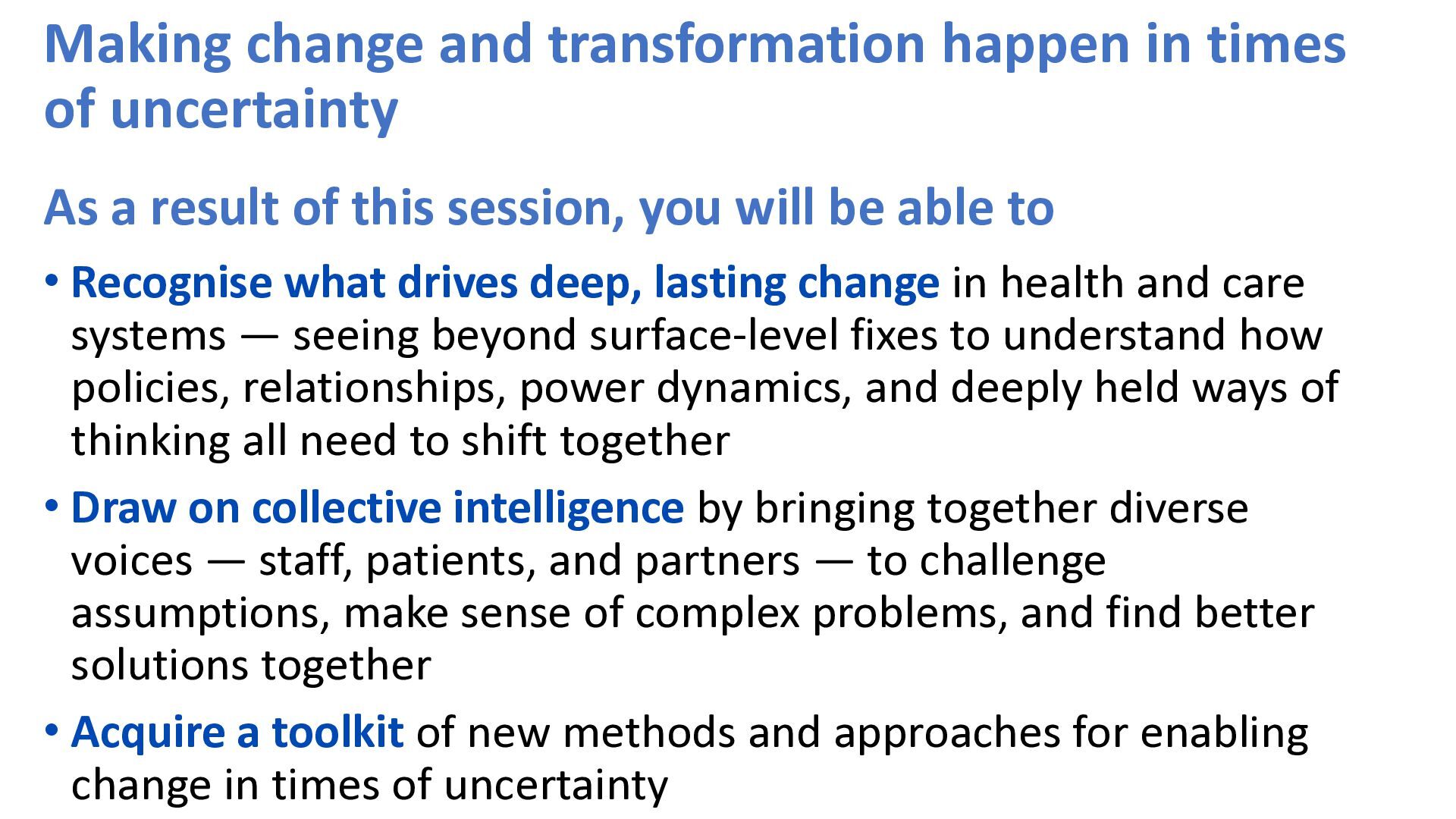
    a result of this session, you will be able to • Recognise what drives deep, lasting change in health and care systems — seeing beyond surface-level fixes to understand how policies, relationships, power dynamics, and deeply held ways of thinking all need to shift together • Draw on collective intelligence by bringing together diverse voices — staff, patients, and partners — to challenge assumptions, make sense of complex problems, and find better solutions together • Acquire a toolkit of new methods and approaches for enabling change in times of uncertainty
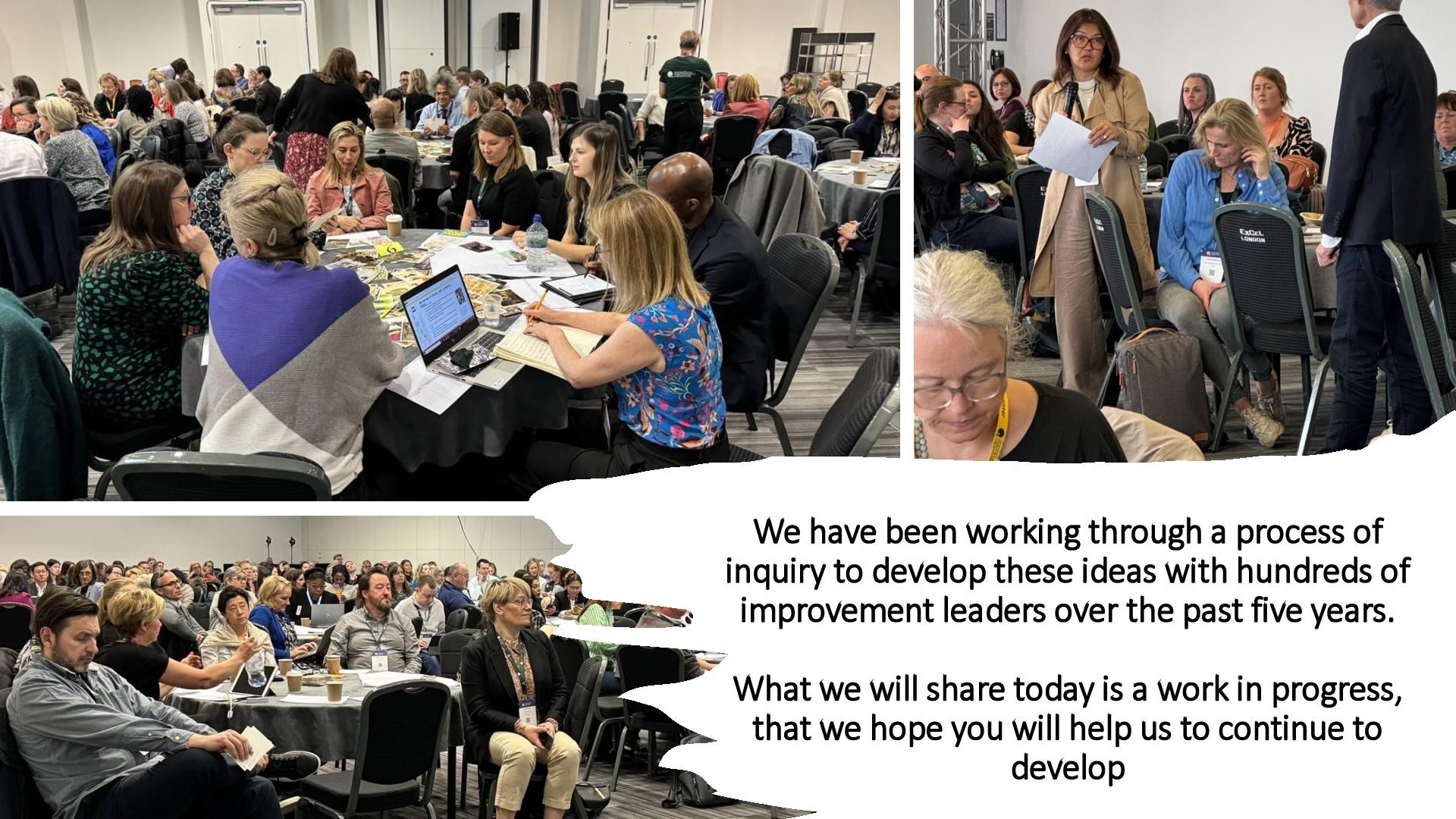
  2. We have been working through a process of inquiry to

    develop these ideas with hundreds of improvement leaders over the past five years. What we will share today is a work in progress, that we hope you will help us to continue to develop
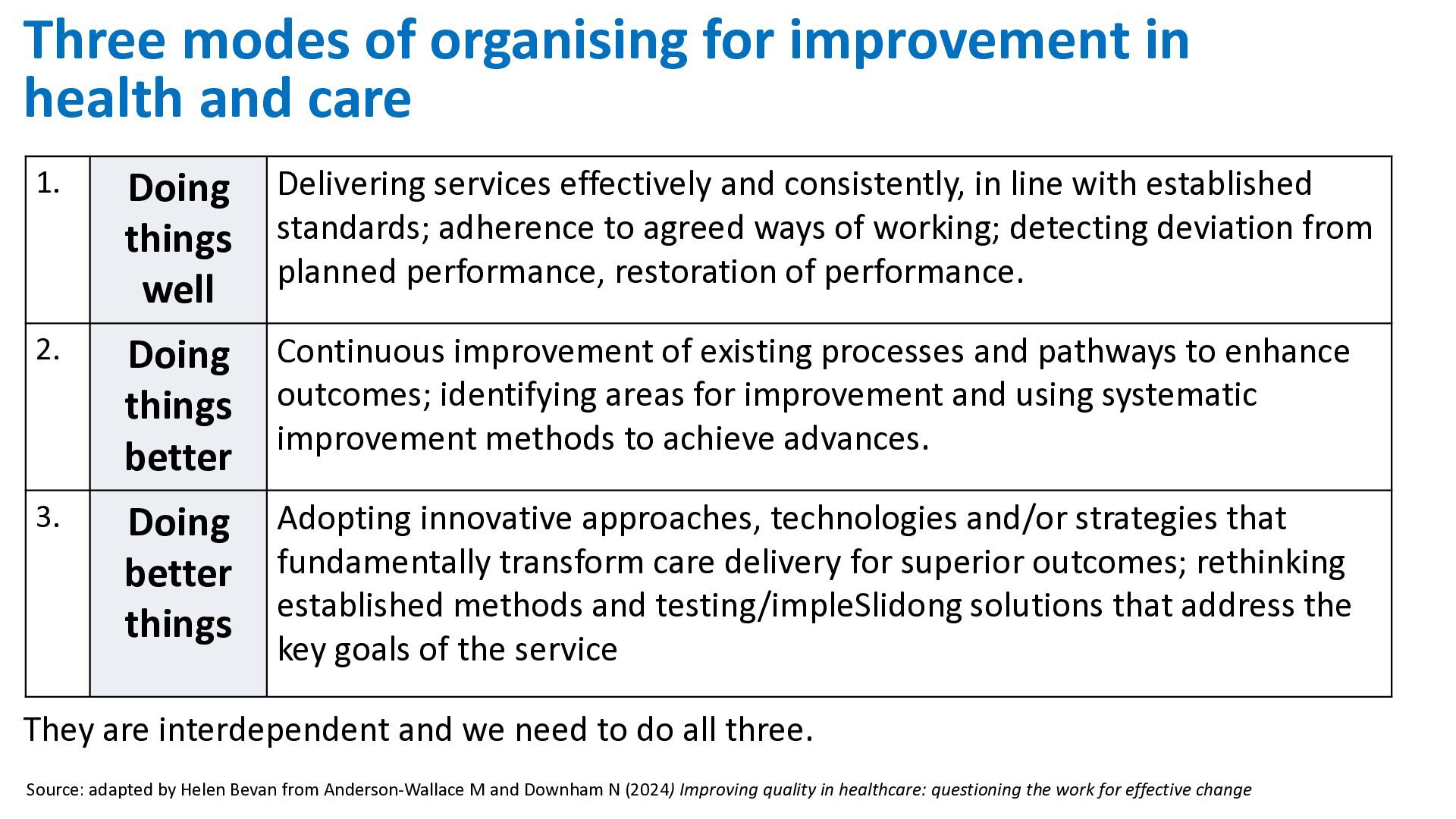
  3. Three modes of organising for improvement in health and care

    1. Doing things well Delivering services effectively and consistently, in line with established standards; adherence to agreed ways of working; detecting deviation from planned performance, restoration of performance. 2. Doing things better Continuous improvement of existing processes and pathways to enhance outcomes; identifying areas for improvement and using systematic improvement methods to achieve advances. 3. Doing better things Adopting innovative approaches, technologies and/or strategies that fundamentally transform care delivery for superior outcomes; rethinking established methods and testing/impleSlidong solutions that address the key goals of the service They are interdependent and we need to do all three. Source: adapted by Helen Bevan from Anderson-Wallace M and Downham N (2024) Improving quality in healthcare: questioning the work for effective change
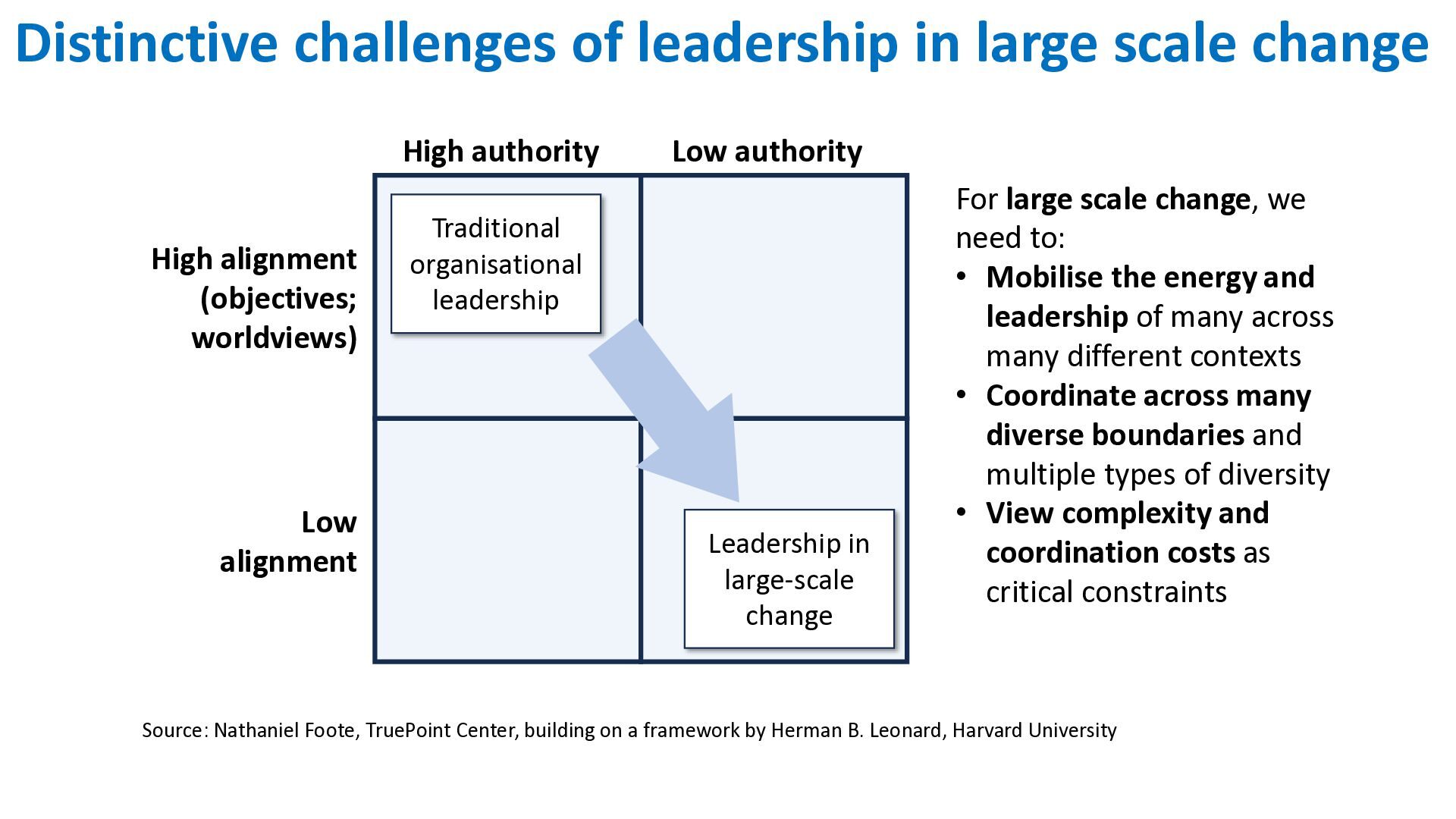
  4. Distinctive challenges of leadership in large scale change High authority

    Low authority Low alignment High alignment (objectives; worldviews) Traditional organisational leadership Leadership in large-scale change For large scale change, we need to: • Mobilise the energy and leadership of many across many different contexts • Coordinate across many diverse boundaries and multiple types of diversity • View complexity and coordination costs as critical constraints Source: Nathaniel Foote, TruePoint Center, building on a framework by Herman B. Leonard, Harvard University
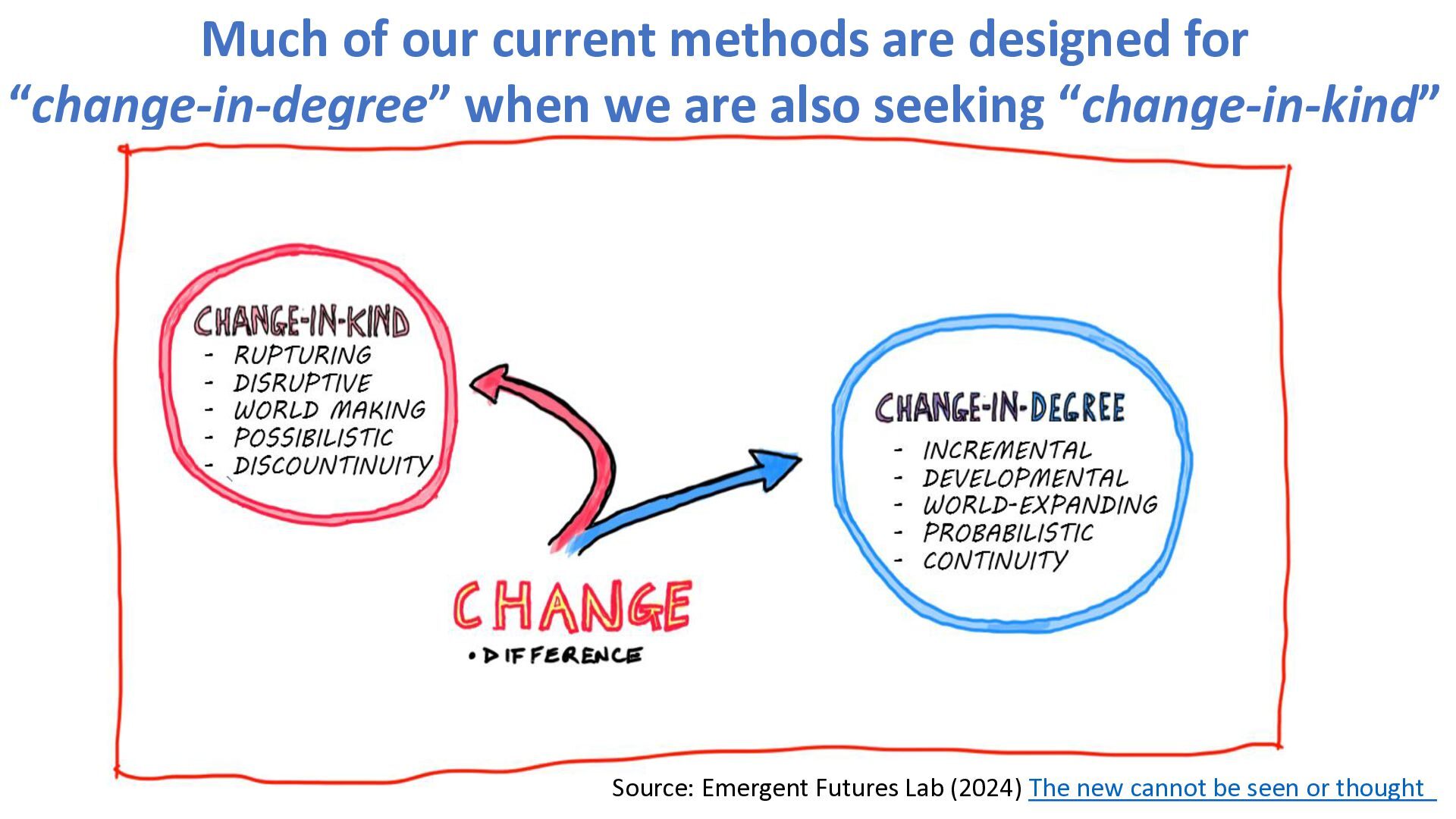
  5. WORLD EXPANDING Much of our current methods are designed for

    “change-in-degree” when we are also seeking “change-in-kind” Source: Emergent Futures Lab (2024) The new cannot be seen or thought
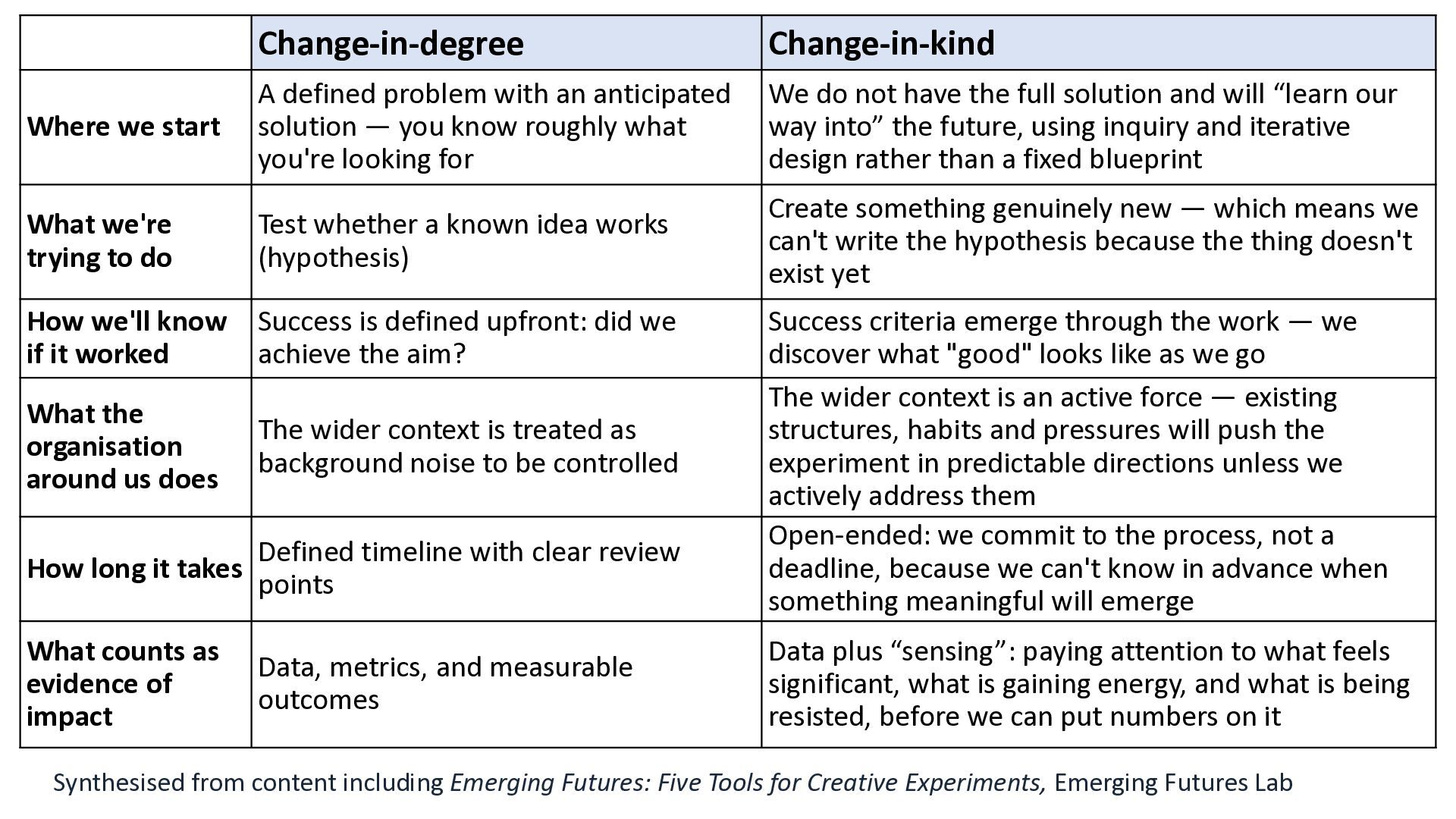
  6. Change-in-degree Change-in-kind Where we start A defined problem with an

    anticipated solution — you know roughly what you're looking for We do not have the full solution and will “learn our way into” the future, using inquiry and iterative design rather than a fixed blueprint What we're trying to do Test whether a known idea works (hypothesis) Create something genuinely new — which means we can't write the hypothesis because the thing doesn't exist yet How we'll know if it worked Success is defined upfront: did we achieve the aim? Success criteria emerge through the work — we discover what "good" looks like as we go What the organisation around us does The wider context is treated as background noise to be controlled The wider context is an active force — existing structures, habits and pressures will push the experiment in predictable directions unless we actively address them How long it takes Defined timeline with clear review points Open-ended: we commit to the process, not a deadline, because we can't know in advance when something meaningful will emerge What counts as evidence of impact Data, metrics, and measurable outcomes Data plus “sensing”: paying attention to what feels significant, what is gaining energy, and what is being resisted, before we can put numbers on it Synthesised from content including Emerging Futures: Five Tools for Creative Experiments, Emerging Futures Lab
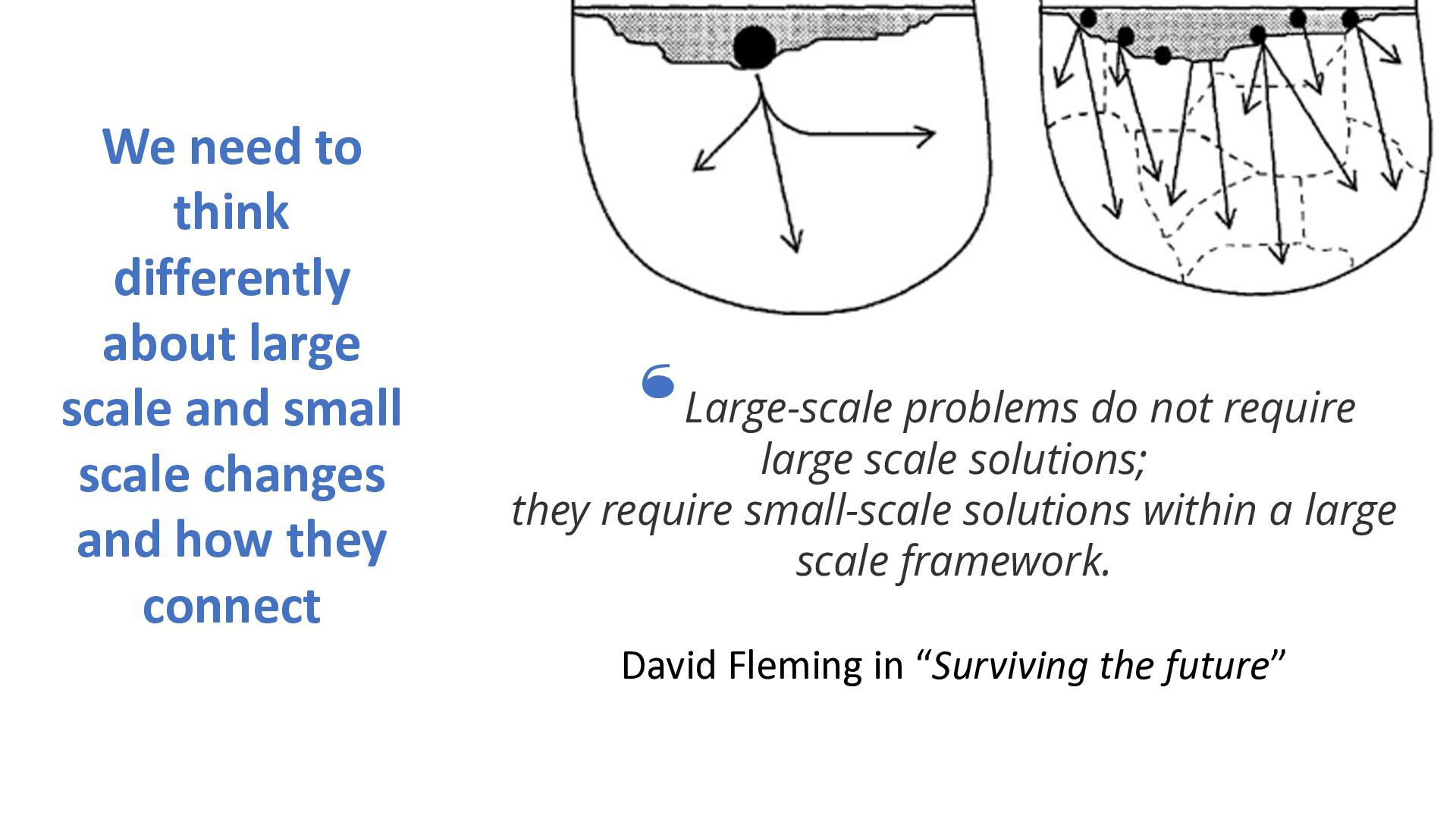
  7. Large-scale problems do not require large scale solutions; they require

    small-scale solutions within a large scale framework. David Fleming in “Surviving the future” ‘ We need to think differently about large scale and small scale changes and how they connect
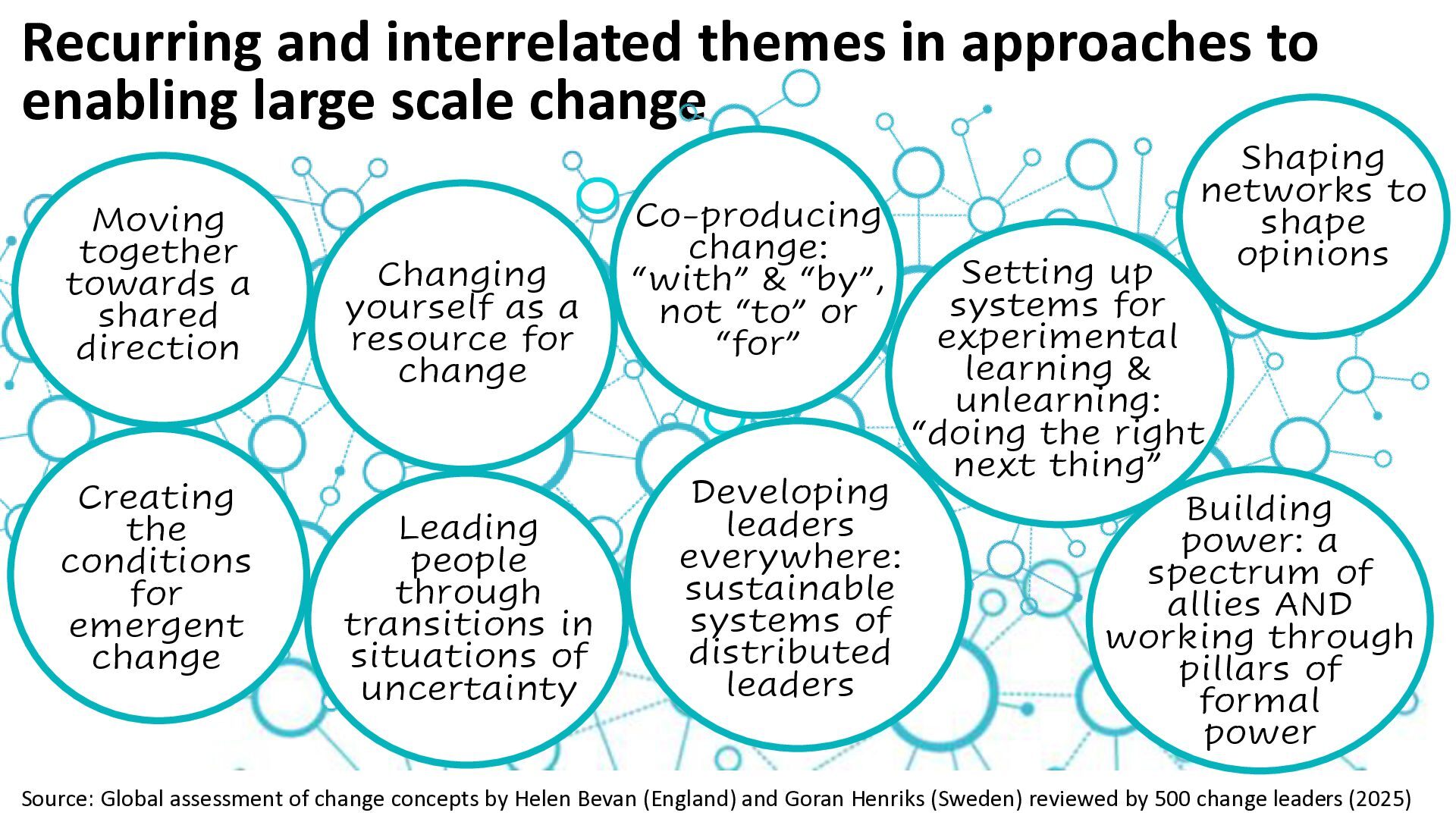
  8. Recurring and interrelated themes in approaches to enabling large scale

    change Moving together towards a shared direction Co-producing change: “with” & “by”, not “to” or “for” Setting up systems for experimental learning & unlearning: “doing the right next thing” Developing leaders everywhere: sustainable systems of distributed leaders Building power: a spectrum of allies AND working through pillars of formal power Changing yourself as a resource for change Shaping networks to shape opinions Source: Global assessment of change concepts by Helen Bevan (England) and Goran Henriks (Sweden) reviewed by 500 change leaders (2025) Leading people through transitions in situations of uncertainty Creating the conditions for emergent change
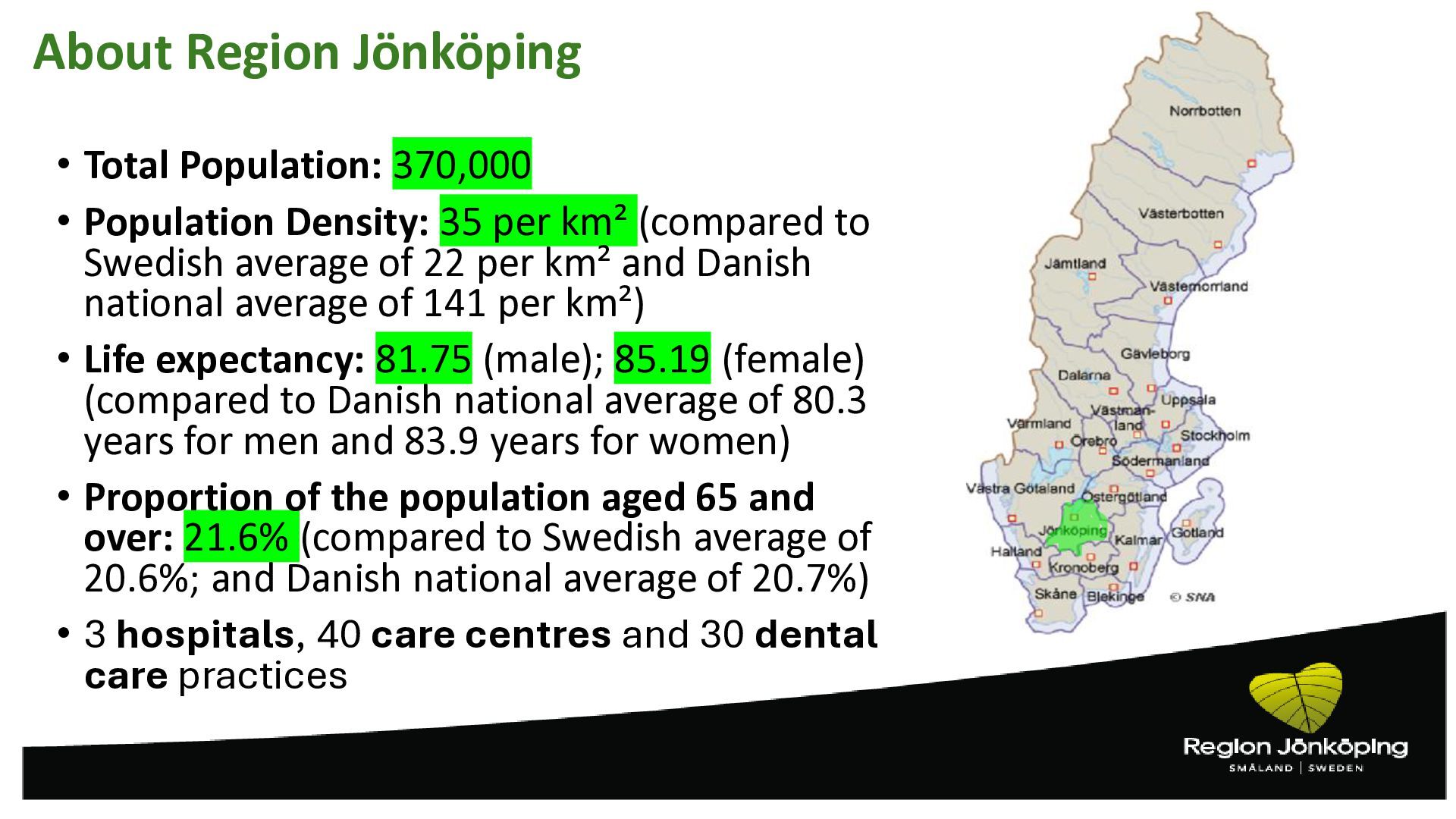
  9. About Region Jönköping • Total Population: 370,000 • Population Density:

    35 per km² (compared to Swedish average of 22 per km² and Danish national average of 141 per km²) • Life expectancy: 81.75 (male); 85.19 (female) (compared to Danish national average of 80.3 years for men and 83.9 years for women) • Proportion of the population aged 65 and over: 21.6% (compared to Swedish average of 20.6%; and Danish national average of 20.7%) • 3 hospitals, 40 care centres and 30 dental care practices
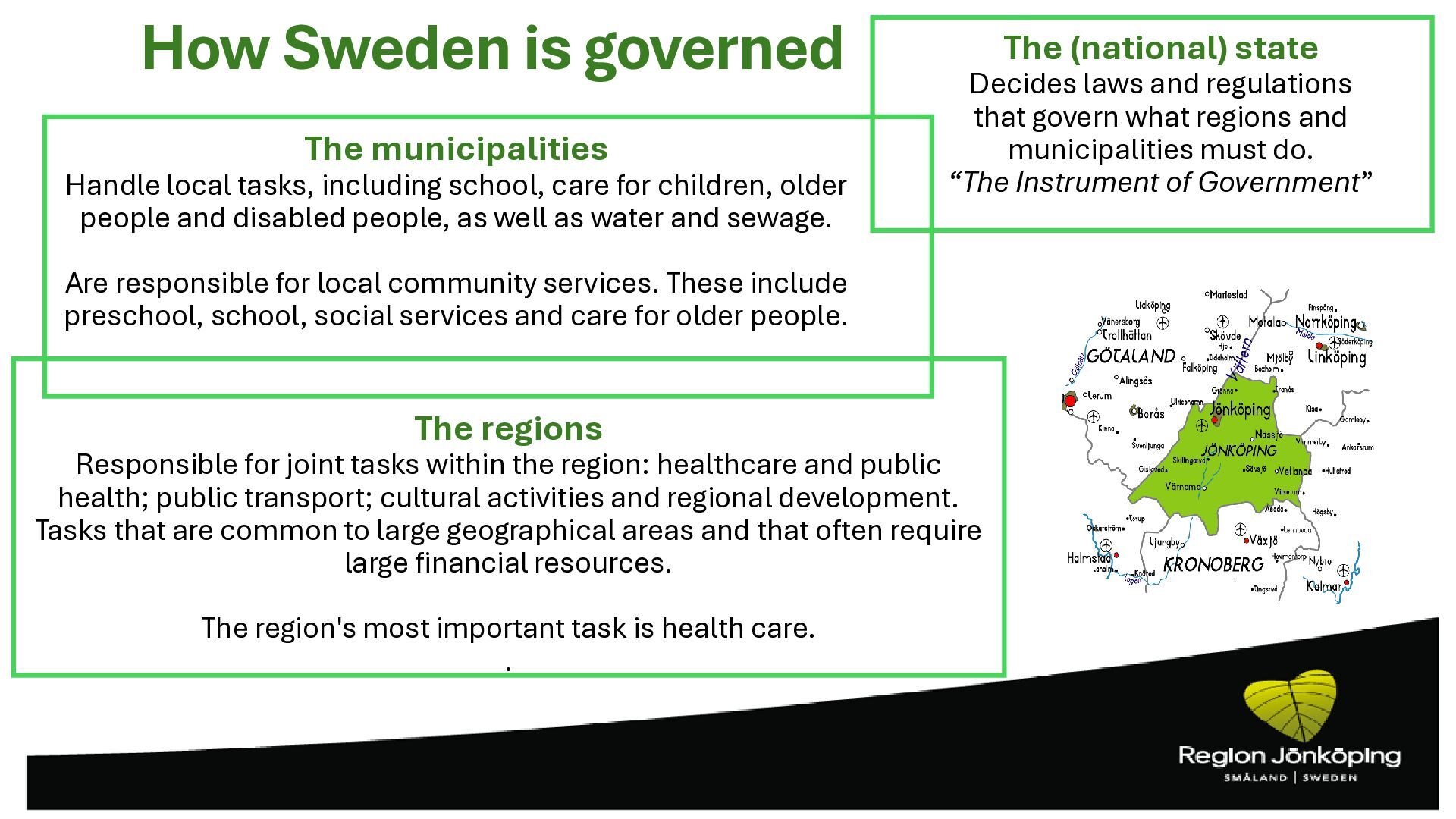
  10. How Sweden is governed The (national) state Decides laws and

    regulations that govern what regions and municipalities must do. “The Instrument of Government” The municipalities Handle local tasks, including school, care for children, older people and disabled people, as well as water and sewage. Are responsible for local community services. These include preschool, school, social services and care for older people. The regions Responsible for joint tasks within the region: healthcare and public health; public transport; cultural activities and regional development. Tasks that are common to large geographical areas and that often require large financial resources. The region's most important task is health care. .
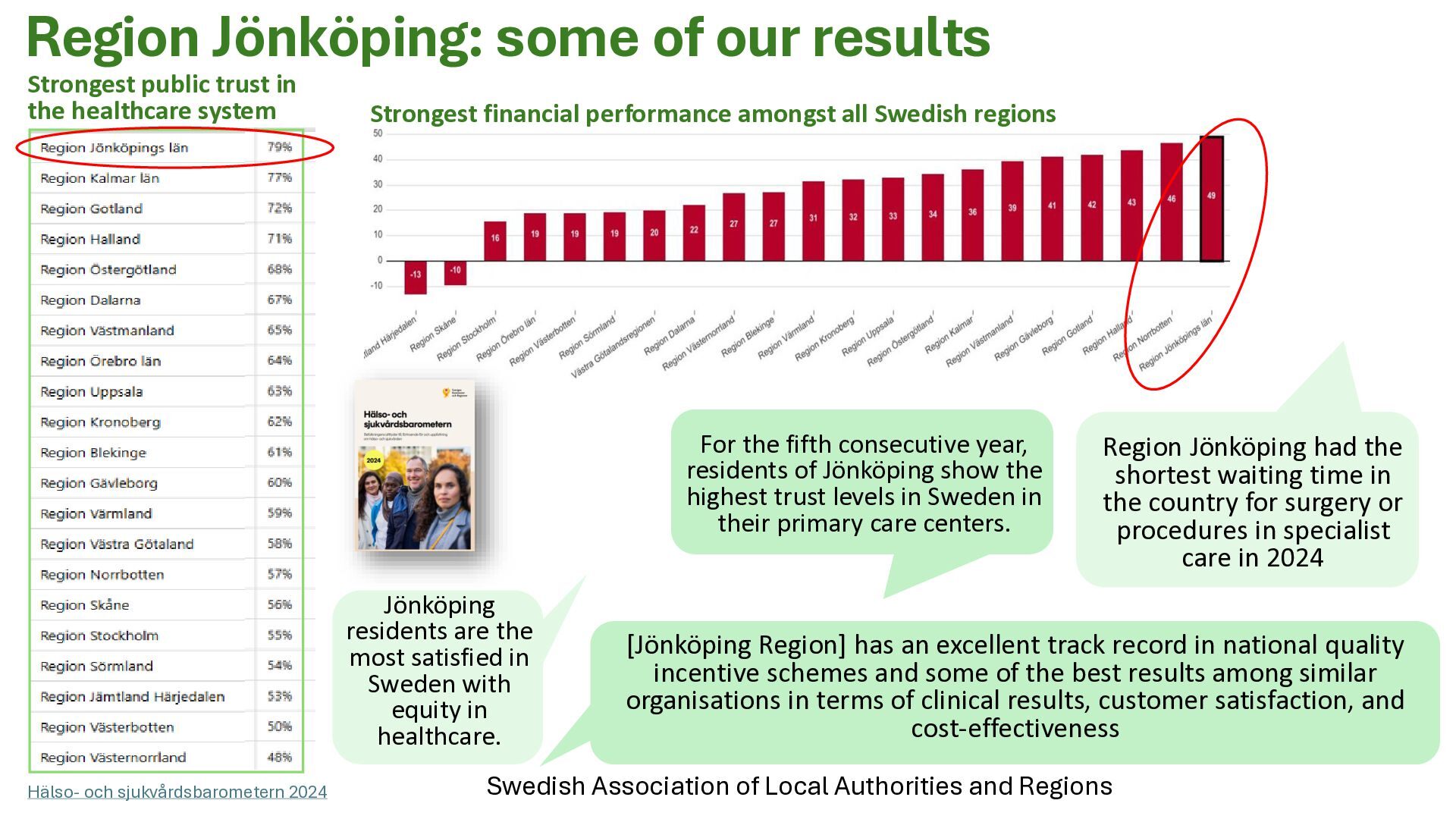
  11. Region Jönköping: some of our results Strongest public trust in

    the healthcare system Strongest financial performance amongst all Swedish regions Region Jönköping had the shortest waiting time in the country for surgery or procedures in specialist care in 2024 Jönköping residents are the most satisfied in Sweden with equity in healthcare. [Jönköping Region] has an excellent track record in national quality incentive schemes and some of the best results among similar organisations in terms of clinical results, customer satisfaction, and cost-effectiveness Hälso- och sjukvårdsbarometern 2024 Swedish Association of Local Authorities and Regions For the fifth consecutive year, residents of Jönköping show the highest trust levels in Sweden in their primary care centers.
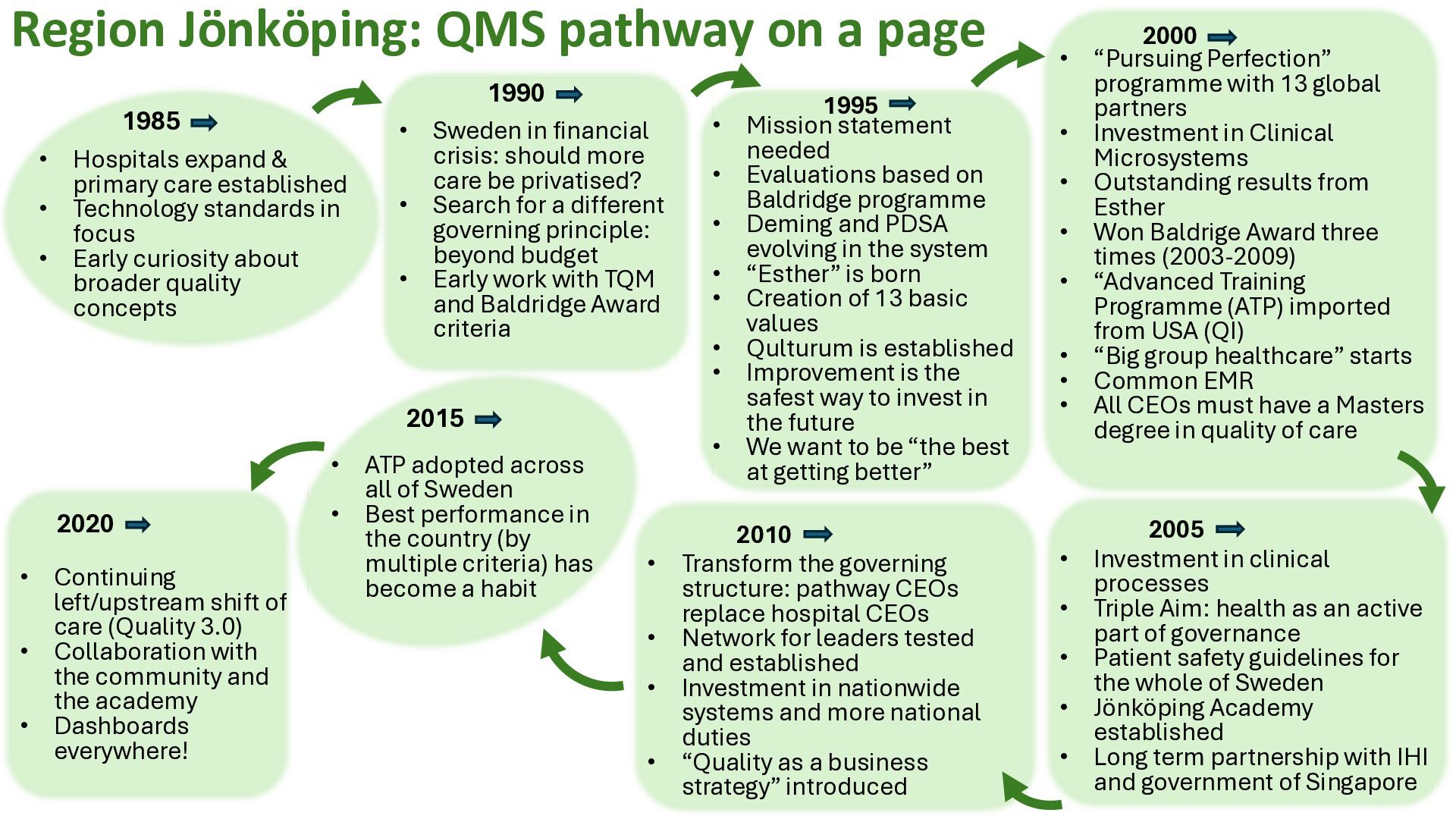
  12. Region Jönköping: QMS pathway on a page 1985 • Hospitals

    expand & primary care established • Technology standards in focus • Early curiosity about broader quality concepts 1990 • Sweden in financial crisis: should more care be privatised? • Search for a different governing principle: beyond budget • Early work with TQM and Baldridge Award criteria • Mission statement needed • Evaluations based on Baldridge programme • Deming and PDSA evolving in the system • “Esther” is born • Creation of 13 basic values • Qulturum is established • Improvement is the safest way to invest in the future • We want to be “the best at getting better” 1995 • “Pursuing Perfection” programme with 13 global partners • Investment in Clinical Microsystems • Outstanding results from Esther • Won Baldrige Award three times (2003-2009) • “Advanced Training Programme (ATP) imported from USA (QI) • “Big group healthcare” starts • Common EMR • All CEOs must have a Masters degree in quality of care 2000 • Investment in clinical processes • Triple Aim: health as an active part of governance • Patient safety guidelines for the whole of Sweden • Jönköping Academy established • Long term partnership with IHI and government of Singapore 2005 • Transform the governing structure: pathway CEOs replace hospital CEOs • Network for leaders tested and established • Investment in nationwide systems and more national duties • “Quality as a business strategy” introduced 2010 2015 • ATP adopted across all of Sweden • Best performance in the country (by multiple criteria) has become a habit 2020 • Continuing left/upstream shift of care (Quality 3.0) • Collaboration with the community and the academy • Dashboards everywhere!
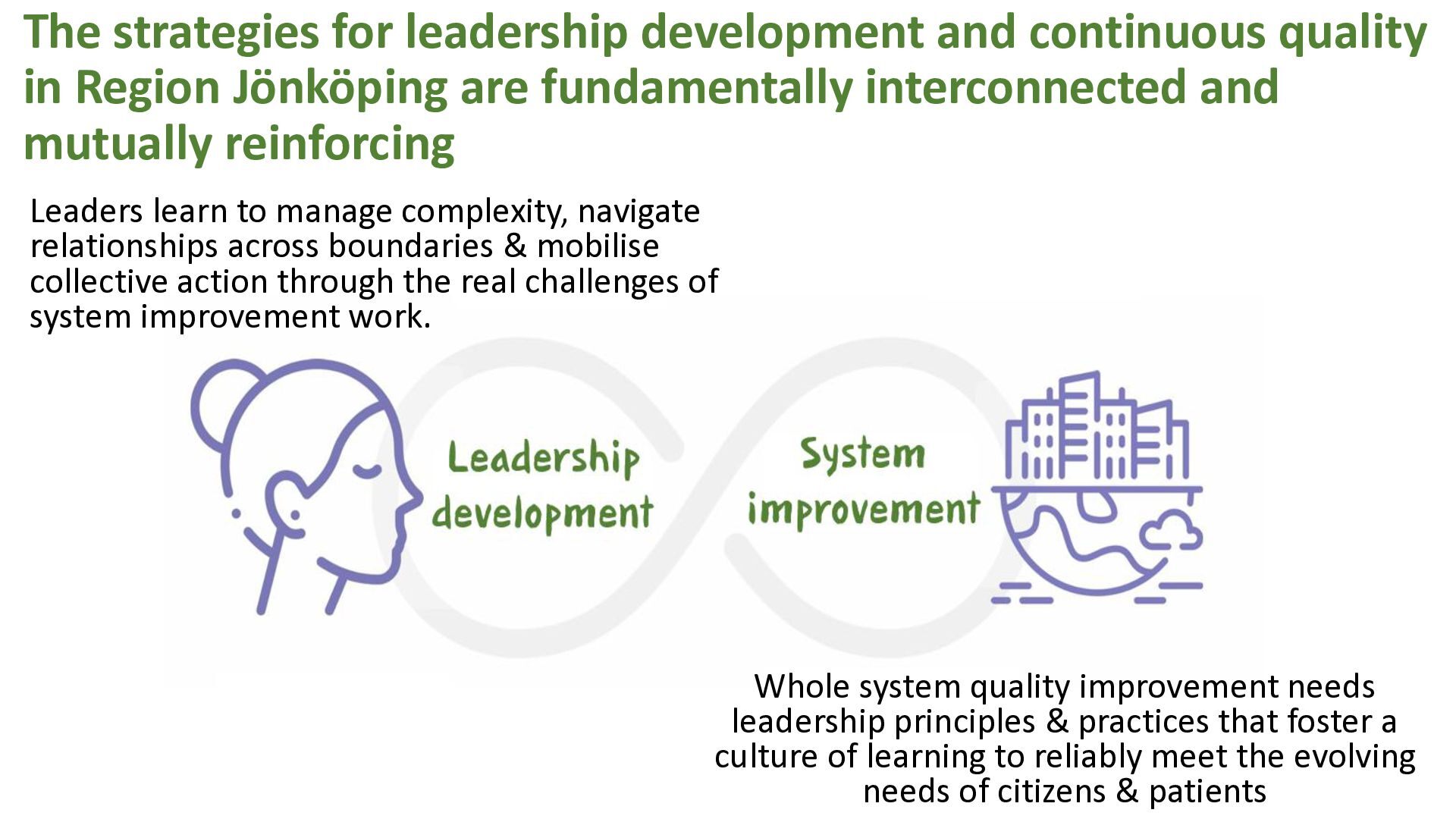
  13. The strategies for leadership development and continuous quality in Region

    Jönköping are fundamentally interconnected and mutually reinforcing Whole system quality improvement needs leadership principles & practices that foster a culture of learning to reliably meet the evolving needs of citizens & patients Leaders learn to manage complexity, navigate relationships across boundaries & mobilise collective action through the real challenges of system improvement work.
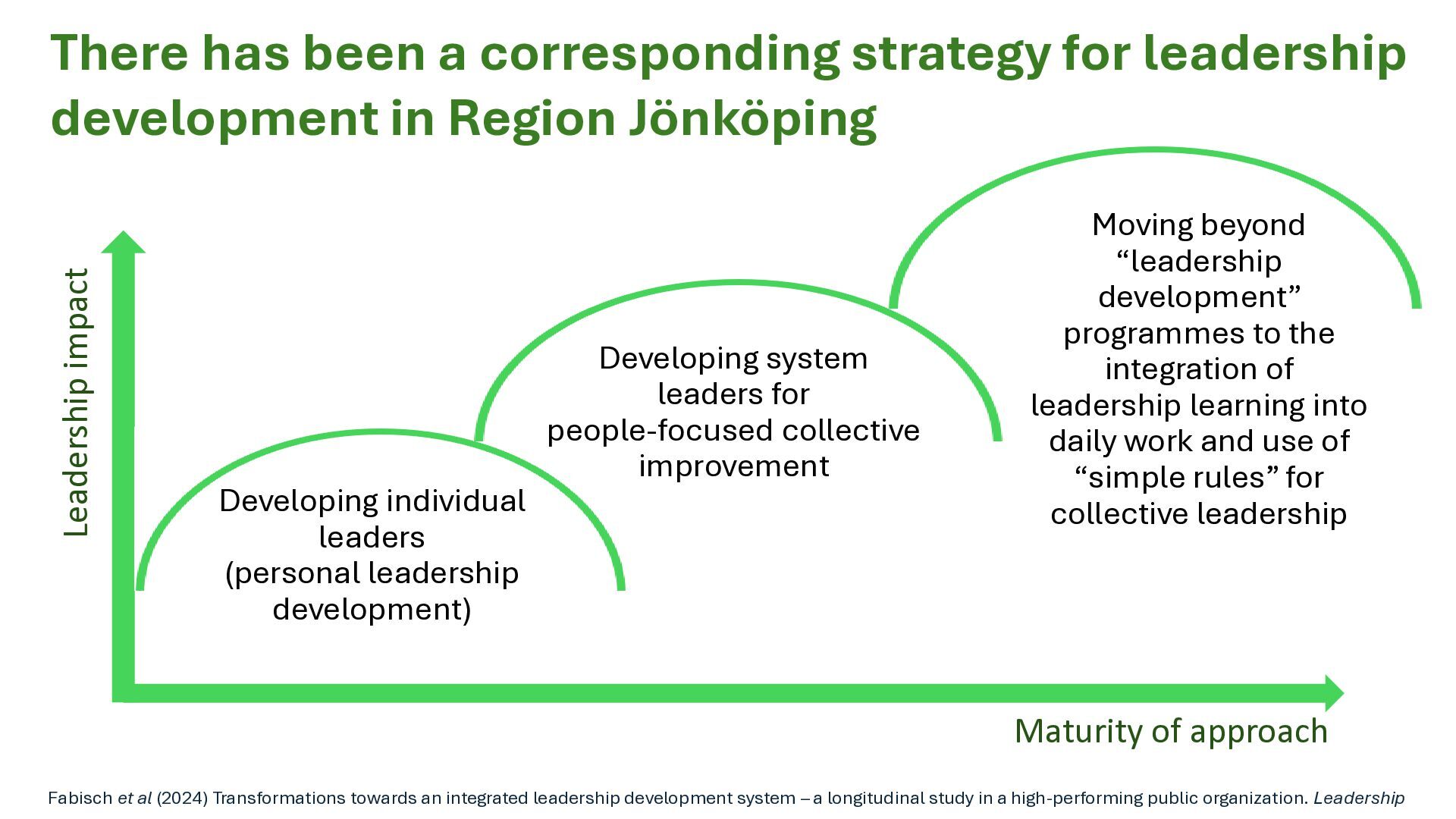
  14. Maturity of approach Leadership impact Developing individual leaders (personal leadership

    development) Developing system leaders for people-focused collective improvement Moving beyond “leadership development” programmes to the integration of leadership learning into daily work and use of “simple rules” for collective leadership There has been a corresponding strategy for leadership development in Region Jönköping Fabisch et al (2024) Transformations towards an integrated leadership development system – a longitudinal study in a high-performing public organization. Leadership
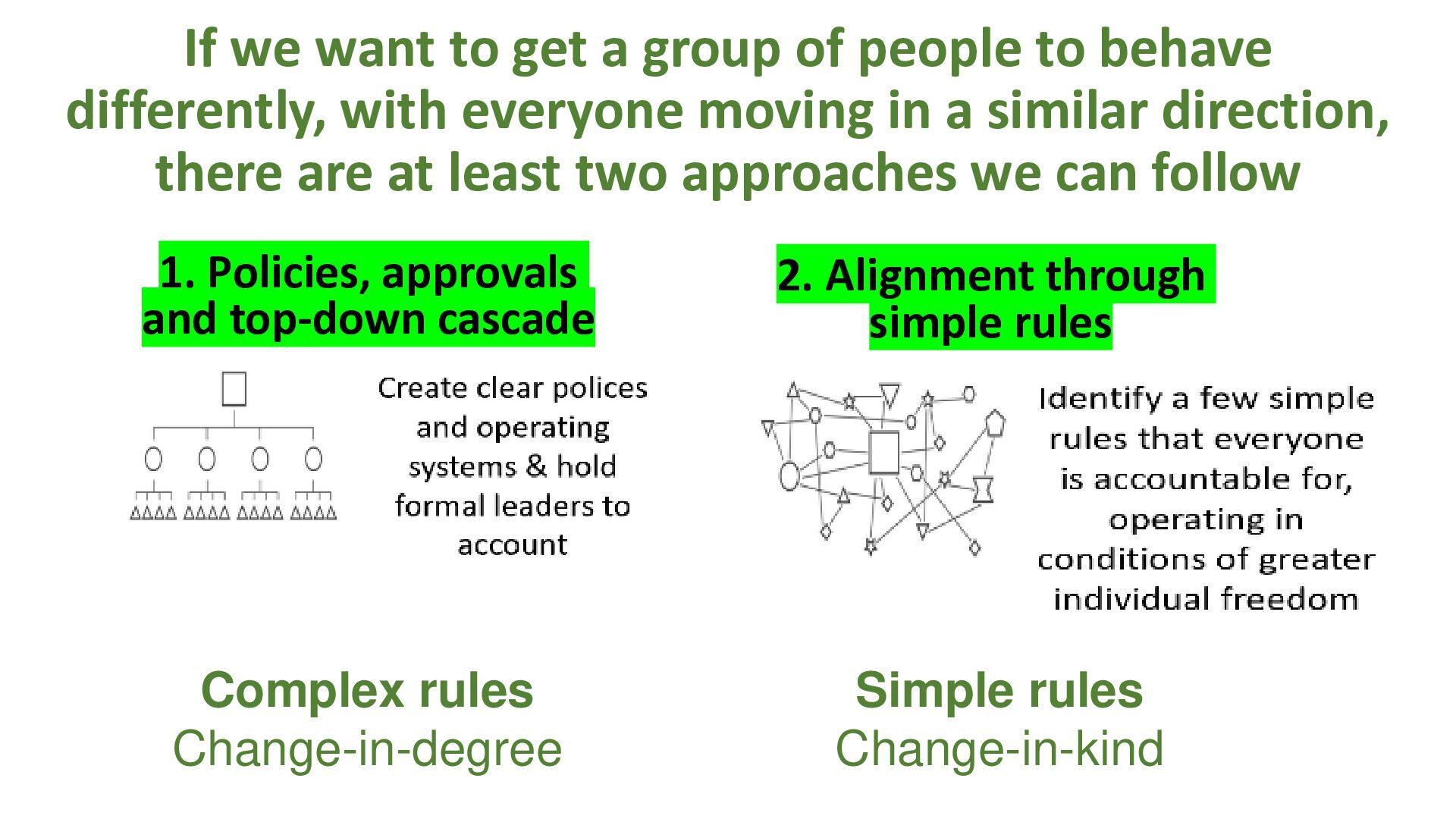
  15. If we want to get a group of people to

    behave differently, with everyone moving in a similar direction, there are at least two approaches we can follow Complex rules Change-in-degree Simple rules Change-in-kind 1. Policies, approvals and top-down cascade 2. Alignment through simple rules
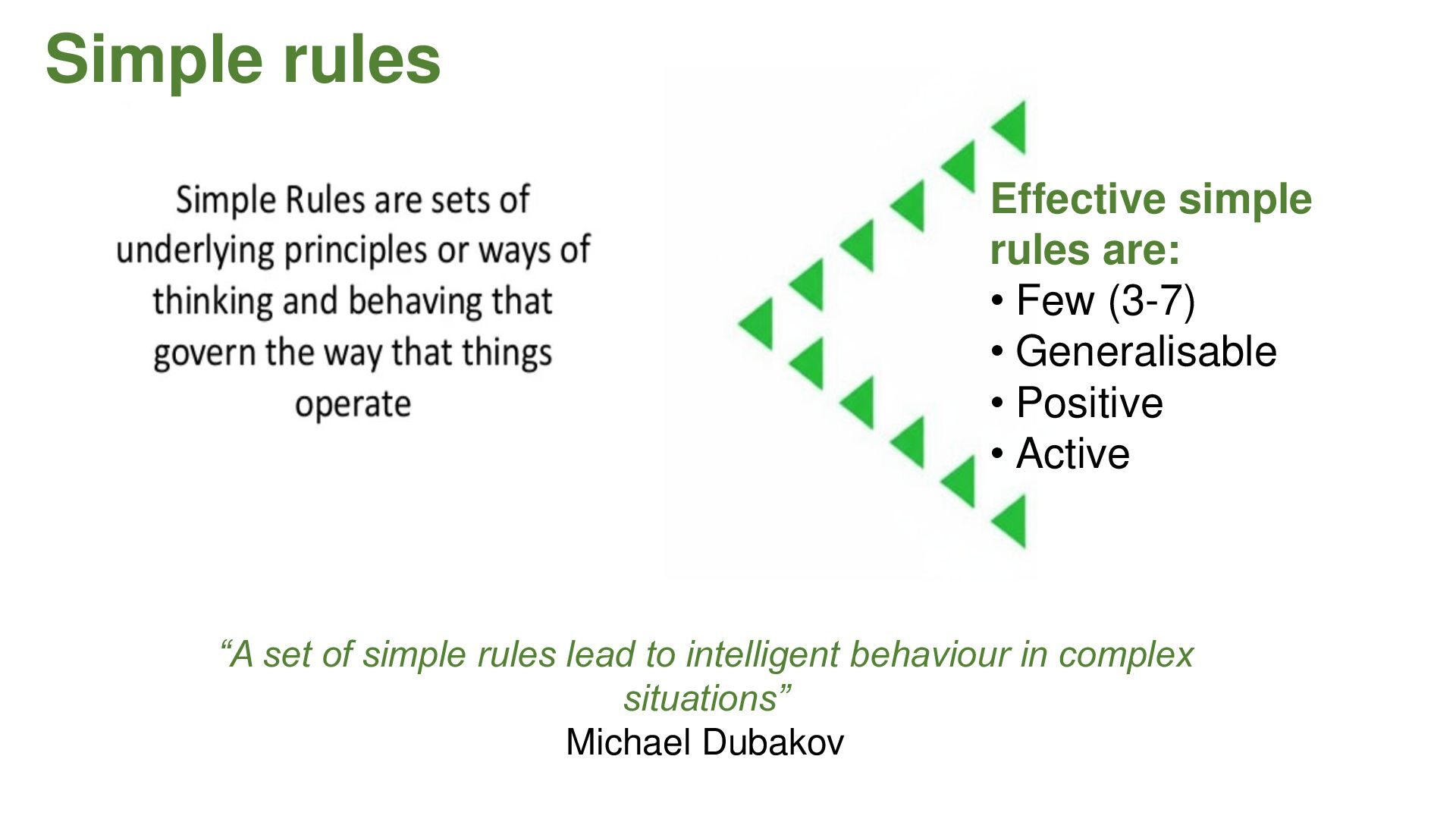
  16. Simple rules “A set of simple rules lead to intelligent

    behaviour in complex situations” Michael Dubakov Effective simple rules are: • Few (3-7) • Generalisable • Positive • Active
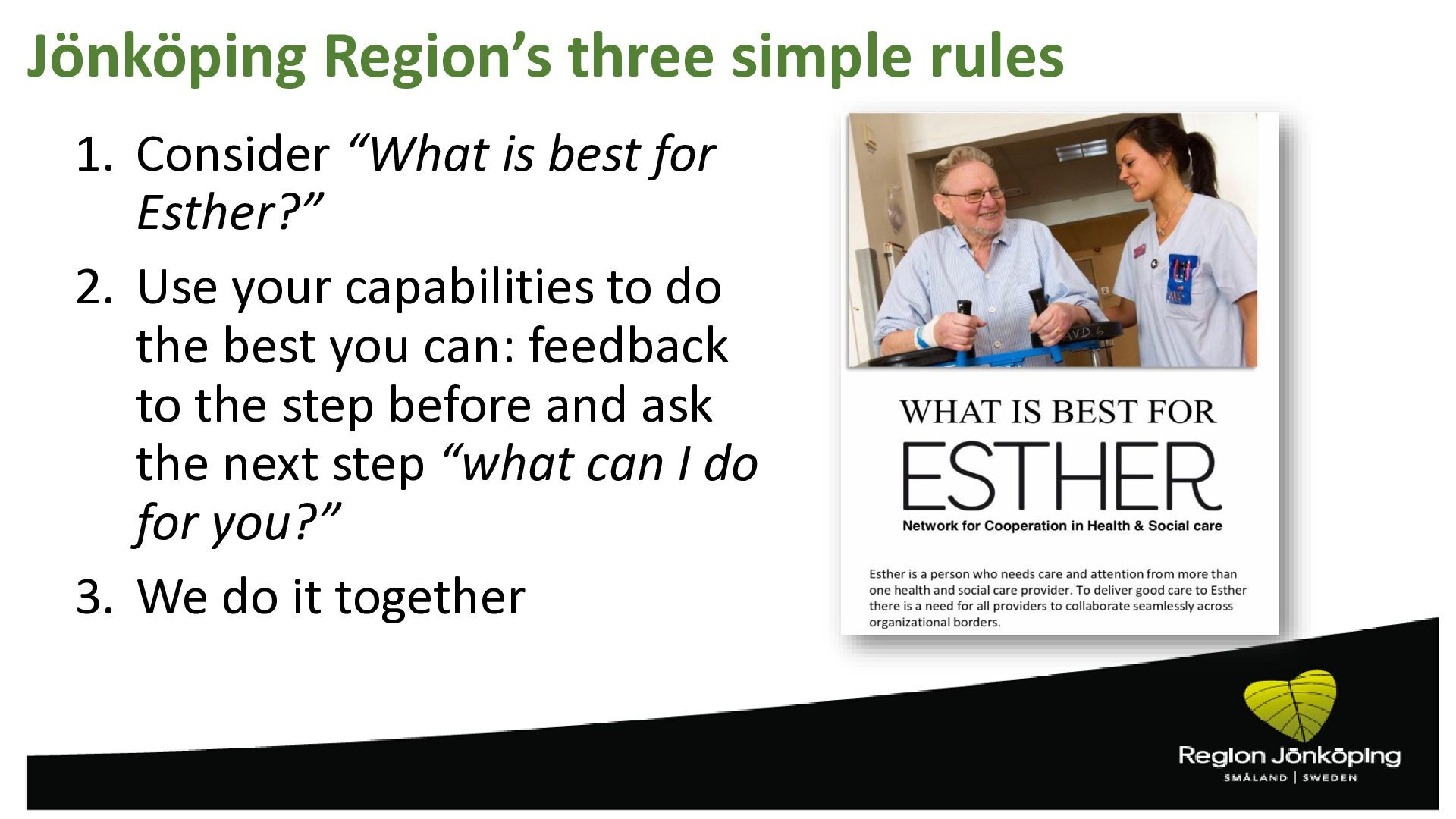
  17. Jönköping Region’s three simple rules 1. Consider “What is best

    for Esther?” 2. Use your capabilities to do the best you can: feedback to the step before and ask the next step “what can I do for you?” 3. We do it together
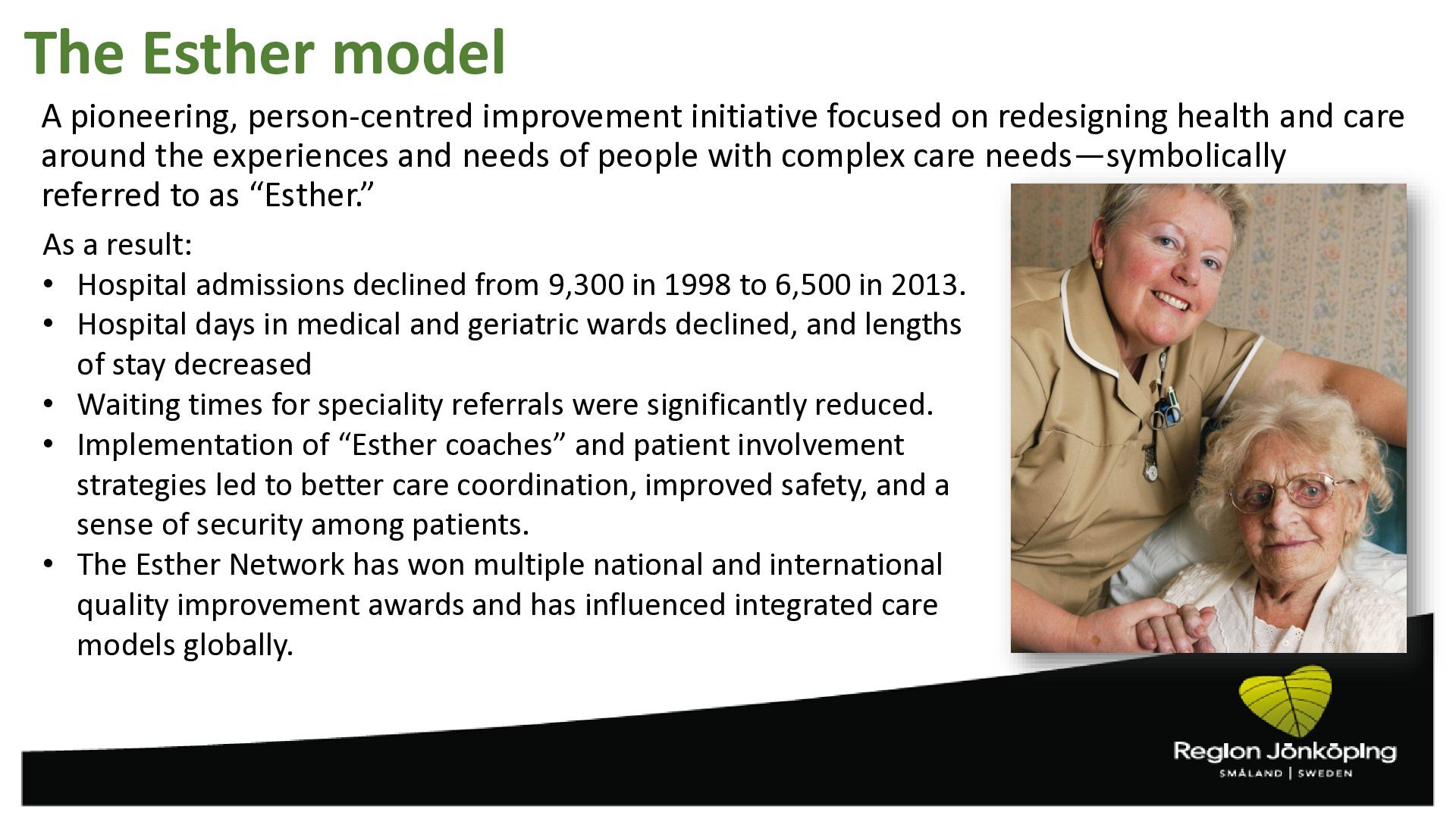
  18. The Esther model A pioneering, person-centred improvement initiative focused on

    redesigning health and care around the experiences and needs of people with complex care needs—symbolically referred to as “Esther.” As a result: • Hospital admissions declined from 9,300 in 1998 to 6,500 in 2013. • Hospital days in medical and geriatric wards declined, and lengths of stay decreased • Waiting times for speciality referrals were significantly reduced. • Implementation of “Esther coaches” and patient involvement strategies led to better care coordination, improved safety, and a sense of security among patients. • The Esther Network has won multiple national and international quality improvement awards and has influenced integrated care models globally.
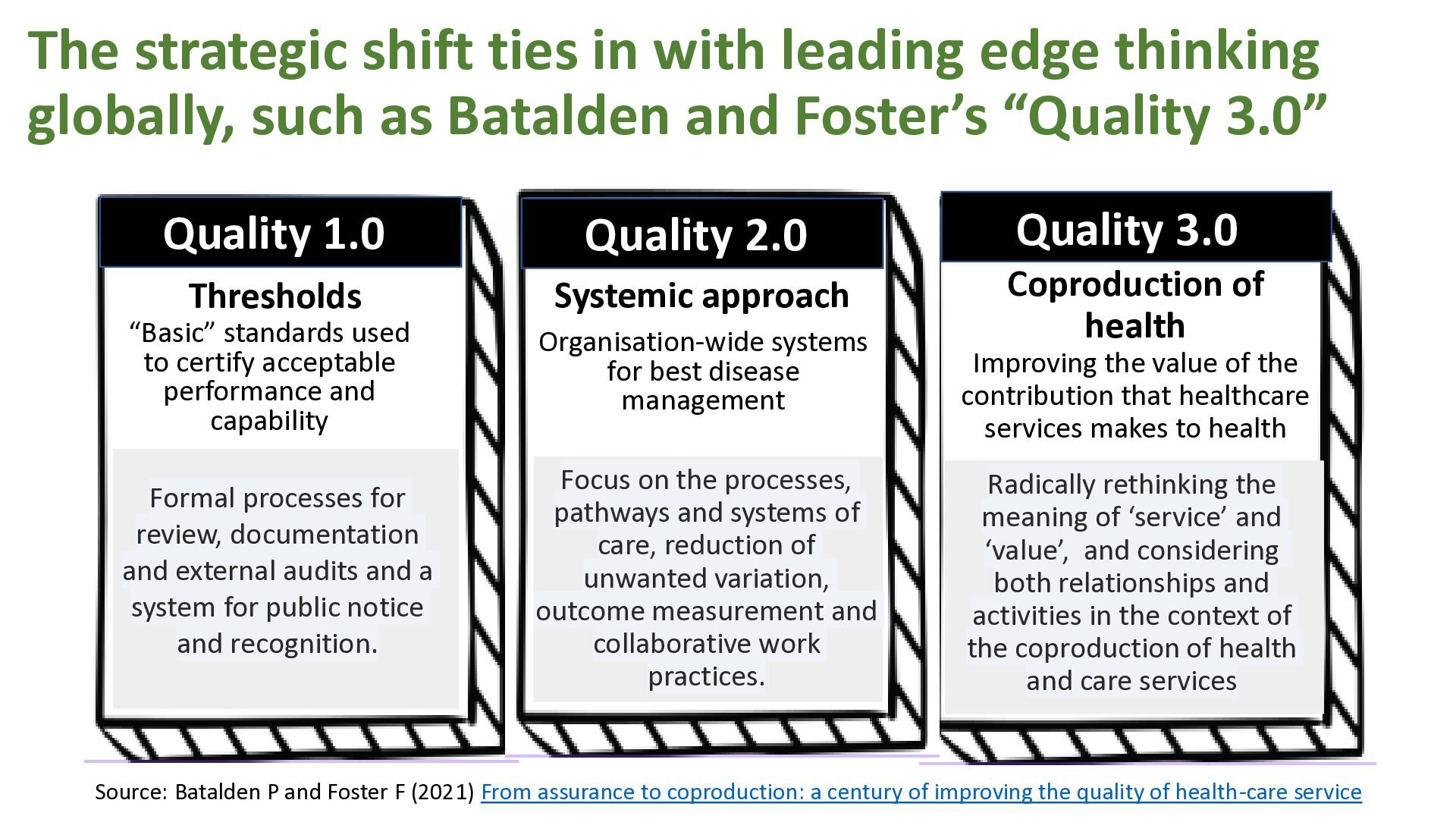
  19. The strategic shift ties in with leading edge thinking globally,

    such as Batalden and Foster’s “Quality 3.0” Quality 1.0 Quality 1.0 Quality 3.0 Quality 2.0 Formal processes for review, documentation and external audits and a system for public notice and recognition. Systemic approach Coproduction of health Improving the value of the contribution that healthcare services makes to health Focus on the processes, pathways and systems of care, reduction of unwanted variation, outcome measurement and collaborative work practices. Source: Batalden P and Foster F (2021) From assurance to coproduction: a century of improving the quality of health-care service Thresholds “Basic” standards used to certify acceptable performance and capability Organisation-wide systems for best disease management Radically rethinking the meaning of ‘service’ and ‘value’, and considering both relationships and activities in the context of the coproduction of health and care services
  20. Investing in leaders at Region Jönköping • From 2010 onwards,

    we saw limitations in the move to process orientation: we needed to shift to leadership development • From 2012, we put 550 leaders through half day sessions 4-5 times a year to discuss strategy • We started “Big Group healthcare”, bringing the top leadership and Chiefs of Department together 4-5 times a year • Twice a year, there is a full day of following clinical process results – top leaders, plus chiefs, plus process leads • When a new Chief is appointed they get 12-16 days of development. After five years in post, they get 12-16 days more • Every year, there is 360 degree evaluation of all leaders
  21. References • Alderwick, H., Ham, C., & Buck, D. (2015).

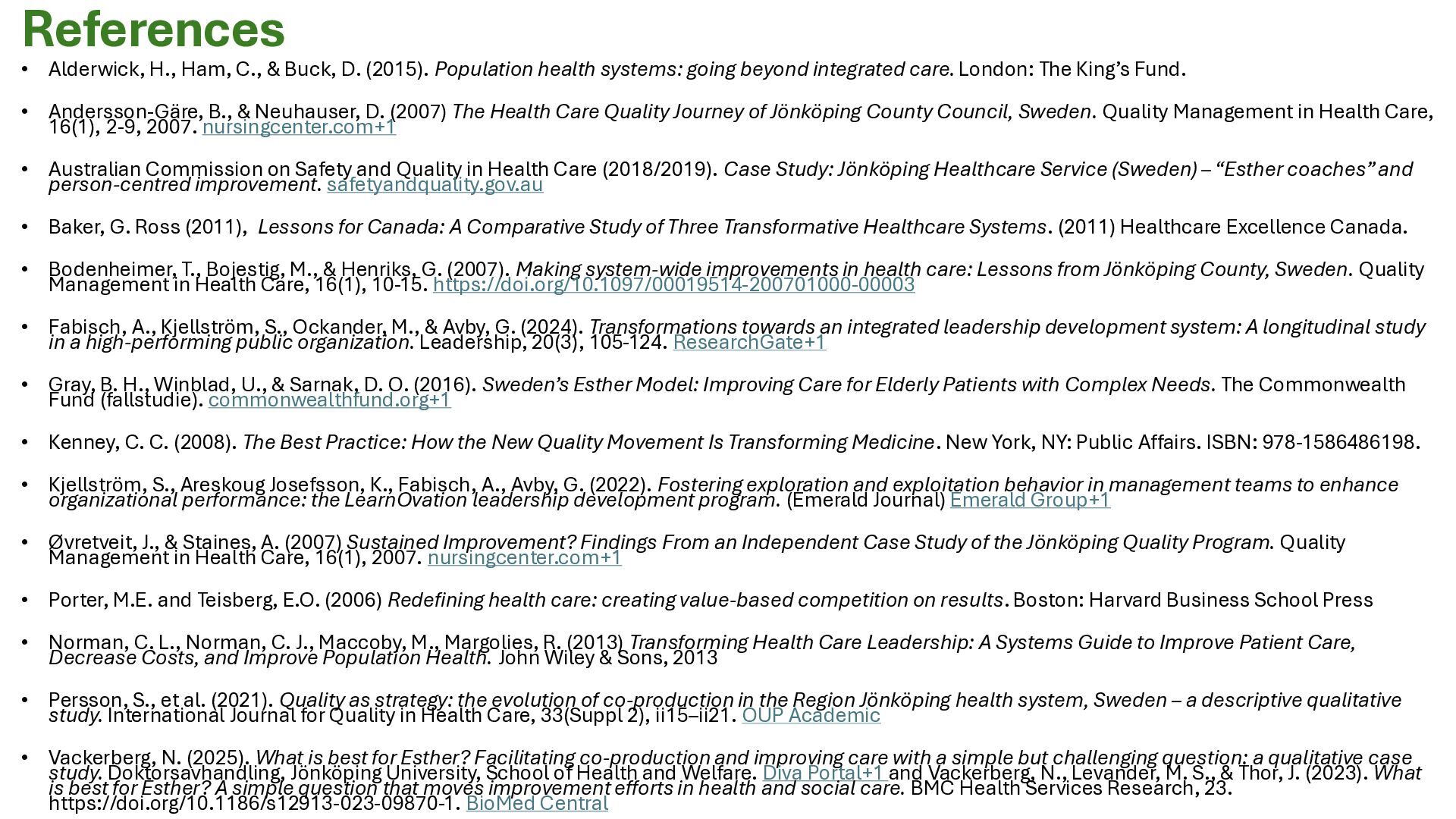
    Population health systems: going beyond integrated care. London: The King’s Fund. • Andersson-Gäre, B., & Neuhauser, D. (2007) The Health Care Quality Journey of Jönköping County Council, Sweden. Quality Management in Health Care, 16(1), 2-9, 2007. nursingcenter.com+1 • Australian Commission on Safety and Quality in Health Care (2018/2019). Case Study: Jönköping Healthcare Service (Sweden) – “Esther coaches” and person-centred improvement. safetyandquality.gov.au • Baker, G. Ross (2011), Lessons for Canada: A Comparative Study of Three Transformative Healthcare Systems. (2011) Healthcare Excellence Canada. • Bodenheimer, T., Bojestig, M., & Henriks, G. (2007). Making system-wide improvements in health care: Lessons from Jönköping County, Sweden. Quality Management in Health Care, 16(1), 10-15. https://doi.org/10.1097/00019514-200701000-00003 • Fabisch, A., Kjellström, S., Ockander, M., & Avby, G. (2024). Transformations towards an integrated leadership development system: A longitudinal study in a high-performing public organization. Leadership, 20(3), 105-124. ResearchGate+1 • Gray, B. H., Winblad, U., & Sarnak, D. O. (2016). Sweden’s Esther Model: Improving Care for Elderly Patients with Complex Needs. The Commonwealth Fund (fallstudie). commonwealthfund.org+1 • Kenney, C. C. (2008). The Best Practice: How the New Quality Movement Is Transforming Medicine. New York, NY: Public Affairs. ISBN: 978-1586486198. • Kjellström, S., Areskoug Josefsson, K., Fabisch, A., Avby, G. (2022). Fostering exploration and exploitation behavior in management teams to enhance organizational performance: the LearnOvation leadership development program. (Emerald Journal) Emerald Group+1 • Øvretveit, J., & Staines, A. (2007) Sustained Improvement? Findings From an Independent Case Study of the Jönköping Quality Program. Quality Management in Health Care, 16(1), 2007. nursingcenter.com+1 • Porter, M.E. and Teisberg, E.O. (2006) Redefining health care: creating value-based competition on results. Boston: Harvard Business School Press • Norman, C. L., Norman, C. J., Maccoby, M., Margolies, R. (2013) Transforming Health Care Leadership: A Systems Guide to Improve Patient Care, Decrease Costs, and Improve Population Health. John Wiley & Sons, 2013 • Persson, S., et al. (2021). Quality as strategy: the evolution of co-production in the Region Jönköping health system, Sweden – a descriptive qualitative study. International Journal for Quality in Health Care, 33(Suppl 2), ii15–ii21. OUP Academic • Vackerberg, N. (2025). What is best for Esther? Facilitating co-production and improving care with a simple but challenging question: a qualitative case study. Doktorsavhandling, Jönköping University, School of Health and Welfare. Diva Portal+1 and Vackerberg, N., Levander, M. S., & Thor, J. (2023). What is best for Esther? A simple question that moves improvement efforts in health and social care. BMC Health Services Research, 23. https://doi.org/10.1186/s12913-023-09870-1. BioMed Central
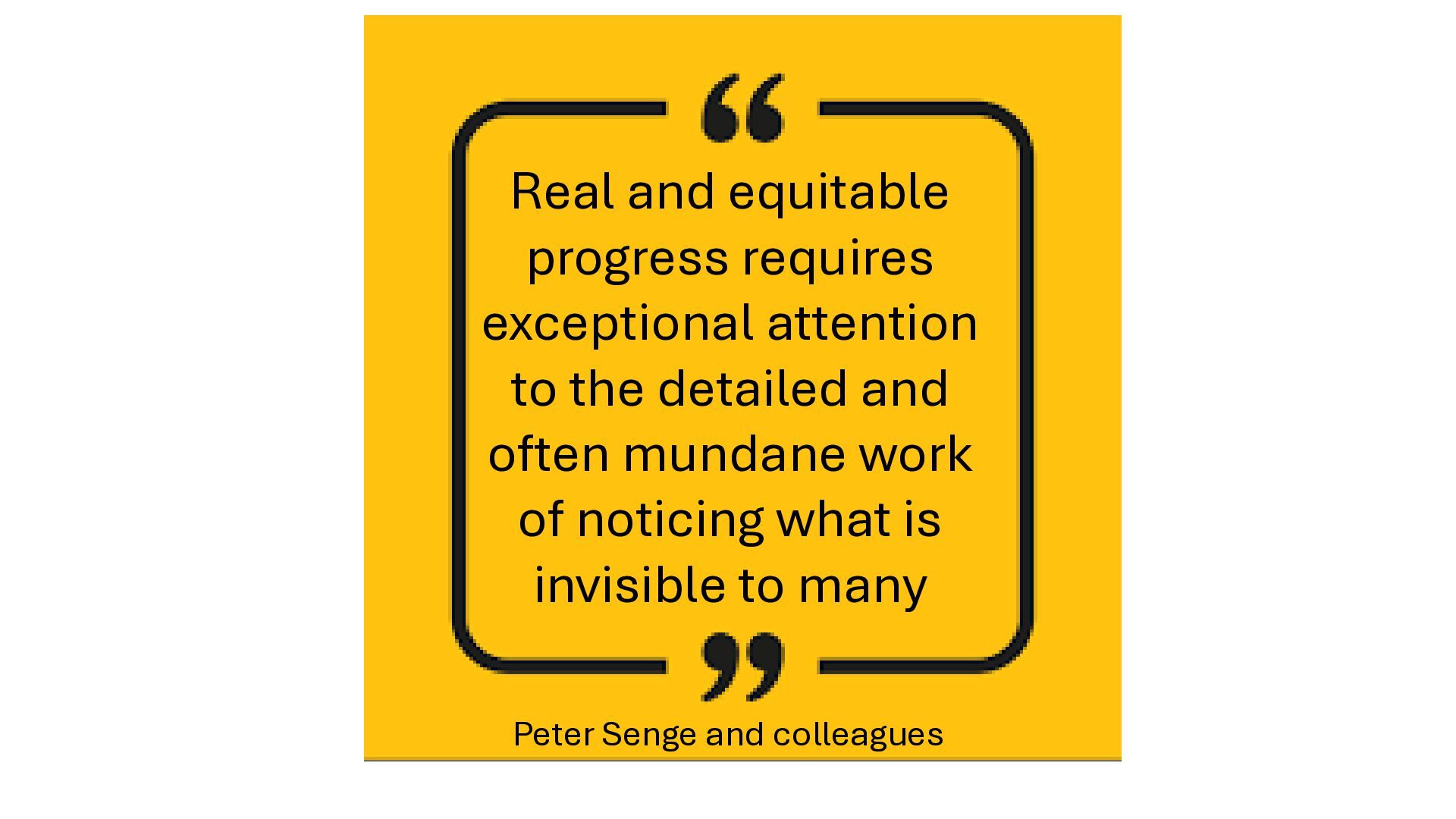
  22. Peter Senge and colleagues Real and equitable progress requires exceptional

    attention to the detailed and often mundane work of noticing what is invisible to many
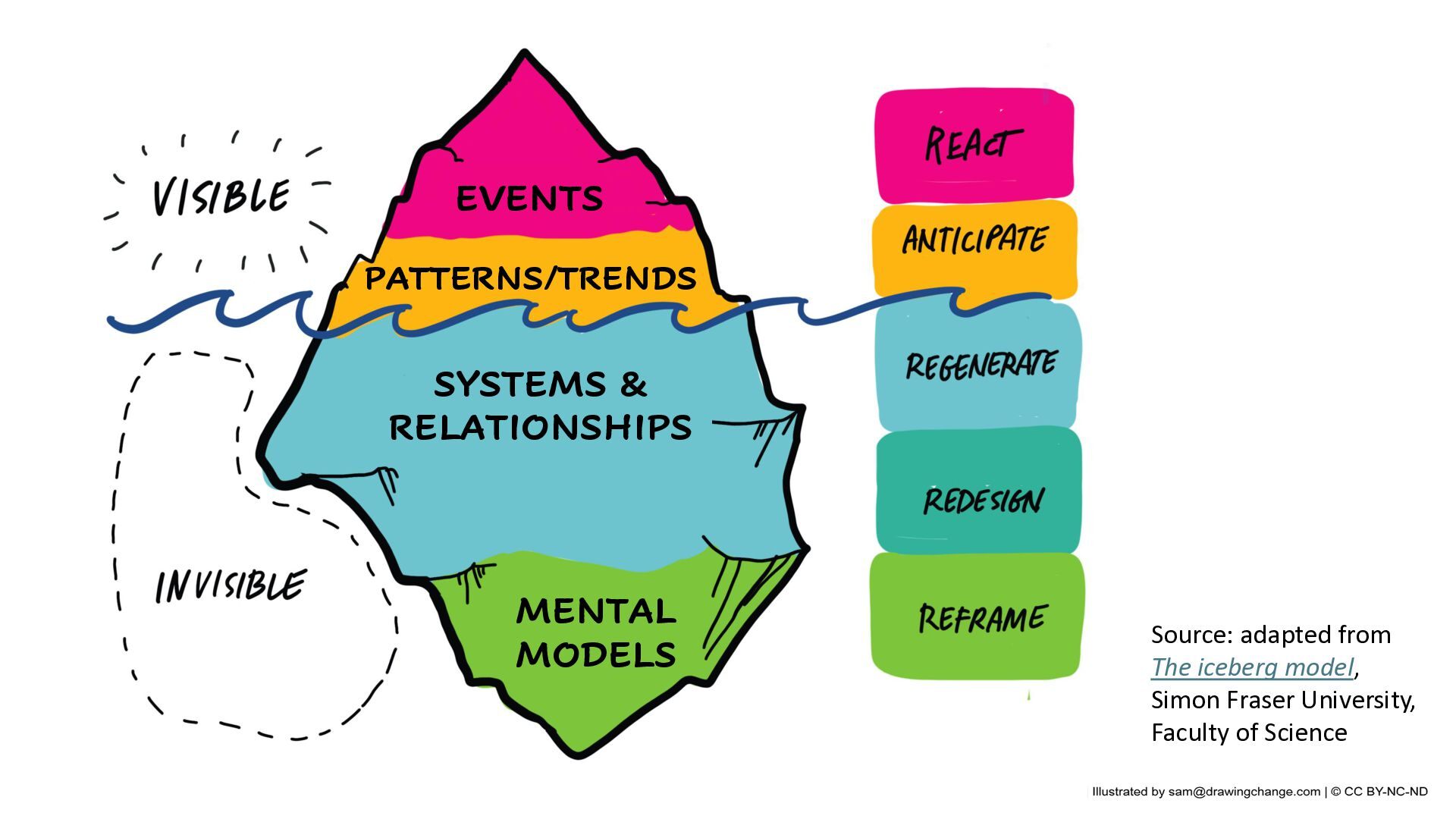
  23. Source: adapted from The iceberg model, Simon Fraser University, Faculty

    of Science PATTERNS/TRENDS EVENTS MENTAL MODELS SYSTEMS & RELATIONSHIPS
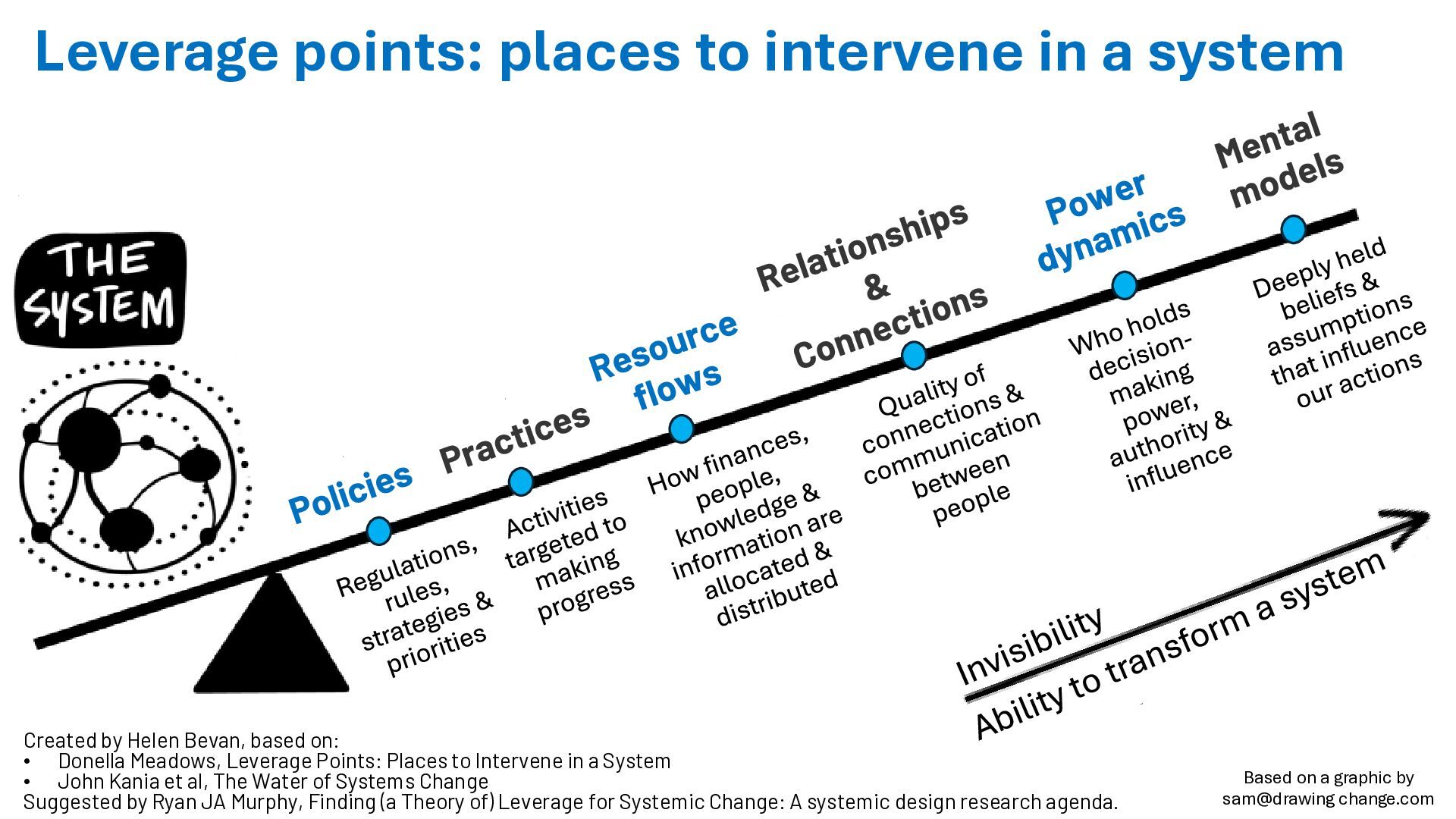
  24. . . Created by Helen Bevan, based on: • Donella

    Meadows, Leverage Points: Places to Intervene in a System • John Kania et al, The Water of Systems Change Suggested by Ryan JA Murphy, Finding (a Theory of) Leverage for Systemic Change: A systemic design research agenda. Leverage points: places to intervene in a system Based on a graphic by sam@drawing change.com
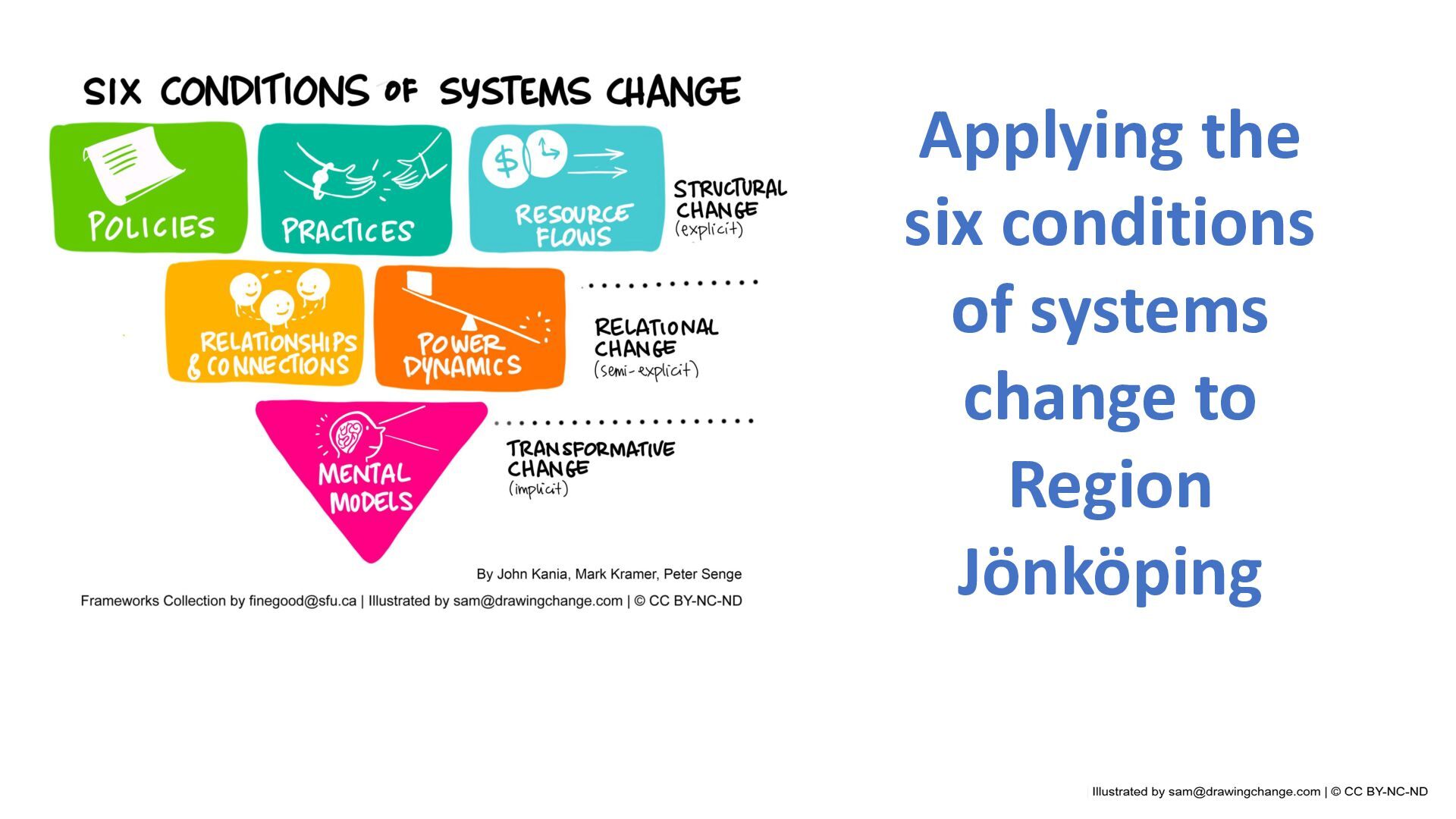
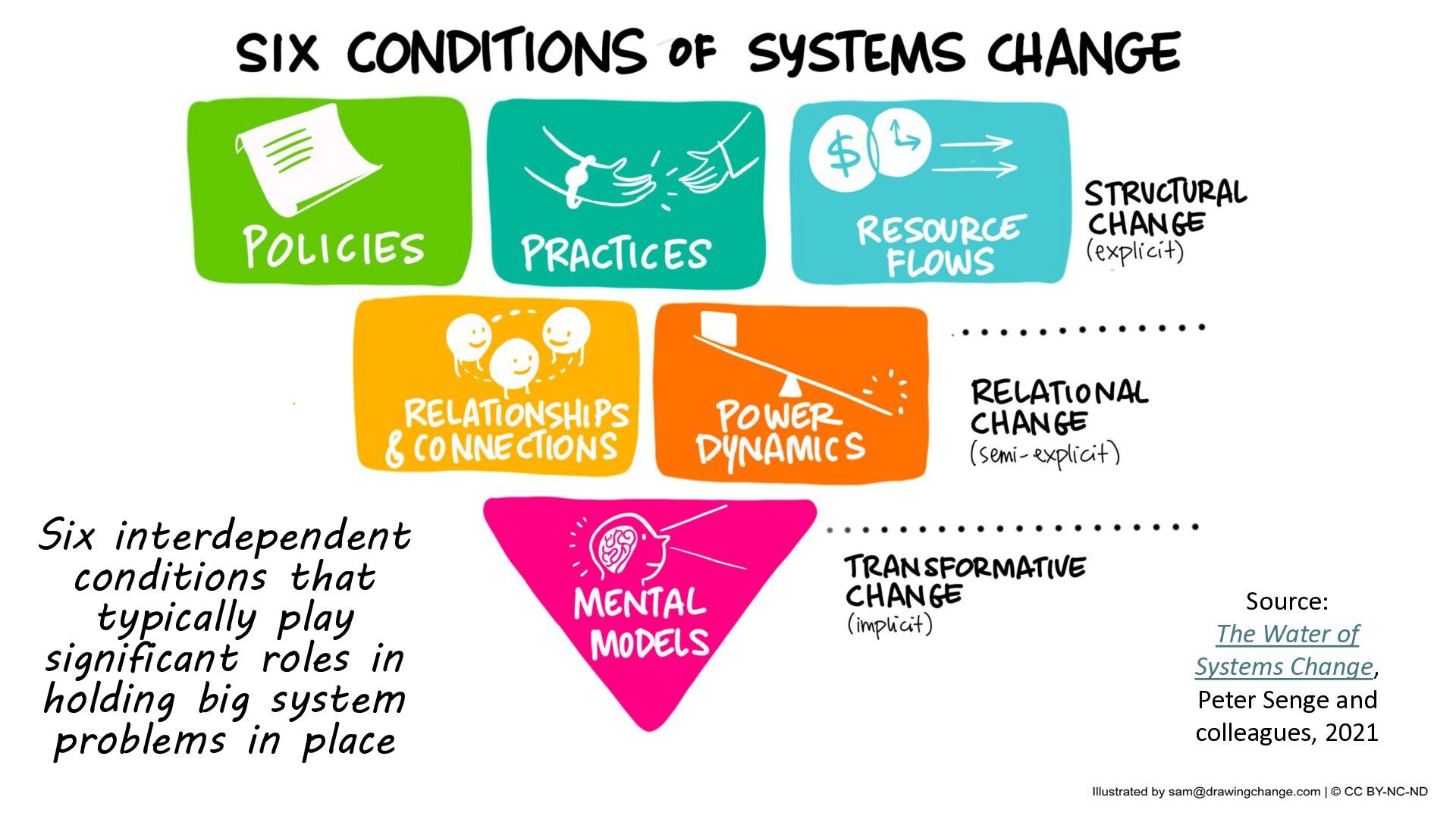
  25. Source: The Water of Systems Change, Peter Senge and colleagues,

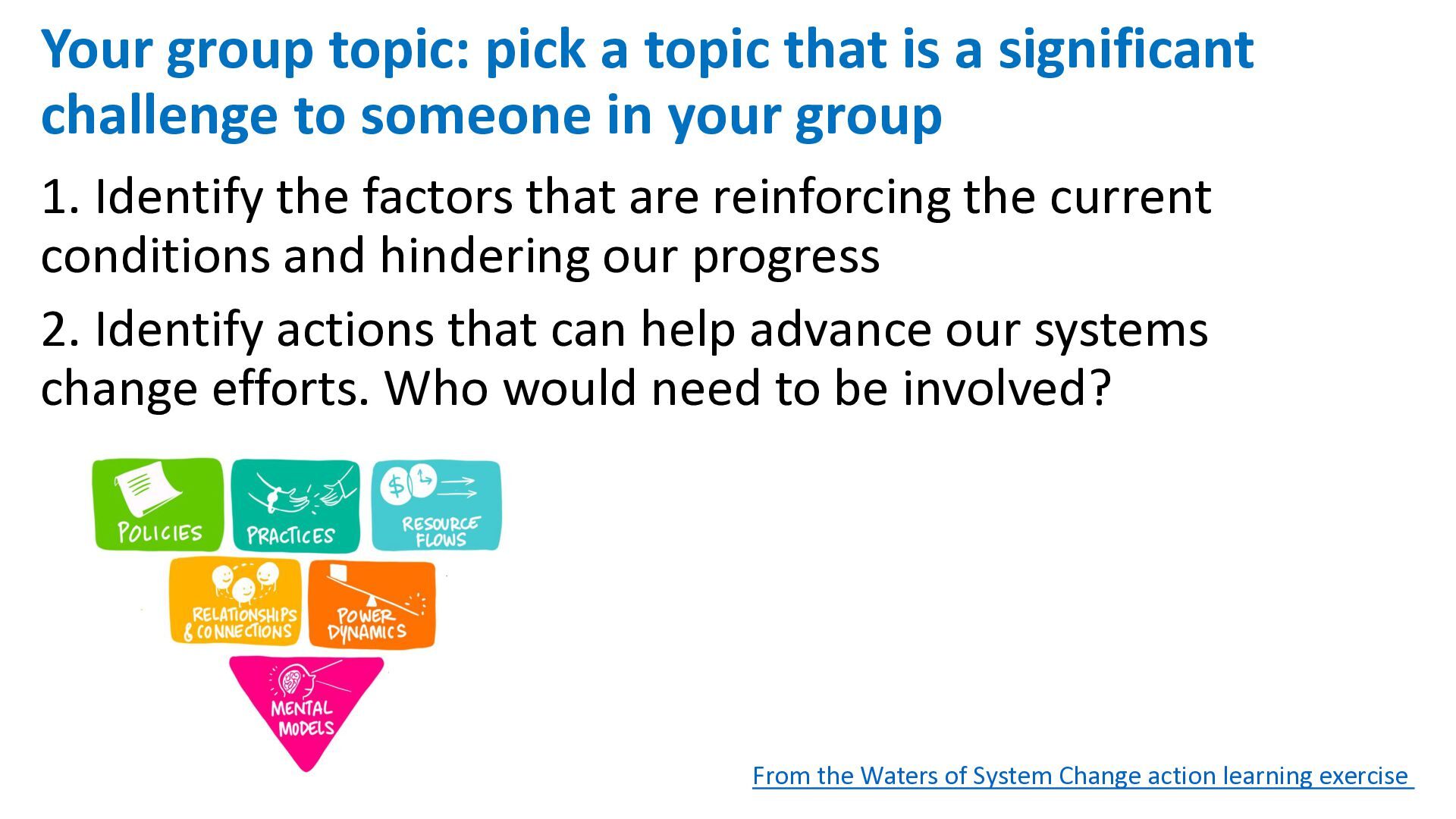
    2021 Six interdependent conditions that typically play significant roles in holding big system problems in place
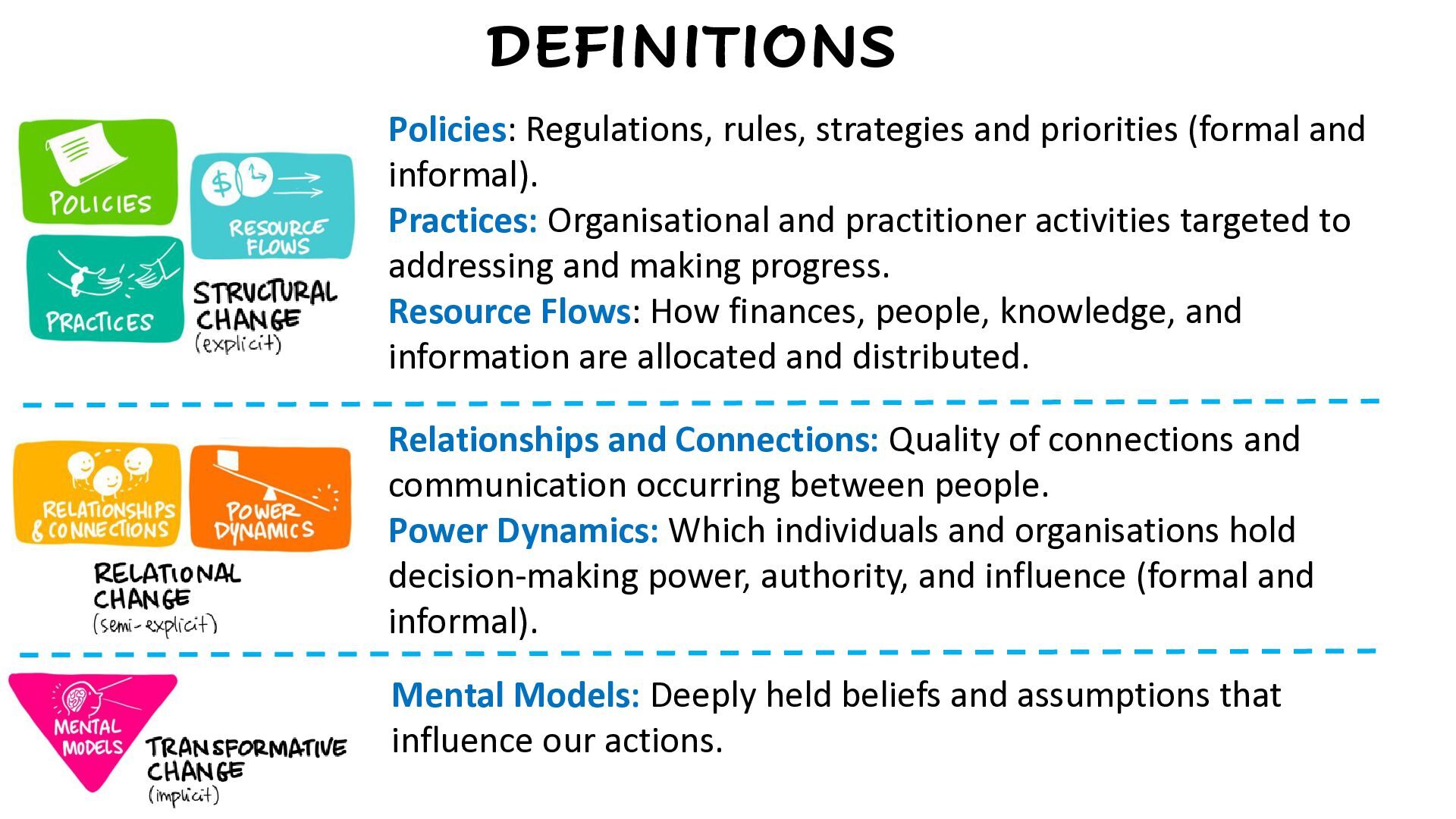
  26. Relationships and Connections: Quality of connections and communication occurring between

    people. Power Dynamics: Which individuals and organisations hold decision-making power, authority, and influence (formal and informal). Policies: Regulations, rules, strategies and priorities (formal and informal). Practices: Organisational and practitioner activities targeted to addressing and making progress. Resource Flows: How finances, people, knowledge, and information are allocated and distributed. DEFINITIONS Mental Models: Deeply held beliefs and assumptions that influence our actions.
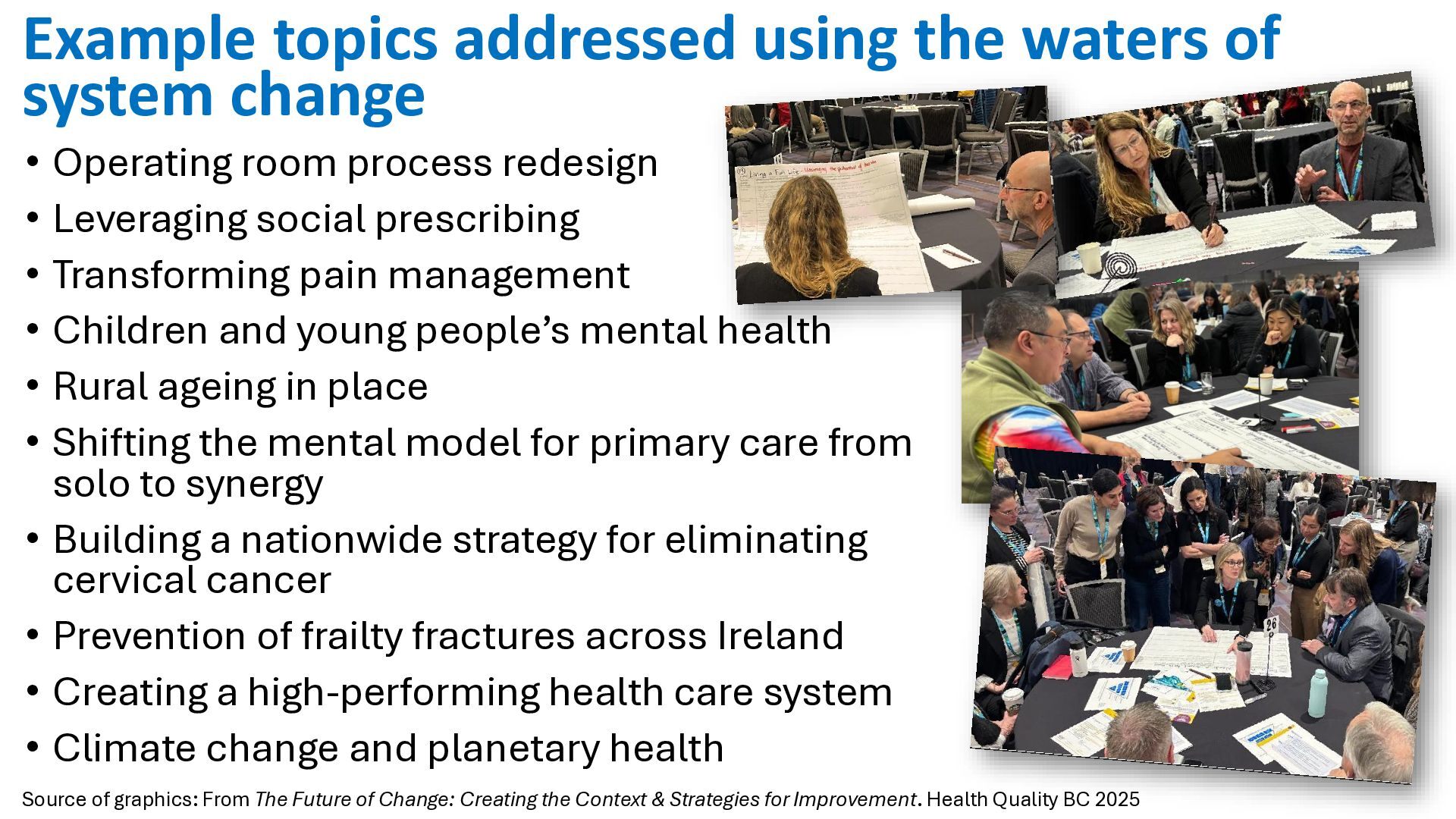
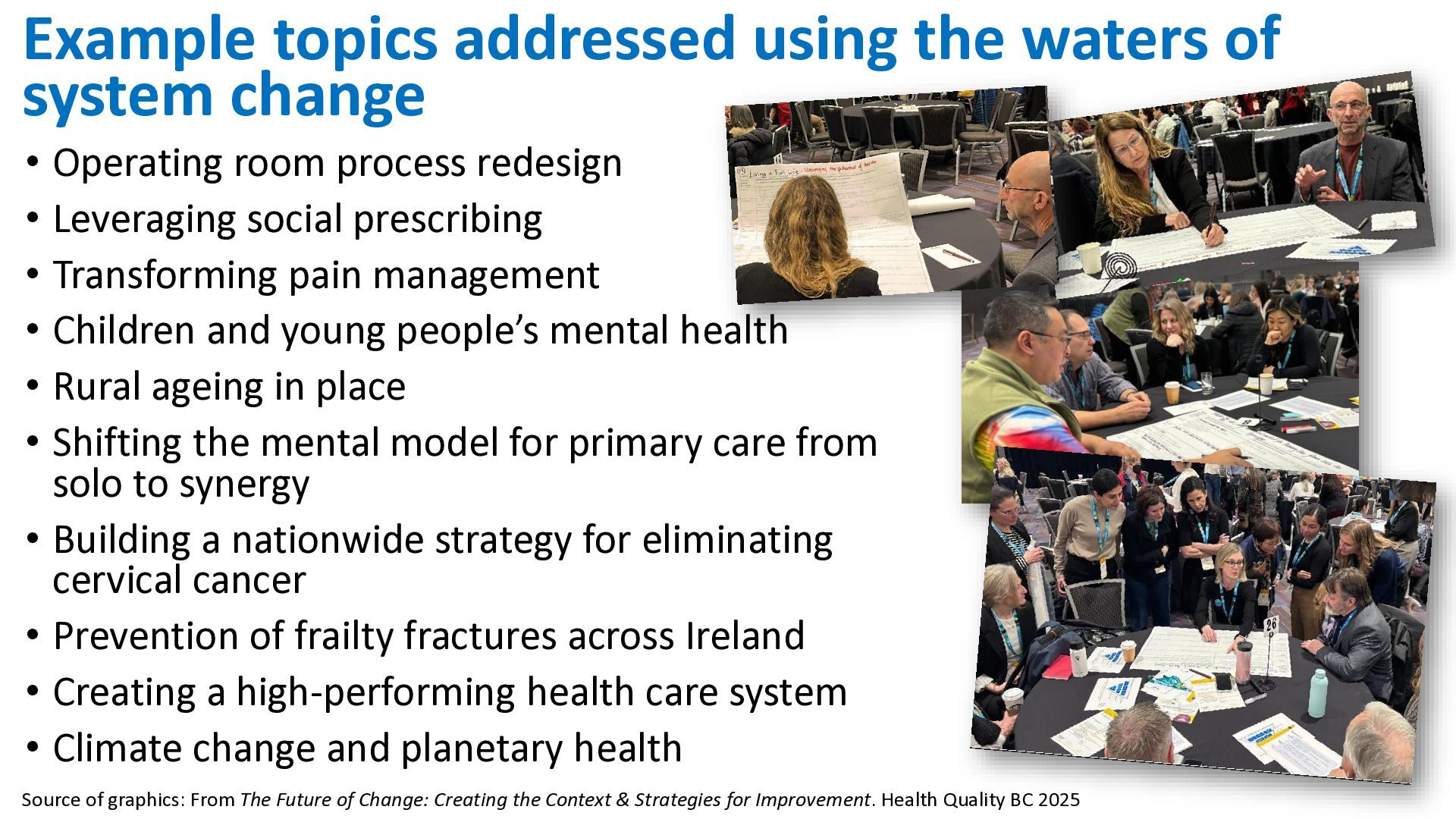
  27. Example topics addressed using the waters of system change •

    Operating room process redesign • Leveraging social prescribing • Transforming pain management • Children and young people’s mental health • Rural ageing in place • Shifting the mental model for primary care from solo to synergy • Building a nationwide strategy for eliminating cervical cancer • Prevention of frailty fractures across Ireland • Creating a high-performing health care system • Climate change and planetary health Source of graphics: From The Future of Change: Creating the Context & Strategies for Improvement. Health Quality BC 2025
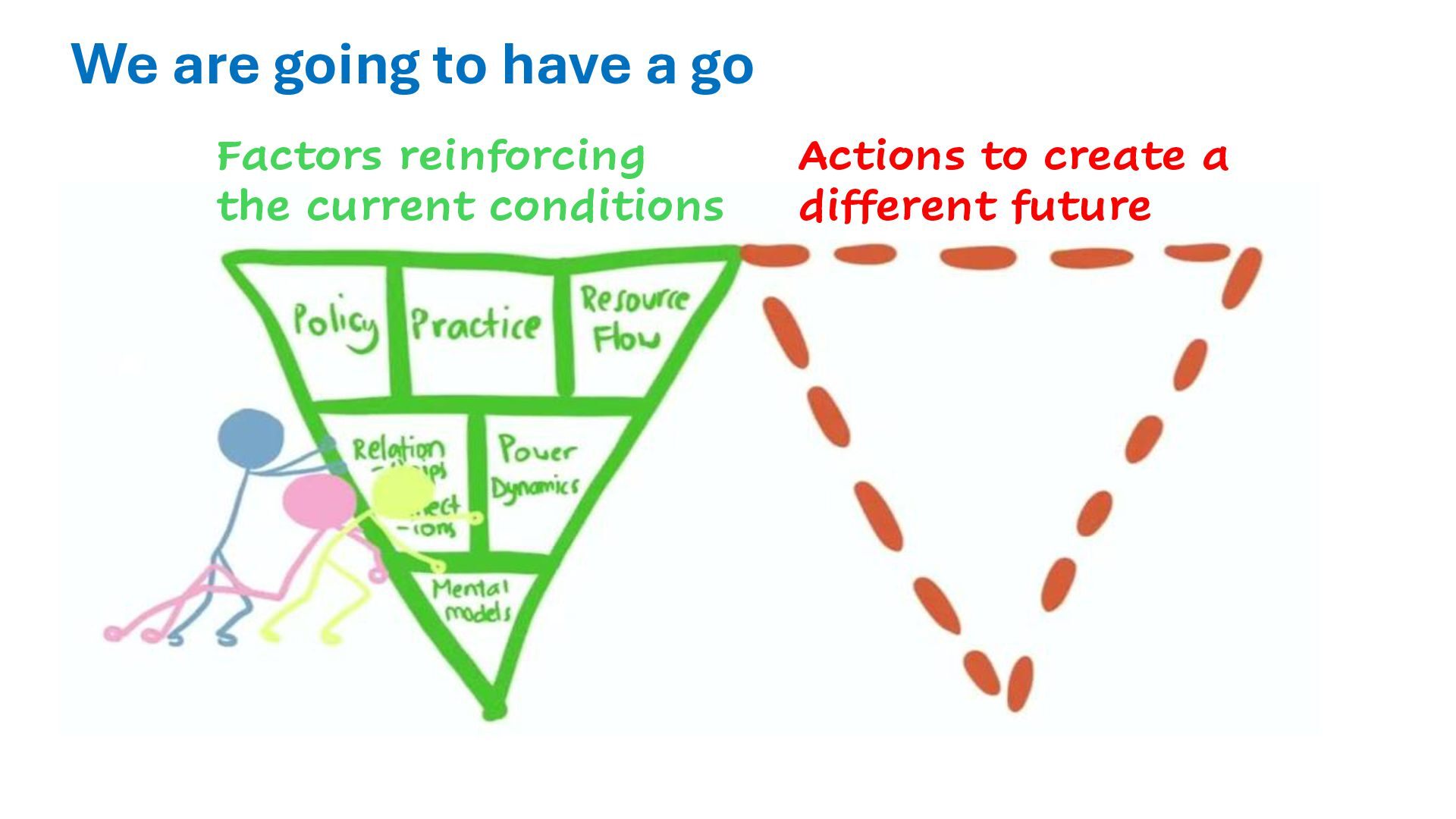
  28. Your group topic: pick a topic that is a significant

    challenge to someone in your group 1. Identify the factors that are reinforcing the current conditions and hindering our progress 2. Identify actions that can help advance our systems change efforts. Who would need to be involved? From the Waters of System Change action learning exercise
  29. Example topics addressed using the waters of system change •

    Operating room process redesign • Leveraging social prescribing • Transforming pain management • Children and young people’s mental health • Rural ageing in place • Shifting the mental model for primary care from solo to synergy • Building a nationwide strategy for eliminating cervical cancer • Prevention of frailty fractures across Ireland • Creating a high-performing health care system • Climate change and planetary health Source of graphics: From The Future of Change: Creating the Context & Strategies for Improvement. Health Quality BC 2025
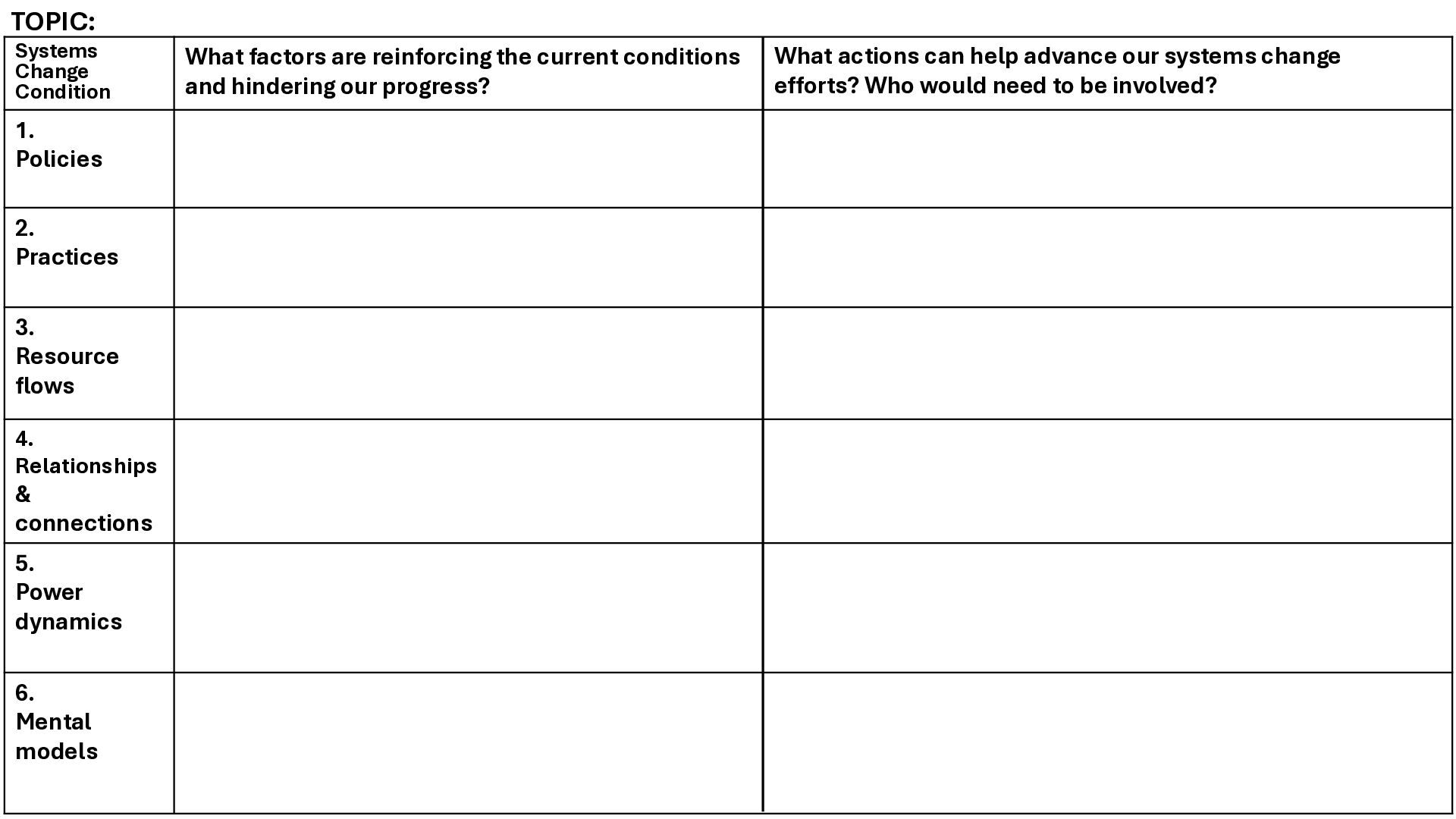
  30. Systems Change Condition What factors are reinforcing the current conditions

    and hindering our progress? 1. Policies 2. Practices 3. Resource flows 4. Relationships & connections 5. Power dynamics 6. Mental models What actions can help advance our systems change efforts? Who would need to be involved? TOPIC:
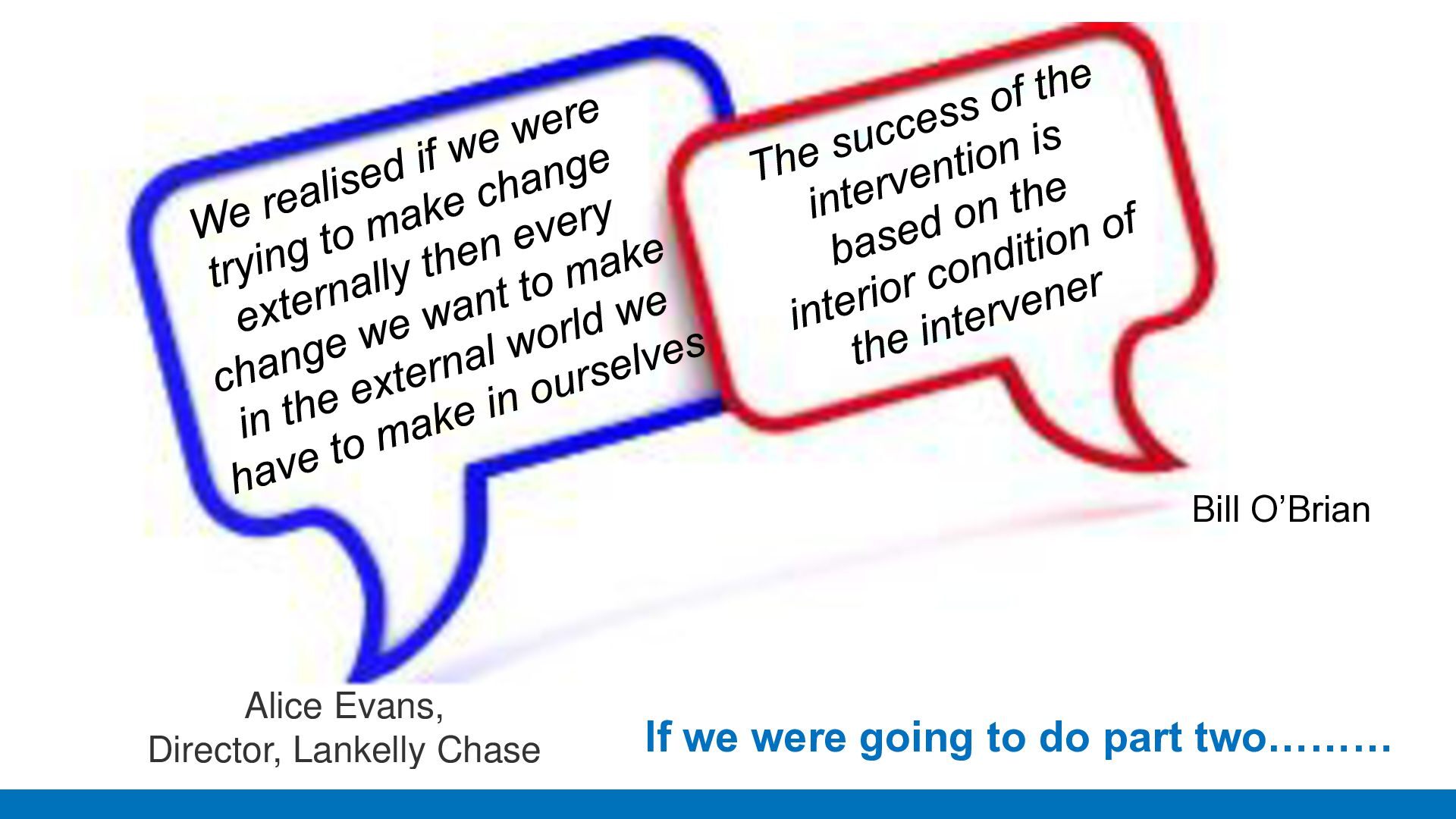
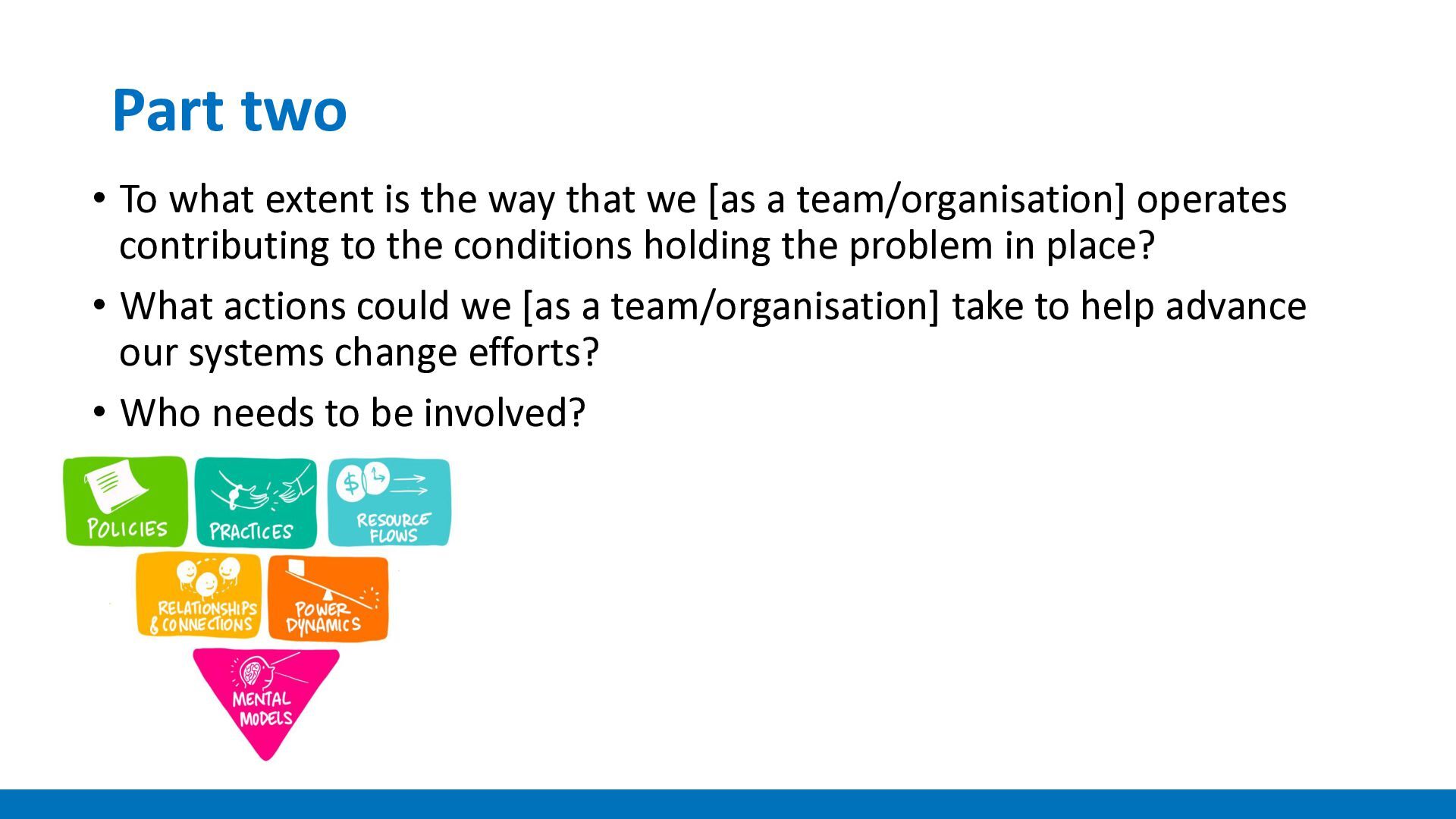
  31. Part two • To what extent is the way that

    we [as a team/organisation] operates contributing to the conditions holding the problem in place? • What actions could we [as a team/organisation] take to help advance our systems change efforts? • Who needs to be involved?
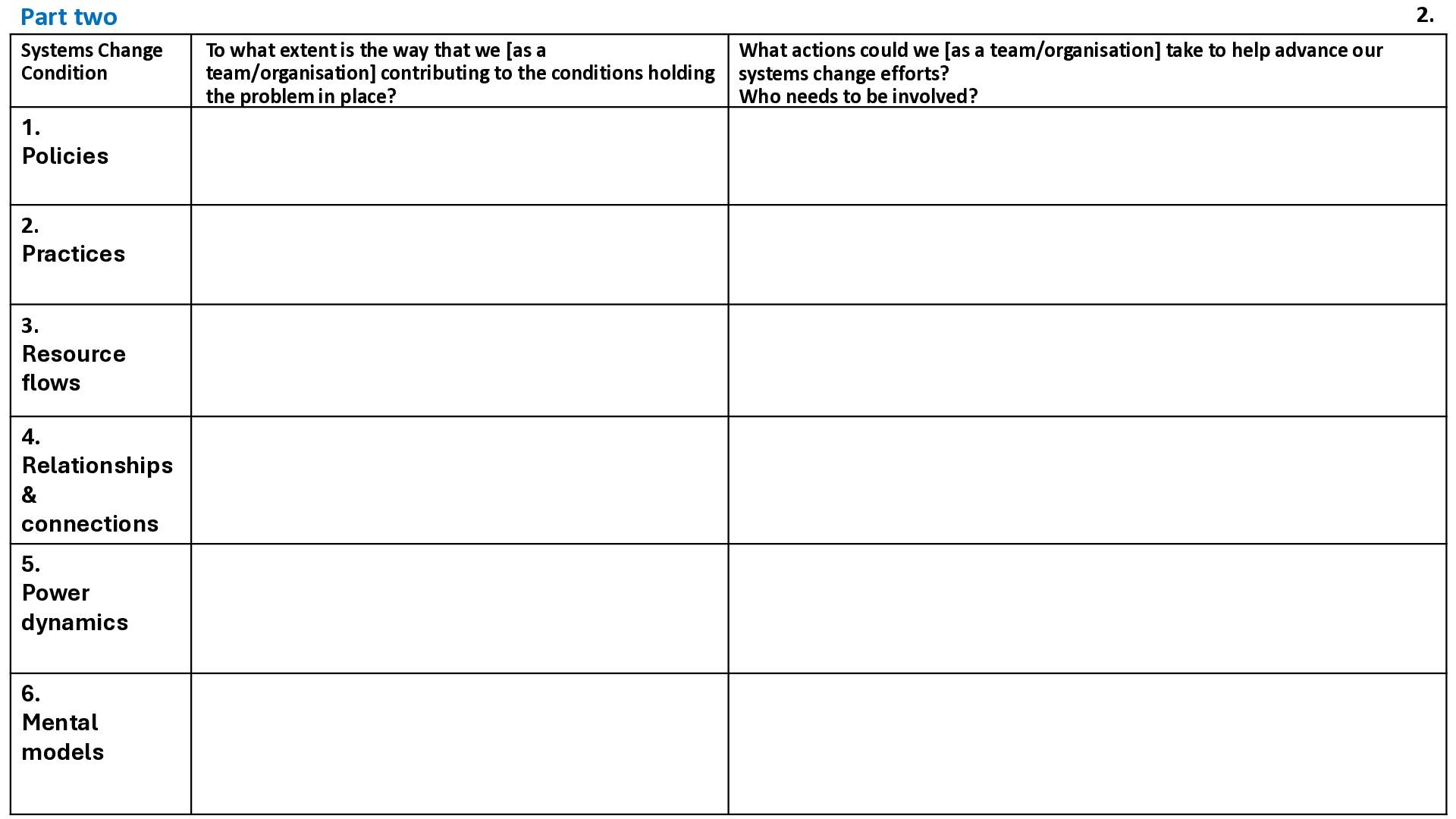
  32. Systems Change Condition 1. Policies 2. Practices 3. Resource flows

    4. Relationships & connections 5. Power dynamics 6. Mental models 2. What actions could we [as a team/organisation] take to help advance our systems change efforts? Who needs to be involved? To what extent is the way that we [as a team/organisation] contributing to the conditions holding the problem in place? Part two
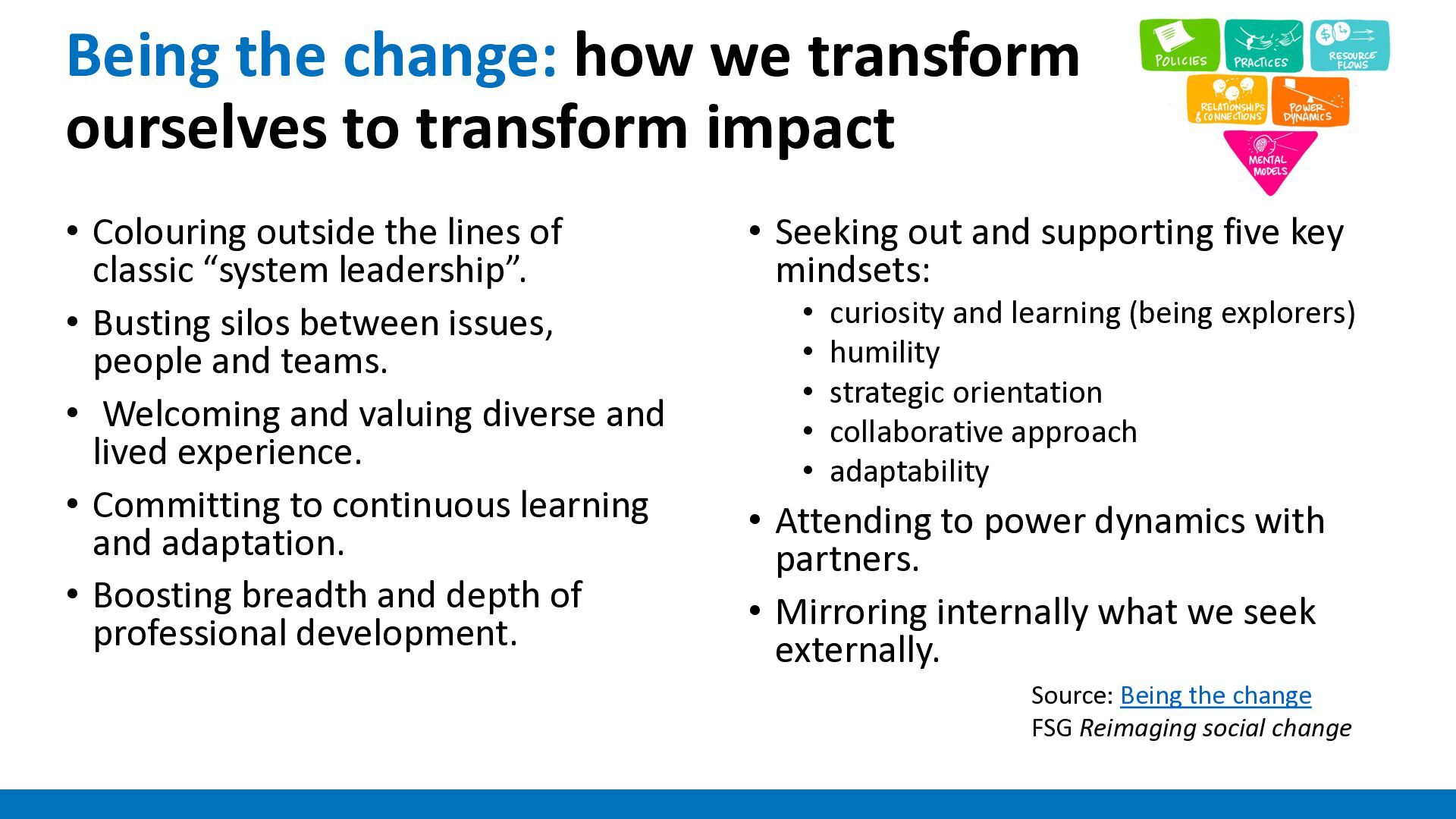
  33. Being the change: how we transform ourselves to transform impact

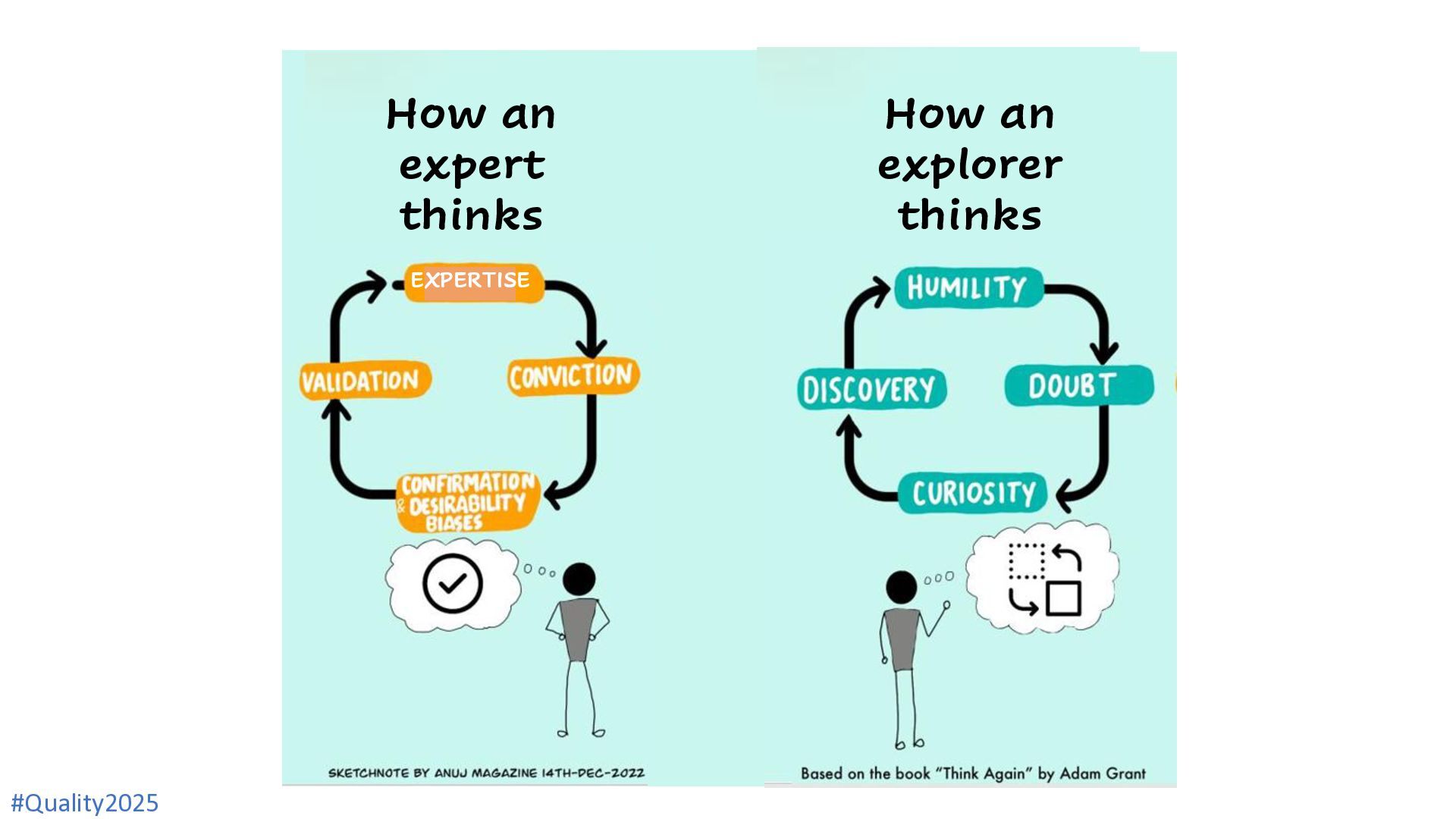
    • Colouring outside the lines of classic “system leadership”. • Busting silos between issues, people and teams. • Welcoming and valuing diverse and lived experience. • Committing to continuous learning and adaptation. • Boosting breadth and depth of professional development. • Seeking out and supporting five key mindsets: • curiosity and learning (being explorers) • humility • strategic orientation • collaborative approach • adaptability • Attending to power dynamics with partners. • Mirroring internally what we seek externally. Source: Being the change FSG Reimaging social change
  34. Extra references Aspen Institute and the Higher Ambition Leadership Alliance

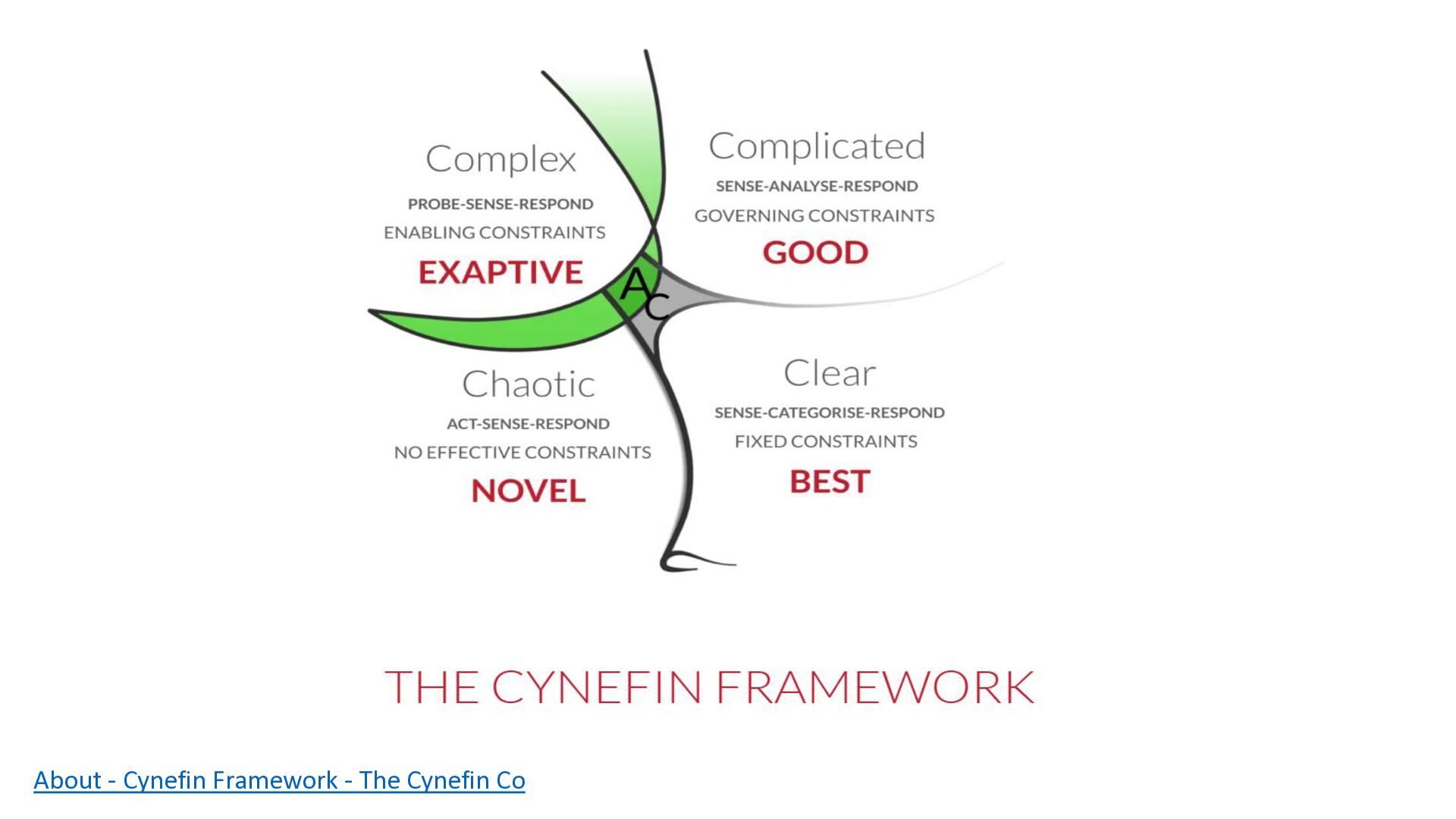
    (2025) Leadership for large-scale change: distinctive challenges, emerging responses Bannear, B. (2023) The new zeitgeist: relationships and emergence. Medium. https://medium.com/@bill.bannear/the-new-zeitgeist-relationships-and-emergence- e8359b934e0 Centola, D. (2021) Change: How to Make Big Things Happen John Murray Emergent Futures Lab (2024) The new cannot be seen or thought Hansgaard J (2024) Connectivity is Broken! Now What? - How to Connect Your People for Better Performance and Wellbeing. Plsek, P., Bevan, H. and Winstanley, L. (2018) Leading Large-Scale Change: A Practical Guide, NHS England Satell, G. (2019) Cascades: How to Create a Movement That Drives Transformational Change McGraw-Hill Education Snowden, D. (2021) ‘A mélange of potential not a mindset’, The Cynefin Company
  35. Our contacts Helen Bevan [email protected] X: @HelenBevan LinkedIn: Helen Bevan

    Goran Henriks [email protected] X: @GoranHenriks LinkedIn: Goran Henriks #Quality2025