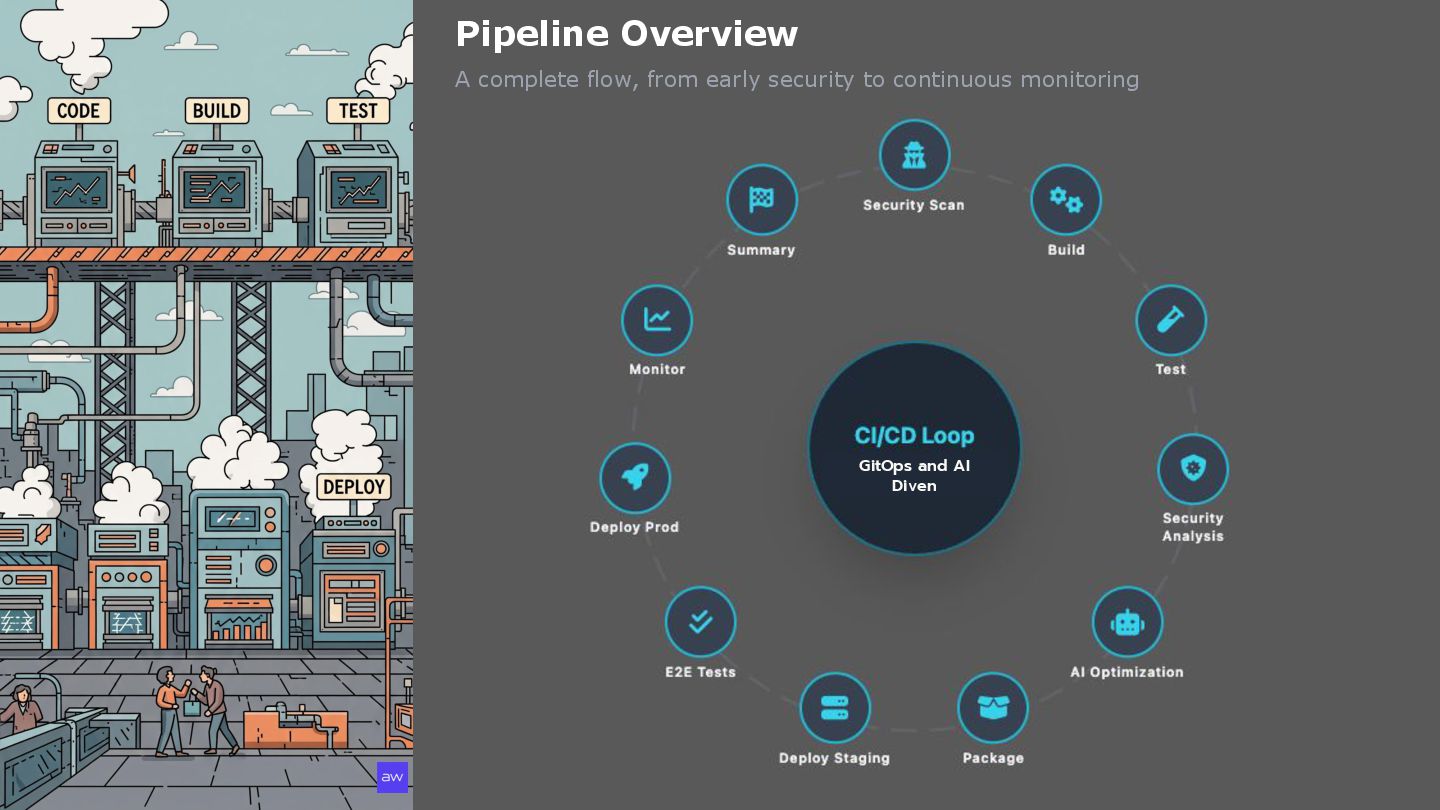
software delivery hold for us • The CI/CD pipelines we know are evolving. Simple automation is no longer enough. • The 2025 pipeline is intelligent, inherently secure, and entirely driven by the GitOps philosophy. • This session explores a new generation pipeline for a containerized Symfony Applications. • Let's discover how AI, Zero-Trust, and GitOps are becoming a tangible and necessary reality !
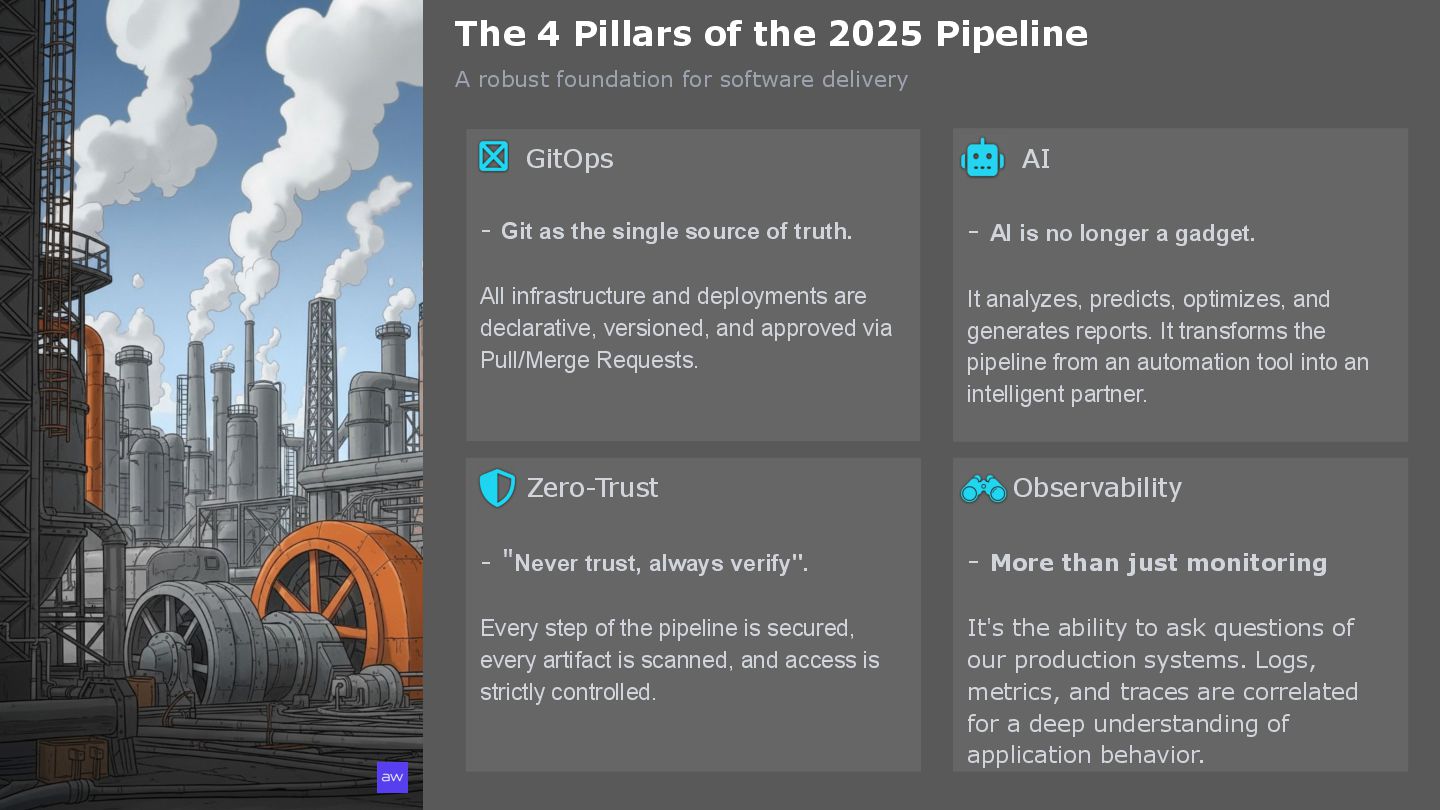
for software delivery GitOps - Git as the single source of truth. All infrastructure and deployments are declarative, versioned, and approved via Pull/Merge Requests. AI - AI is no longer a gadget. It analyzes, predicts, optimizes, and generates reports. It transforms the pipeline from an automation tool into an intelligent partner. Zero-Trust - "Never trust, always verify". Every step of the pipeline is secured, every artifact is scanned, and access is strictly controlled. Observability - More than just monitoring It's the ability to ask questions of our production systems. Logs, metrics, and traces are correlated for a deep understanding of application behavior.
intelligent optimization. • ai-code-optimization: A Python script uses Gemini to analyze performance reports, code, and logs to suggest optimizations and predict failure points. • ai-test-generation: AI analyzes code coverage. If it's below a certain threshold, it generates new unit tests and creates a Merge Request for the team. YAML ai-code-optimization: stage: ai-optimization image: python:3.11-slim script: - python scripts/ai-analyzer.py --suggest-optimizations ai-test-generation: stage: ai-optimization script: - python scripts/ai-test-generator.py --coverage-threshold 90 # Crée une Merge Request avec les nouveaux tests
of truth for deployment • The heart of GitOps: The pipeline does not deploy directly with `kubectl` ou `helm`. This is an anti-pattern ! • Declarative update: : Job `deploy-staging` clones the repository and updates the image version to be deployed, then pushes the change. • ArgoCD detects the divergence and automatically synchronizes the desired state in the Kubernetes staging cluster. • YAML deploy-staging: stage: deploy-staging script: - git clone gitops-repo.git # Update the image version in the config file (values.yaml) - yq -i '.image.tag = "$CI_COMMIT_SHORT_SHA"' gitops-repo/values.yaml # Commit & Push changes - git commit -m "Deploy app version $CI_COMMIT_SHORT_SHA to staging" - git push # ArgoCD takes care of the rest!
e2e-tests: End-to-End (Cypress) and dynamic security (ZAP) tests are launched against the staging environment to simulate the user journey. • deploy-production: If E2E tests pass, the same GitOps process is triggered. The commit is "promoted" by updating the production environment configuration in the GitOps repository. YAML e2e-tests: stage: e2e-tests image: cypress/included:15.3.0 script: - cypress run --config baseUrl=https://staging.app.com deploy-production: stage: deploy-production script: - ./scripts/gitops-sync.sh "symfony-app" "production"
• post-deployment-monitoring: The pipeline does not stop at the`push`. It waits for the deployment to stabilize in production • It then performs a "smoke test" or "health check" to ensure that critical services respond correctly. • This is the first step of continuous feedback from the real environment, closing the deployment loop. YAML post-deployment-monitoring: stage: monitor script: - echo "Waiting for deployment to stabilize..." - check-health.sh - post-alert-on-alertmanager - notify-users - …
the team • The pipeline doesn't just succeed or fail. • In a reporting step, dedicated jobs analyze each artifact generated with Gemini. • The result? Relevant summaries and prioritized alerts sent to Mattermost, instead of simple 2000-line logs. • ai-container-scan-analysis • ai-ct-analysis • ai-dependency-analysis • ai-e2e-analysis • ai-gitleaks-analysis • ai-kubeconform-analysis • ai-kubescore-analysis • ai-lint-analysis • ai-performance-analysis • ai-polaris-analysis • ai-trivy-analysis • ai-unittest-analysis • ai-zap-analysis
Ultra-Fast & Intelligent Feedback • The team receives analyses, not just logs. Proactive Security • Security is integrated and automated at every step, not an afterthought. Reduced Cognitive Load • AI handles repetitive analysis tasks, allowing developers to focus on value creation. Auditability & Resilience • Thanks to GitOps, every environment change is tracked, auditable, and easily reversible.
is no longer just an assembly line. It's an intelligent partner that secures, optimizes, and accelerates your innovation. By combining GitOps, AI, Zero-Trust, and Observability, we transform our delivery chain into a decisive competitive advantage.


 tammyeverts
 bluesmoon
 michaelherold
 chriscoyier
 mza
mza
 honzajavorek
 smashingmag
 techseoconnect
 stuffmc
 sugarenia
 szymonslowik
 holman




![[email protected] linkedin.com/in/herveleclerc github.com/herveleclerc Let's discuss the future of your pipelines!](https://files.speakerdeck.com/presentations/4a035944288145509720807a8884a149/slide_30.jpg)