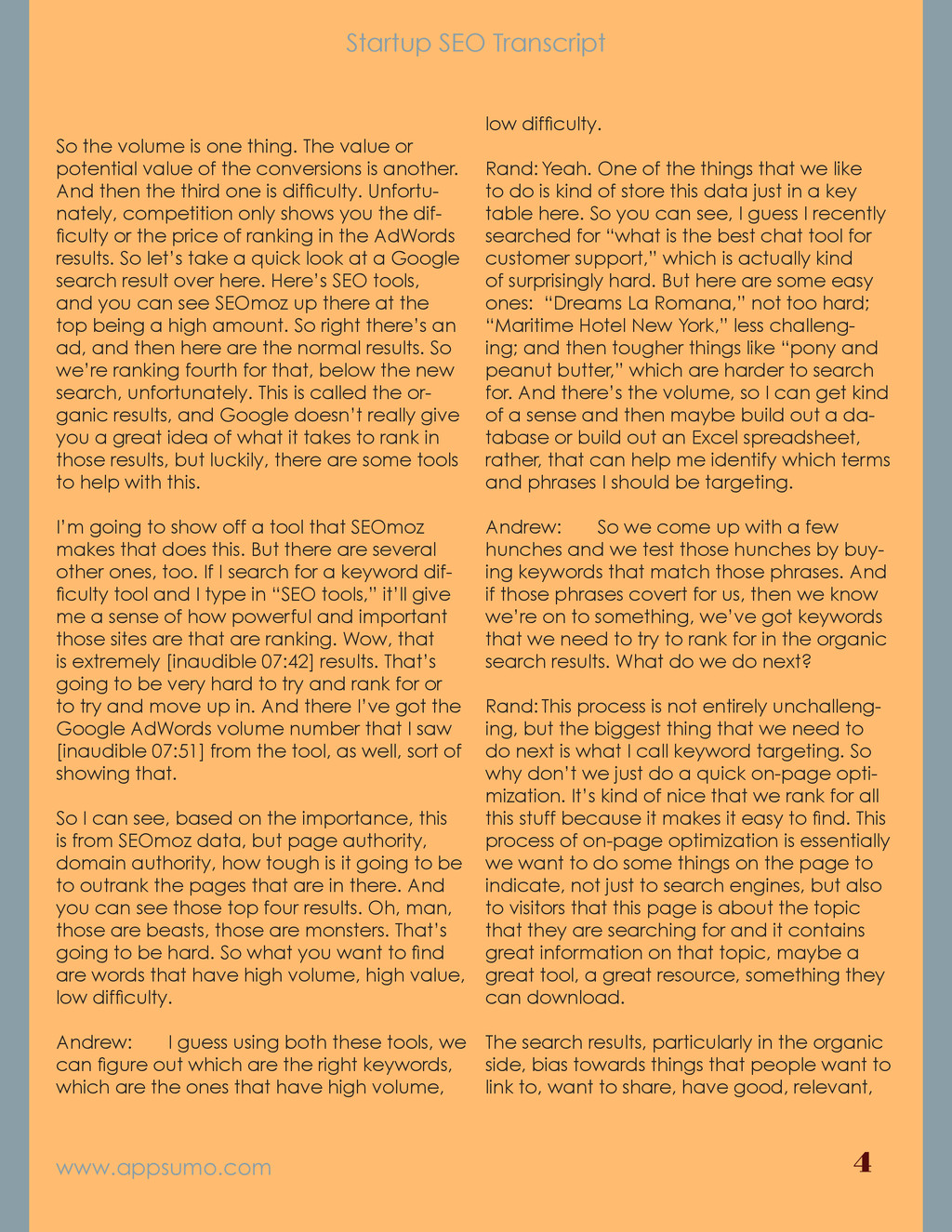
thing. The value or potential value of the conversions is another. And then the third one is difficulty. Unfortu- nately, competition only shows you the dif- ficulty or the price of ranking in the AdWords results. So let’s take a quick look at a Google search result over here. Here’s SEO tools, and you can see SEOmoz up there at the top being a high amount. So right there’s an ad, and then here are the normal results. So we’re ranking fourth for that, below the new search, unfortunately. This is called the or- ganic results, and Google doesn’t really give you a great idea of what it takes to rank in those results, but luckily, there are some tools to help with this. I’m going to show off a tool that SEOmoz makes that does this. But there are several other ones, too. If I search for a keyword dif- ficulty tool and I type in “SEO tools,” it’ll give me a sense of how powerful and important those sites are that are ranking. Wow, that is extremely [inaudible 07:42] results. That’s going to be very hard to try and rank for or to try and move up in. And there I’ve got the Google AdWords volume number that I saw [inaudible 07:51] from the tool, as well, sort of showing that. So I can see, based on the importance, this is from SEOmoz data, but page authority, domain authority, how tough is it going to be to outrank the pages that are in there. And you can see those top four results. Oh, man, those are beasts, those are monsters. That’s going to be hard. So what you want to find are words that have high volume, high value, low difficulty. Andrew: I guess using both these tools, we can figure out which are the right keywords, which are the ones that have high volume, low difficulty. Rand: Yeah. One of the things that we like to do is kind of store this data just in a key table here. So you can see, I guess I recently searched for “what is the best chat tool for customer support,” which is actually kind of surprisingly hard. But here are some easy ones: “Dreams La Romana,” not too hard; “Maritime Hotel New York,” less challeng- ing; and then tougher things like “pony and peanut butter,” which are harder to search for. And there’s the volume, so I can get kind of a sense and then maybe build out a da- tabase or build out an Excel spreadsheet, rather, that can help me identify which terms and phrases I should be targeting. Andrew: So we come up with a few hunches and we test those hunches by buy- ing keywords that match those phrases. And if those phrases covert for us, then we know we’re on to something, we’ve got keywords that we need to try to rank for in the organic search results. What do we do next? Rand: This process is not entirely unchalleng- ing, but the biggest thing that we need to do next is what I call keyword targeting. So why don’t we just do a quick on-page opti- mization. It’s kind of nice that we rank for all this stuff because it makes it easy to find. This process of on-page optimization is essentially we want to do some things on the page to indicate, not just to search engines, but also to visitors that this page is about the topic that they are searching for and it contains great information on that topic, maybe a great tool, a great resource, something they can download. The search results, particularly in the organic side, bias towards things that people want to link to, want to share, have good, relevant,


 62gerente
 mkilby
 deanohume
 ryanjones
 marktimemedia
 eileencodes
 garrettdimon
 akademiya2063
 aki_iinuma
 takai
takai
 afnizarnur
 akihiro_kokubo