an express agreement under international law entered into by actors in international law, namely sovereign states and international organizations. A treaty may also be known as an (international) agreement, protocol, covenant, convention or exchange of letters, among other terms. Treaties can be loosely compared to contracts: both are means of willing parties assuming obligations among themselves, and a party to either that fails to live up to their obligations can be held liable under international law.
to ratify them, wich means they make them elgally binding in their own law. Everybody ratified the charter, except vatican city. They have the non- member status. But they can watch anyway.
the four purposes of the UN, but it won't tell you wich those four purposes are. It's not that i don't consider the actual content unimportant but it doesn't translate well into the memrise system.
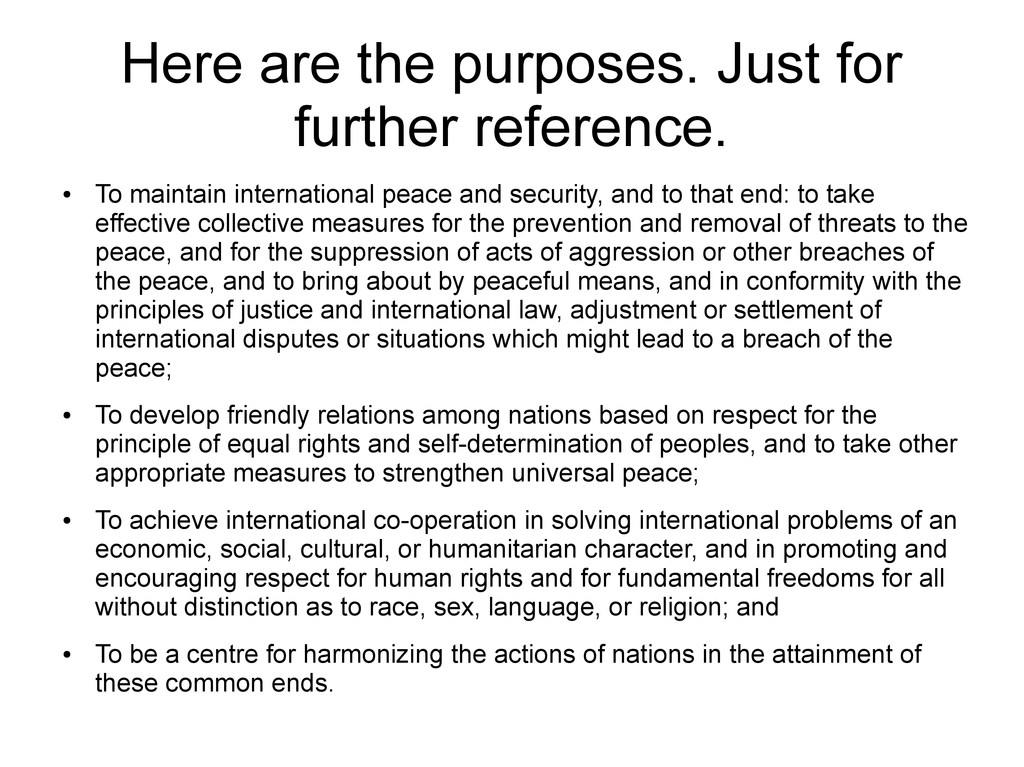
maintain international peace and security, and to that end: to take effective collective measures for the prevention and removal of threats to the peace, and for the suppression of acts of aggression or other breaches of the peace, and to bring about by peaceful means, and in conformity with the principles of justice and international law, adjustment or settlement of international disputes or situations which might lead to a breach of the peace; • To develop friendly relations among nations based on respect for the principle of equal rights and self-determination of peoples, and to take other appropriate measures to strengthen universal peace; • To achieve international co-operation in solving international problems of an economic, social, cultural, or humanitarian character, and in promoting and encouraging respect for human rights and for fundamental freedoms for all without distinction as to race, sex, language, or religion; and • To be a centre for harmonizing the actions of nations in the attainment of these common ends.


 kimpetersen
 mclloyd
 aleyda
 tenderlove
 katarinadahlin
 michaelherold
 greggifford
 ipullrank
 aemeredith
 inesmontani
 jcasabona
 honzajavorek