Share
Embed
Transcript
26 slides
-
Muhammad Asghar Khan Drupal Consultant - Ikonami • Drupal Developer
• 7 years experience in IT • Zend Certified PHP Eng. • Drupal Module contributor Speaker August 19, 2015 www.ikonami.net -
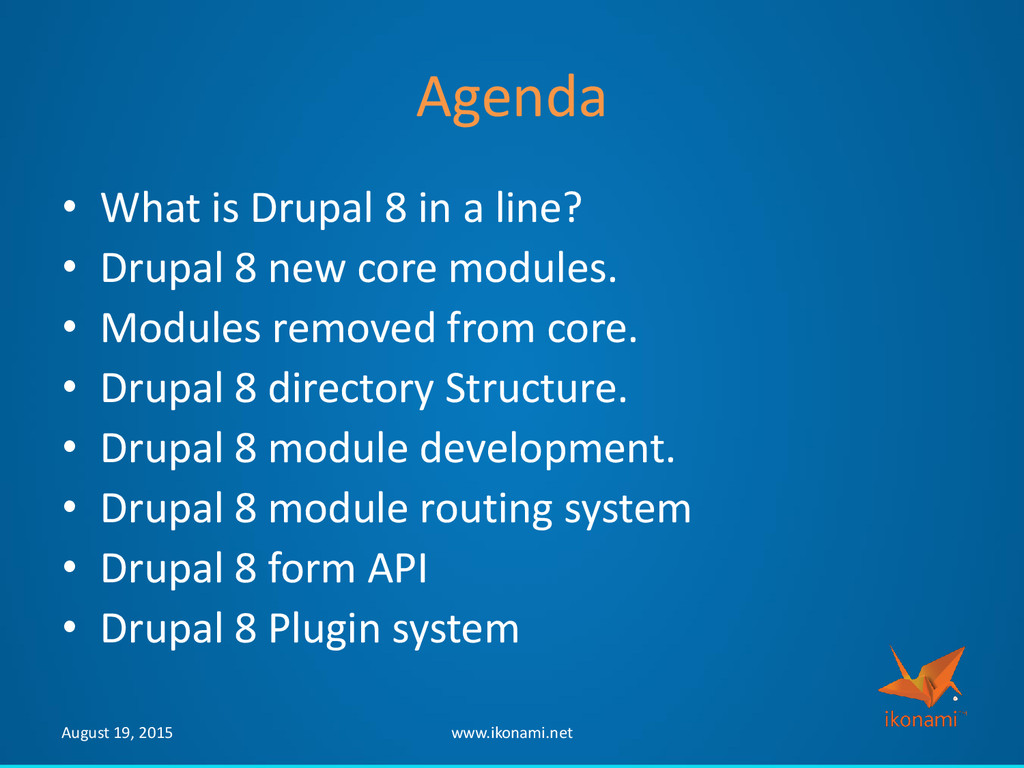
Agenda • What is Drupal 8 in a line? •
Drupal 8 new core modules. • Modules removed from core. • Drupal 8 directory Structure. • Drupal 8 module development. • Drupal 8 module routing system • Drupal 8 form API • Drupal 8 Plugin system August 19, 2015 www.ikonami.net -
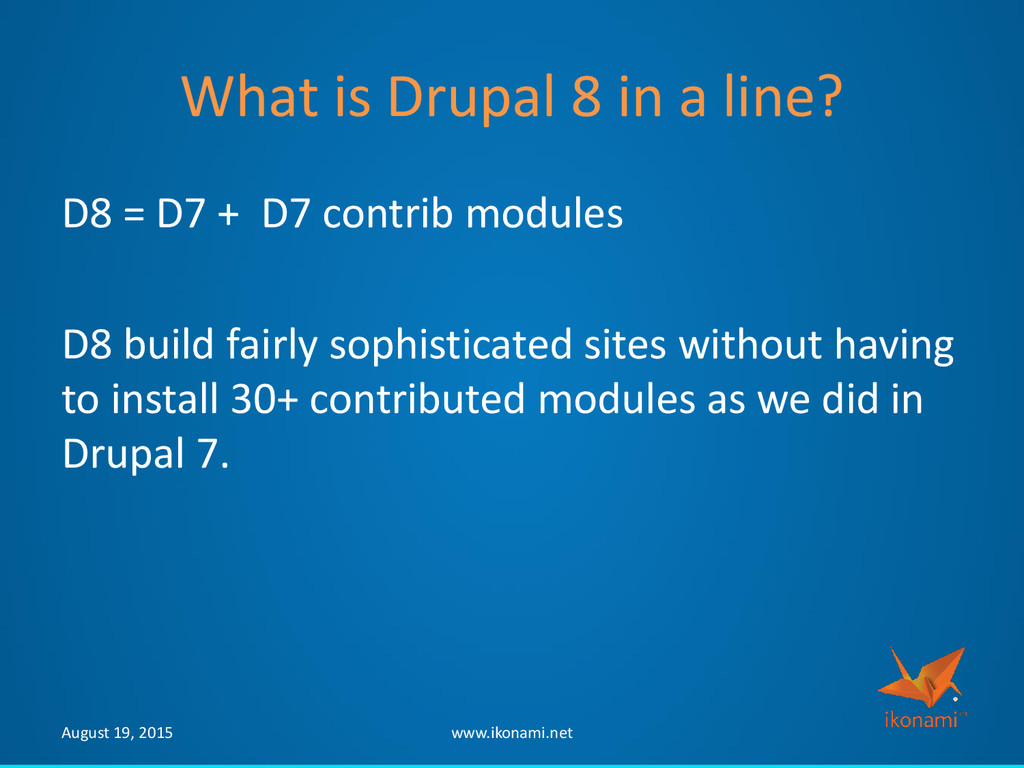
What is Drupal 8 in a line? D8 = D7
+ D7 contrib modules D8 build fairly sophisticated sites without having to install 30+ contributed modules as we did in Drupal 7. August 19, 2015 www.ikonami.net -
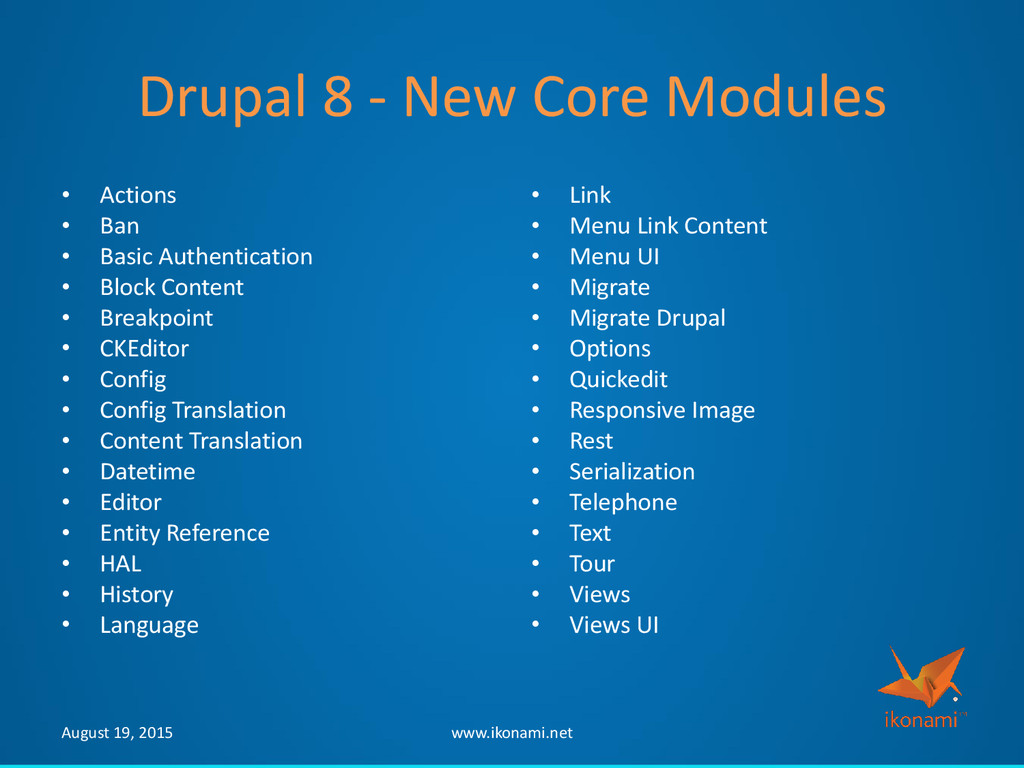
Drupal 8 - New Core Modules • Actions • Ban
• Basic Authentication • Block Content • Breakpoint • CKEditor • Config • Config Translation • Content Translation • Datetime • Editor • Entity Reference • HAL • History • Language • Link • Menu Link Content • Menu UI • Migrate • Migrate Drupal • Options • Quickedit • Responsive Image • Rest • Serialization • Telephone • Text • Tour • Views • Views UI August 19, 2015 www.ikonami.net -
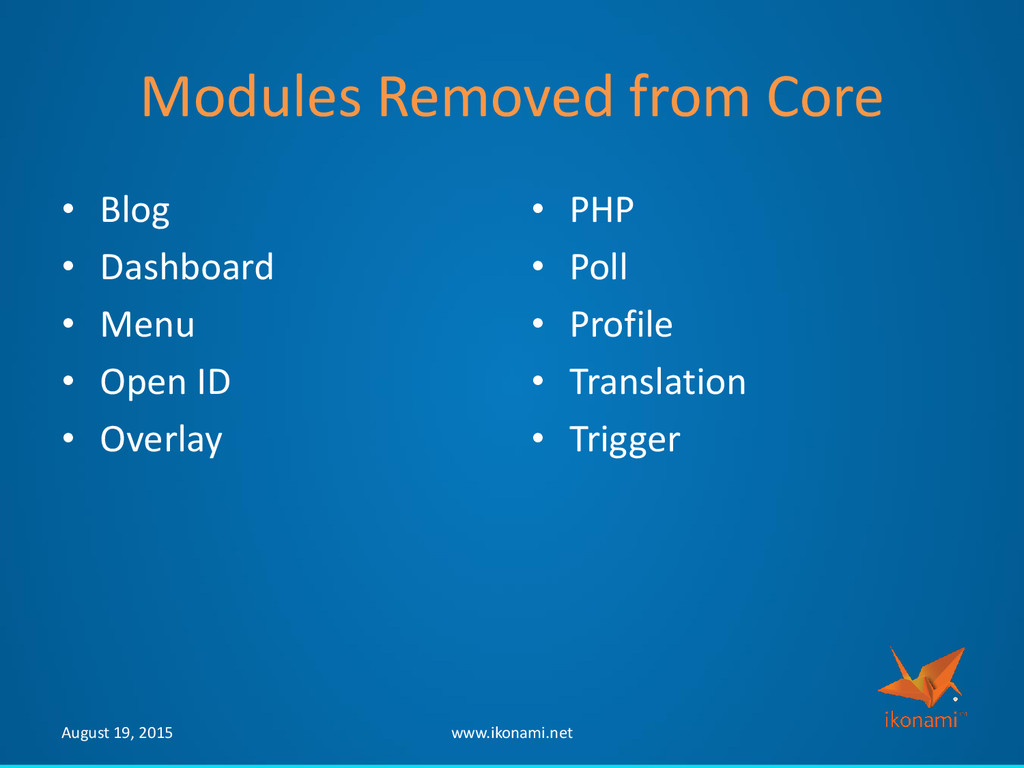
Modules Removed from Core • Blog • Dashboard • Menu
• Open ID • Overlay • PHP • Poll • Profile • Translation • Trigger August 19, 2015 www.ikonami.net -
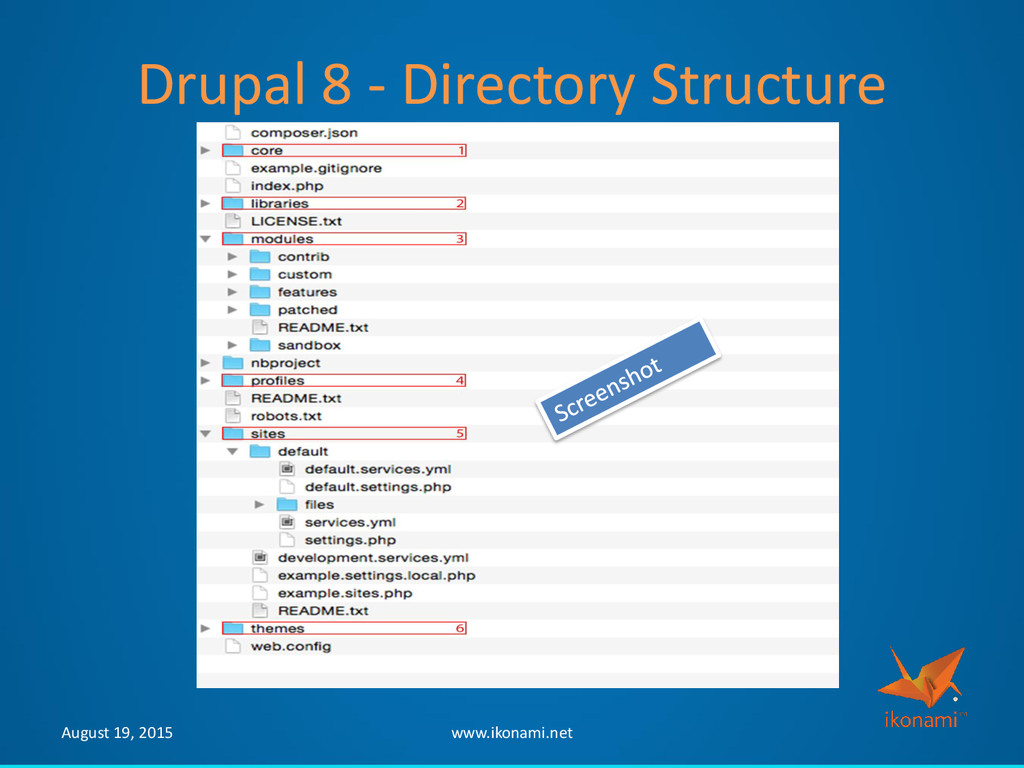
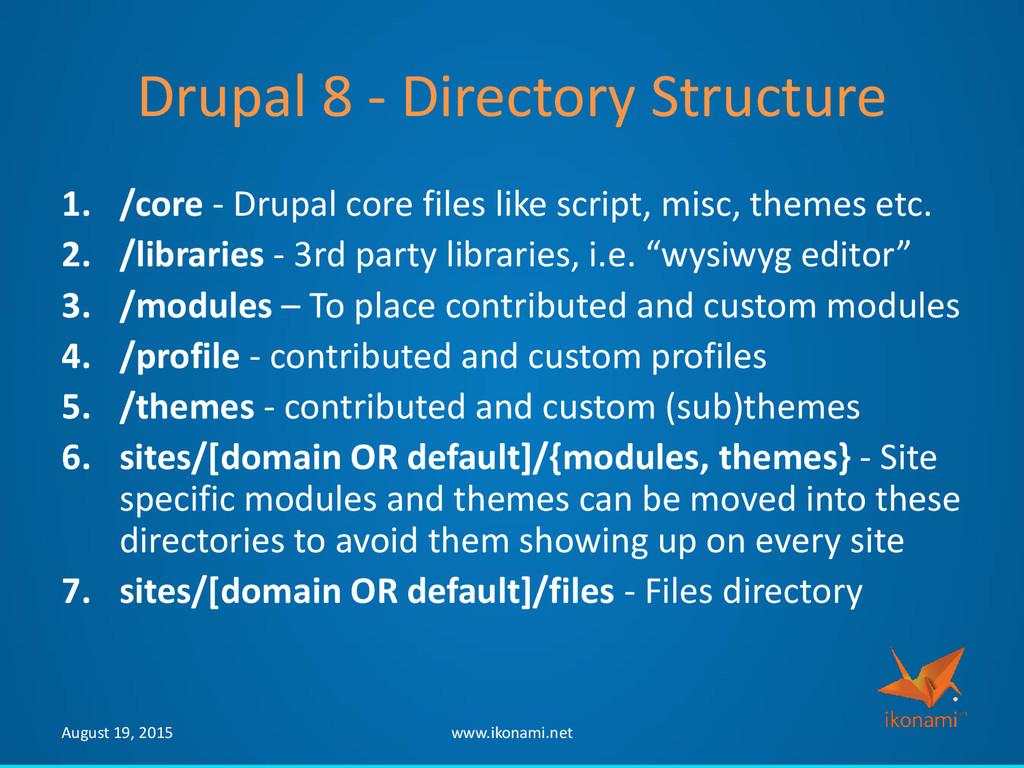
Drupal 8 - Directory Structure 1. /core - Drupal core
files like script, misc, themes etc. 2. /libraries - 3rd party libraries, i.e. “wysiwyg editor” 3. /modules – To place contributed and custom modules 4. /profile - contributed and custom profiles 5. /themes - contributed and custom (sub)themes 6. sites/[domain OR default]/{modules, themes} - Site specific modules and themes can be moved into these directories to avoid them showing up on every site 7. sites/[domain OR default]/files - Files directory August 19, 2015 www.ikonami.net -
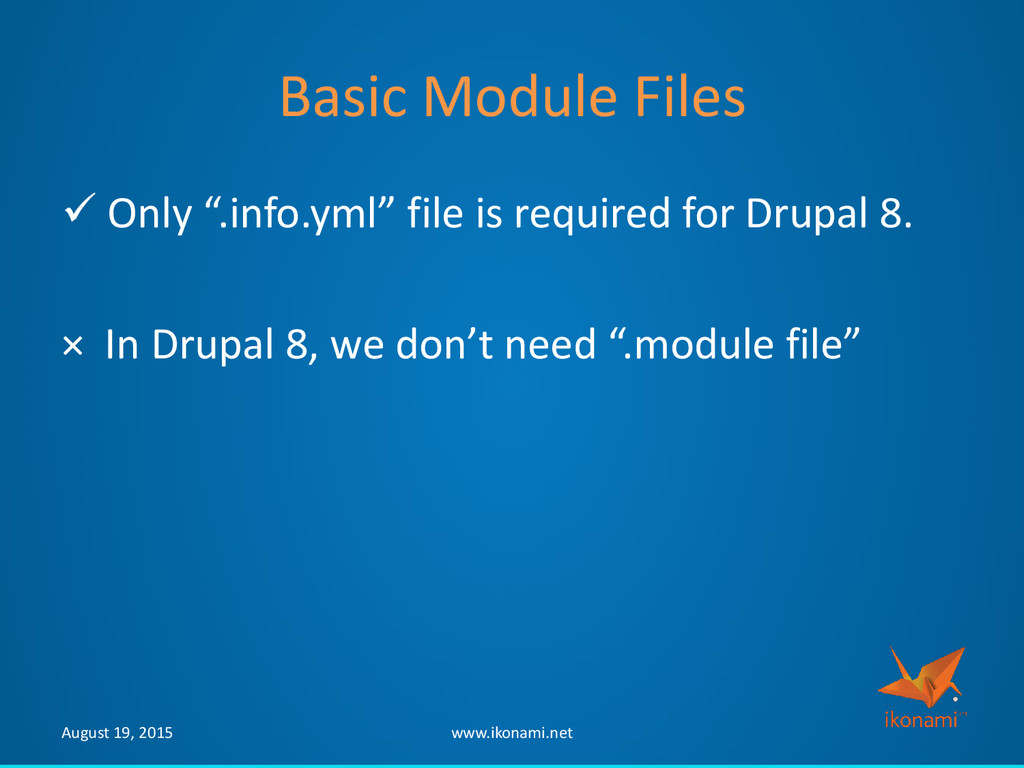
Basic Module Files Only “.info.yml” file is required for
Drupal 8. × In Drupal 8, we don’t need “.module file” August 19, 2015 www.ikonami.net -
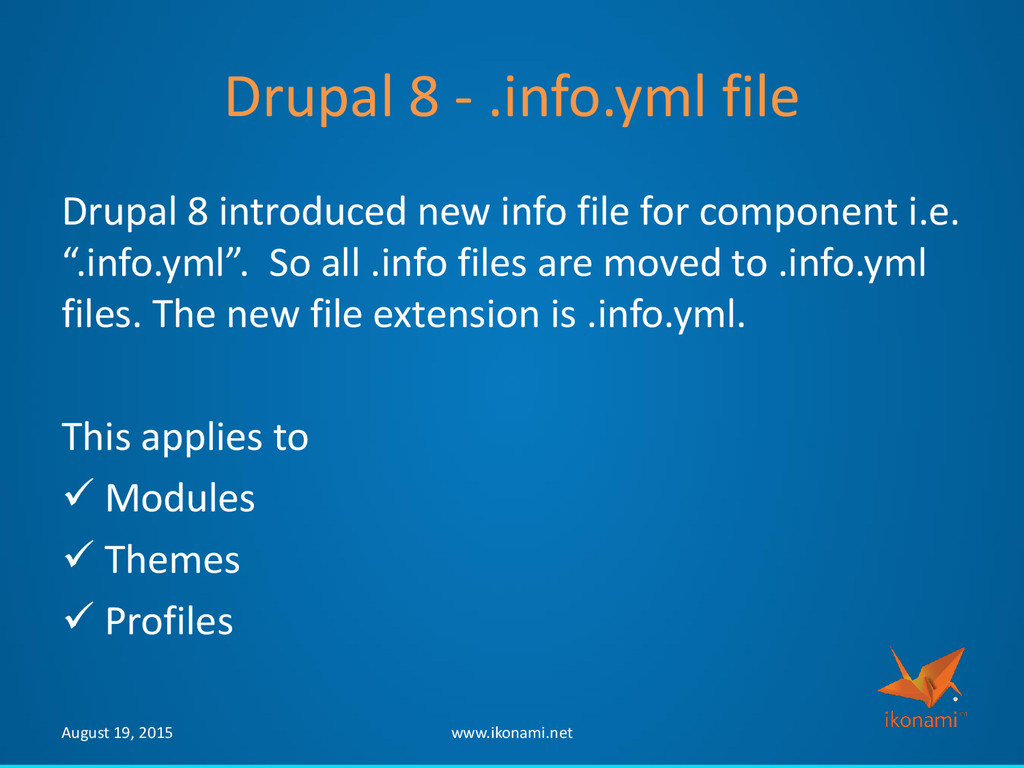
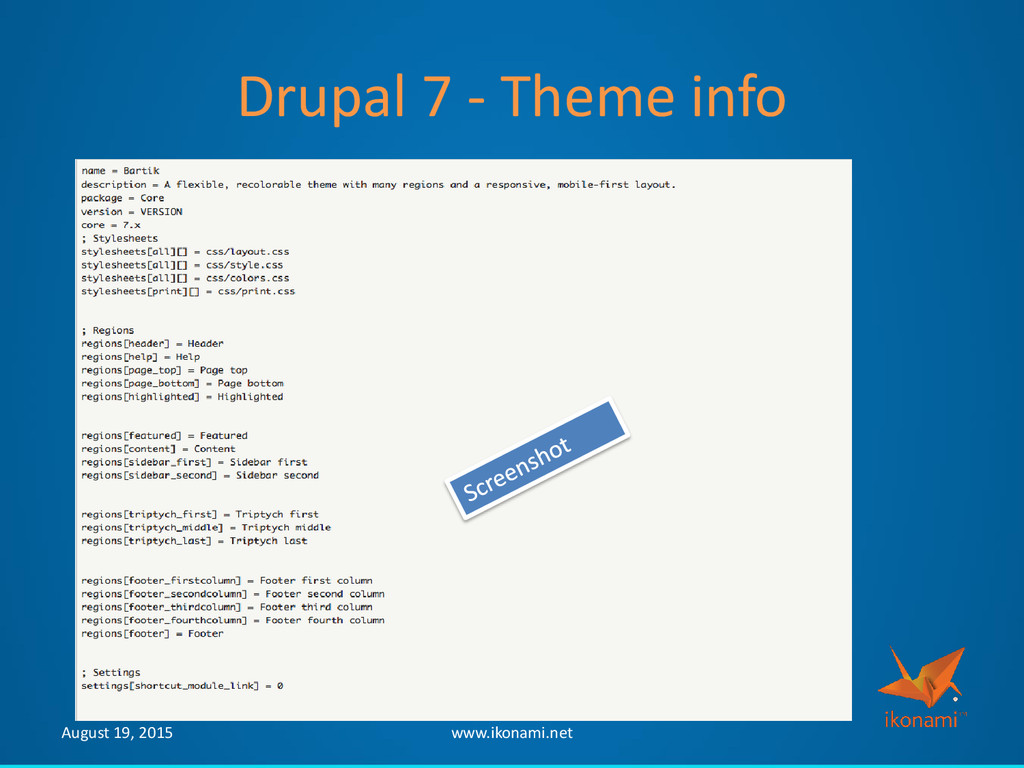
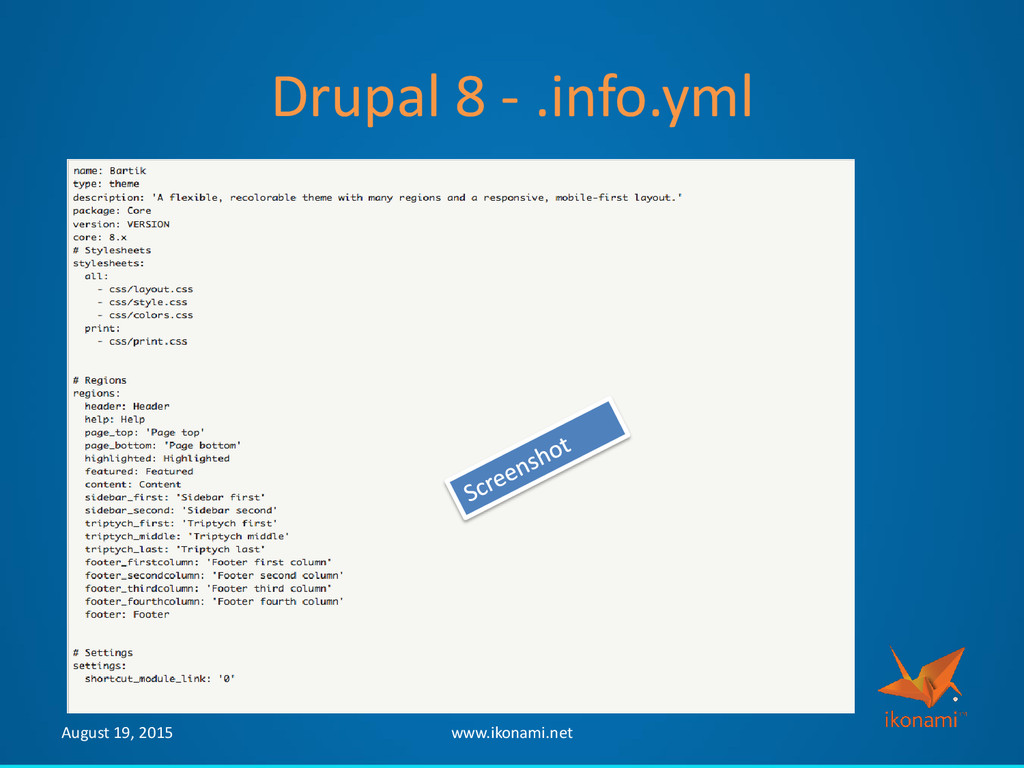
Drupal 8 - .info.yml file Drupal 8 introduced new info
file for component i.e. “.info.yml”. So all .info files are moved to .info.yml files. The new file extension is .info.yml. This applies to Modules Themes Profiles August 19, 2015 www.ikonami.net -
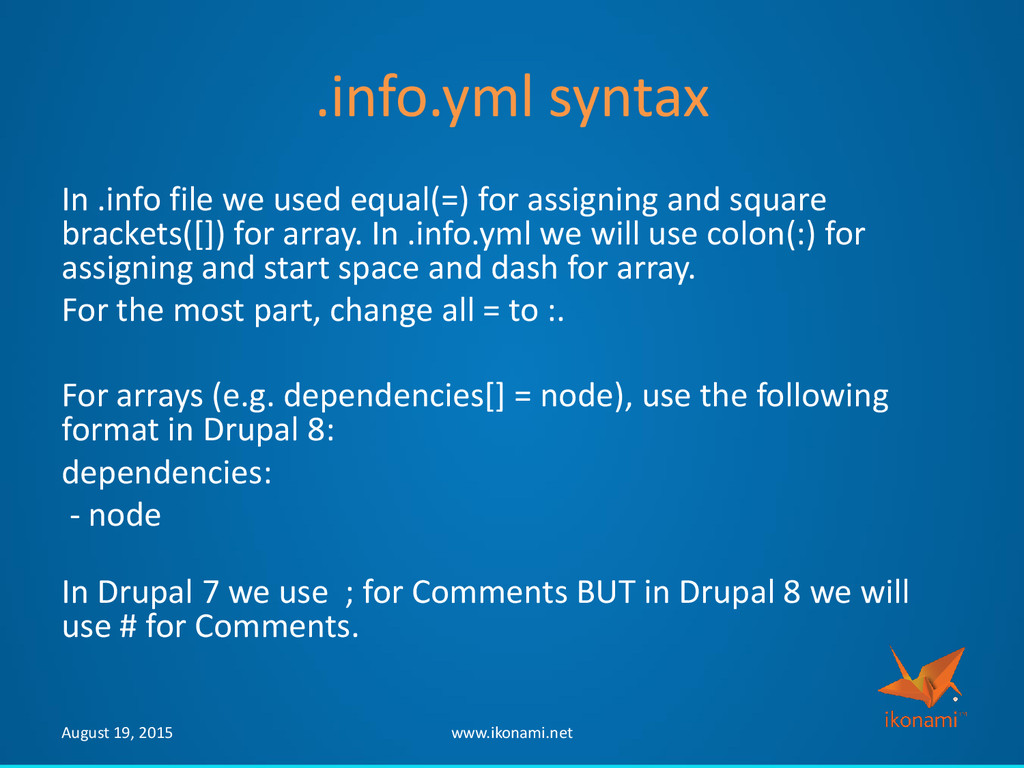
.info.yml syntax In .info file we used equal(=) for assigning
and square brackets([]) for array. In .info.yml we will use colon(:) for assigning and start space and dash for array. For the most part, change all = to :. For arrays (e.g. dependencies[] = node), use the following format in Drupal 8: dependencies: - node In Drupal 7 we use ; for Comments BUT in Drupal 8 we will use # for Comments. August 19, 2015 www.ikonami.net -
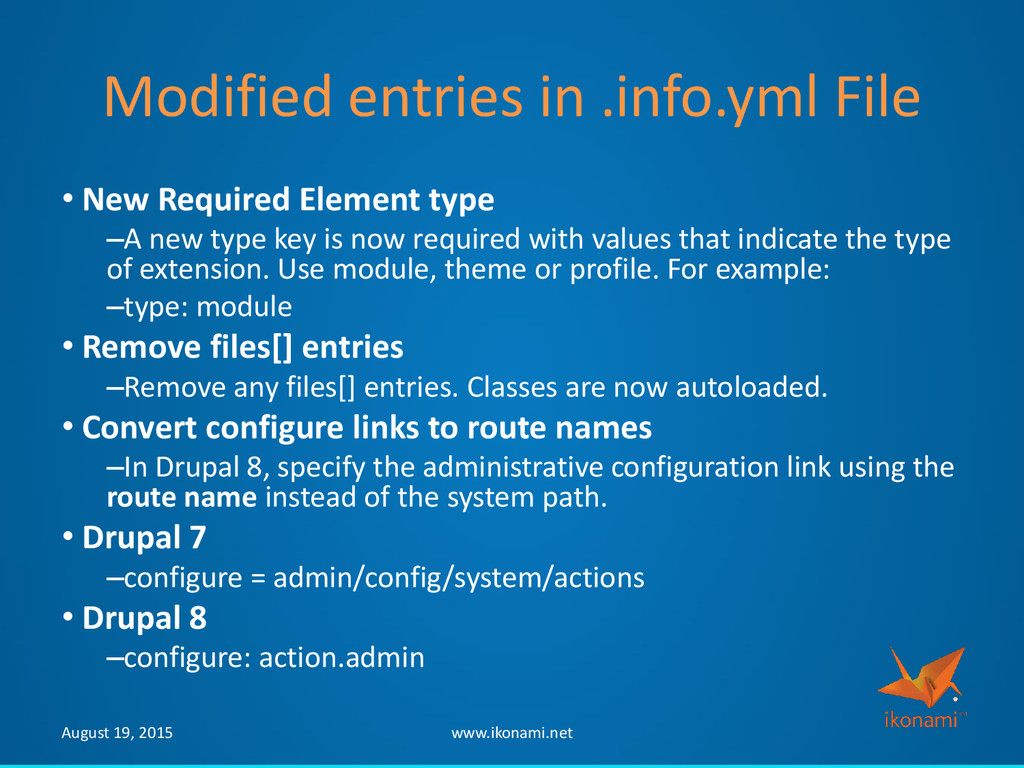
Modified entries in .info.yml File • New Required Element type
–A new type key is now required with values that indicate the type of extension. Use module, theme or profile. For example: –type: module • Remove files[] entries –Remove any files[] entries. Classes are now autoloaded. • Convert configure links to route names –In Drupal 8, specify the administrative configuration link using the route name instead of the system path. • Drupal 7 –configure = admin/config/system/actions • Drupal 8 –configure: action.admin August 19, 2015 www.ikonami.net -
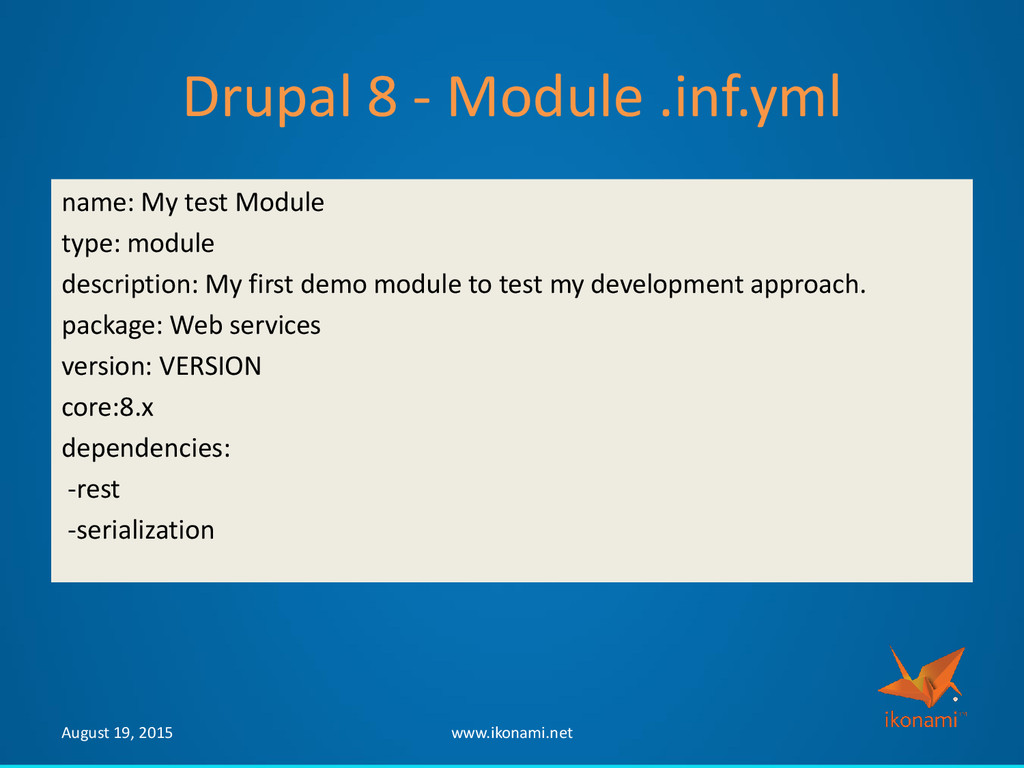
Drupal 8 - Module .inf.yml August 19, 2015 www.ikonami.net name:
My test Module type: module description: My first demo module to test my development approach. package: Web services version: VERSION core:8.x dependencies: -rest -serialization -
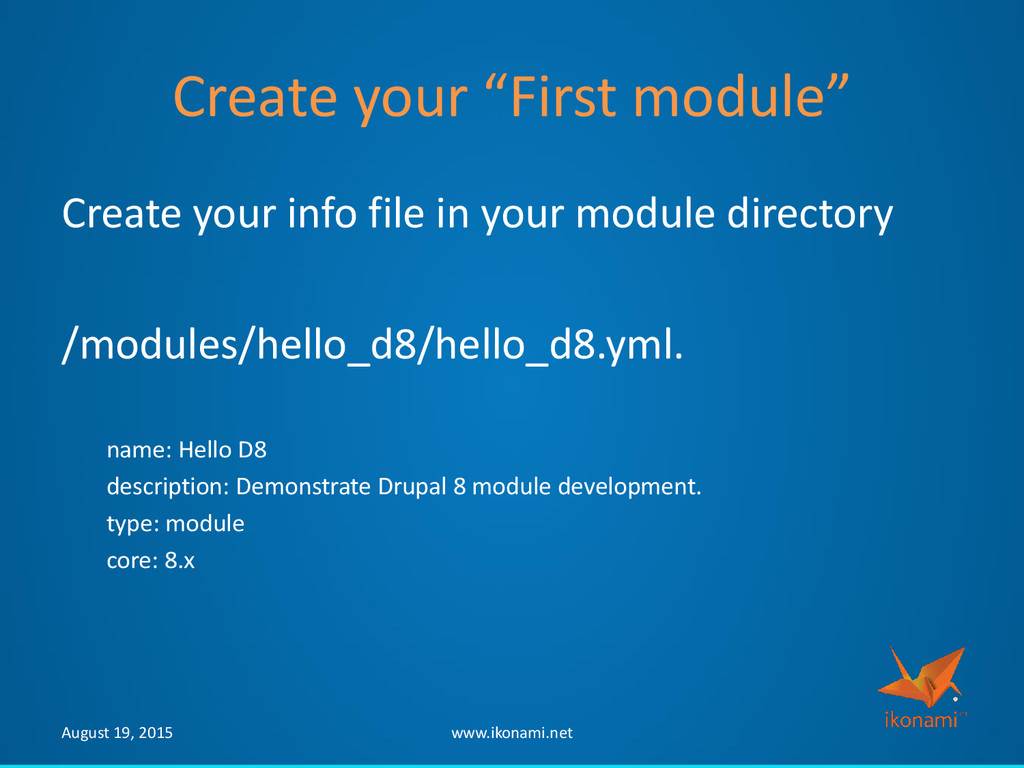
Create your “First module” Create your info file in your
module directory /modules/hello_d8/hello_d8.yml. name: Hello D8 description: Demonstrate Drupal 8 module development. type: module core: 8.x August 19, 2015 www.ikonami.net -
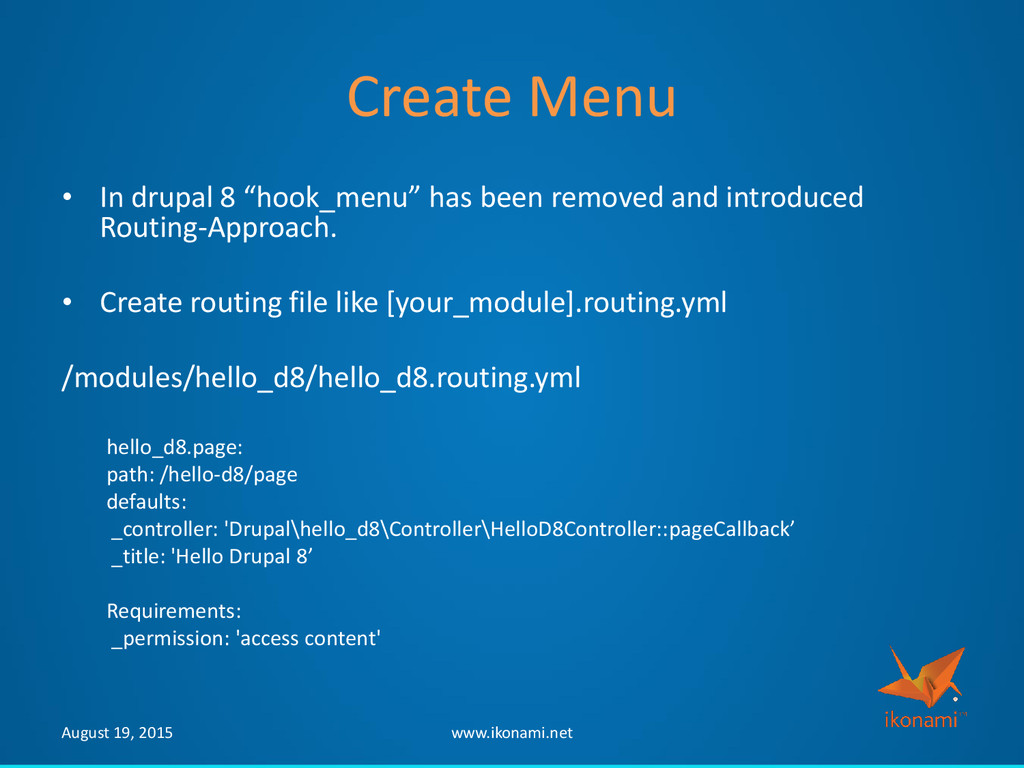
Create Menu • In drupal 8 “hook_menu” has been removed
and introduced Routing-Approach. • Create routing file like [your_module].routing.yml /modules/hello_d8/hello_d8.routing.yml hello_d8.page: path: /hello-d8/page defaults: _controller: 'Drupal\hello_d8\Controller\HelloD8Controller::pageCallback’ _title: 'Hello Drupal 8’ Requirements: _permission: 'access content' August 19, 2015 www.ikonami.net -
Create your module controller As Drupal 8 follows PSR-4 folder
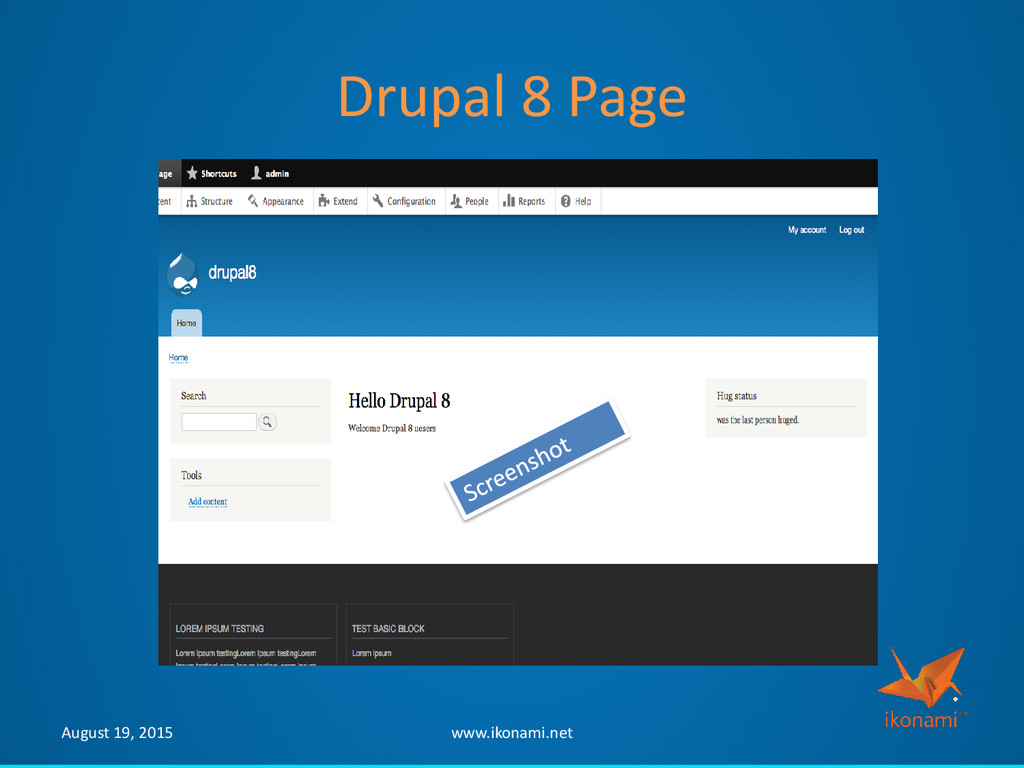
structure so you need to create your controller file under /modules/hello_d8/src/Controller/HelloD8Controller.php <?php namespace Drupal\hello_d8\Controller; use Drupal\Core\Controller\ControllerBase; class HelloD8Controller extends ControllerBase { public function pageCallback () { return [ '#markup' => $this->t('Welcome Drupal 8 uesers') ]; } } August 19, 2015 www.ikonami.net -
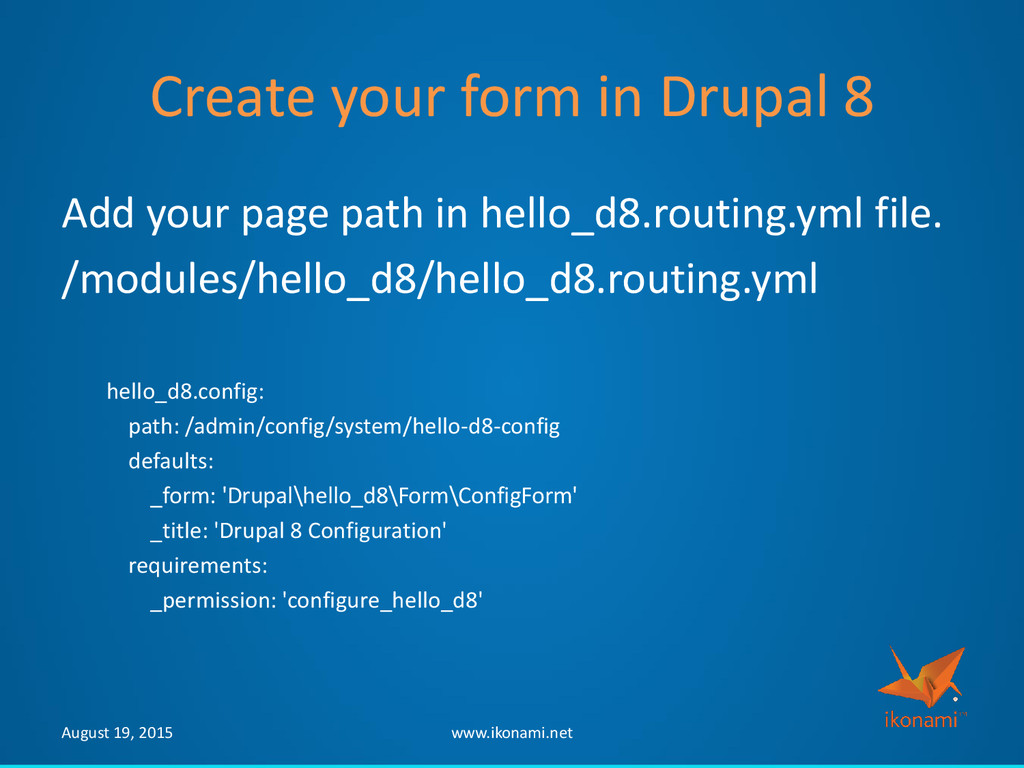
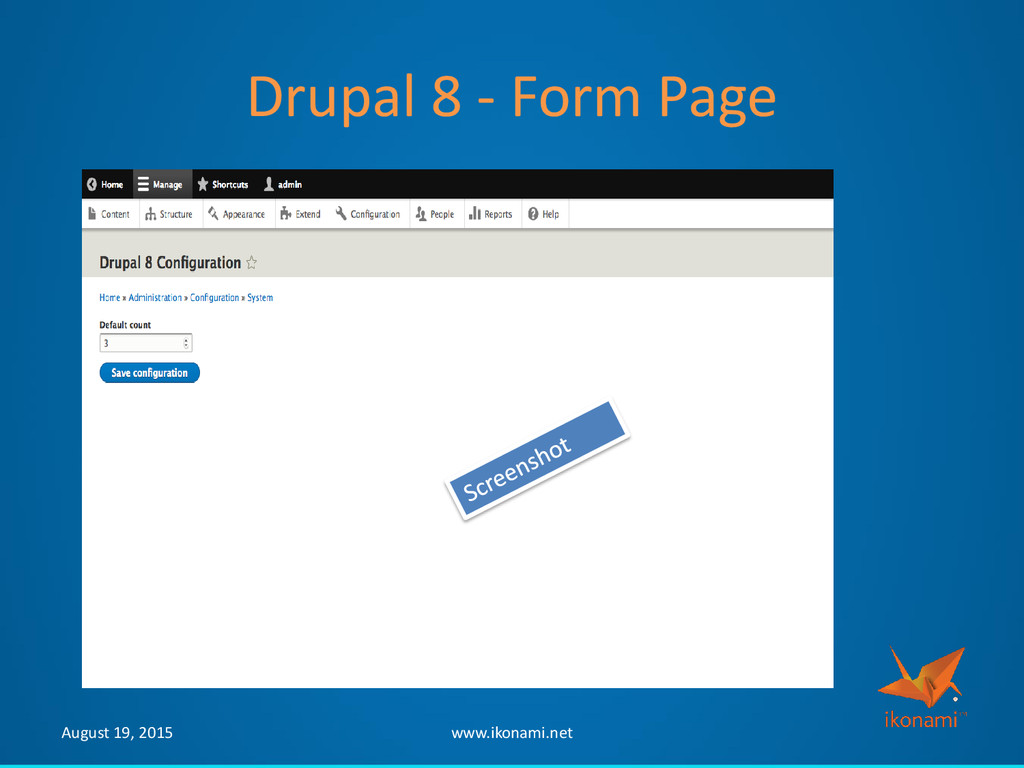
Create your form in Drupal 8 Add your page path
in hello_d8.routing.yml file. /modules/hello_d8/hello_d8.routing.yml hello_d8.config: path: /admin/config/system/hello-d8-config defaults: _form: 'Drupal\hello_d8\Form\ConfigForm' _title: 'Drupal 8 Configuration' requirements: _permission: 'configure_hello_d8' August 19, 2015 www.ikonami.net -
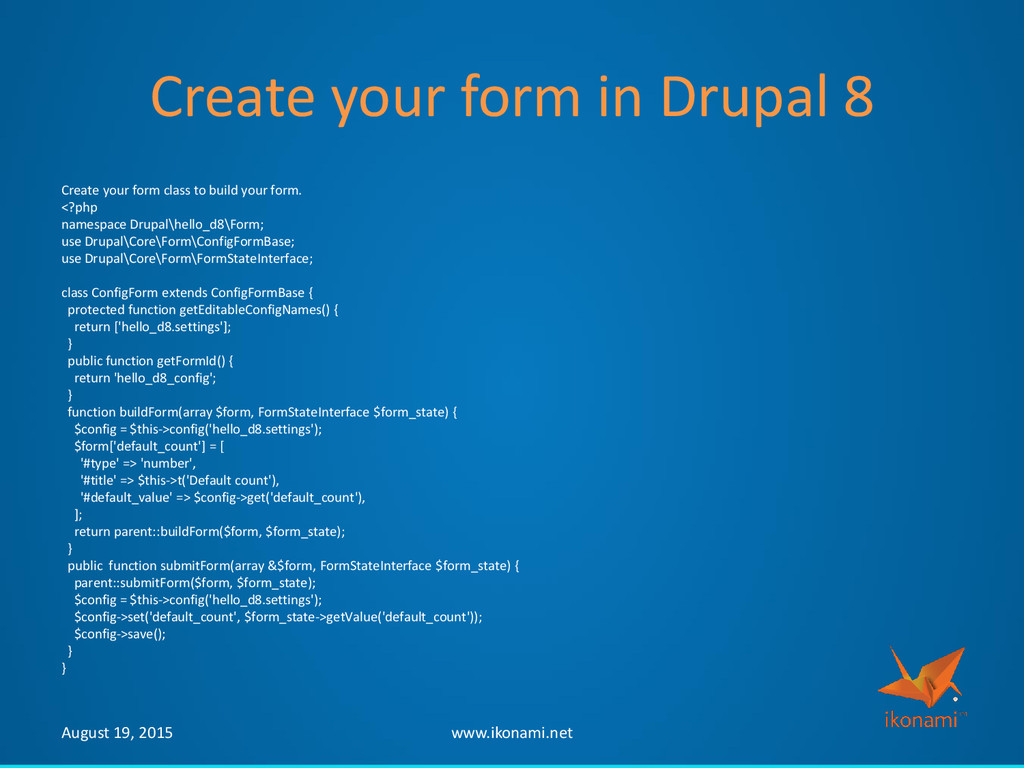
Create your form in Drupal 8 Create your form class
to build your form. <?php namespace Drupal\hello_d8\Form; use Drupal\Core\Form\ConfigFormBase; use Drupal\Core\Form\FormStateInterface; class ConfigForm extends ConfigFormBase { protected function getEditableConfigNames() { return ['hello_d8.settings']; } public function getFormId() { return 'hello_d8_config'; } function buildForm(array $form, FormStateInterface $form_state) { $config = $this->config('hello_d8.settings'); $form['default_count'] = [ '#type' => 'number', '#title' => $this->t('Default count'), '#default_value' => $config->get('default_count'), ]; return parent::buildForm($form, $form_state); } public function submitForm(array &$form, FormStateInterface $form_state) { parent::submitForm($form, $form_state); $config = $this->config('hello_d8.settings'); $config->set('default_count', $form_state->getValue('default_count')); $config->save(); } } August 19, 2015 www.ikonami.net -
Drupal 8 - Plugin API Plugins are small pieces of
functionality that are swappable. Plugins that perform similar functionality are of the same plugin type. August 19, 2015 www.ikonami.net -
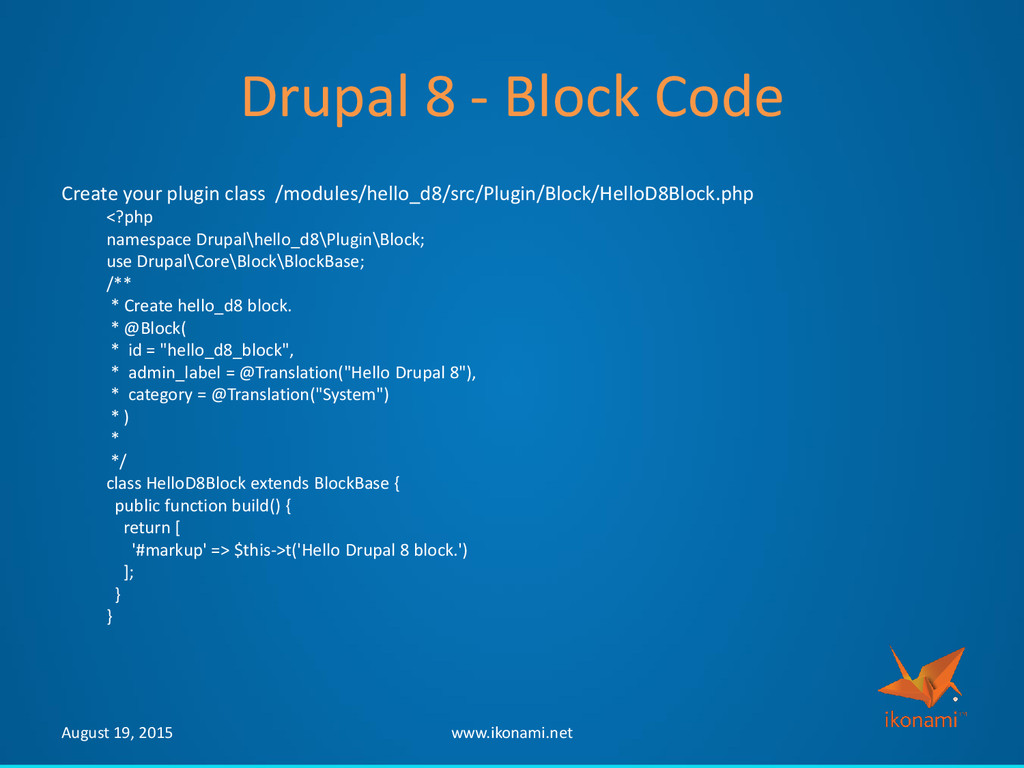
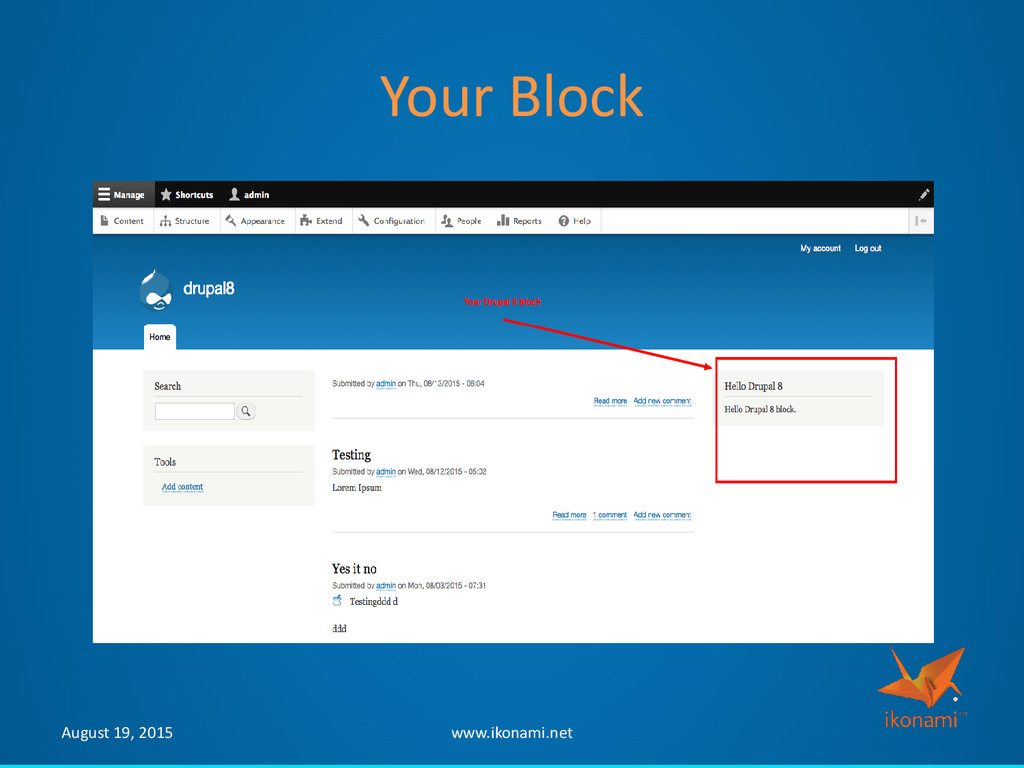
Drupal 8 - Block Code Create your plugin class /modules/hello_d8/src/Plugin/Block/HelloD8Block.php
<?php namespace Drupal\hello_d8\Plugin\Block; use Drupal\Core\Block\BlockBase; /** * Create hello_d8 block. * @Block( * id = "hello_d8_block", * admin_label = @Translation("Hello Drupal 8"), * category = @Translation("System") * ) * */ class HelloD8Block extends BlockBase { public function build() { return [ '#markup' => $this->t('Hello Drupal 8 block.') ]; } } August 19, 2015 www.ikonami.net