Upgrade to Pro — share decks privately, control downloads, hide ads and more …

Clean Architecture with ASP.NET Core 3

Sponsored · Ship Features Fearlessly Turn features on and off without deploys. Used by thousands of Ruby developers. →
Avatar for Jason Taylor Jason Taylor
November 20, 2019

Clean Architecture with ASP.NET Core 3

The explosive growth of web frameworks and the demands of users have changed the approach to building web applications. Many challenges exist, and getting started can be a daunting prospect. Let's change that now.

This talk provides practical guidance and recommendations. We will cover architecture, technologies, tools, and frameworks. We will examine strategies for organizing your projects, folders and files. We will design a system that is simple to build and maintain - all the way from development to production. You leave this talk inspired and prepared to take your enterprise application development to the next level.

Avatar for Jason Taylor

Jason Taylor

November 20, 2019

Other Decks in Technology

Transcript

  1. SSW Solution Architect Jason Taylor github.com/jasongt youtube.com/jasongt Join the Conversation

    #DotNetCoreSuperpowers @SSW_TV jasongtau codingflow.net Visiting from Australia .NET Developer Since 2002 Keep It Simple, Stupid!
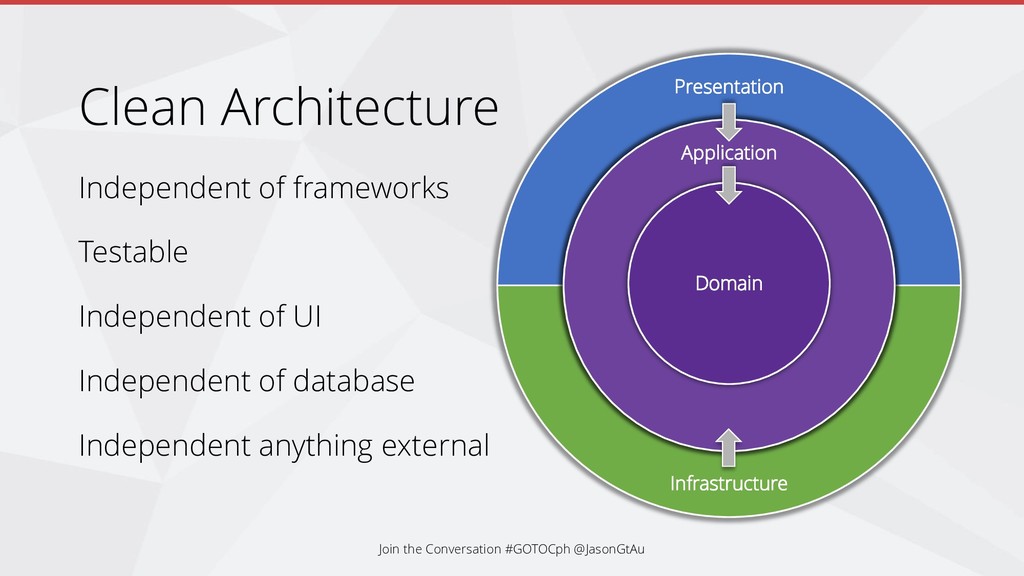
  2. Clean Architecture Independent of frameworks Testable Independent of UI Independent

    of database Independent anything external Join the Conversation #GOTOCph @JasonGtAu Presentation Infrastructure Application Domain
  3. Northwind Traders Sample Clean Architecture ASP.NET Core 3.0 Entity Framework

    Core 3.0 ASP.NET Core Identity 3.0 Repo bit.ly/northwind-traders Join the Conversation #GOTOCph @JasonGtAu
  4. Clean Architecture Template .NET Core Template Package ASP.NET Core 3.0

    Entity Framework Core 3.0 ASP.NET Core Identity 3.0 Repo bit.ly/ca-sln Join the Conversation #GOTOCph @JasonGtAu
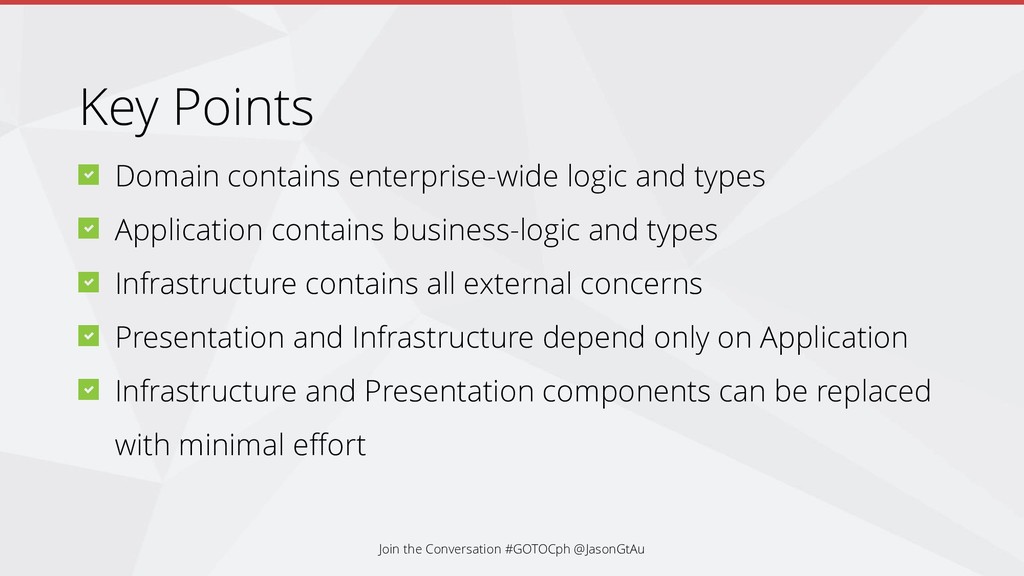
  5. Domain contains enterprise-wide logic and types Application contains business-logic and

    types Infrastructure contains all external concerns Presentation and Infrastructure depend only on Application Infrastructure and Presentation components can be replaced with minimal effort Join the Conversation #GOTOCph @JasonGtAu Key Points
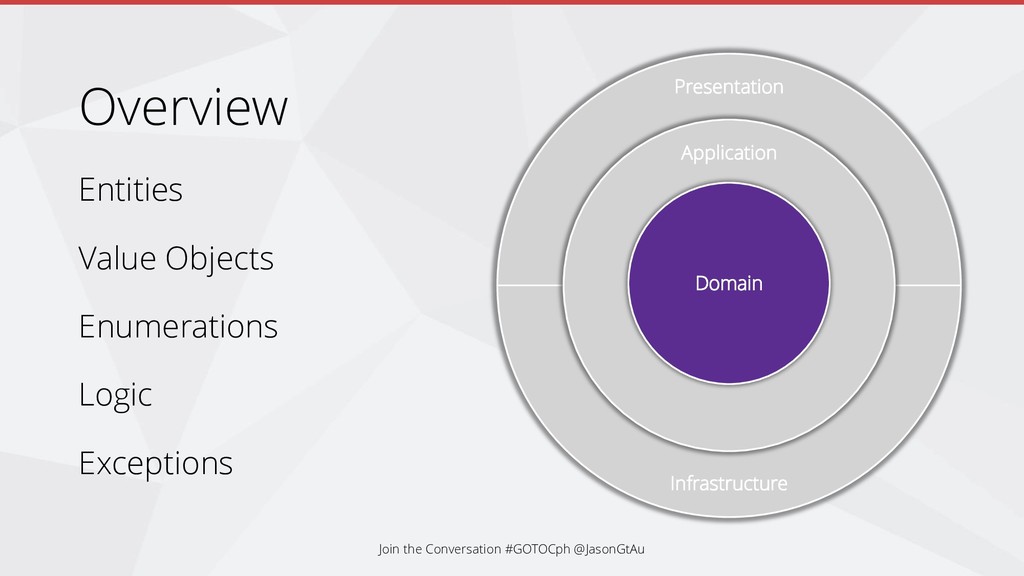
  6. Overview Entities Value Objects Enumerations Logic Exceptions Join the Conversation

    #GOTOCph @JasonGtAu Presentation Application Infrastructure Domain
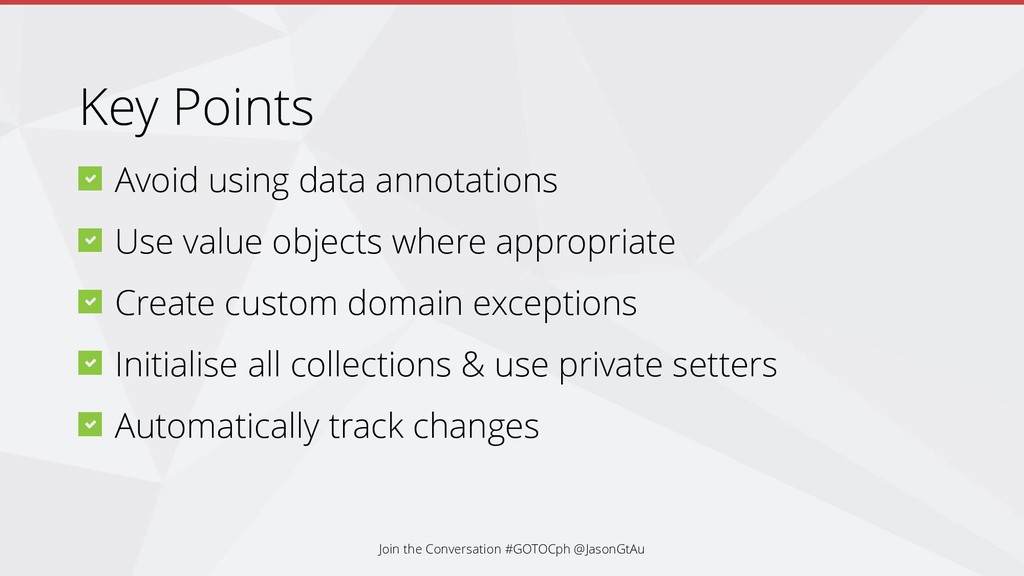
  7. Avoid using data annotations Use value objects where appropriate Create

    custom domain exceptions Initialise all collections & use private setters Automatically track changes Join the Conversation #GOTOCph @JasonGtAu Key Points
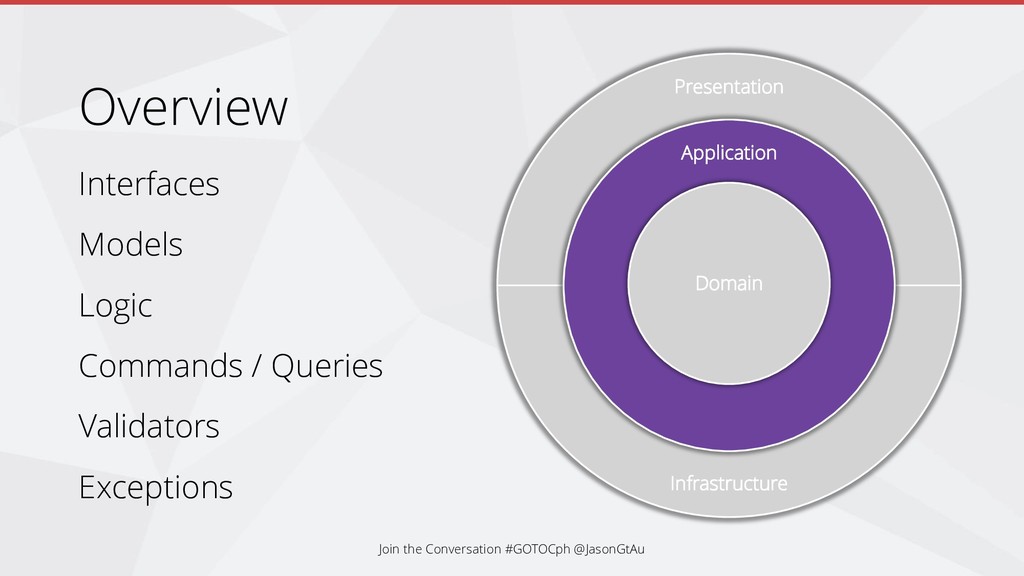
  8. Overview Interfaces Models Logic Commands / Queries Validators Exceptions Join

    the Conversation #GOTOCph @JasonGtAu Presentation Application Infrastructure Domain
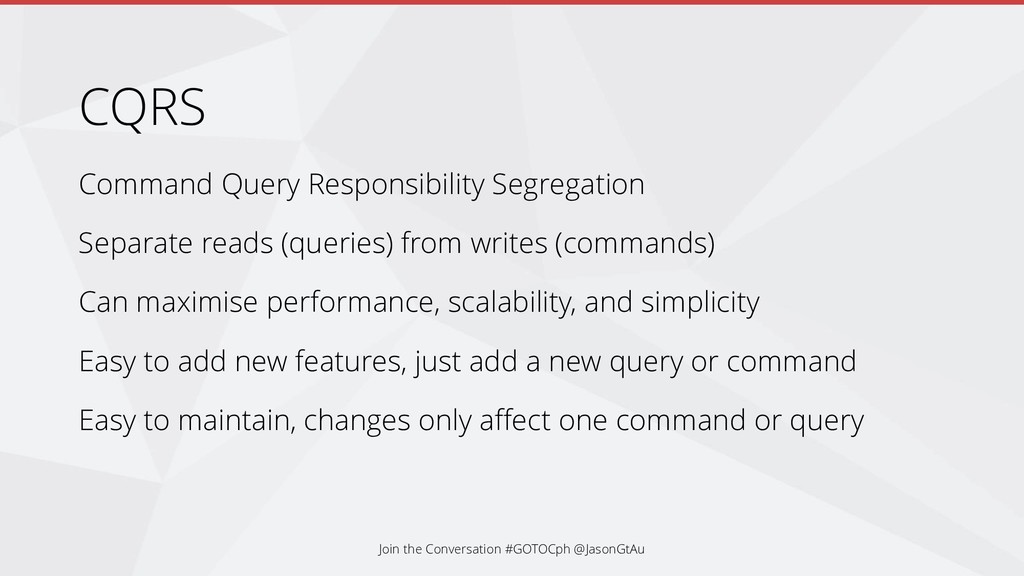
  9. CQRS Command Query Responsibility Segregation Separate reads (queries) from writes

    (commands) Can maximise performance, scalability, and simplicity Easy to add new features, just add a new query or command Easy to maintain, changes only affect one command or query Join the Conversation #GOTOCph @JasonGtAu
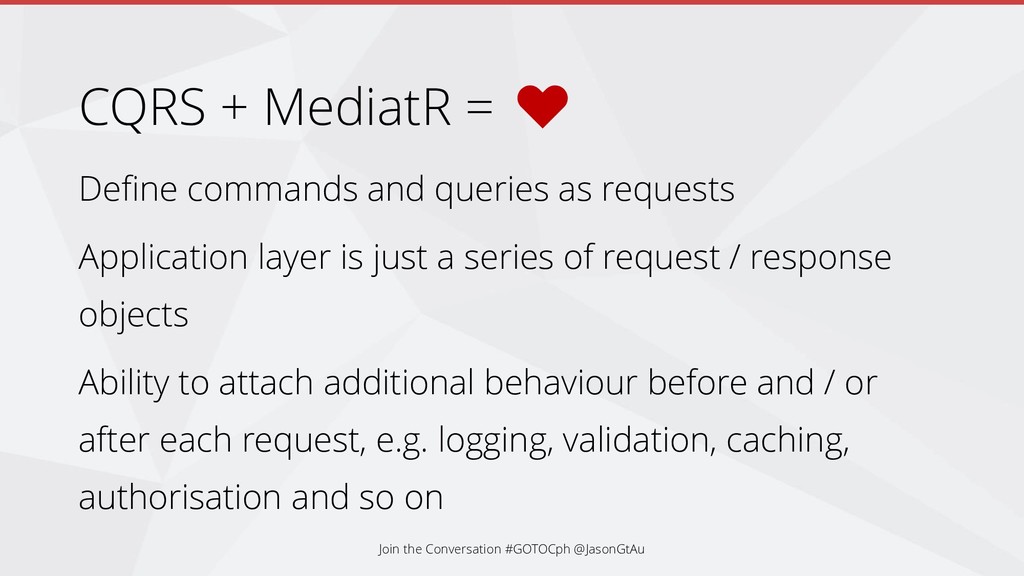
  10. CQRS + MediatR = ♥ Define commands and queries as

    requests Application layer is just a series of request / response objects Ability to attach additional behaviour before and / or after each request, e.g. logging, validation, caching, authorisation and so on Join the Conversation #GOTOCph @JasonGtAu
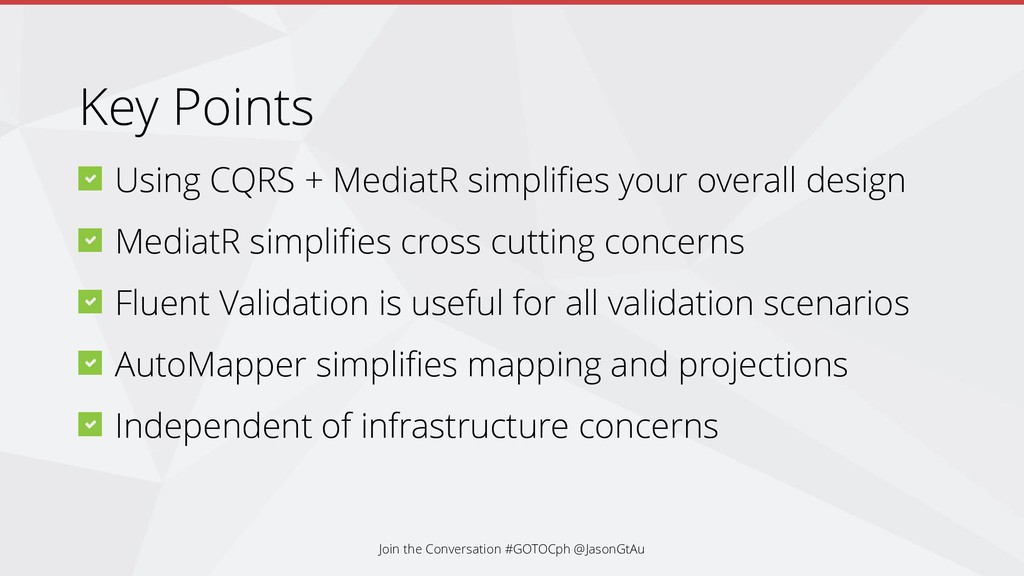
  11. Using CQRS + MediatR simplifies your overall design MediatR simplifies

    cross cutting concerns Fluent Validation is useful for all validation scenarios AutoMapper simplifies mapping and projections Independent of infrastructure concerns Join the Conversation #GOTOCph @JasonGtAu Key Points
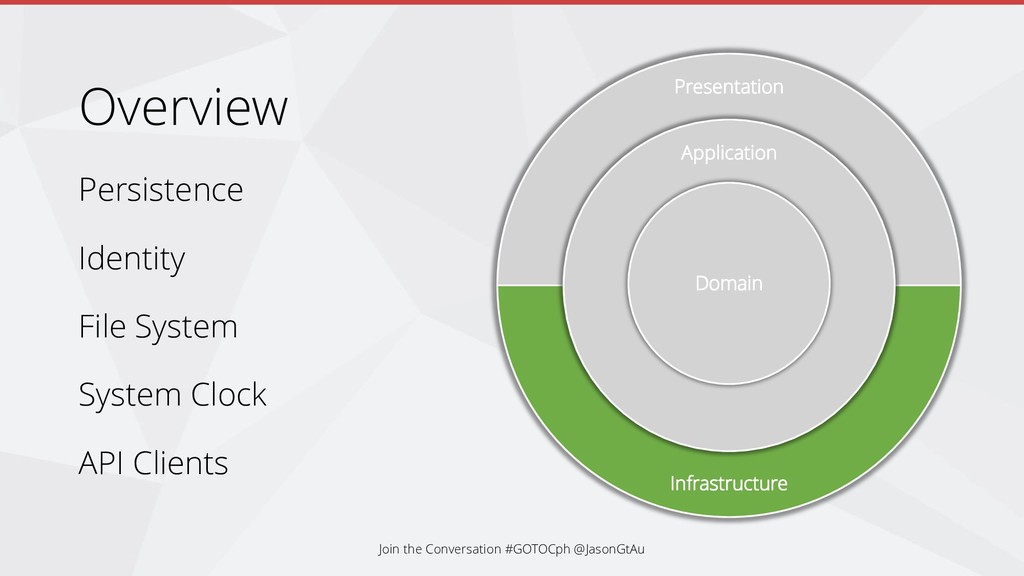
  12. Overview Persistence Identity File System System Clock API Clients Join

    the Conversation #GOTOCph @JasonGtAu Presentation Application Infrastructure Domain
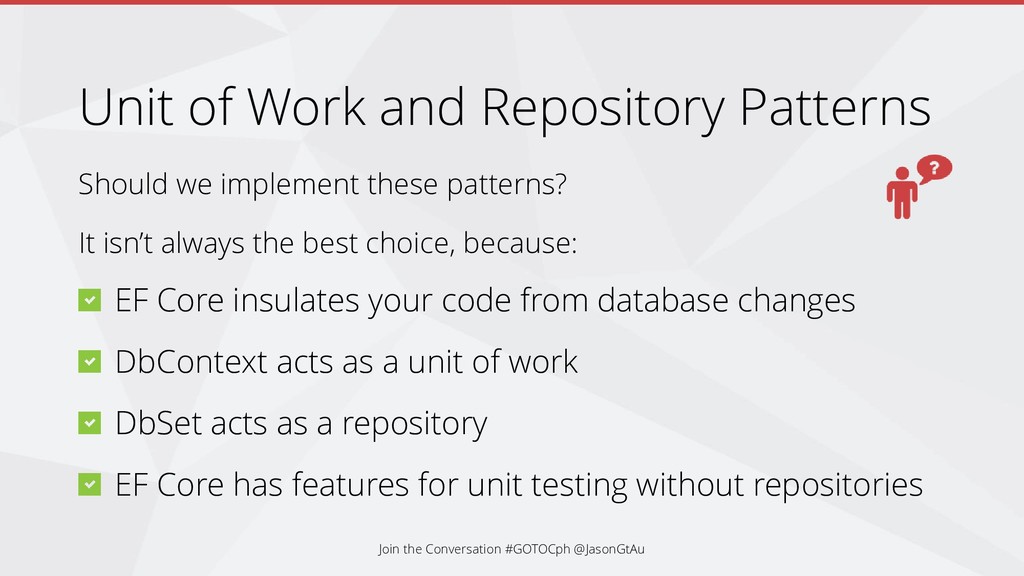
  13. Unit of Work and Repository Patterns Should we implement these

    patterns? It isn’t always the best choice, because: EF Core insulates your code from database changes DbContext acts as a unit of work DbSet acts as a repository EF Core has features for unit testing without repositories Join the Conversation #GOTOCph @JasonGtAu
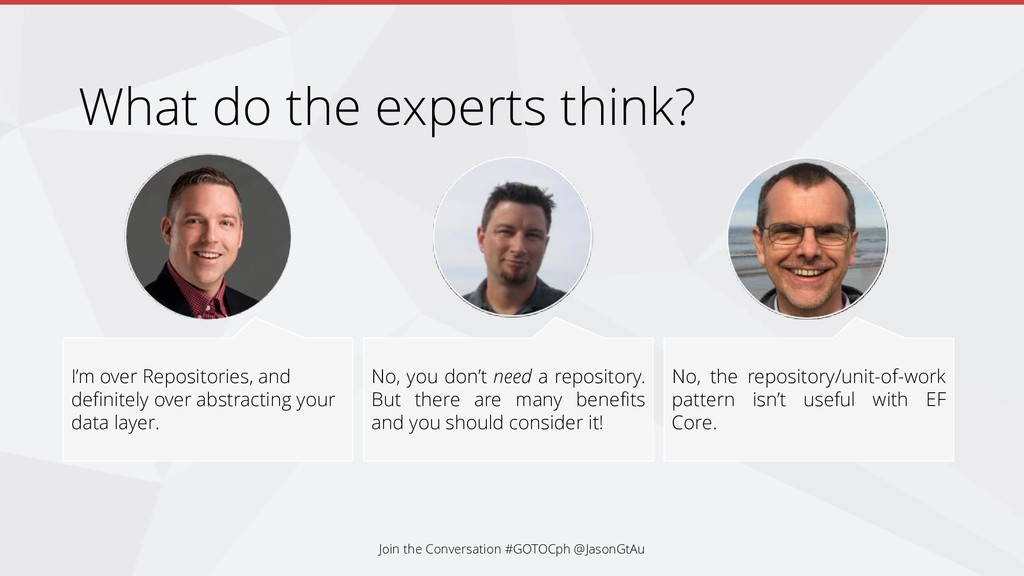
  14. What do the experts think? Join the Conversation #GOTOCph @JasonGtAu

    I’m over Repositories, and definitely over abstracting your data layer. No, the repository/unit-of-work pattern isn’t useful with EF Core. No, you don’t need a repository. But there are many benefits and you should consider it!
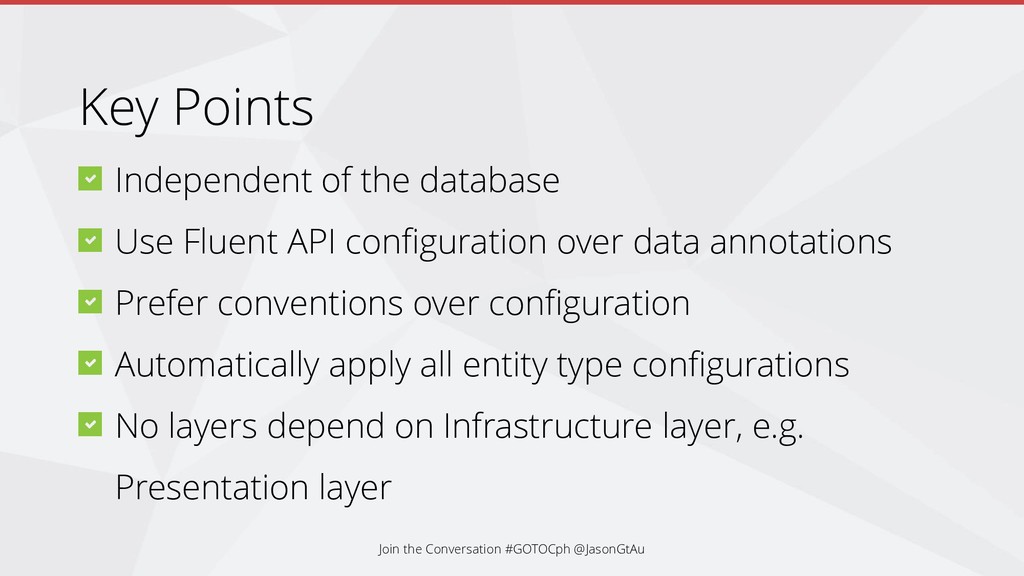
  15. Independent of the database Use Fluent API configuration over data

    annotations Prefer conventions over configuration Automatically apply all entity type configurations No layers depend on Infrastructure layer, e.g. Presentation layer Join the Conversation #GOTOCph @JasonGtAu Key Points
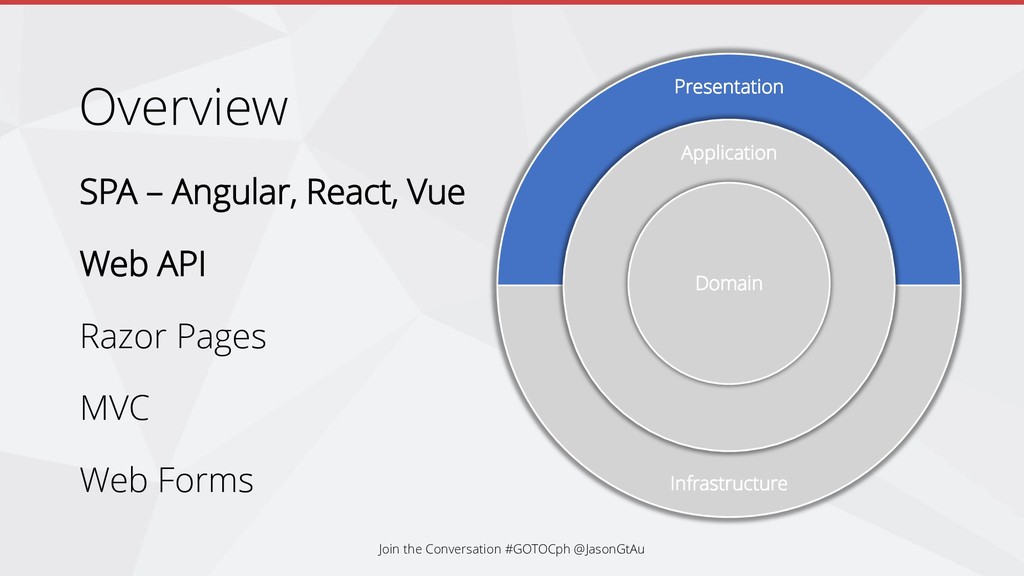
  16. Overview SPA – Angular, React, Vue Web API Razor Pages

    MVC Web Forms Join the Conversation #GOTOCph @JasonGtAu Presentation Application Infrastructure Domain
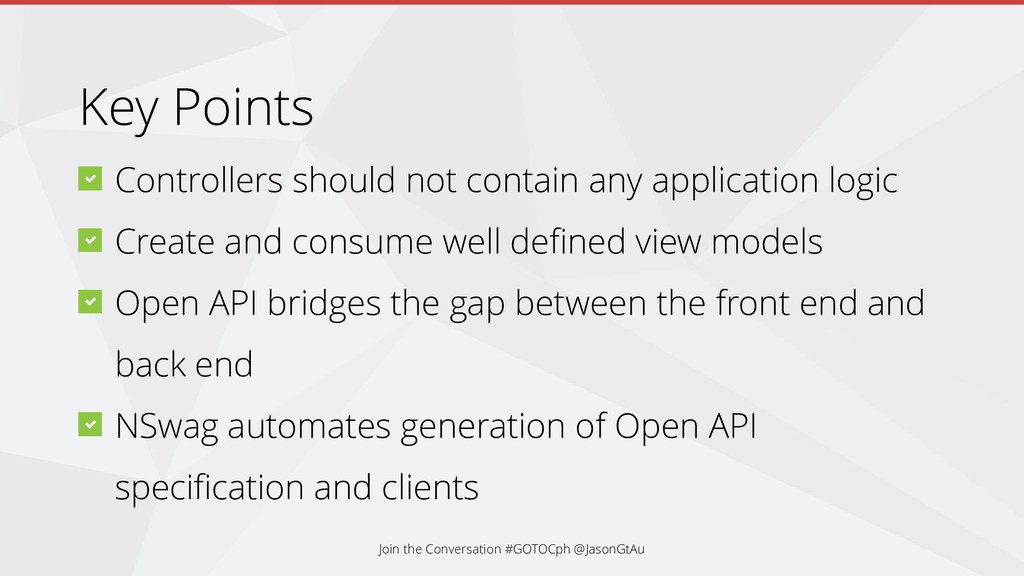
  17. Controllers should not contain any application logic Create and consume

    well defined view models Open API bridges the gap between the front end and back end NSwag automates generation of Open API specification and clients Join the Conversation #GOTOCph @JasonGtAu Key Points
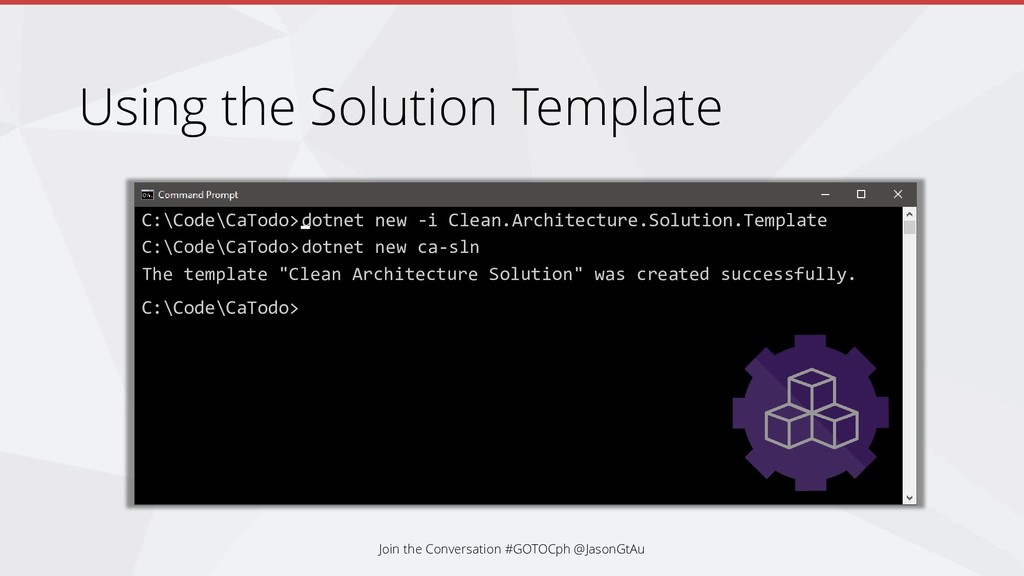
  18. Using the Solution Template Join the Conversation #GOTOCph @JasonGtAu C:\Code\CaTodo>dotnet

    new -i Clean.Architecture.Solution.Template C:\Code\CaTodo>dotnet new ca-sln The template "Clean Architecture Solution" was created successfully. C:\Code\CaTodo>