rather quickly. have included links within slides for further exploration. may not get around to all the slides. Do copy this link: (use phone, take picture)
spans theory and practice. It requires thinking both in abstract terms and in concrete terms… computer science can be seen on a higher level, as a science of problem solving.” - http://www.cs.mtu.edu/~john/whatiscs.html
at modeling and analyzing problems. They must also be able to design solutions and verify that they are correct. Problem solving requires precision, creativity, and careful reasoning.” - http://www.cs.mtu.edu/~john/whatiscs.html Summary: Problems → Solution/Opportunities
Enigma code, a group of Mathematicians and graduate students built a machine that followed logical instructions based on Alan Turing’s proposal. The Turing Machine became the foundation of modern computer and computation. Clip of how the code was broken: https://www.youtube.com/watch?v=Hb44bGY2KdU Twitter-like history of computers: http://www.computerhope.com/issues/ch000984.htm
“Computing drives innovation in the sciences (human genome project, AIDS vaccine research, environmental monitoring and protection just to mention a few), and also in engineering, business, entertainment and education.” http://computingcareers.acm.org/?page_id=4
of knowledge, problem solving and logical thinking will be a competitive advantage in any career or field you pursue. Coupled with a secondary field your opportunities expand and become more interesting.
Networks & Communications, Mainframe Systems, Distributed Systems, Data Processing and Database Systems, Human-Computer Interaction, Cryptography, Security and much more. just marble at the wonder of your mobile phone….
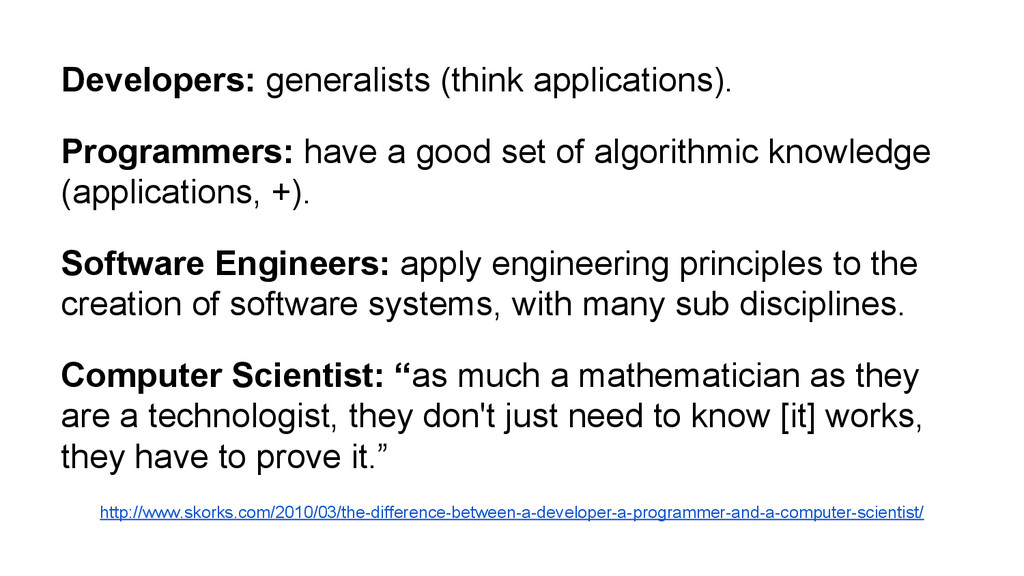
algorithmic knowledge (applications, +). Software Engineers: apply engineering principles to the creation of software systems, with many sub disciplines. Computer Scientist: “as much a mathematician as they are a technologist, they don't just need to know [it] works, they have to prove it.” http://www.skorks.com/2010/03/the-difference-between-a-developer-a-programmer-and-a-computer-scientist/
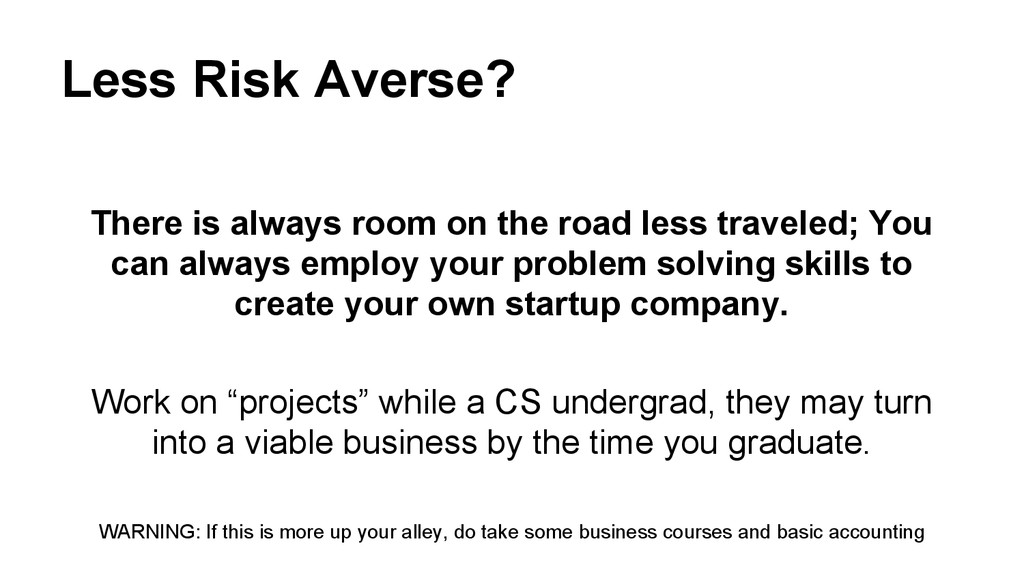
less traveled; You can always employ your problem solving skills to create your own startup company. Work on “projects” while a CS undergrad, they may turn into a viable business by the time you graduate. WARNING: If this is more up your alley, do take some business courses and basic accounting
have TONS of real world experience in both industry and academia. The Mathematics and Computer Science Department has a partnership with IBM, opening up doors for students to gain experience.
At the very least take: CMP 167: Programming Methods I (Any) PHI 227: Ethical Issues in Computing & Tech. (Dale) PHI 170: Introduction to Logic (Dale) PHI 330: Business Ethics (Birnbaum)
up pursuing get an internship in the field or a related one by your Junior or Senior year. 2. Start updating your resume: Get experience outside the classroom: program/hack away, find problems and try tackling solutions, join Hack-a-thons, build things. Resume Help: http://www.ocs.fas.harvard.edu/students/materials/resumes_and_cover_letters.pdf The Google Resume: https://www.uop.edu.jo/download/research/members/495_1887_llll.pdf You can always compensate lack of work experience with personal project.
by Computer Science Education Week and Code.org to introduce millions of students to one hour of computer science and computer programming. https://www.khanacademy.org/hourofcode
department professors! 2. Get acquainted over the winter break: Codeacademy.com (fantastic place to start) Udacity.com (How to Build a Startup) EdX.org/Coursera.com (MIT, Harvard, etc CS courses) Lynda.com (available Lehman Library)
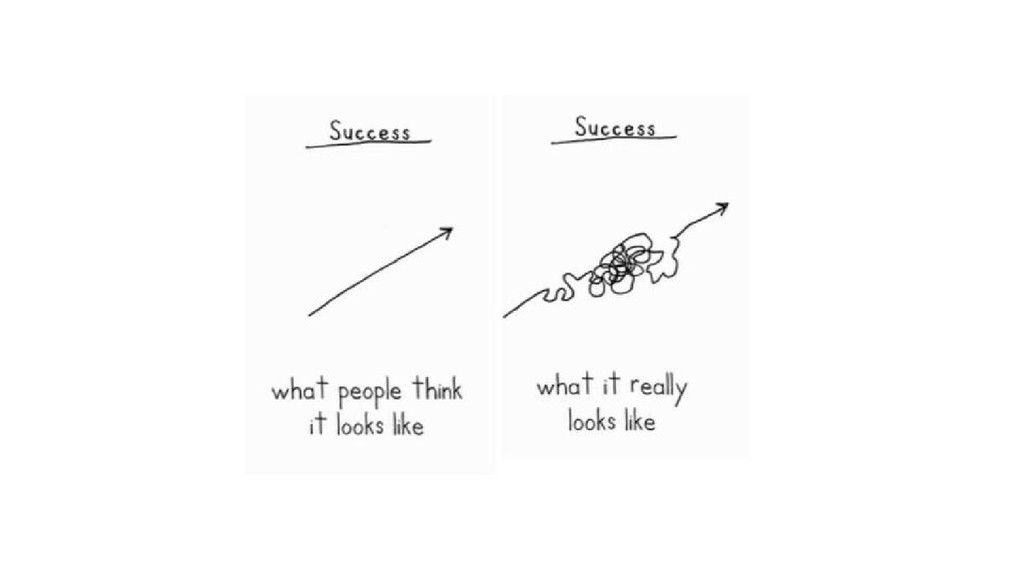
and without desire. The reality of your own nature should determine the speed. If you become restless, speed up. If you become winded, slow down. You climb the mountain in an equilibrium between restlessness and exhaustion… To live only for some future goal is shallow. It's the sides of the mountain which sustain life, not the top. Here's where things grow." - Robert Pirsig, The Art of Motorcycle Maintenance Some strings of Inspiration


 jgalv
 kneath
 soudai
 letsgokoyo
 tammyeverts
 palkan
 pauljervisheath
 eitanlees
 reverentgeek
 techseoconnect
 panda_program
 lauravandoore
 retrage