Upgrade to Pro — share decks privately, control downloads, hide ads and more …

Drinking_some_Elixir.pdf

Avatar for josv josv
June 16, 2018
27

 Drinking_some_Elixir.pdf

Avatar for josv

josv

June 16, 2018

Transcript

  1. WHAT IS ELIXIR ? WHAT IS ELIXIR ? Elixir is

    a functional, concurrent, general-purpose programming language that runs on the BEAM VM. BUT WHY ELIXIR? 2
  2. WHY ELIXIR? (RESPONSIVE AND WHY ELIXIR? (RESPONSIVE AND ROBUST) ROBUST)

    Runs on Erlang VM Fault Tolerant Distributed Low latency Consistent performance Observable *We will see these in code later 4
  3. WHY ELIXIR? (PROGRAMMER WHY ELIXIR? (PROGRAMMER INCENTIVES) INCENTIVES) Mature Tooling

    and Documentation Use Erlang libraries Metaprogramming Standards for distributed apps (OTP) Actor model based concurrency Functional (is the new cool :D) 5
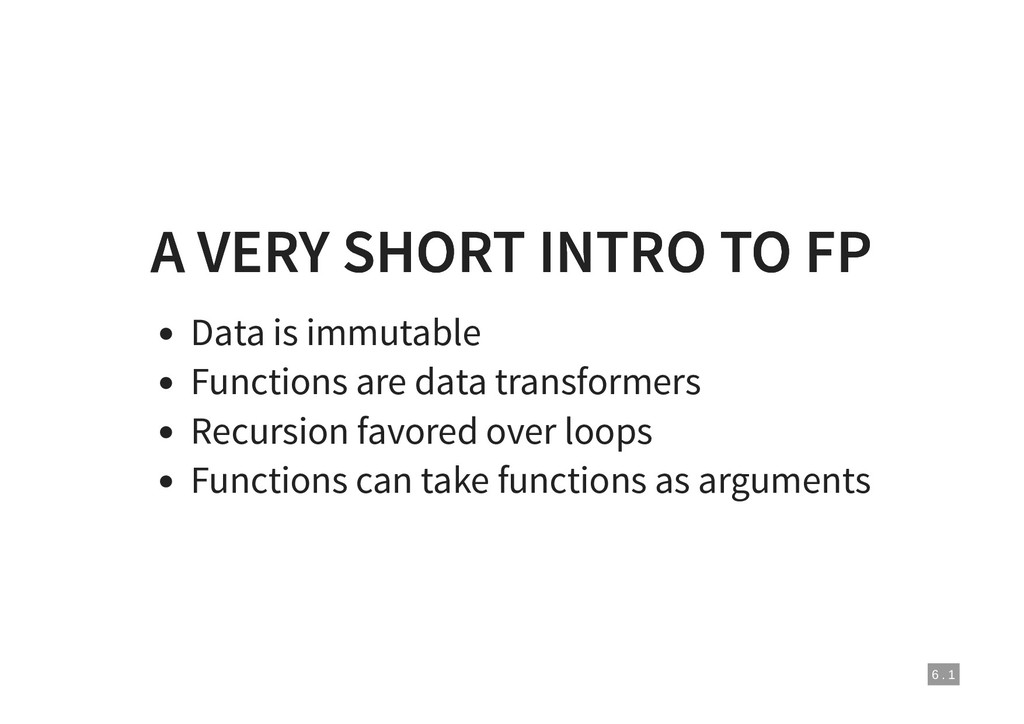
  4. A VERY SHORT INTRO TO FP A VERY SHORT INTRO

    TO FP Data is immutable Functions are data transformers Recursion favored over loops Functions can take functions as arguments 6 . 1
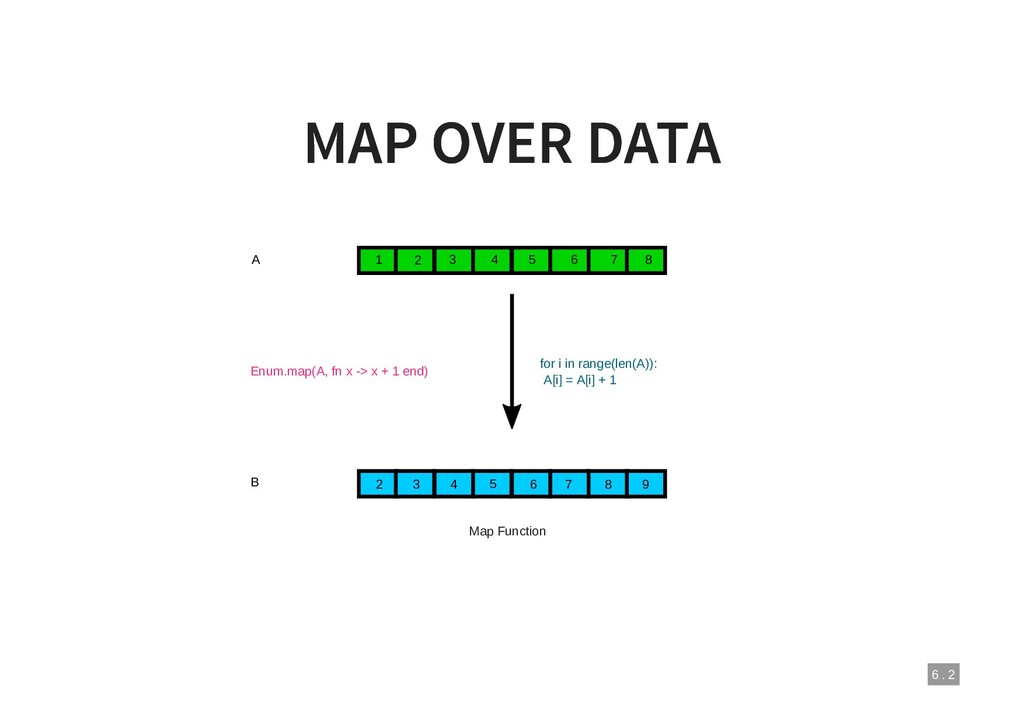
  5. MAP OVER DATA MAP OVER DATA 1 2 3 4

    5 6 7 8 Enum.map(A, fn x -> x + 1 end) A 2 3 4 5 6 7 8 9 B for i in range(len(A)): A[i] = A[i] + 1 Map Function 6 . 2
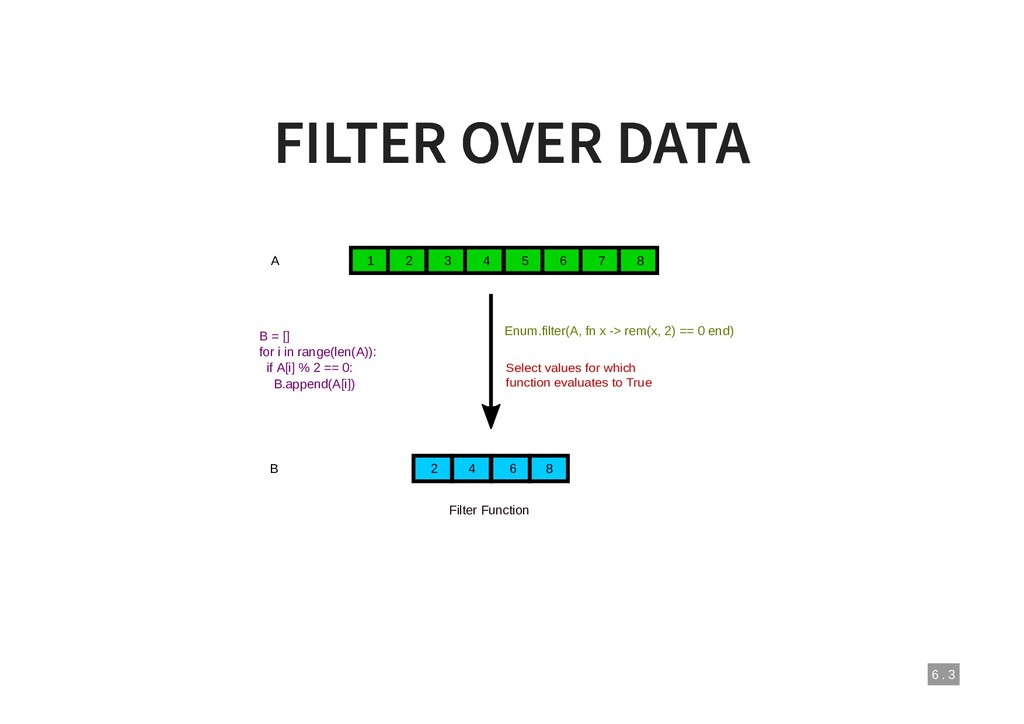
  6. FILTER OVER DATA FILTER OVER DATA Enum.filter(A, fn x ->

    rem(x, 2) == 0 end) 1 2 3 4 5 6 7 8 A 2 4 6 8 B B = [] for i in range(len(A)): if A[i] % 2 == 0: B.append(A[i]) Filter Function Select values for which function evaluates to True 6 . 3
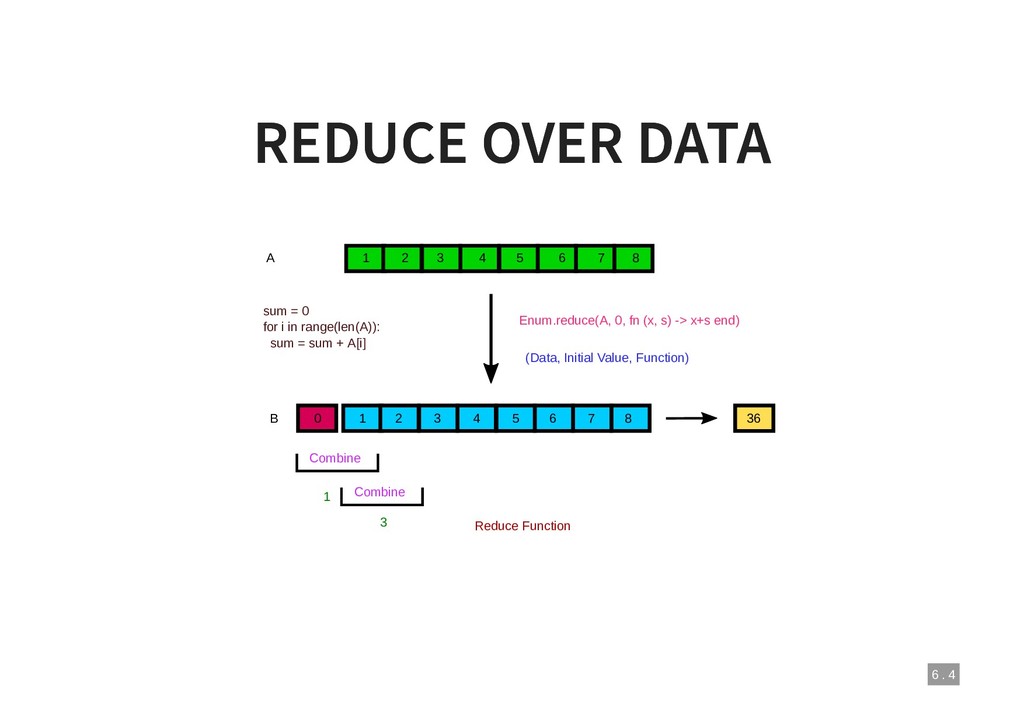
  7. REDUCE OVER DATA REDUCE OVER DATA Enum.reduce(A, 0, fn (x,

    s) -> x+s end) 1 2 3 4 5 6 7 8 A Combine (Data, Initial Value, Function) 36 Combine 1 3 sum = 0 for i in range(len(A)): sum = sum + A[i] Reduce Function 2 3 4 5 6 7 8 B 0 1 6 . 4
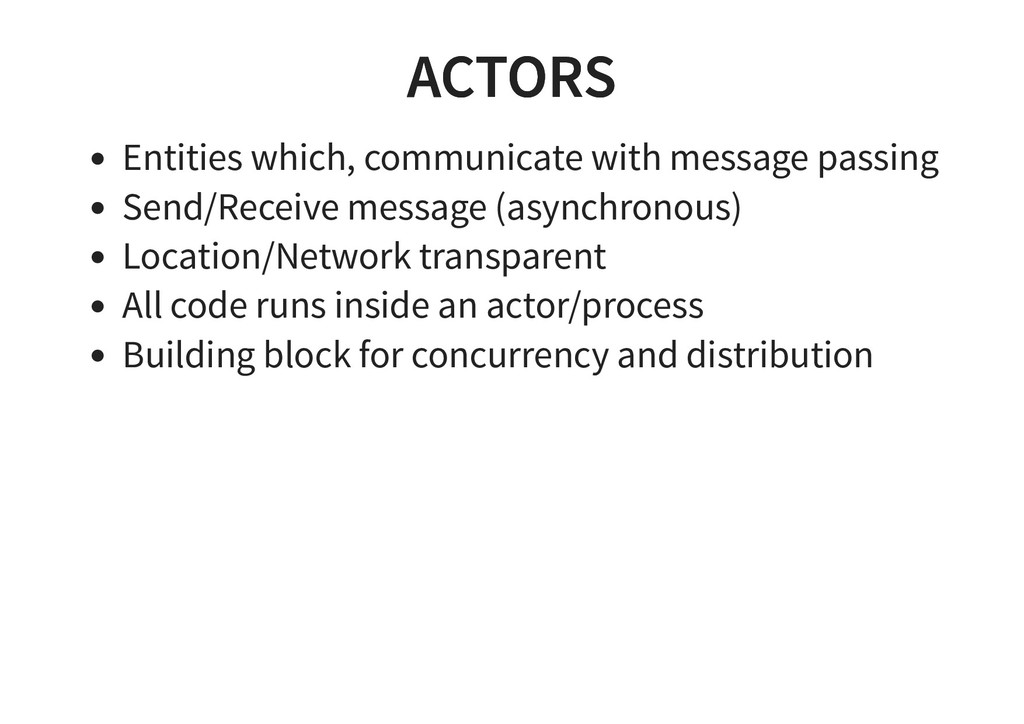
  8. ACTORS ACTORS Entities which, communicate with message passing Send/Receive message

    (asynchronous) Location/Network transparent All code runs inside an actor/process Building block for concurrency and distribution
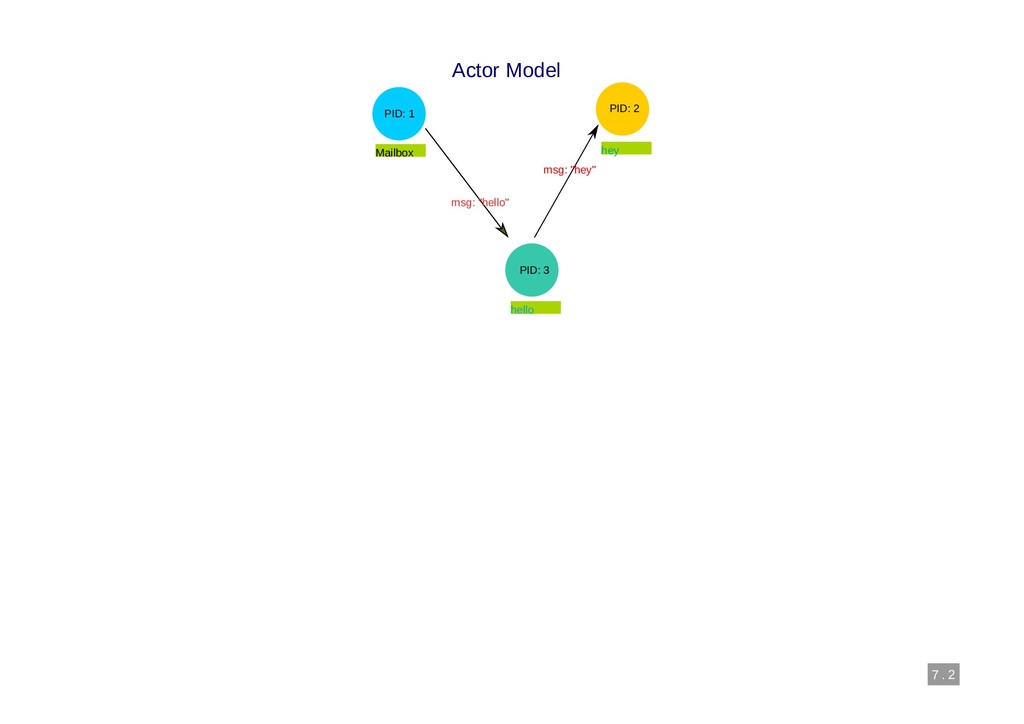
  9. PID: 1 PID: 2 PID: 3 Mailbox hey msg: "hello"

    msg: "hey" hello Actor Model 7 . 2
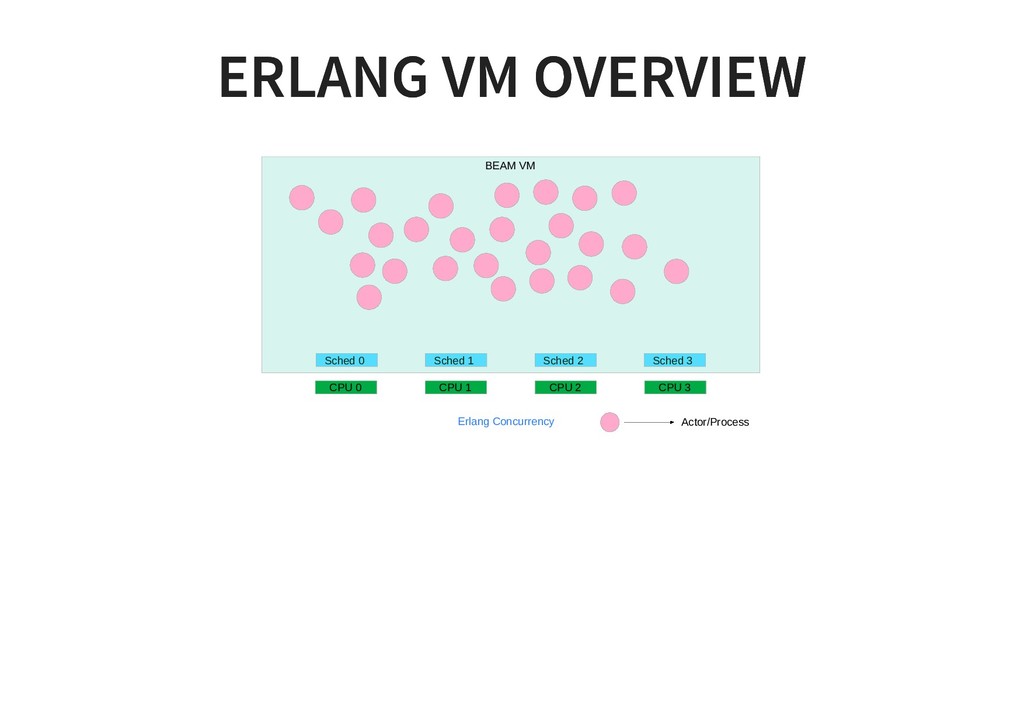
  10. ERLANG VM OVERVIEW ERLANG VM OVERVIEW CPU 2 CPU 3

    CPU 1 CPU 0 Sched 2 Sched 0 Sched 1 Sched 3 BEAM VM Actor/Process Erlang Concurrency
  11. A Preemptive scheduler for each CPU Extremely lightweight processes Process

    level Garbage Collection Asynchronous message passing Can handle millions of processes 7 . 3
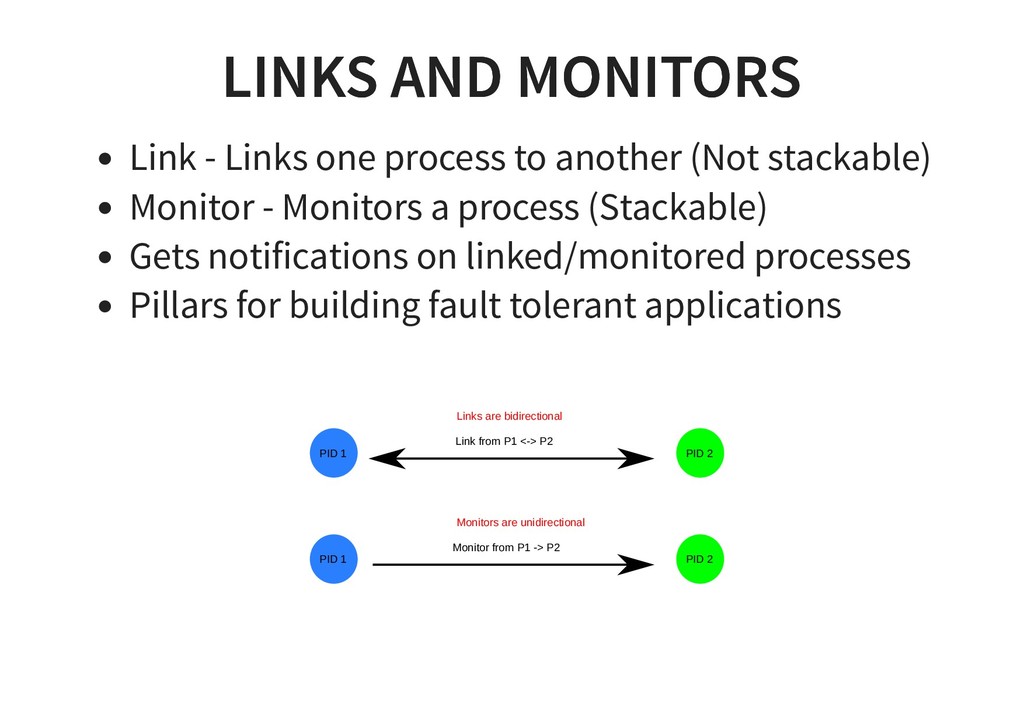
  12. LINKS AND MONITORS LINKS AND MONITORS Link - Links one

    process to another (Not stackable) Monitor - Monitors a process (Stackable) Gets notifications on linked/monitored processes Pillars for building fault tolerant applications PID 2 PID 1 Link from P1 <-> P2 Links are bidirectional PID 2 PID 1 Monitor from P1 -> P2 Monitors are unidirectional
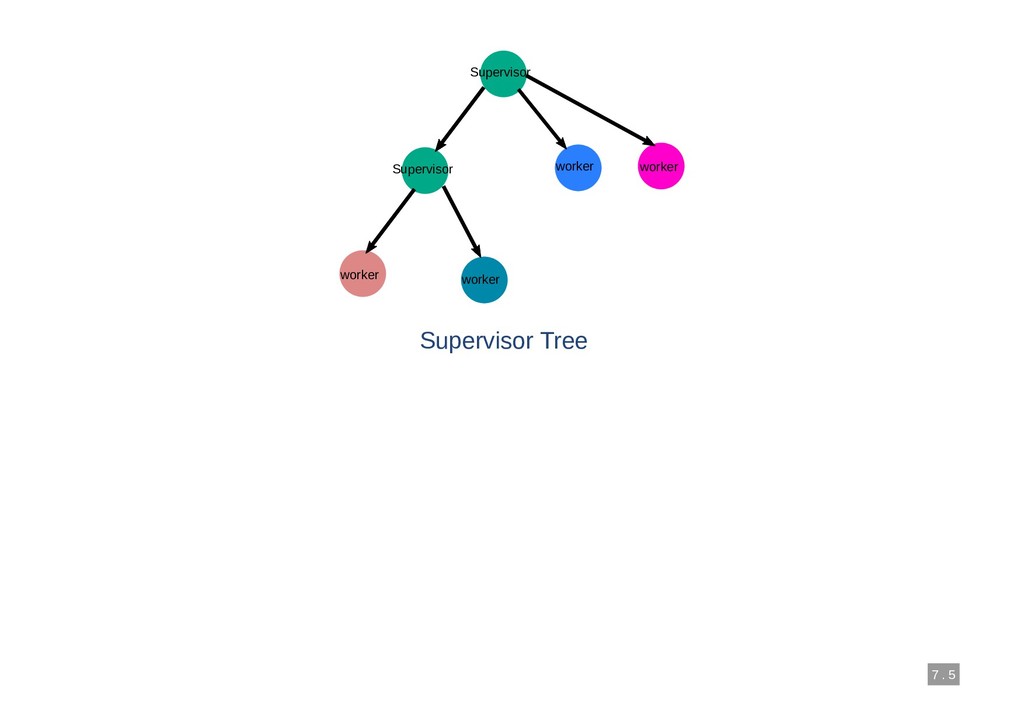
  13. SUPERVISORS SUPERVISORS Built on top of monitors Supervise actors Automatically

    kills/restarts actors based on rules Can form supervision tree
  14. ELIXIR BASICS ELIXIR BASICS Basic Types Pattern Matching Modules and

    Functions Metaprogramming Polymorphism Error Handling 8
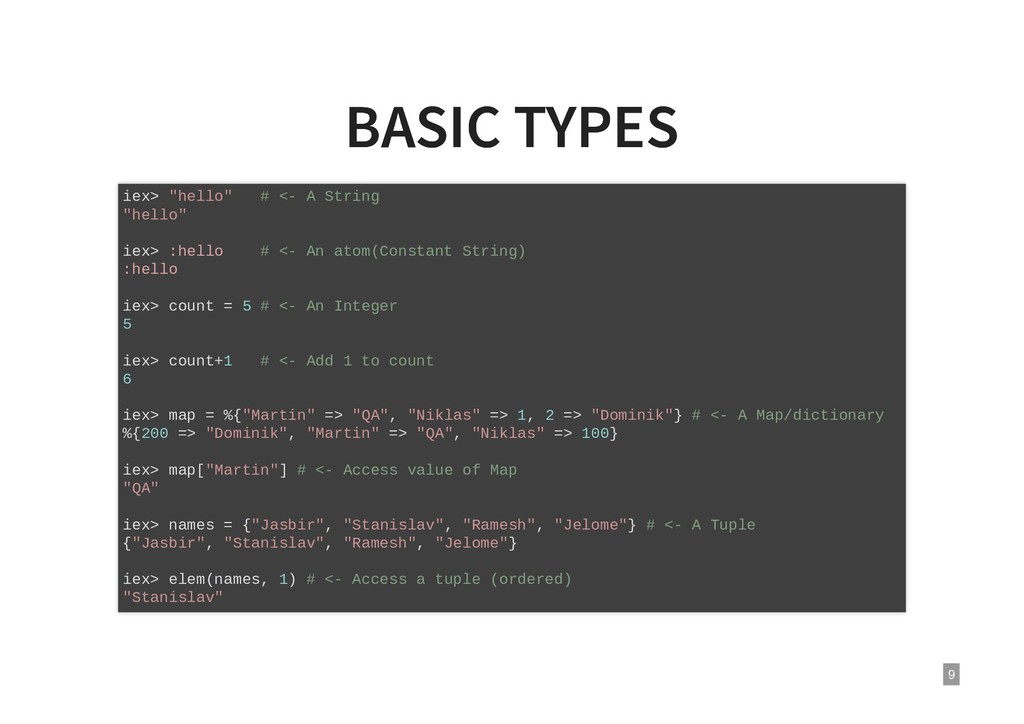
  15. BASIC TYPES BASIC TYPES iex> "hello" # <- A String

    "hello" iex> :hello # <- An atom(Constant String) :hello iex> count = 5 # <- An Integer 5 iex> count+1 # <- Add 1 to count 6 iex> map = %{"Martin" => "QA", "Niklas" => 1, 2 => "Dominik"} # <- A Map/dictionary %{200 => "Dominik", "Martin" => "QA", "Niklas" => 100} iex> map["Martin"] # <- Access value of Map "QA" iex> names = {"Jasbir", "Stanislav", "Ramesh", "Jelome"} # <- A Tuple {"Jasbir", "Stanislav", "Ramesh", "Jelome"} iex> elem(names, 1) # <- Access a tuple (ordered) "Stanislav" 9
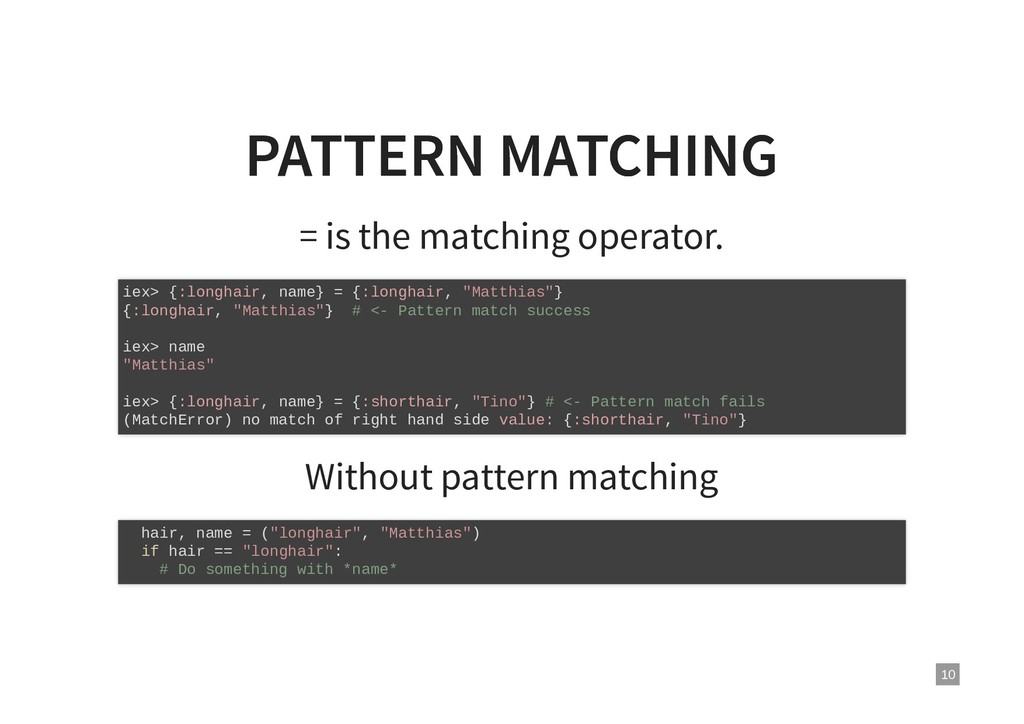
  16. PATTERN MATCHING PATTERN MATCHING = is the matching operator. Without

    pattern matching iex> {:longhair, name} = {:longhair, "Matthias"} {:longhair, "Matthias"} # <- Pattern match success iex> name "Matthias" iex> {:longhair, name} = {:shorthair, "Tino"} # <- Pattern match fails (MatchError) no match of right hand side value: {:shorthair, "Tino"} hair, name = ("longhair", "Matthias") if hair == "longhair": # Do something with *name* 10
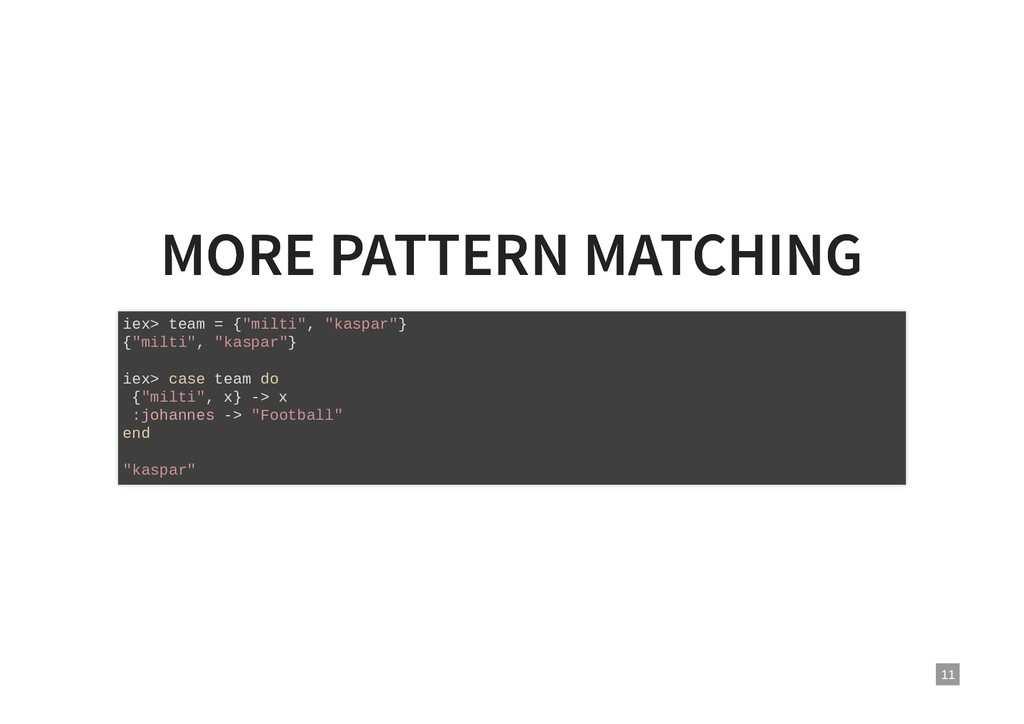
  17. MORE PATTERN MATCHING MORE PATTERN MATCHING iex> team = {"milti",

    "kaspar"} {"milti", "kaspar"} iex> case team do {"milti", x} -> x :johannes -> "Football" end "kaspar" 11
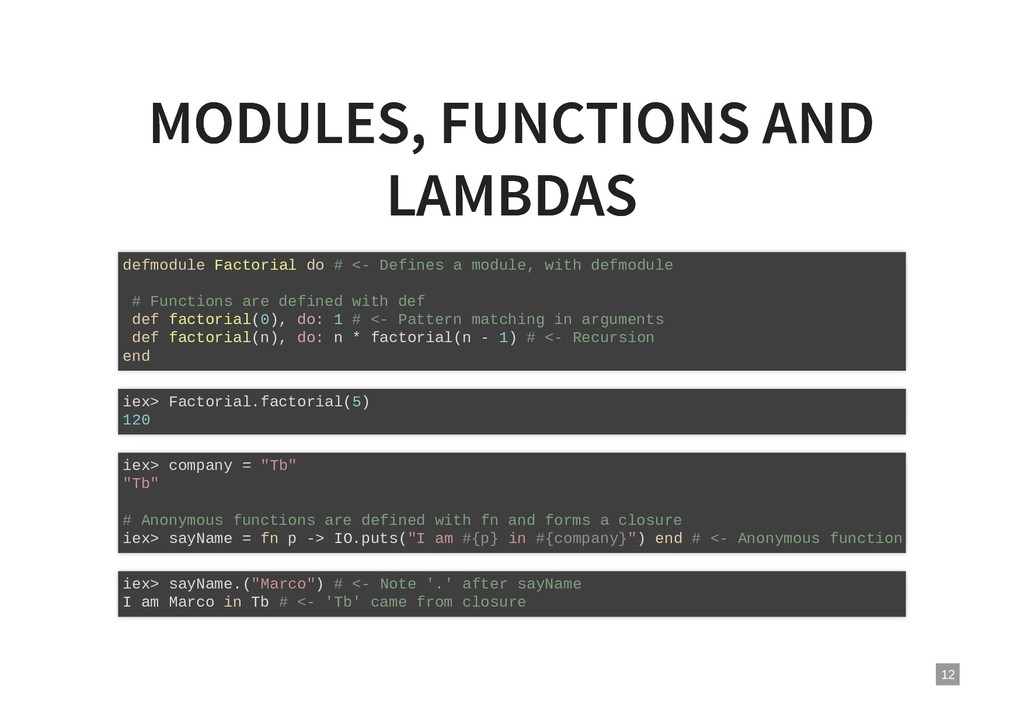
  18. MODULES, FUNCTIONS AND MODULES, FUNCTIONS AND LAMBDAS LAMBDAS defmodule Factorial

    do # <- Defines a module, with defmodule # Functions are defined with def def factorial(0), do: 1 # <- Pattern matching in arguments def factorial(n), do: n * factorial(n - 1) # <- Recursion end iex> Factorial.factorial(5) 120 iex> company = "Tb" "Tb" # Anonymous functions are defined with fn and forms a closure iex> sayName = fn p -> IO.puts("I am #{p} in #{company}") end # <- Anonymous function iex> sayName.("Marco") # <- Note '.' after sayName I am Marco in Tb # <- 'Tb' came from closure 12
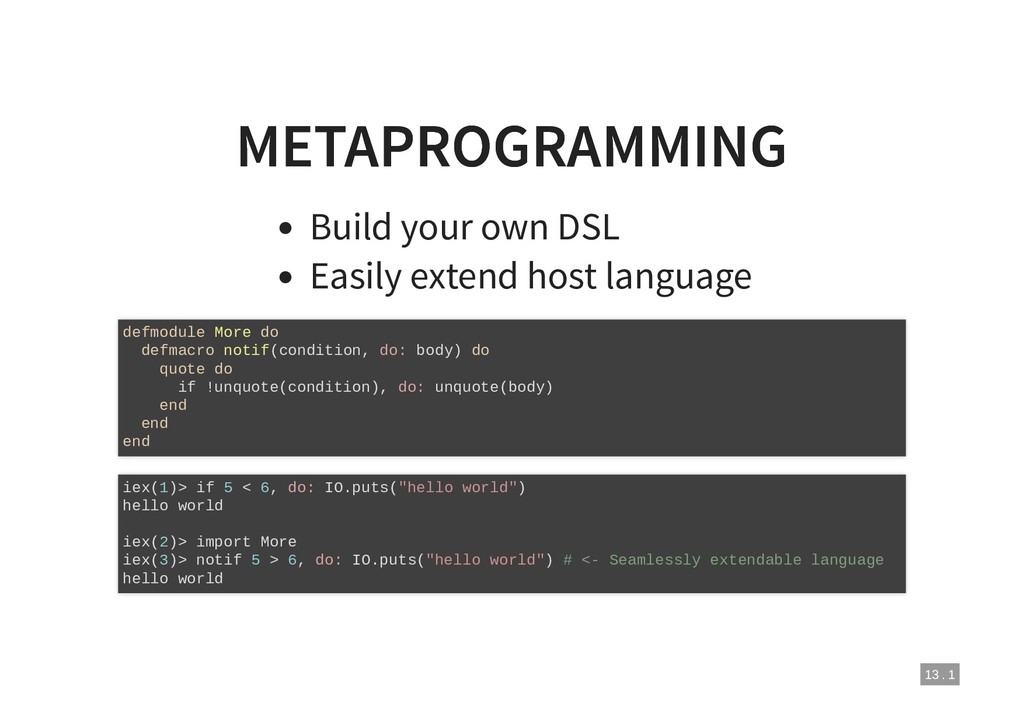
  19. METAPROGRAMMING METAPROGRAMMING Build your own DSL Easily extend host language

    defmodule More do defmacro notif(condition, do: body) do quote do if !unquote(condition), do: unquote(body) end end end iex(1)> if 5 < 6, do: IO.puts("hello world") hello world iex(2)> import More iex(3)> notif 5 > 6, do: IO.puts("hello world") # <- Seamlessly extendable language hello world 13 . 1
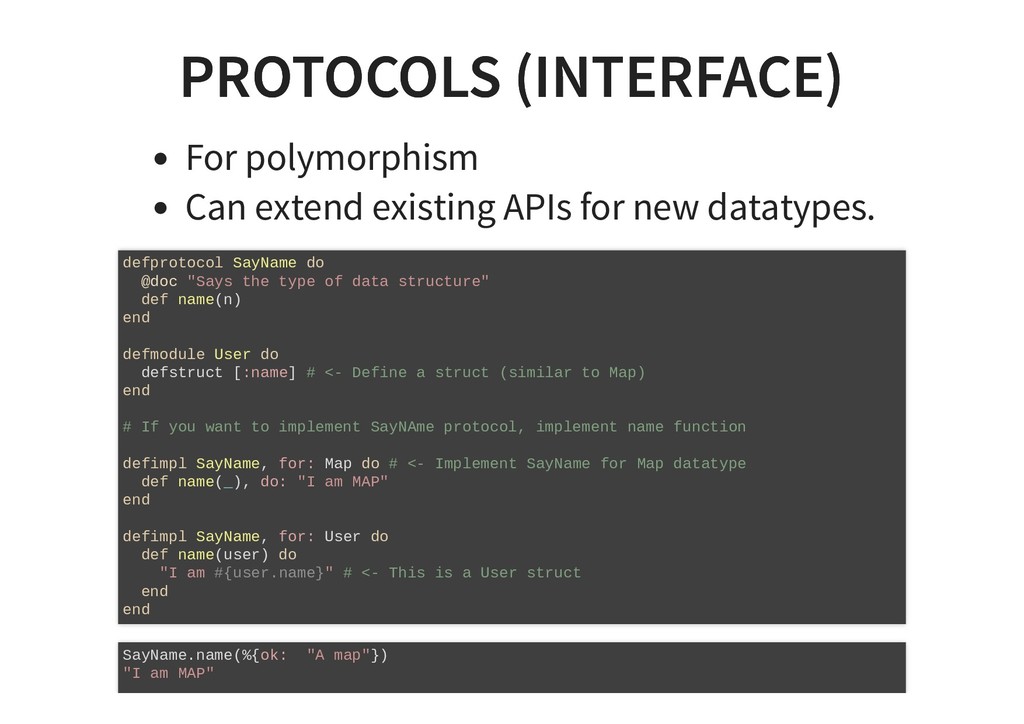
  20. PROTOCOLS (INTERFACE) PROTOCOLS (INTERFACE) For polymorphism Can extend existing APIs

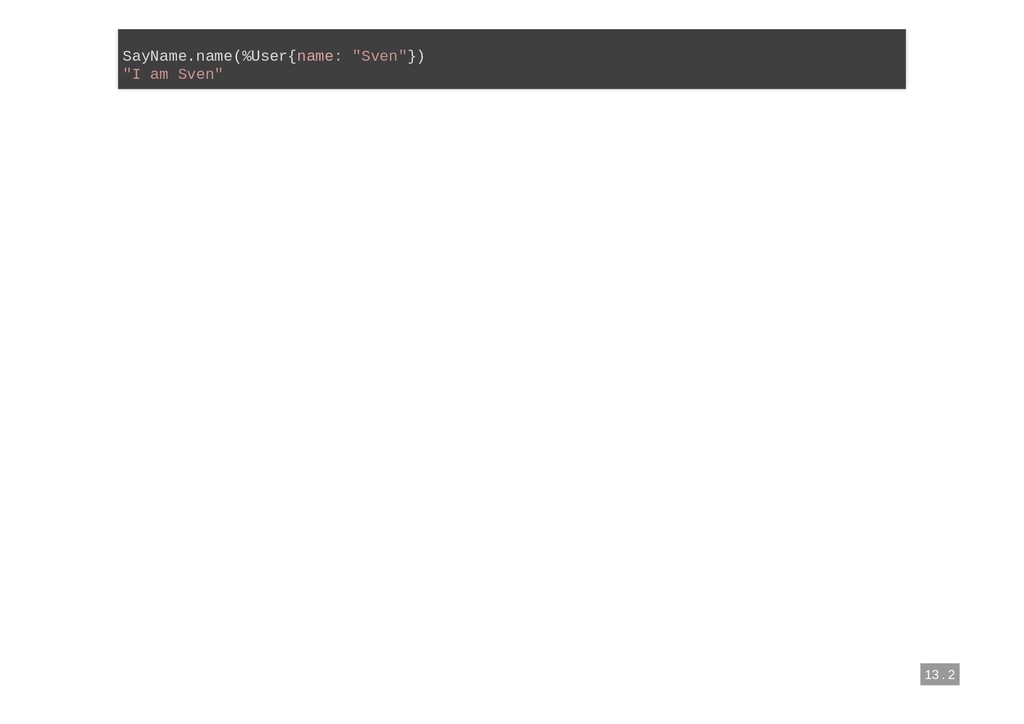
    for new datatypes. defprotocol SayName do @doc "Says the type of data structure" def name(n) end defmodule User do defstruct [:name] # <- Define a struct (similar to Map) end # If you want to implement SayNAme protocol, implement name function defimpl SayName, for: Map do # <- Implement SayName for Map datatype def name(_), do: "I am MAP" end defimpl SayName, for: User do def name(user) do "I am #{user.name}" # <- This is a User struct end end SayName.name(%{ok: "A map"}) "I am MAP"
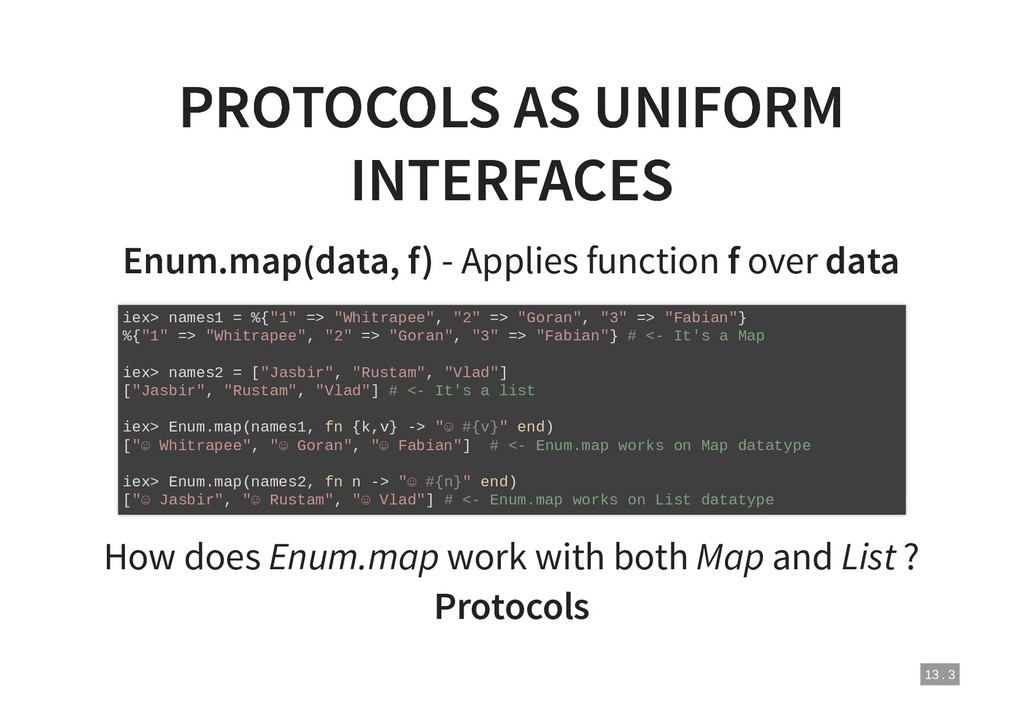
  21. PROTOCOLS AS UNIFORM PROTOCOLS AS UNIFORM INTERFACES INTERFACES Enum.map(data, f)

    - Applies function f over data How does Enum.map work with both Map and List ? Protocols iex> names1 = %{"1" => "Whitrapee", "2" => "Goran", "3" => "Fabian"} %{"1" => "Whitrapee", "2" => "Goran", "3" => "Fabian"} # <- It's a Map iex> names2 = ["Jasbir", "Rustam", "Vlad"] ["Jasbir", "Rustam", "Vlad"] # <- It's a list iex> Enum.map(names1, fn {k,v} -> "☺ #{v}" end) ["☺ Whitrapee", "☺ Goran", "☺ Fabian"] # <- Enum.map works on Map datatype iex> Enum.map(names2, fn n -> "☺ #{n}" end) ["☺ Jasbir", "☺ Rustam", "☺ Vlad"] # <- Enum.map works on List datatype 13 . 3
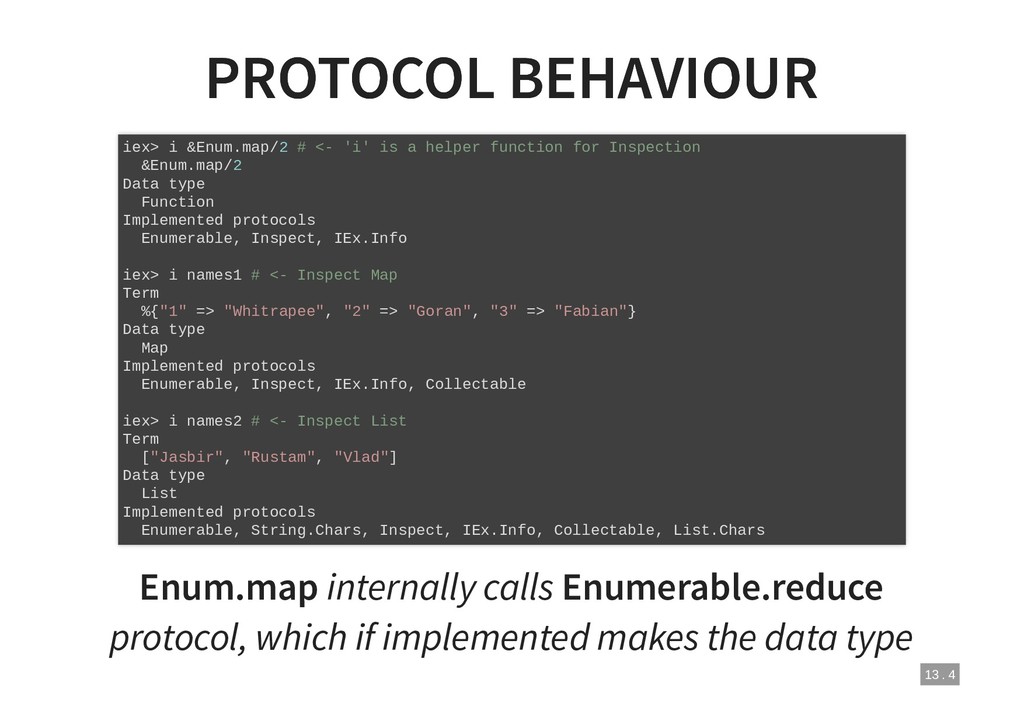
  22. PROTOCOL BEHAVIOUR PROTOCOL BEHAVIOUR Enum.map internally calls Enumerable.reduce protocol, which

    if implemented makes the data type iex> i &Enum.map/2 # <- 'i' is a helper function for Inspection &Enum.map/2 Data type Function Implemented protocols Enumerable, Inspect, IEx.Info iex> i names1 # <- Inspect Map Term %{"1" => "Whitrapee", "2" => "Goran", "3" => "Fabian"} Data type Map Implemented protocols Enumerable, Inspect, IEx.Info, Collectable iex> i names2 # <- Inspect List Term ["Jasbir", "Rustam", "Vlad"] Data type List Implemented protocols Enumerable, String.Chars, Inspect, IEx.Info, Collectable, List.Chars 13 . 4
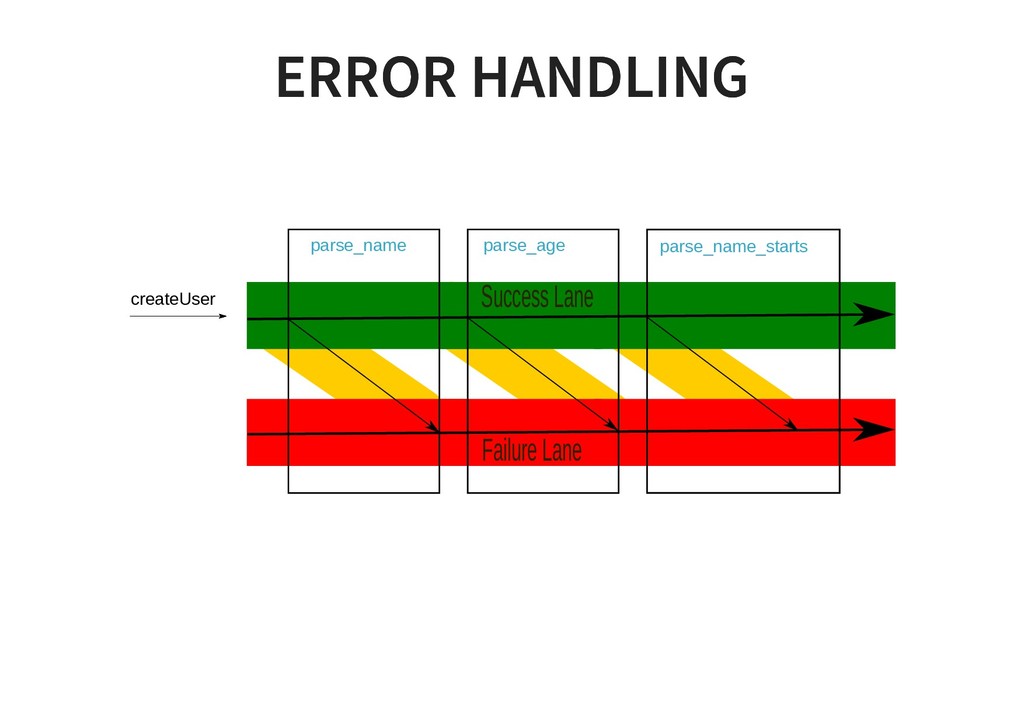
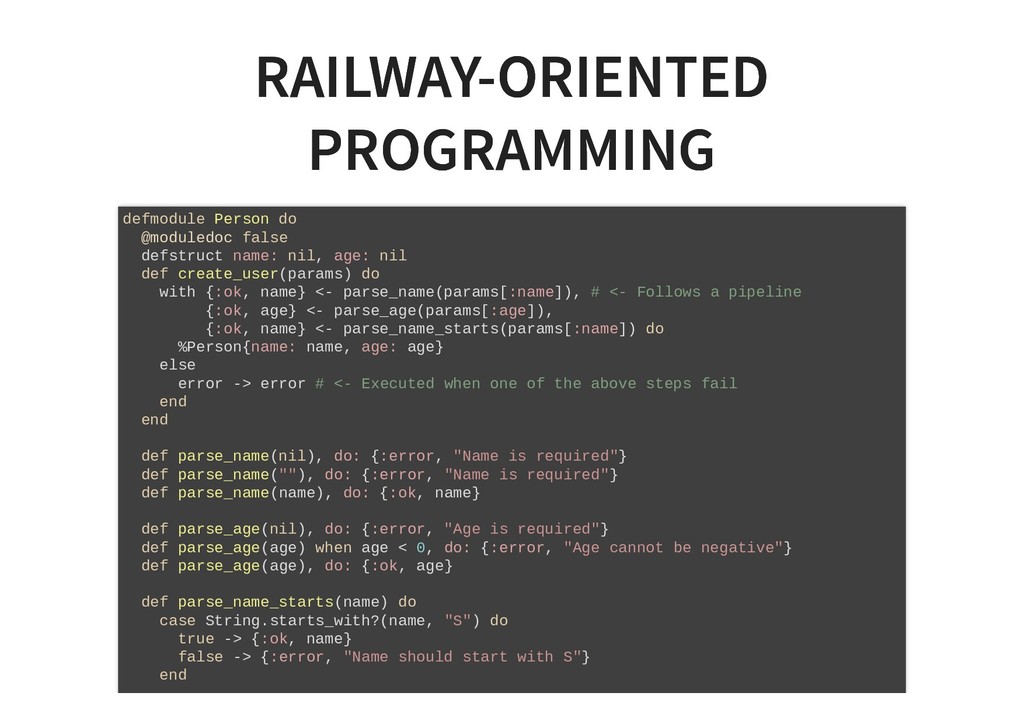
  23. RAILWAY-ORIENTED RAILWAY-ORIENTED PROGRAMMING PROGRAMMING defmodule Person do @moduledoc false defstruct

    name: nil, age: nil def create_user(params) do with {:ok, name} <- parse_name(params[:name]), # <- Follows a pipeline {:ok, age} <- parse_age(params[:age]), {:ok, name} <- parse_name_starts(params[:name]) do %Person{name: name, age: age} else error -> error # <- Executed when one of the above steps fail end end def parse_name(nil), do: {:error, "Name is required"} def parse_name(""), do: {:error, "Name is required"} def parse_name(name), do: {:ok, name} def parse_age(nil), do: {:error, "Age is required"} def parse_age(age) when age < 0, do: {:error, "Age cannot be negative"} def parse_age(age), do: {:ok, age} def parse_name_starts(name) do case String.starts_with?(name, "S") do true -> {:ok, name} false -> {:error, "Name should start with S"} end
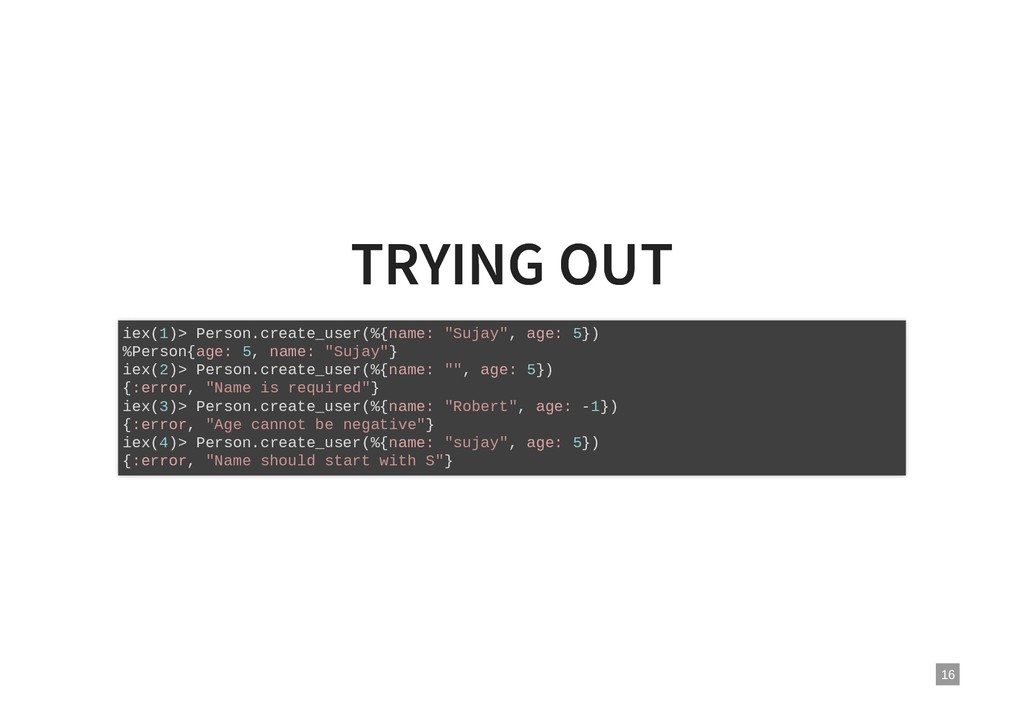
  24. TRYING OUT TRYING OUT iex(1)> Person.create_user(%{name: "Sujay", age: 5}) %Person{age:

    5, name: "Sujay"} iex(2)> Person.create_user(%{name: "", age: 5}) {:error, "Name is required"} iex(3)> Person.create_user(%{name: "Robert", age: -1}) {:error, "Age cannot be negative"} iex(4)> Person.create_user(%{name: "sujay", age: 5}) {:error, "Name should start with S"} 16
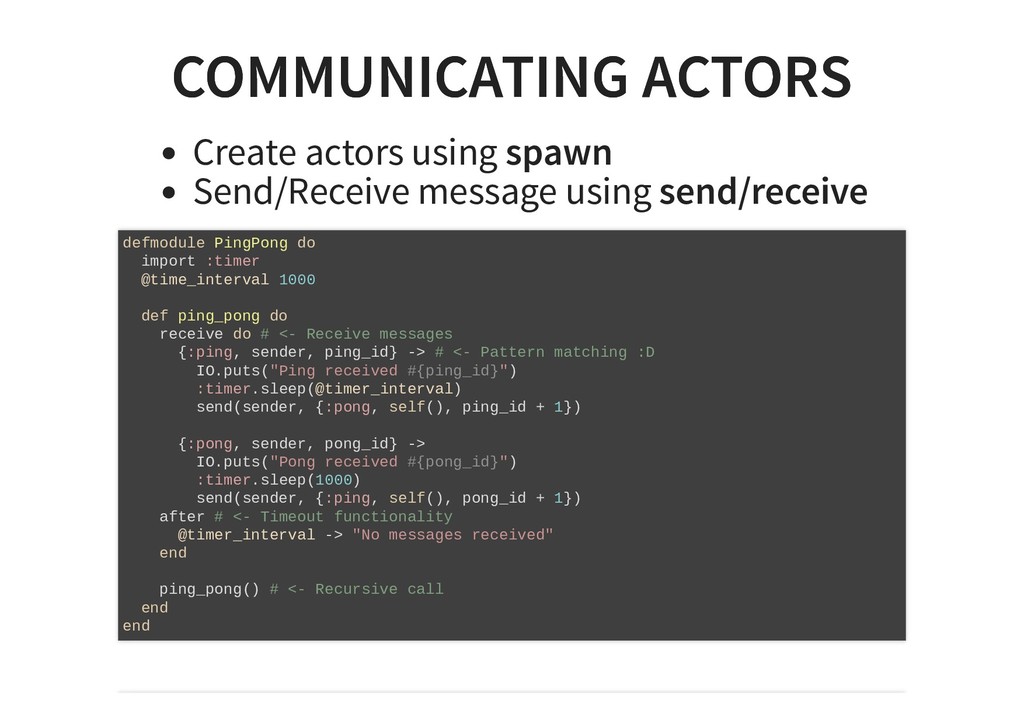
  25. COMMUNICATING ACTORS COMMUNICATING ACTORS Create actors using spawn Send/Receive message

    using send/receive defmodule PingPong do import :timer @time_interval 1000 def ping_pong do receive do # <- Receive messages {:ping, sender, ping_id} -> # <- Pattern matching :D IO.puts("Ping received #{ping_id}") :timer.sleep(@timer_interval) send(sender, {:pong, self(), ping_id + 1}) {:pong, sender, pong_id} -> IO.puts("Pong received #{pong_id}") :timer.sleep(1000) send(sender, {:ping, self(), pong_id + 1}) after # <- Timeout functionality @timer_interval -> "No messages received" end ping_pong() # <- Recursive call end end
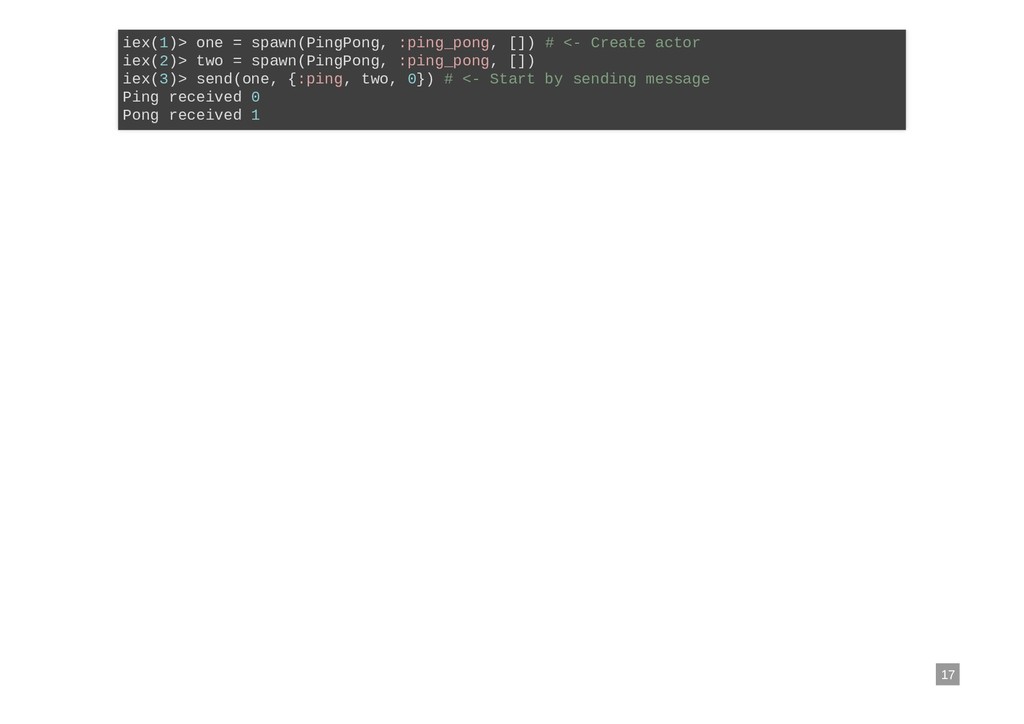
  26. iex(1)> one = spawn(PingPong, :ping_pong, []) # <- Create actor

    iex(2)> two = spawn(PingPong, :ping_pong, []) iex(3)> send(one, {:ping, two, 0}) # <- Start by sending message Ping received 0 Pong received 1 17
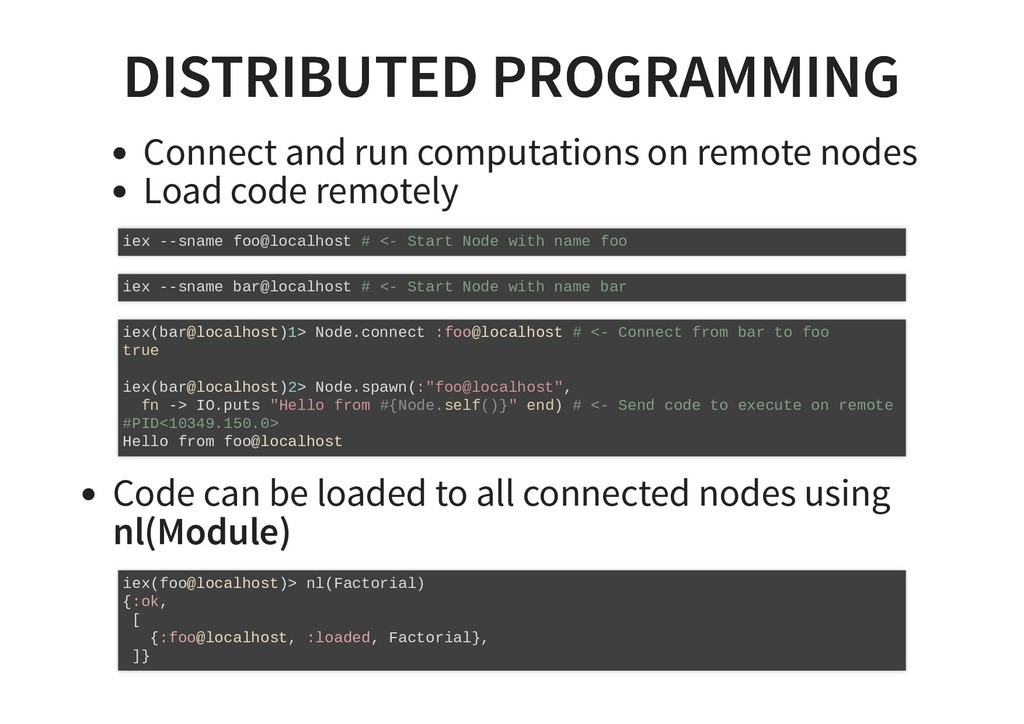
  27. DISTRIBUTED PROGRAMMING DISTRIBUTED PROGRAMMING Connect and run computations on remote

    nodes Load code remotely Code can be loaded to all connected nodes using nl(Module) iex --sname foo@localhost # <- Start Node with name foo iex --sname bar@localhost # <- Start Node with name bar iex(bar@localhost)1> Node.connect :foo@localhost # <- Connect from bar to foo true iex(bar@localhost)2> Node.spawn(:"foo@localhost", fn -> IO.puts "Hello from #{Node.self()}" end) # <- Send code to execute on remote #PID<10349.150.0> Hello from foo@localhost iex(foo@localhost)> nl(Factorial) {:ok, [ {:foo@localhost, :loaded, Factorial}, ]}
  28. 18

  29. OPEN TELECOM PLATFORM (OTP) OPEN TELECOM PLATFORM (OTP) OTP framework

    is a set of modules and standards designed to help build applications. Includes GenServer Supervisors And more 19
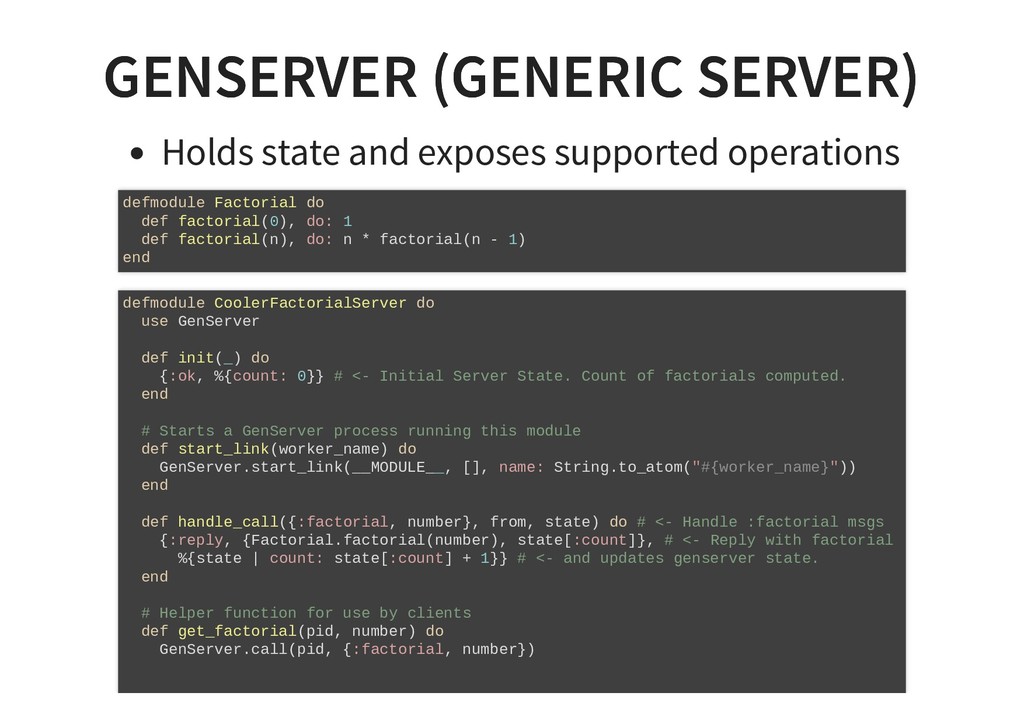
  30. GENSERVER (GENERIC SERVER) GENSERVER (GENERIC SERVER) Holds state and exposes

    supported operations defmodule Factorial do def factorial(0), do: 1 def factorial(n), do: n * factorial(n - 1) end defmodule CoolerFactorialServer do use GenServer def init(_) do {:ok, %{count: 0}} # <- Initial Server State. Count of factorials computed. end # Starts a GenServer process running this module def start_link(worker_name) do GenServer.start_link(__MODULE__, [], name: String.to_atom("#{worker_name}")) end def handle_call({:factorial, number}, from, state) do # <- Handle :factorial msgs {:reply, {Factorial.factorial(number), state[:count]}, # <- Reply with factorial %{state | count: state[:count] + 1}} # <- and updates genserver state. end # Helper function for use by clients def get_factorial(pid, number) do GenServer.call(pid, {:factorial, number})
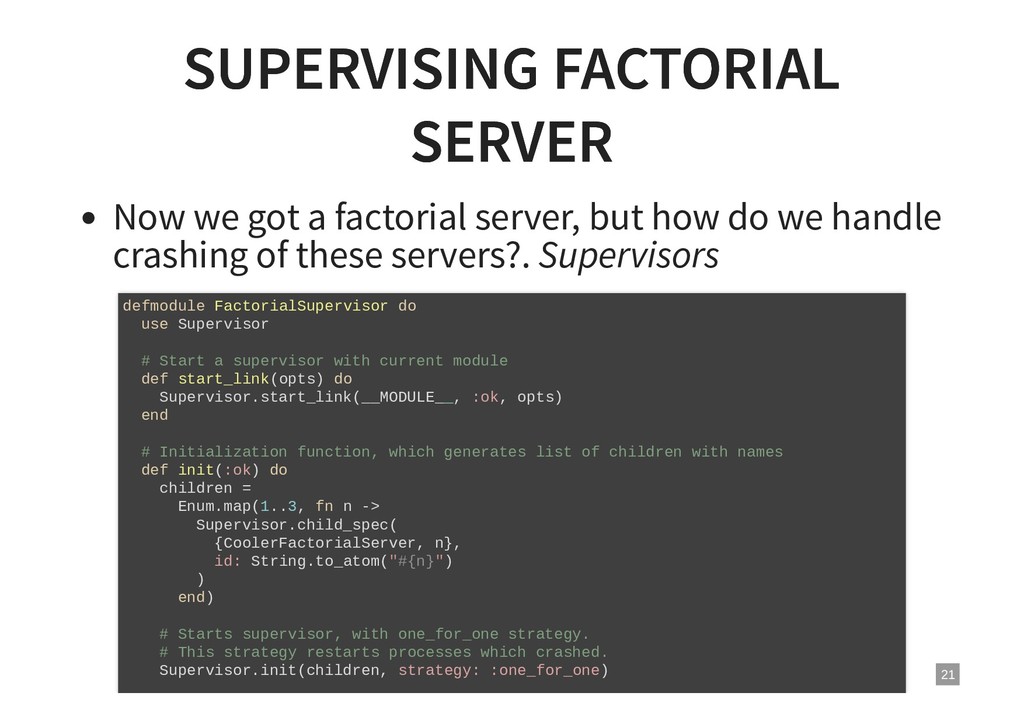
  31. SUPERVISING FACTORIAL SUPERVISING FACTORIAL SERVER SERVER Now we got a

    factorial server, but how do we handle crashing of these servers?. Supervisors defmodule FactorialSupervisor do use Supervisor # Start a supervisor with current module def start_link(opts) do Supervisor.start_link(__MODULE__, :ok, opts) end # Initialization function, which generates list of children with names def init(:ok) do children = Enum.map(1..3, fn n -> Supervisor.child_spec( {CoolerFactorialServer, n}, id: String.to_atom("#{n}") ) end) # Starts supervisor, with one_for_one strategy. # This strategy restarts processes which crashed. Supervisor.init(children, strategy: :one_for_one) 21
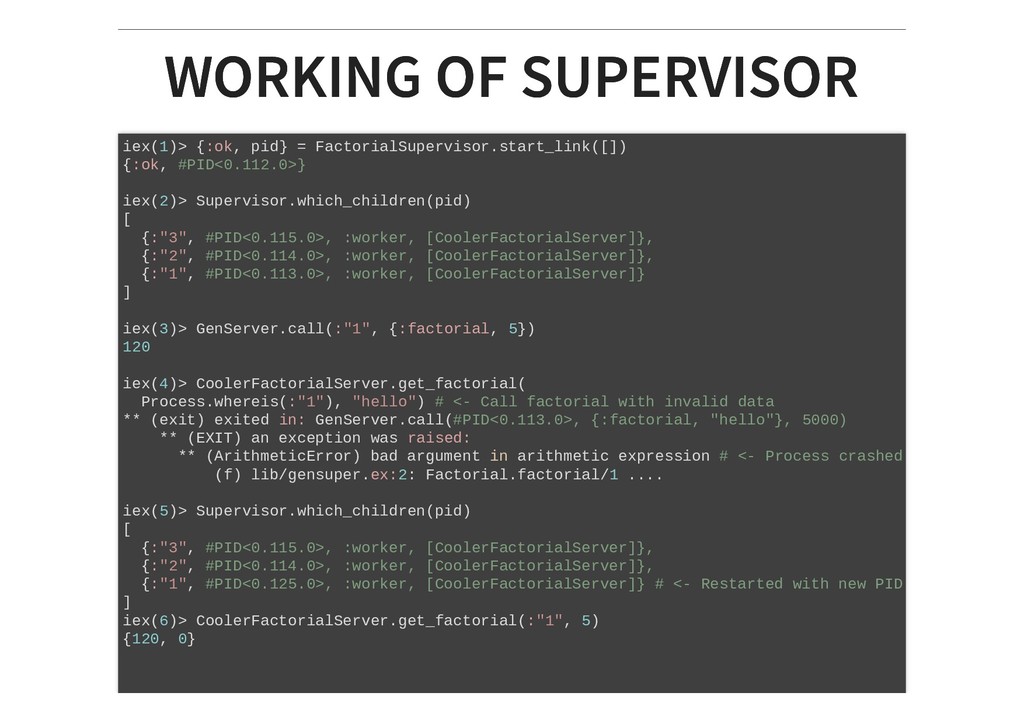
  32. WORKING OF SUPERVISOR WORKING OF SUPERVISOR iex(1)> {:ok, pid} =

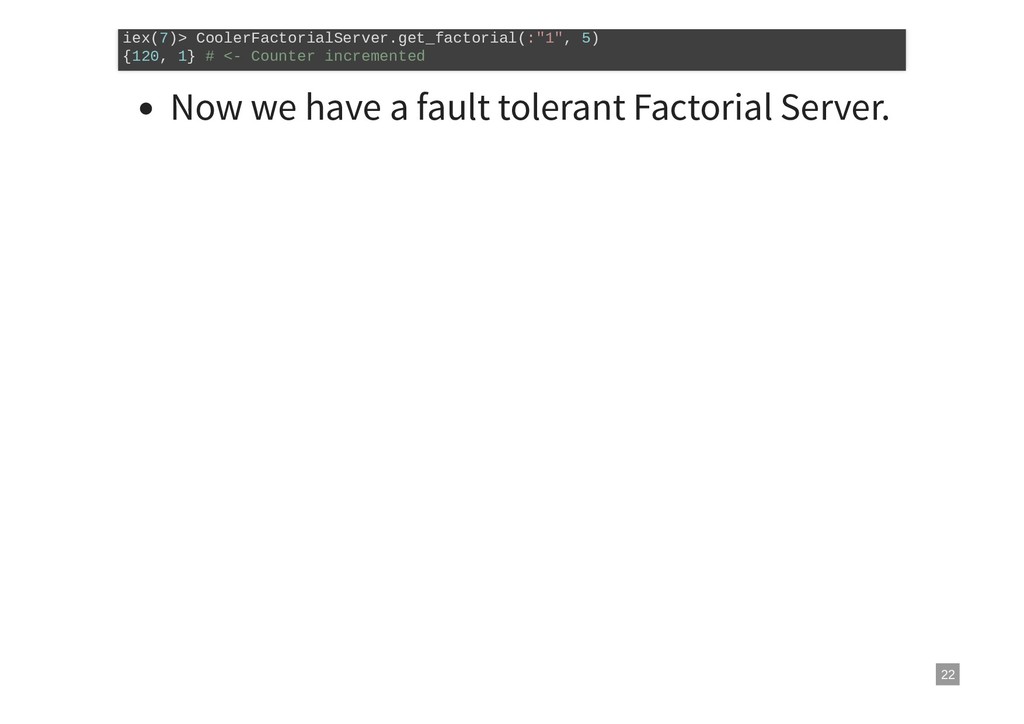
    FactorialSupervisor.start_link([]) {:ok, #PID<0.112.0>} iex(2)> Supervisor.which_children(pid) [ {:"3", #PID<0.115.0>, :worker, [CoolerFactorialServer]}, {:"2", #PID<0.114.0>, :worker, [CoolerFactorialServer]}, {:"1", #PID<0.113.0>, :worker, [CoolerFactorialServer]} ] iex(3)> GenServer.call(:"1", {:factorial, 5}) 120 iex(4)> CoolerFactorialServer.get_factorial( Process.whereis(:"1"), "hello") # <- Call factorial with invalid data ** (exit) exited in: GenServer.call(#PID<0.113.0>, {:factorial, "hello"}, 5000) ** (EXIT) an exception was raised: ** (ArithmeticError) bad argument in arithmetic expression # <- Process crashed (f) lib/gensuper.ex:2: Factorial.factorial/1 .... iex(5)> Supervisor.which_children(pid) [ {:"3", #PID<0.115.0>, :worker, [CoolerFactorialServer]}, {:"2", #PID<0.114.0>, :worker, [CoolerFactorialServer]}, {:"1", #PID<0.125.0>, :worker, [CoolerFactorialServer]} # <- Restarted with new PID ] iex(6)> CoolerFactorialServer.get_factorial(:"1", 5) {120, 0}
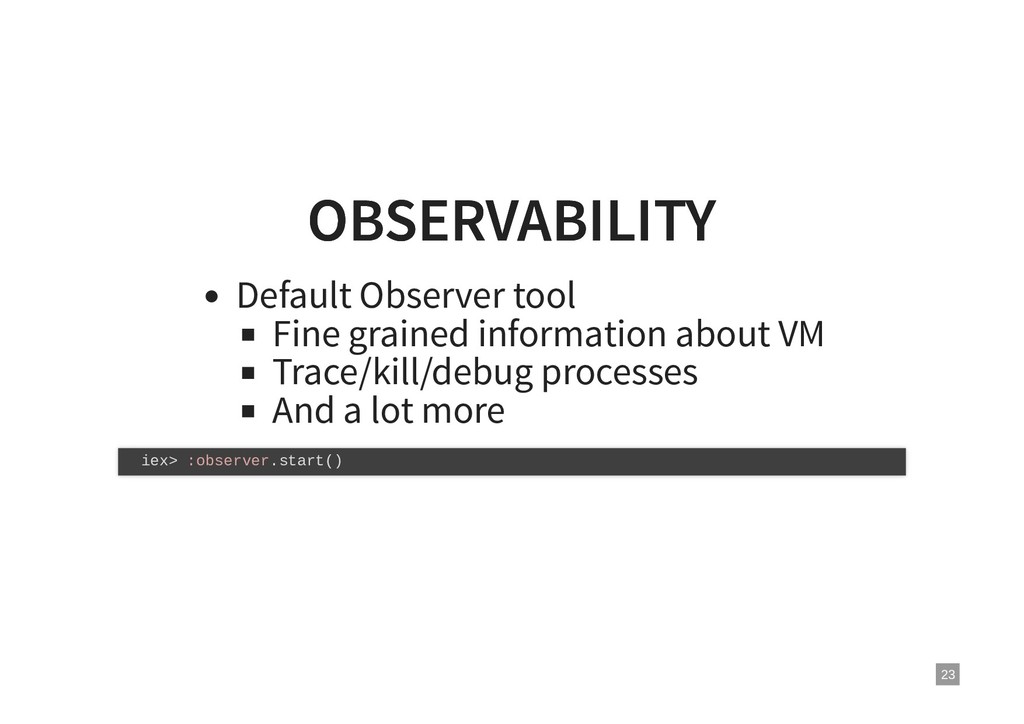
  33. OBSERVABILITY OBSERVABILITY Default Observer tool Fine grained information about VM
    Trace/kill/debug processes And a lot more iex> :observer.start() 23
  34. 24

  35. OTHER GOODIES OTHER GOODIES Mix/Hex/Exunit - Build/Package Manager/Testing Inbuilt formatter

    and rules Mature web development frameworks (Phoenix Framework) Embedded systems support (Nerves Project) Optional Typing (Dialyxir) Inbuilt cache/database (Mnesia, ETS) Checkout awesome elixir at github 25
  36. SUMMARY SUMMARY Looked at motivation for Elixir Briefly introduced functional

    programming Took a look at elixir concepts and syntax Learned basics on building fault tolerant apps 26
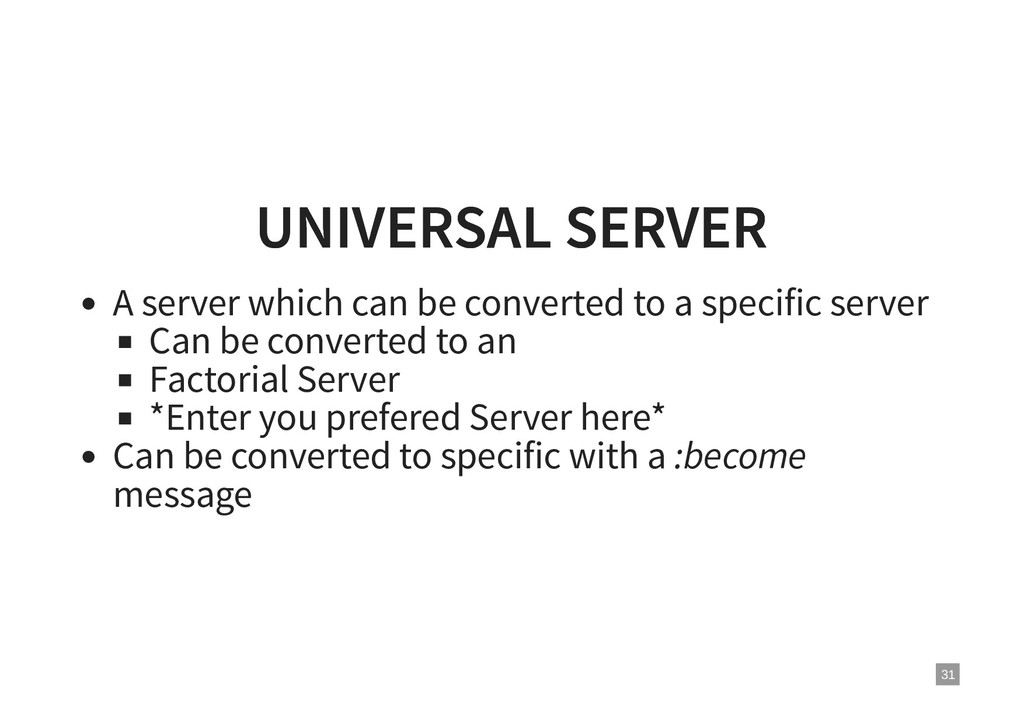
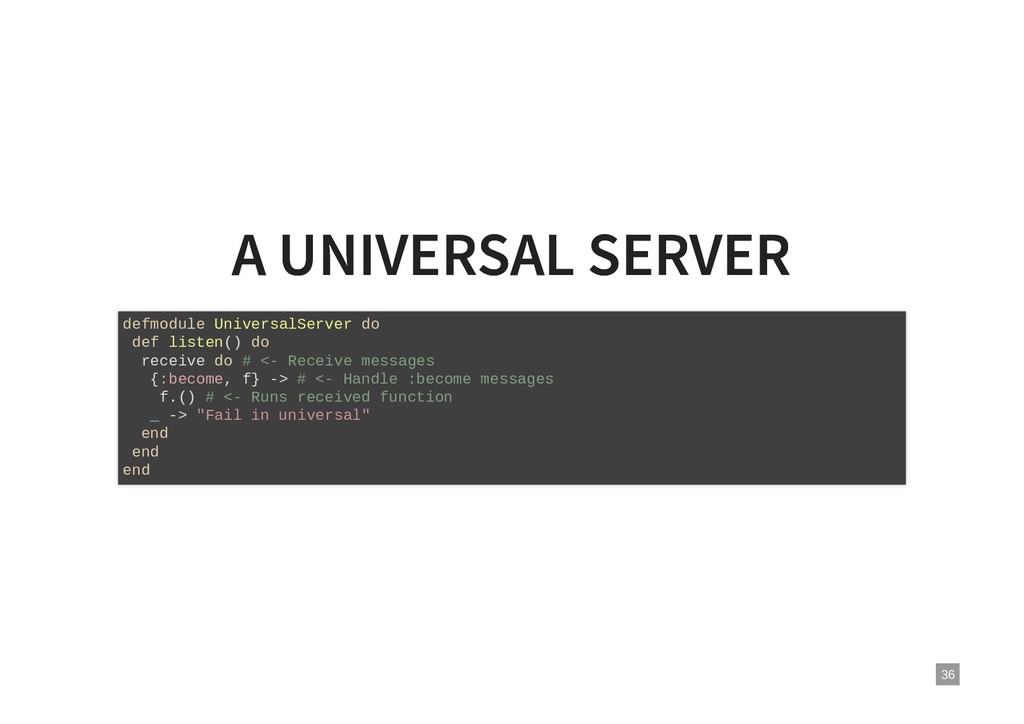
  37. UNIVERSAL SERVER UNIVERSAL SERVER A server which can be converted

    to a specific server Can be converted to an Factorial Server *Enter you prefered Server here* Can be converted to specific with a :become message 31
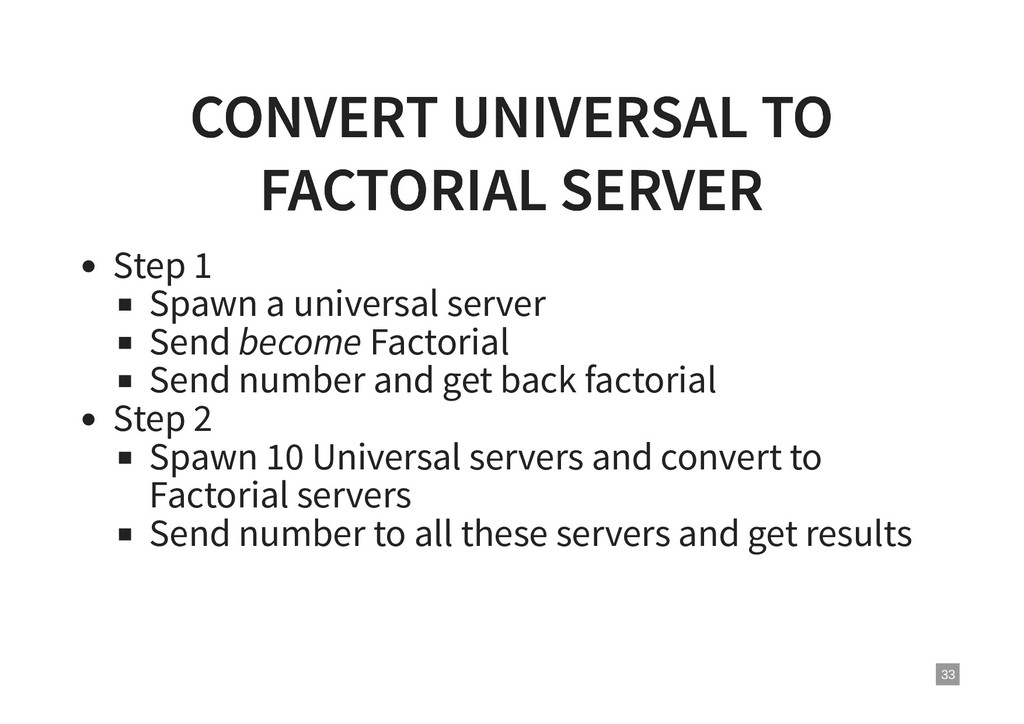
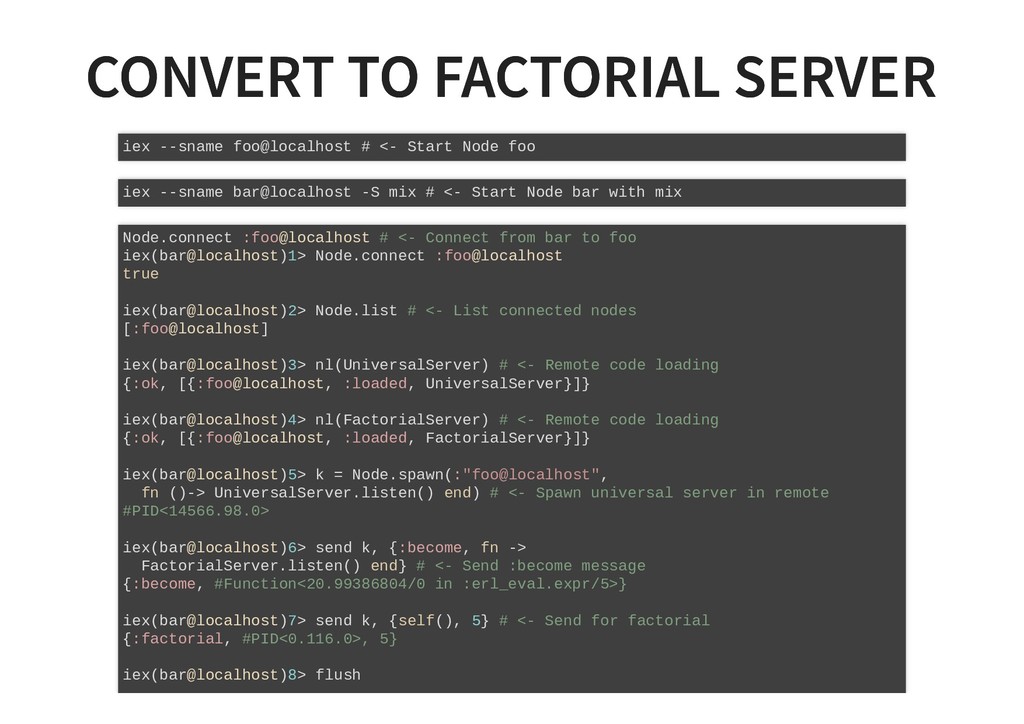
  38. CONVERT UNIVERSAL TO CONVERT UNIVERSAL TO FACTORIAL SERVER FACTORIAL SERVER

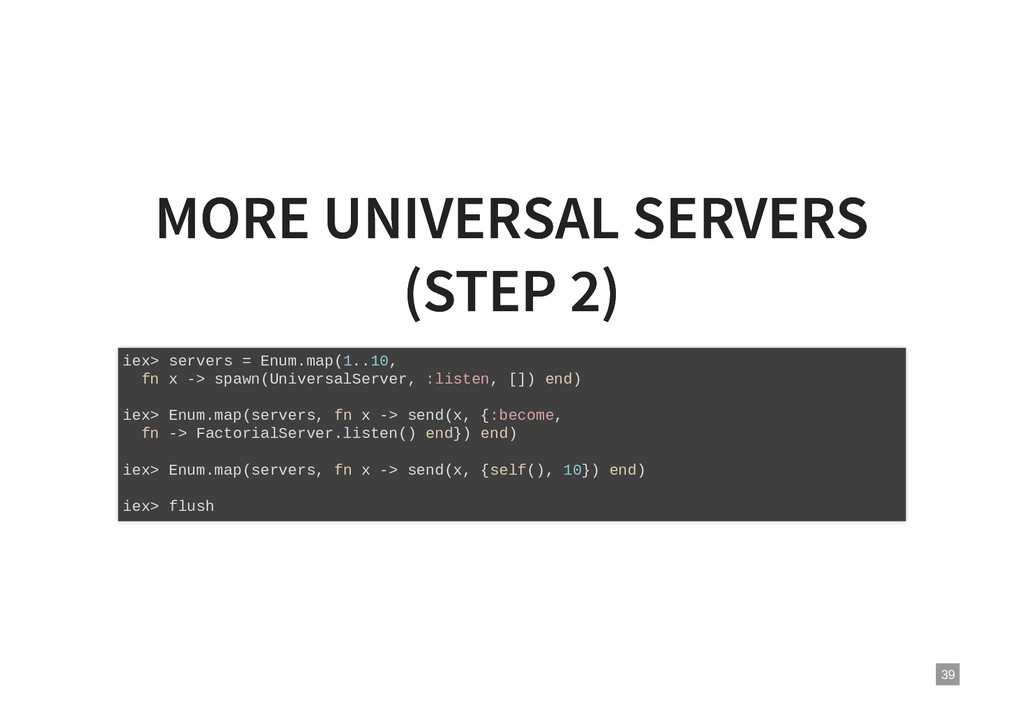
    Step 1 Spawn a universal server Send become Factorial Send number and get back factorial Step 2 Spawn 10 Universal servers and convert to Factorial servers Send number to all these servers and get results 33
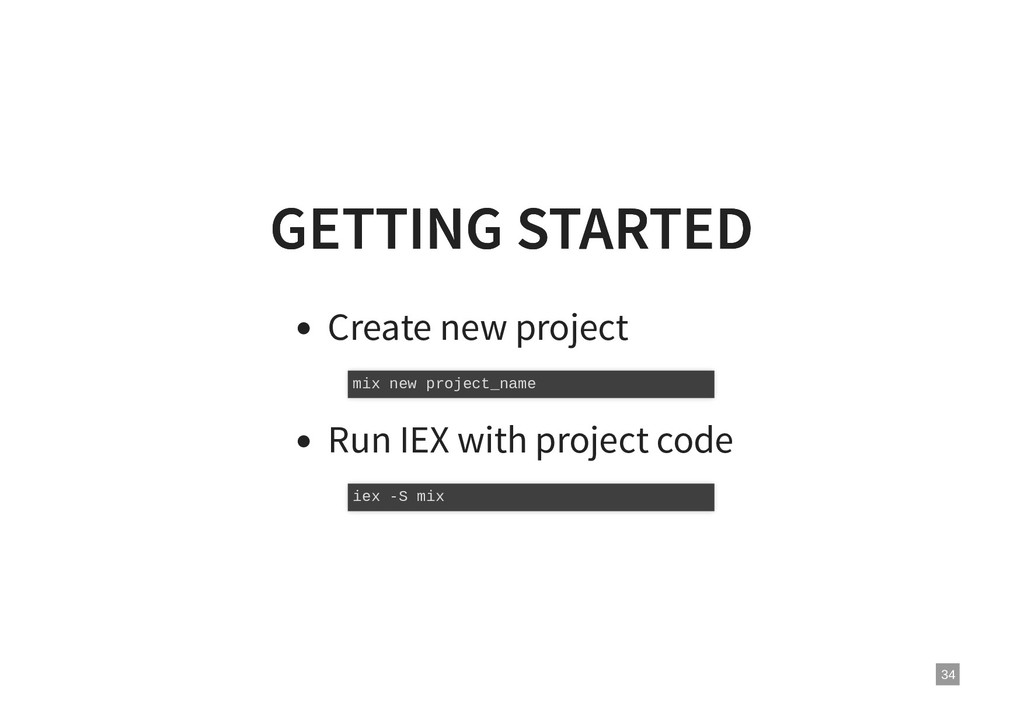
  39. GETTING STARTED GETTING STARTED Create new project Run IEX with

    project code mix new project_name iex -S mix 34
  40. A UNIVERSAL SERVER A UNIVERSAL SERVER defmodule UniversalServer do def

    listen() do receive do # <- Receive messages {:become, f} -> # <- Handle :become messages f.() # <- Runs received function _ -> "Fail in universal" end end end 36
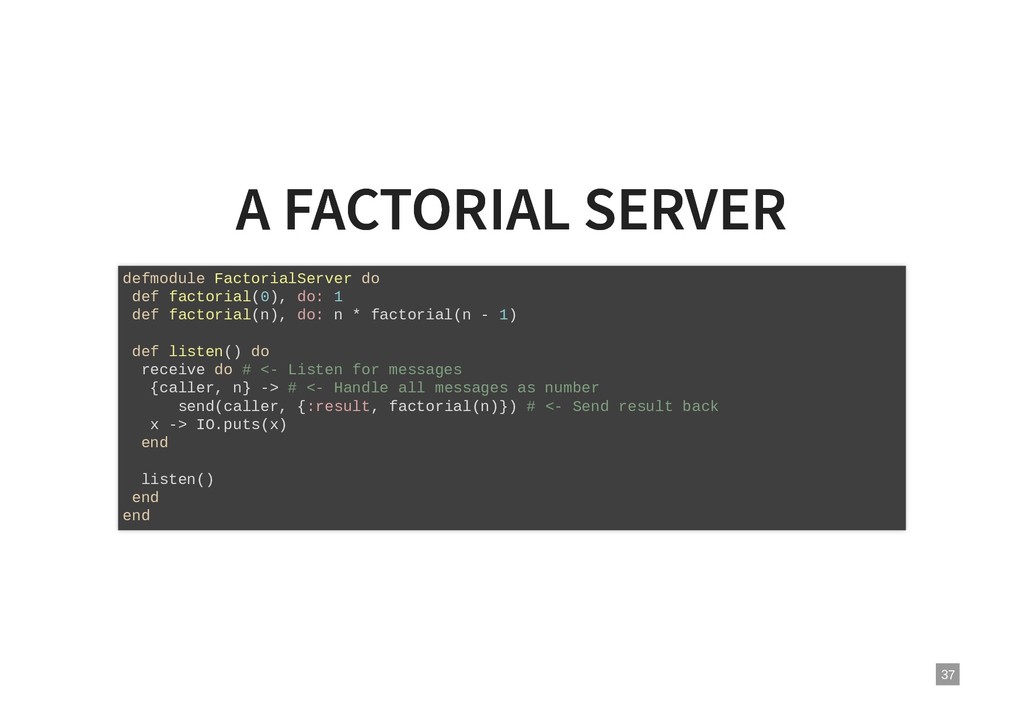
  41. A FACTORIAL SERVER A FACTORIAL SERVER defmodule FactorialServer do def

    factorial(0), do: 1 def factorial(n), do: n * factorial(n - 1) def listen() do receive do # <- Listen for messages {caller, n} -> # <- Handle all messages as number send(caller, {:result, factorial(n)}) # <- Send result back x -> IO.puts(x) end listen() end end 37
  42. CONVERT TO FACTORIAL SERVER CONVERT TO FACTORIAL SERVER iex --sname

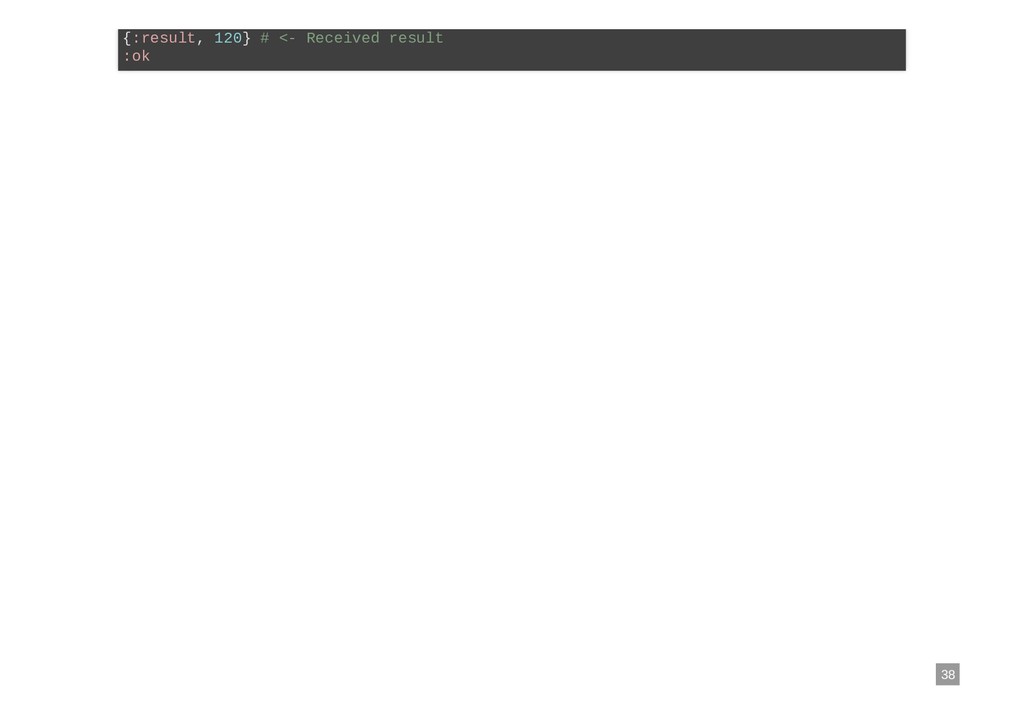
    foo@localhost # <- Start Node foo iex --sname bar@localhost -S mix # <- Start Node bar with mix Node.connect :foo@localhost # <- Connect from bar to foo iex(bar@localhost)1> Node.connect :foo@localhost true iex(bar@localhost)2> Node.list # <- List connected nodes [:foo@localhost] iex(bar@localhost)3> nl(UniversalServer) # <- Remote code loading {:ok, [{:foo@localhost, :loaded, UniversalServer}]} iex(bar@localhost)4> nl(FactorialServer) # <- Remote code loading {:ok, [{:foo@localhost, :loaded, FactorialServer}]} iex(bar@localhost)5> k = Node.spawn(:"foo@localhost", fn ()-> UniversalServer.listen() end) # <- Spawn universal server in remote #PID<14566.98.0> iex(bar@localhost)6> send k, {:become, fn -> FactorialServer.listen() end} # <- Send :become message {:become, #Function<20.99386804/0 in :erl_eval.expr/5>} iex(bar@localhost)7> send k, {self(), 5} # <- Send for factorial {:factorial, #PID<0.116.0>, 5} iex(bar@localhost)8> flush
  43. MORE UNIVERSAL SERVERS MORE UNIVERSAL SERVERS (STEP 2) (STEP 2)

    iex> servers = Enum.map(1..10, fn x -> spawn(UniversalServer, :listen, []) end) iex> Enum.map(servers, fn x -> send(x, {:become, fn -> FactorialServer.listen() end}) end) iex> Enum.map(servers, fn x -> send(x, {self(), 10}) end) iex> flush 39