Upgrade to Pro — share decks privately, control downloads, hide ads and more …

The Big "Why equal doesn't equal" Quiz

Sponsored · SiteGround - Reliable hosting with speed, security, and support you can count on.

The Big "Why equal doesn't equal" Quiz

Presented on February 20th 2014 at the Amsterdam PHP Meetup, Amsterdam, The Netherlands.
http://www.meetup.com/AmsterdamPHP/events/143000332/
---------------------------------------------------------------
Partial slide deck - the actual quiz will not be made public.
---------------------------------------------------------------
We all compare data on nearly every other line in our code, be it input validation, an if-statement, a switch or determining what to display and how.
So of course we are all experts on how to do these comparisons…. Or are we?
---------------------------------------------------------------
Links:
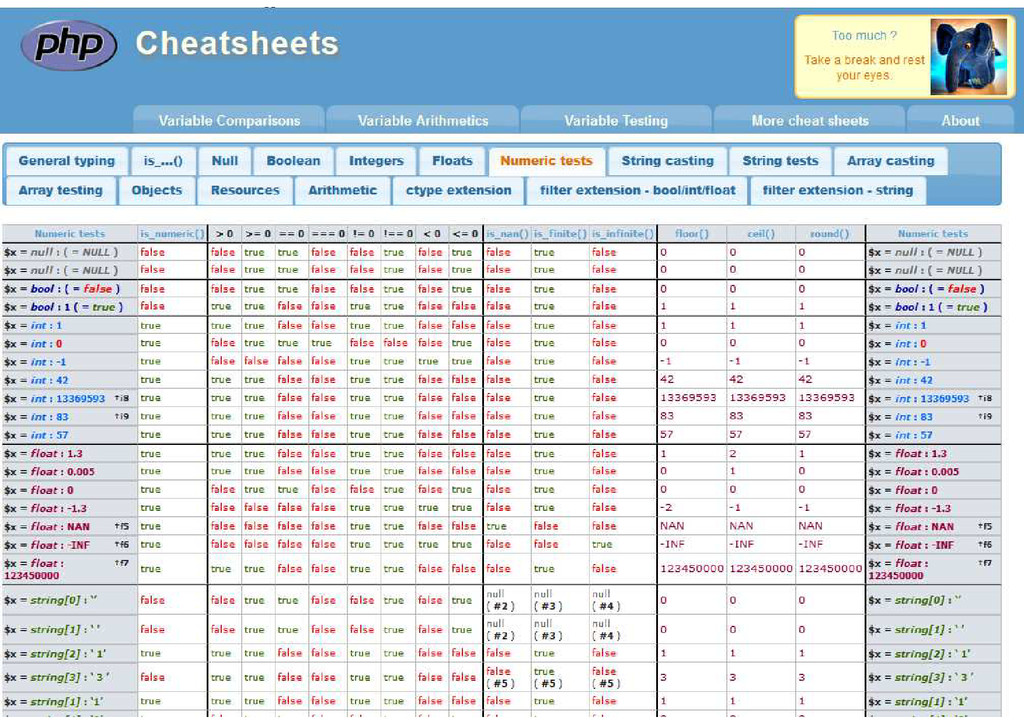
http://phpcheatsheets.com/
https://github.com/jrfnl/PHP-cheat-sheet-extended

Avatar for Juliette Reinders Folmer

Juliette Reinders Folmer PRO

February 20, 2014
Tweet

More Decks by Juliette Reinders Folmer

Other Decks in Programming

Transcript

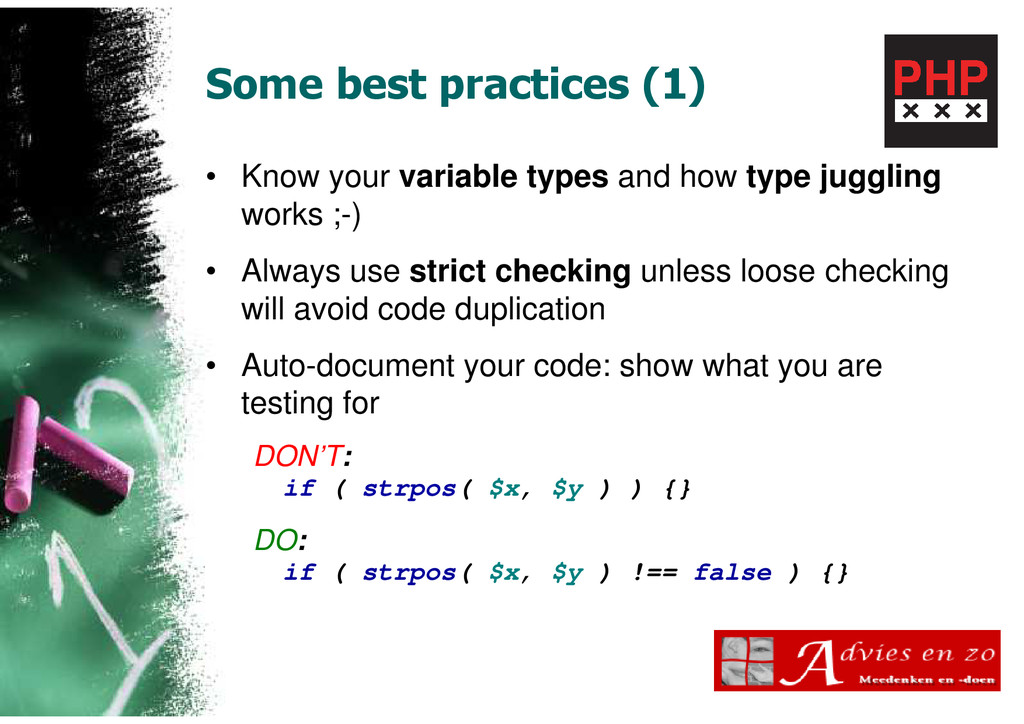
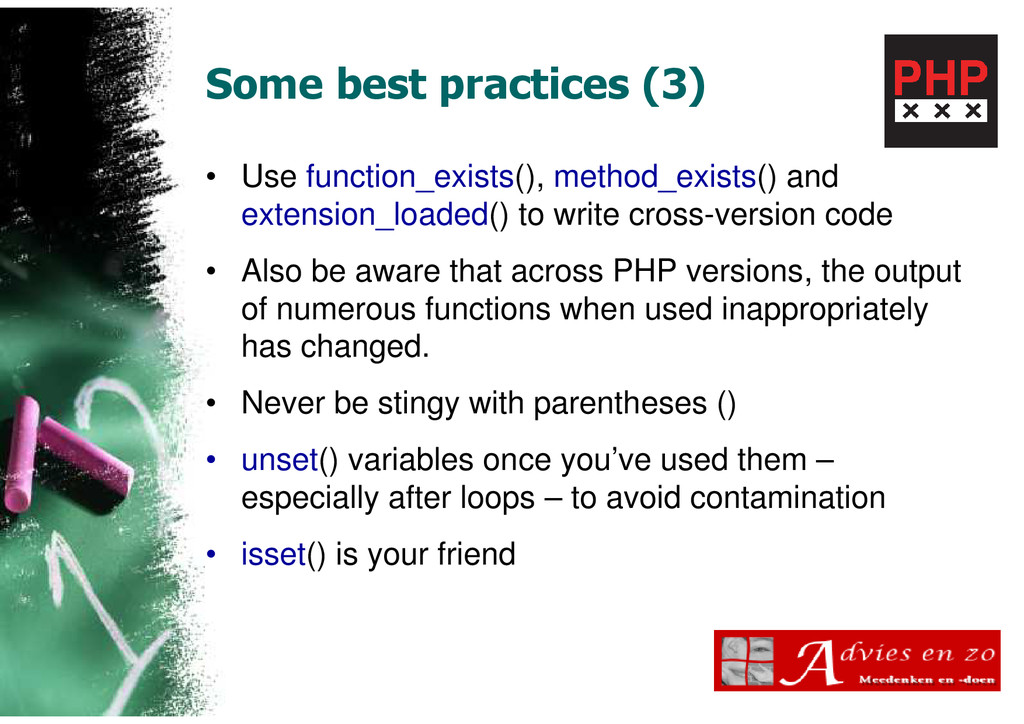
  1. Some best practices (1) • Know your variable types and

    how type juggling works ;-) • Always use strict checking unless loose checking will avoid code duplication • Auto-document your code: show what you are testing for DON’T: if ( strpos( $x, $y ) ) {} DO: if ( strpos( $x, $y ) !== false ) {}
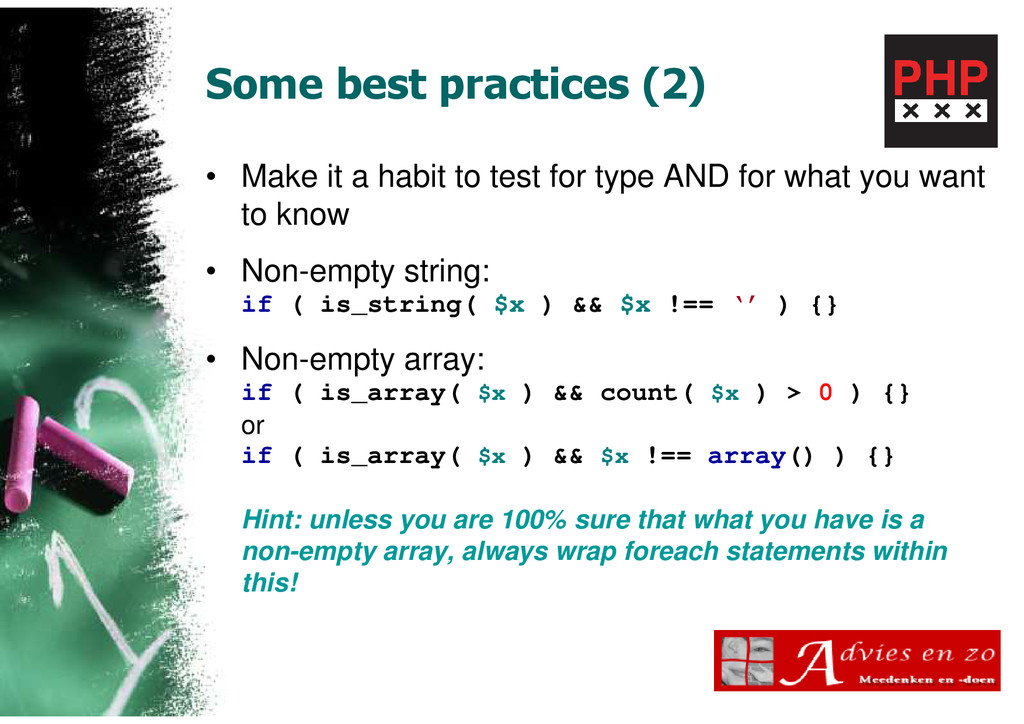
  2. Some best practices (2) • Make it a habit to

    test for type AND for what you want to know • Non-empty string: if ( is_string( $x ) && $x !== ‘’ ) {} • Non-empty array: if ( is_array( $x ) && count( $x ) > 0 ) {} or if ( is_array( $x ) && $x !== array() ) {} Hint: unless you are 100% sure that what you have is a non-empty array, always wrap foreach statements within this!
  3. Some best practices (3) • Use function_exists(), method_exists() and extension_loaded()

    to write cross-version code • Also be aware that across PHP versions, the output of numerous functions when used inappropriately has changed. • Never be stingy with parentheses () • unset() variables once you’ve used them – especially after loops – to avoid contamination • isset() is your friend
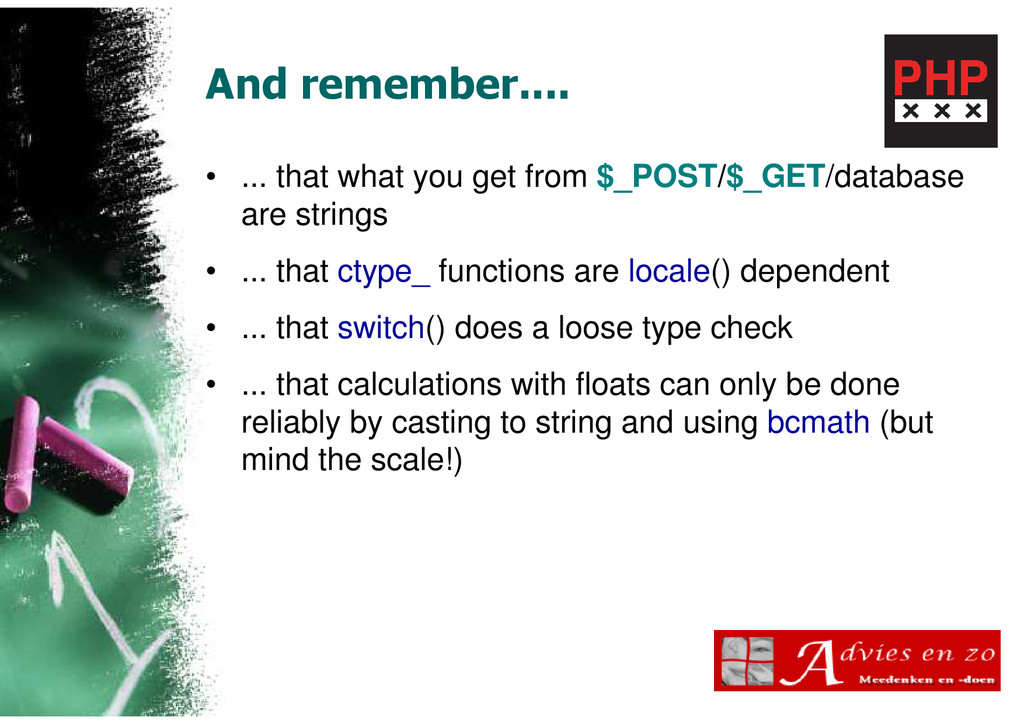
  4. And remember.... • ... that what you get from $_POST/$_GET/database

    are strings • ... that ctype_ functions are locale() dependent • ... that switch() does a loose type check • ... that calculations with floats can only be done reliably by casting to string and using bcmath (but mind the scale!)
  5. Keep in touch! (I’m self-employed, you can hire me ;-)

    ) Email: [email protected] Web: http://www.adviesenzo.nl/ LinkedIn: http://nl.linkedin.com/in/julietterf Twitter: http://twitter.com/jrf_nl GitHub: http://github.com/jrfnl/ Please rate this talk on joined.in/.... ? Endorsements and recommendations on LinkedIn are much appreciated too!