Upgrade to Pro — share decks privately, control downloads, hide ads and more …

Manager or IC? Both, Actually | Women In Data

Manager or IC? Both, Actually | Women In Data

My title at Astronomer is about to change from Senior Director of Engineering to Distinguished Engineer. Same work, different label. I'm on the Apache Airflow PMC. I still committed code last week. Most orgs frame the manager vs IC choice as a one-way door. I'll argue it isn't.

This talk is for anyone staring down that decision, or anyone who made it once and is wondering if they can un-make it.

What I'll cover:
- Why the "up or stuck" framing of the manager path is a trap, and what the hybrid path actually looks like day-to-day
- Which skills transfer across tracks, which don't, and which ones only compound when you stay in motion between them
- When a track switch is the right call, and when it's a reaction to one bad week
- How AI tools are changing what "being hands-on" means in 2026, and why that shifts the question entirely

The short version: shipping code makes you a better manager. Managing people makes you a better IC. The industry has been pricing this wrong.

Avatar for Kaxil Naik

Kaxil Naik

May 20, 2026

More Decks by Kaxil Naik

Other Decks in Programming

Transcript

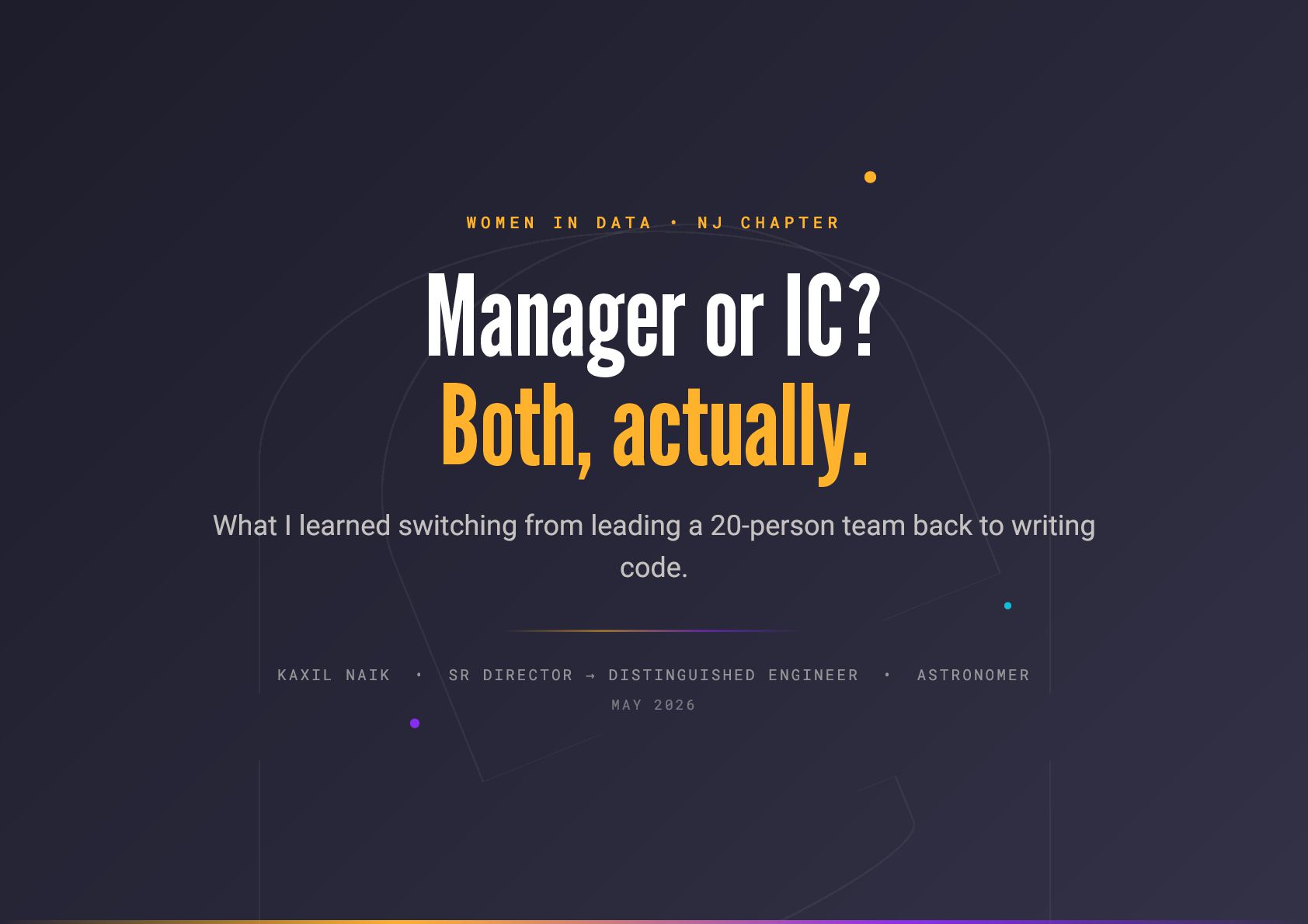
  1. W O M E N I N D A T

    A • N J C H A P T E R Manager or IC? Both, actually. What I learned switching from leading a 20-person team back to writing code. KAXIL NAIK • SR DIRECTOR → DISTINGUISHED ENGINEER • ASTRONOMER MAY 2026
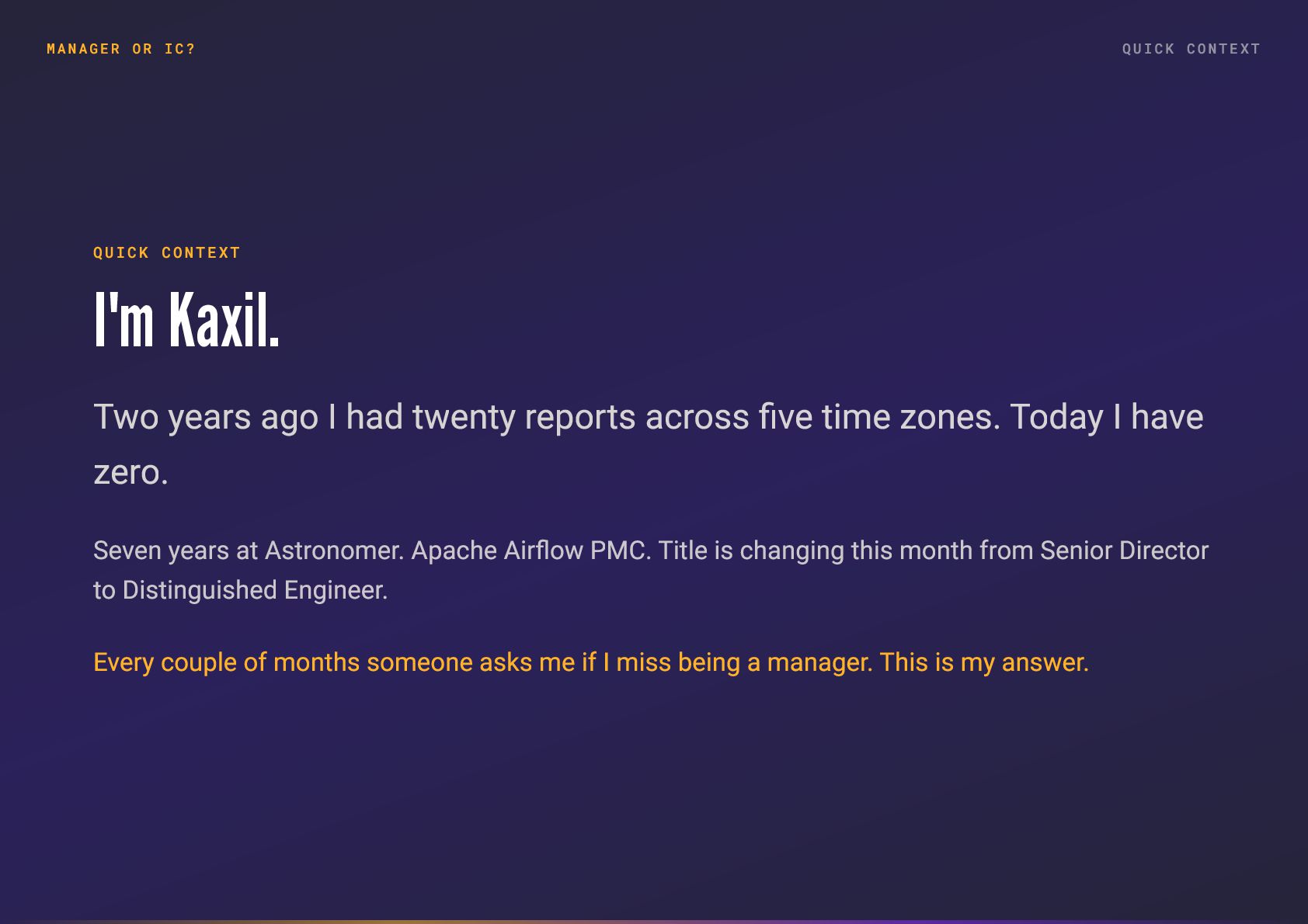
  2. QUICK CONTEXT I'm Kaxil. Two years ago I had twenty

    reports across five time zones. Today I have zero. Seven years at Astronomer. Apache Airflow PMC. Title is changing this month from Senior Director to Distinguished Engineer. Every couple of months someone asks me if I miss being a manager. This is my answer. MANAGER OR IC? QUICK CONTEXT
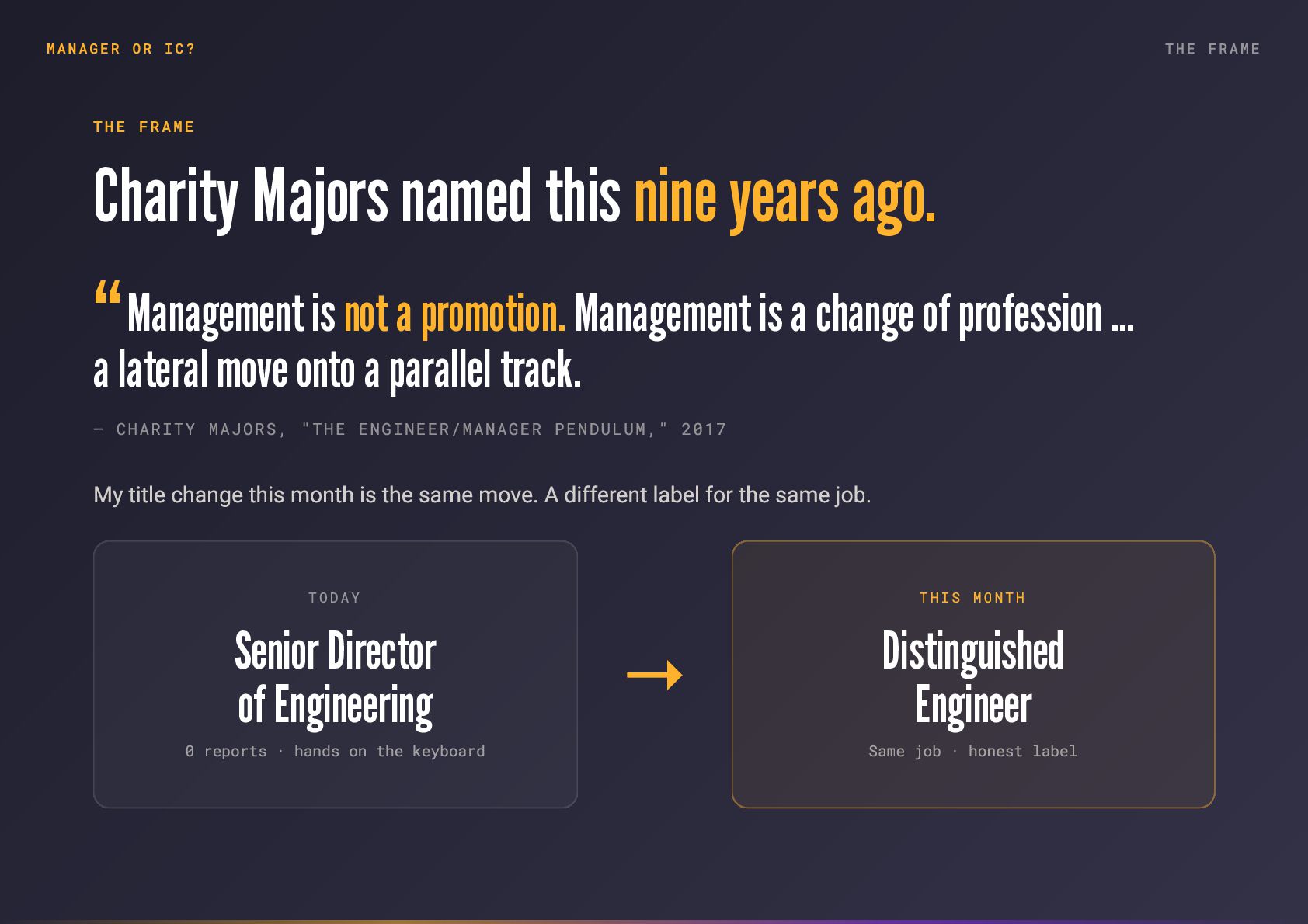
  3. THE FRAME Charity Majors named this nine years ago. “Management

    is not a promotion. Management is a change of profession … a lateral move onto a parallel track. — CHARITY MAJORS, "THE ENGINEER/MANAGER PENDULUM," 2017 My title change this month is the same move. A different label for the same job. TODAY Senior Director of Engineering 0 reports · hands on the keyboard → THIS MONTH Distinguished Engineer Same job · honest label MANAGER OR IC? THE FRAME
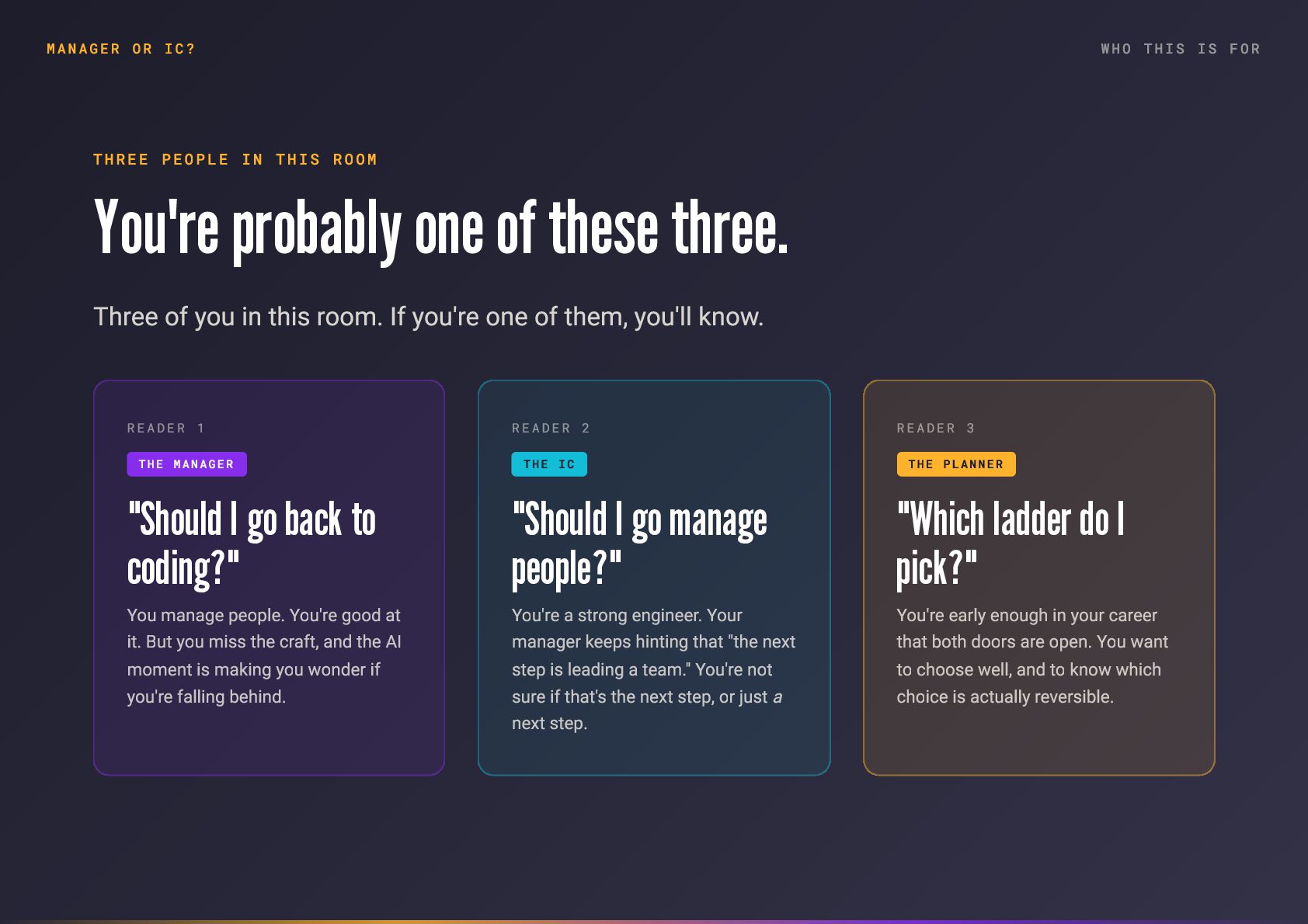
  4. THREE PEOPLE IN THIS ROOM You're probably one of these

    three. Three of you in this room. If you're one of them, you'll know. MANAGER OR IC? WHO THIS IS FOR R E A D E R 1 THE MANAGER "Should I go back to coding?" You manage people. You're good at it. But you miss the craft, and the AI moment is making you wonder if you're falling behind. R E A D E R 2 THE IC "Should I go manage people?" You're a strong engineer. Your manager keeps hinting that "the next step is leading a team." You're not sure if that's the next step, or just a next step. R E A D E R 3 THE PLANNER "Which ladder do I pick?" You're early enough in your career that both doors are open. You want to choose well, and to know which choice is actually reversible.
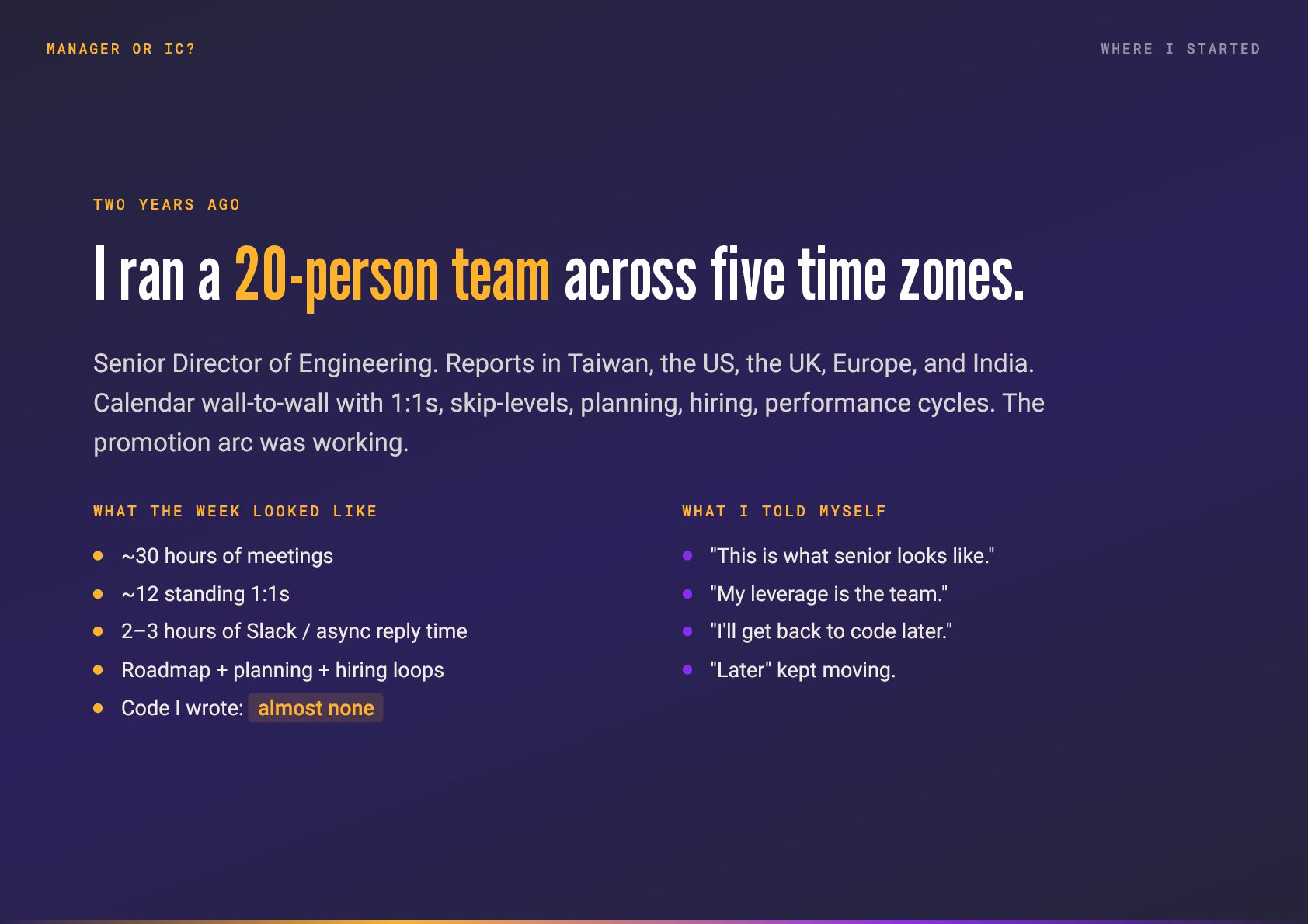
  5. TWO YEARS AGO I ran a 20-person team across five

    time zones. Senior Director of Engineering. Reports in Taiwan, the US, the UK, Europe, and India. Calendar wall-to-wall with 1:1s, skip-levels, planning, hiring, performance cycles. The promotion arc was working. WHAT THE WEEK LOOKED LIKE WHAT I TOLD MYSELF MANAGER OR IC? WHERE I STARTED ~30 hours of meetings ~12 standing 1:1s 2–3 hours of Slack / async reply time Roadmap + planning + hiring loops Code I wrote: almost none "This is what senior looks like." "My leverage is the team." "I'll get back to code later." "Later" kept moving.
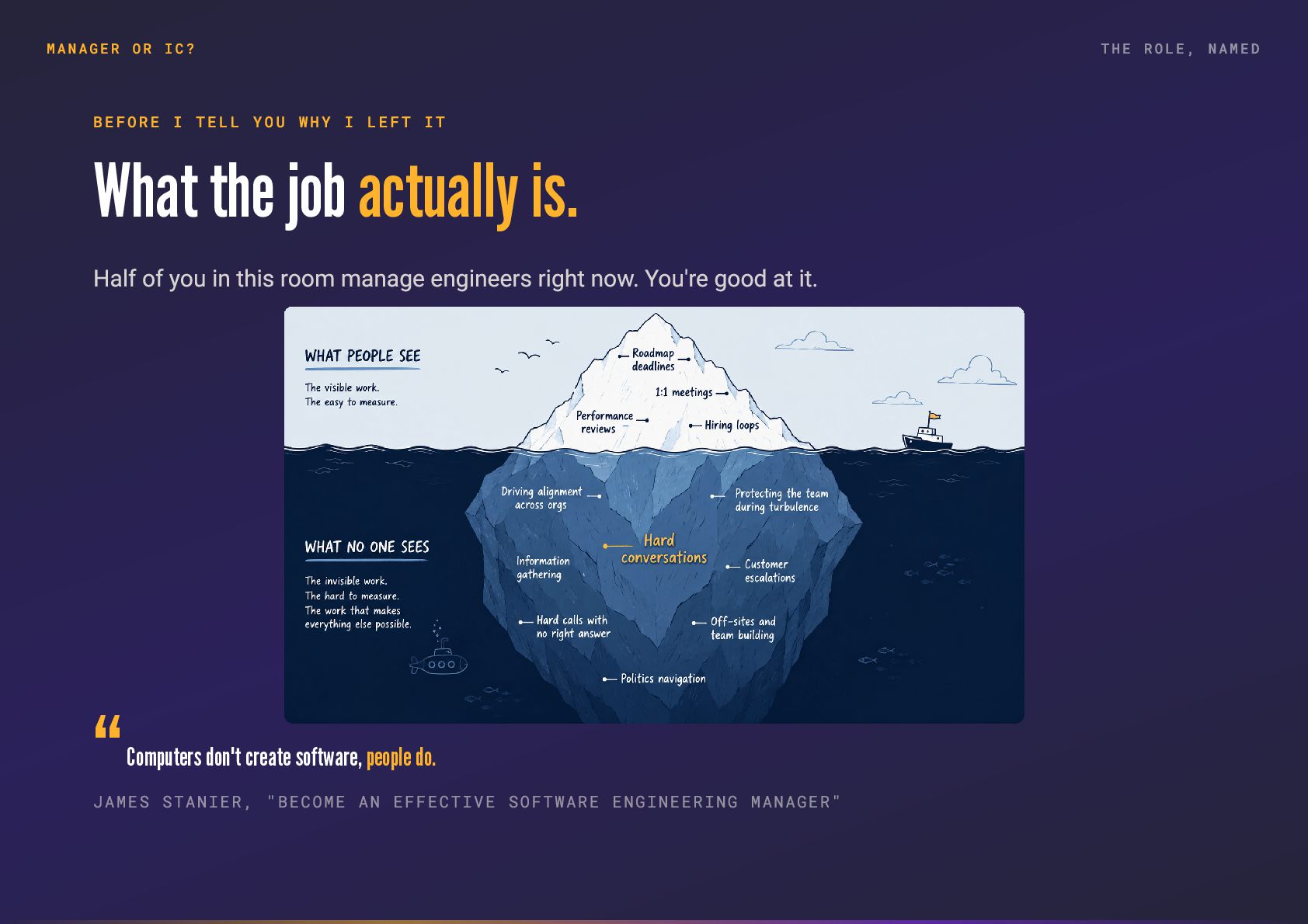
  6. BEFORE I TELL YOU WHY I LEFT IT What the

    job actually is. Half of you in this room manage engineers right now. You're good at it. “Computers don't create software, people do. JAMES STANIER, "BECOME AN EFFECTIVE SOFTWARE ENGINEERING MANAGER" MANAGER OR IC? THE ROLE, NAMED
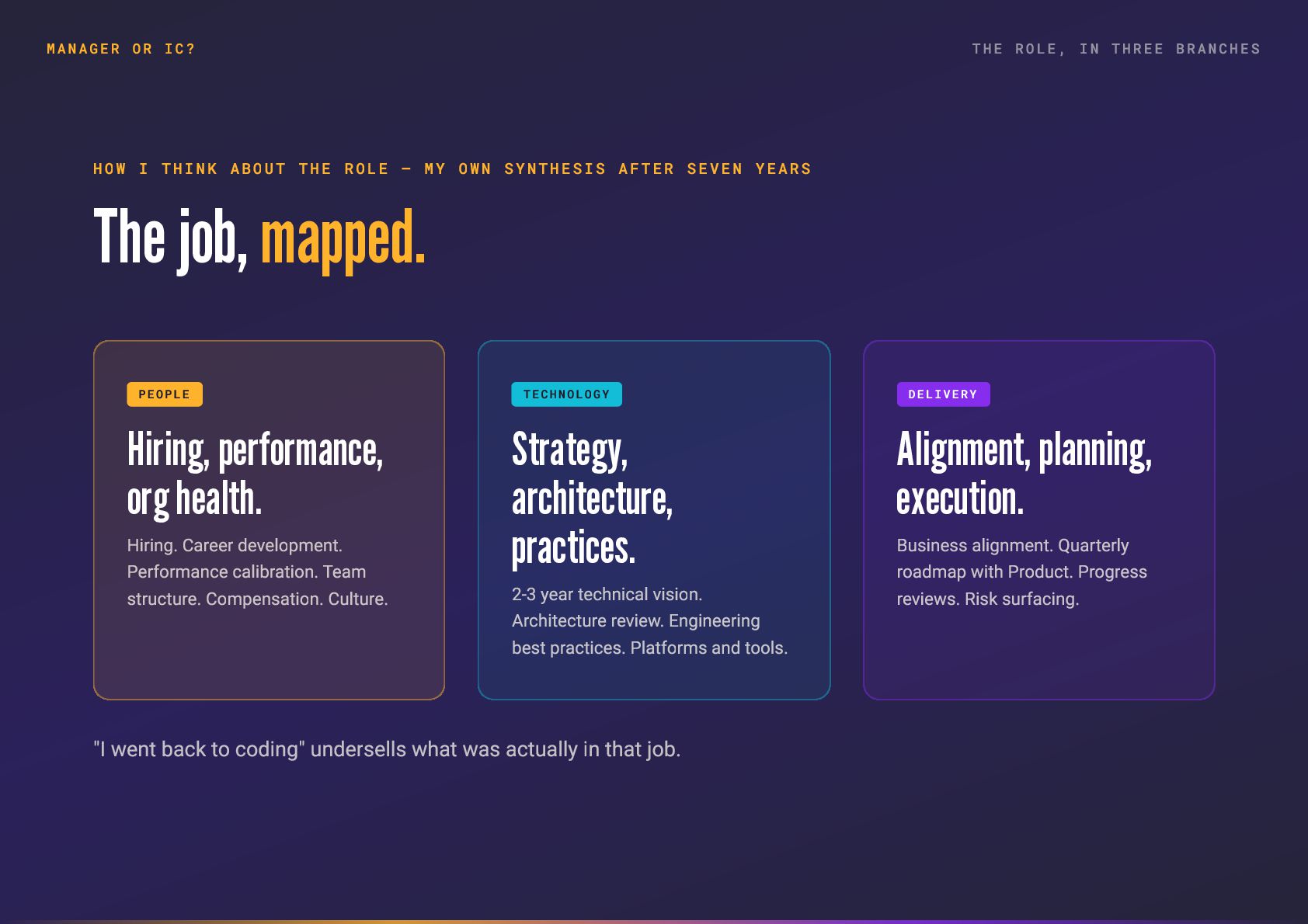
  7. HOW I THINK ABOUT THE ROLE — MY OWN SYNTHESIS

    AFTER SEVEN YEARS The job, mapped. "I went back to coding" undersells what was actually in that job. MANAGER OR IC? THE ROLE, IN THREE BRANCHES PEOPLE Hiring, performance, org health. Hiring. Career development. Performance calibration. Team structure. Compensation. Culture. TECHNOLOGY Strategy, architecture, practices. 2-3 year technical vision. Architecture review. Engineering best practices. Platforms and tools. DELIVERY Alignment, planning, execution. Business alignment. Quarterly roadmap with Product. Progress reviews. Risk surfacing.
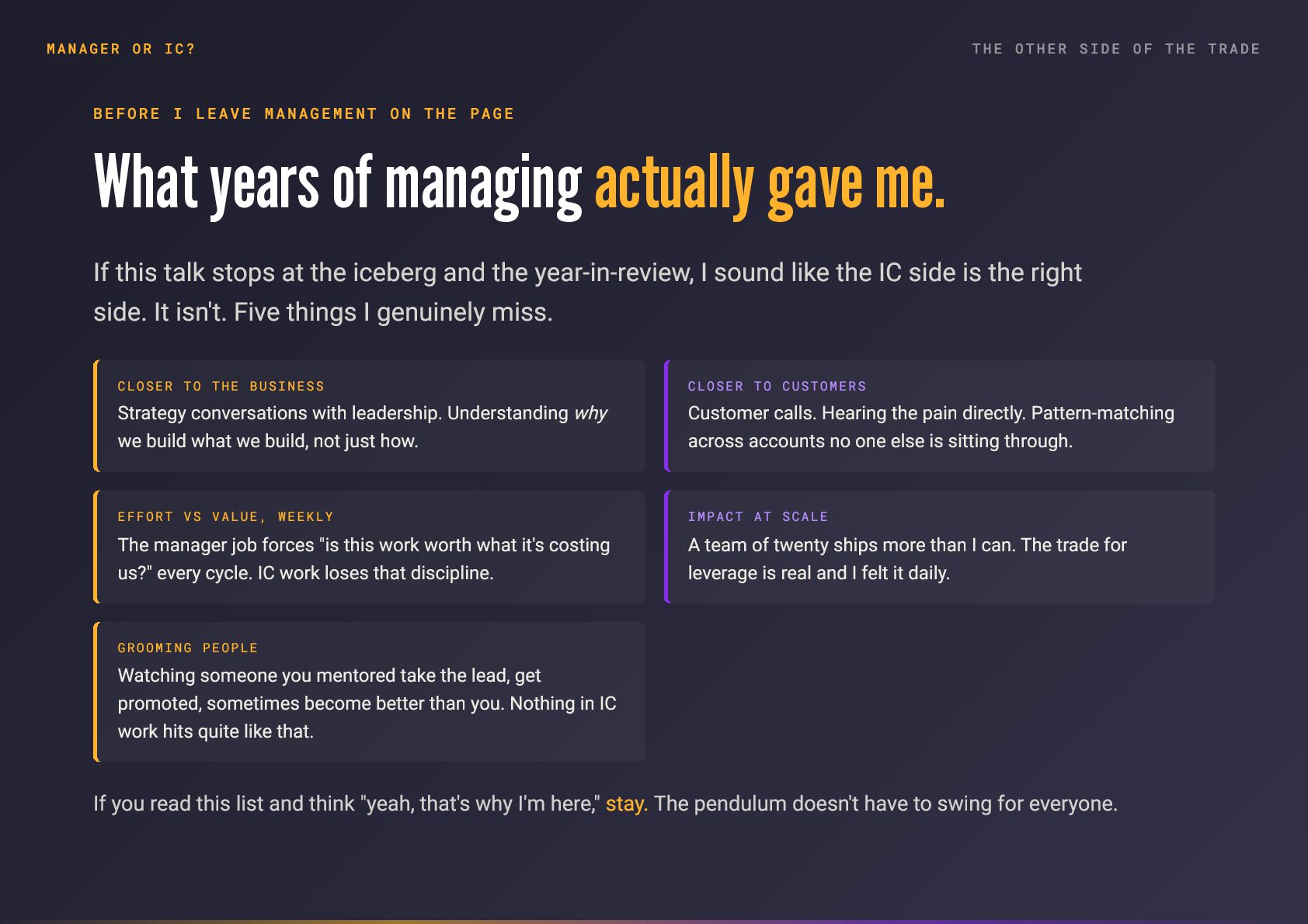
  8. BEFORE I LEAVE MANAGEMENT ON THE PAGE What years of

    managing actually gave me. If this talk stops at the iceberg and the year-in-review, I sound like the IC side is the right side. It isn't. Five things I genuinely miss. CLOSER TO THE BUSINESS Strategy conversations with leadership. Understanding why we build what we build, not just how. CLOSER TO CUSTOMERS Customer calls. Hearing the pain directly. Pattern-matching across accounts no one else is sitting through. EFFORT VS VALUE, WEEKLY The manager job forces "is this work worth what it's costing us?" every cycle. IC work loses that discipline. IMPACT AT SCALE A team of twenty ships more than I can. The trade for leverage is real and I felt it daily. GROOMING PEOPLE Watching someone you mentored take the lead, get promoted, sometimes become better than you. Nothing in IC work hits quite like that. If you read this list and think "yeah, that's why I'm here," stay. The pendulum doesn't have to swing for everyone. MANAGER OR IC? THE OTHER SIDE OF THE TRADE
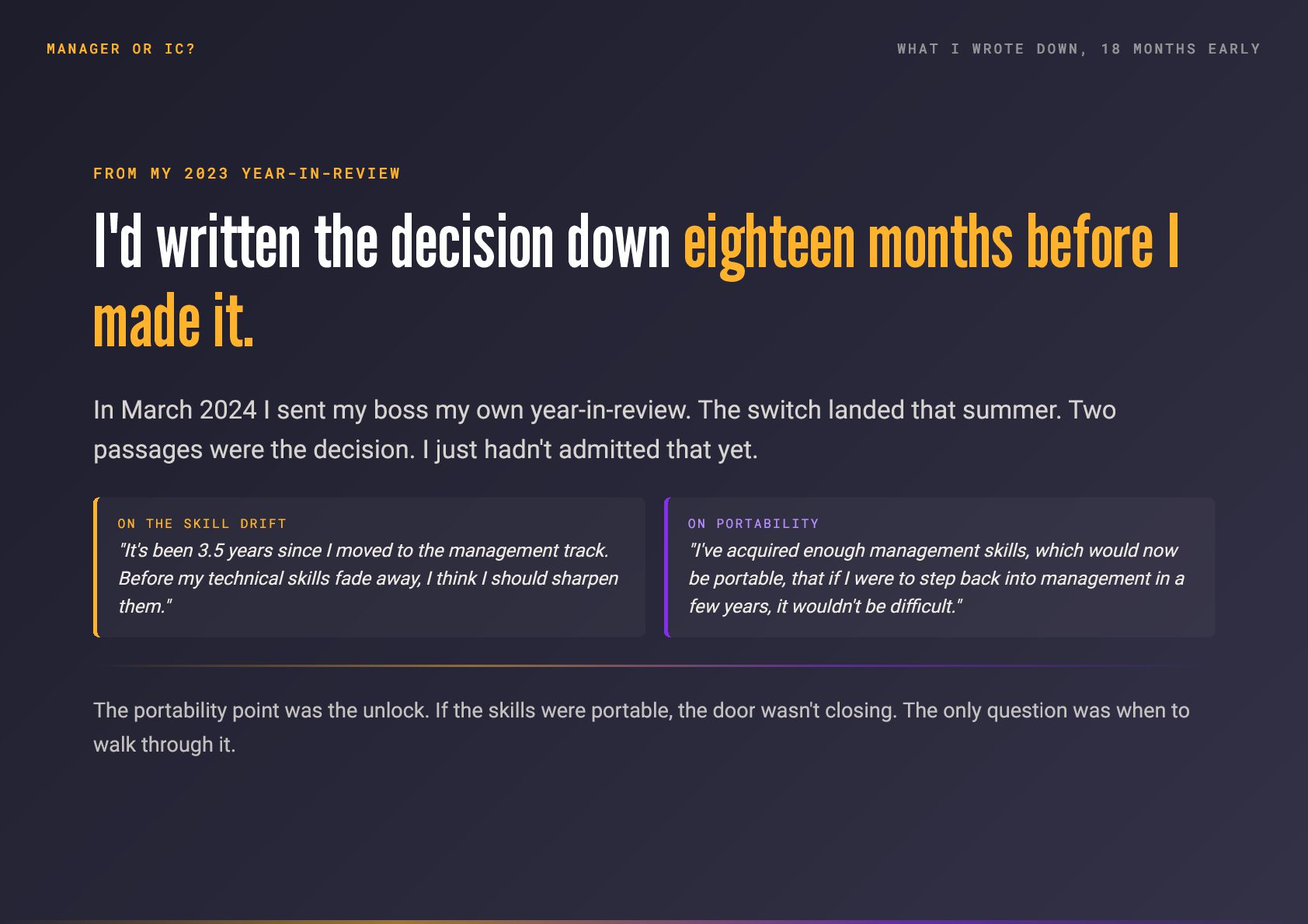
  9. FROM MY 2023 YEAR-IN-REVIEW I'd written the decision down eighteen

    months before I made it. In March 2024 I sent my boss my own year-in-review. The switch landed that summer. Two passages were the decision. I just hadn't admitted that yet. ON THE SKILL DRIFT "It's been 3.5 years since I moved to the management track. Before my technical skills fade away, I think I should sharpen them." ON PORTABILITY "I've acquired enough management skills, which would now be portable, that if I were to step back into management in a few years, it wouldn't be difficult." The portability point was the unlock. If the skills were portable, the door wasn't closing. The only question was when to walk through it. MANAGER OR IC? WHAT I WROTE DOWN, 18 MONTHS EARLY
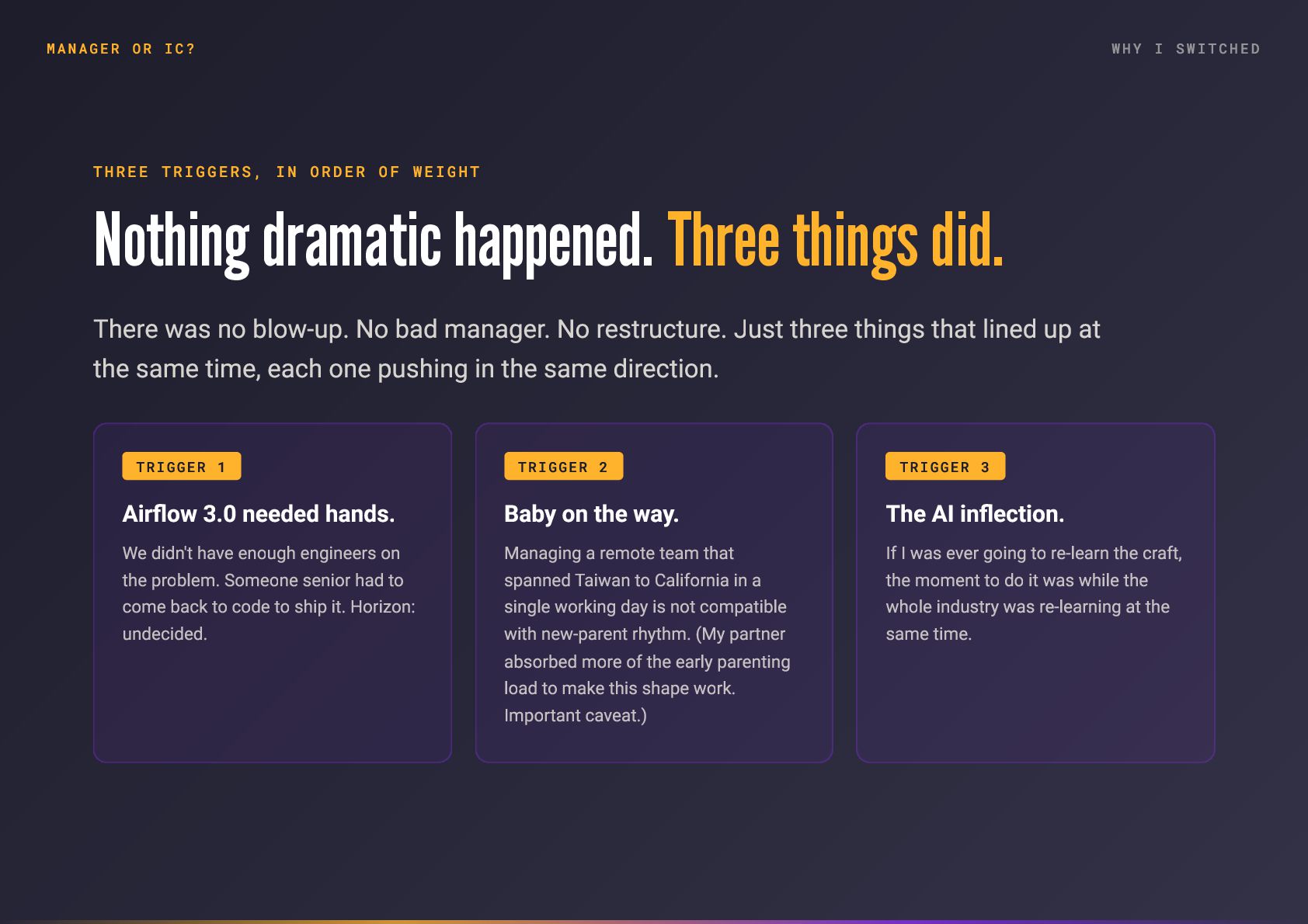
  10. THREE TRIGGERS, IN ORDER OF WEIGHT Nothing dramatic happened. Three

    things did. There was no blow-up. No bad manager. No restructure. Just three things that lined up at the same time, each one pushing in the same direction. MANAGER OR IC? WHY I SWITCHED TRIGGER 1 Airflow 3.0 needed hands. We didn't have enough engineers on the problem. Someone senior had to come back to code to ship it. Horizon: undecided. TRIGGER 2 Baby on the way. Managing a remote team that spanned Taiwan to California in a single working day is not compatible with new-parent rhythm. (My partner absorbed more of the early parenting load to make this shape work. Important caveat.) TRIGGER 3 The AI inflection. If I was ever going to re-learn the craft, the moment to do it was while the whole industry was re-learning at the same time.
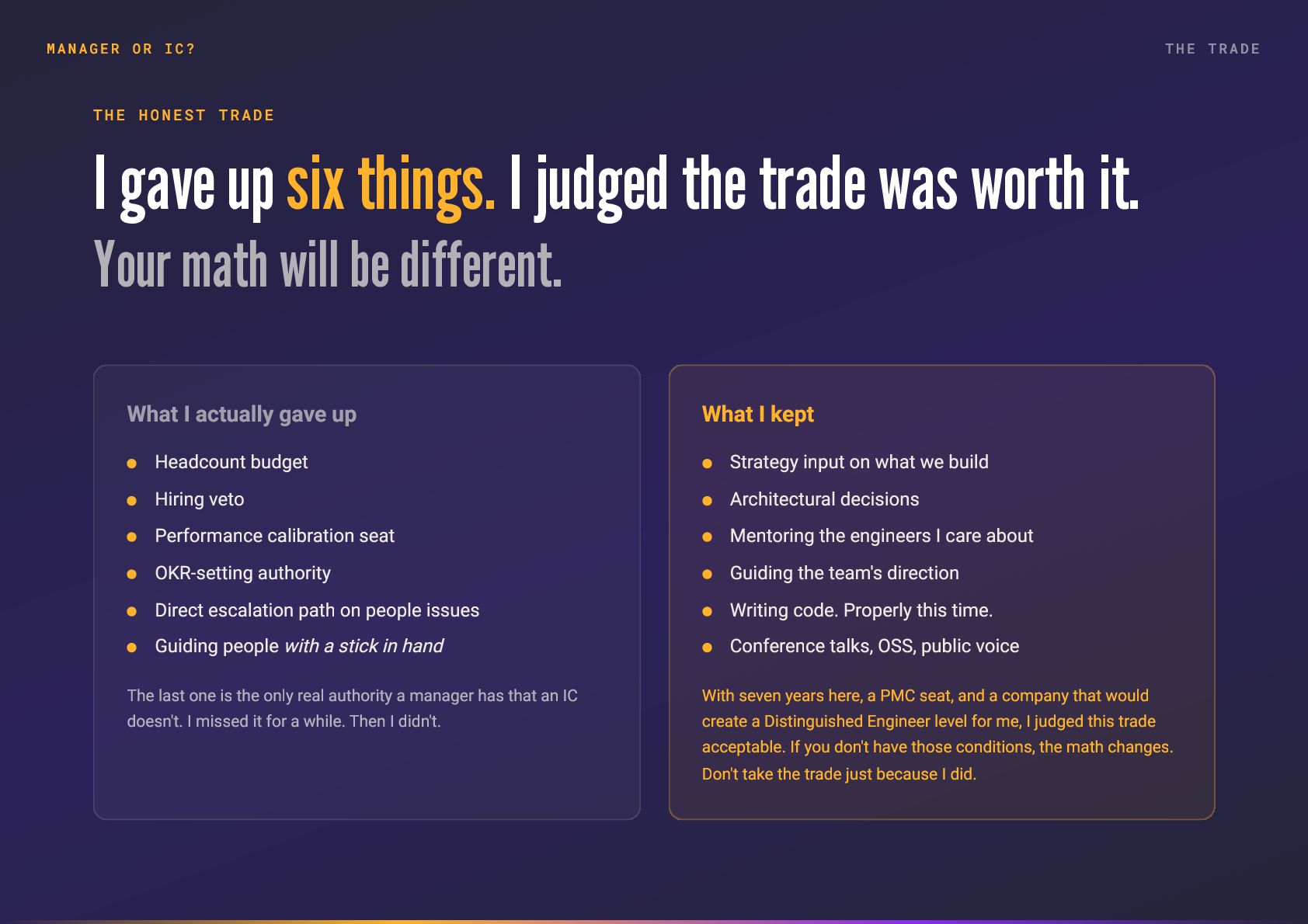
  11. THE HONEST TRADE I gave up six things. I judged

    the trade was worth it. Your math will be different. What I actually gave up The last one is the only real authority a manager has that an IC doesn't. I missed it for a while. Then I didn't. What I kept With seven years here, a PMC seat, and a company that would create a Distinguished Engineer level for me, I judged this trade acceptable. If you don't have those conditions, the math changes. Don't take the trade just because I did. MANAGER OR IC? THE TRADE Headcount budget Hiring veto Performance calibration seat OKR-setting authority Direct escalation path on people issues Guiding people with a stick in hand Strategy input on what we build Architectural decisions Mentoring the engineers I care about Guiding the team's direction Writing code. Properly this time. Conference talks, OSS, public voice
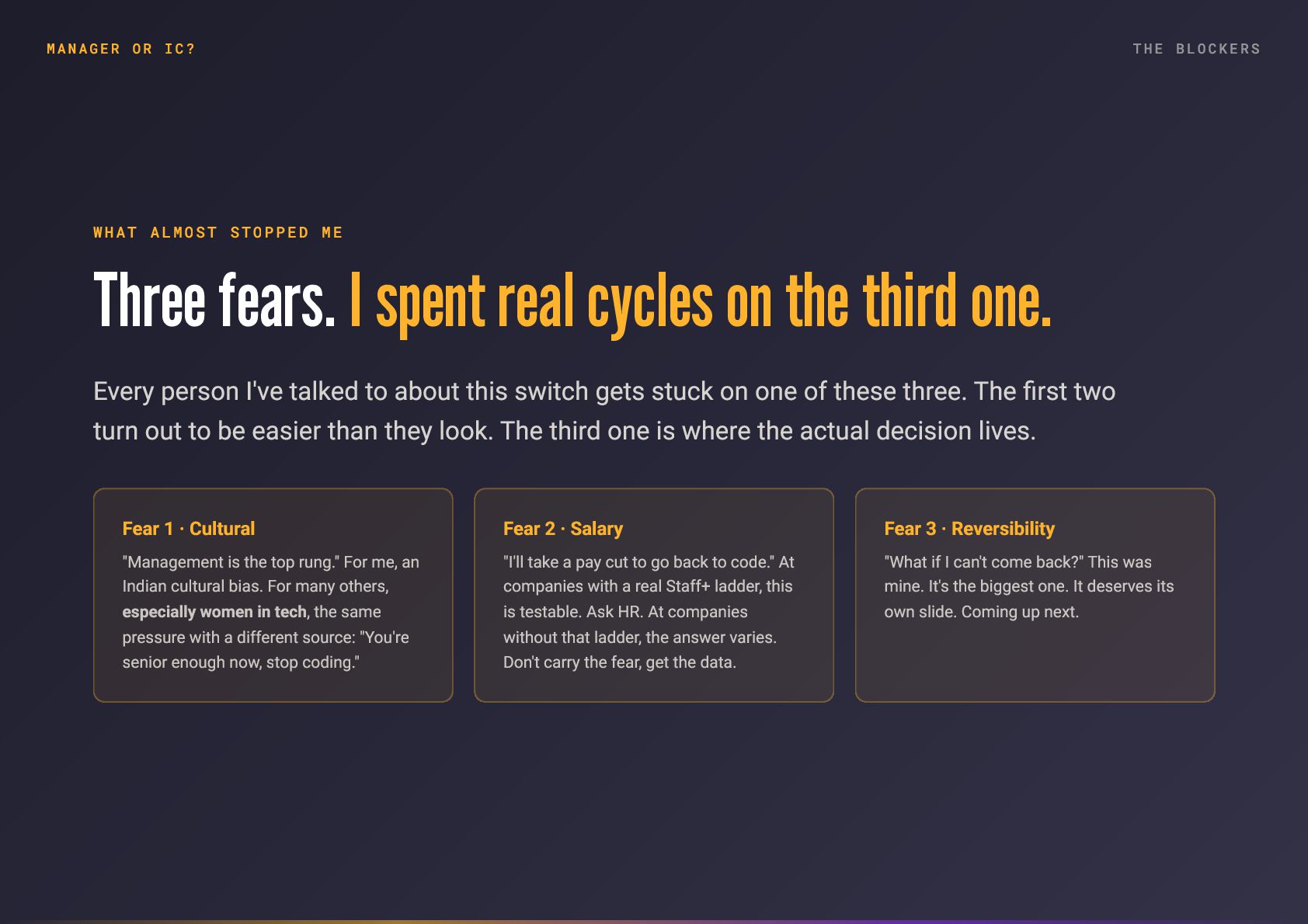
  12. WHAT ALMOST STOPPED ME Three fears. I spent real cycles

    on the third one. Every person I've talked to about this switch gets stuck on one of these three. The first two turn out to be easier than they look. The third one is where the actual decision lives. Fear 1 · Cultural "Management is the top rung." For me, an Indian cultural bias. For many others, especially women in tech, the same pressure with a different source: "You're senior enough now, stop coding." Fear 2 · Salary "I'll take a pay cut to go back to code." At companies with a real Staff+ ladder, this is testable. Ask HR. At companies without that ladder, the answer varies. Don't carry the fear, get the data. Fear 3 · Reversibility "What if I can't come back?" This was mine. It's the biggest one. It deserves its own slide. Coming up next. MANAGER OR IC? THE BLOCKERS
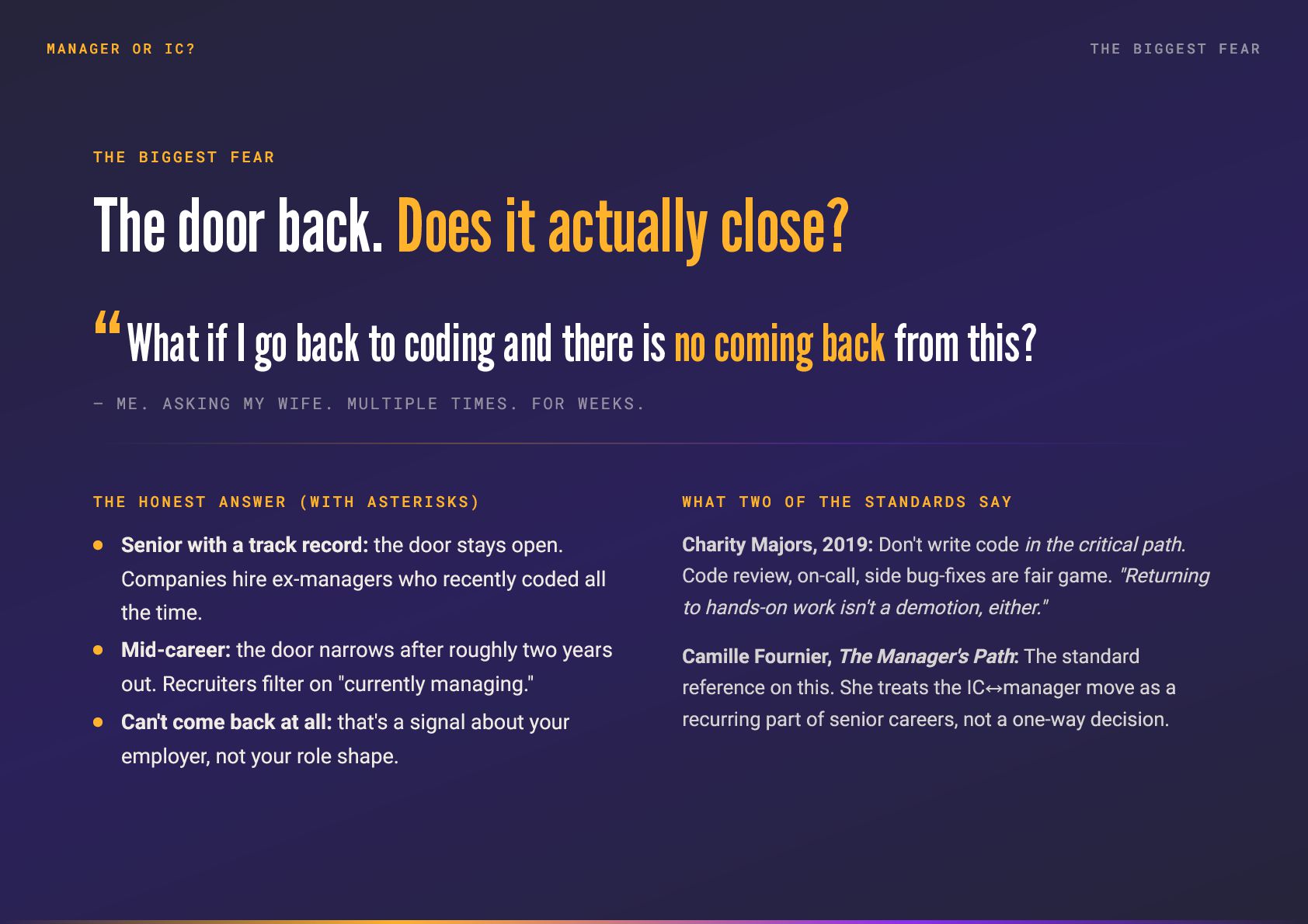
  13. THE BIGGEST FEAR The door back. Does it actually close?

    “What if I go back to coding and there is no coming back from this? — ME. ASKING MY WIFE. MULTIPLE TIMES. FOR WEEKS. THE HONEST ANSWER (WITH ASTERISKS) WHAT TWO OF THE STANDARDS SAY Charity Majors, 2019: Don't write code in the critical path. Code review, on-call, side bug-fixes are fair game. "Returning to hands-on work isn't a demotion, either." Camille Fournier, The Manager's Path: The standard reference on this. She treats the IC ↔manager move as a recurring part of senior careers, not a one-way decision. MANAGER OR IC? THE BIGGEST FEAR Senior with a track record: the door stays open. Companies hire ex-managers who recently coded all the time. Mid-career: the door narrows after roughly two years out. Recruiters filter on "currently managing." Can't come back at all: that's a signal about your employer, not your role shape.
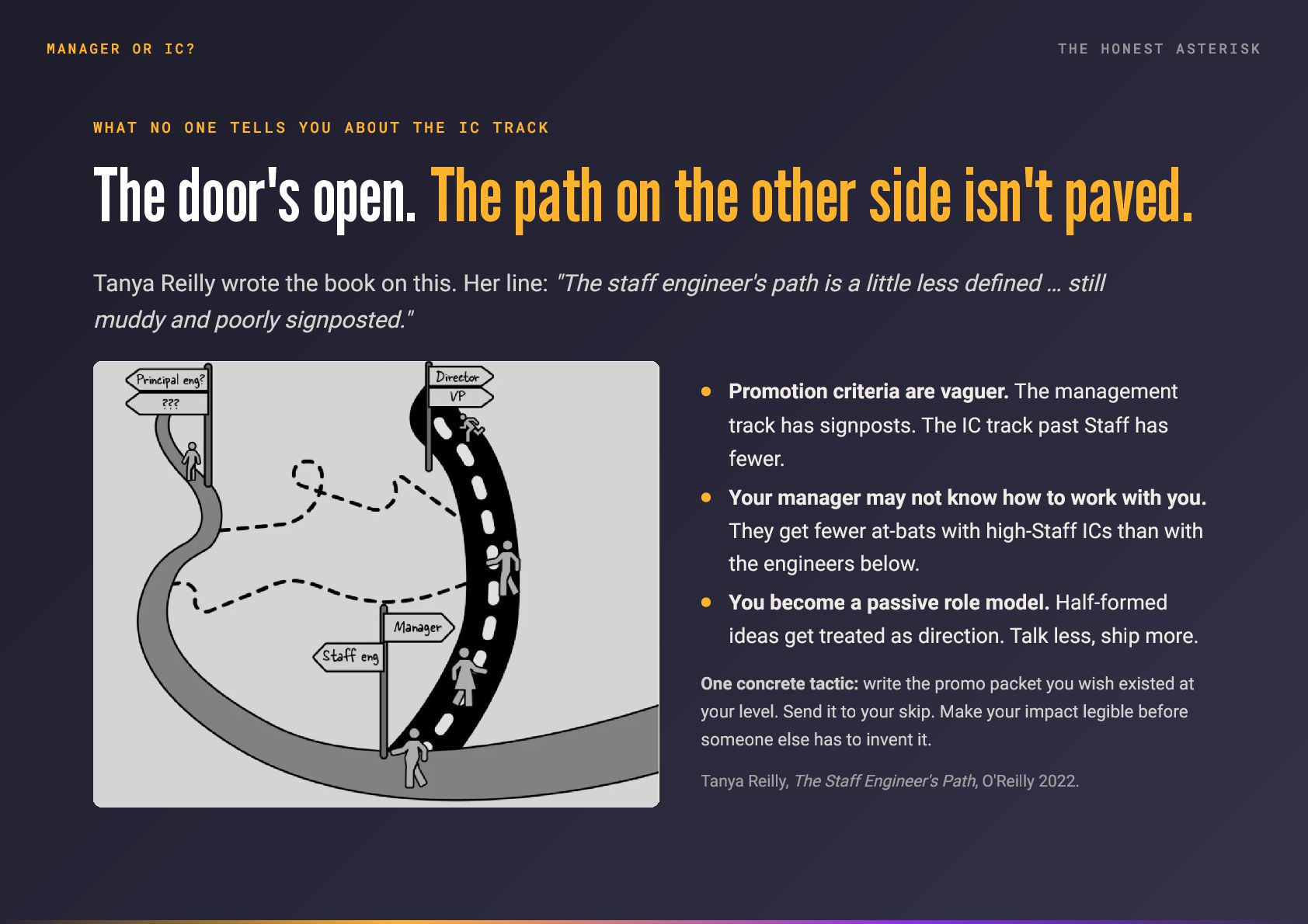
  14. WHAT NO ONE TELLS YOU ABOUT THE IC TRACK The

    door's open. The path on the other side isn't paved. Tanya Reilly wrote the book on this. Her line: "The staff engineer's path is a little less defined … still muddy and poorly signposted." One concrete tactic: write the promo packet you wish existed at your level. Send it to your skip. Make your impact legible before someone else has to invent it. Tanya Reilly, The Staff Engineer's Path, O'Reilly 2022. MANAGER OR IC? THE HONEST ASTERISK Promotion criteria are vaguer. The management track has signposts. The IC track past Staff has fewer. Your manager may not know how to work with you. They get fewer at-bats with high-Staff ICs than with the engineers below. You become a passive role model. Half-formed ideas get treated as direction. Talk less, ship more.
  15. THE FIRST THING I CHANGED I deleted every standing 1:1.

    Including with my boss. “My calendar, dude. After I switched, one month in, oh my god the relief. ME, TWO MONTHS POST-SWITCH, TO A PEER THINKING ABOUT THE SAME MOVE WHAT GOT BETTER WHAT GOT WORSE MANAGER OR IC? WHAT IT ACTUALLY FELT LIKE Long uninterrupted blocks. The thing engineers actually need. Time for OSS work that the calendar had crowded out Headspace for the AI shift. I wouldn't have noticed if I'd stayed busy. Lateral org information that flowed through 1:1s. I find out later now. Casual mentoring moments. PR review is high- bandwidth but it's code review, not person review I used to know when someone was about to quit. I don't anymore.
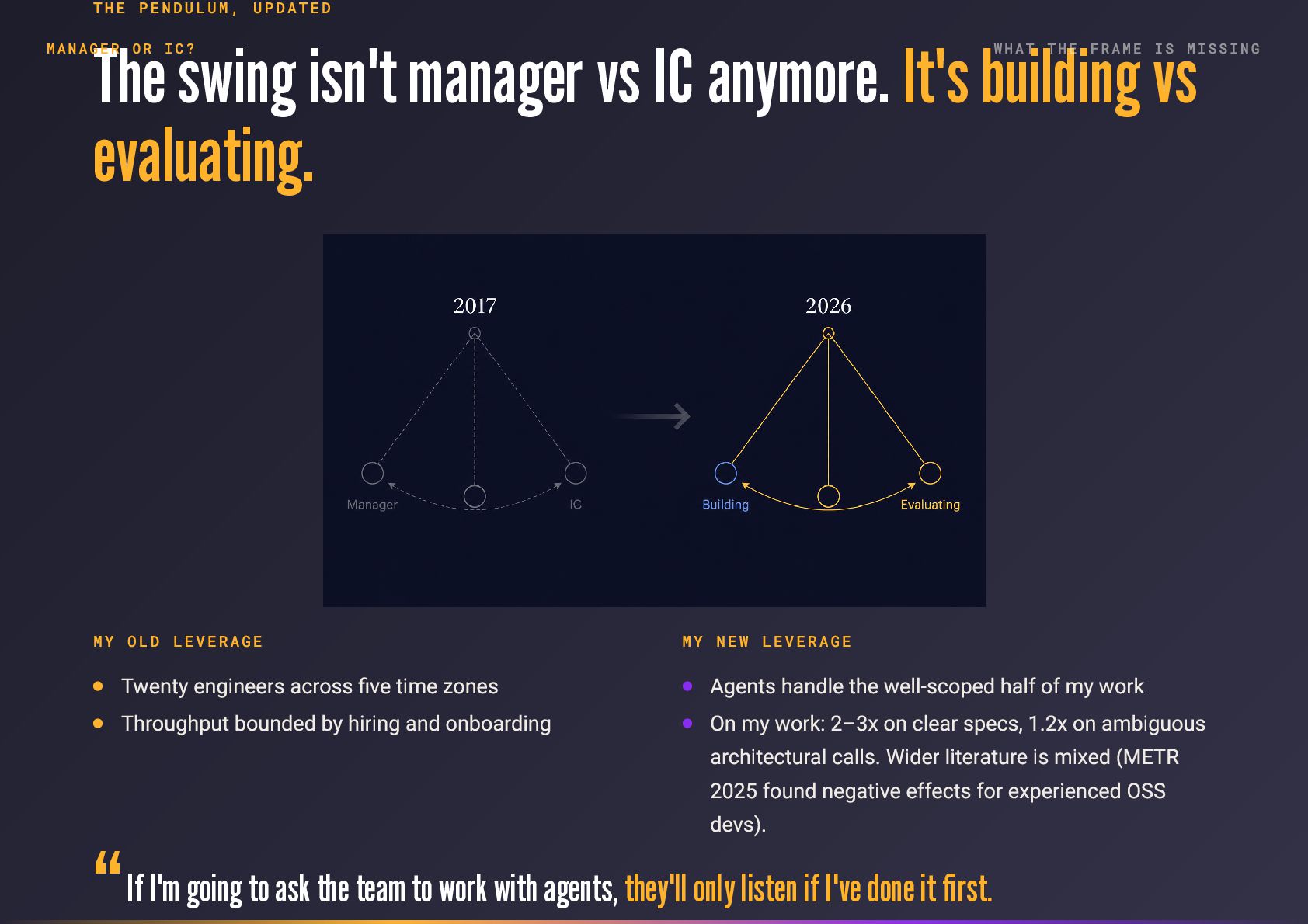
  16. THE PENDULUM, UPDATED The swing isn't manager vs IC anymore.

    It's building vs evaluating. MY OLD LEVERAGE MY NEW LEVERAGE “If I'm going to ask the team to work with agents, they'll only listen if I've done it first. MANAGER OR IC? WHAT THE FRAME IS MISSING Twenty engineers across five time zones Throughput bounded by hiring and onboarding Agents handle the well-scoped half of my work On my work: 2–3x on clear specs, 1.2x on ambiguous architectural calls. Wider literature is mixed (METR 2025 found negative effects for experienced OSS devs).
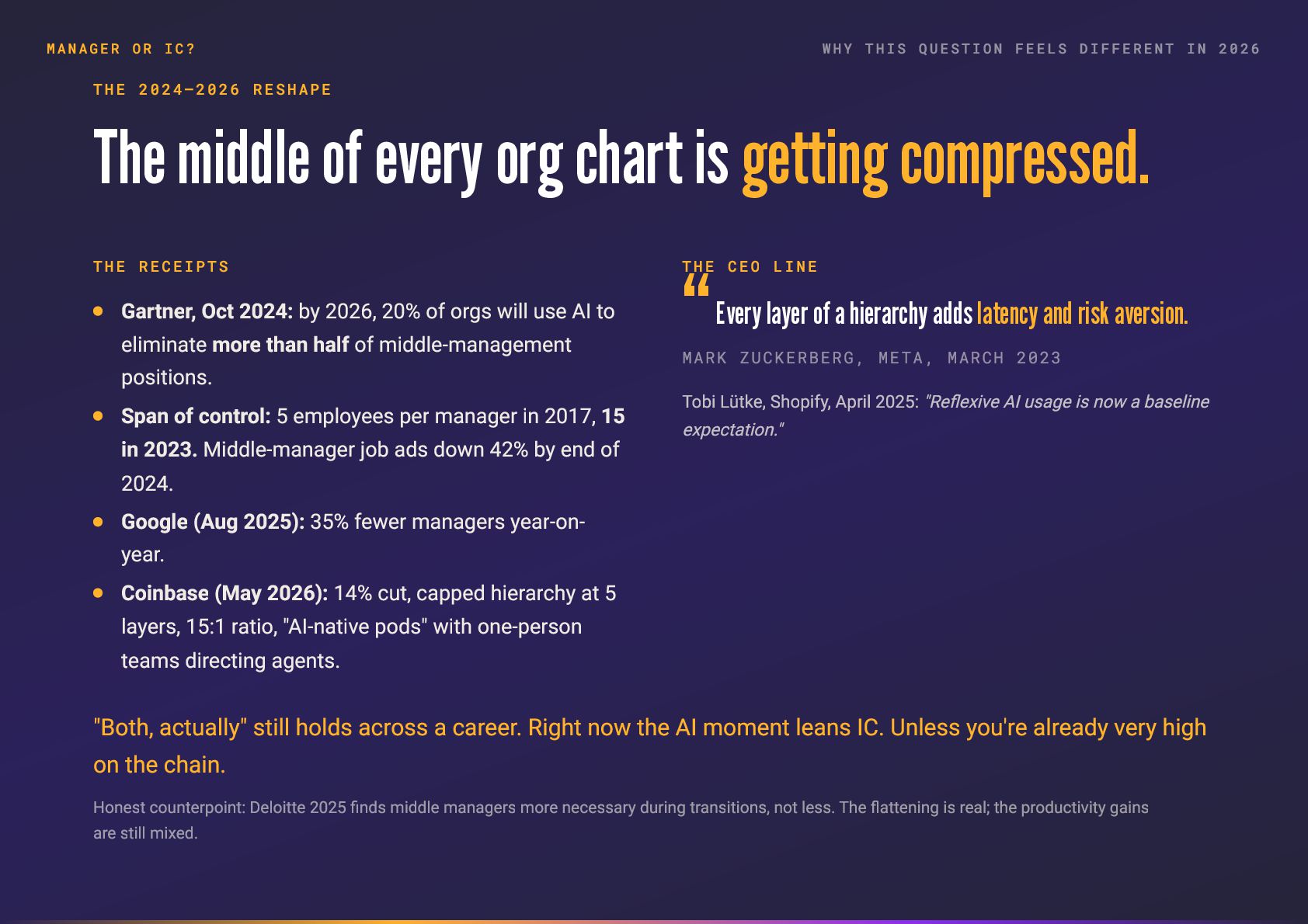
  17. THE 2024–2026 RESHAPE The middle of every org chart is

    getting compressed. THE RECEIPTS THE CEO LINE “Every layer of a hierarchy adds latency and risk aversion. MARK ZUCKERBERG, META, MARCH 2023 Tobi Lütke, Shopify, April 2025: "Reflexive AI usage is now a baseline expectation." "Both, actually" still holds across a career. Right now the AI moment leans IC. Unless you're already very high on the chain. Honest counterpoint: Deloitte 2025 finds middle managers more necessary during transitions, not less. The flattening is real; the productivity gains are still mixed. MANAGER OR IC? WHY THIS QUESTION FEELS DIFFERENT IN 2026 Gartner, Oct 2024: by 2026, 20% of orgs will use AI to eliminate more than half of middle-management positions. Span of control: 5 employees per manager in 2017, 15 in 2023. Middle-manager job ads down 42% by end of 2024. Google (Aug 2025): 35% fewer managers year-on- year. Coinbase (May 2026): 14% cut, capped hierarchy at 5 layers, 15:1 ratio, "AI-native pods" with one-person teams directing agents.
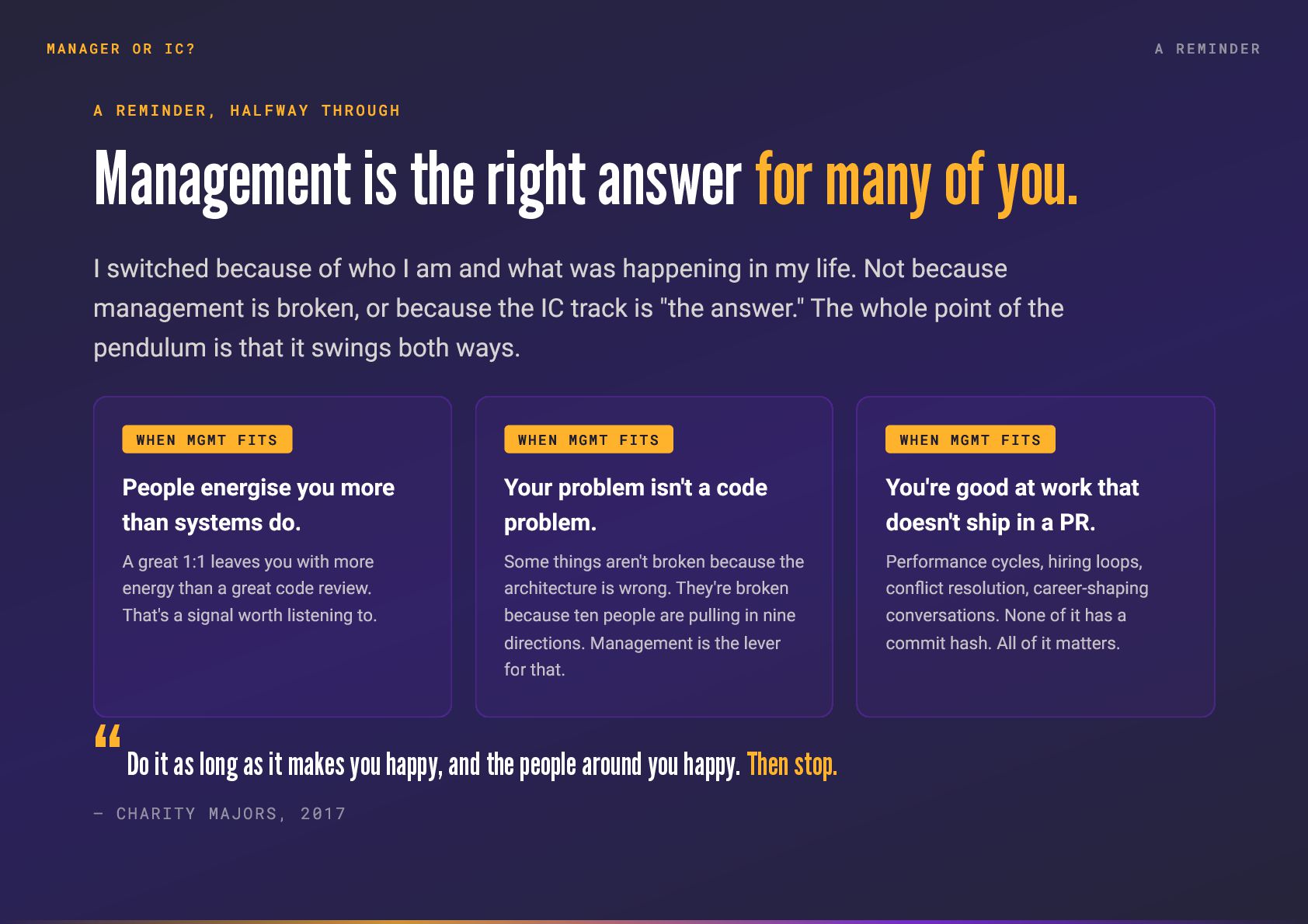
  18. A REMINDER, HALFWAY THROUGH Management is the right answer for

    many of you. I switched because of who I am and what was happening in my life. Not because management is broken, or because the IC track is "the answer." The whole point of the pendulum is that it swings both ways. “Do it as long as it makes you happy, and the people around you happy. Then stop. — CHARITY MAJORS, 2017 MANAGER OR IC? A REMINDER WHEN MGMT FITS People energise you more than systems do. A great 1:1 leaves you with more energy than a great code review. That's a signal worth listening to. WHEN MGMT FITS Your problem isn't a code problem. Some things aren't broken because the architecture is wrong. They're broken because ten people are pulling in nine directions. Management is the lever for that. WHEN MGMT FITS You're good at work that doesn't ship in a PR. Performance cycles, hiring loops, conflict resolution, career-shaping conversations. None of it has a commit hash. All of it matters.
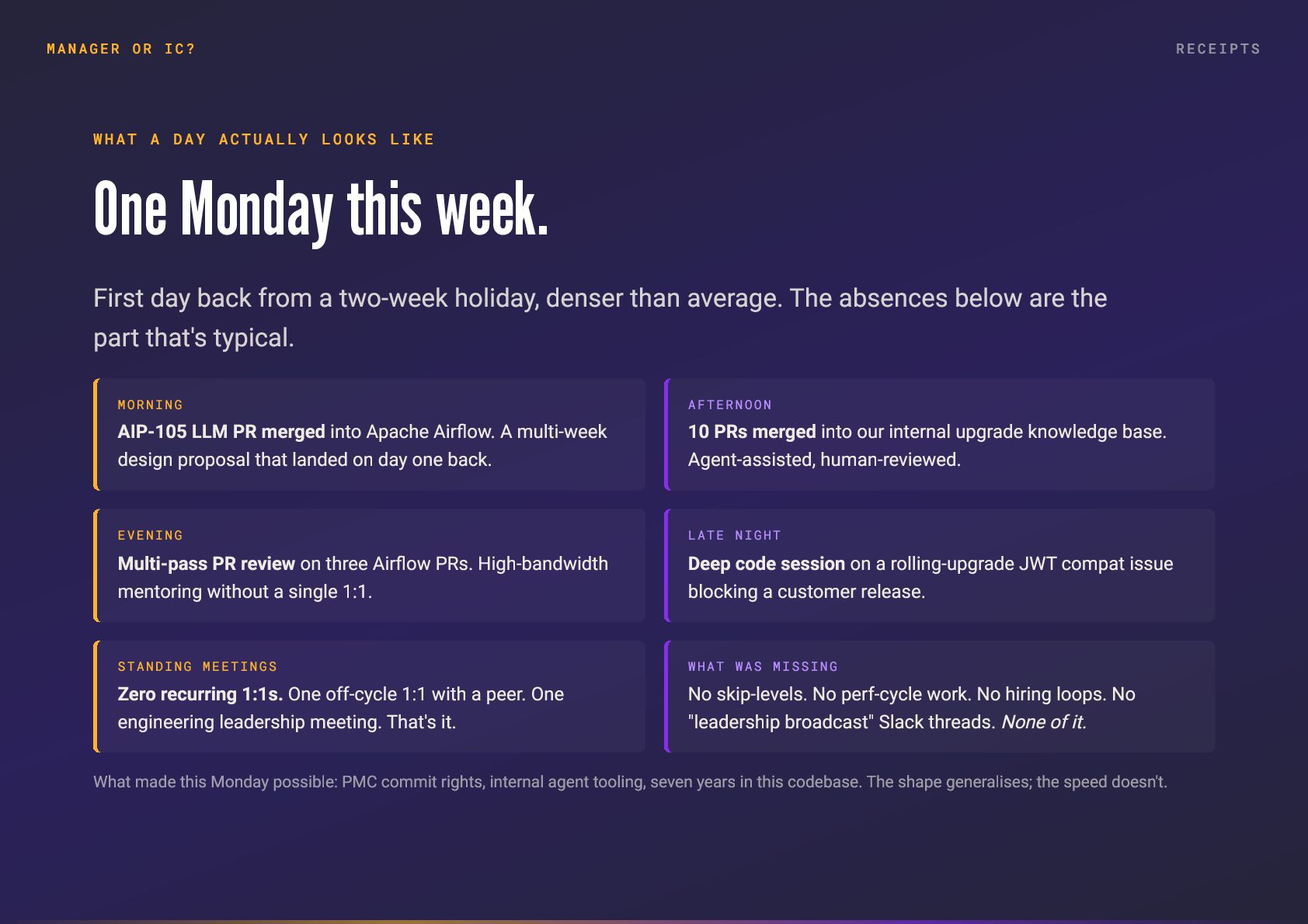
  19. WHAT A DAY ACTUALLY LOOKS LIKE One Monday this week.

    First day back from a two-week holiday, denser than average. The absences below are the part that's typical. MORNING AIP-105 LLM PR merged into Apache Airflow. A multi-week design proposal that landed on day one back. AFTERNOON 10 PRs merged into our internal upgrade knowledge base. Agent-assisted, human-reviewed. EVENING Multi-pass PR review on three Airflow PRs. High-bandwidth mentoring without a single 1:1. LATE NIGHT Deep code session on a rolling-upgrade JWT compat issue blocking a customer release. STANDING MEETINGS Zero recurring 1:1s. One off-cycle 1:1 with a peer. One engineering leadership meeting. That's it. WHAT WAS MISSING No skip-levels. No perf-cycle work. No hiring loops. No "leadership broadcast" Slack threads. None of it. What made this Monday possible: PMC commit rights, internal agent tooling, seven years in this codebase. The shape generalises; the speed doesn't. MANAGER OR IC? RECEIPTS
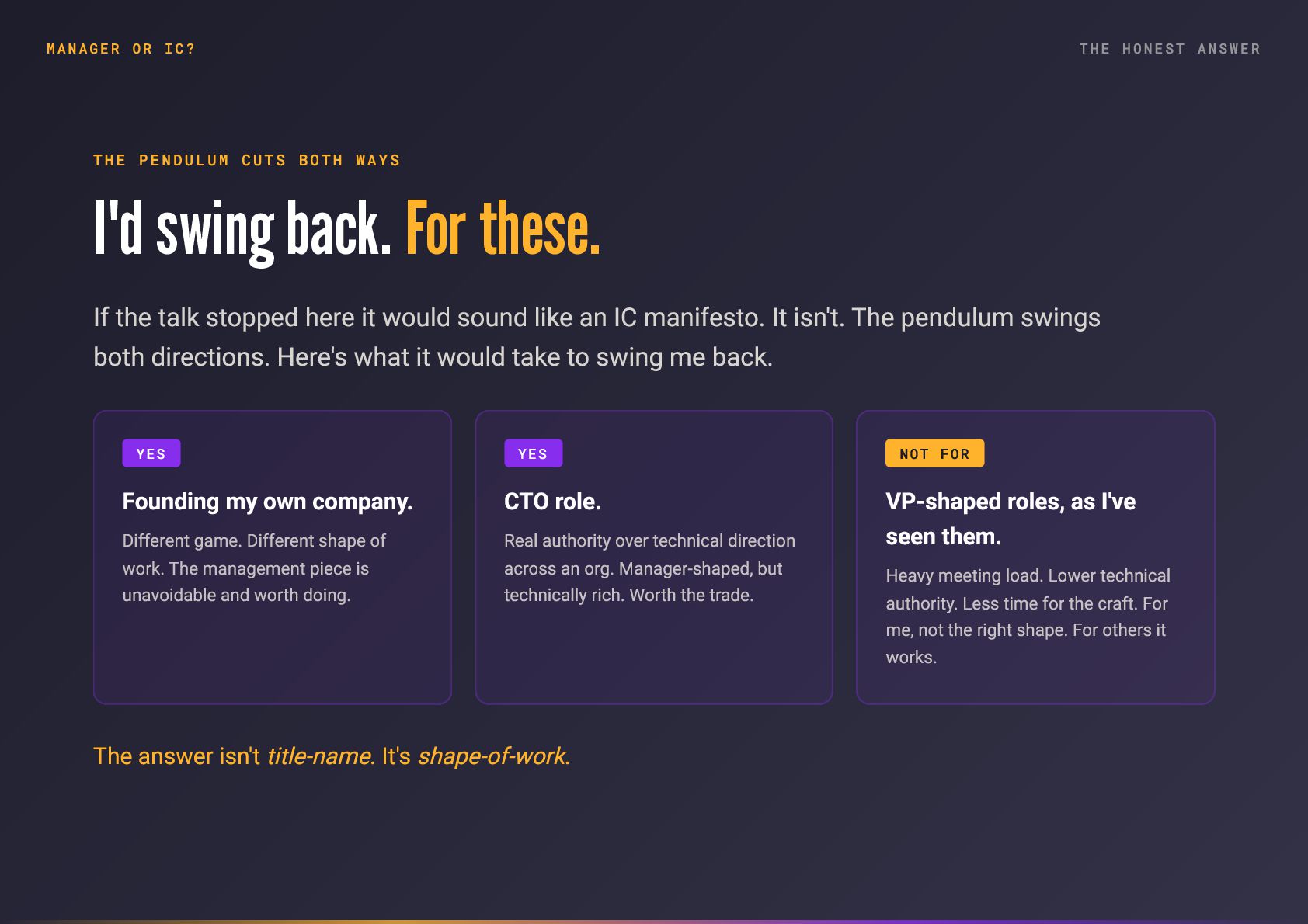
  20. THE PENDULUM CUTS BOTH WAYS I'd swing back. For these.

    If the talk stopped here it would sound like an IC manifesto. It isn't. The pendulum swings both directions. Here's what it would take to swing me back. The answer isn't title-name. It's shape-of-work. MANAGER OR IC? THE HONEST ANSWER YES Founding my own company. Different game. Different shape of work. The management piece is unavoidable and worth doing. YES CTO role. Real authority over technical direction across an org. Manager-shaped, but technically rich. Worth the trade. NOT FOR VP-shaped roles, as I've seen them. Heavy meeting load. Lower technical authority. Less time for the craft. For me, not the right shape. For others it works.
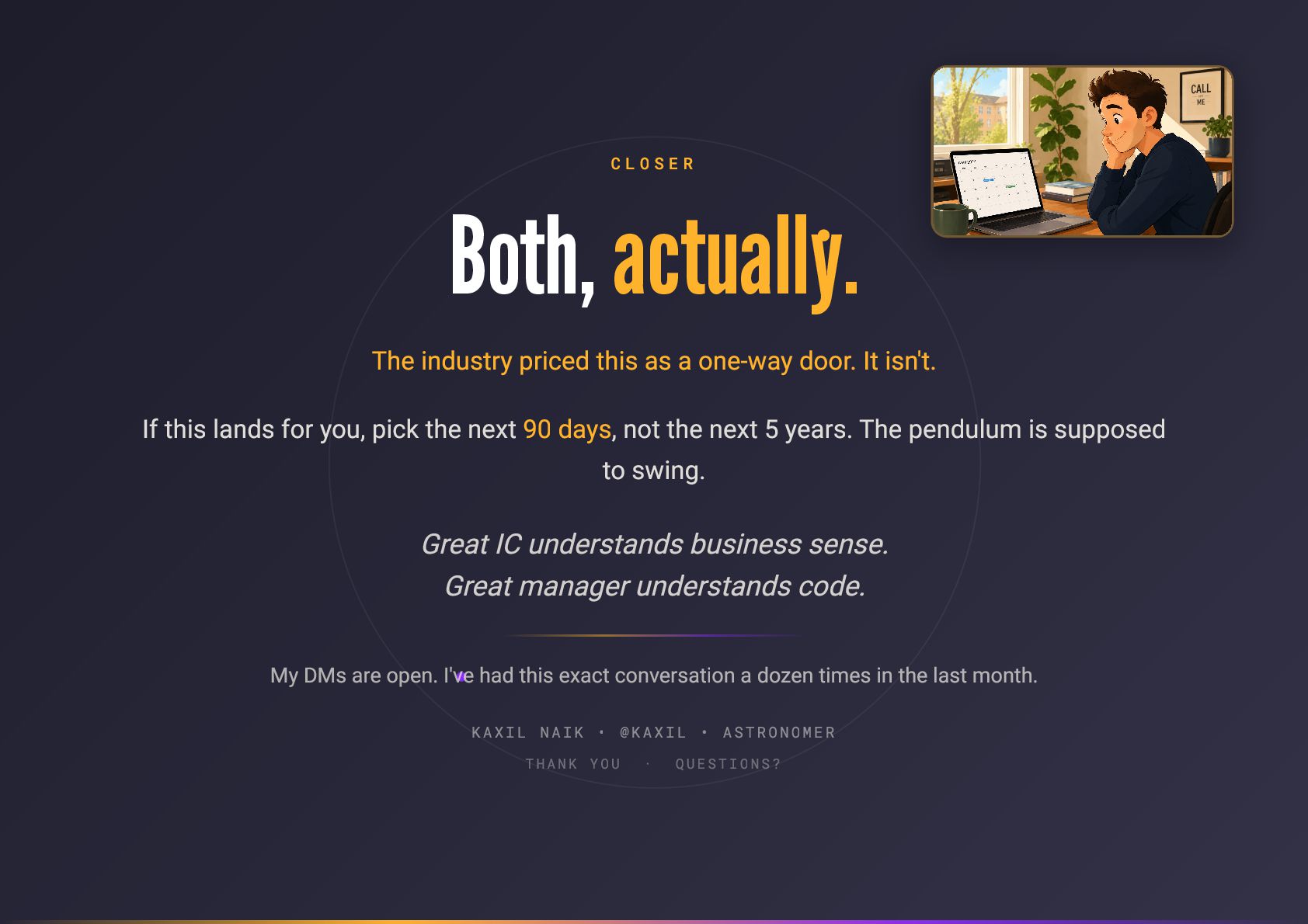
  21. C L O S E R Both, actually. The industry

    priced this as a one-way door. It isn't. If this lands for you, pick the next 90 days, not the next 5 years. The pendulum is supposed to swing. Great IC understands business sense. Great manager understands code. My DMs are open. I've had this exact conversation a dozen times in the last month. KAXIL NAIK • @KAXIL • ASTRONOMER THANK YOU · QUESTIONS?