Share
Embed
Securing the foundations: Hardware-assisted secure Unikernels
MirageOS Unikernels running baremetal on security-hardened Shakti RISC-V processors

KC Sivaramakrishnan
November 29, 2024
Transcript
114 slides
-
Today • Operating Systems ‣ MirageOS — Small, safer, single-purpose
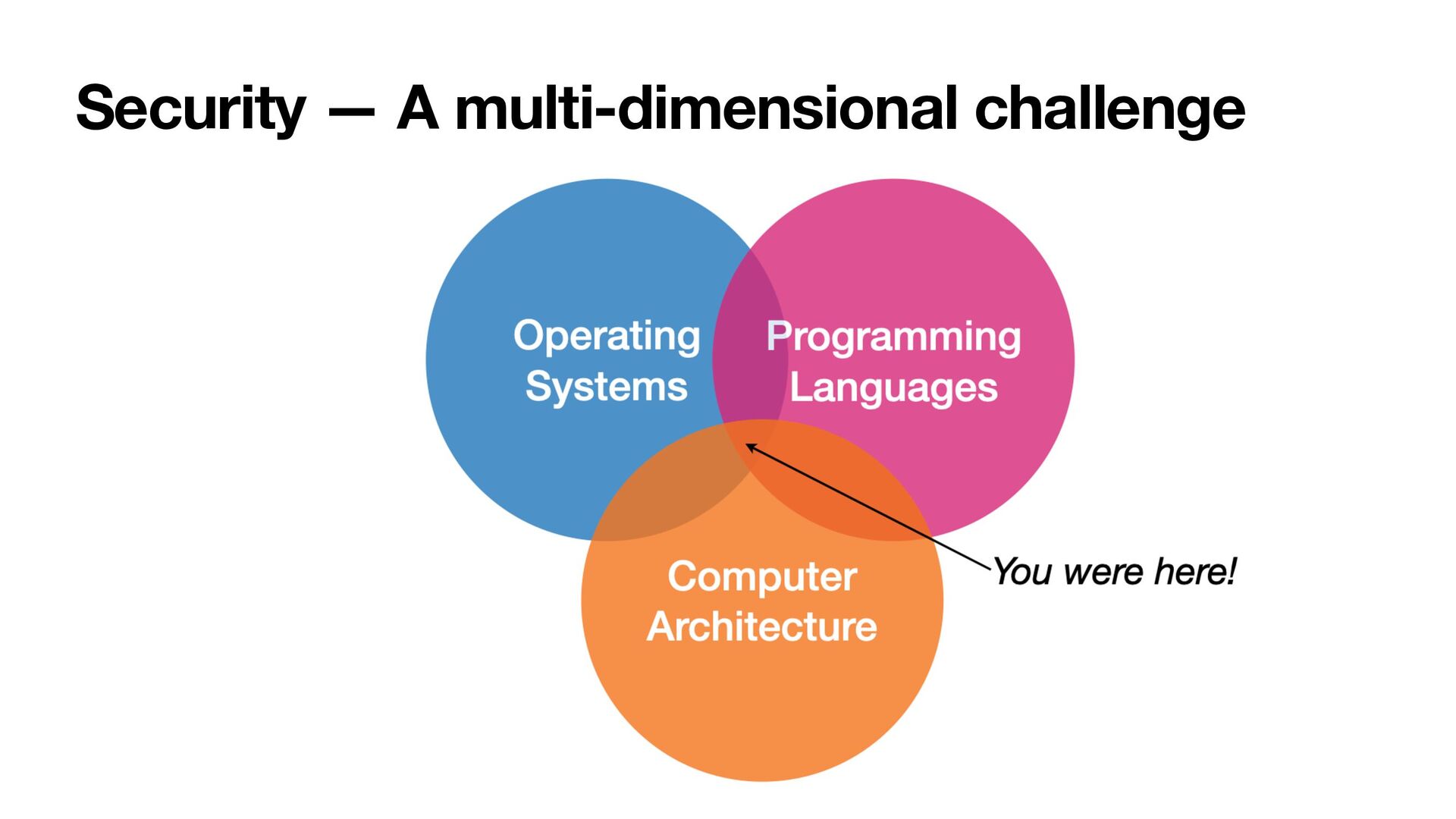
OS • Memory Safety ‣ OCaml — memory-safe programming • Going beyond memory safety ‣ FIDES — Hardware-assisted intra-process isolation -
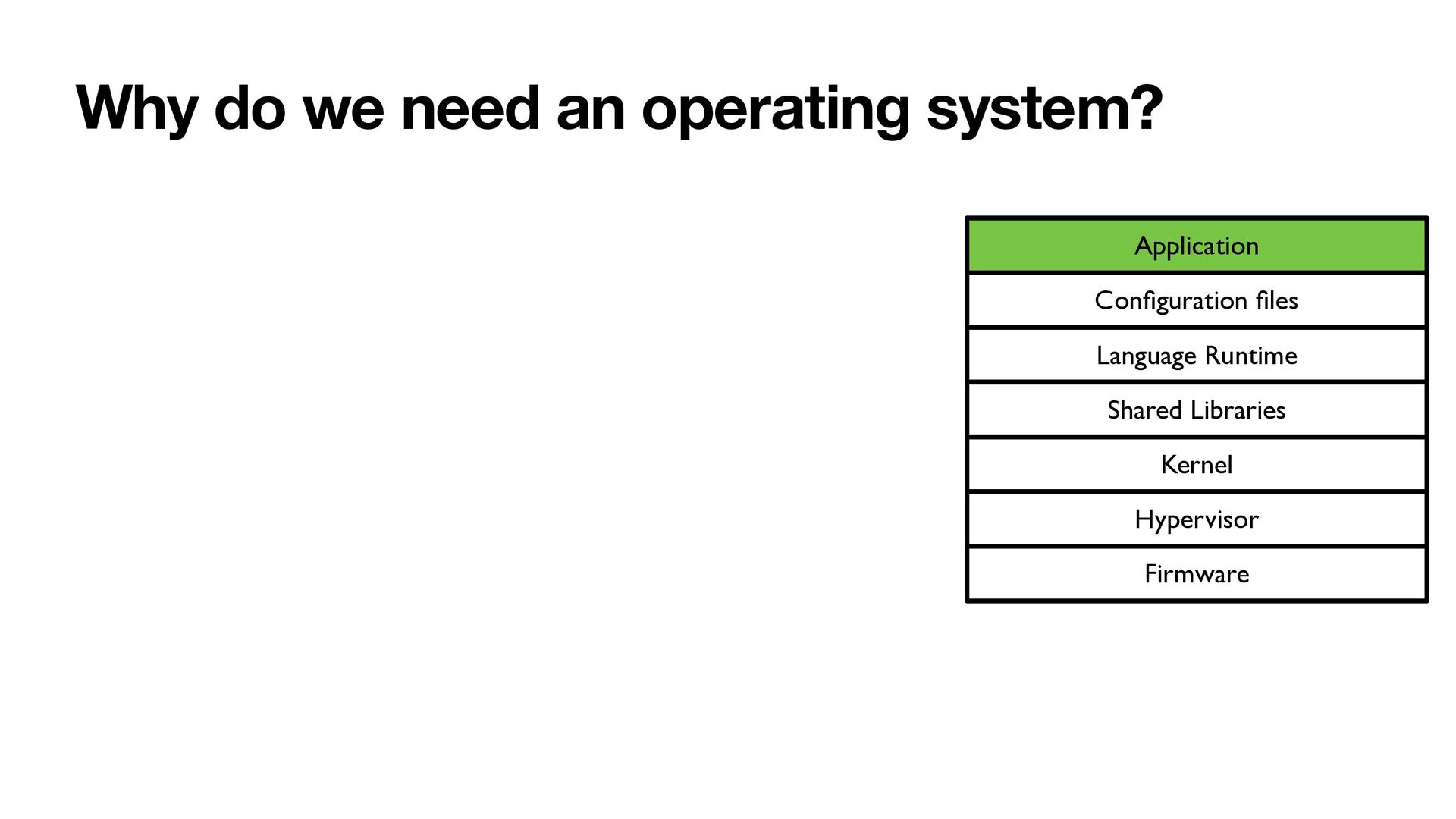
Why do we need an operating system? Firmware Hypervisor Kernel
Language Runtime Shared Libraries Configuration files Application -
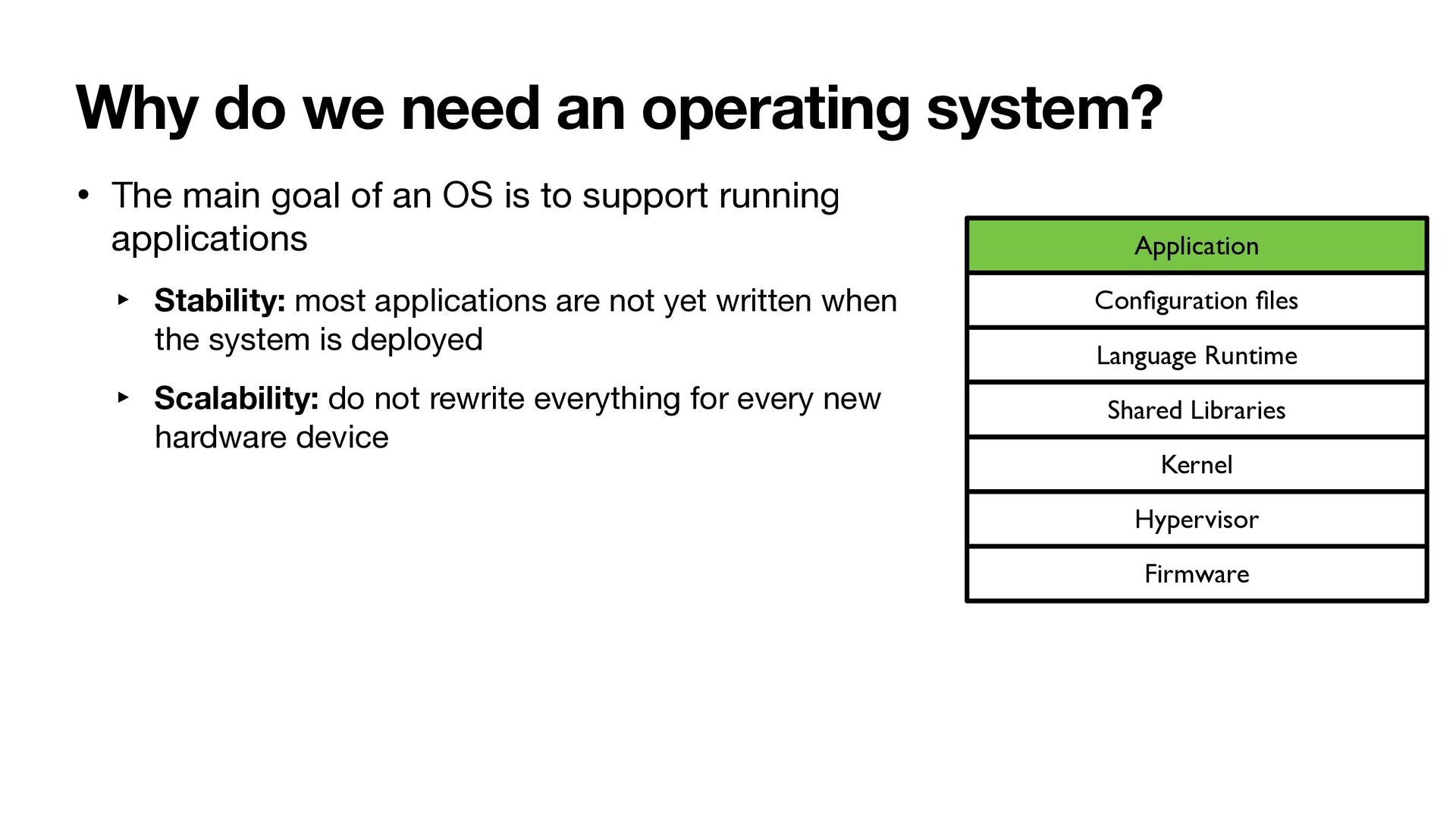
Why do we need an operating system? • The main
goal of an OS is to support running applications ‣ Stability: most applications are not yet written when the system is deployed ‣ Scalability: do not rewrite everything for every new hardware device Firmware Hypervisor Kernel Language Runtime Shared Libraries Configuration files Application -
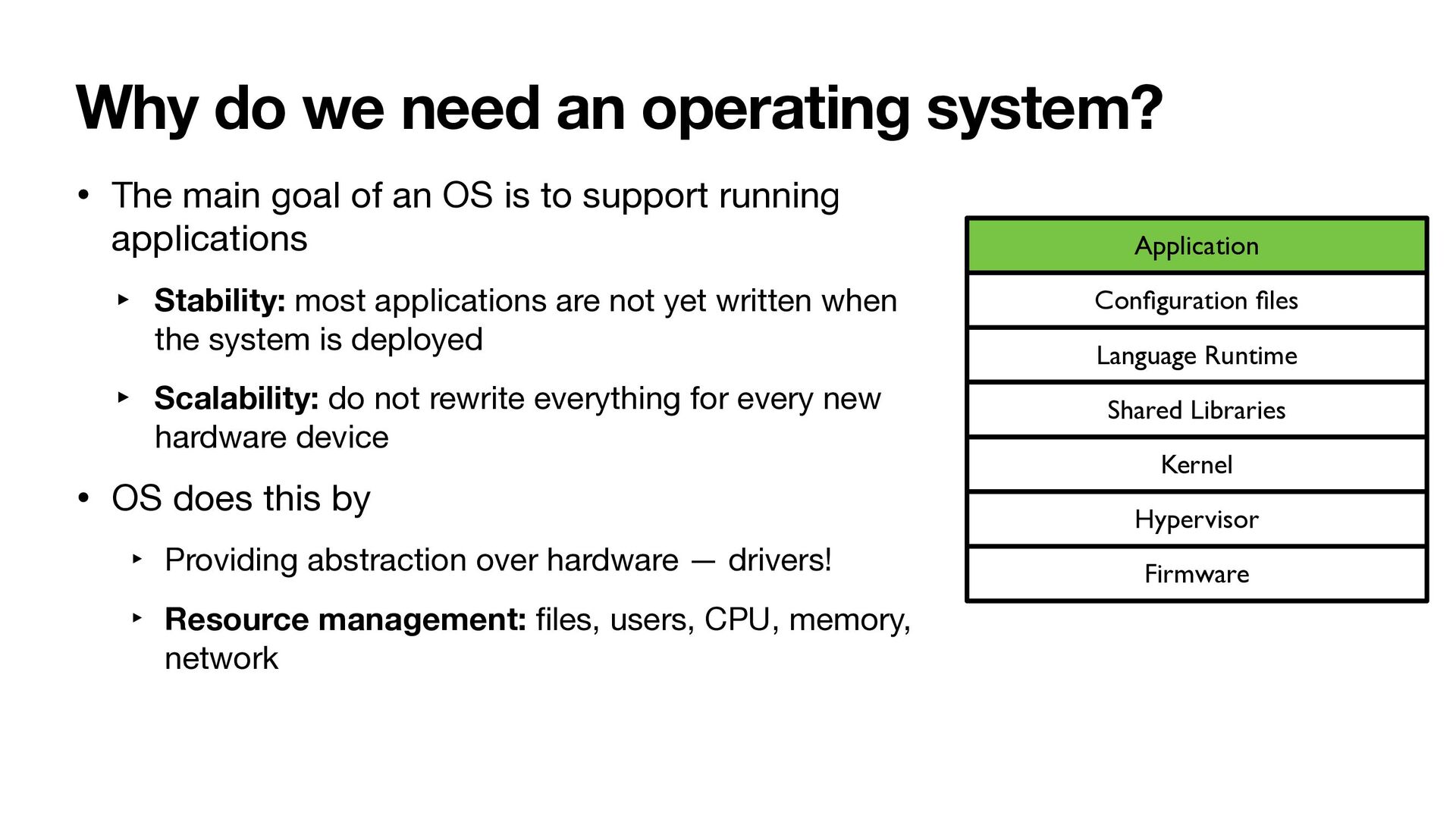
Why do we need an operating system? • The main
goal of an OS is to support running applications ‣ Stability: most applications are not yet written when the system is deployed ‣ Scalability: do not rewrite everything for every new hardware device • OS does this by ‣ Providing abstraction over hardware — drivers! ‣ Resource management: fi les, users, CPU, memory, network Firmware Hypervisor Kernel Language Runtime Shared Libraries Configuration files Application -
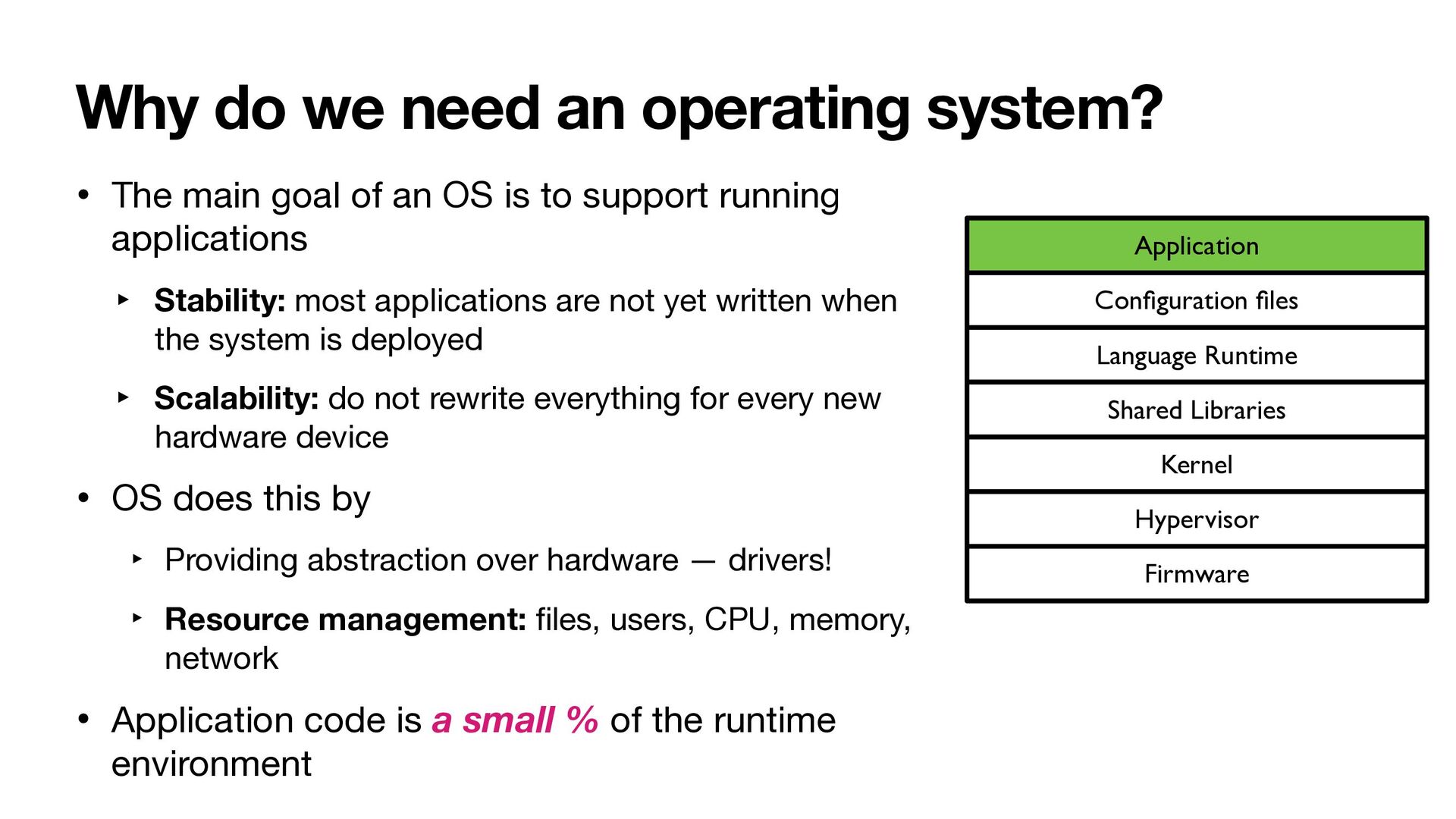
Why do we need an operating system? • The main
goal of an OS is to support running applications ‣ Stability: most applications are not yet written when the system is deployed ‣ Scalability: do not rewrite everything for every new hardware device • OS does this by ‣ Providing abstraction over hardware — drivers! ‣ Resource management: fi les, users, CPU, memory, network • Application code is a small % of the runtime environment Firmware Hypervisor Kernel Language Runtime Shared Libraries Configuration files Application -
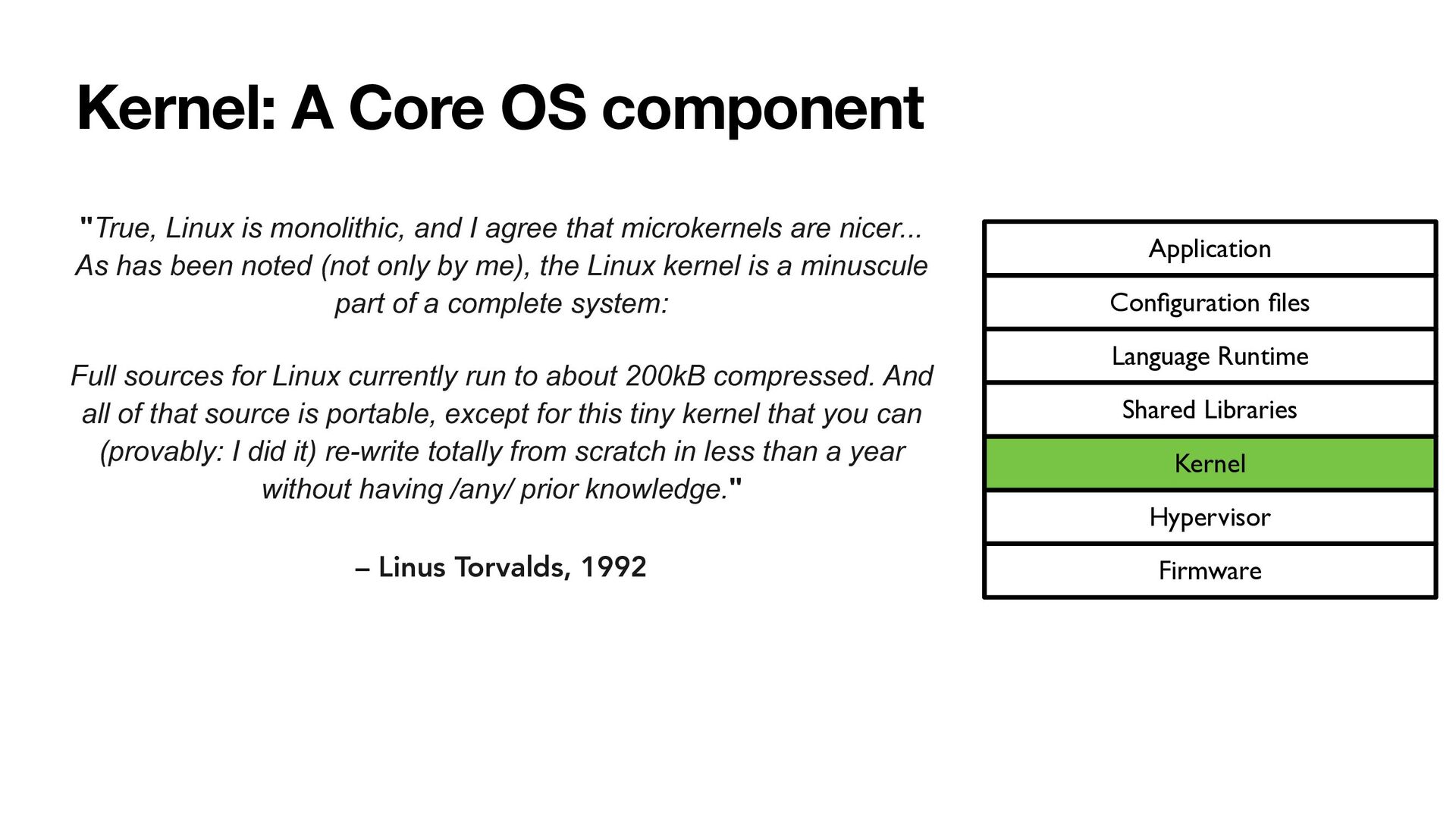
Kernel: A Core OS component "True, Linux is monolithic, and
I agree that microkernels are nicer... As has been noted (not only by me), the Linux kernel is a minuscule part of a complete system: Full sources for Linux currently run to about 200kB compressed. And all of that source is portable, except for this tiny kernel that you can (provably: I did it) re-write totally from scratch in less than a year without having /any/ prior knowledge." – Linus Torvalds, 1992 Firmware Hypervisor Kernel Language Runtime Shared Libraries Configuration files Application -
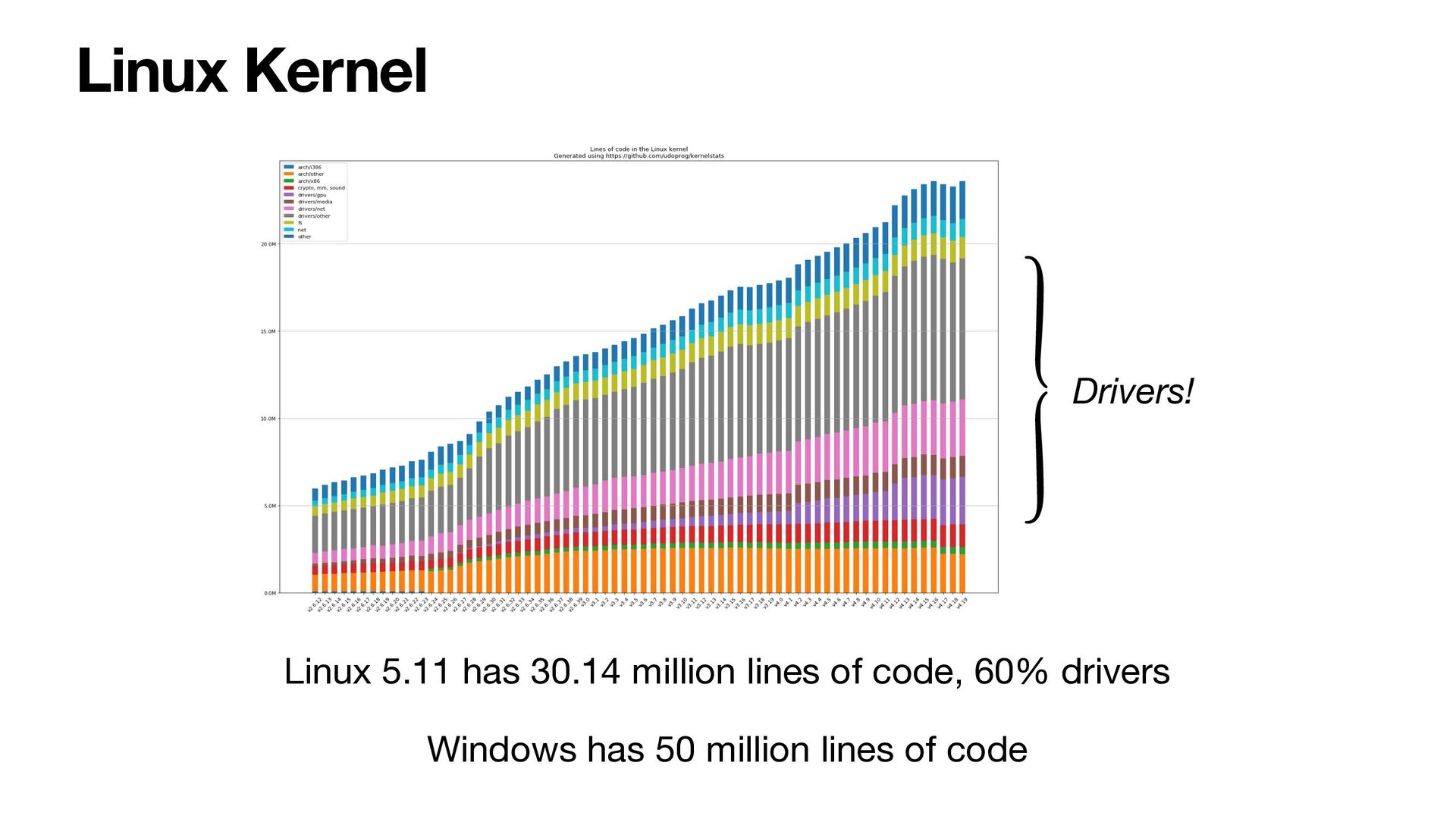
Drivers! Linux Kernel Linux 5.11 has 30.14 million lines of
code, 60% drivers Windows has 50 million lines of code -
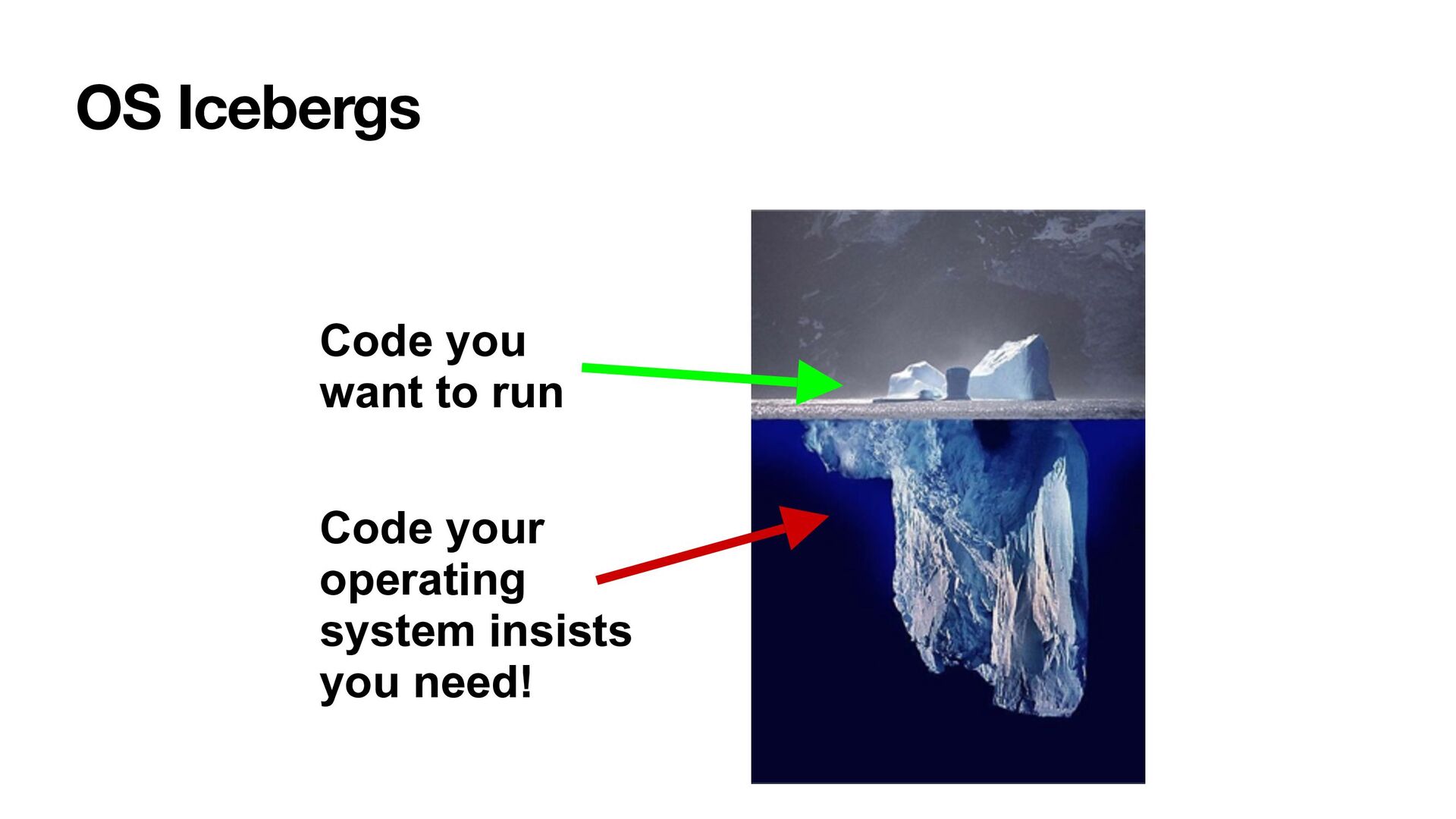
Code you want to run Code your operating system insists
you need! OS Icebergs -
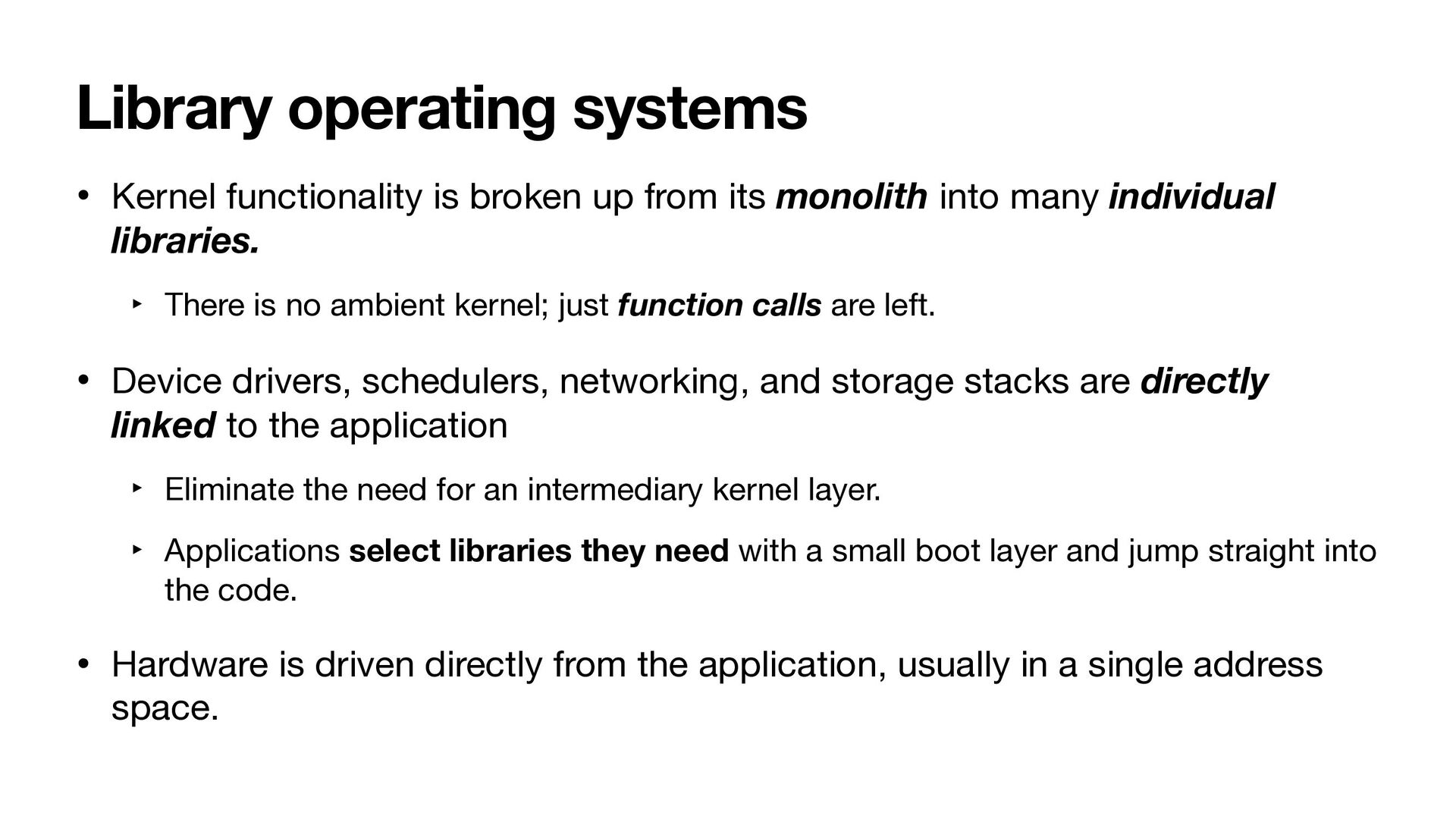
Library operating systems • Kernel functionality is broken up from
its monolith into many individual libraries. ‣ There is no ambient kernel; just function calls are left. -
Library operating systems • Kernel functionality is broken up from
its monolith into many individual libraries. ‣ There is no ambient kernel; just function calls are left. • Device drivers, schedulers, networking, and storage stacks are directly linked to the application ‣ Eliminate the need for an intermediary kernel layer. ‣ Applications select libraries they need with a small boot layer and jump straight into the code. -
Library operating systems • Kernel functionality is broken up from
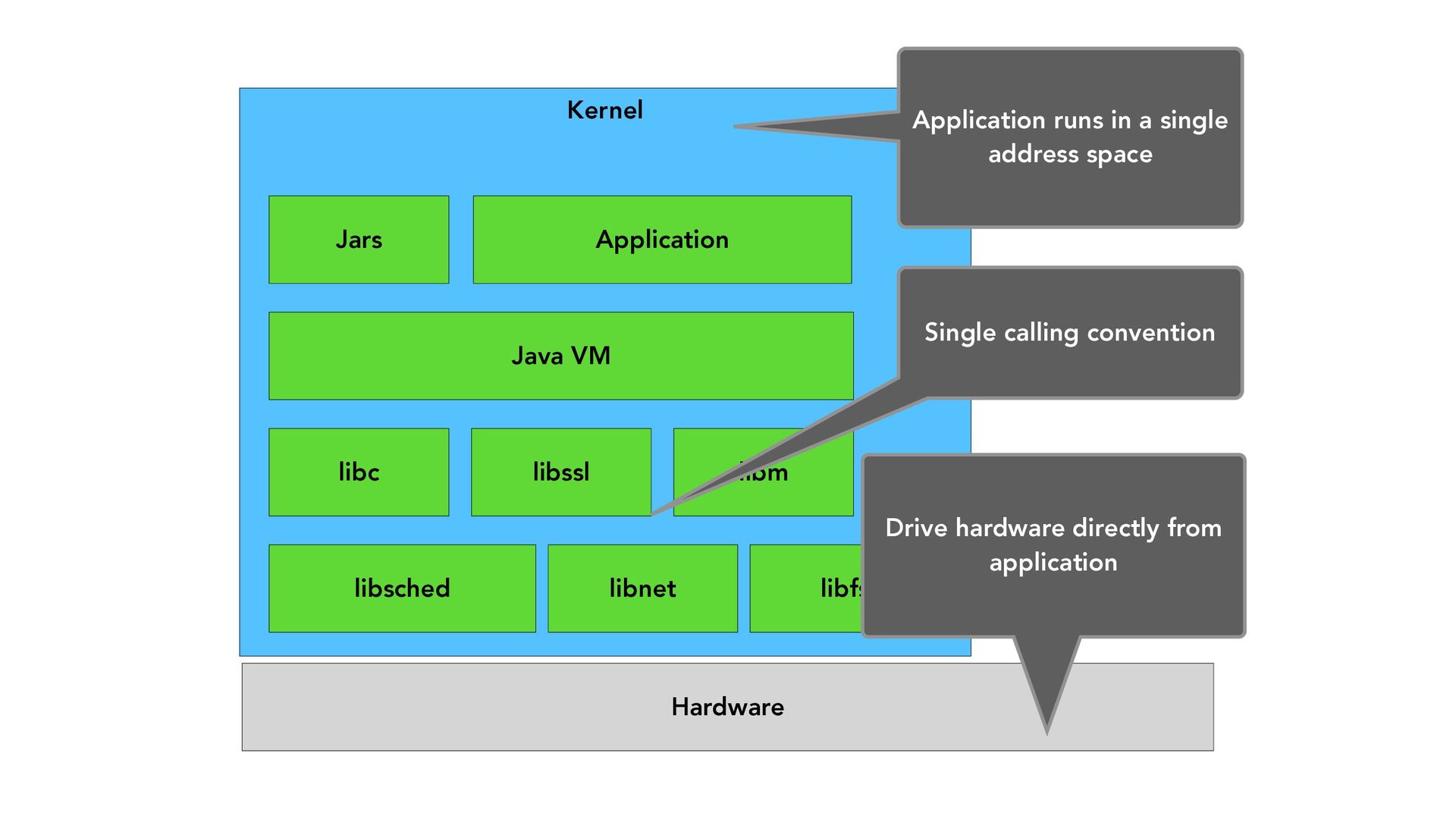
its monolith into many individual libraries. ‣ There is no ambient kernel; just function calls are left. • Device drivers, schedulers, networking, and storage stacks are directly linked to the application ‣ Eliminate the need for an intermediary kernel layer. ‣ Applications select libraries they need with a small boot layer and jump straight into the code. • Hardware is driven directly from the application, usually in a single address space. -
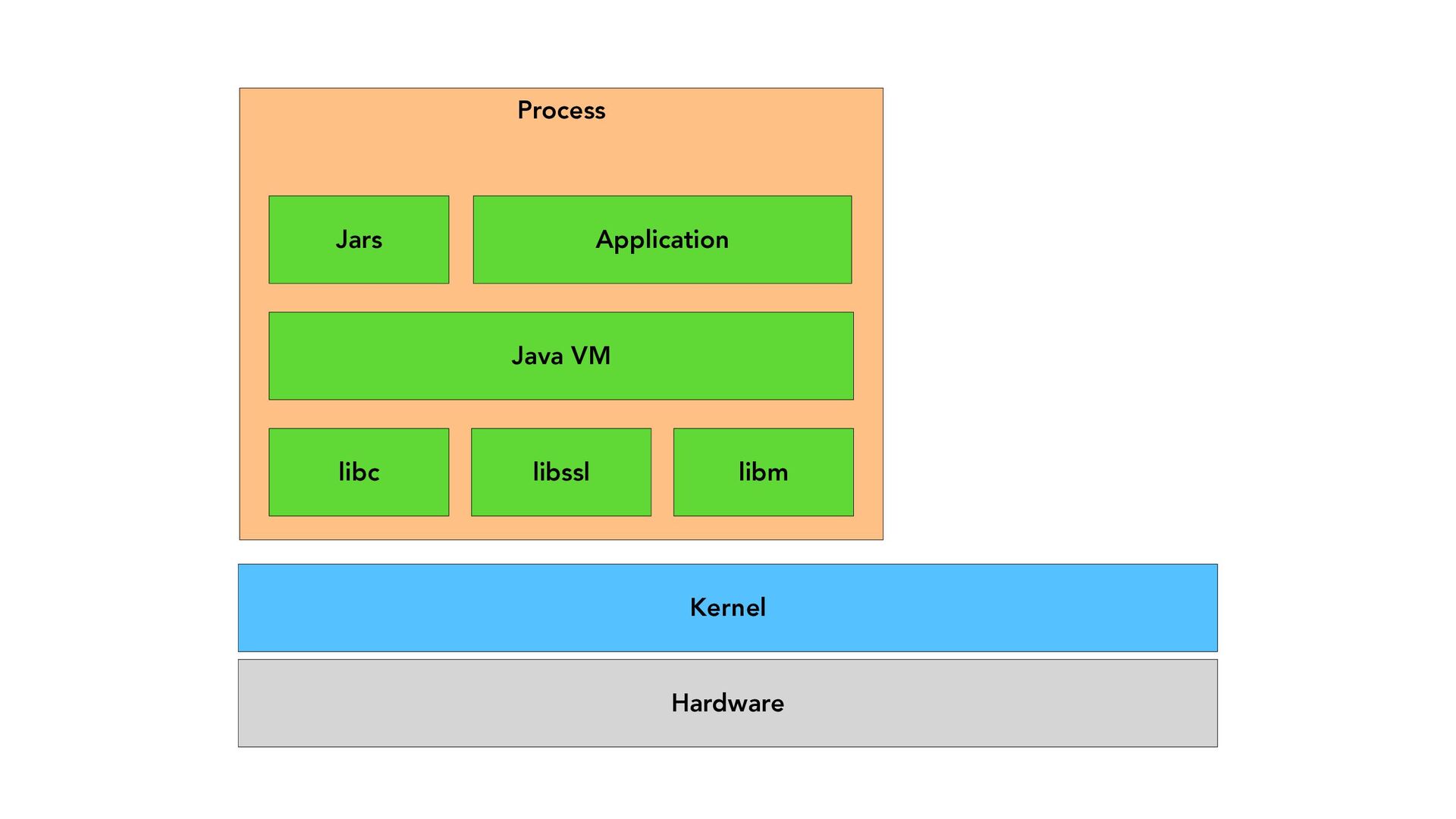
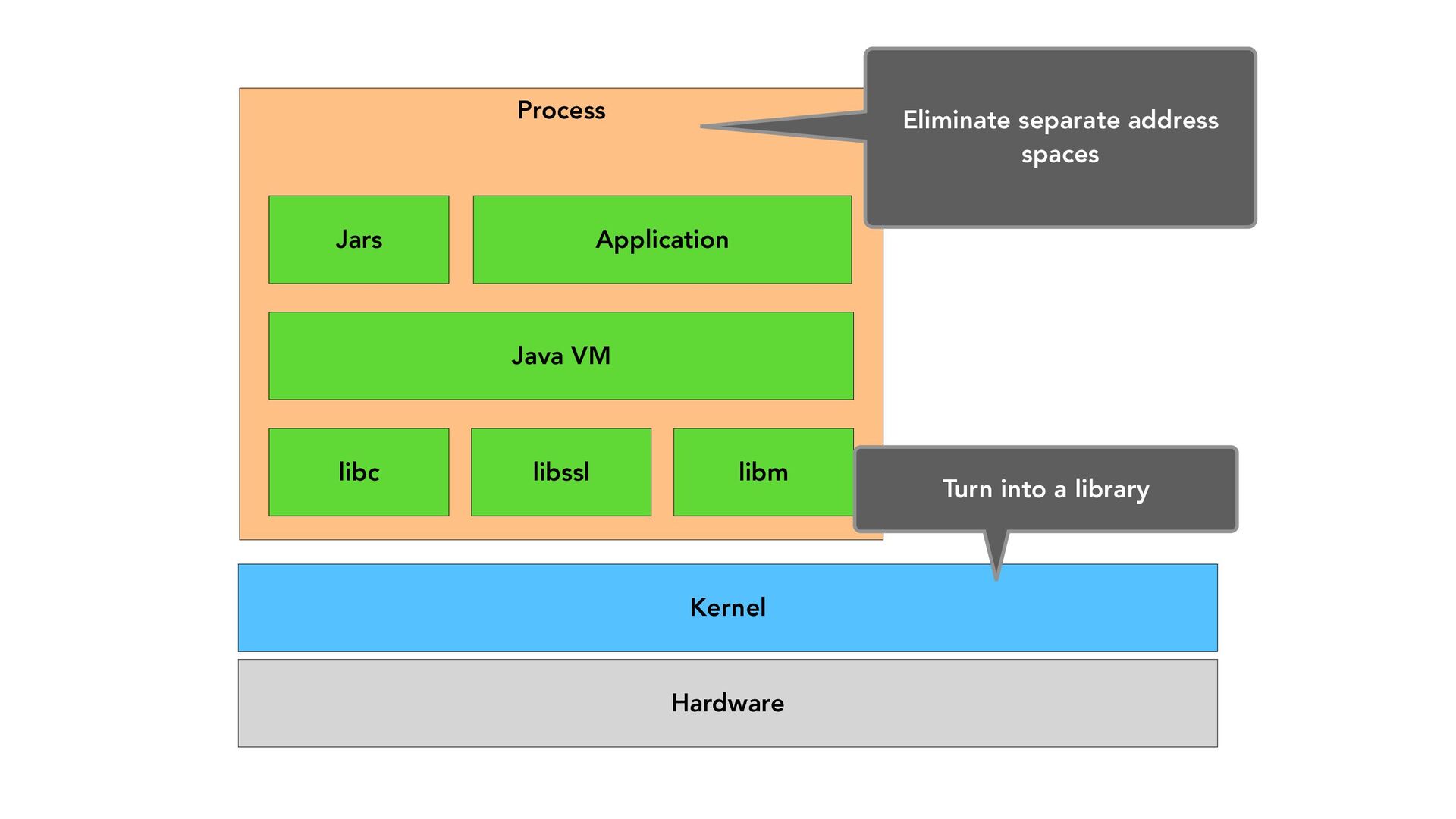
Kernel Hardware Process Java VM libc libssl libm Jars Application
Eliminate separate address spaces Turn into a library -
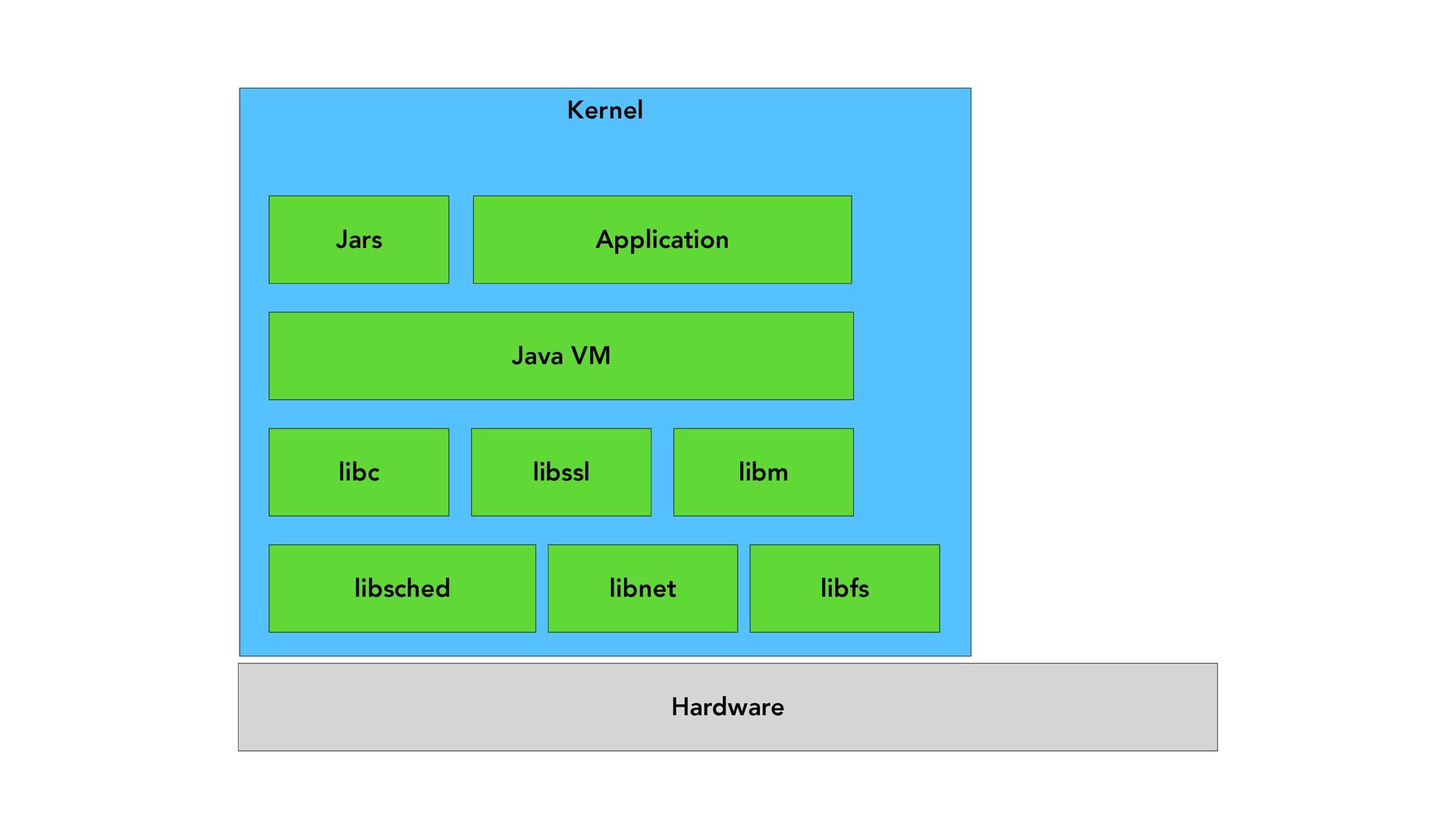
Hardware Kernel Java VM libc libssl libm Jars Application Application
runs in a single address space libsched libnet libfs Drive hardware directly from application Single calling convention -
Library operating systems In the 1990s, we had: • Nemesis:
Cambridge/Glasgow • Exokernel: MIT Neither succeeded outside of academia due to the device drivers needing to be updated regularly to stay relevant. Became popular in niche areas (network appliances or high-frequency trading). -
Library operating systems Firmware Kernel Application Pros: application-level control of
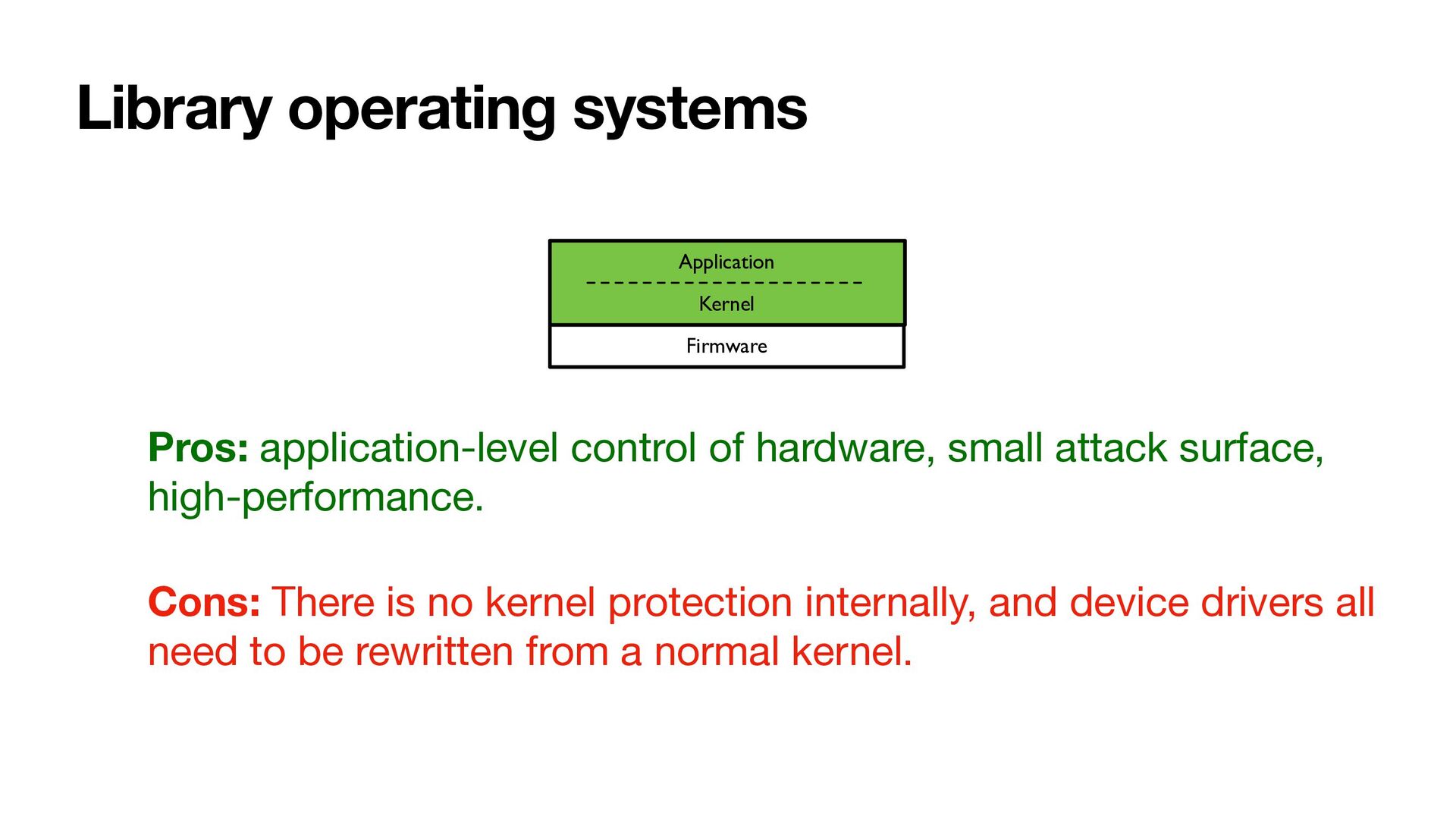
hardware, small attack surface, high-performance. Cons: There is no kernel protection internally, and device drivers all need to be rewritten from a normal kernel. -
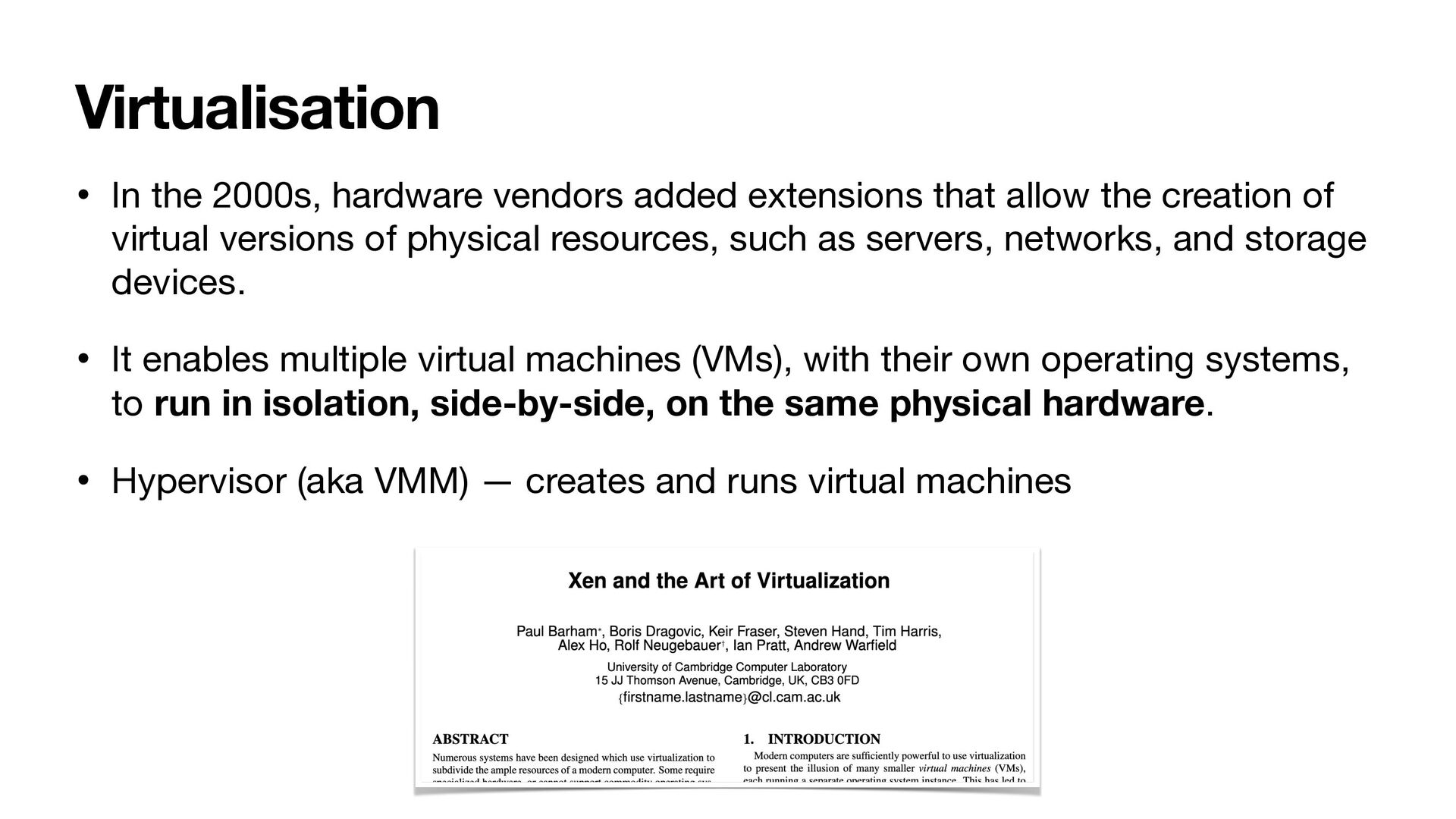
Virtualisation • In the 2000s, hardware vendors added extensions that
allow the creation of virtual versions of physical resources, such as servers, networks, and storage devices. • It enables multiple virtual machines (VMs), with their own operating systems, to run in isolation, side-by-side, on the same physical hardware. • Hypervisor (aka VMM) — creates and runs virtual machines -
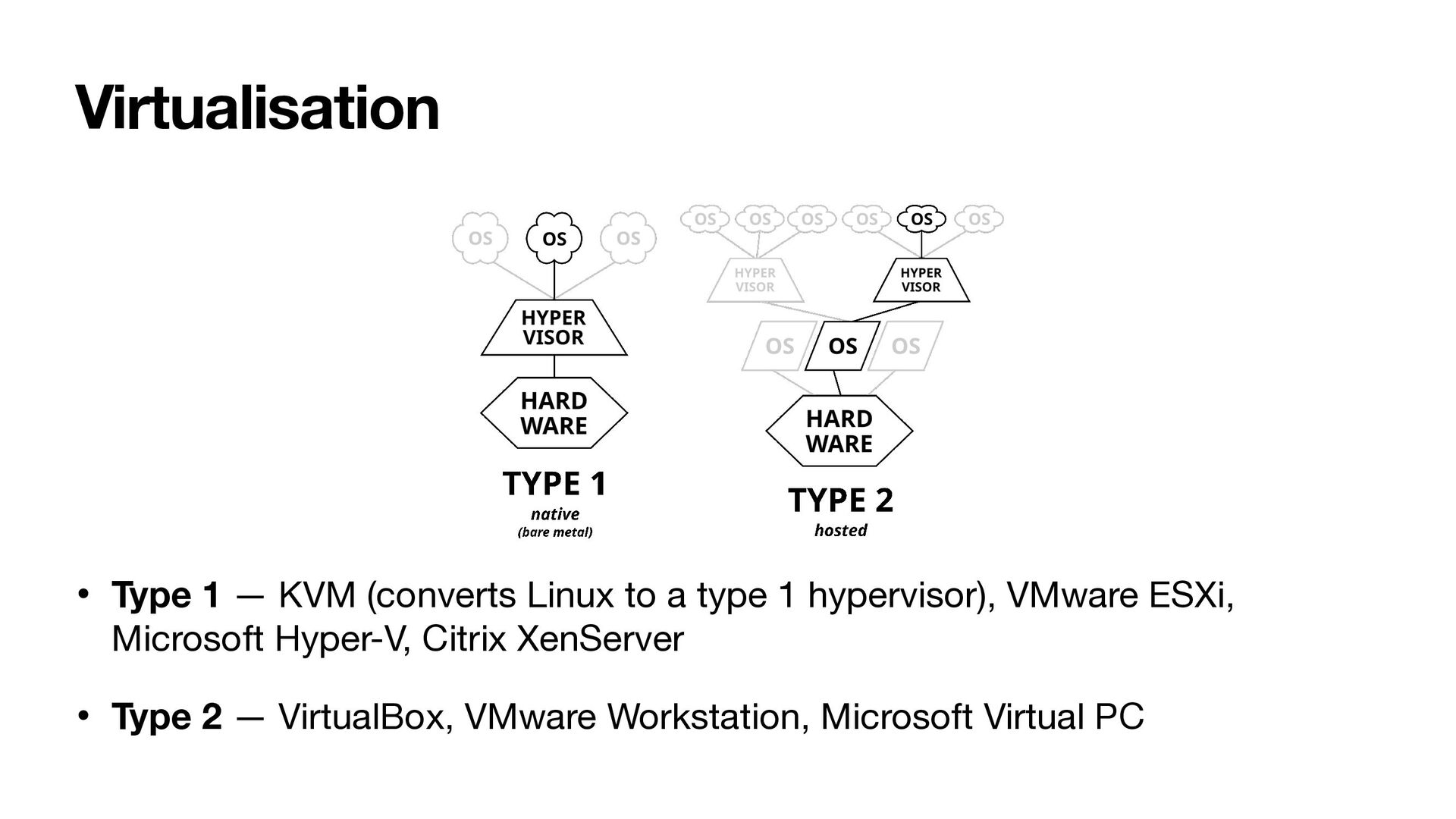
Virtualisation • Type 1 — KVM (converts Linux to a
type 1 hypervisor), VMware ESXi, Microsoft Hyper-V, Citrix XenServer • Type 2 — VirtualBox, VMware Workstation, Microsoft Virtual PC -
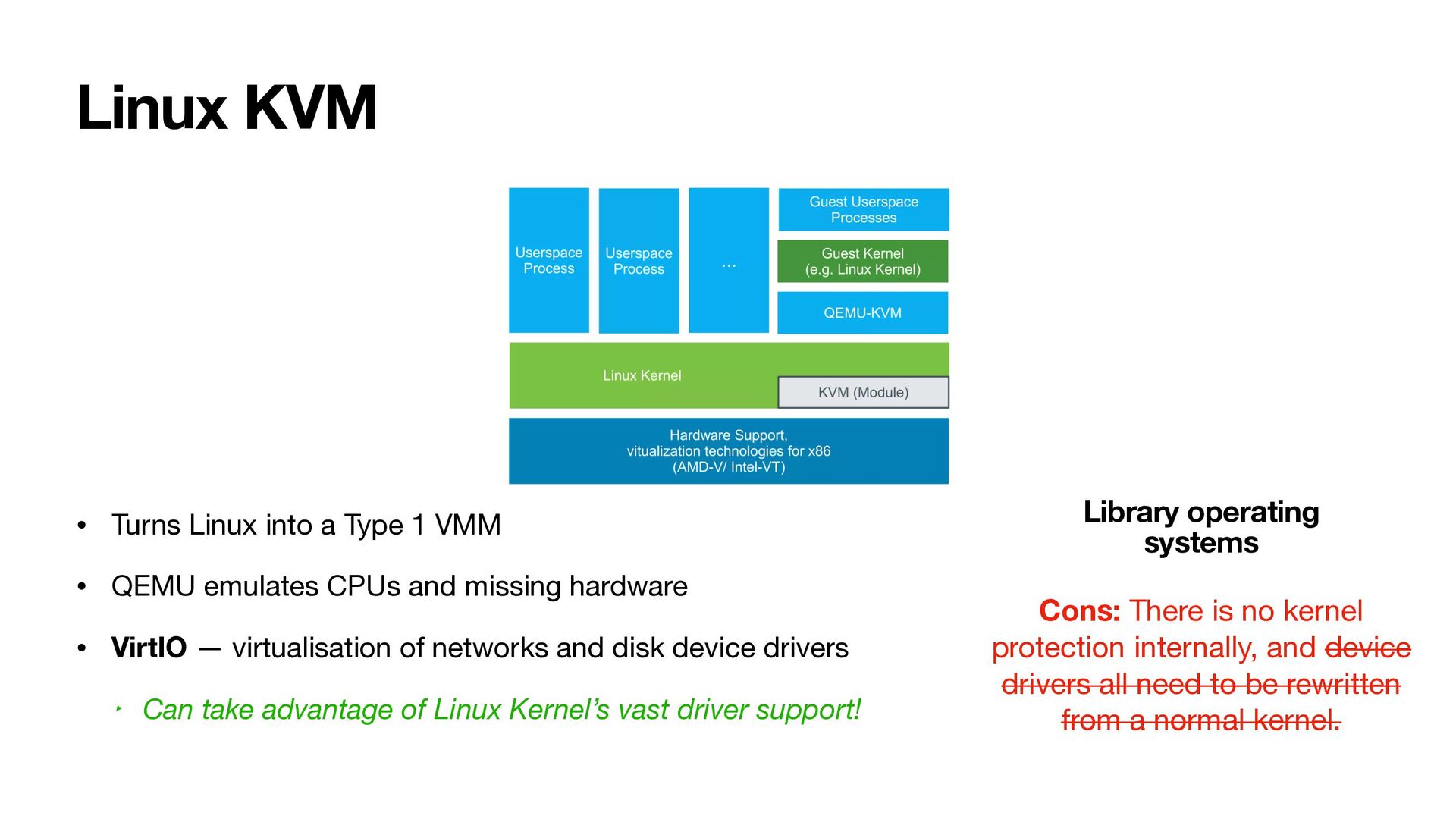
Linux KVM • Turns Linux into a Type 1 VMM
• QEMU emulates CPUs and missing hardware • VirtIO — virtualisation of networks and disk device drivers ‣ Can take advantage of Linux Kernel’s vast driver support! Cons: There is no kernel protection internally, and device drivers all need to be rewritten from a normal kernel. Library operating systems -
Memory safety Cons: There is no kernel protection internally, and
device drivers all need to be rewritten from a normal kernel. Library operating systems -
Memory safety Cons: There is no kernel protection internally, and
device drivers all need to be rewritten from a normal kernel. Library operating systems -
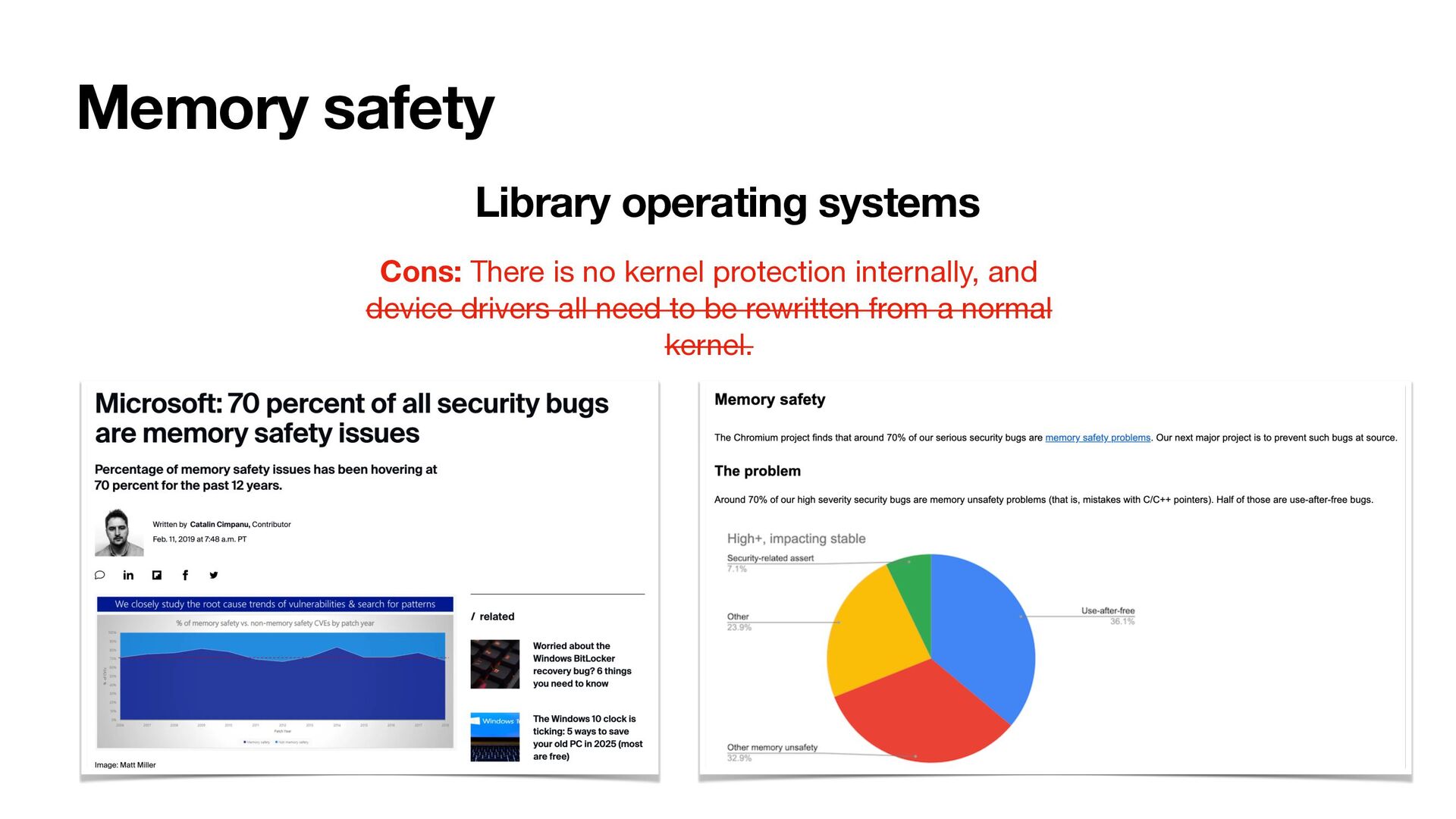
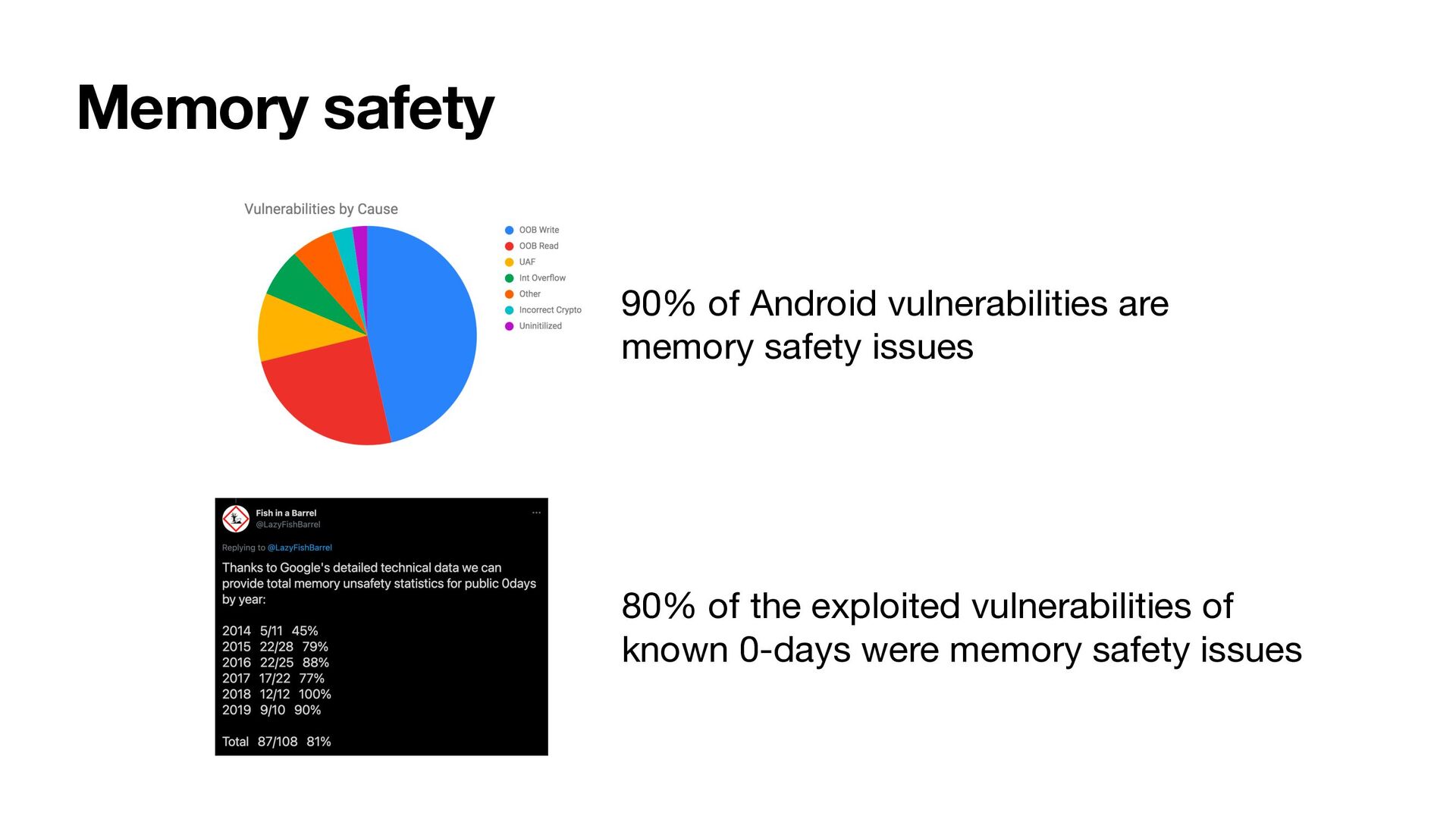
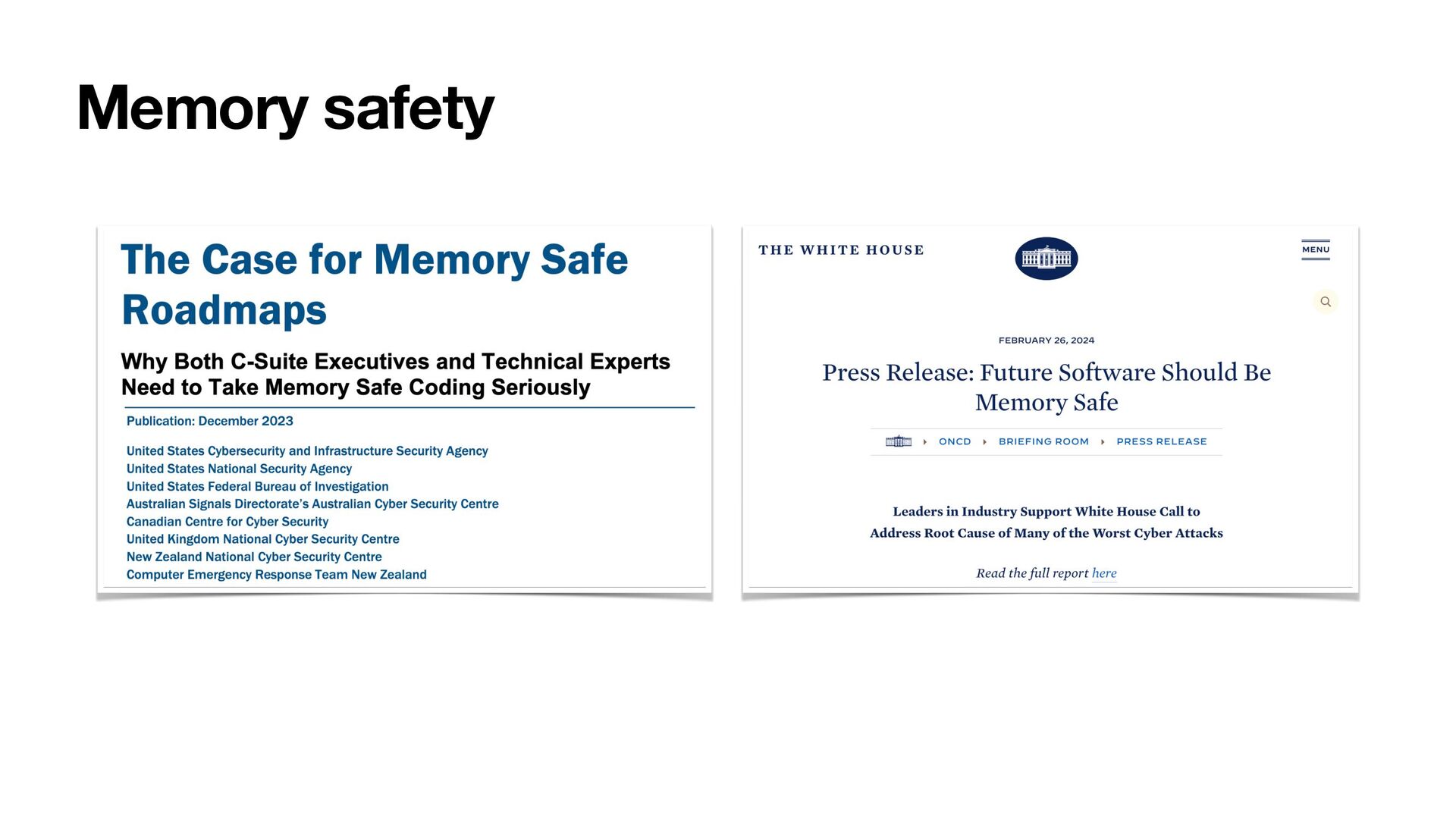
Memory safety 90% of Android vulnerabilities are memory safety issues
80% of the exploited vulnerabilities of known 0-days were memory safety issues -
Memory safety and Programming Languages • Unsafe languages ‣ C,
C++, Assembly, Objective-C -
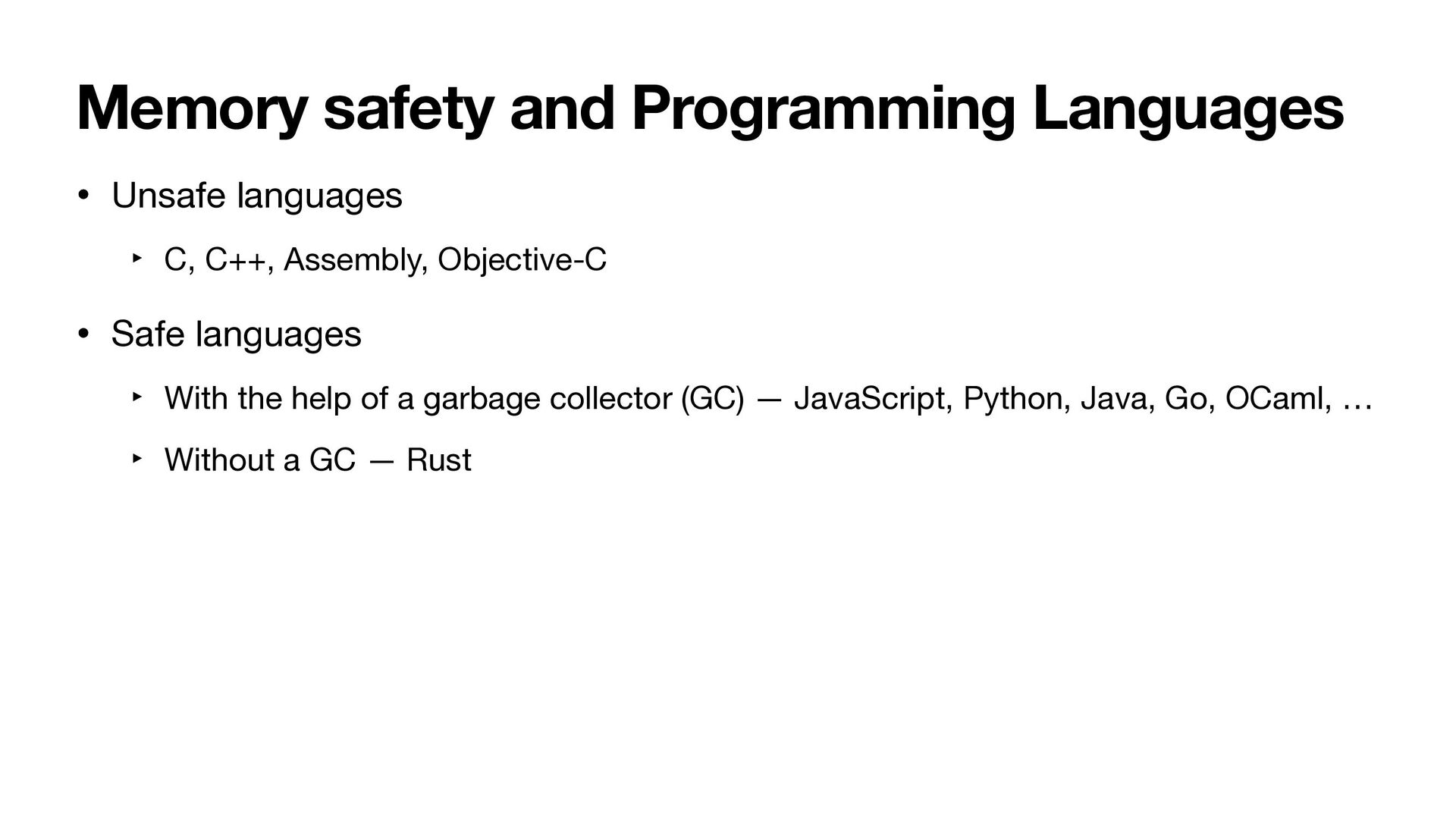
Memory safety and Programming Languages • Unsafe languages ‣ C,
C++, Assembly, Objective-C • Safe languages ‣ With the help of a garbage collector (GC) — JavaScript, Python, Java, Go, OCaml, … ‣ Without a GC — Rust -
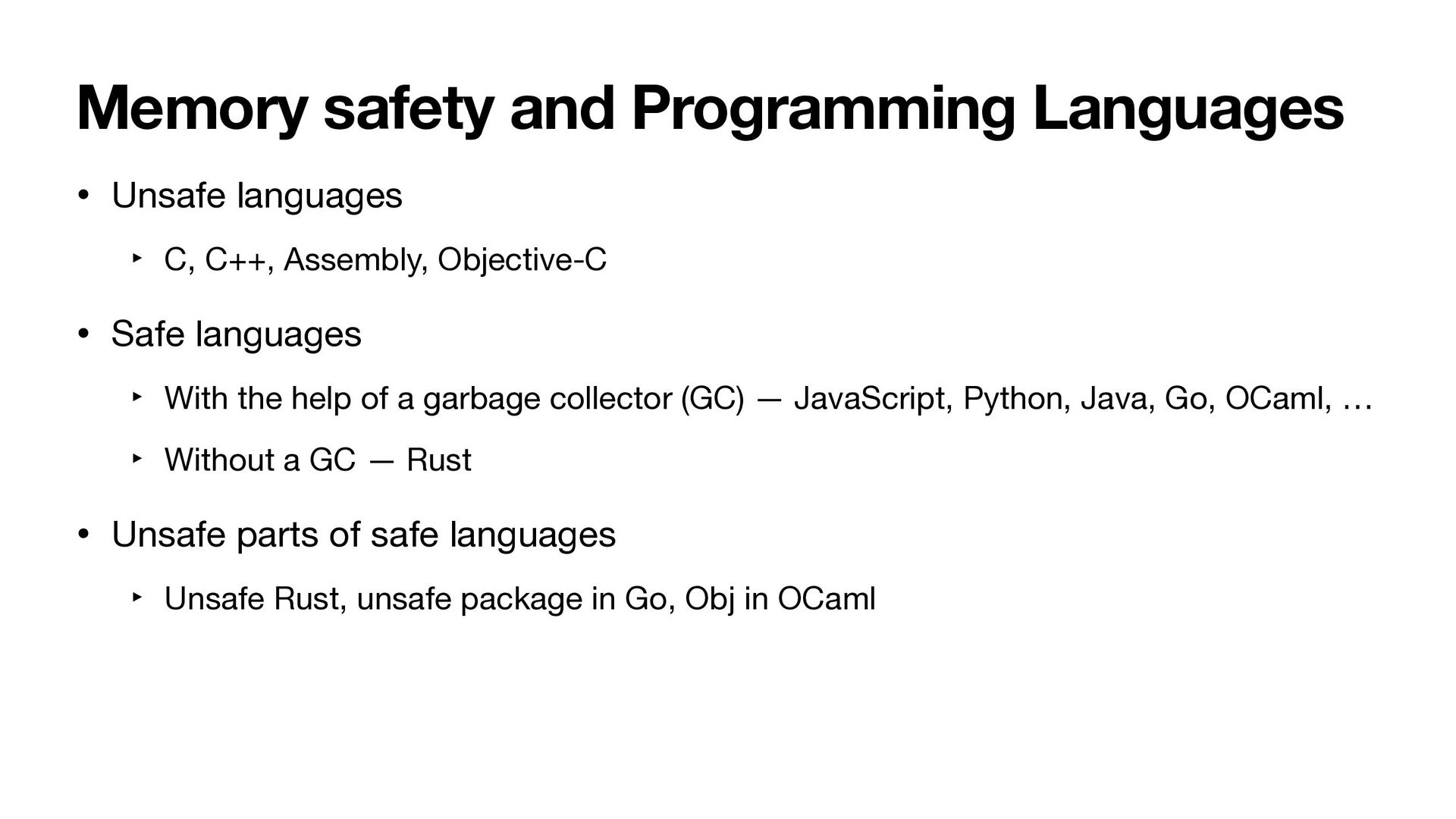
Memory safety and Programming Languages • Unsafe languages ‣ C,
C++, Assembly, Objective-C • Safe languages ‣ With the help of a garbage collector (GC) — JavaScript, Python, Java, Go, OCaml, … ‣ Without a GC — Rust • Unsafe parts of safe languages ‣ Unsafe Rust, unsafe package in Go, Obj in OCaml -
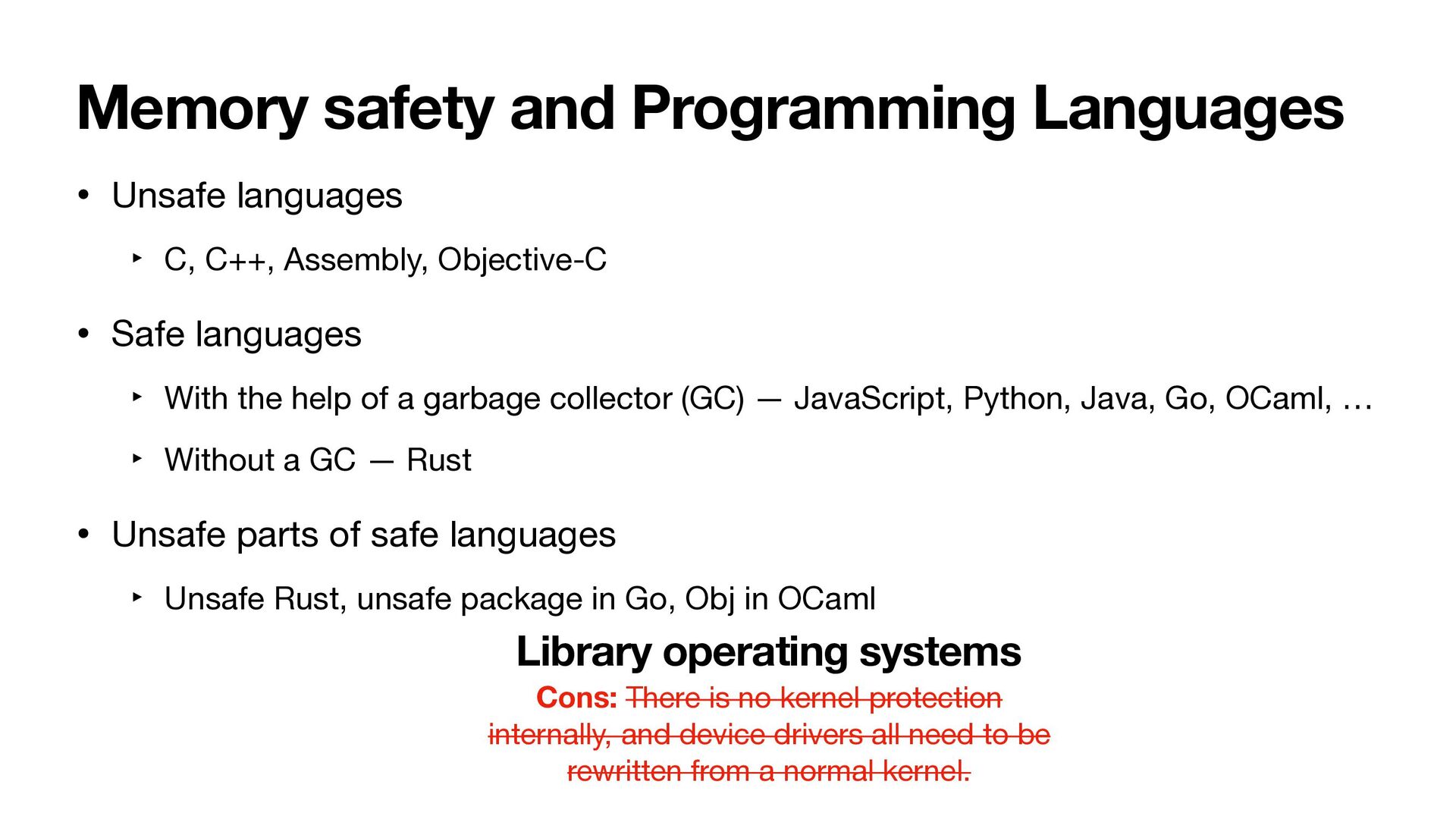
Memory safety and Programming Languages • Unsafe languages ‣ C,
C++, Assembly, Objective-C • Safe languages ‣ With the help of a garbage collector (GC) — JavaScript, Python, Java, Go, OCaml, … ‣ Without a GC — Rust • Unsafe parts of safe languages ‣ Unsafe Rust, unsafe package in Go, Obj in OCaml Cons: There is no kernel protection internally, and device drivers all need to be rewritten from a normal kernel. Library operating systems -
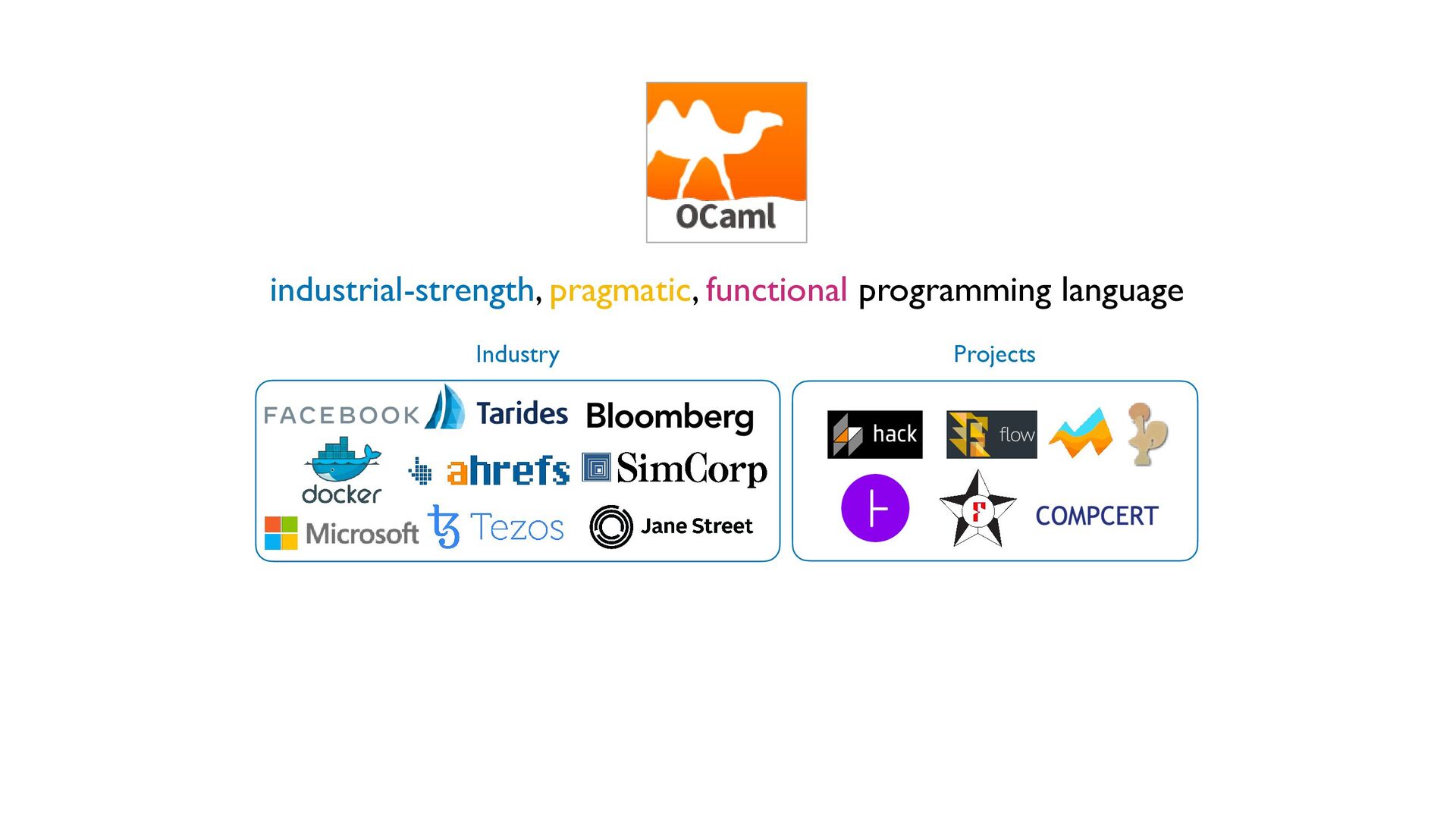
industrial-strength, pragmatic, functional programming language Higher-order functions Hindley-Milner Type Inference
Powerful module system Industry Projects -
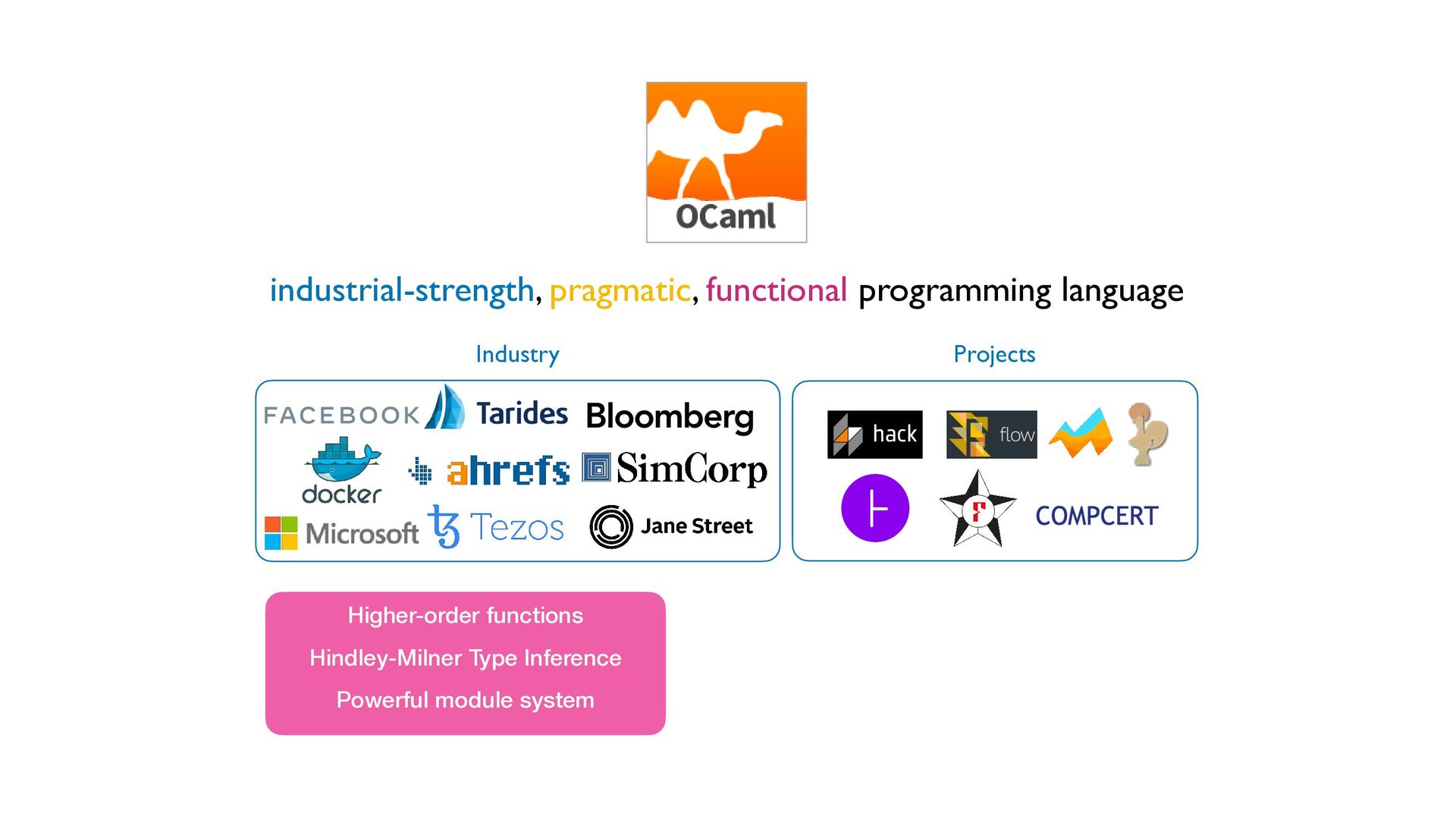
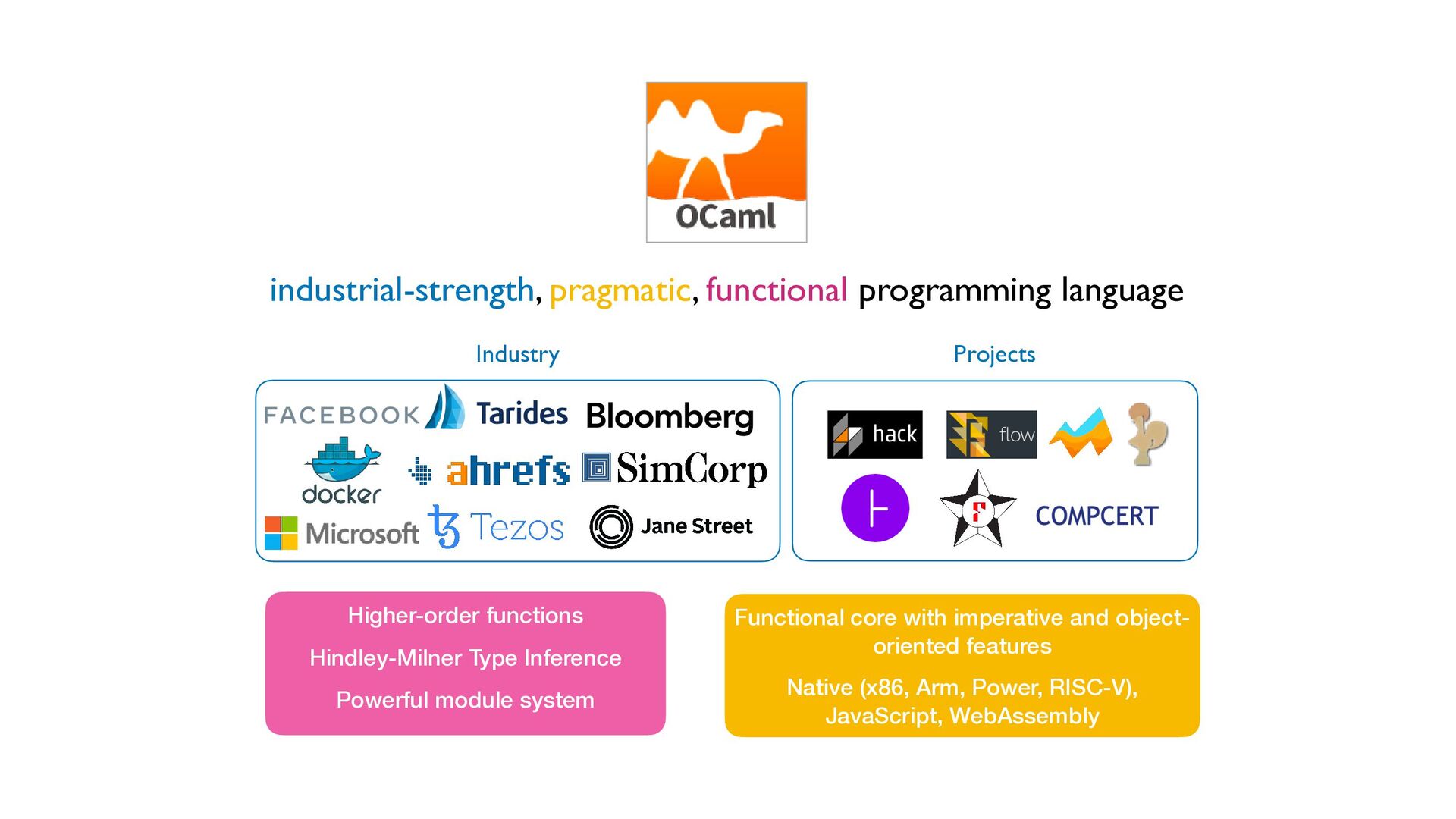
industrial-strength, pragmatic, functional programming language Higher-order functions Hindley-Milner Type Inference
Powerful module system Functional core with imperative and object- oriented features Native (x86, Arm, Power, RISC-V), JavaScript, WebAssembly Industry Projects -
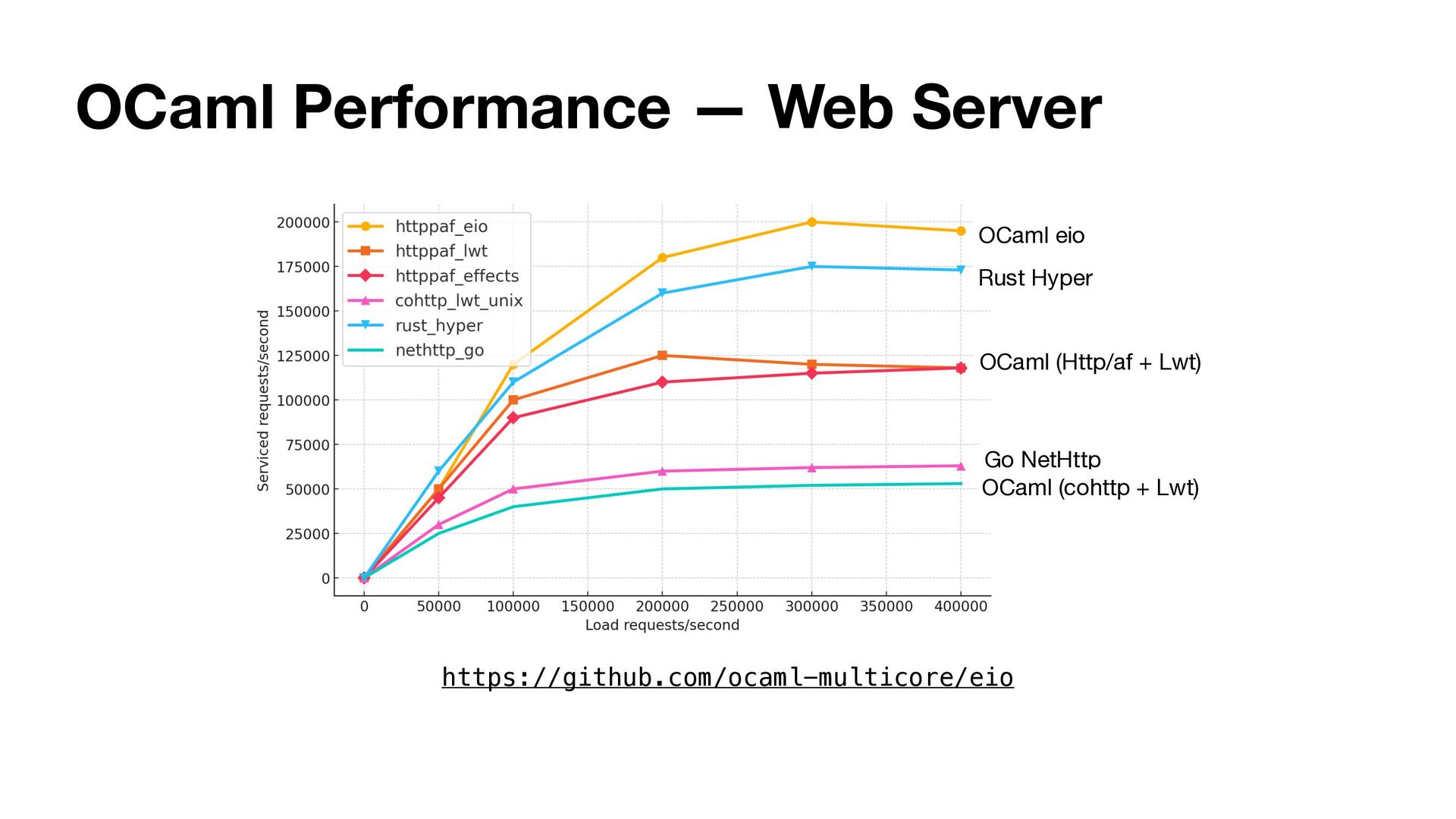
OCaml Performance • GC is tuned for low-latency ‣ If
your application can tolerate 1 ms latency, then OCaml is a good fi t ‣ 95% of code that we write fi t this model -
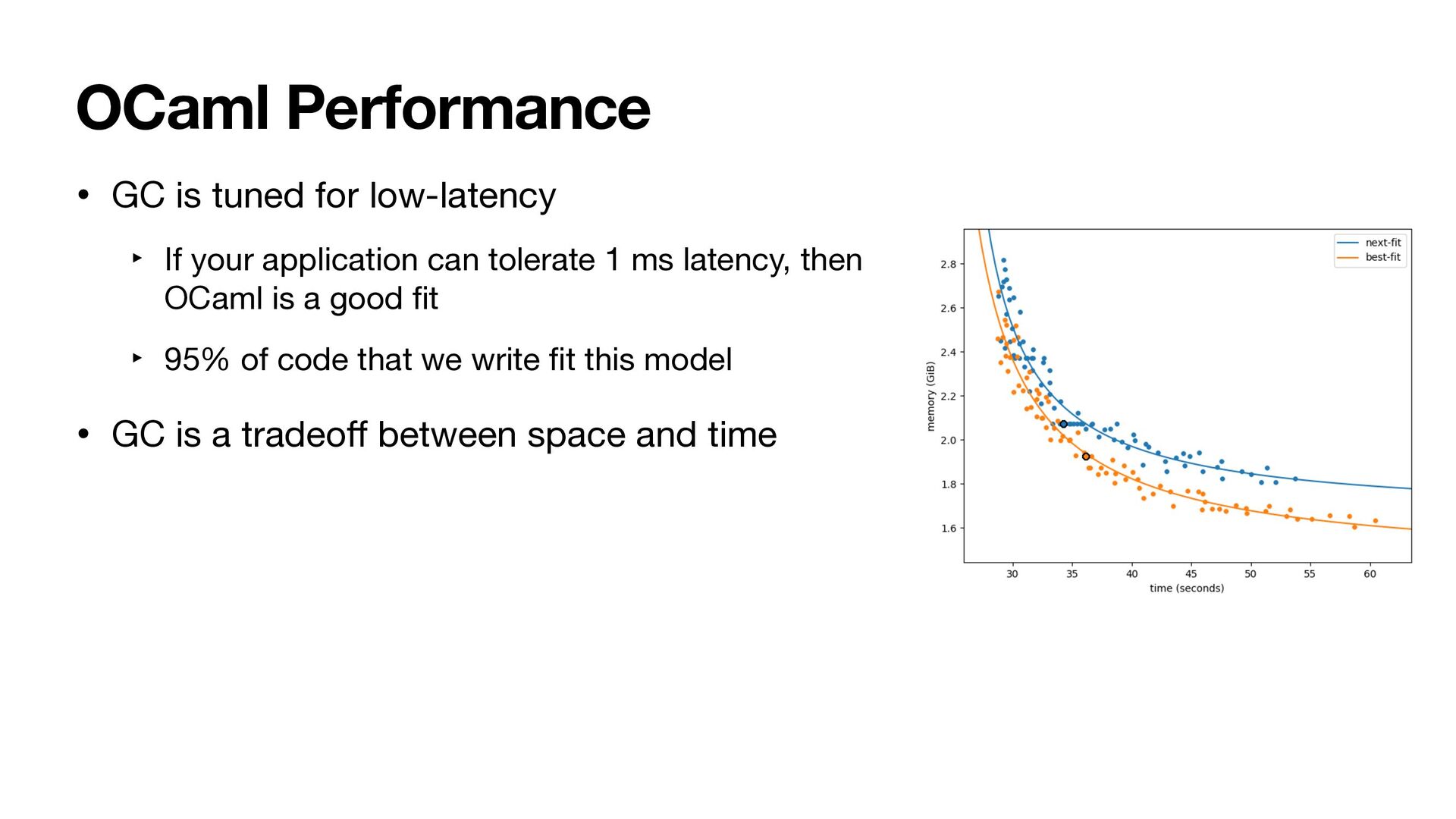
OCaml Performance • GC is tuned for low-latency ‣ If
your application can tolerate 1 ms latency, then OCaml is a good fi t ‣ 95% of code that we write fi t this model • GC is a tradeo ff between space and time -
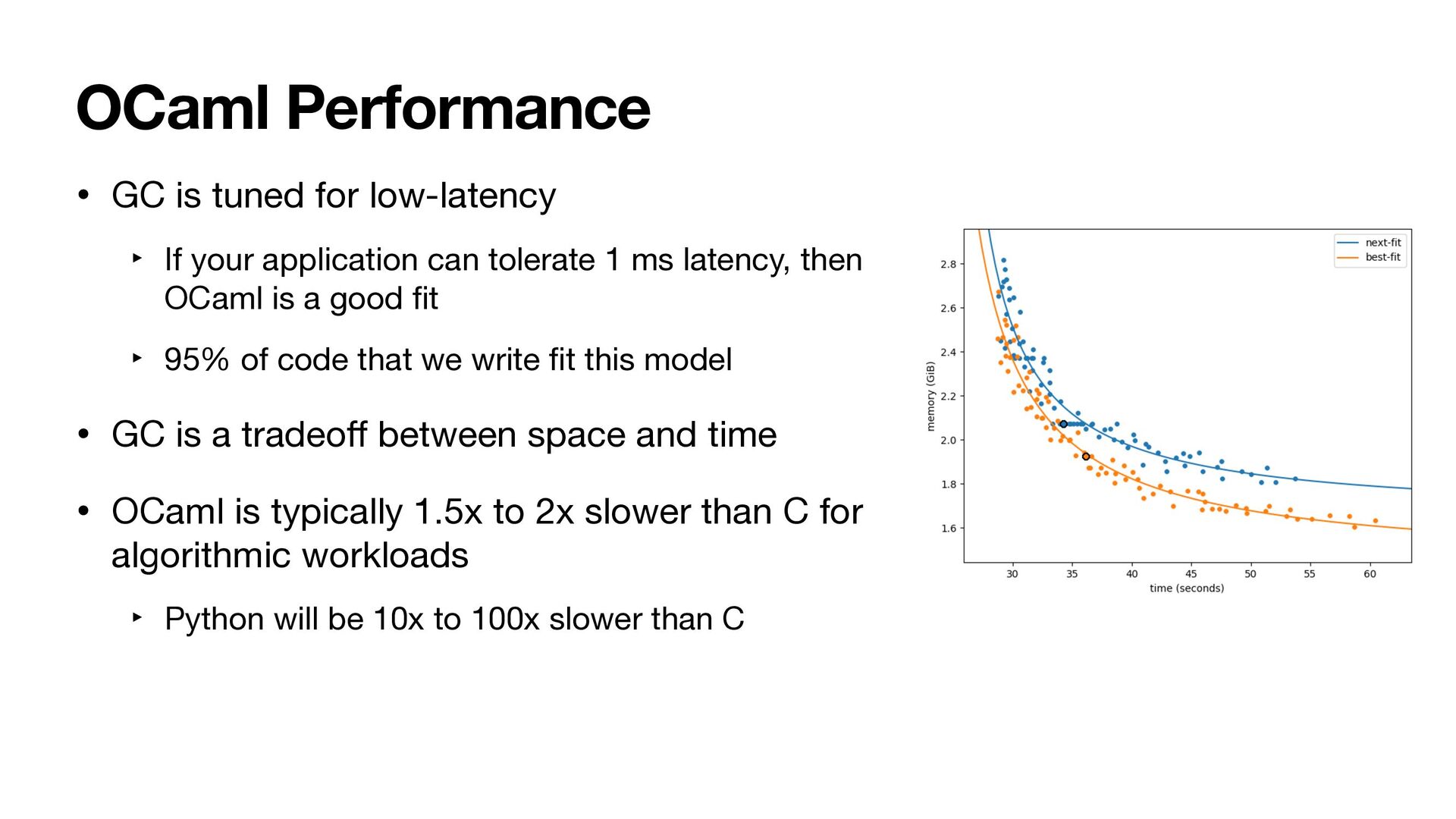
OCaml Performance • GC is tuned for low-latency ‣ If
your application can tolerate 1 ms latency, then OCaml is a good fi t ‣ 95% of code that we write fi t this model • GC is a tradeo ff between space and time • OCaml is typically 1.5x to 2x slower than C for algorithmic workloads ‣ Python will be 10x to 100x slower than C -
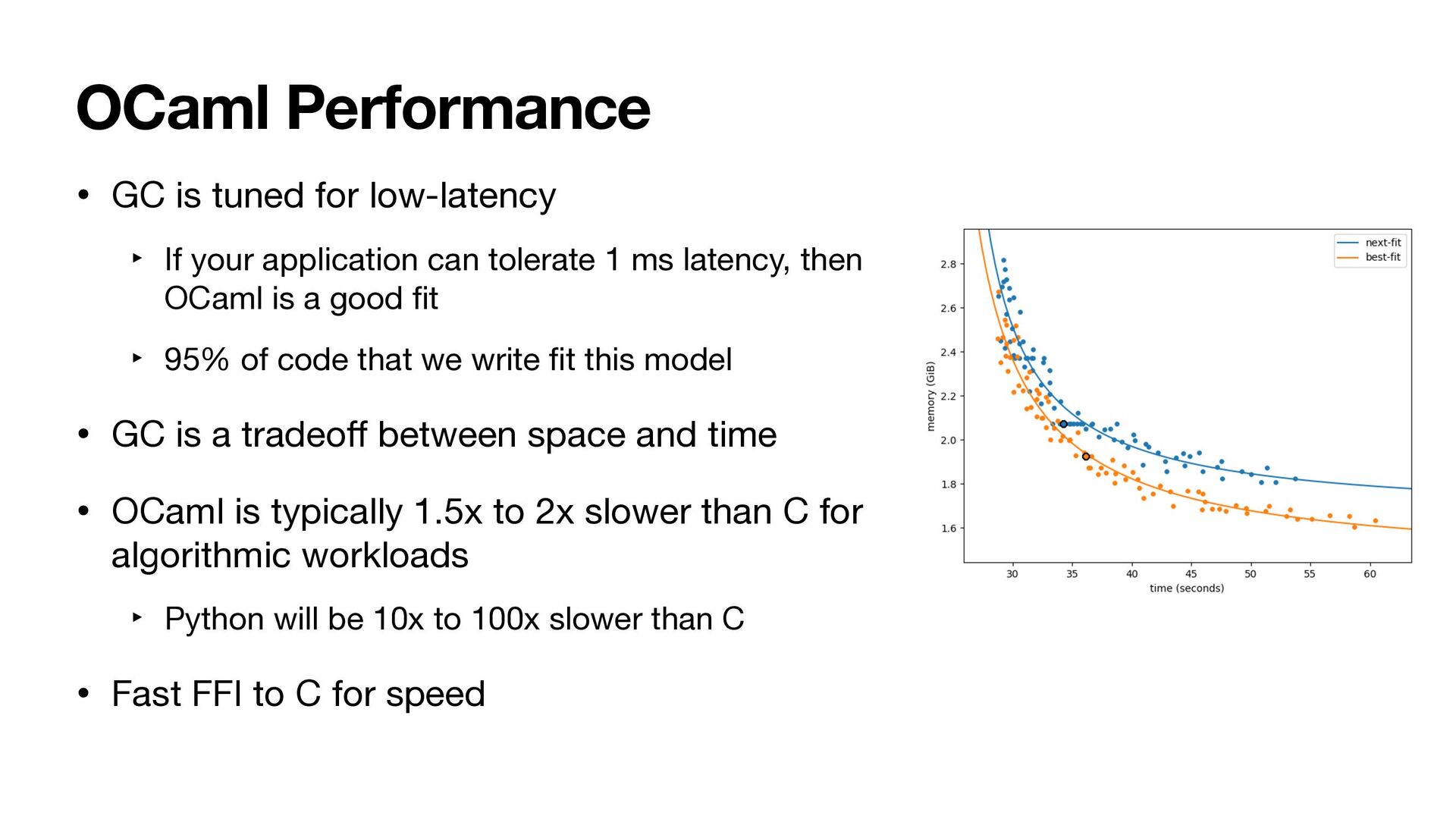
OCaml Performance • GC is tuned for low-latency ‣ If
your application can tolerate 1 ms latency, then OCaml is a good fi t ‣ 95% of code that we write fi t this model • GC is a tradeo ff between space and time • OCaml is typically 1.5x to 2x slower than C for algorithmic workloads ‣ Python will be 10x to 100x slower than C • Fast FFI to C for speed -
OCaml eio Rust Hyper OCaml (Http/af + Lwt) Go NetHttp
OCaml (cohttp + Lwt) https://github.com/ocaml-multicore/eio OCaml Performance — Web Server -
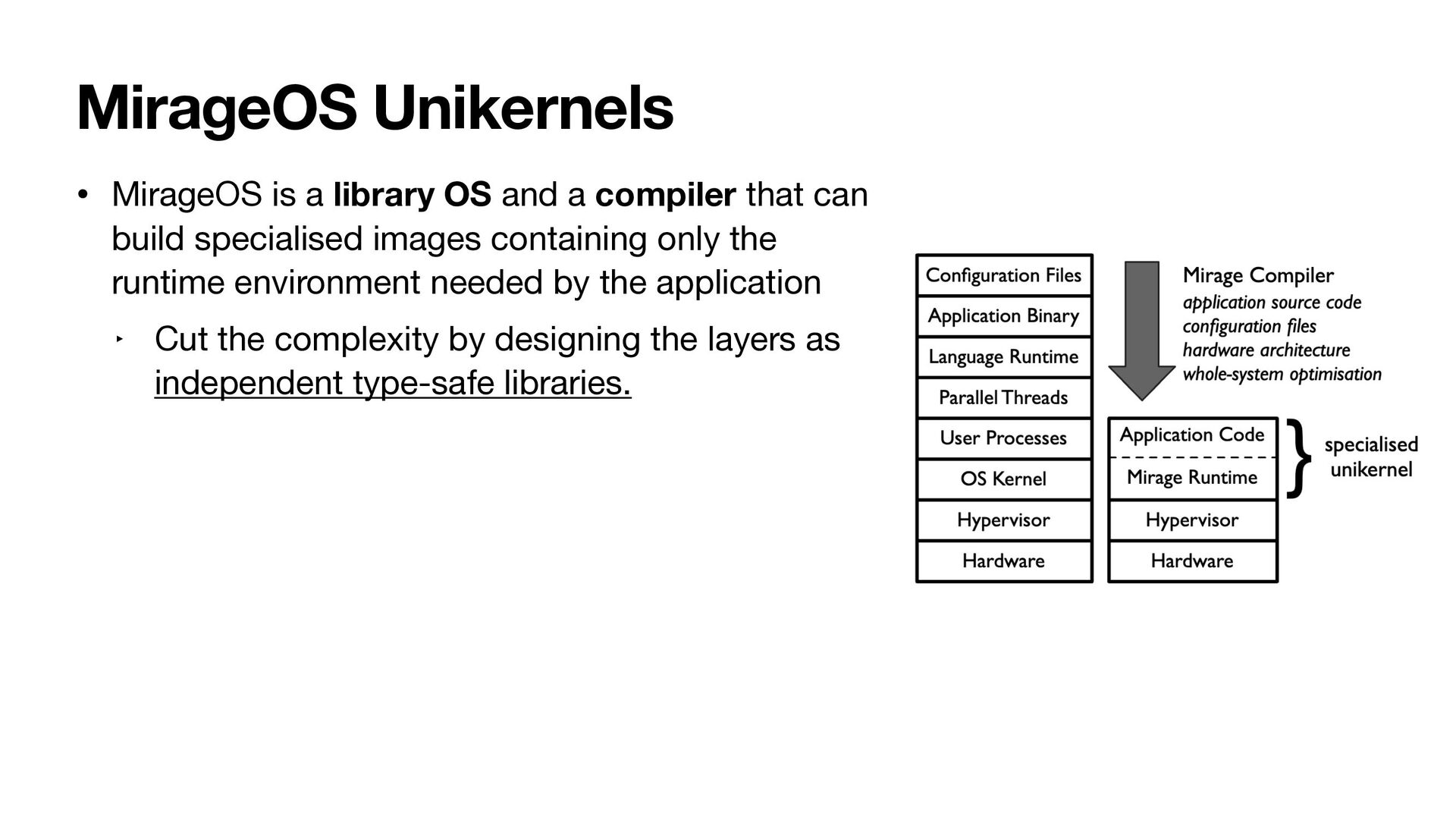
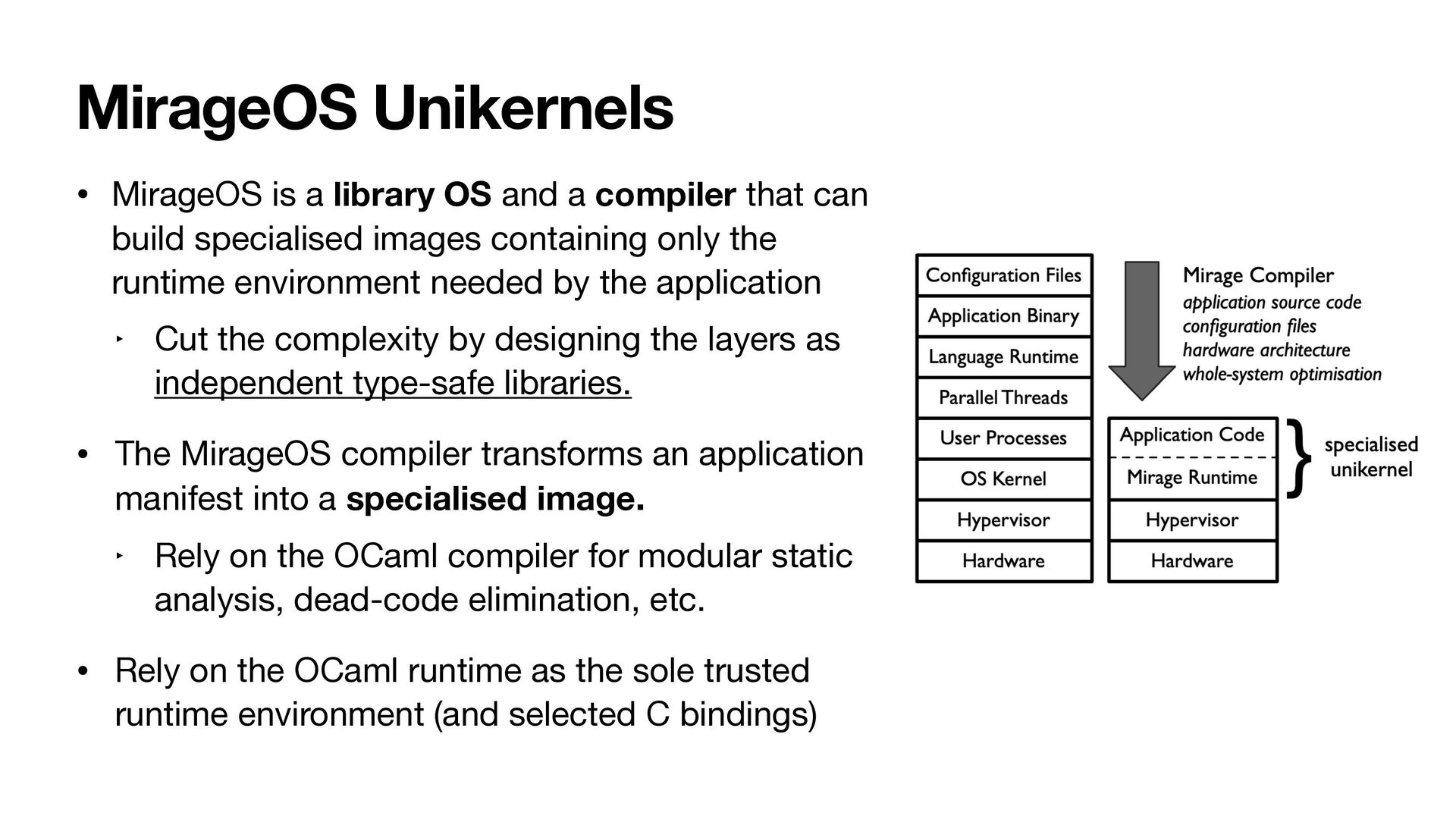
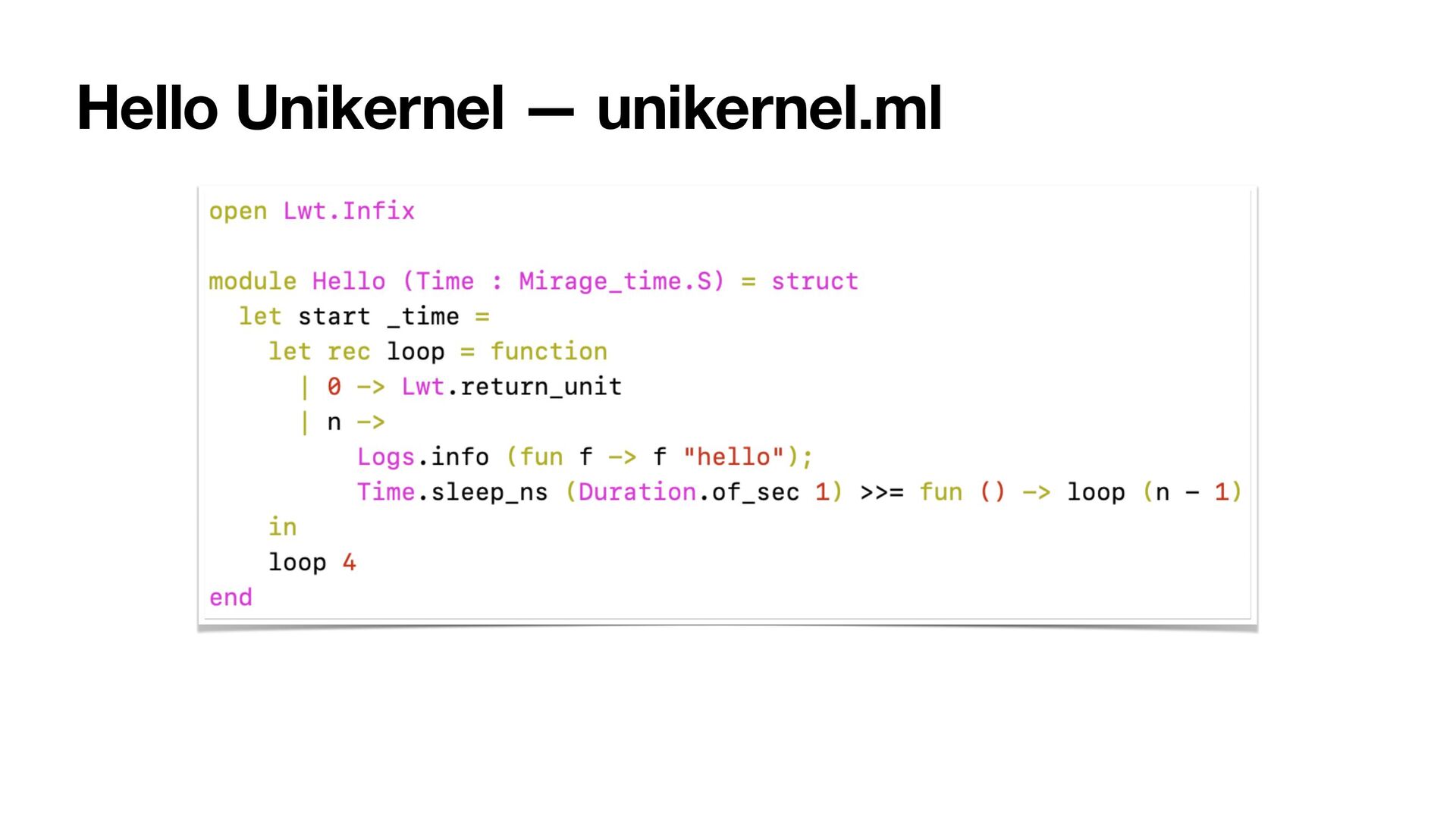
MirageOS Unikernels • MirageOS is a library OS and a
compiler that can build specialised images containing only the runtime environment needed by the application ‣ Cut the complexity by designing the layers as independent type-safe libraries. -
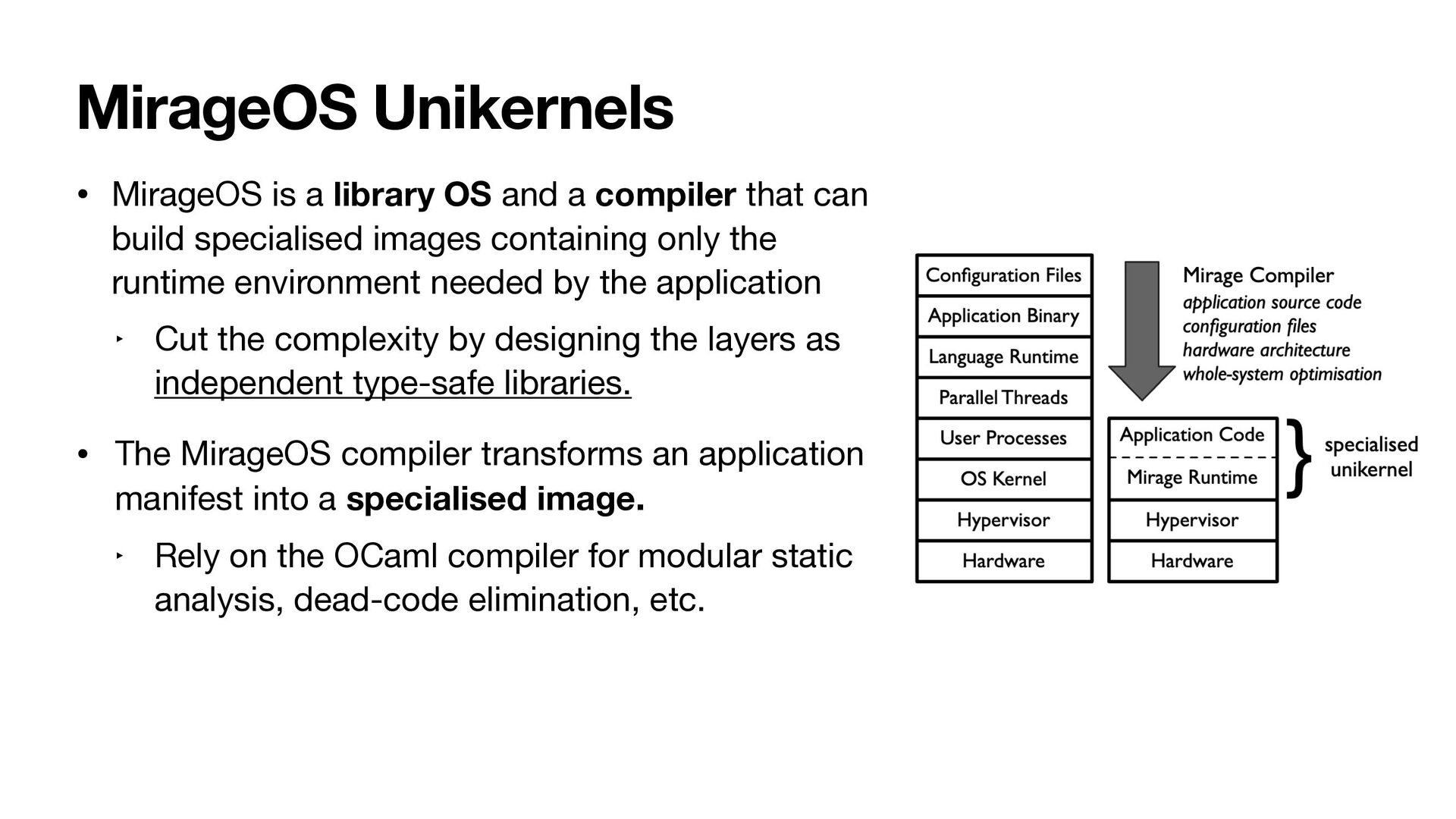
MirageOS Unikernels • MirageOS is a library OS and a
compiler that can build specialised images containing only the runtime environment needed by the application ‣ Cut the complexity by designing the layers as independent type-safe libraries. • The MirageOS compiler transforms an application manifest into a specialised image. ‣ Rely on the OCaml compiler for modular static analysis, dead-code elimination, etc. -
MirageOS Unikernels • MirageOS is a library OS and a
compiler that can build specialised images containing only the runtime environment needed by the application ‣ Cut the complexity by designing the layers as independent type-safe libraries. • The MirageOS compiler transforms an application manifest into a specialised image. ‣ Rely on the OCaml compiler for modular static analysis, dead-code elimination, etc. • Rely on the OCaml runtime as the sole trusted runtime environment (and selected C bindings) -
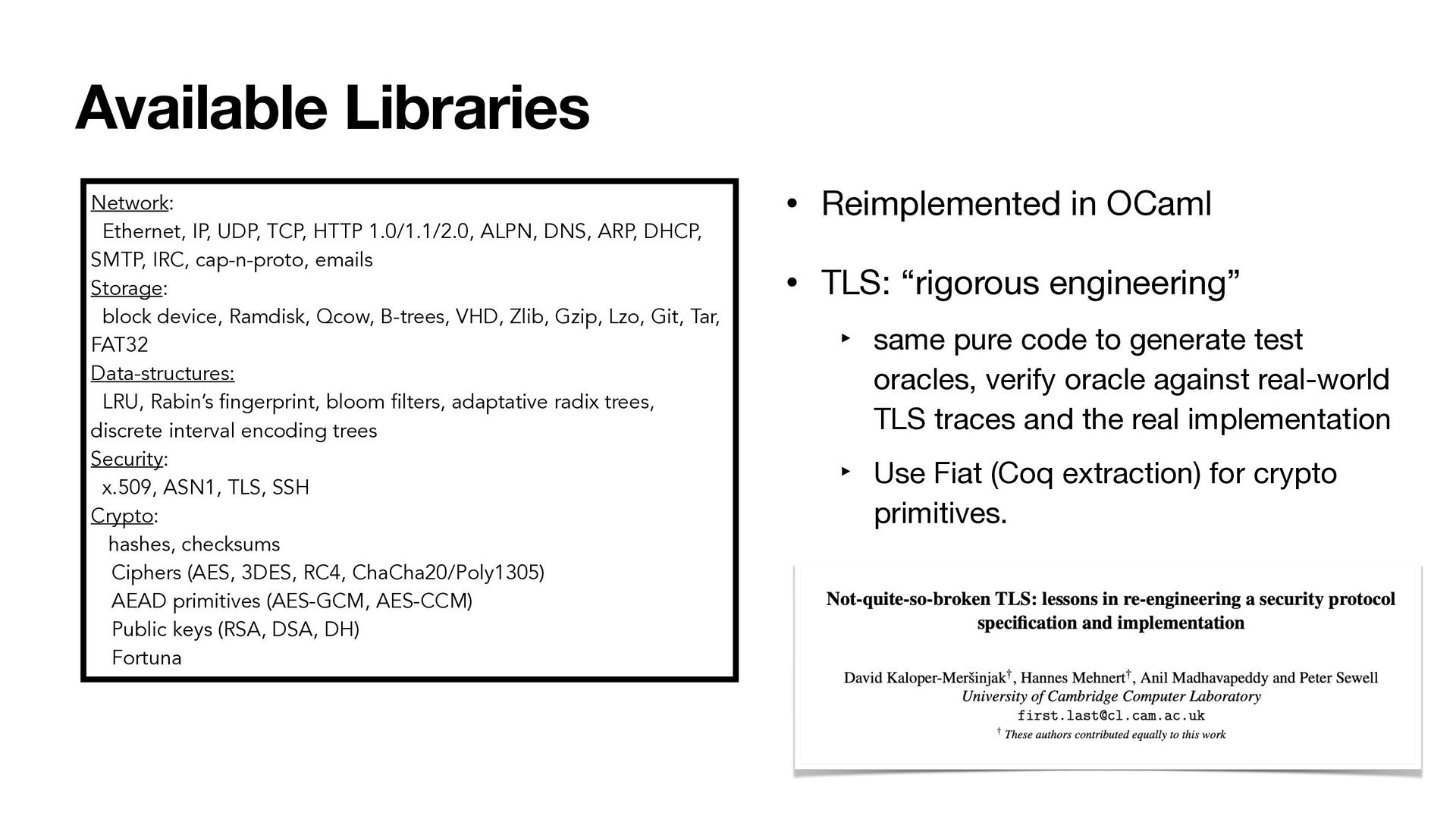
Available Libraries Network: Ethernet, IP, UDP, TCP, HTTP 1.0/1.1/2.0, ALPN,
DNS, ARP, DHCP, SMTP, IRC, cap-n-proto, emails Storage: block device, Ramdisk, Qcow, B-trees, VHD, Zlib, Gzip, Lzo, Git, Tar, FAT32 Data-structures: LRU, Rabin’s fingerprint, bloom filters, adaptative radix trees, discrete interval encoding trees Security: x.509, ASN1, TLS, SSH Crypto: hashes, checksums Ciphers (AES, 3DES, RC4, ChaCha20/Poly1305) AEAD primitives (AES-GCM, AES-CCM) Public keys (RSA, DSA, DH) Fortuna • Reimplemented in OCaml • TLS: “rigorous engineering” ‣ same pure code to generate test oracles, verify oracle against real-world TLS traces and the real implementation ‣ Use Fiat (Coq extraction) for crypto primitives. -
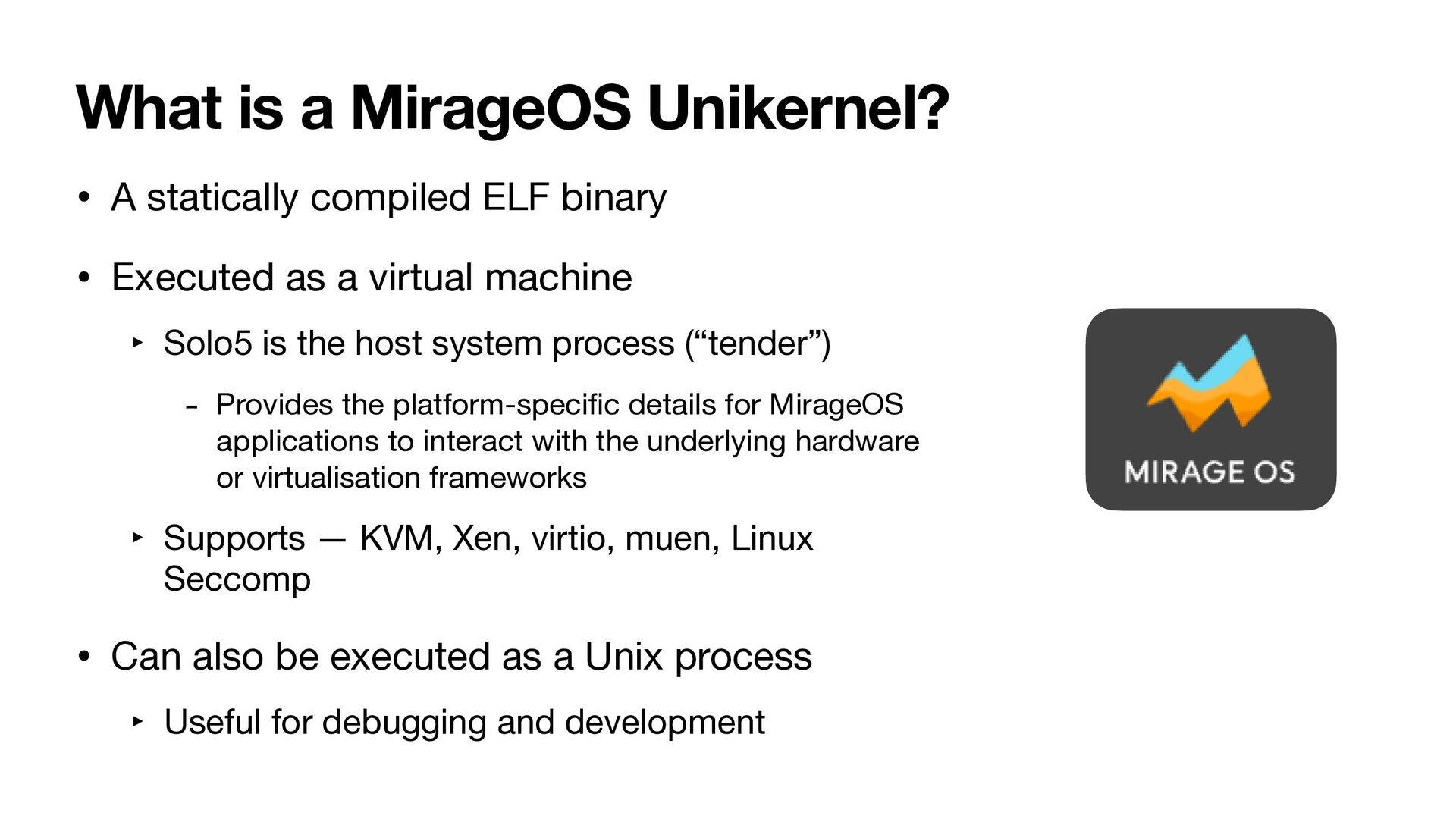
What is a MirageOS Unikernel? • A statically compiled ELF
binary • Executed as a virtual machine ‣ Solo5 is the host system process (“tender”) - Provides the platform-speci fi c details for MirageOS applications to interact with the underlying hardware or virtualisation frameworks ‣ Supports — KVM, Xen, virtio, muen, Linux Seccomp • Can also be executed as a Unix process ‣ Useful for debugging and development -
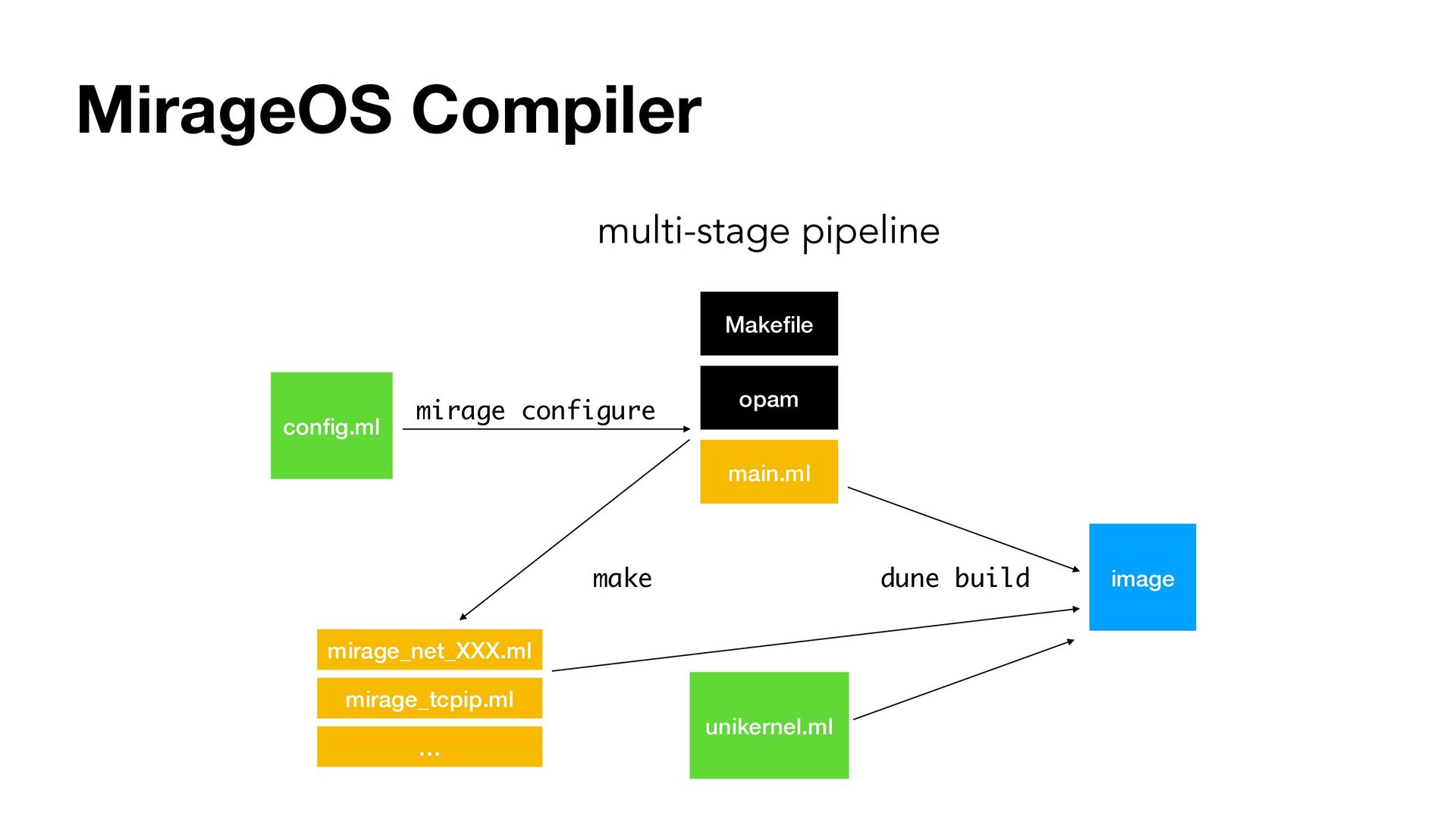
con fi g.ml multi-stage pipeline mirage configure unikernel.ml image dune
build main.ml opam Make fi le make mirage_net_XXX.ml mirage_tcpip.ml … MirageOS Compiler -
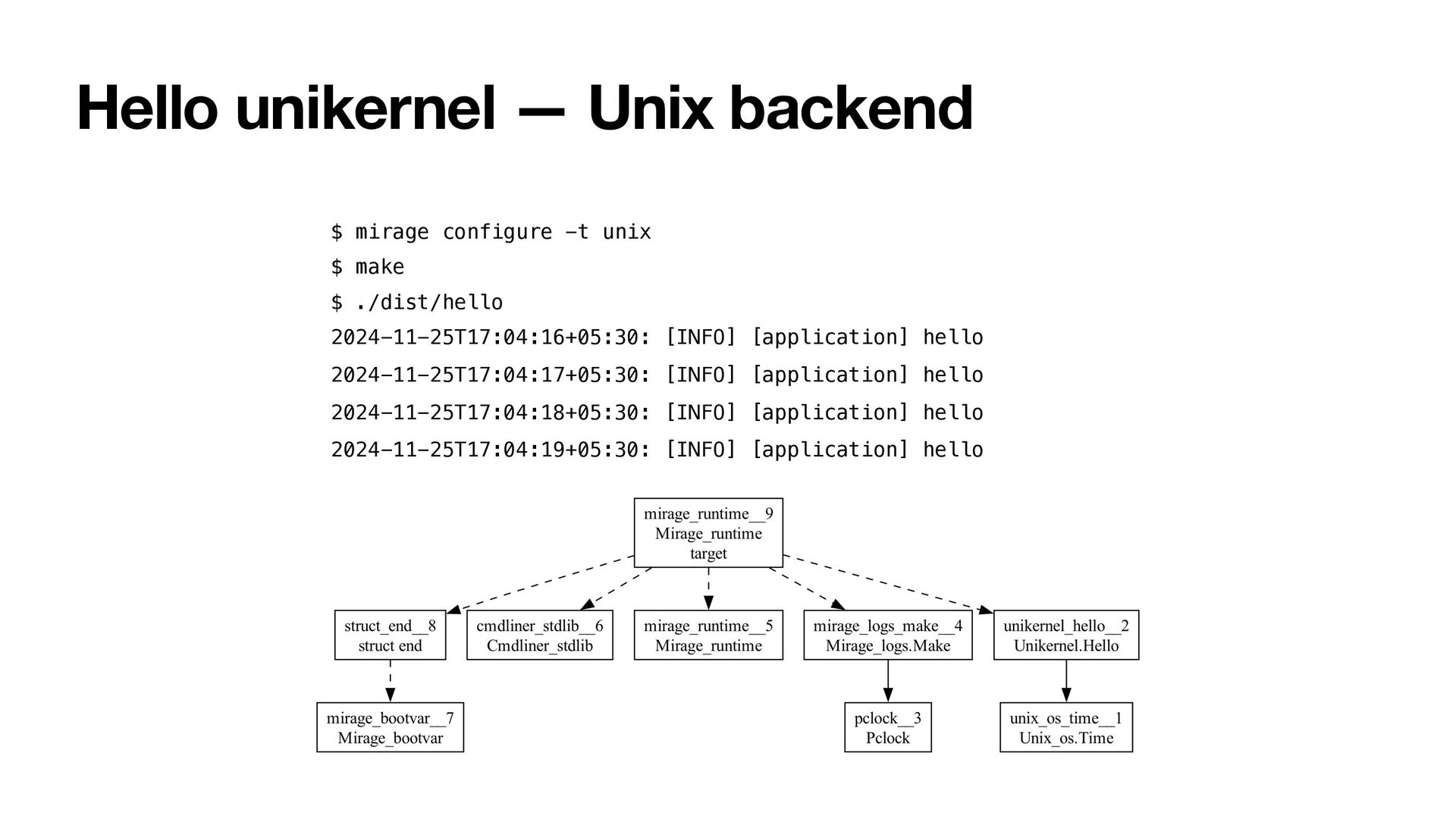
Hello unikernel — Unix backend $ mirage configure -t unix
$ make $ ./dist/hello 2024-11-25T17:04:16+05:30: [INFO] [application] hello 2024-11-25T17:04:17+05:30: [INFO] [application] hello 2024-11-25T17:04:18+05:30: [INFO] [application] hello 2024-11-25T17:04:19+05:30: [INFO] [application] hello -
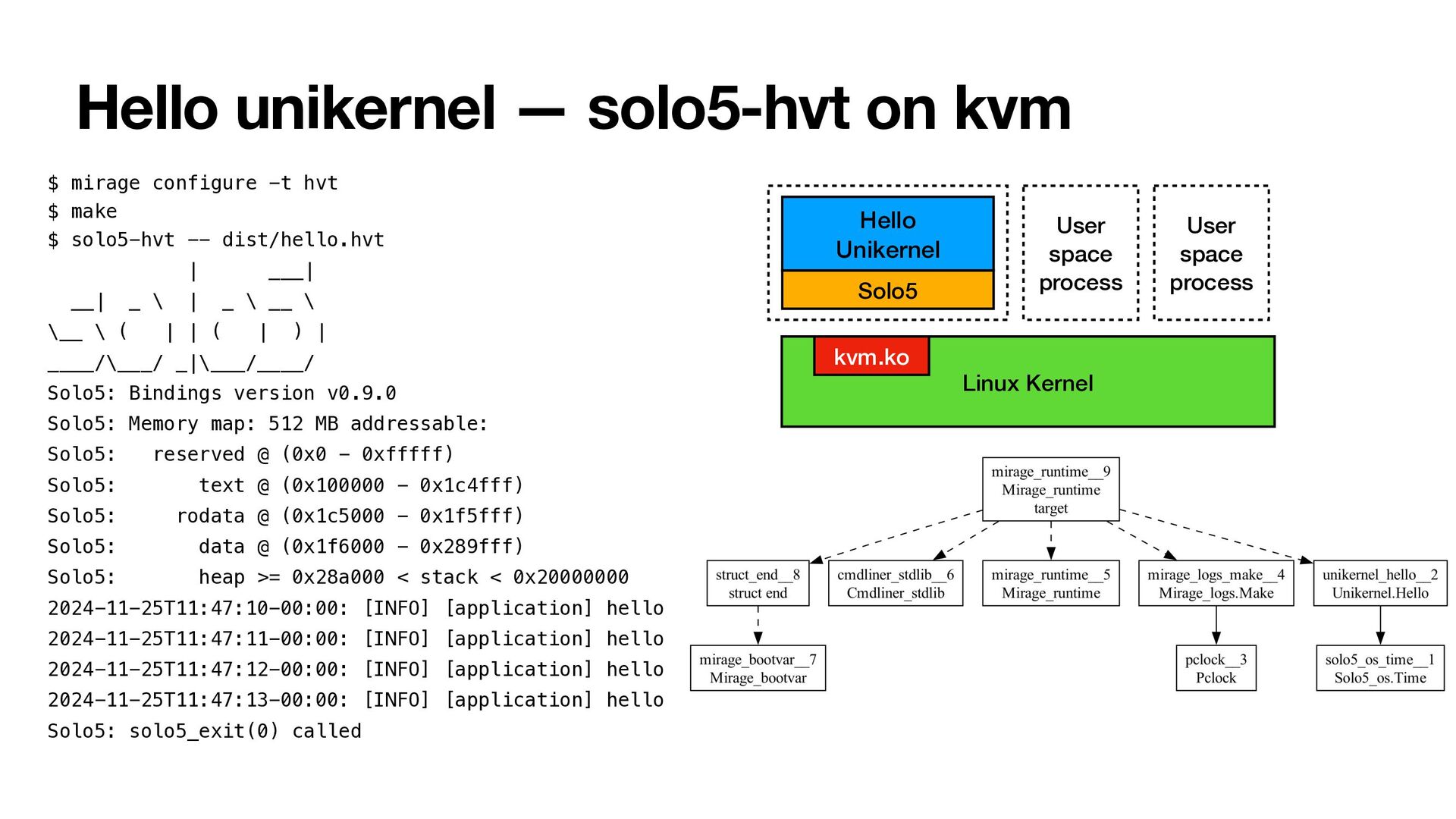
Hello unikernel — solo5-hvt on kvm $ mirage configure -t
hvt $ make $ solo5-hvt -- dist/hello.hvt | ___| __| _ \ | _ \ __ \ \__ \ ( | | ( | ) | ____/\___/ _|\___/____/ Solo5: Bindings version v0.9.0 Solo5: Memory map: 512 MB addressable: Solo5: reserved @ (0x0 - 0xfffff) Solo5: text @ (0x100000 - 0x1c4fff) Solo5: rodata @ (0x1c5000 - 0x1f5fff) Solo5: data @ (0x1f6000 - 0x289fff) Solo5: heap >= 0x28a000 < stack < 0x20000000 2024-11-25T11:47:10-00:00: [INFO] [application] hello 2024-11-25T11:47:11-00:00: [INFO] [application] hello 2024-11-25T11:47:12-00:00: [INFO] [application] hello 2024-11-25T11:47:13-00:00: [INFO] [application] hello Solo5: solo5_exit(0) called Hello Unikernel Solo5 Linux Kernel kvm.ko User space process User space process -
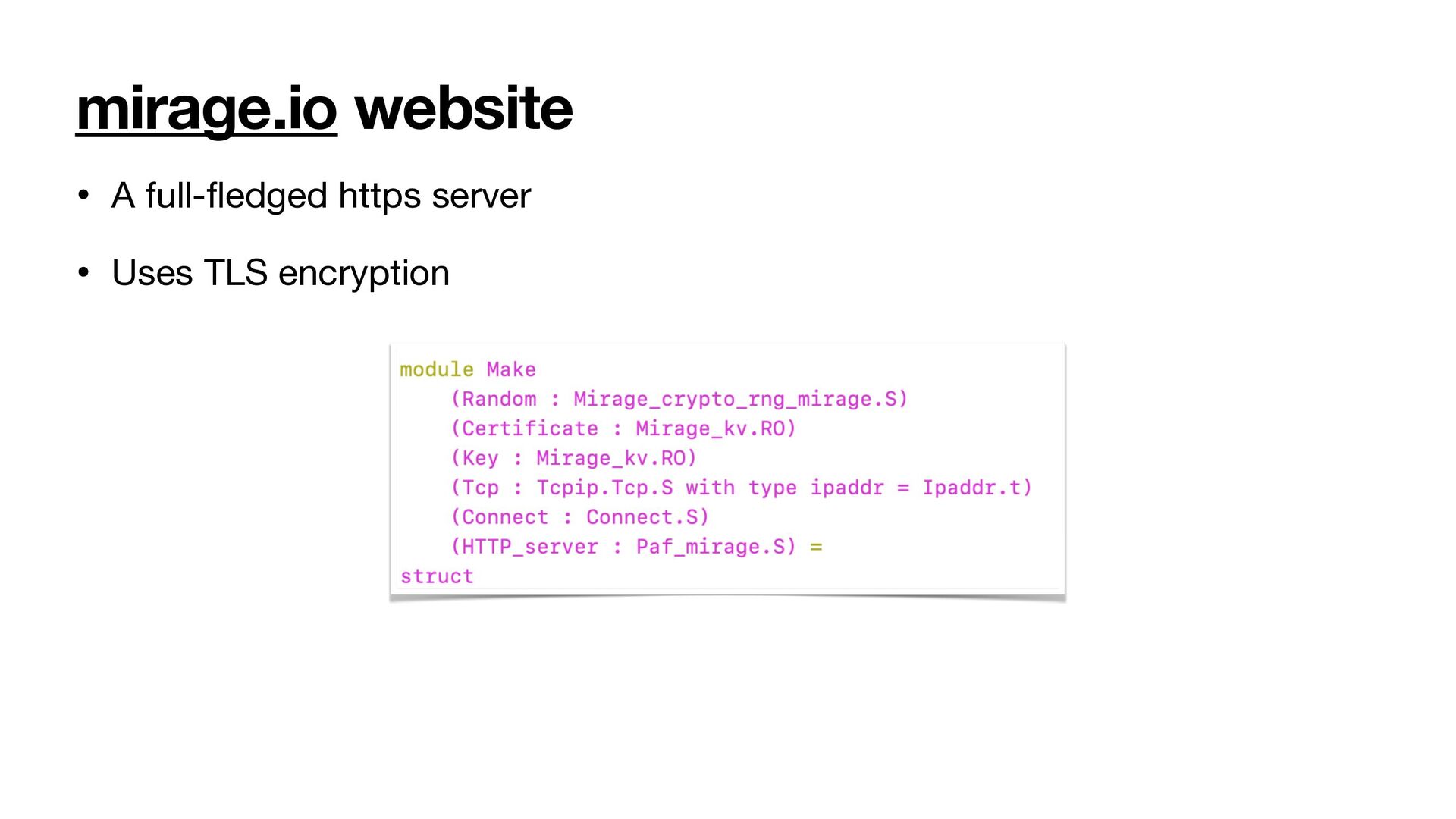
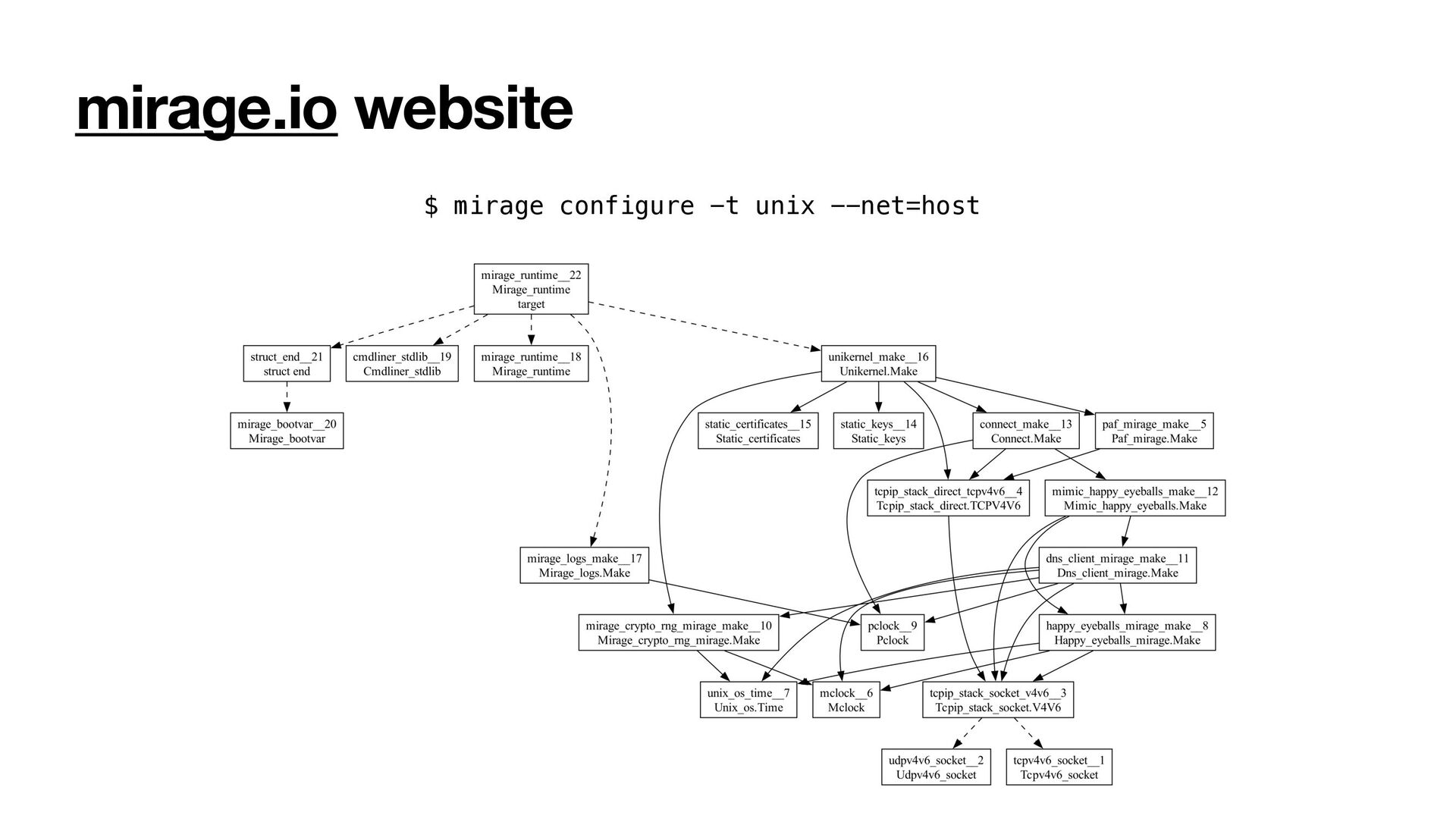
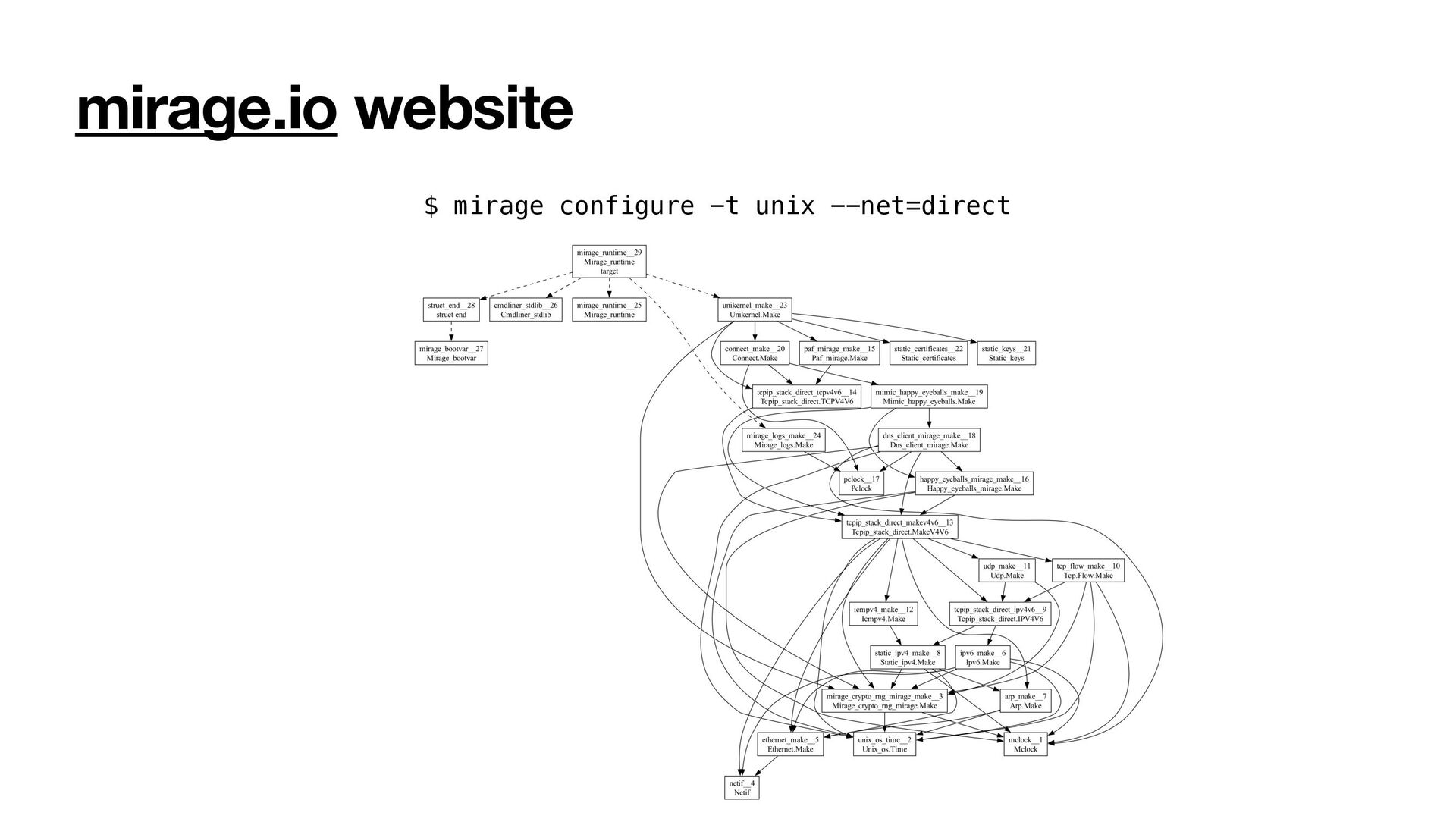
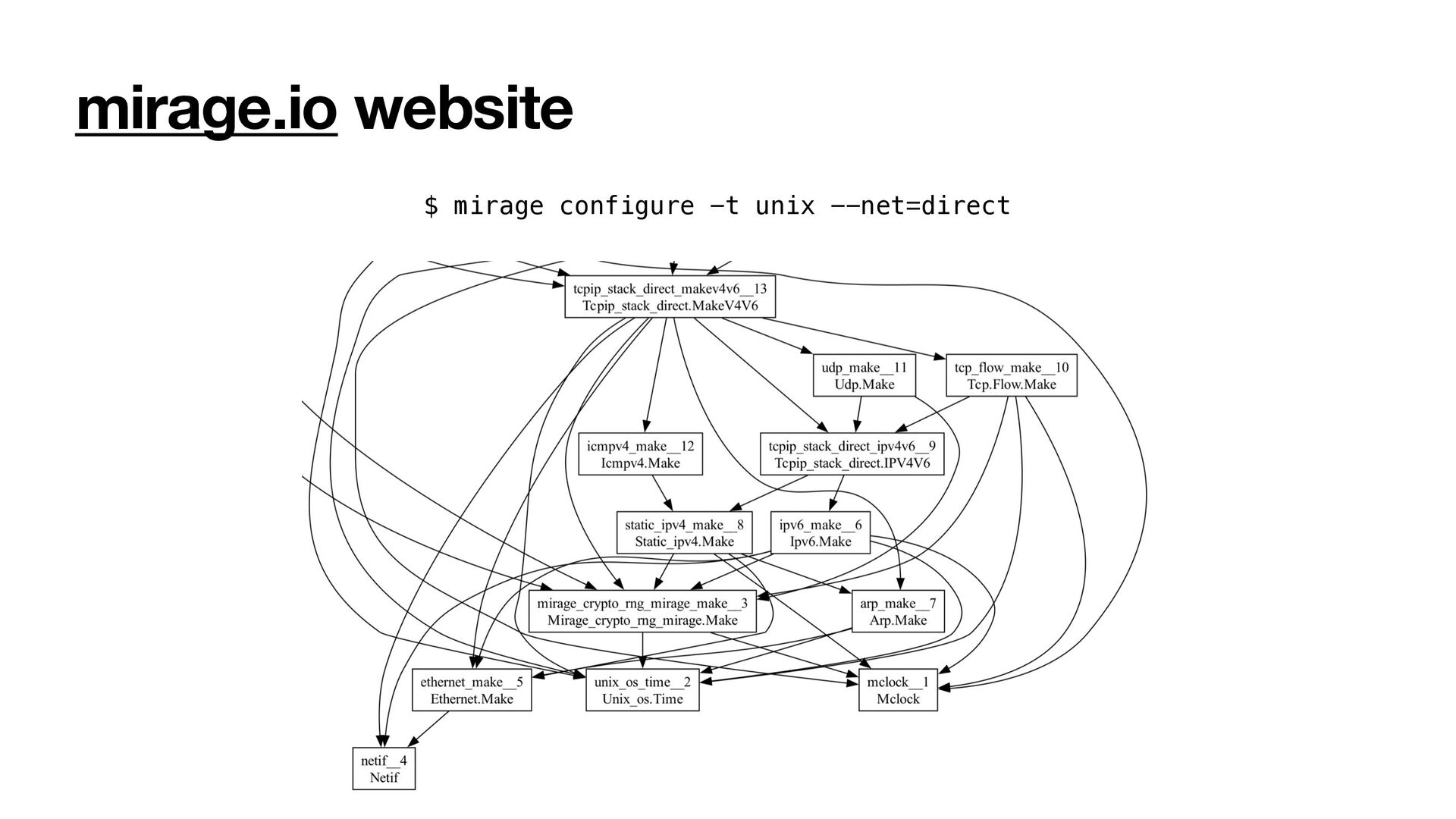
mirage.io website • A full- fl edged https server •
Uses TLS encryption -
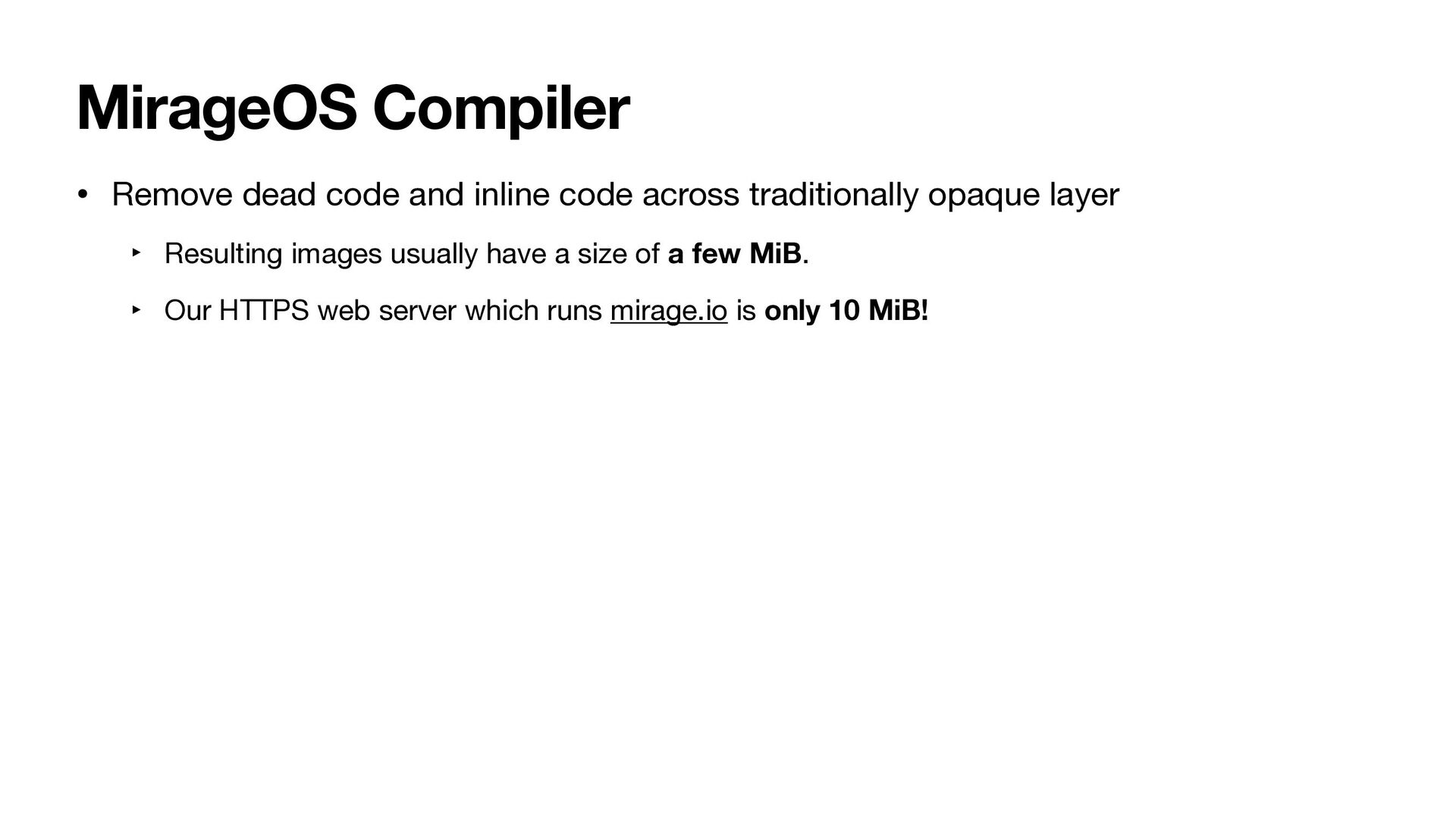
MirageOS Compiler • Remove dead code and inline code across
traditionally opaque layer ‣ Resulting images usually have a size of a few MiB. ‣ Our HTTPS web server which runs mirage.io is only 10 MiB! -
MirageOS Compiler • Remove dead code and inline code across
traditionally opaque layer ‣ Resulting images usually have a size of a few MiB. ‣ Our HTTPS web server which runs mirage.io is only 10 MiB! • Con fi guration can be partially evaluated at compile-time ‣ Extreme specialisation enables a boot time of a few ms. -
MirageOS Compiler • Remove dead code and inline code across
traditionally opaque layer ‣ Resulting images usually have a size of a few MiB. ‣ Our HTTPS web server which runs mirage.io is only 10 MiB! • Con fi guration can be partially evaluated at compile-time ‣ Extreme specialisation enables a boot time of a few ms. • If something (e.g. networking) is not used, it will not be available at runtime ‣ Minimal runtime environments use a few MiB of RAM. -
MirageOS Compiler • Remove dead code and inline code across
traditionally opaque layer ‣ Resulting images usually have a size of a few MiB. ‣ Our HTTPS web server which runs mirage.io is only 10 MiB! • Con fi guration can be partially evaluated at compile-time ‣ Extreme specialisation enables a boot time of a few ms. • If something (e.g. networking) is not used, it will not be available at runtime ‣ Minimal runtime environments use a few MiB of RAM. • The kernel and user space share the same address space ‣ Many runtime checks are removed, so static analysis is critical. -
Bitcoin Piñata • https://hannes.robur.coop/Posts/Pinata • 1.1 MB Unikernel, which ran
from 2015 to 2018 • Hold the key to 10 bitcoins (peak worth $165k) ‣ Now worth ~$1M • A successful authenticated TLS session reveals the private Bitcoin key • 500,000 accesses to the Piñata website, more than 150,000 attempts at connecting to the Piñata bounty • The bitcoins were safe! -
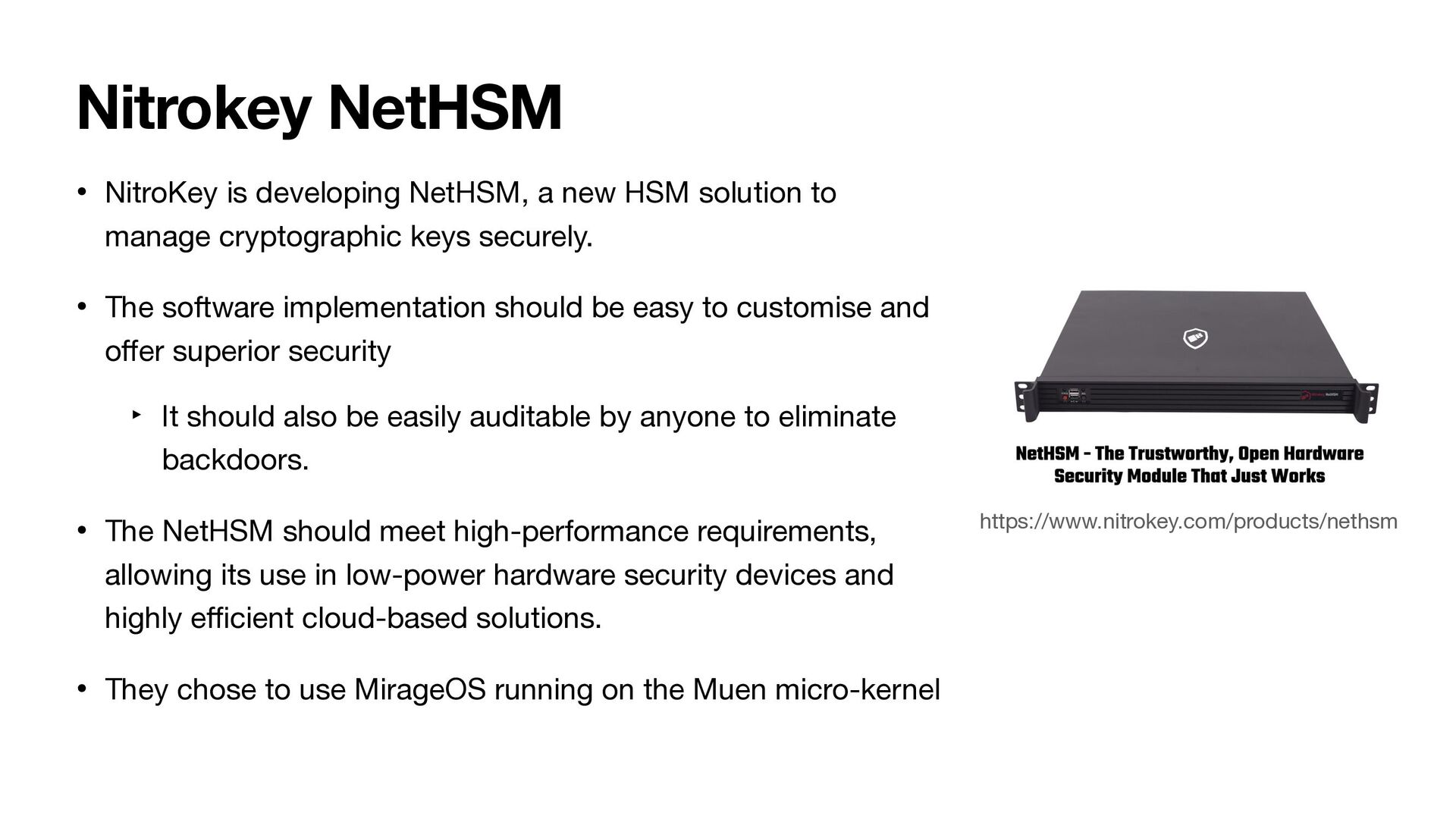
Nitrokey NetHSM • NitroKey is developing NetHSM, a new HSM
solution to manage cryptographic keys securely. • The software implementation should be easy to customise and o ff er superior security ‣ It should also be easily auditable by anyone to eliminate backdoors. • The NetHSM should meet high-performance requirements, allowing its use in low-power hardware security devices and highly e ff i cient cloud-based solutions. • They chose to use MirageOS running on the Muen micro-kernel https://www.nitrokey.com/products/nethsm -
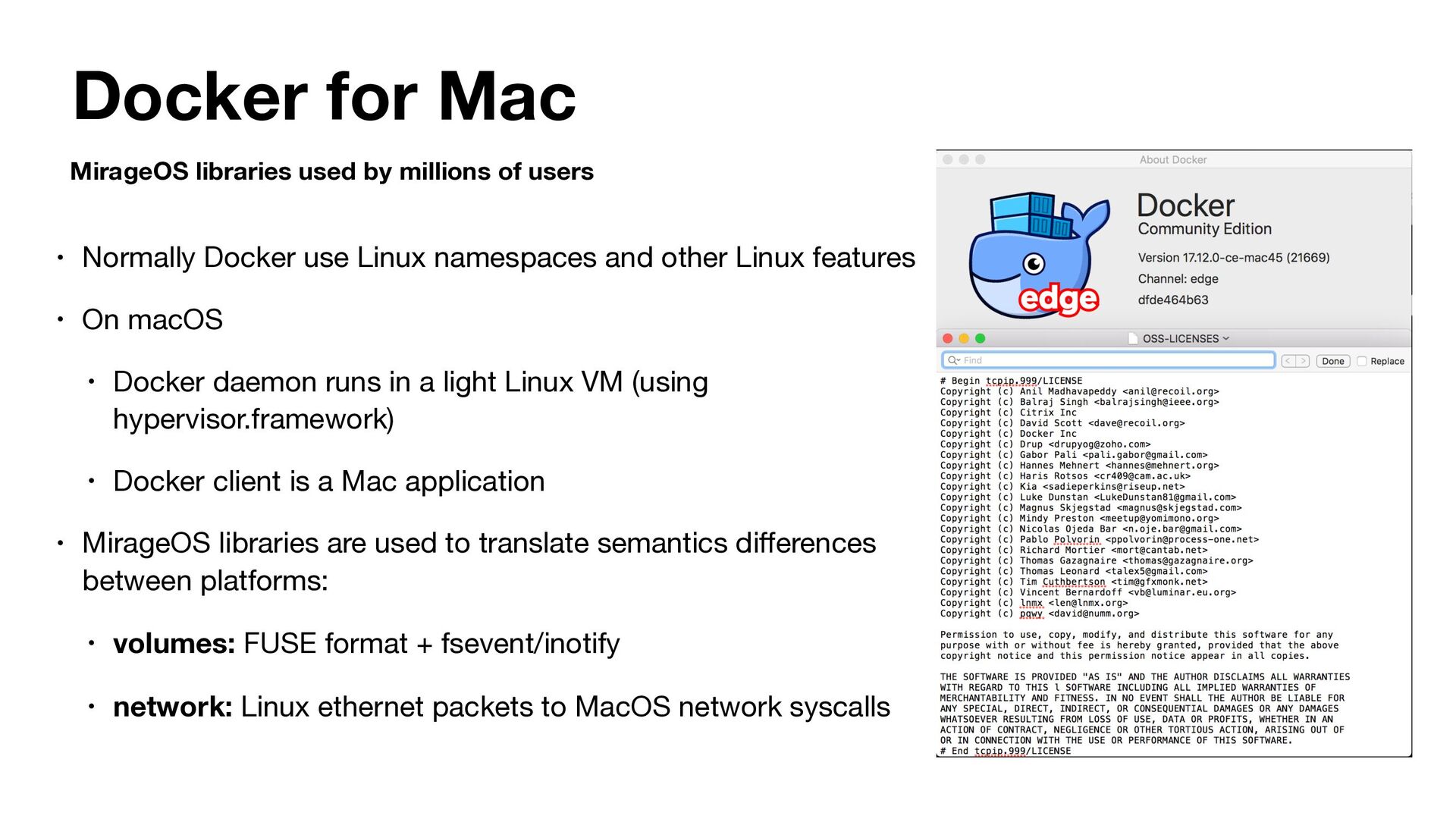
Docker for Mac • Normally Docker use Linux namespaces and
other Linux features • On macOS • Docker daemon runs in a light Linux VM (using hypervisor.framework) • Docker client is a Mac application • MirageOS libraries are used to translate semantics di ff erences between platforms: • volumes: FUSE format + fsevent/inotify • network: Linux ethernet packets to MacOS network syscalls MirageOS libraries used by millions of users -
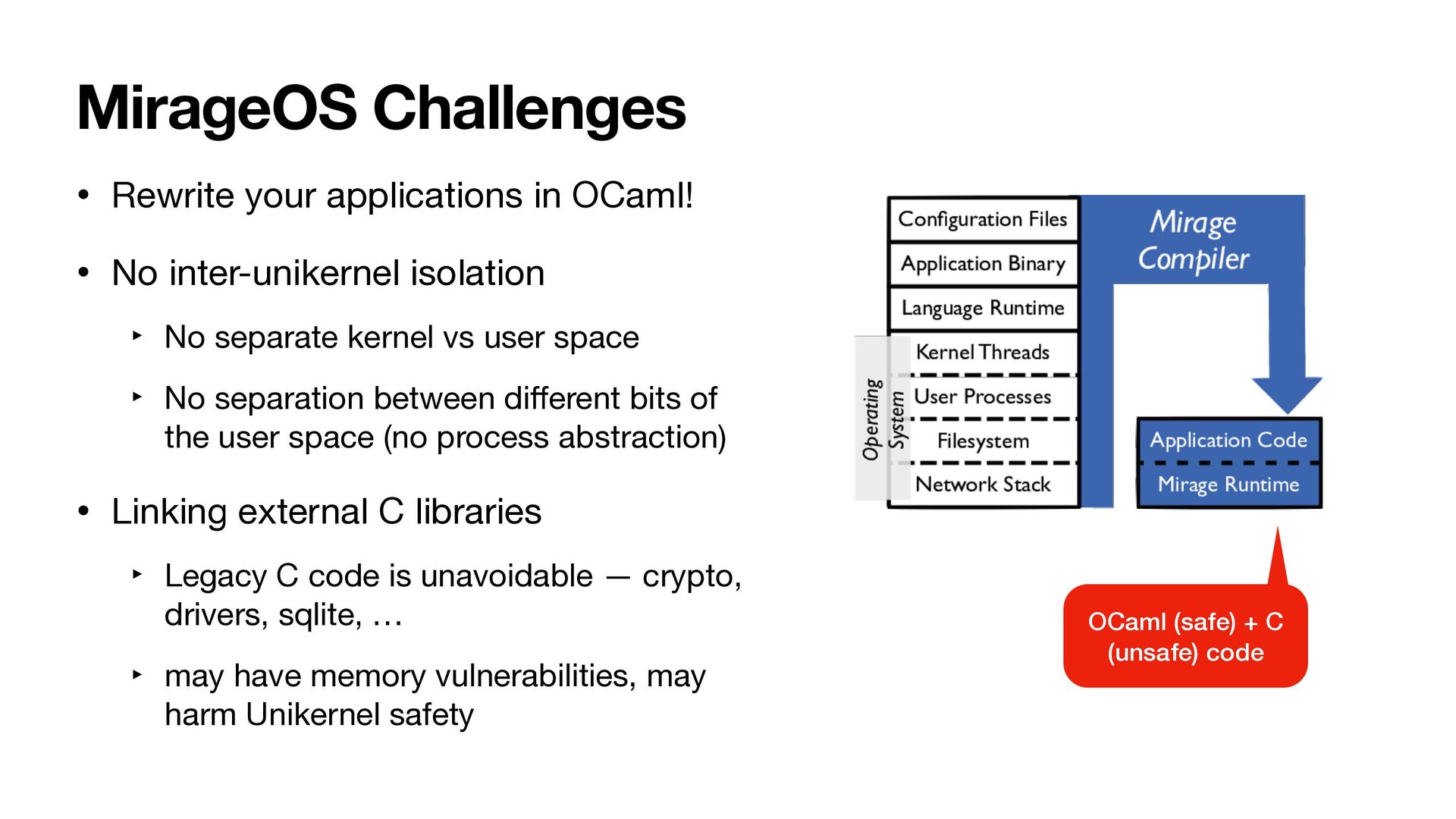
MirageOS Challenges • Rewrite your applications in OCaml! • No
inter-unikernel isolation ‣ No separate kernel vs user space ‣ No separation between di ff erent bits of the user space (no process abstraction) • Linking external C libraries ‣ Legacy C code is unavoidable — crypto, drivers, sqlite, … ‣ may have memory vulnerabilities, may harm Unikernel safety OCaml (safe) + C (unsafe) code -
MirageOS Challenges • Rewrite your applications in OCaml! • No
inter-unikernel isolation ‣ No separate kernel vs user space ‣ No separation between di ff erent bits of the user space (no process abstraction) • Linking external C libraries ‣ Legacy C code is unavoidable — crypto, drivers, sqlite, … ‣ may have memory vulnerabilities, may harm Unikernel safety OCaml (safe) + C (unsafe) code -
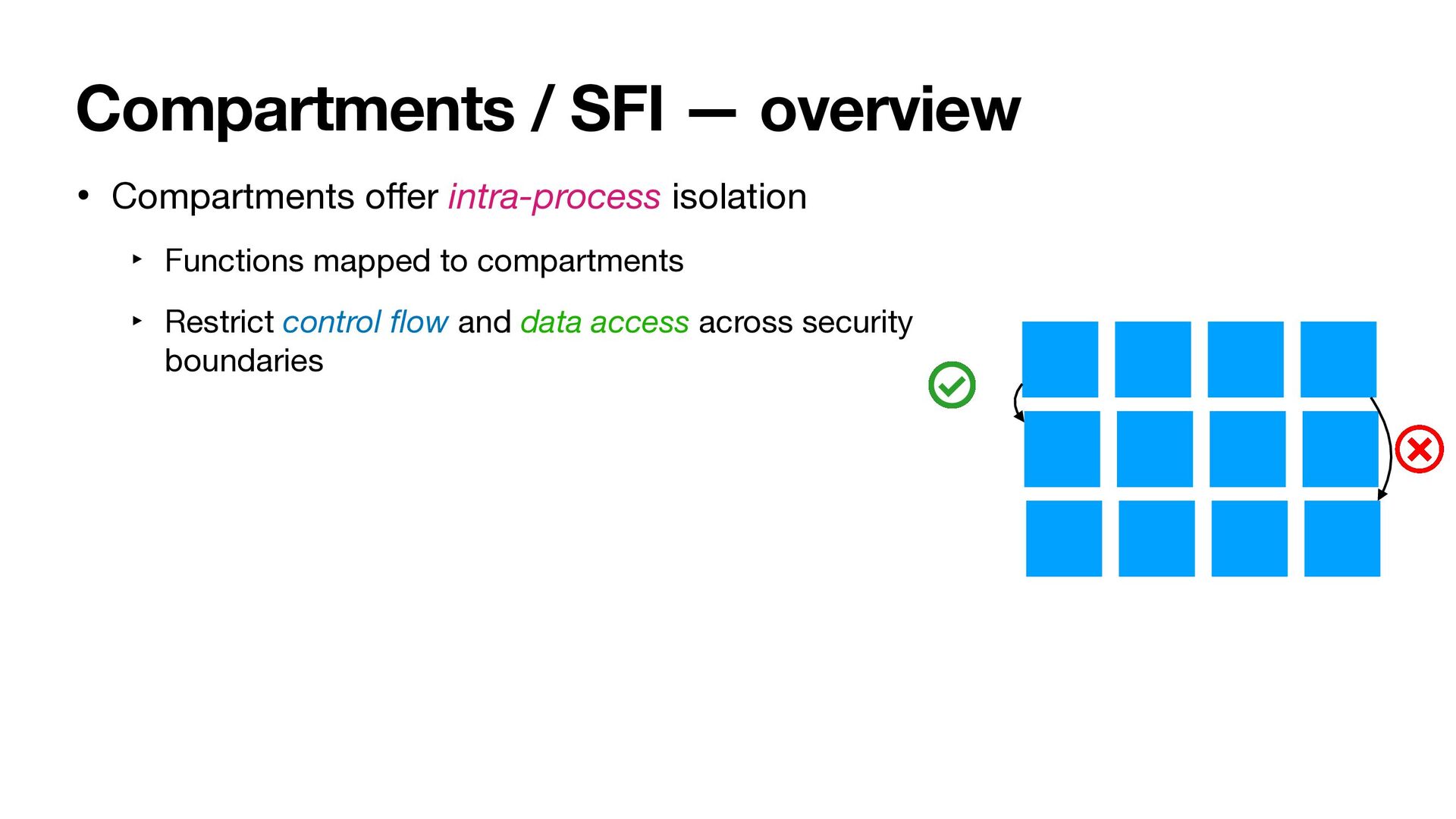
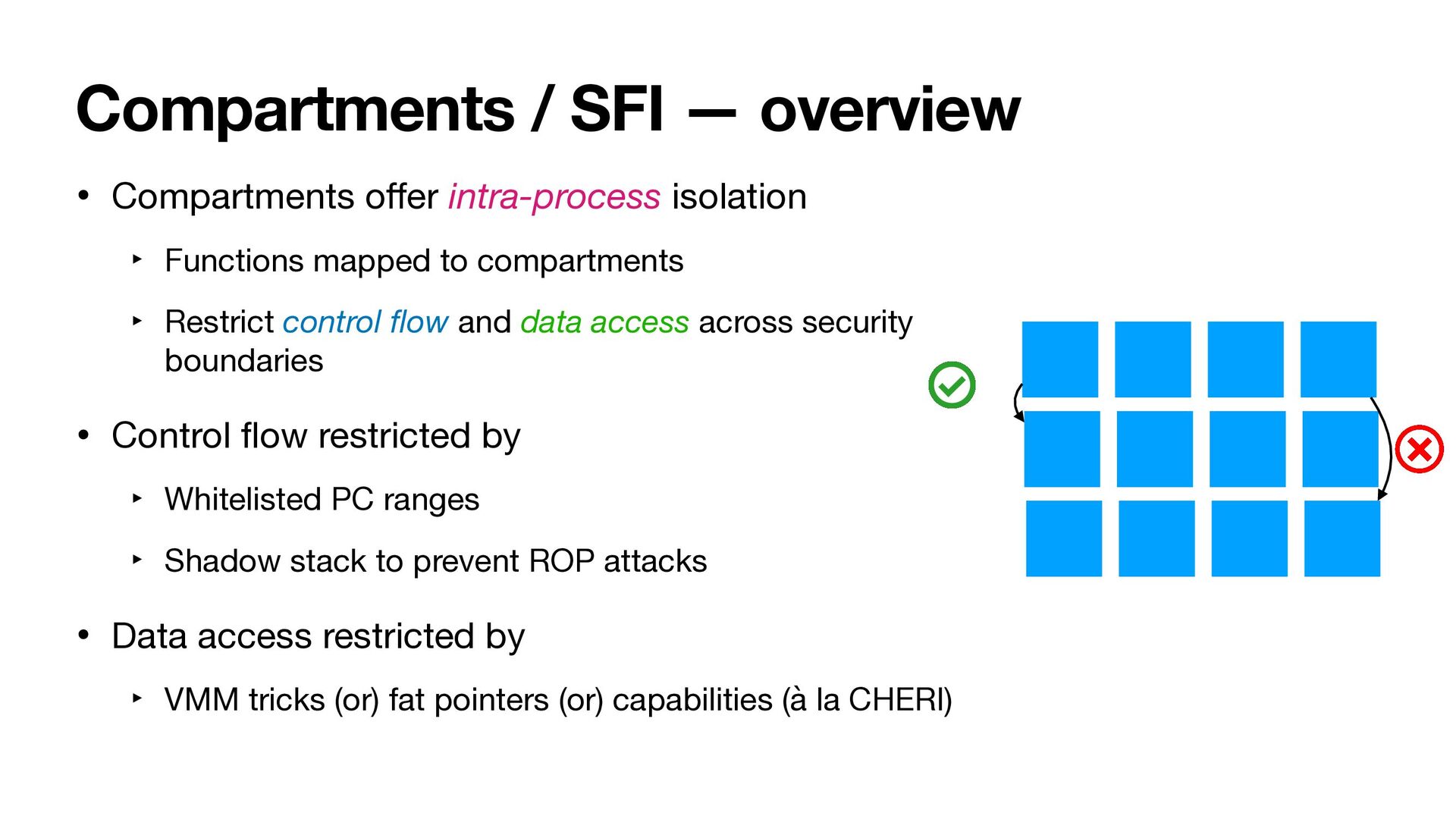
Compartments / SFI — overview • Compartments o ff er
intra-process isolation ‣ Functions mapped to compartments ‣ Restrict control fl ow and data access across security boundaries -
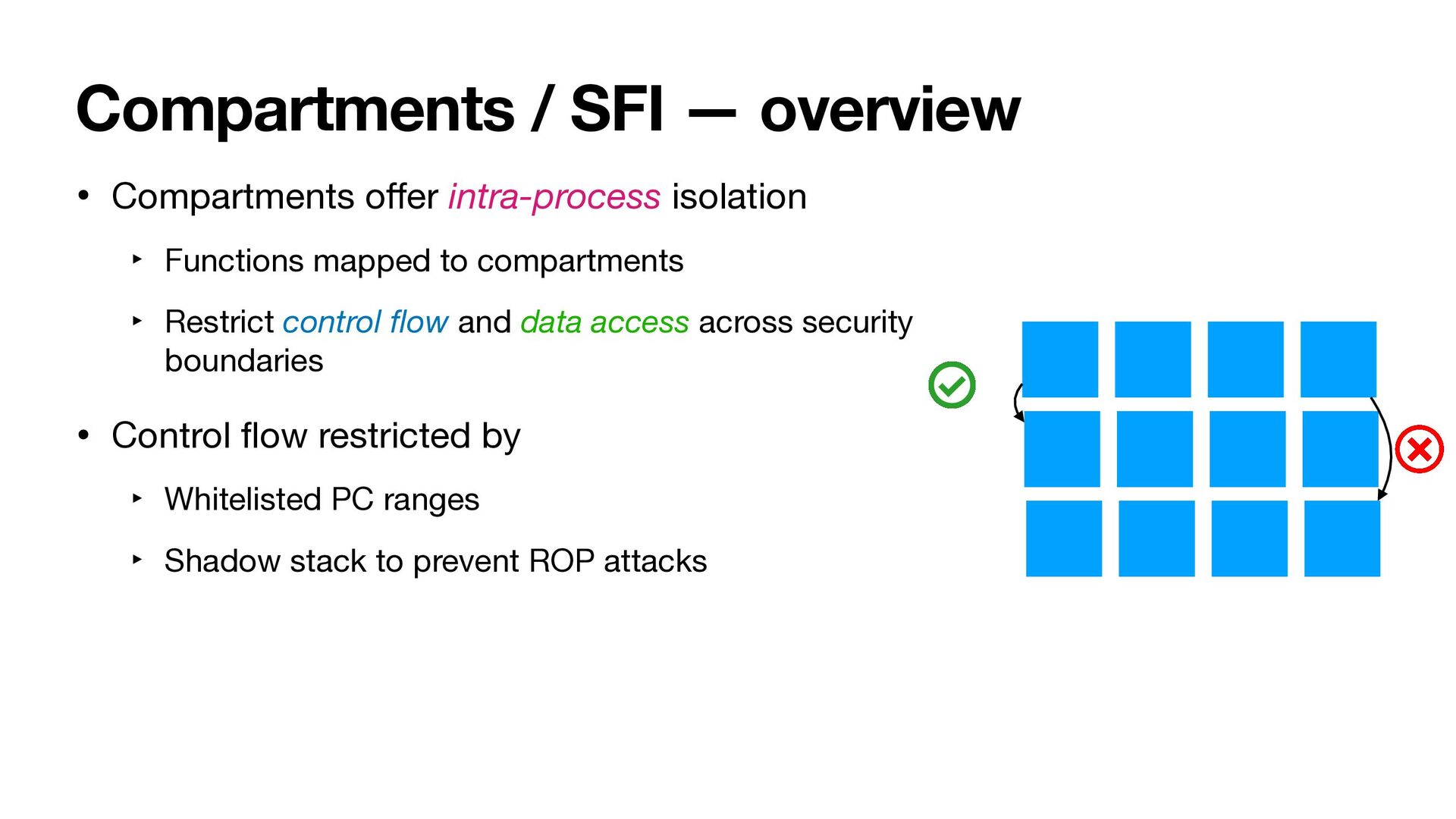
Compartments / SFI — overview • Compartments o ff er
intra-process isolation ‣ Functions mapped to compartments ‣ Restrict control fl ow and data access across security boundaries • Control fl ow restricted by ‣ Whitelisted PC ranges ‣ Shadow stack to prevent ROP attacks -
Compartments / SFI — overview • Compartments o ff er
intra-process isolation ‣ Functions mapped to compartments ‣ Restrict control fl ow and data access across security boundaries • Control fl ow restricted by ‣ Whitelisted PC ranges ‣ Shadow stack to prevent ROP attacks • Data access restricted by ‣ VMM tricks (or) fat pointers (or) capabilities (à la CHERI) -
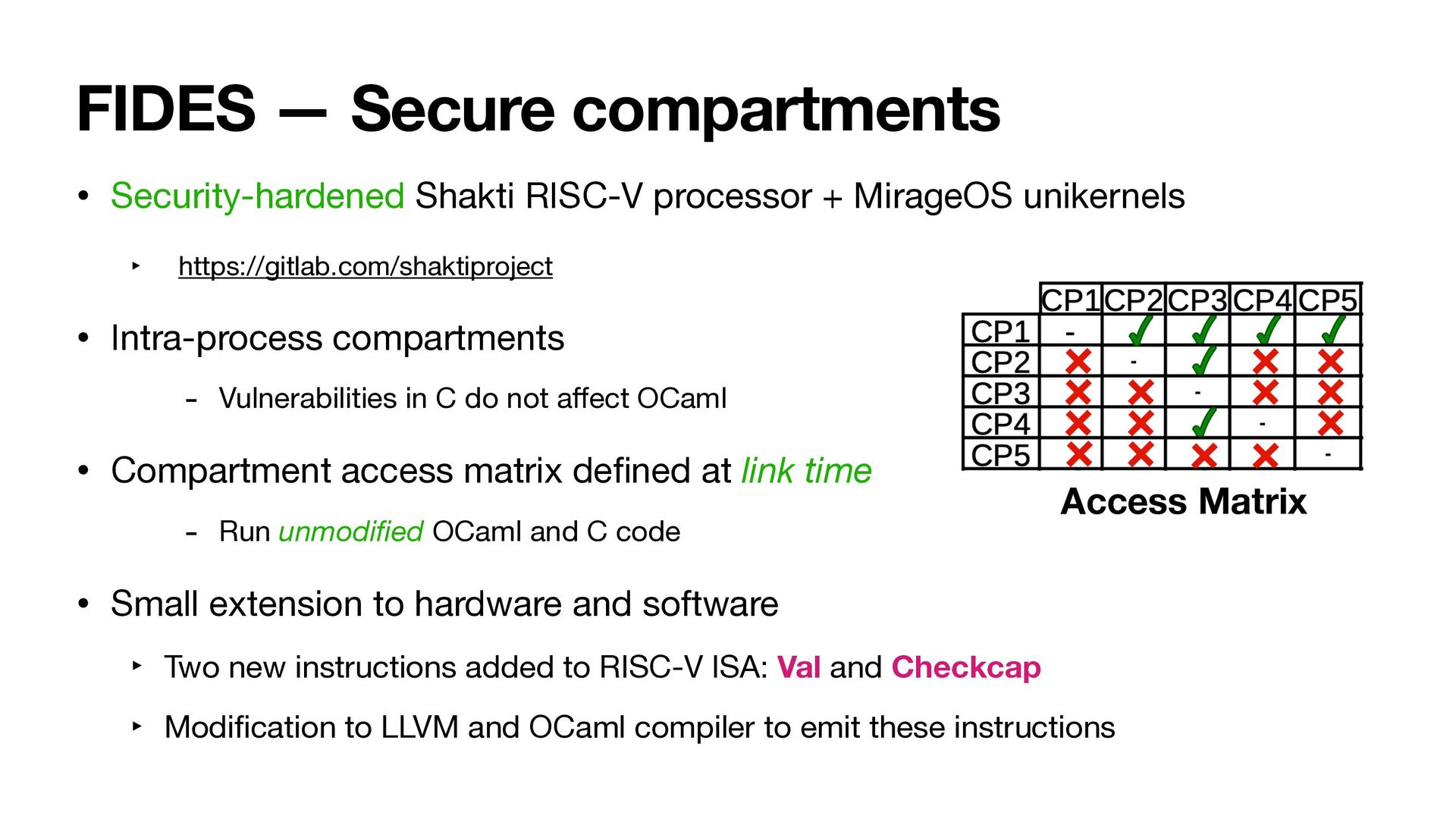
FIDES — Secure compartments • Security-hardened Shakti RISC-V processor +
MirageOS unikernels ‣ https://gitlab.com/shaktiproject -
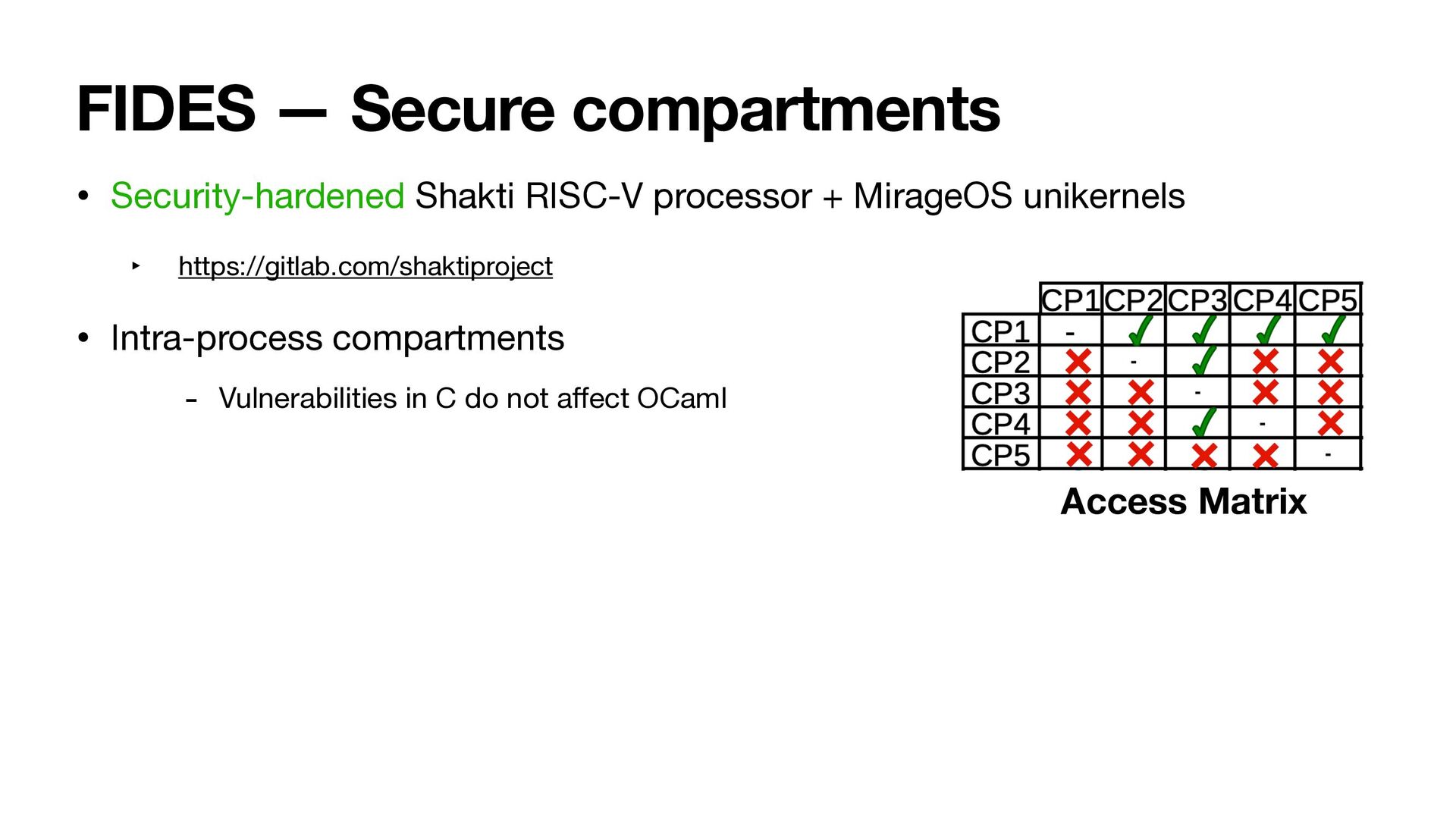
FIDES — Secure compartments • Security-hardened Shakti RISC-V processor +
MirageOS unikernels ‣ https://gitlab.com/shaktiproject • Intra-process compartments - Vulnerabilities in C do not a ff ect OCaml Access Matrix -
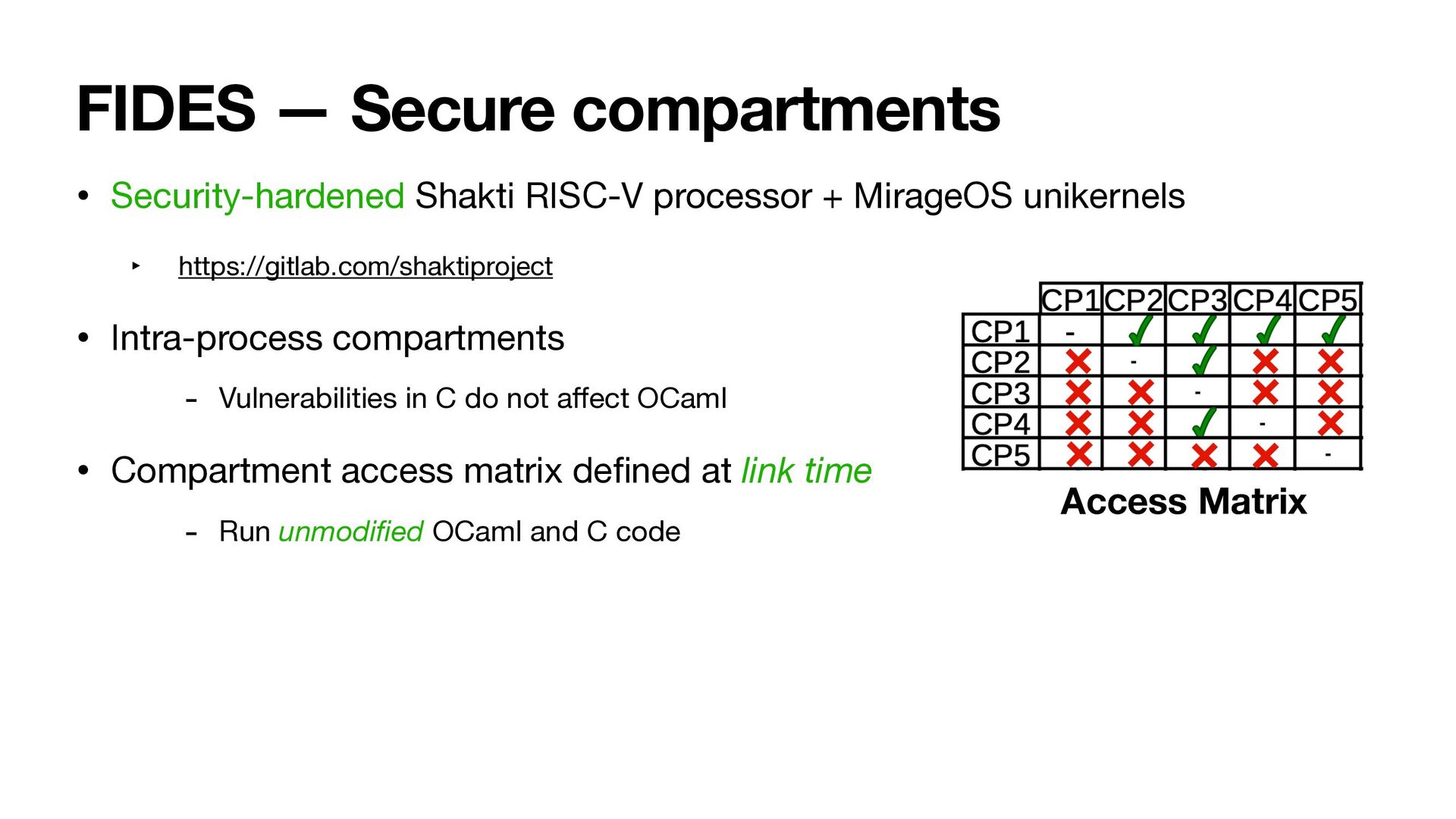
FIDES — Secure compartments • Security-hardened Shakti RISC-V processor +
MirageOS unikernels ‣ https://gitlab.com/shaktiproject • Intra-process compartments - Vulnerabilities in C do not a ff ect OCaml • Compartment access matrix de fi ned at link time - Run unmodi fi ed OCaml and C code Access Matrix -
FIDES — Secure compartments • Security-hardened Shakti RISC-V processor +
MirageOS unikernels ‣ https://gitlab.com/shaktiproject • Intra-process compartments - Vulnerabilities in C do not a ff ect OCaml • Compartment access matrix de fi ned at link time - Run unmodi fi ed OCaml and C code • Small extension to hardware and software ‣ Two new instructions added to RISC-V ISA: Val and Checkcap ‣ Modi fi cation to LLVM and OCaml compiler to emit these instructions Access Matrix -
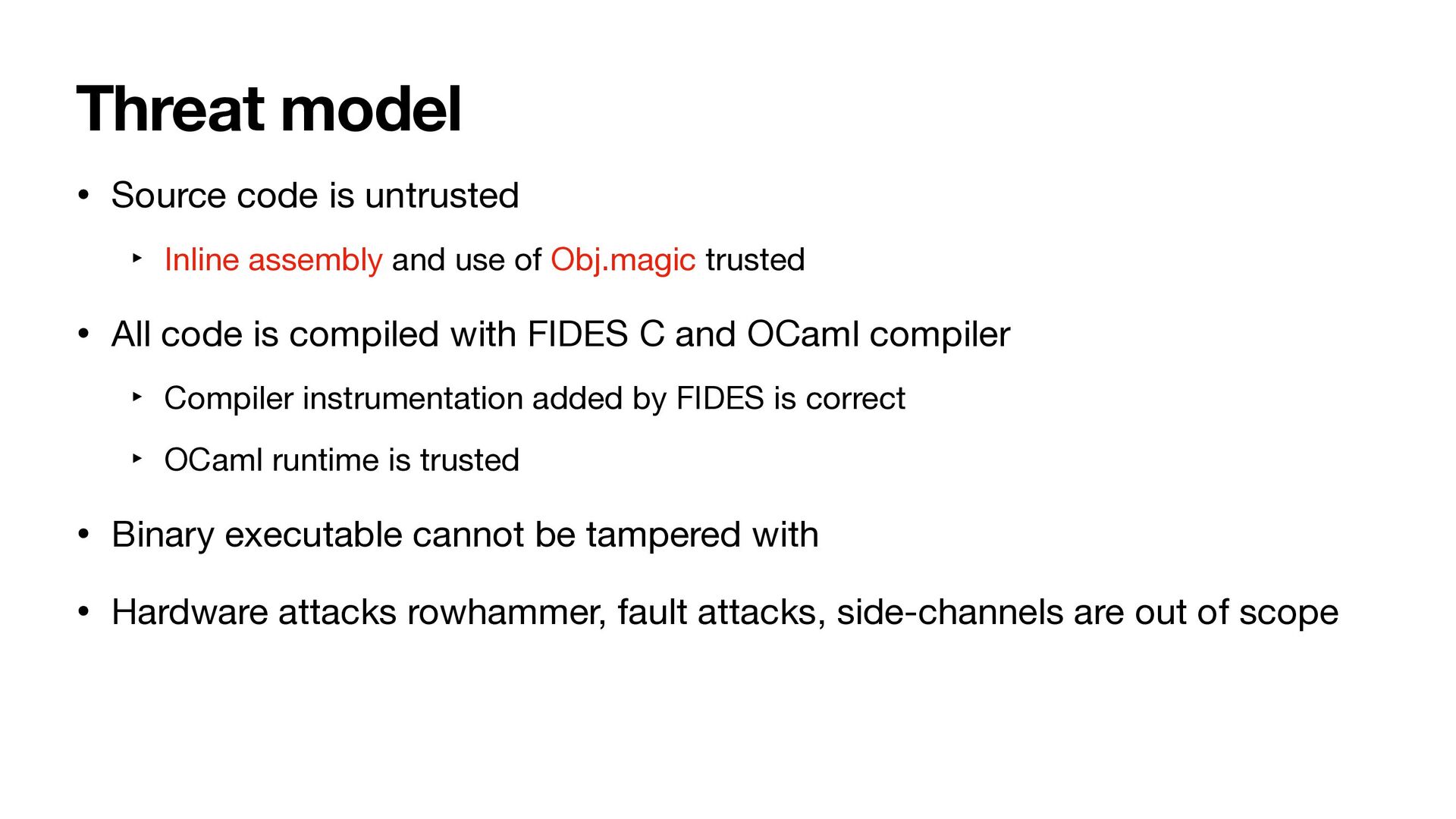
Threat model • Source code is untrusted ‣ Inline assembly
and use of Obj.magic trusted • All code is compiled with FIDES C and OCaml compiler ‣ Compiler instrumentation added by FIDES is correct ‣ OCaml runtime is trusted • Binary executable cannot be tampered with • Hardware attacks rowhammer, fault attacks, side-channels are out of scope -
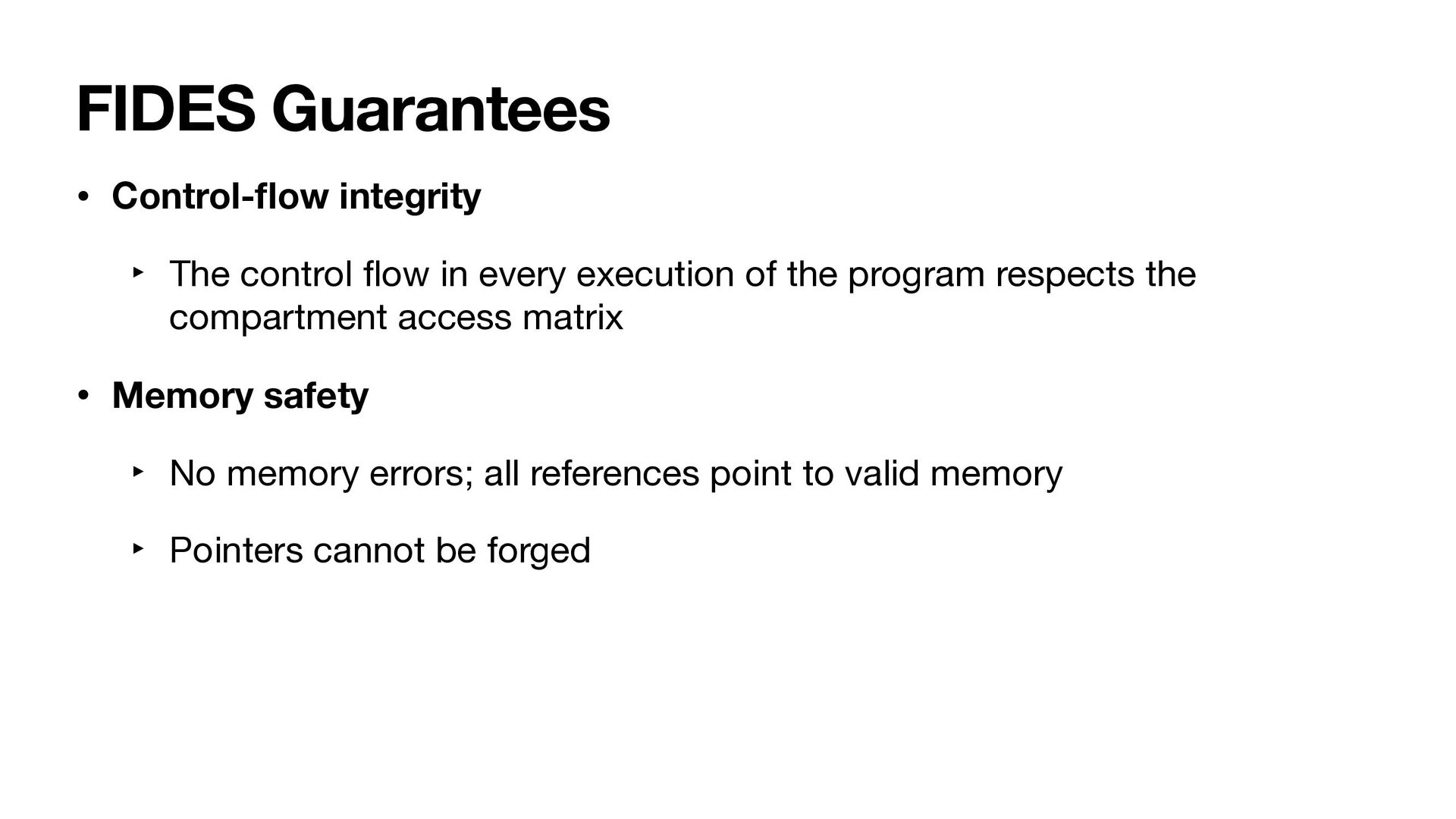
FIDES Guarantees • Control- fl ow integrity ‣ The control
fl ow in every execution of the program respects the compartment access matrix • Memory safety ‣ No memory errors; all references point to valid memory ‣ Pointers cannot be forged -
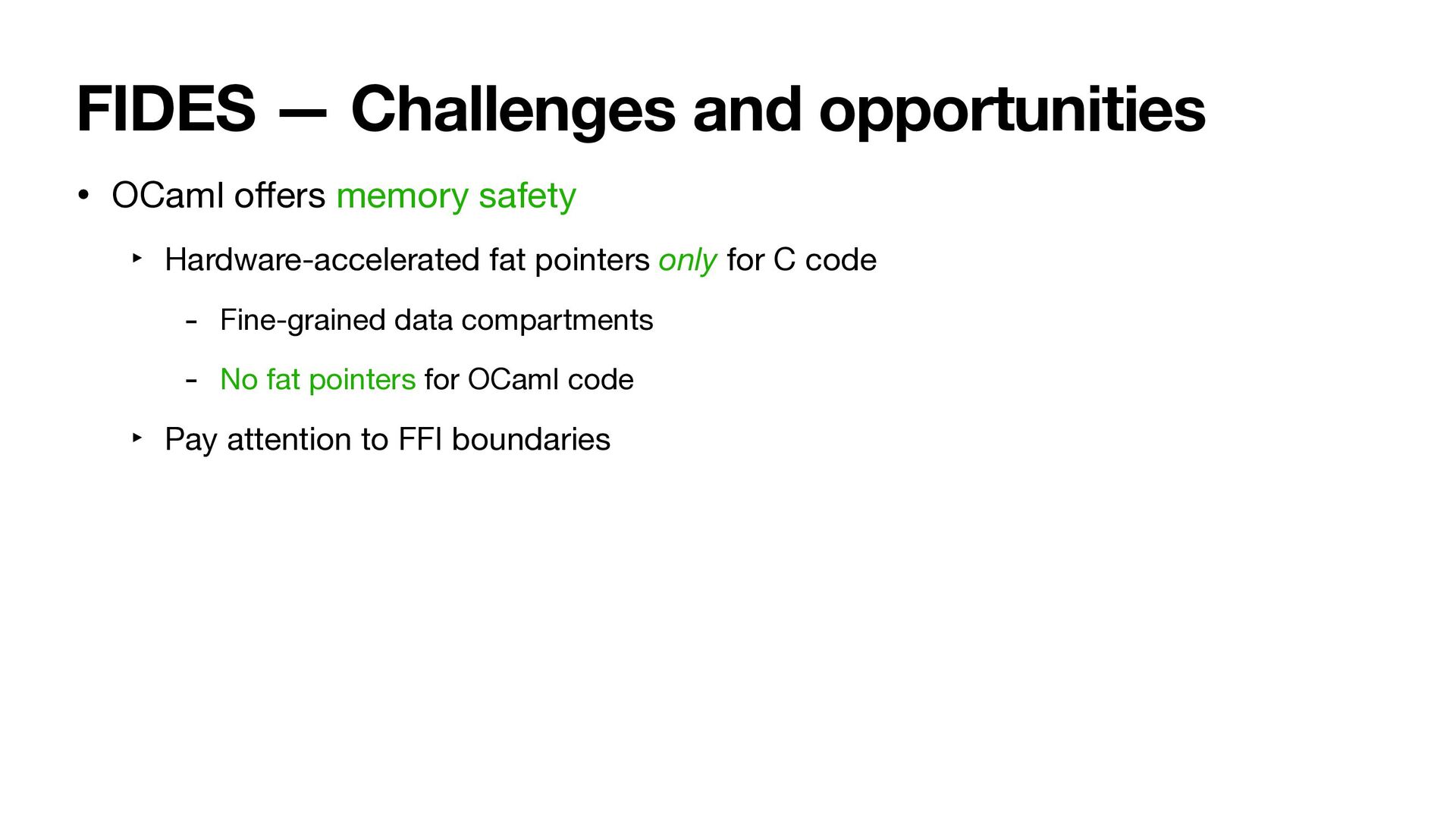
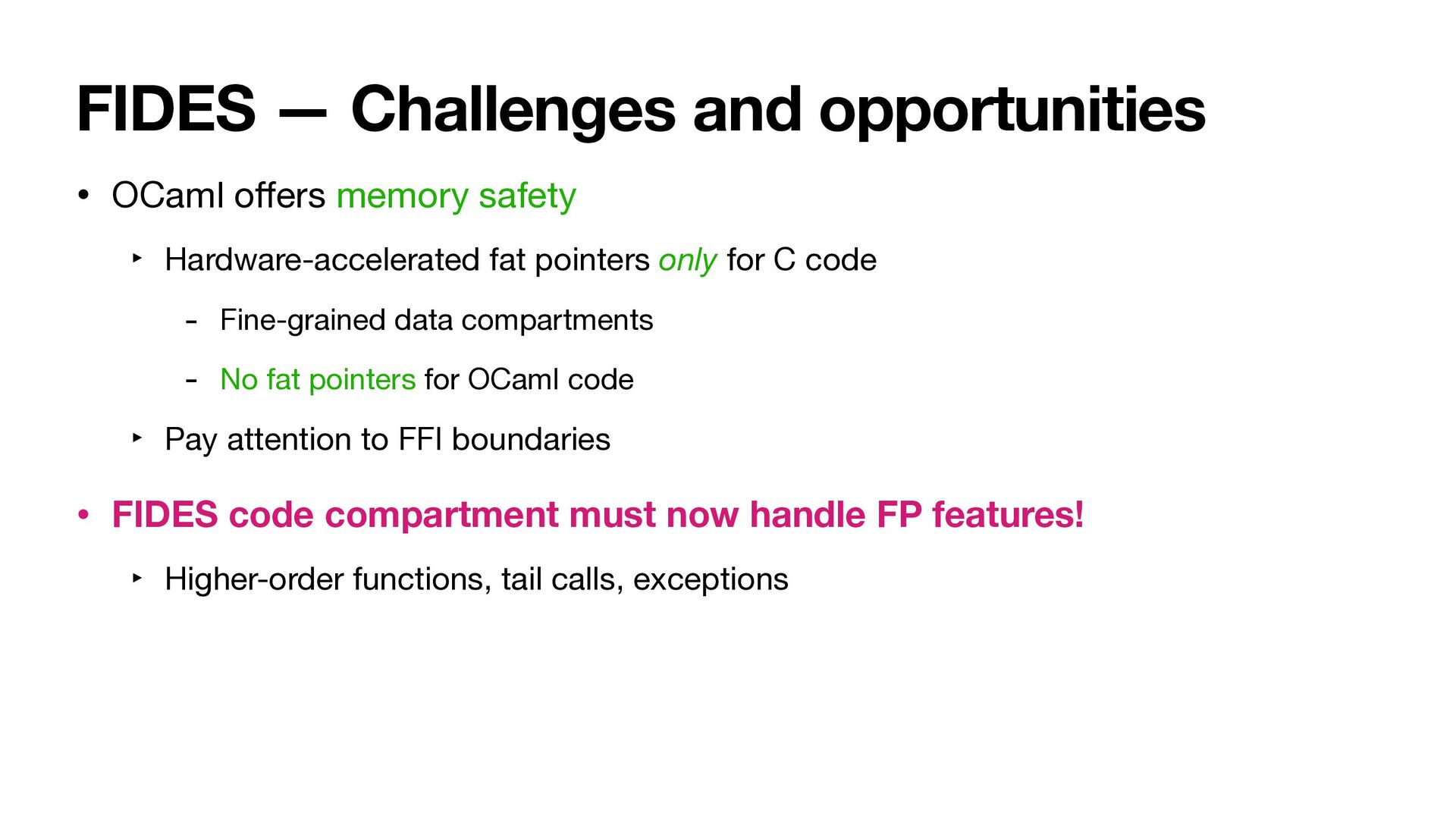
FIDES — Challenges and opportunities • OCaml o ff ers
memory safety ‣ Hardware-accelerated fat pointers only for C code - Fine-grained data compartments - No fat pointers for OCaml code ‣ Pay attention to FFI boundaries -
FIDES — Challenges and opportunities • OCaml o ff ers
memory safety ‣ Hardware-accelerated fat pointers only for C code - Fine-grained data compartments - No fat pointers for OCaml code ‣ Pay attention to FFI boundaries • FIDES code compartment must now handle FP features! ‣ Higher-order functions, tail calls, exceptions -
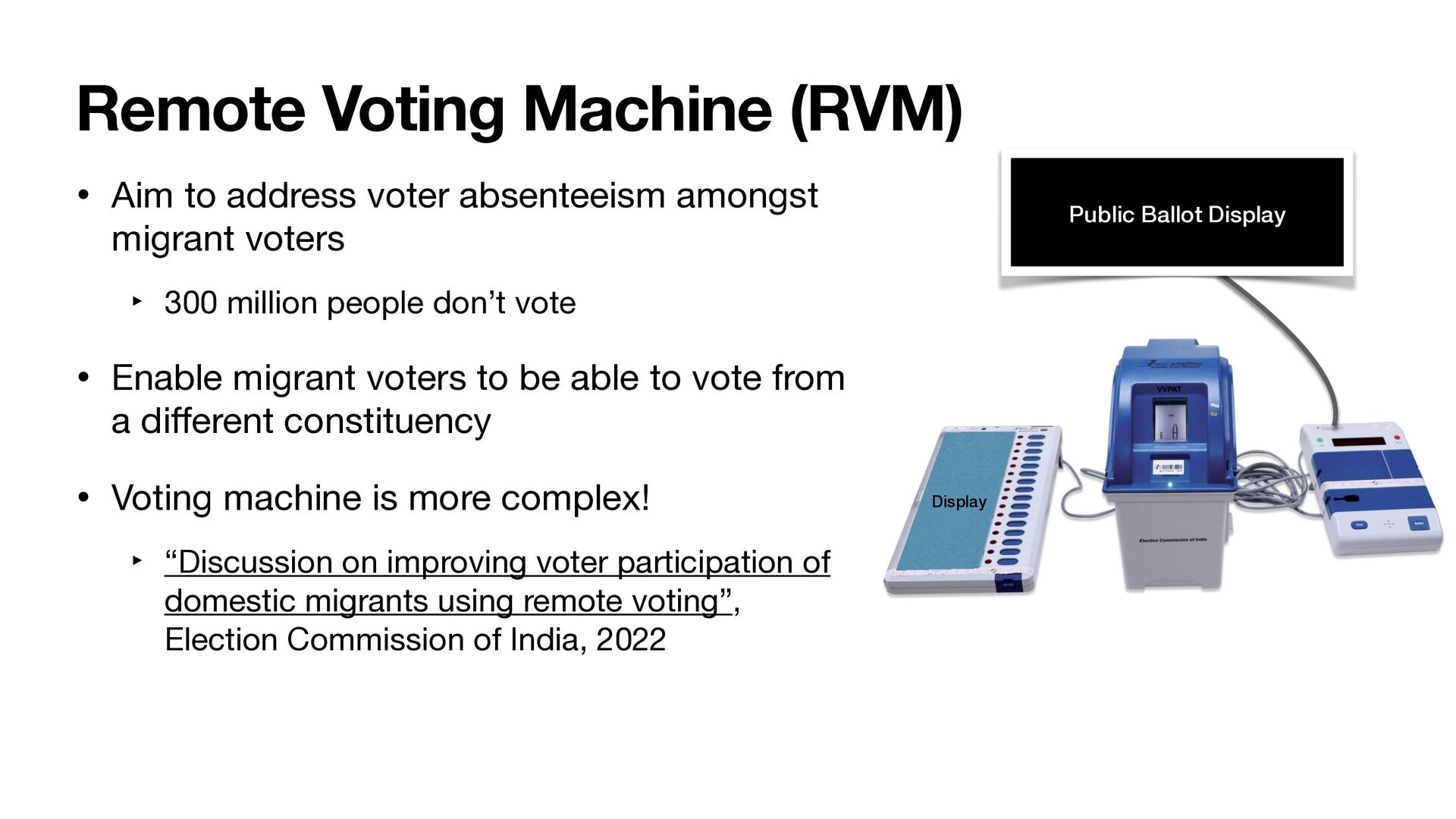
Remote Voting Machine (RVM) • Aim to address voter absenteeism
amongst migrant voters ‣ 300 million people don’t vote • Enable migrant voters to be able to vote from a di ff erent constituency • Voting machine is more complex! ‣ “Discussion on improving voter participation of domestic migrants using remote voting”, Election Commission of India, 2022 Display Public Ballot Display -
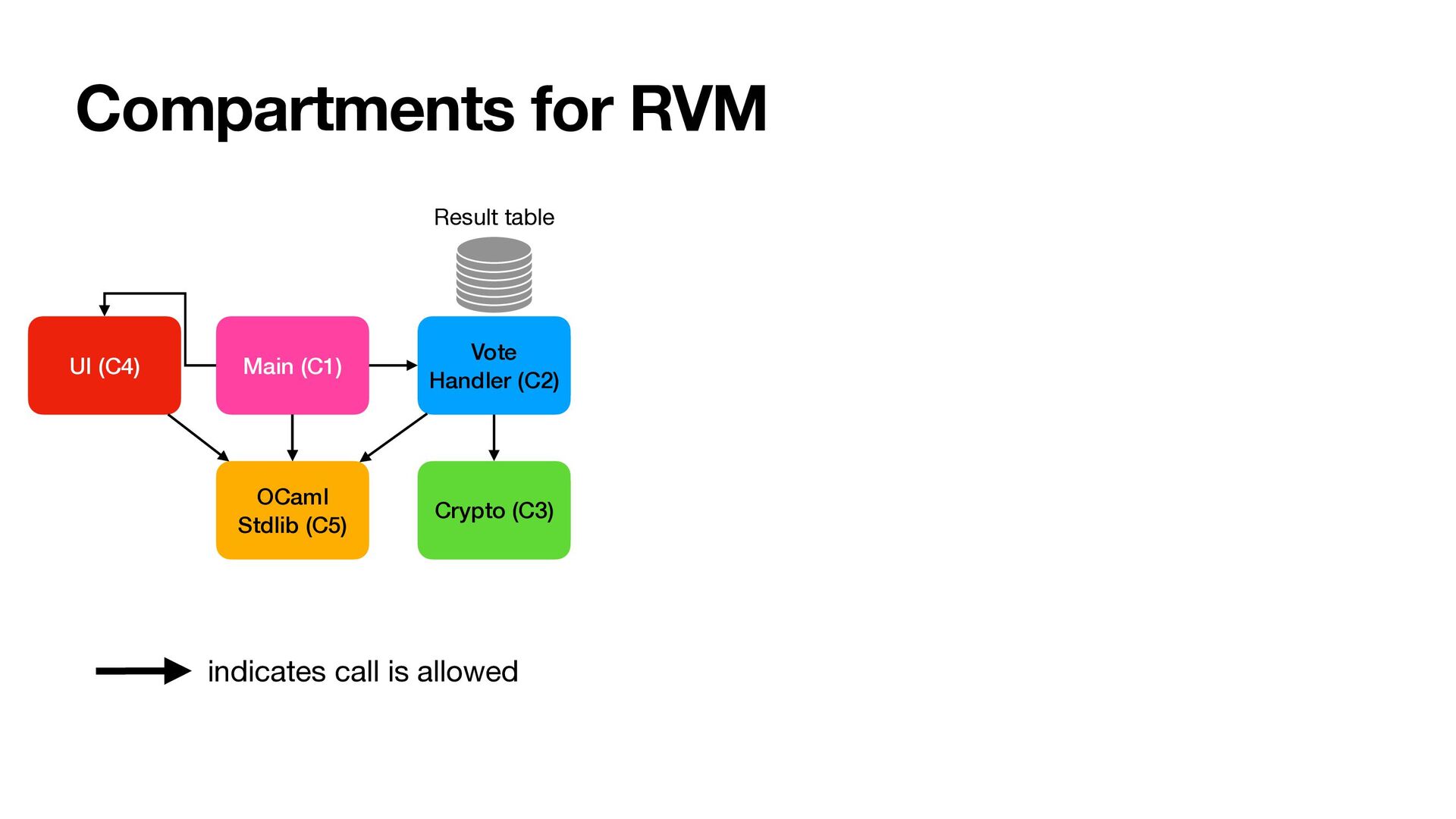
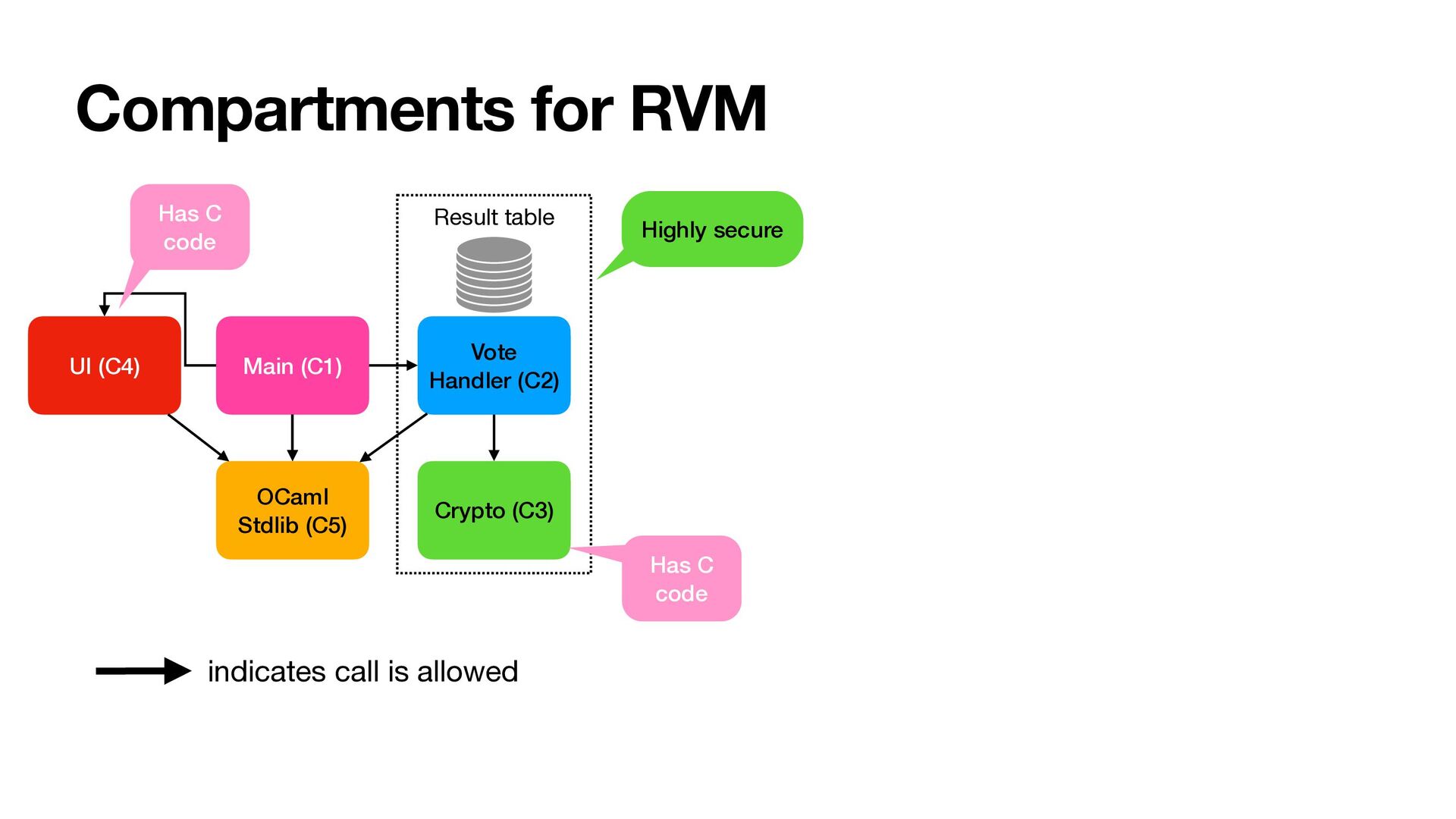
Compartments for RVM OCaml Stdlib (C5) Crypto (C3) Vote Handler
(C2) UI (C4) Result table Main (C1) indicates call is allowed -
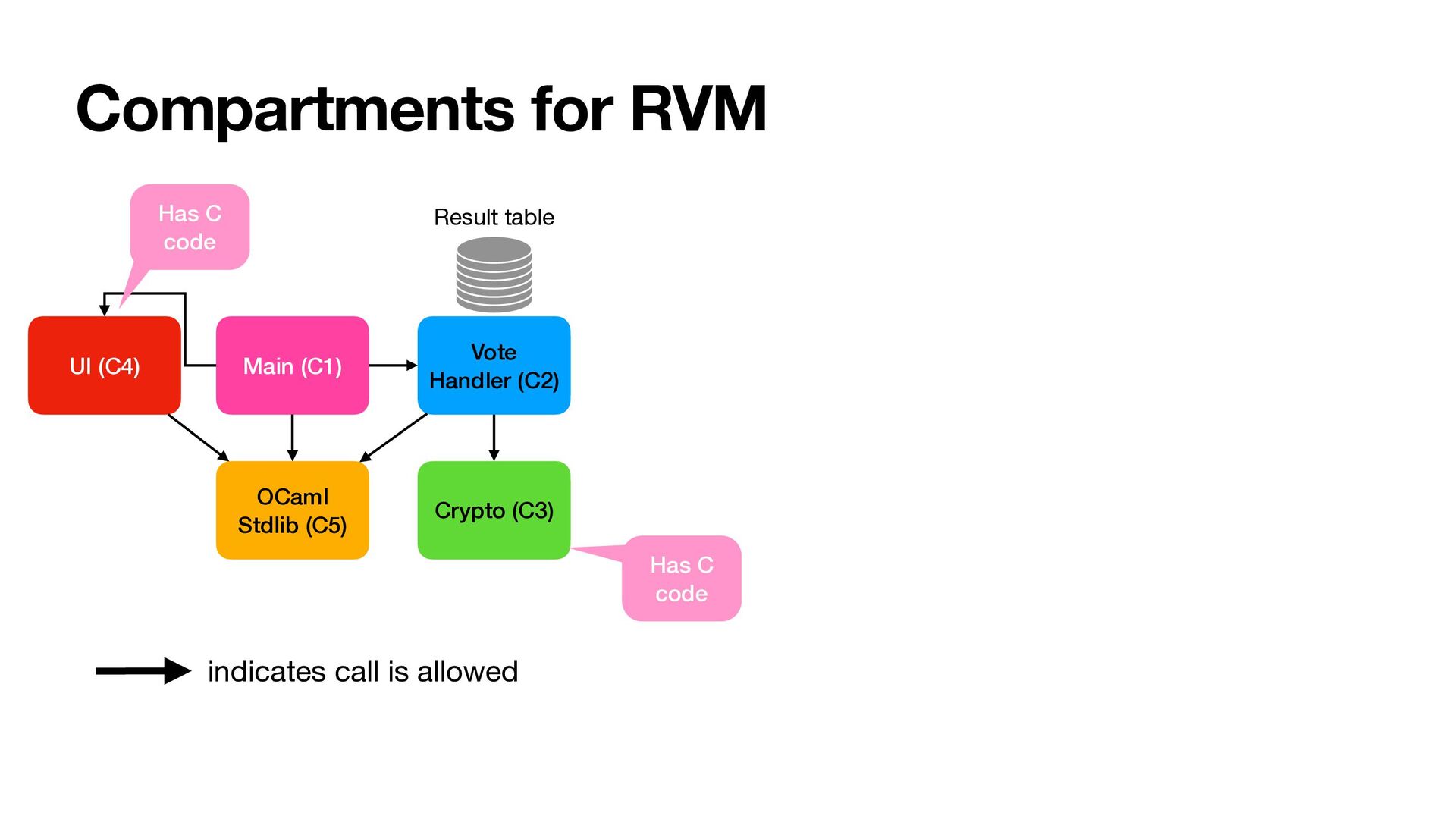
Compartments for RVM OCaml Stdlib (C5) Crypto (C3) Vote Handler
(C2) UI (C4) Result table Main (C1) indicates call is allowed Has C code Has C code -
Compartments for RVM OCaml Stdlib (C5) Crypto (C3) Vote Handler
(C2) UI (C4) Result table Main (C1) indicates call is allowed Highly secure Has C code Has C code -
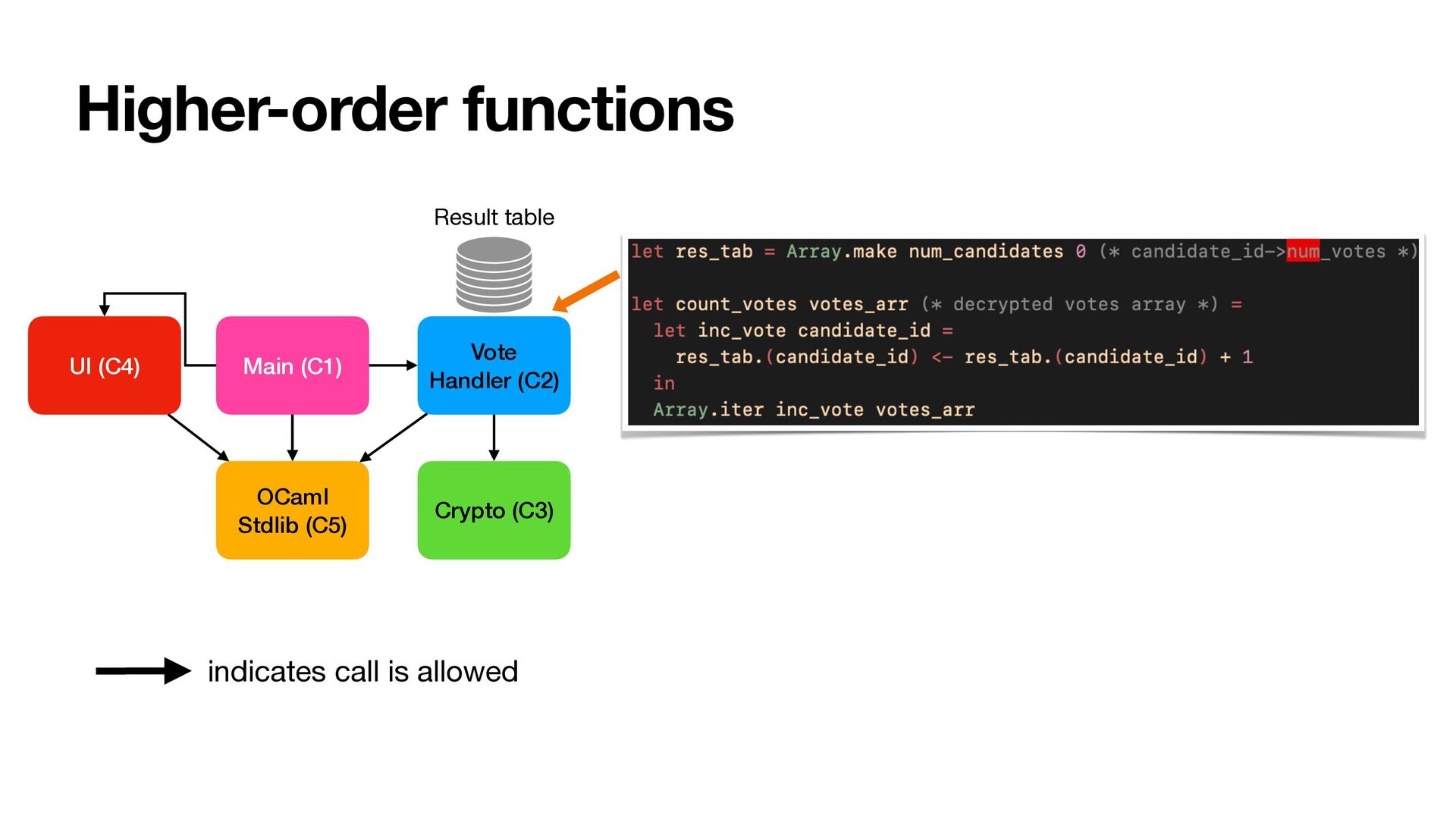
Higher-order functions OCaml Stdlib (C5) Crypto (C3) Vote Handler (C2)
UI (C4) Result table Main (C1) indicates call is allowed -
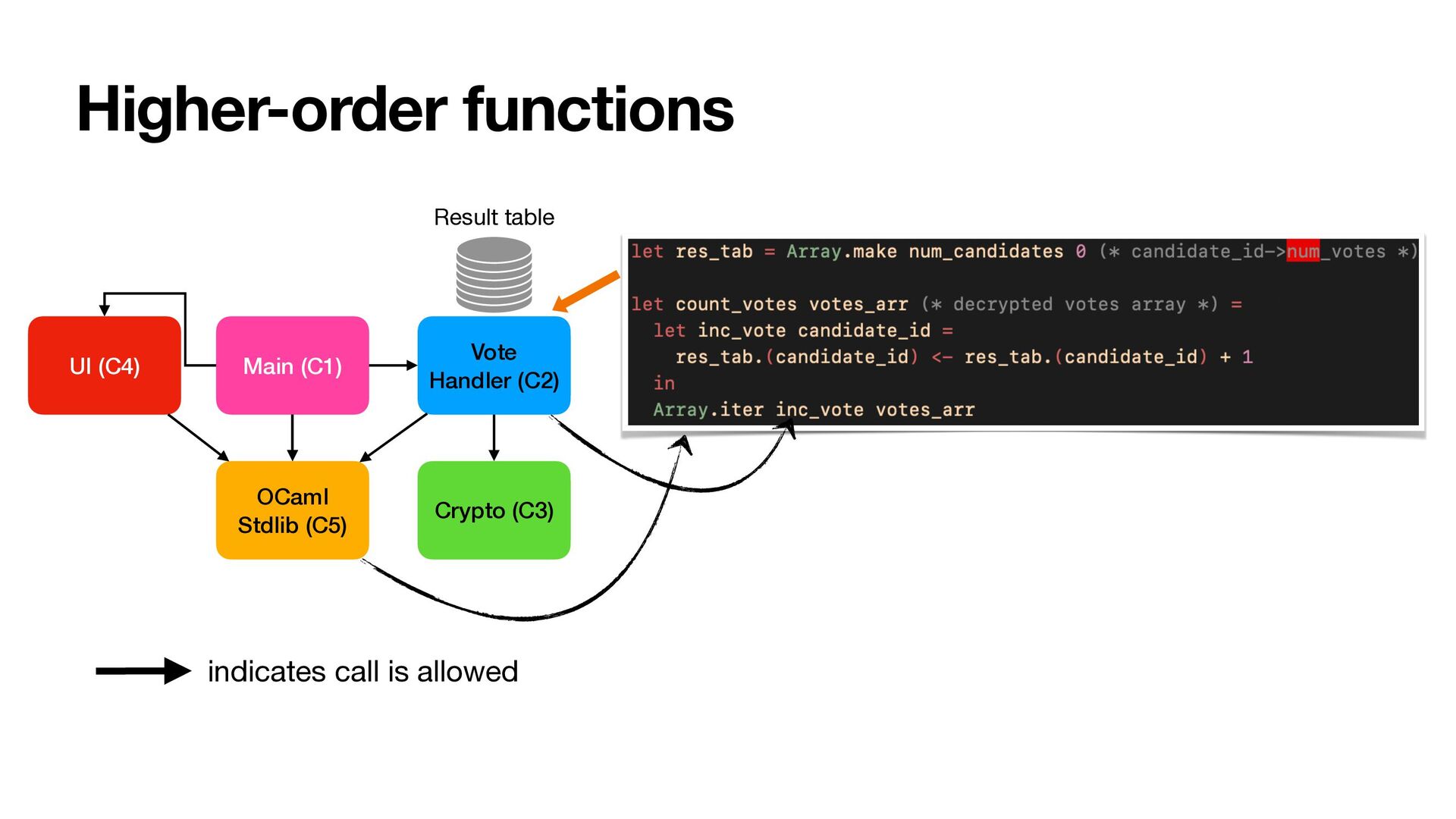
Higher-order functions OCaml Stdlib (C5) Crypto (C3) Vote Handler (C2)
UI (C4) Result table Main (C1) indicates call is allowed -
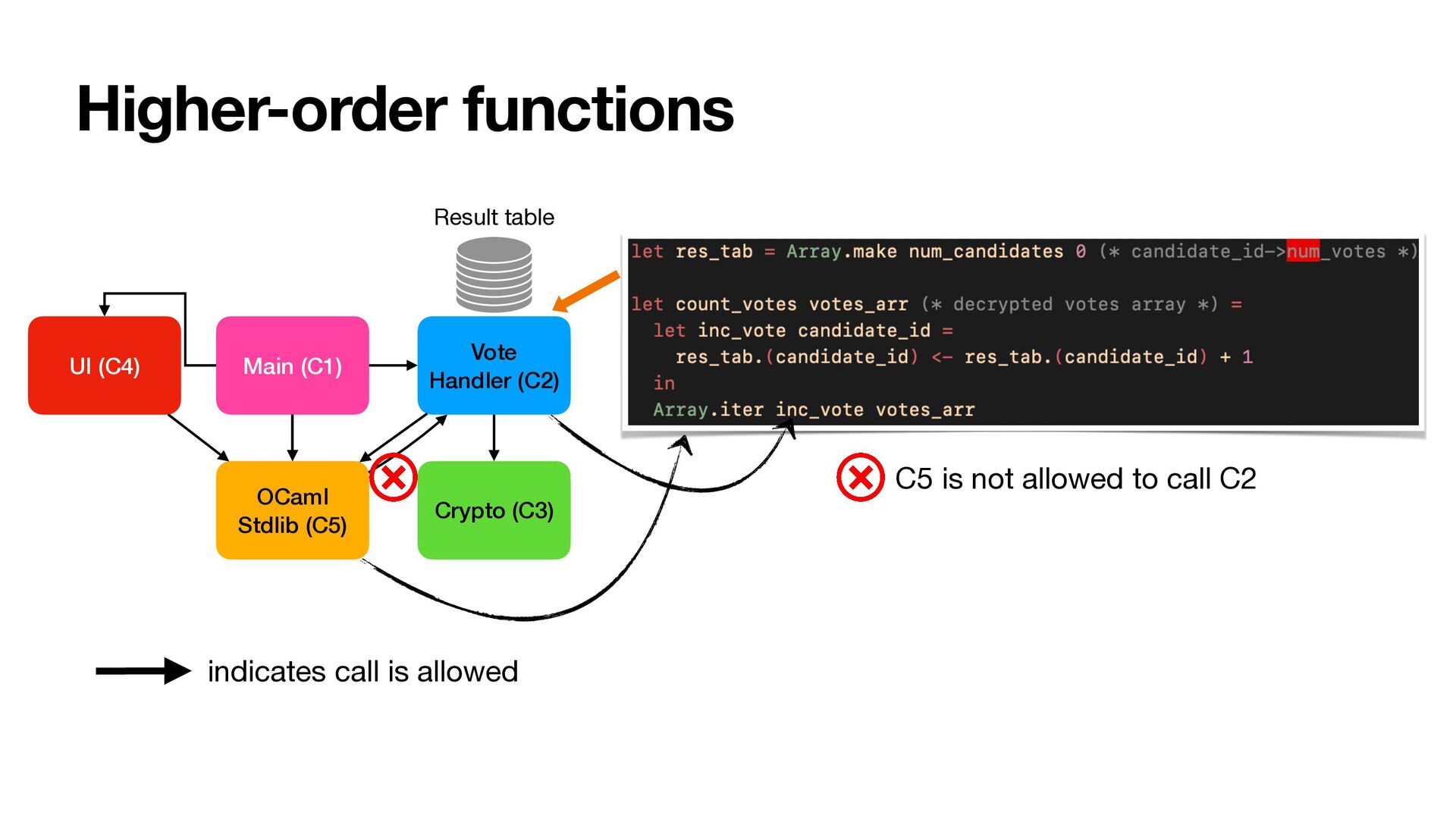
Higher-order functions OCaml Stdlib (C5) Crypto (C3) Vote Handler (C2)
UI (C4) Result table Main (C1) indicates call is allowed C5 is not allowed to call C2 -
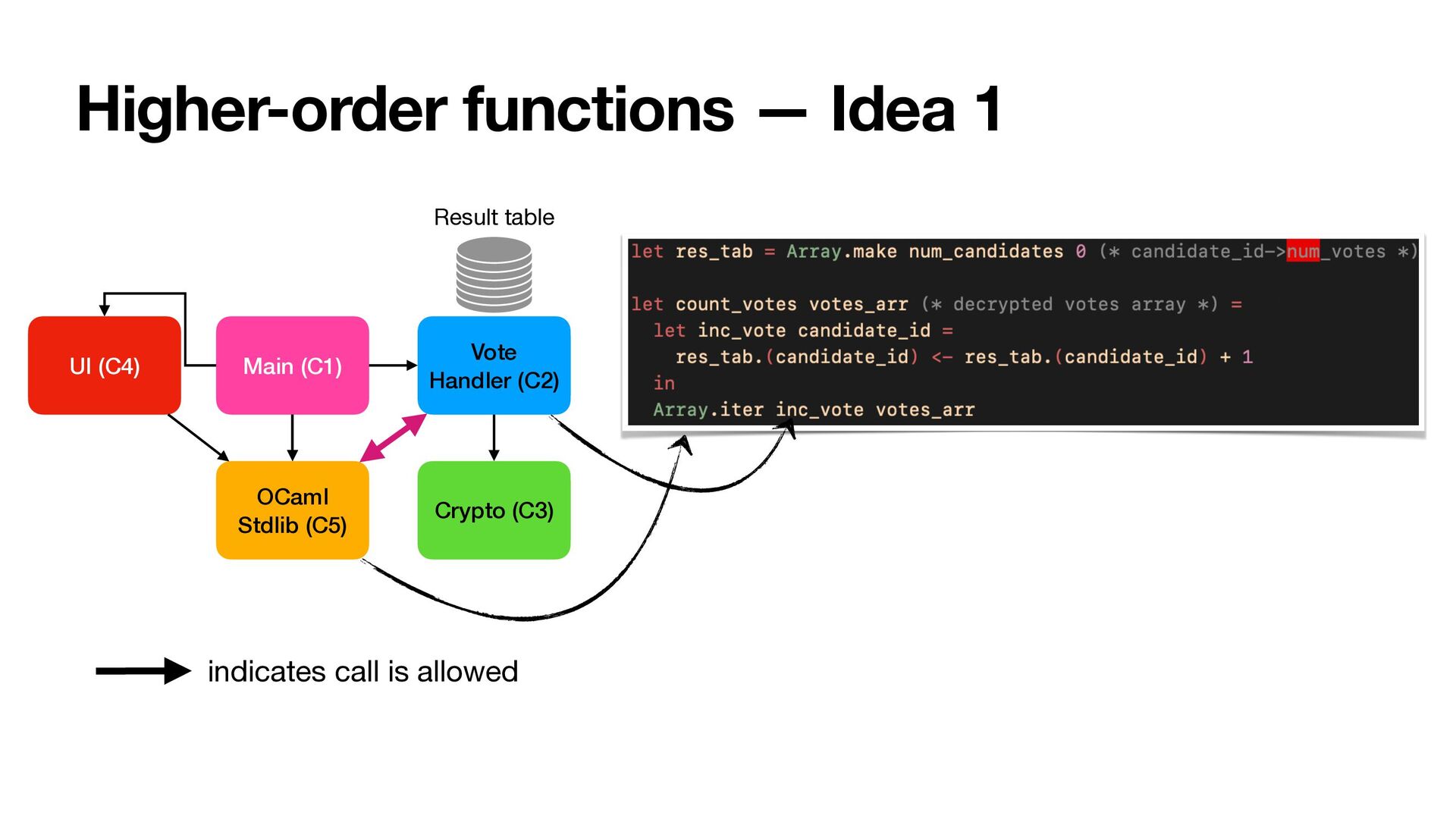
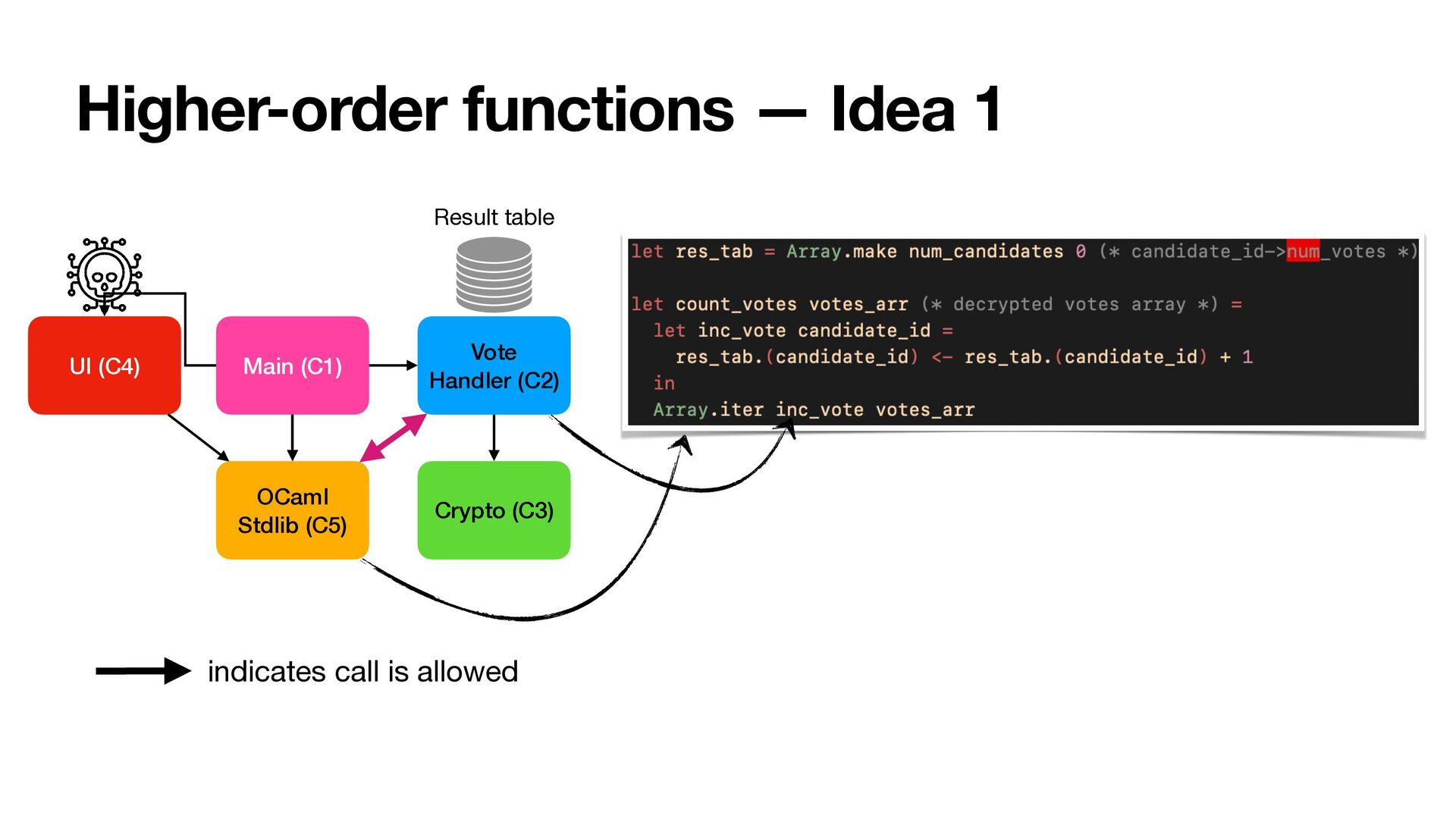
Higher-order functions — Idea 1 OCaml Stdlib (C5) Crypto (C3)
Vote Handler (C2) UI (C4) Result table Main (C1) indicates call is allowed -
Higher-order functions — Idea 1 OCaml Stdlib (C5) Crypto (C3)
Vote Handler (C2) UI (C4) Result table Main (C1) indicates call is allowed -
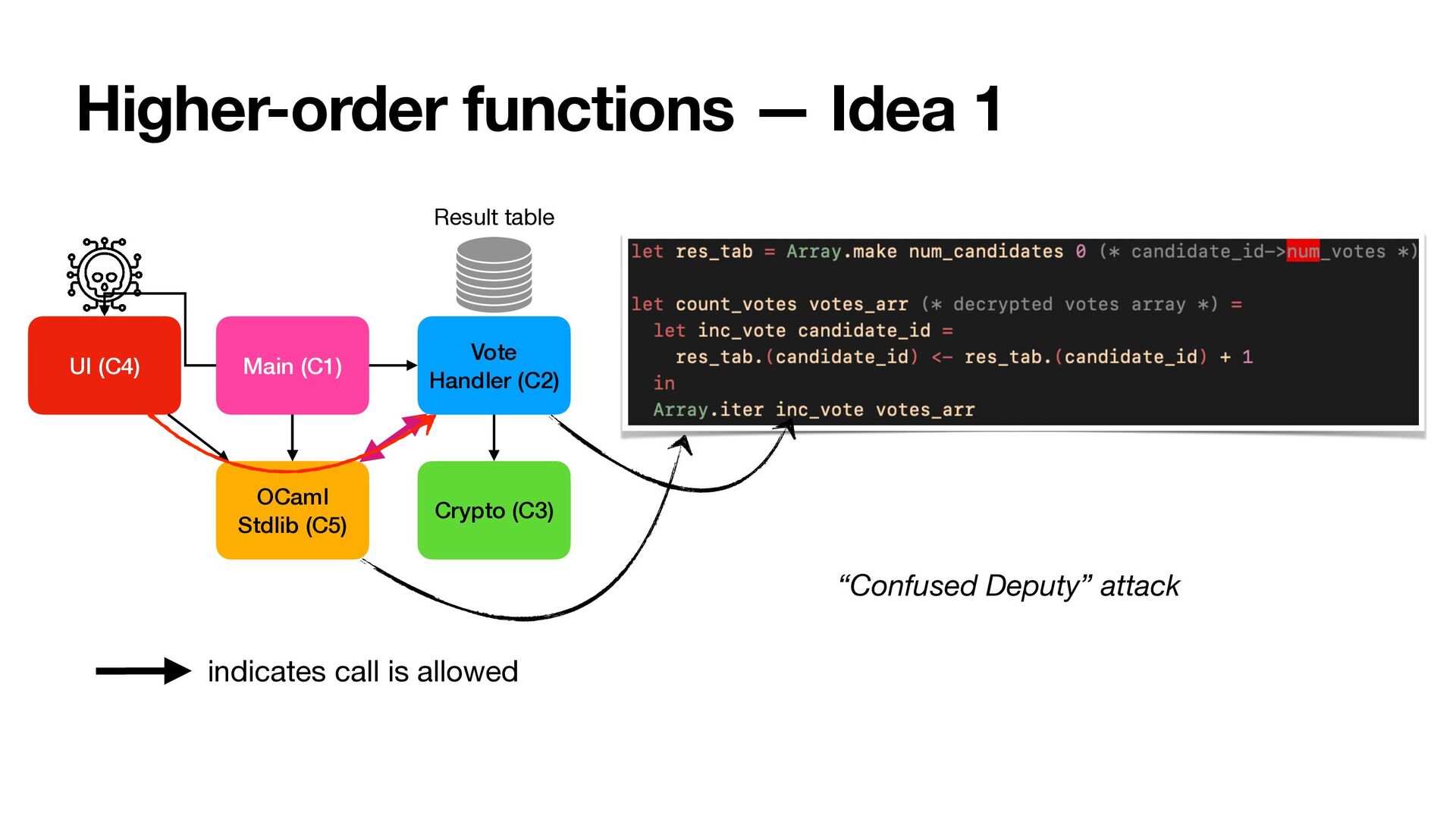
Higher-order functions — Idea 1 OCaml Stdlib (C5) Crypto (C3)
Vote Handler (C2) UI (C4) Result table Main (C1) indicates call is allowed “Confused Deputy” attack -
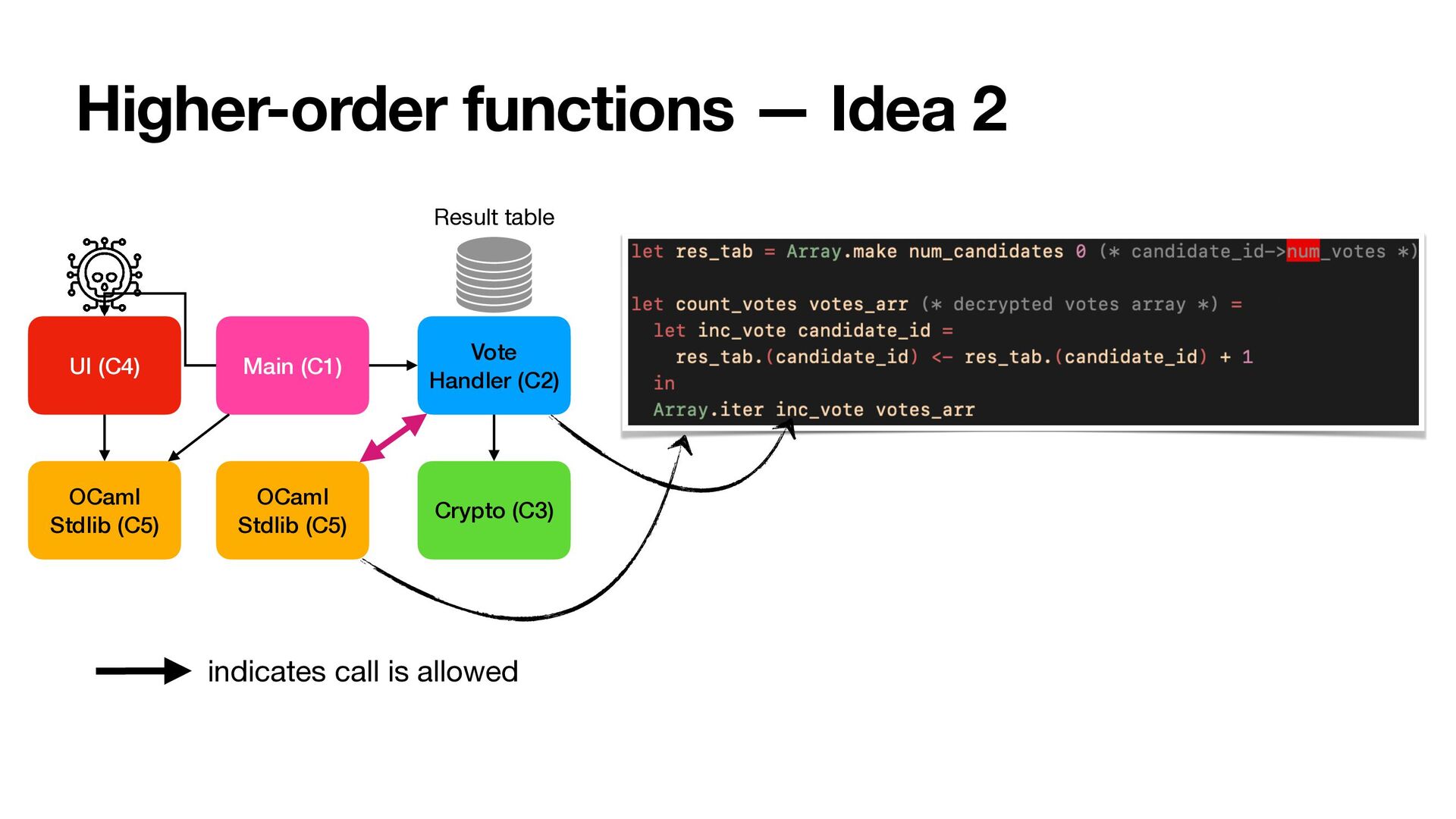
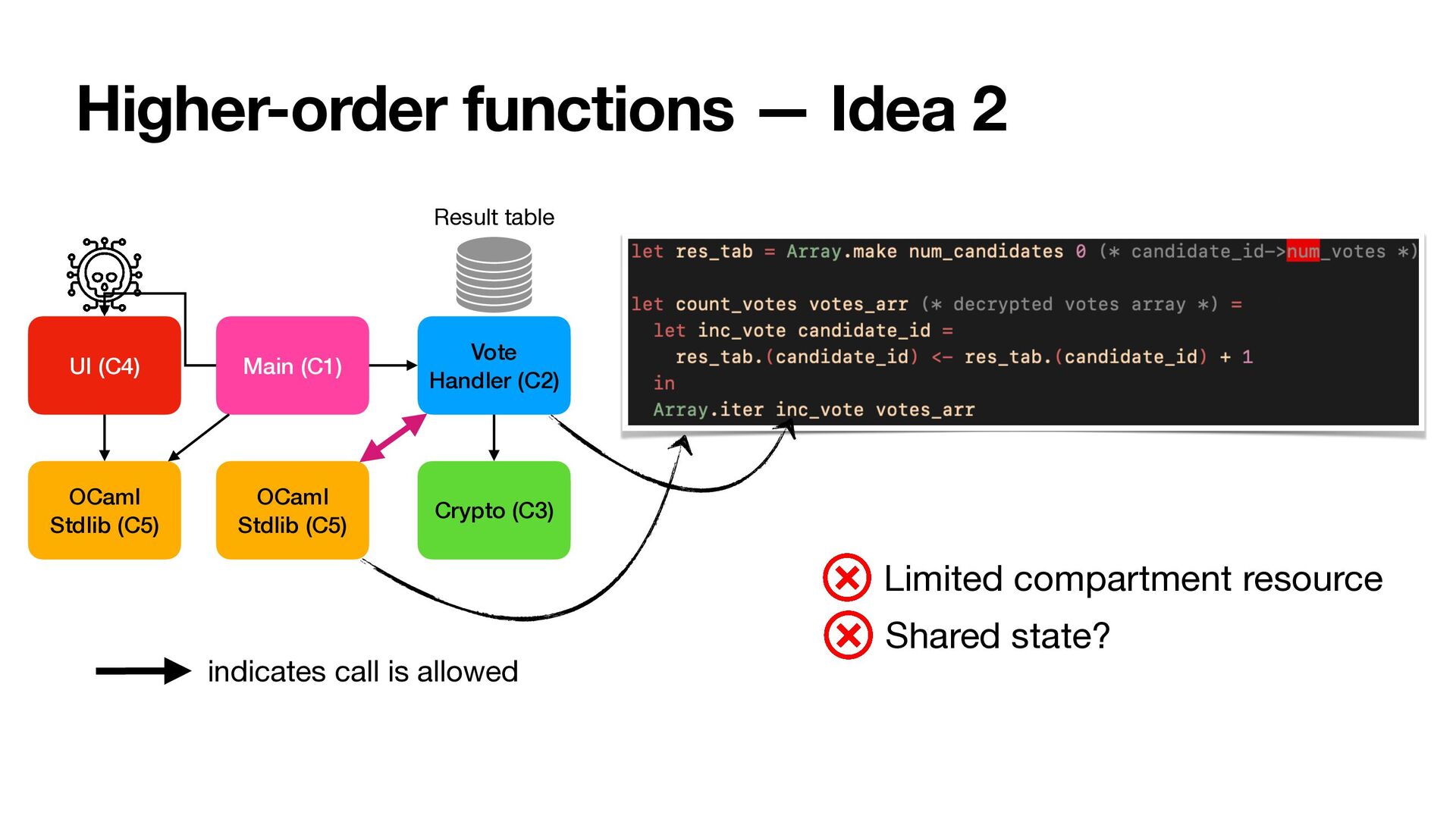
Higher-order functions — Idea 2 OCaml Stdlib (C5) Crypto (C3)
Vote Handler (C2) UI (C4) Result table Main (C1) indicates call is allowed OCaml Stdlib (C5) -
Higher-order functions — Idea 2 OCaml Stdlib (C5) Crypto (C3)
Vote Handler (C2) UI (C4) Result table Main (C1) indicates call is allowed OCaml Stdlib (C5) Limited compartment resource Shared state? -
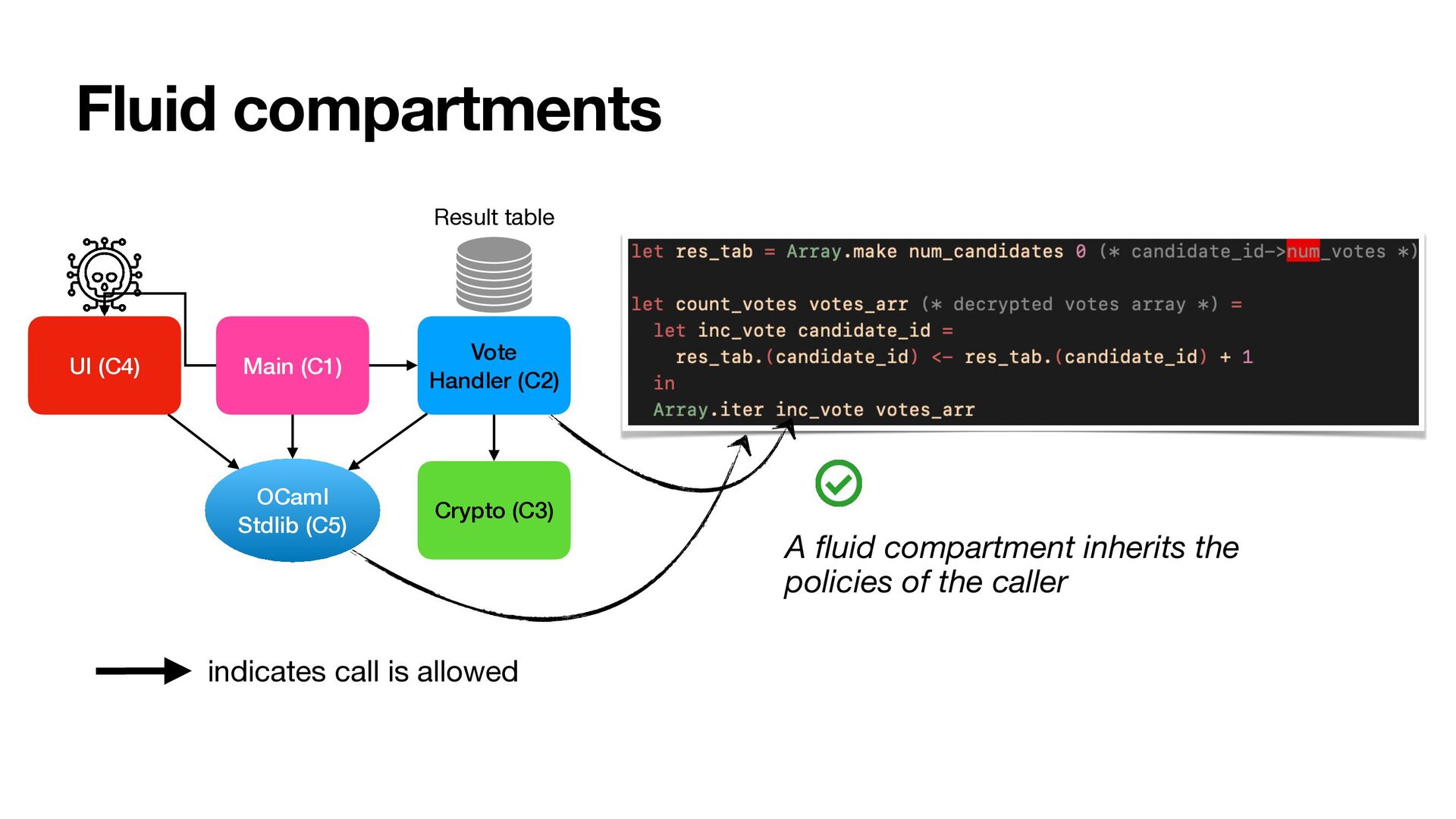
Fluid compartments Crypto (C3) Vote Handler (C2) UI (C4) Result
table Main (C1) indicates call is allowed OCaml Stdlib (C5) A fl uid compartment inherits the policies of the caller -
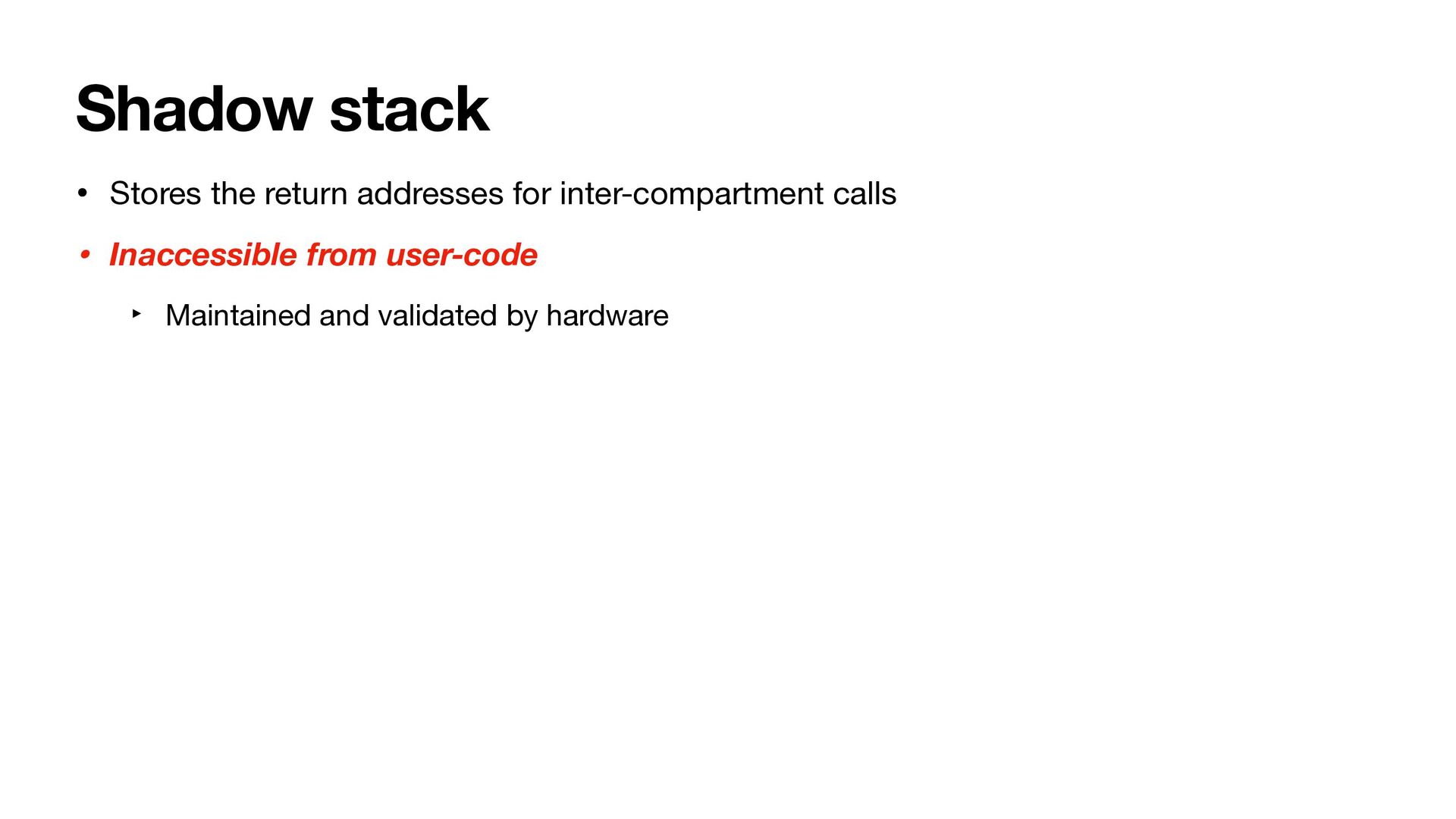
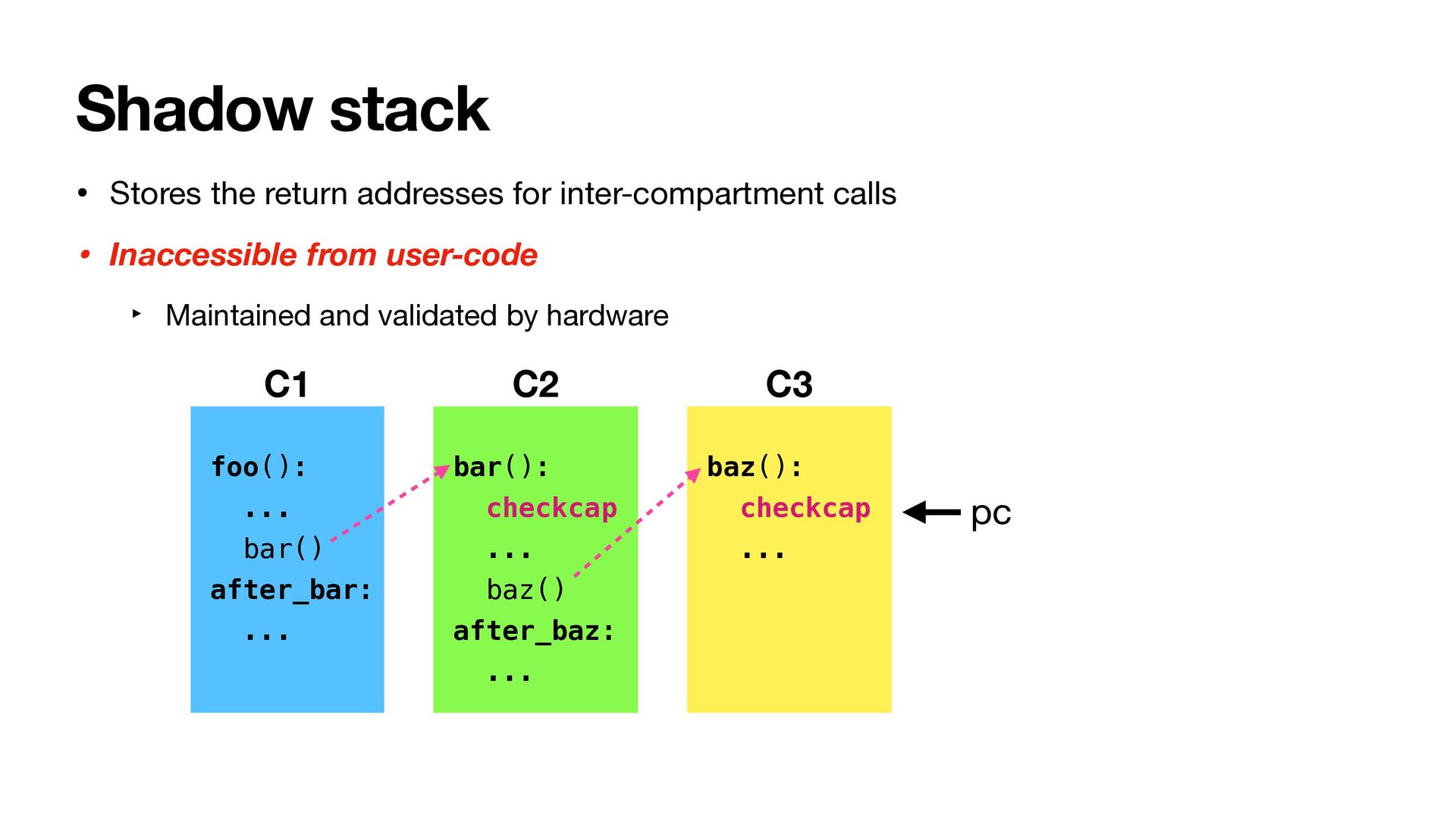
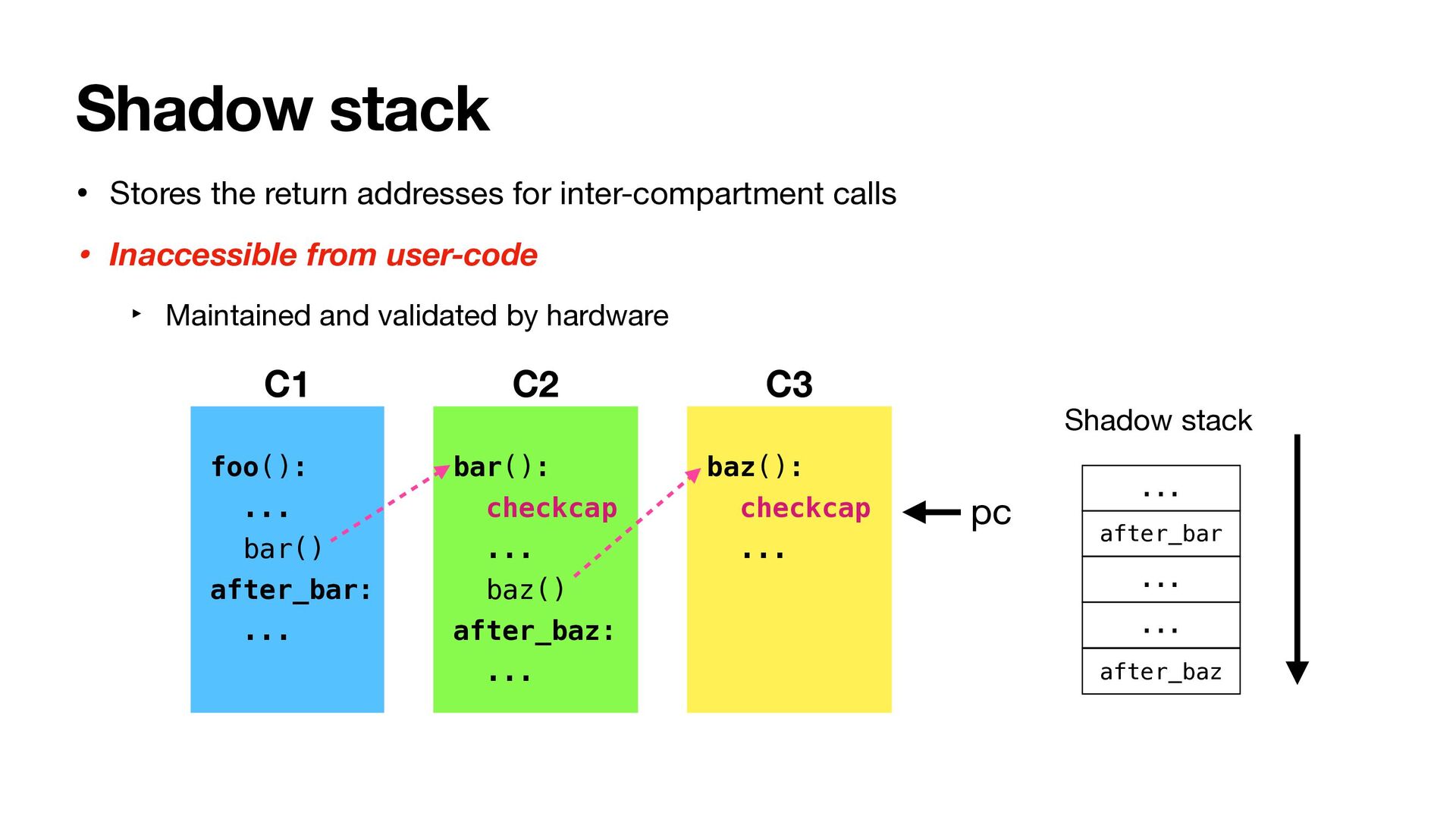
Shadow stack • Stores the return addresses for inter-compartment calls
• Inaccessible from user-code ‣ Maintained and validated by hardware -
Shadow stack • Stores the return addresses for inter-compartment calls
• Inaccessible from user-code ‣ Maintained and validated by hardware foo(): ... bar() after_bar: ... bar(): checkcap ... baz() after_baz: ... baz(): checkcap ... C1 C2 C3 pc -
Shadow stack • Stores the return addresses for inter-compartment calls
• Inaccessible from user-code ‣ Maintained and validated by hardware foo(): ... bar() after_bar: ... bar(): checkcap ... baz() after_baz: ... baz(): checkcap ... C1 C2 C3 ... after_baz ... Shadow stack after_bar ... pc -
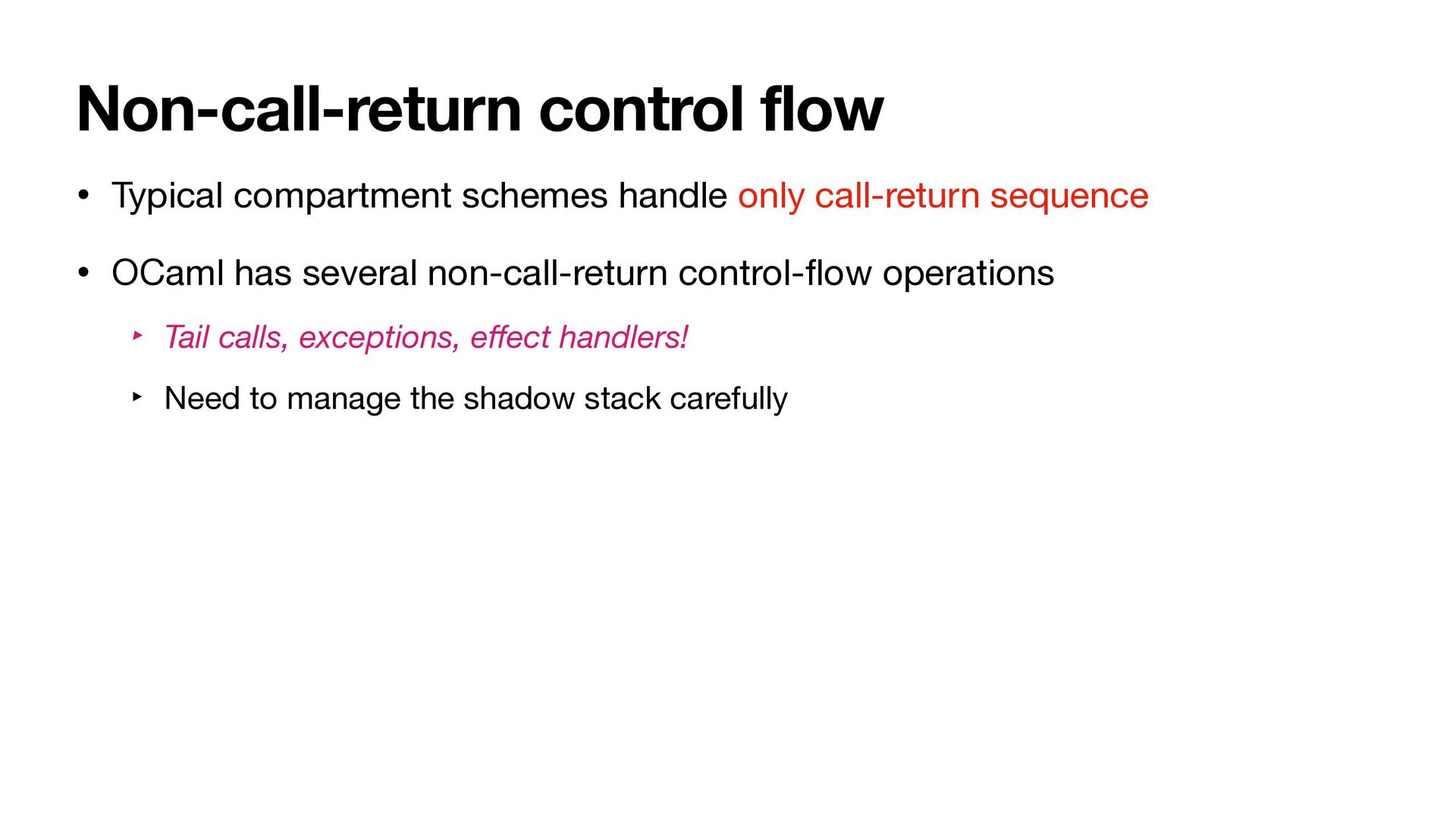
Non-call-return control flow • Typical compartment schemes handle only call-return
sequence • OCaml has several non-call-return control- fl ow operations ‣ Tail calls, exceptions, e ff ect handlers! ‣ Need to manage the shadow stack carefully -
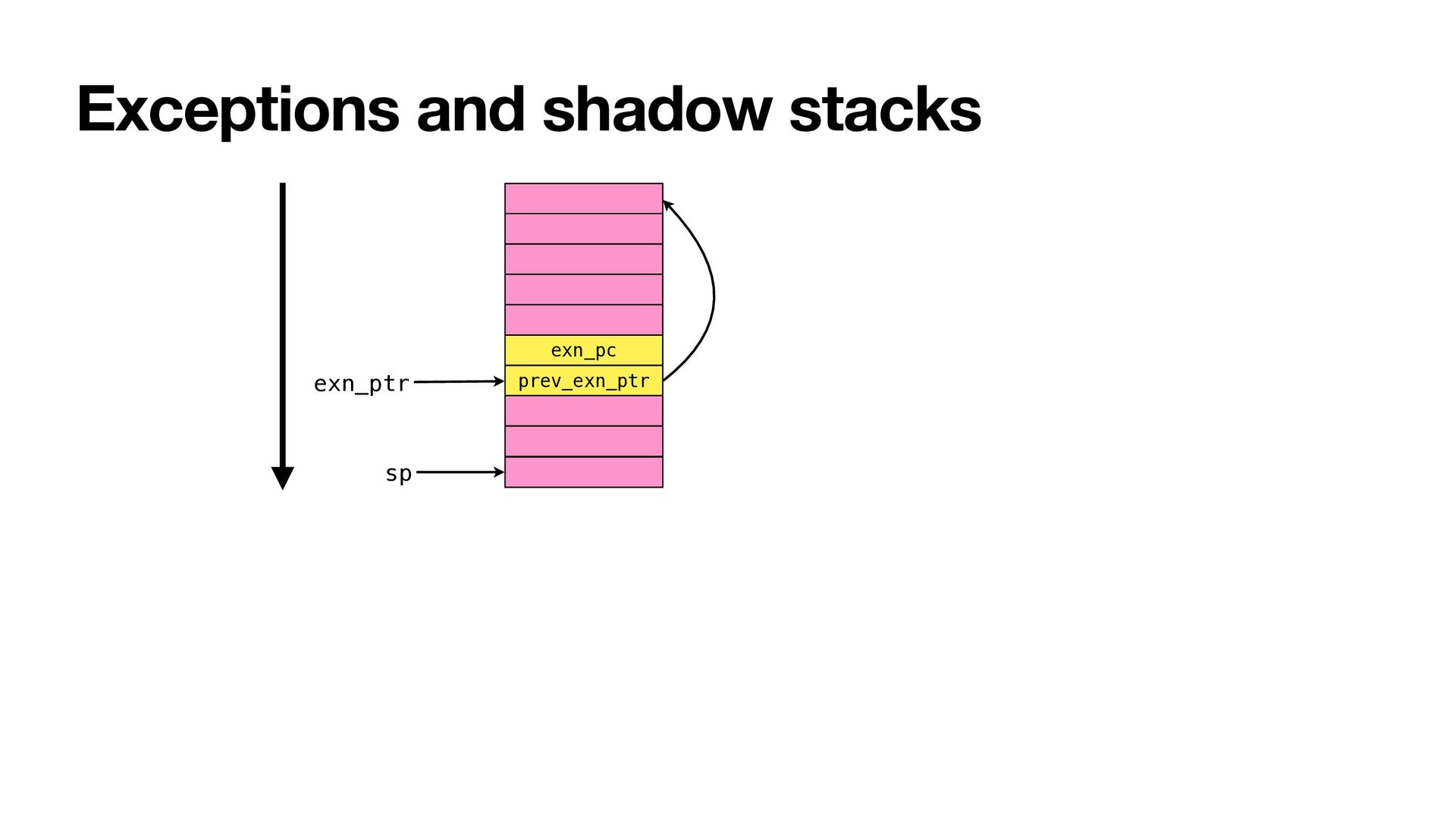
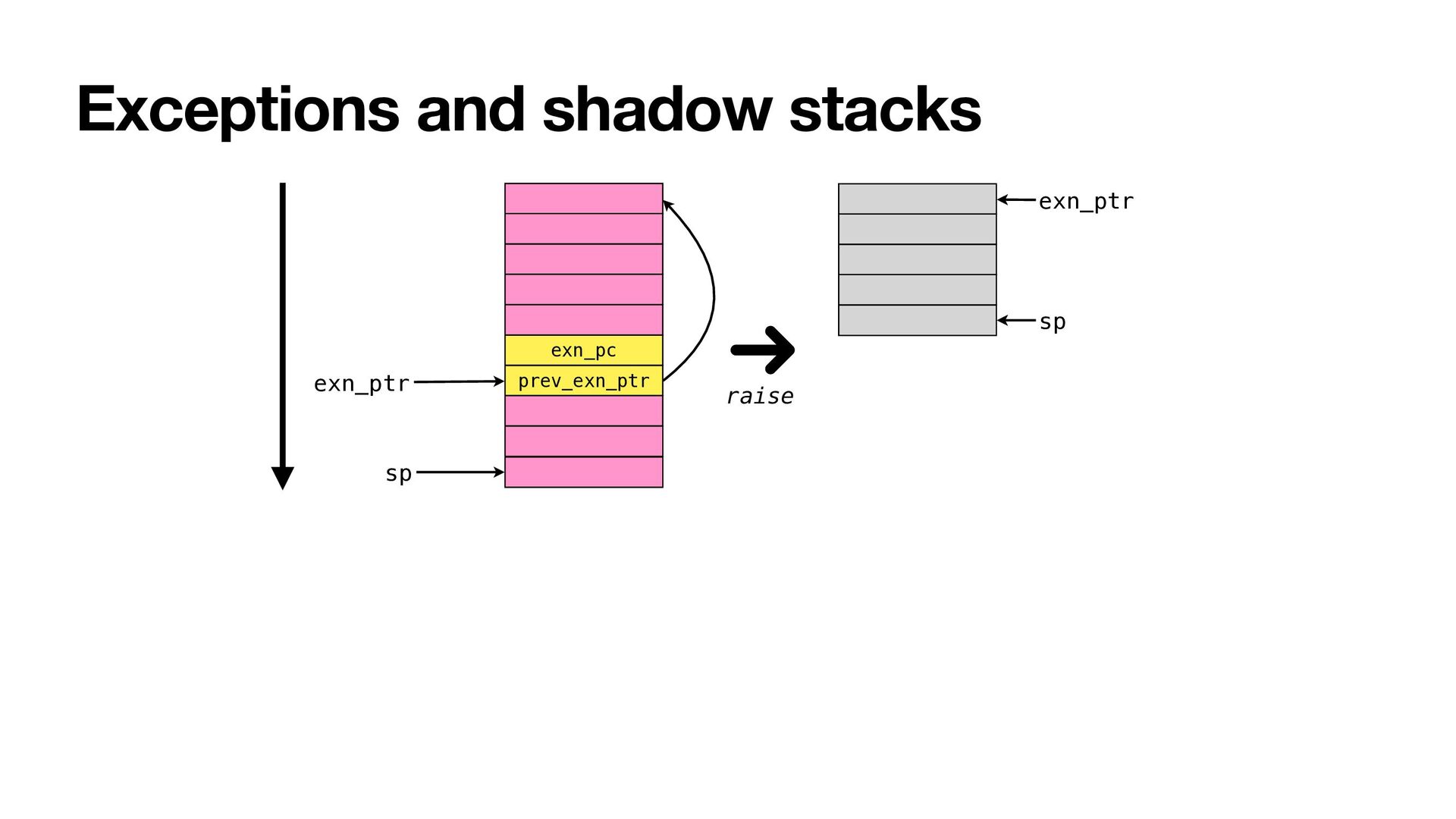
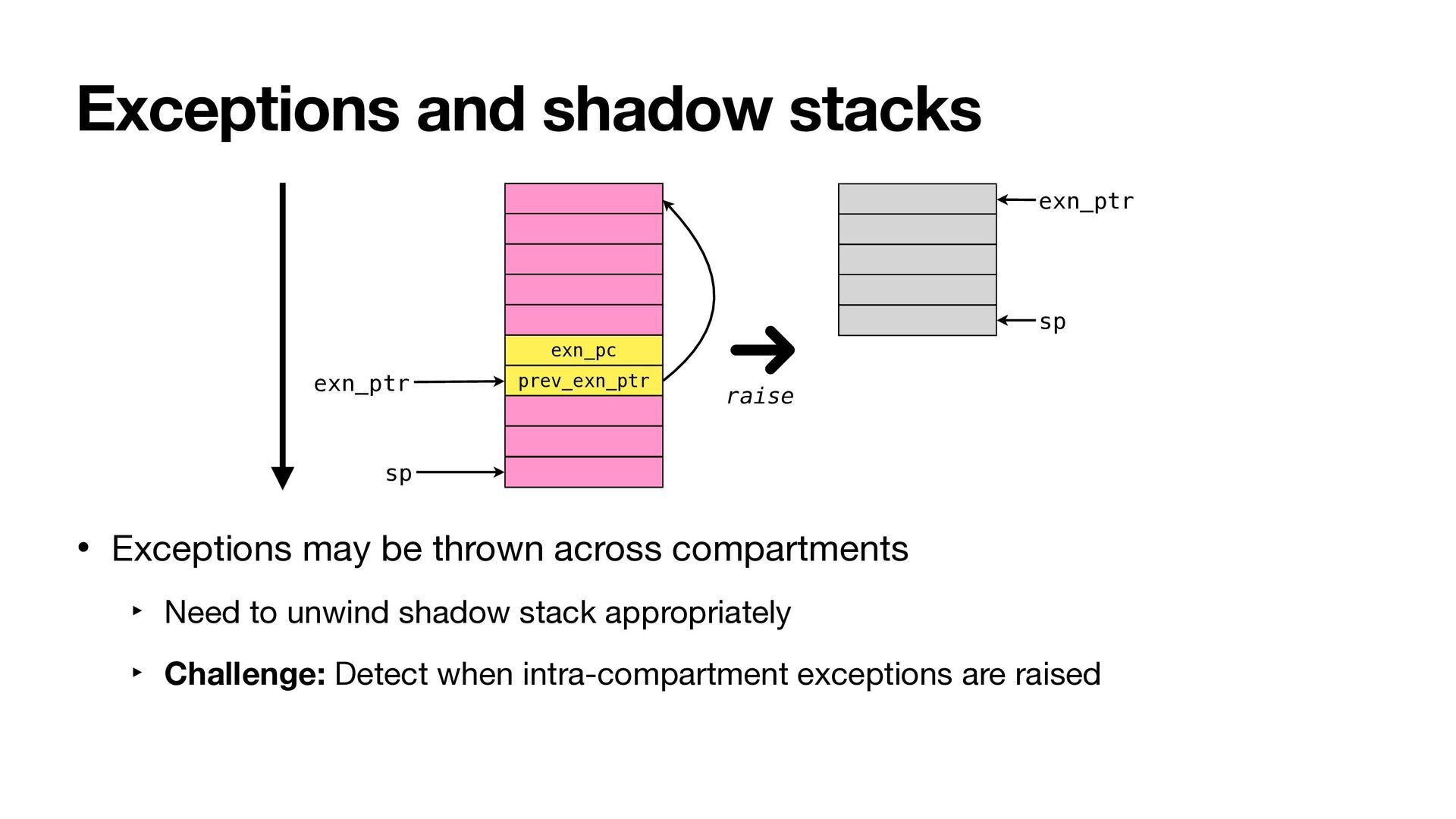
Exceptions and shadow stacks • Exceptions may be thrown across
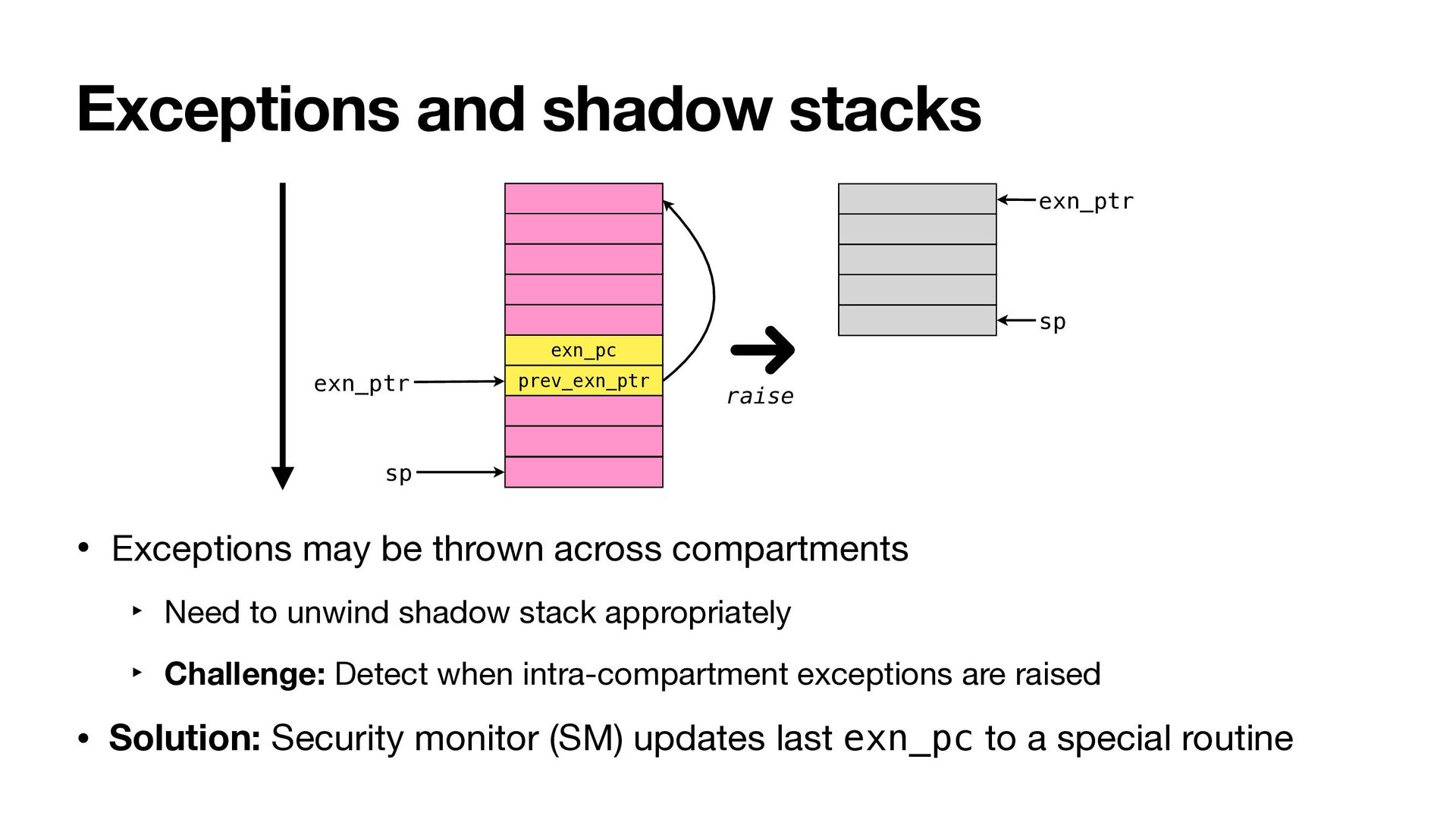
compartments ‣ Need to unwind shadow stack appropriately ‣ Challenge: Detect when intra-compartment exceptions are raised exn_pc prev_exn_ptr sp exn_ptr raise sp exn_ptr -
Exceptions and shadow stacks • Exceptions may be thrown across
compartments ‣ Need to unwind shadow stack appropriately ‣ Challenge: Detect when intra-compartment exceptions are raised • Solution: Security monitor (SM) updates last exn_pc to a special routine exn_pc prev_exn_ptr sp exn_ptr raise sp exn_ptr -
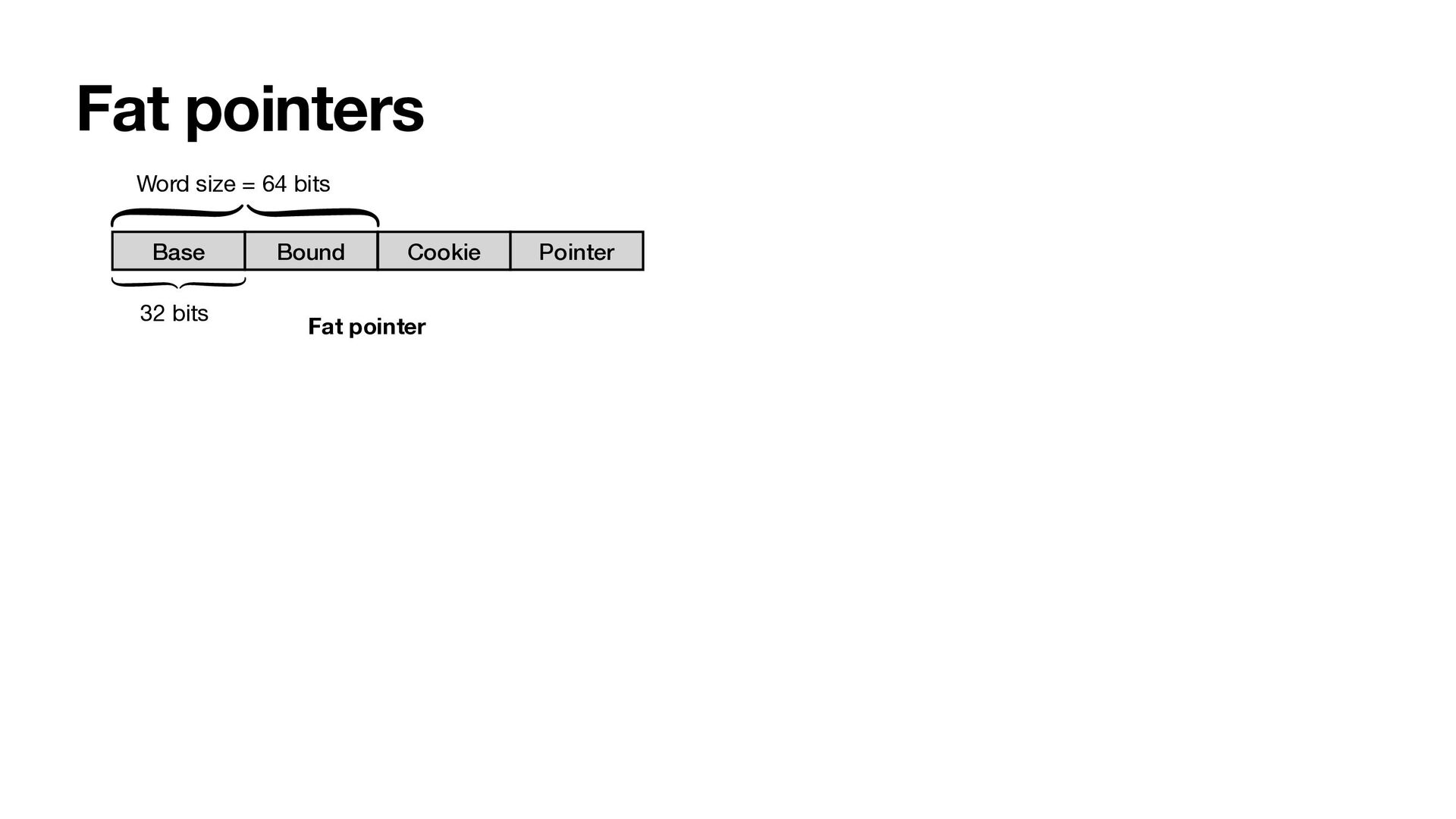
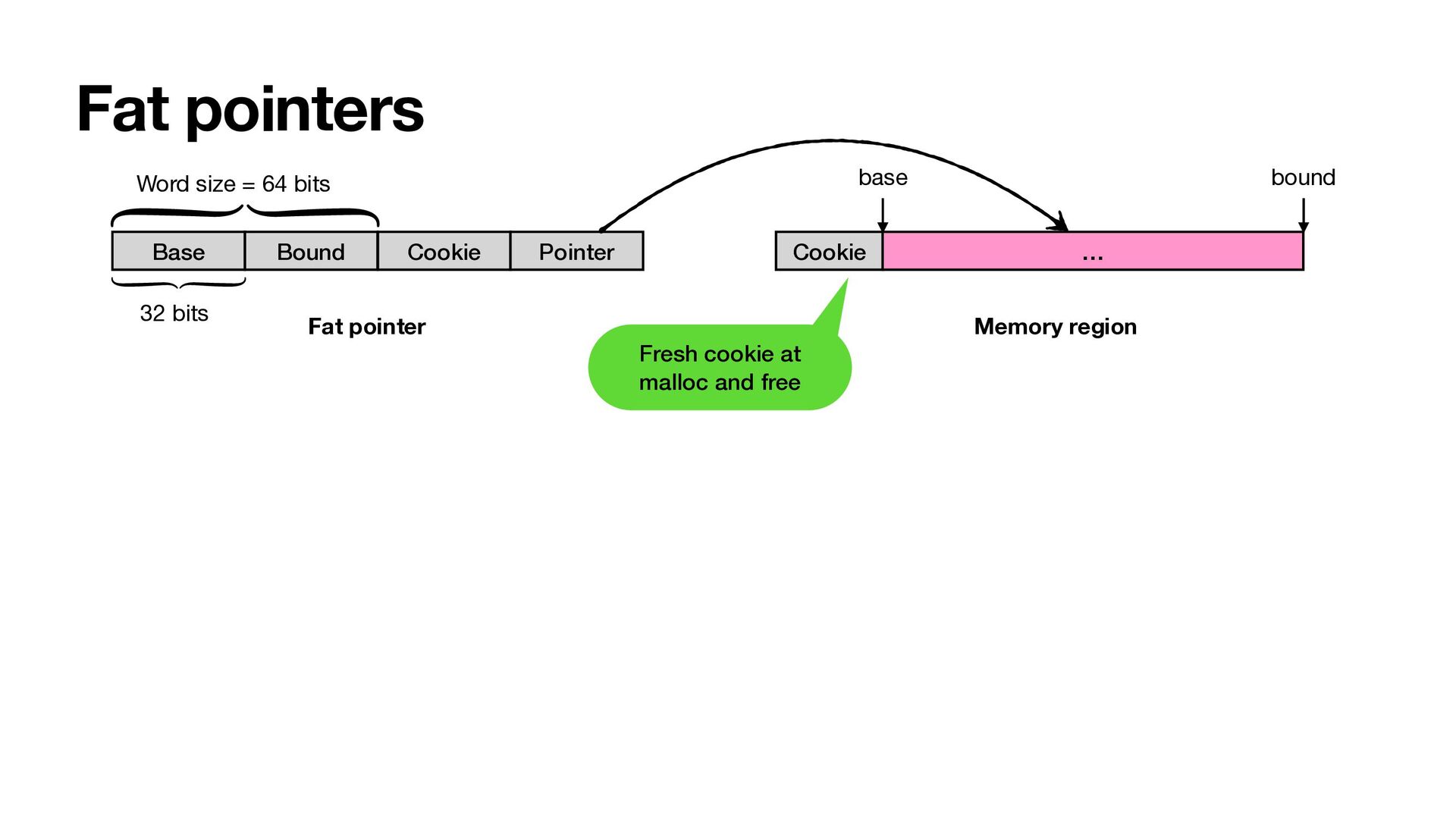
Fat pointers Base Bound Cookie Pointer 32 bits Word size
= 64 bits Fat pointer -
Fat pointers Base Bound Cookie Pointer 32 bits Word size
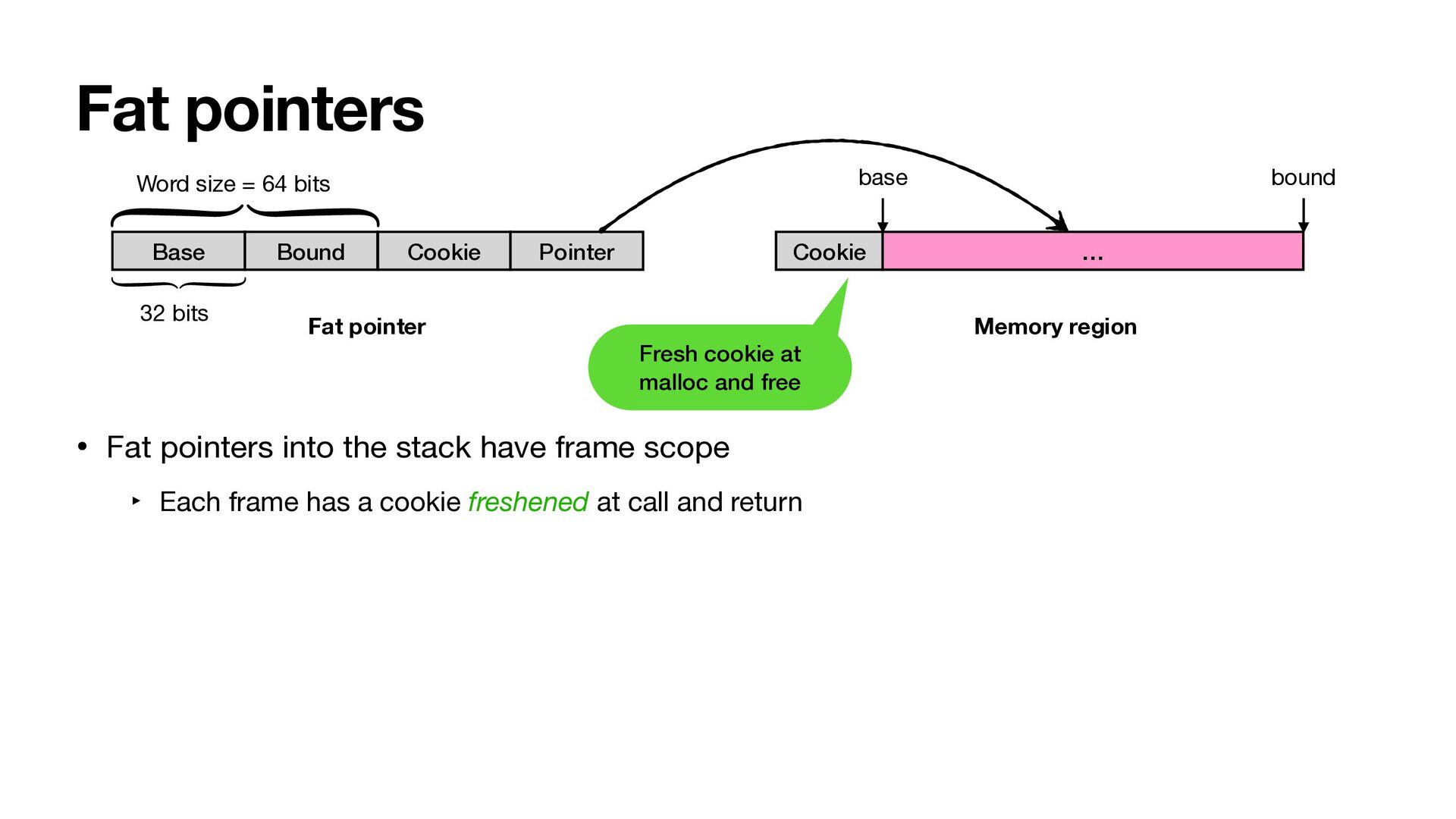
= 64 bits Cookie … base bound Memory region Fat pointer Fresh cookie at malloc and free -
Fat pointers Base Bound Cookie Pointer 32 bits Word size
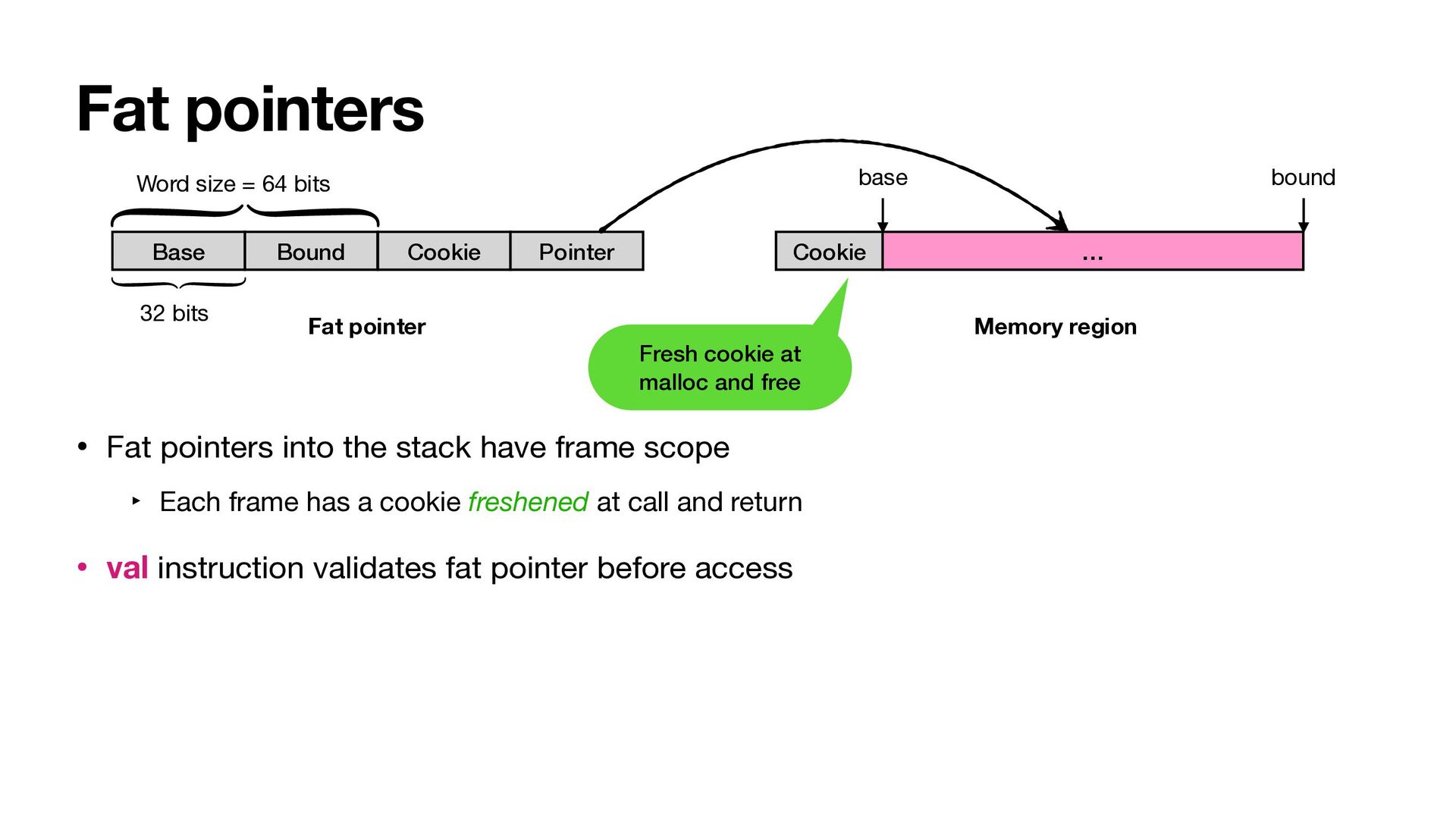
= 64 bits Cookie … base bound Memory region Fat pointer Fresh cookie at malloc and free • Fat pointers into the stack have frame scope ‣ Each frame has a cookie freshened at call and return -
Fat pointers Base Bound Cookie Pointer 32 bits Word size
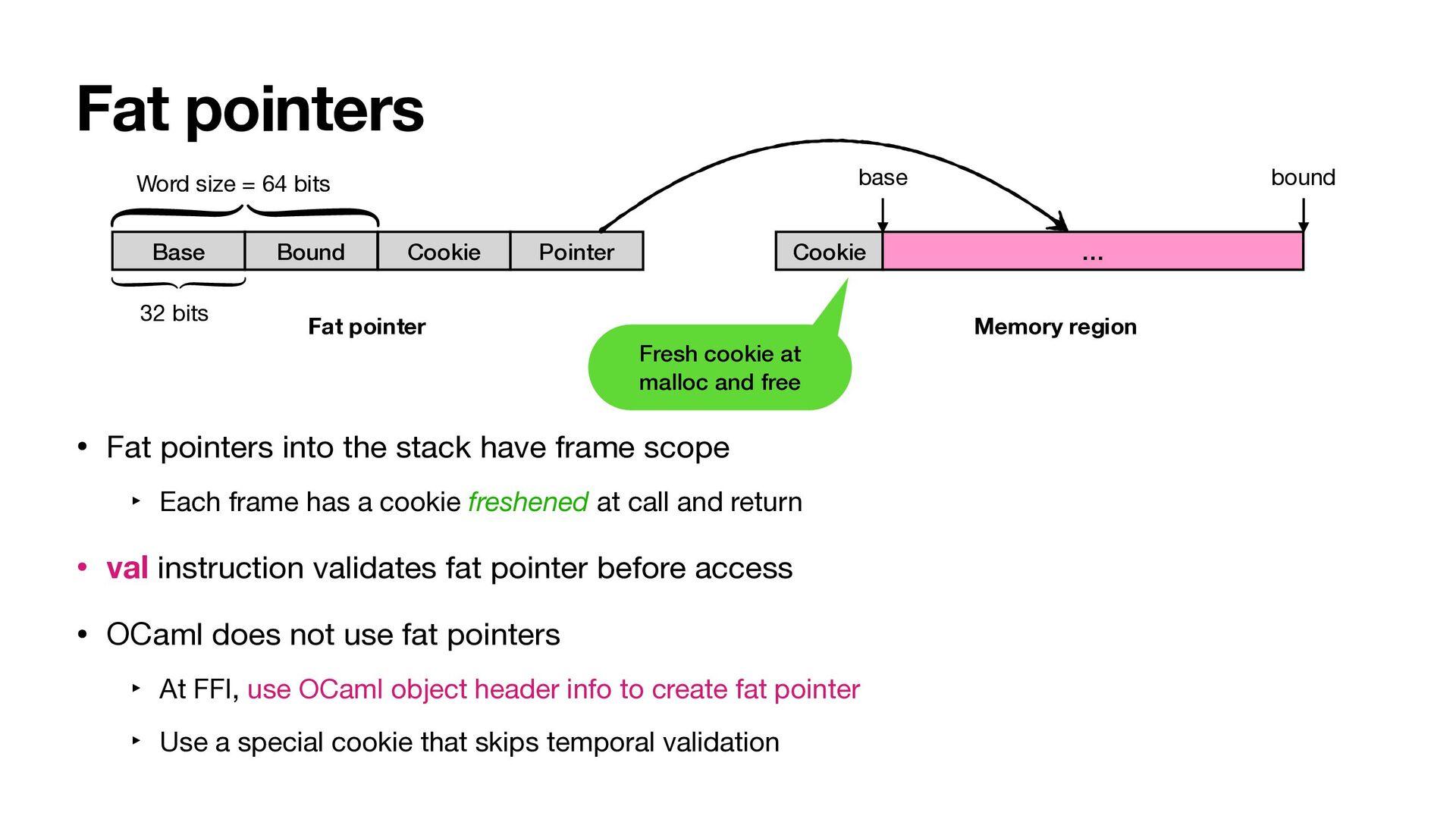
= 64 bits Cookie … base bound Memory region Fat pointer Fresh cookie at malloc and free • Fat pointers into the stack have frame scope ‣ Each frame has a cookie freshened at call and return • val instruction validates fat pointer before access -
Fat pointers Base Bound Cookie Pointer 32 bits Word size
= 64 bits Cookie … base bound Memory region Fat pointer Fresh cookie at malloc and free • Fat pointers into the stack have frame scope ‣ Each frame has a cookie freshened at call and return • val instruction validates fat pointer before access • OCaml does not use fat pointers ‣ At FFI, use OCaml object header info to create fat pointer ‣ Use a special cookie that skips temporal validation -
Evaluation • Compiler changes ‣ ~300 lines for OCaml, ~2300
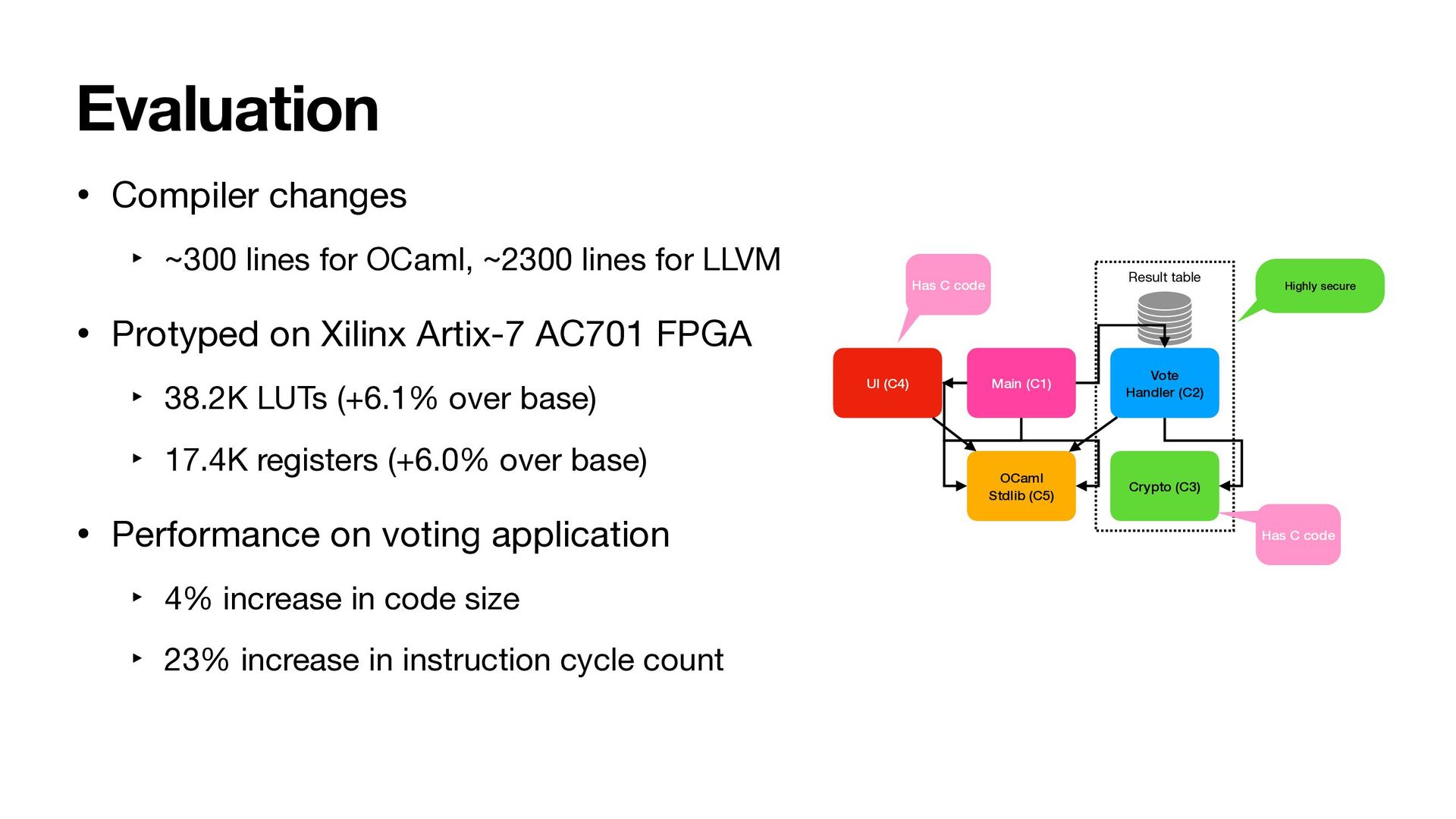
lines for LLVM • Protyped on Xilinx Artix-7 AC701 FPGA ‣ 38.2K LUTs (+6.1% over base) ‣ 17.4K registers (+6.0% over base) • Performance on voting application ‣ 4% increase in code size ‣ 23% increase in instruction cycle count OCaml Stdlib (C5) Crypto (C3) Vote Handler (C2) UI (C4) Result table Main (C1) Highly secure Has C code Has C code -
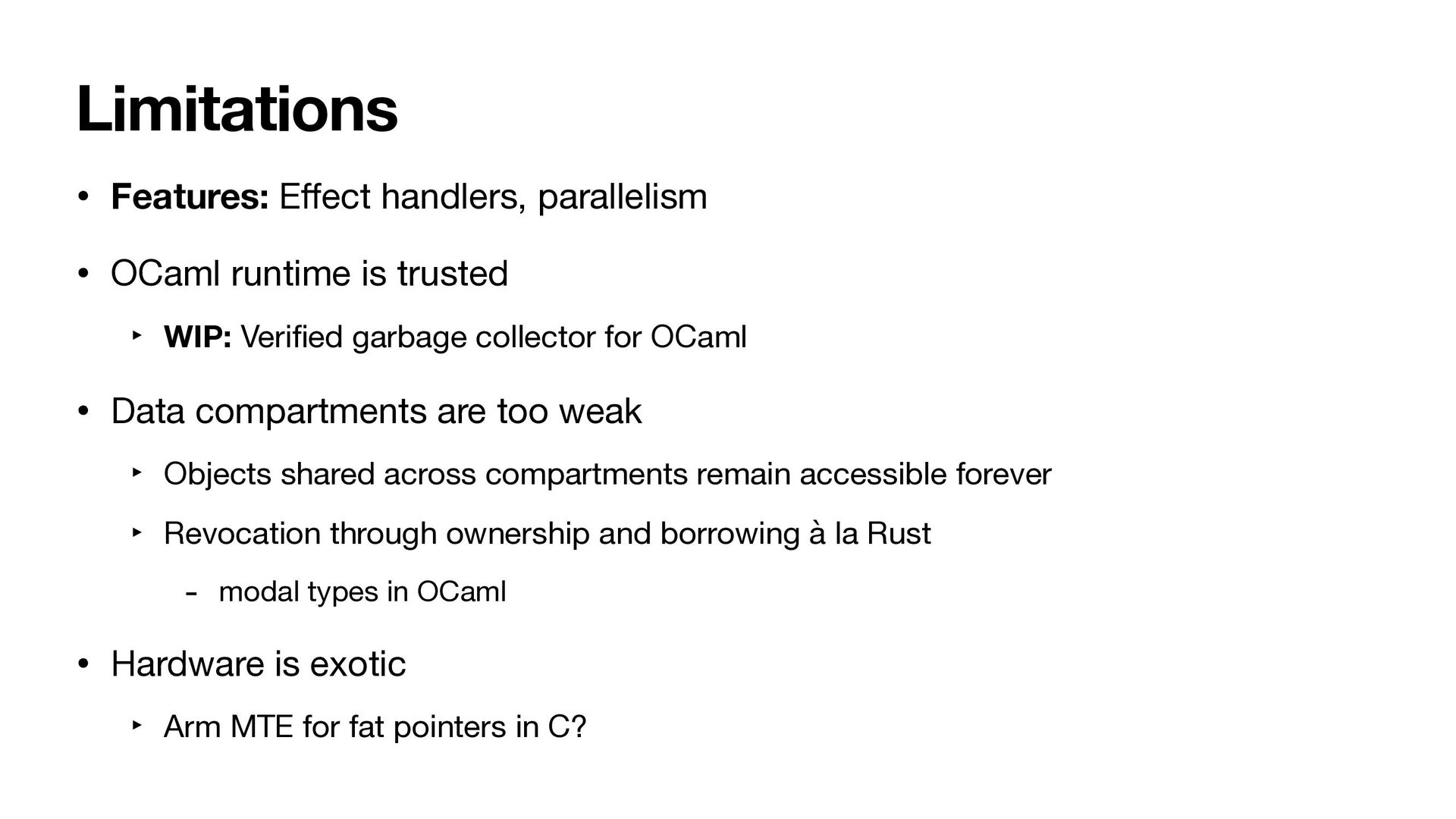
Limitations • Features: E ff ect handlers, parallelism • OCaml
runtime is trusted ‣ WIP: Veri fi ed garbage collector for OCaml -
Limitations • Features: E ff ect handlers, parallelism • OCaml
runtime is trusted ‣ WIP: Veri fi ed garbage collector for OCaml • Data compartments are too weak ‣ Objects shared across compartments remain accessible forever ‣ Revocation through ownership and borrowing à la Rust - modal types in OCaml -
Limitations • Features: E ff ect handlers, parallelism • OCaml
runtime is trusted ‣ WIP: Veri fi ed garbage collector for OCaml • Data compartments are too weak ‣ Objects shared across compartments remain accessible forever ‣ Revocation through ownership and borrowing à la Rust - modal types in OCaml • Hardware is exotic ‣ Arm MTE for fat pointers in C?
 kayceesrk
 mkilby
 honzajavorek
 jacobian
 addyosmani
 reverentgeek
 tanoku
 tmiket
 ianozsvald
 garrettdimon
 eileencodes
 konakalab
 brad_frost