Upgrade to Pro — share decks privately, control downloads, hide ads and more …

Modelling Hidato Puzzle

Sponsored · Ship Features Fearlessly Turn features on and off without deploys. Used by thousands of Ruby developers.

Modelling Hidato Puzzle

Avatar for Kaung Htet

Kaung Htet

April 11, 2016
Tweet

More Decks by Kaung Htet

Other Decks in Programming

Transcript

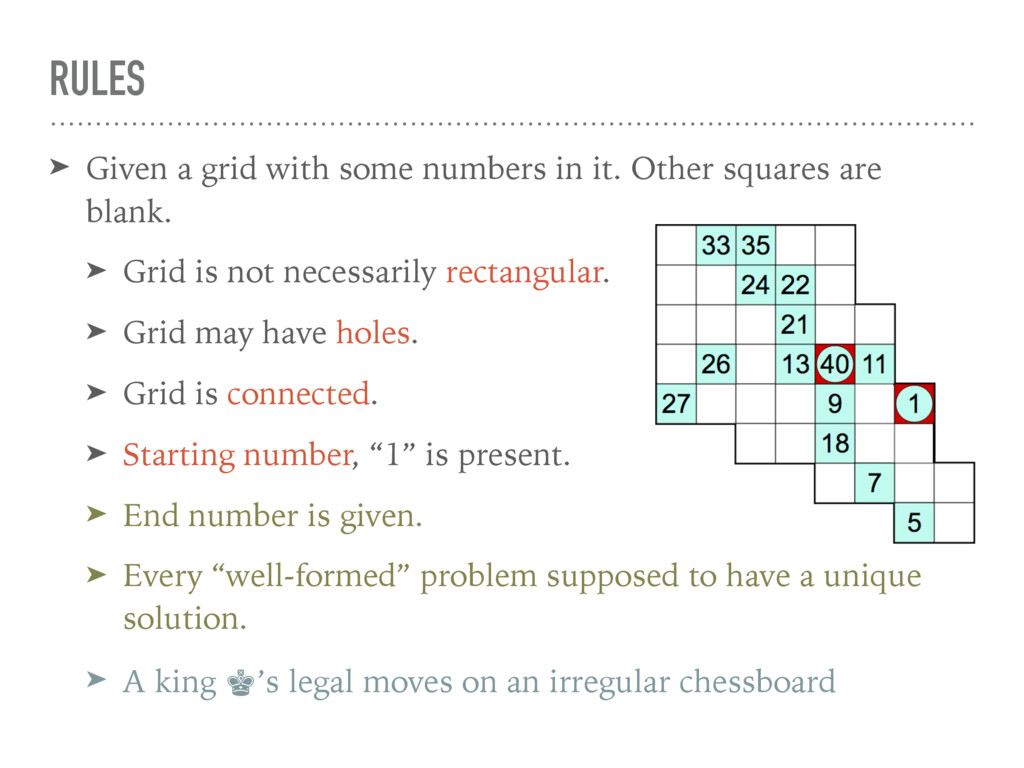
  1. RULES ➤ Given a grid with some numbers in it.

    Other squares are blank. ➤ Grid is not necessarily rectangular. ➤ Grid may have holes. ➤ Grid is connected. ➤ Starting number, “1” is present. ➤ End number is given. ➤ Every “well-formed” problem supposed to have a unique solution. ➤ A king ♚’s legal moves on an irregular chessboard
  2. Given a Hidato game that fits in a m x

    n grid, does a solution exist?
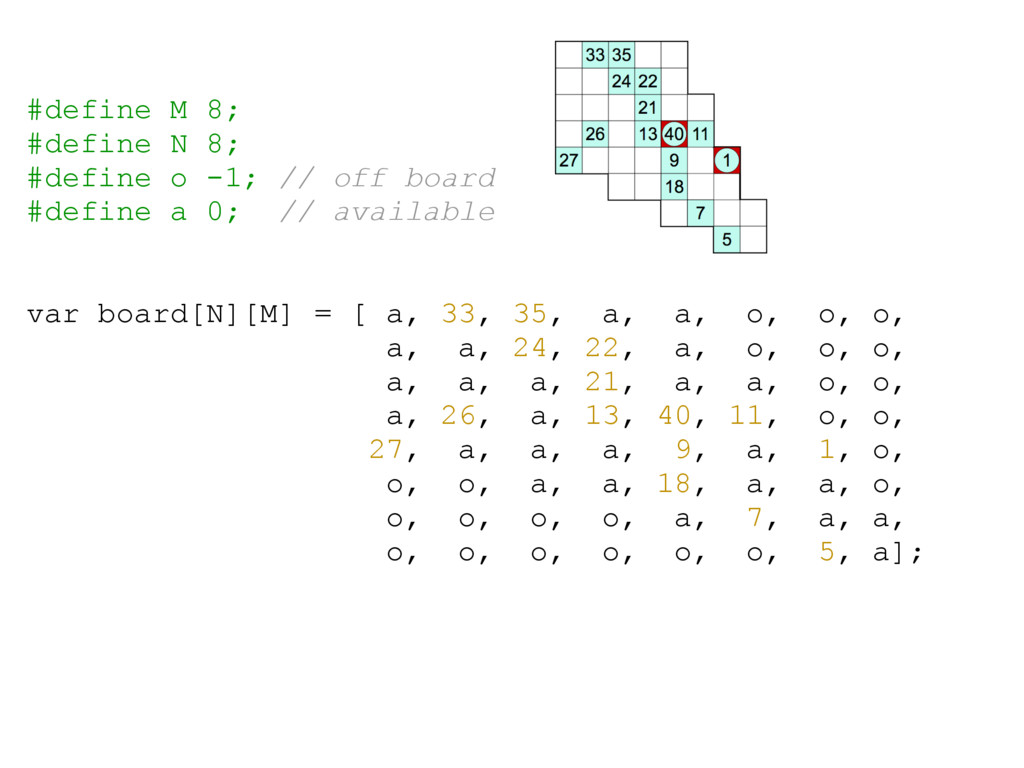
  3. #define M 8; #define N 8; #define o -1; //

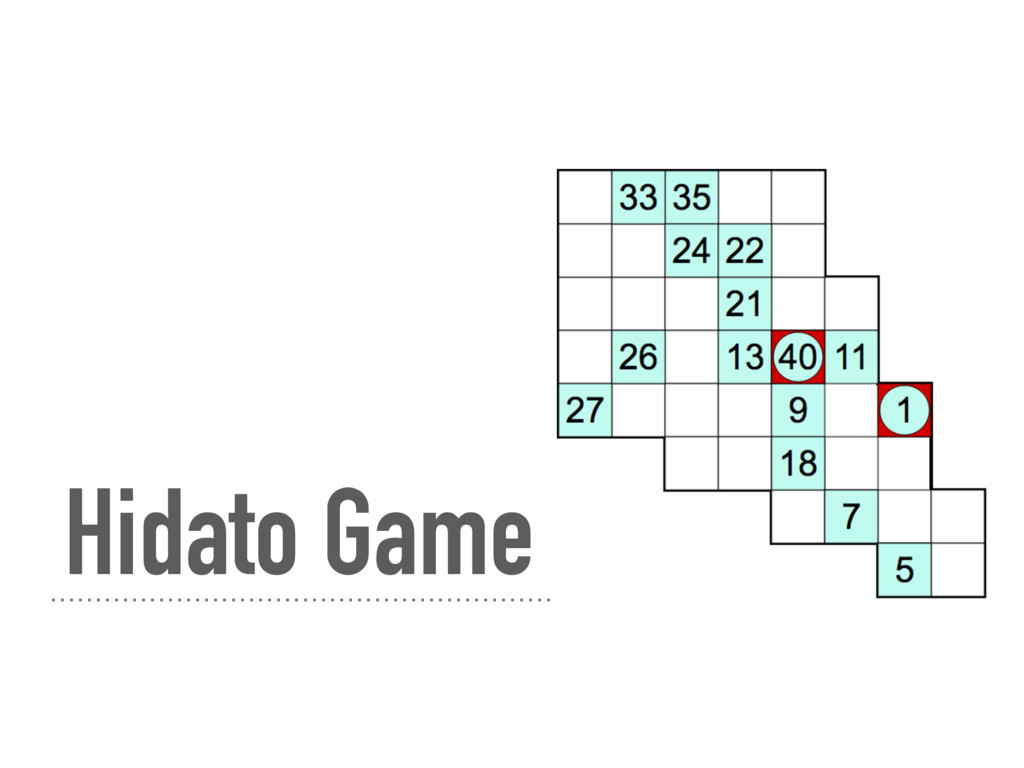
    off board #define a 0; // available var board[N][M] = [ a, 33, 35, a, a, o, o, o, a, a, 24, 22, a, o, o, o, a, a, a, 21, a, a, o, o, a, 26, a, 13, 40, 11, o, o, 27, a, a, a, 9, a, 1, o, o, o, a, a, 18, a, a, o, o, o, o, o, a, 7, a, a, o, o, o, o, o, o, 5, a];
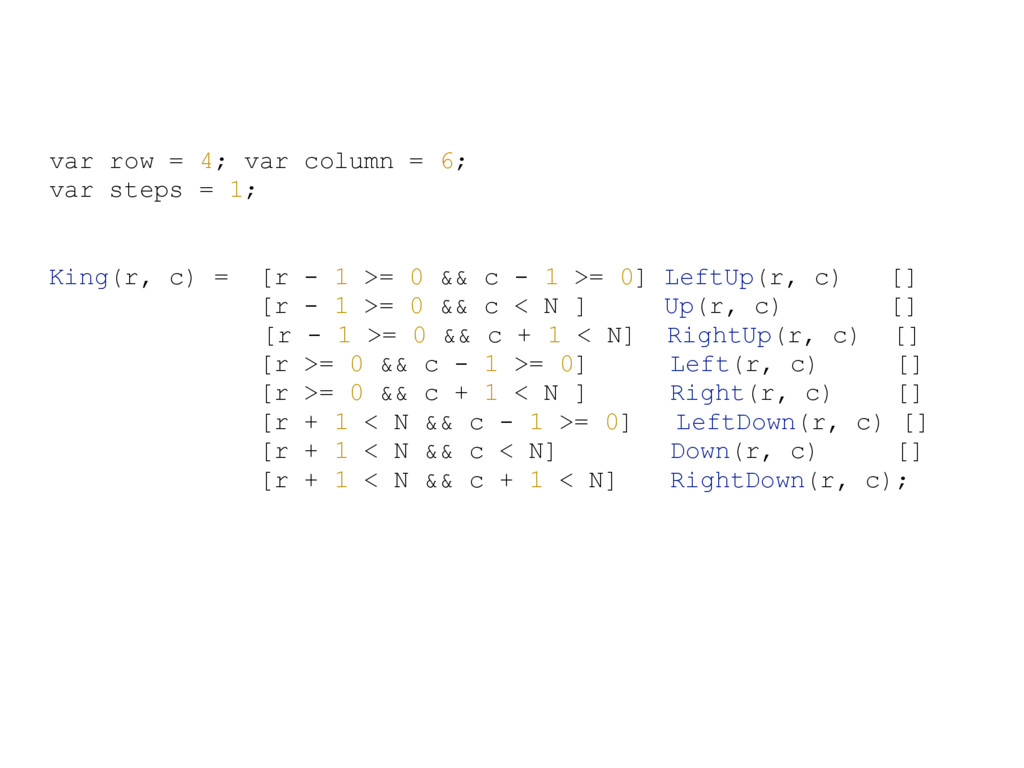
  4. var row = 4; var column = 6; var steps

    = 1; King(r, c) = [r - 1 >= 0 && c - 1 >= 0] LeftUp(r, c) [] [r - 1 >= 0 && c < N ] Up(r, c) [] [r - 1 >= 0 && c + 1 < N] RightUp(r, c) [] [r >= 0 && c - 1 >= 0] Left(r, c) [] [r >= 0 && c + 1 < N ] Right(r, c) [] [r + 1 < N && c - 1 >= 0] LeftDown(r, c) [] [r + 1 < N && c < N] Down(r, c) [] [r + 1 < N && c + 1 < N] RightDown(r, c);
  5. LeftUp(r, c) = [board[r-1][c-1]==a || board[r-1][c-1] == steps+1] leftup{steps=steps+1;board[r-1][c-1]=steps;} ->

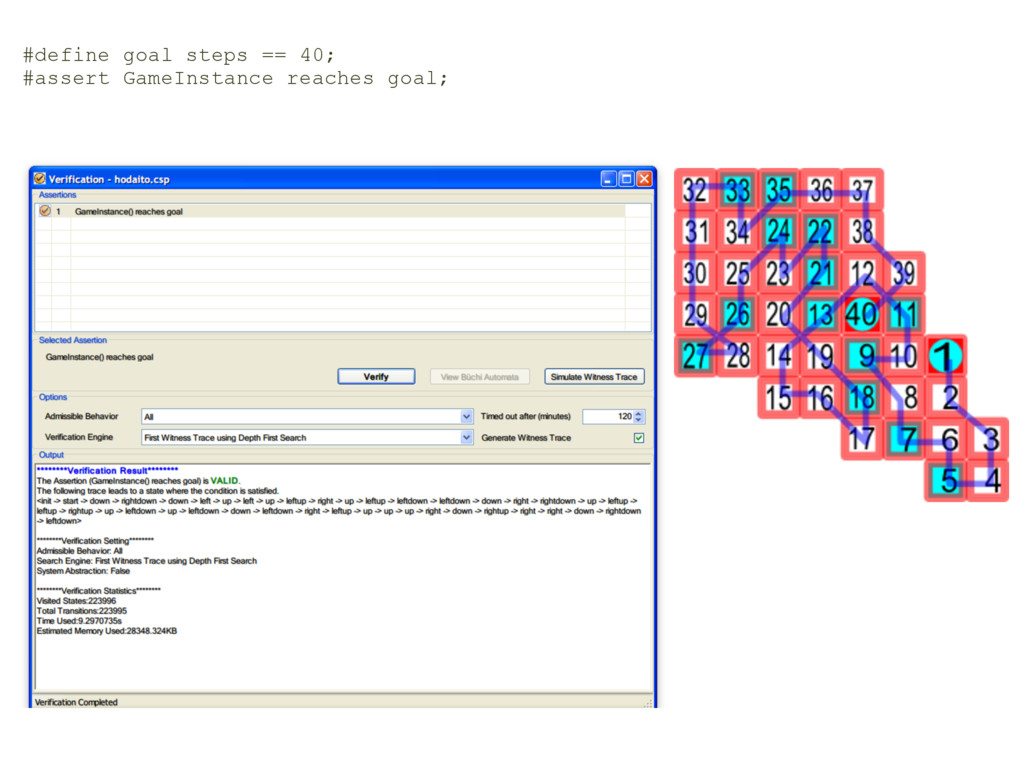
    King(r-1, c-1); Up(r, c) = [board[r-1][c]==a || board[r-1][c] == steps+1] up{steps=steps+1;board[r-1][c]=steps;} -> King(r-1, c); RightUp(r, c) = [board[r-1][c+1]==a || board[r-1][c+1]==steps+1] rightup{steps=steps+1;board[r-1][c+1]=steps;} -> King(r-1, c+1); Left(r, c) = [board[r][c-1]==a || board[r][c-1]==steps+1] left{steps=steps+1;board[r][c-1]=steps;} -> King(r, c-1); Right(r, c) = [board[r][c+1]==a || board[r][c+1]==steps+1] right{steps=steps+1;board[r][c+1]=steps;} -> King(r, c+1); LeftDown(r, c) = [board[r+1][c-1]==a || board[r+1][c-1]==steps+1] leftdown{steps=steps+1;board[r+1][c-1]=steps;} -> King(r+1, c-1); Down(r, c) = [board[r+1][c]==a || board[r+1][c]==steps+1] down{steps=steps+1;board[r+1][c]=steps;} -> King(r+1, c); RightDown(r, c) = [board[r+1][c+1]==a || board[r+1][c+1]==steps+1] rightdown{steps=steps+1;board[r+1][c+1]=steps;} -> King(r+1, c+1); Game(r, c) = start{board[r][c] = steps} -> King(r, c); GameInstance = Game(row, column); n+1 a a 0 ♚ 0 0 0 0
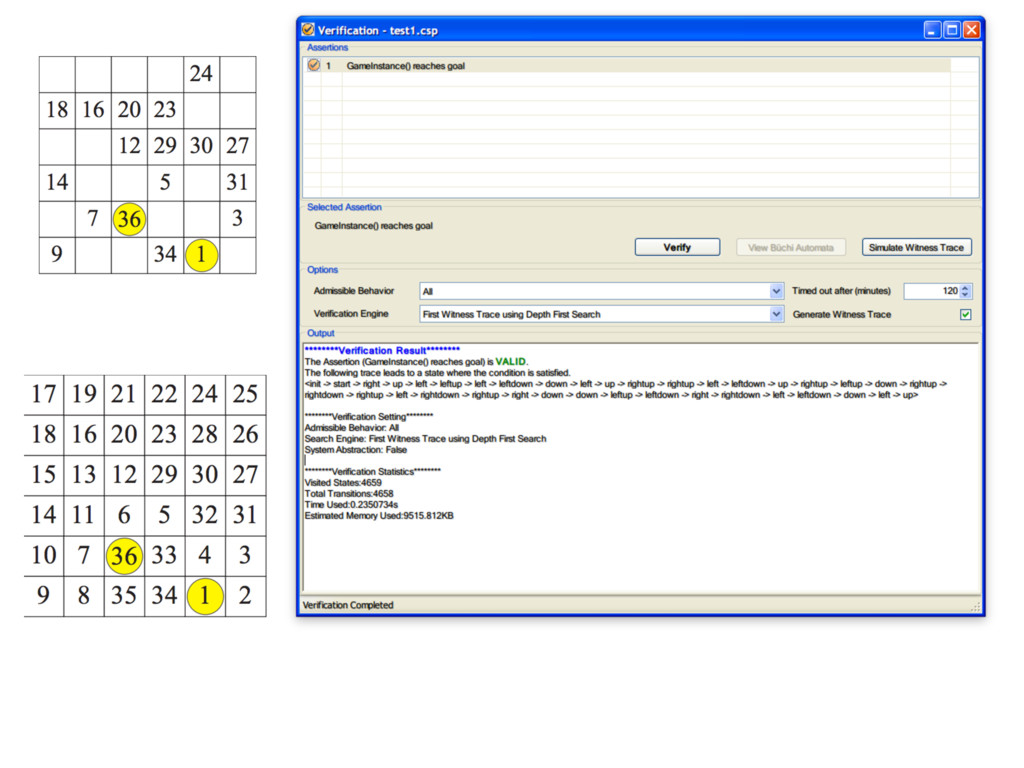
  6. ➤ Not well-formed problems, very big grids with very few

    given numbers. ➤ Exponential search state space. ➤ Possible Optimisations ➤ Choose neighbour squares that points towards the next smallest given number.