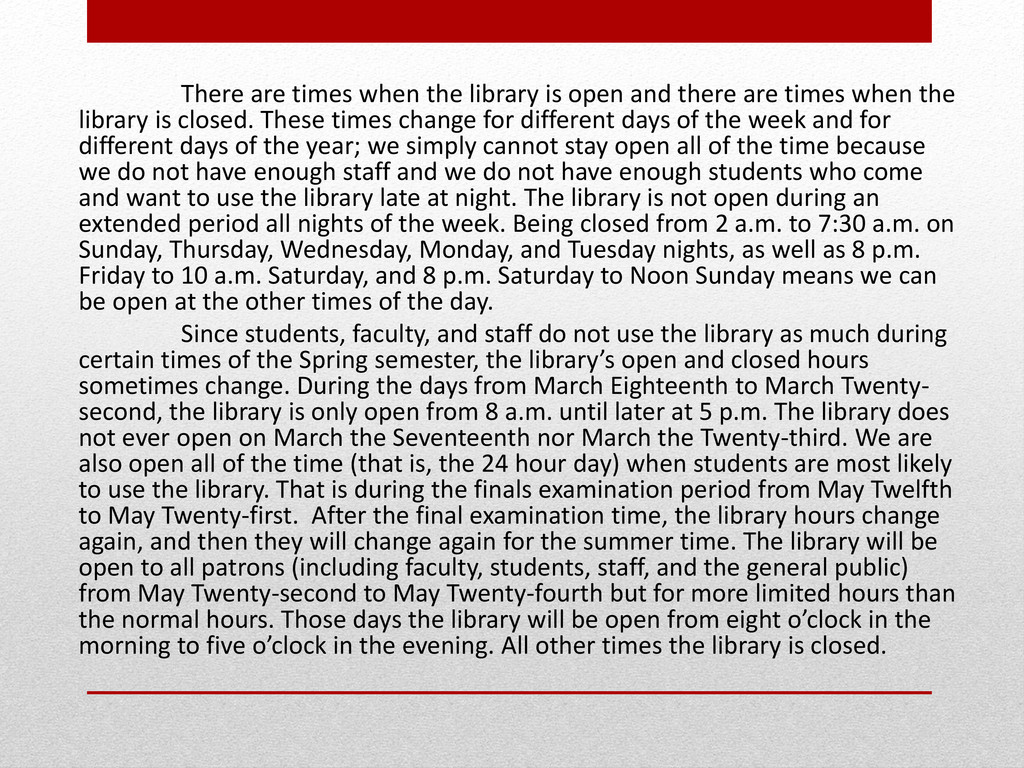
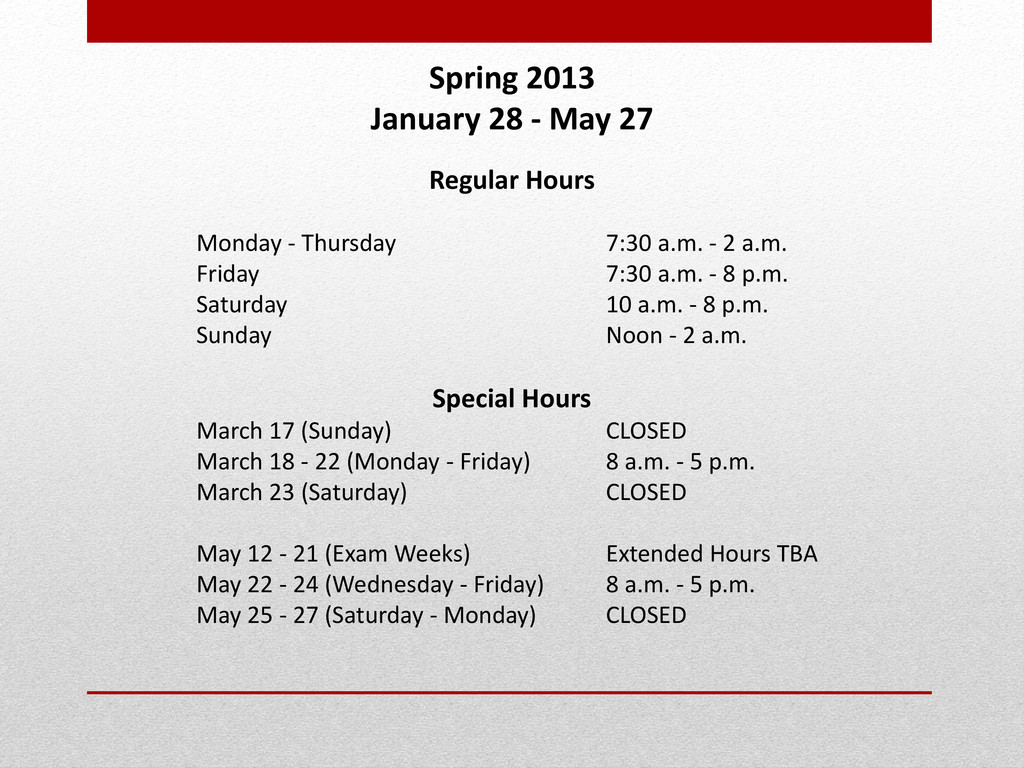
are times when the library is closed. These times change for different days of the week and for different days of the year; we simply cannot stay open all of the time because we do not have enough staff and we do not have enough students who come and want to use the library late at night. The library is not open during an extended period all nights of the week. Being closed from 2 a.m. to 7:30 a.m. on Sunday, Thursday, Wednesday, Monday, and Tuesday nights, as well as 8 p.m. Friday to 10 a.m. Saturday, and 8 p.m. Saturday to Noon Sunday means we can be open at the other times of the day. Since students, faculty, and staff do not use the library as much during certain times of the Spring semester, the library’s open and closed hours sometimes change. During the days from March Eighteenth to March Twenty- second, the library is only open from 8 a.m. until later at 5 p.m. The library does not ever open on March the Seventeenth nor March the Twenty-third. We are also open all of the time (that is, the 24 hour day) when students are most likely to use the library. That is during the finals examination period from May Twelfth to May Twenty-first. After the final examination time, the library hours change again, and then they will change again for the summer time. The library will be open to all patrons (including faculty, students, staff, and the general public) from May Twenty-second to May Twenty-fourth but for more limited hours than the normal hours. Those days the library will be open from eight o’clock in the morning to five o’clock in the evening. All other times the library is closed.
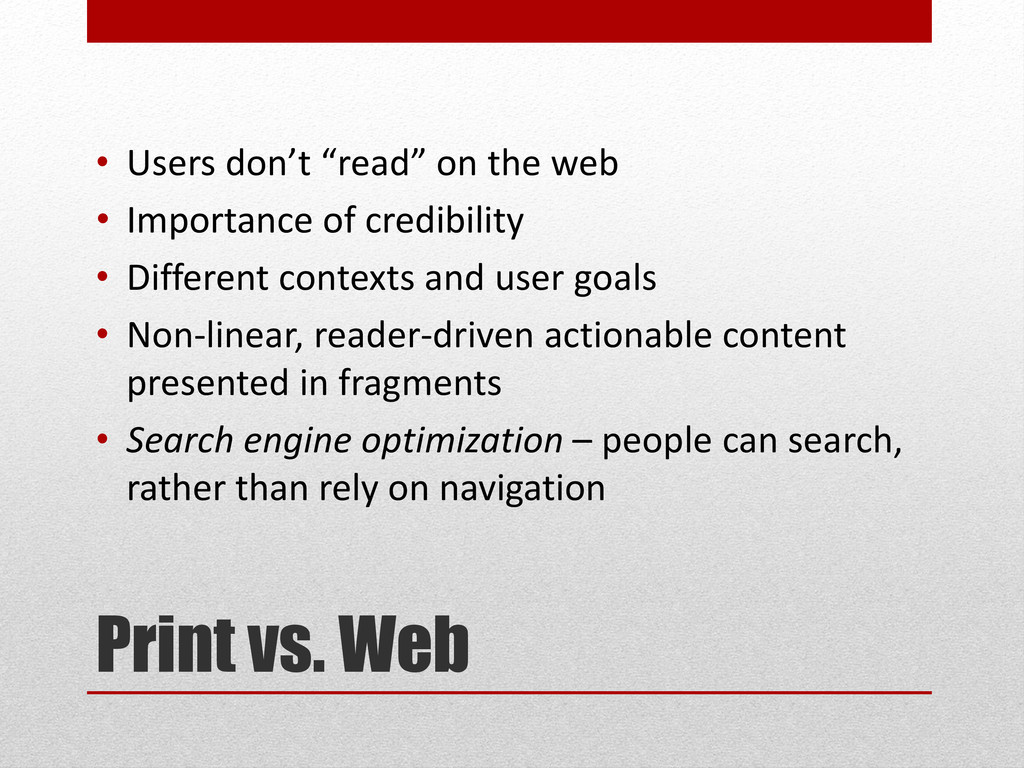
• Importance of credibility • Different contexts and user goals • Non-linear, reader-driven actionable content presented in fragments • Search engine optimization – people can search, rather than rely on navigation
Link to additional content Easy to read format – bullets, lists Clarity Concise Consistent format Visual interest K.I.S.S. (keep it simple stupid) Standard fonts Specific subject line Add attachments appropriately Mobile-friendly Consider whitespace Email – greeting Use sections for different topic/ chunking content Provide additional info, if people want it (in an additional location?) Your Suggestions
phrases • Use lists and tables • Use ordered lists for steps in a process • Link, don’t recreate • Use descriptive links (not “click here”) • Use acronyms
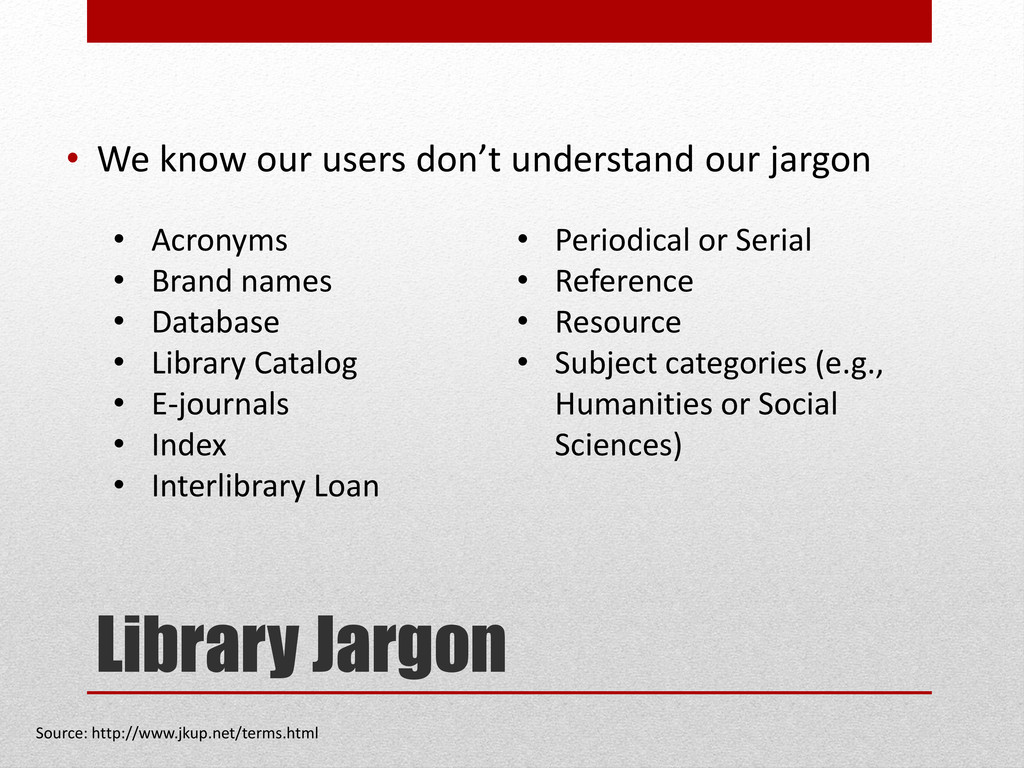
capitalization, terminology, etc. • Use 1st and 2nd voice when appropriate • Use 3rd for policies, rule, and audience-specific privileges • Avoid jargon when possible • Use absolute dates • “on May 18, 2013” vs. “in a few months”
number of materials that cannot be requested due to various reasons, including the fragility of the items and the policies of the library that is loaning the materials to TWU libraries. In the former, any rare books and other fragile or bulky items cannot be requested. Most libraries have policies that will not allow Texas Woman’s University to get computer software, audio-visual materials (which includes sound recordings, DVDs, videos, etc.), and entire issues of journals. Books owned as ebooks by TWU Libraries (click here to take a look at our e-books), Children’s Collection materials, materials that are on reserve, textbooks, and reference works also cannot be requested. Graduate students will receive more consideration for special requests than you.
their research can be traced by their readers. If, for example, they found an article in the New York Times, they want to tell them how to find this exact same article. They need to provide them with the title of it, when it was published, who wrote it, etc. They also want to make sure they acknowledge the efforts of other writers and researchers. By citing their sources, they make certain that the previously mentioned writers of the sources they found are credited. Without citations, it might look like they have plagiarized their work or ideas.
can easily print directly from either a university or personally- owned laptop while in the client application from which you wish to print a document. Follow these steps to print: Select the print button in the application (the location of this may vary by application) and send the document to Pharos UnipriNT, the Libraries' networked pay-for-print system. UnipriNT will ask the user to title their print job and provide a name. The title that is assigned to the print job will help the user identify and retrieve his or her printout at one of the UnipriNT stations located on the first floor of the library near the Help Desk. After sending their print job, it must be retrieved within one hour. After one hour the printing system deletes the job in order to keep room free for other queued print jobs. The cost for printing is 15 cents per page, black and white; or 50 cents per page, color. Caution: to avoid theft and charges for loss, patrons of the library are encouraged to not leave their laptops unattended while retrieving their print job. Items have been stolen and the library assumes no responsibility for anything left unattended by patrons of Colorado State University Libraries
staff must use their University-issued identification card as their official library card. Community borrowers and affiliate faculty are issued an official library identification card upon completion and acceptance of an application card. Minors (under-18 years old), who are in the 6th grade or above, may apply for a card with parental/guardian co-signature. Community borrowers and minors must be residents of Colorado and provide proof of such at the time of application with a current State Driver’s License or State-Issued ID Card. Once your application has been processed and approved, other valid forms of ID may be used for borrowing; i.e. valid U.S. Passport or U.S. Military I.D. Do not lend your card to anyone else because you are responsible for whatever books are checked out to your card, including any fines. Cards are non-transferable. Your library card is good for one year and must be renewed in person upon expiration.
Norman Group – Writing for the Web http://www.nngroup.com/topic/writing-web/ Plain Language http://www.plainlanguage.gov Redish, J. (2007). Letting go of the words: Writing Web content that works. Amsterdam: Elsevier/Morgan Kaufmann Publishers. http://towsonuniversity.worldcat.org/oclc/85828748


 kimberlymiller3
 cassininazir
 thekraken
 ammeep
 aleyda
 lfama
lfama
 marketingsoph
 nikkihalliwell
 minecr
 bcantrill
 rabernat
 baasie
 samtorres