Popular Formats How do I find information? Search Strategies Finding info through the Library How should I use information in my paper? Plagiarism Citing Information
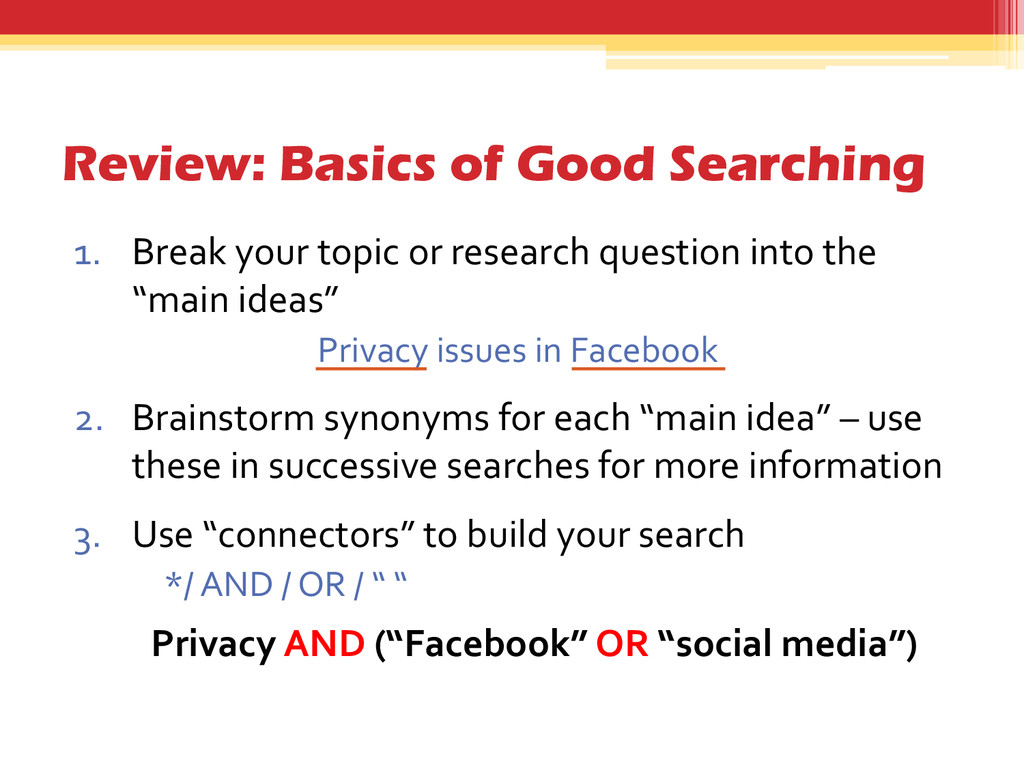
research question into the “main ideas” Privacy issues in Facebook 2. Brainstorm synonyms for each “main idea” – use these in successive searches for more information 3. Use “connectors” to build your search */ AND / OR / “ “ Privacy AND (“Facebook” OR “social media”)
nearly every subject that is taught at TU? • Look for the “Subject Gateways” icon on our homepage • Look for the Subject Gateway for the major or subject you’re investigating
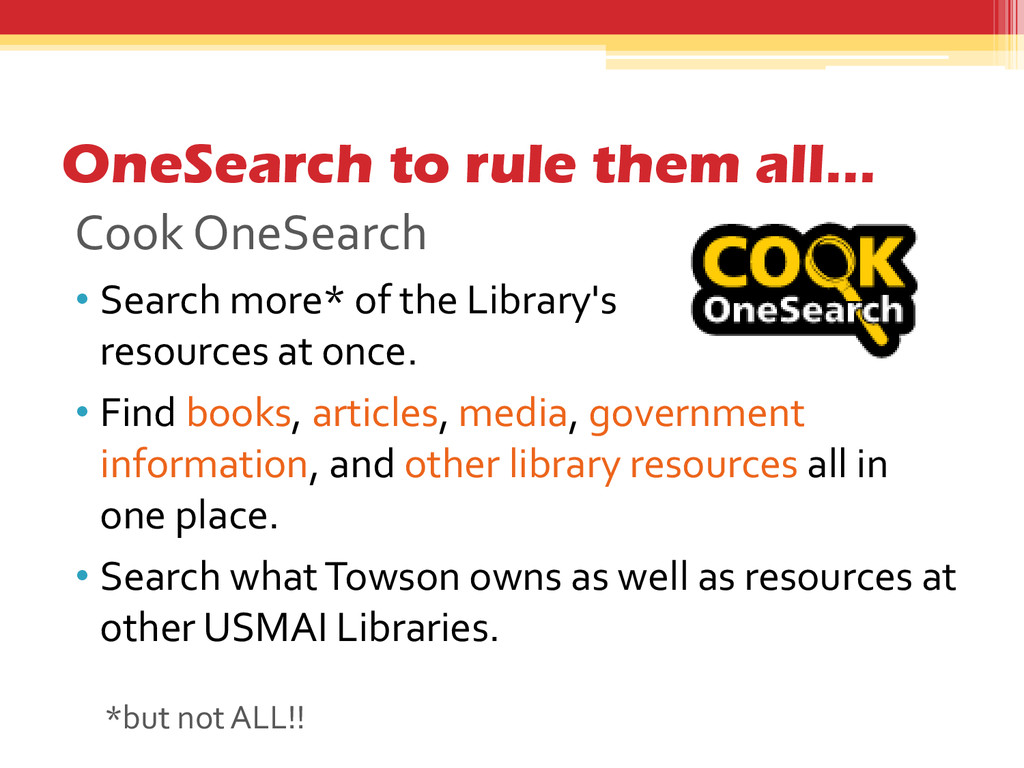
of the Library's resources at once. • Find books, articles, media, government information, and other library resources all in one place. • Search what Towson owns as well as resources at other USMAI Libraries. *but not ALL!!
from the “Library” tab on your class Blackboard site • SAVE YOUR DOCUMENT to your Towson drive or a flash drive • Use the library’s resources to get started finding sources: Course and Subject Gateways, or Cook OneSearch • Use the next 15 minutes to start your search or finish Assignment 1. Feel free to talk to your other project group members about the information you’re finding.
• Allows readers to identify and verify your information • Gives credit to the creators of the ideas… avoids plagiarism • University Policy • Required for your assignment
Web Sites • Graphics – e.g., pictures from the Web, etc. • Videotapes, audio tapes • Software • Government documents & data • Tests, measures, surveys Basically….
words?” • Paraphrasing: Borrowing an idea and putting it in your own words • Avoid “paraphrase plagiarism,” where your paraphrase is too similar to original source • Remember to cite! A paraphrase must always be documented
carefully • Note key ideas, then “Shut the book” • Try to boil down the information or summarize, making sure you understand what you’re reading and providing your own understanding • Proofread! • Learn to write and cite confidently
= MLA Handbook for Writers of Research Papers (MLA) • Social Sciences = American Psychological Association (APA) http://apastyle.apa.org/ http://www.mla.org/store/CID24/PID363
(Burrows, 2009, para. 5) OR (Burrows, 2009, p. 26) 3. An entry in the References list (the bibliography) at the end of the paper Every in-text citation should have a match in the bibliography
citation (Burrows, 2009) 3. An entry in the References list at the end of the paper Again, every in-text citation should have a match in the bibliography!
least some online classes in 2001 (Virtual school initiatives, 2005) • Teaching online classes time-consuming, requires special techniques (Bender, 2003) • Students taking online courses must be self-starters (Thomas, 2007)
etc. • Alphabetized by first author’s last name **Remember! List authors in the order in which they are listed on the article!** • Format of each entry is based on what it is (e.g., print/electronic book or article, website, etc.)
student learning: Theory, practice, and assessment. Sterling, Va: Stylus Pub. Thomas, C. (2007). Are you a candidate for distance learning? Petersons.com. Retrieved from http://www.petersons.com/distancelearning/code/articles/ distancelearncandidate2.asp Virtual school initiatives increase as study details distance learning. (2005). Electronic Education Report, 12(6), 3-5.
Espionage is the Currency of Cybercrime Publication Date: March 8th, 2011 URL:http://www.pcworld.com/article/223483/mcafee_ corporate_espionage_is_the_currency_of_cybercrim e.html
need for your citation (e.g., author, title, date, source, page numbers…) 2. Look at an example citation, noting the order in which the pieces are put together and the formatting.
need for your citation (e.g., author, title, date, source, page numbers…) 2. Look at an example citation, noting the order in which the pieces are put together and the formatting. 3. Duplicate the example using the information from your source.
Retrieved from URL Bradley, T. (2011, March). McAfee: Corporate espionage is the currency of cybercrime. Retrieved from http://www.pcworld.com/article/223483/mcafee_co rporate_espionage_is_the_currency_of_cybercrime .html
beginning of class • First team to construct a 100% correct citation for the provided article source wins ! • You may write your answers on a sheet of paper, or you may type them in Word • Using an online citation generator will lead to instant disqualification!
Bossler Source: CyberPsychology, Behavior & Social Networking Page numbers: 464-472 Year of publication: 2012 Article Title: Predictors of Patrol Officer Interest in Cybercrime Training and Investigation in Selected United States Police Departments Volume: 15 Issue: 9 DOI: 10.1089/cyber.2011.0625
B. (Year). Title of article. Title of Journal Source, volume(issue), page range. doi: xxxxxxxx Holt, T. J., & Bossler, A.M. (2012). Holt, T. J., & Bossler, A.M. (2012). Predictors of patrol officers interest in cybercrime training and investigation in selected united states police departments. CyberPsychology, Behavior & Social Networking, 15(9), 464- 472. doi: 10.1089/cyber.2011.6025 Holt, T. J., & Bossler, A.M. (2012). Predictors of patrol officers interest in cybercrime training and investigation in selected united states police departments. CyberPsychology, Behavior & Social Networking, 15(9), 464- 472. doi: 10.1089/cyber.2011.6025 Holt, T. J., & Bossler, A.M. (2012). Predictors of patrol officers interest in cybercrime training and investigation in selected united states police departments. CyberPsychology, Behavior & Social Networking, 15(9), 464- 472. doi: 10.1089/cyber.2011.6025
Searching and finding sources ▫ A 100% correct APA-style citation for one source you find… that means down to the last period and comma! ▫ Due Monday, March 31st – upload to Blackboard


 kimberlymiller3
 pawan_pharm
 matleenalaakso
 signer
 arnoknobbe
 uchi8977
 suisan
 akiraasano
 yatabe
 rashwhitman
 terasawat
 ainischool
 sugarenia
 yeseniaperezcruz
 inesmontani
.png) helenjbeal
helenjbeal
 sarafernandez
 joshbly
 marktimemedia
 mayunak
 mojombo
 addyosmani
 greggifford
 eileencodes