Upgrade to Pro
— share decks privately, control downloads, hide ads and more …
Speaker Deck
Sign up for free
Menu
Search
Features
All features
Private URLs
Password Protection
Custom URLS
Scheduled publishing
Remove Branding
Restrict embedding
Deck Collections
Notes
Features
All features
Private URLs
Password Protection
Custom URLS
Scheduled publishing
Remove Branding
Restrict embedding
Deck Collections
Notes
Explore
Featured decks
Featured speakers
Programming
Technology
Storyboards
Explore
Featured decks
Featured speakers
Programming
Technology
Storyboards
Pricing
Search
Sign in
Sign up for free
Web Cross Device
Search
Sponsored
·
Your Podcast. Everywhere. Effortlessly.
Share. Educate. Inspire. Entertain. You do you. We'll handle the rest.
→
Jacopo Rabolini
May 23, 2015
Programming
80
0
Share
Embed
Copy iframe code
Copy JS code
Copy link
Start on current slide
Web Cross Device
Presentazione relativa al workshop tenuto alla Wired Next Fest 2015.
Jacopo Rabolini
May 23, 2015
More Decks by Jacopo Rabolini
See All by Jacopo Rabolini
A Community of Communities
kingfelix
0
48
Other Decks in Programming
See All in Programming
プロダクトコードからライブラリの境界を見つける
elmetal
PRO
0
110
ソニーのクラウド共通基盤の変遷と AI時代の開発スタイルに合わせた進化 / The Journey of Sony’s Common Cloud Platform and Its Evolution for AI-Native Development
kenjiyoneyama
0
230
手動確認はもう限界 〜XCUITestでCustom URL Schemeの遷移を起動種別ごとに自動テストする〜 / Testing Custom URL Schemes with XCUITest
otouto
0
390
カツオ、ご期待ください
suneo3476
0
150
mrbgem 三角測量 開発
ogom
0
210
Vue Fes Japan 2026 タイムテーブル徹底解説
448jp
1
630
機械に任せるテスト、人が見るテスト ⽣成AIで引き直した、運⽤保守フェーズの線引き
dske104
0
160
setup-vp GitLab対応の裏側
naokihaba
0
150
AWSに止められる覚悟してますか?
morizo_1984
2
520
Augmenting AI with the Power of Jakarta EE
ivargrimstad
0
550
GemmaをJevのように使ってみる / Use Gemma like Jev
kishida
5
710
Atomic Design, Enforced: Scaling Mobile Design Systems (next.app devCon / droidCon Berlin 2026)
steliosf
PRO
0
130
Featured
See All Featured
Scaling GitHub
holman
464
140k
AI in Enterprises - Java and Open Source to the Rescue
ivargrimstad
0
1.5k
職位にかかわらず全員がリーダーシップを発揮するチーム作り / Building a team where everyone can demonstrate leadership regardless of position
madoxten
69
66k
How to audit for AI Accessibility on your Front & Back End
davetheseo
0
570
ラッコキーワード サービス紹介資料
rakko
1
5.2M
エンジニアに許された特別な時間の終わり
watany
109
250k
Data-driven link building: lessons from a $708K investment (BrightonSEO talk)
szymonslowik
1
1.4k
Helping Users Find Their Own Way: Creating Modern Search Experiences
danielanewman
31
3.4k
How to Grow Your eCommerce with AI & Automation
katarinadahlin
PRO
2
320
AI Search: Implications for SEO and How to Move Forward - #ShenzhenSEOConference
aleyda
1
1.4k
Code Reviewing Like a Champion
maltzj
529
40k
Measuring & Analyzing Core Web Vitals
bluesmoon
9
1k
Transcript
Web Cross Device GDG Milano @ Wired Next Fest 2015
gdgmilano.org / jacoporabolini.com
“Il web è progettato per essere universale: per includere tutto
e tutti.” - Tim Berners-Lee
C’era una volta... image: http://bradfrost.com/blog/web/responsive-web-design-missing-the-point/
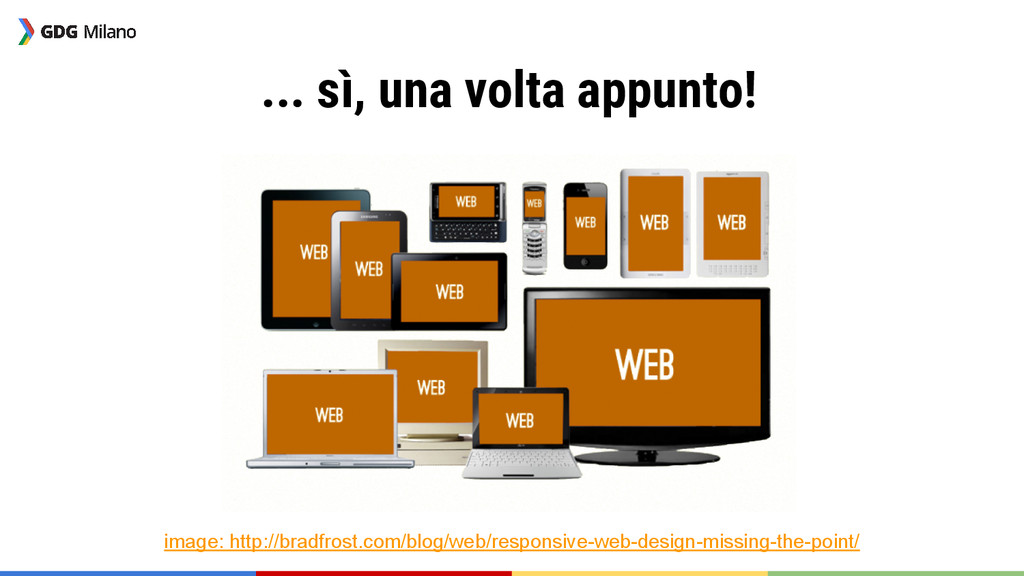
... sì, una volta appunto! image: http://bradfrost.com/blog/web/responsive-web-design-missing-the-point/
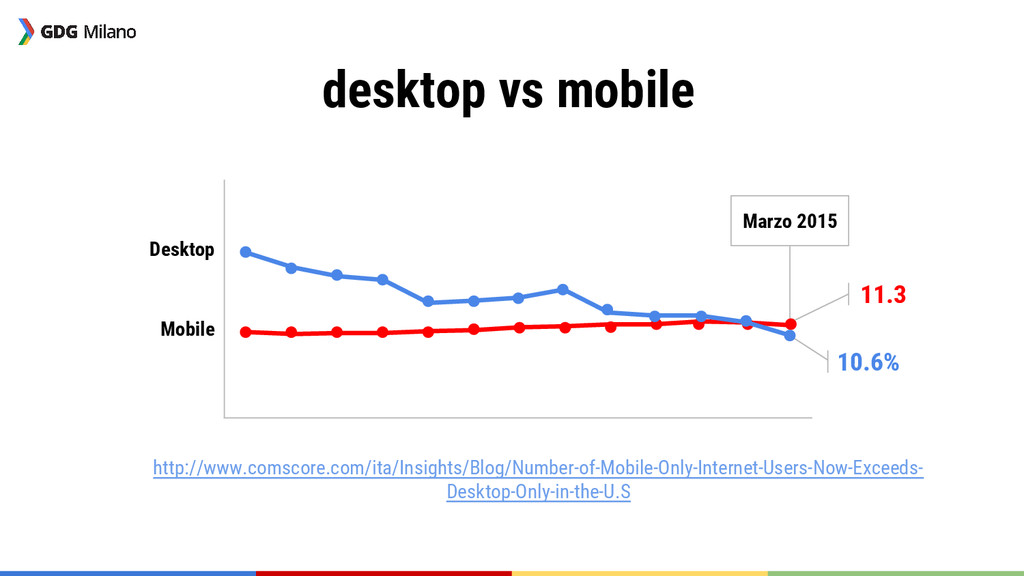
desktop vs mobile Marzo 2015 Desktop Mobile 10.6% 11.3 http://www.comscore.com/ita/Insights/Blog/Number-of-Mobile-Only-Internet-Users-Now-Exceeds-
Desktop-Only-in-the-U.S
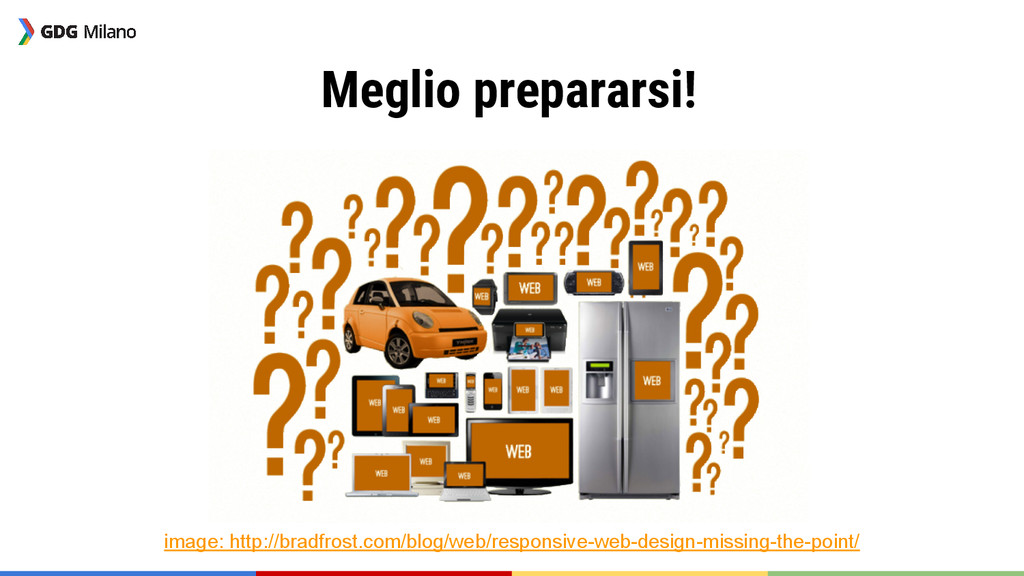
Meglio prepararsi! image: http://bradfrost.com/blog/web/responsive-web-design-missing-the-point/
Di cosa parleremo 1) Layout Fluid 2) La viewport 3)
Le media query 4) Codelab
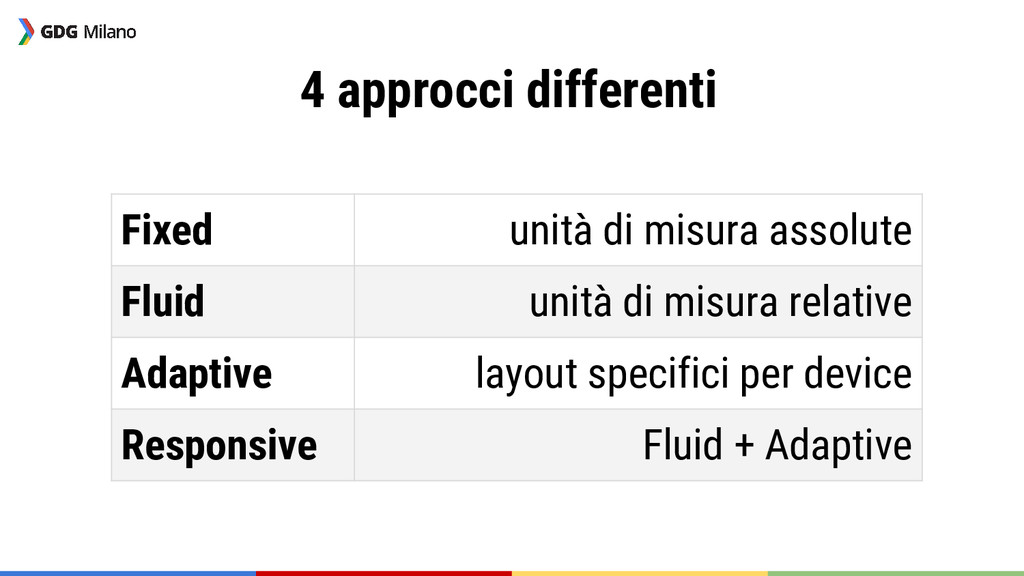
4 approcci differenti Fixed unità di misura assolute Fluid unità
di misura relative Adaptive layout specifici per device Responsive Fluid + Adaptive
Layout Fluid
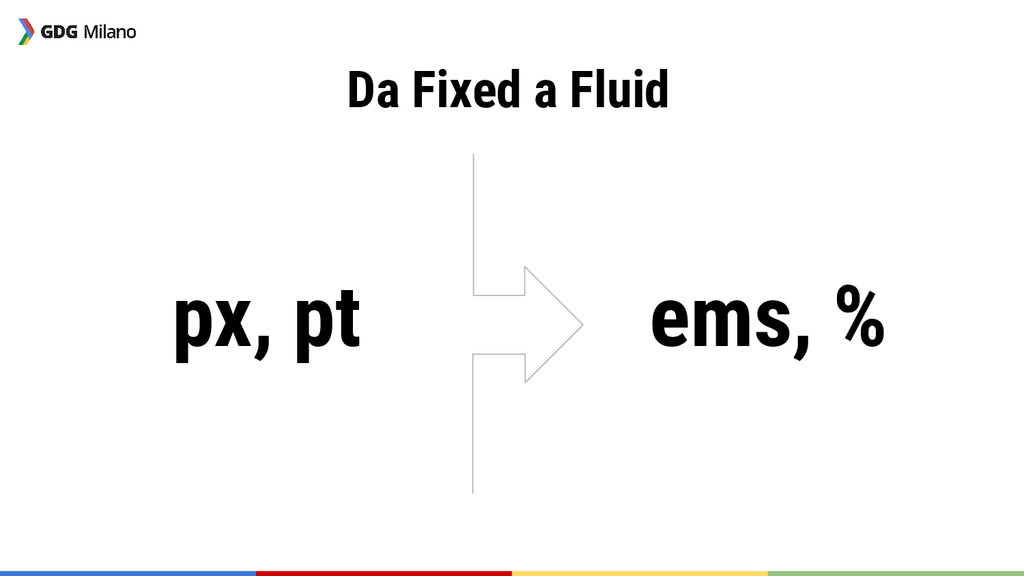
px, pt ems, % Da Fixed a Fluid
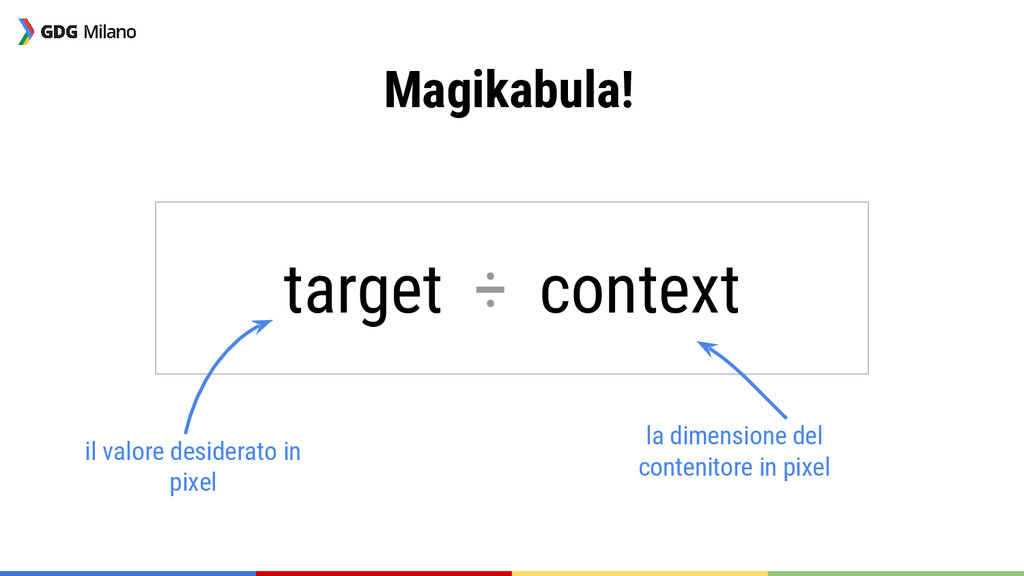
Magikabula! target ÷ context il valore desiderato in pixel la
dimensione del contenitore in pixel
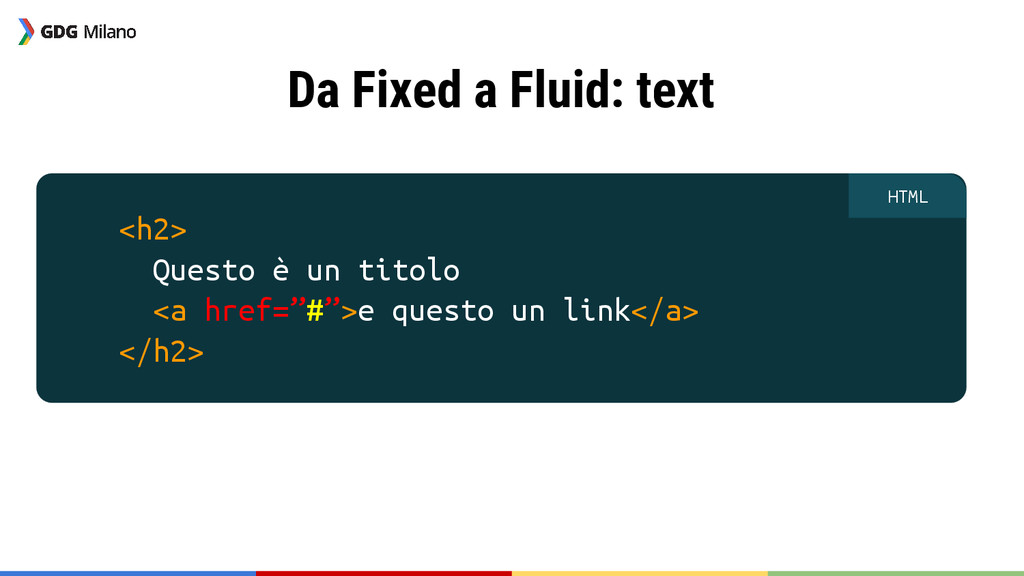
Da Fixed a Fluid: text <h2> Questo è un titolo
<a href=”#”>e questo un link</a> </h2> HTML
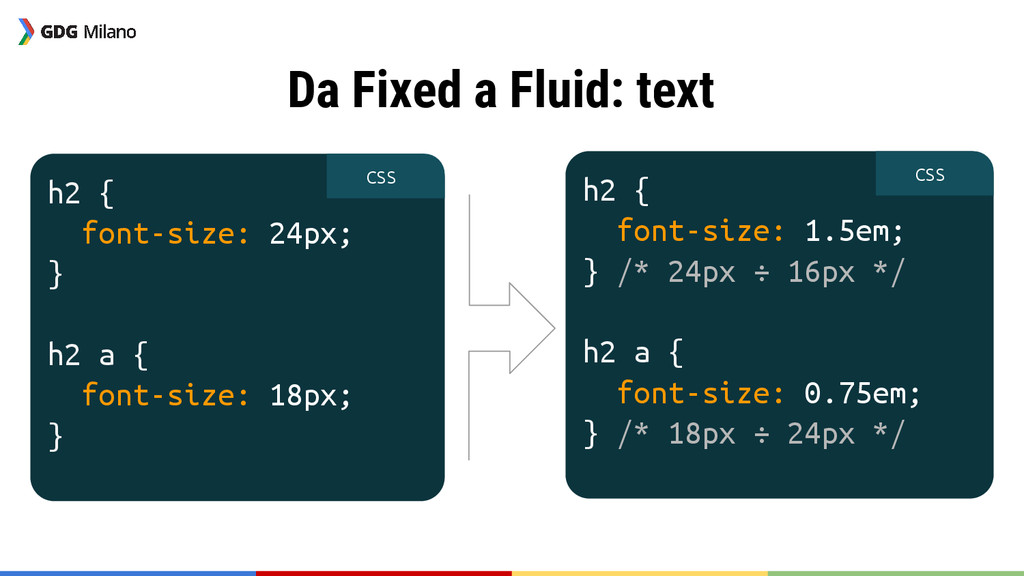
h2 { font-size: 24px; } h2 a { font-size: 18px;
} h2 { font-size: 1.5em; } /* 24px ÷ 16px */ h2 a { font-size: 0.75em; } /* 18px ÷ 24px */ CSS CSS Da Fixed a Fluid: text
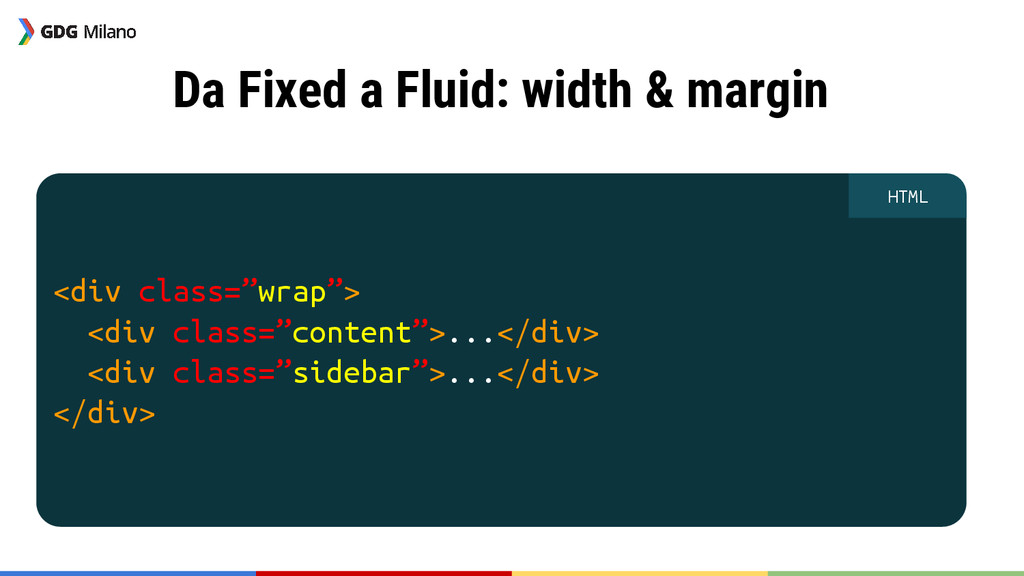
<div class=”wrap”> <div class=”content”>...</div> <div class=”sidebar”>...</div> </div> HTML Da Fixed
a Fluid: width & margin
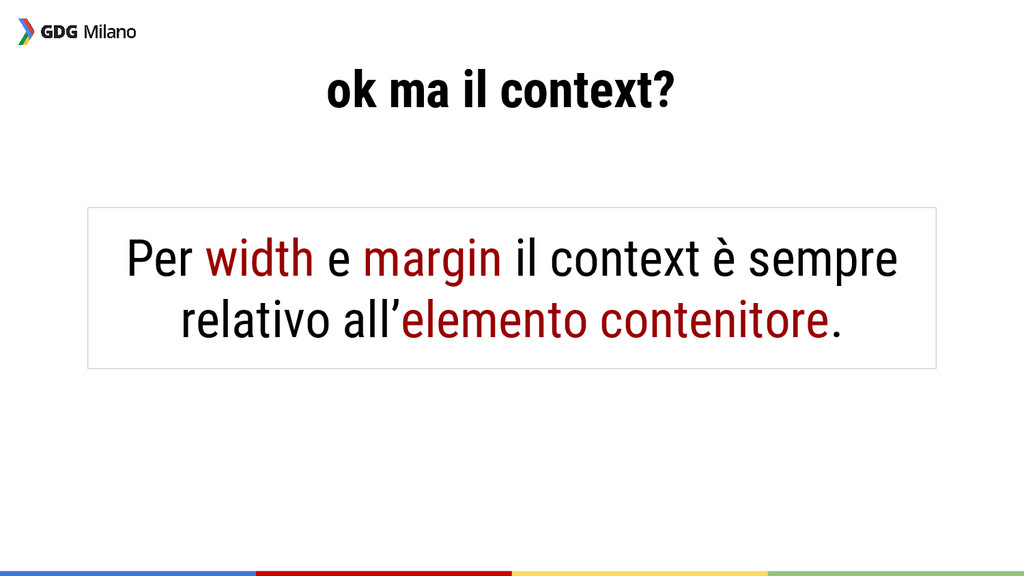
ok ma il context? Per width e margin il context
è sempre relativo all’elemento contenitore.
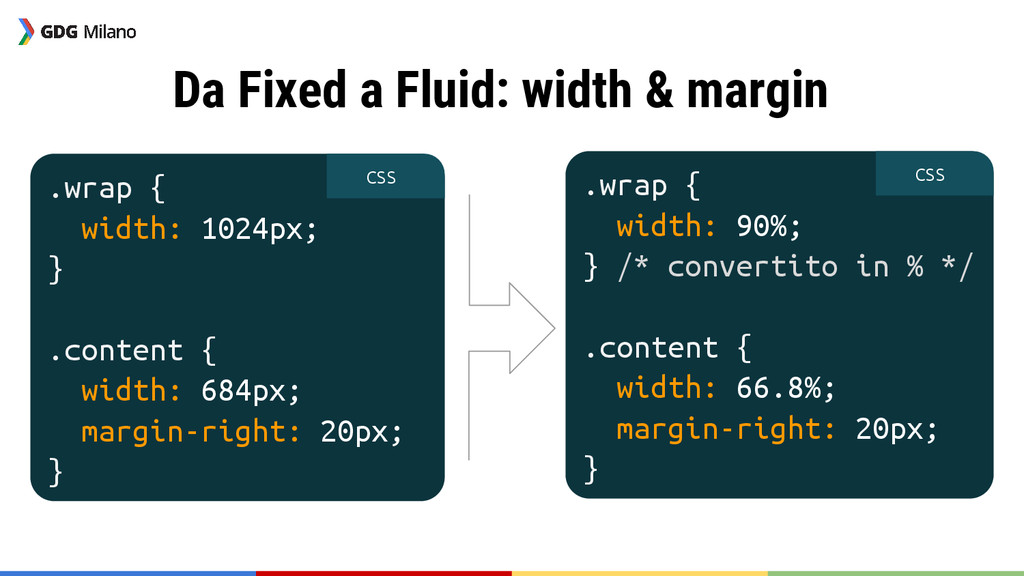
.wrap { width: 1024px; } .content { width: 684px; margin-right:
20px; } .wrap { width: 90%; } /* convertito in % */ .content { width: 66.8%; margin-right: 20px; } CSS CSS Da Fixed a Fluid: width & margin
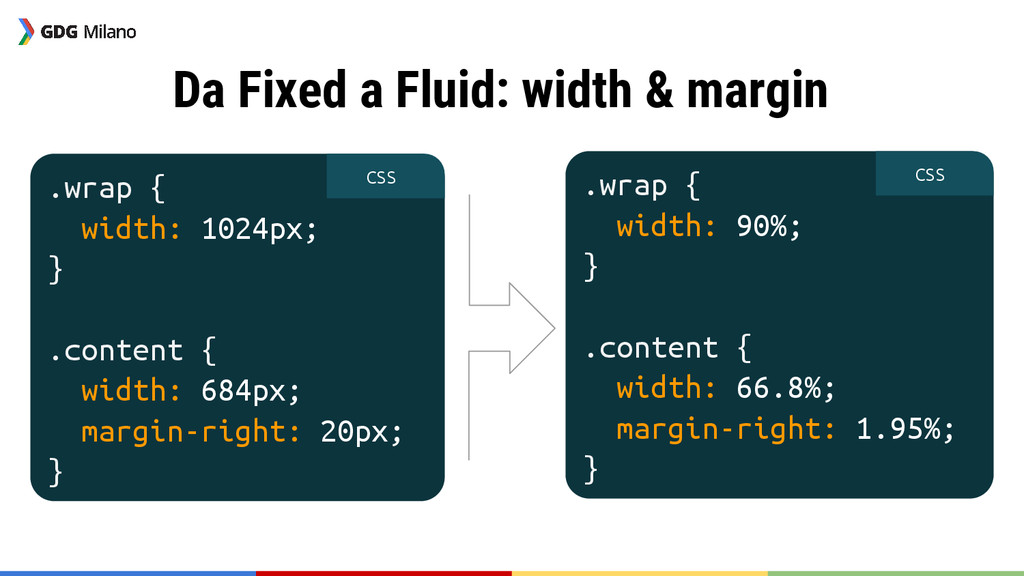
.wrap { width: 1024px; } .content { width: 684px; margin-right:
20px; } .wrap { width: 90%; } .content { width: 66.8%; margin-right: 1.95%; } Da Fixed a Fluid: width & margin CSS CSS
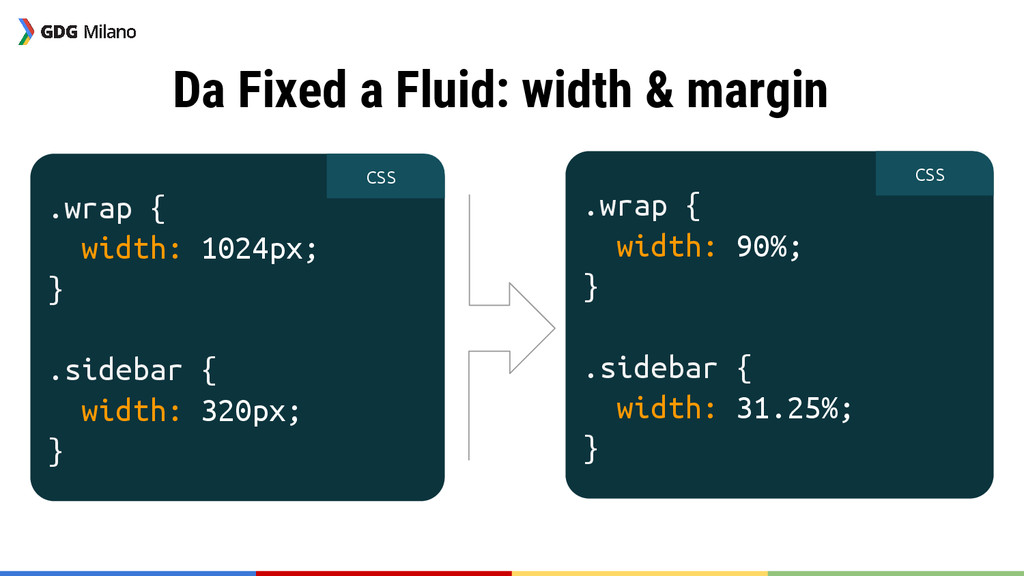
.wrap { width: 1024px; } .sidebar { width: 320px; }
.wrap { width: 90%; } .sidebar { width: 31.25%; } CSS CSS Da Fixed a Fluid: width & margin
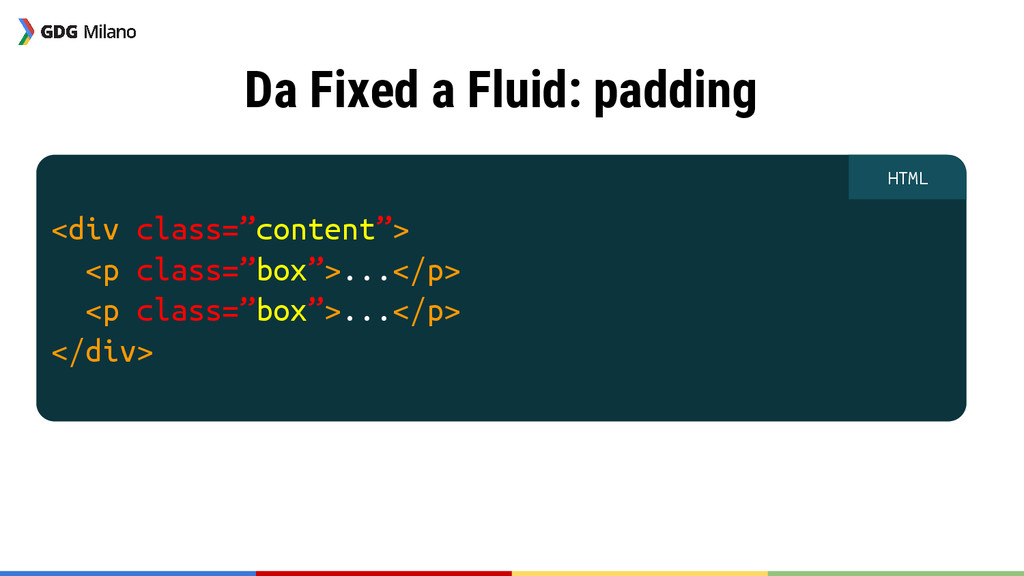
<div class=”content”> <p class=”box”>...</p> <p class=”box”>...</p> </div> HTML Da Fixed
a Fluid: padding
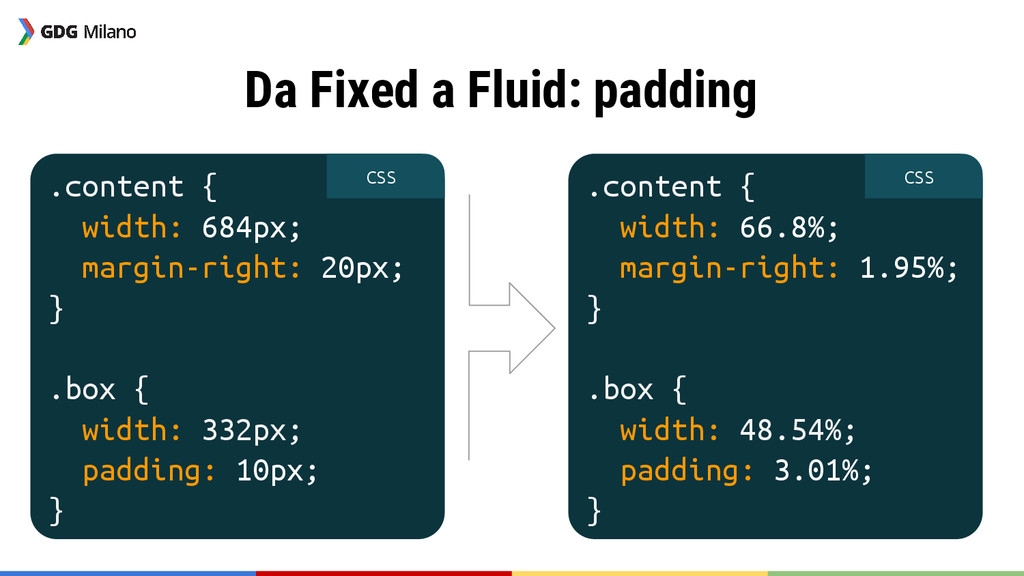
Attenzione al context! Per il padding il context è sempre
relativo all’elemento stesso.
.content { width: 684px; margin-right: 20px; } .box { width:
332px; padding: 10px; } CSS .content { width: 66.8%; margin-right: 1.95%; } .box { width: 48.54%; padding: 3.01%; } CSS Da Fixed a Fluid: padding
La viewport
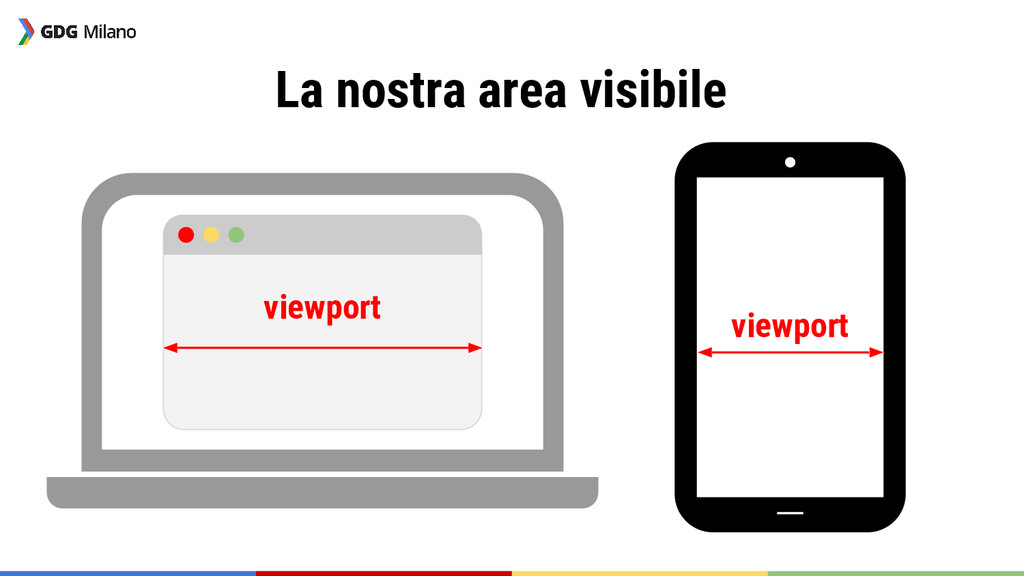
La nostra area visibile viewport viewport
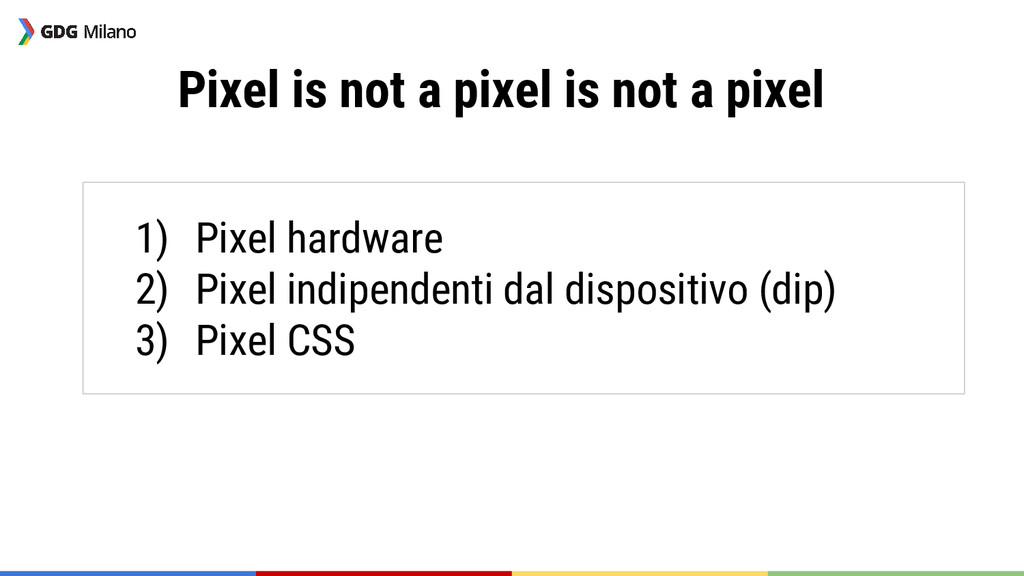
Pixel is not a pixel is not a pixel 1)
Pixel hardware 2) Pixel indipendenti dal dispositivo (dip) 3) Pixel CSS
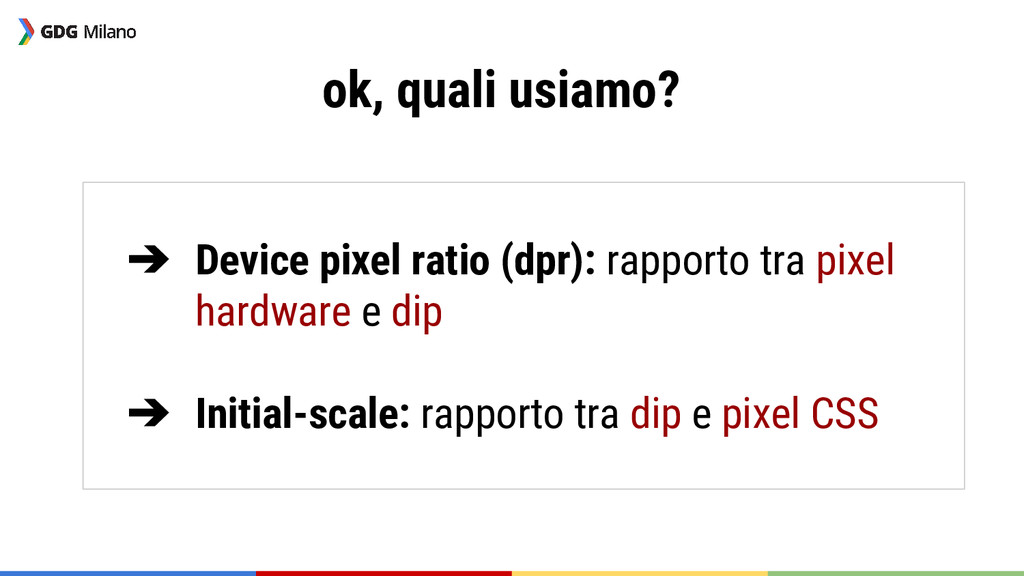
ok, quali usiamo? ➔ Device pixel ratio (dpr): rapporto tra
pixel hardware e dip ➔ Initial-scale: rapporto tra dip e pixel CSS
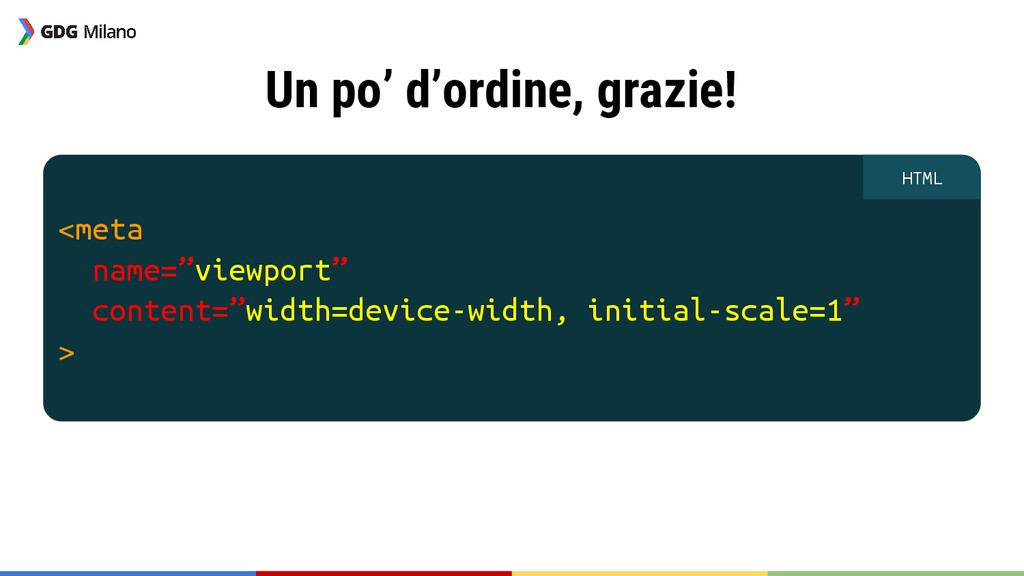
Un po’ d’ordine, grazie! <meta name=”viewport” content=”width=device-width, initial-scale=1” > HTML
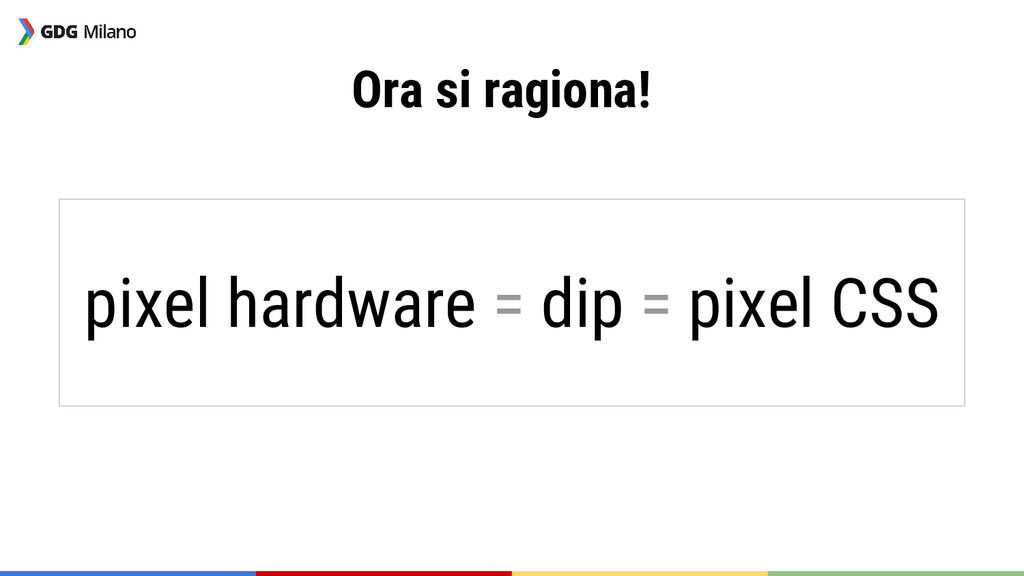
Ora si ragiona! pixel hardware = dip = pixel CSS
Le media query
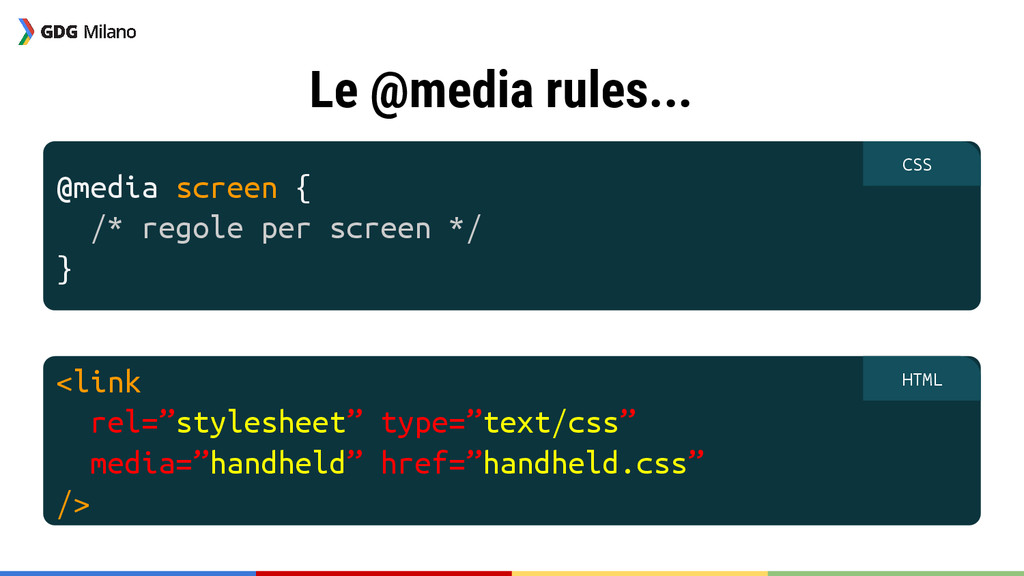
Le @media rules... @media screen { /* regole per screen
*/ } CSS <link rel=”stylesheet” type=”text/css” media=”handheld” href=”handheld.css” /> HTML
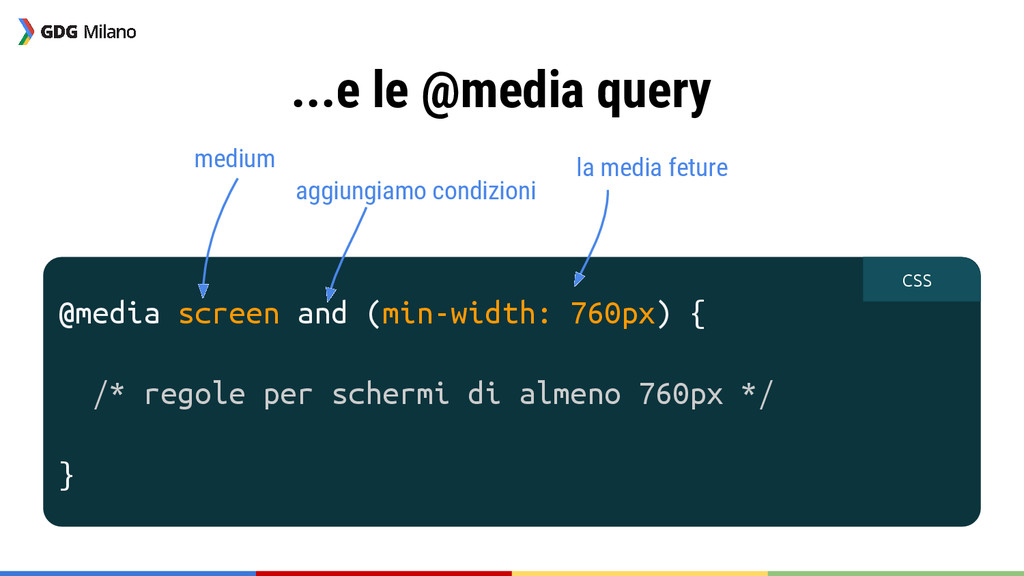
...e le @media query @media screen and (min-width: 760px) {
/* regole per schermi di almeno 760px */ } CSS medium aggiungiamo condizioni la media feture
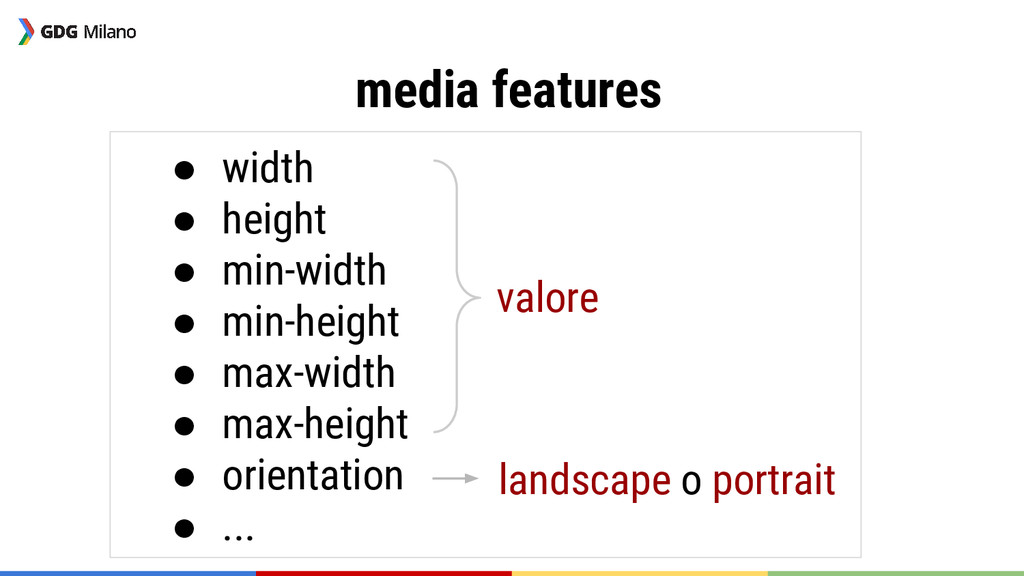
media features • width • height • min-width • min-height
• max-width • max-height • orientation • ... valore landscape o portrait
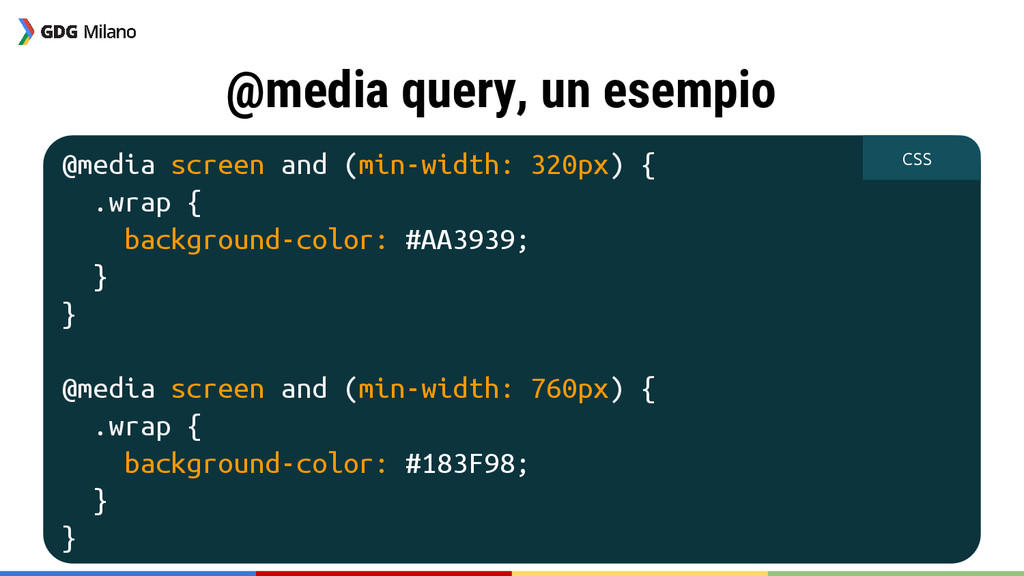
@media query, un esempio @media screen and (min-width: 320px) {
.wrap { background-color: #AA3939; } } @media screen and (min-width: 760px) { .wrap { background-color: #183F98; } } CSS
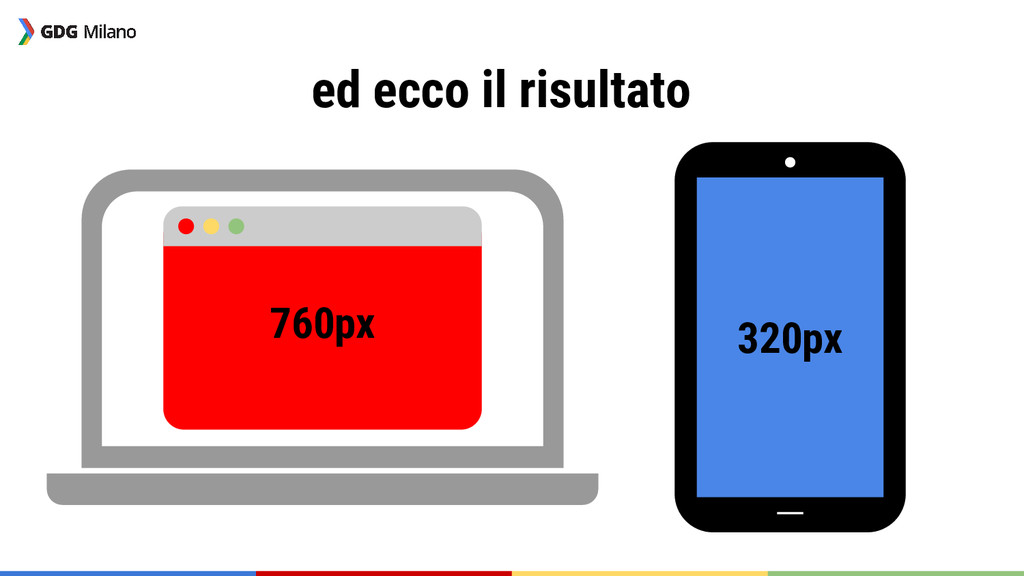
ed ecco il risultato 760px 320px
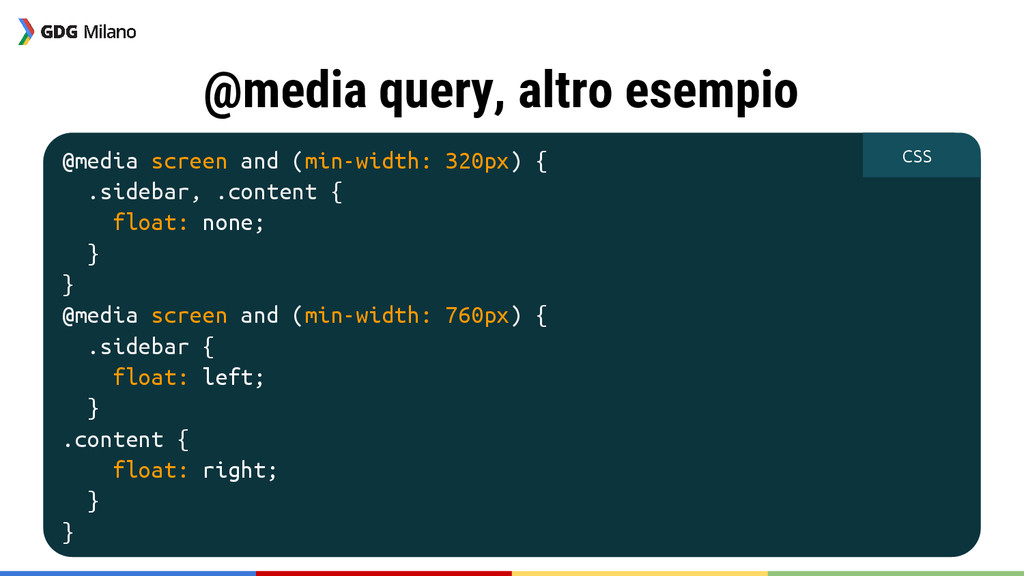
@media query, altro esempio @media screen and (min-width: 320px) {
.sidebar, .content { float: none; } } @media screen and (min-width: 760px) { .sidebar { float: left; } .content { float: right; } } CSS
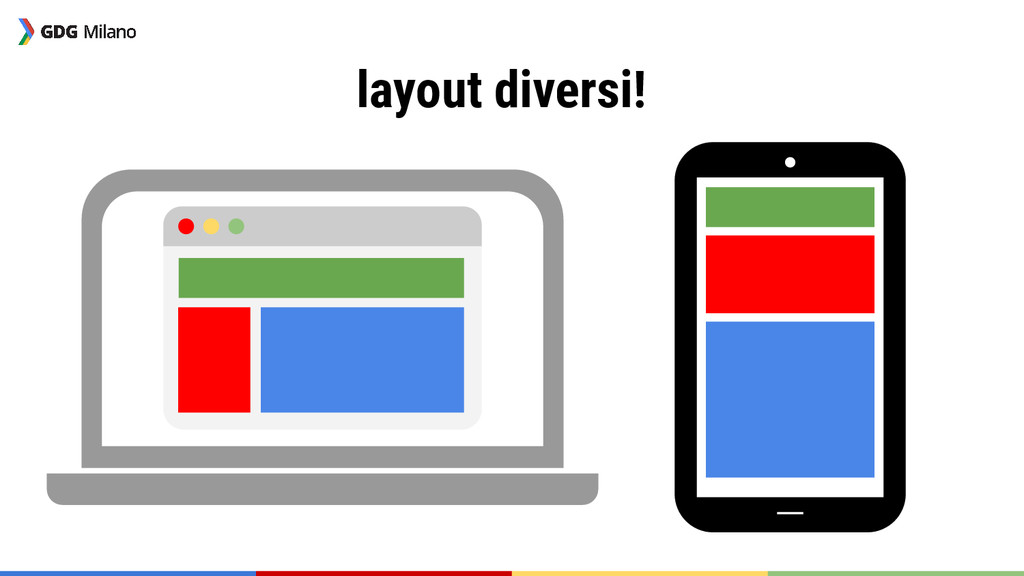
layout diversi!
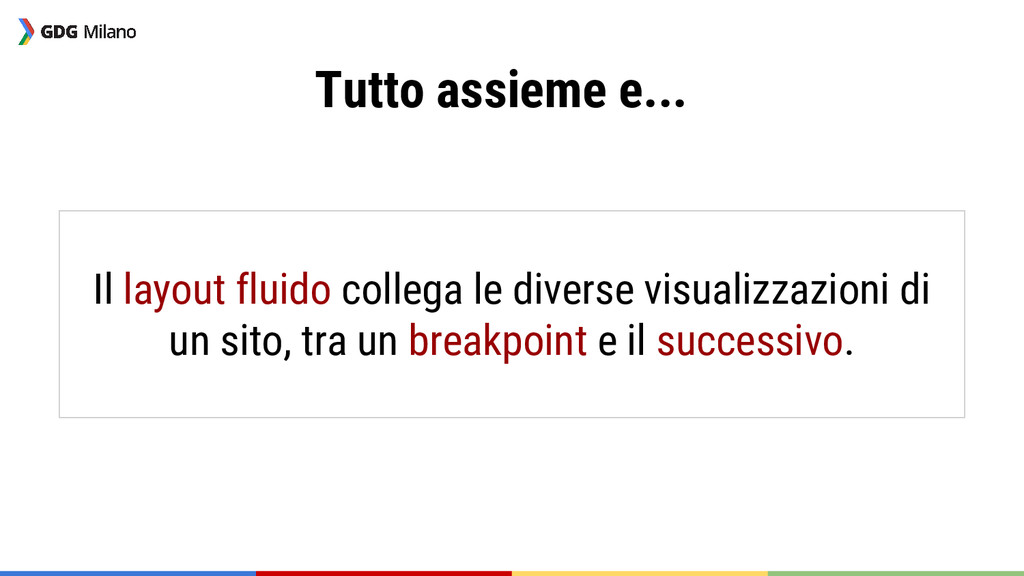
Tutto assieme e... Il layout fluido collega le diverse visualizzazioni
di un sito, tra un breakpoint e il successivo.
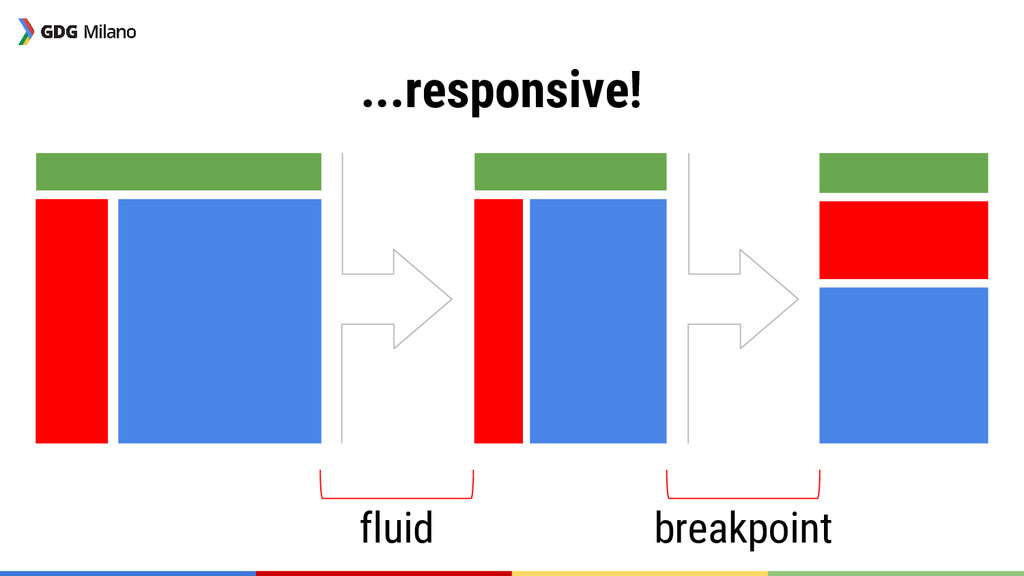
...responsive! fluid breakpoint
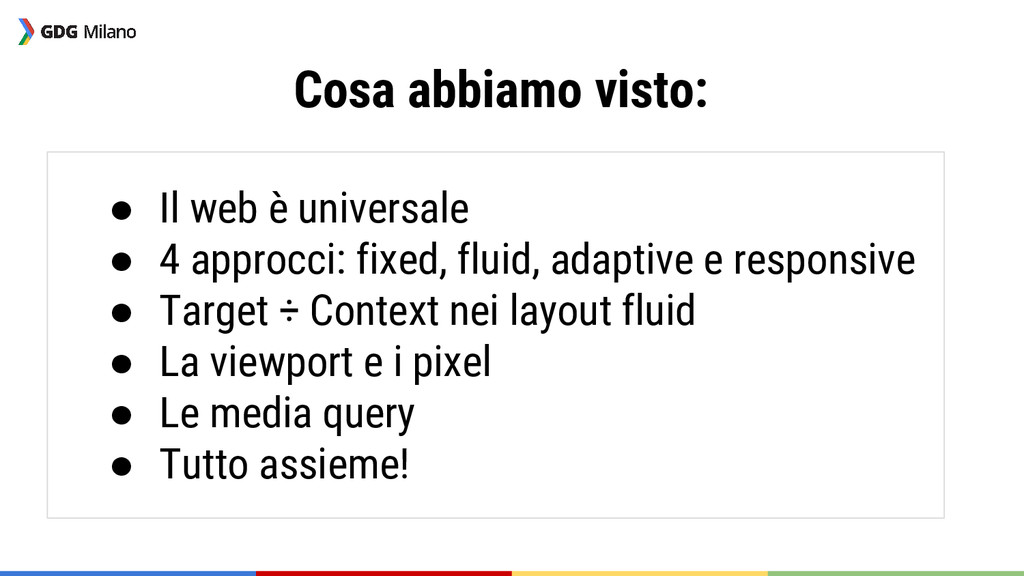
Cosa abbiamo visto: • Il web è universale • 4
approcci: fixed, fluid, adaptive e responsive • Target ÷ Context nei layout fluid • La viewport e i pixel • Le media query • Tutto assieme!
Domande?
Codelab :)
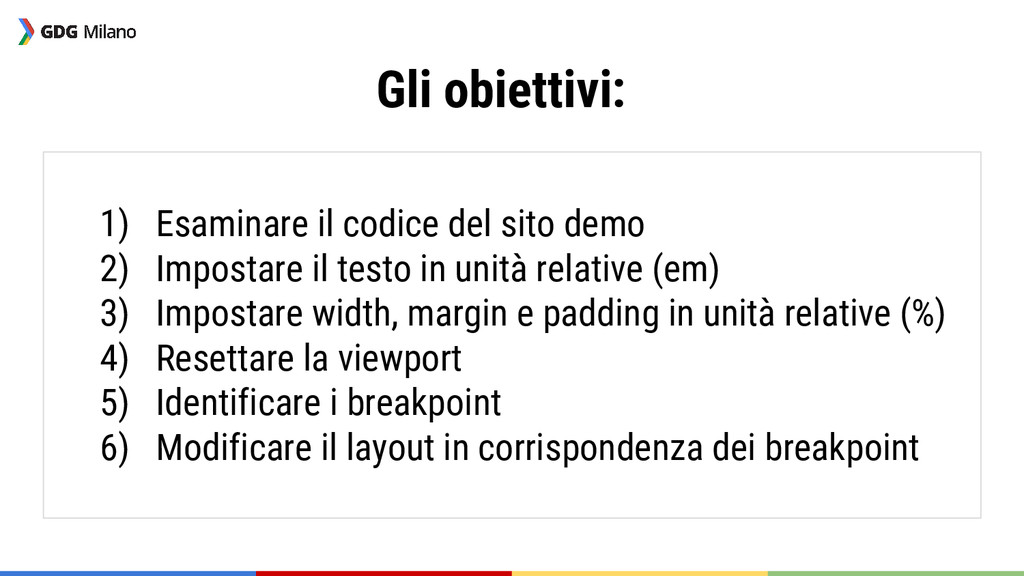
Gli obiettivi: 1) Esaminare il codice del sito demo 2)
Impostare il testo in unità relative (em) 3) Impostare width, margin e padding in unità relative (%) 4) Resettare la viewport 5) Identificare i breakpoint 6) Modificare il layout in corrispondenza dei breakpoint
Risorse: gdgmilano.org/wired
Restiamo in contatto! ★ Jacopo Rabolini | Web & Graphic
designer ➔ jacoporabolini.com ➔
[email protected]
➔ google.com/+jacoporabolini
Grazie!


 kingfelix
 elmetal
 kenjiyoneyama
 otouto
 suneo3476
 ogom
ogom
 448jp
448jp
 dske104
 naokihaba
 morizo_1984
 ivargrimstad
 kishida
 steliosf
 holman
 madoxten
 davetheseo
 rakko
rakko
 watany
 szymonslowik
 danielanewman
 katarinadahlin
 aleyda
 maltzj
 bluesmoon