Upgrade to Pro — share decks privately, control downloads, hide ads and more …

Data Lake Governance

Avatar for Kiran Kiran
October 26, 2015

Data Lake Governance

Hadoop based data Lakes have become increasingly popular within today’s modern data architectures for their ability to scale, handle data variety and low cost. Many organizations start slow with the data lake initiatives but as they grow bigger, they suffer with challenges on data consistency, quality and security, resulting in losing confidence in their data lake initiatives.
This talk will discuss the need for good data governance mechanisms for Hadoop data lakes and it relationship with productivity and how it helps organizations meet regulatory and compliance requirements. The talk advocates carrying a different mindset for designing and implementing flexible governance mechanisms on Hadoop data lakes.

Avatar for Kiran

Kiran

October 26, 2015

More Decks by Kiran

Other Decks in Technology

Transcript

  1. Anarchy Doesn’t Scale: Your Data Lake Needs Governance Kiran Kamreddy

    Principal Product Manager Hadoop Portfolio, Teradata
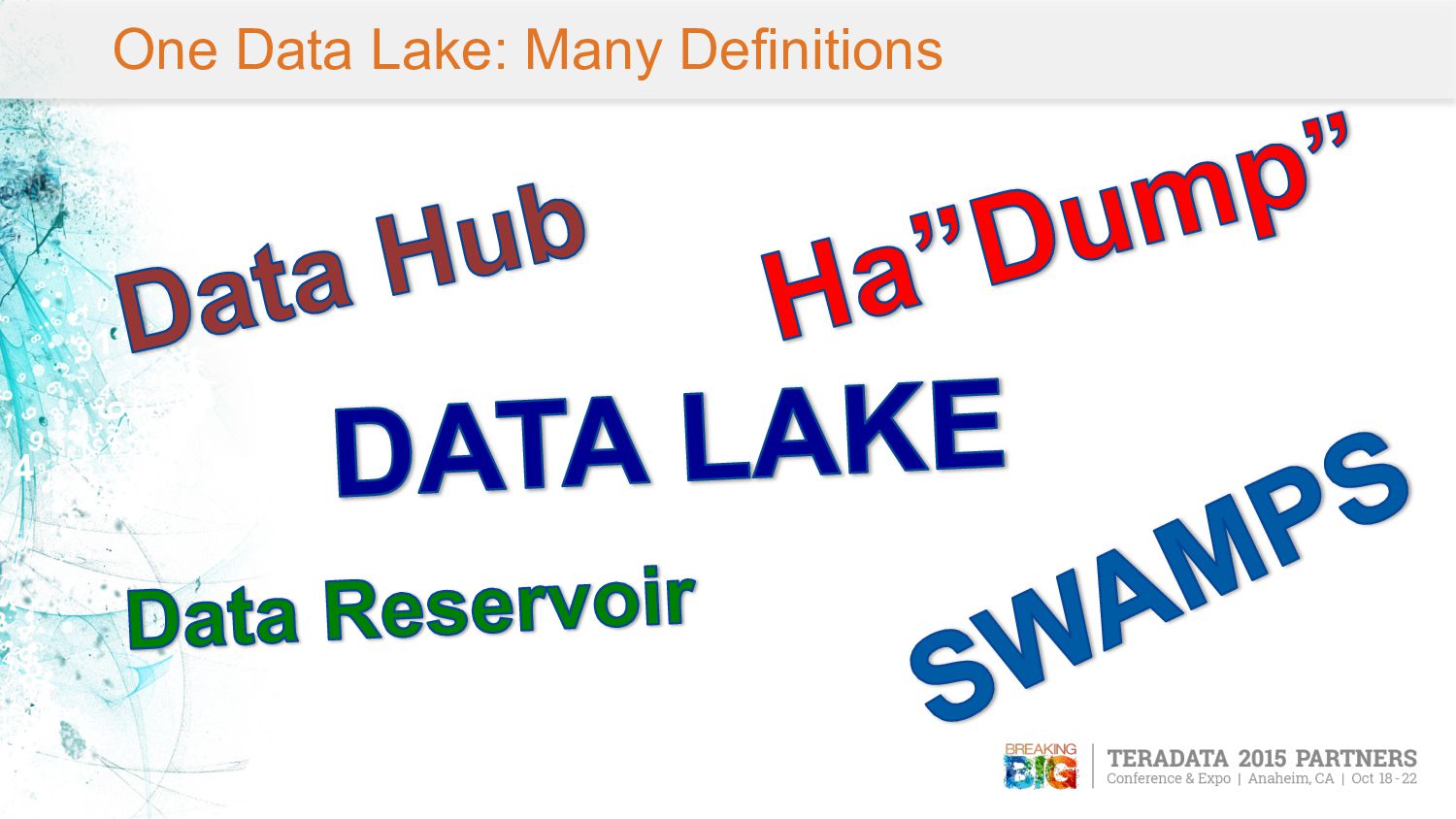
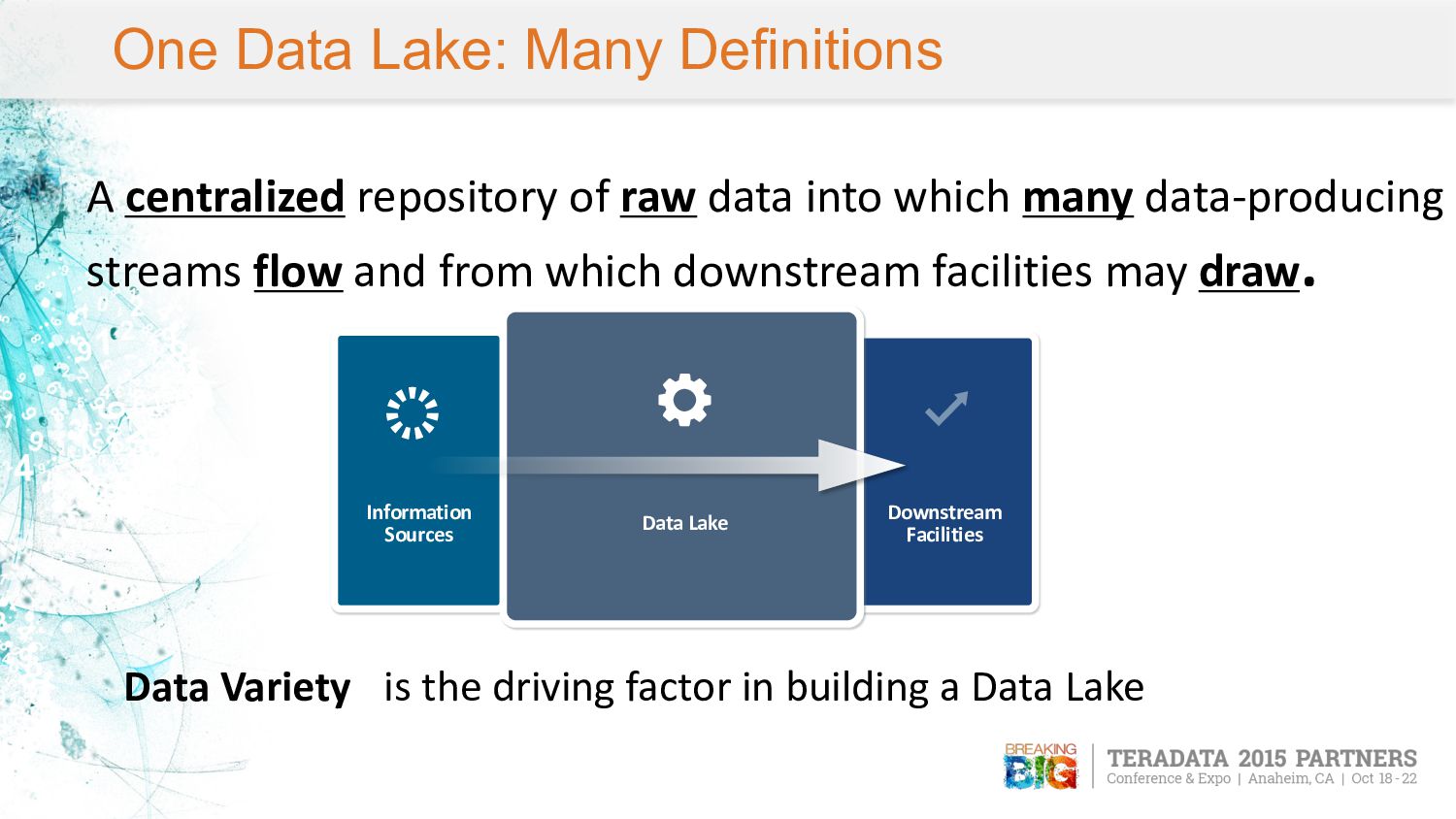
  2. One Data Lake: Many Definitions A centralized repository of raw

    data into which many data-producing streams flow and from which downstream facilities may draw. Information Sources Data Lake Downstream Facilities Data Variety is the driving factor in building a Data Lake
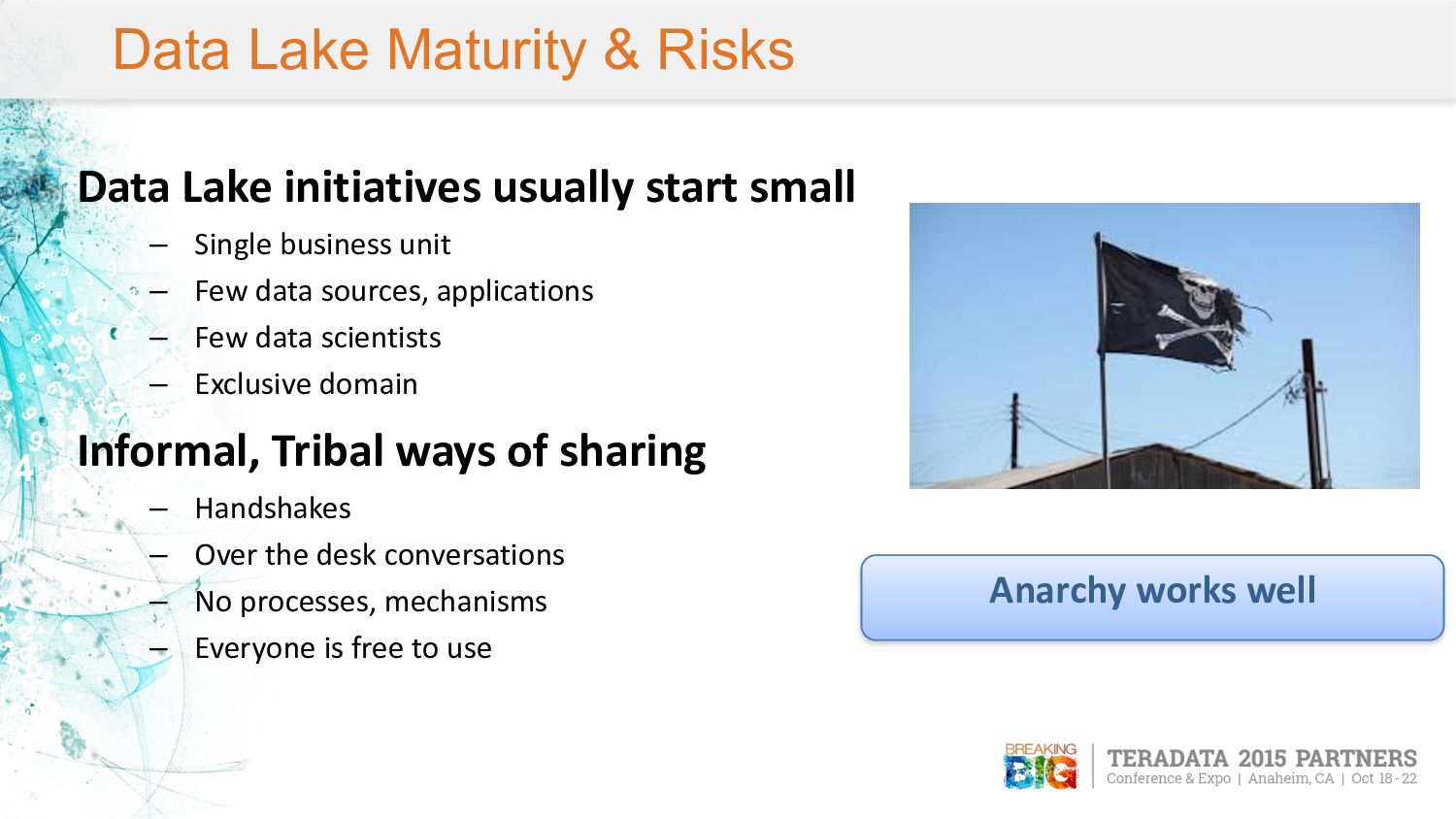
  3. Data Lake Maturity & Risks Data Lake initiatives usually start

    small – Single business unit – Few data sources, applications – Few data scientists – Exclusive domain Informal, Tribal ways of sharing – Handshakes – Over the desk conversations – No processes, mechanisms – Everyone is free to use Anarchy works well
  4. Data Lake Maturity & Risks Data Lake initiatives grow popular

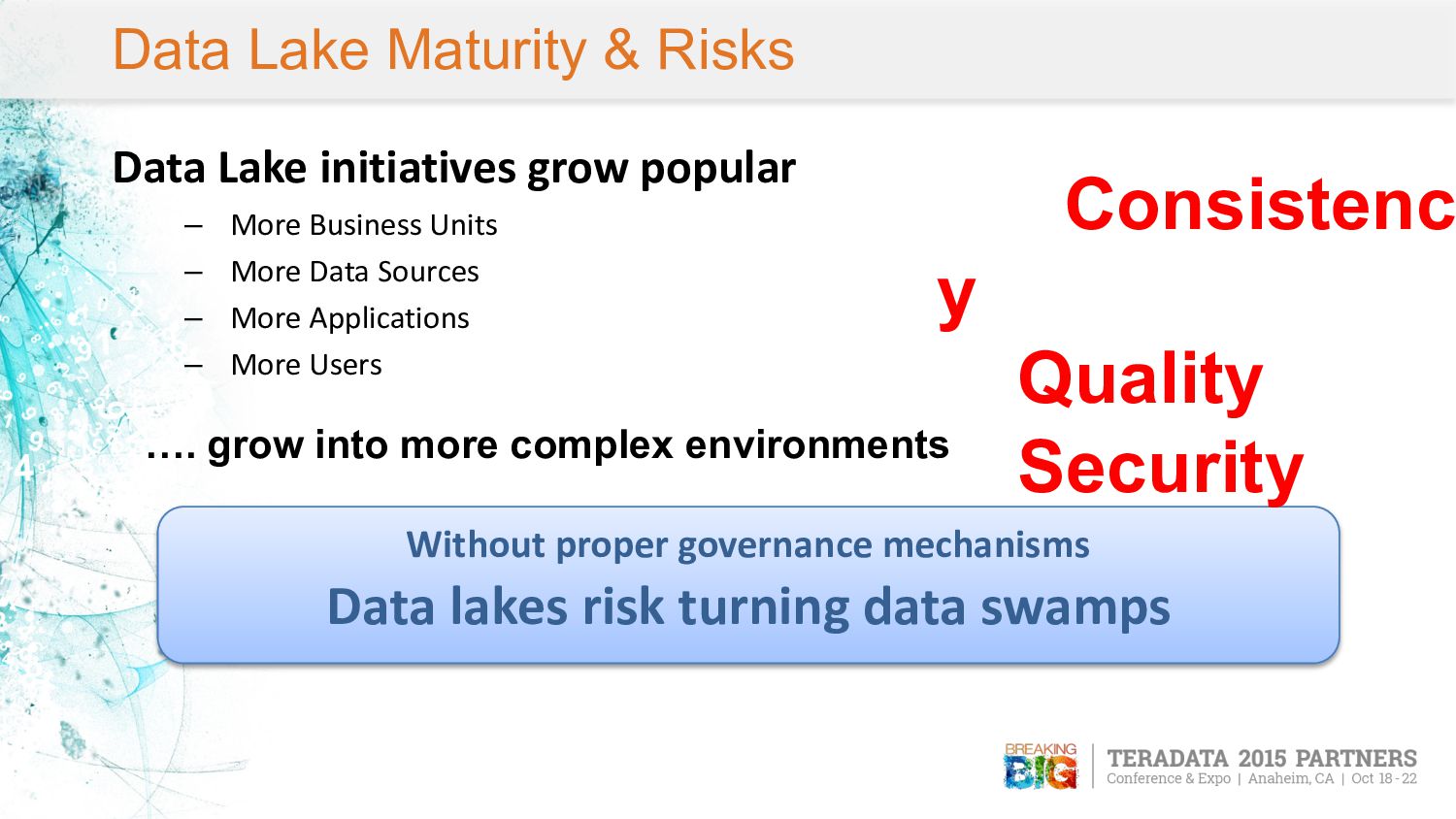
    – More Business Units – More Data Sources – More Applications – More Users …. grow into more complex environments Without proper governance mechanisms Data lakes risk turning data swamps Consistenc y Quality Security
  5. What can Governance do for my data lake? Fundamental capabilities

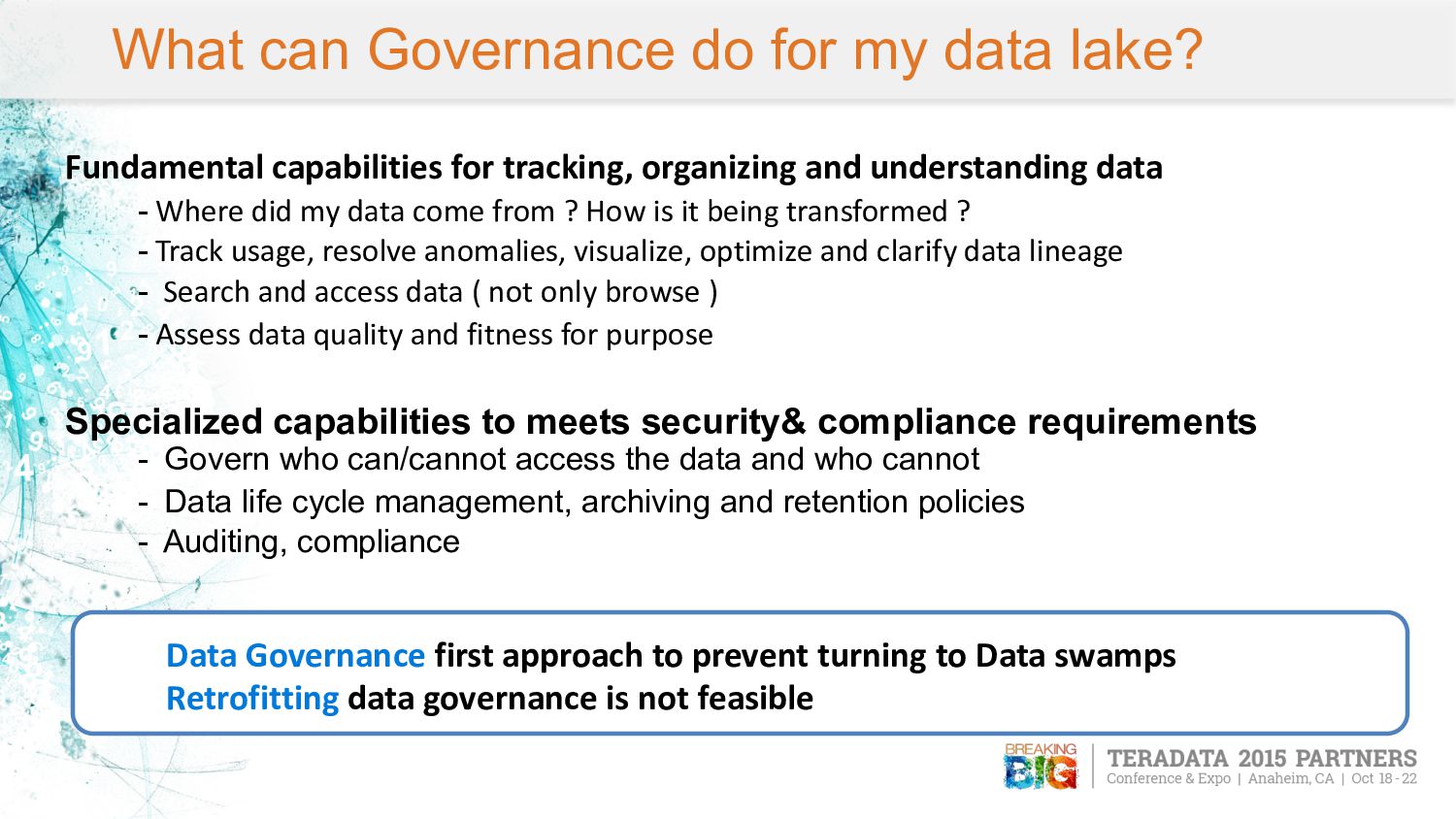
    for tracking, organizing and understanding data - Where did my data come from ? How is it being transformed ? - Track usage, resolve anomalies, visualize, optimize and clarify data lineage - Search and access data ( not only browse ) - Assess data quality and fitness for purpose Specialized capabilities to meets security& compliance requirements - Govern who can/cannot access the data and who cannot - Data life cycle management, archiving and retention policies - Auditing, compliance Data Governance first approach to prevent turning to Data swamps Retrofitting data governance is not feasible
  6. Governance and Productivity Governance should supports day-to-day use of data

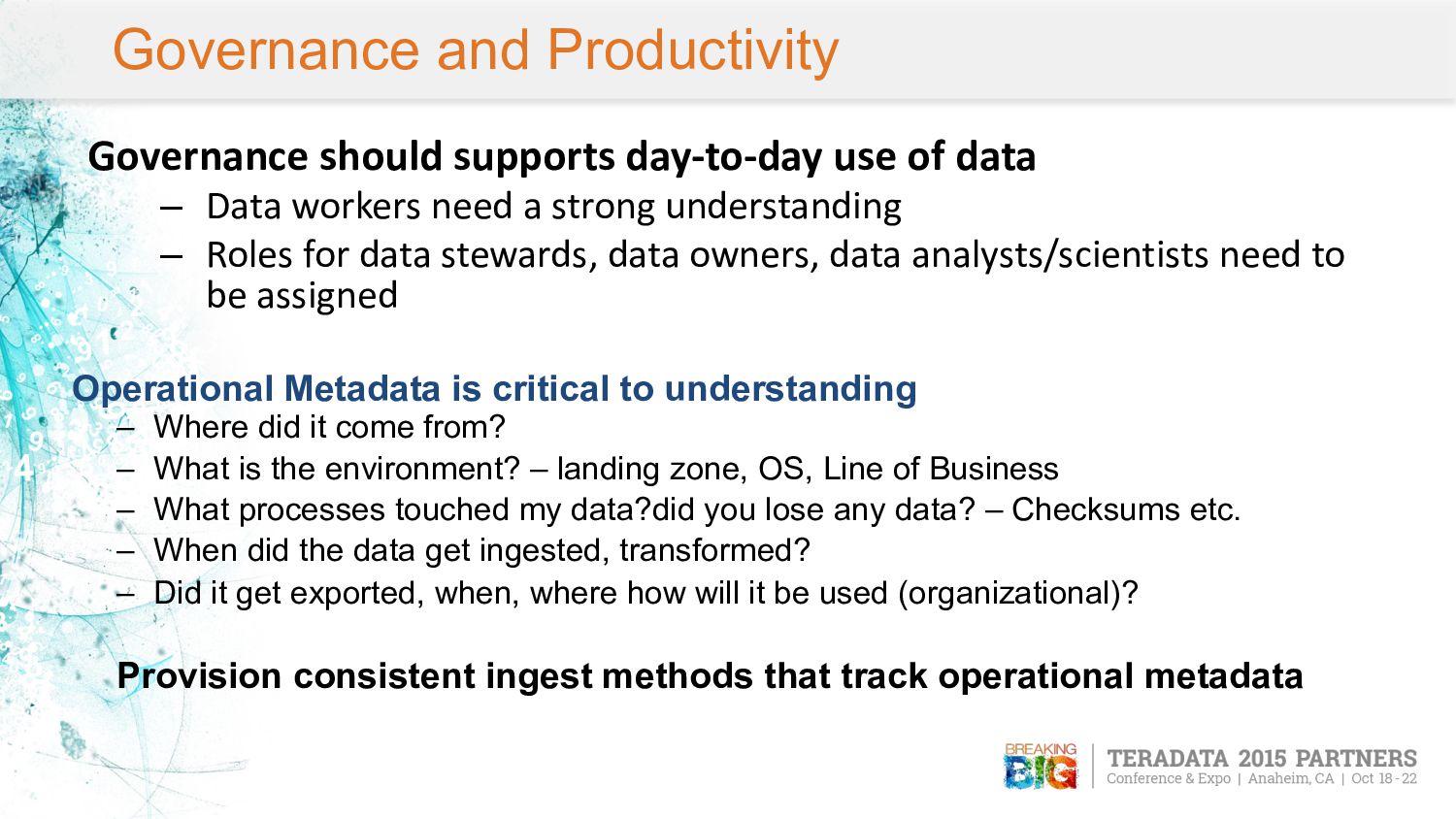
    – Data workers need a strong understanding – Roles for data stewards, data owners, data analysts/scientists need to be assigned Operational Metadata is critical to understanding – Where did it come from? – What is the environment? – landing zone, OS, Line of Business – What processes touched my data?did you lose any data? – Checksums etc. – When did the data get ingested, transformed? – Did it get exported, when, where how will it be used (organizational)? Provision consistent ingest methods that track operational metadata
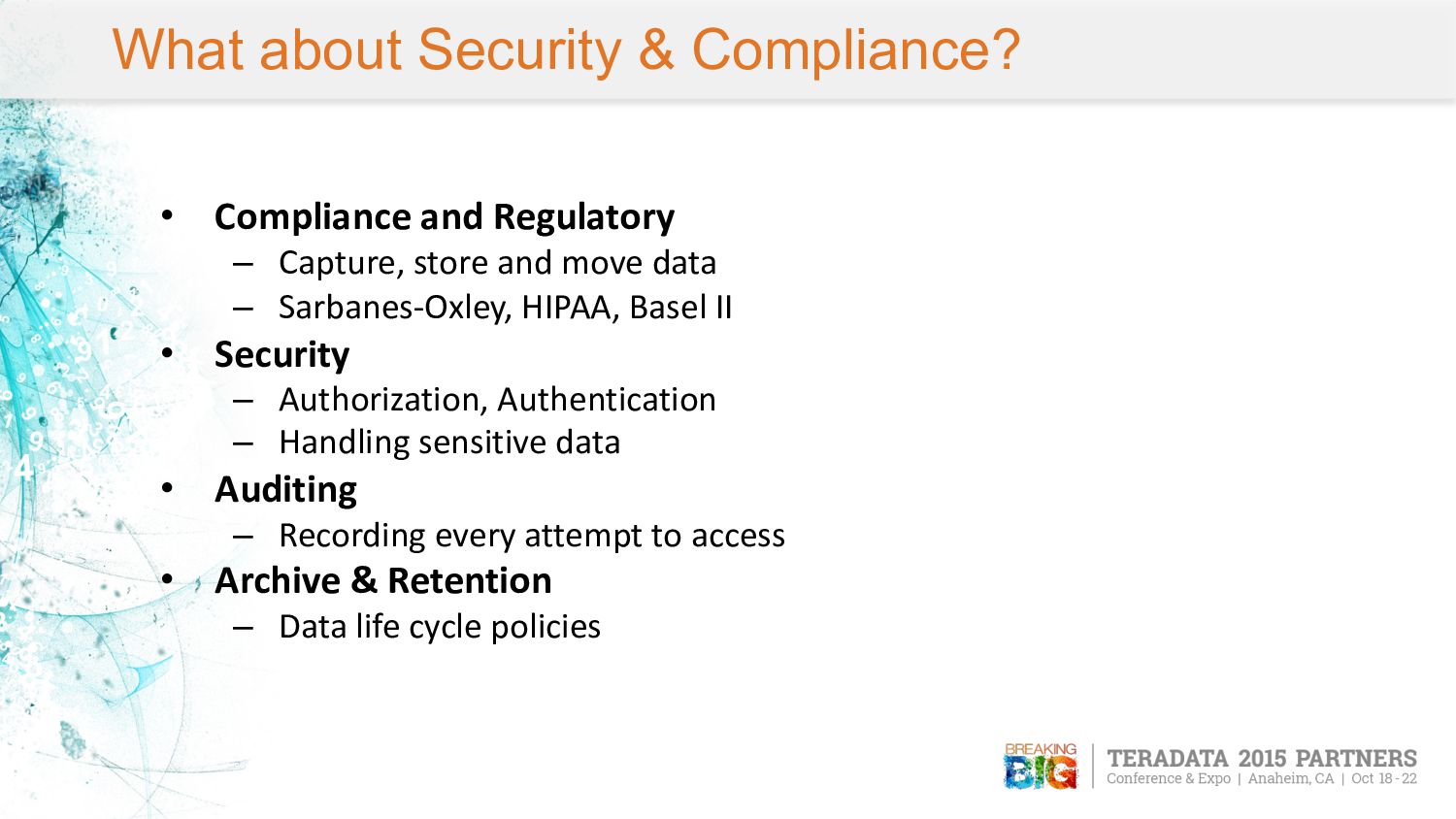
  7. What about Security & Compliance? • Compliance and Regulatory –

    Capture, store and move data – Sarbanes-Oxley, HIPAA, Basel II • Security – Authorization, Authentication – Handling sensitive data • Auditing – Recording every attempt to access • Archive & Retention – Data life cycle policies
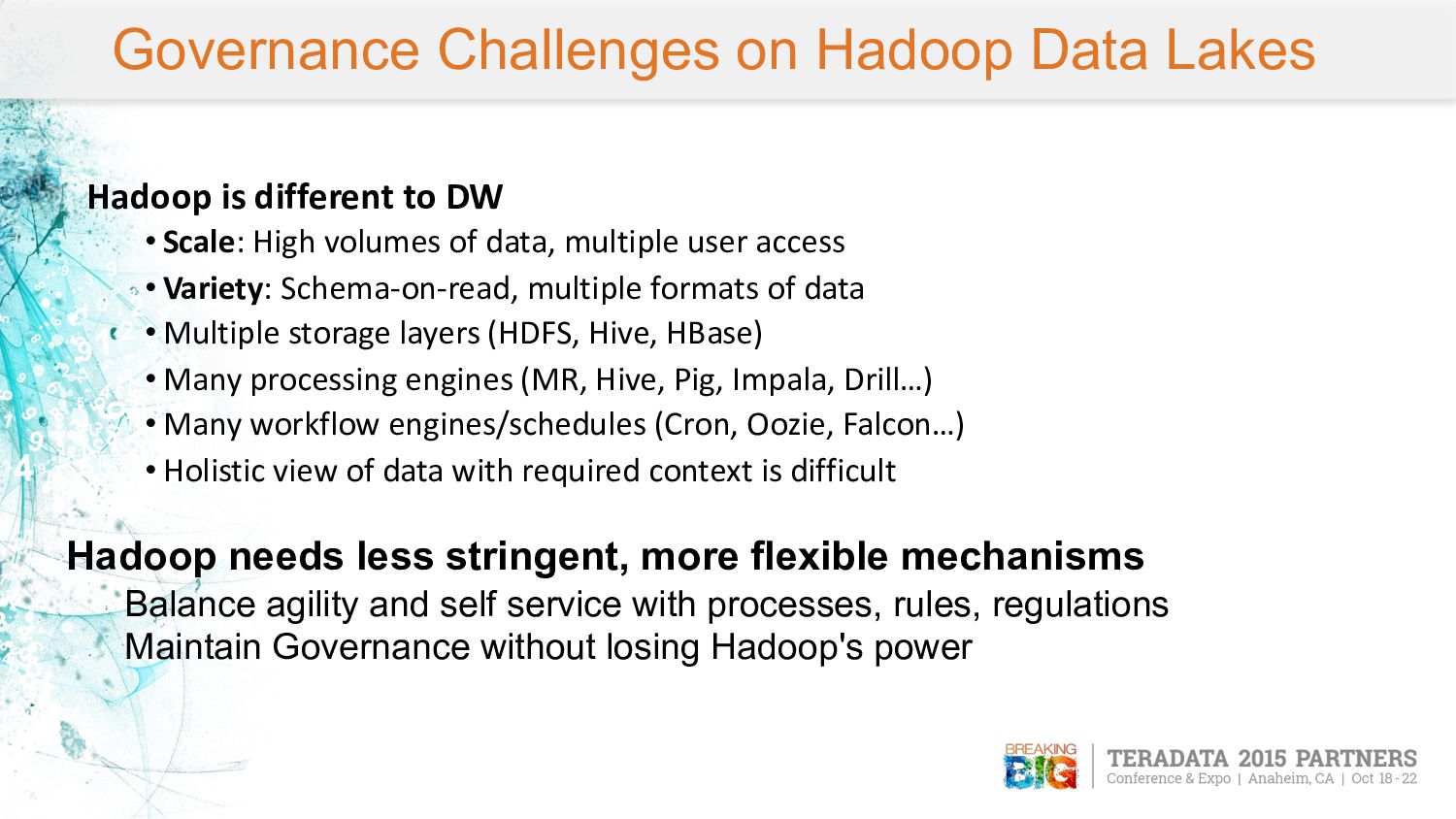
  8. Governance Challenges on Hadoop Data Lakes Hadoop is different to

    DW • Scale: High volumes of data, multiple user access • Variety: Schema-on-read, multiple formats of data • Multiple storage layers (HDFS, Hive, HBase) • Many processing engines (MR, Hive, Pig, Impala, Drill…) • Many workflow engines/schedules (Cron, Oozie, Falcon…) • Holistic view of data with required context is difficult Hadoop needs less stringent, more flexible mechanisms Balance agility and self service with processes, rules, regulations Maintain Governance without losing Hadoop's power
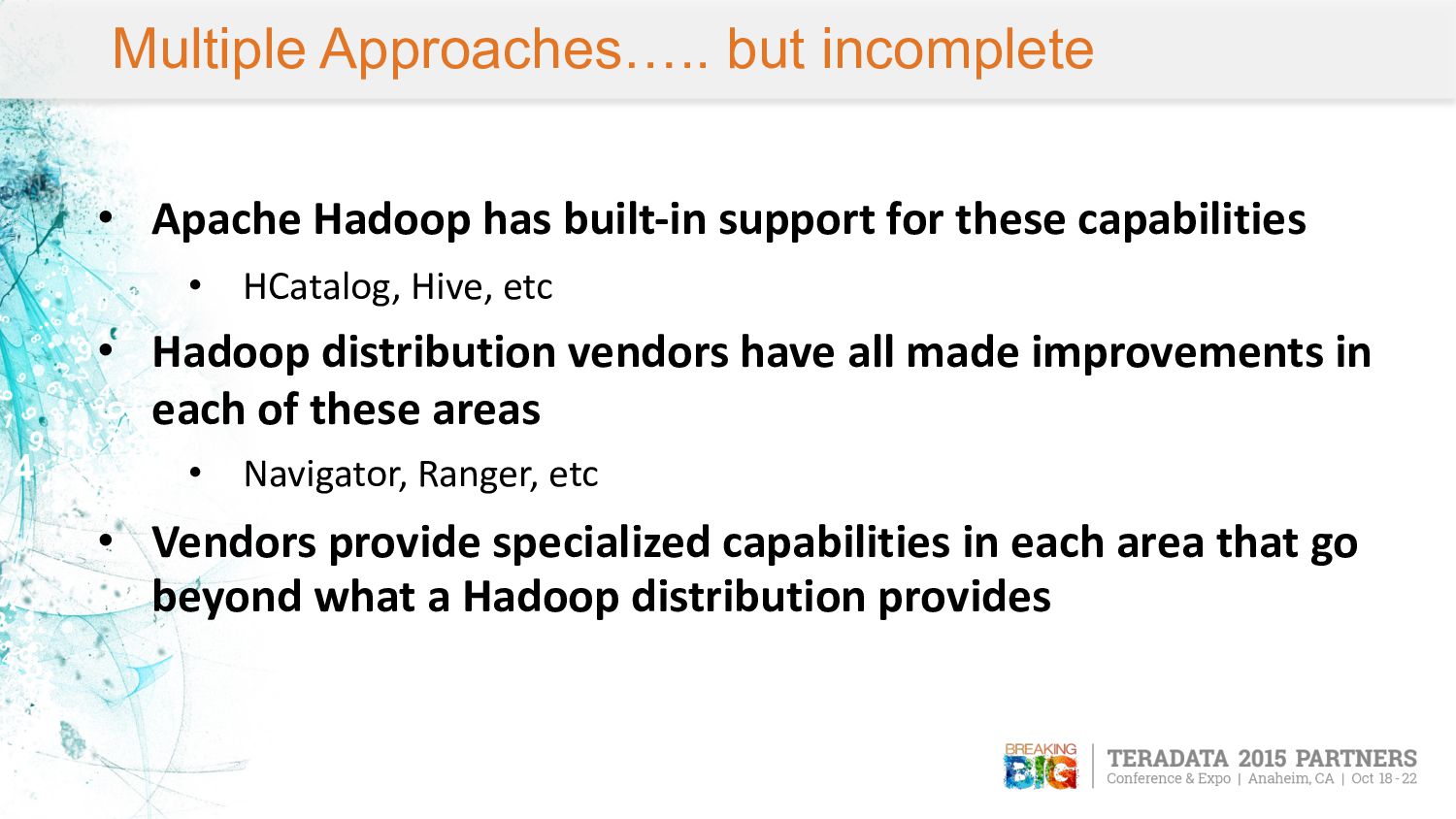
  9. • Apache Hadoop has built-in support for these capabilities •

    HCatalog, Hive, etc • Hadoop distribution vendors have all made improvements in each of these areas • Navigator, Ranger, etc • Vendors provide specialized capabilities in each area that go beyond what a Hadoop distribution provides Multiple Approaches….. but incomplete
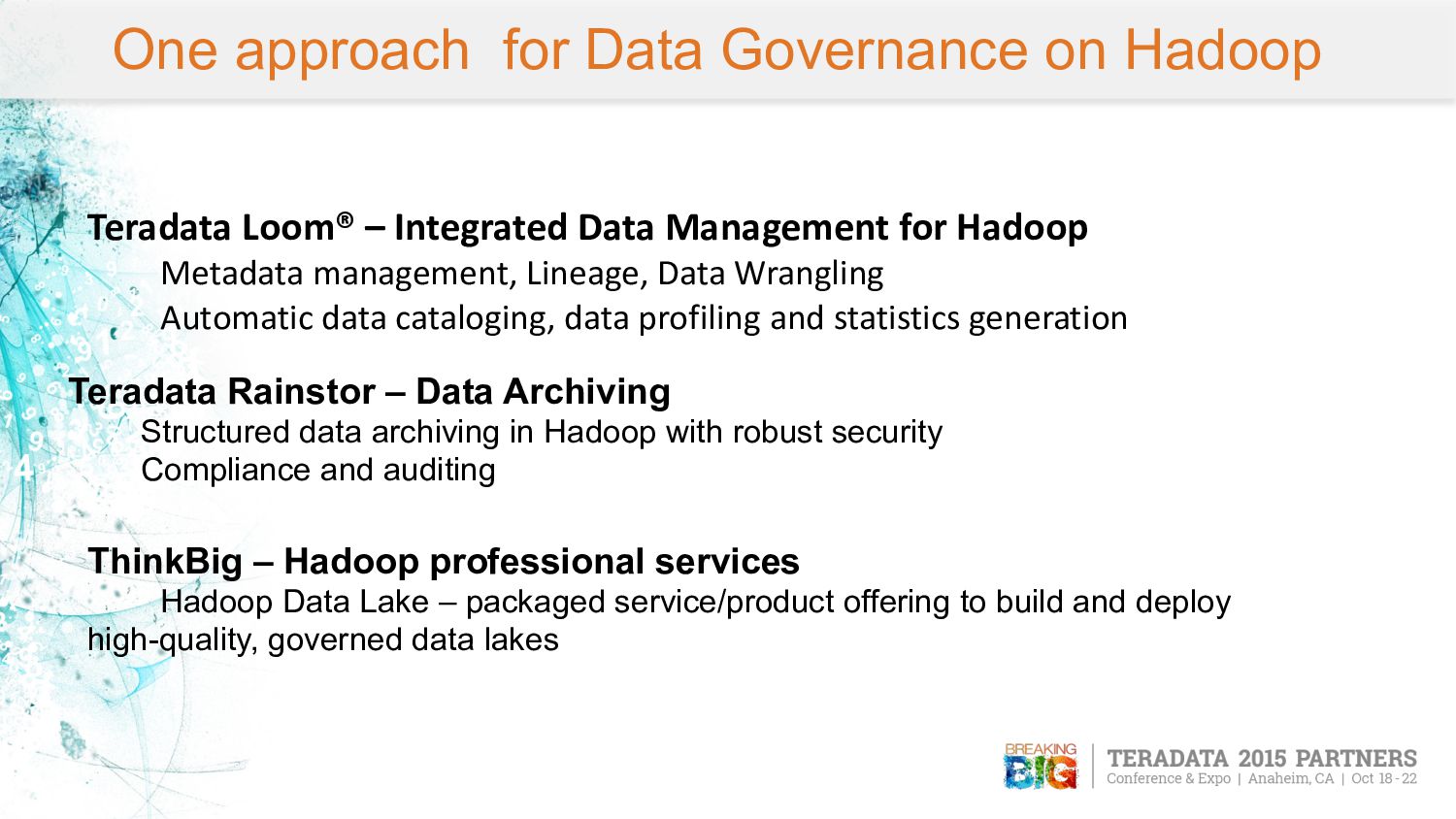
  10. One approach for Data Governance on Hadoop Teradata Loom® –

    Integrated Data Management for Hadoop Metadata management, Lineage, Data Wrangling Automatic data cataloging, data profiling and statistics generation Teradata Rainstor – Data Archiving Structured data archiving in Hadoop with robust security Compliance and auditing ThinkBig – Hadoop professional services Hadoop Data Lake – packaged service/product offering to build and deploy high-quality, governed data lakes
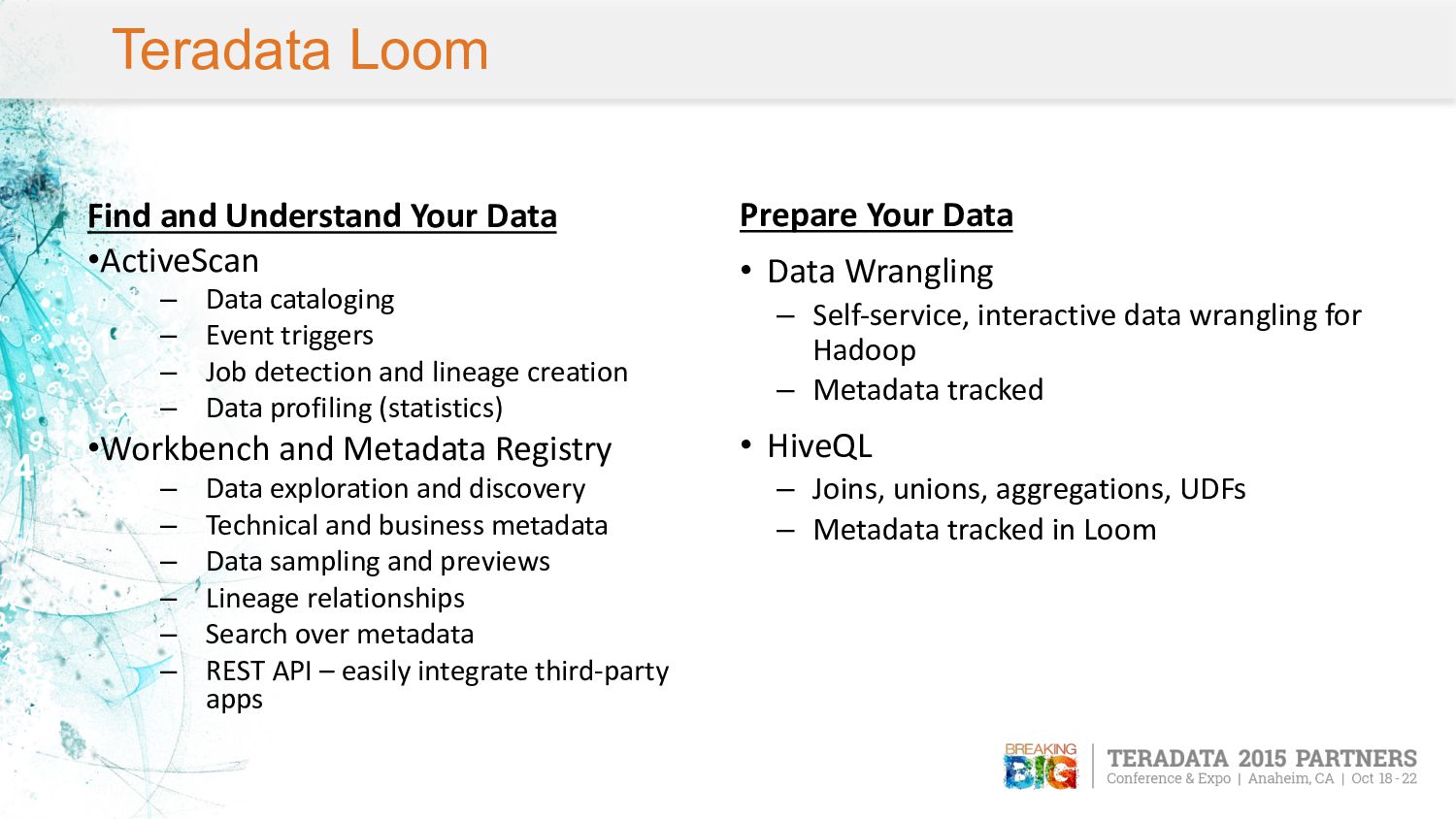
  11. Teradata Loom Find and Understand Your Data •ActiveScan – Data

    cataloging – Event triggers – Job detection and lineage creation – Data profiling (statistics) •Workbench and Metadata Registry – Data exploration and discovery – Technical and business metadata – Data sampling and previews – Lineage relationships – Search over metadata – REST API – easily integrate third-party apps Prepare Your Data • Data Wrangling – Self-service, interactive data wrangling for Hadoop – Metadata tracked • HiveQL – Joins, unions, aggregations, UDFs – Metadata tracked in Loom
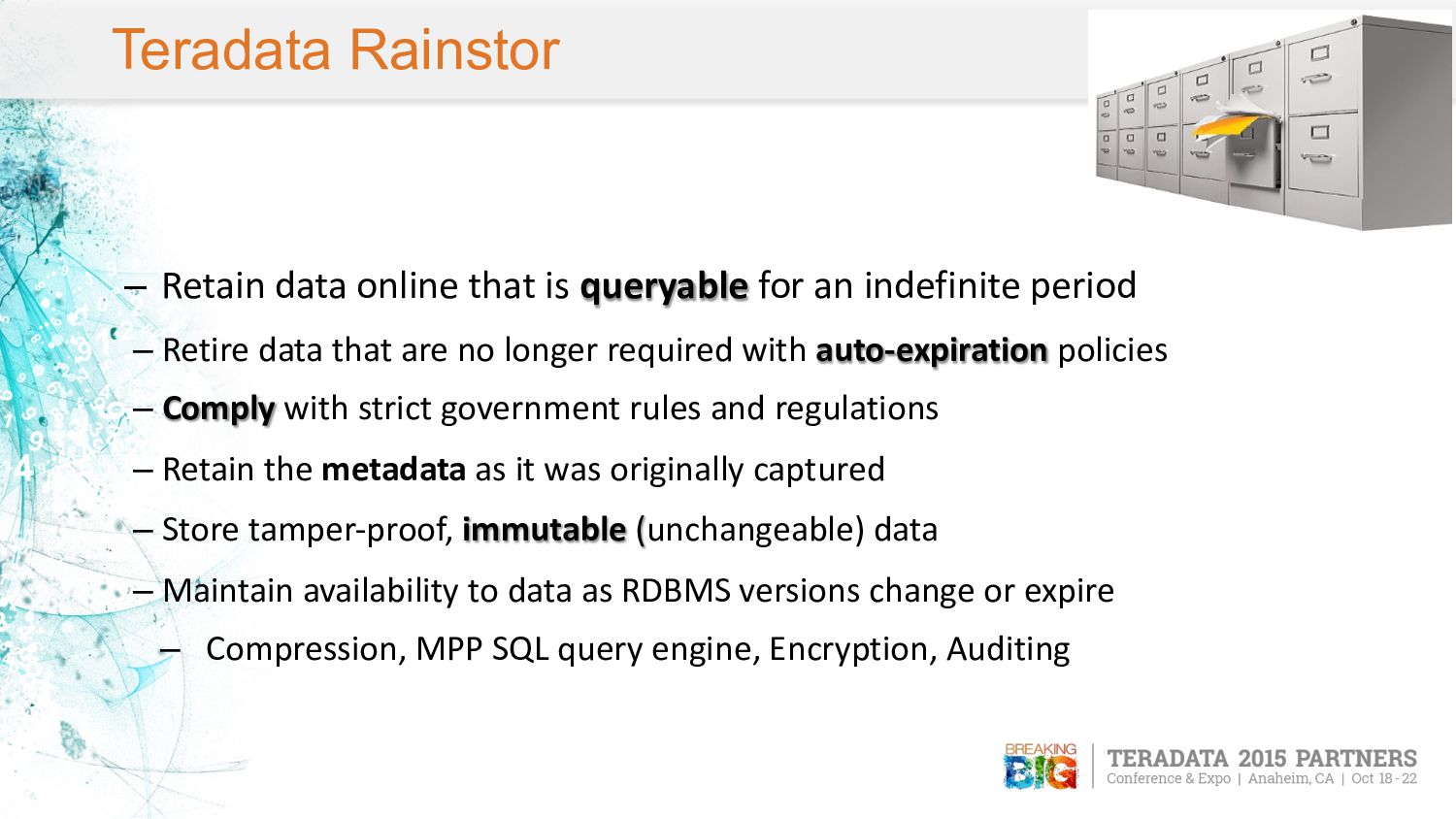
  12. Teradata Rainstor – Retain data online that is queryable for

    an indefinite period – Retire data that are no longer required with auto-expiration policies – Comply with strict government rules and regulations – Retain the metadata as it was originally captured – Store tamper-proof, immutable (unchangeable) data – Maintain availability to data as RDBMS versions change or expire – Compression, MPP SQL query engine, Encryption, Auditing
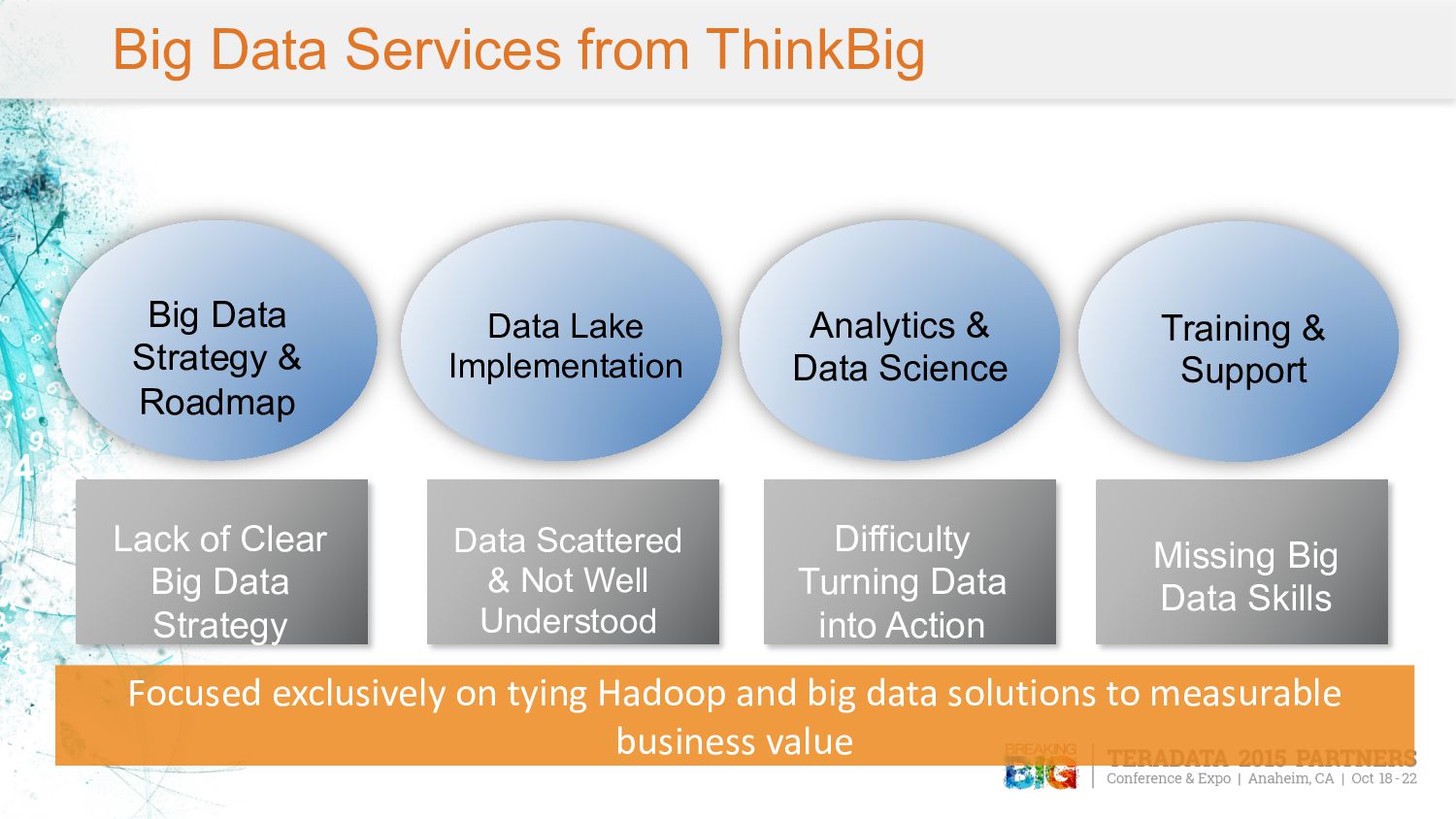
  13. Big Data Services from ThinkBig Big Data Strategy & Roadmap

    Data Lake Implementation Analytics & Data Science Training & Support Lack of Clear Big Data Strategy Difficulty Turning Data into Action Missing Big Data Skills Focused exclusively on tying Hadoop and big data solutions to measurable business value Data Scattered & Not Well Understood
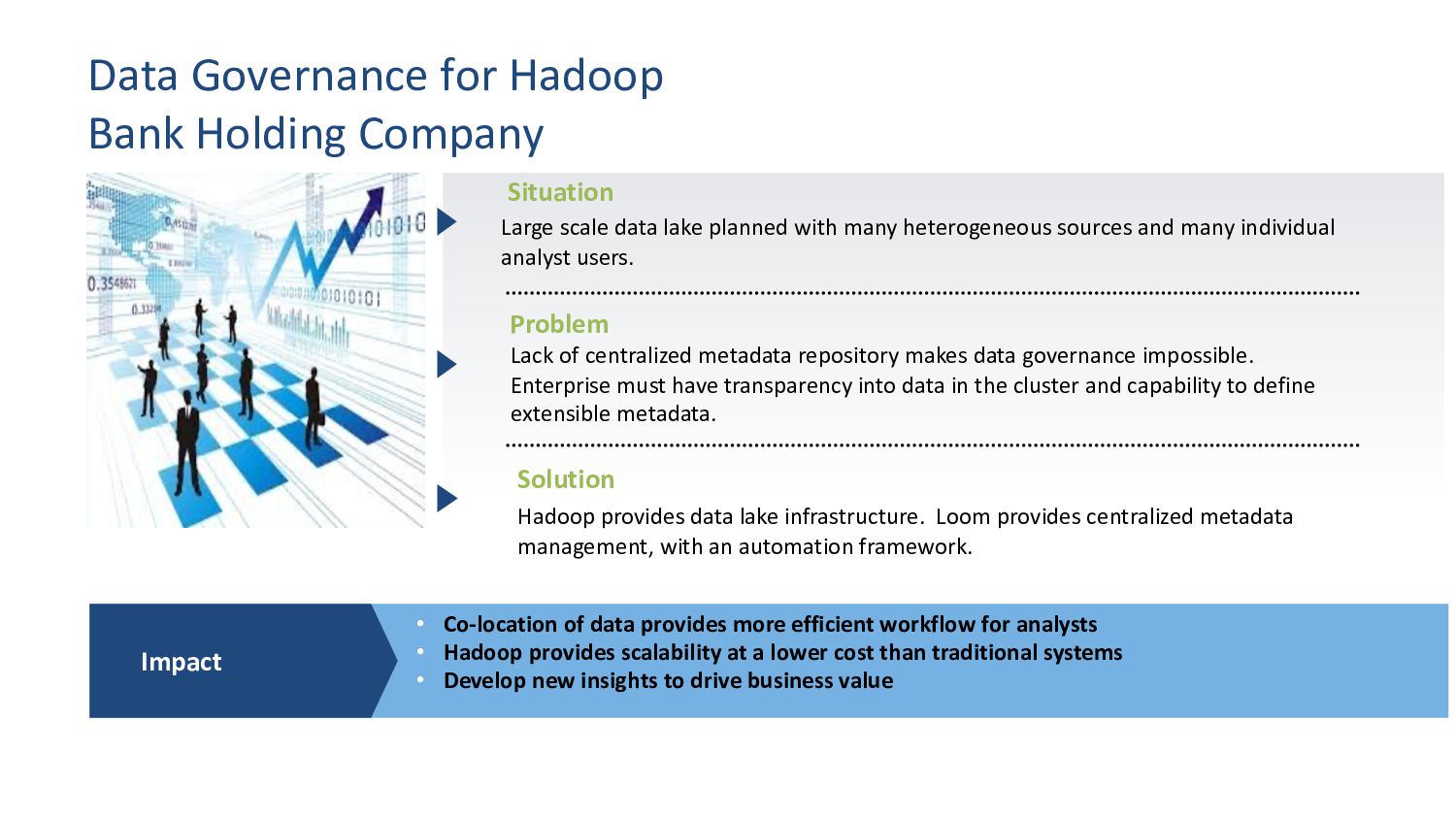
  14. Impact • Co-location of data provides more efficient workflow for

    analysts • Hadoop provides scalability at a lower cost than traditional systems • Develop new insights to drive business value Situation Problem Lack of centralized metadata repository makes data governance impossible. Enterprise must have transparency into data in the cluster and capability to define extensible metadata. Large scale data lake planned with many heterogeneous sources and many individual analyst users. Solution Hadoop provides data lake infrastructure. Loom provides centralized metadata management, with an automation framework. Data Governance for Hadoop Bank Holding Company
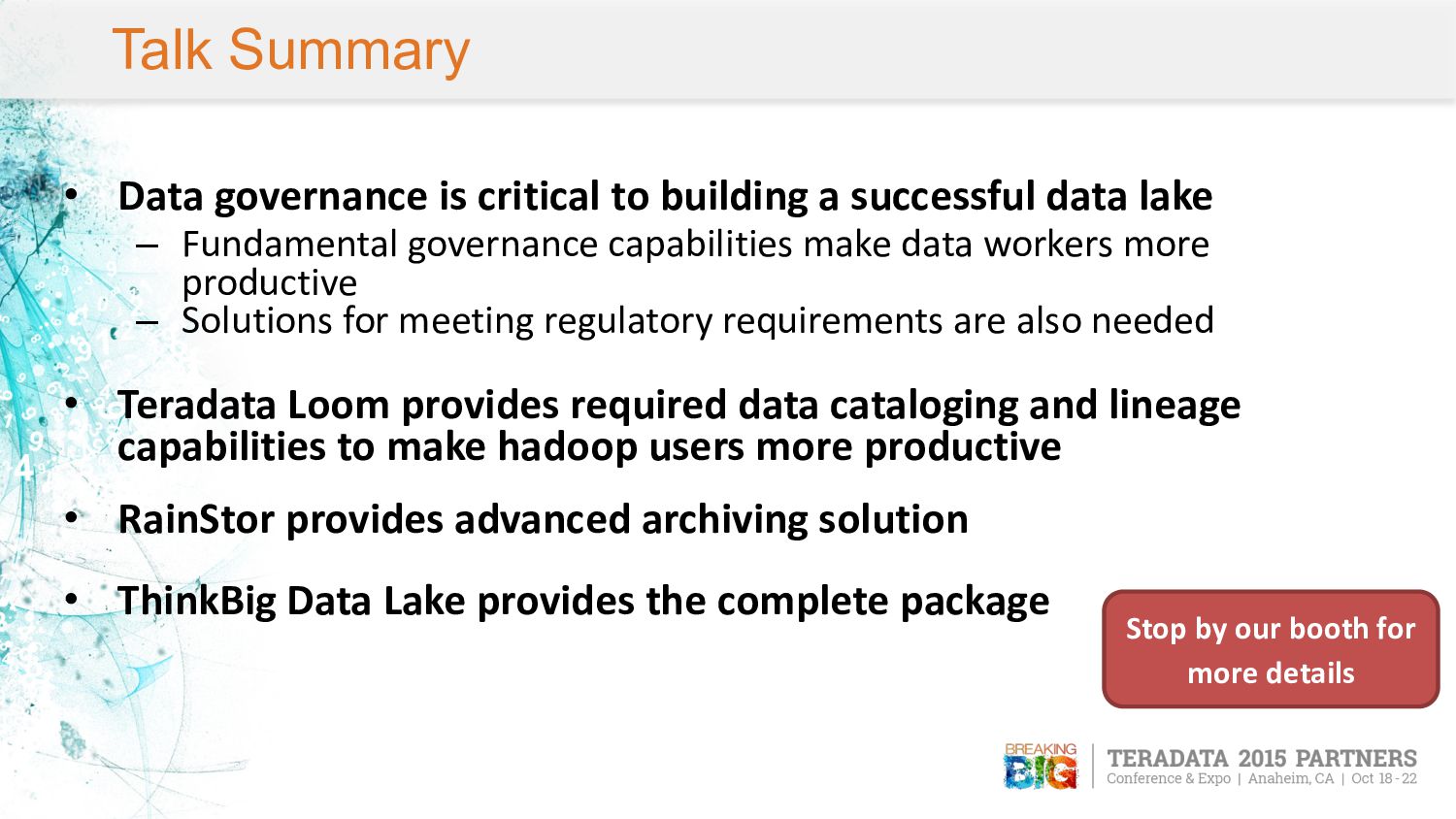
  15. Talk Summary • Data governance is critical to building a

    successful data lake – Fundamental governance capabilities make data workers more productive – Solutions for meeting regulatory requirements are also needed • Teradata Loom provides required data cataloging and lineage capabilities to make hadoop users more productive • RainStor provides advanced archiving solution • ThinkBig Data Lake provides the complete package Stop by our booth for more details
  16. We Love Feedback Questions/Comments Email: [email protected] Follow Me Twitter @kirankamreddy

    Rate This Session with the PARTNERS Mobile App Remember To Share Your Virtual Passes Follow Teradata 2015 PARTNERS www.teradata-partners.com/social