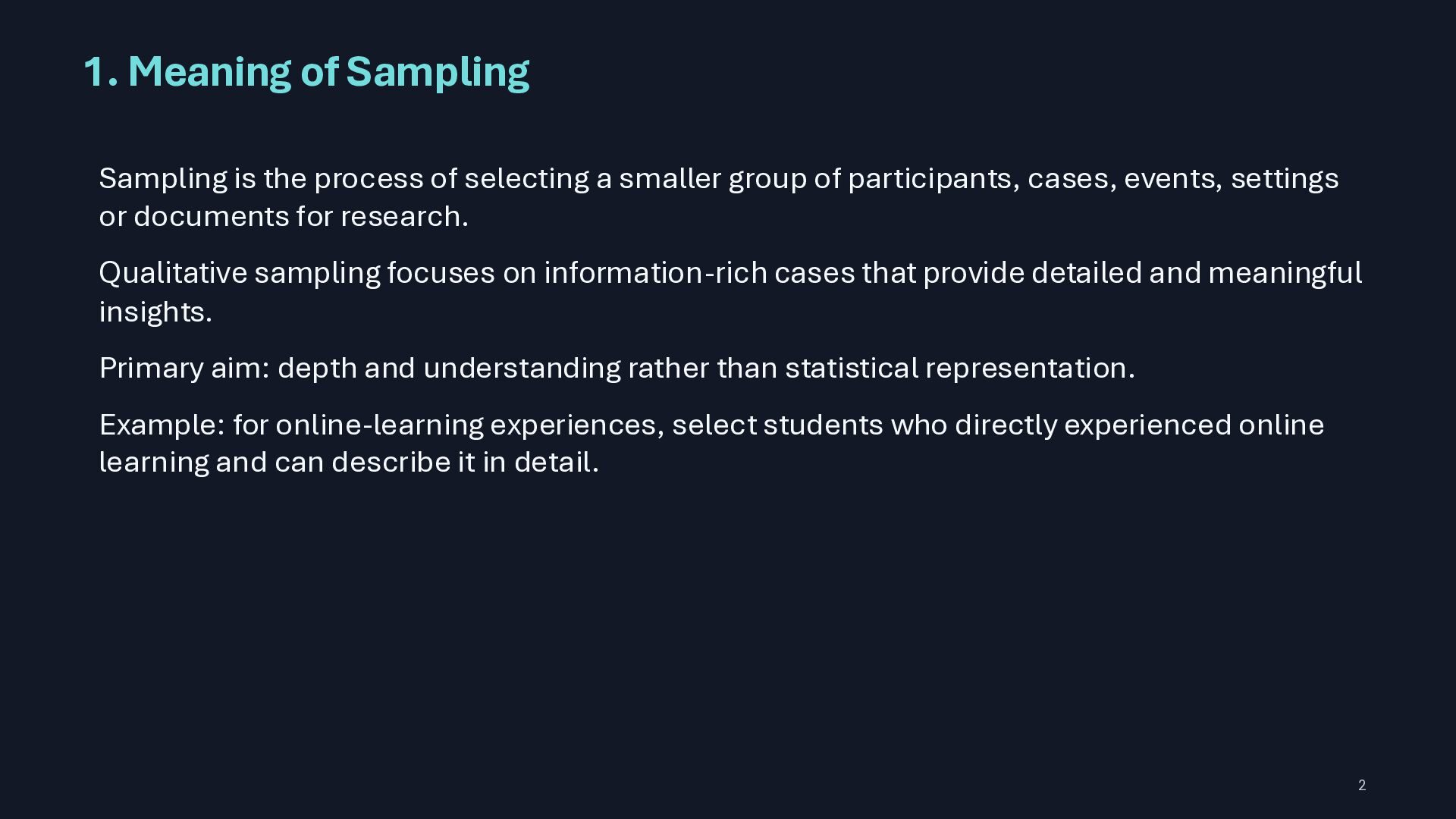
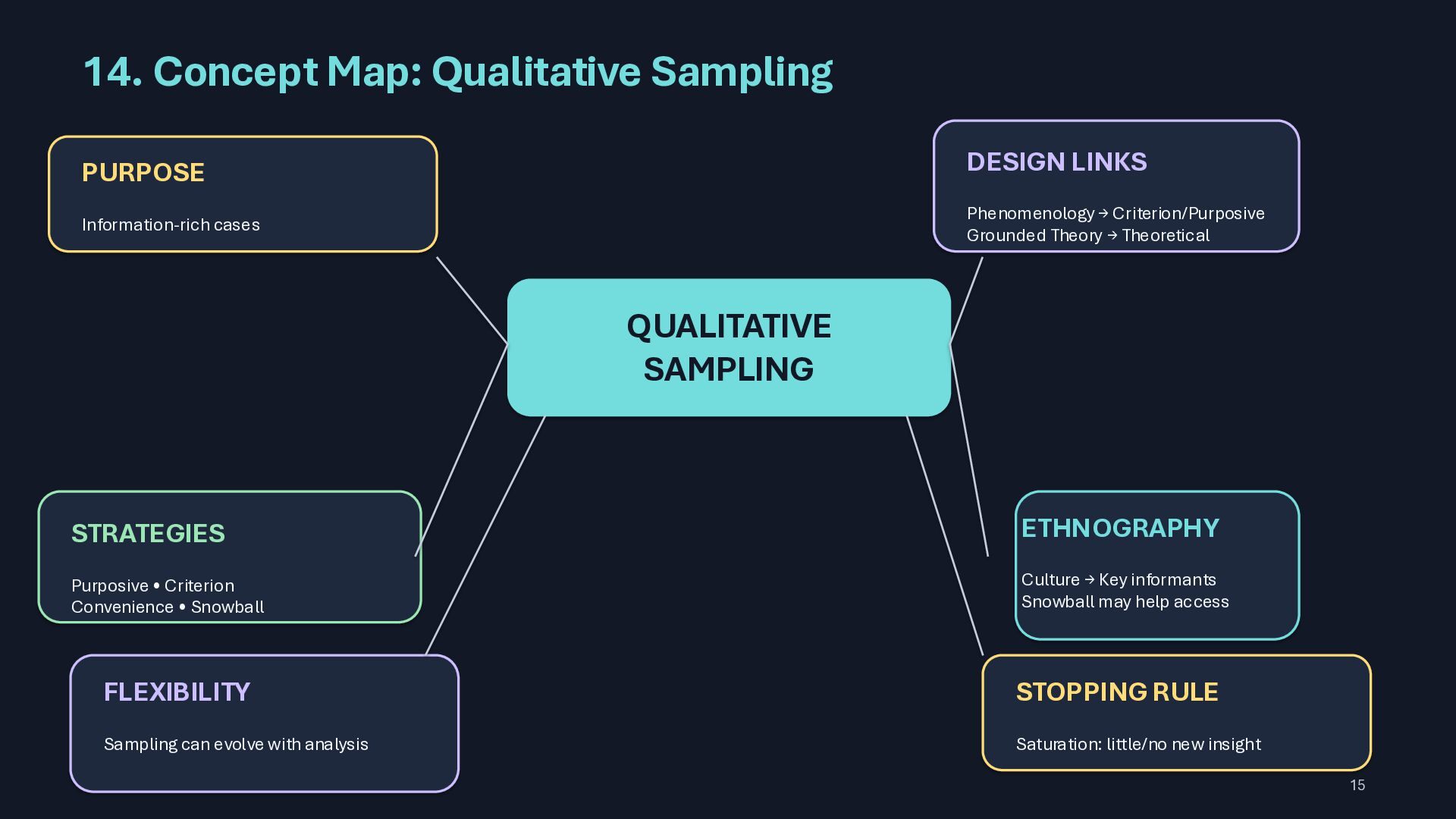
a smaller group of participants, cases, events, settings or documents for research. Qualitative sampling focuses on information-rich cases that provide detailed and meaningful insights. Primary aim: depth and understanding rather than statistical representation. Example: for online-learning experiences, select students who directly experienced online learning and can describe it in detail. 2
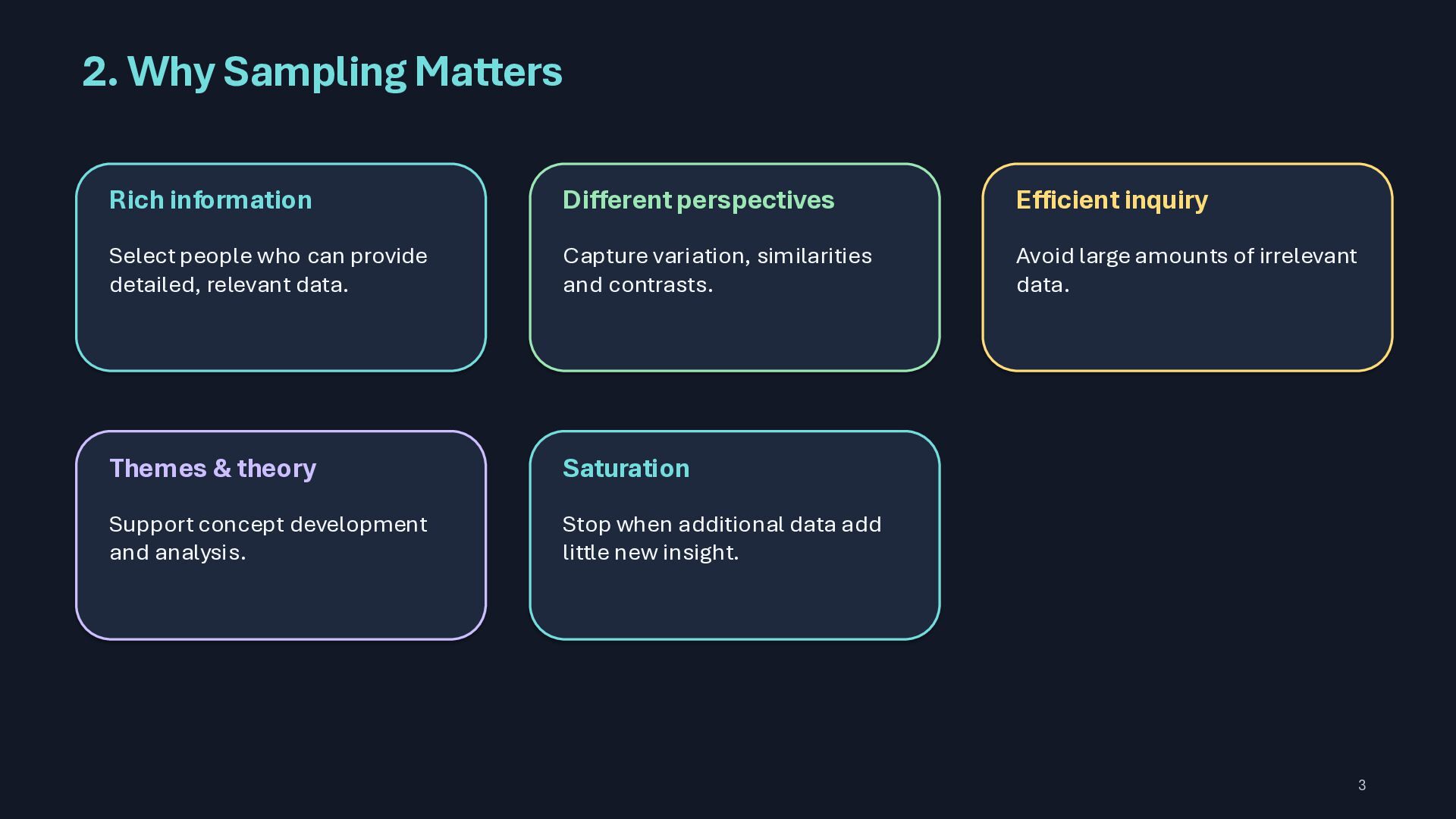
Select people who can provide detailed, relevant data. Capture variation, similarities and contrasts. Avoid large amounts of irrelevant data. Themes & theory Saturation Support concept development and analysis. Stop when additional data add little new insight. 3
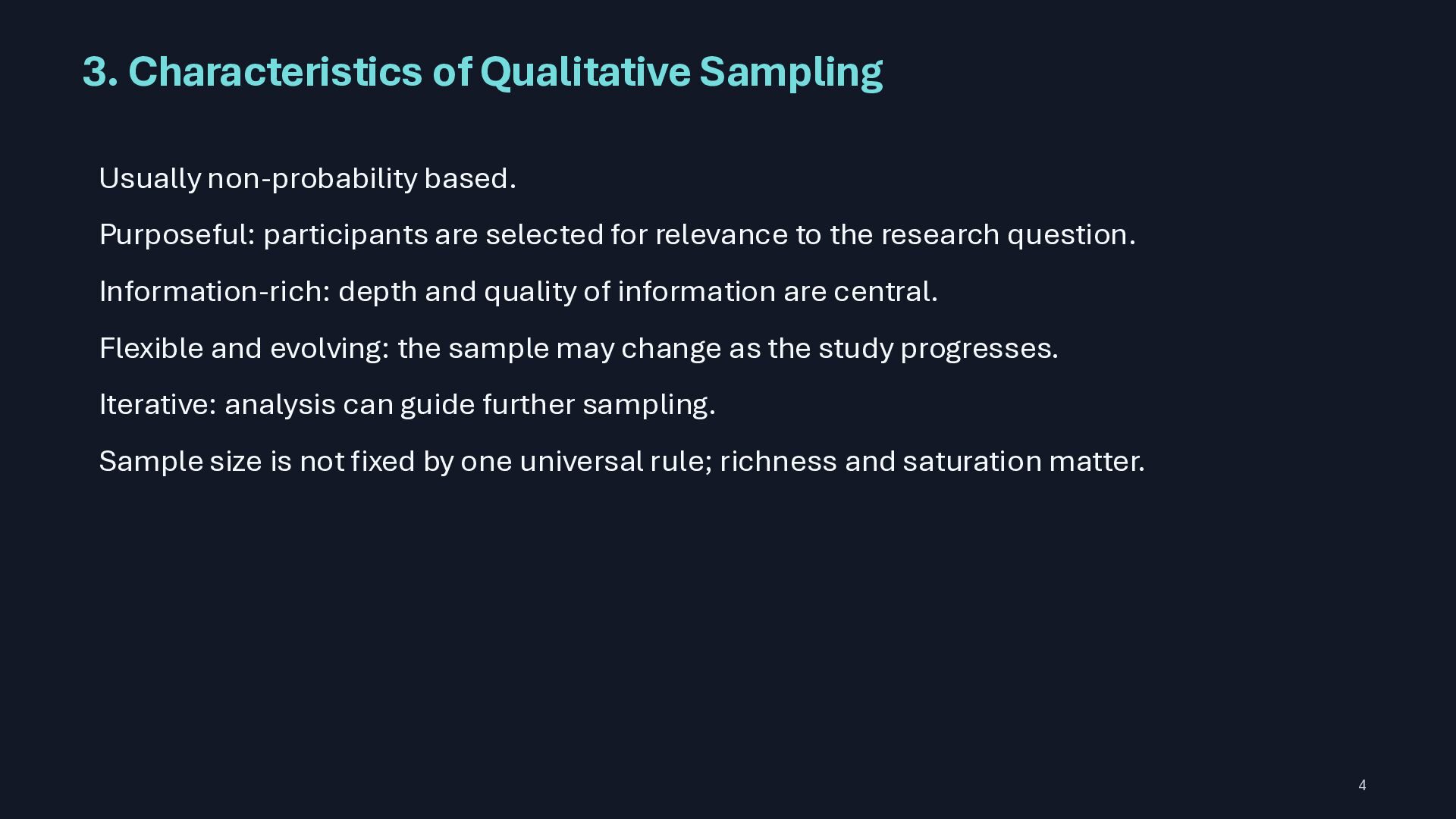
are selected for relevance to the research question. Information-rich: depth and quality of information are central. Flexible and evolving: the sample may change as the study progresses. Iterative: analysis can guide further sampling. Sample size is not fixed by one universal rule; richness and saturation matter. 4
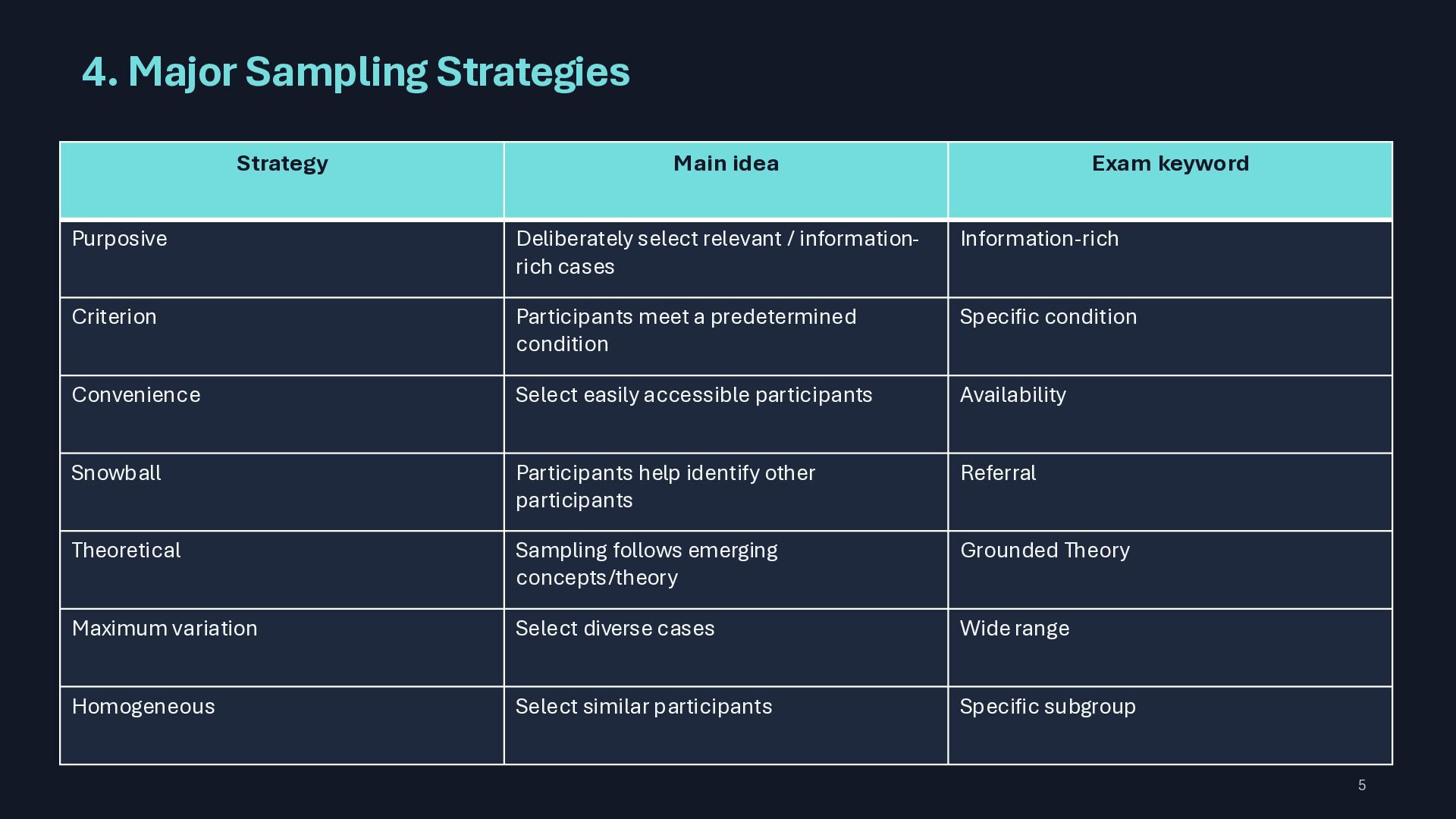
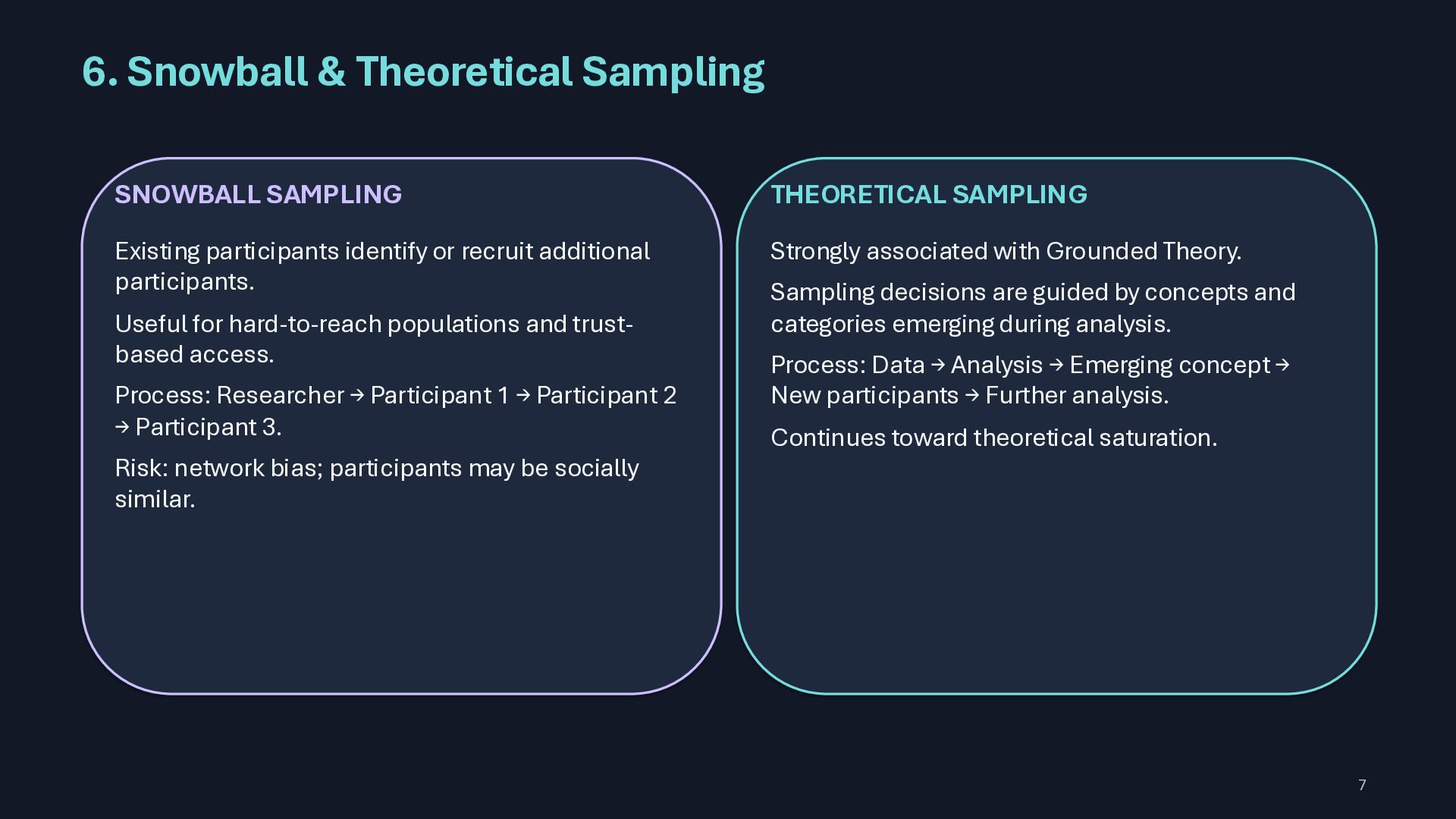
Deliberately select relevant / informationrich cases Information-rich Criterion Participants meet a predetermined condition Specific condition Convenience Select easily accessible participants Availability Snowball Participants help identify other participants Referral Theoretical Sampling follows emerging concepts/theory Grounded Theory Maximum variation Select diverse cases Wide range Homogeneous Select similar participants Specific subgroup 5
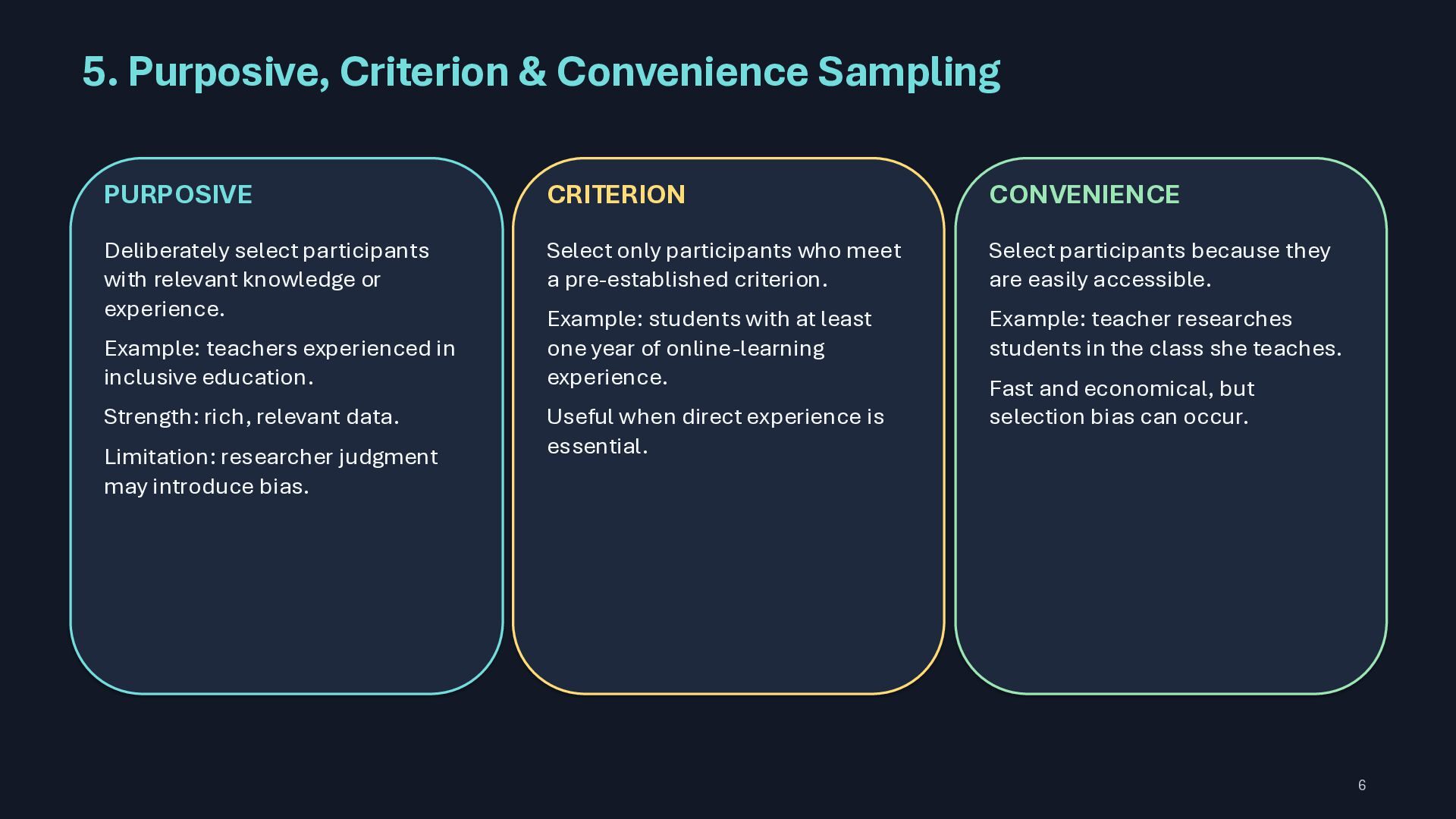
select participants with relevant knowledge or experience. Select only participants who meet a pre-established criterion. Select participants because they are easily accessible. Example: students with at least one year of online-learning experience. Example: teacher researches students in the class she teaches. Example: teachers experienced in inclusive education. Strength: rich, relevant data. Limitation: researcher judgment may introduce bias. Useful when direct experience is essential. Fast and economical, but selection bias can occur. 6
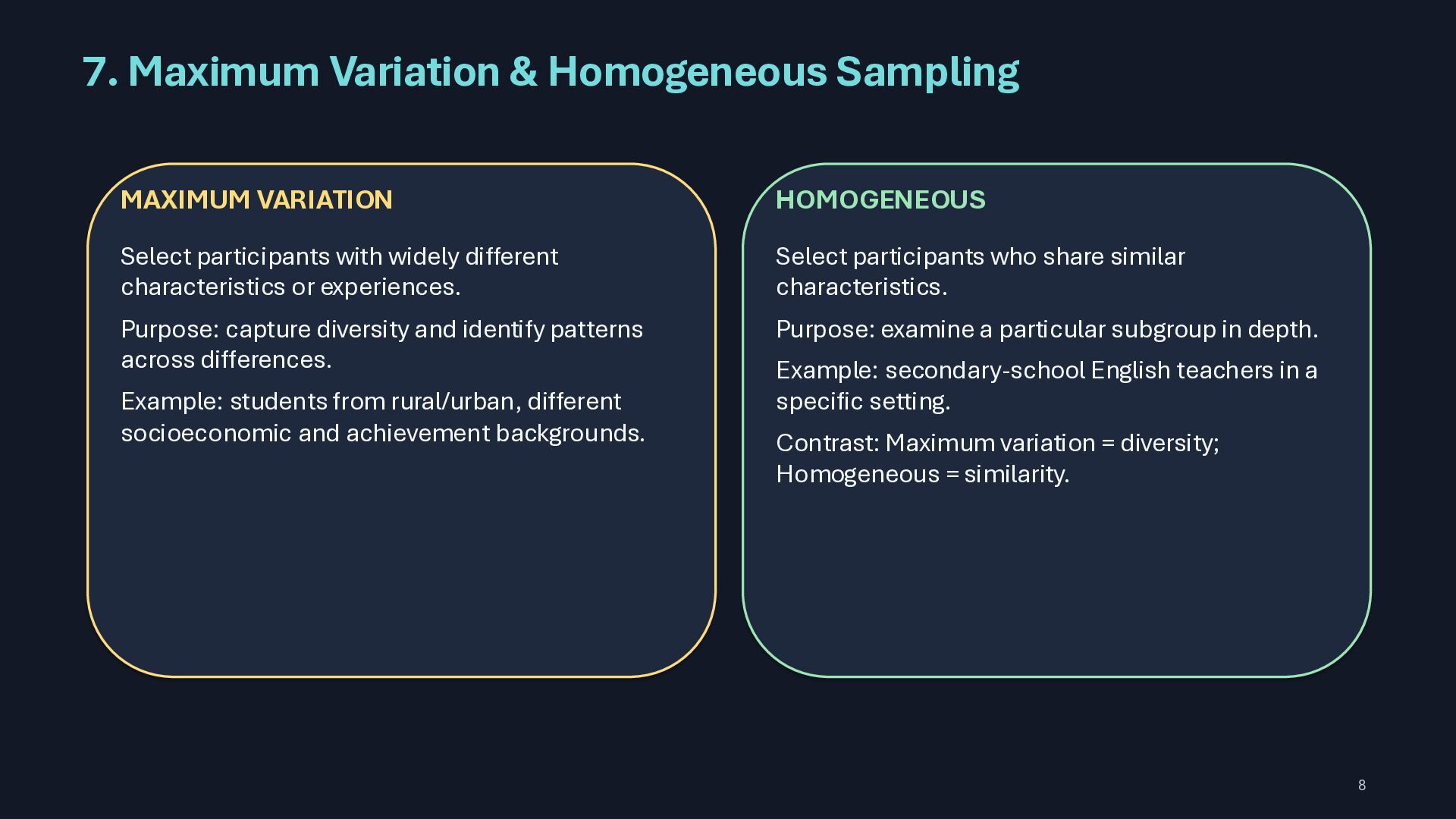
participants with widely different characteristics or experiences. Select participants who share similar characteristics. Purpose: capture diversity and identify patterns across differences. Purpose: examine a particular subgroup in depth. Example: students from rural/urban, different socioeconomic and achievement backgrounds. Example: secondary-school English teachers in a specific setting. Contrast: Maximum variation = diversity; Homogeneous = similarity. 8
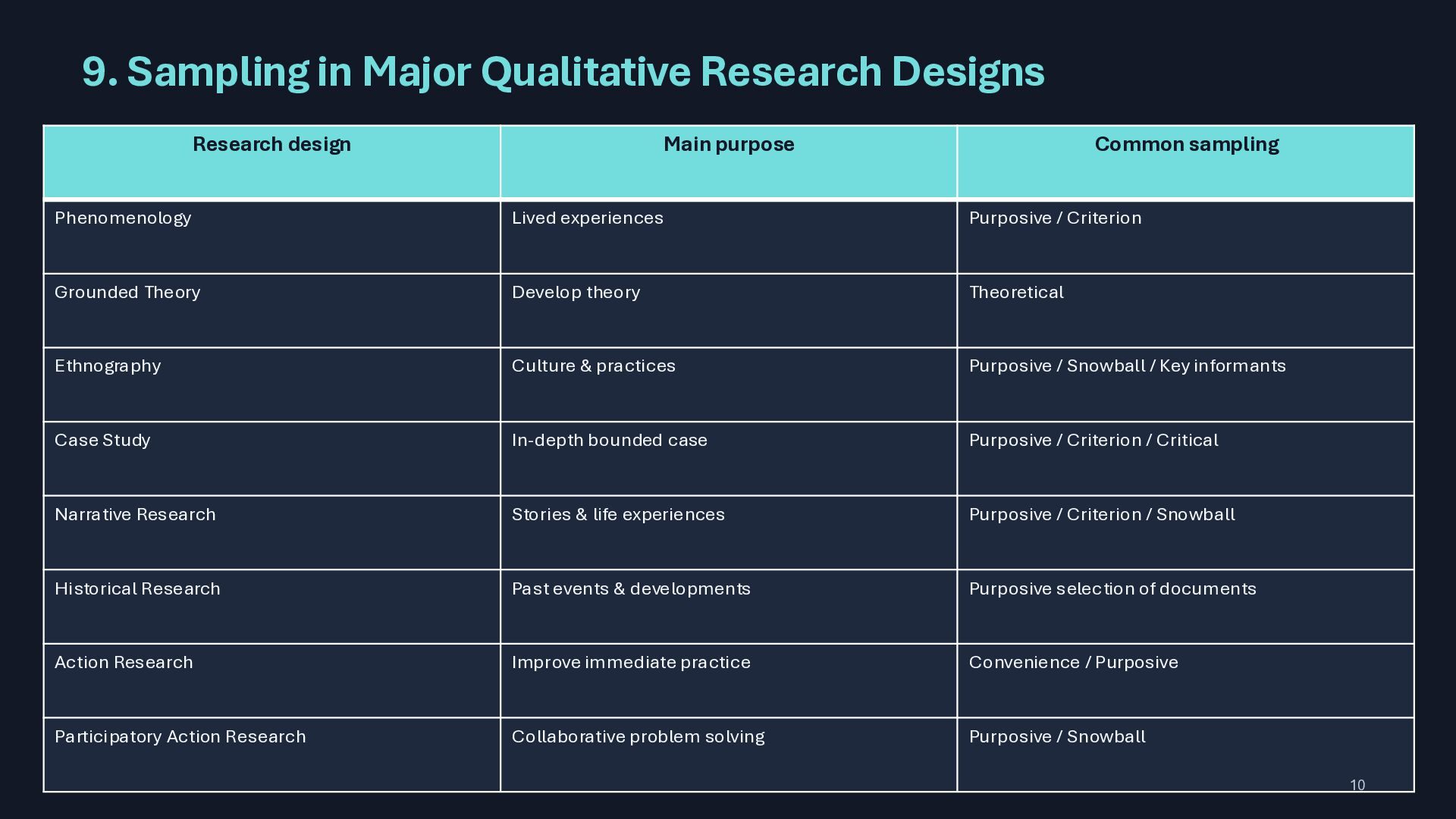
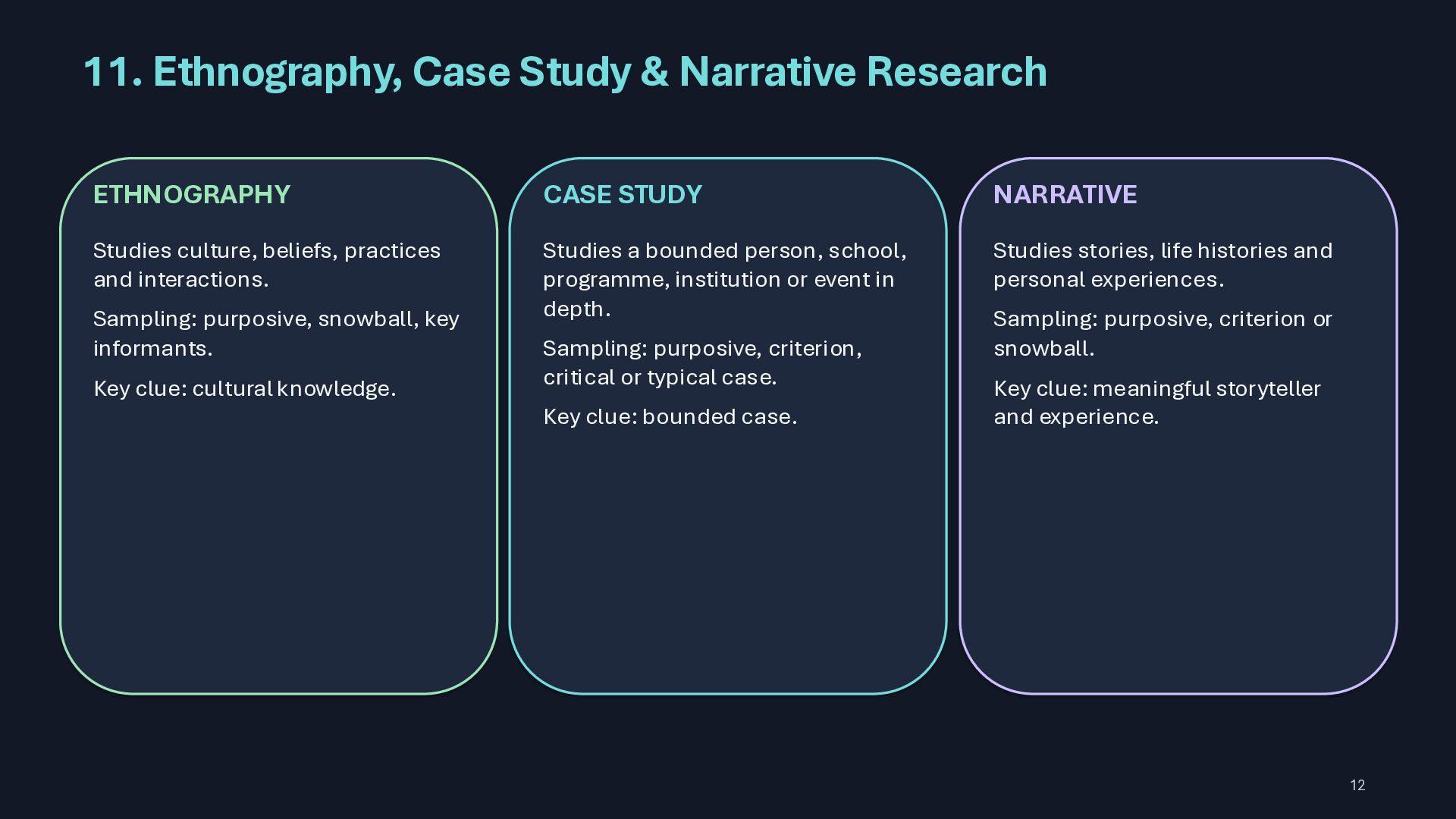
purpose Common sampling Phenomenology Lived experiences Purposive / Criterion Grounded Theory Develop theory Theoretical Ethnography Culture & practices Purposive / Snowball / Key informants Case Study In-depth bounded case Purposive / Criterion / Critical Narrative Research Stories & life experiences Purposive / Criterion / Snowball Historical Research Past events & developments Purposive selection of documents Action Research Improve immediate practice Convenience / Purposive Participatory Action Research Collaborative problem solving Purposive / Snowball 10
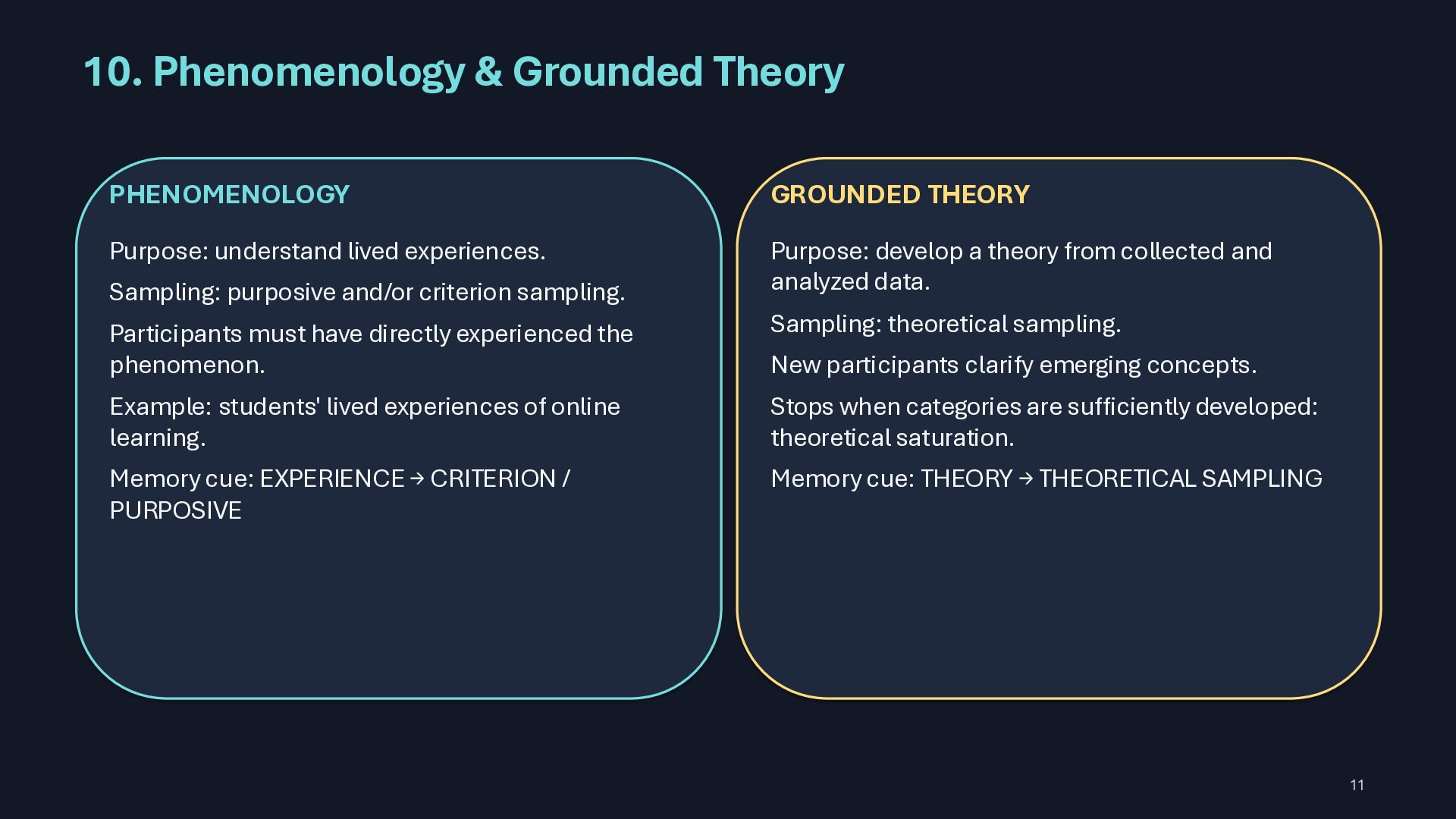
lived experiences. Sampling: purposive and/or criterion sampling. Purpose: develop a theory from collected and analyzed data. Participants must have directly experienced the phenomenon. Sampling: theoretical sampling. New participants clarify emerging concepts. Example: students' lived experiences of online learning. Stops when categories are sufficiently developed: theoretical saturation. Memory cue: EXPERIENCE → CRITERION / PURPOSIVE Memory cue: THEORY → THEORETICAL SAMPLING 11
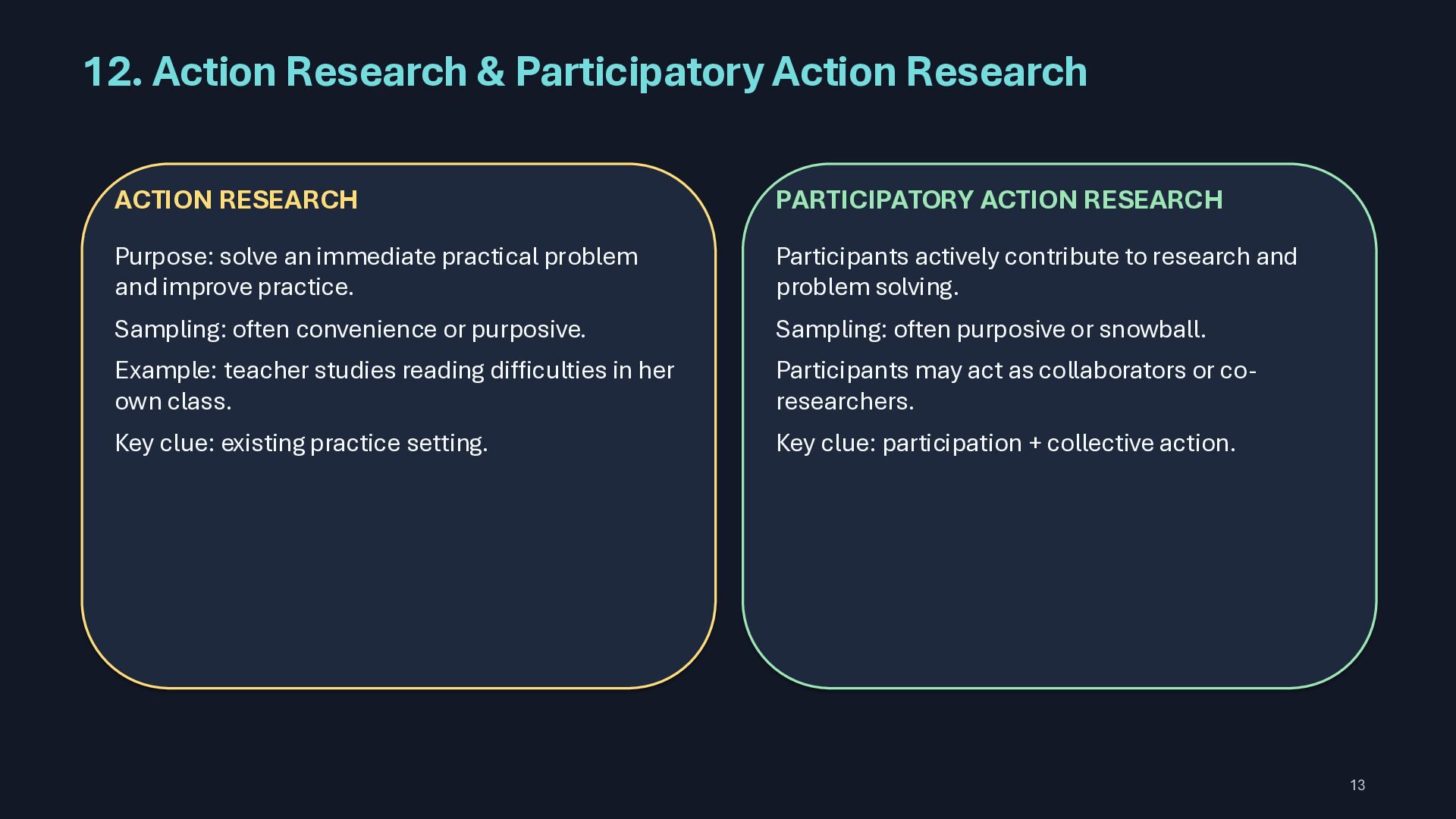
ACTION RESEARCH Purpose: solve an immediate practical problem and improve practice. Participants actively contribute to research and problem solving. Sampling: often convenience or purposive. Sampling: often purposive or snowball. Example: teacher studies reading difficulties in her own class. Participants may act as collaborators or coresearchers. Key clue: existing practice setting. Key clue: participation + collective action. 13
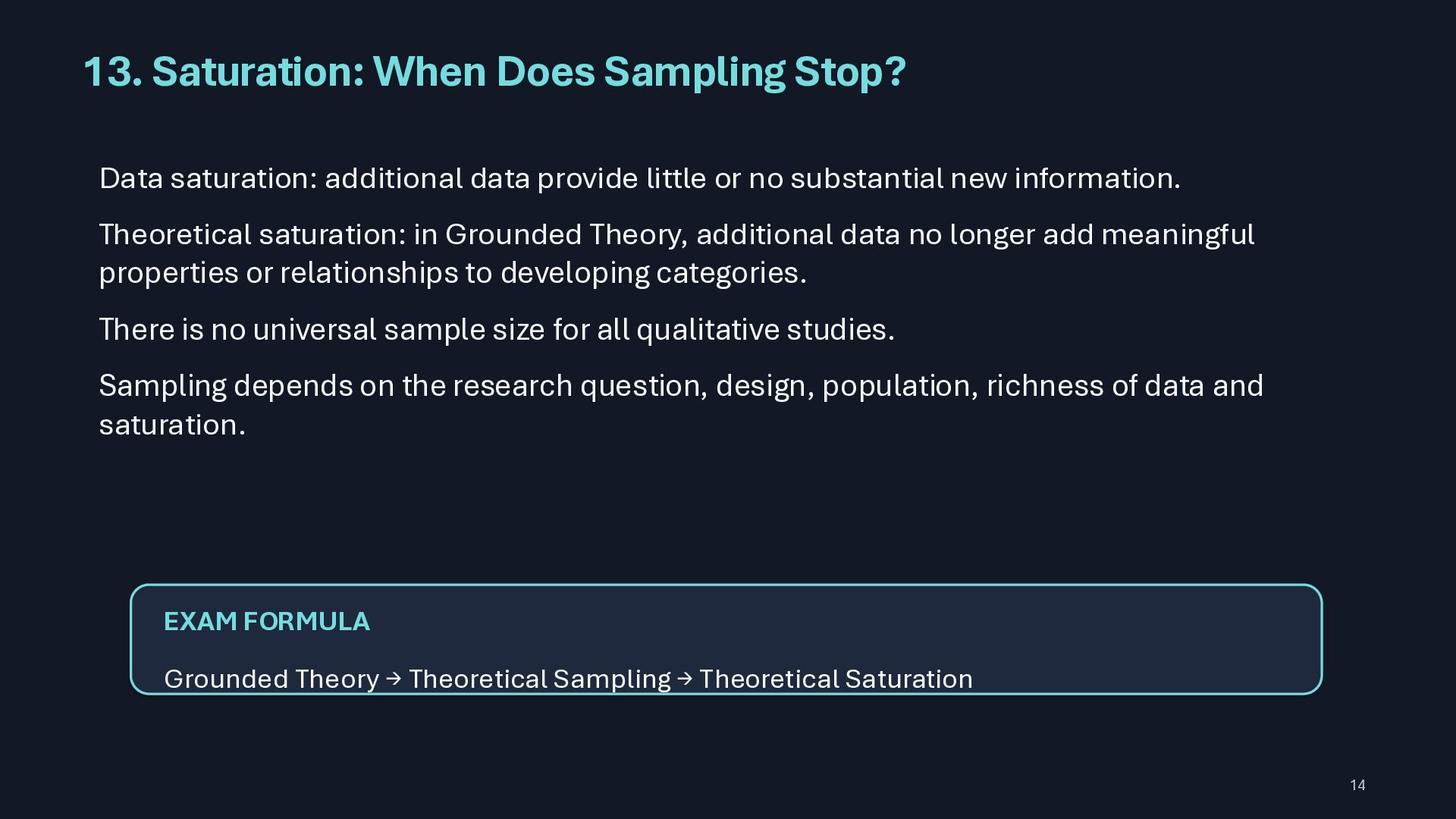
provide little or no substantial new information. Theoretical saturation: in Grounded Theory, additional data no longer add meaningful properties or relationships to developing categories. There is no universal sample size for all qualitative studies. Sampling depends on the research question, design, population, richness of data and saturation. EXAM FORMULA Grounded Theory → Theoretical Sampling → Theoretical Saturation 14
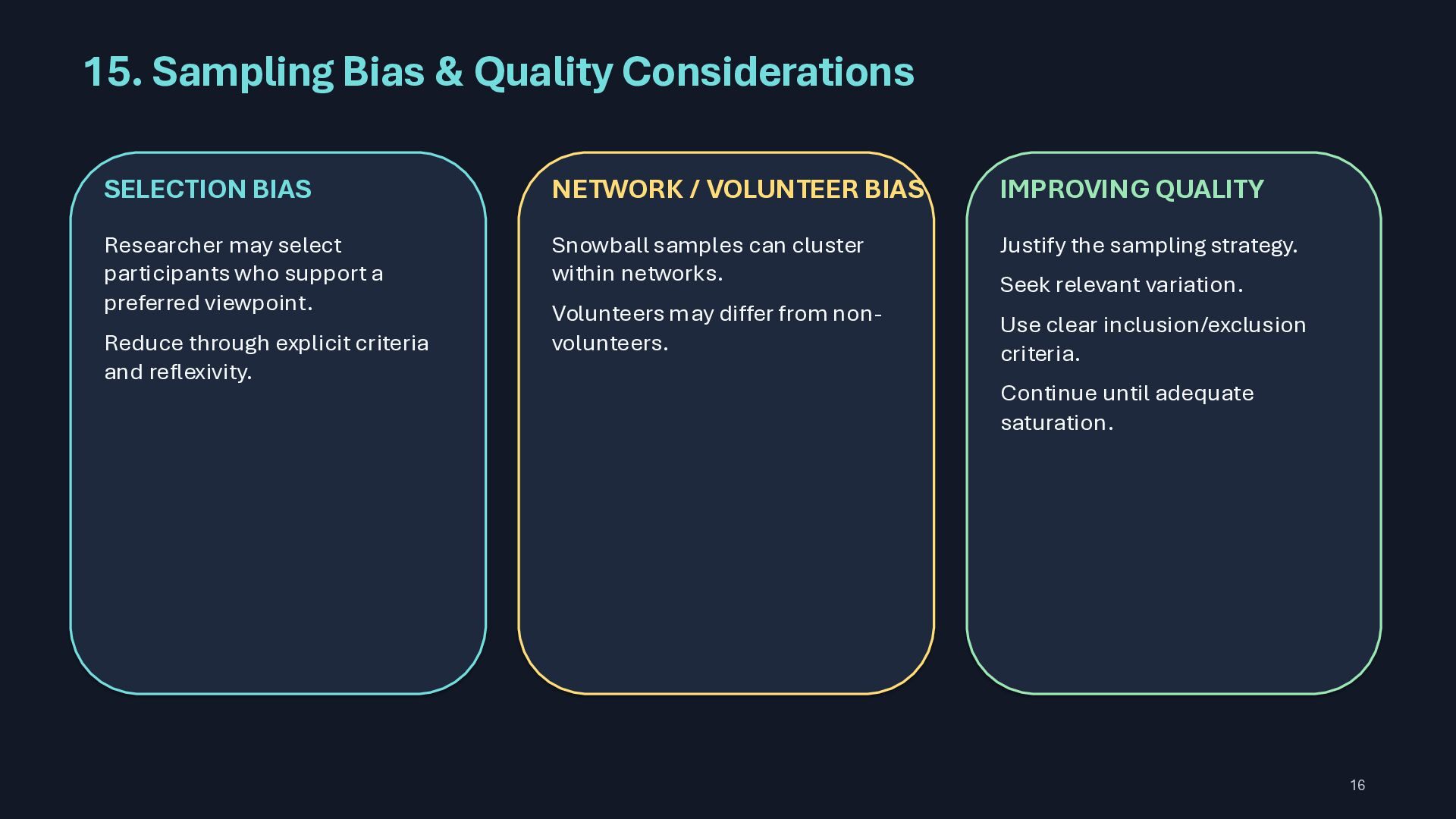
VOLUNTEER BIAS IMPROVING QUALITY Researcher may select participants who support a preferred viewpoint. Snowball samples can cluster within networks. Justify the sampling strategy. Volunteers may differ from nonvolunteers. Use clear inclusion/exclusion criteria. Reduce through explicit criteria and reflexivity. Seek relevant variation. Continue until adequate saturation. 16
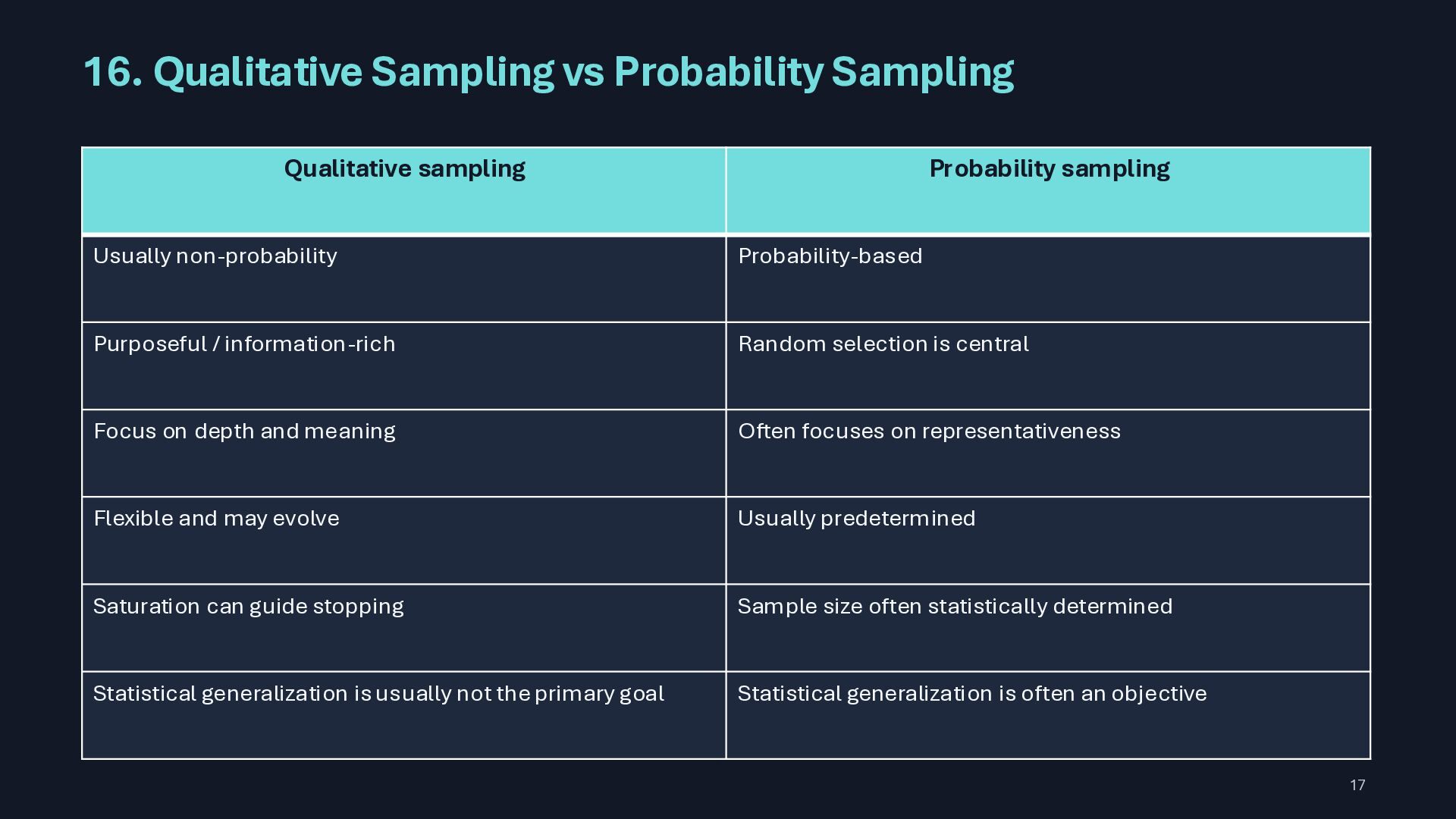
Usually non-probability Probability-based Purposeful / information-rich Random selection is central Focus on depth and meaning Often focuses on representativeness Flexible and may evolve Usually predetermined Saturation can guide stopping Sample size often statistically determined Statistical generalization is usually not the primary goal Statistical generalization is often an objective 17


 mojombo
 techseoconnect
 scottboms
 reverentgeek
 sugarenia
 lemiorhan
 leimatthew05
 lynnandtonic
 rasagy
 michielstock
 jonoalderson