Upgrade to Pro — share decks privately, control downloads, hide ads and more …

PGR Conference 2013

Avatar for lblade lblade
May 14, 2013
22

PGR Conference 2013

PhD first year PGR Conference

Avatar for lblade

lblade

May 14, 2013

Transcript

  1. Space  Time  Data  Mining  of   RIDDOR  data   Linda

     Blade   Prof  Chris  Brunsdon  
  2. To  inves7gate  the  use  of  exploratory  data   mining  and

     visualisa7on  techniques  on  data   generated  from  the  RIDDOR  dataset  to   iden7fy  spa7al  and  temporal  pa?erns  on   accidents  at  work.   Aim  
  3. Health  and  Safety  Execu7ve     ‘The  HSE  is  the

     na7onal  independent  watchdog   for  work-­‐related  health,  safety  and  illness.’     The  HSE  enforces  health  and  safety  in  Great   Britain’s  workplaces  by  tackling  issues  which   result  in  death,  serious  injury  and  illness.  
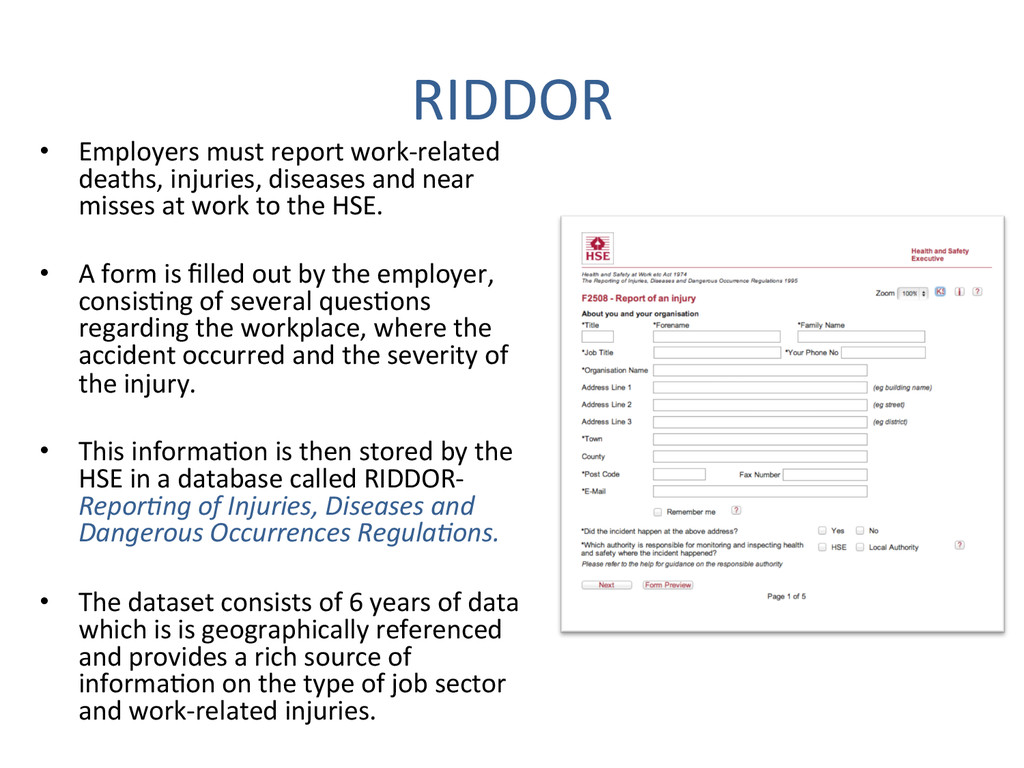
  4. •  Employers  must  report  work-­‐related   deaths,  injuries,  diseases  and

     near   misses  at  work  to  the  HSE.     •  A  form  is  filled  out  by  the  employer,   consis7ng  of  several  ques7ons   regarding  the  workplace,  where  the   accident  occurred  and  the  severity  of   the  injury.     •  This  informa7on  is  then  stored  by  the   HSE  in  a  database  called  RIDDOR-­‐   Repor4ng  of  Injuries,  Diseases  and   Dangerous  Occurrences  Regula4ons.   •  The  dataset  consists  of  6  years  of  data   which  is  is  geographically  referenced   and  provides  a  rich  source  of   informa7on  on  the  type  of  job  sector   and  work-­‐related  injuries.     RIDDOR  
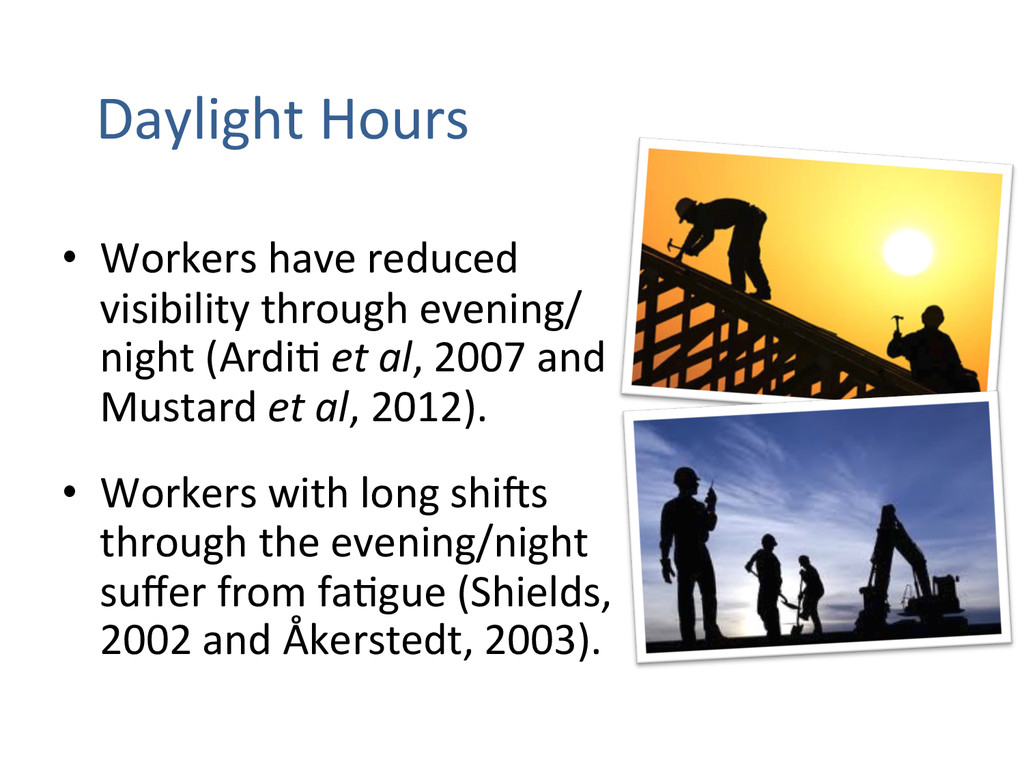
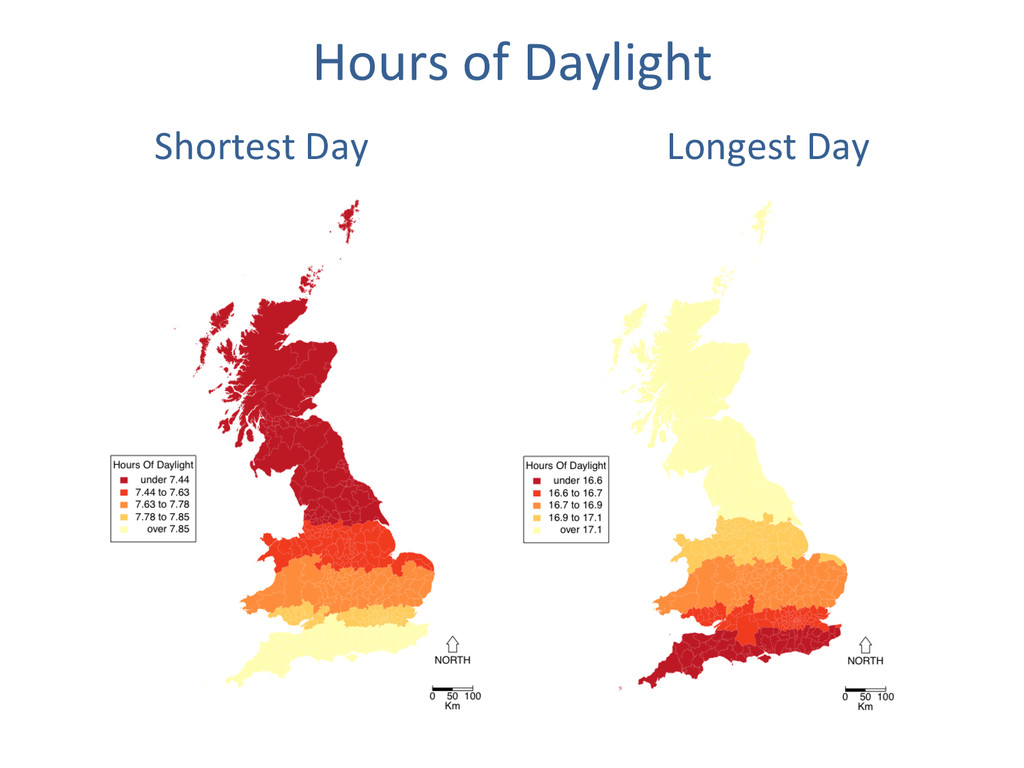
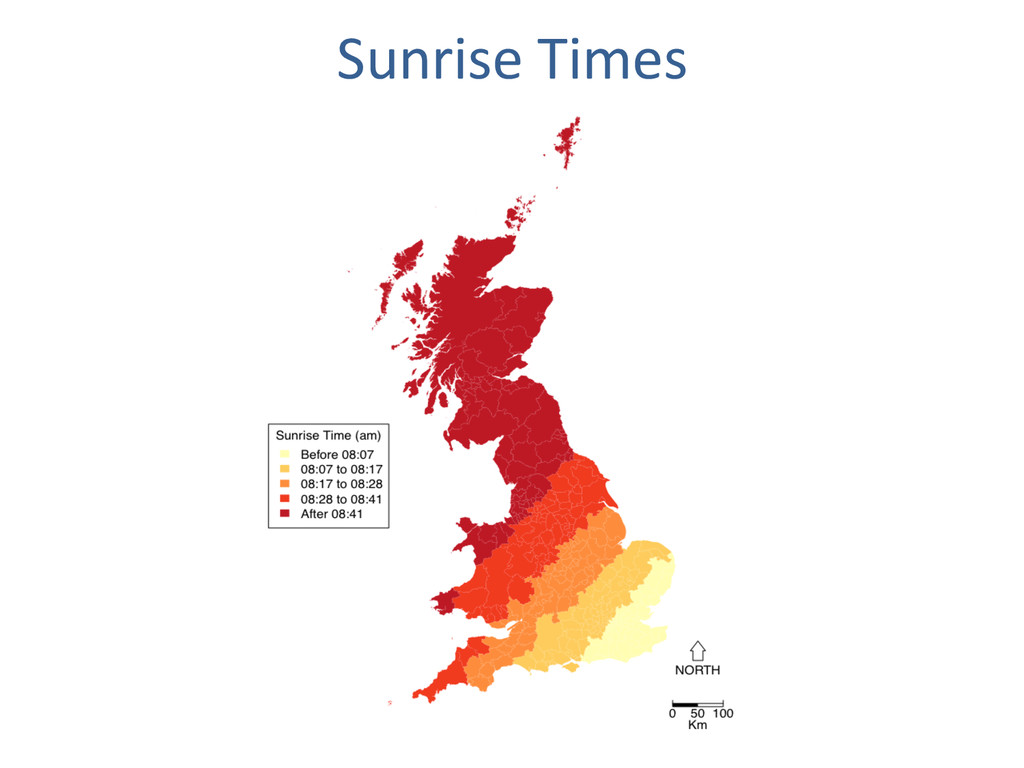
  5. Daylight  Hours     •  Workers  have  reduced   visibility

     through  evening/ night  (Ardi7  et  al,  2007  and   Mustard  et  al,  2012).     •  Workers  with  long  shiXs   through  the  evening/night   suffer  from  fa7gue  (Shields,   2002  and  Åkerstedt,  2003).    
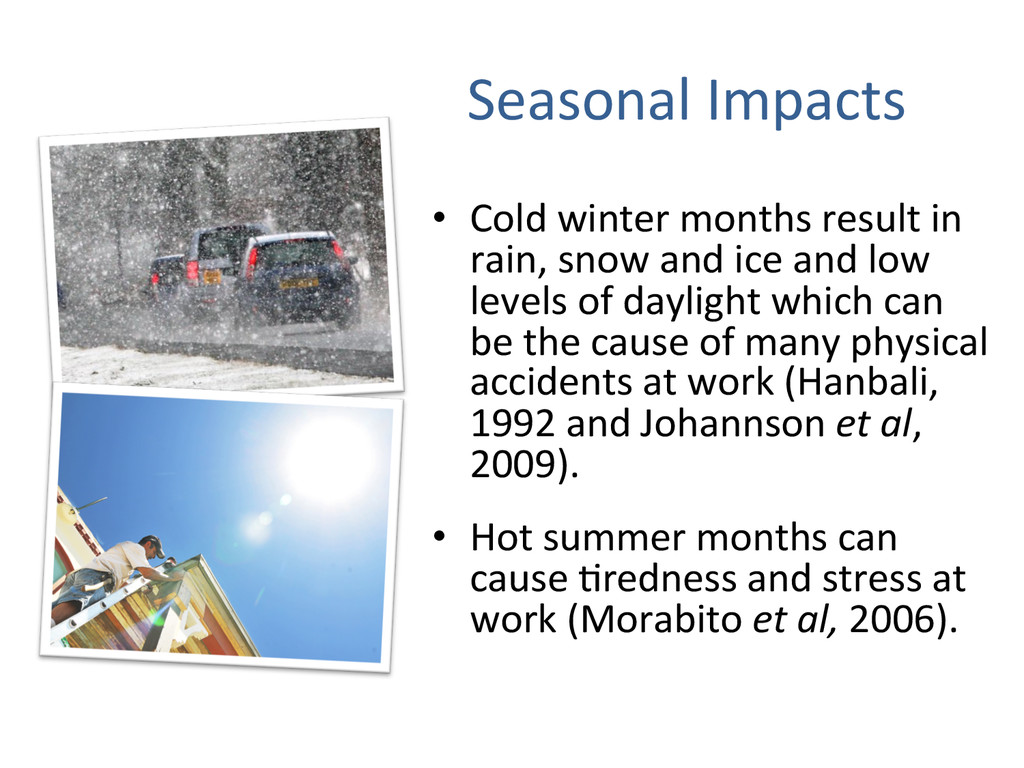
  6. Seasonal  Impacts     •  Cold  winter  months  result  in

      rain,  snow  and  ice  and  low   levels  of  daylight  which  can   be  the  cause  of  many  physical   accidents  at  work  (Hanbali,   1992  and  Johannson  et  al,   2009).     •  Hot  summer  months  can   cause  7redness  and  stress  at   work  (Morabito  et  al,  2006).      
  7. Research  Ques7ons   •  Is  there  a  rela7onship  between  hours

     of   daylight  and  accidents  at  work?     •  Are  the  number  of  accidents  at  work  are   related  to  seasonal  changes?     •  Do  either  of  these  pa?erns  change  across   Great  Britain?  
  8. •  Literature/Policy  Review     •  Data  prepara7on    

    •  Evalua7on  of  appropriate  soXware  and  methods  for   space-­‐7me  mining  and  visualisa7on  of  RIDDOR  data.     •  Exploratory  spa7al  and  temporal  data  analysis  on   RIDDOR  data       Timetable:  Year  1  
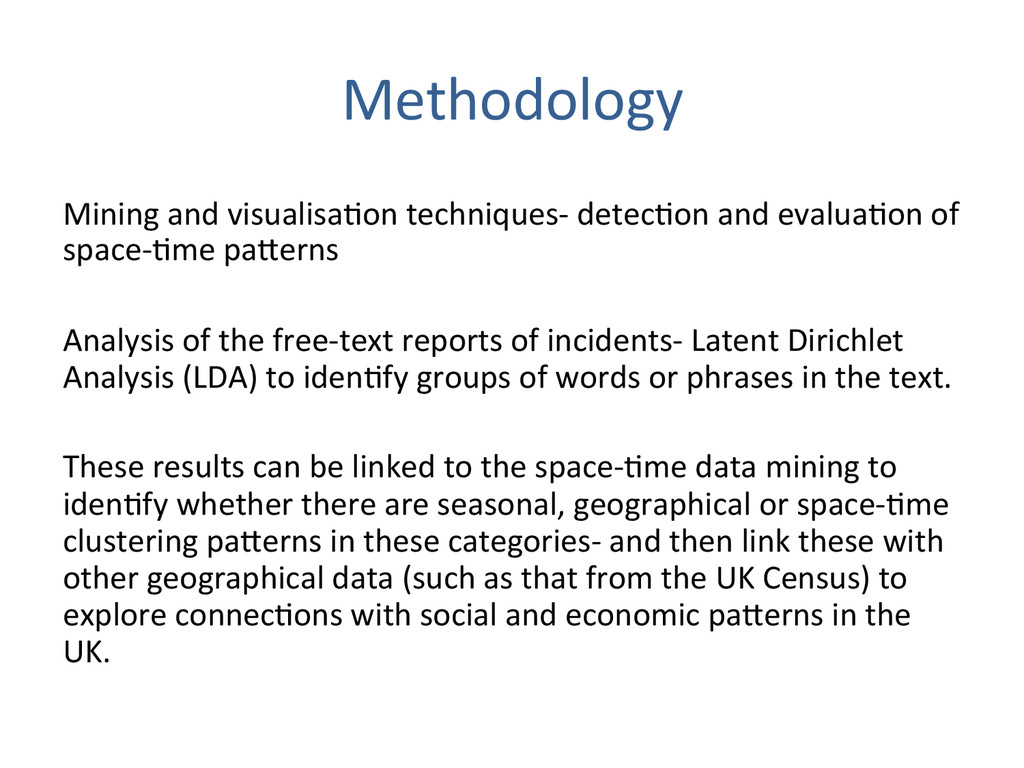
  9. Methodology   Mining  and  visualisa7on  techniques-­‐  detec7on  and  evalua7on  of

      space-­‐7me  pa?erns     Analysis  of  the  free-­‐text  reports  of  incidents-­‐  Latent  Dirichlet   Analysis  (LDA)  to  iden7fy  groups  of  words  or  phrases  in  the  text.     These  results  can  be  linked  to  the  space-­‐7me  data  mining  to   iden7fy  whether  there  are  seasonal,  geographical  or  space-­‐7me   clustering  pa?erns  in  these  categories-­‐  and  then  link  these  with   other  geographical  data  (such  as  that  from  the  UK  Census)  to   explore  connec7ons  with  social  and  economic  pa?erns  in  the   UK.  
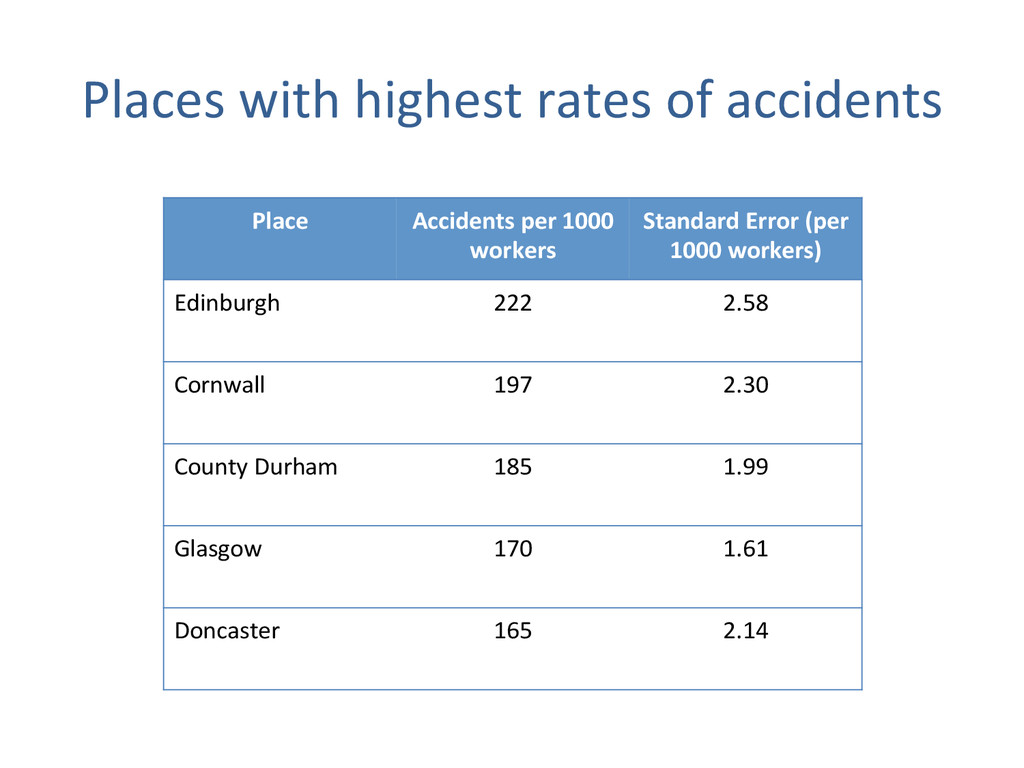
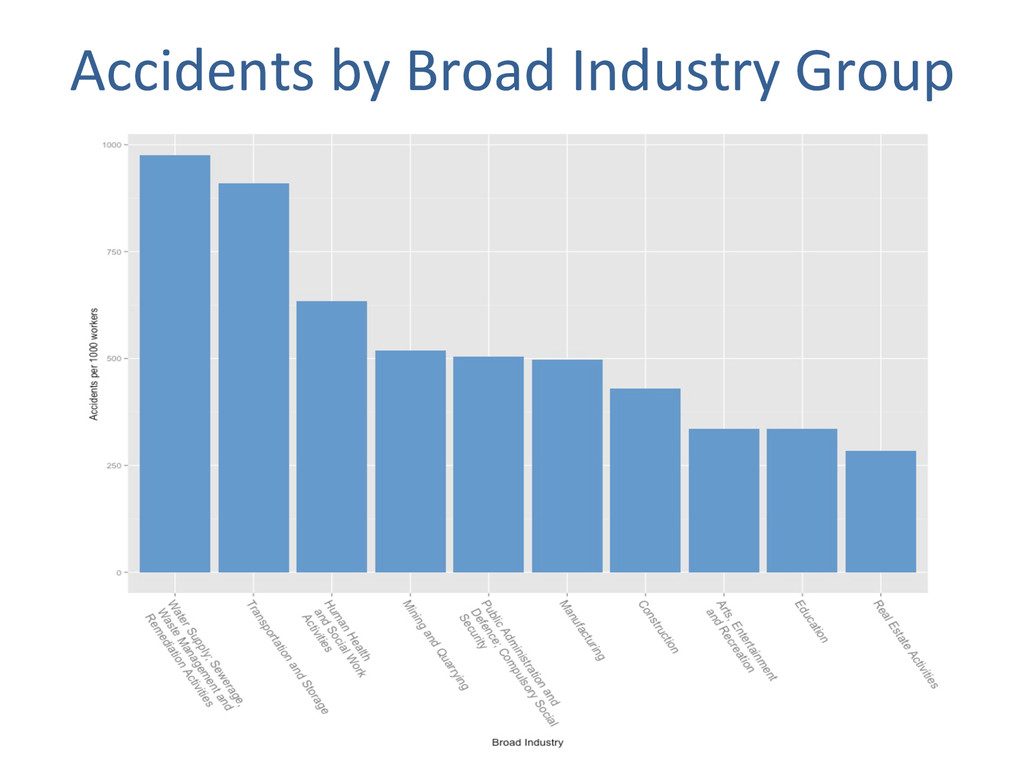
  10. Places  with  highest  rates  of  accidents   Place   Accidents

     per  1000   workers   Standard  Error  (per   1000  workers)   Edinburgh   222   2.58   Cornwall   197   2.30   County  Durham   185   1.99   Glasgow   170   1.61   Doncaster   165   2.14  
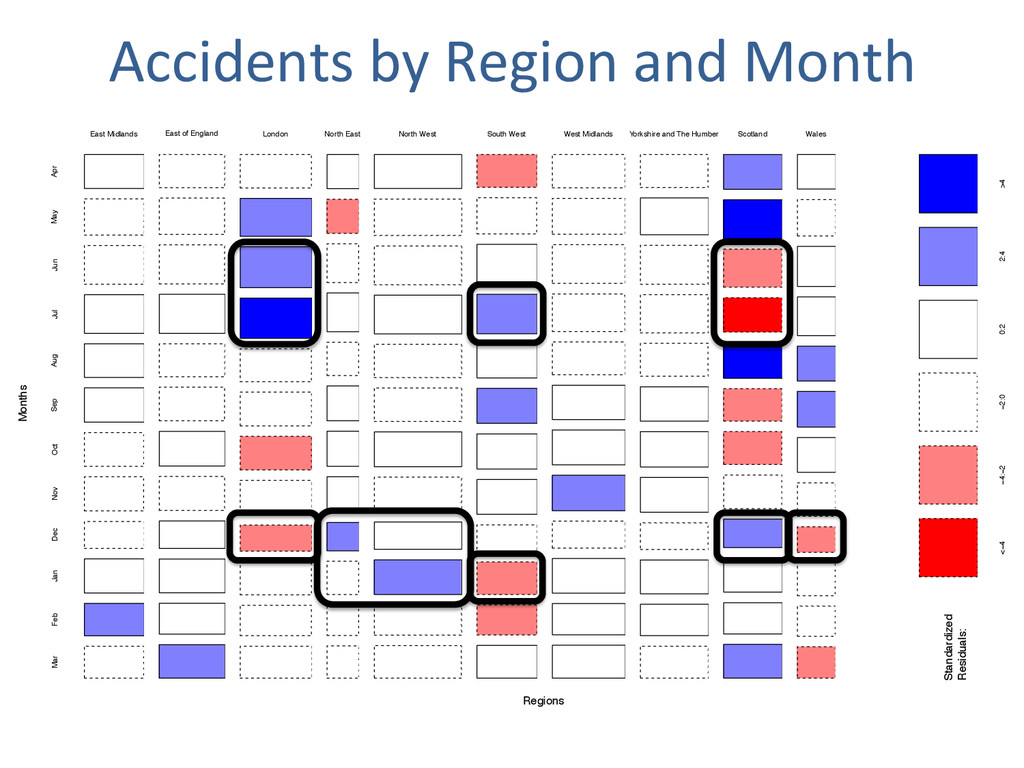
  11. Standardized Residuals: <−4 −4:−2 −2:0 0:2 2:4 >4 Workplace Accidents

    Regions Months East Midlands East of England London North East North West South West West Midlands Yorkshire and The Humber Scotland Wales Apr May Jun Jul Aug Sep Oct Nov Dec Jan Feb Mar Accidents  by  Region  and  Month  
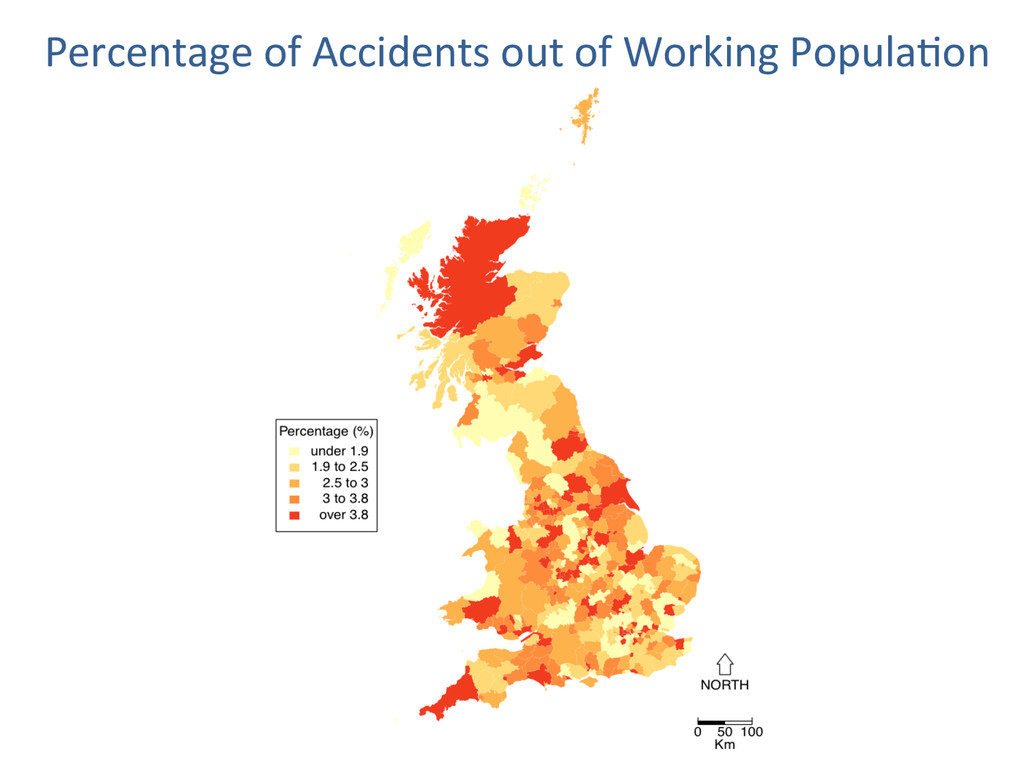
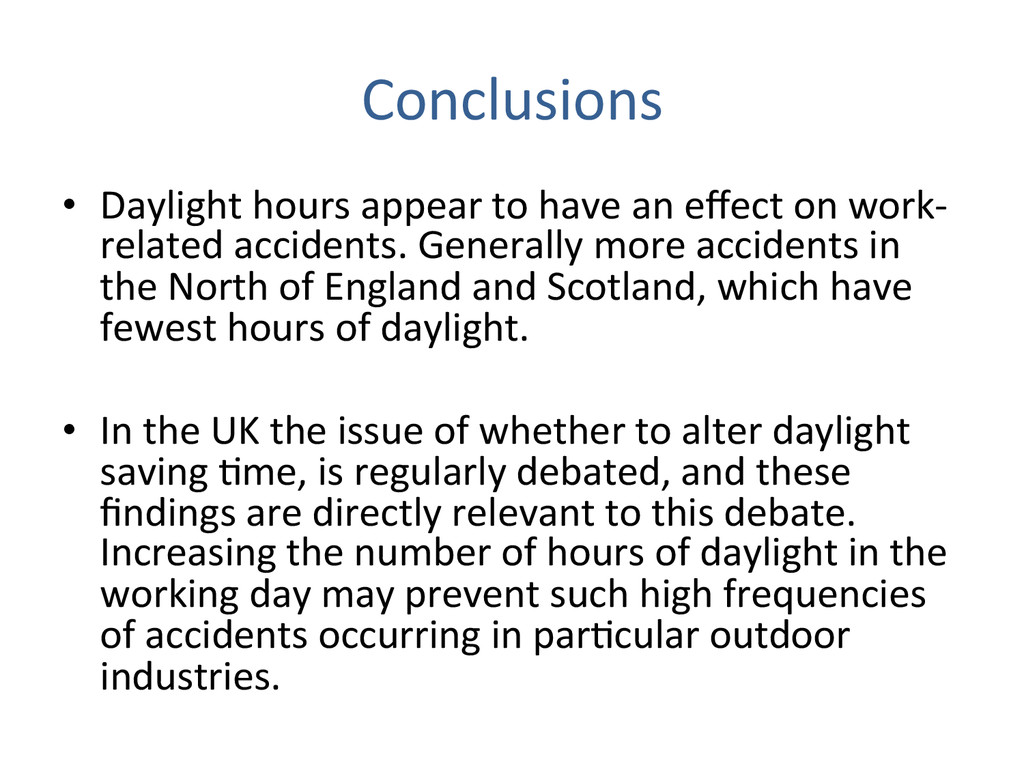
  12. Conclusions   •  Daylight  hours  appear  to  have  an  effect

     on  work-­‐ related  accidents.  Generally  more  accidents  in   the  North  of  England  and  Scotland,  which  have   fewest  hours  of  daylight.       •  In  the  UK  the  issue  of  whether  to  alter  daylight   saving  7me,  is  regularly  debated,  and  these   findings  are  directly  relevant  to  this  debate.   Increasing  the  number  of  hours  of  daylight  in  the   working  day  may  prevent  such  high  frequencies   of  accidents  occurring  in  par7cular  outdoor   industries.  
  13.   •  Knowledge  Exchange  Output:  Iden7fica7on  of   example  problems

        •  Evalua7on  of  modelling  frameworks  for  use  in   example  applica7ons     •  Web-­‐based  ‘How-­‐to’  guides  on  the  use  of   visualisa7on  and  data  analysis  soXware     Timetable:  Year  2  
  14. •  Calibra7on/Tes7ng  of  example  models     •  PhD  write-­‐up

        •  Knowledge  Exchange  Output:  Final  report  to   partner  (HSE)  on  example  applica7ons  and   guides  and  example  files  of  the  use  of   soXware       Timetable:  Year  3  
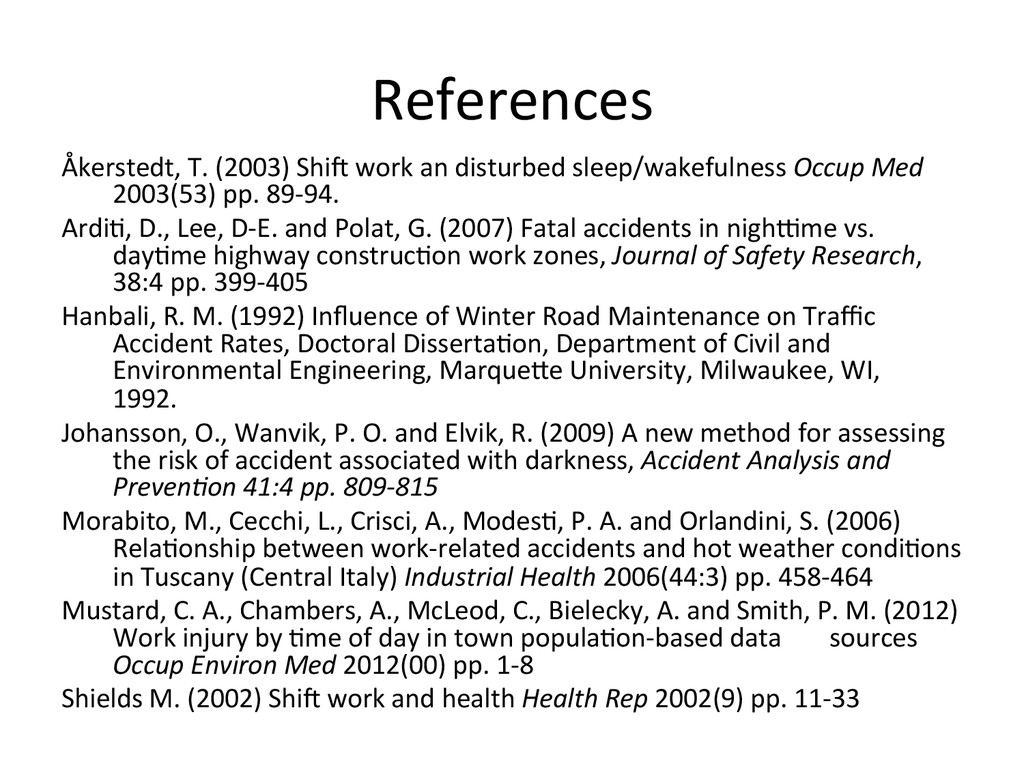
  15. References   Åkerstedt,  T.  (2003)  ShiX  work  an  disturbed  sleep/wakefulness

     Occup  Med    2003(53)  pp.  89-­‐94.   Ardi7,  D.,  Lee,  D-­‐E.  and  Polat,  G.  (2007)  Fatal  accidents  in  nighlme  vs.    day7me  highway  construc7on  work  zones,  Journal  of  Safety  Research,    38:4  pp.  399-­‐405   Hanbali,  R.  M.  (1992)  Influence  of  Winter  Road  Maintenance  on  Traffic    Accident  Rates,  Doctoral  Disserta7on,  Department  of  Civil  and    Environmental  Engineering,  Marque?e  University,  Milwaukee,  WI,    1992.     Johansson,  O.,  Wanvik,  P.  O.  and  Elvik,  R.  (2009)  A  new  method  for  assessing    the  risk  of  accident  associated  with  darkness,  Accident  Analysis  and    Preven4on  41:4  pp.  809-­‐815   Morabito,  M.,  Cecchi,  L.,  Crisci,  A.,  Modes7,  P.  A.  and  Orlandini,  S.  (2006)    Rela7onship  between  work-­‐related  accidents  and  hot  weather  condi7ons    in  Tuscany  (Central  Italy)  Industrial  Health  2006(44:3)  pp.  458-­‐464   Mustard,  C.  A.,  Chambers,  A.,  McLeod,  C.,  Bielecky,  A.  and  Smith,  P.  M.  (2012)    Work  injury  by  7me  of  day  in  town  popula7on-­‐based  data    sources    Occup  Environ  Med  2012(00)  pp.  1-­‐8   Shields  M.  (2002)  ShiX  work  and  health  Health  Rep  2002(9)  pp.  11-­‐33