Upgrade to Pro — share decks privately, control downloads, hide ads and more …

A Billion stars in the Jupyter notebook

A Billion stars in the Jupyter notebook

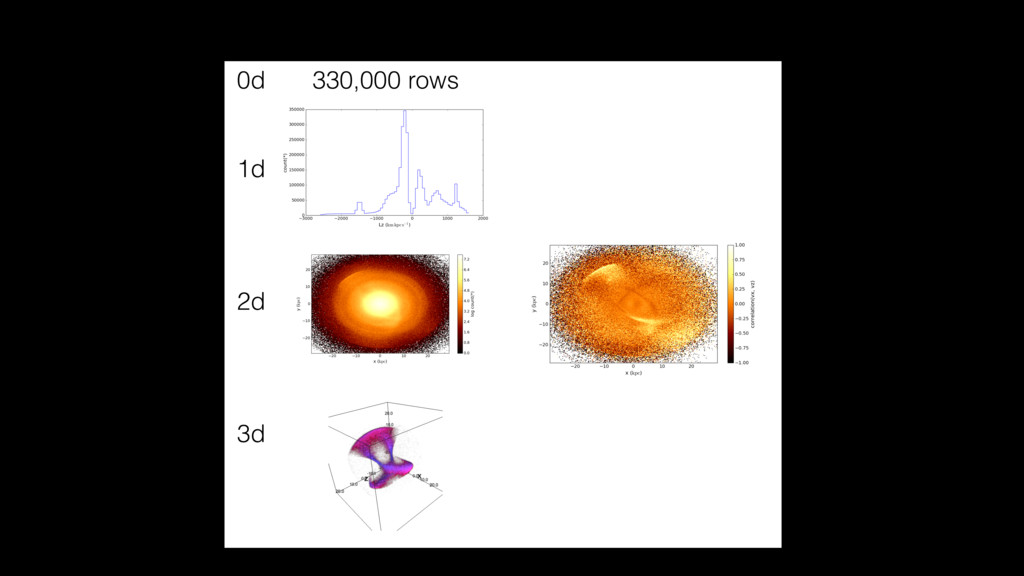
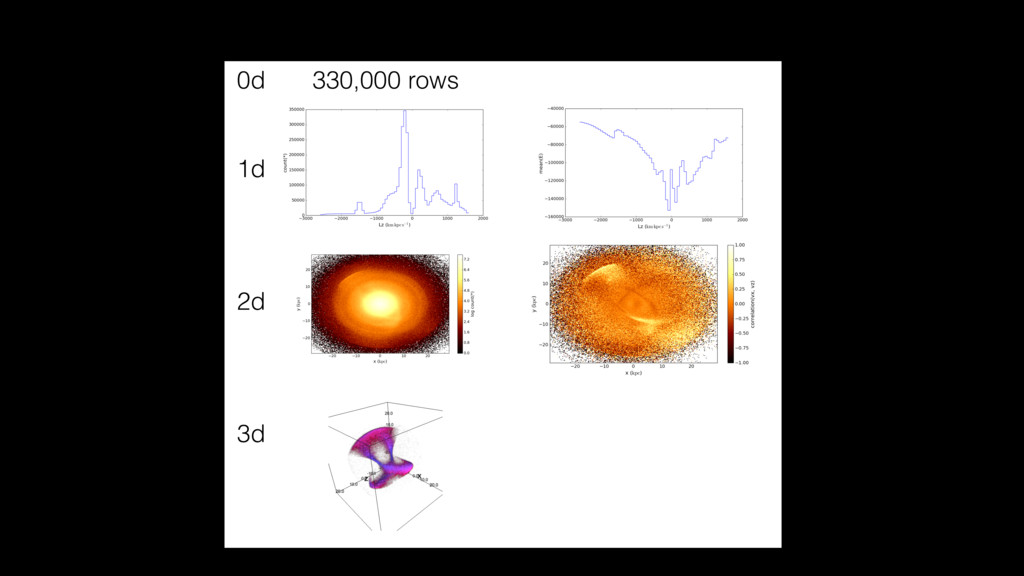
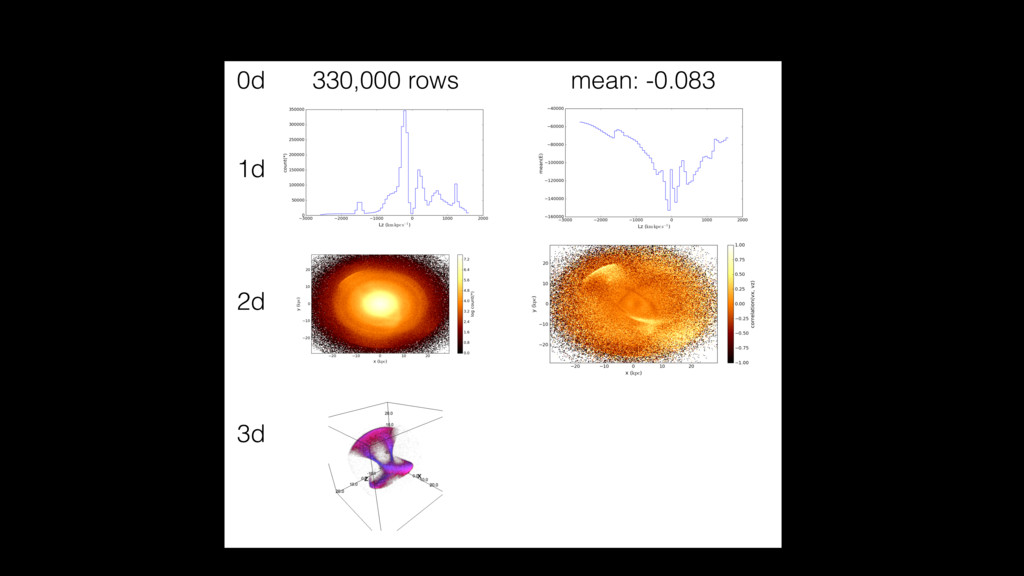
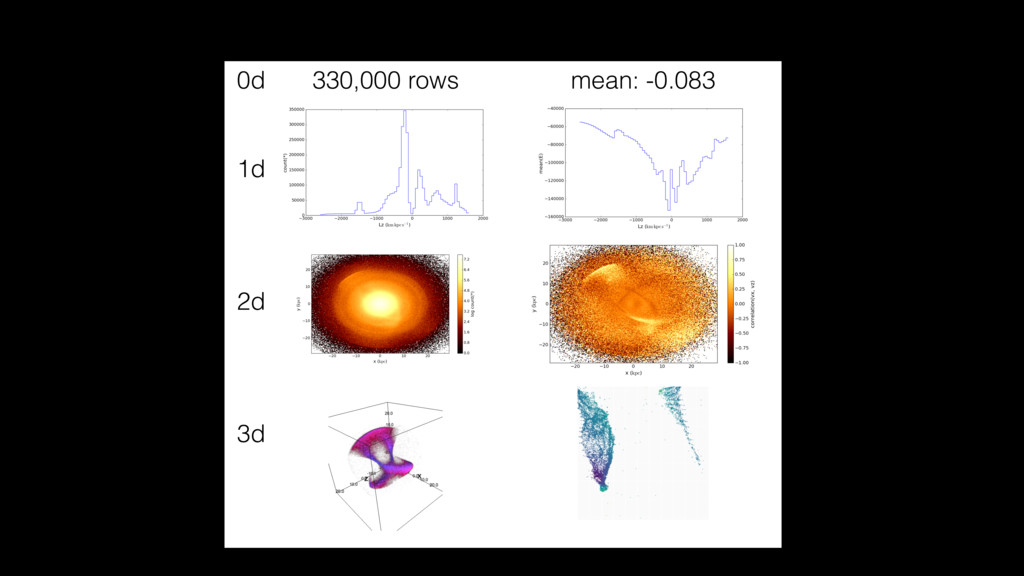
Maarten Breddels offers an overview of vaex, a Python library that enables calculating statistics for a billion samples per second on a regular n-dimensional grid, and ipyvolume, a library that enables volume and glyph rendering in Jupyter notebooks. Together, these libraries allow the interactive visualization and exploration of large, high-dimensional datasets in the Jupyter Notebook.

Avatar for Maarten Breddels

Maarten Breddels

August 25, 2017

Other Decks in Programming

Transcript

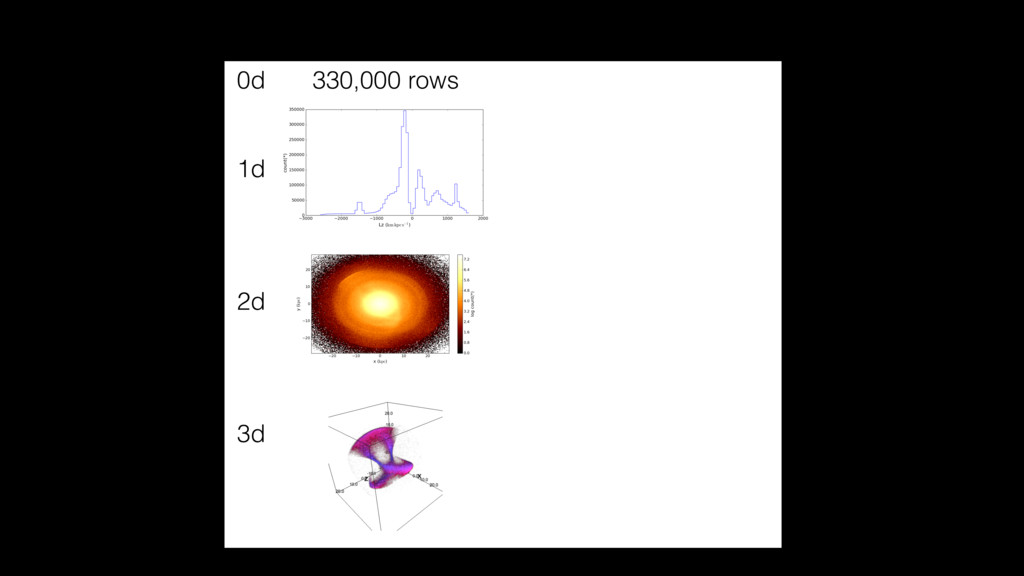
  1. Agenda • Show how to deal with a billion objects/rows/stars?

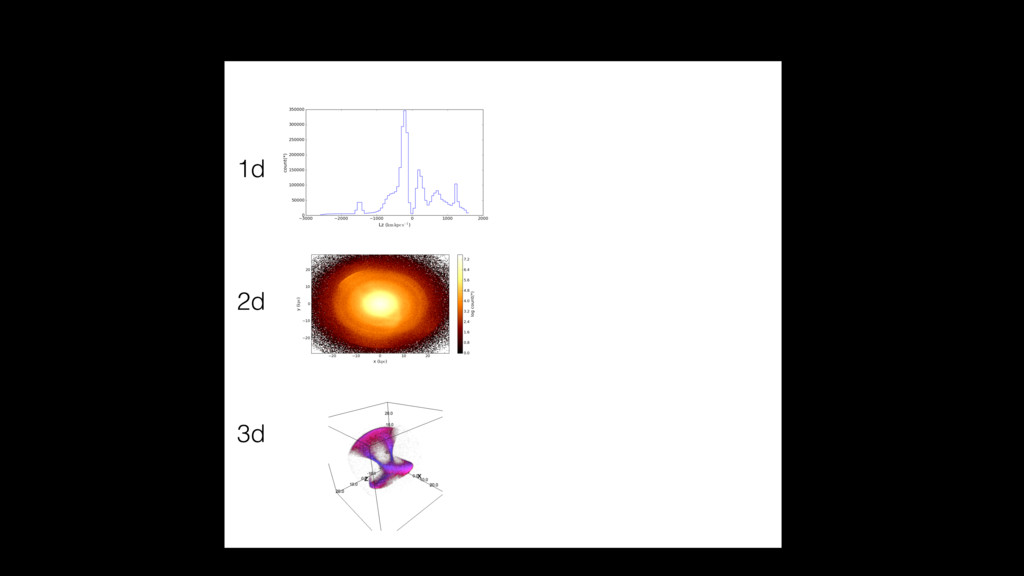
    • How you can do 3d visualization in the notebook?
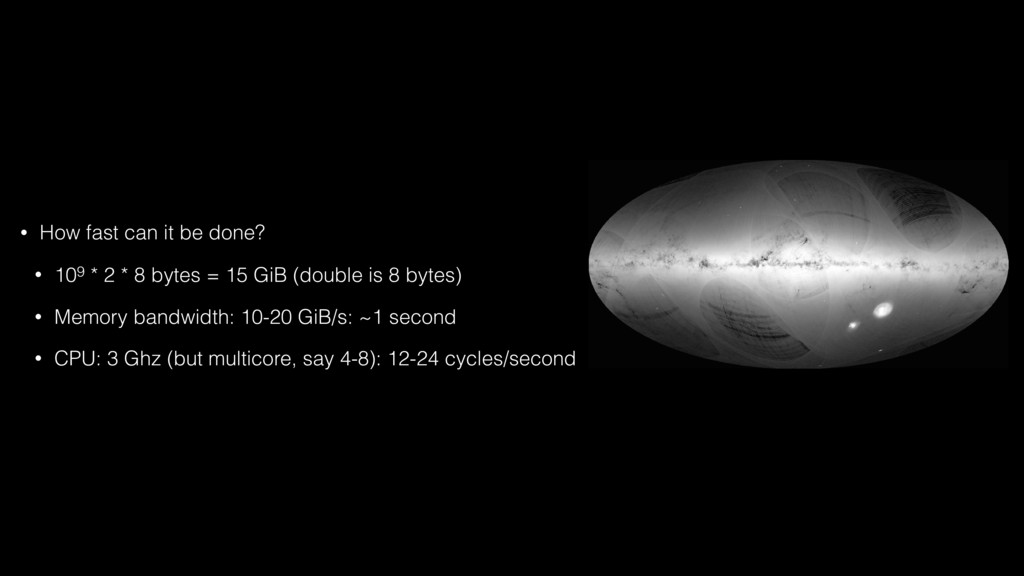
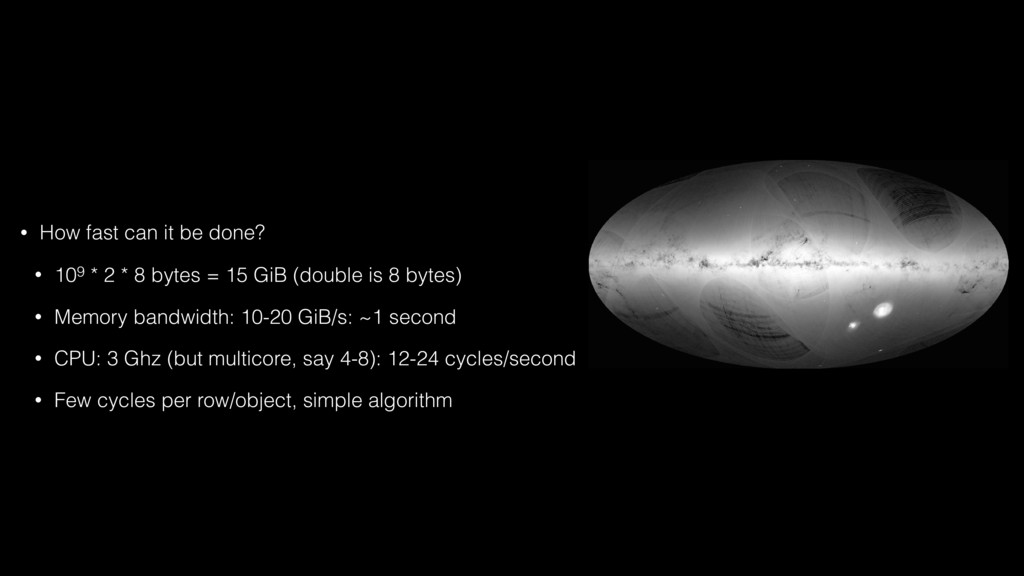
  2. • How fast can it be done? • 109 *

    2 * 8 bytes = 15 GiB (double is 8 bytes)
  3. • How fast can it be done? • 109 *

    2 * 8 bytes = 15 GiB (double is 8 bytes) • Memory bandwidth: 10-20 GiB/s: ~1 second
  4. • How fast can it be done? • 109 *

    2 * 8 bytes = 15 GiB (double is 8 bytes) • Memory bandwidth: 10-20 GiB/s: ~1 second • CPU: 3 Ghz (but multicore, say 4-8): 12-24 cycles/second
  5. • How fast can it be done? • 109 *

    2 * 8 bytes = 15 GiB (double is 8 bytes) • Memory bandwidth: 10-20 GiB/s: ~1 second • CPU: 3 Ghz (but multicore, say 4-8): 12-24 cycles/second • Few cycles per row/object, simple algorithm
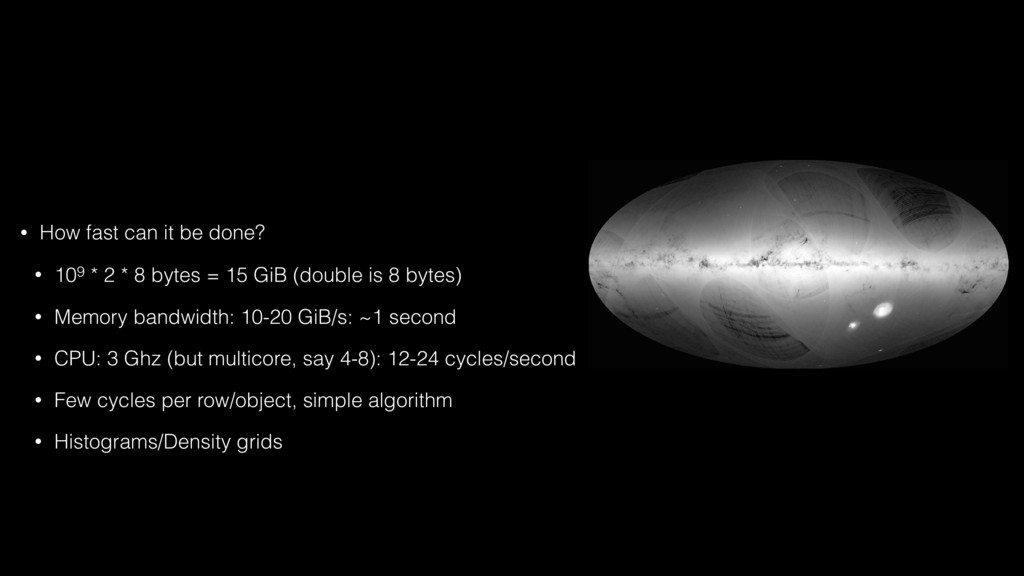
  6. • How fast can it be done? • 109 *

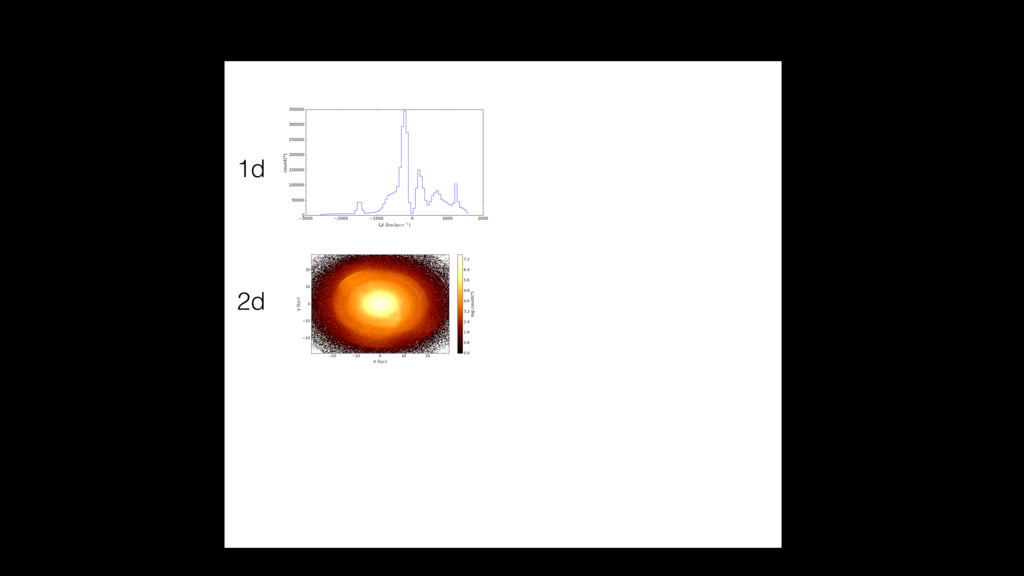
    2 * 8 bytes = 15 GiB (double is 8 bytes) • Memory bandwidth: 10-20 GiB/s: ~1 second • CPU: 3 Ghz (but multicore, say 4-8): 12-24 cycles/second • Few cycles per row/object, simple algorithm • Histograms/Density grids
  7. • How fast can it be done? • 109 *

    2 * 8 bytes = 15 GiB (double is 8 bytes) • Memory bandwidth: 10-20 GiB/s: ~1 second • CPU: 3 Ghz (but multicore, say 4-8): 12-24 cycles/second • Few cycles per row/object, simple algorithm • Histograms/Density grids
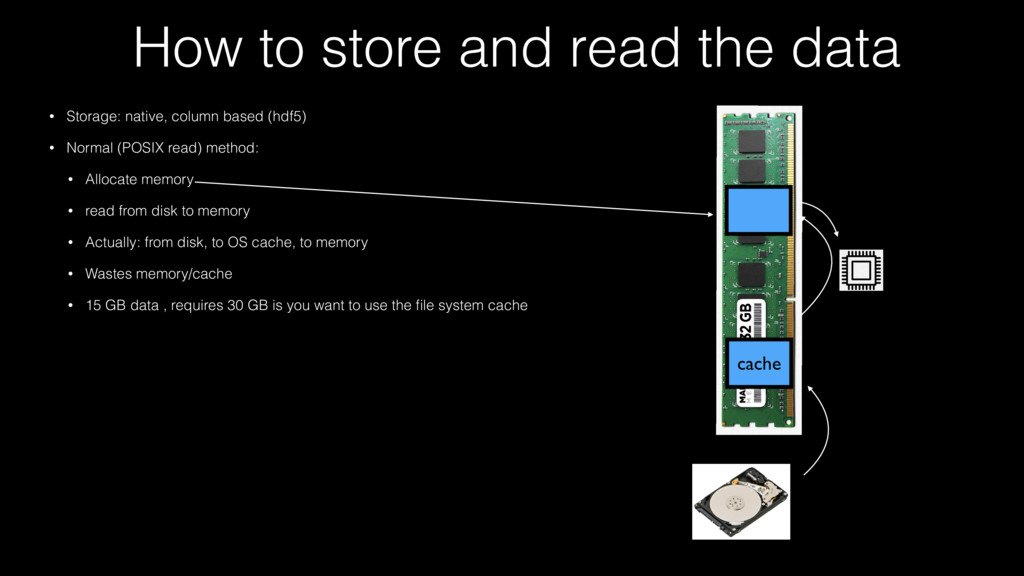
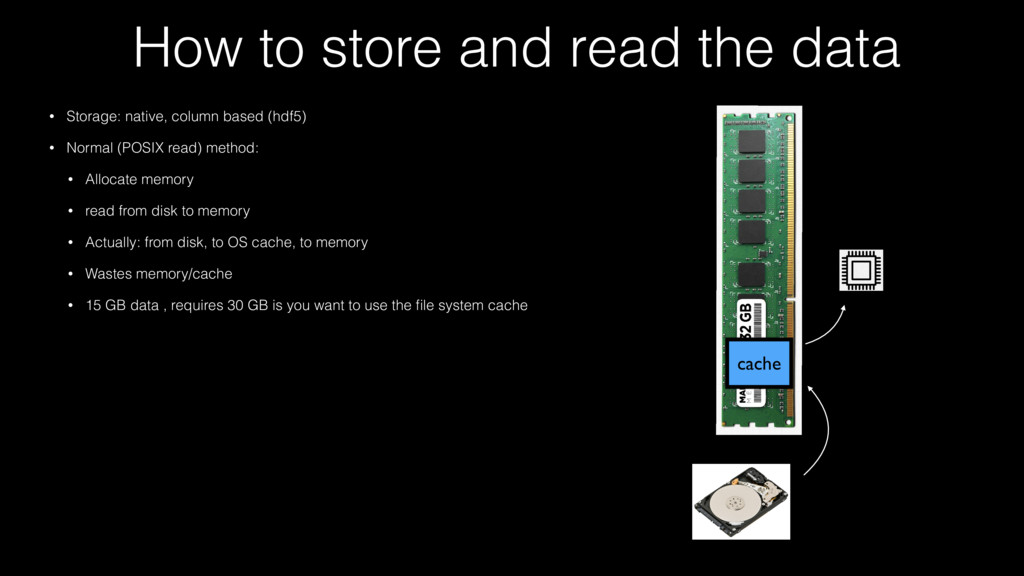
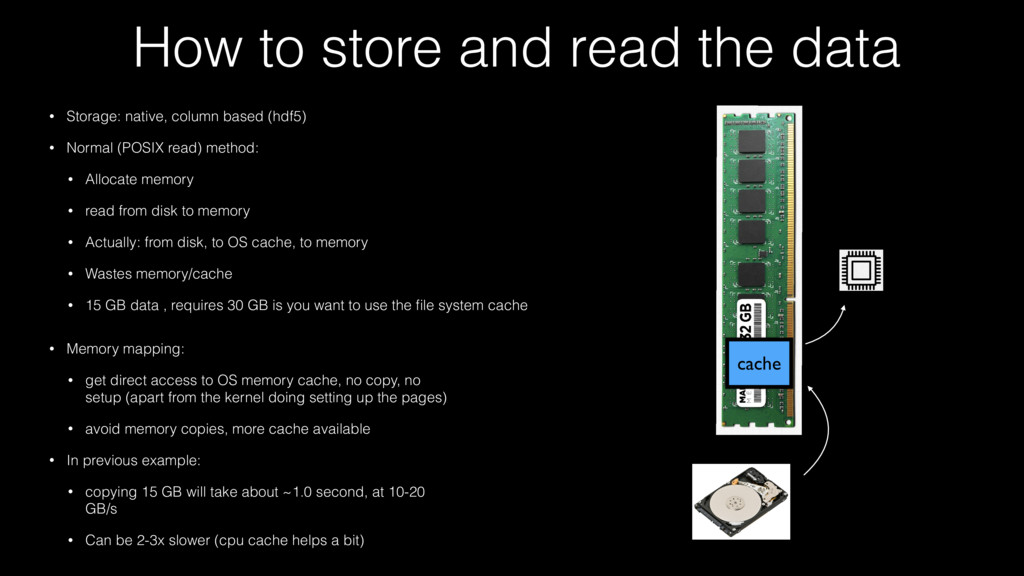
  8. How to store and read the data cache • Storage:

    native, column based (hdf5) • Normal (POSIX read) method: • Allocate memory • read from disk to memory • Actually: from disk, to OS cache, to memory • Wastes memory/cache • 15 GB data , requires 30 GB is you want to use the file system cache
  9. How to store and read the data cache • Storage:

    native, column based (hdf5) • Normal (POSIX read) method: • Allocate memory • read from disk to memory • Actually: from disk, to OS cache, to memory • Wastes memory/cache • 15 GB data , requires 30 GB is you want to use the file system cache
  10. How to store and read the data cache • Storage:

    native, column based (hdf5) • Normal (POSIX read) method: • Allocate memory • read from disk to memory • Actually: from disk, to OS cache, to memory • Wastes memory/cache • 15 GB data , requires 30 GB is you want to use the file system cache • Memory mapping: • get direct access to OS memory cache, no copy, no setup (apart from the kernel doing setting up the pages) • avoid memory copies, more cache available • In previous example: • copying 15 GB will take about ~1.0 second, at 10-20 GB/s • Can be 2-3x slower (cpu cache helps a bit)
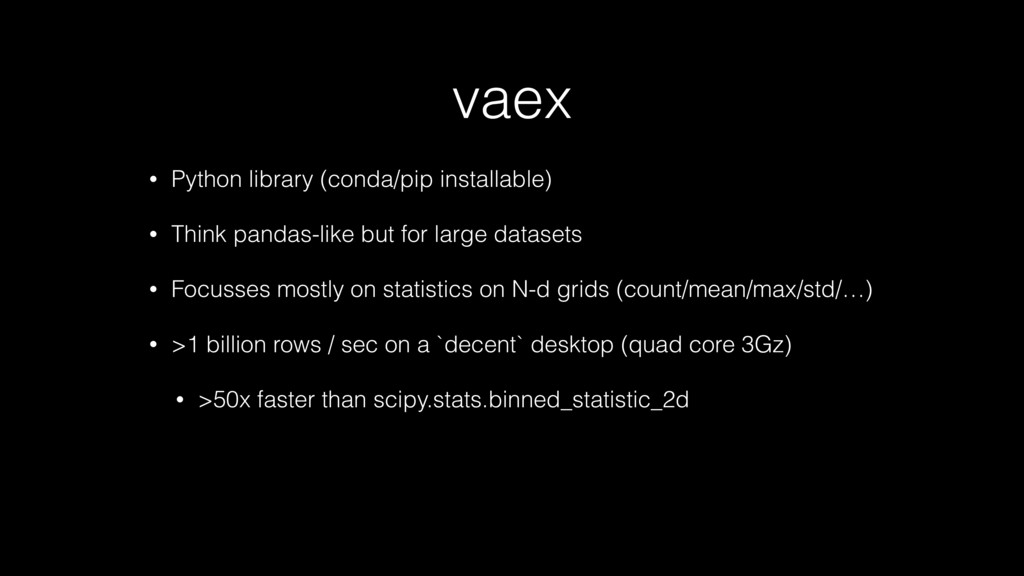
  11. vaex • Python library (conda/pip installable) • Think pandas-like but

    for large datasets • Focusses mostly on statistics on N-d grids (count/mean/max/std/…) • ~1 second
  12. vaex • Python library (conda/pip installable) • Think pandas-like but

    for large datasets • Focusses mostly on statistics on N-d grids (count/mean/max/std/…) • >1 billion rows / sec on a `decent` desktop (quad core 3Gz) • >50x faster than scipy.stats.binned_statistic_2d • ~1 second
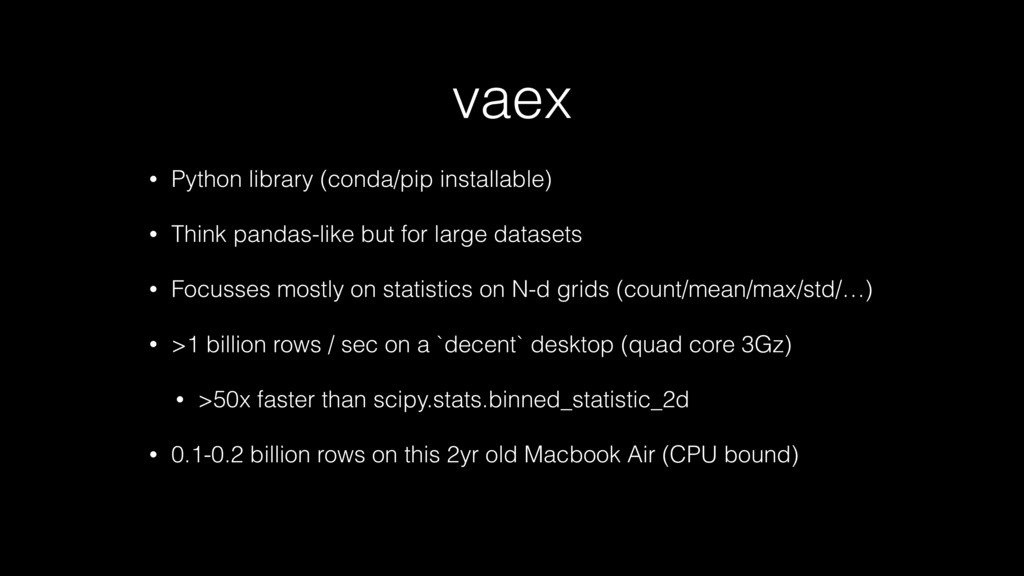
  13. vaex • Python library (conda/pip installable) • Think pandas-like but

    for large datasets • Focusses mostly on statistics on N-d grids (count/mean/max/std/…) • >1 billion rows / sec on a `decent` desktop (quad core 3Gz) • >50x faster than scipy.stats.binned_statistic_2d • 0.1-0.2 billion rows on this 2yr old Macbook Air (CPU bound) • ~1 second
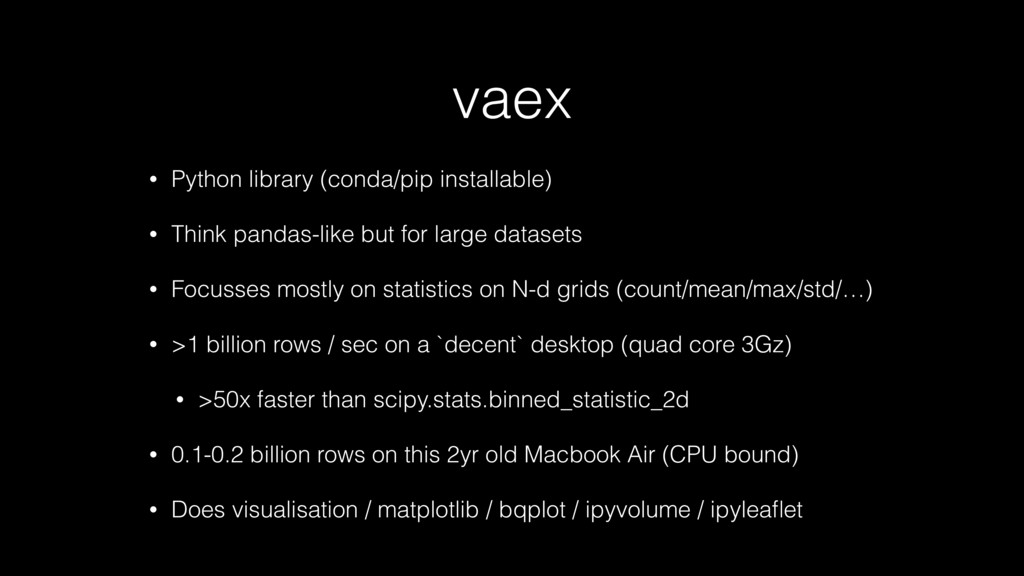
  14. vaex • Python library (conda/pip installable) • Think pandas-like but

    for large datasets • Focusses mostly on statistics on N-d grids (count/mean/max/std/…) • >1 billion rows / sec on a `decent` desktop (quad core 3Gz) • >50x faster than scipy.stats.binned_statistic_2d • 0.1-0.2 billion rows on this 2yr old Macbook Air (CPU bound) • Does visualisation / matplotlib / bqplot / ipyvolume / ipyleaflet • ~1 second
  15. Answers • How to deal with a billion objects/rows/stars? •

    statistics in N-d grids / vaex • How you can do 3d visualization in the notebook? • ipyvolume
  16. • [email protected] • twitter @maartenbreddels • vaex • http://vaex.astro.rug.nl •

    https://github.com/maartenbreddels/vaex • pip install —pre vaex / conda install -c conda-forge vaex • ipyvolume • https://ipywidgets.readthedocs.io • https://github.com/maartenbreddels/ipyvolume • pip install ipyvolume / conda install -c conda-forge ipyvolume • if pip: jupyter nbextension enable --py --user ipyvolume (but really, use anaconda) • Material: • https://github.com/maartenbreddels/jupytercon-2017