Upgrade to Pro — share decks privately, control downloads, hide ads and more …

sp500_25_multitrillion_company_report_Mangesh

Sponsored · Your Podcast. Everywhere. Effortlessly. Share. Educate. Inspire. Entertain. You do you. We'll handle the rest. →

 sp500_25_multitrillion_company_report_Mangesh

sp500_25_multitrillion_company_report_Mangesh

Avatar for MangsTheMathematician

MangsTheMathematician

July 07, 2026

Transcript

  1. Page 1 S&P 500 Multi-Trillion Candidate Research Report - Educational,

    not financial advice Best 25 S&P 500 Companies With Multi-Trillion Potential Beginner-friendly research report for long-term analysis - July 6, 2026 market snapshot This report explains the companies like you are new to the market: what they actually sell, why investors think they can become or remain multi-trillion-dollar companies, what must go right, what can go wrong, and how I would think about allocation. It is not a promise, not a guaranteed forecast, and not personalized financial advice. Important plain-English idea: a stock becomes multi-trillion-dollar only when the market believes the company can produce huge future profits for many years. Hype alone can move a stock for months, but long-term market value needs revenue, profit, cash flow, moat and execution. Prepared from current market snapshots, company annual reports/earnings releases, and macro research sources including S&P 500 constituent/weight data, Gartner AI/cloud forecasts, WSTS semiconductor forecasts, IEA electricity/data-center analysis, and company investor filings. Market values change every trading day; use this as a study report, not a live trading terminal. S&P 500 Multi-Trillion Candidate Research Report - Research-backed, data-driven, mathematically analyzed, and risk-aware For educational purposes only, not financial advice - Researched and created by Mangesh Janardan Bodke Page 1
  2. Page 2 S&P 500 Multi-Trillion Candidate Research Report - Educational,

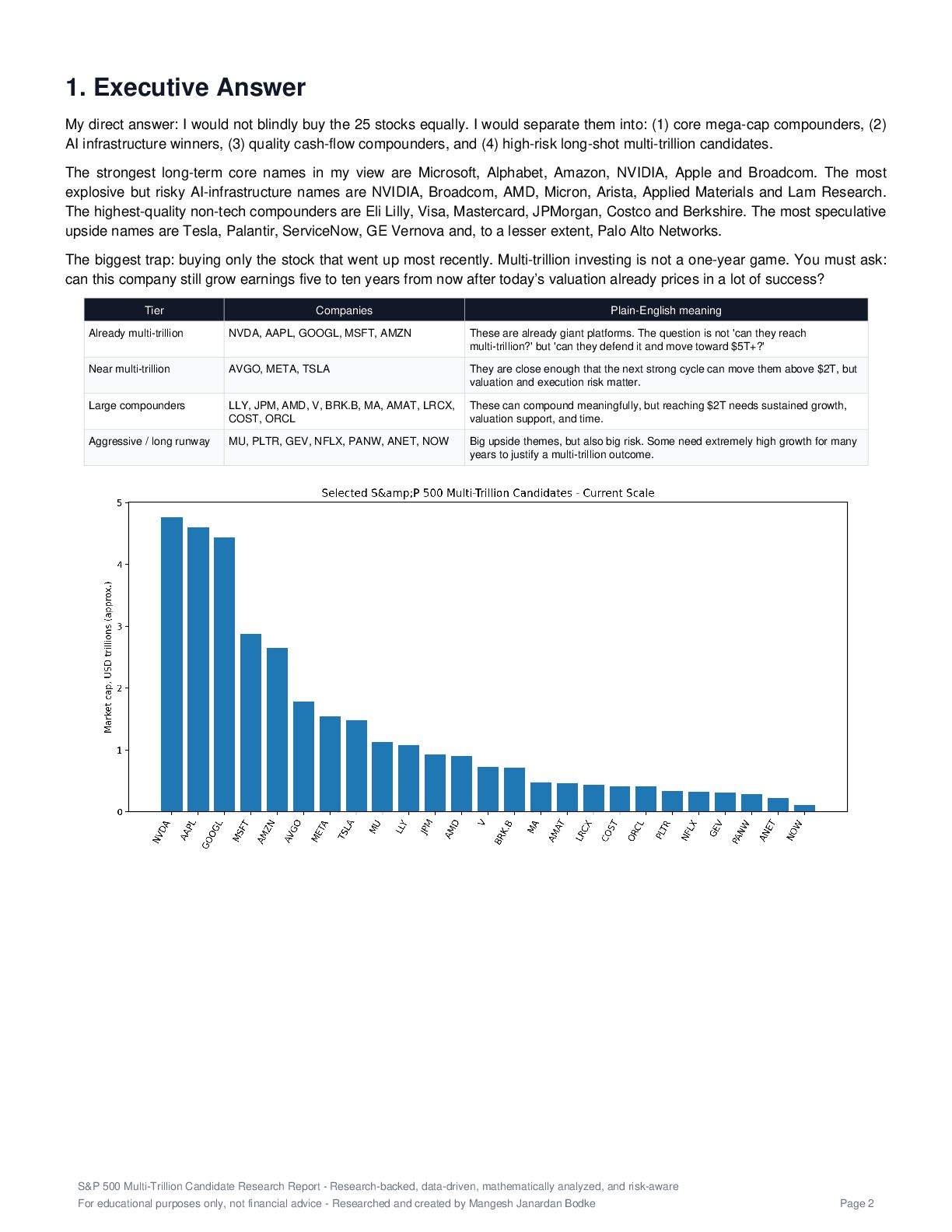
    not financial advice 1. Executive Answer My direct answer: I would not blindly buy the 25 stocks equally. I would separate them into: (1) core mega-cap compounders, (2) AI infrastructure winners, (3) quality cash-flow compounders, and (4) high-risk long-shot multi-trillion candidates. The strongest long-term core names in my view are Microsoft, Alphabet, Amazon, NVIDIA, Apple and Broadcom. The most explosive but risky AI-infrastructure names are NVIDIA, Broadcom, AMD, Micron, Arista, Applied Materials and Lam Research. The highest-quality non-tech compounders are Eli Lilly, Visa, Mastercard, JPMorgan, Costco and Berkshire. The most speculative upside names are Tesla, Palantir, ServiceNow, GE Vernova and, to a lesser extent, Palo Alto Networks. The biggest trap: buying only the stock that went up most recently. Multi-trillion investing is not a one-year game. You must ask: can this company still grow earnings five to ten years from now after today’s valuation already prices in a lot of success? Tier Companies Plain-English meaning Already multi-trillion NVDA, AAPL, GOOGL, MSFT, AMZN These are already giant platforms. The question is not 'can they reach multi-trillion?' but 'can they defend it and move toward $5T+?' Near multi-trillion AVGO, META, TSLA They are close enough that the next strong cycle can move them above $2T, but valuation and execution risk matter. Large compounders LLY, JPM, AMD, V, BRK.B, MA, AMAT, LRCX, COST, ORCL These can compound meaningfully, but reaching $2T needs sustained growth, valuation support, and time. Aggressive / long runway MU, PLTR, GEV, NFLX, PANW, ANET, NOW Big upside themes, but also big risk. Some need extremely high growth for many years to justify a multi-trillion outcome. S&P 500 Multi-Trillion Candidate Research Report - Research-backed, data-driven, mathematically analyzed, and risk-aware For educational purposes only, not financial advice - Researched and created by Mangesh Janardan Bodke Page 2
  3. Page 3 S&P 500 Multi-Trillion Candidate Research Report - Educational,

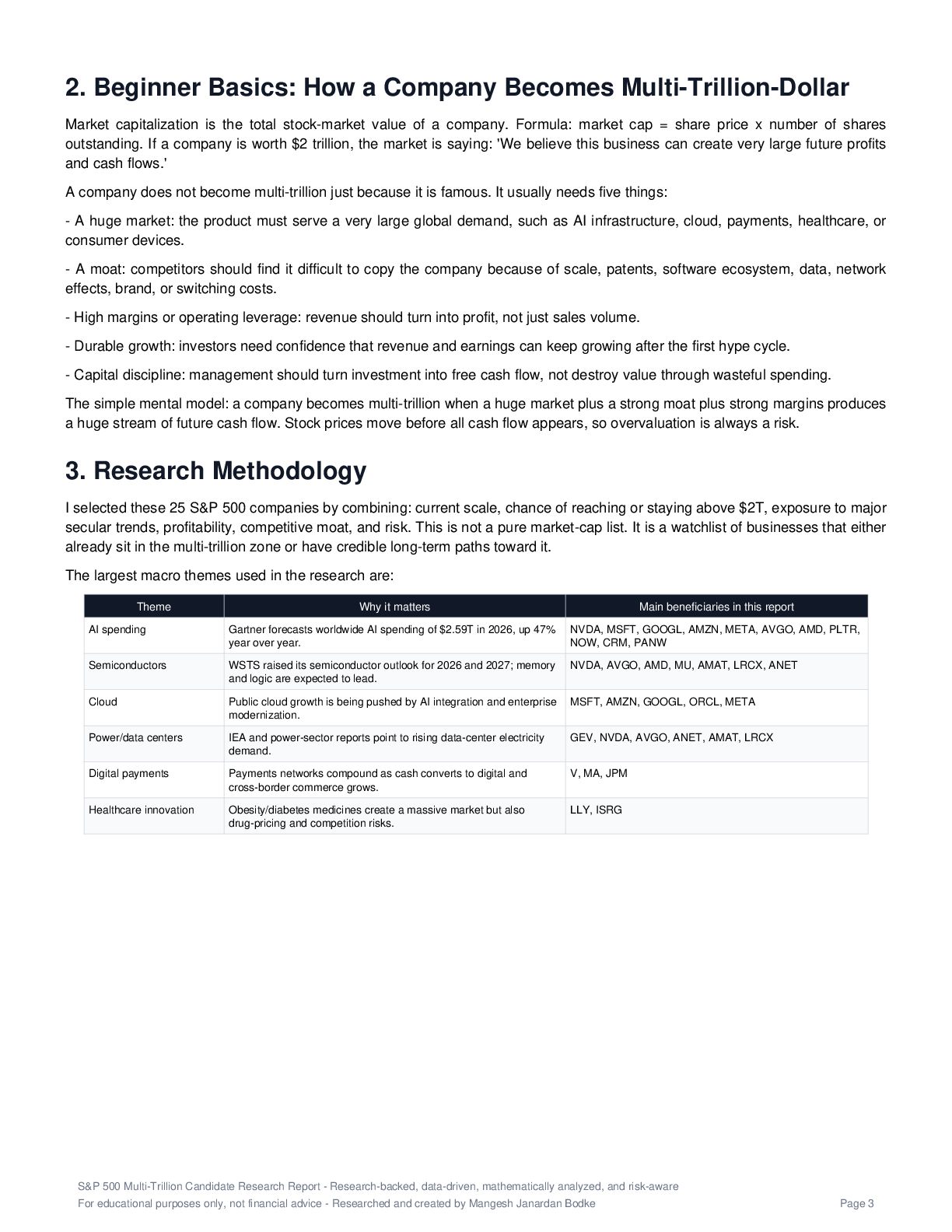
    not financial advice 2. Beginner Basics: How a Company Becomes Multi-Trillion-Dollar Market capitalization is the total stock-market value of a company. Formula: market cap = share price x number of shares outstanding. If a company is worth $2 trillion, the market is saying: 'We believe this business can create very large future profits and cash flows.' A company does not become multi-trillion just because it is famous. It usually needs five things: - A huge market: the product must serve a very large global demand, such as AI infrastructure, cloud, payments, healthcare, or consumer devices. - A moat: competitors should find it difficult to copy the company because of scale, patents, software ecosystem, data, network effects, brand, or switching costs. - High margins or operating leverage: revenue should turn into profit, not just sales volume. - Durable growth: investors need confidence that revenue and earnings can keep growing after the first hype cycle. - Capital discipline: management should turn investment into free cash flow, not destroy value through wasteful spending. The simple mental model: a company becomes multi-trillion when a huge market plus a strong moat plus strong margins produces a huge stream of future cash flow. Stock prices move before all cash flow appears, so overvaluation is always a risk. 3. Research Methodology I selected these 25 S&P 500 companies by combining: current scale, chance of reaching or staying above $2T, exposure to major secular trends, profitability, competitive moat, and risk. This is not a pure market-cap list. It is a watchlist of businesses that either already sit in the multi-trillion zone or have credible long-term paths toward it. The largest macro themes used in the research are: Theme Why it matters Main beneficiaries in this report AI spending Gartner forecasts worldwide AI spending of $2.59T in 2026, up 47% year over year. NVDA, MSFT, GOOGL, AMZN, META, AVGO, AMD, PLTR, NOW, CRM, PANW Semiconductors WSTS raised its semiconductor outlook for 2026 and 2027; memory and logic are expected to lead. NVDA, AVGO, AMD, MU, AMAT, LRCX, ANET Cloud Public cloud growth is being pushed by AI integration and enterprise modernization. MSFT, AMZN, GOOGL, ORCL, META Power/data centers IEA and power-sector reports point to rising data-center electricity demand. GEV, NVDA, AVGO, ANET, AMAT, LRCX Digital payments Payments networks compound as cash converts to digital and cross-border commerce grows. V, MA, JPM Healthcare innovation Obesity/diabetes medicines create a massive market but also drug-pricing and competition risks. LLY, ISRG S&P 500 Multi-Trillion Candidate Research Report - Research-backed, data-driven, mathematically analyzed, and risk-aware For educational purposes only, not financial advice - Researched and created by Mangesh Janardan Bodke Page 3
  4. Page 4 S&P 500 Multi-Trillion Candidate Research Report - Educational,

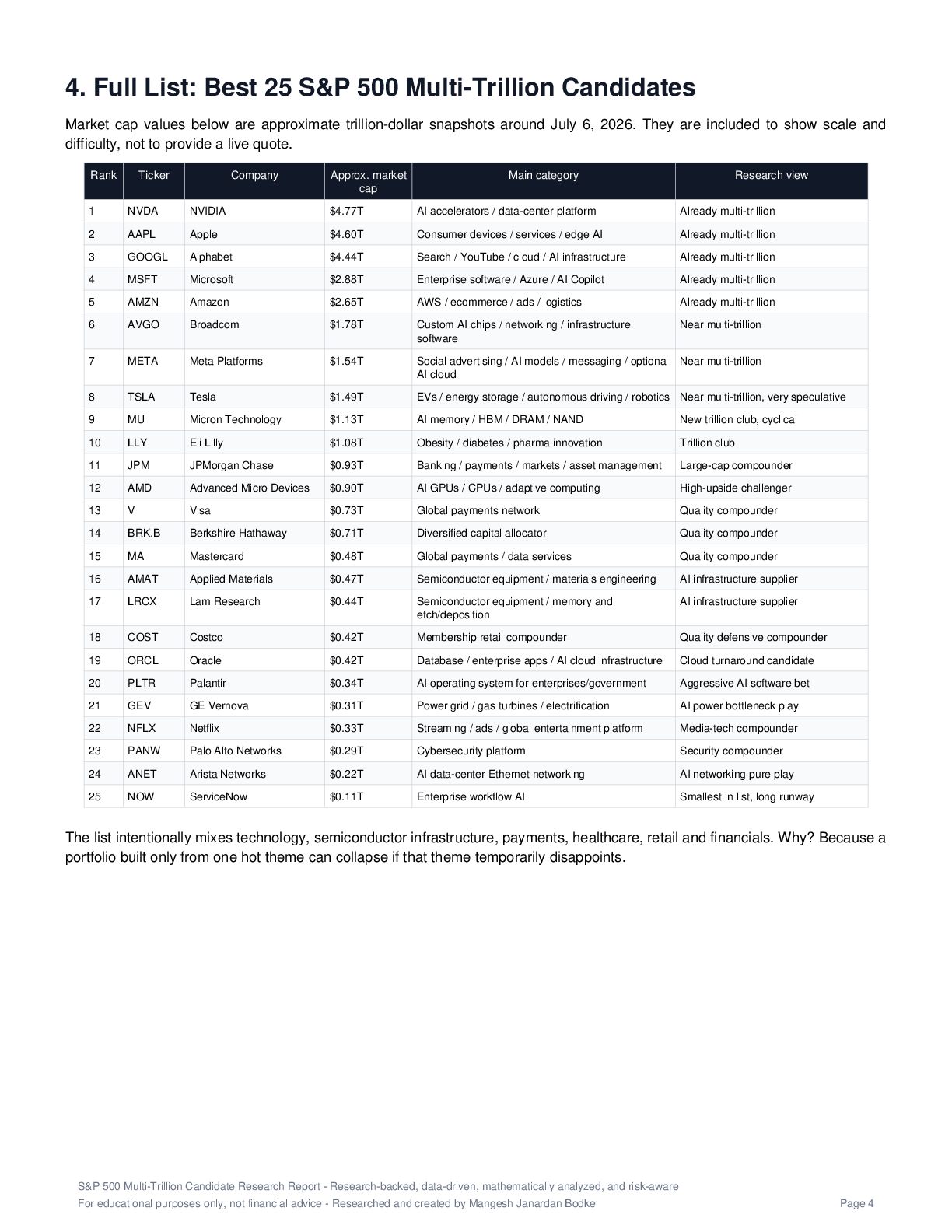
    not financial advice 4. Full List: Best 25 S&P 500 Multi-Trillion Candidates Market cap values below are approximate trillion-dollar snapshots around July 6, 2026. They are included to show scale and difficulty, not to provide a live quote. Rank Ticker Company Approx. market cap Main category Research view 1 NVDA NVIDIA $4.77T AI accelerators / data-center platform Already multi-trillion 2 AAPL Apple $4.60T Consumer devices / services / edge AI Already multi-trillion 3 GOOGL Alphabet $4.44T Search / YouTube / cloud / AI infrastructure Already multi-trillion 4 MSFT Microsoft $2.88T Enterprise software / Azure / AI Copilot Already multi-trillion 5 AMZN Amazon $2.65T AWS / ecommerce / ads / logistics Already multi-trillion 6 AVGO Broadcom $1.78T Custom AI chips / networking / infrastructure software Near multi-trillion 7 META Meta Platforms $1.54T Social advertising / AI models / messaging / optional AI cloud Near multi-trillion 8 TSLA Tesla $1.49T EVs / energy storage / autonomous driving / robotics Near multi-trillion, very speculative 9 MU Micron Technology $1.13T AI memory / HBM / DRAM / NAND New trillion club, cyclical 10 LLY Eli Lilly $1.08T Obesity / diabetes / pharma innovation Trillion club 11 JPM JPMorgan Chase $0.93T Banking / payments / markets / asset management Large-cap compounder 12 AMD Advanced Micro Devices $0.90T AI GPUs / CPUs / adaptive computing High-upside challenger 13 V Visa $0.73T Global payments network Quality compounder 14 BRK.B Berkshire Hathaway $0.71T Diversified capital allocator Quality compounder 15 MA Mastercard $0.48T Global payments / data services Quality compounder 16 AMAT Applied Materials $0.47T Semiconductor equipment / materials engineering AI infrastructure supplier 17 LRCX Lam Research $0.44T Semiconductor equipment / memory and etch/deposition AI infrastructure supplier 18 COST Costco $0.42T Membership retail compounder Quality defensive compounder 19 ORCL Oracle $0.42T Database / enterprise apps / AI cloud infrastructure Cloud turnaround candidate 20 PLTR Palantir $0.34T AI operating system for enterprises/government Aggressive AI software bet 21 GEV GE Vernova $0.31T Power grid / gas turbines / electrification AI power bottleneck play 22 NFLX Netflix $0.33T Streaming / ads / global entertainment platform Media-tech compounder 23 PANW Palo Alto Networks $0.29T Cybersecurity platform Security compounder 24 ANET Arista Networks $0.22T AI data-center Ethernet networking AI networking pure play 25 NOW ServiceNow $0.11T Enterprise workflow AI Smallest in list, long runway The list intentionally mixes technology, semiconductor infrastructure, payments, healthcare, retail and financials. Why? Because a portfolio built only from one hot theme can collapse if that theme temporarily disappoints. S&P 500 Multi-Trillion Candidate Research Report - Research-backed, data-driven, mathematically analyzed, and risk-aware For educational purposes only, not financial advice - Researched and created by Mangesh Janardan Bodke Page 4
  5. Page 5 S&P 500 Multi-Trillion Candidate Research Report - Educational,

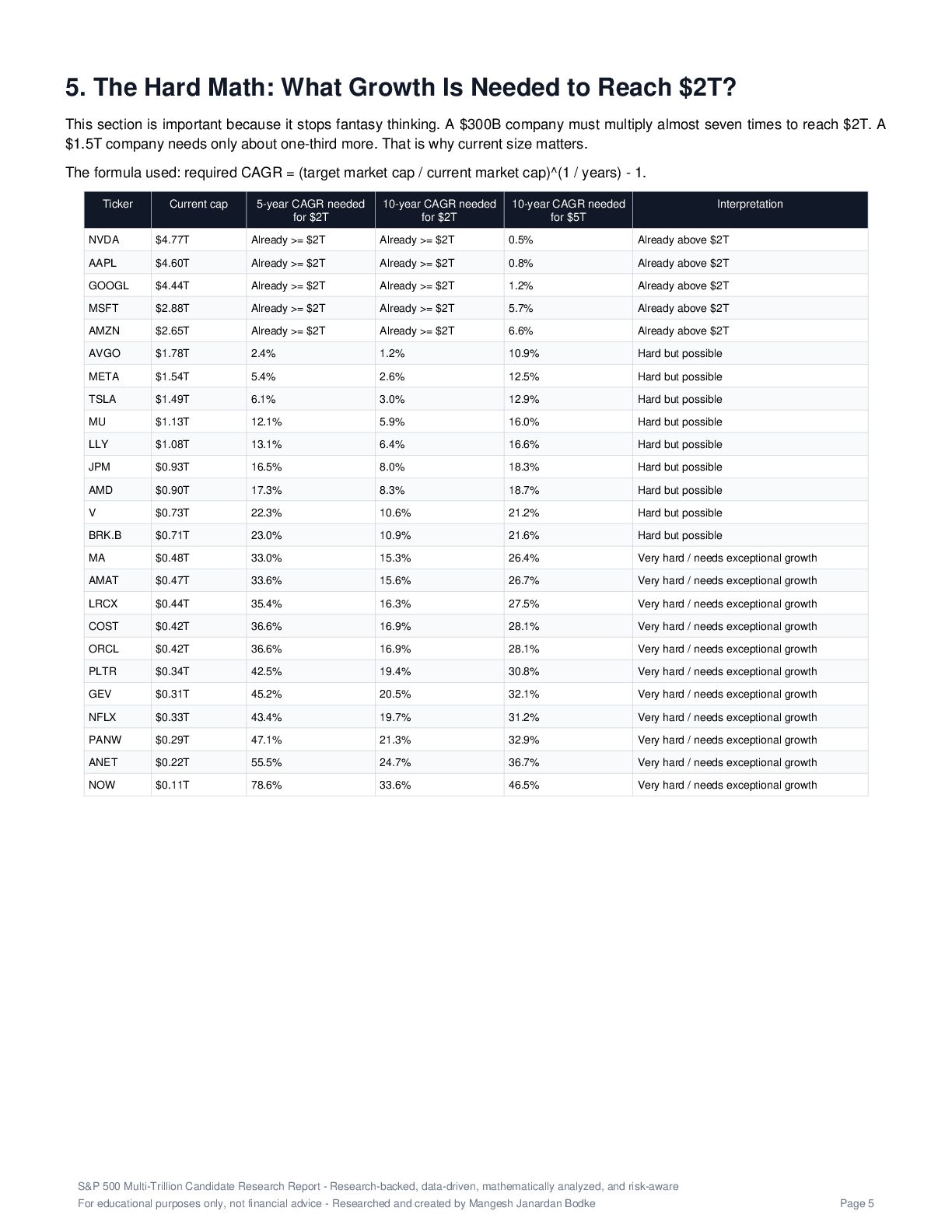
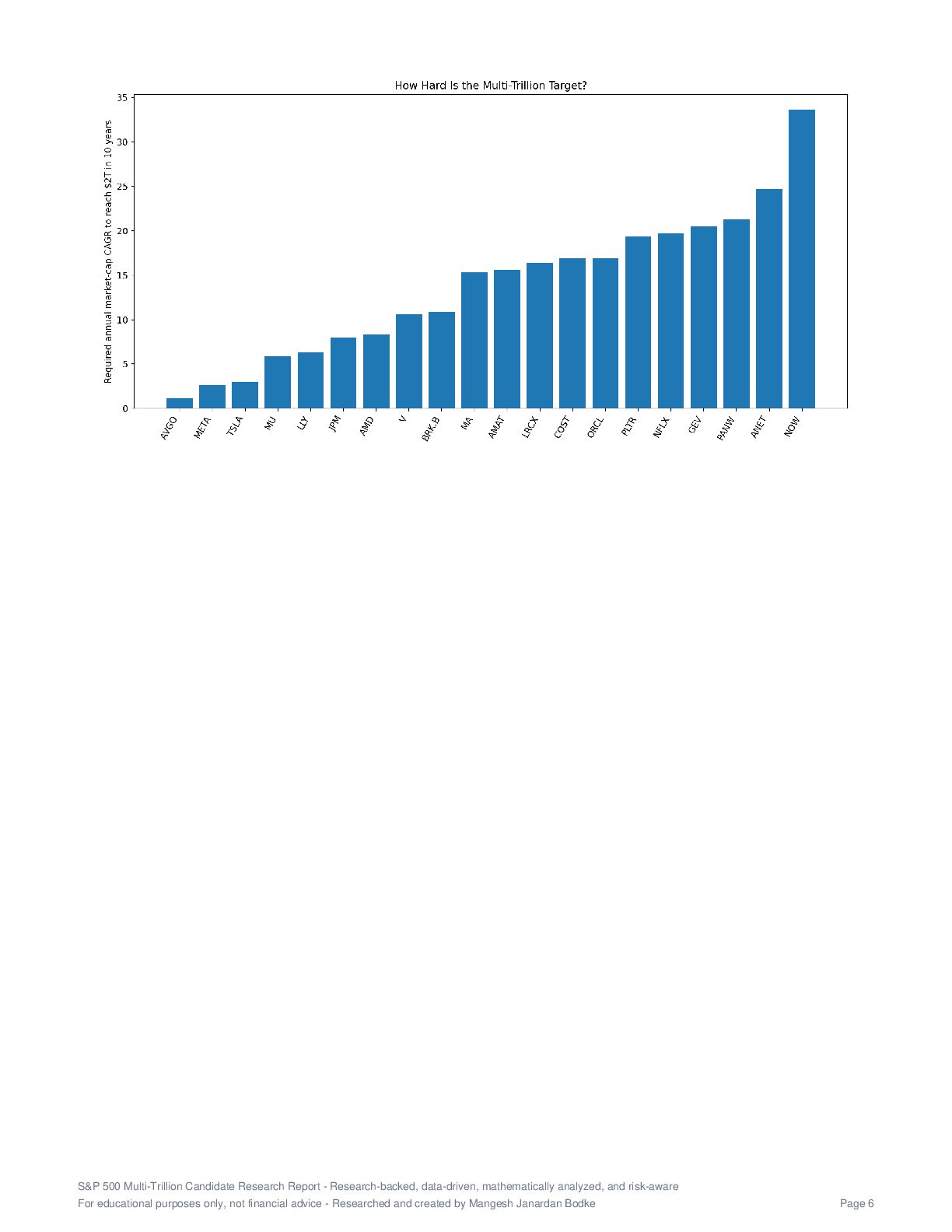
    not financial advice 5. The Hard Math: What Growth Is Needed to Reach $2T? This section is important because it stops fantasy thinking. A $300B company must multiply almost seven times to reach $2T. A $1.5T company needs only about one-third more. That is why current size matters. The formula used: required CAGR = (target market cap / current market cap)^(1 / years) - 1. Ticker Current cap 5-year CAGR needed for $2T 10-year CAGR needed for $2T 10-year CAGR needed for $5T Interpretation NVDA $4.77T Already >= $2T Already >= $2T 0.5% Already above $2T AAPL $4.60T Already >= $2T Already >= $2T 0.8% Already above $2T GOOGL $4.44T Already >= $2T Already >= $2T 1.2% Already above $2T MSFT $2.88T Already >= $2T Already >= $2T 5.7% Already above $2T AMZN $2.65T Already >= $2T Already >= $2T 6.6% Already above $2T AVGO $1.78T 2.4% 1.2% 10.9% Hard but possible META $1.54T 5.4% 2.6% 12.5% Hard but possible TSLA $1.49T 6.1% 3.0% 12.9% Hard but possible MU $1.13T 12.1% 5.9% 16.0% Hard but possible LLY $1.08T 13.1% 6.4% 16.6% Hard but possible JPM $0.93T 16.5% 8.0% 18.3% Hard but possible AMD $0.90T 17.3% 8.3% 18.7% Hard but possible V $0.73T 22.3% 10.6% 21.2% Hard but possible BRK.B $0.71T 23.0% 10.9% 21.6% Hard but possible MA $0.48T 33.0% 15.3% 26.4% Very hard / needs exceptional growth AMAT $0.47T 33.6% 15.6% 26.7% Very hard / needs exceptional growth LRCX $0.44T 35.4% 16.3% 27.5% Very hard / needs exceptional growth COST $0.42T 36.6% 16.9% 28.1% Very hard / needs exceptional growth ORCL $0.42T 36.6% 16.9% 28.1% Very hard / needs exceptional growth PLTR $0.34T 42.5% 19.4% 30.8% Very hard / needs exceptional growth GEV $0.31T 45.2% 20.5% 32.1% Very hard / needs exceptional growth NFLX $0.33T 43.4% 19.7% 31.2% Very hard / needs exceptional growth PANW $0.29T 47.1% 21.3% 32.9% Very hard / needs exceptional growth ANET $0.22T 55.5% 24.7% 36.7% Very hard / needs exceptional growth NOW $0.11T 78.6% 33.6% 46.5% Very hard / needs exceptional growth S&P 500 Multi-Trillion Candidate Research Report - Research-backed, data-driven, mathematically analyzed, and risk-aware For educational purposes only, not financial advice - Researched and created by Mangesh Janardan Bodke Page 5
  6. Page 6 S&P 500 Multi-Trillion Candidate Research Report - Educational,

    not financial advice S&P 500 Multi-Trillion Candidate Research Report - Research-backed, data-driven, mathematically analyzed, and risk-aware For educational purposes only, not financial advice - Researched and created by Mangesh Janardan Bodke Page 6
  7. Page 7 S&P 500 Multi-Trillion Candidate Research Report - Educational,

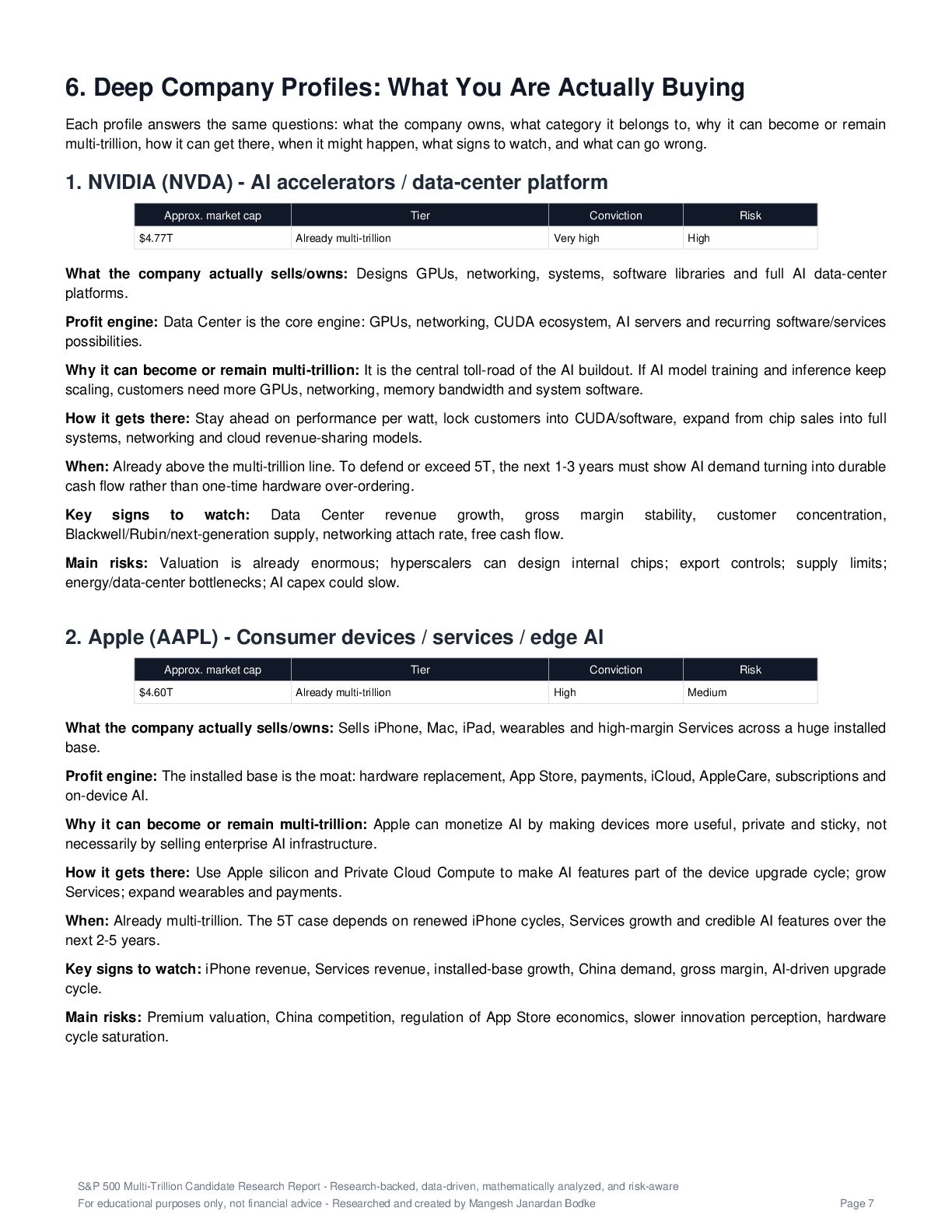
    not financial advice 6. Deep Company Profiles: What You Are Actually Buying Each profile answers the same questions: what the company owns, what category it belongs to, why it can become or remain multi-trillion, how it can get there, when it might happen, what signs to watch, and what can go wrong. 1. NVIDIA (NVDA) - AI accelerators / data-center platform Approx. market cap Tier Conviction Risk $4.77T Already multi-trillion Very high High What the company actually sells/owns: Designs GPUs, networking, systems, software libraries and full AI data-center platforms. Profit engine: Data Center is the core engine: GPUs, networking, CUDA ecosystem, AI servers and recurring software/services possibilities. Why it can become or remain multi-trillion: It is the central toll-road of the AI buildout. If AI model training and inference keep scaling, customers need more GPUs, networking, memory bandwidth and system software. How it gets there: Stay ahead on performance per watt, lock customers into CUDA/software, expand from chip sales into full systems, networking and cloud revenue-sharing models. When: Already above the multi-trillion line. To defend or exceed 5T, the next 1-3 years must show AI demand turning into durable cash flow rather than one-time hardware over-ordering. Key signs to watch: Data Center revenue growth, gross margin stability, customer concentration, Blackwell/Rubin/next-generation supply, networking attach rate, free cash flow. Main risks: Valuation is already enormous; hyperscalers can design internal chips; export controls; supply limits; energy/data-center bottlenecks; AI capex could slow. 2. Apple (AAPL) - Consumer devices / services / edge AI Approx. market cap Tier Conviction Risk $4.60T Already multi-trillion High Medium What the company actually sells/owns: Sells iPhone, Mac, iPad, wearables and high-margin Services across a huge installed base. Profit engine: The installed base is the moat: hardware replacement, App Store, payments, iCloud, AppleCare, subscriptions and on-device AI. Why it can become or remain multi-trillion: Apple can monetize AI by making devices more useful, private and sticky, not necessarily by selling enterprise AI infrastructure. How it gets there: Use Apple silicon and Private Cloud Compute to make AI features part of the device upgrade cycle; grow Services; expand wearables and payments. When: Already multi-trillion. The 5T case depends on renewed iPhone cycles, Services growth and credible AI features over the next 2-5 years. Key signs to watch: iPhone revenue, Services revenue, installed-base growth, China demand, gross margin, AI-driven upgrade cycle. Main risks: Premium valuation, China competition, regulation of App Store economics, slower innovation perception, hardware cycle saturation. S&P 500 Multi-Trillion Candidate Research Report - Research-backed, data-driven, mathematically analyzed, and risk-aware For educational purposes only, not financial advice - Researched and created by Mangesh Janardan Bodke Page 7
  8. Page 8 S&P 500 Multi-Trillion Candidate Research Report - Educational,

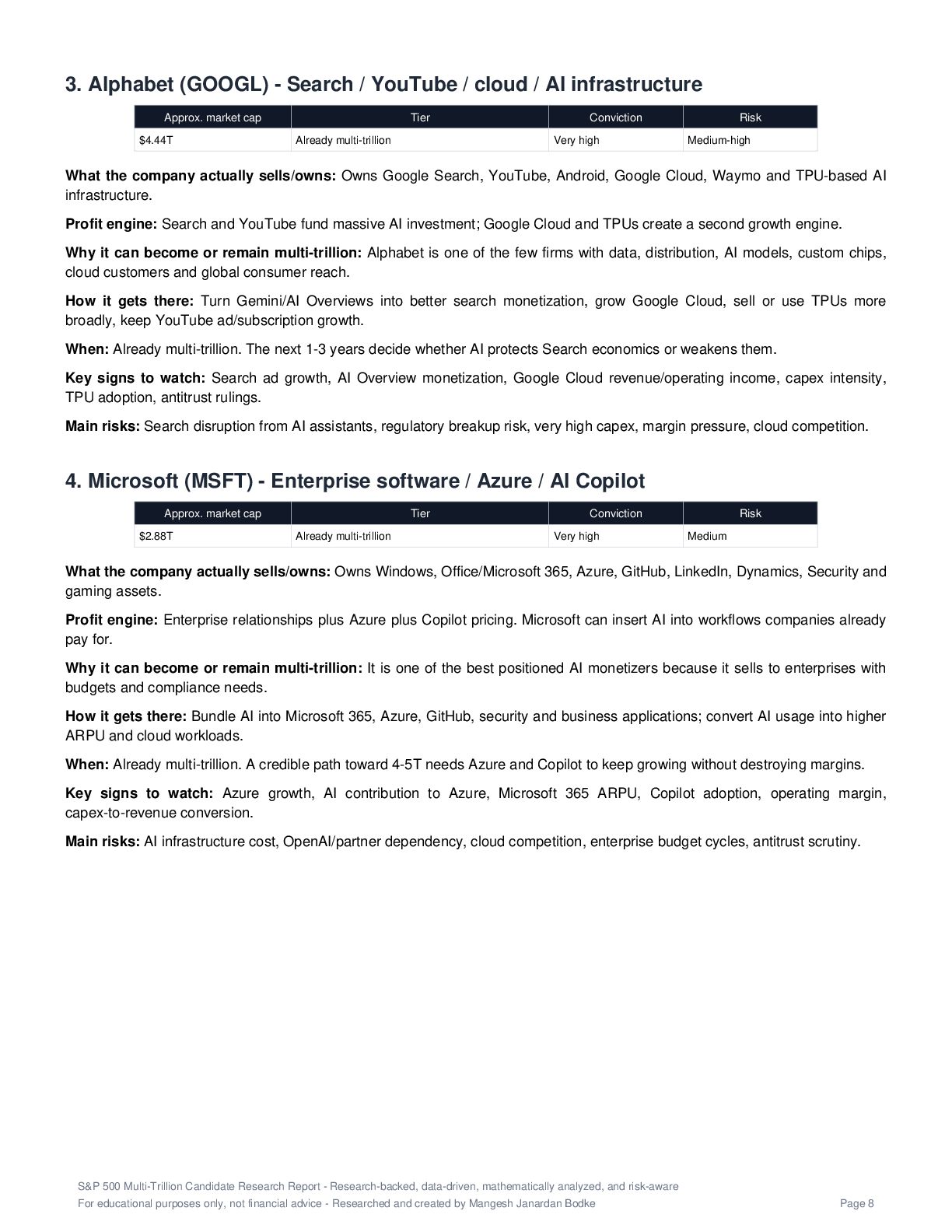
    not financial advice 3. Alphabet (GOOGL) - Search / YouTube / cloud / AI infrastructure Approx. market cap Tier Conviction Risk $4.44T Already multi-trillion Very high Medium-high What the company actually sells/owns: Owns Google Search, YouTube, Android, Google Cloud, Waymo and TPU-based AI infrastructure. Profit engine: Search and YouTube fund massive AI investment; Google Cloud and TPUs create a second growth engine. Why it can become or remain multi-trillion: Alphabet is one of the few firms with data, distribution, AI models, custom chips, cloud customers and global consumer reach. How it gets there: Turn Gemini/AI Overviews into better search monetization, grow Google Cloud, sell or use TPUs more broadly, keep YouTube ad/subscription growth. When: Already multi-trillion. The next 1-3 years decide whether AI protects Search economics or weakens them. Key signs to watch: Search ad growth, AI Overview monetization, Google Cloud revenue/operating income, capex intensity, TPU adoption, antitrust rulings. Main risks: Search disruption from AI assistants, regulatory breakup risk, very high capex, margin pressure, cloud competition. 4. Microsoft (MSFT) - Enterprise software / Azure / AI Copilot Approx. market cap Tier Conviction Risk $2.88T Already multi-trillion Very high Medium What the company actually sells/owns: Owns Windows, Office/Microsoft 365, Azure, GitHub, LinkedIn, Dynamics, Security and gaming assets. Profit engine: Enterprise relationships plus Azure plus Copilot pricing. Microsoft can insert AI into workflows companies already pay for. Why it can become or remain multi-trillion: It is one of the best positioned AI monetizers because it sells to enterprises with budgets and compliance needs. How it gets there: Bundle AI into Microsoft 365, Azure, GitHub, security and business applications; convert AI usage into higher ARPU and cloud workloads. When: Already multi-trillion. A credible path toward 4-5T needs Azure and Copilot to keep growing without destroying margins. Key signs to watch: Azure growth, AI contribution to Azure, Microsoft 365 ARPU, Copilot adoption, operating margin, capex-to-revenue conversion. Main risks: AI infrastructure cost, OpenAI/partner dependency, cloud competition, enterprise budget cycles, antitrust scrutiny. S&P 500 Multi-Trillion Candidate Research Report - Research-backed, data-driven, mathematically analyzed, and risk-aware For educational purposes only, not financial advice - Researched and created by Mangesh Janardan Bodke Page 8
  9. Page 9 S&P 500 Multi-Trillion Candidate Research Report - Educational,

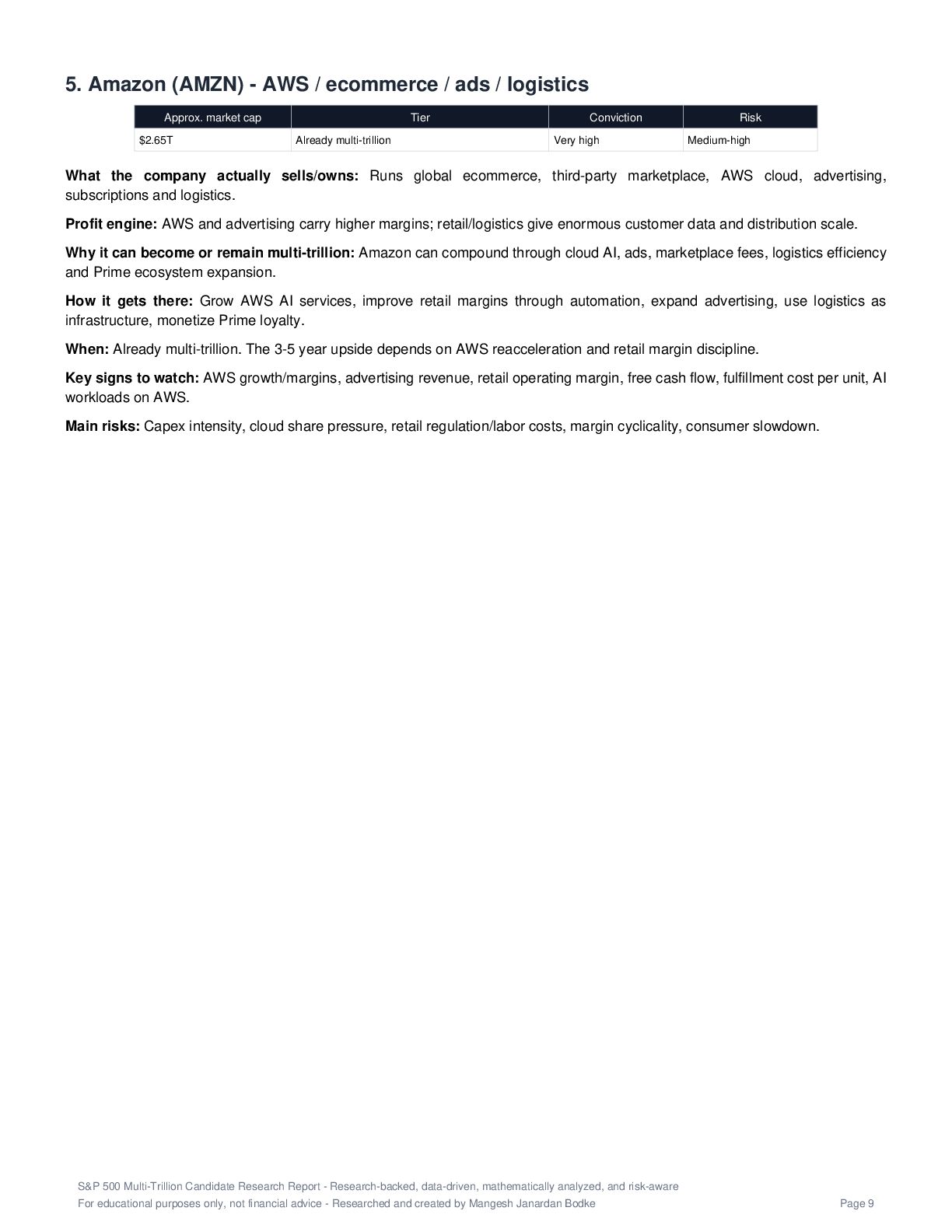
    not financial advice 5. Amazon (AMZN) - AWS / ecommerce / ads / logistics Approx. market cap Tier Conviction Risk $2.65T Already multi-trillion Very high Medium-high What the company actually sells/owns: Runs global ecommerce, third-party marketplace, AWS cloud, advertising, subscriptions and logistics. Profit engine: AWS and advertising carry higher margins; retail/logistics give enormous customer data and distribution scale. Why it can become or remain multi-trillion: Amazon can compound through cloud AI, ads, marketplace fees, logistics efficiency and Prime ecosystem expansion. How it gets there: Grow AWS AI services, improve retail margins through automation, expand advertising, use logistics as infrastructure, monetize Prime loyalty. When: Already multi-trillion. The 3-5 year upside depends on AWS reacceleration and retail margin discipline. Key signs to watch: AWS growth/margins, advertising revenue, retail operating margin, free cash flow, fulfillment cost per unit, AI workloads on AWS. Main risks: Capex intensity, cloud share pressure, retail regulation/labor costs, margin cyclicality, consumer slowdown. S&P 500 Multi-Trillion Candidate Research Report - Research-backed, data-driven, mathematically analyzed, and risk-aware For educational purposes only, not financial advice - Researched and created by Mangesh Janardan Bodke Page 9
  10. Page 10 S&P 500 Multi-Trillion Candidate Research Report - Educational,

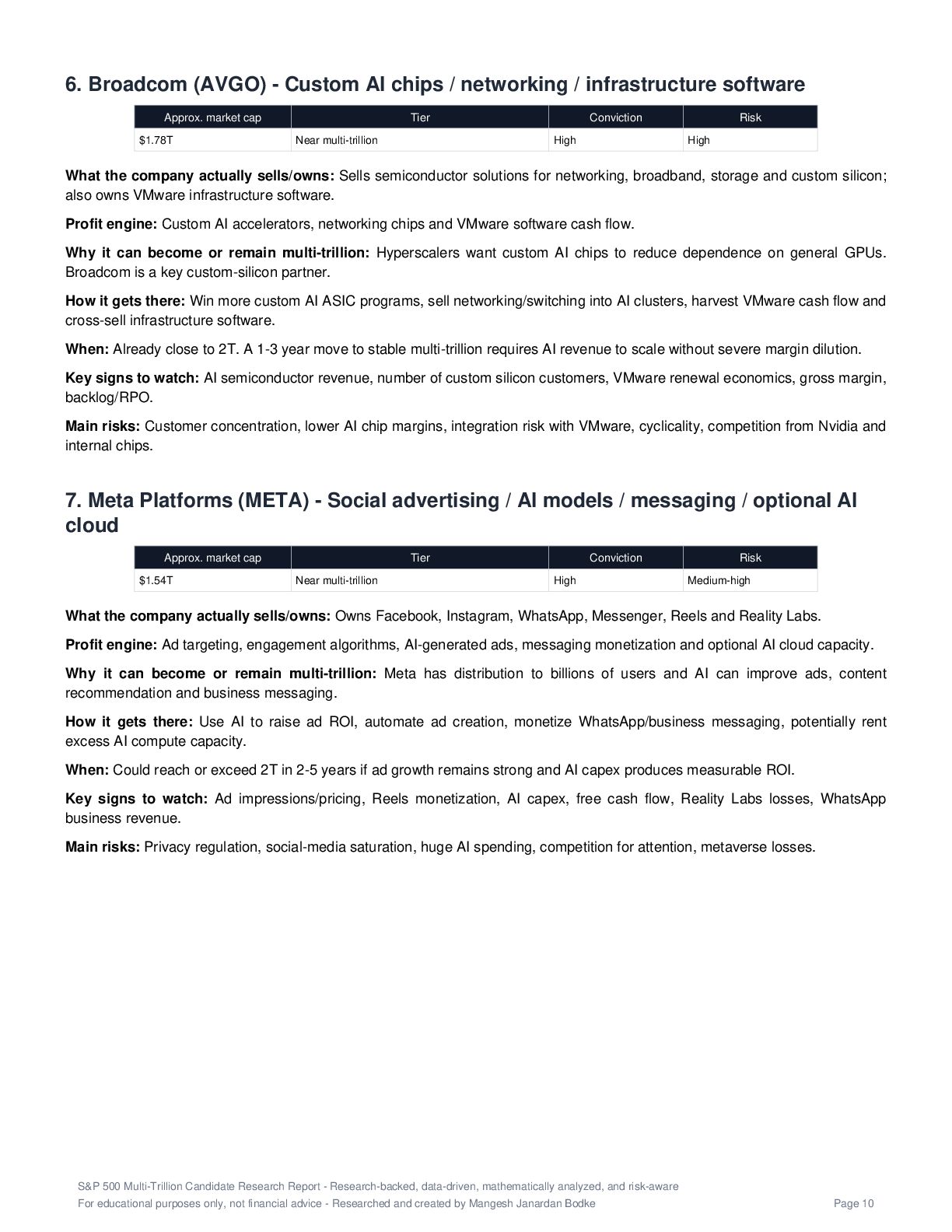
    not financial advice 6. Broadcom (AVGO) - Custom AI chips / networking / infrastructure software Approx. market cap Tier Conviction Risk $1.78T Near multi-trillion High High What the company actually sells/owns: Sells semiconductor solutions for networking, broadband, storage and custom silicon; also owns VMware infrastructure software. Profit engine: Custom AI accelerators, networking chips and VMware software cash flow. Why it can become or remain multi-trillion: Hyperscalers want custom AI chips to reduce dependence on general GPUs. Broadcom is a key custom-silicon partner. How it gets there: Win more custom AI ASIC programs, sell networking/switching into AI clusters, harvest VMware cash flow and cross-sell infrastructure software. When: Already close to 2T. A 1-3 year move to stable multi-trillion requires AI revenue to scale without severe margin dilution. Key signs to watch: AI semiconductor revenue, number of custom silicon customers, VMware renewal economics, gross margin, backlog/RPO. Main risks: Customer concentration, lower AI chip margins, integration risk with VMware, cyclicality, competition from Nvidia and internal chips. 7. Meta Platforms (META) - Social advertising / AI models / messaging / optional AI cloud Approx. market cap Tier Conviction Risk $1.54T Near multi-trillion High Medium-high What the company actually sells/owns: Owns Facebook, Instagram, WhatsApp, Messenger, Reels and Reality Labs. Profit engine: Ad targeting, engagement algorithms, AI-generated ads, messaging monetization and optional AI cloud capacity. Why it can become or remain multi-trillion: Meta has distribution to billions of users and AI can improve ads, content recommendation and business messaging. How it gets there: Use AI to raise ad ROI, automate ad creation, monetize WhatsApp/business messaging, potentially rent excess AI compute capacity. When: Could reach or exceed 2T in 2-5 years if ad growth remains strong and AI capex produces measurable ROI. Key signs to watch: Ad impressions/pricing, Reels monetization, AI capex, free cash flow, Reality Labs losses, WhatsApp business revenue. Main risks: Privacy regulation, social-media saturation, huge AI spending, competition for attention, metaverse losses. S&P 500 Multi-Trillion Candidate Research Report - Research-backed, data-driven, mathematically analyzed, and risk-aware For educational purposes only, not financial advice - Researched and created by Mangesh Janardan Bodke Page 10
  11. Page 11 S&P 500 Multi-Trillion Candidate Research Report - Educational,

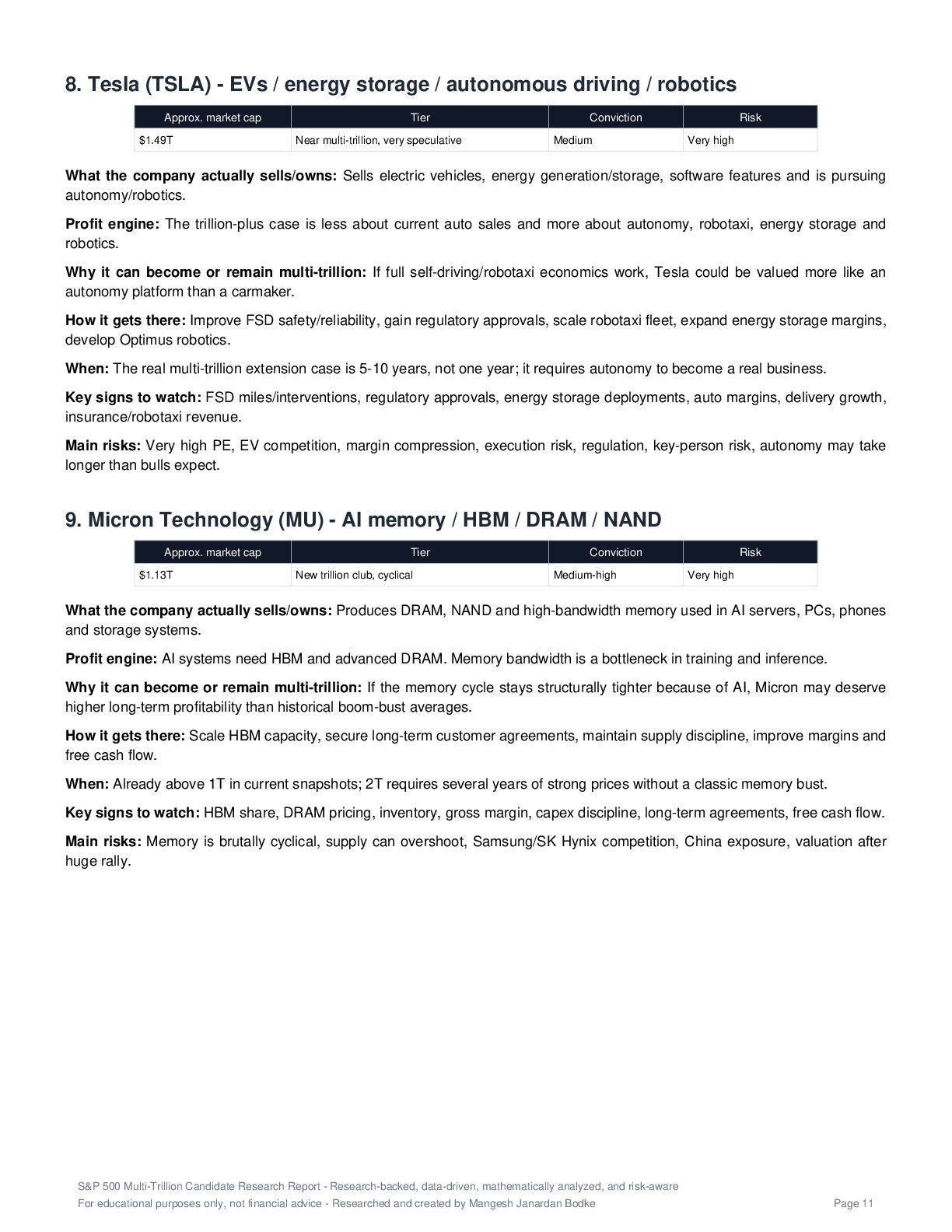
    not financial advice 8. Tesla (TSLA) - EVs / energy storage / autonomous driving / robotics Approx. market cap Tier Conviction Risk $1.49T Near multi-trillion, very speculative Medium Very high What the company actually sells/owns: Sells electric vehicles, energy generation/storage, software features and is pursuing autonomy/robotics. Profit engine: The trillion-plus case is less about current auto sales and more about autonomy, robotaxi, energy storage and robotics. Why it can become or remain multi-trillion: If full self-driving/robotaxi economics work, Tesla could be valued more like an autonomy platform than a carmaker. How it gets there: Improve FSD safety/reliability, gain regulatory approvals, scale robotaxi fleet, expand energy storage margins, develop Optimus robotics. When: The real multi-trillion extension case is 5-10 years, not one year; it requires autonomy to become a real business. Key signs to watch: FSD miles/interventions, regulatory approvals, energy storage deployments, auto margins, delivery growth, insurance/robotaxi revenue. Main risks: Very high PE, EV competition, margin compression, execution risk, regulation, key-person risk, autonomy may take longer than bulls expect. 9. Micron Technology (MU) - AI memory / HBM / DRAM / NAND Approx. market cap Tier Conviction Risk $1.13T New trillion club, cyclical Medium-high Very high What the company actually sells/owns: Produces DRAM, NAND and high-bandwidth memory used in AI servers, PCs, phones and storage systems. Profit engine: AI systems need HBM and advanced DRAM. Memory bandwidth is a bottleneck in training and inference. Why it can become or remain multi-trillion: If the memory cycle stays structurally tighter because of AI, Micron may deserve higher long-term profitability than historical boom-bust averages. How it gets there: Scale HBM capacity, secure long-term customer agreements, maintain supply discipline, improve margins and free cash flow. When: Already above 1T in current snapshots; 2T requires several years of strong prices without a classic memory bust. Key signs to watch: HBM share, DRAM pricing, inventory, gross margin, capex discipline, long-term agreements, free cash flow. Main risks: Memory is brutally cyclical, supply can overshoot, Samsung/SK Hynix competition, China exposure, valuation after huge rally. S&P 500 Multi-Trillion Candidate Research Report - Research-backed, data-driven, mathematically analyzed, and risk-aware For educational purposes only, not financial advice - Researched and created by Mangesh Janardan Bodke Page 11
  12. Page 12 S&P 500 Multi-Trillion Candidate Research Report - Educational,

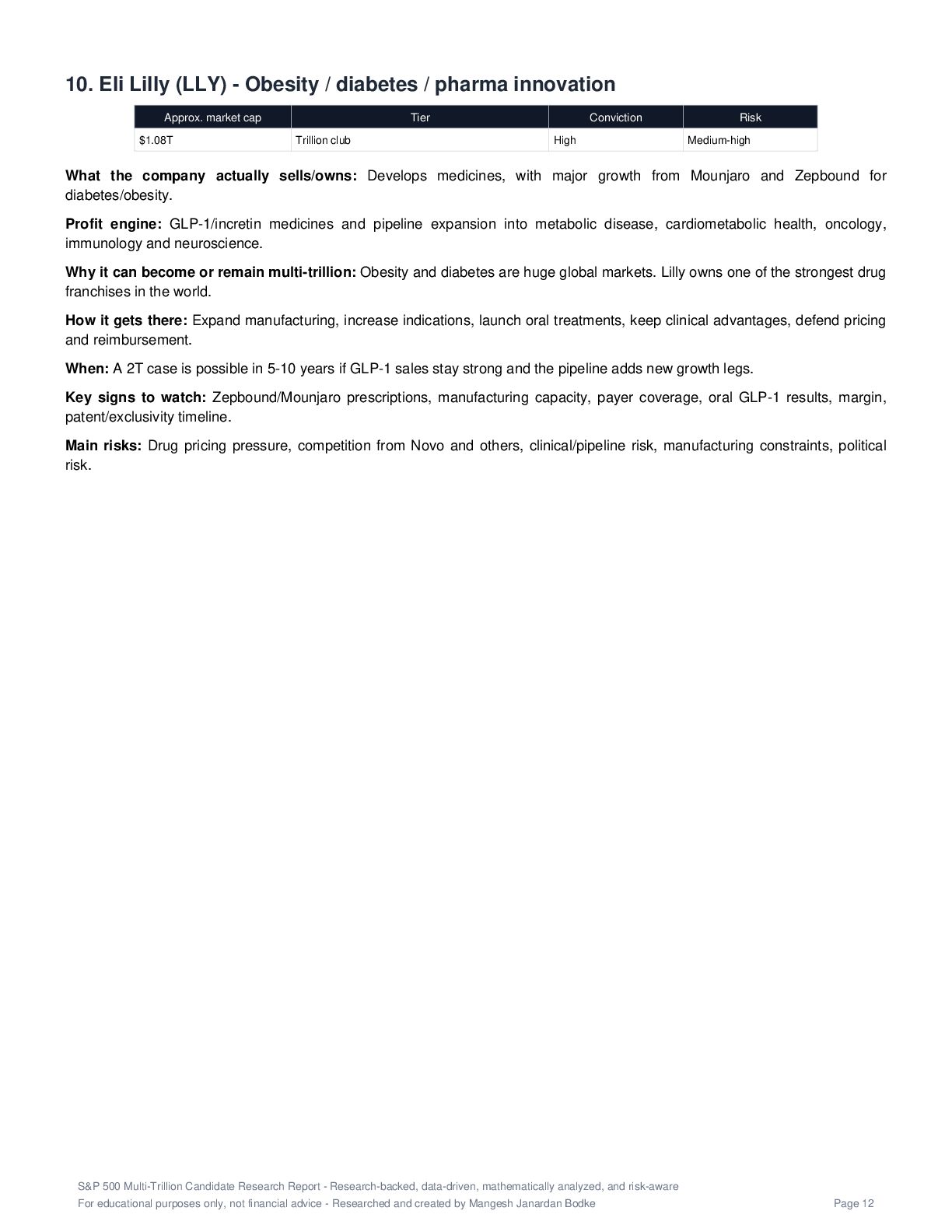
    not financial advice 10. Eli Lilly (LLY) - Obesity / diabetes / pharma innovation Approx. market cap Tier Conviction Risk $1.08T Trillion club High Medium-high What the company actually sells/owns: Develops medicines, with major growth from Mounjaro and Zepbound for diabetes/obesity. Profit engine: GLP-1/incretin medicines and pipeline expansion into metabolic disease, cardiometabolic health, oncology, immunology and neuroscience. Why it can become or remain multi-trillion: Obesity and diabetes are huge global markets. Lilly owns one of the strongest drug franchises in the world. How it gets there: Expand manufacturing, increase indications, launch oral treatments, keep clinical advantages, defend pricing and reimbursement. When: A 2T case is possible in 5-10 years if GLP-1 sales stay strong and the pipeline adds new growth legs. Key signs to watch: Zepbound/Mounjaro prescriptions, manufacturing capacity, payer coverage, oral GLP-1 results, margin, patent/exclusivity timeline. Main risks: Drug pricing pressure, competition from Novo and others, clinical/pipeline risk, manufacturing constraints, political risk. S&P 500 Multi-Trillion Candidate Research Report - Research-backed, data-driven, mathematically analyzed, and risk-aware For educational purposes only, not financial advice - Researched and created by Mangesh Janardan Bodke Page 12
  13. Page 13 S&P 500 Multi-Trillion Candidate Research Report - Educational,

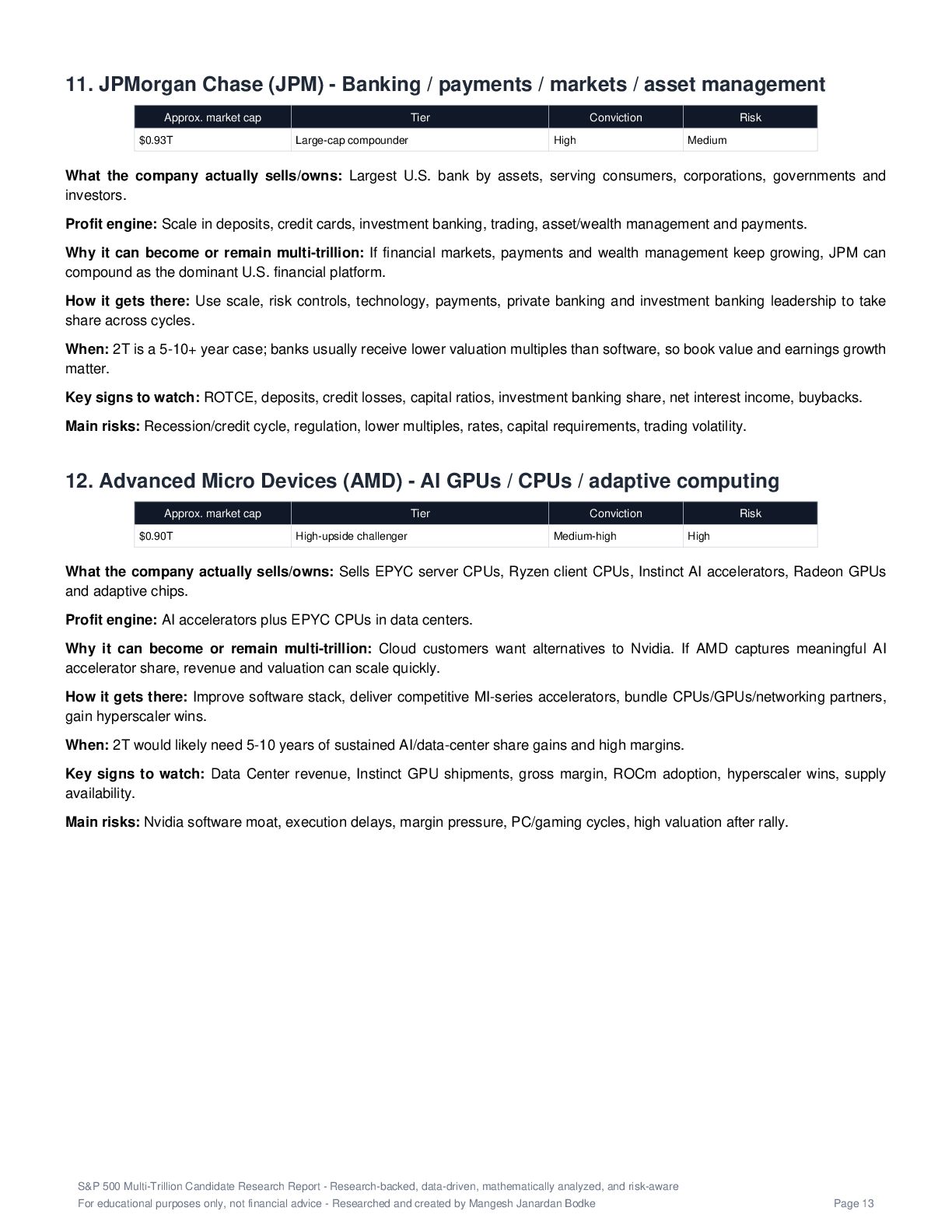
    not financial advice 11. JPMorgan Chase (JPM) - Banking / payments / markets / asset management Approx. market cap Tier Conviction Risk $0.93T Large-cap compounder High Medium What the company actually sells/owns: Largest U.S. bank by assets, serving consumers, corporations, governments and investors. Profit engine: Scale in deposits, credit cards, investment banking, trading, asset/wealth management and payments. Why it can become or remain multi-trillion: If financial markets, payments and wealth management keep growing, JPM can compound as the dominant U.S. financial platform. How it gets there: Use scale, risk controls, technology, payments, private banking and investment banking leadership to take share across cycles. When: 2T is a 5-10+ year case; banks usually receive lower valuation multiples than software, so book value and earnings growth matter. Key signs to watch: ROTCE, deposits, credit losses, capital ratios, investment banking share, net interest income, buybacks. Main risks: Recession/credit cycle, regulation, lower multiples, rates, capital requirements, trading volatility. 12. Advanced Micro Devices (AMD) - AI GPUs / CPUs / adaptive computing Approx. market cap Tier Conviction Risk $0.90T High-upside challenger Medium-high High What the company actually sells/owns: Sells EPYC server CPUs, Ryzen client CPUs, Instinct AI accelerators, Radeon GPUs and adaptive chips. Profit engine: AI accelerators plus EPYC CPUs in data centers. Why it can become or remain multi-trillion: Cloud customers want alternatives to Nvidia. If AMD captures meaningful AI accelerator share, revenue and valuation can scale quickly. How it gets there: Improve software stack, deliver competitive MI-series accelerators, bundle CPUs/GPUs/networking partners, gain hyperscaler wins. When: 2T would likely need 5-10 years of sustained AI/data-center share gains and high margins. Key signs to watch: Data Center revenue, Instinct GPU shipments, gross margin, ROCm adoption, hyperscaler wins, supply availability. Main risks: Nvidia software moat, execution delays, margin pressure, PC/gaming cycles, high valuation after rally. S&P 500 Multi-Trillion Candidate Research Report - Research-backed, data-driven, mathematically analyzed, and risk-aware For educational purposes only, not financial advice - Researched and created by Mangesh Janardan Bodke Page 13
  14. Page 14 S&P 500 Multi-Trillion Candidate Research Report - Educational,

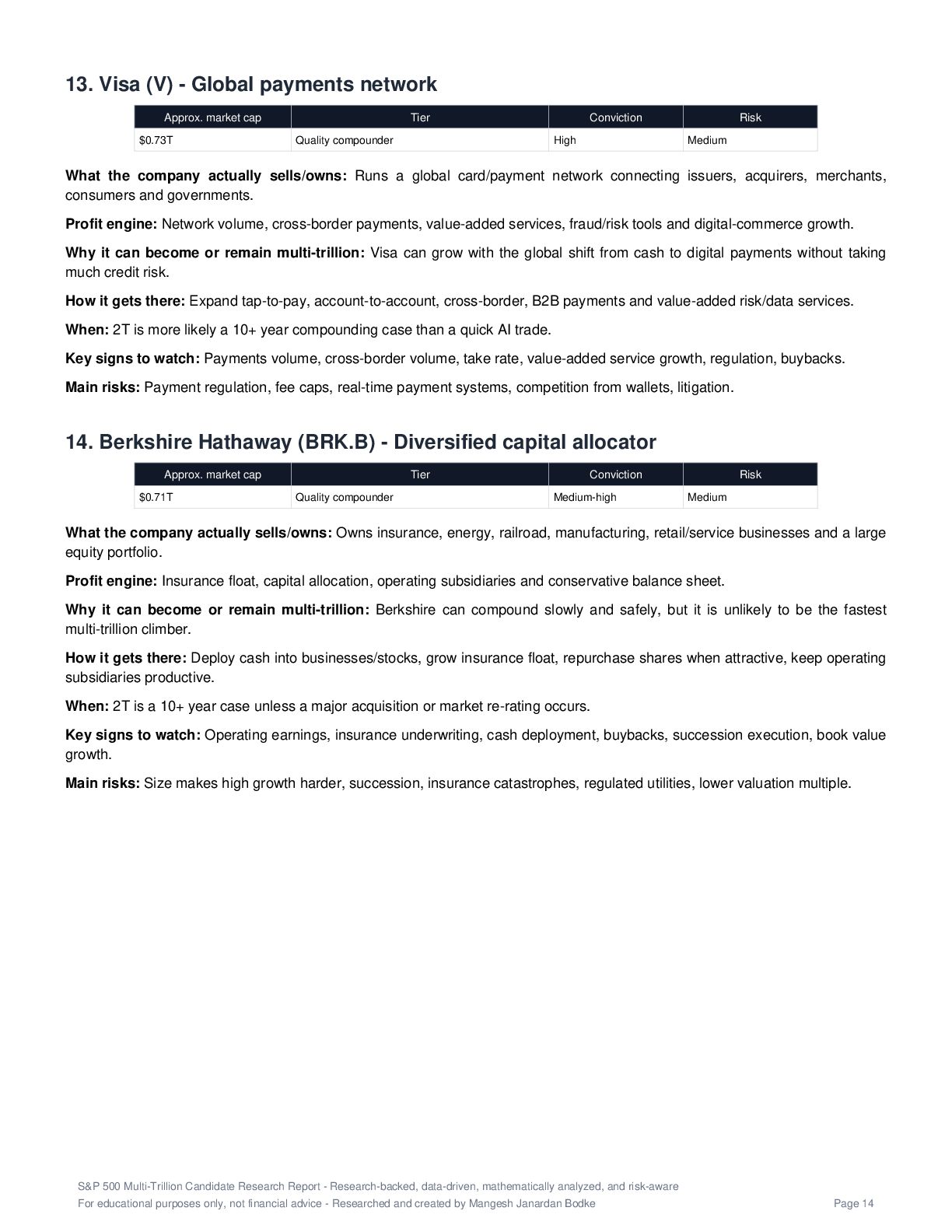
    not financial advice 13. Visa (V) - Global payments network Approx. market cap Tier Conviction Risk $0.73T Quality compounder High Medium What the company actually sells/owns: Runs a global card/payment network connecting issuers, acquirers, merchants, consumers and governments. Profit engine: Network volume, cross-border payments, value-added services, fraud/risk tools and digital-commerce growth. Why it can become or remain multi-trillion: Visa can grow with the global shift from cash to digital payments without taking much credit risk. How it gets there: Expand tap-to-pay, account-to-account, cross-border, B2B payments and value-added risk/data services. When: 2T is more likely a 10+ year compounding case than a quick AI trade. Key signs to watch: Payments volume, cross-border volume, take rate, value-added service growth, regulation, buybacks. Main risks: Payment regulation, fee caps, real-time payment systems, competition from wallets, litigation. 14. Berkshire Hathaway (BRK.B) - Diversified capital allocator Approx. market cap Tier Conviction Risk $0.71T Quality compounder Medium-high Medium What the company actually sells/owns: Owns insurance, energy, railroad, manufacturing, retail/service businesses and a large equity portfolio. Profit engine: Insurance float, capital allocation, operating subsidiaries and conservative balance sheet. Why it can become or remain multi-trillion: Berkshire can compound slowly and safely, but it is unlikely to be the fastest multi-trillion climber. How it gets there: Deploy cash into businesses/stocks, grow insurance float, repurchase shares when attractive, keep operating subsidiaries productive. When: 2T is a 10+ year case unless a major acquisition or market re-rating occurs. Key signs to watch: Operating earnings, insurance underwriting, cash deployment, buybacks, succession execution, book value growth. Main risks: Size makes high growth harder, succession, insurance catastrophes, regulated utilities, lower valuation multiple. S&P 500 Multi-Trillion Candidate Research Report - Research-backed, data-driven, mathematically analyzed, and risk-aware For educational purposes only, not financial advice - Researched and created by Mangesh Janardan Bodke Page 14
  15. Page 15 S&P 500 Multi-Trillion Candidate Research Report - Educational,

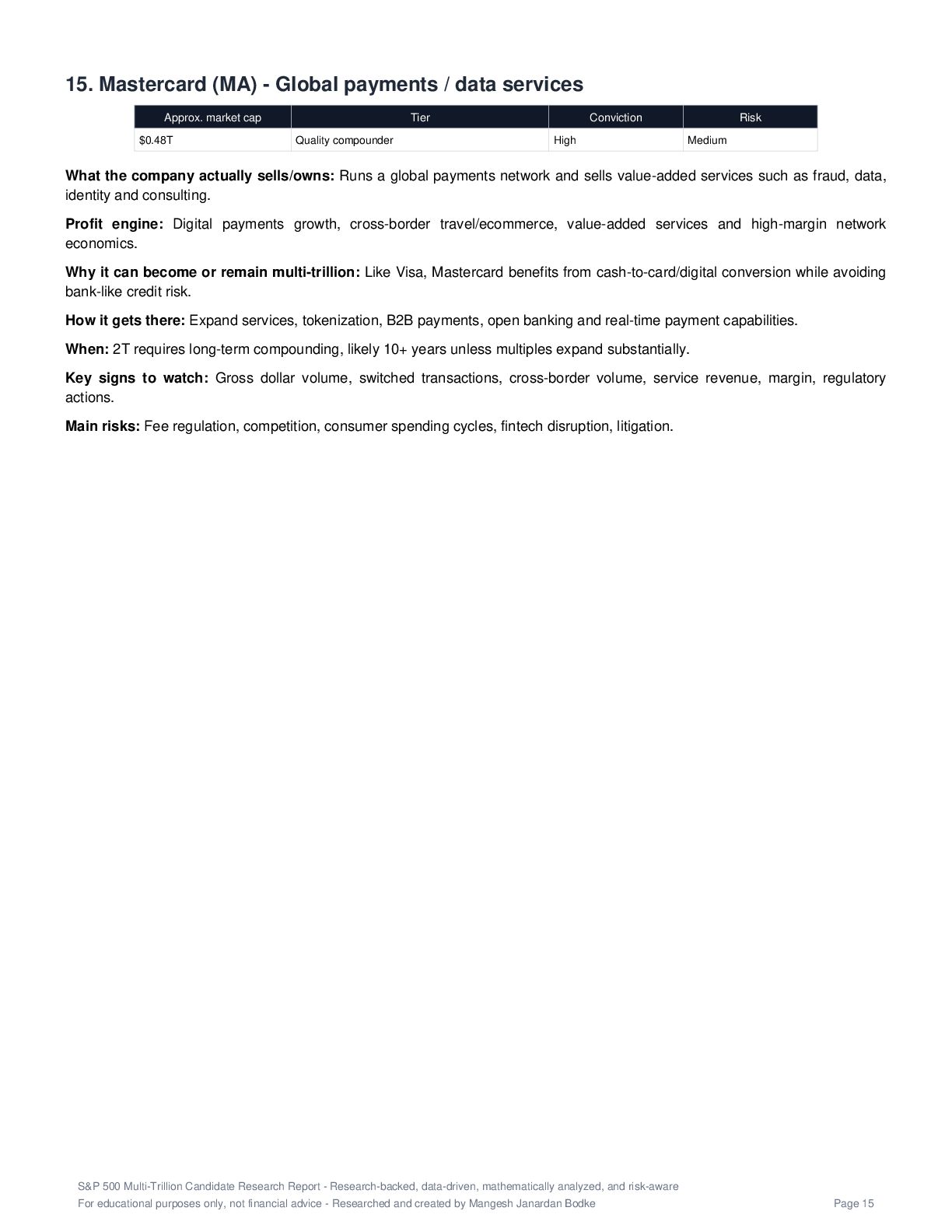
    not financial advice 15. Mastercard (MA) - Global payments / data services Approx. market cap Tier Conviction Risk $0.48T Quality compounder High Medium What the company actually sells/owns: Runs a global payments network and sells value-added services such as fraud, data, identity and consulting. Profit engine: Digital payments growth, cross-border travel/ecommerce, value-added services and high-margin network economics. Why it can become or remain multi-trillion: Like Visa, Mastercard benefits from cash-to-card/digital conversion while avoiding bank-like credit risk. How it gets there: Expand services, tokenization, B2B payments, open banking and real-time payment capabilities. When: 2T requires long-term compounding, likely 10+ years unless multiples expand substantially. Key signs to watch: Gross dollar volume, switched transactions, cross-border volume, service revenue, margin, regulatory actions. Main risks: Fee regulation, competition, consumer spending cycles, fintech disruption, litigation. S&P 500 Multi-Trillion Candidate Research Report - Research-backed, data-driven, mathematically analyzed, and risk-aware For educational purposes only, not financial advice - Researched and created by Mangesh Janardan Bodke Page 15
  16. Page 16 S&P 500 Multi-Trillion Candidate Research Report - Educational,

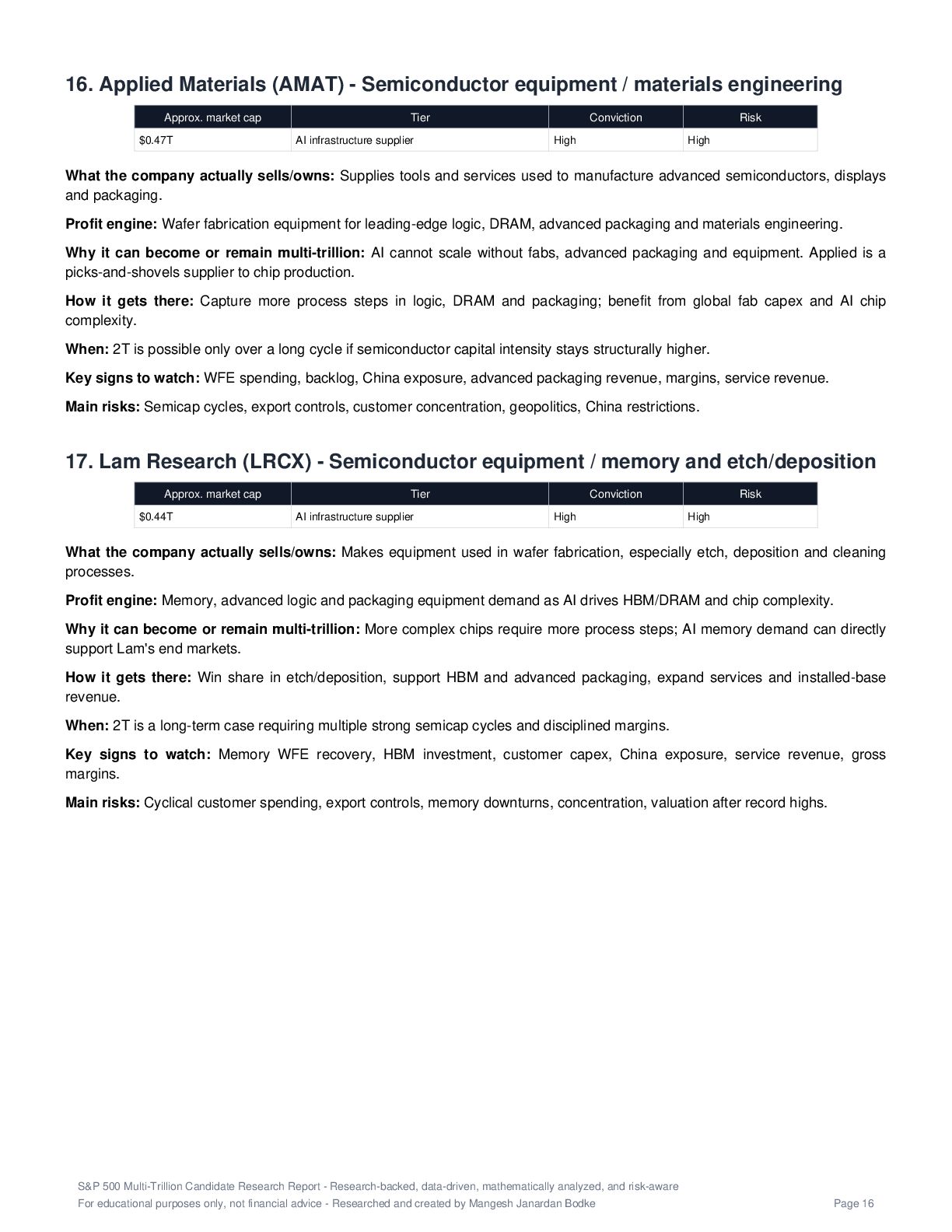
    not financial advice 16. Applied Materials (AMAT) - Semiconductor equipment / materials engineering Approx. market cap Tier Conviction Risk $0.47T AI infrastructure supplier High High What the company actually sells/owns: Supplies tools and services used to manufacture advanced semiconductors, displays and packaging. Profit engine: Wafer fabrication equipment for leading-edge logic, DRAM, advanced packaging and materials engineering. Why it can become or remain multi-trillion: AI cannot scale without fabs, advanced packaging and equipment. Applied is a picks-and-shovels supplier to chip production. How it gets there: Capture more process steps in logic, DRAM and packaging; benefit from global fab capex and AI chip complexity. When: 2T is possible only over a long cycle if semiconductor capital intensity stays structurally higher. Key signs to watch: WFE spending, backlog, China exposure, advanced packaging revenue, margins, service revenue. Main risks: Semicap cycles, export controls, customer concentration, geopolitics, China restrictions. 17. Lam Research (LRCX) - Semiconductor equipment / memory and etch/deposition Approx. market cap Tier Conviction Risk $0.44T AI infrastructure supplier High High What the company actually sells/owns: Makes equipment used in wafer fabrication, especially etch, deposition and cleaning processes. Profit engine: Memory, advanced logic and packaging equipment demand as AI drives HBM/DRAM and chip complexity. Why it can become or remain multi-trillion: More complex chips require more process steps; AI memory demand can directly support Lam's end markets. How it gets there: Win share in etch/deposition, support HBM and advanced packaging, expand services and installed-base revenue. When: 2T is a long-term case requiring multiple strong semicap cycles and disciplined margins. Key signs to watch: Memory WFE recovery, HBM investment, customer capex, China exposure, service revenue, gross margins. Main risks: Cyclical customer spending, export controls, memory downturns, concentration, valuation after record highs. S&P 500 Multi-Trillion Candidate Research Report - Research-backed, data-driven, mathematically analyzed, and risk-aware For educational purposes only, not financial advice - Researched and created by Mangesh Janardan Bodke Page 16
  17. Page 17 S&P 500 Multi-Trillion Candidate Research Report - Educational,

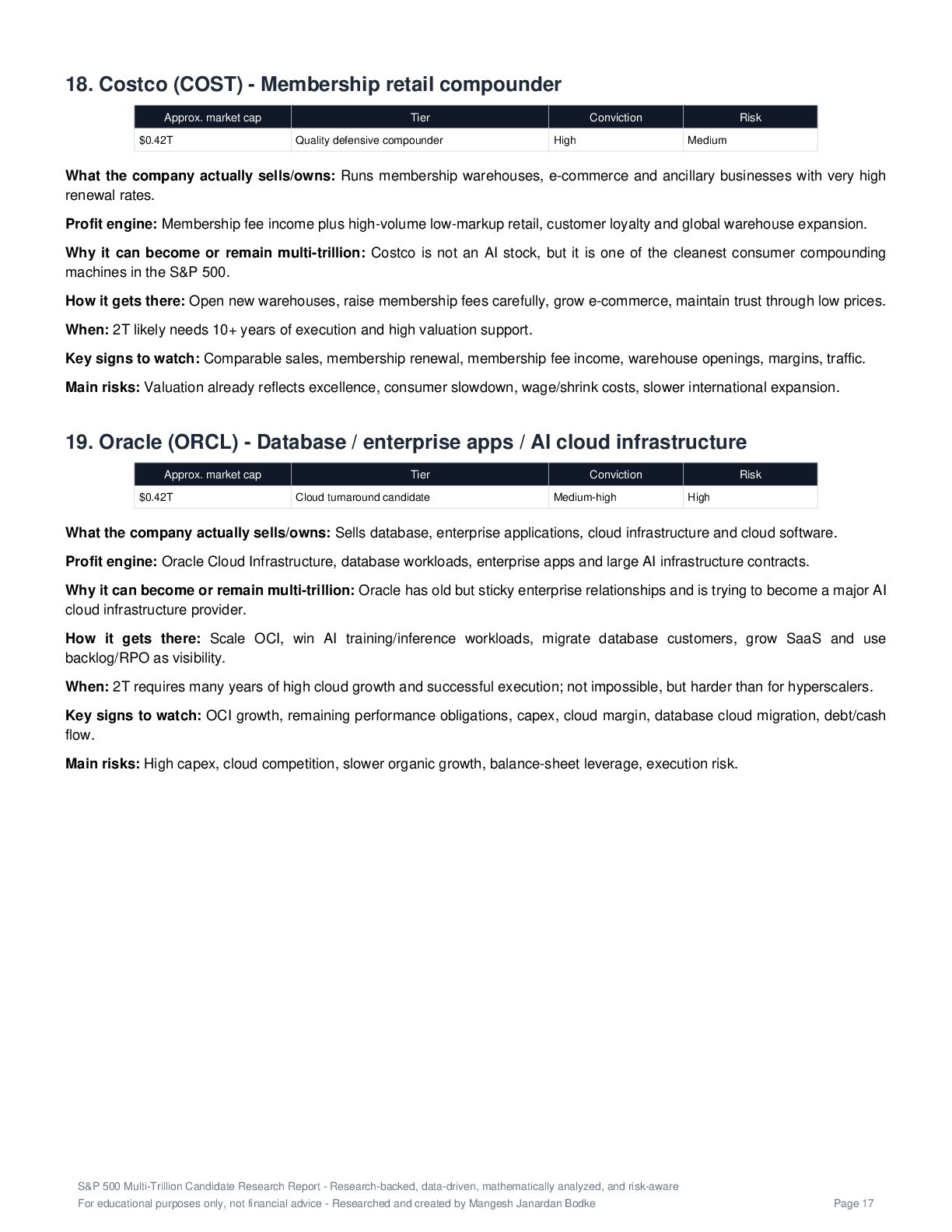
    not financial advice 18. Costco (COST) - Membership retail compounder Approx. market cap Tier Conviction Risk $0.42T Quality defensive compounder High Medium What the company actually sells/owns: Runs membership warehouses, e-commerce and ancillary businesses with very high renewal rates. Profit engine: Membership fee income plus high-volume low-markup retail, customer loyalty and global warehouse expansion. Why it can become or remain multi-trillion: Costco is not an AI stock, but it is one of the cleanest consumer compounding machines in the S&P 500. How it gets there: Open new warehouses, raise membership fees carefully, grow e-commerce, maintain trust through low prices. When: 2T likely needs 10+ years of execution and high valuation support. Key signs to watch: Comparable sales, membership renewal, membership fee income, warehouse openings, margins, traffic. Main risks: Valuation already reflects excellence, consumer slowdown, wage/shrink costs, slower international expansion. 19. Oracle (ORCL) - Database / enterprise apps / AI cloud infrastructure Approx. market cap Tier Conviction Risk $0.42T Cloud turnaround candidate Medium-high High What the company actually sells/owns: Sells database, enterprise applications, cloud infrastructure and cloud software. Profit engine: Oracle Cloud Infrastructure, database workloads, enterprise apps and large AI infrastructure contracts. Why it can become or remain multi-trillion: Oracle has old but sticky enterprise relationships and is trying to become a major AI cloud infrastructure provider. How it gets there: Scale OCI, win AI training/inference workloads, migrate database customers, grow SaaS and use backlog/RPO as visibility. When: 2T requires many years of high cloud growth and successful execution; not impossible, but harder than for hyperscalers. Key signs to watch: OCI growth, remaining performance obligations, capex, cloud margin, database cloud migration, debt/cash flow. Main risks: High capex, cloud competition, slower organic growth, balance-sheet leverage, execution risk. S&P 500 Multi-Trillion Candidate Research Report - Research-backed, data-driven, mathematically analyzed, and risk-aware For educational purposes only, not financial advice - Researched and created by Mangesh Janardan Bodke Page 17
  18. Page 18 S&P 500 Multi-Trillion Candidate Research Report - Educational,

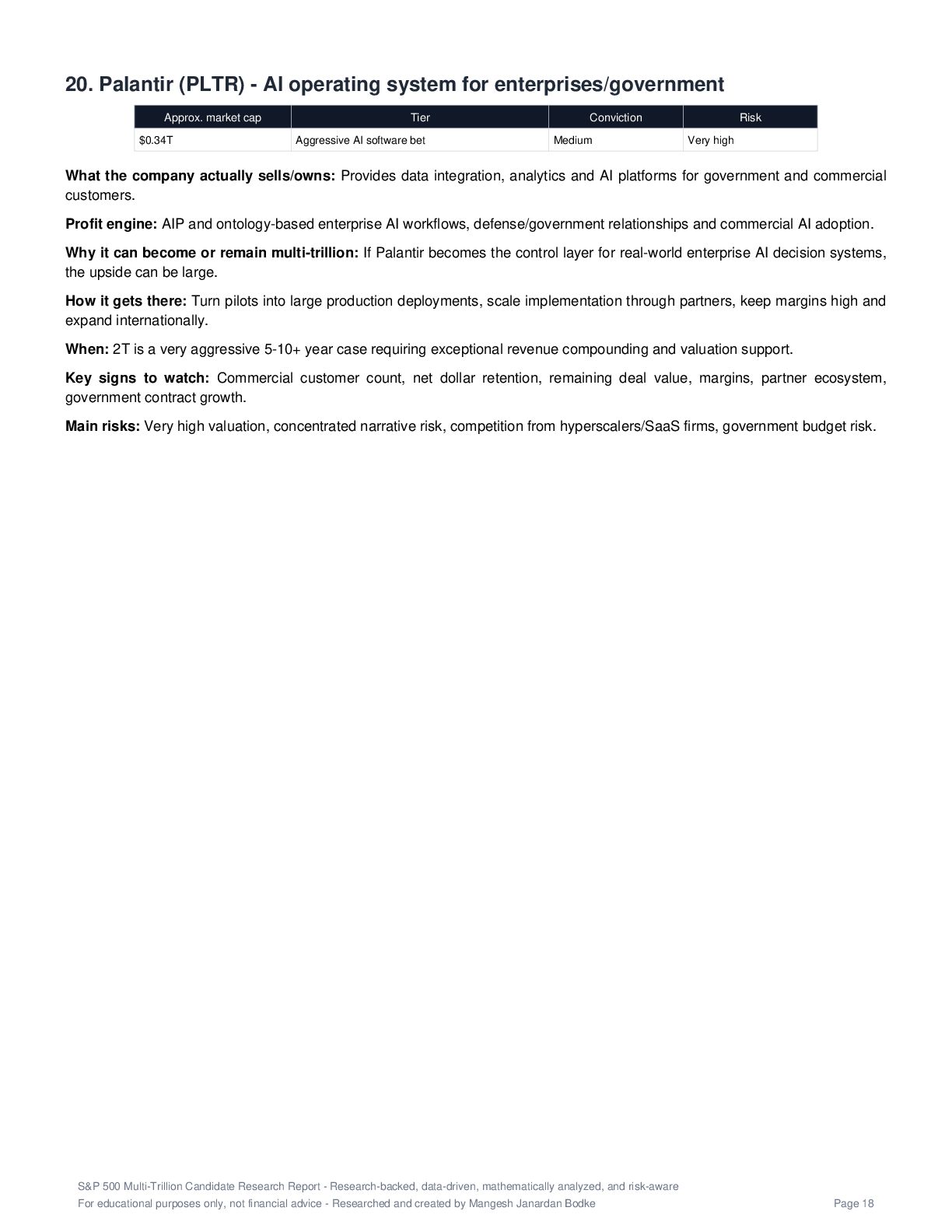
    not financial advice 20. Palantir (PLTR) - AI operating system for enterprises/government Approx. market cap Tier Conviction Risk $0.34T Aggressive AI software bet Medium Very high What the company actually sells/owns: Provides data integration, analytics and AI platforms for government and commercial customers. Profit engine: AIP and ontology-based enterprise AI workflows, defense/government relationships and commercial AI adoption. Why it can become or remain multi-trillion: If Palantir becomes the control layer for real-world enterprise AI decision systems, the upside can be large. How it gets there: Turn pilots into large production deployments, scale implementation through partners, keep margins high and expand internationally. When: 2T is a very aggressive 5-10+ year case requiring exceptional revenue compounding and valuation support. Key signs to watch: Commercial customer count, net dollar retention, remaining deal value, margins, partner ecosystem, government contract growth. Main risks: Very high valuation, concentrated narrative risk, competition from hyperscalers/SaaS firms, government budget risk. S&P 500 Multi-Trillion Candidate Research Report - Research-backed, data-driven, mathematically analyzed, and risk-aware For educational purposes only, not financial advice - Researched and created by Mangesh Janardan Bodke Page 18
  19. Page 19 S&P 500 Multi-Trillion Candidate Research Report - Educational,

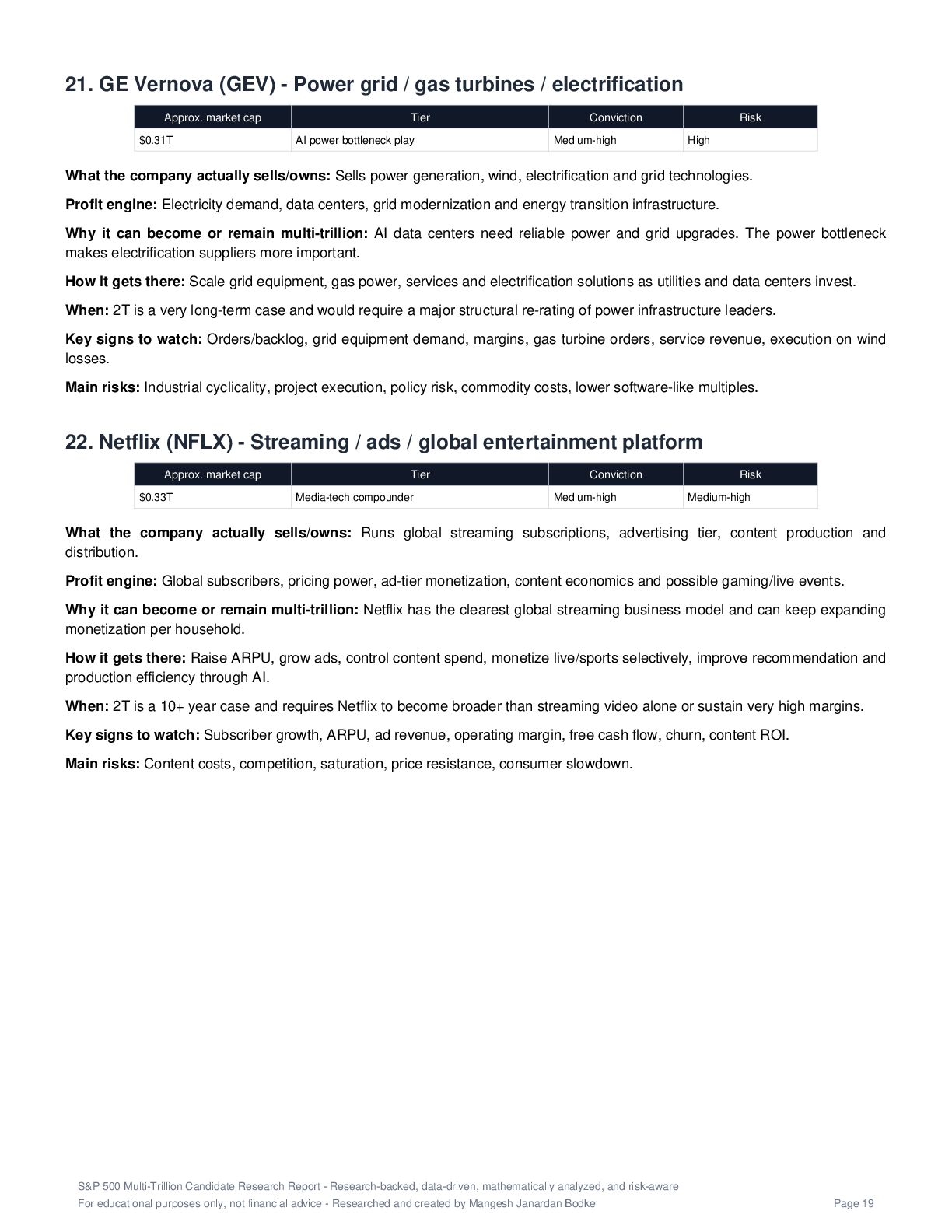
    not financial advice 21. GE Vernova (GEV) - Power grid / gas turbines / electrification Approx. market cap Tier Conviction Risk $0.31T AI power bottleneck play Medium-high High What the company actually sells/owns: Sells power generation, wind, electrification and grid technologies. Profit engine: Electricity demand, data centers, grid modernization and energy transition infrastructure. Why it can become or remain multi-trillion: AI data centers need reliable power and grid upgrades. The power bottleneck makes electrification suppliers more important. How it gets there: Scale grid equipment, gas power, services and electrification solutions as utilities and data centers invest. When: 2T is a very long-term case and would require a major structural re-rating of power infrastructure leaders. Key signs to watch: Orders/backlog, grid equipment demand, margins, gas turbine orders, service revenue, execution on wind losses. Main risks: Industrial cyclicality, project execution, policy risk, commodity costs, lower software-like multiples. 22. Netflix (NFLX) - Streaming / ads / global entertainment platform Approx. market cap Tier Conviction Risk $0.33T Media-tech compounder Medium-high Medium-high What the company actually sells/owns: Runs global streaming subscriptions, advertising tier, content production and distribution. Profit engine: Global subscribers, pricing power, ad-tier monetization, content economics and possible gaming/live events. Why it can become or remain multi-trillion: Netflix has the clearest global streaming business model and can keep expanding monetization per household. How it gets there: Raise ARPU, grow ads, control content spend, monetize live/sports selectively, improve recommendation and production efficiency through AI. When: 2T is a 10+ year case and requires Netflix to become broader than streaming video alone or sustain very high margins. Key signs to watch: Subscriber growth, ARPU, ad revenue, operating margin, free cash flow, churn, content ROI. Main risks: Content costs, competition, saturation, price resistance, consumer slowdown. S&P 500 Multi-Trillion Candidate Research Report - Research-backed, data-driven, mathematically analyzed, and risk-aware For educational purposes only, not financial advice - Researched and created by Mangesh Janardan Bodke Page 19
  20. Page 20 S&P 500 Multi-Trillion Candidate Research Report - Educational,

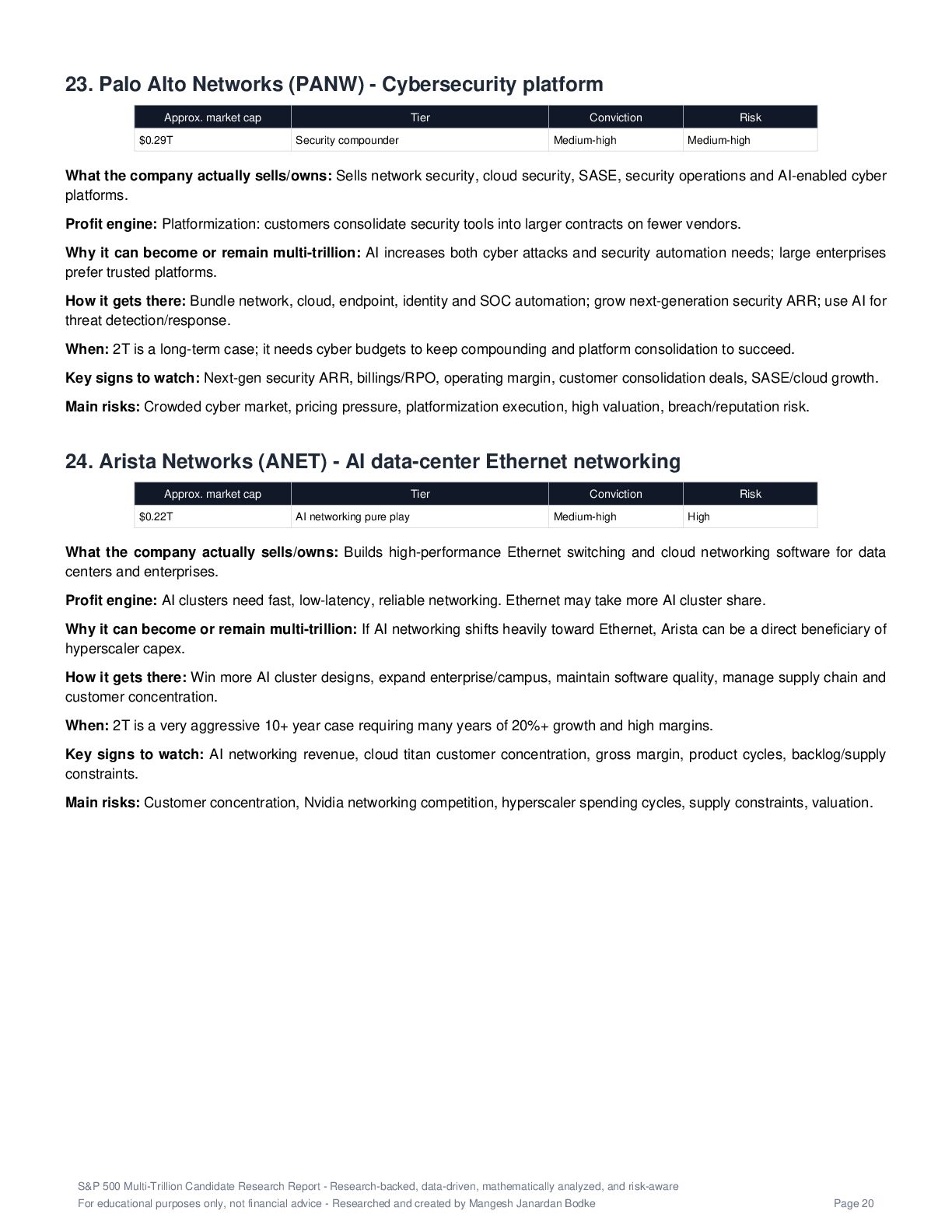
    not financial advice 23. Palo Alto Networks (PANW) - Cybersecurity platform Approx. market cap Tier Conviction Risk $0.29T Security compounder Medium-high Medium-high What the company actually sells/owns: Sells network security, cloud security, SASE, security operations and AI-enabled cyber platforms. Profit engine: Platformization: customers consolidate security tools into larger contracts on fewer vendors. Why it can become or remain multi-trillion: AI increases both cyber attacks and security automation needs; large enterprises prefer trusted platforms. How it gets there: Bundle network, cloud, endpoint, identity and SOC automation; grow next-generation security ARR; use AI for threat detection/response. When: 2T is a long-term case; it needs cyber budgets to keep compounding and platform consolidation to succeed. Key signs to watch: Next-gen security ARR, billings/RPO, operating margin, customer consolidation deals, SASE/cloud growth. Main risks: Crowded cyber market, pricing pressure, platformization execution, high valuation, breach/reputation risk. 24. Arista Networks (ANET) - AI data-center Ethernet networking Approx. market cap Tier Conviction Risk $0.22T AI networking pure play Medium-high High What the company actually sells/owns: Builds high-performance Ethernet switching and cloud networking software for data centers and enterprises. Profit engine: AI clusters need fast, low-latency, reliable networking. Ethernet may take more AI cluster share. Why it can become or remain multi-trillion: If AI networking shifts heavily toward Ethernet, Arista can be a direct beneficiary of hyperscaler capex. How it gets there: Win more AI cluster designs, expand enterprise/campus, maintain software quality, manage supply chain and customer concentration. When: 2T is a very aggressive 10+ year case requiring many years of 20%+ growth and high margins. Key signs to watch: AI networking revenue, cloud titan customer concentration, gross margin, product cycles, backlog/supply constraints. Main risks: Customer concentration, Nvidia networking competition, hyperscaler spending cycles, supply constraints, valuation. S&P 500 Multi-Trillion Candidate Research Report - Research-backed, data-driven, mathematically analyzed, and risk-aware For educational purposes only, not financial advice - Researched and created by Mangesh Janardan Bodke Page 20
  21. Page 21 S&P 500 Multi-Trillion Candidate Research Report - Educational,

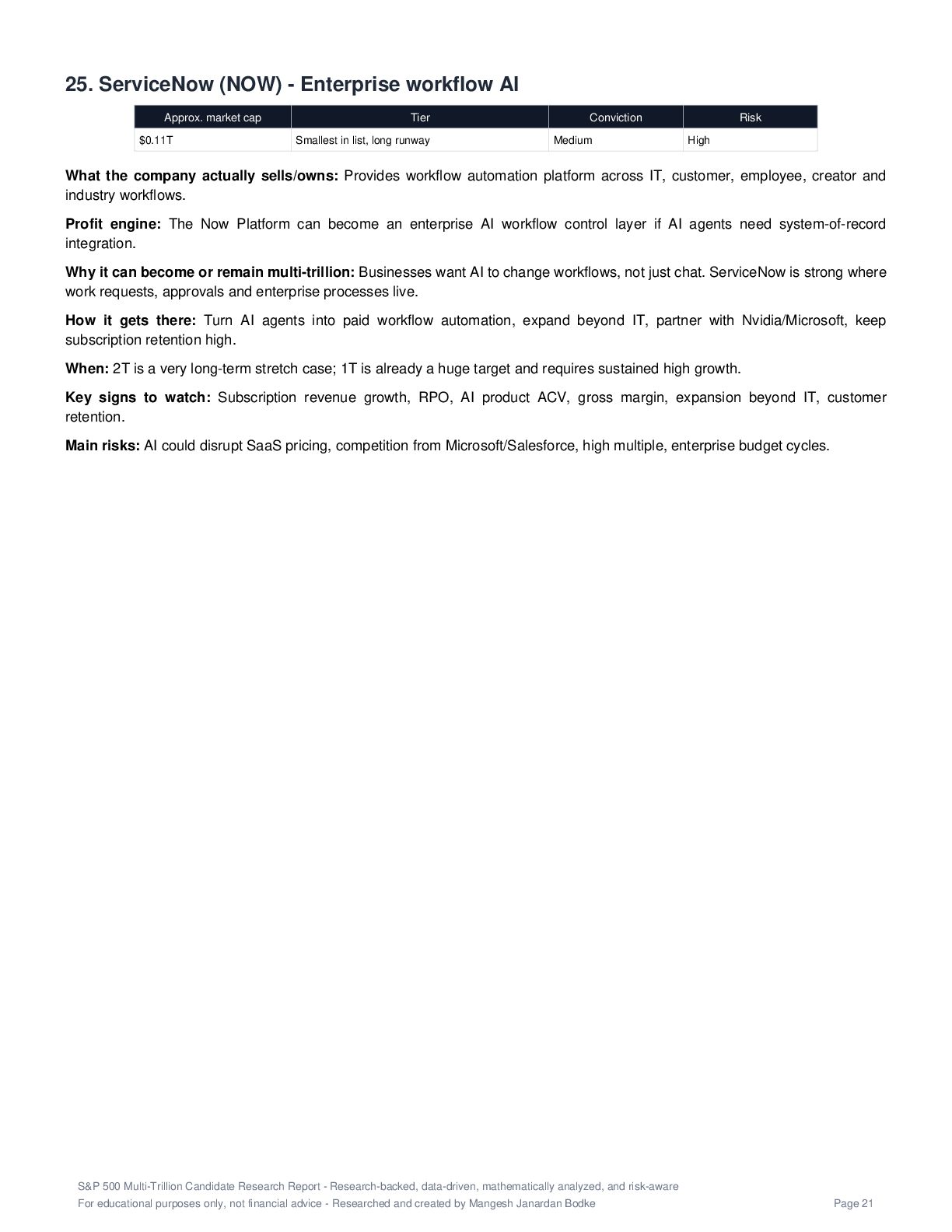
    not financial advice 25. ServiceNow (NOW) - Enterprise workflow AI Approx. market cap Tier Conviction Risk $0.11T Smallest in list, long runway Medium High What the company actually sells/owns: Provides workflow automation platform across IT, customer, employee, creator and industry workflows. Profit engine: The Now Platform can become an enterprise AI workflow control layer if AI agents need system-of-record integration. Why it can become or remain multi-trillion: Businesses want AI to change workflows, not just chat. ServiceNow is strong where work requests, approvals and enterprise processes live. How it gets there: Turn AI agents into paid workflow automation, expand beyond IT, partner with Nvidia/Microsoft, keep subscription retention high. When: 2T is a very long-term stretch case; 1T is already a huge target and requires sustained high growth. Key signs to watch: Subscription revenue growth, RPO, AI product ACV, gross margin, expansion beyond IT, customer retention. Main risks: AI could disrupt SaaS pricing, competition from Microsoft/Salesforce, high multiple, enterprise budget cycles. S&P 500 Multi-Trillion Candidate Research Report - Research-backed, data-driven, mathematically analyzed, and risk-aware For educational purposes only, not financial advice - Researched and created by Mangesh Janardan Bodke Page 21
  22. Page 22 S&P 500 Multi-Trillion Candidate Research Report - Educational,

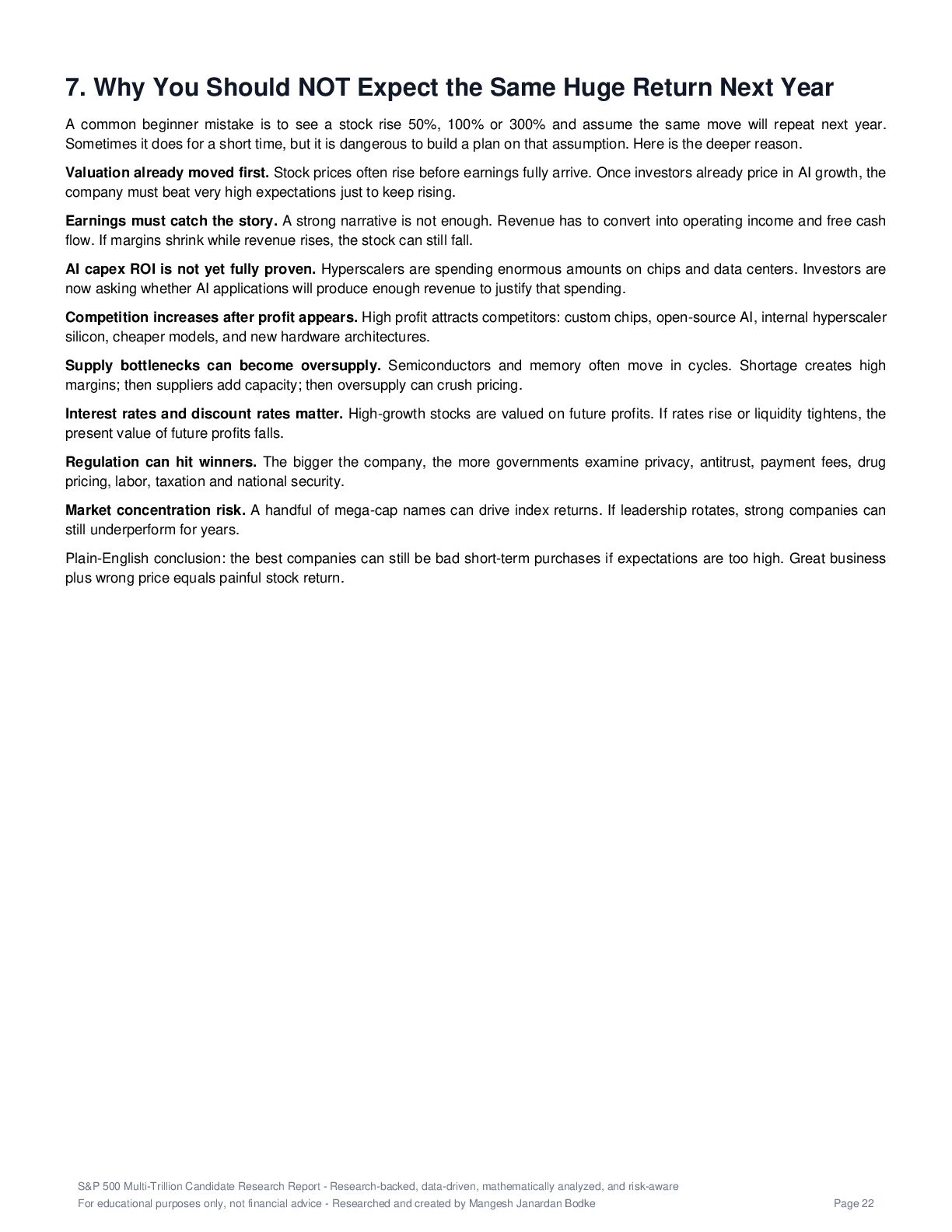
    not financial advice 7. Why You Should NOT Expect the Same Huge Return Next Year A common beginner mistake is to see a stock rise 50%, 100% or 300% and assume the same move will repeat next year. Sometimes it does for a short time, but it is dangerous to build a plan on that assumption. Here is the deeper reason. Valuation already moved first. Stock prices often rise before earnings fully arrive. Once investors already price in AI growth, the company must beat very high expectations just to keep rising. Earnings must catch the story. A strong narrative is not enough. Revenue has to convert into operating income and free cash flow. If margins shrink while revenue rises, the stock can still fall. AI capex ROI is not yet fully proven. Hyperscalers are spending enormous amounts on chips and data centers. Investors are now asking whether AI applications will produce enough revenue to justify that spending. Competition increases after profit appears. High profit attracts competitors: custom chips, open-source AI, internal hyperscaler silicon, cheaper models, and new hardware architectures. Supply bottlenecks can become oversupply. Semiconductors and memory often move in cycles. Shortage creates high margins; then suppliers add capacity; then oversupply can crush pricing. Interest rates and discount rates matter. High-growth stocks are valued on future profits. If rates rise or liquidity tightens, the present value of future profits falls. Regulation can hit winners. The bigger the company, the more governments examine privacy, antitrust, payment fees, drug pricing, labor, taxation and national security. Market concentration risk. A handful of mega-cap names can drive index returns. If leadership rotates, strong companies can still underperform for years. Plain-English conclusion: the best companies can still be bad short-term purchases if expectations are too high. Great business plus wrong price equals painful stock return. S&P 500 Multi-Trillion Candidate Research Report - Research-backed, data-driven, mathematically analyzed, and risk-aware For educational purposes only, not financial advice - Researched and created by Mangesh Janardan Bodke Page 22
  23. Page 23 S&P 500 Multi-Trillion Candidate Research Report - Educational,

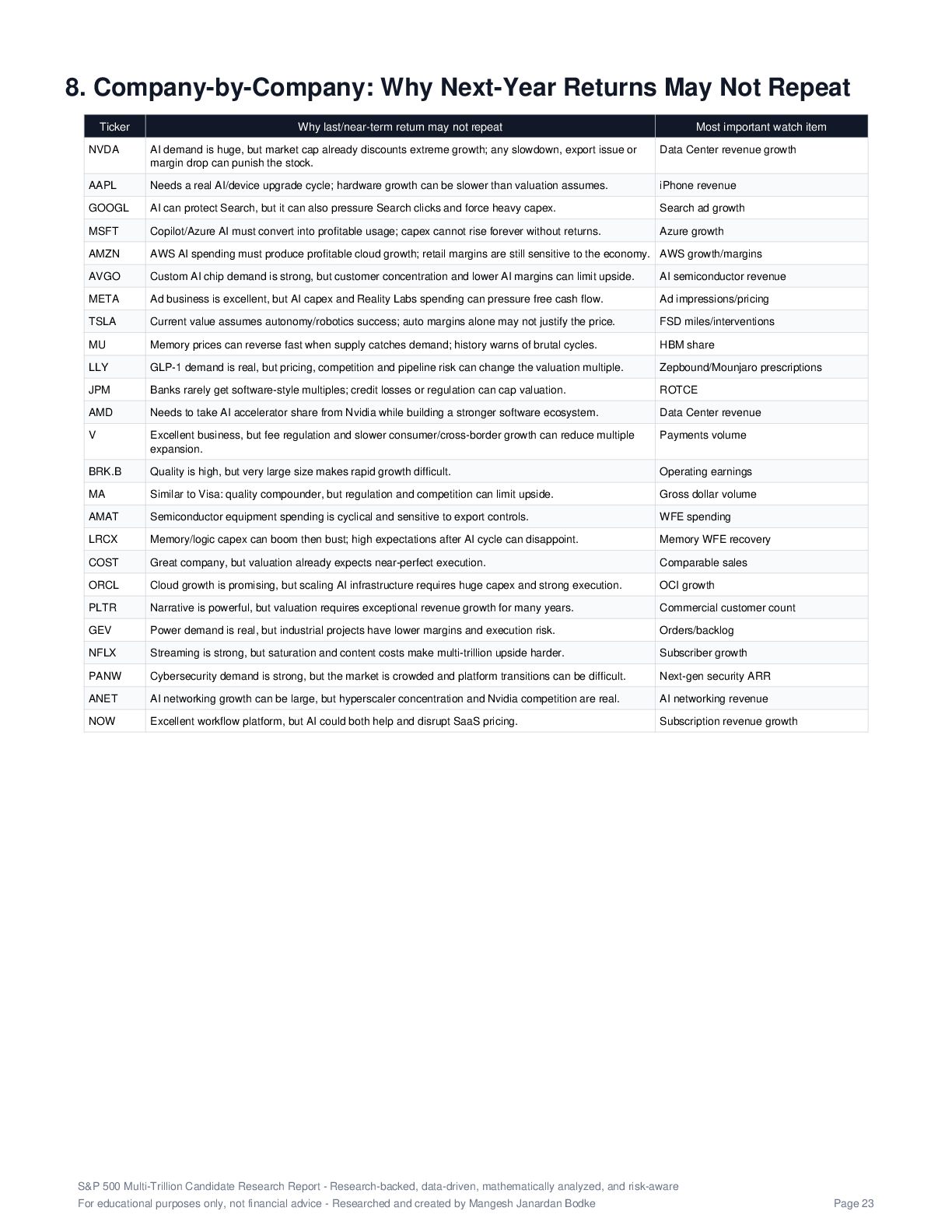
    not financial advice 8. Company-by-Company: Why Next-Year Returns May Not Repeat Ticker Why last/near-term return may not repeat Most important watch item NVDA AI demand is huge, but market cap already discounts extreme growth; any slowdown, export issue or margin drop can punish the stock. Data Center revenue growth AAPL Needs a real AI/device upgrade cycle; hardware growth can be slower than valuation assumes. iPhone revenue GOOGL AI can protect Search, but it can also pressure Search clicks and force heavy capex. Search ad growth MSFT Copilot/Azure AI must convert into profitable usage; capex cannot rise forever without returns. Azure growth AMZN AWS AI spending must produce profitable cloud growth; retail margins are still sensitive to the economy. AWS growth/margins AVGO Custom AI chip demand is strong, but customer concentration and lower AI margins can limit upside. AI semiconductor revenue META Ad business is excellent, but AI capex and Reality Labs spending can pressure free cash flow. Ad impressions/pricing TSLA Current value assumes autonomy/robotics success; auto margins alone may not justify the price. FSD miles/interventions MU Memory prices can reverse fast when supply catches demand; history warns of brutal cycles. HBM share LLY GLP-1 demand is real, but pricing, competition and pipeline risk can change the valuation multiple. Zepbound/Mounjaro prescriptions JPM Banks rarely get software-style multiples; credit losses or regulation can cap valuation. ROTCE AMD Needs to take AI accelerator share from Nvidia while building a stronger software ecosystem. Data Center revenue V Excellent business, but fee regulation and slower consumer/cross-border growth can reduce multiple expansion. Payments volume BRK.B Quality is high, but very large size makes rapid growth difficult. Operating earnings MA Similar to Visa: quality compounder, but regulation and competition can limit upside. Gross dollar volume AMAT Semiconductor equipment spending is cyclical and sensitive to export controls. WFE spending LRCX Memory/logic capex can boom then bust; high expectations after AI cycle can disappoint. Memory WFE recovery COST Great company, but valuation already expects near-perfect execution. Comparable sales ORCL Cloud growth is promising, but scaling AI infrastructure requires huge capex and strong execution. OCI growth PLTR Narrative is powerful, but valuation requires exceptional revenue growth for many years. Commercial customer count GEV Power demand is real, but industrial projects have lower margins and execution risk. Orders/backlog NFLX Streaming is strong, but saturation and content costs make multi-trillion upside harder. Subscriber growth PANW Cybersecurity demand is strong, but the market is crowded and platform transitions can be difficult. Next-gen security ARR ANET AI networking growth can be large, but hyperscaler concentration and Nvidia competition are real. AI networking revenue NOW Excellent workflow platform, but AI could both help and disrupt SaaS pricing. Subscription revenue growth S&P 500 Multi-Trillion Candidate Research Report - Research-backed, data-driven, mathematically analyzed, and risk-aware For educational purposes only, not financial advice - Researched and created by Mangesh Janardan Bodke Page 23
  24. Page 24 S&P 500 Multi-Trillion Candidate Research Report - Educational,

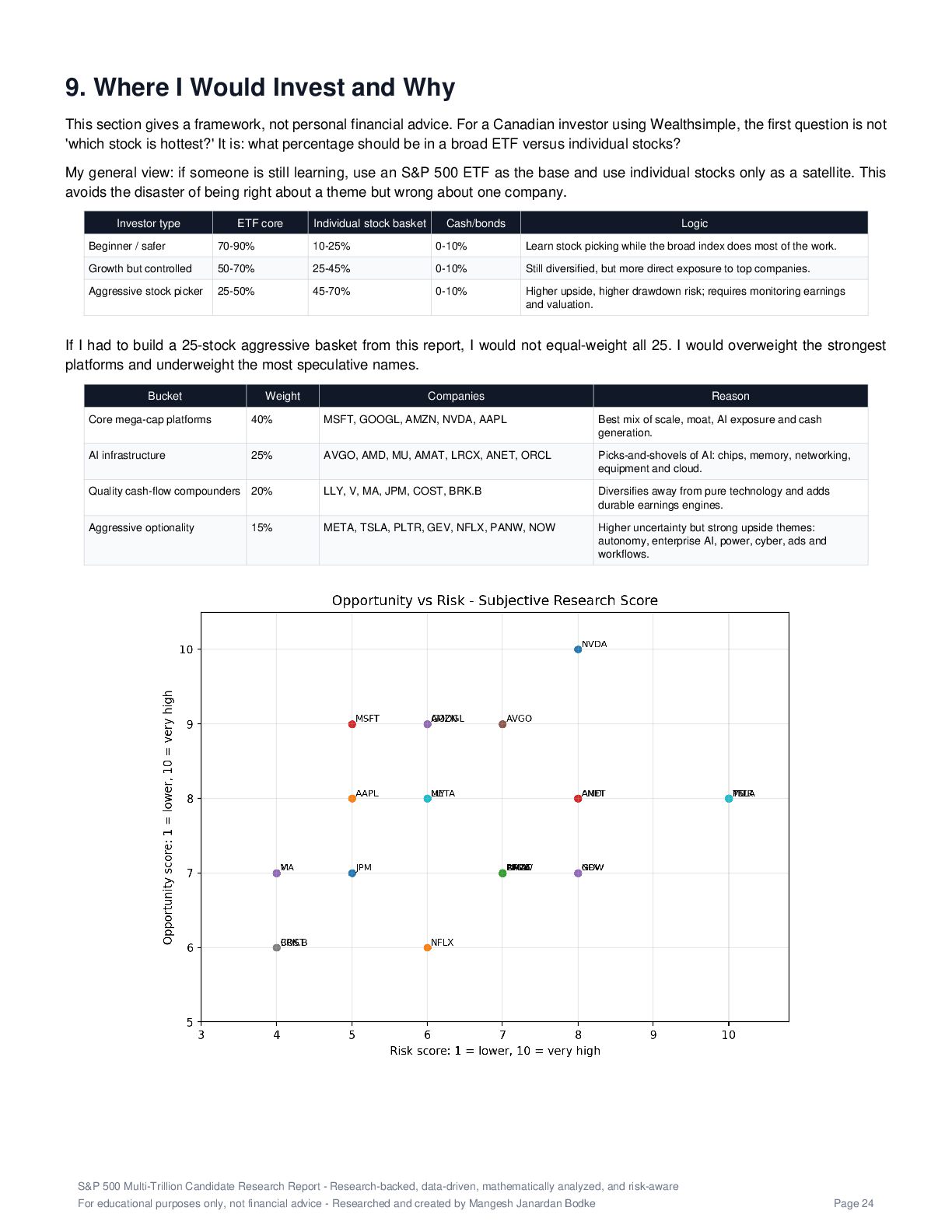
    not financial advice 9. Where I Would Invest and Why This section gives a framework, not personal financial advice. For a Canadian investor using Wealthsimple, the first question is not 'which stock is hottest?' It is: what percentage should be in a broad ETF versus individual stocks? My general view: if someone is still learning, use an S&P 500 ETF as the base and use individual stocks only as a satellite. This avoids the disaster of being right about a theme but wrong about one company. Investor type ETF core Individual stock basket Cash/bonds Logic Beginner / safer 70-90% 10-25% 0-10% Learn stock picking while the broad index does most of the work. Growth but controlled 50-70% 25-45% 0-10% Still diversified, but more direct exposure to top companies. Aggressive stock picker 25-50% 45-70% 0-10% Higher upside, higher drawdown risk; requires monitoring earnings and valuation. If I had to build a 25-stock aggressive basket from this report, I would not equal-weight all 25. I would overweight the strongest platforms and underweight the most speculative names. Bucket Weight Companies Reason Core mega-cap platforms 40% MSFT, GOOGL, AMZN, NVDA, AAPL Best mix of scale, moat, AI exposure and cash generation. AI infrastructure 25% AVGO, AMD, MU, AMAT, LRCX, ANET, ORCL Picks-and-shovels of AI: chips, memory, networking, equipment and cloud. Quality cash-flow compounders 20% LLY, V, MA, JPM, COST, BRK.B Diversifies away from pure technology and adds durable earnings engines. Aggressive optionality 15% META, TSLA, PLTR, GEV, NFLX, PANW, NOW Higher uncertainty but strong upside themes: autonomy, enterprise AI, power, cyber, ads and workflows. S&P 500 Multi-Trillion Candidate Research Report - Research-backed, data-driven, mathematically analyzed, and risk-aware For educational purposes only, not financial advice - Researched and created by Mangesh Janardan Bodke Page 24
  25. Page 25 S&P 500 Multi-Trillion Candidate Research Report - Educational,

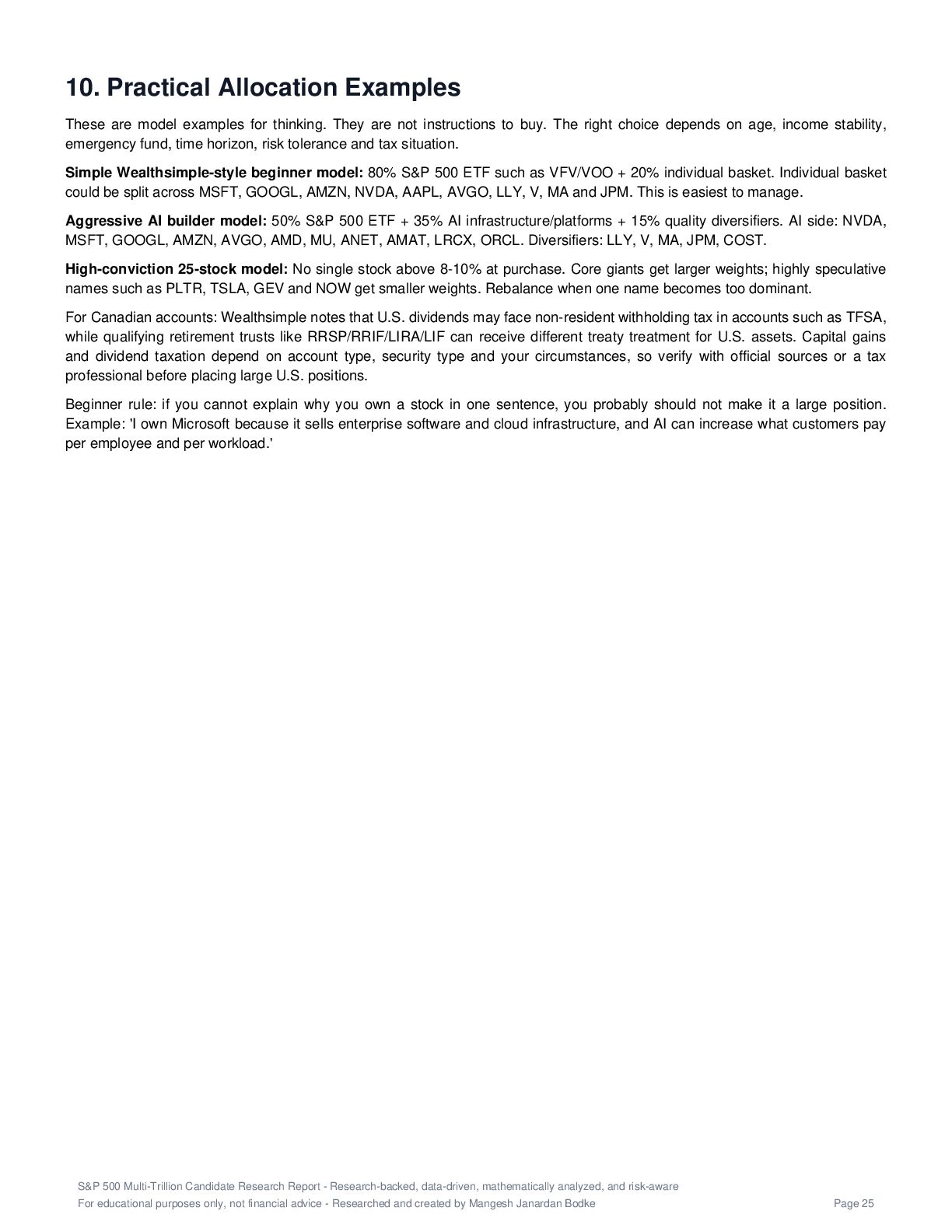
    not financial advice 10. Practical Allocation Examples These are model examples for thinking. They are not instructions to buy. The right choice depends on age, income stability, emergency fund, time horizon, risk tolerance and tax situation. Simple Wealthsimple-style beginner model: 80% S&P 500 ETF such as VFV/VOO + 20% individual basket. Individual basket could be split across MSFT, GOOGL, AMZN, NVDA, AAPL, AVGO, LLY, V, MA and JPM. This is easiest to manage. Aggressive AI builder model: 50% S&P 500 ETF + 35% AI infrastructure/platforms + 15% quality diversifiers. AI side: NVDA, MSFT, GOOGL, AMZN, AVGO, AMD, MU, ANET, AMAT, LRCX, ORCL. Diversifiers: LLY, V, MA, JPM, COST. High-conviction 25-stock model: No single stock above 8-10% at purchase. Core giants get larger weights; highly speculative names such as PLTR, TSLA, GEV and NOW get smaller weights. Rebalance when one name becomes too dominant. For Canadian accounts: Wealthsimple notes that U.S. dividends may face non-resident withholding tax in accounts such as TFSA, while qualifying retirement trusts like RRSP/RRIF/LIRA/LIF can receive different treaty treatment for U.S. assets. Capital gains and dividend taxation depend on account type, security type and your circumstances, so verify with official sources or a tax professional before placing large U.S. positions. Beginner rule: if you cannot explain why you own a stock in one sentence, you probably should not make it a large position. Example: 'I own Microsoft because it sells enterprise software and cloud infrastructure, and AI can increase what customers pay per employee and per workload.' S&P 500 Multi-Trillion Candidate Research Report - Research-backed, data-driven, mathematically analyzed, and risk-aware For educational purposes only, not financial advice - Researched and created by Mangesh Janardan Bodke Page 25
  26. Page 26 S&P 500 Multi-Trillion Candidate Research Report - Educational,

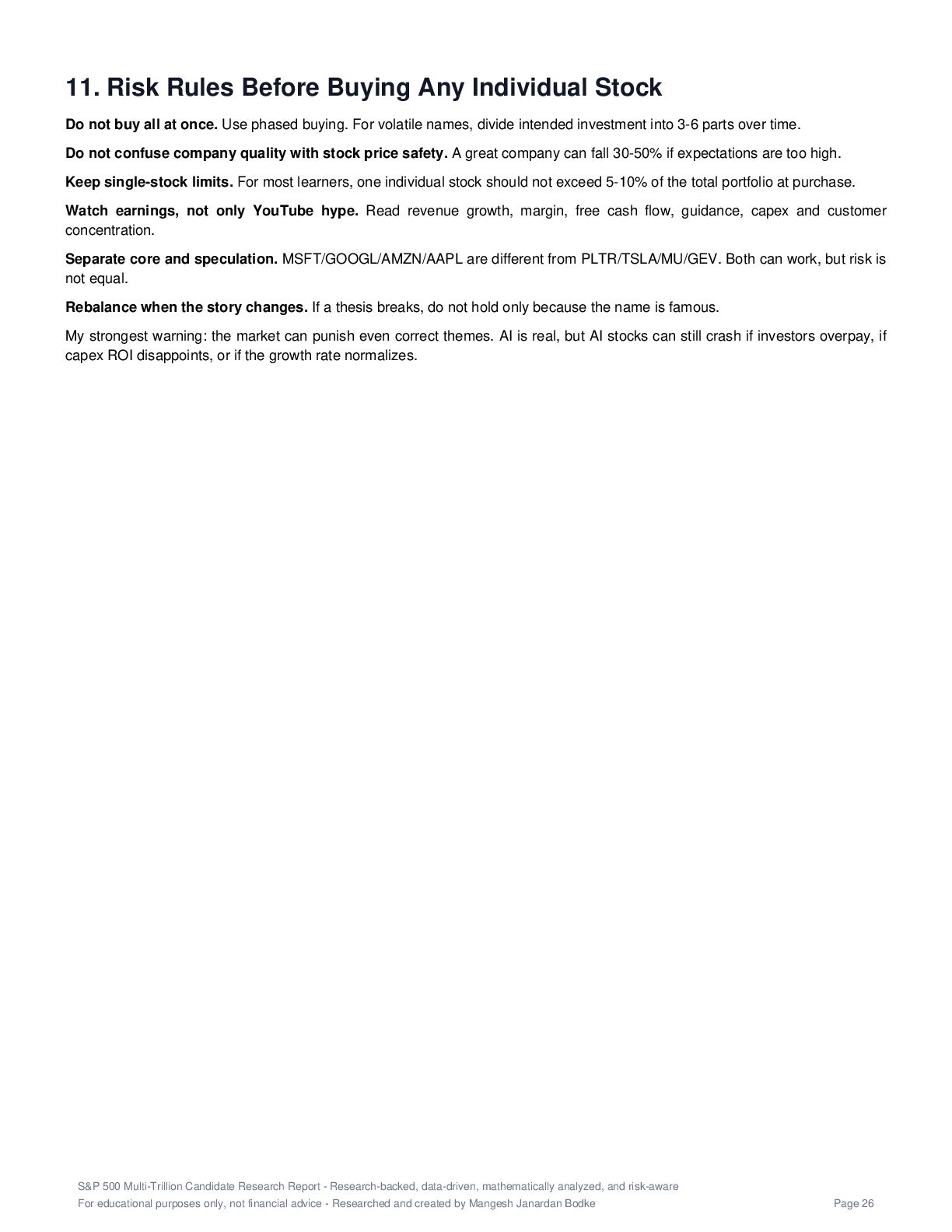
    not financial advice 11. Risk Rules Before Buying Any Individual Stock Do not buy all at once. Use phased buying. For volatile names, divide intended investment into 3-6 parts over time. Do not confuse company quality with stock price safety. A great company can fall 30-50% if expectations are too high. Keep single-stock limits. For most learners, one individual stock should not exceed 5-10% of the total portfolio at purchase. Watch earnings, not only YouTube hype. Read revenue growth, margin, free cash flow, guidance, capex and customer concentration. Separate core and speculation. MSFT/GOOGL/AMZN/AAPL are different from PLTR/TSLA/MU/GEV. Both can work, but risk is not equal. Rebalance when the story changes. If a thesis breaks, do not hold only because the name is famous. My strongest warning: the market can punish even correct themes. AI is real, but AI stocks can still crash if investors overpay, if capex ROI disappoints, or if the growth rate normalizes. S&P 500 Multi-Trillion Candidate Research Report - Research-backed, data-driven, mathematically analyzed, and risk-aware For educational purposes only, not financial advice - Researched and created by Mangesh Janardan Bodke Page 26
  27. Page 27 S&P 500 Multi-Trillion Candidate Research Report - Educational,

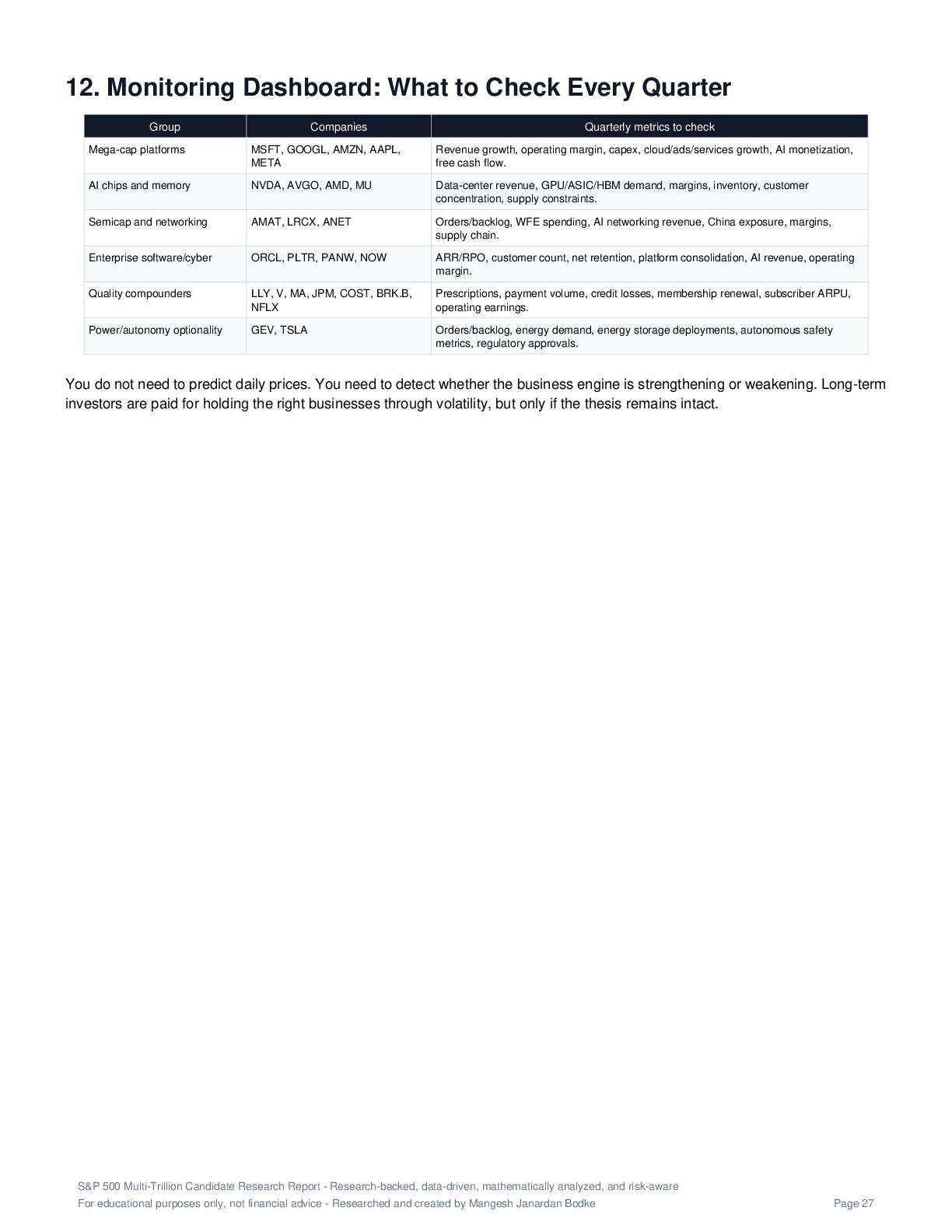
    not financial advice 12. Monitoring Dashboard: What to Check Every Quarter Group Companies Quarterly metrics to check Mega-cap platforms MSFT, GOOGL, AMZN, AAPL, META Revenue growth, operating margin, capex, cloud/ads/services growth, AI monetization, free cash flow. AI chips and memory NVDA, AVGO, AMD, MU Data-center revenue, GPU/ASIC/HBM demand, margins, inventory, customer concentration, supply constraints. Semicap and networking AMAT, LRCX, ANET Orders/backlog, WFE spending, AI networking revenue, China exposure, margins, supply chain. Enterprise software/cyber ORCL, PLTR, PANW, NOW ARR/RPO, customer count, net retention, platform consolidation, AI revenue, operating margin. Quality compounders LLY, V, MA, JPM, COST, BRK.B, NFLX Prescriptions, payment volume, credit losses, membership renewal, subscriber ARPU, operating earnings. Power/autonomy optionality GEV, TSLA Orders/backlog, energy demand, energy storage deployments, autonomous safety metrics, regulatory approvals. You do not need to predict daily prices. You need to detect whether the business engine is strengthening or weakening. Long-term investors are paid for holding the right businesses through volatility, but only if the thesis remains intact. S&P 500 Multi-Trillion Candidate Research Report - Research-backed, data-driven, mathematically analyzed, and risk-aware For educational purposes only, not financial advice - Researched and created by Mangesh Janardan Bodke Page 27
  28. Page 28 S&P 500 Multi-Trillion Candidate Research Report - Educational,

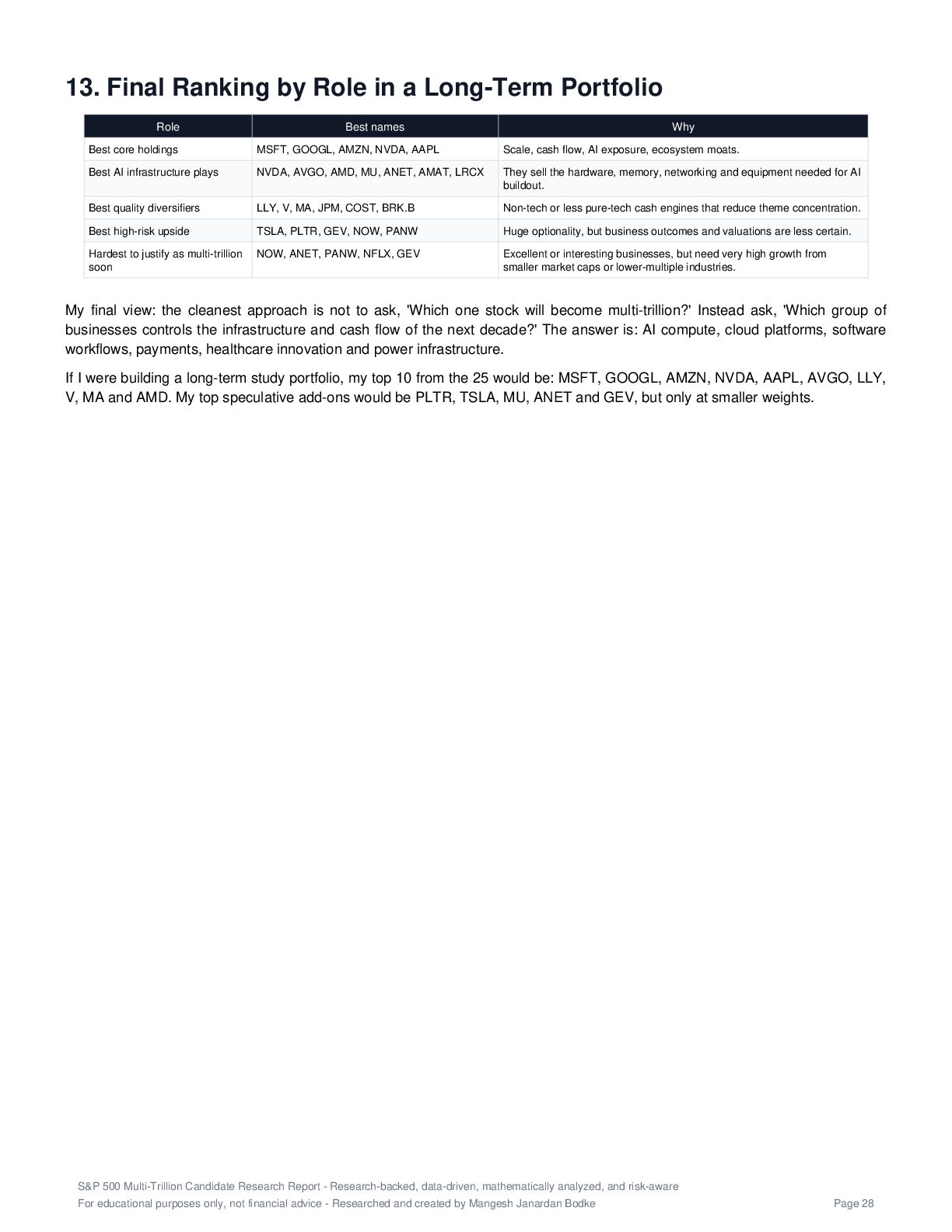
    not financial advice 13. Final Ranking by Role in a Long-Term Portfolio Role Best names Why Best core holdings MSFT, GOOGL, AMZN, NVDA, AAPL Scale, cash flow, AI exposure, ecosystem moats. Best AI infrastructure plays NVDA, AVGO, AMD, MU, ANET, AMAT, LRCX They sell the hardware, memory, networking and equipment needed for AI buildout. Best quality diversifiers LLY, V, MA, JPM, COST, BRK.B Non-tech or less pure-tech cash engines that reduce theme concentration. Best high-risk upside TSLA, PLTR, GEV, NOW, PANW Huge optionality, but business outcomes and valuations are less certain. Hardest to justify as multi-trillion soon NOW, ANET, PANW, NFLX, GEV Excellent or interesting businesses, but need very high growth from smaller market caps or lower-multiple industries. My final view: the cleanest approach is not to ask, 'Which one stock will become multi-trillion?' Instead ask, 'Which group of businesses controls the infrastructure and cash flow of the next decade?' The answer is: AI compute, cloud platforms, software workflows, payments, healthcare innovation and power infrastructure. If I were building a long-term study portfolio, my top 10 from the 25 would be: MSFT, GOOGL, AMZN, NVDA, AAPL, AVGO, LLY, V, MA and AMD. My top speculative add-ons would be PLTR, TSLA, MU, ANET and GEV, but only at smaller weights. S&P 500 Multi-Trillion Candidate Research Report - Research-backed, data-driven, mathematically analyzed, and risk-aware For educational purposes only, not financial advice - Researched and created by Mangesh Janardan Bodke Page 28
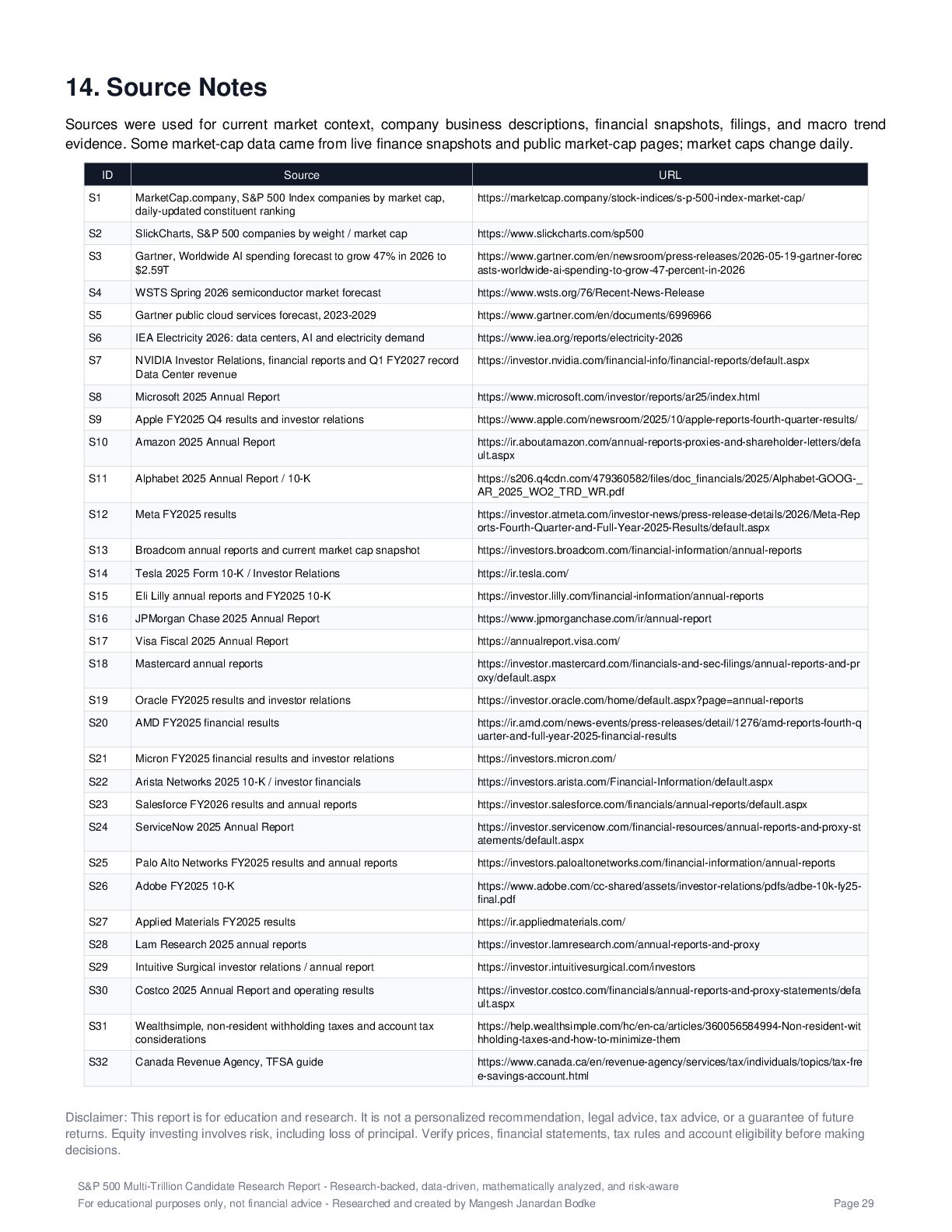
  29. Page 29 S&P 500 Multi-Trillion Candidate Research Report - Educational,

    not financial advice 14. Source Notes Sources were used for current market context, company business descriptions, financial snapshots, filings, and macro trend evidence. Some market-cap data came from live finance snapshots and public market-cap pages; market caps change daily. ID Source URL S1 MarketCap.company, S&P 500 Index companies by market cap, daily-updated constituent ranking https://marketcap.company/stock-indices/s-p-500-index-market-cap/ S2 SlickCharts, S&P 500 companies by weight / market cap https://www.slickcharts.com/sp500 S3 Gartner, Worldwide AI spending forecast to grow 47% in 2026 to $2.59T https://www.gartner.com/en/newsroom/press-releases/2026-05-19-gartner-forec asts-worldwide-ai-spending-to-grow-47-percent-in-2026 S4 WSTS Spring 2026 semiconductor market forecast https://www.wsts.org/76/Recent-News-Release S5 Gartner public cloud services forecast, 2023-2029 https://www.gartner.com/en/documents/6996966 S6 IEA Electricity 2026: data centers, AI and electricity demand https://www.iea.org/reports/electricity-2026 S7 NVIDIA Investor Relations, financial reports and Q1 FY2027 record Data Center revenue https://investor.nvidia.com/financial-info/financial-reports/default.aspx S8 Microsoft 2025 Annual Report https://www.microsoft.com/investor/reports/ar25/index.html S9 Apple FY2025 Q4 results and investor relations https://www.apple.com/newsroom/2025/10/apple-reports-fourth-quarter-results/ S10 Amazon 2025 Annual Report https://ir.aboutamazon.com/annual-reports-proxies-and-shareholder-letters/defa ult.aspx S11 Alphabet 2025 Annual Report / 10-K https://s206.q4cdn.com/479360582/files/doc_financials/2025/Alphabet-GOOG-_ AR_2025_WO2_TRD_WR.pdf S12 Meta FY2025 results https://investor.atmeta.com/investor-news/press-release-details/2026/Meta-Rep orts-Fourth-Quarter-and-Full-Year-2025-Results/default.aspx S13 Broadcom annual reports and current market cap snapshot https://investors.broadcom.com/financial-information/annual-reports S14 Tesla 2025 Form 10-K / Investor Relations https://ir.tesla.com/ S15 Eli Lilly annual reports and FY2025 10-K https://investor.lilly.com/financial-information/annual-reports S16 JPMorgan Chase 2025 Annual Report https://www.jpmorganchase.com/ir/annual-report S17 Visa Fiscal 2025 Annual Report https://annualreport.visa.com/ S18 Mastercard annual reports https://investor.mastercard.com/financials-and-sec-filings/annual-reports-and-pr oxy/default.aspx S19 Oracle FY2025 results and investor relations https://investor.oracle.com/home/default.aspx?page=annual-reports S20 AMD FY2025 financial results https://ir.amd.com/news-events/press-releases/detail/1276/amd-reports-fourth-q uarter-and-full-year-2025-financial-results S21 Micron FY2025 financial results and investor relations https://investors.micron.com/ S22 Arista Networks 2025 10-K / investor financials https://investors.arista.com/Financial-Information/default.aspx S23 Salesforce FY2026 results and annual reports https://investor.salesforce.com/financials/annual-reports/default.aspx S24 ServiceNow 2025 Annual Report https://investor.servicenow.com/financial-resources/annual-reports-and-proxy-st atements/default.aspx S25 Palo Alto Networks FY2025 results and annual reports https://investors.paloaltonetworks.com/financial-information/annual-reports S26 Adobe FY2025 10-K https://www.adobe.com/cc-shared/assets/investor-relations/pdfs/adbe-10k-fy25- final.pdf S27 Applied Materials FY2025 results https://ir.appliedmaterials.com/ S28 Lam Research 2025 annual reports https://investor.lamresearch.com/annual-reports-and-proxy S29 Intuitive Surgical investor relations / annual report https://investor.intuitivesurgical.com/investors S30 Costco 2025 Annual Report and operating results https://investor.costco.com/financials/annual-reports-and-proxy-statements/defa ult.aspx S31 Wealthsimple, non-resident withholding taxes and account tax considerations https://help.wealthsimple.com/hc/en-ca/articles/360056584994-Non-resident-wit hholding-taxes-and-how-to-minimize-them S32 Canada Revenue Agency, TFSA guide https://www.canada.ca/en/revenue-agency/services/tax/individuals/topics/tax-fre e-savings-account.html Disclaimer: This report is for education and research. It is not a personalized recommendation, legal advice, tax advice, or a guarantee of future returns. Equity investing involves risk, including loss of principal. Verify prices, financial statements, tax rules and account eligibility before making decisions. S&P 500 Multi-Trillion Candidate Research Report - Research-backed, data-driven, mathematically analyzed, and risk-aware For educational purposes only, not financial advice - Researched and created by Mangesh Janardan Bodke Page 29