The Ten Principles of Fighting Corruption: Institutionalizing Integrity, Transparency, and Accountability
My engagement at the Second International Conference 2020 on “The Integrity, Transparency and Accountability Policies… Theory and Practice” via zoom platform, of the Palestinian Anti-Corruption Commission was conducted on December 9, 2020.
By Mike J. Masoud, CPA, CACM, CFE, MBA Sr. Director of The AACI in the Middle East and Africa December 9, 2020 Tempe - Arizona Institutionalizing Integrity, Transparency, and Accountability The PACC’s Second International Conference 2020 The Integrity, Transparency, and Accountability Policies...Theory and Practice V. Via Zoom Ramallah – State of Palestine
Exam Unit. All Rights Reserved. No part of this publication may be reproduced, stored in a retrieval system or transmitted in any form or by any means, electronic, mechanical, photocopying, recording, scanning or otherwise, except as permitted under Sections 107 or 108 of the 1976 United States Copyright Act, without the prior written permission of the Publisher. Requests to the Publisher for permission should be addressed to the Exam Unit of The American Anti-Corruption Institute (AACI). Direct all inquiries to [email protected], [email protected], or The American Anti- Corruption Institute (AACI). Telephone inquiries may be directed to (603) 235-0956. Publisher: The Exam Unit of The American Anti-Corruption Institute LLC. 2
as “Abuse of power or perceived power or entrusted authority for direct or indirect private monetary or non-monetary gain.” • We do not classify it. Corruption is corruption • ALL types of POWER 4
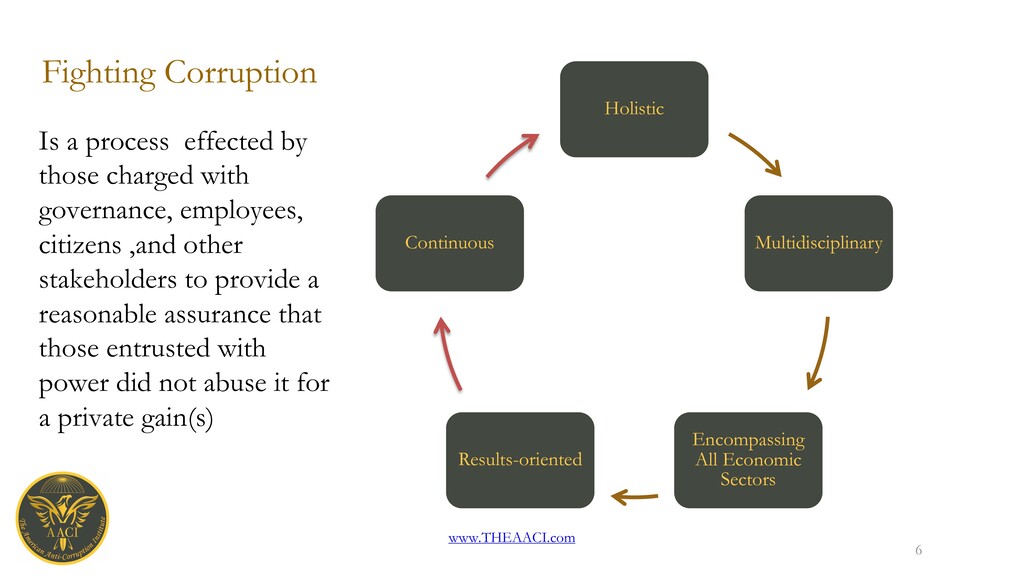
charged with governance, employees, citizens ,and other stakeholders to provide a reasonable assurance that those entrusted with power did not abuse it for a private gain(s) Holistic Multidisciplinary Encompassing All Economic Sectors Results-oriented Continuous
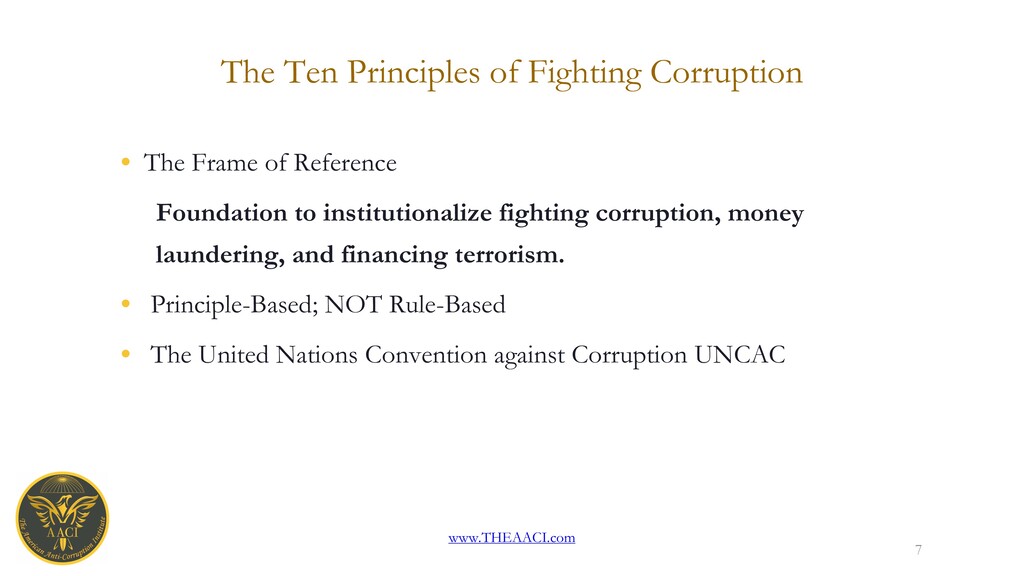
of Reference Foundation to institutionalize fighting corruption, money laundering, and financing terrorism. • Principle-Based; NOT Rule-Based • The United Nations Convention against Corruption UNCAC 7
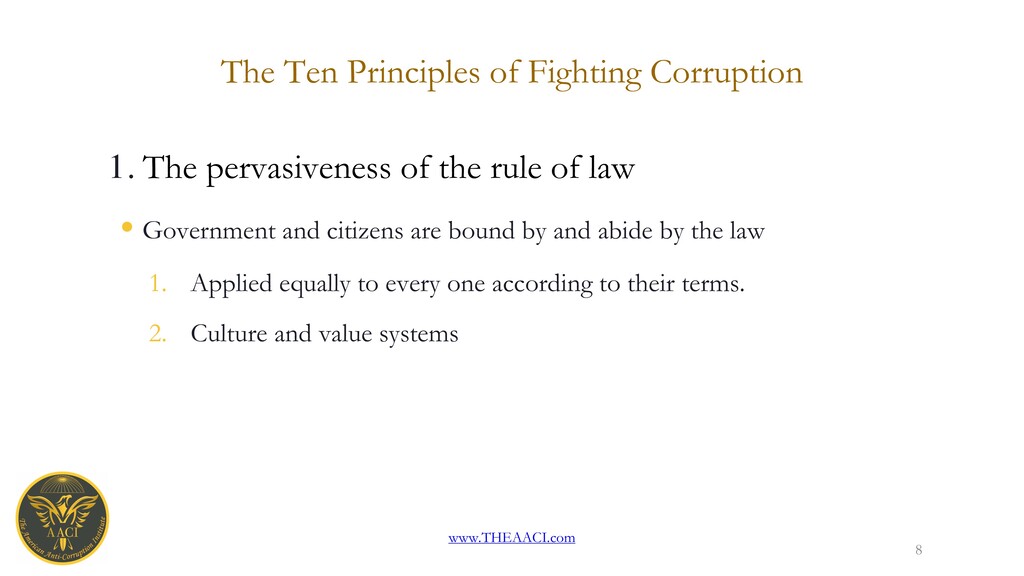
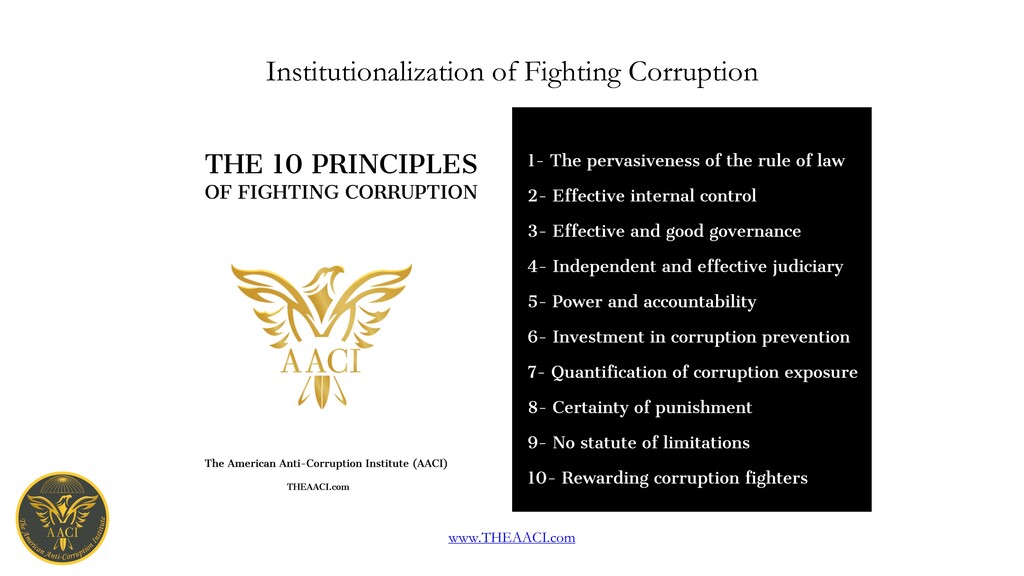
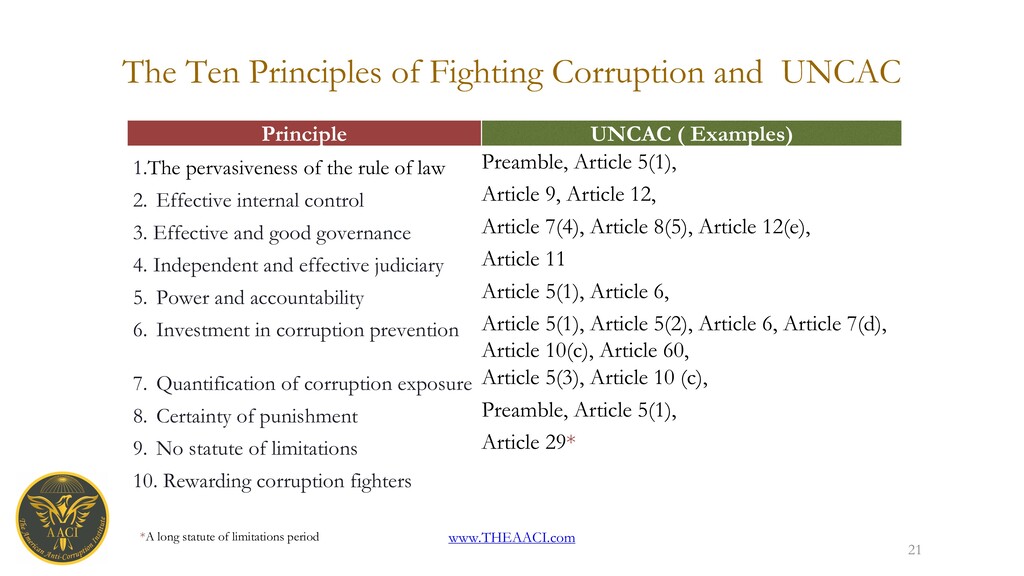
of the rule of law • Government and citizens are bound by and abide by the law 1. Applied equally to every one according to their terms. 2. Culture and value systems 8
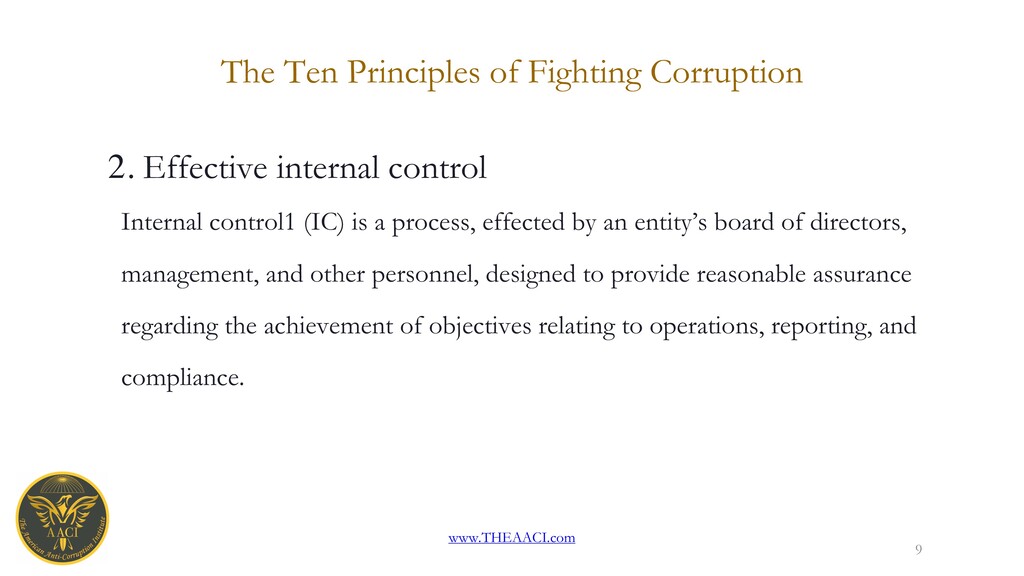
control Internal control1 (IC) is a process, effected by an entity’s board of directors, management, and other personnel, designed to provide reasonable assurance regarding the achievement of objectives relating to operations, reporting, and compliance. 9
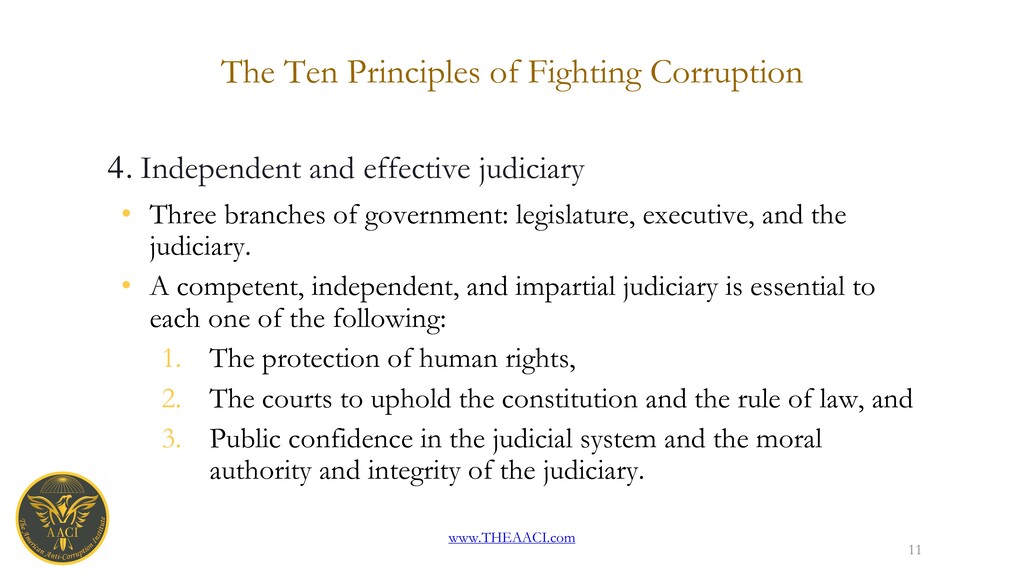
effective judiciary • Three branches of government: legislature, executive, and the judiciary. • A competent, independent, and impartial judiciary is essential to each one of the following: 1. The protection of human rights, 2. The courts to uphold the constitution and the rule of law, and 3. Public confidence in the judicial system and the moral authority and integrity of the judiciary. 11
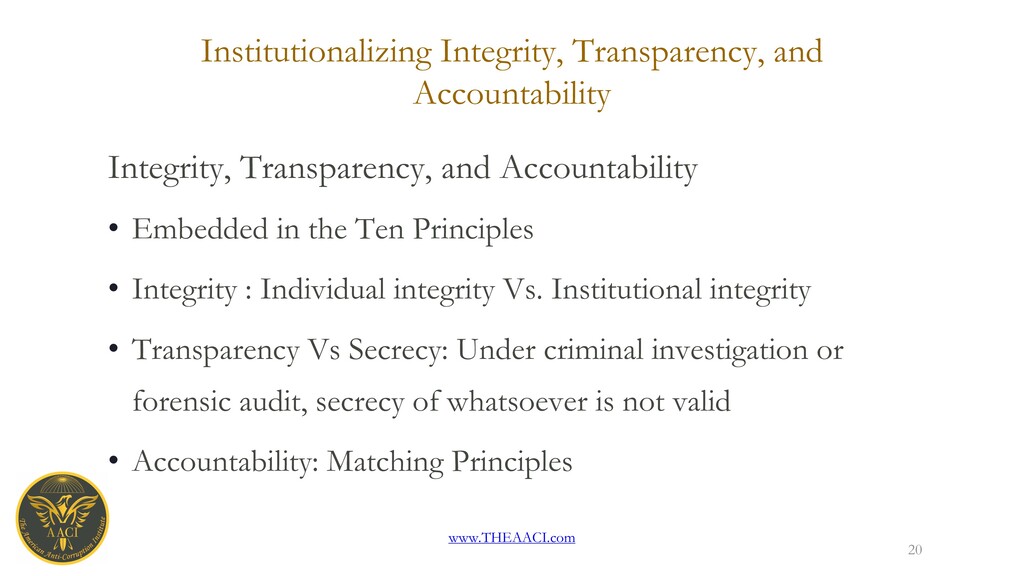
• Embedded in the Ten Principles • Integrity : Individual integrity Vs. Institutional integrity • Transparency Vs Secrecy: Under criminal investigation or forensic audit, secrecy of whatsoever is not valid • Accountability: Matching Principles 20
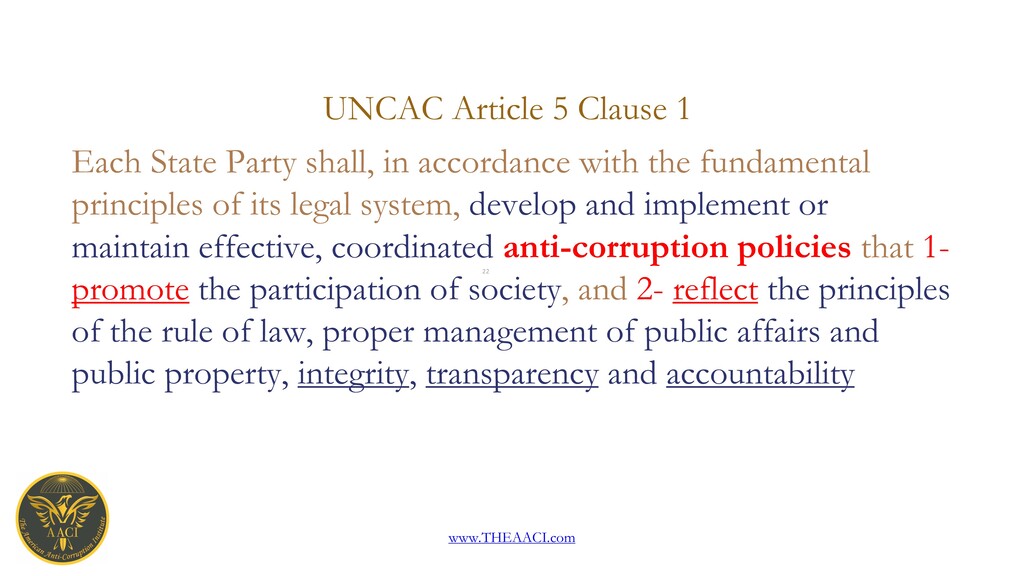
shall, in accordance with the fundamental principles of its legal system, develop and implement or maintain effective, coordinated anti-corruption policies that 1- promote the participation of society, and 2- reflect the principles of the rule of law, proper management of public affairs and public property, integrity, transparency and accountability UNCAC Article 5 Clause 1
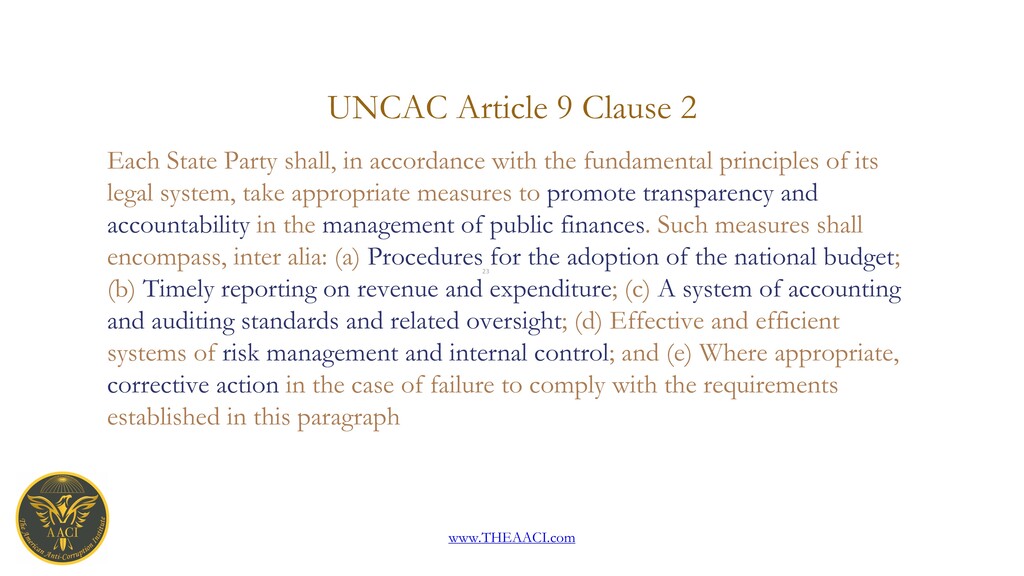
shall, in accordance with the fundamental principles of its legal system, take appropriate measures to promote transparency and accountability in the management of public finances. Such measures shall encompass, inter alia: (a) Procedures for the adoption of the national budget; (b) Timely reporting on revenue and expenditure; (c) A system of accounting and auditing standards and related oversight; (d) Effective and efficient systems of risk management and internal control; and (e) Where appropriate, corrective action in the case of failure to comply with the requirements established in this paragraph UNCAC Article 9 Clause 2
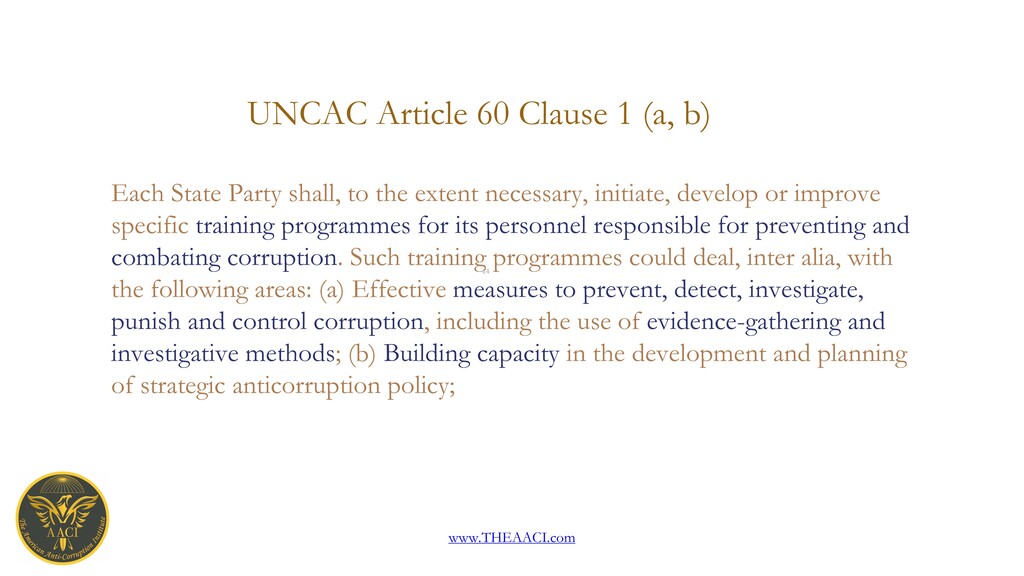
State Party shall, to the extent necessary, initiate, develop or improve specific training programmes for its personnel responsible for preventing and combating corruption. Such training programmes could deal, inter alia, with the following areas: (a) Effective measures to prevent, detect, investigate, punish and control corruption, including the use of evidence-gathering and investigative methods; (b) Building capacity in the development and planning of strategic anticorruption policy; UNCAC Article 60 Clause 1 (a, b)
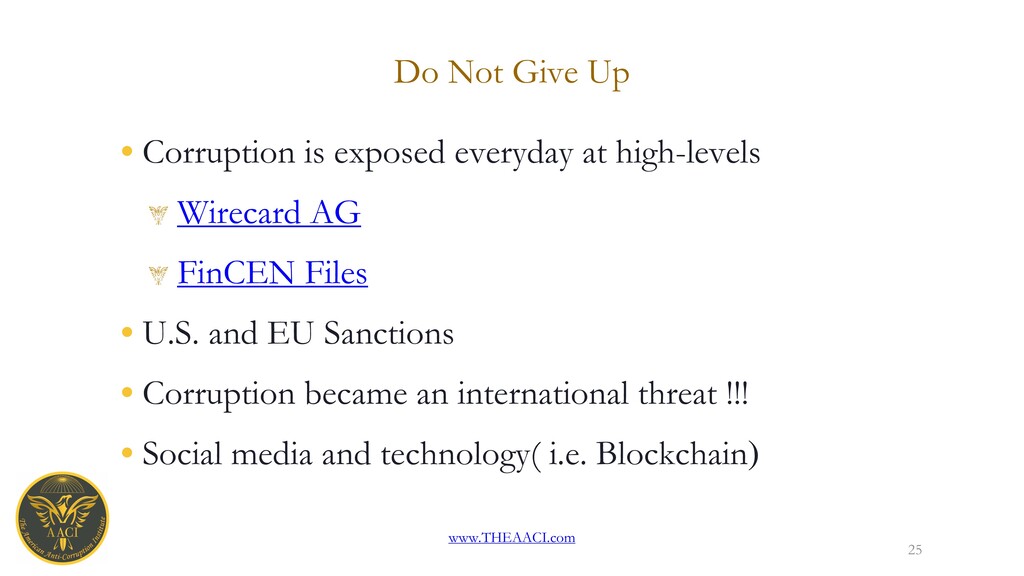
at high-levels Wirecard AG FinCEN Files • U.S. and EU Sanctions • Corruption became an international threat !!! • Social media and technology( i.e. Blockchain) 25
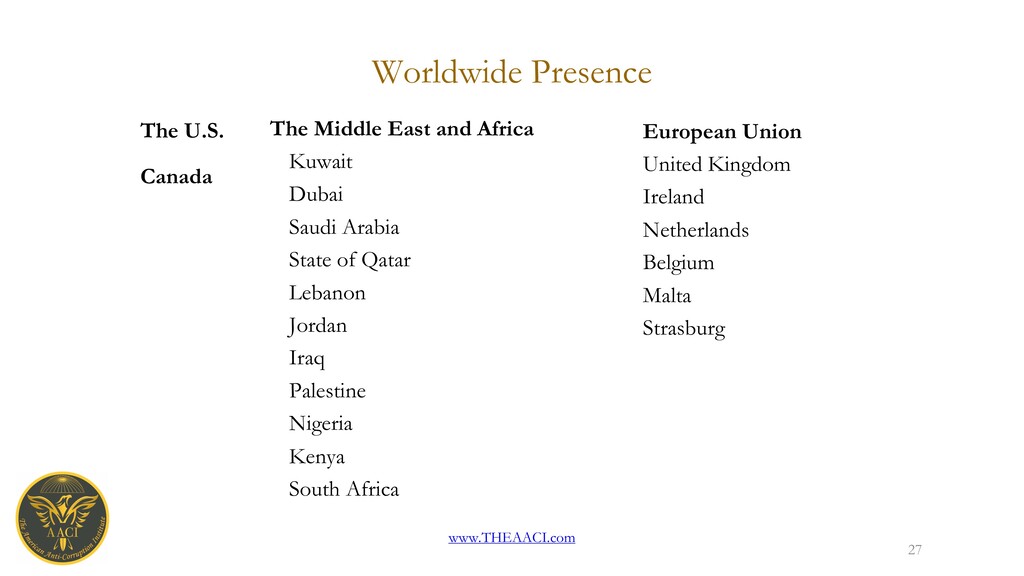
and Africa Kuwait Dubai Saudi Arabia State of Qatar Lebanon Jordan Iraq Palestine Nigeria Kenya South Africa European Union United Kingdom Ireland Netherlands Belgium Malta Strasburg


 kekekenta
 spring_aki
 cbtlibrary
 dragon2
 terazawa
 frievea
 ainischool
 tasusu
 bvr7352
 ytapples613
 signer
 pedronauck
 jonoalderson
 dugsong
 codingconduct
 baasie
 geshan
 aki_iinuma
 inesmontani
 mfonobong
 mayunak
 irinanazarova
 lara
lara