Upgrade to Pro — share decks privately, control downloads, hide ads and more …

From Probabilistic AI to Deterministic Applicat...

Sponsored · Your Podcast. Everywhere. Effortlessly. Share. Educate. Inspire. Entertain. You do you. We'll handle the rest.

From Probabilistic AI to Deterministic Applications – with Angular Signal Forms

ANGULARarchitects.io - Michael Egger-Zikes

Modern LLMs are remarkably good at generating code. However, the real challenge is not generating individual components, but building deterministic business applications. While AI models are inherently probabilistic, applications need to be reproducible, predictable, and reliable.

In this talk, I’ll present an approach in which natural language is not translated directly into Angular code, but into a declarative DSL. This DSL describes forms, and is interpreted deterministically by a runtime built on Angular Signal Forms.

Instead of generating code, this approach creates deterministic applications that can be described declaratively, validated, and continuously evolved. The talk demonstrates how a declarative DSL can bridge the gap between probabilistic AI and deterministic business applications.

Avatar for Michael Egger-Zikes

Michael Egger-Zikes

September 18, 2026

More Decks by Michael Egger-Zikes

Other Decks in Programming

Transcript

  1. From Probabilistic AI to Deterministic Apps with Angular Signal Forms

    Michael Egger-Zikes Michael Egger-Zikes (@MikeZks) ANGULARarchitects.io
  2. About Michael • Michael Egger-Zikes ANGULARarchitects.io Michael Egger-Zikes @MikeZks •

    Focus on Angular • Trainings, Consultancy, Reviews • Conference Speaker Michael Egger-Zikes (@MikeZks) Public: in-person or remote In-House: everywhere angulararchitects.io /en/angular-workshops
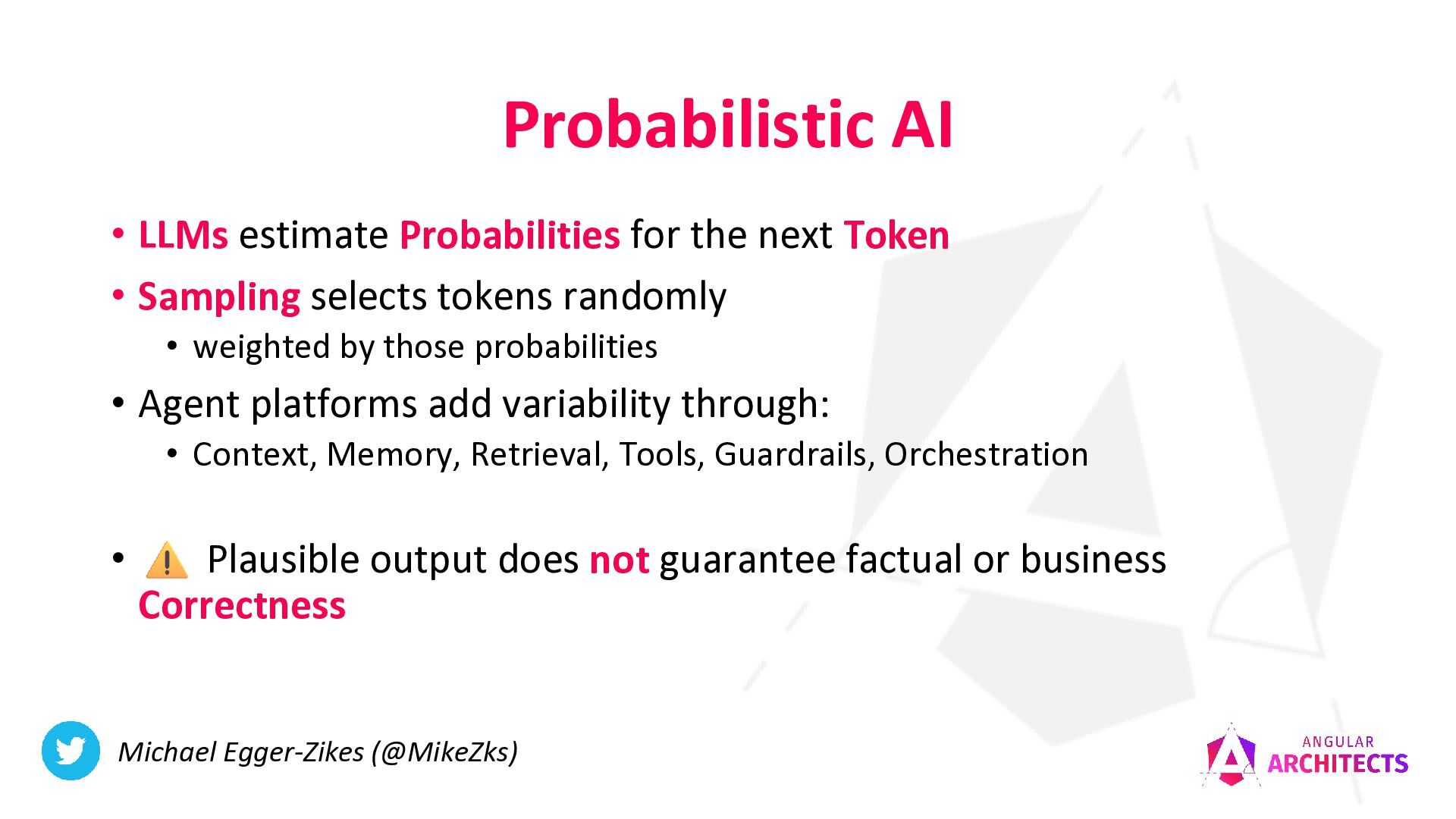
  3. Probabilistic AI • LLMs estimate Probabilities for the next Token

    • Sampling selects tokens randomly • weighted by those probabilities • Agent platforms add variability through: • Context, Memory, Retrieval, Tools, Guardrails, Orchestration • Plausible output does not guarantee factual or business Correctness Michael Egger-Zikes (@MikeZks)
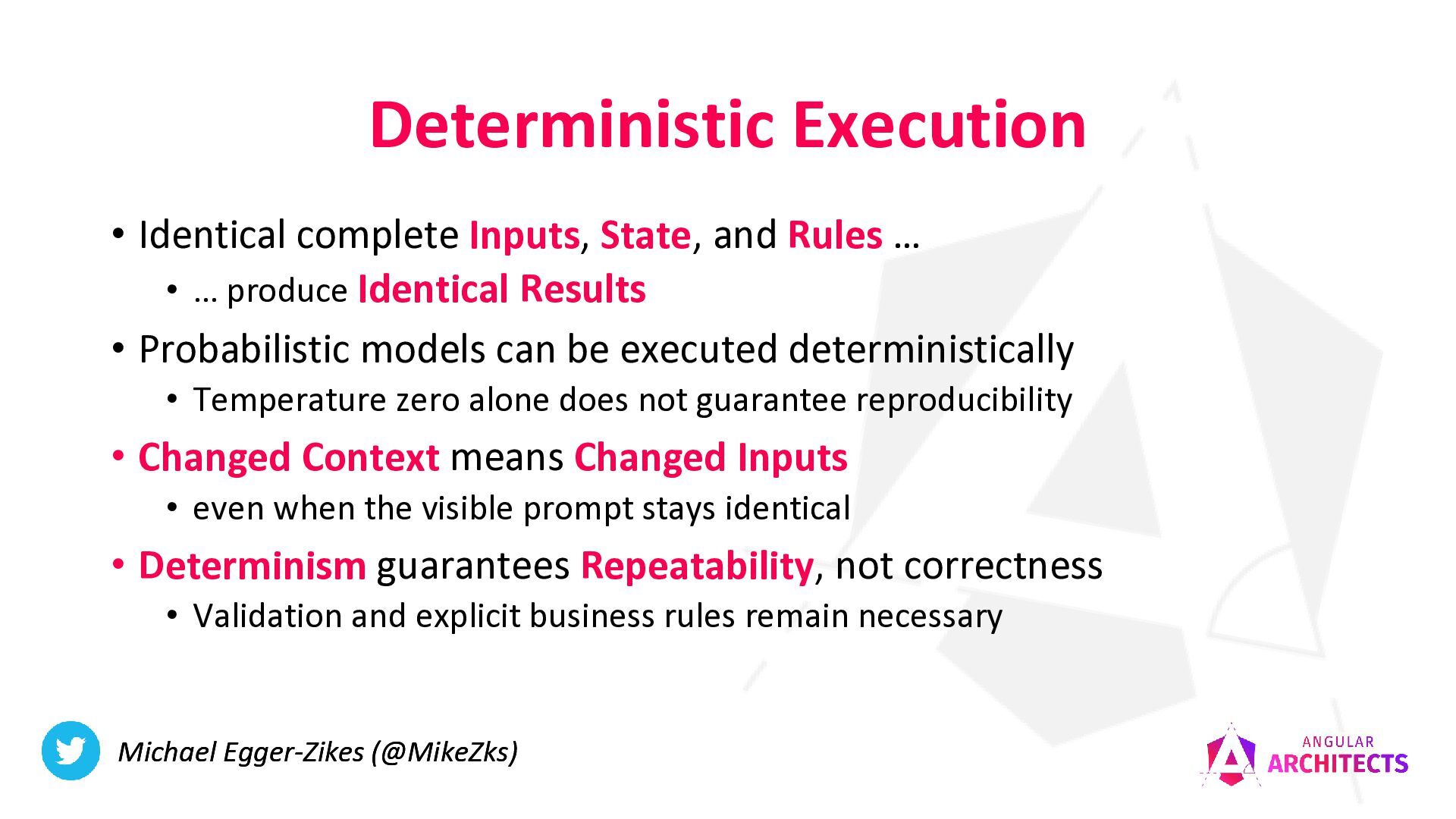
  4. Deterministic Execution • Identical complete Inputs, State, and Rules …

    • … produce Identical Results • Probabilistic models can be executed deterministically • Temperature zero alone does not guarantee reproducibility • Changed Context means Changed Inputs • even when the visible prompt stays identical • Determinism guarantees Repeatability, not correctness • Validation and explicit business rules remain necessary Michael Egger-Zikes (@MikeZks)
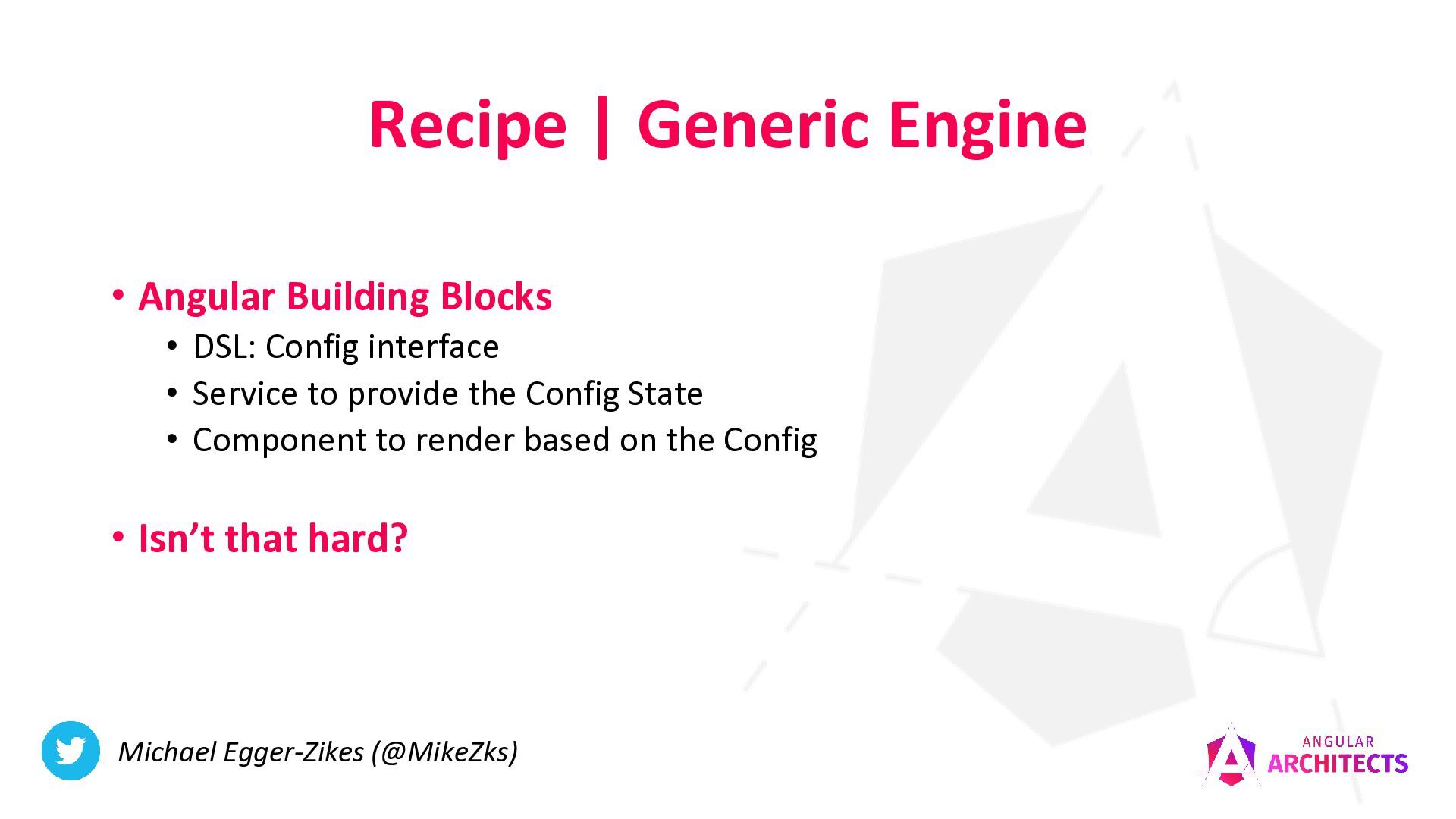
  5. Recipe | Generic Engine • Angular Building Blocks • DSL:

    Config interface • Service to provide the Config State • Component to render based on the Config • Isn’t that hard? Michael Egger-Zikes (@MikeZks)
  6. “We choose to go to the moon not because it

    is easy, but because it is hard!” ! Michael Egger-Zikes (@MikeZks)
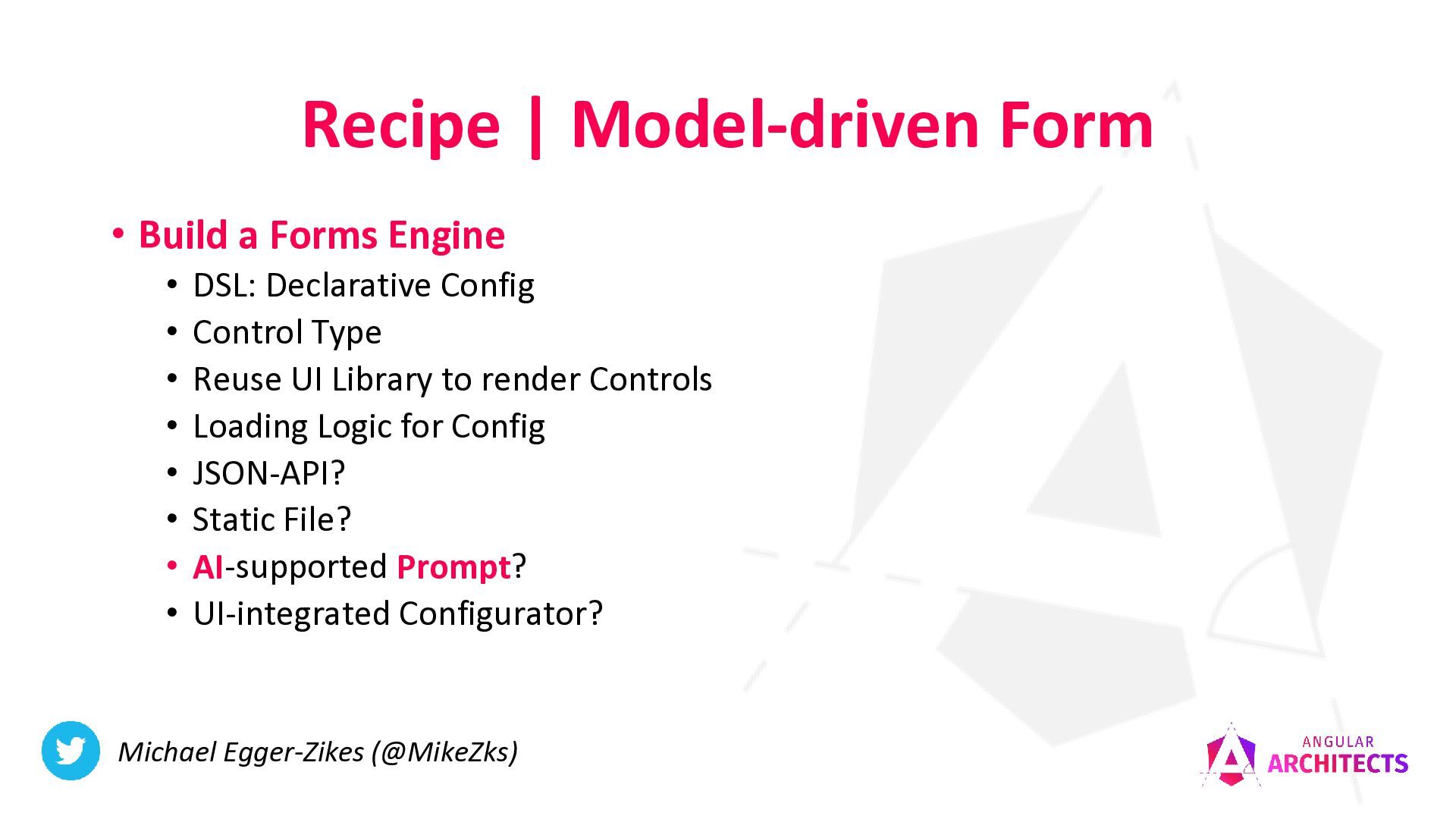
  7. Recipe | Model-driven Form • Build a Forms Engine •

    DSL: Declarative Config • Control Type • Reuse UI Library to render Controls • Loading Logic for Config • JSON-API? • Static File? • AI-supported Prompt? • UI-integrated Configurator? Michael Egger-Zikes (@MikeZks)
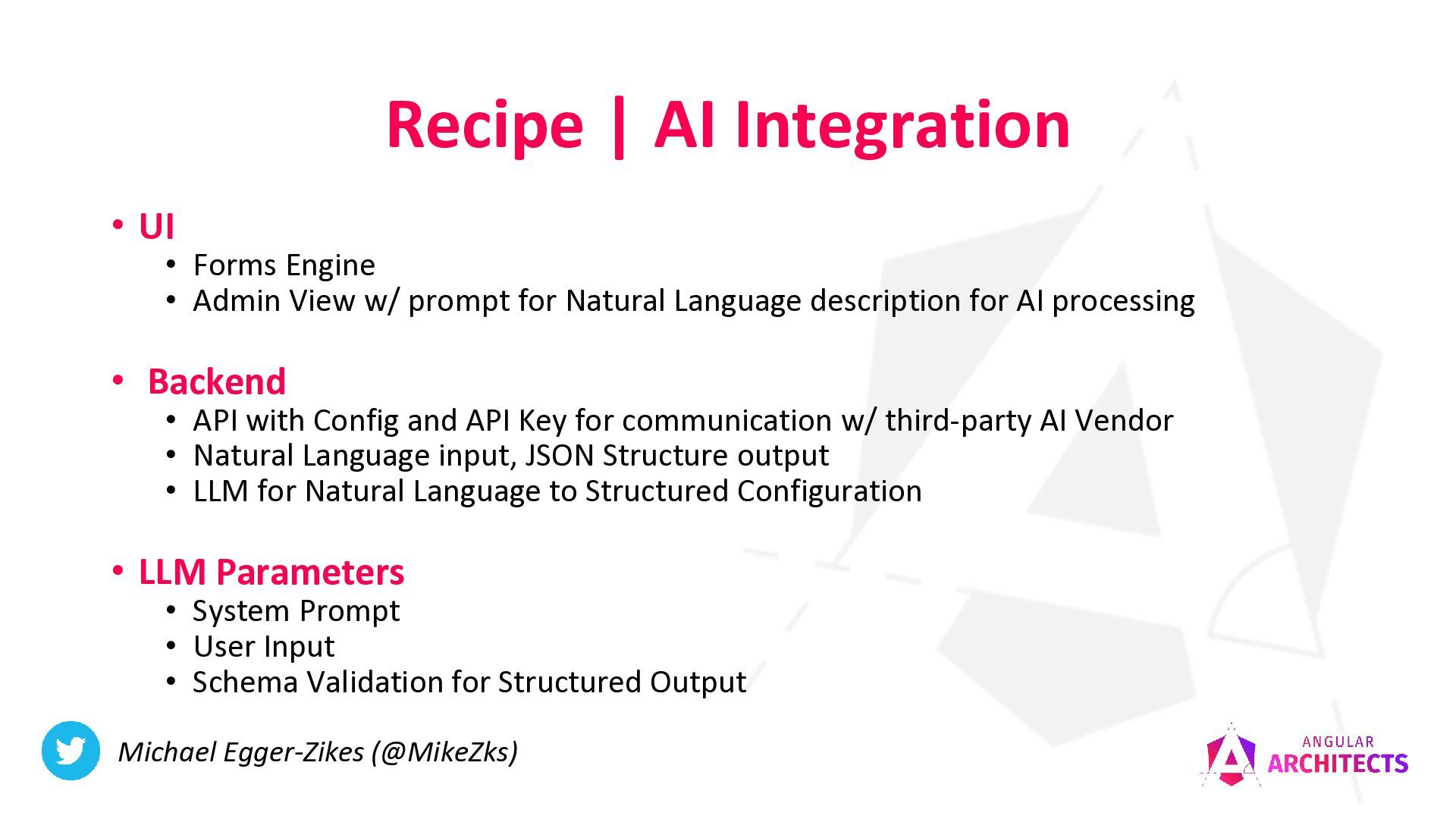
  8. Recipe | AI Integration • UI • Forms Engine •

    Admin View w/ prompt for Natural Language description for AI processing • Backend • API with Config and API Key for communication w/ third-party AI Vendor • Natural Language input, JSON Structure output • LLM for Natural Language to Structured Configuration • LLM Parameters • System Prompt • User Input • Schema Validation for Structured Output Michael Egger-Zikes (@MikeZks)
  9. DEMO AI Backend w/ Open AI GPT API Node.js NestJS

    Backend Michael Egger-Zikes (@MikeZks)
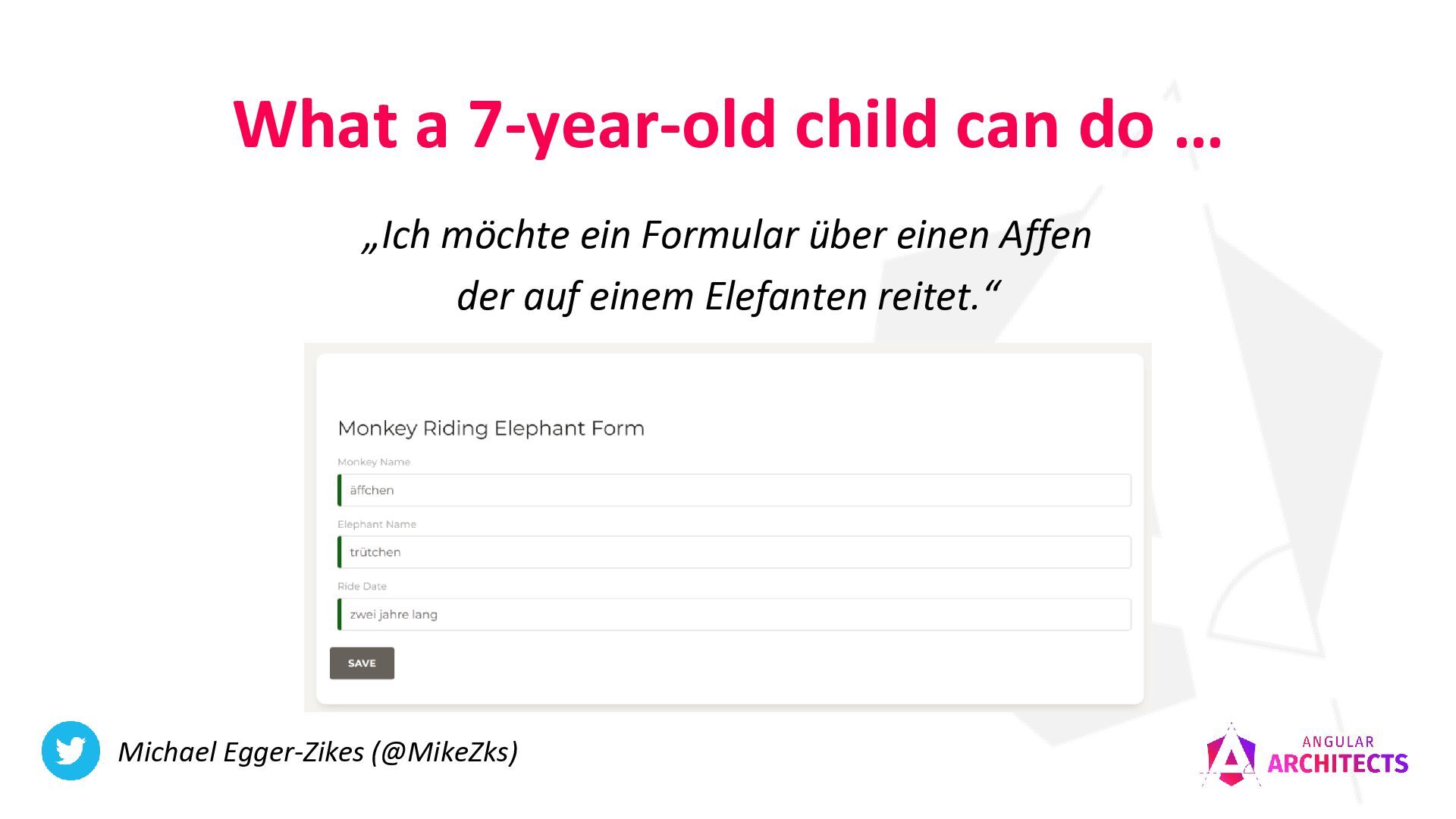
  10. What a 7-year-old child can do … „Ich möchte ein

    Formular über einen Affen der auf einem Elefanten reitet.“ Michael Egger-Zikes (@MikeZks)
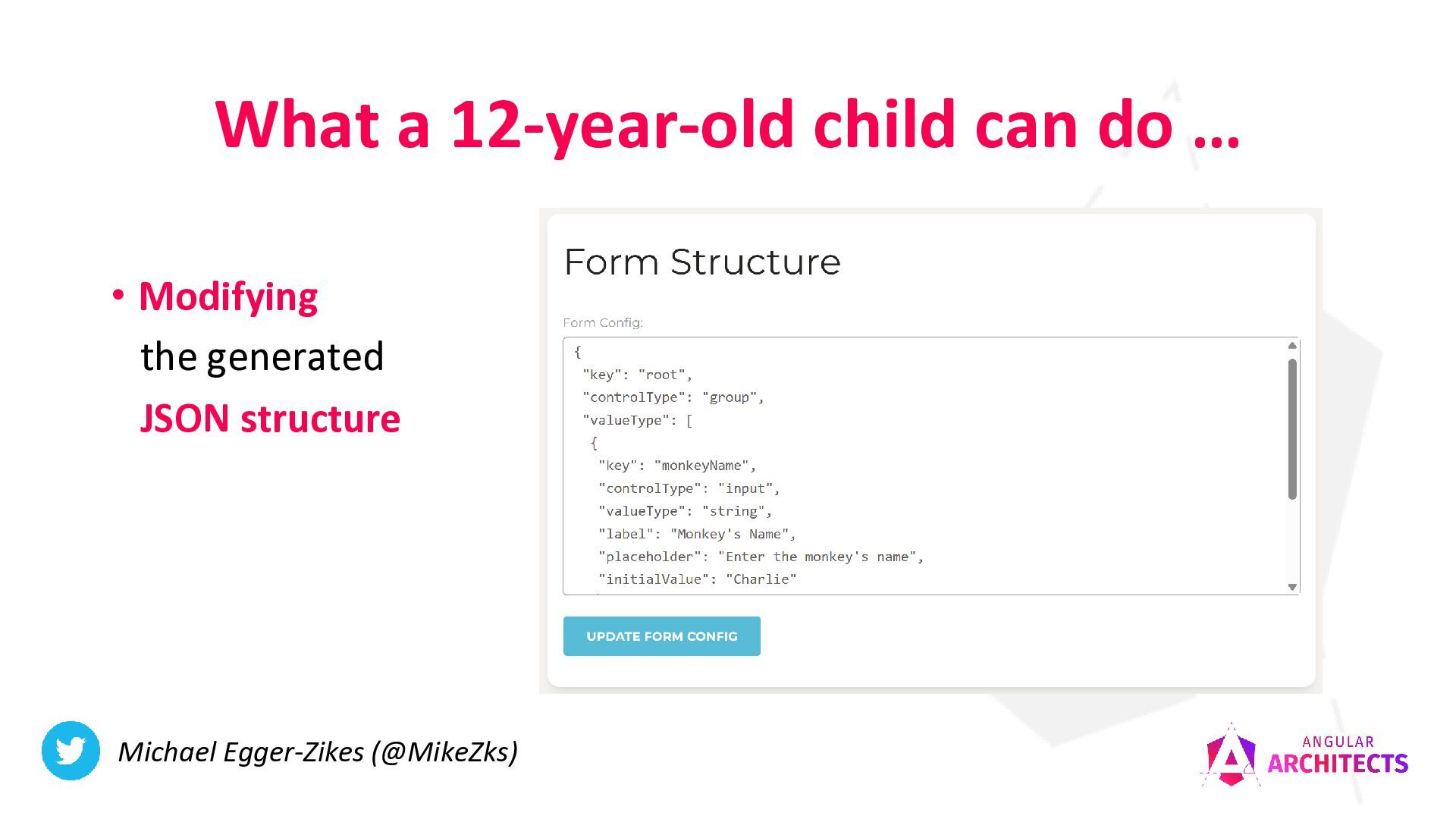
  11. What a 12-year-old child can do … • Modifying the

    generated JSON structure Michael Egger-Zikes (@MikeZks)
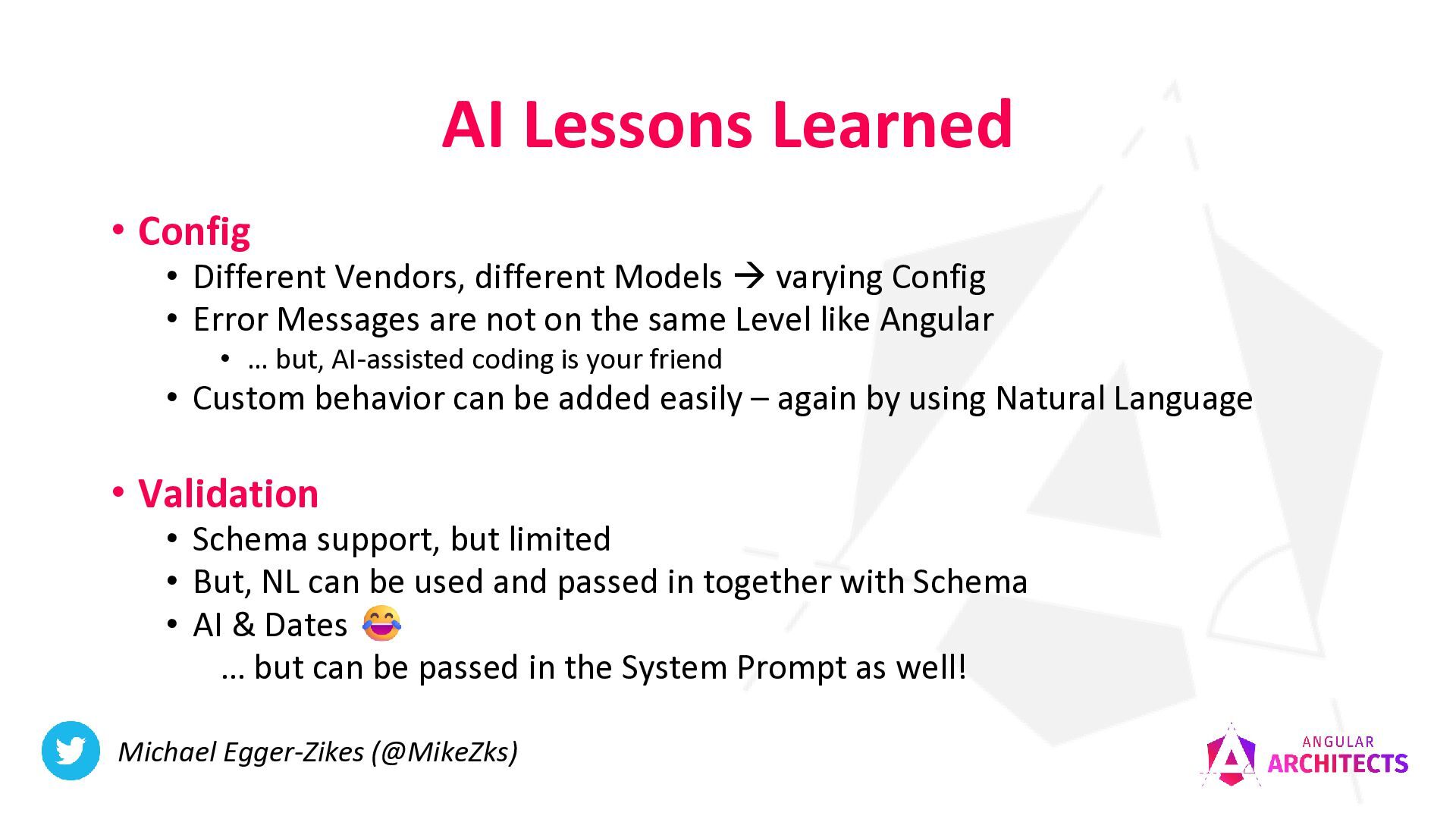
  12. AI Lessons Learned • Config • Different Vendors, different Models

    → varying Config • Error Messages are not on the same Level like Angular • … but, AI-assisted coding is your friend • Custom behavior can be added easily – again by using Natural Language • Validation • Schema support, but limited • But, NL can be used and passed in together with Schema • AI & Dates … but can be passed in the System Prompt as well! Michael Egger-Zikes (@MikeZks)
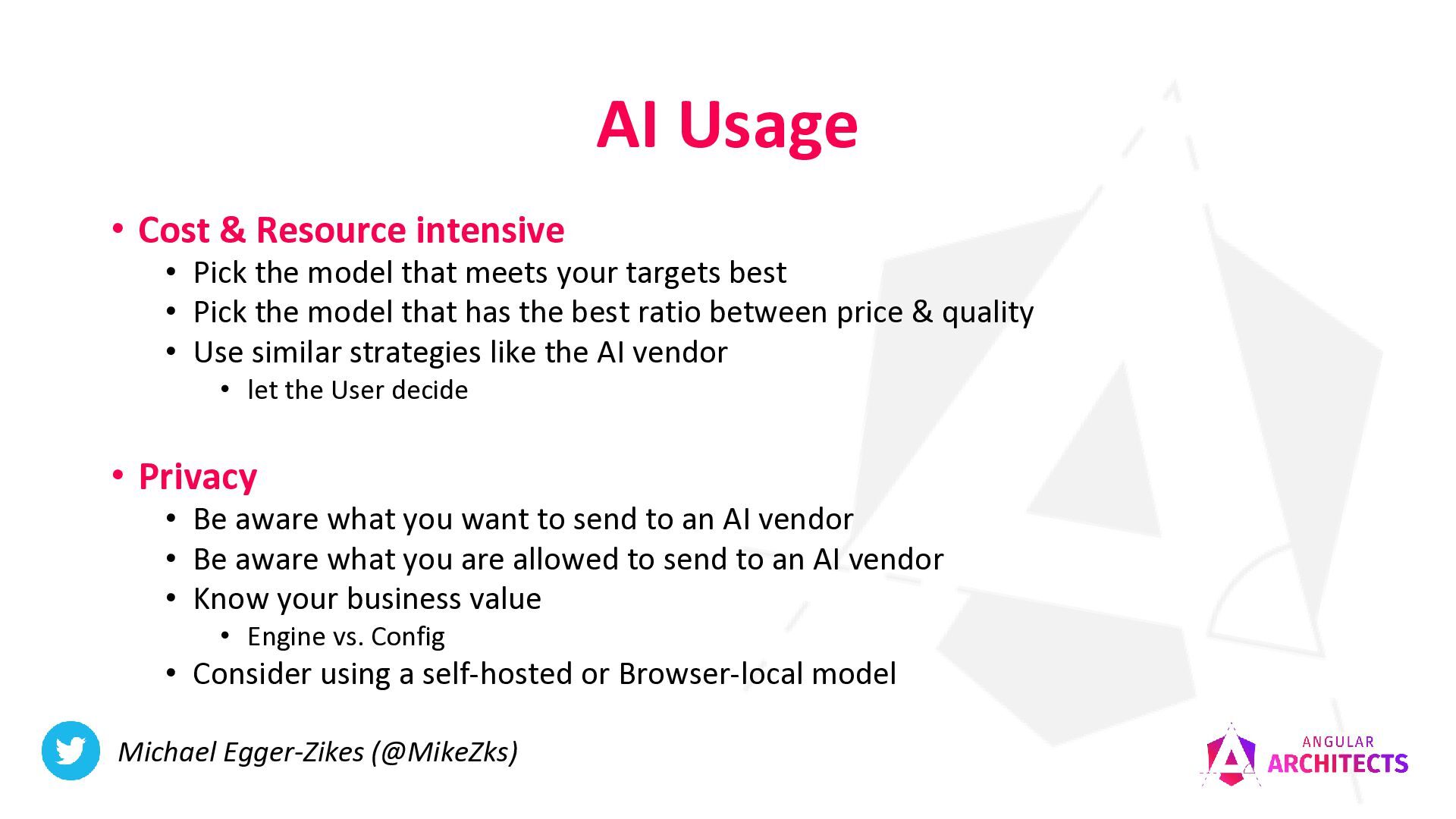
  13. AI Usage • Cost & Resource intensive • Pick the

    model that meets your targets best • Pick the model that has the best ratio between price & quality • Use similar strategies like the AI vendor • let the User decide • Privacy • Be aware what you want to send to an AI vendor • Be aware what you are allowed to send to an AI vendor • Know your business value • Engine vs. Config • Consider using a self-hosted or Browser-local model Michael Egger-Zikes (@MikeZks)
  14. Future AI Integration for Angular Apps • Generic APIs •

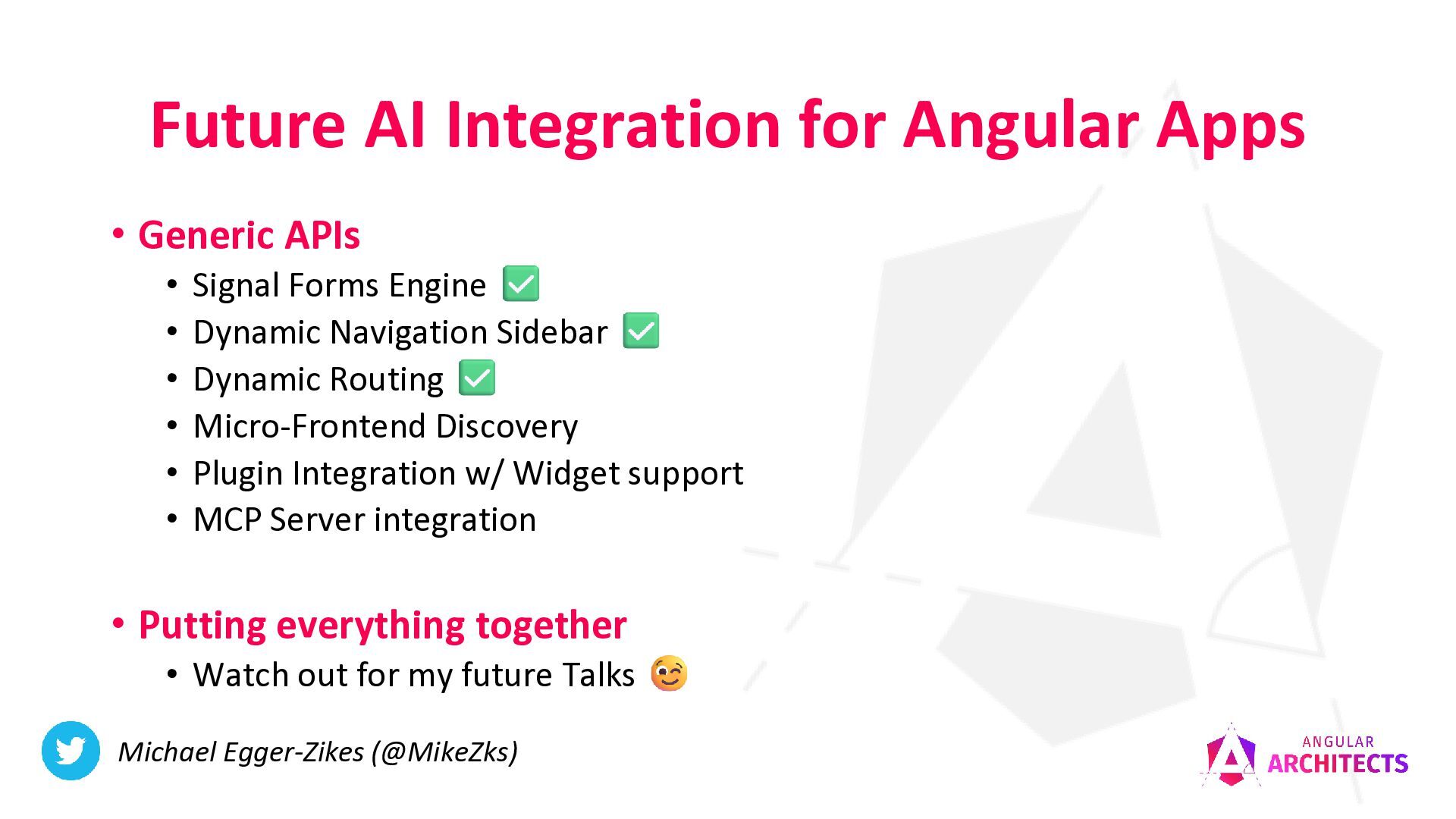
    Signal Forms Engine • Dynamic Navigation Sidebar • Dynamic Routing • Micro-Frontend Discovery • Plugin Integration w/ Widget support • MCP Server integration • Putting everything together • Watch out for my future Talks Michael Egger-Zikes (@MikeZks)
  15. Contact • Slides • Code Link mit einfarbiger Füllung [web]

    ANGULARarchitects.io [twitter] Michael Egger-Zikes (@MikeZks) [repo] https://github.com/mikezks/wts-26-ng-ai Michael Egger-Zikes (@MikeZks) Remote Workshops: Public & tailored to your company angulararchitects.io/angular-workshops