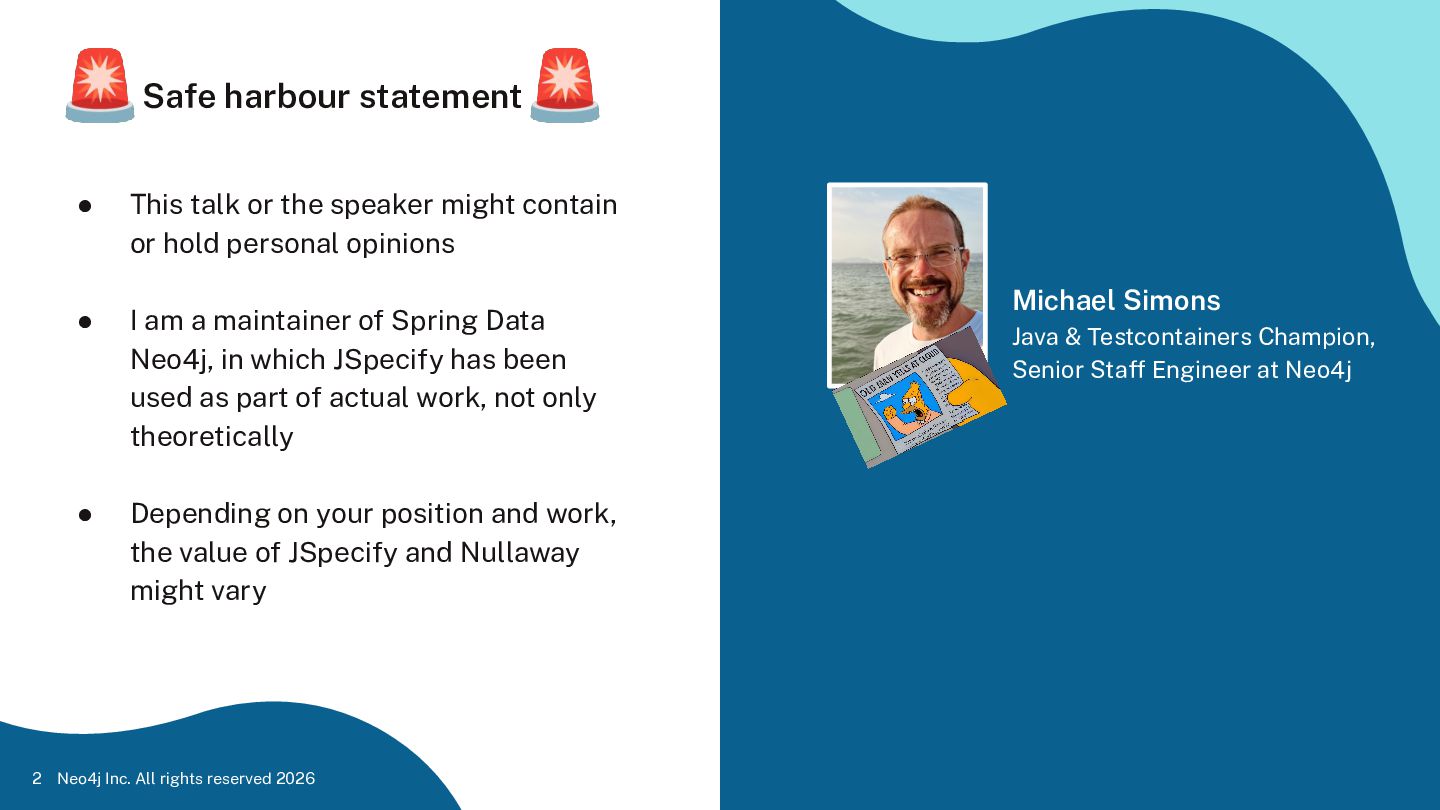
speaker might contain or hold personal opinions • I am a maintainer of Spring Data Neo4j, in which JSpecify has been used as part of actual work, not only theoretically • Depending on your position and work, the value of JSpecify and Nullaway might vary Neo4j Inc. All rights reserved 2026 2 Michael Simons Java & Testcontainers Champion, Senior Staff Engineer at Neo4j
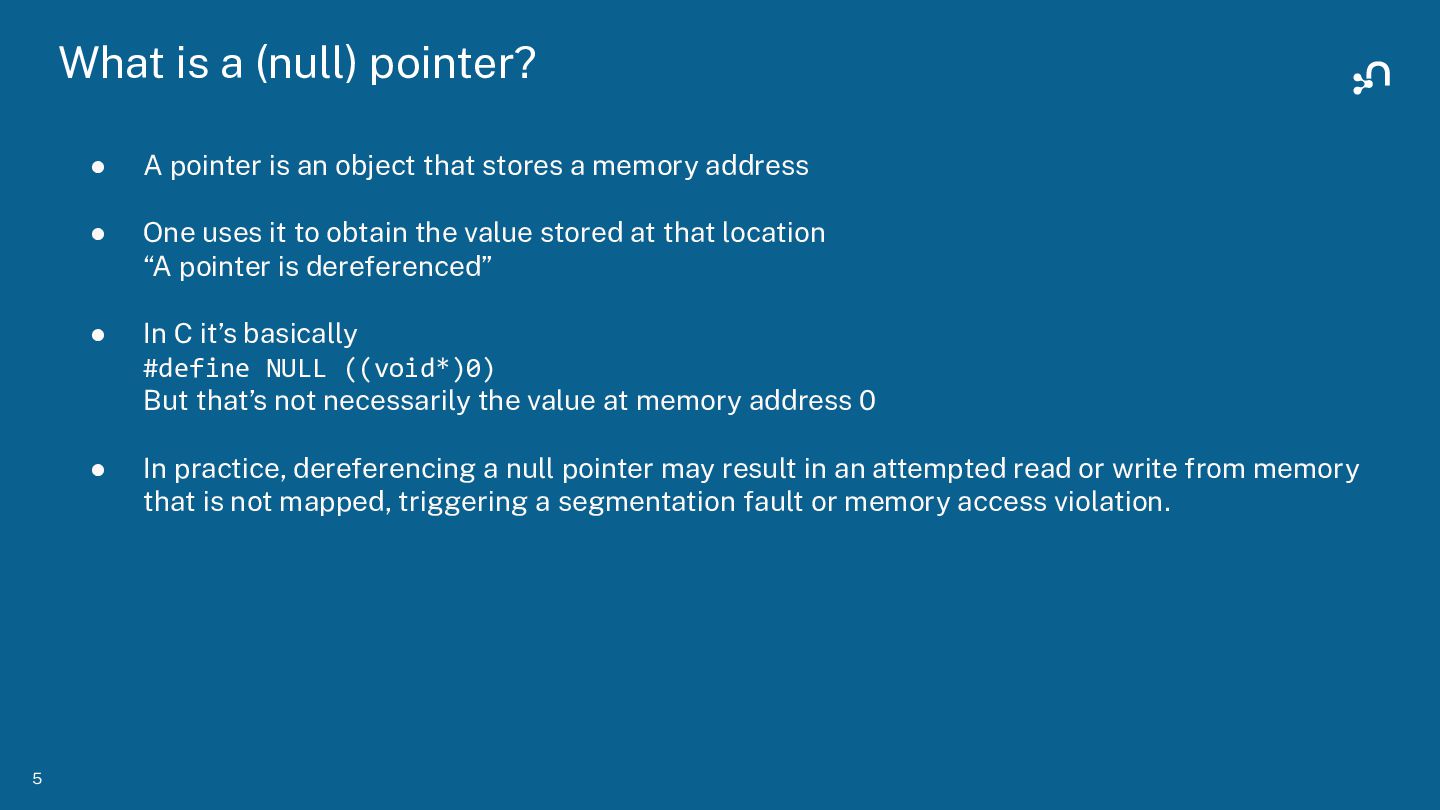
an object that stores a memory address • One uses it to obtain the value stored at that location “A pointer is dereferenced” • In C it’s basically #define NULL ((void*)0) But that’s not necessarily the value at memory address 0 • In practice, dereferencing a null pointer may result in an attempted read or write from memory that is not mapped, triggering a segmentation fault or memory access violation.
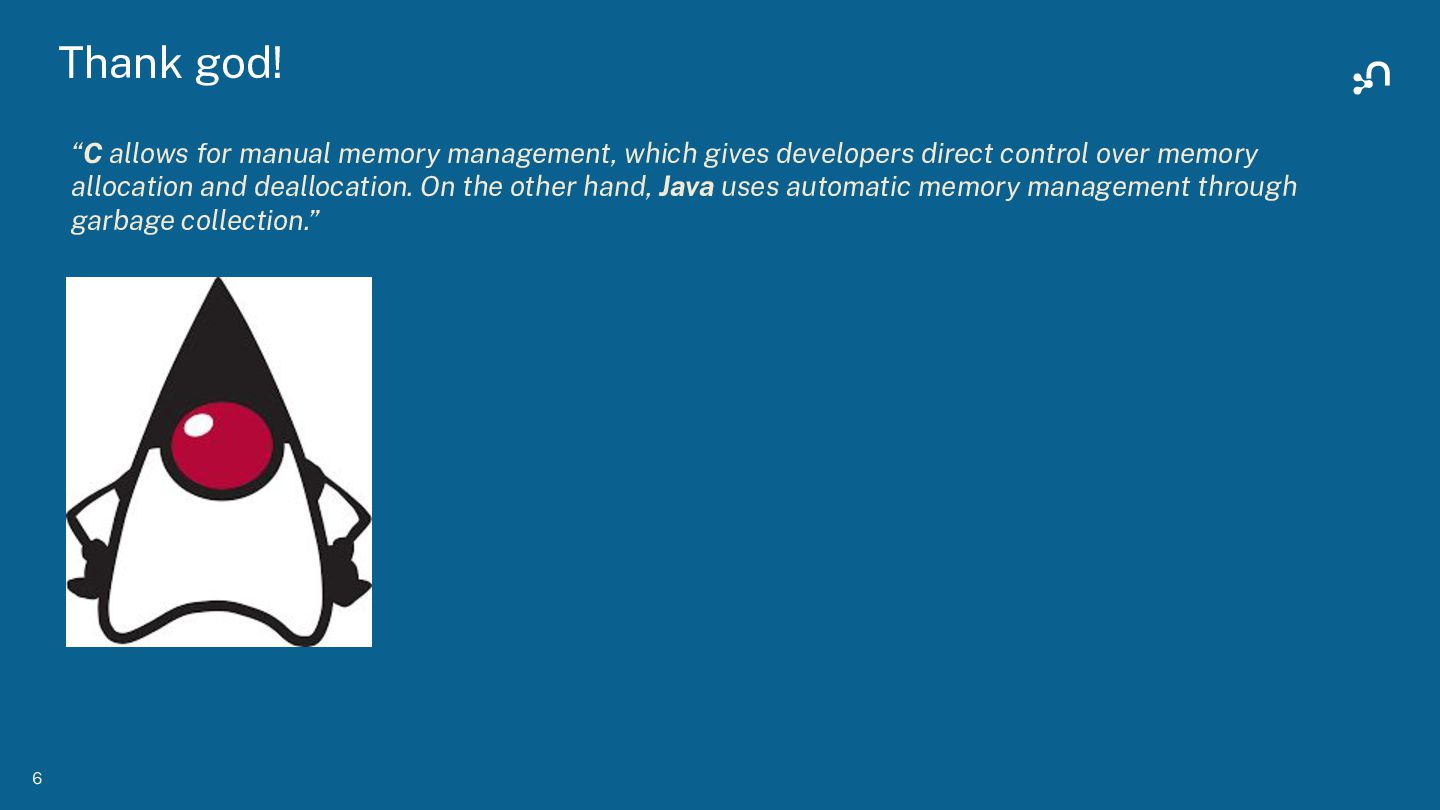
gives developers direct control over memory allocation and deallocation. On the other hand, Java uses automatic memory management through garbage collection.”
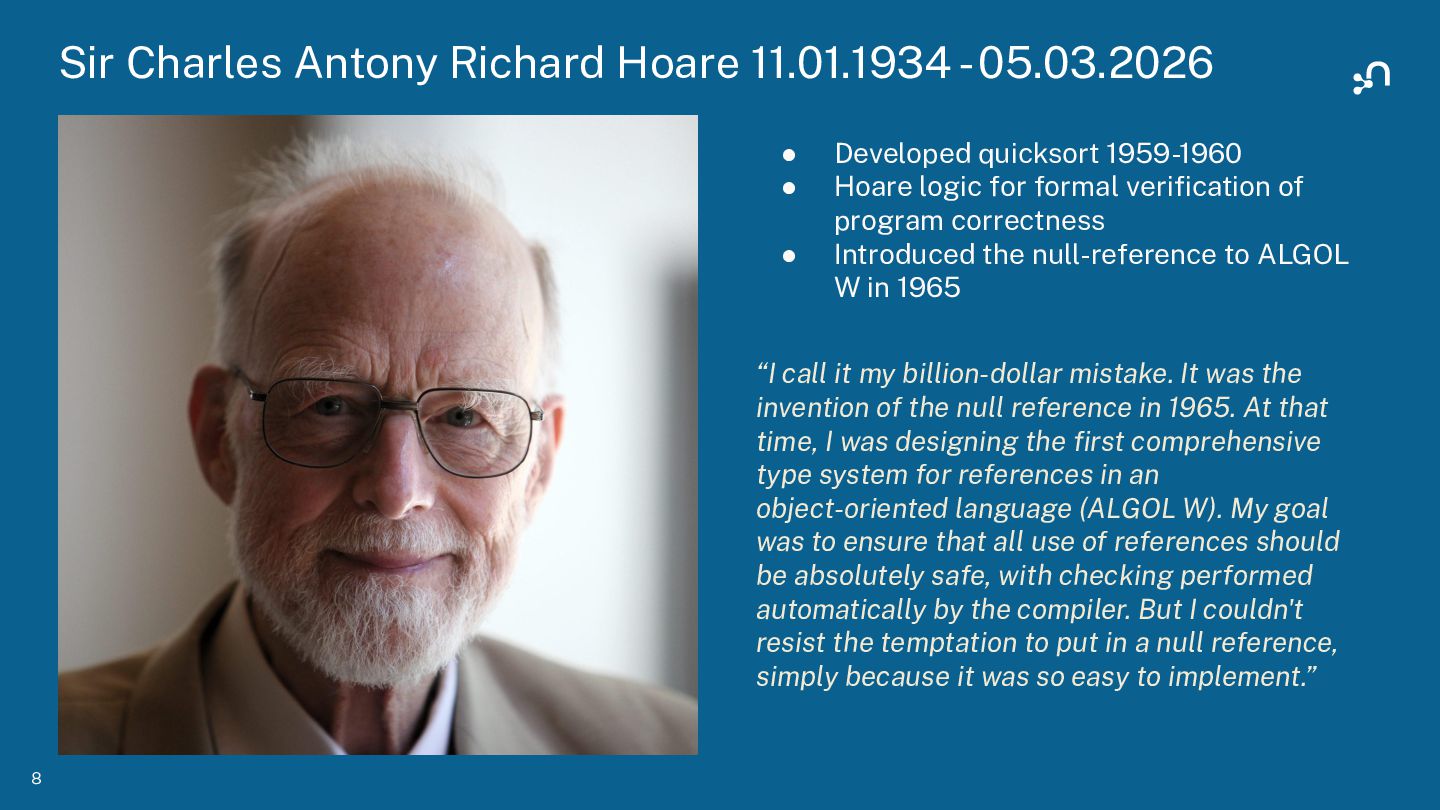
Developed quicksort 1959-1960 • Hoare logic for formal verification of program correctness • Introduced the null-reference to ALGOL W in 1965 “I call it my billion-dollar mistake. It was the invention of the null reference in 1965. At that time, I was designing the first comprehensive type system for references in an object-oriented language (ALGOL W). My goal was to ensure that all use of references should be absolutely safe, with checking performed automatically by the compiler. But I couldn't resist the temptation to put in a null reference, simply because it was so easy to implement.”
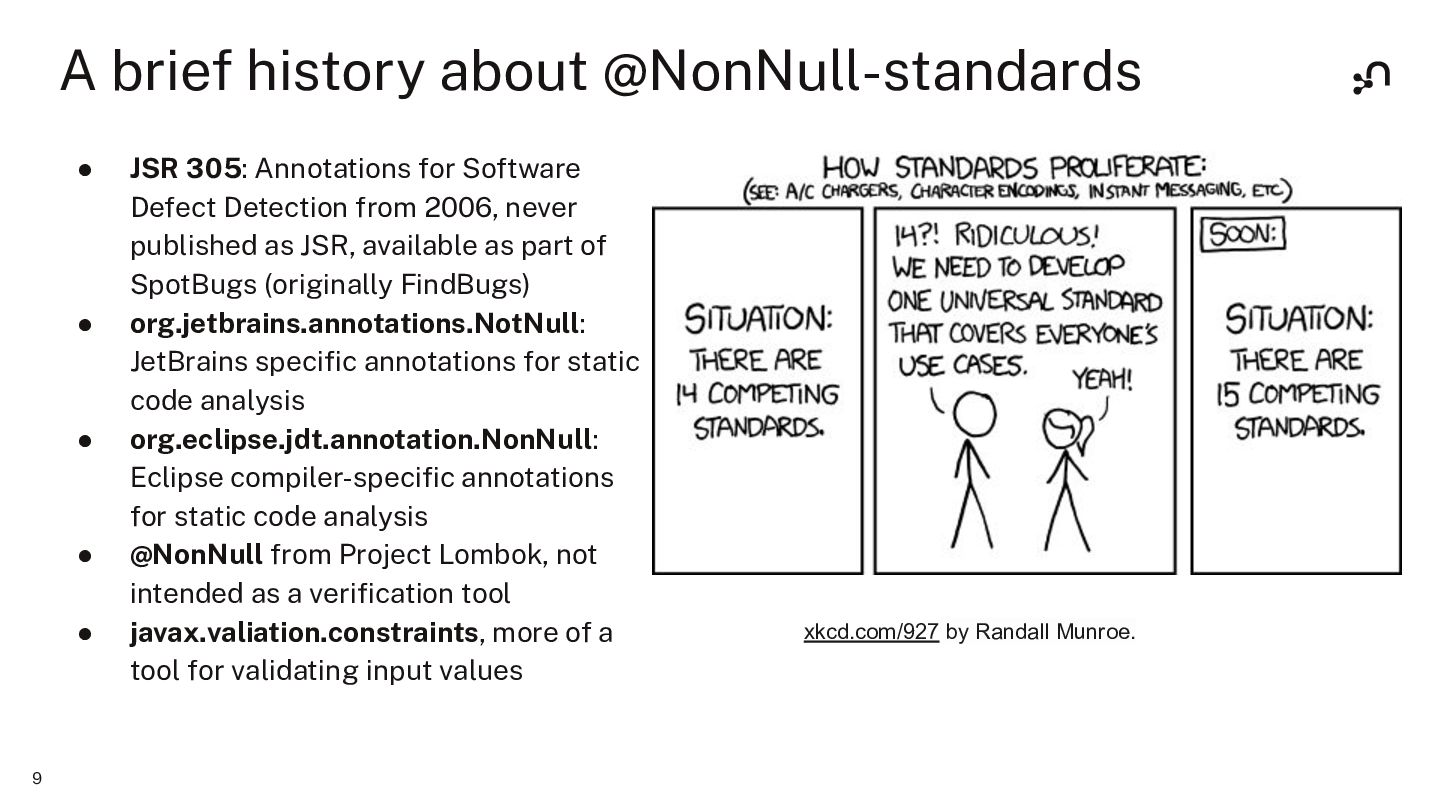
for Software Defect Detection from 2006, never published as JSR, available as part of SpotBugs (originally FindBugs) • org.jetbrains.annotations.NotNull: JetBrains specific annotations for static code analysis • org.eclipse.jdt.annotation.NonNull: Eclipse compiler-specific annotations for static code analysis • @NonNull from Project Lombok, not intended as a verification tool • javax.valiation.constraints, more of a tool for validating input values xkcd.com/927 by Randall Munroe.
very similar • Designed by a committee of industry and research experts • Google • JetBrains • Meta • Microsoft • Oracle • Sonar • Uber and • Broadcom (Spring Framework) 10
nullness analysis by letting you communicate, for each type usage, whether it is nullable or non-null. A core element of the JSpecify design is that nullness is not binary, but rather ternary: • nullable types • non-null types • and types of unspecified nullness
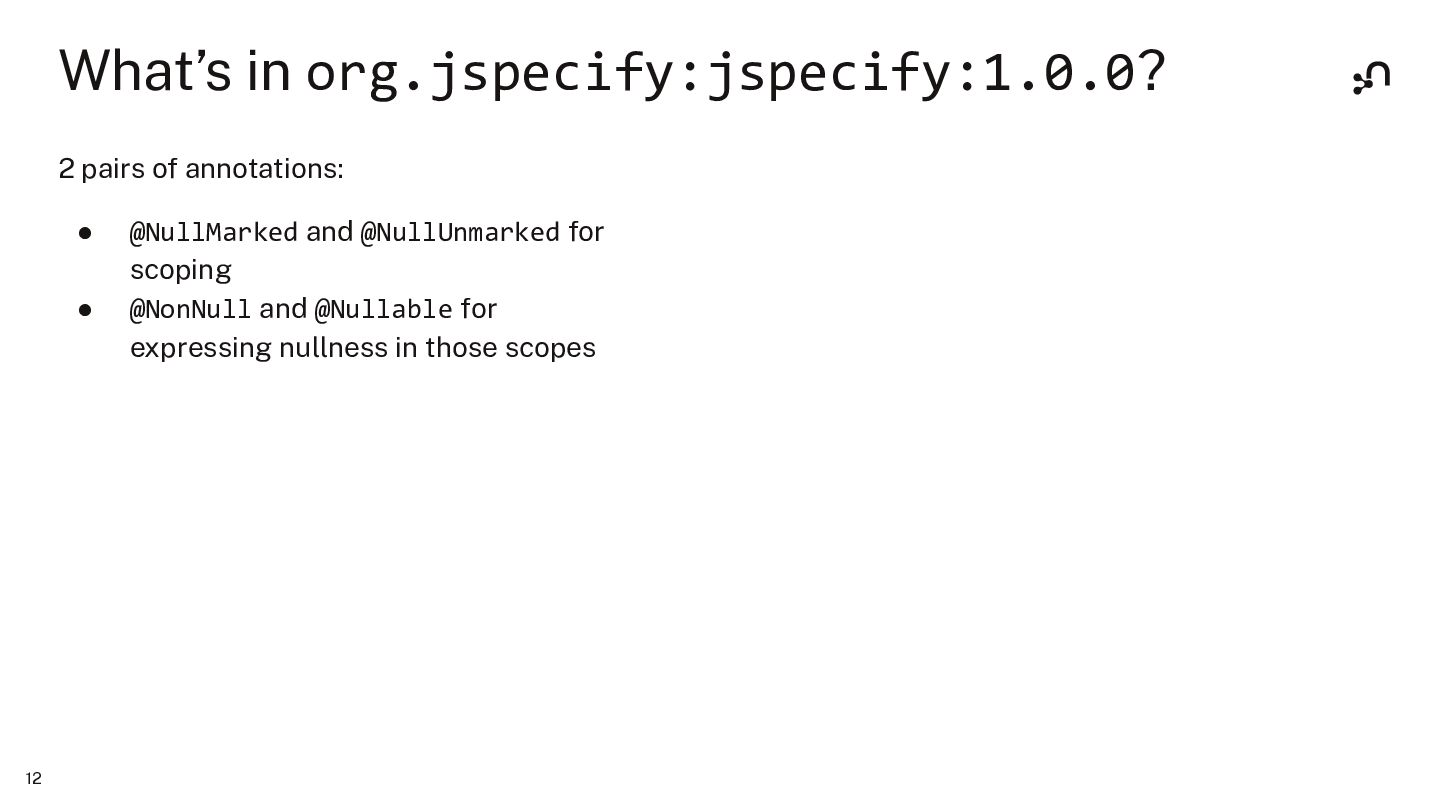
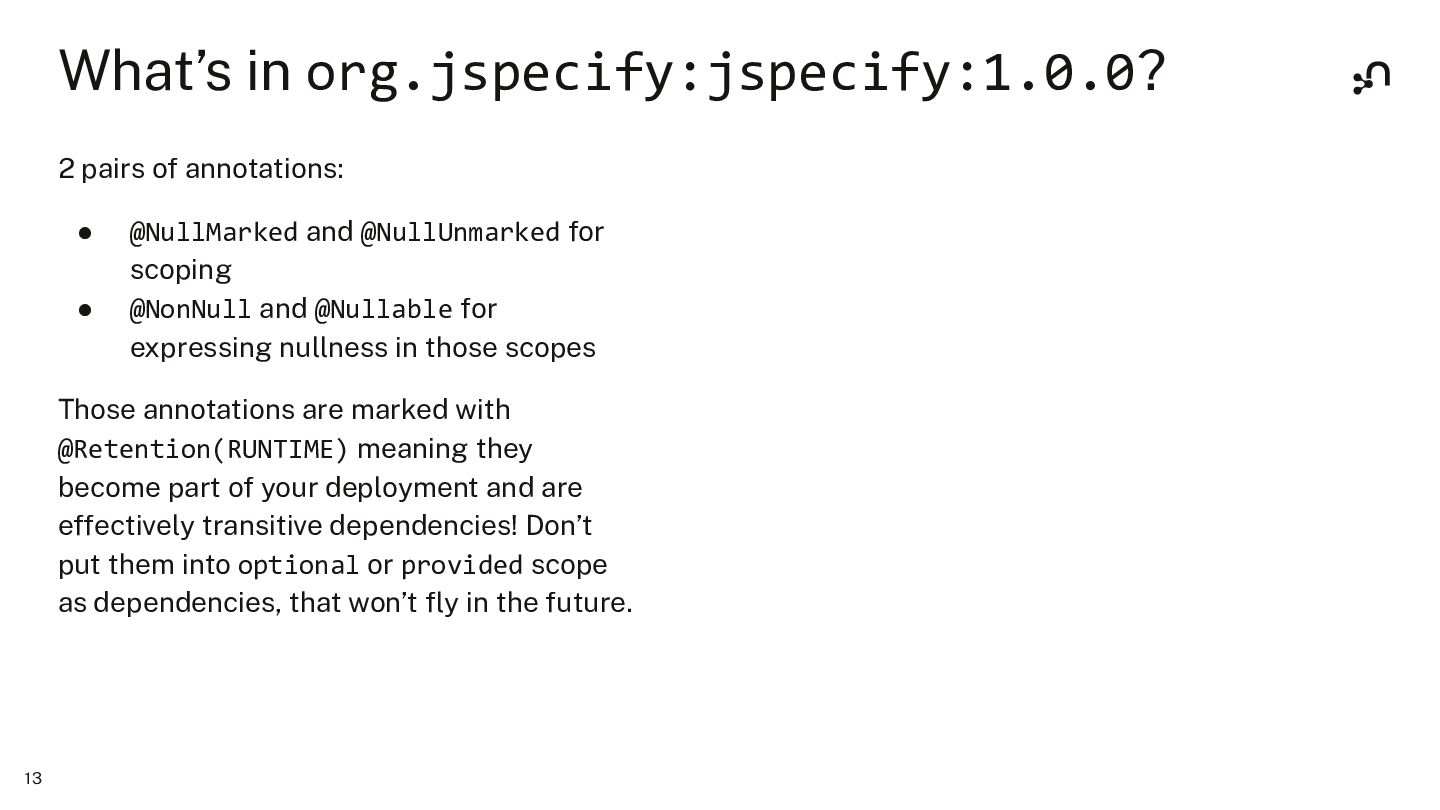
and @NullUnmarked for scoping • @NonNull and @Nullable for expressing nullness in those scopes Those annotations are marked with @Retention(RUNTIME) meaning they become part of your deployment and are effectively transitive dependencies! Don’t put them into optional or provided scope as dependencies, that won’t fly in the future.
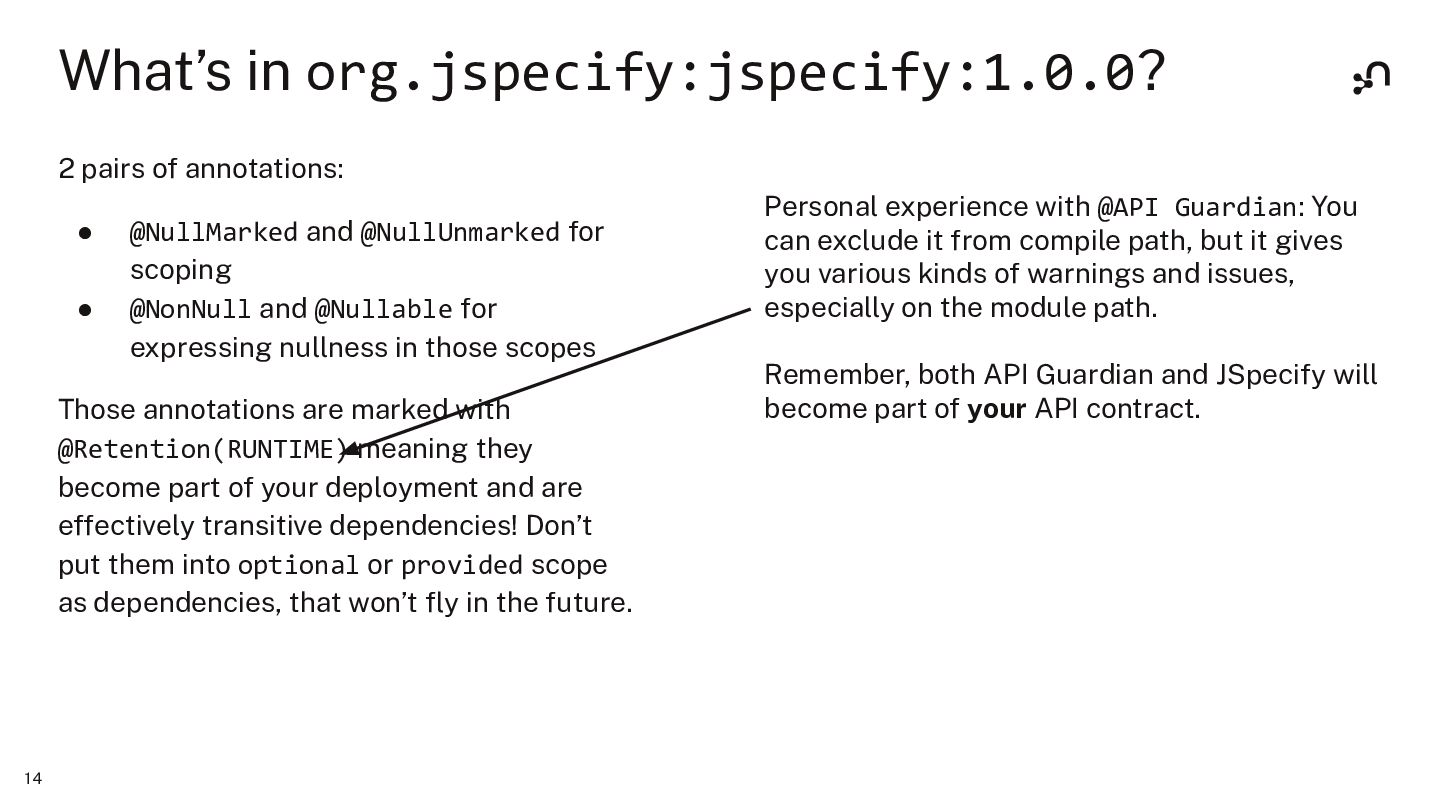
and @NullUnmarked for scoping • @NonNull and @Nullable for expressing nullness in those scopes Those annotations are marked with @Retention(RUNTIME) meaning they become part of your deployment and are effectively transitive dependencies! Don’t put them into optional or provided scope as dependencies, that won’t fly in the future. Personal experience with @API Guardian: You can exclude it from compile path, but it gives you various kinds of warnings and issues, especially on the module path. Remember, both API Guardian and JSpecify will become part of your API contract.
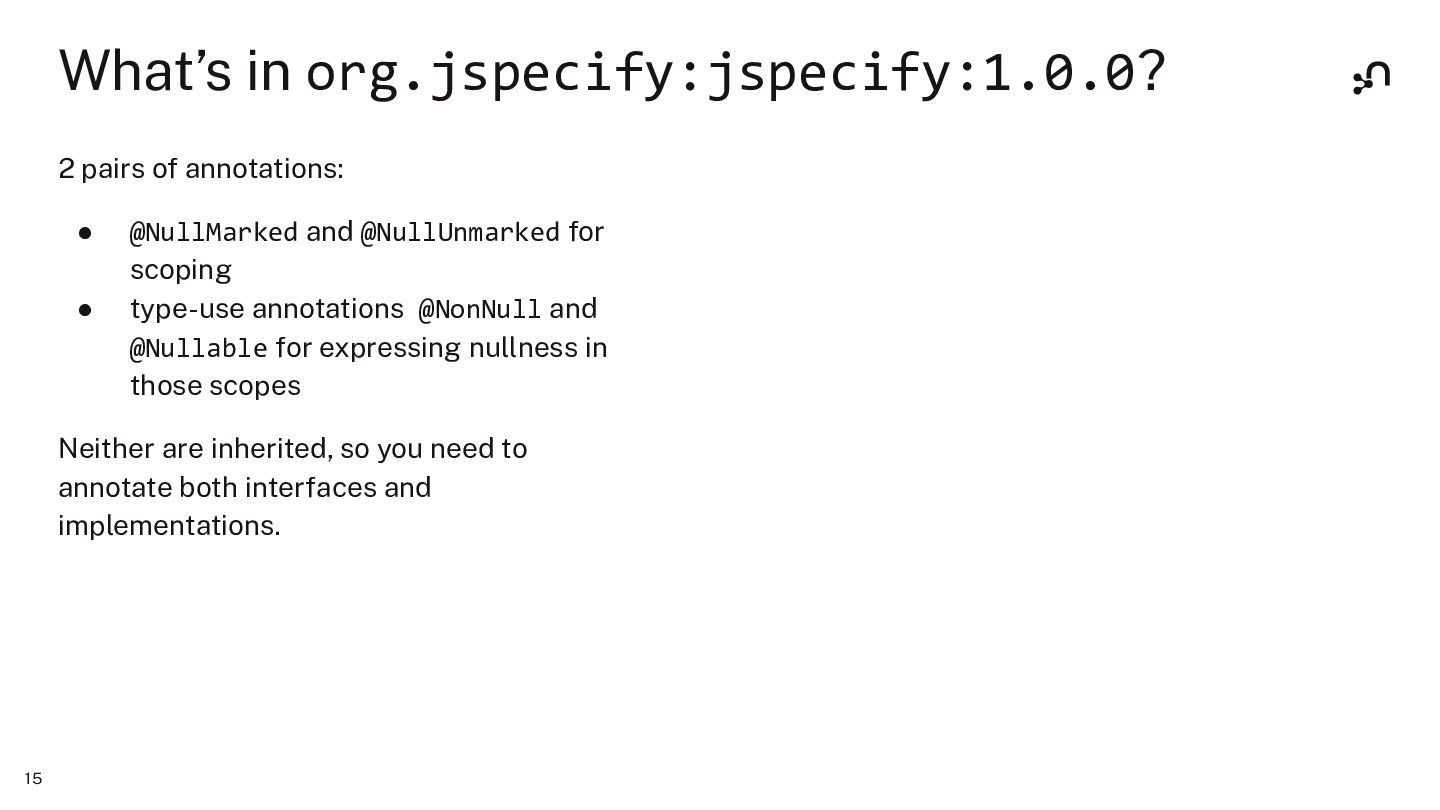
and @NullUnmarked for scoping • type-use annotations @NonNull and @Nullable for expressing nullness in those scopes Neither are inherited, so you need to annotate both interfaces and implementations.
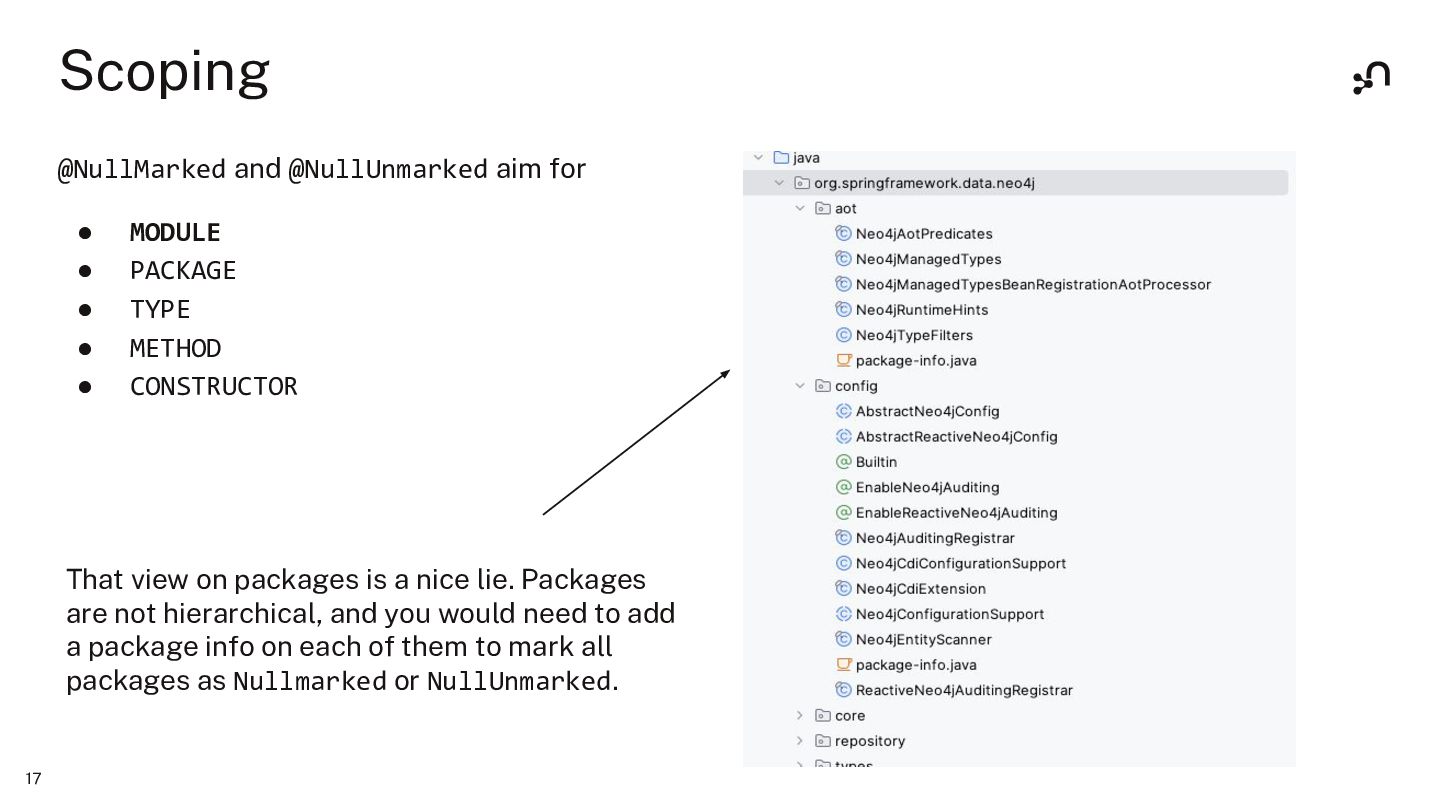
PACKAGE • TYPE • METHOD • CONSTRUCTOR That view on packages is a nice lie. Packages are not hierarchical, and you would need to add a package info on each of them to mark all packages as Nullmarked or NullUnmarked.
which you made sure that all types that are not annotated as nullable, are in fact: Not nullable. • Use @NullUnmarked for single packages in modules or classes in packages for which you want to stick with unspecified nullness.
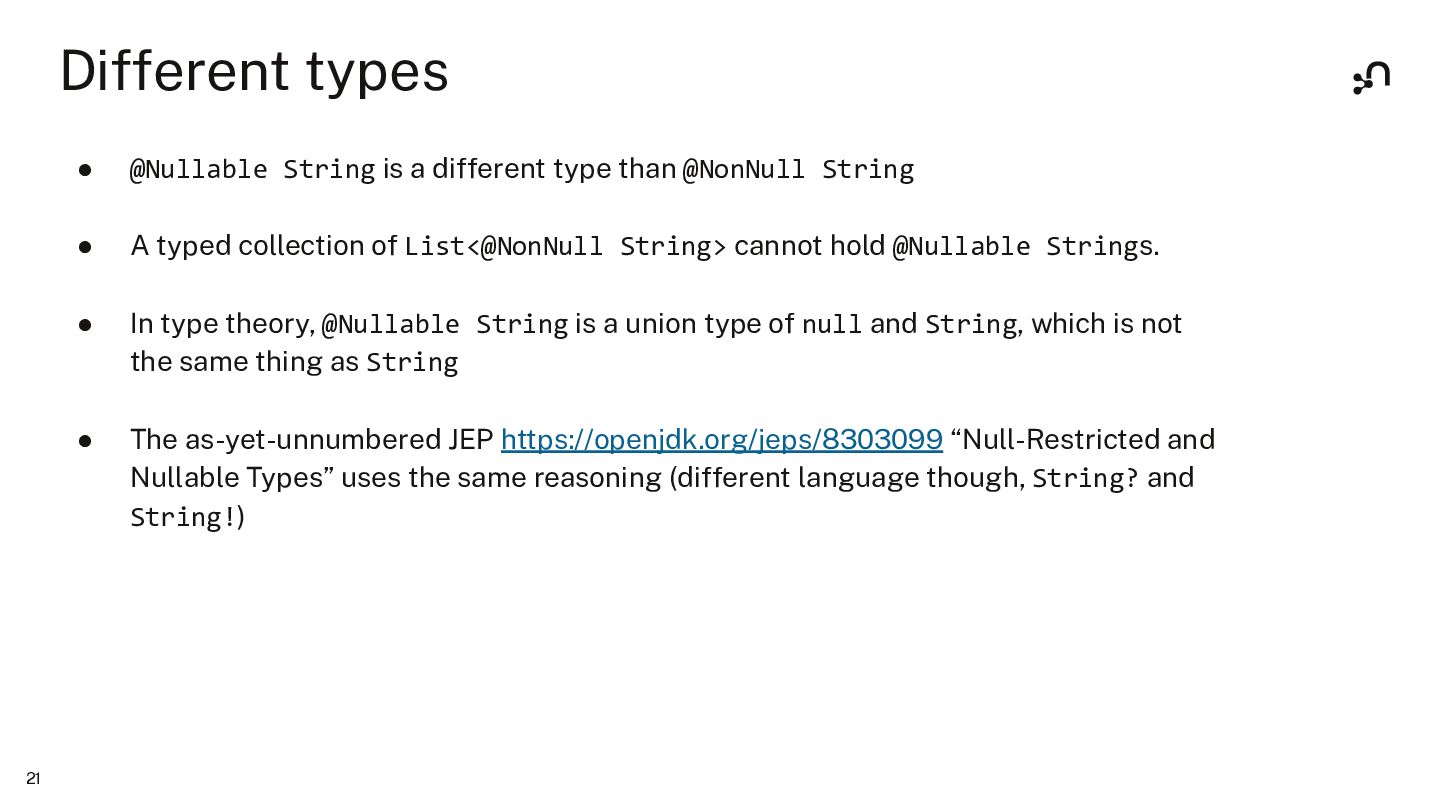
than @NonNull String • A typed collection of List<@NonNull String> cannot hold @Nullable Strings. • In type theory, @Nullable String is a union type of null and String, which is not the same thing as String
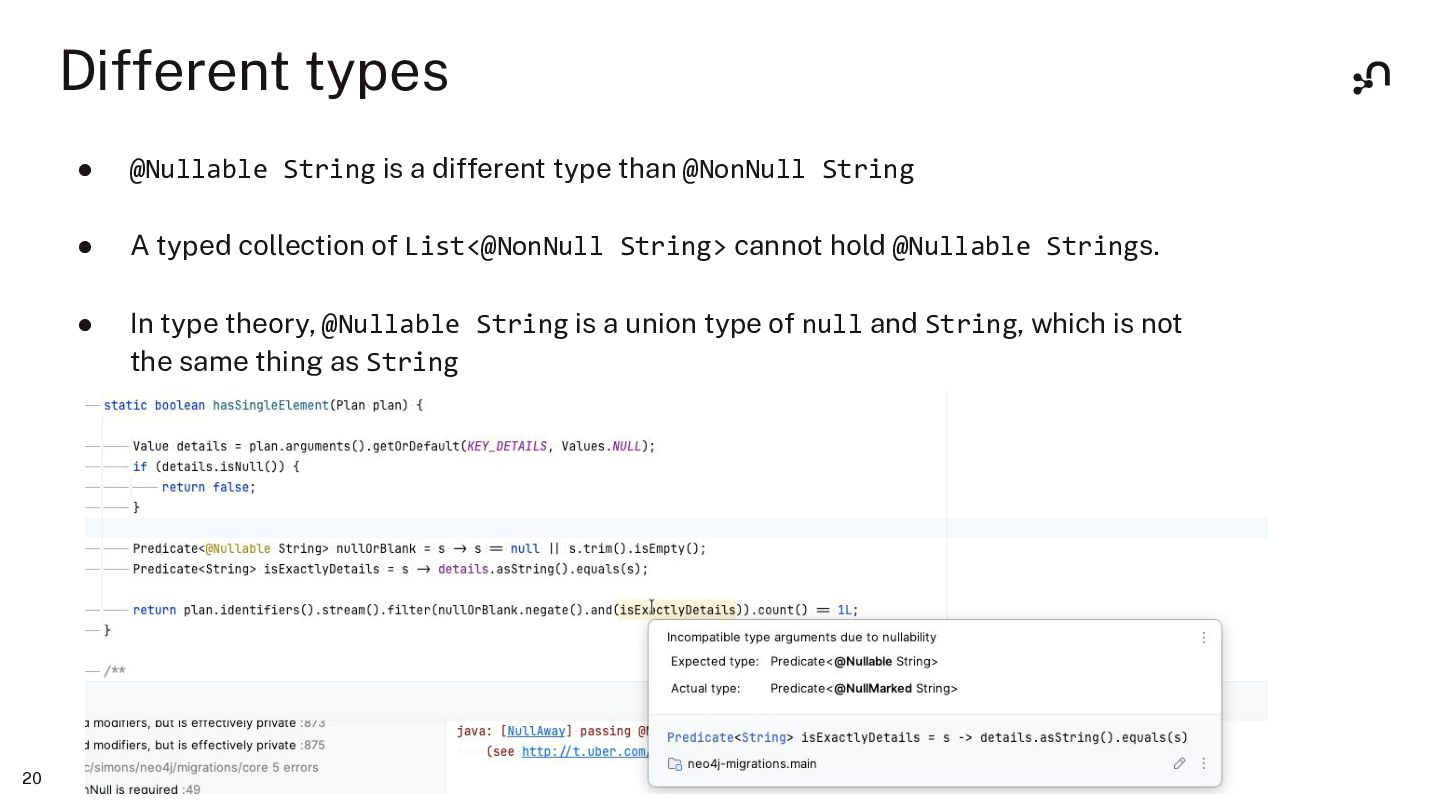
than @NonNull String • A typed collection of List<@NonNull String> cannot hold @Nullable Strings. • In type theory, @Nullable String is a union type of null and String, which is not the same thing as String
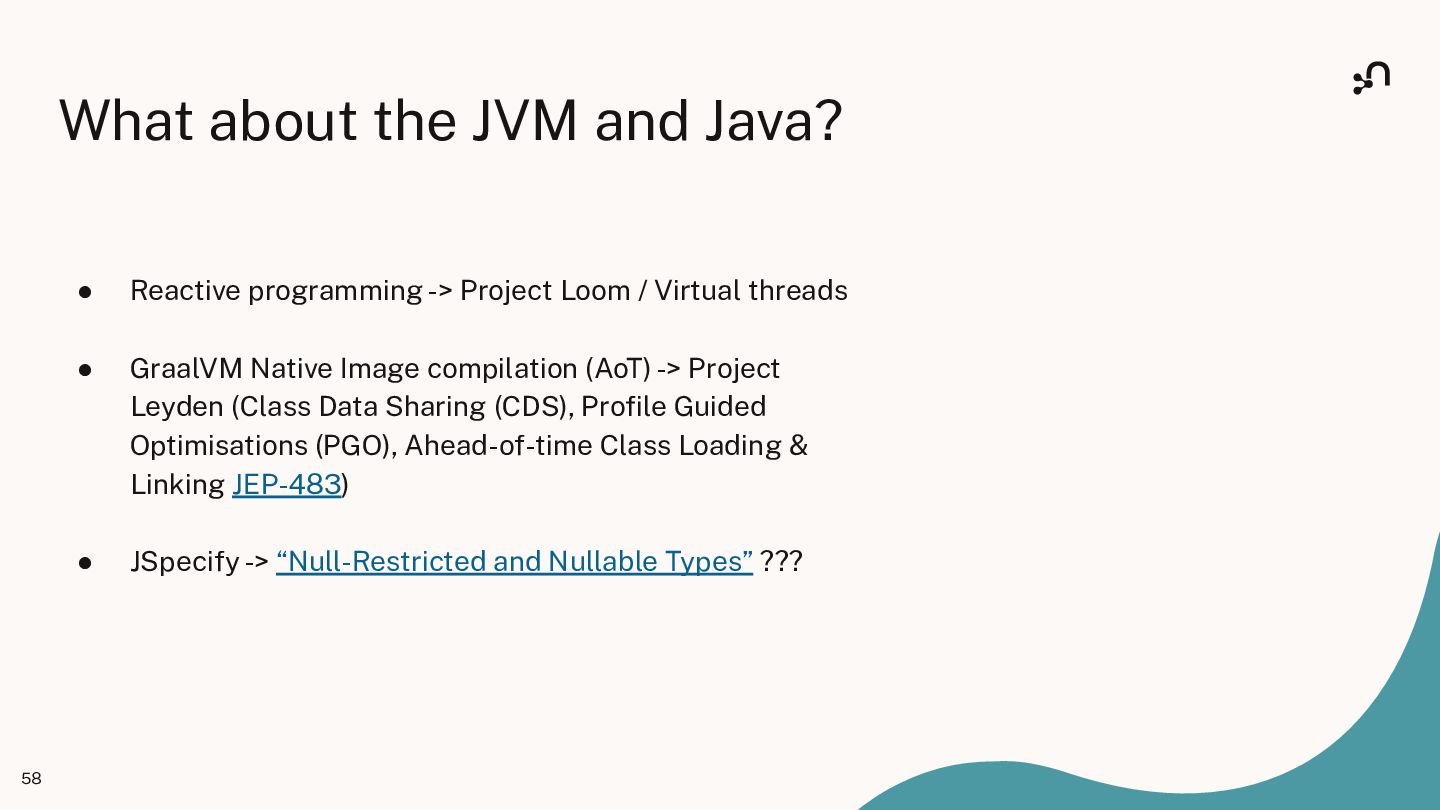
than @NonNull String • A typed collection of List<@NonNull String> cannot hold @Nullable Strings. • In type theory, @Nullable String is a union type of null and String, which is not the same thing as String • The as-yet-unnumbered JEP https://openjdk.org/jeps/8303099 “Null-Restricted and Nullable Types” uses the same reasoning (different language though, String? and String!)
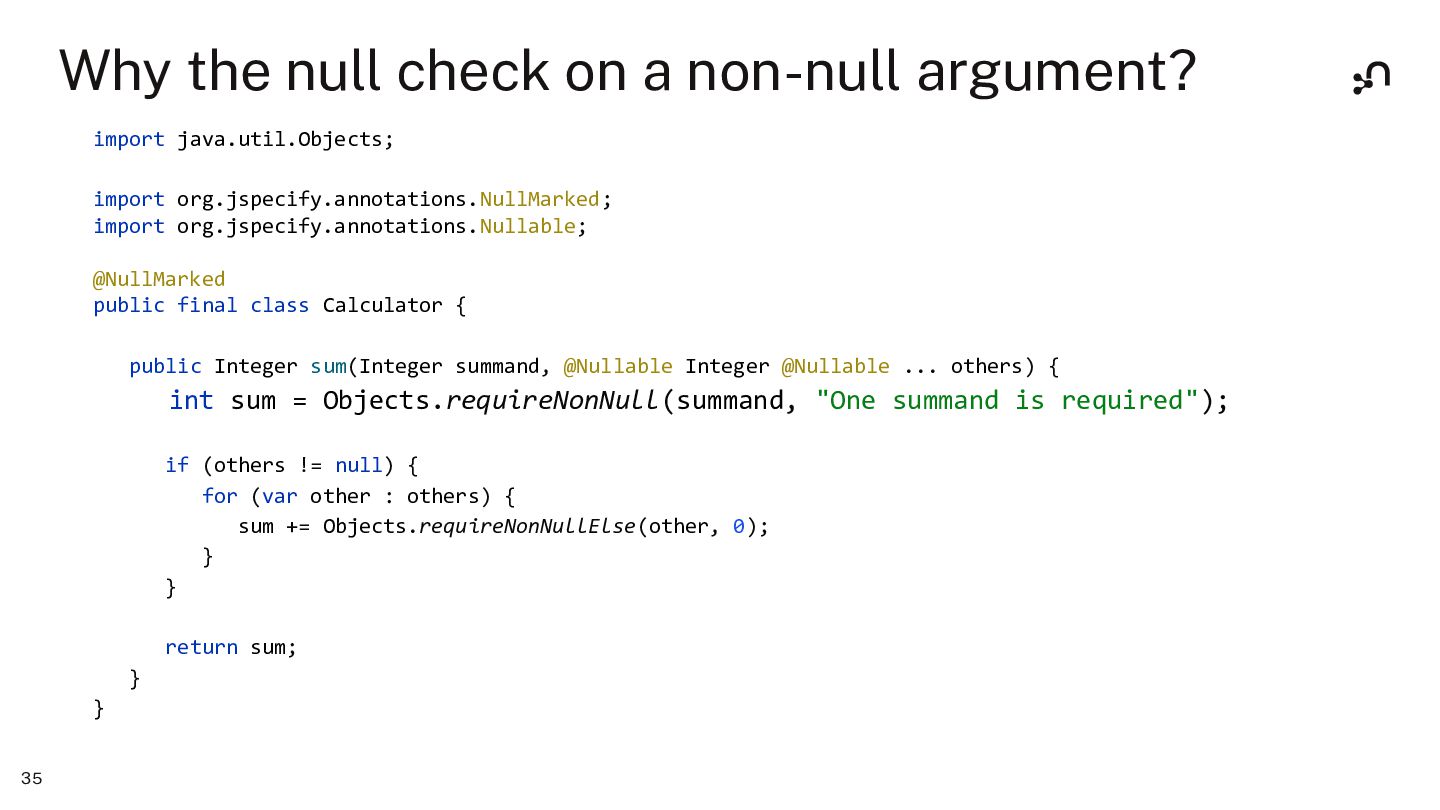
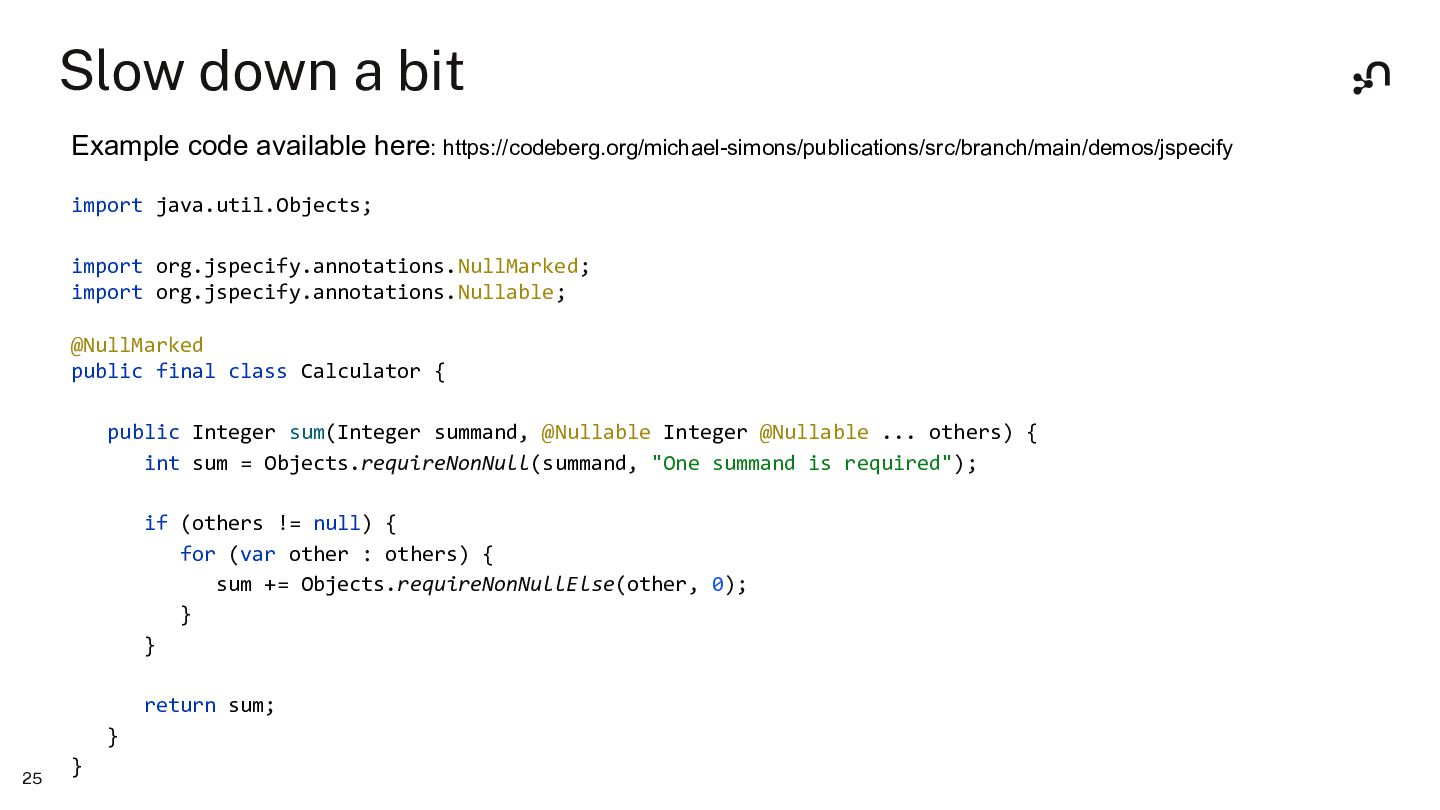
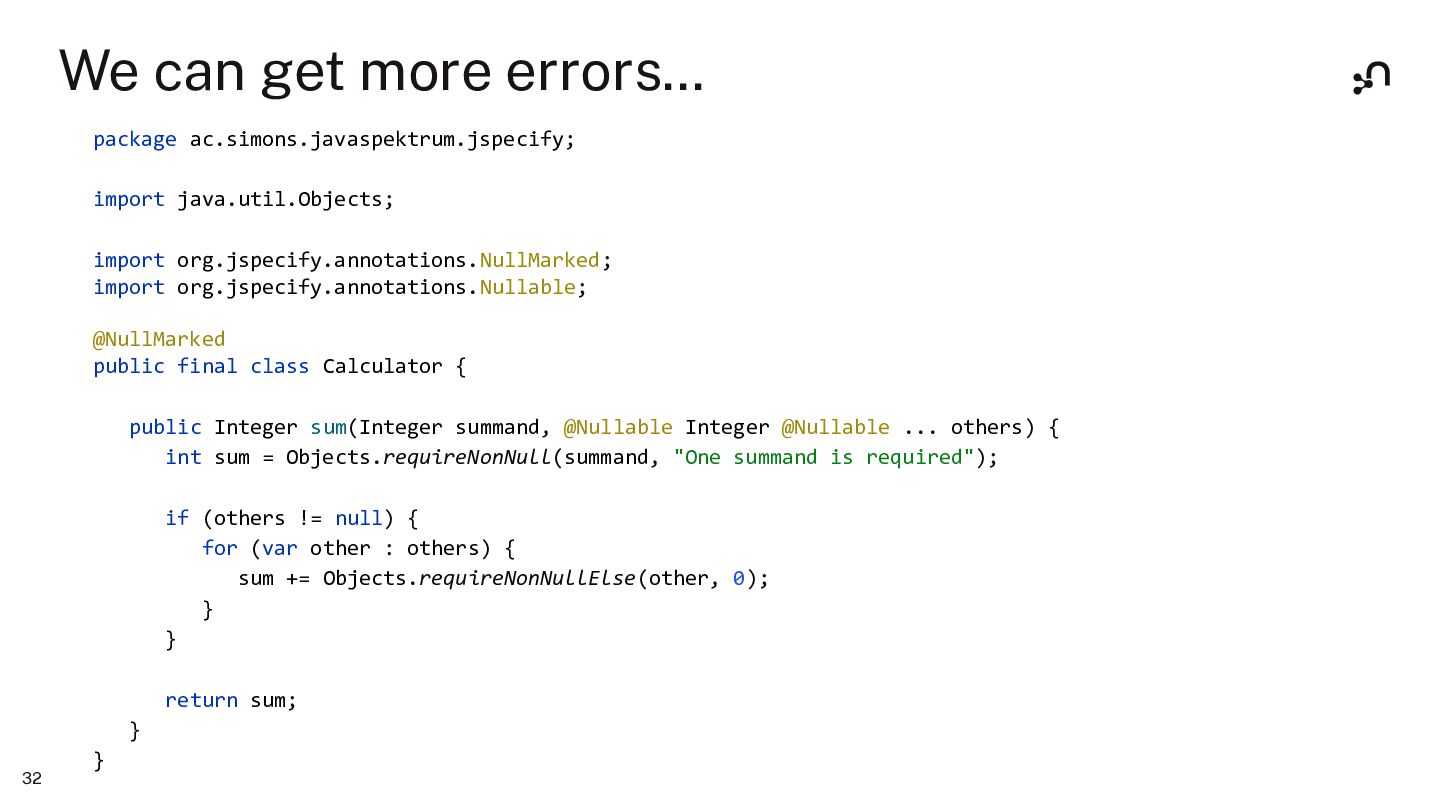
import java.util.Objects; import org.jspecify.annotations.NullMarked; import org.jspecify.annotations.Nullable; @NullMarked public final class Calculator { public Integer sum(Integer summand, @Nullable Integer @Nullable ... others) { int sum = Objects.requireNonNull(summand, "One summand is required"); if (others != null) { for (var other : others) { sum += Objects.requireNonNullElse(other, 0); } } return sum; } }
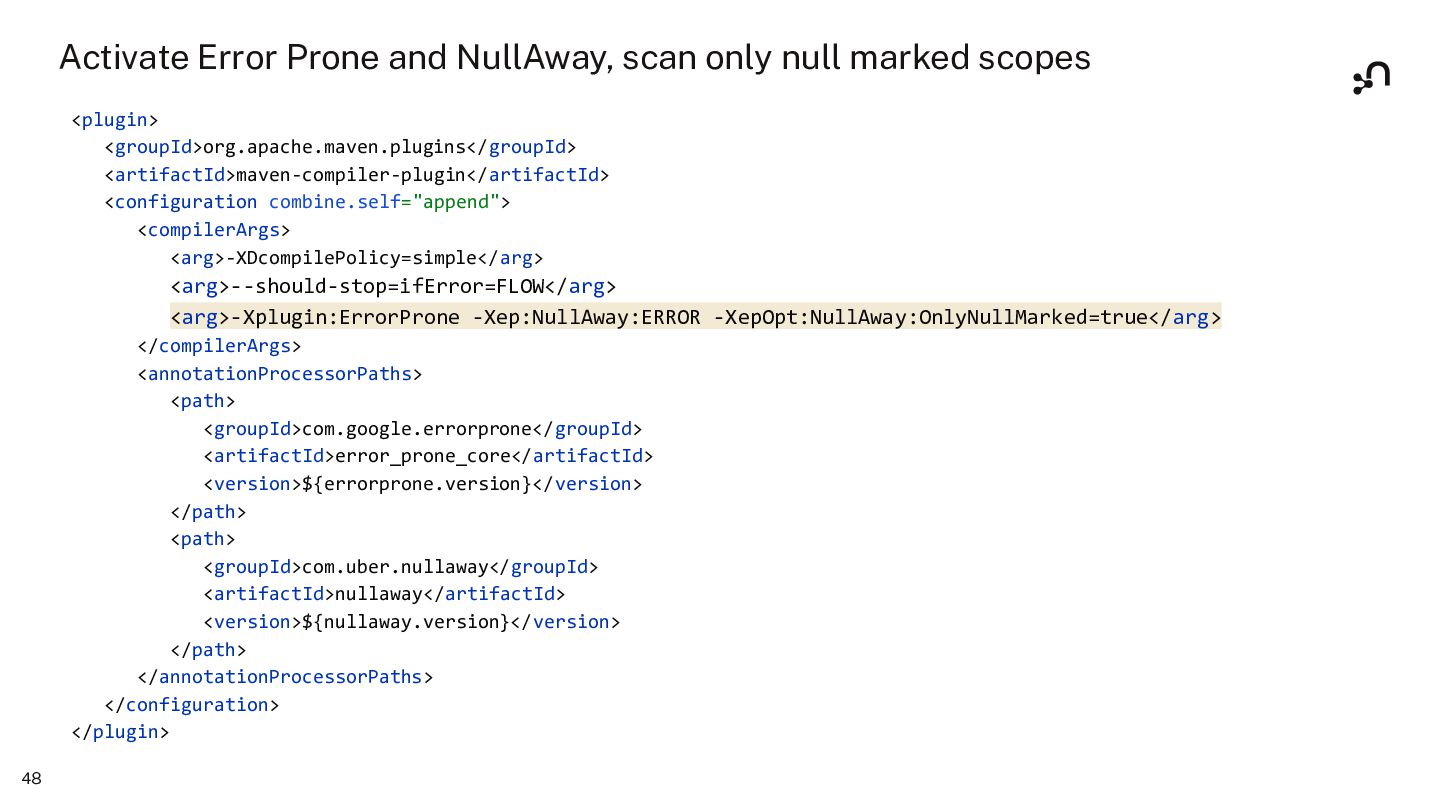
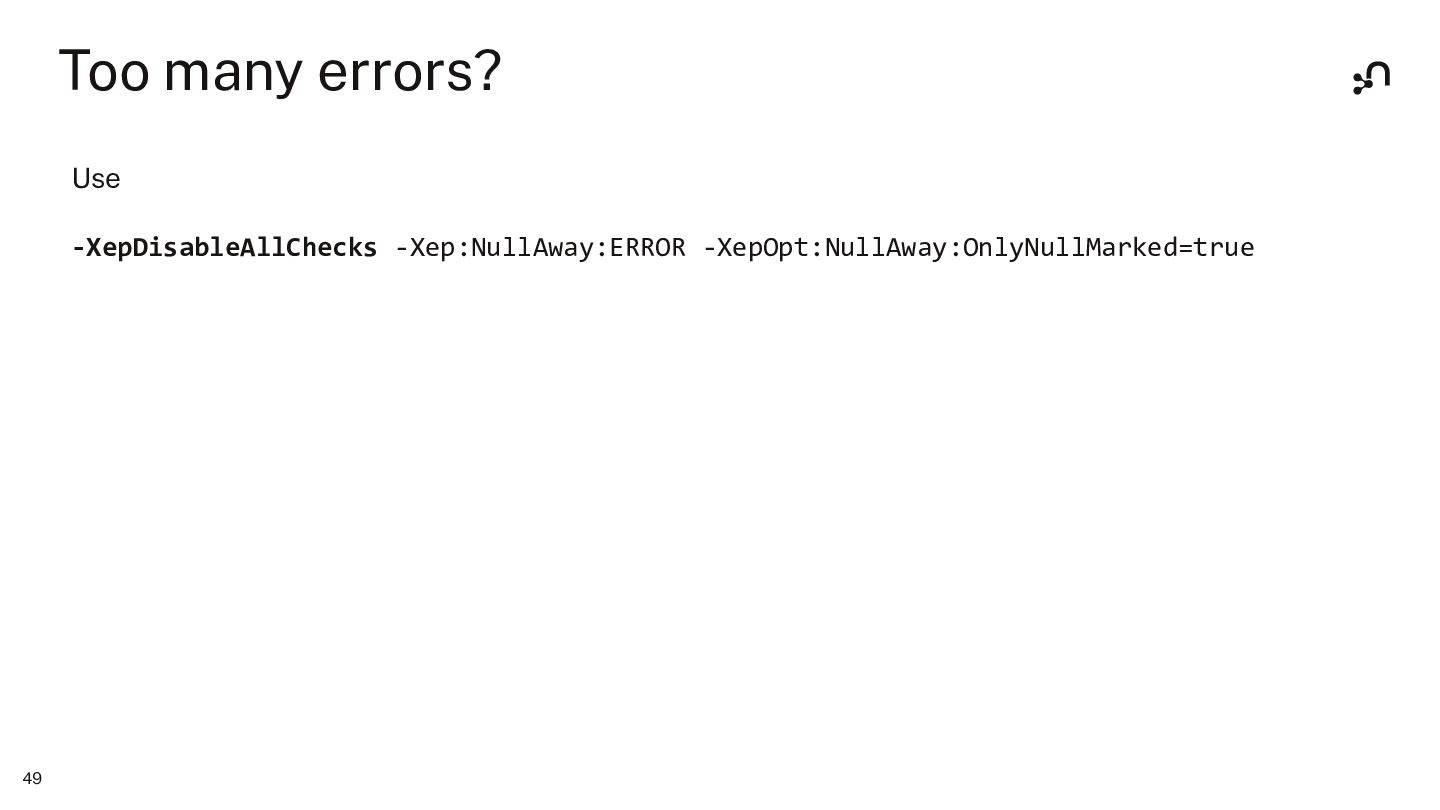
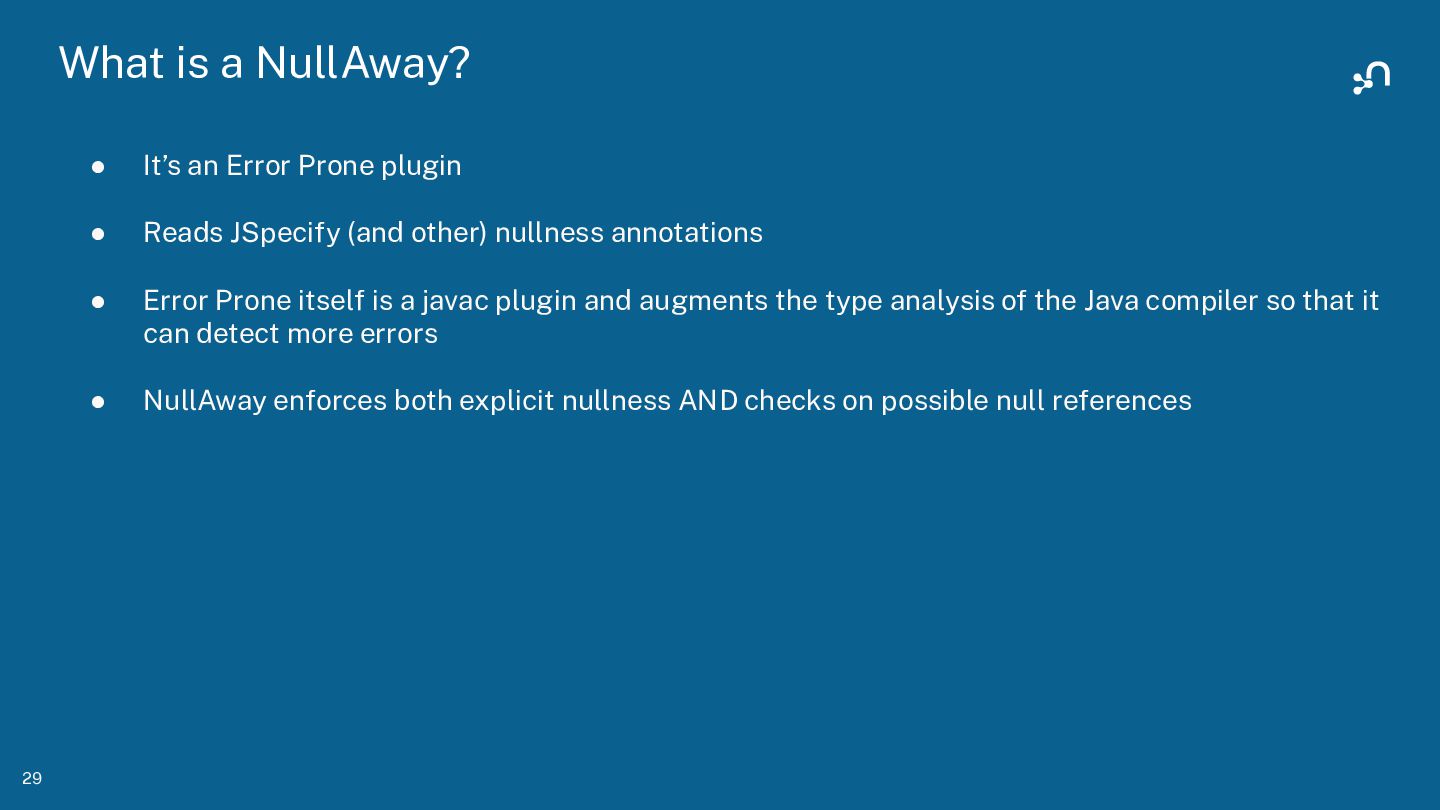
plugin • Reads JSpecify (and other) nullness annotations • Error Prone itself is a javac plugin and augments the type analysis of the Java compiler so that it can detect more errors • NullAway enforces both explicit nullness AND checks on possible null references
import org.jspecify.annotations.NullMarked; import org.jspecify.annotations.Nullable; @NullMarked public final class Calculator { public Integer sum(Integer summand, @Nullable Integer @Nullable ... others) { int sum = Objects.requireNonNull(summand, "One summand is required"); if (others != null) { for (var other : others) { sum += Objects.requireNonNullElse(other, 0); } } return sum; } }
java.util.Objects; import org.jspecify.annotations.NullMarked; import org.jspecify.annotations.Nullable; @NullMarked public final class Calculator { public Integer sum(Integer summand, @Nullable Integer @Nullable ... others) { int sum = Objects.requireNonNull(summand, "One summand is required"); if (others != null) { for (var other : others) { sum += Objects.requireNonNullElse(other, 0); } } return sum; } }
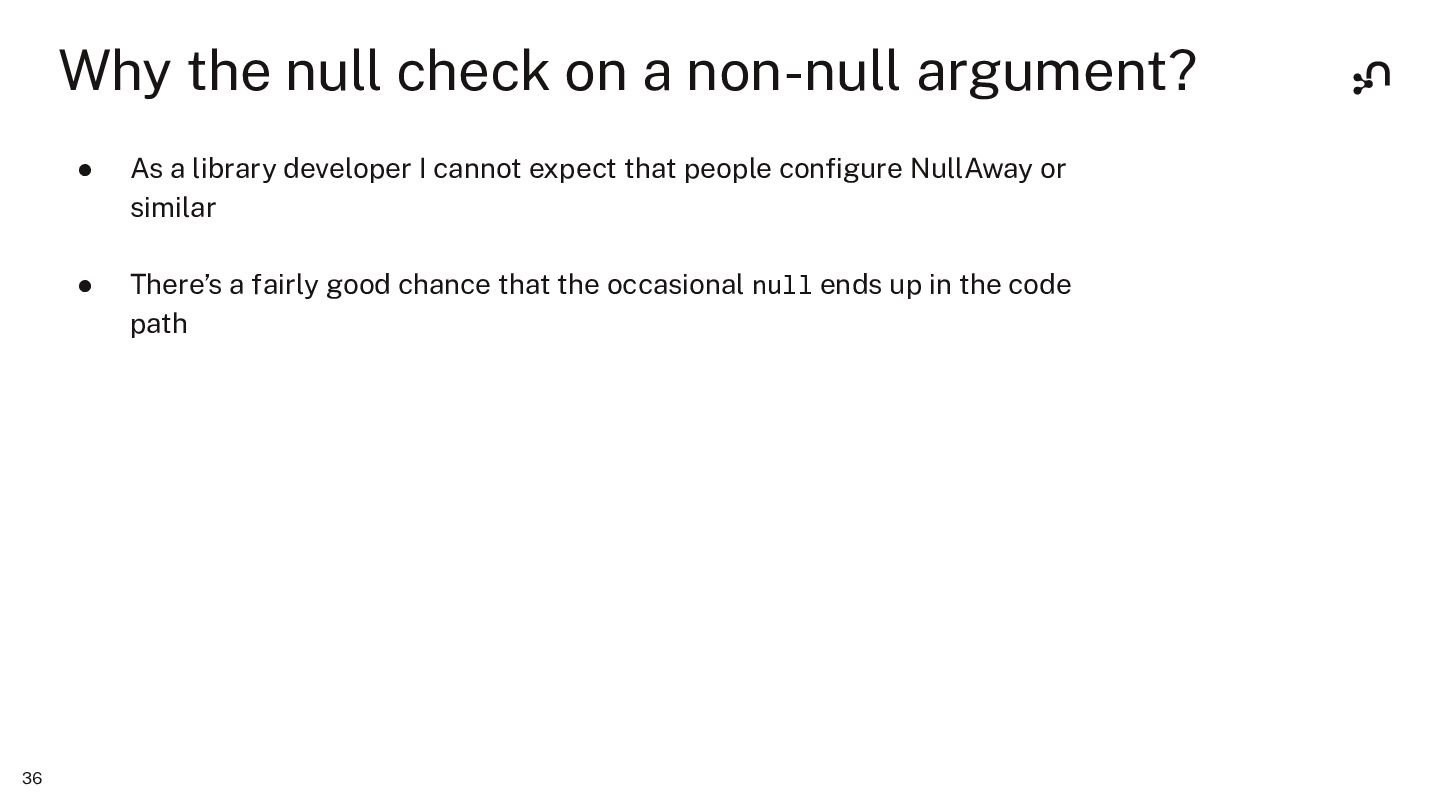
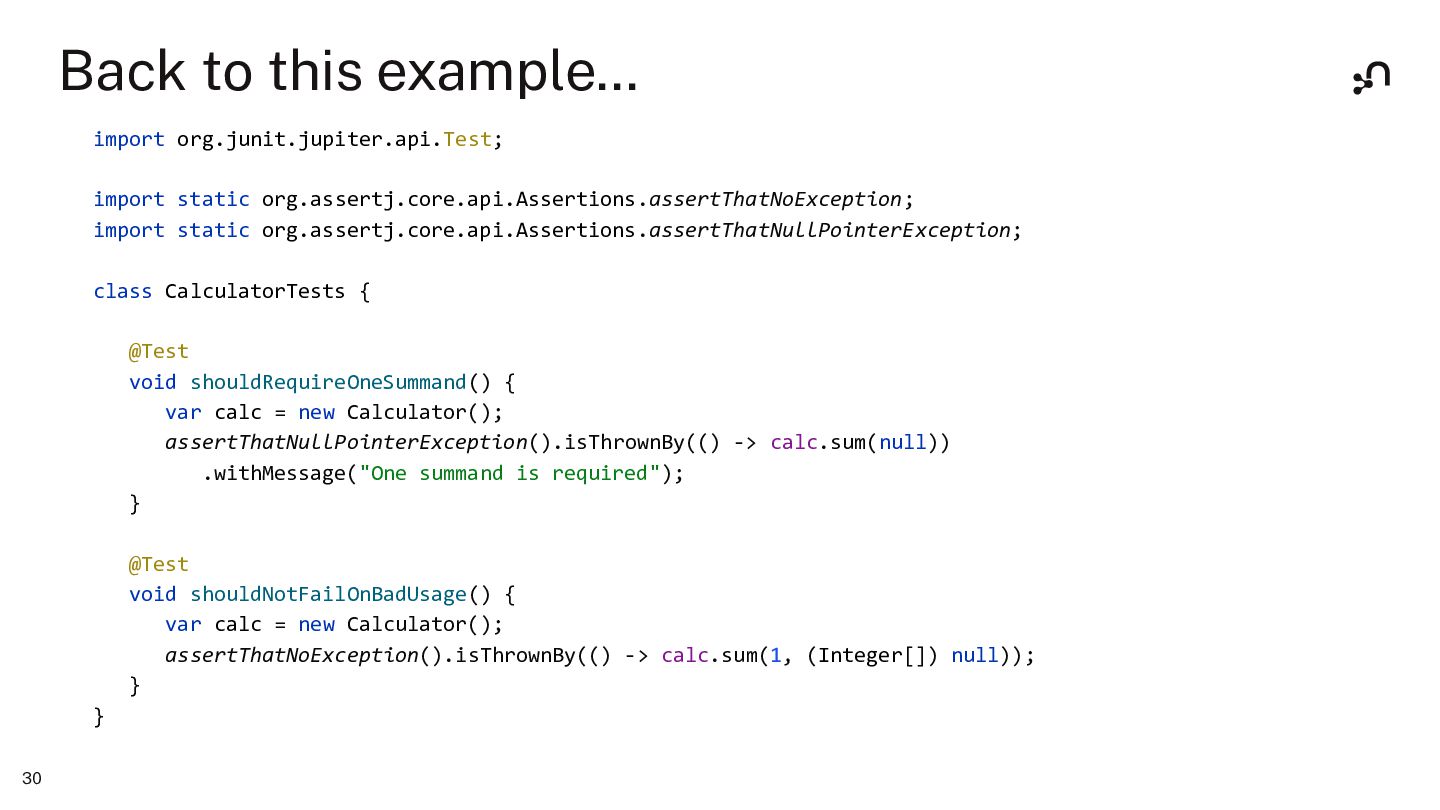
As a library developer I cannot expect that people configure NullAway or similar • There’s a fairly good chance that the occasional null ends up in the code path
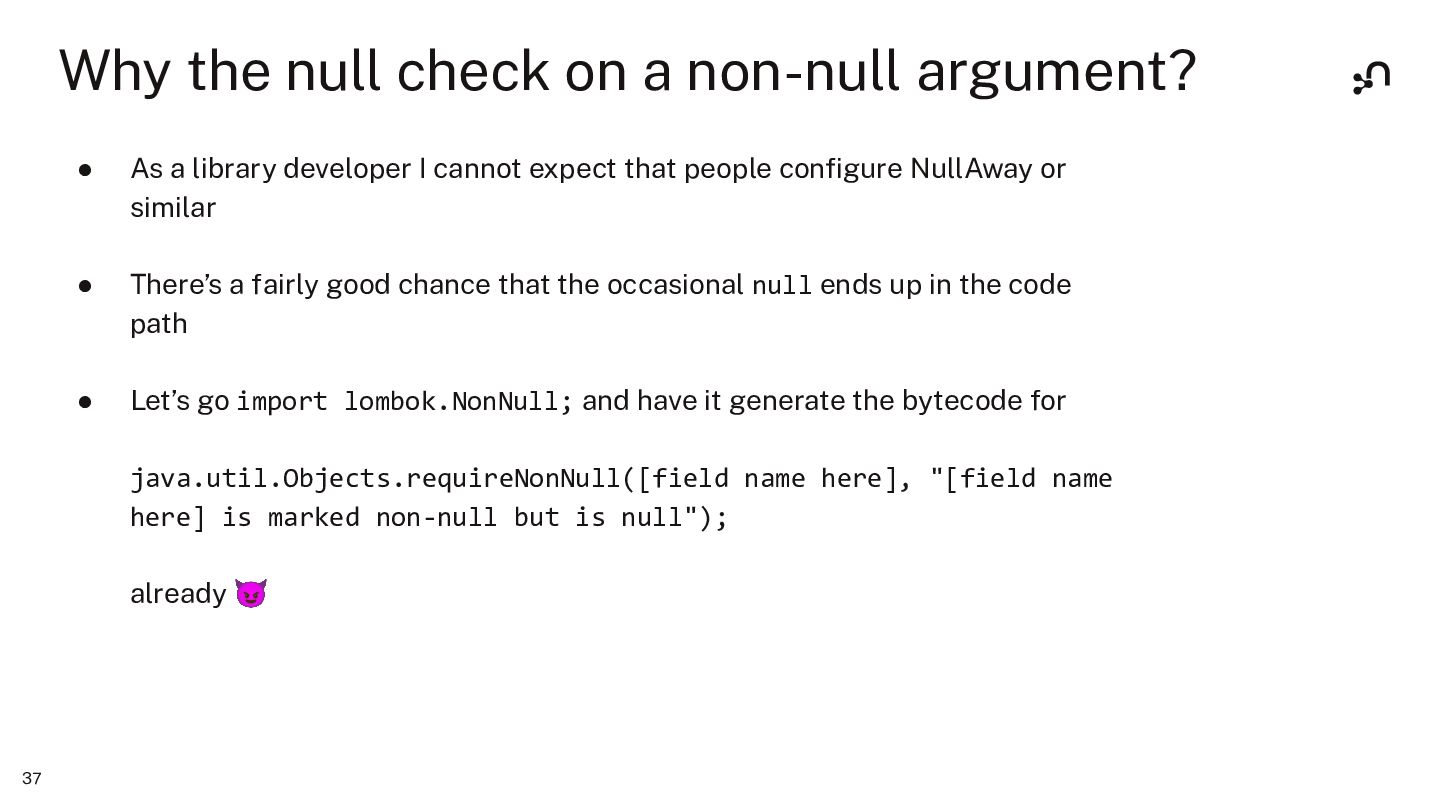
As a library developer I cannot expect that people configure NullAway or similar • There’s a fairly good chance that the occasional null ends up in the code path • Let’s go import lombok.NonNull; and have it generate the bytecode for java.util.Objects.requireNonNull([field name here], "[field name here] is marked non-null but is null"); already 😈
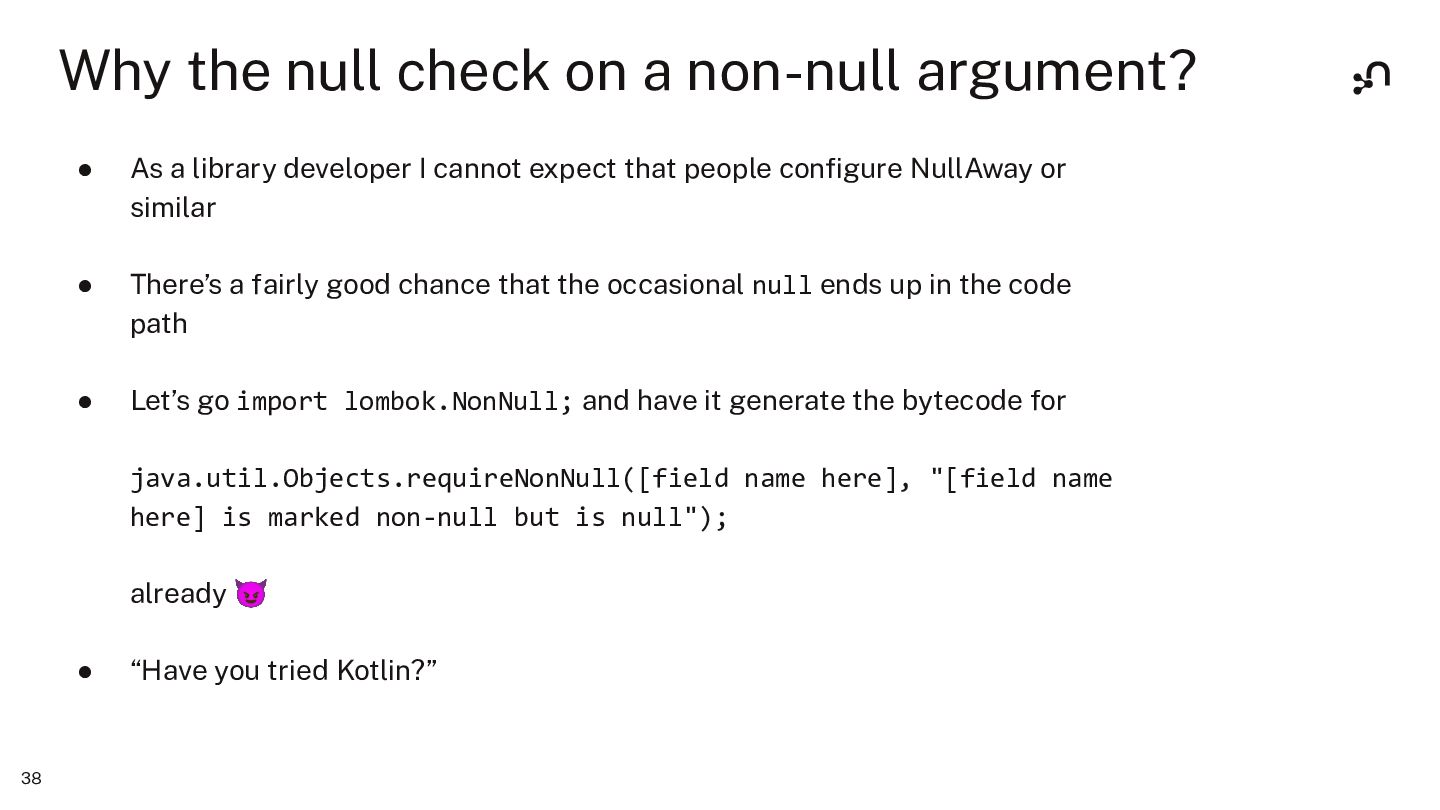
As a library developer I cannot expect that people configure NullAway or similar • There’s a fairly good chance that the occasional null ends up in the code path • Let’s go import lombok.NonNull; and have it generate the bytecode for java.util.Objects.requireNonNull([field name here], "[field name here] is marked non-null but is null"); already 😈 • “Have you tried Kotlin?”
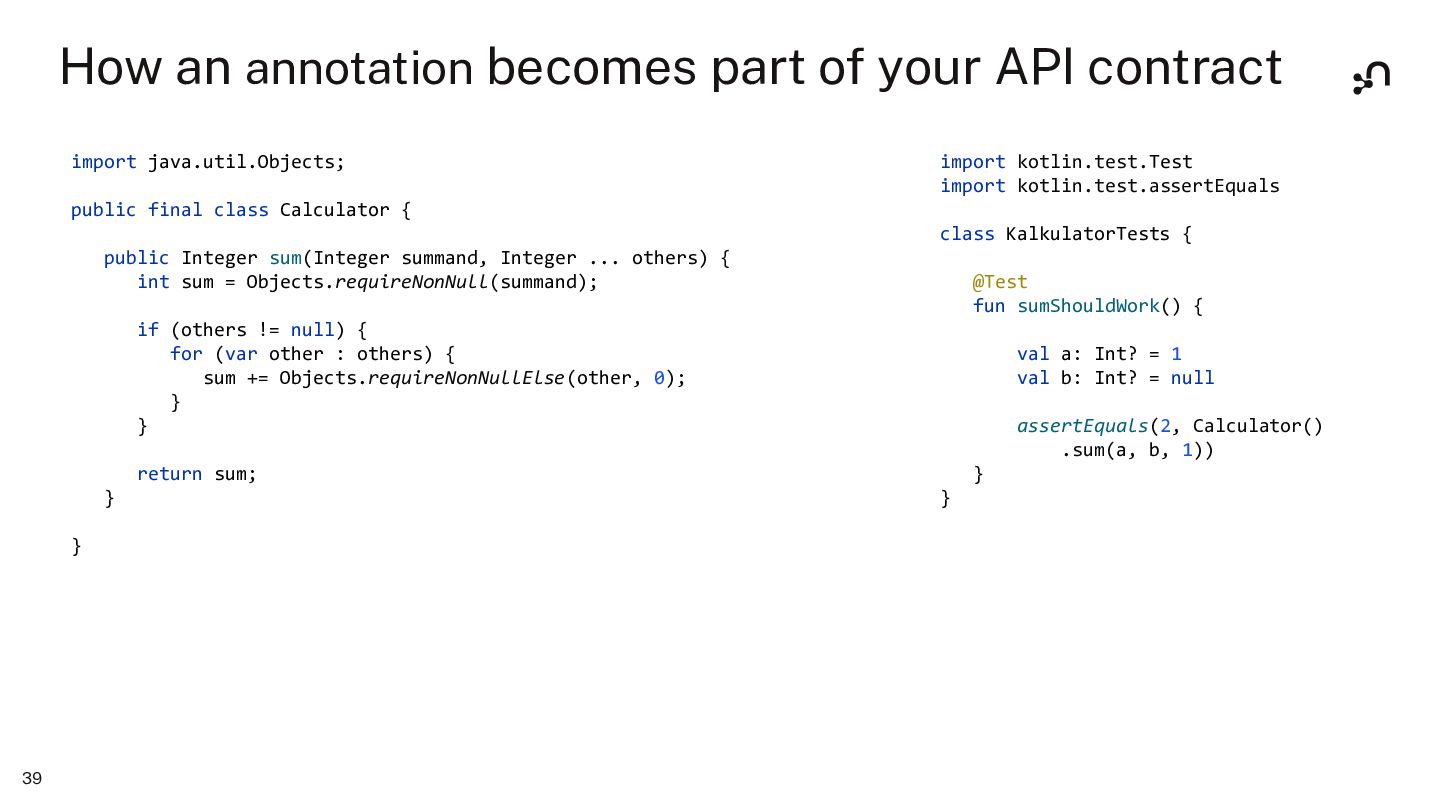
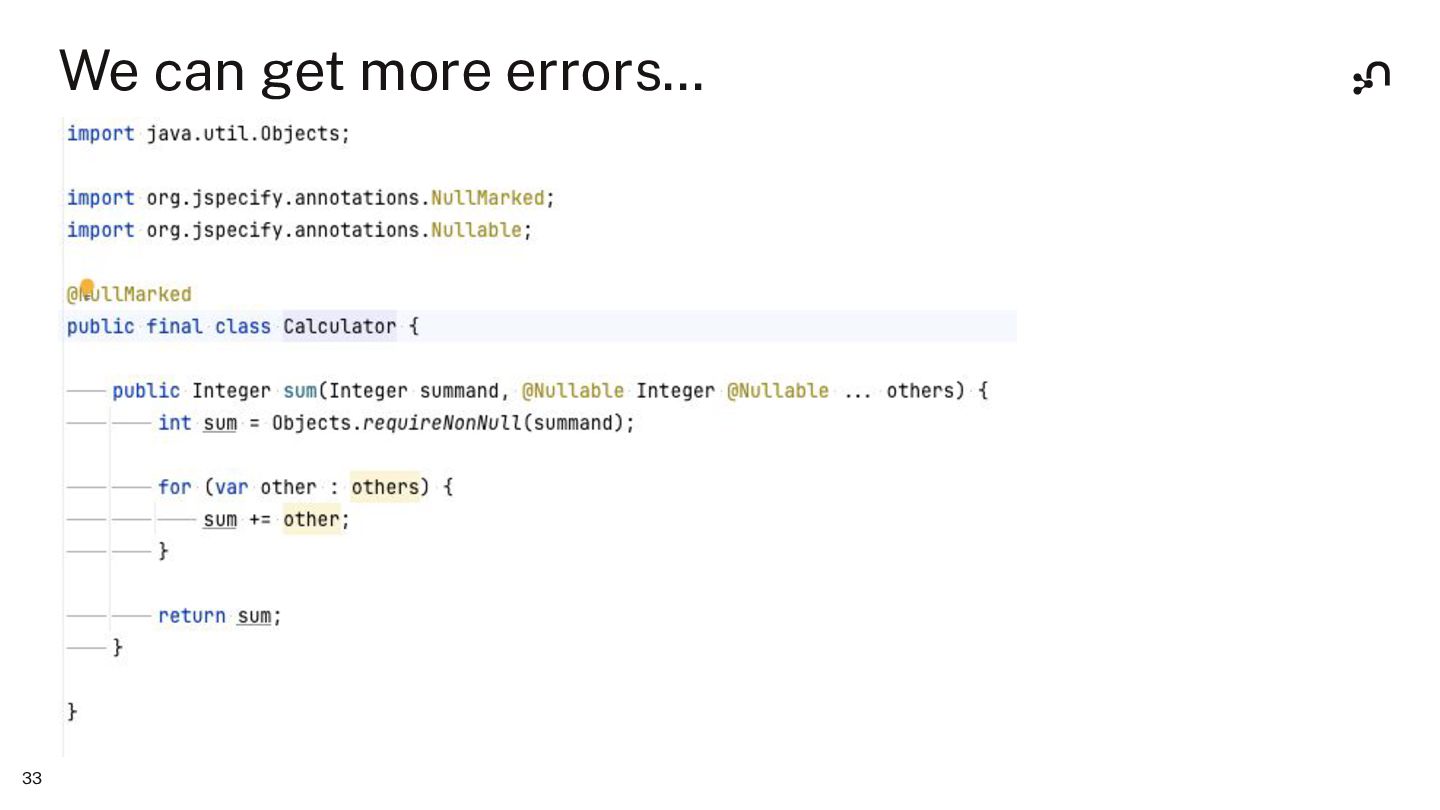
import java.util.Objects; public final class Calculator { public Integer sum(Integer summand, Integer ... others) { int sum = Objects.requireNonNull(summand); if (others != null) { for (var other : others) { sum += Objects.requireNonNullElse(other, 0); } } return sum; } } import kotlin.test.Test import kotlin.test.assertEquals class KalkulatorTests { @Test fun sumShouldWork() { val a: Int? = 1 val b: Int? = null assertEquals(2, Calculator() .sum(a, b, 1)) } }
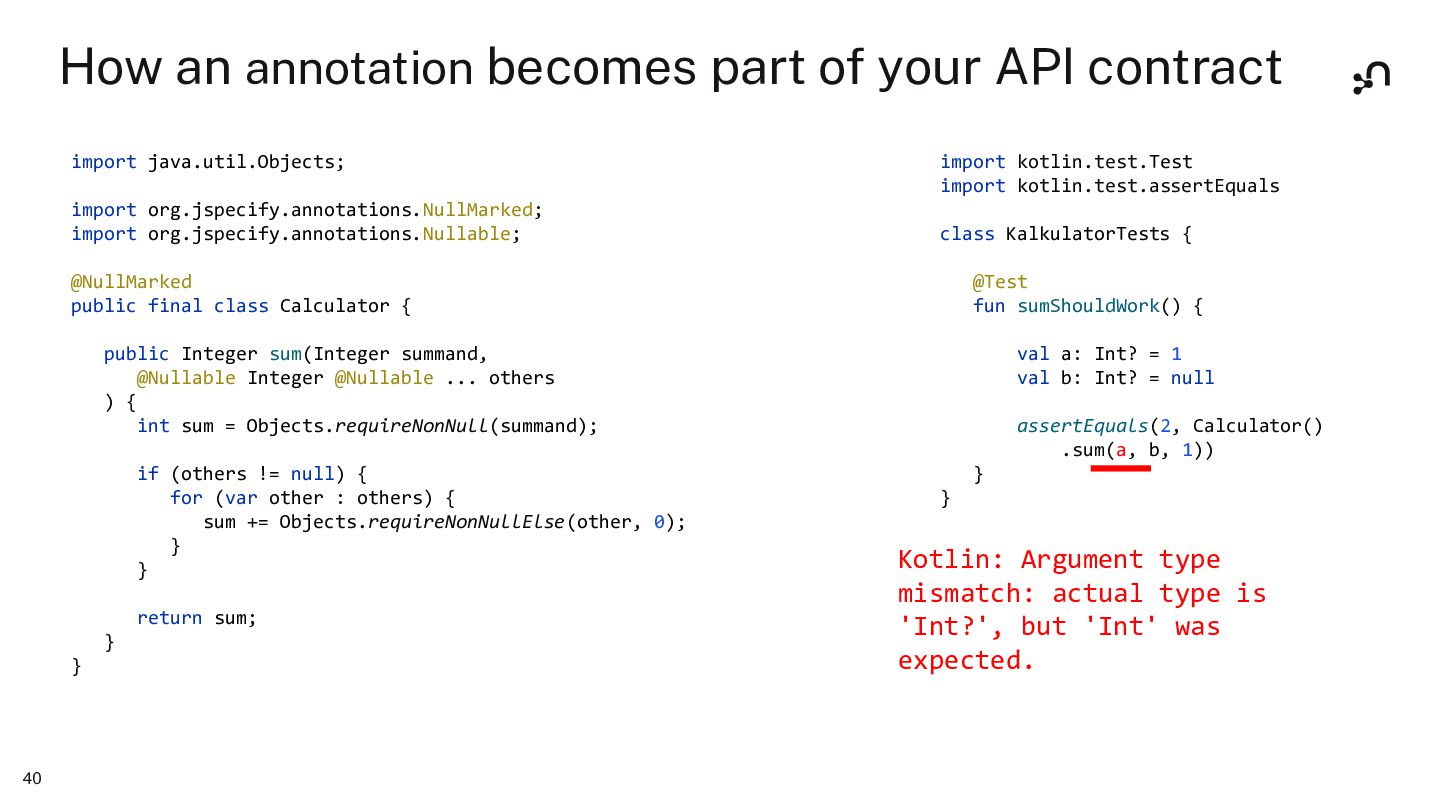
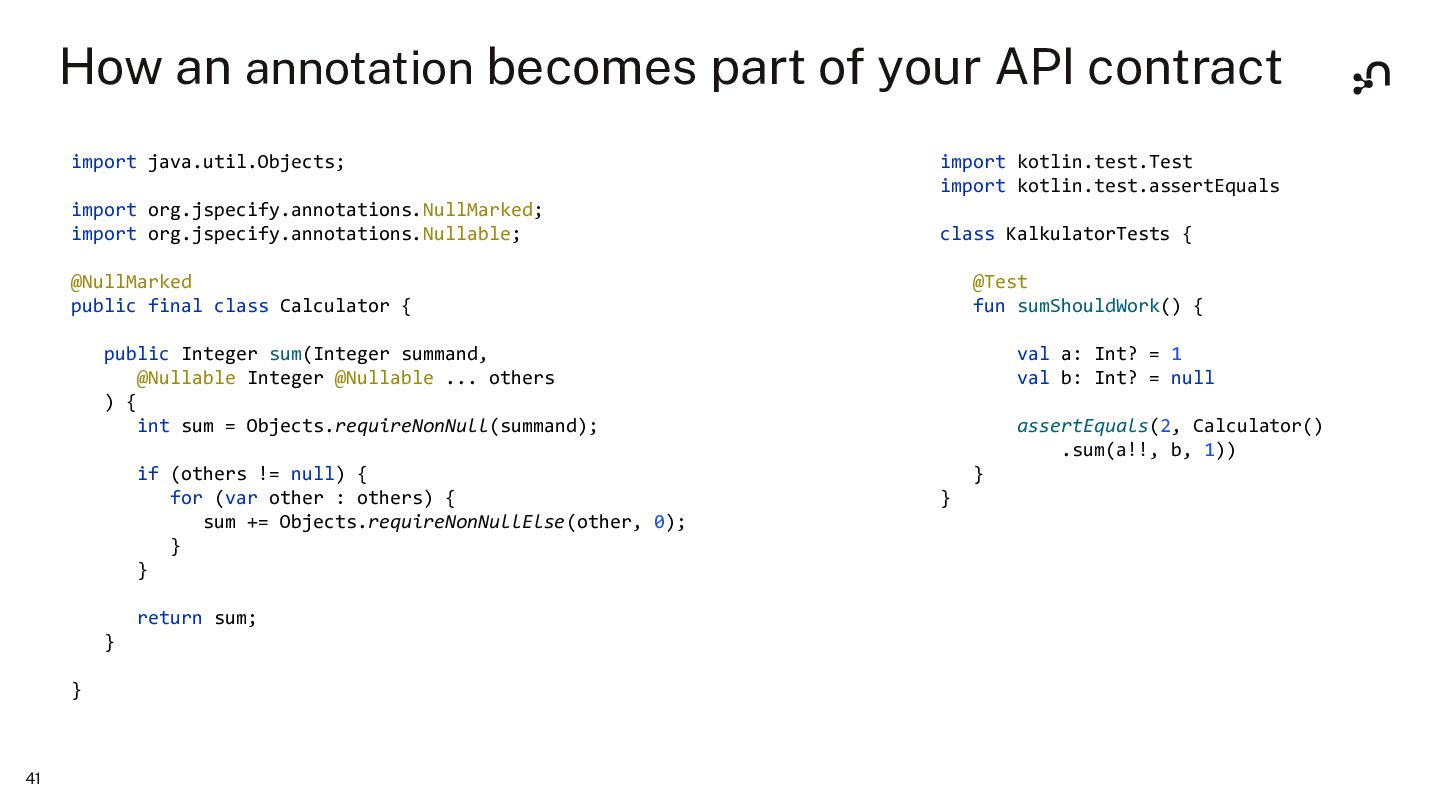
import java.util.Objects; import org.jspecify.annotations.NullMarked; import org.jspecify.annotations.Nullable; @NullMarked public final class Calculator { public Integer sum(Integer summand, @Nullable Integer @Nullable ... others ) { int sum = Objects.requireNonNull(summand); if (others != null) { for (var other : others) { sum += Objects.requireNonNullElse(other, 0); } } return sum; } } import kotlin.test.Test import kotlin.test.assertEquals class KalkulatorTests { @Test fun sumShouldWork() { val a: Int? = 1 val b: Int? = null assertEquals(2, Calculator() .sum(a, b, 1)) } } Kotlin: Argument type mismatch: actual type is 'Int?', but 'Int' was expected.
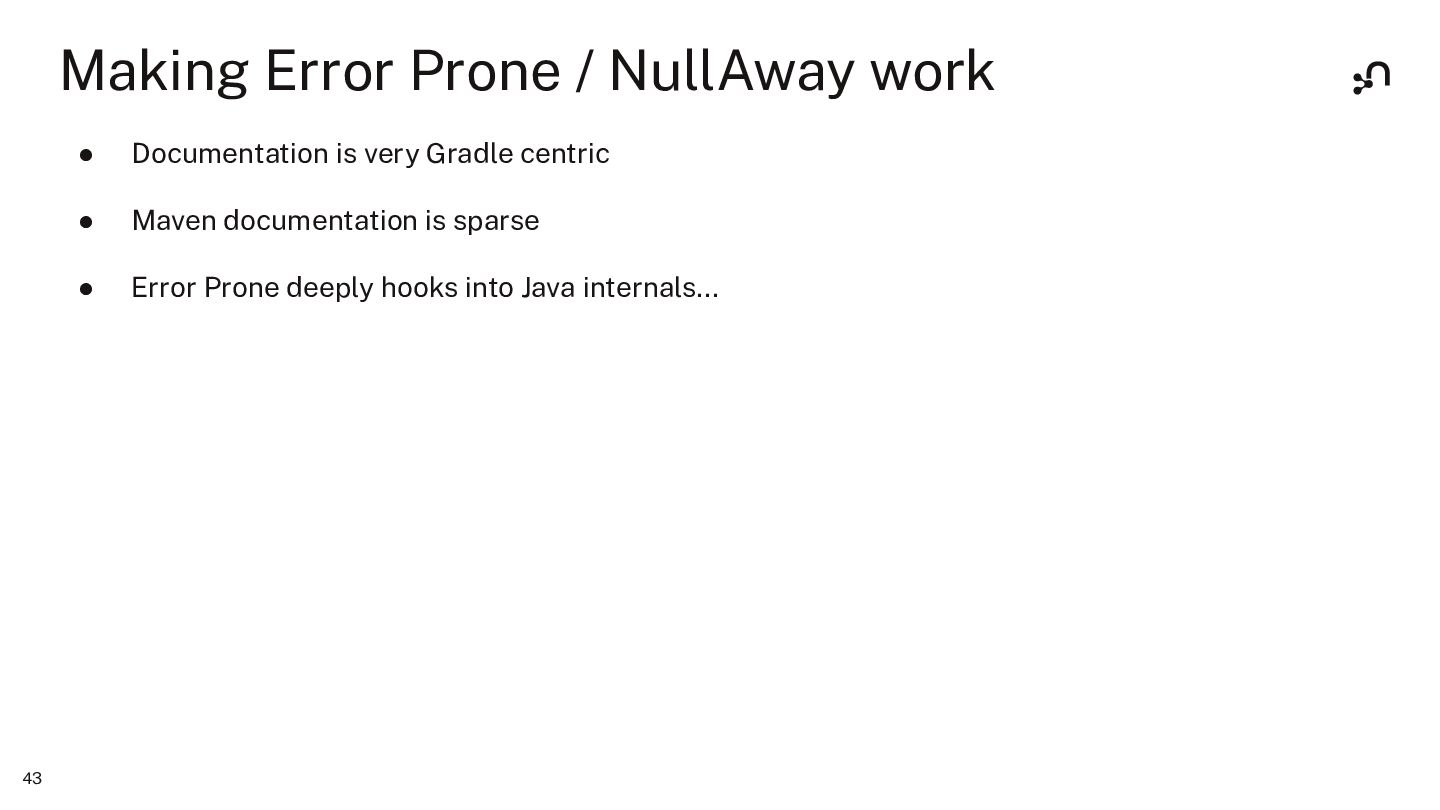
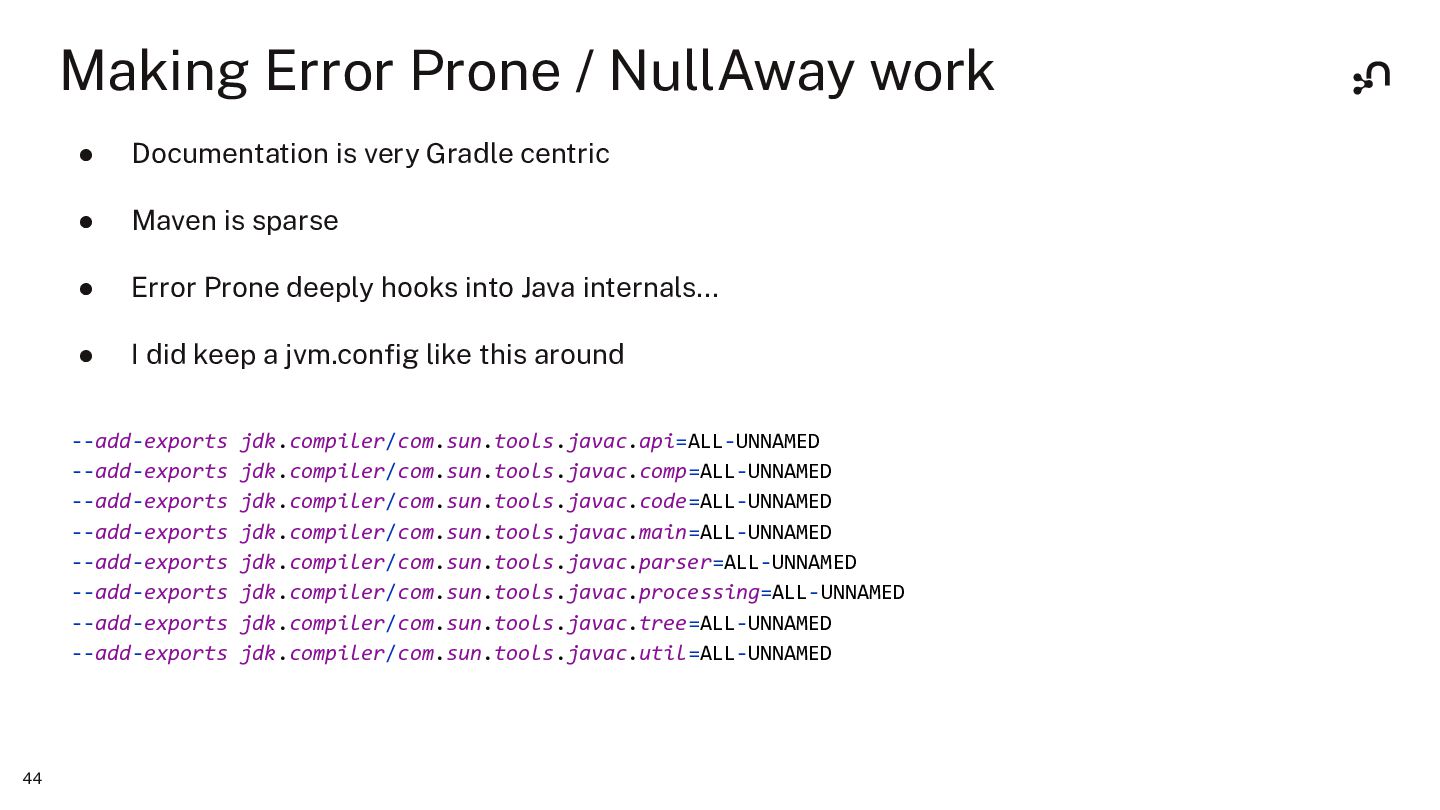
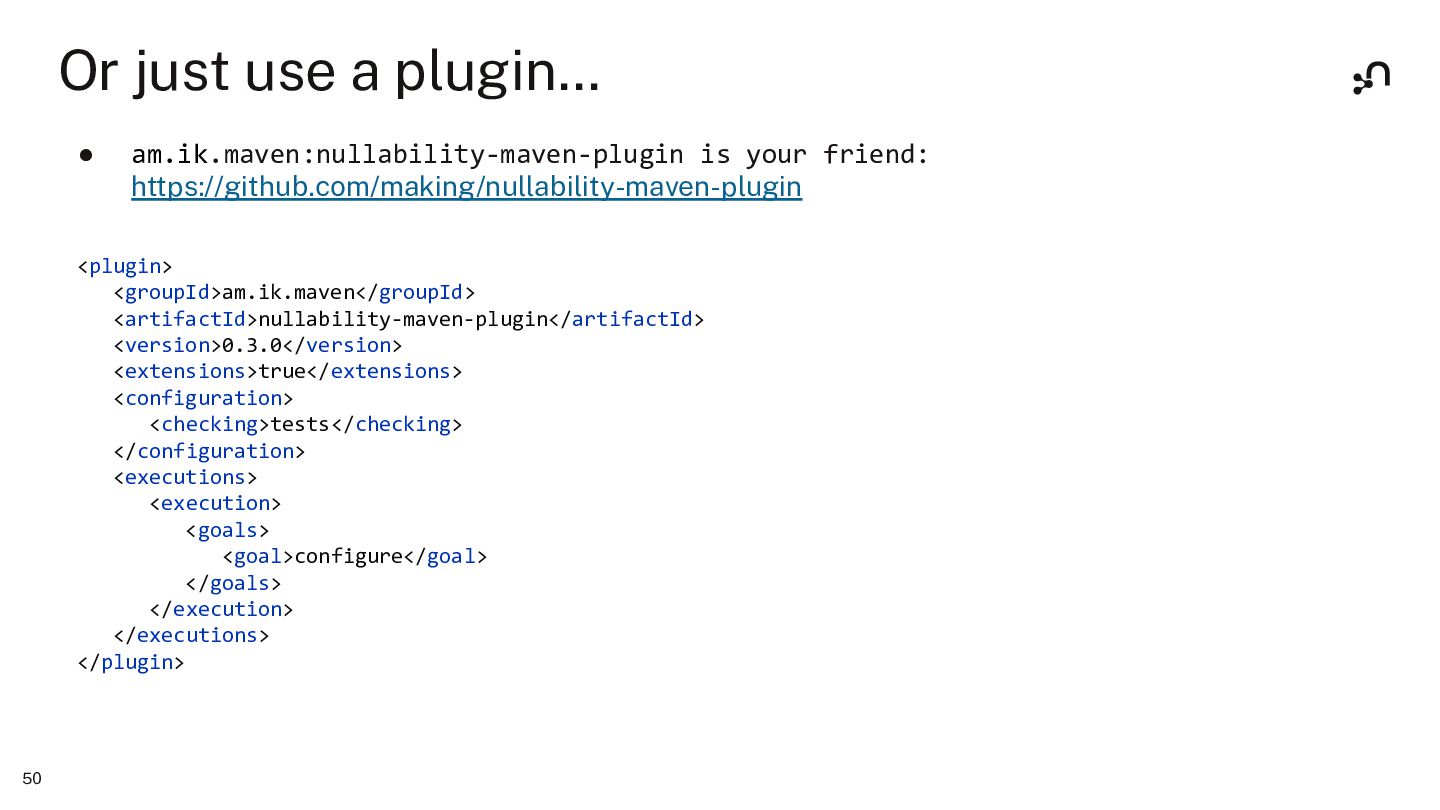
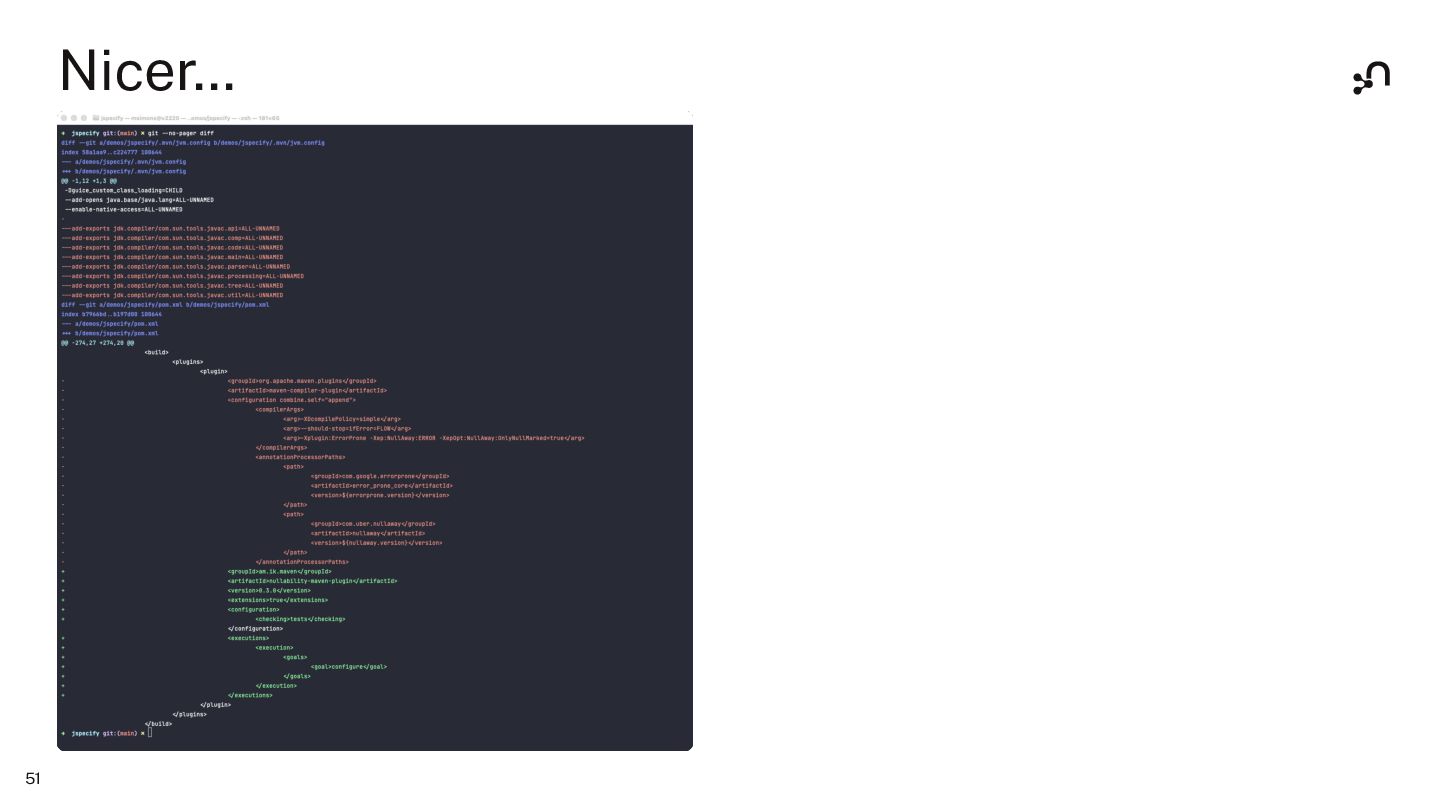
jdk.compiler/com.sun.tools.javac.comp=ALL-UNNAMED --add-exports jdk.compiler/com.sun.tools.javac.code=ALL-UNNAMED --add-exports jdk.compiler/com.sun.tools.javac.main=ALL-UNNAMED --add-exports jdk.compiler/com.sun.tools.javac.parser=ALL-UNNAMED --add-exports jdk.compiler/com.sun.tools.javac.processing=ALL-UNNAMED --add-exports jdk.compiler/com.sun.tools.javac.tree=ALL-UNNAMED --add-exports jdk.compiler/com.sun.tools.javac.util=ALL-UNNAMED • Documentation is very Gradle centric • Maven is sparse • Error Prone deeply hooks into Java internals… • I did keep a jvm.config like this around
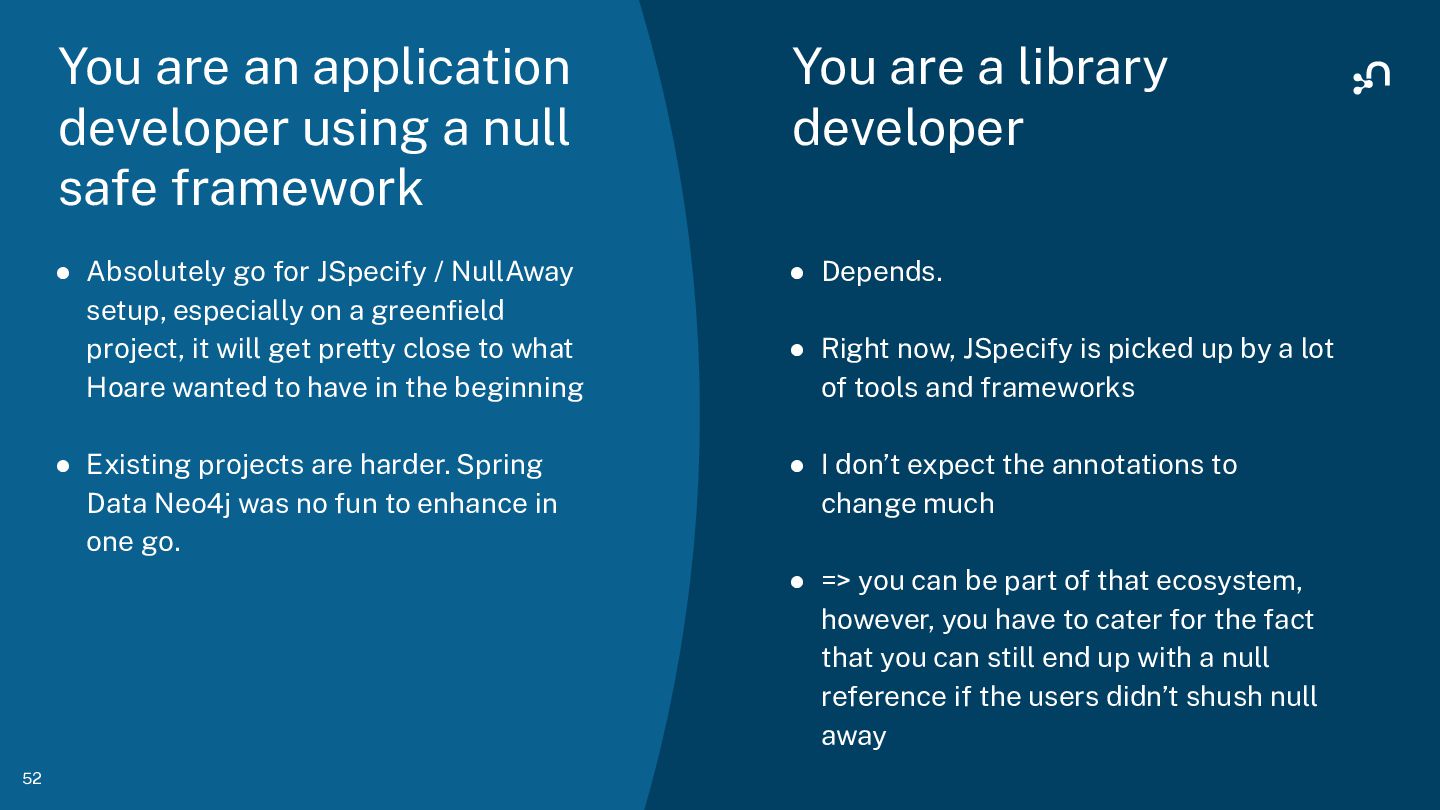
52 • Absolutely go for JSpecify / NullAway setup, especially on a greenfield project, it will get pretty close to what Hoare wanted to have in the beginning • Existing projects are harder. Spring Data Neo4j was no fun to enhance in one go. You are a library developer • Depends. • Right now, JSpecify is picked up by a lot of tools and frameworks • I don’t expect the annotations to change much • => you can be part of that ecosystem, however, you have to cater for the fact that you can still end up with a null reference if the users didn’t shush null away
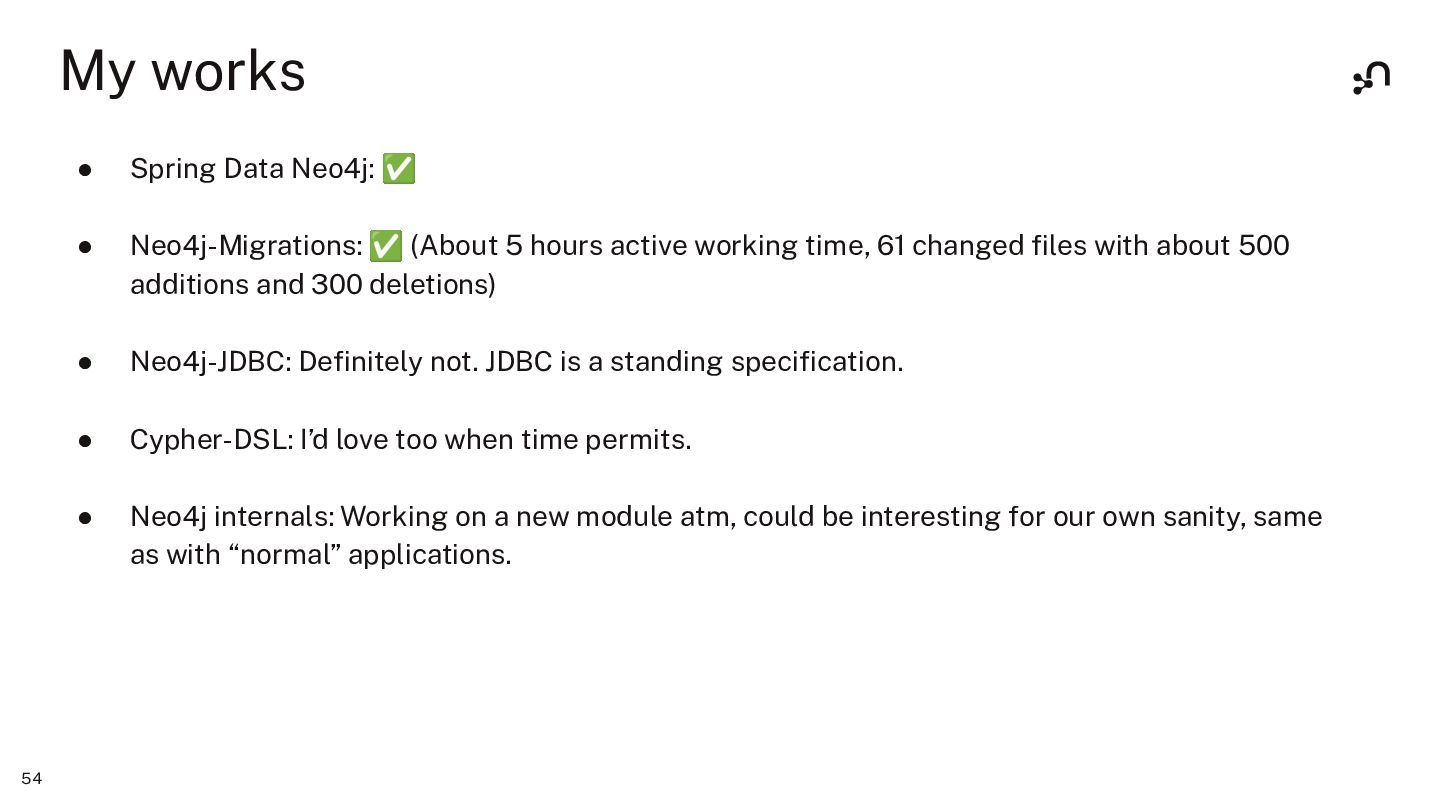
✅ (About 5 hours active working time, 61 changed files with about 500 additions and 300 deletions) • Neo4j-JDBC: Definitely not. JDBC is a standing specification. • Cypher-DSL: I’d love too when time permits. • Neo4j internals: Working on a new module atm, could be interesting for our own sanity, same as with “normal” applications.
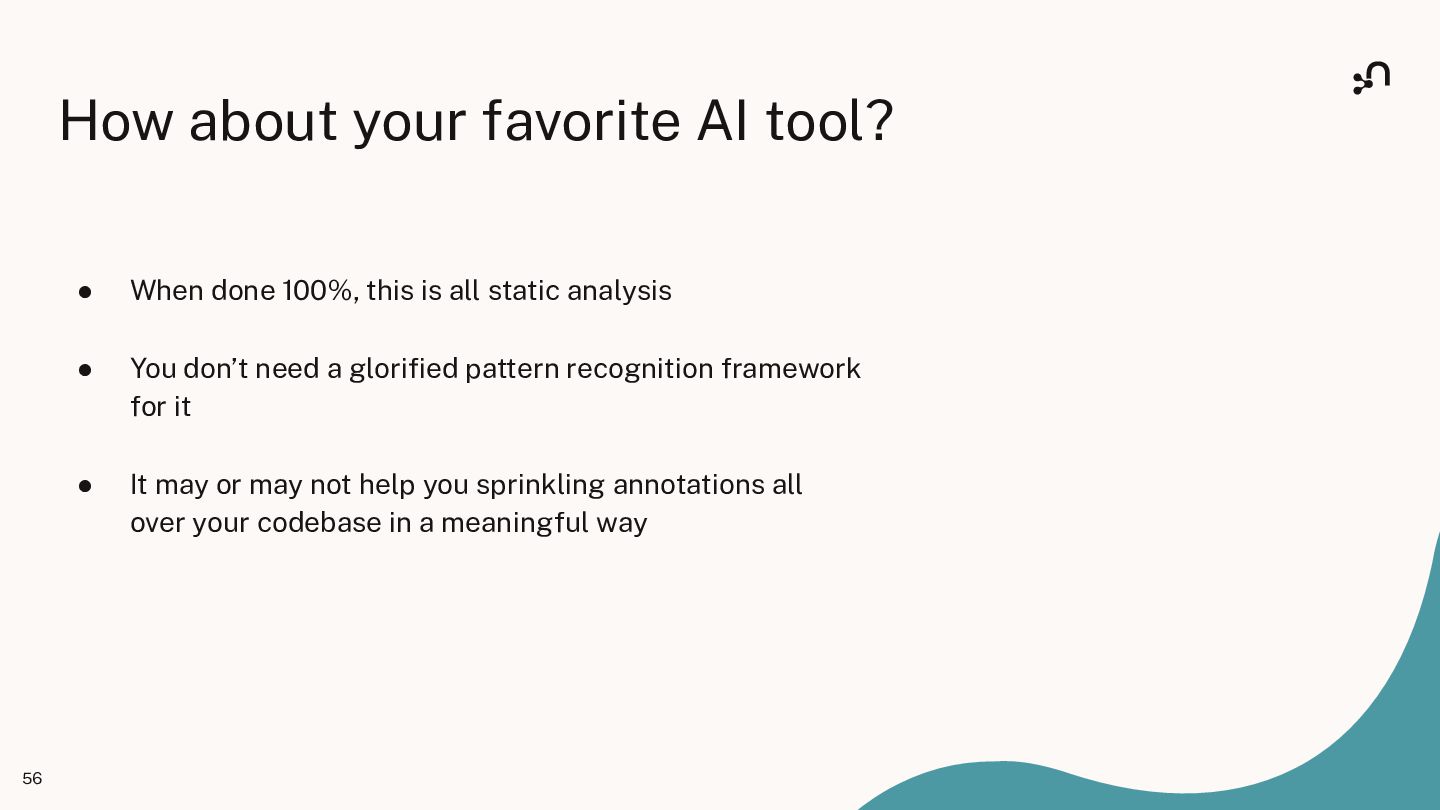
100%, this is all static analysis • You don’t need a glorified pattern recognition framework for it • It may or may not help you sprinkling annotations all over your codebase in a meaningful way
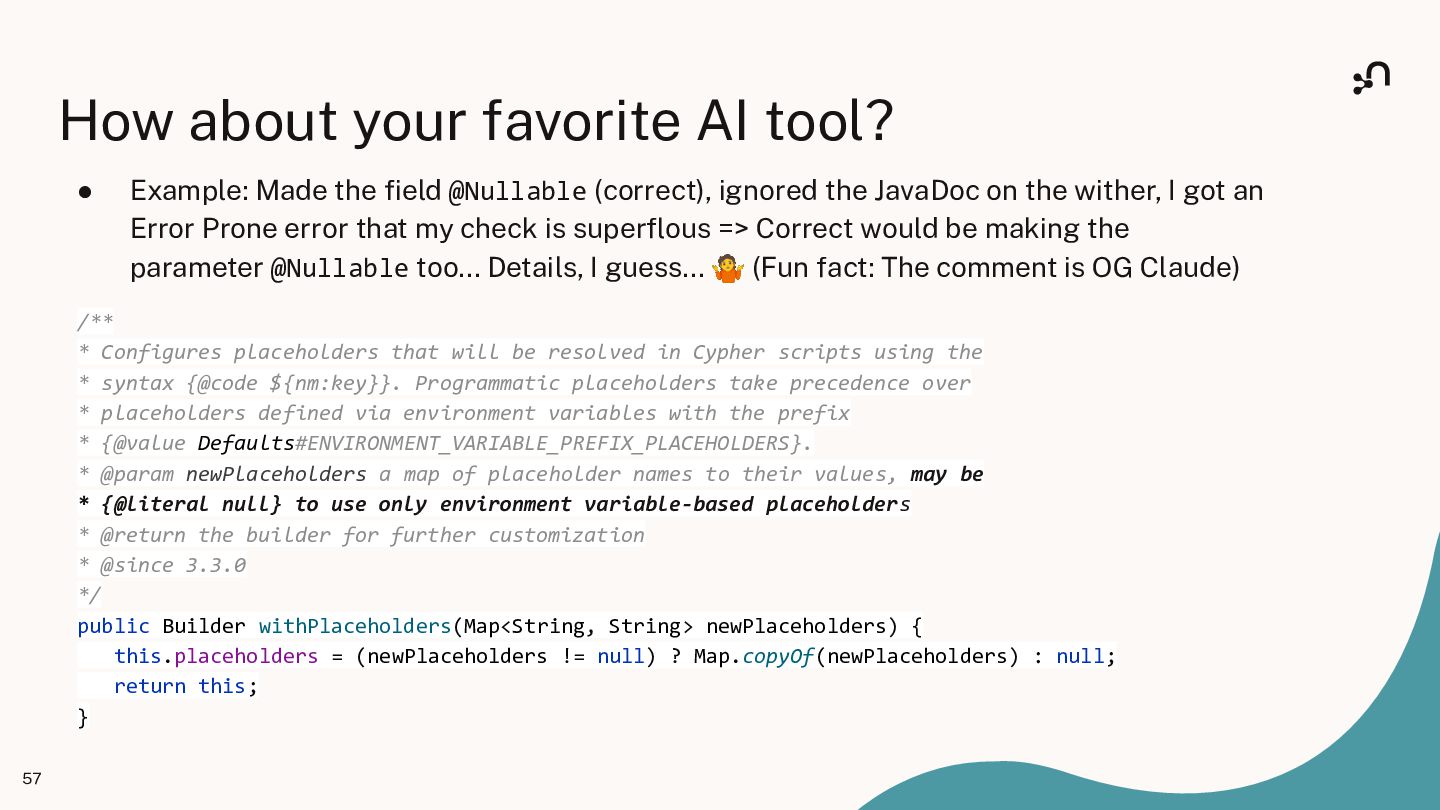
the field @Nullable (correct), ignored the JavaDoc on the wither, I got an Error Prone error that my check is superflous => Correct would be making the parameter @Nullable too… Details, I guess… 🤷 (Fun fact: The comment is OG Claude) /** * Configures placeholders that will be resolved in Cypher scripts using the * syntax {@code ${nm:key}}. Programmatic placeholders take precedence over * placeholders defined via environment variables with the prefix * {@value Defaults#ENVIRONMENT_VARIABLE_PREFIX_PLACEHOLDERS}. * @param newPlaceholders a map of placeholder names to their values, may be * {@literal null} to use only environment variable-based placeholders * @return the builder for further customization * @since 3.3.0 */ public Builder withPlaceholders(Map<String, String> newPlaceholders) { this.placeholders = (newPlaceholders != null) ? Map.copyOf(newPlaceholders) : null; return this; }


 michaelsimons
 steliosf
 kinopeee
 yukikurage
 falcon8823
 cclai999
 kishida
 hollycummins
 tomokon
 sylph01
 mofurune
 tosite
 shihochan
 aleyda
 vanstee
 jdejongh
 garrettdimon
 schlessera
 marktimemedia
 tammyeverts
 samlambert
 retrage
 chriscoyier
 reverentgeek




![Back to this example… 31 [INFO] --- compiler:3.14.0:testCompile (java-test-compile) @](https://files.speakerdeck.com/presentations/f1dce3aabb1b4e619181d81de55ccd94/slide_30.jpg)
![We can get more errors… 34 [INFO] --- compiler:3.14.0:compile (java-compile)](https://files.speakerdeck.com/presentations/f1dce3aabb1b4e619181d81de55ccd94/slide_33.jpg)