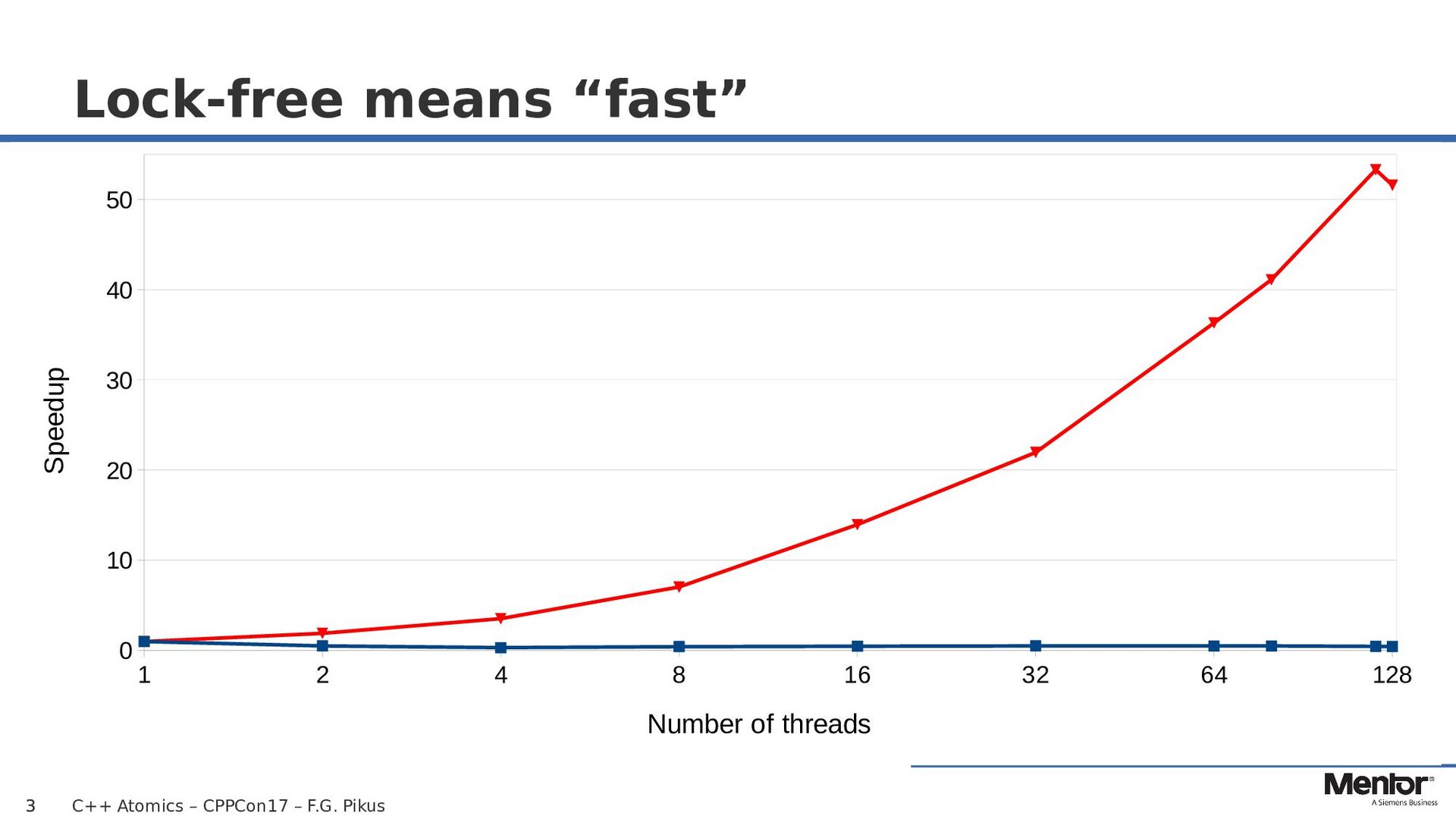
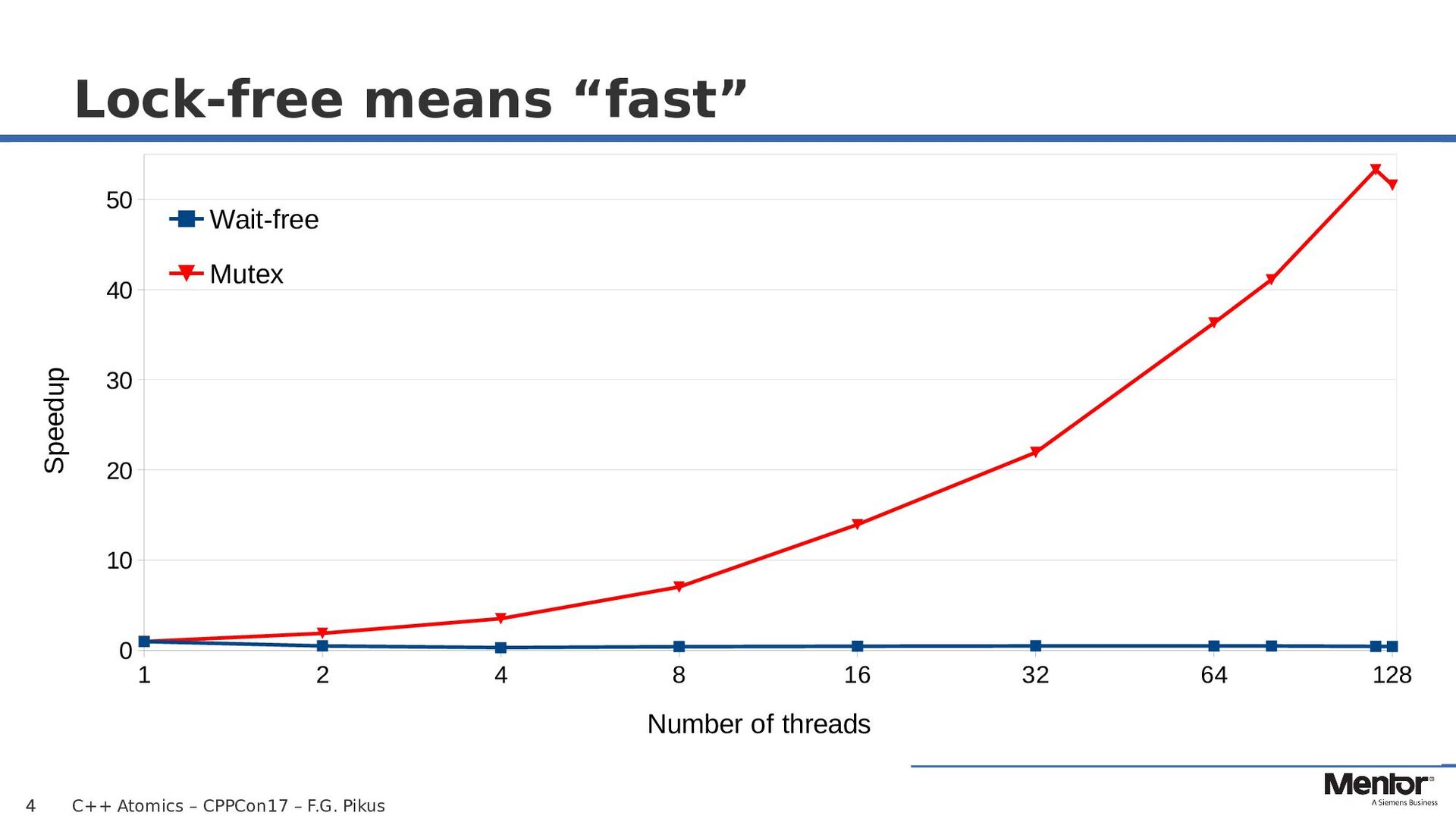
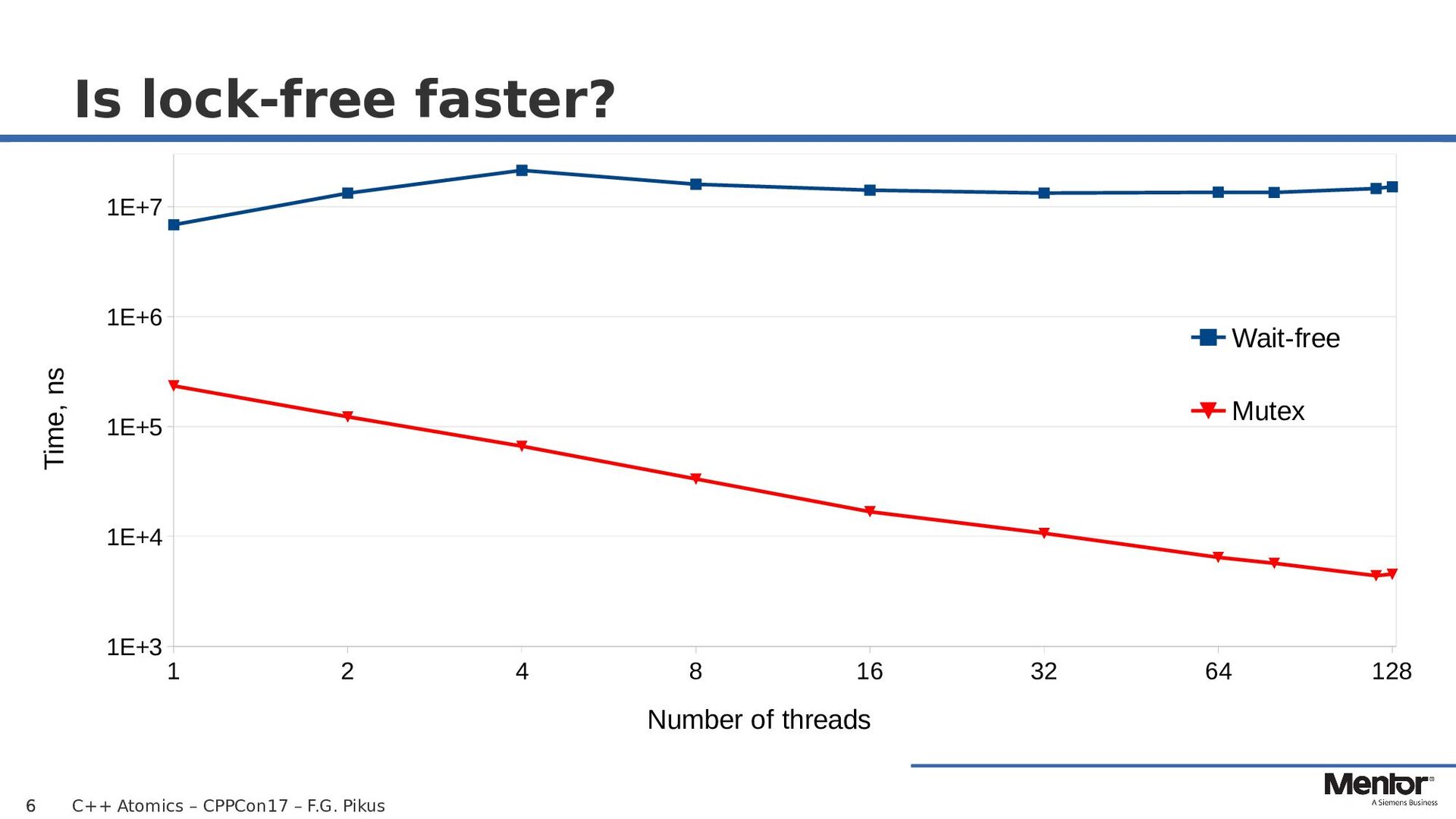
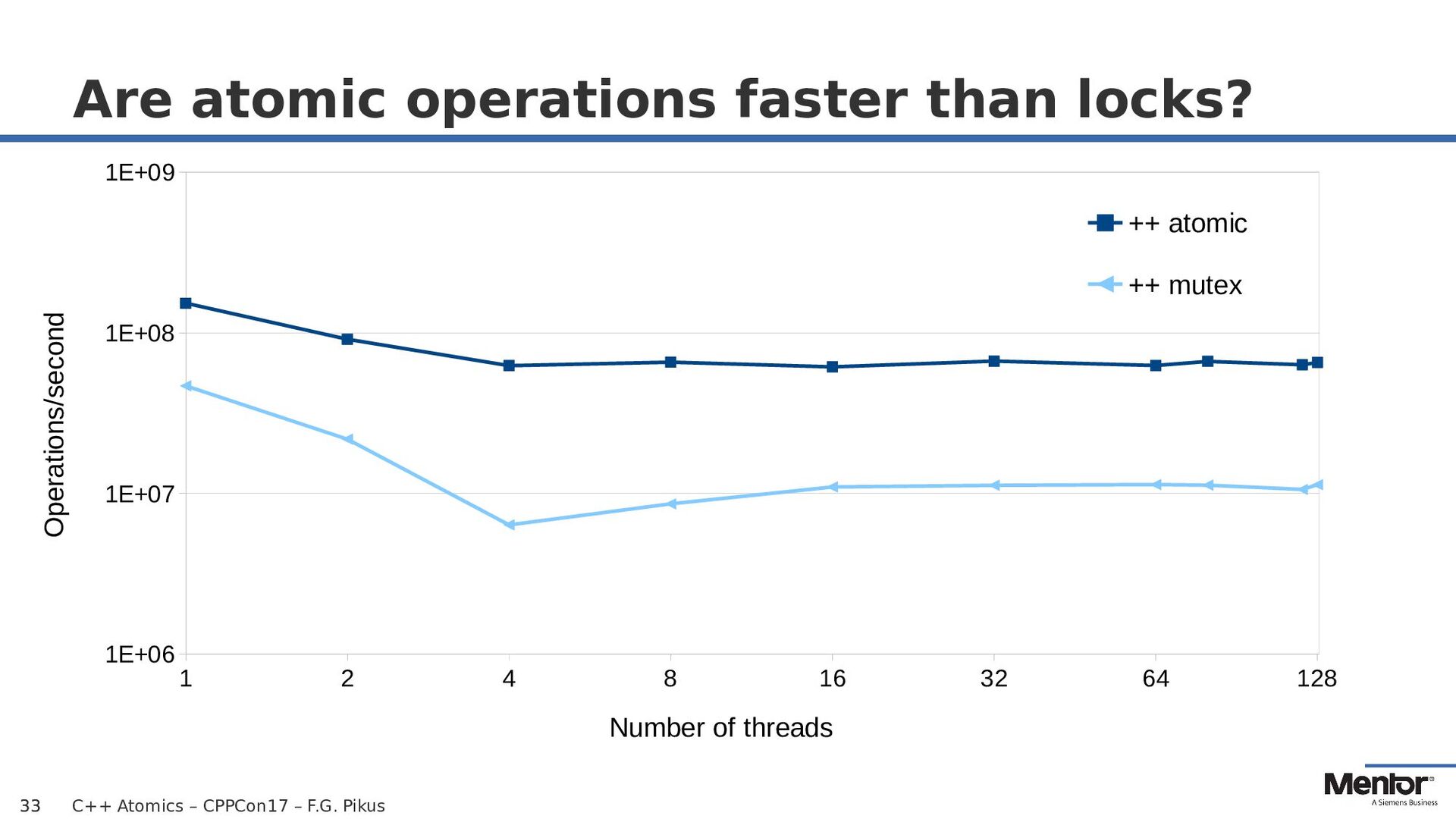
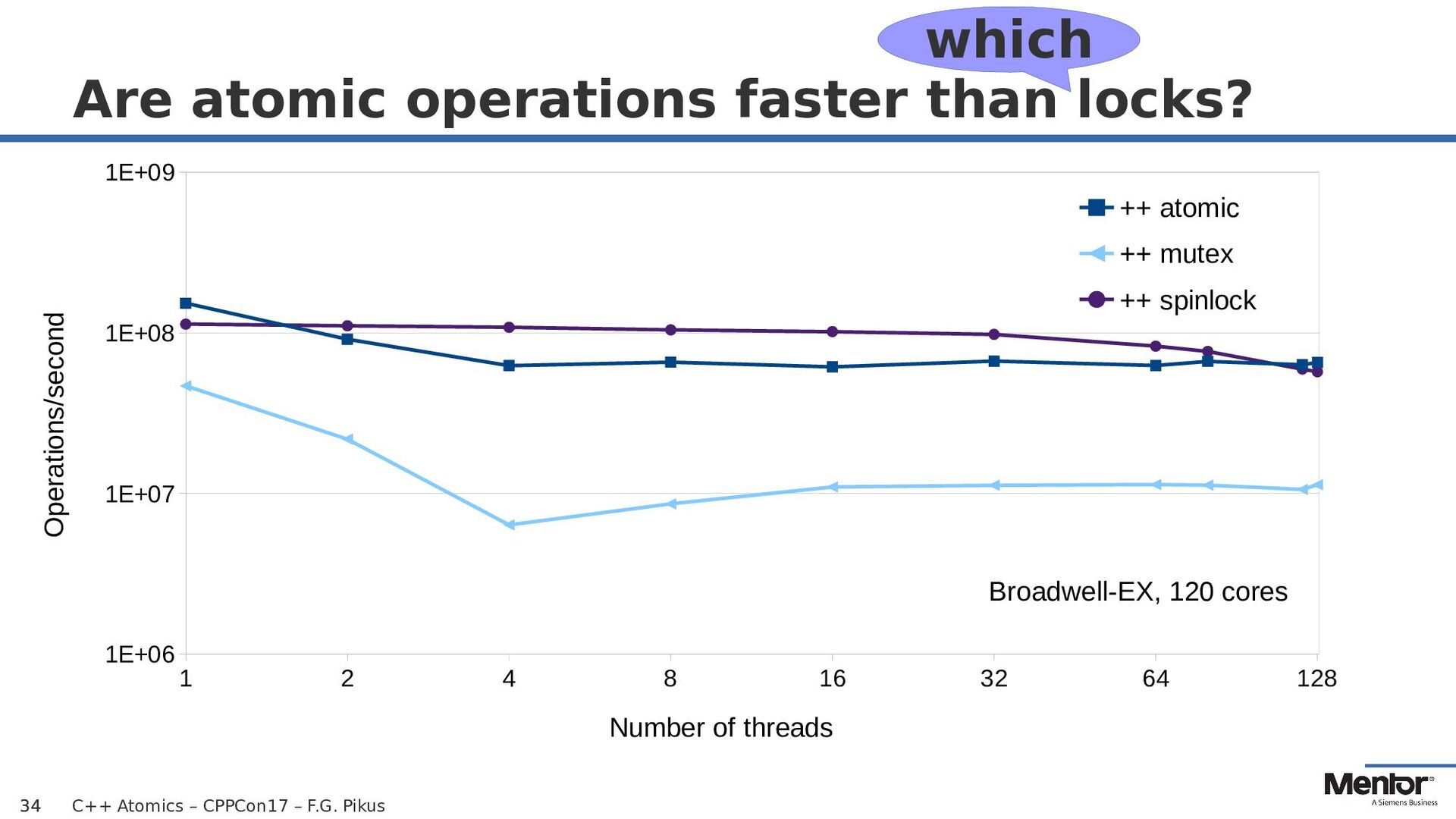
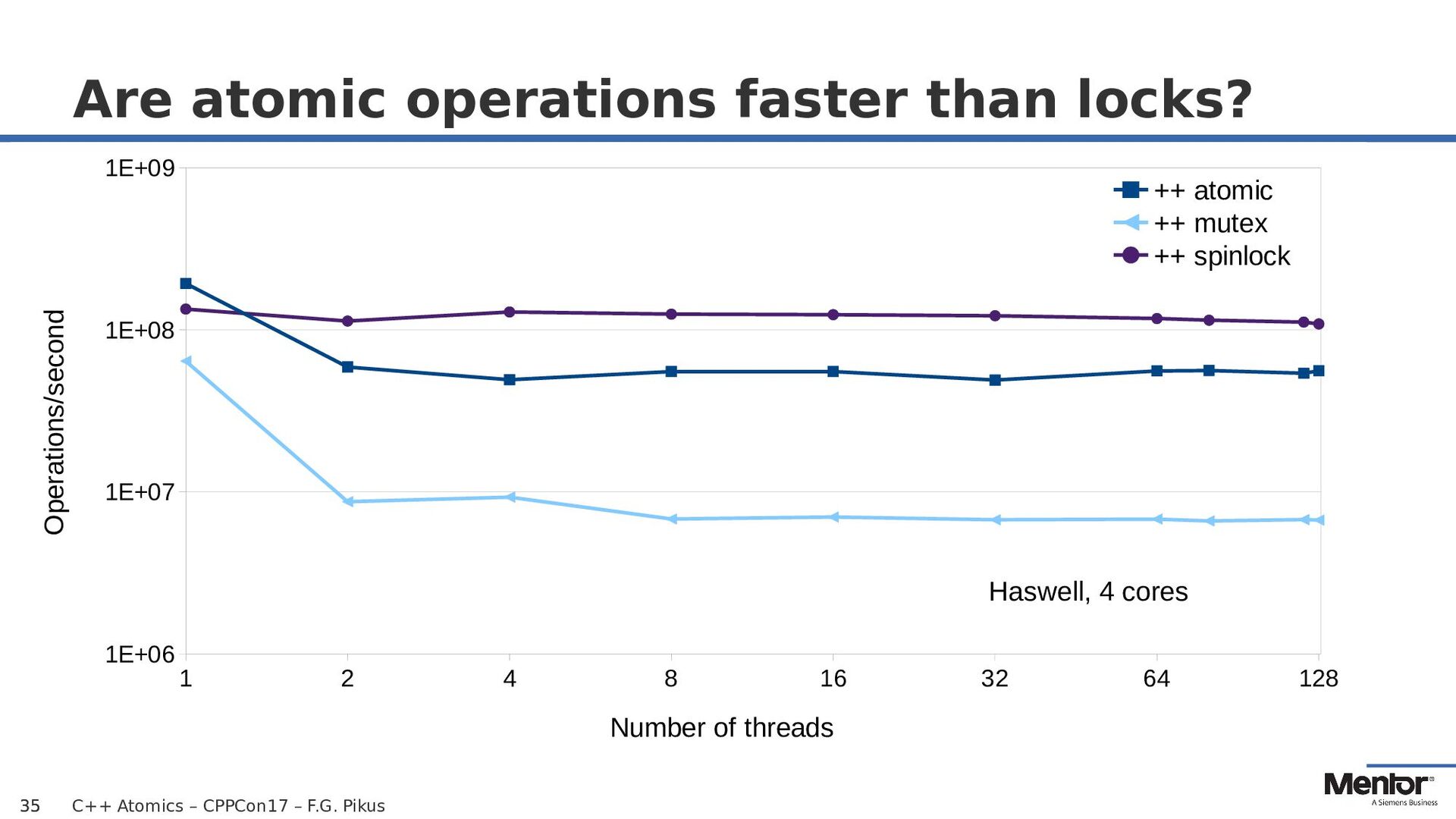
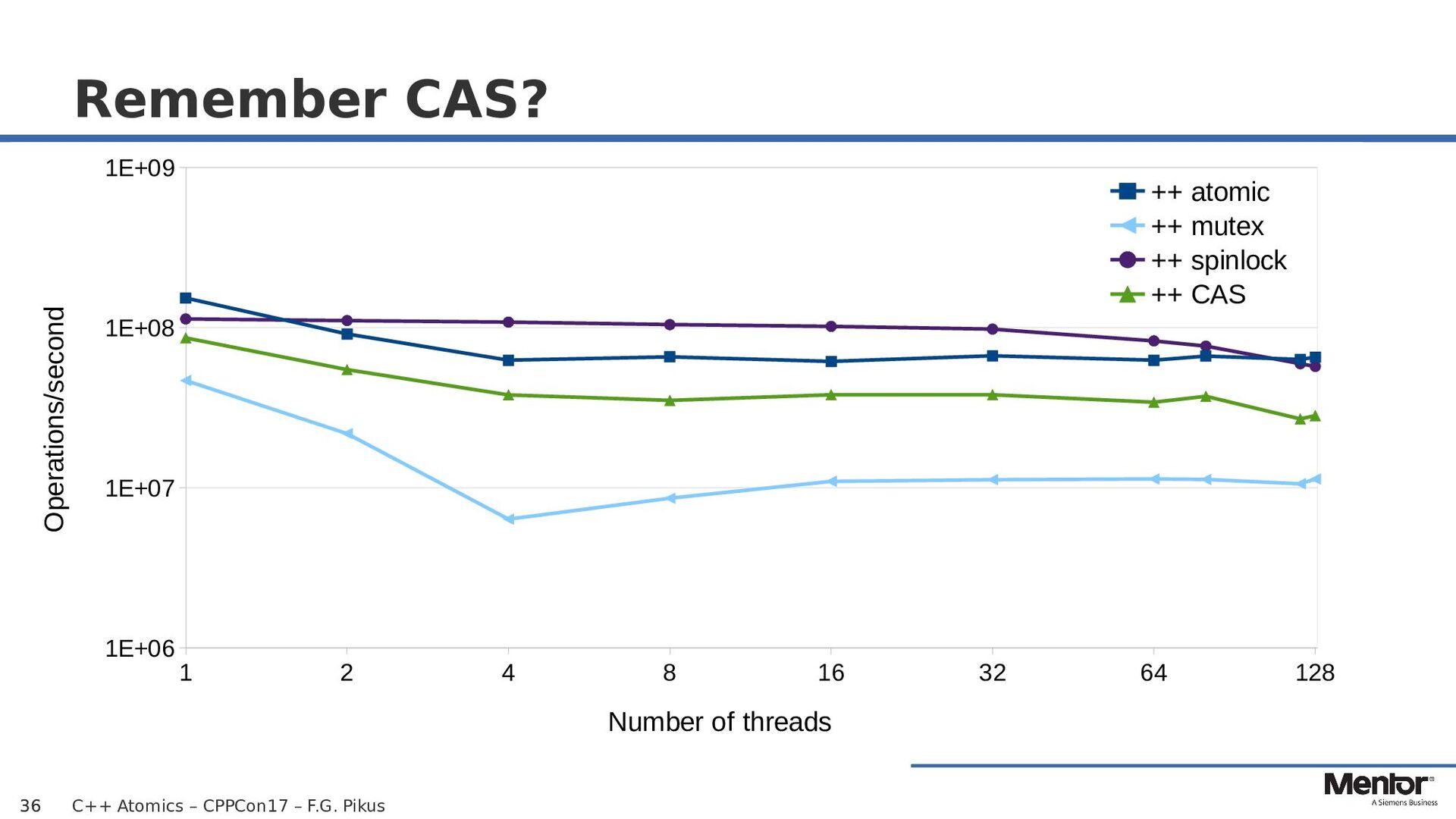
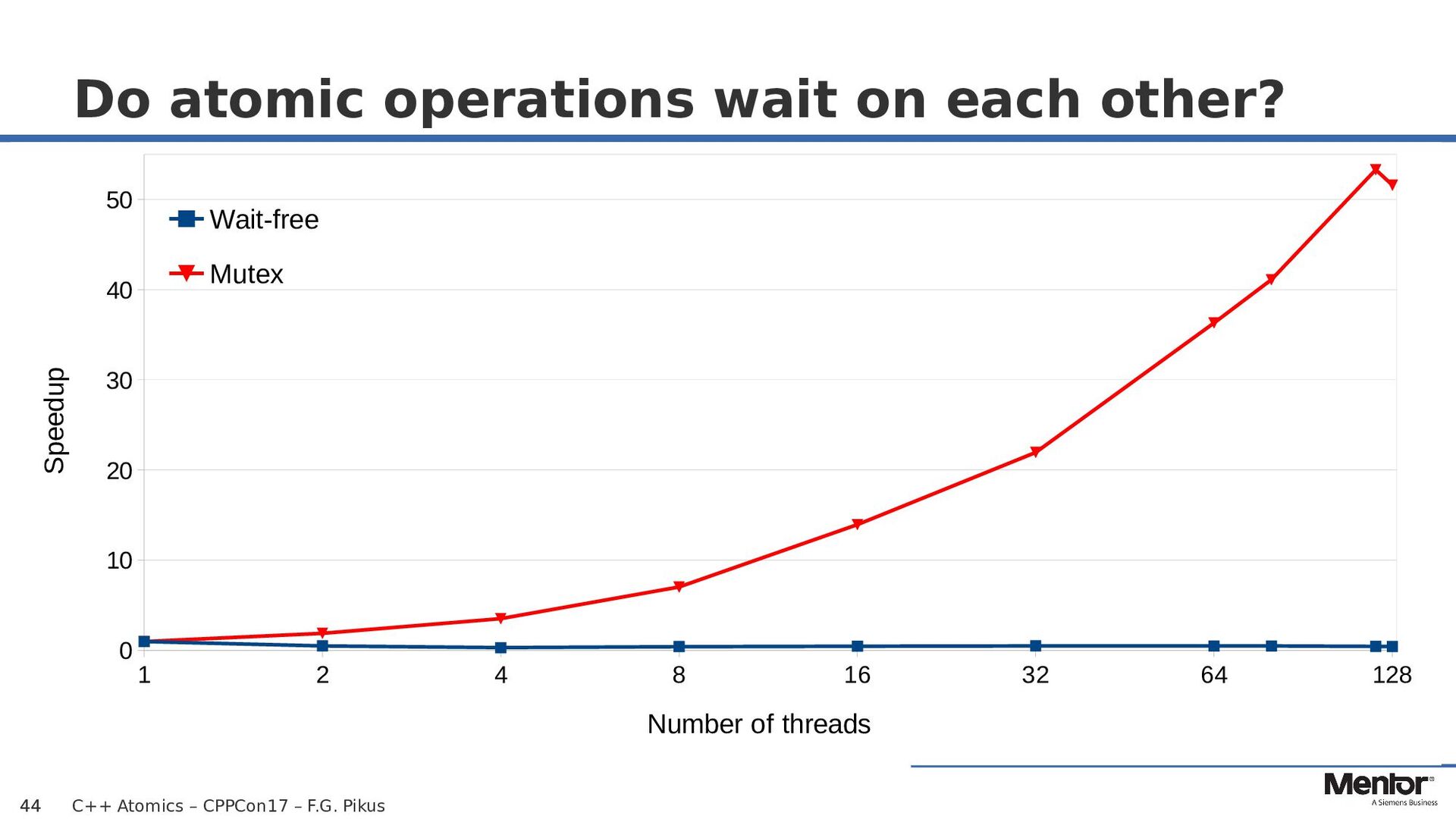
tool of lock-free programming Lock-free means “fast” 2 Compare performance of two programs Both programs perform the same computations and get the same results Both programs are correct – No “wait loops” or other tricks One program uses std::mutex, the other is wait-free (even better than lock-free!)
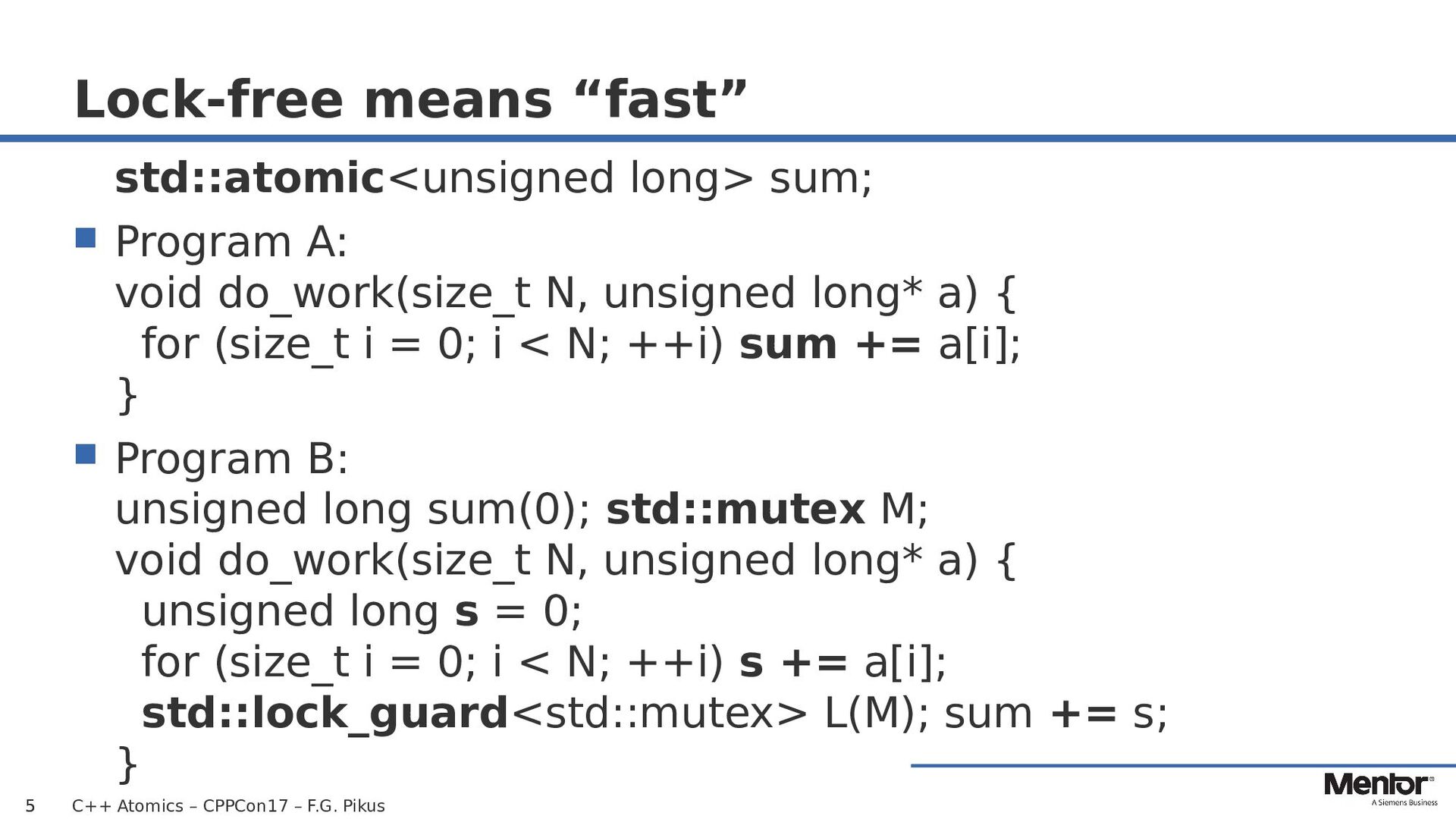
“fast” 5 std::atomic<unsigned long> sum; Program A: void do_work(size_t N, unsigned long* a) { for (size_t i = 0; i < N; ++i) sum += a[i]; } Program B: unsigned long sum(0); std::mutex M; void do_work(size_t N, unsigned long* a) { unsigned long s = 0; for (size_t i = 0; i < N; ++i) s += a[i]; std::lock_guard<std::mutex> L(M); sum += s; }
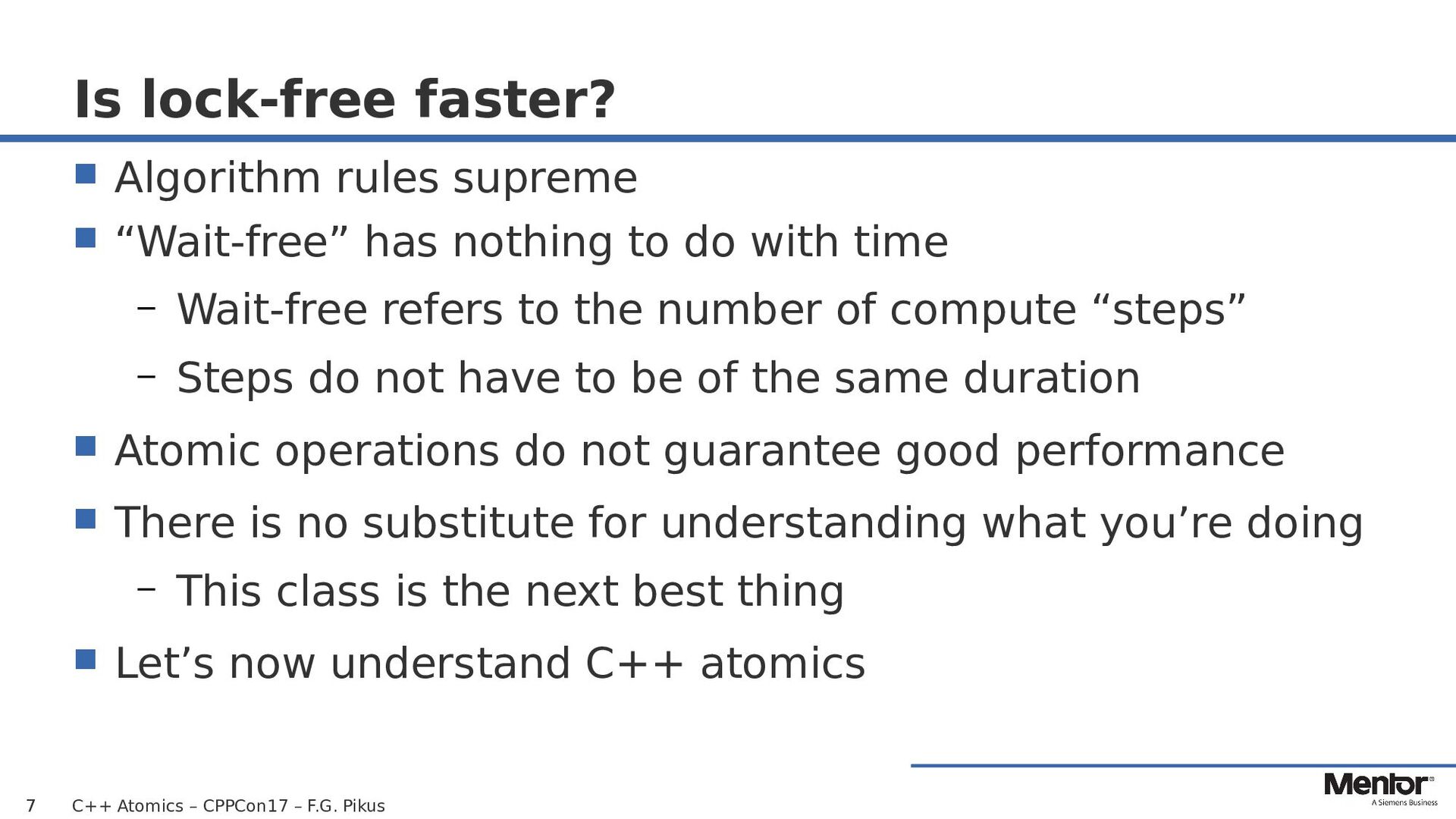
faster? 7 Algorithm rules supreme “Wait-free” has nothing to do with time – Wait-free refers to the number of compute “steps” – Steps do not have to be of the same duration Atomic operations do not guarantee good performance There is no substitute for understanding what you’re doing – This class is the next best thing Let’s now understand C++ atomics
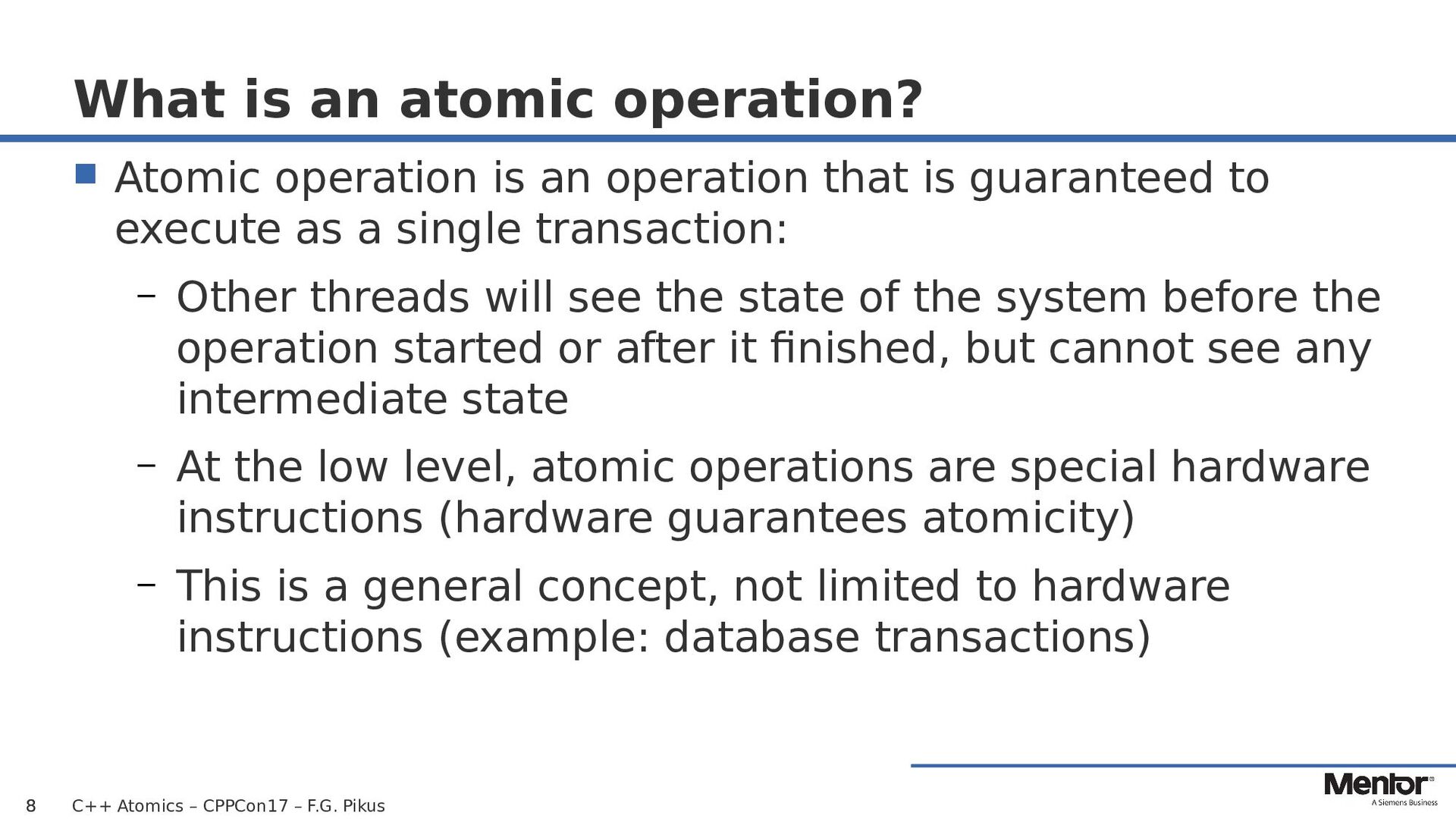
an atomic operation? Atomic operation is an operation that is guaranteed to execute as a single transaction: – Other threads will see the state of the system before the operation started or after it finished, but cannot see any intermediate state – At the low level, atomic operations are special hardware instructions (hardware guarantees atomicity) – This is a general concept, not limited to hardware instructions (example: database transactions) 8
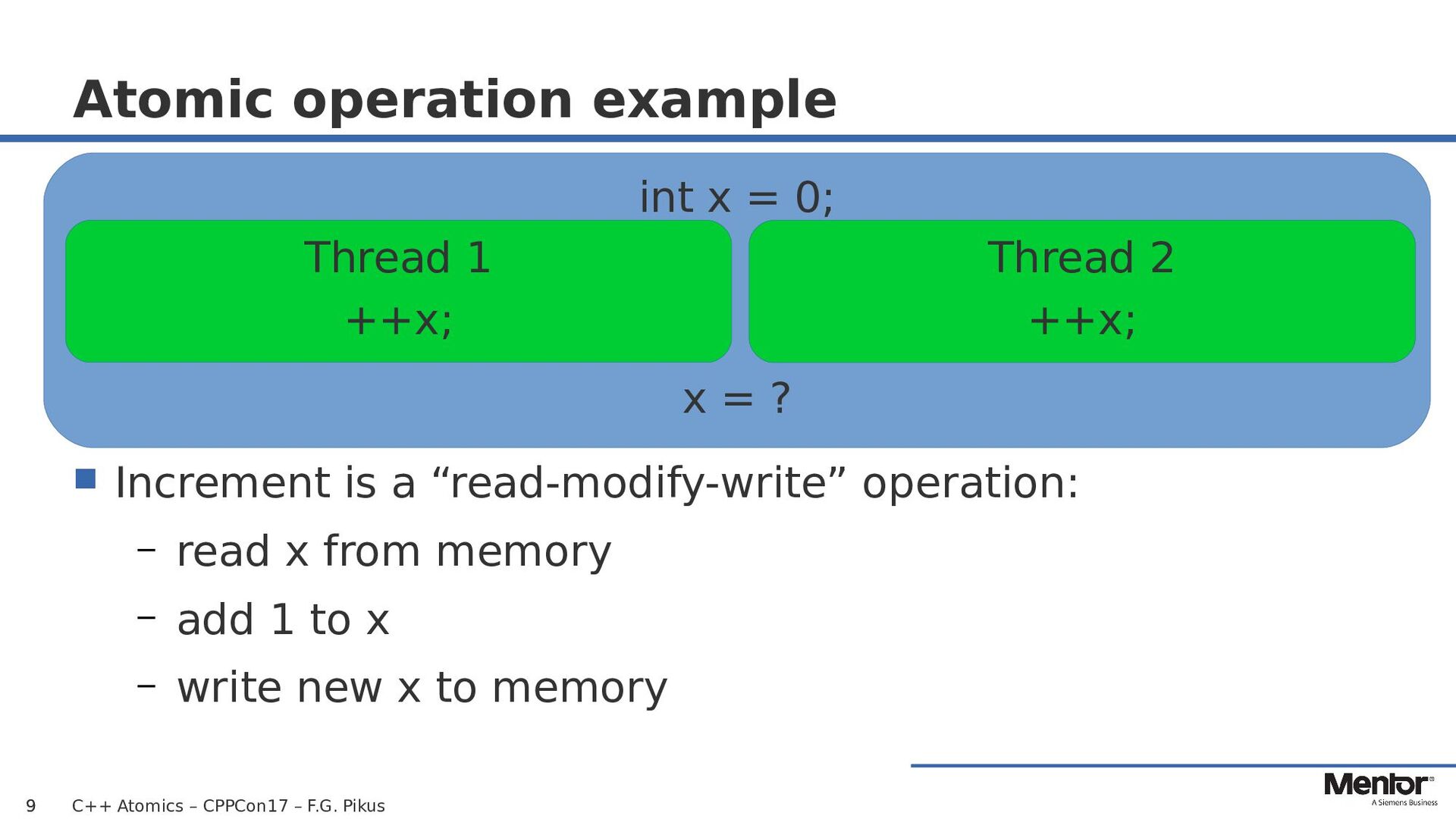
example Increment is a “read-modify-write” operation: – read x from memory – add 1 to x – write new x to memory 9 int x = 0; x = ? Thread 1 ++x; Thread 2 ++x;
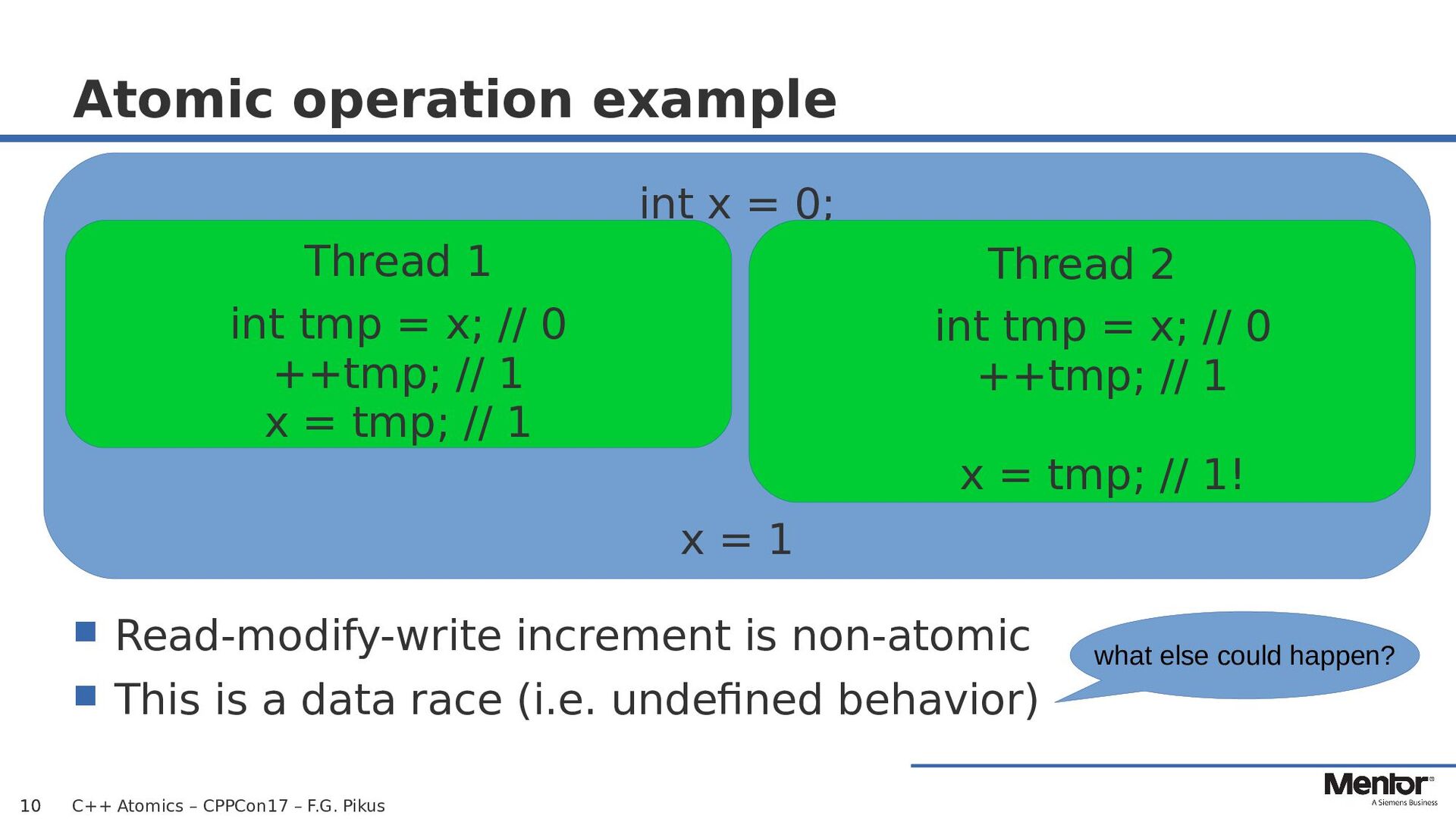
example Read-modify-write increment is non-atomic This is a data race (i.e. undefined behavior) 10 int x = 0; x = 1 Thread 1 int tmp = x; // 0 ++tmp; // 1 x = tmp; // 1 Thread 2 int tmp = x; // 0 ++tmp; // 1 x = tmp; // 1! what else could happen?
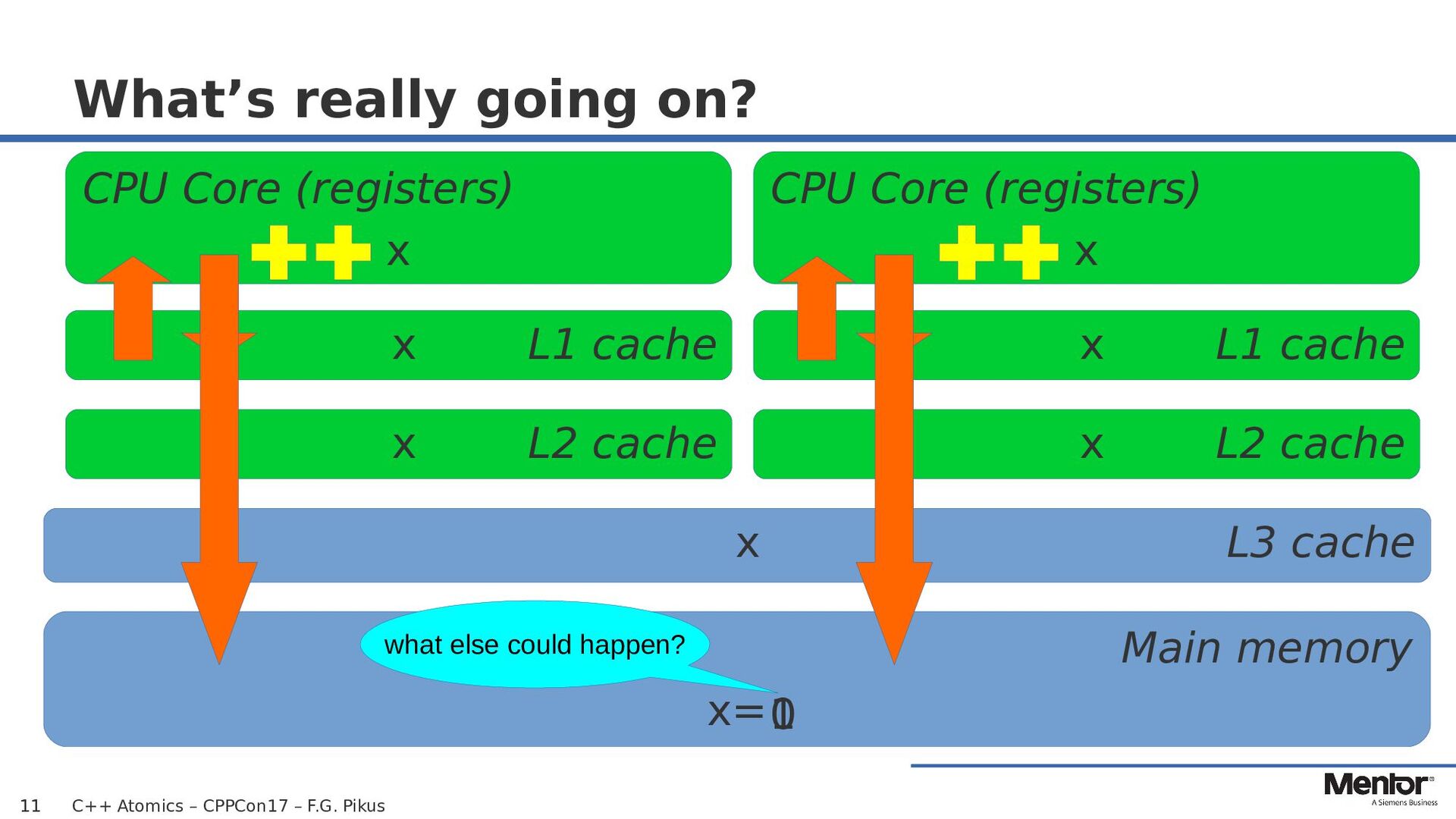
going on? 11 Main memory x= CPU Core (registers) x x L3 cache x L1 cache x L2 cache CPU Core (registers) x x L1 cache x L2 cache 0 1 what else could happen?
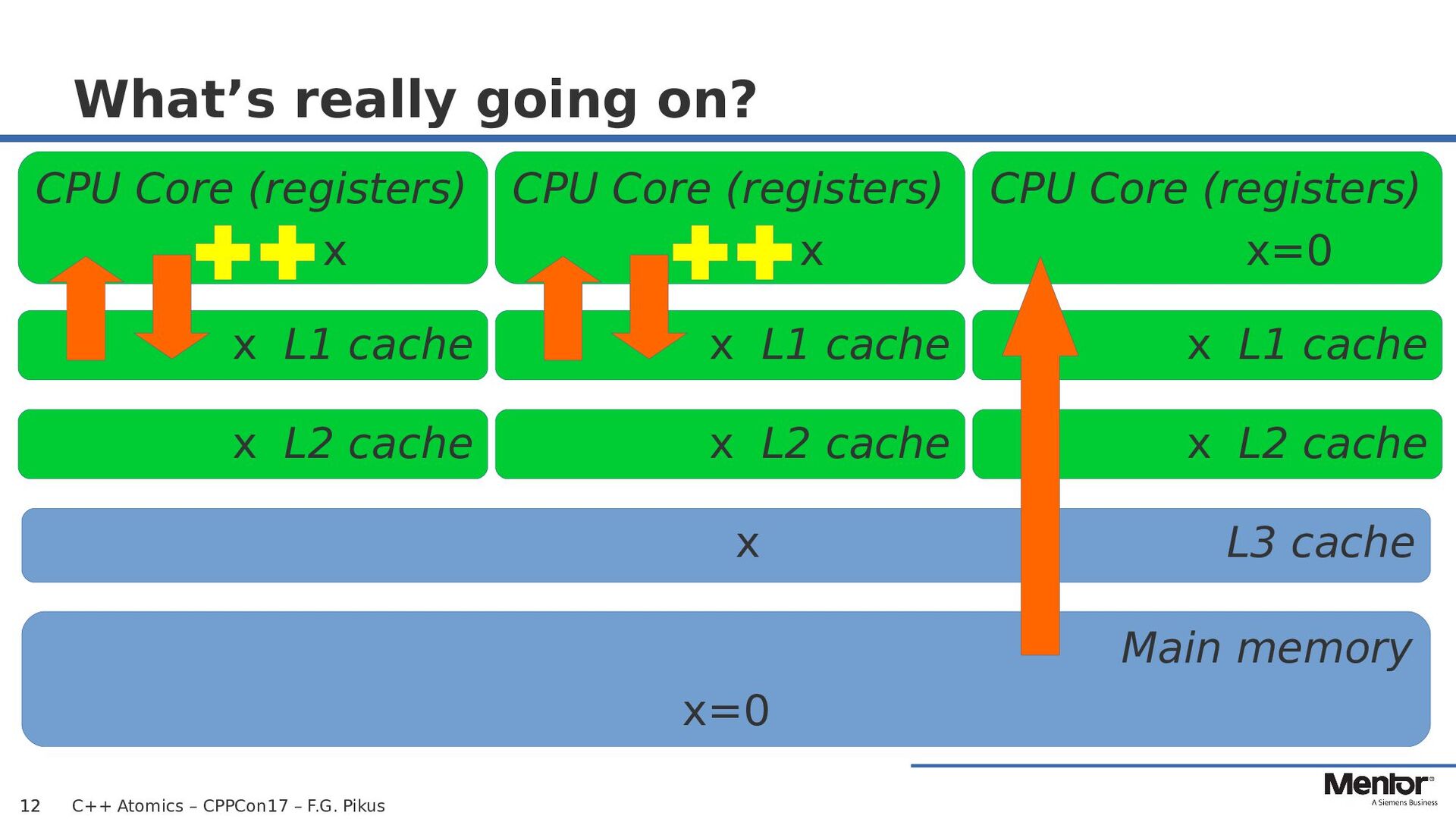
going on? 12 Main memory x=0 CPU Core (registers) x x L3 cache x L1 cache x L2 cache CPU Core (registers) x x L1 cache x L2 cache CPU Core (registers) x=0 x L1 cache x L2 cache
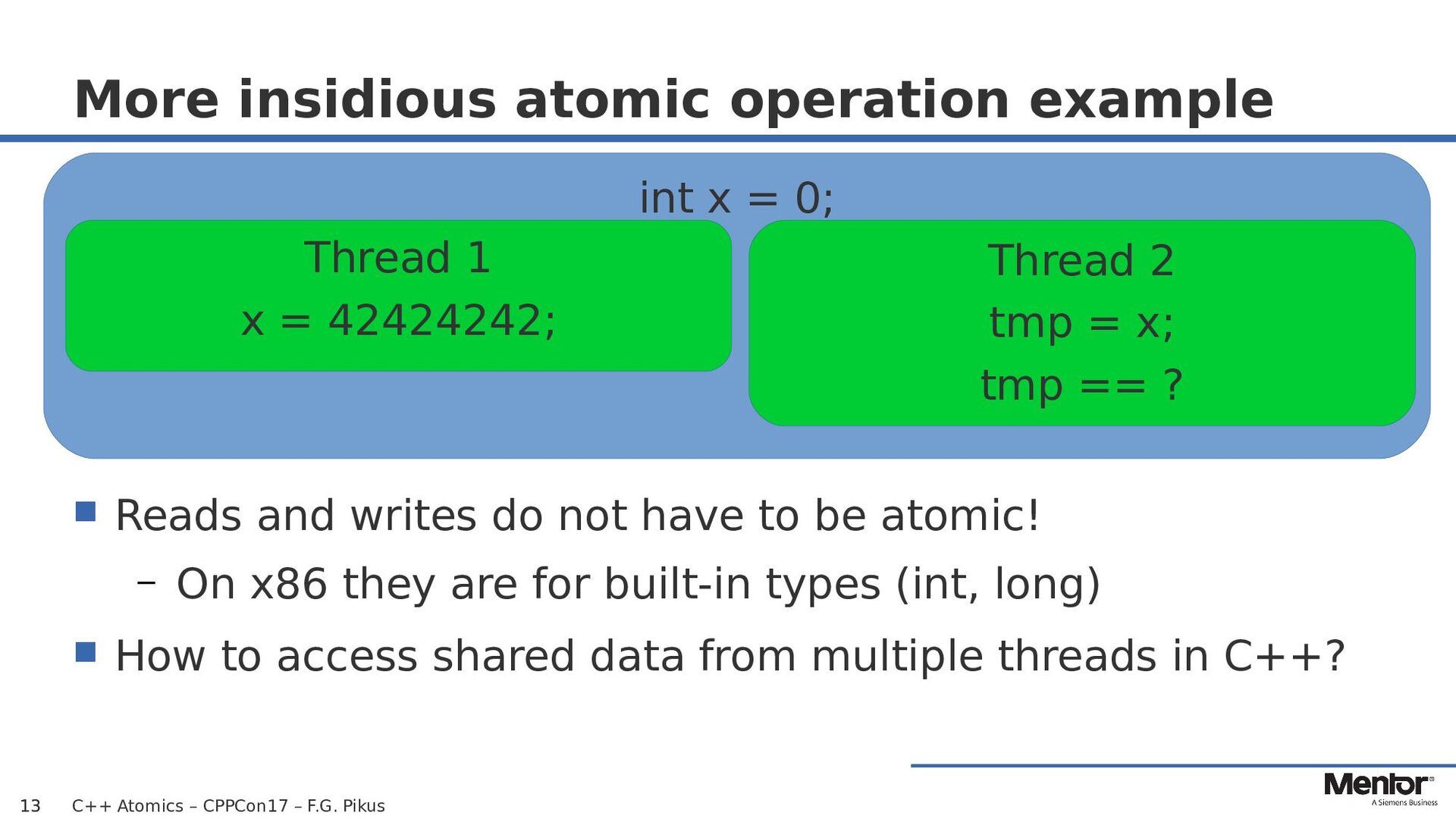
atomic operation example Reads and writes do not have to be atomic! – On x86 they are for built-in types (int, long) How to access shared data from multiple threads in C++? 13 int x = 0; Thread 1 x = 42424242; Thread 2 tmp = x; tmp == ?
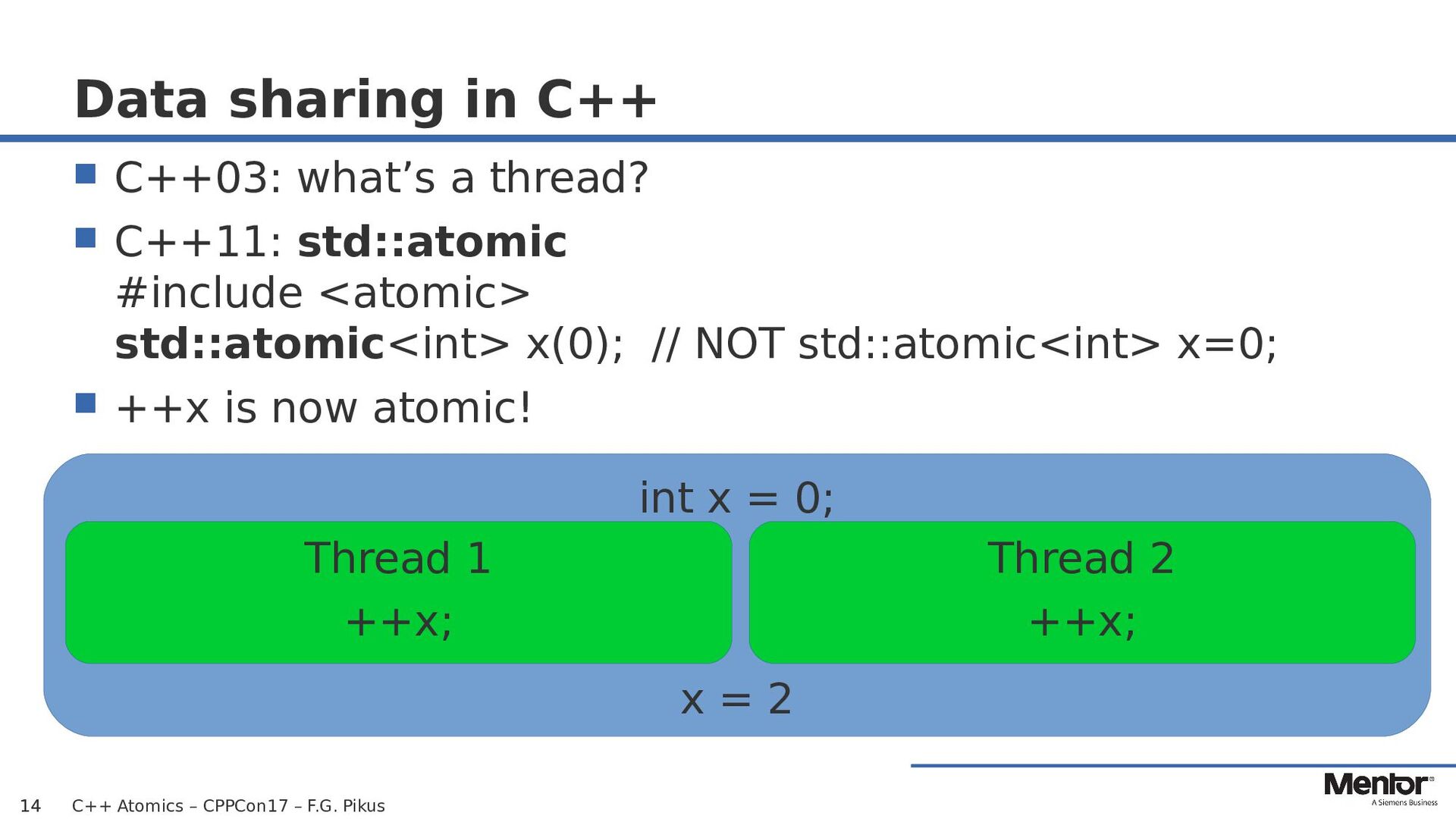
in C++ C++03: what’s a thread? C++11: std::atomic #include <atomic> std::atomic<int> x(0); // NOT std::atomic<int> x=0; ++x is now atomic! – another thread cannot access x during increment 14 int x = 0; x = 2 Thread 1 ++x; Thread 2 ++x;
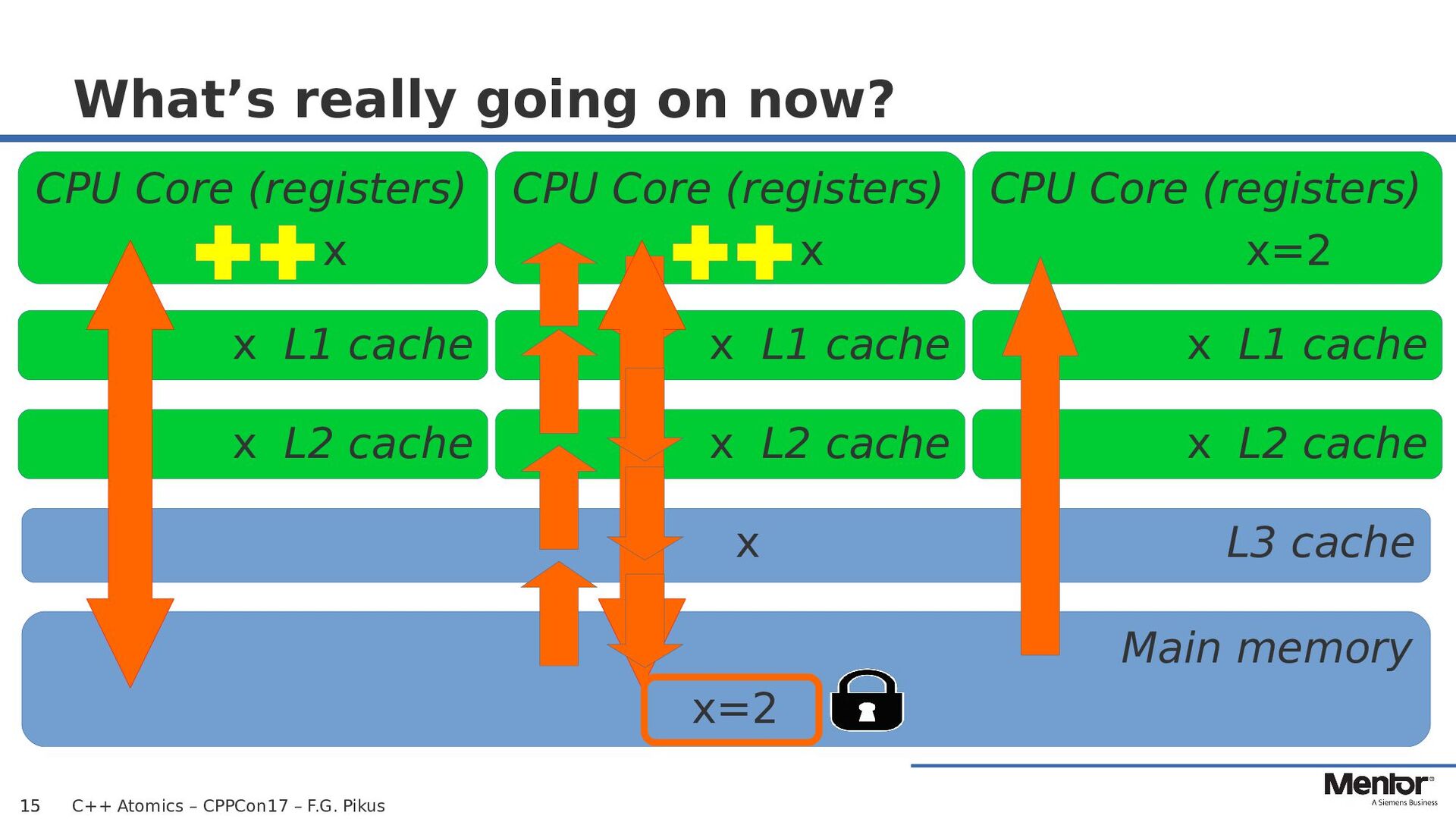
going on now? 15 Main memory x=0 CPU Core (registers) x x L3 cache x L1 cache x L2 cache CPU Core (registers) x x L1 cache x L2 cache CPU Core (registers) x=2 x L1 cache x L2 cache x=1 x=2
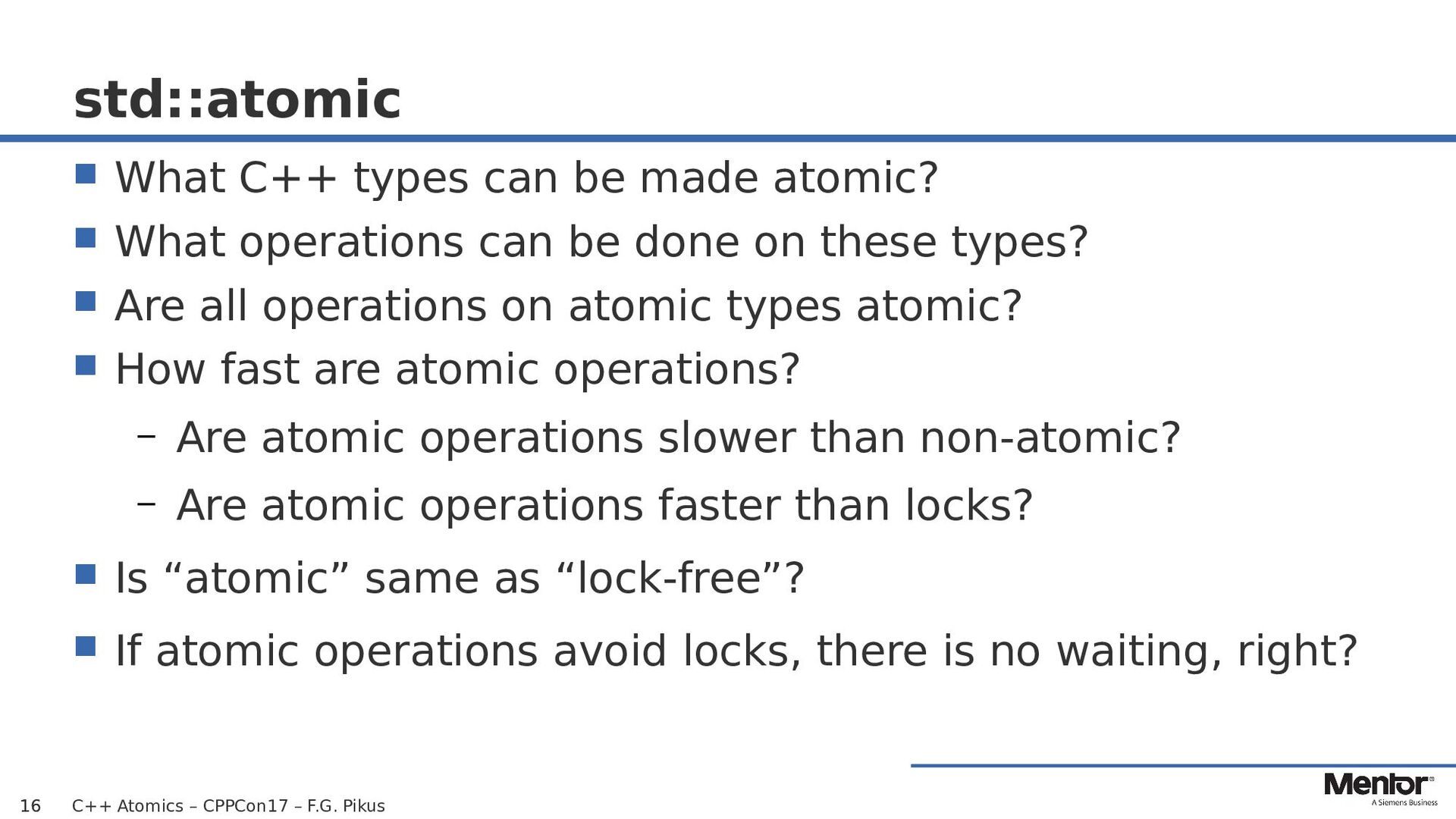
What C++ types can be made atomic? What operations can be done on these types? Are all operations on atomic types atomic? How fast are atomic operations? – Are atomic operations slower than non-atomic? – Are atomic operations faster than locks? Is “atomic” same as “lock-free”? If atomic operations avoid locks, there is no waiting, right?
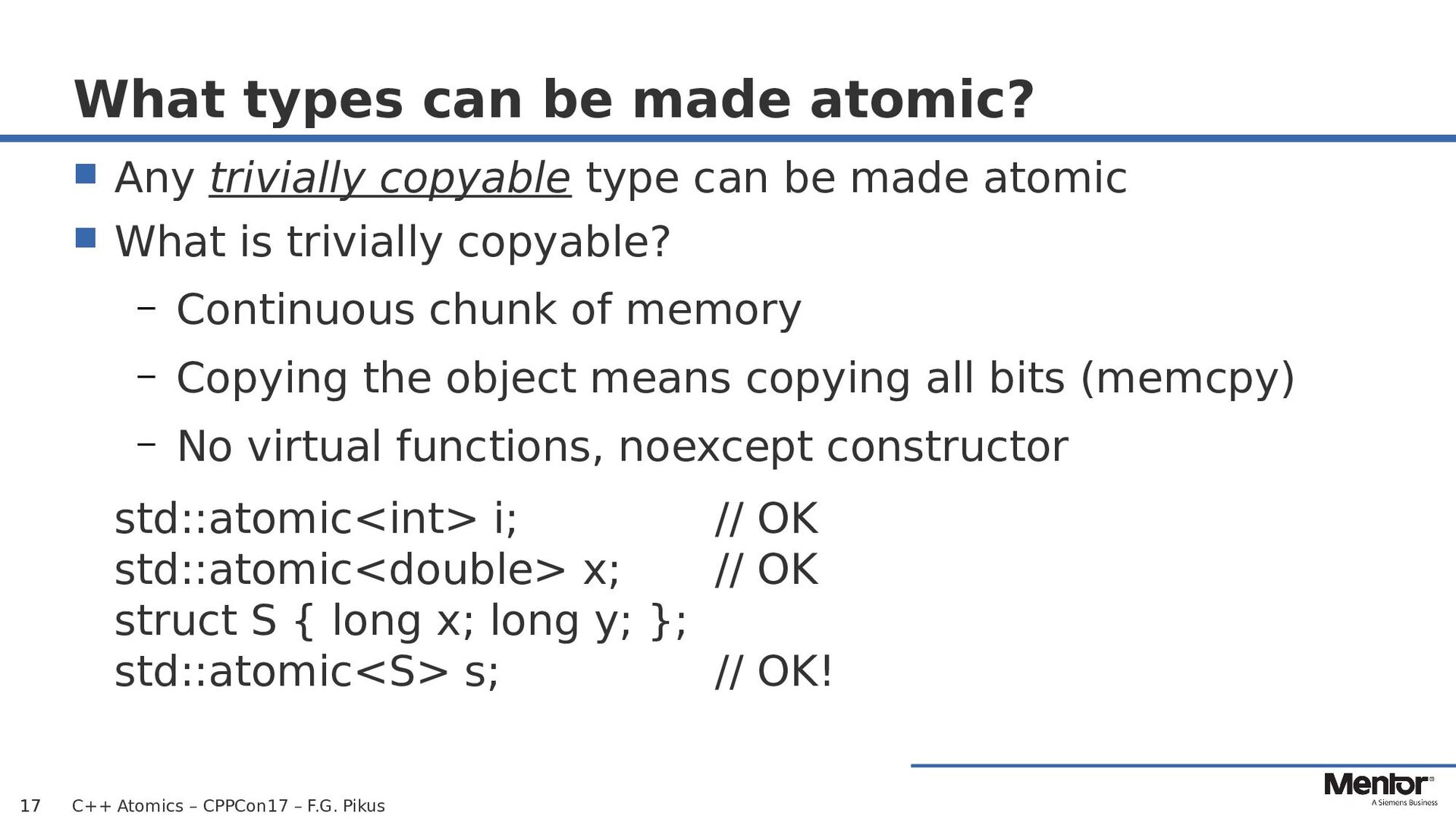
can be made atomic? 17 Any trivially copyable type can be made atomic What is trivially copyable? – Continuous chunk of memory – Copying the object means copying all bits (memcpy) – No virtual functions, noexcept constructor std::atomic<int> i; // OK std::atomic<double> x; // OK struct S { long x; long y; }; std::atomic<S> s; // OK!
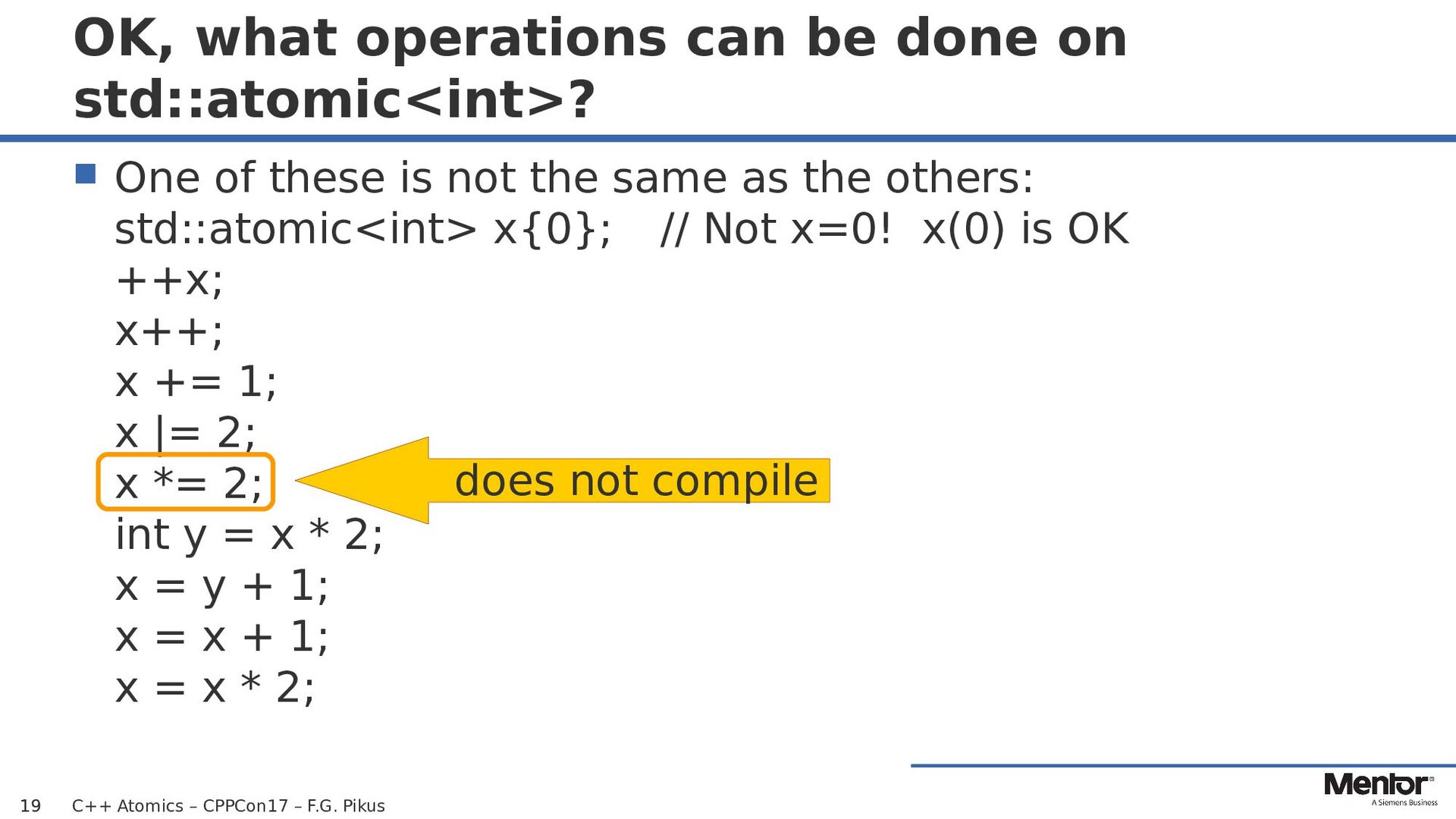
operations can be done on std::atomic<int>? 19 One of these is not the same as the others: std::atomic<int> x{0}; // Not x=0! x(0) is OK ++x; x++; x += 1; x |= 2; x *= 2; int y = x * 2; x = y + 1; x = x + 1; x = x * 2; does not compile
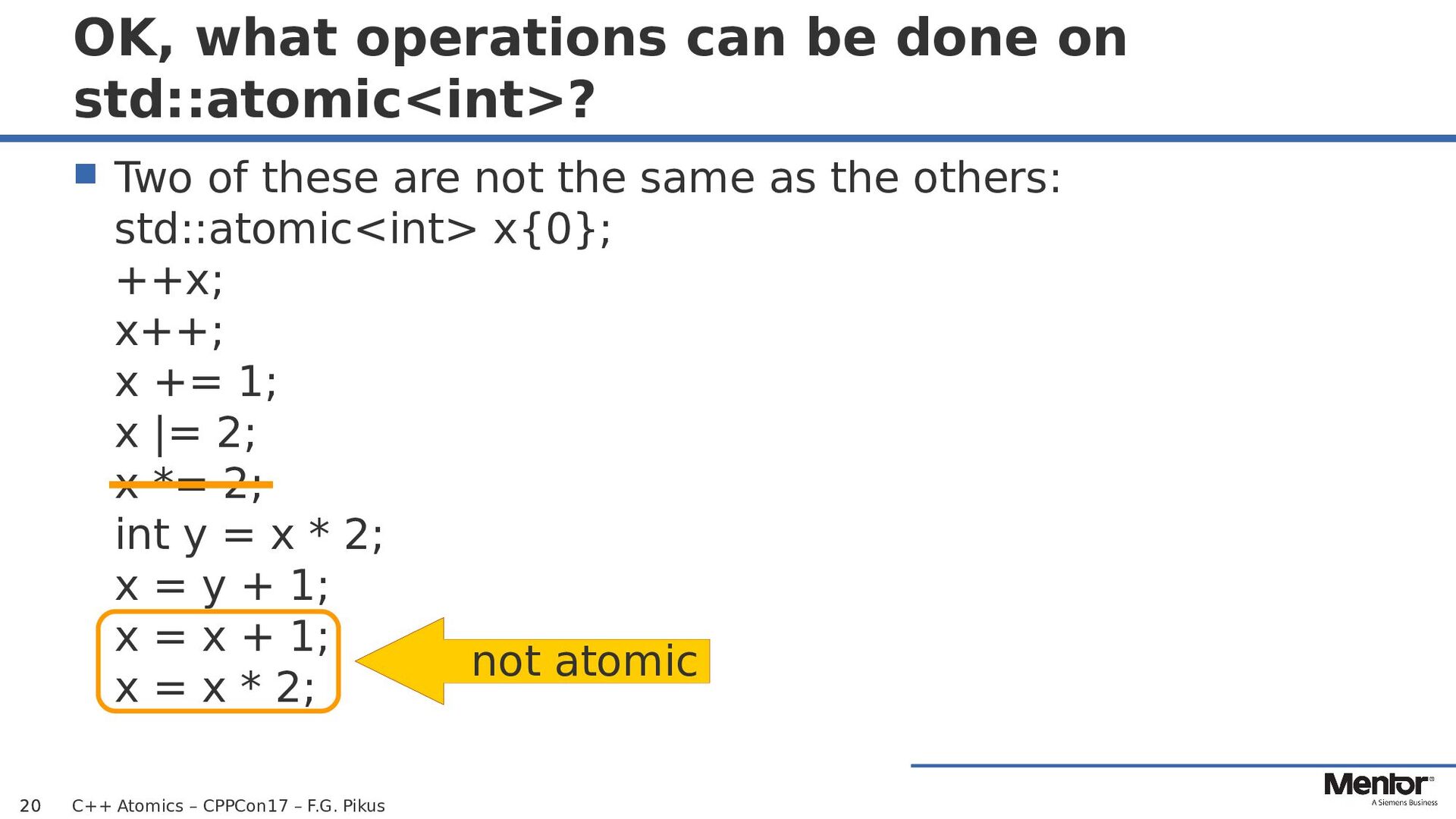
operations can be done on std::atomic<int>? 20 Two of these are not the same as the others: std::atomic<int> x{0}; ++x; x++; x += 1; x |= 2; x *= 2; int y = x * 2; x = y + 1; x = x + 1; x = x * 2; not atomic
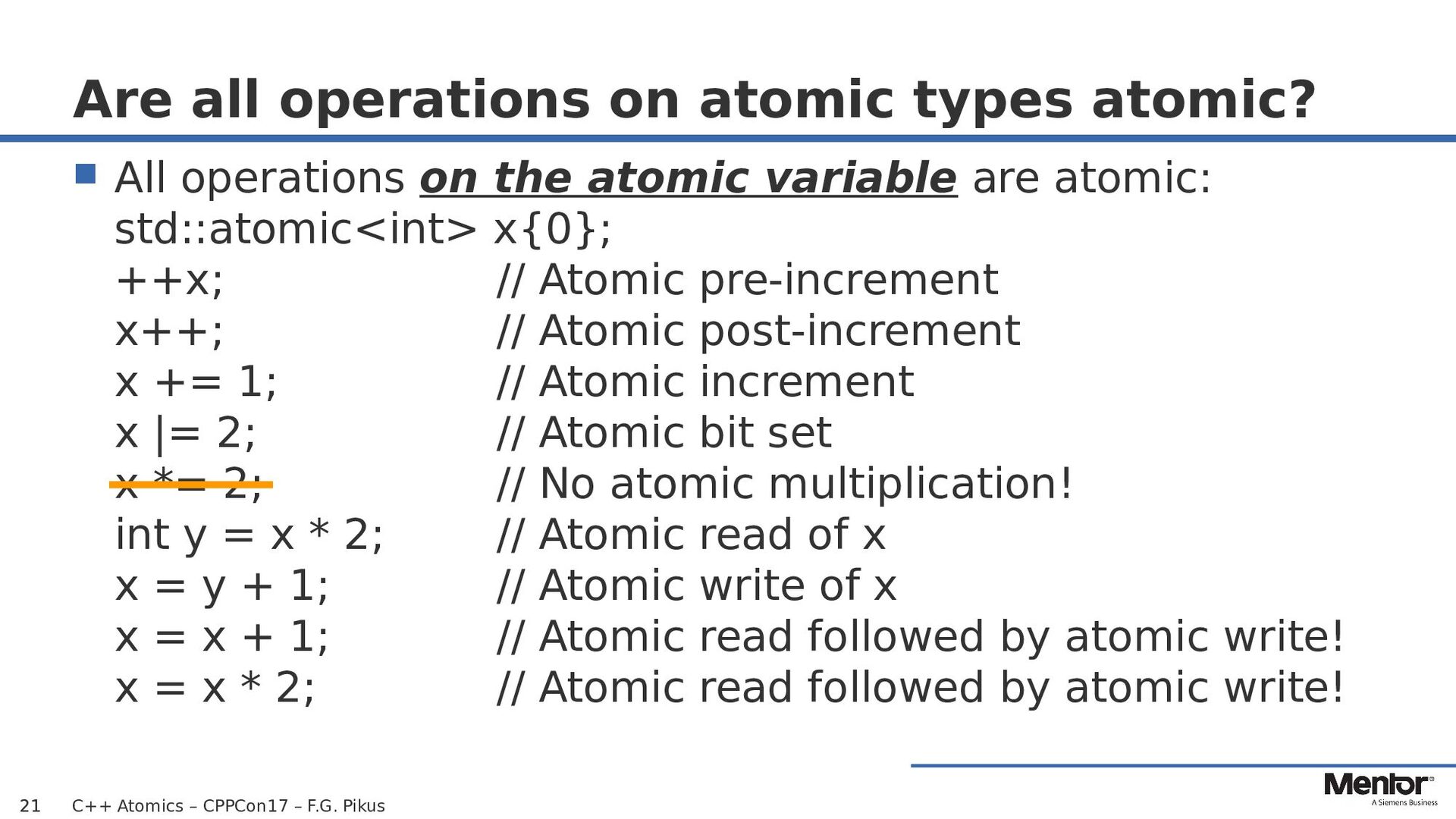
operations on atomic types atomic? 21 All operations on the atomic variable are atomic: std::atomic<int> x{0}; ++x; // Atomic pre-increment x++; // Atomic post-increment x += 1; // Atomic increment x |= 2; // Atomic bit set x *= 2; // No atomic multiplication! int y = x * 2; // Atomic read of x x = y + 1; // Atomic write of x x = x + 1; // Atomic read followed by atomic write! x = x * 2; // Atomic read followed by atomic write!
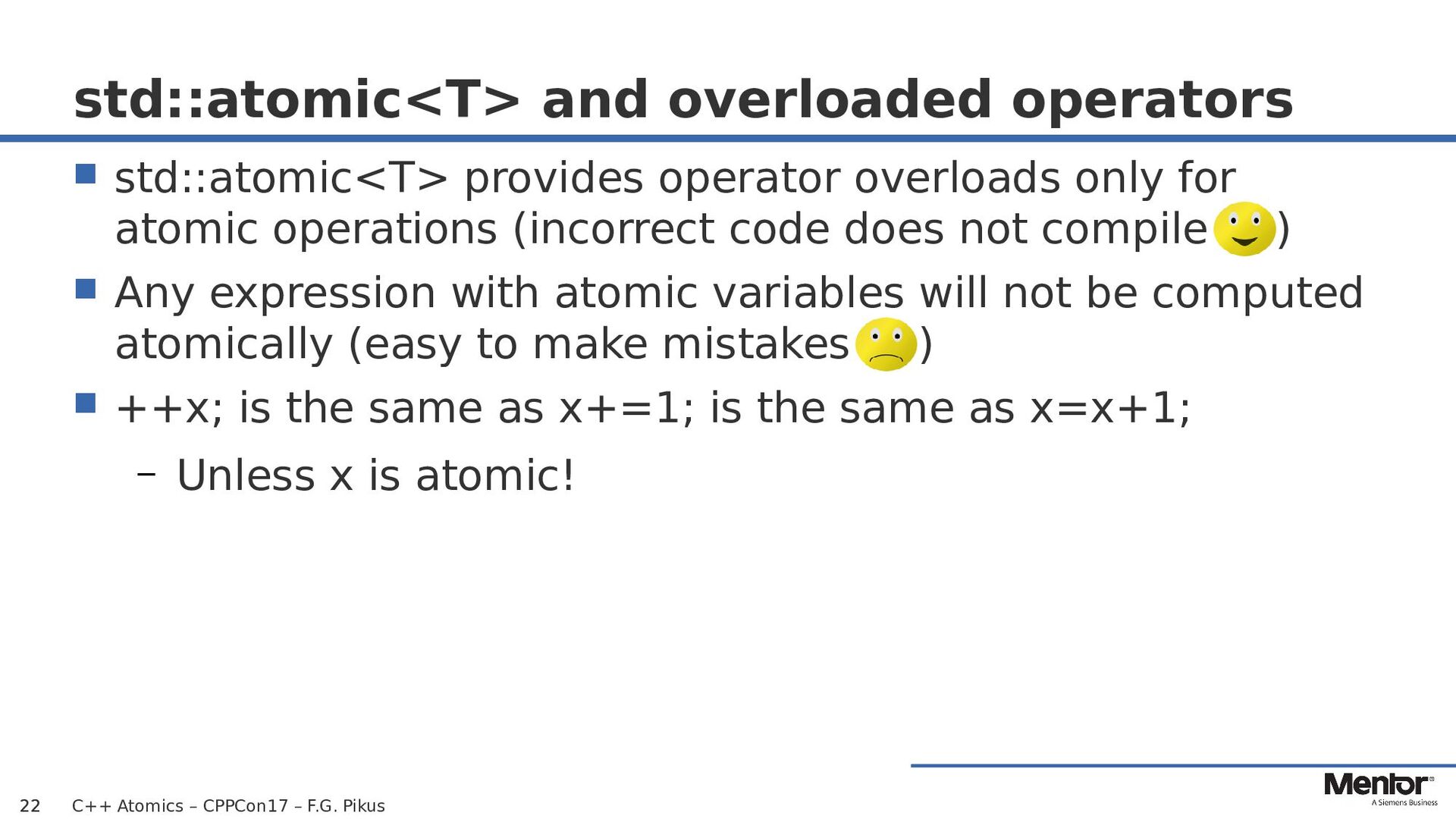
overloaded operators 22 std::atomic<T> provides operator overloads only for atomic operations (incorrect code does not compile ) Any expression with atomic variables will not be computed atomically (easy to make mistakes ) ++x; is the same as x+=1; is the same as x=x+1; – Unless x is atomic!
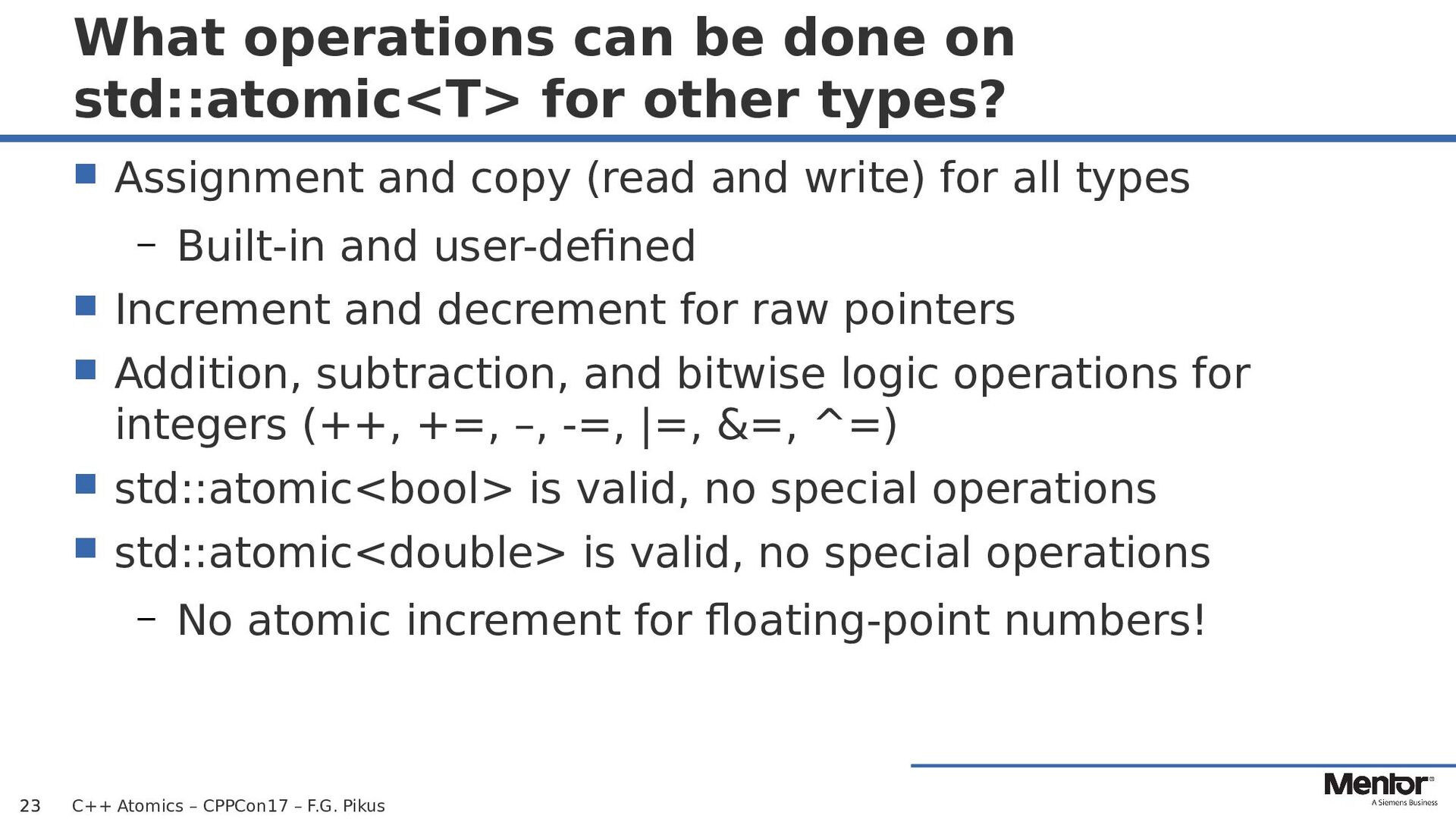
can be done on std::atomic<T> for other types? 23 Assignment and copy (read and write) for all types – Built-in and user-defined Increment and decrement for raw pointers Addition, subtraction, and bitwise logic operations for integers (++, +=, –, -=, |=, &=, ^=) std::atomic<bool> is valid, no special operations std::atomic<double> is valid, no special operations – No atomic increment for floating-point numbers!
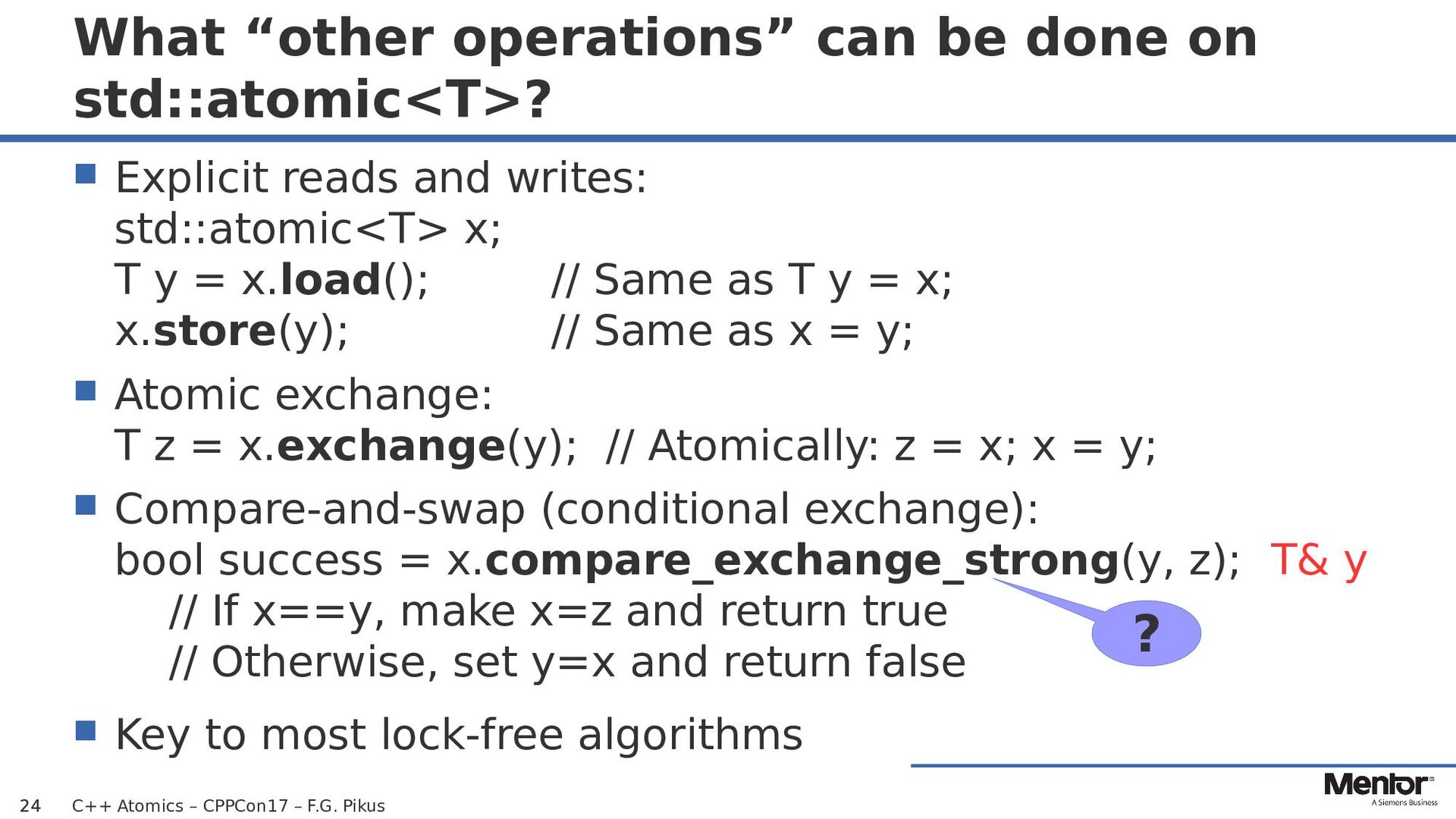
operations” can be done on std::atomic<T>? 24 Explicit reads and writes: std::atomic<T> x; T y = x.load(); // Same as T y = x; x.store(y); // Same as x = y; Atomic exchange: T z = x.exchange(y); // Atomically: z = x; x = y; Compare-and-swap (conditional exchange): bool success = x.compare_exchange_strong(y, z); // If x==y, make x=z and return true // Otherwise, set y=x and return false Key to most lock-free algorithms T& y ?
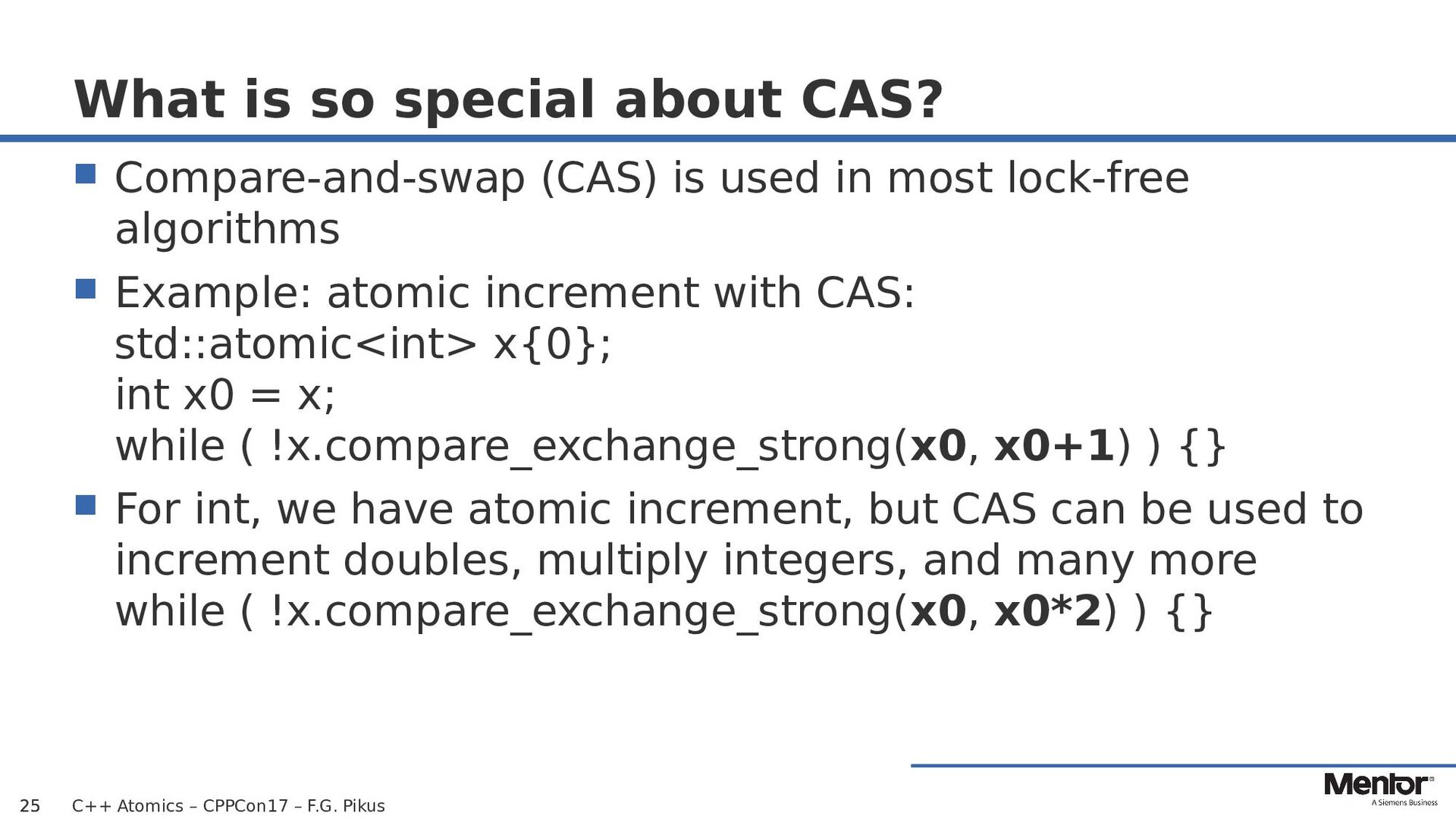
so special about CAS? 25 Compare-and-swap (CAS) is used in most lock-free algorithms Example: atomic increment with CAS: std::atomic<int> x{0}; int x0 = x; while ( !x.compare_exchange_strong(x0, x0+1) ) {} For int, we have atomic increment, but CAS can be used to increment doubles, multiply integers, and many more while ( !x.compare_exchange_strong(x0, x0*2) ) {}
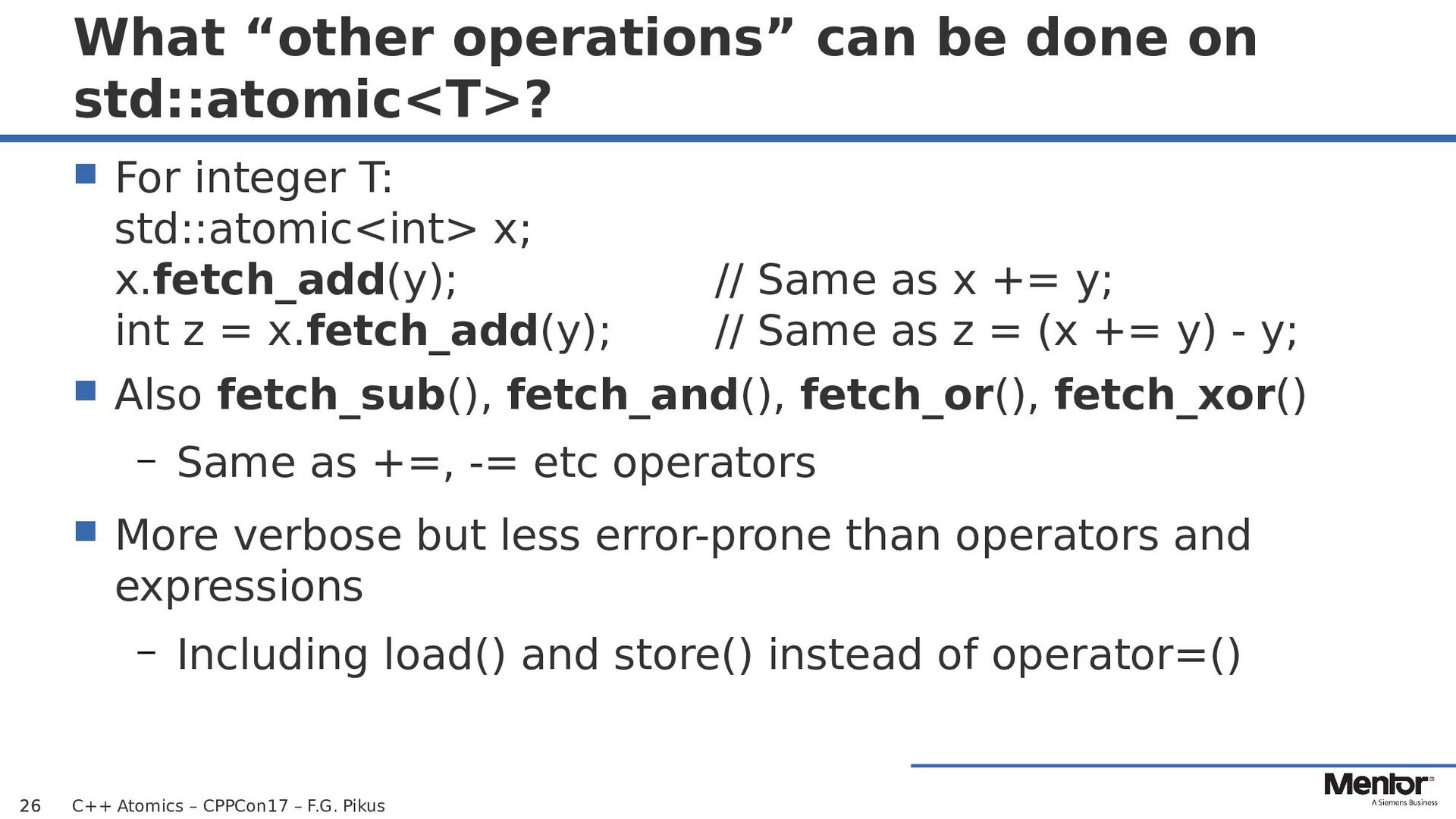
operations” can be done on std::atomic<T>? 26 For integer T: std::atomic<int> x; x.fetch_add(y); // Same as x += y; int z = x.fetch_add(y); // Same as z = (x += y) - y; Also fetch_sub(), fetch_and(), fetch_or(), fetch_xor() – Same as +=, -= etc operators More verbose but less error-prone than operators and expressions – Including load() and store() instead of operator=()
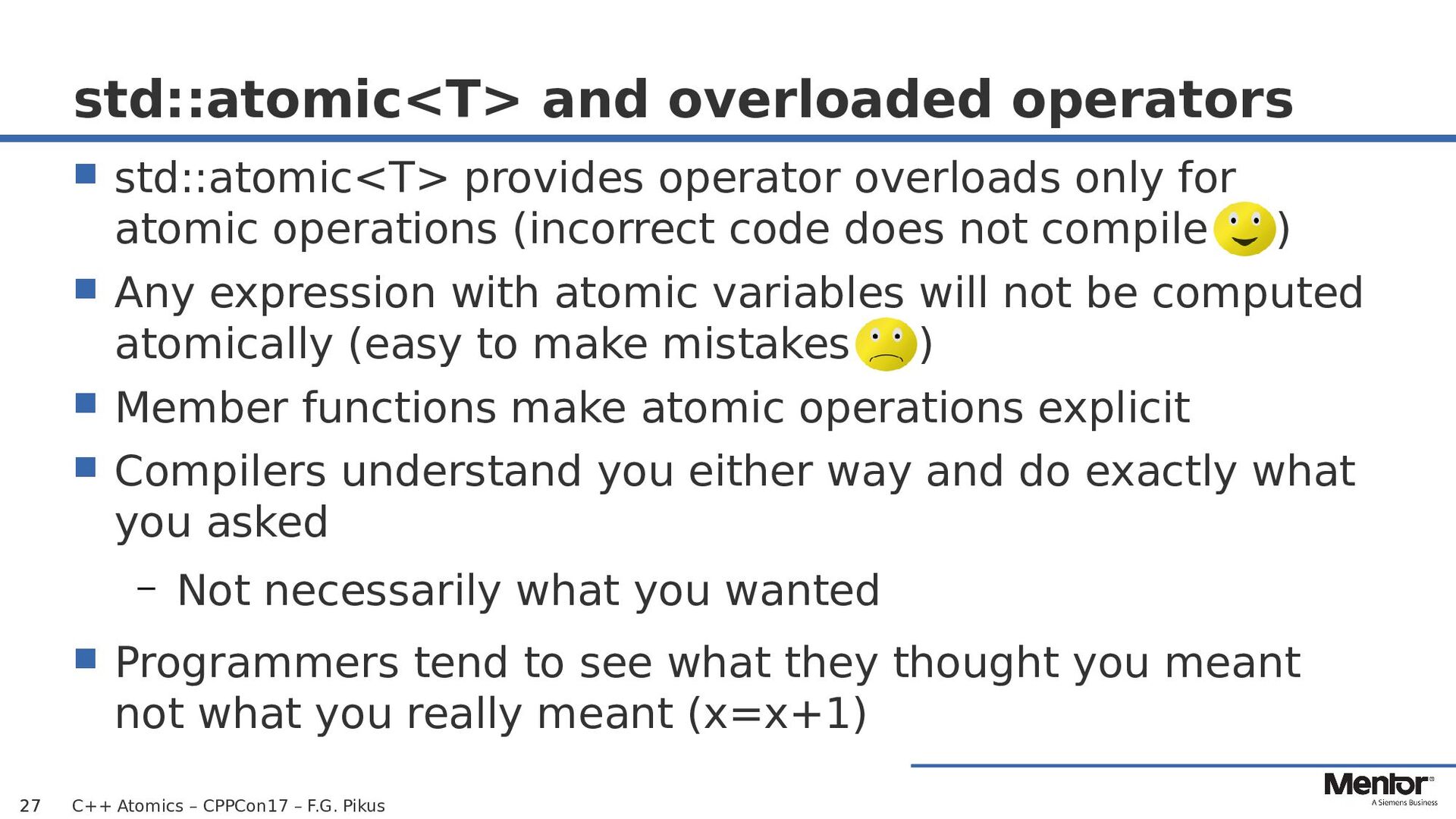
overloaded operators 27 std::atomic<T> provides operator overloads only for atomic operations (incorrect code does not compile ) Any expression with atomic variables will not be computed atomically (easy to make mistakes ) Member functions make atomic operations explicit Compilers understand you either way and do exactly what you asked – Not necessarily what you wanted Programmers tend to see what they thought you meant not what you really meant (x=x+1)
are atomic operations? 29 Performance should be measured Caution: measurement results will be hardware and compiler specific and should not be over-generalized! Caution: comparing atomic and non-atomic operations may be instructive for understanding of what the hardware does, but is rarely directly useful – Comparing atomic operation with another thread-safe alternative is valid and useful
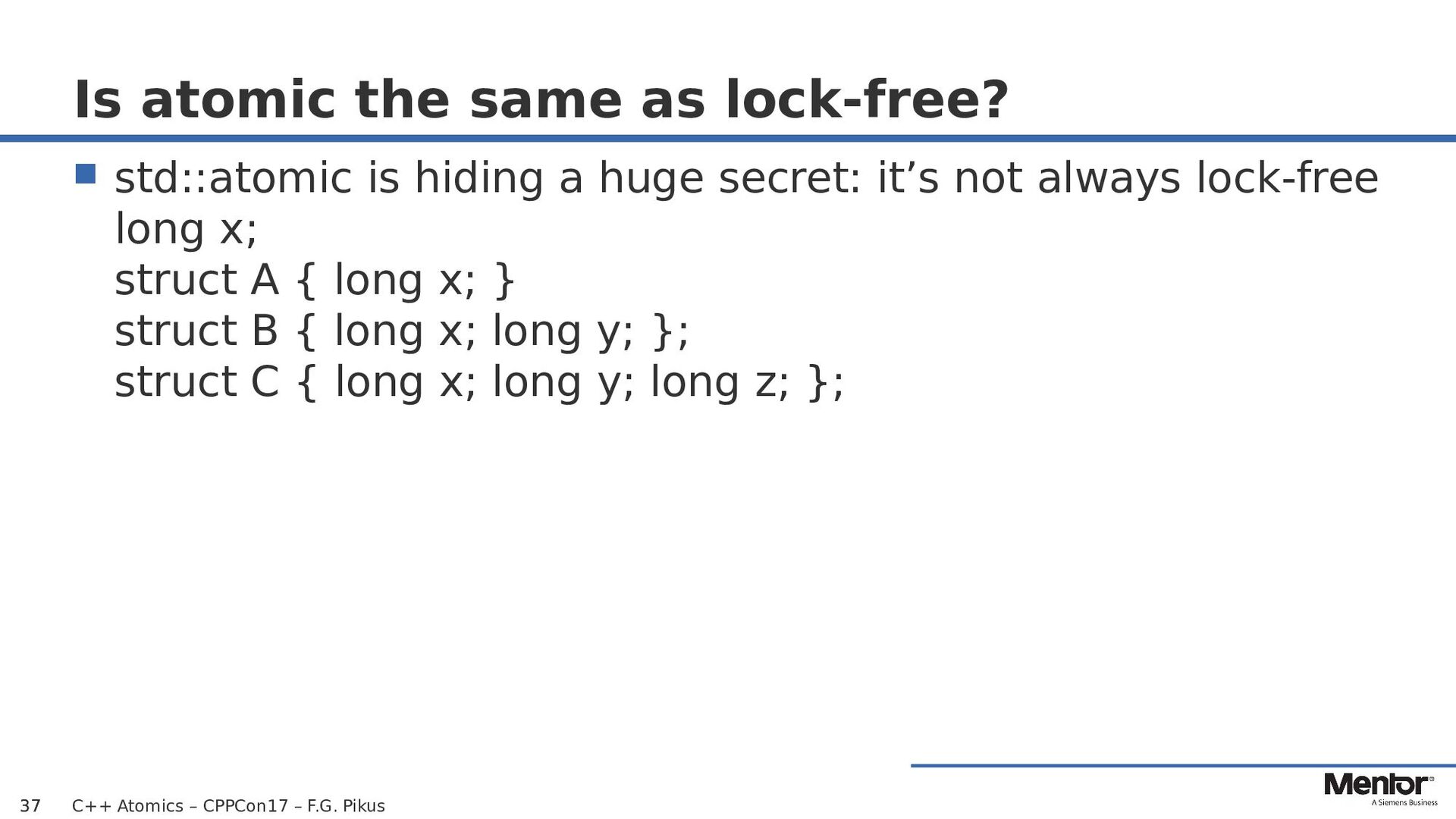
the same as lock-free? 37 std::atomic is hiding a huge secret: it’s not always lock-free long x; struct A { long x; } struct B { long x; long y; }; struct C { long x; long y; long z; };
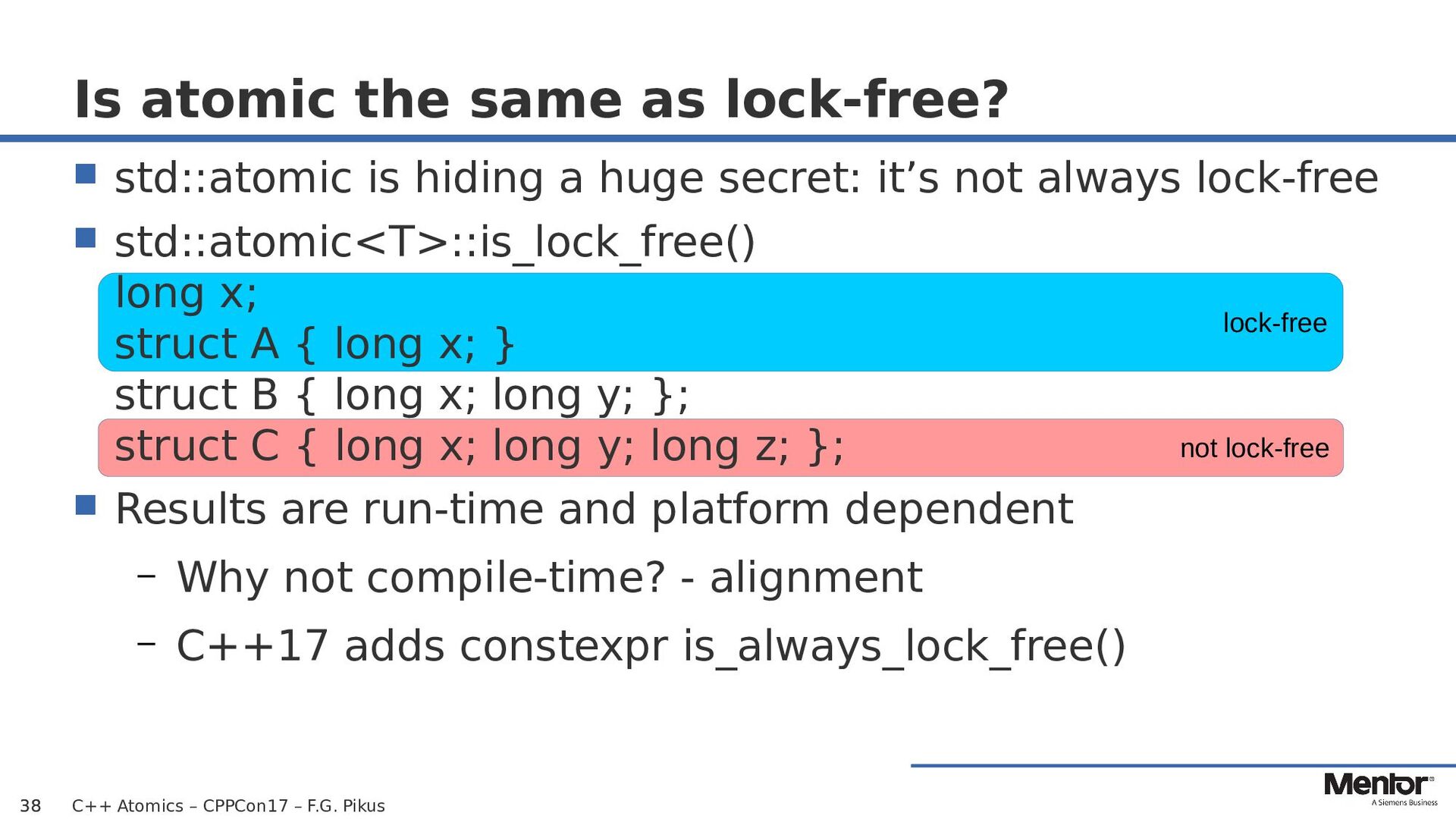
the same as lock-free? 38 lock-free not lock-free std::atomic is hiding a huge secret: it’s not always lock-free std::atomic<T>::is_lock_free() long x; struct A { long x; } struct B { long x; long y; }; struct C { long x; long y; long z; }; Results are run-time and platform dependent – Why not compile-time? - alignment – C++17 adds constexpr is_always_lock_free()
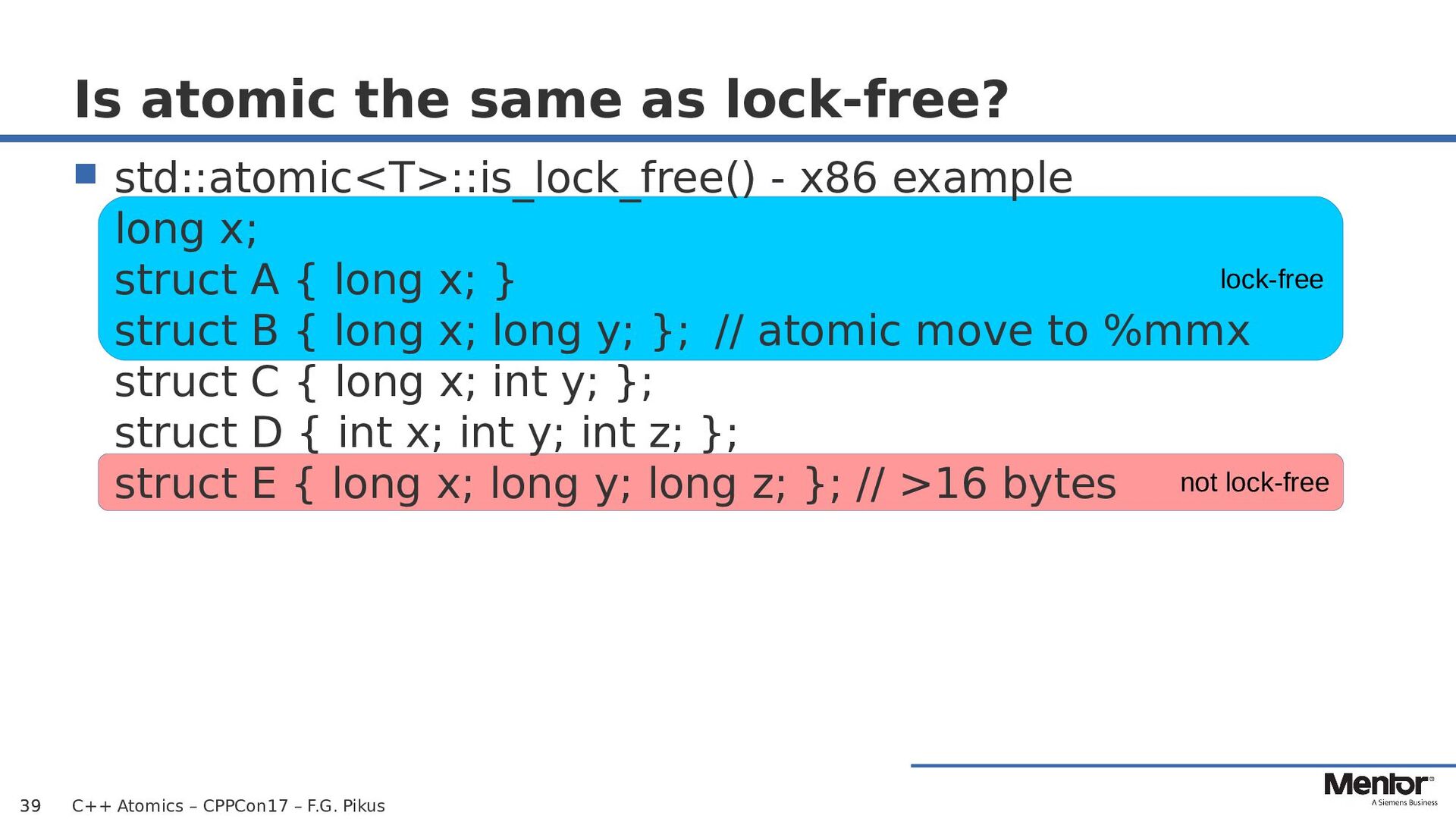
the same as lock-free? 39 lock-free not lock-free std::atomic<T>::is_lock_free() - x86 example long x; struct A { long x; } struct B { long x; long y; }; // atomic move to %mmx struct C { long x; int y; }; struct D { int x; int y; int z; }; struct E { long x; long y; long z; }; // >16 bytes
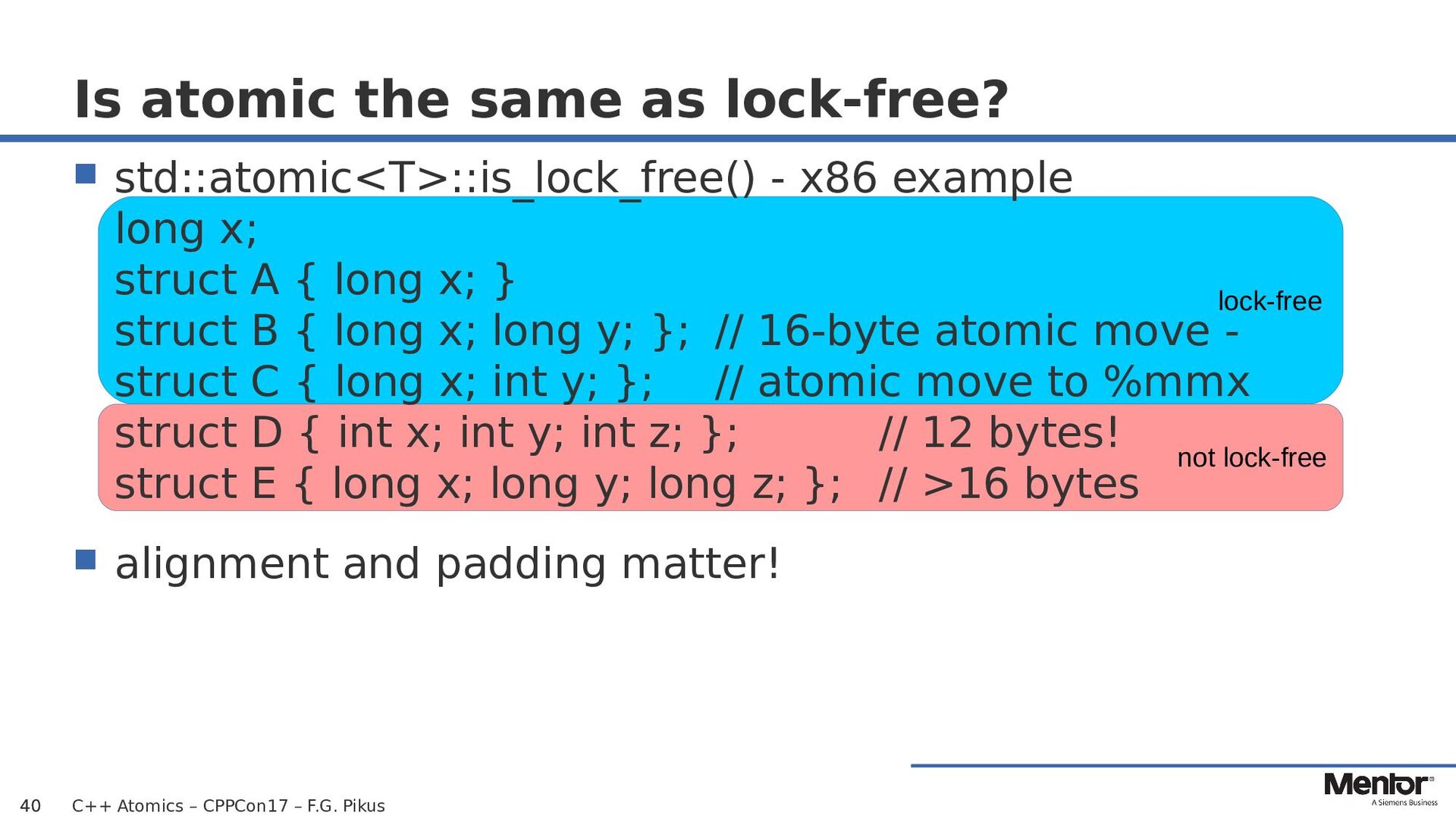
the same as lock-free? 40 lock-free not lock-free std::atomic<T>::is_lock_free() - x86 example long x; struct A { long x; } struct B { long x; long y; }; // 16-byte atomic move - struct C { long x; int y; }; // atomic move to %mmx struct D { int x; int y; int z; }; // 12 bytes! struct E { long x; long y; long z; }; // >16 bytes alignment and padding matter!
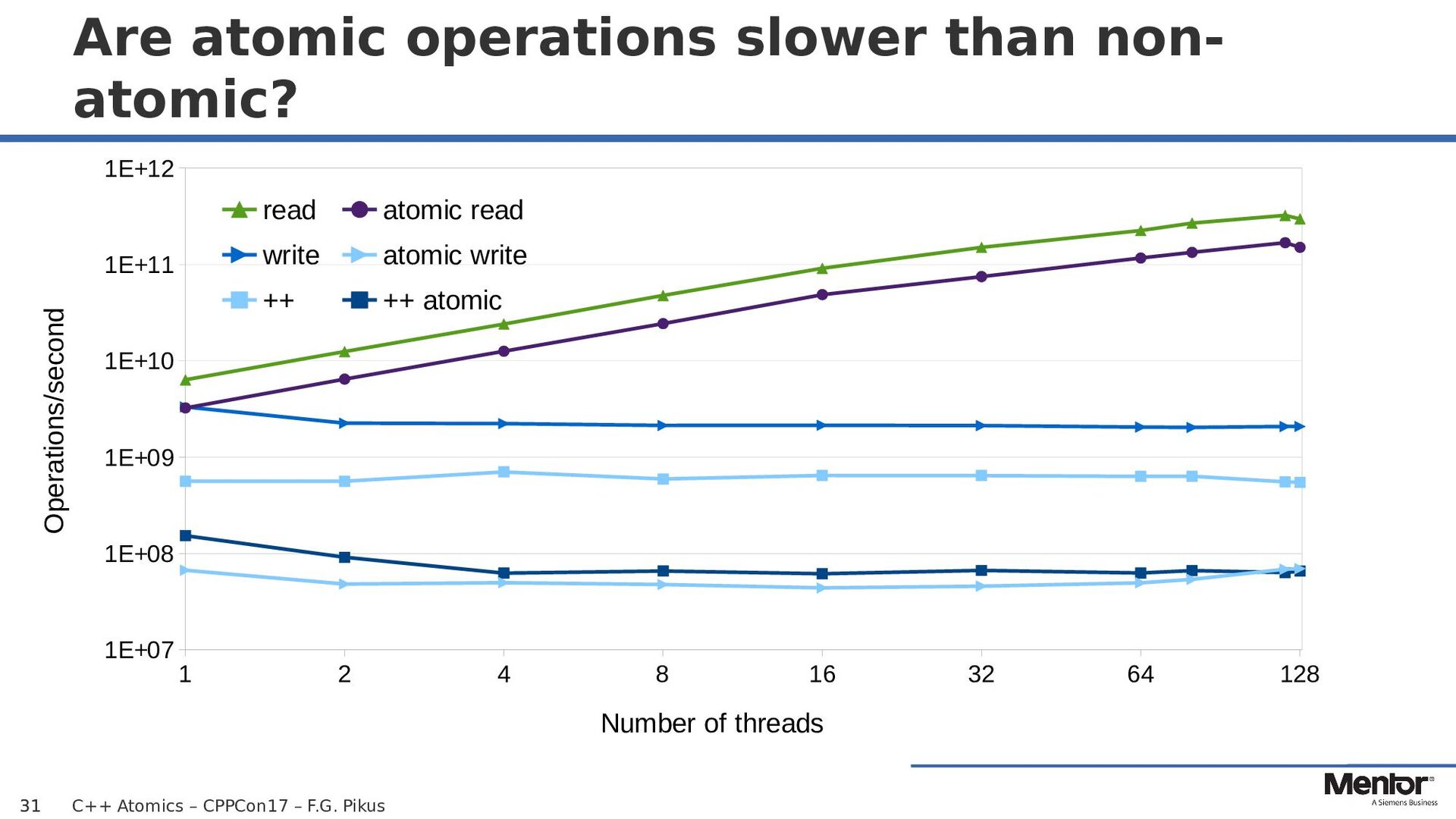
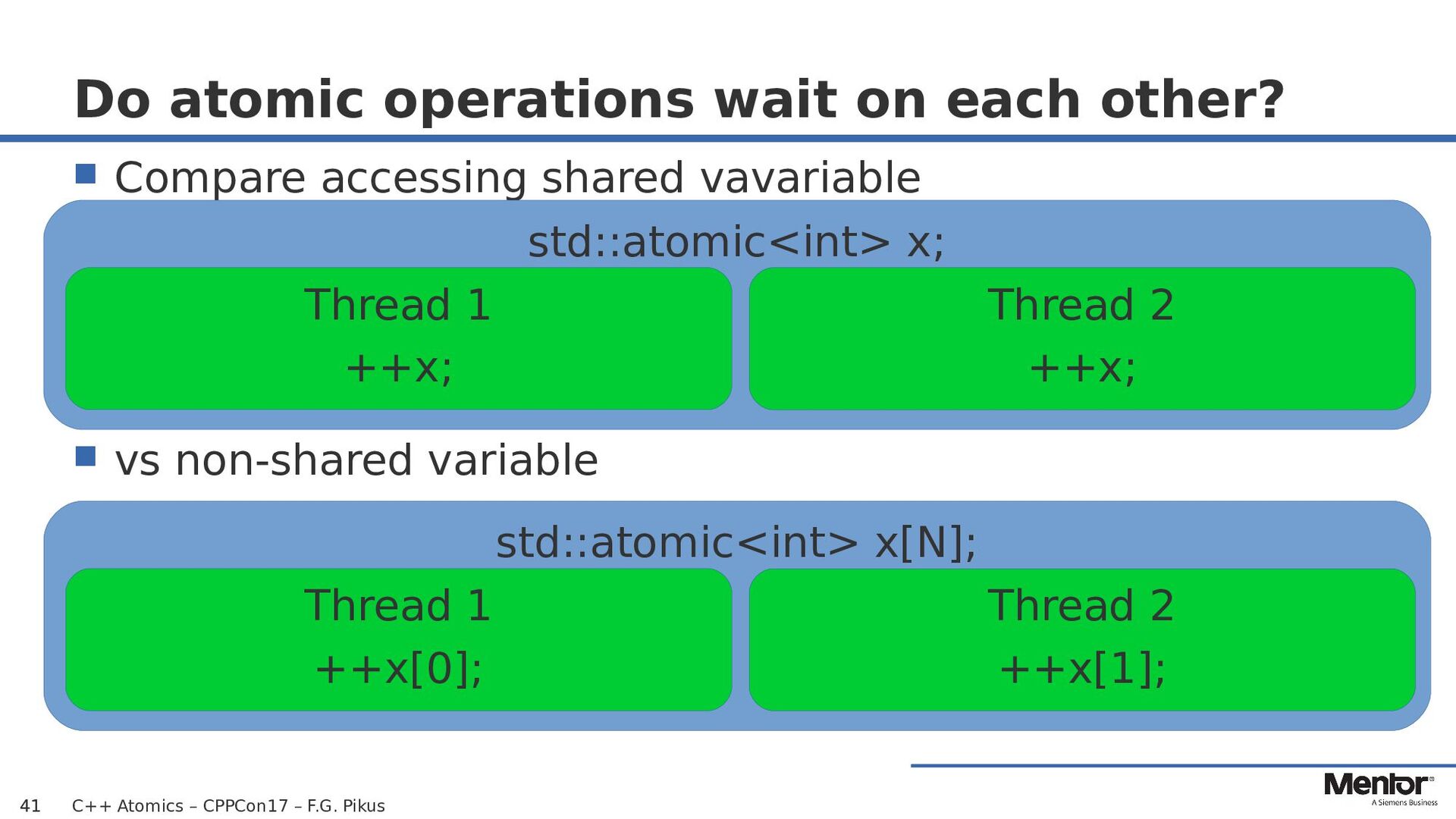
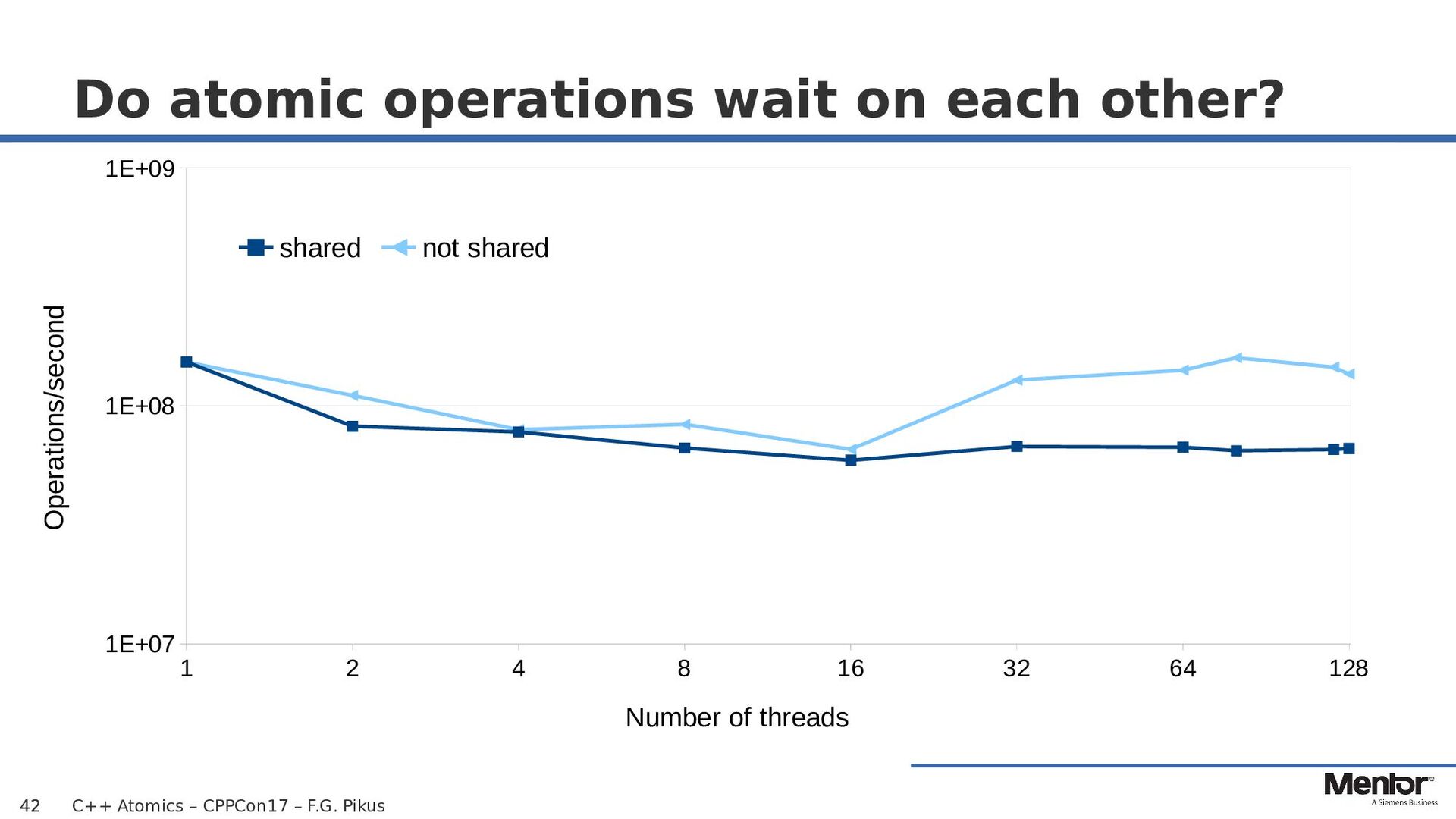
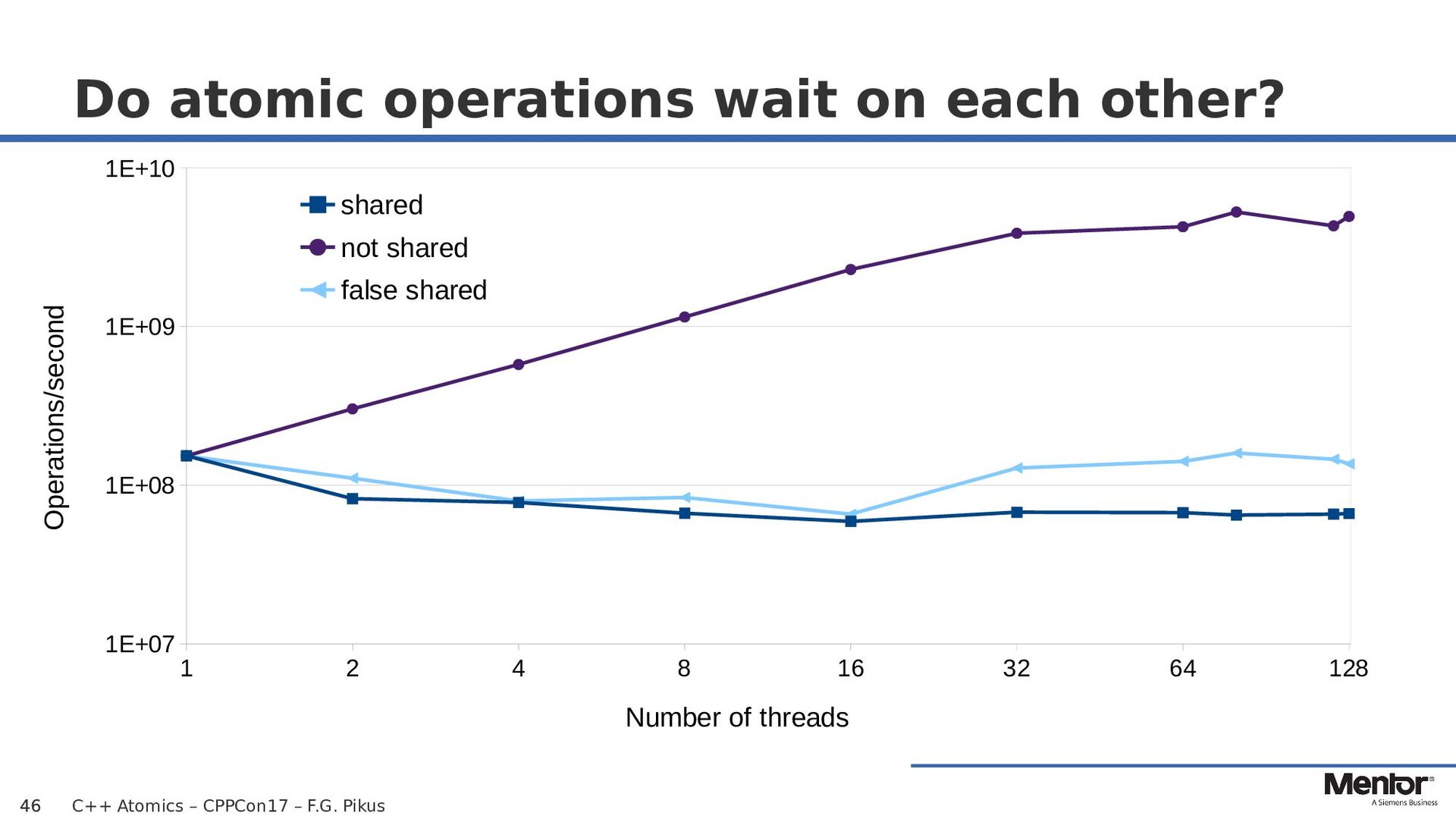
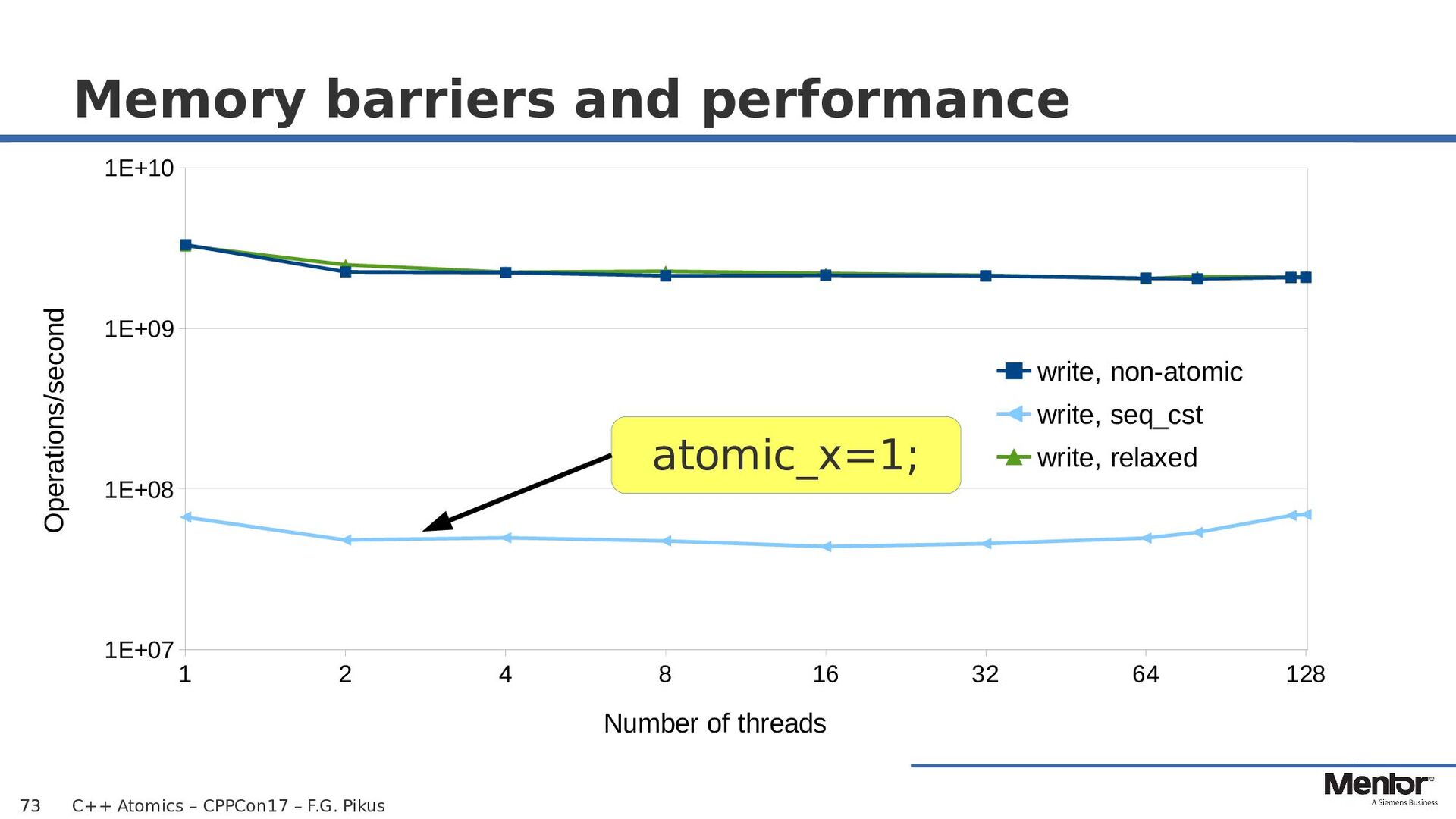
operations wait on each other? 45 Algorithm rules supreme “Wait-free” has nothing to do with time – Wait-free refers to the number of compute “steps” – Steps do not have to be of the same duration Atomic operations do wait on each other – In particular, write operations do – Read-only operations can scale near-perfectly
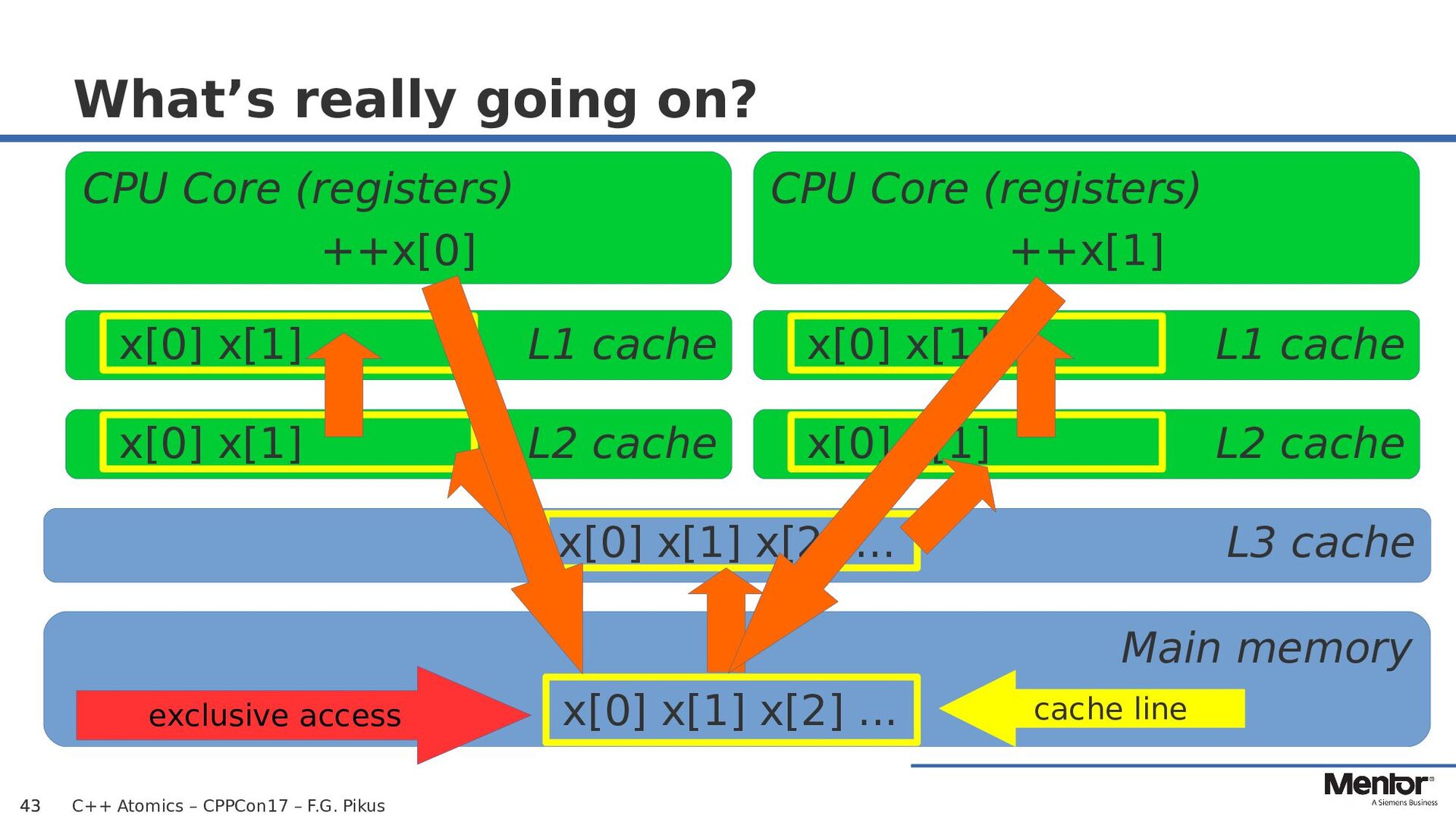
operations wait on each other? 47 Atomic operations have to wait for cache line access – Price of data sharing without races – Accessing different locations in the same cache line still incurs run-time penalty (false sharing) – Avoid false sharing by aligning per-thread data to separate cache lines • On NUMA machines, may be even separate pages
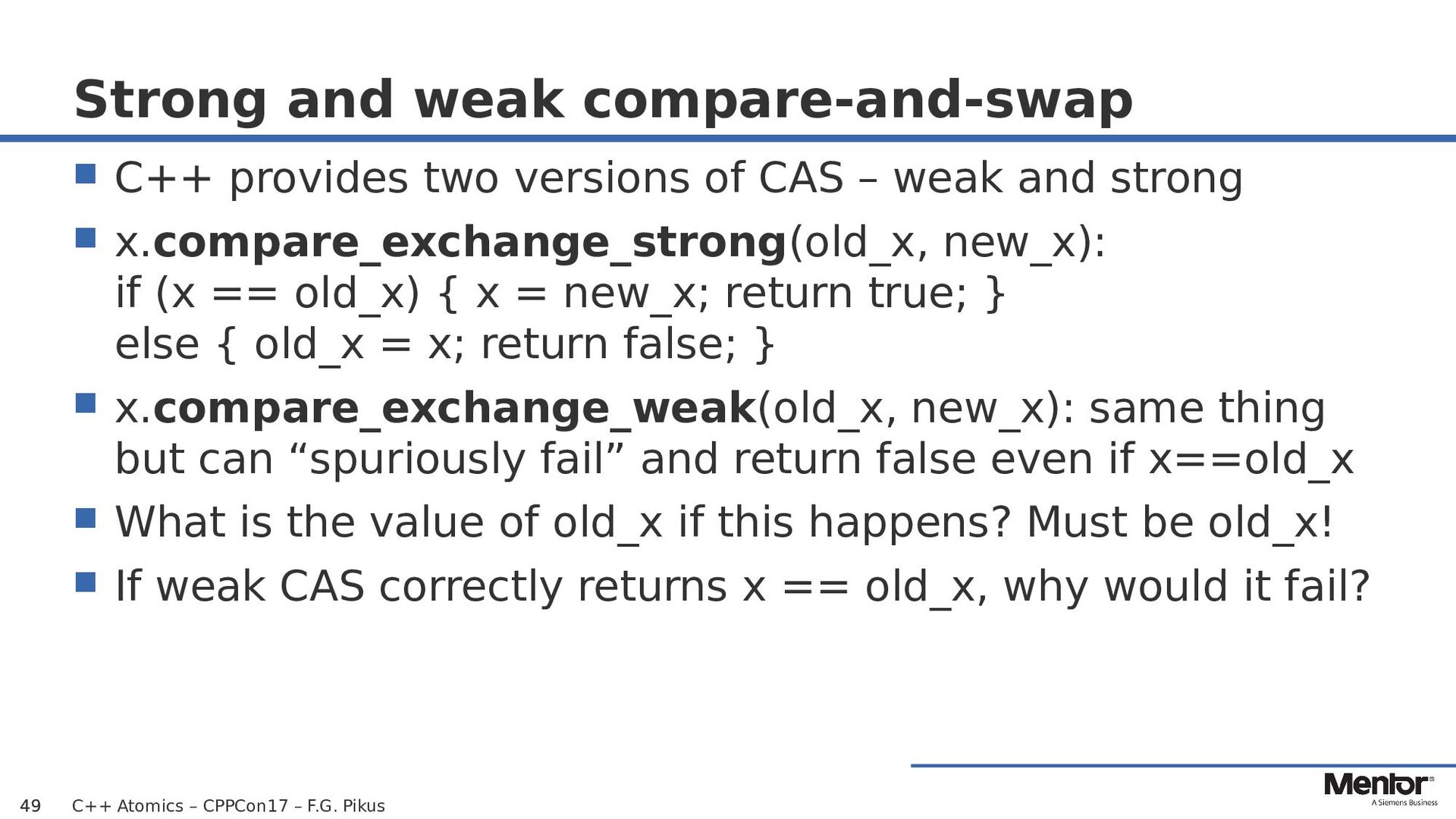
weak compare-and-swap 48 C++ provides two versions of CAS – weak and strong x.compare_exchange_strong(old_x, new_x): if (x == old_x) { x = new_x; return true; } else { old_x = x; return false; } x.compare_exchange_weak(old_x, new_x): same thing but can “spuriously fail” and return false even if x==old_x What is the value of old_x if this happens?
weak compare-and-swap 49 C++ provides two versions of CAS – weak and strong x.compare_exchange_strong(old_x, new_x): if (x == old_x) { x = new_x; return true; } else { old_x = x; return false; } x.compare_exchange_weak(old_x, new_x): same thing but can “spuriously fail” and return false even if x==old_x What is the value of old_x if this happens? Must be old_x! If weak CAS correctly returns x == old_x, why would it fail?
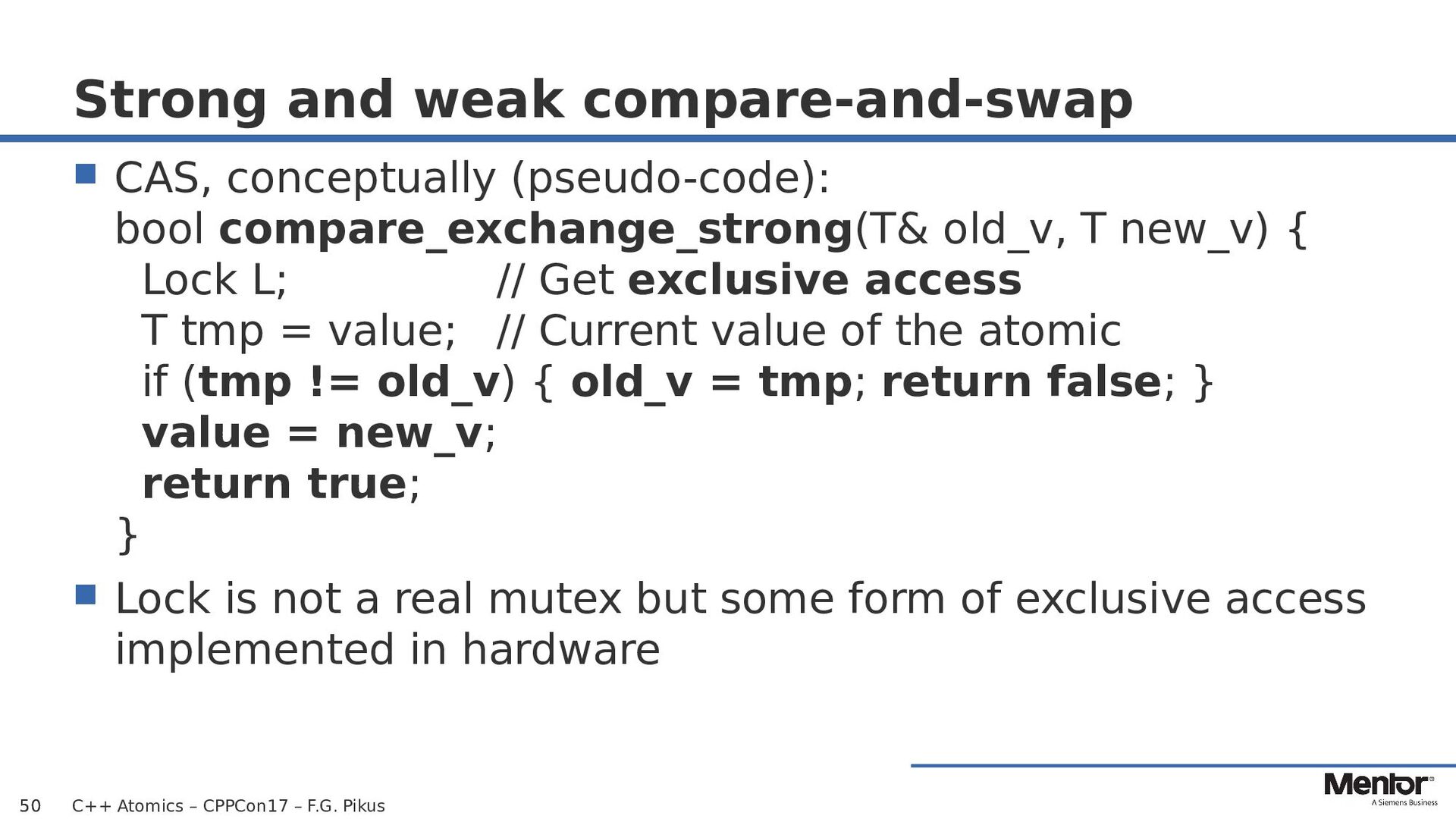
weak compare-and-swap 50 CAS, conceptually (pseudo-code): bool compare_exchange_strong(T& old_v, T new_v) { Lock L; // Get exclusive access T tmp = value; // Current value of the atomic if (tmp != old_v) { old_v = tmp; return false; } value = new_v; return true; } Lock is not a real mutex but some form of exclusive access implemented in hardware
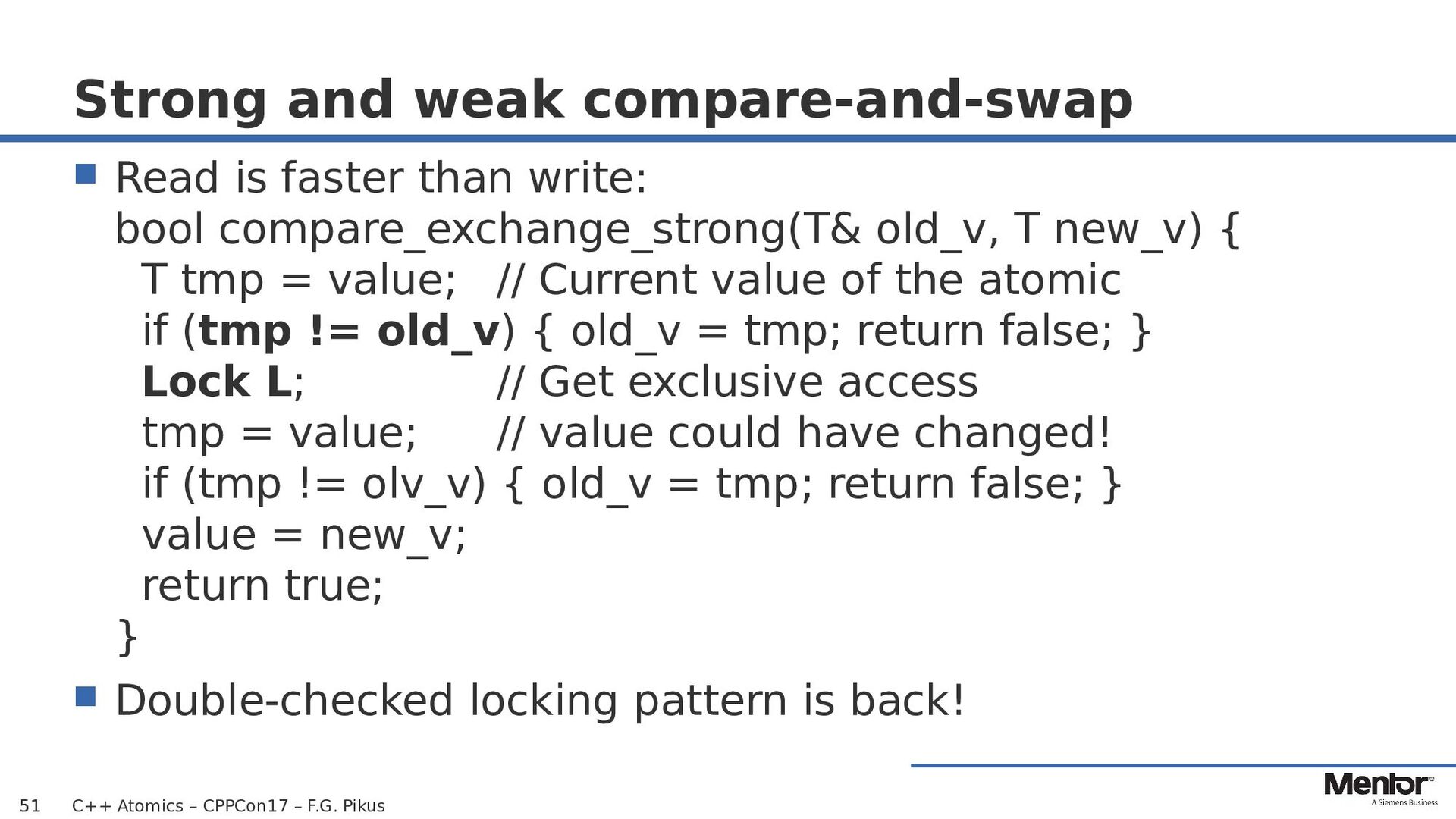
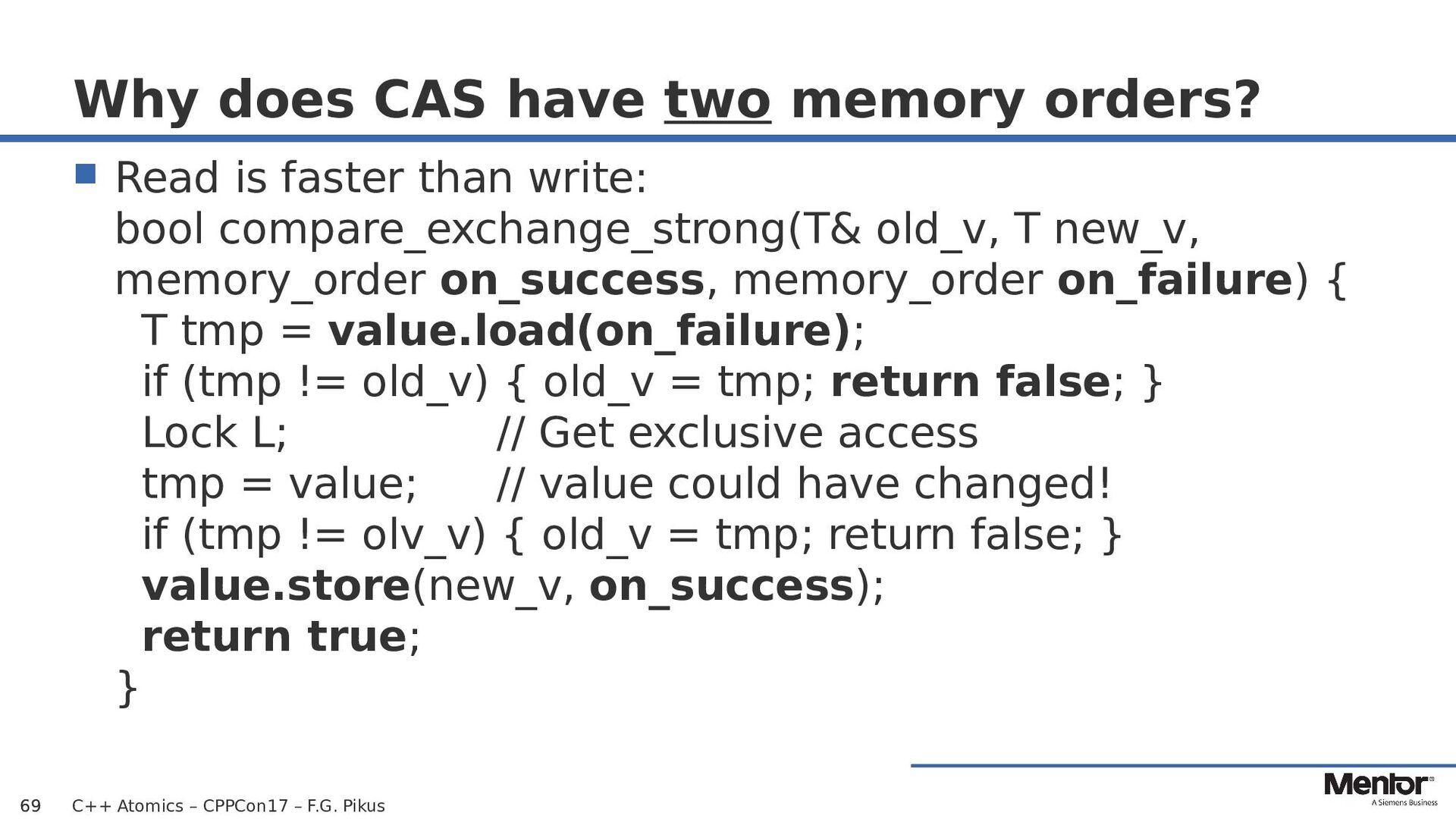
weak compare-and-swap 51 Read is faster than write: bool compare_exchange_strong(T& old_v, T new_v) { T tmp = value; // Current value of the atomic if (tmp != old_v) { old_v = tmp; return false; } Lock L; // Get exclusive access tmp = value; // value could have changed! if (tmp != olv_v) { old_v = tmp; return false; } value = new_v; return true; } Double-checked locking pattern is back!
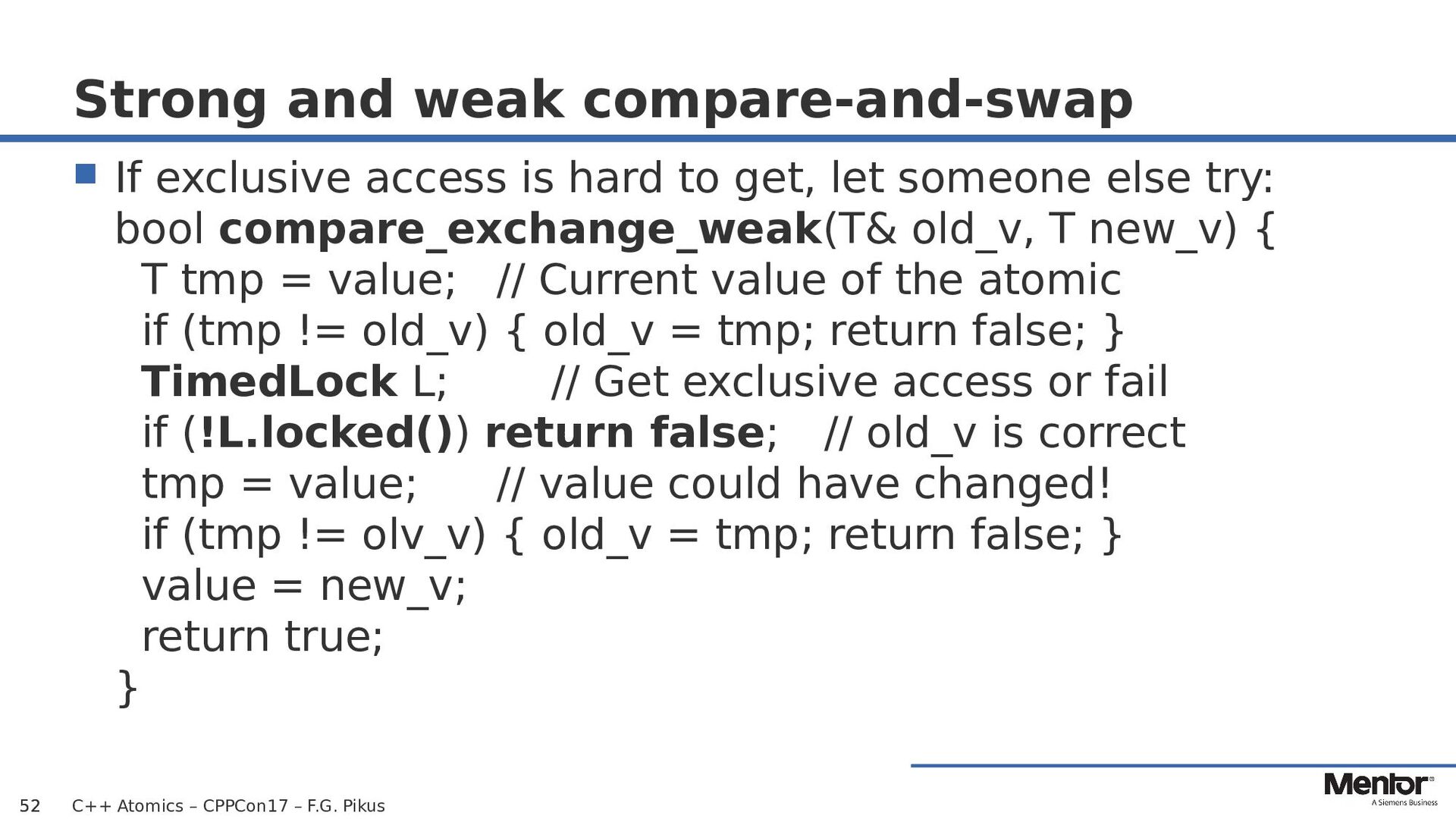
weak compare-and-swap 52 If exclusive access is hard to get, let someone else try: bool compare_exchange_weak(T& old_v, T new_v) { T tmp = value; // Current value of the atomic if (tmp != old_v) { old_v = tmp; return false; } TimedLock L; // Get exclusive access or fail if (!L.locked()) return false; // old_v is correct tmp = value; // value could have changed! if (tmp != olv_v) { old_v = tmp; return false; } value = new_v; return true; }
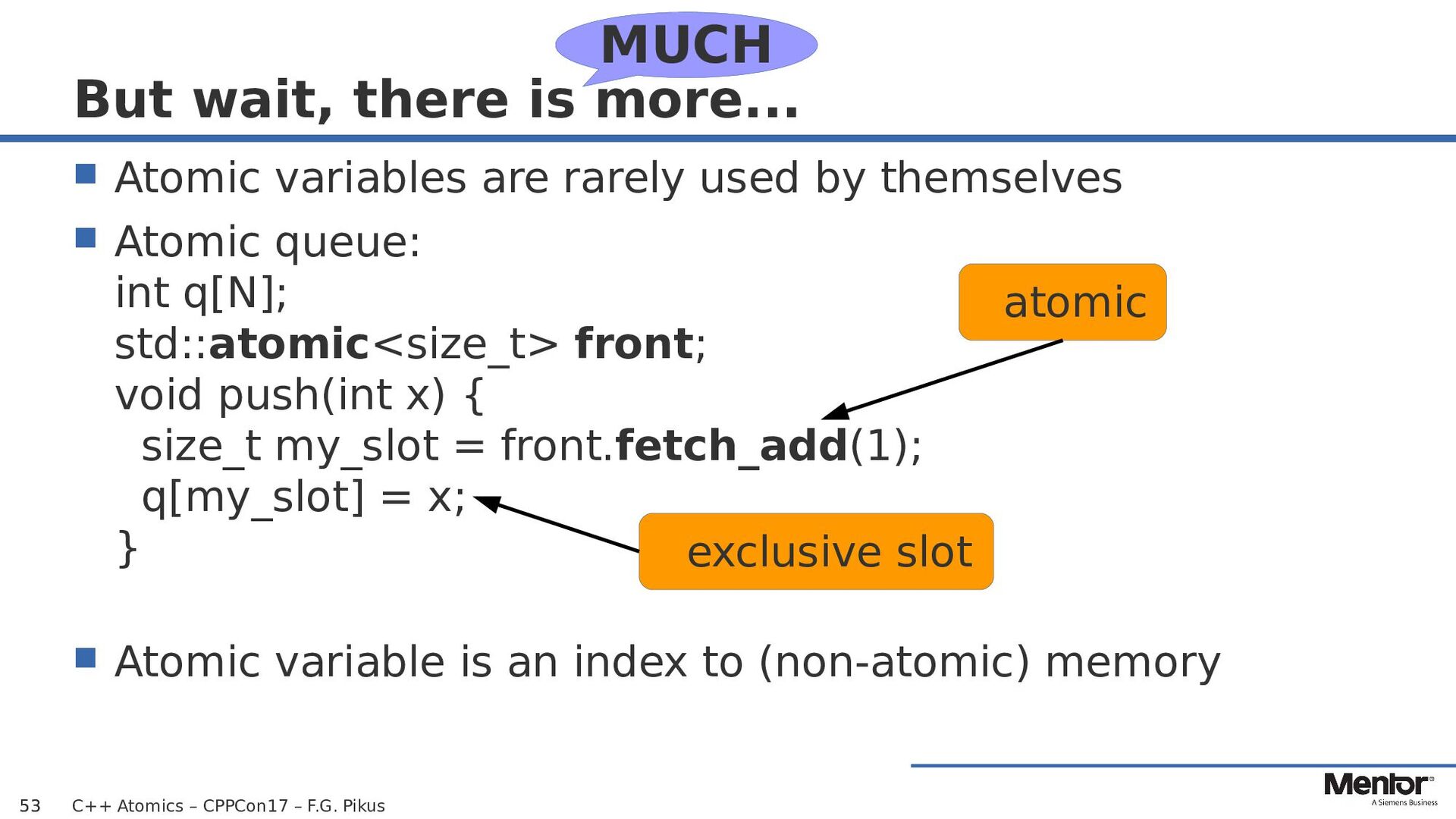
there is more... 53 Atomic variables are rarely used by themselves Atomic queue: int q[N]; std::atomic<size_t> front; void push(int x) { size_t my_slot = front.fetch_add(1); q[my_slot] = x; } Atomic variable is an index to (non-atomic) memory MUCH atomic exclusive slot
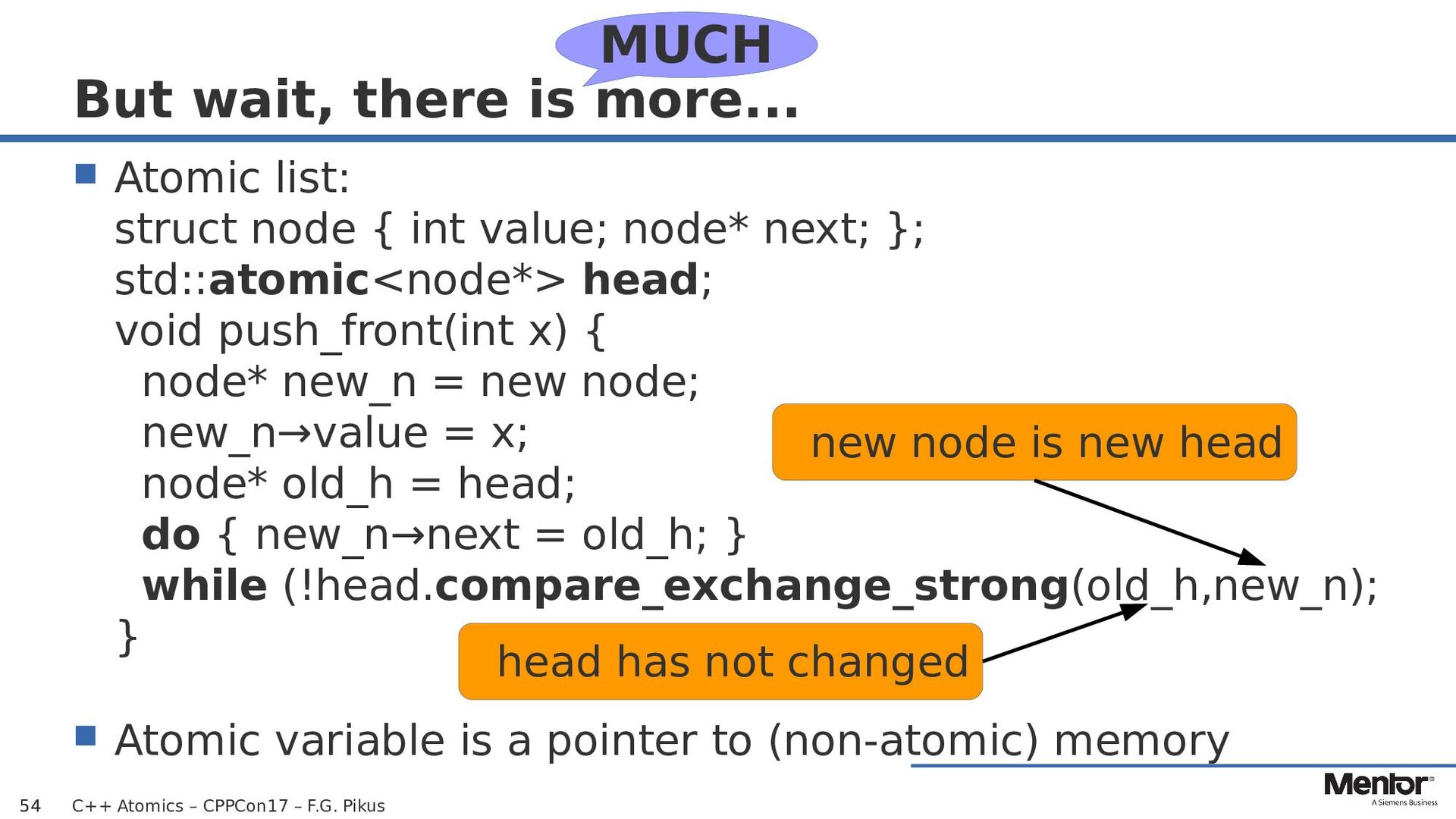
there is more... 54 Atomic list: struct node { int value; node* next; }; std::atomic<node*> head; void push_front(int x) { node* new_n = new node; new_n→value = x; node* old_h = head; do { new_n→next = old_h; } while (!head.compare_exchange_strong(old_h,new_n); } Atomic variable is a pointer to (non-atomic) memory MUCH head has not changed new node is new head
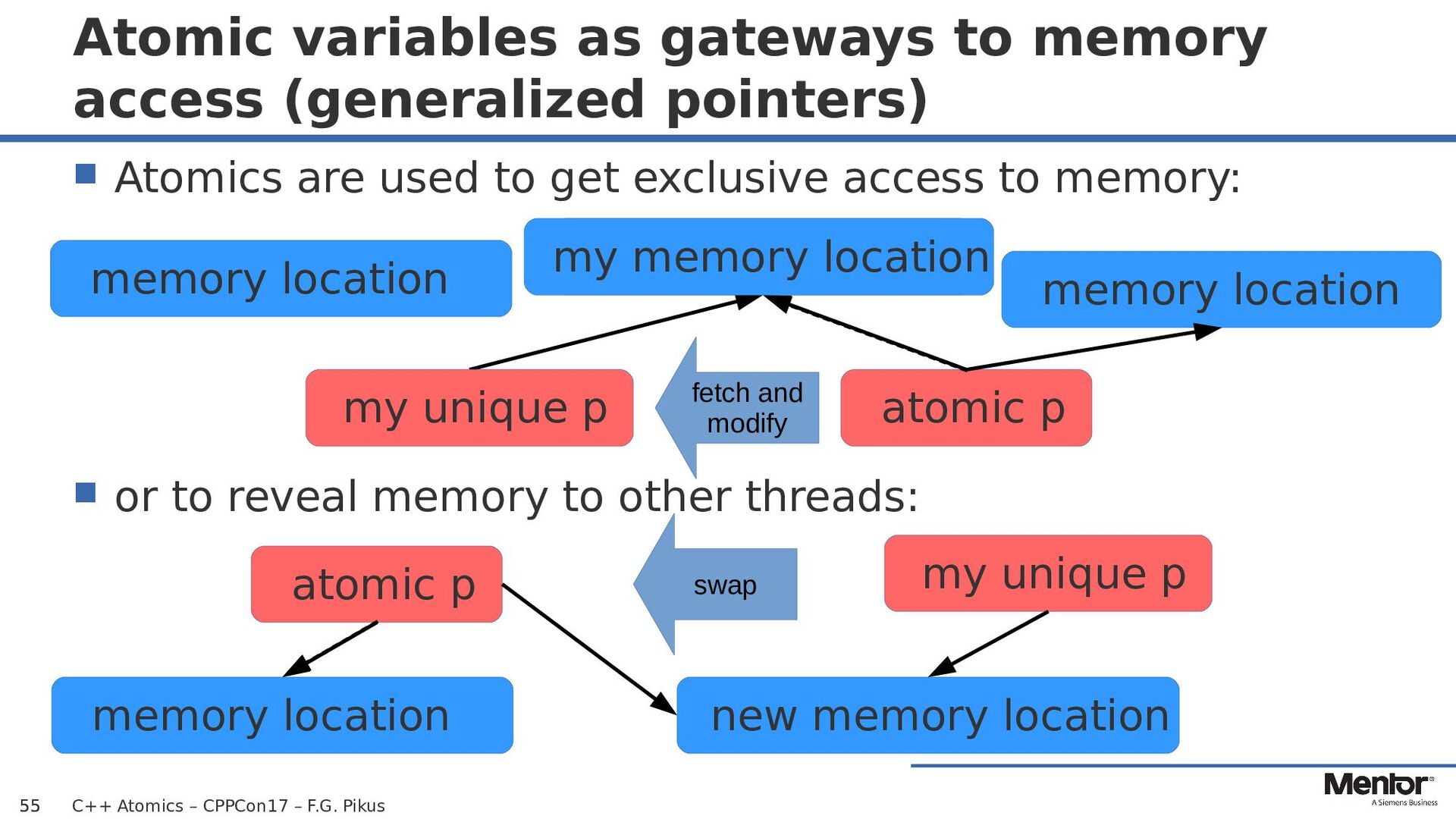
as gateways to memory access (generalized pointers) 55 Atomics are used to get exclusive access to memory: or to reveal memory to other threads: atomic p memory location memory location memory location my unique p fetch and modify my memory location memory location my unique p new memory location atomic p swap
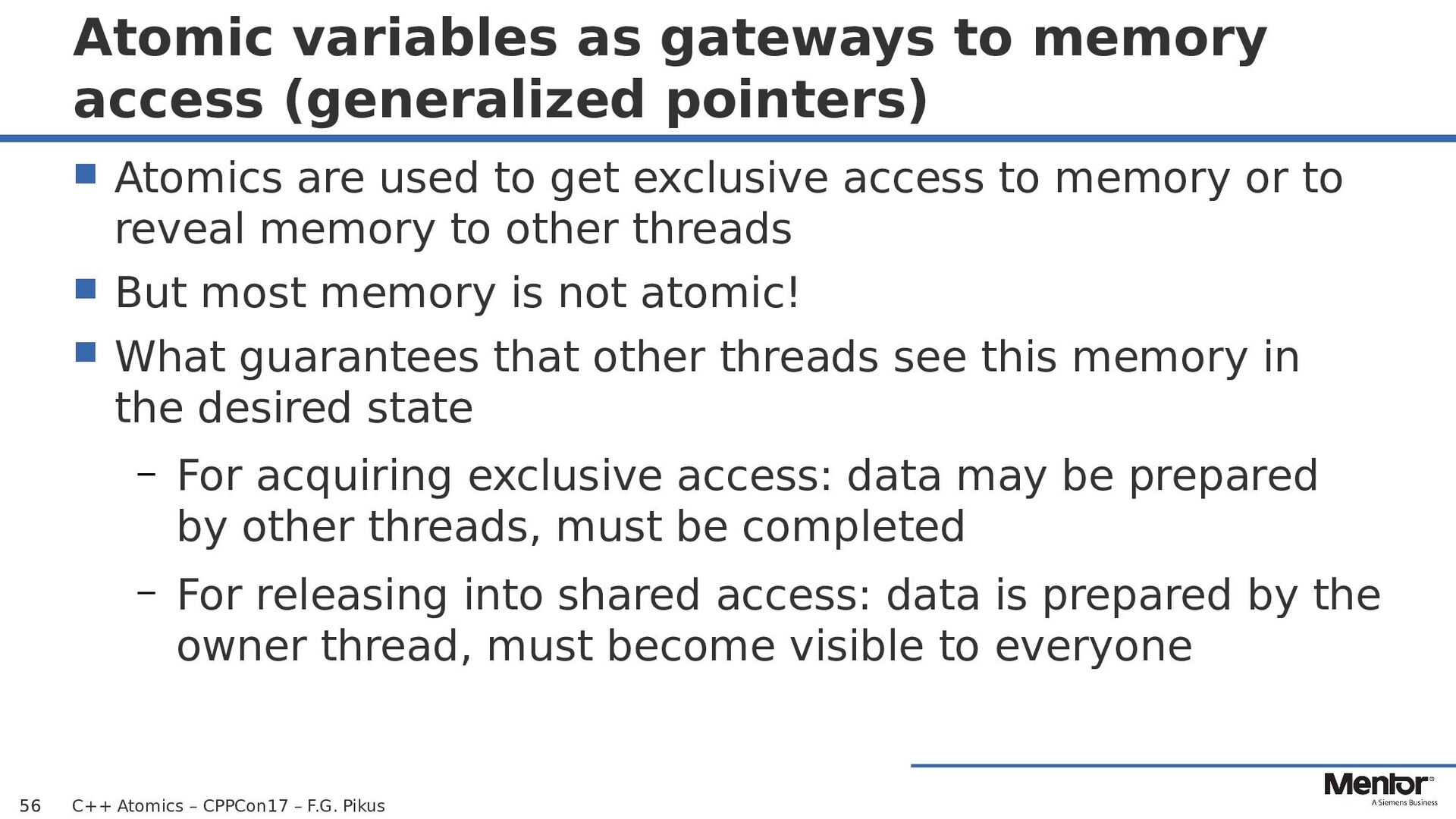
as gateways to memory access (generalized pointers) 56 Atomics are used to get exclusive access to memory or to reveal memory to other threads But most memory is not atomic! What guarantees that other threads see this memory in the desired state – For acquiring exclusive access: data may be prepared by other threads, must be completed – For releasing into shared access: data is prepared by the owner thread, must become visible to everyone
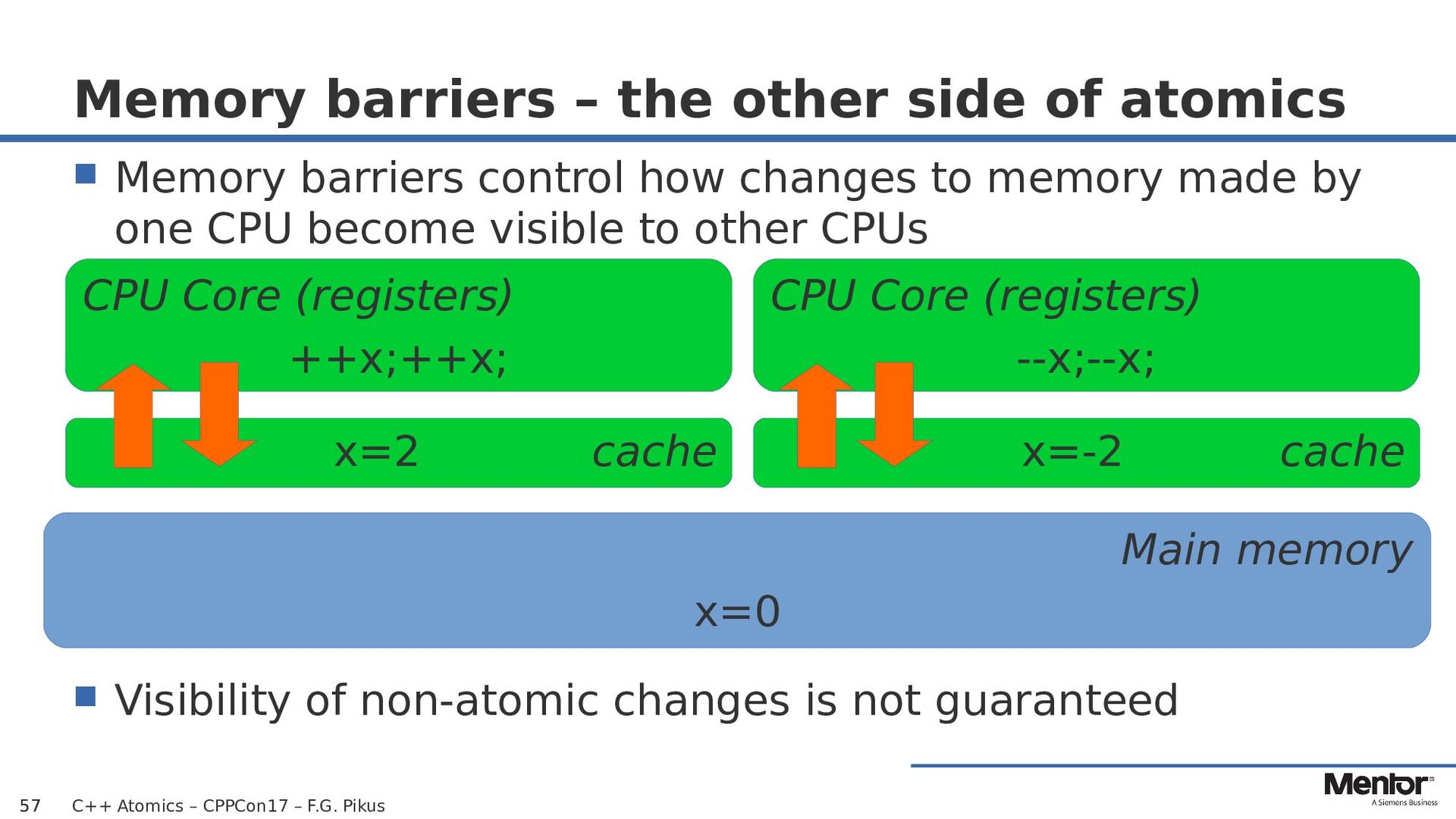
– the other side of atomics 57 Memory barriers control how changes to memory made by one CPU become visible to other CPUs Visibility of non-atomic changes is not guaranteed Main memory x=0 CPU Core (registers) ++x;++x; x=2 cache CPU Core (registers) --x;--x; x=-2 cache
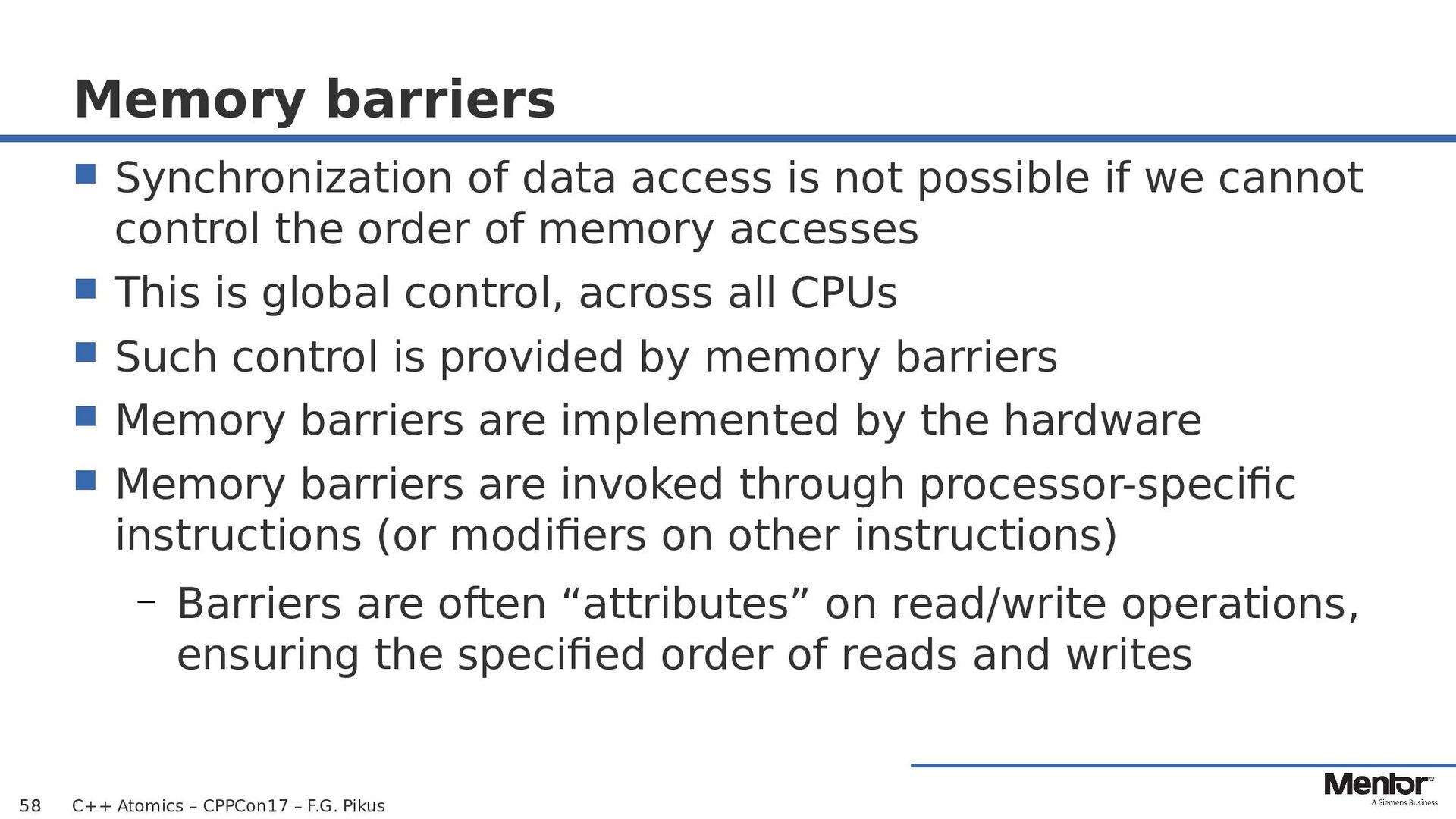
58 Synchronization of data access is not possible if we cannot control the order of memory accesses This is global control, across all CPUs Such control is provided by memory barriers Memory barriers are implemented by the hardware Memory barriers are invoked through processor-specific instructions (or modifiers on other instructions) – Barriers are often “attributes” on read/write operations, ensuring the specified order of reads and writes
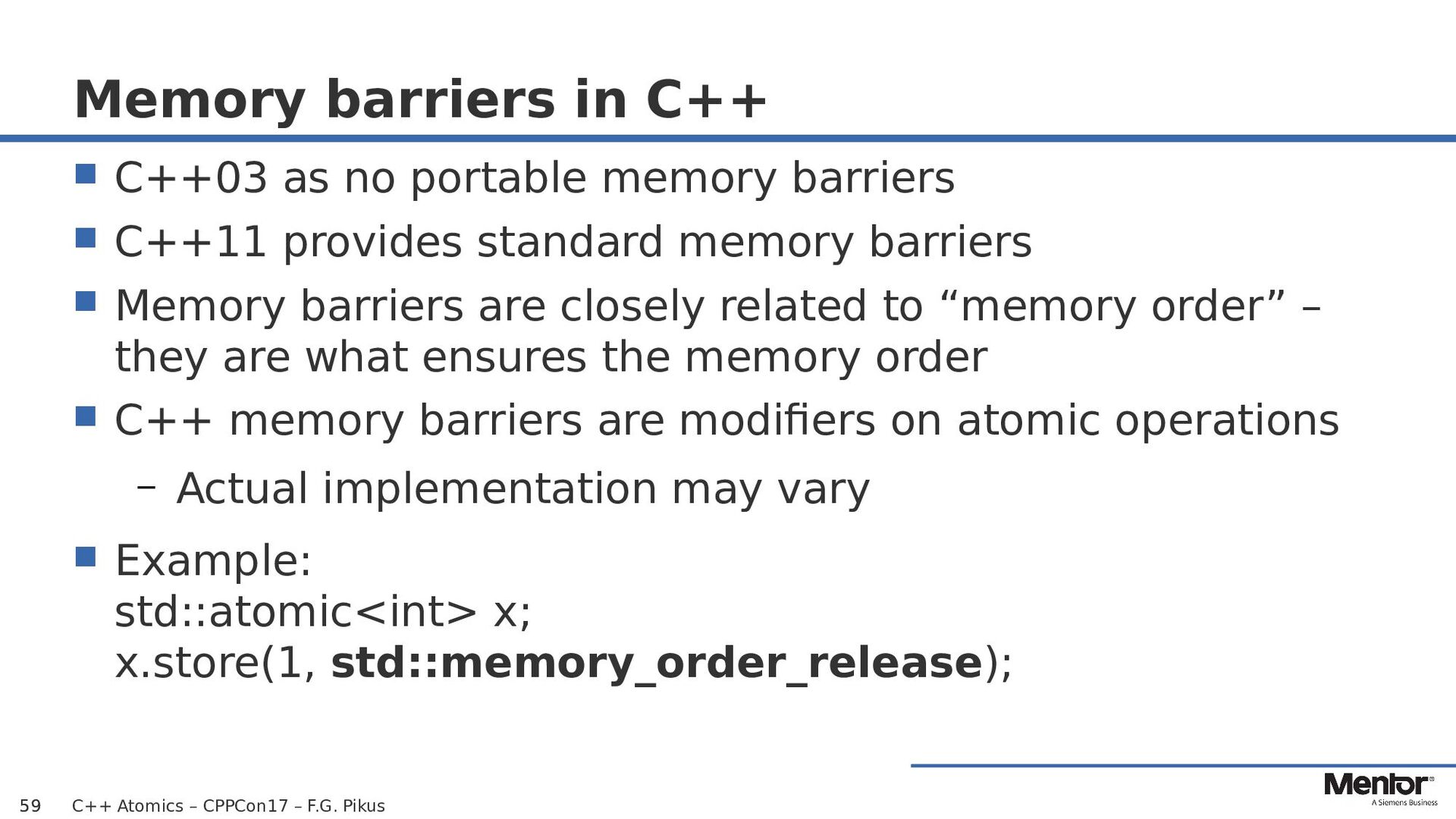
in C++ 59 C++03 as no portable memory barriers C++11 provides standard memory barriers Memory barriers are closely related to “memory order” – they are what ensures the memory order C++ memory barriers are modifiers on atomic operations – Actual implementation may vary Example: std::atomic<int> x; x.store(1, std::memory_order_release);
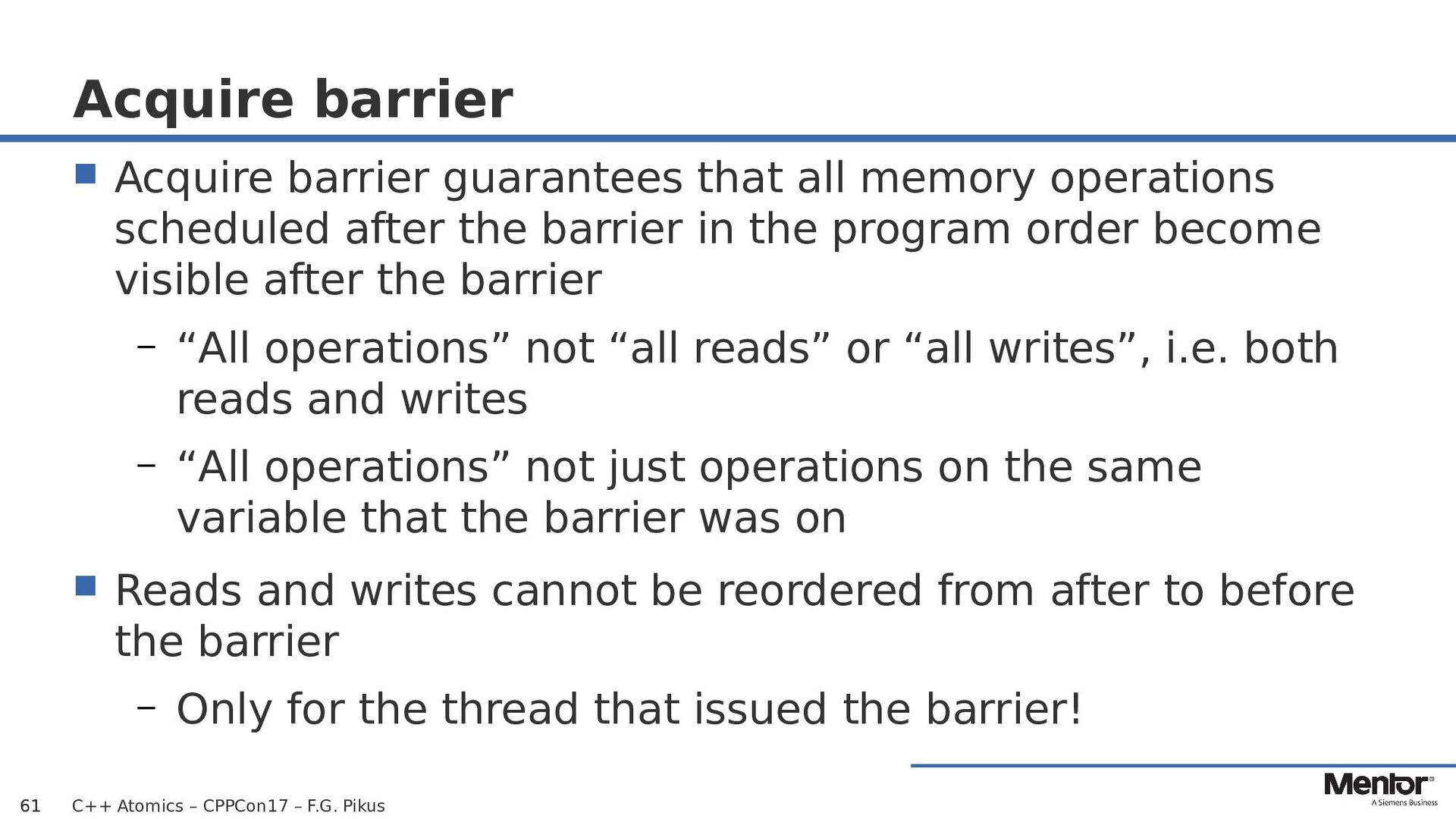
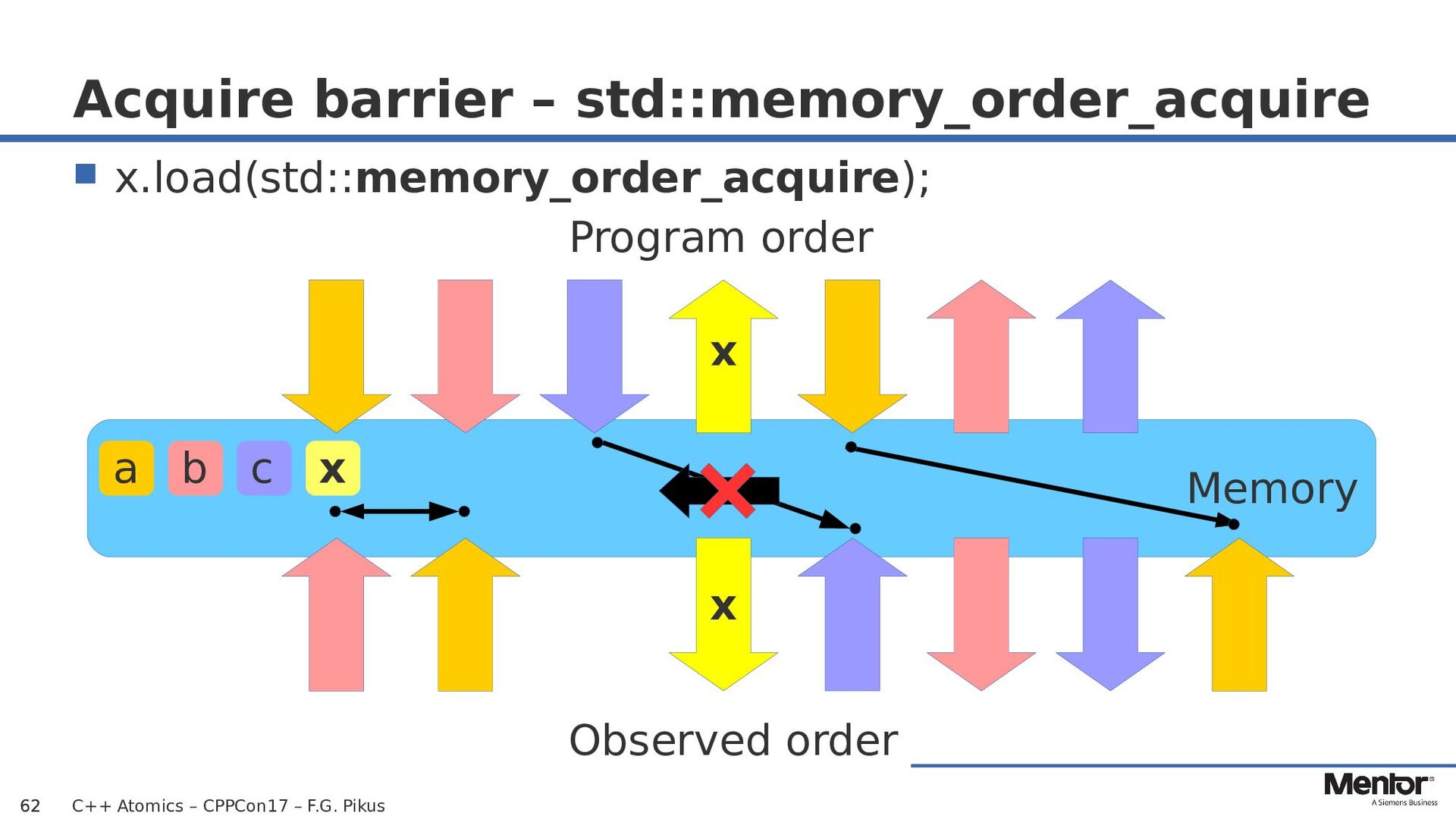
61 Acquire barrier guarantees that all memory operations scheduled after the barrier in the program order become visible after the barrier – “All operations” not “all reads” or “all writes”, i.e. both reads and writes – “All operations” not just operations on the same variable that the barrier was on Reads and writes cannot be reordered from after to before the barrier – Only for the thread that issued the barrier!
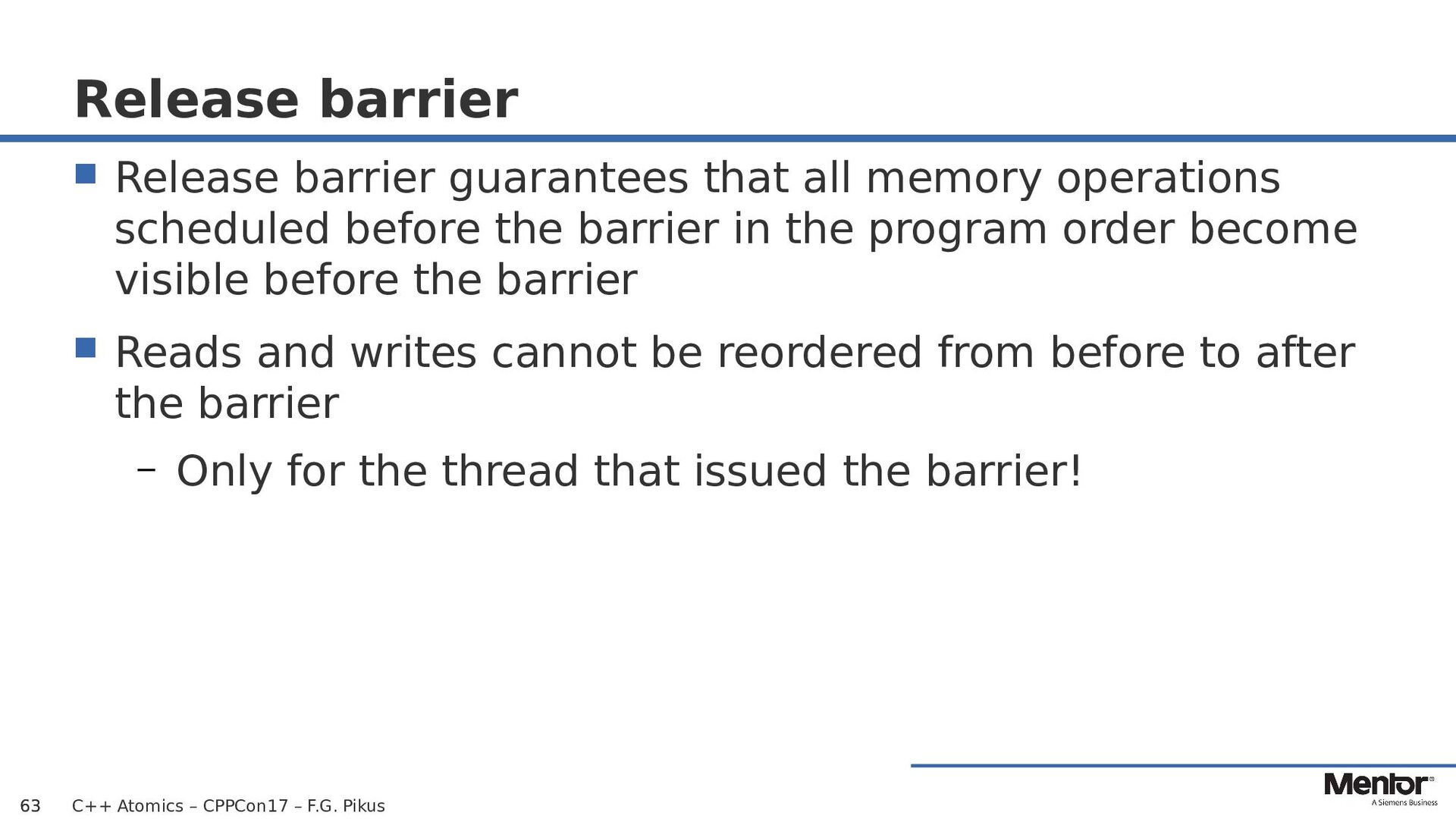
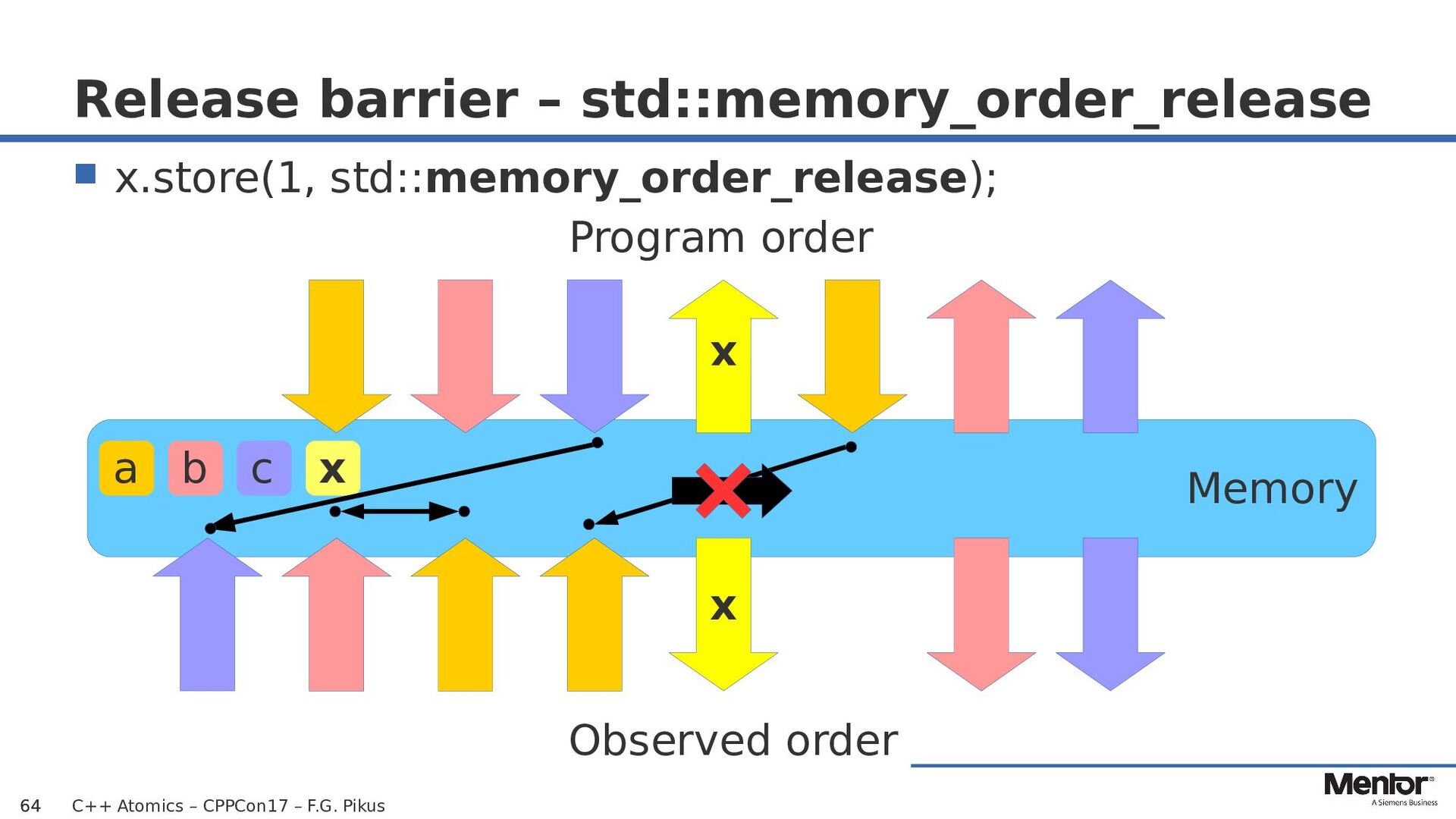
63 Release barrier guarantees that all memory operations scheduled before the barrier in the program order become visible before the barrier Reads and writes cannot be reordered from before to after the barrier – Only for the thread that issued the barrier!
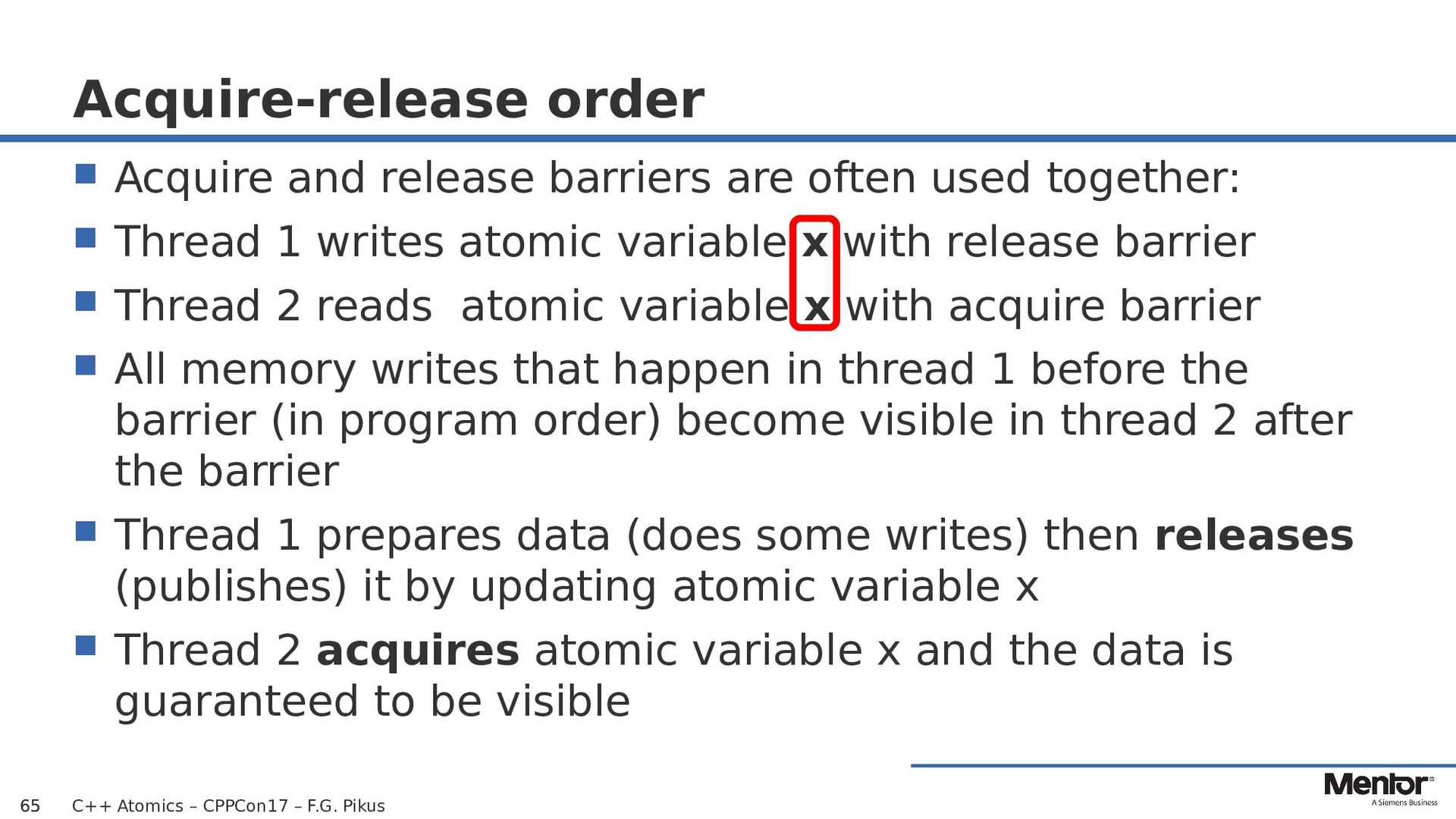
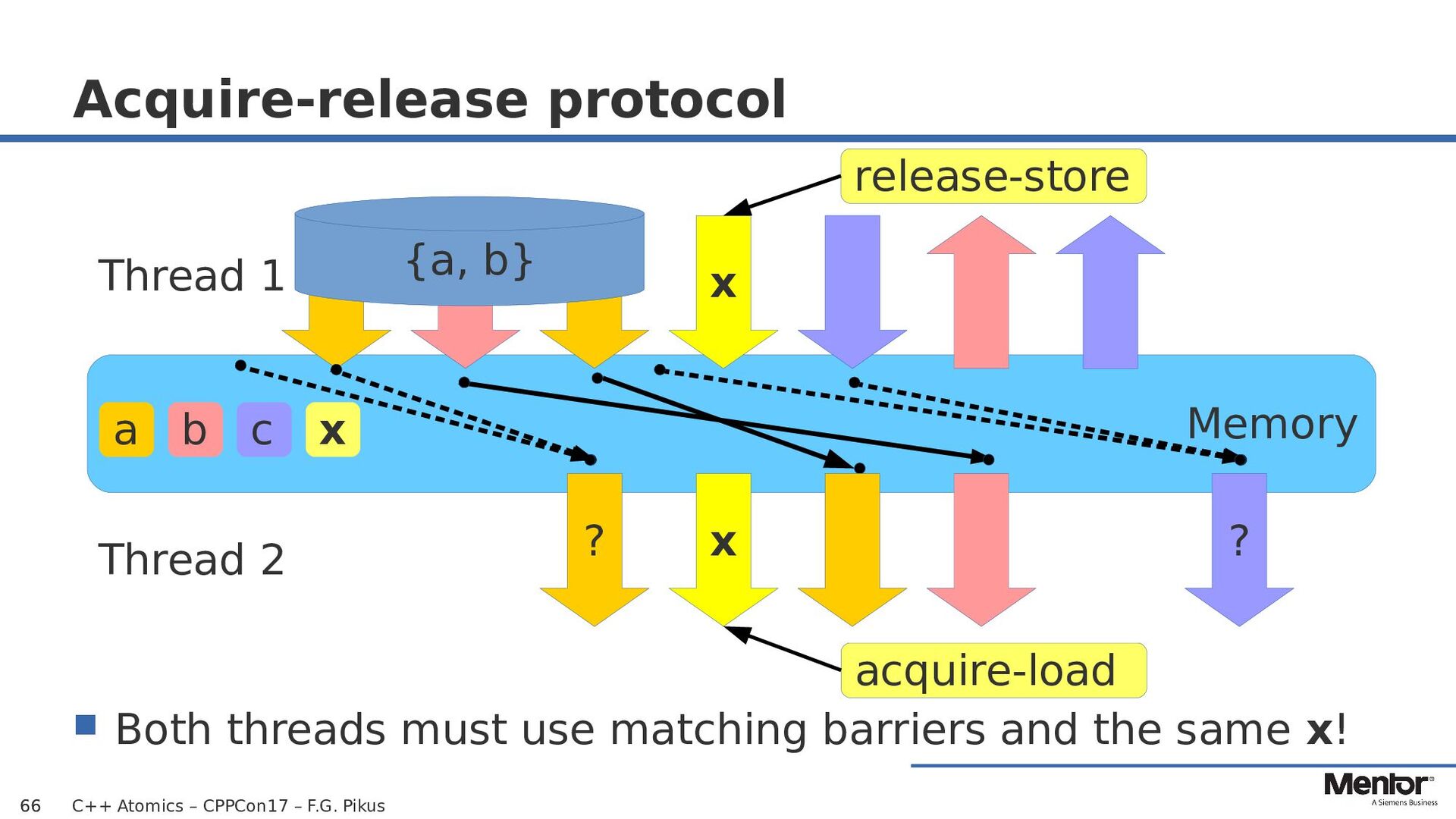
65 Acquire and release barriers are often used together: Thread 1 writes atomic variable x with release barrier Thread 2 reads atomic variable x with acquire barrier All memory writes that happen in thread 1 before the barrier (in program order) become visible in thread 2 after the barrier Thread 1 prepares data (does some writes) then releases (publishes) it by updating atomic variable x Thread 2 acquires atomic variable x and the data is guaranteed to be visible
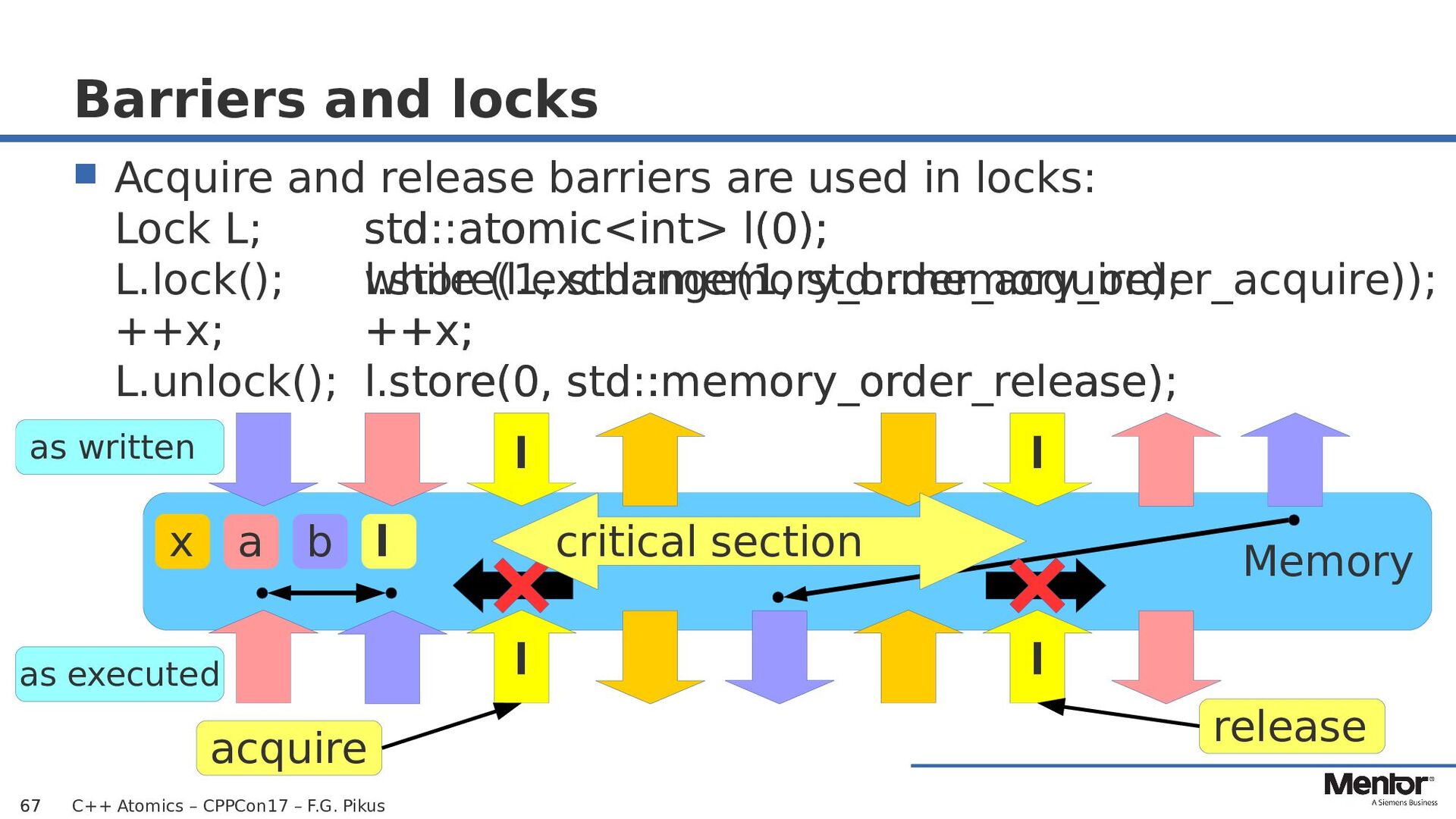
locks 67 Acquire and release barriers are used in locks: Lock L; L.lock(); ++x; L.unlock(); std::atomic<int> l(0); l.store(1, std::memory_order_acquire); ++x; l.store(0, std::memory_order_release); std::atomic<int> l(0); while (l.exchange(1, std::memory_order_acquire)); ++x; l.store(0, std::memory_order_release); Memory l x a b l l l l acquire release critical section as written as executed
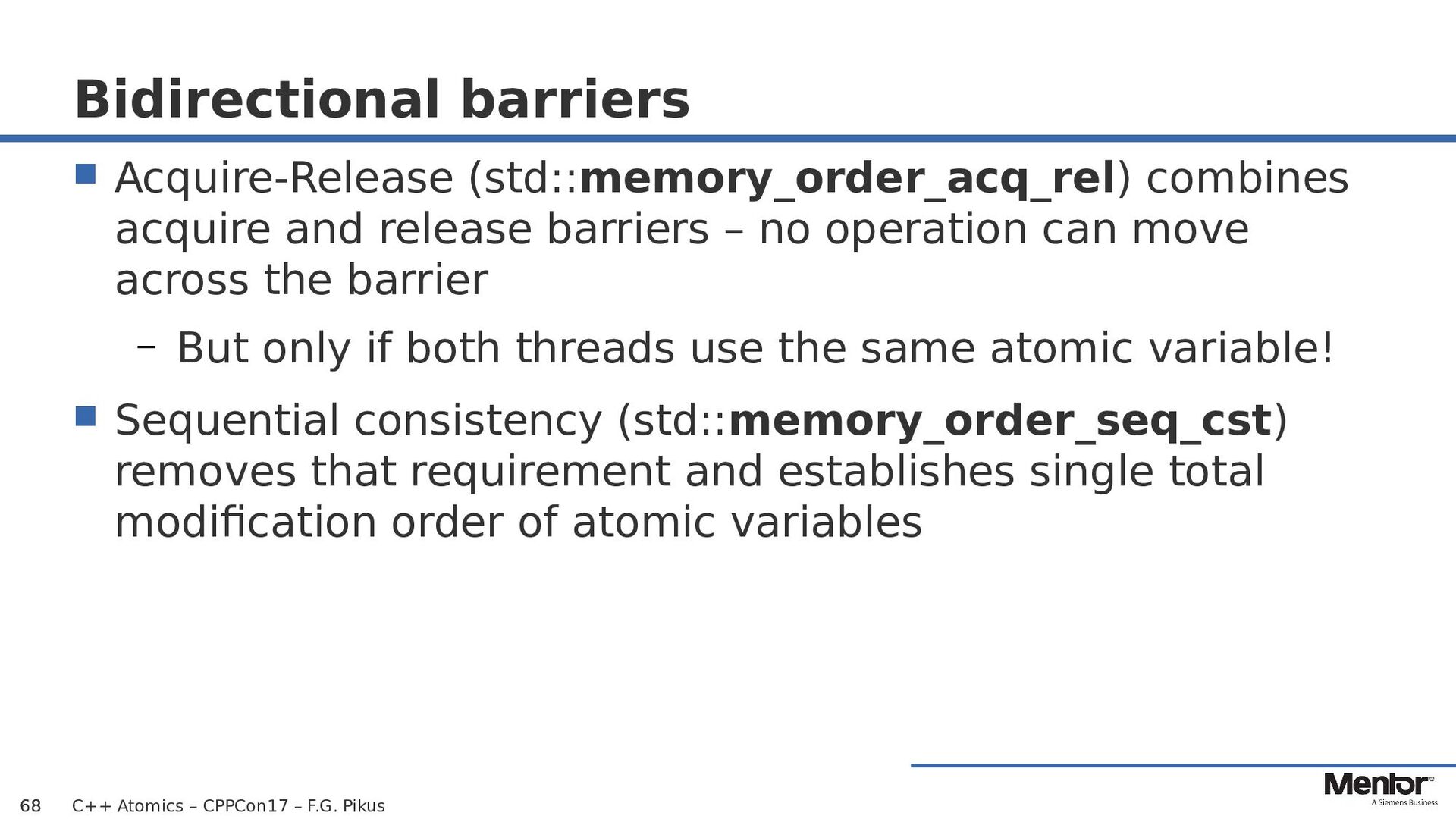
68 Acquire-Release (std::memory_order_acq_rel) combines acquire and release barriers – no operation can move across the barrier – But only if both threads use the same atomic variable! Sequential consistency (std::memory_order_seq_cst) removes that requirement and establishes single total modification order of atomic variables
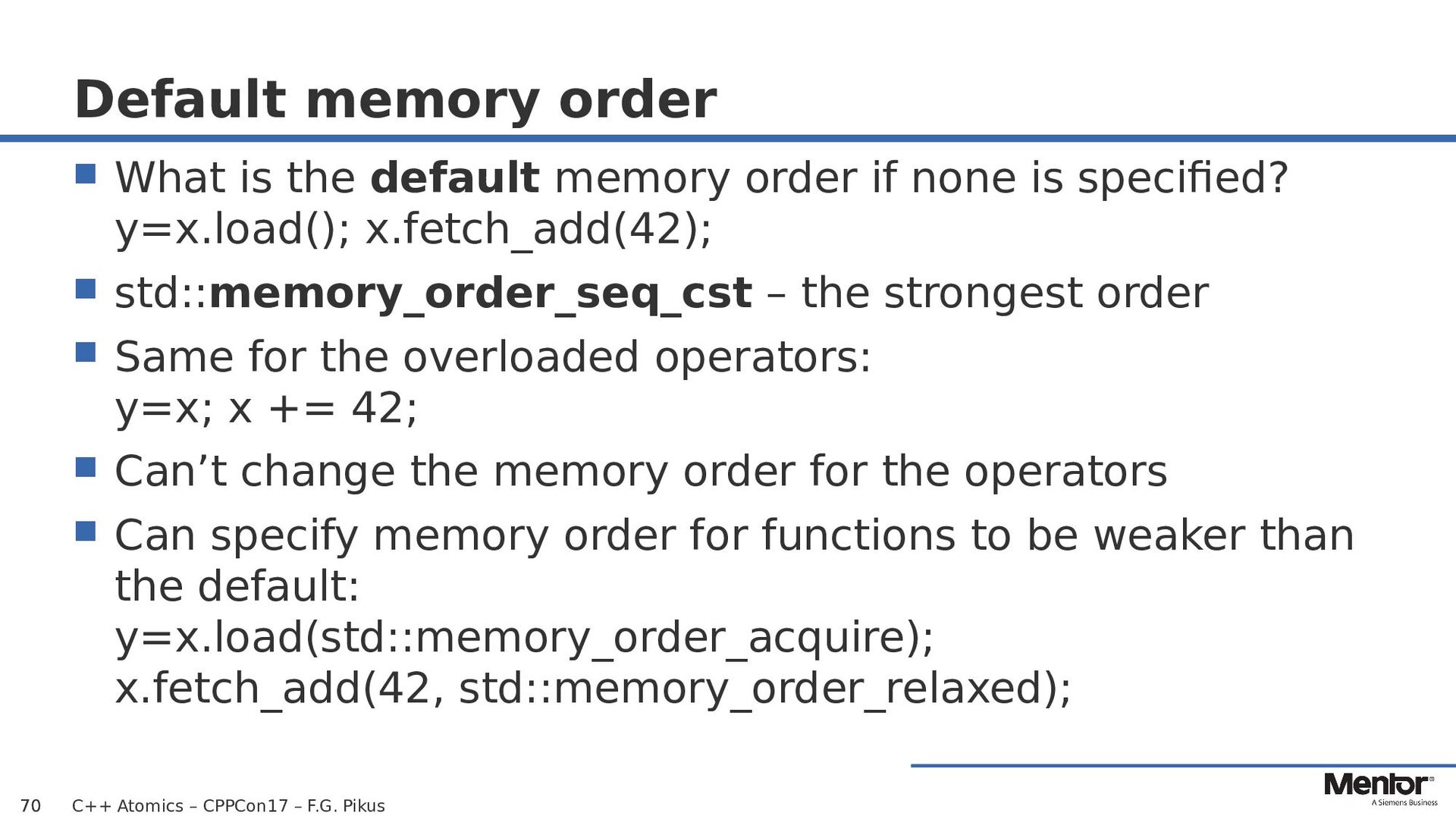
order 70 What is the default memory order if none is specified? y=x.load(); x.fetch_add(42); std::memory_order_seq_cst – the strongest order Same for the overloaded operators: y=x; x += 42; Can’t change the memory order for the operators Can specify memory order for functions to be weaker than the default: y=x.load(std::memory_order_acquire); x.fetch_add(42, std::memory_order_relaxed);
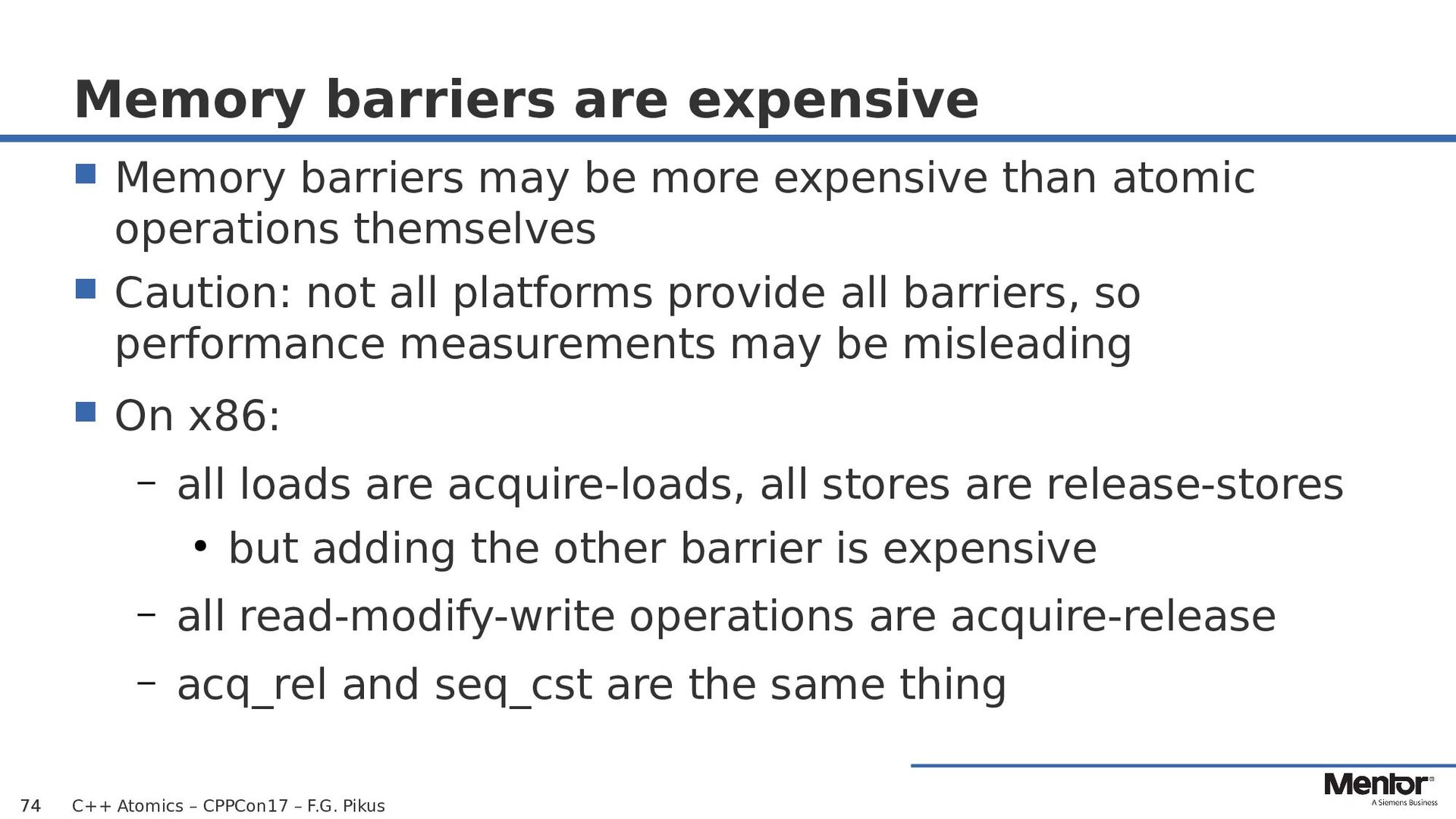
are expensive 74 Memory barriers may be more expensive than atomic operations themselves Caution: not all platforms provide all barriers, so performance measurements may be misleading On x86: – all loads are acquire-loads, all stores are release-stores • but adding the other barrier is expensive – all read-modify-write operations are acquire-release – acq_rel and seq_cst are the same thing
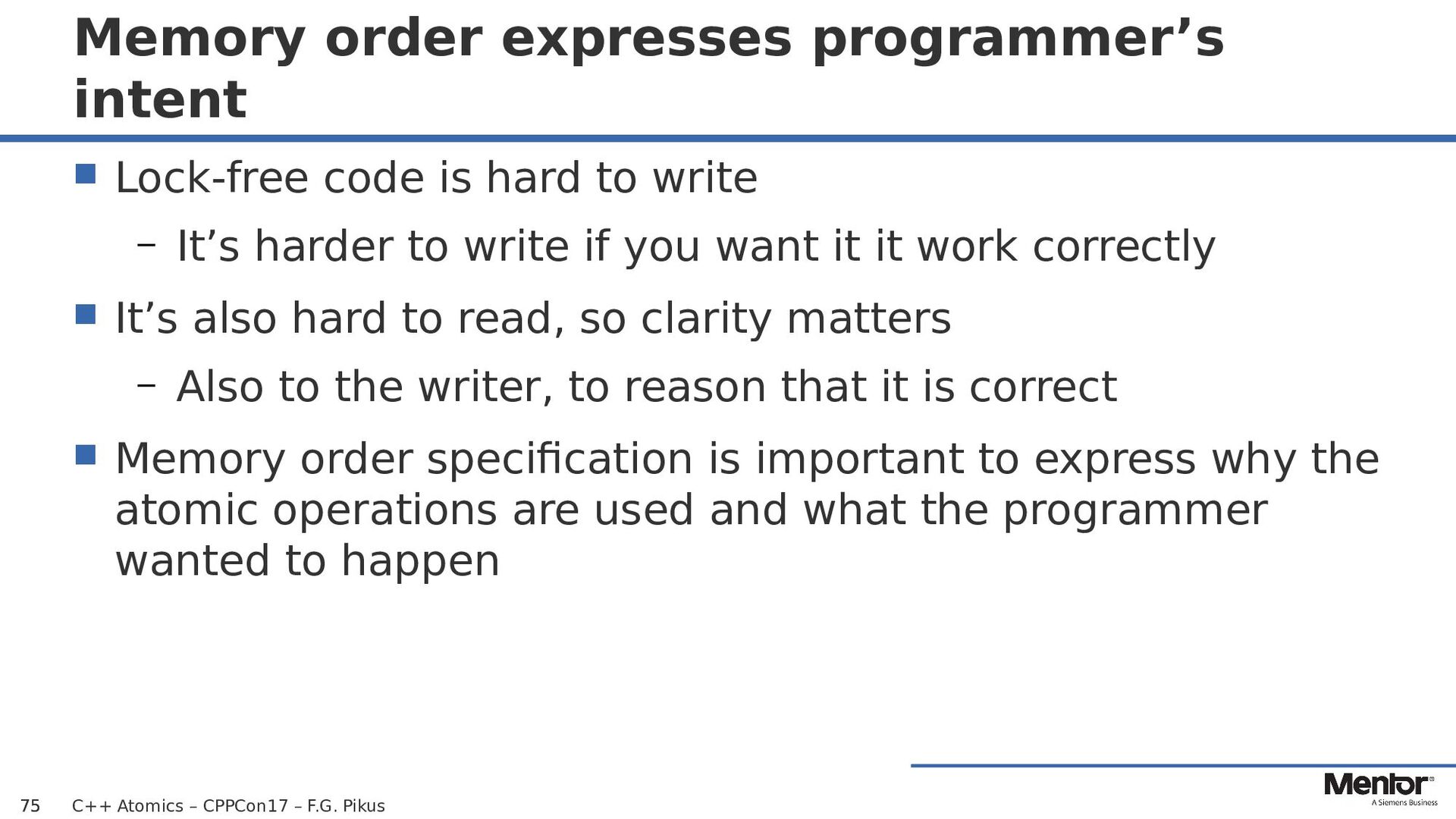
expresses programmer’s intent 75 Lock-free code is hard to write – It’s harder to write if you want it it work correctly It’s also hard to read, so clarity matters – Also to the writer, to reason that it is correct Memory order specification is important to express why the atomic operations are used and what the programmer wanted to happen
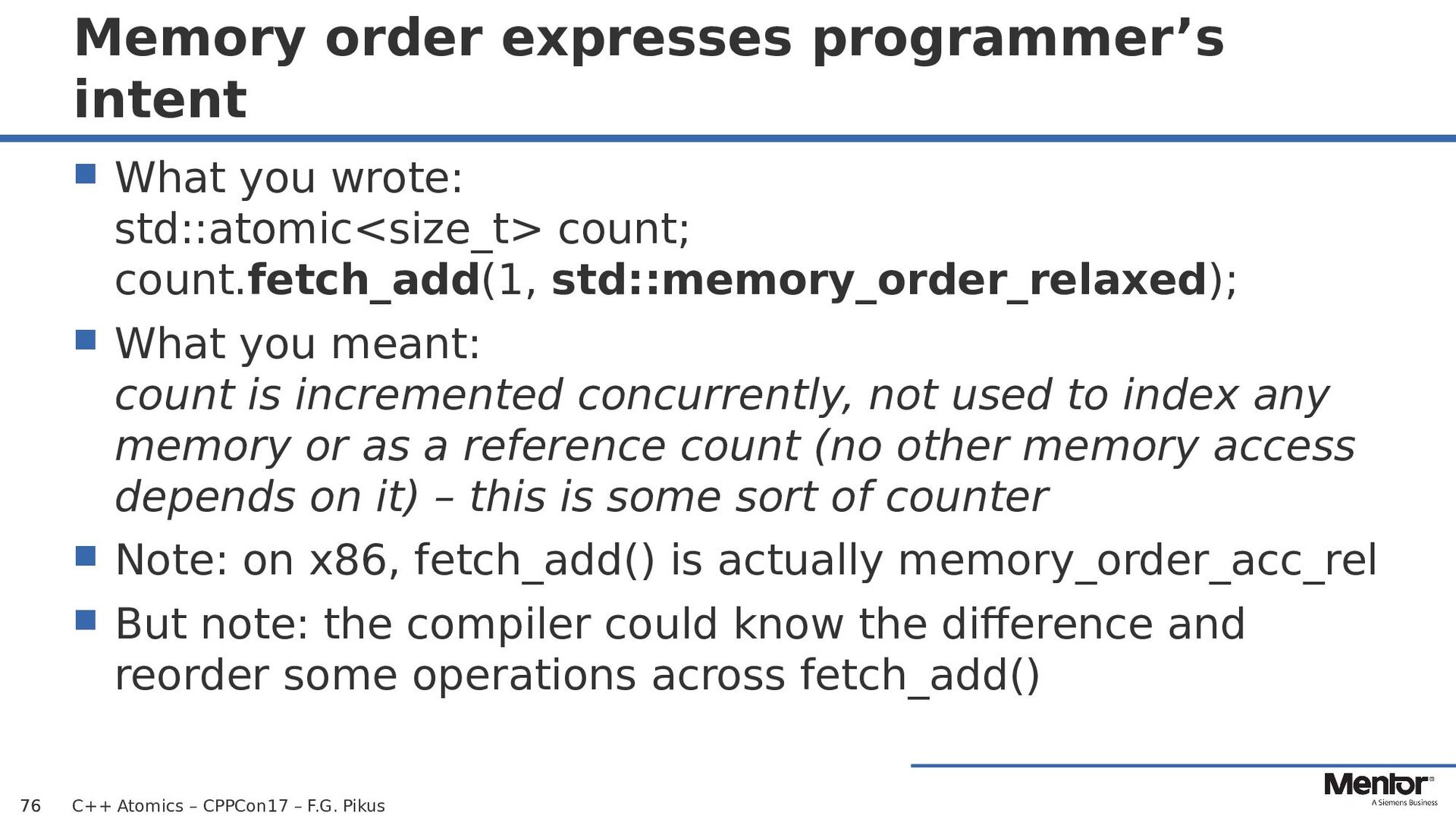
expresses programmer’s intent 76 What you wrote: std::atomic<size_t> count; count.fetch_add(1, std::memory_order_relaxed); What you meant: count is incremented concurrently, not used to index any memory or as a reference count (no other memory access depends on it) – this is some sort of counter Note: on x86, fetch_add() is actually memory_order_acc_rel But note: the compiler could know the difference and reorder some operations across fetch_add()
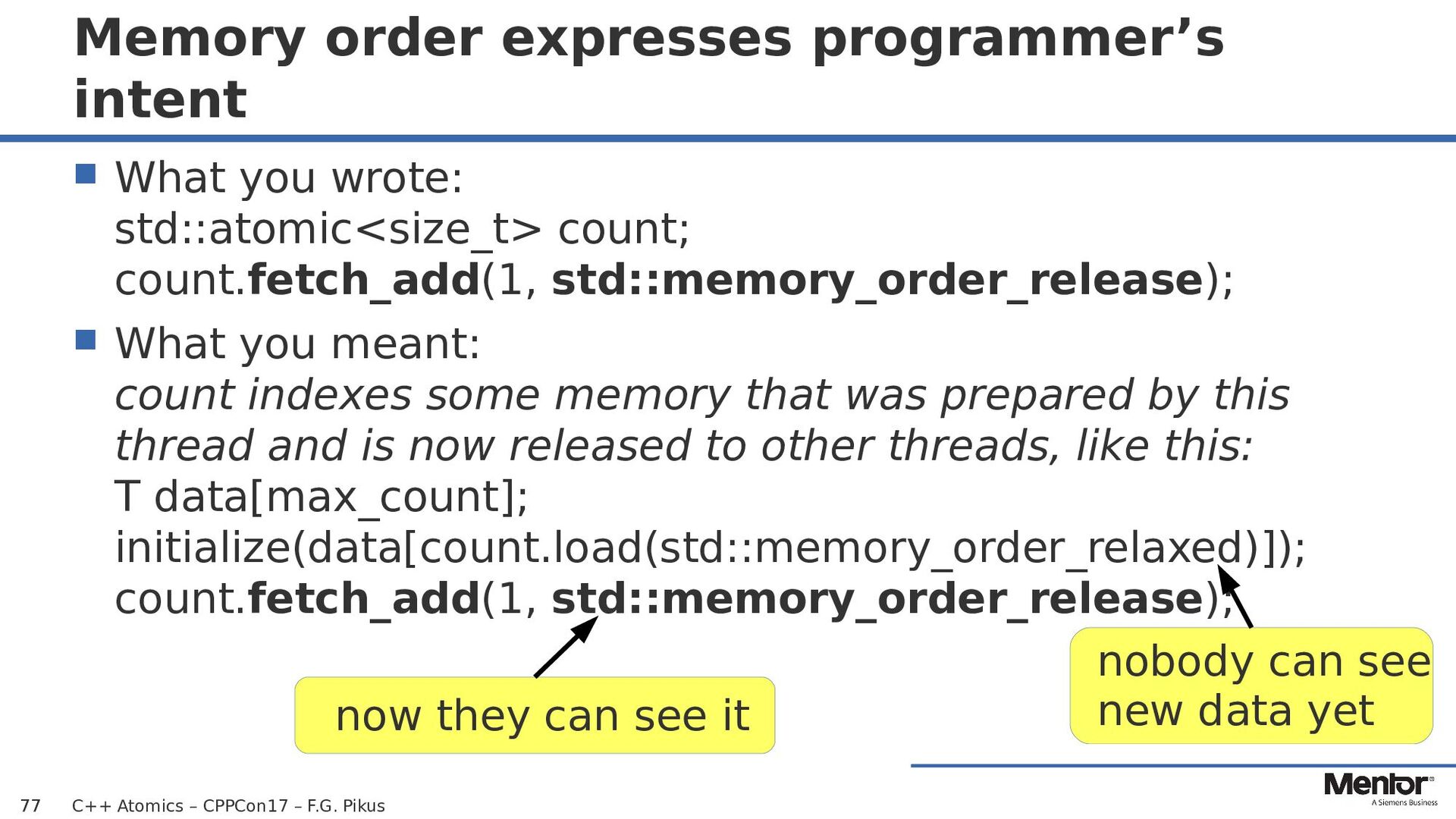
expresses programmer’s intent 77 What you wrote: std::atomic<size_t> count; count.fetch_add(1, std::memory_order_release); What you meant: count indexes some memory that was prepared by this thread and is now released to other threads, like this: T data[max_count]; initialize(data[count.load(std::memory_order_relaxed)]); count.fetch_add(1, std::memory_order_release); nobody can see new data yet now they can see it
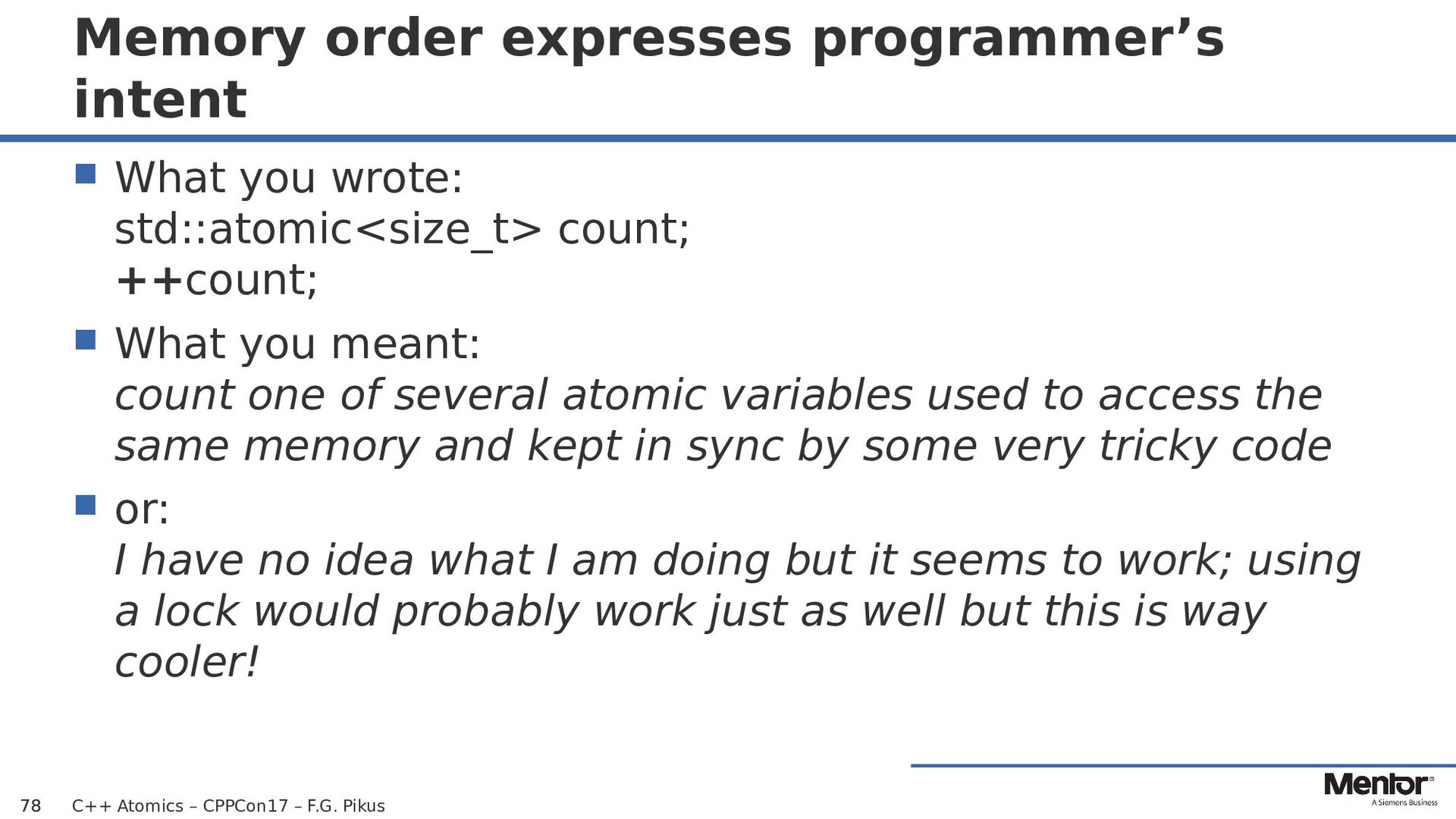
expresses programmer’s intent 78 What you wrote: std::atomic<size_t> count; ++count; What you meant: count one of several atomic variables used to access the same memory and kept in sync by some very tricky code or: I have no idea what I am doing but it seems to work; using a lock would probably work just as well but this is way cooler!
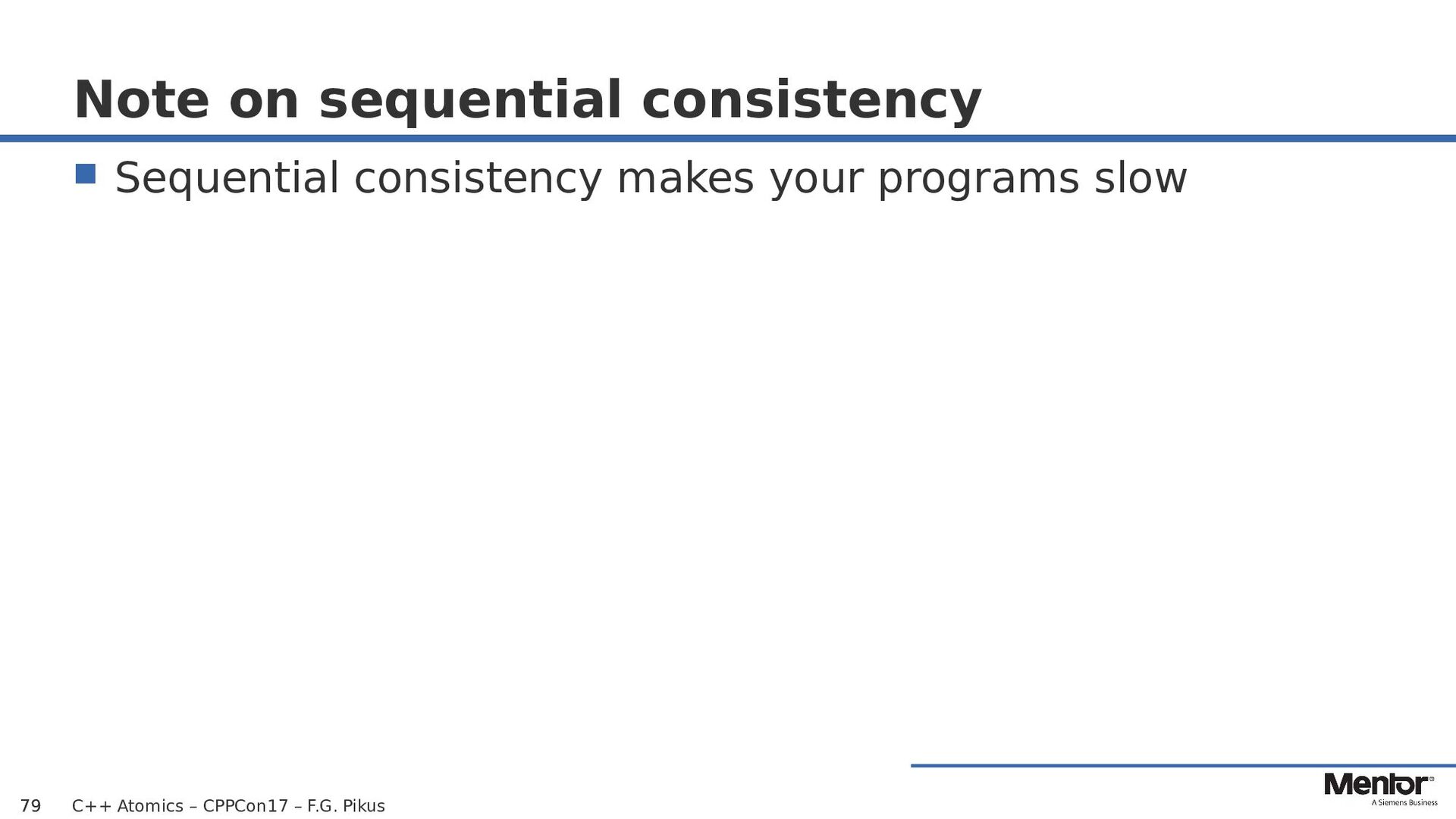
sequential consistency 81 Sequential consistency makes your program easier to understand and often has no performance penalty But making every atomic operation memory_order_seq_cst is not necessary for sequential consistency and usually obscures the programmer’s intent Consider: – Lock-based program can be sequentially consistent, but – Lock implementation does not need memory_order_seq_cst, only memory_order_acquire and memory_order_release
about the C++ standard 82 What you wrote: class C { std::atomic<size_t> N; T* p; … }; C::~C() { cleanup(p, N.load(std::memory_order_relaxed)); What you said: C::N may be accessed by another thread while the object is being destructed – be very afraid! What you probably meant: I wish the standard let me say N.load_nonatomic() so I don’t have to terrify people unless I really want to
std::atomic 83 Atomic variables and operations on them – Member function operations (use them) and operators Performance of atomic operations (not always fastest) Memory barriers – Essential for interaction of threads through memory – Significantly affect performance
use std::atomic in your C++ code 84 High-performance concurrent lock-free data structures – Prove it by measuring performance Data structures that are difficult or expensive to implement with locks (lists, trees) When drawbacks of locks are important (deadlocks, priority conflicts, latency problems) When concurrent synchronization can be achieved by the cheapest atomic operations (load and store) – see my talk on RCU


 mikhailsolomin
 davetheseo
 baasie
 jnunemaker
 bluesmoon
 lynnandtonic
 ivargrimstad
 mlcsv
 codingconduct
 khoart
 marketingsoph
 techseoconnect
 quramy