Upgrade to Pro — share decks privately, control downloads, hide ads and more …

Finding Common Ground: The Case for Reforming H...

Sponsored · Your Podcast. Everywhere. Effortlessly. Share. Educate. Inspire. Entertain. You do you. We'll handle the rest. →
Avatar for Mr Berry Mr Berry
June 09, 2026
1

Finding Common Ground: The Case for Reforming How the NHS Values Medicines

Avatar for Mr Berry

Mr Berry

June 09, 2026

Transcript

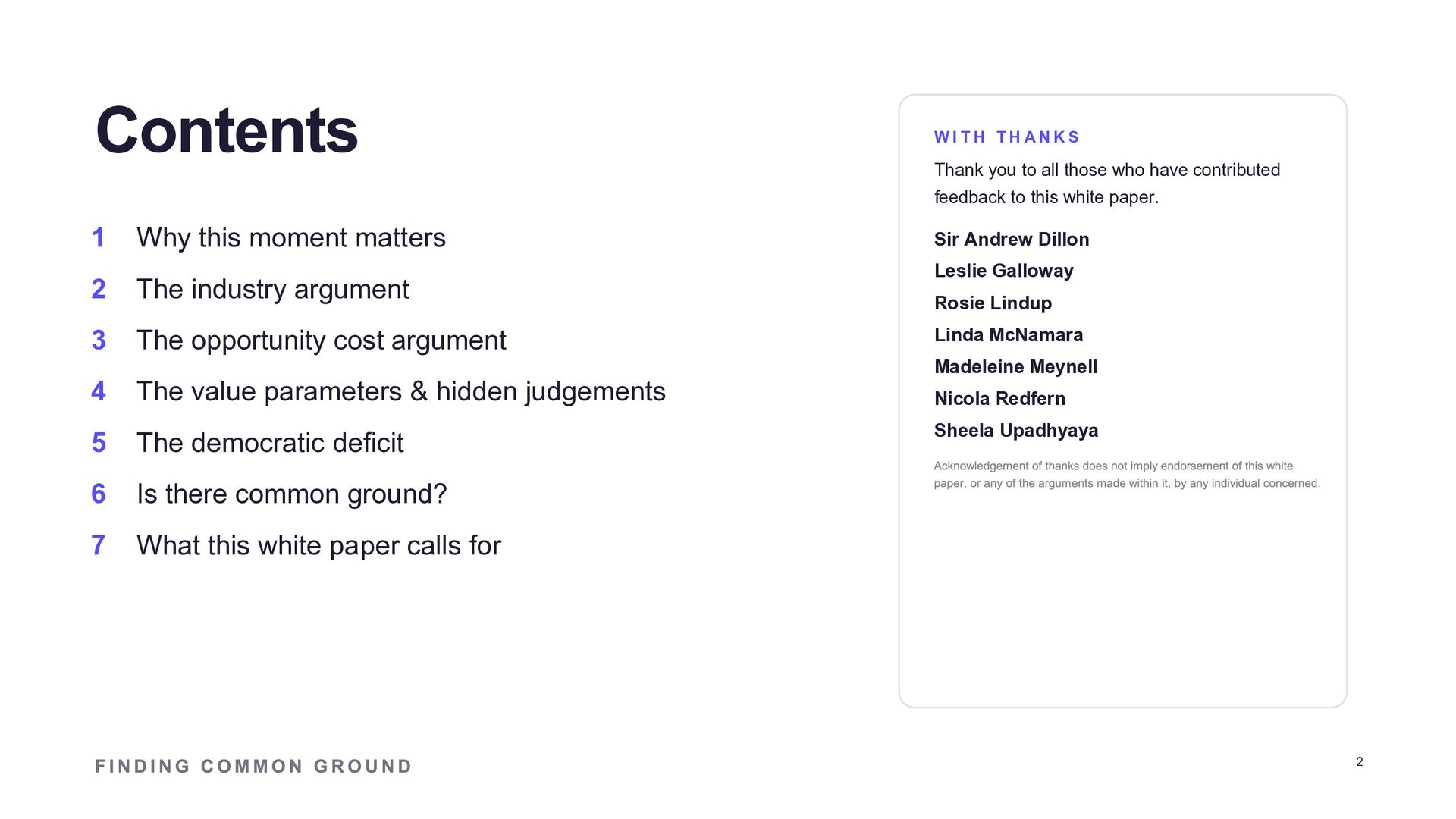
  1. Contents 1 Why this moment matters 2 The industry argument

    3 The opportunity cost argument 4 The value parameters & hidden judgements 5 The democratic deficit 6 Is there common ground? 7 What this white paper calls for W I T H T H A N K S Thank you to all those who have contributed feedback to this white paper. Sir Andrew Dillon Leslie Galloway Rosie Lindup Linda McNamara Madeleine Meynell Nicola Redfern Sheela Upadhyaya 2
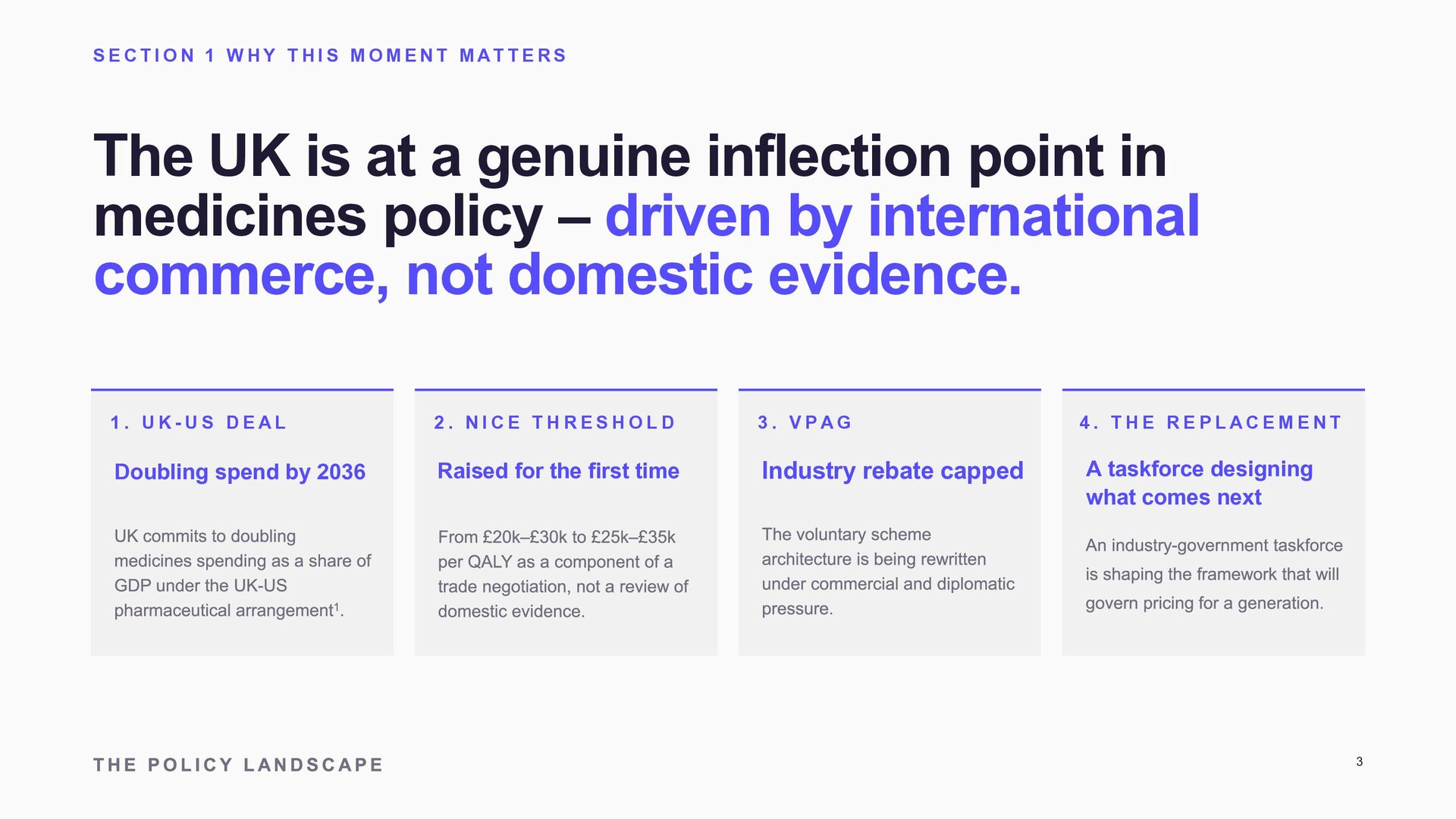
  2. S E C T I O N 1 W H

    Y T H I S M O M E N T M AT T E R S The UK is at a genuine inflection point in medicines policy – driven by international commerce, not domestic evidence. 1 . U K - U S D E A L Doubling spend by 2036 2 . N I C E T H R E S H O L D Raised for the first time 3 . V P A G Industry rebate capped 4 . T H E R E P L A C E M E N T A taskforce designing what comes next 3
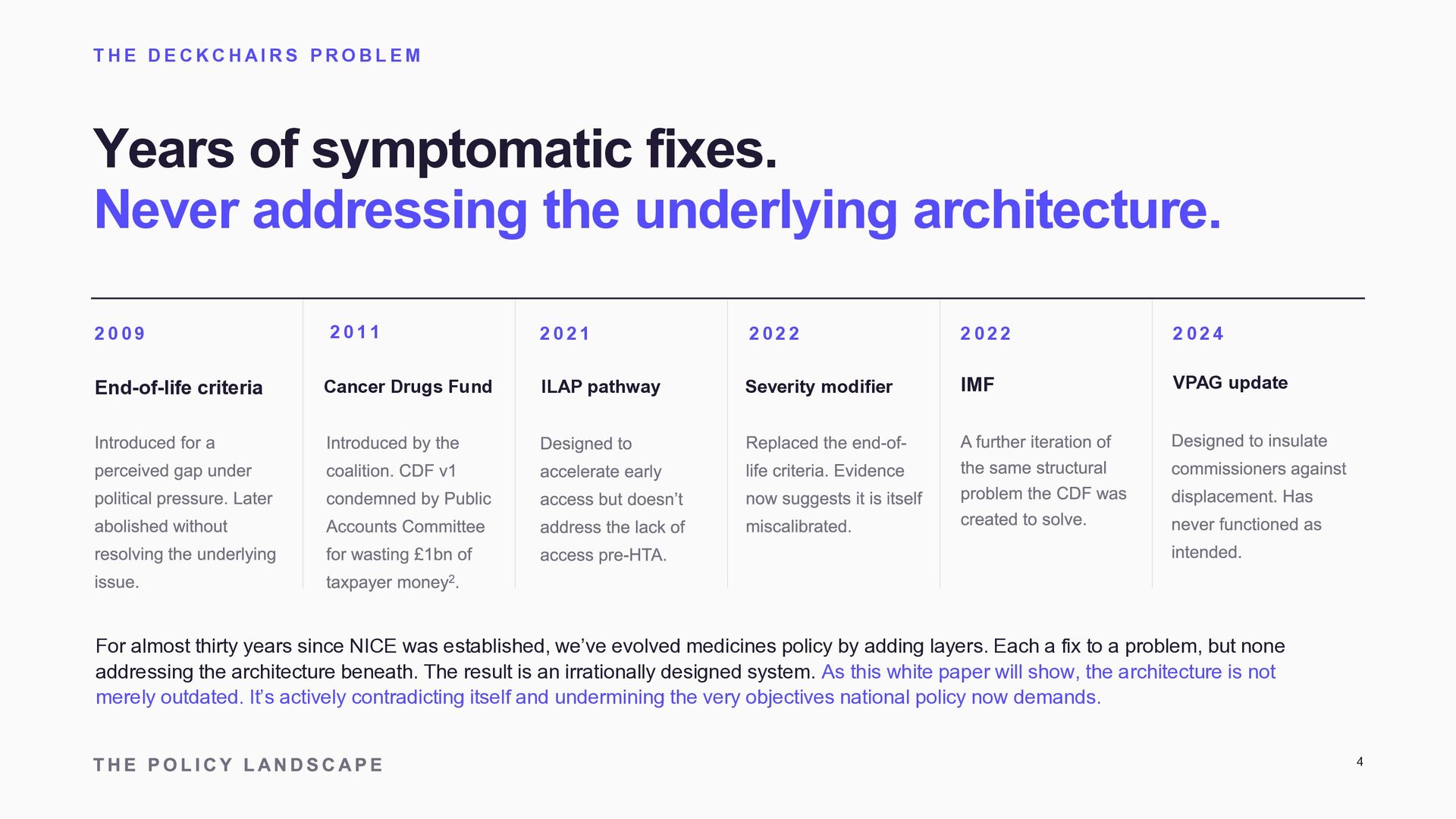
  3. Years of symptomatic fixes. Never addressing the underlying architecture. 2

    0 0 9 End-of-life criteria 2 0 2 1 ILAP pathway 2 0 2 2 IMF 2 0 2 4 VPAG update For almost thirty years since NICE was established, we’ve evolved medicines policy by adding layers. Each a fix to a problem, but none addressing the architecture beneath. The result is an irrationally designed system. As this white paper will show, the architecture is not merely outdated. It’s actively contradicting itself and undermining the very objectives national policy now demands. 2 0 1 1 Cancer Drugs Fund 2 0 2 2 Severity modifier T H E D E C K C H AI R S P R O B L E M 4
  4. T H E M Y T H T H E

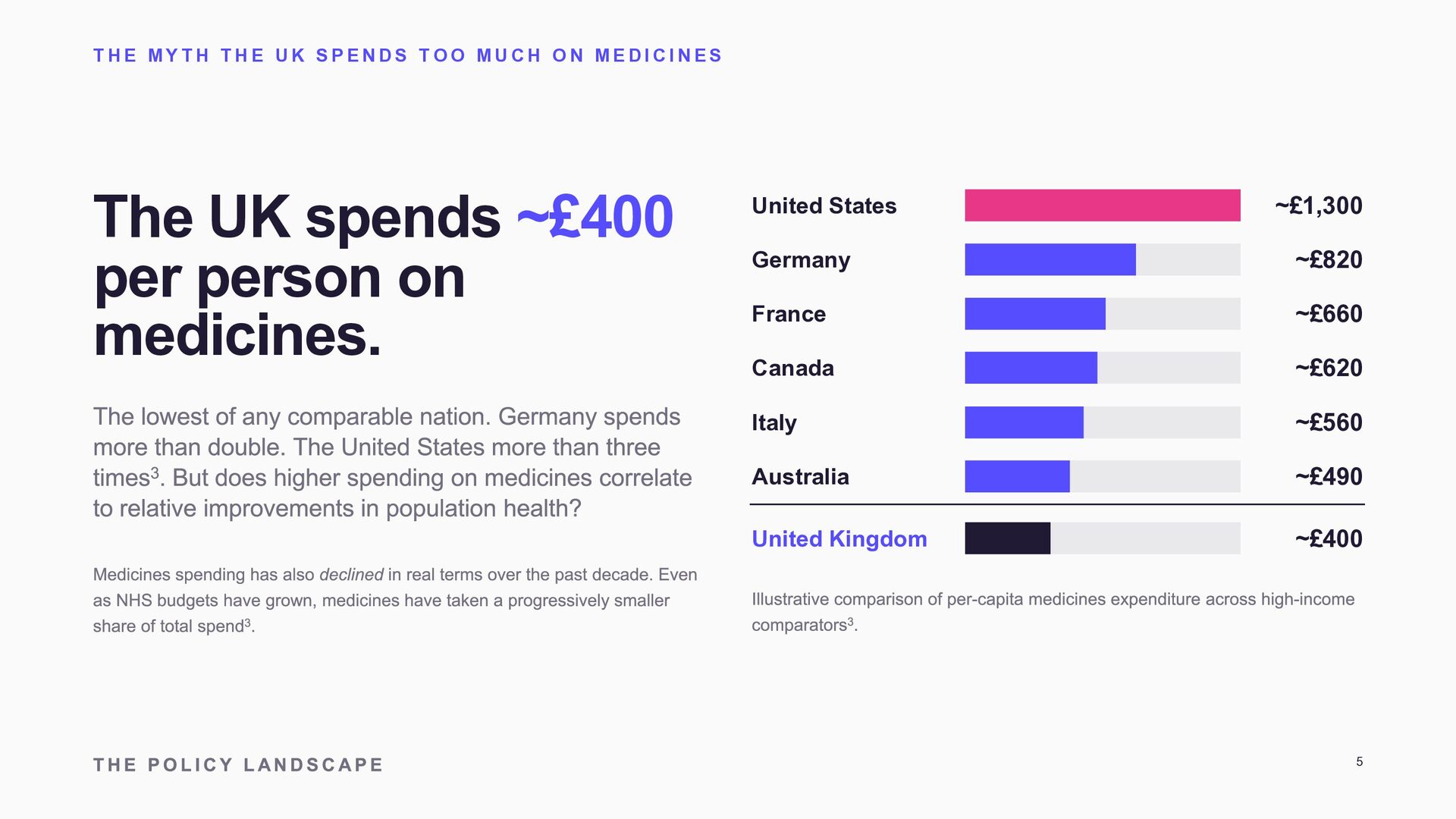
    U K S P E N D S T O O M U C H O N M E D I C I N E S The UK spends ~£400 per person on medicines. United States ~£1,300 Germany ~£820 France ~£660 Canada ~£620 Australia ~£490 United Kingdom ~£400 Italy ~£560 5
  5. T H E A C C E S S P

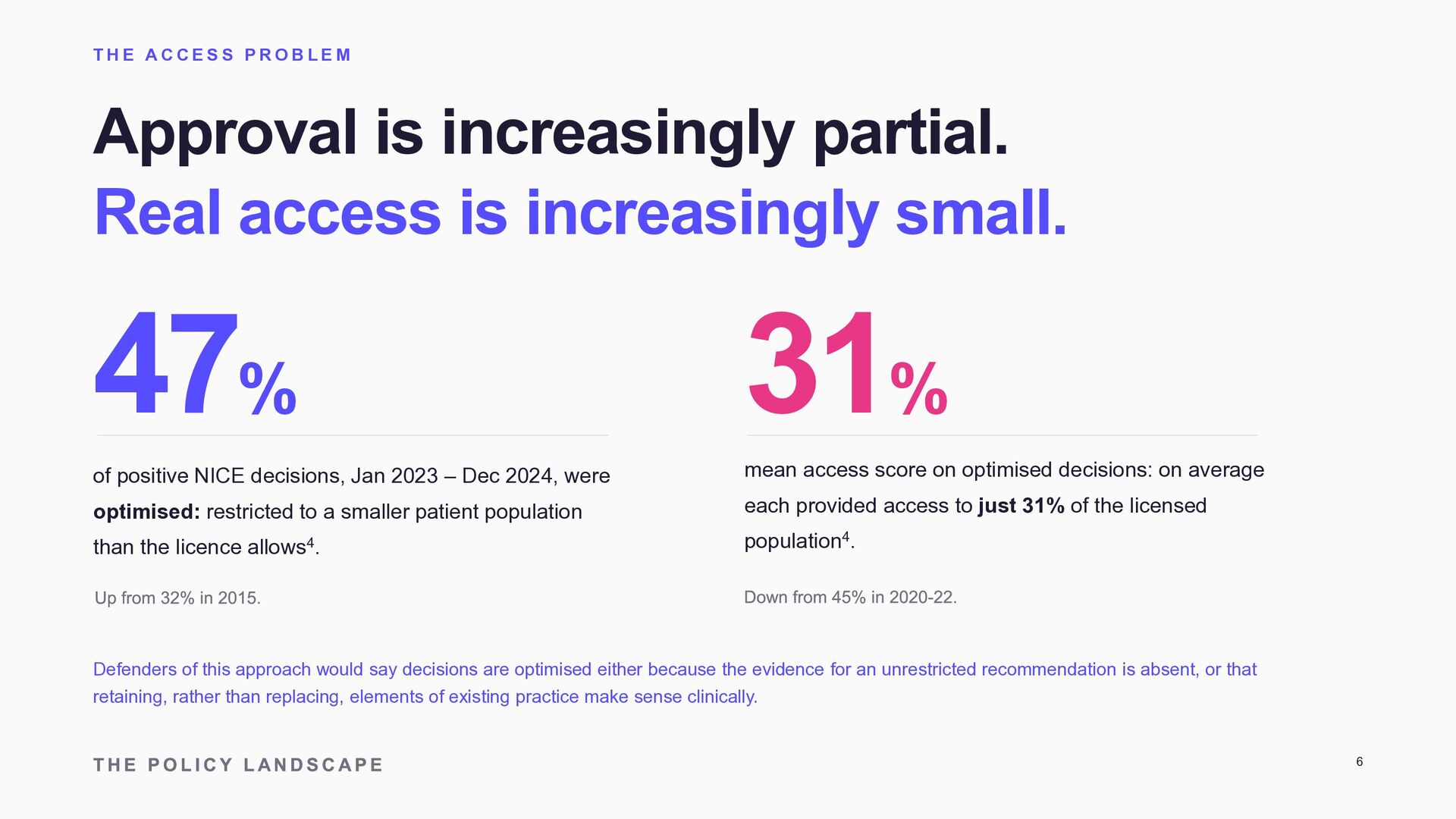
    R O B L E M Approval is increasingly partial. Real access is increasingly small. 47% of positive NICE decisions, Jan 2023 – Dec 2024, were optimised: restricted to a smaller patient population than the licence allows4. 31% mean access score on optimised decisions: on average each provided access to just 31% of the licensed population4. 6 Defenders of this approach would say decisions are optimised either because the evidence for an unrestricted recommendation is absent, or that retaining, rather than replacing, elements of existing practice make sense clinically.
  6. W H AT ‘ O P T I M I

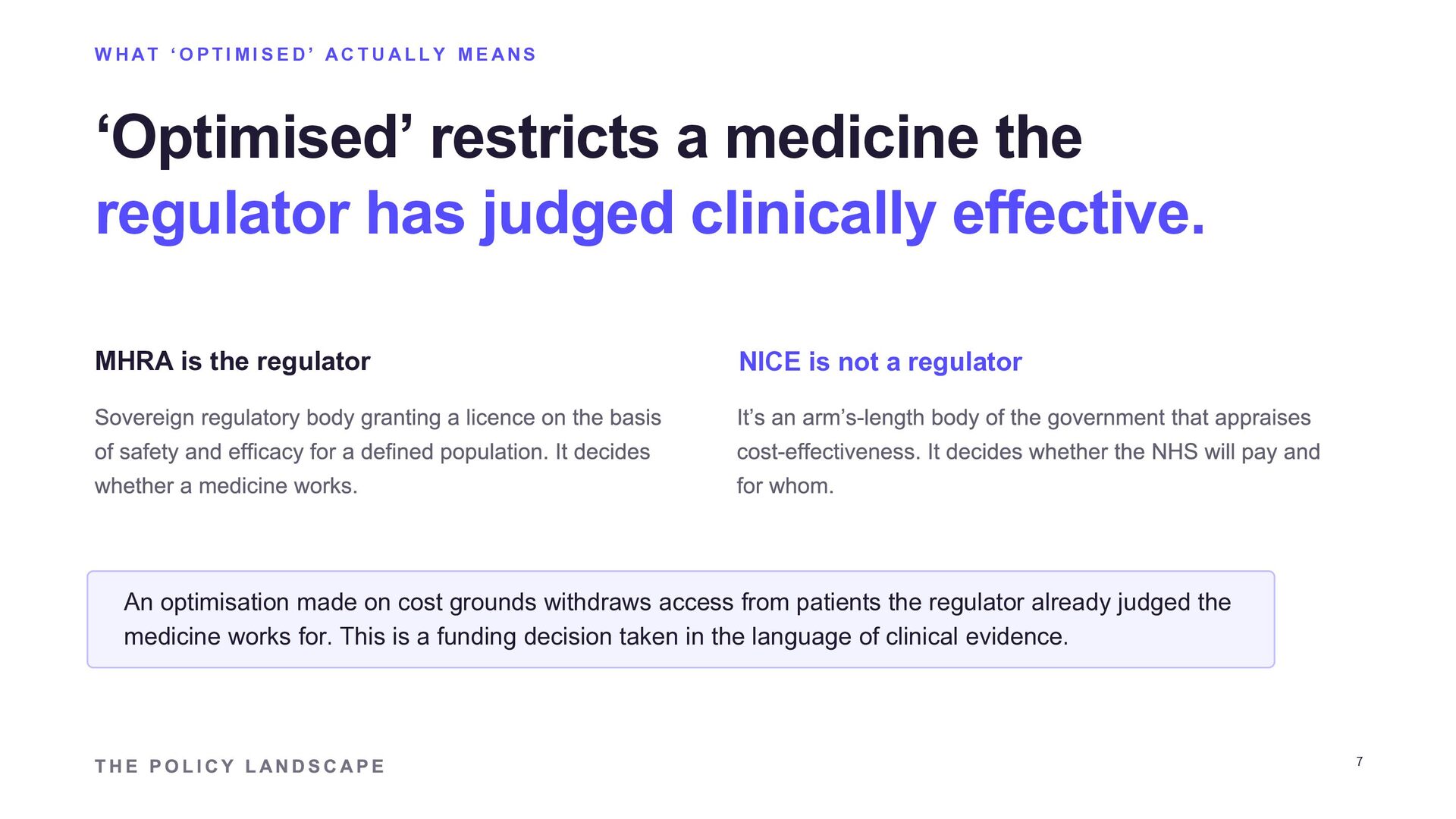
    S E D ’ AC T U A L L Y M E AN S ‘Optimised’ restricts a medicine the regulator has judged clinically effective. MHRA is the regulator NICE is not a regulator 7 An optimisation made on cost grounds withdraws access from patients the regulator already judged the medicine works for. This is a funding decision taken in the language of clinical evidence.
  7. I N D I C AT I V E AN

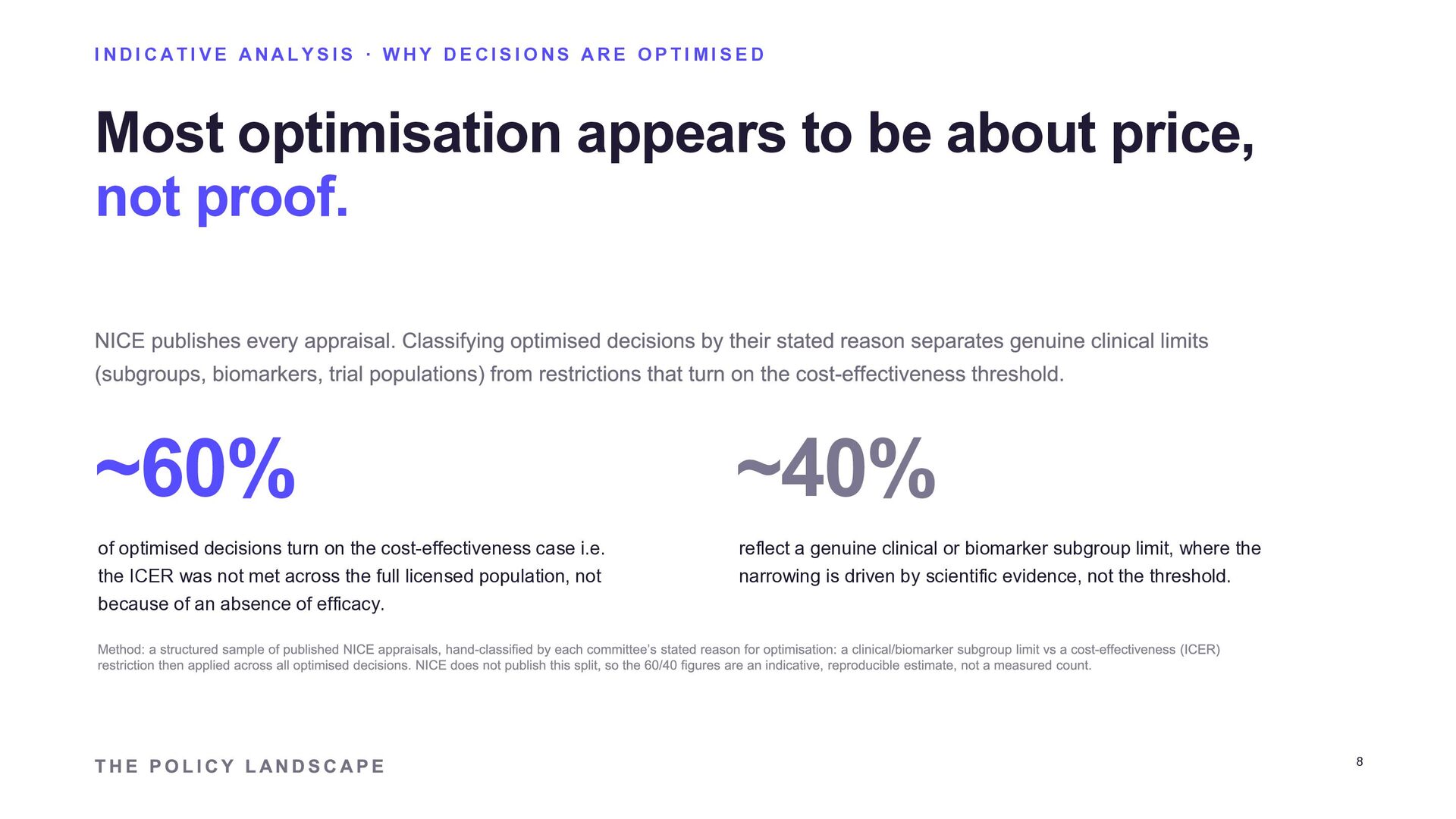
    A L Y S I S · W H Y D E C I S I O N S AR E O P T I M I S E D Most optimisation appears to be about price, not proof. ~60% of optimised decisions turn on the cost-effectiveness case i.e. the ICER was not met across the full licensed population, not because of an absence of efficacy. ~40% reflect a genuine clinical or biomarker subgroup limit, where the narrowing is driven by scientific evidence, not the threshold. 8
  8. I N D I C AT I V E AN

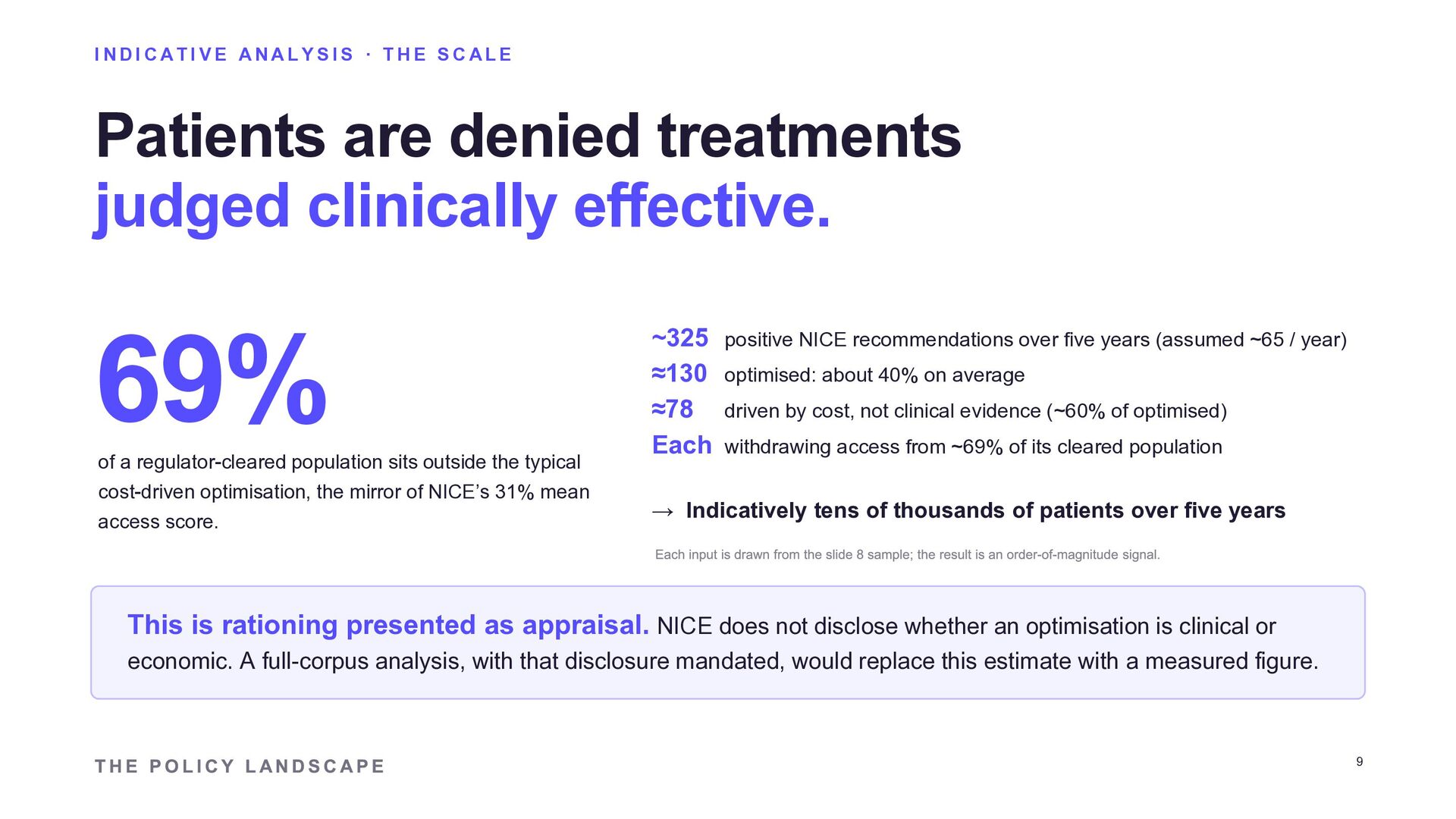
    A L Y S I S · T H E S C AL E Patients are denied treatments judged clinically effective. 69% of a regulator-cleared population sits outside the typical cost-driven optimisation, the mirror of NICE’s 31% mean access score. ~325 positive NICE recommendations over five years (assumed ~65 / year) ≈130 optimised: about 40% on average ≈78 driven by cost, not clinical evidence (~60% of optimised) Each withdrawing access from ~69% of its cleared population → Indicatively tens of thousands of patients over five years 9 This is rationing presented as appraisal. NICE does not disclose whether an optimisation is clinical or economic. A full-corpus analysis, with that disclosure mandated, would replace this estimate with a measured figure.
  9. U K P E R - C A P I

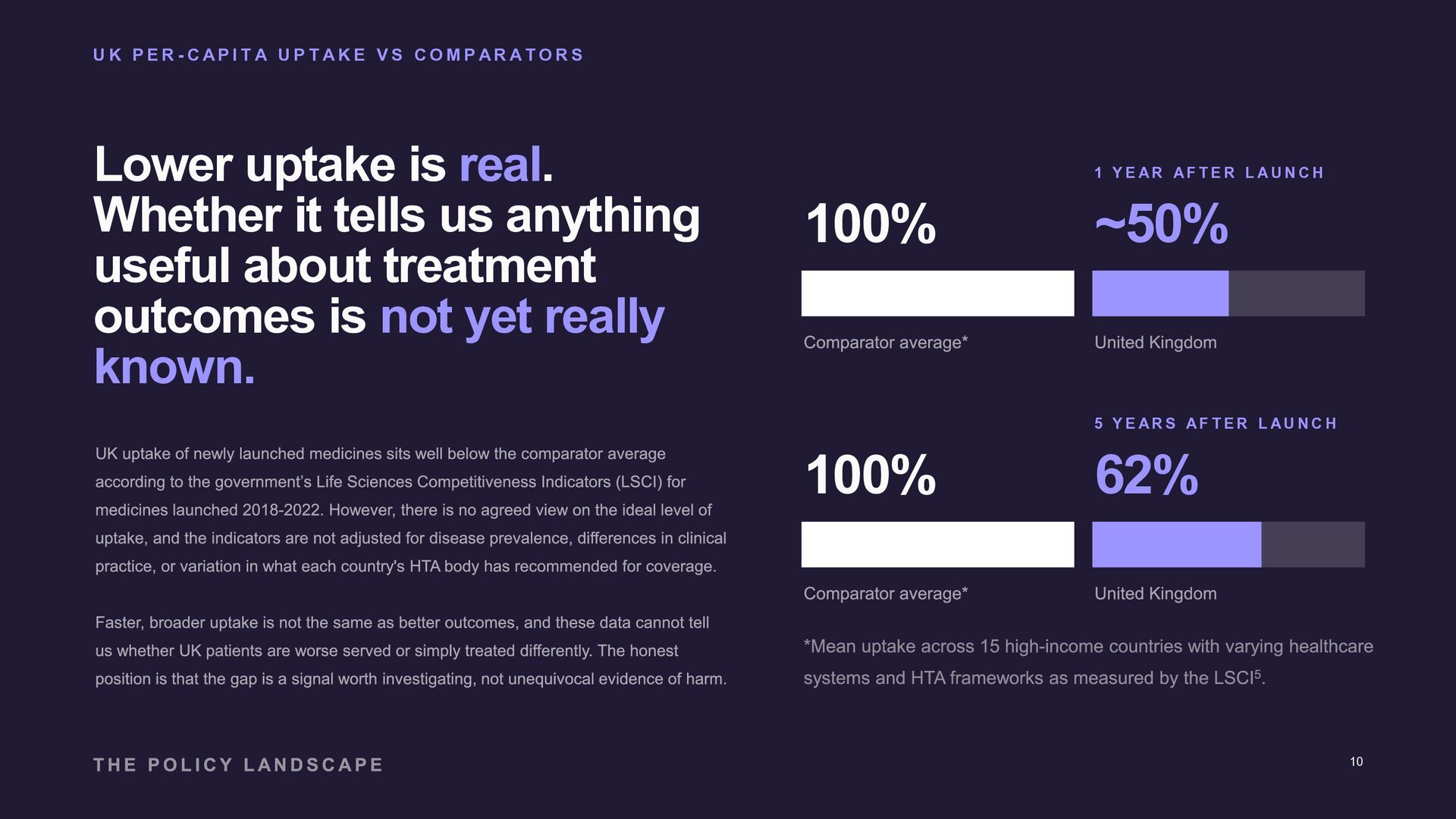
    T A U P T A K E V S C O M P A R A T O R S Lower uptake is real. Whether it tells us anything useful about treatment outcomes is not yet really known. 1 Y E A R AF T E R L A U N C H 100% ~50% 100% 62% 5 Y E A R S AF T E R L AU N C H 10
  10. S O V E R E I G N M

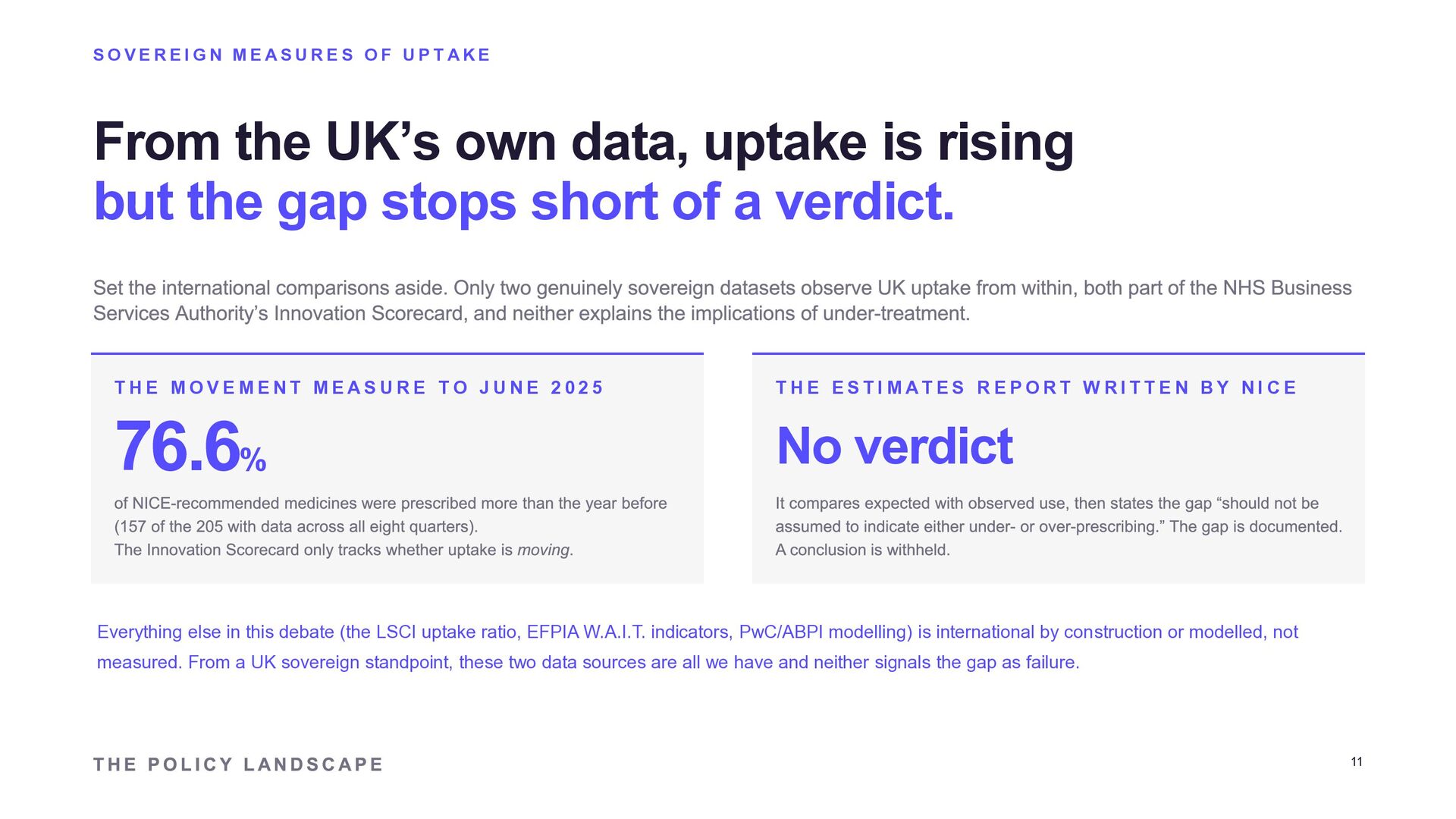
    E A S U R E S O F U P T A K E From the UK’s own data, uptake is rising but the gap stops short of a verdict. T H E M O V E M E N T M E A S U R E T O J U N E 2 0 2 5 76.6% T H E E S T I M A T E S R E P O R T W R I T T E N B Y N I C E No verdict Everything else in this debate (the LSCI uptake ratio, EFPIA W.A.I.T. indicators, PwC/ABPI modelling) is international by construction or modelled, not measured. From a UK sovereign standpoint, these two data sources are all we have and neither signals the gap as failure. 11
  11. S E C T I O N 2 The industry

    argument – what is fact and what is contested
  12. T H E B I G I N D U

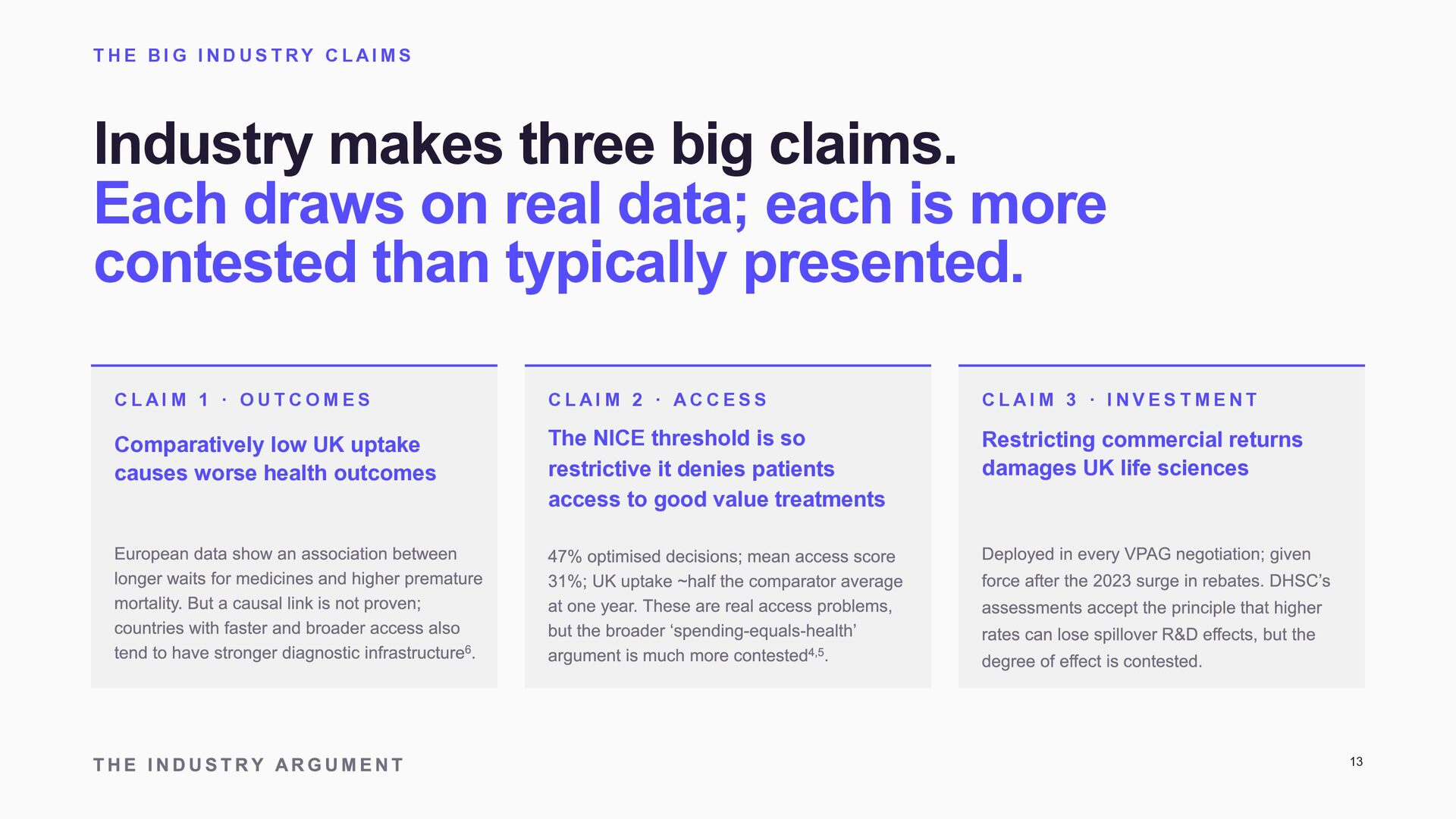
    S T R Y C L AI M S Industry makes three big claims. Each draws on real data; each is more contested than typically presented. C L A I M 1 · O U T C O M E S Comparatively low UK uptake causes worse health outcomes C L A I M 2 · A C C E S S The NICE threshold is so restrictive it denies patients access to good value treatments C L A I M 3 · I N V E S T M E N T Restricting commercial returns damages UK life sciences 13
  13. C O M M E R C I A L

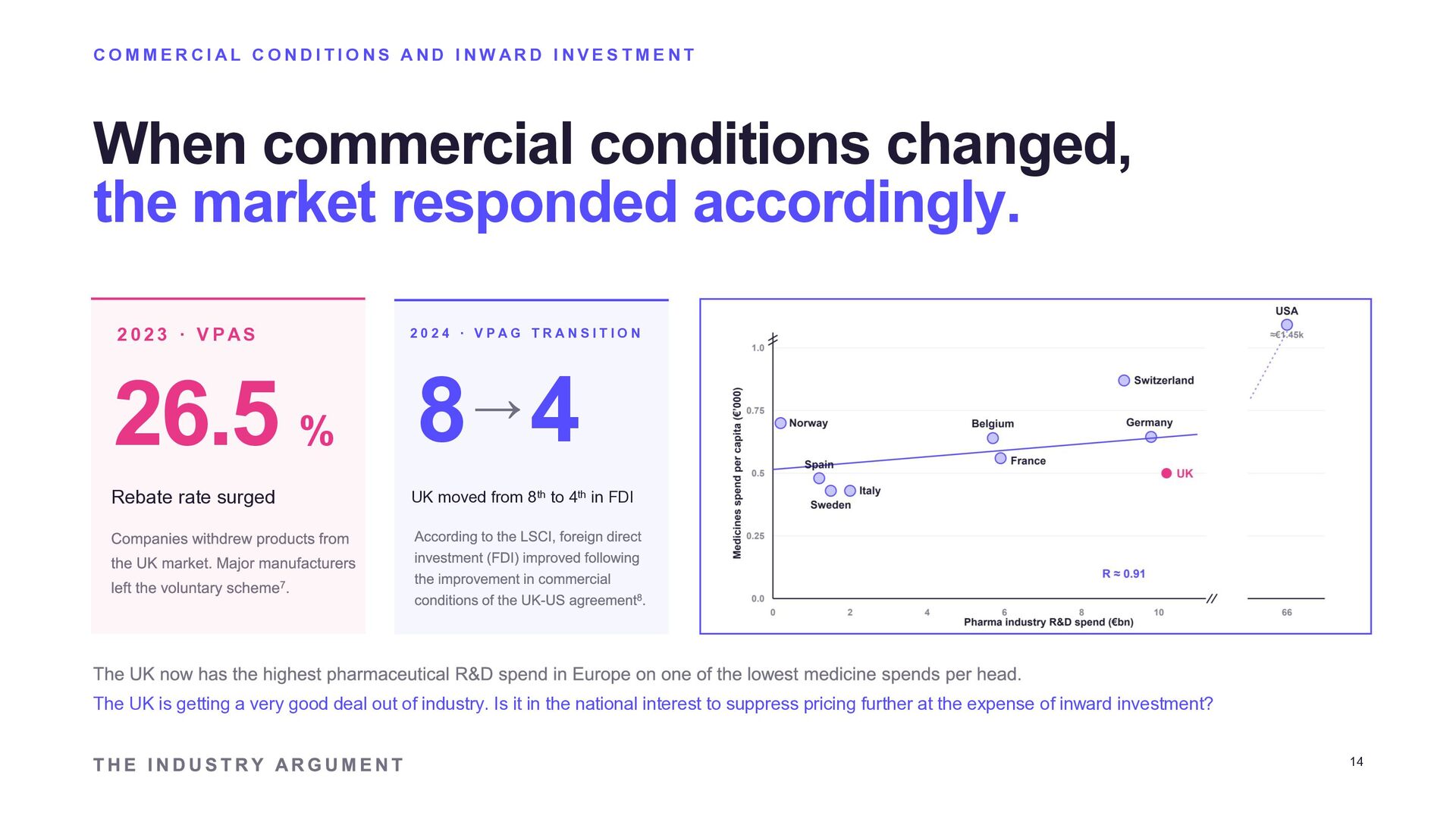
    C O N D I T I O N S A N D I N W A R D I N V E S T M E N T When commercial conditions changed, the market responded accordingly. 2 0 2 3 · V P AS 26.5 % Rebate rate surged 2 0 2 4 · V P A G T R A N S I T I O N 8 4 UK moved from 8th to 4th in FDI The UK is getting a very good deal out of industry. Is it in the national interest to suppress pricing further at the expense of inward investment? 9 14
  14. A B P I M E D I C I

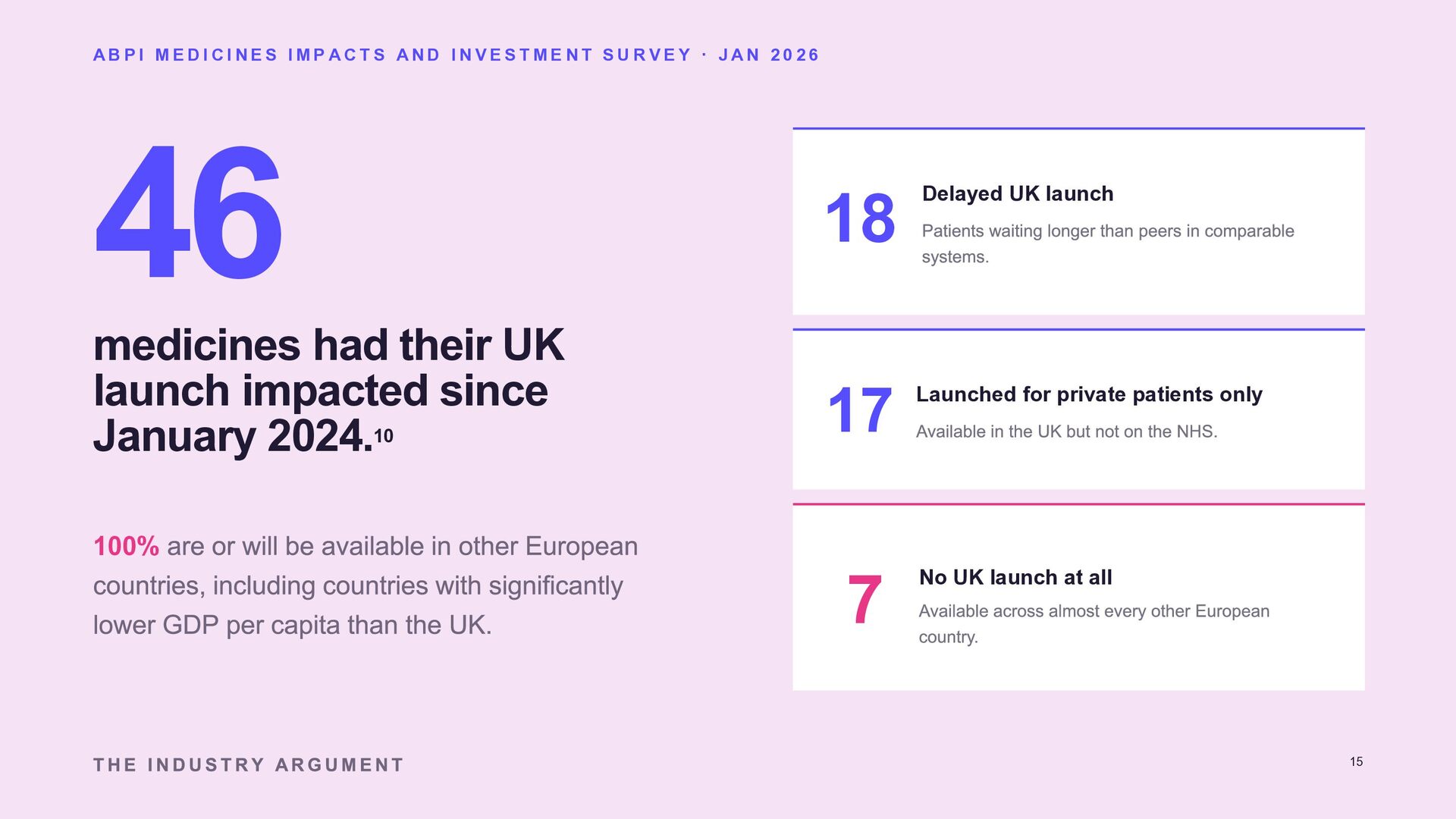
    N E S I M P A C T S A N D I N V E S T M E N T S U R V E Y · J A N 2 0 2 6 46 medicines had their UK launch impacted since January 2024.10 100% 18 Delayed UK launch 17 Launched for private patients only 7 No UK launch at all 15
  15. T H E I N T E R I M

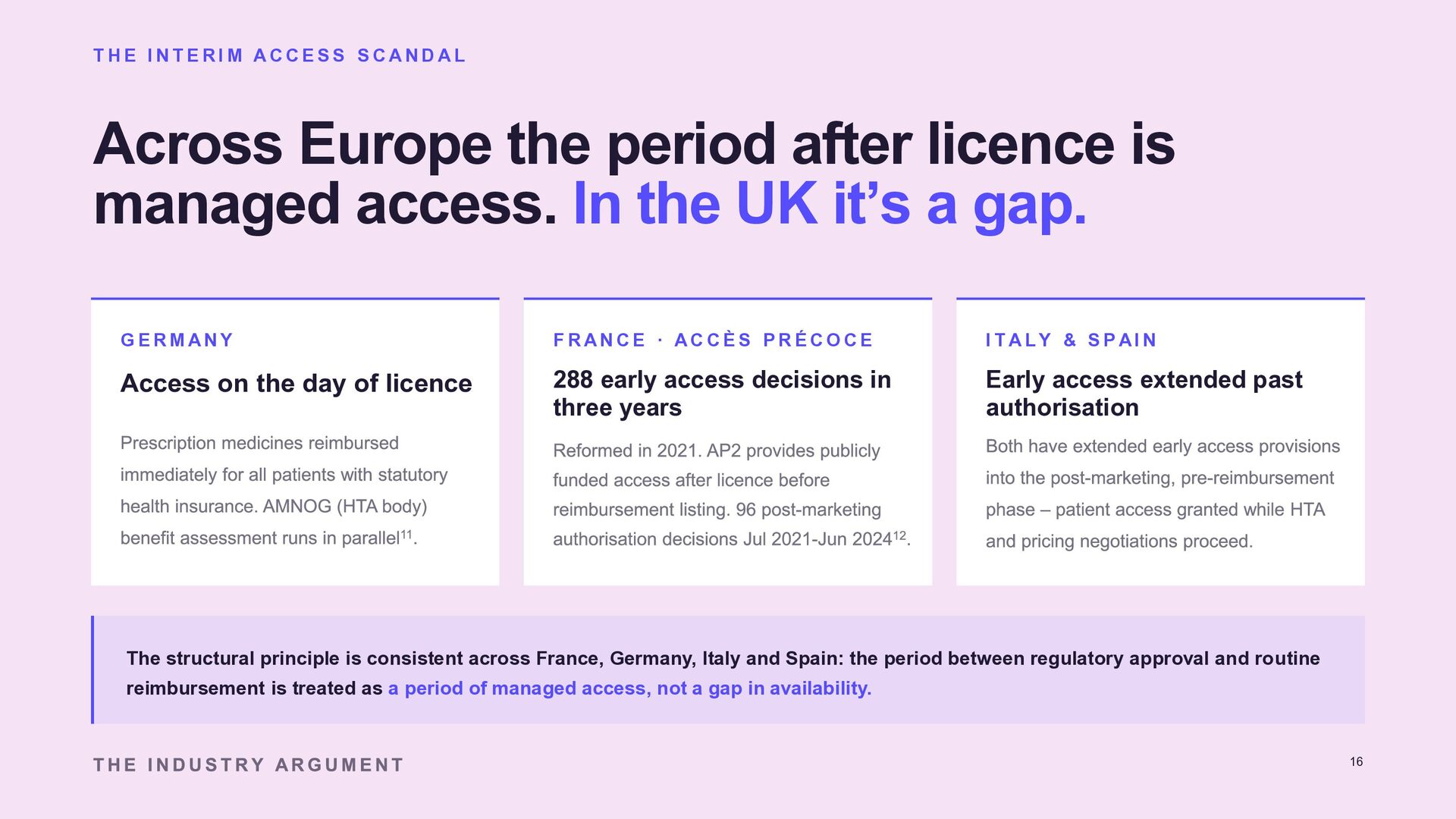
    AC C E S S S C AN D A L Across Europe the period after licence is managed access. In the UK it’s a gap. G E R M AN Y Access on the day of licence F R A N C E · A C C È S P R É C O C E 288 early access decisions in three years I T A L Y & S P A I N Early access extended past authorisation The structural principle is consistent across France, Germany, Italy and Spain: the period between regulatory approval and routine reimbursement is treated as a period of managed access, not a gap in availability. 16
  16. W H A T I S N E E D

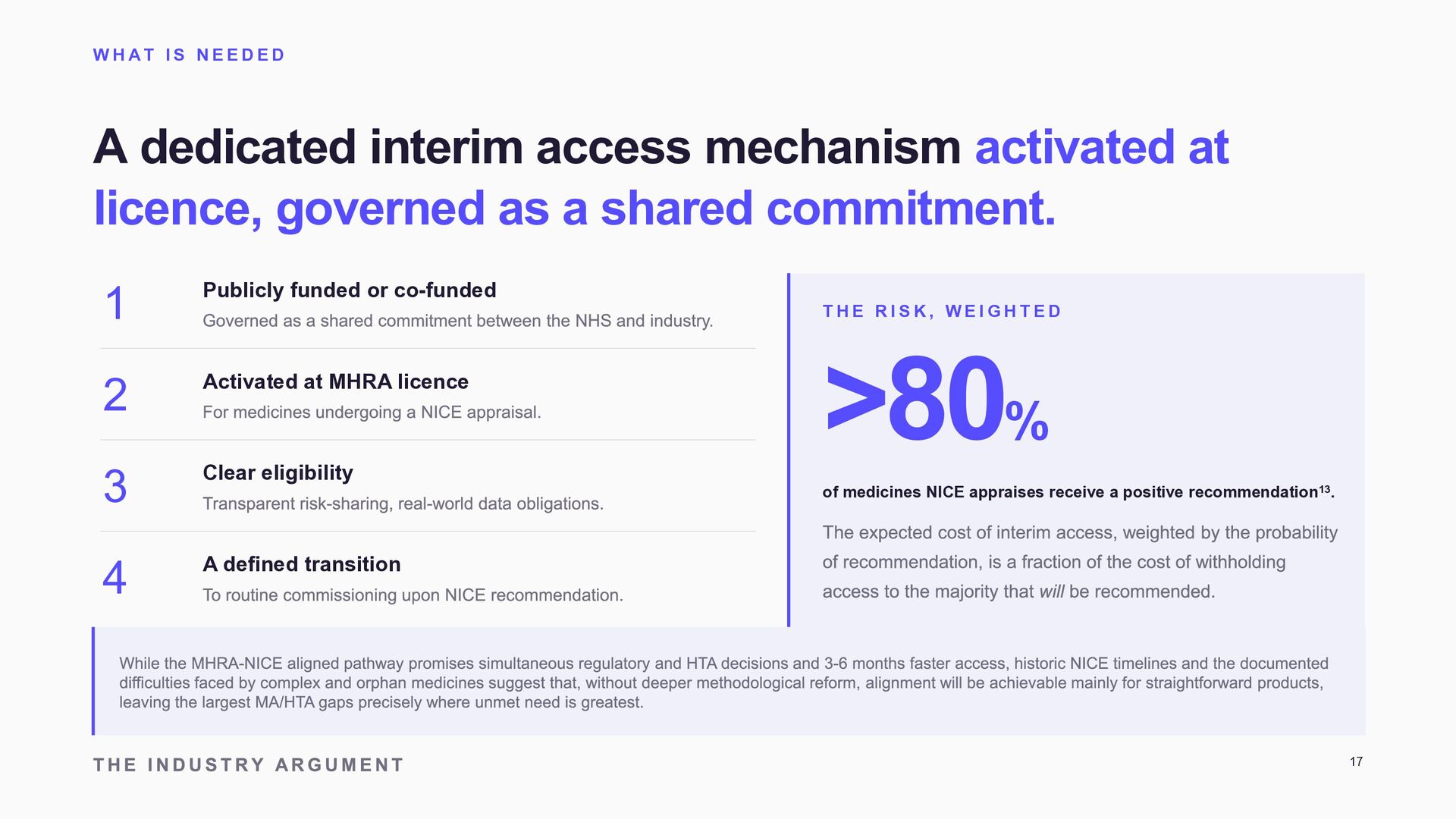
    E D A dedicated interim access mechanism activated at licence, governed as a shared commitment. T H E R I S K , W E I G H T E D >80% of medicines NICE appraises receive a positive recommendation13. 1 Publicly funded or co-funded 2 Activated at MHRA licence 3 Clear eligibility 4 A defined transition 17
  17. H O W T H E AR G U M

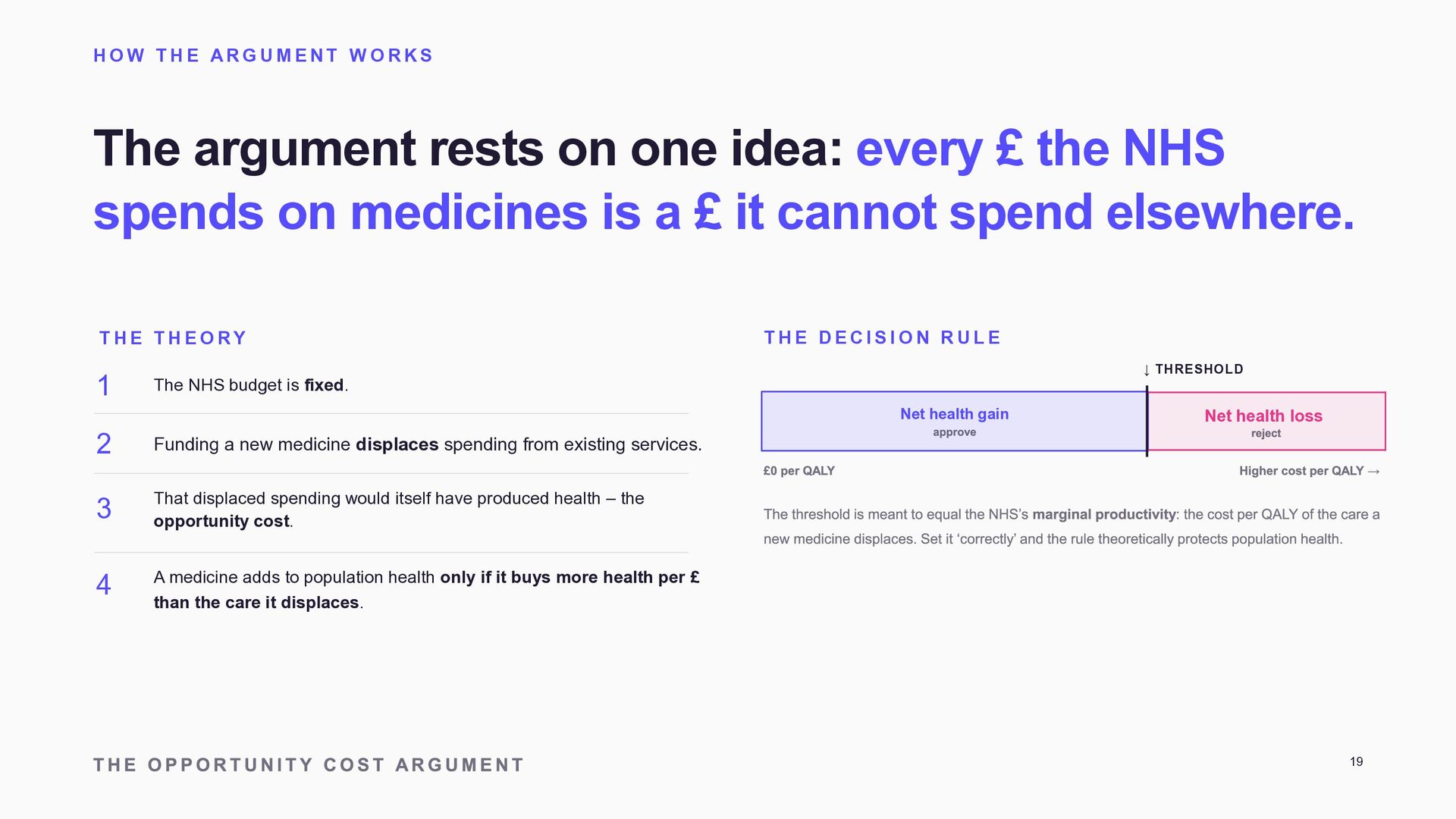
    E N T W O R K S The argument rests on one idea: every £ the NHS spends on medicines is a £ it cannot spend elsewhere. 1 The NHS budget is fixed. 2 Funding a new medicine displaces spending from existing services. 3 That displaced spending would itself have produced health – the opportunity cost. 4 A medicine adds to population health only if it buys more health per £ than the care it displaces. T H E D E C I S I O N R U L E ↓ THRESHOLD Net health gain Net health loss T H E T H E O R Y 19
  18. T H E C L A X T O N

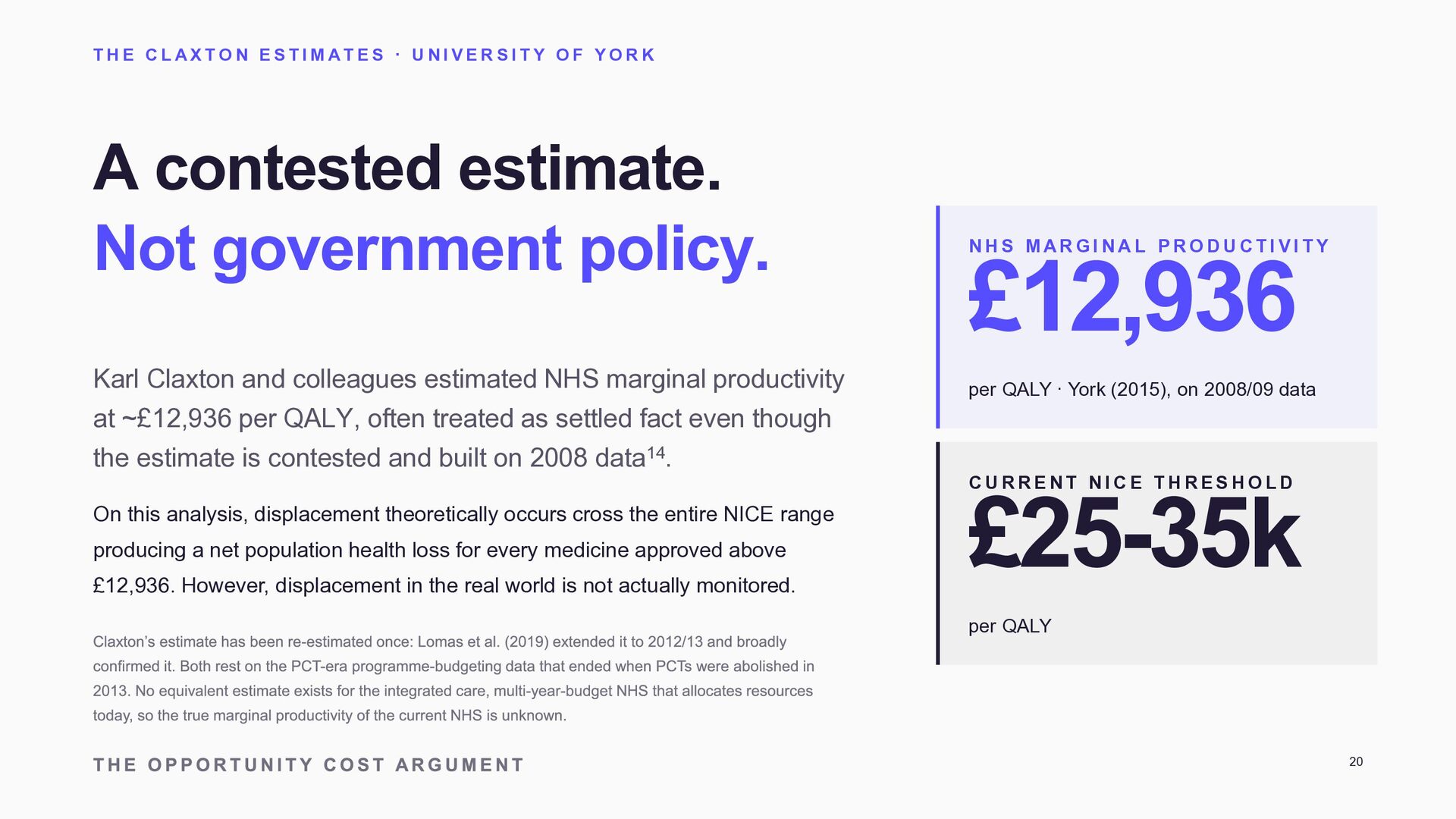
    E S T I M A T E S · U N I V E R S I T Y O F Y O R K A contested estimate. Not government policy. Karl Claxton and colleagues estimated NHS marginal productivity at ~£12,936 per QALY, often treated as settled fact even though the estimate is contested and built on 2008 data14. On this analysis, displacement theoretically occurs cross the entire NICE range producing a net population health loss for every medicine approved above £12,936. However, displacement in the real world is not actually monitored. N H S M A R G I N A L P R O D U C T I V I T Y £12,936 per QALY · York (2015), on 2008/09 data C U R R E N T N I C E T H R E S H O L D £25-35k per QALY 20
  19. T H E L AN C E T 2 0

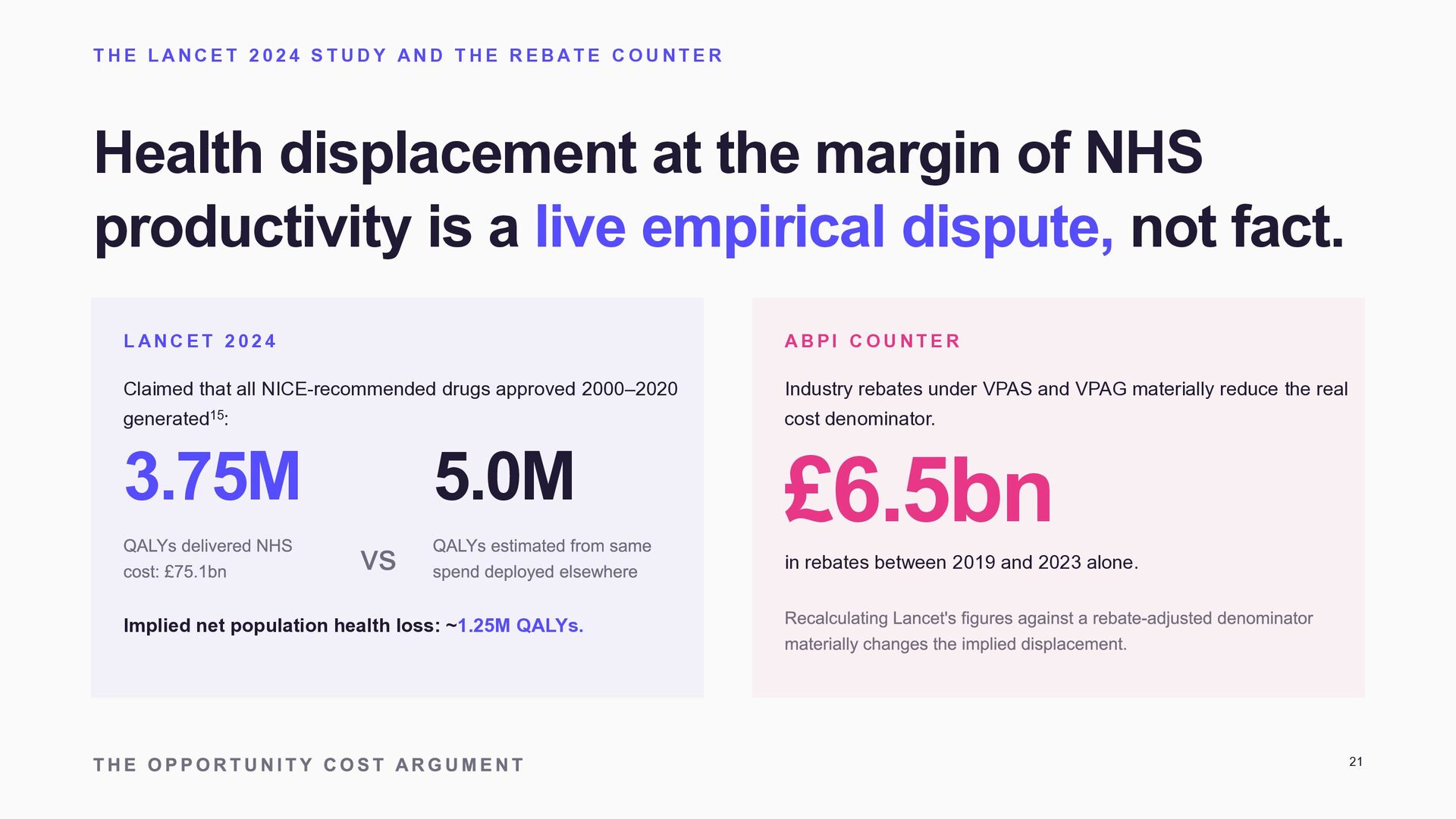
    2 4 S T U D Y AN D T H E R E B A T E C O U N T E R Health displacement at the margin of NHS productivity is a live empirical dispute, not fact. L AN C E T 2 0 2 4 Claimed that all NICE-recommended drugs approved 2000–2020 generated15: 3.75M 5.0M Implied net population health loss: ~1.25M QALYs. A B P I C O U N T E R Industry rebates under VPAS and VPAG materially reduce the real cost denominator. £6.5bn in rebates between 2019 and 2023 alone. 21
  20. A M I R R O R - I M

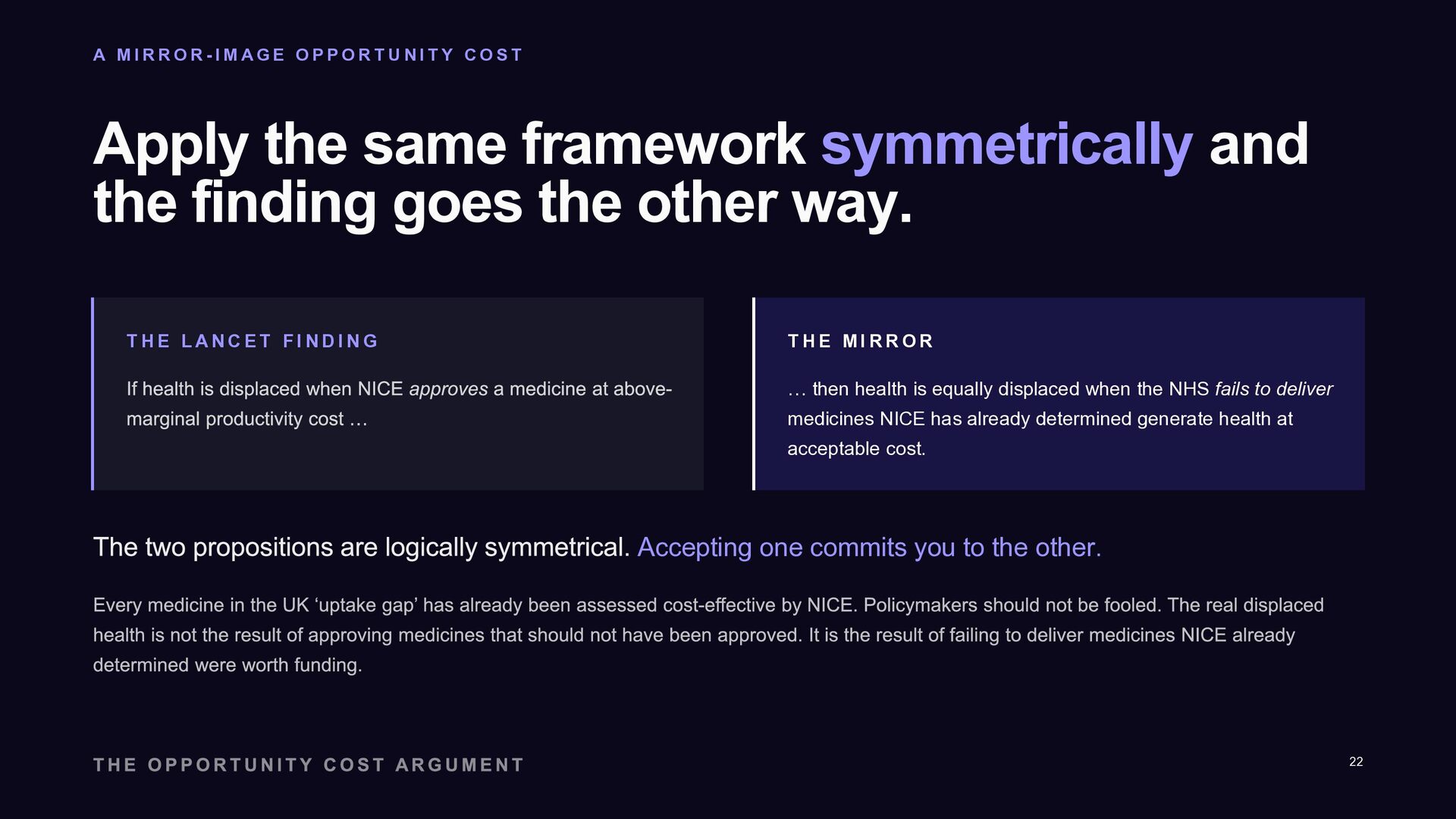
    A G E O P P O R T U N I T Y C O S T Apply the same framework symmetrically and the finding goes the other way. T H E L AN C E T F I N D I N G T H E M I R R O R … then health is equally displaced when the NHS fails to deliver medicines NICE has already determined generate health at acceptable cost. Accepting one commits you to the other. 22
  21. I N D I C AT I V E AI

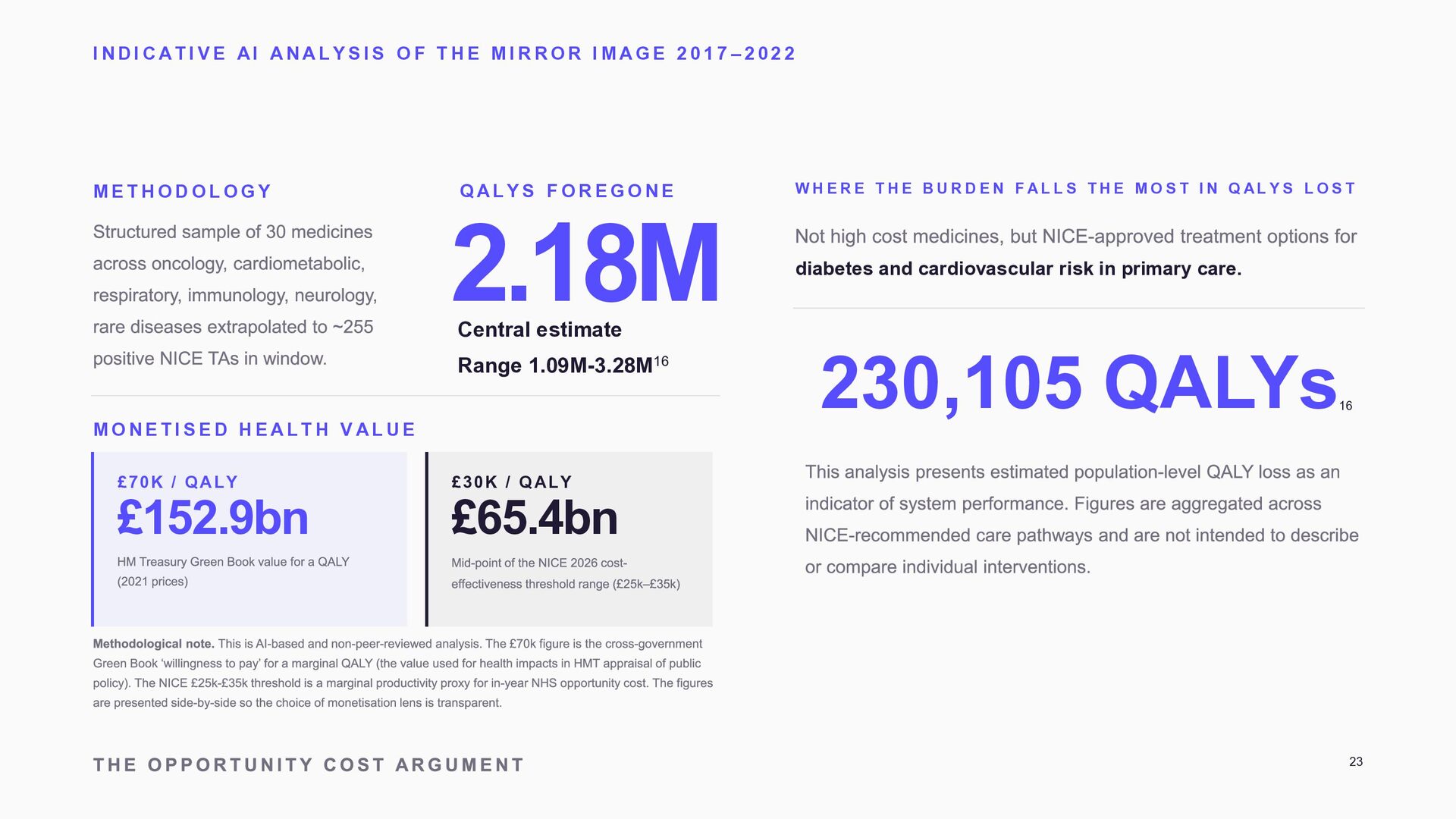
    AN A L Y S I S O F T H E M I R R O R I M A G E 2 0 1 7 – 2 0 2 2 M E T H O D O L O G Y W H E R E T H E B U R D E N F A L L S T H E M O S T I N Q A L Y S L O S T diabetes and cardiovascular risk in primary care. Q AL Y S F O R E G O N E 2.18M Central estimate Range 1.09M-3.28M16 M O N E T I S E D H E AL T H V AL U E £70K / QALY £152.9bn £30K / QALY £65.4bn 230,105 QALYs 16 23
  22. H O W C O N T E S T

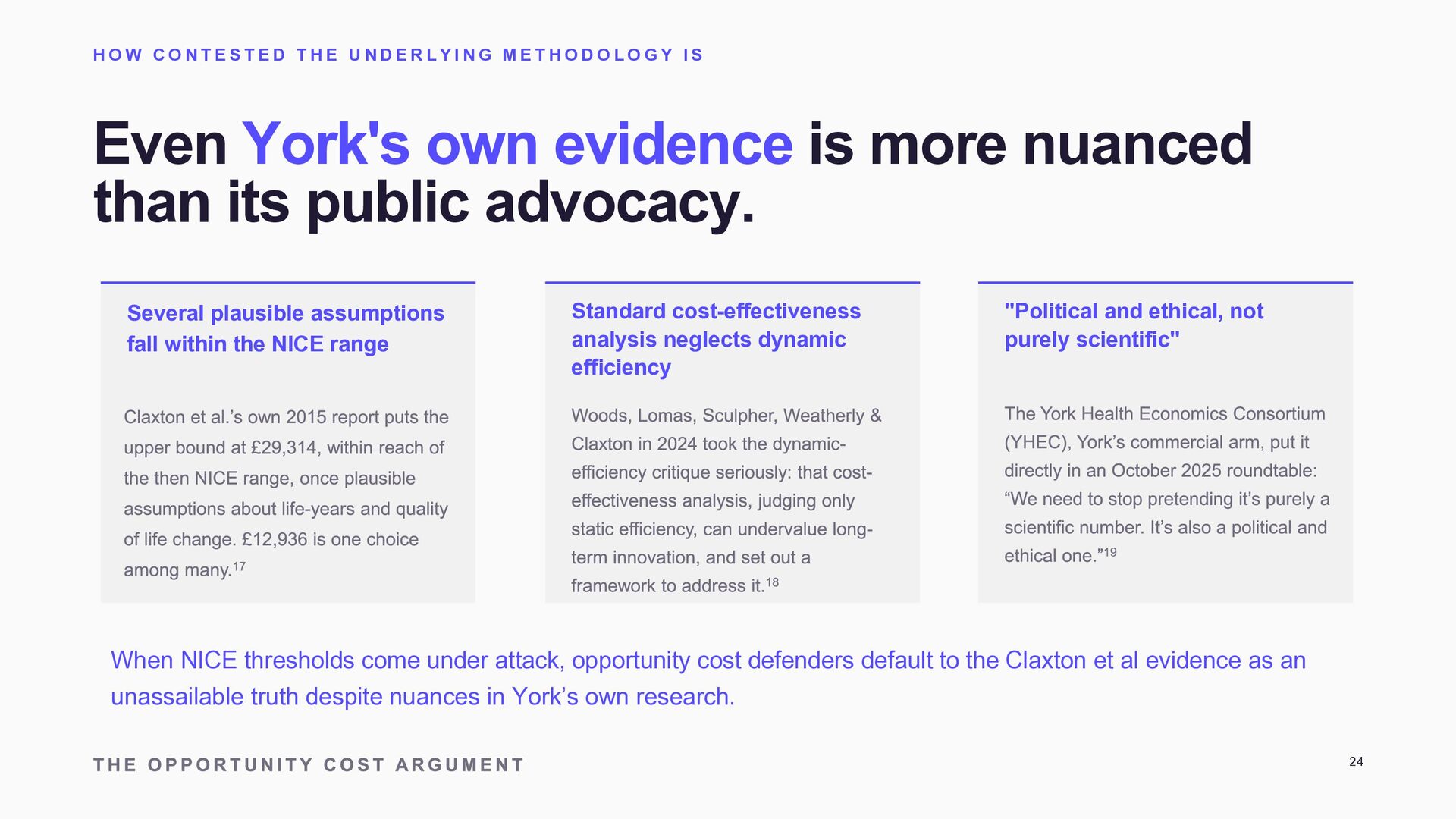
    E D T H E U N D E R L Y I N G M E T H O D O L O G Y I S Even York's own evidence is more nuanced than its public advocacy. Several plausible assumptions fall within the NICE range Standard cost-effectiveness analysis neglects dynamic efficiency "Political and ethical, not purely scientific" When NICE thresholds come under attack, opportunity cost defenders default to the Claxton et al evidence as an unassailable truth despite nuances in York’s own research. 24
  23. T H E B L I N D S P

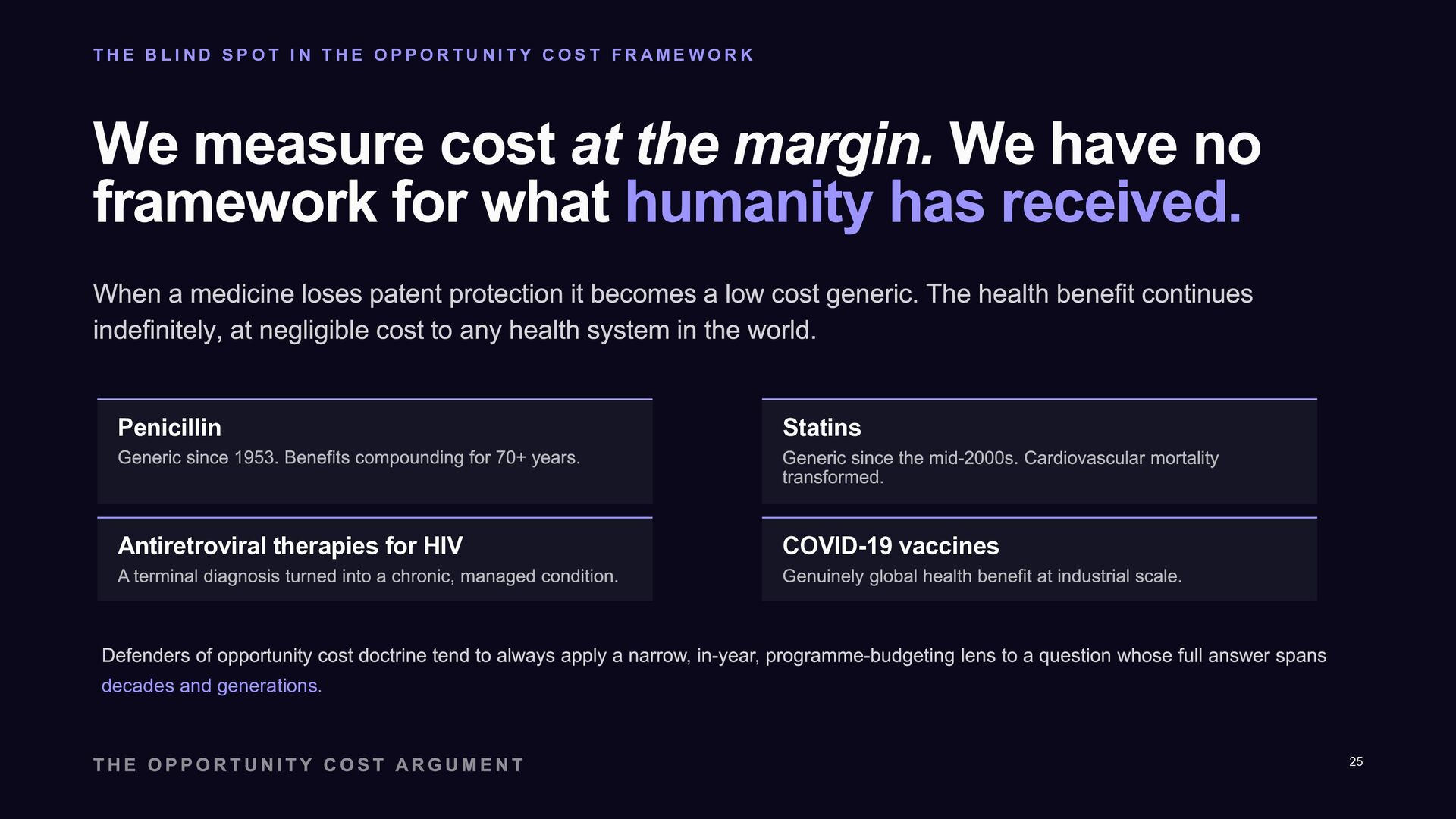
    O T I N T H E O P P O R T U N I T Y C O S T F R A M E W O R K We measure cost at the margin. We have no framework for what humanity has received. Penicillin Statins Antiretroviral therapies for HIV COVID-19 vaccines decades and generations. 25
  24. T H E V P A G P R O

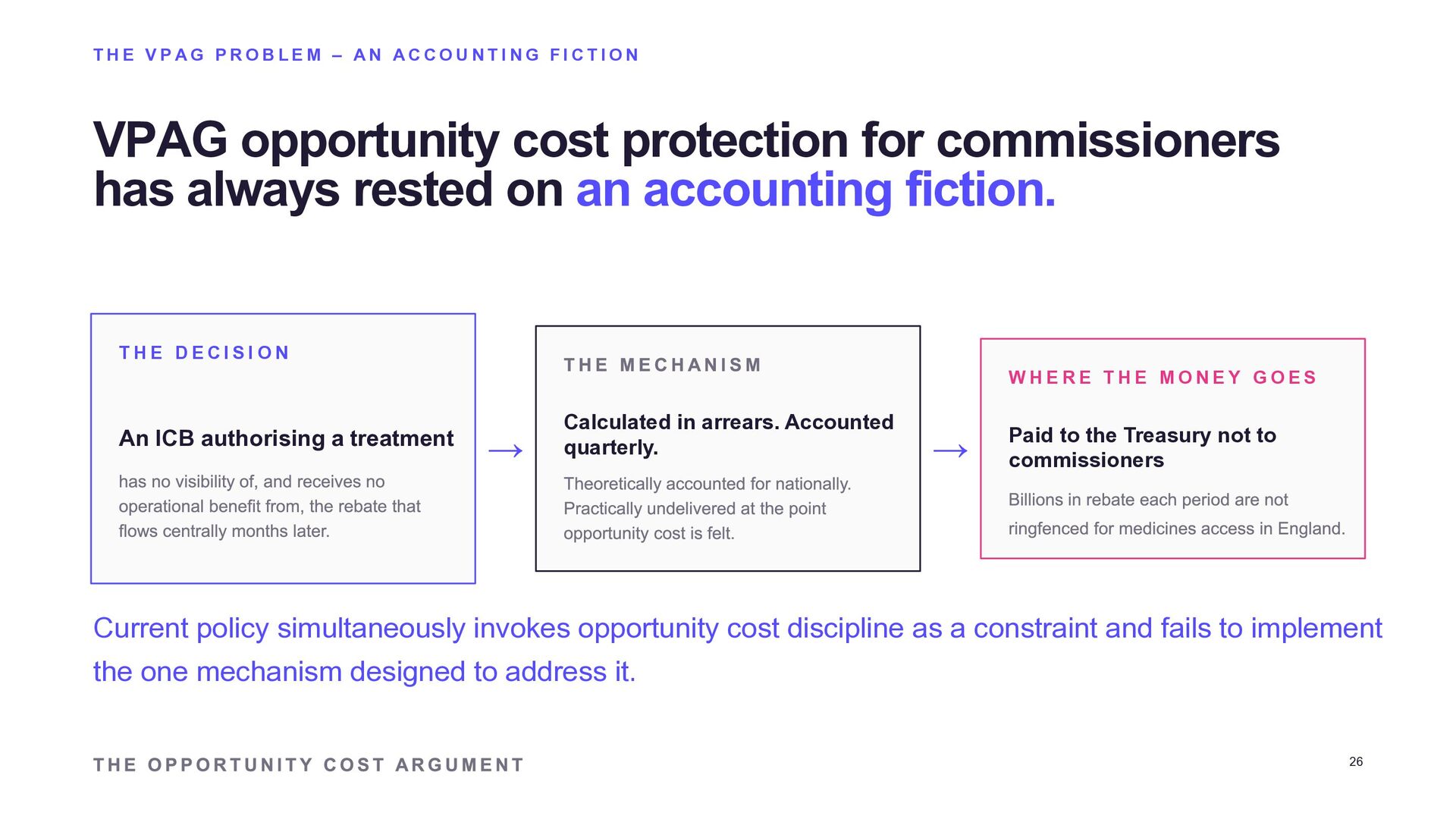
    B L E M – A N A C C O U N T I N G F I C T I O N VPAG opportunity cost protection for commissioners has always rested on an accounting fiction. T H E D E C I S I O N An ICB authorising a treatment → Calculated in arrears. Accounted quarterly. → W H E R E T H E M O N E Y G O E S Paid to the Treasury not to commissioners Current policy simultaneously invokes opportunity cost discipline as a constraint and fails to implement the one mechanism designed to address it. 26
  25. T H E P R AC T I C E

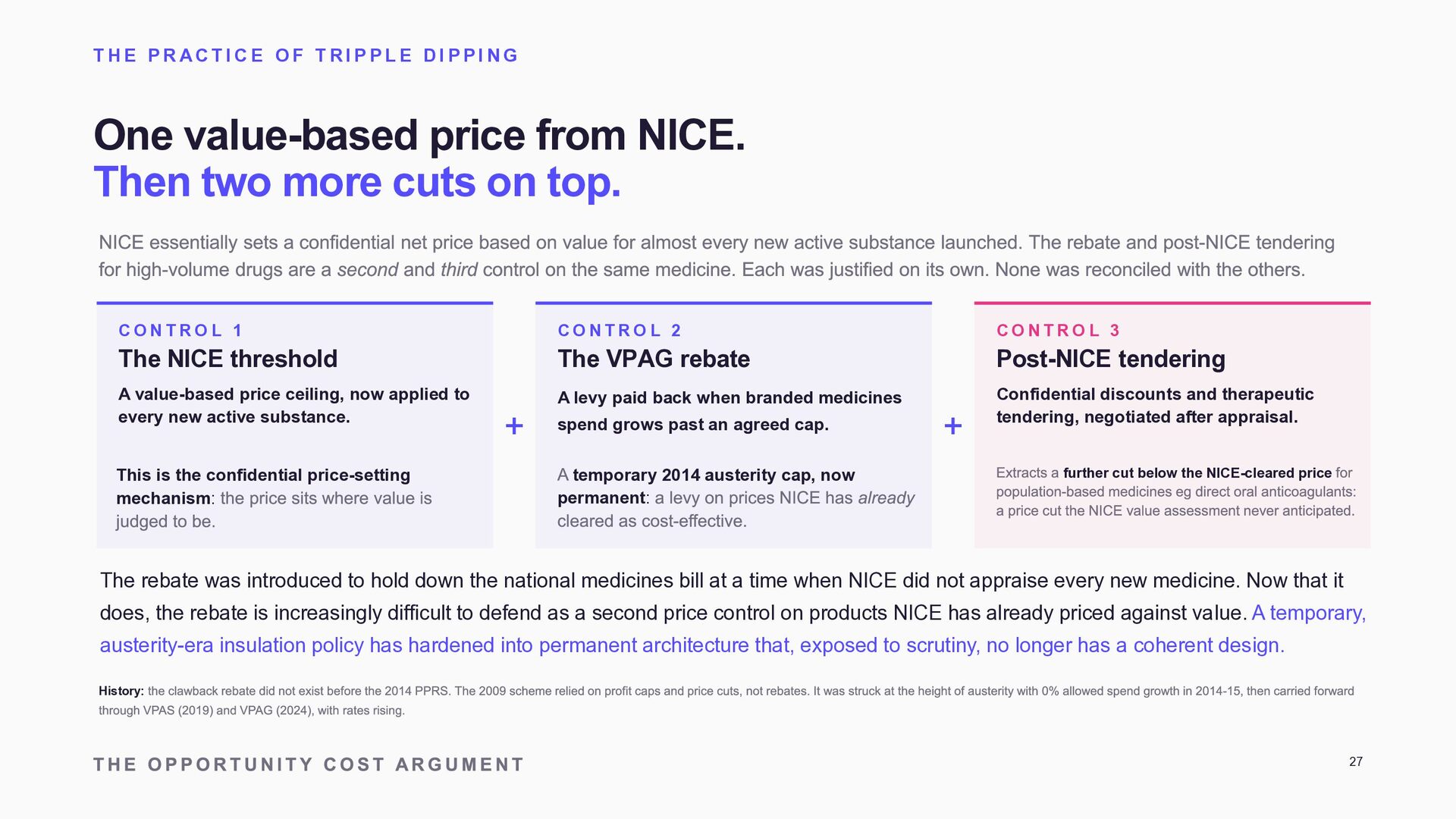
    O F T R I P P L E D I P P I N G One value-based price from NICE. Then two more cuts on top. C O N T R O L 1 The NICE threshold A value-based price ceiling, now applied to every new active substance. This is the confidential price-setting mechanism: + C O N T R O L 2 The VPAG rebate A levy paid back when branded medicines spend grows past an agreed cap. temporary 2014 austerity cap, now permanent: + C O N T R O L 3 Post-NICE tendering Confidential discounts and therapeutic tendering, negotiated after appraisal. further cut below the NICE-cleared price History: The rebate was introduced to hold down the national medicines bill at a time when NICE did not appraise every new medicine. Now that it does, the rebate is increasingly difficult to defend as a second price control on products NICE has already priced against value. A temporary, austerity-era insulation policy has hardened into permanent architecture that, exposed to scrutiny, no longer has a coherent design. 27
  26. T H E E C O N O M I

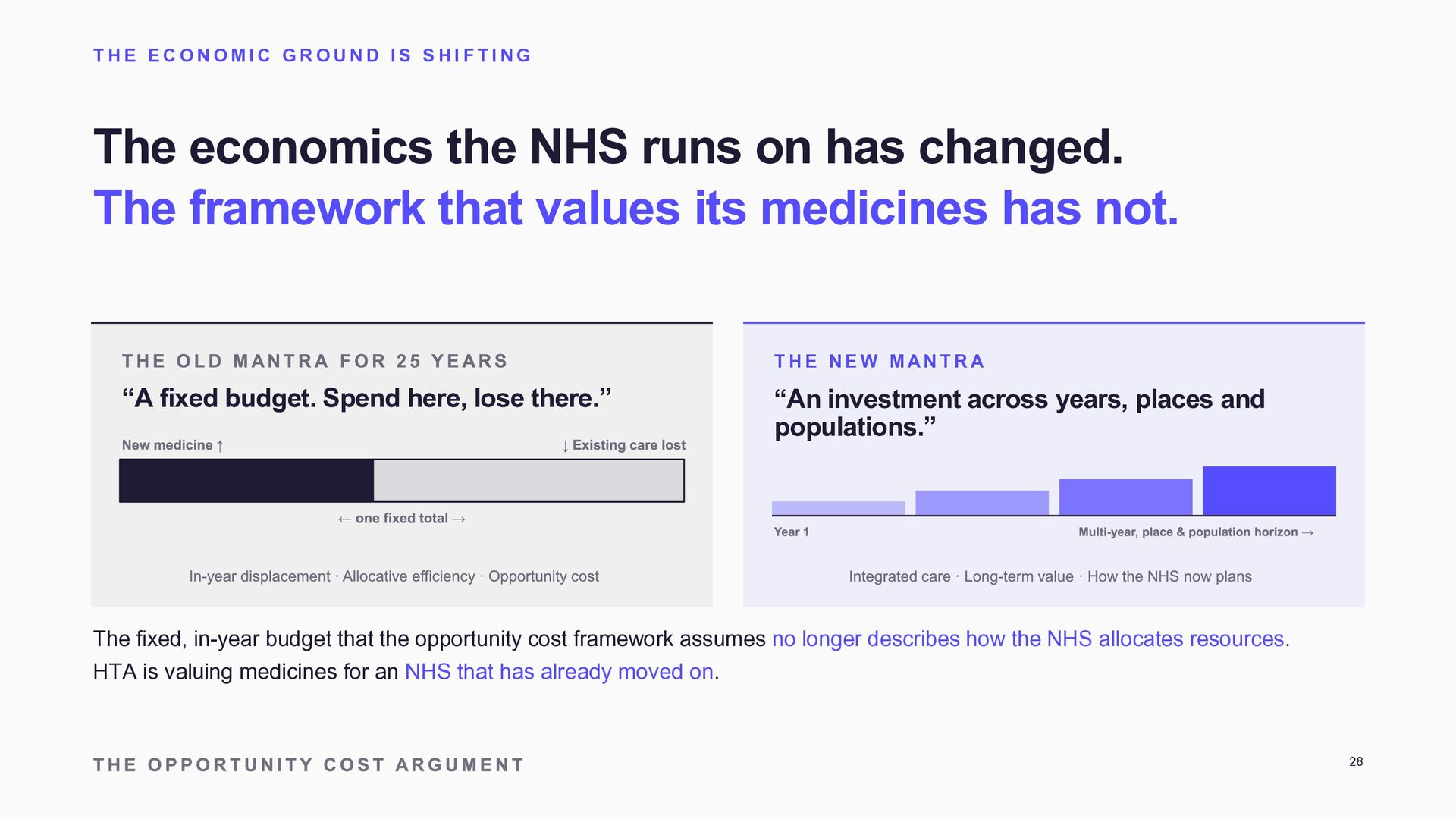
    C G R O U N D I S S H I F T I N G The economics the NHS runs on has changed. The framework that values its medicines has not. “A fixed budget. Spend here, lose there.” T H E N E W M A N T R A “An investment across years, places and populations.” The fixed, in-year budget that the opportunity cost framework assumes no longer describes how the NHS allocates resources. HTA is valuing medicines for an NHS that has already moved on. 28
  27. T H E R E A S O N A

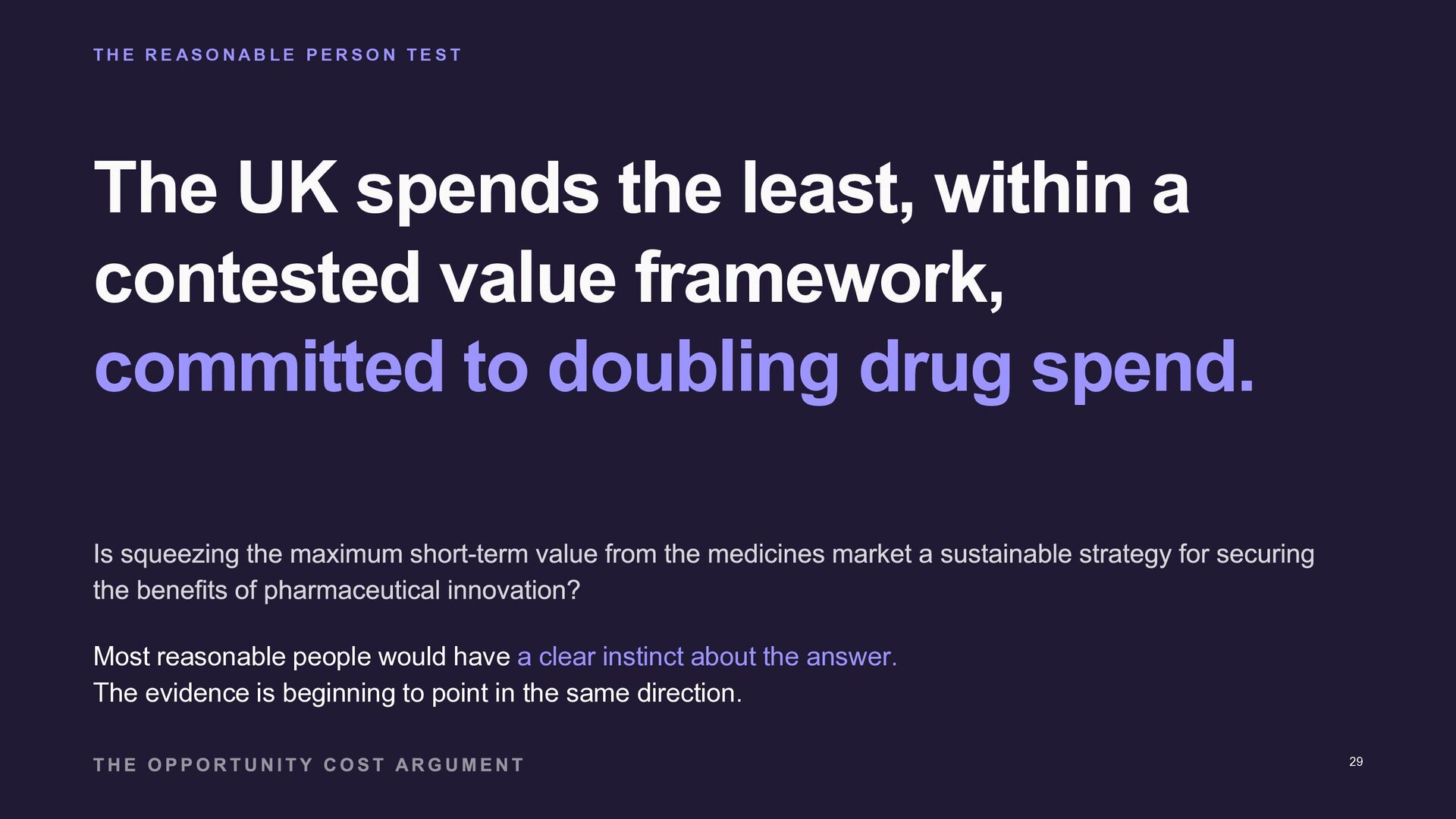
    B L E P E R S O N T E S T The UK spends the least, within a contested value framework, committed to doubling drug spend. Most reasonable people would have a clear instinct about the answer. The evidence is beginning to point in the same direction. 29
  28. S E C T I O N 4 The value

    parameters and where social value judgements hide
  29. S O C I A L V A L U

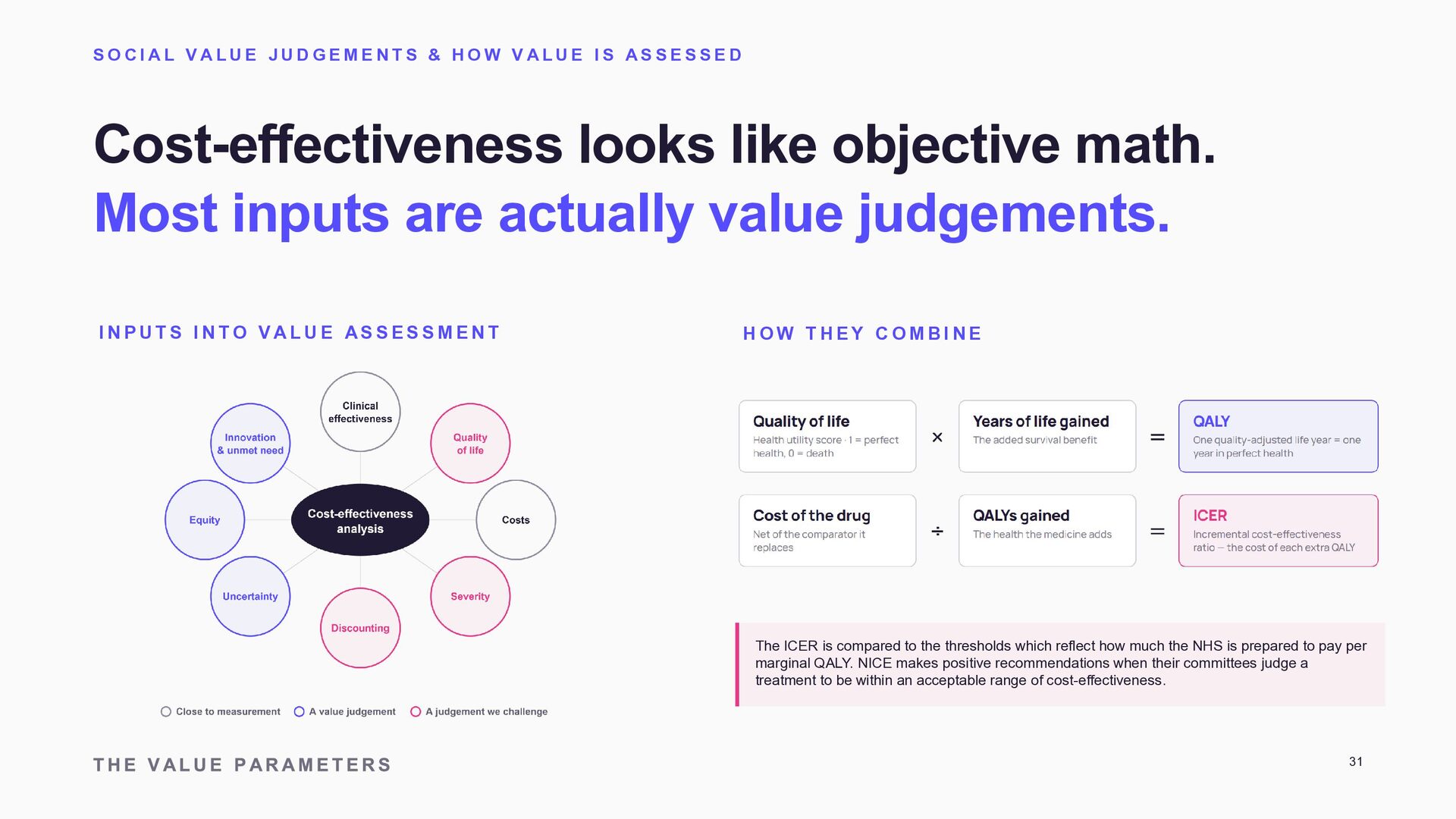
    E J U D G E M E N T S & H O W V A L U E I S A S S E S S E D Cost-effectiveness looks like objective math. Most inputs are actually value judgements. I N P U T S I N T O V AL U E AS S E S S M E N T H O W T H E Y C O M B I N E The ICER is compared to the thresholds which reflect how much the NHS is prepared to pay per marginal QALY. NICE makes positive recommendations when their committees judge a treatment to be within an acceptable range of cost-effectiveness. 31
  30. V A L U E P AR A M E

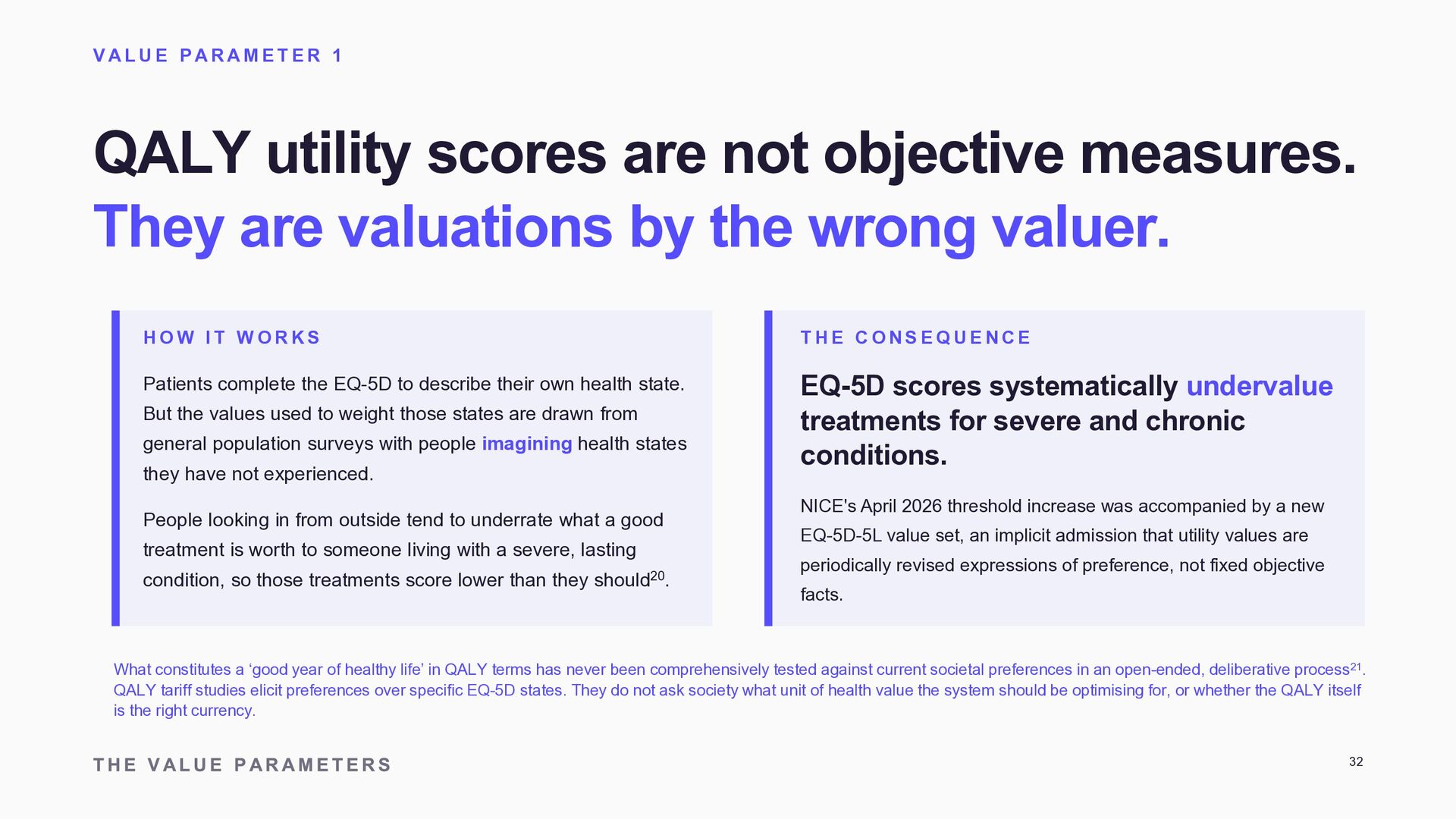
    T E R 1 QALY utility scores are not objective measures. They are valuations by the wrong valuer. H O W I T W O R K S Patients complete the EQ-5D to describe their own health state. But the values used to weight those states are drawn from general population surveys with people imagining health states they have not experienced. People looking in from outside tend to underrate what a good treatment is worth to someone living with a severe, lasting condition, so those treatments score lower than they should20. T H E C O N S E Q U E N C E EQ-5D scores systematically undervalue treatments for severe and chronic conditions. NICE's April 2026 threshold increase was accompanied by a new EQ-5D-5L value set, an implicit admission that utility values are periodically revised expressions of preference, not fixed objective facts. What constitutes a ‘good year of healthy life’ in QALY terms has never been comprehensively tested against current societal preferences in an open-ended, deliberative process21. QALY tariff studies elicit preferences over specific EQ-5D states. They do not ask society what unit of health value the system should be optimising for, or whether the QALY itself is the right currency. 32
  31. V A L U E P AR A M E

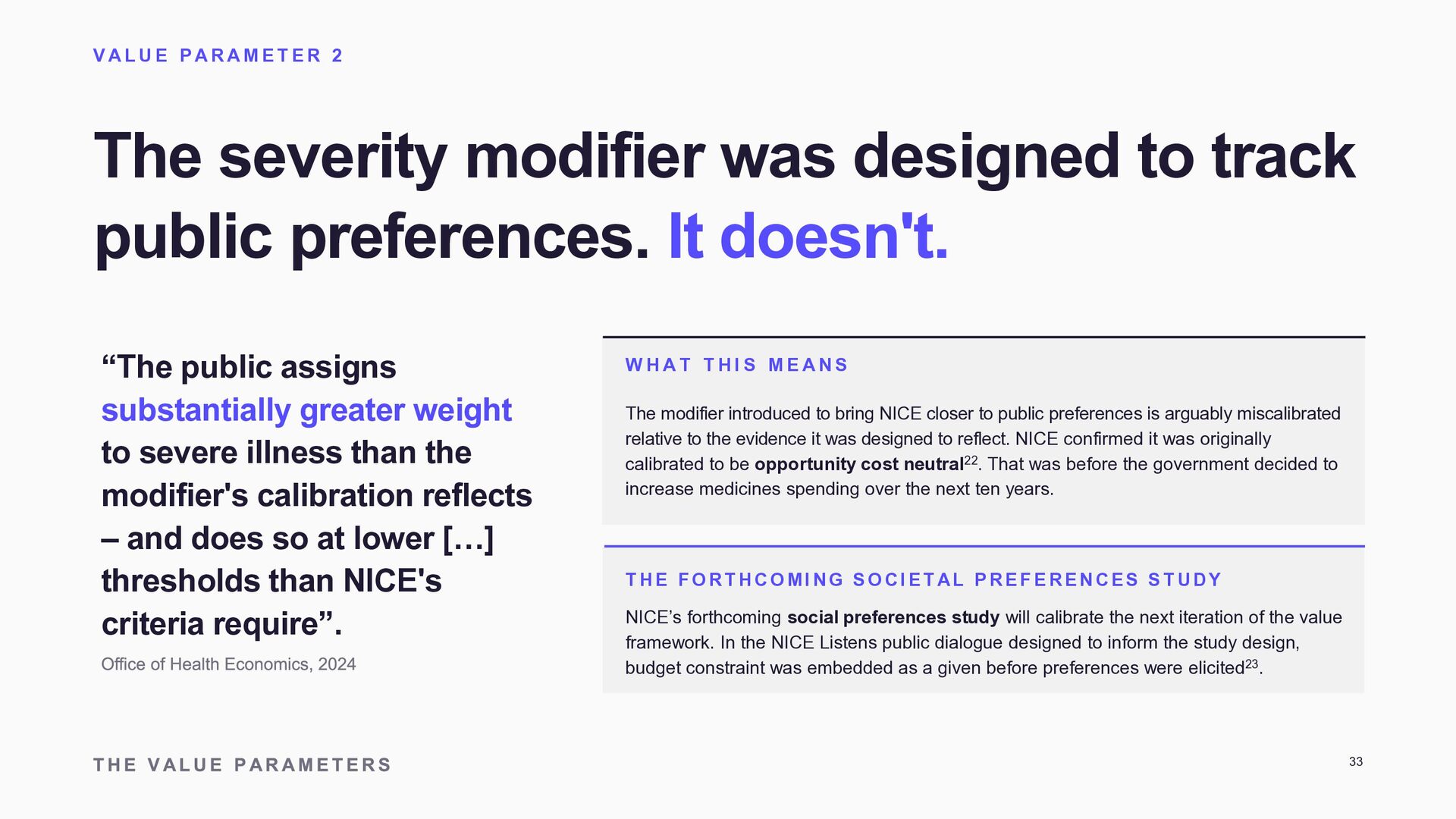
    T E R 2 The severity modifier was designed to track public preferences. It doesn't. “The public assigns substantially greater weight to severe illness than the modifier's calibration reflects – and does so at lower […] thresholds than NICE's criteria require”. W H A T T H I S M E A N S The modifier introduced to bring NICE closer to public preferences is arguably miscalibrated relative to the evidence it was designed to reflect. NICE confirmed it was originally calibrated to be opportunity cost neutral22. That was before the government decided to increase medicines spending over the next ten years. T H E F O R T H C OMI NG S O C I E TAL P R E F E R E N C ES S T U D Y NICE’s forthcoming social preferences study will calibrate the next iteration of the value framework. In the NICE Listens public dialogue designed to inform the study design, budget constraint was embedded as a given before preferences were elicited23. 33
  32. V A L U E P AR A M E

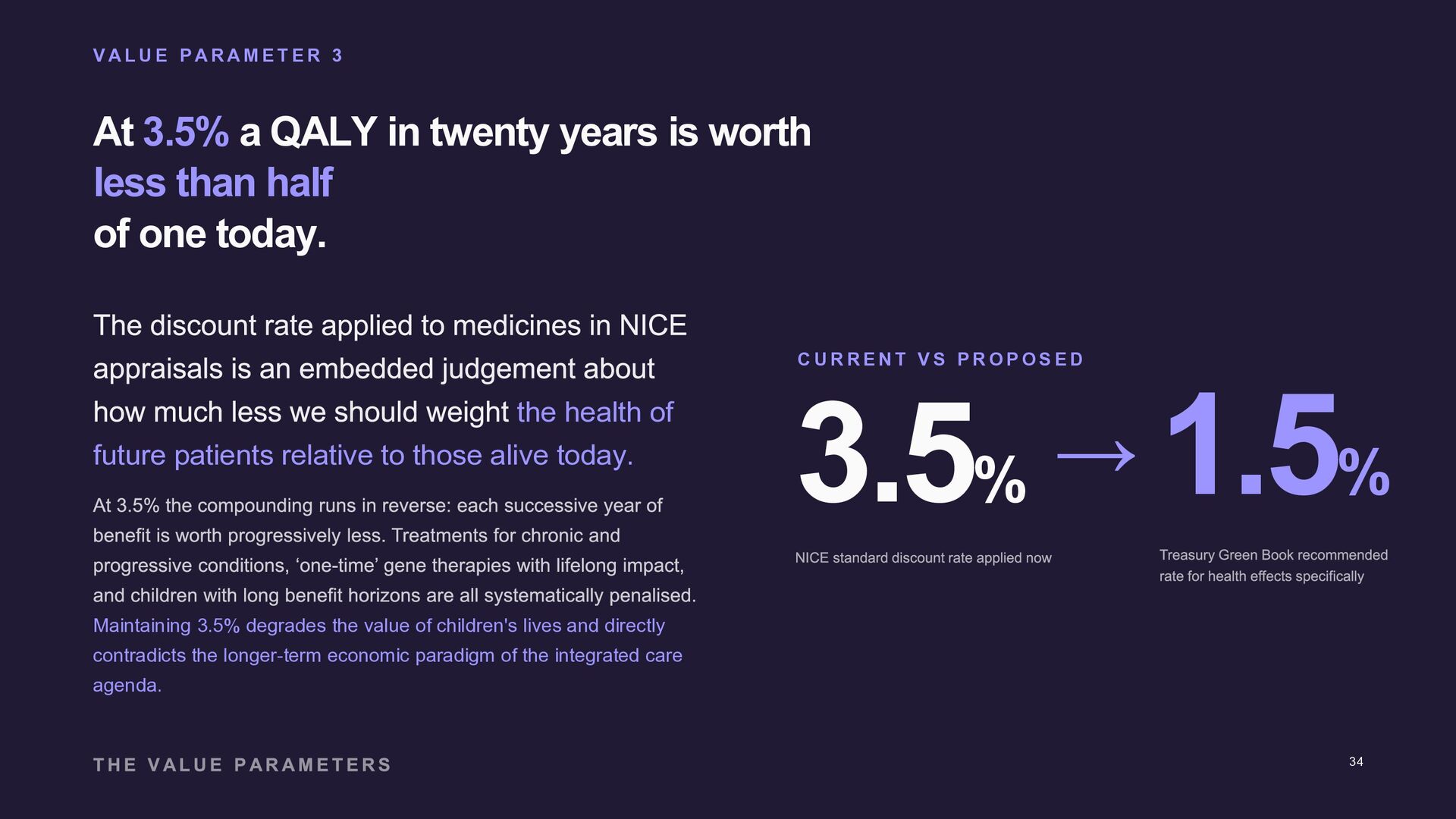
    T E R 3 At 3.5% a QALY in twenty years is worth less than half of one today. C U R R E N T V S P R O P O S E D 3.5% → 1.5% the health of future patients relative to those alive today. Maintaining 3.5% degrades the value of children's lives and directly contradicts the longer-term economic paradigm of the integrated care agenda. 34
  33. T H E P AE D I A T R

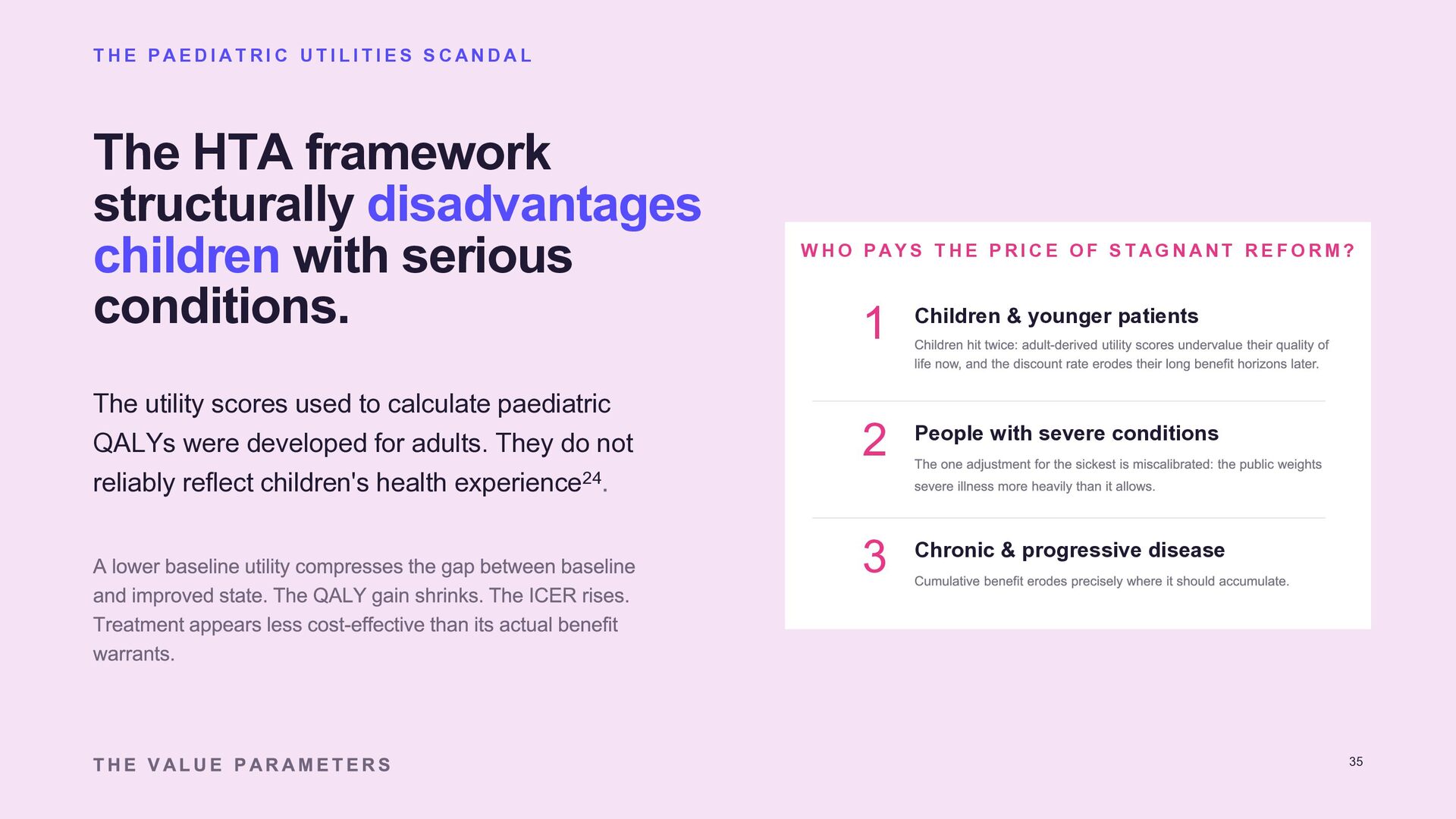
    I C U T I L I T I E S S C AN D A L The HTA framework structurally disadvantages children with serious conditions. The utility scores used to calculate paediatric QALYs were developed for adults. They do not reliably reflect children's health experience24 W H O P A Y S T H E P R I C E O F S T A G N A N T R E F O R M ? 1 Children & younger patients 2 People with severe conditions 3 Chronic & progressive disease 35
  34. T H E U N T E S T E

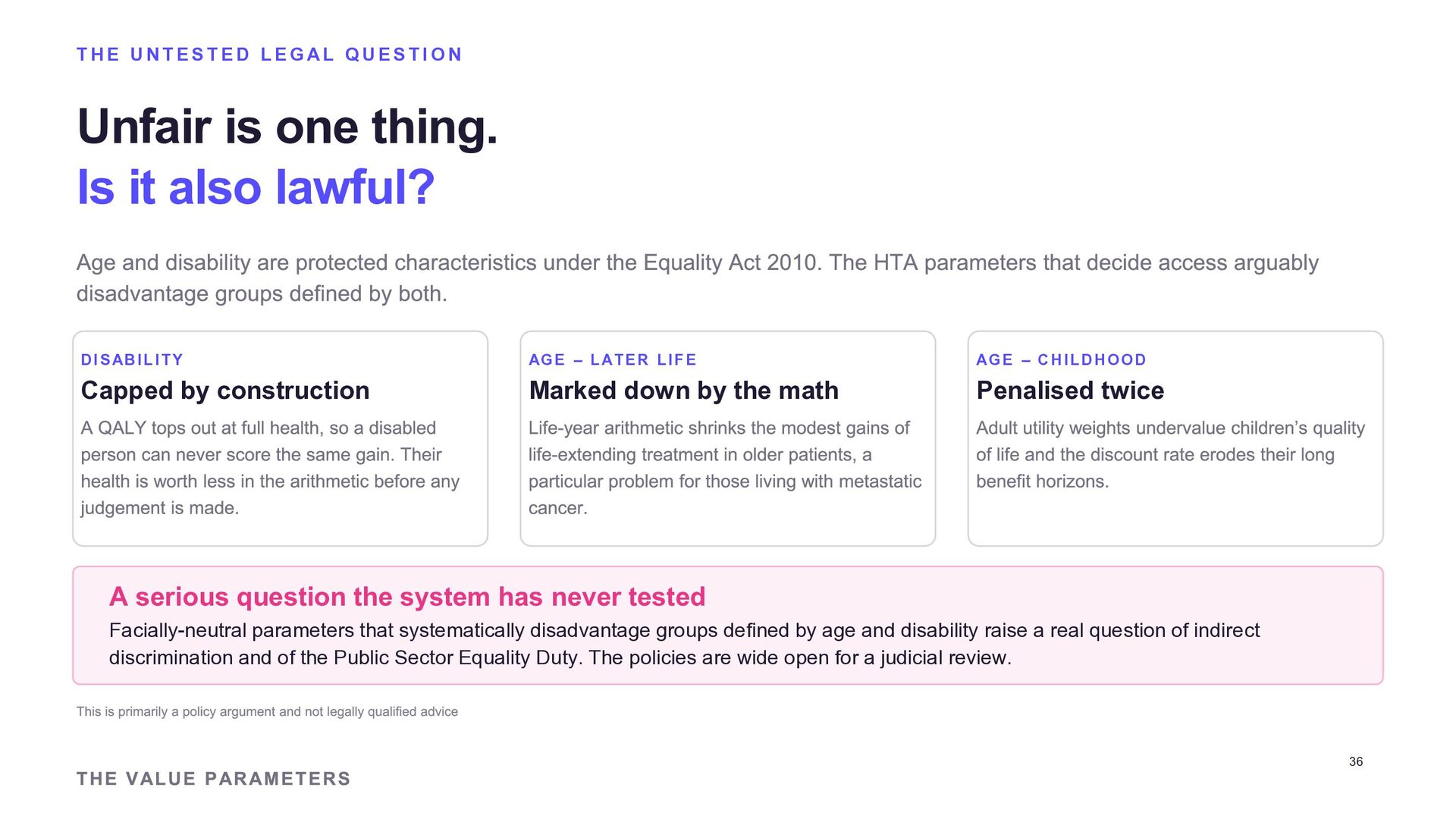
    D L E G AL Q U E S T I O N Unfair is one thing. Is it also lawful? DISABILITY Capped by construction AGE – LATER LIFE Marked down by the math AGE – CHILDHOOD Penalised twice A serious question the system has never tested Facially-neutral parameters that systematically disadvantage groups defined by age and disability raise a real question of indirect discrimination and of the Public Sector Equality Duty. The policies are wide open for a judicial review. 36
  35. S E C T I O N 5 The democratic

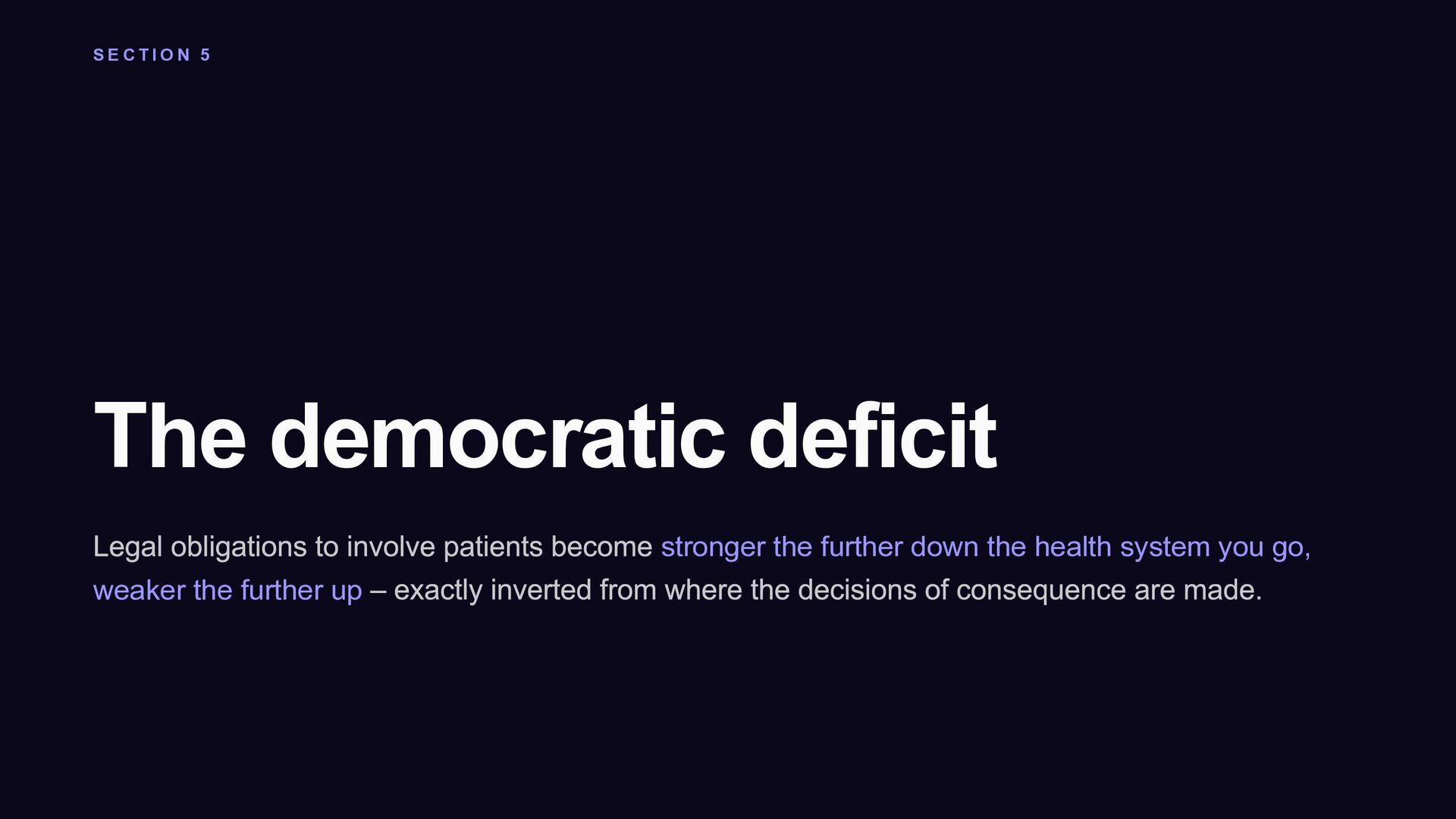
    deficit stronger the further down the health system you go, weaker the further up
  36. T H E I N V E R T E

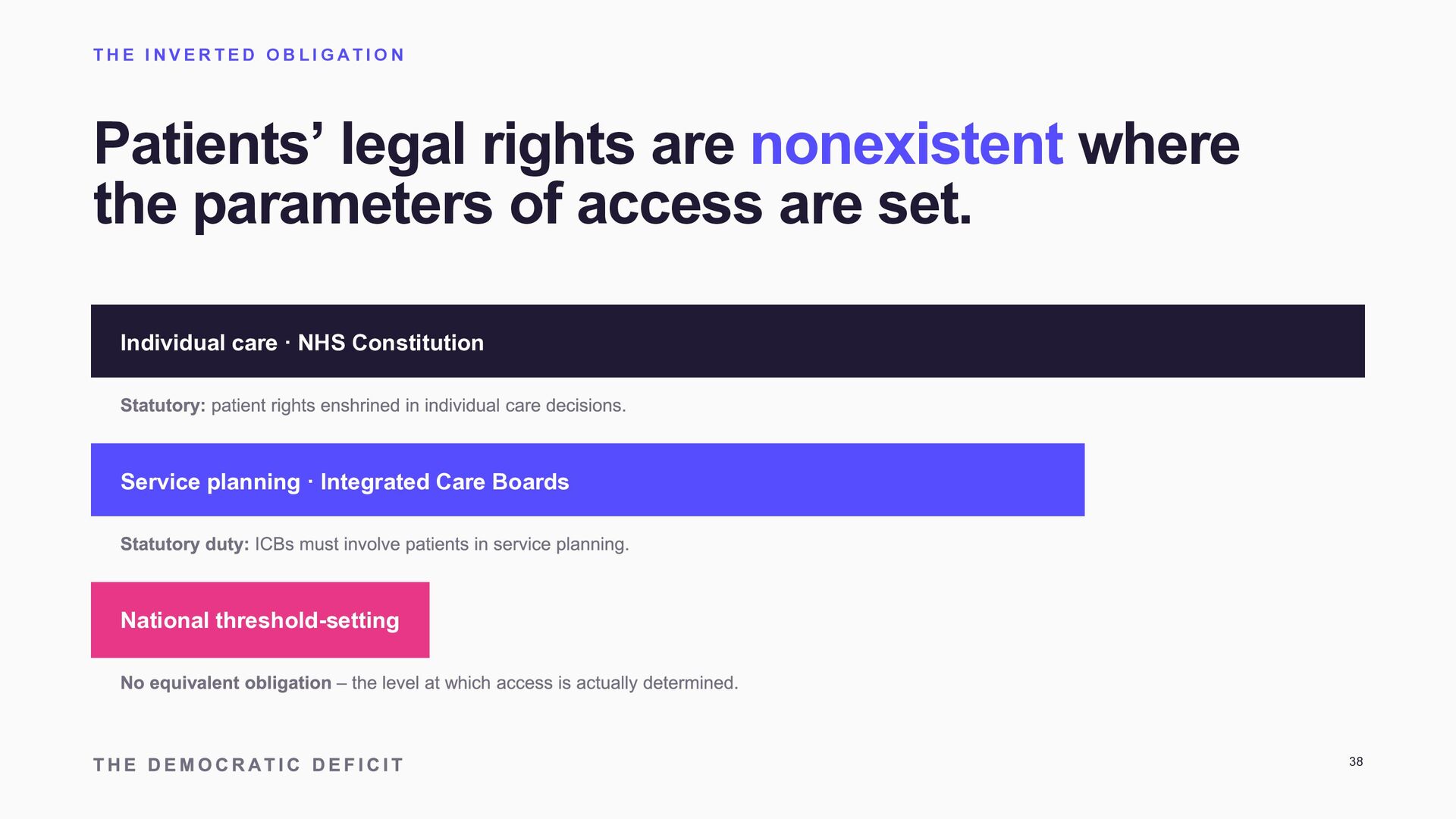
    D O B L I G A T I O N Patients’ legal rights are nonexistent where the parameters of access are set. Individual care · NHS Constitution Service planning · Integrated Care Boards National threshold-setting 38
  37. For 25 years the NICE threshold was a technical instrument.

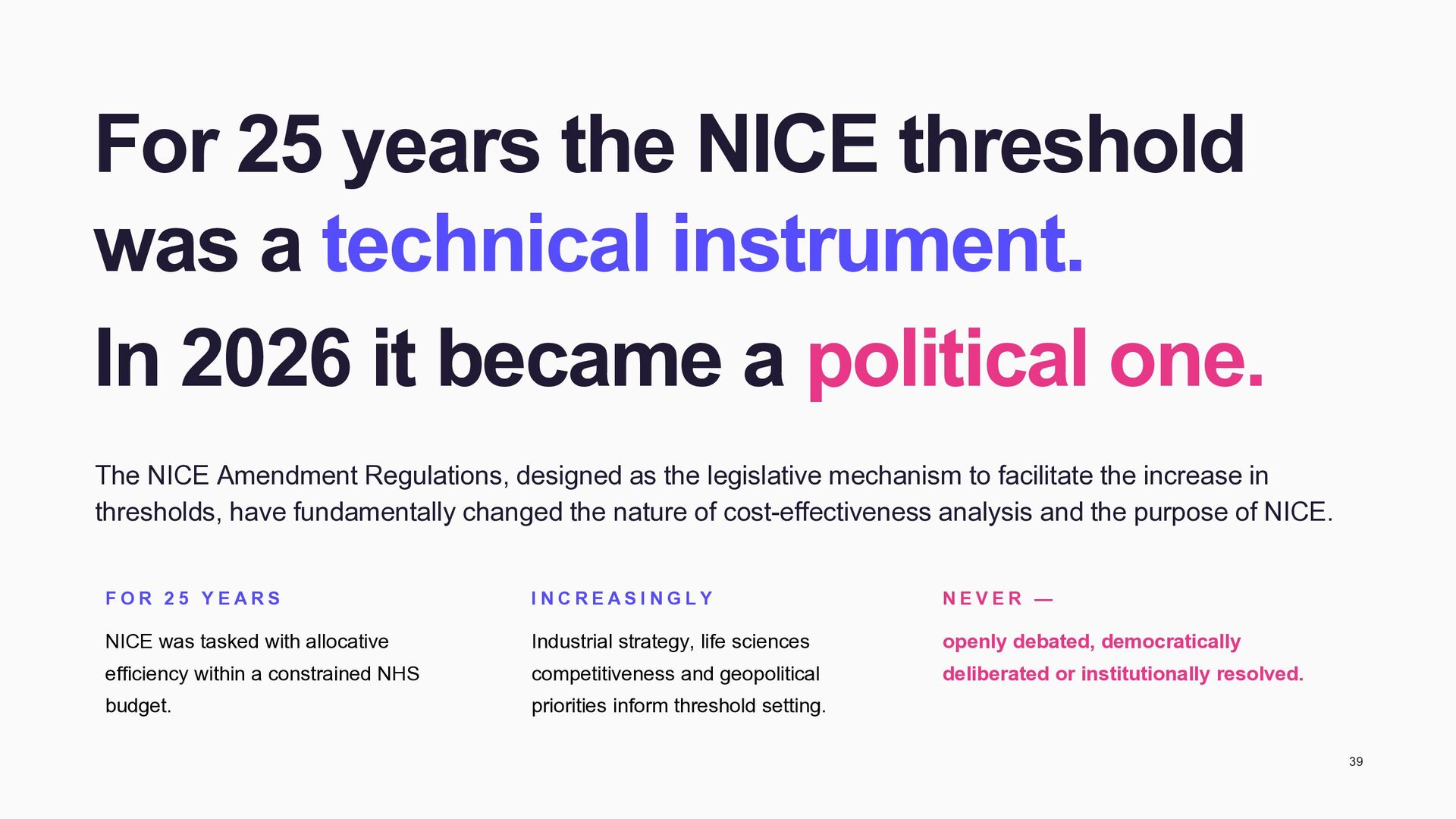
    In 2026 it became a political one. F O R 2 5 Y E A R S NICE was tasked with allocative efficiency within a constrained NHS budget. I N C R E A S I N G L Y Industrial strategy, life sciences competitiveness and geopolitical priorities inform threshold setting. N E V E R — openly debated, democratically deliberated or institutionally resolved. The NICE Amendment Regulations, designed as the legislative mechanism to facilitate the increase in thresholds, have fundamentally changed the nature of cost-effectiveness analysis and the purpose of NICE. 39
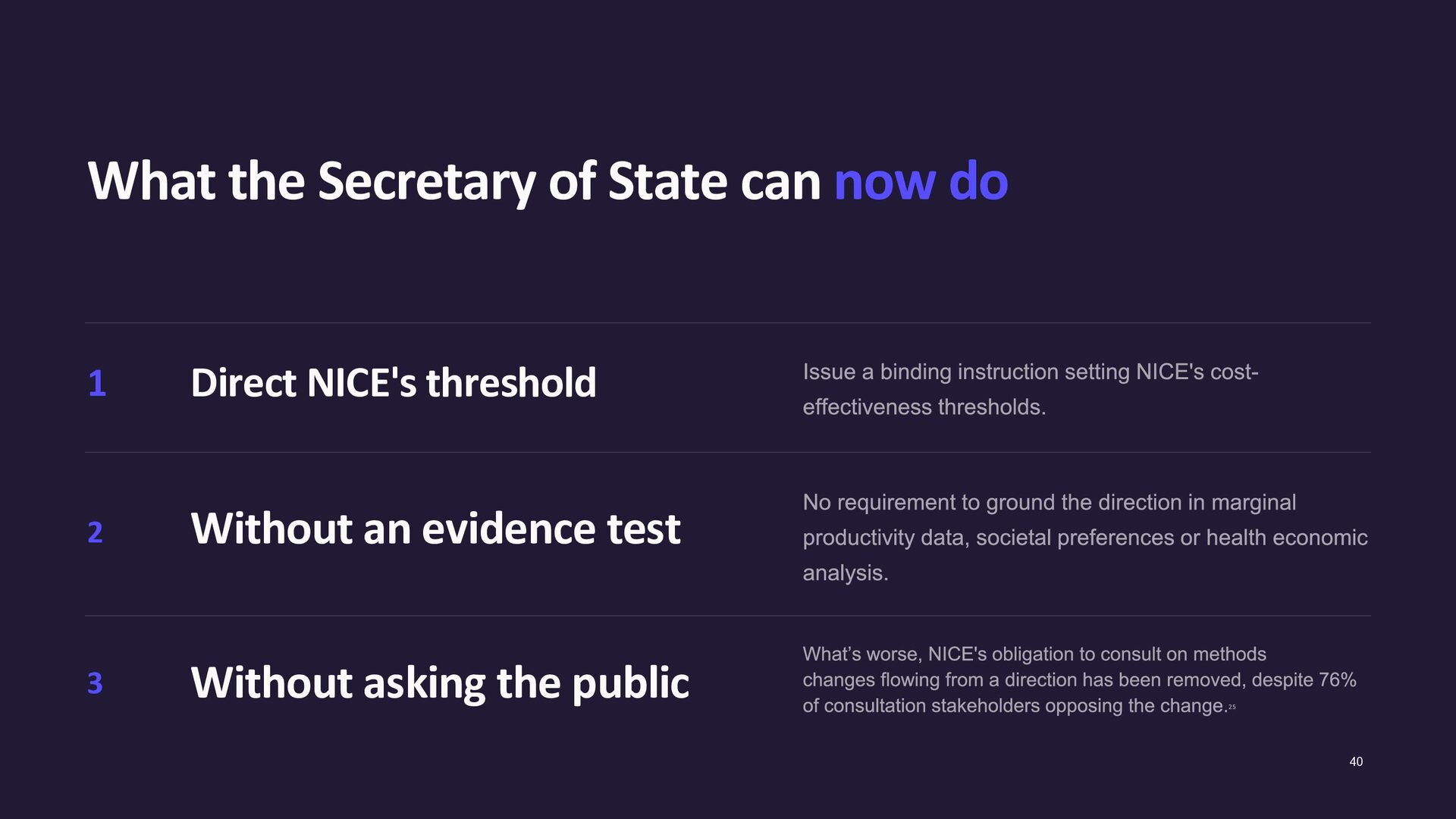
  38. 40 What the Secretary of State can now do 1

    Direct NICE's threshold 2 Without an evidence test 3 Without asking the public
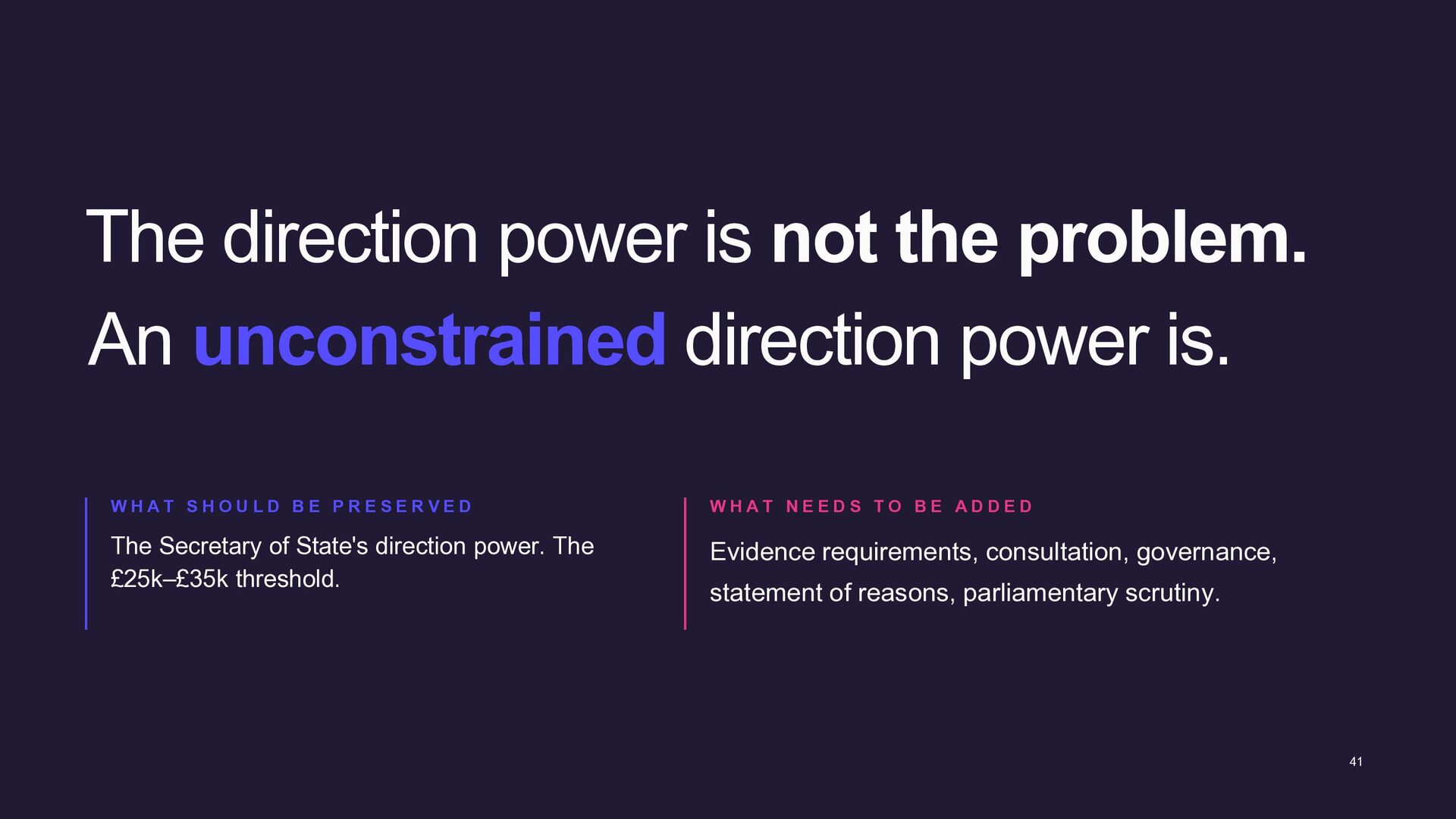
  39. The direction power is not the problem. An unconstrained direction

    power is. W H A T S H O U L D B E P R E S E R V E D The Secretary of State's direction power. The £25k–£35k threshold. W H A T N E E D S T O B E A D D E D Evidence requirements, consultation, governance, statement of reasons, parliamentary scrutiny. 41
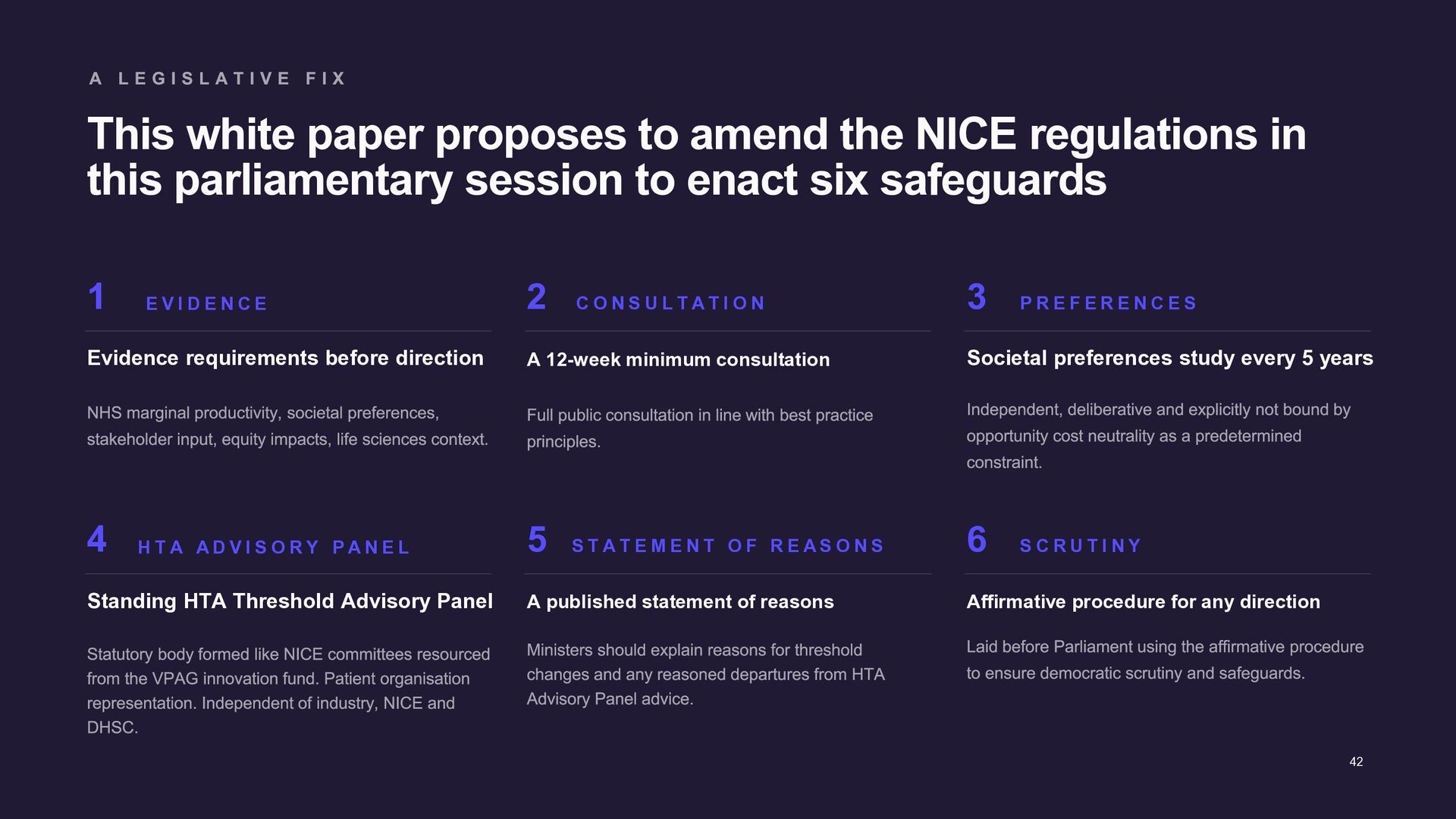
  40. This white paper proposes to amend the NICE regulations in

    this parliamentary session to enact six safeguards 1 E V I D E N C E Evidence requirements before direction 2 C O N S U L T A T I O N A 12-week minimum consultation 3 P R E F E R E N C E S Societal preferences study every 5 years 4 H T A A D V I S O R Y P A N E L Standing HTA Threshold Advisory Panel 5 S T A T E M E N T O F R E A S O N S A published statement of reasons 6 S C R U T I N Y Affirmative procedure for any direction 42
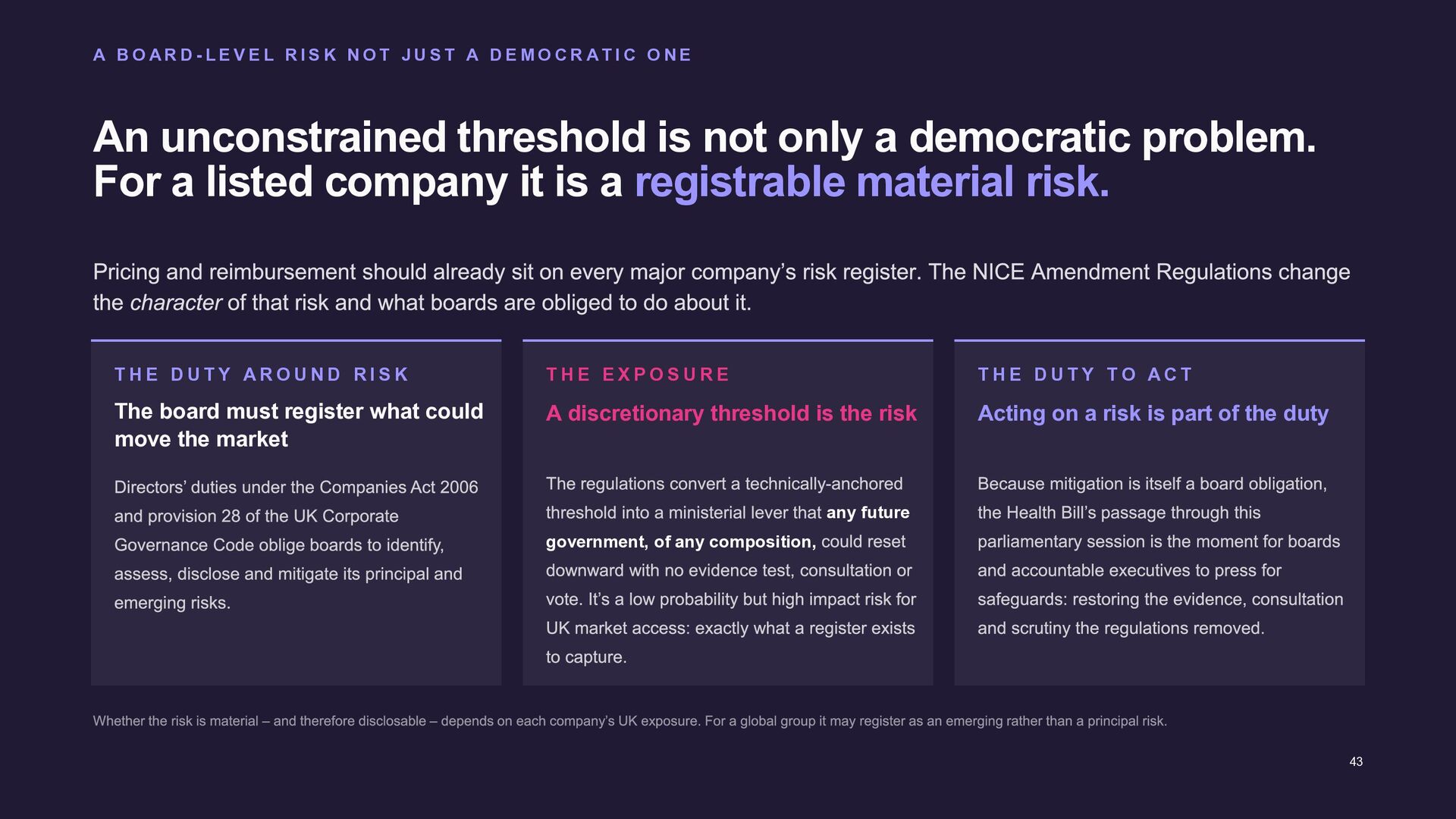
  41. A B O A R D - L E V

    E L R I S K N O T J U S T A D E M O C R A T I C O N E An unconstrained threshold is not only a democratic problem. For a listed company it is a registrable material risk. T H E D U T Y A R O U N D R I S K The board must register what could move the market T H E E X P O S U R E A discretionary threshold is the risk any future government, of any composition, T H E D U T Y T O A C T Acting on a risk is part of the duty 43
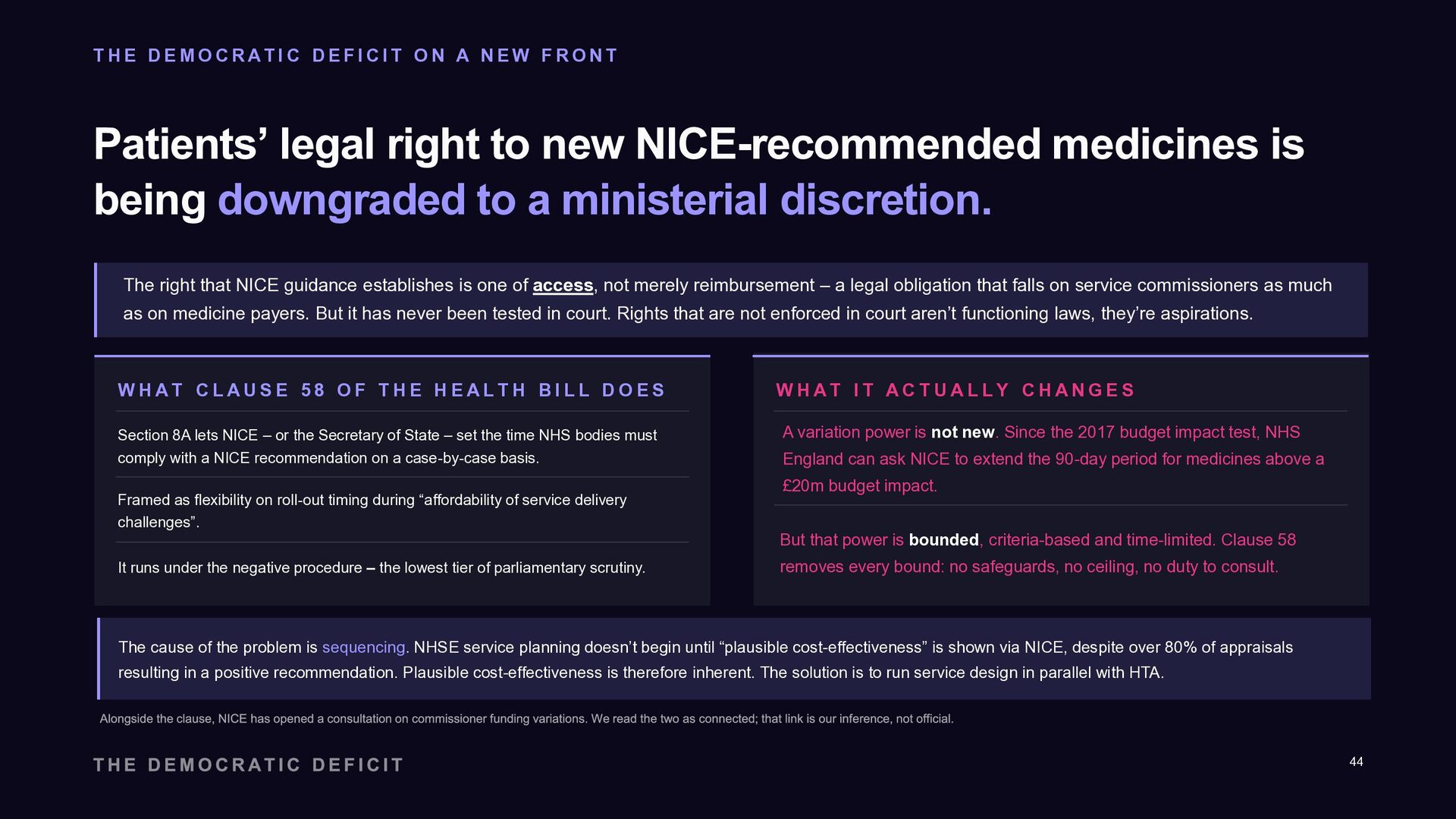
  42. Patients’ legal right to new NICE-recommended medicines is being downgraded

    to a ministerial discretion. W H A T C L A U S E 5 8 O F T H E H E A L T H B I L L D O E S Section 8A lets NICE – or the Secretary of State – set the time NHS bodies must comply with a NICE recommendation on a case-by-case basis. Framed as flexibility on roll-out timing during “affordability of service delivery challenges”. It runs under the negative procedure – the lowest tier of parliamentary scrutiny. W H A T I T A C T U A L L Y C H A N G E S The cause of the problem is sequencing. NHSE service planning doesn’t begin until “plausible cost-effectiveness” is shown via NICE, despite over 80% of appraisals resulting in a positive recommendation. Plausible cost-effectiveness is therefore inherent. The solution is to run service design in parallel with HTA. The right that NICE guidance establishes is one of access, not merely reimbursement – a legal obligation that falls on service commissioners as much as on medicine payers. But it has never been tested in court. Rights that are not enforced in court aren’t functioning laws, they’re aspirations. A variation power is not new. Since the 2017 budget impact test, NHS England can ask NICE to extend the 90-day period for medicines above a £20m budget impact. But that power is bounded, criteria-based and time-limited. Clause 58 removes every bound: no safeguards, no ceiling, no duty to consult. T H E D E M O C R AT I C D E F I C I T O N A N E W F R O N T 44
  43. S E C T I O N 6 Is there

    common ground? Yes, there is!
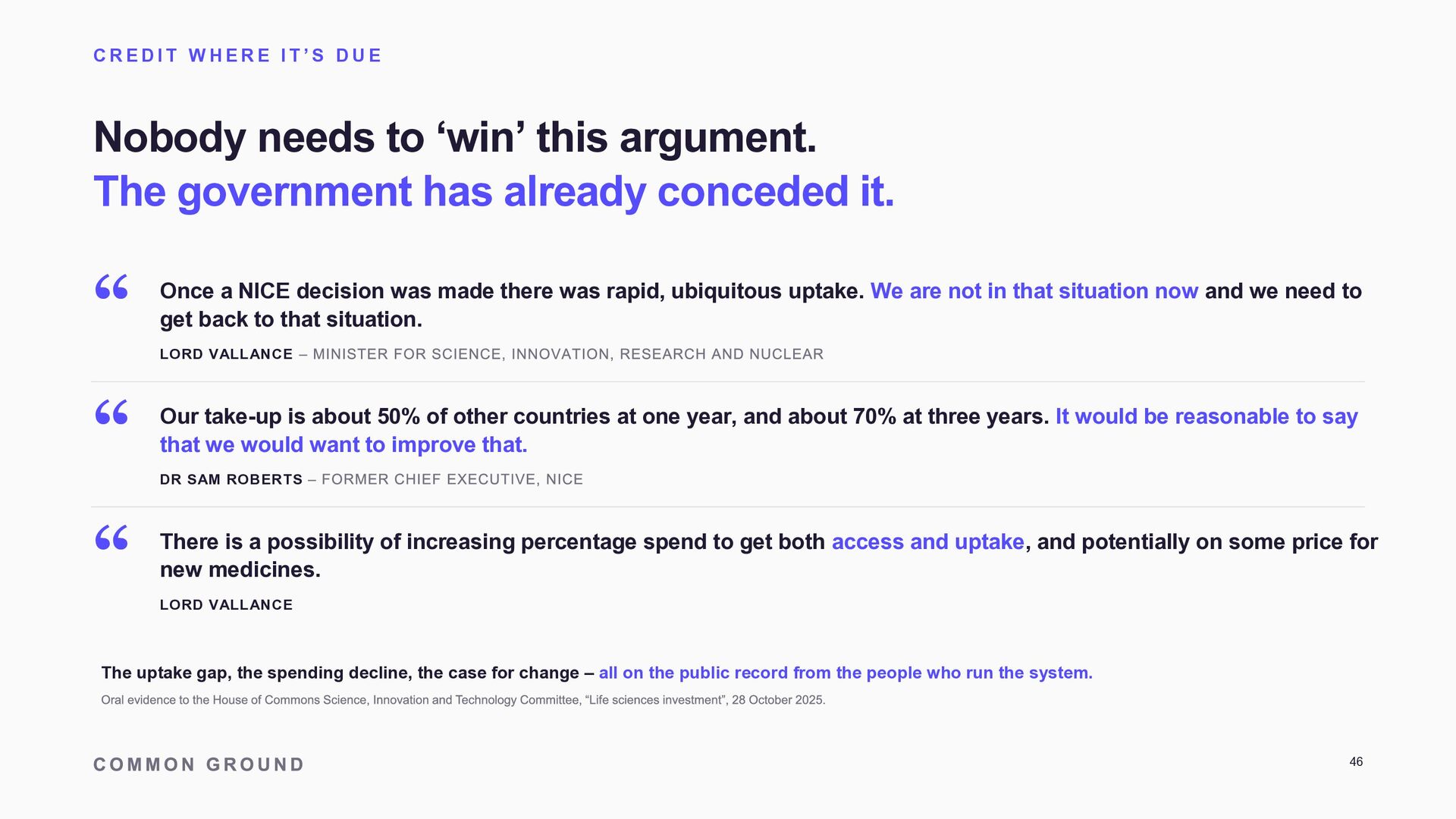
  44. C R E D I T W H E R

    E I T ’ S D U E Nobody needs to ‘win’ this argument. The government has already conceded it. “ Once a NICE decision was made there was rapid, ubiquitous uptake. We are not in that situation now and we need to get back to that situation. LORD VALLANCE “ Our take-up is about 50% of other countries at one year, and about 70% at three years. It would be reasonable to say that we would want to improve that. DR SAM ROBERTS “ There is a possibility of increasing percentage spend to get both access and uptake, and potentially on some price for new medicines. LORD VALLANCE The uptake gap, the spending decline, the case for change – all on the public record from the people who run the system. 46
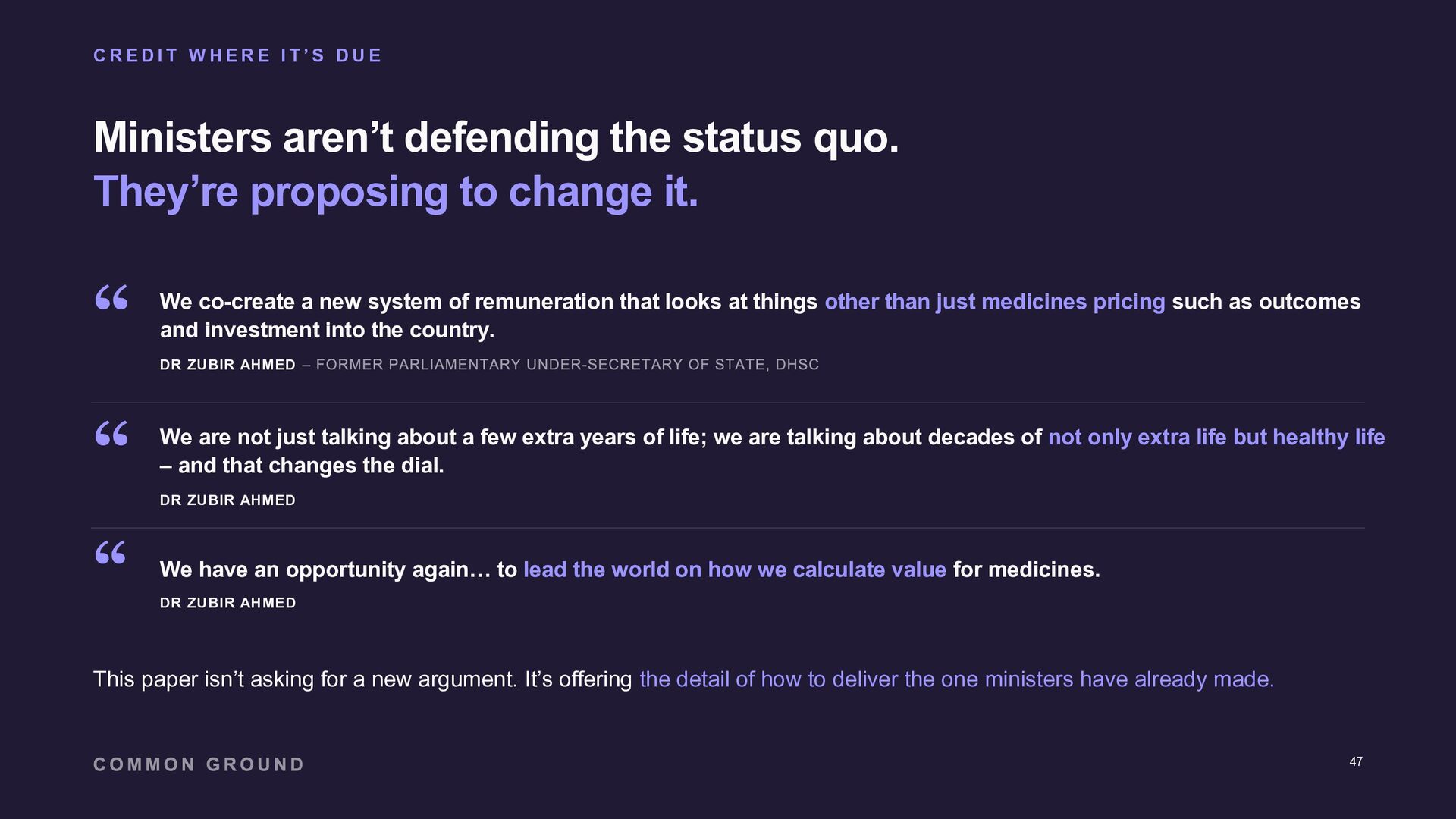
  45. C R E D I T W H E R

    E I T ’ S D U E Ministers aren’t defending the status quo. They’re proposing to change it. “ We co-create a new system of remuneration that looks at things other than just medicines pricing such as outcomes and investment into the country. DR ZUBIR AHMED “ We are not just talking about a few extra years of life; we are talking about decades of not only extra life but healthy life – and that changes the dial. DR ZUBIR AHMED “ We have an opportunity again… to lead the world on how we calculate value for medicines. DR ZUBIR AHMED This paper isn’t asking for a new argument. It’s offering the detail of how to deliver the one ministers have already made. 47
  46. W H E R E I N S T I

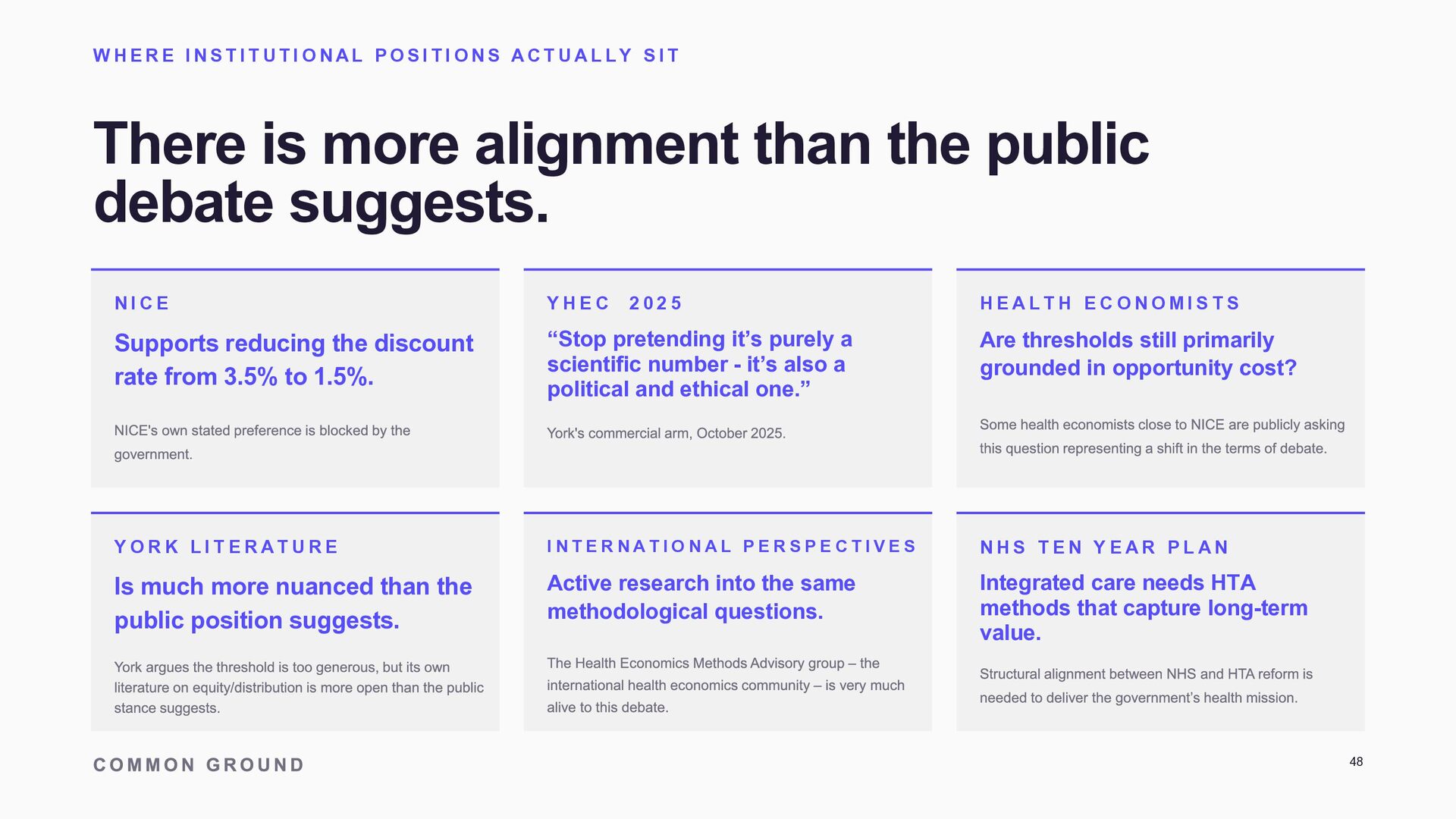
    T U T I O N AL P O S I T I O N S A C T U A L L Y S I T There is more alignment than the public debate suggests. N I C E Supports reducing the discount rate from 3.5% to 1.5%. Y H E C 2 0 2 5 “Stop pretending it’s purely a scientific number - it’s also a political and ethical one.” H E A L T H E C O N O M I S T S Are thresholds still primarily grounded in opportunity cost? Y O R K L I T E R A T U R E Is much more nuanced than the public position suggests. I N T E R N A T I O N A L P E R S P E C T I V E S Active research into the same methodological questions. N H S T E N Y E A R P L A N Integrated care needs HTA methods that capture long-term value. 48
  47. W E C AN C H AN G E I

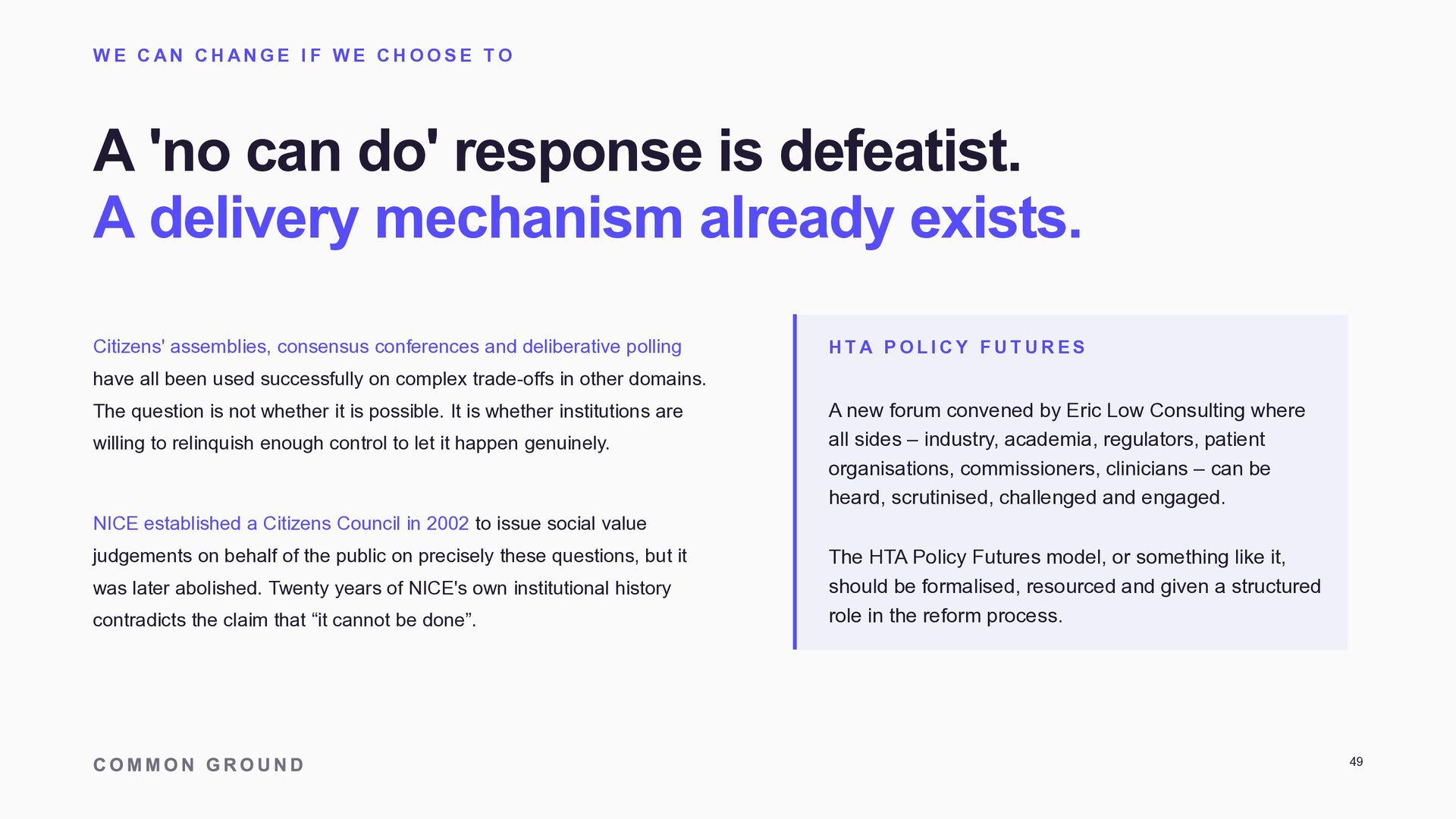
    F W E C H O O S E T O A 'no can do' response is defeatist. A delivery mechanism already exists. NICE established a Citizens Council in 2002 to issue social value judgements on behalf of the public on precisely these questions, but it was later abolished. Twenty years of NICE's own institutional history contradicts the claim that “it cannot be done”. Citizens' assemblies, consensus conferences and deliberative polling have all been used successfully on complex trade-offs in other domains. The question is not whether it is possible. It is whether institutions are willing to relinquish enough control to let it happen genuinely. H T A P O L I C Y F U T U R E S A new forum convened by Eric Low Consulting where all sides – industry, academia, regulators, patient organisations, commissioners, clinicians – can be heard, scrutinised, challenged and engaged. The HTA Policy Futures model, or something like it, should be formalised, resourced and given a structured role in the reform process. 49
  48. S E C T I O N 7 What this

    white paper calls for
  49. Six things Finding Common Ground calls for 1 A genuine

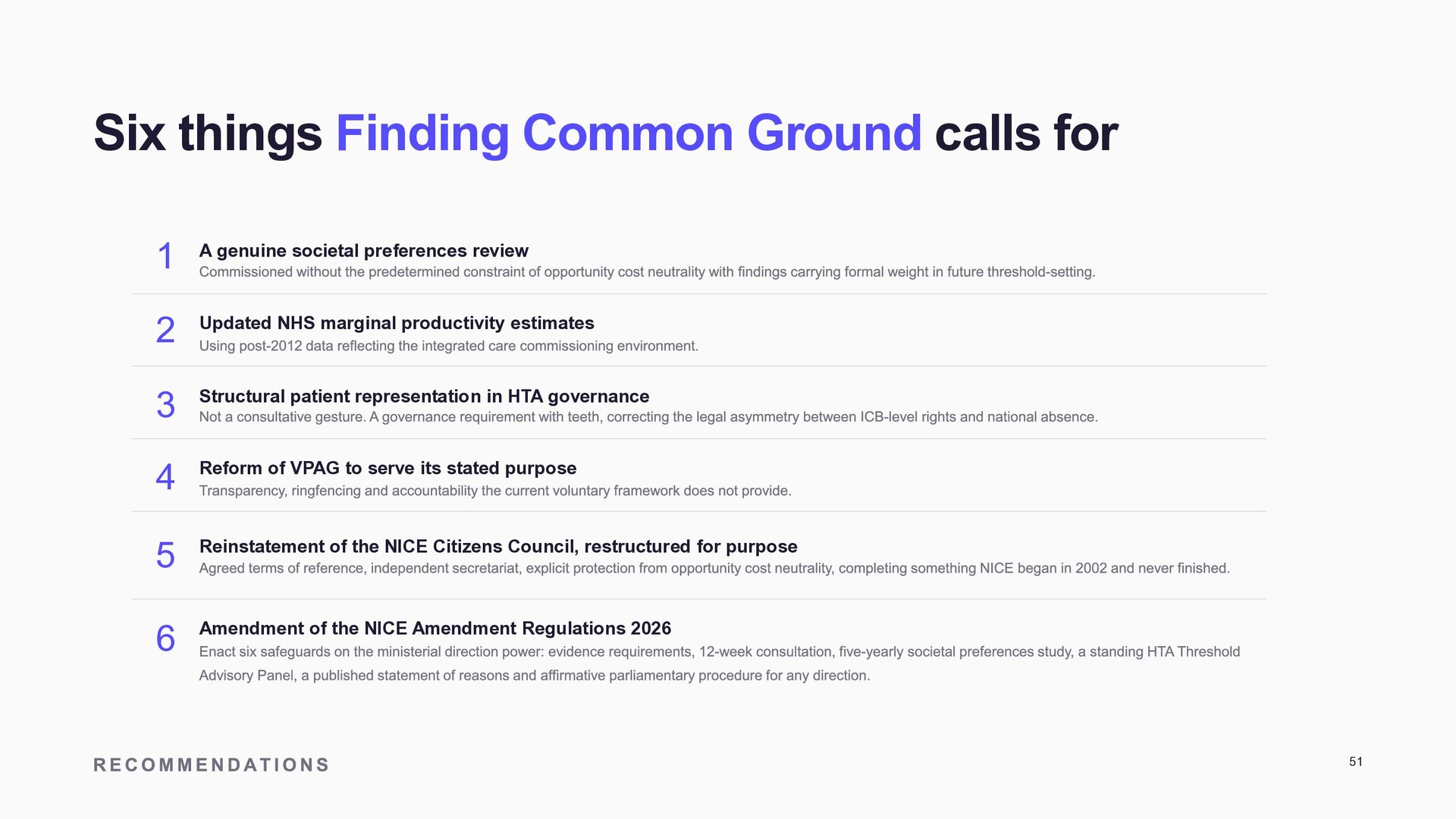
    societal preferences review 2 Updated NHS marginal productivity estimates 3 Structural patient representation in HTA governance 4 Reform of VPAG to serve its stated purpose 5 Reinstatement of the NICE Citizens Council, restructured for purpose 6 Amendment of the NICE Amendment Regulations 2026 51
  50. T H E P R E C O N D

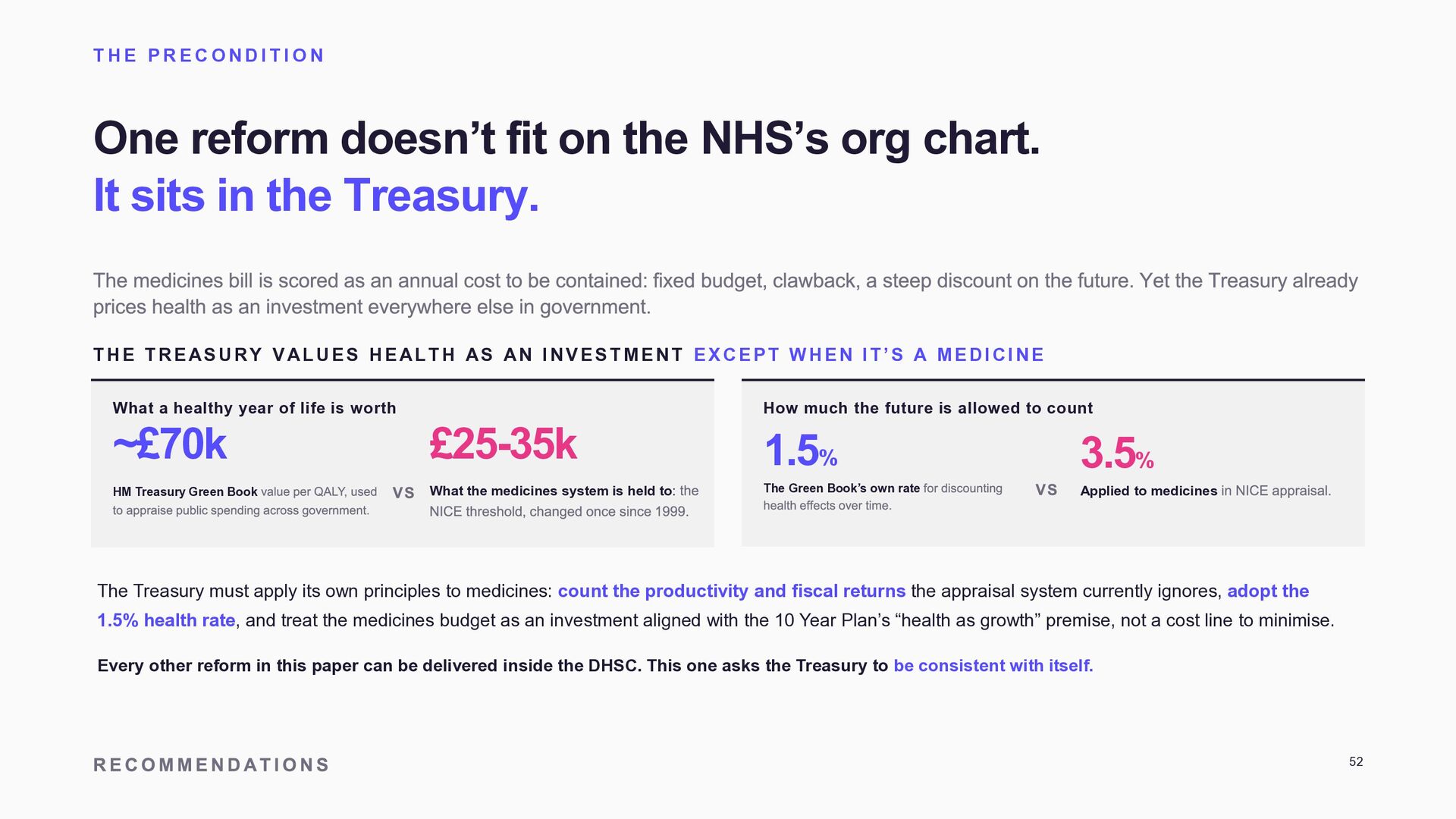
    I T I O N One reform doesn’t fit on the NHS’s org chart. It sits in the Treasury. THE TREASURY VALUES HEALTH AS AN INVESTMENT EXCEPT WHEN IT’S A MEDICINE What a healthy year of life is worth ~£70k HM Treasury Green Book £25-35k What the medicines system is held to: How much the future is allowed to count 1.5% The Green Book’s own rate 3.5% Applied to medicines The Treasury must apply its own principles to medicines: count the productivity and fiscal returns the appraisal system currently ignores, adopt the 1.5% health rate, and treat the medicines budget as an investment aligned with the 10 Year Plan’s “health as growth” premise, not a cost line to minimise. Every other reform in this paper can be delivered inside the DHSC. This one asks the Treasury to be consistent with itself. 52
  51. A R O A D M A P T O

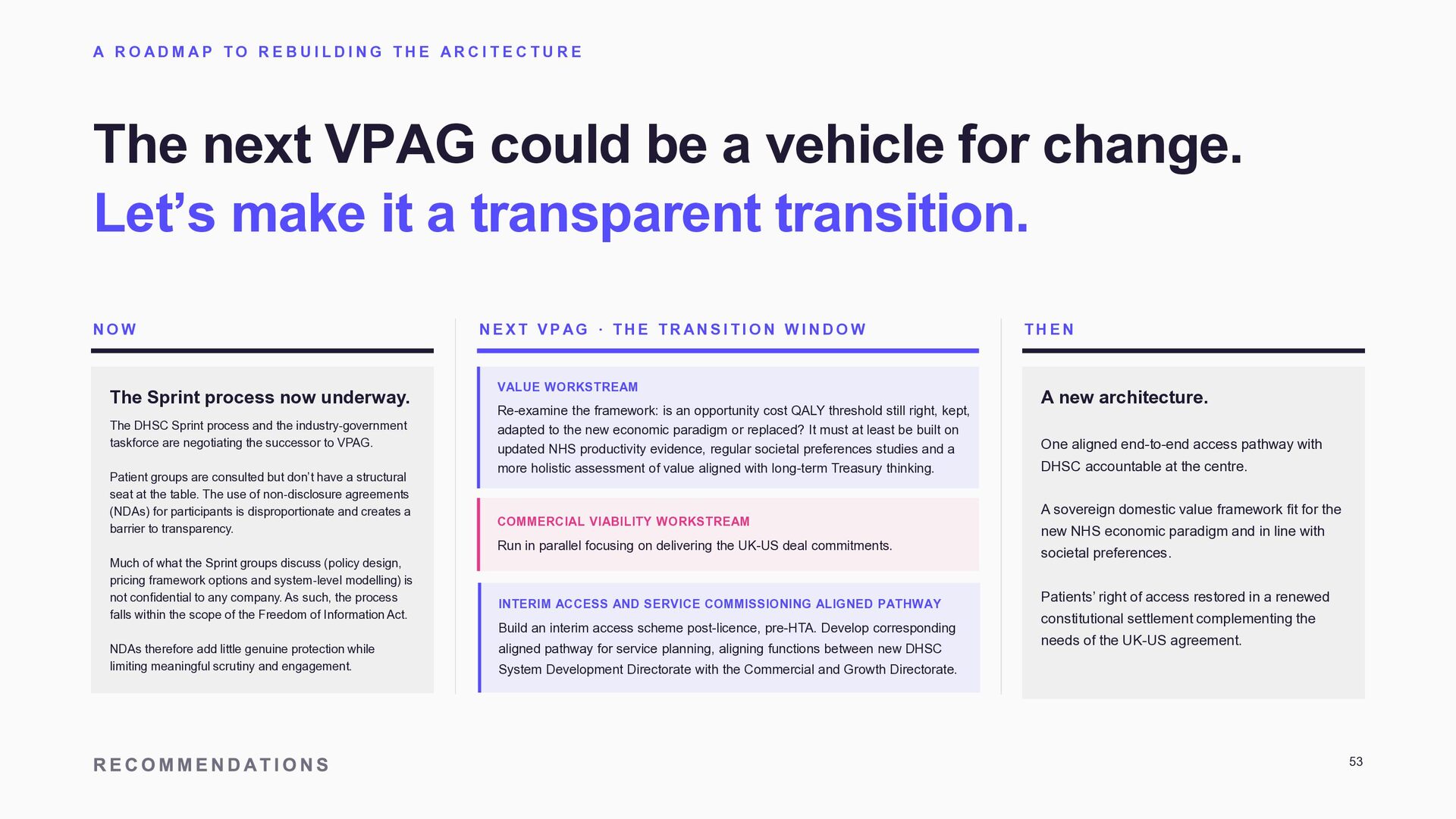
    R E B U I L D I N G T H E A R C I T E C T U R E The next VPAG could be a vehicle for change. Let’s make it a transparent transition. N O W The Sprint process now underway. The DHSC Sprint process and the industry-government taskforce are negotiating the successor to VPAG. Patient groups are consulted but don’t have a structural seat at the table. The use of non-disclosure agreements (NDAs) for participants is disproportionate and creates a barrier to transparency. Much of what the Sprint groups discuss (policy design, pricing framework options and system-level modelling) is not confidential to any company. As such, the process falls within the scope of the Freedom of Information Act. NDAs therefore add little genuine protection while limiting meaningful scrutiny and engagement. N E X T V P AG · T H E T R AN S I T I O N W I N D O W VALUE WORKSTREAM Re-examine the framework: is an opportunity cost QALY threshold still right, kept, adapted to the new economic paradigm or replaced? It must at least be built on updated NHS productivity evidence, regular societal preferences studies and a more holistic assessment of value aligned with long-term Treasury thinking. COMMERCIAL VIABILITY WORKSTREAM Run in parallel focusing on delivering the UK-US deal commitments. T H E N A new architecture. One aligned end-to-end access pathway with DHSC accountable at the centre. A sovereign domestic value framework fit for the new NHS economic paradigm and in line with societal preferences. Patients’ right of access restored in a renewed constitutional settlement complementing the needs of the UK-US agreement. INTERIM ACCESS AND SERVICE COMMISSIONING ALIGNED PATHWAY Build an interim access scheme post-licence, pre-HTA. Develop corresponding aligned pathway for service planning, aligning functions between new DHSC System Development Directorate with the Commercial and Growth Directorate. 53
  52. Give patients a structural seat, not a consultative gesture. THE

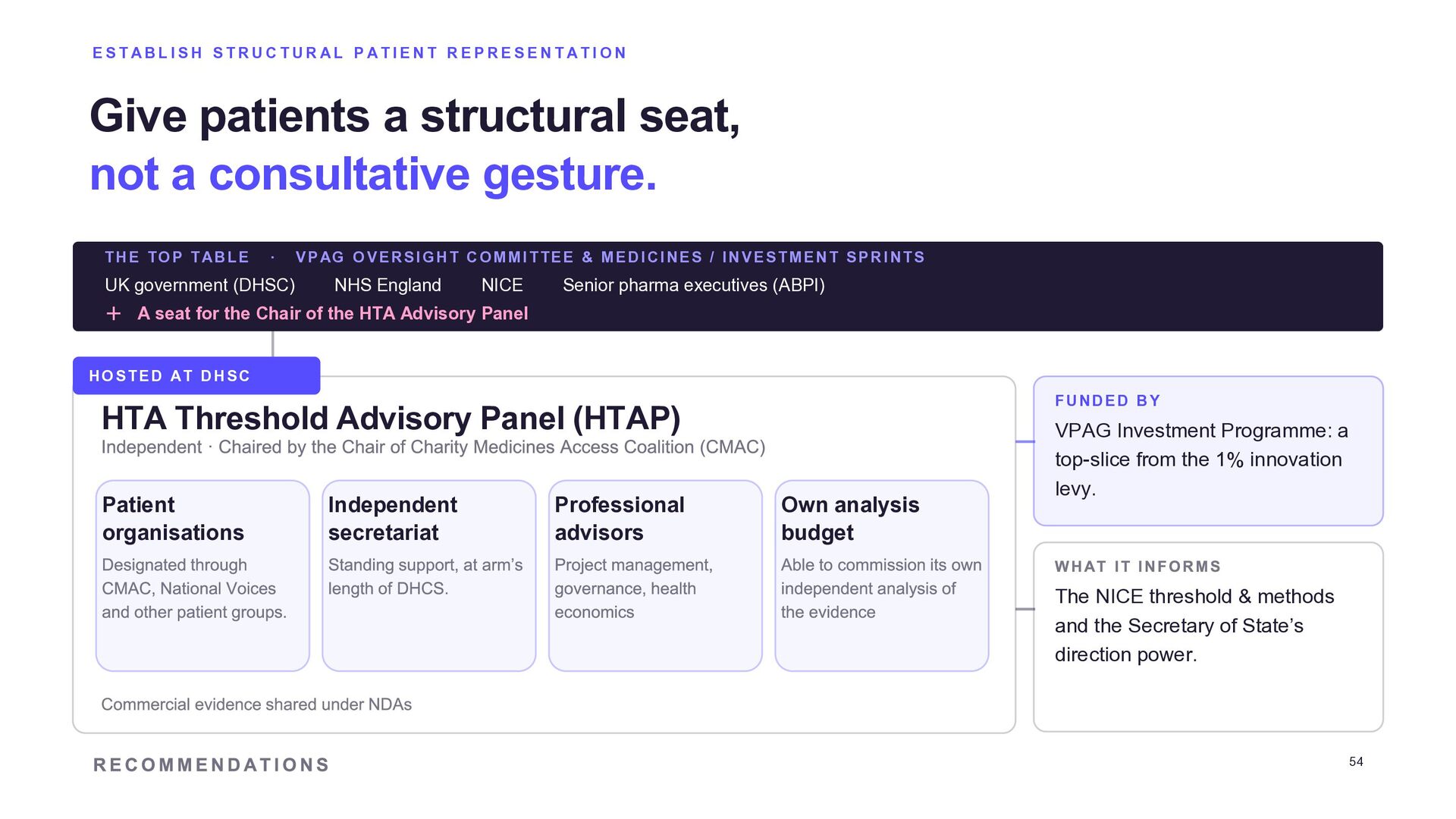
    TOP TABLE · VPAG OVERSIGHT COMMITTEE & MEDICINES / INVESTMENT SPRINTS UK government (DHSC) NHS England NICE Senior pharma executives (ABPI) + A seat for the Chair of the HTA Advisory Panel HOSTED AT DHSC HTA Threshold Advisory Panel (HTAP) Patient organisations Independent secretariat Professional advisors Own analysis budget FUNDED BY VPAG Investment Programme: a top-slice from the 1% innovation levy. The NICE threshold & methods and the Secretary of State’s direction power. 54 E S T A B L I S H S T R U C T U R A L P A T I E N T R E P R E S E N T A T I O N
  53. A F I N AL P R O V O

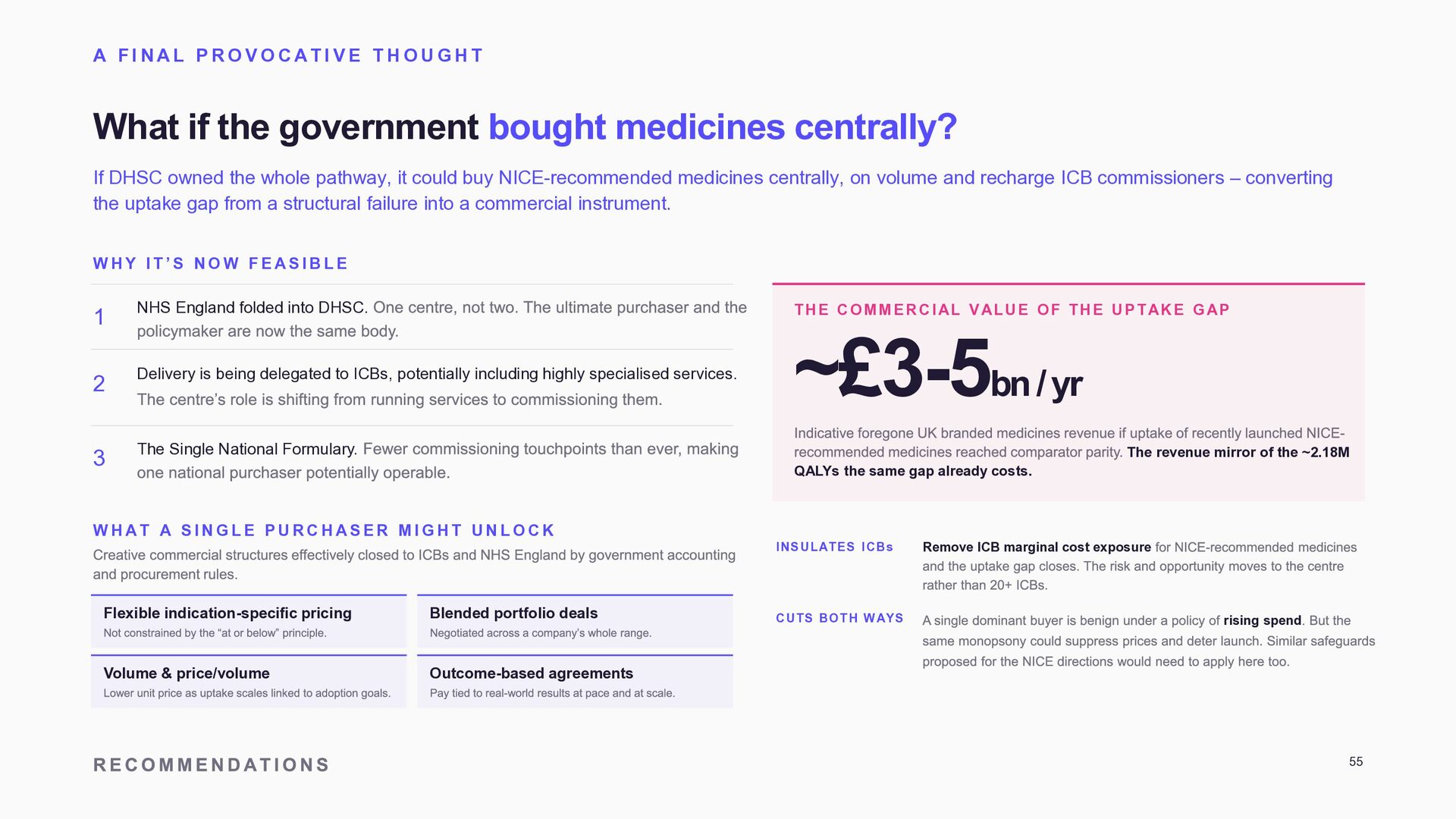
    C AT I V E T H O U G H T What if the government bought medicines centrally? If DHSC owned the whole pathway, it could buy NICE-recommended medicines centrally, on volume and recharge ICB commissioners – converting the uptake gap from a structural failure into a commercial instrument. W H Y I T ’ S N O W F E A S I B L E 1 NHS England folded into DHSC. 2 Delivery is being delegated to ICBs, potentially including highly specialised services. 3 The Single National Formulary. W H A T A S I N G L E P U R C H A S E R M I G H T U N L O C K Flexible indication-specific pricing Blended portfolio deals Volume & price/volume Outcome-based agreements THE COMMERCIAL VALUE OF THE UPTAKE GAP ~£3-5bn / yr The revenue mirror of the ~2.18M QALYs the same gap already costs. CUTS BOTH WAYS rising spend INSULATES ICBs Remove ICB marginal cost exposure 55
  54. A C A L L F O R C O

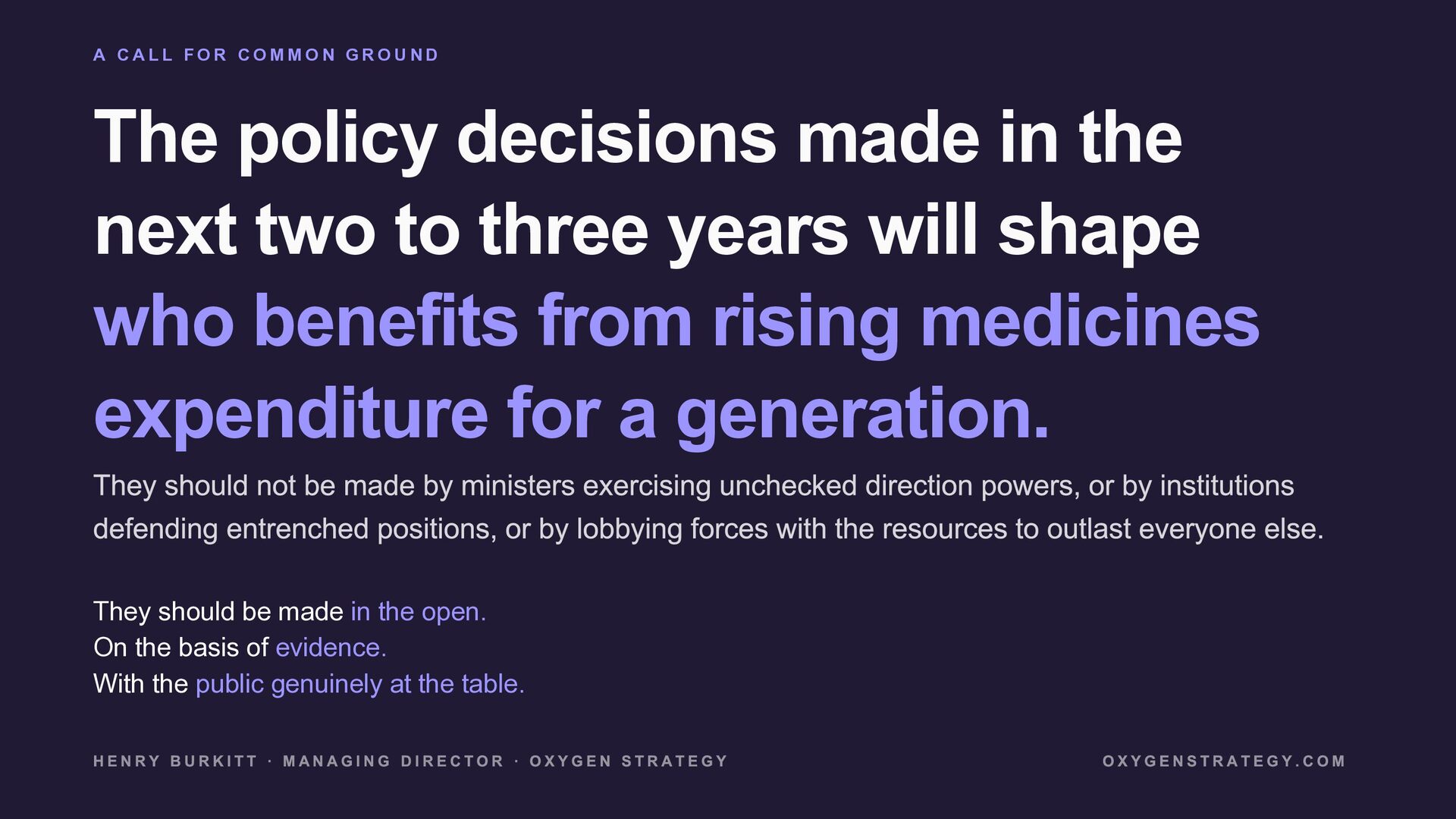
    M M O N G R O U N D The policy decisions made in the next two to three years will shape who benefits from rising medicines expenditure for a generation. They should be made in the open. On the basis of evidence. With the public genuinely at the table.
  55. R E F E R E N C E S

    References and sources for evidentiary claims 1 UK–US Pharmaceutical Pricing Arrangement — HM Government / DHSC announcement, October 2025; UK commitment to increase medicines spend as a share of GDP. 2 National Audit Office (2017), Investigation into the Cancer Drugs Fund, HC 442. 3 OECD Health Statistics 2024; ABPI per-capita medicines expenditure analysis 2024. Comparative figures illustrative. 4 ABPI / NICE technology appraisal optimisation analysis — 47% optimised (Jan 2023–Dec 2024); mean access score 31% (down from 45% in 2020–22). 5 Office for Life Sciences (2024), Life Sciences Competitiveness Indicators — UK uptake of new medicines, 2018–2022 cohort; comparator average across 15 high-income countries. 6 Hofmarcher et al., IHE Comparator Report on Cancer in Europe (uptake / premature-mortality association); EFPIA W.A.I.T. Indicator 2024. 7 VPAS 2023 rebate-rate calculation; DHSC and ABPI scheme correspondence; coverage of company withdrawals from the voluntary scheme. 8 Office for Life Sciences / DHSC / Department for Business and Trade, inward life-sciences FDI data 2023–2025. 9 Industry R&D by country: EFPIA, The Pharmaceutical Industry in Figures (Key Data 2025), 2023 figures — UK the largest national R&D figure in Europe; medicines spend per capita from EFPIA market value ÷ population. 10 ABPI, Medicines Impacts and Investment Survey, January 2026. 11 Cencora HTAQ 2024; IGES AMNOG benefit-assessment review — German immediate-reimbursement / parallel- assessment model. 12 Haute Autorité de Santé, Accès Précoce annual reports 2022–2024; Remap Consulting analysis of the 2021 reform. 13 NICE Annual Report 2023–24 — published recommendation rate for technology appraisals. 57 14 Claxton K, Martin S, Soares M et al. (2015), ‘Methods for the estimation of the NICE cost-effectiveness threshold’, Health Technology Assessment 19(14). Source dataset: 2008 NHS programme-budgeting data. 15 Health-displacement modelling of NICE-recommended drugs 2000–2020, The Lancet, 2024. 16 Oxygen Strategy (May 2026), indicative QALY-burden scoping analysis, 2017–2022 window. Structured sample of 30 medicines extrapolated to ~255 positive NICE TAs. Indicative, not peer-reviewed. 17 Claxton K, Martin S, Soares M et al. (2015), Health Technology Assessment 19(14), Table 30 — structural sensitivity range for the threshold (£2,018–£29,314; best estimate £12,936). 18 Woods B, Lomas J, Sculpher M, Claxton K (2024), discussion of dynamic efficiency and cost-effectiveness analysis, Health Economics. 19 York Health Economics Consortium (YHEC), “The NICE Threshold Debate: More Than a Number”, blog roundtable, October 2025. 20 Brazier J et al. on response-shift and adaptation in valuation; Ubel, Loewenstein & Jepson (2003), ‘Whose quality of life? A commentary’, Quality of Life Research. 21 Oxygen Strategy synthesis (argued position): no published open-ended deliberative study has elicited current English societal preferences over the QALY as the unit of a ‘good year of healthy life’. 22 NICE, severity-modifier explanatory notes and methods update (2022); ABPI (2024), commentary on opportunity-cost neutrality of the severity modifier. 23 NICE Listens public dialogue report (2024–2025), Workshop 1 — budget-constraint and opportunity-cost-neutrality framing. 24 Powell PA, Carlton J, Rowen D, Brazier J (2026), paediatric utility-value research, ISPOR Europe 2026. 25 Department of Health and Social Care, Changes to NICE regulations: cost-effectiveness threshold: government response, 3 March 2026. 76% of respondents disagreed with removing NICE’s duty to consult on procedural changes resulting from a ministerial direction.