Upgrade to Pro — share decks privately, control downloads, hide ads and more …

Your Agents Need a Router: One Integration for ...

Your Agents Need a Router: One Integration for Every Model and Tool

Every agent starts simple: one model, one SDK, a demo that works. Then comes the second provider, the MCP tools, the fallback logic, the rate-limit backoff — and suddenly half your codebase is integration glue that has nothing to do with what your agent actually does.
Agent Router — newly donated to the Agentic AI Foundation, with a 1.0 GA release and production deployments at scale — collapses all of it into a single integration: every model, every tool, one declarative API.
We'll walk through a live agent workload end-to-end: routing across model providers with automatic failover; understanding exactly what each agent and team spends — and capping it before it surprises you; and choosing which MCP tools each agent can see and call. All declared in one place, none of it in your application code. You'll leave knowing exactly where a router fits in your agent stack, what it takes to run one in production, and how to get involved in the Agent Router project.

Avatar for Ignasi Barrera

Ignasi Barrera

September 19, 2026

More Decks by Ignasi Barrera

Other Decks in Technology

Transcript

  1. Where the agentic stack is being built. Your Agents Need

    a Router: One Integration for Every Model and Tool Ignasi Barrera
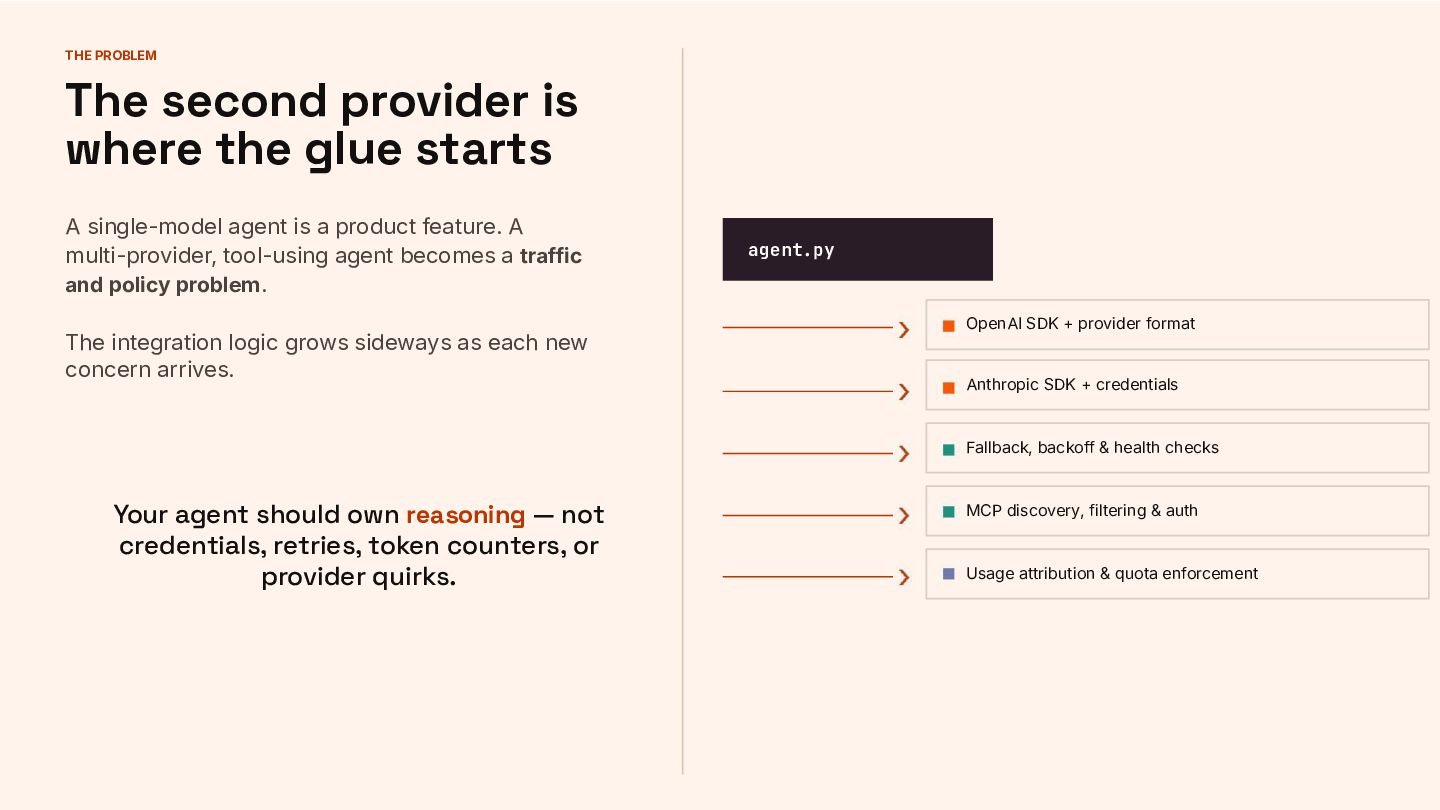
  2. THE PROBLEM The second provider is where the glue starts

    A single-model agent is a product feature. A multi-provider, tool-using agent becomes a traffic and policy problem. The integration logic grows sideways as each new concern arrives. agent.py OpenAI SDK + provider format Anthropic SDK + credentials Fallback, backoff & health checks Your agent should own reasoning — not credentials, retries, token counters, or provider quirks. MCP discovery, filtering & auth Usage attribution & quota enforcement
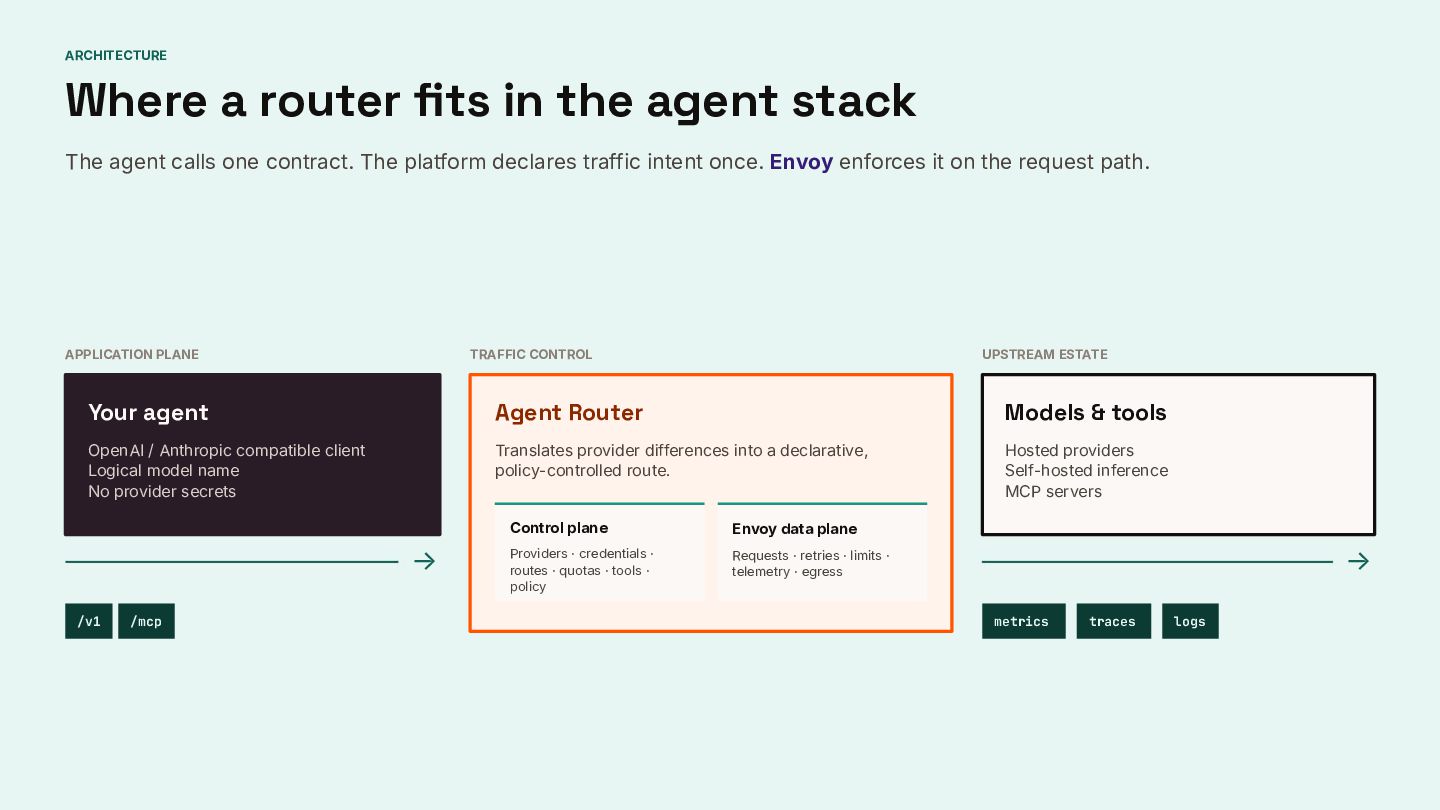
  3. ARCHITECTURE Where a router fits in the agent stack The

    agent calls one contract. The platform declares traffic intent once. Envoy enforces it on the request path. APPLICATION PLANE TRAFFIC CONTROL UPSTREAM ESTATE Your agent Agent Router Models & tools OpenAI / Anthropic compatible client Logical model name No provider secrets Translates provider differences into a declarative, policy-controlled route. Hosted providers Self-hosted inference MCP servers → /v1 /mcp Control plane Envoy data plane Providers · credentials · routes · quotas · tools · policy Requests · retries · limits · telemetry · egress → metrics traces logs
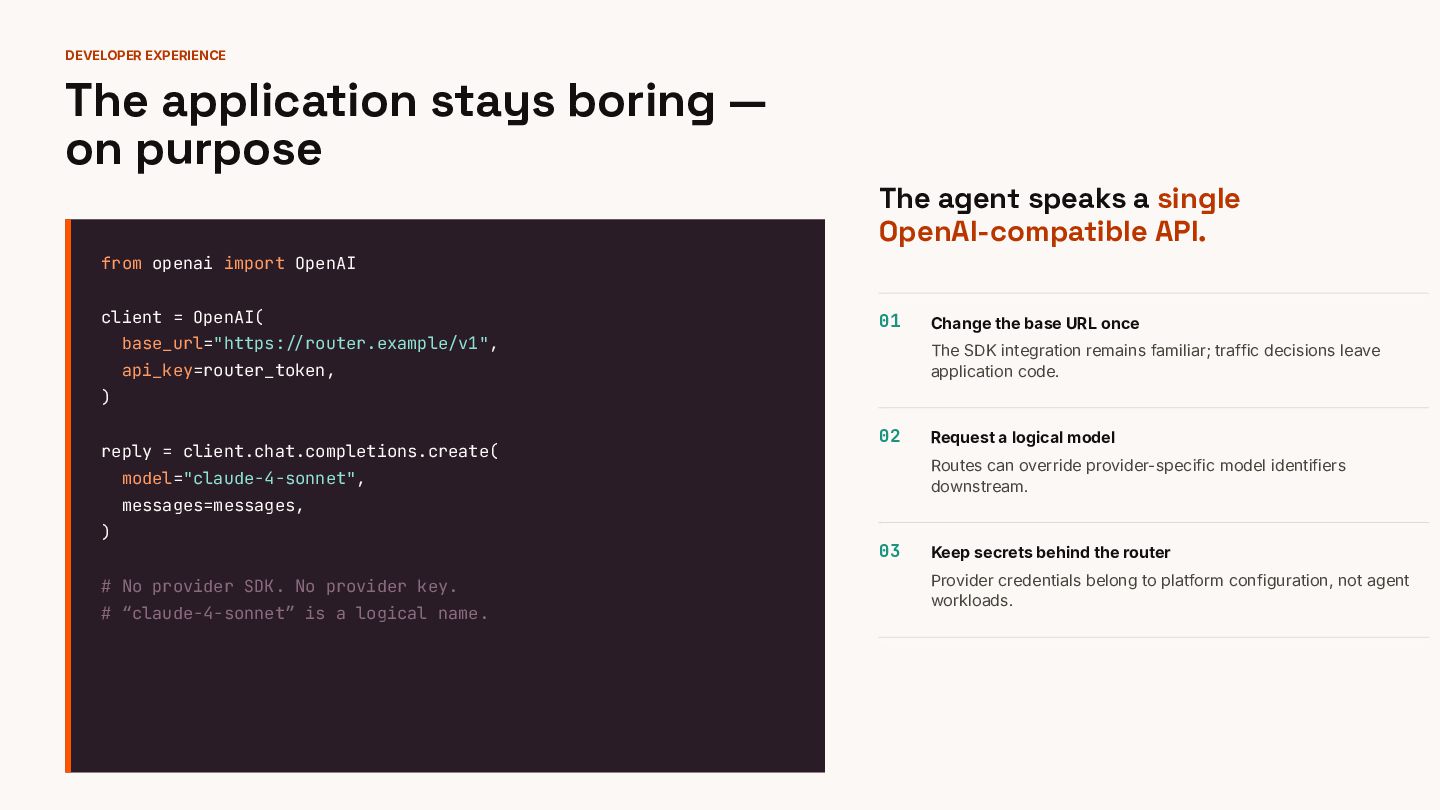
  4. DEVELOPER EXPERIENCE The application stays boring — on purpose The

    agent speaks a single OpenAI-compatible API. from openai import OpenAI client = OpenAI( base_url="https://router.example/v1", 01 Change the base URL once The SDK integration remains familiar; traffic decisions leave application code. api_key=router_token, ) reply = client.chat.completions.create( 02 Routes can override provider-specific model identifiers downstream. model="claude-4-sonnet", messages=messages, ) # No provider SDK. No provider key. # “claude-4-sonnet” is a logical name. Request a logical model 03 Keep secrets behind the router Provider credentials belong to platform configuration, not agent workloads.
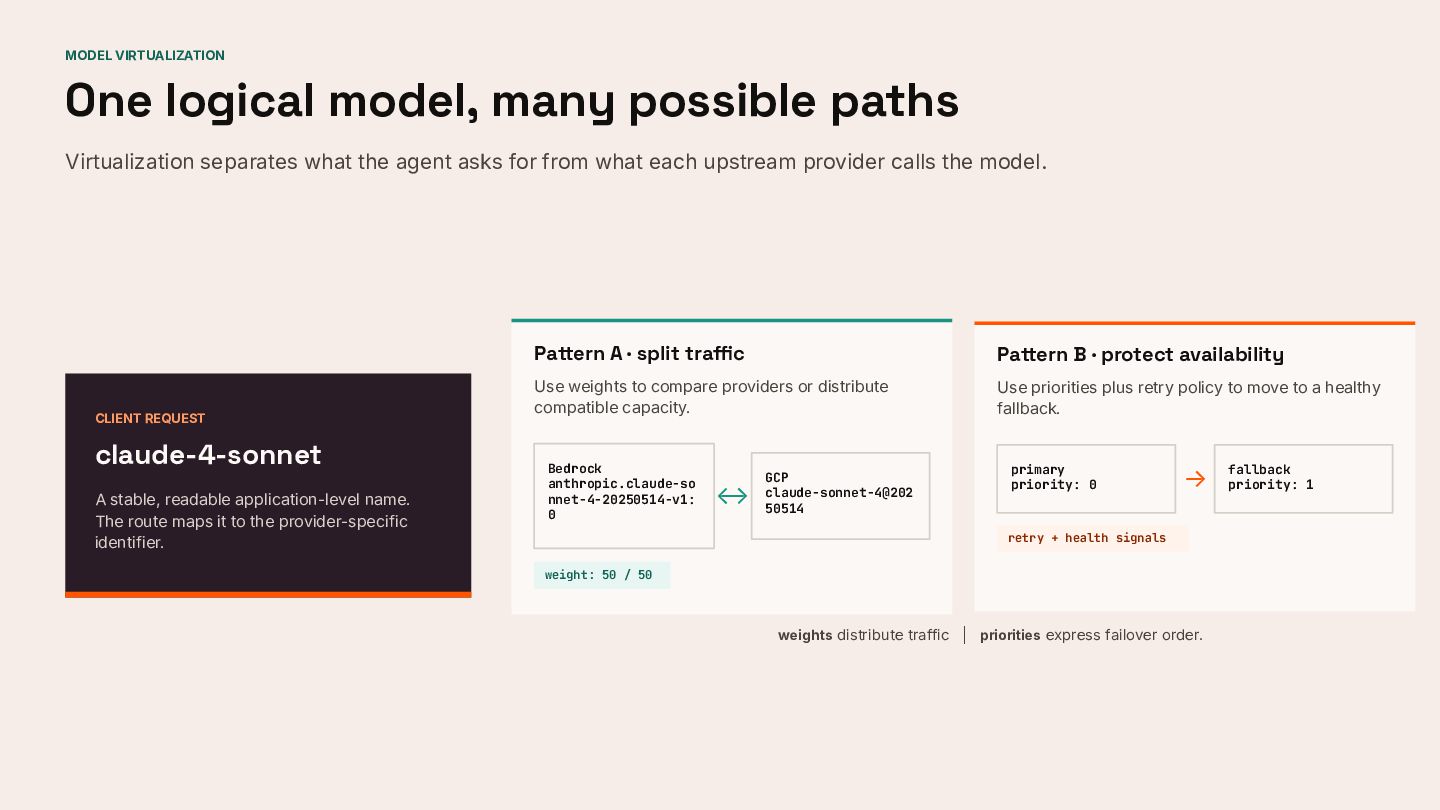
  5. MODEL VIRTUALIZATION One logical model, many possible paths Virtualization separates

    what the agent asks for from what each upstream provider calls the model. CLIENT REQUEST claude-4-sonnet A stable, readable application-level name. The route maps it to the provider-specific identifier. Pattern A · split traffic Pattern B · protect availability Use weights to compare providers or distribute compatible capacity. Use priorities plus retry policy to move to a healthy fallback. Bedrock anthropic.claude-so nnet-4-20250514-v1: 0 ↔ GCP claude-sonnet-4@202 50514 primary priority: 0 → retry + health signals weight: 50 / 50 weights distribute traffic | priorities express failover order. fallback priority: 1
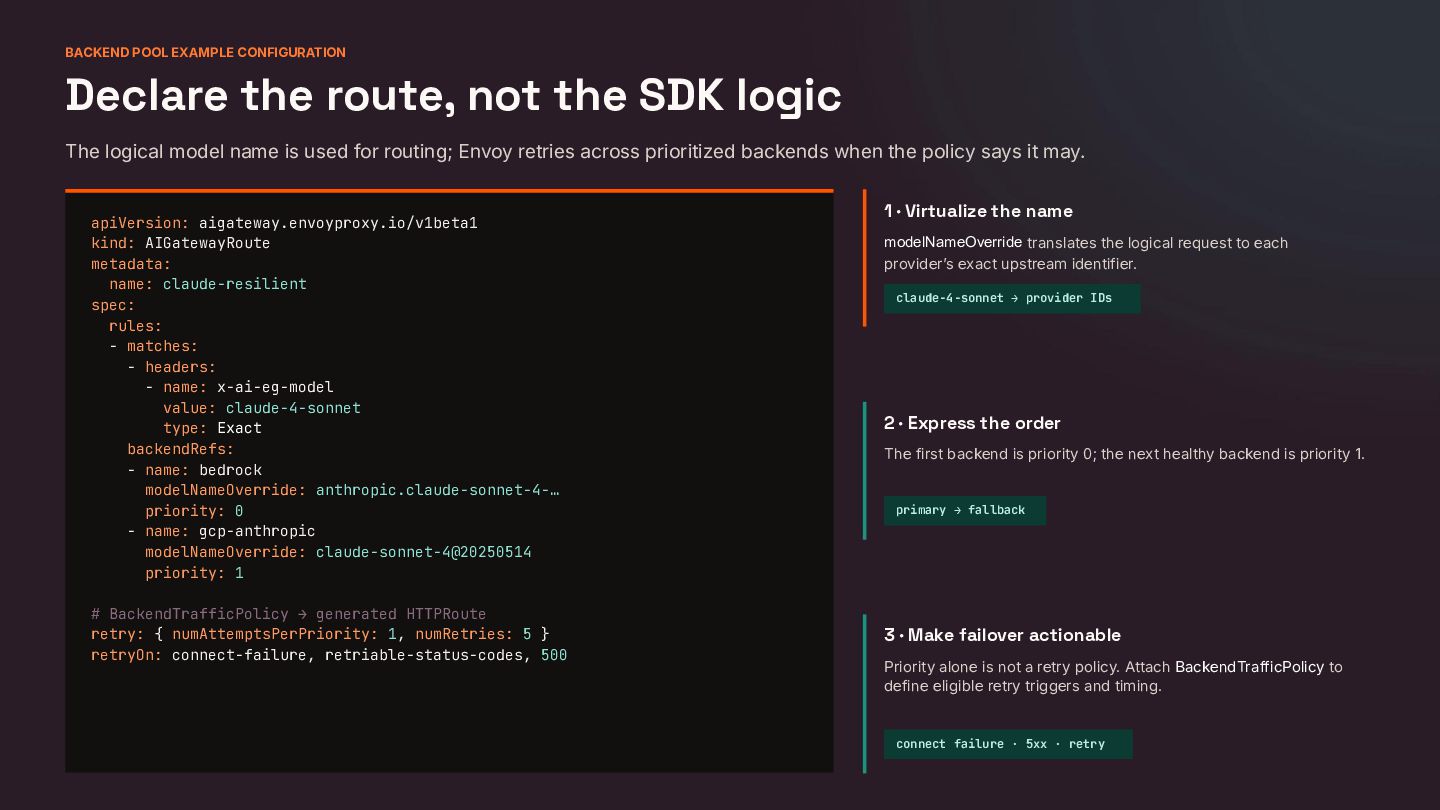
  6. BACKEND POOL EXAMPLE CONFIGURATION Declare the route, not the SDK

    logic The logical model name is used for routing; Envoy retries across prioritized backends when the policy says it may. apiVersion: aigateway.envoyproxy.io/v1beta1 kind: AIGatewayRoute metadata: name: claude-resilient spec: rules: - matches: - headers: - name: x-ai-eg-model value: claude-4-sonnet type: Exact backendRefs: - name: bedrock modelNameOverride: anthropic.claude-sonnet-4-… priority: 0 - name: gcp-anthropic modelNameOverride: claude-sonnet-4@20250514 priority: 1 # BackendTrafficPolicy → generated HTTPRoute retry: { numAttemptsPerPriority: 1, numRetries: 5 } retryOn: connect-failure, retriable-status-codes, 500 1 · Virtualize the name modelNameOverride translates the logical request to each providerʼs exact upstream identifier. claude-4-sonnet → provider IDs 2 · Express the order The first backend is priority 0; the next healthy backend is priority 1. primary → fallback 3 · Make failover actionable Priority alone is not a retry policy. Attach BackendTrafficPolicy to define eligible retry triggers and timing. connect failure · 5xx · retry
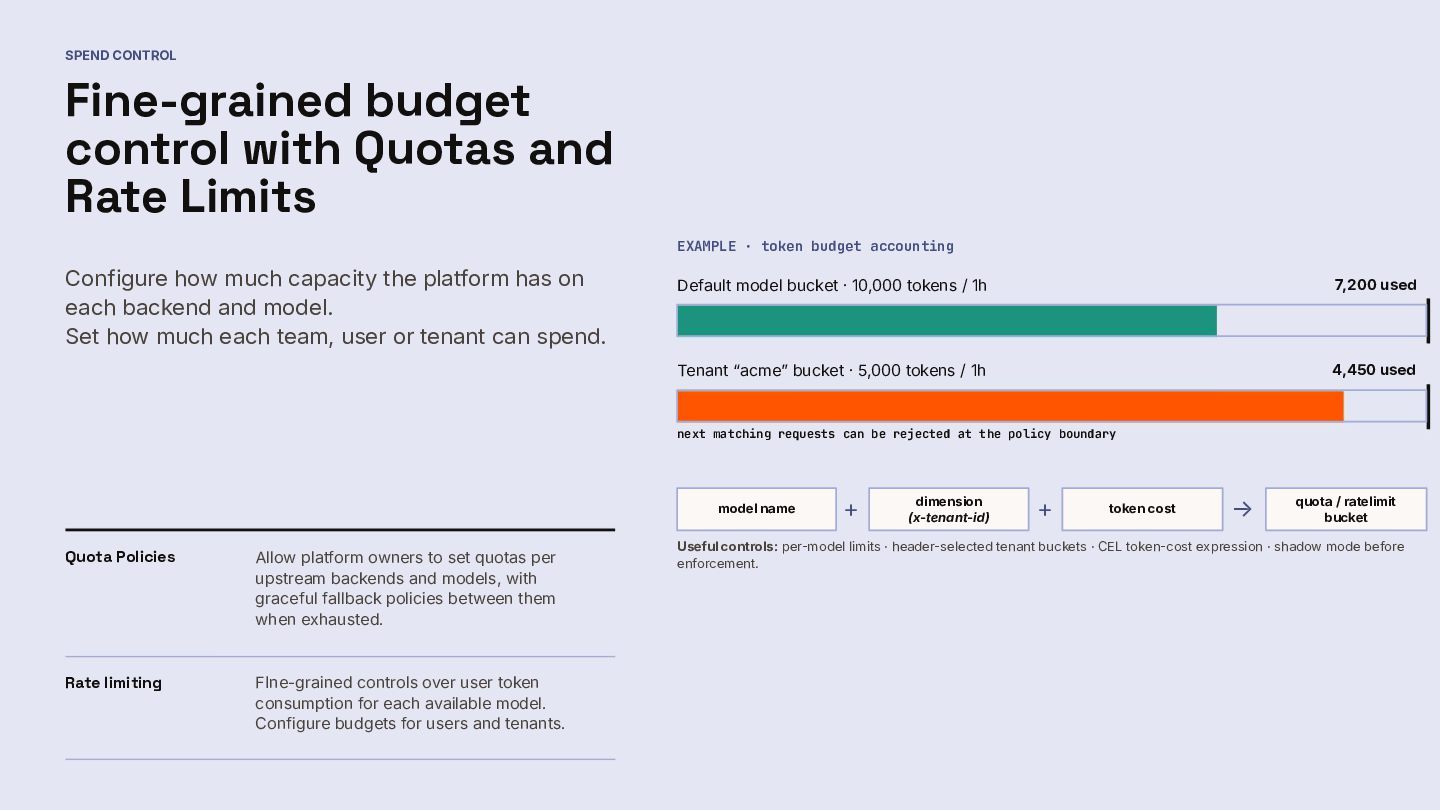
  7. SPEND CONTROL Fine-grained budget control with Quotas and Rate Limits

    EXAMPLE · token budget accounting Configure how much capacity the platform has on each backend and model. Set how much each team, user or tenant can spend. Default model bucket · 10,000 tokens / 1h 7,200 used Tenant “acmeˮ bucket · 5,000 tokens / 1h 4,450 used next matching requests can be rejected at the policy boundary model name Quota Policies Allow platform owners to set quotas per upstream backends and models, with graceful fallback policies between them when exhausted. Rate limiting FIne-grained controls over user token consumption for each available model. Configure budgets for users and tenants. + dimension (x-tenant-id) + token cost → quota / ratelimit bucket Useful controls: per-model limits · header-selected tenant buckets · CEL token-cost expression · shadow mode before enforcement.
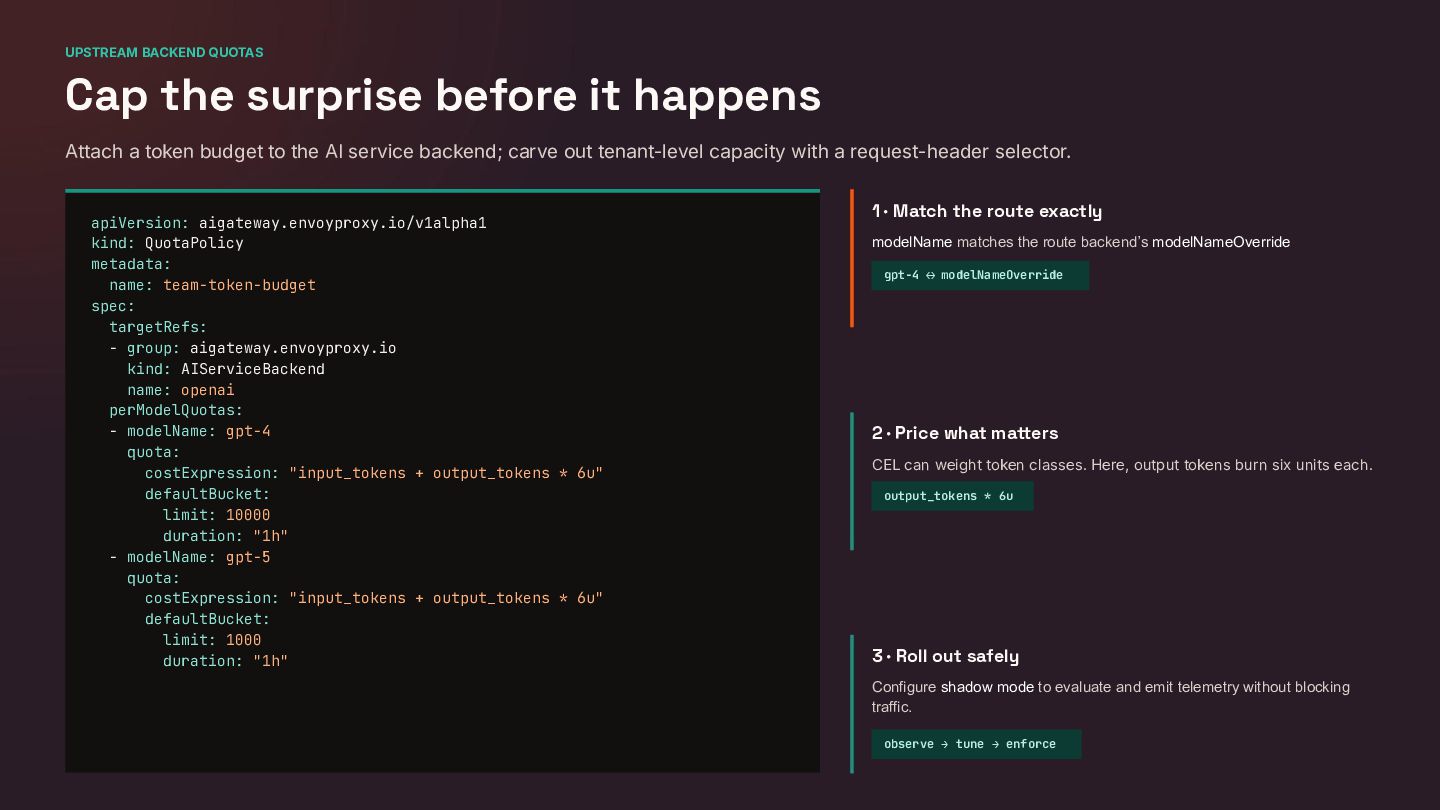
  8. UPSTREAM BACKEND QUOTAS Cap the surprise before it happens Attach

    a token budget to the AI service backend; carve out tenant-level capacity with a request-header selector. apiVersion: aigateway.envoyproxy.io/v1alpha1 kind: QuotaPolicy metadata: name: team-token-budget spec: targetRefs: - group: aigateway.envoyproxy.io kind: AIServiceBackend name: openai perModelQuotas: - modelName: gpt-4 quota: costExpression: "input_tokens + output_tokens * 6u" defaultBucket: limit: 10000 duration: "1h" - modelName: gpt-5 quota: costExpression: "input_tokens + output_tokens * 6u" defaultBucket: limit: 1000 duration: "1h" 1 · Match the route exactly modelName matches the route backend’s modelNameOverride gpt-4 ↔ modelNameOverride 2 · Price what matters CEL can weight token classes. Here, output tokens burn six units each. output_tokens * 6u 3 · Roll out safely Configure shadow mode to evaluate and emit telemetry without blocking traffic. observe → tune → enforce
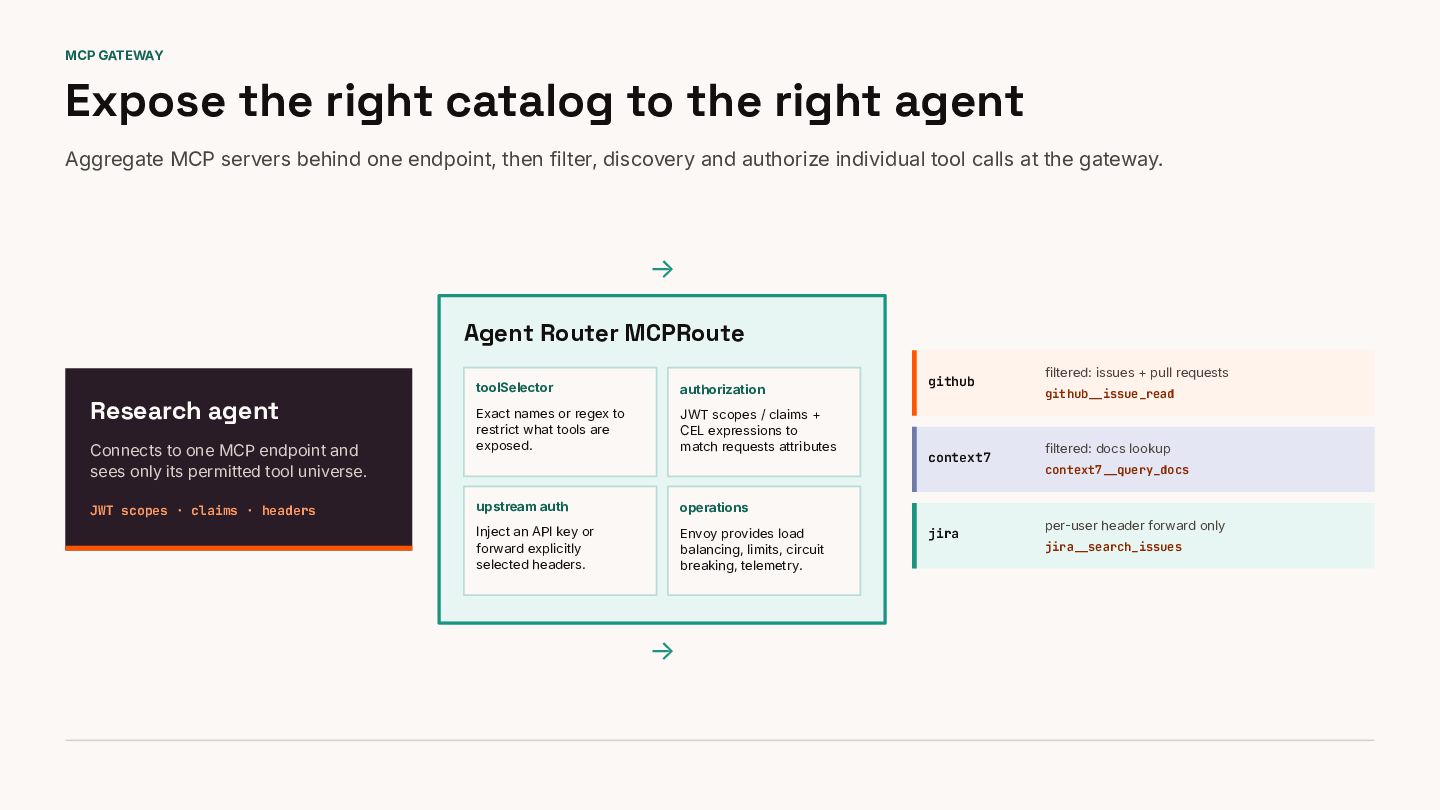
  9. MCP GATEWAY Expose the right catalog to the right agent

    Aggregate MCP servers behind one endpoint, then filter, discovery and authorize individual tool calls at the gateway. → Agent Router MCPRoute Research agent Connects to one MCP endpoint and sees only its permitted tool universe. JWT scopes · claims · headers toolSelector authorization Exact names or regex to restrict what tools are exposed. JWT scopes / claims + CEL expressions to match requests attributes upstream auth operations Inject an API key or forward explicitly selected headers. Envoy provides load balancing, limits, circuit breaking, telemetry. → github context7 jira filtered: issues + pull requests github__issue_read filtered: docs lookup context7__query_docs per-user header forward only jira__search_issues
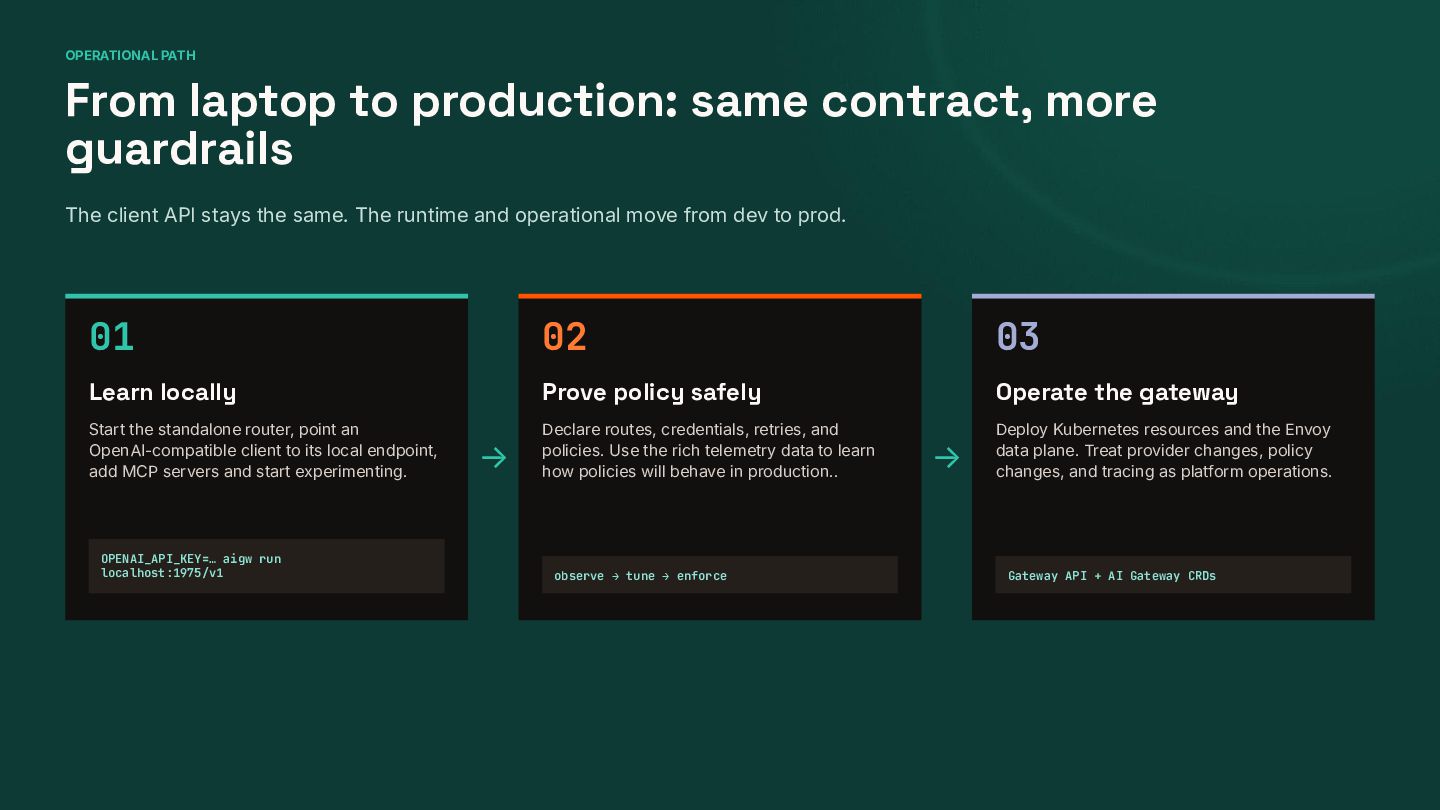
  10. OPERATIONAL PATH From laptop to production: same contract, more guardrails

    The client API stays the same. The runtime and operational move from dev to prod. 01 02 03 Learn locally Prove policy safely Operate the gateway Start the standalone router, point an OpenAI-compatible client to its local endpoint, add MCP servers and start experimenting. Declare routes, credentials, retries, and policies. Use the rich telemetry data to learn how policies will behave in production.. Deploy Kubernetes resources and the Envoy data plane. Treat provider changes, policy changes, and tracing as platform operations. OPENAI_API_KEY=… aigw run localhost:1975/v1 → observe → tune → enforce → Gateway API + AI Gateway CRDs
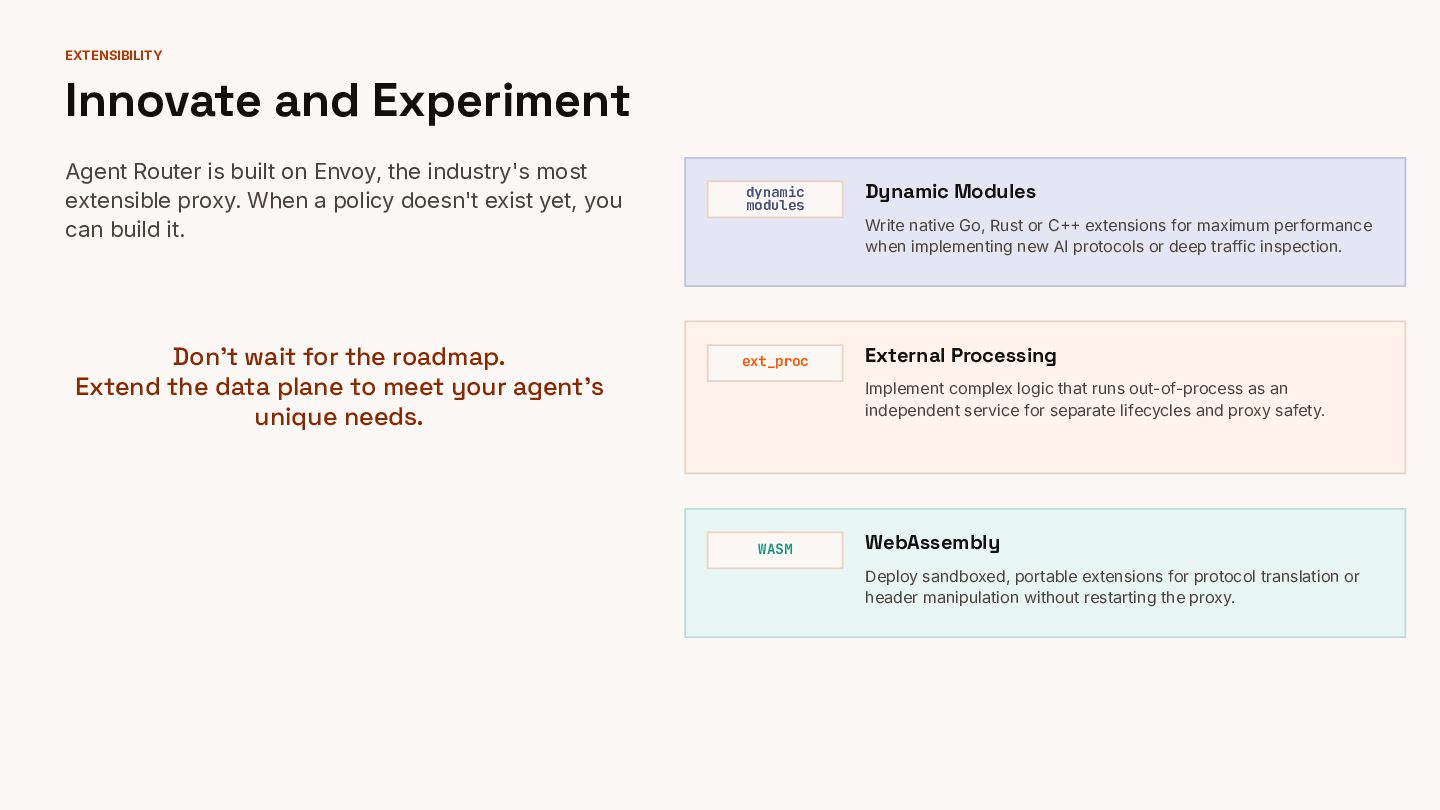
  11. EXTENSIBILITY Innovate and Experiment Agent Router is built on Envoy,

    the industry's most extensible proxy. When a policy doesn't exist yet, you can build it. Don't wait for the roadmap. Extend the data plane to meet your agent's unique needs. dynamic modules Dynamic Modules Write native Go, Rust or C extensions for maximum performance when implementing new AI protocols or deep traffic inspection. ext_proc External Processing Implement complex logic that runs out-of-process as an independent service for separate lifecycles and proxy safety. WASM WebAssembly Deploy sandboxed, portable extensions for protocol translation or header manipulation without restarting the proxy.
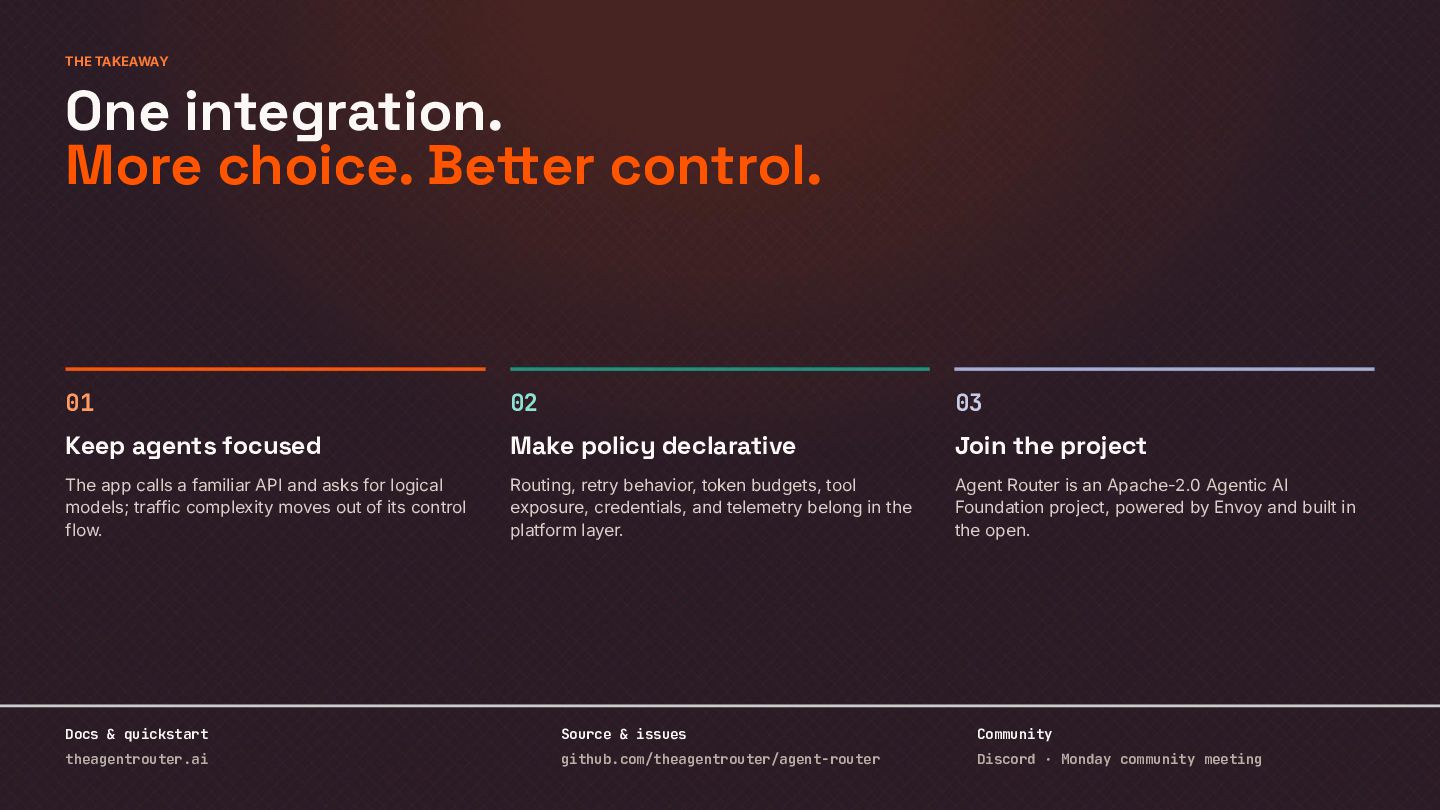
  12. THE TAKEAWAY One integration. More choice. Better control. 01 02

    03 Keep agents focused Make policy declarative Join the project The app calls a familiar API and asks for logical models; traffic complexity moves out of its control flow. Routing, retry behavior, token budgets, tool exposure, credentials, and telemetry belong in the platform layer. Agent Router is an Apache-2.0 Agentic AI Foundation project, powered by Envoy and built in the open. Docs & quickstart Source & issues Community theagentrouter.ai github.com/theagentrouter/agent-router Discord · Monday community meeting