Upgrade to Pro — share decks privately, control downloads, hide ads and more …

Current Good Manufacturing Practices (cGMP): Ob...

Sponsored · Your Podcast. Everywhere. Effortlessly. Share. Educate. Inspire. Entertain. You do you. We'll handle the rest. →
Avatar for Nilesh Chaudhari Nilesh Chaudhari
May 08, 2026
58

Current Good Manufacturing Practices (cGMP): Objectives, Policies, Facility Design & Equipment Maintenance

This presentation explains the fundamentals of Current Good Manufacturing Practices (cGMP) in the pharmaceutical industry. It covers the objectives of cGMP, GMP policies, production area requirements, building layout, facility services, sanitation, SOPs, warehousing, quality control systems, and equipment maintenance. The presentation also highlights important USFDA regulations and Schedule M requirements under the Drugs and Cosmetics Act, India. Useful for B.Pharm, M.Pharm, industrial pharmacy, and pharmaceutical quality assurance students.

Avatar for Nilesh Chaudhari

Nilesh Chaudhari

May 08, 2026

Transcript

  1. 1 Current Good Manufacturing Practices (cGMP) Dr. Nilesh Chaudhari Assistant

    Professor Sanjivani College of Pharmaceutical Education and Research.
  2. CONTENTS  Introduction  Objectives  Policies  Building Layout

    Services  Equipment and Their Maintenance 2
  3. INTRODUCTION TO CGMP  cGMP (current Good Manufacturing Practices) is

    a set of guidelines and regulations that ensure pharmaceutical products are consistently produced and controlled according to quality standards. These standards are essential for the safety, efficacy, and quality of medicines.  Schedule M 'Good Manufacturing Practices and Requirements of Premises, Plant and Equipment for Pharmaceutical Products, The Drugs and Cosmetics Act and Rules(1945), India 3
  4. USFDA REGULATIONS: The requirements for compliance to cGMP are lain

    down in the following code of Federal Regulation (21CFR). o 21 CFR Part 210 cGMP in manufacturing, processing, packing, or holding of the drugs. o 21 CFR Part 211 cGMP for finished pharmaceutical. o 21 CFR Part 610-Current Good Manufacture of Biological Products. o 21 CFR Part 820-Current Good Manufacturing Practices for Devices 4
  5. OBJECTIVES OF CGMP The primary objectives of cGMP are :

     To ensure product quality.  Prevent contamination.  Ensure consistency in manufacturing processes.  Ensure that products meet regulatory requirements.  Maintaining a hygienic environment.  Controlling production processes.  Using validated equipment. 5
  6. GMP INCLUDES a) General considerations b) Personnel c) Production area

    d) Equipment e) Sanitation f) SOP’s g) Raw Materials h) Self Inspection And Audit i) Master Formula Records j) Batch Manufacturing Records k) Warehousing Area l) Labels And Other Printed Materials m) Quality Control System 6
  7. a) General considerations Location and surroundings: shall be so situated

    that it avoid risk of contamination from external environmental including open sewage, drain, public lavatory. Building and premises: shall conform to the conditions laid down in the Factories Act, 1948 (63 of 1948) Water system: shall be validated system for treatment of water in accordance with standards specified by the Bureau of Indian Standards or Local Municipality or Pharmacopoeial specification Disposal of waste: be in conformity wit the requirements of Environment Pollution Control Board 7
  8. b) Personnel Qualified and experience in relevant field Written duties

    of technical and Quality Control personnel shall be laid and following strictly Medical examination prior to employment & periodically after personnel hygiene training c) Production Area Orderly and logical positioning of equipment and materials and movement of personnel Separate dedicated and self-contained facilities shall be made available for the production of sensitive pharmaceutical product 8
  9. d) Equipment shall be located, designed, constructed, adapted to suit

    the operations and logbook shall be maintained shall be calibrated and checked on a scheduled basis in accordance to SOP and maintain records e) Sanitation manufacturing premises shall be cleaned and in an orderly manner f) SOP For Equipment, sampling, Testing, Process and Packaging shall be retained for at least one year after the expiry date of the finished product 9
  10. g) Raw materials Keeping an inventory of all raw materials

    to be used and maintain records as per Schedule U Should be purchased from approved sources Must be checked by QC department and shall be labelled h) Self inspection and Audit To detect shortcomings in the implementation of GMP and to recommend the necessary corrective actions shall be performed routinely and on specific occasions i) Master Formula Records There shall be Master Formula records relating to all manufacturing procedures for each product and batch size shall be prepared and endorsed by head of production and quality control 10
  11. j) Warehousing Area should be designed and adapted to ensure

    good storage conditions There shall be a separate sampling area in the warehousing area for active raw materials and excipients Should be clean, dry and maintained with acceptable temperature limits Every Material stored should be labeled properly k) Labels & other printed materials Labels are necessary for identification of the drugs and their use The Printing shall be done in bright colours and in a legible manner l) Quality Control System QC lab. May be divided into Chemical, Instrumentation, Microbiological and Biological testing QC department shall conduct stability studies of the products to ensure and assign their shell life 11
  12. CGMP POLICIES  cGMP policies provide the framework for quality

    management in pharmaceutical production. These policies cover aspects such as employee training, sanitation and hygiene, raw material inspection, equipment validation, and batch production records. Adhering to these policies ensures the production of safe and effective pharmaceutical products. 12
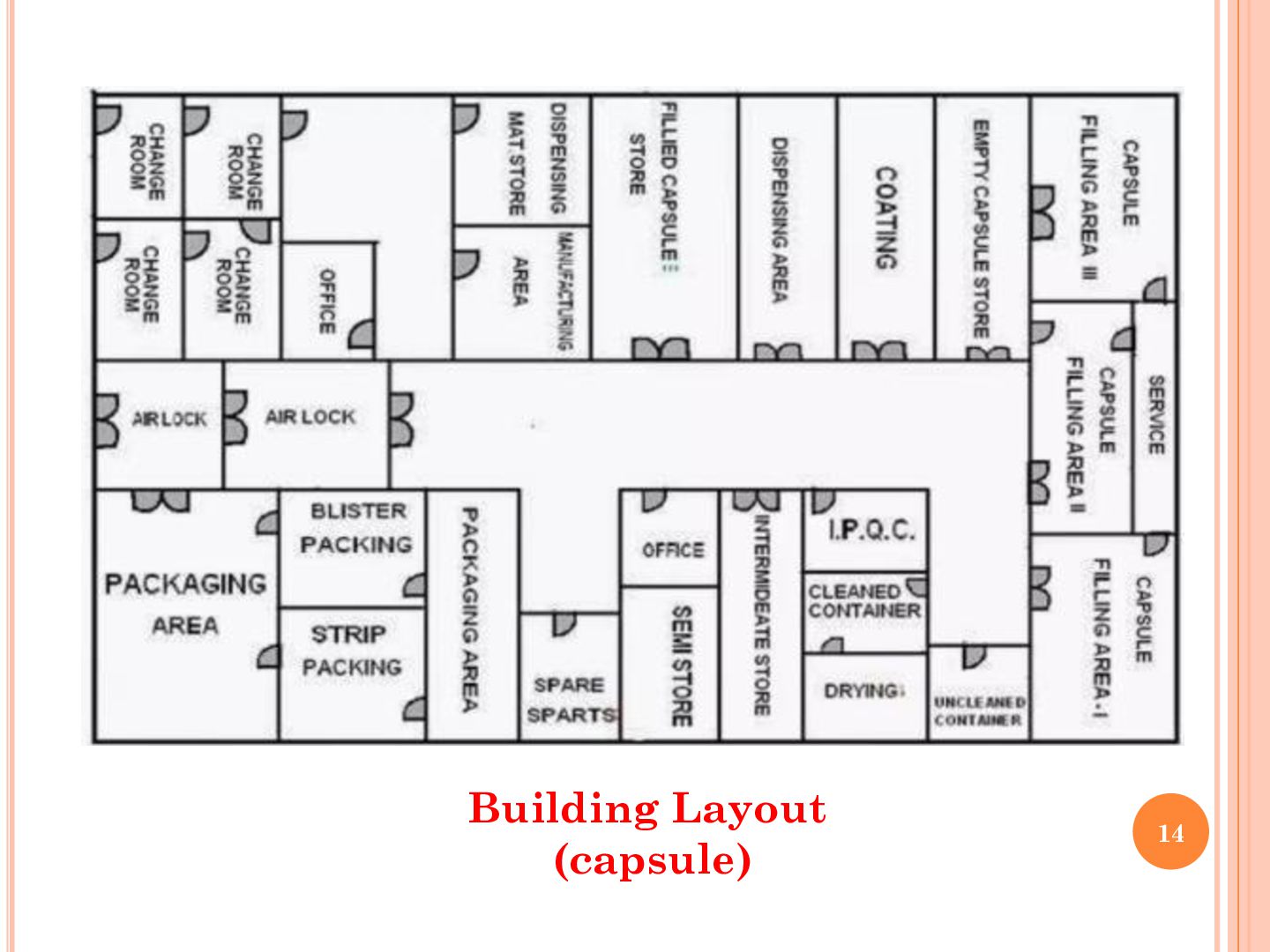
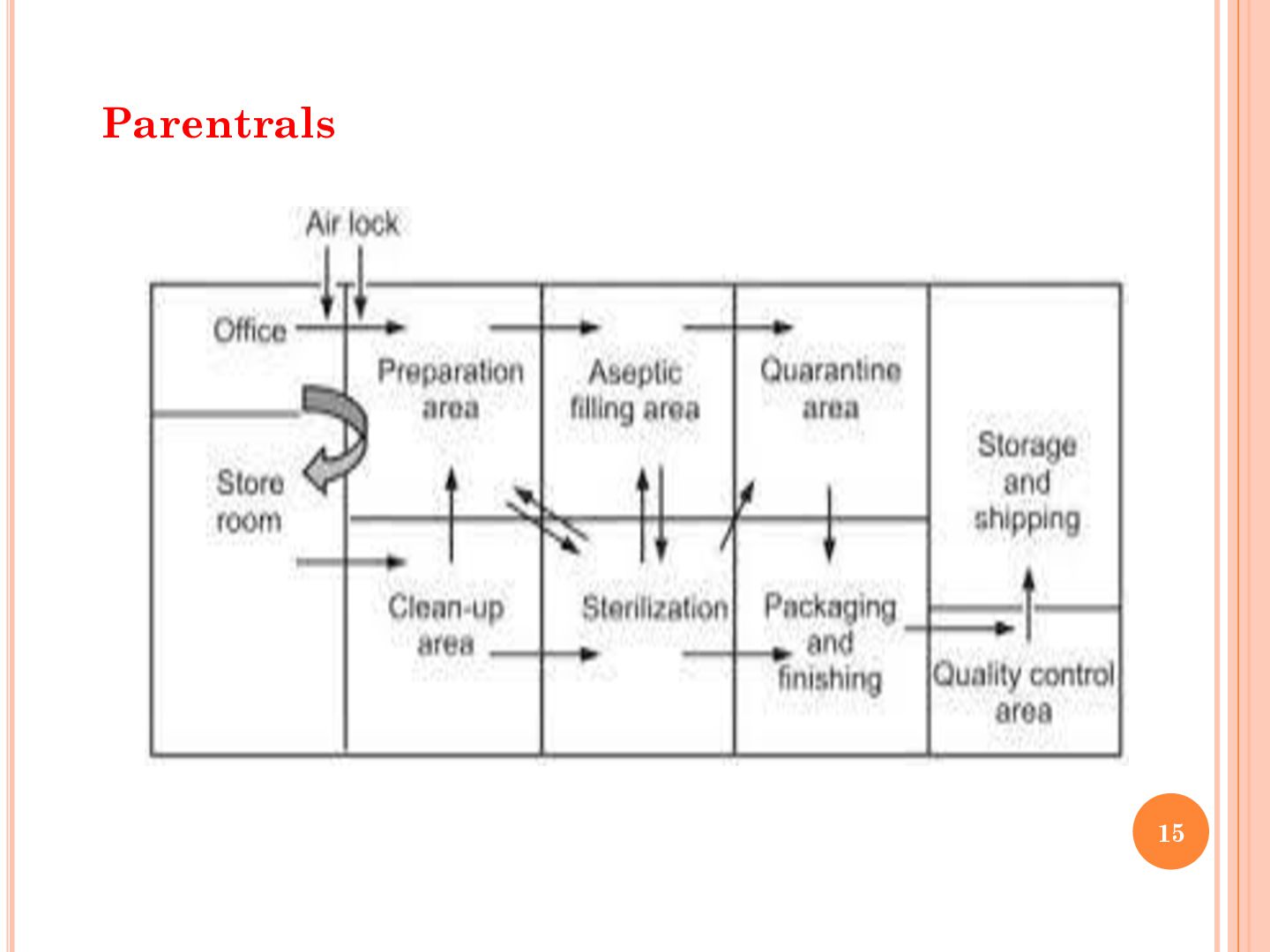
  13. BUILDING LAYOUT IN CGMP FACILITIES The layout of a cGMP

    facility is designed to minimize the risk of contamination and ensure efficient production. 1. Plant Layout: o Plant layout is a coordinated effort to achieve the final objective to integrate machines, materials, and personnel for economic production. o Involves location of different departments and arrangement of machinery in each department. 13
  14. Types of Plant Layout: I. Process layout: o Arrangement of

    machines of a particular class doing a particular process as separate department. Advantage: o More effective supervision o Division of labor can be provided Disadvantage: o May not be possible as a number of unit operations have to be performed 16
  15. II. Product layout: o The arrangement of machines doing various

    operations in a line as one department. Advantages: o Processing of work is quick and smooth o Cost of handling is reduced using conveyers o Manufacturing time can be reduced o Floor space can be properly utilized 17
  16. 2. Stores-Layout: Should be planned in the objectives of: o

    Achieving minimum wastage of space o Achieving maximum ease of operations The layouts should: o Make optimum utilization of floor space and height o Should be 1.5- 3m wide to facilitate traffic o Permit effective and orderly segregation of various categories of materials and allow rotation of stock (1st in 1st out) o Should be ventilate o Have provisions for storage as per specific conditions o Adequately protected from waste, damage and deterioration. 18
  17. SERVICES IN CGMP FACILITIES 1. Lighting - Adequate lighting shall

    be provided in all areas. 2. Ventilation, air filtration, air heating and cooling o Adequate ventilation shall be provided. o Equipment for adequate control over air pressure , microorganisms, dust, humidity, and temperature shall be provided appropriate for the manufacture, processing, packing,of a drug product. o Air filtration systems, including pre-filters and particulate matter air filters, shall be used appropriate on air supplies to production areas. . 19
  18. 3. Plumbing - Potable Water shall be supplied under continuous

    positive pressure in a plumbing system free of defects that could contribute contamination to any drug product. 4. Sewage and refuse - Sewage, trash, and other refuse from the building and premises shall be disposed of in a safe and sanitary manner. 5. Washing and toilet facilities - Adequate washing facilities shall be provided, including hot and cold water, soap or detergent, air driers or single-service towels, and clean toilet facilities easily accessible to working areas. 20
  19. 6. Sanitation  Any building used in the manufacture, processing,

    packing, or holding of a drug product shall be maintained in a clean and sanitary condition, building shall be free of infestation by rodents, birds, insects, and other vermin. Trash and organic waste matter shall be held and disposed of in a timely and sanitary manner.  Sanitation procedures shall apply to work performed by contractors or temporary employees as well as work performed by full-time employees during the ordinary course of operations 21
  20. A. Design and Construction: o The equipment surfaces coming into

    contact with any in-process material should not react with the materials. o Equipment should not adversely affect the product through leaking valves, lubricant drips. o Equipment should be easily cleaned. o Equipment used for flammable substances should be explosion proof. 23
  21. B. Installation and Location:  Equipment should be located to

    avoid congestion and properly identified to assure the products do not become admixed with one another.  Water, steam and pressure or vacuum lines, where applicable, should be installed so as to be easily accessible during all phases of operation.  Support systems such as heating, ventilation, air conditioning, water, steam, compressed air and gases (example nitrogen) should function as designed and identifiable. 24
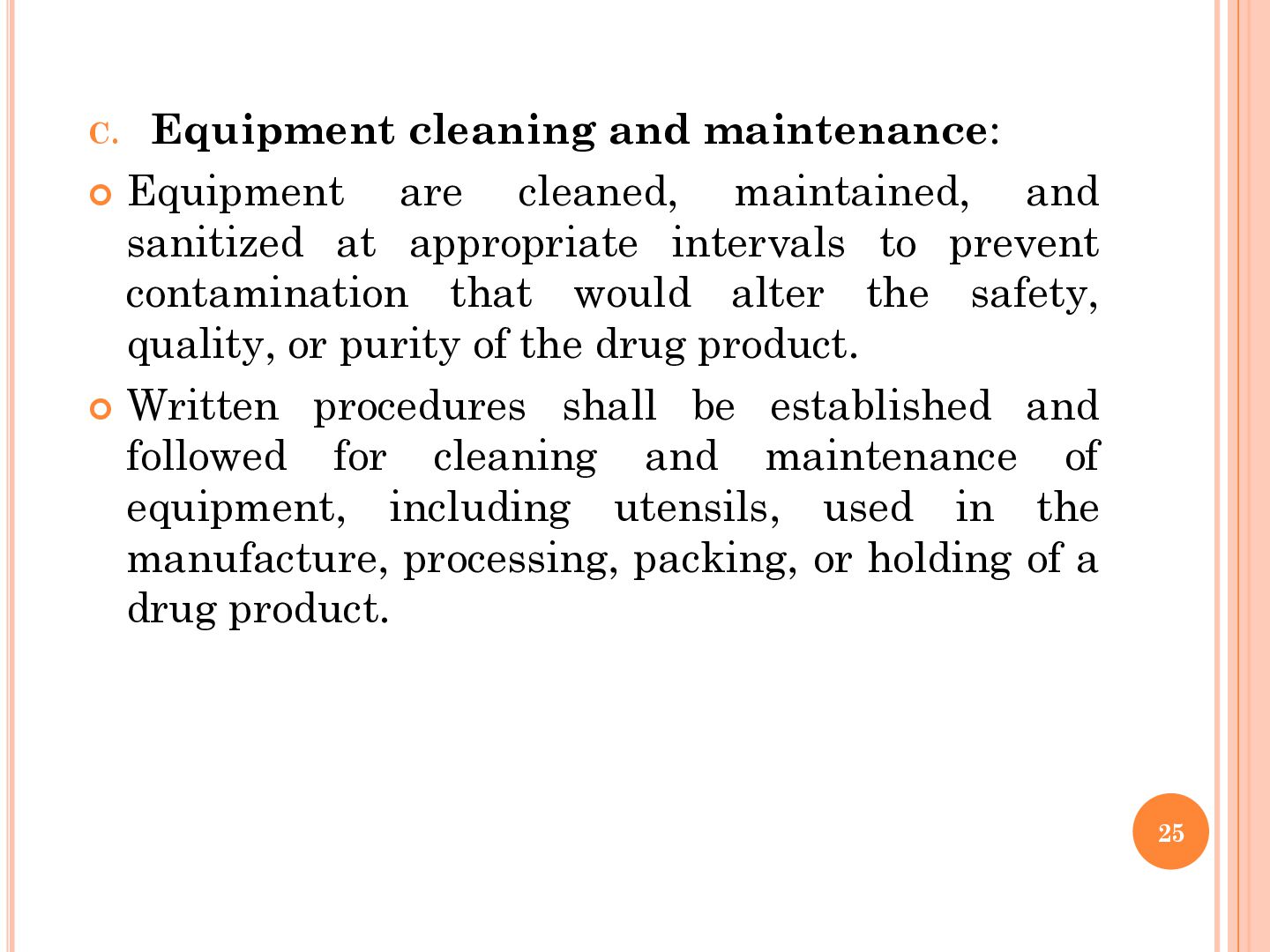
  22. C. Equipment cleaning and maintenance:  Equipment are cleaned, maintained,

    and sanitized at appropriate intervals to prevent contamination that would alter the safety, quality, or purity of the drug product.  Written procedures shall be established and followed for cleaning and maintenance of equipment, including utensils, used in the manufacture, processing, packing, or holding of a drug product. 25