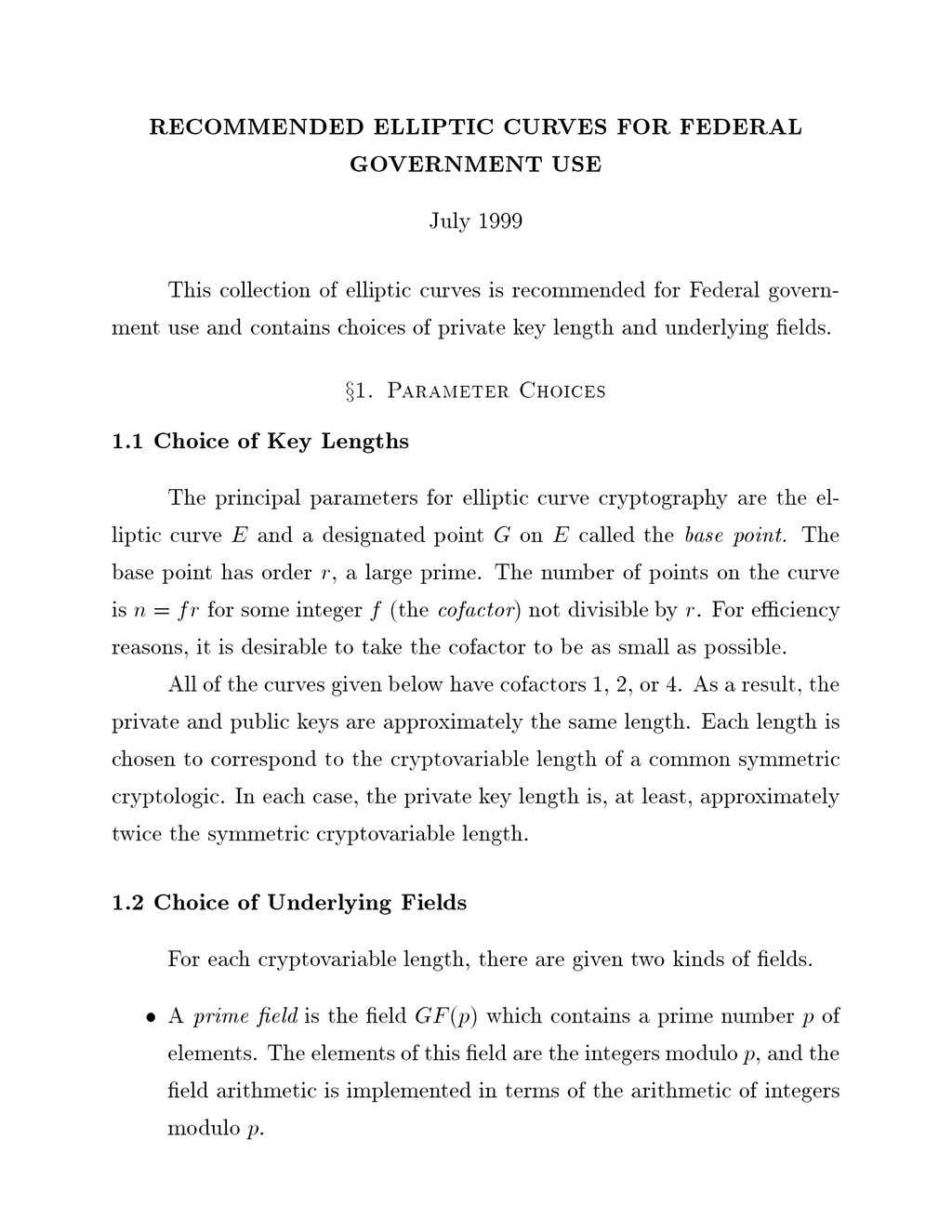
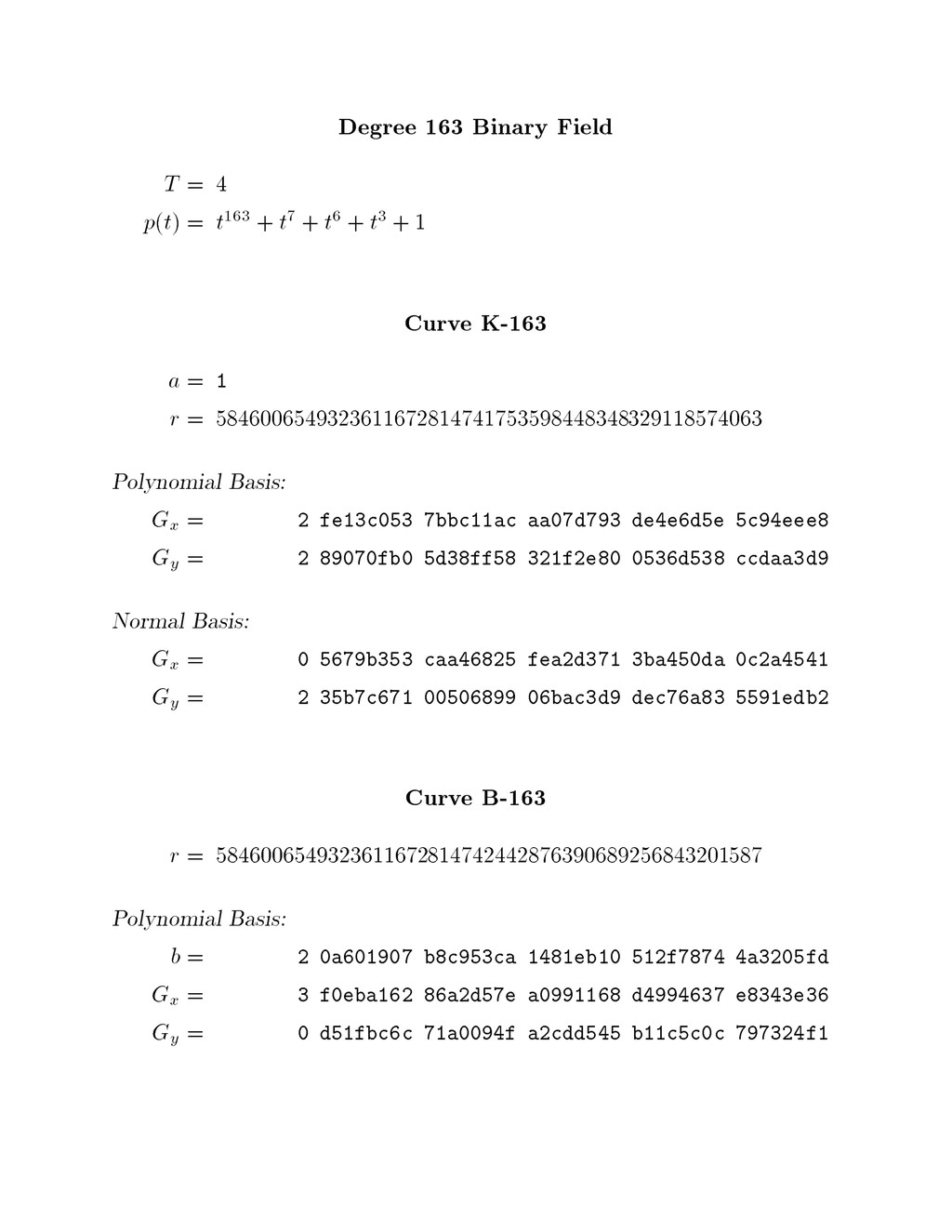
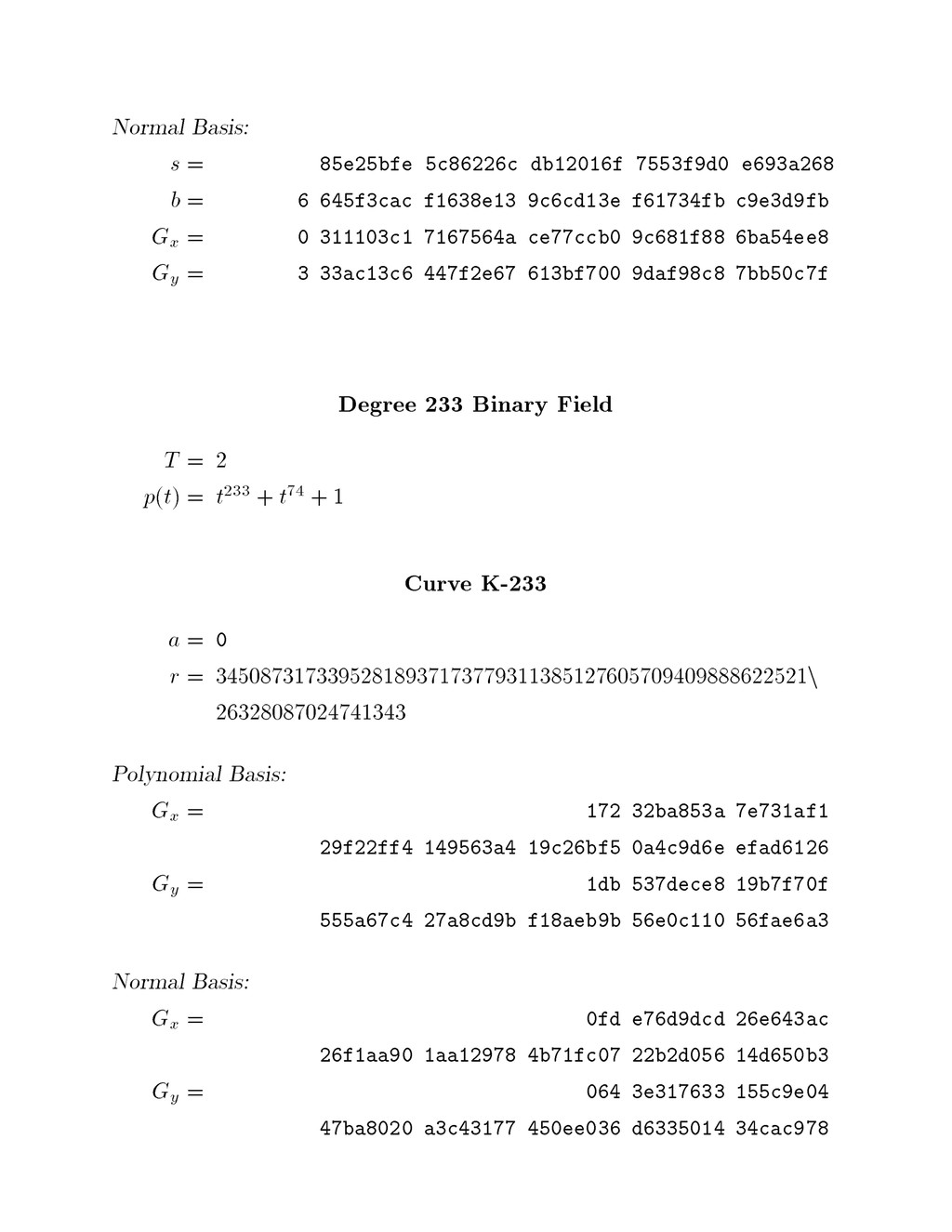
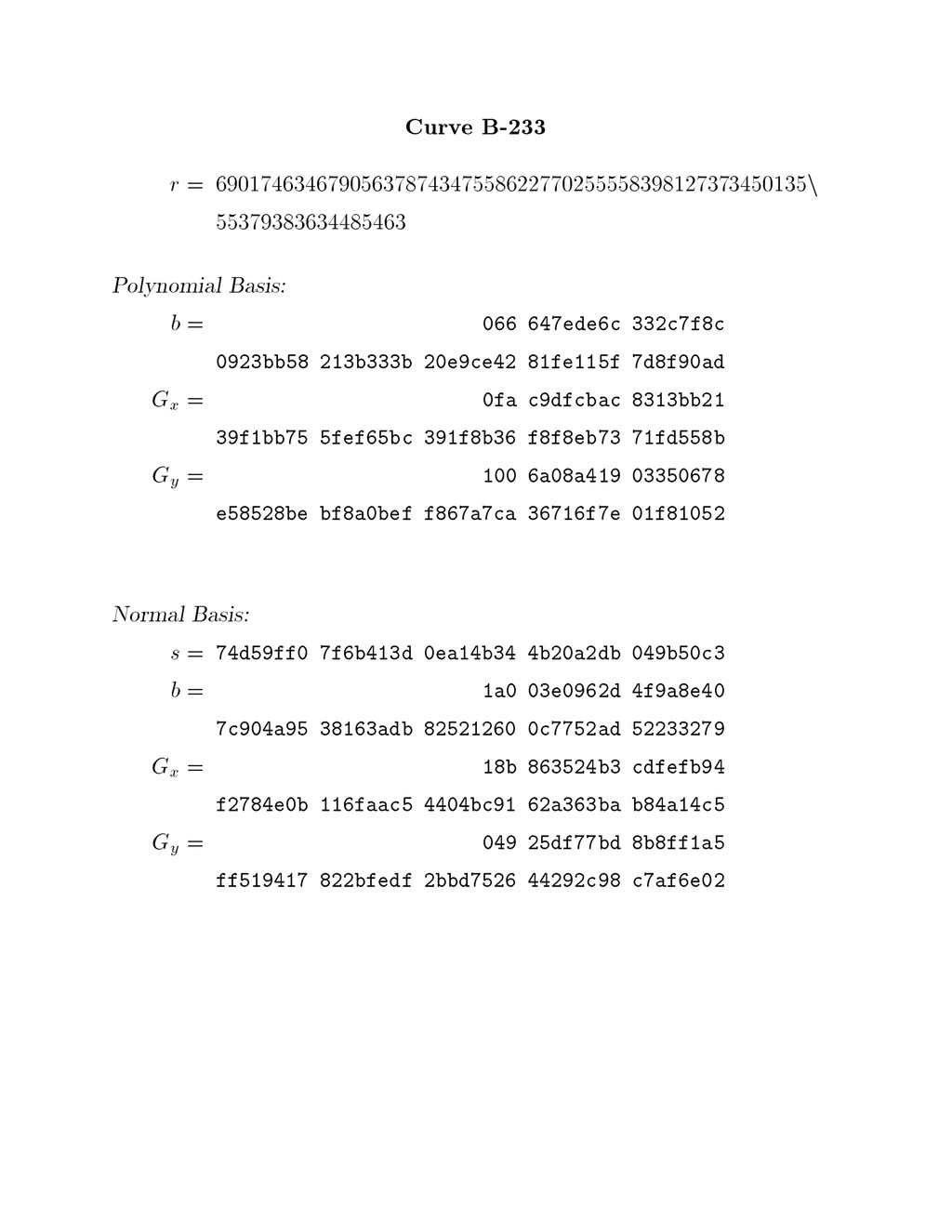
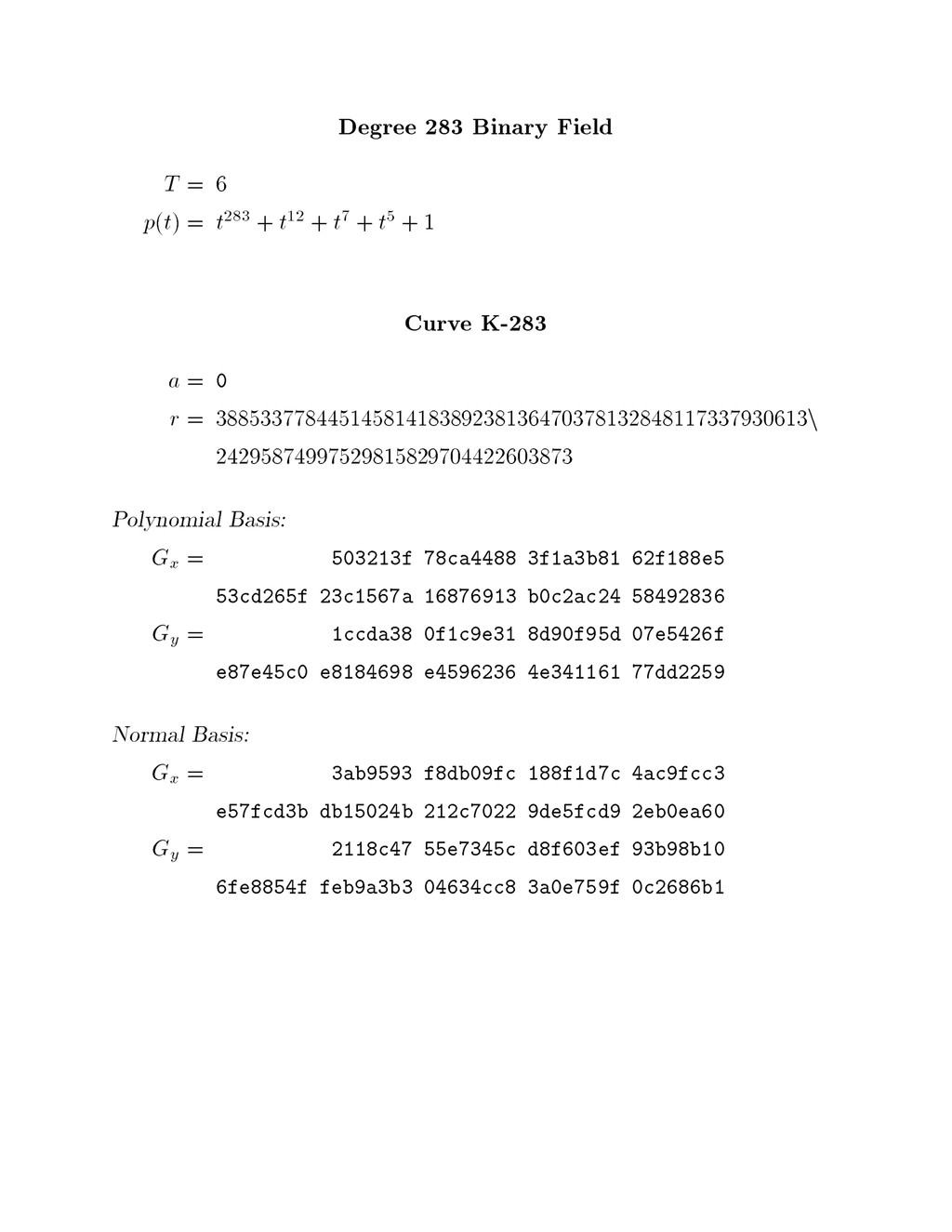
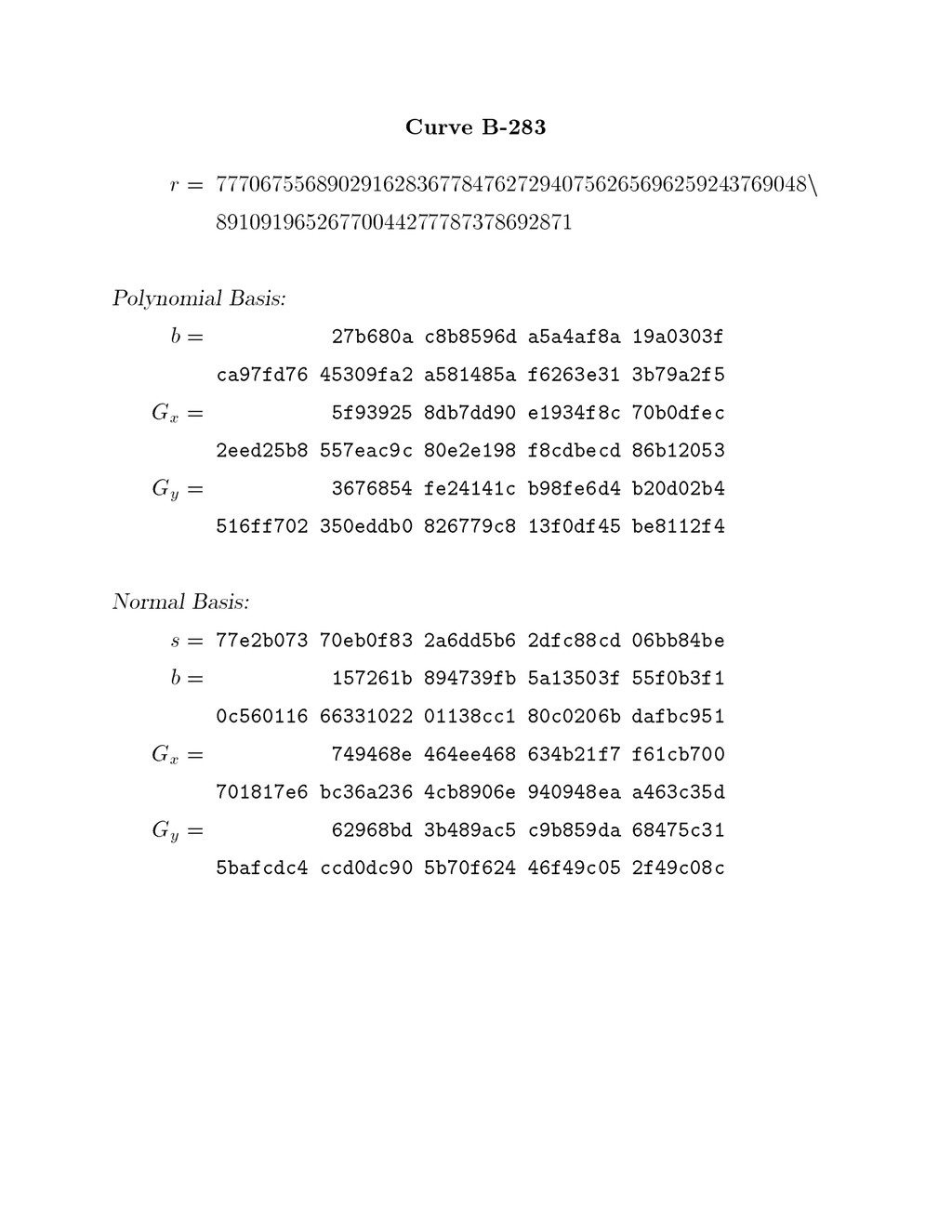
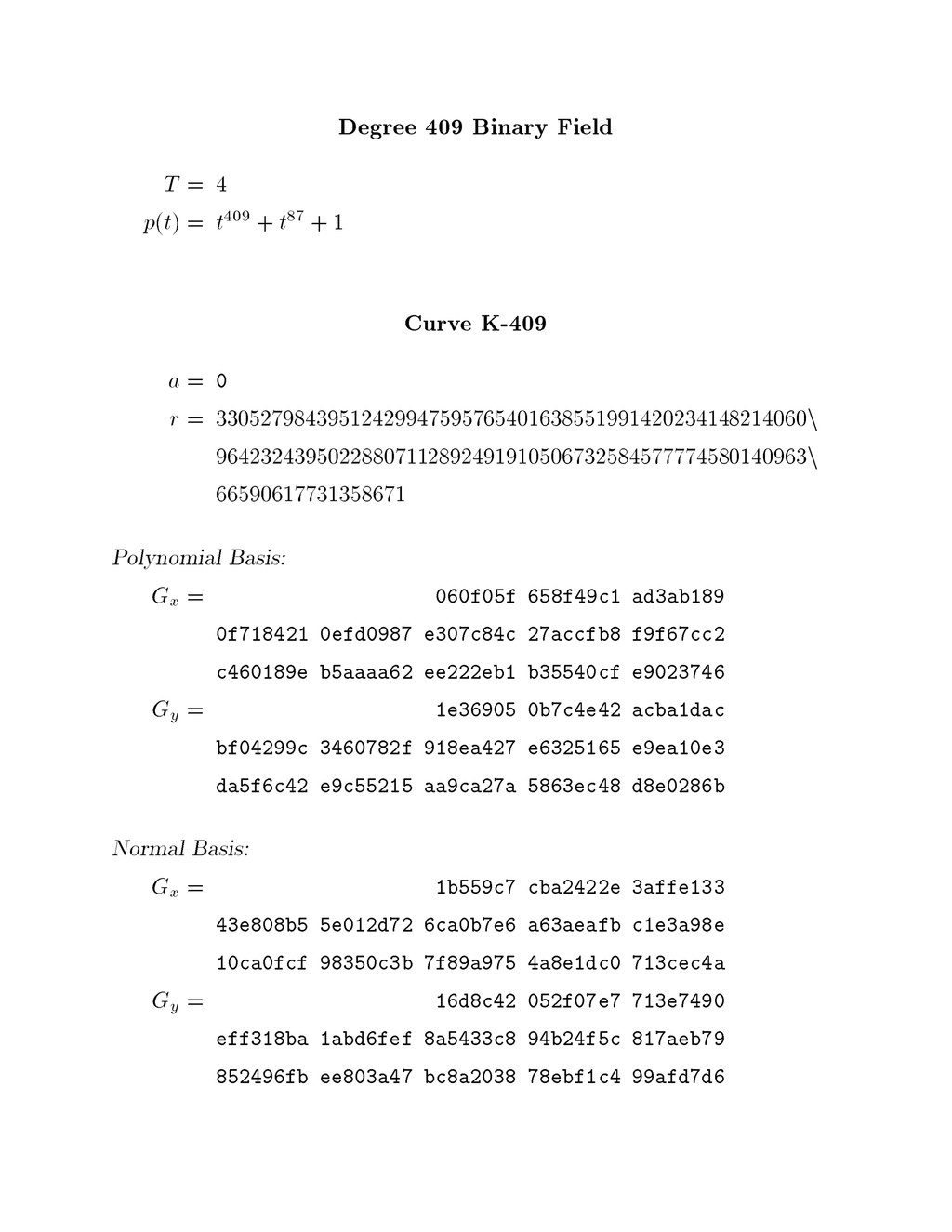
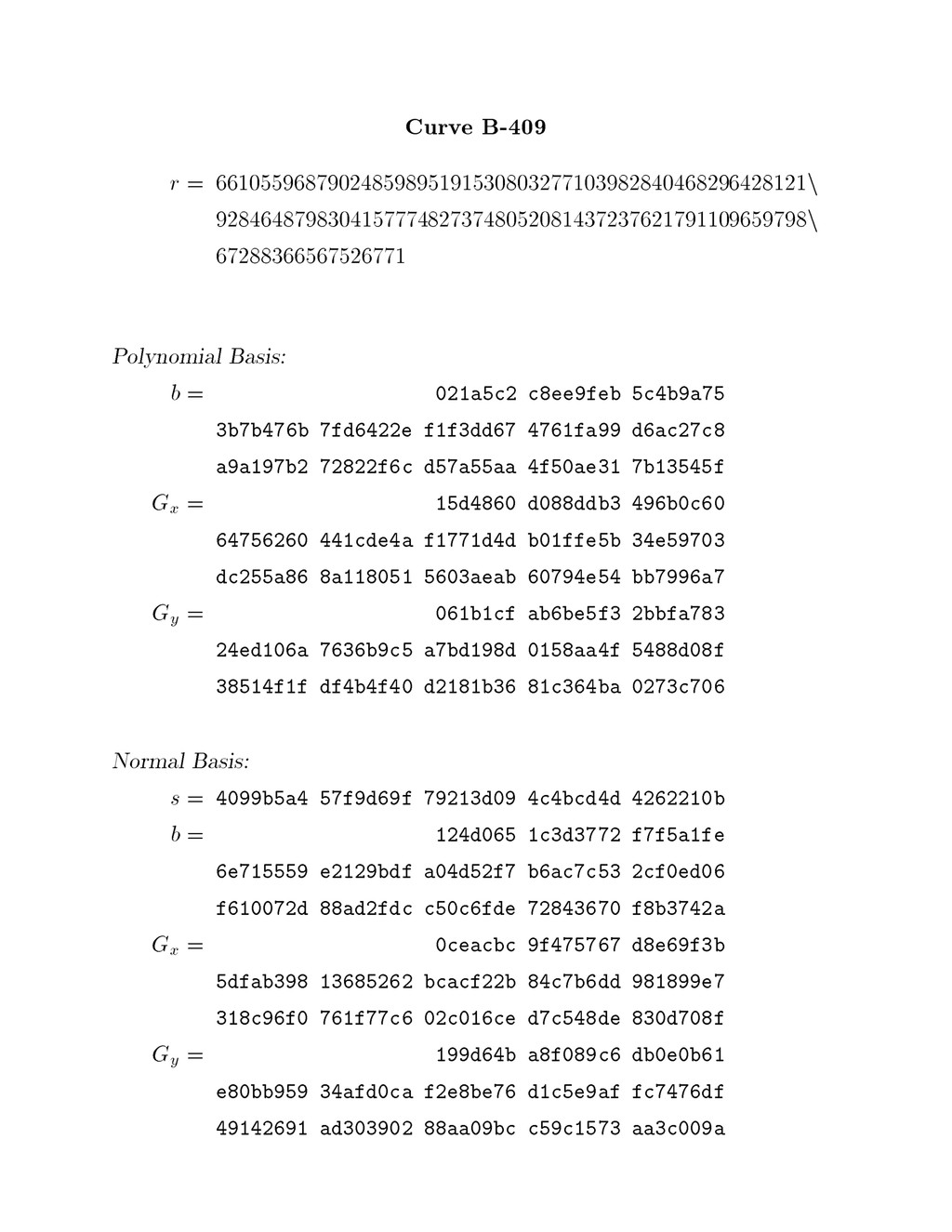
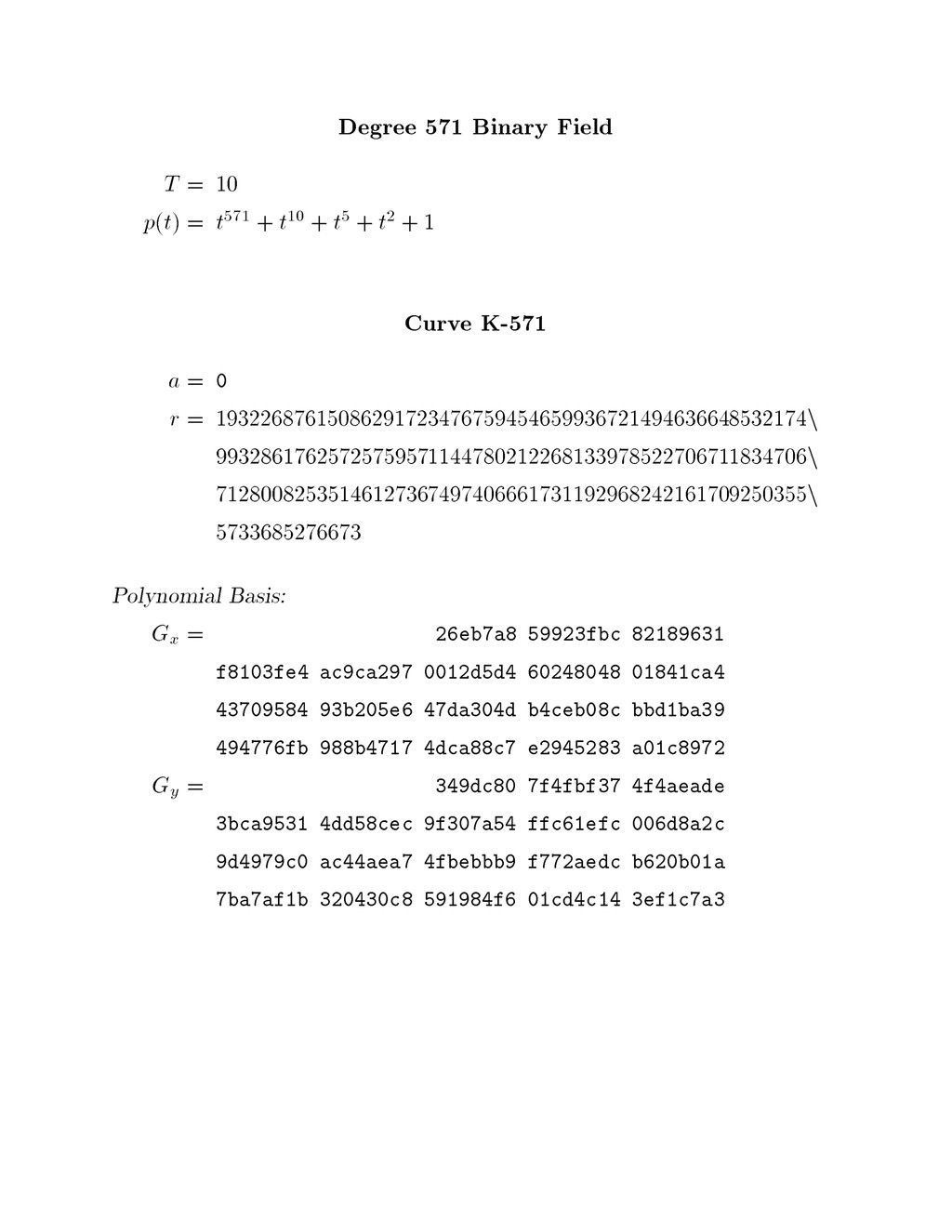
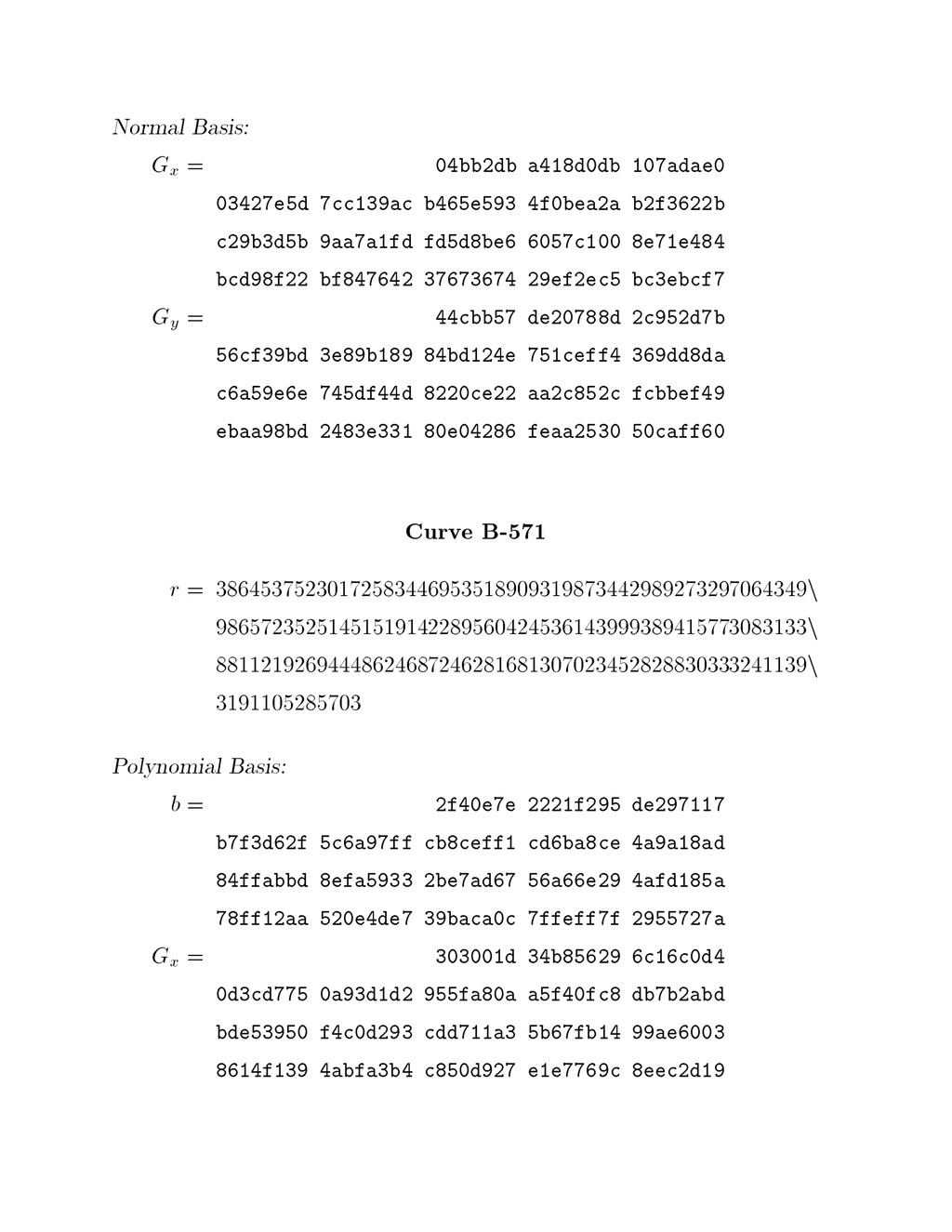
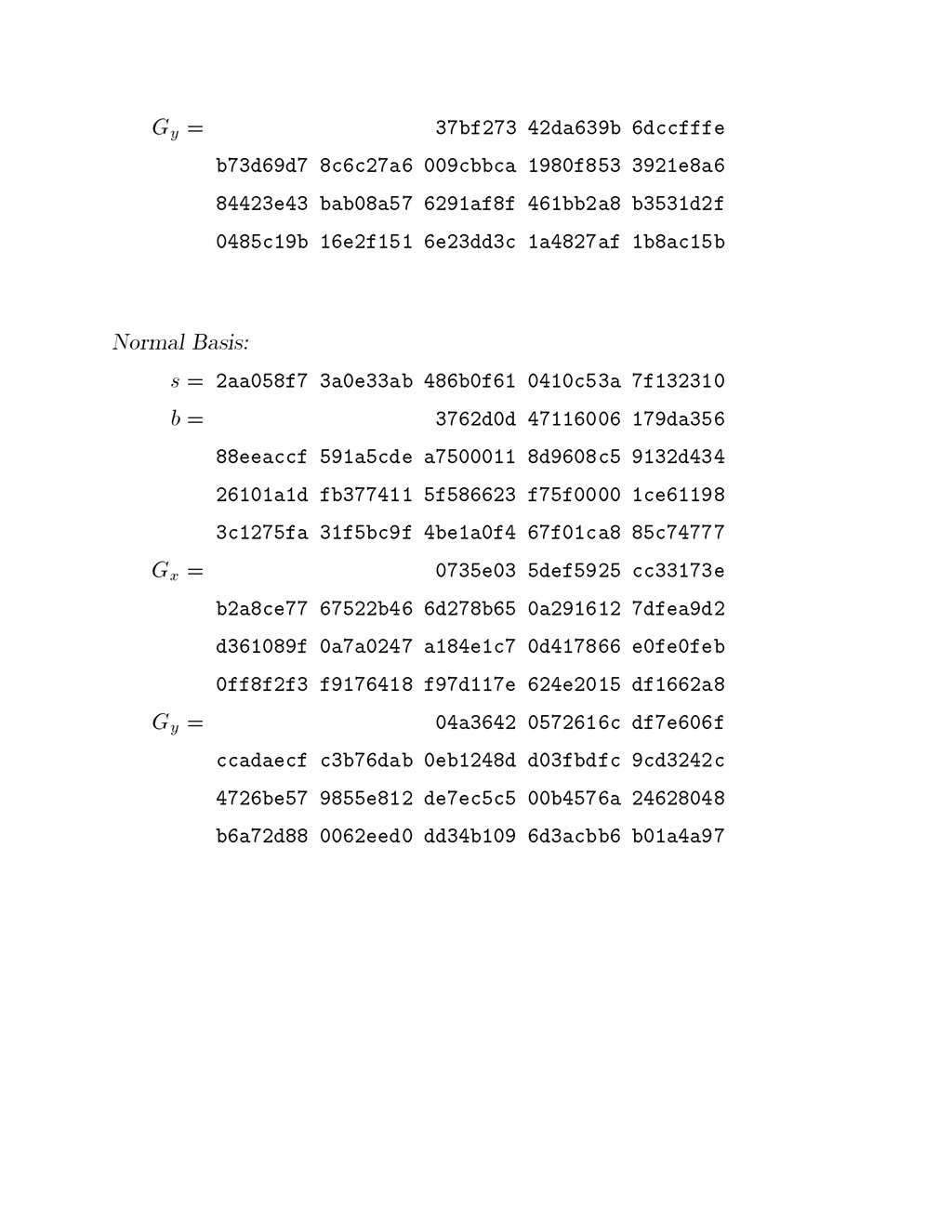
This collection of elliptic curves is recommended for Federal govern ment use and contains choices of private key length and underlying felds. §1. PARAMETER CHOICES 1.1 Choice of Key Lengths The principal parameters for elliptic curve cryptography are the el liptic curve E and a designated point G on E called the base point. The base point has order r, a large prime. The number of points on the curve is n = fr for some integer f (the cofactor) not divisible by r. For efciency reasons, it is desirable to take the cofactor to be as small as possible. All of the curves given below have cofactors 1, 2, or 4. As a result, the private and public keys are approximately the same length. Each length is chosen to correspond to the cryptovariable length of a common symmetric cryptologic. In each case, the private key length is, at least, approximately twice the symmetric cryptovariable length. 1.2 Choice of Underlying Fields For each cryptovariable length, there are given two kinds of felds. • A prime feld is the feld GF(p) which contains a prime number p of elements. The elements of this feld are the integers modulo p, and the feld arithmetic is implemented in terms of the arithmetic of integers modulo p.
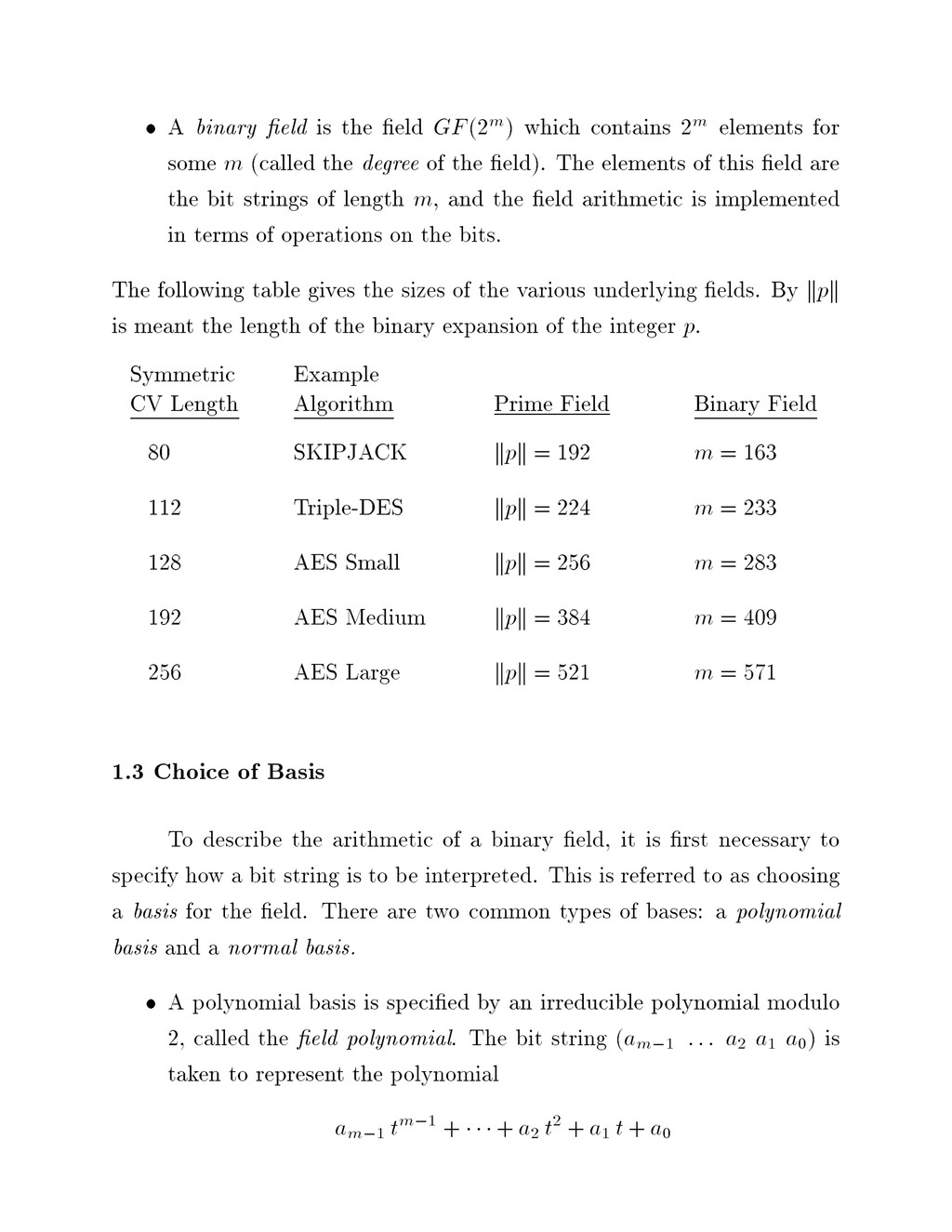
which contains 2 m elements for some m (called the degree of the feld). The elements of this feld are the bit strings of length m , and the feld arithmetic is implemented in terms of operations on the bits. The following table gives the sizes of the various underlying felds. By IpI is meant the length of the binary expansion of the integer p . Symmetric Example CV Length Algorithm Prime Field Binary Field 80 SKIPJACK IpI = 192 m = 163 112 Triple-DES IpI = 224 m = 233 128 AES Small IpI = 256 m = 283 192 AES Medium IpI = 384 m = 409 256 AES Large IpI = 521 m = 571 1.3 Choice of Basis To describe the arithmetic of a binary feld, it is frst necessary to specify how a bit string is to be interpreted. This is referred to as choosing a basis for the feld. There are two common types of bases: a polynomial basis and a normal basis. • A polynomial basis is specifed by an irreducible polynomial modulo 2, called the feld polynomial. The bit string (a m0l . . . a al ao) is 2 taken to represent the polynomial a m0l t m0l + 1 1 1 + a2 t 2 + al t + ao
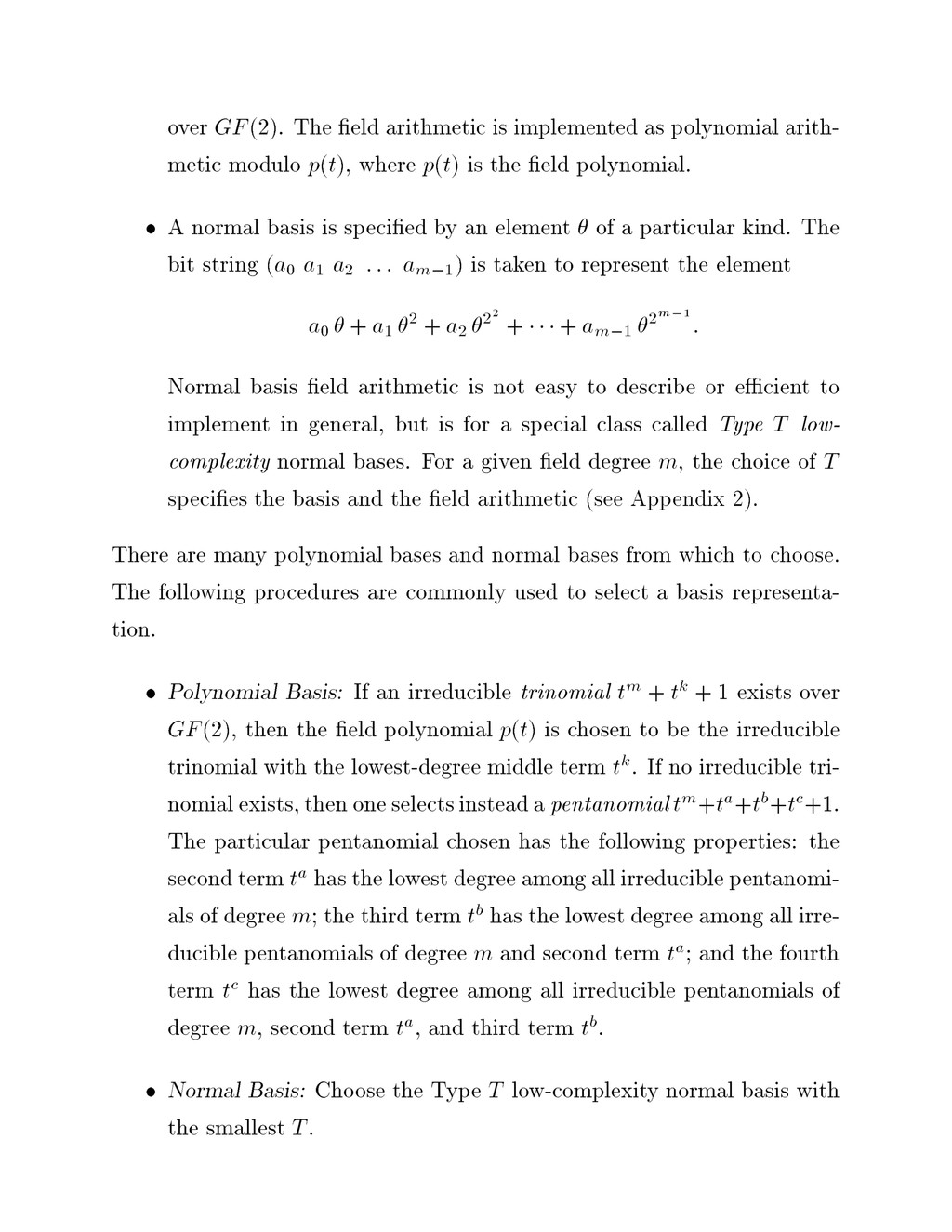
arith metic modulo p(t), where p(t) is the feld polynomial. • A normal basis is specifed by an element ( of a particular kind. The bit string (ao a1 a2 . . . am01 ) is taken to represent the element ao ( + a1 (2 + a2 (2� + 1 1 1 + am01 (2 �0� . Normal basis feld arithmetic is not easy to describe or efcient to implement in general, but is for a special class called Type T low complexity normal bases. For a given feld degree m, the choice of T specifes the basis and the feld arithmetic (see Appendix 2). There are many polynomial bases and normal bases from which to choose. The following procedures are commonly used to select a basis representa tion. • Polynomial Basis: If an irreducible trinomial tm + tk + 1 exists over GF(2), then the feld polynomial p(t) is chosen to be the irreducible trinomial with the lowestdegree middle term tk. If no irreducible tri nomial exists, then one selects instead a pentanomial tm+ta+tb+tc+1. The particular pentanomial chosen has the following properties: the second term ta has the lowest degree among all irreducible pentanomi als of degree m; the third term tb has the lowest degree among all irre ducible pentanomials of degree m and second term ta; and the fourth term tc has the lowest degree among all irreducible pentanomials of degree m, second term ta, and third term tb. • Normal Basis: Choose the Type T lowcomplexity normal basis with the smallest T.
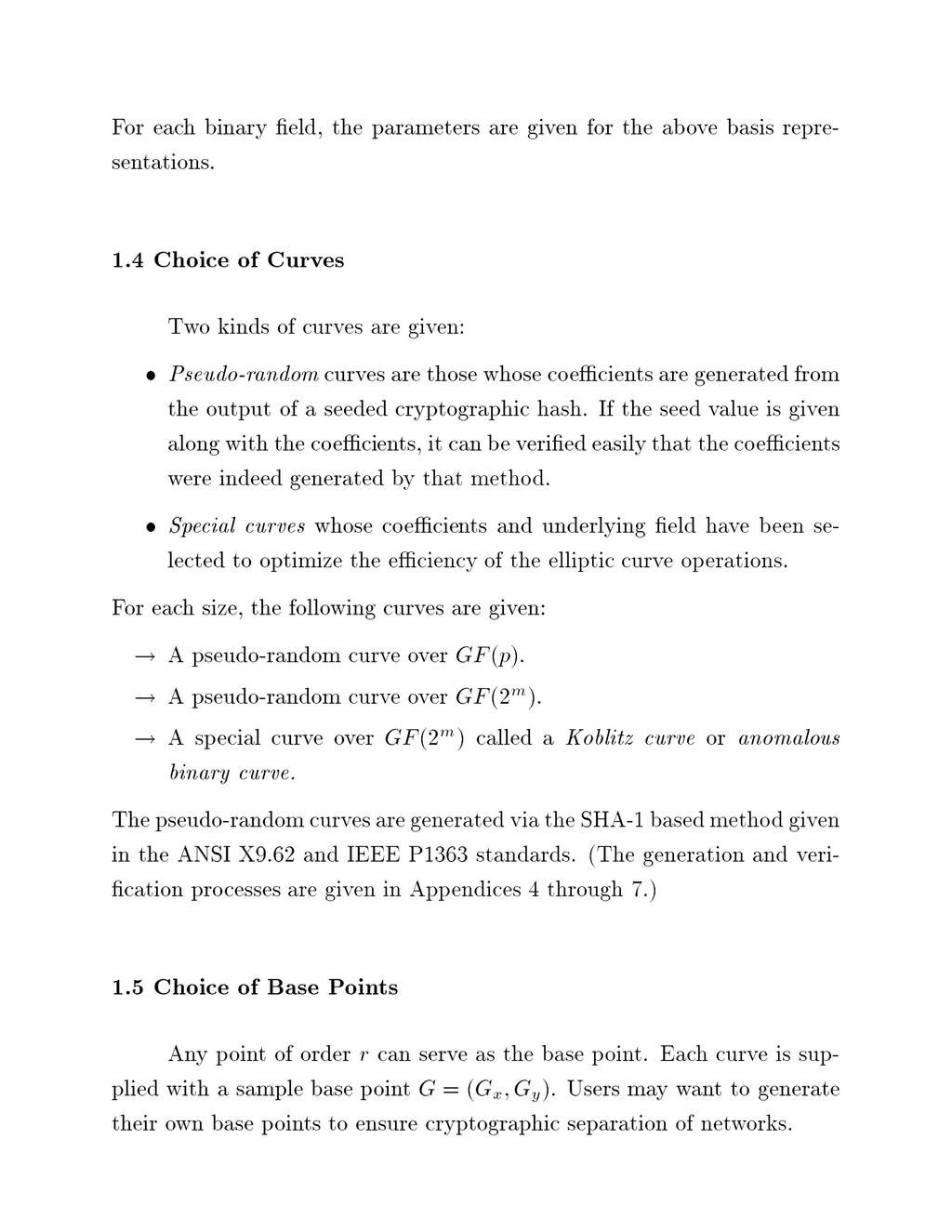
above basis repre sentations. 1.4 Choice of Curves Two kinds of curves are given: • Pseudo-random curves are those whose coefcients are generated from the output of a seeded cryptographic hash. If the seed value is given along with the coefcients, it can be verifed easily that the coefcients were indeed generated by that method. • Special curves whose coefcients and underlying feld have been se lected to optimize the efciency of the elliptic curve operations. For each size, the following curves are given: - A pseudorandom curve over GF (p ). - A pseudorandom curve over GF (2 m). - A special curve over GF (2 m ) called a Koblitz curve or anomalous binary curve. The pseudorandom curves are generated via the SHAl based method given in the ANSI X9.62 and IEEE Pl363 standards. (The generation and veri fcation processes are given in Appendices 4 through 7.) 1.5 Choice of Base Points Any point of order r can serve as the base point. Each curve is sup plied with a sample base point G = (G x, G y ). Users may want to generate their own base points to ensure cryptographic separation of networks.
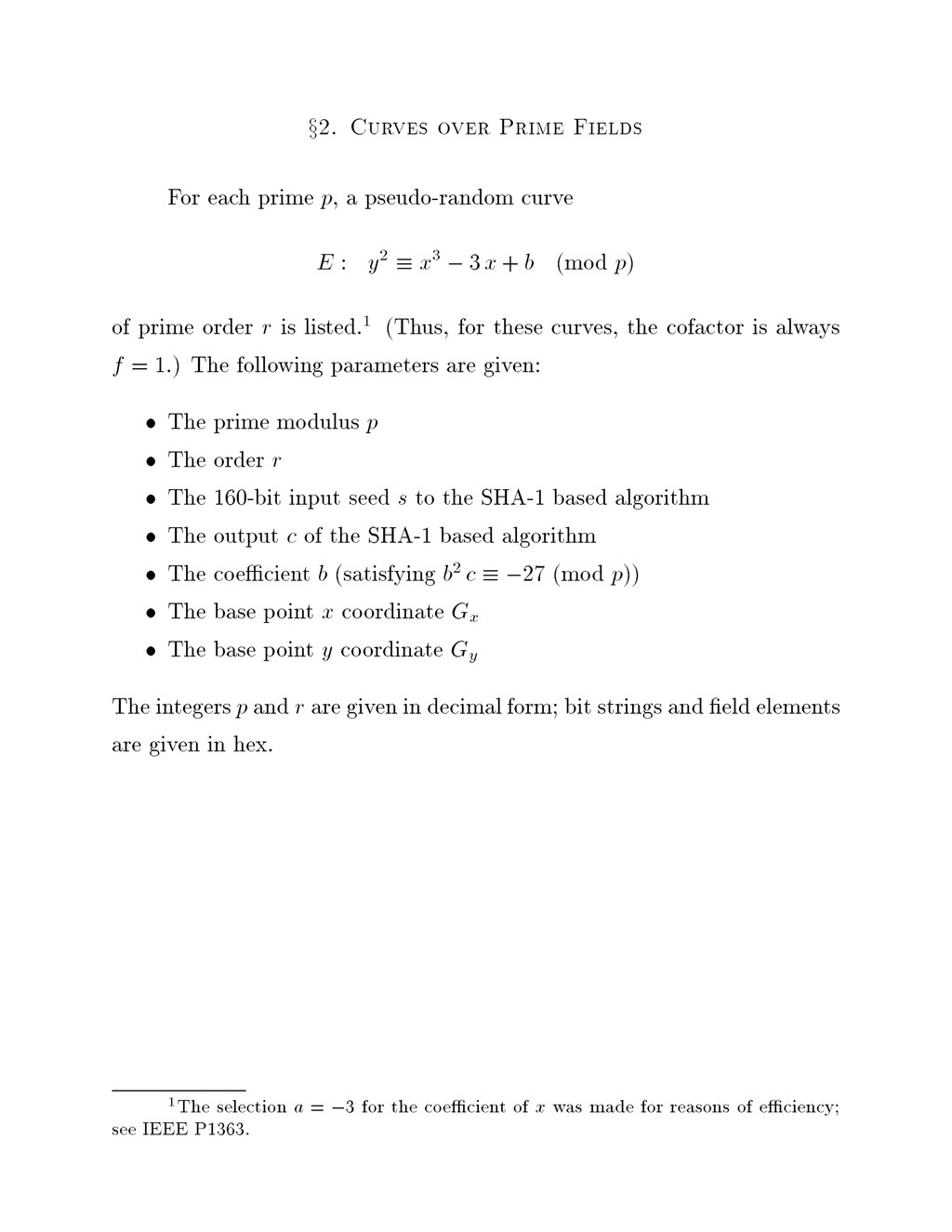
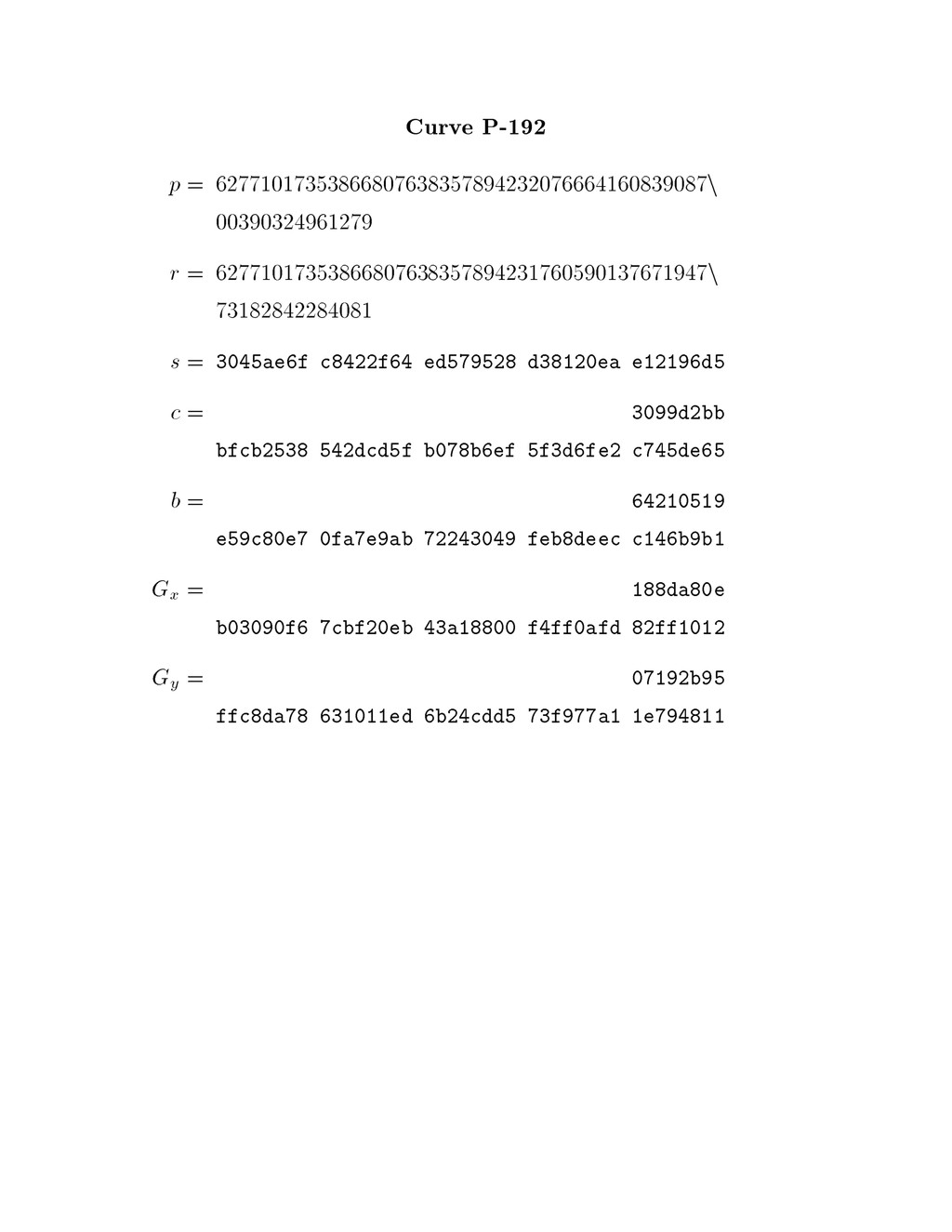
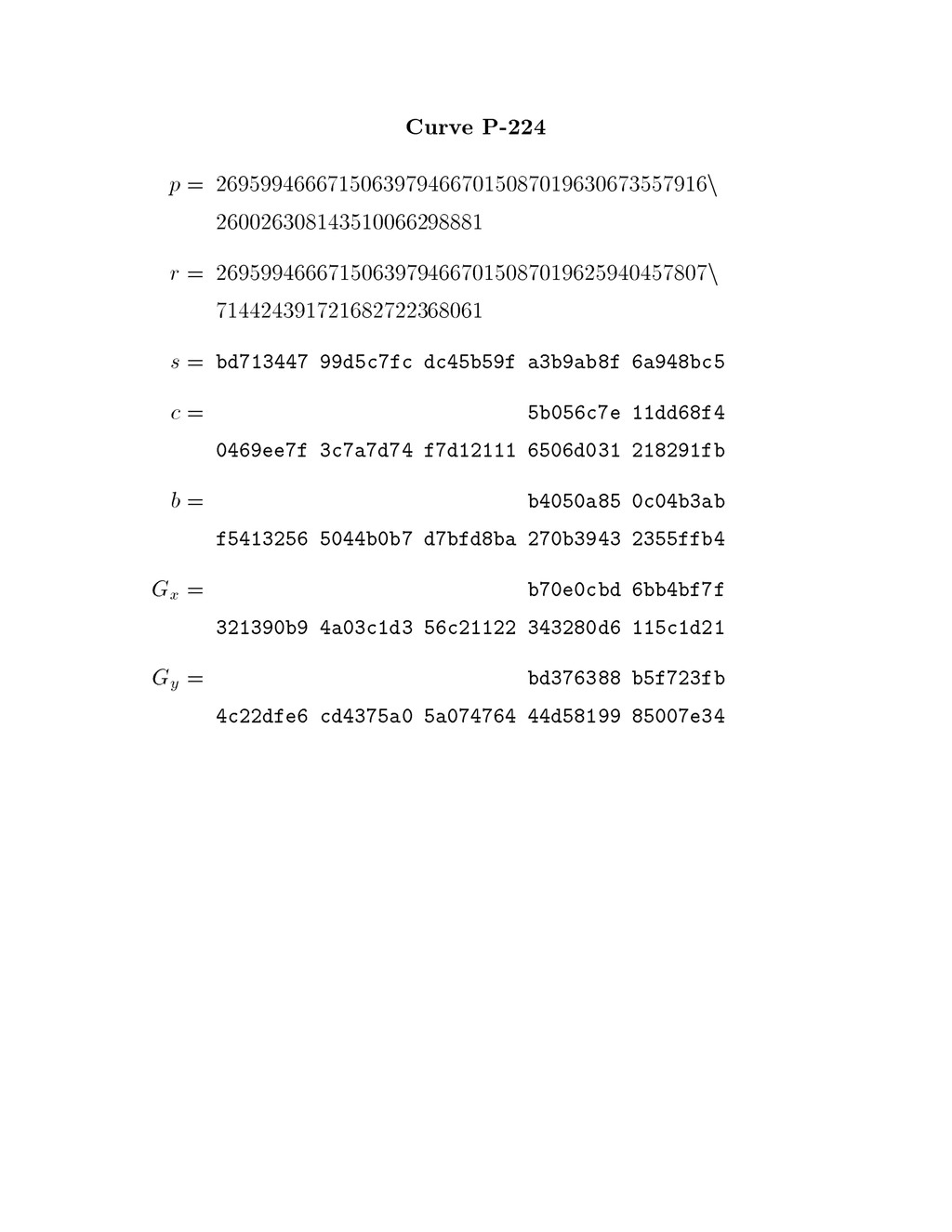
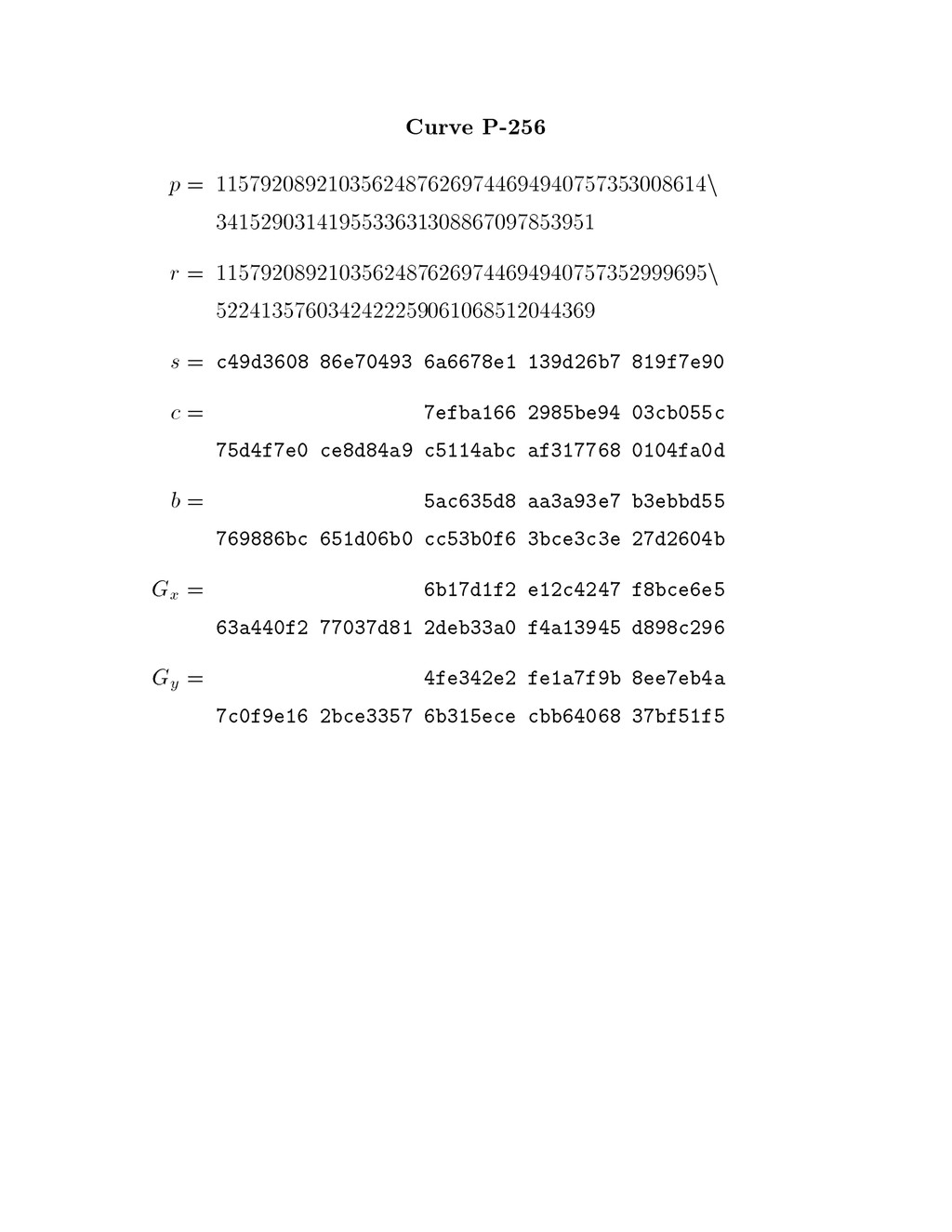
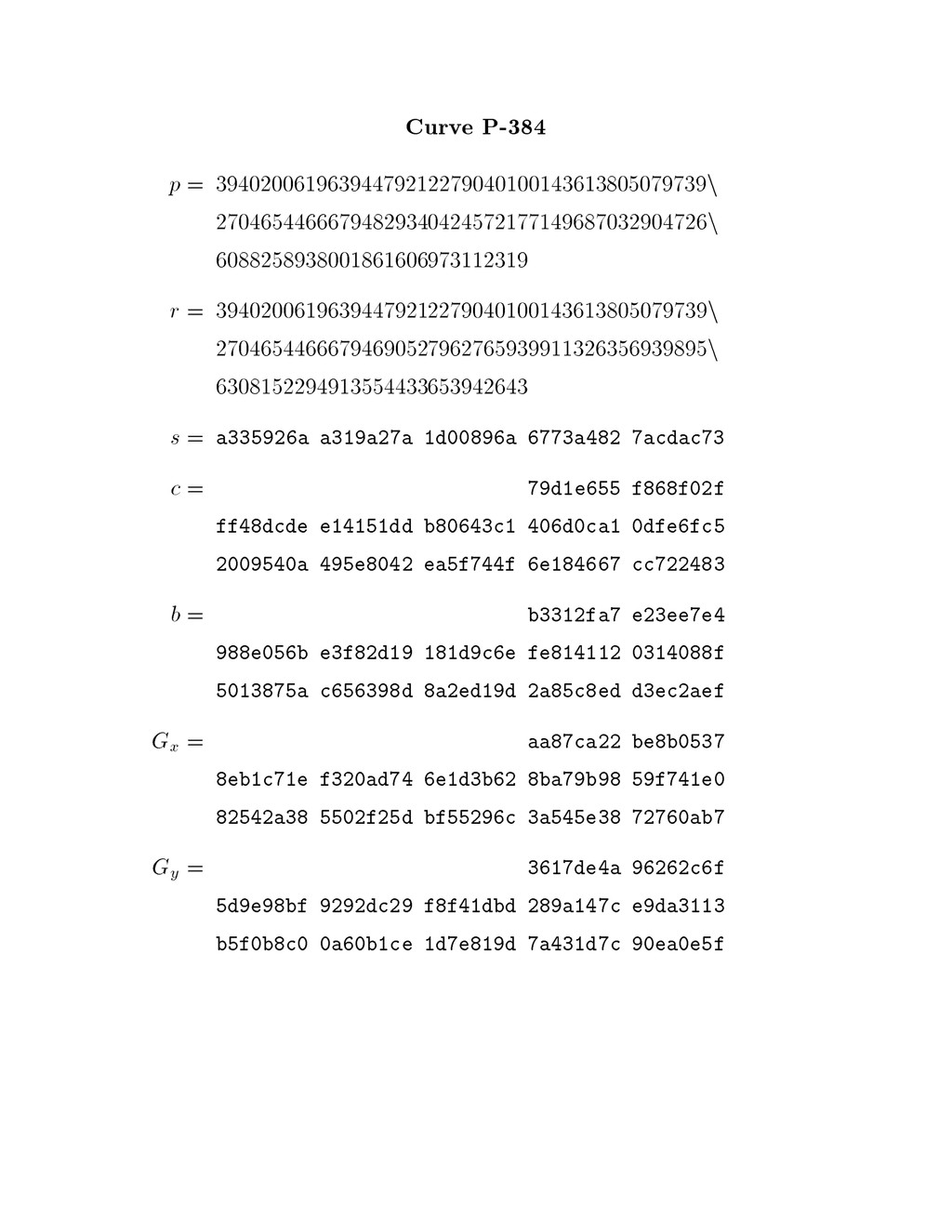
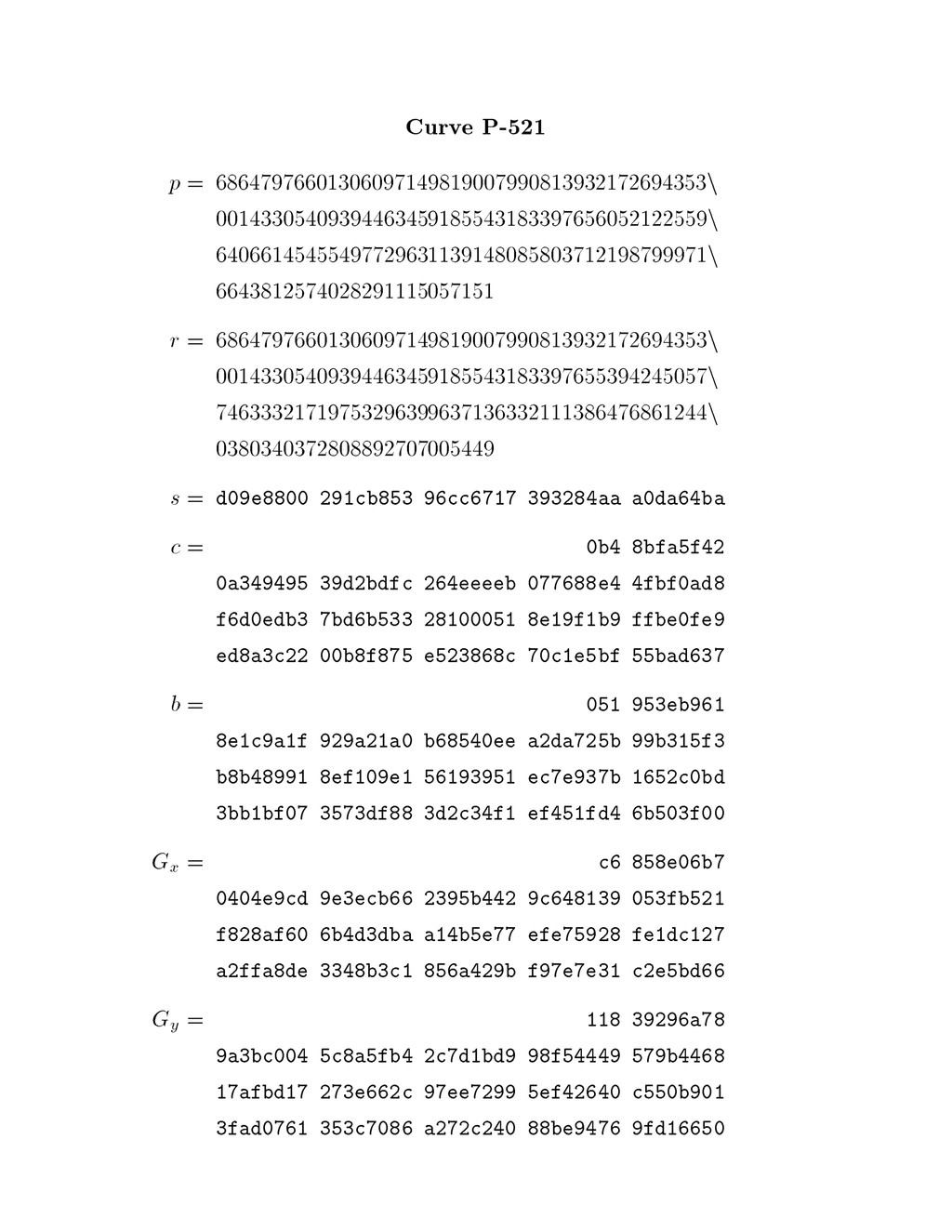
pseudo-random curve E : y2 x3 0 3 x + b (mod p) of prime order r is listed.1 (Thus, for these curves, the cofactor is always f = 1.) The following parameters are given: • The prime modulus p • The order r • The 160-bit input seed s to the SHA-1 based algorithm • The output c of the SHA-1 based algorithm • The coefcient b (satisfying b2 c 027 (mod p)) • The base point x coordinate Gx • The base point y coordinate Gy The integers p and r are given in decimal form; bit strings and feld elements are given in hex. 1 The selection a = 03 for the coefcient of x was made for reasons of efciency; see IEEE P1363.
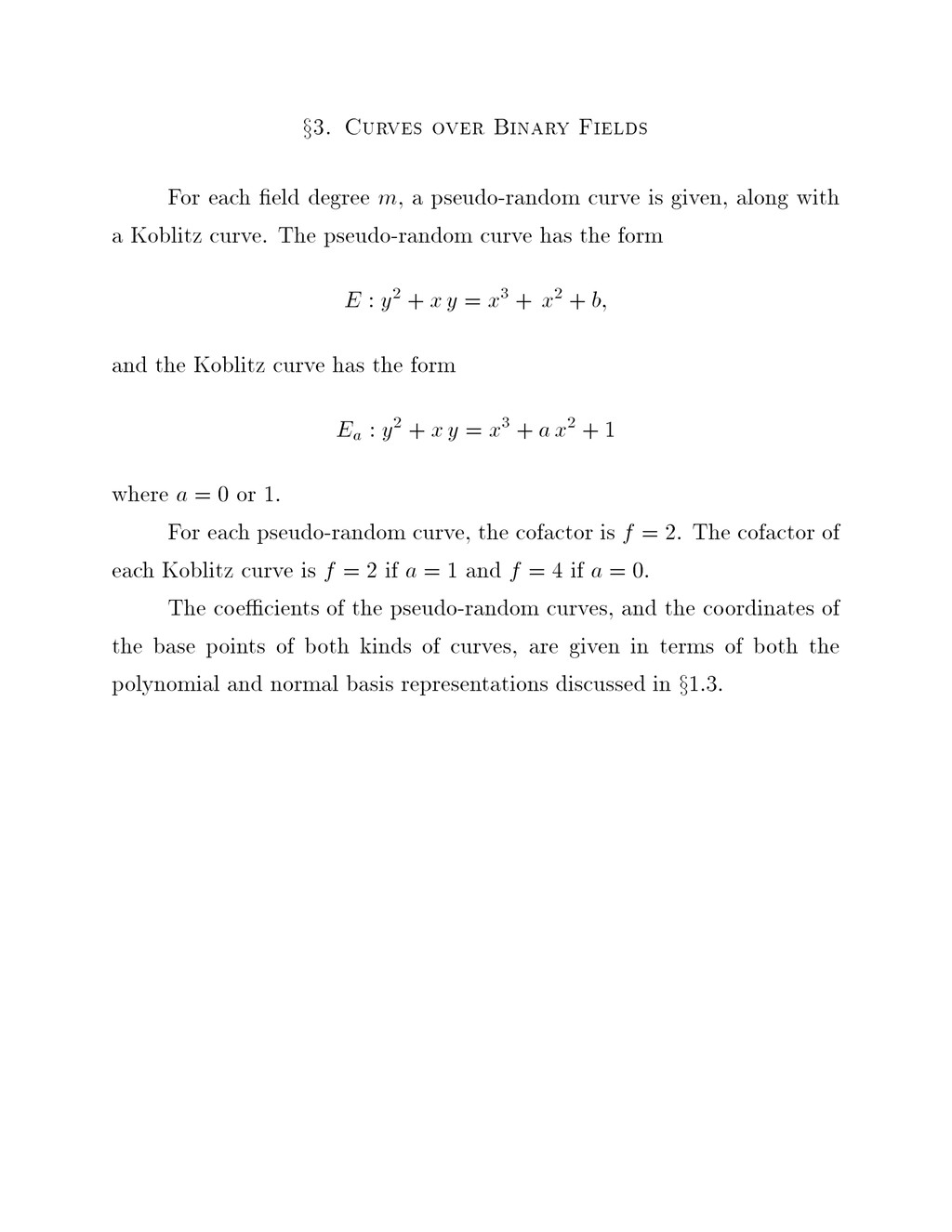
, a pseudo-random curve is given, along with a Koblitz curve. The pseudo-random curve has the form � � � � � � � = � � � � � � �� and the Koblitz curve has the form �� � � � � � � = � � � a � � � 1 where a = o or 1. For each pseudo-random curve, the cofactor is f = 2. The cofactor of each Koblitz curve is f = 2 if a = 1 and f = 4 if a = o. The coefcients of the pseudo-random curves, and the coordinates of the base points of both kinds of curves, are given in terms of both the polynomial and normal basis representations discussed in §1.3.
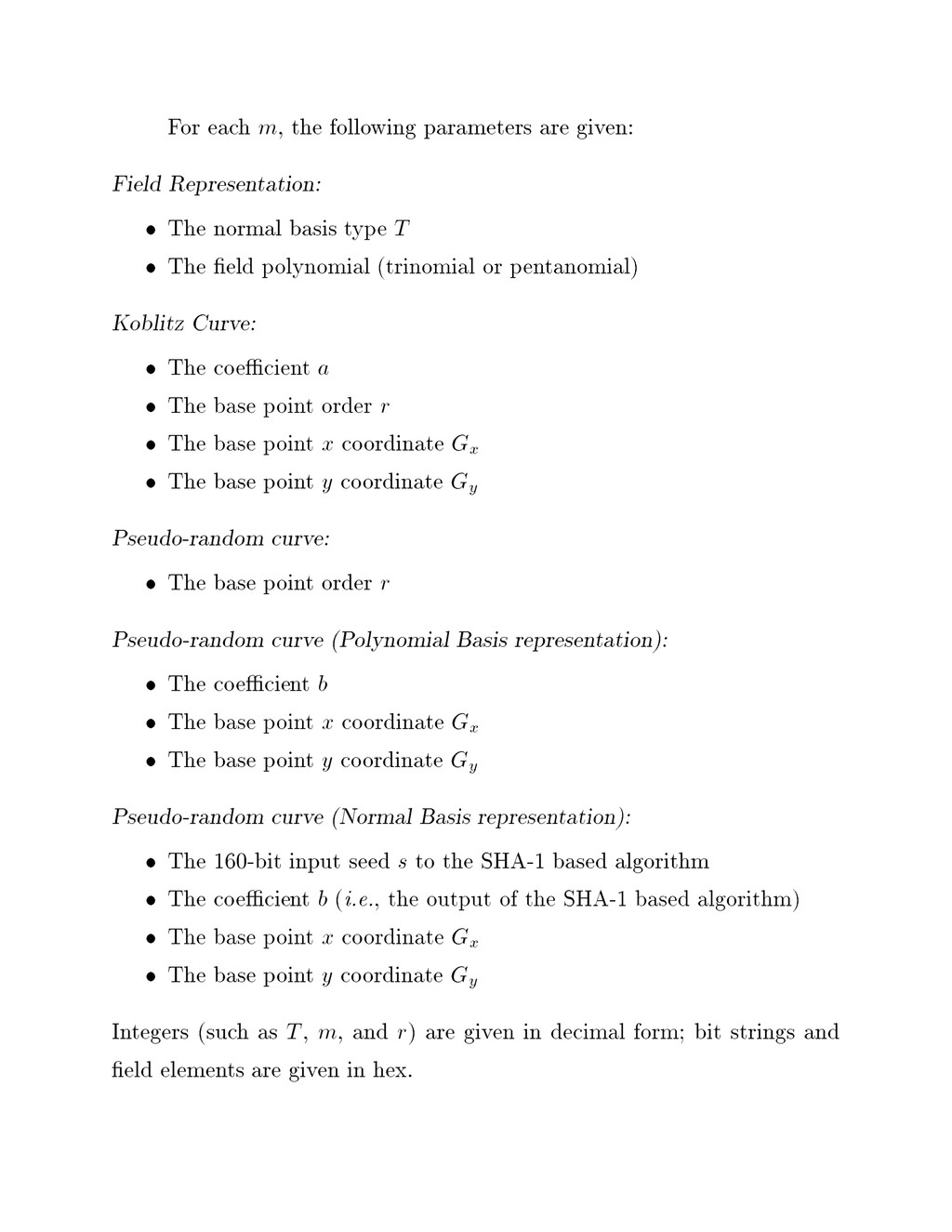
• The normal basis type T • The feld polynomial (trinomial or pentanomial) Ioblitz Curve: • The coefcient a • The base point order r • The base point x coordinate Gx • The base point y coordinate Gy Pseudo-random curve: • The base point order r Pseudo-random curve (Polynomial Basis representation): • The coefcient b • The base point x coordinate Gx • The base point y coordinate Gy Pseudo-random curve (Normal Basis representation): • The l60-bit input seed s to the SHA-l based algorithm • The coefcient b (i.e. , the output of the SHA-l based algorithm) • The base point x coordinate Gx • The base point y coordinate Gy Integers (such as T, m, and r) are given in decimal form; bit strings and feld elements are given in hex.
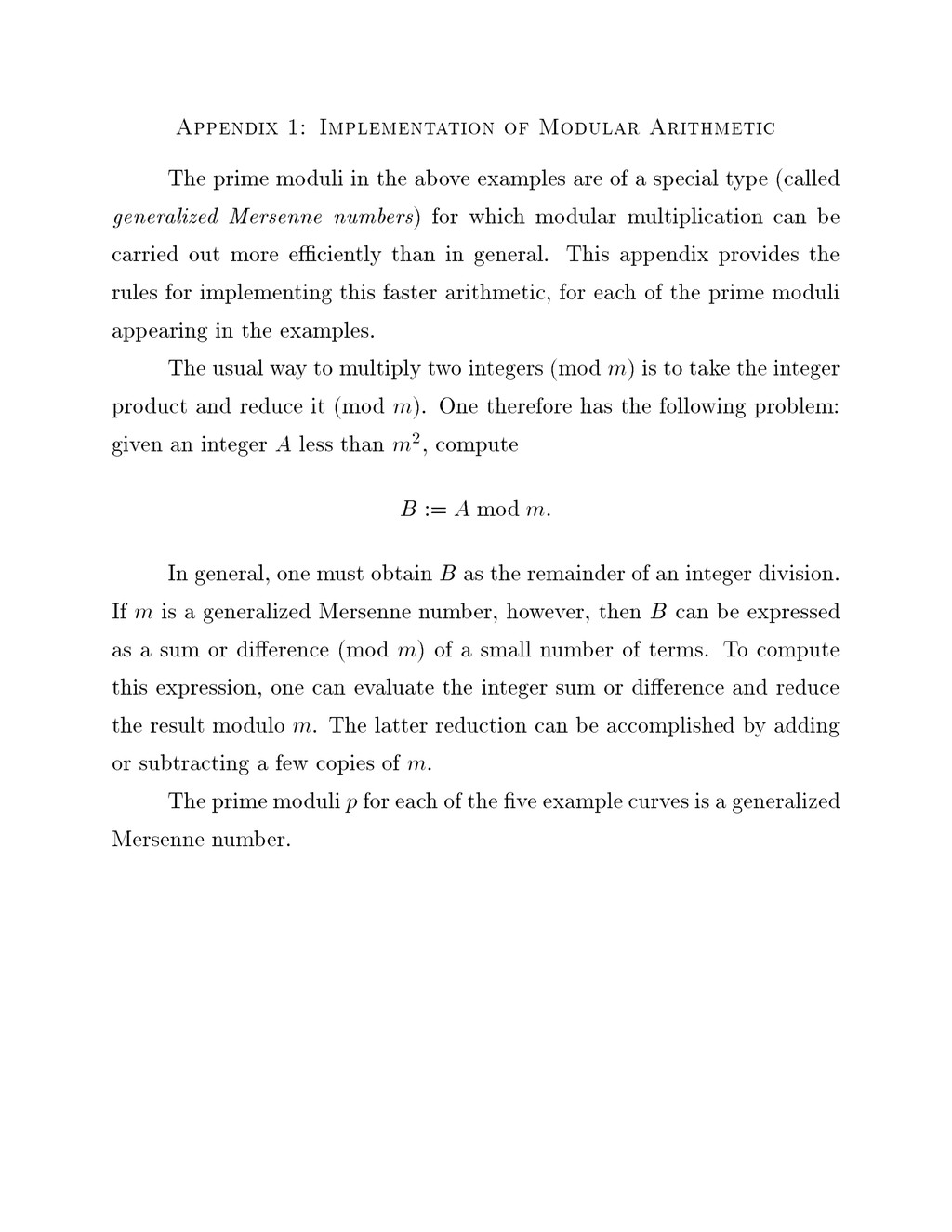
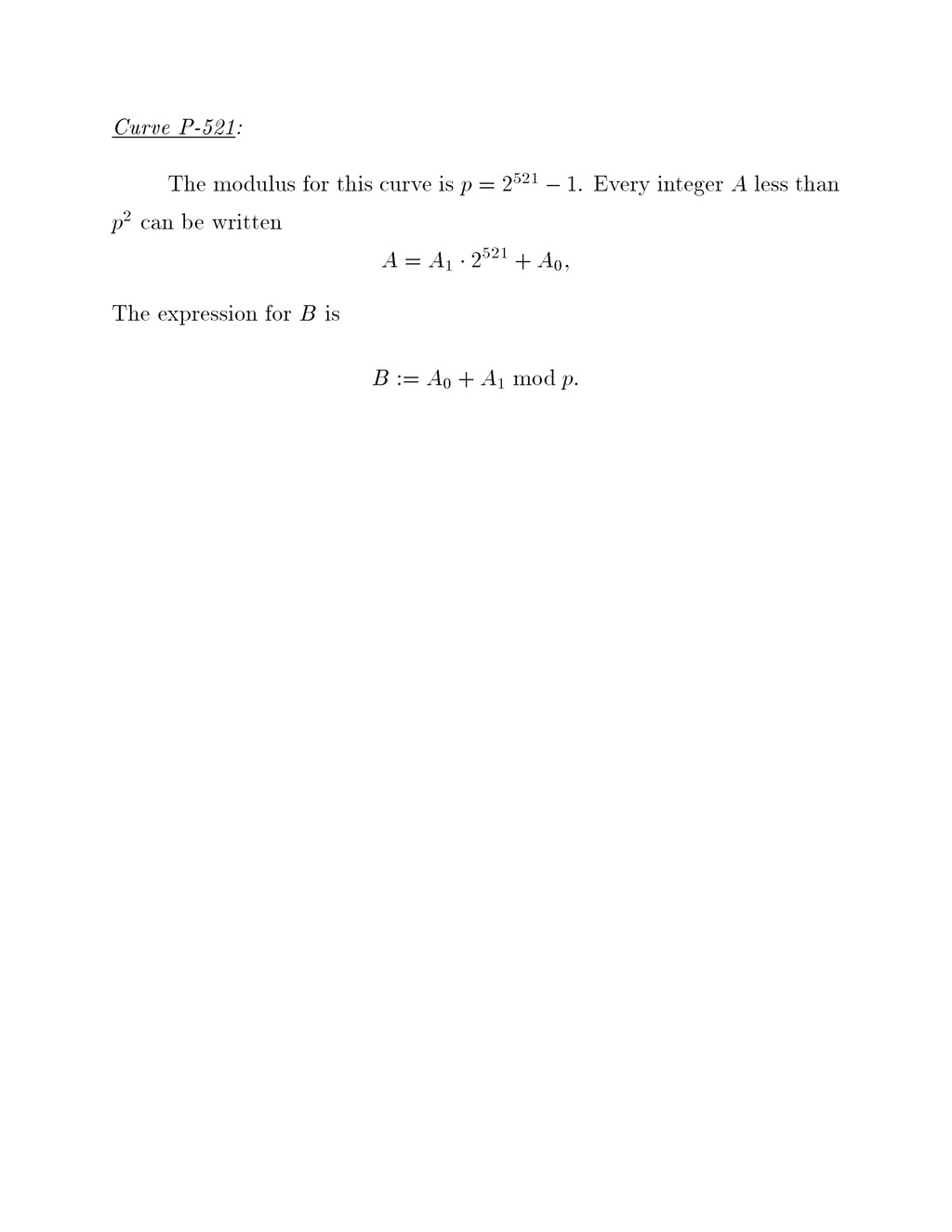
the above examples are of a special type (called generalized Mersenne numbers) for which modular multiplication can be carried out more efciently than in general. This appendix provides the rules for implementing this faster arithmetic, for each of the prime moduli appearing in the examples. The usual way to multiply two integers (mod m ) is to take the integer product and reduce it (mod m ). One therefore has the following problem: given an integer A less than m 2 , compute B := A mod m. In general, one must obtain B as the remainder of an integer division. If m is a generalized Mersenne number, however, then B can be expressed as a sum or diference (mod m ) of a small number of terms. To compute this expression, one can evaluate the integer sum or diference and reduce the result modulo m . The latter reduction can be accomplished by adding or subtracting a few copies of m . The prime moduli p for each of the fve example curves is a generalized Mersenne number.
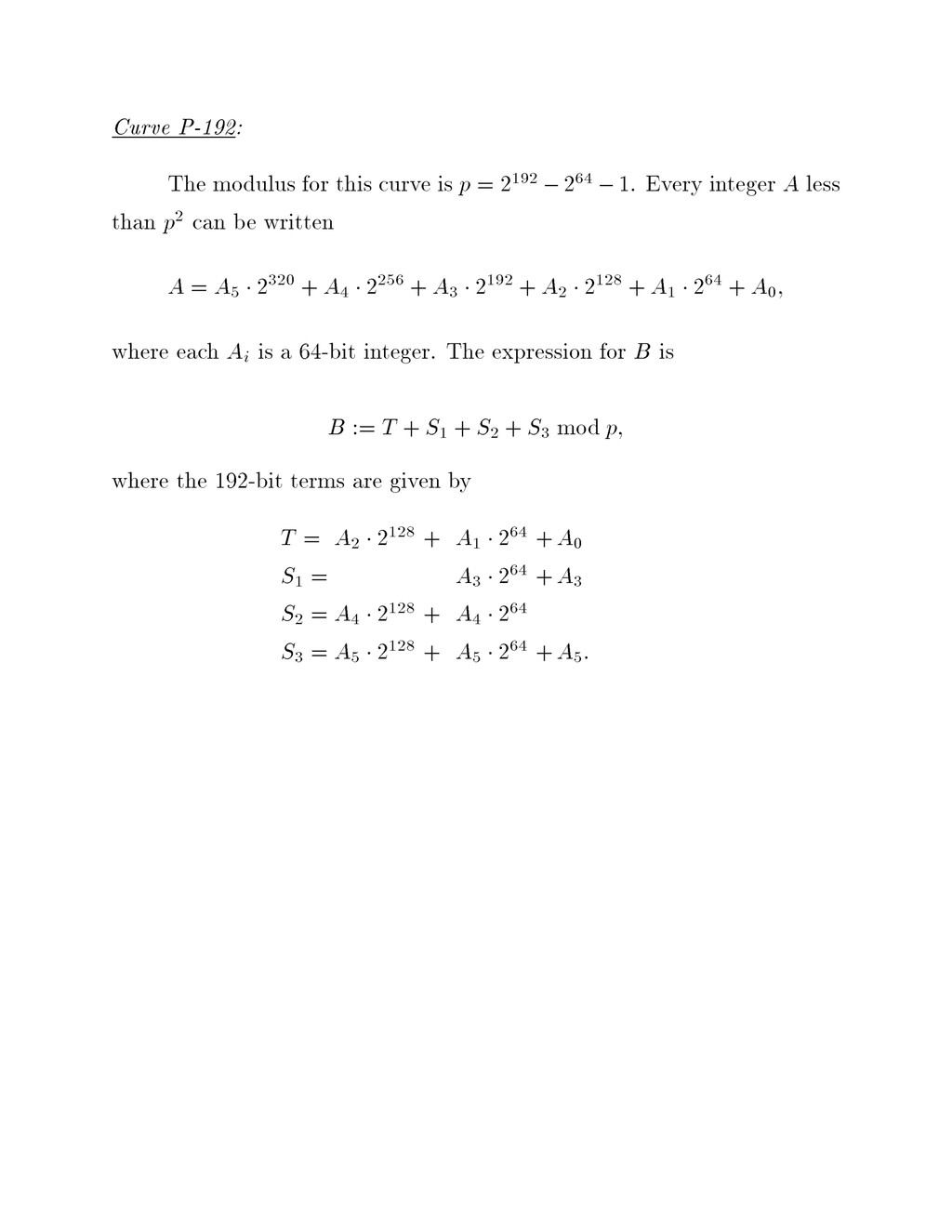
p = 2192 0 1. Every integer A less than p 2 can be written A = A5 1 2320 + A4 1 2256 + A3 1 2192 + A2 1 2128 + A1 1 264 + A0, where each Ai is a 64-bit integer. The expression for B is B := T + 81 + 82 + 83 mod p, where the 192-bit terms are given by A2 1 2128 + A1 1 264 + A0 A T = 3 1 264 8 8 81 = + A3 2 = A4 1 2128 + A4 1 264 3 = A5 1 2128 + A5 1 264 + A5 .
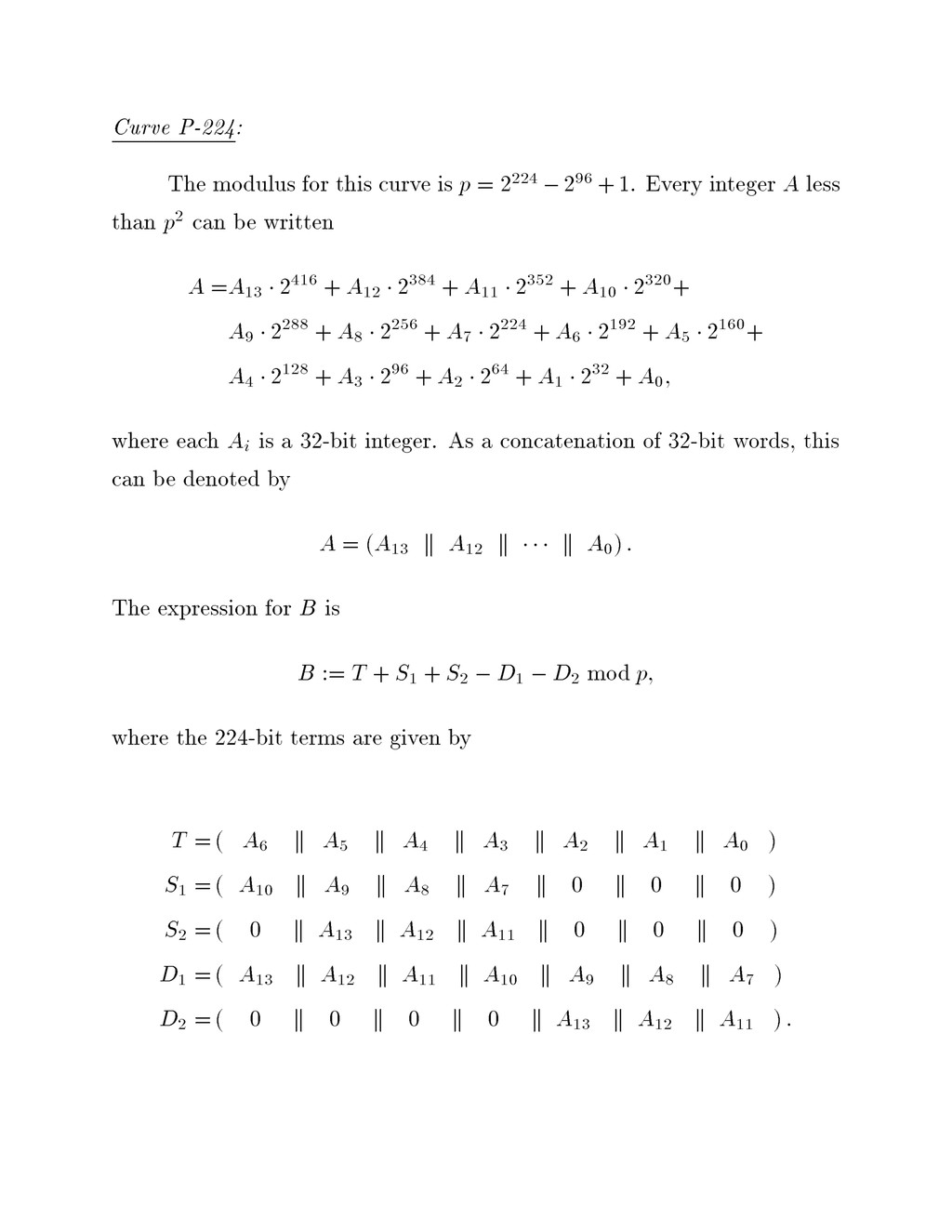
2224 0 296 + 1. Every integer A less than p 2 can be written A A A =A13 1 2 416 + A12 1 2 384 + A11 1 2 352 + A10 1 2 320 + 9 1 2 288 + A8 1 2 256 + A7 1 2 224 + A6 1 2 192 + A5 1 2 160 + 4 1 2 128 + A3 1 2 96 + A2 1 2 64 + A1 1 2 32 + A0, where each Ai is a 32-bit integer. As a concatenation of 32-bit words, this can be denoted by A = (A13 I A12 I 111 I A0) . The expression for B is B �= T + 81 + 82 0 D1 0 D2 mod p, where the 224-bit terms are given by T = ( A6 I A5 I A4 I A3 I A2 I A1 I A0 ) 81 = ( A10 I A9 I A8 I A7 I 0 I 0 I 0 ) 82 = ( 0 I A13 I A12 I A11 I 0 I 0 I 0 ) D1 = ( A13 I A12 I A11 I A10 I A9 I A8 I A7 ) D2 = ( 0 I 0 I 0 I 0 I A13 I A12 I A11 ) .
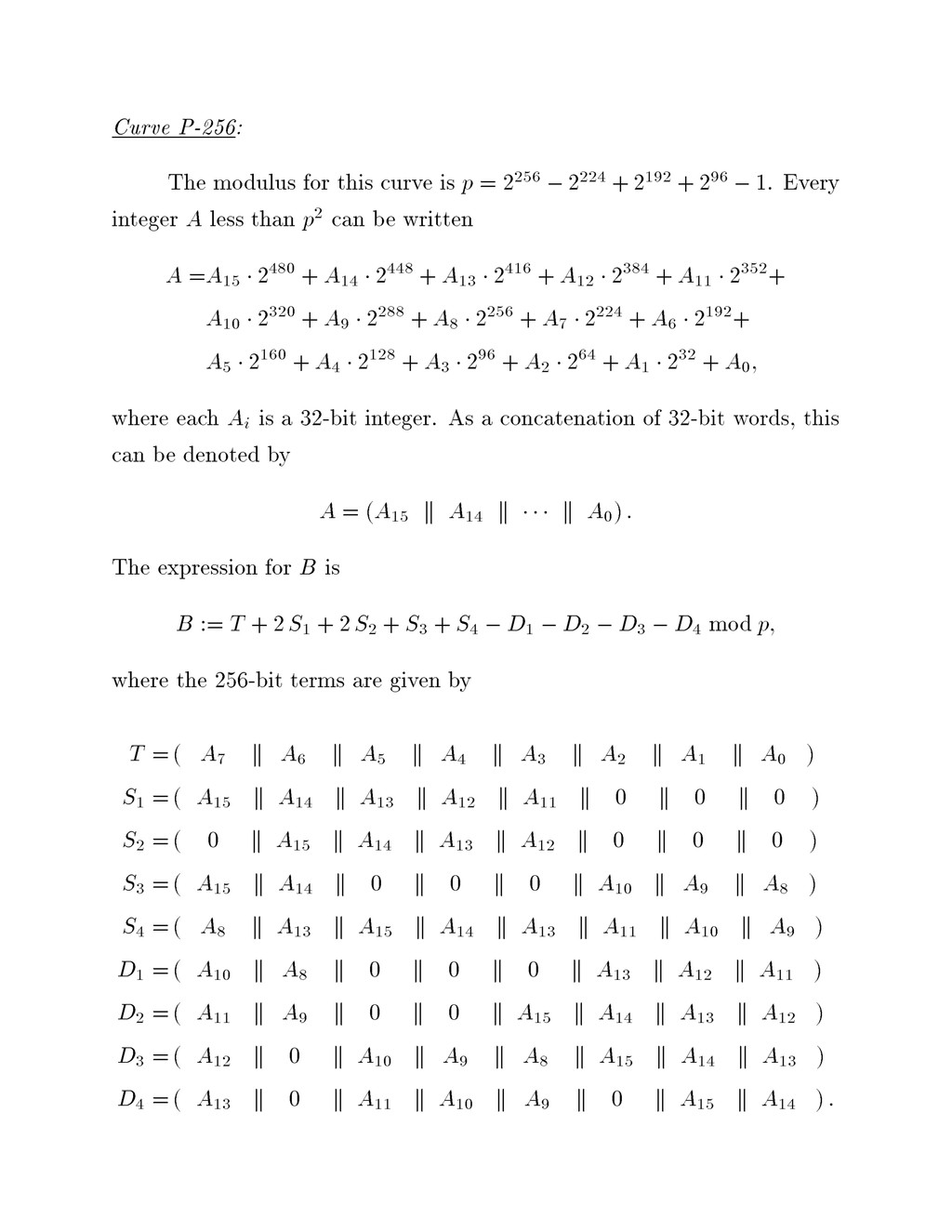
2256 0 2224 + 2192 + 296 0 1. Every integer A less than p 2 can be written A A A =A15 1 2 480 + A14 1 2 448 + A13 1 2 416 + A12 1 2 384 + A11 1 2 352 + 10 1 2 320 + A9 1 2 288 + A8 1 2 256 + A7 1 2 224 + A6 1 2 192 + 5 1 2 160 + A4 1 2 128 + A3 1 2 96 + A2 1 2 64 + A1 1 2 32 + A0, where each Ai is a 32-bit integer. As a concatenation of 32-bit words, this can be denoted by A = (A15 I A14 I 111 I A0) . The expression for B is B �= T + 2 81 + 2 82 + 83 + 84 0 D1 0 D2 0 D3 0 D4 mod p, where the 256-bit terms are given by D D D D 8 8 8 8 T = ( A7 I A6 I A5 I A4 I A3 I A2 I A1 I A0 ) 1 = ( A15 I A14 I A13 I A12 I A11 I 0 I 0 I 0 ) 2 = ( 0 I A15 I A14 I A13 I A12 I 0 I 0 I 0 ) 3 = ( A15 I A14 I 0 I 0 I 0 I A10 I A9 I A8 ) 4 = ( A8 I A13 I A15 I A14 I A13 I A11 I A10 I A9 ) 1 = ( A10 I A8 I 0 I 0 I 0 I A13 I A12 I A11 ) 2 = ( A11 I A9 I 0 I 0 I A15 I A14 I A13 I A12 ) 3 = ( A12 I 0 I A10 I A9 I A8 I A15 I A14 I A13 ) 4 = ( A13 I 0 I A11 I A10 I A9 I 0 I A15 I A14 ) .
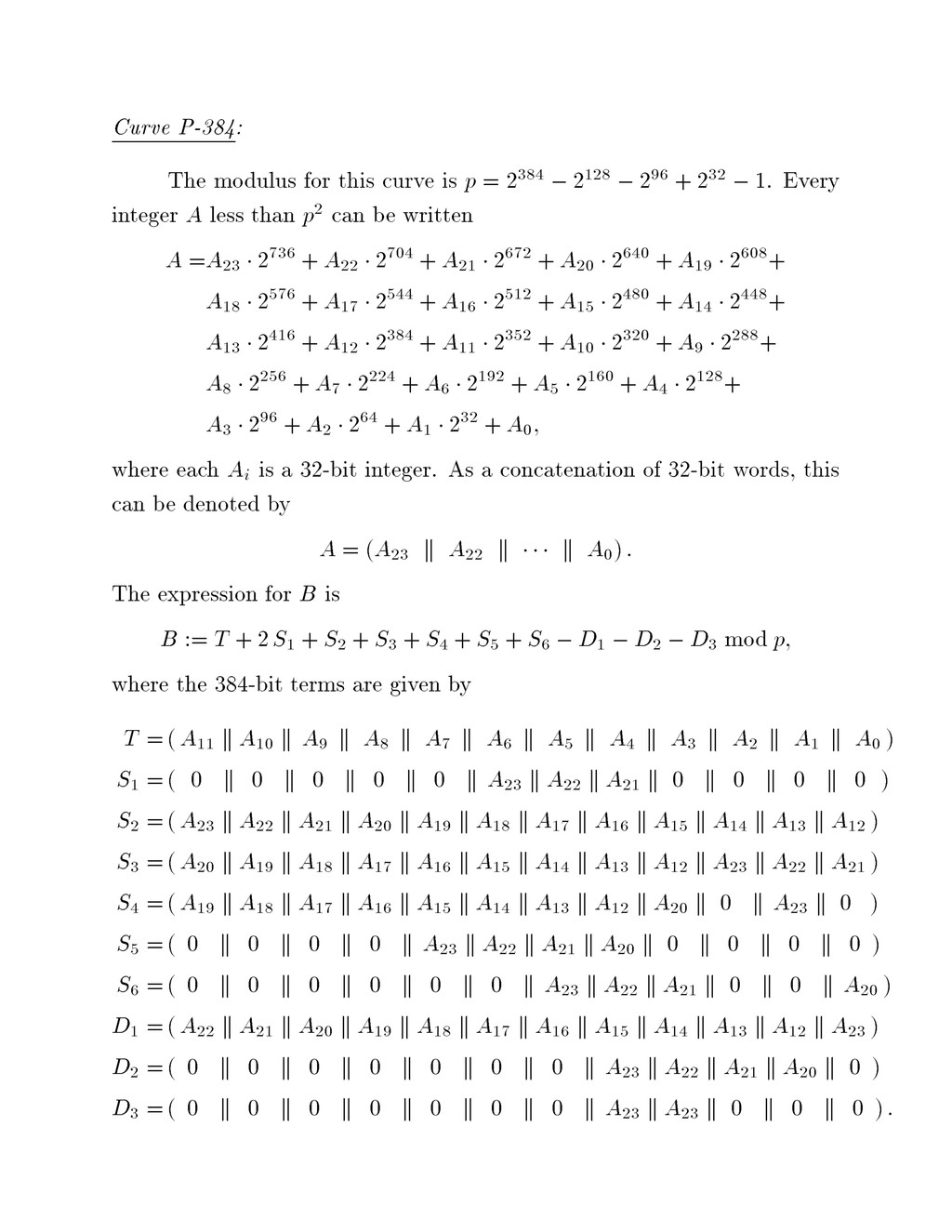
2 384 0 2 128 0 2 96 + 2 32 0 1. Every integer A less than p 2 can be written A =A23 1 2 736 + A22 1 2 704 + A21 1 2 672 + A20 1 2 640 + A19 1 2 608 + A18 1 2 576 + A17 1 2 544 + A16 1 2 512 + A15 1 2 480 + A14 1 2 448 + A13 1 2 416 + A12 1 2 384 + A11 1 2 352 + A10 1 2 320 + A9 1 2 288 + A8 1 2 256 + A7 1 2 224 + A6 1 2 192 + A5 1 2 160 + A4 1 2 128 + A3 1 2 96 + A2 1 2 64 + A1 1 2 32 + A0, where each Ai is a 32-bit integer. As a concatenation of 32-bit words, this can be denoted by A = (A23 I A22 I 111 I A0) . The expression for B is B �= T + 2 81 + 82 + 83 + 84 + 85 + 86 0 D1 0 D2 0 D3 mod p, where the 384-bit terms are given by T = ( A11 I A10 I A9 I A8 I A7 I A6 I A5 I A4 I A3 I A2 I A1 I A0 ) 81 = ( 0 I 0 I 0 I 0 I 0 I A23 I A22 I A21 I 0 I 0 I 0 I 0 ) 82 = ( A23 I A22 I A21 I A20 I A19 I A18 I A17 I A16 I A15 I A14 I A13 I A12 ) 83 = ( A20 I A19 I A18 I A17 I A16 I A15 I A14 I A13 I A12 I A23 I A22 I A21 ) 84 = ( A19 I A18 I A17 I A16 I A15 I A14 I A13 I A12 I A20 I 0 I A23 I 0 ) 85 = ( 0 I 0 I 0 I 0 I A23 I A22 I A21 I A20 I 0 I 0 I 0 I 0 ) 86 = ( 0 I 0 I 0 I 0 I 0 I 0 I A23 I A22 I A21 I 0 I 0 I A20 ) D1 = ( A22 I A21 I A20 I A19 I A18 I A17 I A16 I A15 I A14 I A13 I A12 I A23 ) D2 = ( 0 I 0 I 0 I 0 I 0 I 0 I 0 I A23 I A22 I A21 I A20 I 0 ) D3 = ( 0 I 0 I 0 I 0 I 0 I 0 I 0 I A23 I A23 I 0 I 0 I 0 ) .
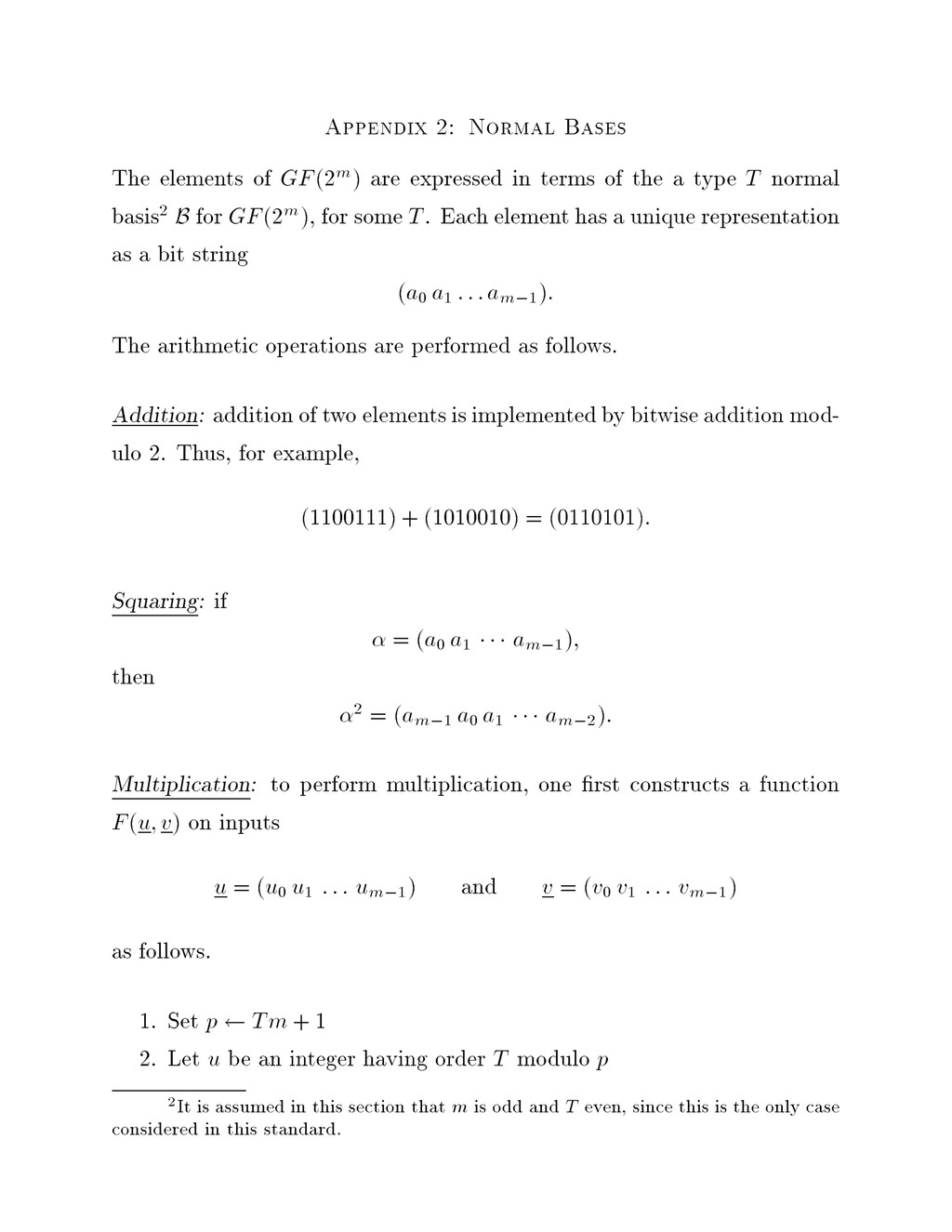
expressed in terms of the a type T normal basis2 B for GF(2 m ), for some T. Each element has a unique representation as a bit string (�� �� �m0� ) The arithmetic operations are performed as follows. Addition: addition of two elements is implemented by bitwise addition mod ulo 2. Thus, for example, (1100111) + (1010010) = (0110101) Squaring: if � = (�� �� 1 1 1 �m0� ), then �2 = (�m0� �� �� 1 1 1 �m02 ). Multiplication: to perform multiplication, one frst constructs a function F(u,v) on inputs u = (u� u� um0� ) and v = (v� v� vm0� ) as follows. 1. Set p + Tm + 1 2. Let u be an integer having order T modulo p 2 It is assumed in this section that m is odd and T even, since this is the only case considered in this standard.
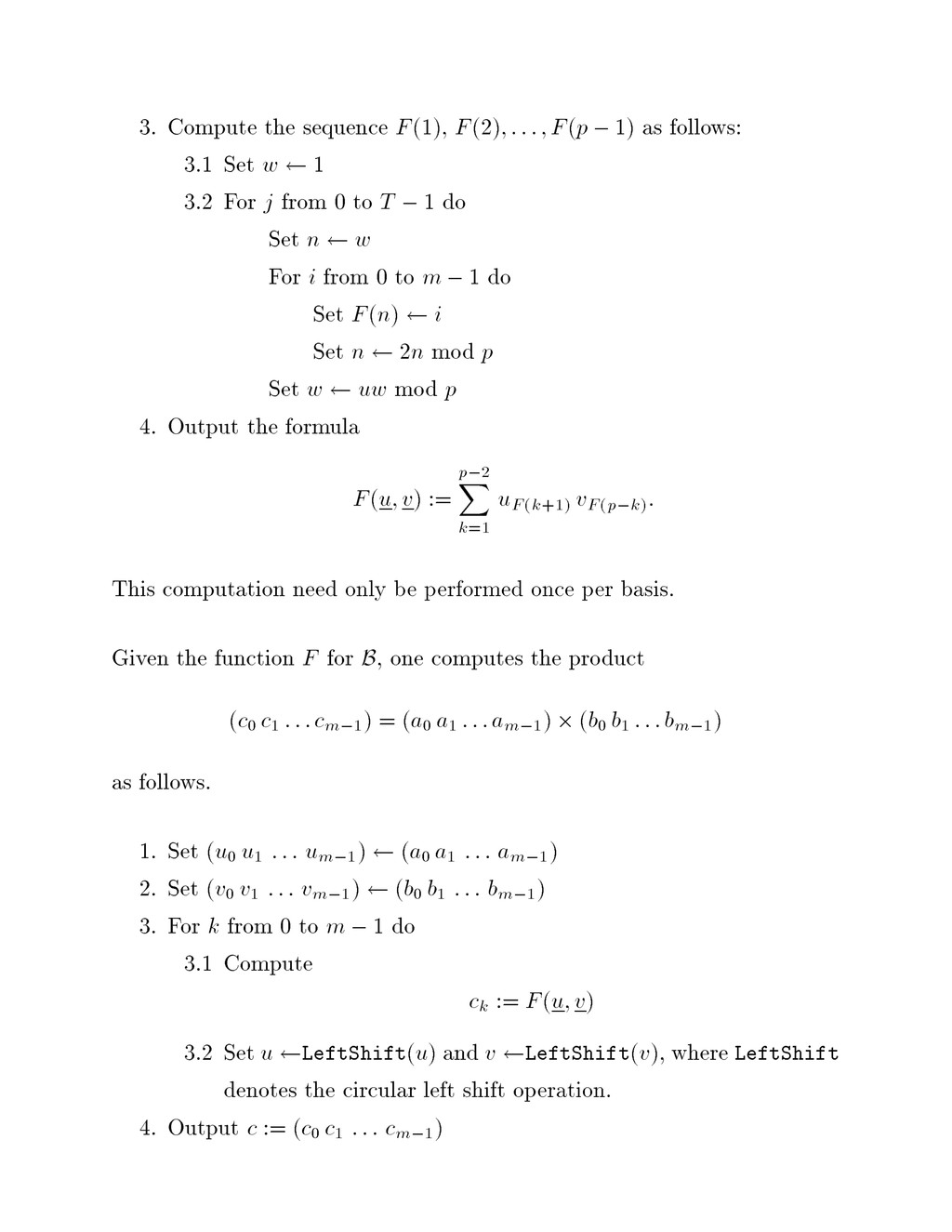
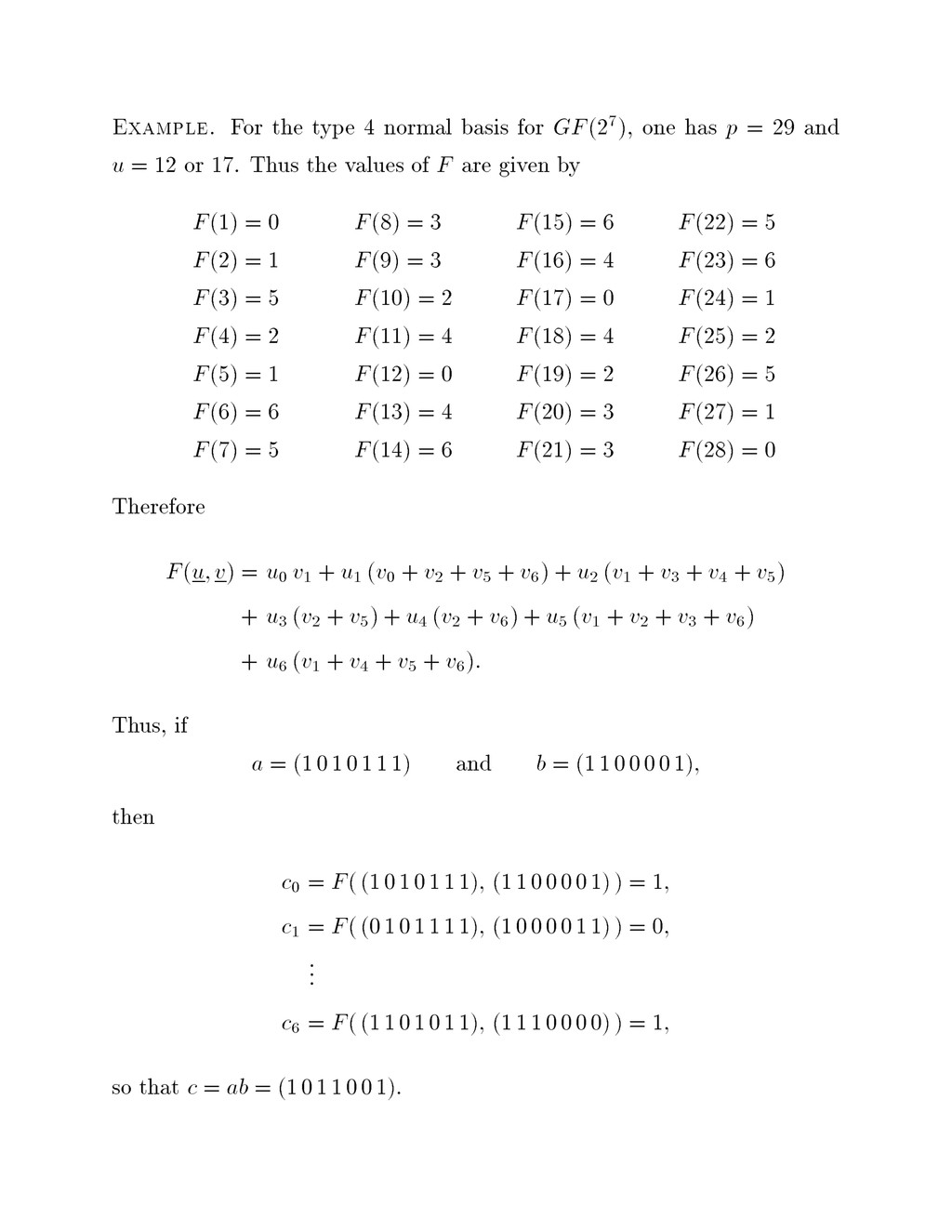
. , F (p 0 1) as follows: 3.1 Set w + 1 3.2 For j from 0 to T 0 1 do Set n + w For i from 0 to m 0 1 do Set F (n) + i Set n + 2n mod p Set w + Uw mod p 4. Output the formula F (U, v) := 2 p0 � UF(k+I) vF(p0k). k=I This computation need only be performed once per basis. Given the function F for B, one computes the product (co cI . . . cm0I) = (ao aI . . . am0I) 2 (bo bI . . . bm0I) as follows. 1. Set (Uo UI . . . Um0I) + (ao aI . . . am0I) 2. Set (vo vI . . . vm0I) + (bo bI . . . bm0I) 3. For k from 0 to m 0 1 do 3.1 Compute ck := F (U, v) 3.2 Set U +LeftShift(U) and v +LeftShift(v), where LeftShift denotes the circular left shift operation. 4. Output c := (co cI . . . cm0I)
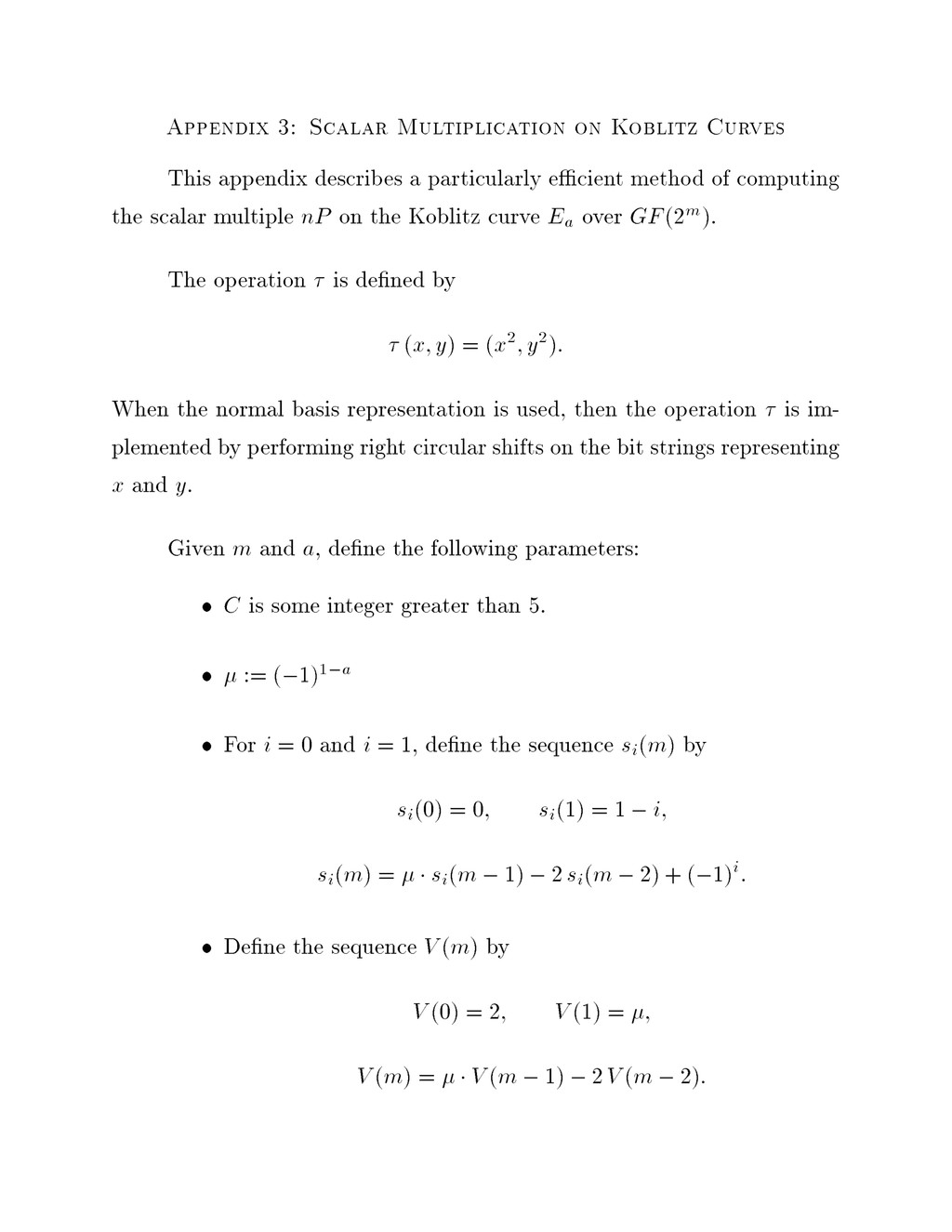
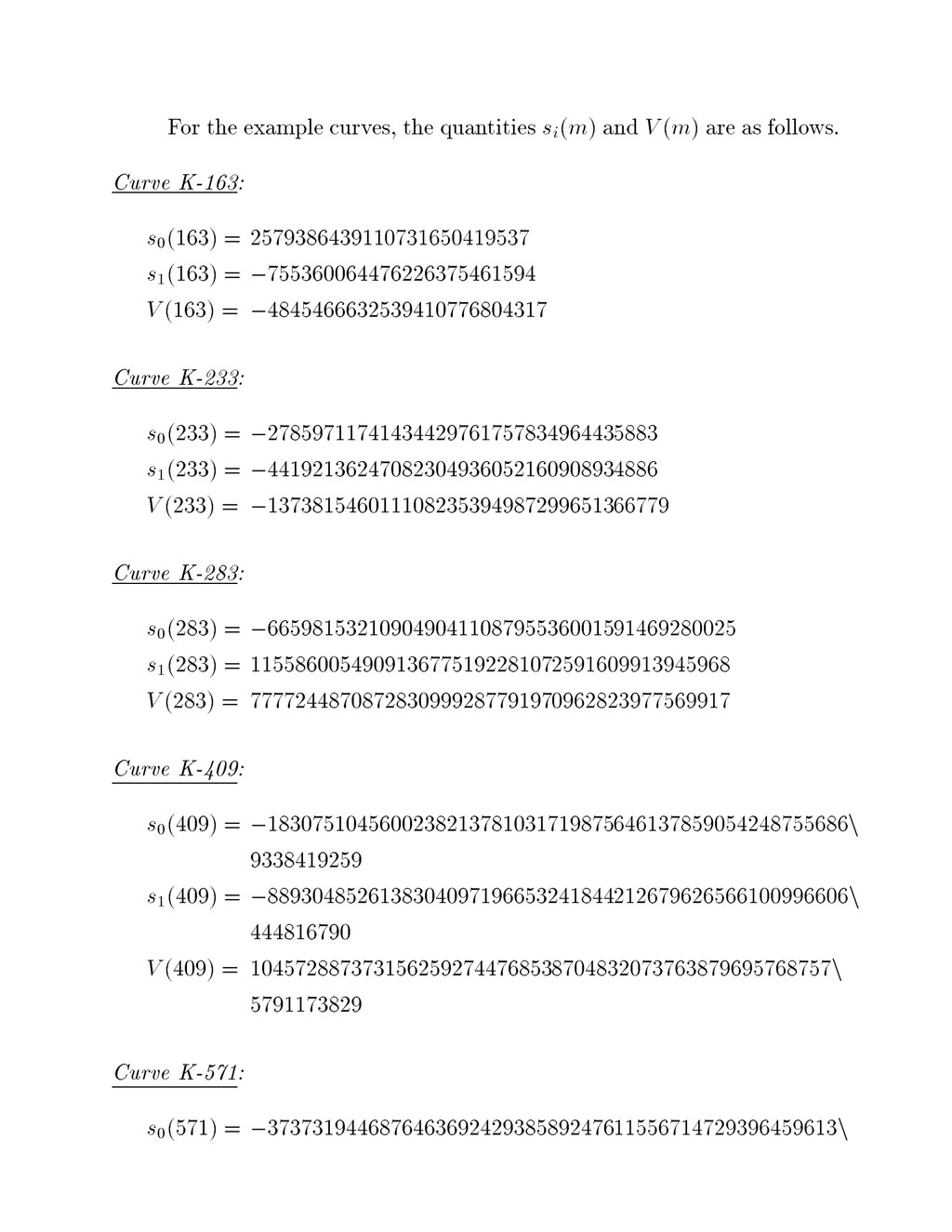
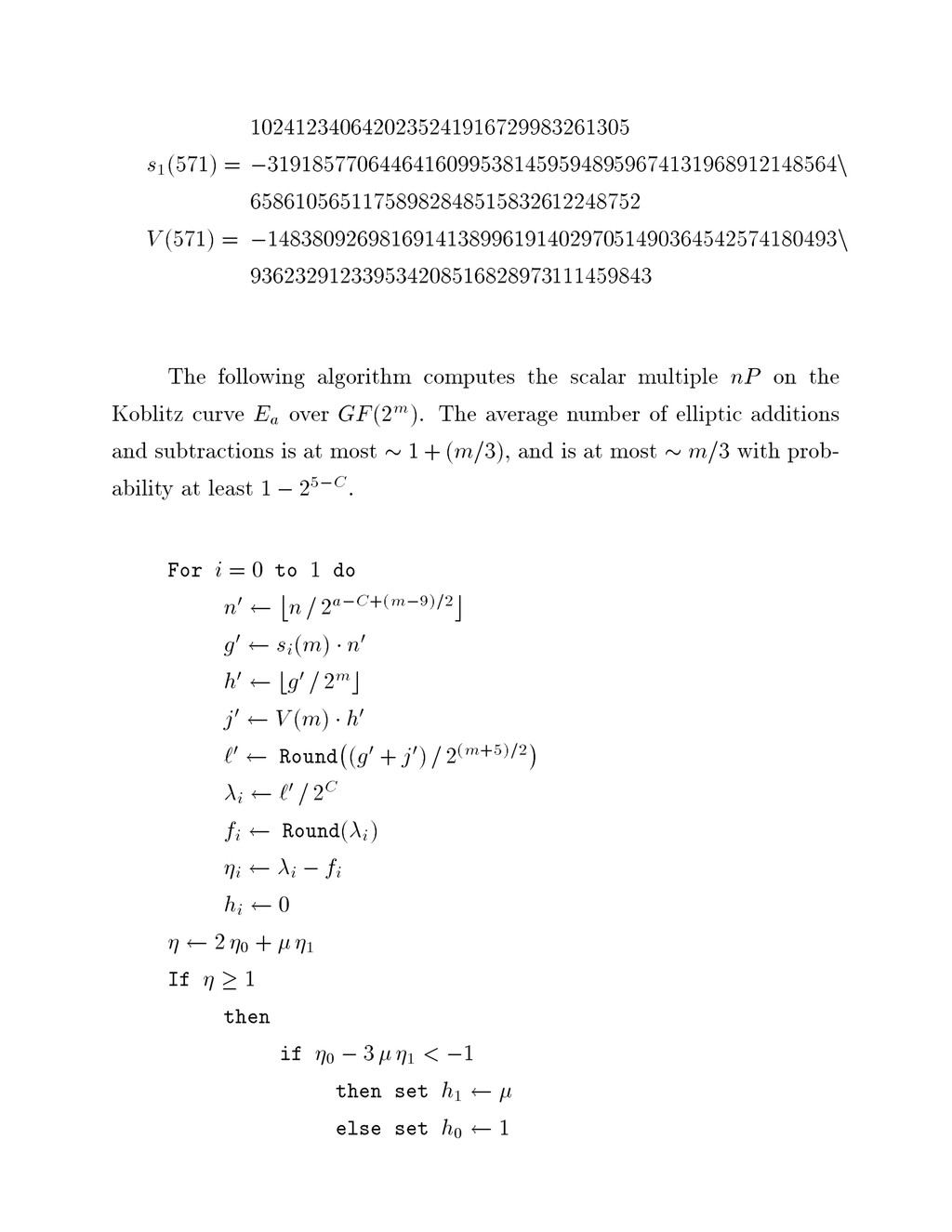
a particularly efcient method of computing the scalar multiple nP on the Koblitz curve Ea over GF(2m). The operation T is defned by T (x,y) = (x�,y� ). When the normal basis representation is used, then the operation T is im plemented by performing right circular shifts on the bit strings representing x and y. Given m and a, defne the following parameters: • C is some integer greater than 5. • / := (01)�0a • For i = O and i = 1, defne the sequence si(m) by si(O) = O, si(1) = 1 0 i, si(m) = / 1 si(m 0 1) 0 2 si(m 0 2) � (01)i. • Defne the sequence V (m) by V (O) = 2, V (1) = /, V (m) = / 1 V (m 0 1) 0 2 V (m 0 2).
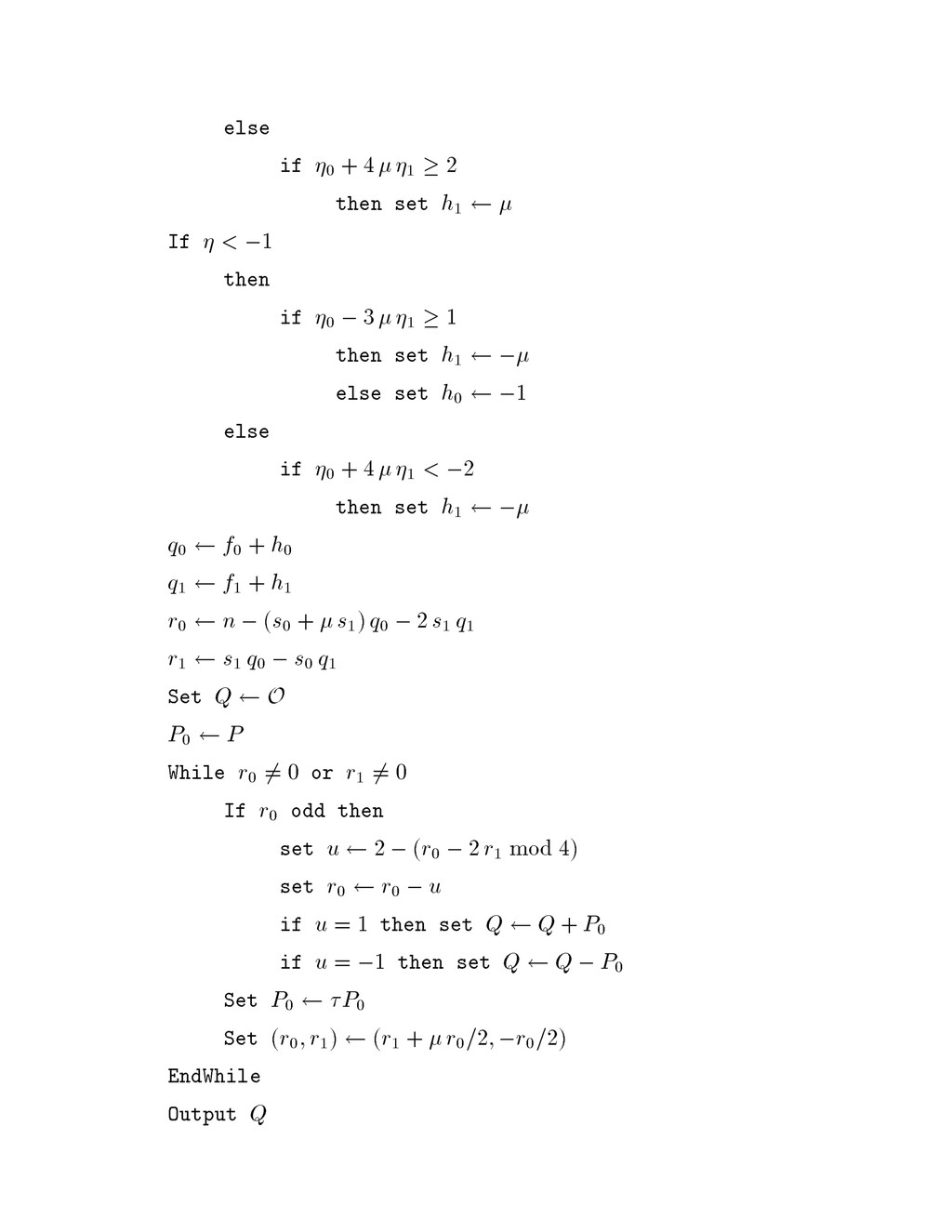
\ 936232912339534208516828973111459843 The following algorithm computes the scalar multiple nP on the Koblitz curve Ea over GF(2 m). The average number of elliptic additions and subtractions is at most I 1 + (m/3), and is at most I m/3 with prob ability at least 1 0 25 0C . For i = 0 to 1 do 4 5 n ' + n / 2 a0C+(m09)/2 g ' + 3i(m) 1n ' h ' + 1g ' / 2mJ j ' + 1 (m) 1h ' 0 1 £ ' + (g ' + j ' ) / 2(m+5)/2 Round Ai + £ ' / 2 C Ii + Round(Ai ) Ti + Ai 0Ii hi + 0 T + 2 To + f Tl If T > 1 then if To 0 3 f Tl < 01 then set hl + f else set ho + 1
set hl + f If T < 01 then if To 0 3 f Tl > 1 then set hl + 0f else set ho + 01 else if To + 4 f Tl < 02 then set hl + 0f qo + fo + ho q + f + h l l l To + n 0 (3o + f 3l ) qo 02 3l ql Tl + 3l qo 0 3o ql P Set Q + 0 o + P While To = 0 or Tl = 0 If To odd then set u + 2 0 (To 0 2 Tl mod 4) set To + To 0 u if u = 1 then set Q + Q + Po if u = 01 then set Q + Q 0 Po Set Po + TPo Set (To , Tl) + (Tl + f To /2, 0To /2) EndWhile Output Q
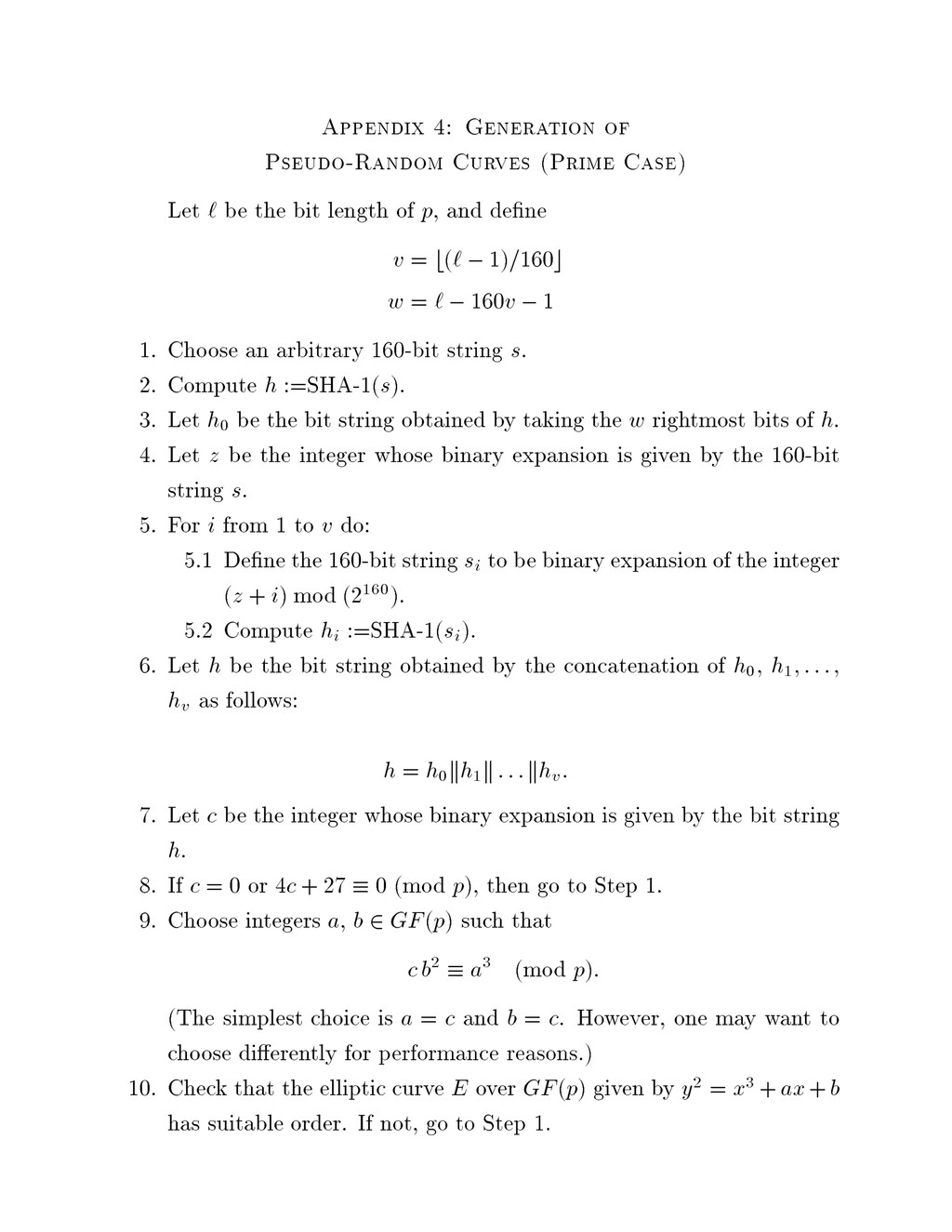
be the bit length of p , and defne v = l(£ 0 1)/ 160J w = £ 0 160v 0 1 1. Choose an arbitrary 160-bit string s . 2. Compute h :=SHA-1(s ). 3. Let ho be the bit string obtained by taking the w rightmost bits of h . 4. Let z be the integer whose binary expansion is given by the 160-bit string s . 5. For i from 1 to v do: 5.1 Defne the 160-bit string si to be binary expansion of the integer (z + i ) mod (216o). 5.2 Compute hi :=SHA-1(si ). h 6. Let h be the bit string obtained by the concatenation of ho , h1, . . . , v as follows: h = ho lh1 l . . . lhv . 7. Let c be the integer whose binary expansion is given by the bit string h . 8. If c = 0 or 4c + 27 0 (mod p ), then go to Step 1. 9. Choose integers a , b E GF (p ) such that 3 c b 2 a (mod p ). (The simplest choice is a = c and b = c . However, one may want to choose diferently for performance reasons.) 10. Check that the elliptic curve E over GF (p ) given by y 2 = x 3 + ax + b has suitable order. If not, go to Step 1.
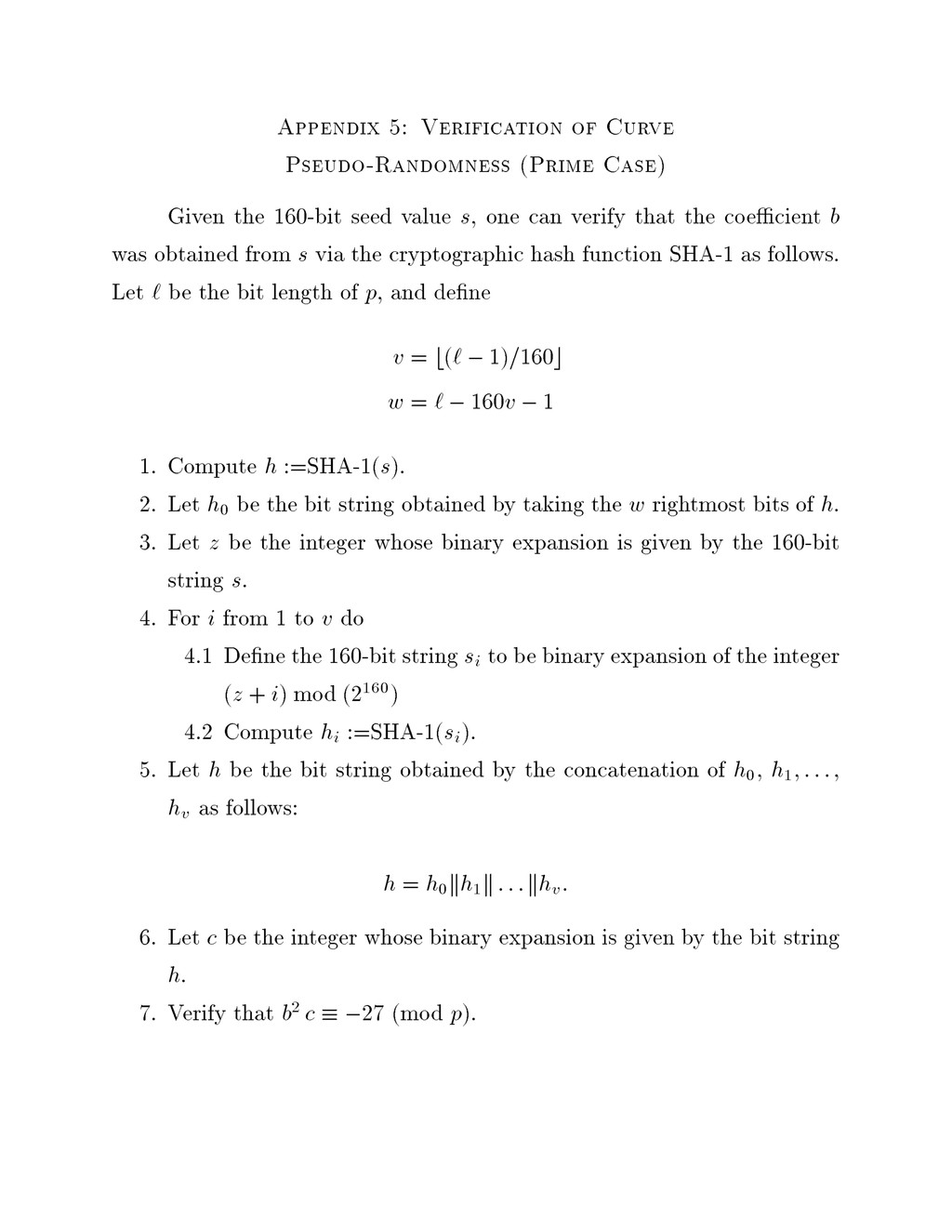
160-bit seed value s , one can verify that the coefcient b was obtained from s via the cryptographic hash function SHA-1 as follows. Let £ be the bit length of p , and defne v = l(£ 01)/ 160J w = £ 0 160v 01 1. Compute h :=SHA-1(s ). 2. Let ho be the bit string obtained by taking the w rightmost bits of h . 3. Let z be the integer whose binary expansion is given by the 160-bit string s . 4. For i from 1 to v do 4.1 Defne the 160-bit string si to be binary expansion of the integer (z + i ) mod (216o) 4.2 Compute hi :=SHA-1(si ). h 5. Let h be the bit string obtained by the concatenation of ho, h1, . . . , v as follows: h = ho lh1 l. . . lhv . 6. Let c be the integer whose binary expansion is given by the bit string h . 7. Verify that b 2 c 027 (mod p ).
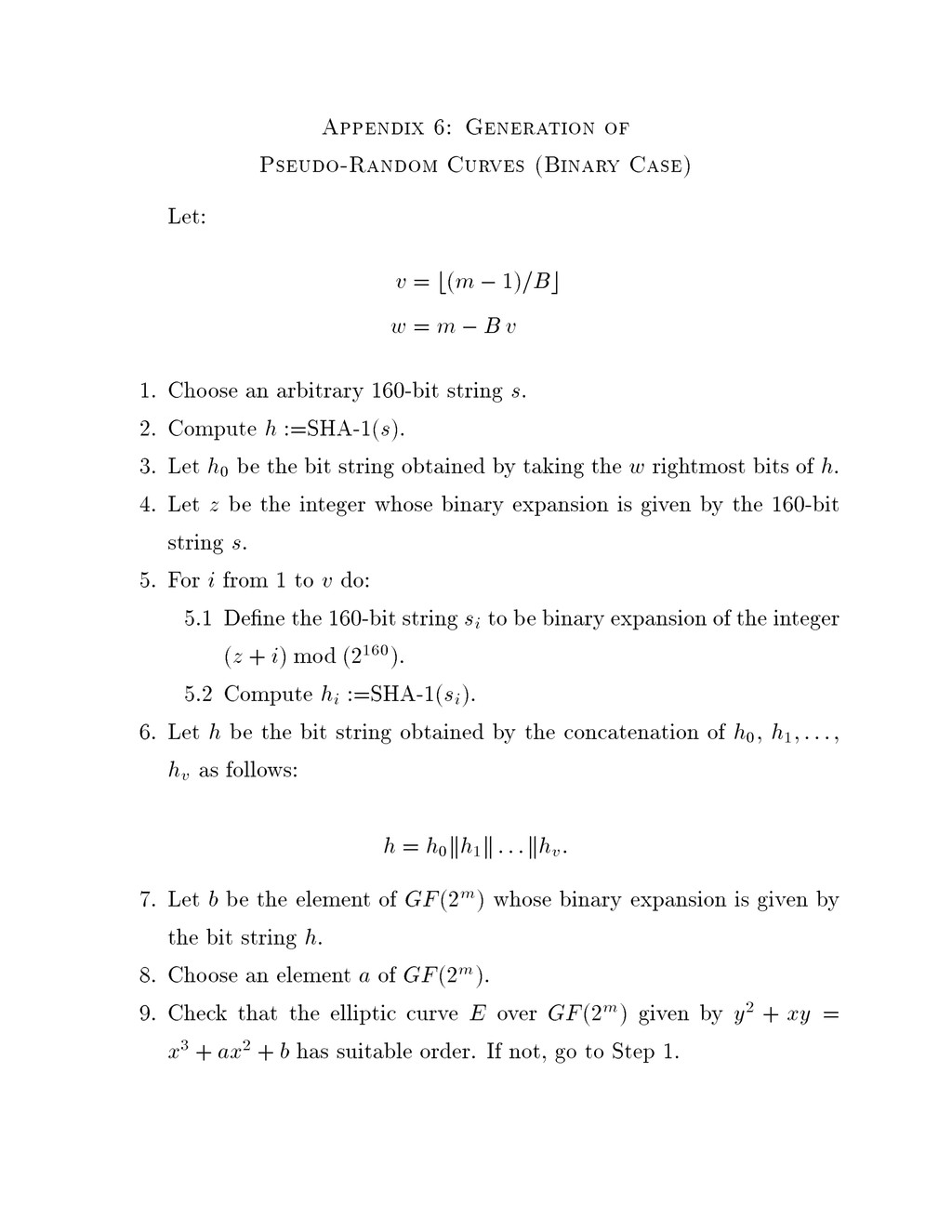
= l(m 0 1)/B J w = m 0 B v 1. Choose an arbitrary 160-bit string s . 2. Compute h :=SHA-1(s ). 3. Let ho be the bit string obtained by taking the w rightmost bits of h . 4. Let z be the integer whose binary expansion is given by the 160-bit string s . 5. For i from 1 to v do: 5.1 Defne the 160-bit string si to be binary expansion of the integer (z + i ) mod (216o). 5.2 Compute hi :=SHA-1(si ). 6. Let h be the bit string obtained by the concatenation of ho, h1, . . . , hv as follows: h = ho lh1 l . . . lhv . 7. Let b be the element of GF (2m) whose binary expansion is given by the bit string h . 8. Choose an element a of GF (2m ). 9. Check that the elliptic curve E over GF (2m) given by y 2 + xy = x 3 + ax 2 + b has suitable order. If not, go to Step 1.
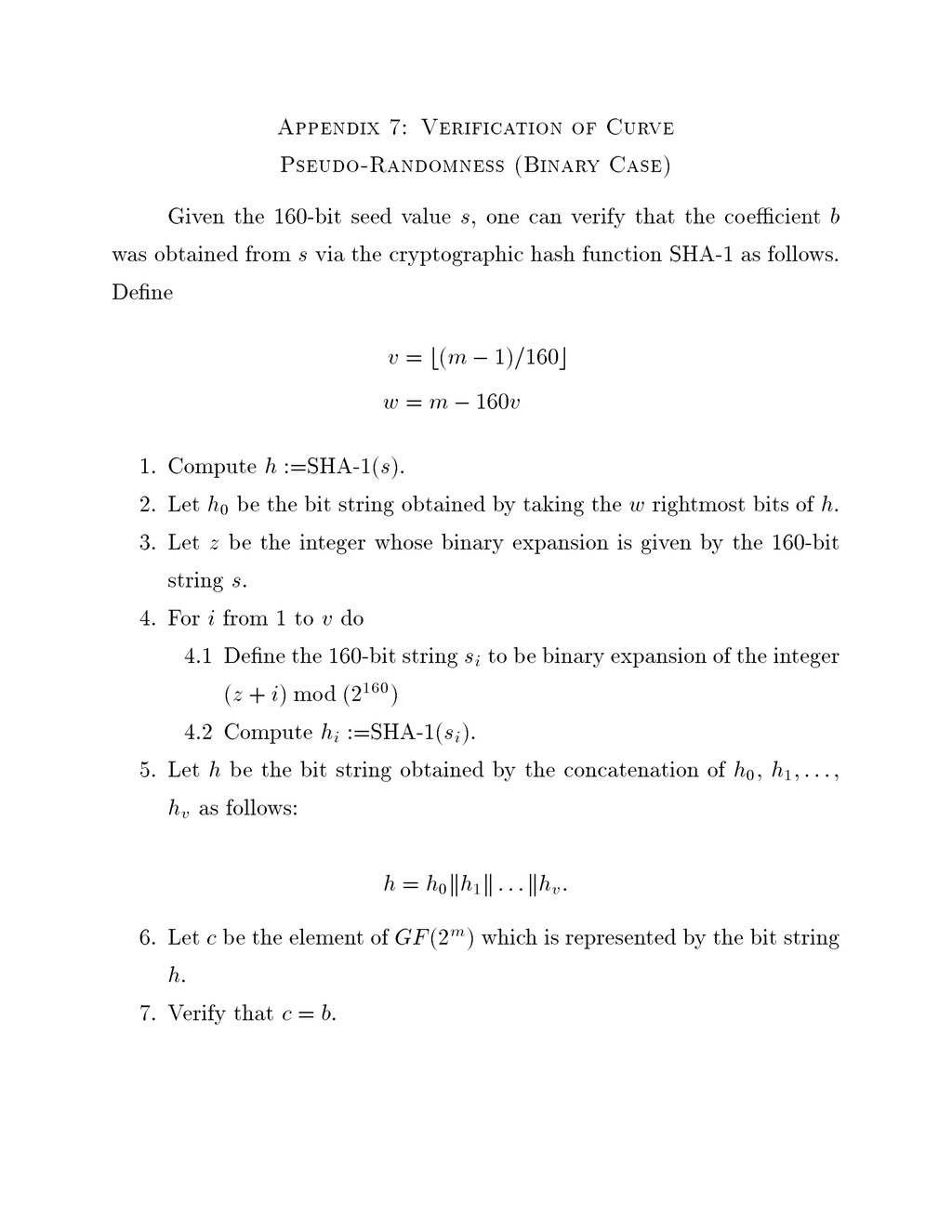
160-bit seed value s , one can verify that the coefcient b was obtained from s via the cryptographic hash function SHA-1 as follows. Defne v = l(m 0 1)/ 160J w = m 0 160v 1. Compute h :=SHA-1(s ). 2. Let ho be the bit string obtained by taking the w rightmost bits of h . 3. Let z be the integer whose binary expansion is given by the 160-bit string s . 4. For i from 1 to v do 4.1 Defne the 160-bit string si to be binary expansion of the integer (z + i ) mod (216o) 4.2 Compute hi :=SHA-1(si ). 5. Let h be the bit string obtained by the concatenation of ho, h1, . . . , hv as follows: h = ho lh1 l . . . lhv . 6. Let c be the element of GF (2m) which is represented by the bit string h . 7. Verify that c = b .
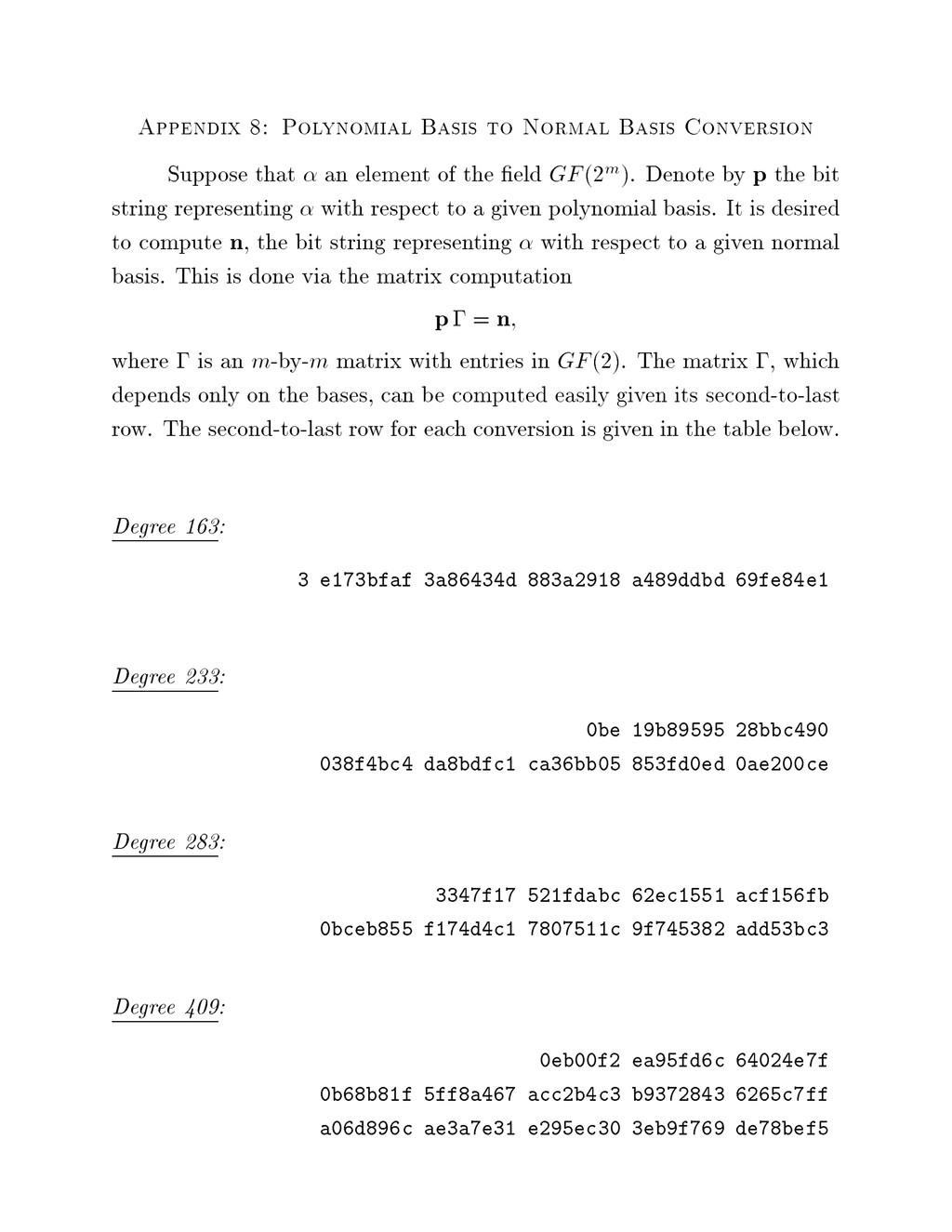
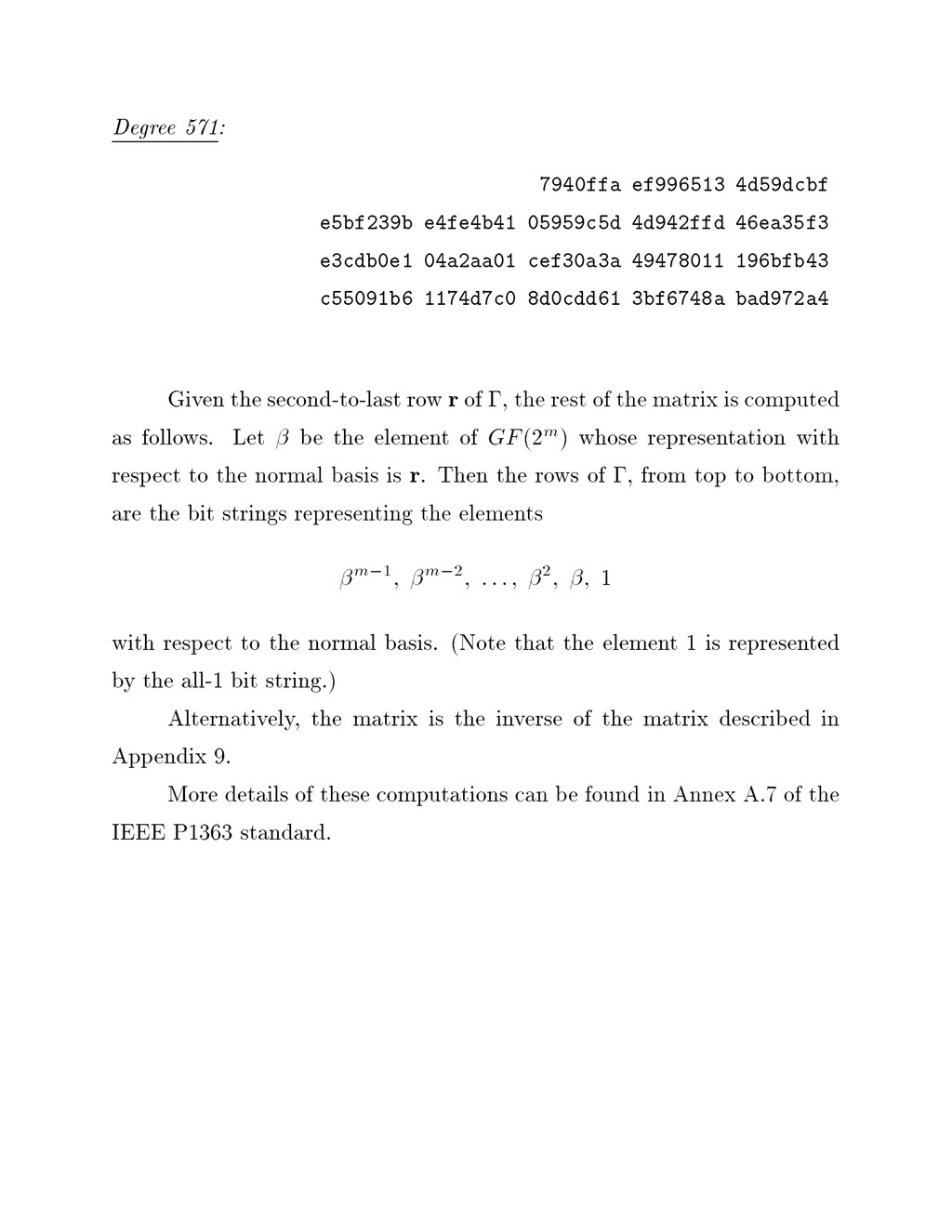
a an element of the feld GF(2m). Denote by p the bit string representing a with respect to a given polynomial basis. It is desired to compute n, the bit string representing a with respect to a given normal basis. This is done via the matrix computation p 0 = n, where 0 is an m-by-m matrix with entries in GF(2). The matrix 0, which depends only on the bases, can be computed easily given its second-to-last row. The second-to-last row for each conversion is given in the table below. Degree 163: 3 e173bfaf 3a86434d 883a2918 a489ddbd 69fe84e1 Degree 233: 0be 19b89595 28bbc490 038f4bc4 da8bdfc1 ca36bb05 853fd0ed 0ae200ce Degree 283: 3347f17 521fdabc 62ec1551 acf156fb 0bceb855 f174d4c1 7807511c 9f745382 add53bc3 Degree 409: 0eb00f2 ea95fd6c 64024e7f 0b68b81f 5ff8a467 acc2b4c3 b9372843 6265c7ff a06d896c ae3a7e31 e295ec30 3eb9f769 de78bef5
e3cdb0e1 04a2aa01 cef30a3a 49478011 196bfb43 c55091b6 1174d7c0 8d0cdd61 3bf6748a bad972a4 Given the second-to-last row r of 0, the rest of the matrix is computed as follows. Let ( be the element of GF(2m) whose representation with respect to the normal basis is r. Then the rows of 0, from top to bottom, are the bit strings representing the elements ( m0l , ( m02 , ..., (2 , (, 1 with respect to the normal basis. (Note that the element 1 is represented by the all-1 bit string.) Alternatively, the matrix is the inverse of the matrix described in Appendix 9. More details of these computations can be found in Annex A.7 of the IEEE P1363 standard.
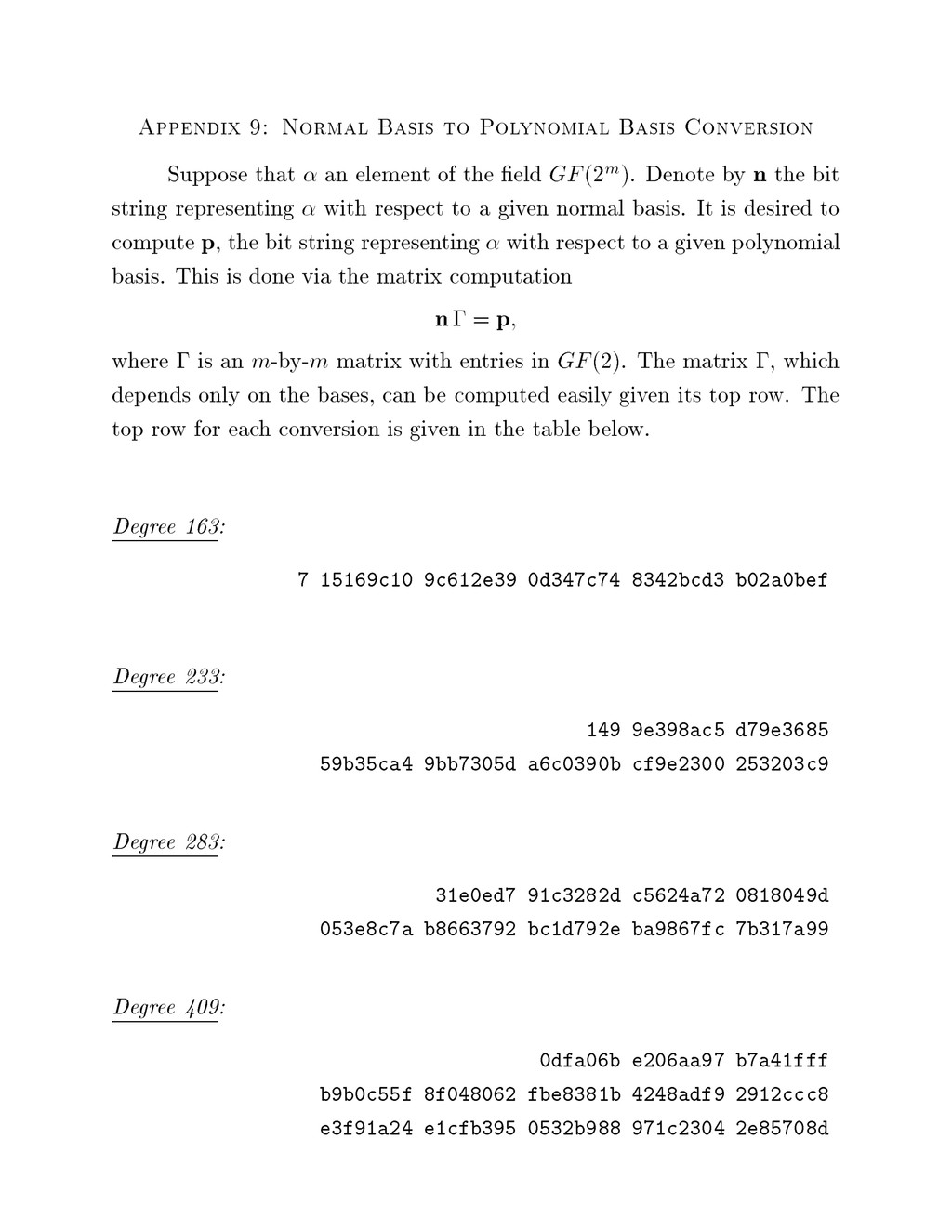
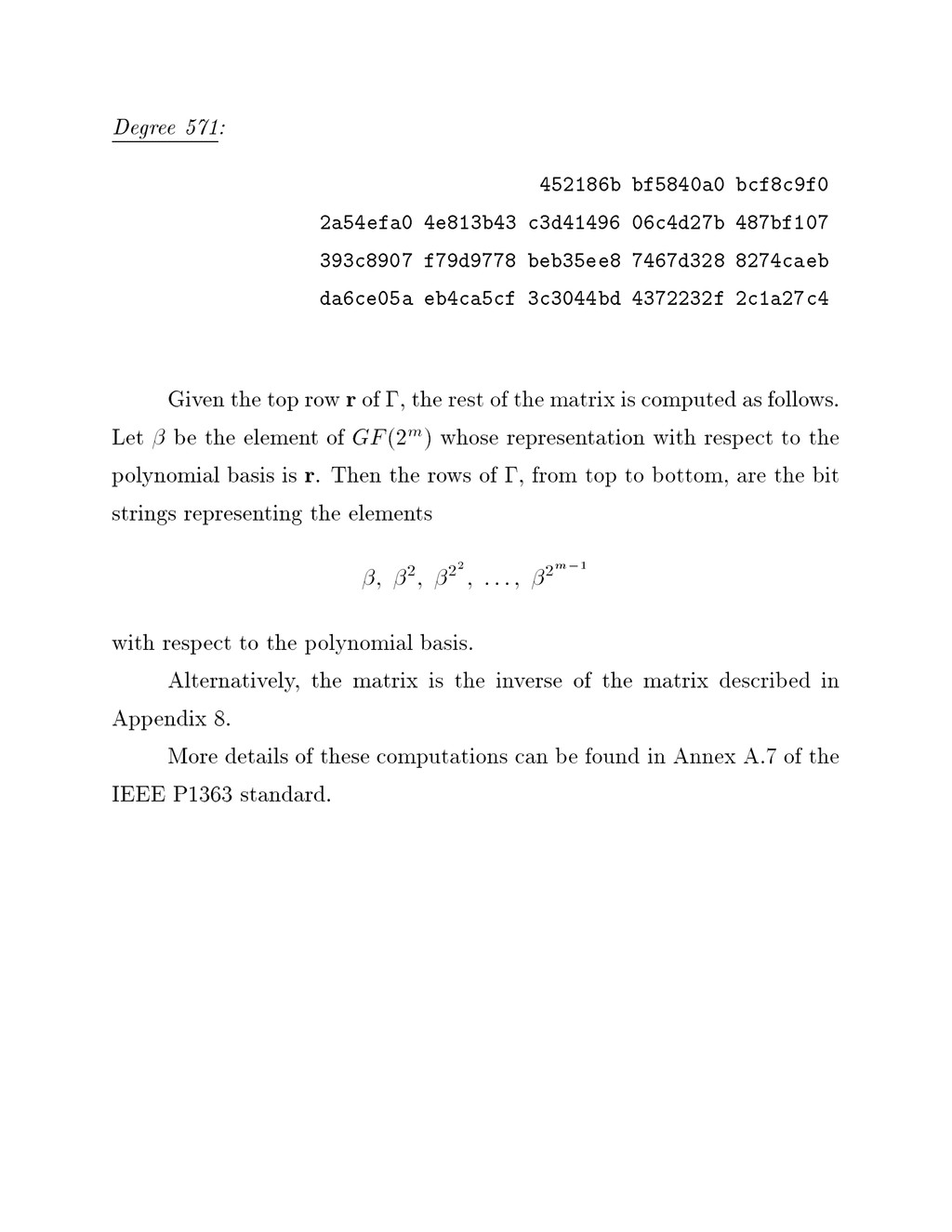
a an element of the feld GF(2m). Denote by n the bit string representing a with respect to a given normal basis. It is desired to compute p, the bit string representing a with respect to a given polynomial basis. This is done via the matrix computation n 0 = p, where 0 is an m-by-m matrix with entries in GF(2). The matrix 0, which depends only on the bases, can be computed easily given its top row. The top row for each conversion is given in the table below. Degree 163: 7 15169c10 9c612e39 0d347c74 8342bcd3 b02a0bef Degree 233: 149 9e398ac5 d79e3685 59b35ca4 9bb7305d a6c0390b cf9e2300 253203c9 Degree 283: 31e0ed7 91c3282d c5624a72 0818049d 053e8c7a b8663792 bc1d792e ba9867fc 7b317a99 Degree 409: 0dfa06b e206aa97 b7a41fff b9b0c55f 8f048062 fbe8381b 4248adf9 2912ccc8 e3f91a24 e1cfb395 0532b988 971c2304 2e85708d
393c8907 f79d9778 beb35ee8 7467d328 8274caeb da6ce05a eb4ca5cf 3c3044bd 4372232f 2c1a27c4 Given the top row r of 0, the rest of the matrix is computed as follows. Let ( be the element of GF(2m) whose representation with respect to the polynomial basis is r. Then the rows of 0, from top to bottom, are the bit strings representing the elements � (� (�� ( � � ���� (� �0� with respect to the polynomial basis. Alternatively, the matrix is the inverse of the matrix described in Appendix 8. More details of these computations can be found in Annex A.7 of the IEEE P1363 standard.


 yutobara
 chobishiba
 minodriven
 sylph01
 skydoves
 ichirokano2
 ryu1013
 takai
 hollycummins
 oku053
 kishida
 gonta
 akashhashmi
 tammyeverts
 mfonobong
 jacobian
 matthewcrist
 raygrieselhuber
 productmarketing
 jonoalderson
 seathinner
 jakevdp
 oripsolob
 colly