Upgrade to Pro — share decks privately, control downloads, hide ads and more …

Webinar on applying agroecology in IFAD operations

Avatar for Oliver Mundy Oliver Mundy
October 03, 2019
45

Webinar on applying agroecology in IFAD operations

Mixed cropping, using ‘weed’ crops to attract predators and cultivating resilient local breeds - these are all examples of agroecology in action.

Agroecology refers to the application of ecological science and principles to the study, design and management of sustainable agricultural ecosystems.

This webinar will present the concept and benefits of agroecology and share experiences of how it has been successfully applied in two IFAD-funded projects:

Family Farming Development Programme in Maradi, Tahoua and Zinder Regions (ProDAF), Niger
Agricultural Services Programme for Innovation, Resilience and Extension (ASPIRE), Cambodia

Issues for discussion include:

How can agroecology help farmers become economically resilient?
What proven-practices exist that can help smallholder farmers overcome poverty?
Speakers:

Emile A. Frison (former Director General of Bioversity International)
Emma Siliprandi (FAO)
Rikke Grand Olivera (IFAD)
Sebastien Subsol (IFAD)
Karan Sehgal (IFAD)

Avatar for Oliver Mundy

Oliver Mundy

October 03, 2019

Transcript

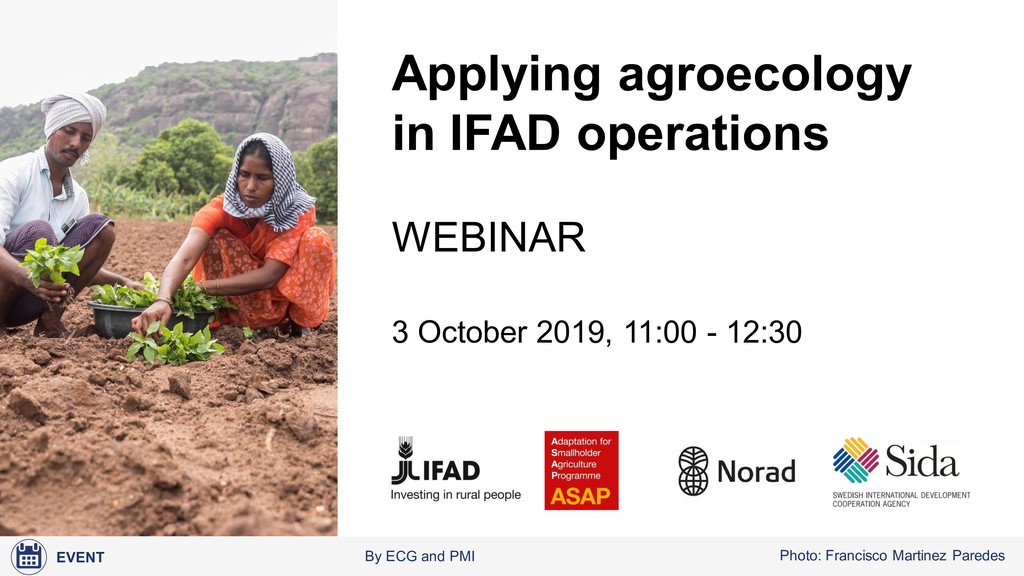
  1. Applying agroecology in IFAD operations WEBINAR EVENT 3 October 2019,

    11:00 - 12:30 By ECG and PMI Photo: Francisco Martinez Paredes
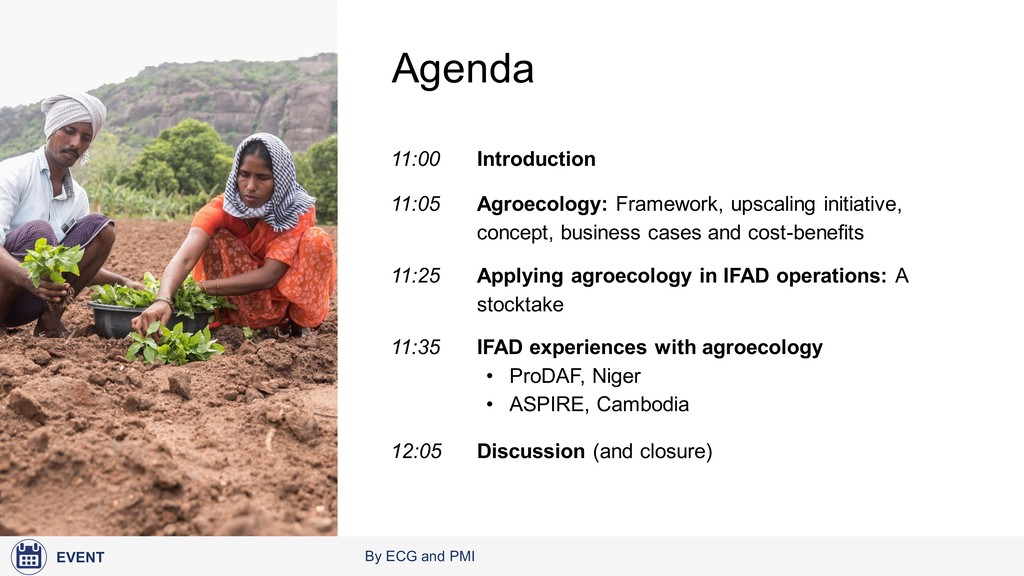
  2. Agenda EVENT By ECG and PMI 11:00 Introduction 11:05 Agroecology:

    Framework, upscaling initiative, concept, business cases and cost-benefits 11:25 Applying agroecology in IFAD operations: A stocktake 11:35 IFAD experiences with agroecology • ProDAF, Niger • ASPIRE, Cambodia 12:05 Discussion (and closure)
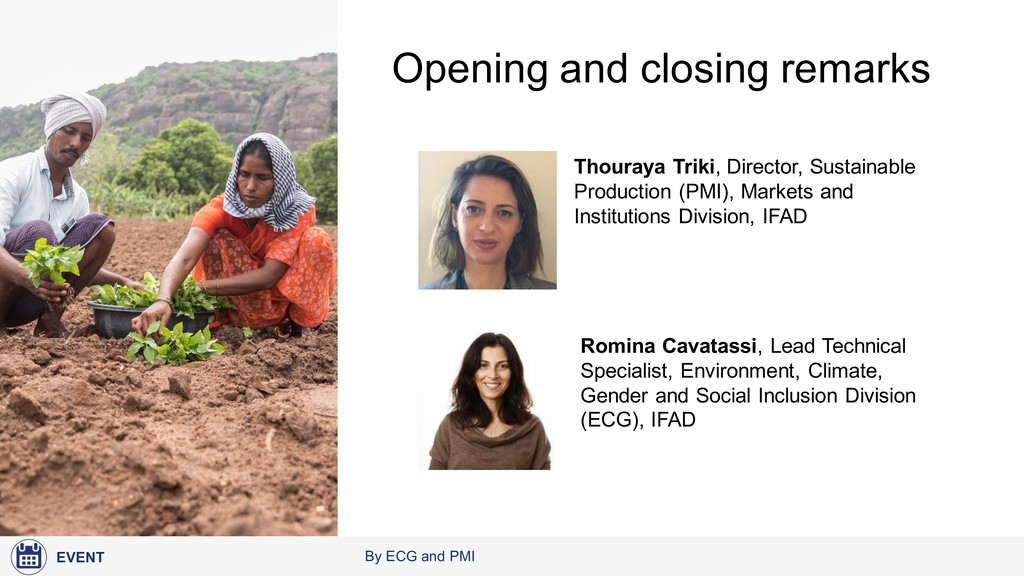
  3. Opening and closing remarks EVENT By ECG and PMI Romina

    Cavatassi, Lead Technical Specialist, Environment, Climate, Gender and Social Inclusion Division (ECG), IFAD Thouraya Triki, Director, Sustainable Production (PMI), Markets and Institutions Division, IFAD
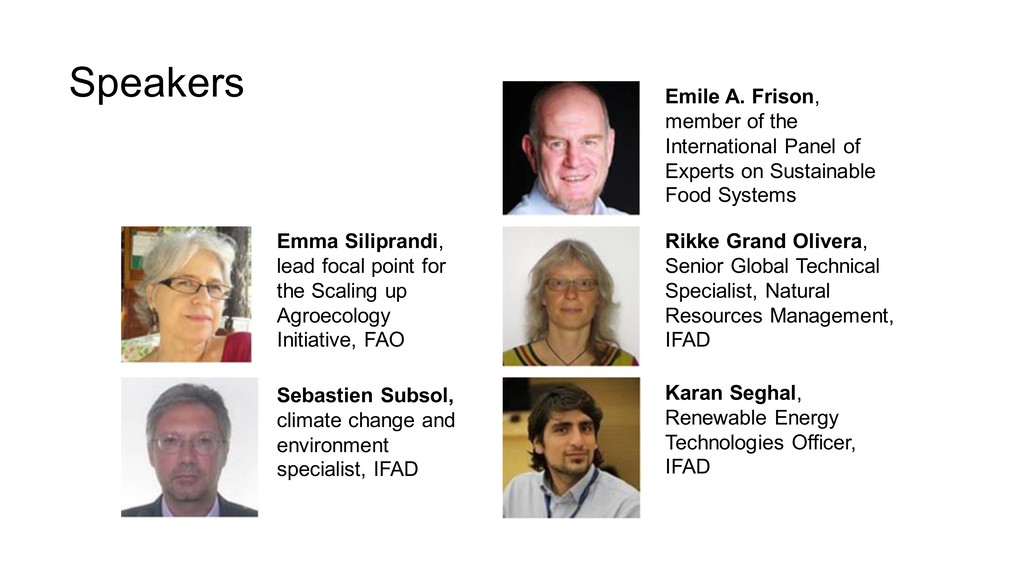
  4. Karan Seghal, Renewable Energy Technologies Officer, IFAD Sebastien Subsol, climate
    change and environment specialist, IFAD Rikke Grand Olivera, Senior Global Technical Specialist, Natural Resources Management, IFAD Emile A. Frison, member of the International Panel of Experts on Sustainable Food Systems Emma Siliprandi, lead focal point for the Scaling up Agroecology Initiative, FAO Speakers
  5. Emile A. Frison– IPES FOOD Webinar on the Scaling-up Agroecology

    Initiative, IFAD, 3 October 2019 Applying agroecology in IFAD Operations EMILE A. FRISON
  6. Webinar on the Scaling-up Agroecology Initiative, IFAD, 3 October 2019

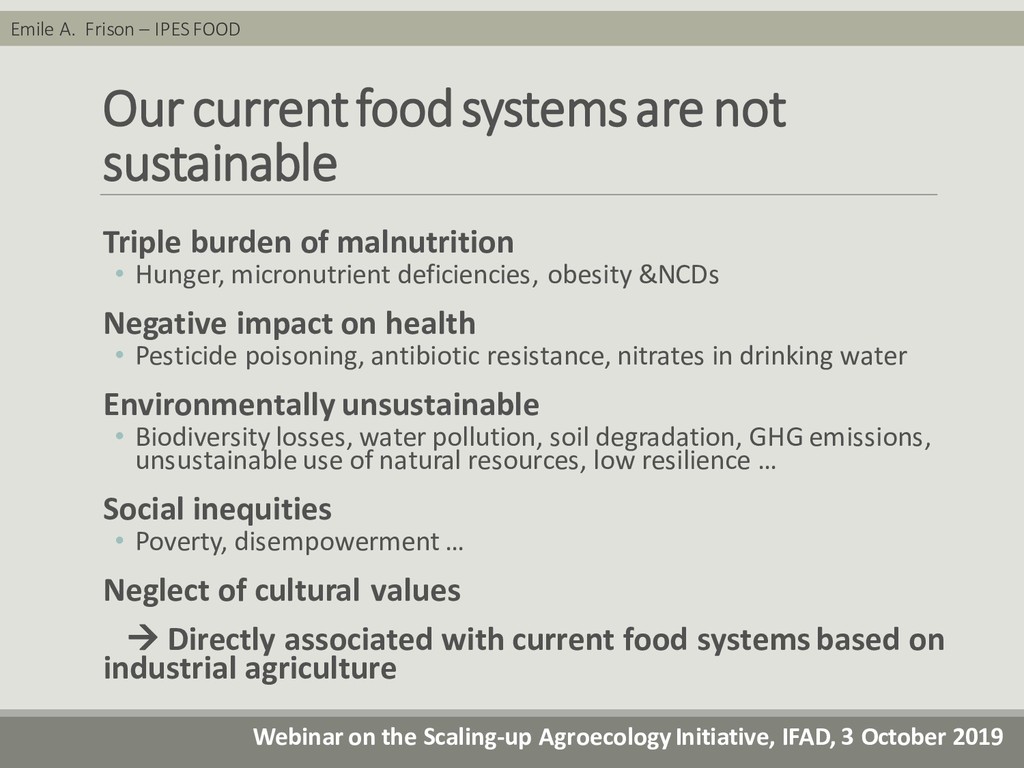
    Emile A. Frison – IPES FOOD Our current food systems are not sustainable Triple burden of malnutrition • Hunger, micronutrient deficiencies, obesity &NCDs Negative impact on health • Pesticide poisoning, antibiotic resistance, nitrates in drinking water Environmentally unsustainable • Biodiversity losses, water pollution, soil degradation, GHG emissions, unsustainable use of natural resources, low resilience … Social inequities • Poverty, disempowerment … Neglect of cultural values  Directly associated with current food systems based on industrial agriculture
  7. Emile A. Frison – IPES FOOD Webinar on the Scaling-up

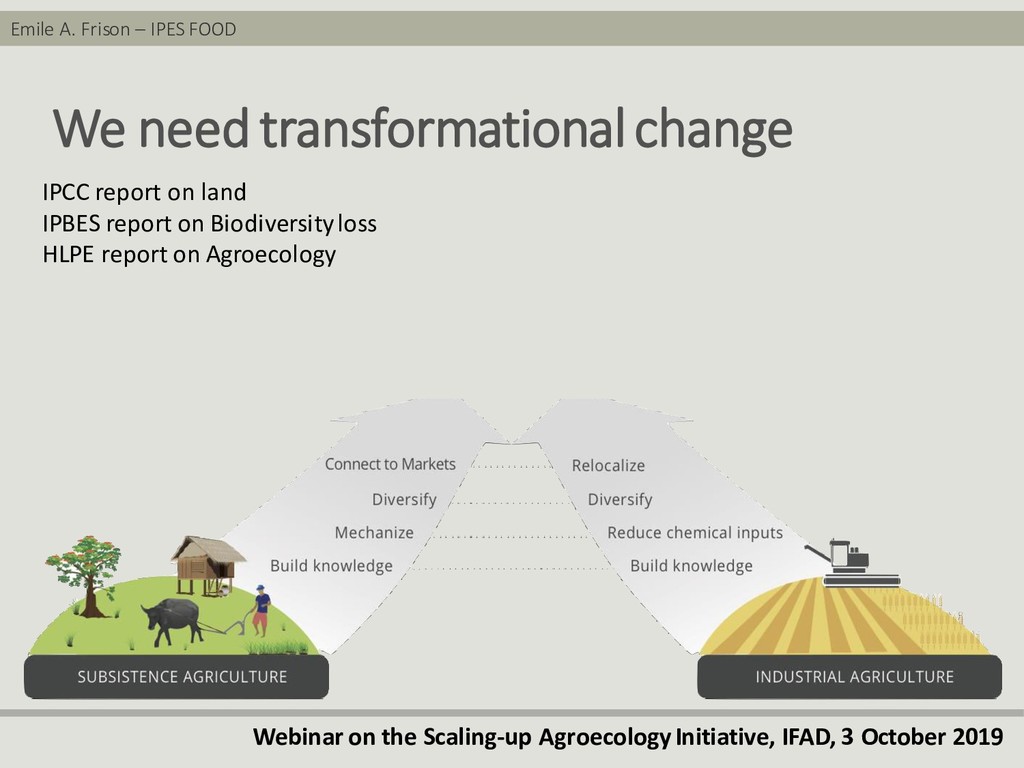
    Agroecology Initiative, IFAD, 3 October 2019 We need transformational change IPCC report on land IPBES report on Biodiversity loss HLPE report on Agroecology
  8. Webinar on the Scaling-up Agroecology Initiative, IFAD, 3 October 2019

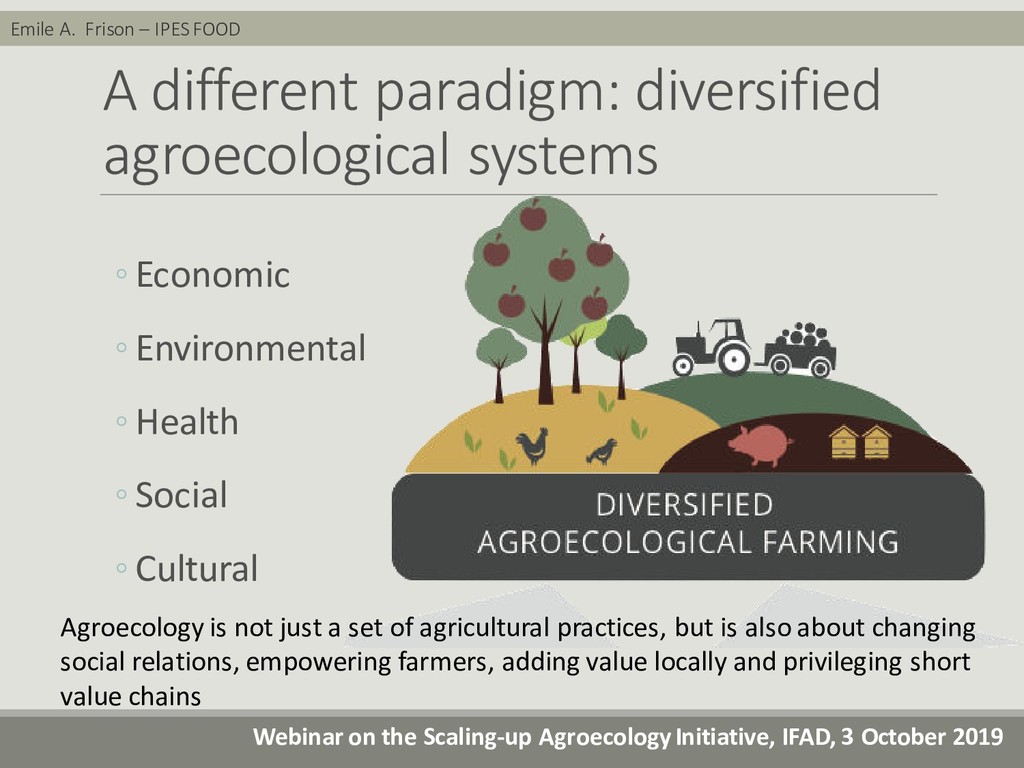
    Emile A. Frison – IPES FOOD A different paradigm: diversified agroecological systems ◦ Economic ◦ Environmental ◦ Health ◦ Social ◦ Cultural Agroecology is not just a set of agricultural practices, but is also about changing social relations, empowering farmers, adding value locally and privileging short value chains
  9. Webinar on the Scaling-up Agroecology Initiative, IFAD, 3 October 2019

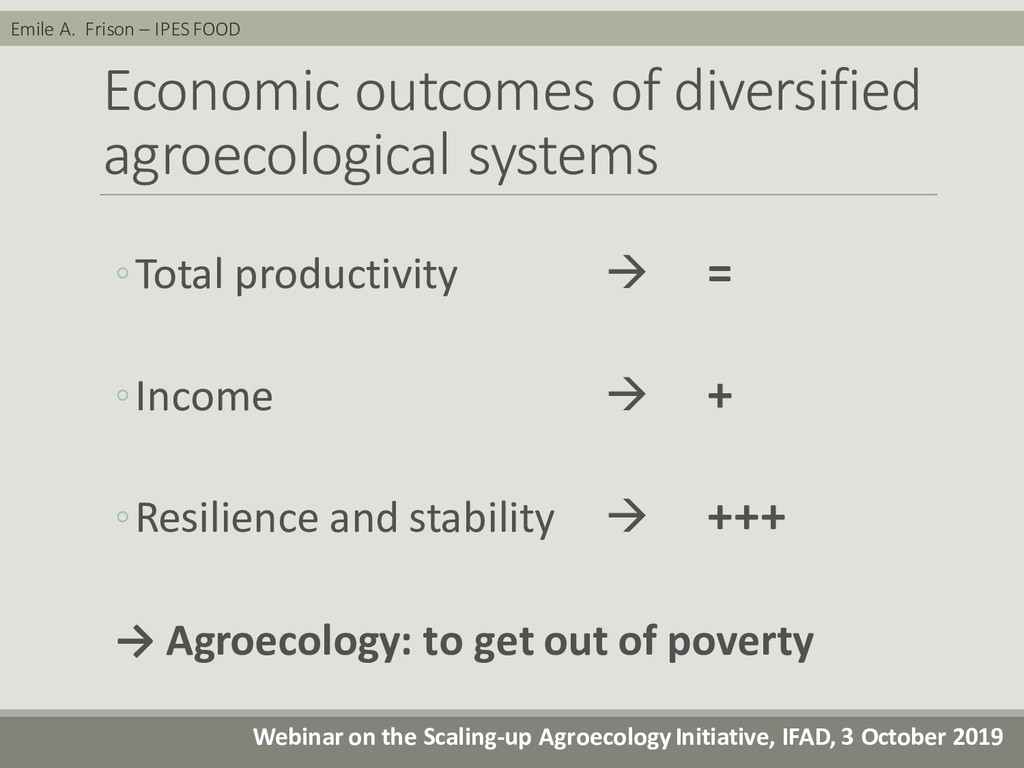
    Emile A. Frison – IPES FOOD Economic outcomes of diversified agroecological systems ◦Total productivity  = ◦Income  + ◦Resilience and stability  +++ → Agroecology: to get out of poverty
  10. Webinar on the Scaling-up Agroecology Initiative, IFAD, 3 October 2019

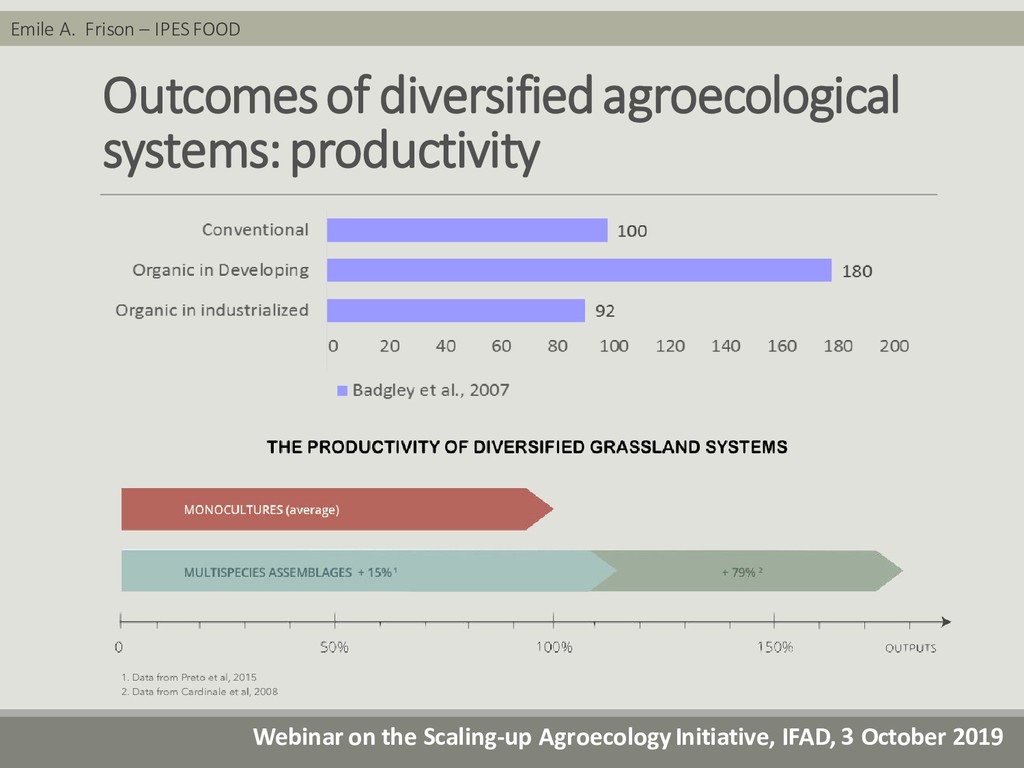
    Emile A. Frison – IPES FOOD Outcomes of diversified agroecological systems: productivity
  11. Webinar on the Scaling-up Agroecology Initiative, IFAD, 3 October 2019

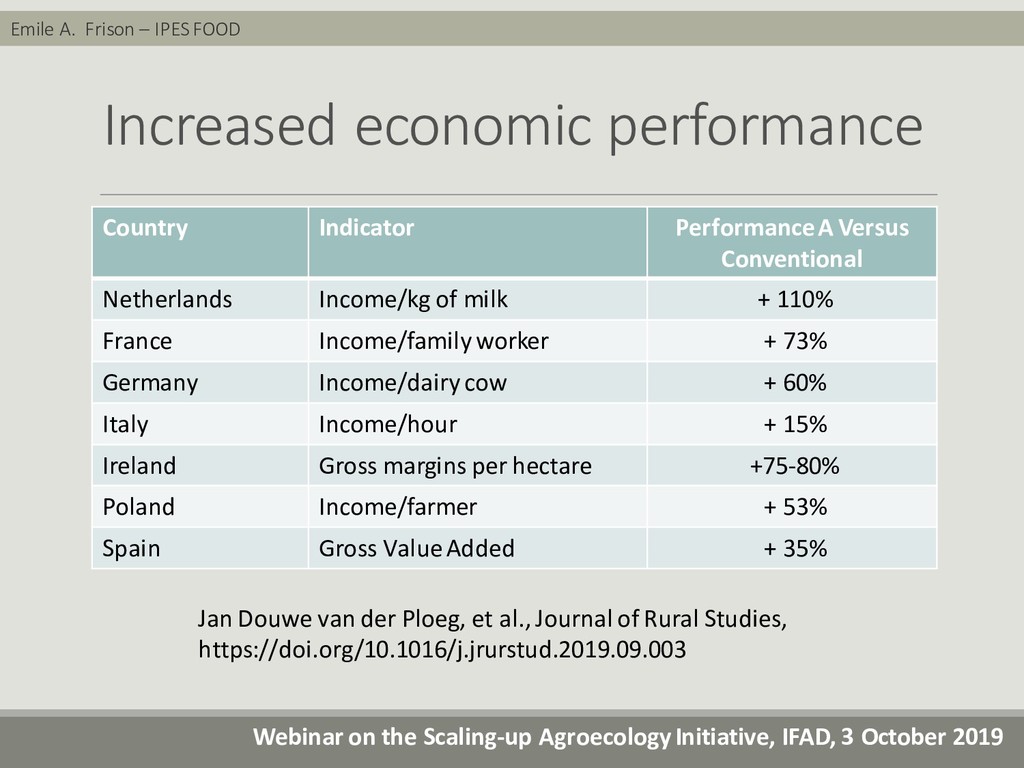
    Emile A. Frison – IPES FOOD Increased economic performance Country Indicator Performance A Versus Conventional Netherlands Income/kg of milk + 110% France Income/family worker + 73% Germany Income/dairy cow + 60% Italy Income/hour + 15% Ireland Gross margins per hectare +75-80% Poland Income/farmer + 53% Spain Gross Value Added + 35% Jan Douwe van der Ploeg, et al., Journal of Rural Studies, https://doi.org/10.1016/j.jrurstud.2019.09.003
  12. Webinar on the Scaling-up Agroecology Initiative, IFAD, 3 October 2019

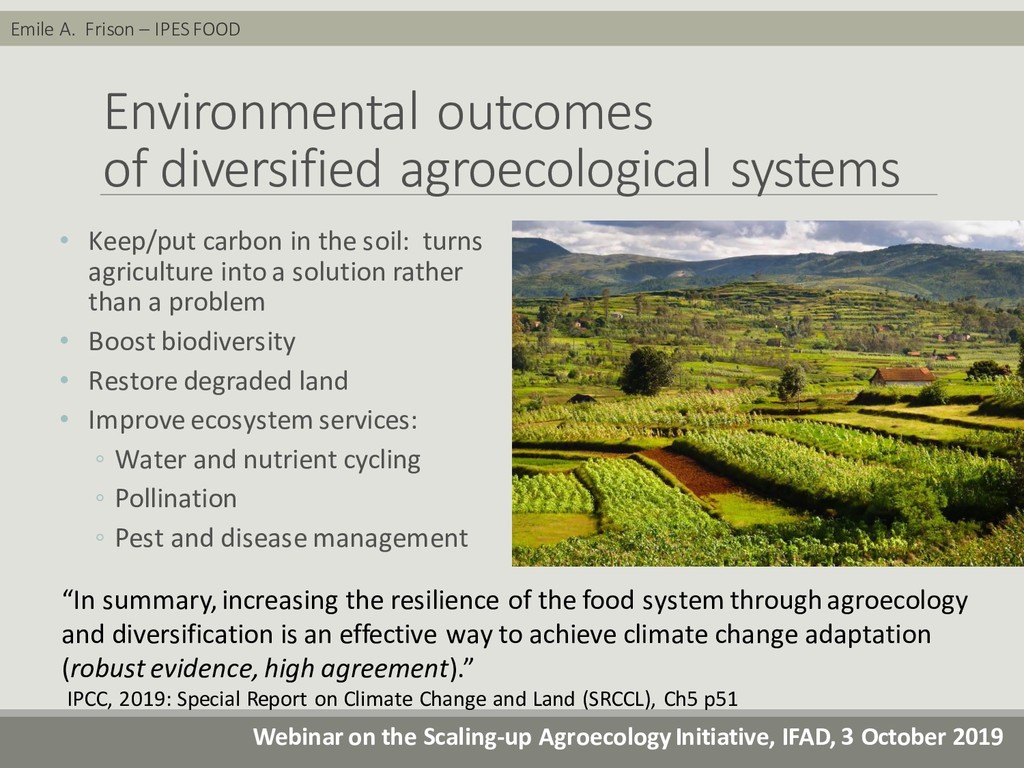
    Emile A. Frison – IPES FOOD Environmental outcomes of diversified agroecological systems • Keep/put carbon in the soil: turns agriculture into a solution rather than a problem • Boost biodiversity • Restore degraded land • Improve ecosystem services: ◦ Water and nutrient cycling ◦ Pollination ◦ Pest and disease management “In summary, increasing the resilience of the food system through agroecology and diversification is an effective way to achieve climate change adaptation (robust evidence, high agreement).” IPCC, 2019: Special Report on Climate Change and Land (SRCCL), Ch5 p51
  13. Webinar on the Scaling-up Agroecology Initiative, IFAD, 3 October 2019

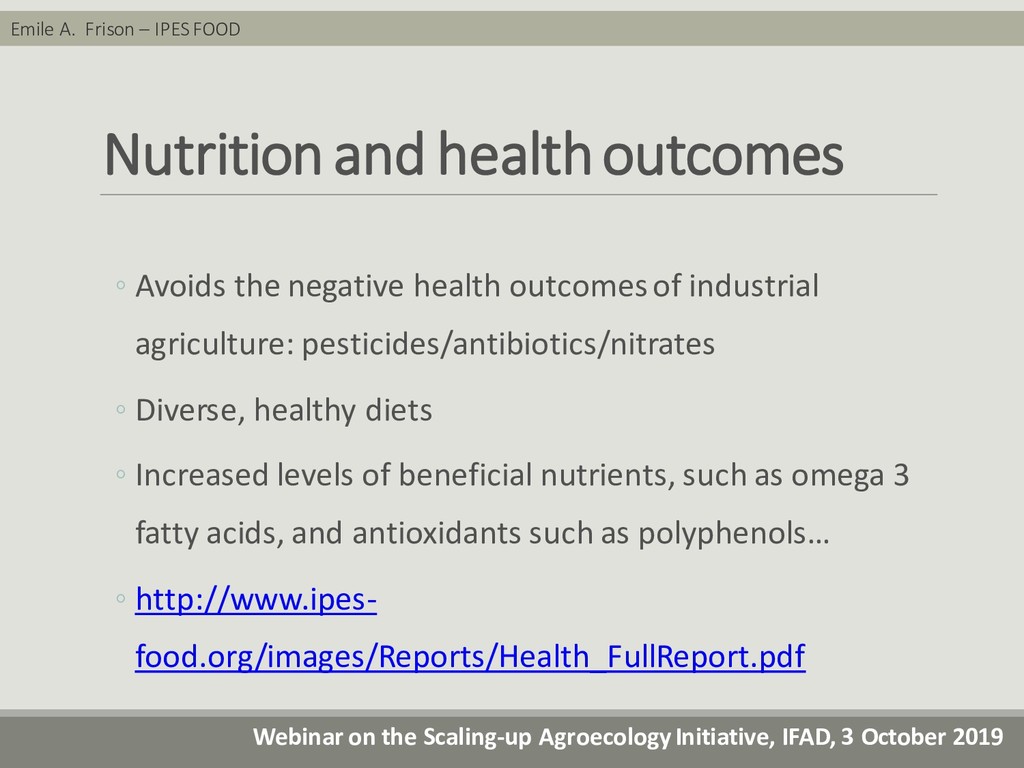
    Emile A. Frison – IPES FOOD Nutrition and health outcomes ◦ Avoids the negative health outcomes of industrial agriculture: pesticides/antibiotics/nitrates ◦ Diverse, healthy diets ◦ Increased levels of beneficial nutrients, such as omega 3 fatty acids, and antioxidants such as polyphenols… ◦ http://www.ipes- food.org/images/Reports/Health_FullReport.pdf
  14. Webinar on the Scaling-up Agroecology Initiative, IFAD, 3 October 2019

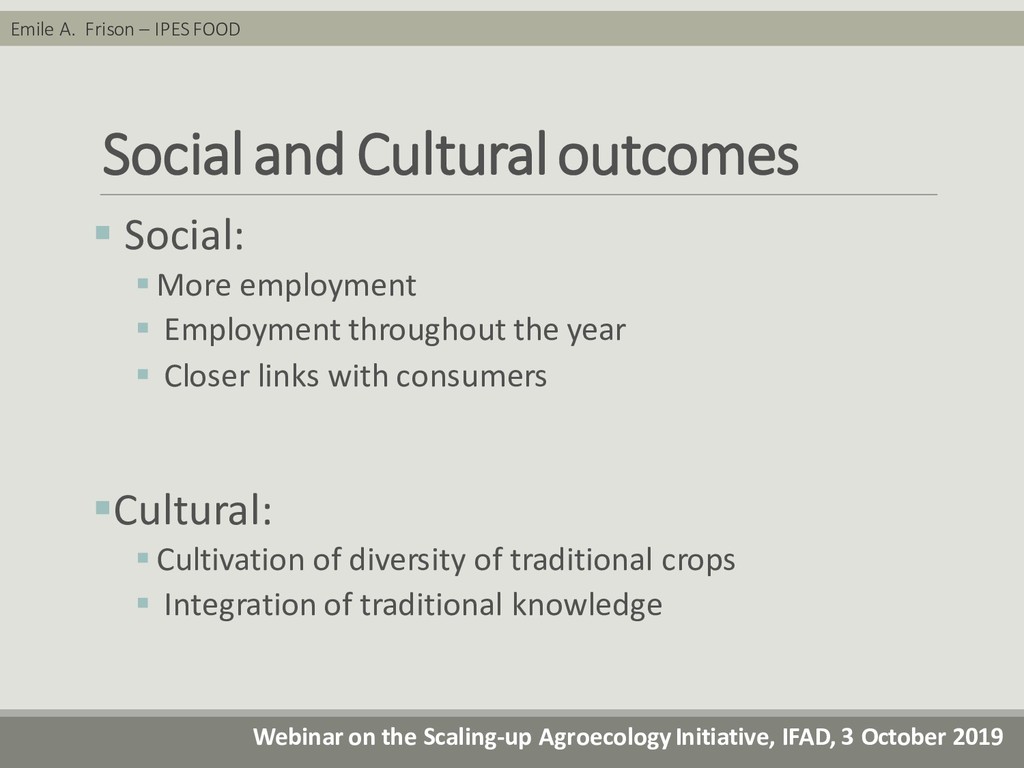
    Emile A. Frison – IPES FOOD Social and Cultural outcomes  Social:  More employment  Employment throughout the year  Closer links with consumers Cultural:  Cultivation of diversity of traditional crops  Integration of traditional knowledge
  15. Emile A. Frison – IPES FOOD Webinar on the Scaling-up

    Agroecology Initiative, IFAD, 3 October 2019
  16. Webinar on the Scaling-up Agroecology Initiative, IFAD, 3 October 2019

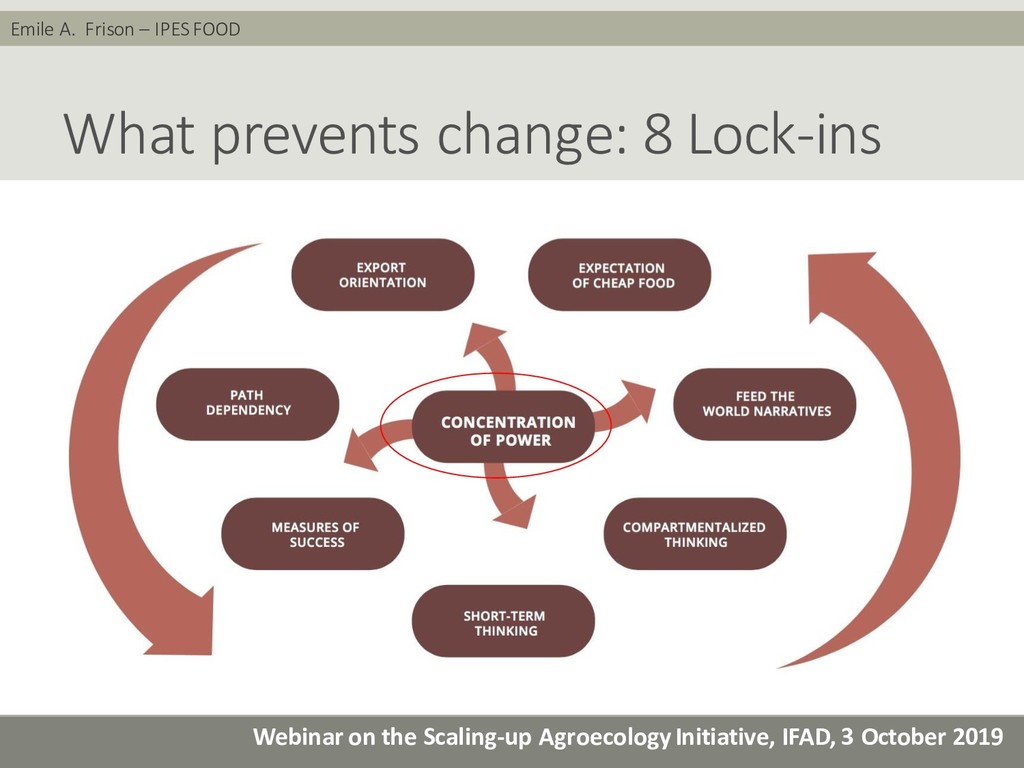
    Emile A. Frison – IPES FOOD What prevents change: 8 Lock-ins
  17. Webinar on the Scaling-up Agroecology Initiative, IFAD, 3 October 2019

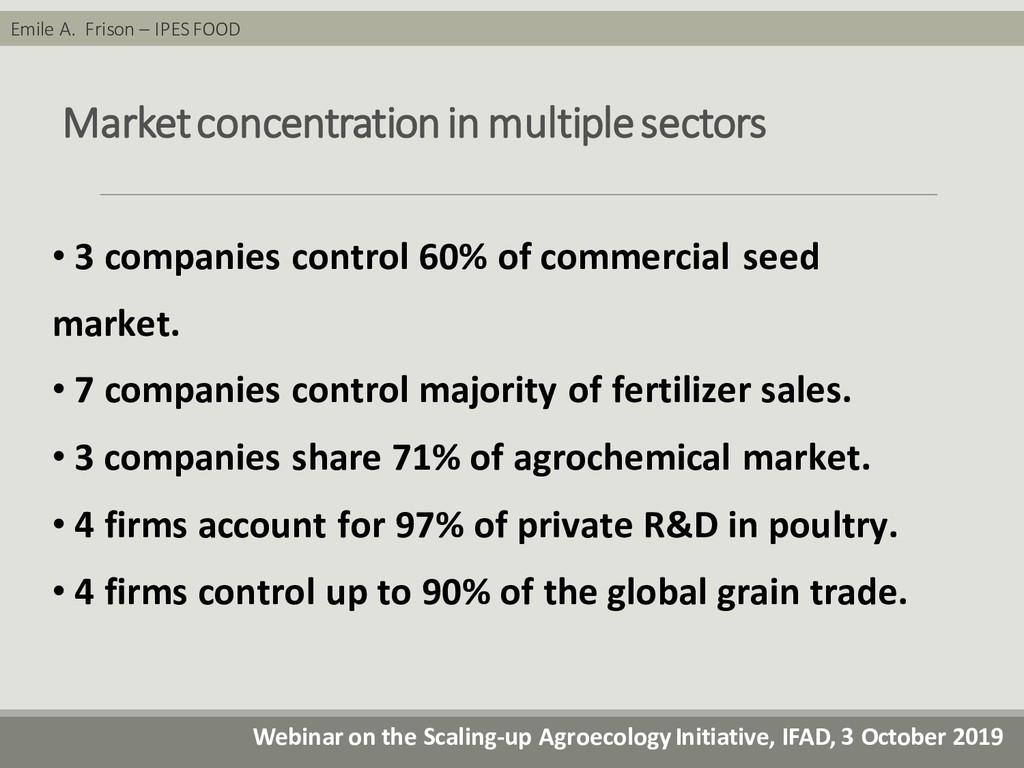
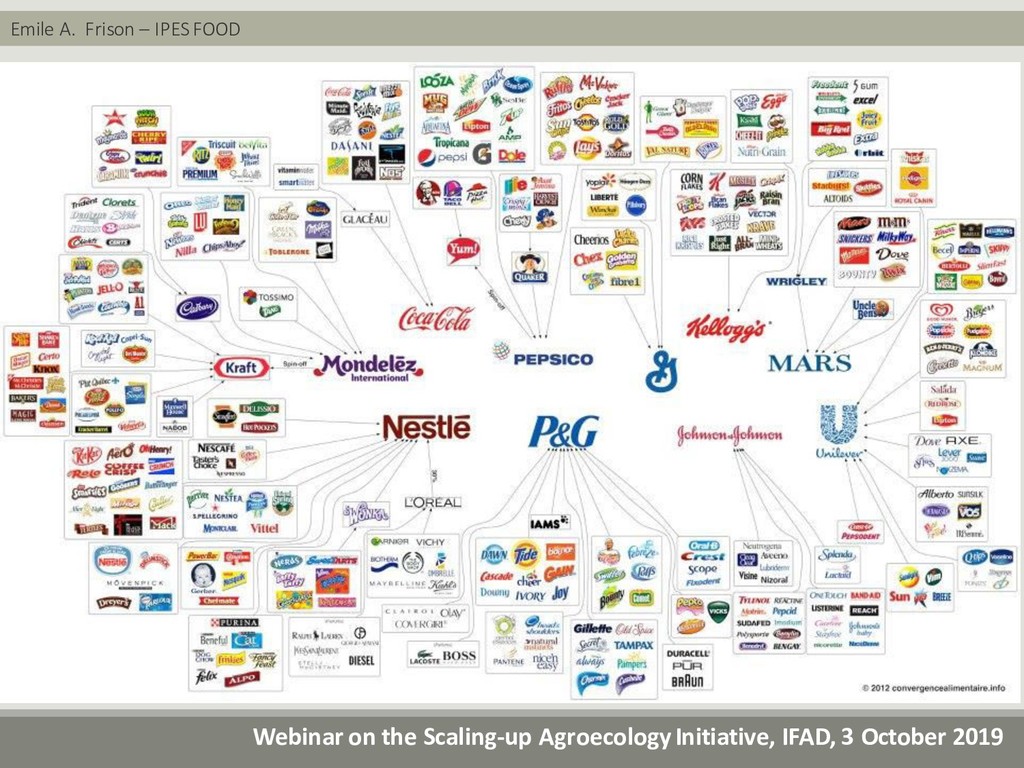
    Emile A. Frison – IPES FOOD Market concentration in multiple sectors • 3 companies control 60% of commercial seed market. • 7 companies control majority of fertilizer sales. • 3 companies share 71% of agrochemical market. • 4 firms account for 97% of private R&D in poultry. • 4 firms control up to 90% of the global grain trade.
  18. Emile A. Frison – IPES FOOD Webinar on the Scaling-up

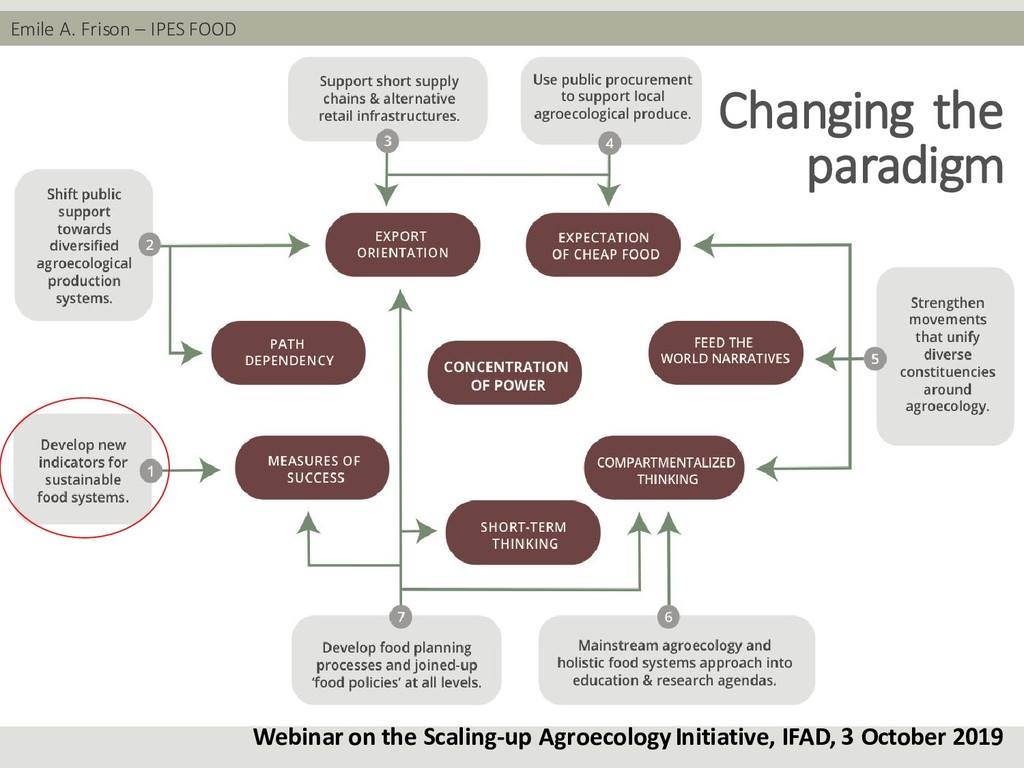
    Agroecology Initiative, IFAD, 3 October 2019 Changing the paradigm
  19. Emile A. Frison – IPES FOOD Webinar on the Scaling-up

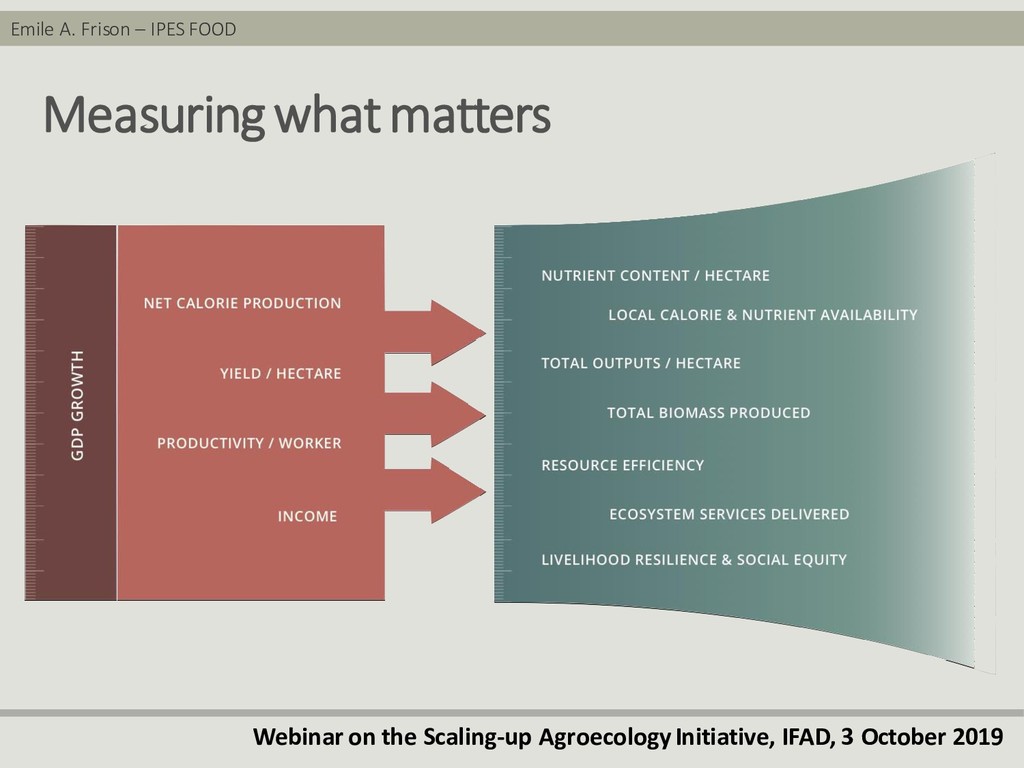
    Agroecology Initiative, IFAD, 3 October 2019 Measuring what matters
  20. Webinar on the Scaling-up Agroecology Initiative, IFAD, 3 October 2019

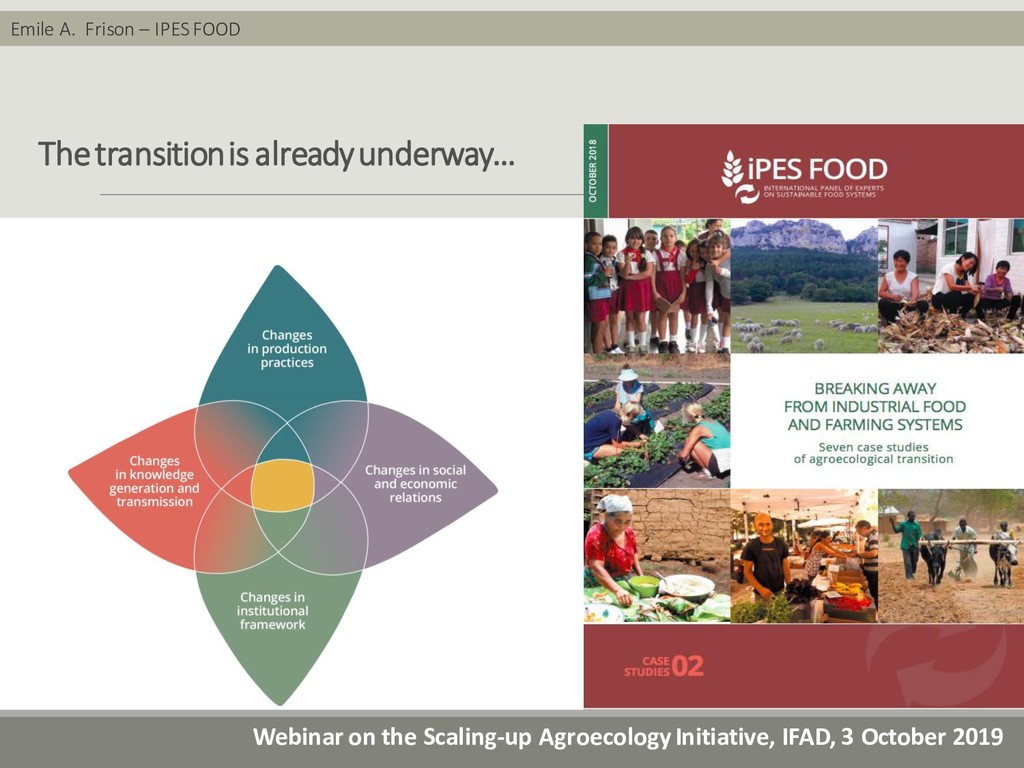
    Emile A. Frison – IPES FOOD The transition is already underway…
  21. Emile A. Frison – IPES FOOD Webinar on the Scaling-up

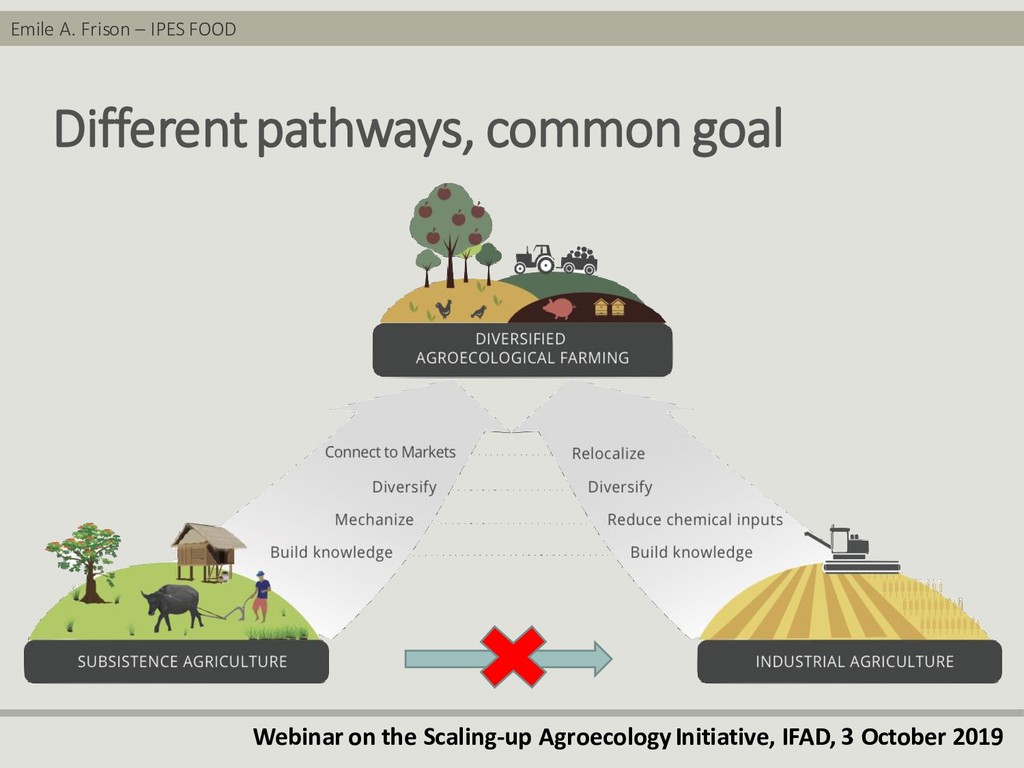
    Agroecology Initiative, IFAD, 3 October 2019 Different pathways, common goal
  22. Emile A. Frison – IPES FOOD Webinar on the Scaling-up

    Agroecology Initiative, IFAD, 3 October 2019 Thank you! www.ipes-food.org
  23. 1 Webinar Applying Agroecology in IFAD operation The Scaling up

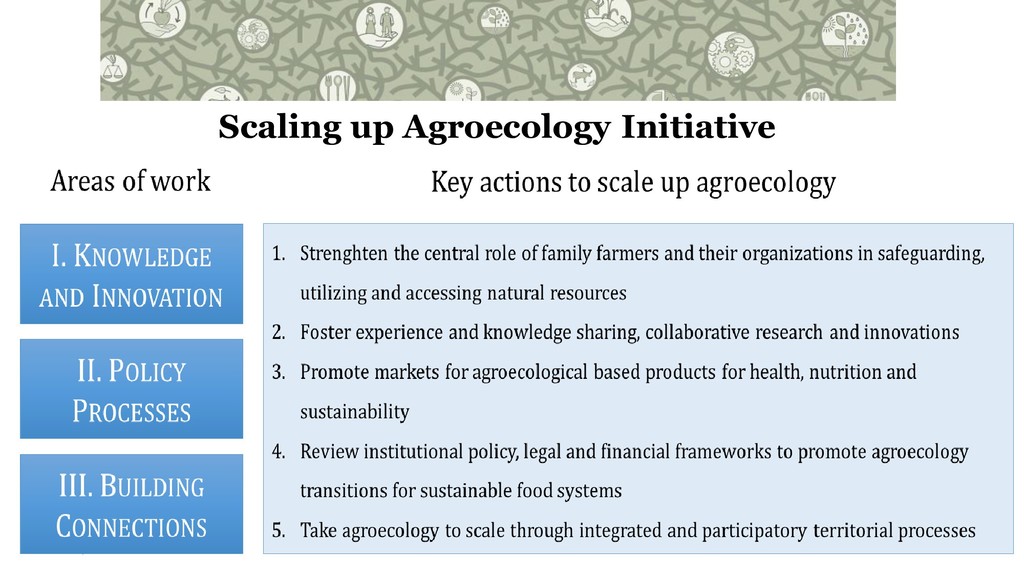
    Agroecology Initiative Emma Siliprandi FAO
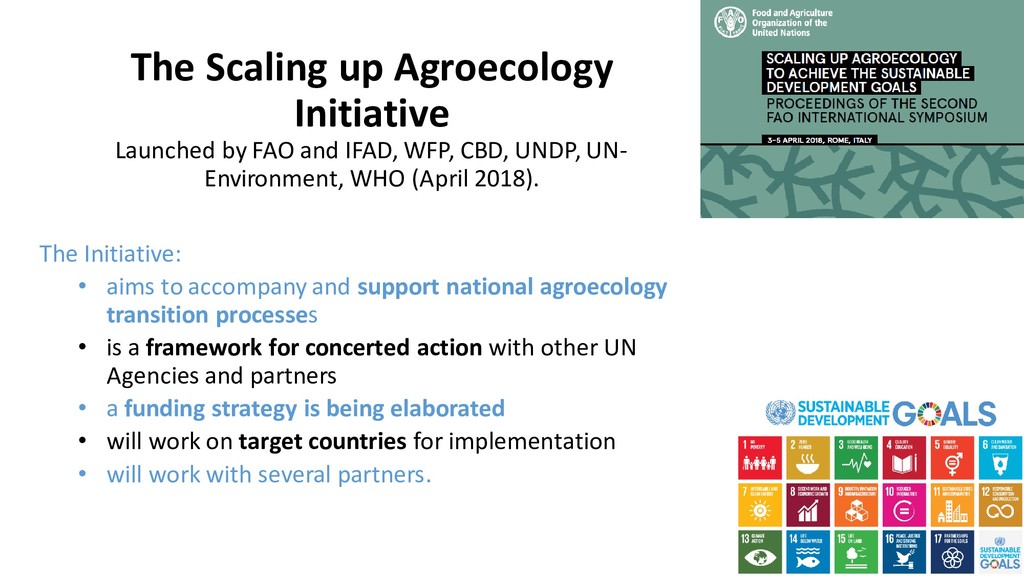
  24. The Scaling up Agroecology Initiative Launched by FAO and IFAD,

    WFP, CBD, UNDP, UN- Environment, WHO (April 2018). The Initiative: • aims to accompany and support national agroecology transition processes • is a framework for concerted action with other UN Agencies and partners • a funding strategy is being elaborated • will work on target countries for implementation • will work with several partners.
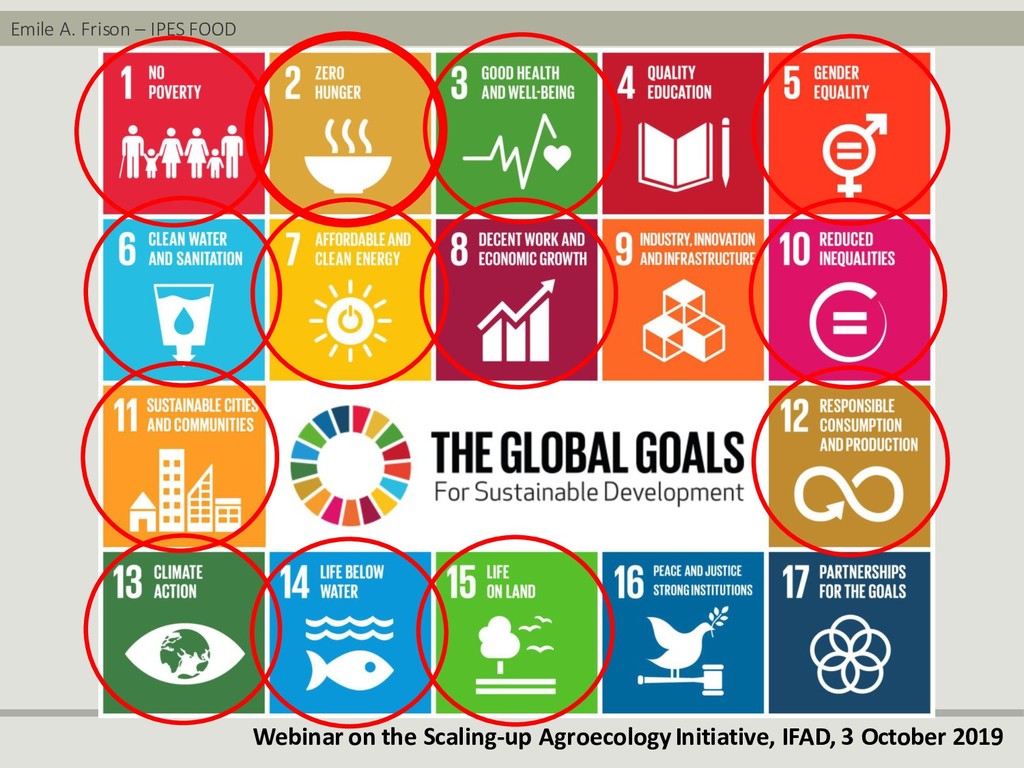
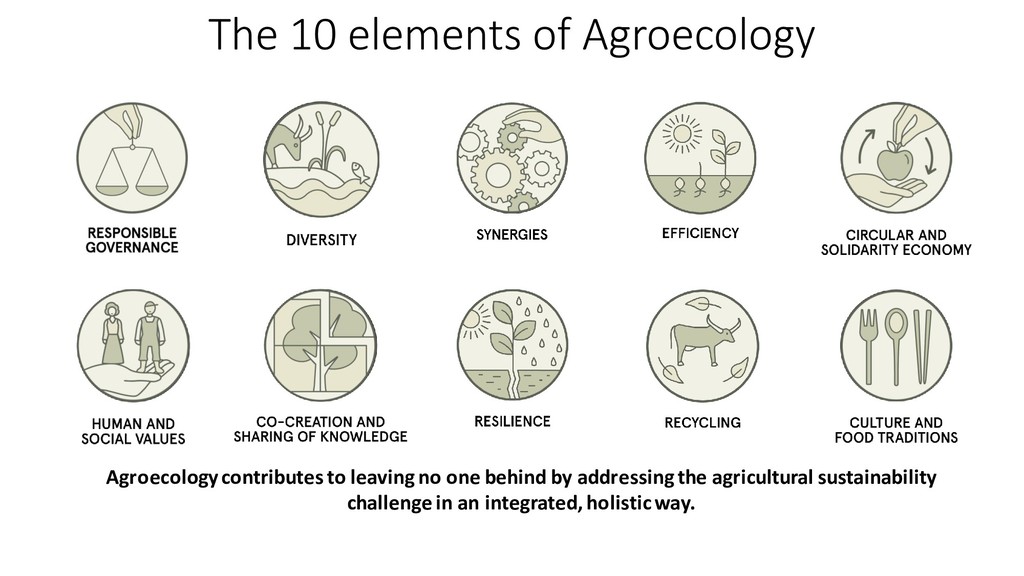
  25. Agroecology contributes to leaving no one behind by addressing the

    agricultural sustainability challenge in an integrated, holistic way.
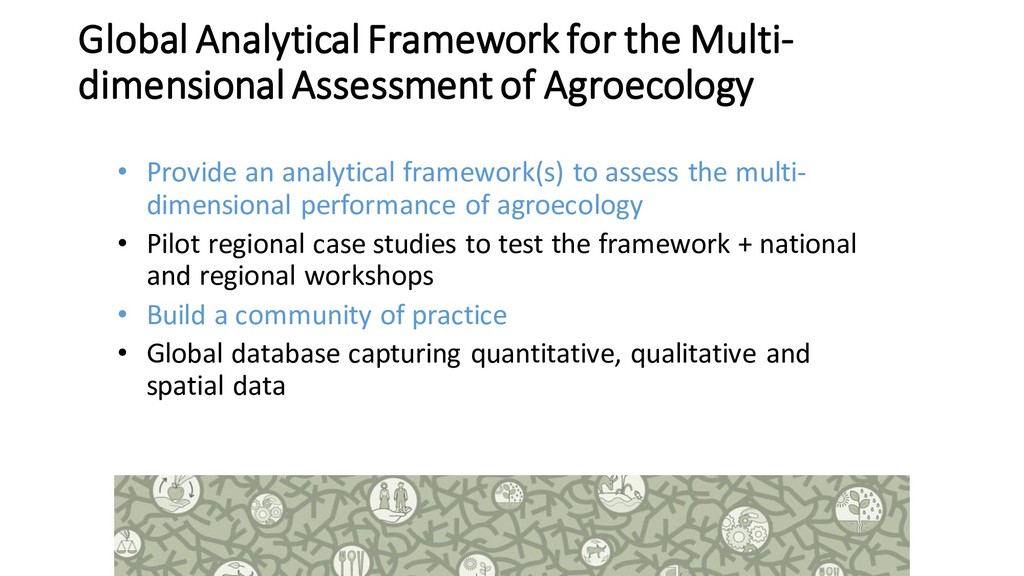
  26. Global Analytical Framework for the Multi- dimensional Assessment of Agroecology

    • Provide an analytical framework(s) to assess the multi- dimensional performance of agroecology • Pilot regional case studies to test the framework + national and regional workshops • Build a community of practice • Global database capturing quantitative, qualitative and spatial data
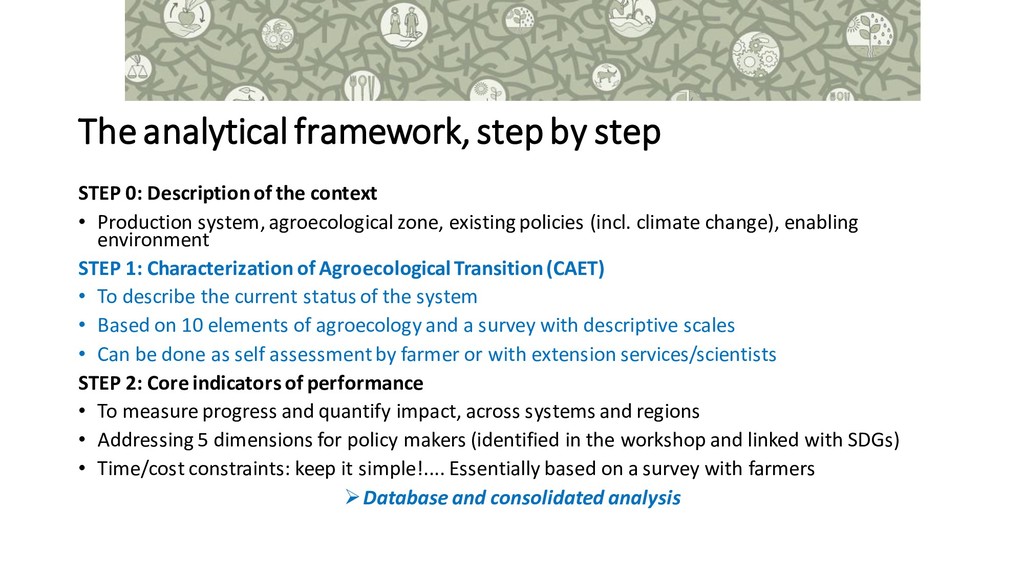
  27. The analytical framework, step by step STEP 0: Description of

    the context • Production system, agroecological zone, existing policies (incl. climate change), enabling environment STEP 1: Characterization of Agroecological Transition (CAET) • To describe the current status of the system • Based on 10 elements of agroecology and a survey with descriptive scales • Can be done as self assessment by farmer or with extension services/scientists STEP 2: Core indicators of performance • To measure progress and quantify impact, across systems and regions • Addressing 5 dimensions for policy makers (identified in the workshop and linked with SDGs) • Time/cost constraints: keep it simple!.... Essentially based on a survey with farmers Database and consolidated analysis
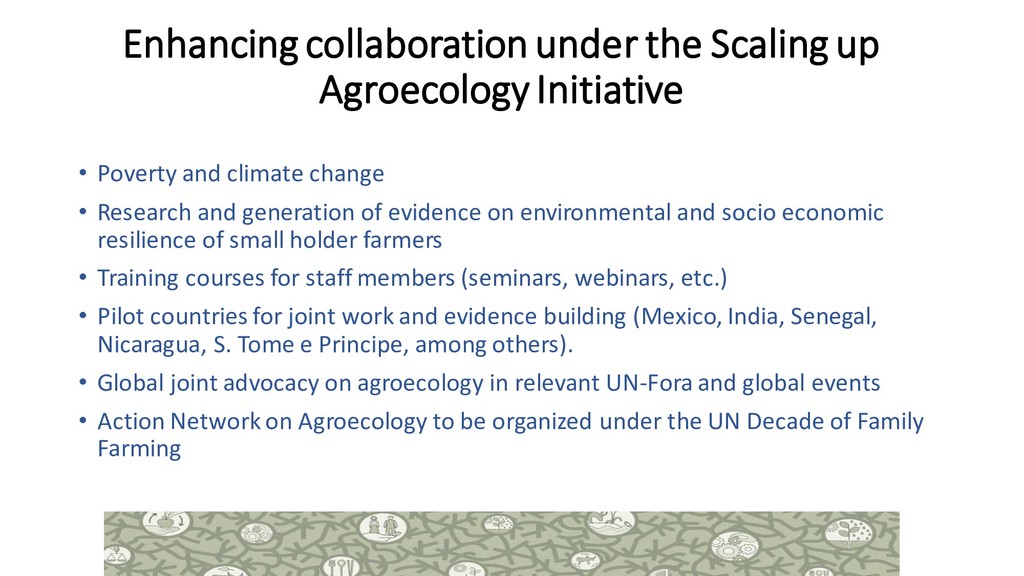
  28. Enhancing collaboration under the Scaling up Agroecology Initiative • Poverty

    and climate change • Research and generation of evidence on environmental and socio economic resilience of small holder farmers • Training courses for staff members (seminars, webinars, etc.) • Pilot countries for joint work and evidence building (Mexico, India, Senegal, Nicaragua, S. Tome e Principe, among others). • Global joint advocacy on agroecology in relevant UN-Fora and global events • Action Network on Agroecology to be organized under the UN Decade of Family Farming
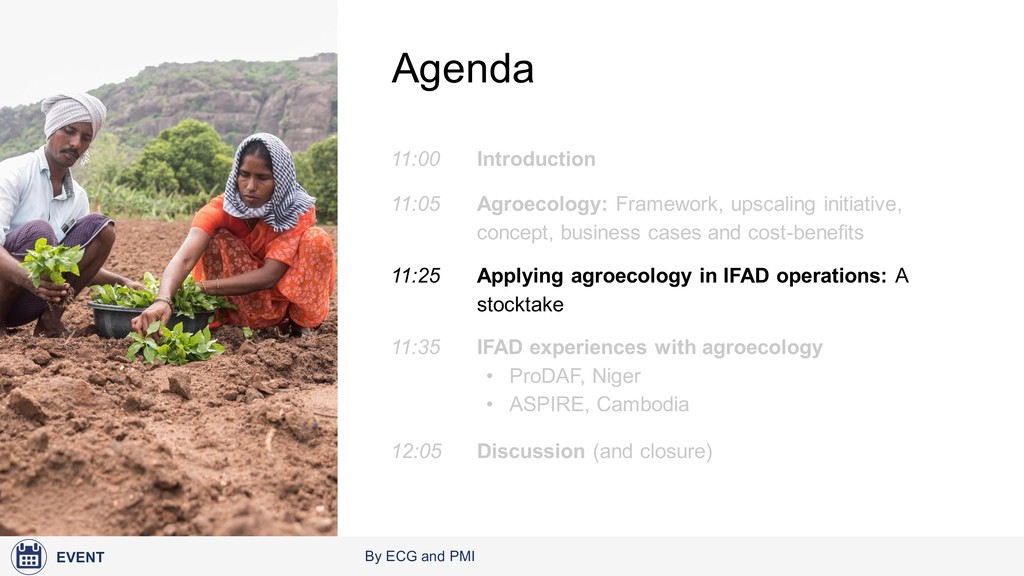
  29. Agenda EVENT By ECG and PMI 11:00 Introduction 11:05 Agroecology:

    Framework, upscaling initiative, concept, business cases and cost-benefits 11:25 Applying agroecology in IFAD operations: A stocktake 11:35 IFAD experiences with agroecology • ProDAF, Niger • ASPIRE, Cambodia 12:05 Discussion (and closure)
  30. Analysis of IFAD interventions in agroecology Webinar: Applying agroecology in

    IFAD operations October 2019 Rikke Olivera, PMI, IFAD
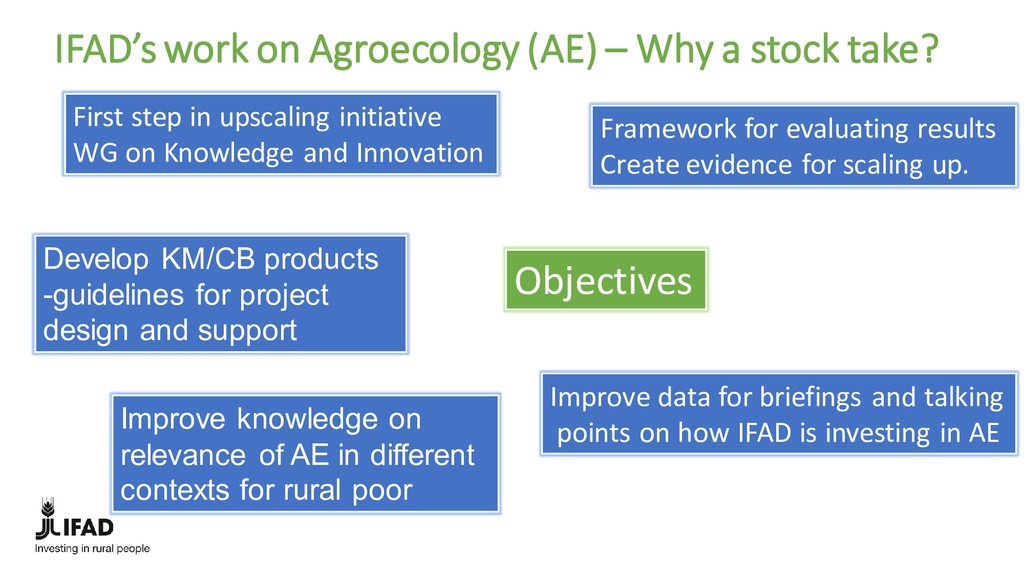
  31. IFAD’s work on Agroecology (AE) – Why a stock take?

    Objectives First step in upscaling initiative WG on Knowledge and Innovation Framework for evaluating results Create evidence for scaling up. Improve data for briefings and talking points on how IFAD is investing in AE Develop KM/CB products -guidelines for project design and support Improve knowledge on relevance of AE in different contexts for rural poor
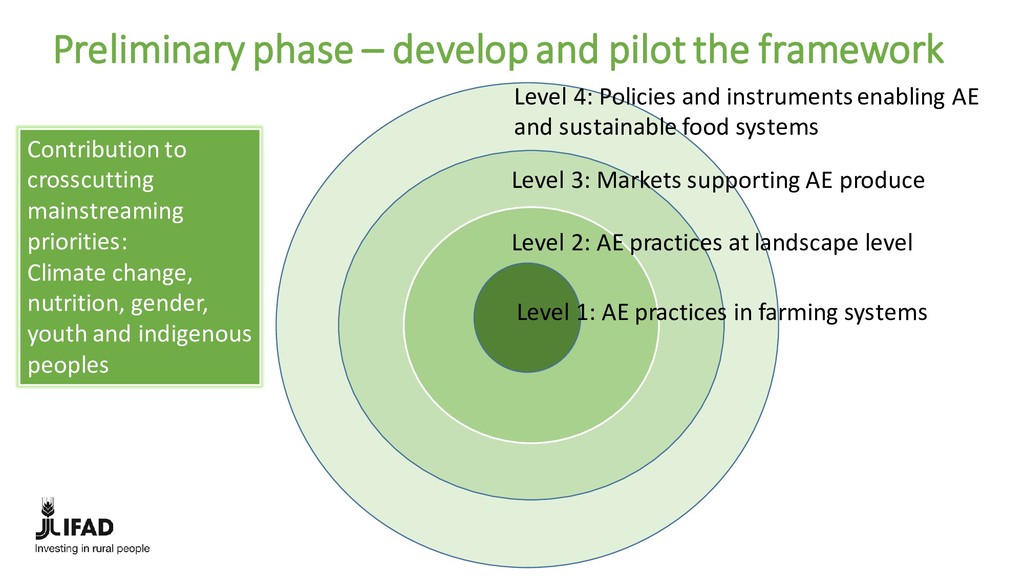
  32. Preliminary phase – develop and pilot the framework Level 3:

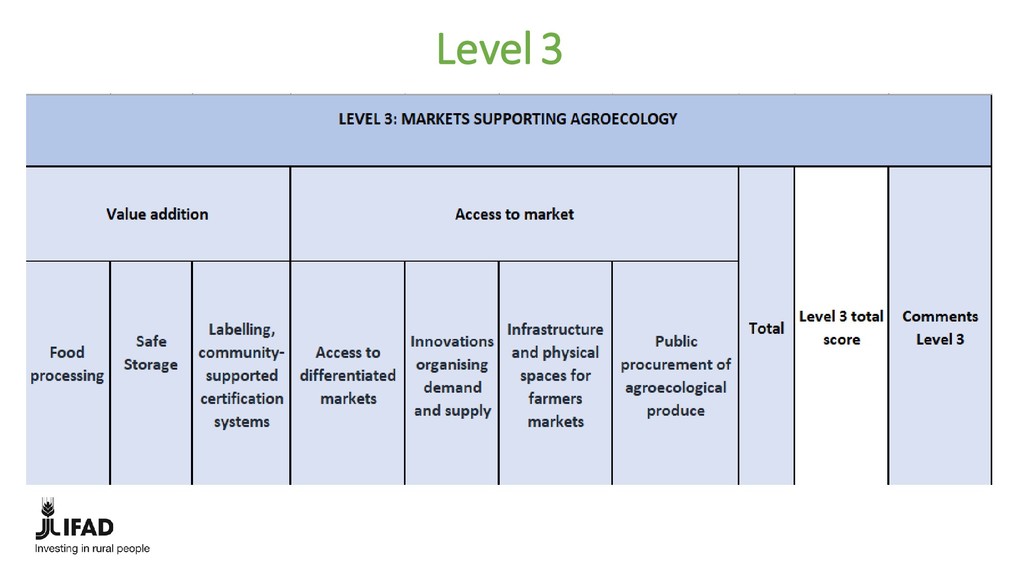
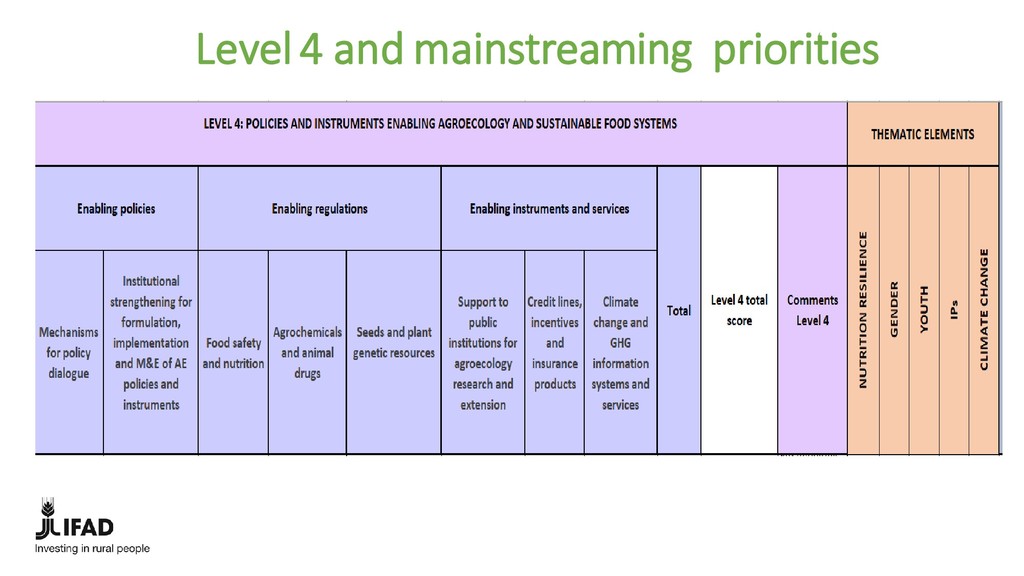
    Markets supporting AE produce Level 4: Policies and instruments enabling AE and sustainable food systems Level 2: AE practices at landscape level Level 1: AE practices in farming systems Contribution to crosscutting mainstreaming priorities: Climate change, nutrition, gender, youth and indigenous peoples
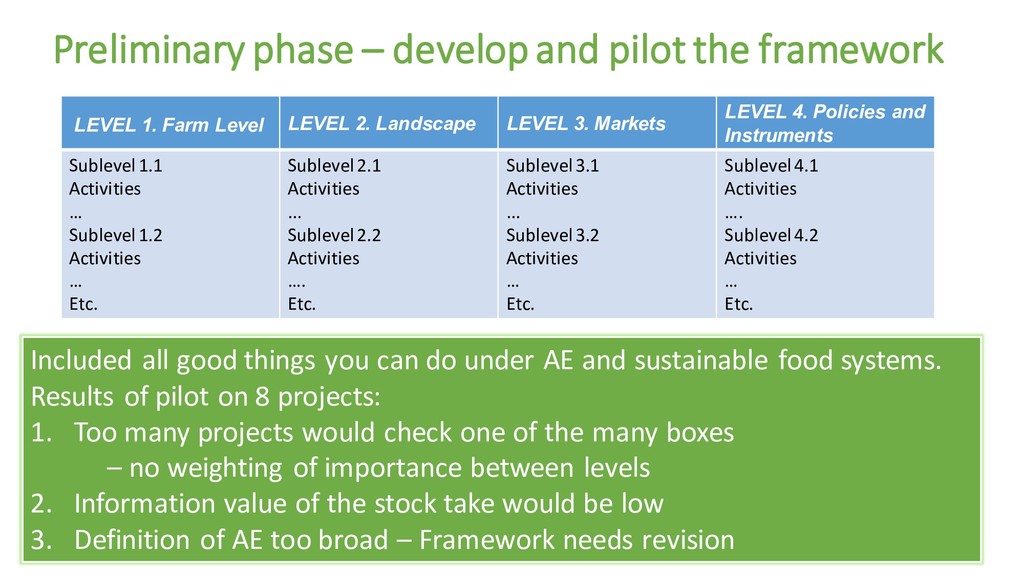
  33. Preliminary phase – develop and pilot the framework LEVEL 1.

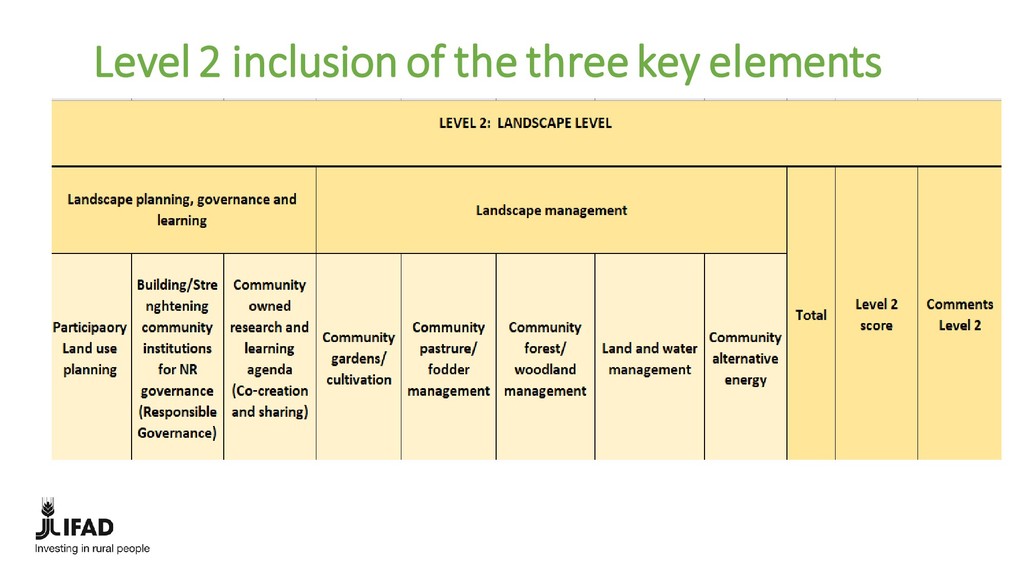
    Farm Level LEVEL 2. Landscape LEVEL 3. Markets LEVEL 4. Policies and Instruments Sublevel 1.1 Activities … Sublevel 1.2 Activities … Etc. Sublevel 2.1 Activities ... Sublevel 2.2 Activities …. Etc. Sublevel 3.1 Activities ... Sublevel 3.2 Activities … Etc. Sublevel 4.1 Activities …. Sublevel 4.2 Activities … Etc. Included all good things you can do under AE and sustainable food systems. Results of pilot on 8 projects: 1. Too many projects would check one of the many boxes – no weighting of importance between levels 2. Information value of the stock take would be low 3. Definition of AE too broad – Framework needs revision
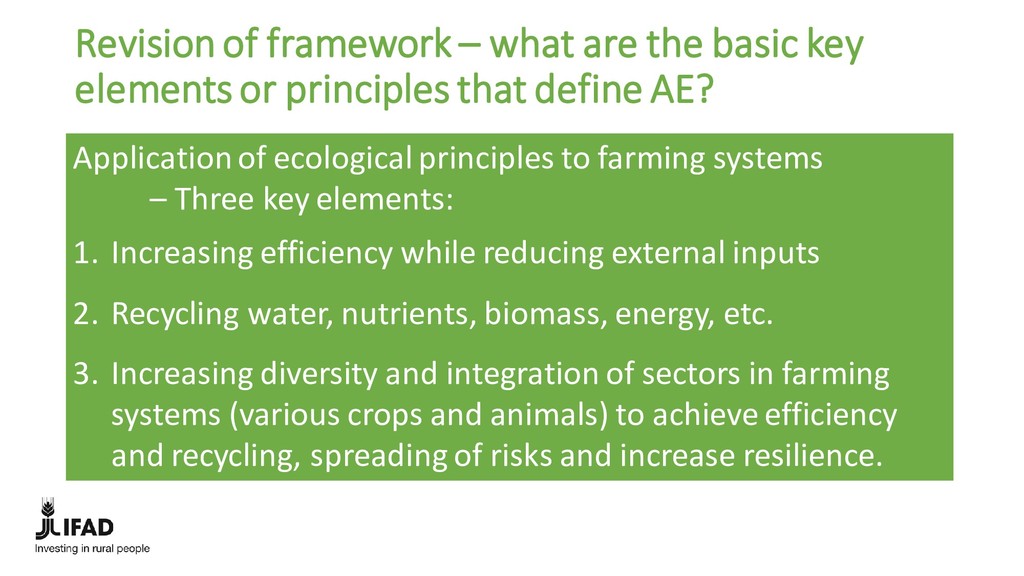
  34. Revision of framework – what are the basic key elements

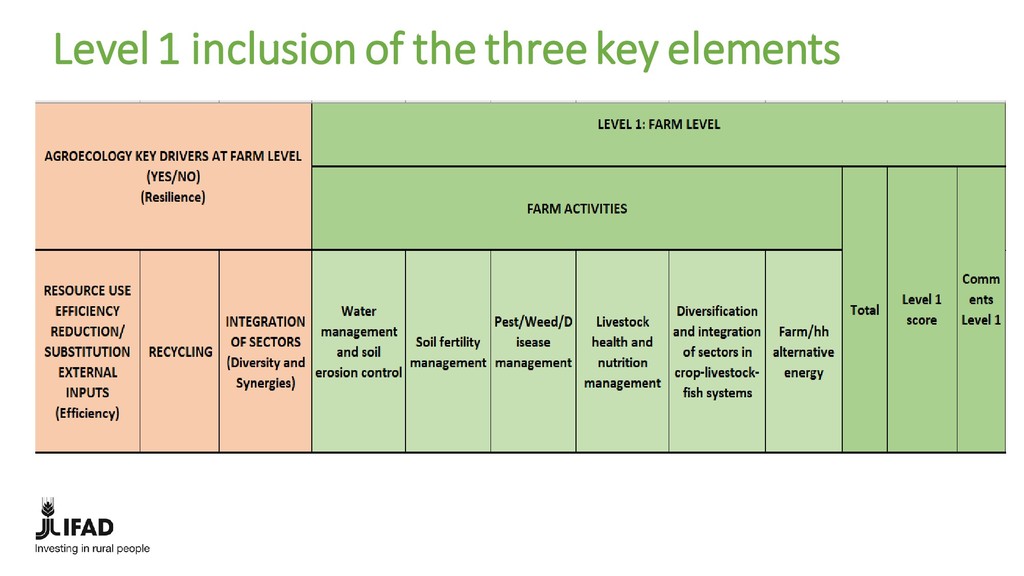
    or principles that define AE? Application of ecological principles to farming systems – Three key elements: 1. Increasing efficiency while reducing external inputs 2. Recycling water, nutrients, biomass, energy, etc. 3. Increasing diversity and integration of sectors in farming systems (various crops and animals) to achieve efficiency and recycling, spreading of risks and increase resilience.
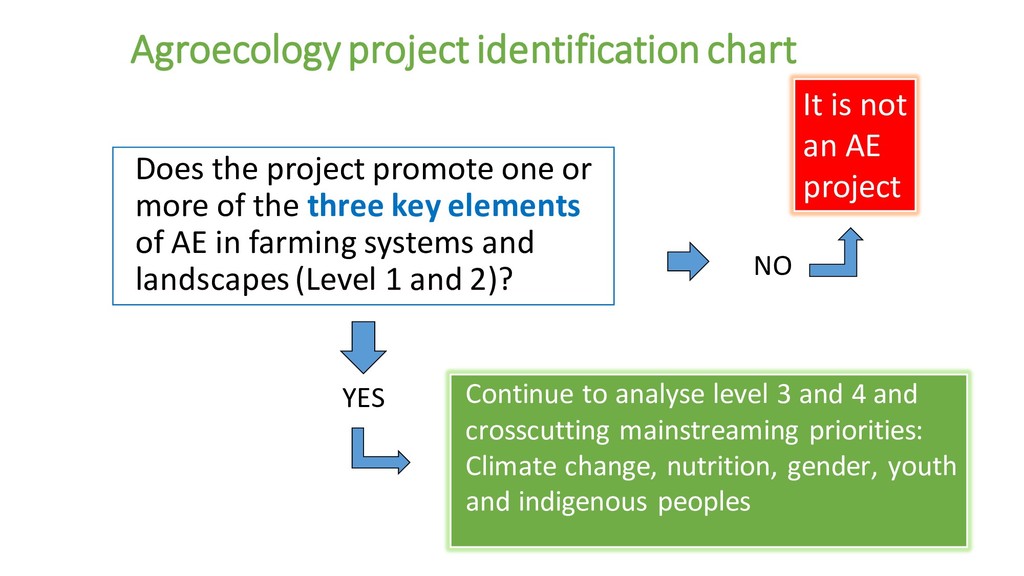
  35. Does the project promote one or more of the three

    key elements of AE in farming systems and landscapes (Level 1 and 2)? Agroecology project identification chart NO It is not an AE project YES Continue to analyse level 3 and 4 and crosscutting mainstreaming priorities: Climate change, nutrition, gender, youth and indigenous peoples
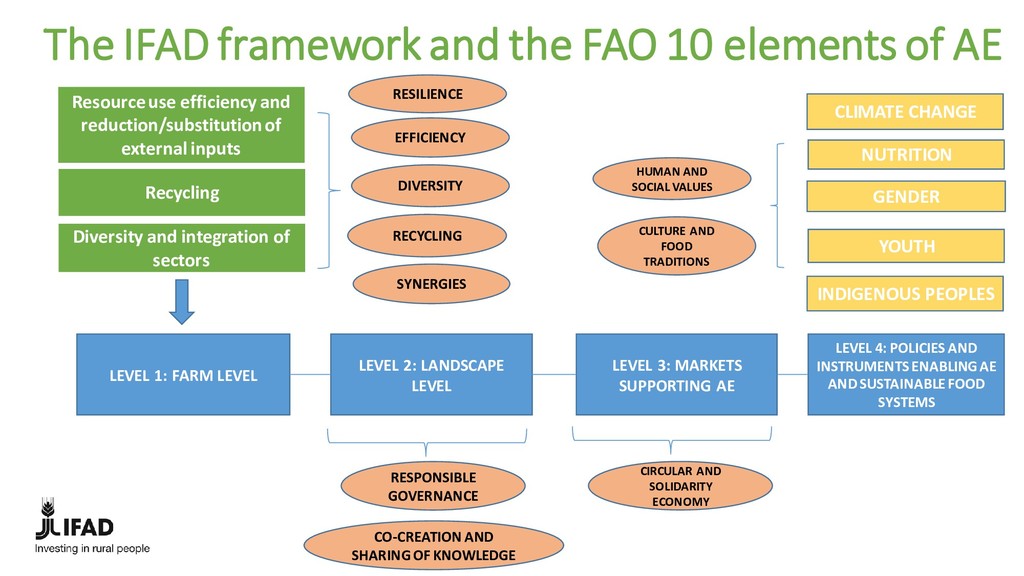
  36. Resource use efficiency and reduction/substitution of external inputs Recycling Diversity

    and integration of sectors LEVEL 1: FARM LEVEL LEVEL 2: LANDSCAPE LEVEL LEVEL 3: MARKETS SUPPORTING AE LEVEL 4: POLICIES AND INSTRUMENTS ENABLING AE AND SUSTAINABLE FOOD SYSTEMS RESILIENCE EFFICIENCY DIVERSITY RESPONSIBLE GOVERNANCE CO-CREATION AND SHARING OF KNOWLEDGE RECYCLING CIRCULAR AND SOLIDARITY ECONOMY NUTRITION GENDER YOUTH INDIGENOUS PEOPLES CLIMATE CHANGE HUMAN AND SOCIAL VALUES SYNERGIES The IFAD framework and the FAO 10 elements of AE CULTURE AND FOOD TRADITIONS
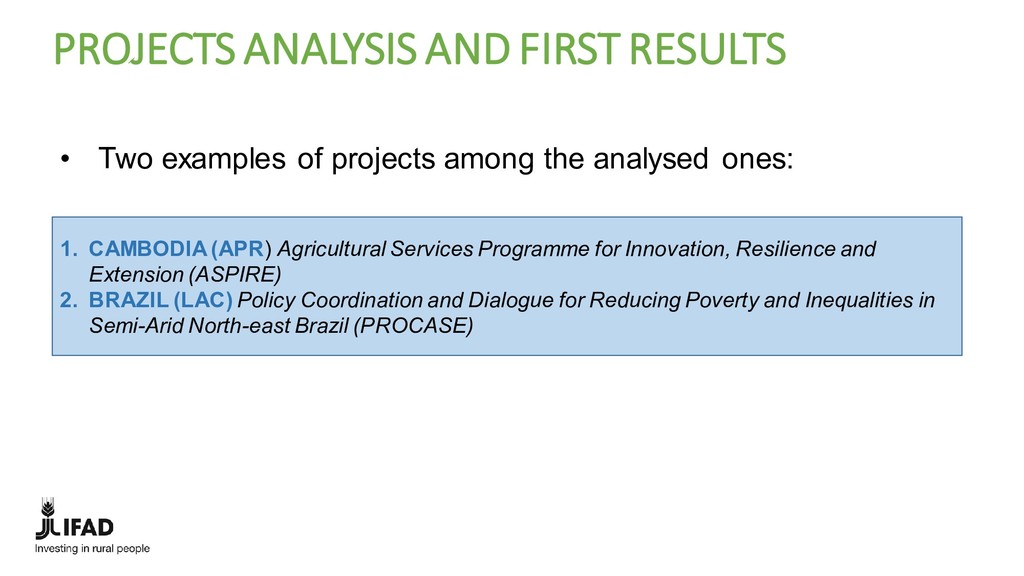
  37. • Two examples of projects among the analysed ones: PROJECTS

    ANALYSIS AND FIRST RESULTS 1. CAMBODIA (APR) Agricultural Services Programme for Innovation, Resilience and Extension (ASPIRE) 2. BRAZIL (LAC) Policy Coordination and Dialogue for Reducing Poverty and Inequalities in Semi-Arid North-east Brazil (PROCASE)
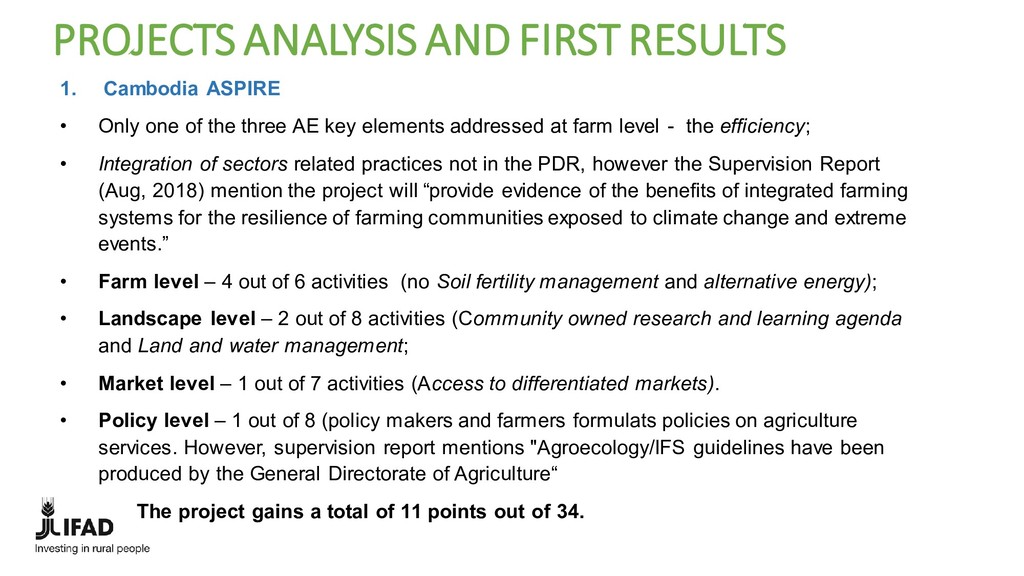
  38. 1. Cambodia ASPIRE • Only one of the three AE

    key elements addressed at farm level - the efficiency; • Integration of sectors related practices not in the PDR, however the Supervision Report (Aug, 2018) mention the project will “provide evidence of the benefits of integrated farming systems for the resilience of farming communities exposed to climate change and extreme events.” • Farm level – 4 out of 6 activities (no Soil fertility management and alternative energy); • Landscape level – 2 out of 8 activities (Community owned research and learning agenda and Land and water management; • Market level – 1 out of 7 activities (Access to differentiated markets). • Policy level – 1 out of 8 (policy makers and farmers formulats policies on agriculture services. However, supervision report mentions "Agroecology/IFS guidelines have been produced by the General Directorate of Agriculture“ The project gains a total of 11 points out of 34. PROJECTS ANALYSIS AND FIRST RESULTS
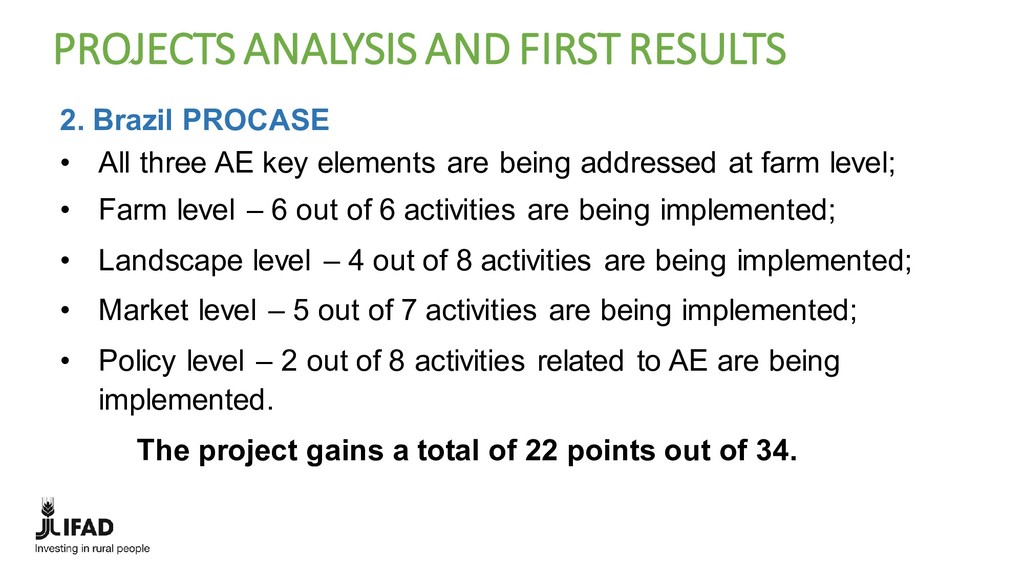
  39. 2. Brazil PROCASE • All three AE key elements are

    being addressed at farm level; • Farm level – 6 out of 6 activities are being implemented; • Landscape level – 4 out of 8 activities are being implemented; • Market level – 5 out of 7 activities are being implemented; • Policy level – 2 out of 8 activities related to AE are being implemented. The project gains a total of 22 points out of 34. PROJECTS ANALYSIS AND FIRST RESULTS
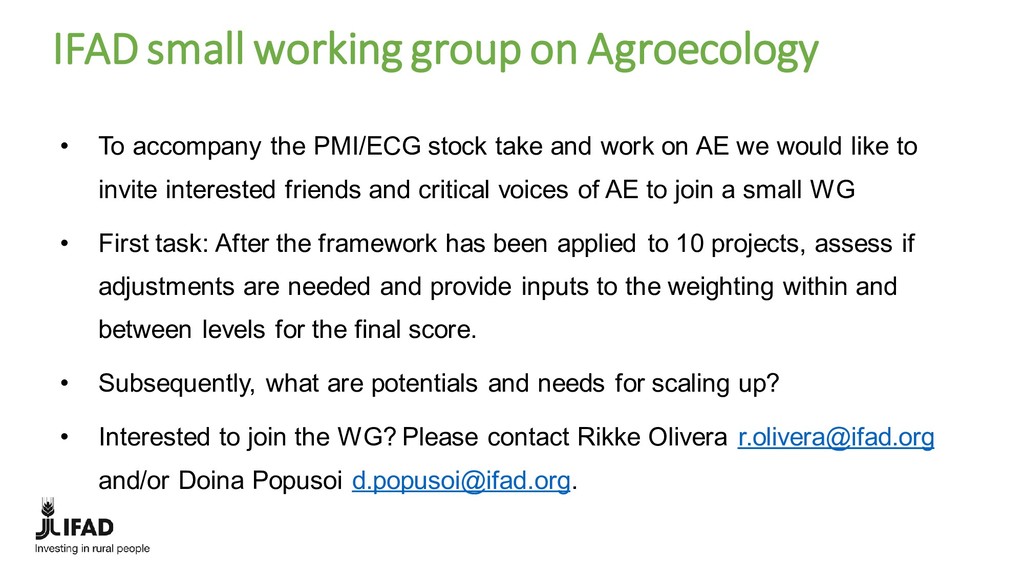
  40. • To accompany the PMI/ECG stock take and work on

    AE we would like to invite interested friends and critical voices of AE to join a small WG • First task: After the framework has been applied to 10 projects, assess if adjustments are needed and provide inputs to the weighting within and between levels for the final score. • Subsequently, what are potentials and needs for scaling up? • Interested to join the WG? Please contact Rikke Olivera [email protected] and/or Doina Popusoi [email protected]. IFAD small working group on Agroecology
  41. Agenda EVENT By ECG and PMI 11:00 Introduction 11:05 Agroecology:

    Framework, upscaling initiative, concept, business cases and cost-benefits 11:25 Applying agroecology in IFAD operations: A stocktake 11:35 IFAD experiences with agroecology • ProDAF, Niger • ASPIRE, Cambodia 12:05 Discussion (and closure)
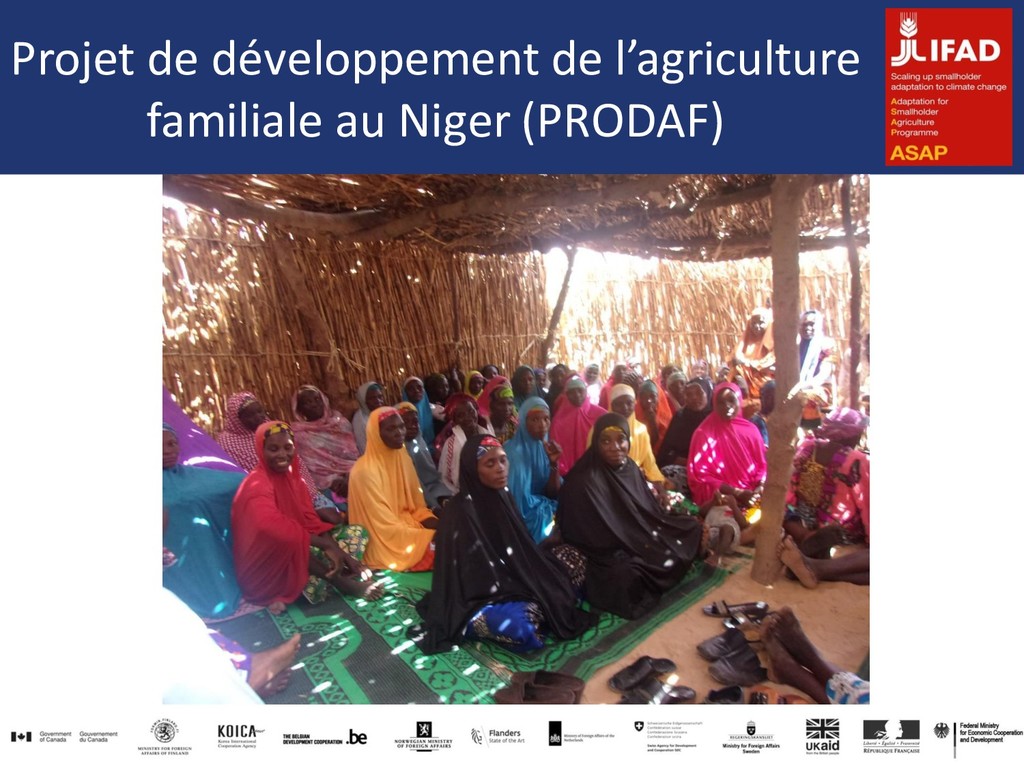
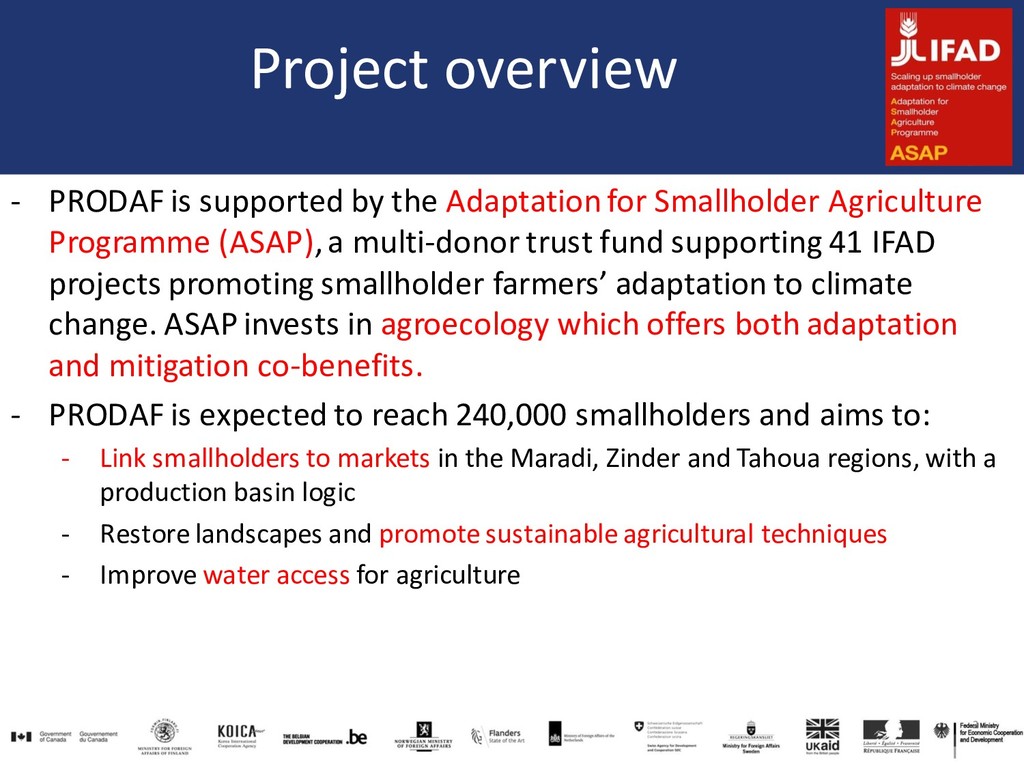
  42. - PRODAF is supported by the Adaptation for Smallholder Agriculture

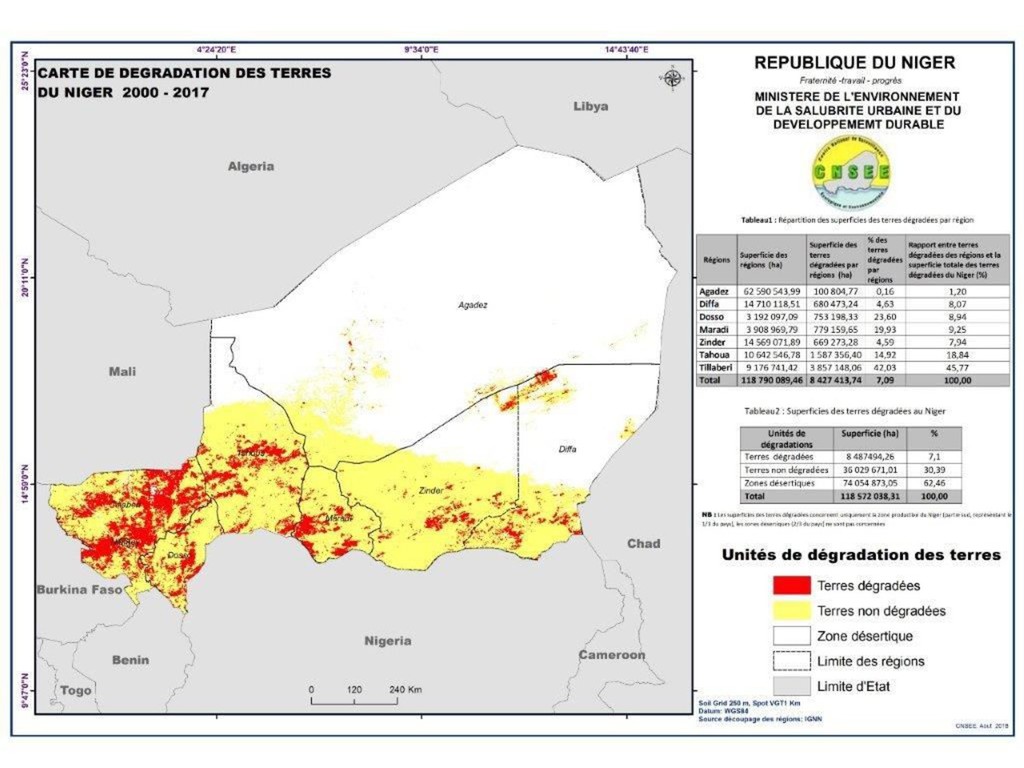
    Programme (ASAP), a multi-donor trust fund supporting 41 IFAD projects promoting smallholder farmers’ adaptation to climate change. ASAP invests in agroecology which offers both adaptation and mitigation co-benefits. - PRODAF is expected to reach 240,000 smallholders and aims to: - Link smallholders to markets in the Maradi, Zinder and Tahoua regions, with a production basin logic - Restore landscapes and promote sustainable agricultural techniques - Improve water access for agriculture Project overview 2
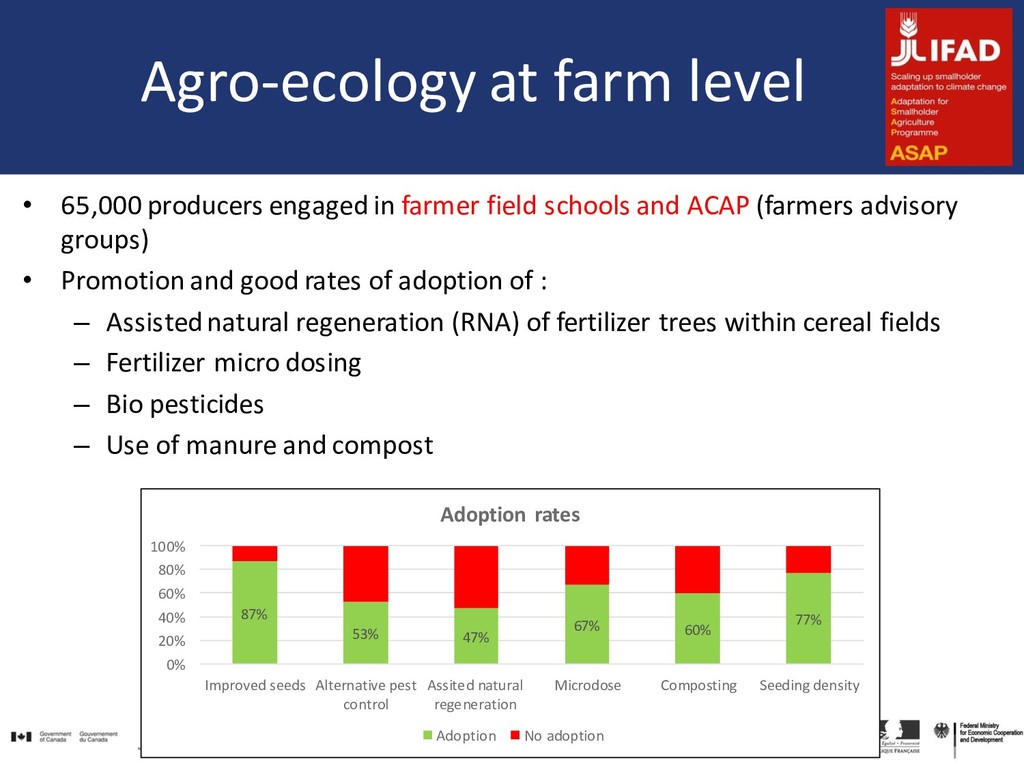
  43. Agro-ecology at farm level • 65,000 producers engaged in farmer

    field schools and ACAP (farmers advisory groups) • Promotion and good rates of adoption of : – Assisted natural regeneration (RNA) of fertilizer trees within cereal fields – Fertilizer micro dosing – Bio pesticides – Use of manure and compost 87% 53% 47% 67% 60% 77% 0% 20% 40% 60% 80% 100% Improved seeds Alternative pest control Assited natural regeneration Microdose Composting Seeding density Adoption rates Adoption No adoption
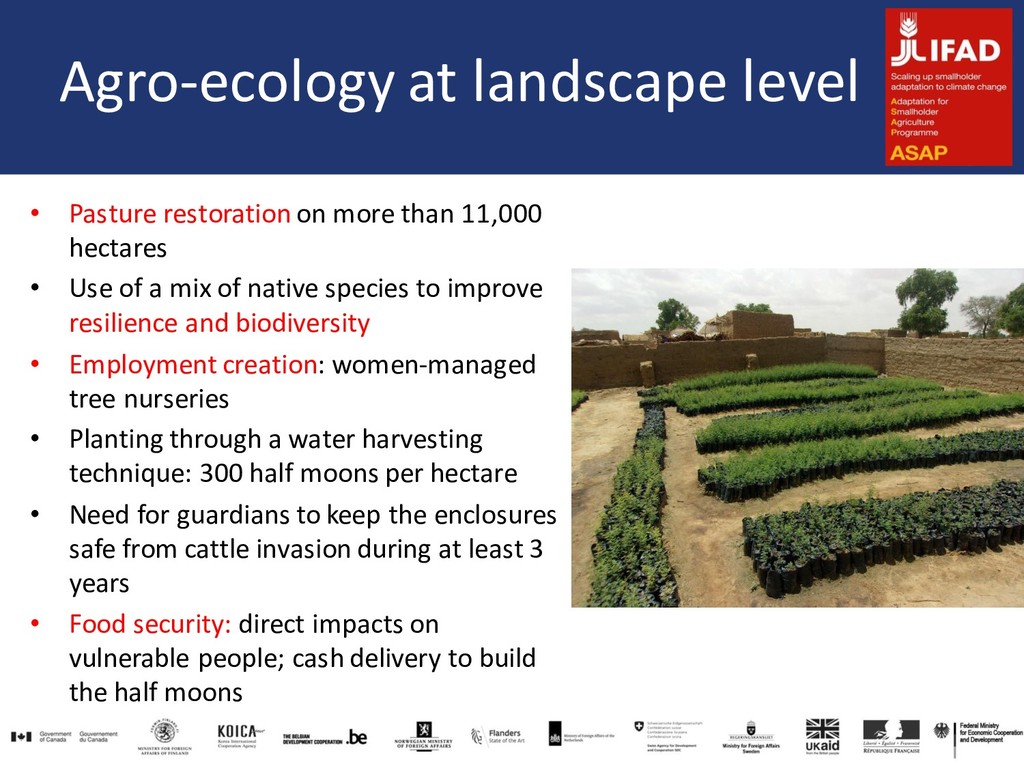
  44. Agro-ecology at landscape level • Pasture restoration on more than

    11,000 hectares • Use of a mix of native species to improve resilience and biodiversity • Employment creation: women-managed tree nurseries • Planting through a water harvesting technique: 300 half moons per hectare • Need for guardians to keep the enclosures safe from cattle invasion during at least 3 years • Food security: direct impacts on vulnerable people; cash delivery to build the half moons
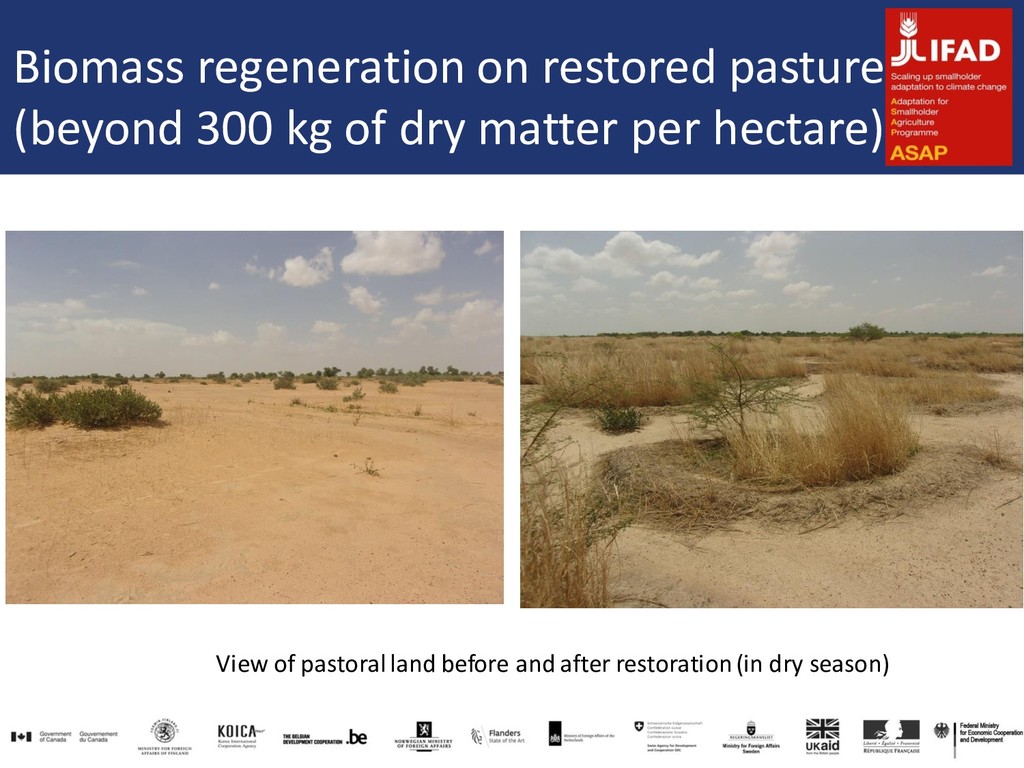
  45. Biomass regeneration on restored pasture (beyond 300 kg of dry

    matter per hectare) View of pastoral land before and after restoration (in dry season)
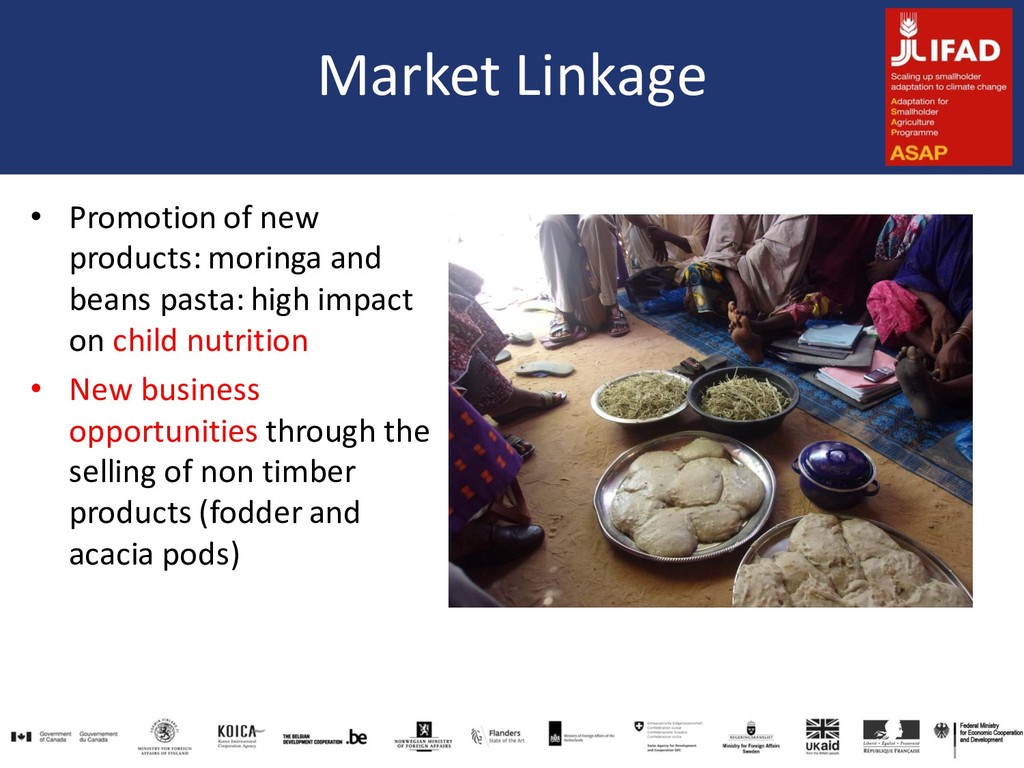
  46. Market Linkage • Promotion of new products: moringa and beans

    pasta: high impact on child nutrition • New business opportunities through the selling of non timber products (fodder and acacia pods)
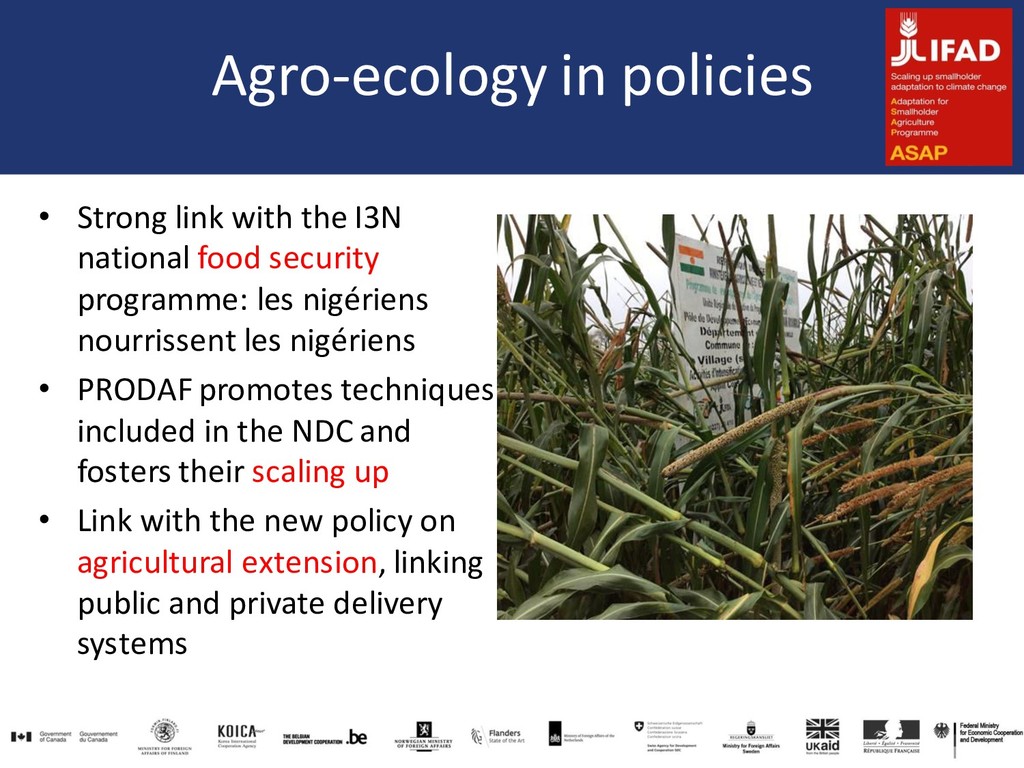
  47. Agro-ecology in policies • Strong link with the I3N national

    food security programme: les nigériens nourrissent les nigériens • PRODAF promotes techniques included in the NDC and fosters their scaling up • Link with the new policy on agricultural extension, linking public and private delivery systems
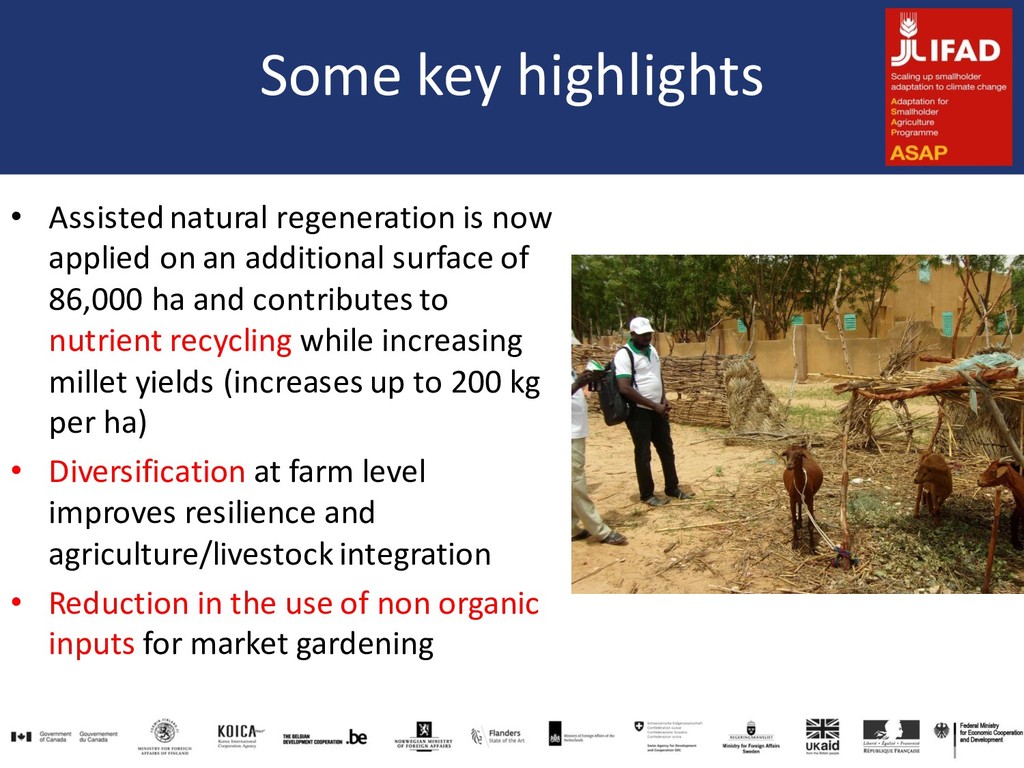
  48. Some key highlights • Assisted natural regeneration is now applied

    on an additional surface of 86,000 ha and contributes to nutrient recycling while increasing millet yields (increases up to 200 kg per ha) • Diversification at farm level improves resilience and agriculture/livestock integration • Reduction in the use of non organic inputs for market gardening
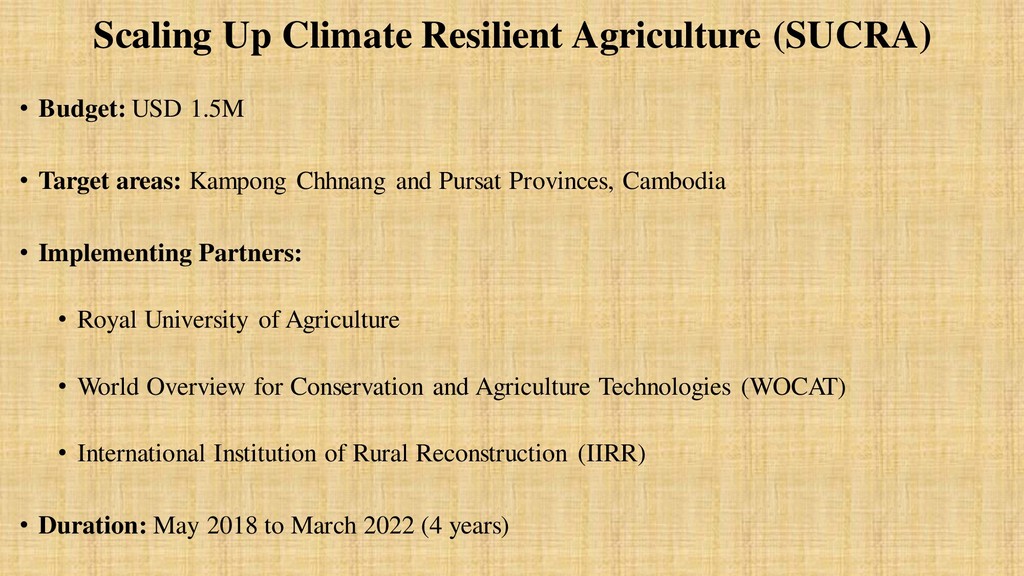
  49. Scaling Up Climate Resilient Agriculture (SUCRA) • Budget: USD 1.5M

    • Target areas: Kampong Chhnang and Pursat Provinces, Cambodia • Implementing Partners: • Royal University of Agriculture • World Overview for Conservation and Agriculture Technologies (WOCAT) • International Institution of Rural Reconstruction (IIRR) • Duration: May 2018 to March 2022 (4 years)
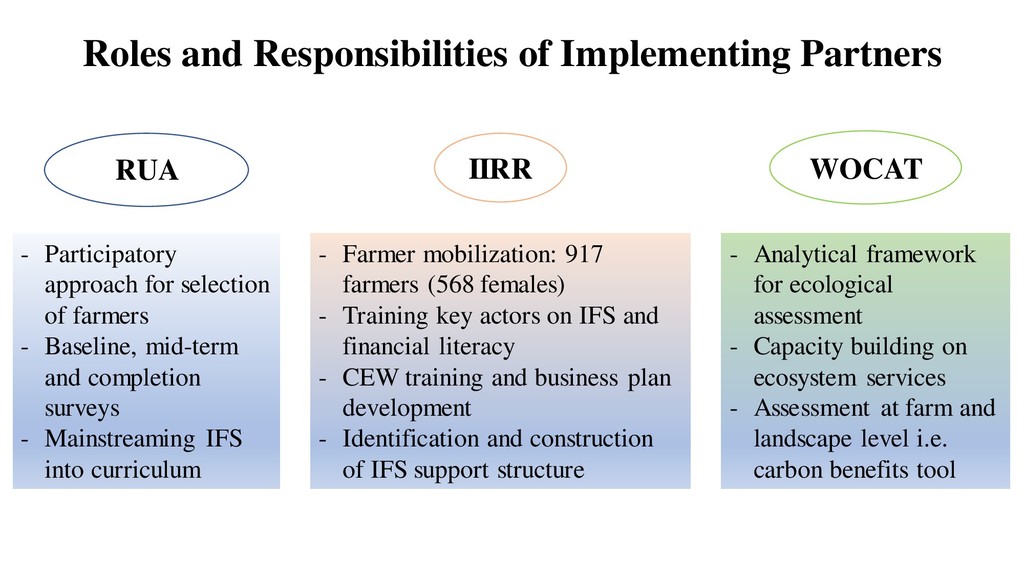
  50. Roles and Responsibilities of Implementing Partners RUA - Participatory approach

    for selection of farmers - Baseline, mid-term and completion surveys - Mainstreaming IFS into curriculum IIRR - Farmer mobilization: 917 farmers (568 females) - Training key actors on IFS and financial literacy - CEW training and business plan development - Identification and construction of IFS support structure WOCAT - Analytical framework for ecological assessment - Capacity building on ecosystem services - Assessment at farm and landscape level i.e. carbon benefits tool
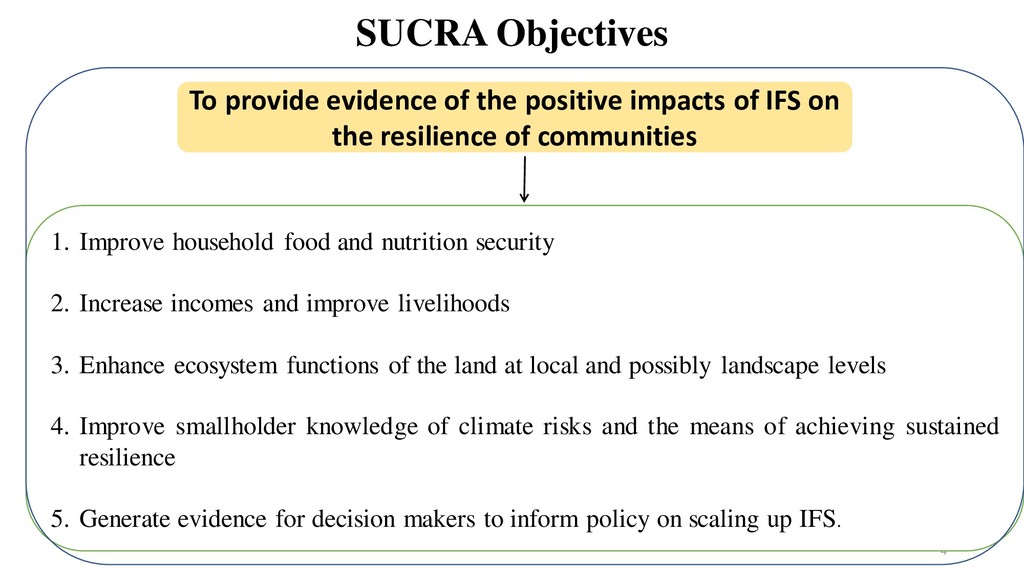
  51. SUCRA Objectives 4 1. Improve household food and nutrition security

    2. Increase incomes and improve livelihoods 3. Enhance ecosystem functions of the land at local and possibly landscape levels 4. Improve smallholder knowledge of climate risks and the means of achieving sustained resilience 5. Generate evidence for decision makers to inform policy on scaling up IFS. To provide evidence of the positive impacts of IFS on the resilience of communities
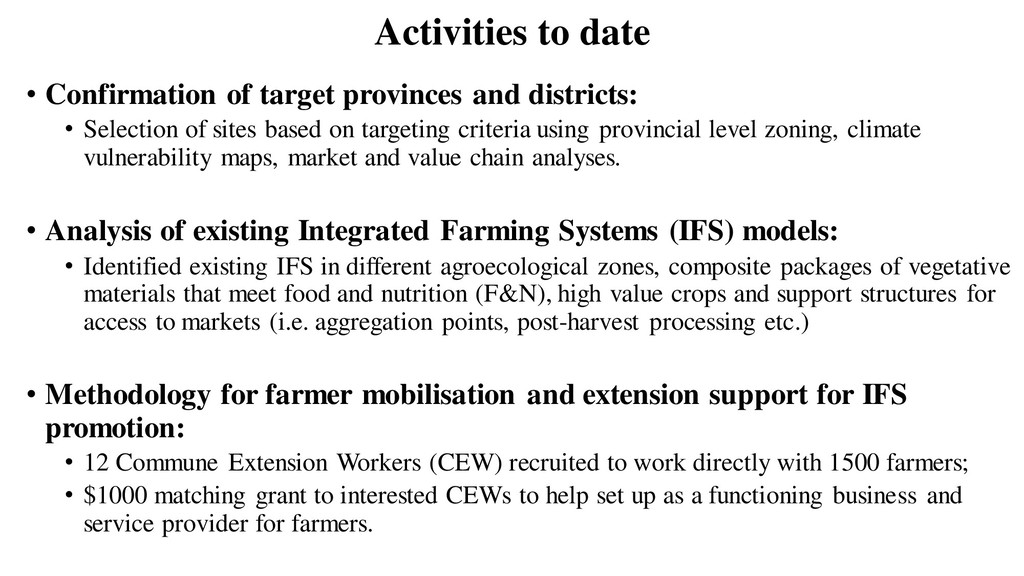
  52. Activities to date • Confirmation of target provinces and districts:

    • Selection of sites based on targeting criteria using provincial level zoning, climate vulnerability maps, market and value chain analyses. • Analysis of existing Integrated Farming Systems (IFS) models: • Identified existing IFS in different agroecological zones, composite packages of vegetative materials that meet food and nutrition (F&N), high value crops and support structures for access to markets (i.e. aggregation points, post-harvest processing etc.) • Methodology for farmer mobilisation and extension support for IFS promotion: • 12 Commune Extension Workers (CEW) recruited to work directly with 1500 farmers; • $1000 matching grant to interested CEWs to help set up as a functioning business and service provider for farmers.
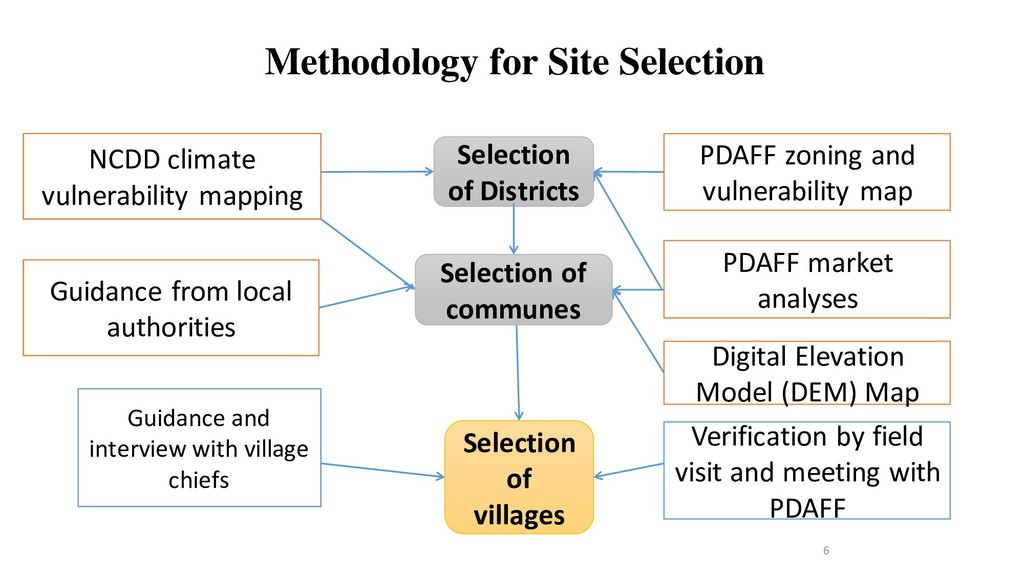
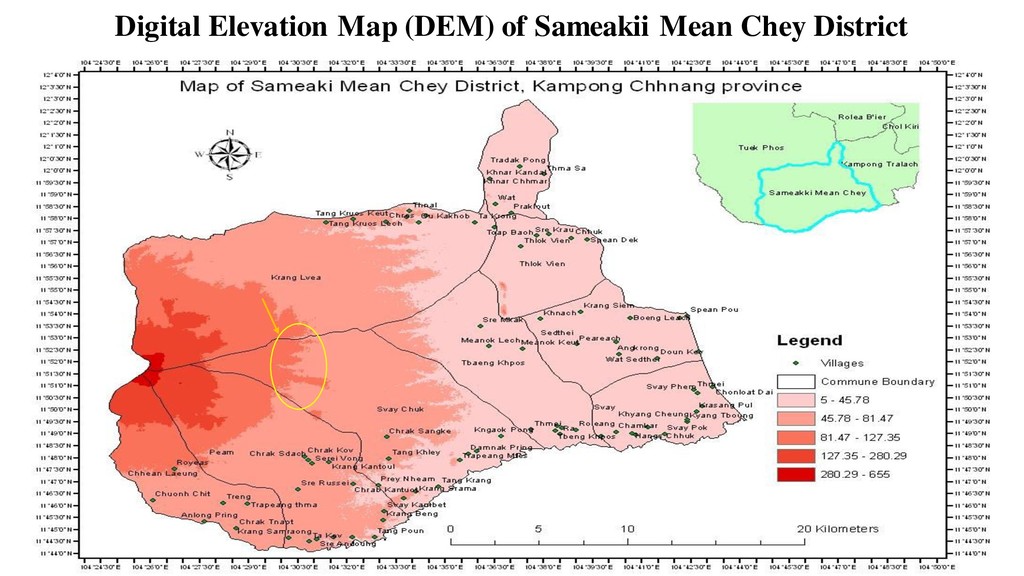
  53. Methodology for Site Selection 6 Selection of villages Selection of

    Districts NCDD climate vulnerability mapping Guidance from local authorities Guidance and interview with village chiefs Verification by field visit and meeting with PDAFF PDAFF zoning and vulnerability map PDAFF market analyses Digital Elevation Model (DEM) Map Selection of communes
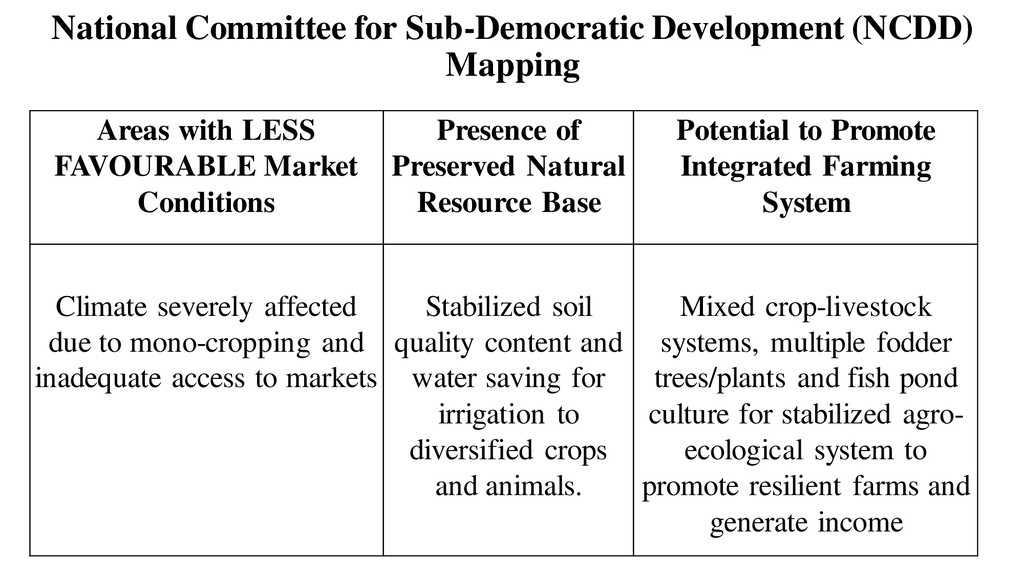
  54. National Committee for Sub-Democratic Development (NCDD) Mapping Areas with LESS

    FAVOURABLE Market Conditions Presence of Preserved Natural Resource Base Potential to Promote Integrated Farming System Climate severely affected due to mono-cropping and inadequate access to markets Stabilized soil quality content and water saving for irrigation to diversified crops and animals. Mixed crop-livestock systems, multiple fodder trees/plants and fish pond culture for stabilized agro- ecological system to promote resilient farms and generate income
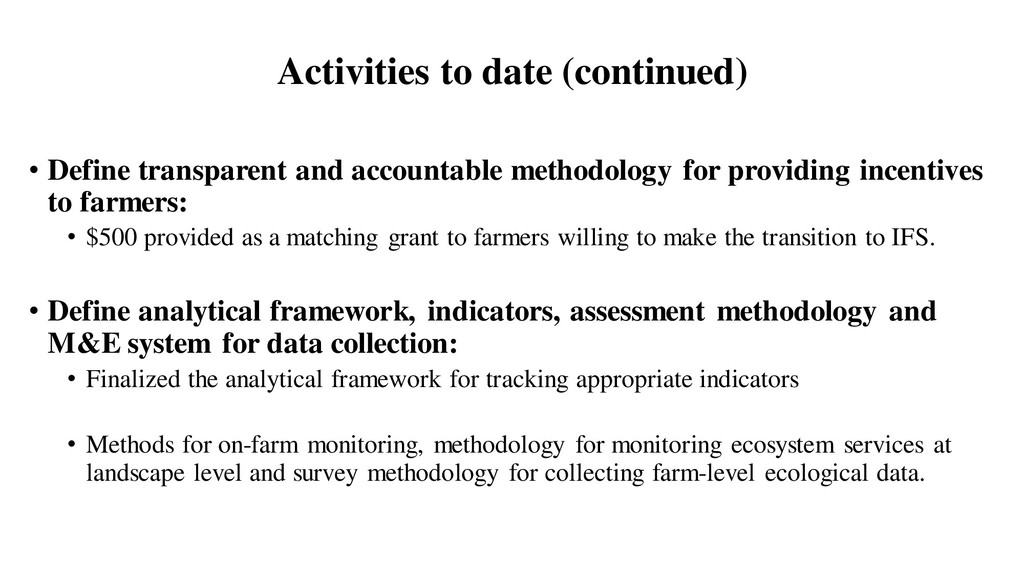
  55. Activities to date (continued) • Define transparent and accountable methodology

    for providing incentives to farmers: • $500 provided as a matching grant to farmers willing to make the transition to IFS. • Define analytical framework, indicators, assessment methodology and M&E system for data collection: • Finalized the analytical framework for tracking appropriate indicators • Methods for on-farm monitoring, methodology for monitoring ecosystem services at landscape level and survey methodology for collecting farm-level ecological data.
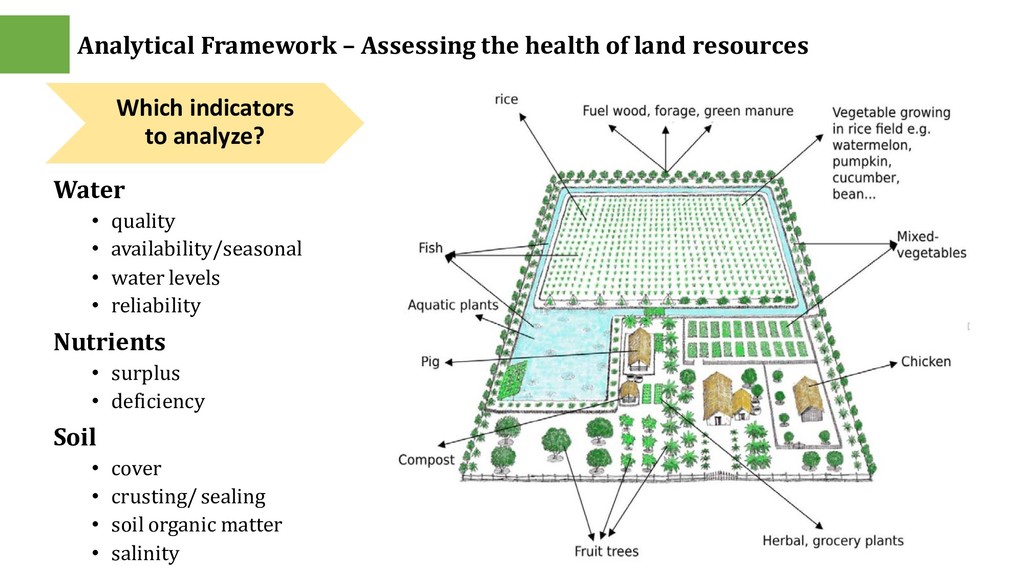
  56. Water • quality • availability/seasonal • water levels • reliability

    Nutrients • surplus • deficiency Soil • cover • crusting/ sealing • soil organic matter • salinity Analytical Framework – Assessing the health of land resources Which indicators to analyze?
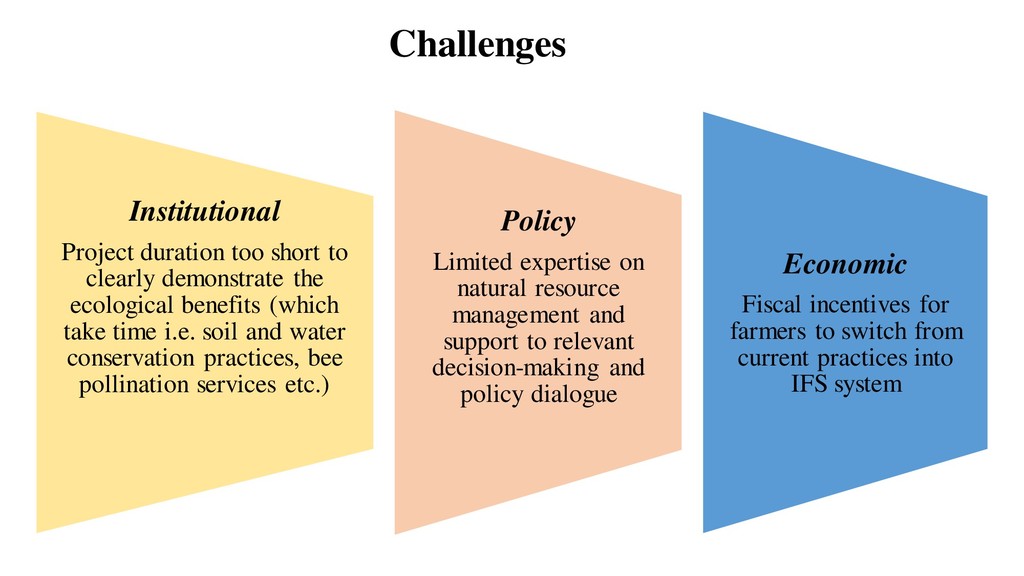
  57. Challenges Institutional Project duration too short to clearly demonstrate the

    ecological benefits (which take time i.e. soil and water conservation practices, bee pollination services etc.) Policy Limited expertise on natural resource management and support to relevant decision-making and policy dialogue Economic Fiscal incentives for farmers to switch from current practices into IFS system
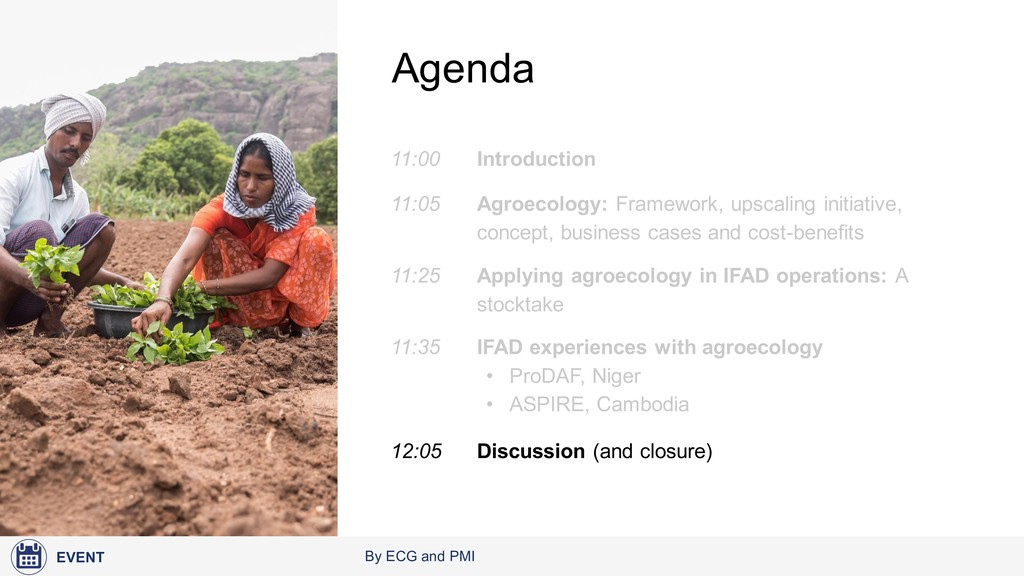
  58. Agenda EVENT By ECG and PMI 11:00 Introduction 11:05 Agroecology:

    Framework, upscaling initiative, concept, business cases and cost-benefits 11:25 Applying agroecology in IFAD operations: A stocktake 11:35 IFAD experiences with agroecology • ProDAF, Niger • ASPIRE, Cambodia 12:05 Discussion (and closure)
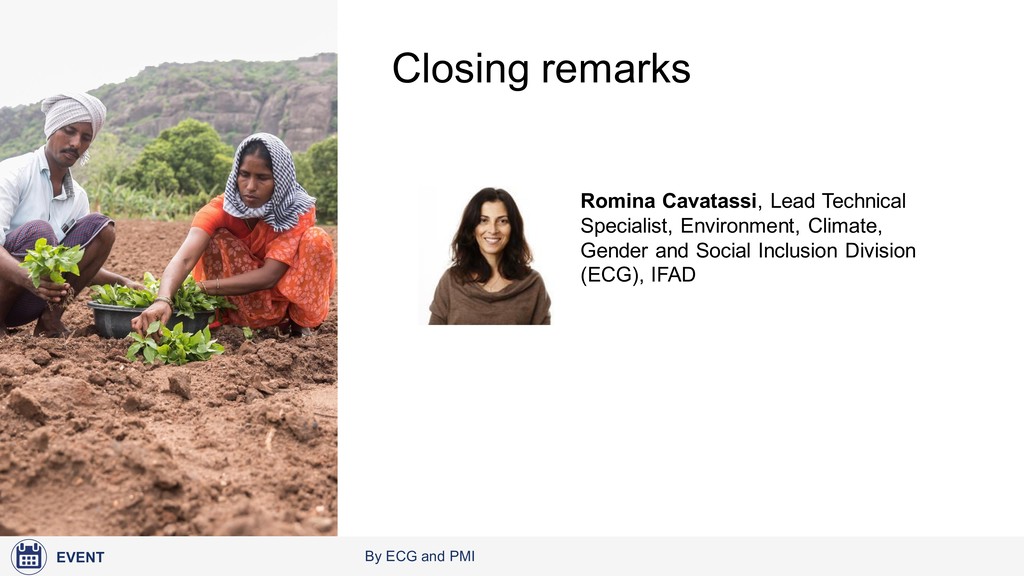
  59. Closing remarks EVENT By ECG and PMI Romina Cavatassi, Lead

    Technical Specialist, Environment, Climate, Gender and Social Inclusion Division (ECG), IFAD
  60. Applying agroecology in IFAD operations THANK YOU! Any queries? Contact

    Oliver Mundy or Maria Elena Mangiafico EVENT By ECG and PMI