Upgrade to Pro — share decks privately, control downloads, hide ads and more …

Building an Open Autonomous Data Platform - Xin...

Sponsored · Ship Features Fearlessly Turn features on and off without deploys. Used by thousands of Ruby developers. →

Building an Open Autonomous Data Platform - Xing Yang, OpenSDS Lead Architect, Futurewei

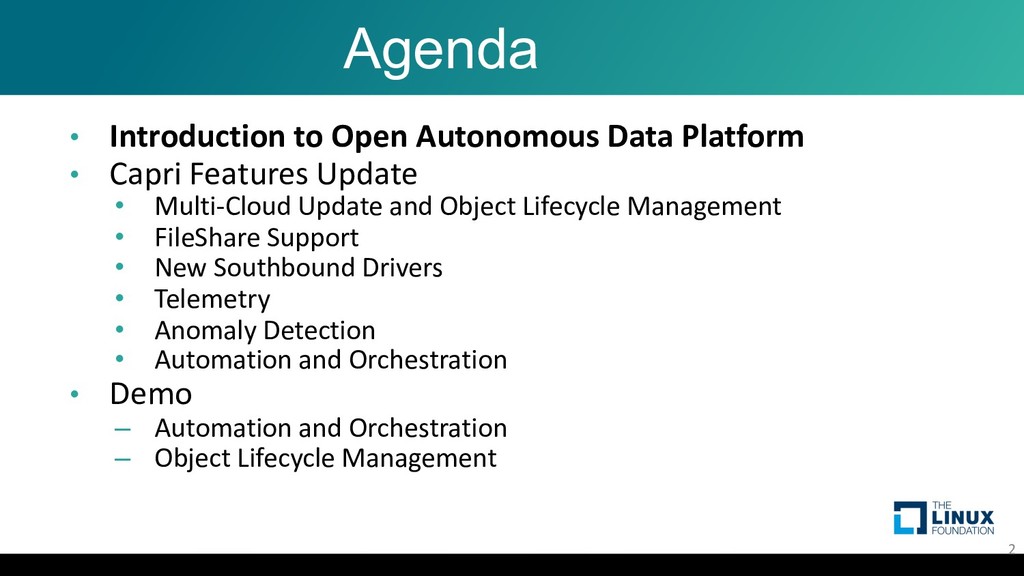
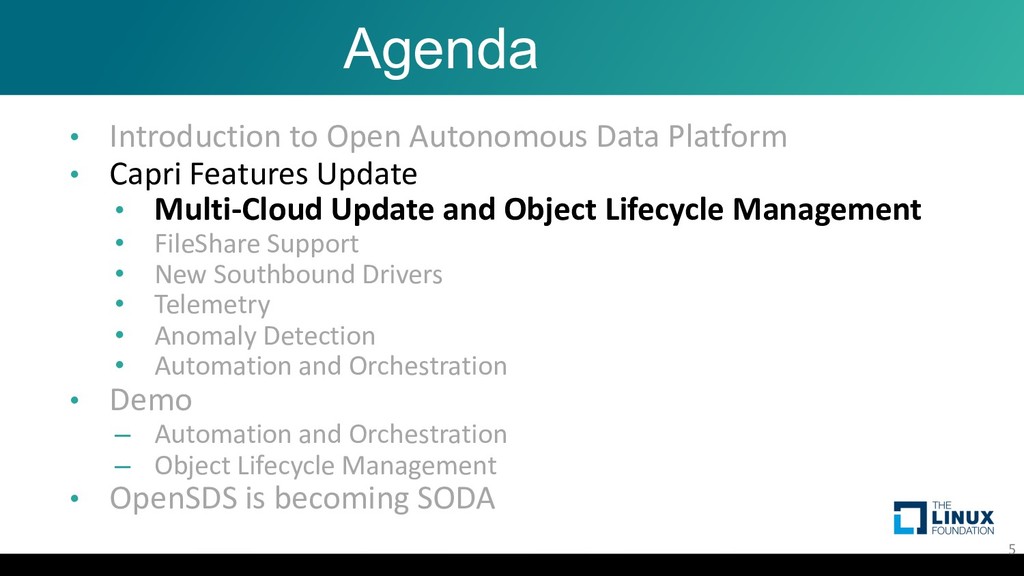
• Introduction to Open Autonomous Data Platform
• Capri Features Update
– Multi-Cloud Update and Object Lifecycle Management
– FileShare Support
– New Southbound Drivers
– Telemetry
– Anomaly Detection
– Automation and Orchestration
• Demo
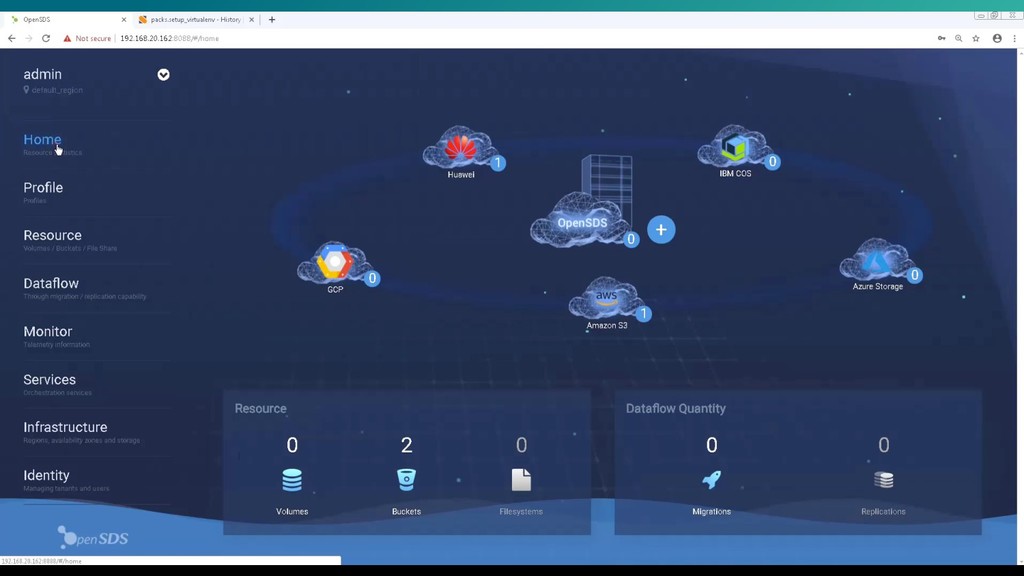
– Automation and Orchestration
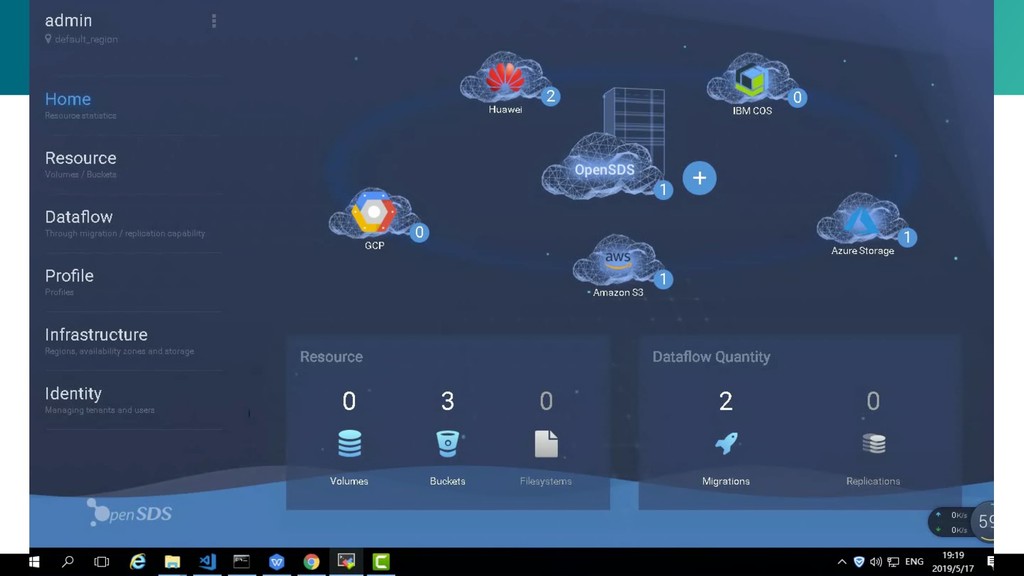
– Object Lifecycle Management

Avatar for OpenSDS

OpenSDS

July 19, 2019

More Decks by OpenSDS

Other Decks in Technology

Transcript

  1. Agenda • Introduction to Open Autonomous Data Platform • Capri

    Features Update • Multi-Cloud Update and Object Lifecycle Management • FileShare Support • New Southbound Drivers • Telemetry • Anomaly Detection • Automation and Orchestration • Demo – Automation and Orchestration – Object Lifecycle Management 2
  2. OpenSDS Roadmap 4 4 2018H1 ARUBA • OpenStack • Replication

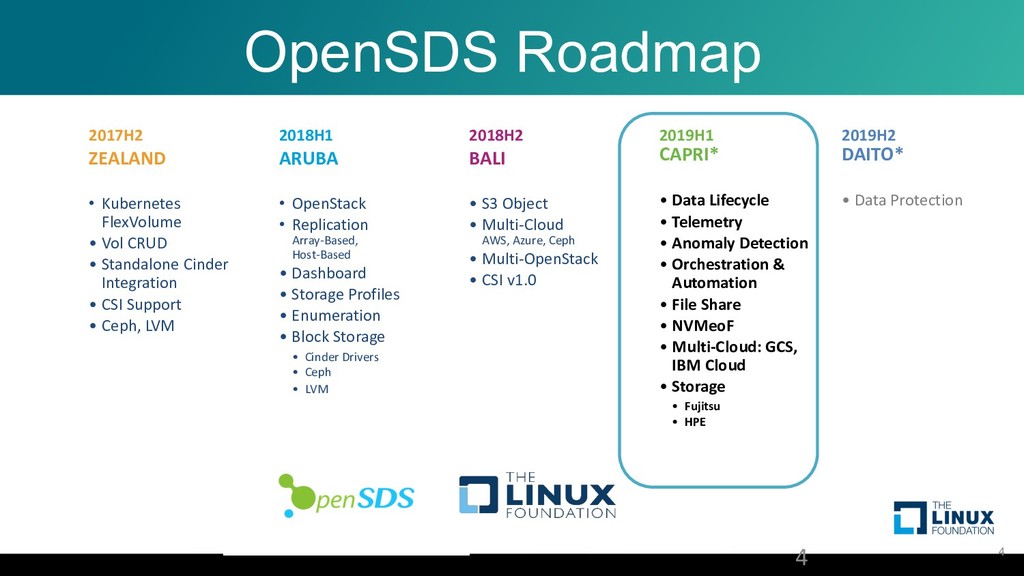
    Array-Based, Host-Based • Dashboard • Storage Profiles • Enumeration • Block Storage • Cinder Drivers • Ceph • LVM 2017H2 ZEALAND • Kubernetes FlexVolume • Vol CRUD • Standalone Cinder Integration • CSI Support • Ceph, LVM 2018H2 BALI • S3 Object • Multi-Cloud AWS, Azure, Ceph • Multi-OpenStack • CSI v1.0 2019H1 CAPRI* • Data Lifecycle • Telemetry • Anomaly Detection • Orchestration & Automation • File Share • NVMeoF • Multi-Cloud: GCS, IBM Cloud • Storage • Fujitsu • HPE 2019H2 DAITO* • Data Protection
  3. Agenda • Introduction to Open Autonomous Data Platform • Capri

    Features Update • Multi-Cloud Update and Object Lifecycle Management • FileShare Support • New Southbound Drivers • Telemetry • Anomaly Detection • Automation and Orchestration • Demo – Automation and Orchestration – Object Lifecycle Management • OpenSDS is becoming SODA 5
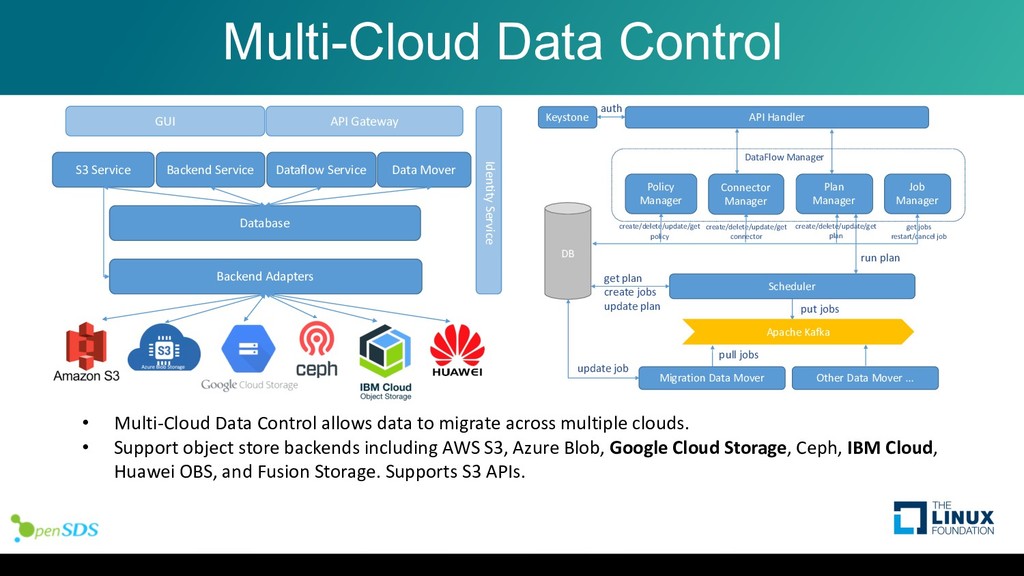
  4. Multi-Cloud Data Control Connector Manager API Handler Migration Data Mover

    Policy Manager Job Manager Plan Manager Other Data Mover … DB Scheduler Apache Kafka DataFlow Manager Keystone put jobs pull jobs run plan create/delete/update/get policy create/delete/update/get connector create/delete/update/get plan get jobs restart/cancel job get plan create jobs update plan auth update job • Multi-Cloud Data Control allows data to migrate across multiple clouds. • Support object store backends including AWS S3, Azure Blob, Google Cloud Storage, Ceph, IBM Cloud, Huawei OBS, and Fusion Storage. Supports S3 APIs. S3 Service Backend Service Dataflow Service Database Backend Adapters GUI API Gateway Data Mover Identity Service
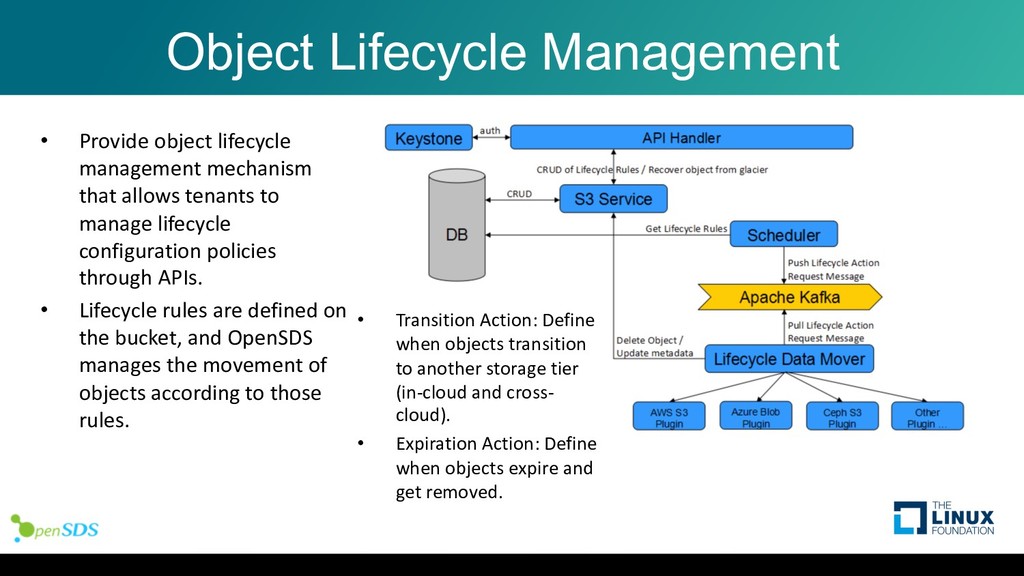
  5. Object Lifecycle Management • Provide object lifecycle management mechanism that

    allows tenants to manage lifecycle configuration policies through APIs. • Lifecycle rules are defined on the bucket, and OpenSDS manages the movement of objects according to those rules. • Transition Action: Define when objects transition to another storage tier (in-cloud and cross- cloud). • Expiration Action: Define when objects expire and get removed.
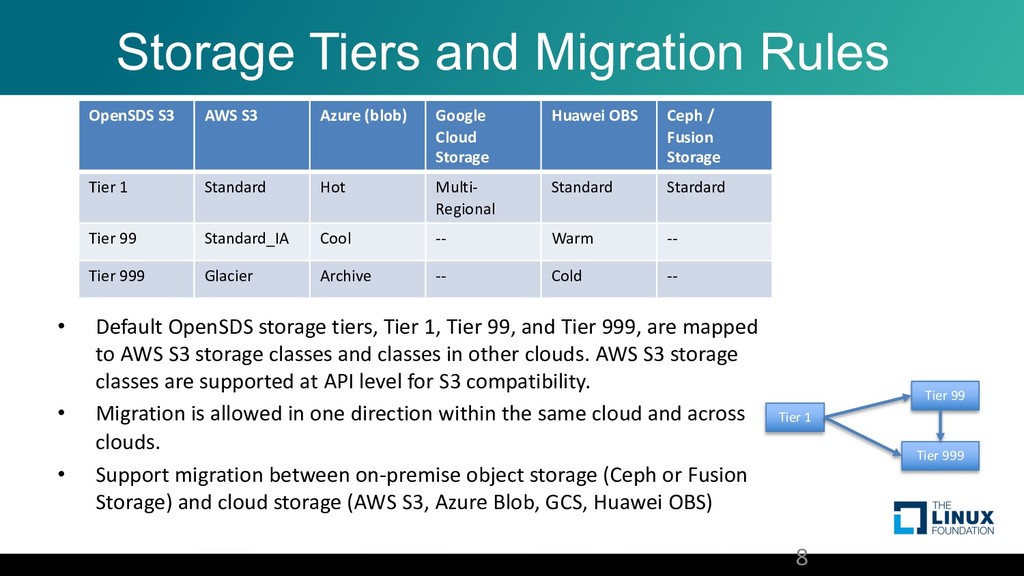
  6. Storage Tiers and Migration Rules 8 • Default OpenSDS storage

    tiers, Tier 1, Tier 99, and Tier 999, are mapped to AWS S3 storage classes and classes in other clouds. AWS S3 storage classes are supported at API level for S3 compatibility. • Migration is allowed in one direction within the same cloud and across clouds. • Support migration between on-premise object storage (Ceph or Fusion Storage) and cloud storage (AWS S3, Azure Blob, GCS, Huawei OBS) Tier 1 Tier 99 Tier 999 OpenSDS S3 AWS S3 Azure (blob) Google Cloud Storage Huawei OBS Ceph / Fusion Storage Tier 1 Standard Hot Multi- Regional Standard Stardard Tier 99 Standard_IA Cool -- Warm -- Tier 999 Glacier Archive -- Cold --
  7. Agenda • Introduction to Open Autonomous Data Platform • Capri

    Features Update • Multi-Cloud Update and Object Lifecycle Management • FileShare Support • New Southbound Drivers • Telemetry • Anomaly Detection • Automation and Orchestration • Demo – Automation and Orchestration – Object Lifecycle Management • OpenSDS is becoming SODA 9
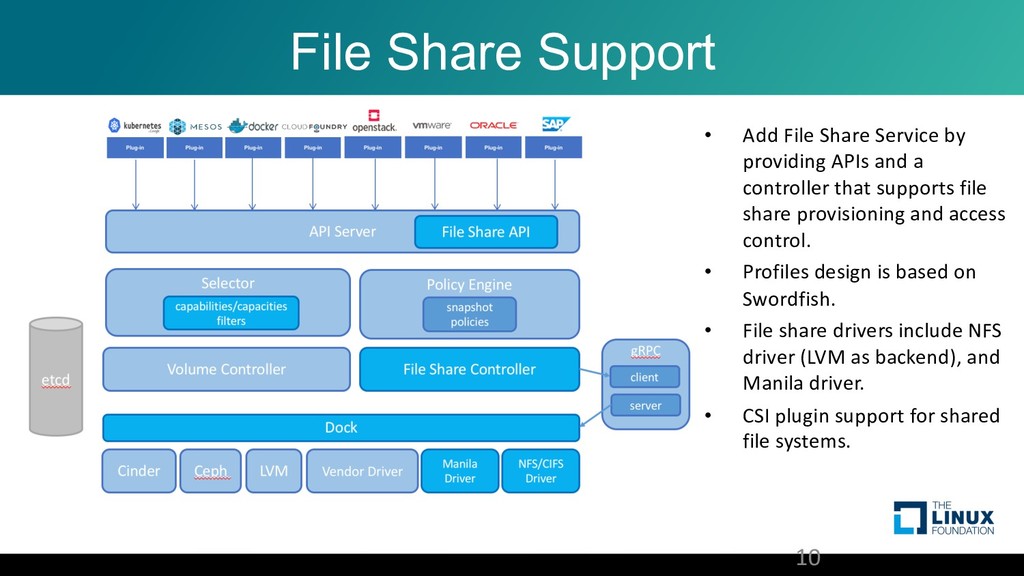
  8. File Share Support 10 • Add File Share Service by

    providing APIs and a controller that supports file share provisioning and access control. • Profiles design is based on Swordfish. • File share drivers include NFS driver (LVM as backend), and Manila driver. • CSI plugin support for shared file systems.
  9. Agenda • Introduction to Open Autonomous Data Platform • Capri

    Features Update • Multi-Cloud Update and Object Lifecycle Management • FileShare Support • New Southbound Drivers • Telemetry • Anomaly Detection • Automation and Orchestration • Demo – Automation and Orchestration – Object Lifecycle Management • OpenSDS is becoming SODA 11
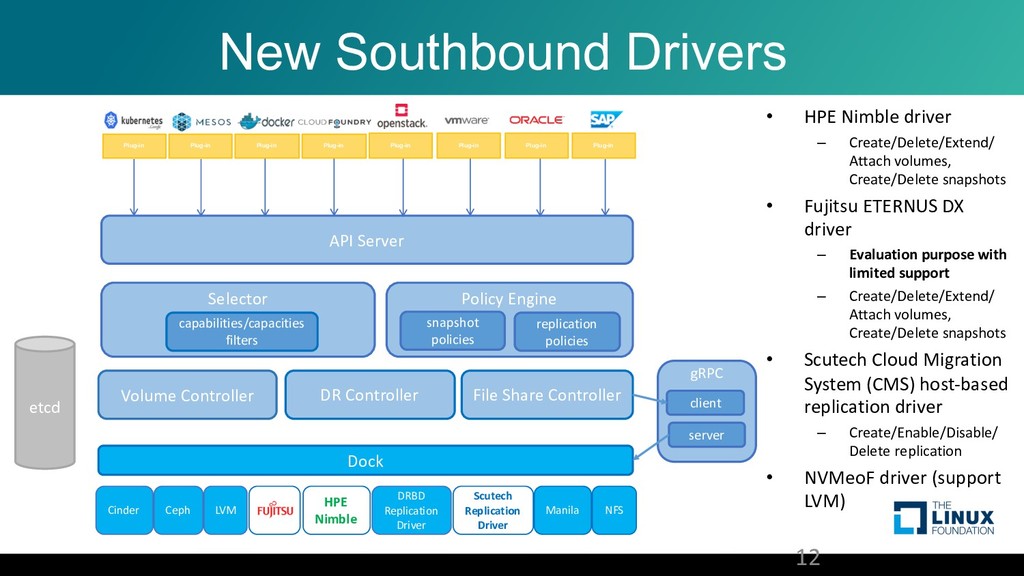
  10. New Southbound Drivers 12 • HPE Nimble driver – Create/Delete/Extend/

    Attach volumes, Create/Delete snapshots • Fujitsu ETERNUS DX driver – Evaluation purpose with limited support – Create/Delete/Extend/ Attach volumes, Create/Delete snapshots • Scutech Cloud Migration System (CMS) host-based replication driver – Create/Enable/Disable/ Delete replication • NVMeoF driver (support LVM) API Server Volume Controller File Share Controller Selector Policy Engine Dock Ceph NFS Cinder DRBD Replication Driver capabilities/capacities filters Manila snapshot policies LVM gRPC etcd client server Plug-in Plug-in Plug-in Plug-in Plug-in Plug-in Plug-in Plug-in DR Controller replication policies Scutech Replication Driver HPE Nimble
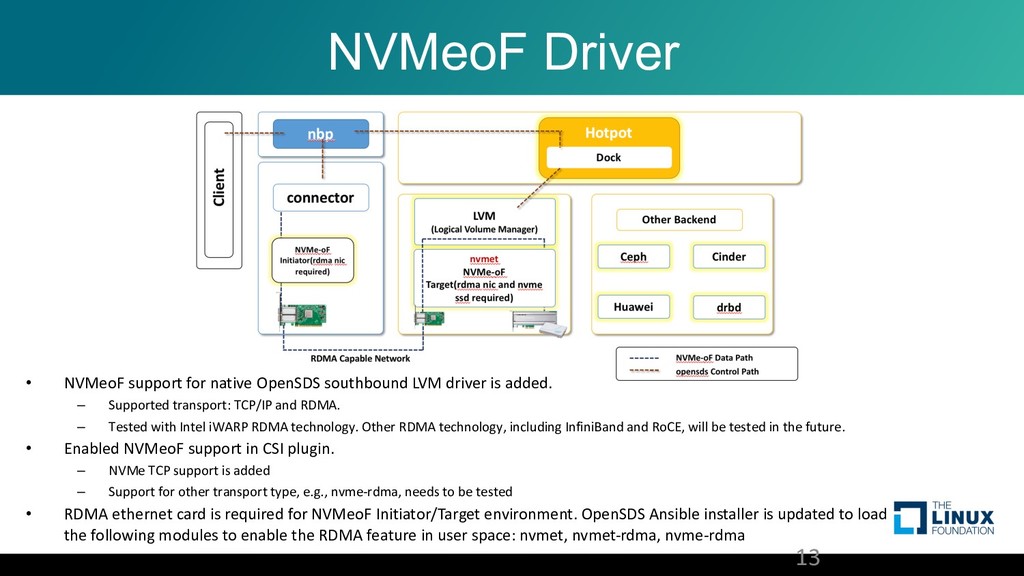
  11. NVMeoF Driver 13 • NVMeoF support for native OpenSDS southbound

    LVM driver is added. – Supported transport: TCP/IP and RDMA. – Tested with Intel iWARP RDMA technology. Other RDMA technology, including InfiniBand and RoCE, will be tested in the future. • Enabled NVMeoF support in CSI plugin. – NVMe TCP support is added – Support for other transport type, e.g., nvme-rdma, needs to be tested • RDMA ethernet card is required for NVMeoF Initiator/Target environment. OpenSDS Ansible installer is updated to load the following modules to enable the RDMA feature in user space: nvmet, nvmet-rdma, nvme-rdma
  12. Agenda • Introduction to Open Autonomous Data Platform • Capri

    Features Update • Multi-Cloud Update and Object Lifecycle Management • FileShare Support • New Southbound Drivers • Telemetry • Anomaly Detection • Automation and Orchestration • Demo – Automation and Orchestration – Object Lifecycle Management • OpenSDS is becoming SODA 14
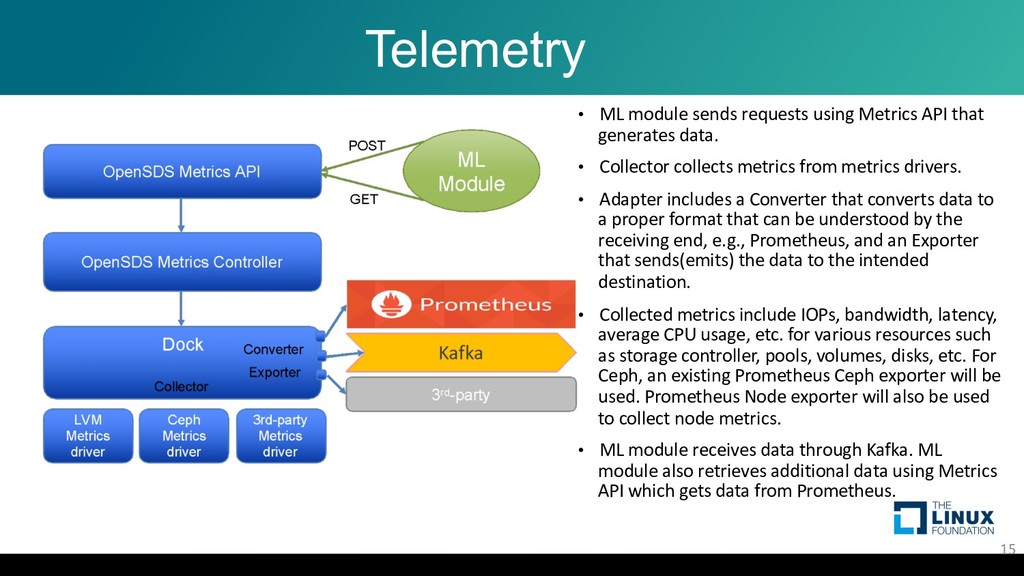
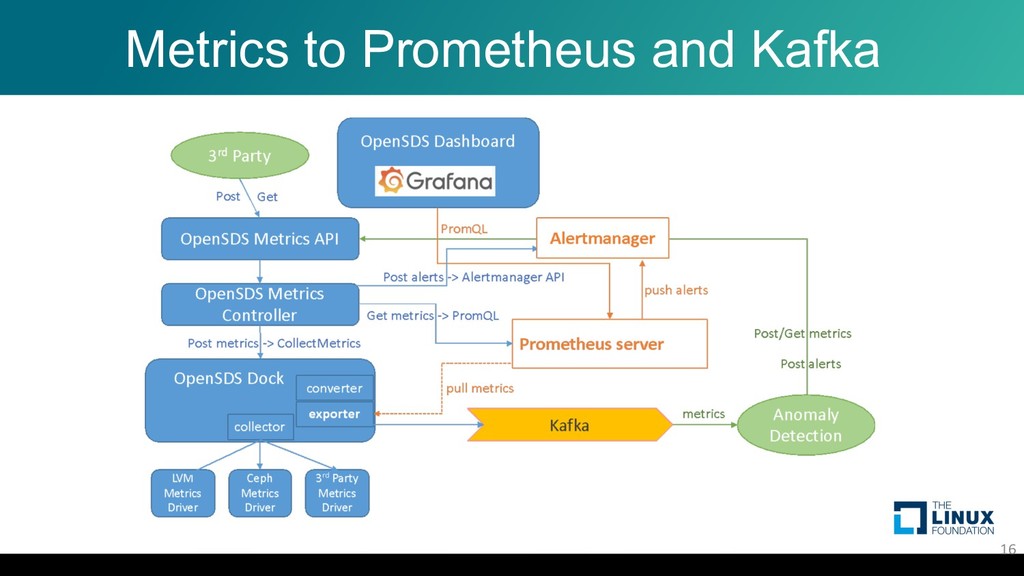
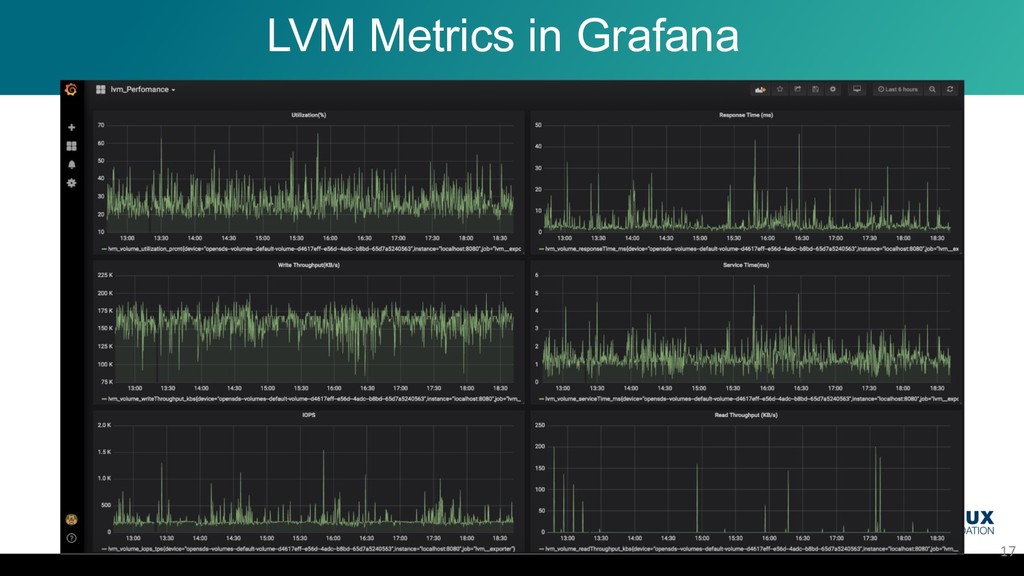
  13. Telemetry • ML module sends requests using Metrics API that

    generates data. • Collector collects metrics from metrics drivers. • Adapter includes a Converter that converts data to a proper format that can be understood by the receiving end, e.g., Prometheus, and an Exporter that sends(emits) the data to the intended destination. • Collected metrics include IOPs, bandwidth, latency, average CPU usage, etc. for various resources such as storage controller, pools, volumes, disks, etc. For Ceph, an existing Prometheus Ceph exporter will be used. Prometheus Node exporter will also be used to collect node metrics. • ML module receives data through Kafka. ML module also retrieves additional data using Metrics API which gets data from Prometheus. 15
  14. Agenda • Introduction to Open Autonomous Data Platform • Capri

    Features Update • Multi-Cloud Update and Object Lifecycle Management • FileShare Support • New Southbound Drivers • Telemetry • Anomaly Detection • Automation and Orchestration • Demo – Automation and Orchestration – Object Lifecycle Management • OpenSDS is becoming SODA 18
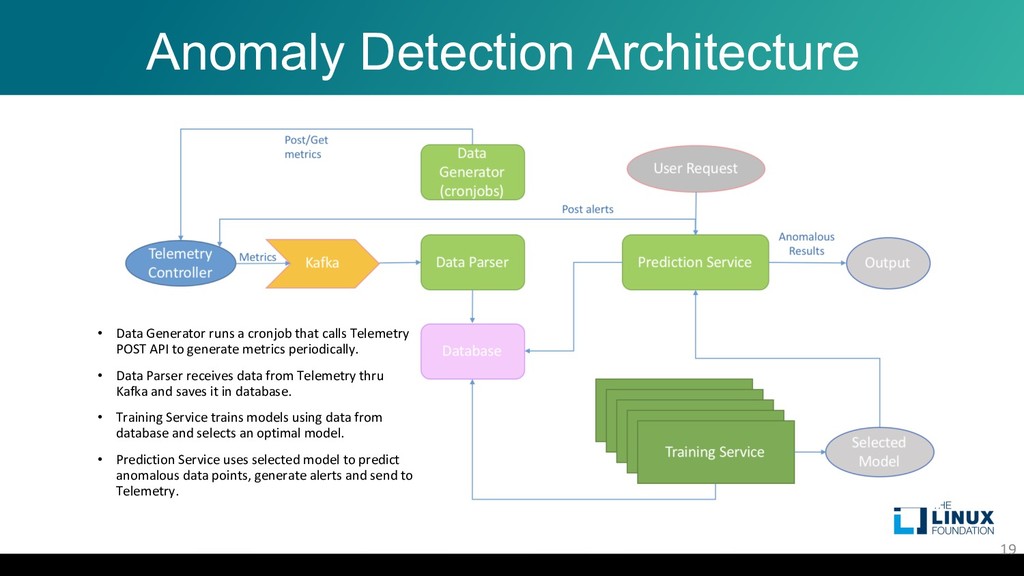
  15. Anomaly Detection Architecture 19 • Data Generator runs a cronjob

    that calls Telemetry POST API to generate metrics periodically. • Data Parser receives data from Telemetry thru Kafka and saves it in database. • Training Service trains models using data from database and selects an optimal model. • Prediction Service uses selected model to predict anomalous data points, generate alerts and send to Telemetry.
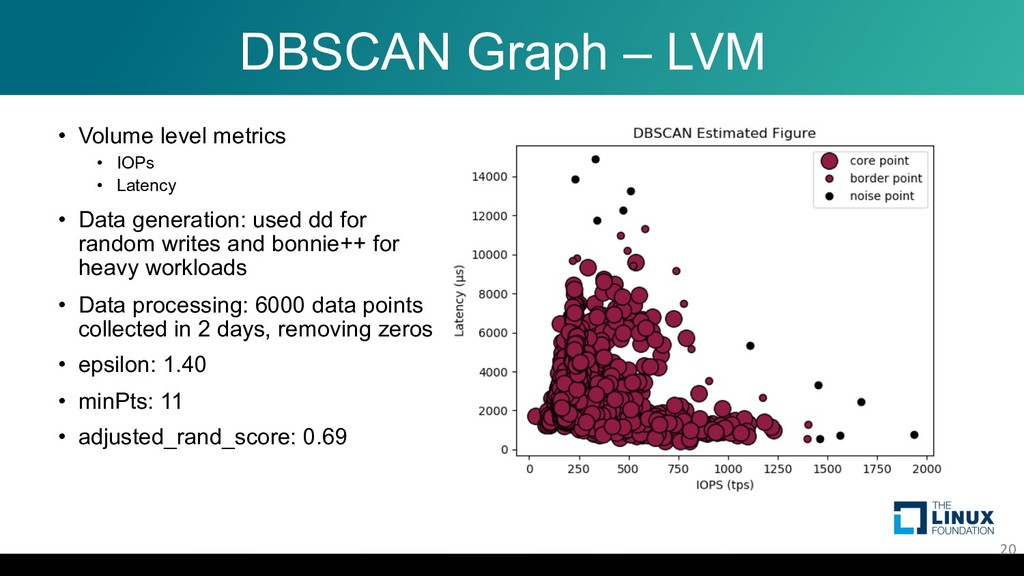
  16. DBSCAN Graph – LVM • Volume level metrics • IOPs

    • Latency • Data generation: used dd for random writes and bonnie++ for heavy workloads • Data processing: 6000 data points collected in 2 days, removing zeros • epsilon: 1.40 • minPts: 11 • adjusted_rand_score: 0.69 20
  17. Agenda • Introduction to Open Autonomous Data Platform • Capri

    Features Update • Multi-Cloud Update and Object Lifecycle Management • FileShare Support • New Southbound Drivers • Telemetry • Anomaly Detection • Automation and Orchestration • Demo – Automation and Orchestration – Object Lifecycle Management • OpenSDS is becoming SODA 21
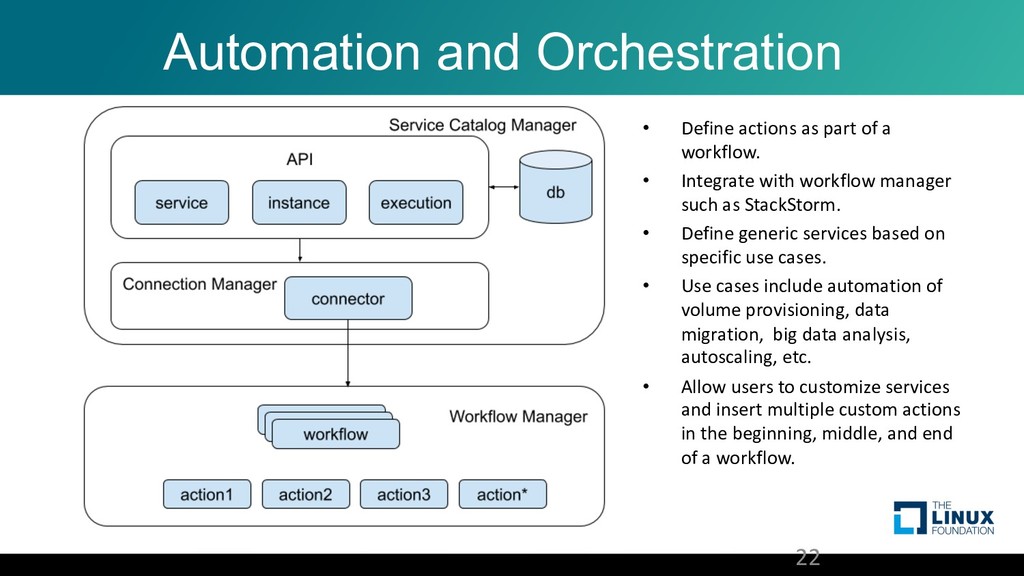
  18. Automation and Orchestration 22 • Define actions as part of

    a workflow. • Integrate with workflow manager such as StackStorm. • Define generic services based on specific use cases. • Use cases include automation of volume provisioning, data migration, big data analysis, autoscaling, etc. • Allow users to customize services and insert multiple custom actions in the beginning, middle, and end of a workflow.
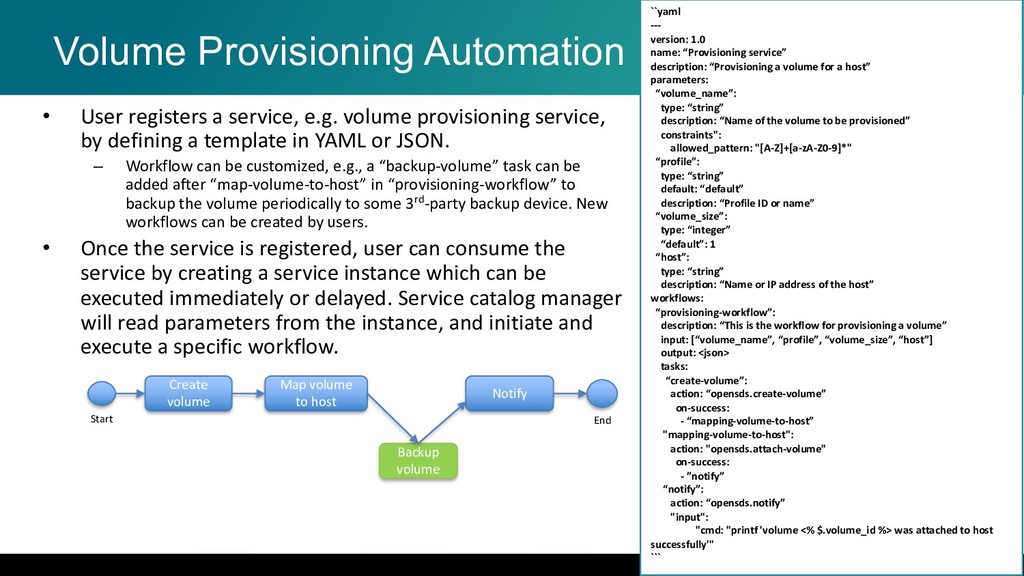
  19. Volume Provisioning Automation 23 • User registers a service, e.g.

    volume provisioning service, by defining a template in YAML or JSON. – Workflow can be customized, e.g., a “backup-volume” task can be added after “map-volume-to-host” in “provisioning-workflow” to backup the volume periodically to some 3rd-party backup device. New workflows can be created by users. • Once the service is registered, user can consume the service by creating a service instance which can be executed immediately or delayed. Service catalog manager will read parameters from the instance, and initiate and execute a specific workflow. ``yaml --- version: 1.0 name: “Provisioning service” description: “Provisioning a volume for a host” parameters: “volume_name”: type: “string” description: “Name of the volume to be provisioned” constraints": allowed_pattern: "[A-Z]+[a-zA-Z0-9]*" “profile”: type: “string” default: “default” description: “Profile ID or name” “volume_size”: type: “integer” “default”: 1 “host”: type: “string” description: “Name or IP address of the host” workflows: “provisioning-workflow”: description: “This is the workflow for provisioning a volume” input: [“volume_name”, “profile”, “volume_size”, “host”] output: <json> tasks: “create-volume”: action: “opensds.create-volume” on-success: - “mapping-volume-to-host” "mapping-volume-to-host": action: "opensds.attach-volume" on-success: - ”notify” “notify”: action: “opensds.notify” "input": "cmd: "printf 'volume <% $.volume_id %> was attached to host successfully'" ``` Create volume Map volume to host Backup volume Notify Start End
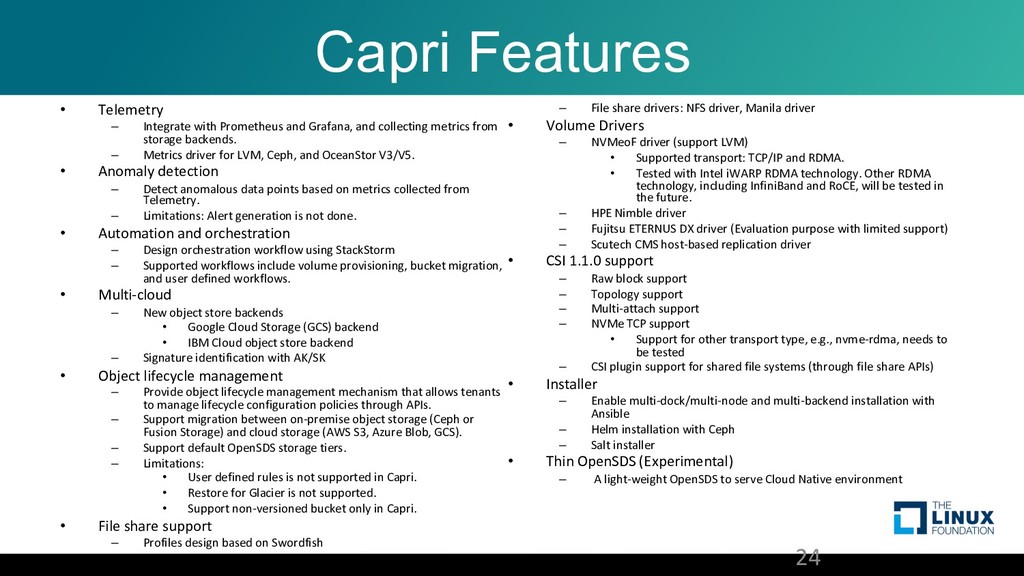
  20. Capri Features 24 • Telemetry – Integrate with Prometheus and

    Grafana, and collecting metrics from storage backends. – Metrics driver for LVM, Ceph, and OceanStor V3/V5. • Anomaly detection – Detect anomalous data points based on metrics collected from Telemetry. – Limitations: Alert generation is not done. • Automation and orchestration – Design orchestration workflow using StackStorm – Supported workflows include volume provisioning, bucket migration, and user defined workflows. • Multi-cloud – New object store backends • Google Cloud Storage (GCS) backend • IBM Cloud object store backend – Signature identification with AK/SK • Object lifecycle management – Provide object lifecycle management mechanism that allows tenants to manage lifecycle configuration policies through APIs. – Support migration between on-premise object storage (Ceph or Fusion Storage) and cloud storage (AWS S3, Azure Blob, GCS). – Support default OpenSDS storage tiers. – Limitations: • User defined rules is not supported in Capri. • Restore for Glacier is not supported. • Support non-versioned bucket only in Capri. • File share support – Profiles design based on Swordfish – File share drivers: NFS driver, Manila driver • Volume Drivers – NVMeoF driver (support LVM) • Supported transport: TCP/IP and RDMA. • Tested with Intel iWARP RDMA technology. Other RDMA technology, including InfiniBand and RoCE, will be tested in the future. – HPE Nimble driver – Fujitsu ETERNUS DX driver (Evaluation purpose with limited support) – Scutech CMS host-based replication driver • CSI 1.1.0 support – Raw block support – Topology support – Multi-attach support – NVMe TCP support • Support for other transport type, e.g., nvme-rdma, needs to be tested – CSI plugin support for shared file systems (through file share APIs) • Installer – Enable multi-dock/multi-node and multi-backend installation with Ansible – Helm installation with Ceph – Salt installer • Thin OpenSDS (Experimental) – A light-weight OpenSDS to serve Cloud Native environment
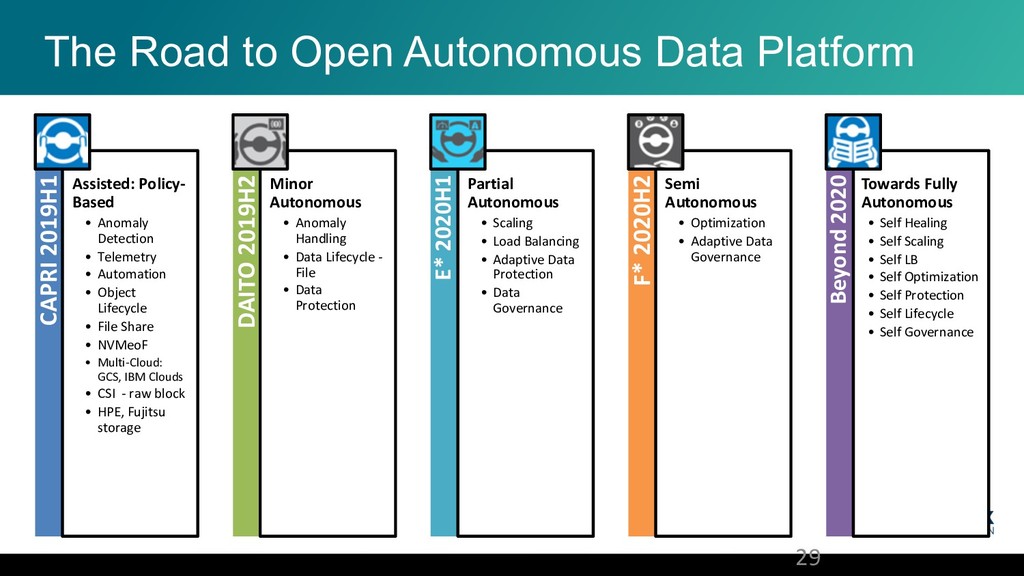
  21. The Road to Open Autonomous Data Platform 29 CAPRI 2019H1

    Assisted: Policy- Based • Anomaly Detection • Telemetry • Automation • Object Lifecycle • File Share • NVMeoF • Multi-Cloud: GCS, IBM Clouds • CSI - raw block • HPE, Fujitsu storage DAITO 2019H2 Minor Autonomous • Anomaly Handling • Data Lifecycle - File • Data Protection E* 2020H1 Responsive Environment Aware Predictive Analytics/UL Partial Autonomous • Scaling • Load Balancing • Adaptive Data Protection • Data Governance F* 2020H2 Highly Autonomous Prescriptive Analytics/DL Semi Autonomous • Optimization • Adaptive Data Governance Beyond 2020 Towards Fully Autonomous • Self Healing • Self Scaling • Self LB • Self Optimization • Self Protection • Self Lifecycle • Self Governance
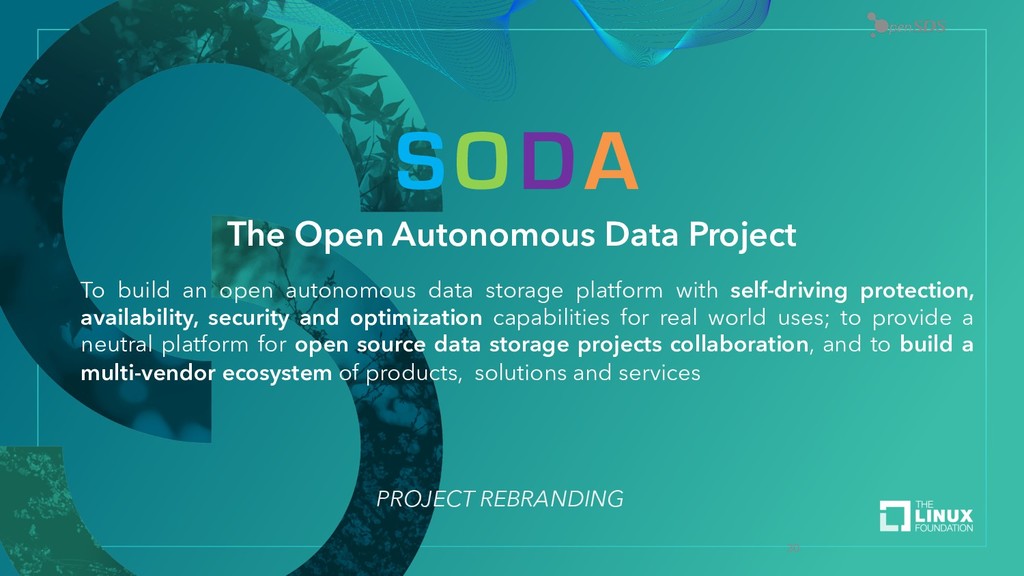
  22. 30 The Open Autonomous Data Project To build an open

    autonomous data storage platform with self-driving protection, availability, security and optimization capabilities for real world uses; to provide a neutral platform for open source data storage projects collaboration, and to build a multi-vendor ecosystem of products, solutions and services SODA PROJECT REBRANDING