| PyData NYC 2018 Unrestricted The views expressed here are those of the authors and do not necessarily represent or reflect the views of Barclays Disclaimer
| PyData NYC 2018 Unrestricted 1. Financial models for Planning and Stress-Testing 2. Modular approach to model development and integration 3. Benefits of an integrated solution 4. Notebook example 5. Role of Open Source Software Agenda
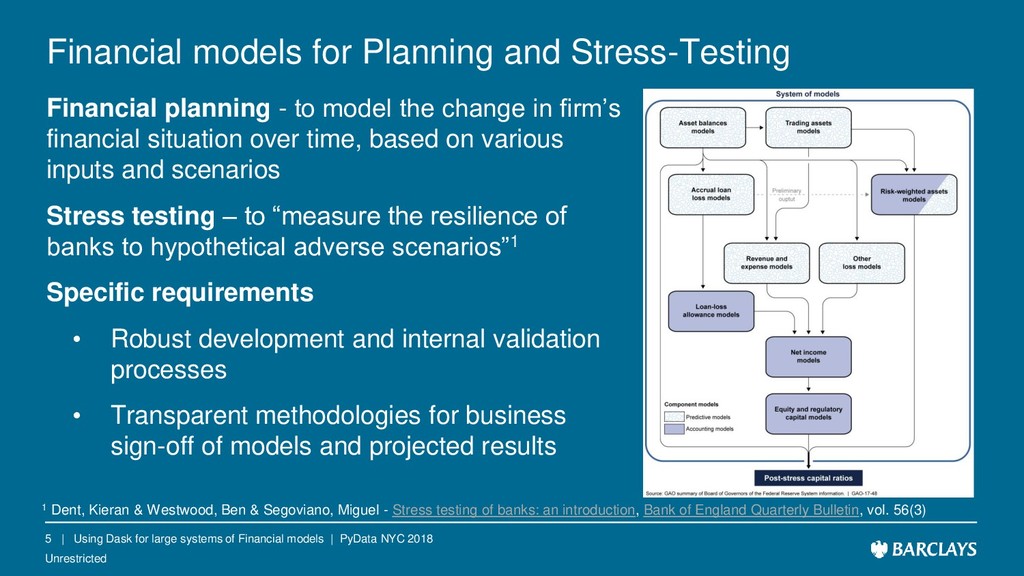
| PyData NYC 2018 Unrestricted Financial planning - to model the change in firm’s financial situation over time, based on various inputs and scenarios Stress testing – to “measure the resilience of banks to hypothetical adverse scenarios”1 Specific requirements • Robust development and internal validation processes • Transparent methodologies for business sign-off of models and projected results Financial models for Planning and Stress-Testing 1 Dent, Kieran & Westwood, Ben & Segoviano, Miguel - Stress testing of banks: an introduction, Bank of England Quarterly Bulletin, vol. 56(3)
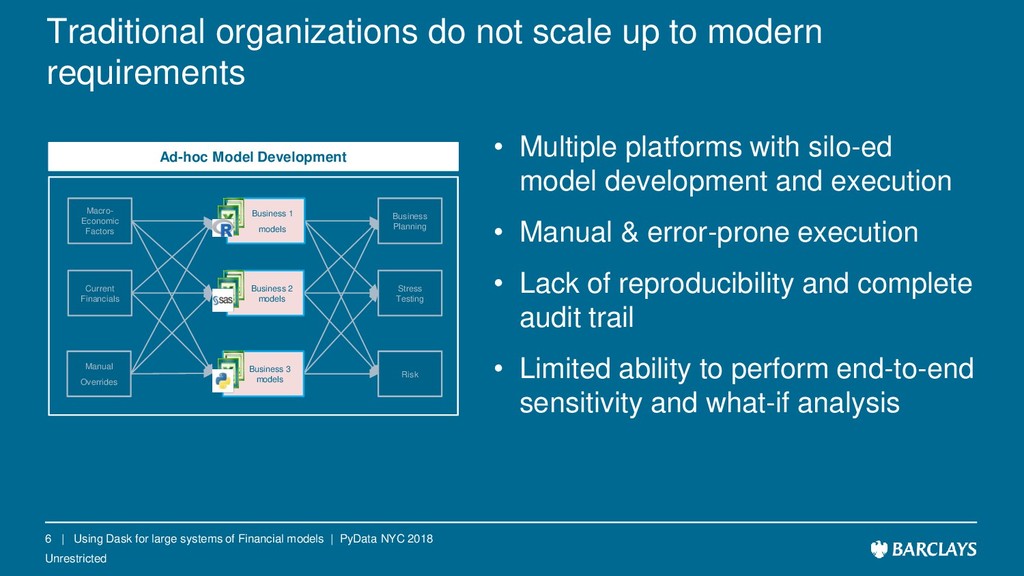
| PyData NYC 2018 Unrestricted • Multiple platforms with silo-ed model development and execution • Manual & error-prone execution • Lack of reproducibility and complete audit trail • Limited ability to perform end-to-end sensitivity and what-if analysis Traditional organizations do not scale up to modern requirements Business Planning Stress Testing Risk Macro- Economic Factors Current Financials Manual Overrides Business 1 models Business 2 models Business 3 models Ad-hoc Model Development
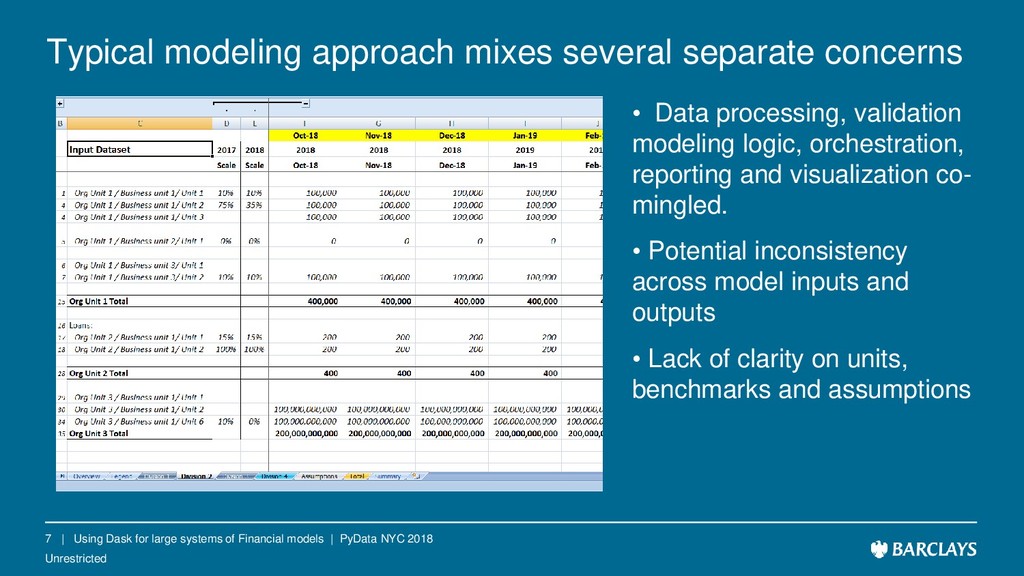
| PyData NYC 2018 Unrestricted Typical modeling approach mixes several separate concerns • Data processing, validation modeling logic, orchestration, reporting and visualization co- mingled. • Potential inconsistency across model inputs and outputs • Lack of clarity on units, benchmarks and assumptions
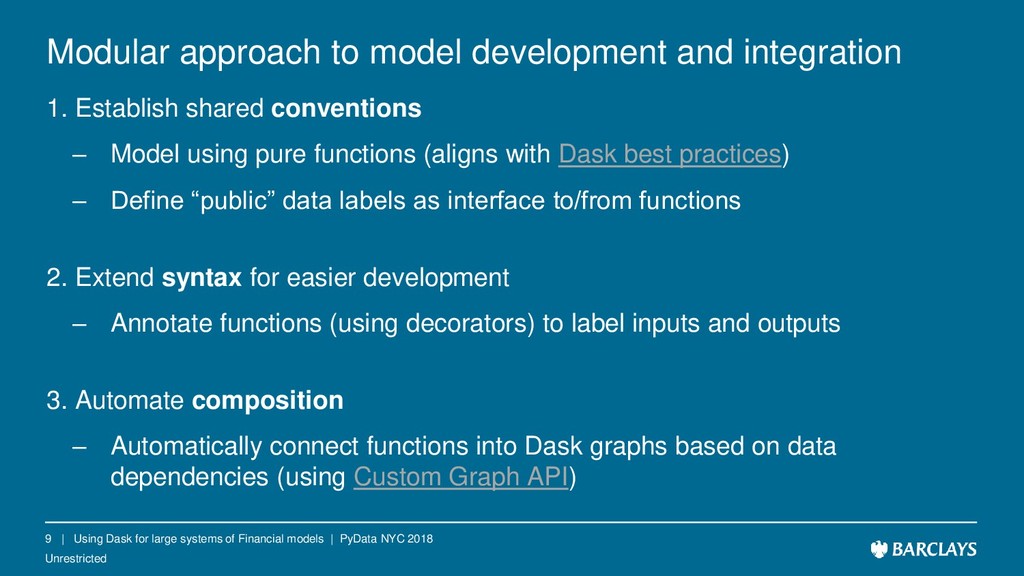
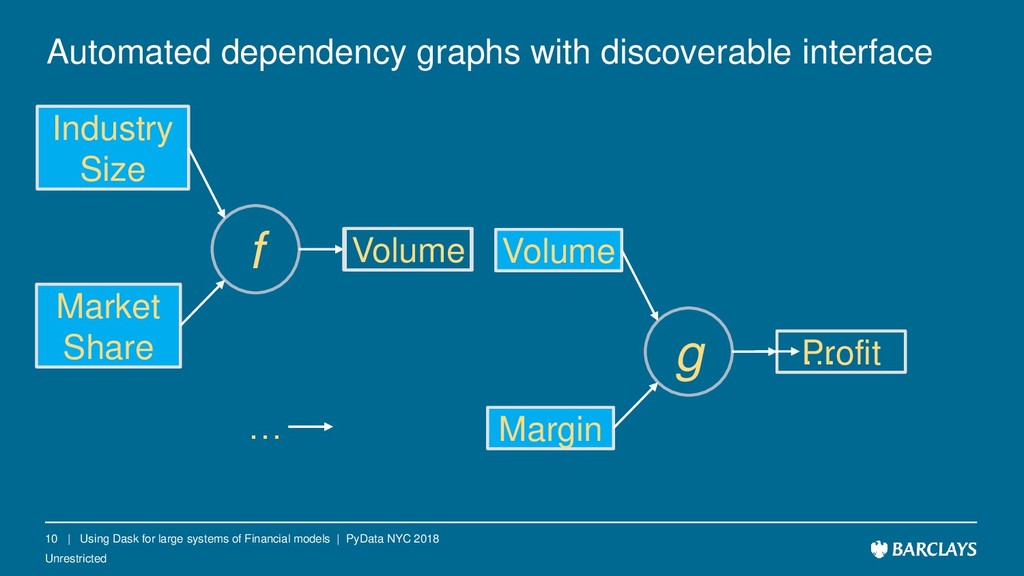
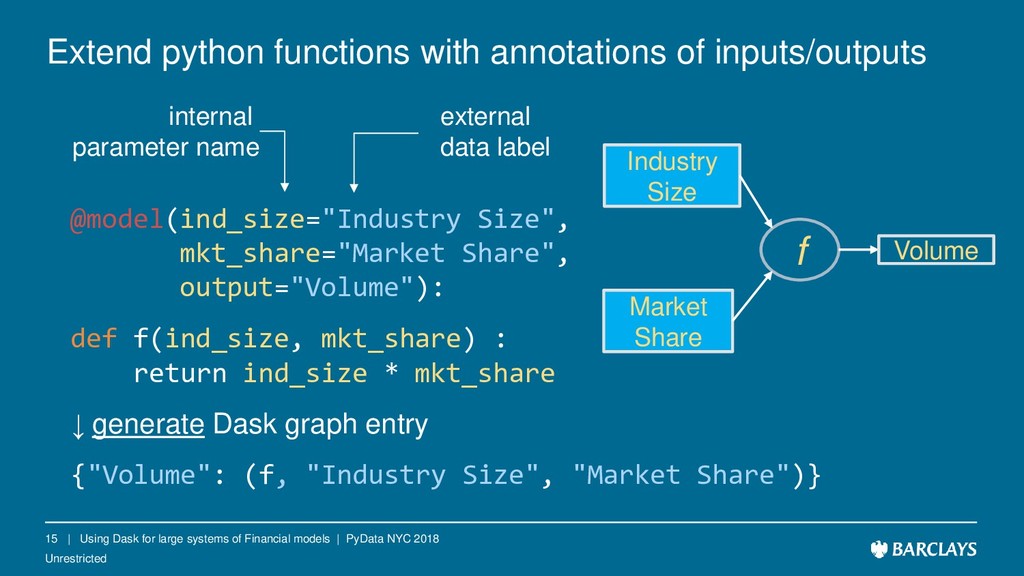
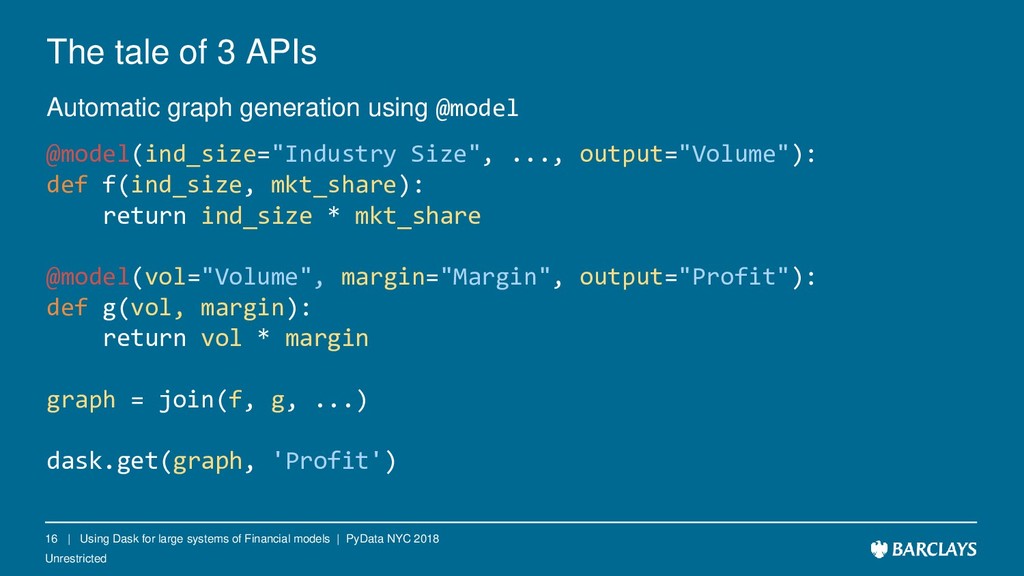
| PyData NYC 2018 Unrestricted 1. Establish shared conventions – Model using pure functions (aligns with Dask best practices) – Define “public” data labels as interface to/from functions 2. Extend syntax for easier development – Annotate functions (using decorators) to label inputs and outputs 3. Automate composition – Automatically connect functions into Dask graphs based on data dependencies (using Custom Graph API) Modular approach to model development and integration
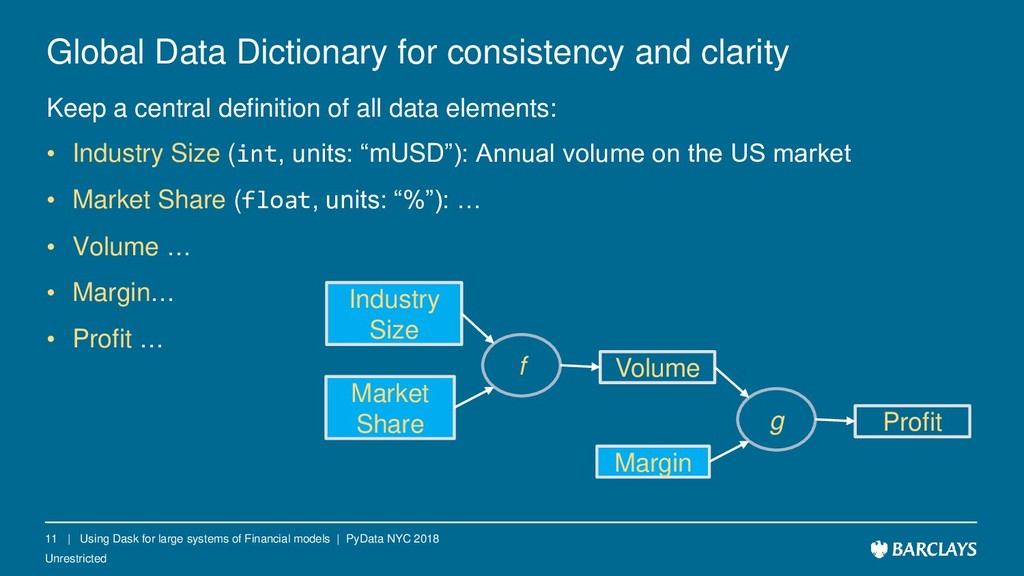
| PyData NYC 2018 Unrestricted Keep a central definition of all data elements: • Industry Size (int, units: “mUSD”): Annual volume on the US market • Market Share (float, units: “%”): … • Volume … • Margin… • Profit … Global Data Dictionary for consistency and clarity Market Share Volume f Industry Size Margin Profit g
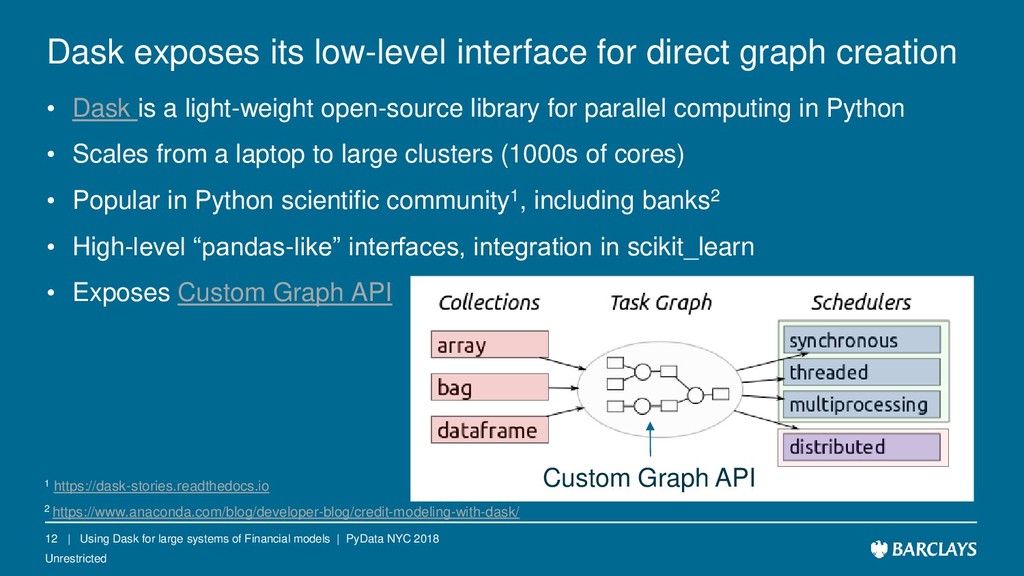
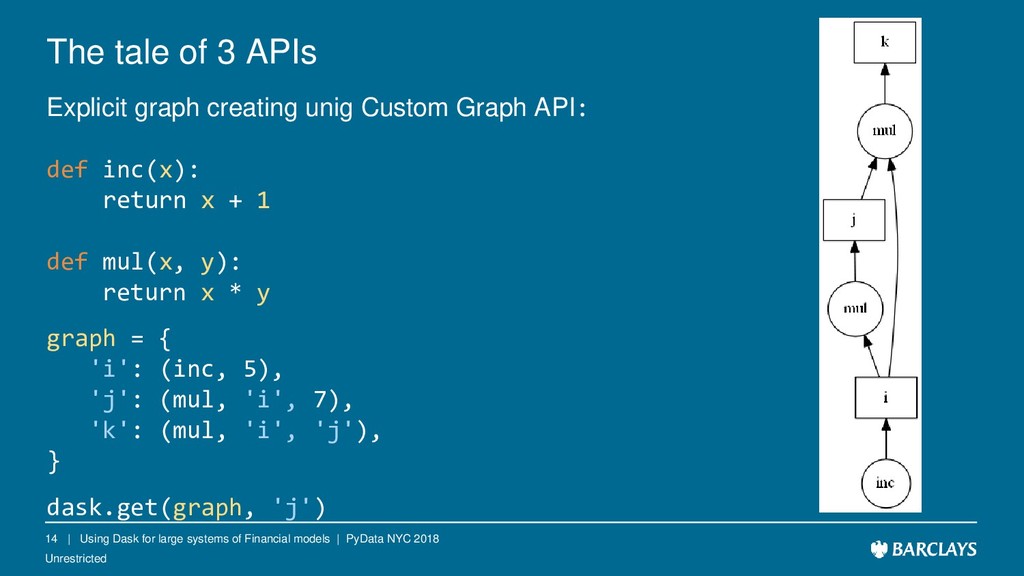
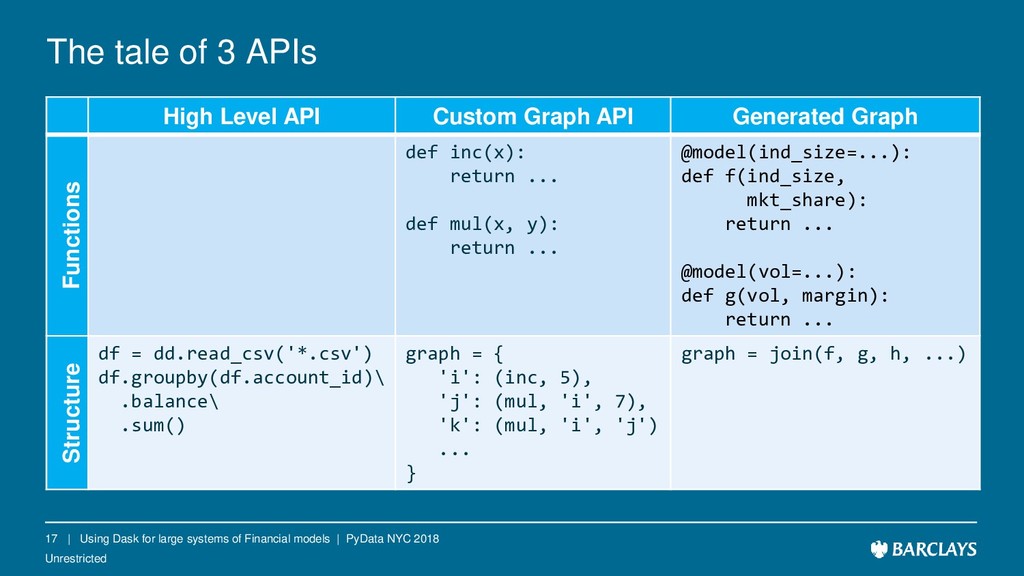
| PyData NYC 2018 Unrestricted • Dask is a light-weight open-source library for parallel computing in Python • Scales from a laptop to large clusters (1000s of cores) • Popular in Python scientific community1, including banks2 • High-level “pandas-like” interfaces, integration in scikit_learn • Exposes Custom Graph API Dask exposes its low-level interface for direct graph creation Custom Graph API 1 https://dask-stories.readthedocs.io 2 https://www.anaconda.com/blog/developer-blog/credit-modeling-with-dask/
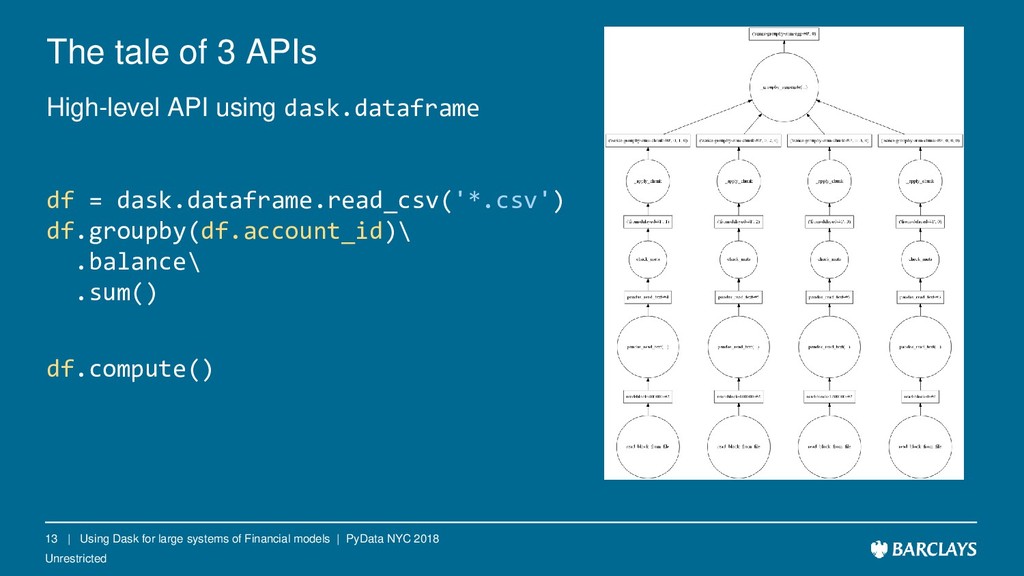
| PyData NYC 2018 Unrestricted The tale of 3 APIs High-level API using dask.dataframe df = dask.dataframe.read_csv('*.csv') df.groupby(df.account_id)\ .balance\ .sum() df.compute()
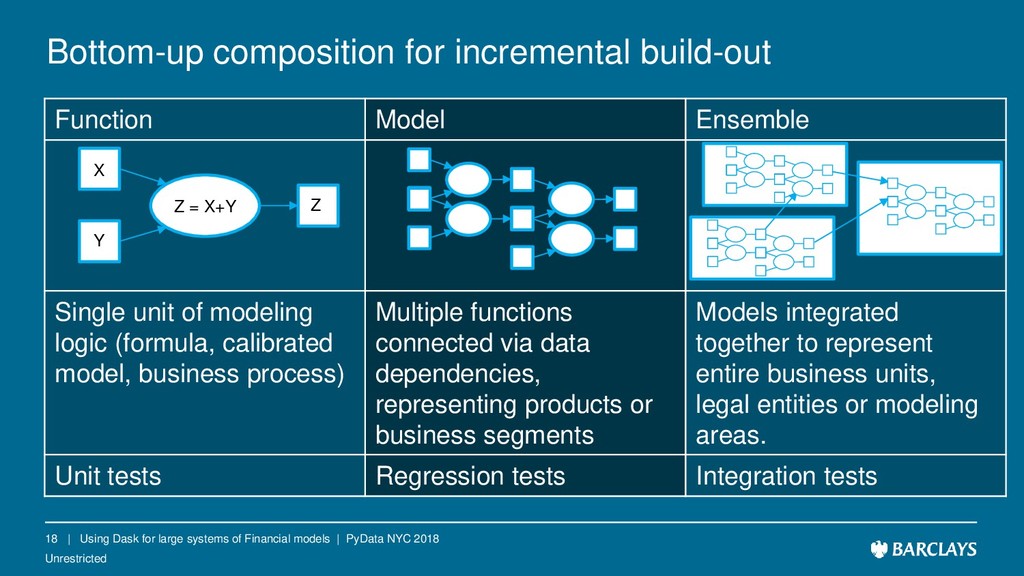
| PyData NYC 2018 Unrestricted Bottom-up composition for incremental build-out Function Model Ensemble Single unit of modeling logic (formula, calibrated model, business process) Multiple functions connected via data dependencies, representing products or business segments Models integrated together to represent entire business units, legal entities or modeling areas. Unit tests Regression tests Integration tests Z = X+Y X Y Z
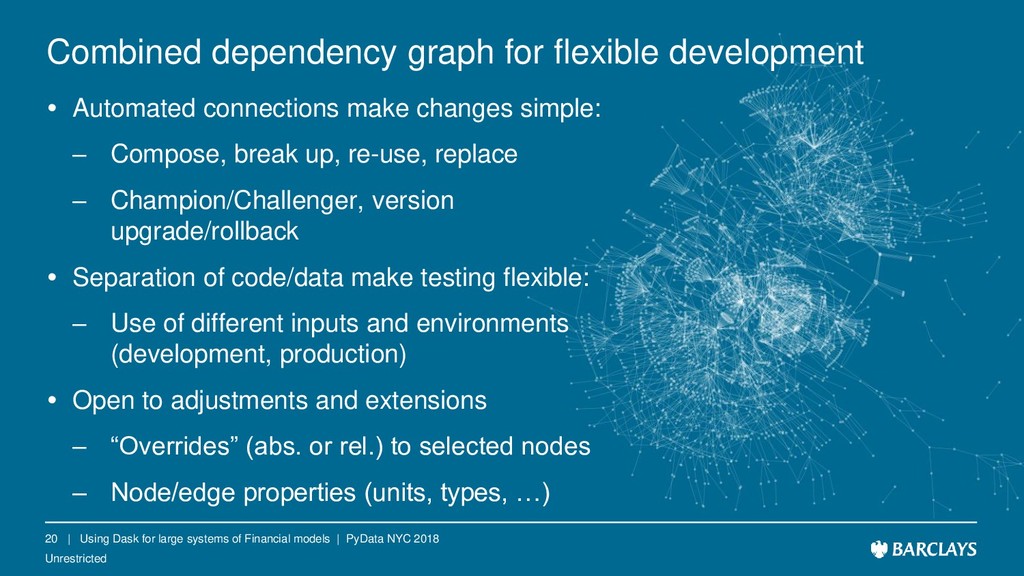
| PyData NYC 2018 Unrestricted Automated connections make changes simple: – Compose, break up, re-use, replace – Champion/Challenger, version upgrade/rollback Separation of code/data make testing flexible: – Use of different inputs and environments (development, production) Open to adjustments and extensions – “Overrides” (abs. or rel.) to selected nodes – Node/edge properties (units, types, …) Combined dependency graph for flexible development
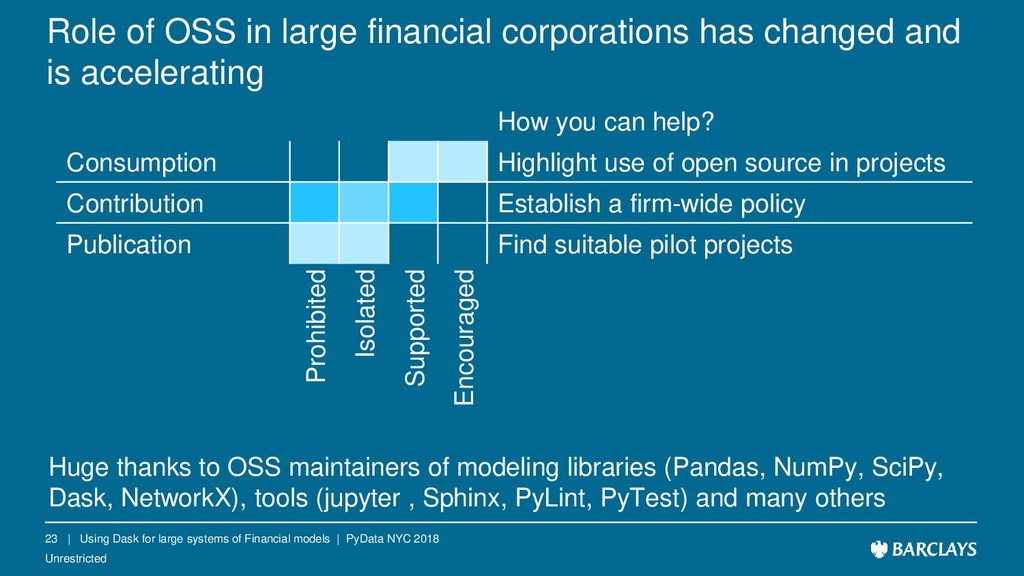
| PyData NYC 2018 Unrestricted Huge thanks to OSS maintainers of modeling libraries (Pandas, NumPy, SciPy, Dask, NetworkX), tools (jupyter , Sphinx, PyLint, PyTest) and many others Role of OSS in large financial corporations has changed and is accelerating How you can help? Consumption Highlight use of open source in projects Contribution Establish a firm-wide policy Publication Find suitable pilot projects Prohibited Isolated Supported Encouraged
| PyData NYC 2018 Unrestricted • Large financial modeling projects face unique challenges arising from a disparity of models and data • Strict rules and technology can help in building a flexible development and execution infrastructure • Automation opens doors to further analysis and re-use that would otherwise not be possible • Open source is a key enabler for even small teams to build great projects quickly Summary


 kizawa2020
 masakiokuda
 ivry_presentationmaterials
 jtakeda
 akitoshiga
 keeg
 tokuty
 makocchi
 maimyyym
 kairim0
 nttcom
 satomasahiro2005
 khoart
 joshbly
 holman
 reverentgeek
 palkan
 baasie
 geoffreycrofte
 techseoconnect
 marktimemedia
 inesmontani
 aleyda
 tmiket