Upgrade to Pro — share decks privately, control downloads, hide ads and more …

Your Office Furniture Is Telling a Story—Is It ...

Your Office Furniture Is Telling a Story—Is It the Right One?

Keynote Summary
● The furniture in an office shows the brand's personality and professionalism.
● Design affects how effectively employees work together, how healthy they are, and how productive they are.
● A curated place talks to clients, partners, and talent.
● Modular installations, ergonomic seating, and flexible layouts are changing the story of modern offices.
● Companies in the UAE are redesigning their workstations with care, taking cues from high-end local vendors like Urban 411.
First Impressions Start with the Chair You Sit On
You only get one shot to make a good first impression. That goes for both individuals and places. When you walk into a well-designed office, you can tell right away what kind of mood it is: focused or relaxed, conventional or tech-savvy, friendly or antiseptic. Most of the time, the furniture is what talks.

In the UAE, where business culture and new building styles come together, businesses are rethinking how their office furniture conveys their story.

Your Office Is a Mirror of Your Brand
Your office isn't only a location to work; it's also a part of your brand. The color of the meeting chairs, the executive desk, and even the layout of the workstations all communicate subtle (or not-so-subtle) messages to clients, employees, and visitors.

A software business that works together might use open benching systems, whereas a legal firm might choose high-back executive chairs and dark mahogany tables. Both options are planned and thought out. They change how people see things.
The Psychology of Furniture
Comfort = Care
Height-adjustable desks and ergonomic office chairs are not only fashionable, but they also show workers that their health is important. This message of concern that people don't know they're sending makes them feel better and work harder.
Organization = Clarity
Professionalism is shown by clean storage units, careful wire management, and modular design that work well together. On the other hand, old, messy furniture can make you think that someone isn't working hard enough—or worse, doesn't care.
Movement = Modernity
Office pods and mobile workstations suggest that you can be flexible and quick. These are values that both modern workers and customers admire.


Office Furniture is a Silent Communicator
Furniture also talks to workers. Are there areas where you can work quietly? Is there a comfy place to brainstorm ideas? Are conference tables made to be inclusive or to show who's in charge?

Planning ahead can change how people act, get them to work together, and keep them from getting burned out. Many smart organizations in Dubai and Abu Dhabi are putting their money into this. They're not only buying desks; they're also building ecosystems.
Growth of Story-Driven Workspaces in the UAE
In the UAE, the way workspaces are designed is changing. The physical environment has to work harder to feel relevant now that remote work is changing how and why we go to the office.

Companies are integrating:

● Acoustic office pods let you work in private without being alone.
● Ergonomic task seats that help you stay focused all day
● Executive desks that are both useful and impressive
● Workstations that may adjust to fit the needs of the team

These selections are planned, based on the tale, and based on strategy.

Many companies are going to worldwide furniture brands, but others are looking to local quality. For example, Urban 411's collections are changing how people in the UAE think about office furniture.
Design Choices That Say a Lot
Scenario 1
A creative agency changed the layout of their office by adding modular workstations and lounge areas. The new layout made it easier for people to work together in a relaxed way and fit with their fun brand.
Scenario 2
A new financial company set up stylish meeting rooms and exclusive work pods. The area now gives off a sense of creativity and privacy, which is great for their field.
Scenario 3
A consulting firm bought luxury workstations with built-in storage and unique table designs. Their office now conveys a story of skill and style.

In each example, the furniture was the main thing that changed the look of the area, even if it didn't say anything.
How to Write the Story of Your Office
Check out your current space.
What does your furniture say right now? Out of date? Not the same? Cold?

What is your main point?
Do you want to be recognized as modern, environmentally friendly, cooperative, or fancy?

Plan with purpose.
Don't just look at how it works. Pick furniture that shows what your business stands for.

Talk to the pros.
You can get world-class office furniture design if you live in the UAE. Urban 411, for example, combines creativity and usefulness, which is great for firms who want to make sure their design matches their messaging.
FAQs
Q1: Why is office furniture important for branding?
Your office furniture is an element of how people see you. It affects how people see your business, culture, and level of professionalism.
Q2: What kind of furniture makes people more productive?
Chairs that are good for your back, desks that can be adjusted, and workstations that can be put together in different ways all make work more comfortable and encourage movement. Both of these things affect focus and health.
Q3: How often should businesses change out their furniture?
There isn't a hard rule, but changing things up every 5 to 7 years keeps your workspace new, useful, and in line with what your employees require.
Q4: Is it worth it to buy workplace furniture?
Yes. Quality furniture pays off by making employees happier, improving how people see your business, and making everything run more smoothly.
Final Thoughts
● Your office furniture says a lot about your business without saying a word.
● Design choices can affect how productive people are, the culture of the company, and how much clients trust it.
● In modern UAE offices, flexibility, ergonomics, and looks are quite important.
● Urban 411 is one of the best-known companies in the area that helps businesses tell a captivating story about their workspaces.
● Your office should be as unique as your business, so don't settle for generic.

Avatar for pk studio

pk studio

January 27, 2026
Tweet

Other Decks in Technology

Transcript

  1. Research on the Business Strategy and Deficiency of the Fast

    Fashion Industry to Enhance Development - a Case Study of Shein Jiaye Liu King’s Business School King’s College London *Corresponding author. Email: [email protected] ABSTRACT Apparel is one of the largest categories of retail business in which the fast fashion industry originated in the 1990s and has played a significant role over the past decade. However, it still faces a variety of unique challenges. This research aims to suggest appropriate improvements in certain aspects of the fast fashion business using the case of Shein, which is an e-commerce company with one of the fastest growth rates in the world. By analysing the business strategies of the company using the SWOT analysis and the Marketing Mix, this study identifies three potential deficiencies in the field which hinder its further development, including the lack of sensitivity in design, insufficient corporate social responsibility, and damage to the environment in the manufacturing process. Keywords: Fast fashion, Shein, E-commerce, C2M 1. INTRODUCTION Fast fashion is a business model followed by the clothing industry in which recent catwalk trends and high-fashion designs are copied, mass-produced at a low cost, and shipped quickly to retail stores. During the late 20th century, fast fashion grew as clothing manufacturing became less expensive - thanks to new fabrics like polyester and nylon, more efficient supply chains and rapid response manufacturing techniques, and reliance on low-cost labour in the apparel industries of Asia. With an estimated market value of $30 billion, Shein is now the largest cross-border e-commerce site for fast fashion in China [1]. Over the past eight years, its revenue has grown by over 100% every year and is reported to reach almost $10 billion in 2020 [1]. In the United States, Shein has taken over the No.1 spot on iOS and Android from Amazon as the leading e-commerce app in the fast fashion category [2]. Shein adopts a unique business model - the Consumer to Manufacturer (C2M) model. By using this model, Shein's production of popular items can be accelerated quicker than others because she can predict demand more accurately. Consequently, the company reduces waste as well as inefficiencies, giving it a huge competitive advantage. The purpose of this research is to explore the business strategies applied by Shein as a fast-growing startup and to analyse the areas that require improvement to enhance development for the fast fashion industry as a whole. 2. THE HISTORY OF SHEIN The company was established in Nanjing, China, by Chris Xu in 2008 and is known for its reasonably priced clothing. Shein started more as a drop shipping business rather than a retailer in the early days. Instead of designing and manufacturing clothes, the company bought its merchandise in Guangzhou wholesale markets. Shein acquired Romwe, a Chinese retailer, in 2014, transforming the company into a "fully integrated retailer". As one of the largest fast fashion companies, Shein can ship to over 220 countries around the world thanks to its global warehouse network. Similar Web estimates that Shein's website received 115.5 million visits worldwide in 2021, second only to Nike, Zara, Macy's, Lululemon and Adidas in the fashion and apparel category [3]. Westerners are surprised by the Shein obsession because it seems to have appeared out of nowhere. Nevertheless, as more startup companies emphasize revenue and growth over profits, this kind of explosive © The Author(s) 2022 Y. Jiang et al. (Eds.): ICEDBC 2022, AEBMR 225, pp. 1794–1801, 2022. https://doi.org/10.2991/978-94-6463-036-7_268
  2. growth is becoming more common. The marketing strategies Shein applied

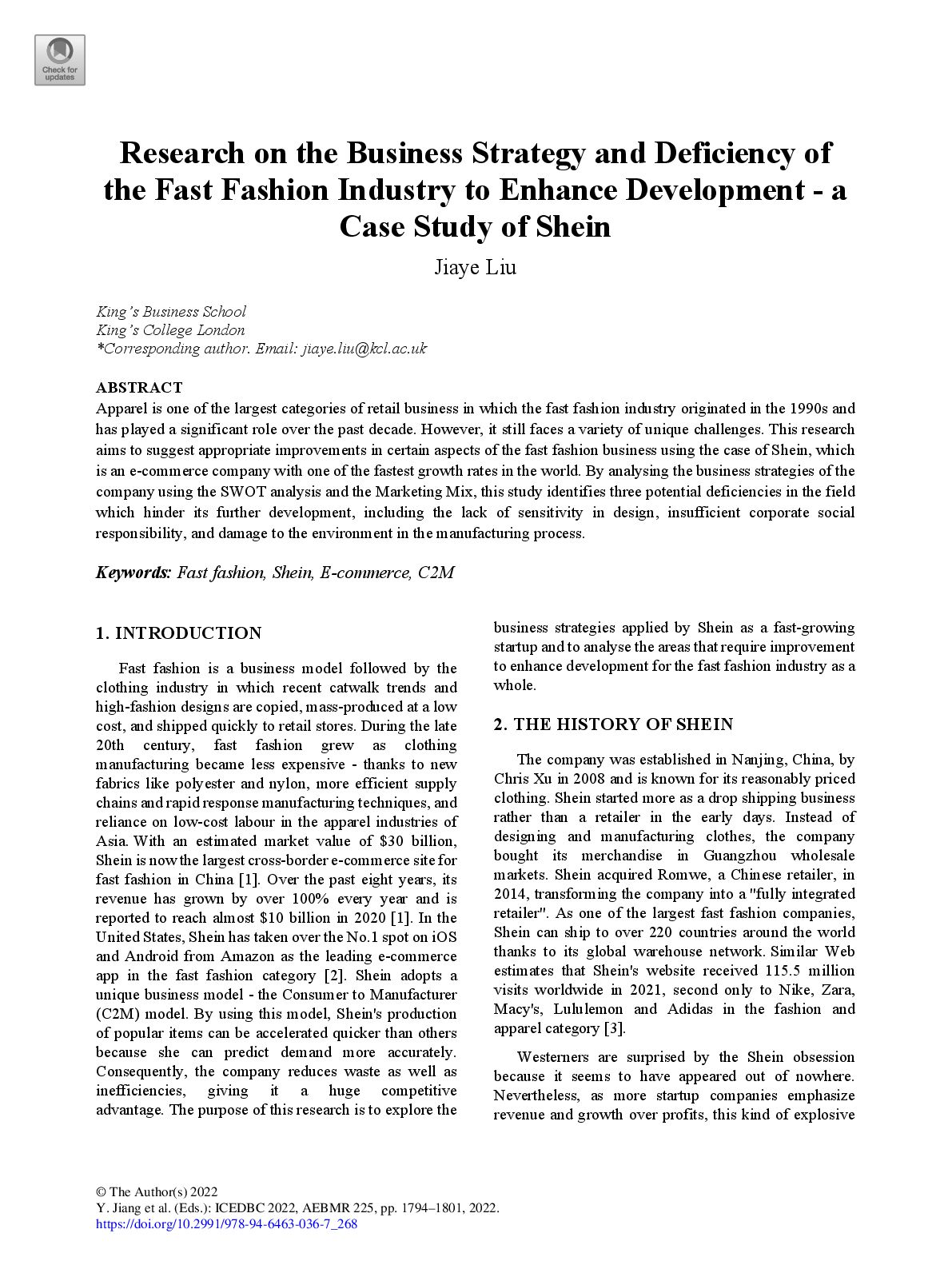
    were innovative and effective. 3. SWOT ANALYSIS SWOT analysis stands for Strengths, Weaknesses, Opportunities and Threats, which is a strategic analysis tool for business competition. It identifies the internal (Strengths and weaknesses) and external factors (opportunities and threats) of Shein for the competitive advantages and the potential crisis in achieving the objectives. 3.1. Strengths Shein announced sales of over 10 billion dollars in 2020 and 15.7 billion in 2021. In June 2021, the company has nearly as many fast fashion sales in the US as H&M and Zara combined [4]. Figure 1. Market share of fast fashion in the US [4] (Source: earnest, Shein Now Leads Fast Fashion, 2021, Not for commercial use) 3.1.1. Fast update From design to manufacturing, Shein handles the entire supply chain on its own. With every step highly digitised and integrated to the next, the company can create hundreds of new products every day tailored to different regions and tastes. Shein removes any remaining middlemen and has developed an enhanced cross-border C2M(Customer-to-Manufacturer) model. When a trend is identified, Shein can produce items in less than three days (usually 5-7 days) [5]. Shein launched 800,000 new products in 2021, on average more than 50,000 items every month. In just a few months, it has surpassed the annual new product volume of Zara, and the growth is accelerating [6]. According to their official website, there were about 8000 new products added to Shein's women's clothing category alone every day in March 2022. 3.1.2. Low price Despite other fast fashion brands and Amazon's products being cheap, for example,people can buy a regular shirt at Zara for up to $30, the same thing at Shein only costs half that amount. Furthermore, Shein aims to reach every type of customer and ensure they can enjoy fashion, irrespective of their economic situation. The low prices of Shein are attracting more and more young consumers. T-shirts for women can be purchased for as low as $5 and dresses for as low as $10. 3.1.3. Variety It offers clothes for women of all shapes and sizes, from XS up to 5XL. The plus-size collection is still rare on the market. For example, a basic t-shirt is available in 8 different colours, nine sizes, and three necklines. New sections with tiny gadgets, makeup, technological devices and home decorations, as well as sections dedicated to men, children, and pets, are also included. 3.2. Weaknesses 3.2.1. Quality As what is the most common criticism of the fast fashion industry, there are complaints on social media about the poor quality and condition of the products with clothes falling apart and received with odd smells. Additionally, the clothing in Shein's photos does not fit appropriately as seen or comes in the wrong sizes, showed in some YouTube videos [6]. Research on the Business Strategy and Deficiency 1795
  3. 3.2.2. Slow Delivery While Shein products are designed and manufactured

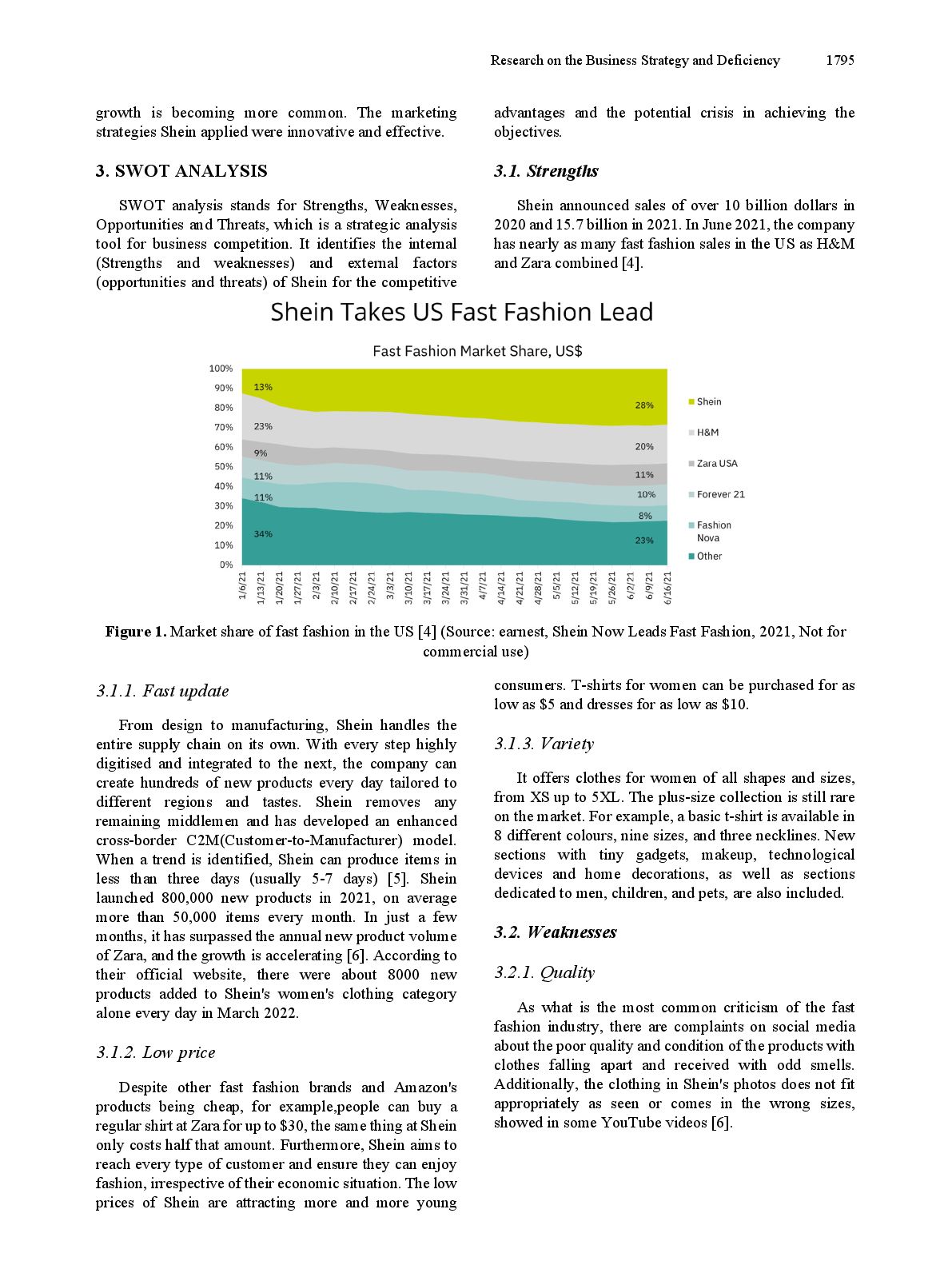
    quickly, they still take a long time to arrive. In some regions, there are no warehouses facilities available to speed up the delivery process. Delivery usually takes two to three weeks from Shein’s [5]. If one is shopping for a special occasion and needs the clothing item immediately, that is a long wait time. In that length of time, the purchase is also likely to be forgotten. Besides, if shipping stays slow, what would be the point of being fashion-responsive? 3.3. Opportunities 3.3.1. Increase in the e-commerce Both businesses and clients are increasingly turning to eCommerce as they are booming in the digital world. Businesses and consumers are seeing the benefits, including lower overhead costs and an easier and safer customer experience. With the growth of the e- commerce fashion industry, an increasing number of brands are venturing into e-commerce. To continue to succeed, Shein can incorporate new branding methods since it is already online. 3.3.2. COVID-19 COVID-19 may have contributed to Shein's relative outperformance. Zara and Uniqlo's revenues declined last year largely because of the global pandemic [5], which prevented people from stepping into the stores for shopping. However, each month, Shein's US sales increased by more than twice as much as they were before the pandemic [1]. Additionally, Shein's targeted consumers had more time to browse the Web and shop online during the lockdown period. Shein took advantage of this opportunity to increase consumer awareness, which resulted in a rapid rise in its popularity. During the COVID period, the increased use of digital technology also enabled Shein to develop their social media marketing strategies according to their target audience, Generation Z. The popular social media app, TikTok, gave Shein the opportunity to connect with their young consumers as well as build relationships. Figure 2. Shein's monthly year-over-year sales growth during the pandemic [1] (Source: Bloomberg News, How Trump's Trade War Built Shein, China's First Global Fashion Giant, 2021, Not for commercial use) 3.4. Threats 3.4.1. Geopolitical tensions There are increasing volatile geopolitical tensions, and China-related tech companies are under increased scrutiny. Shein was one of 59 apps the Indian government banned last year, including TikTok and WeChat, as they were deemed detrimental to India's sovereignty and integrity, the defence of India, security of state, and public order [1]. The C2M models are not as widely accepted in those countries, which is why the quality of the low-cost made- in-China products is questionable. Knowing they were basically buying directly from Chinese manufacturers might discourage consumers from purchasing. 3.4.2. Competitions Online competition is crucial. In this way, they must compete with both giants, like Amazon and small shops, which also provide affordable clothing. Additionally, consumers have a large selection of physical clothing stores such as Zara and Urban Outfitters, which provide the convenience of trying on clothes before buying. New entrants also present a very significant threat, given that hundreds of new websites of this kind are created each year. 4. MARKETING MIX The Marketing Mix, often referred to the four Ps of marketing, includes Product, Price, Place, and Promotion of a company, each interacting significantly with each other. The Marketing Mix is used by companies to analyse some key factors for the marketing strategies of their business. By incorporating the marketing strategies 1796 J. Liu
  4. into the Marketing Mix, Shein can provide high-demand, accessible products

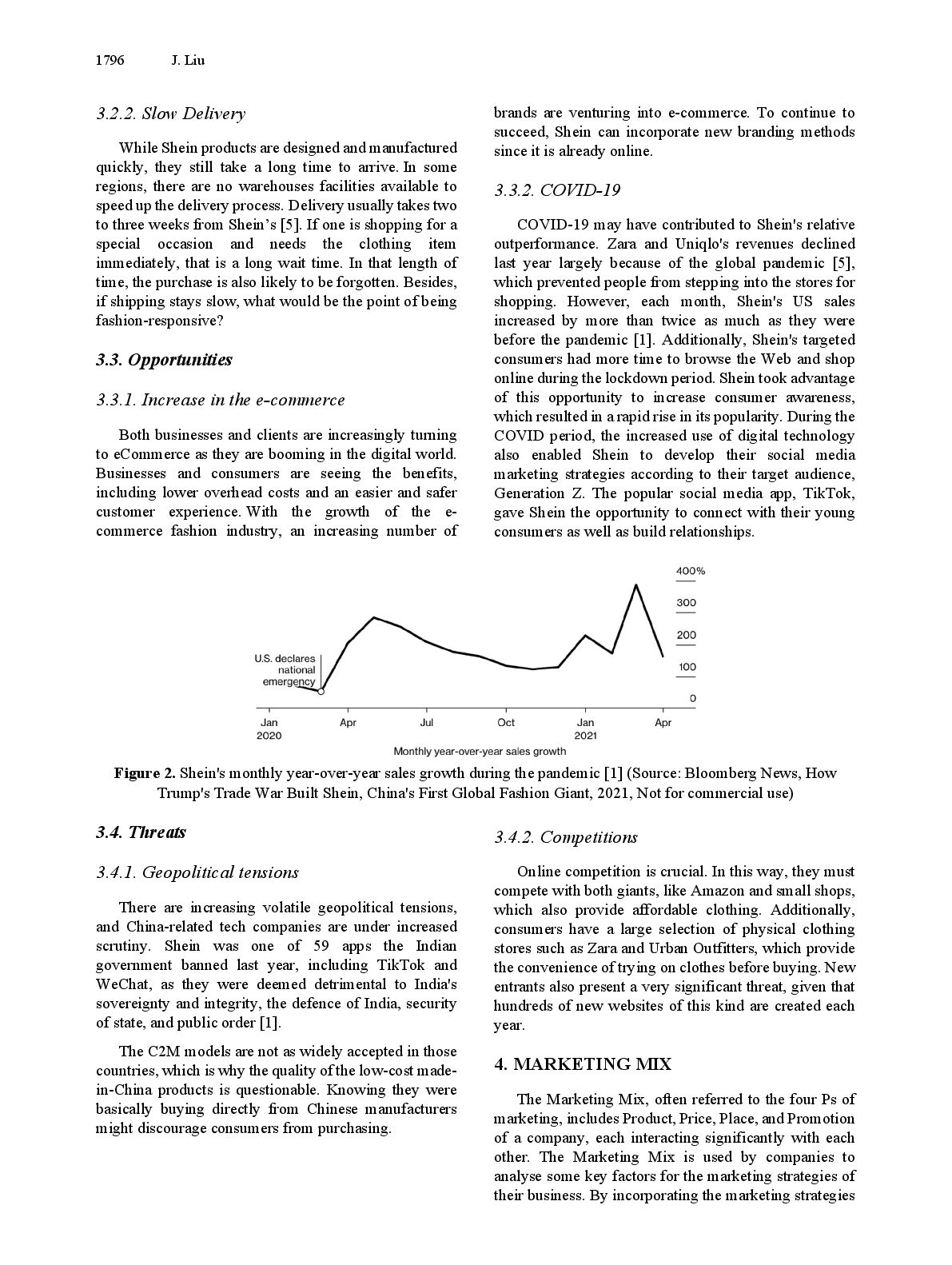
    that are promoted to their customers at competitive prices. 4.1. Product Shein is a one-stop shop. They offer a wide range of products, including clothing, shoes and accessories from daily dressing to beachwear. In the clothing category, their products provide a variety of sizes for both male and female customers from XS to 5XL, and to kids from new- born to 14 years old. Clothing targeted at teens and young adults in their 20s remains its core business. Shein's clothes are more diverse in terms of their styles, colours, and patterns. They also have numerous products for pets, technological devices, and home decorations. Last year, they announced their first beauty brand, 'SHEGLAM', which covers the cosmetic area from makeup skincare to body products. 4.2. Price Shein uses a low pricing strategy that appeals to the shopping preferences of Gen-Z (their targeted demographic). Gen Z emphasises that they are extremely price-sensitive and price-driven when shopping for fashion, considering price as the most important factor. Their most advantageous marketing strategy is to offer products at significantly lower prices than other fast fashion retailers like Zara and ASOS, as well as those sold on Amazon. 4.3. Place Backed by a powerful modern marketing engine, Shein sells mainly through its app. Shein's target demographics are the young, mobile-obsessed Generation Z, which sees its app as preferable to its website and is moving the battle onto mobile app e- commerce. Unlike generic consumer brands that rely on Amazon for customer acquisition with no meaningful access to customer data, Shein owns its sales channel and user data. Figure 3. App traffic VS website traffic for Shein and its competitors [3] (Source: Similarweb, Not for commercial use) 4.4. Promotion 4.4.1. Advertisement and social media The company used social media influencers to market its products as early as 2011. As a pioneer in every major e-commerce acquisition channel, Shein didn't shy away from paid marketing. It spends heavily on Facebook and Instagram as it is one of the largest Chinese clients of Google [5]. TikTok has emerged as a major channel in recent years. Shein is one of the most popular brands for teens on TikTok. A continual stream of discounts encourages shoppers to visit the site. TikTok users are delighted with the wide selection of clothing sizes available from XS to 5XL. Fashion bloggers support the Shein with haul videos under its hashtag. TikTok and Shein are the perfect matches, not only because they can be reached at an affordable price, but also because people enjoy seeing others wearing their purchases. Among the 70 hashtags on TikTok, only the #shein hashtag has reached 21.5 billion views [6]. 4.4.2. Affiliate program for influencers With Shein, customers can join the affiliate program since the company is not an Amazon-like platform. By referring customers to Shein.com through affiliate programs, people can earn commissions on all sales made, with affiliate rates higher than any other small store. Many users post content for free to earn 10-20% of sales as affiliate fees [5]. Micro-influencers such as these are known as KOCs or Key Opinion Consumers. They Research on the Business Strategy and Deficiency 1797
  5. also use an exchange model in which they offer free

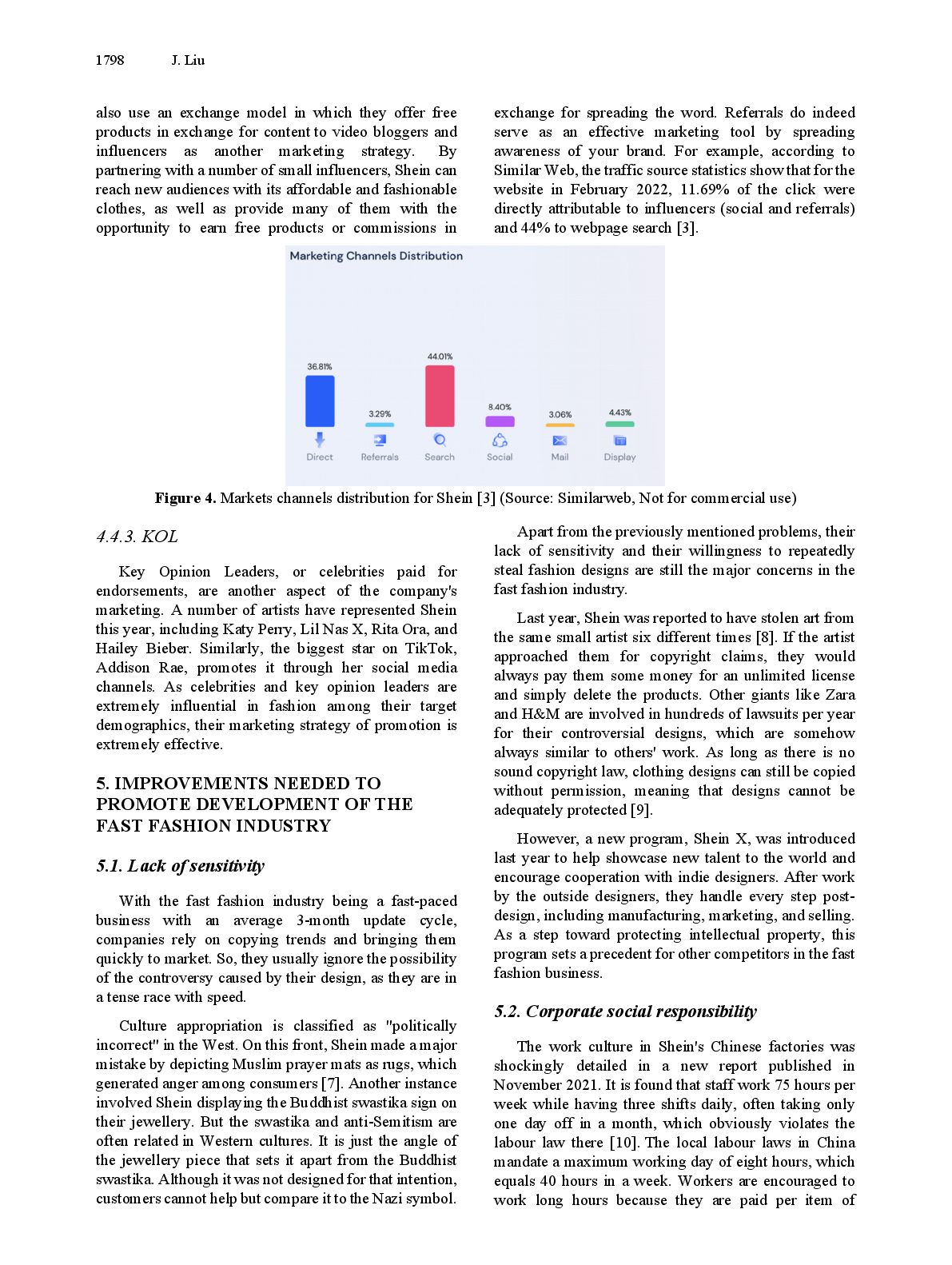
    products in exchange for content to video bloggers and influencers as another marketing strategy. By partnering with a number of small influencers, Shein can reach new audiences with its affordable and fashionable clothes, as well as provide many of them with the opportunity to earn free products or commissions in exchange for spreading the word. Referrals do indeed serve as an effective marketing tool by spreading awareness of your brand. For example, according to Similar Web, the traffic source statistics show that for the website in February 2022, 11.69% of the click were directly attributable to influencers (social and referrals) and 44% to webpage search [3]. Figure 4. Markets channels distribution for Shein [3] (Source: Similarweb, Not for commercial use) 4.4.3. KOL Key Opinion Leaders, or celebrities paid for endorsements, are another aspect of the company's marketing. A number of artists have represented Shein this year, including Katy Perry, Lil Nas X, Rita Ora, and Hailey Bieber. Similarly, the biggest star on TikTok, Addison Rae, promotes it through her social media channels. As celebrities and key opinion leaders are extremely influential in fashion among their target demographics, their marketing strategy of promotion is extremely effective. 5. IMPROVEMENTS NEEDED TO PROMOTE DEVELOPMENT OF THE FAST FASHION INDUSTRY 5.1. Lack of sensitivity With the fast fashion industry being a fast-paced business with an average 3-month update cycle, companies rely on copying trends and bringing them quickly to market. So, they usually ignore the possibility of the controversy caused by their design, as they are in a tense race with speed. Culture appropriation is classified as "politically incorrect" in the West. On this front, Shein made a major mistake by depicting Muslim prayer mats as rugs, which generated anger among consumers [7]. Another instance involved Shein displaying the Buddhist swastika sign on their jewellery. But the swastika and anti-Semitism are often related in Western cultures. It is just the angle of the jewellery piece that sets it apart from the Buddhist swastika. Although it was not designed for that intention, customers cannot help but compare it to the Nazi symbol. Apart from the previously mentioned problems, their lack of sensitivity and their willingness to repeatedly steal fashion designs are still the major concerns in the fast fashion industry. Last year, Shein was reported to have stolen art from the same small artist six different times [8]. If the artist approached them for copyright claims, they would always pay them some money for an unlimited license and simply delete the products. Other giants like Zara and H&M are involved in hundreds of lawsuits per year for their controversial designs, which are somehow always similar to others' work. As long as there is no sound copyright law, clothing designs can still be copied without permission, meaning that designs cannot be adequately protected [9]. However, a new program, Shein X, was introduced last year to help showcase new talent to the world and encourage cooperation with indie designers. After work by the outside designers, they handle every step post- design, including manufacturing, marketing, and selling. As a step toward protecting intellectual property, this program sets a precedent for other competitors in the fast fashion business. 5.2. Corporate social responsibility The work culture in Shein's Chinese factories was shockingly detailed in a new report published in November 2021. It is found that staff work 75 hours per week while having three shifts daily, often taking only one day off in a month, which obviously violates the labour law there [10]. The local labour laws in China mandate a maximum working day of eight hours, which equals 40 hours in a week. Workers are encouraged to work long hours because they are paid per item of 1798 J. Liu
  6. product. In a 'paid per item' model, workers are paid

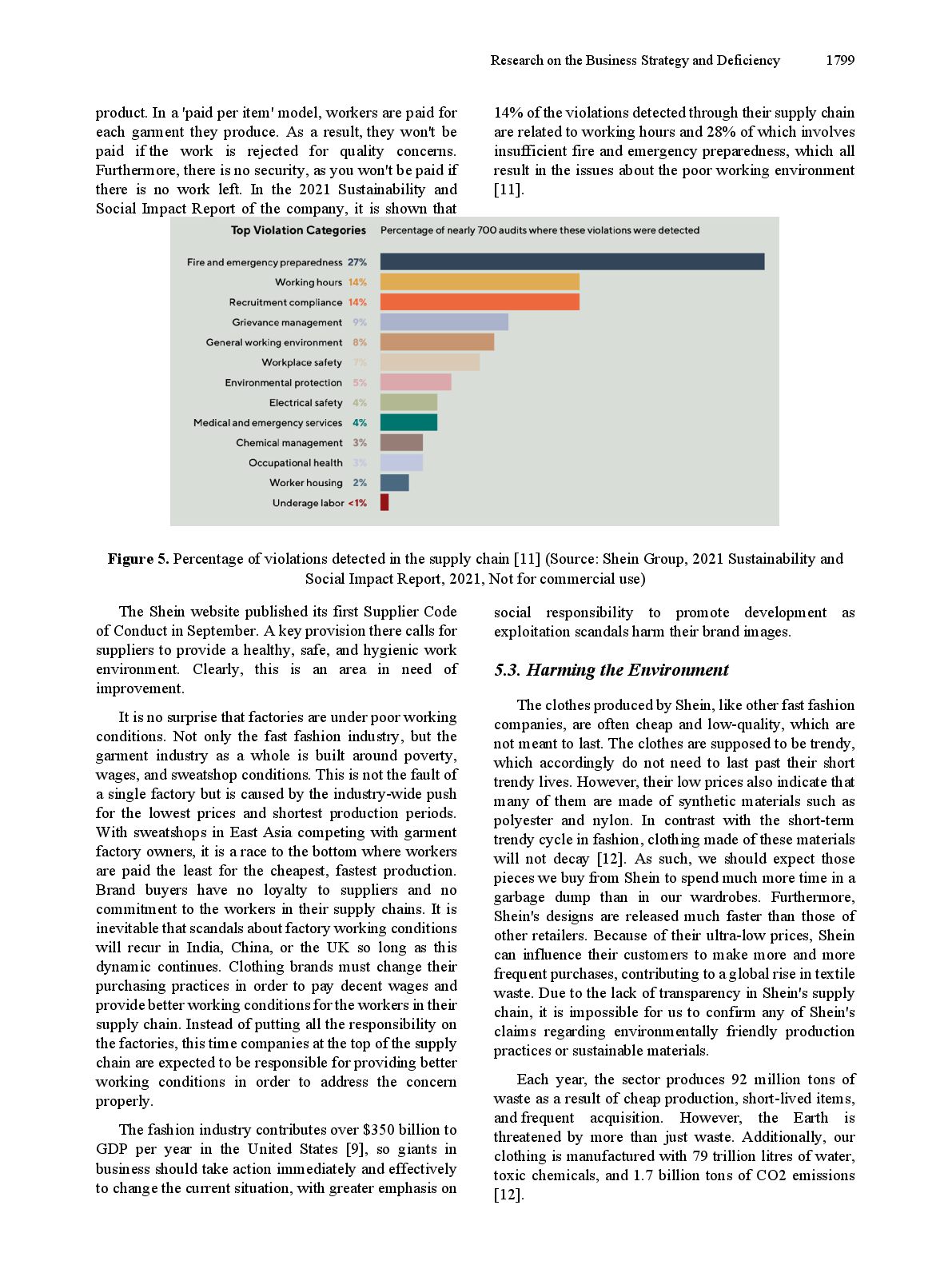
    for each garment they produce. As a result, they won't be paid if the work is rejected for quality concerns. Furthermore, there is no security, as you won't be paid if there is no work left. In the 2021 Sustainability and Social Impact Report of the company, it is shown that 14% of the violations detected through their supply chain are related to working hours and 28% of which involves insufficient fire and emergency preparedness, which all result in the issues about the poor working environment [11]. Figure 5. Percentage of violations detected in the supply chain [11] (Source: Shein Group, 2021 Sustainability and Social Impact Report, 2021, Not for commercial use) The Shein website published its first Supplier Code of Conduct in September. A key provision there calls for suppliers to provide a healthy, safe, and hygienic work environment. Clearly, this is an area in need of improvement. It is no surprise that factories are under poor working conditions. Not only the fast fashion industry, but the garment industry as a whole is built around poverty, wages, and sweatshop conditions. This is not the fault of a single factory but is caused by the industry-wide push for the lowest prices and shortest production periods. With sweatshops in East Asia competing with garment factory owners, it is a race to the bottom where workers are paid the least for the cheapest, fastest production. Brand buyers have no loyalty to suppliers and no commitment to the workers in their supply chains. It is inevitable that scandals about factory working conditions will recur in India, China, or the UK so long as this dynamic continues. Clothing brands must change their purchasing practices in order to pay decent wages and provide better working conditions for the workers in their supply chain. Instead of putting all the responsibility on the factories, this time companies at the top of the supply chain are expected to be responsible for providing better working conditions in order to address the concern properly. The fashion industry contributes over $350 billion to GDP per year in the United States [9], so giants in business should take action immediately and effectively to change the current situation, with greater emphasis on social responsibility to promote development as exploitation scandals harm their brand images. 5.3. Harming the Environment The clothes produced by Shein, like other fast fashion companies, are often cheap and low-quality, which are not meant to last. The clothes are supposed to be trendy, which accordingly do not need to last past their short trendy lives. However, their low prices also indicate that many of them are made of synthetic materials such as polyester and nylon. In contrast with the short-term trendy cycle in fashion, clothing made of these materials will not decay [12]. As such, we should expect those pieces we buy from Shein to spend much more time in a garbage dump than in our wardrobes. Furthermore, Shein's designs are released much faster than those of other retailers. Because of their ultra-low prices, Shein can influence their customers to make more and more frequent purchases, contributing to a global rise in textile waste. Due to the lack of transparency in Shein's supply chain, it is impossible for us to confirm any of Shein's claims regarding environmentally friendly production practices or sustainable materials. Each year, the sector produces 92 million tons of waste as a result of cheap production, short-lived items, and frequent acquisition. However, the Earth is threatened by more than just waste. Additionally, our clothing is manufactured with 79 trillion litres of water, toxic chemicals, and 1.7 billion tons of CO2 emissions [12]. Research on the Business Strategy and Deficiency 1799
  7. Fast fashion businesses should make an effort in investing in

    more sustainable materials and a more environmental-friendly production process. They could develop a recycling system that encourages their customers to donate their outdated items to be reused as raw materials. Ultimately, businesses should transition to a more circular business model which repurposes their materials. Those resources could be used more efficiently and waste would be reduced substantially, contributing to sustainability and managing environmental damage. Furthermore, they should be more transparent with their production line, allowing consumers to confirm that they are 'environmentally friendly' as they claim to be. 6. CONCLUSION This study aims to analyse the approaches by which fast fashion businesses could develop further by using the case of a new startup Shein. In the SWOT analysis, the company has absolute advantages in their ultra-fast updating cycle and extremely low prices on wide selections of products. The outbreak of the pandemic and the boost of e-commerce provide opportunities for them to grow. However, the quality and the delivery process are still the major concerns of their consumers. Threats may arise from the tension of geopolitical issues against Chinese companies and the competition between other physical stores offering fitting rooms. By using the marketing mix, their products cover the range of men, women and kids, as well as pets and home decorations, all at affordable prices for everyone. They control their sales channel as consumers can only buy either from their website or mobile app. Furthermore, they are one of the companies that give full play to their advantages through social media by running enormous advertisements and adopting affiliate programs. As for recommendations, businesses in the fast fashion industry should pay more attention to the copyright of designs, enhance social responsibility by eliminating sweatshop factories, and protect the environment with a more sustainable manufacturing process. Nevertheless, this research has some limitations considering that the case company is a relatively young yet very promising one compared to other experienced competitors in the field. Even though it is the pioneer in the ultra-fast fashion business, this study perceives it as a player in the traditional fast fashion industry as we cannot predict the future impact of this revolutionary transition, but we do know that it is an inevitable move. Thus, further study is required to fill the gap between the development of the traditional and ultra-fast fashion industries; and the impact of the transition on the e- commerce market. REFERENCES [1] Bloomberg News, How Trump's Trade War Built Shein, China's First Global Fashion Giant, 2021. Online: https://www.bloomberg.com/news/articles/2021- 06-14/online-fashion-giant-shein-emerged-from- china-thanks-to-donald-trump-s-trade- war?sref=QYWxDQ1o [2] Rita Liao, Shein overtakes Amazon as top shopping app on US app stores, 2021. Online: https://techcrunch.com/2021/05/18/shein- overtakes-amazon/ [3] Similarweb, Online: https://www.similarweb.com/zh/website/shein.com /#overview [4] Seersite, Shein Now Leads Fast Fashion, 2021. Online: https://www.earnestresearch.com/data- bites/shein-leads-fast-fashion/ [5] Packy McCormick, Shein: The TikTok of Ecommerce, 2021. Online: https://www.notboring.co/p/shein-the-tiktok-of- ecommerce?token=eyJ1c2VyX2lkIjo0NTAwNywi cG9zdF9pZCI6MzY0ODM2OTMsIl8iOiJGaXpT UiIsImlhdCI6MTYyMTI1Njc5OCwiZXhwIjoxNjI xMjYwMzk4LCJpc3MiOiJwdWItMTAwMjUiLC JzdWIiOiJwb3N0LXJlYWN0aW9uIn0.OCvxt- 9N69bHLrOkzuTh0e4Eo6UMn6HCBwNuLFOHu ys&s=r [6] Daiane Chen, Shein's market strategy: how the Chinese fashion brand is conquering the West, 2022. Online: https://daxueconsulting.com/shein- market-strategy/ [7] BBC News, Shein apologises for selling Muslim prayer mats as 'Greek carpets', 2020. Online: https://www.bbc.co.uk/news/newsbeat-53308549 [8] Jerren Gan, Here's Why You Should Never Shop at Shein No Matter What, 2021. Online: https://medium.com/age-of-awareness/heres-why- you-should-never-shop-at-shein-no-matter-what- 8140d285cf4b [9] Chavie Lieber, Fashion brands steal design ideas all the time. And it's completely legal, 2018. Online: https://www.vox.com/2018/4/27/17281022/fashion -brands-knockoffs-copyright-stolen-designs-old- navy-zara-h-and-m [10] Timo Kollbrunner, Toiling away for Shein, 2021. Online: https://stories.publiceye.ch/en/shein/ [11] Shein Group, 2021 Sustainability and Social Impact Report, 2021. Online: 1800 J. Liu
  8. https://www.shein.co.uk/2021-Sustainability-and- Social-Impact-Report-a-1267.html [12] Niinimäki, K., Peters, G., Dahlbo, H. et

    al., The environmental price of fast fashion. Nat Rev Earth Environ, vol. 1, pp. 189–200, 2020 Open Access This chapter is licensed under the terms of the Creative Commons Attribution-NonCommercial 4.0 International License (http://creativecommons.org/licenses/by-nc/4.0/), which permits any noncommercial use, sharing, adaptation, distribution and reproduction in any medium or format, as long as you give appropriate credit to the original author(s) and the source, provide a link to the Creative Commons license and indicate if changes were made. The images or other third party material in this chapter are included in the chapter s Creative Commons license, unless indicated otherwise in a credit line to the material. If material is not included in the chapter s Creative Commons license and your intended use is not permitted by statutory regulation or exceeds the permitted use, you will need to obtain permission directly from the copyright holder. ’ ’ Research on the Business Strategy and Deficiency 1801