us know their views about treatment and care? Isn’t this the realm of the specialist and of researchers? Virtue of patients is: They are a test card running through the system Staff nearly always think their services and care are unimpeachable – patients may think otherwise, or confirm In a non market, non price environment like the NHS, patients can tell you what’s going on when there are no price signals and no market where customer choice impacts on work volumes Patients are sophisticated: they discriminate between good and bad aspects of service Quantitative data is useful, qualitative data adds believable granularity
of Trusts improved scores between 2010 and 2011-12. 98 Trusts improved performance significantly Liberates patients to discuss and report on their care: they have no problem discussing “cancer”, as 68% response rate on CPES shows; 85% on Survivorship etc 130,000 patient comments on CPES Informs actions by Trusts, MDTs, national policy delivery
Trust, tumour group, demographic (age, gender, ethnicity, LTC, sexuality, region) Rarer cancers show poorer levels of information and ratings of care in many cases Presentations/discussions to Trusts show: Large scale willingness to change Impact of Trust culture and in some cases lack of strategic oversight – no cancer Board, MDT silo oversight only Strong concern for Trust and clinical reputation
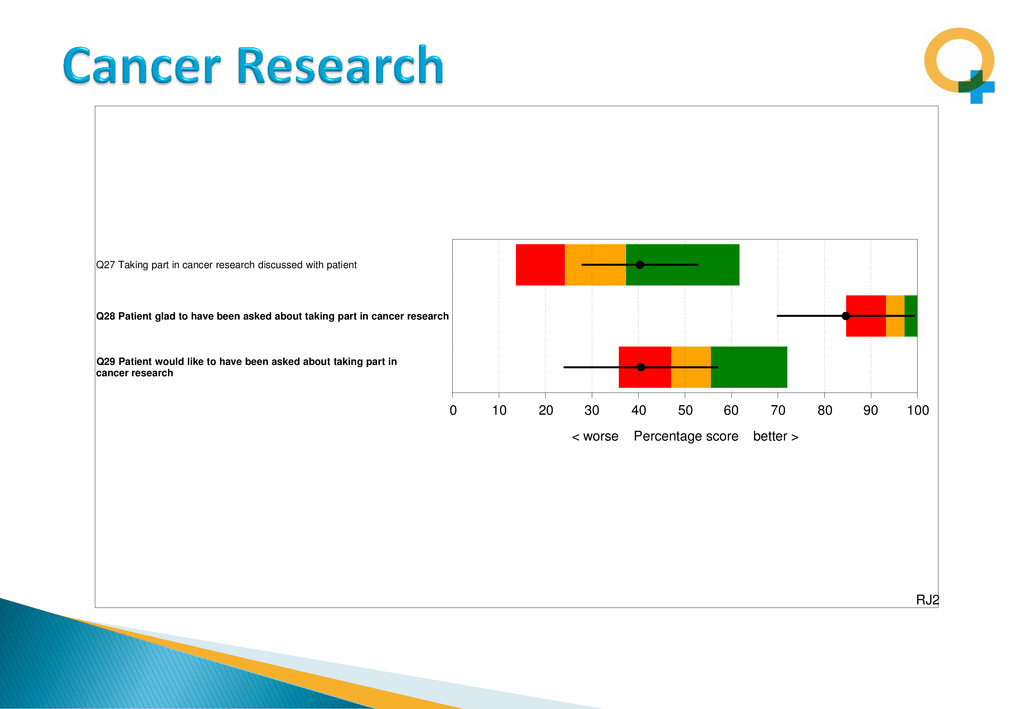
by Trust, 85% - 100% glad to have been asked c. 35% nationwide asked if they would like to take part in cancer research (range 12-82, depending on Trust size and teaching component) Clear that patients like being asked, mainly want to help
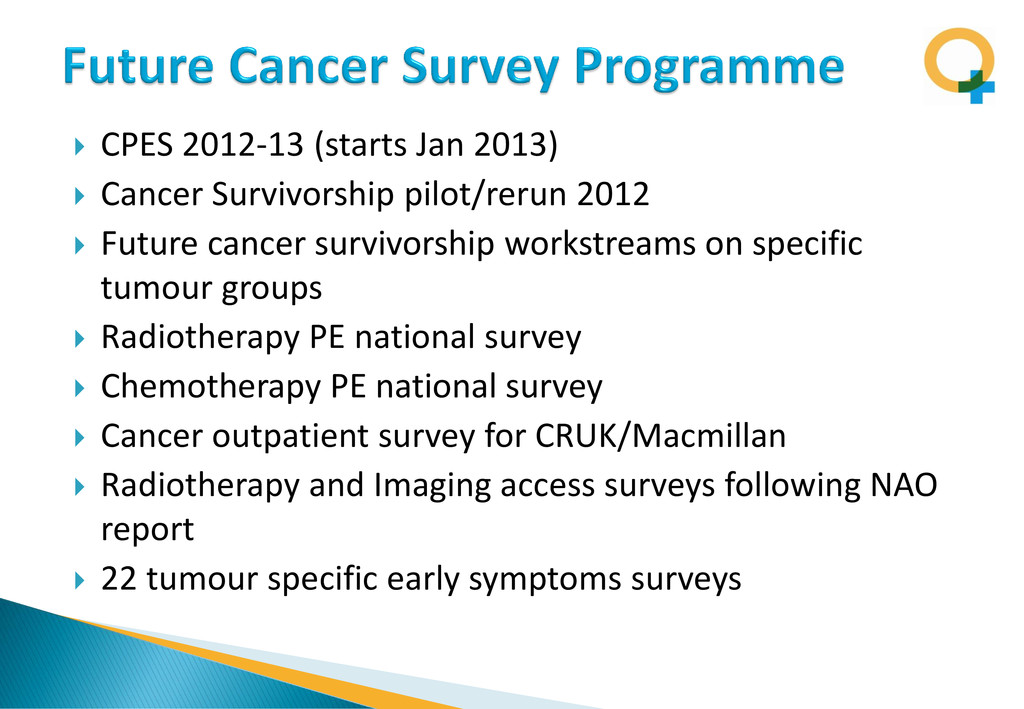
2012 Future cancer survivorship workstreams on specific tumour groups Radiotherapy PE national survey Chemotherapy PE national survey Cancer outpatient survey for CRUK/Macmillan Radiotherapy and Imaging access surveys following NAO report 22 tumour specific early symptoms surveys
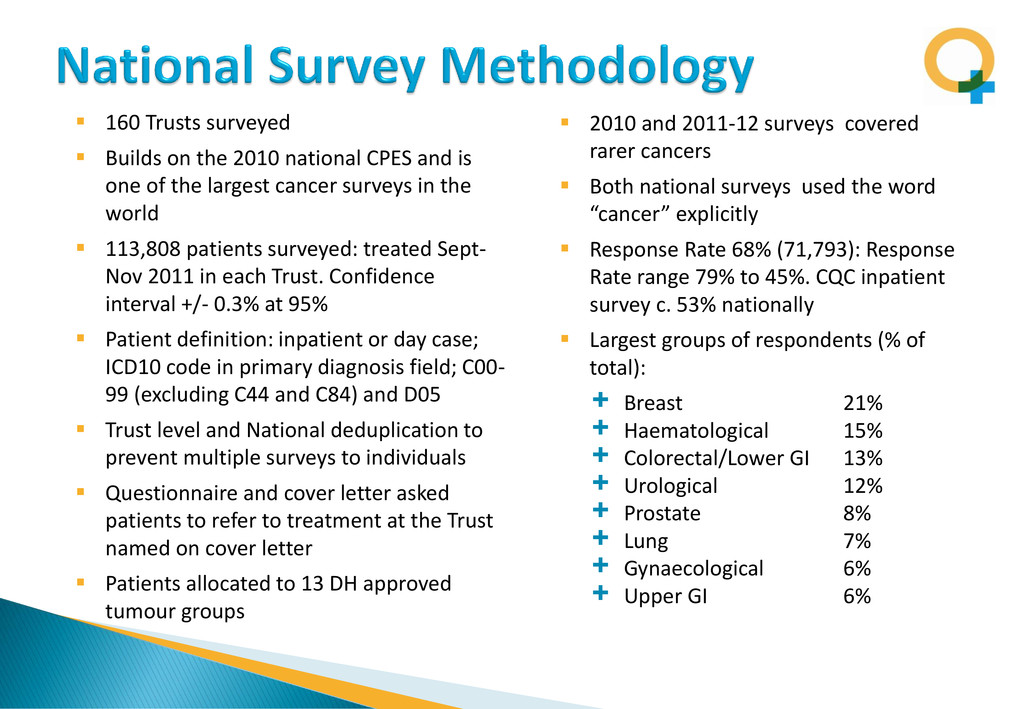
CPES and is one of the largest cancer surveys in the world 113,808 patients surveyed: treated Sept- Nov 2011 in each Trust. Confidence interval +/- 0.3% at 95% Patient definition: inpatient or day case; ICD10 code in primary diagnosis field; C00- 99 (excluding C44 and C84) and D05 Trust level and National deduplication to prevent multiple surveys to individuals Questionnaire and cover letter asked patients to refer to treatment at the Trust named on cover letter Patients allocated to 13 DH approved tumour groups 2010 and 2011-12 surveys covered rarer cancers Both national surveys used the word “cancer” explicitly Response Rate 68% (71,793): Response Rate range 79% to 45%. CQC inpatient survey c. 53% nationally Largest groups of respondents (% of total): + Breast 21% + Haematological 15% + Colorectal/Lower GI 13% + Urological 12% + Prostate 8% + Lung 7% + Gynaecological 6% + Upper GI 6%
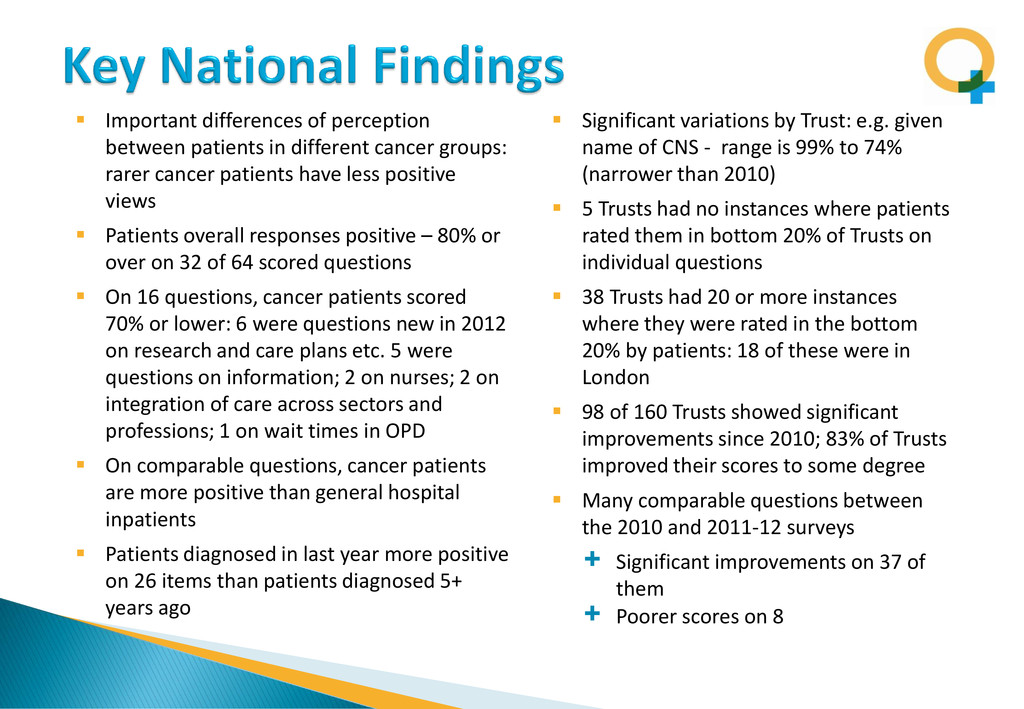
groups: rarer cancer patients have less positive views Patients overall responses positive – 80% or over on 32 of 64 scored questions On 16 questions, cancer patients scored 70% or lower: 6 were questions new in 2012 on research and care plans etc. 5 were questions on information; 2 on nurses; 2 on integration of care across sectors and professions; 1 on wait times in OPD On comparable questions, cancer patients are more positive than general hospital inpatients Patients diagnosed in last year more positive on 26 items than patients diagnosed 5+ years ago Significant variations by Trust: e.g. given name of CNS - range is 99% to 74% (narrower than 2010) 5 Trusts had no instances where patients rated them in bottom 20% of Trusts on individual questions 38 Trusts had 20 or more instances where they were rated in the bottom 20% by patients: 18 of these were in London 98 of 160 Trusts showed significant improvements since 2010; 83% of Trusts improved their scores to some degree Many comparable questions between the 2010 and 2011-12 surveys + Significant improvements on 37 of them + Poorer scores on 8 160 Trusts
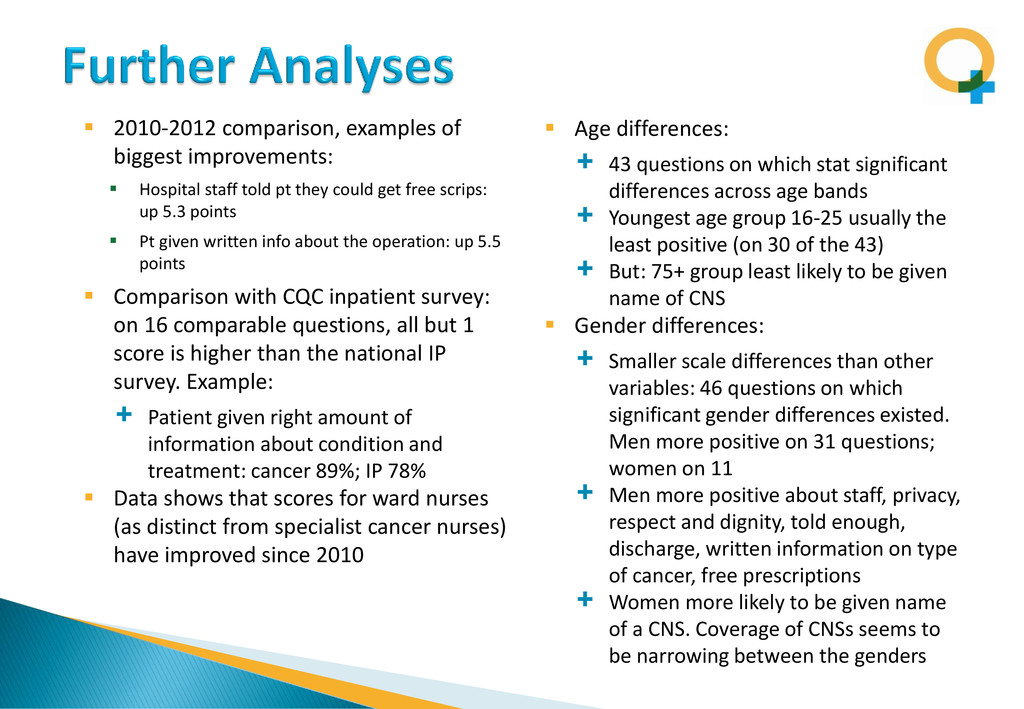
told pt they could get free scrips: up 5.3 points Pt given written info about the operation: up 5.5 points Comparison with CQC inpatient survey: on 16 comparable questions, all but 1 score is higher than the national IP survey. Example: + Patient given right amount of information about condition and treatment: cancer 89%; IP 78% Data shows that scores for ward nurses (as distinct from specialist cancer nurses) have improved since 2010 Age differences: + 43 questions on which stat significant differences across age bands + Youngest age group 16-25 usually the least positive (on 30 of the 43) + But: 75+ group least likely to be given name of CNS Gender differences: + Smaller scale differences than other variables: 46 questions on which significant gender differences existed. Men more positive on 31 questions; women on 11 + Men more positive about staff, privacy, respect and dignity, told enough, discharge, written information on type of cancer, free prescriptions + Women more likely to be given name of a CNS. Coverage of CNSs seems to be narrowing between the genders
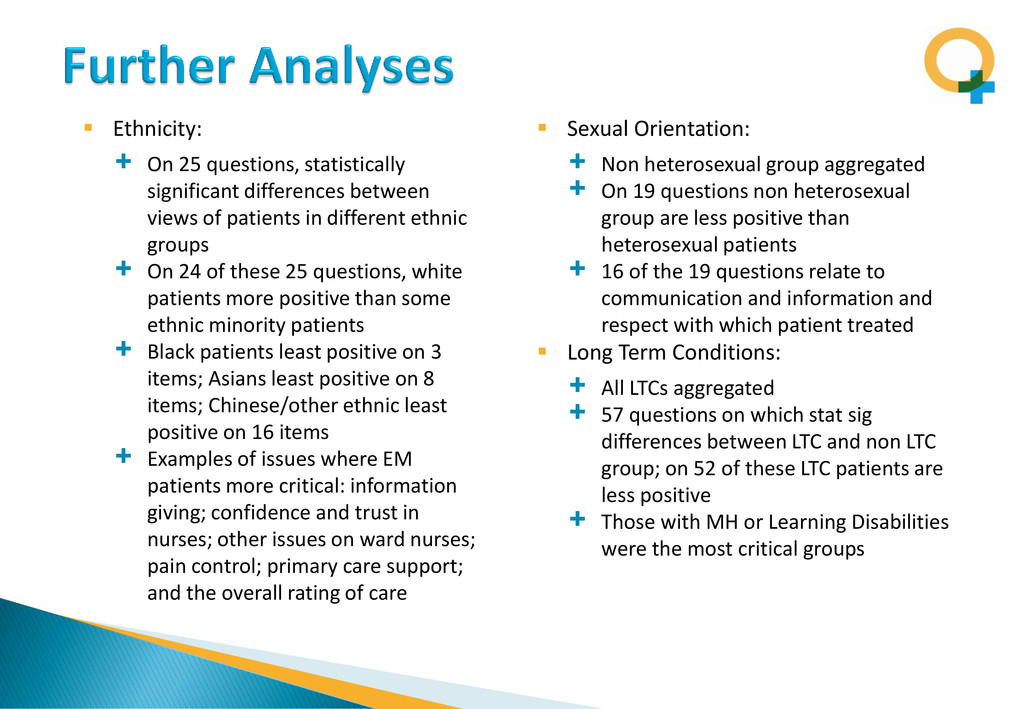
views of patients in different ethnic groups + On 24 of these 25 questions, white patients more positive than some ethnic minority patients + Black patients least positive on 3 items; Asians least positive on 8 items; Chinese/other ethnic least positive on 16 items + Examples of issues where EM patients more critical: information giving; confidence and trust in nurses; other issues on ward nurses; pain control; primary care support; and the overall rating of care Sexual Orientation: + Non heterosexual group aggregated + On 19 questions non heterosexual group are less positive than heterosexual patients + 16 of the 19 questions relate to communication and information and respect with which patient treated Long Term Conditions: + All LTCs aggregated + 57 questions on which stat sig differences between LTC and non LTC group; on 52 of these LTC patients are less positive + Those with MH or Learning Disabilities were the most critical groups
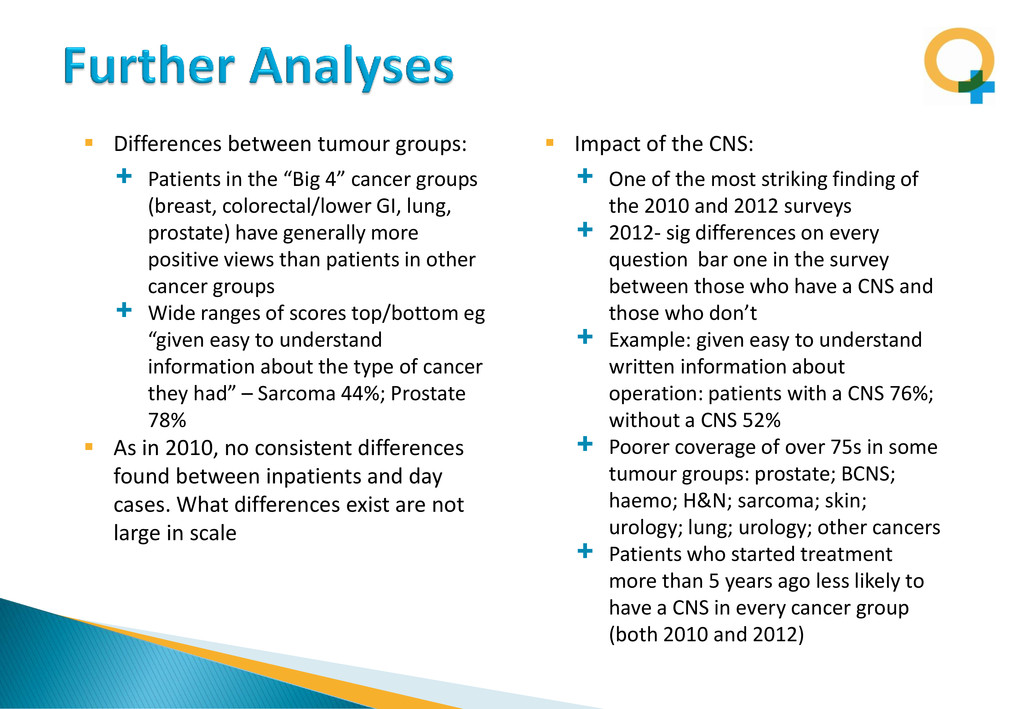
4” cancer groups (breast, colorectal/lower GI, lung, prostate) have generally more positive views than patients in other cancer groups + Wide ranges of scores top/bottom eg “given easy to understand information about the type of cancer they had” – Sarcoma 44%; Prostate 78% As in 2010, no consistent differences found between inpatients and day cases. What differences exist are not large in scale Impact of the CNS: + One of the most striking finding of the 2010 and 2012 surveys + 2012- sig differences on every question bar one in the survey between those who have a CNS and those who don’t + Example: given easy to understand written information about operation: patients with a CNS 76%; without a CNS 52% + Poorer coverage of over 75s in some tumour groups: prostate; BCNS; haemo; H&N; sarcoma; skin; urology; lung; urology; other cancers + Patients who started treatment more than 5 years ago less likely to have a CNS in every cancer group (both 2010 and 2012)
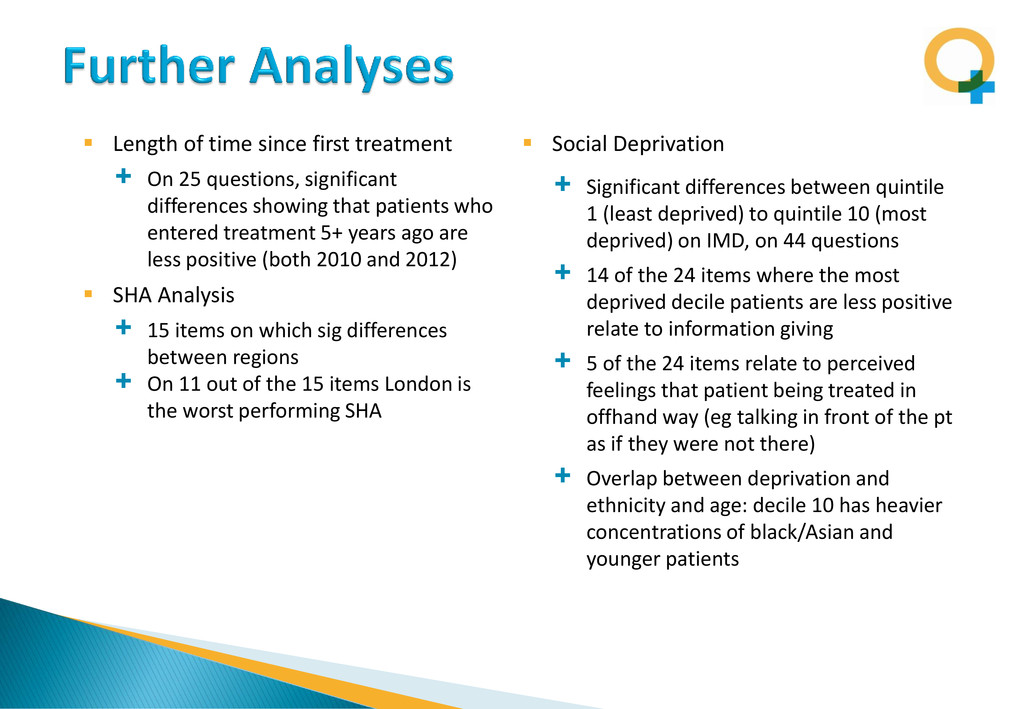
questions, significant differences showing that patients who entered treatment 5+ years ago are less positive (both 2010 and 2012) SHA Analysis + 15 items on which sig differences between regions + On 11 out of the 15 items London is the worst performing SHA Social Deprivation + Significant differences between quintile 1 (least deprived) to quintile 10 (most deprived) on IMD, on 44 questions + 14 of the 24 items where the most deprived decile patients are less positive relate to information giving + 5 of the 24 items relate to perceived feelings that patient being treated in offhand way (eg talking in front of the pt as if they were not there) + Overlap between deprivation and ethnicity and age: decile 10 has heavier concentrations of black/Asian and younger patients
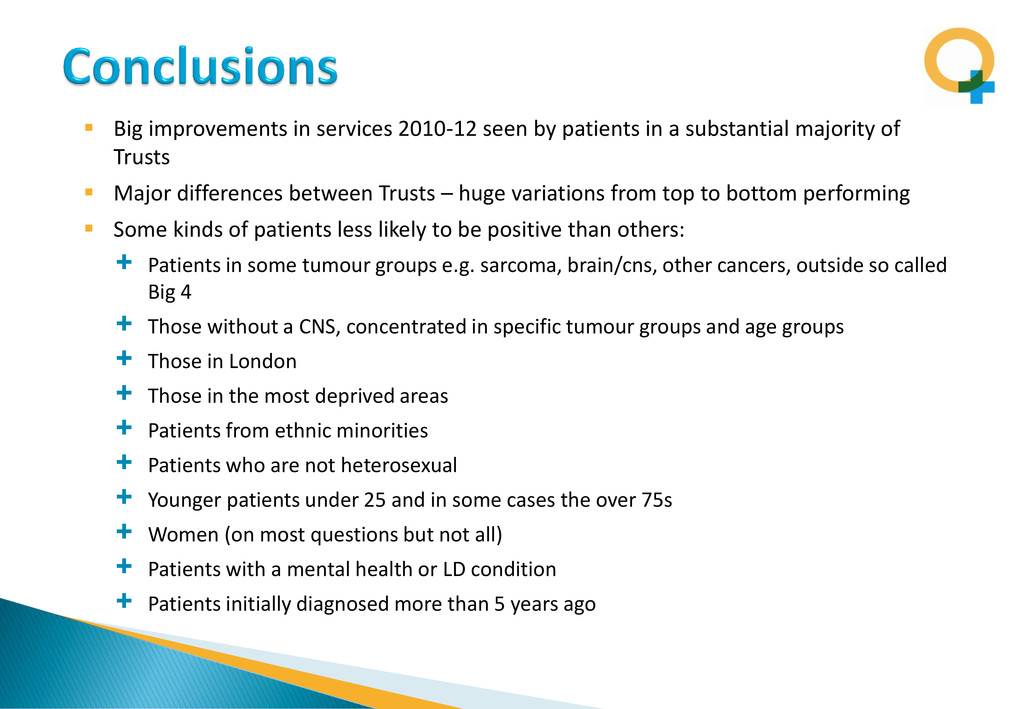
a substantial majority of Trusts Major differences between Trusts – huge variations from top to bottom performing Some kinds of patients less likely to be positive than others: + Patients in some tumour groups e.g. sarcoma, brain/cns, other cancers, outside so called Big 4 + Those without a CNS, concentrated in specific tumour groups and age groups + Those in London + Those in the most deprived areas + Patients from ethnic minorities + Patients who are not heterosexual + Younger patients under 25 and in some cases the over 75s + Women (on most questions but not all) + Patients with a mental health or LD condition + Patients initially diagnosed more than 5 years ago
Patient glad to have been asked about taking part in cancer research Q29 Patient would like to have been asked about taking part in cancer research 0 10 20 30 40 50 60 70 80 90 100 < worse Percentage score better > RJ2
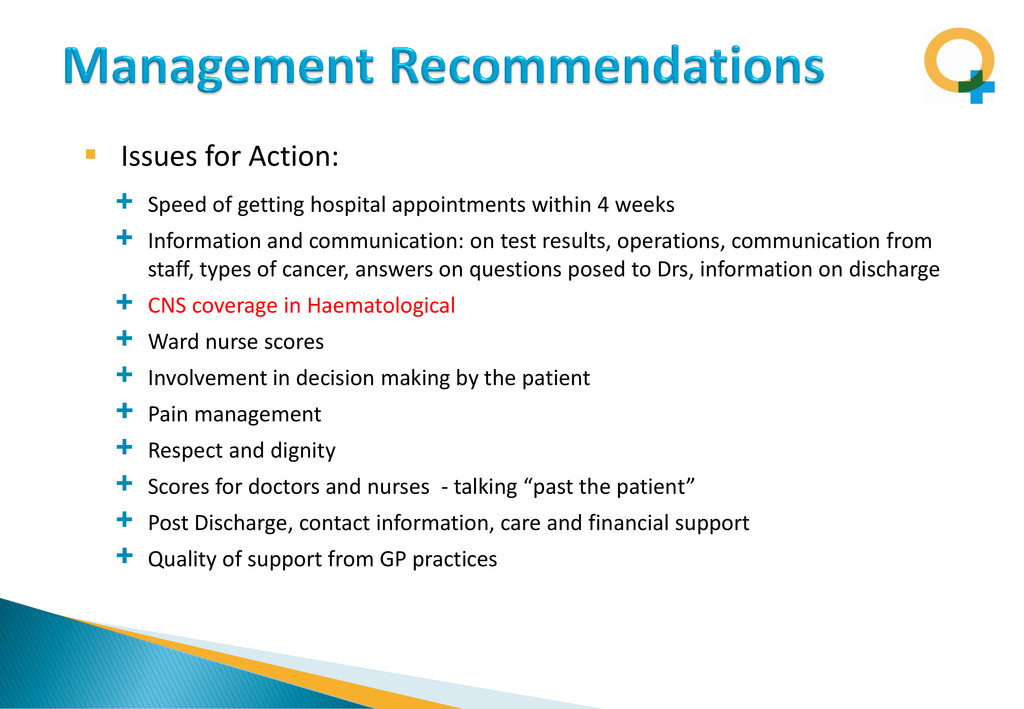
within 4 weeks + Information and communication: on test results, operations, communication from staff, types of cancer, answers on questions posed to Drs, information on discharge + CNS coverage in Haematological + Ward nurse scores + Involvement in decision making by the patient + Pain management + Respect and dignity + Scores for doctors and nurses - talking “past the patient” + Post Discharge, contact information, care and financial support + Quality of support from GP practices
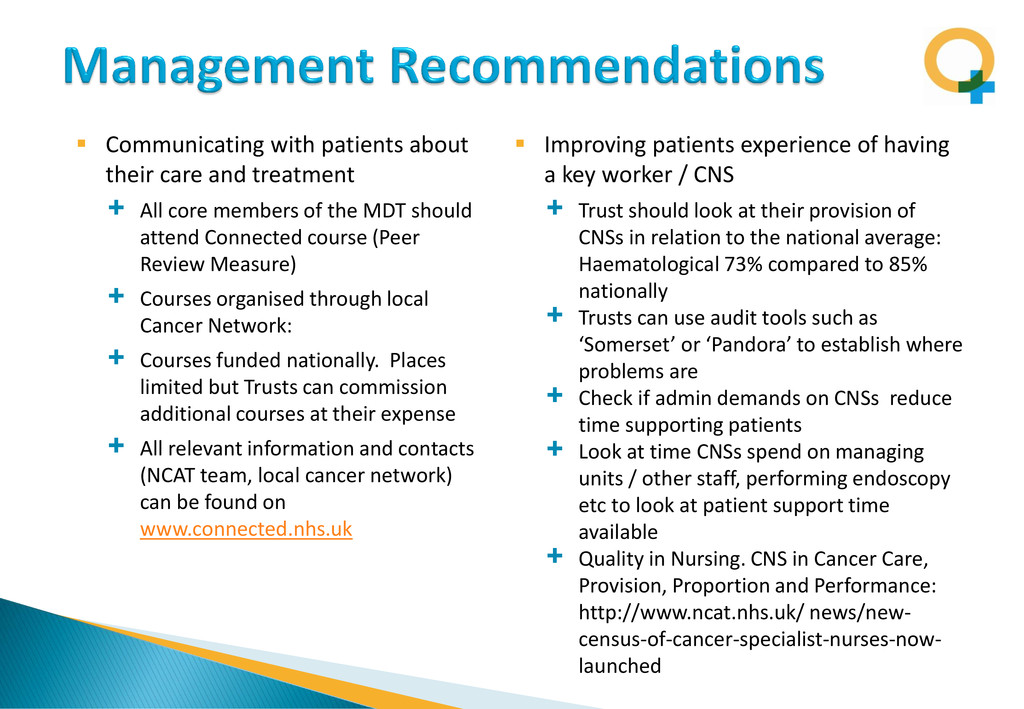
All core members of the MDT should attend Connected course (Peer Review Measure) + Courses organised through local Cancer Network: + Courses funded nationally. Places limited but Trusts can commission additional courses at their expense + All relevant information and contacts (NCAT team, local cancer network) can be found on www.connected.nhs.uk Improving patients experience of having a key worker / CNS + Trust should look at their provision of CNSs in relation to the national average: Haematological 73% compared to 85% nationally + Trusts can use audit tools such as ‘Somerset’ or ‘Pandora’ to establish where problems are + Check if admin demands on CNSs reduce time supporting patients + Look at time CNSs spend on managing units / other staff, performing endoscopy etc to look at patient support time available + Quality in Nursing. CNS in Cancer Care, Provision, Proportion and Performance: http://www.ncat.nhs.uk/ news/new- census-of-cancer-specialist-nurses-now- launched
focus: + Ensure that each MDT aware of survey results at tumour level (where numbers allow) + Reflect on the areas of lower scores within MDTs and agree what process changes could be made to improve + Consider the MDT characteristics document and DVD and look at what can be applied to MDTs – see link + http://www.ncat.nhs.uk/our- work/ensuring-better- treatment/multi-disciplinary-team- development Action to improve Trust performance could include: + Monitor performance of clinical teams against NCPR measures. Provides good forward indicator for future performance on next National Cancer Patient Survey. + Patient involvement in Internal Validation of clinical services for NCPR + Patient engagement in the service by linking to the network Patient Partnership group + Further info on the peer review programme http://www.cquins.nhs.uk/
minorities, non heterosexuals, patients with rarer cancers, less likely to be positive Calibration of communication with these groups of patients is crucial: + Role of CNS critical + Simplicity of comms to the 1 in 4 who don’t understand information about condition and treatment + Provision of information through Information Prescriptions Key factors are: Strategic Oversight – Cancer Board or similar Early diagnosis: GP engagement and training with your cancer specialists Clear information to patients Training and support for your MDTs – on communication, MDT working Analyse the gaps in CNS coverage if any
Exec Team needs to set targets, task individuals, and monitor progress regularly Use training process effectively through MDTs Recognise that there are wider corporate issues related to cancer services performance – e.g. staff numbers in key roles Lead the process within the Trust; repeat messages through clear effective communication Prepare for repeat of survey in 2012/13


 samlambert
 scottboms
 katarinadahlin
 mlcsv
 garrettdimon
 mongodb
 pauljervisheath
 auna
 tmiket
 cassininazir
 jdejongh
 addyosmani