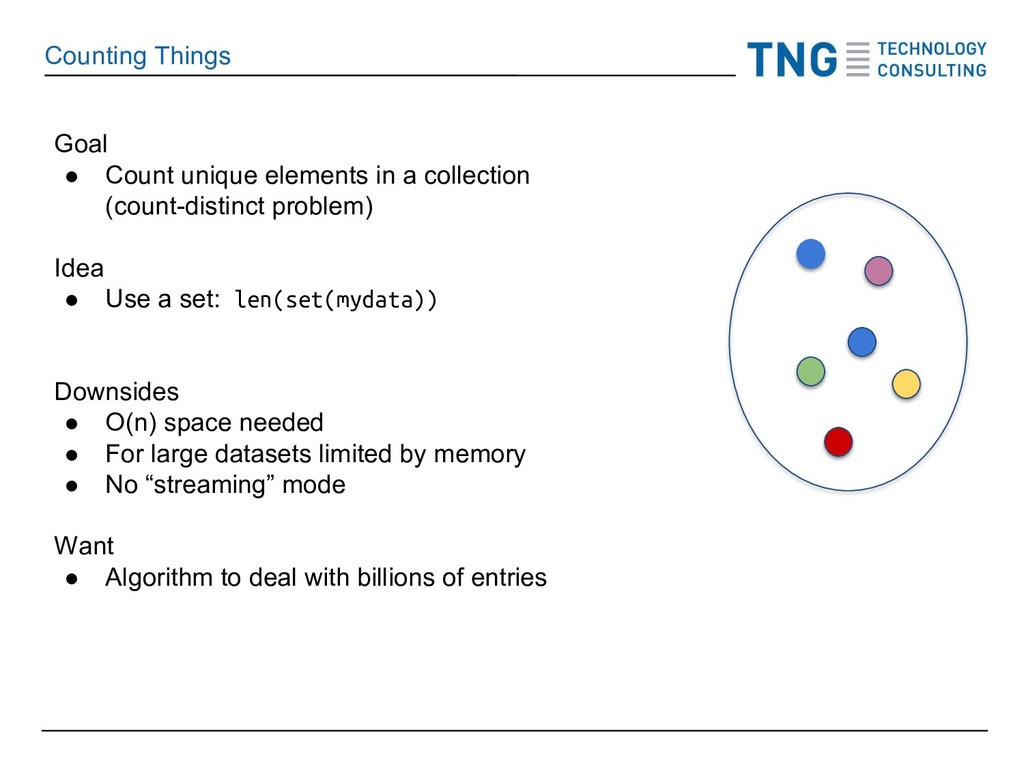
(count-distinct problem) Idea • Use a set: len(set(mydata)) Downsides • O(n) space needed • For large datasets limited by memory • No “streaming” mode Want • Algorithm to deal with billions of entries
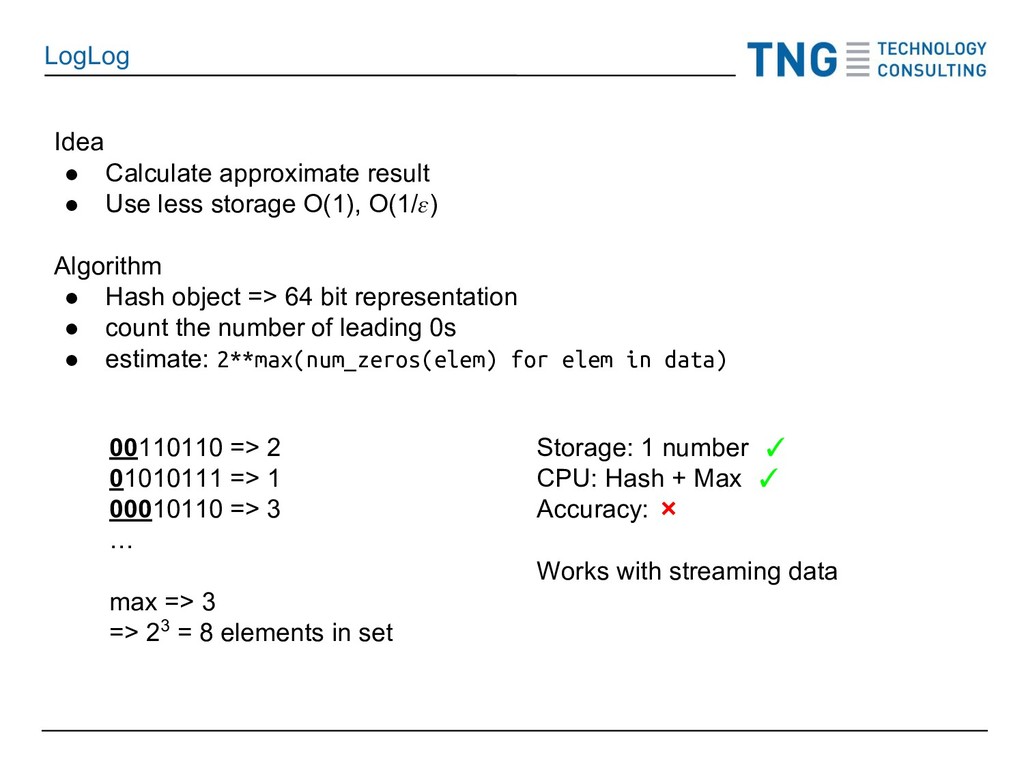
O(1), O(1/) Algorithm • Hash object => 64 bit representation • count the number of leading 0s • estimate: 2**max(num_zeros(elem) for elem in data) 00110110 => 2 01010111 => 1 00010110 => 3 … max => 3 => 23 = 8 elements in set Storage: 1 number ✓ CPU: Hash + Max ✓ Accuracy: ❌ Works with streaming data
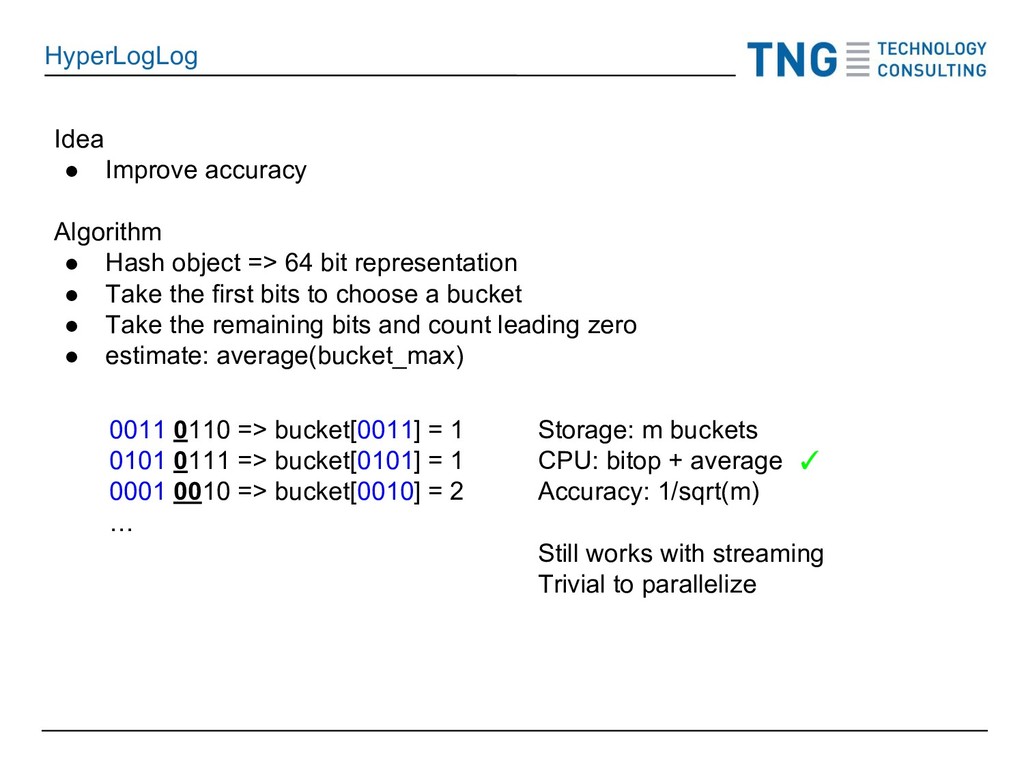
64 bit representation • Take the first bits to choose a bucket • Take the remaining bits and count leading zero • estimate: average(bucket_max) 0011 0110 => bucket[0011] = 1 0101 0111 => bucket[0101] = 1 0001 0010 => bucket[0010] = 2 … Storage: m buckets CPU: bitop + average ✓ Accuracy: 1/sqrt(m) Still works with streaming Trivial to parallelize
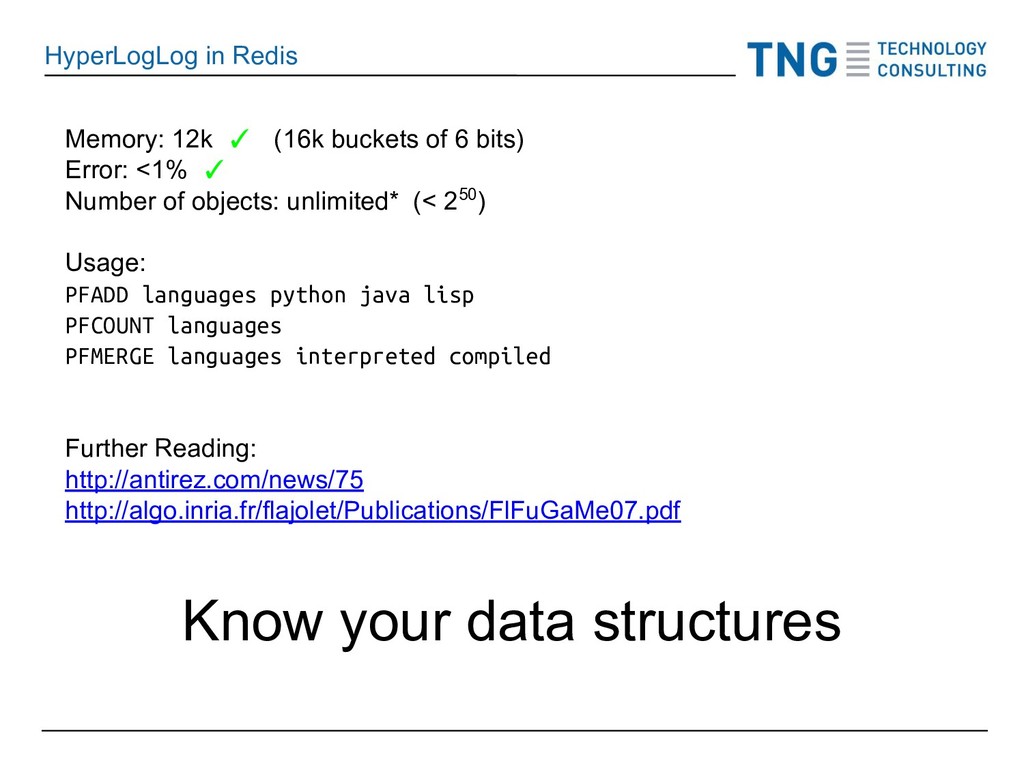
bits) Error: <1% ✓ Number of objects: unlimited* (< 250) Usage: PFADD languages python java lisp PFCOUNT languages PFMERGE languages interpreted compiled Further Reading: http://antirez.com/news/75 http://algo.inria.fr/flajolet/Publications/FlFuGaMe07.pdf Know your data structures


 ryu1013
 tanahiro2010
 kaityo256
 hollycummins
 steliosf
 skydoves
 clockmaker
 findyinc
 falcon8823
 kinopeee
 rshindo
 o0h
 lindahogenes
 rasmusluckow
 frankvandijk
 tamaranovitovic
 geshan
 3n
 honnibal
 cassininazir
 jcasabona
 akademiya2063
 sarafernandez
 smashingmag