Upgrade to Pro — share decks privately, control downloads, hide ads and more …

Tips for Tailwind CSS

Sponsored · Your Podcast. Everywhere. Effortlessly. Share. Educate. Inspire. Entertain. You do you. We'll handle the rest.
Avatar for Radoslav Stankov Radoslav Stankov
October 18, 2025
26

Tips for Tailwind CSS

Avatar for Radoslav Stankov

Radoslav Stankov

October 18, 2025
Tweet

Transcript

  1. !

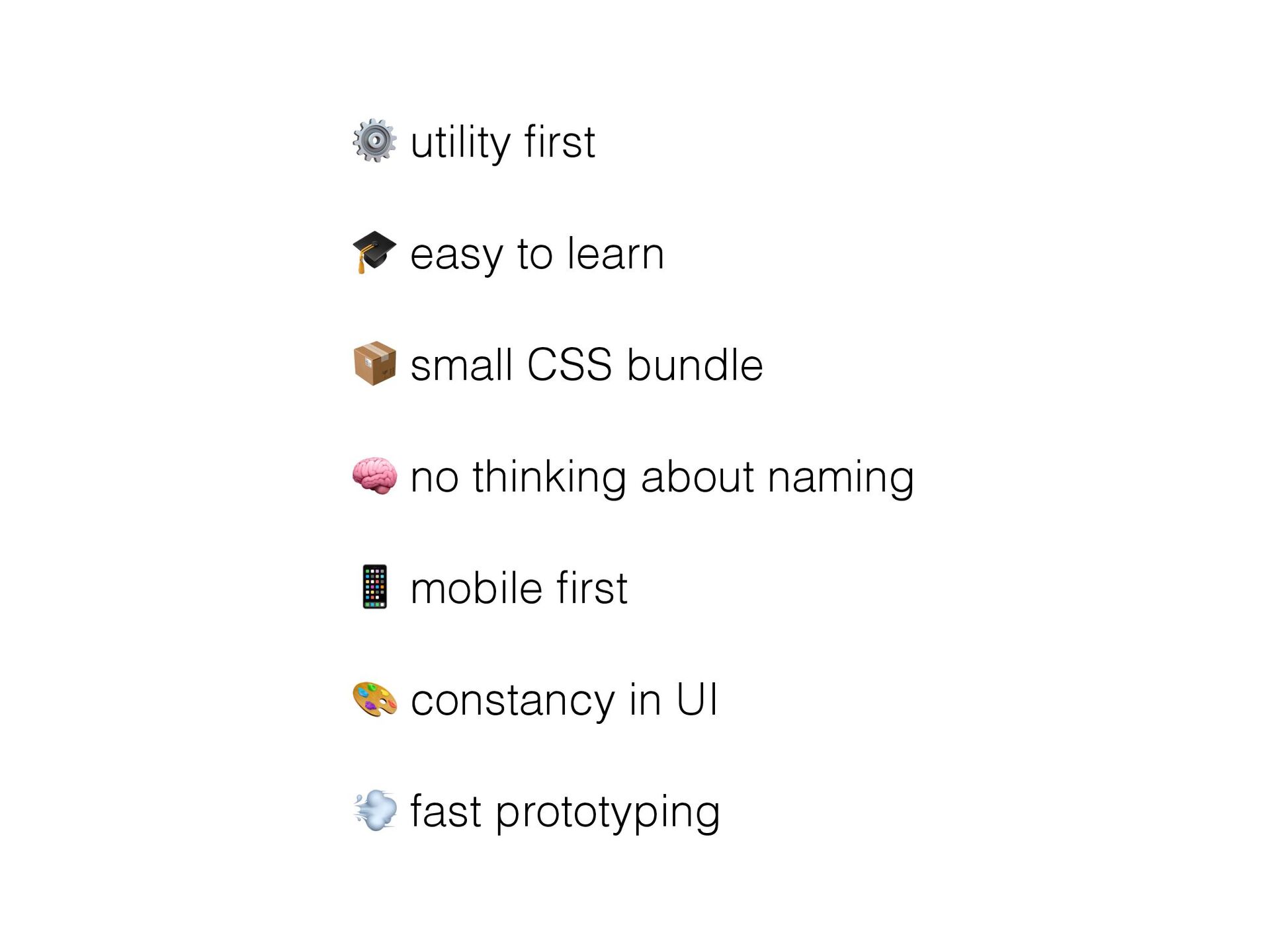
  2. ⚙ utility first ! easy to learn ! small CSS
    bundle ! no thinking about naming ! mobile first ! constancy in UI ! fast prototyping
  3. +

  4. +

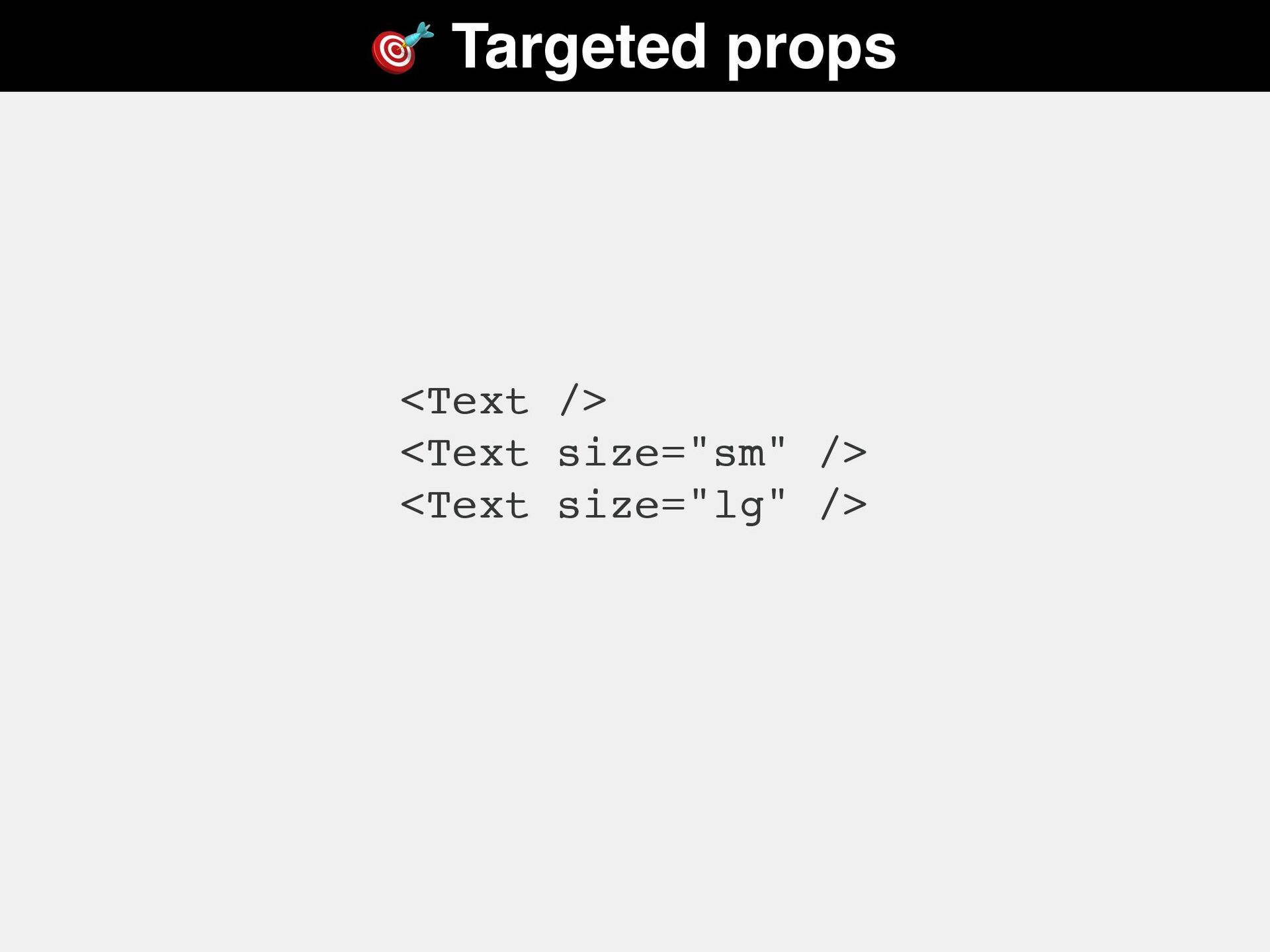
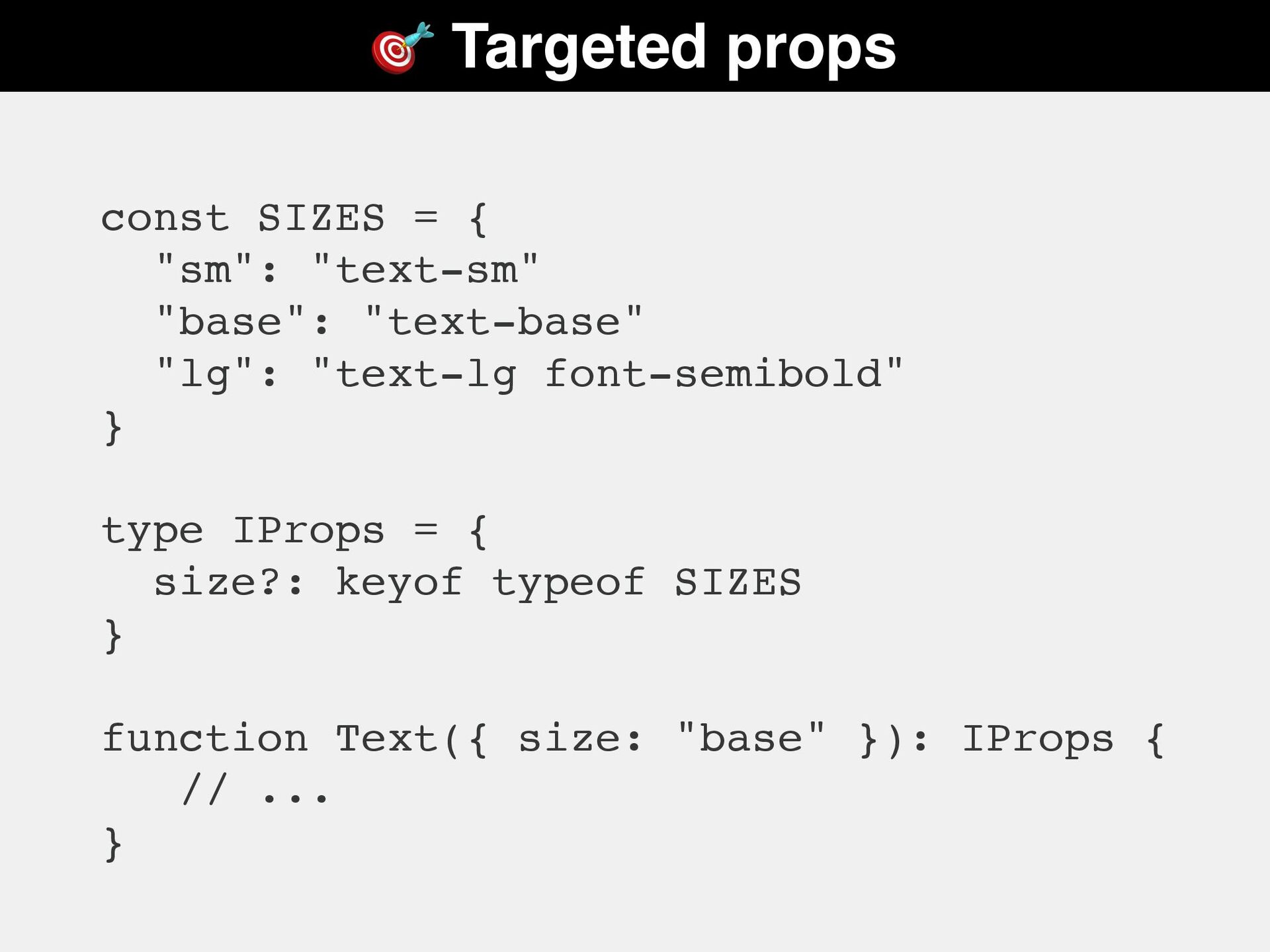
  5. const SIZES = { "sm": "text-sm" "base": "text-base" "lg": "text-lg

    font-semibold" } type IProps = { size?: keyof typeof SIZES } function Text({ size: "base" }): IProps { // ... } ! Targeted props
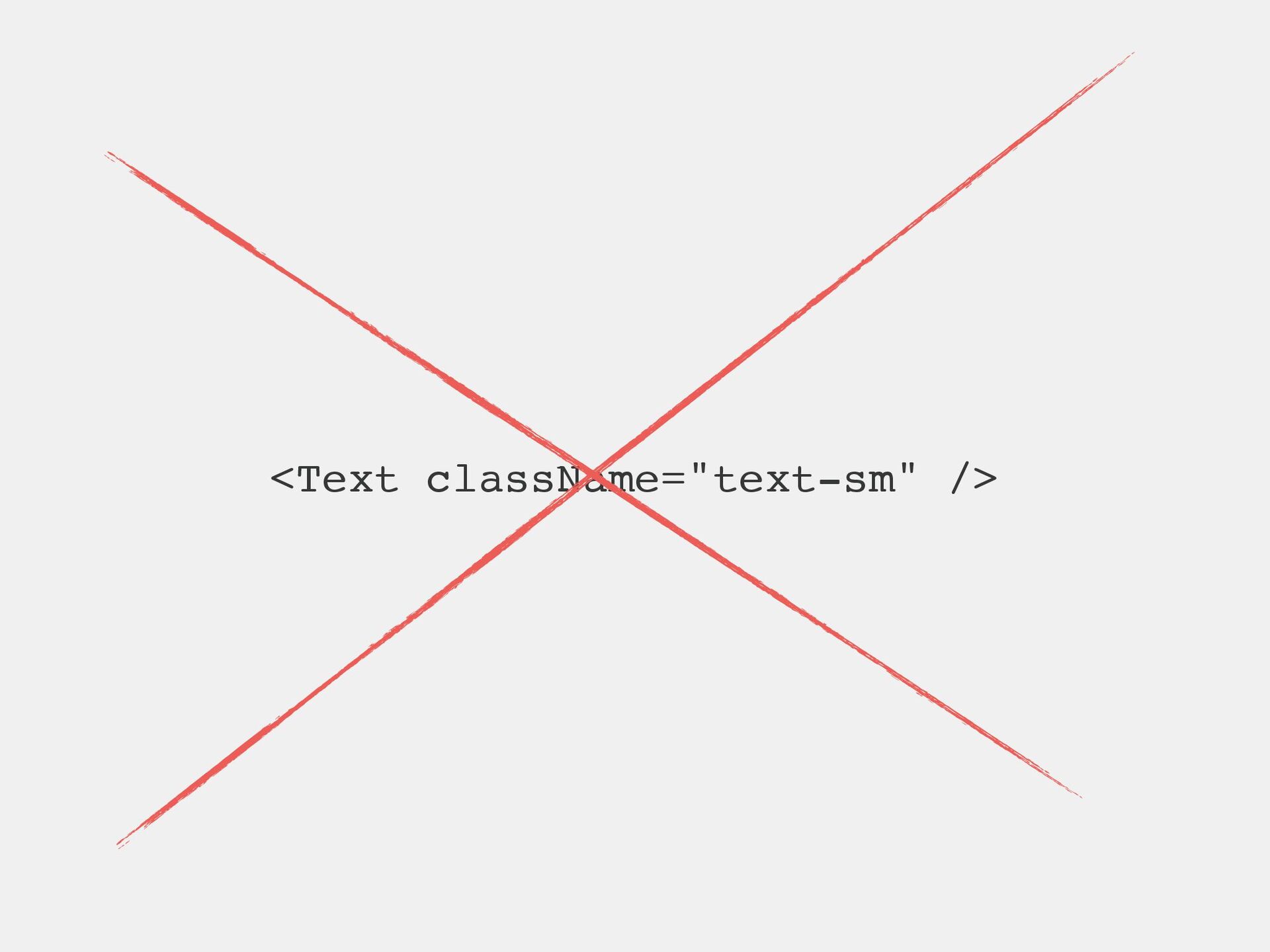
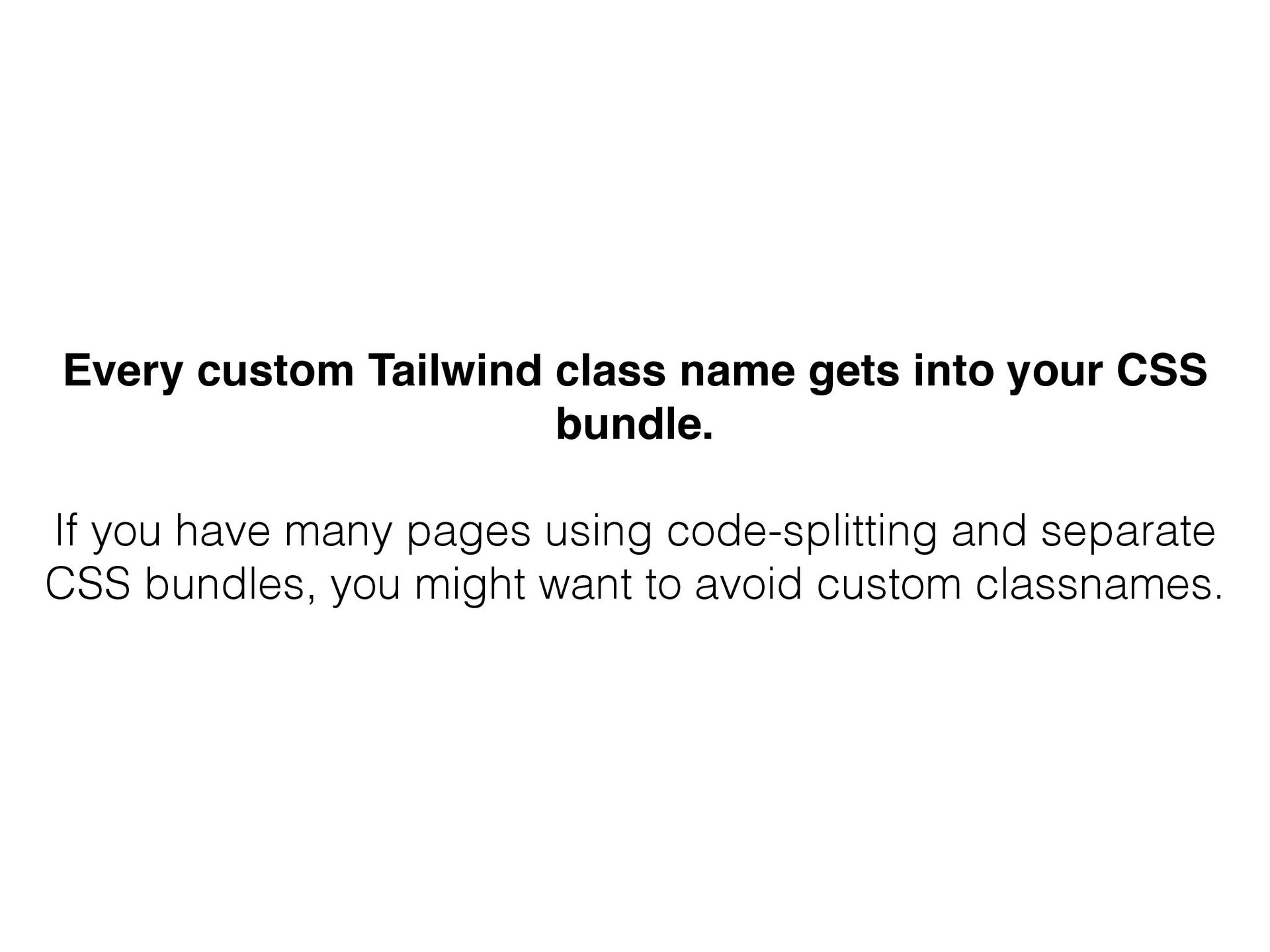
  6. Every custom Tailwind class name gets into your CSS bundle.

    If you have many pages using code-splitting and separate CSS bundles, you might want to avoid custom classnames.
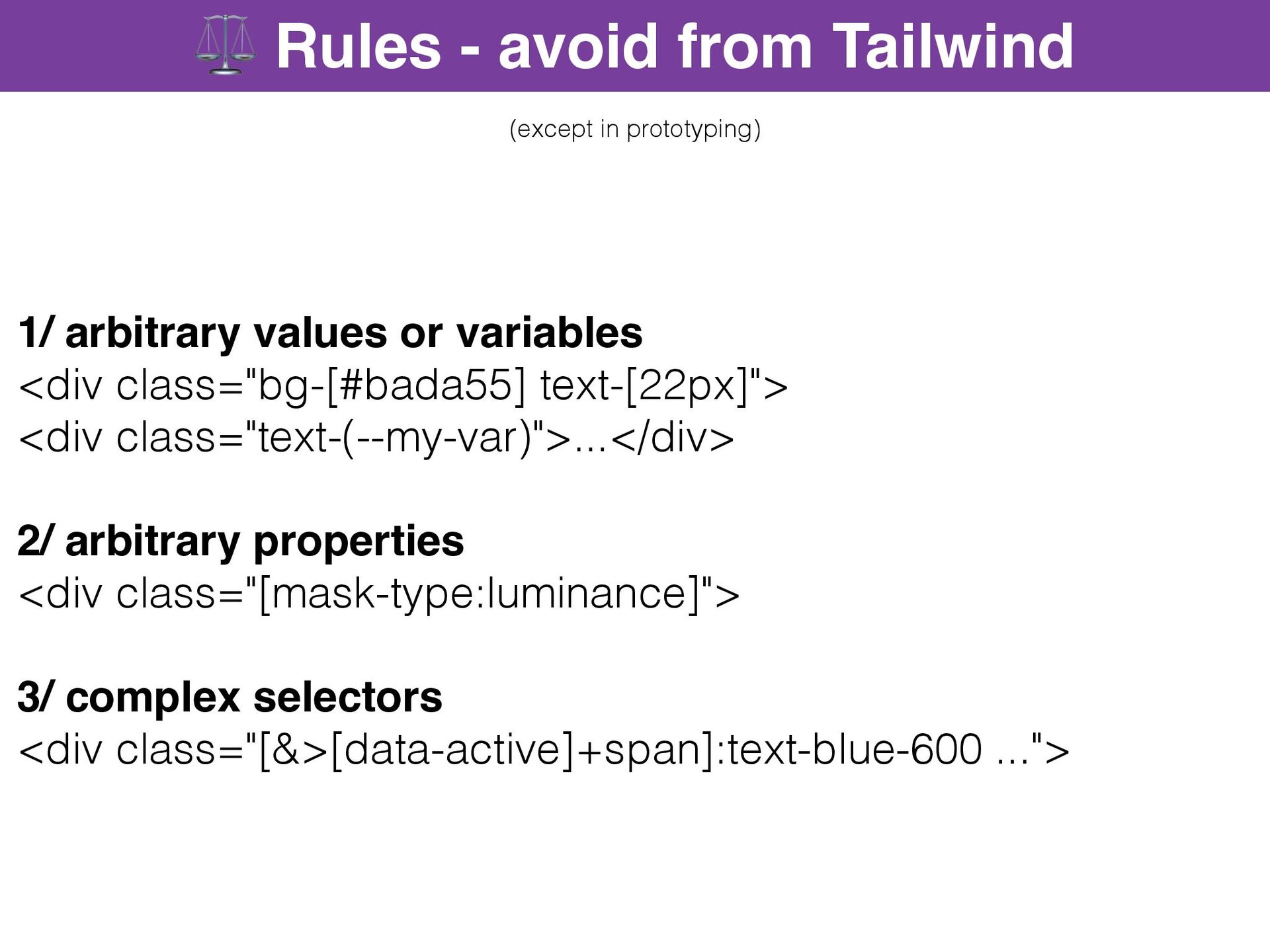
  7. ⚖ Rules - avoid from Tailwind 1/ arbitrary values or

    variables <div class="bg-[#bada55] text-[22px]"> <div class="text-(--my-var)">...</div> 2/ arbitrary properties <div class="[mask-type:luminance]"> 3/ complex selectors <div class="[&>[data-active]+span]:text-blue-600 ..."> (except in prototyping)
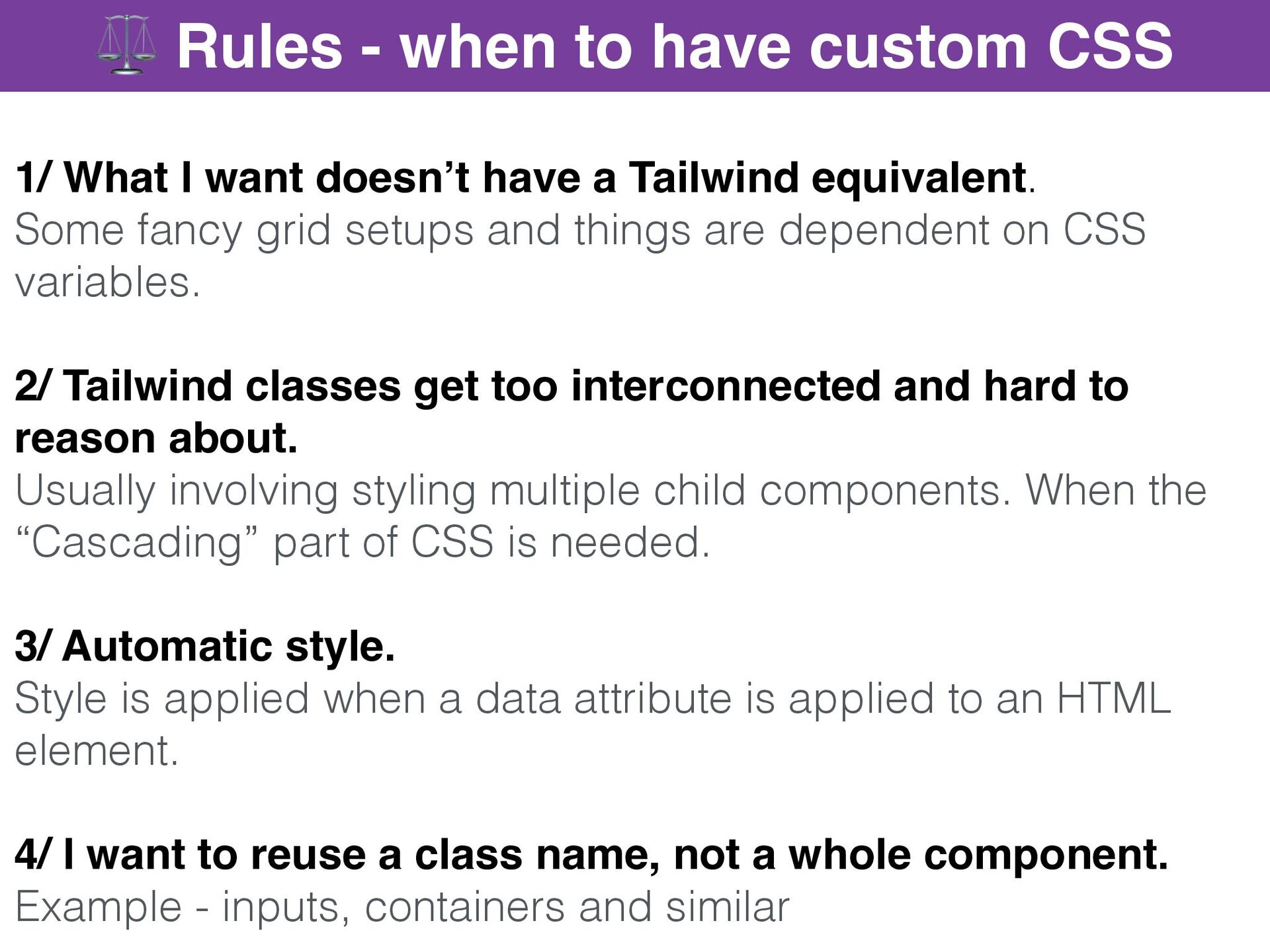
  8. ⚖ Rules - when to have custom CSS 1/ What

    I want doesn’t have a Tailwind equivalent. Some fancy grid setups and things are dependent on CSS variables. 2/ Tailwind classes get too interconnected and hard to reason about. Usually involving styling multiple child components. When the “Cascading” part of CSS is needed. 3/ Automatic style. Style is applied when a data attribute is applied to an HTML element. 4/ I want to reuse a class name, not a whole component. Example - inputs, containers and similar
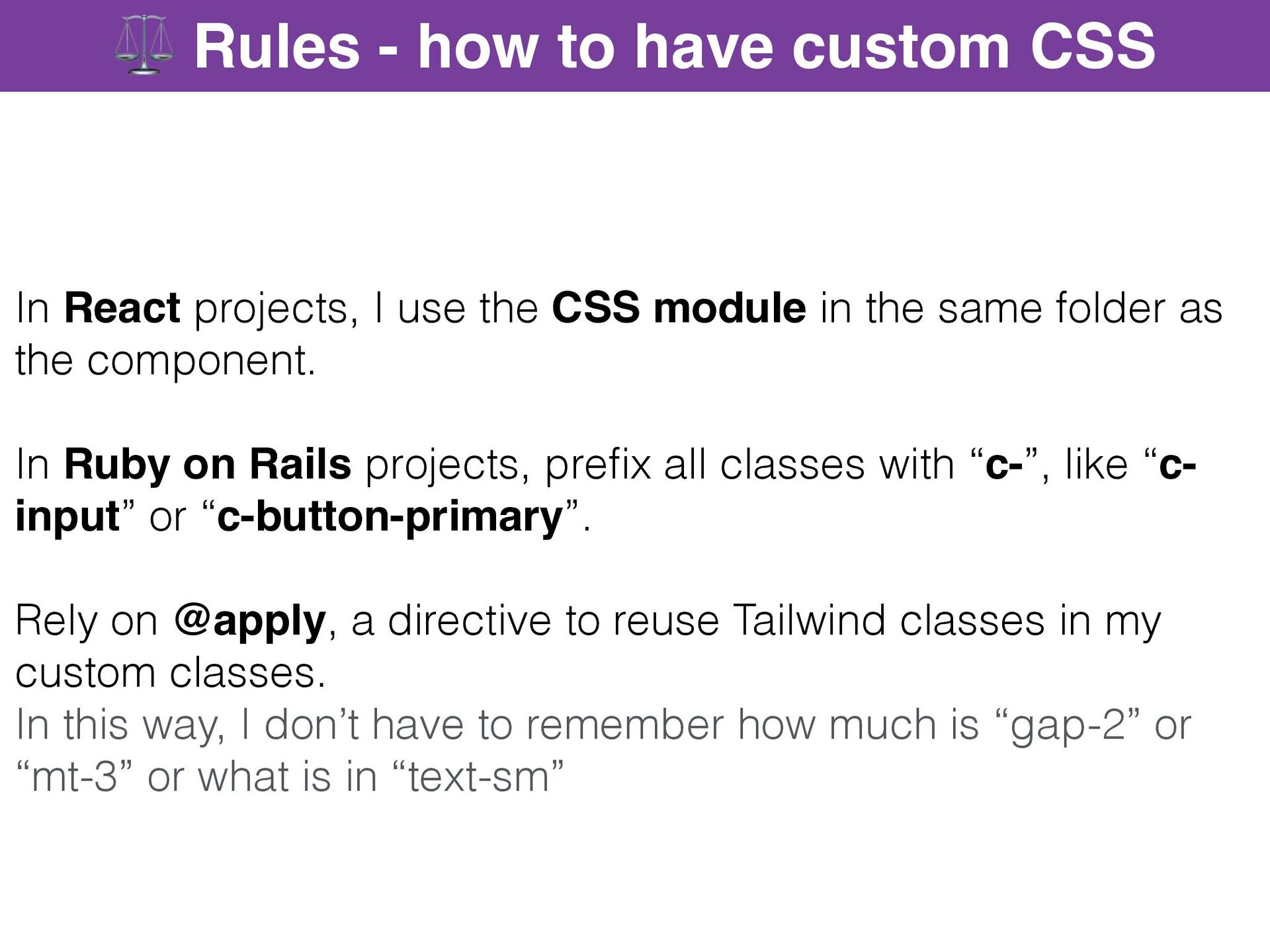
  9. ⚖ Rules - how to have custom CSS In React

    projects, I use the CSS module in the same folder as the component. In Ruby on Rails projects, prefix all classes with “c-”, like “c- input” or “c-button-primary”. Rely on @apply, a directive to reuse Tailwind classes in my custom classes. In this way, I don’t have to remember how much is “gap-2” or “mt-3” or what is in “text-sm”
  10. function MyButton() { const [isHovered, setIsHovered] = useState(false); const className

    = isHovered ? 'button button-hover' : 'button'; const onMouseEnter = () => setIsHovered(true); const onMouseLeave = () => setIsHovered(false); return ( <button className={className} onMouseEnter={onMouseEnter} onMouseLeave={onMouseLeave}>Button</button> ); }
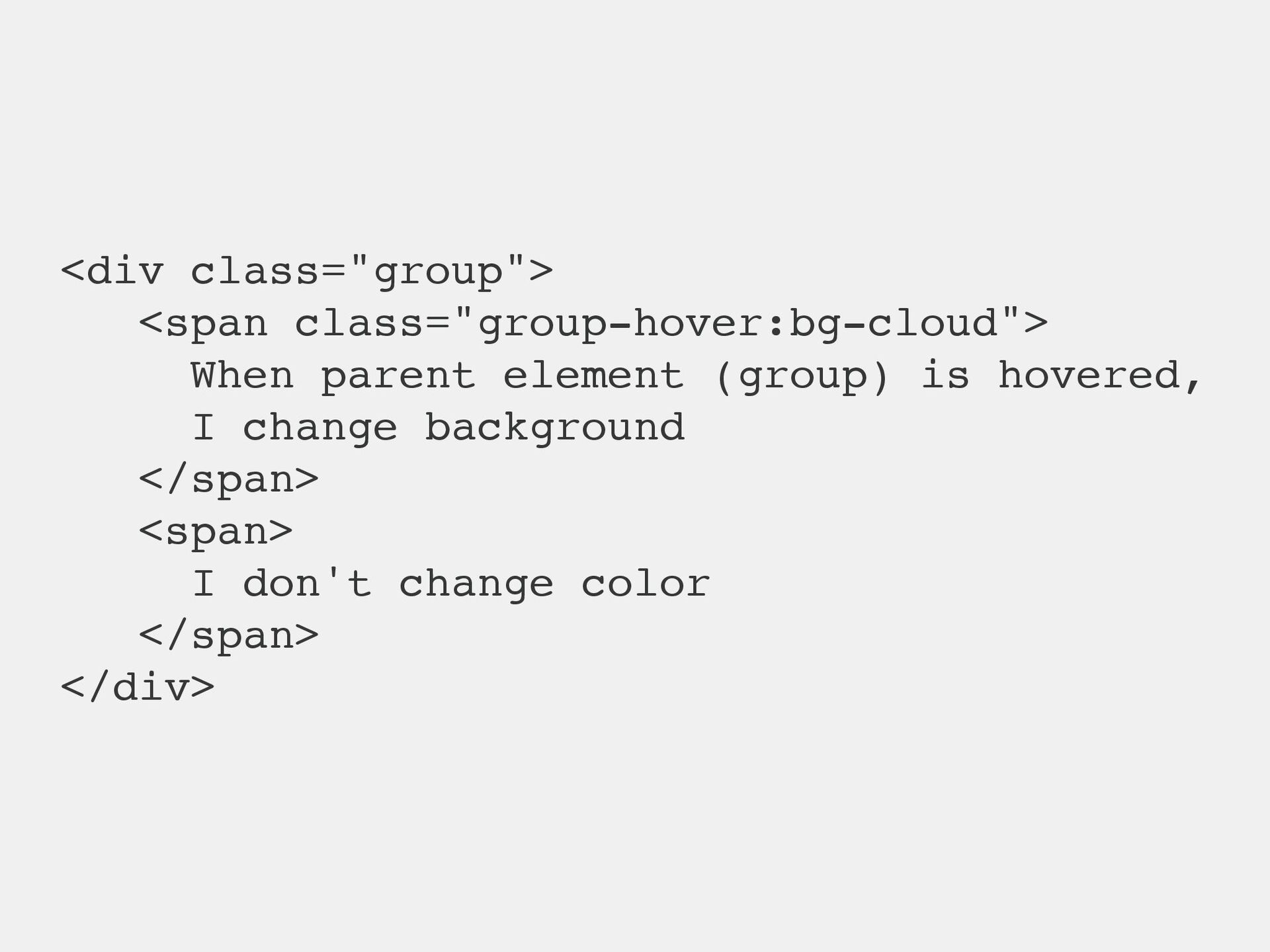
  11. <div class="group"> <span class="group-hover:bg-cloud"> When parent element (group) is hovered,

    I change background </span> <span> I don't change color </span> </div>
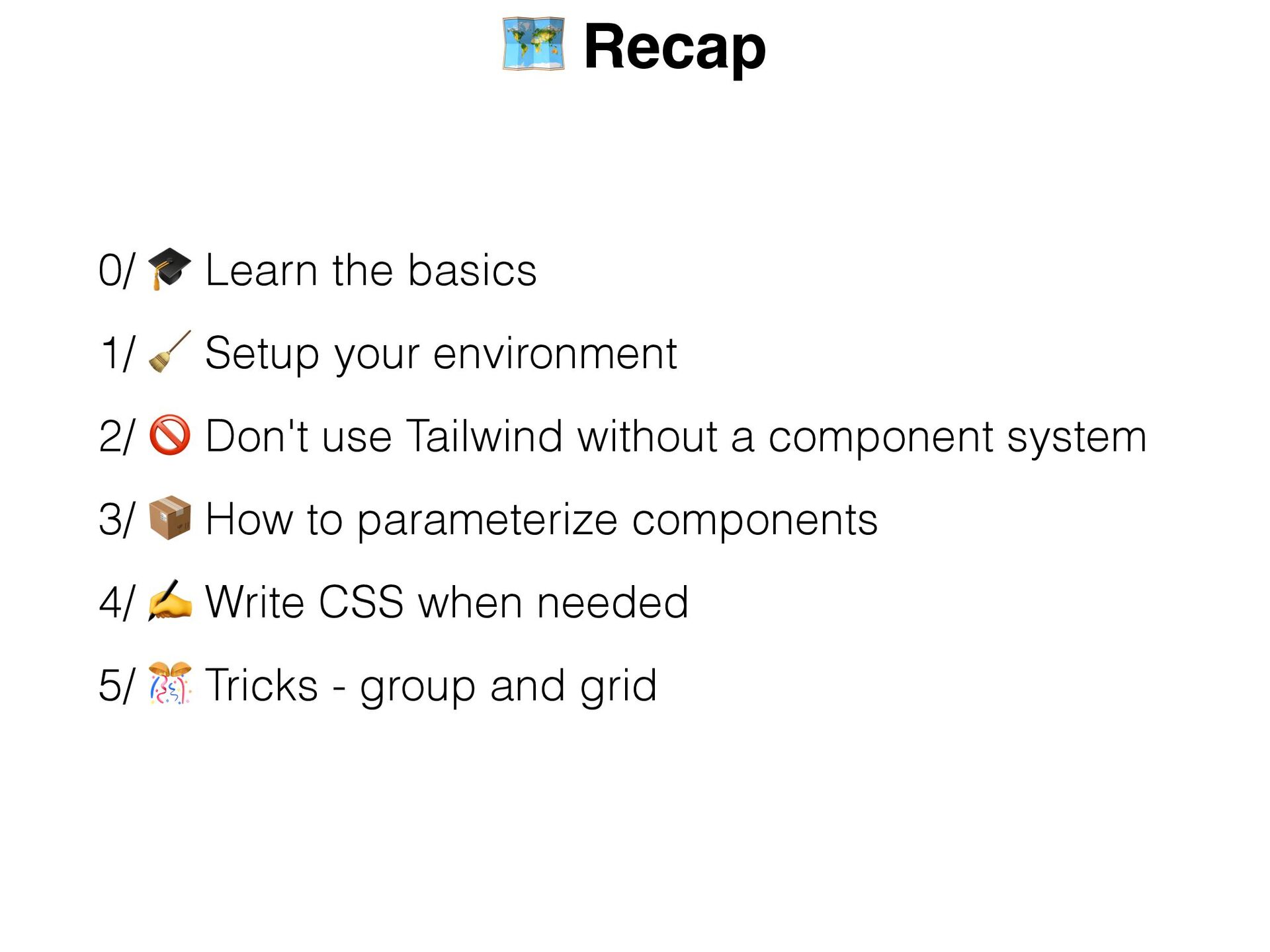
  12. 0/ ! Learn the basics 1/ ! Setup your environment

    2/ ! Don't use Tailwind without a component system 3/ ! How to parameterize components 4/ ✍ Write CSS when needed 5/ ! Tricks - group and grid ! Recap