Best Wood for Outdoor Kitchen Cabinets (and Wha...
Sponsored
·
 Your Podcast. Everywhere. Effortlessly.
Share. Educate. Inspire. Entertain. You do you. We'll handle the rest.
→
Your Podcast. Everywhere. Effortlessly.
Share. Educate. Inspire. Entertain. You do you. We'll handle the rest.
→

Share
Embed
Best Wood for Outdoor Kitchen Cabinets (and What to Avoid)
Rustic Woodworx’s guide to the best wood for outdoor kitchen cabinets explains why cedar, teak, and reclaimed hardwood outperform pine, MDF, and particle board in rain, sun, and humidity. It covers finishing options, maintenance tips, five questions to ask your builder, and answers to common FAQs. With over 30 years of custom cabinetry experience in Hixson, TN, Rustic Woodworx shares expert advice to help you build a durable outdoor kitchen.

Rustic Woodworx
November 05, 2026
Transcript
8 slides
-
Best Wood for Outdoor Kitchen Cabinets (and What to Avoid)
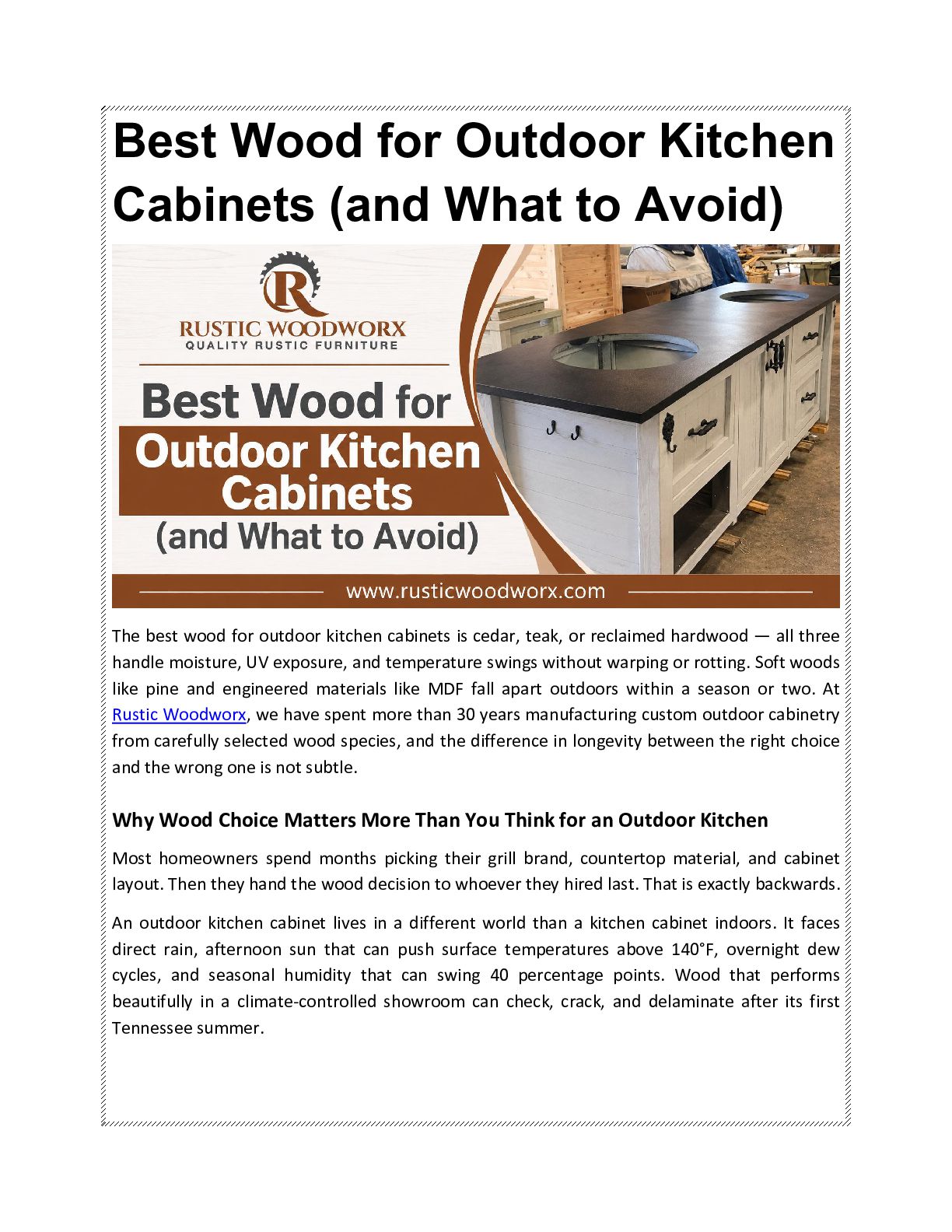
The best wood for outdoor kitchen cabinets is cedar, teak, or reclaimed hardwood — all three handle moisture, UV exposure, and temperature swings without warping or rotting. Soft woods like pine and engineered materials like MDF fall apart outdoors within a season or two. At Rustic Woodworx, we have spent more than 30 years manufacturing custom outdoor cabinetry from carefully selected wood species, and the difference in longevity between the right choice and the wrong one is not subtle. Why Wood Choice Matters More Than You Think for an Outdoor Kitchen Most homeowners spend months picking their grill brand, countertop material, and cabinet layout. Then they hand the wood decision to whoever they hired last. That is exactly backwards. An outdoor kitchen cabinet lives in a different world than a kitchen cabinet indoors. It faces direct rain, afternoon sun that can push surface temperatures above 140°F, overnight dew cycles, and seasonal humidity that can swing 40 percentage points. Wood that performs beautifully in a climate-controlled showroom can check, crack, and delaminate after its first Tennessee summer. -
The wood species and the way it is finished determines
whether your outdoor kitchen still looks sharp in year five or needs a full rebuild in year three. Getting that decision right from the start is one of the most cost-effective things you can do for a custom outdoor living project. Bottom line: Choose a naturally dense, oil-rich hardwood or properly treated reclaimed wood. Everything else is a compromise. What Are the Best Wood Species for Outdoor Kitchen Cabinets? Cedar: The Classic Choice Western red cedar has been the go-to outdoor wood in North America for generations, and for good reason. Its natural oils repel moisture and resist rot without chemical treatment. Cedar stays relatively stable as humidity rises and falls, which means fewer gaps at joints and fewer cracked door panels over time. Cedar is also lighter than most hardwoods, which matters for cabinet door hardware and for shipping large assembled pieces nationwide something Rustic Woodworx does regularly. Its one weakness is that it is softer than oak or teak, so it will show dents and scratches more readily in a high-traffic outdoor kitchen used for large gatherings. For most residential outdoor kitchens in the Southeast and Mid-Atlantic, cedar is the practical sweet spot: excellent weather resistance, reasonable cost, and a warm grain that looks right at home in a rustic or farmhouse-style outdoor space. Teak: The Premium Standard Teak is the benchmark for outdoor wood performance. Its natural silica and oil content make it nearly impervious to water, and it holds up in saltwater coastal environments where cedar would need extra treatment. Teak does not just resist moisture it actively sheds it. The trade-off is cost and weight. Teak is significantly more expensive than cedar, and its density adds real weight to cabinet doors and drawer fronts. For a full outdoor kitchen build with multiple cabinets, that weight adds up. Still, for clients investing in a long-term luxury outdoor living space, teak repays the investment in longevity and low maintenance. Teak grays gracefully over time if left unsealed, or holds its honey-brown color with periodic oiling. Either way, it ages with character rather than degrading. Reclaimed and Rustic Hardwood: Character and Durability Together Reclaimed and rustic hardwood is the specialty of Rustic Woodworx. There is a practical reason this material performs so well outdoors beyond its obvious visual appeal. -
Old-growth reclaimed wood recovered from barns, industrial buildings, and warehouses
— was often cut from trees that are 80 to 200 years old. That slow growth produces a tight, dense grain that modern lumber simply cannot replicate. Tighter grain means less porosity, which means less water absorption, which means better outdoor performance. Reclaimed hardwood also arrives pre-seasoned. Freshly milled lumber still holds moisture and continues to dry and shift after installation. Reclaimed wood has already done that work over decades, so it is more dimensionally stable when it goes into a cabinet. Key point: Reclaimed hardwood is not just an aesthetic choice. The density and stability of oldgrowth wood is a genuine performance advantage for outdoor cabinetry. What Wood Should You Avoid for an Outdoor Kitchen? This is the question homeowners rarely ask their cabinet builder, and it is often the most expensive mistake in an outdoor kitchen project. Pine and Soft Lumber Pine is cheap and easy to work with. It is also porous, fast to absorb moisture, and prone to rot when exposed to the outdoors. A painted pine cabinet can look fine for a season or two, but once moisture gets behind the paint through a nail hole, a checking joint, or a failing seal — the deterioration accelerates quickly. Pine is a fine interior wood for the right applications. In an outdoor kitchen, avoid it entirely. MDF and Particle Board Medium-density fiberboard (MDF) and particle board are wood composites made with adhesives and compressed wood fibers. They are popular in budget interior cabinetry because they hold paint well and have no grain variation. Outdoors, they are a liability. Both materials absorb water aggressively and swell, often to the point of structural failure. A wet summer is enough to buckle an MDF cabinet door. A freeze-thaw cycle in a climate like Tennessee can turn a particle-board cabinet box into compost in a single winter. No amount of sealing or painting fully protects MDF and particle board from outdoor exposure. Do not let a builder substitute these materials in an outdoor kitchen build, regardless of price. Untreated Plywood Standard plywood the kind used in construction framing and interior applications — is not rated for outdoor exposure. Its layers are bonded with adhesives that break down with water infiltration, leading to delamination. -
Marine-grade plywood, which uses waterproof adhesive and higher-quality veneers, is
a different story and can work as a structural component inside a cabinet when protected. But standard construction plywood exposed to the elements will fail. How Does Finishing Affect Outdoor Kitchen Cabinet Wood Performance? The wood species sets the ceiling on outdoor performance. The finish determines how close you get to that ceiling over time. Penetrating Oil Finishes Oil-based penetrating finishes tung oil, Danish oil, and teak oil formulations — soak into the wood rather than sitting on top of it. They feed the natural oils in the wood, reinforce its moisture resistance, and do not peel or chip. For cedar and teak, a penetrating oil finish applied every one to two years is often the best long-term maintenance approach. Exterior-Grade Polyurethane and Sealers Film-forming finishes like exterior polyurethane create a hard protective layer on the surface of the wood. They offer excellent short-term protection against water and UV, but they are vulnerable to cracking and peeling as the wood naturally expands and contracts. Once the film cracks, water gets under it and can cause more damage than an unfinished cabinet would experience. If you choose a film finish, plan on reapplication every two to three years and keep an eye out for cracking at joints and edges. Paint A quality exterior paint properly applied to the right primer on a stable, dense wood species can perform well. The key word is "stable." Painting a porous or soft wood outdoors puts all the burden on the paint film, and that film will eventually fail at vulnerable spots. At Rustic Woodworx, the finishing approach is matched to the specific wood species and the project environment. A cabinet going to coastal South Carolina gets treated differently than one for a covered patio in Hixson, TN. How Do I Choose the Right Wood for My Specific Outdoor Kitchen? The right wood for your outdoor kitchen depends on four factors: your climate, your design style, your maintenance commitment, and your budget. Here is a practical way to think through each: -
• Climate: High humidity, salt air, or frequent freeze-thaw cycles
push you toward teak or treated reclaimed hardwood. A covered patio in a mild climate gives cedar more room to perform. • Design style: Rustic, farmhouse, and industrial styles are a natural fit for reclaimed hardwood. Clean-lined modern outdoor kitchens often look better with a smoothgrained species or a painted finish. • Maintenance: If you want a wood that stays beautiful with minimal effort, teak is your best option. Cedar and reclaimed hardwood are relatively low-maintenance but benefit from periodic oiling or resealing. • Budget: Cedar offers the best performance-per-dollar. Teak carries a premium. Reclaimed hardwood varies by availability and sourcing — but when sourced well, it offers premium performance at a mid-range price. These decisions are exactly what the Rustic Woodworx design consultation process is built around. On custom orders, the team begins with a consultation by phone to understand your project environment, functional requirements, and design preferences — then provides a personalized quote with specific material and finish recommendations. You can request a quote here. A Note from the Shop: What 30 Years of Building Outdoor Kitchens Teaches You Rustic Woodworx has been manufacturing custom wood cabinetry and furniture from Hixson, Tennessee for over 30 years. The business is built on Six Sigma manufacturing principles — which, in plain language, means that quality control is not an afterthought. Every piece that leaves the shop has been evaluated against specific standards for joinery, finish quality, and dimensional accuracy. Over those three decades, the team has shipped fully assembled outdoor kitchens, grill islands, beverage bars, and custom cabinetry nationwide and internationally. That means wood selection has to work not just for Tennessee summers but for backyard kitchens in Florida, Texas, Minnesota, and beyond. The lesson the shop has learned the hard way often through requests to fix someone else's work is that the single most common point of failure in an outdoor kitchen is the cabinet material. Not the grill. Not the countertop. Not the hardware. The wood, or the material pretending to be wood. -
That is why Rustic Woodworx specializes in reclaimed and rustic
wood for outdoor applications. It is not a trend decision. It is a performance decision backed by decades of watching what holds up and what does not. Indoor Custom Cabinetry: The Year-Round Companion Outdoor kitchens are a warm-weather priority for most families. But Rustic Woodworx builds custom cabinetry and furniture for the whole home and the same wood knowledge that makes an outdoor kitchen cabinet last applies equally indoors. The shop builds custom kitchen islands, range hoods, mudroom locker systems and hall trees, buffets, sideboards, bars, and China cabinets. These interior pieces use many of the same reclaimed and rustic hardwood species as the outdoor line, with finishing approaches tailored to indoor conditions. For homeowners who want a cohesive design language across their indoor and outdoor living spaces — a kitchen island that speaks the same visual language as the outdoor grill cabinet — Rustic Woodworx is one of the few custom manufacturers that can handle both in a single design consultation. You can see examples in the Rustic Woodworx gallery. Practical Tips Before You Buy Your Outdoor Kitchen Cabinets Before you commit to a cabinet material or a builder, here are five questions worth asking: 1. What wood species is this, specifically? "Hardwood" and "wood" are not species names. Ask for the specific species and look it up for outdoor performance. 2. Is this material rated for exterior use? MDF, particle board, and standard plywood are not. Get a clear answer in writing if you are unsure. 3. What finish is being applied, and how often will it need maintenance? The finish schedule affects your long-term maintenance cost as much as the wood choice itself. 4. Is the wood kiln-dried or air-dried? For outdoor applications, properly dried wood is far more dimensionally stable. Green or insufficiently dried wood will move, gap, and crack more aggressively outdoors. 5. Can I see examples of this material in an outdoor setting after two or more years? Any experienced custom builder should have real-world aged examples to show. A portfolio only of newly completed projects is a yellow flag. Rustic Woodworx welcomes these questions. The team serves homeowners, builders, landscape architects, interior designers, and branding companies and the expectation is a -
quality working relationship, not a quick transaction. Consultations are by
appointment at 5395 Wilbanks Dr., Hixson, TN 37343, or by phone at 844-462-4455. Key Takeaways • Best wood for outdoor kitchen cabinets: cedar, teak, or reclaimed/rustic hardwood. • Worst choices: pine, MDF, particle board, and untreated standard plywood. • Finish matters: penetrating oil finishes are lower maintenance than film finishes for most wood species. • Ask for specifics: a good builder names the species, finish schedule, and drying method not just "hardwood." • Old-growth reclaimed hardwood offers dense grain and pre-seasoned stability that modern milled lumber cannot match. • One consultation covers both: Rustic Woodworx designs outdoor kitchens and indoor cabinetry, so your indoor and outdoor spaces can share a design language. Frequently Asked Questions What is the most weather-resistant wood for outdoor kitchen cabinets? Teak is generally considered the most weather-resistant wood for outdoor kitchen cabinets due to its natural oil content and silica, which make it highly resistant to moisture, rot, and UV exposure. For homeowners who want comparable performance with more visual character, old-growth reclaimed hardwood is a strong alternative. Can I use pressure-treated lumber for outdoor kitchen cabinets? Pressure-treated lumber is designed for structural outdoor use decking, fence posts, framing — not finish cabinetry. The chemicals used in pressure treatment can be corrosive to metal hardware and fasteners, and the rough, inconsistent surface quality does not produce quality cabinet work. Use a naturally rot-resistant species or a properly finished hardwood instead. How long do wood outdoor kitchen cabinets last? Properly built and maintained wood outdoor kitchen cabinets made from cedar, teak, or reclaimed hardwood should last 15 to 25 years or more. Cabinets built from pine, MDF, or -
particle board typically begin to show significant deterioration within two
to five years in an outdoor environment. Does the finish really make that much difference? Yes. The wood species sets the baseline performance, but the finish determines how well that baseline is maintained over time. A cedar cabinet with a quality penetrating oil finish maintained every year or two will outperform an untreated cedar cabinet by a significant margin — and will likely outperform a painted pine cabinet regardless of how well that paint is applied. How do I get started with a custom outdoor kitchen cabinet project? Rustic Woodworx begins every custom project with a design consultation by phone to understand your functional requirements, design preferences, and project environment. From there, a personalized quote is provided with specific layout, material, and finish recommendations. Contact the team at rusticwoodworx.com, by phone at 844-462-4455, or visit the shop by appointment at 5395 Wilbanks Dr., Hixson, TN 37343. About the Author Janet Hamblen is co-founder of Rustic Woodworx, a custom wood products manufacturer based in Hixson, Tennessee. With over 30 years of experience in custom cabinetry and furniture manufacturing, Janet leads the design consultation process for residential and commercial clients across the United States. Rustic Woodworx serves homeowners, interior designers, landscape architects, and national brands from its manufacturing facility at 5395 Wilbanks Dr., Hixson, TN 37343. Reach Janet at 678-600-5679 or through www.RusticWoodworx.com. Connect with Rustic Woodworx Website | Etsy Shop | Facebook | Instagram | Pinterest | Twitter/X
 greggifford
 varn
 danielanewman
 tammyeverts
 aleyda
 akademiya2063
 eileencodes
 mfonobong
 inesmontani
 mclloyd
 jcasabona