Upgrade to Pro — share decks privately, control downloads, hide ads and more …

Leading Beyond Titles: Mobile Engineering Leade...

Leading Beyond Titles: Mobile Engineering Leadership from Both Sides of the Table

What does leadership really look like on a mobile team of 25 engineers? In this candid two-speaker session, a former Engineering Manager and a Senior Engineer share their lived experience leading side-by-side at Sendwave—one from a people and strategy perspective, the other from a technical and influence perspective. We’ll break down how leadership plays out differently (and sometimes similarly) for managers and senior ICs when it comes to communication, ownership, and creating leverage. You’ll hear real stories—what worked, what didn’t, and what we wish we’d done differently. Whether you’re climbing the IC ladder or stepping into management, this talk will help you lead with clarity, influence without authority, and create impact that scales.

Avatar for Rygel Louv

Rygel Louv

January 02, 2026
Tweet

More Decks by Rygel Louv

Other Decks in Technology

Transcript

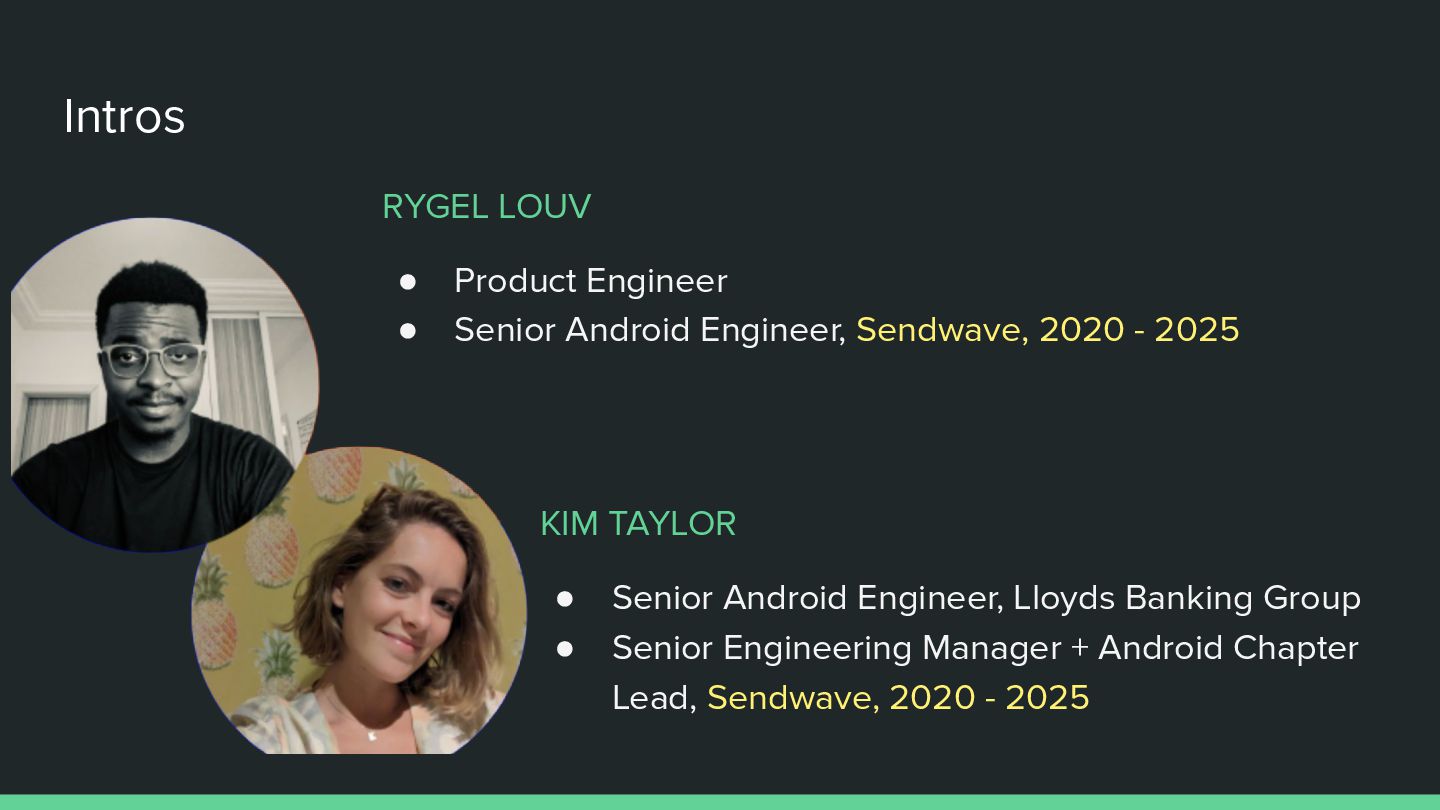
  1. Intros RYGEL LOUV • Product Engineer • Senior Android Engineer,

    Sendwave, 2020 - 2025 KIM TAYLOR • Senior Android Engineer, Lloyds Banking Group • Senior Engineering Manager + Android Chapter Lead, Sendwave, 2020 - 2025
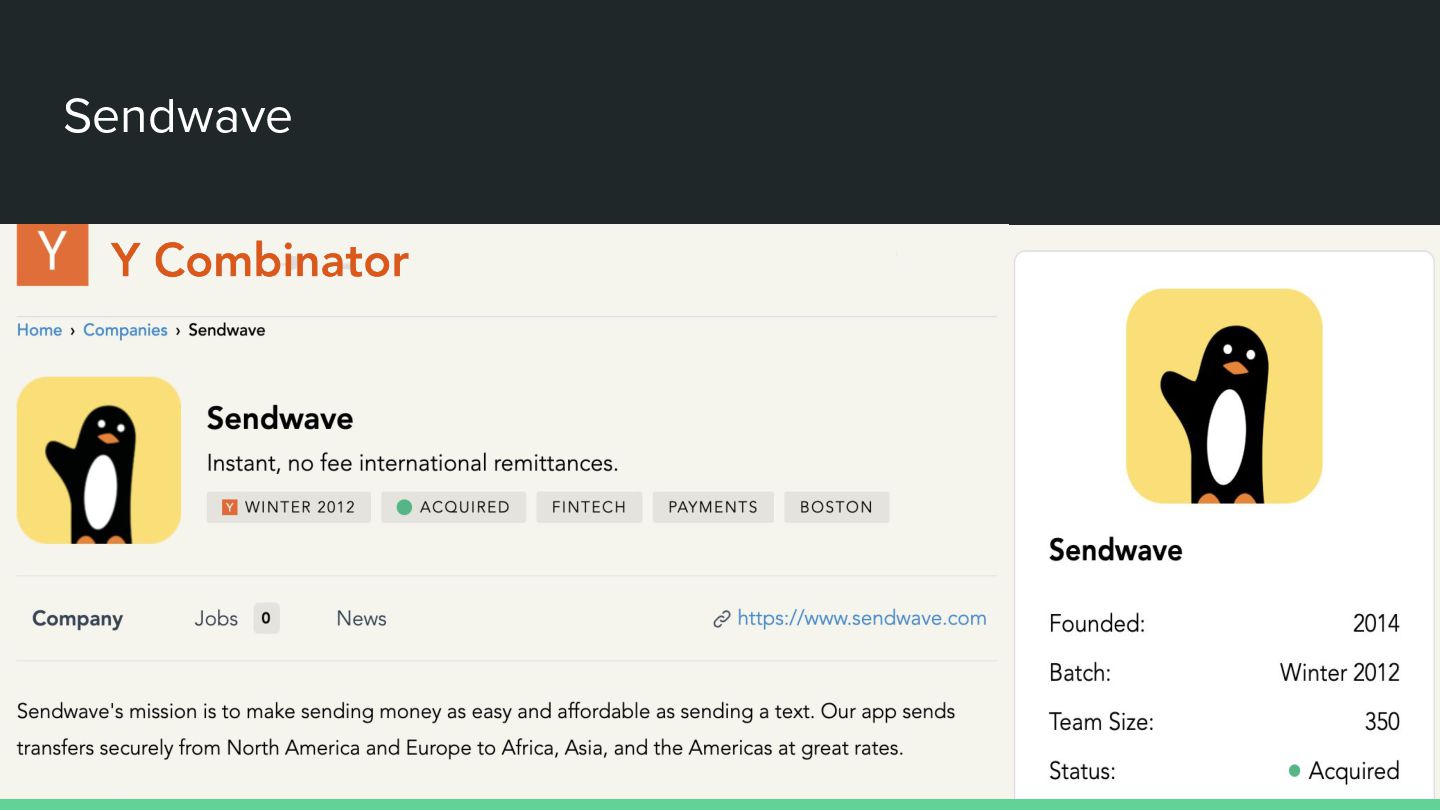
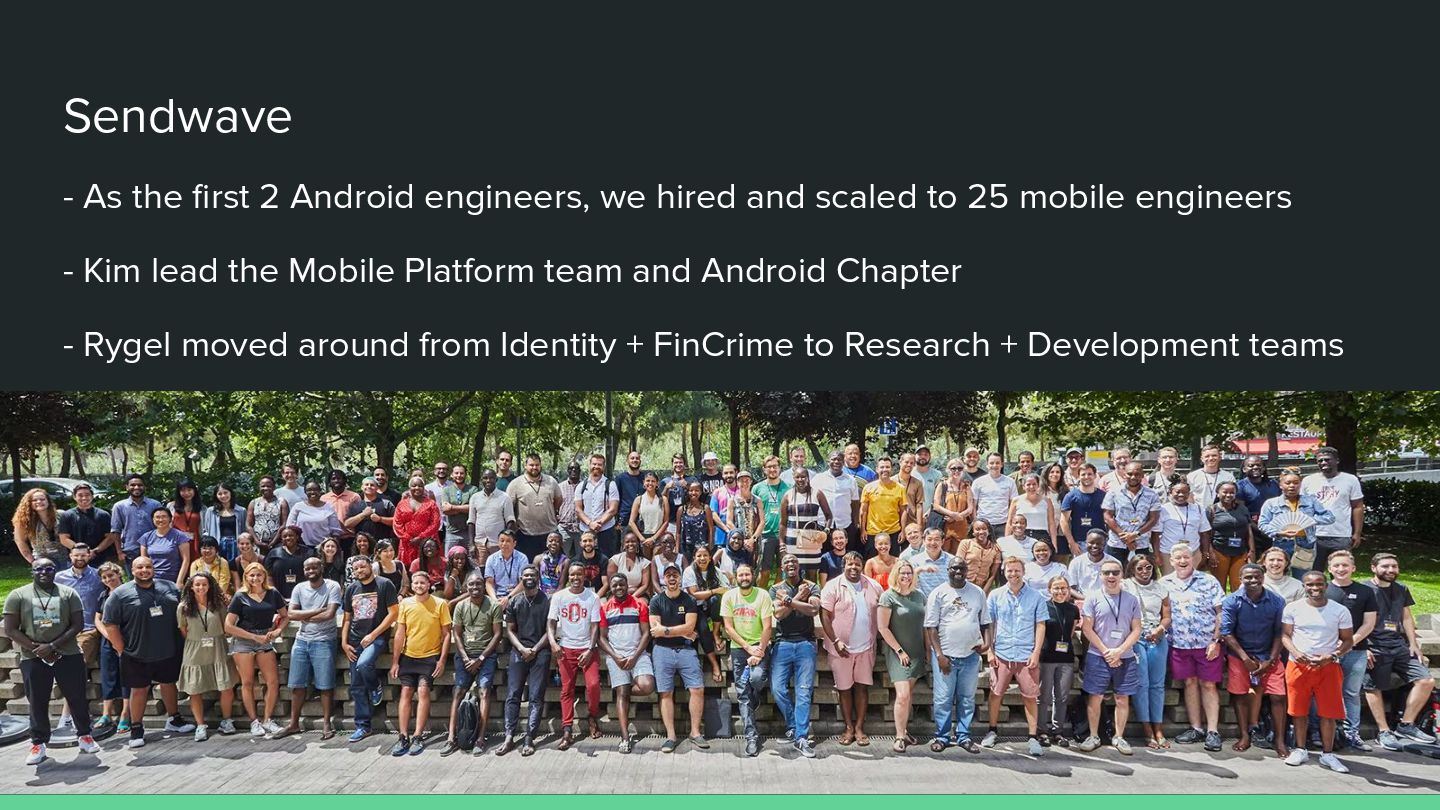
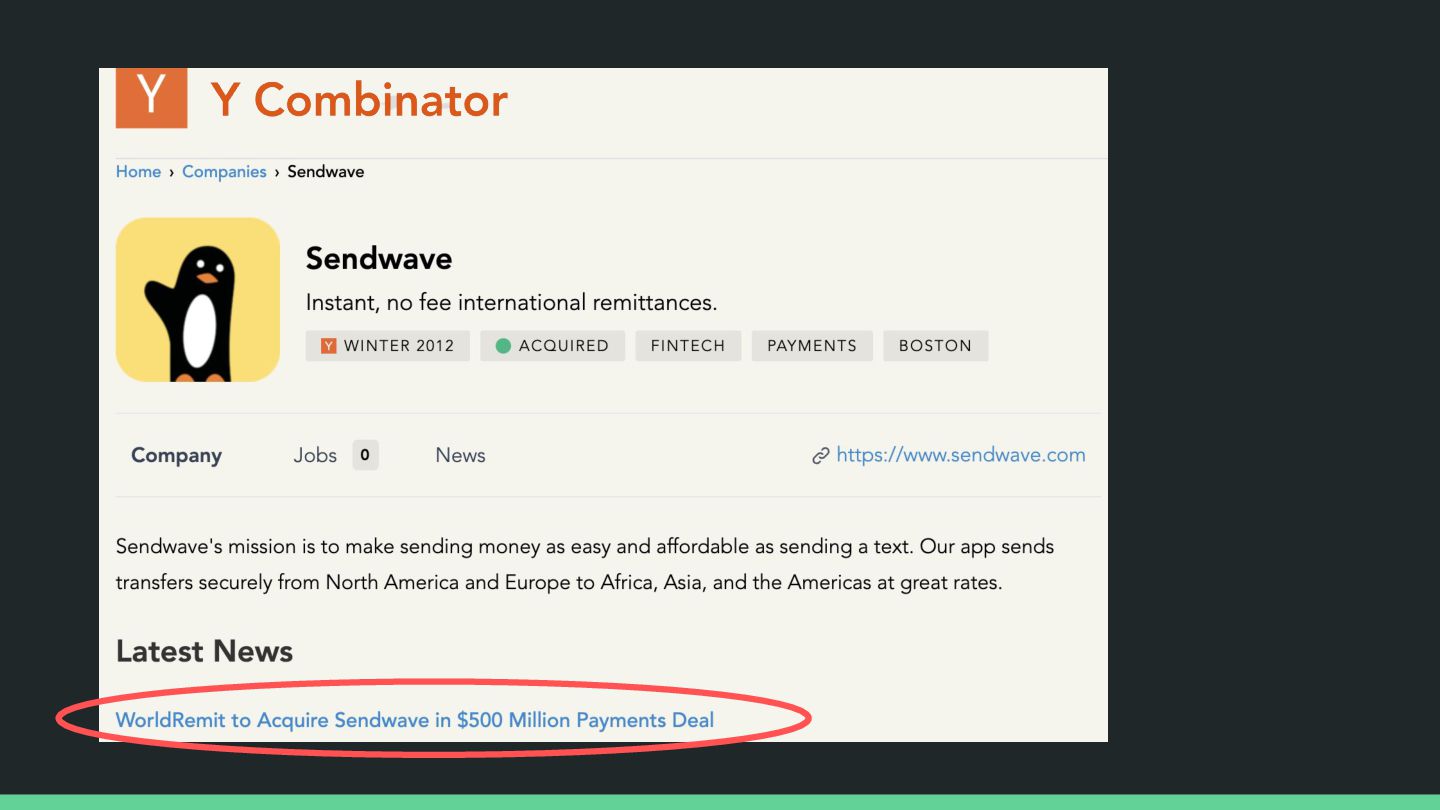
  2. Sendwave - As the first 2 Android engineers, we hired

    and scaled to 25 mobile engineers - Kim lead the Mobile Platform team and Android Chapter - Rygel moved around from Identity + FinCrime to Research + Development teams
  3. Agenda 1. What makes a great engineer / leader? 2.

    What does this look like in practice? 3. Real world examples 4. Your turn 5. Q + A + Discussion
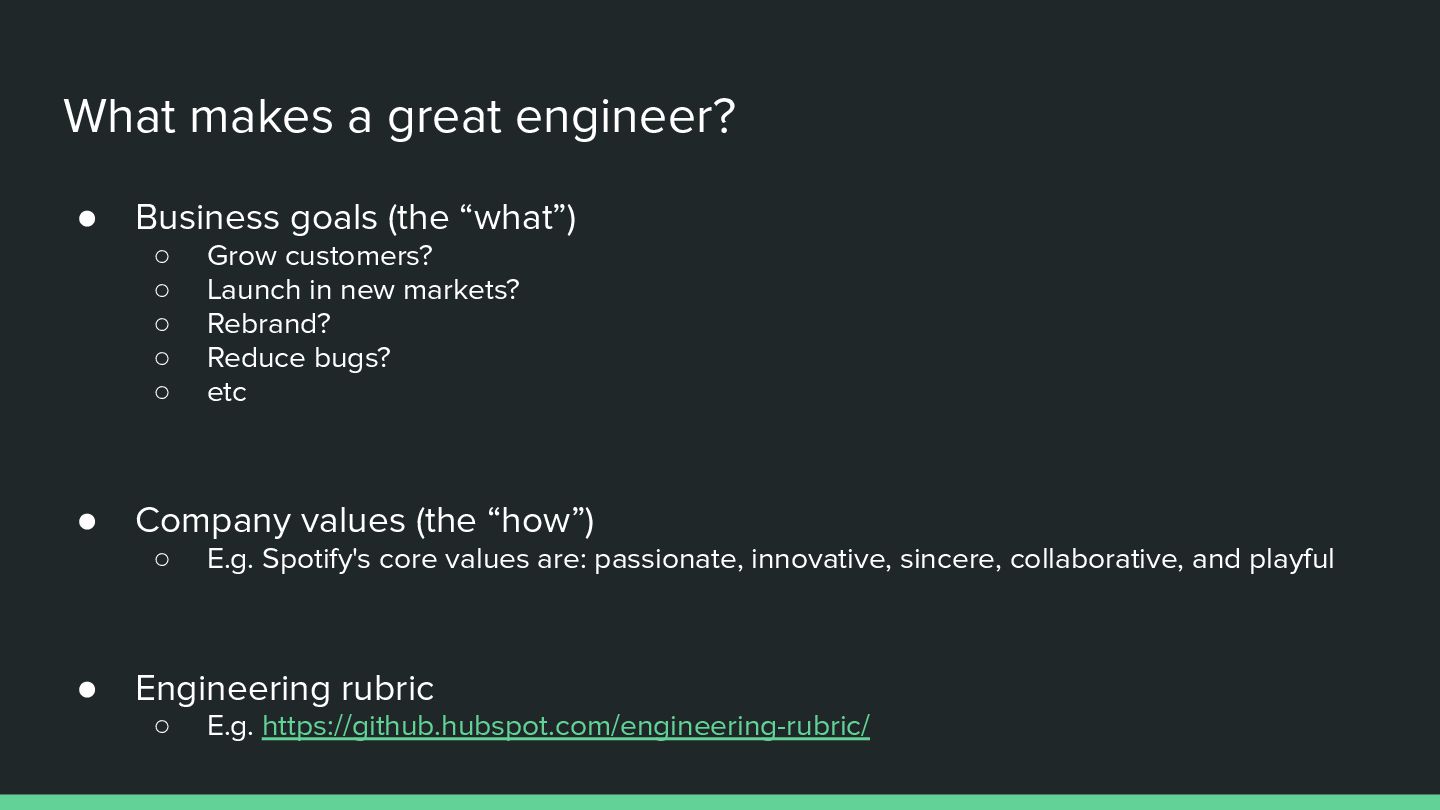
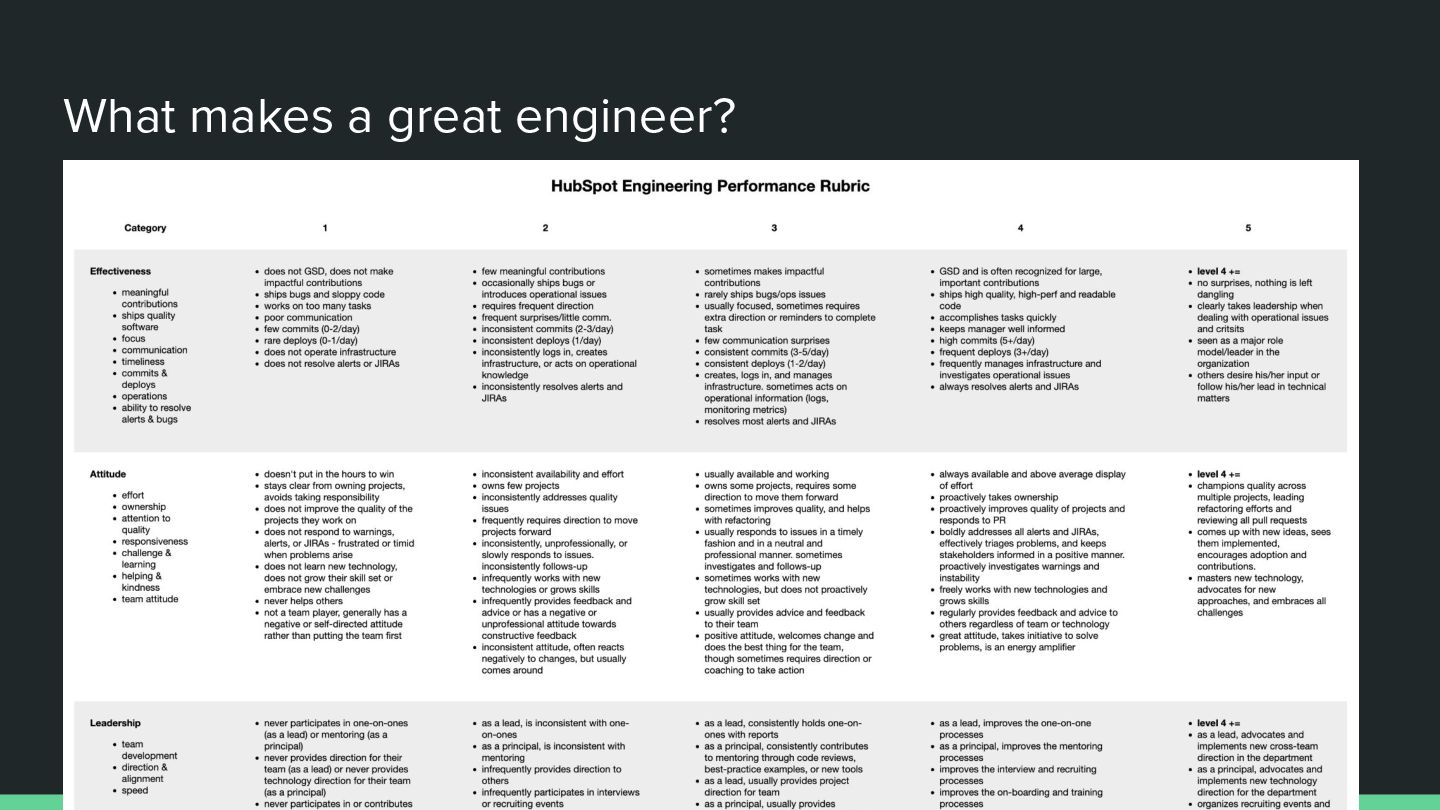
  4. What makes a great engineer? • Business goals (the “what”)

    ◦ Grow customers? ◦ Launch in new markets? ◦ Rebrand? ◦ Reduce bugs? ◦ etc • Company values (the “how”) ◦ E.g. Spotify's core values are: passionate, innovative, sincere, collaborative, and playful • Engineering rubric ◦ E.g. https://github.hubspot.com/engineering-rubric/
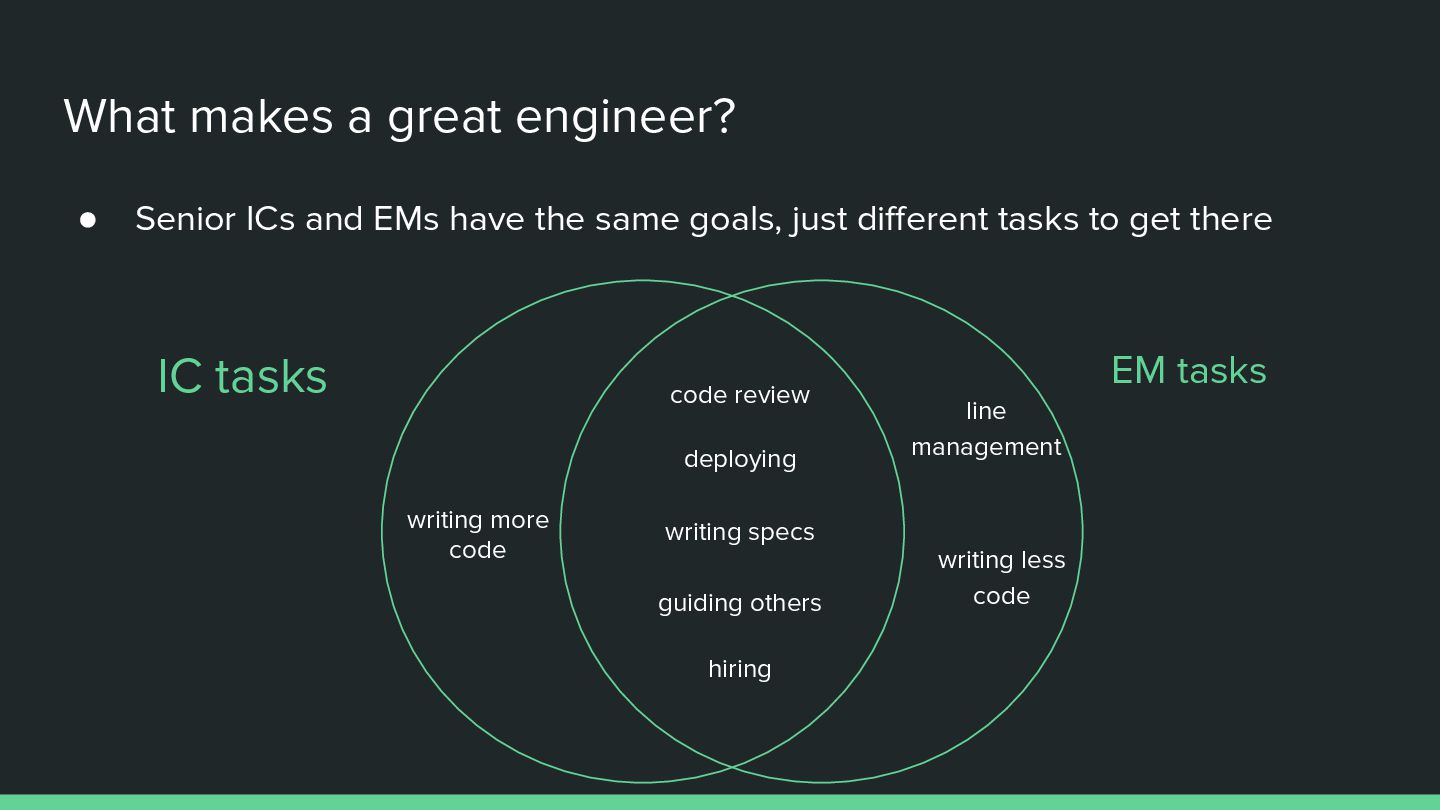
  5. What makes a great engineer? • Senior ICs and EMs

    have the same goals, just different tasks to get there line management code review guiding others writing specs writing less code writing more code deploying hiring EM tasks IC tasks
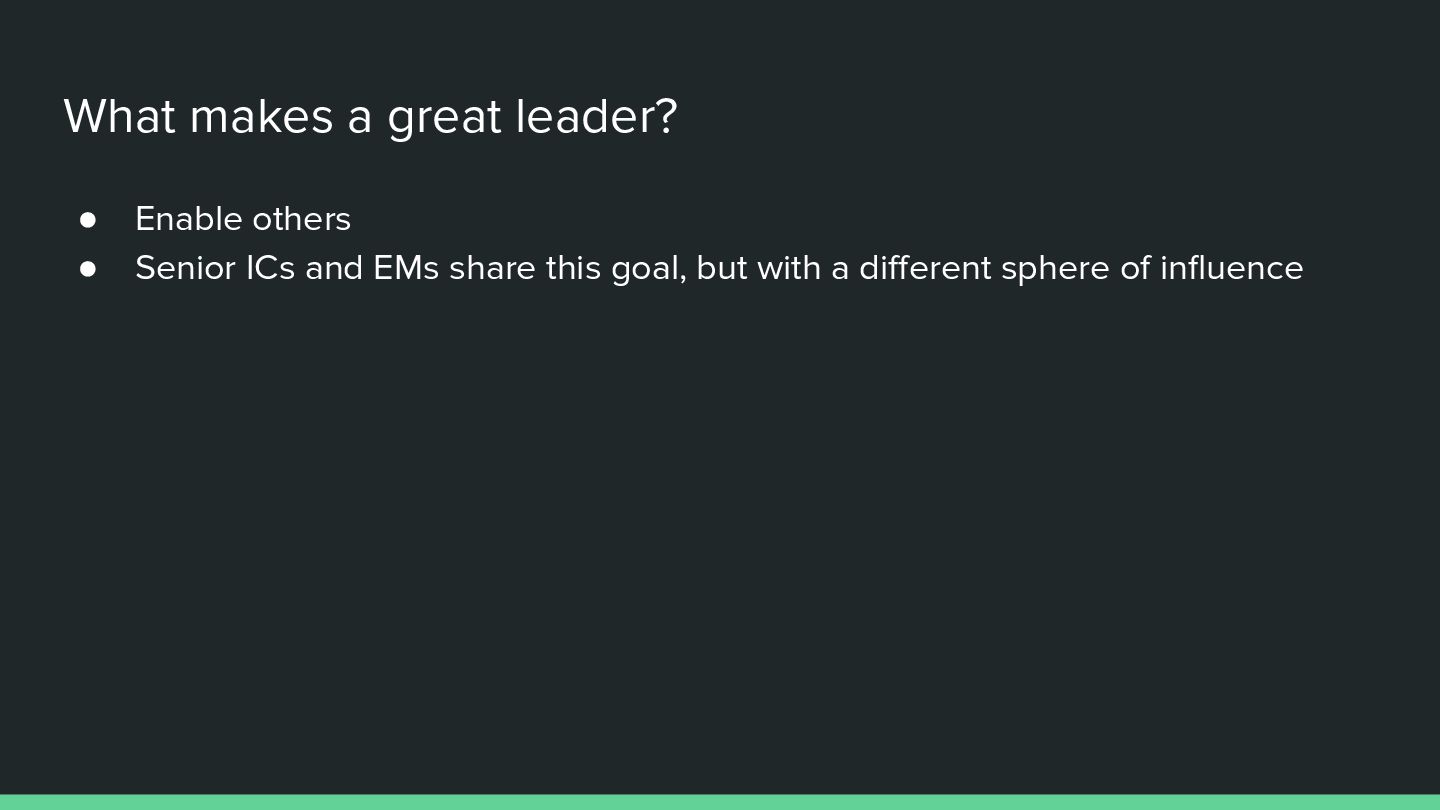
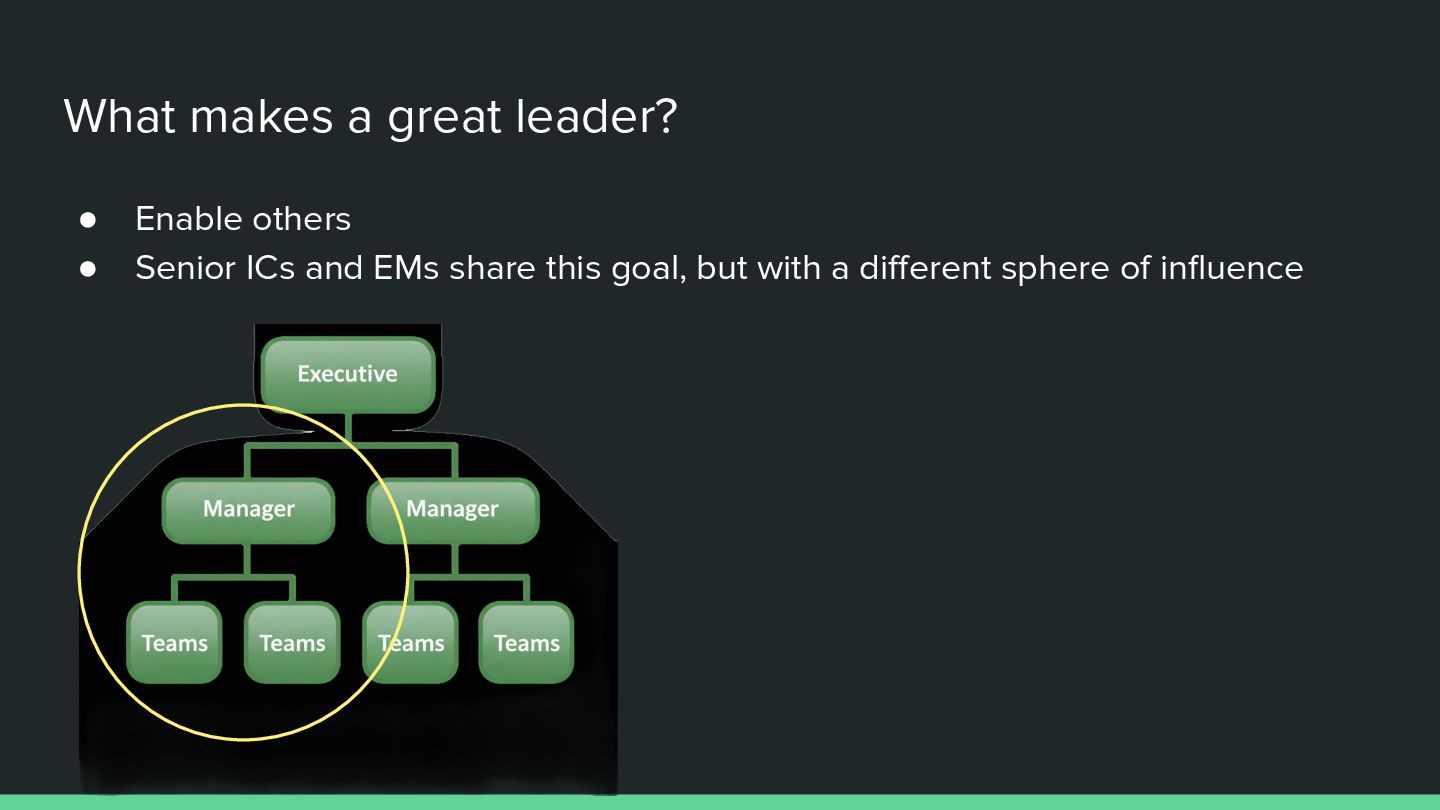
  6. What makes a great leader? • Enable others • Senior

    ICs and EMs share this goal, but with a different sphere of influence
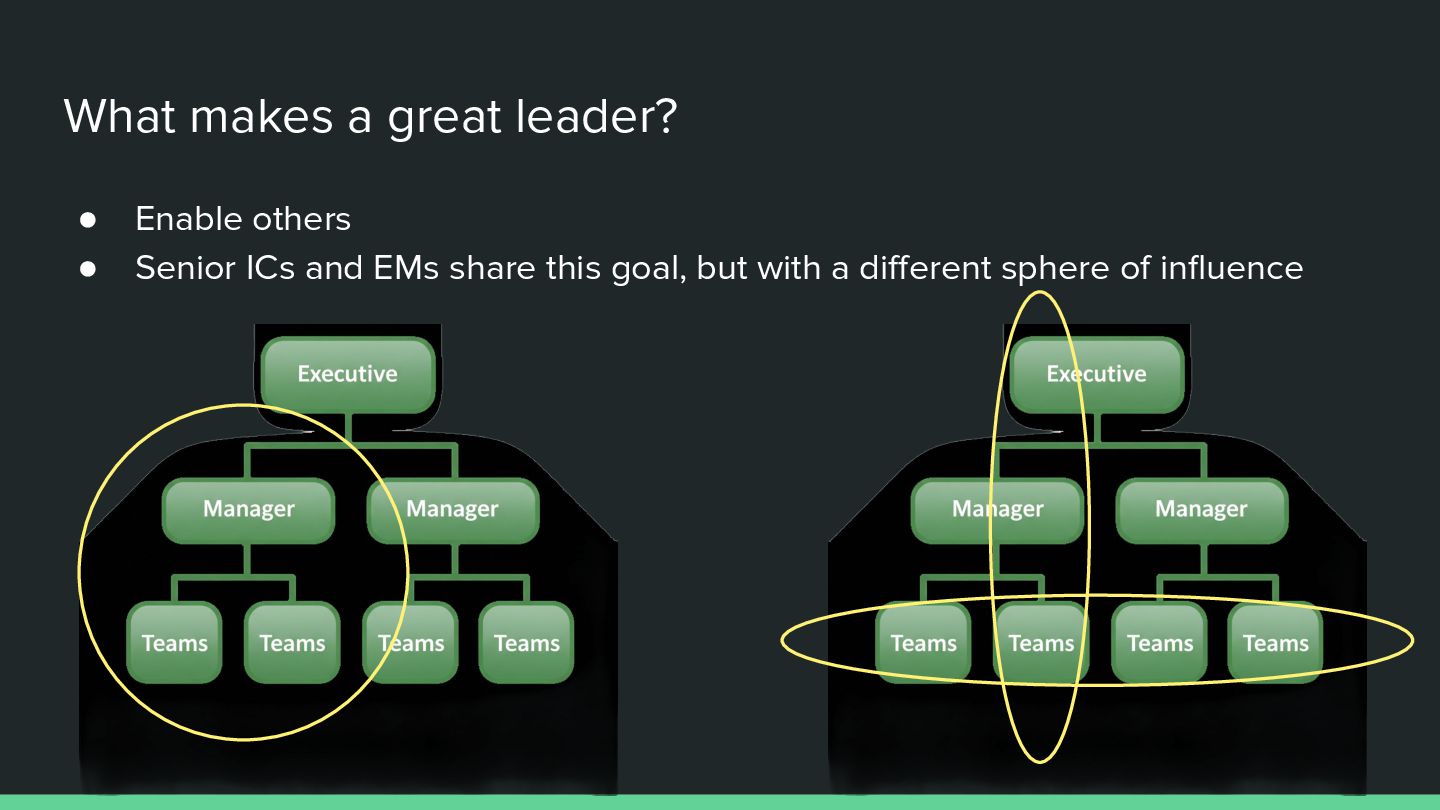
  7. What makes a great leader? • Enable others • Senior

    ICs and EMs share this goal, but with a different sphere of influence
  8. What makes a great leader? • Enable others • Senior

    ICs and EMs share this goal, but with a different sphere of influence
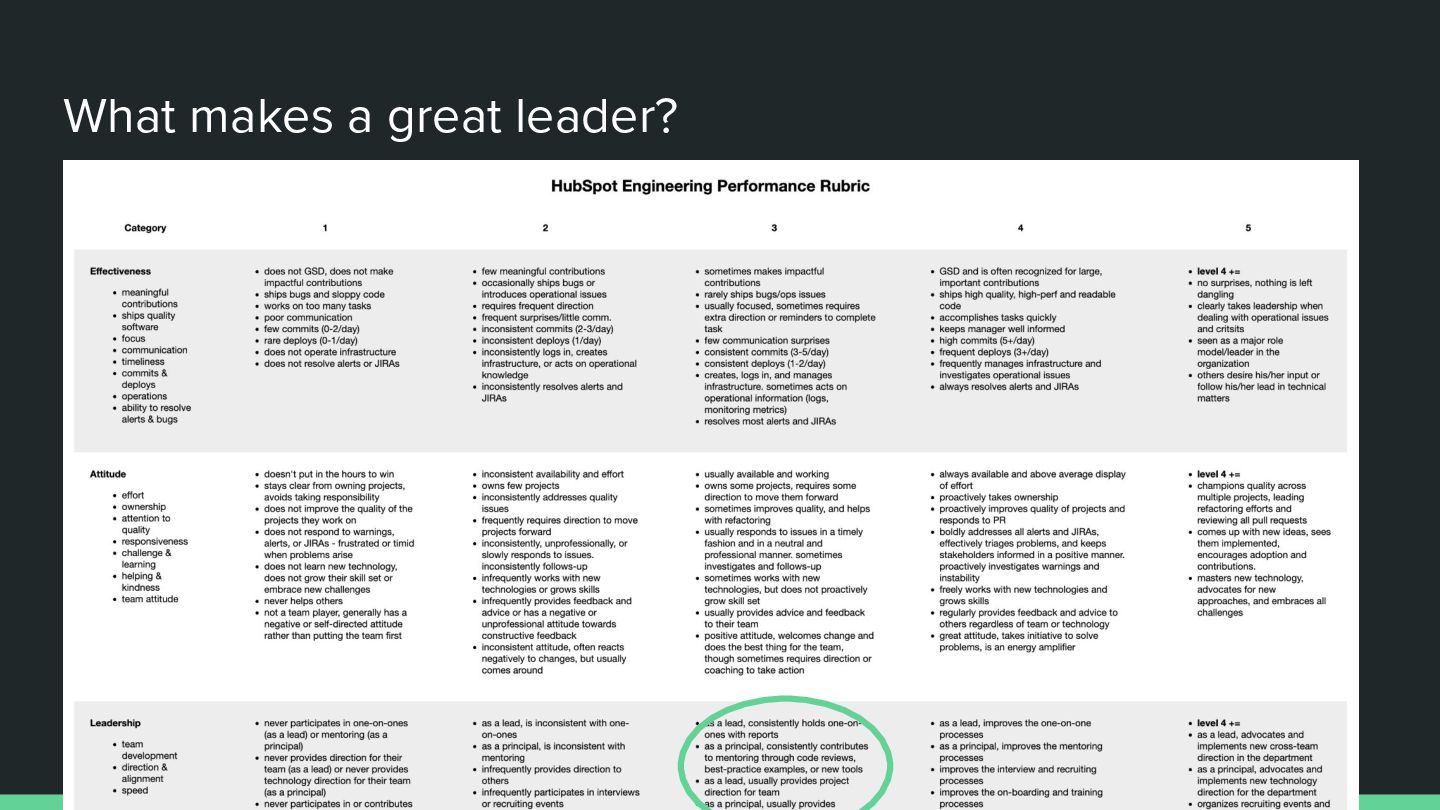
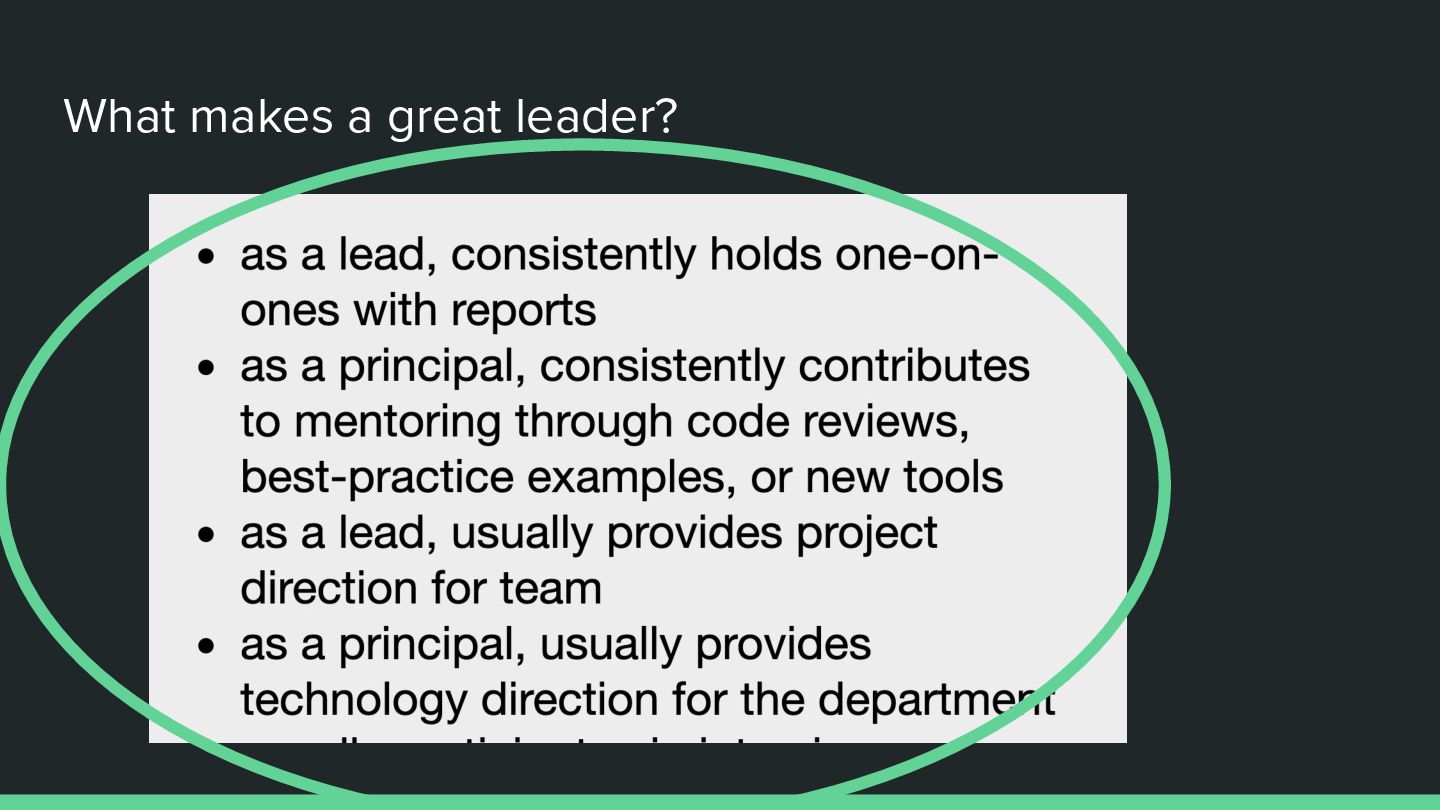
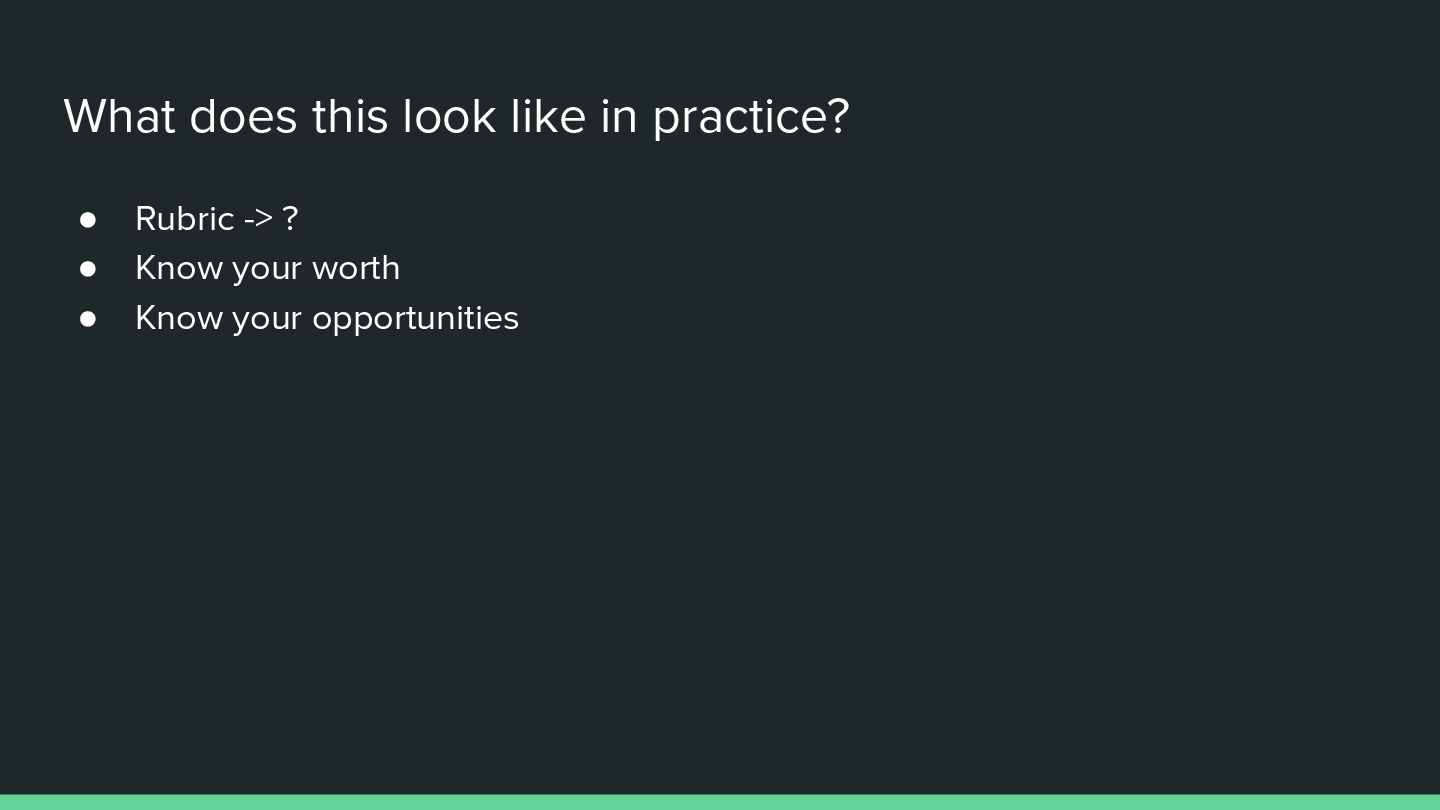
  9. What does this look like in practice? • Rubric ->

    ? • Know your worth • Know your opportunities
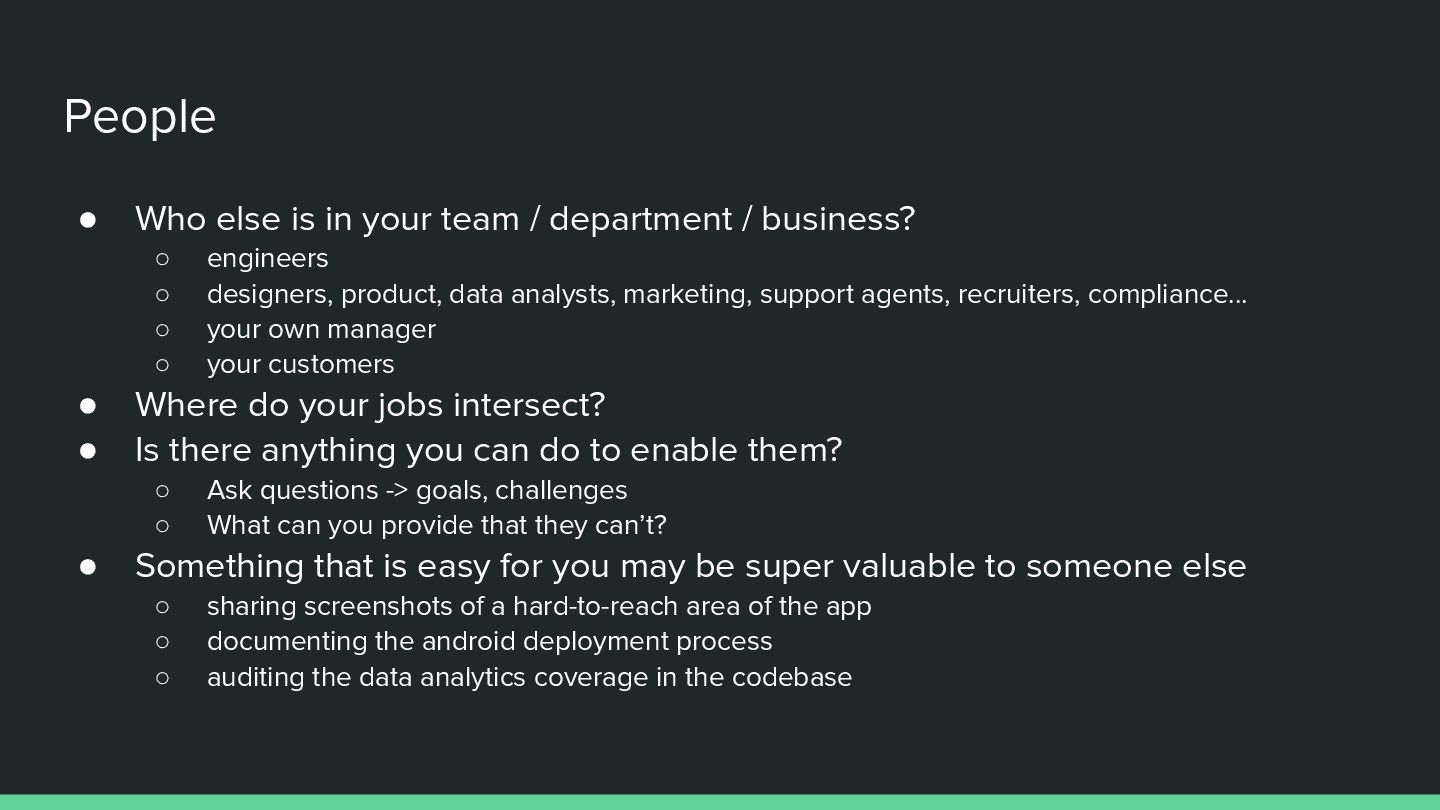
  10. People • Who else is in your team / department

    / business? ◦ engineers ◦ designers, product, data analysts, marketing, support agents, recruiters, compliance... ◦ your own manager ◦ your customers • Where do your jobs intersect? • Is there anything you can do to enable them? ◦ Ask questions -> goals, challenges ◦ What can you provide that they can’t? • Something that is easy for you may be super valuable to someone else ◦ sharing screenshots of a hard-to-reach area of the app ◦ documenting the android deployment process ◦ auditing the data analytics coverage in the codebase
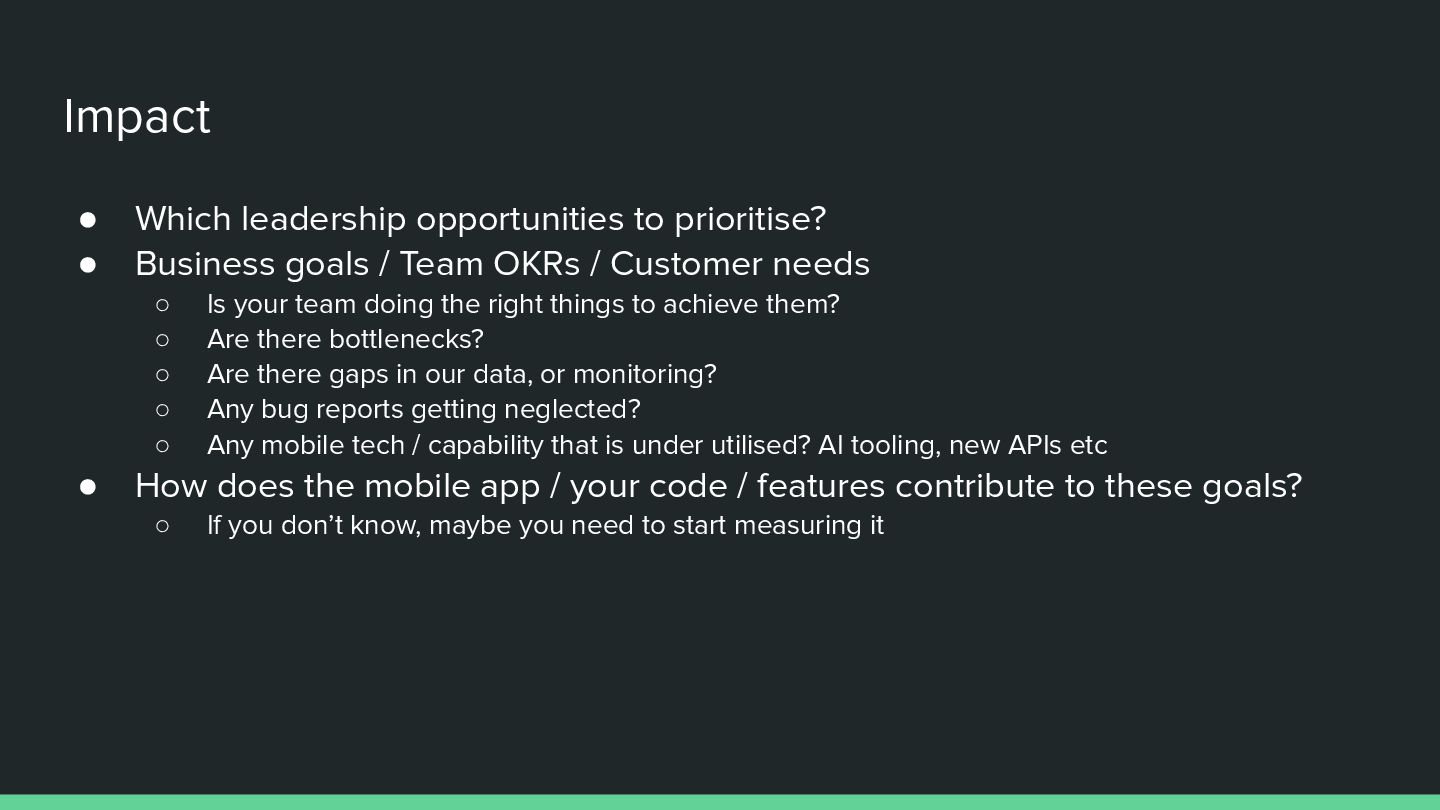
  11. Impact • Which leadership opportunities to prioritise? • Business goals

    / Team OKRs / Customer needs ◦ Is your team doing the right things to achieve them? ◦ Are there bottlenecks? ◦ Are there gaps in our data, or monitoring? ◦ Any bug reports getting neglected? ◦ Any mobile tech / capability that is under utilised? AI tooling, new APIs etc • How does the mobile app / your code / features contribute to these goals? ◦ If you don’t know, maybe you need to start measuring it
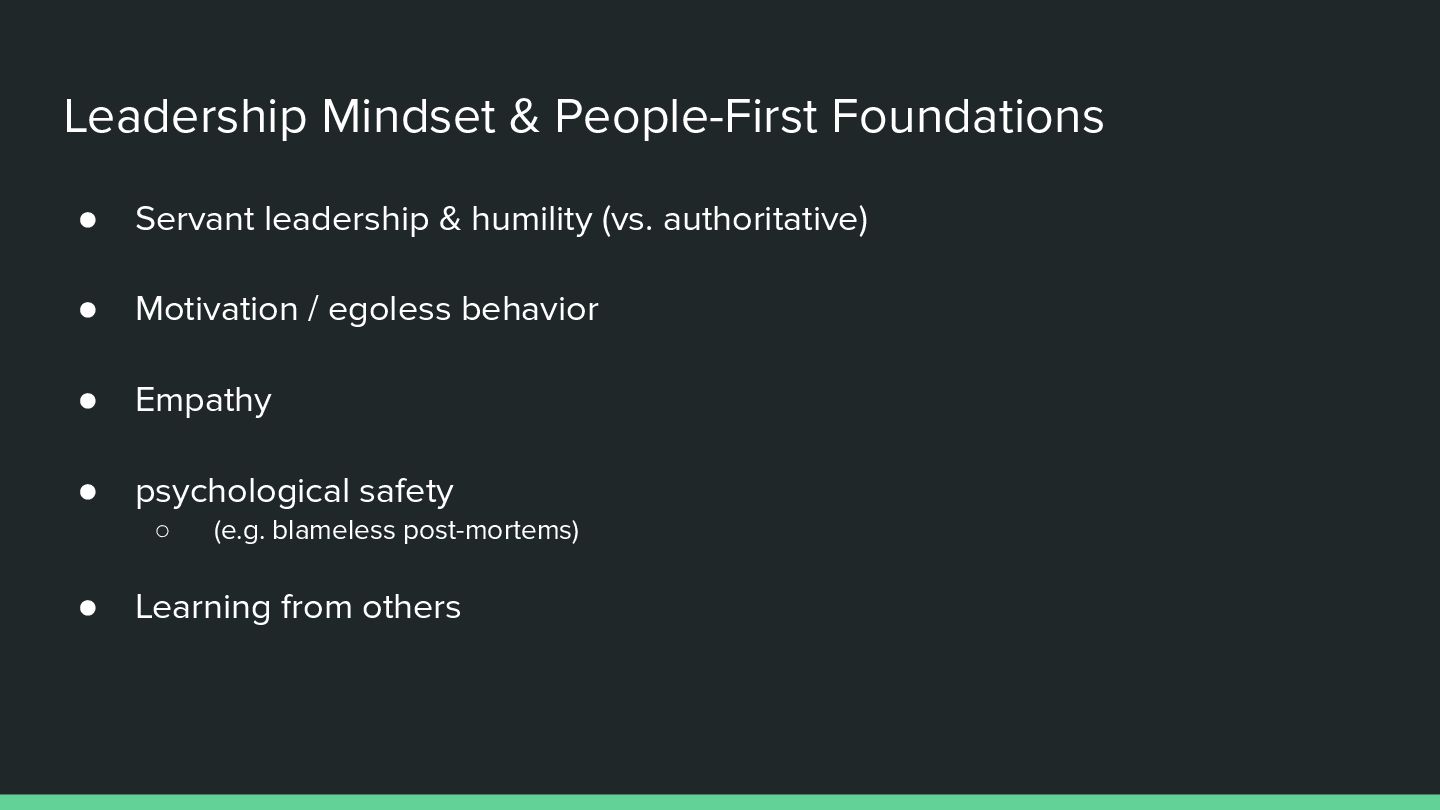
  12. Leadership Mindset & People-First Foundations • Servant leadership & humility

    (vs. authoritative) • Motivation / egoless behavior • Empathy • psychological safety ◦ (e.g. blameless post-mortems) • Learning from others
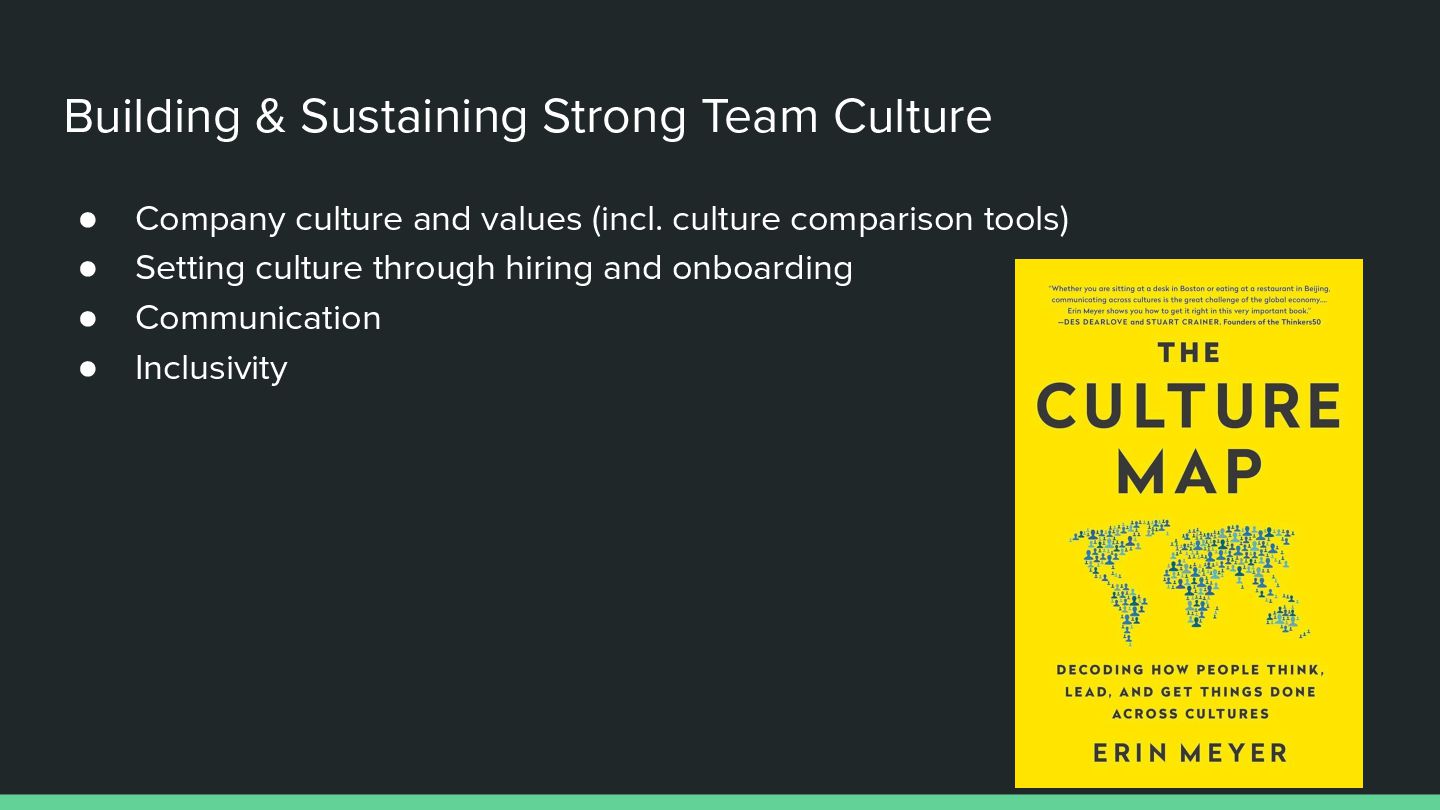
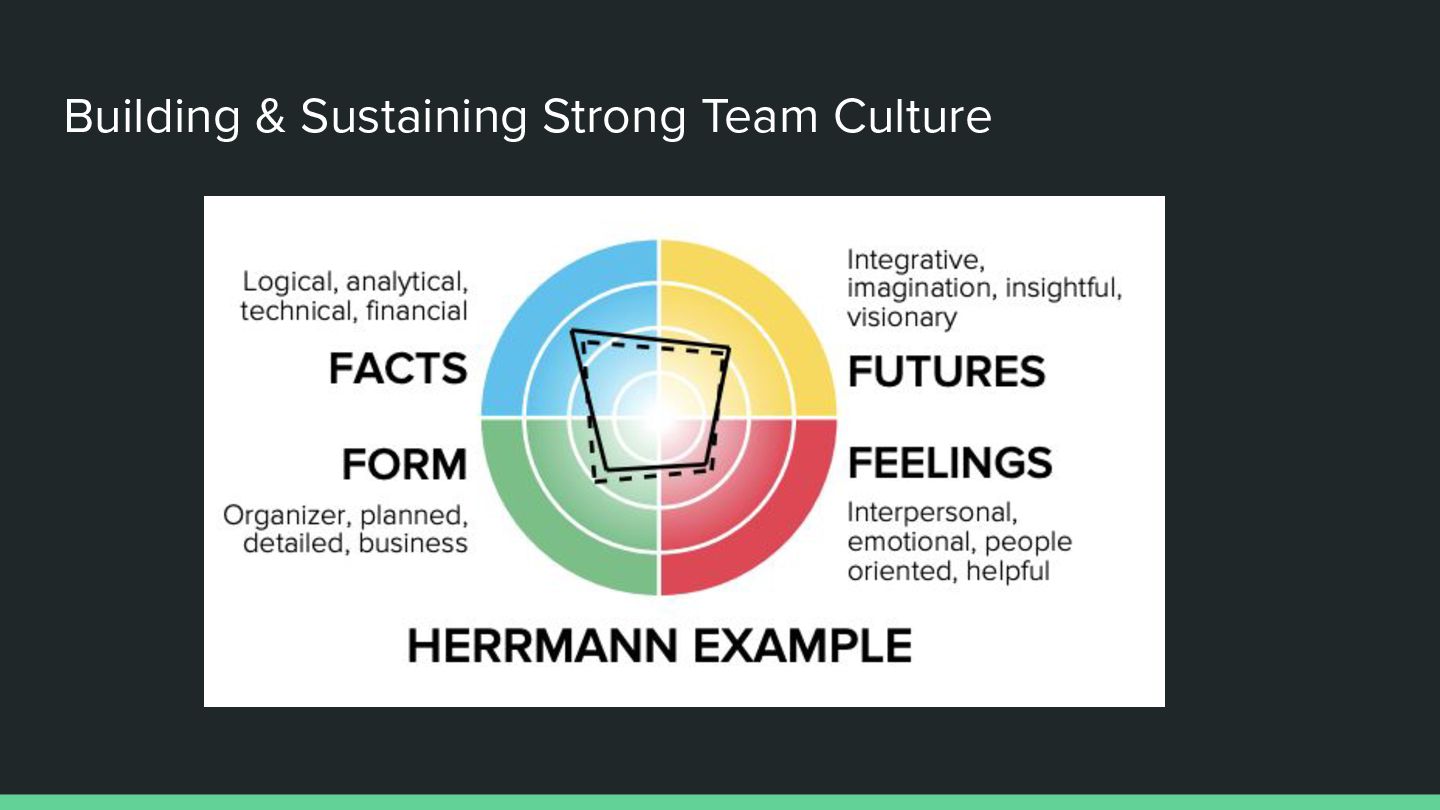
  13. Building & Sustaining Strong Team Culture • Company culture and

    values (incl. culture comparison tools) • Setting culture through hiring and onboarding • Communication • Inclusivity
  14. Ownership, Execution & High-Trust Collaboration • Ownership • Accountability •

    Trust - Being a trusted partner • Transparency • Reliability • Time management & prioritisation
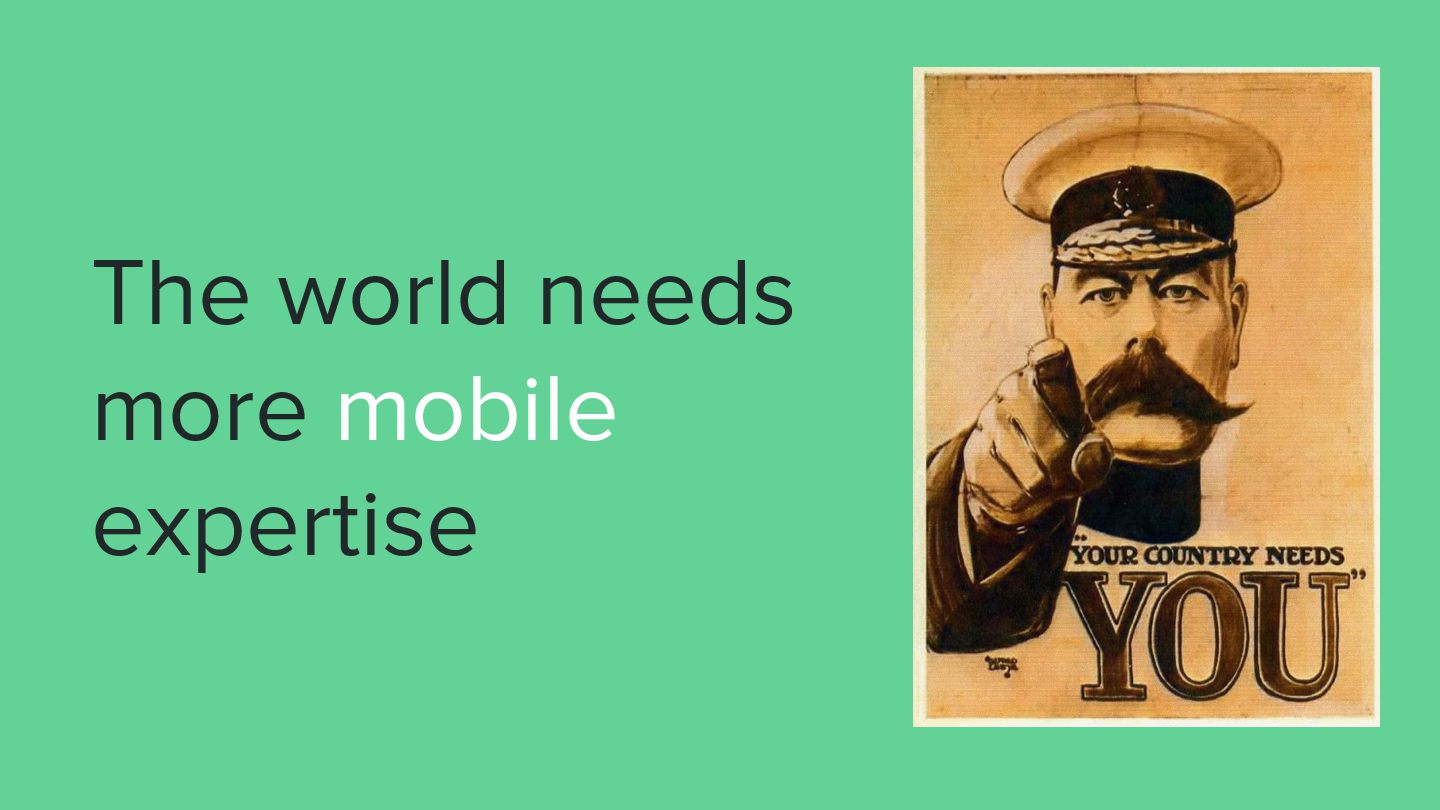
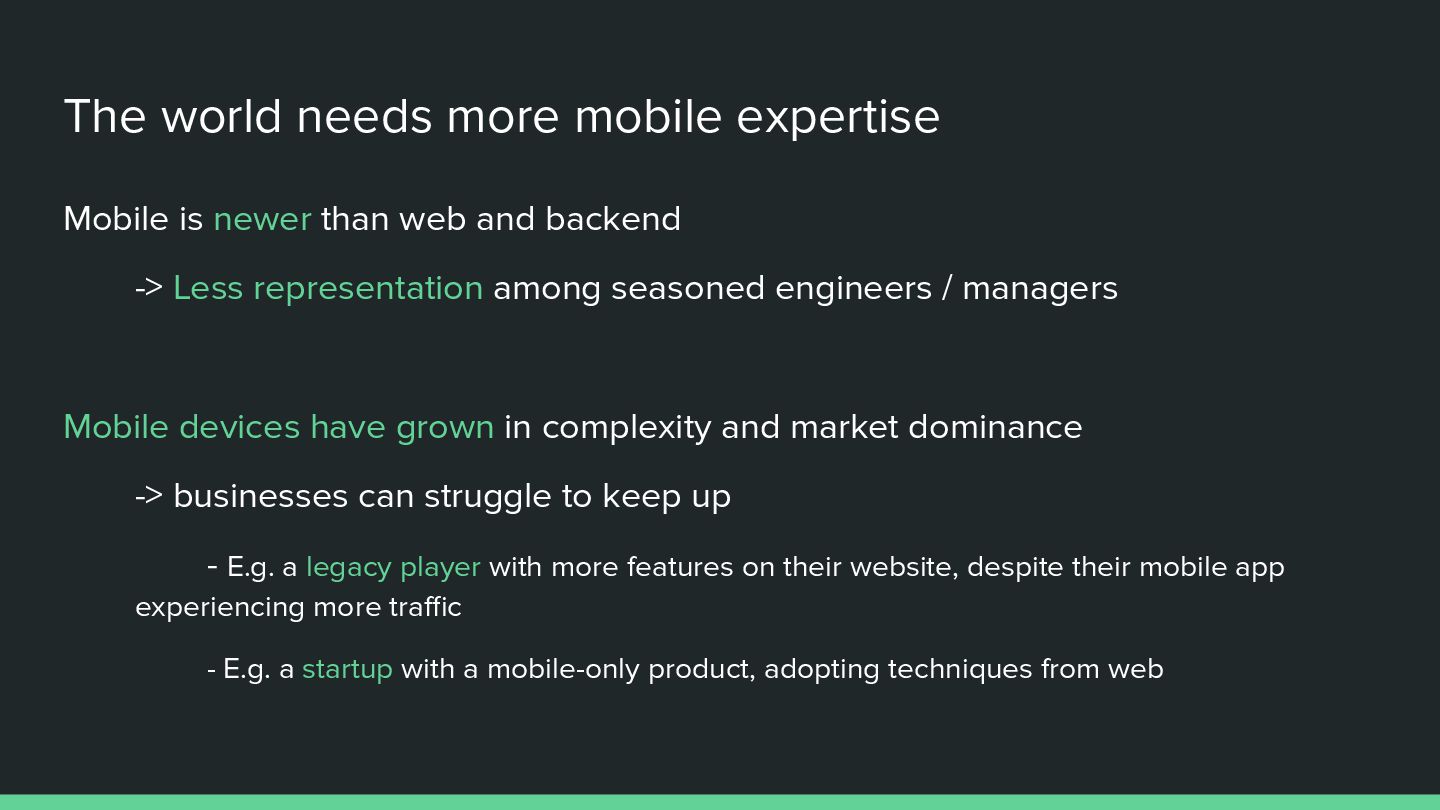
  15. The world needs more mobile expertise Mobile is newer than

    web and backend -> Less representation among seasoned engineers / managers Mobile devices have grown in complexity and market dominance -> businesses can struggle to keep up - E.g. a legacy player with more features on their website, despite their mobile app experiencing more traffic - E.g. a startup with a mobile-only product, adopting techniques from web
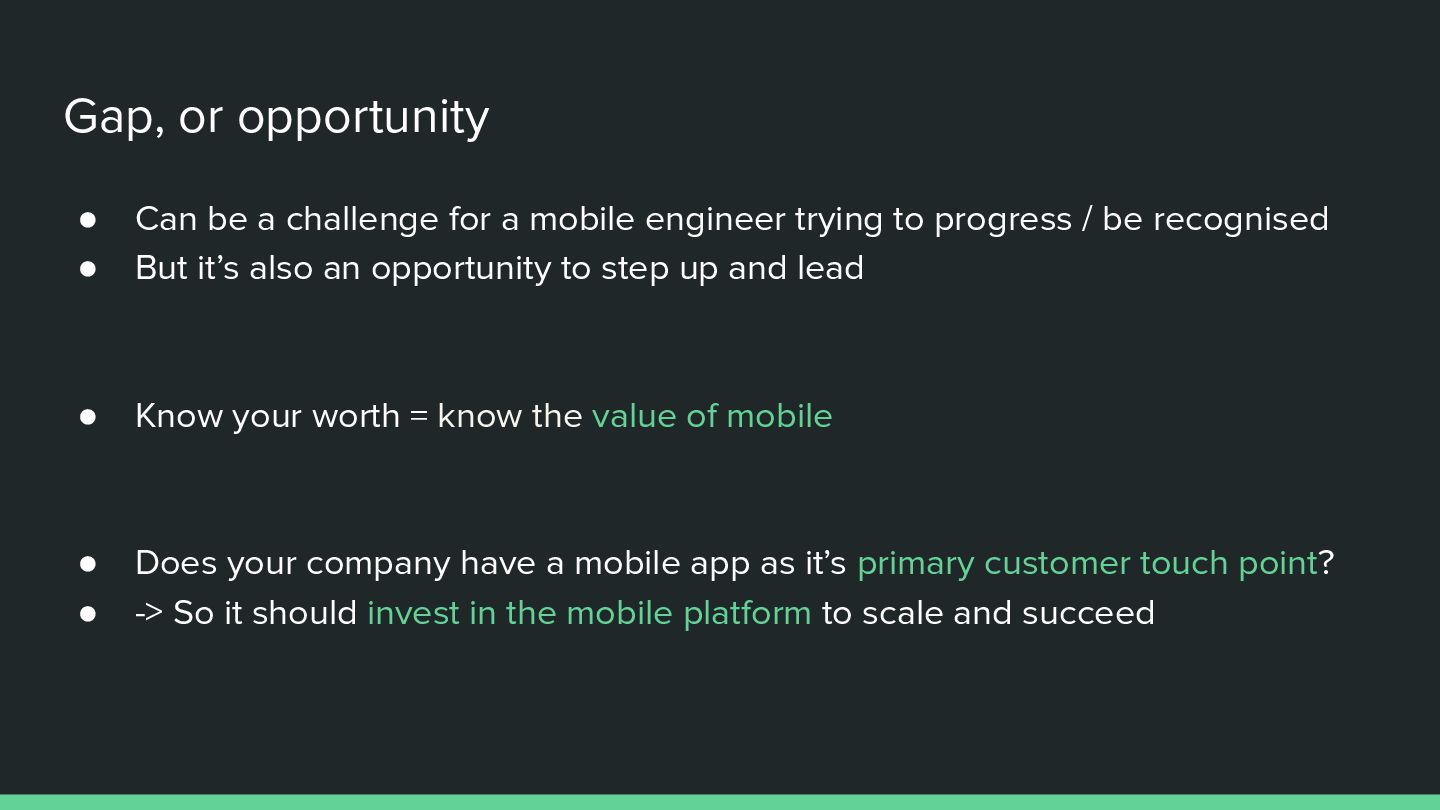
  16. Gap, or opportunity • Can be a challenge for a

    mobile engineer trying to progress / be recognised • But it’s also an opportunity to step up and lead • Know your worth = know the value of mobile • Does your company have a mobile app as it’s primary customer touch point? • -> So it should invest in the mobile platform to scale and succeed
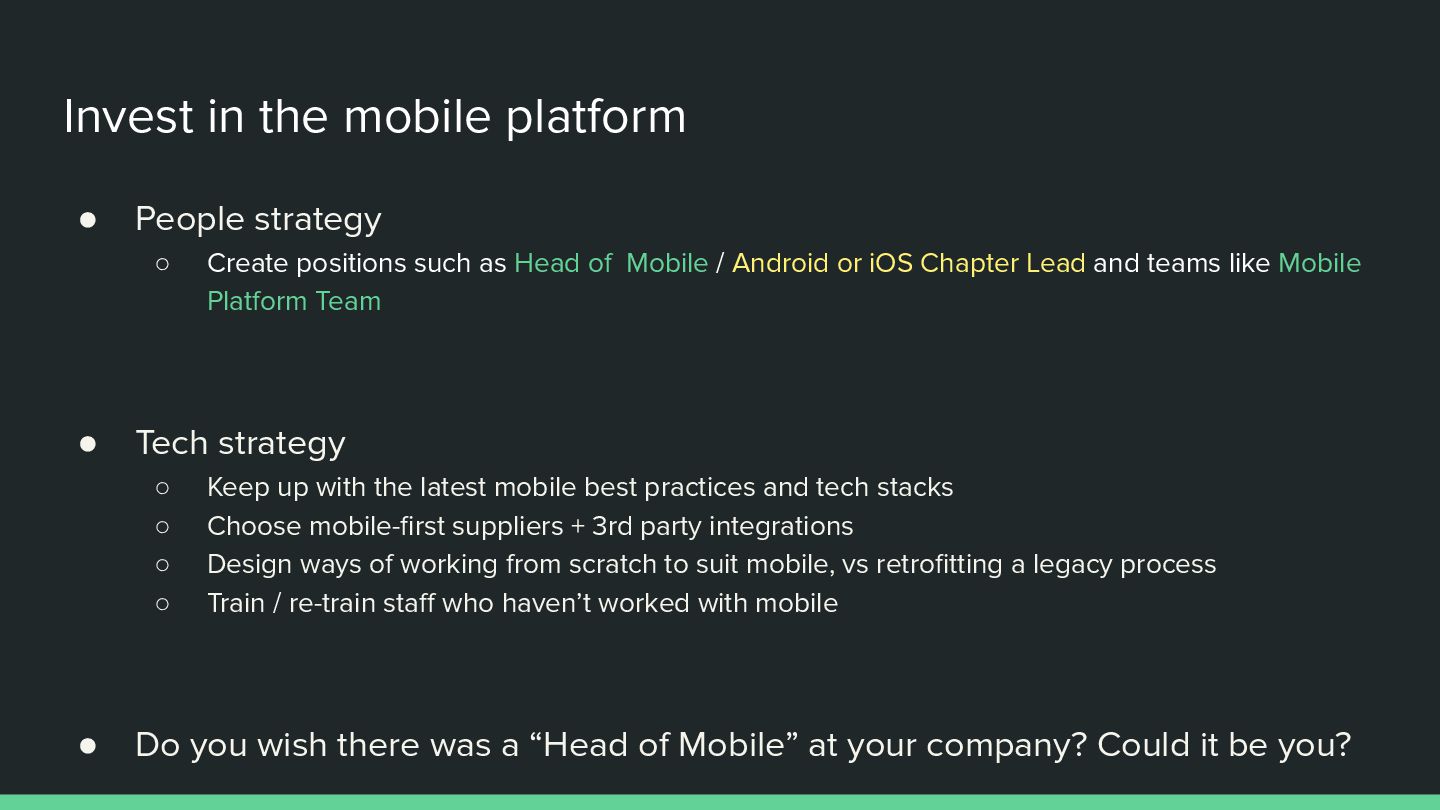
  17. Invest in the mobile platform • People strategy ◦ Create

    positions such as Head of Mobile / Android or iOS Chapter Lead and teams like Mobile Platform Team • Tech strategy ◦ Keep up with the latest mobile best practices and tech stacks ◦ Choose mobile-first suppliers + 3rd party integrations ◦ Design ways of working from scratch to suit mobile, vs retrofitting a legacy process ◦ Train / re-train staff who haven’t worked with mobile • Do you wish there was a “Head of Mobile” at your company? Could it be you?
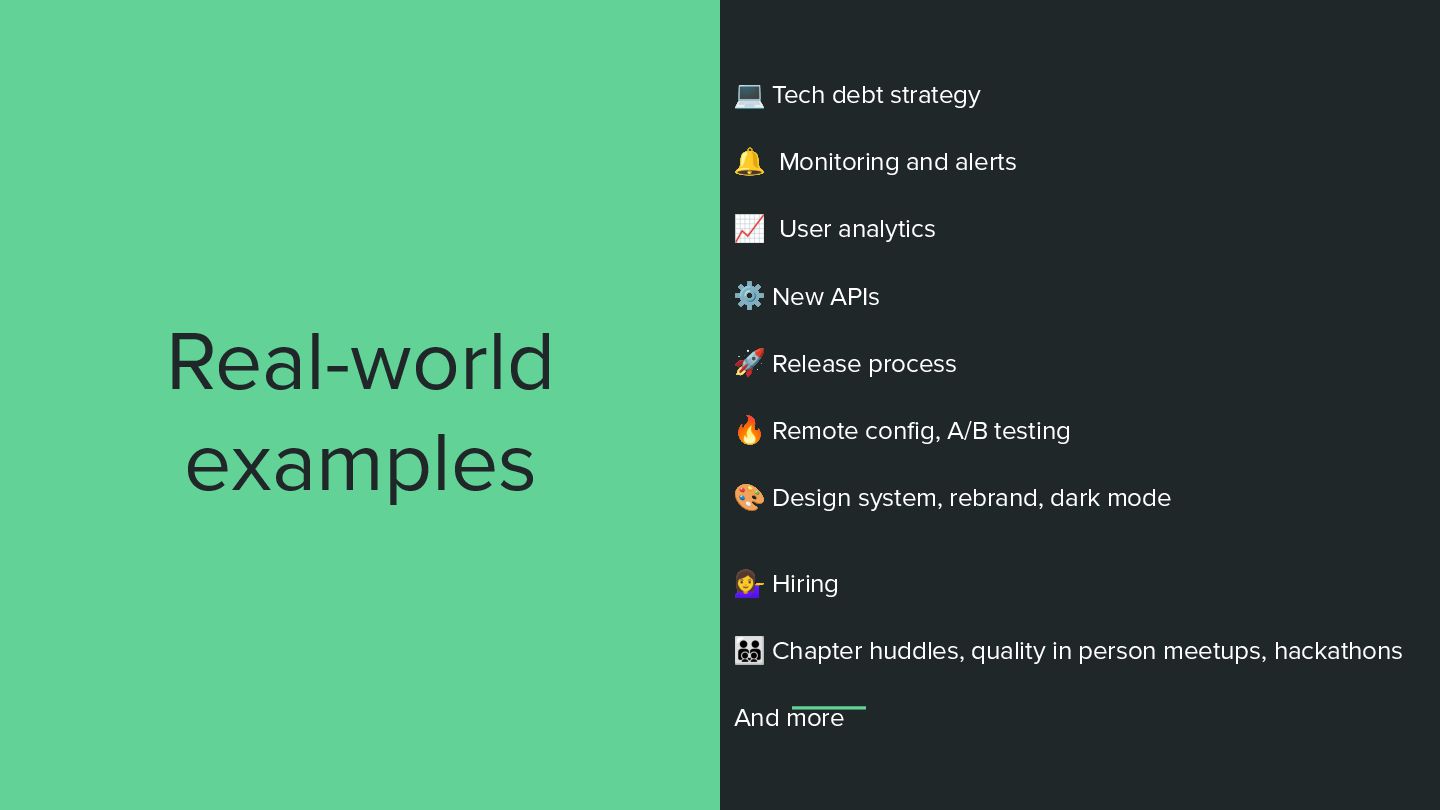
  18. Real-world examples 💻 Tech debt strategy 🔔 Monitoring and alerts
    📈 User analytics ⚙ New APIs 🚀 Release process 🔥 Remote config, A/B testing 🎨 Design system, rebrand, dark mode 󰡈 Hiring 󰼠 Chapter huddles, quality in person meetups, hackathons And more
  19. 5 minutes 2) Now imagine you work for the same

    company and are working together for the first time. What do you want to ask?
  20. 5 minutes 3) Now reflect on the leadership principles we’ve

    talked about. Is there an opportunity here to enable each other? Is there any action you want to take in your team / business?