Upgrade to Pro — share decks privately, control downloads, hide ads and more …

Simple Workload & Application Portability (SWAP...

Simple Workload & Application Portability (SWAP) - Presentation

This is the presentation I gave on my paper at the IEEE INFOCOM '14 CrossCloud workshop in Toronto on 28 April 2014, along with a demo of the experimental implementation of the protocol.

In it I proposed that we adopt the same strategy as was used for Internet email to break down the cloud computing silos — a HTTP-based "lowest common denominator" protocol called "Simple Workload and Application Portability (SWAP)".

Avatar for Sam Johnston

Sam Johnston

April 28, 2014
Tweet

More Decks by Sam Johnston

Other Decks in Technology

Transcript

  1. Sam Johnston (@samj) <[email protected]> Simple Workload & Application Portability A

    simple “lowest common denominator” approach to hybrid, multi- and inter- cloud portability over HTTP
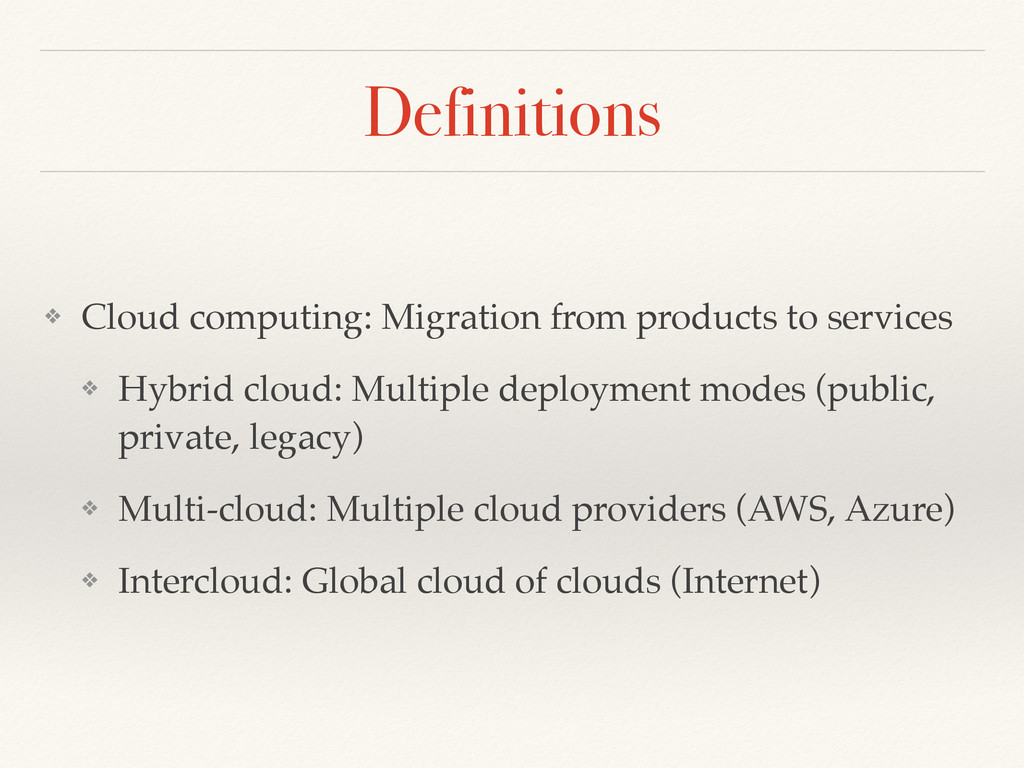
  2. Definitions ❖ Cloud computing: Migration from products to services! ❖

    Hybrid cloud: Multiple deployment modes (public, private, legacy)! ❖ Multi-cloud: Multiple cloud providers (AWS, Azure)! ❖ Intercloud: Global cloud of clouds (Internet)
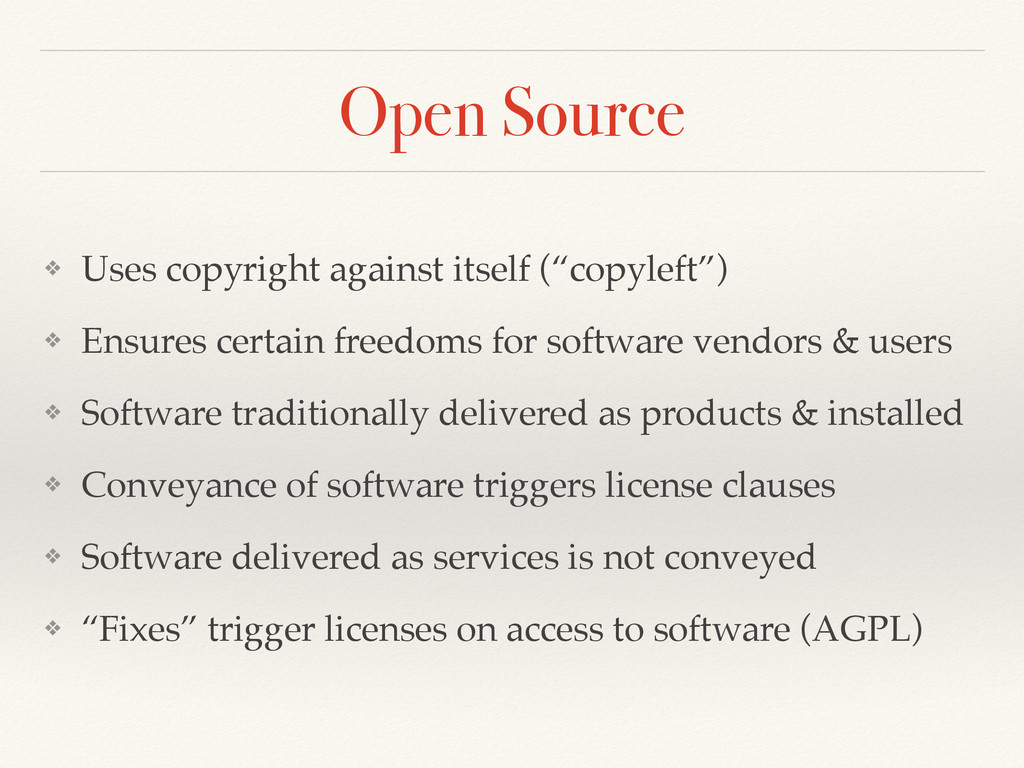
  3. Open Source ❖ Uses copyright against itself (“copyleft”)! ❖ Ensures

    certain freedoms for software vendors & users! ❖ Software traditionally delivered as products & installed! ❖ Conveyance of software triggers license clauses! ❖ Software delivered as services is not conveyed! ❖ “Fixes” trigger licenses on access to software (AGPL)
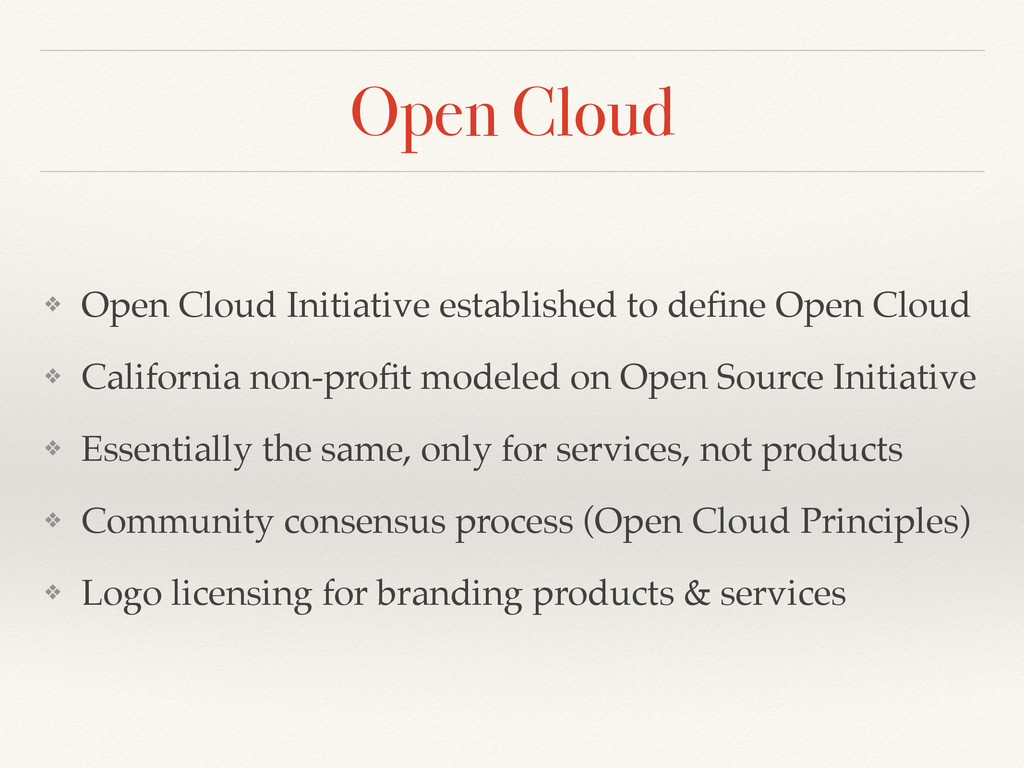
  4. Open Cloud ❖ Open Cloud Initiative established to define Open

    Cloud! ❖ California non-profit modeled on Open Source Initiative! ❖ Essentially the same, only for services, not products! ❖ Community consensus process (Open Cloud Principles)! ❖ Logo licensing for branding products & services
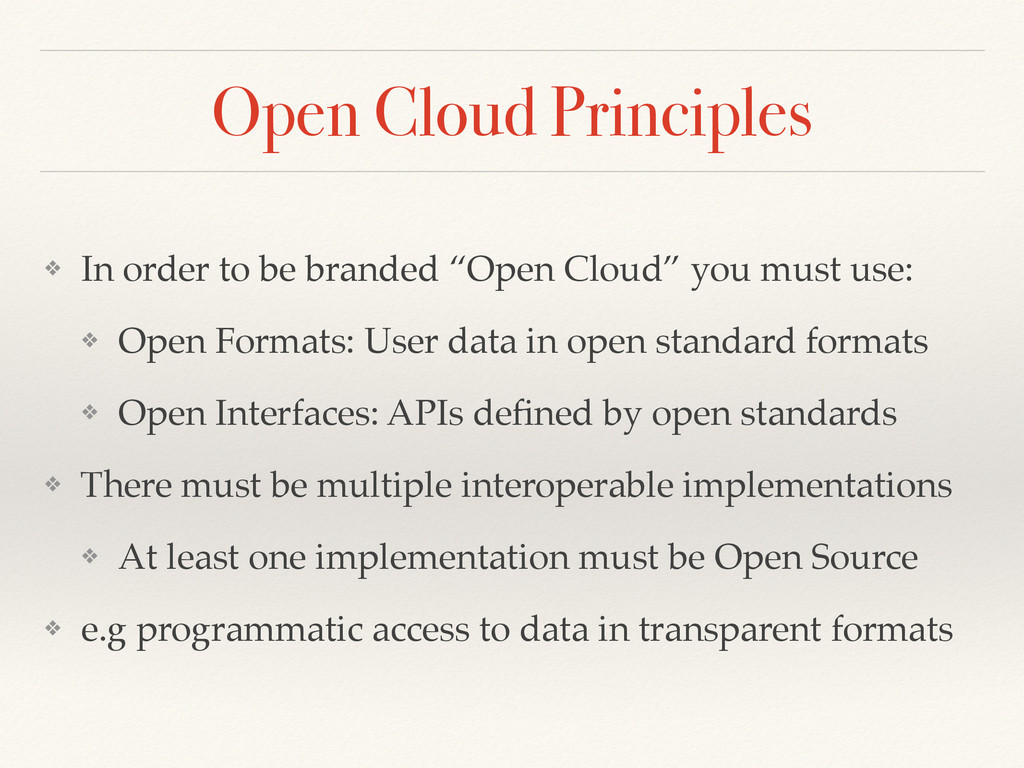
  5. Open Cloud Principles ❖ In order to be branded “Open

    Cloud” you must use:! ❖ Open Formats: User data in open standard formats! ❖ Open Interfaces: APIs defined by open standards! ❖ There must be multiple interoperable implementations! ❖ At least one implementation must be Open Source! ❖ e.g programmatic access to data in transparent formats
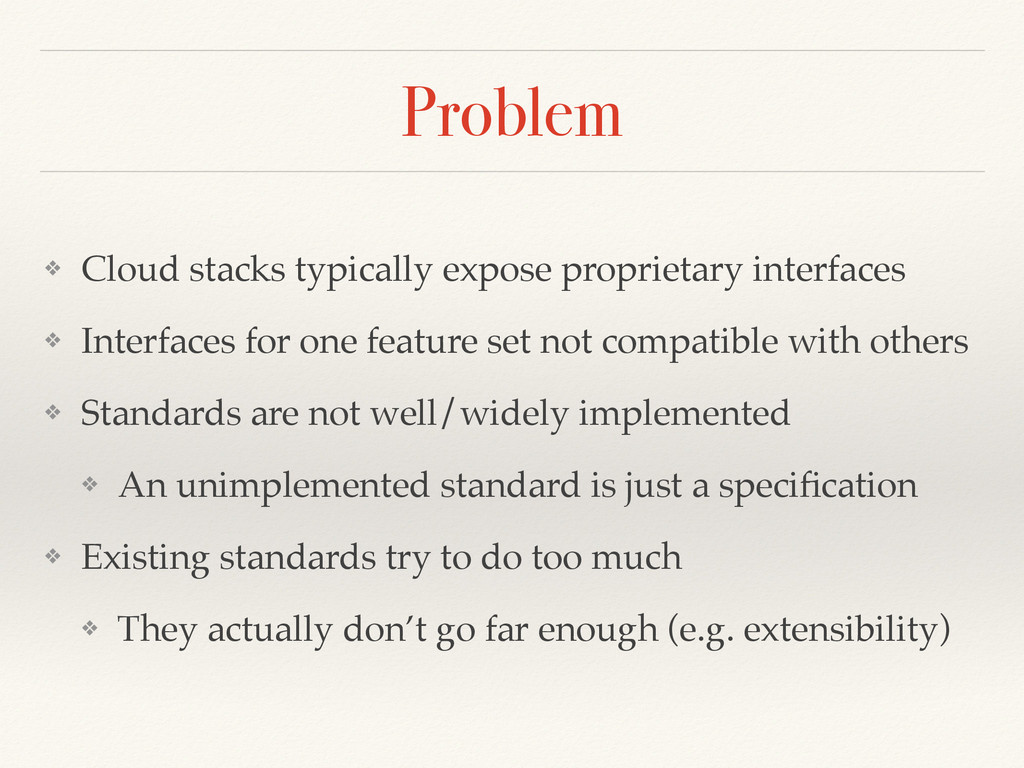
  6. Problem ❖ Cloud stacks typically expose proprietary interfaces! ❖ Interfaces

    for one feature set not compatible with others! ❖ Standards are not well/widely implemented! ❖ An unimplemented standard is just a specification! ❖ Existing standards try to do too much! ❖ They actually don’t go far enough (e.g. extensibility)
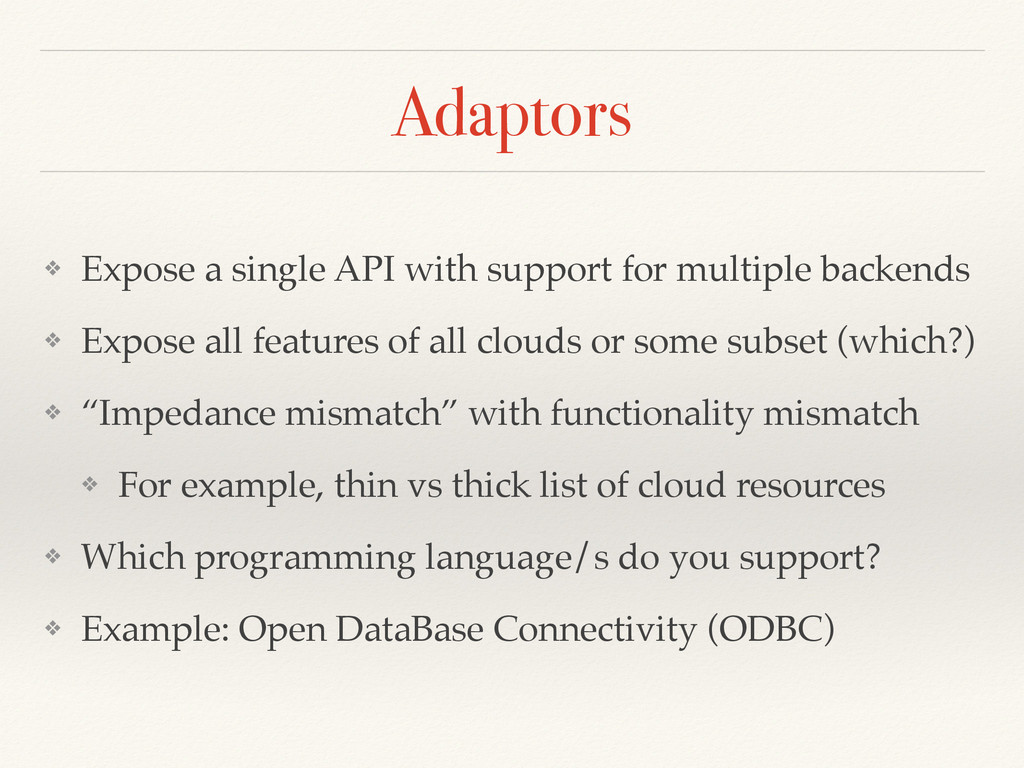
  7. Adaptors ❖ Expose a single API with support for multiple

    backends! ❖ Expose all features of all clouds or some subset (which?)! ❖ “Impedance mismatch” with functionality mismatch! ❖ For example, thin vs thick list of cloud resources! ❖ Which programming language/s do you support?! ❖ Example: Open DataBase Connectivity (ODBC)
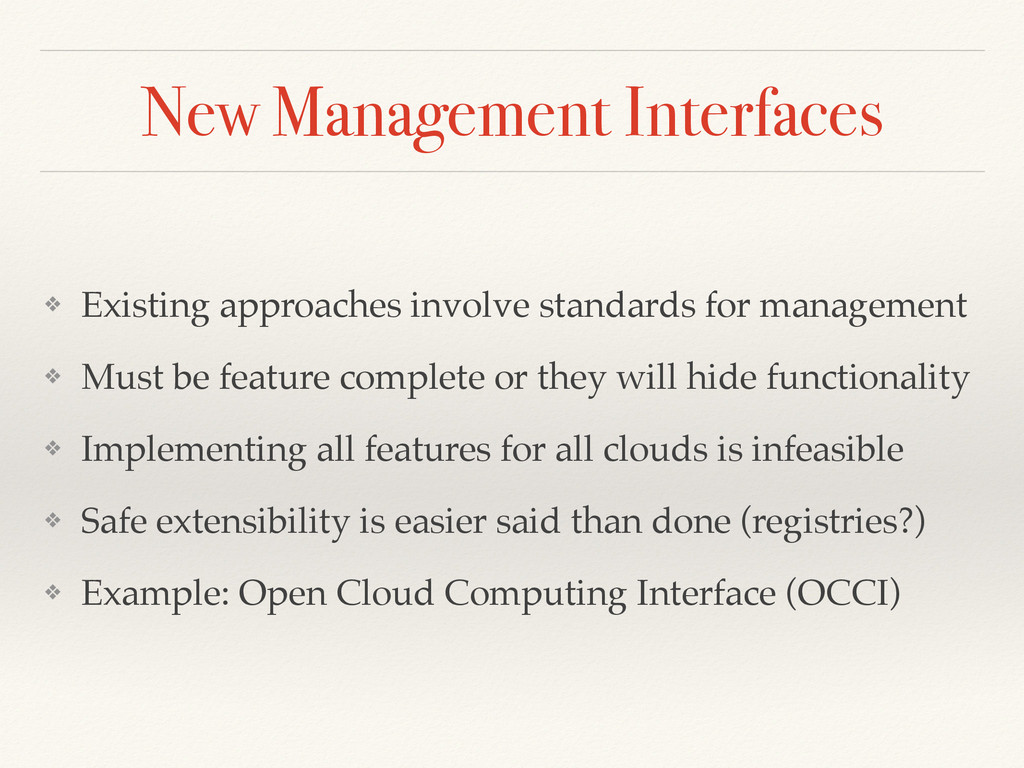
  8. New Management Interfaces ❖ Existing approaches involve standards for management!

    ❖ Must be feature complete or they will hide functionality! ❖ Implementing all features for all clouds is infeasible! ❖ Safe extensibility is easier said than done (registries?)! ❖ Example: Open Cloud Computing Interface (OCCI)
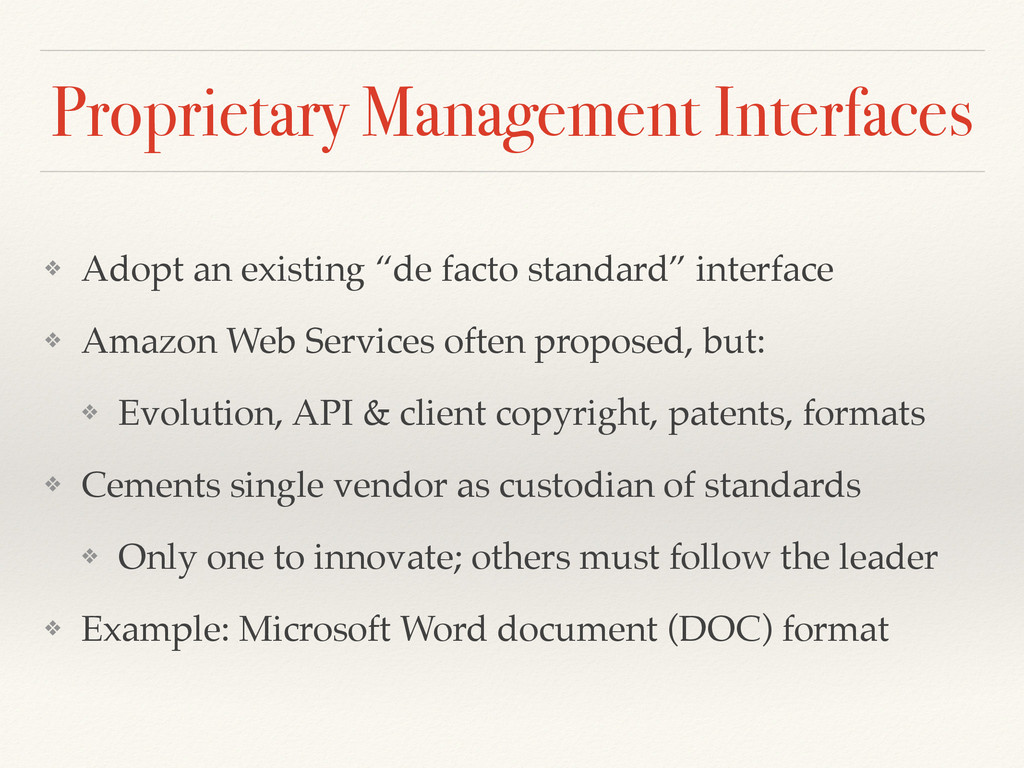
  9. Proprietary Management Interfaces ❖ Adopt an existing “de facto standard”

    interface! ❖ Amazon Web Services often proposed, but:! ❖ Evolution, API & client copyright, patents, formats! ❖ Cements single vendor as custodian of standards! ❖ Only one to innovate; others must follow the leader! ❖ Example: Microsoft Word document (DOC) format
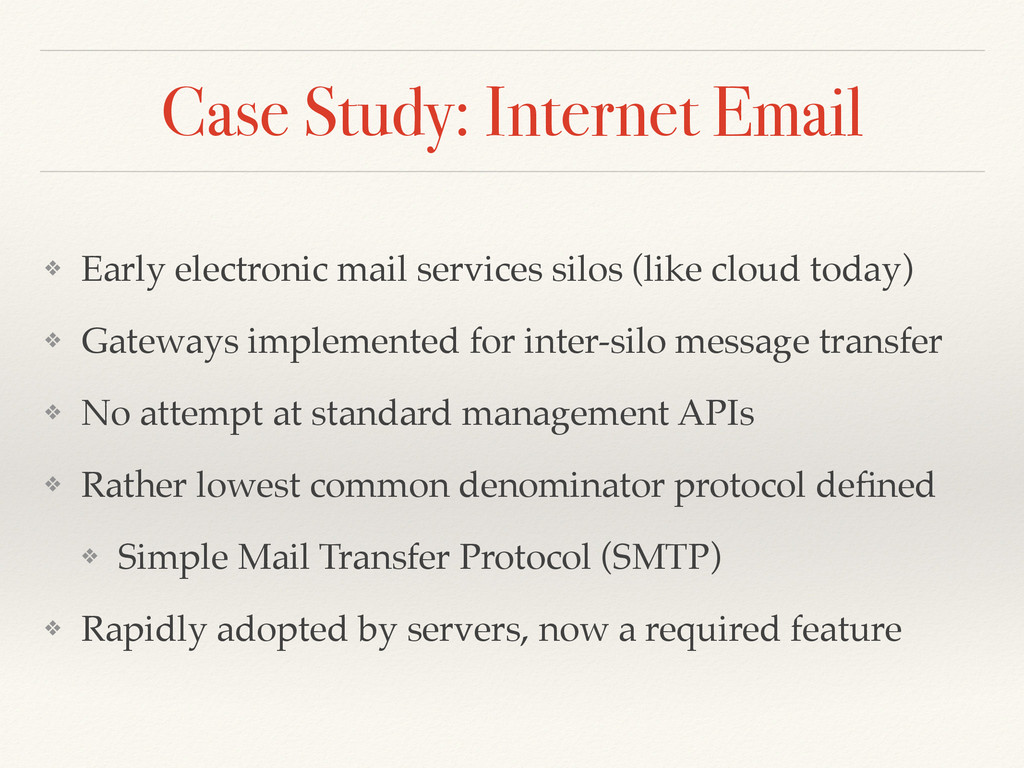
  10. Case Study: Internet Email ❖ Early electronic mail services silos

    (like cloud today)! ❖ Gateways implemented for inter-silo message transfer! ❖ No attempt at standard management APIs! ❖ Rather lowest common denominator protocol defined! ❖ Simple Mail Transfer Protocol (SMTP)! ❖ Rapidly adopted by servers, now a required feature
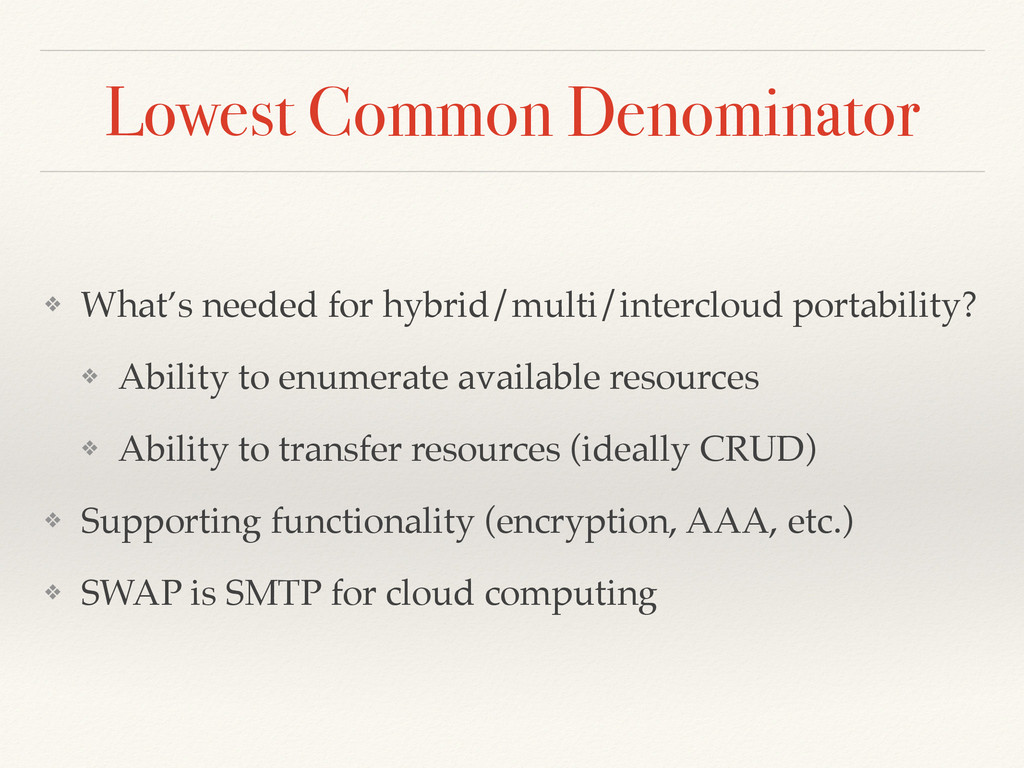
  11. Lowest Common Denominator ❖ What’s needed for hybrid/multi/intercloud portability?! ❖

    Ability to enumerate available resources! ❖ Ability to transfer resources (ideally CRUD)! ❖ Supporting functionality (encryption, AAA, etc.)! ❖ SWAP is SMTP for cloud computing
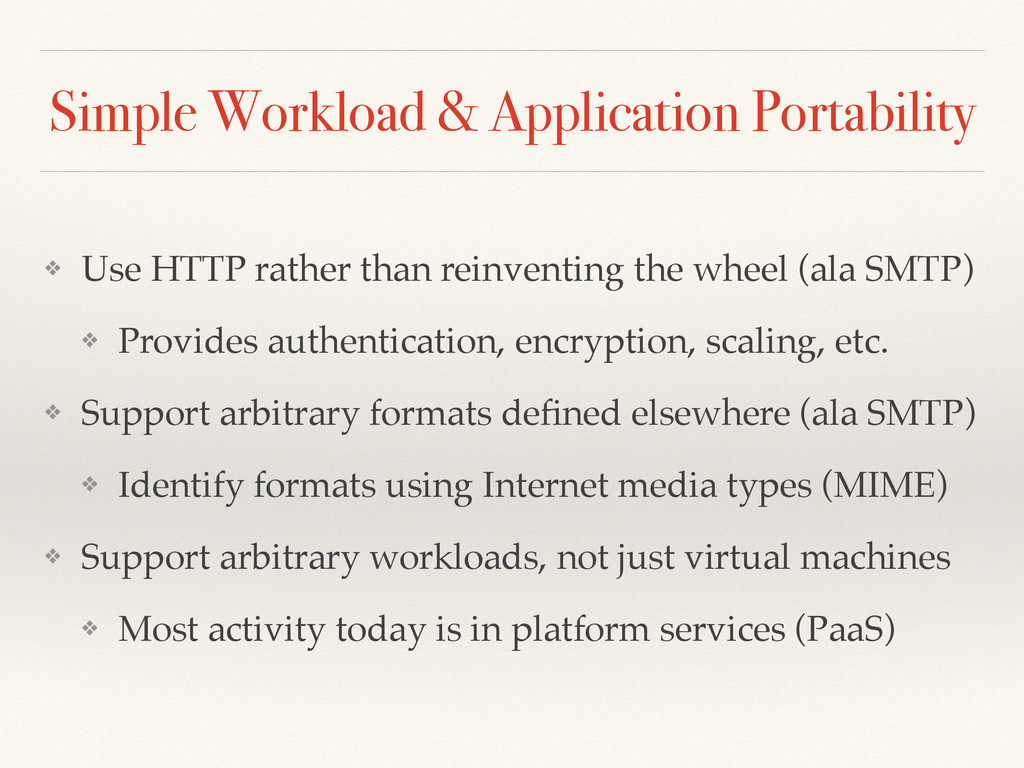
  12. Simple Workload & Application Portability ❖ Use HTTP rather than

    reinventing the wheel (ala SMTP)! ❖ Provides authentication, encryption, scaling, etc.! ❖ Support arbitrary formats defined elsewhere (ala SMTP)! ❖ Identify formats using Internet media types (MIME)! ❖ Support arbitrary workloads, not just virtual machines! ❖ Most activity today is in platform services (PaaS)
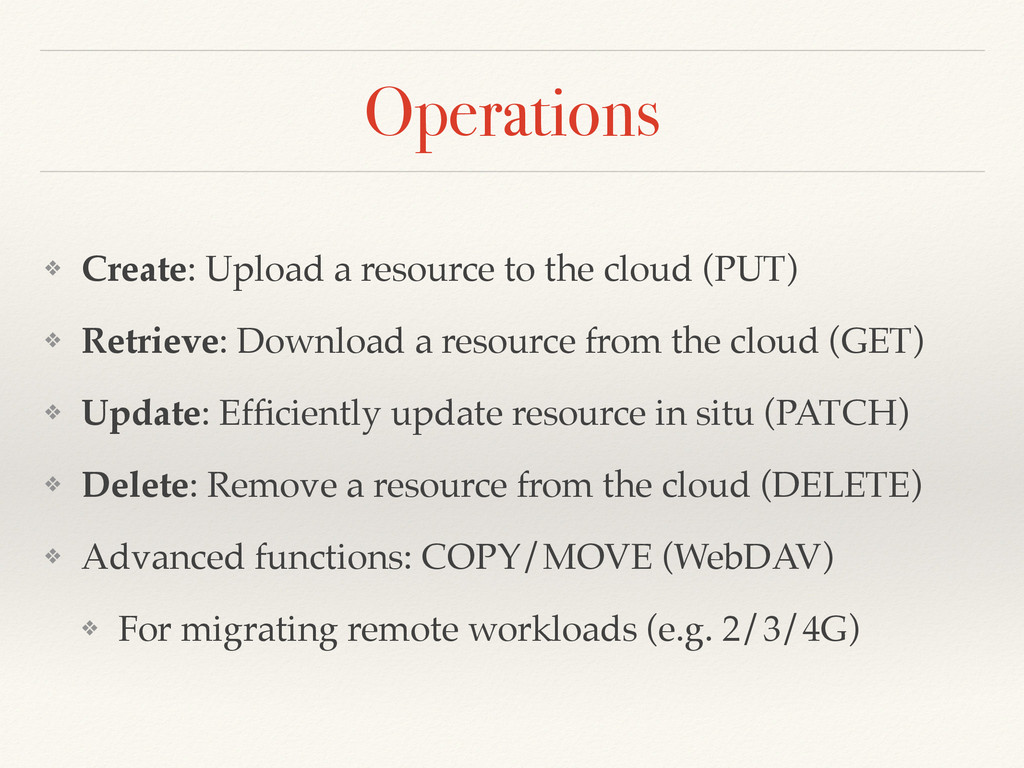
  13. Operations ❖ Create: Upload a resource to the cloud (PUT)!

    ❖ Retrieve: Download a resource from the cloud (GET)! ❖ Update: Efficiently update resource in situ (PATCH)! ❖ Delete: Remove a resource from the cloud (DELETE)! ❖ Advanced functions: COPY/MOVE (WebDAV)! ❖ For migrating remote workloads (e.g. 2/3/4G)
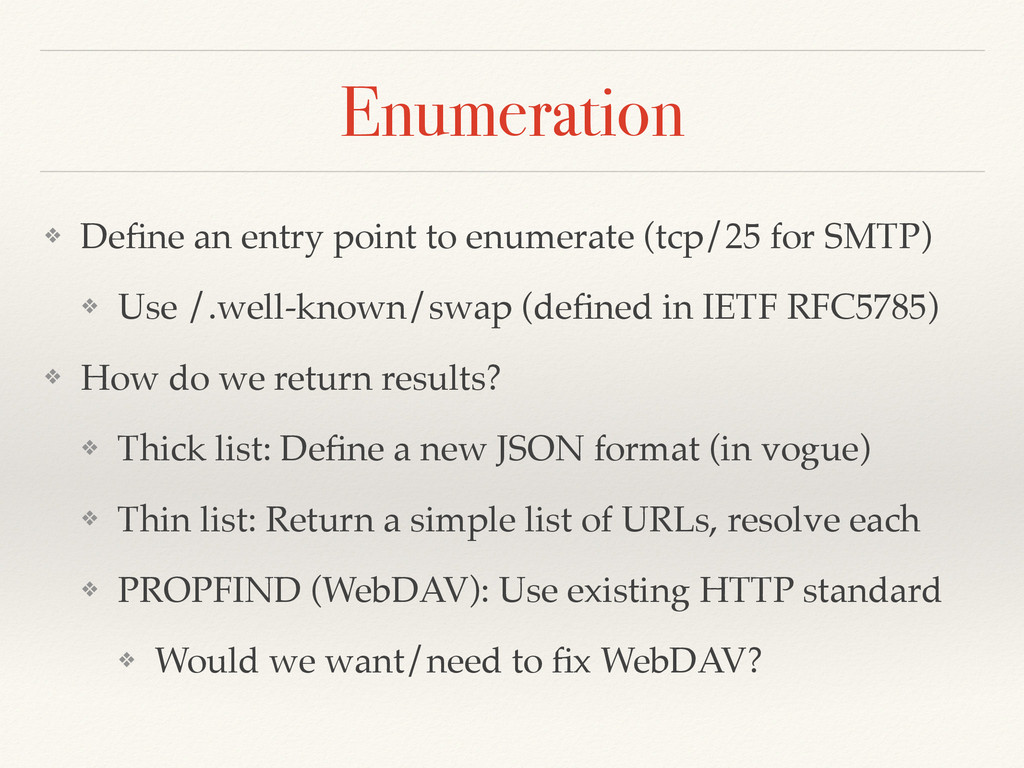
  14. Enumeration ❖ Define an entry point to enumerate (tcp/25 for

    SMTP)! ❖ Use /.well-known/swap (defined in IETF RFC5785)! ❖ How do we return results?! ❖ Thick list: Define a new JSON format (in vogue)! ❖ Thin list: Return a simple list of URLs, resolve each! ❖ PROPFIND (WebDAV): Use existing HTTP standard! ❖ Would we want/need to fix WebDAV?
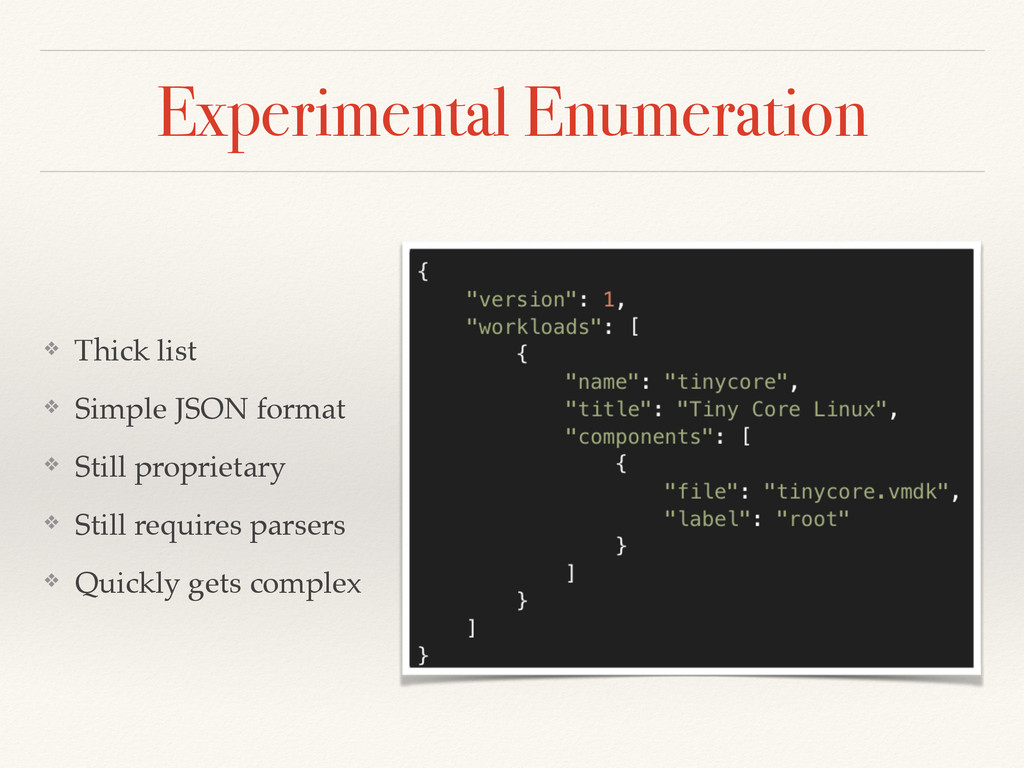
  15. Experimental Enumeration ❖ Thick list! ❖ Simple JSON format! ❖

    Still proprietary! ❖ Still requires parsers! ❖ Quickly gets complex
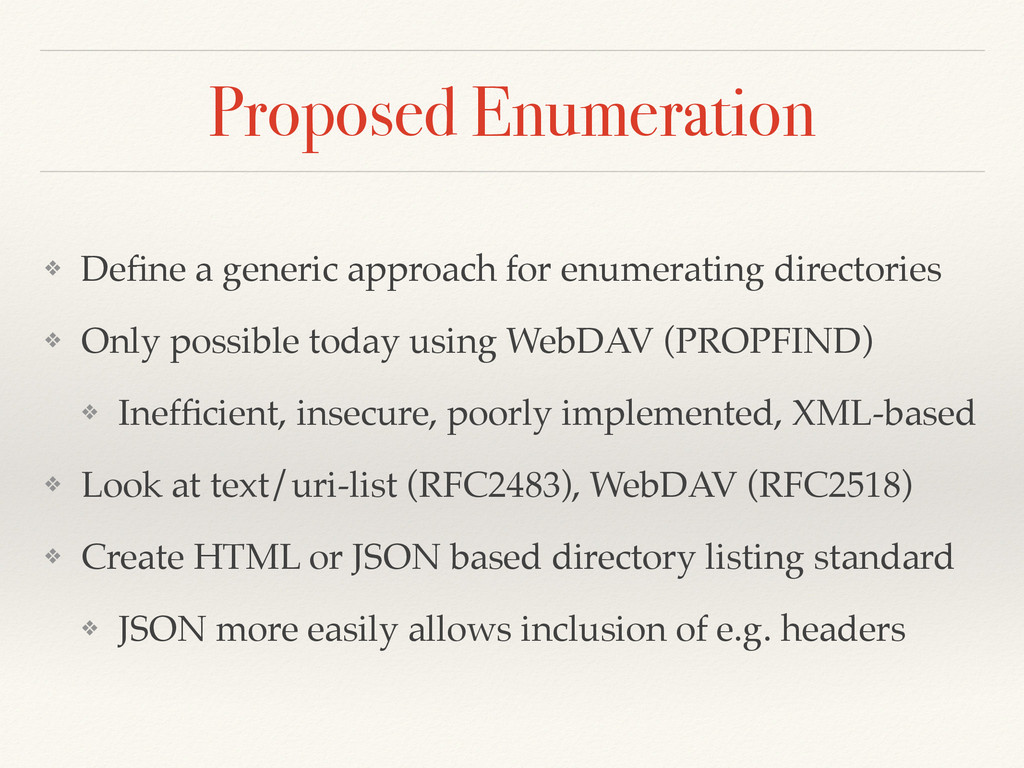
  16. Proposed Enumeration ❖ Define a generic approach for enumerating directories!

    ❖ Only possible today using WebDAV (PROPFIND)! ❖ Inefficient, insecure, poorly implemented, XML-based! ❖ Look at text/uri-list (RFC2483), WebDAV (RFC2518)! ❖ Create HTML or JSON based directory listing standard! ❖ JSON more easily allows inclusion of e.g. headers
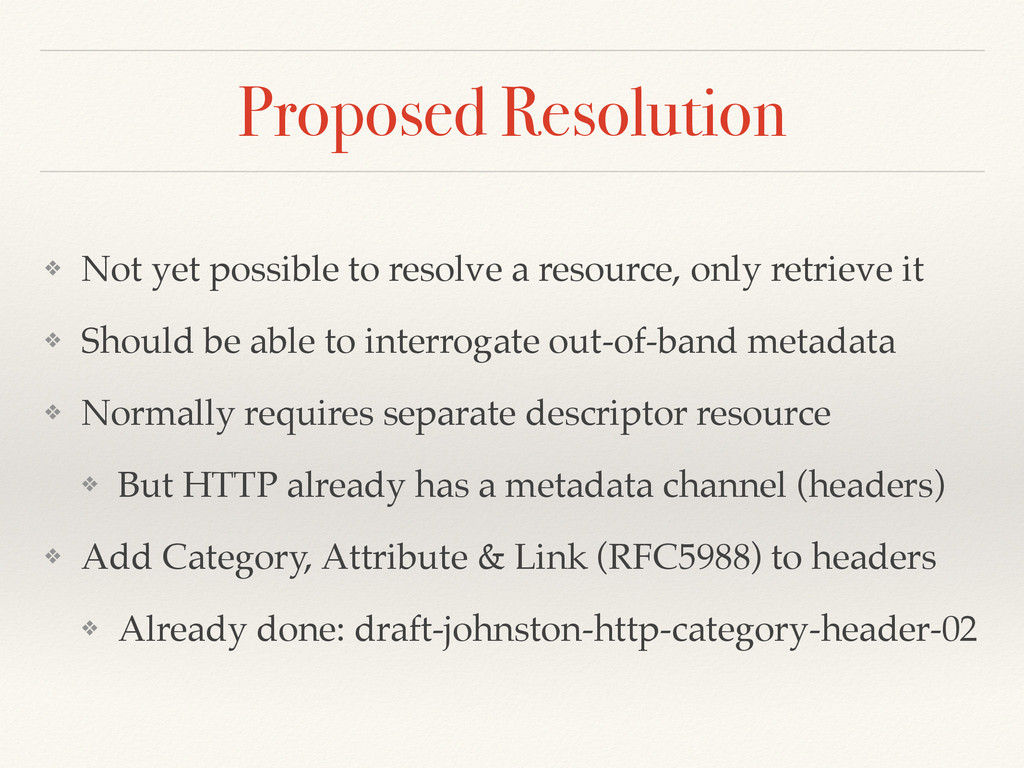
  17. Proposed Resolution ❖ Not yet possible to resolve a resource,

    only retrieve it! ❖ Should be able to interrogate out-of-band metadata! ❖ Normally requires separate descriptor resource! ❖ But HTTP already has a metadata channel (headers)! ❖ Add Category, Attribute & Link (RFC5988) to headers! ❖ Already done: draft-johnston-http-category-header-02
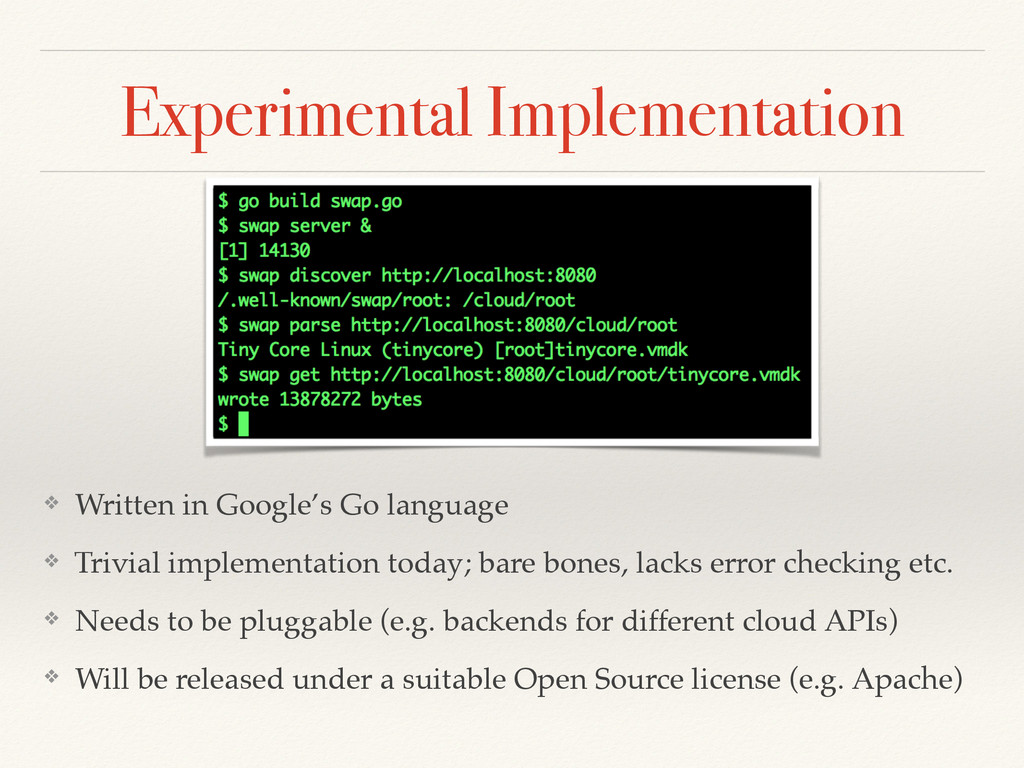
  18. Experimental Implementation ❖ Written in Google’s Go language! ❖ Trivial

    implementation today; bare bones, lacks error checking etc.! ❖ Needs to be pluggable (e.g. backends for different cloud APIs)! ❖ Will be released under a suitable Open Source license (e.g. Apache)
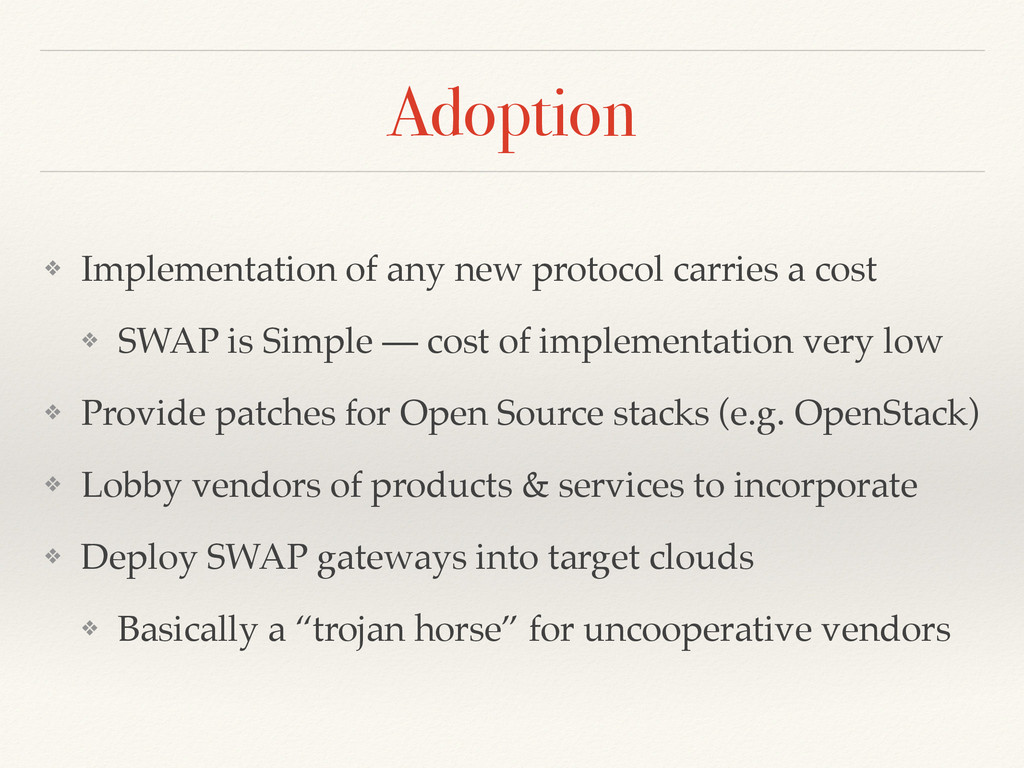
  19. Adoption ❖ Implementation of any new protocol carries a cost!

    ❖ SWAP is Simple — cost of implementation very low! ❖ Provide patches for Open Source stacks (e.g. OpenStack)! ❖ Lobby vendors of products & services to incorporate! ❖ Deploy SWAP gateways into target clouds! ❖ Basically a “trojan horse” for uncooperative vendors
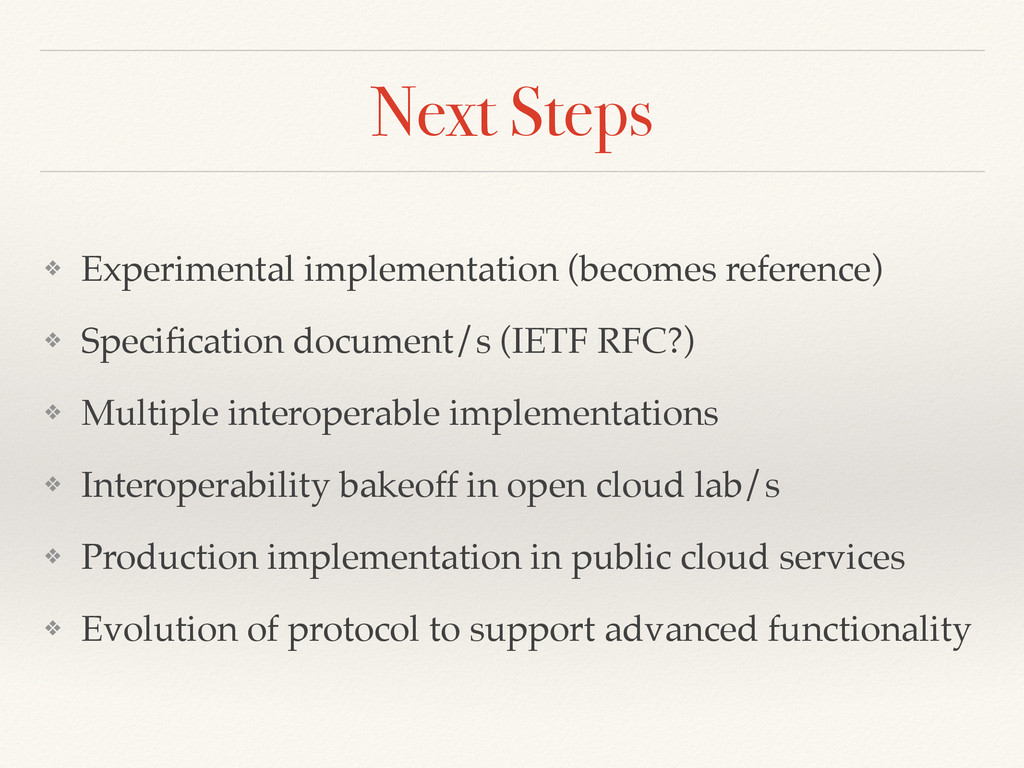
  20. Next Steps ❖ Experimental implementation (becomes reference)! ❖ Specification document/s

    (IETF RFC?)! ❖ Multiple interoperable implementations! ❖ Interoperability bakeoff in open cloud lab/s! ❖ Production implementation in public cloud services! ❖ Evolution of protocol to support advanced functionality