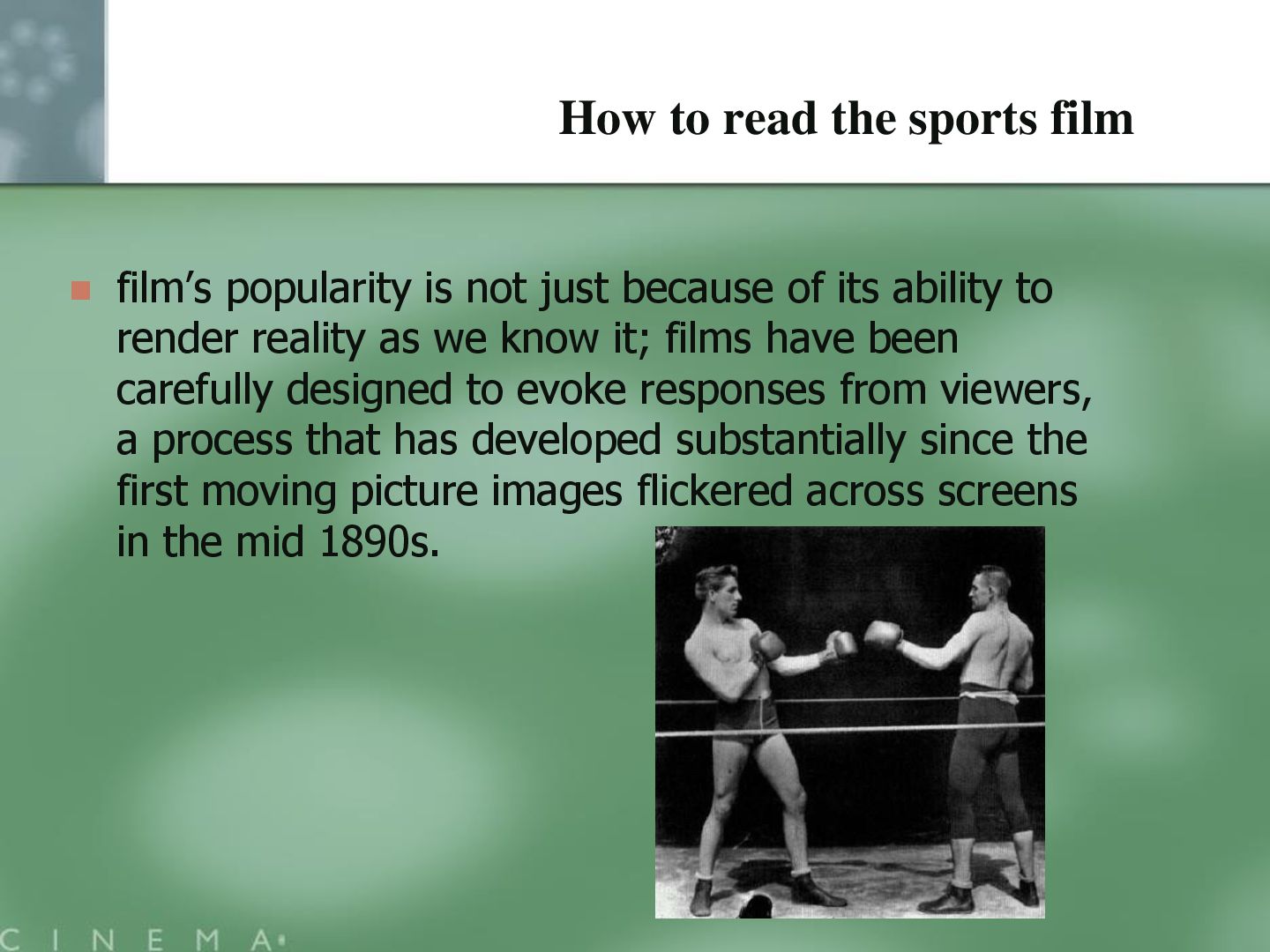
not just because of its ability to render reality as we know it; films have been carefully designed to evoke responses from viewers, a process that has developed substantially since the first moving picture images flickered across screens in the mid 1890s.
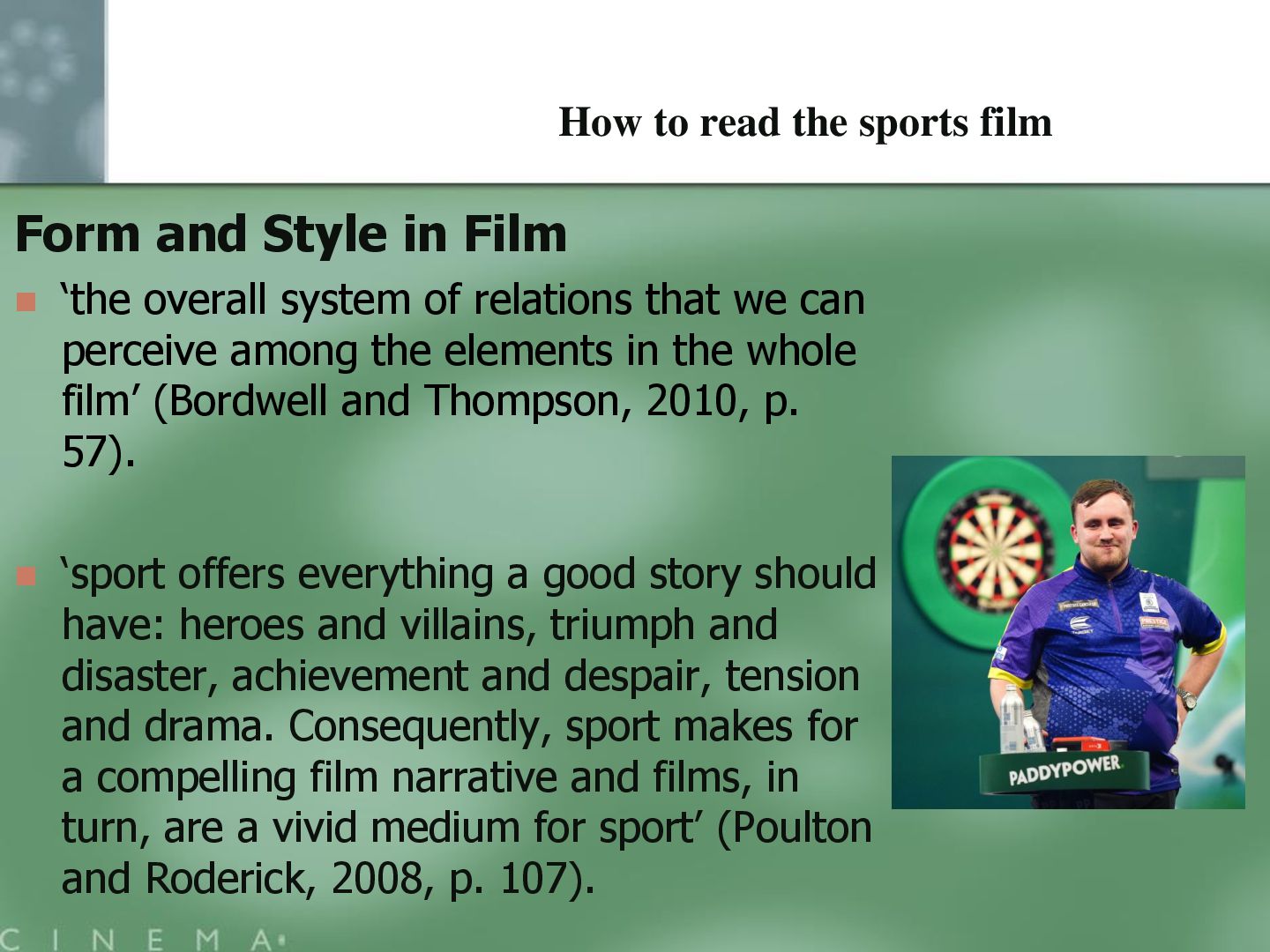
Film ‘the overall system of relations that we can perceive among the elements in the whole film’ (Bordwell and Thompson, 2010, p. 57). ‘sport offers everything a good story should have: heroes and villains, triumph and disaster, achievement and despair, tension and drama. Consequently, sport makes for a compelling film narrative and films, in turn, are a vivid medium for sport’ (Poulton and Roderick, 2008, p. 107).
chain of events linked by cause and effect and occurring in time and space’ (Bordwell and Thompson, 2010, p 79). composed principally of two elements, story and plot.
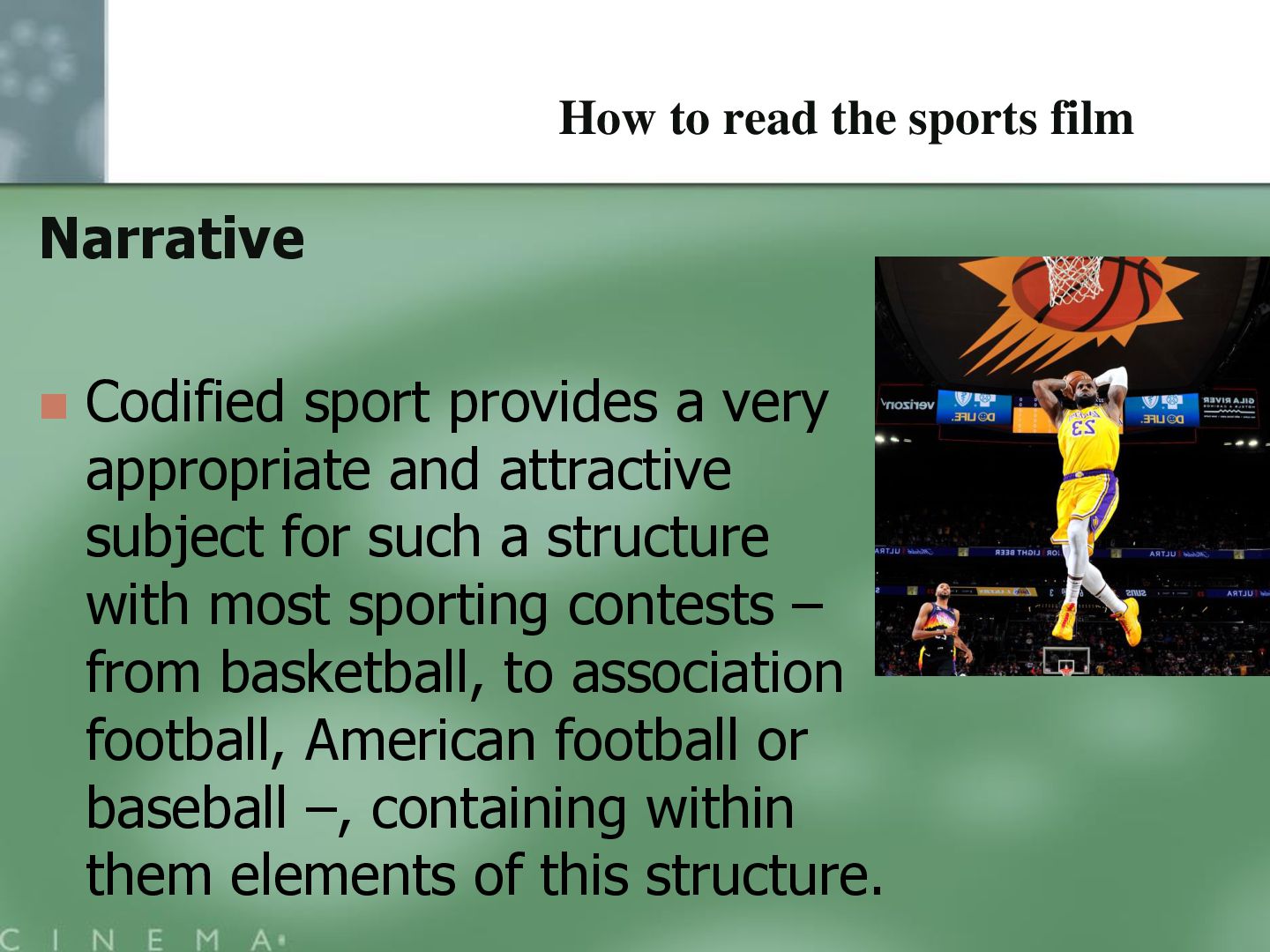
provides a very appropriate and attractive subject for such a structure with most sporting contests – from basketball, to association football, American football or baseball –, containing within them elements of this structure.
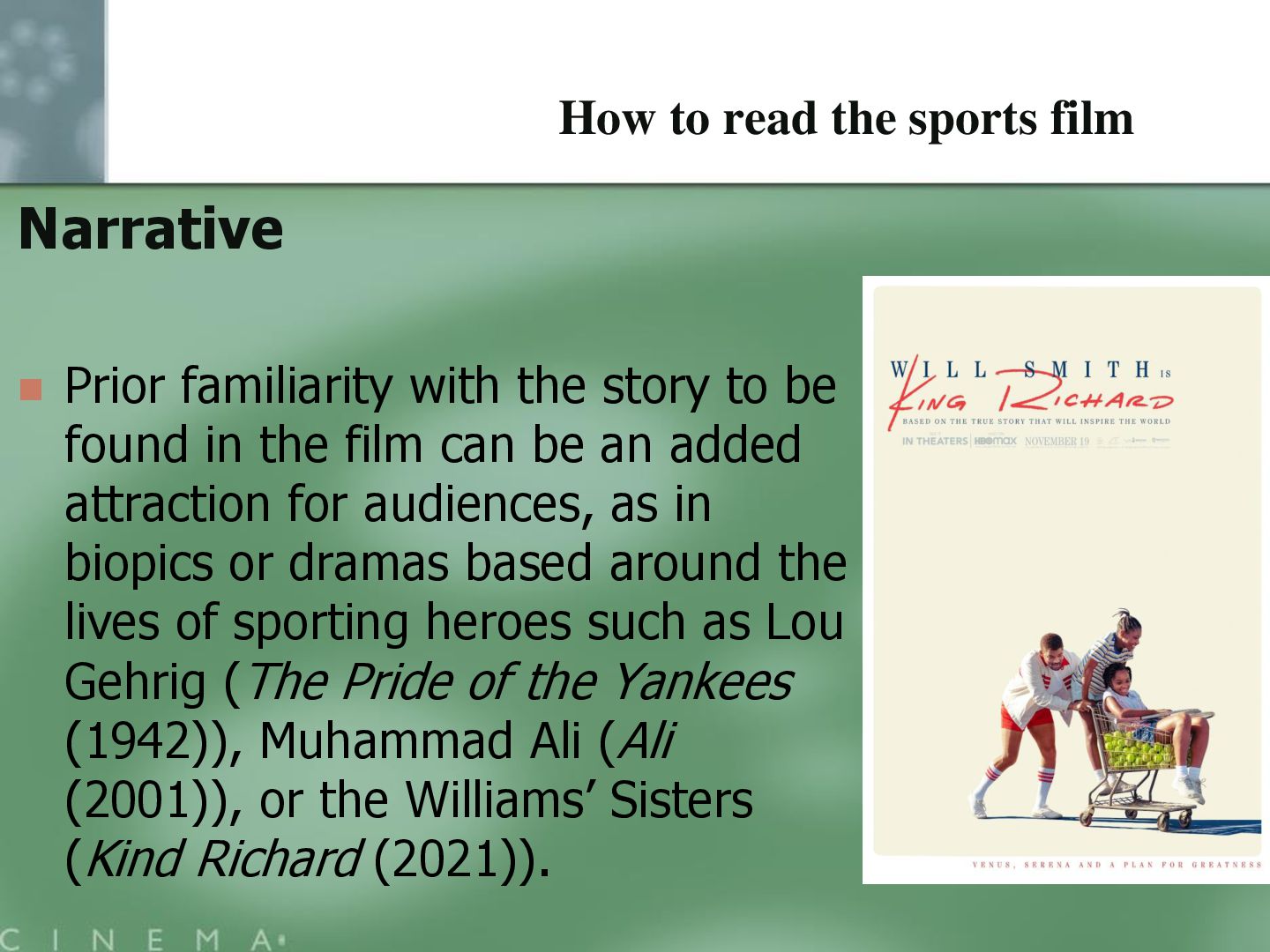
with the story to be found in the film can be an added attraction for audiences, as in biopics or dramas based around the lives of sporting heroes such as Lou Gehrig (The Pride of the Yankees (1942)), Muhammad Ali (Ali (2001)), or the Williams’ Sisters (Kind Richard (2021)).
Much as sport has been described as taking place ‘within limits set in explicit and formal rules governing role and position relationships’ (Edwards, 1973, pp. 57-58), Thomas Schatz has defined film genre as ‘a specific grammar or system of rules of expression and construction and the individual genre film as a manifestation of these rules’ (1991, p. 644).
and Thompson observe, most ‘patterns of plot development depend heavily on the ways that causes and effects create a change in a character’s situation. The most common general pattern is a change in knowledge’ (2010, p. 91). A very popular pattern of development in Hollywood and commercial film is the goal-orientated plot in which a character or characters attempt to achieve specific goals or outcomes.
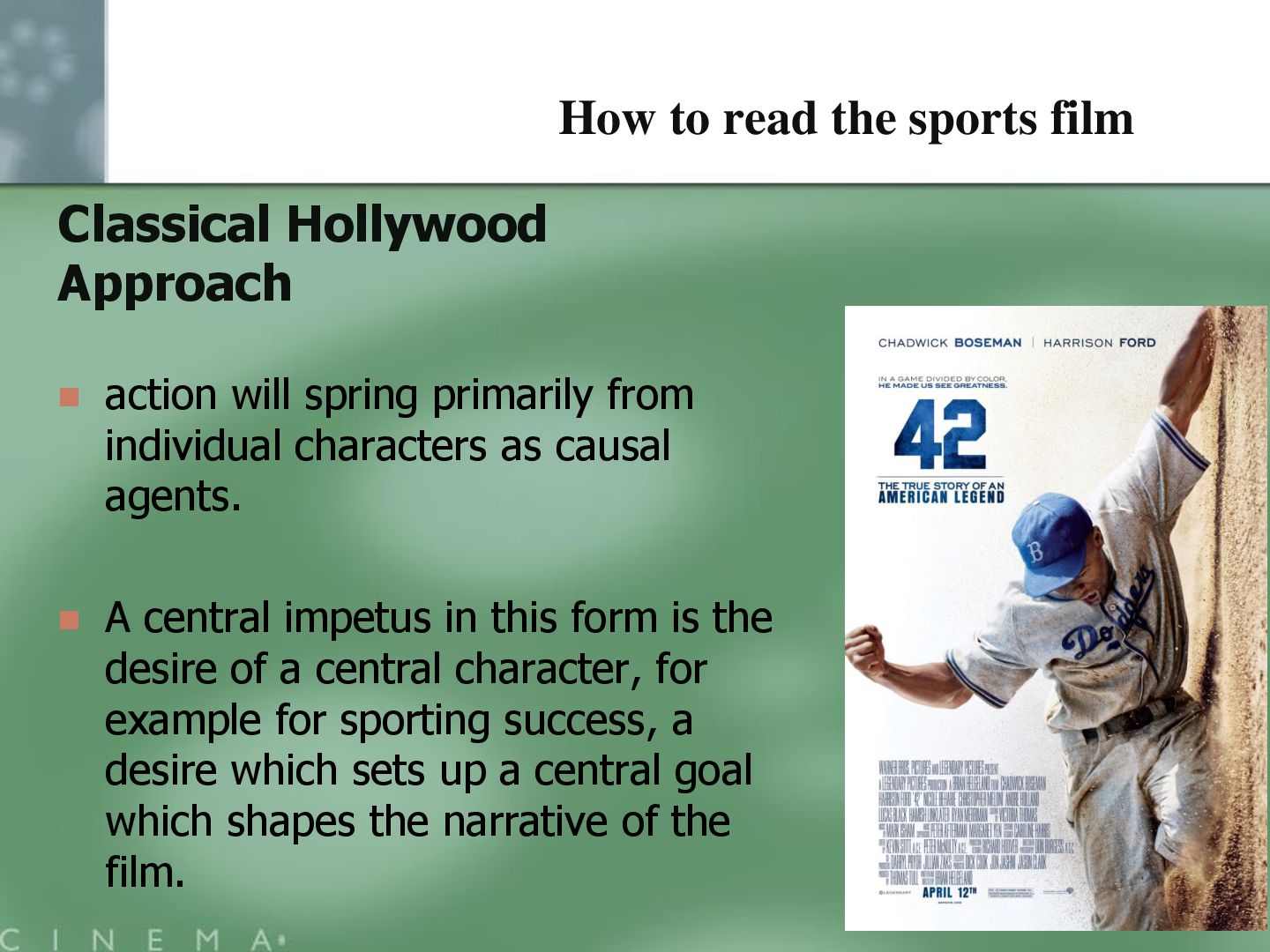
action will spring primarily from individual characters as causal agents. A central impetus in this form is the desire of a central character, for example for sporting success, a desire which sets up a central goal which shapes the narrative of the film.
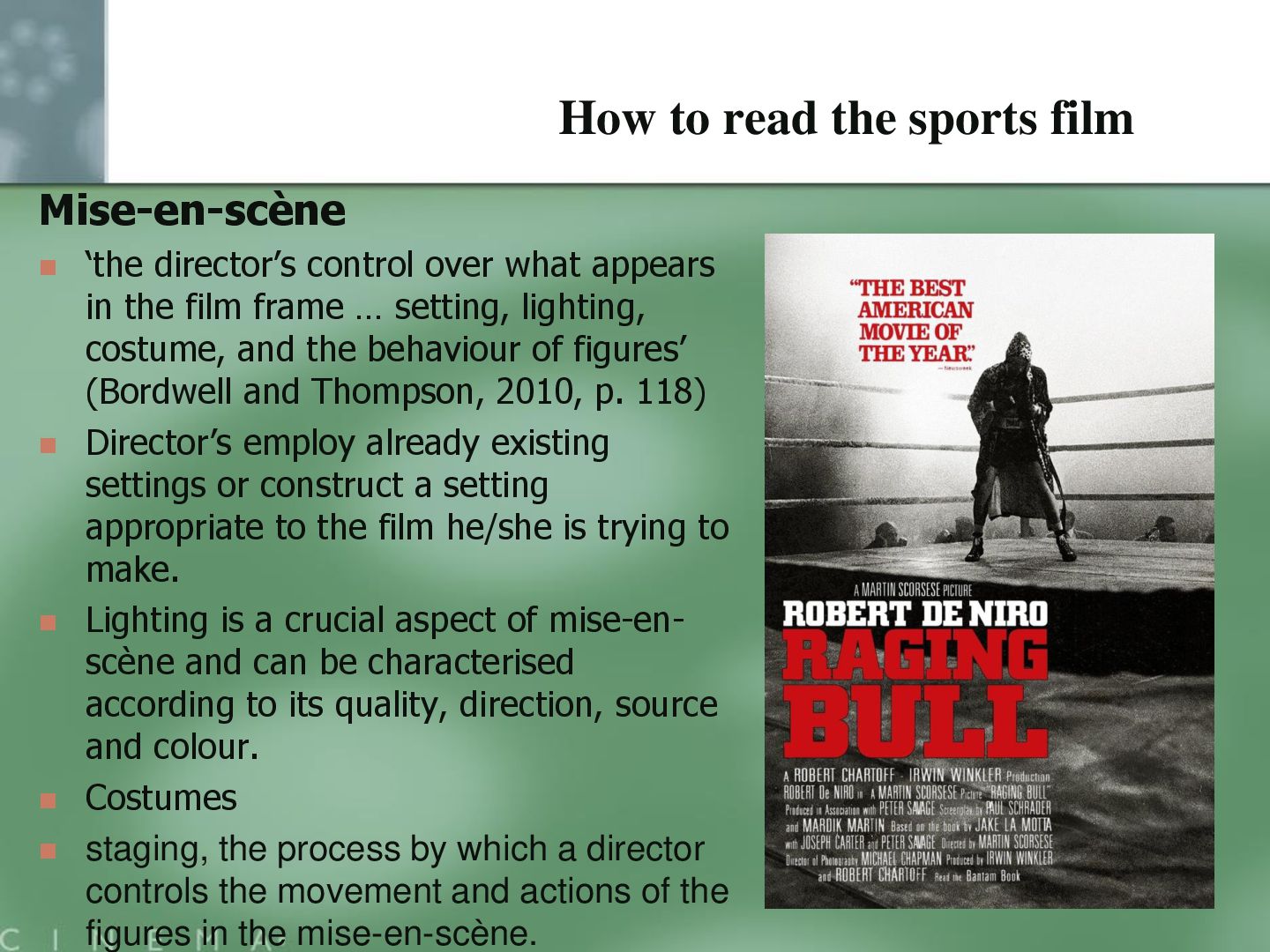
control over what appears in the film frame … setting, lighting, costume, and the behaviour of figures’ (Bordwell and Thompson, 2010, p. 118) Director’s employ already existing settings or construct a setting appropriate to the film he/she is trying to make. Lighting is a crucial aspect of mise-en- scène and can be characterised according to its quality, direction, source and colour. Costumes staging, the process by which a director controls the movement and actions of the figures in the mise-en-scène.
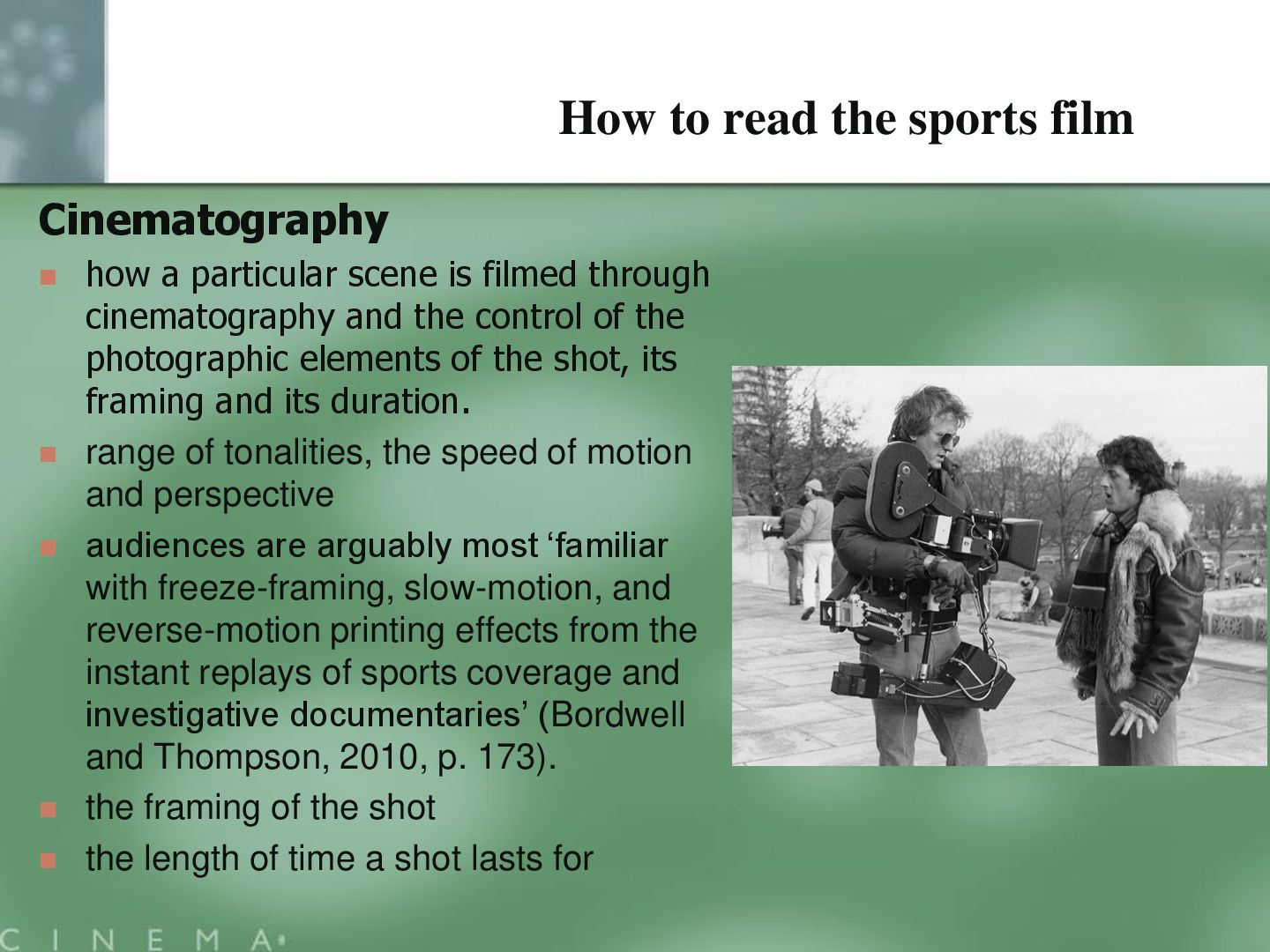
particular scene is filmed through cinematography and the control of the photographic elements of the shot, its framing and its duration. range of tonalities, the speed of motion and perspective audiences are arguably most ‘familiar with freeze-framing, slow-motion, and reverse-motion printing effects from the instant replays of sports coverage and investigative documentaries’ (Bordwell and Thompson, 2010, p. 173). the framing of the shot the length of time a shot lasts for
on perceptions and interpretations of the subject depicted, all the more so as audiences tend to underestimate the role of sound. Loudness pitch (‘perceived highness or lowness of a sound’) timbre (‘color, or tone quality’) of sounds (Bordwell and Thompson, 2010, p. 273). a spatial dimension as it originates from a source. diegetic, originating in the film’s story world non-diegetic
of one shot with the next’ fade-out (darkening the end of the shot) a fade-in (brightening a shot from black) a dissolve (superimposing the end of one shot over the beginning of the next) the wipe (replacing one shot with another by a line moving across the screen) (Bordwell and Thompson, 2010, p. 223). Most commonly shots are joined in film by a cut, whereby one shot is instantaneously replaced by another, a transition often barely perceptible to the viewer in the continuity editing style popularised by Hollywood cinema.
concerned with permitting space, time and action to flow as seamlessly as possible over a series of shots. dictates a number of spatial and stylistic rule parallel editing or crosscutting the exploitation of the continuity style in sports films has ideological consequences
are frequently narrated by announcers in the style of television or radio coverage and shown with a continuity editing style that makes the sequence of shots seem motivated by the logic of the events rather than the choices of filmmakers. For historical sports films this representational style has special resonance because it recalls real events in sports “history”: athletic contests that the audience has witnessed in the past. Heightened realism in scenes in which the star competes is especially important in validating an ideology of agency that assumes that individual performance in these situations counts most in making the athlete what he is.” (Aaron Baker, 2003, p. 13).
Films have meanings and these range from referential to explicit, implicit and symptomatic. referential meanings refer to the obvious concrete plot features of the film explicit meaning might be termed the moral or central message of the film Implicit meanings are less concrete and not directly stated and depend heavily on the interpretation of viewers. “it’s possible to understand a film’s explicit or implicit meanings as bearing traces of a particular set of social values. We can call this symptomatic meaning, and the set of values that get revealed can be considered a social ideology” (Bordwell and Thompson, 2010, p. 65)
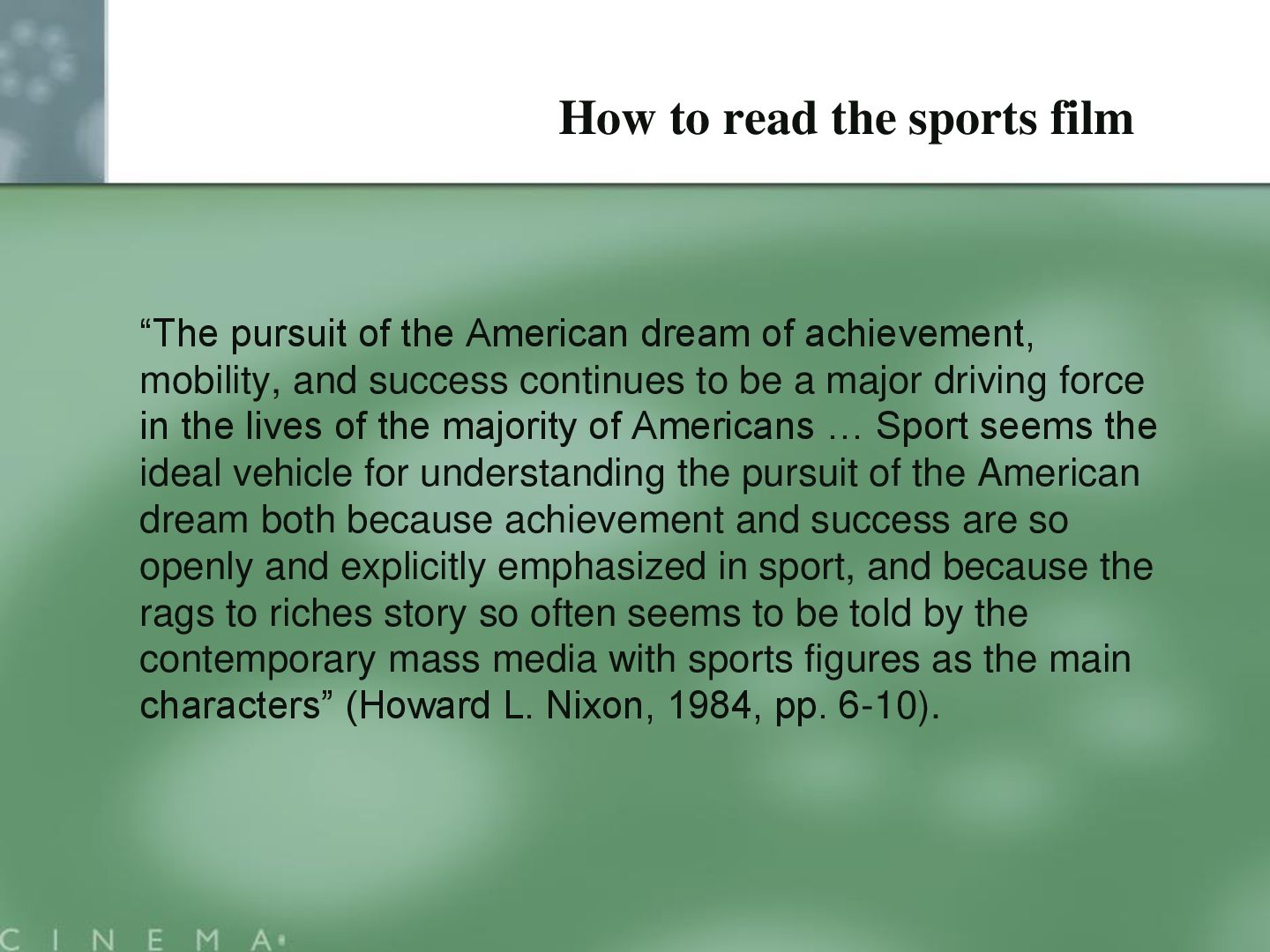
to understanding the role of sport in film. Sports themed films exploit and evoke responses from viewers not just as a result of the powerful effects that film as a form in and of itself can produce, but also from the associations that sport already has in particular societies. Sport in the United States, for example, is associated with a central ideology in American life, the American Dream.
American dream of achievement, mobility, and success continues to be a major driving force in the lives of the majority of Americans … Sport seems the ideal vehicle for understanding the pursuit of the American dream both because achievement and success are so openly and explicitly emphasized in sport, and because the rags to riches story so often seems to be told by the contemporary mass media with sports figures as the main characters” (Howard L. Nixon, 1984, pp. 6-10).
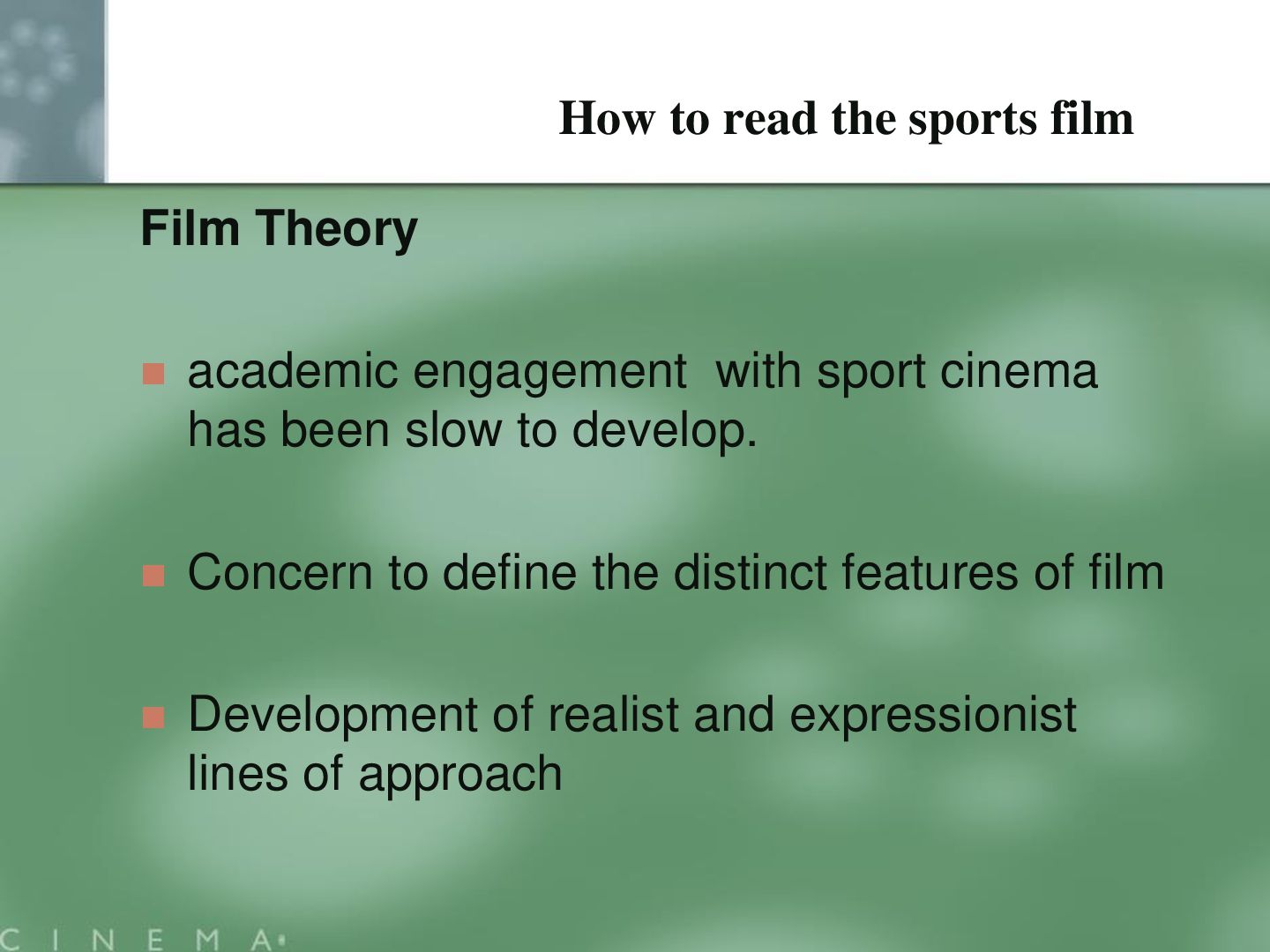
engagement with sport cinema has been slow to develop. Concern to define the distinct features of film Development of realist and expressionist lines of approach
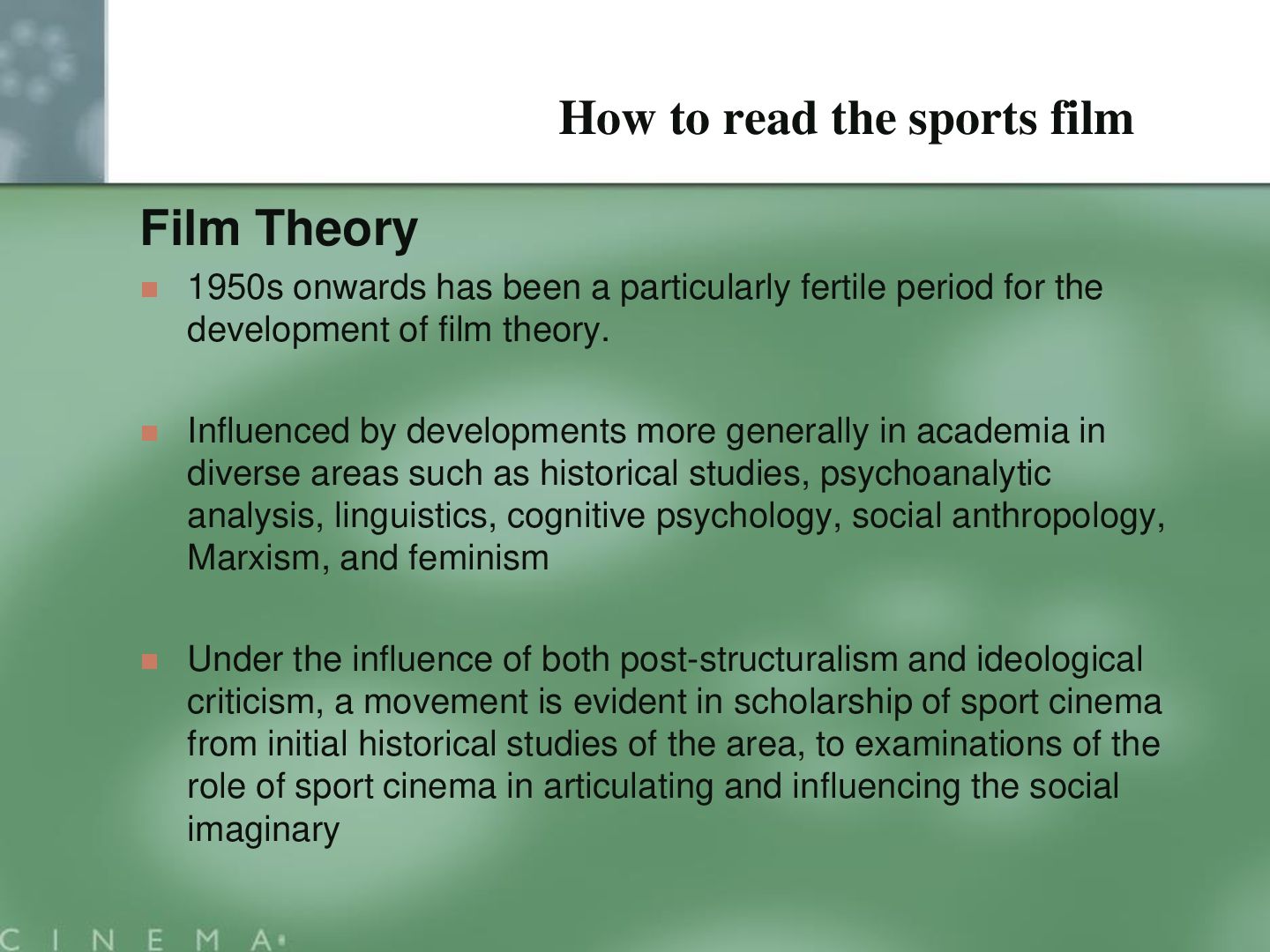
onwards has been a particularly fertile period for the development of film theory. Influenced by developments more generally in academia in diverse areas such as historical studies, psychoanalytic analysis, linguistics, cognitive psychology, social anthropology, Marxism, and feminism Under the influence of both post-structuralism and ideological criticism, a movement is evident in scholarship of sport cinema from initial historical studies of the area, to examinations of the role of sport cinema in articulating and influencing the social imaginary
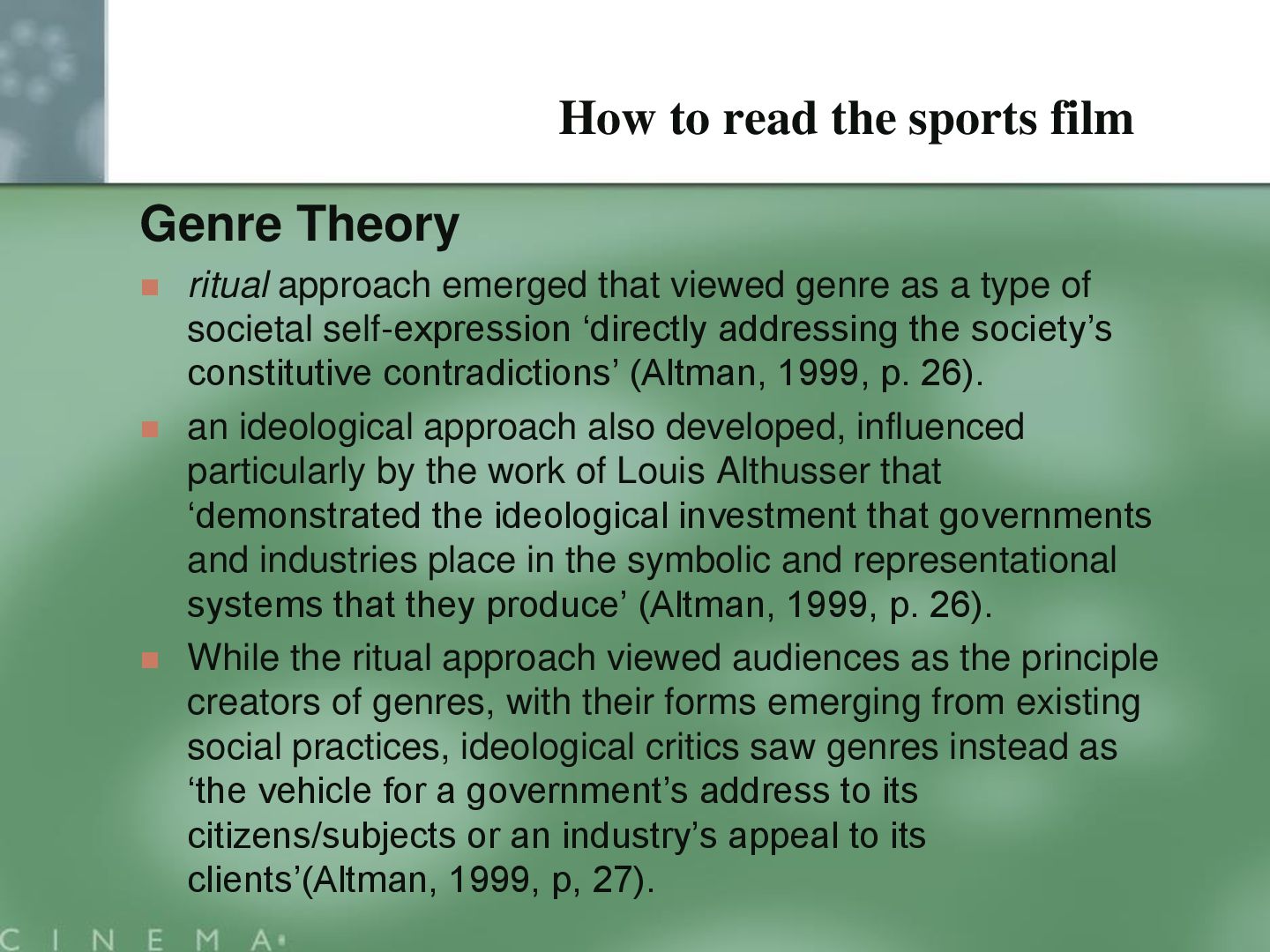
approach emerged that viewed genre as a type of societal self-expression ‘directly addressing the society’s constitutive contradictions’ (Altman, 1999, p. 26). an ideological approach also developed, influenced particularly by the work of Louis Althusser that ‘demonstrated the ideological investment that governments and industries place in the symbolic and representational systems that they produce’ (Altman, 1999, p. 26). While the ritual approach viewed audiences as the principle creators of genres, with their forms emerging from existing social practices, ideological critics saw genres instead as ‘the vehicle for a government’s address to its citizens/subjects or an industry’s appeal to its clients’(Altman, 1999, p, 27).
Cinema While Dickerson (1991) contends that Hollywood sports films mirror “the changes of the culture that gives birth to the films” (p. 153), for Baker (2003), these films also “contribute to the contested process of defining social identities” (p. 2). Informed by influential work in the broader cultural studies/communication studies fields (including Hall, 1973; Morley, 1980) studies of sport cinema have engaged with the role relevant texts have had in either affirming and influencing dominant values and their acceptance or (occasionally) the potential of individual texts for progressive, alternative or oppositional readings, what Mathia Diawara described (in relation to African American audiences) as “resisting spectatorship” (Diawara, 2004).
Cinema A central concern within cultural studies is the meanings particular cultural products, such as film, produce and how they are circulated and received. Examines the manner through which popular film displaces the causes of social conflict in works that ultimately attempt to affirm the hegemonic order. sports films engage repeatedly in this process, foregrounding oppositional and counter-cultural elements before attempting to affirm the hegemonic order.
sport has developed as a key and highly influential aspect of popular culture, so too sport cinema has responded and magnified central aspects of sport’s appeal. due both to the low-regard with which sports films were held for much of the twentieth century and the focus of scholars on identifying distinctive traits of film itself as an art form, scholarship of sport cinema was slow to develop
of this critical discourse over the past forty years has involved a broad range of disciplines and areas, with the influence of cultural studies particularly evident in relevant scholarship. As scholars of cultural studies have argued, film plays a critical role as a mediator of social relations through the naturalization of cultural and societal norms (Boyle, Millington, & Vertinsky, 2006, p, 110; Croteau & Hoynes, 2003; Schirato & Webb, 2004). This contention has informed the focus of research on the role and influence of sport cinema texts in articulating and informing broader discourses, including with regard to race, gender, social class, and national identity.


 brettharned
 jonrohan
 lara
lara
 nikkihalliwell
 jacobtomlinson
 michielstock
 smashingmag
 kneath
 nwiizo
 codingconduct
 inesmontani
 carmenintech