Upgrade to Pro — share decks privately, control downloads, hide ads and more …

Cloud Foundations on AWS

Sponsored · Your Podcast. Everywhere. Effortlessly. Share. Educate. Inspire. Entertain. You do you. We'll handle the rest.
Avatar for Sena Yakut Sena Yakut
August 21, 2026
13

Cloud Foundations on AWS

Avatar for Sena Yakut

Sena Yakut

August 21, 2026

More Decks by Sena Yakut

Transcript

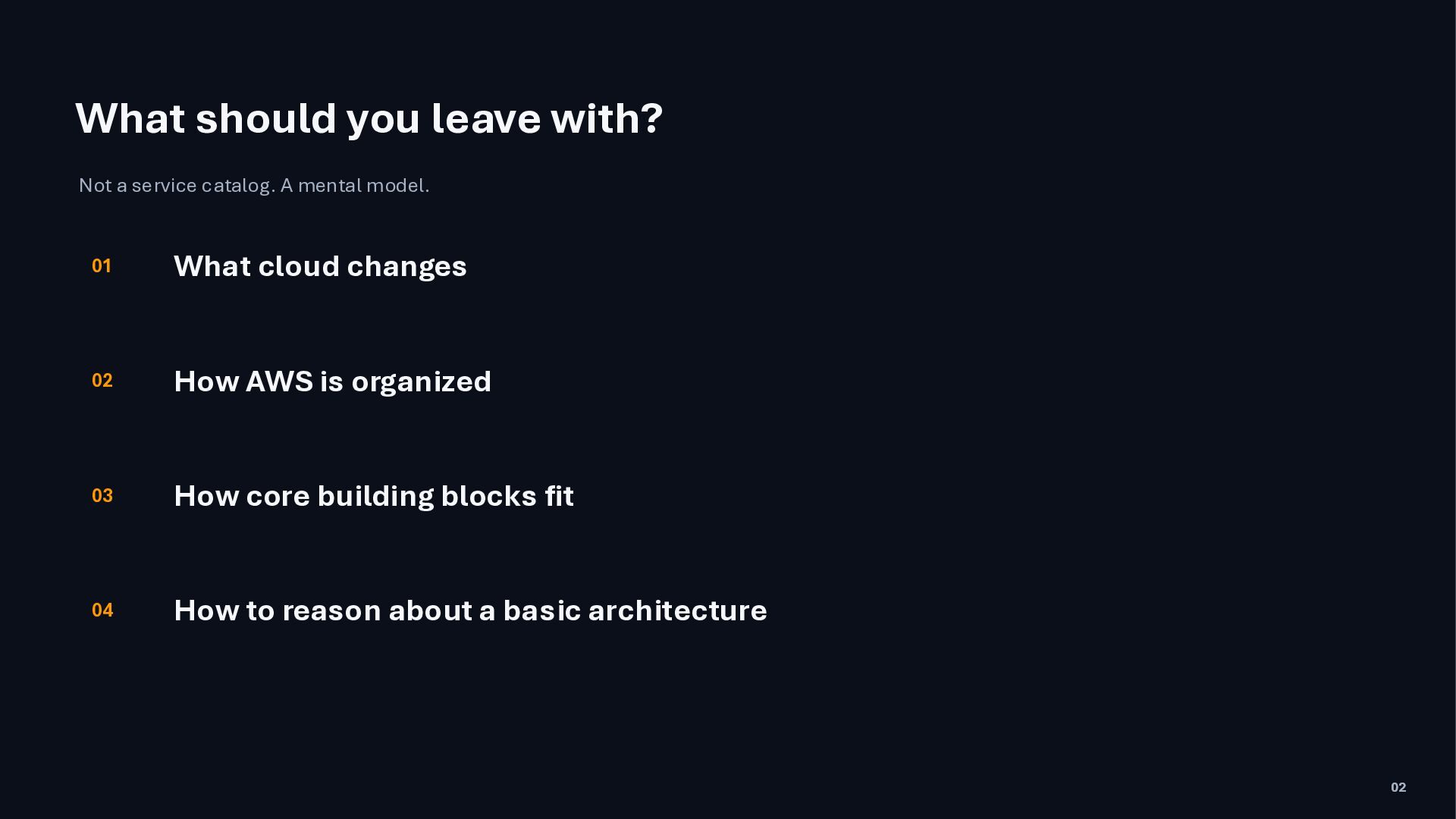
  1. What should you leave with? Not a service catalog. A

    mental model. 01 What cloud changes 02 How AWS is organized 03 How core building blocks fit 04 How to reason about a basic architecture 02
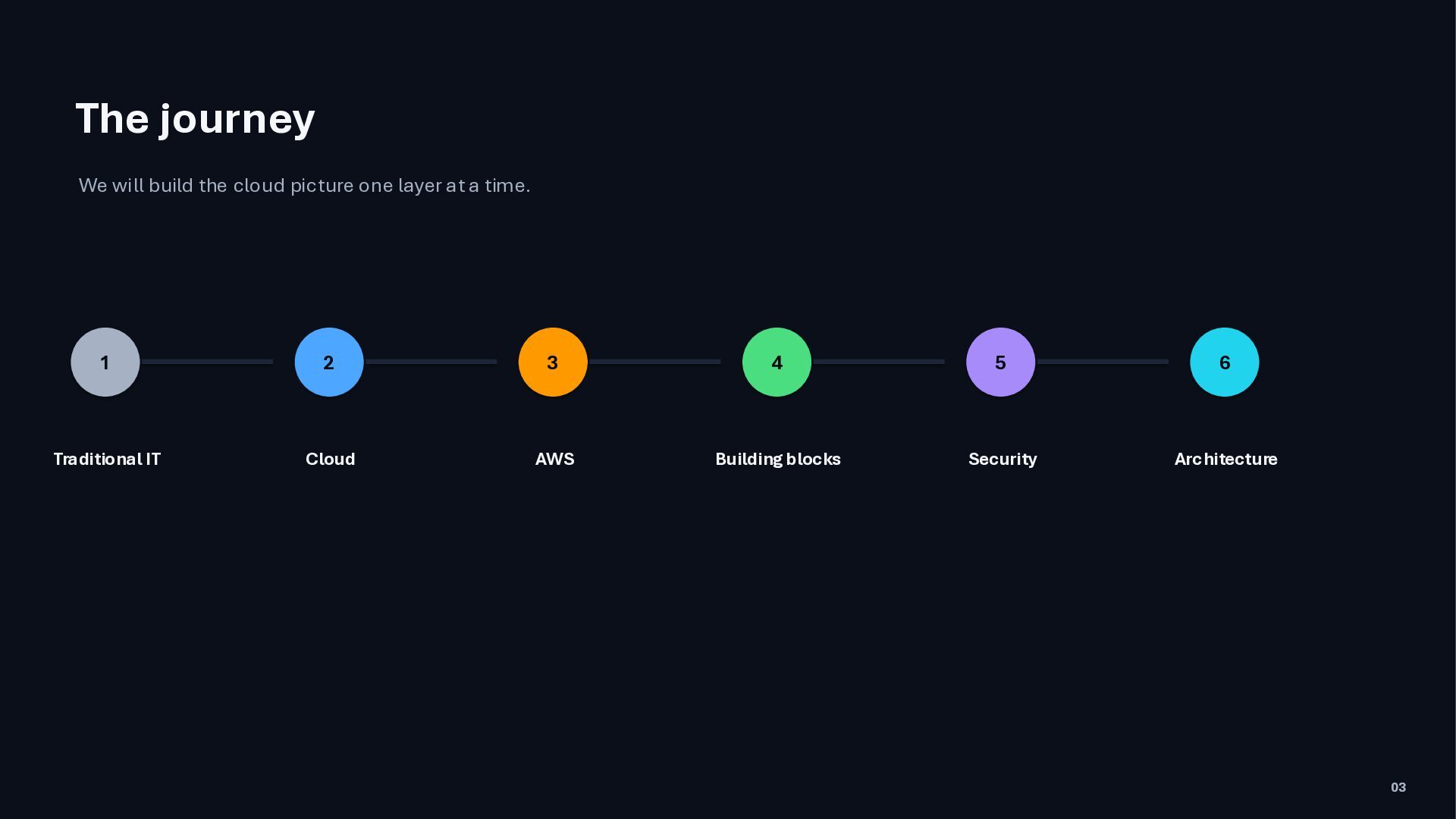
  2. The journey We will build the cloud picture one layer

    at a time. 1 2 3 4 5 6 Traditional IT Cloud AWS Building blocks Security Architecture 03
  3. 01 From Traditional IT to Cloud Cloud changes the operating

    model before it changes the technology. 04
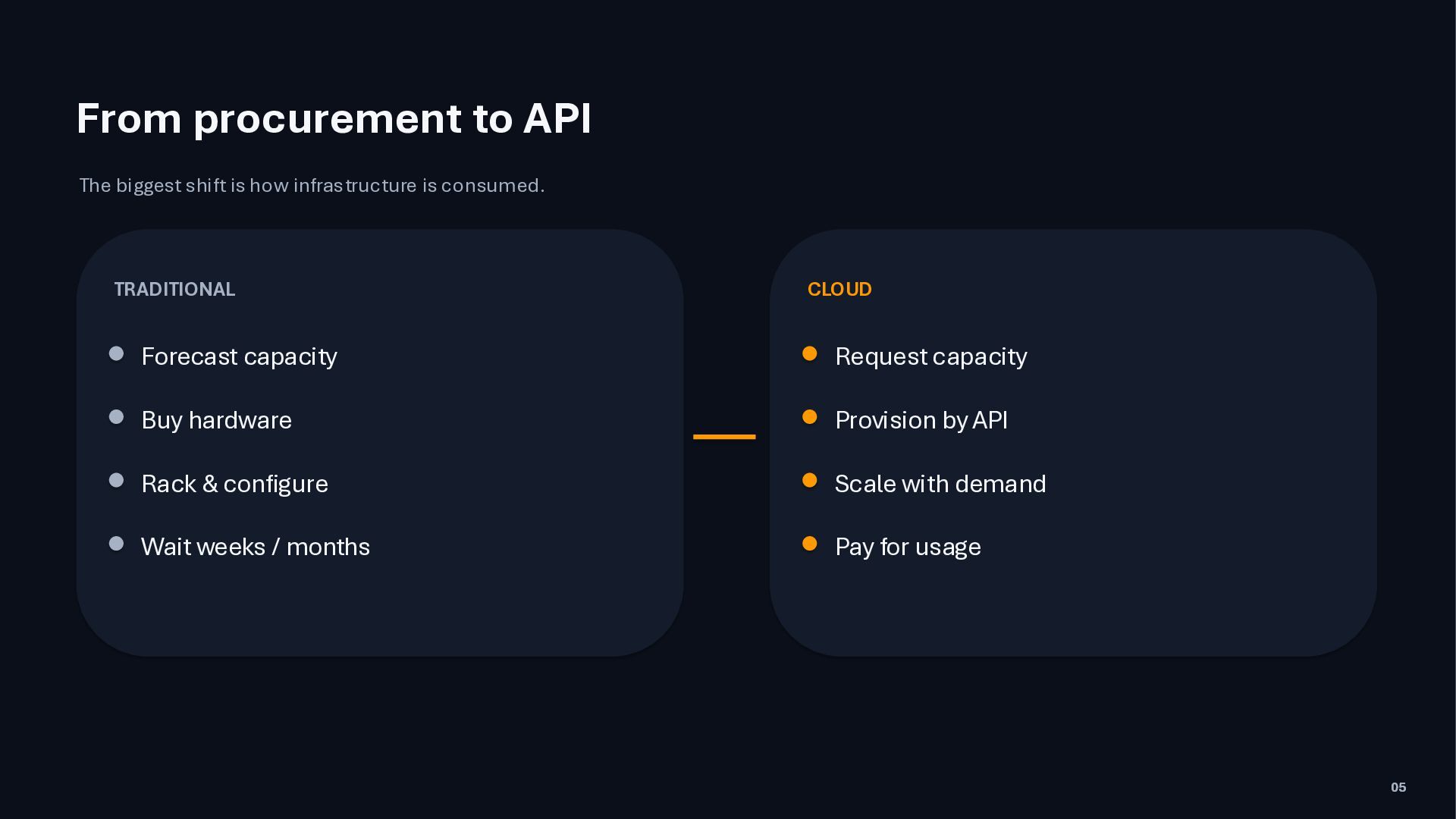
  4. From procurement to API The biggest shift is how infrastructure

    is consumed. TRADITIONAL CLOUD Forecast capacity Request capacity Buy hardware Provision by API Rack & configure Scale with demand Wait weeks / months Pay for usage 05
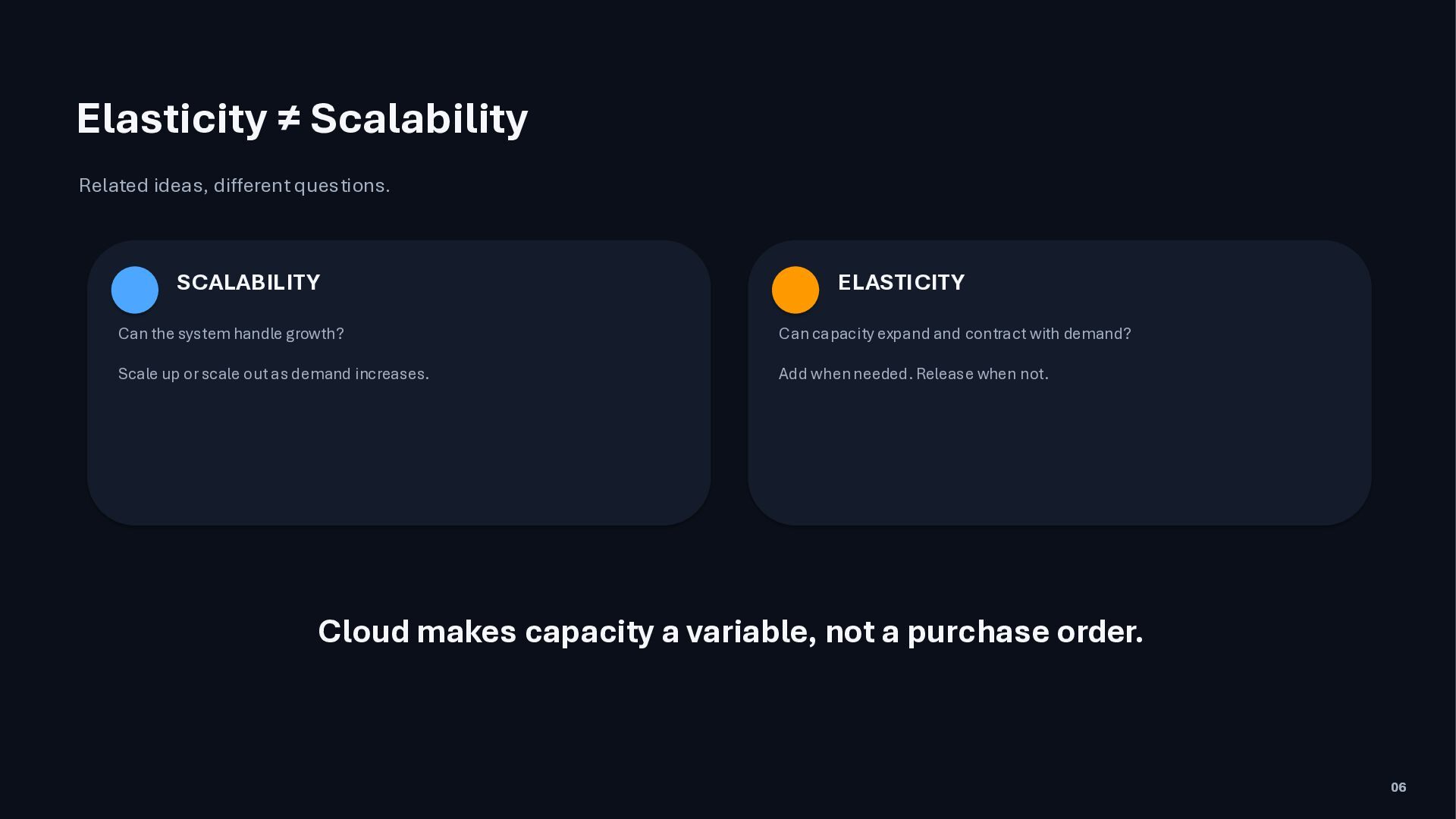
  5. Elasticity ≠ Scalability Related ideas, different questions. SCALABILITY ELASTICITY Can

    the system handle growth? Can capacity expand and contract with demand? Scale up or scale out as demand increases. Add when needed. Release when not. Cloud makes capacity a variable, not a purchase order. 06
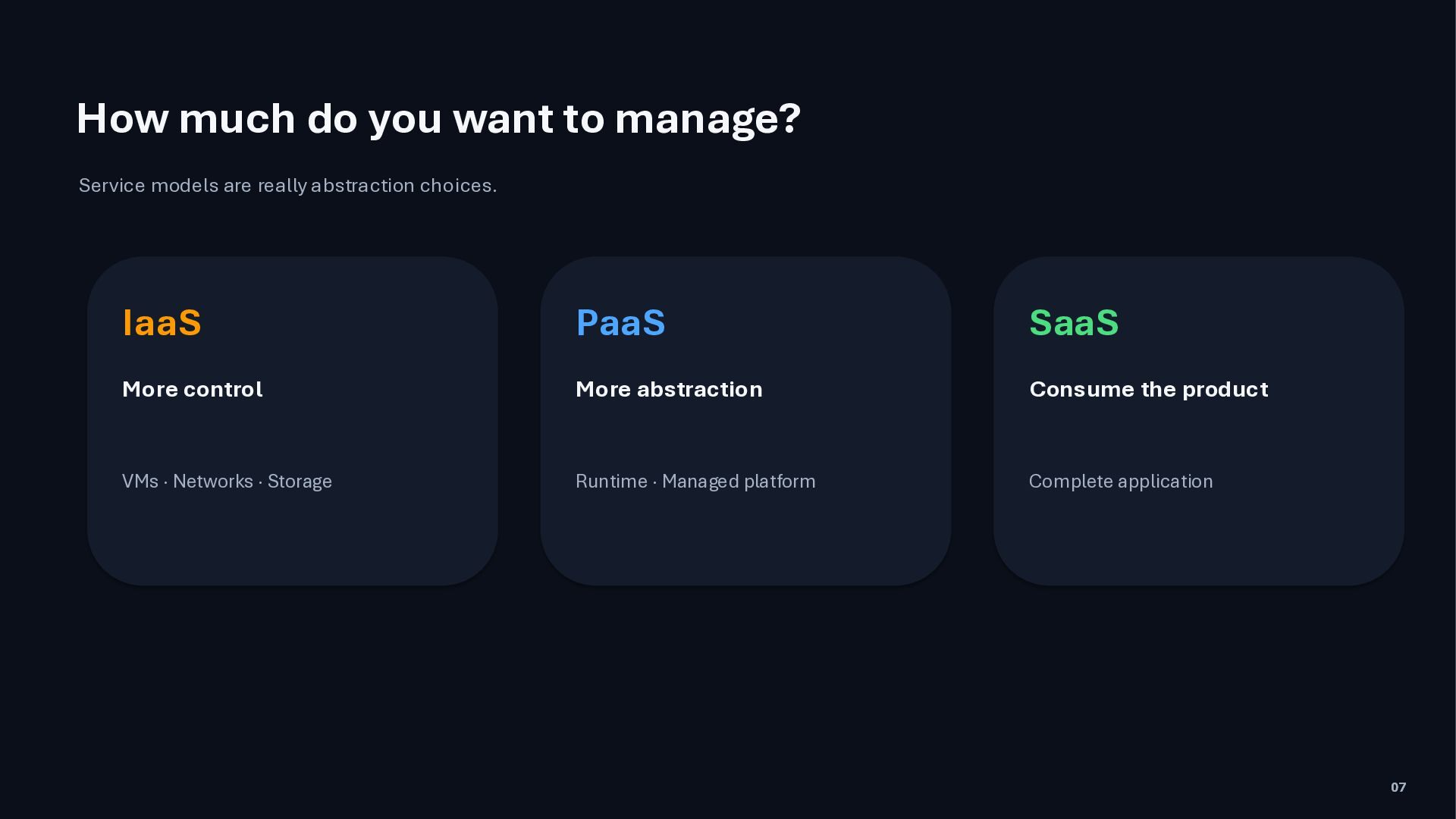
  6. How much do you want to manage? Service models are

    really abstraction choices. IaaS PaaS SaaS More control More abstraction Consume the product VMs · Networks · Storage Runtime · Managed platform Complete application 07
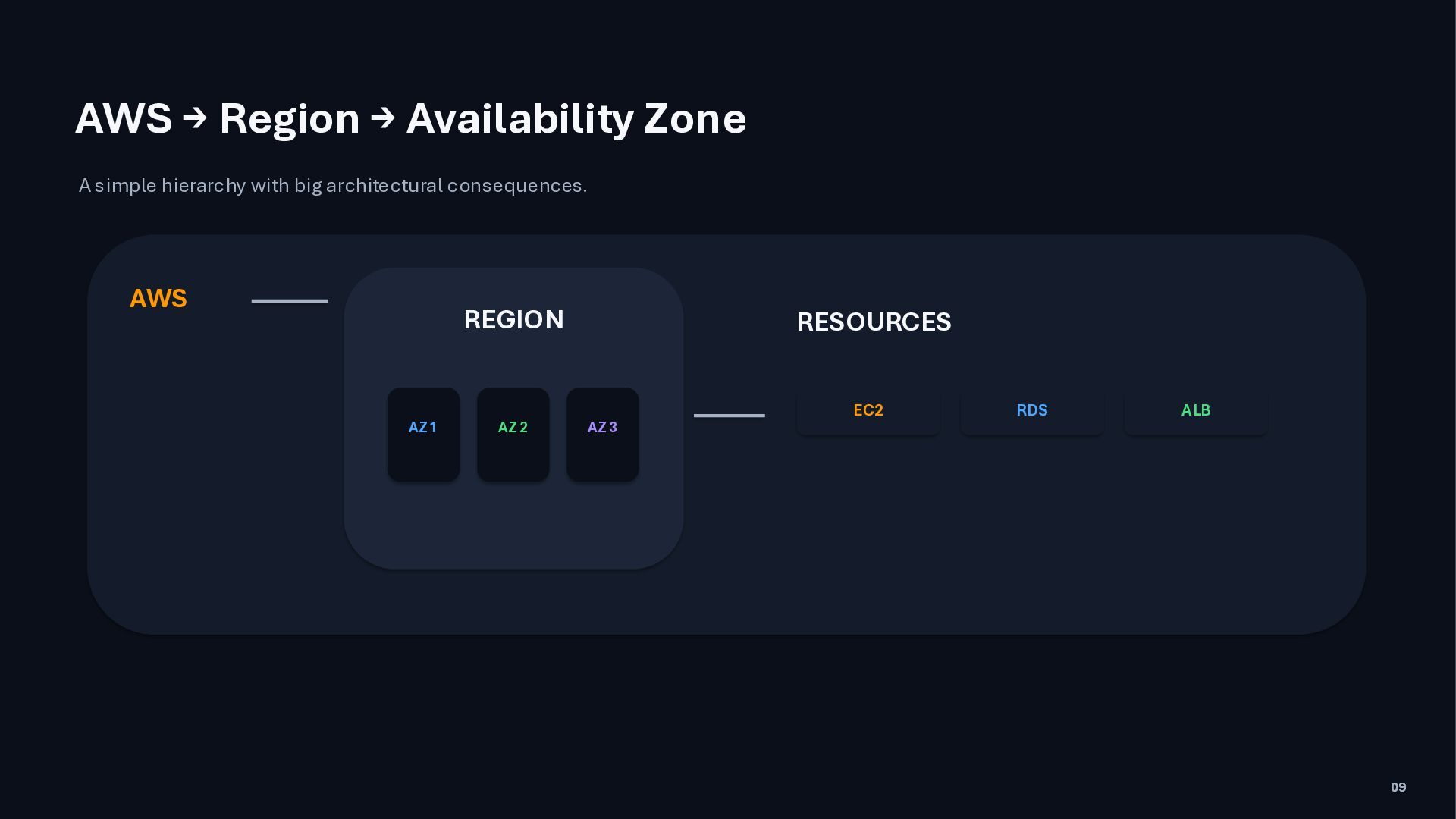
  7. AWS → Region → Availability Zone A simple hierarchy with

    big architectural consequences. AWS REGION AZ 1 AZ 2 RESOURCES AZ 3 EC2 RDS ALB 09
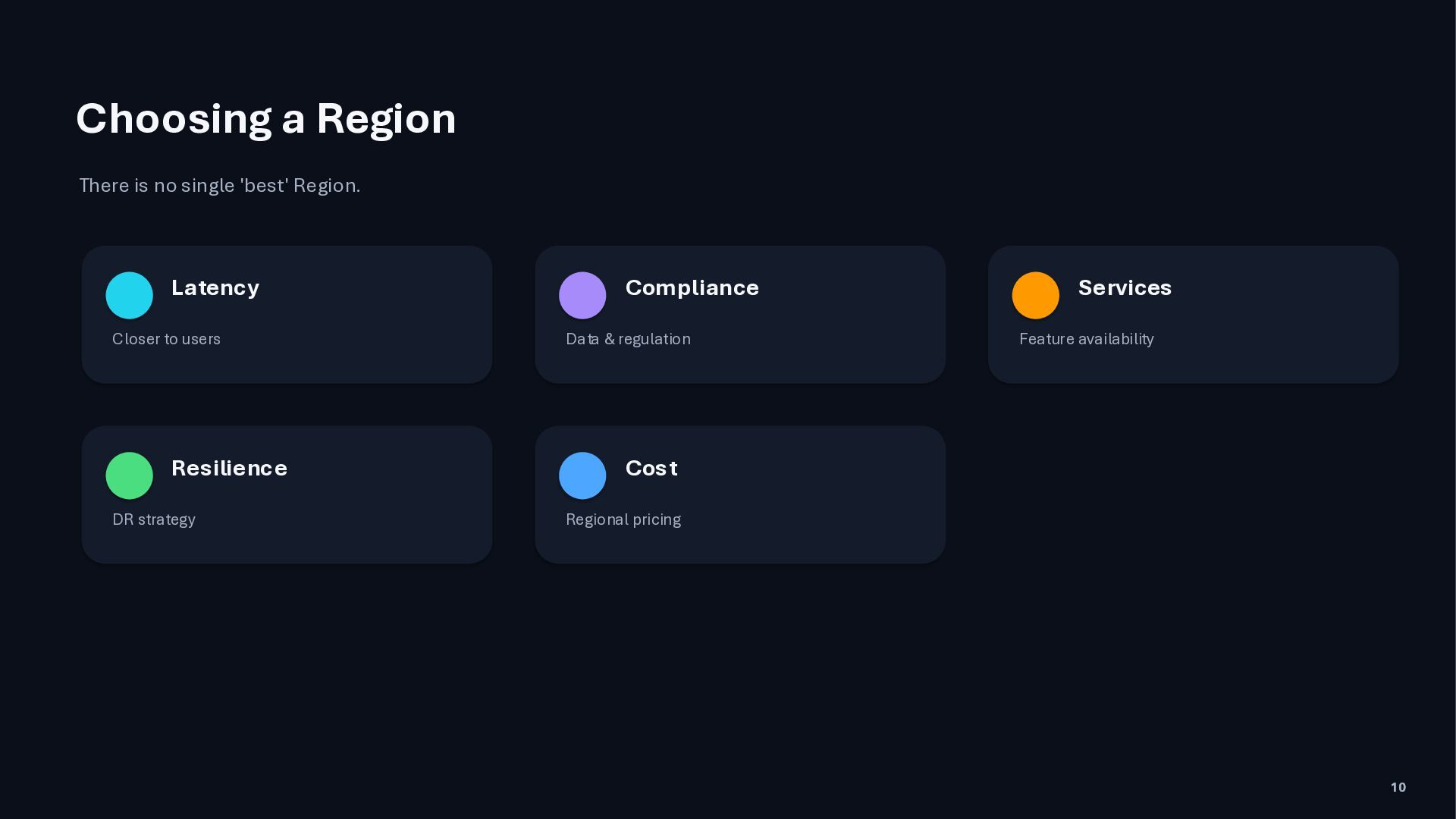
  8. Choosing a Region There is no single 'best' Region. Latency

    Closer to users Resilience DR strategy Compliance Data & regulation Services Feature availability Cost Regional pricing 10
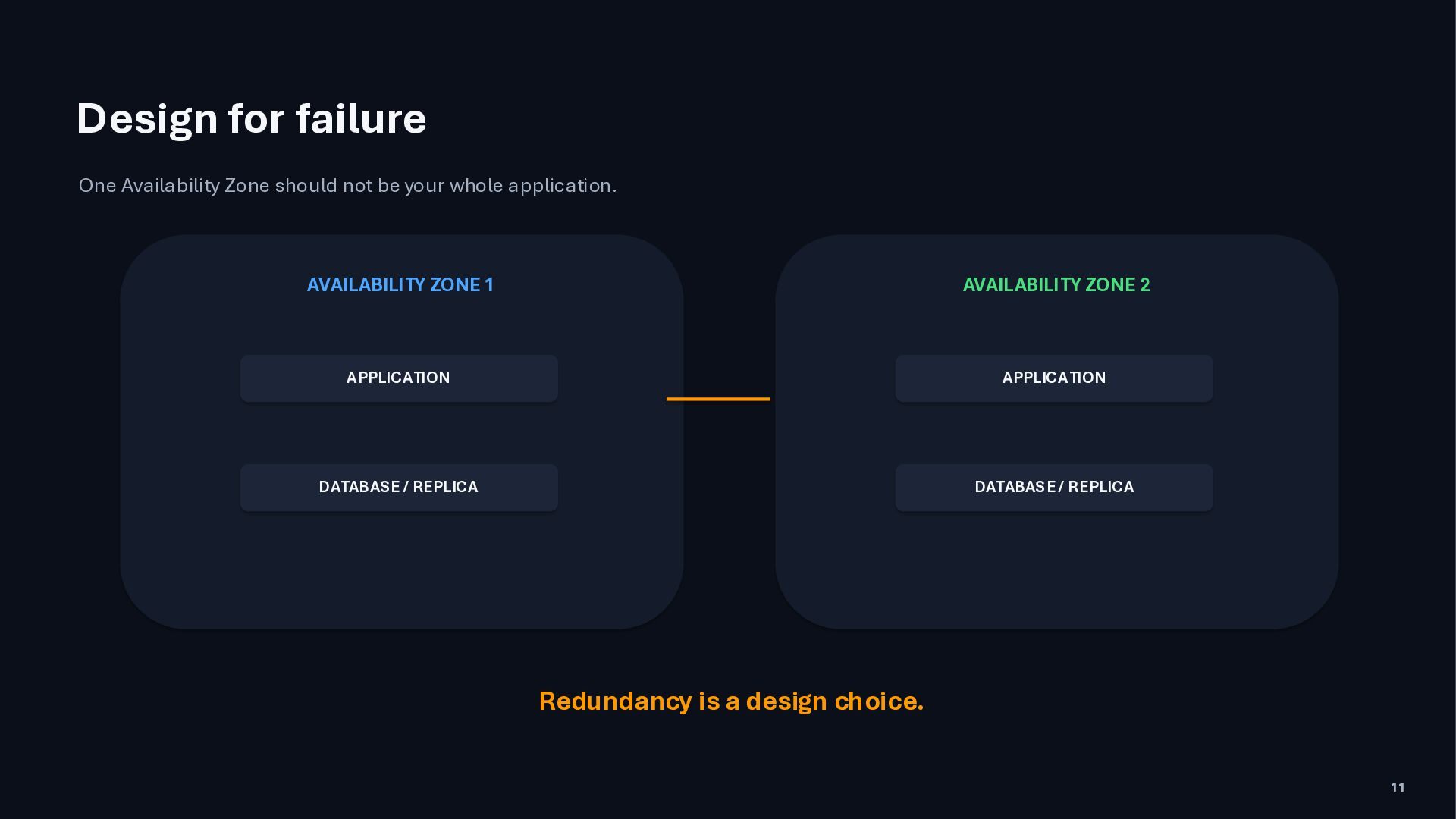
  9. Design for failure One Availability Zone should not be your

    whole application. AVAILABILITY ZONE 1 AVAILABILITY ZONE 2 APPLICATION APPLICATION DATABASE / REPLICA DATABASE / REPLICA Redundancy is a design choice. 11
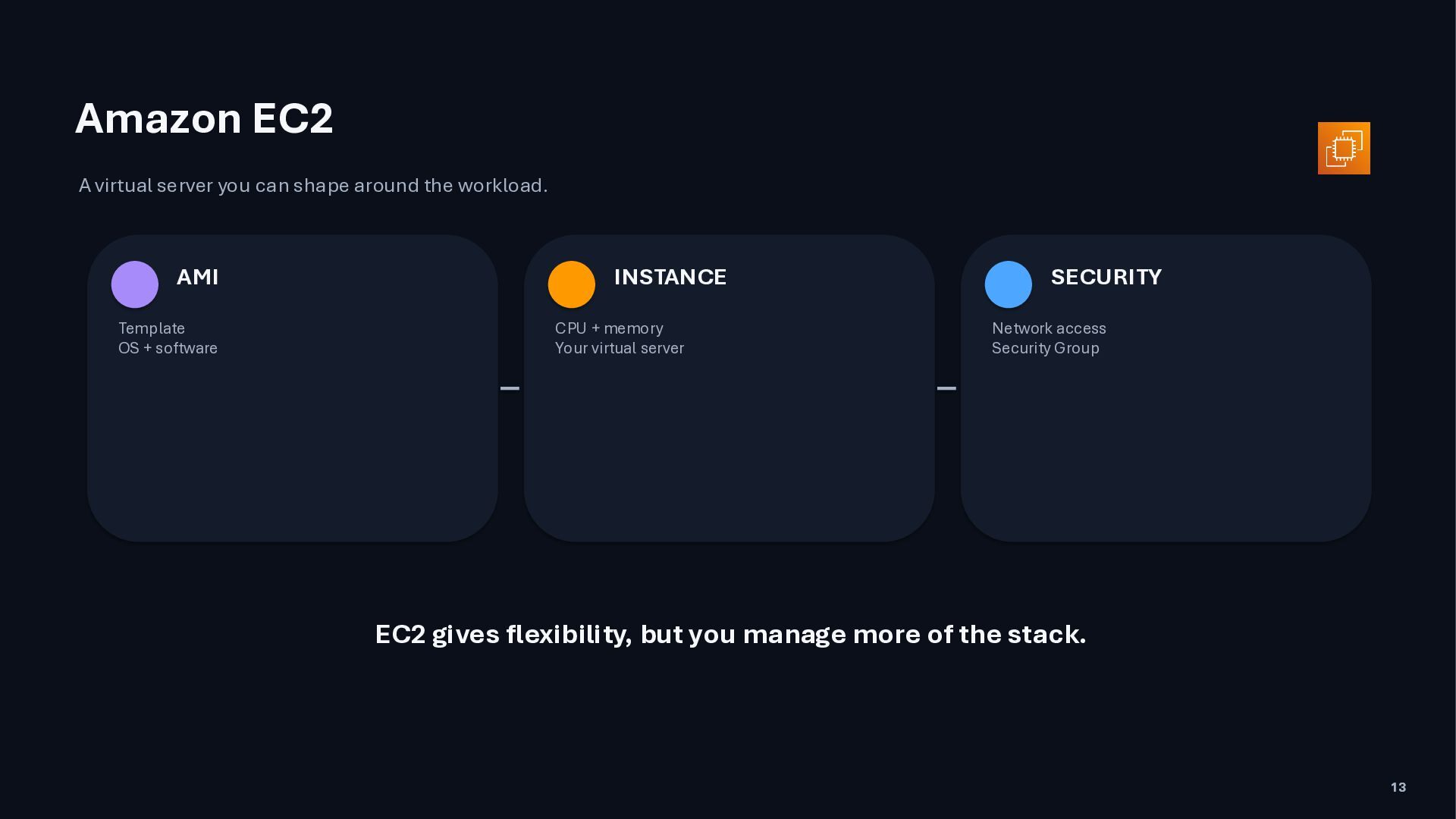
  10. Amazon EC2 A virtual server you can shape around the

    workload. AMI Template OS + software INSTANCE CPU + memory Your virtual server SECURITY Network access Security Group EC2 gives flexibility, but you manage more of the stack. 13
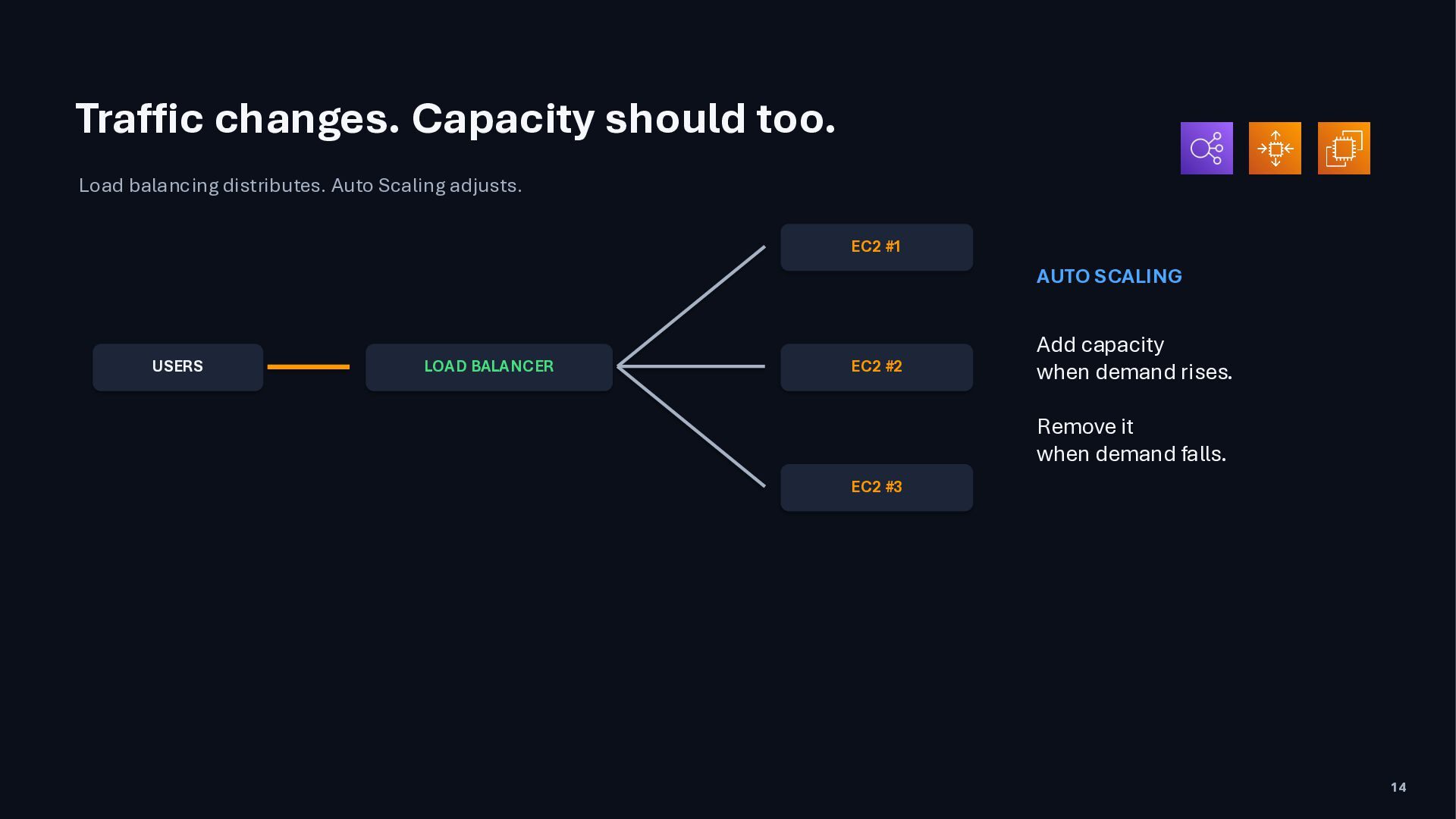
  11. Traffic changes. Capacity should too. Load balancing distributes. Auto Scaling

    adjusts. EC2 #1 AUTO SCALING USERS LOAD BALANCER EC2 #2 Add capacity when demand rises. Remove it when demand falls. EC2 #3 14
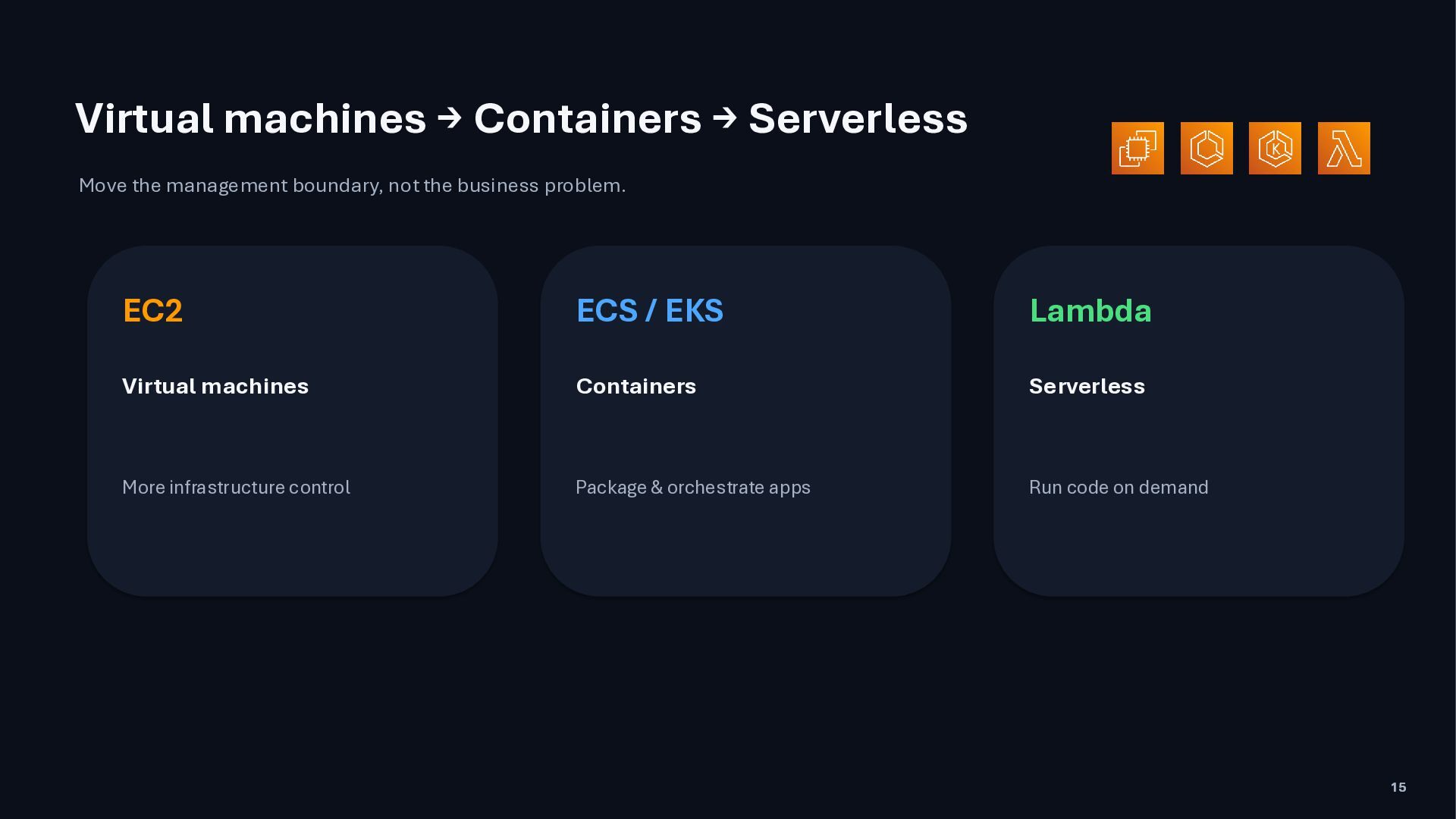
  12. Virtual machines → Containers → Serverless Move the management boundary,

    not the business problem. EC2 ECS / EKS Lambda Virtual machines Containers Serverless More infrastructure control Package & orchestrate apps Run code on demand 15
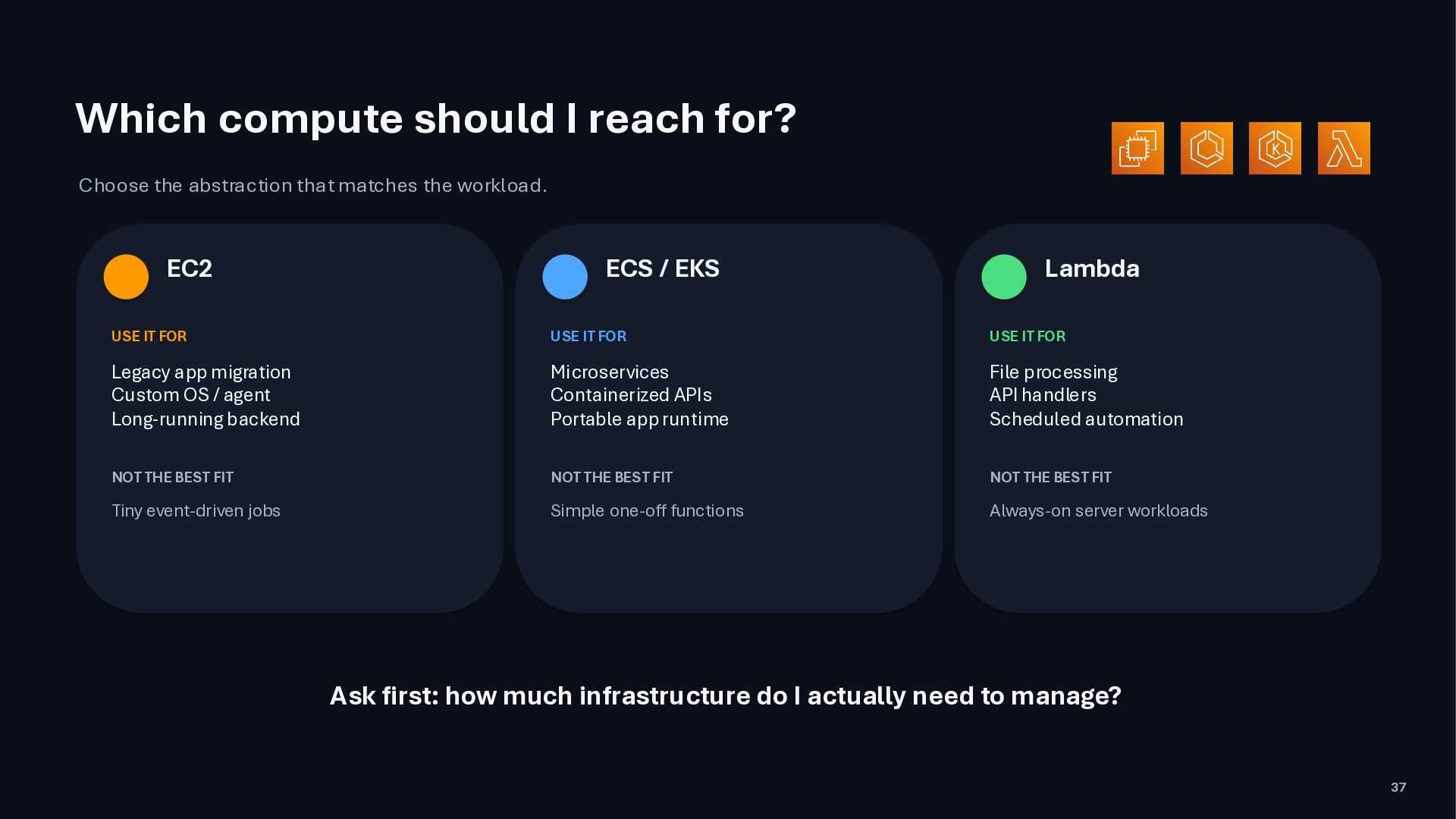
  13. Which compute should I reach for? Choose the abstraction that

    matches the workload. EC2 ECS / EKS Lambda USE IT FOR USE IT FOR USE IT FOR Legacy app migration Custom OS / agent Long-running backend Microservices Containerized APIs Portable app runtime File processing API handlers Scheduled automation NOT THE BEST FIT NOT THE BEST FIT NOT THE BEST FIT Tiny event-driven jobs Simple one-off functions Always-on server workloads Ask first: how much infrastructure do I actually need to manage? 37
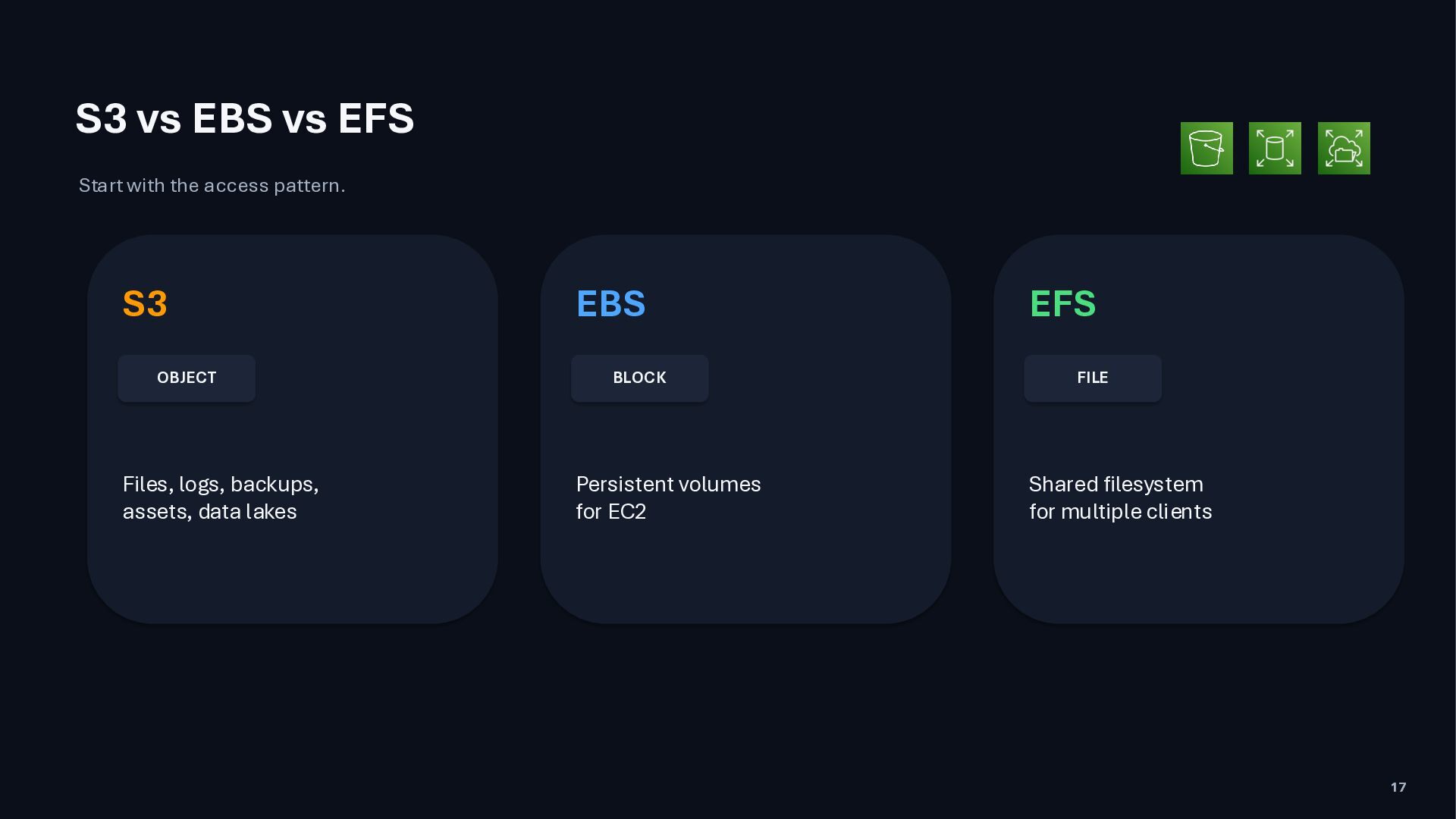
  14. S3 vs EBS vs EFS Start with the access pattern.

    S3 OBJECT Files, logs, backups, assets, data lakes EBS BLOCK Persistent volumes for EC2 EFS FILE Shared filesystem for multiple clients 17
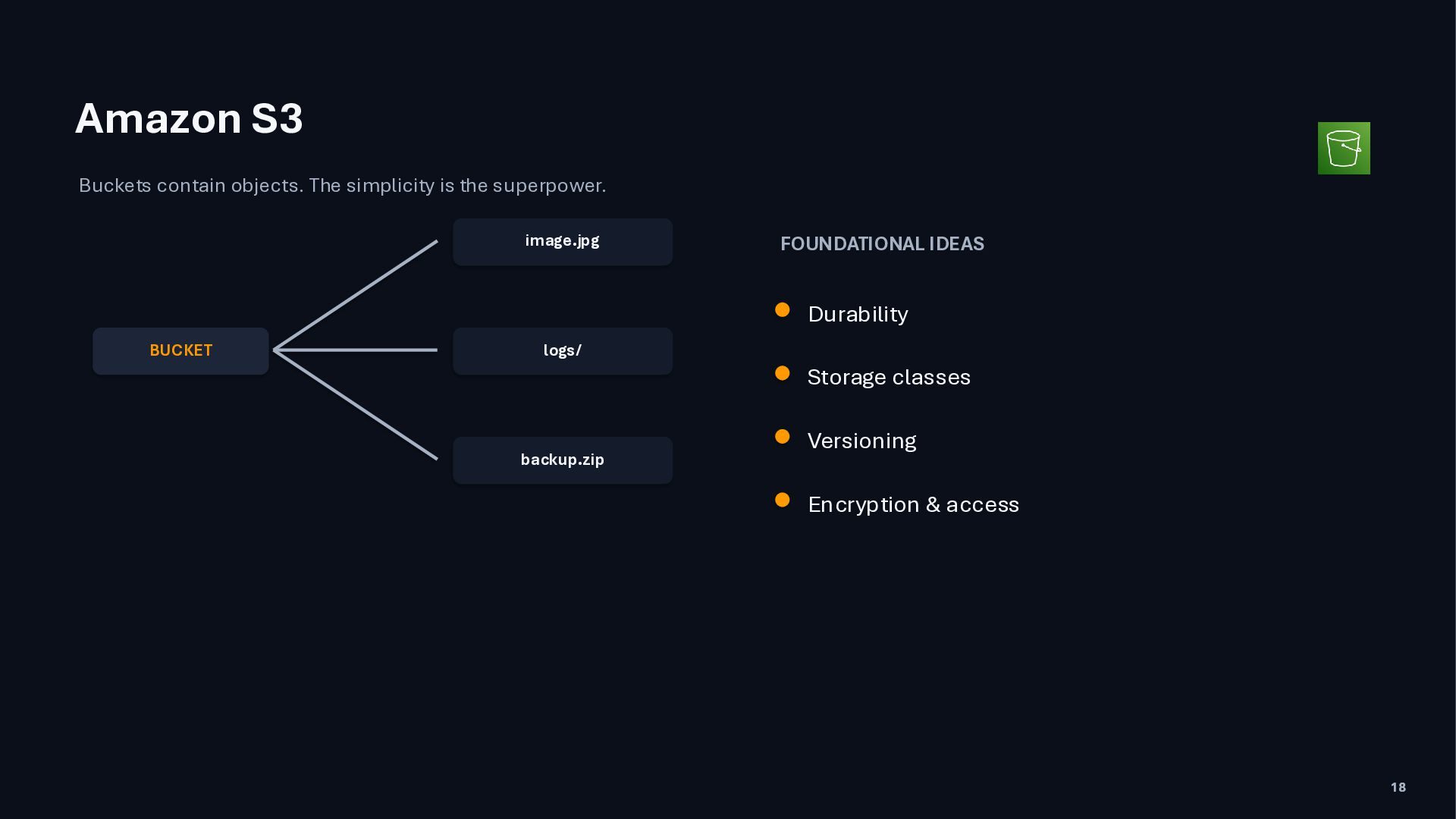
  15. Amazon S3 Buckets contain objects. The simplicity is the superpower.

    image.jpg FOUNDATIONAL IDEAS Durability BUCKET logs/ Storage classes backup.zip Versioning Encryption & access 18
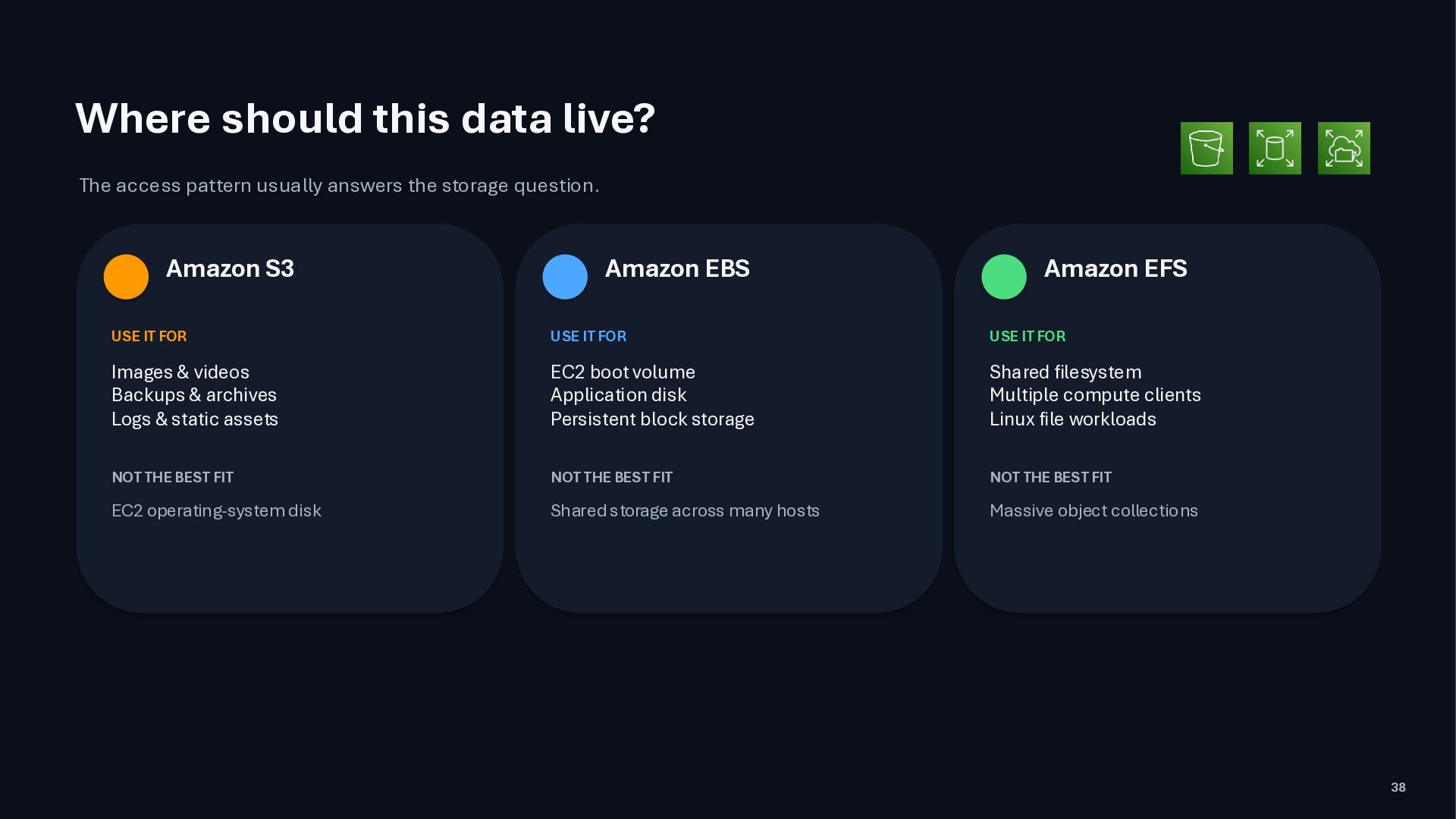
  16. Where should this data live? The access pattern usually answers

    the storage question. Amazon S3 Amazon EBS Amazon EFS USE IT FOR USE IT FOR USE IT FOR Images & videos Backups & archives Logs & static assets EC2 boot volume Application disk Persistent block storage Shared filesystem Multiple compute clients Linux file workloads NOT THE BEST FIT NOT THE BEST FIT NOT THE BEST FIT EC2 operating-system disk Shared storage across many hosts Massive object collections 38
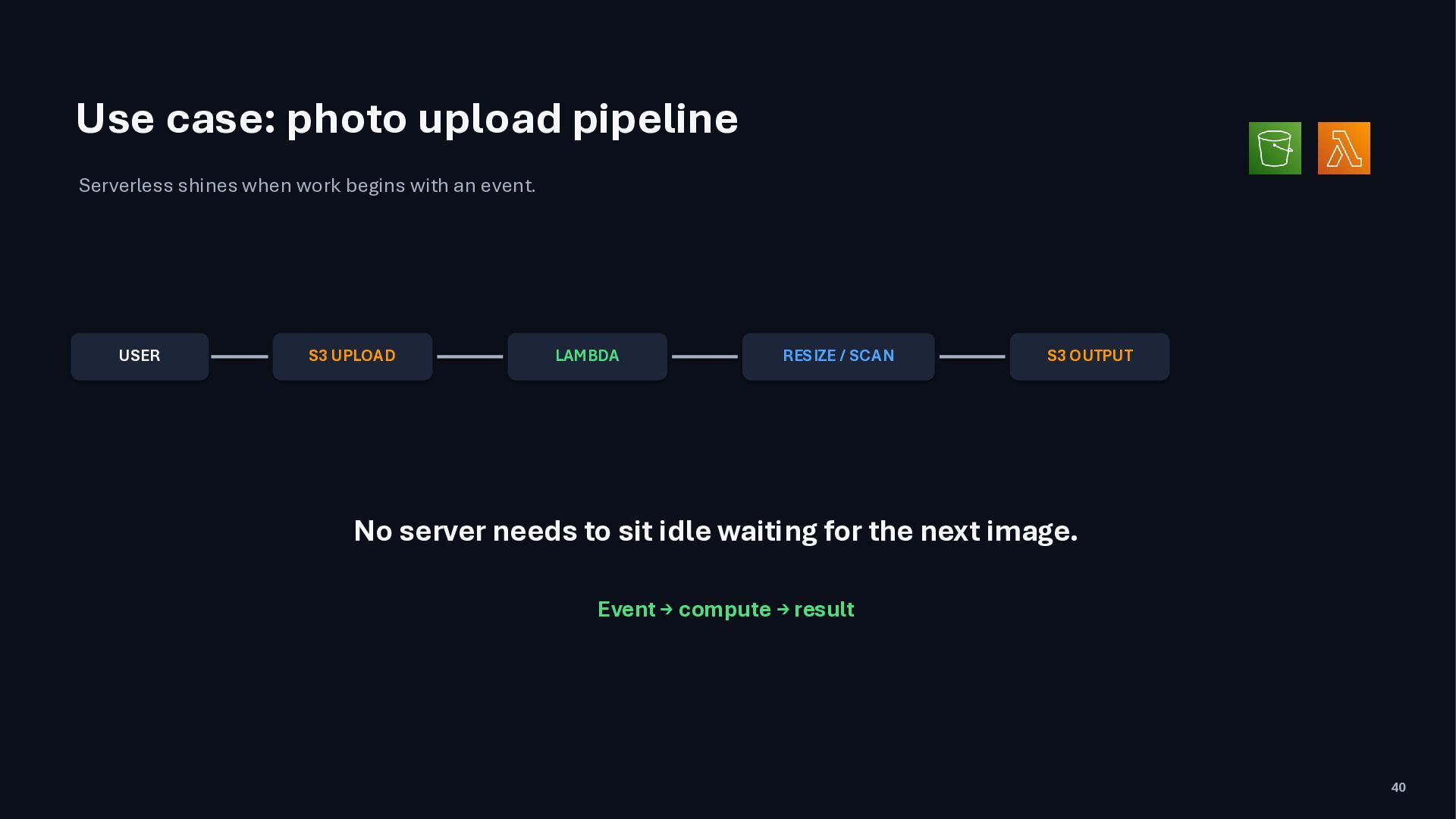
  17. Use case: photo upload pipeline Serverless shines when work begins

    with an event. USER S3 UPLOAD LAMBDA RESIZE / SCAN S3 OUTPUT No server needs to sit idle waiting for the next image. Event → compute → result 40
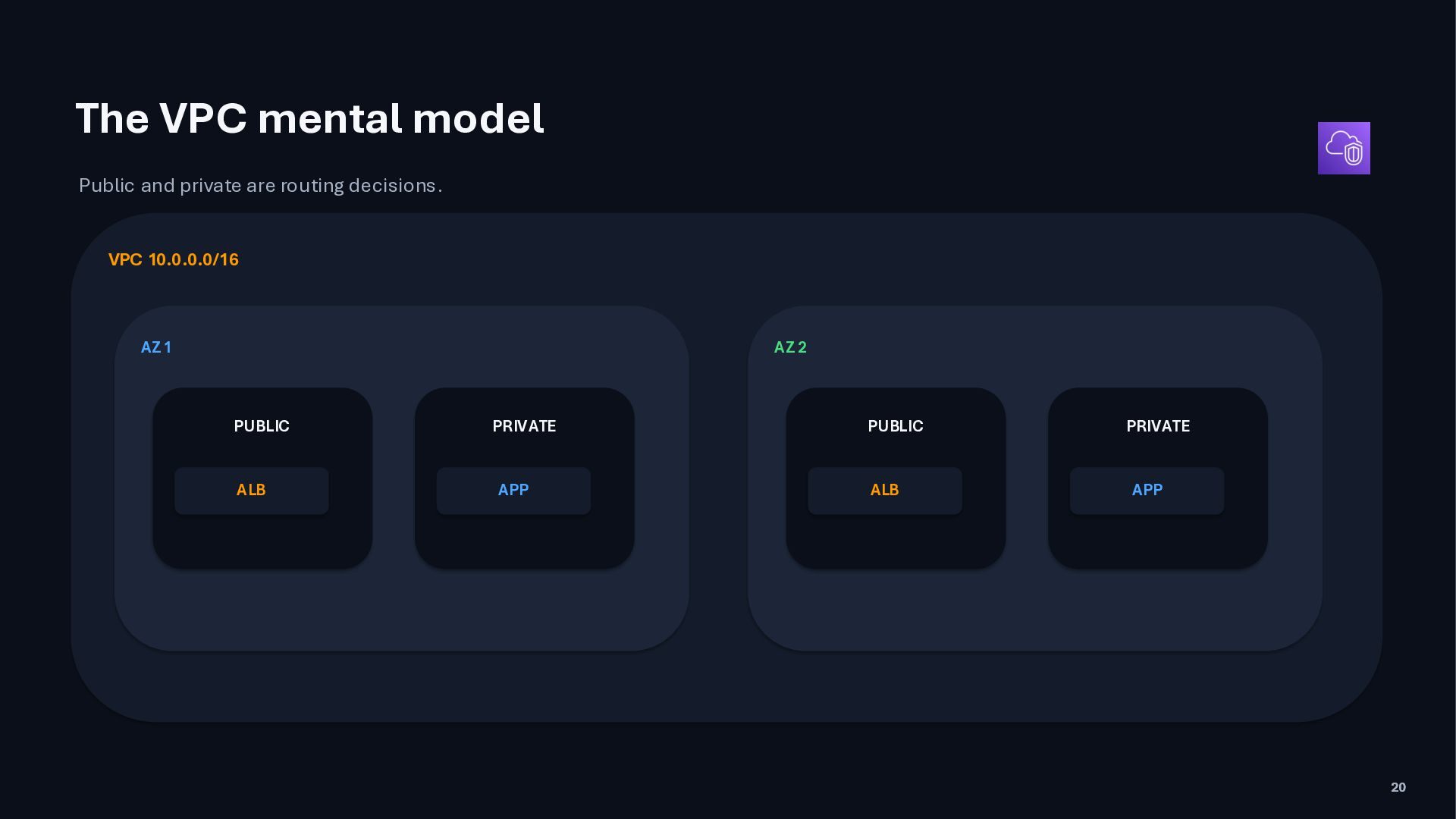
  18. The VPC mental model Public and private are routing decisions.

    VPC 10.0.0.0/16 AZ 1 AZ 2 PUBLIC PRIVATE PUBLIC PRIVATE ALB APP ALB APP 20
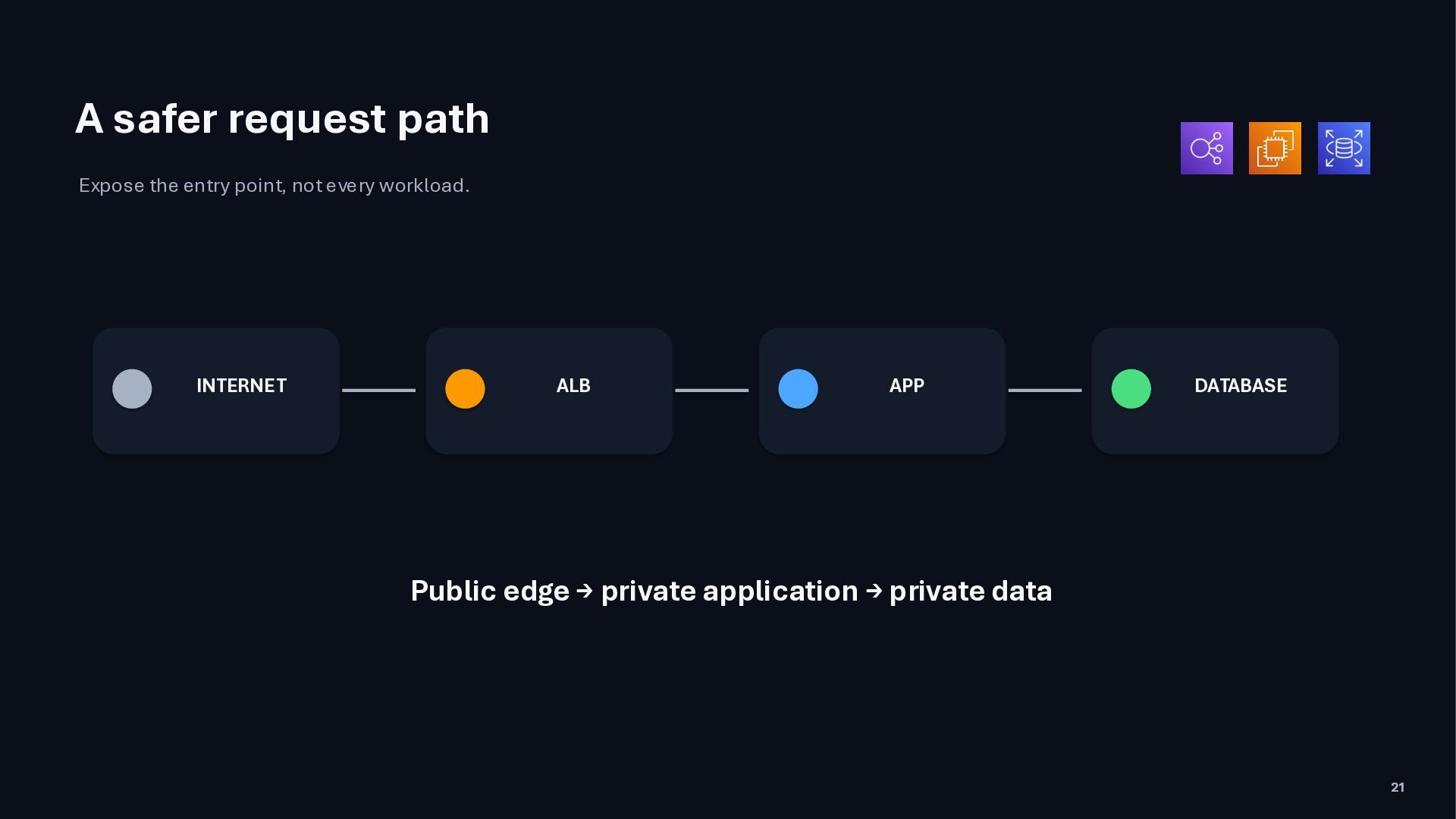
  19. A safer request path Expose the entry point, not every

    workload. INTERNET ALB APP DATABASE Public edge → private application → private data 21
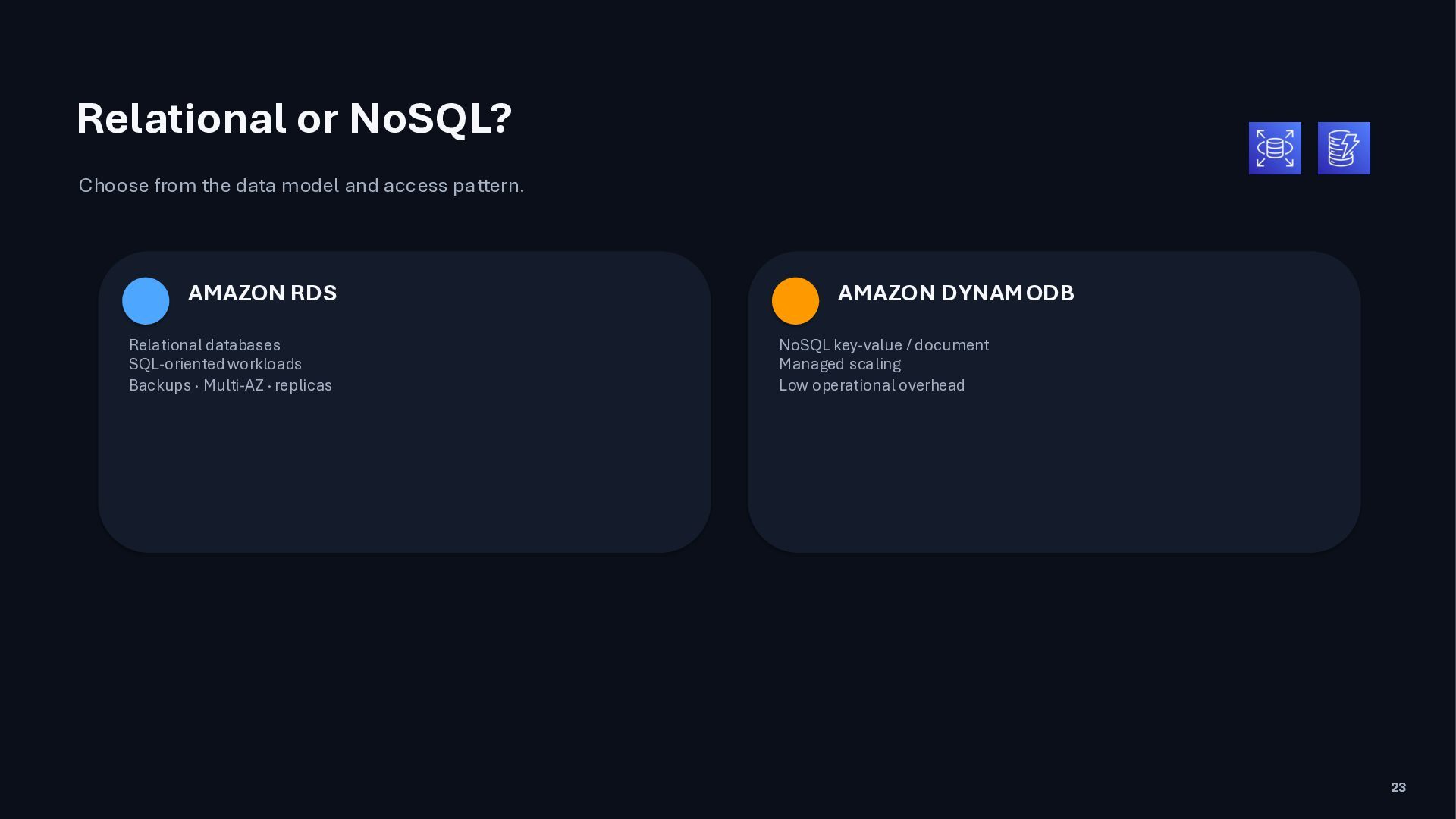
  20. Relational or NoSQL? Choose from the data model and access

    pattern. AMAZON RDS Relational databases SQL-oriented workloads Backups · Multi-AZ · replicas AMAZON DYNAMODB NoSQL key-value / document Managed scaling Low operational overhead 23
  21. 07 Identity & Access Every request begins with an identity

    and ends with an authorization decision. 24
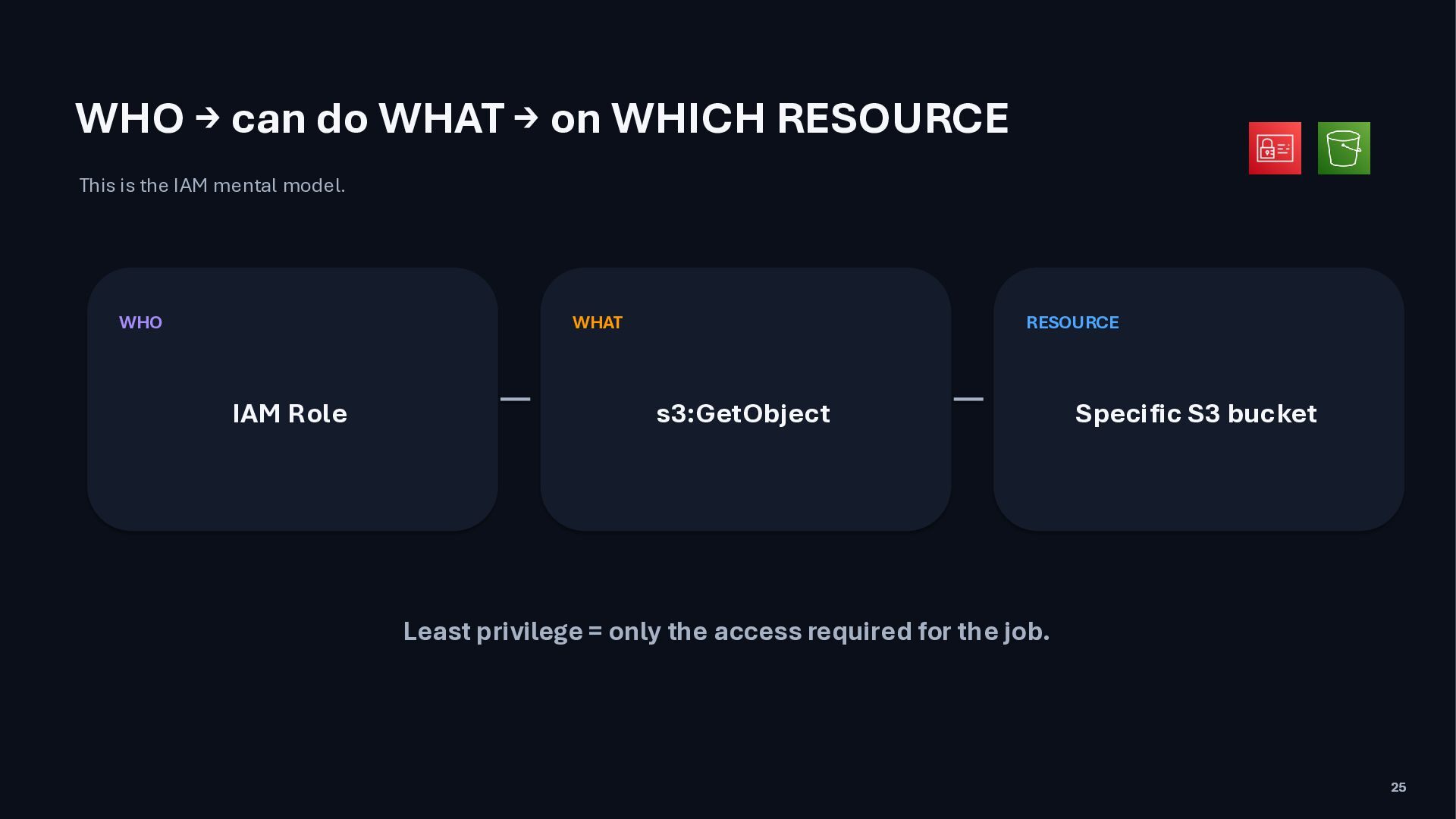
  22. WHO → can do WHAT → on WHICH RESOURCE This

    is the IAM mental model. WHO WHAT IAM Role RESOURCE s3:GetObject Specific S3 bucket Least privilege = only the access required for the job. 25
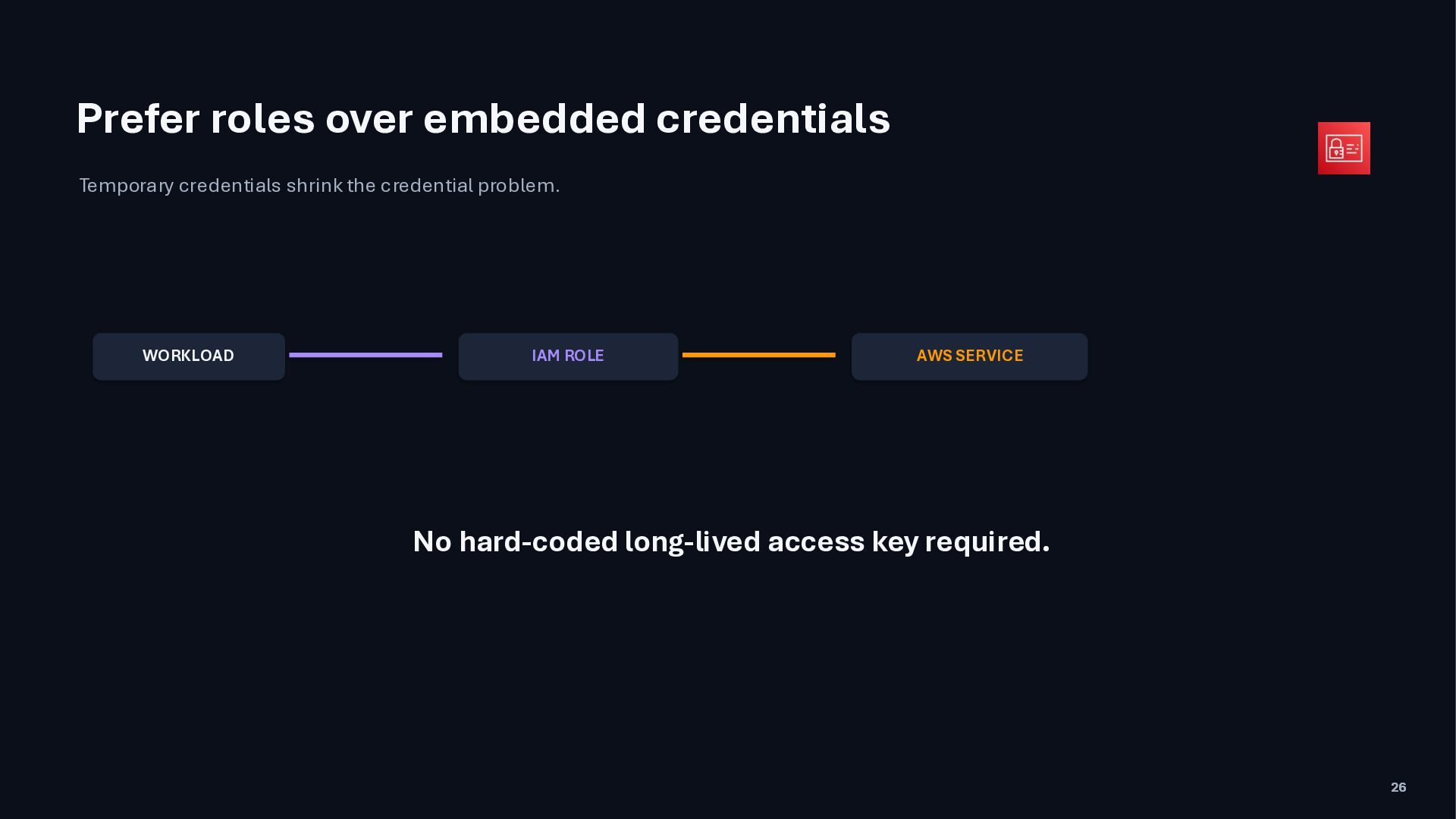
  23. Prefer roles over embedded credentials Temporary credentials shrink the credential

    problem. WORKLOAD IAM ROLE AWS SERVICE No hard-coded long-lived access key required. 26
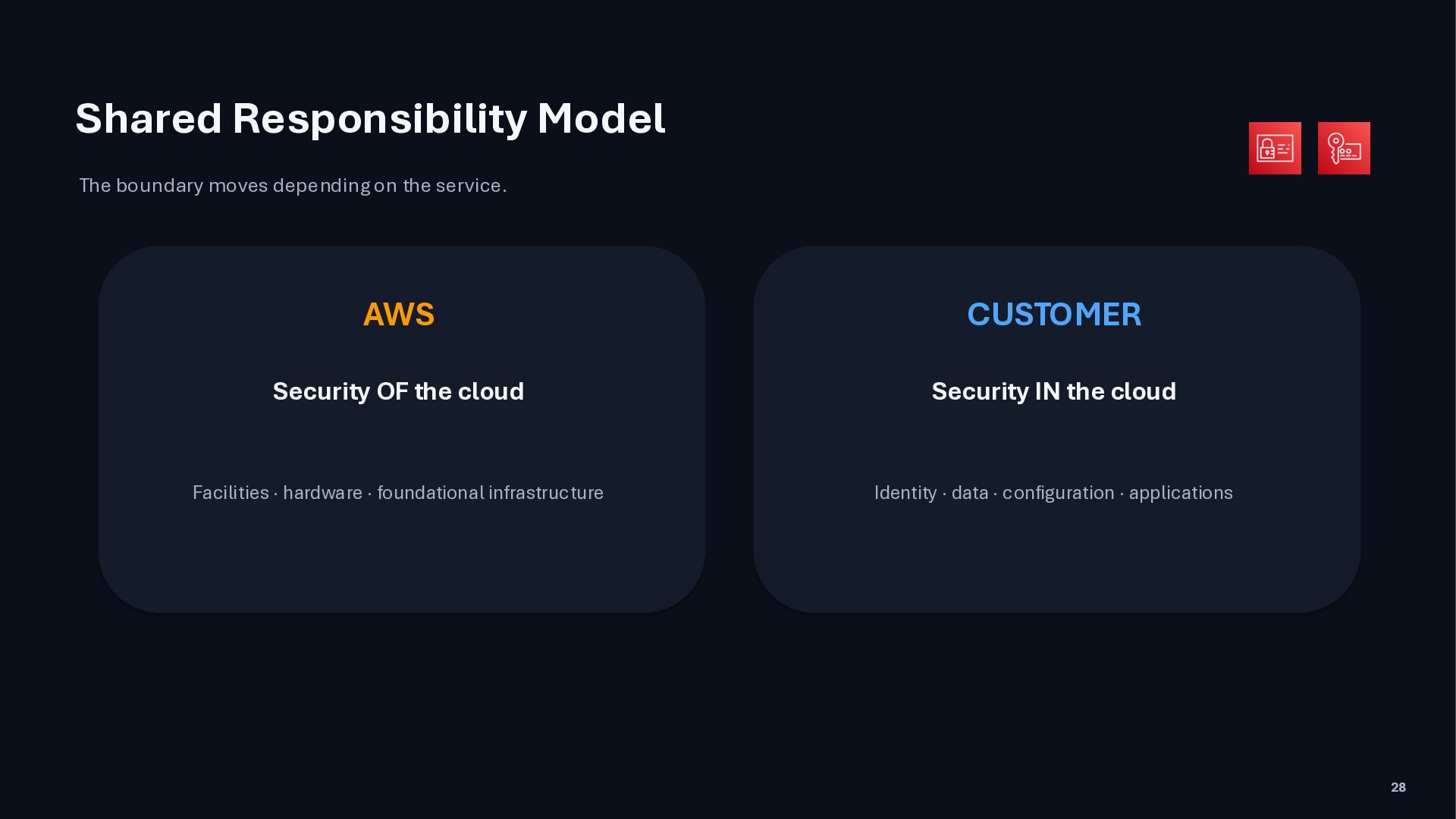
  24. Shared Responsibility Model The boundary moves depending on the service.

    AWS CUSTOMER Security OF the cloud Security IN the cloud Facilities · hardware · foundational infrastructure Identity · data · configuration · applications 28
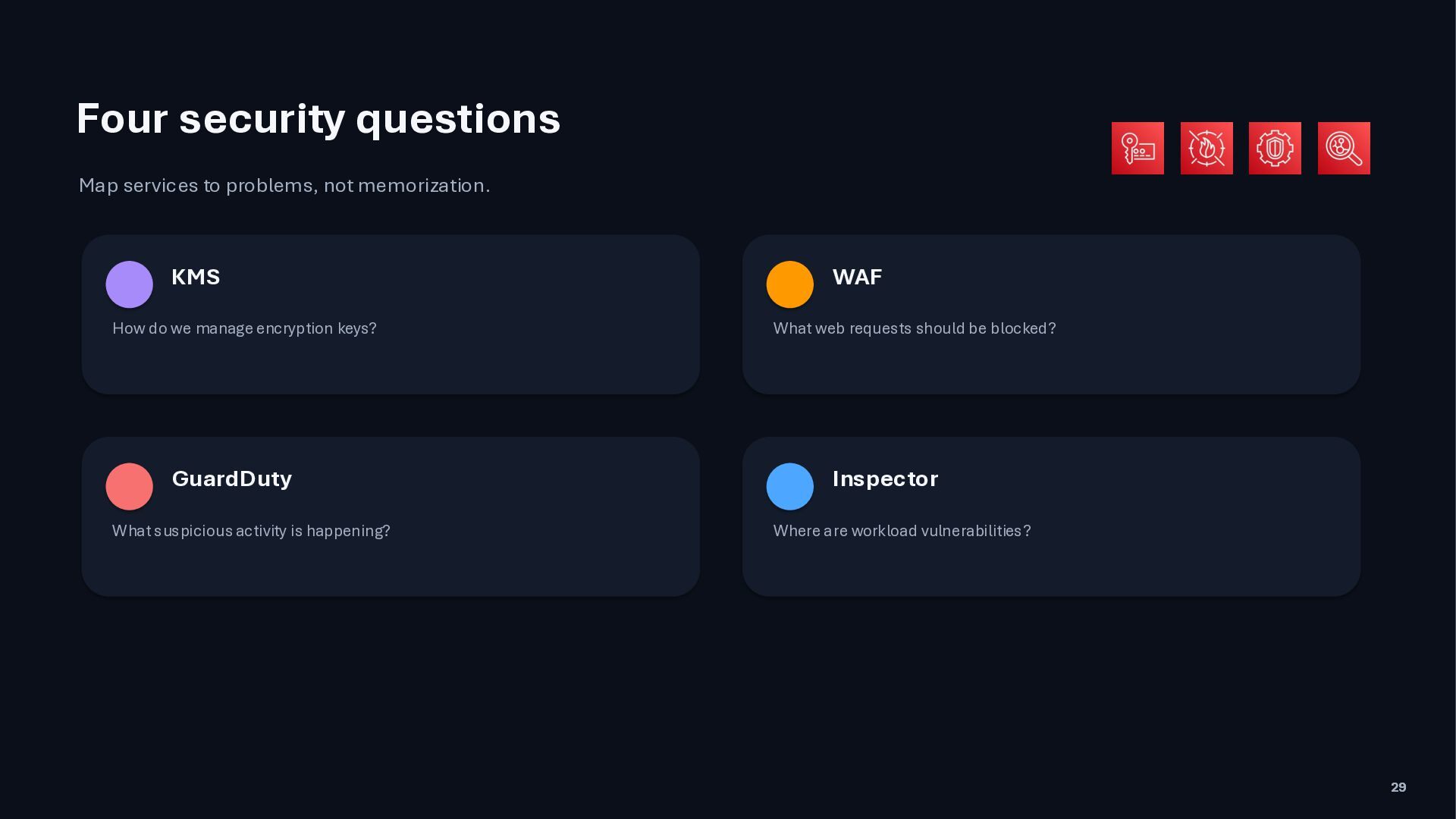
  25. Four security questions Map services to problems, not memorization. KMS

    How do we manage encryption keys? GuardDuty What suspicious activity is happening? WAF What web requests should be blocked? Inspector Where are workload vulnerabilities? 29
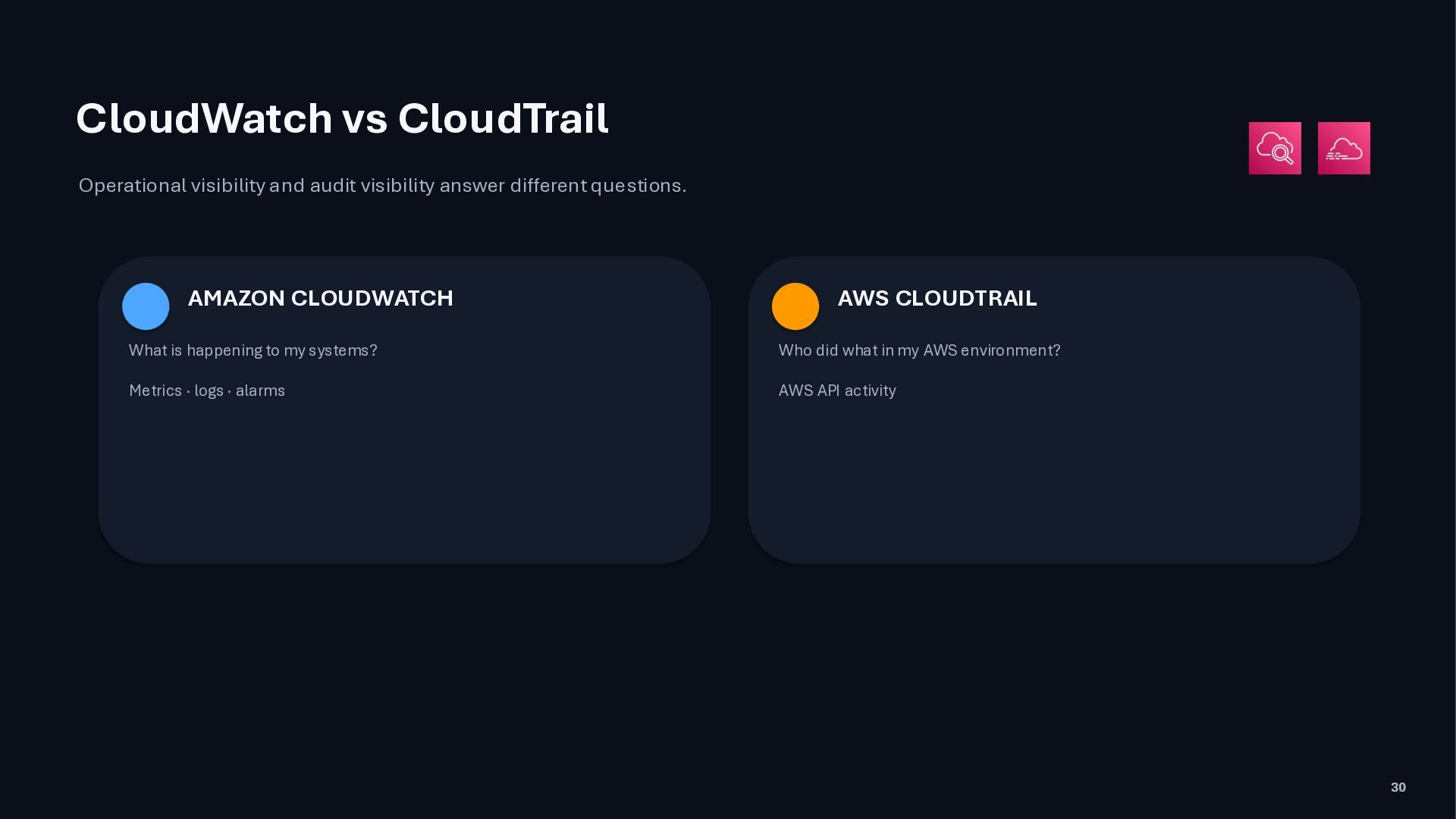
  26. CloudWatch vs CloudTrail Operational visibility and audit visibility answer different

    questions. AMAZON CLOUDWATCH AWS CLOUDTRAIL What is happening to my systems? Who did what in my AWS environment? Metrics · logs · alarms AWS API activity 30
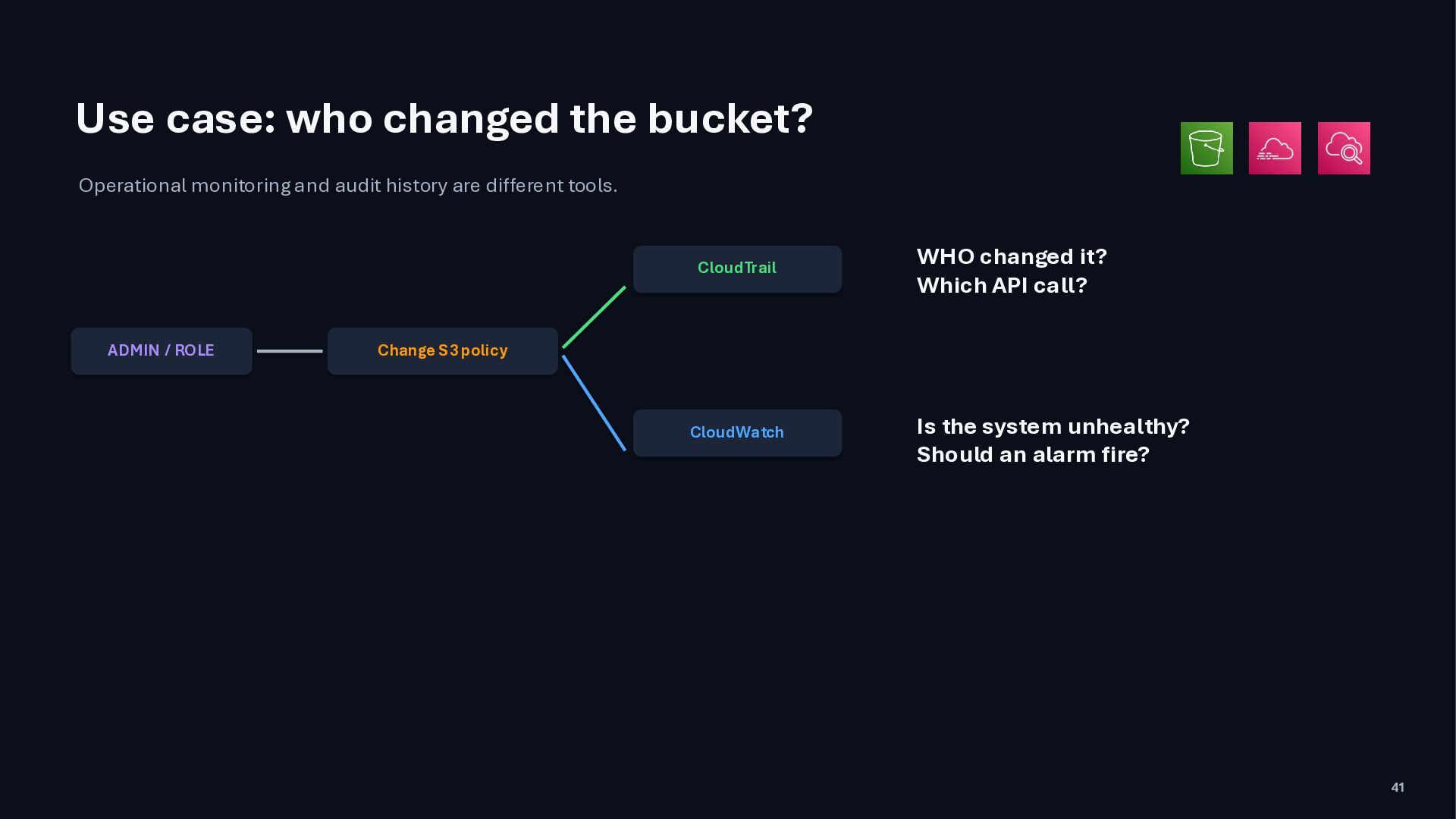
  27. Use case: who changed the bucket? Operational monitoring and audit

    history are different tools. ADMIN / ROLE CloudTrail WHO changed it? Which API call? CloudWatch Is the system unhealthy? Should an alarm fire? Change S3 policy 41
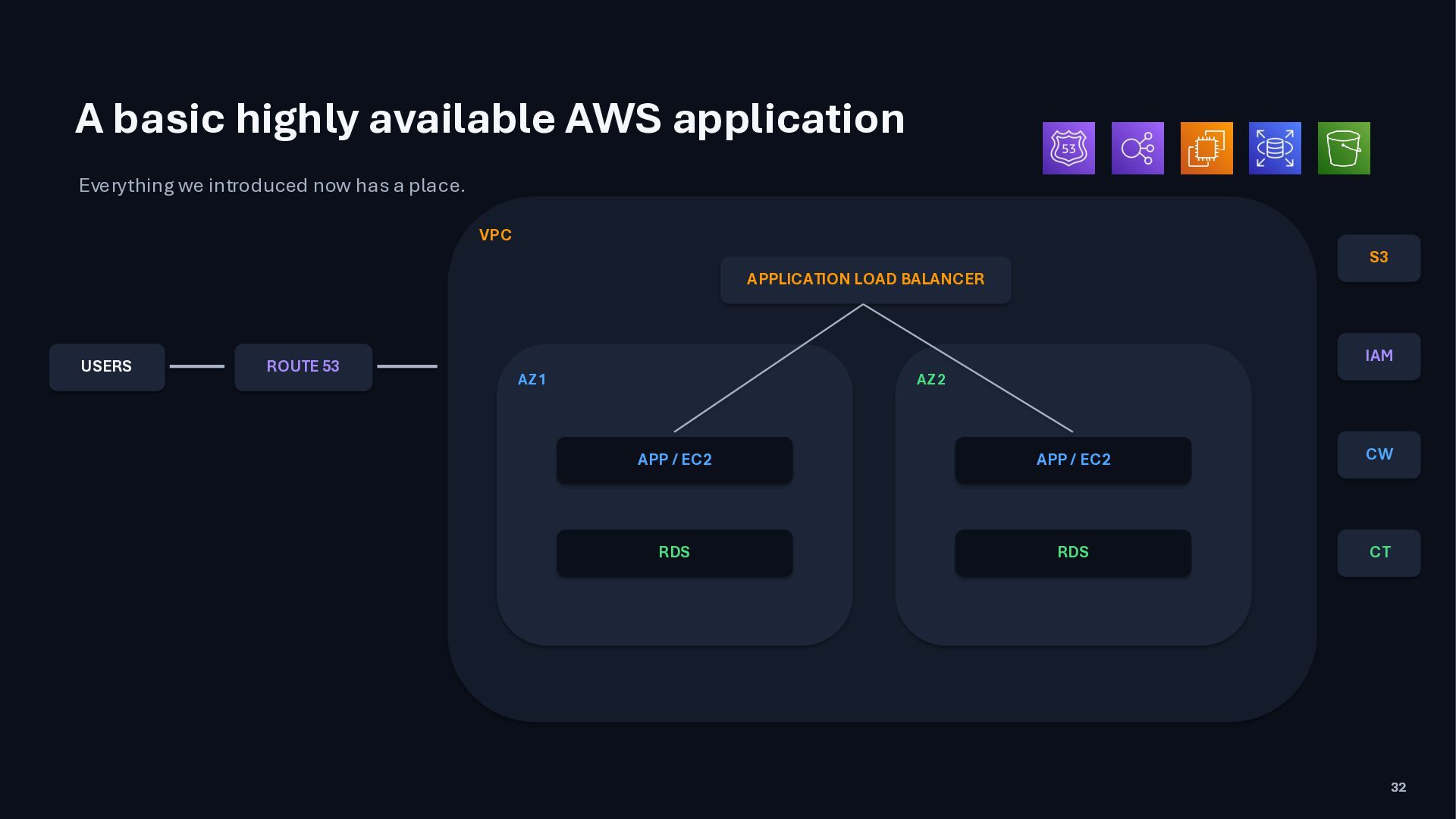
  28. A basic highly available AWS application Everything we introduced now

    has a place. VPC S3 APPLICATION LOAD BALANCER USERS ROUTE 53 IAM AZ 1 AZ 2 APP / EC2 APP / EC2 CW RDS RDS CT 32
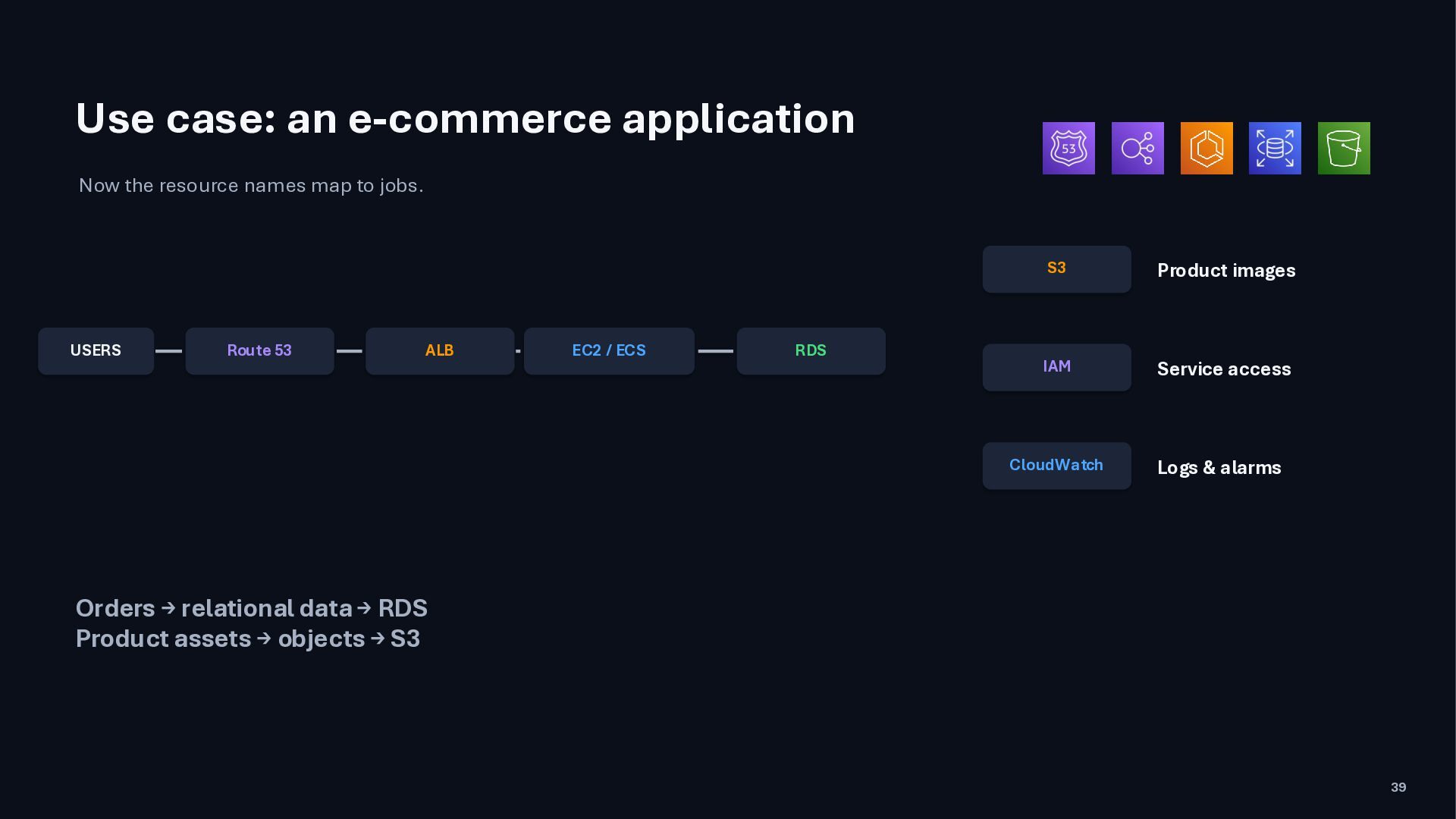
  29. Use case: an e-commerce application Now the resource names map

    to jobs. USERS Route 53 ALB EC2 / ECS RDS S3 Product images IAM Service access CloudWatch Logs & alarms Orders → relational data → RDS Product assets → objects → S3 39
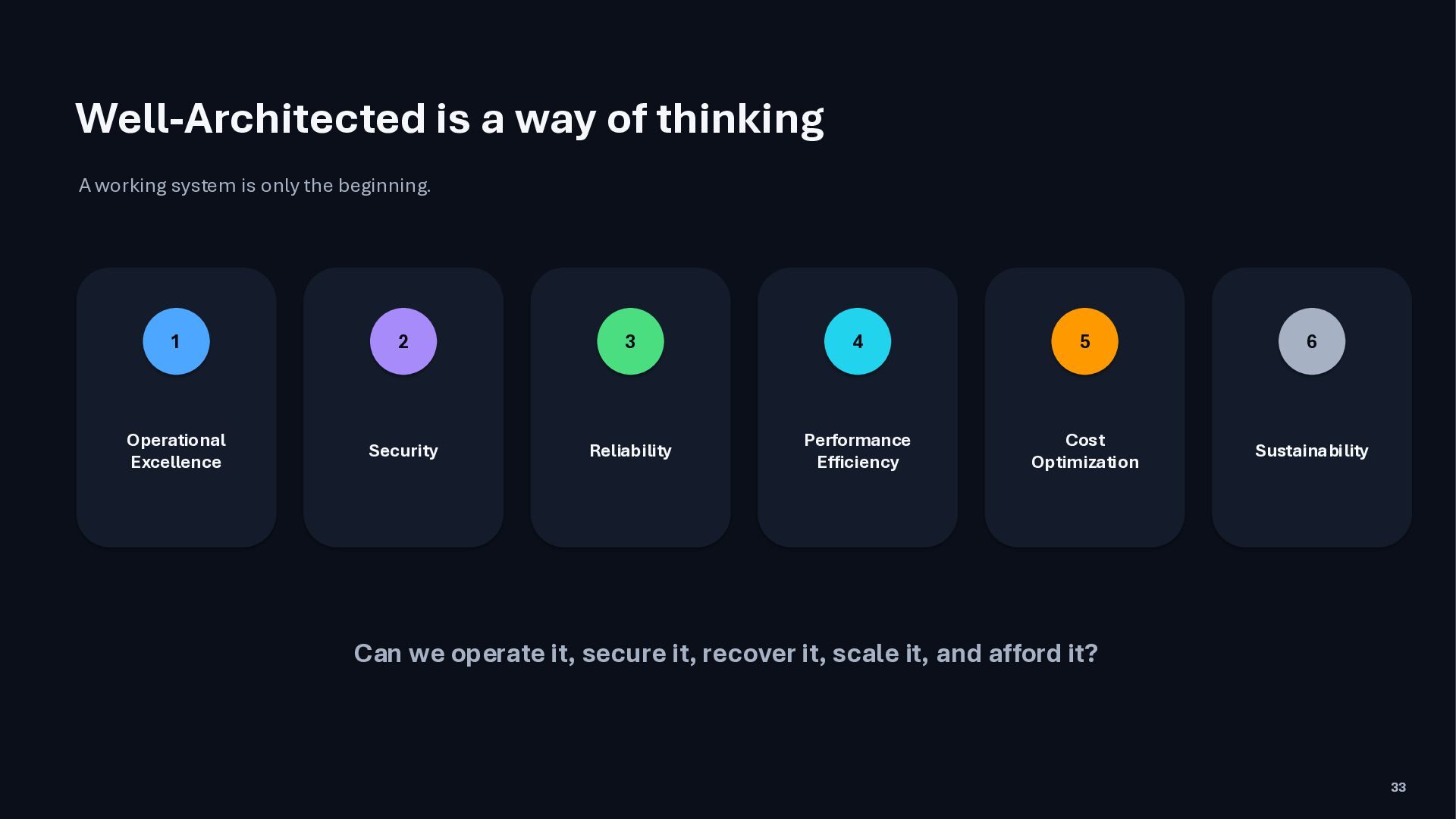
  30. Well-Architected is a way of thinking A working system is

    only the beginning. 1 2 3 4 5 6 Operational Excellence Security Reliability Performance Efficiency Cost Optimization Sustainability Can we operate it, secure it, recover it, scale it, and afford it? 33
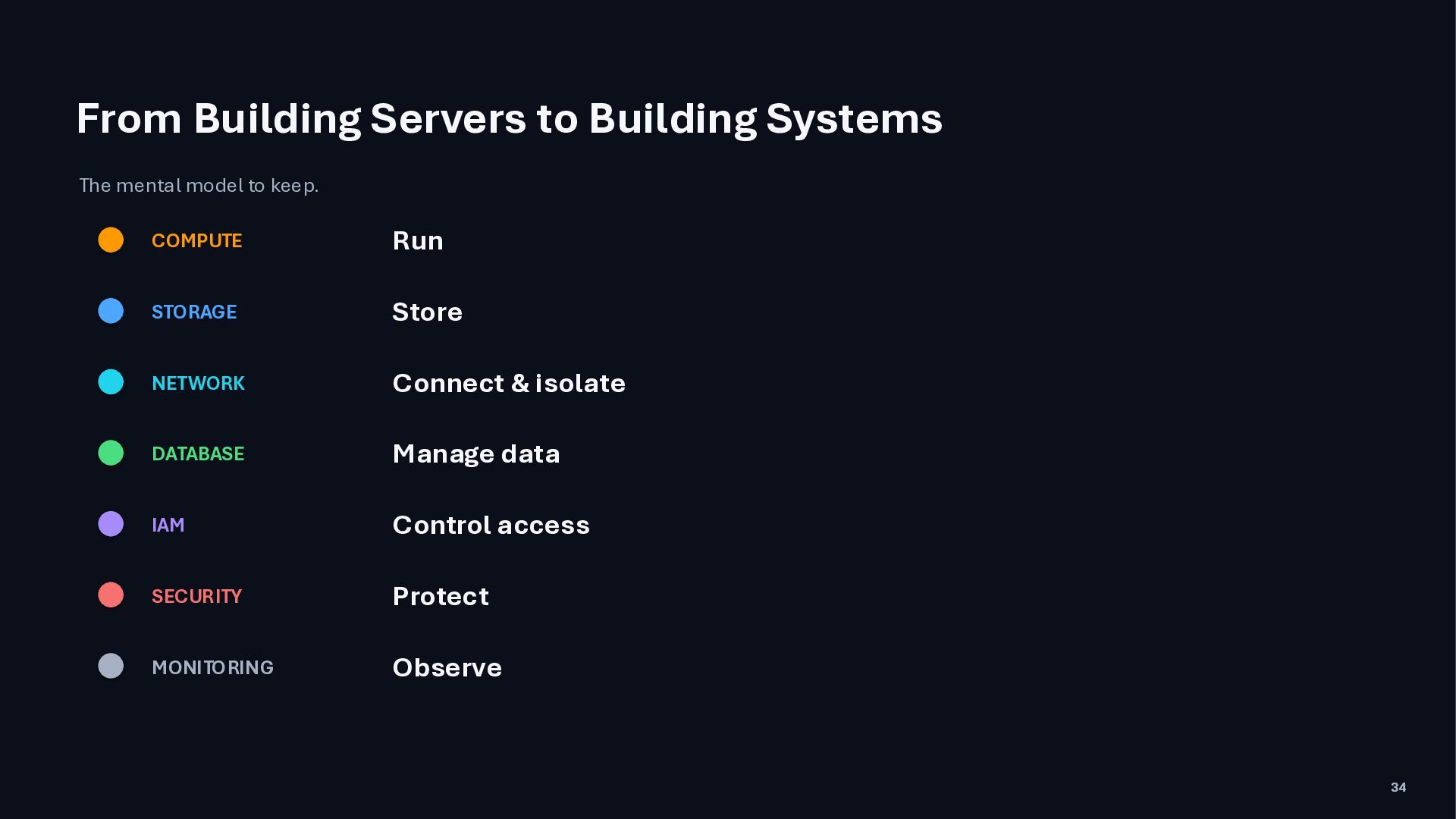
  31. From Building Servers to Building Systems The mental model to

    keep. COMPUTE Run STORAGE Store NETWORK Connect & isolate DATABASE Manage data IAM Control access SECURITY Protect MONITORING Observe 34
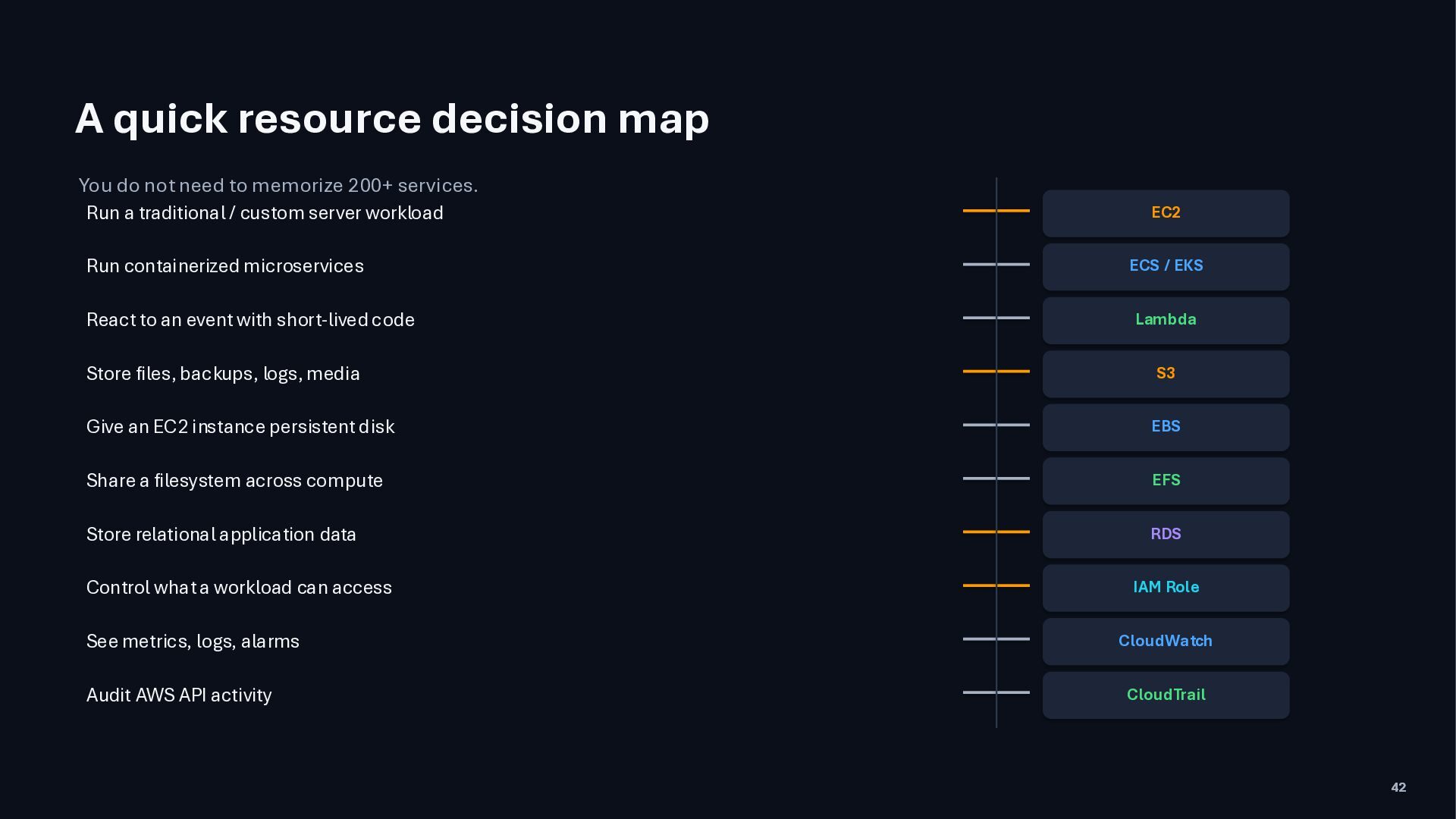
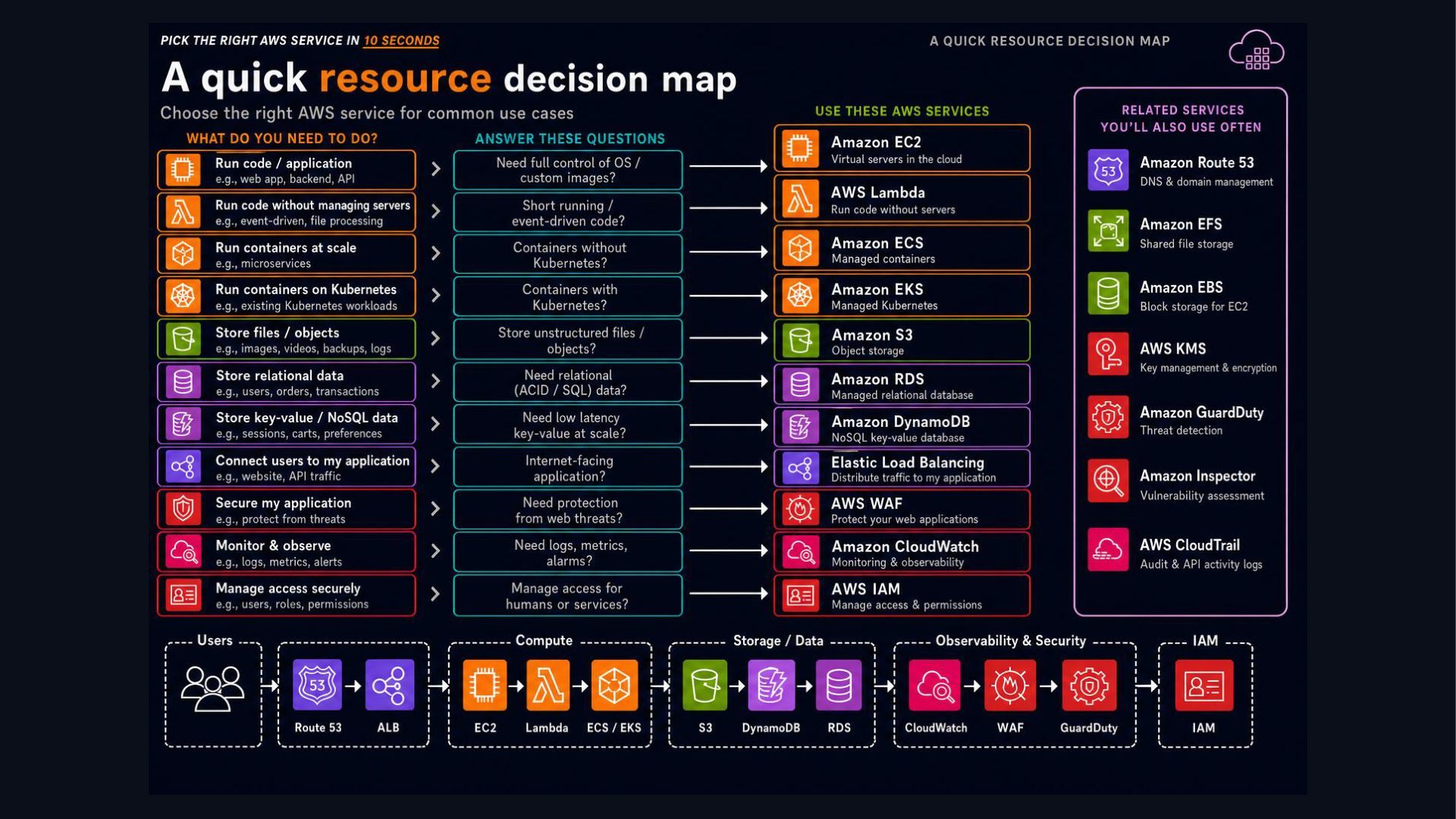
  32. A quick resource decision map You do not need to

    memorize 200+ services. Run a traditional / custom server workload EC2 Run containerized microservices ECS / EKS React to an event with short-lived code Lambda Store files, backups, logs, media S3 Give an EC2 instance persistent disk EBS Share a filesystem across compute EFS Store relational application data RDS Control what a workload can access IAM Role See metrics, logs, alarms CloudWatch Audit AWS API activity CloudTrail 42
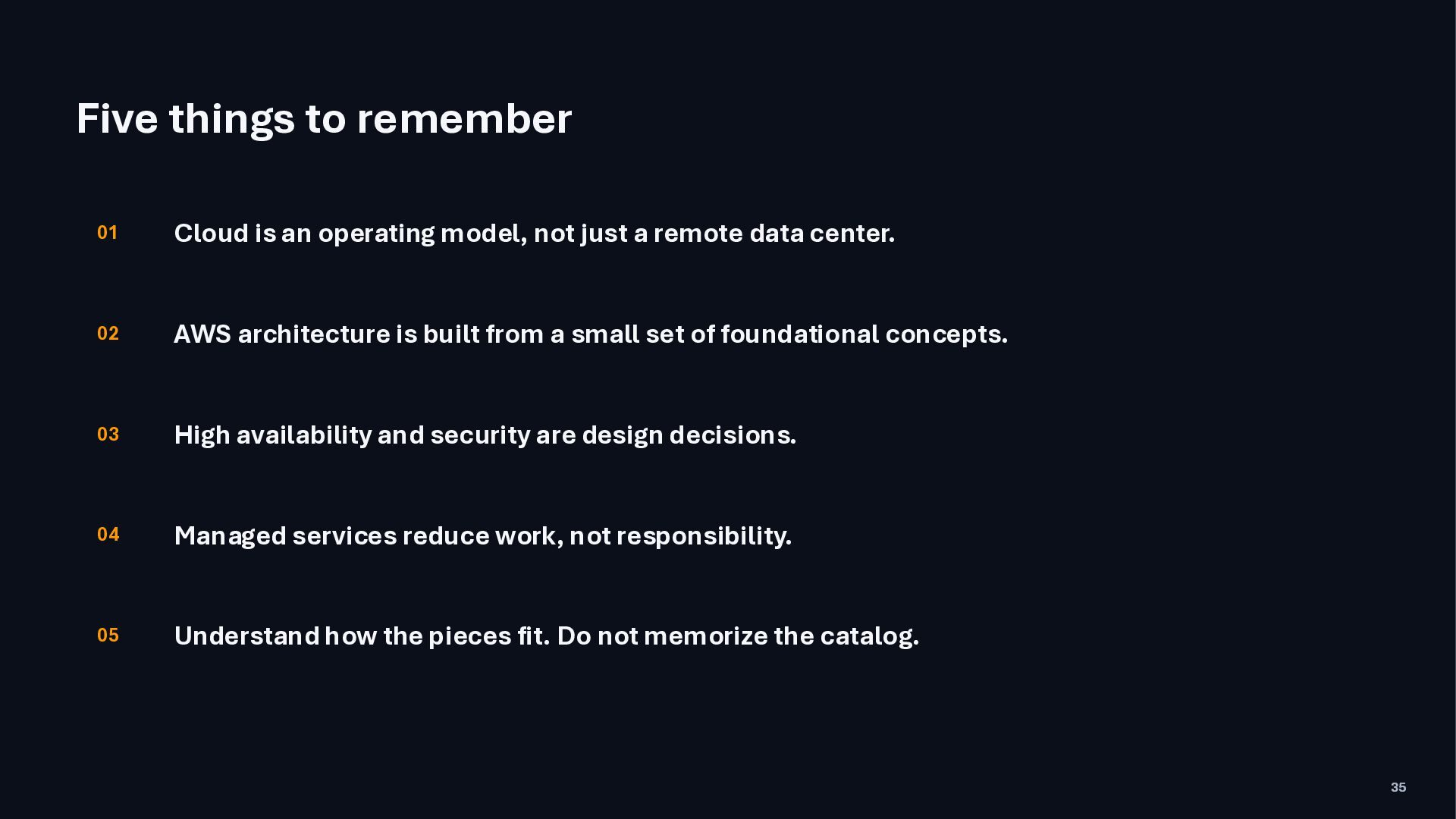
  33. Five things to remember 01 Cloud is an operating model,

    not just a remote data center. 02 AWS architecture is built from a small set of foundational concepts. 03 High availability and security are design decisions. 04 Managed services reduce work, not responsibility. 05 Understand how the pieces fit. Do not memorize the catalog. 35