in the cloud. [CLICK] There are over 3,500 on-‐premise deployments of our solu=ons. [CLICK] And there are over 25,000 deployments of our cloud solu=ons [CLICK] Over 35% of the Global 500 uses our solu=ons [CLICK] We are a global business, headquartered in Silicon Valley with offices throughout the US, Europe, La=n America and Asia.
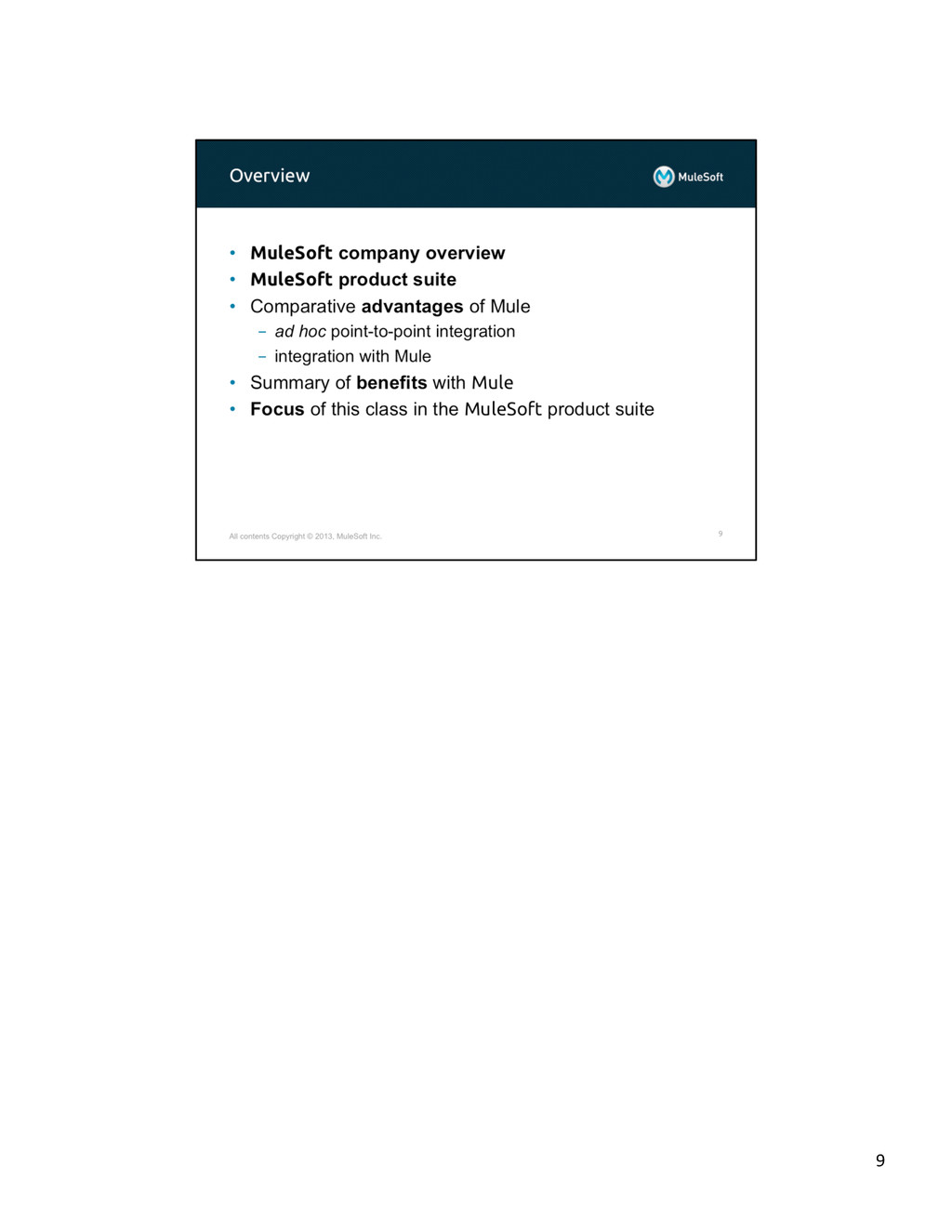
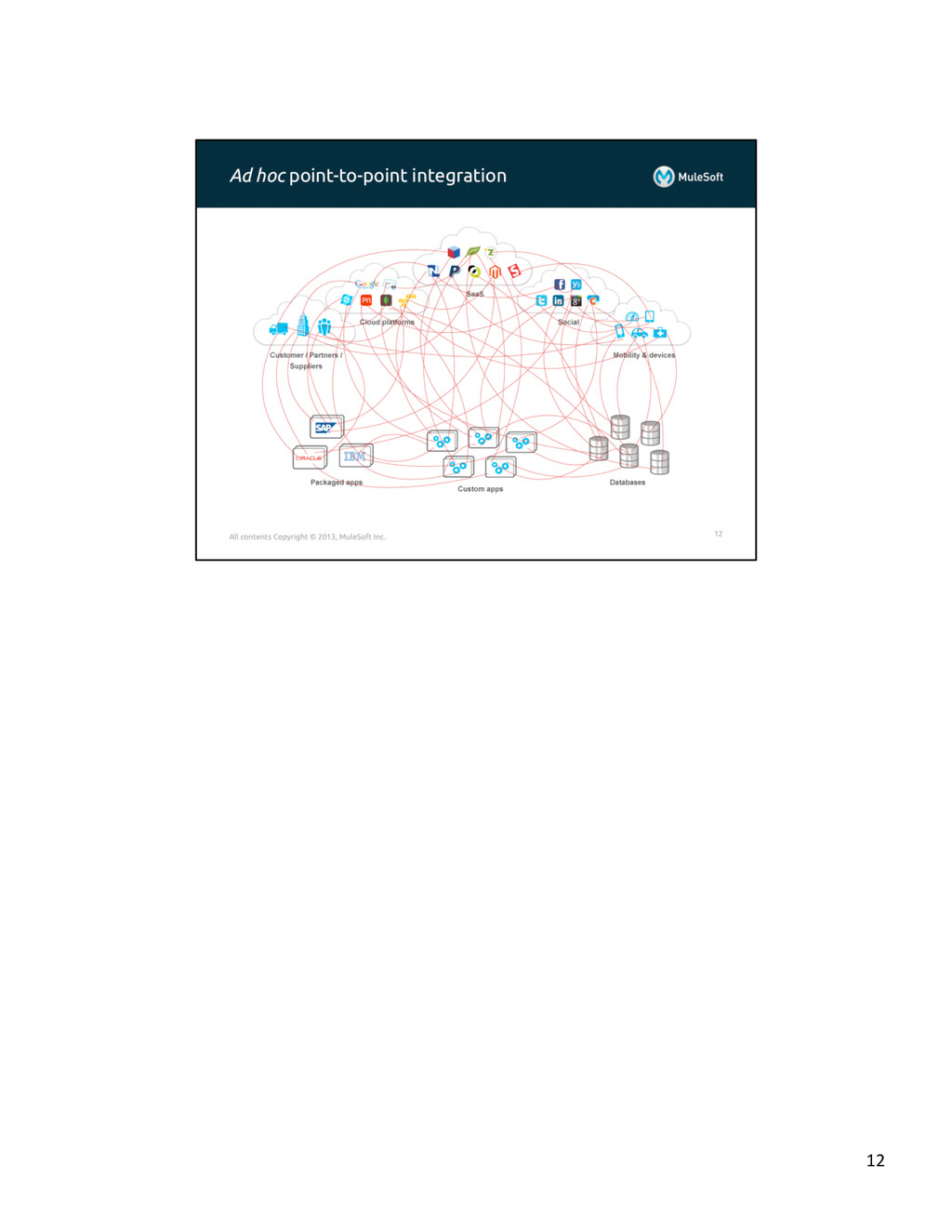
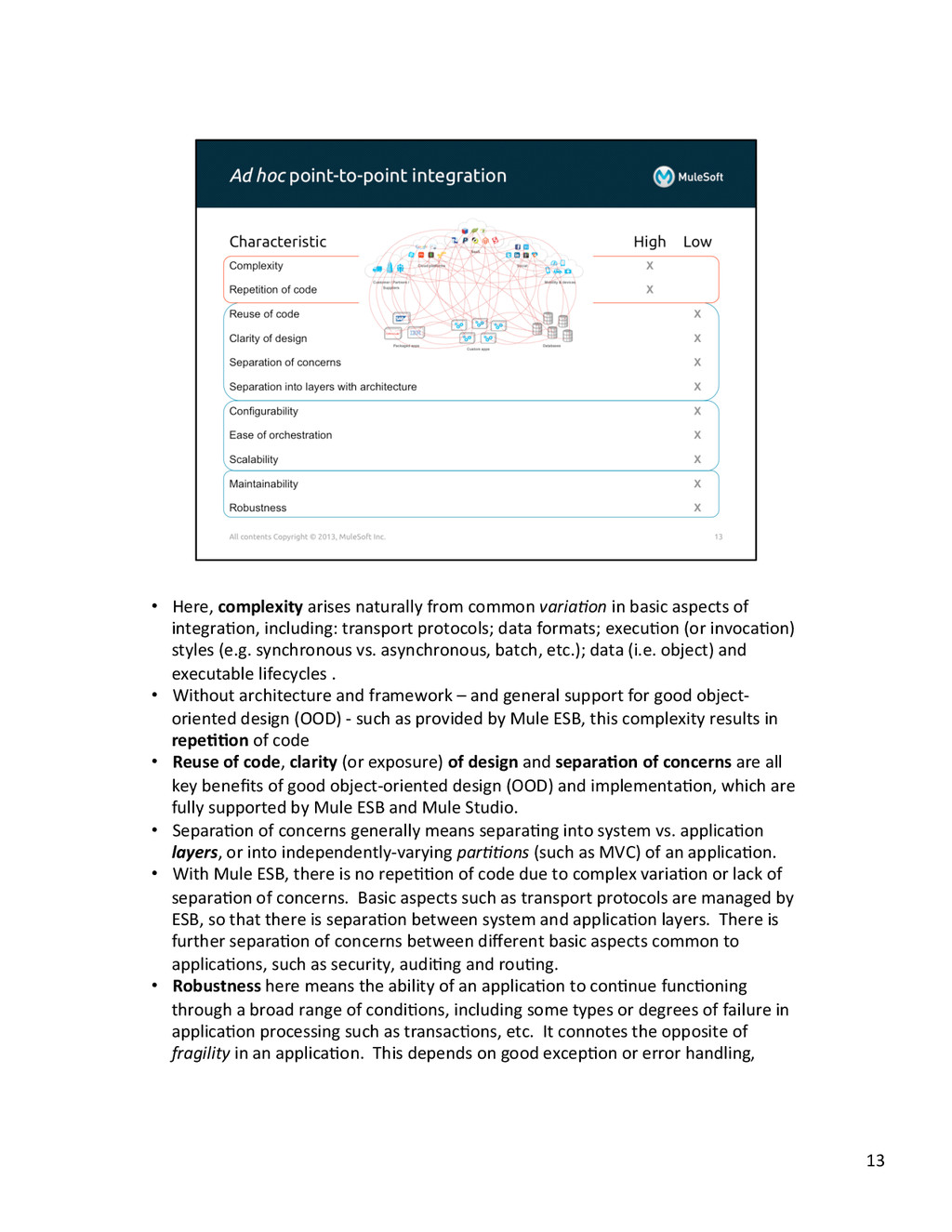
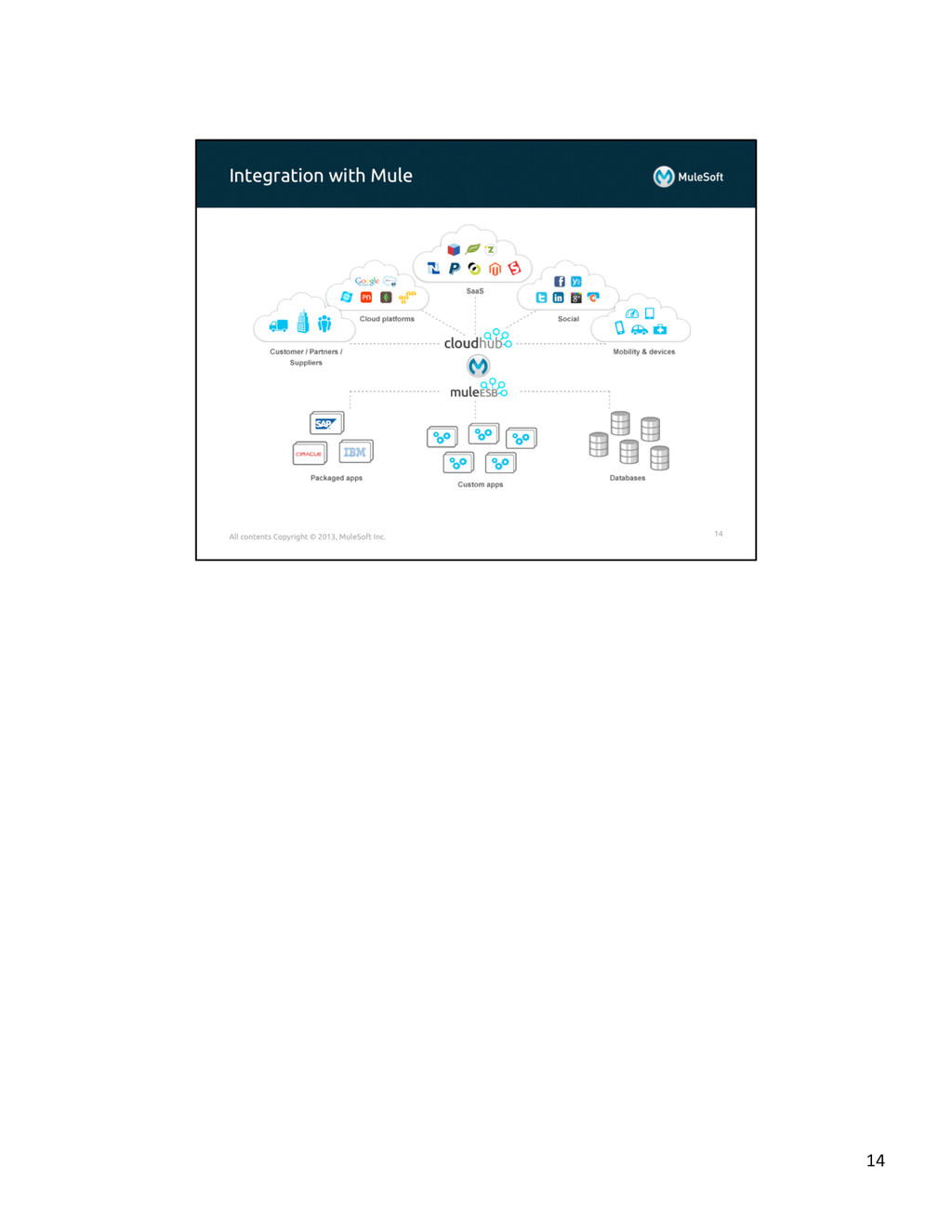
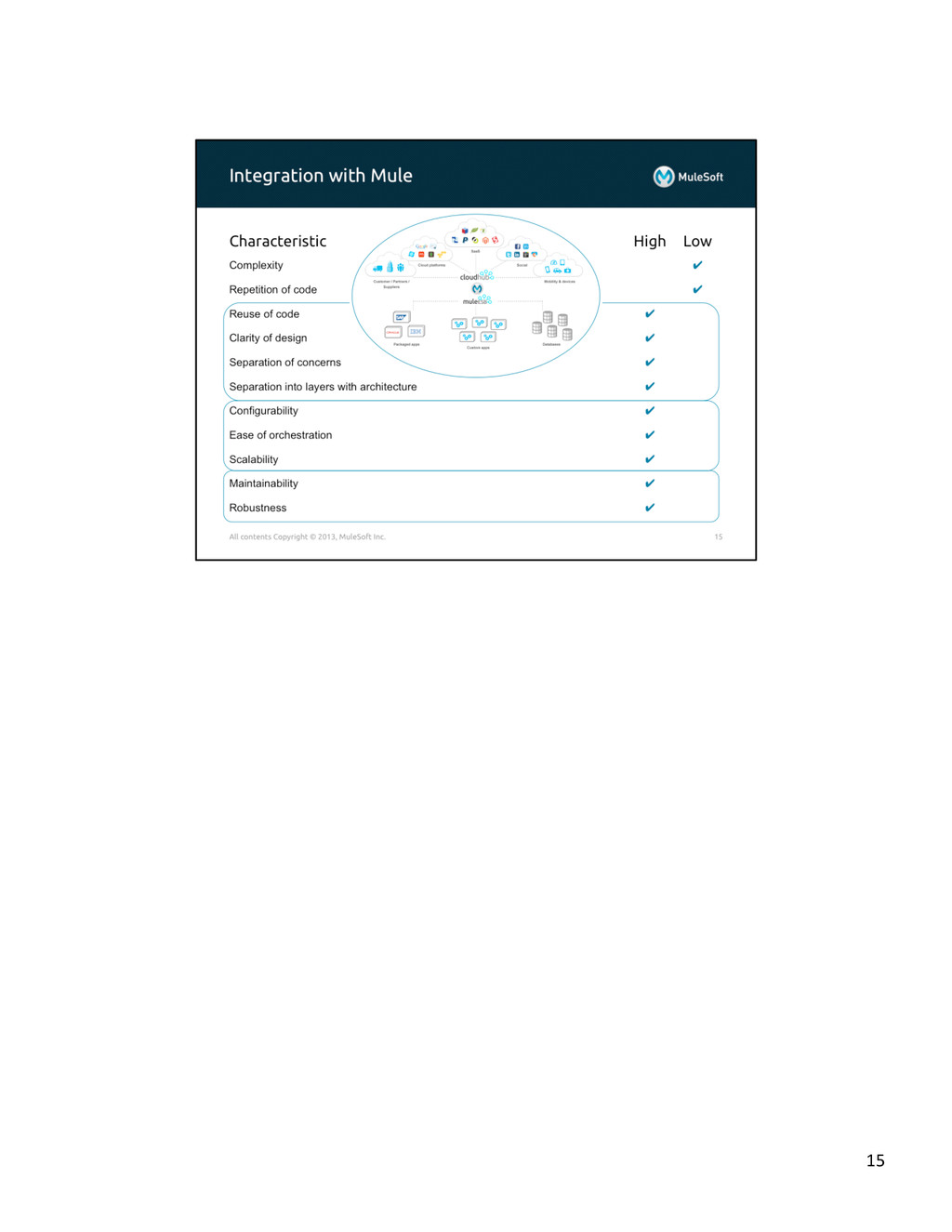
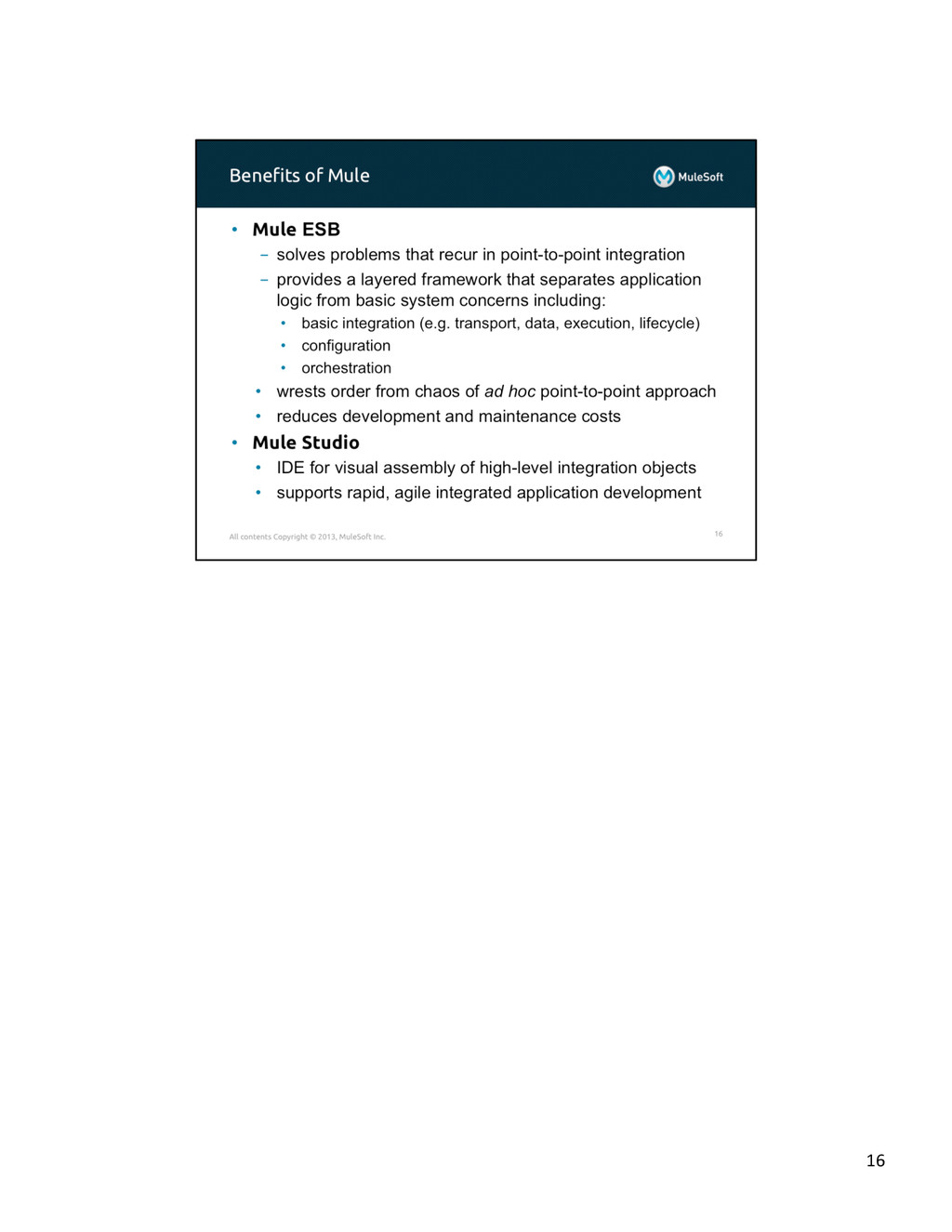
aspects of integra=on, including: transport protocols; data formats; execu=on (or invoca=on) styles (e.g. synchronous vs. asynchronous, batch, etc.); data (i.e. object) and executable lifecycles . • Without architecture and framework – and general support for good object-‐ oriented design (OOD) -‐ such as provided by Mule ESB, this complexity results in repe,,on of code • Reuse of code, clarity (or exposure) of design and separa,on of concerns are all key benefits of good object-‐oriented design (OOD) and implementa=on, which are fully supported by Mule ESB and Mule Studio. • Separa=on of concerns generally means separa=ng into system vs. applica=on layers, or into independently-‐varying par%%ons (such as MVC) of an applica=on. • With Mule ESB, there is no repe==on of code due to complex varia=on or lack of separa=on of concerns. Basic aspects such as transport protocols are managed by ESB, so that there is separa=on between system and applica=on layers. There is further separa=on of concerns between different basic aspects common to applica=ons, such as security, audi=ng and rou=ng. • Robustness here means the ability of an applica=on to con=nue func=oning through a broad range of condi=ons, including some types or degrees of failure in applica=on processing such as transac=ons, etc. It connotes the opposite of fragility in an applica=on. This depends on good excep=on or error handling, 13


 nttcom
 terapyon
 carta_engineering
 pfn
 daidaidai
 iktakahiro
 sudoakiy
 occhi
 kizawa2020
 keeg
 sh_fk2
 kworkdev
 morganepeng
 jonoalderson
 holman
 aleyda
 katarinadahlin
 sonatard
 michaelherold
 axbom
 tammielis
 andyhume
 orderedlist