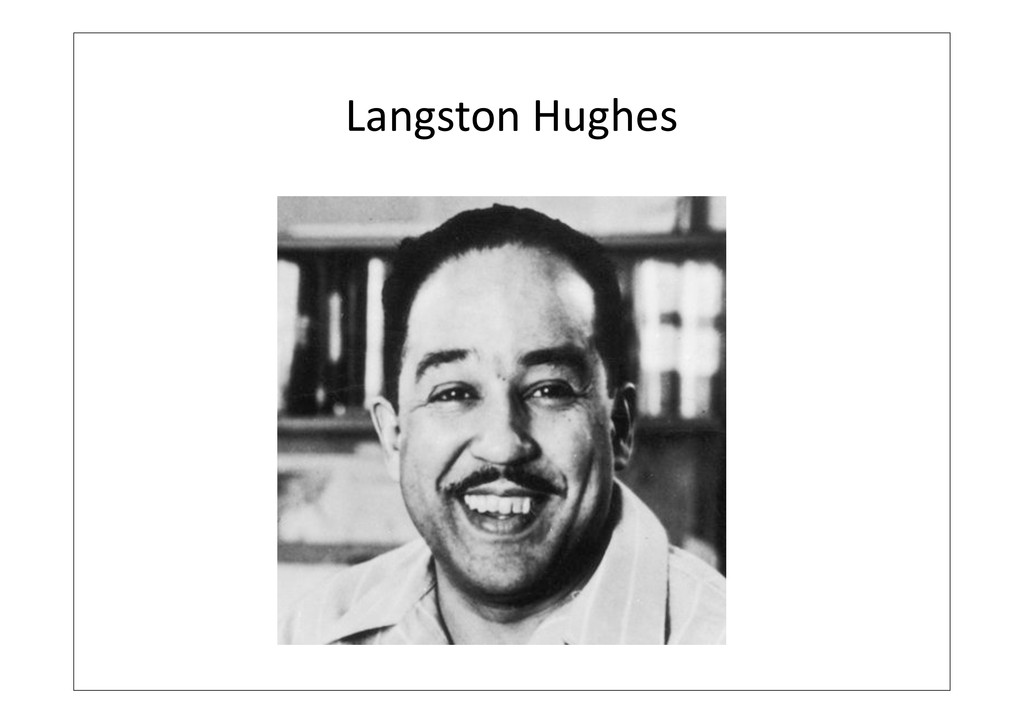
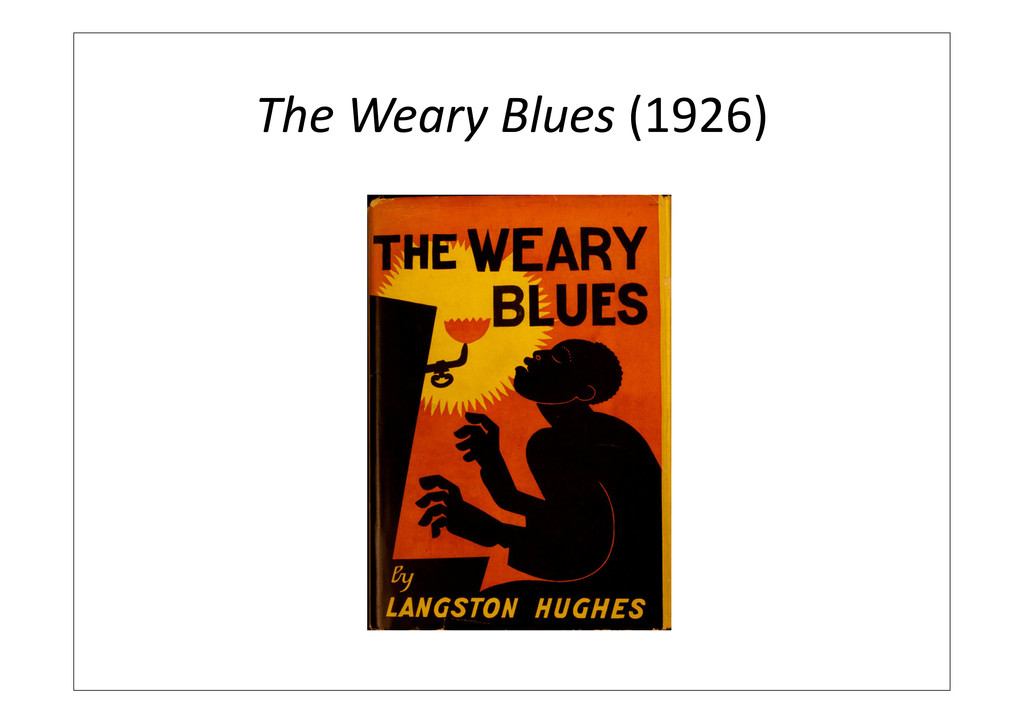
1st publica/on in 1919 in Brownie‘s Book, a magazine for African American children, founded by W.E.B. DuBois • June 1921: “The Negro Speaks of Rivers“ published • 1926: The Weary Blues (collec/on of poems) and Racial Mountain published • His works appeared in the NAACP publica/on “Crisis Magazine” and in “Opportunity Magazine” • He wrote sixteen books of poems, two novels, three collec/ons of short stories, as well as "editorial" and "documentary" fic/on, plays, children's poetry, musicals and operas, autobiographies, radio and television scripts and magazine ar/cles.
on June, 23 1926 in the Magazine The Na<on • An essay in defense of the freedom of the black writer • Became a manifesto for many young black writers; Hughes himself became their rolemodel
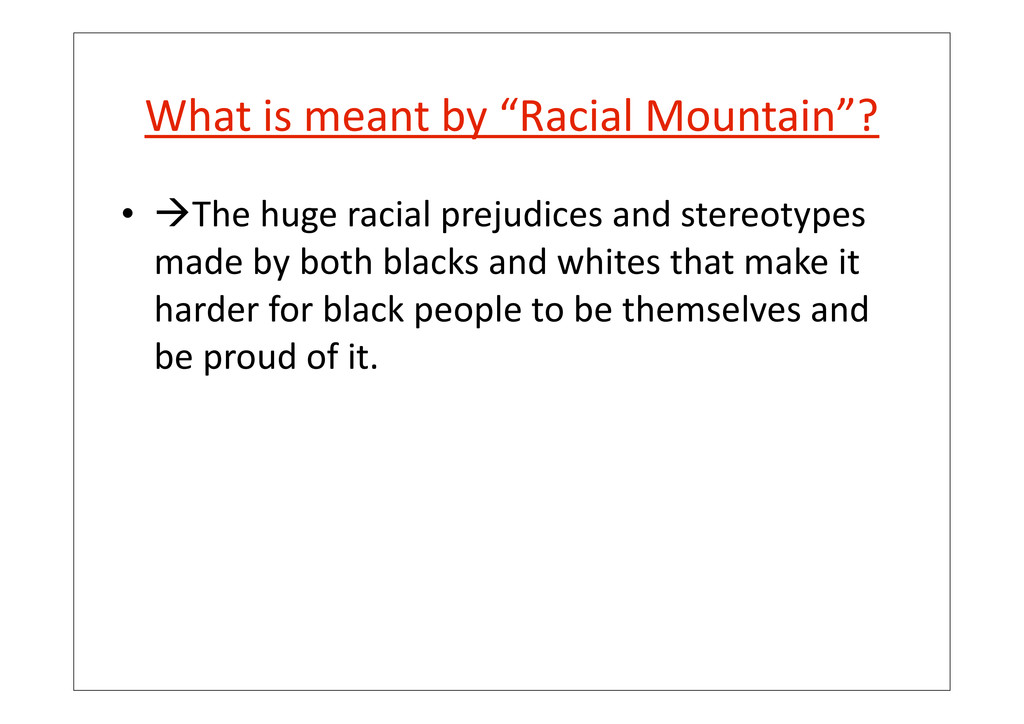
– not a Negro poet”? It is bad to act like a black person. “The mother oaen says “Don’t be like niggers” when the children are bad. A frequent phrase from the father is, “Look how well a white does things.””
– not a Negro poet”? It is bad to act like a black person. “The mother oaen says “Don’t be like niggers” when the children are bad. A frequent phrase from the father is, “Look how well a white does things.”” “The word white [becomes] a symbol of all virtues. It holds for the children beauty, morality and money.”
– not a Negro poet”? It is bad to act like a black person. “The mother oaen says “Don’t be like niggers” when the children are bad. A frequent phrase from the father is, “Look how well a white does things.”” “The word white [becomes] a symbol of all virtues. It holds for the children beauty, morality and money.” Most black ar/st are “never taught to see that [ i. e. the black] beauty.”
blacks about being black? “high‐class” blacks try to imitate whites, “In the North they go to white theaters and white movies. And in the South they have at least two cars and house “like white folks”.
blacks about being black? “high‐class” blacks try to imitate whites, “In the North they go to white theaters and white movies. And in the South they have at least two cars and house “like white folks”. They also don´t support their black fellow ci/zens, “A prominent negro women paid eleven dollars to hear Raquel Meller sing Andalusian popular songs. But she told me a few weeks before she would not think of going to hear […] a black ar/st, sing Negro folksongs.”
blacks about being black? “high‐class” blacks try to imitate whites, “In the North they go to white theaters and white movies. And in the South they have at least two cars and house “like white folks”. They also don´t support their black fellow ci/zens, “A prominent negro women paid eleven dollars to hear Raquel Meller sing Andalusian popular songs. But she told me a few weeks before she would not think of going to hear […] a black ar/st, sing Negro folksongs.” “low‐class” blacks are proud to be black “And they accept what beauty is their own without ques/on”.
blacks about being black? “high‐class” blacks try to imitate whites, “In the North they go to white theaters and white movies. And in the South they have at least two cars and house “like white folks”. They also don´t support their black fellow ci/zens, “A prominent negro women paid eleven dollars to hear Raquel Meller sing Andalusian popular songs. But she told me a few weeks before she would not think of going to hear […] a black ar/st, sing Negro folksongs.” “low‐class” blacks are proud to be black “And they accept what beauty is their own without ques/on”. “And perhaps these common people will give to the world its truly great Negro ar/st, the one who is not afraid to be himself.”
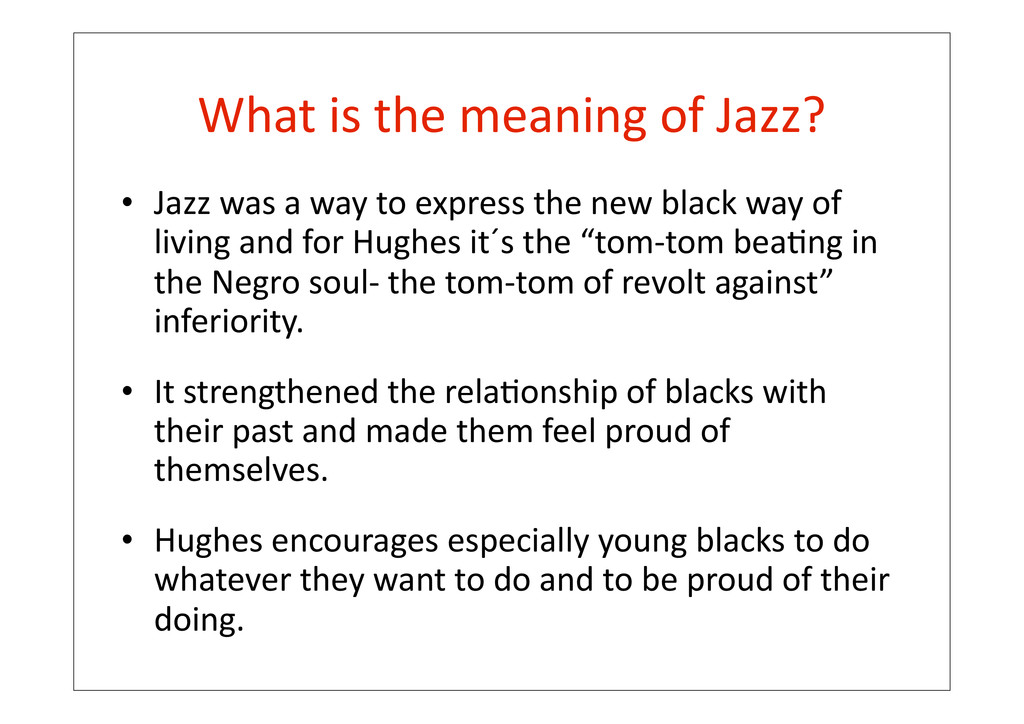
way to express the new black way of living and for Hughes it´s the “tom‐tom bea/ng in the Negro soul‐ the tom‐tom of revolt against” inferiority. • It strengthened the rela/onship of blacks with their past and made them feel proud of themselves.
way to express the new black way of living and for Hughes it´s the “tom‐tom bea/ng in the Negro soul‐ the tom‐tom of revolt against” inferiority. • It strengthened the rela/onship of blacks with their past and made them feel proud of themselves. • Hughes encourages especially young blacks to do whatever they want to do and to be proud of their doing.
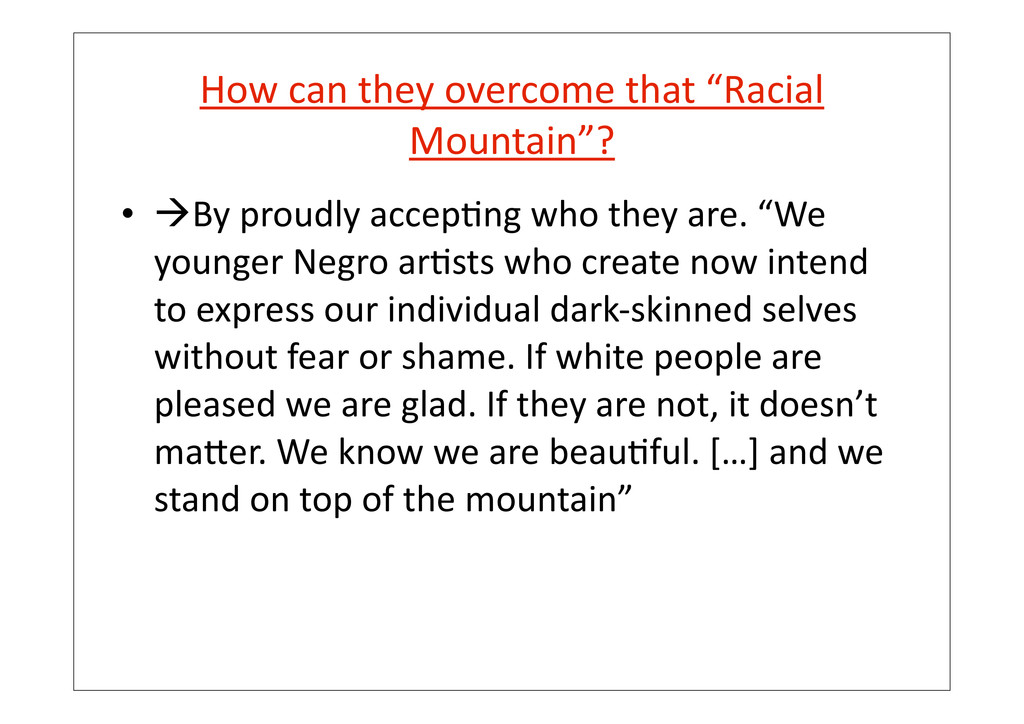
accep/ng who they are. “We younger Negro ar/sts who create now intend to express our individual dark‐skinned selves without fear or shame. If white people are pleased we are glad. If they are not, it doesn’t maker. We know we are beau/ful. […] and we stand on top of the mountain”
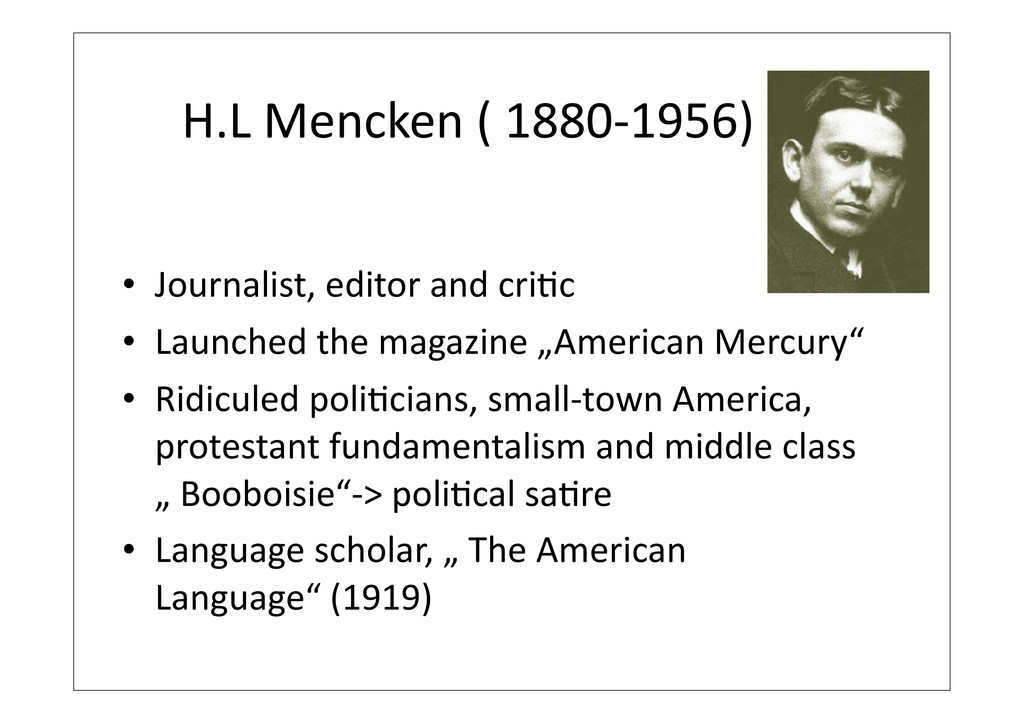
Launched the magazine „American Mercury“ • Ridiculed poli/cians, small‐town America, protestant fundamentalism and middle class „ Booboisie“‐> poli/cal sa/re • Language scholar, „ The American Language“ (1919)
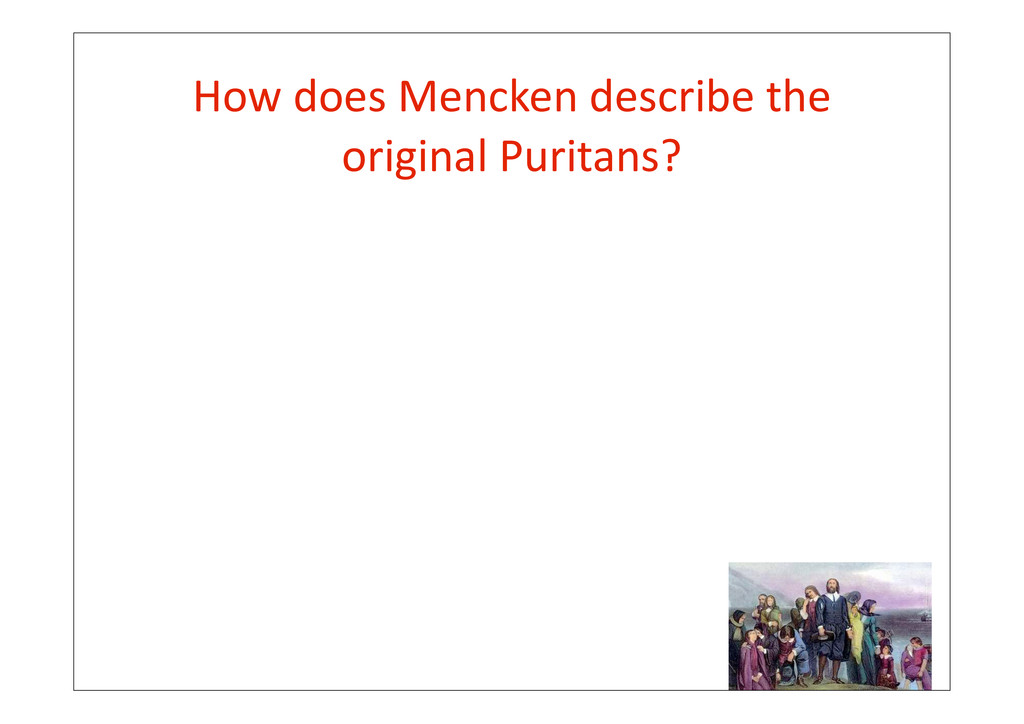
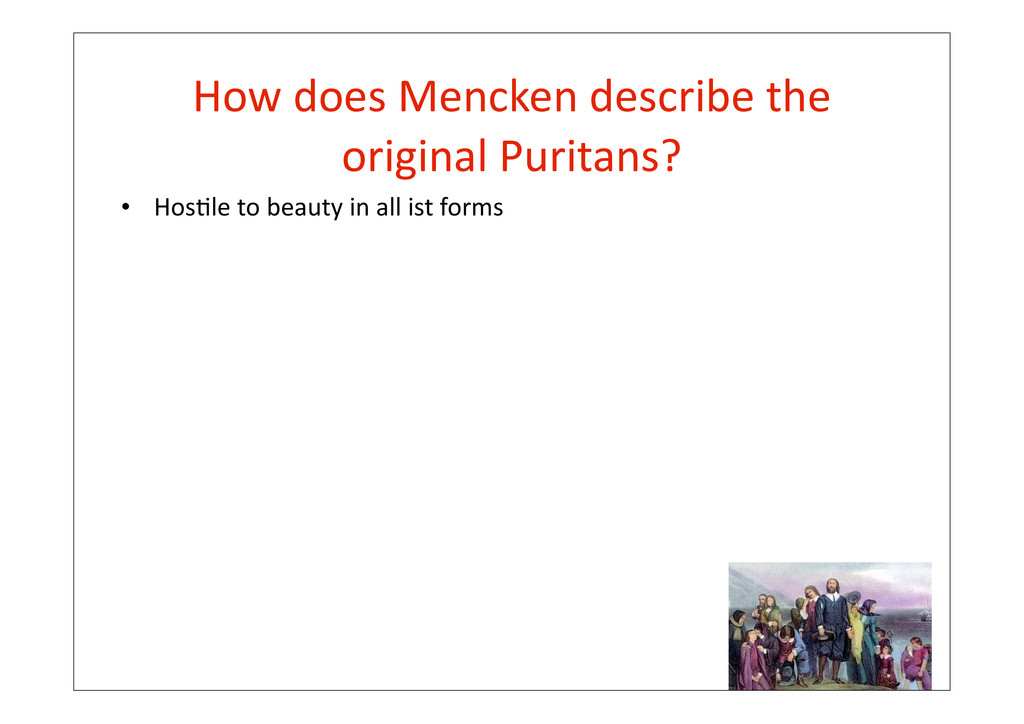
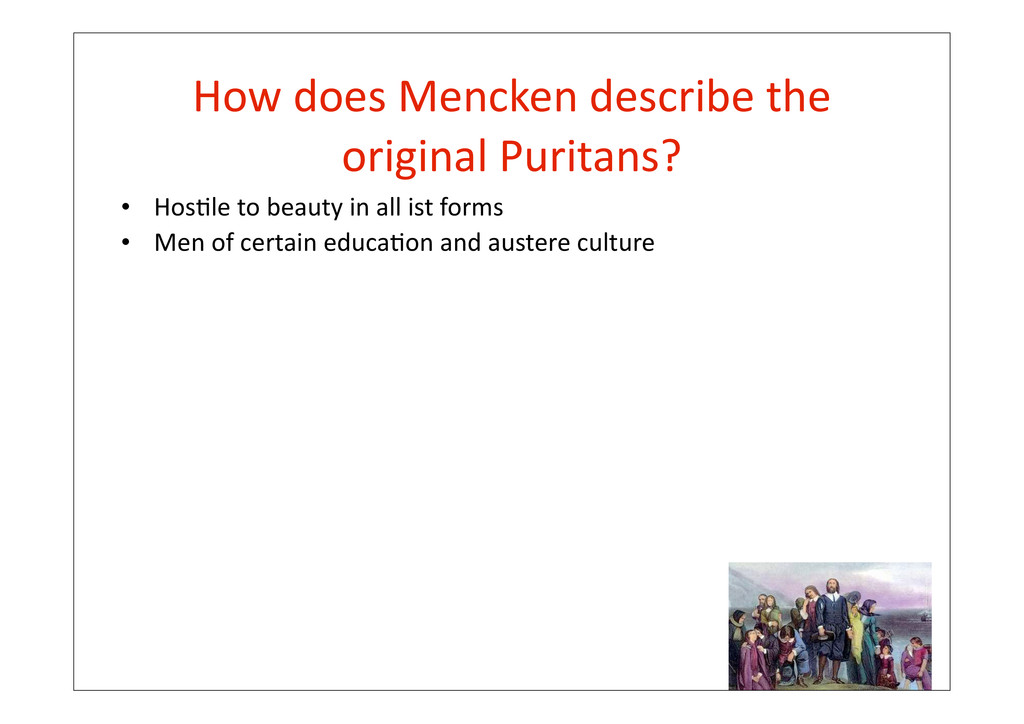
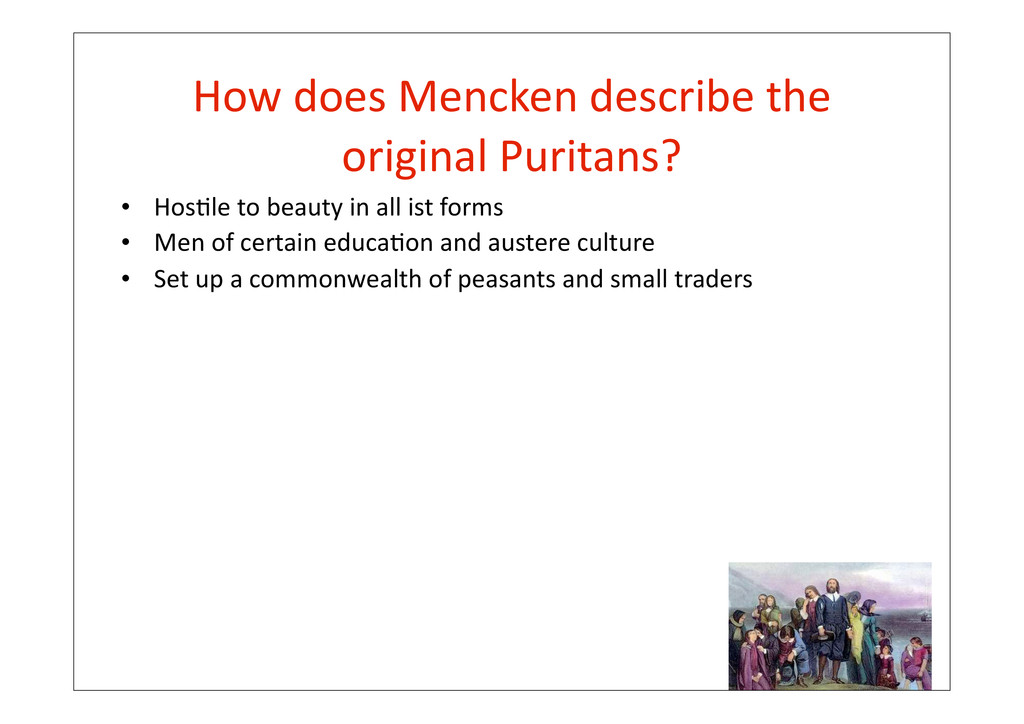
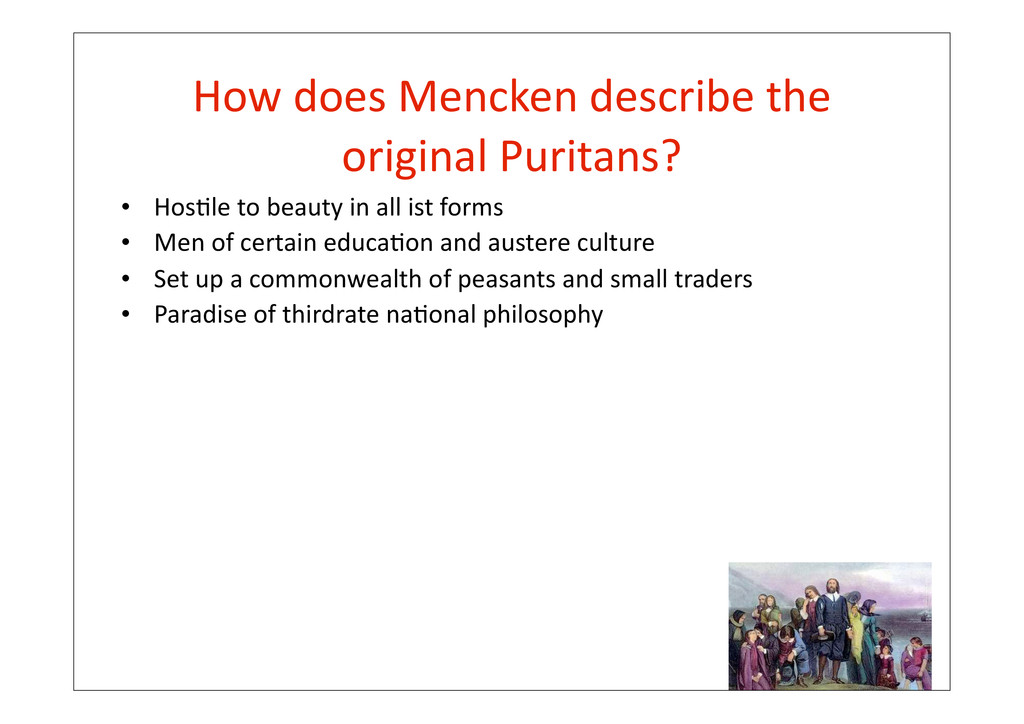
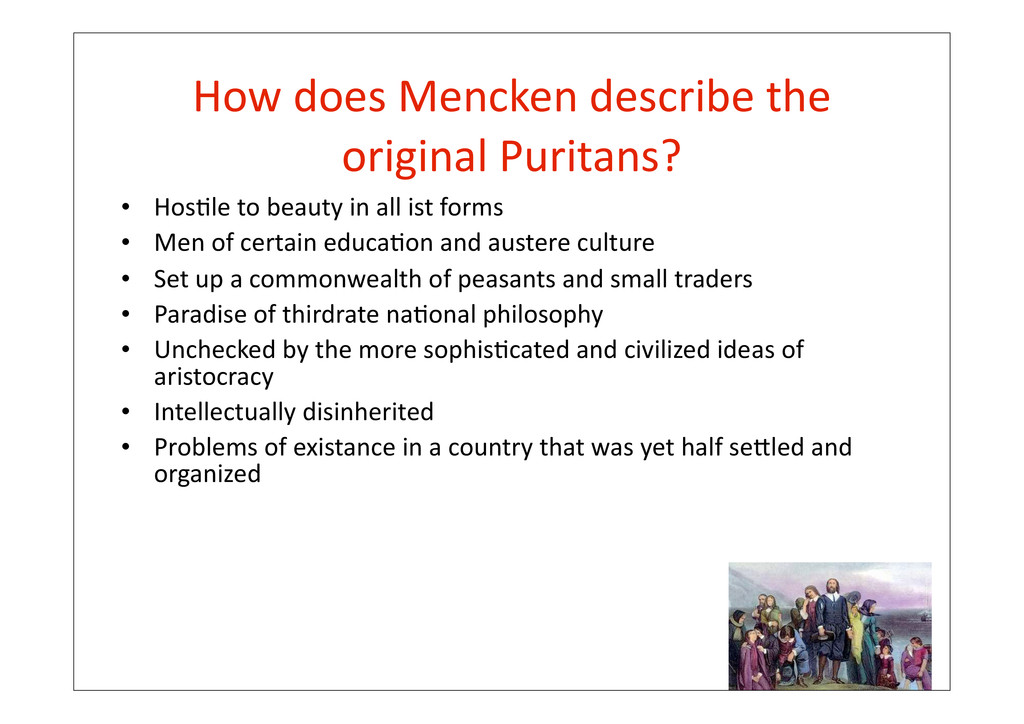
beauty in all ist forms • Men of certain educa/on and austere culture • Set up a commonwealth of peasants and small traders • Paradise of thirdrate na/onal philosophy
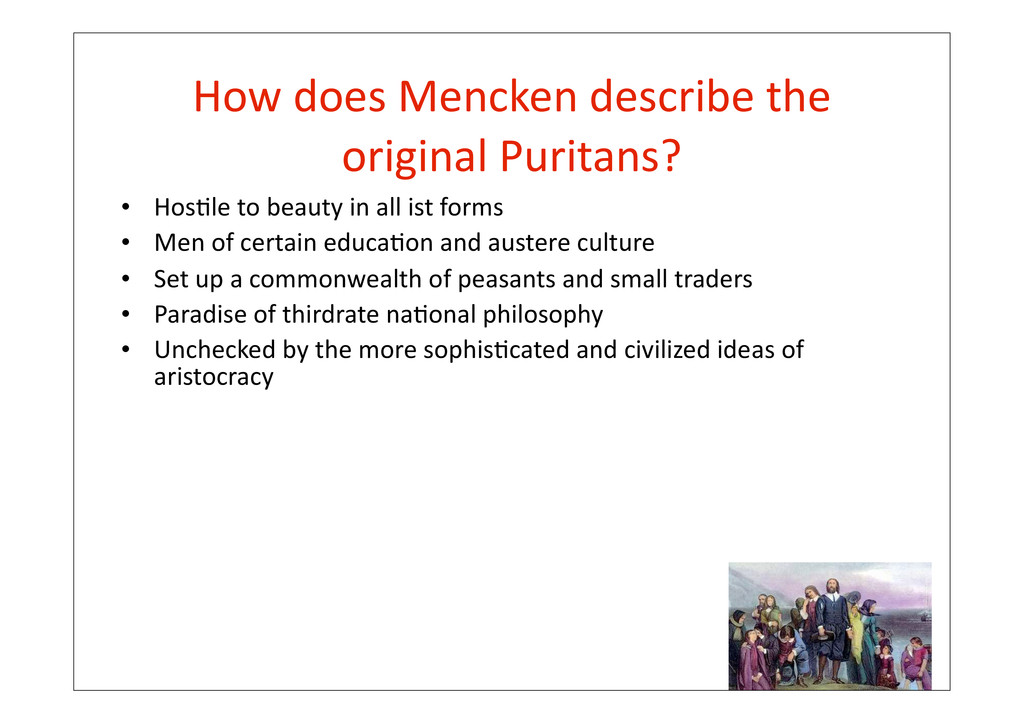
beauty in all ist forms • Men of certain educa/on and austere culture • Set up a commonwealth of peasants and small traders • Paradise of thirdrate na/onal philosophy • Unchecked by the more sophis/cated and civilized ideas of aristocracy
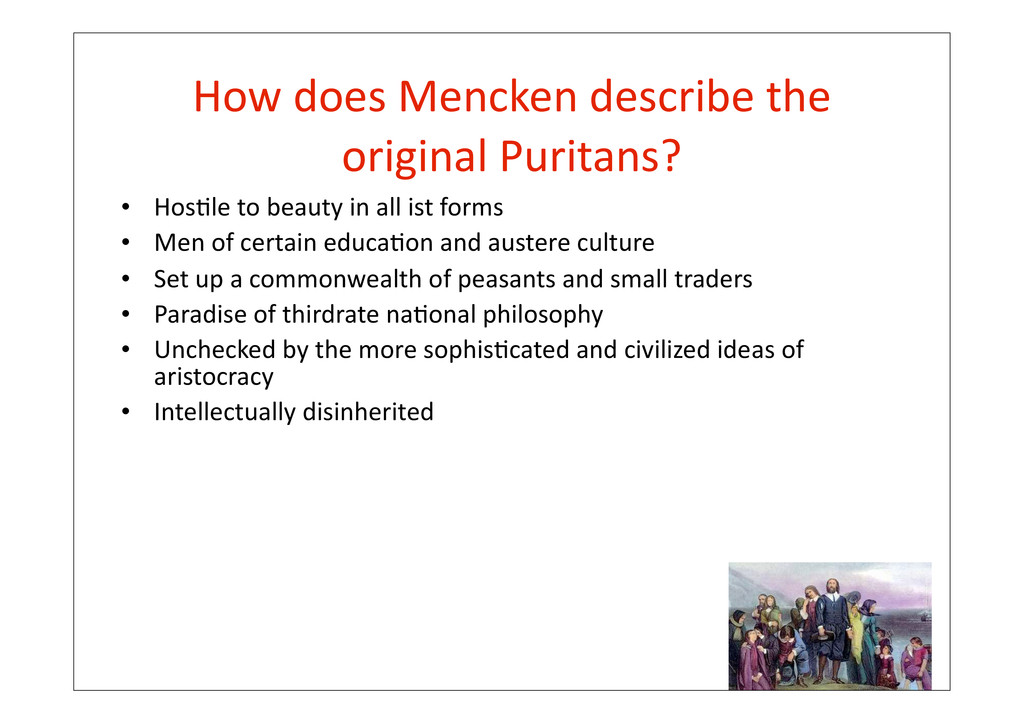
beauty in all ist forms • Men of certain educa/on and austere culture • Set up a commonwealth of peasants and small traders • Paradise of thirdrate na/onal philosophy • Unchecked by the more sophis/cated and civilized ideas of aristocracy • Intellectually disinherited
beauty in all ist forms • Men of certain educa/on and austere culture • Set up a commonwealth of peasants and small traders • Paradise of thirdrate na/onal philosophy • Unchecked by the more sophis/cated and civilized ideas of aristocracy • Intellectually disinherited • Problems of existance in a country that was yet half sekled and organized
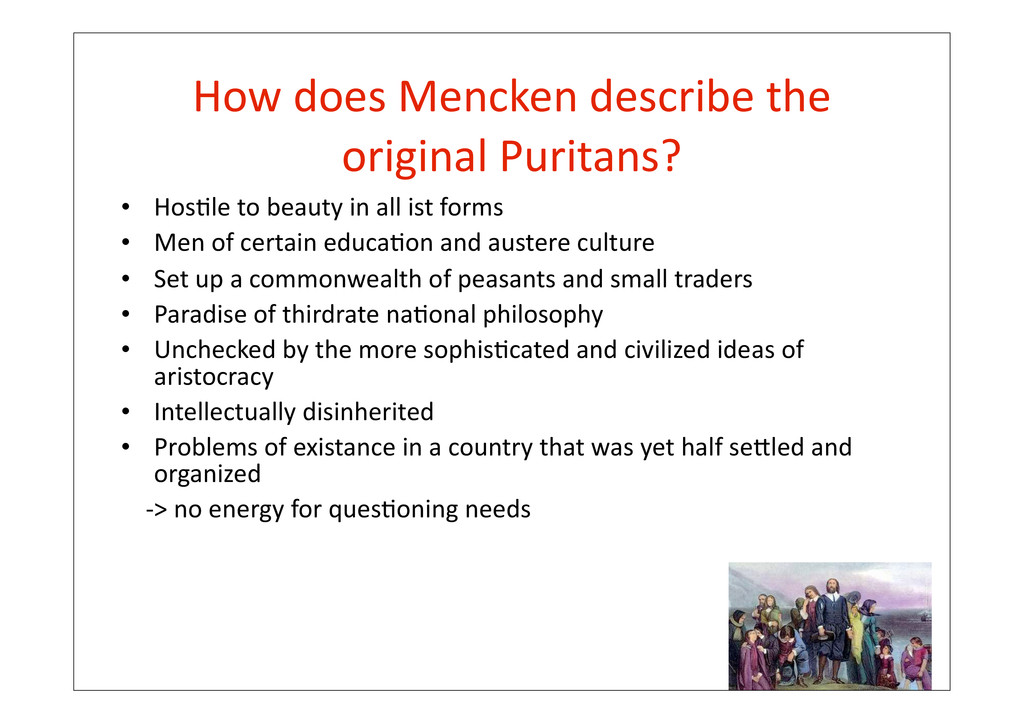
beauty in all ist forms • Men of certain educa/on and austere culture • Set up a commonwealth of peasants and small traders • Paradise of thirdrate na/onal philosophy • Unchecked by the more sophis/cated and civilized ideas of aristocracy • Intellectually disinherited • Problems of existance in a country that was yet half sekled and organized ‐> no energy for ques/oning needs
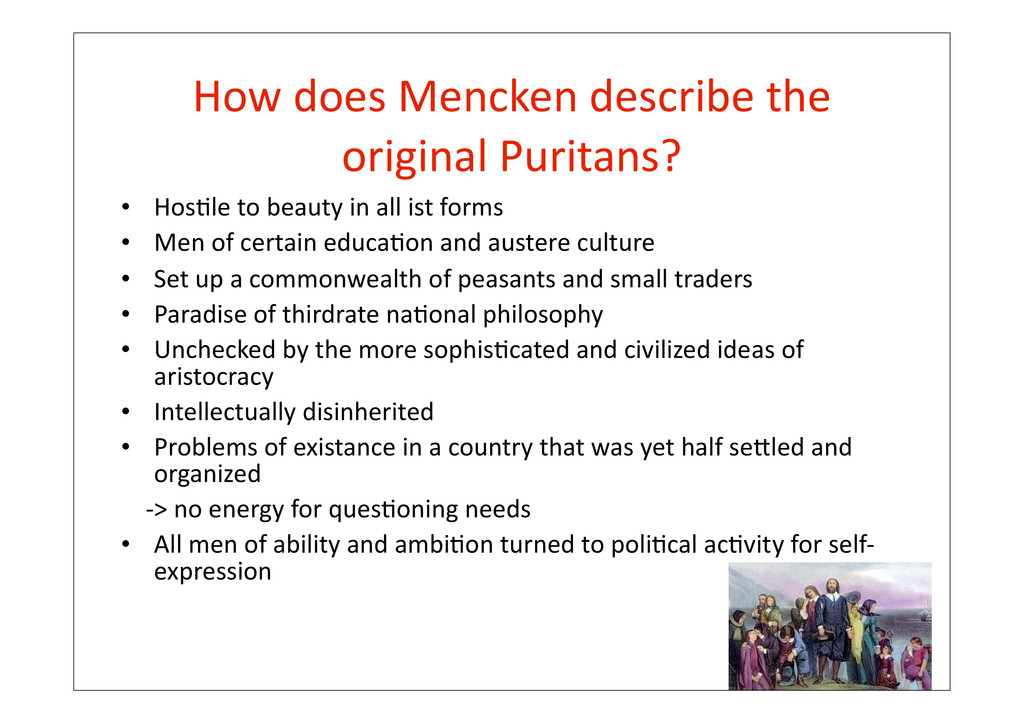
beauty in all ist forms • Men of certain educa/on and austere culture • Set up a commonwealth of peasants and small traders • Paradise of thirdrate na/onal philosophy • Unchecked by the more sophis/cated and civilized ideas of aristocracy • Intellectually disinherited • Problems of existance in a country that was yet half sekled and organized ‐> no energy for ques/oning needs • All men of ability and ambi/on turned to poli/cal ac/vity for self‐ expression
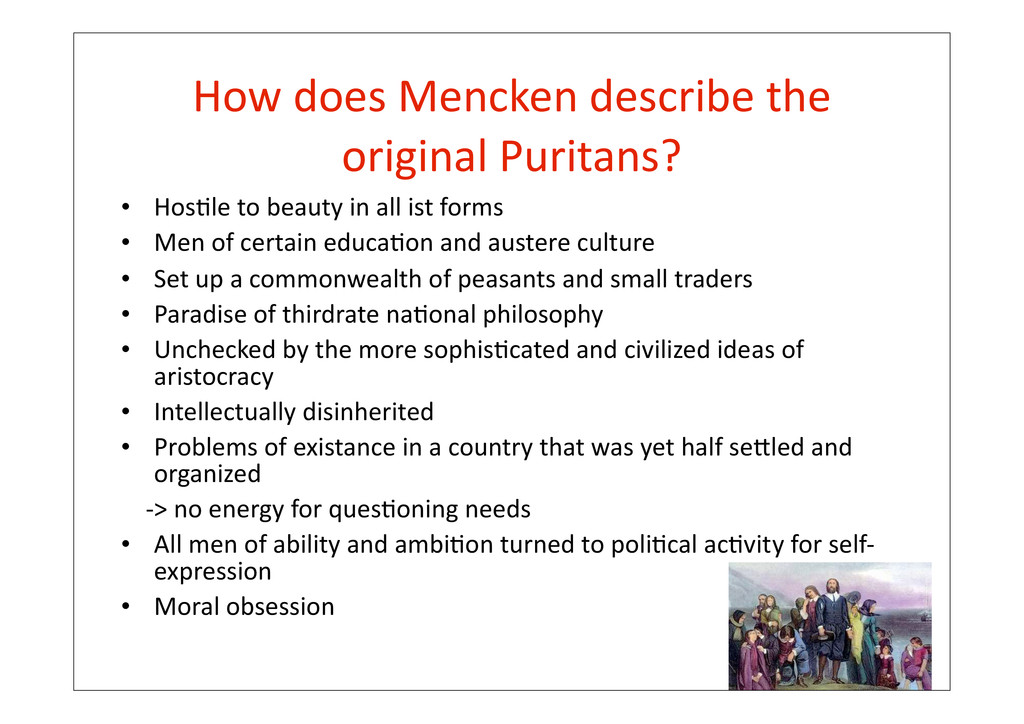
beauty in all ist forms • Men of certain educa/on and austere culture • Set up a commonwealth of peasants and small traders • Paradise of thirdrate na/onal philosophy • Unchecked by the more sophis/cated and civilized ideas of aristocracy • Intellectually disinherited • Problems of existance in a country that was yet half sekled and organized ‐> no energy for ques/oning needs • All men of ability and ambi/on turned to poli/cal ac/vity for self‐ expression • Moral obsession
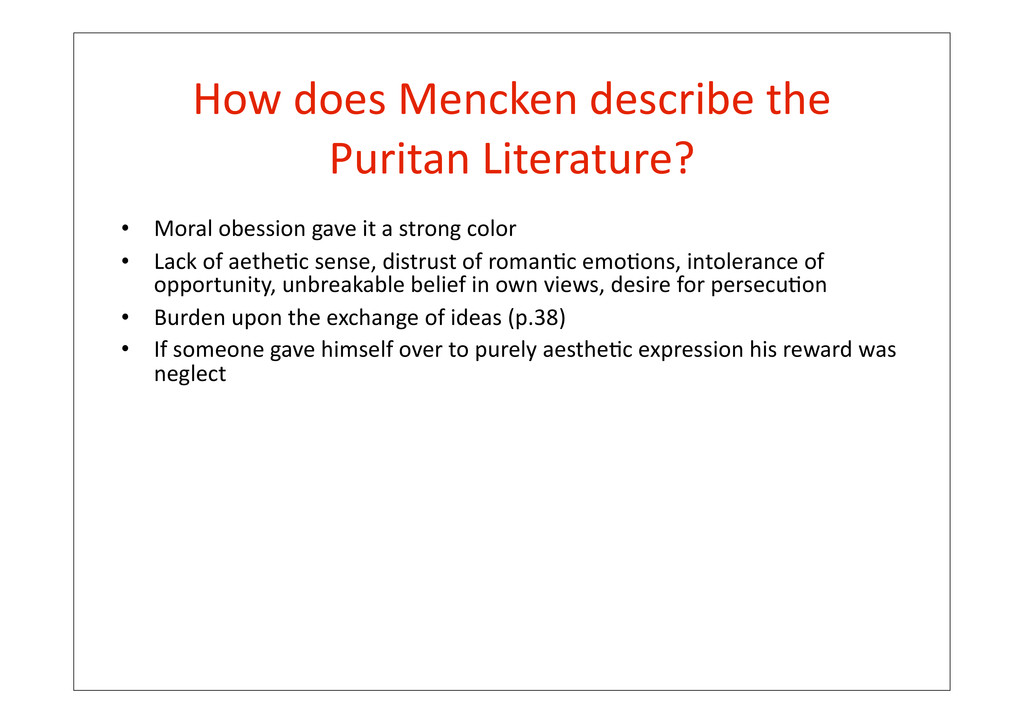
gave it a strong color • Lack of aethe/c sense, distrust of roman/c emo/ons, intolerance of opportunity, unbreakable belief in own views, desire for persecu/on
gave it a strong color • Lack of aethe/c sense, distrust of roman/c emo/ons, intolerance of opportunity, unbreakable belief in own views, desire for persecu/on • Burden upon the exchange of ideas (p.38)
gave it a strong color • Lack of aethe/c sense, distrust of roman/c emo/ons, intolerance of opportunity, unbreakable belief in own views, desire for persecu/on • Burden upon the exchange of ideas (p.38) • If someone gave himself over to purely aesthe/c expression his reward was neglect
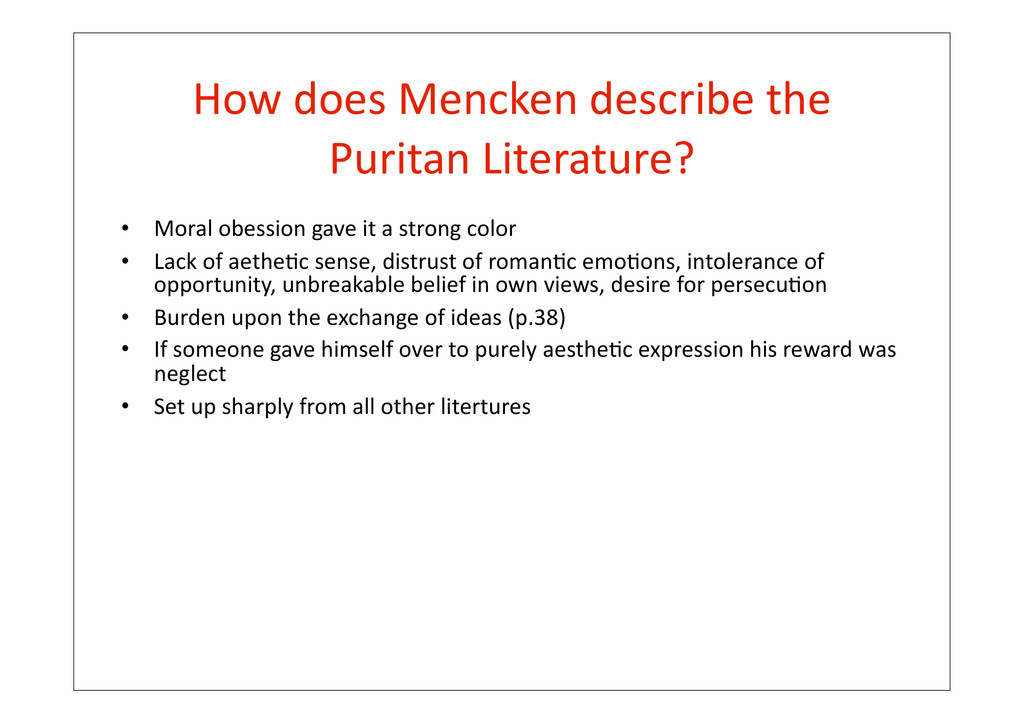
gave it a strong color • Lack of aethe/c sense, distrust of roman/c emo/ons, intolerance of opportunity, unbreakable belief in own views, desire for persecu/on • Burden upon the exchange of ideas (p.38) • If someone gave himself over to purely aesthe/c expression his reward was neglect • Set up sharply from all other litertures
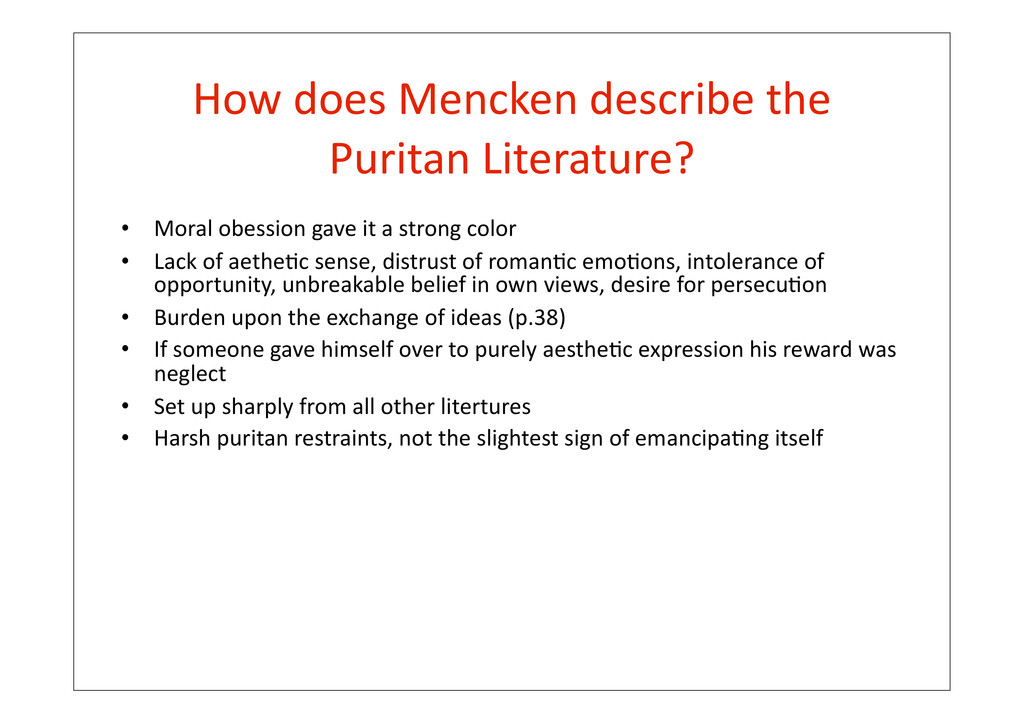
gave it a strong color • Lack of aethe/c sense, distrust of roman/c emo/ons, intolerance of opportunity, unbreakable belief in own views, desire for persecu/on • Burden upon the exchange of ideas (p.38) • If someone gave himself over to purely aesthe/c expression his reward was neglect • Set up sharply from all other litertures • Harsh puritan restraints, not the slightest sign of emancipa/ng itself
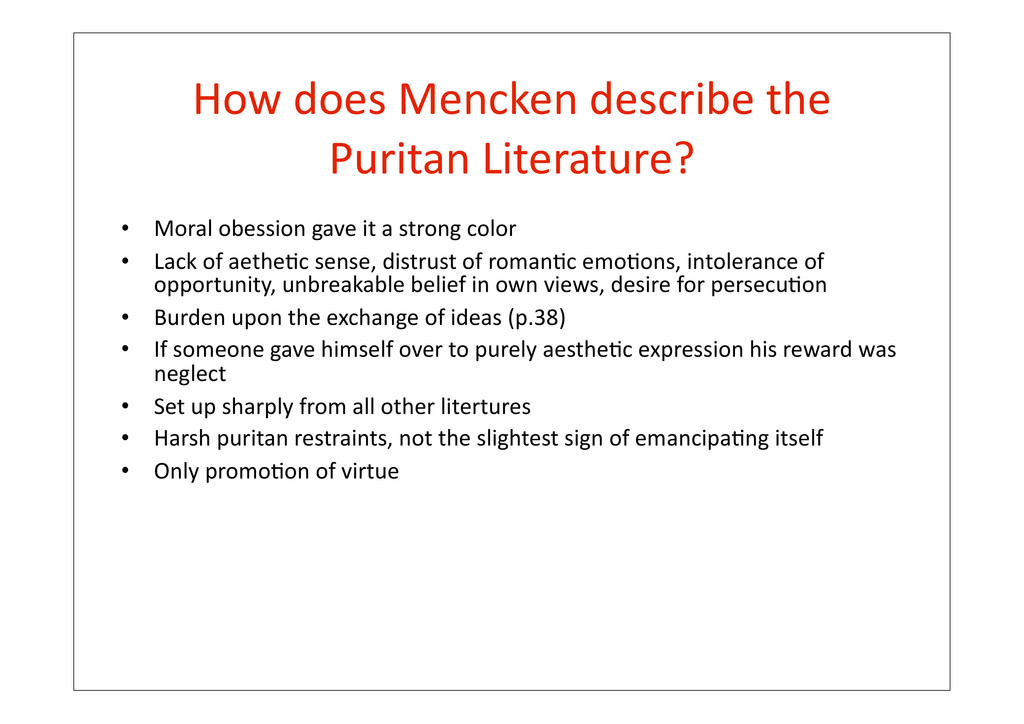
gave it a strong color • Lack of aethe/c sense, distrust of roman/c emo/ons, intolerance of opportunity, unbreakable belief in own views, desire for persecu/on • Burden upon the exchange of ideas (p.38) • If someone gave himself over to purely aesthe/c expression his reward was neglect • Set up sharply from all other litertures • Harsh puritan restraints, not the slightest sign of emancipa/ng itself • Only promo/on of virtue
gave it a strong color • Lack of aethe/c sense, distrust of roman/c emo/ons, intolerance of opportunity, unbreakable belief in own views, desire for persecu/on • Burden upon the exchange of ideas (p.38) • If someone gave himself over to purely aesthe/c expression his reward was neglect • Set up sharply from all other litertures • Harsh puritan restraints, not the slightest sign of emancipa/ng itself • Only promo/on of virtue • Aswell cri/cs only focus on texts that are edifying and nice
gave it a strong color • Lack of aethe/c sense, distrust of roman/c emo/ons, intolerance of opportunity, unbreakable belief in own views, desire for persecu/on • Burden upon the exchange of ideas (p.38) • If someone gave himself over to purely aesthe/c expression his reward was neglect • Set up sharply from all other litertures • Harsh puritan restraints, not the slightest sign of emancipa/ng itself • Only promo/on of virtue • Aswell cri/cs only focus on texts that are edifying and nice • A novel/play is only judged by it´s orthodoxy of doctrine,usefullness as a moral tract
gave it a strong color • Lack of aethe/c sense, distrust of roman/c emo/ons, intolerance of opportunity, unbreakable belief in own views, desire for persecu/on • Burden upon the exchange of ideas (p.38) • If someone gave himself over to purely aesthe/c expression his reward was neglect • Set up sharply from all other litertures • Harsh puritan restraints, not the slightest sign of emancipa/ng itself • Only promo/on of virtue • Aswell cri/cs only focus on texts that are edifying and nice • A novel/play is only judged by it´s orthodoxy of doctrine,usefullness as a moral tract • Not seen as a thing in itself but only as a hand maiden to pol/cs and religion
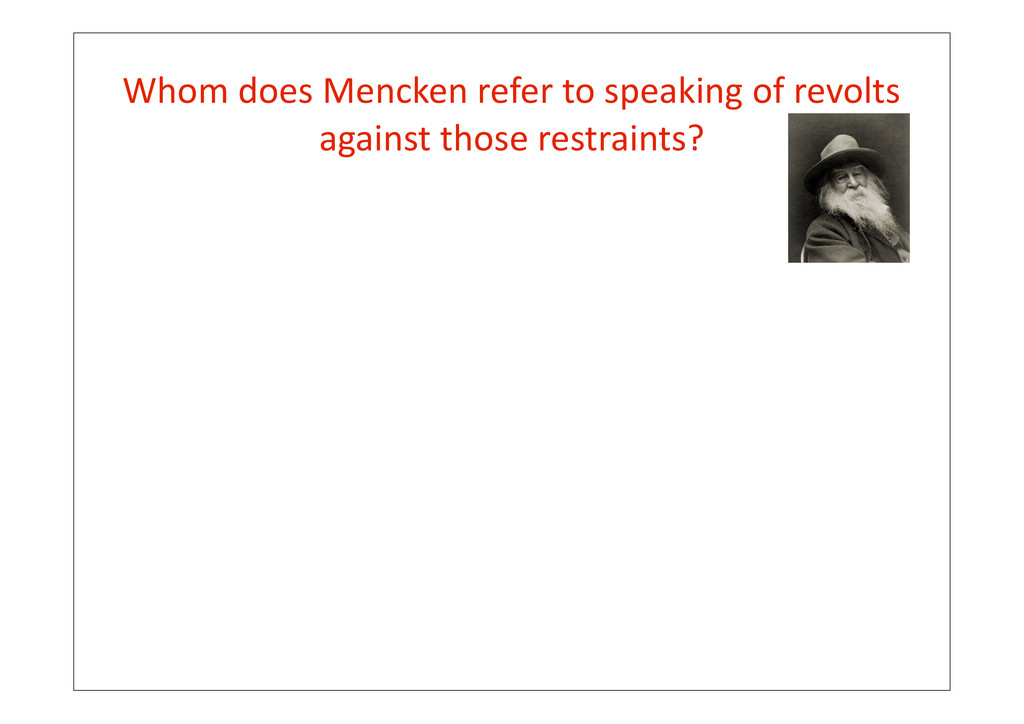
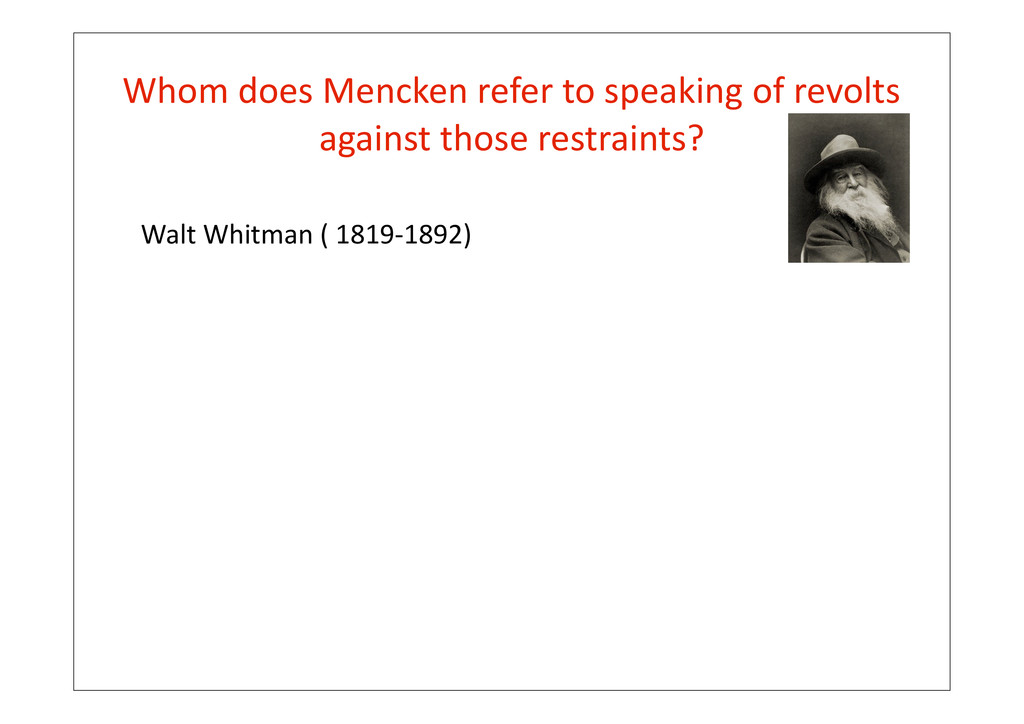
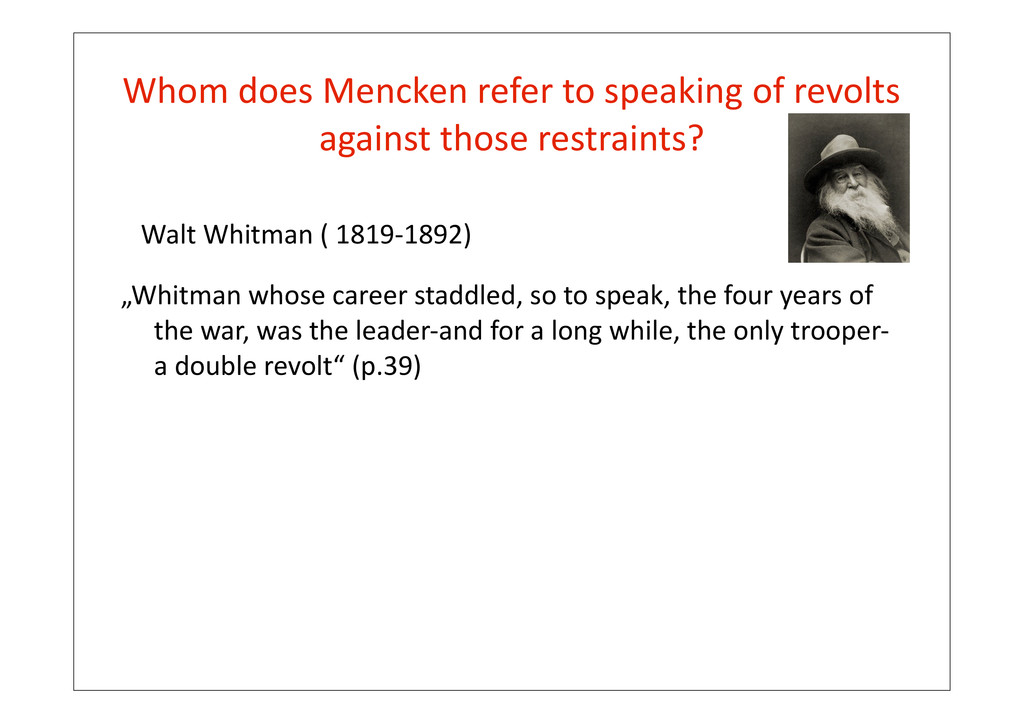
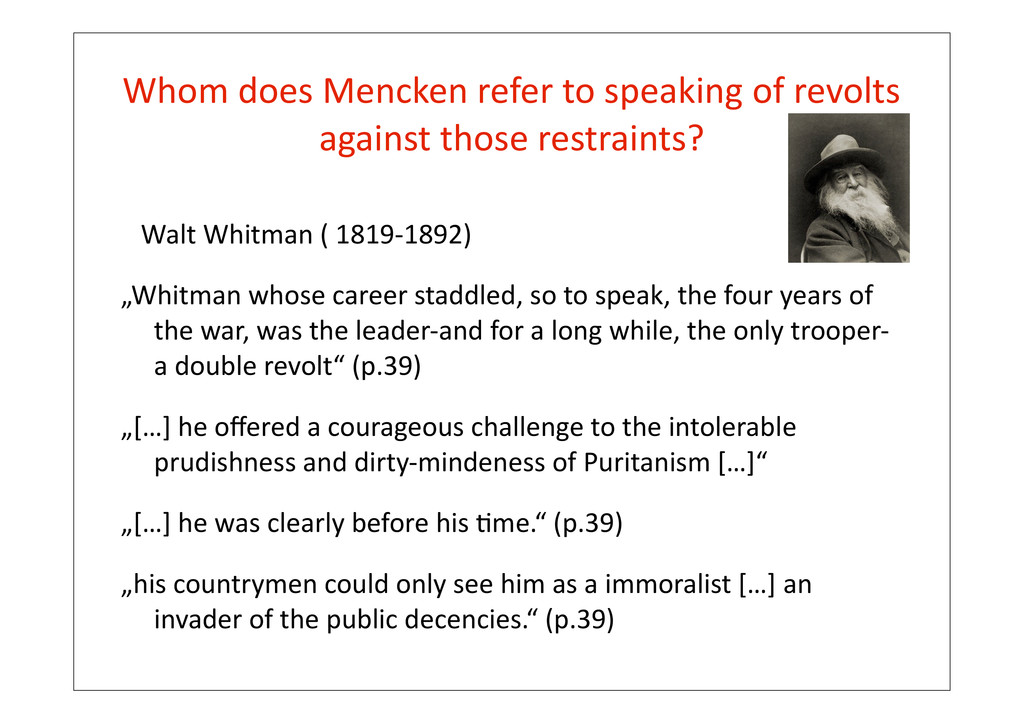
restraints? Walt Whitman ( 1819‐1892) „Whitman whose career staddled, so to speak, the four years of the war, was the leader‐and for a long while, the only trooper‐ a double revolt“ (p.39)
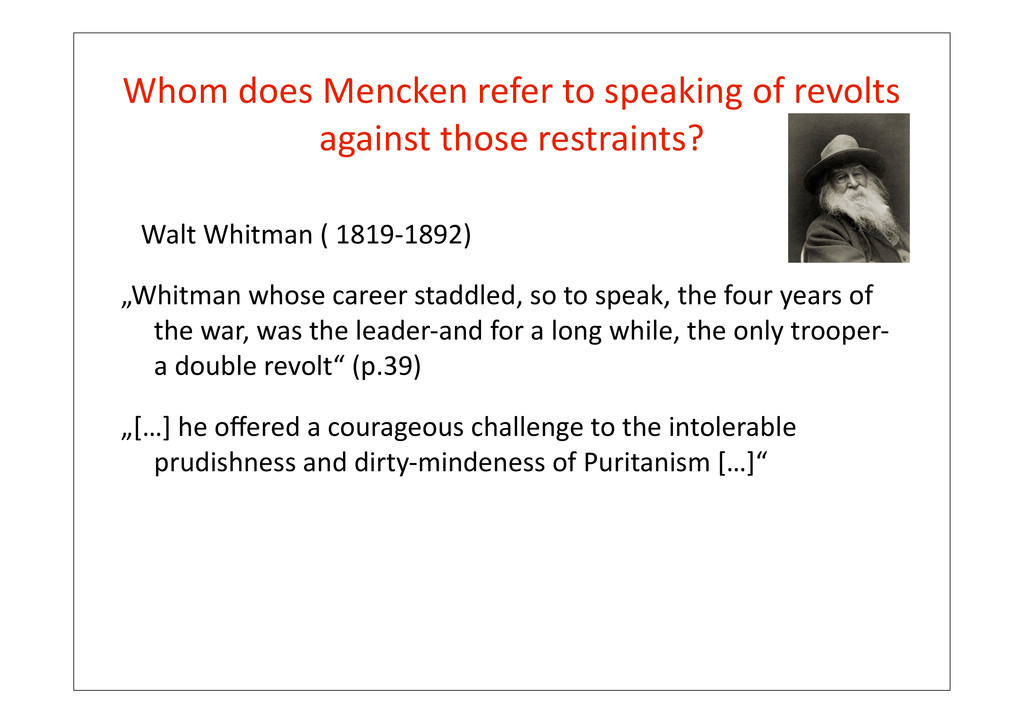
restraints? Walt Whitman ( 1819‐1892) „Whitman whose career staddled, so to speak, the four years of the war, was the leader‐and for a long while, the only trooper‐ a double revolt“ (p.39) „[…] he offered a courageous challenge to the intolerable prudishness and dirty‐mindeness of Puritanism […]“
restraints? Walt Whitman ( 1819‐1892) „Whitman whose career staddled, so to speak, the four years of the war, was the leader‐and for a long while, the only trooper‐ a double revolt“ (p.39) „[…] he offered a courageous challenge to the intolerable prudishness and dirty‐mindeness of Puritanism […]“ „[…] he was clearly before his /me.“ (p.39)
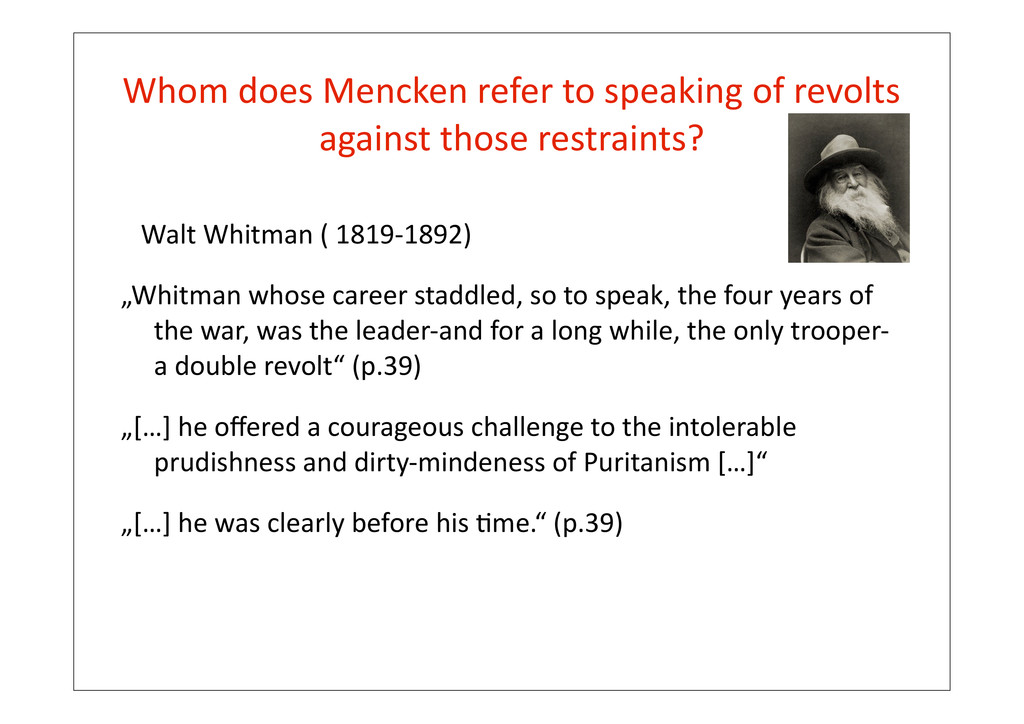
restraints? Walt Whitman ( 1819‐1892) „Whitman whose career staddled, so to speak, the four years of the war, was the leader‐and for a long while, the only trooper‐ a double revolt“ (p.39) „[…] he offered a courageous challenge to the intolerable prudishness and dirty‐mindeness of Puritanism […]“ „[…] he was clearly before his /me.“ (p.39) „his countrymen could only see him as a immoralist […] an invader of the public decencies.“ (p.39)
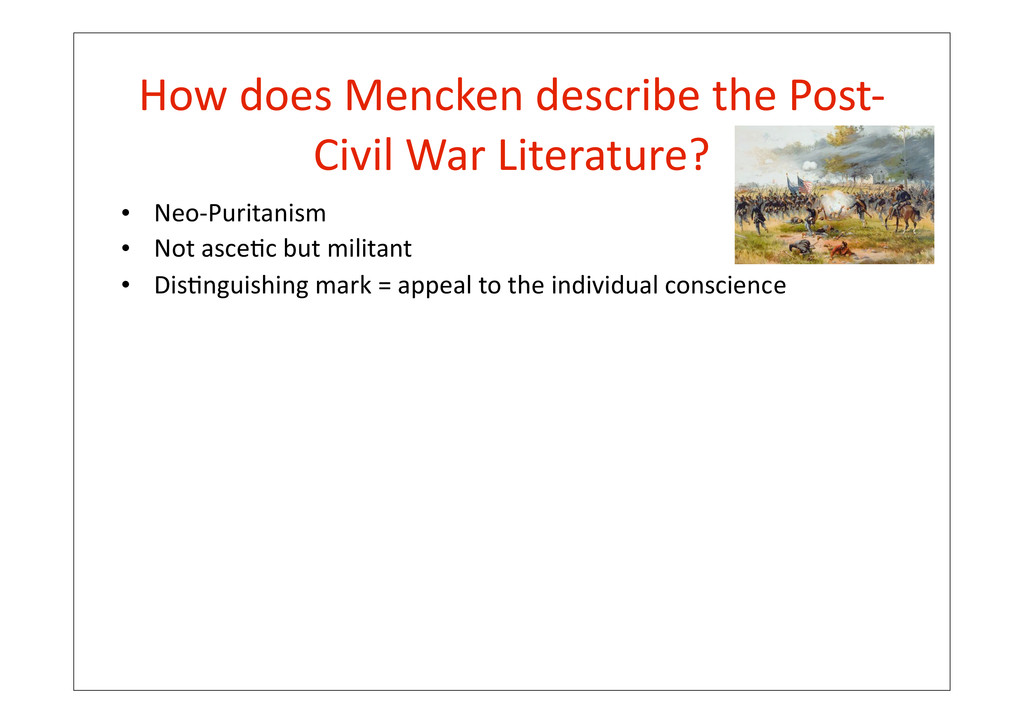
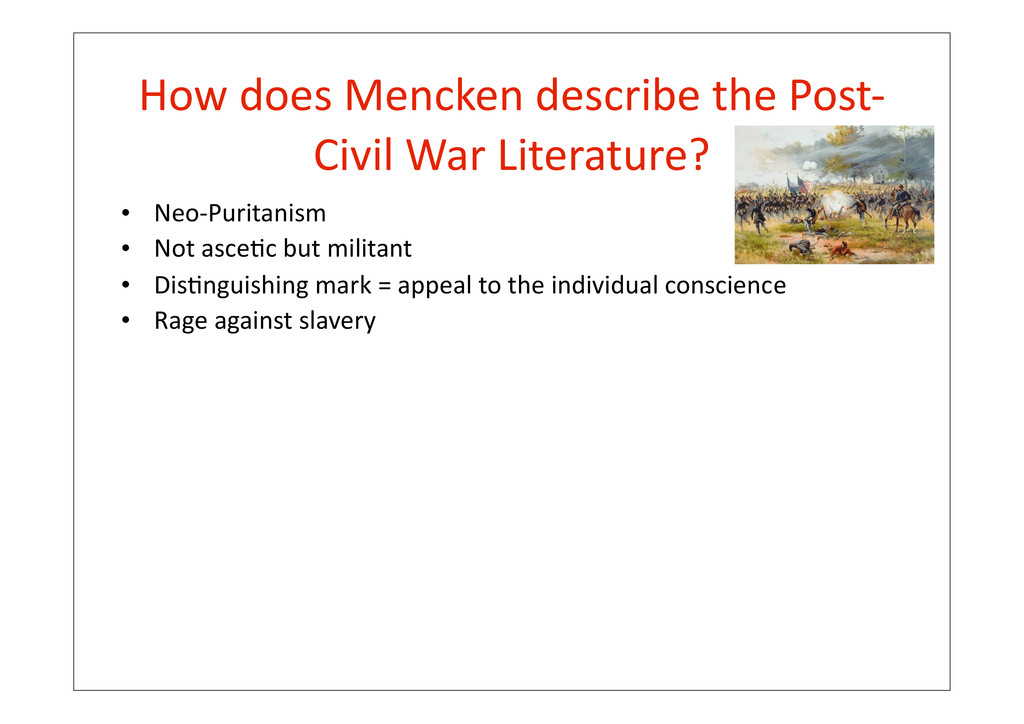
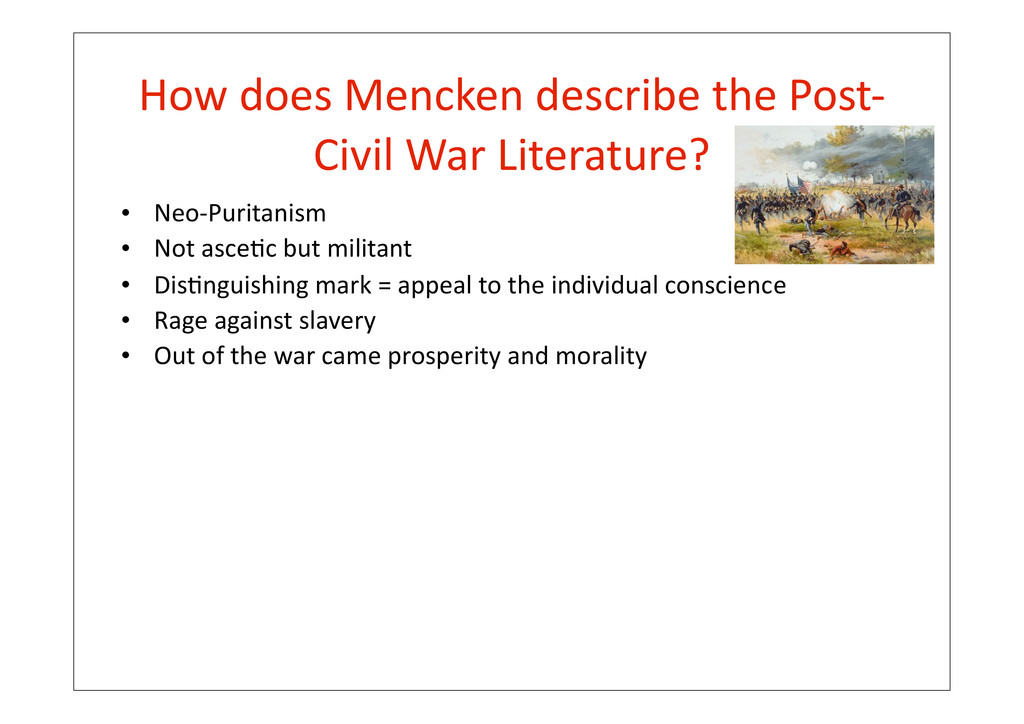
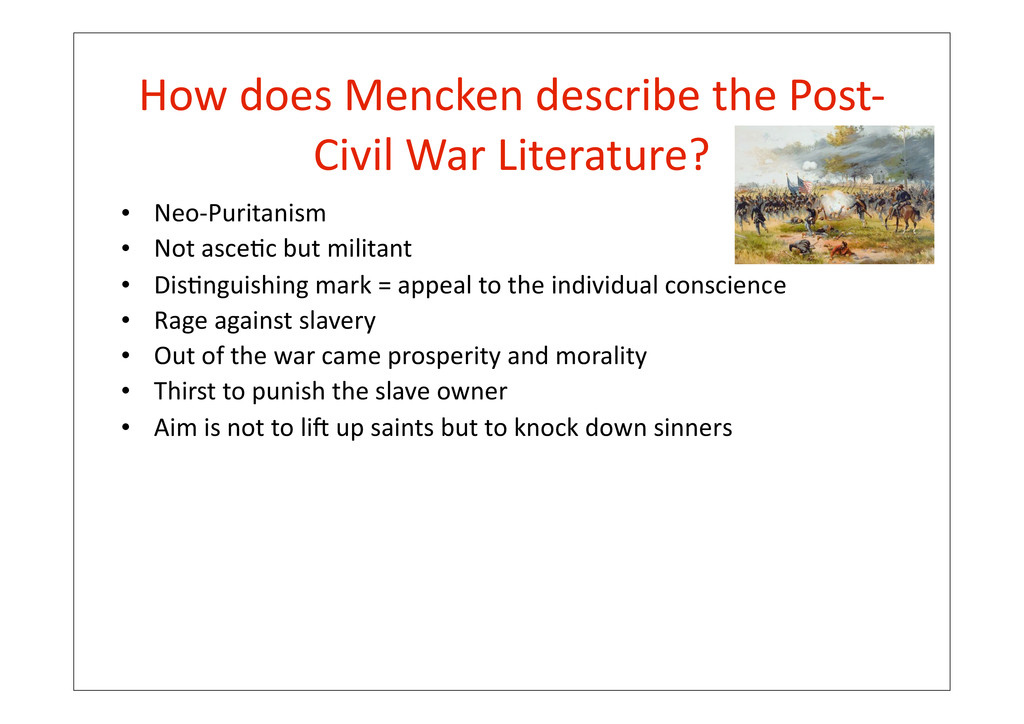
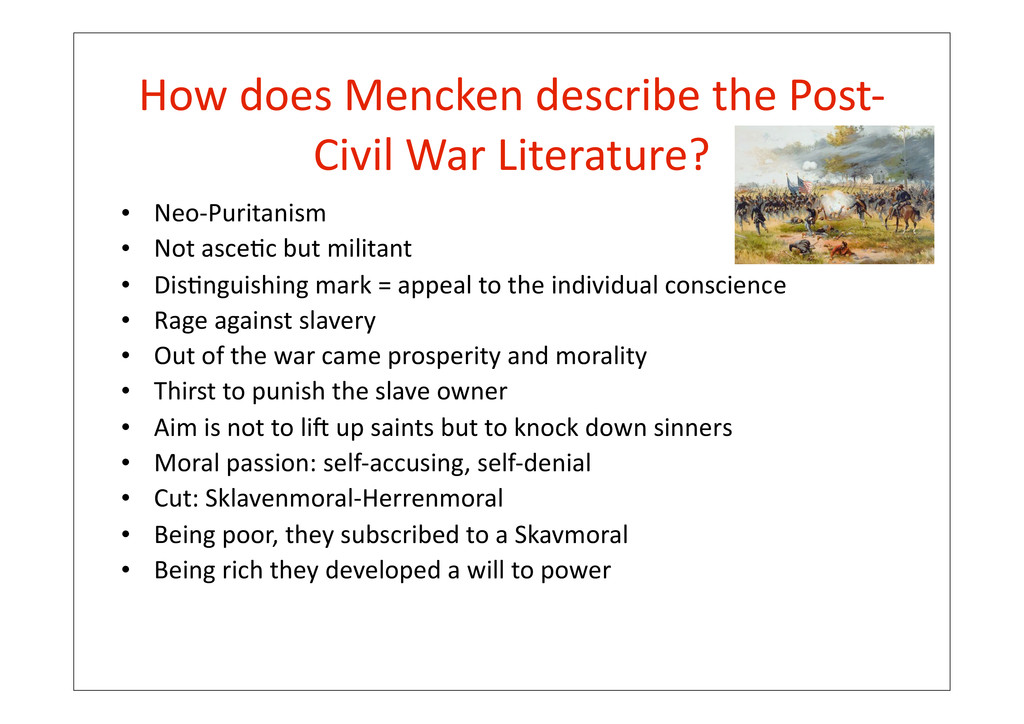
Neo‐Puritanism • Not asce/c but militant • Dis/nguishing mark = appeal to the individual conscience • Rage against slavery • Out of the war came prosperity and morality
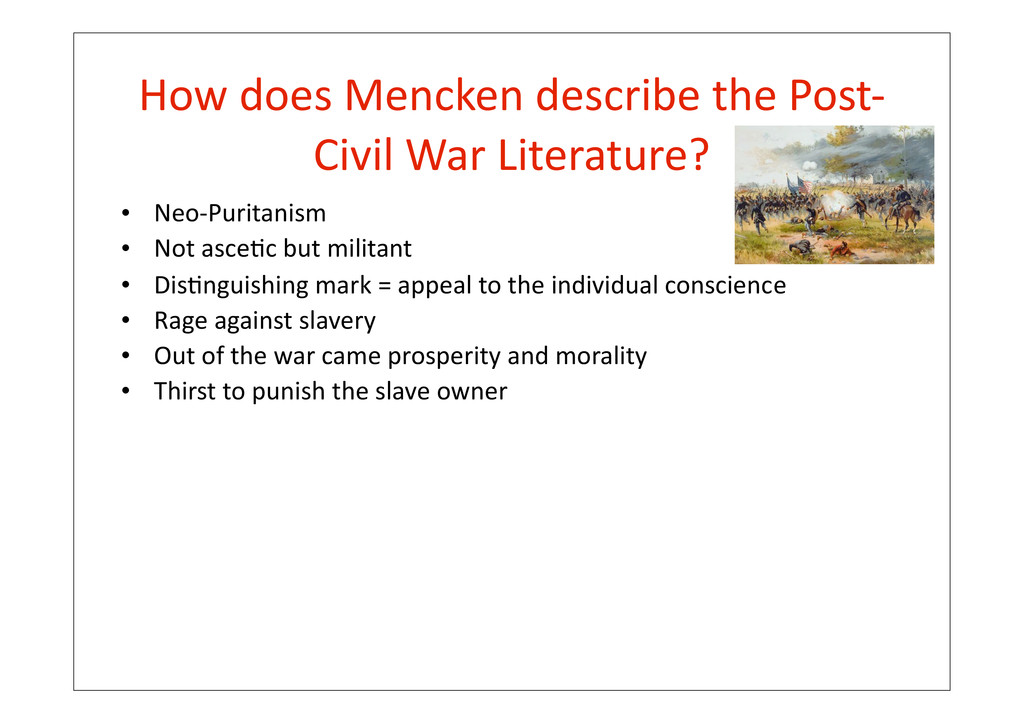
Neo‐Puritanism • Not asce/c but militant • Dis/nguishing mark = appeal to the individual conscience • Rage against slavery • Out of the war came prosperity and morality • Thirst to punish the slave owner
Neo‐Puritanism • Not asce/c but militant • Dis/nguishing mark = appeal to the individual conscience • Rage against slavery • Out of the war came prosperity and morality • Thirst to punish the slave owner • Aim is not to lia up saints but to knock down sinners
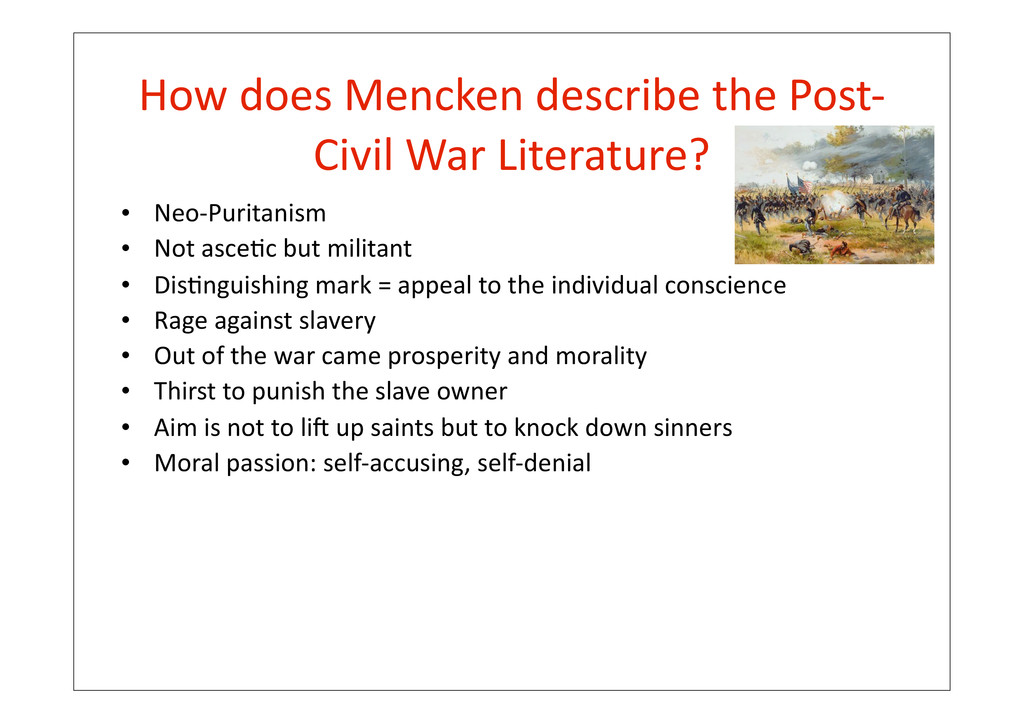
Neo‐Puritanism • Not asce/c but militant • Dis/nguishing mark = appeal to the individual conscience • Rage against slavery • Out of the war came prosperity and morality • Thirst to punish the slave owner • Aim is not to lia up saints but to knock down sinners • Moral passion: self‐accusing, self‐denial
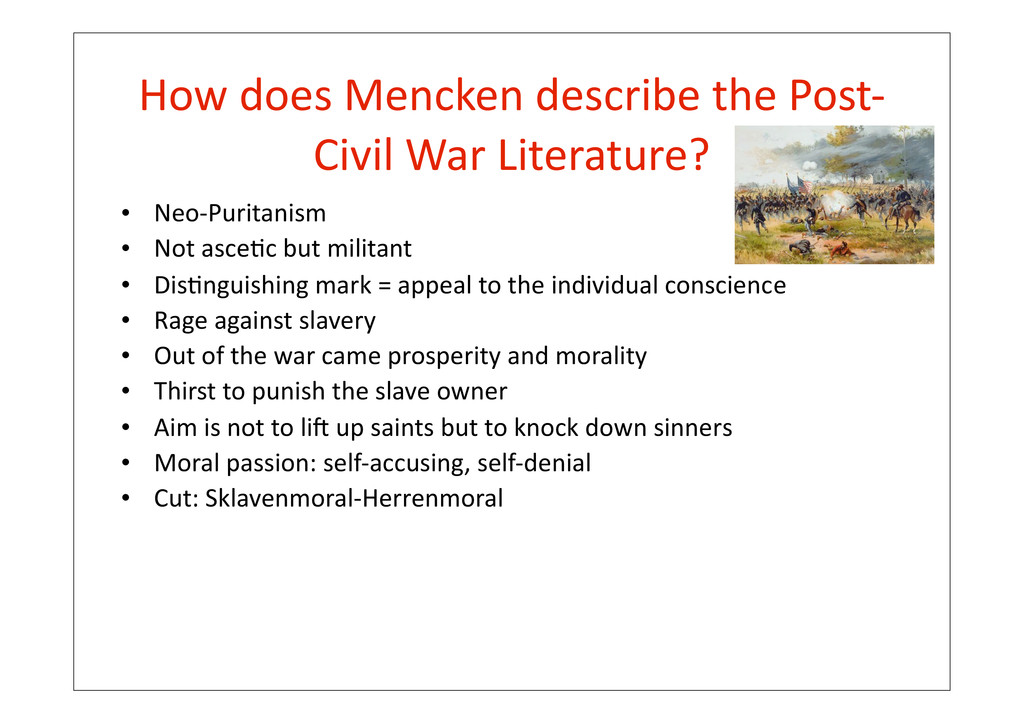
Neo‐Puritanism • Not asce/c but militant • Dis/nguishing mark = appeal to the individual conscience • Rage against slavery • Out of the war came prosperity and morality • Thirst to punish the slave owner • Aim is not to lia up saints but to knock down sinners • Moral passion: self‐accusing, self‐denial • Cut: Sklavenmoral‐Herrenmoral
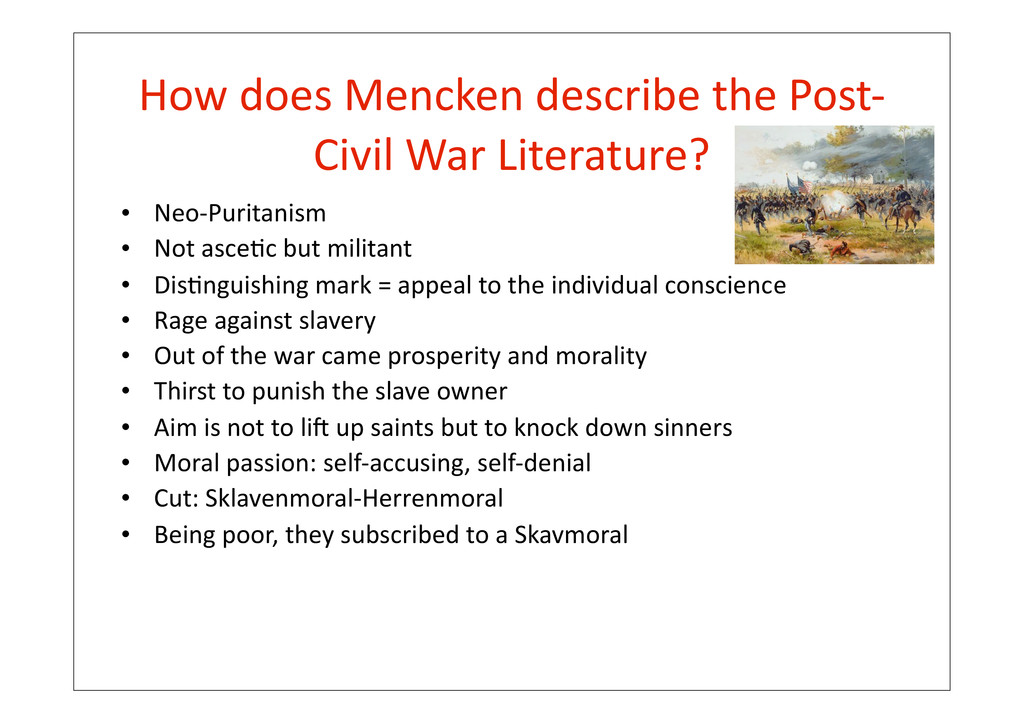
Neo‐Puritanism • Not asce/c but militant • Dis/nguishing mark = appeal to the individual conscience • Rage against slavery • Out of the war came prosperity and morality • Thirst to punish the slave owner • Aim is not to lia up saints but to knock down sinners • Moral passion: self‐accusing, self‐denial • Cut: Sklavenmoral‐Herrenmoral • Being poor, they subscribed to a Skavmoral
Neo‐Puritanism • Not asce/c but militant • Dis/nguishing mark = appeal to the individual conscience • Rage against slavery • Out of the war came prosperity and morality • Thirst to punish the slave owner • Aim is not to lia up saints but to knock down sinners • Moral passion: self‐accusing, self‐denial • Cut: Sklavenmoral‐Herrenmoral • Being poor, they subscribed to a Skavmoral • Being rich they developed a will to power
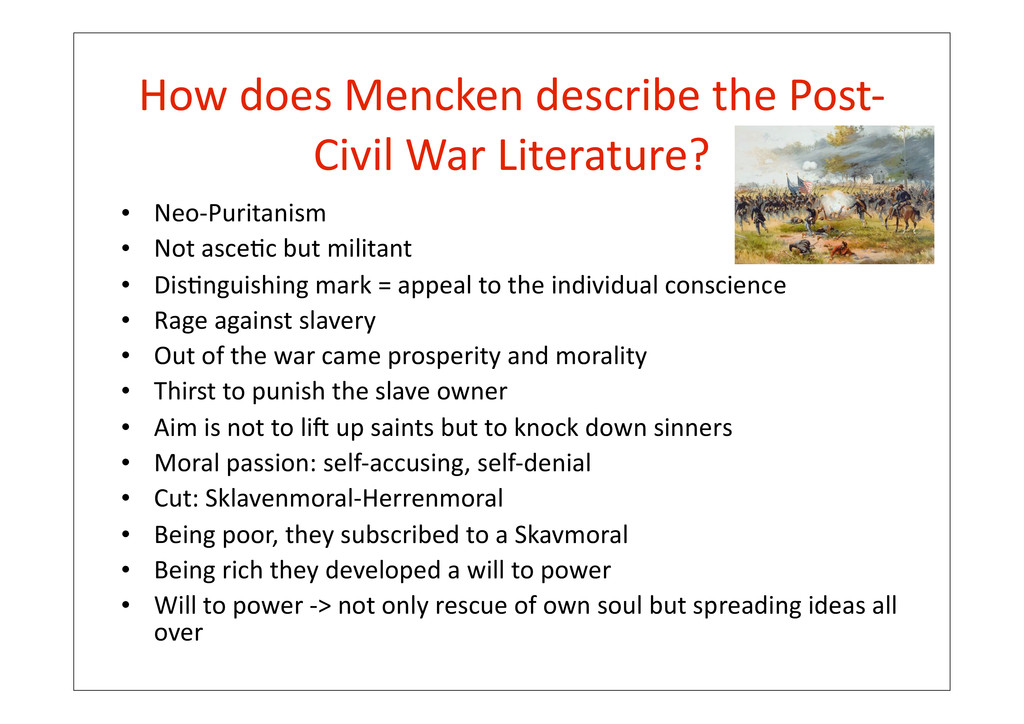
Neo‐Puritanism • Not asce/c but militant • Dis/nguishing mark = appeal to the individual conscience • Rage against slavery • Out of the war came prosperity and morality • Thirst to punish the slave owner • Aim is not to lia up saints but to knock down sinners • Moral passion: self‐accusing, self‐denial • Cut: Sklavenmoral‐Herrenmoral • Being poor, they subscribed to a Skavmoral • Being rich they developed a will to power • Will to power ‐> not only rescue of own soul but spreading ideas all over
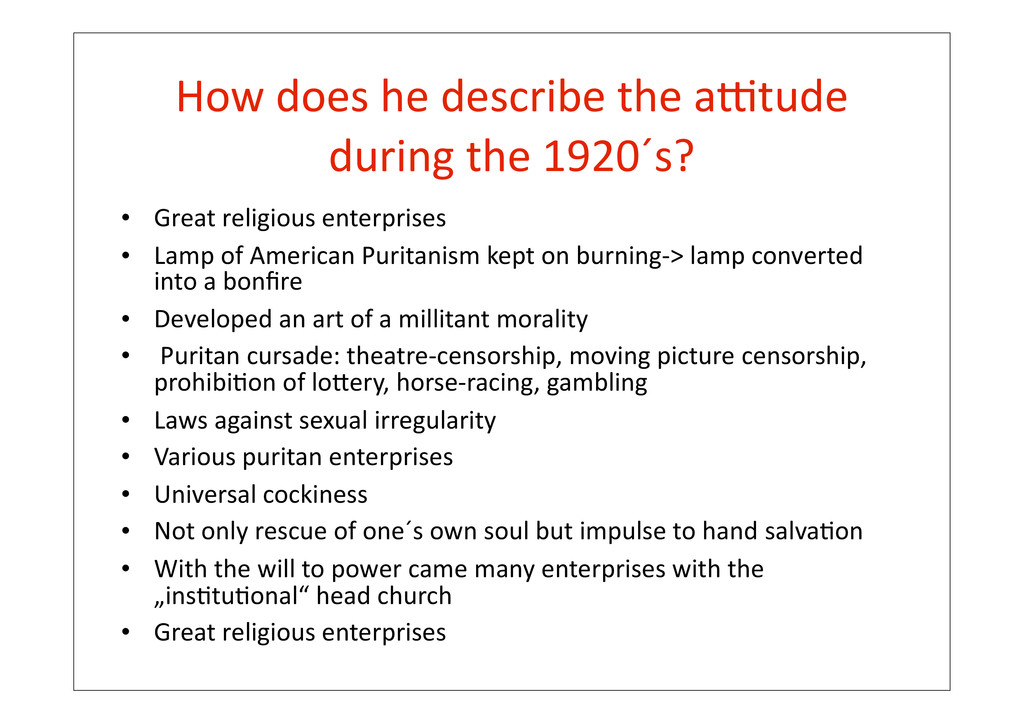
Great religious enterprises • Lamp of American Puritanism kept on burning‐> lamp converted into a bonfire • Developed an art of a millitant morality • Puritan cursade: theatre‐censorship, moving picture censorship, prohibi/on of lokery, horse‐racing, gambling
Great religious enterprises • Lamp of American Puritanism kept on burning‐> lamp converted into a bonfire • Developed an art of a millitant morality • Puritan cursade: theatre‐censorship, moving picture censorship, prohibi/on of lokery, horse‐racing, gambling • Laws against sexual irregularity
Great religious enterprises • Lamp of American Puritanism kept on burning‐> lamp converted into a bonfire • Developed an art of a millitant morality • Puritan cursade: theatre‐censorship, moving picture censorship, prohibi/on of lokery, horse‐racing, gambling • Laws against sexual irregularity • Various puritan enterprises
Great religious enterprises • Lamp of American Puritanism kept on burning‐> lamp converted into a bonfire • Developed an art of a millitant morality • Puritan cursade: theatre‐censorship, moving picture censorship, prohibi/on of lokery, horse‐racing, gambling • Laws against sexual irregularity • Various puritan enterprises • Universal cockiness
Great religious enterprises • Lamp of American Puritanism kept on burning‐> lamp converted into a bonfire • Developed an art of a millitant morality • Puritan cursade: theatre‐censorship, moving picture censorship, prohibi/on of lokery, horse‐racing, gambling • Laws against sexual irregularity • Various puritan enterprises • Universal cockiness • Not only rescue of one´s own soul but impulse to hand salva/on
Great religious enterprises • Lamp of American Puritanism kept on burning‐> lamp converted into a bonfire • Developed an art of a millitant morality • Puritan cursade: theatre‐censorship, moving picture censorship, prohibi/on of lokery, horse‐racing, gambling • Laws against sexual irregularity • Various puritan enterprises • Universal cockiness • Not only rescue of one´s own soul but impulse to hand salva/on • With the will to power came many enterprises with the „ins/tu/onal“ head church
Great religious enterprises • Lamp of American Puritanism kept on burning‐> lamp converted into a bonfire • Developed an art of a millitant morality • Puritan cursade: theatre‐censorship, moving picture censorship, prohibi/on of lokery, horse‐racing, gambling • Laws against sexual irregularity • Various puritan enterprises • Universal cockiness • Not only rescue of one´s own soul but impulse to hand salva/on • With the will to power came many enterprises with the „ins/tu/onal“ head church • Great religious enterprises


 inesmontani
 sarafernandez
 kristinabergwall1
 thoeni
 tammyeverts
 smashingmag
 tmiket
 sferik
 marktimemedia
 denniskardys
 garrettdimon
 frankvandijk