Upgrade to Pro — share decks privately, control downloads, hide ads and more …

Angular JS

Sponsored · Your Podcast. Everywhere. Effortlessly. Share. Educate. Inspire. Entertain. You do you. We'll handle the rest.

Angular JS

Avatar for David Spence

David Spence

June 25, 2014
Tweet

More Decks by David Spence

Other Decks in Technology

Transcript

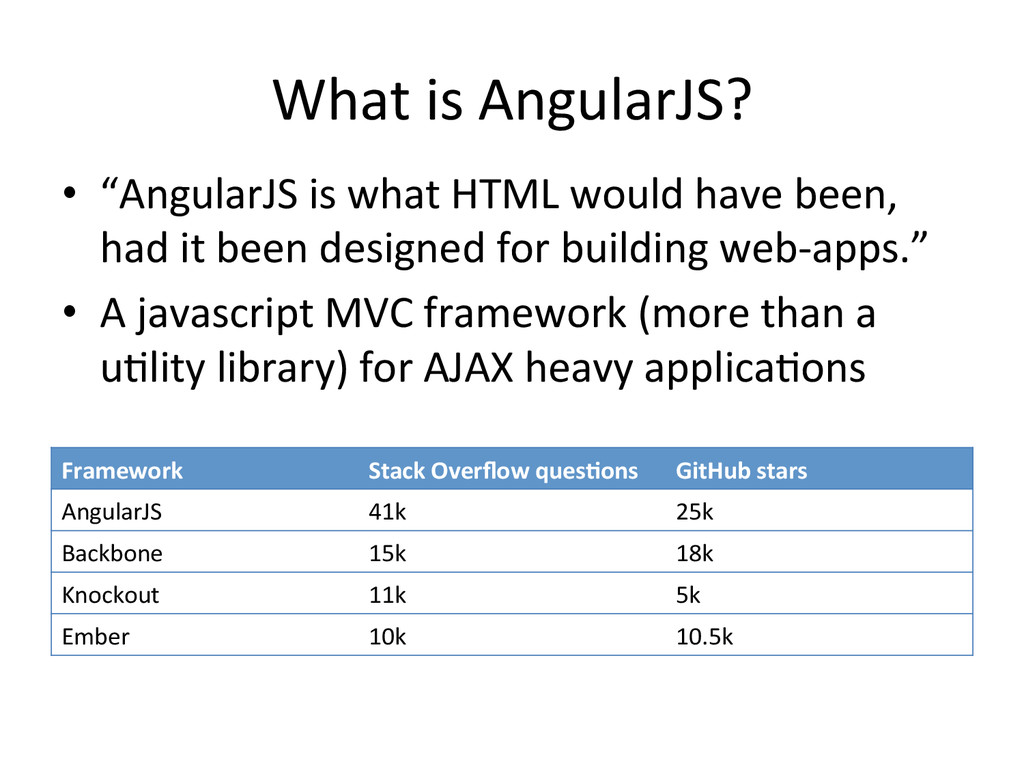
  1. What  is  AngularJS?   •  “AngularJS  is  what  HTML  would

     have  been,   had  it  been  designed  for  building  web-­‐apps.”   •  A  javascript  MVC  framework  (more  than  a   uJlity  library)  for  AJAX  heavy  applicaJons   Framework   Stack  Overflow  ques3ons   GitHub  stars   AngularJS   41k   25k   Backbone   15k   18k   Knockout   11k   5k   Ember   10k   10.5k  
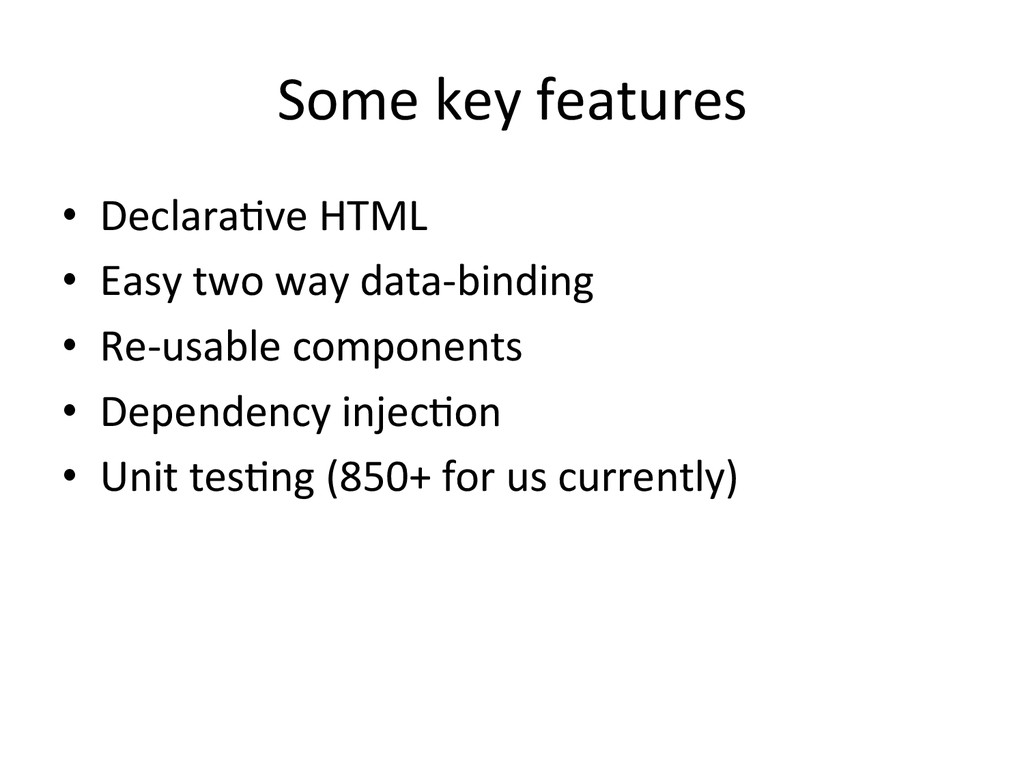
  2. Some  key  features   •  DeclaraJve  HTML   •  Easy

     two  way  data-­‐binding   •  Re-­‐usable  components   •  Dependency  injecJon   •  Unit  tesJng  (850+  for  us  currently)  
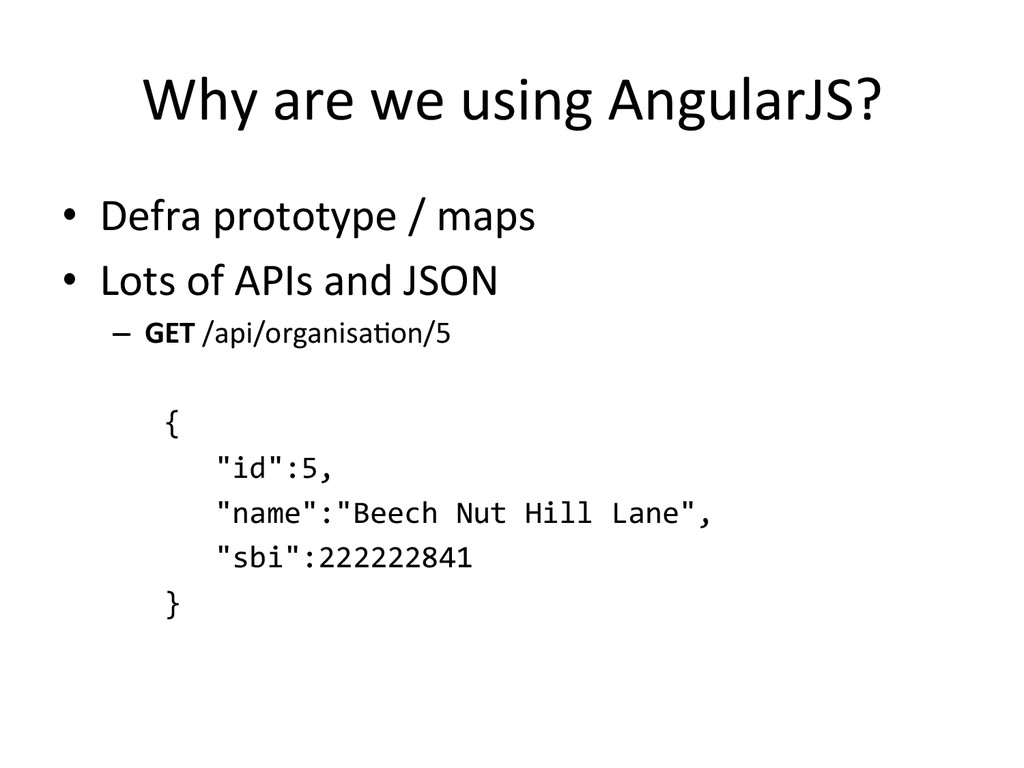
  3. Why  are  we  using  AngularJS?   •  Defra  prototype  /

     maps   •  Lots  of  APIs  and  JSON   –  GET  /api/organisaJon/5      {      "id":5,      "name":"Beech  Nut  Hill  Lane",      "sbi":222222841    }  
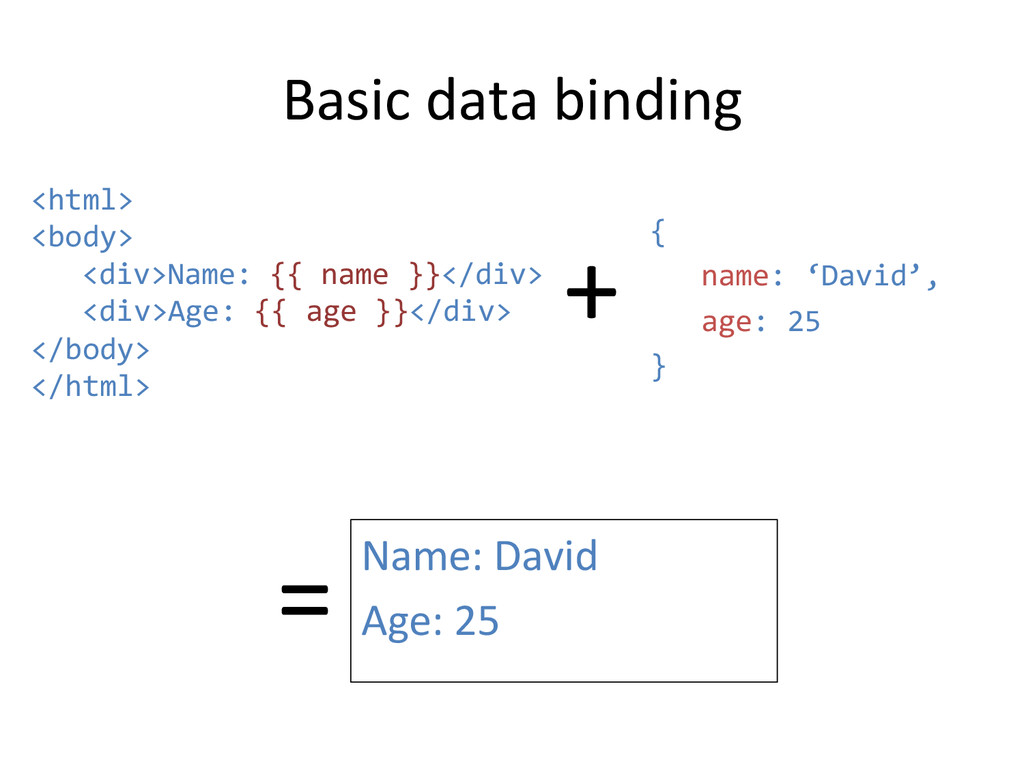
  4. Basic  data  binding   <html>   <body>    <div>Name:  {{

     name  }}</div>    <div>Age:  {{  age  }}</div>   </body>   </html>     Name:  David   Age:  25     {    name:  ‘David’,    age:  25   }     =     +    
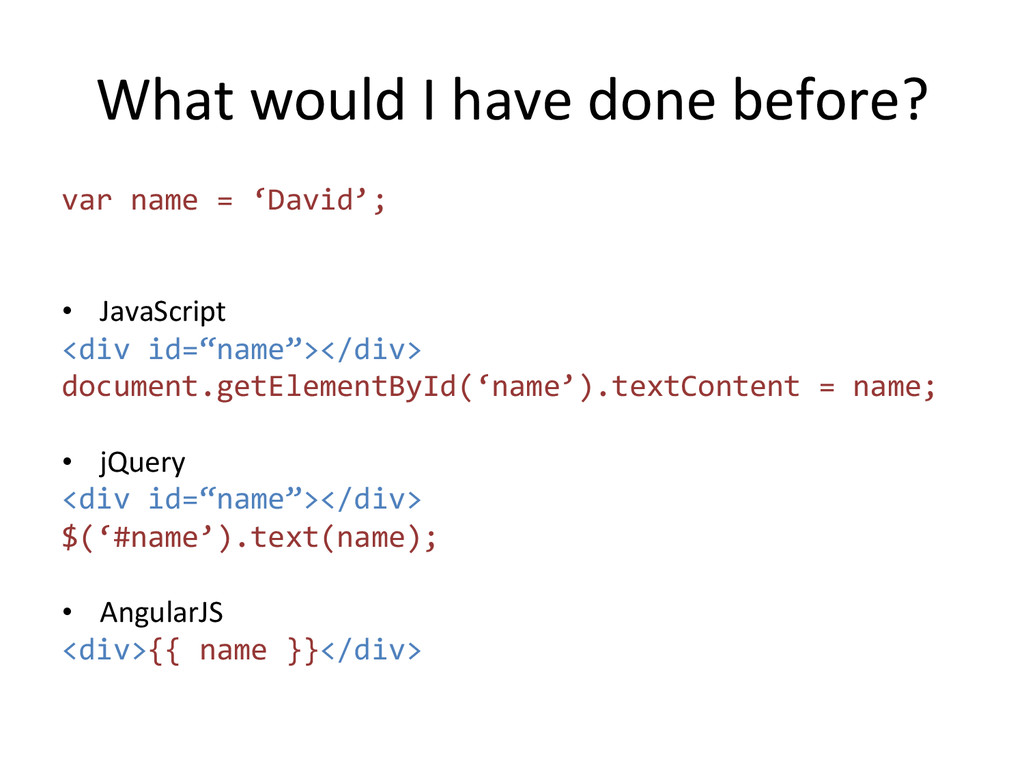
  5. What  would  I  have  done  before?   var  name  =

     ‘David’;       •  JavaScript   <div  id=“name”></div>   document.getElementById(‘name’).textContent  =  name;     •  jQuery   <div  id=“name”></div>   $(‘#name’).text(name);     •  AngularJS   <div>{{  name  }}</div>    
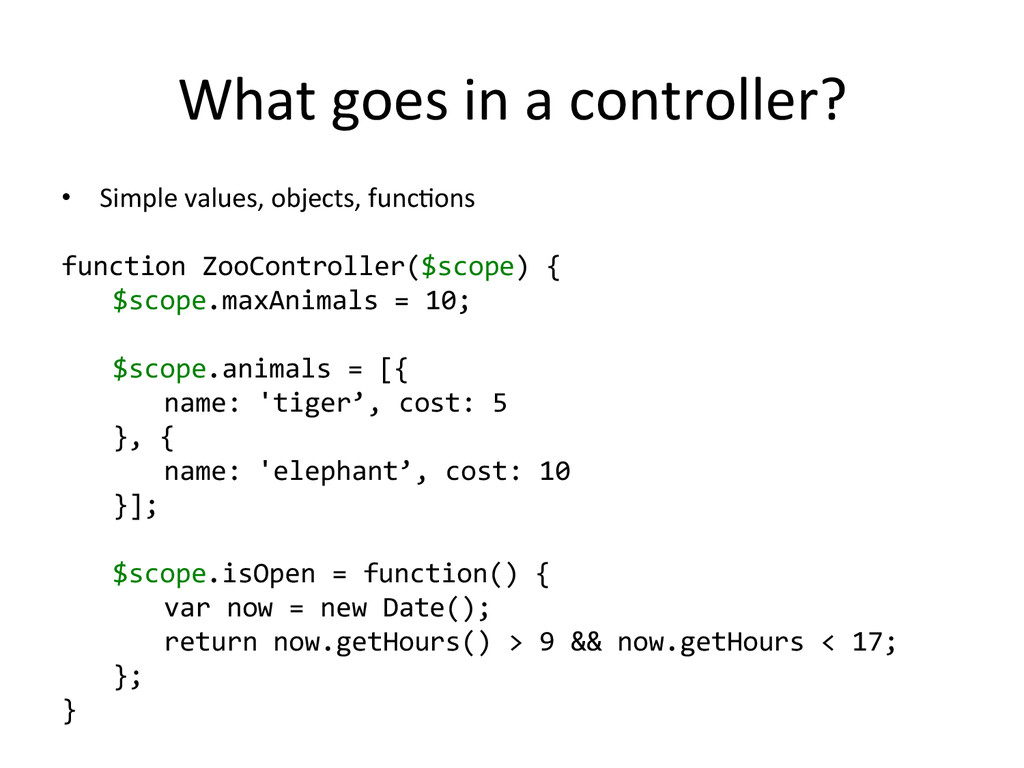
  6. What  goes  in  a  controller?   •  Simple  values,  objects,

     funcJons     function  ZooController($scope)  {    $scope.maxAnimals  =  10;      $scope.animals  =  [{      name:  'tiger’,  cost:  5    },  {      name:  'elephant’,  cost:  10    }];      $scope.isOpen  =  function()  {      var  now  =  new  Date();      return  now.getHours()  >  9  &&  now.getHours  <  17;        };     }  
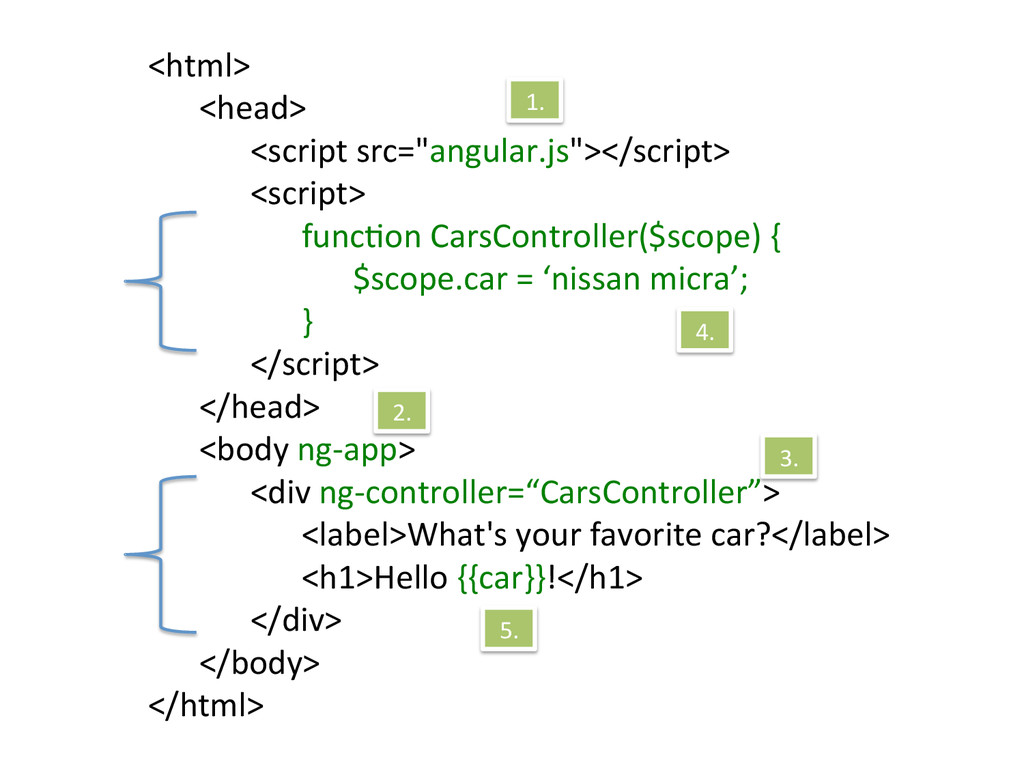
  7.   <html>    <head>      <script  src="angular.js"></script>    

     <script>        funcJon  CarsController($scope)  {          $scope.car  =  ‘nissan  micra’;        }      </script>    </head>    <body  ng-­‐app>      <div  ng-­‐controller=“CarsController”>        <label>What's  your  favorite  car?</label>        <h1>Hello  {{car}}!</h1>      </div>    </body>   </html>   1.   2.   3.   4.   5.  
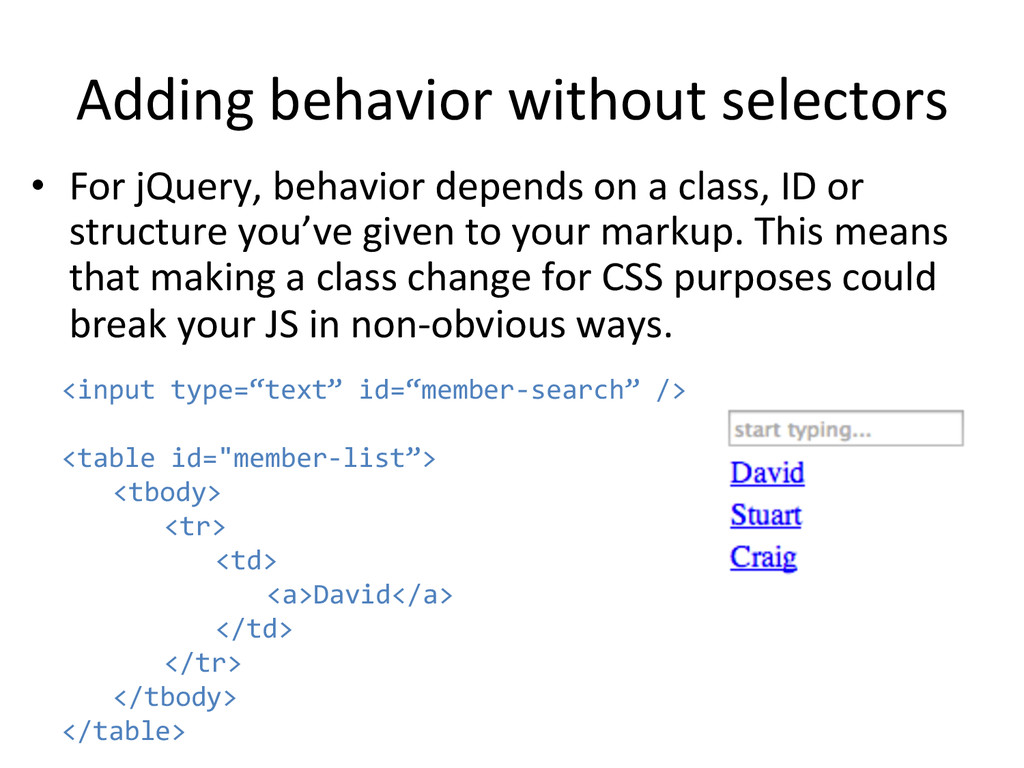
  8. Adding  behavior  without  selectors   •  For  jQuery,  behavior  depends

     on  a  class,  ID  or   structure  you’ve  given  to  your  markup.  This  means   that  making  a  class  change  for  CSS  purposes  could   break  your  JS  in  non-­‐obvious  ways.     <input  type=“text”  id=“member-­‐search”  />     <table  id="member-­‐list”>    <tbody>      <tr>        <td>          <a>David</a>        </td>      </tr>    </tbody>   </table>  
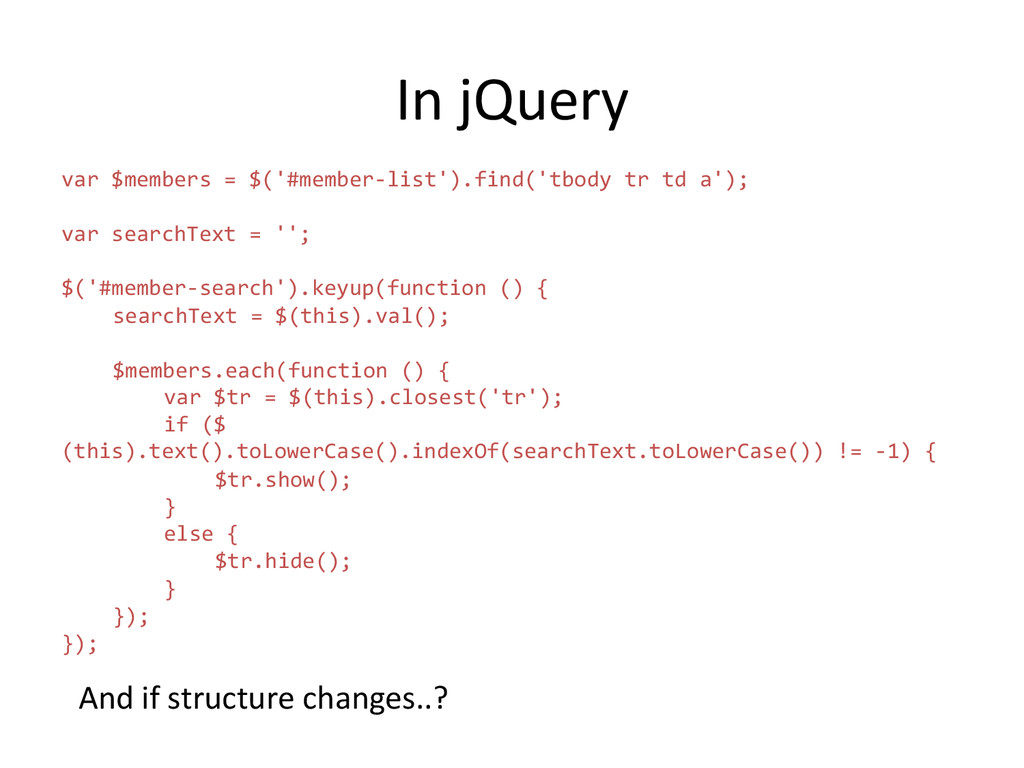
  9. In  jQuery   var  $members  =  $('#member-­‐list').find('tbody  tr  td  a');

        var  searchText  =  '';     $('#member-­‐search').keyup(function  ()  {    searchText  =  $(this).val();     $members.each(function  ()  {      var  $tr  =  $(this).closest('tr');      if  ($ (this).text().toLowerCase().indexOf(searchText.toLowerCase())  !=  -­‐1)  {    $tr.show();    }      else  {        $tr.hide();      }    });   });   And  if  structure  changes..?  
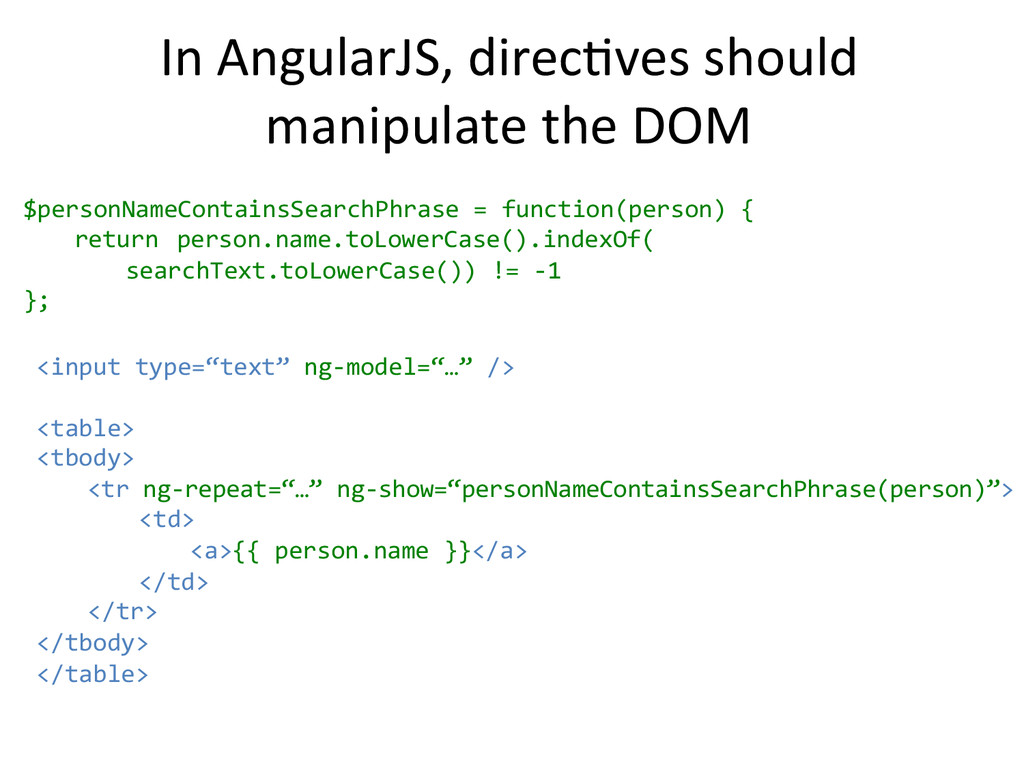
  10. In  AngularJS,  direcJves  should   manipulate  the  DOM    

    $personNameContainsSearchPhrase  =  function(person)  {    return    person.name.toLowerCase().indexOf(      searchText.toLowerCase())  !=  -­‐1   };   <input  type=“text”  ng-­‐model=“…”  />     <table>   <tbody>    <tr  ng-­‐repeat=“…”  ng-­‐show=“personNameContainsSearchPhrase(person)”>      <td>        <a>{{  person.name  }}</a>      </td>    </tr>   </tbody>   </table>  
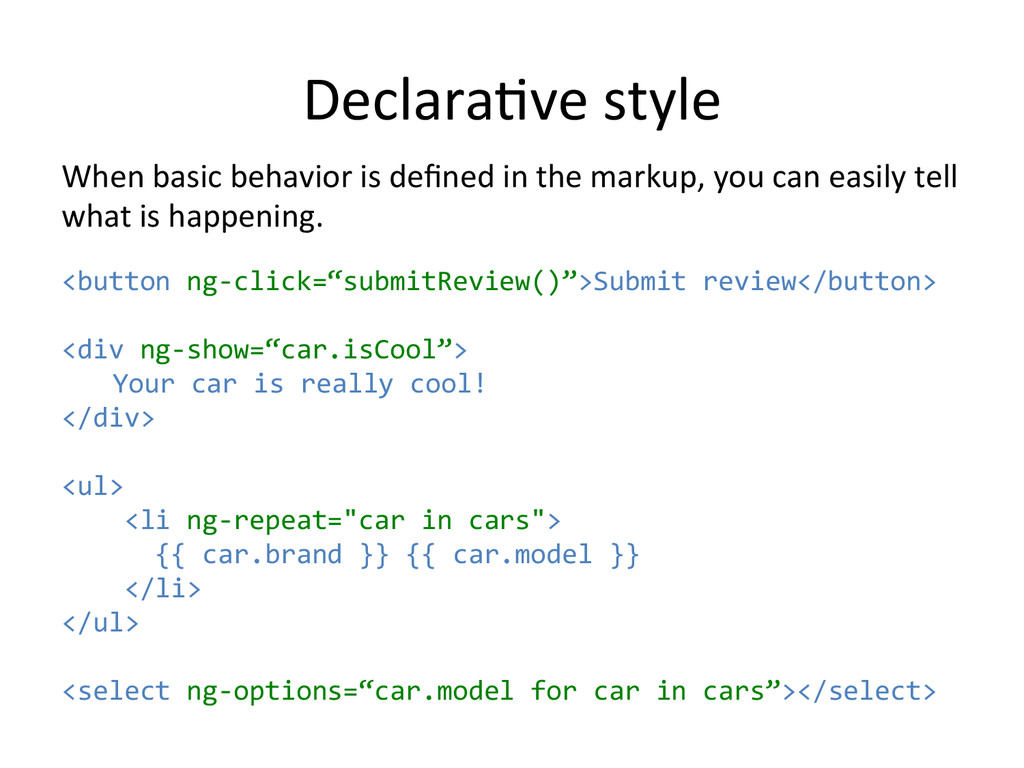
  11. DeclaraJve  style   <button  ng-­‐click=“submitReview()”>Submit  review</button>     <div  ng-­‐show=“car.isCool”>

       Your  car  is  really  cool!   </div>     <ul>          <li  ng-­‐repeat="car  in  cars">              {{  car.brand  }}  {{  car.model  }}          </li>   </ul>     <select  ng-­‐options=“car.model  for  car  in  cars”></select>     When  basic  behavior  is  defined  in  the  markup,  you  can  easily  tell   what  is  happening.  
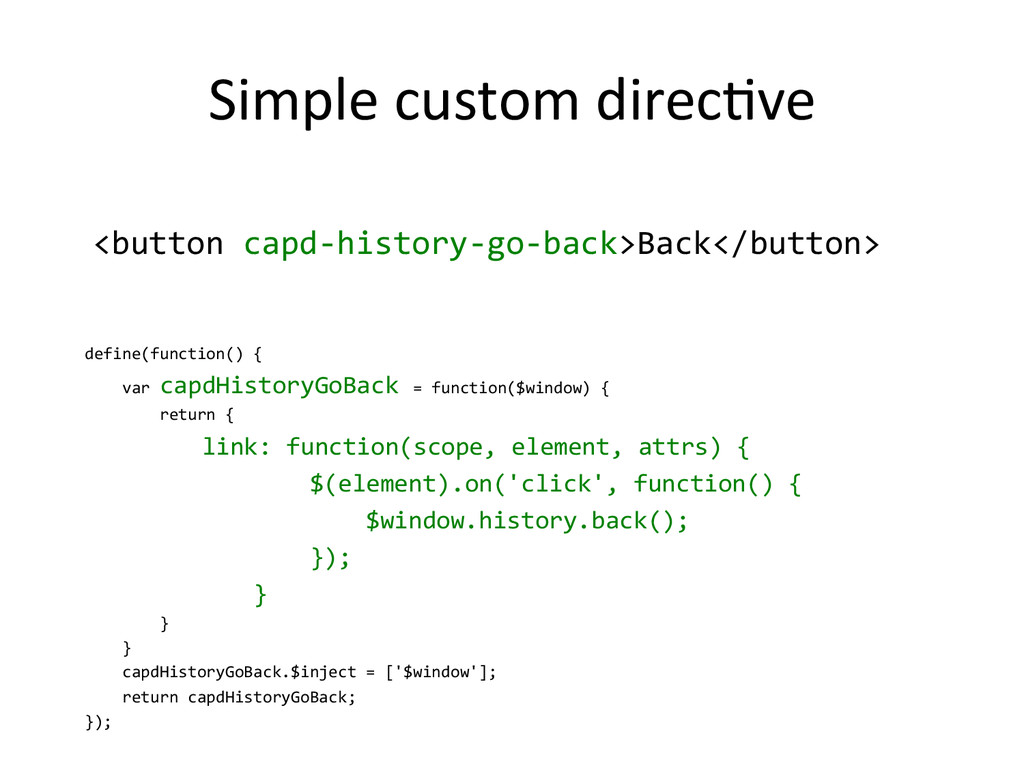
  12. Simple  custom  direcJve   define(function()  {        

     var  capdHistoryGoBack  =  function($window)  {                  return  {                          link:  function(scope,  element,  attrs)  {                                  $(element).on('click',  function()  {                                          $window.history.back();                                  });                          }                  }          }          capdHistoryGoBack.$inject  =  ['$window'];          return  capdHistoryGoBack;   });   <button  capd-­‐history-­‐go-­‐back>Back</button>