Upgrade to Pro — share decks privately, control downloads, hide ads and more …

Java, what's next?

Java, what's next?

According to Mark Reinhold, we can expect (after Java 9) a time-based model with a new feature release every six months, update releases every quarter, and a long-term support release every three years. This session will have a closer look at the possible Java language features we can expect in the near future.
#OpenJDK #Amber #Valhalla

Avatar for Stephan Janssen

Stephan Janssen

October 05, 2017

Other Decks in Programming

Transcript
  1. • Founder of Devoxx • Co-founder of Voxxed (Days) •

    Co-founder Devoxx4Kids • Java Champion • Passionate Developer Who am I ?
  2. “For Java to remain competitive it must not just continue

    to move forward — it must move forward faster.” - Mark Reinhold , Chief Architect of the Java Platform Group at Oracle
  3. @Stephan007 More Java Releases • Every 6 months feature releases

    (March, September) • Long-term support releases every 3 years • Next release for March 2018 • Details @ https://mreinhold.org/blog/forward-faster
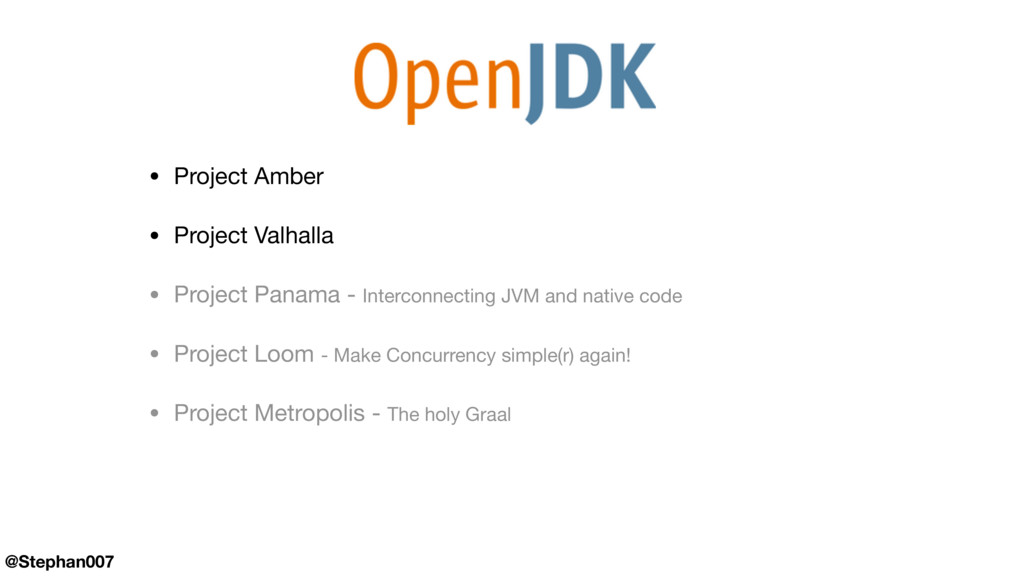
  4. @Stephan007 • Project Amber • Project Valhalla • Project Panama

    - Interconnecting JVM and native code • Project Loom - Make Concurrency simple(r) again! • Project Metropolis - The holy Graal : a Java compiler & interpreter
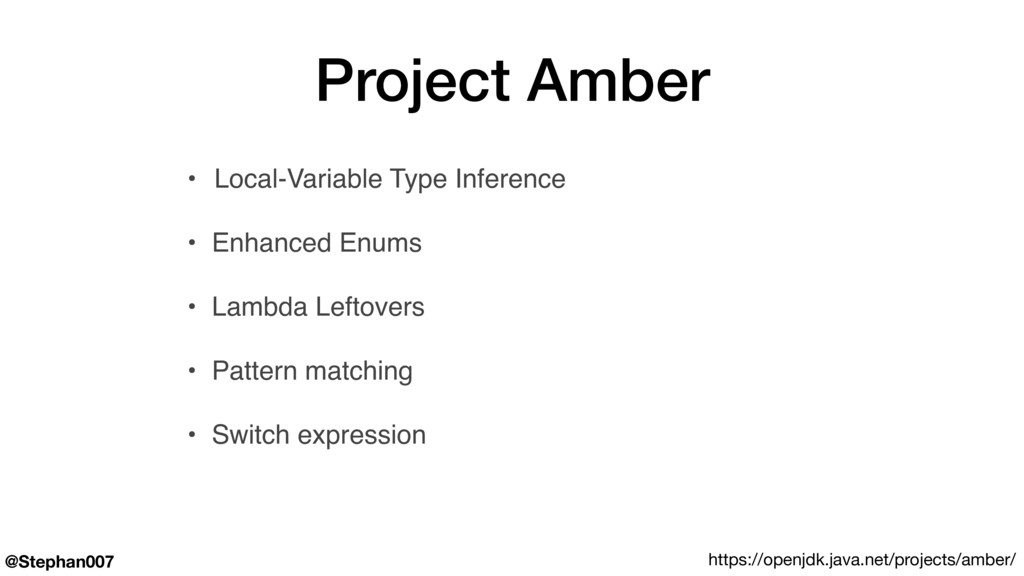
  5. @Stephan007 Project Amber • Local-Variable Type Inference • Enhanced Enums

    • Lambda Leftovers • Pattern matching • Switch expression https://openjdk.java.net/projects/amber/
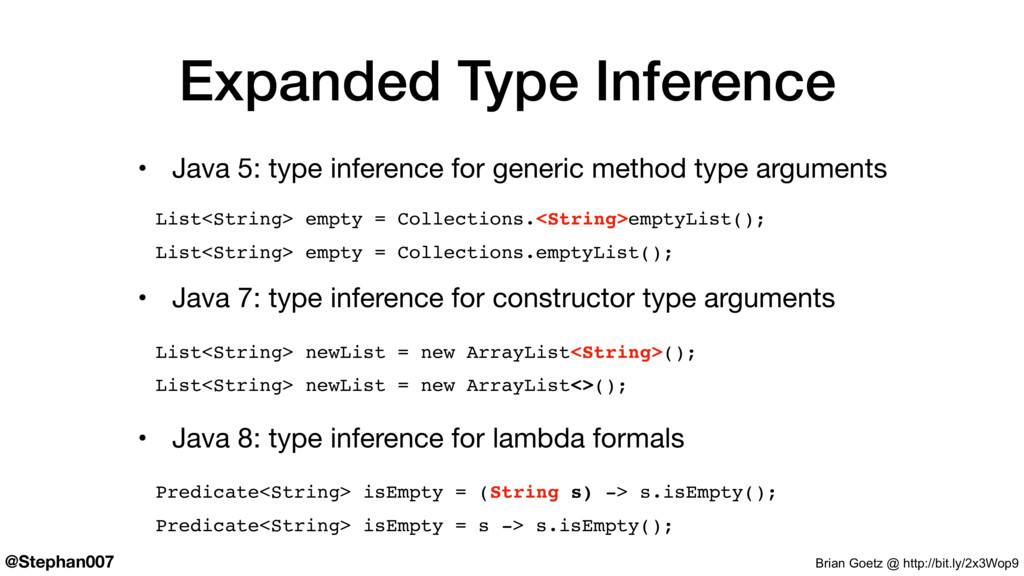
  6. @Stephan007 Expanded Type Inference List<String> empty = Collections.<String>emptyList(); List<String> empty

    = Collections.emptyList(); • Java 5: type inference for generic method type arguments • Java 7: type inference for constructor type arguments List<String> newList = new ArrayList<String>(); List<String> newList = new ArrayList<>(); • Java 8: type inference for lambda formals Predicate<String> isEmpty = (String s) -> s.isEmpty(); Predicate<String> isEmpty = s -> s.isEmpty(); Brian Goetz @ http://bit.ly/2x3Wop9
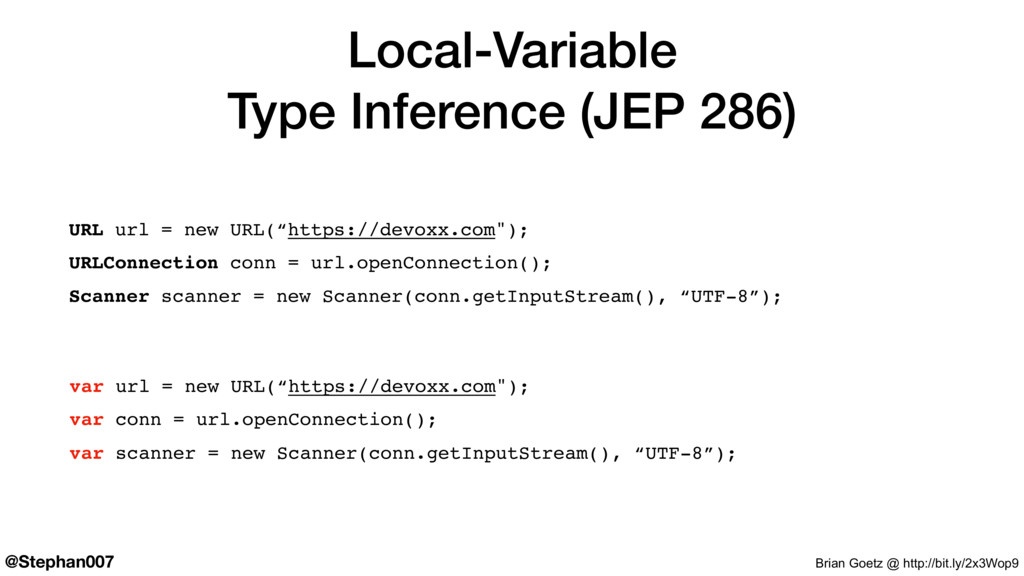
  7. @Stephan007 Local-Variable Type Inference (JEP 286) URL url = new

    URL(“https://devoxx.com"); URLConnection conn = url.openConnection(); Scanner scanner = new Scanner(conn.getInputStream(), “UTF-8”); var url = new URL(“https://devoxx.com"); var conn = url.openConnection(); var scanner = new Scanner(conn.getInputStream(), “UTF-8”); Brian Goetz @ http://bit.ly/2x3Wop9
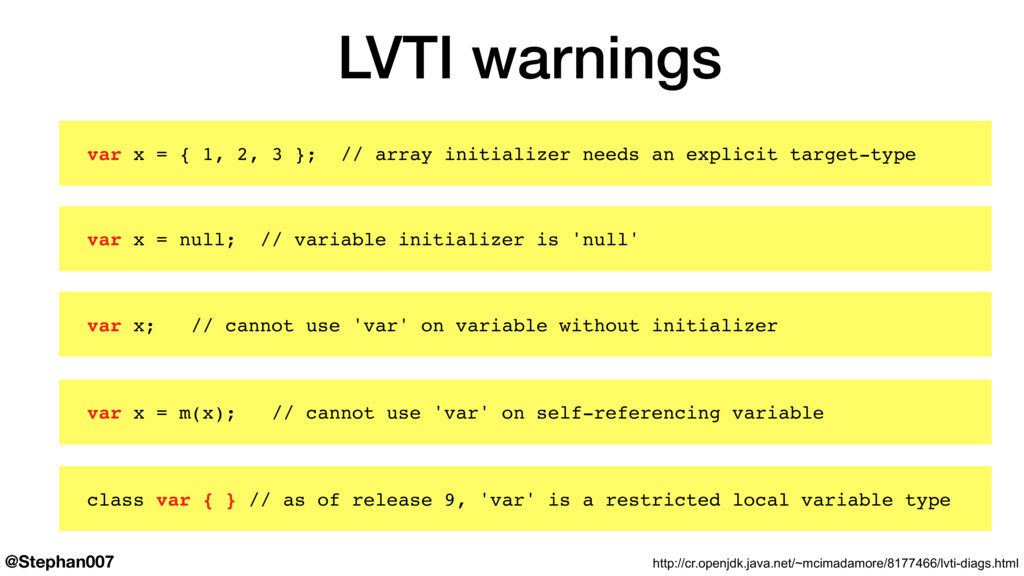
  8. @Stephan007 LVTI warnings var x = { 1, 2, 3

    }; // array initializer needs an explicit target-type http://cr.openjdk.java.net/~mcimadamore/8177466/lvti-diags.html var x = null; // variable initializer is 'null' var x; // cannot use 'var' on variable without initializer var x = m(x); // cannot use 'var' on self-referencing variable class var { } // as of release 9, 'var' is a restricted local variable type
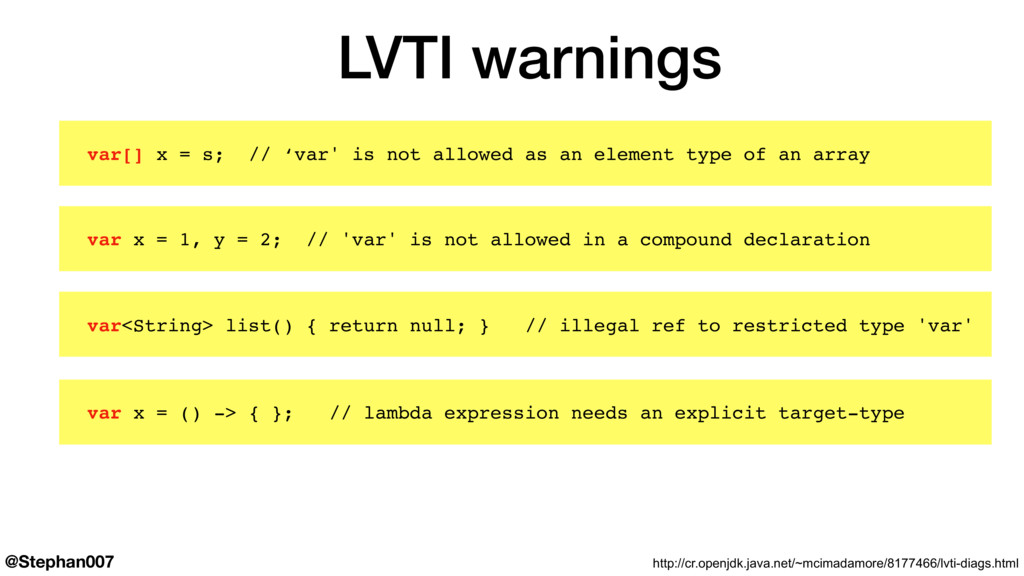
  9. @Stephan007 LVTI warnings var[] x = s; // ‘var' is

    not allowed as an element type of an array http://cr.openjdk.java.net/~mcimadamore/8177466/lvti-diags.html var x = 1, y = 2; // 'var' is not allowed in a compound declaration var<String> list() { return null; } // illegal ref to restricted type 'var' var x = () -> { }; // lambda expression needs an explicit target-type
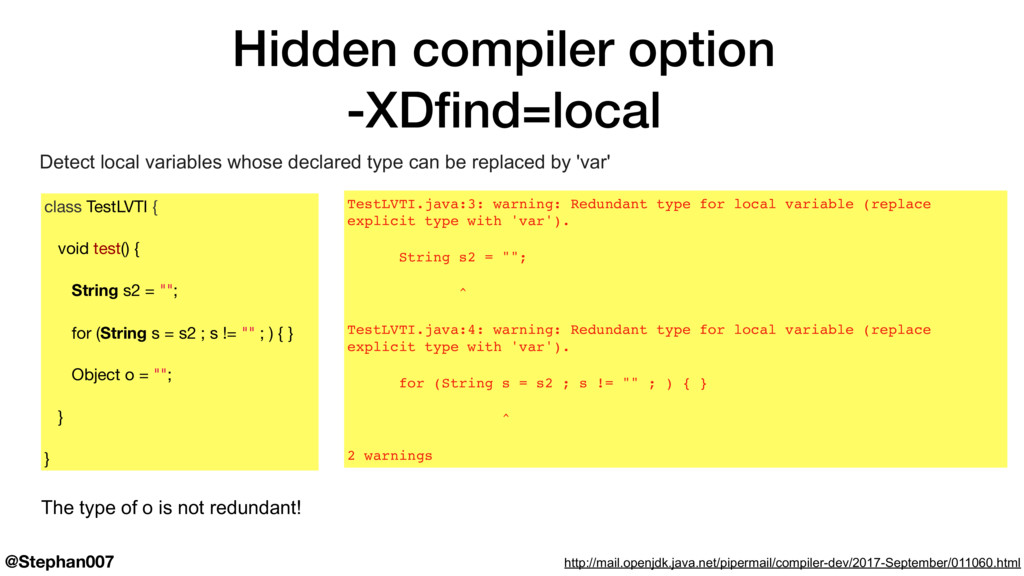
  10. @Stephan007 Hidden compiler option -XDfind=local Detect local variables whose declared

    type can be replaced by 'var' http://mail.openjdk.java.net/pipermail/compiler-dev/2017-September/011060.html class TestLVTI { void test() { String s2 = ""; for (String s = s2 ; s != "" ; ) { } Object o = ""; } } TestLVTI.java:3: warning: Redundant type for local variable (replace explicit type with 'var'). String s2 = ""; ^ TestLVTI.java:4: warning: Redundant type for local variable (replace explicit type with 'var'). for (String s = s2 ; s != "" ; ) { } ^ 2 warnings The type of o is not redundant!
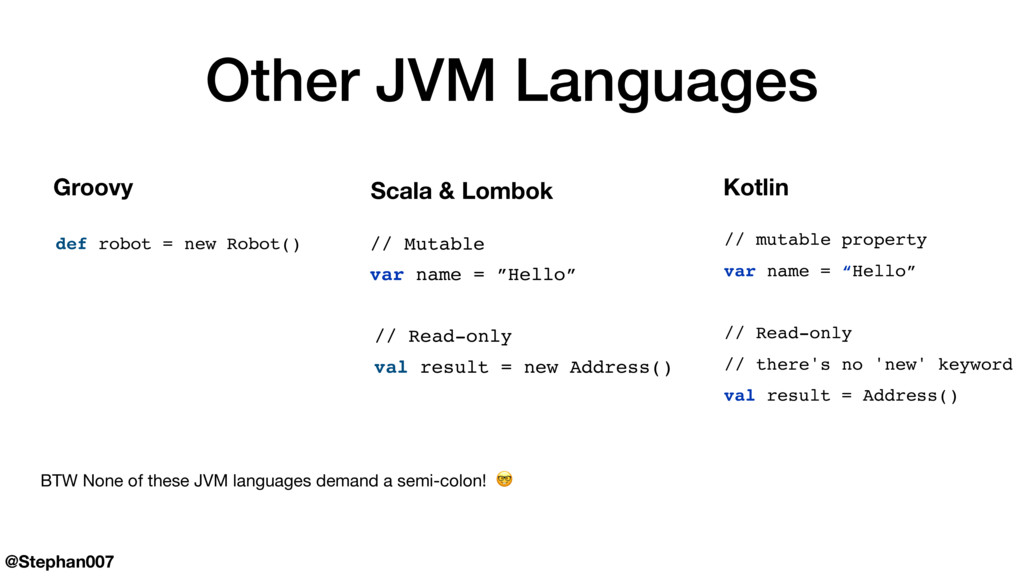
  11. @Stephan007 Other JVM Languages Groovy Kotlin def robot = new

    Robot() // mutable property var name = “Hello” // Read-only // there's no 'new' keyword val result = Address() Scala & Lombok // Mutable var name = ”Hello” // Read-only val result = new Address() BTW None of these JVM languages demand a semi-colon!
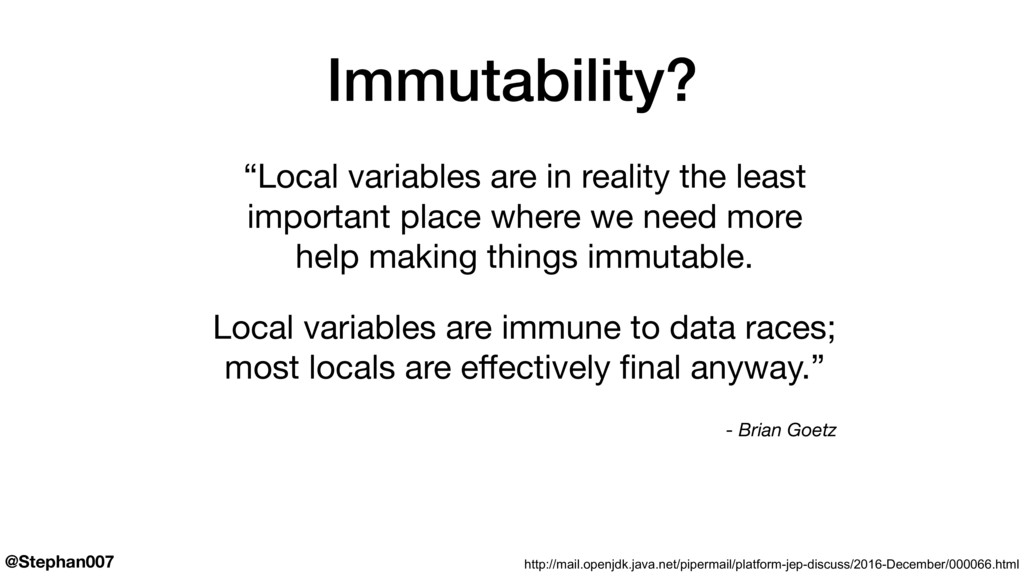
  12. @Stephan007 Immutability? http://mail.openjdk.java.net/pipermail/platform-jep-discuss/2016-December/000066.html “Local variables are in reality the least

    important place where we need more help making things immutable. Local variables are immune to data races; most locals are effectively final anyway.” - Brian Goetz
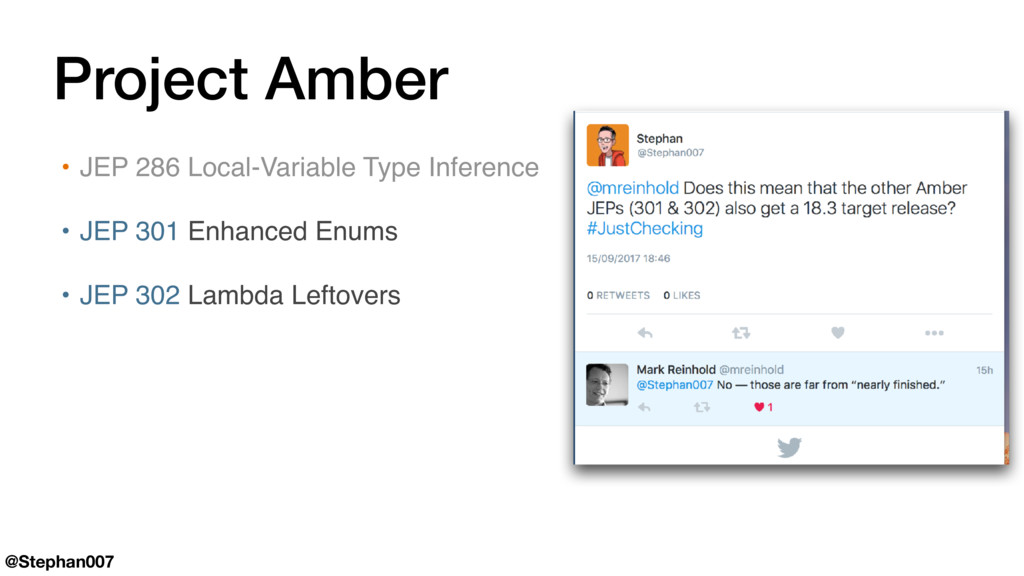
  13. @Stephan007 Project Amber • JEP 286 Local-Variable Type Inference •

    JEP 301 Enhanced Enums • JEP 302 Lambda Leftovers
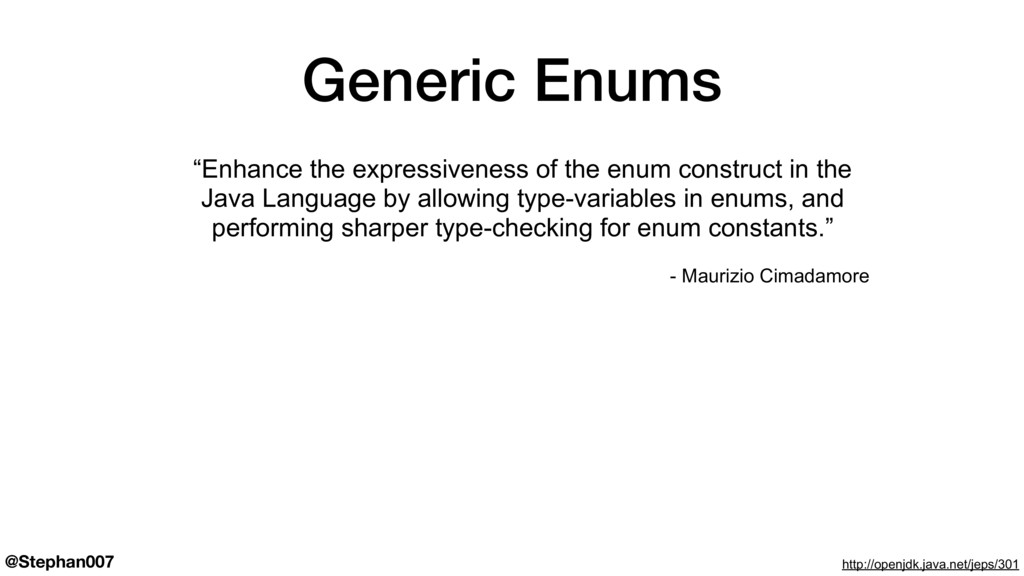
  14. @Stephan007 Generic Enums “Enhance the expressiveness of the enum construct

    in the Java Language by allowing type-variables in enums, and performing sharper type-checking for enum constants.” - Maurizio Cimadamore http://openjdk.java.net/jeps/301
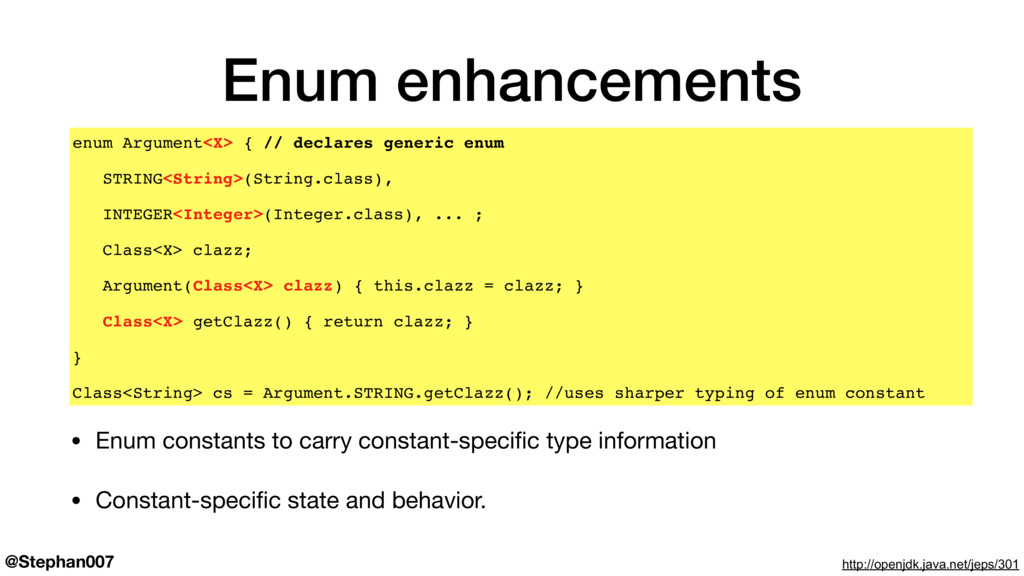
  15. @Stephan007 Enum enhancements enum Argument<X> { // declares generic enum

    STRING<String>(String.class), INTEGER<Integer>(Integer.class), ... ; Class<X> clazz; Argument(Class<X> clazz) { this.clazz = clazz; } Class<X> getClazz() { return clazz; } } Class<String> cs = Argument.STRING.getClazz(); //uses sharper typing of enum constant http://openjdk.java.net/jeps/301 • Enum constants to carry constant-specific type information • Constant-specific state and behavior.
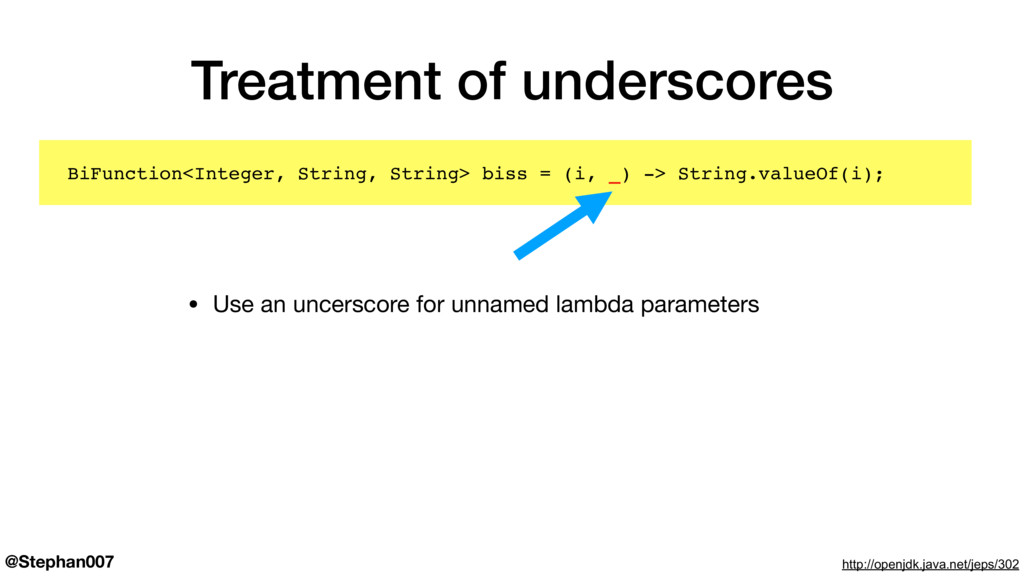
  16. @Stephan007 Treatment of underscores • Use an uncerscore for unnamed

    lambda parameters BiFunction<Integer, String, String> biss = (i, _) -> String.valueOf(i); http://openjdk.java.net/jeps/302
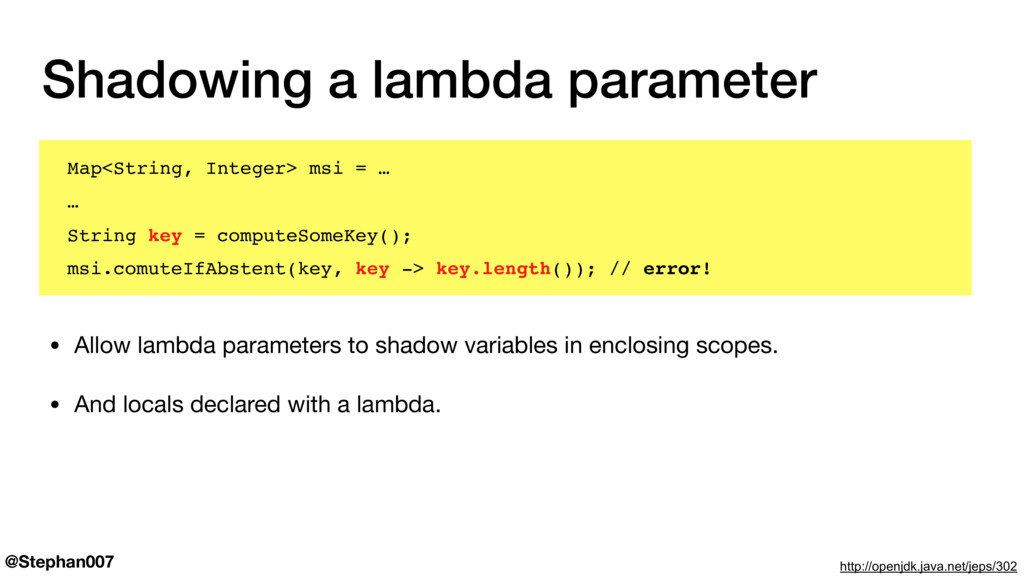
  17. @Stephan007 Shadowing a lambda parameter • Allow lambda parameters to

    shadow variables in enclosing scopes. • And locals declared with a lambda. Map<String, Integer> msi = … … String key = computeSomeKey(); msi.comuteIfAbstent(key, key -> key.length()); // error! http://openjdk.java.net/jeps/302
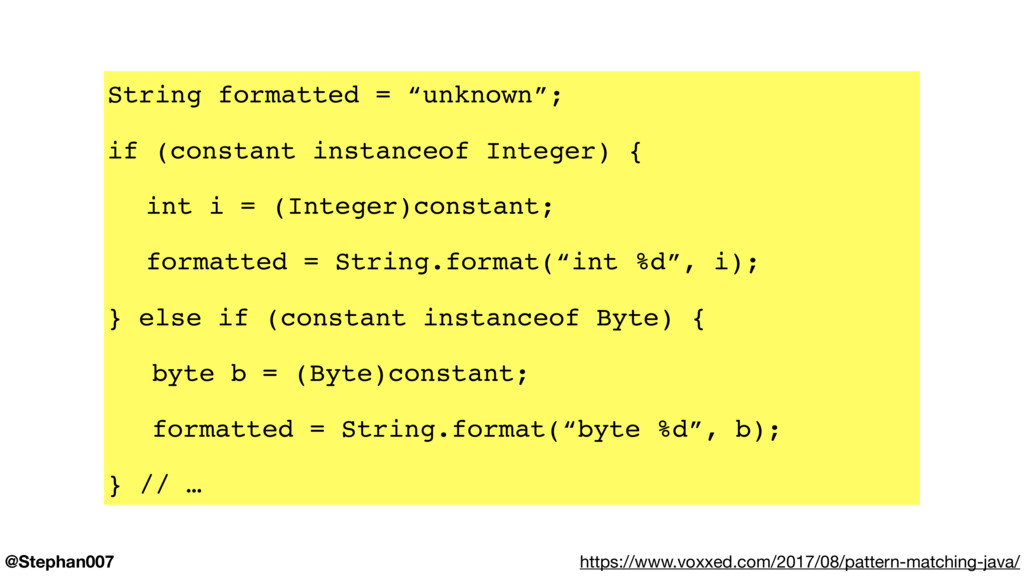
  18. @Stephan007 String formatted = “unknown”; if (constant instanceof Integer) {

    int i = (Integer)constant; formatted = String.format(“int %d”, i); } else if (constant instanceof Byte) { byte b = (Byte)constant; formatted = String.format(“byte %d”, b); } // … https://www.voxxed.com/2017/08/pattern-matching-java/
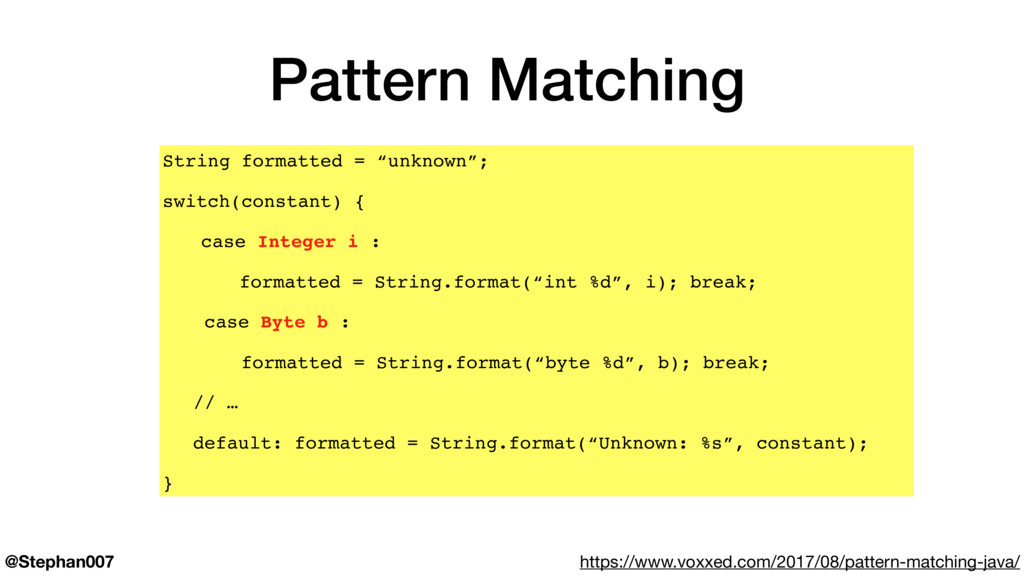
  19. @Stephan007 Pattern Matching String formatted = “unknown”; switch(constant) { case

    Integer i : formatted = String.format(“int %d”, i); break; case Byte b : formatted = String.format(“byte %d”, b); break; // … default: formatted = String.format(“Unknown: %s”, constant); } https://www.voxxed.com/2017/08/pattern-matching-java/
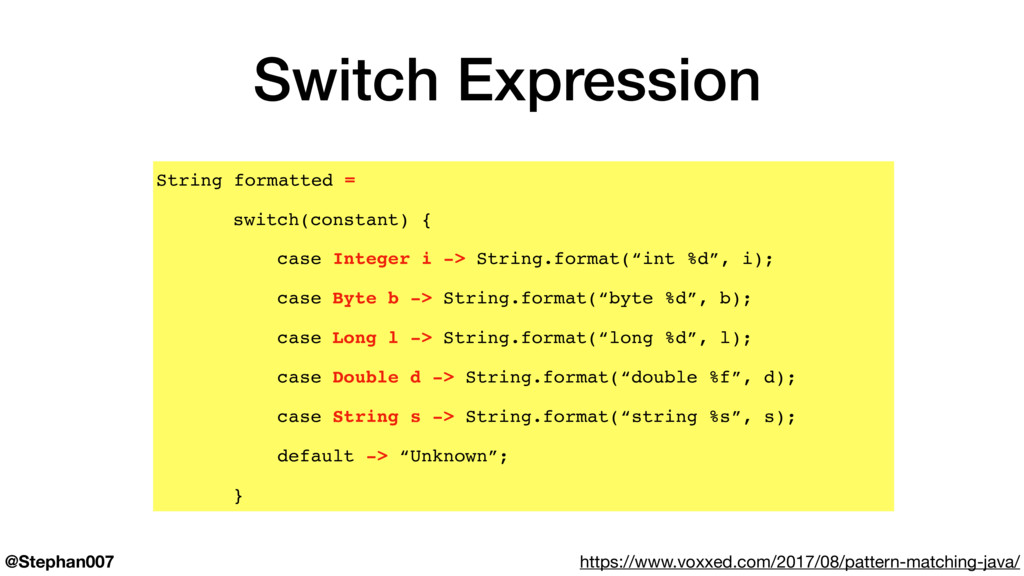
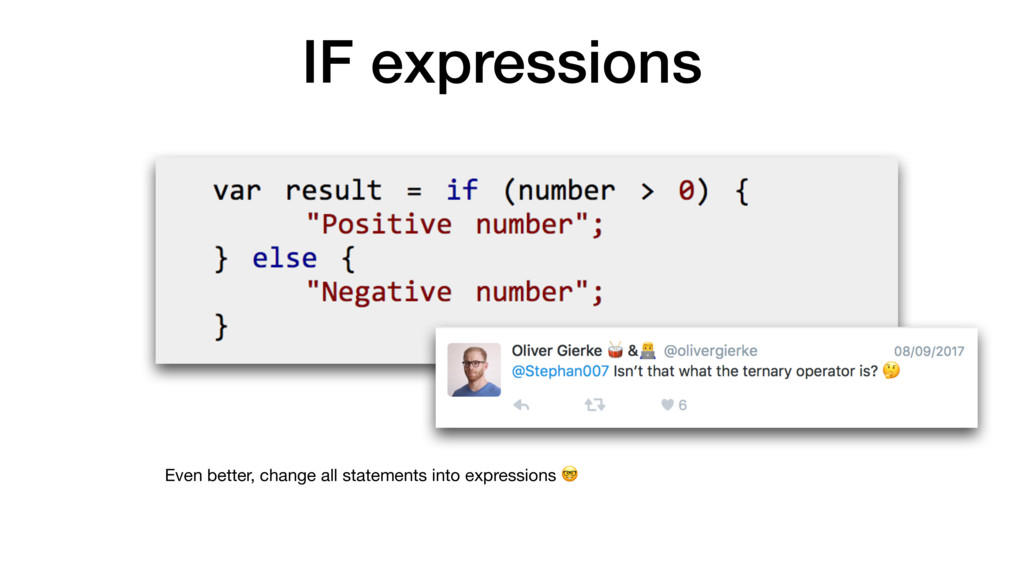
  20. @Stephan007 Switch Expression String formatted = switch(constant) { case Integer

    i -> String.format(“int %d”, i); case Byte b -> String.format(“byte %d”, b); case Long l -> String.format(“long %d”, l); case Double d -> String.format(“double %f”, d); case String s -> String.format(“string %s”, s); default -> “Unknown”; } https://www.voxxed.com/2017/08/pattern-matching-java/
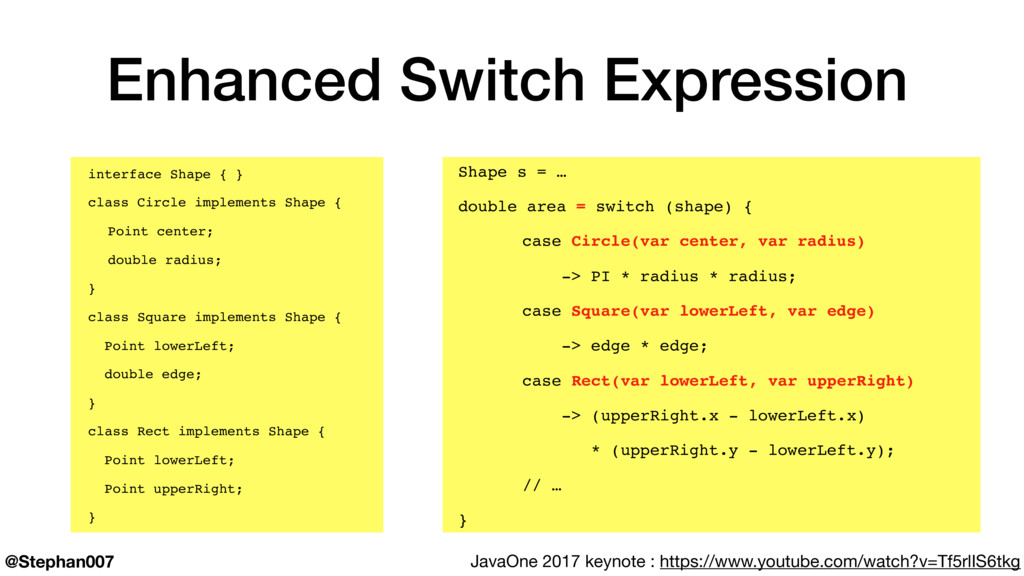
  21. @Stephan007 Enhanced Switch Expression Shape s = … double area

    = switch (shape) { case Circle(var center, var radius) -> PI * radius * radius; case Square(var lowerLeft, var edge) -> edge * edge; case Rect(var lowerLeft, var upperRight) -> (upperRight.x - lowerLeft.x) * (upperRight.y - lowerLeft.y); // … } interface Shape { } class Circle implements Shape { Point center; double radius; } class Square implements Shape { Point lowerLeft; double edge; } class Rect implements Shape { Point lowerLeft; Point upperRight; } JavaOne 2017 keynote : https://www.youtube.com/watch?v=Tf5rlIS6tkg
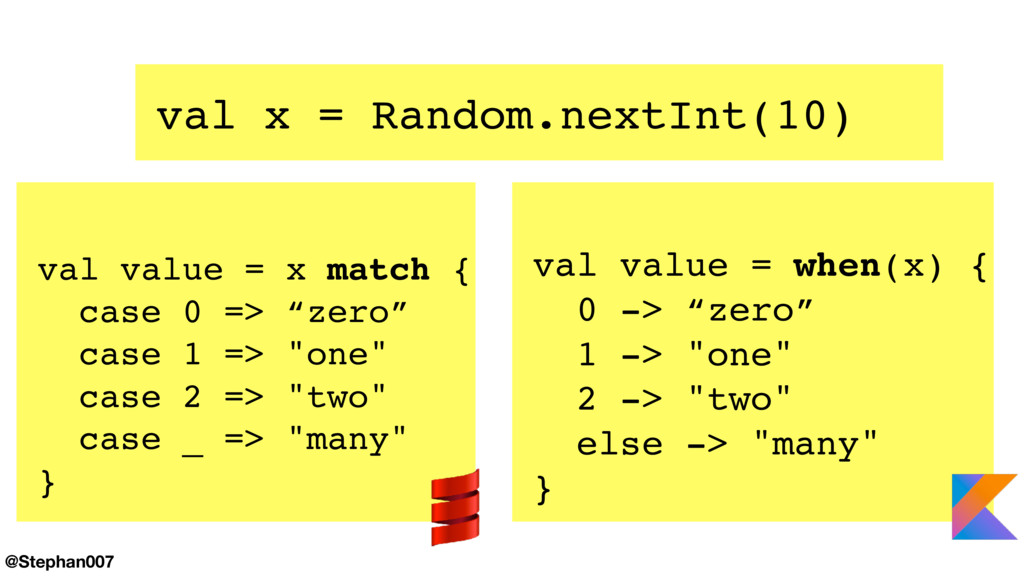
  22. @Stephan007 val x = Random.nextInt(10) val value = x match

    { case 0 => “zero” case 1 => "one" case 2 => "two" case _ => "many" } val value = when(x) { 0 -> “zero” 1 -> "one" 2 -> "two" else -> "many" }
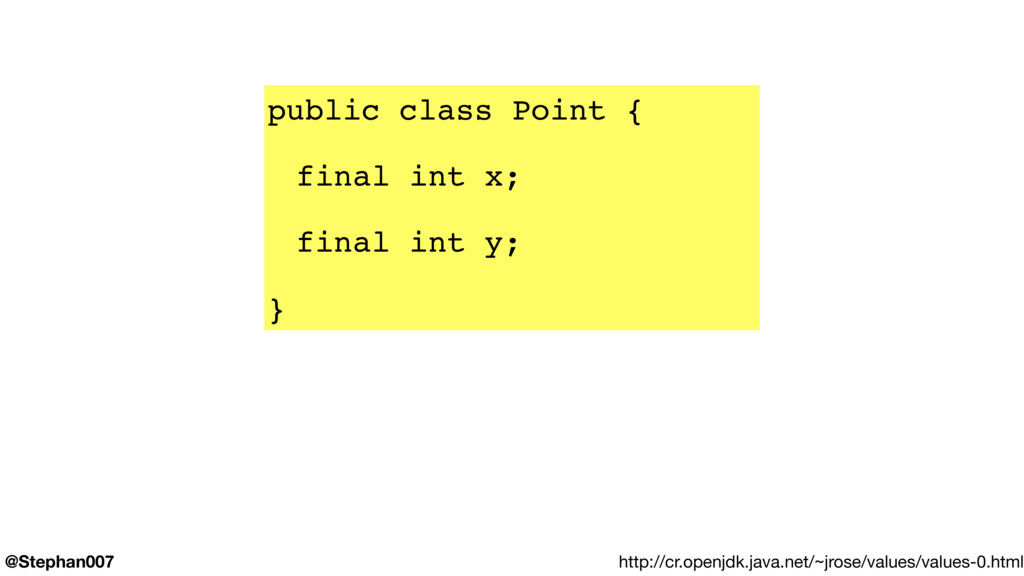
  23. @Stephan007 public class Point { final int x; final int

    y; } http://cr.openjdk.java.net/~jrose/values/values-0.html
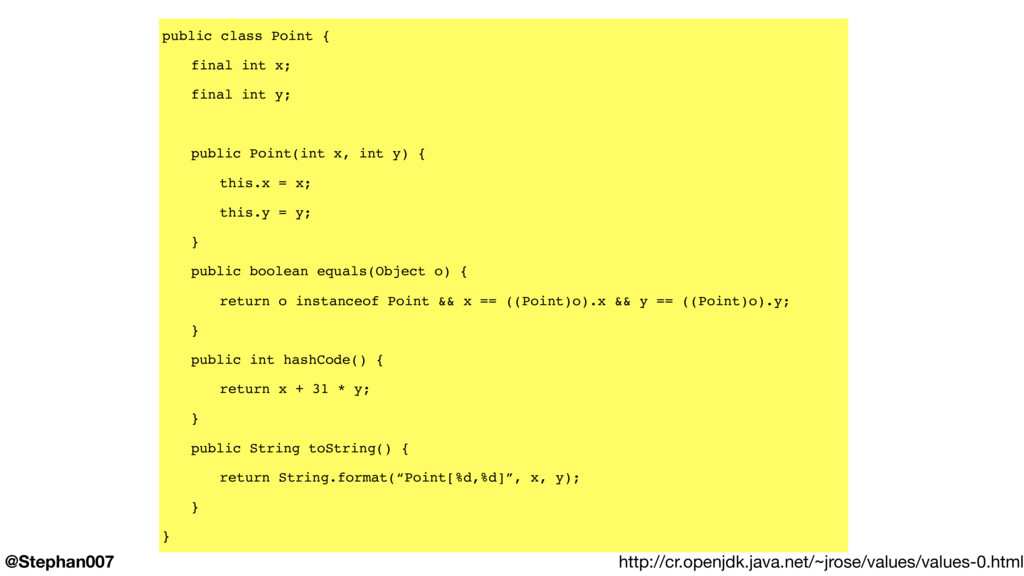
  24. @Stephan007 public class Point { final int x; final int

    y; public Point(int x, int y) { this.x = x; this.y = y; } public boolean equals(Object o) { return o instanceof Point && x == ((Point)o).x && y == ((Point)o).y; } public int hashCode() { return x + 31 * y; } public String toString() { return String.format(“Point[%d,%d]”, x, y); } } http://cr.openjdk.java.net/~jrose/values/values-0.html
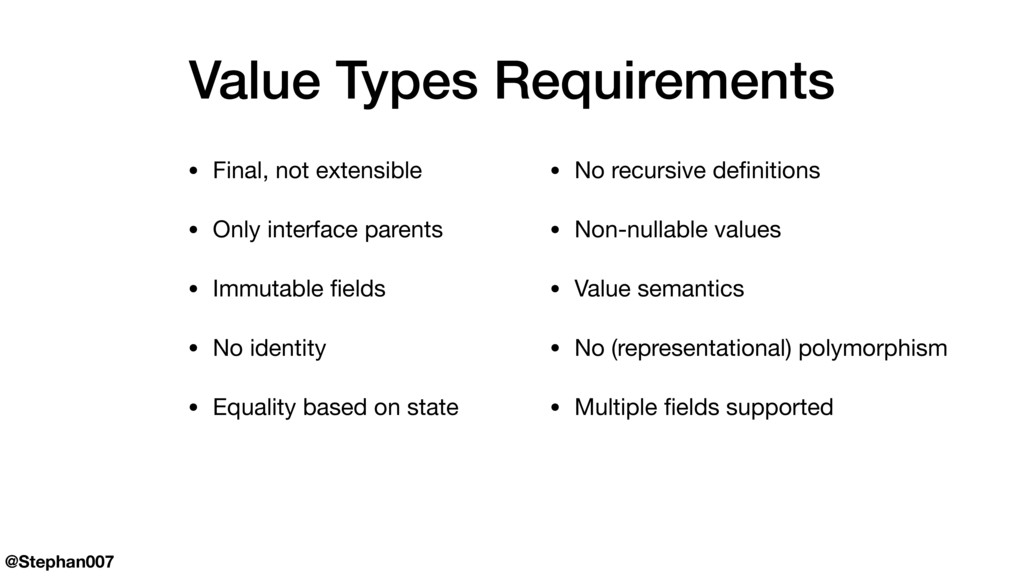
  25. @Stephan007 Value Types Requirements • Final, not extensible • Only

    interface parents • Immutable fields • No identity • Equality based on state • No recursive definitions • Non-nullable values • Value semantics • No (representational) polymorphism • Multiple fields supported
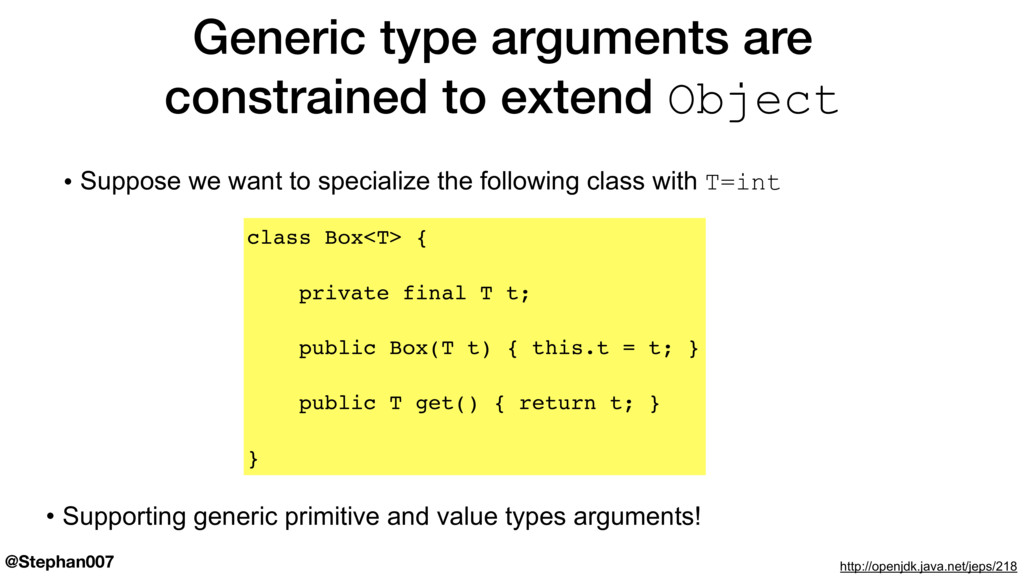
  26. @Stephan007 Generic type arguments are constrained to extend Object •

    Supporting generic primitive and value types arguments! class Box<T> { private final T t; public Box(T t) { this.t = t; } public T get() { return t; } } http://openjdk.java.net/jeps/218 • Suppose we want to specialize the following class with T=int
  27. @Stephan007 • Project Amber • Project Valhalla • Project Panama

    - Interconnecting JVM and native code • Project Loom - Make Concurrency simple(r) again! • Project Metropolis - The holy Graal