Introduction to Julia Language
Sponsored
·
 Ship Features Fearlessly
Turn features on and off without deploys. Used by thousands of Ruby developers.
→
Ship Features Fearlessly
Turn features on and off without deploys. Used by thousands of Ruby developers.
→

Share
Embed
Introduction to Julia Language

thirdwing
December 06, 2012
Transcript
49 slides
-
Introduction to Julia Language Kou Qiang Sun Yat-sen University December
6, 2012 Kou Qiang (Sun Yat-sen University) Introduction to Julia Language December 6, 2012 1 / 33 -
Outline Outline 1 Overview 2 Features Performance Parallelism Cloud Computing
3 LLVM and Clang 4 Comparison between R and Julia Advantages and Disadvantages The State of Statistics in Julia 5 Installation and Usage 6 An Example 7 Other Projects Kou Qiang (Sun Yat-sen University) Introduction to Julia Language December 6, 2012 2 / 33 -
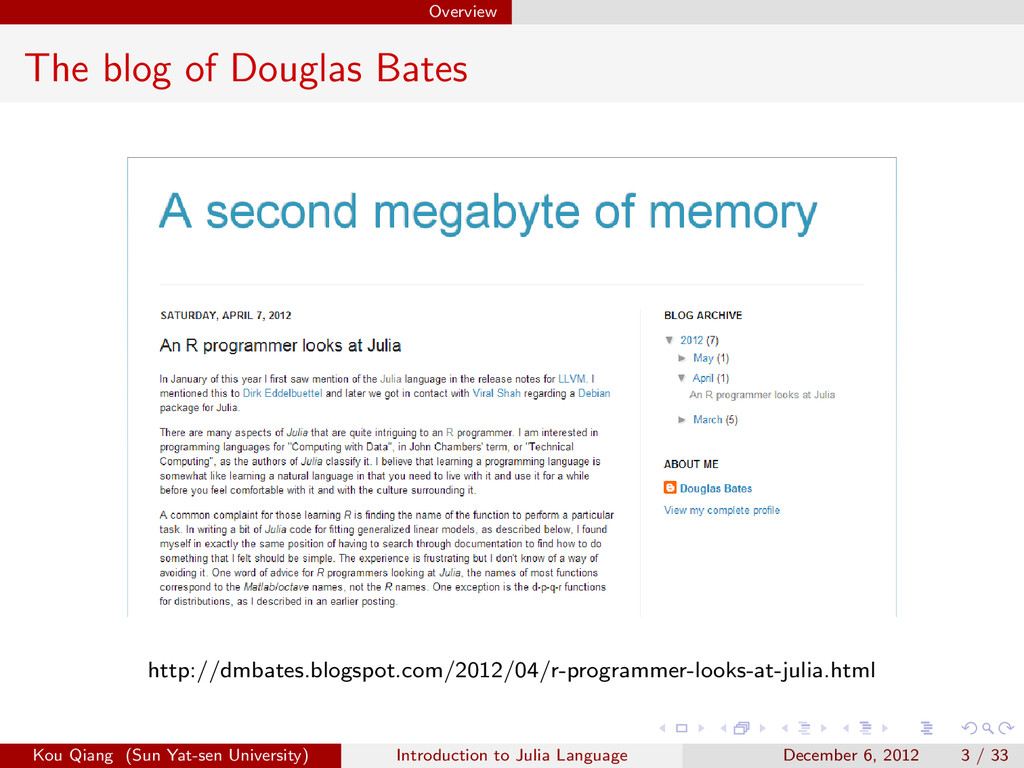
Overview The blog of Douglas Bates http://dmbates.blogspot.com/2012/04/r-programmer-looks-at-julia.html Kou Qiang (Sun
Yat-sen University) Introduction to Julia Language December 6, 2012 3 / 33 -
Overview The Homepage http://julialang.org/ Kou Qiang (Sun Yat-sen University) Introduction
to Julia Language December 6, 2012 4 / 33 -
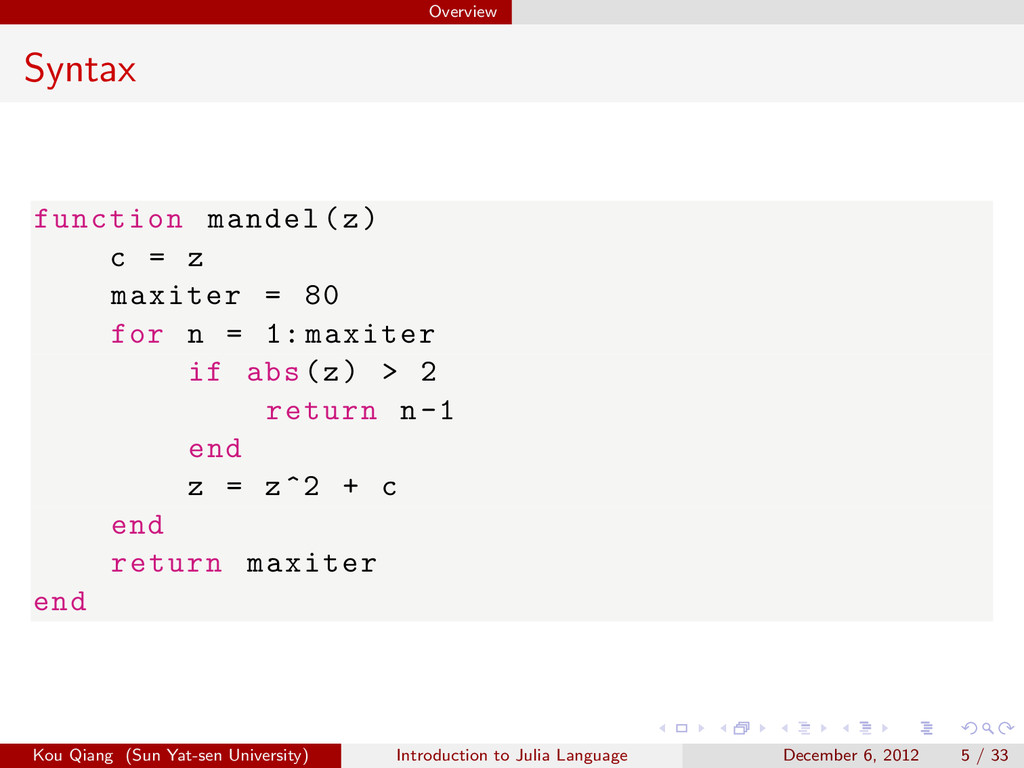
Overview Syntax function mandel(z) c = z maxiter = 80
for n = 1: maxiter if abs(z) > 2 return n-1 end z = z^2 + c end return maxiter end Kou Qiang (Sun Yat-sen University) Introduction to Julia Language December 6, 2012 5 / 33 -
Features Performance Features 1 Overview 2 Features Performance Parallelism Cloud
Computing 3 LLVM and Clang 4 Comparison between R and Julia Advantages and Disadvantages The State of Statistics in Julia 5 Installation and Usage 6 An Example 7 Other Projects Kou Qiang (Sun Yat-sen University) Introduction to Julia Language December 6, 2012 6 / 33 -
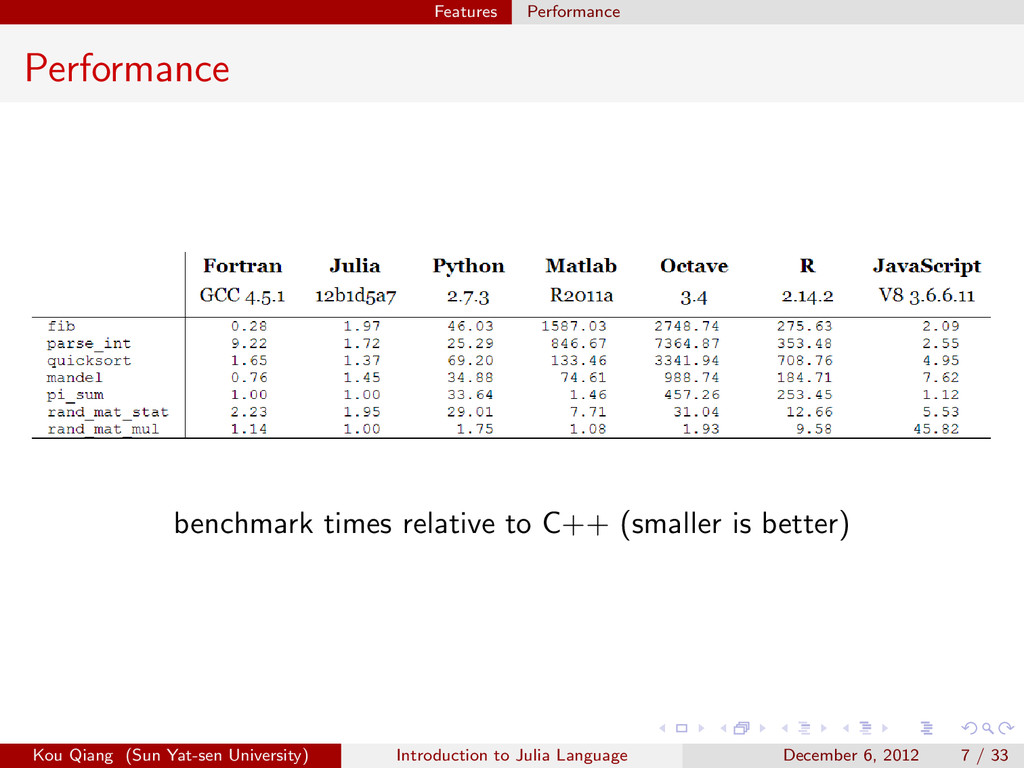
Features Performance Performance benchmark times relative to C++ (smaller is
better) Kou Qiang (Sun Yat-sen University) Introduction to Julia Language December 6, 2012 7 / 33 -
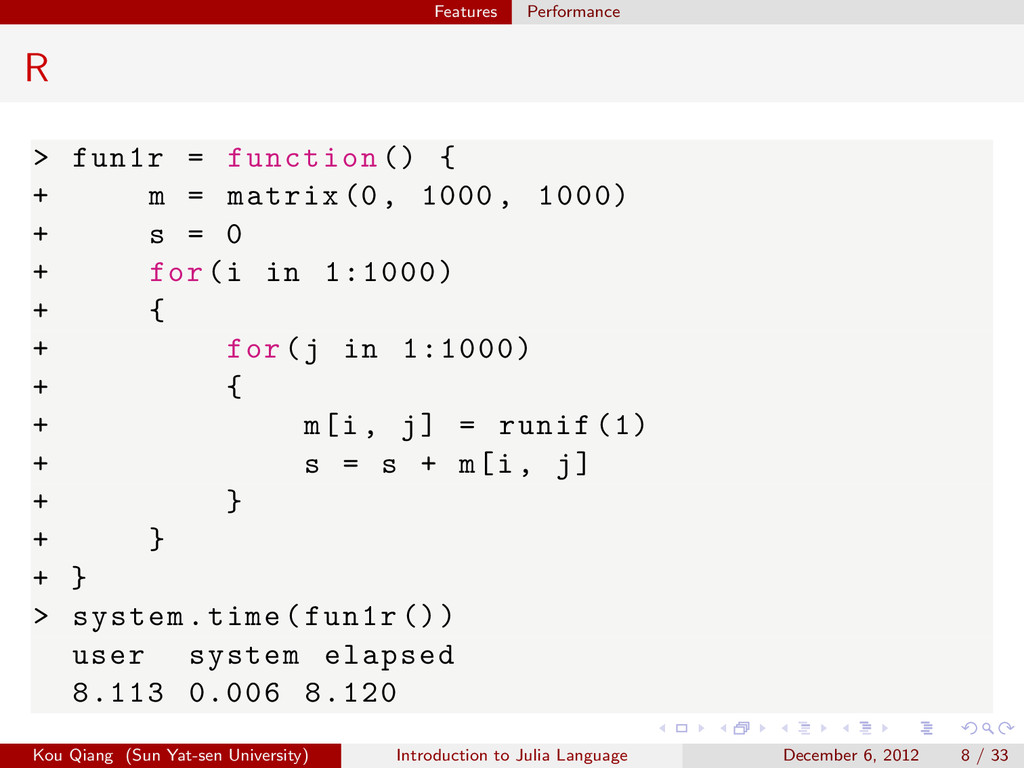
Features Performance R > fun1r = function () { +
m = matrix (0, 1000 , 1000) + s = 0 + for(i in 1:1000) + { + for(j in 1:1000) + { + m[i, j] = runif (1) + s = s + m[i, j] + } + } + } > system.time(fun1r ()) user system elapsed 8.113 0.006 8.120 Kou Qiang (Sun Yat-sen University) Introduction to Julia Language December 6, 2012 8 / 33 -
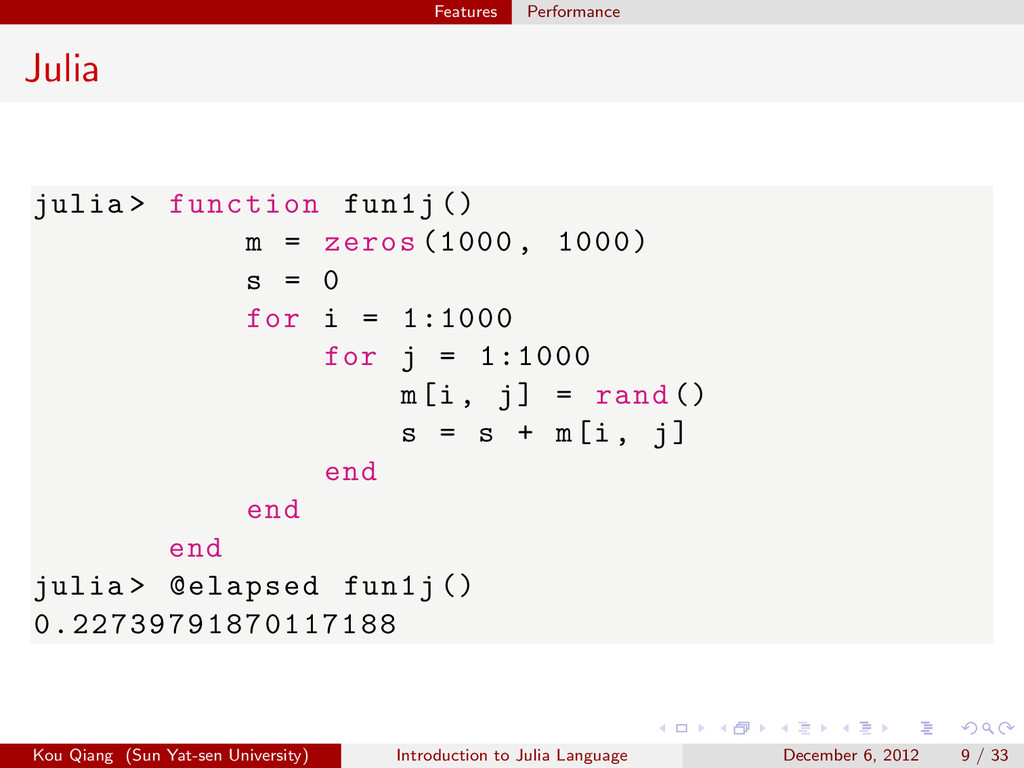
Features Performance Julia julia > function fun1j () m =
zeros (1000 , 1000) s = 0 for i = 1:1000 for j = 1:1000 m[i, j] = rand () s = s + m[i, j] end end end julia > @elapsed fun1j () 0.22739791870117188 Kou Qiang (Sun Yat-sen University) Introduction to Julia Language December 6, 2012 9 / 33 -
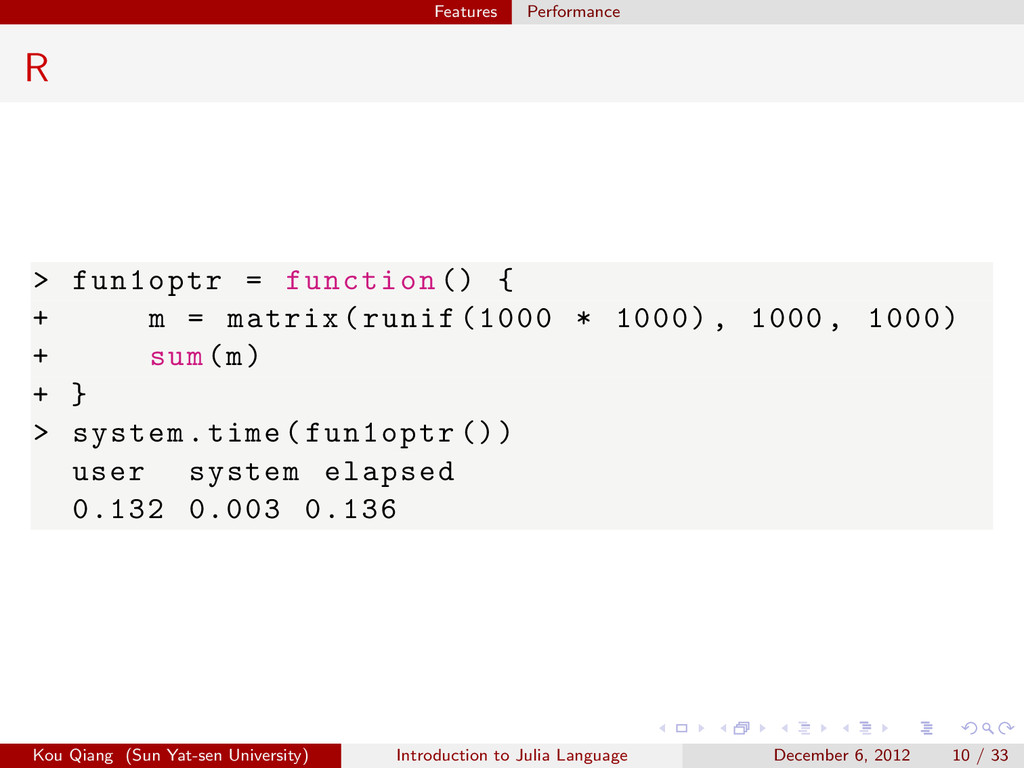
Features Performance R > fun1optr = function () { +
m = matrix(runif (1000 * 1000) , 1000 , 1000) + sum(m) + } > system.time(fun1optr ()) user system elapsed 0.132 0.003 0.136 Kou Qiang (Sun Yat-sen University) Introduction to Julia Language December 6, 2012 10 / 33 -
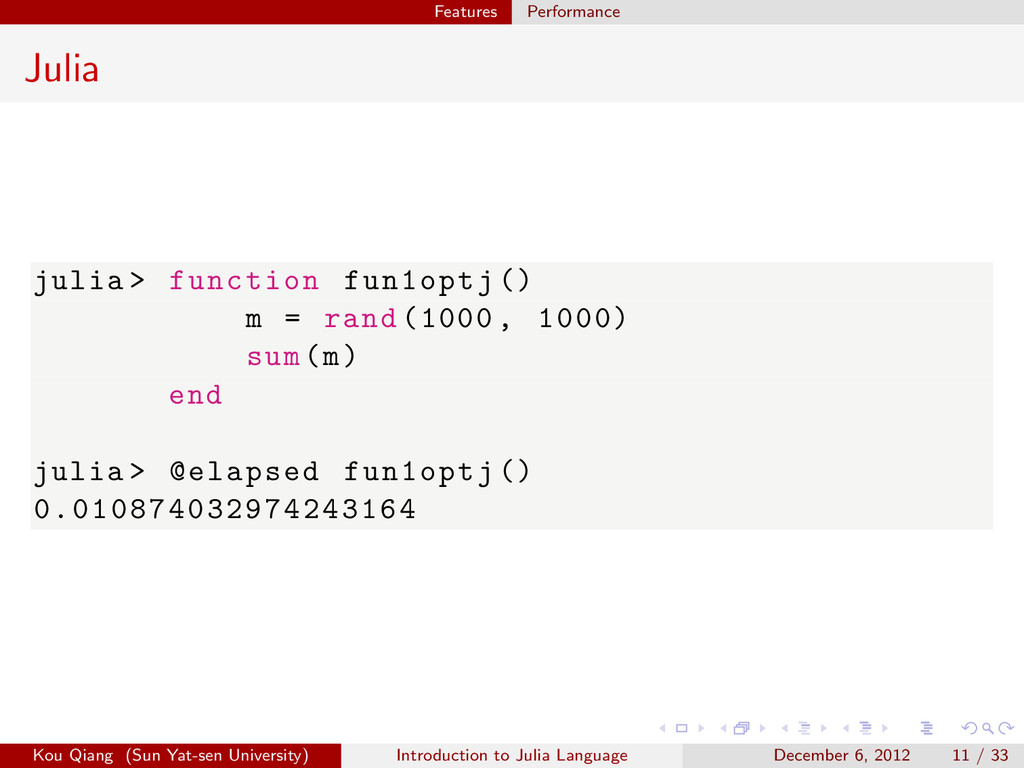
Features Performance Julia julia > function fun1optj () m =
rand (1000 , 1000) sum(m) end julia > @elapsed fun1optj () 0.010874032974243164 Kou Qiang (Sun Yat-sen University) Introduction to Julia Language December 6, 2012 11 / 33 -
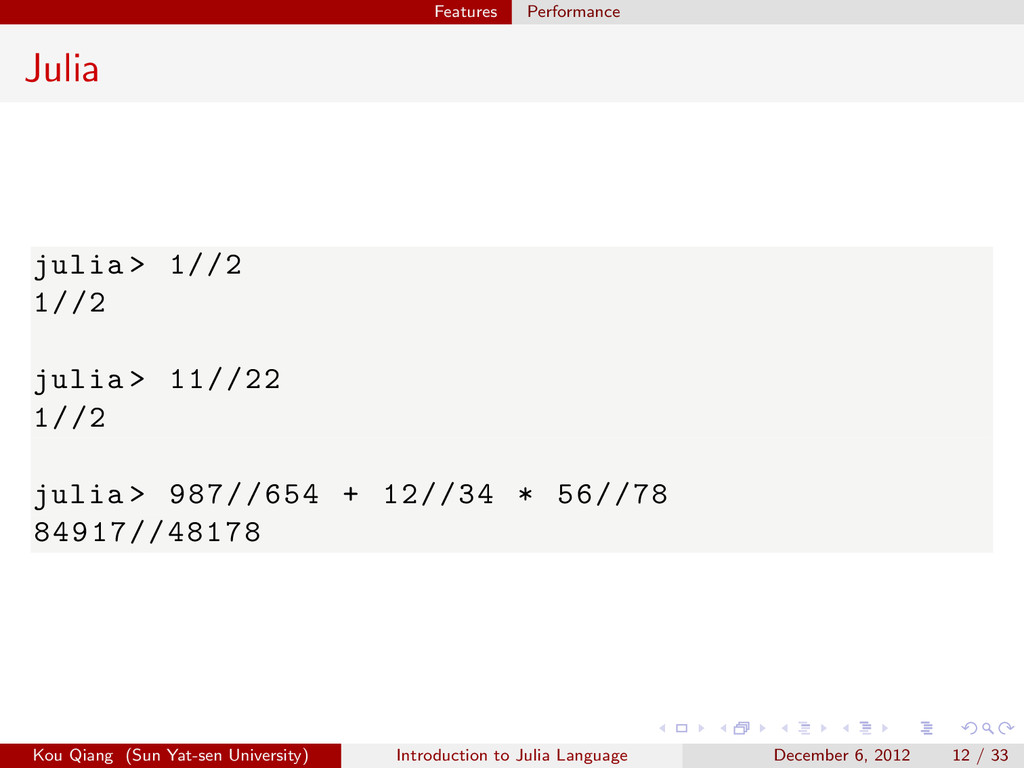
Features Performance Julia julia > 1//2 1//2 julia > 11//22
1//2 julia > 987//654 + 12//34 * 56//78 84917//48178 Kou Qiang (Sun Yat-sen University) Introduction to Julia Language December 6, 2012 12 / 33 -
Features Parallelism Features 1 Overview 2 Features Performance Parallelism Cloud
Computing 3 LLVM and Clang 4 Comparison between R and Julia Advantages and Disadvantages The State of Statistics in Julia 5 Installation and Usage 6 An Example 7 Other Projects Kou Qiang (Sun Yat-sen University) Introduction to Julia Language December 6, 2012 13 / 33 -
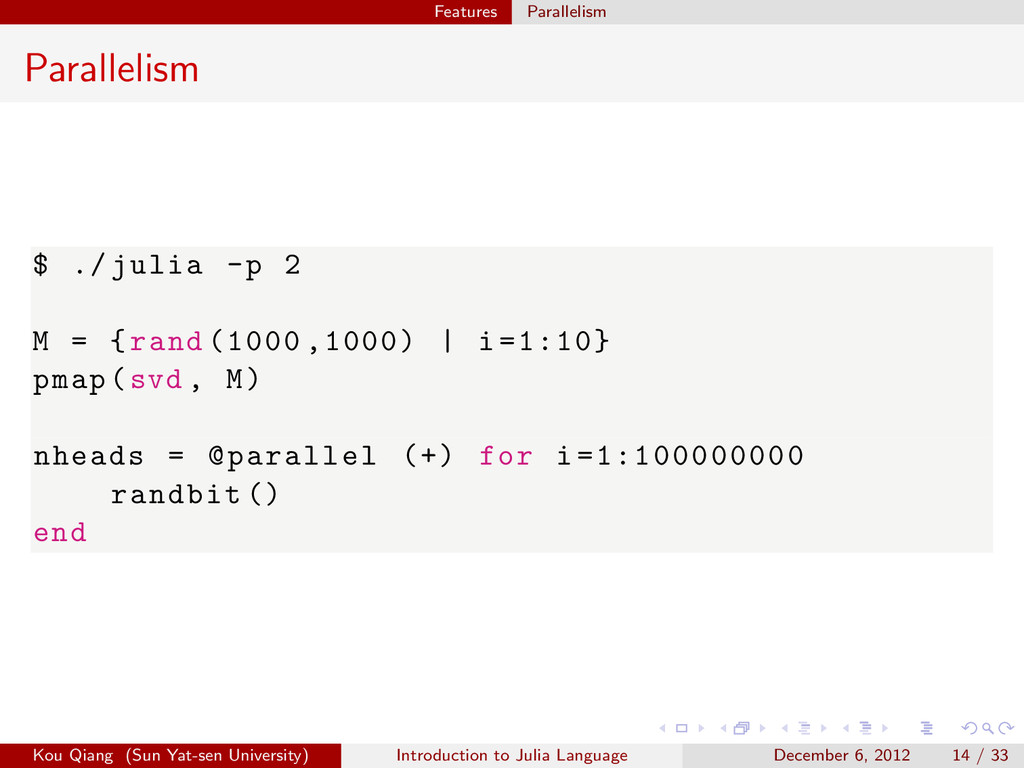
Features Parallelism Parallelism $ ./ julia -p 2 M =
{rand (1000 ,1000) | i=1:10} pmap(svd , M) nheads = @parallel (+) for i=1:100000000 randbit () end Kou Qiang (Sun Yat-sen University) Introduction to Julia Language December 6, 2012 14 / 33 -
Features Cloud Computing Features 1 Overview 2 Features Performance Parallelism
Cloud Computing 3 LLVM and Clang 4 Comparison between R and Julia Advantages and Disadvantages The State of Statistics in Julia 5 Installation and Usage 6 An Example 7 Other Projects Kou Qiang (Sun Yat-sen University) Introduction to Julia Language December 6, 2012 15 / 33 -
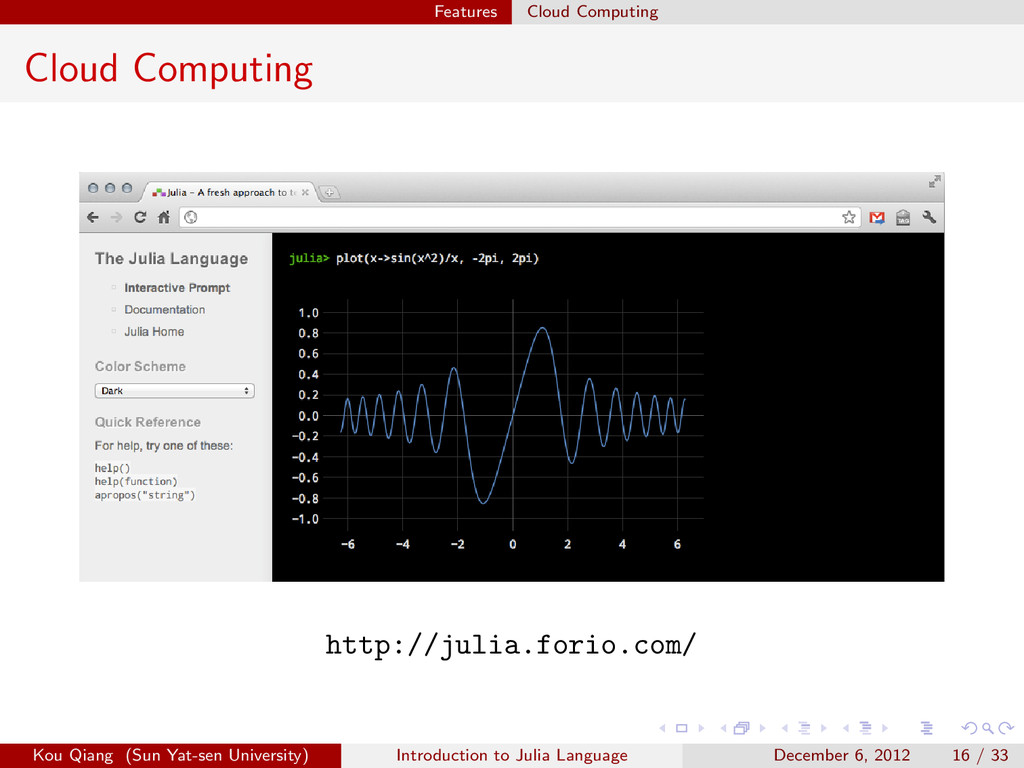
Features Cloud Computing Cloud Computing http://julia.forio.com/ Kou Qiang (Sun Yat-sen
University) Introduction to Julia Language December 6, 2012 16 / 33 -
LLVM and Clang LLVM and Clang LLVM: Low Level Virtual
Machine Kou Qiang (Sun Yat-sen University) Introduction to Julia Language December 6, 2012 17 / 33 -
LLVM and Clang LLVM and Clang LLVM: Low Level Virtual
Machine Clang: an “LLVM native” C/C++/Objective-C compiler Kou Qiang (Sun Yat-sen University) Introduction to Julia Language December 6, 2012 17 / 33 -
LLVM and Clang LLVM and Clang LLVM: Low Level Virtual
Machine Clang: an “LLVM native” C/C++/Objective-C compiler JIT compilation: Just-in-time compilation Kou Qiang (Sun Yat-sen University) Introduction to Julia Language December 6, 2012 17 / 33 -
Comparison between R and Julia Advantages and Disadvantages Comparison between
R and Julia 1 Overview 2 Features Performance Parallelism Cloud Computing 3 LLVM and Clang 4 Comparison between R and Julia Advantages and Disadvantages The State of Statistics in Julia 5 Installation and Usage 6 An Example 7 Other Projects Kou Qiang (Sun Yat-sen University) Introduction to Julia Language December 6, 2012 18 / 33 -
Comparison between R and Julia Advantages and Disadvantages Advantages A
JIT Kou Qiang (Sun Yat-sen University) Introduction to Julia Language December 6, 2012 19 / 33 -
Comparison between R and Julia Advantages and Disadvantages Advantages A
JIT A richer type system Kou Qiang (Sun Yat-sen University) Introduction to Julia Language December 6, 2012 19 / 33 -
Comparison between R and Julia Advantages and Disadvantages Advantages A
JIT A richer type system Multiple dispatch Kou Qiang (Sun Yat-sen University) Introduction to Julia Language December 6, 2012 19 / 33 -
Comparison between R and Julia Advantages and Disadvantages Advantages A
JIT A richer type system Multiple dispatch Parallelism Kou Qiang (Sun Yat-sen University) Introduction to Julia Language December 6, 2012 19 / 33 -
Comparison between R and Julia Advantages and Disadvantages Advantages A
JIT A richer type system Multiple dispatch Parallelism A cleaner model for accessing libraries of compiled code Kou Qiang (Sun Yat-sen University) Introduction to Julia Language December 6, 2012 19 / 33 -
Comparison between R and Julia Advantages and Disadvantages Advantages A
JIT A richer type system Multiple dispatch Parallelism A cleaner model for accessing libraries of compiled code Memory-mapped I/O Kou Qiang (Sun Yat-sen University) Introduction to Julia Language December 6, 2012 19 / 33 -
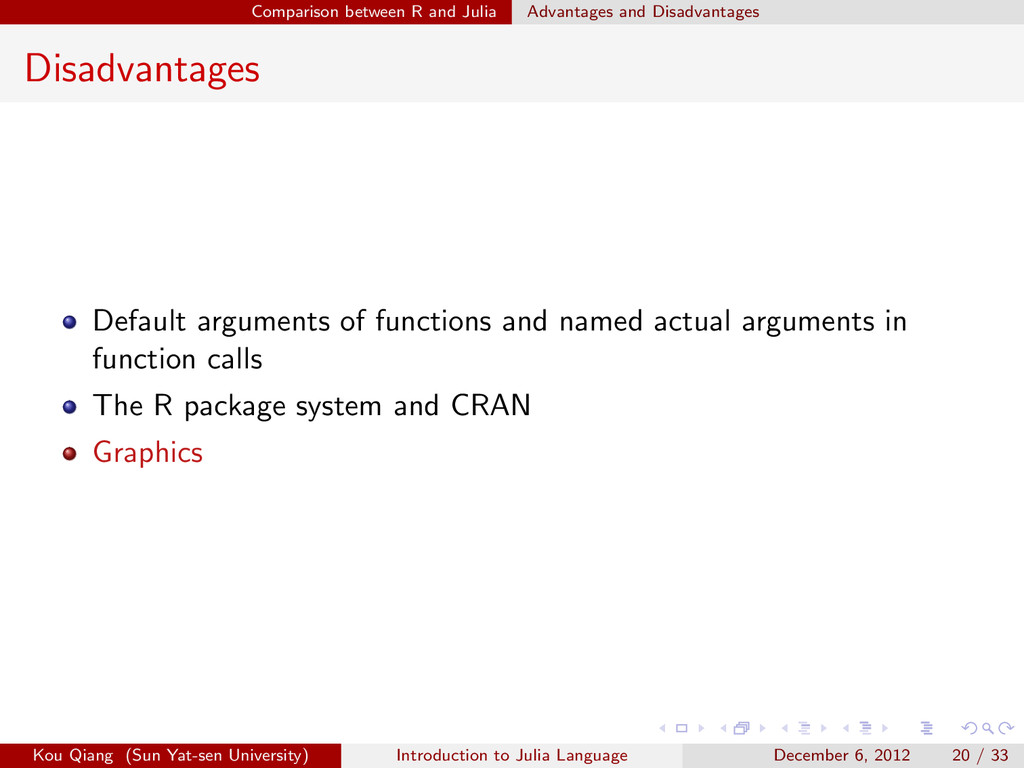
Comparison between R and Julia Advantages and Disadvantages Disadvantages Default
arguments of functions and named actual arguments in function calls Kou Qiang (Sun Yat-sen University) Introduction to Julia Language December 6, 2012 20 / 33 -
Comparison between R and Julia Advantages and Disadvantages Disadvantages Default
arguments of functions and named actual arguments in function calls The R package system and CRAN Kou Qiang (Sun Yat-sen University) Introduction to Julia Language December 6, 2012 20 / 33 -
Comparison between R and Julia Advantages and Disadvantages Disadvantages Default
arguments of functions and named actual arguments in function calls The R package system and CRAN Graphics Kou Qiang (Sun Yat-sen University) Introduction to Julia Language December 6, 2012 20 / 33 -
Comparison between R and Julia The State of Statistics in
Julia Comparison between R and Julia 1 Overview 2 Features Performance Parallelism Cloud Computing 3 LLVM and Clang 4 Comparison between R and Julia Advantages and Disadvantages The State of Statistics in Julia 5 Installation and Usage 6 An Example 7 Other Projects Kou Qiang (Sun Yat-sen University) Introduction to Julia Language December 6, 2012 21 / 33 -
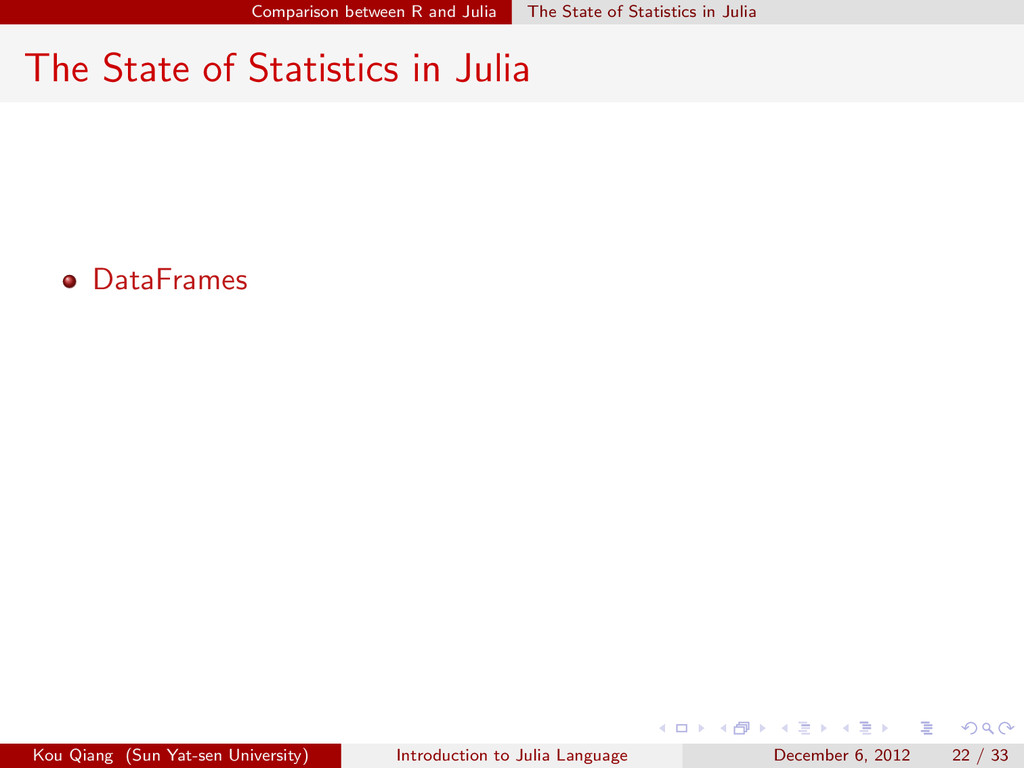
Comparison between R and Julia The State of Statistics in
Julia The State of Statistics in Julia DataFrames Kou Qiang (Sun Yat-sen University) Introduction to Julia Language December 6, 2012 22 / 33 -
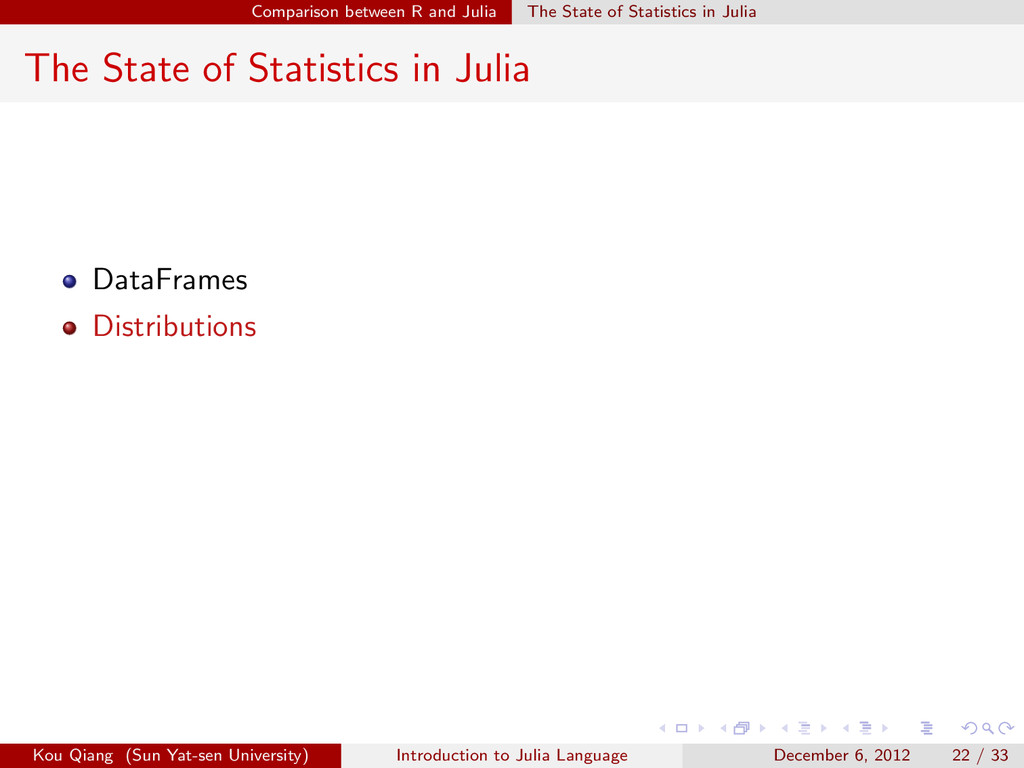
Comparison between R and Julia The State of Statistics in
Julia The State of Statistics in Julia DataFrames Distributions Kou Qiang (Sun Yat-sen University) Introduction to Julia Language December 6, 2012 22 / 33 -
Comparison between R and Julia The State of Statistics in
Julia The State of Statistics in Julia DataFrames Distributions Optim Kou Qiang (Sun Yat-sen University) Introduction to Julia Language December 6, 2012 22 / 33 -
Comparison between R and Julia The State of Statistics in
Julia The State of Statistics in Julia DataFrames Distributions Optim MCMC Kou Qiang (Sun Yat-sen University) Introduction to Julia Language December 6, 2012 22 / 33 -
Comparison between R and Julia The State of Statistics in
Julia The State of Statistics in Julia DataFrames Distributions Optim MCMC NHST: null hypothesis significance testing Kou Qiang (Sun Yat-sen University) Introduction to Julia Language December 6, 2012 22 / 33 -
Comparison between R and Julia The State of Statistics in
Julia The State of Statistics in Julia DataFrames Distributions Optim MCMC NHST: null hypothesis significance testing Clustering: k-means clustering Kou Qiang (Sun Yat-sen University) Introduction to Julia Language December 6, 2012 22 / 33 -
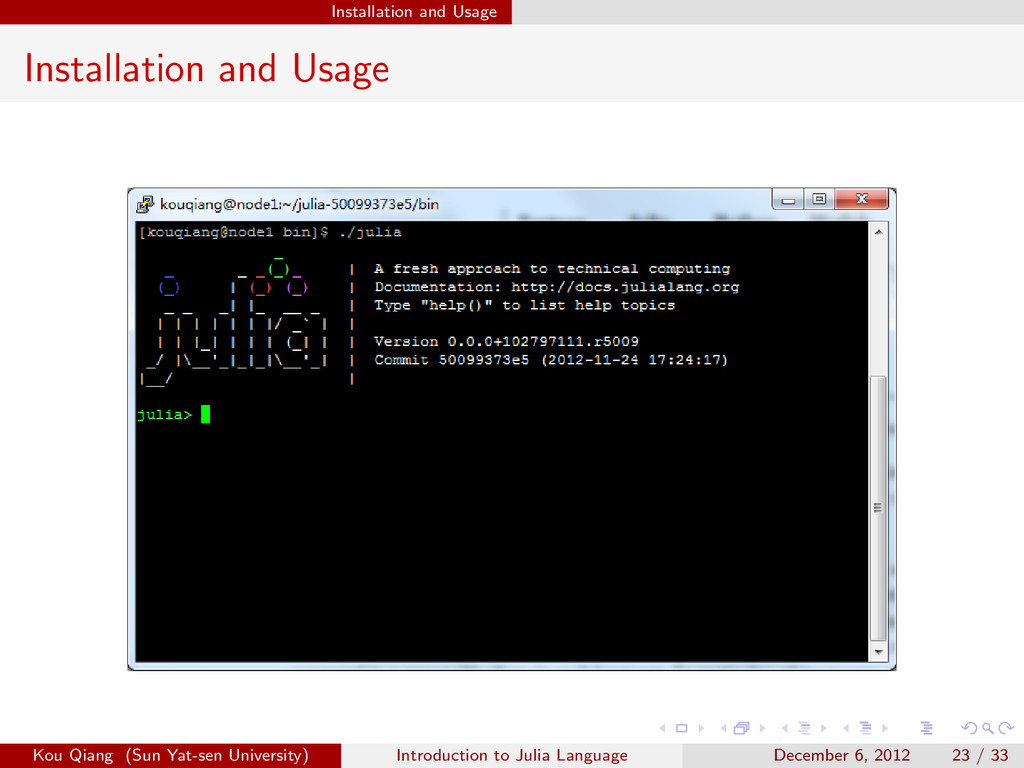
Installation and Usage Installation and Usage Kou Qiang (Sun Yat-sen
University) Introduction to Julia Language December 6, 2012 23 / 33 -
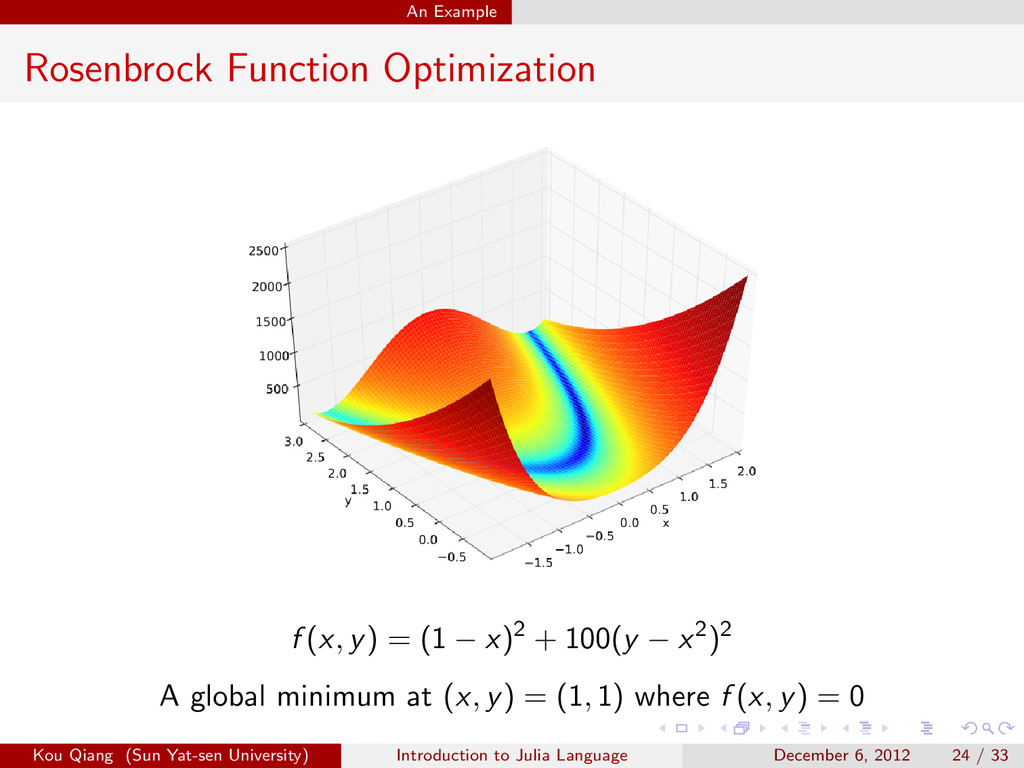
An Example Rosenbrock Function Optimization f (x, y) = (1
− x)2 + 100(y − x2)2 A global minimum at (x, y) = (1, 1) where f (x, y) = 0 Kou Qiang (Sun Yat-sen University) Introduction to Julia Language December 6, 2012 24 / 33 -
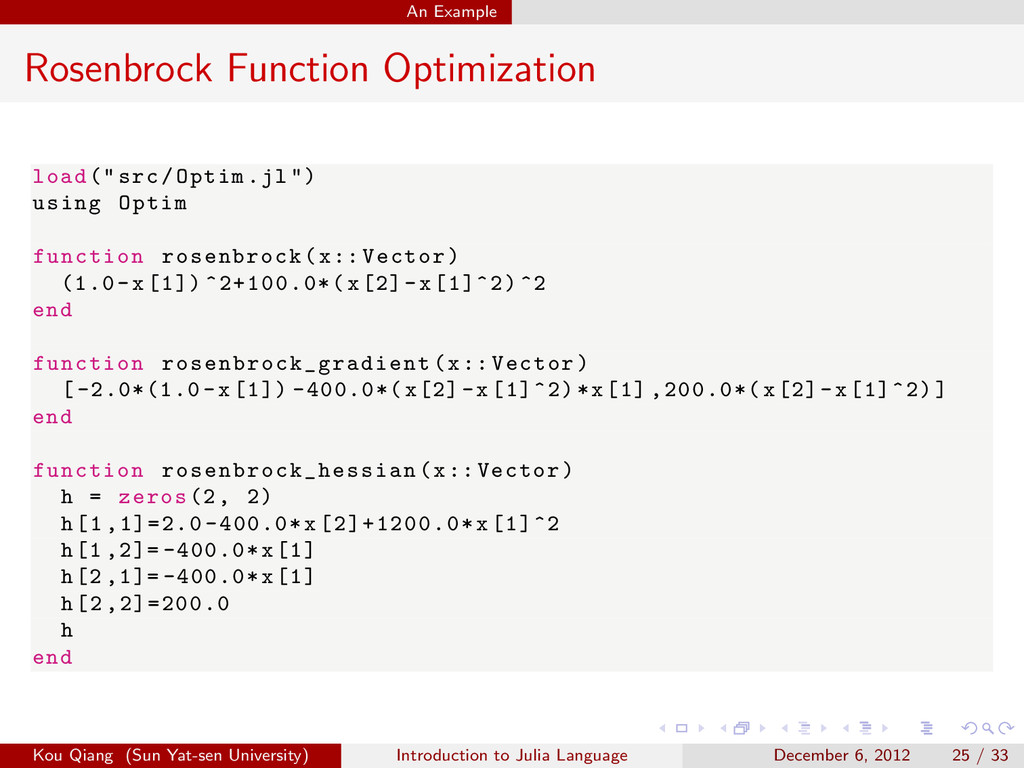
An Example Rosenbrock Function Optimization load (" src/Optim.jl") using Optim
function rosenbrock (x:: Vector) (1.0 -x[1]) ^2+100.0*( x[2]-x[1]^2) ^2 end function rosenbrock_gradient (x:: Vector) [ -2.0*(1.0 -x[1]) -400.0*(x[2]-x[1]^2)*x[1] ,200.0*(x[2]-x[1]^2)] end function rosenbrock_hessian (x:: Vector) h = zeros (2, 2) h[1 ,1]=2.0 -400.0*x [2]+1200.0* x[1]^2 h[1 ,2]= -400.0*x[1] h[2 ,1]= -400.0*x[1] h[2 ,2]=200.0 h end Kou Qiang (Sun Yat-sen University) Introduction to Julia Language December 6, 2012 25 / 33 -
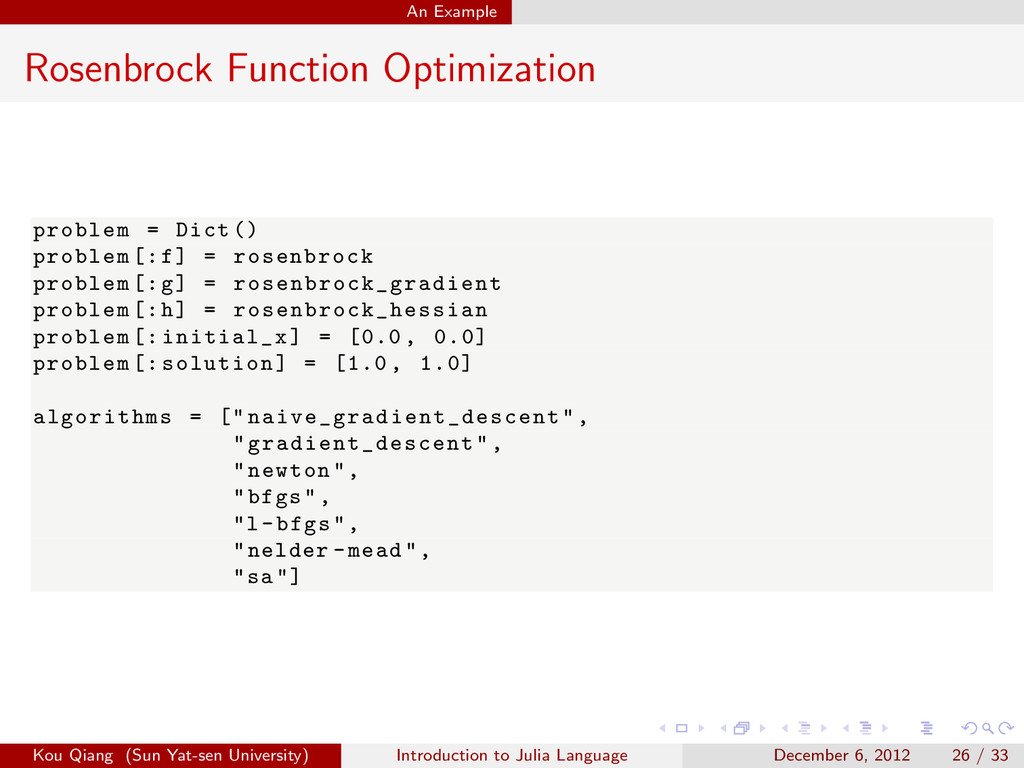
An Example Rosenbrock Function Optimization problem = Dict () problem
[:f] = rosenbrock problem [:g] = rosenbrock_gradient problem [:h] = rosenbrock_hessian problem [: initial_x] = [0.0 , 0.0] problem [: solution] = [1.0 , 1.0] algorithms = [" naive_gradient_descent ", " gradient_descent ", "newton", "bfgs", "l-bfgs", "nelder -mead", "sa"] Kou Qiang (Sun Yat-sen University) Introduction to Julia Language December 6, 2012 26 / 33 -
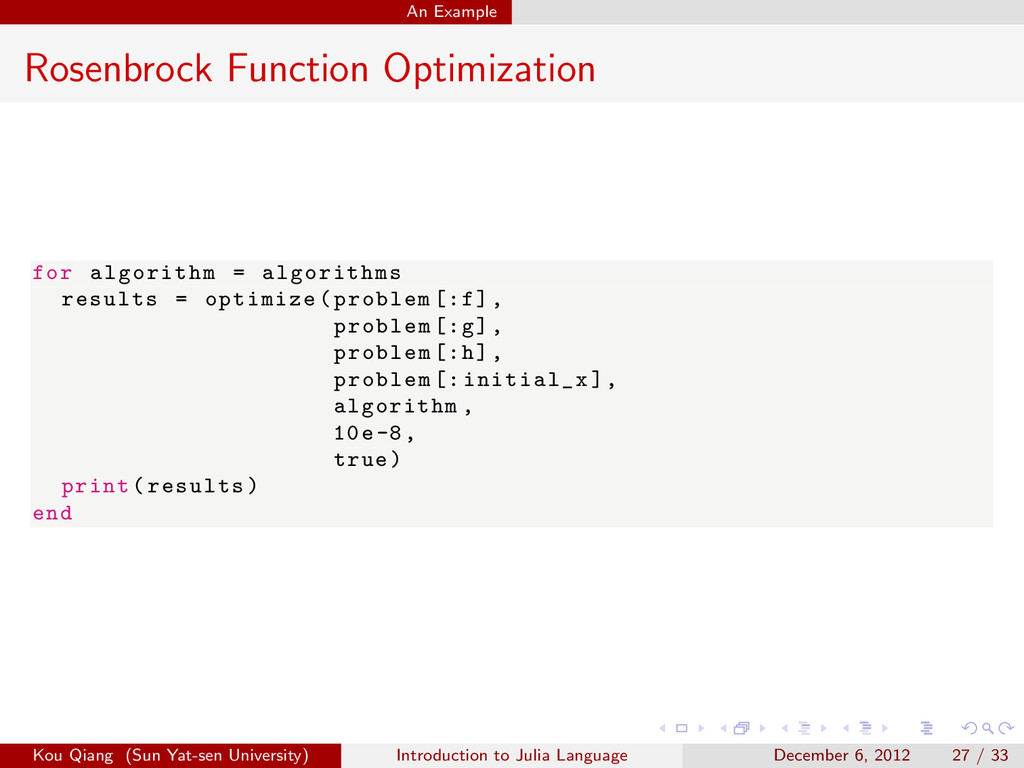
An Example Rosenbrock Function Optimization for algorithm = algorithms results
= optimize(problem [:f], problem [:g], problem [:h], problem [: initial_x], algorithm , 10e-8, true) print(results) end Kou Qiang (Sun Yat-sen University) Introduction to Julia Language December 6, 2012 27 / 33 -
Other Projects GraphChi: Disk-based large-scale graph computation “Big Data -
small machine” Kou Qiang (Sun Yat-sen University) Introduction to Julia Language December 6, 2012 28 / 33 -
Other Projects GraphChi: Disk-based large-scale graph computation “Big Data -
small machine” Implemented in plain C++ and open-source Kou Qiang (Sun Yat-sen University) Introduction to Julia Language December 6, 2012 28 / 33 -
Other Projects GraphChi: Disk-based large-scale graph computation “Big Data -
small machine” Implemented in plain C++ and open-source Support: ALS, SGD, bias-SGD, SVD, NMF, SVD++ Kou Qiang (Sun Yat-sen University) Introduction to Julia Language December 6, 2012 28 / 33 -
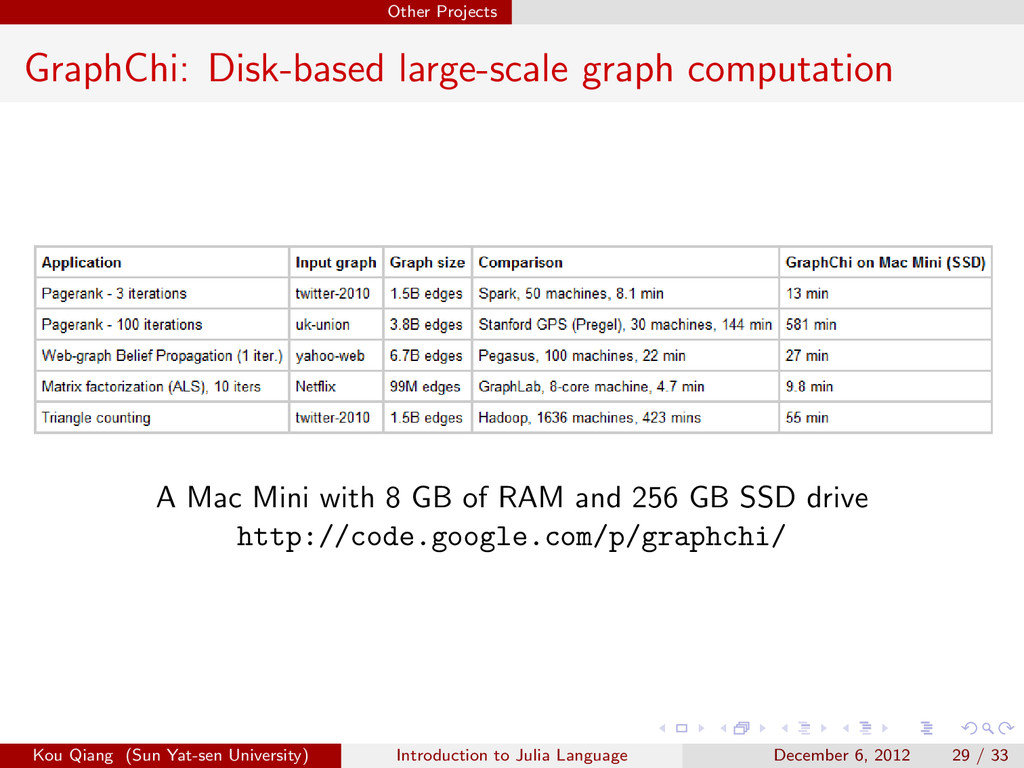
Other Projects GraphChi: Disk-based large-scale graph computation A Mac Mini
with 8 GB of RAM and 256 GB SSD drive http://code.google.com/p/graphchi/ Kou Qiang (Sun Yat-sen University) Introduction to Julia Language December 6, 2012 29 / 33 -
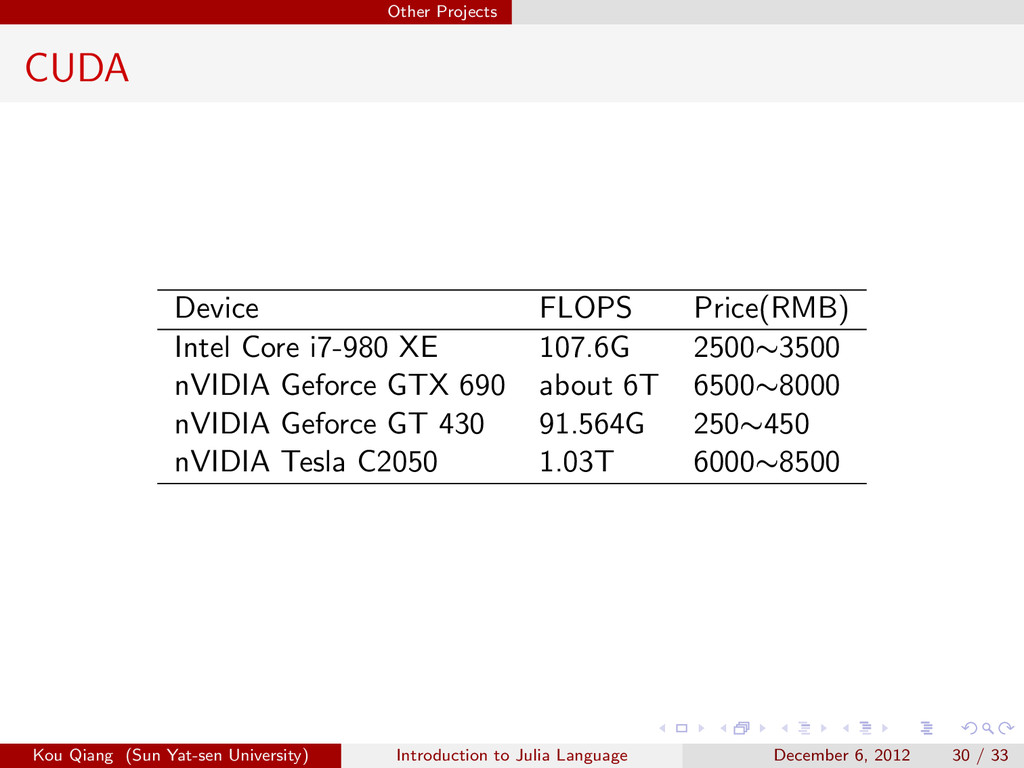
Other Projects CUDA Device FLOPS Price(RMB) Intel Core i7-980 XE
107.6G 2500∼3500 nVIDIA Geforce GTX 690 about 6T 6500∼8000 nVIDIA Geforce GT 430 91.564G 250∼450 nVIDIA Tesla C2050 1.03T 6000∼8500 Kou Qiang (Sun Yat-sen University) Introduction to Julia Language December 6, 2012 30 / 33 -
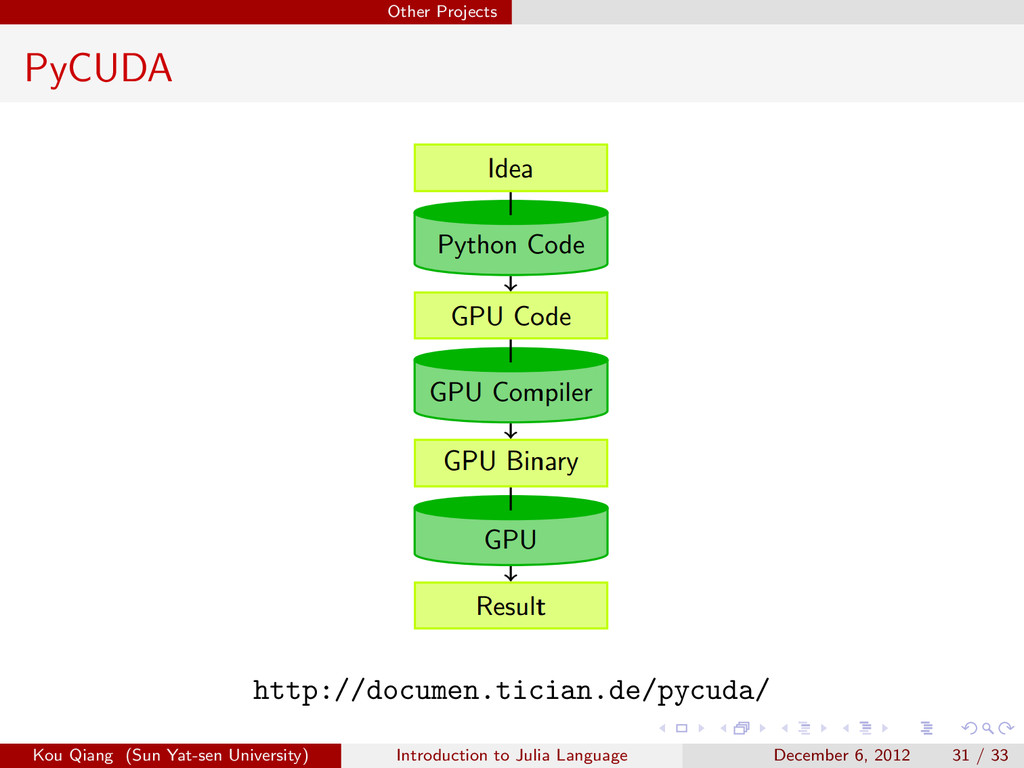
Other Projects PyCUDA http://documen.tician.de/pycuda/ Kou Qiang (Sun Yat-sen University) Introduction
to Julia Language December 6, 2012 31 / 33 -
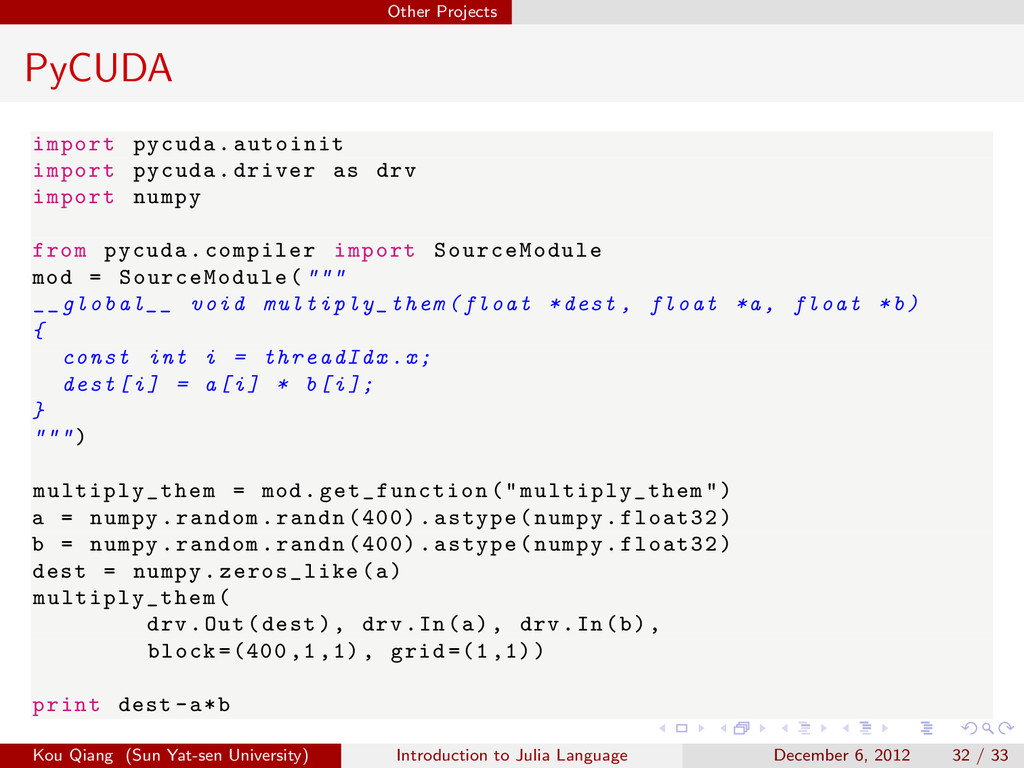
Other Projects PyCUDA import pycuda.autoinit import pycuda.driver as drv import
numpy from pycuda.compiler import SourceModule mod = SourceModule (""" __global__ void multiply_them ( float *dest , float *a, float *b) { const int i = threadIdx .x; dest[i] = a[i] * b[i]; } """) multiply_them = mod. get_function (" multiply_them ") a = numpy.random.randn (400).astype(numpy.float32) b = numpy.random.randn (400).astype(numpy.float32) dest = numpy. zeros_like (a) multiply_them ( drv.Out(dest), drv.In(a), drv.In(b), block =(400 ,1 ,1) , grid =(1 ,1)) print dest -a*b Kou Qiang (Sun Yat-sen University) Introduction to Julia Language December 6, 2012 32 / 33 -
Thanks Thanks Thank you for your time! Kou Qiang (Sun
Yat-sen University) Introduction to Julia Language December 6, 2012 33 / 33
 ykimi
 munakata
 jcabot
 hatahata021
 timakin
 manabuseki
 legalontechnologies
 110y
 staka121
 takaha4k
 uhyo
 atalie2m
 tmiket
 mkilby
 mojombo
 popppiees
 rkendrick25
 badams
 deanohume
 productmarketing
 lara
 addyosmani
 uxyall
 sferik