Upgrade to Pro — share decks privately, control downloads, hide ads and more …

EuroBSDCon 2026 - Porting STUNMESH-go to FreeBS...

Sponsored · Your Podcast. Everywhere. Effortlessly. Share. Educate. Inspire. Entertain. You do you. We'll handle the rest.
Avatar for Date Huang Date Huang
September 12, 2026

EuroBSDCon 2026 - Porting STUNMESH-go to FreeBSD and macOS: Building Peer-to-Peer WireGuard Networks

STUNMESH-go is an open-source tool that enables direct peer-to-peer WireGuard connections between devices behind NAT or CGNAT. It multiplexes STUN and WireGuard traffic on the same UDP port by interacting directly with the kernel WireGuard module, avoiding the overhead of userspace proxies. Originally Linux-only, we ported STUNMESH-go to FreeBSD and macOS. This talk covers the technical challenges we encountered: adapting from Linux raw sockets to BPF-based per-interface packet capture, porting the health monitoring and automatic reconnection system, and ensuring the plugin-based peer discovery mechanism works across platforms. We validated our work on OPNsense firewalls, VyOS routers, and mixed BSD/macOS/Linux full-mesh topologies.

Avatar for Date Huang

Date Huang

September 12, 2026

More Decks by Date Huang

Other Decks in Programming

Transcript

  1. Porting STUNMESH-go to FreeBSD and macOS: Building Peer-to-Peer WireGuard Networks

    Yu-Chiang (Date) Huang <tjjh89017 [at] hotmail.com> @EuroBSDCon 2026-Sep-11
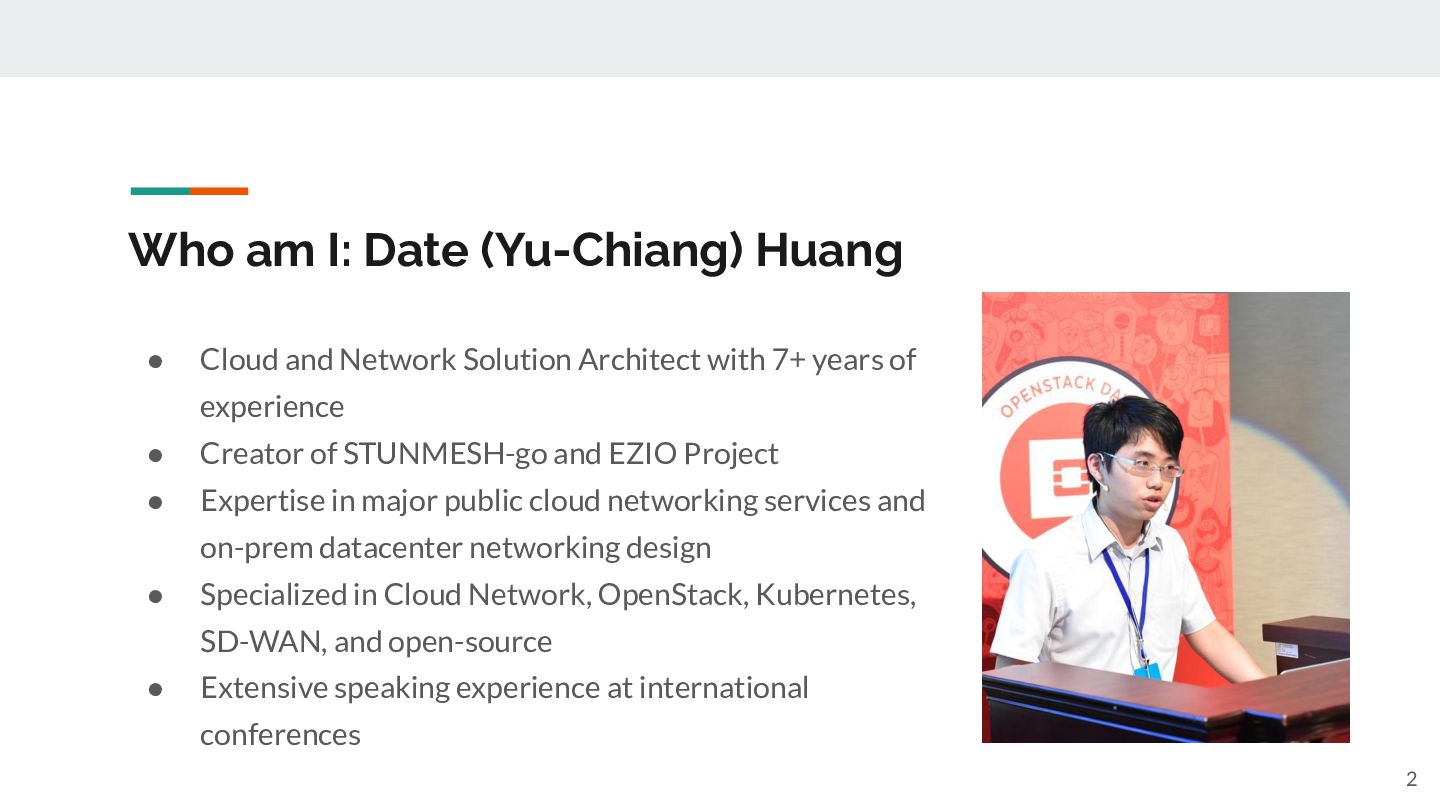
  2. Who am I: Date (Yu-Chiang) Huang • Cloud and Network

    Solution Architect with 7+ years of experience • Creator of STUNMESH-go and EZIO Project • Expertise in major public cloud networking services and on-prem datacenter networking design • Specialized in Cloud Network, OpenStack, Kubernetes, SD-WAN, and open-source • Extensive speaking experience at international conferences 2
  3. Agenda • • • • • • The Problem —
    NAT/CGNAT blocks peer-to-peer WireGuard Background — WireGuard, NAT types, STUN protocol STUNMESH-go — Architecture and how it works on Linux Porting to FreeBSD — What broke and why BSD-Specific Solutions — BPF devices, packet capture, ICMP, wgctrl Q&A 3
  4. Why This Talk Matters for BSD • • • pfSense

    and OPNsense run on FreeBSD, thousands of firewall deployments WireGuard is in the FreeBSD kernel (if-wg), but NAT traversal tools have been Linux-only This work brings direct P2P WireGuard to FreeBSD, macOS, no relay servers needed
  5. NAT/CGNAT/Stateful Firewall Are Everywhere • • • NAT (Network Address

    Translation) conserves IPv4 addresses CGNAT (Carrier-Grade NAT) adds another layer at the ISP Stateful Firewall ◦ • • Even in IPv6 Block inbound connections by default (IT security reason) Peer-to-peer communication becomes difficult ◦ ◦ Neither side can initiate a connection Creates a "deadlock" situation
  6. The WireGuard Challenge • • • WireGuard is fast, secure,

    modern (~4,000 lines of code) But it assumes at least one side has a stable endpoint When both peers are behind NAT: ◦ ◦ • No stable public IP on either side No way to start connections Traditional fix: relay servers ◦ ◦ Added latency, bandwidth cost Extra infrastructure to maintain for relay
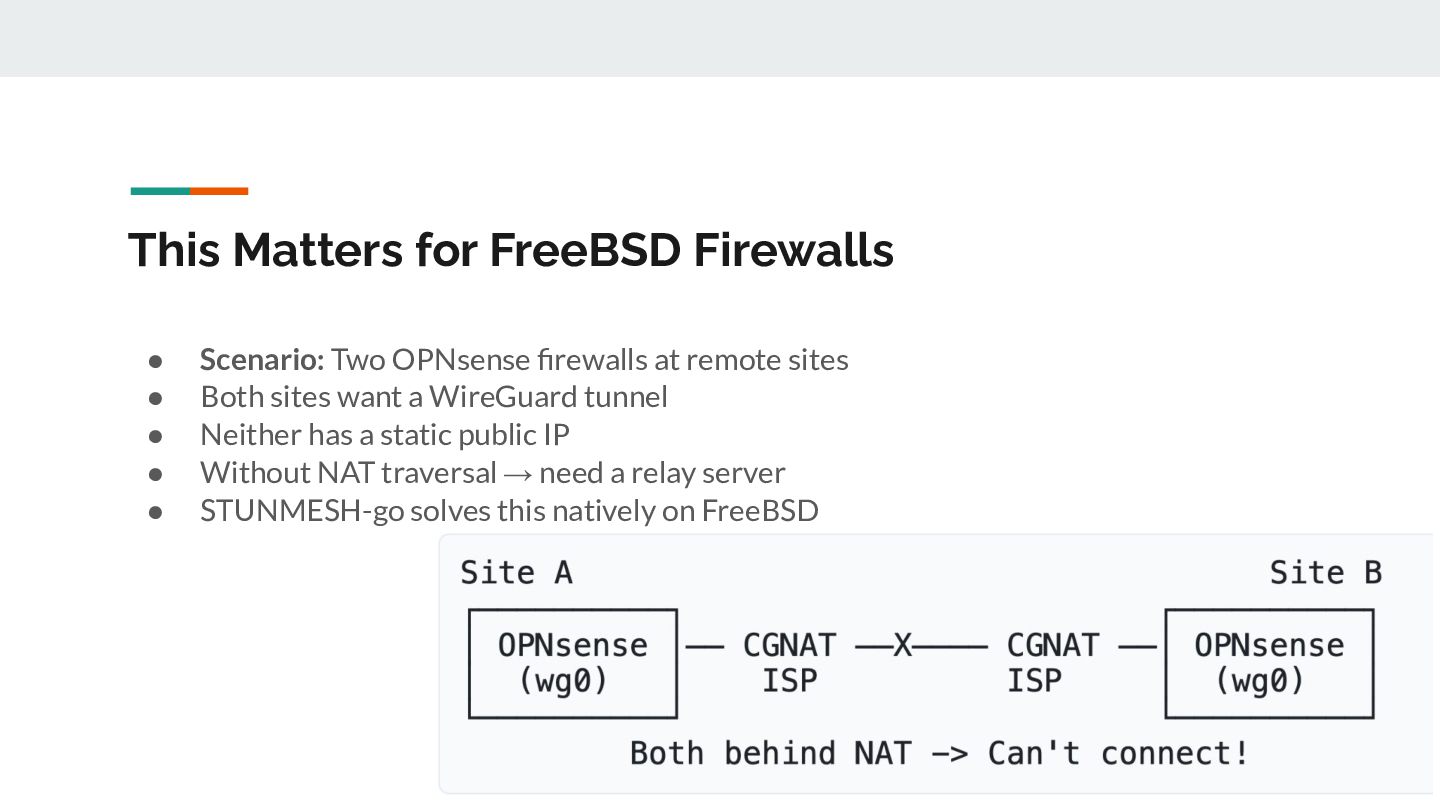
  7. This Matters for FreeBSD Firewalls • • • • •

    Scenario: Two OPNsense firewalls at remote sites Both sites want a WireGuard tunnel Neither has a static public IP Without NAT traversal → need a relay server STUNMESH-go solves this natively on FreeBSD
  8. WireGuard on FreeBSD • Kernel module: if-wg driver ◦ ◦

    • Cryptographic primitives: ◦ ◦ ◦ • Native kernel implementation High performance, integrated with FreeBSD network stack Curve25519 (key exchange) ChaCha20 (symmetric encryption) Poly1305 (authentication) Managed via wg(8)
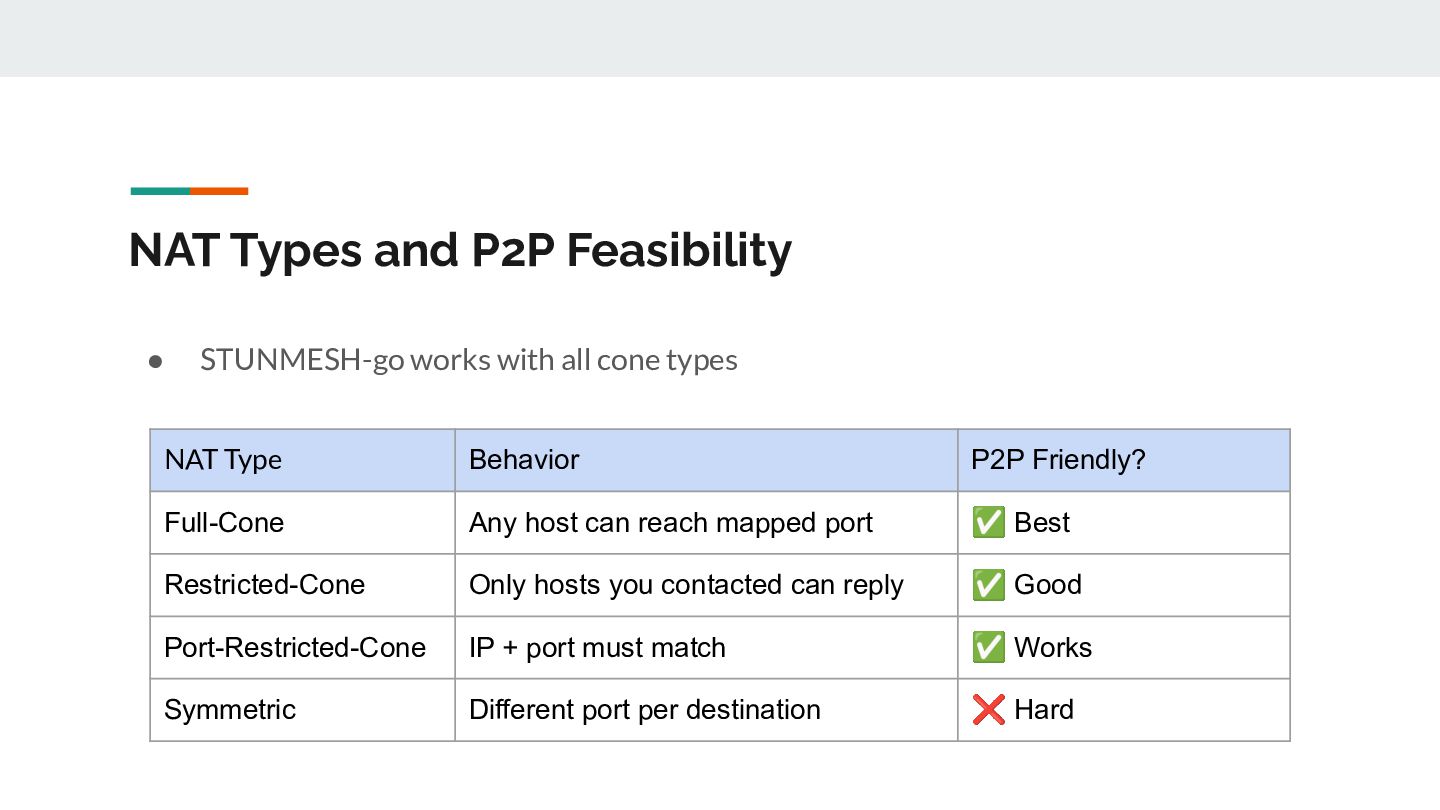
  9. NAT Types and P2P Feasibility • STUNMESH-go works with all

    cone types NAT Type Behavior P2P Friendly? Full-Cone Any host can reach mapped port ✅ Best Restricted-Cone Only hosts you contacted can reply ✅ Good Port-Restricted-Cone IP + port must match ✅ Works Symmetric Different port per destination ❌ Hard
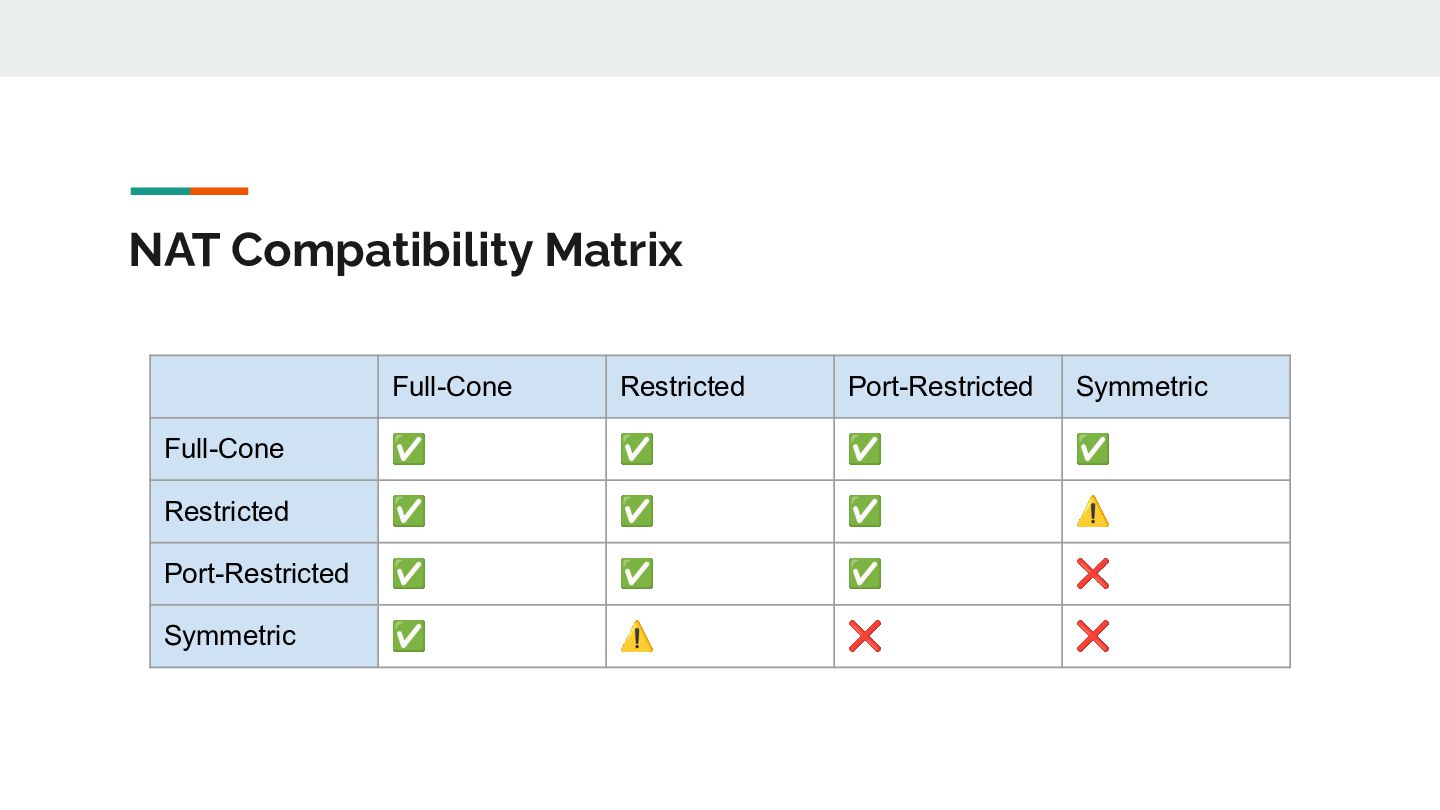
  10. NAT Compatibility Matrix Full-Cone Restricted Port-Restricted Symmetric Full-Cone ✅ ✅

    ✅ ✅ Restricted ✅ ✅ ✅ ⚠ Port-Restricted ✅ ✅ ✅ ❌ Symmetric ✅ ⚠ ❌ ❌
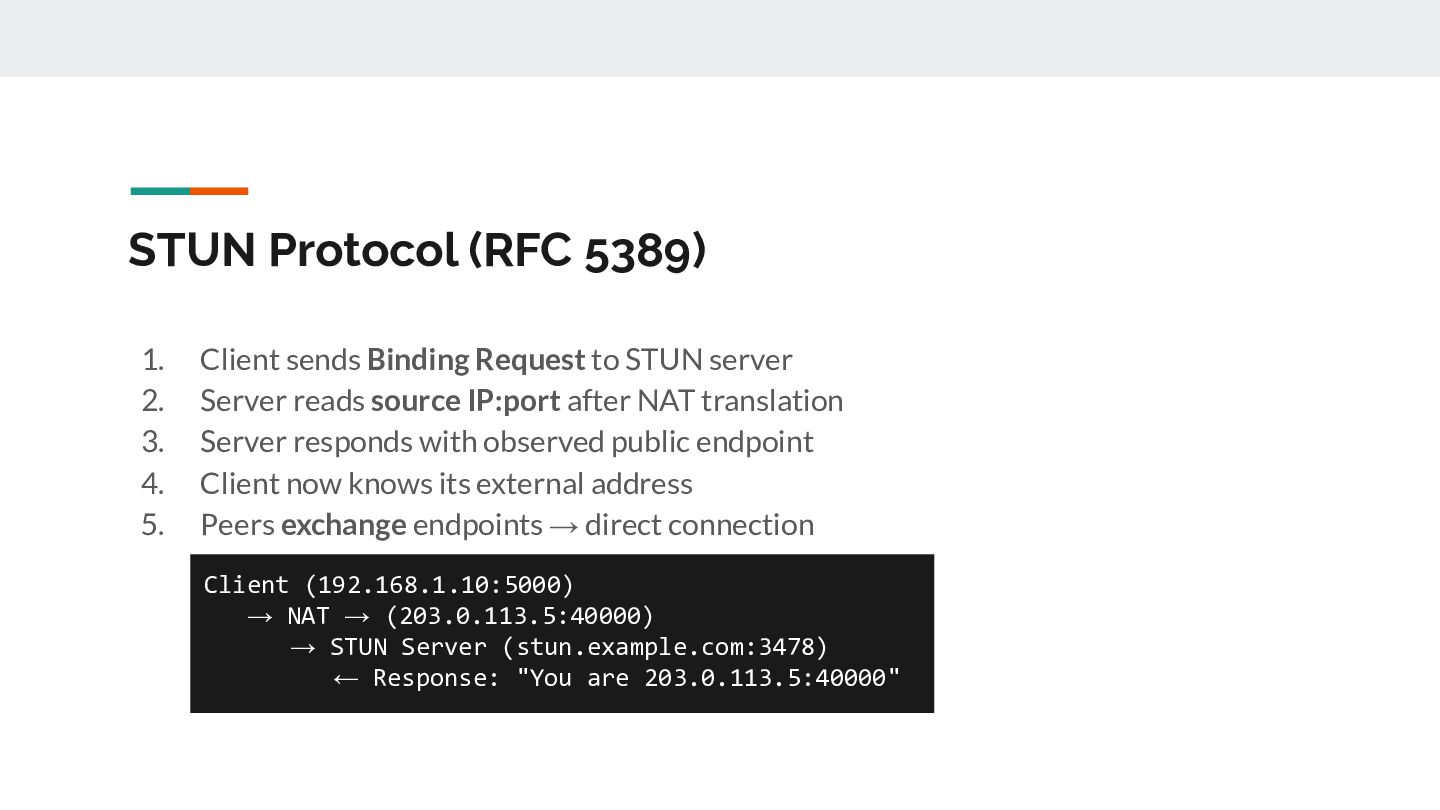
  11. STUN Protocol (RFC 5389) 1. 2. 3. 4. 5. Client

    sends Binding Request to STUN server Server reads source IP:port after NAT translation Server responds with observed public endpoint Client now knows its external address Peers exchange endpoints → direct connection Client (192.168.1.10:5000) → NAT → (203.0.113.5:40000) → STUN Server (stun.example.com:3478) ← Response: "You are 203.0.113.5:40000"
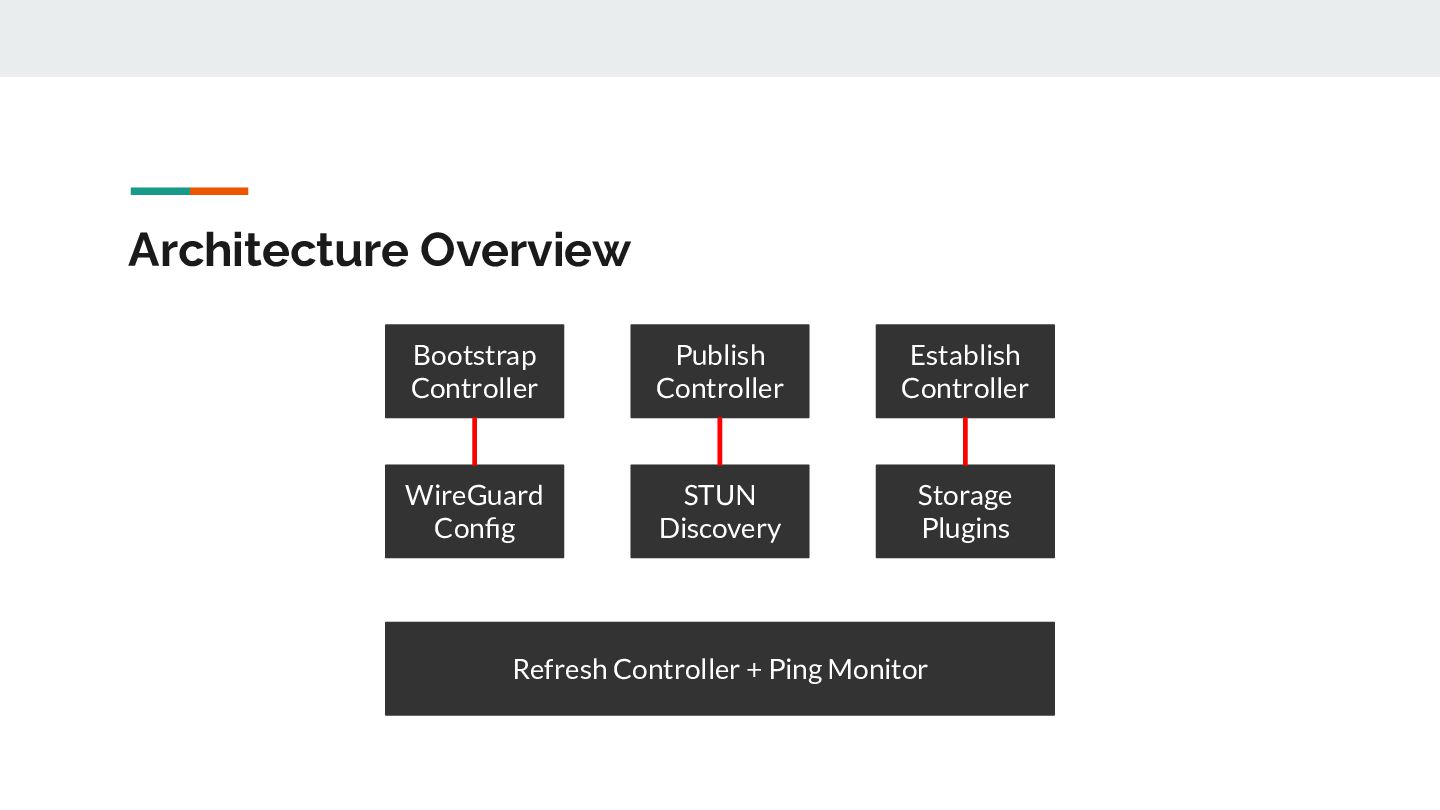
  12. Architecture Overview Bootstrap Controller Publish Controller Establish Controller WireGuard Config

    STUN Discovery Storage Plugins Refresh Controller + Ping Monitor
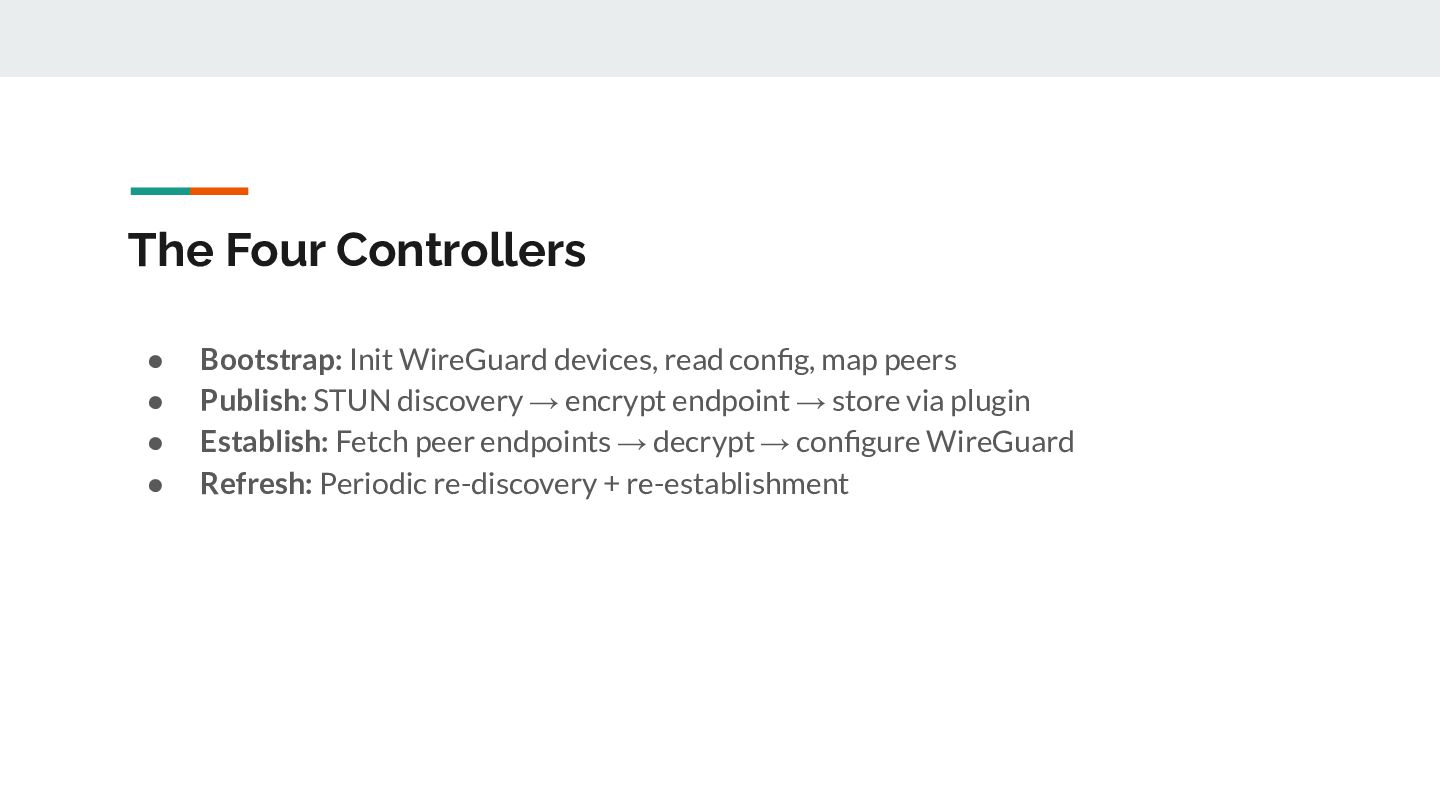
  13. The Four Controllers • • • • Bootstrap: Init WireGuard

    devices, read config, map peers Publish: STUN discovery → encrypt endpoint → store via plugin Establish: Fetch peer endpoints → decrypt → configure WireGuard Refresh: Periodic re-discovery + re-establishment
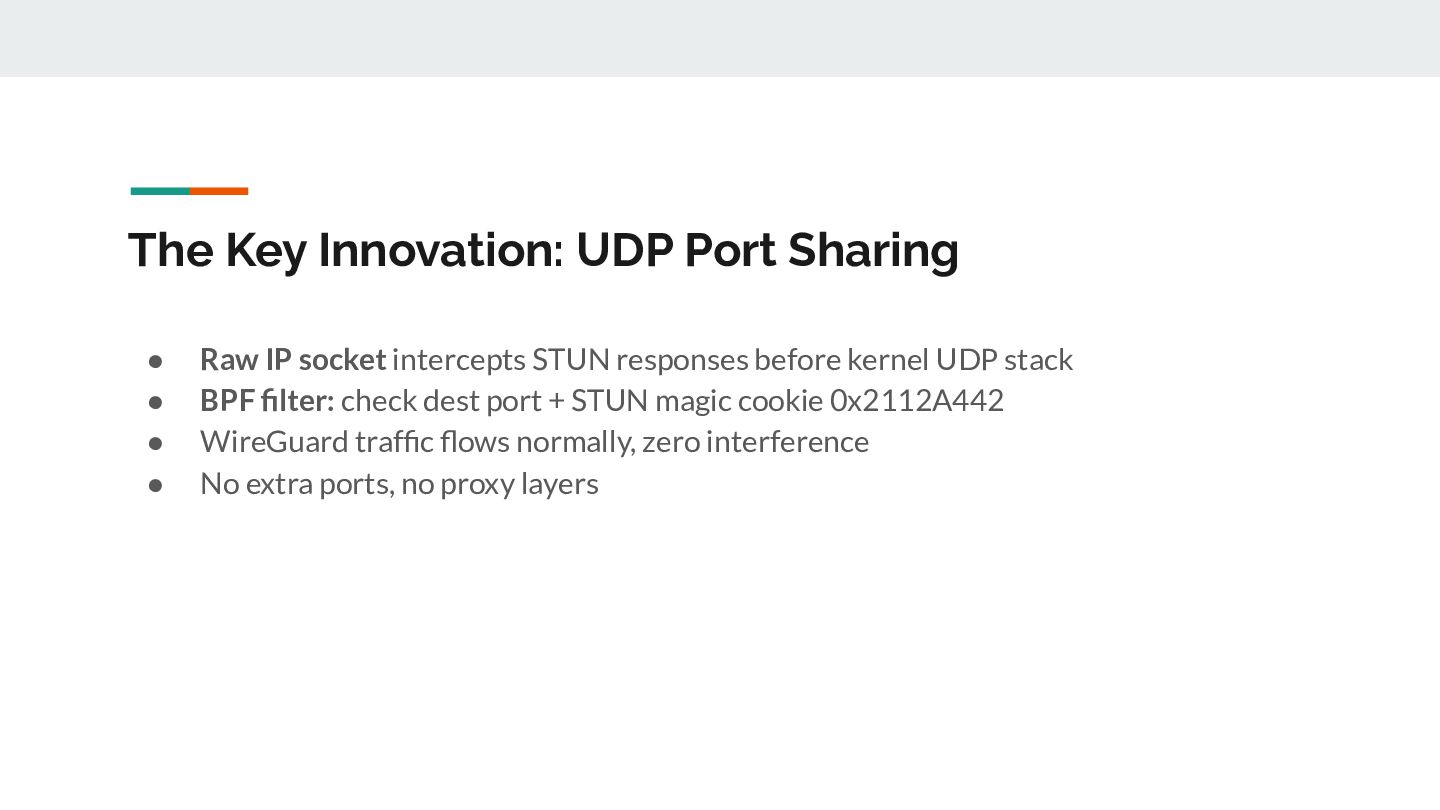
  14. The Key Innovation: UDP Port Sharing • • • •

    Raw IP socket intercepts STUN responses before kernel UDP stack BPF filter: check dest port + STUN magic cookie 0x2112A442 WireGuard traffic flows normally, zero interference No extra ports, no proxy layers
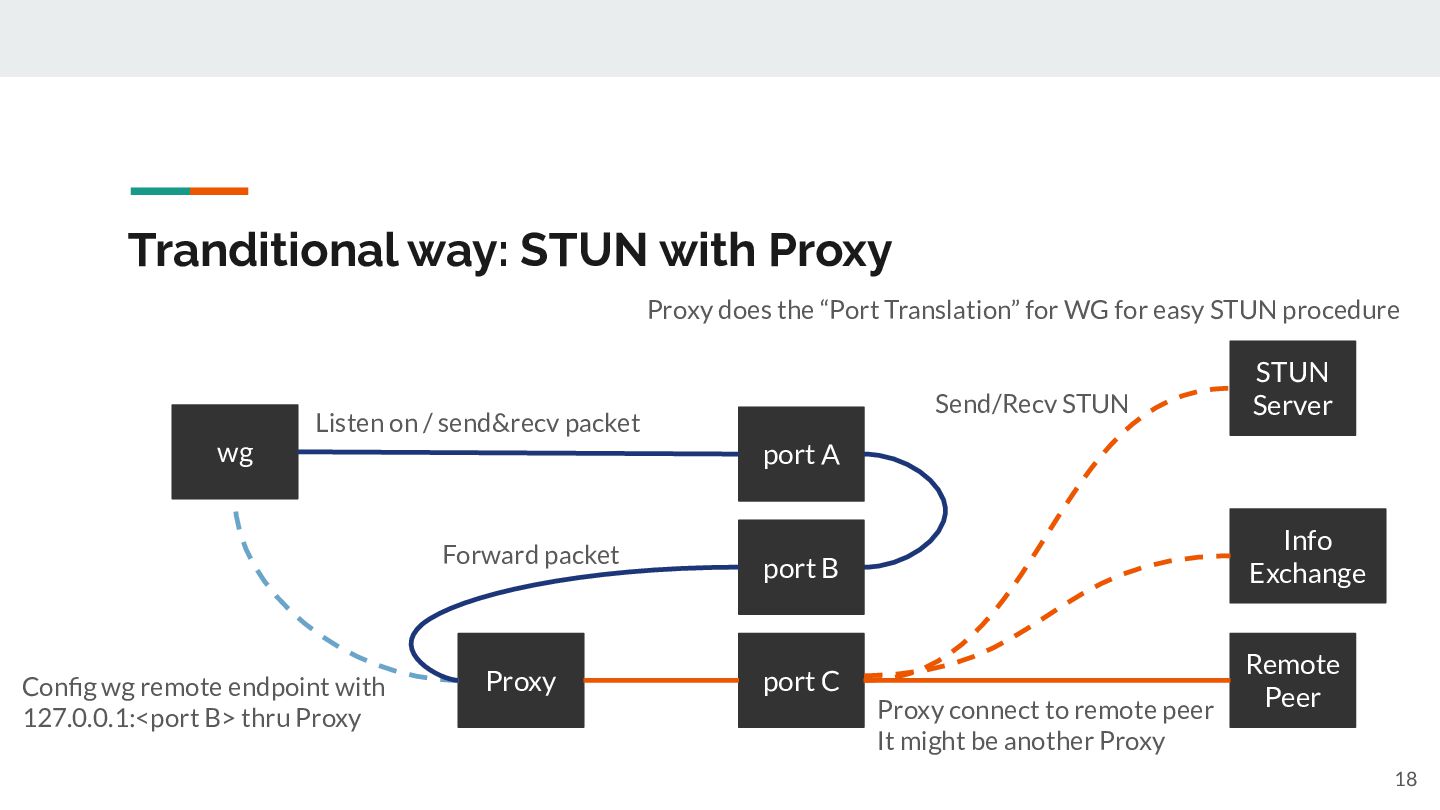
  15. Tranditional way: STUN with Proxy Proxy does the “Port Translation”

    for WG for easy STUN procedure Send/Recv STUN Listen on / send&recv packet wg Config wg remote endpoint with 127.0.0.1:<port B> thru Proxy STUN Server port A Forward packet port B Info Exchange Proxy port C Remote Peer Proxy connect to remote peer It might be another Proxy 18
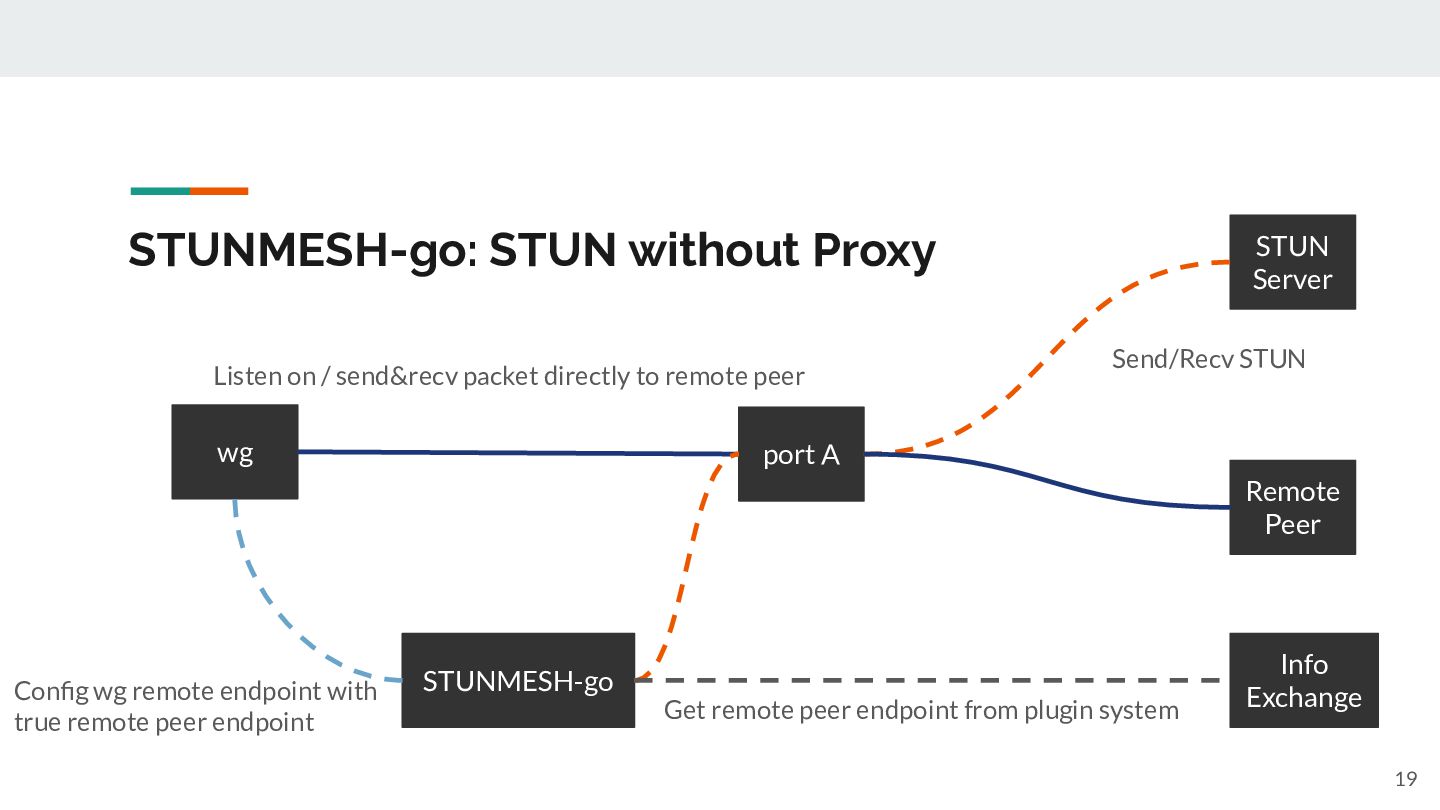
  16. STUNMESH-go: STUN without Proxy Listen on / send&recv packet directly

    to remote peer wg STUN Server Send/Recv STUN port A Remote Peer Config wg remote endpoint with true remote peer endpoint STUNMESH-go Get remote peer endpoint from plugin system Info Exchange 19
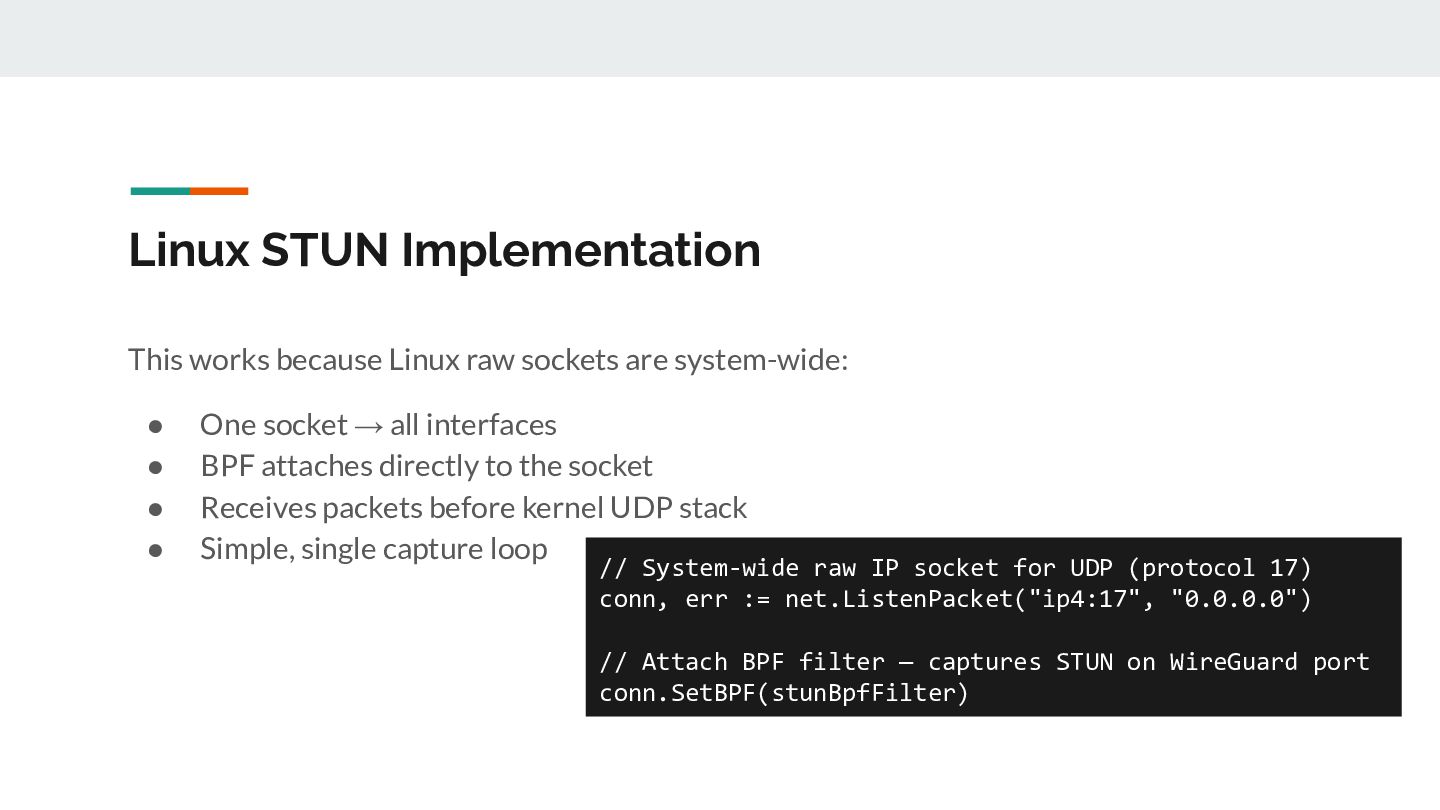
  17. Linux STUN Implementation This works because Linux raw sockets are

    system-wide: • • • • One socket → all interfaces BPF attaches directly to the socket Receives packets before kernel UDP stack Simple, single capture loop // System-wide raw IP socket for UDP (protocol 17) conn, err := net.ListenPacket("ip4:17", "0.0.0.0") // Attach BPF filter — captures STUN on WireGuard port conn.SetBPF(stunBpfFilter)
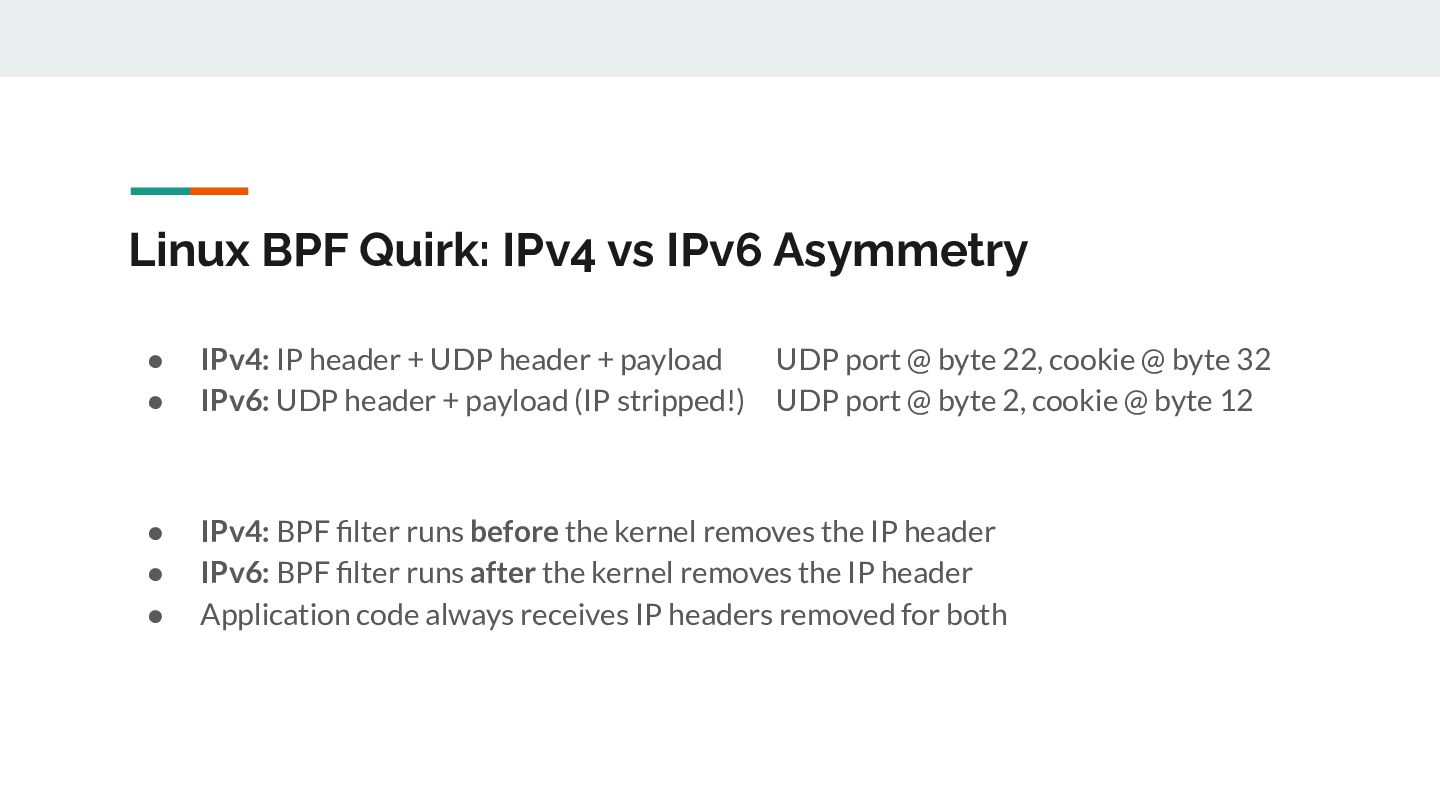
  18. Linux BPF Quirk: IPv4 vs IPv6 Asymmetry • • IPv4:

    IP header + UDP header + payload IPv6: UDP header + payload (IP stripped!) UDP port @ byte 22, cookie @ byte 32 UDP port @ byte 2, cookie @ byte 12 • • • IPv4: BPF filter runs before the kernel removes the IP header IPv6: BPF filter runs after the kernel removes the IP header Application code always receives IP headers removed for both
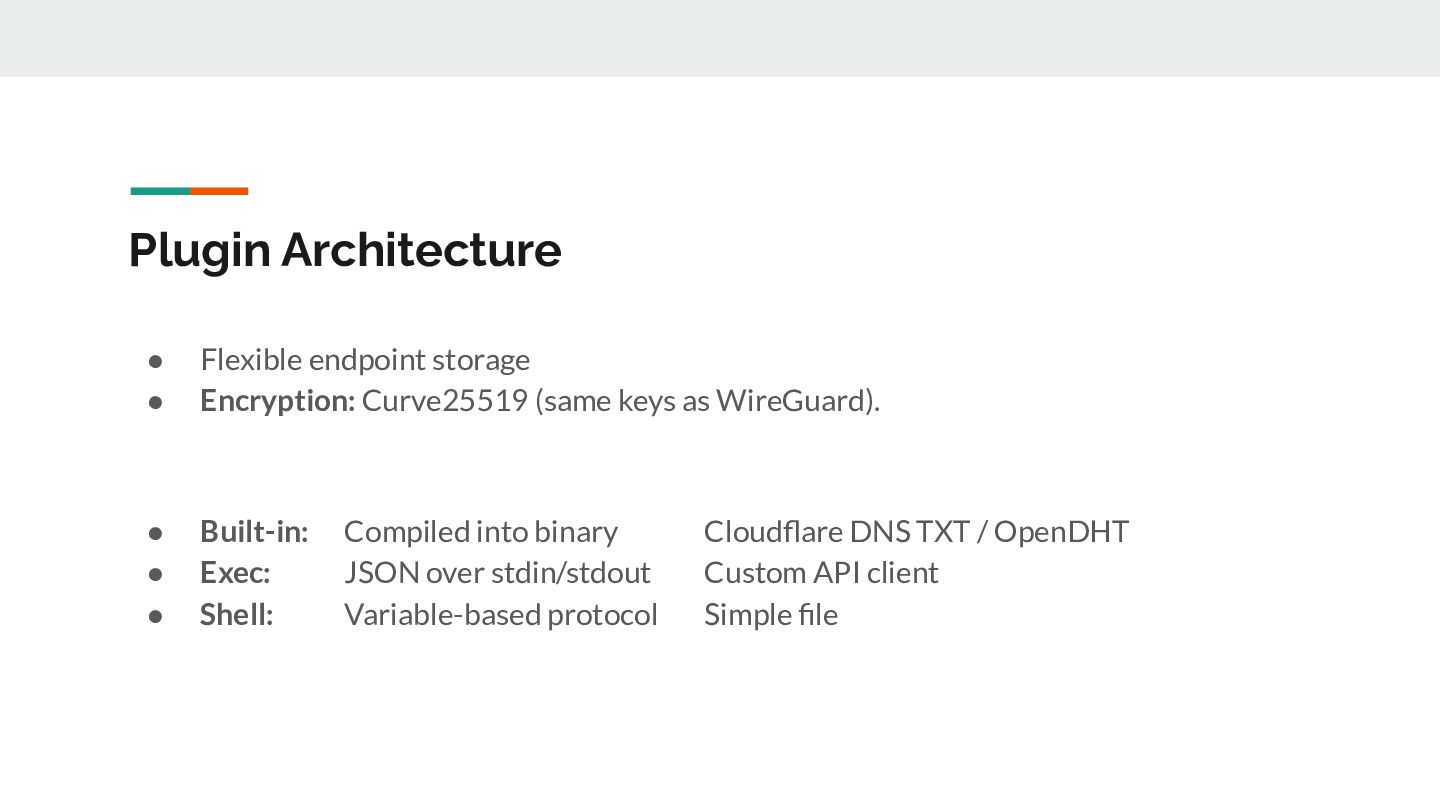
  19. Plugin Architecture • • Flexible endpoint storage Encryption: Curve25519 (same

    keys as WireGuard). • • • Built-in: Exec: Shell: Compiled into binary JSON over stdin/stdout Variable-based protocol Cloudflare DNS TXT / OpenDHT Custom API client Simple file
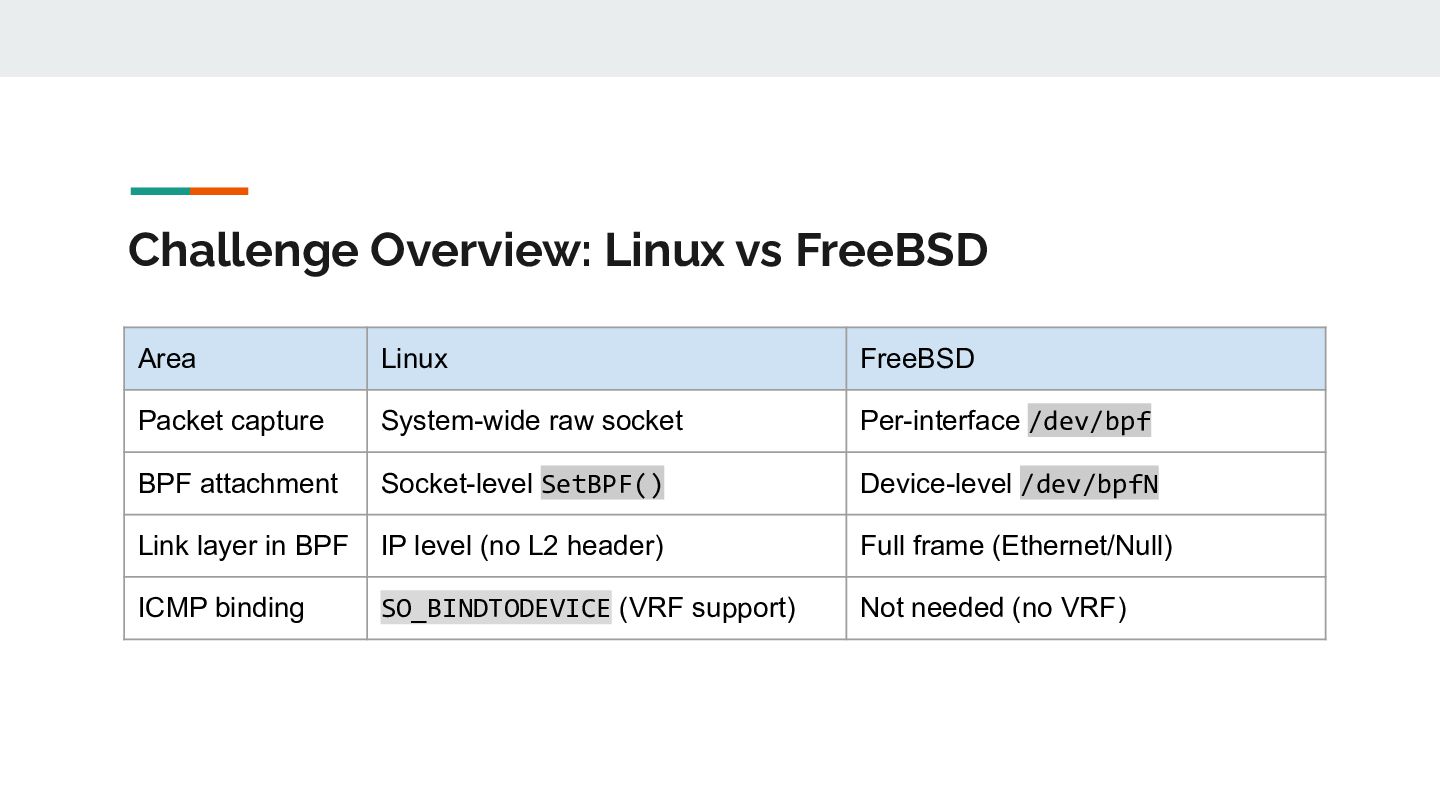
  20. Challenge Overview: Linux vs FreeBSD Area Linux FreeBSD Packet capture

    System-wide raw socket Per-interface /dev/bpf BPF attachment Socket-level SetBPF() Device-level /dev/bpfN Link layer in BPF IP level (no L2 header) Full frame (Ethernet/Null) ICMP binding SO_BINDTODEVICE (VRF support) Not needed (no VRF)
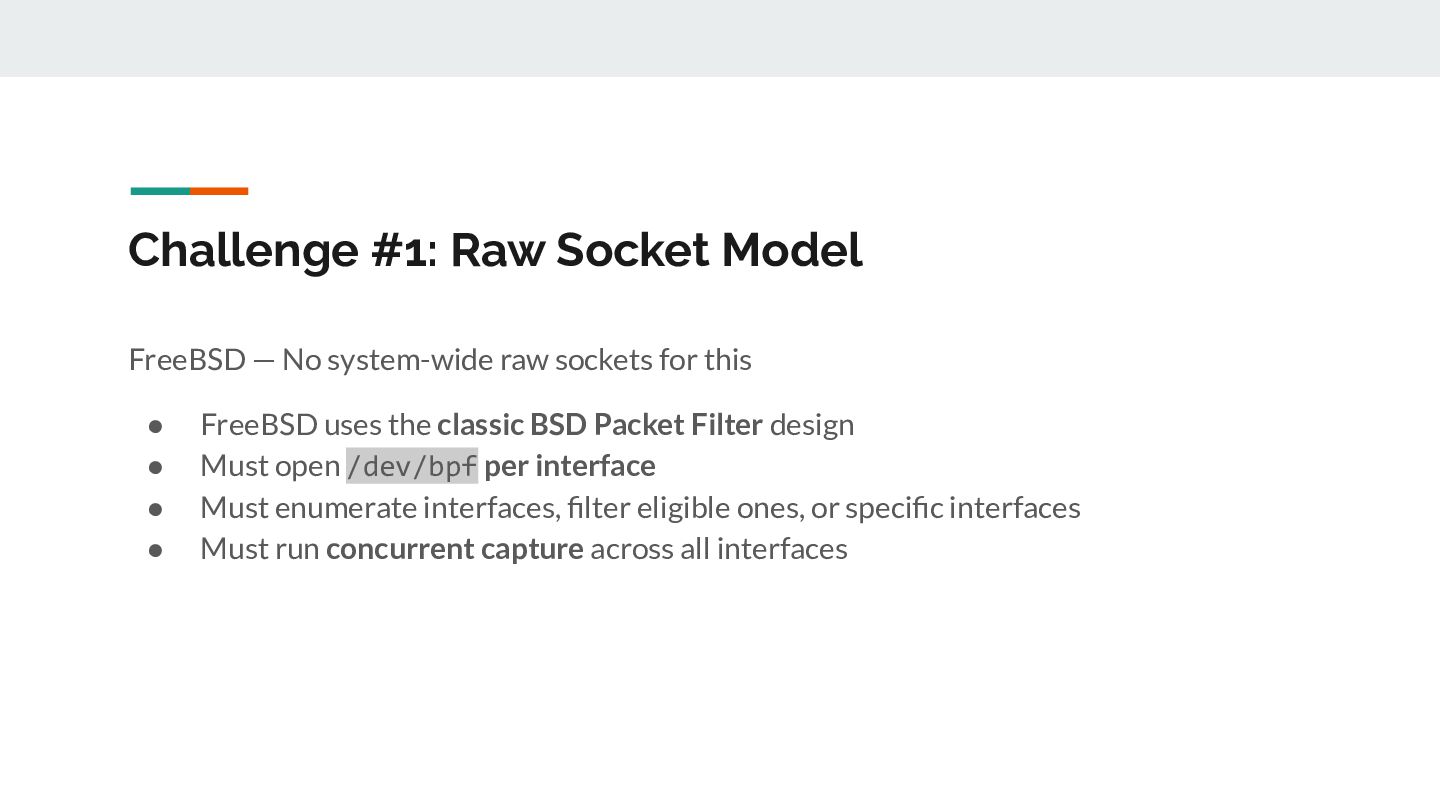
  21. Challenge #1: Raw Socket Model FreeBSD — No system-wide raw

    sockets for this • • • • FreeBSD uses the classic BSD Packet Filter design Must open /dev/bpf per interface Must enumerate interfaces, filter eligible ones, or specific interfaces Must run concurrent capture across all interfaces
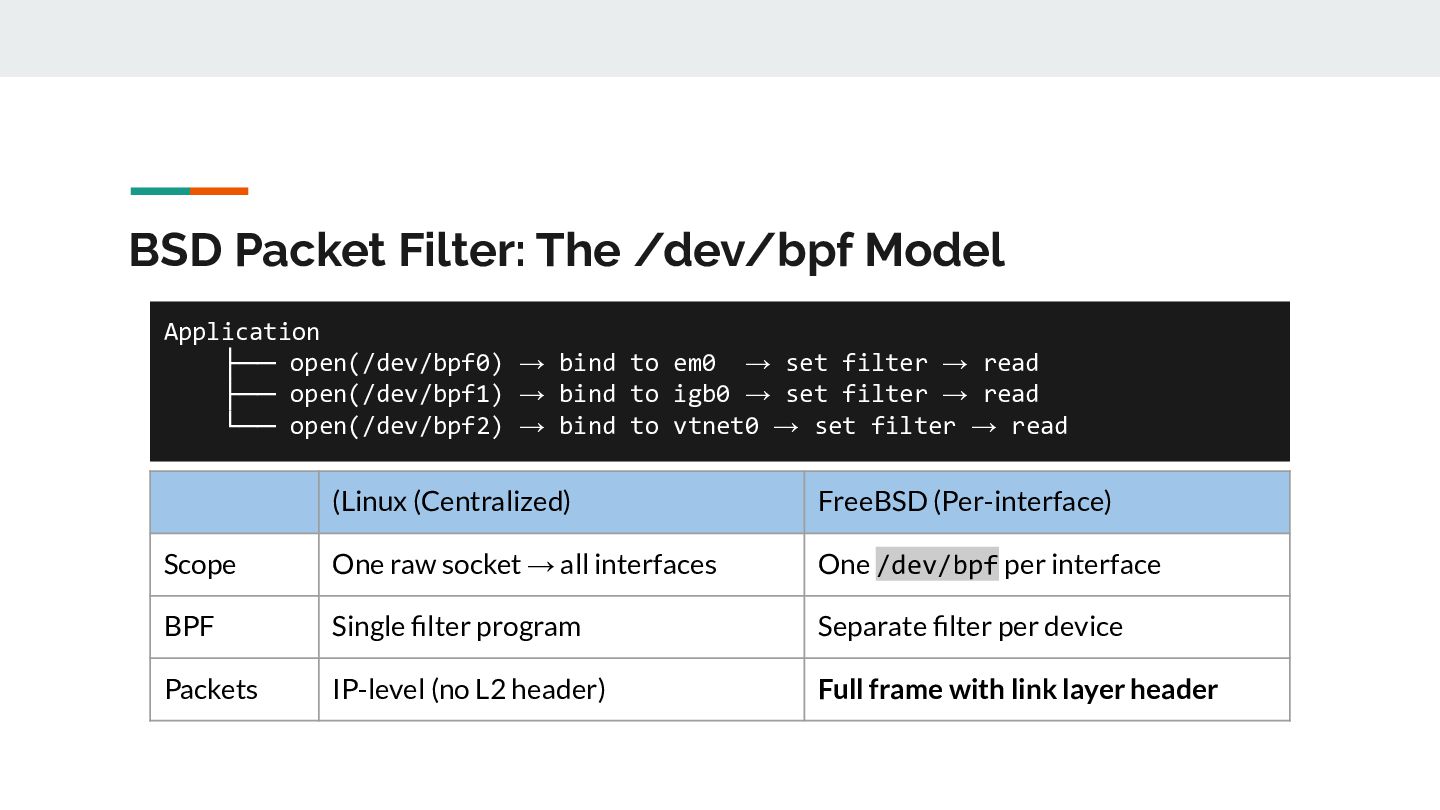
  22. BSD Packet Filter: The /dev/bpf Model Application ├── open(/dev/bpf0) →

    bind to em0 → set filter → read ├── open(/dev/bpf1) → bind to igb0 → set filter → read └── open(/dev/bpf2) → bind to vtnet0 → set filter → read (Linux (Centralized) FreeBSD (Per-interface) Scope One raw socket → all interfaces One /dev/bpf per interface BPF Single filter program Separate filter per device Packets IP-level (no L2 header) Full frame with link layer header
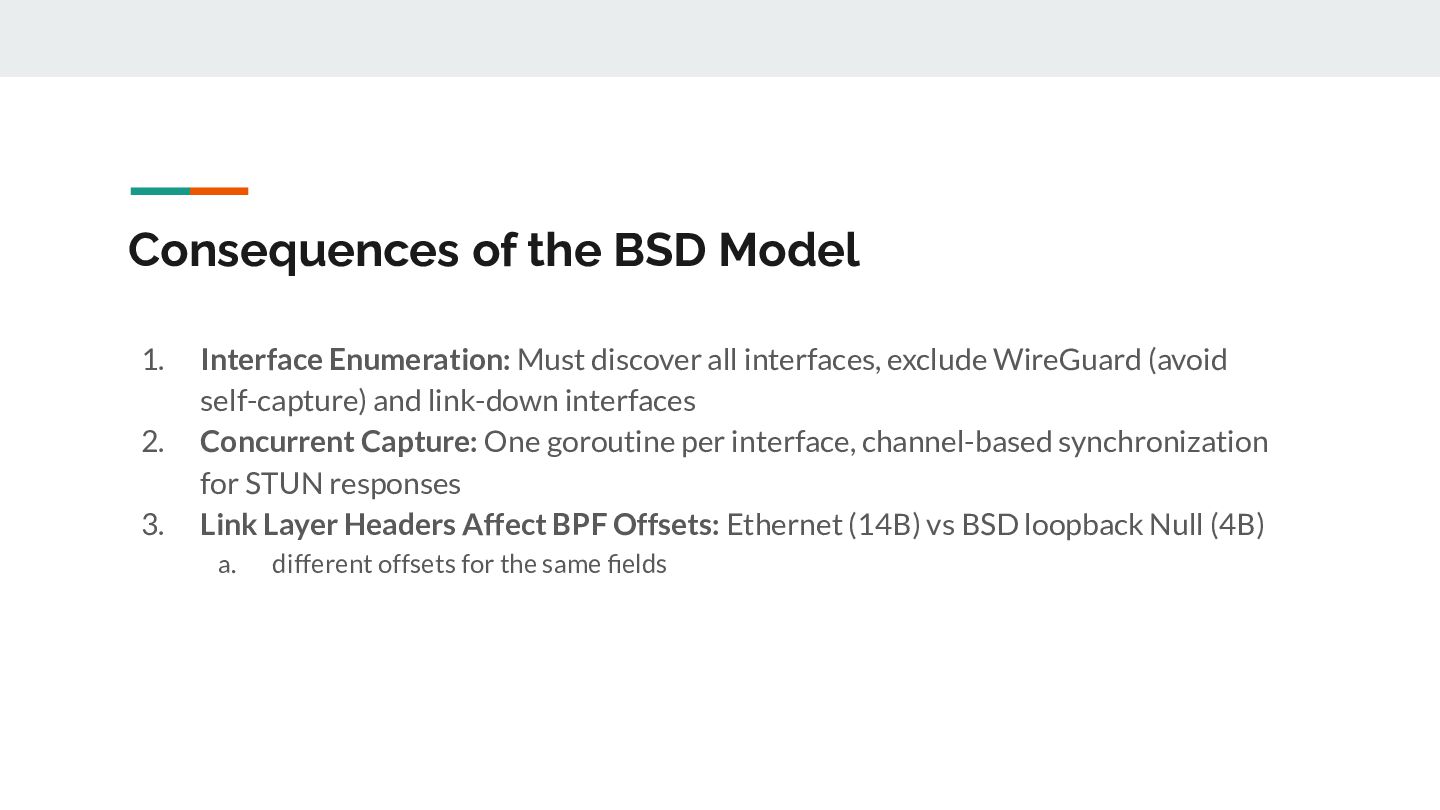
  23. Consequences of the BSD Model 1. 2. 3. Interface Enumeration:

    Must discover all interfaces, exclude WireGuard (avoid self-capture) and link-down interfaces Concurrent Capture: One goroutine per interface, channel-based synchronization for STUN responses Link Layer Headers Affect BPF Offsets: Ethernet (14B) vs BSD loopback Null (4B) a. different offsets for the same fields
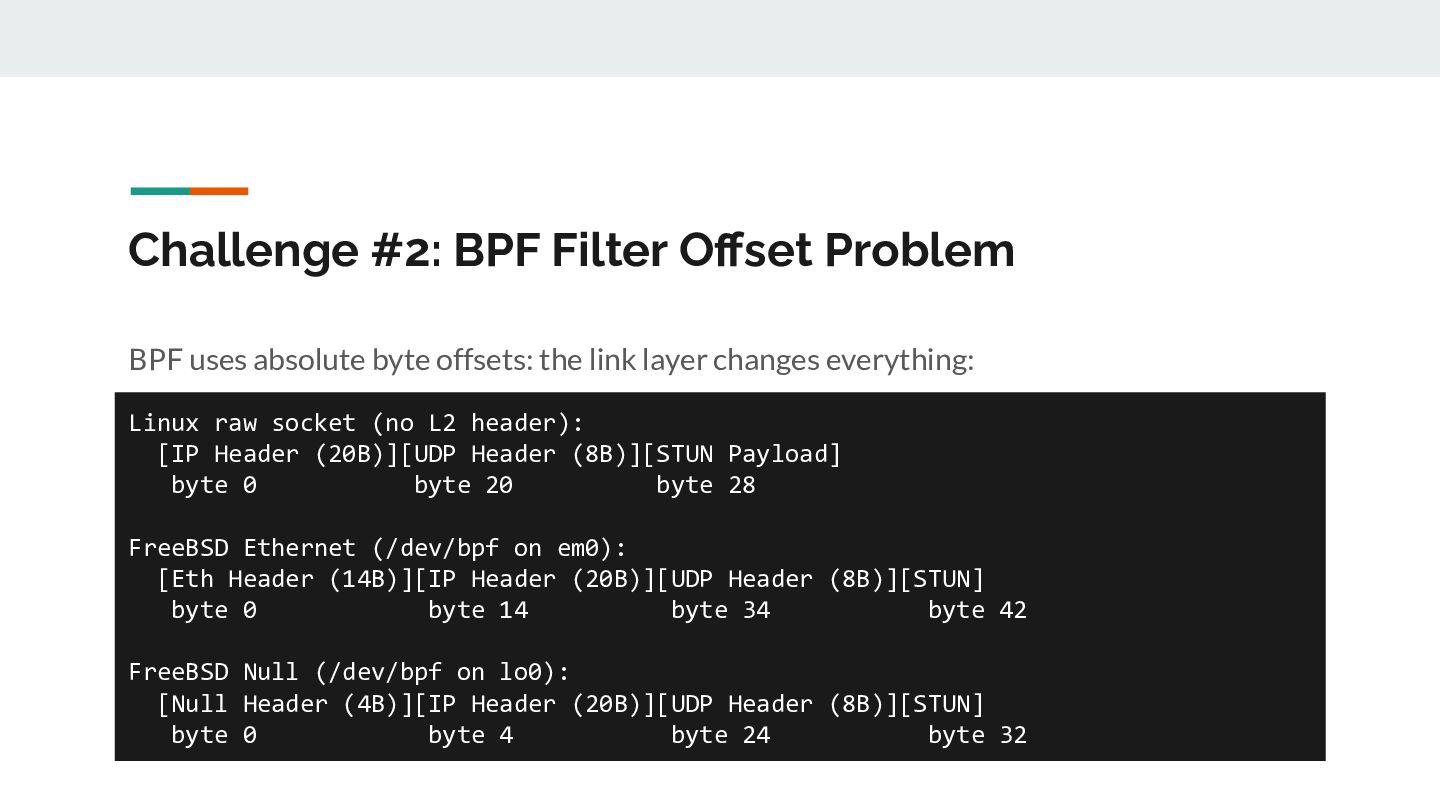
  24. Challenge #2: BPF Filter Offset Problem BPF uses absolute byte

    offsets: the link layer changes everything: Linux raw socket (no L2 header): [IP Header (20B)][UDP Header (8B)][STUN Payload] byte 0 byte 20 byte 28 FreeBSD Ethernet (/dev/bpf on em0): [Eth Header (14B)][IP Header (20B)][UDP Header (8B)][STUN] byte 0 byte 14 byte 34 byte 42 FreeBSD Null (/dev/bpf on lo0): [Null Header (4B)][IP Header (20B)][UDP Header (8B)][STUN] byte 0 byte 4 byte 24 byte 32
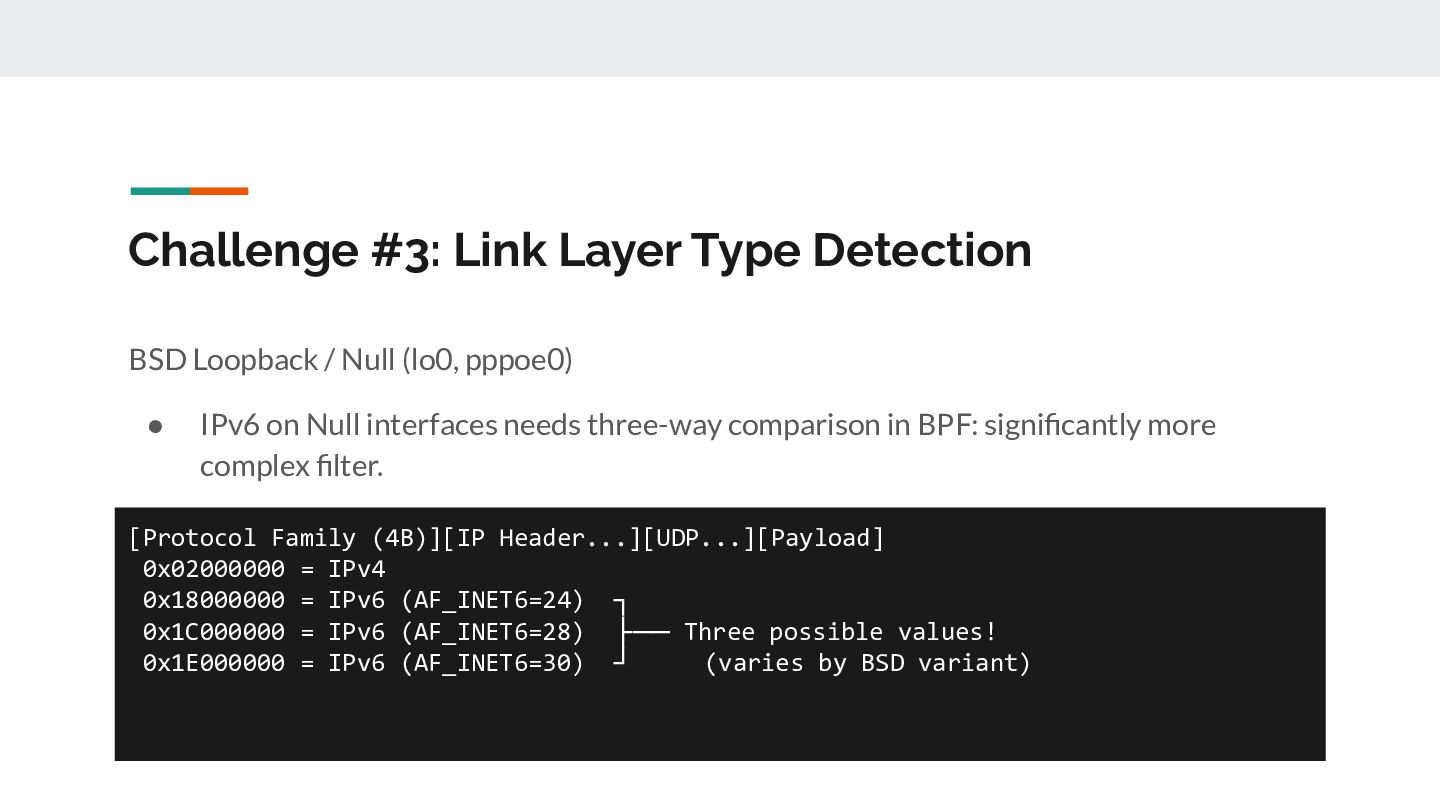
  25. Challenge #3: Link Layer Type Detection BSD Loopback / Null

    (lo0, pppoe0) • IPv6 on Null interfaces needs three-way comparison in BPF: significantly more complex filter. [Protocol Family (4B)][IP Header...][UDP...][Payload] 0x02000000 = IPv4 0x18000000 = IPv6 (AF_INET6=24) ┐ 0x1C000000 = IPv6 (AF_INET6=28) ├── Three possible values! 0x1E000000 = IPv6 (AF_INET6=30) ┘ (varies by BSD variant)
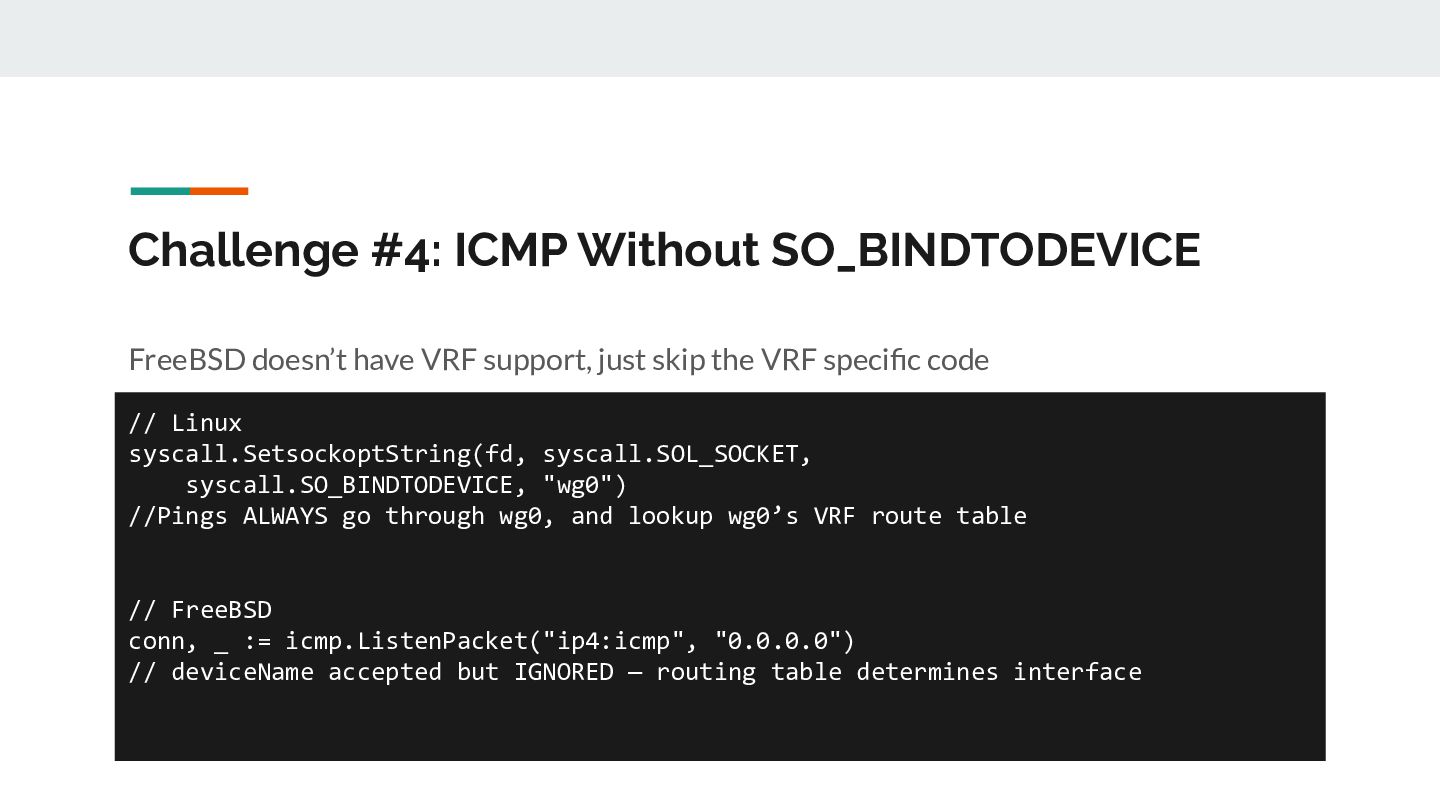
  26. Challenge #4: ICMP Without SO_BINDTODEVICE FreeBSD doesn’t have VRF support,

    just skip the VRF specific code // Linux syscall.SetsockoptString(fd, syscall.SOL_SOCKET, syscall.SO_BINDTODEVICE, "wg0") //Pings ALWAYS go through wg0, and lookup wg0’s VRF route table // FreeBSD conn, _ := icmp.ListenPacket("ip4:icmp", "0.0.0.0") // deviceName accepted but IGNORED — routing table determines interface
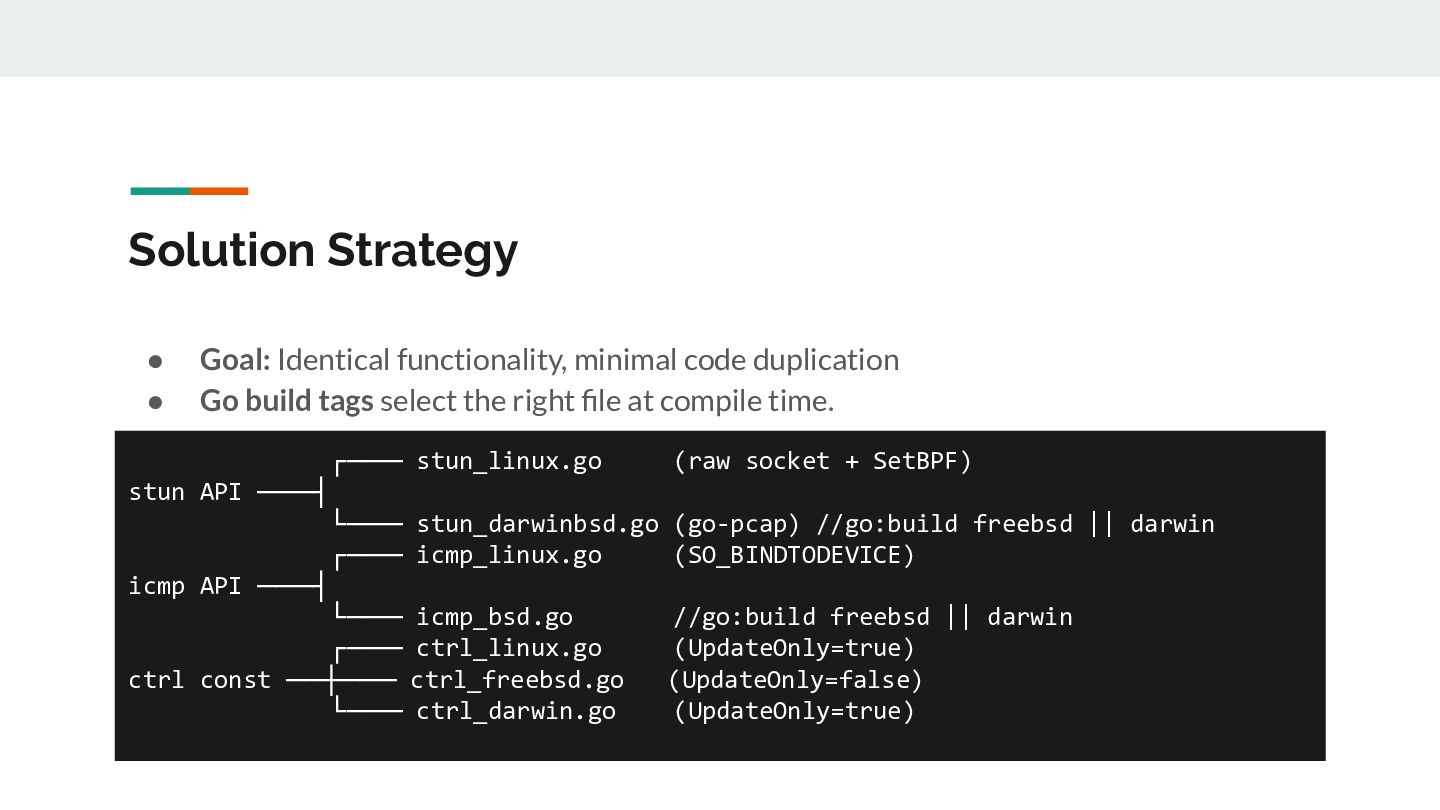
  27. Solution Strategy • • Goal: Identical functionality, minimal code duplication

    Go build tags select the right file at compile time. ┌─── stun_linux.go (raw socket + SetBPF) stun API ───┤ └─── stun_darwinbsd.go (go-pcap) //go:build freebsd || darwin ┌─── icmp_linux.go (SO_BINDTODEVICE) icmp API ───┤ └─── icmp_bsd.go //go:build freebsd || darwin ┌─── ctrl_linux.go (UpdateOnly=true) ctrl const ──┼─── ctrl_freebsd.go (UpdateOnly=false) └─── ctrl_darwin.go (UpdateOnly=true)
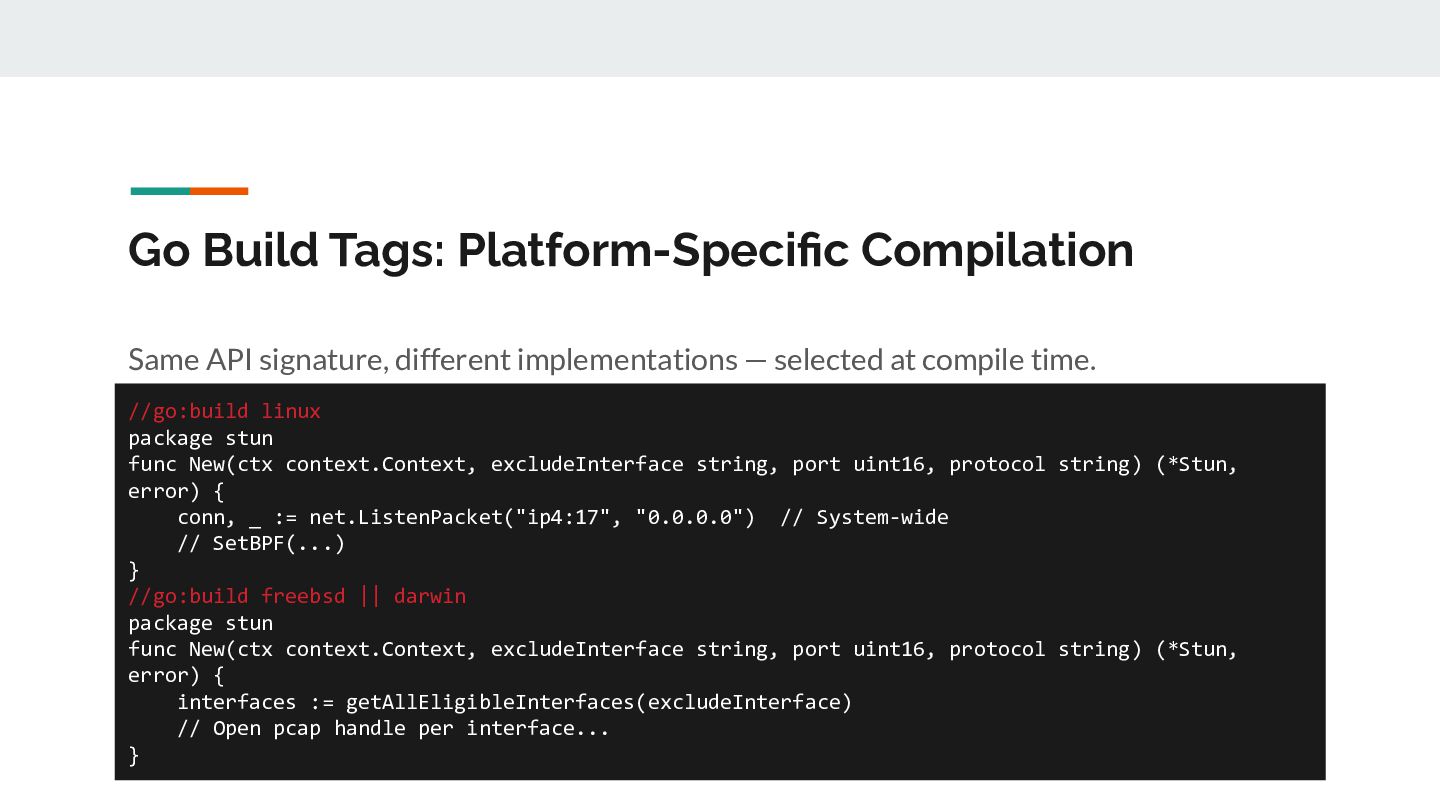
  28. Go Build Tags: Platform-Specific Compilation Same API signature, different implementations

    — selected at compile time. //go:build linux package stun func New(ctx context.Context, excludeInterface string, port uint16, protocol string) (*Stun, error) { conn, _ := net.ListenPacket("ip4:17", "0.0.0.0") // System-wide // SetBPF(...) } //go:build freebsd || darwin package stun func New(ctx context.Context, excludeInterface string, port uint16, protocol string) (*Stun, error) { interfaces := getAllEligibleInterfaces(excludeInterface) // Open pcap handle per interface... }
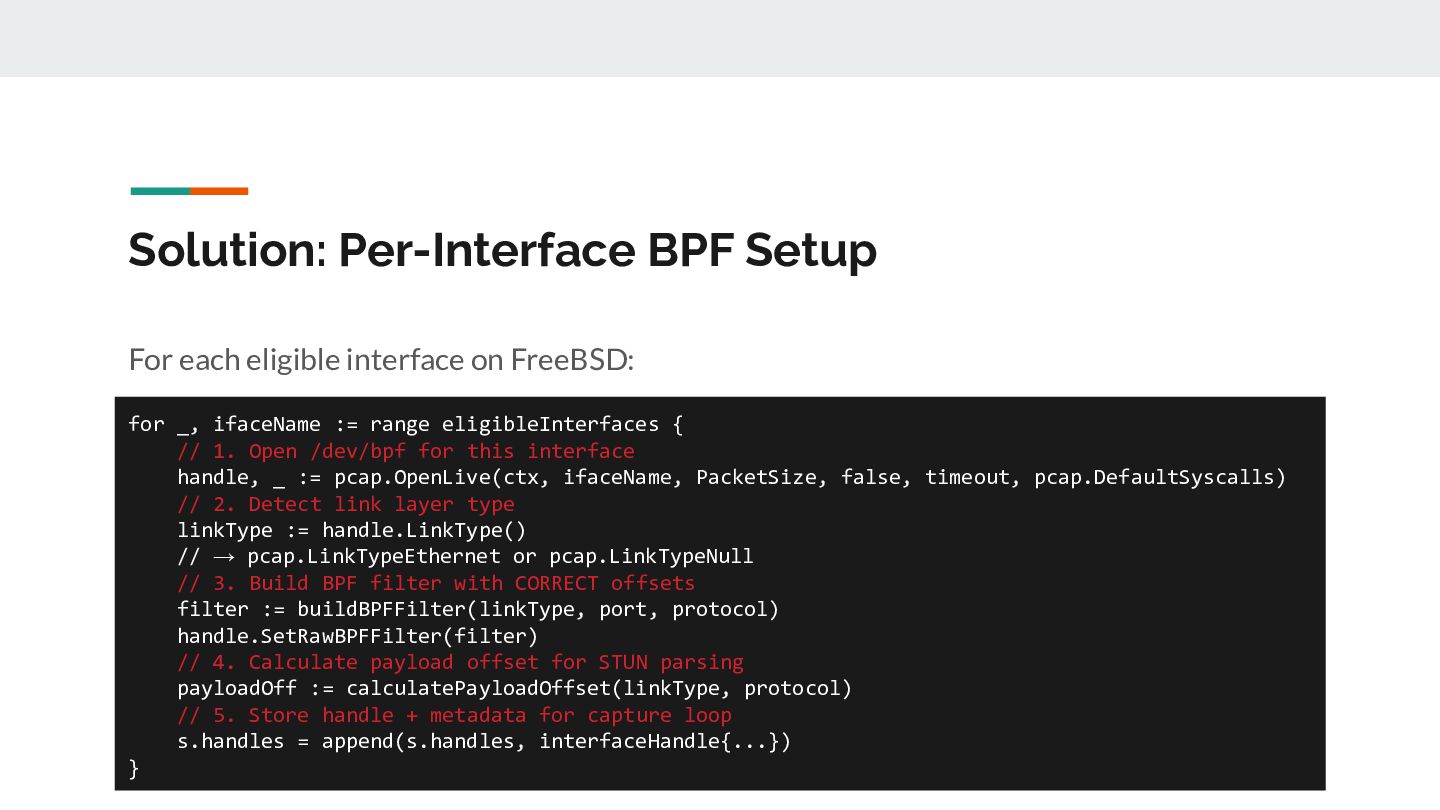
  29. Solution: Per-Interface BPF Setup For each eligible interface on FreeBSD:

    for _, ifaceName := range eligibleInterfaces { // 1. Open /dev/bpf for this interface handle, _ := pcap.OpenLive(ctx, ifaceName, PacketSize, false, timeout, pcap.DefaultSyscalls) // 2. Detect link layer type linkType := handle.LinkType() // → pcap.LinkTypeEthernet or pcap.LinkTypeNull // 3. Build BPF filter with CORRECT offsets filter := buildBPFFilter(linkType, port, protocol) handle.SetRawBPFFilter(filter) // 4. Calculate payload offset for STUN parsing payloadOff := calculatePayloadOffset(linkType, protocol) // 5. Store handle + metadata for capture loop s.handles = append(s.handles, interfaceHandle{...}) }
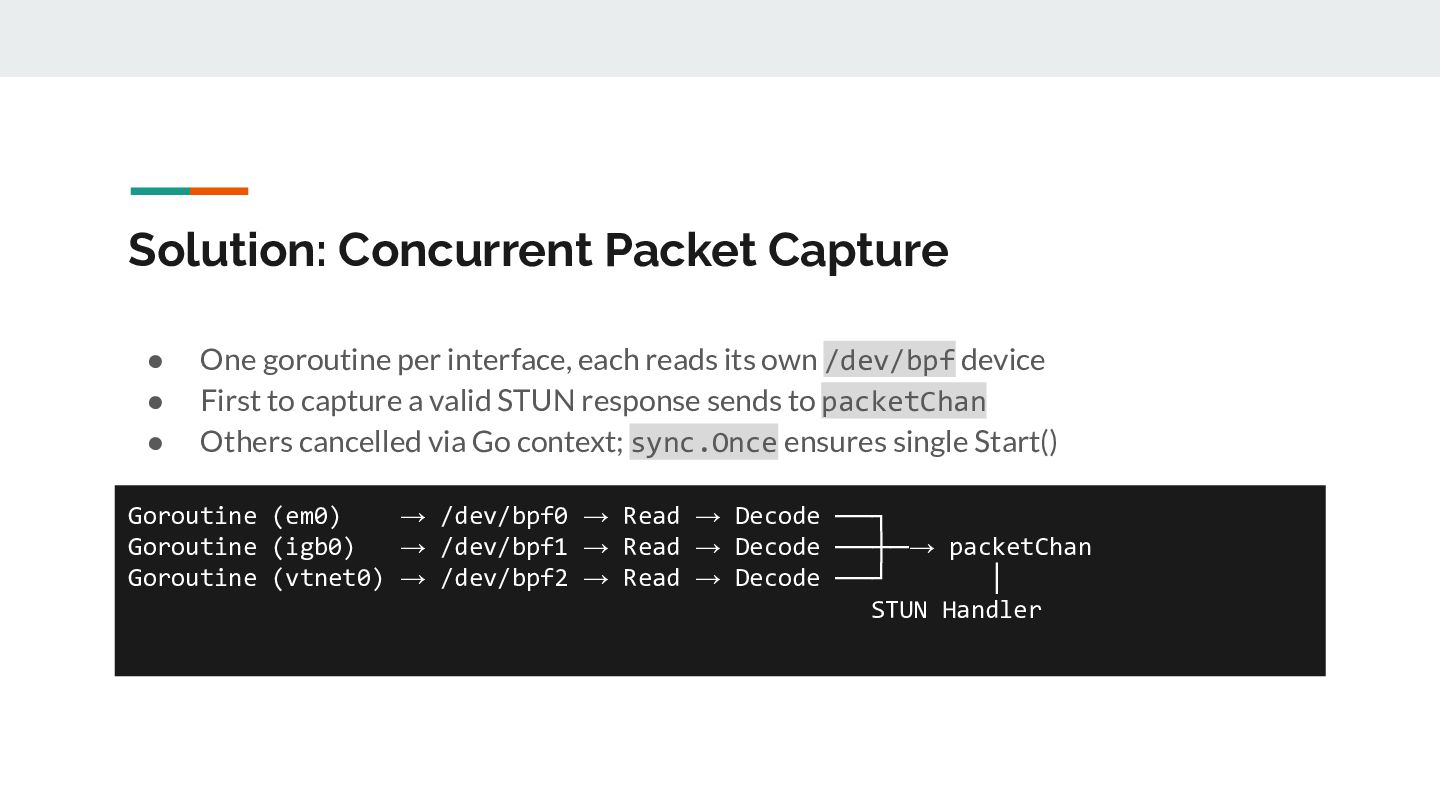
  30. Solution: Concurrent Packet Capture • • • One goroutine per

    interface, each reads its own /dev/bpf device First to capture a valid STUN response sends to packetChan Others cancelled via Go context; sync.Once ensures single Start() Goroutine (em0) → /dev/bpf0 → Read → Decode ──┐ Goroutine (igb0) → /dev/bpf1 → Read → Decode ──┼─→ packetChan Goroutine (vtnet0) → /dev/bpf2 → Read → Decode ──┘ │ STUN Handler
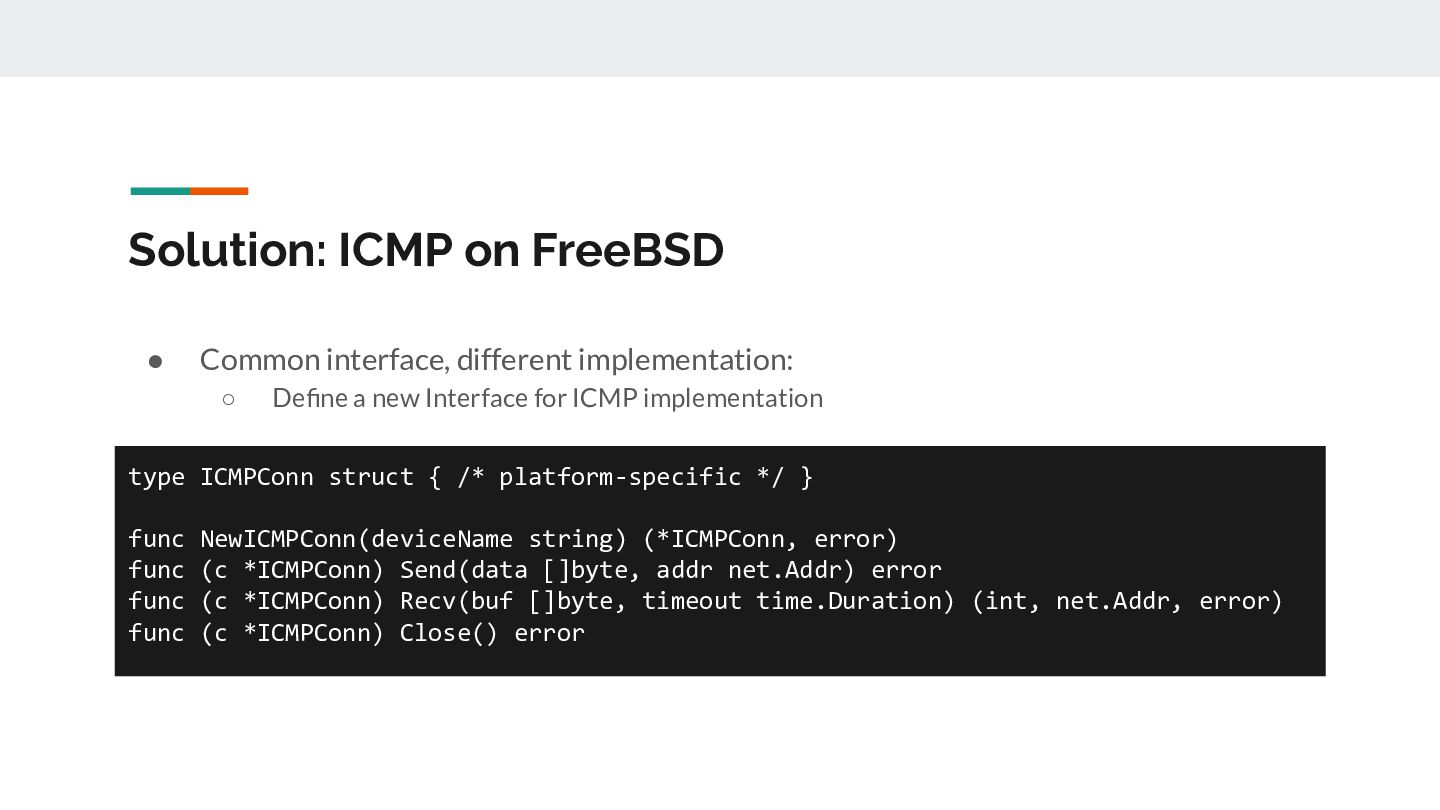
  31. Solution: ICMP on FreeBSD • Common interface, different implementation: ◦

    Define a new Interface for ICMP implementation type ICMPConn struct { /* platform-specific */ } func NewICMPConn(deviceName string) (*ICMPConn, error) func (c *ICMPConn) Send(data []byte, addr net.Addr) error func (c *ICMPConn) Recv(buf []byte, timeout time.Duration) (int, net.Addr, error) func (c *ICMPConn) Close() error
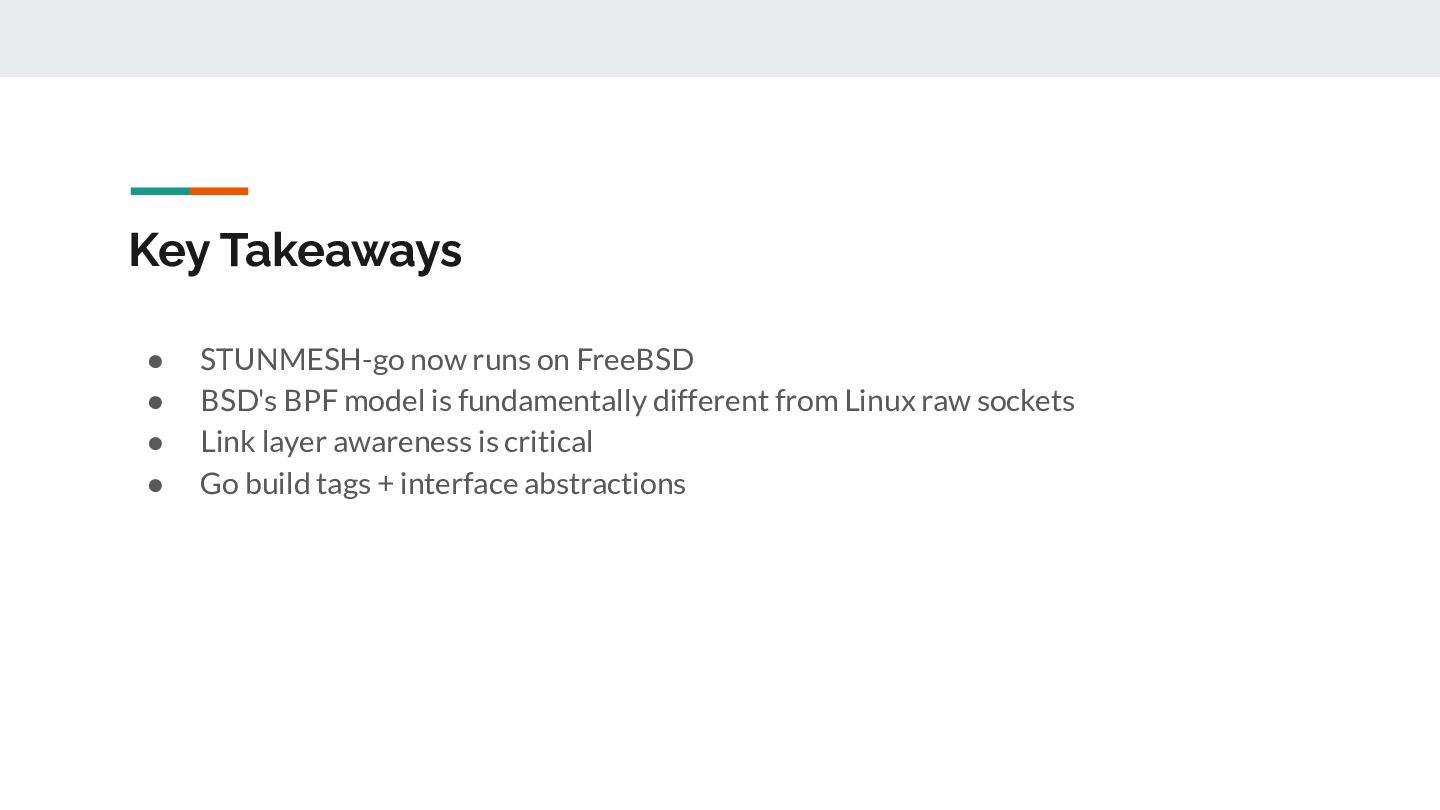
  32. Key Takeaways • • • • STUNMESH-go now runs on

    FreeBSD BSD's BPF model is fundamentally different from Linux raw sockets Link layer awareness is critical Go build tags + interface abstractions
  33. Get the Code • • • • • • github.com/tjjh89017/stunmesh-go

    License: LGPLv3 or later Language: Go FreeBSD: amd64, arm64 Also: Linux (amd64/arm/arm64/mipsle), macOS (amd64/arm64) Contributions welcome
  34. Q&A • Porting STUNMESH-go to FreeBSD and macOS: Building Peer-to-Peer

    WireGuard Networks • • • Find me after the session, or contact me via Linkedin. https://github.com/tjjh89017/stunmesh-go https://github.com/tjjh89017/stunmesh-opnsense Linkedin