Upgrade to Pro — share decks privately, control downloads, hide ads and more …

Open Source Summit Korea 2026 - EZIO: Predictab...

Open Source Summit Korea 2026 - EZIO: Predictable, Fast, Scalable BitTorrent-Based Bare Metal Provisioning

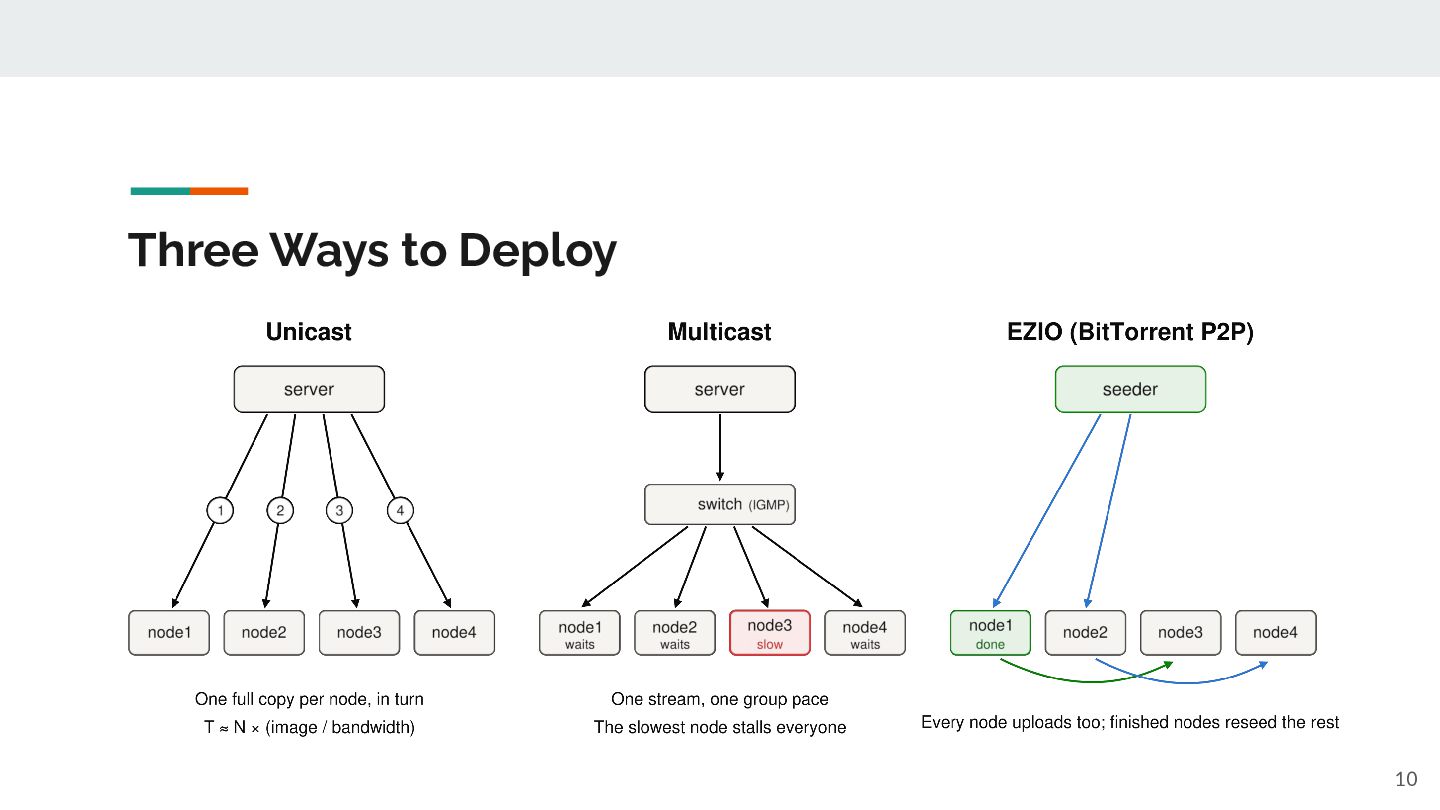
Deploying OS images to bare metal clusters is painful. Unicast scales linearly with node count. Multicast stalls if one node is slow. Past BitTorrent approaches either transfer entire raw partitions (wasting bandwidth) or require RAM buffering for image conversion (size limited).

EZIO's provisioning time depends on image size and bandwidth, not node count. It transfers only used filesystem blocks and writes directly to raw disk by calculating offsets on the fly. No RAM buffering, no image conversion, no size limit. Each node works independently. Broken nodes can rejoin after recovery. This enables deploying large HPC environments with pre-installed software and data. Clonezilla has integrated EZIO for production use.

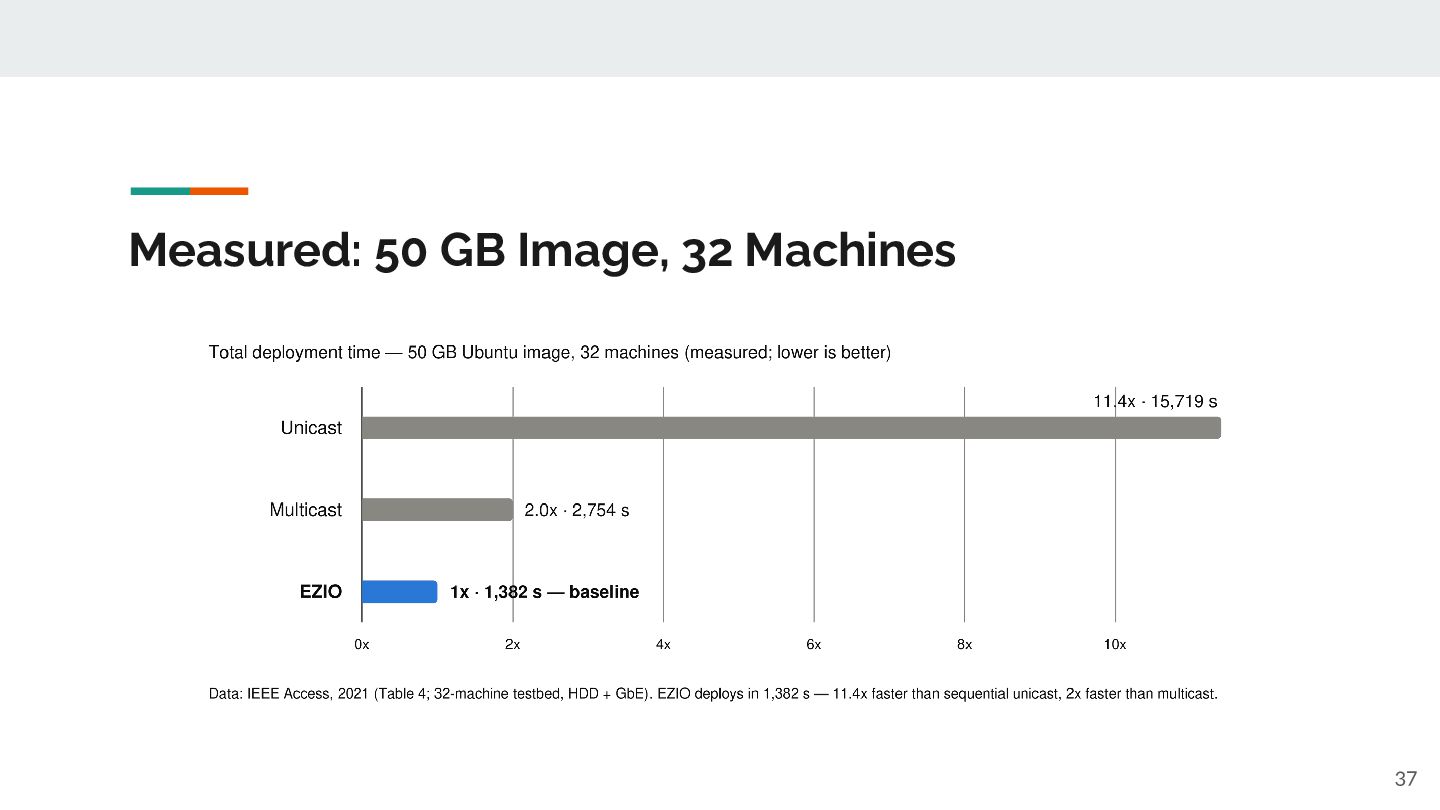
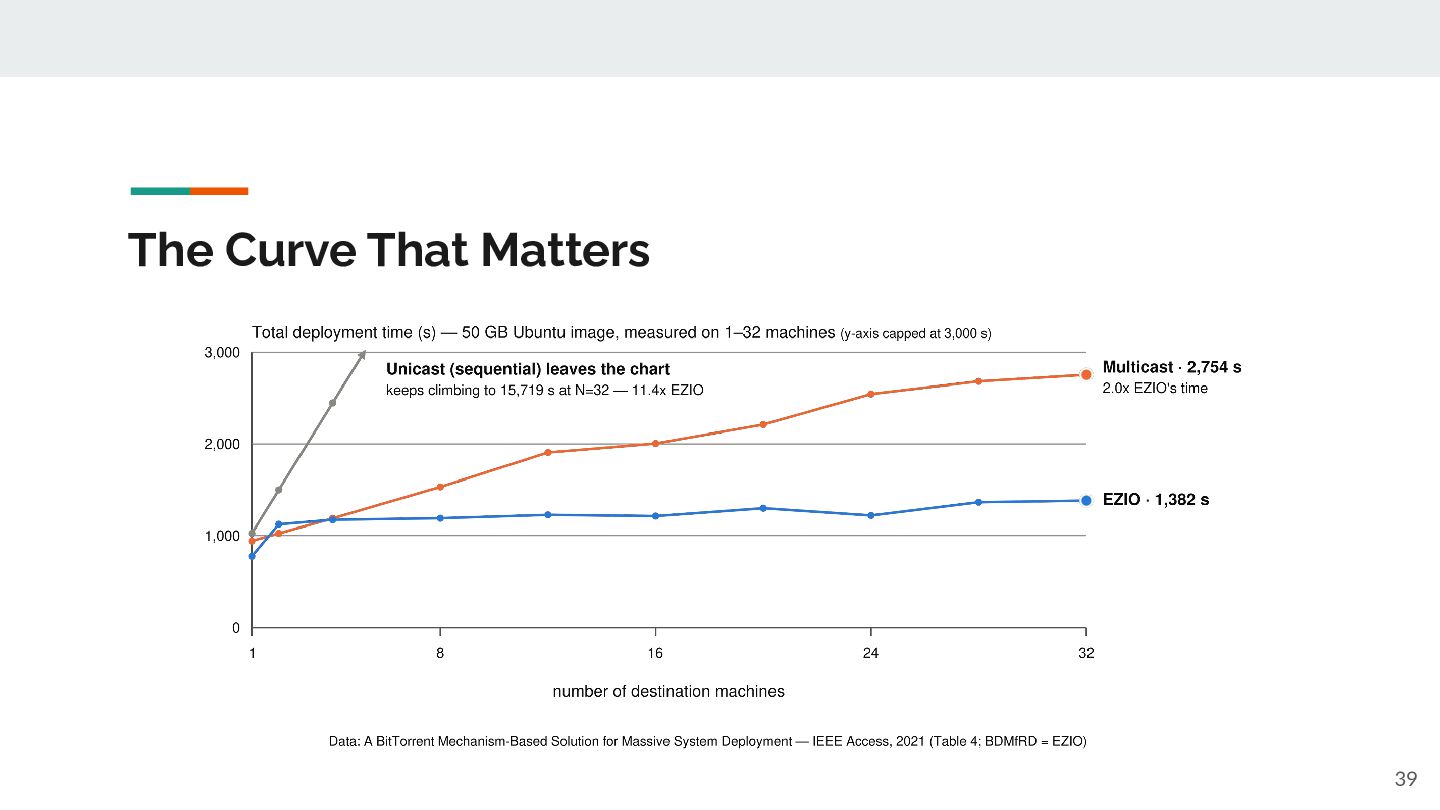
Benchmarks: On HDD (50GB, 32 nodes), 11x faster than unicast, 50% faster than multicast. In the cluster with NVMe SSD and 10G network at Taiwan's National Center for High-performance Computing (NCHC), 500 MB/s across 32 nodes. Lab tests reach 700 MB/s.

This talk covers EZIO's architecture, real-world benchmarks, and integration approach.

Avatar for Date Huang

Date Huang

August 12, 2026

More Decks by Date Huang

Other Decks in Programming
Transcript

  1. EZIO: Predictable, Fast, Scalable BitTorrent-Based Bare Metal Provisioning Date (Yu-Chiang)

    Huang <tjjh89017 [at] hotmail.com> @Open Source Summit Korea, 2026-Aug-12 1
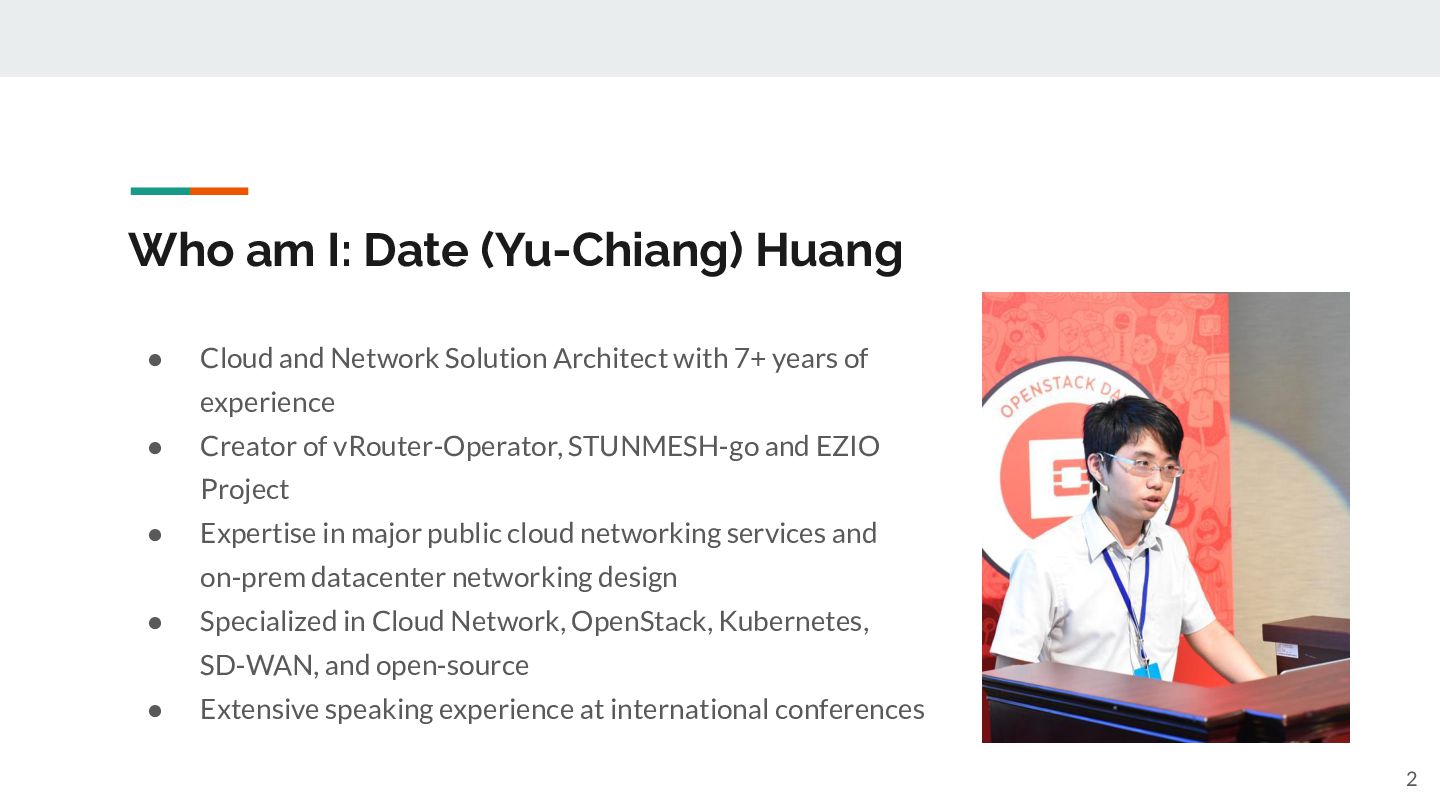
  2. Who am I: Date (Yu-Chiang) Huang • Cloud and Network

    Solution Architect with 7+ years of experience • Creator of vRouter-Operator, STUNMESH-go and EZIO Project • Expertise in major public cloud networking services and on-prem datacenter networking design • Specialized in Cloud Network, OpenStack, Kubernetes, SD-WAN, and open-source • Extensive speaking experience at international conferences 2
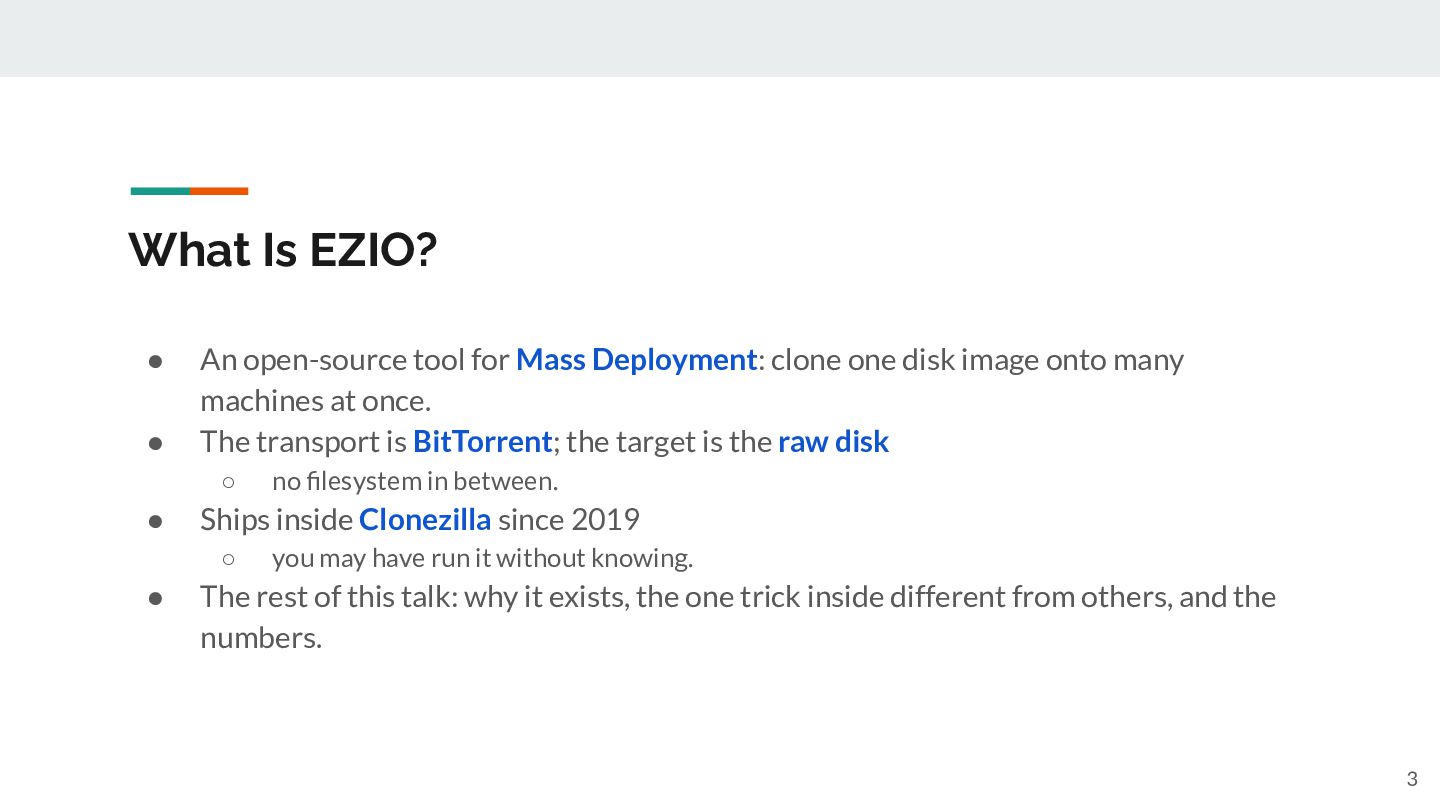
  3. What Is EZIO? • • An open-source tool for Mass

    Deployment: clone one disk image onto many machines at once. The transport is BitTorrent; the target is the raw disk ◦ • Ships inside Clonezilla since 2019 ◦ • no filesystem in between. you may have run it without knowing. The rest of this talk: why it exists, the one trick inside different from others, and the numbers. 3
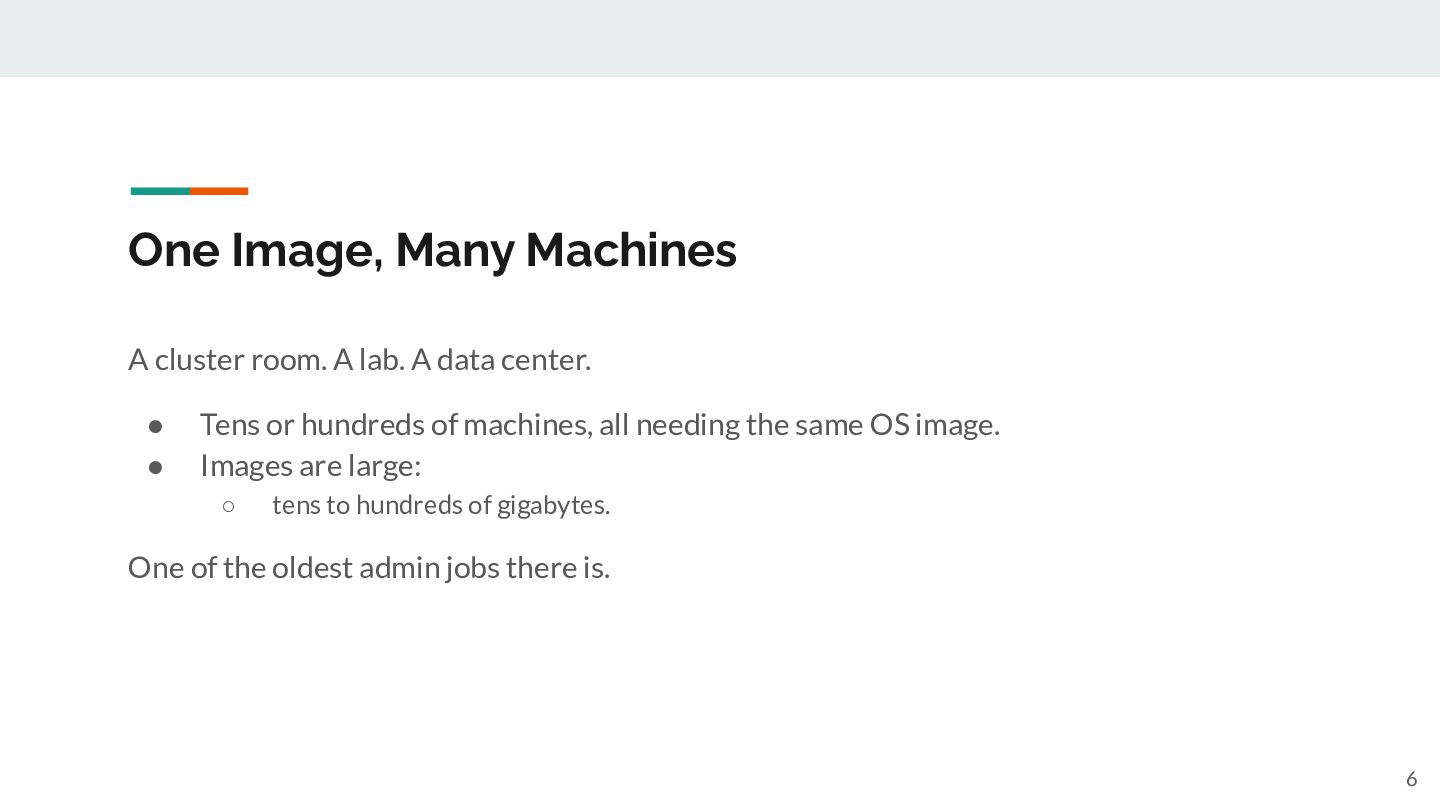
  4. One Image, Many Machines A cluster room. A lab. A

    data center. • • Tens or hundreds of machines, all needing the same OS image. Images are large: ◦ tens to hundreds of gigabytes. One of the oldest admin jobs there is. 6
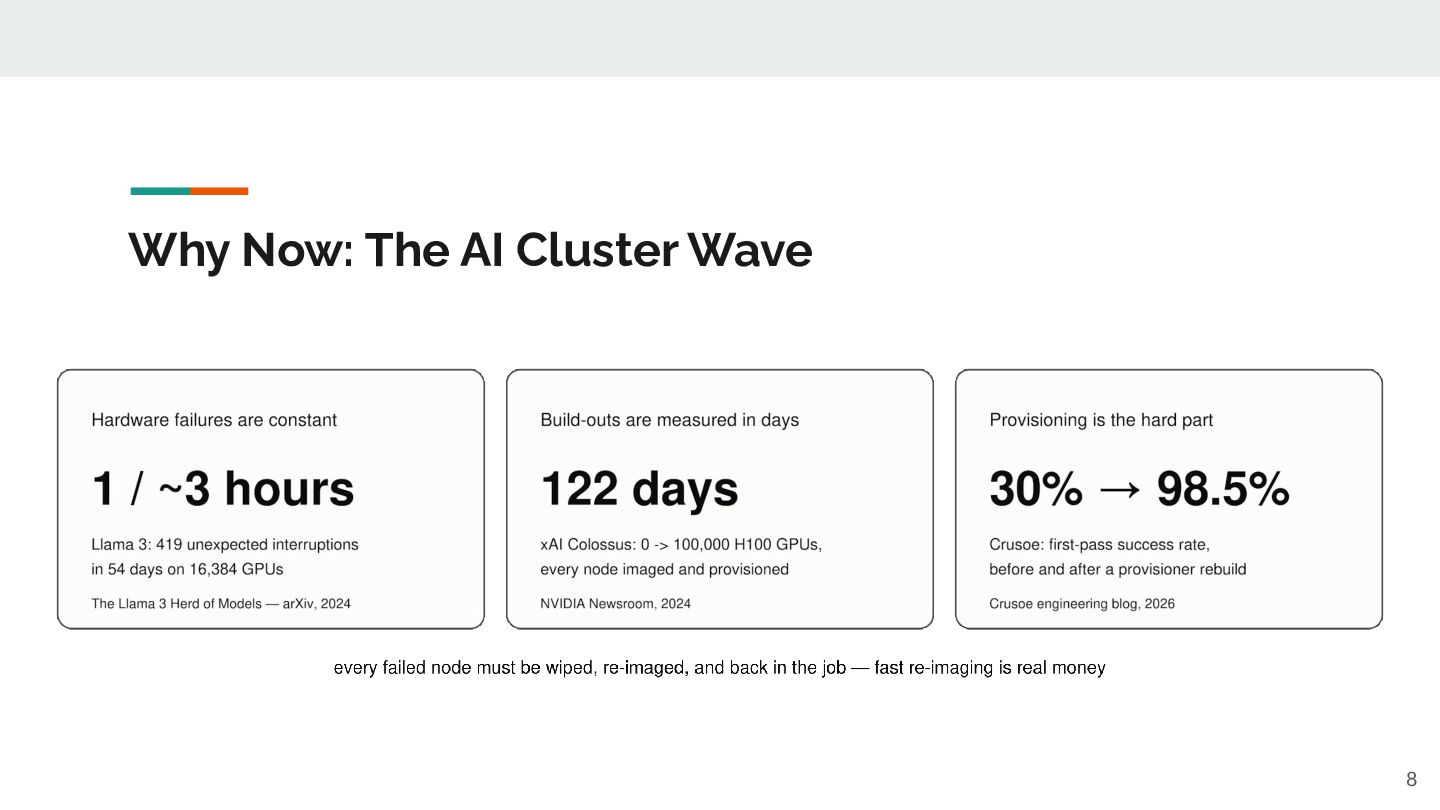
  5. Re-Imaging Speed Is Now Real Money • • • •

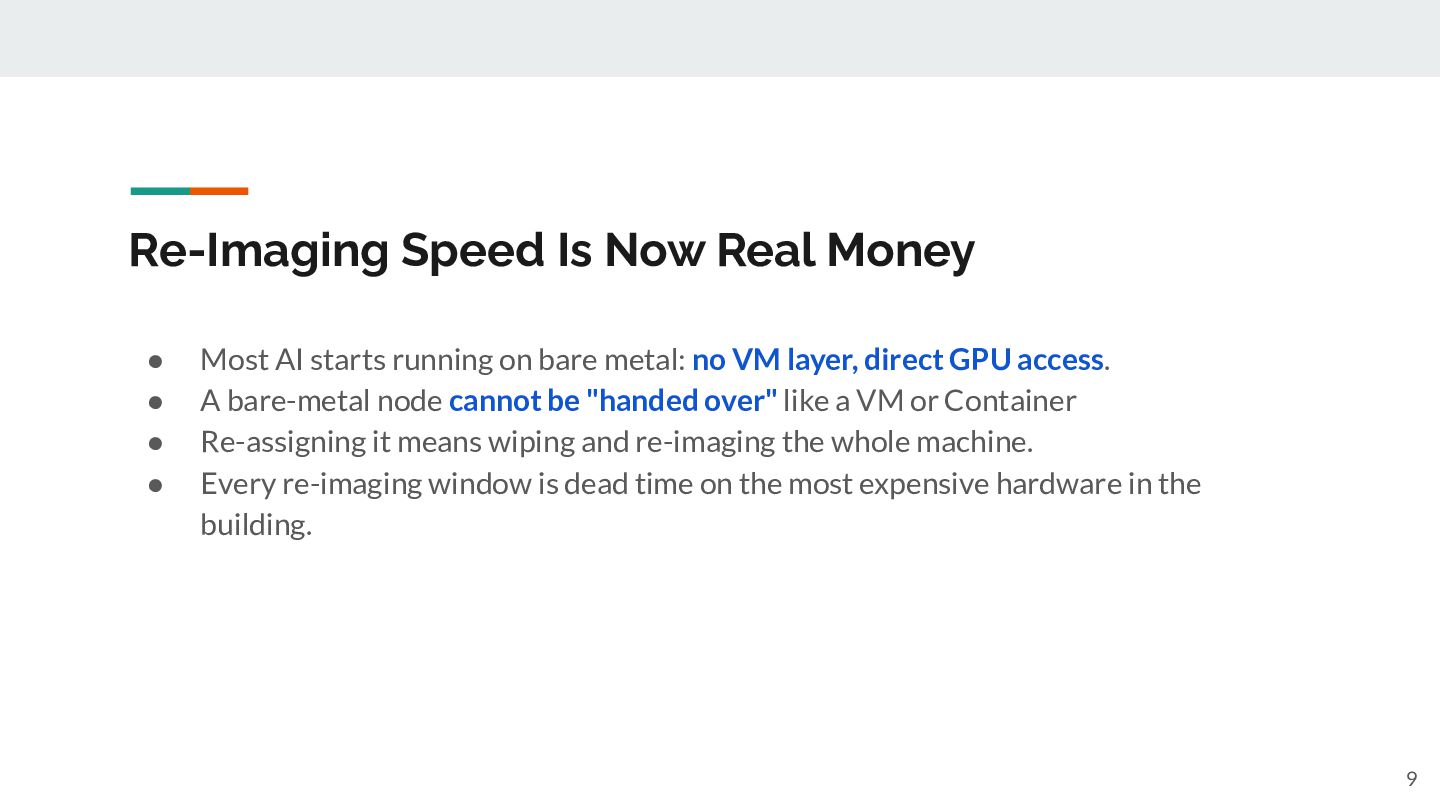
    Most AI starts running on bare metal: no VM layer, direct GPU access. A bare-metal node cannot be "handed over" like a VM or Container Re-assigning it means wiping and re-imaging the whole machine. Every re-imaging window is dead time on the most expensive hardware in the building. 9
  6. Unicast: The Math Is Against You T = N x

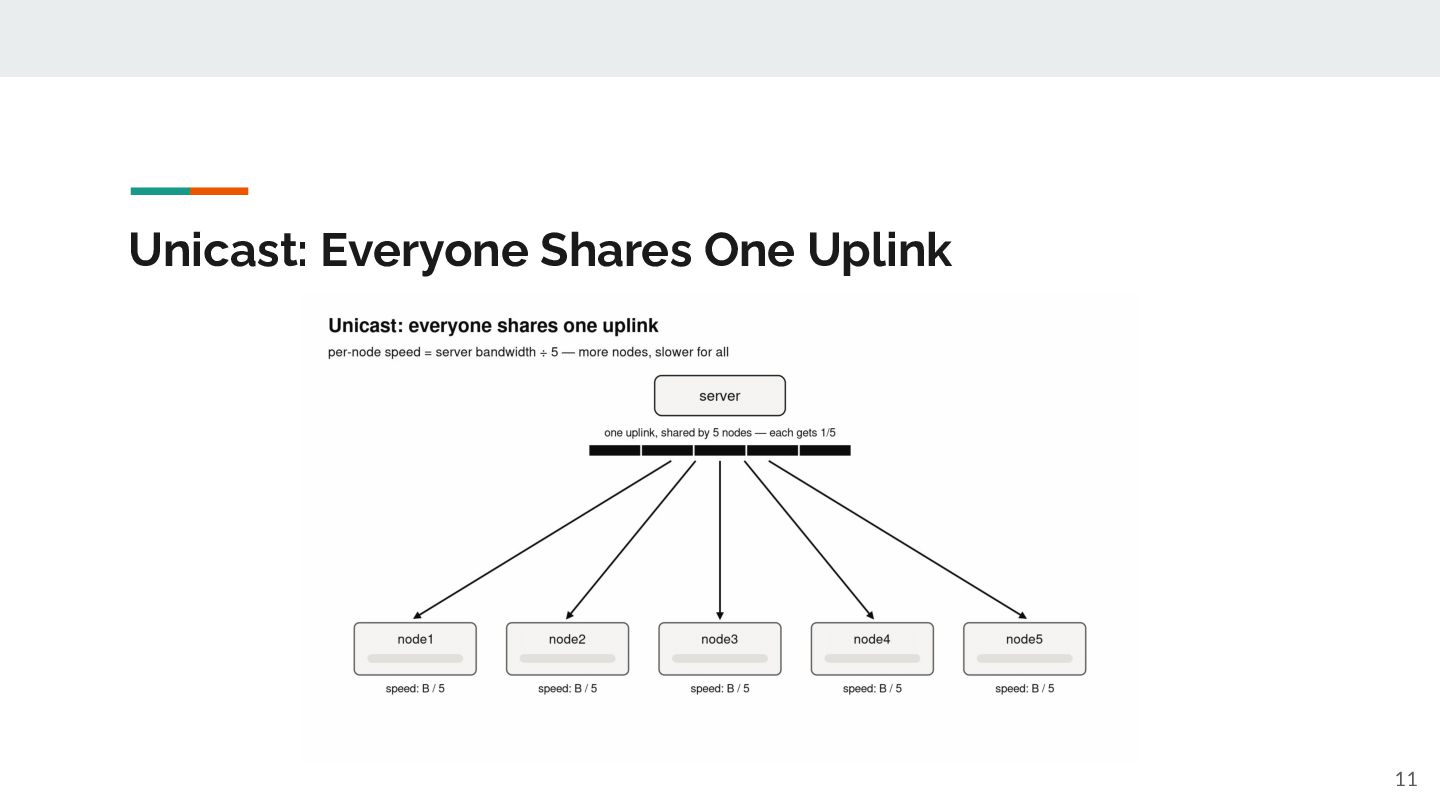
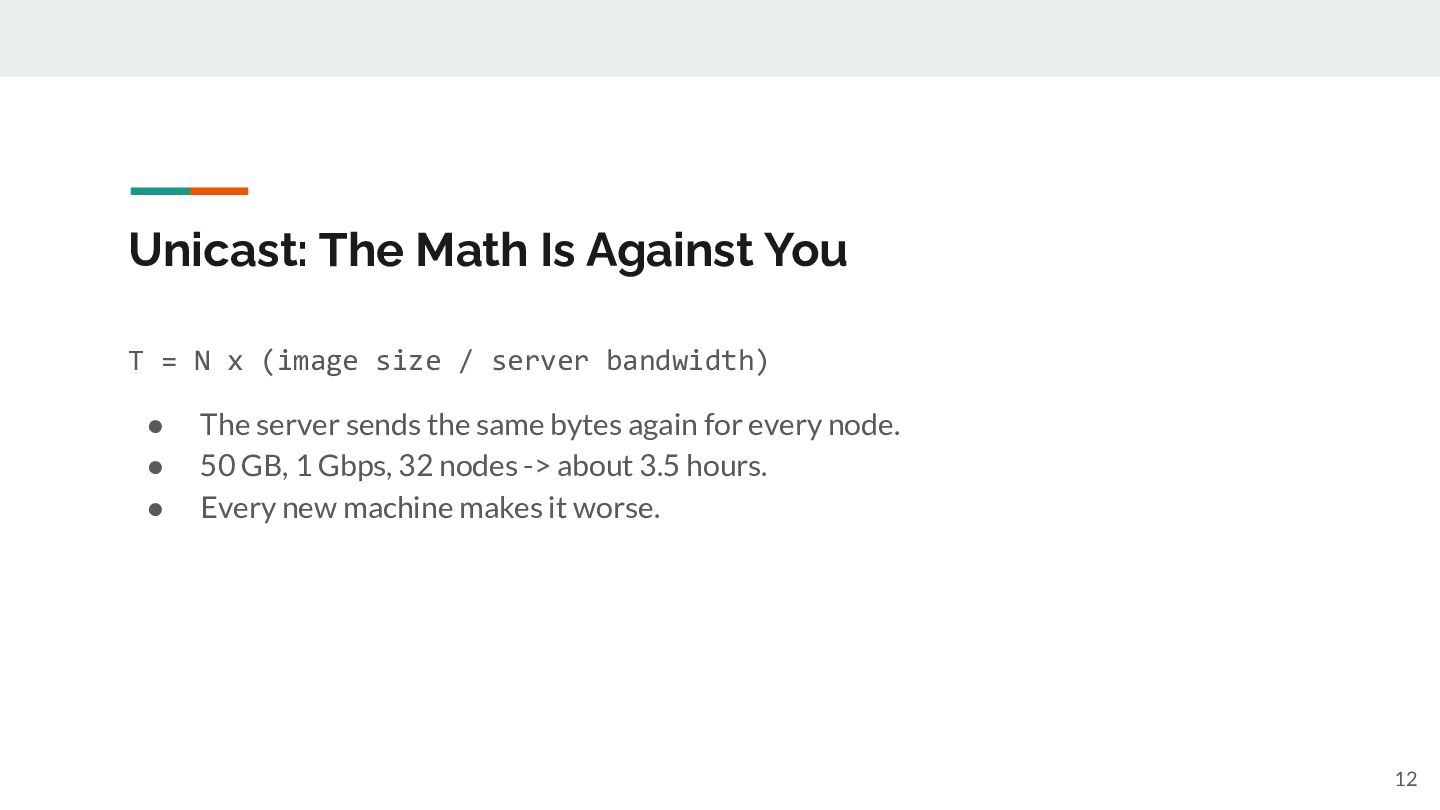
    (image size / server bandwidth) • • • The server sends the same bytes again for every node. 50 GB, 1 Gbps, 32 nodes -> about 3.5 hours. Every new machine makes it worse. 12
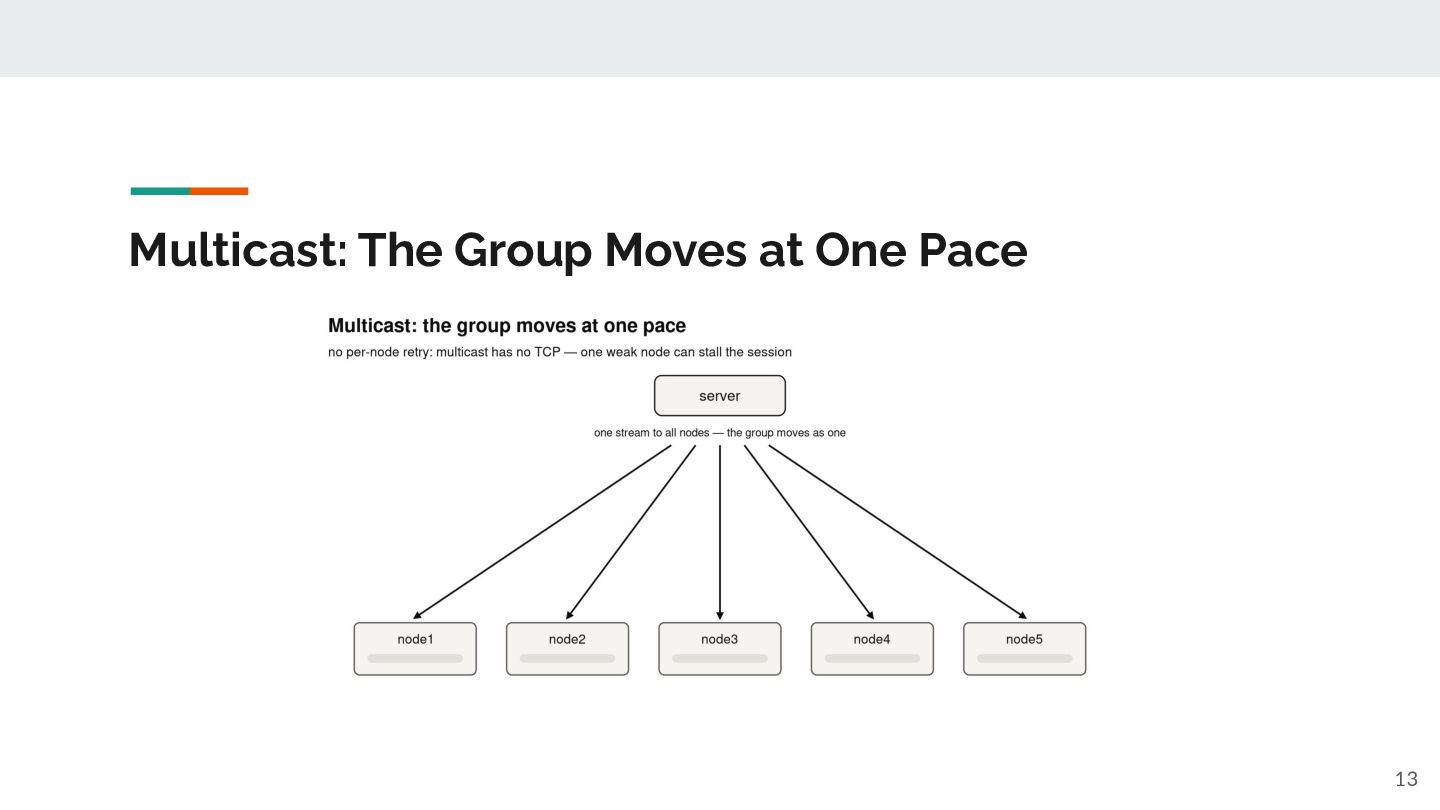
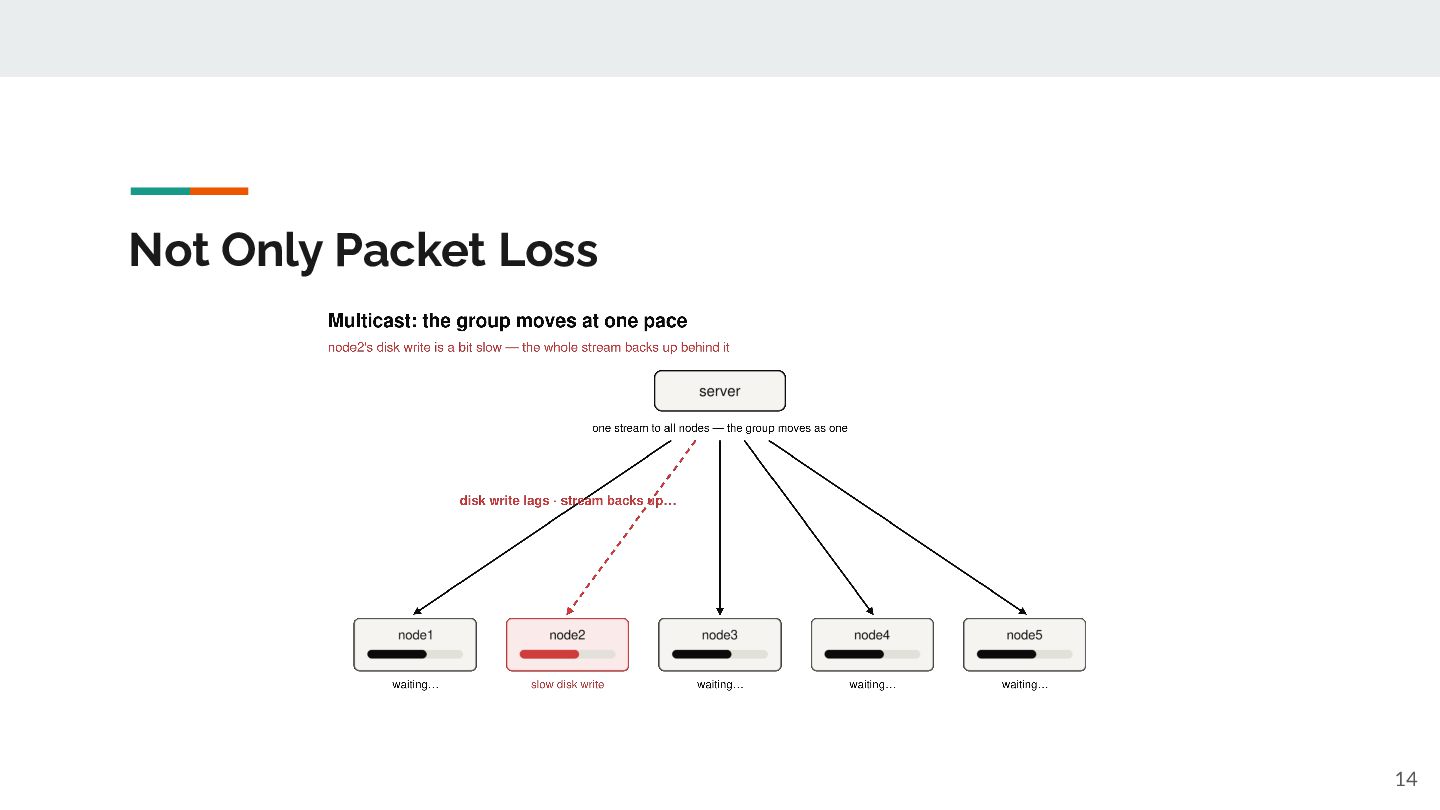
  7. Multicast: Hard to Predict Multicast sends the data only once,

    but the finish time swings with: • • • the slowest node in the group, every packet loss event, every recovery pause. A stuck node is a hard choice • • stall the whole group forever, or drop it on a timeout. Either the finish time slips, or nodes fail and need a second run. 15
  8. Peer-to-Peer: The Right Idea, People Tried Before BitTorrent fixes the

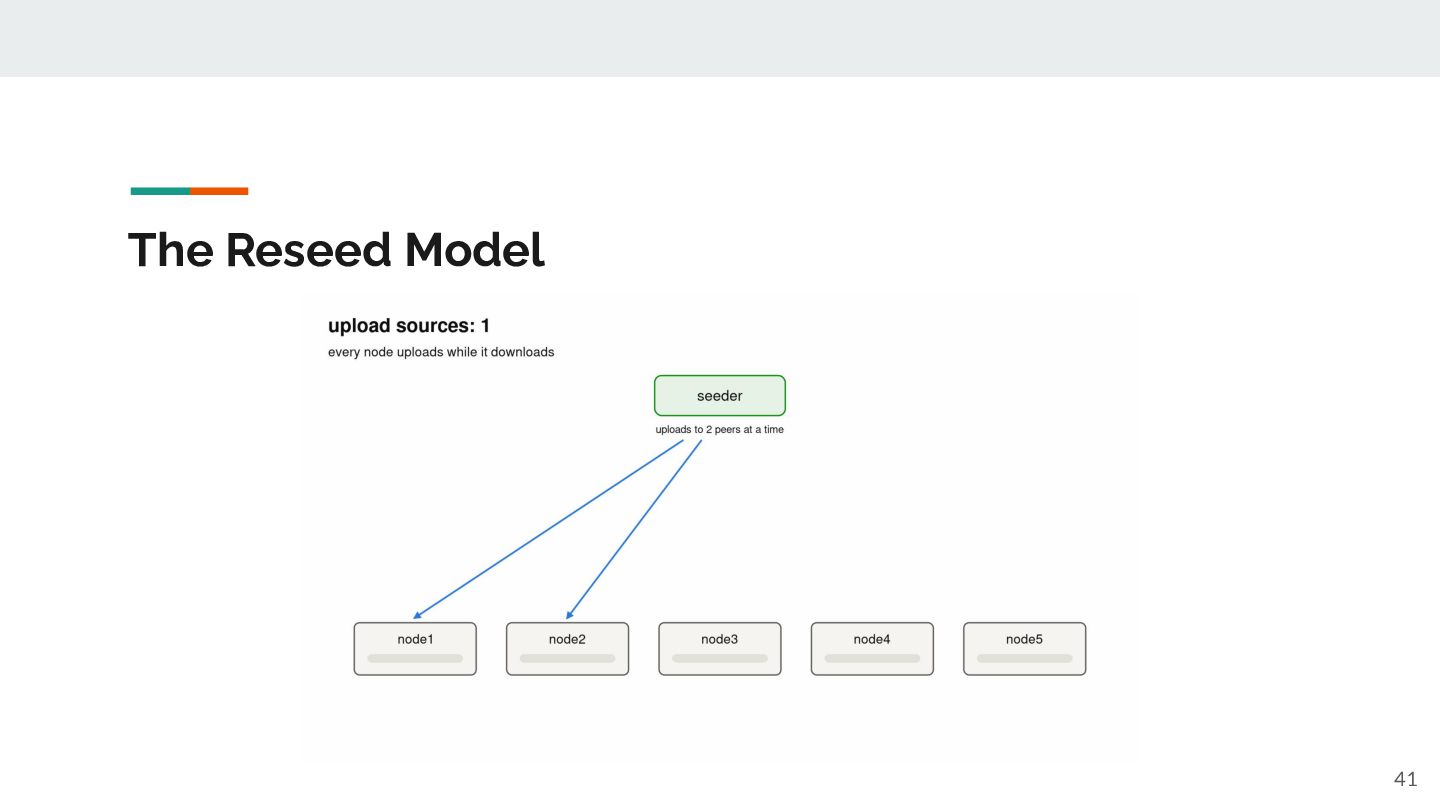
    unicast problem by design: • • every node that has data also uploads it, the server stops being the only source. People tried this for OS deployment years ago. It did not take over. 16
  9. BitTorrent in Thirty Seconds • • • A torrent file:

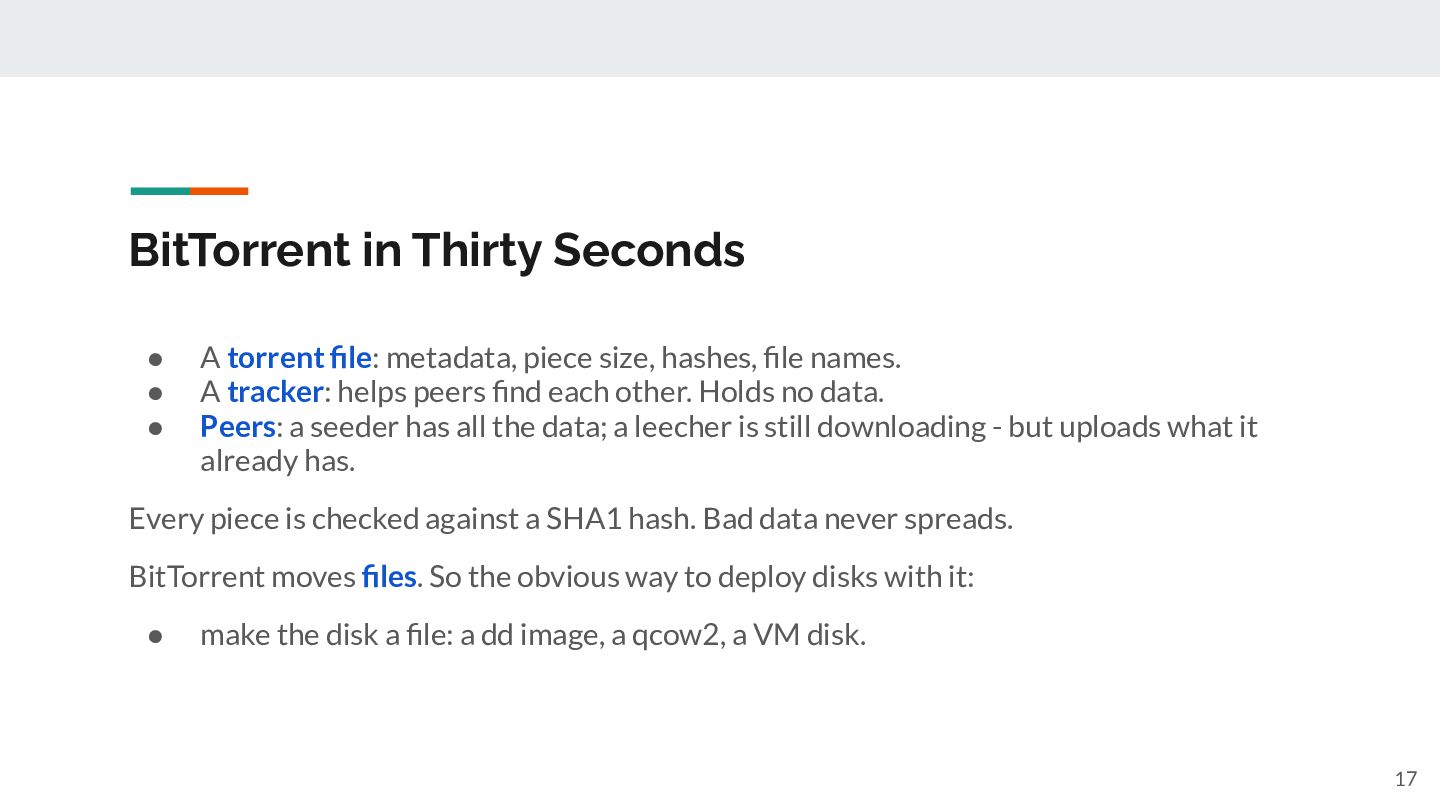
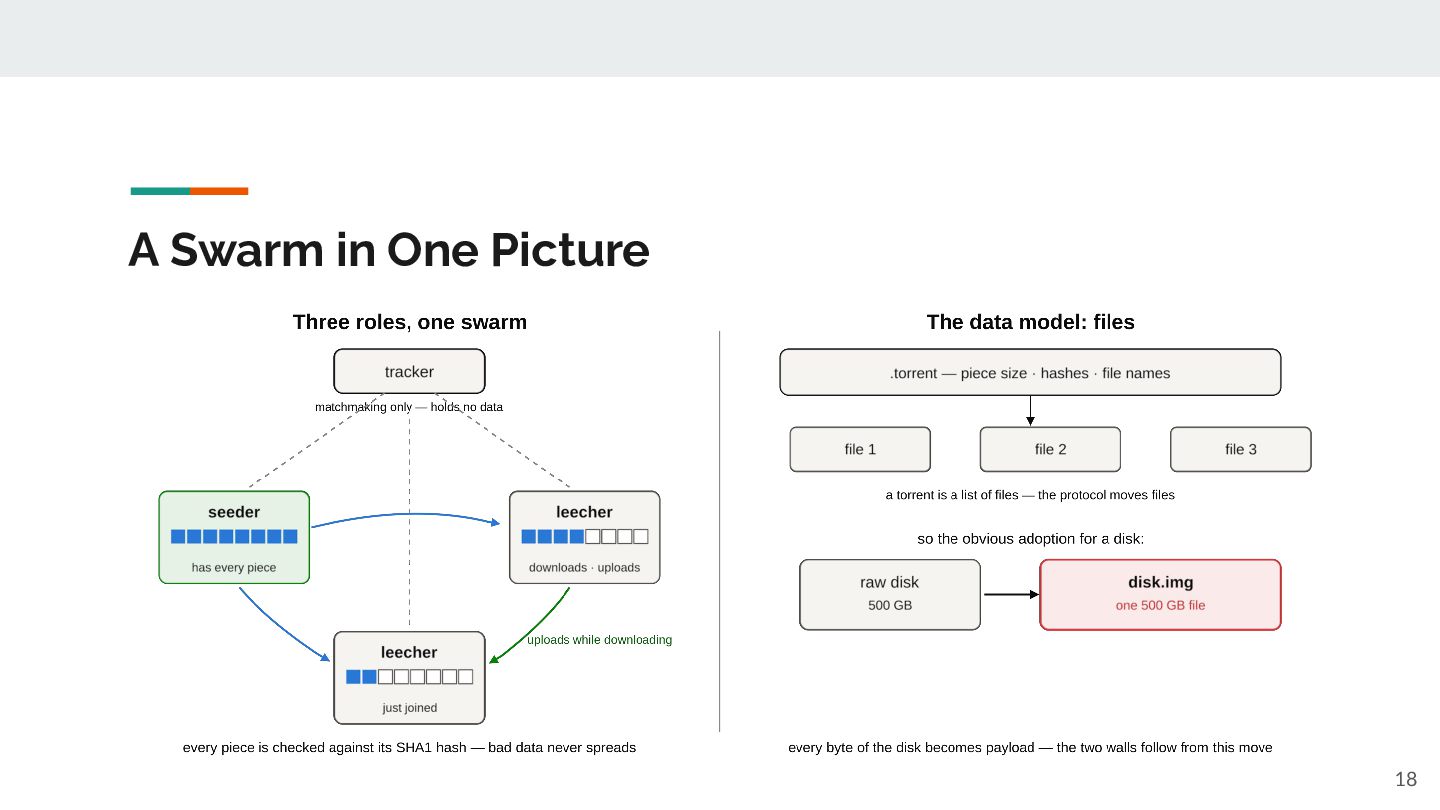
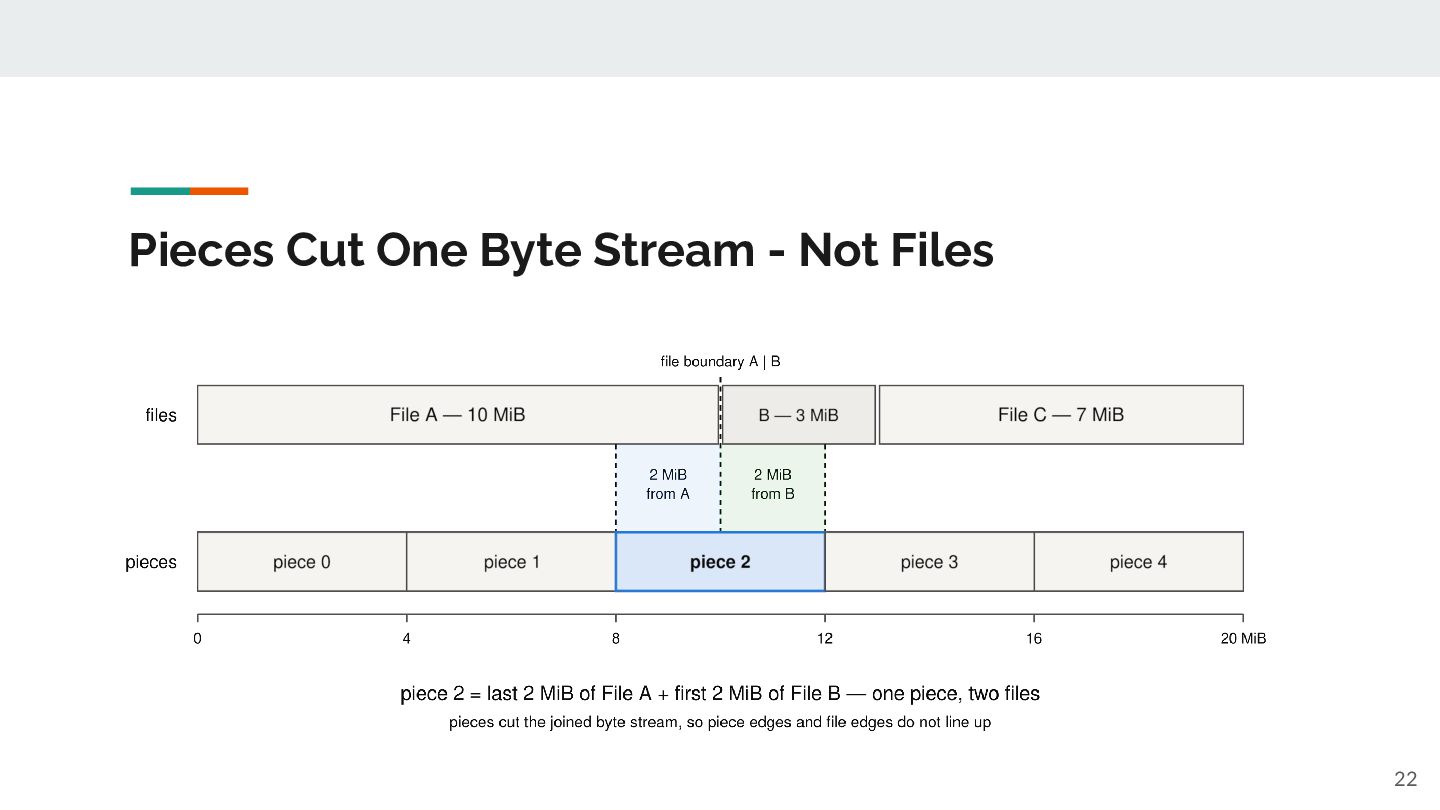
    metadata, piece size, hashes, file names. A tracker: helps peers find each other. Holds no data. Peers: a seeder has all the data; a leecher is still downloading - but uploads what it already has. Every piece is checked against a SHA1 hash. Bad data never spreads. BitTorrent moves files. So the obvious way to deploy disks with it: • make the disk a file: a dd image, a qcow2, a VM disk. 17
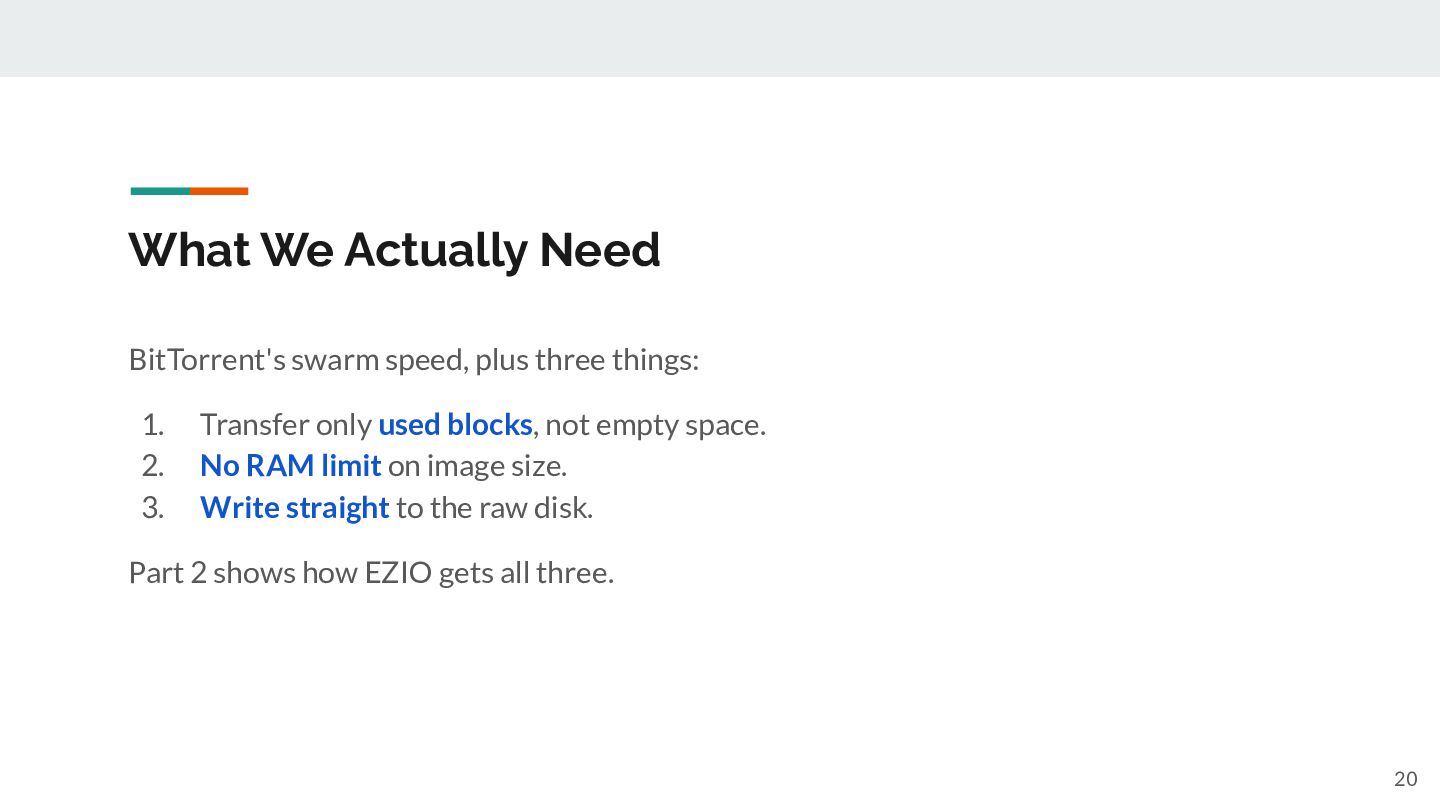
  10. What We Actually Need BitTorrent's swarm speed, plus three things:

    1. 2. 3. Transfer only used blocks, not empty space. No RAM limit on image size. Write straight to the raw disk. Part 2 shows how EZIO gets all three. 20
  11. The Idea Everyone before us wrapped the disk in a

    file. What if the torrent could be the disk? 21
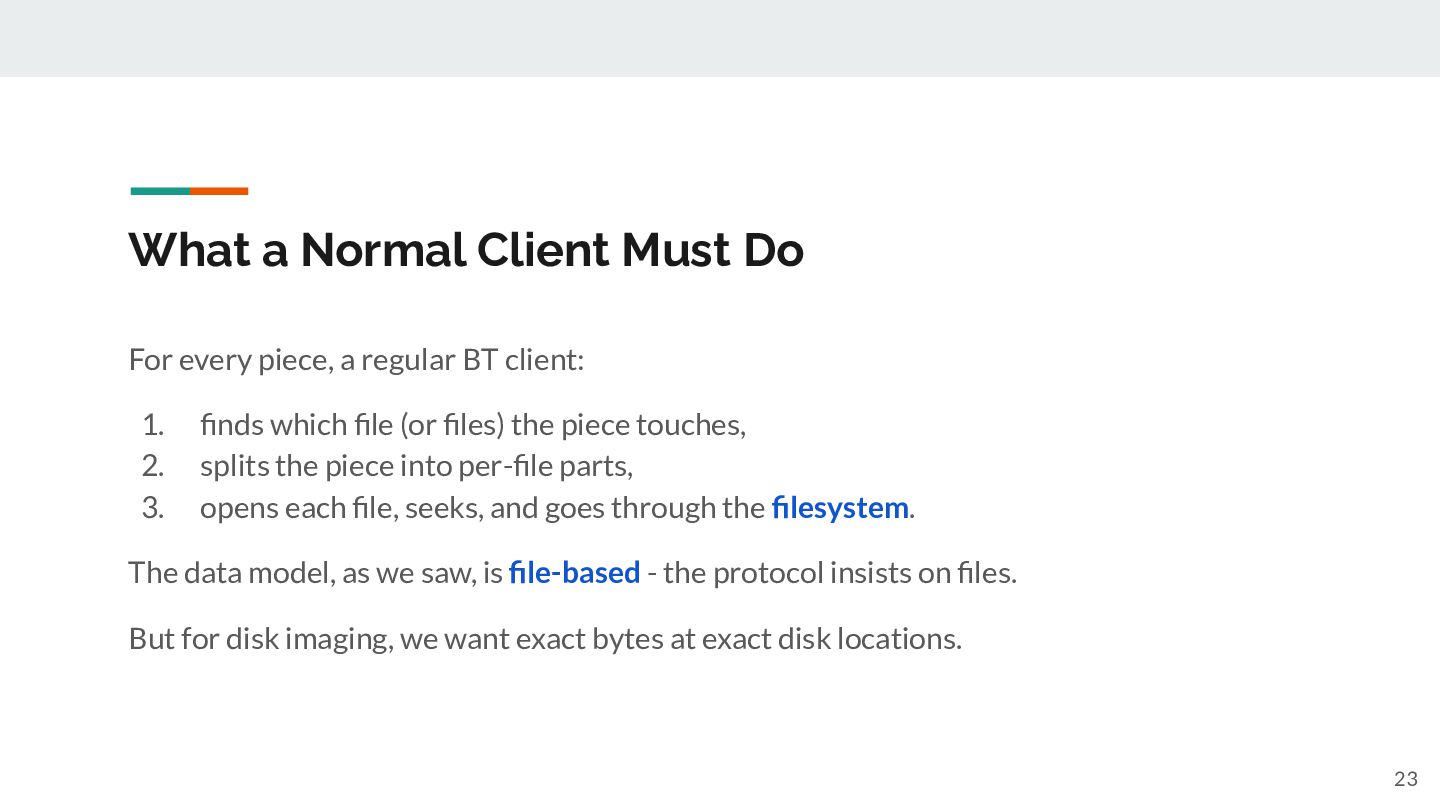
  12. What a Normal Client Must Do For every piece, a

    regular BT client: 1. 2. 3. finds which file (or files) the piece touches, splits the piece into per-file parts, opens each file, seeks, and goes through the filesystem. The data model, as we saw, is file-based - the protocol insists on files. But for disk imaging, we want exact bytes at exact disk locations. 23
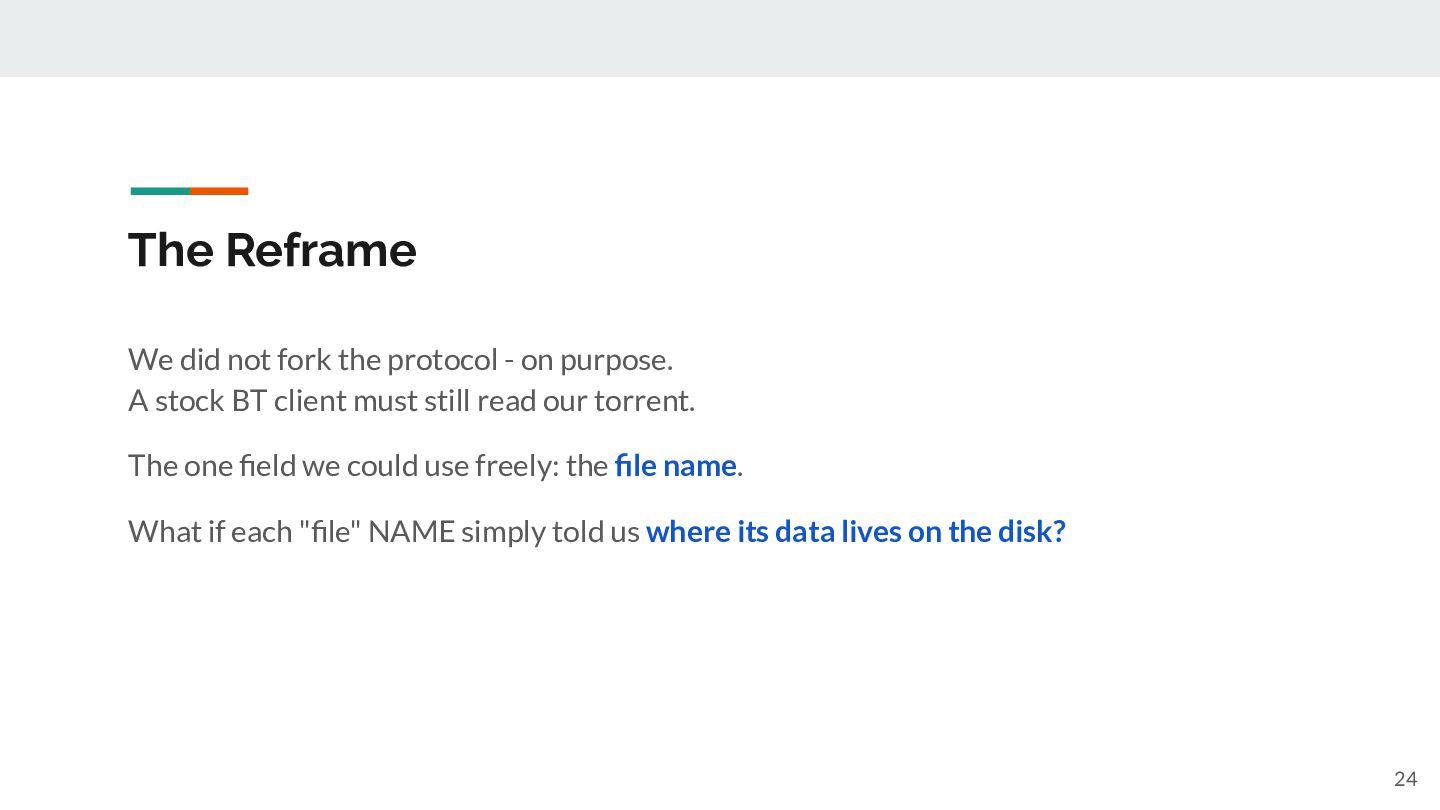
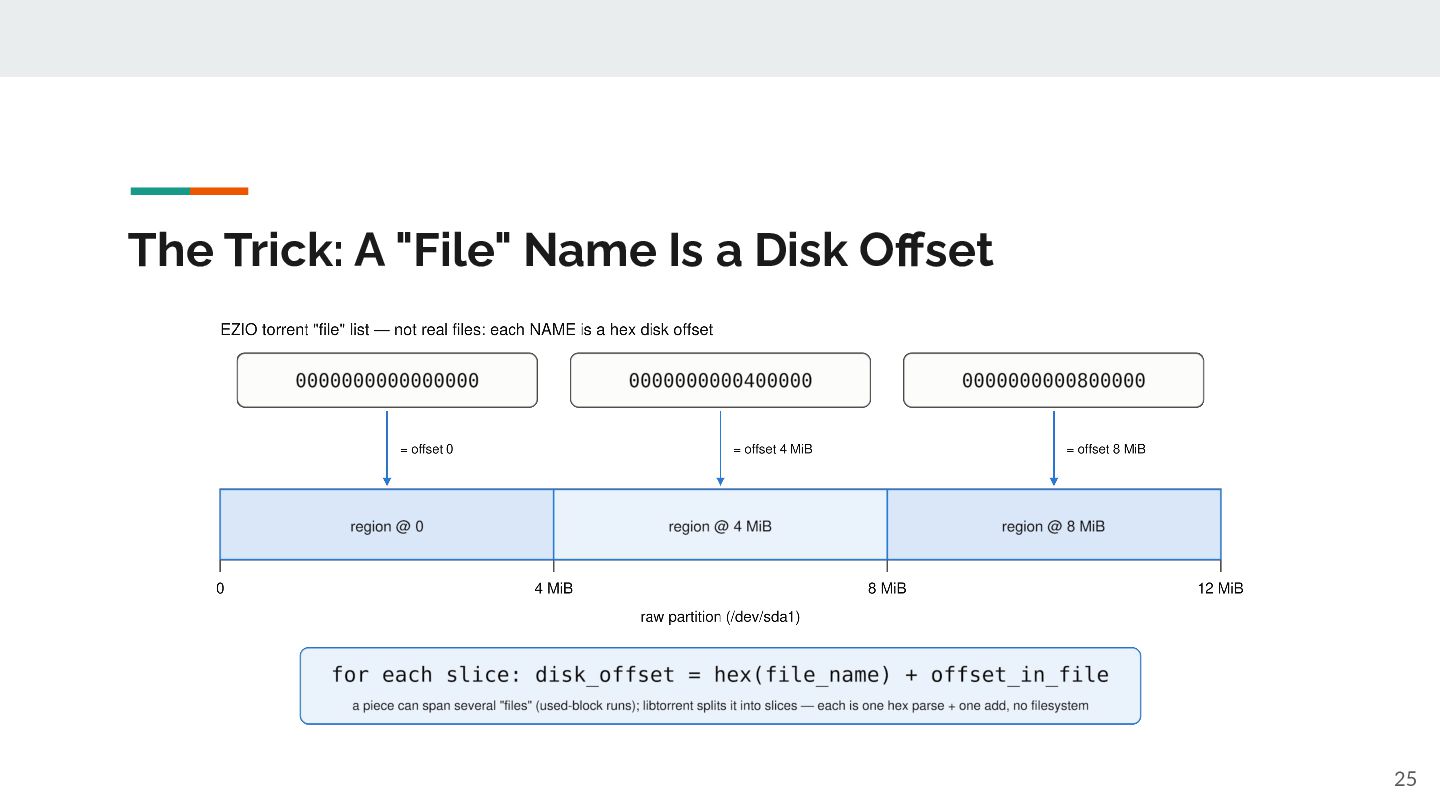
  13. The Reframe We did not fork the protocol - on

    purpose. A stock BT client must still read our torrent. The one field we could use freely: the file name. What if each "file" NAME simply told us where its data lives on the disk? 24
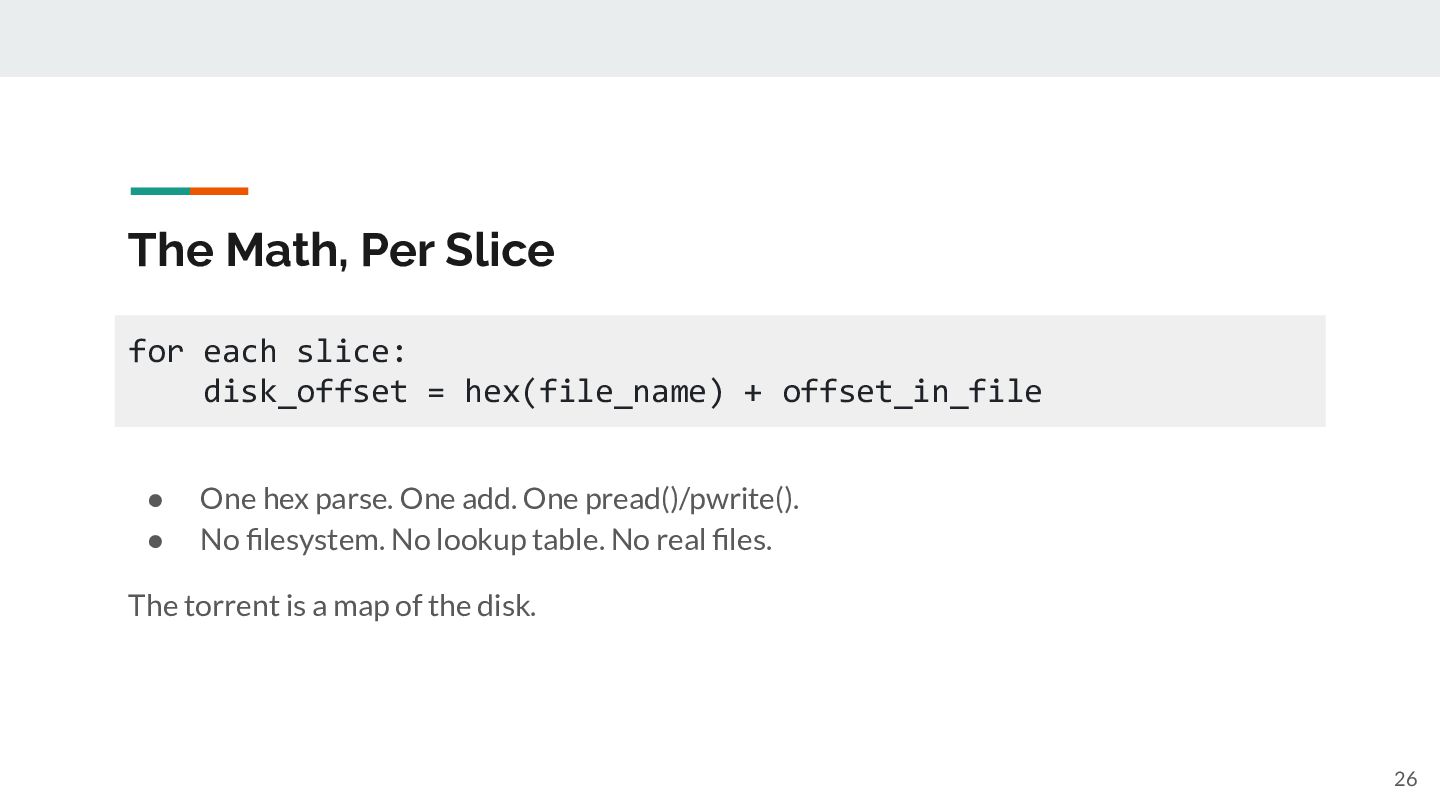
  14. The Math, Per Slice for each slice: disk_offset = hex(file_name)

    + offset_in_file • • One hex parse. One add. One pread()/pwrite(). No filesystem. No lookup table. No real files. The torrent is a map of the disk. 26
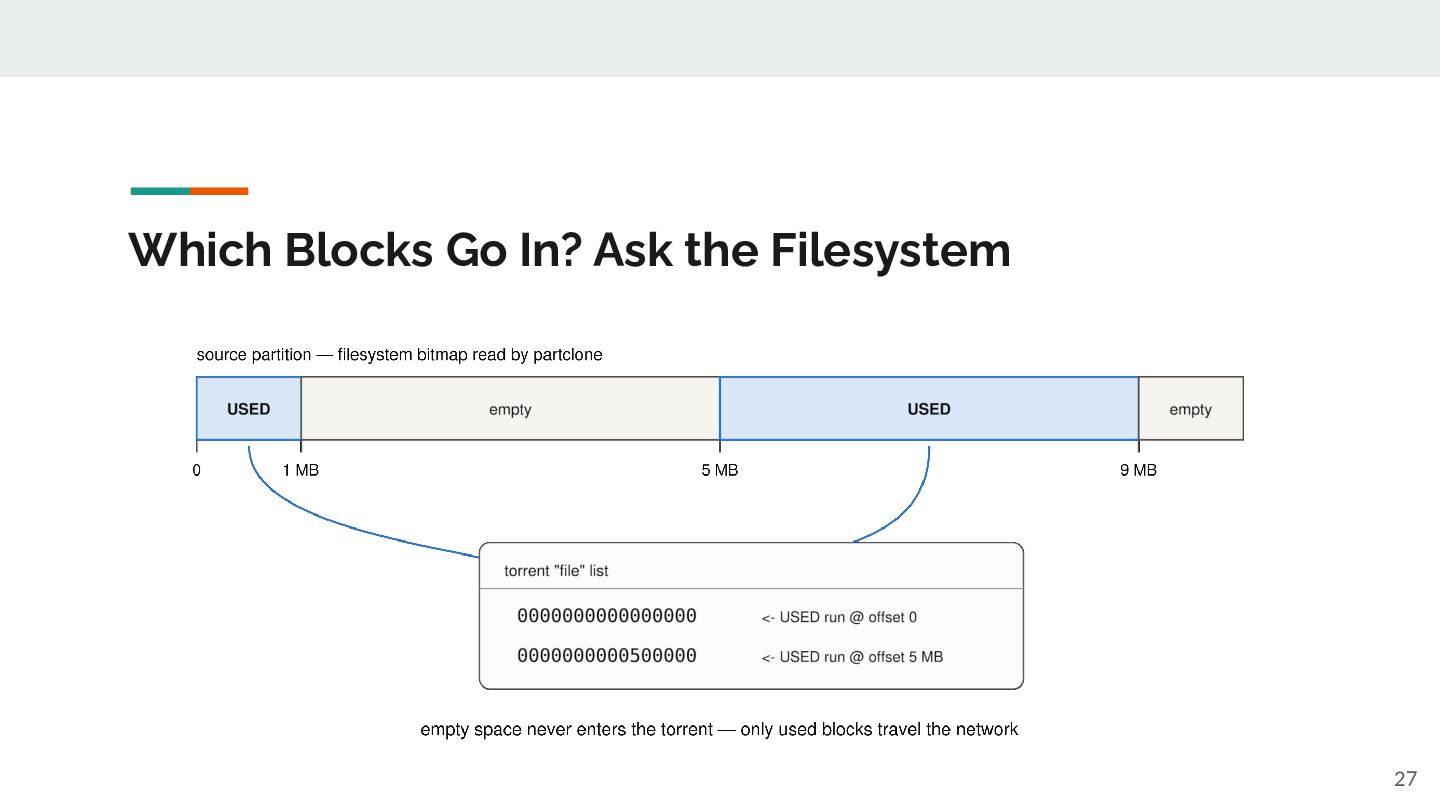
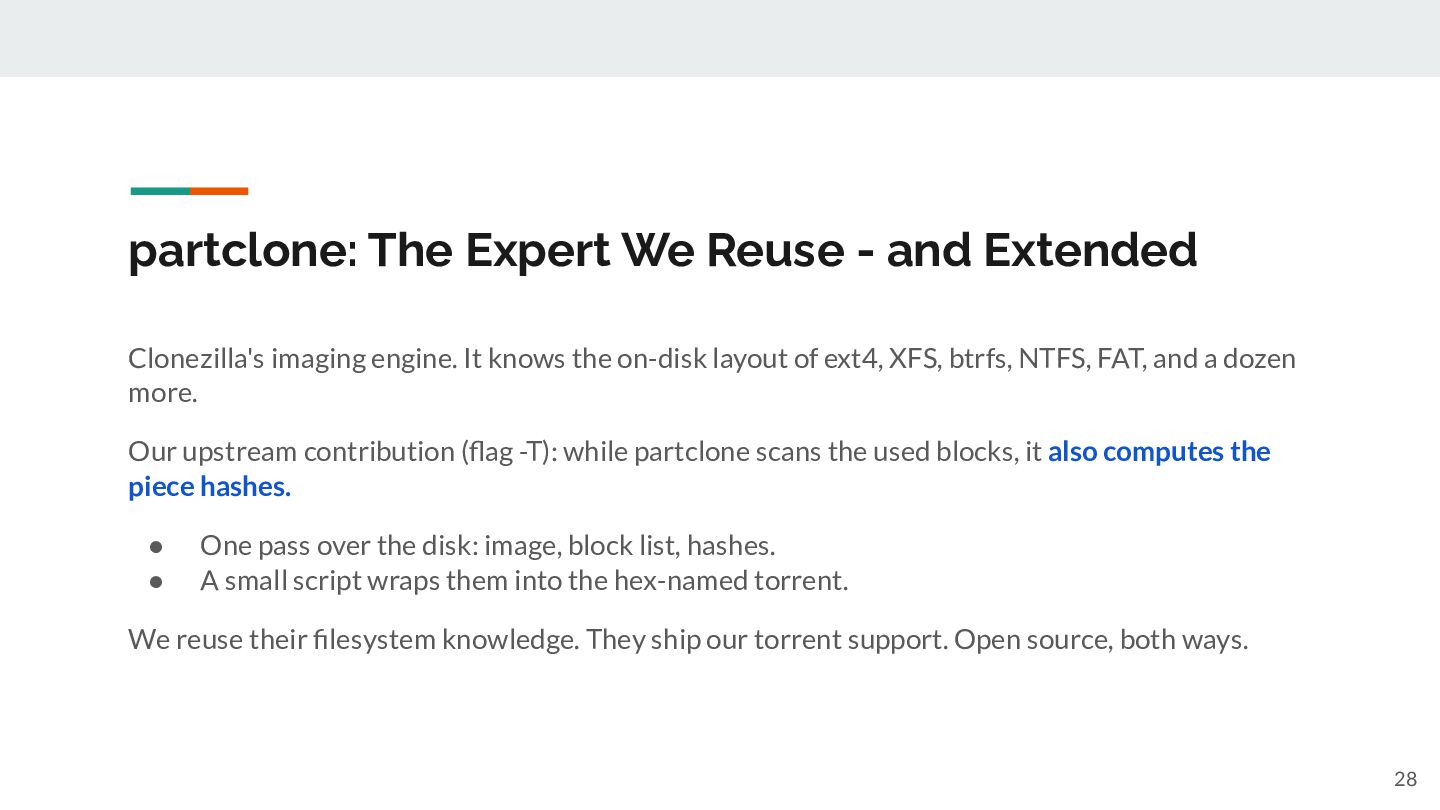
  15. partclone: The Expert We Reuse - and Extended Clonezilla's imaging

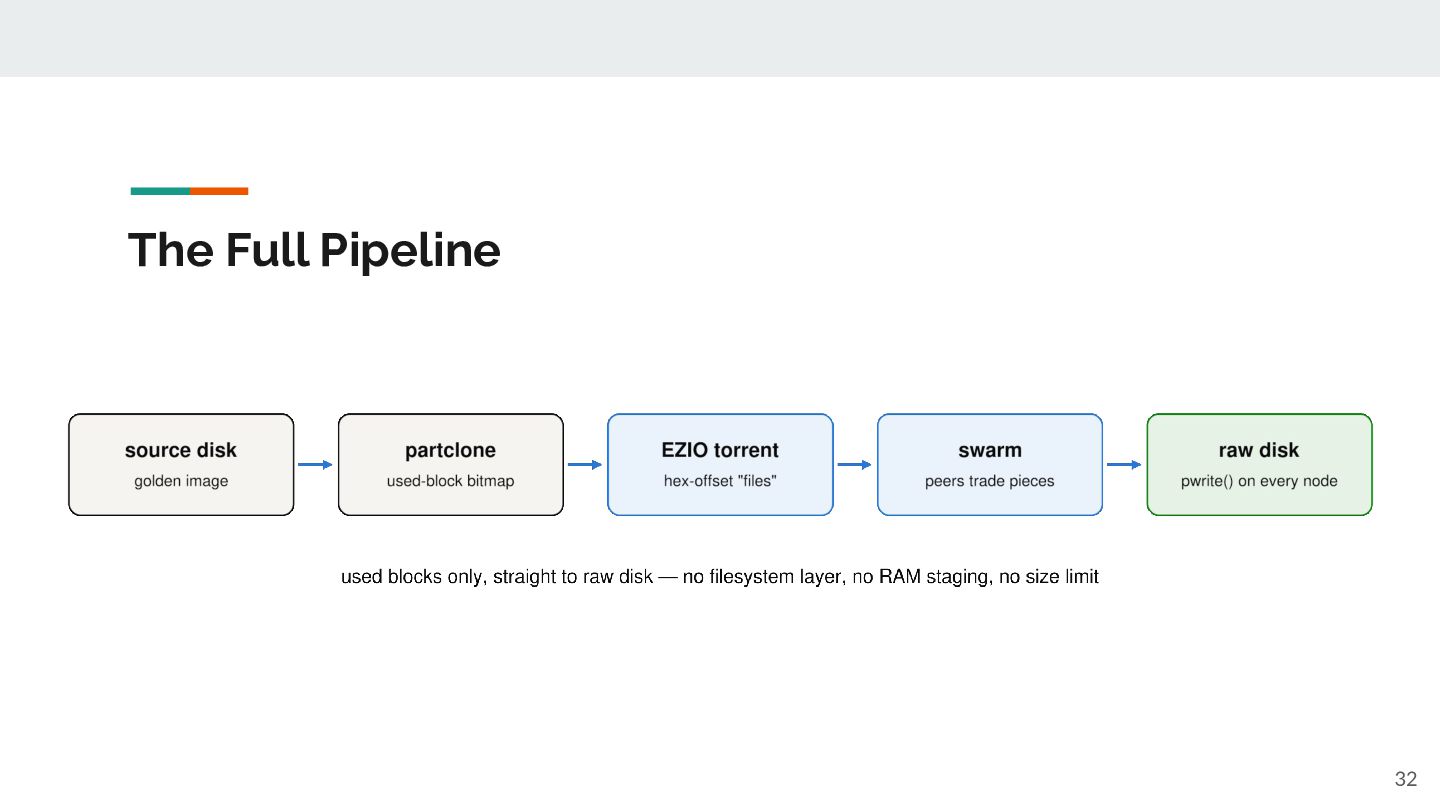
    engine. It knows the on-disk layout of ext4, XFS, btrfs, NTFS, FAT, and a dozen more. Our upstream contribution (flag -T): while partclone scans the used blocks, it also computes the piece hashes. • • One pass over the disk: image, block list, hashes. A small script wraps them into the hex-named torrent. We reuse their filesystem knowledge. They ship our torrent support. Open source, both ways. 28
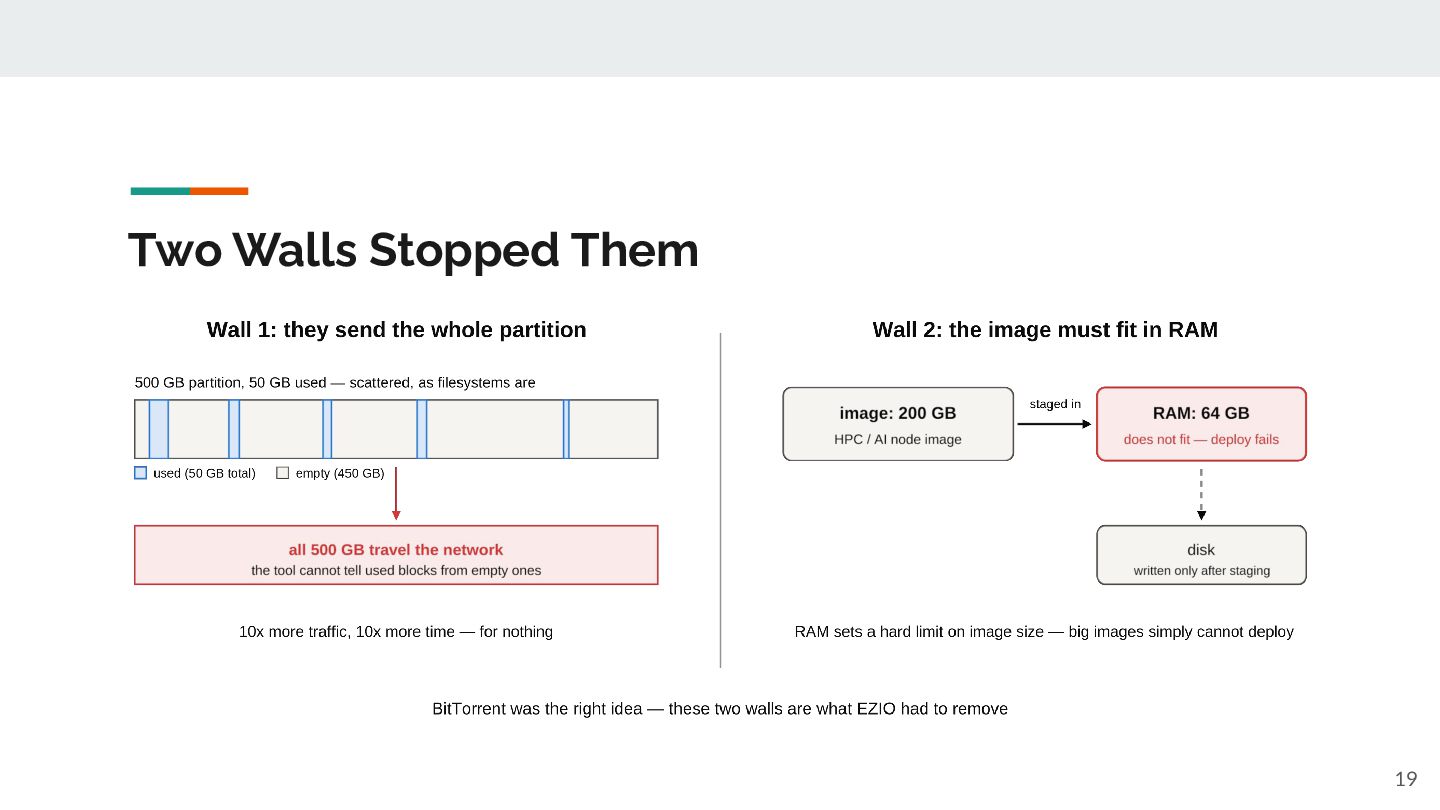
  16. Wall 1 Falls: Send Only What Matters Remember the 500

    GB partition with 50 GB of data? • • Old BT tools sent the full 500 GB. EZIO transfers the 50 GB that partclone marks used. Works for ext4, XFS, btrfs, NTFS - anything partclone understands. One tool, no per-FS code. 29
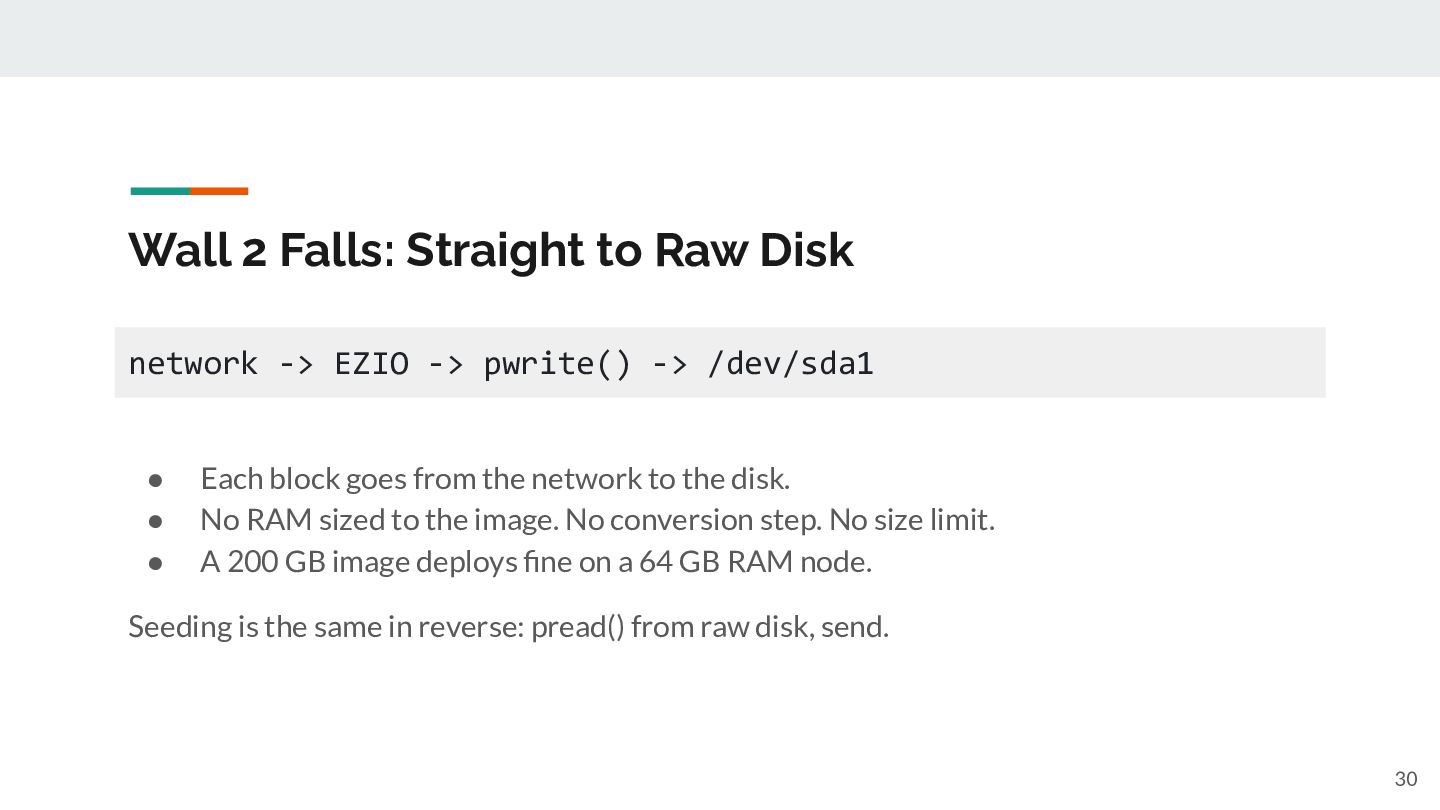
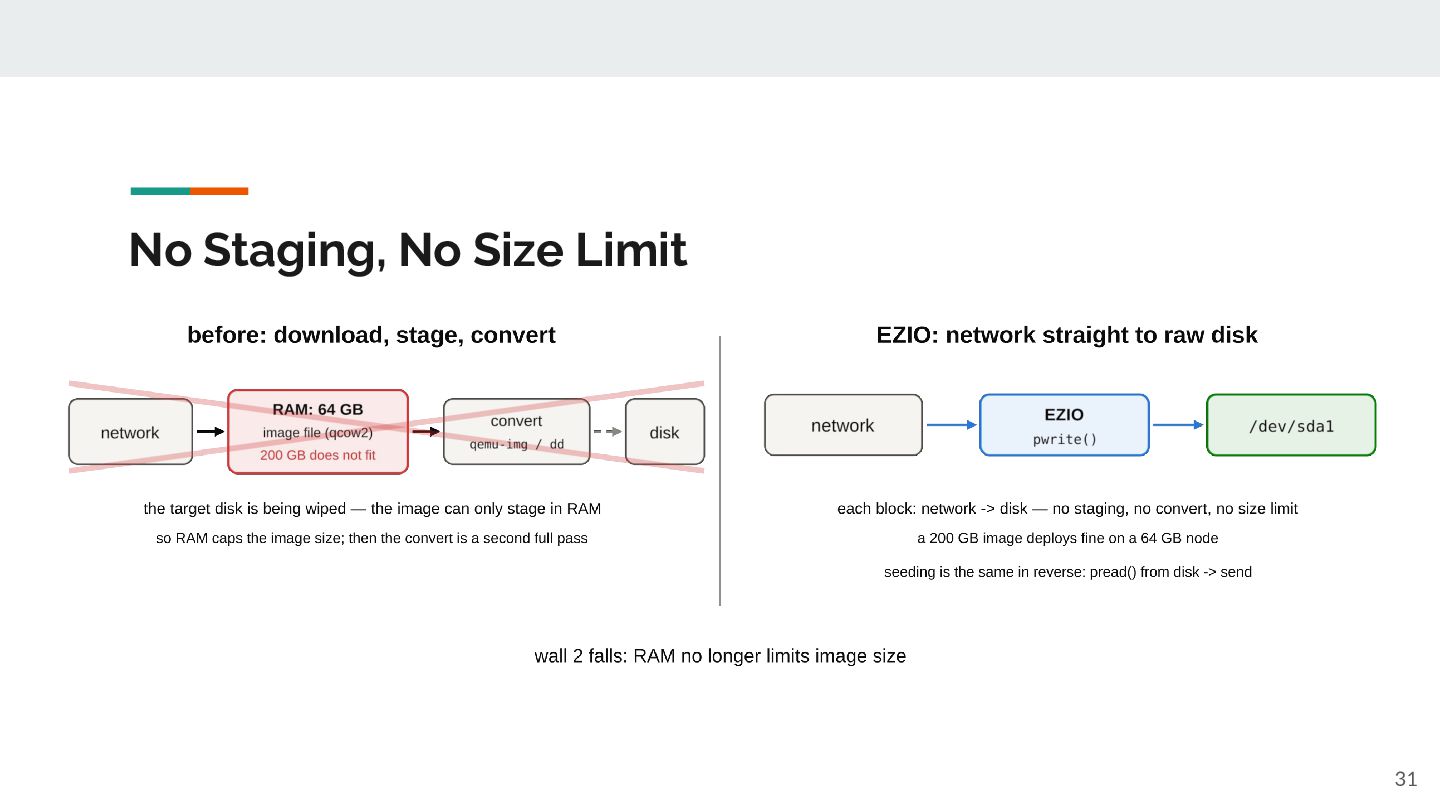
  17. Wall 2 Falls: Straight to Raw Disk network -> EZIO

    -> pwrite() -> /dev/sda1 • • • Each block goes from the network to the disk. No RAM sized to the image. No conversion step. No size limit. A 200 GB image deploys fine on a 64 GB RAM node. Seeding is the same in reverse: pread() from raw disk, send. 30
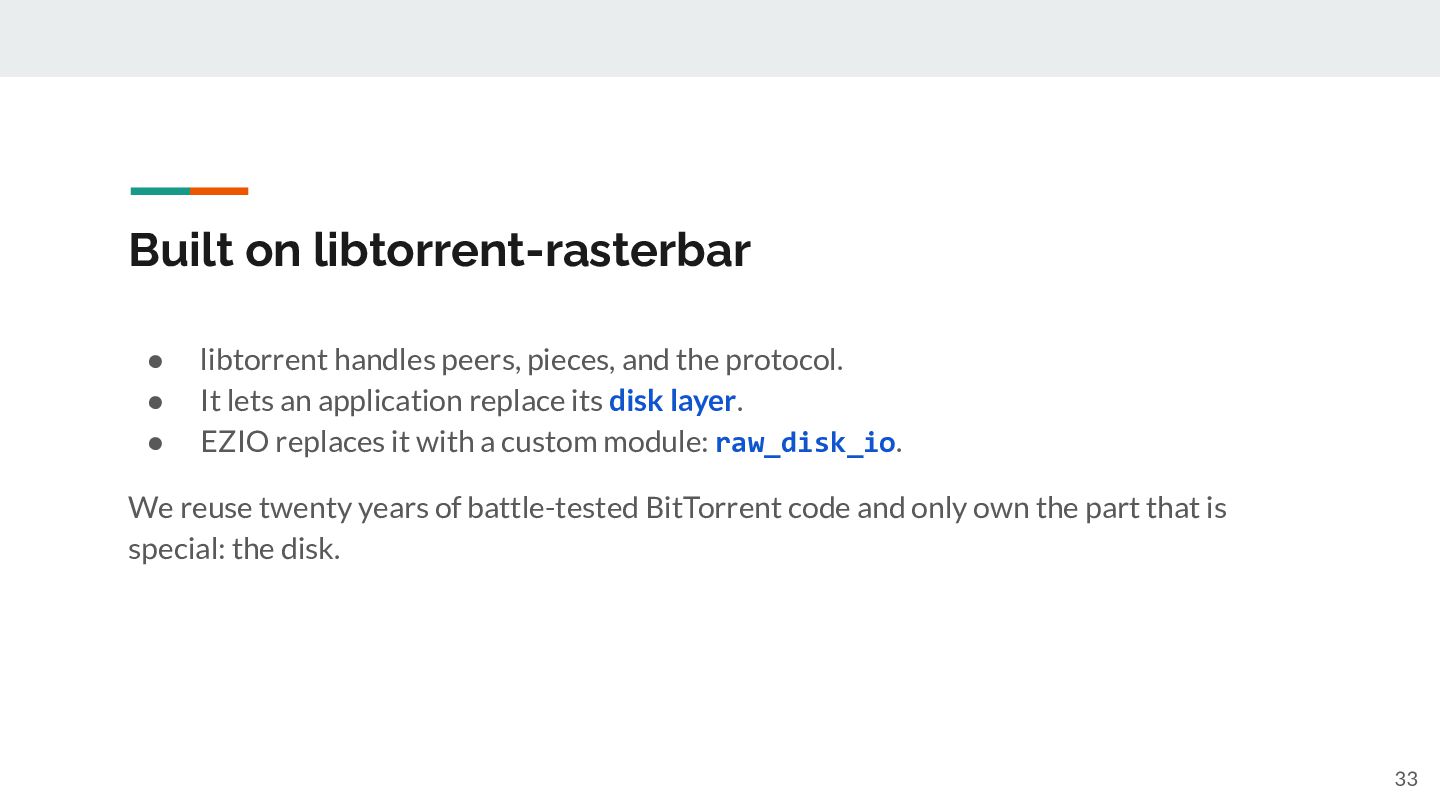
  18. Built on libtorrent-rasterbar • • • libtorrent handles peers, pieces,

    and the protocol. It lets an application replace its disk layer. EZIO replaces it with a custom module: raw_disk_io. We reuse twenty years of battle-tested BitTorrent code and only own the part that is special: the disk. 33
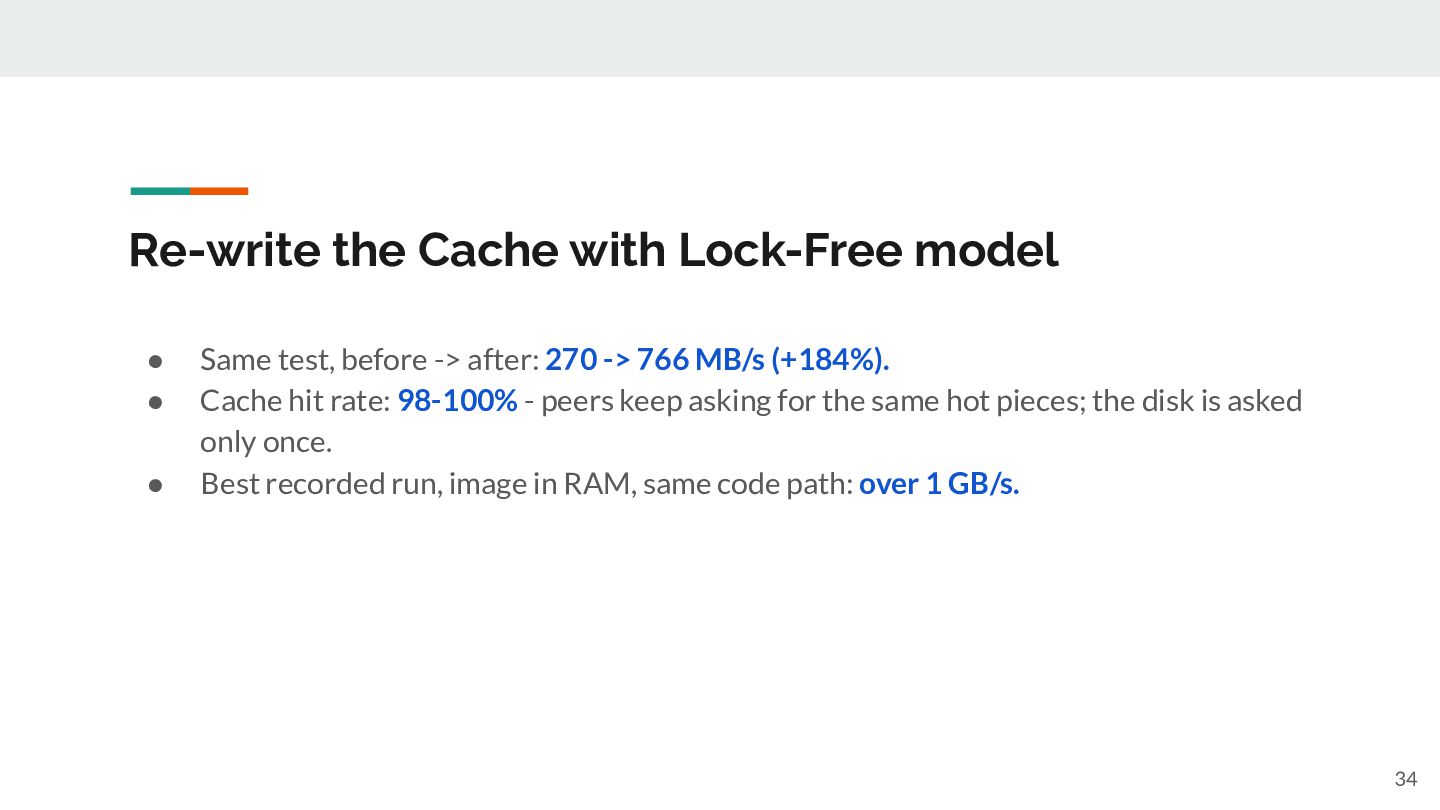
  19. Re-write the Cache with Lock-Free model • • • Same

    test, before -> after: 270 -> 766 MB/s (+184%). Cache hit rate: 98-100% - peers keep asking for the same hot pieces; the disk is asked only once. Best recorded run, image in RAM, same code path: over 1 GB/s. 34
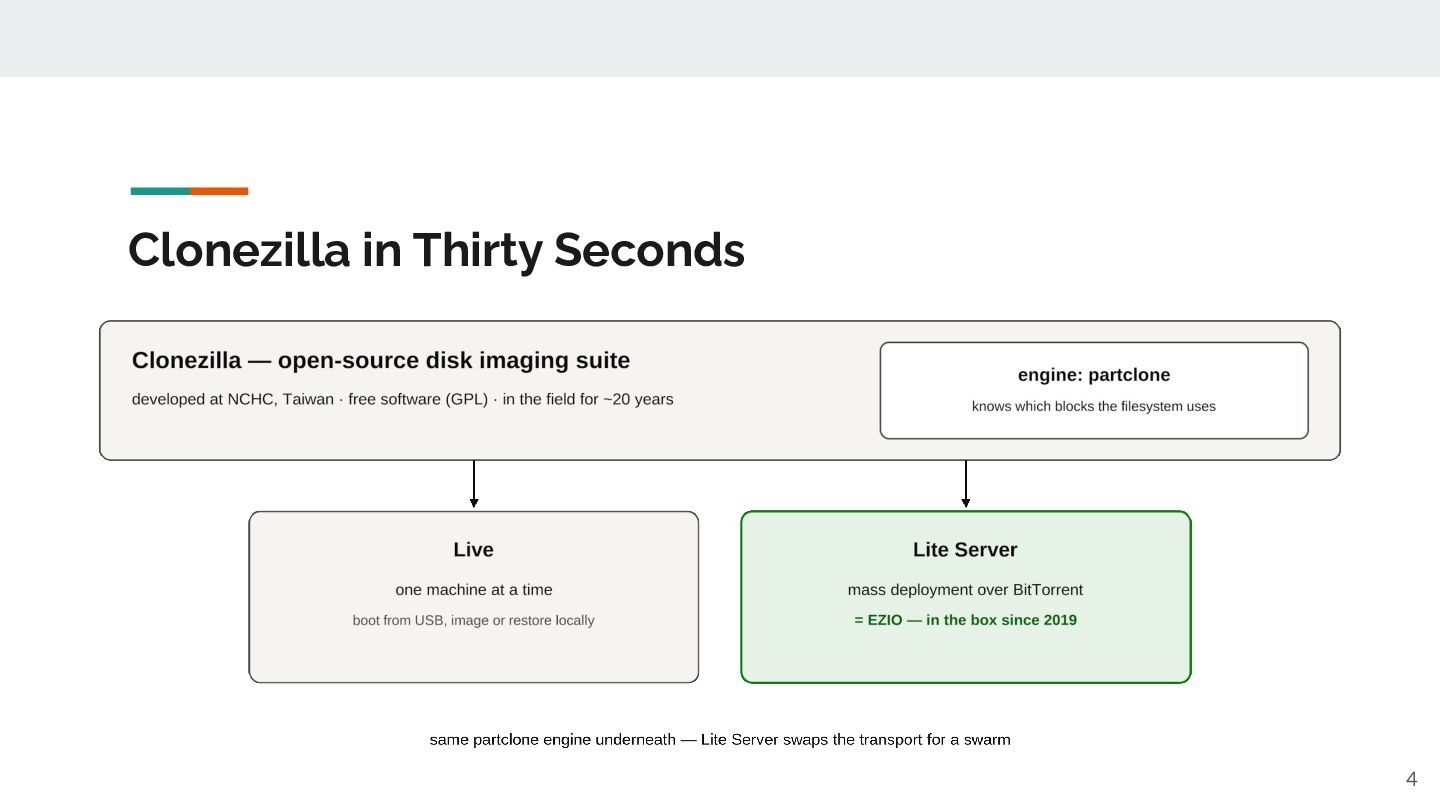
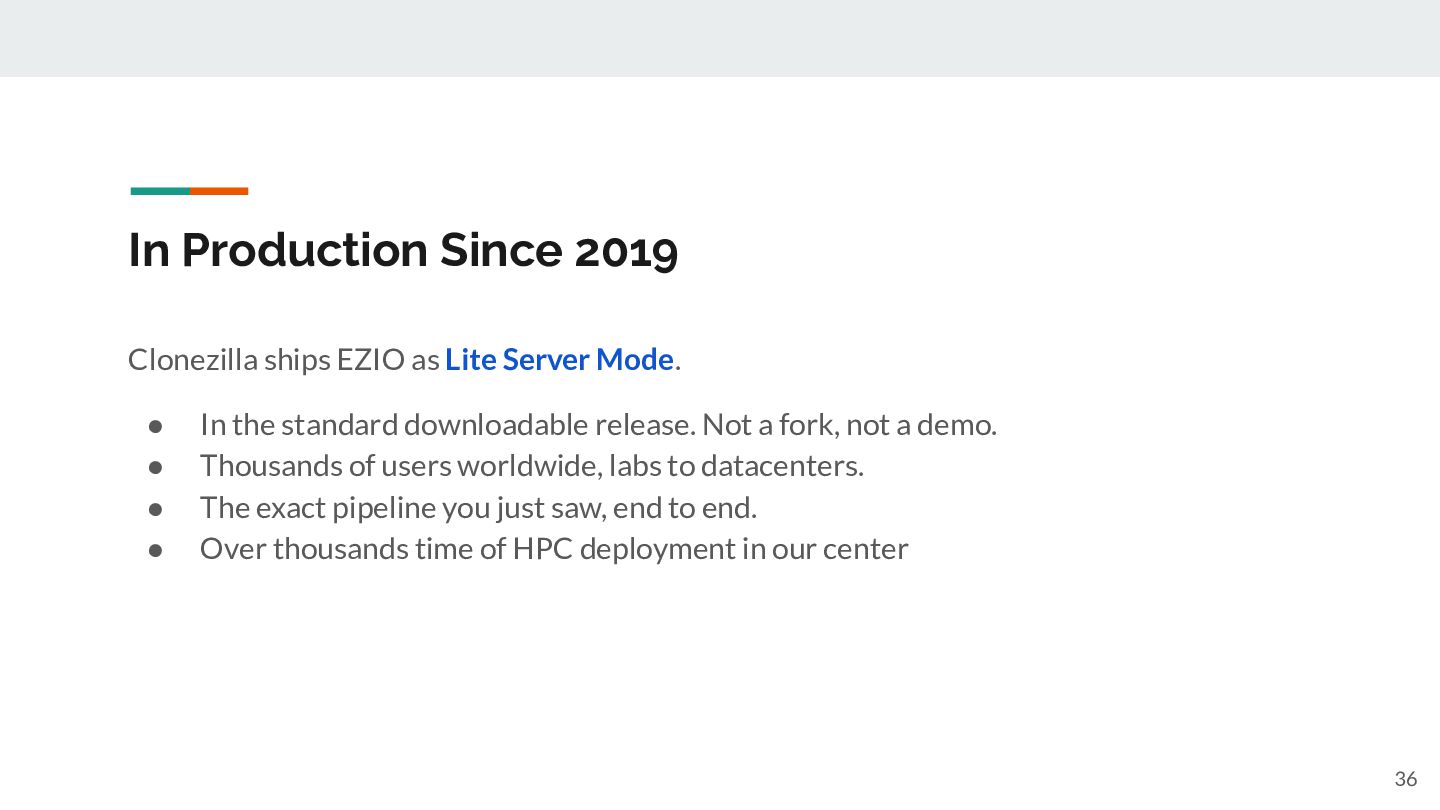
  20. In Production Since 2019 Clonezilla ships EZIO as Lite Server

    Mode. • • • • In the standard downloadable release. Not a fork, not a demo. Thousands of users worldwide, labs to datacenters. The exact pipeline you just saw, end to end. Over thousands time of HPC deployment in our center 36
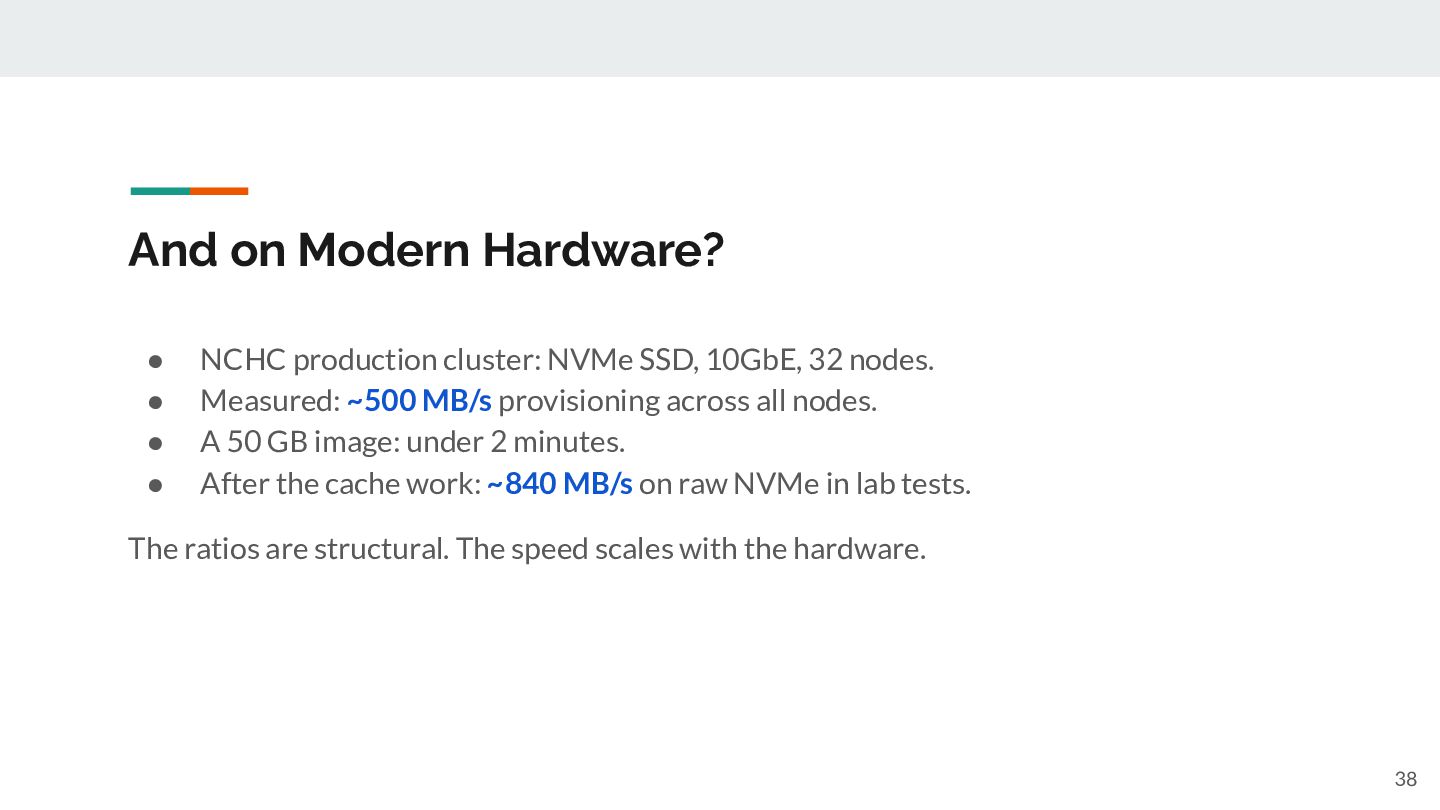
  21. And on Modern Hardware? • • • • NCHC production

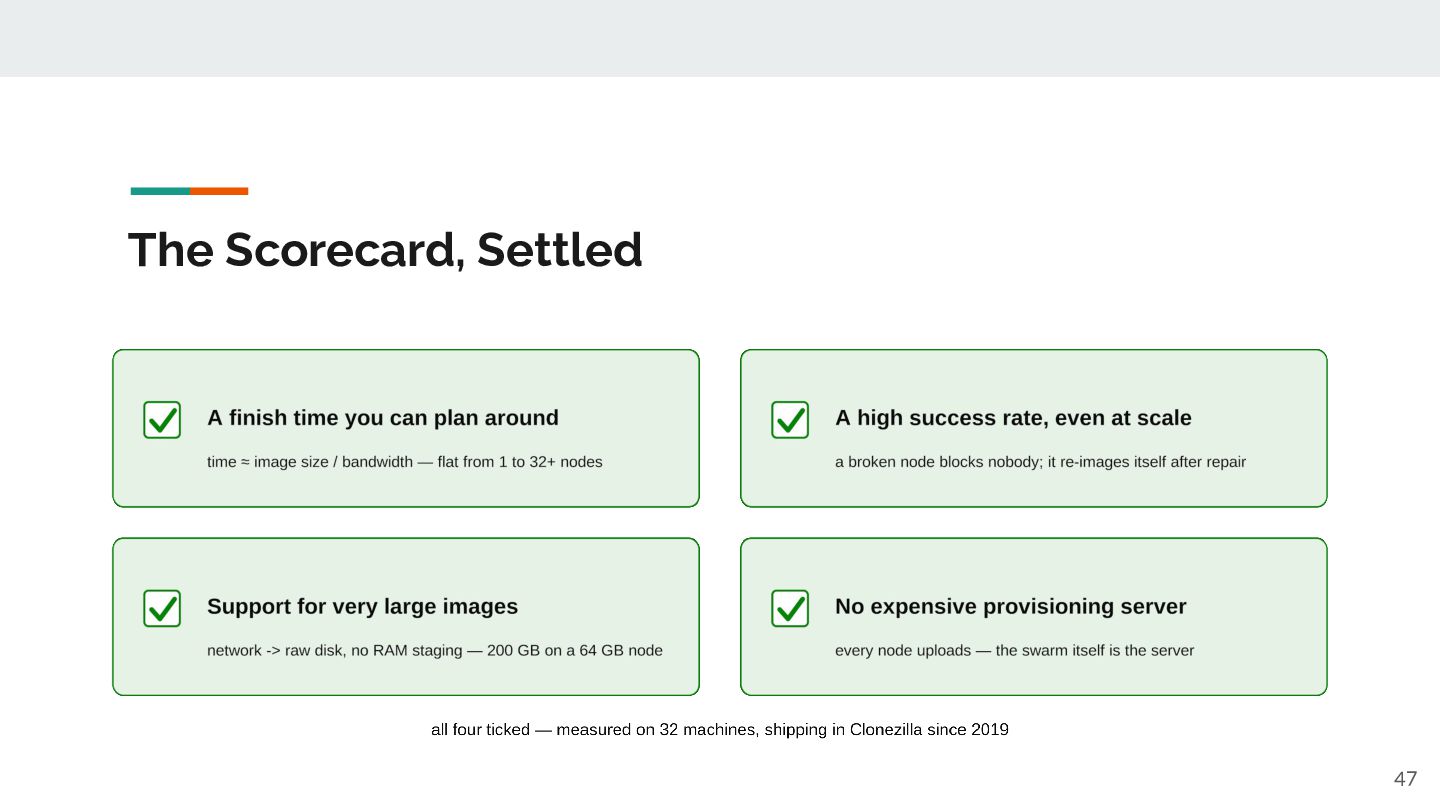
    cluster: NVMe SSD, 10GbE, 32 nodes. Measured: ~500 MB/s provisioning across all nodes. A 50 GB image: under 2 minutes. After the cache work: ~840 MB/s on raw NVMe in lab tests. The ratios are structural. The speed scales with the hardware. 38
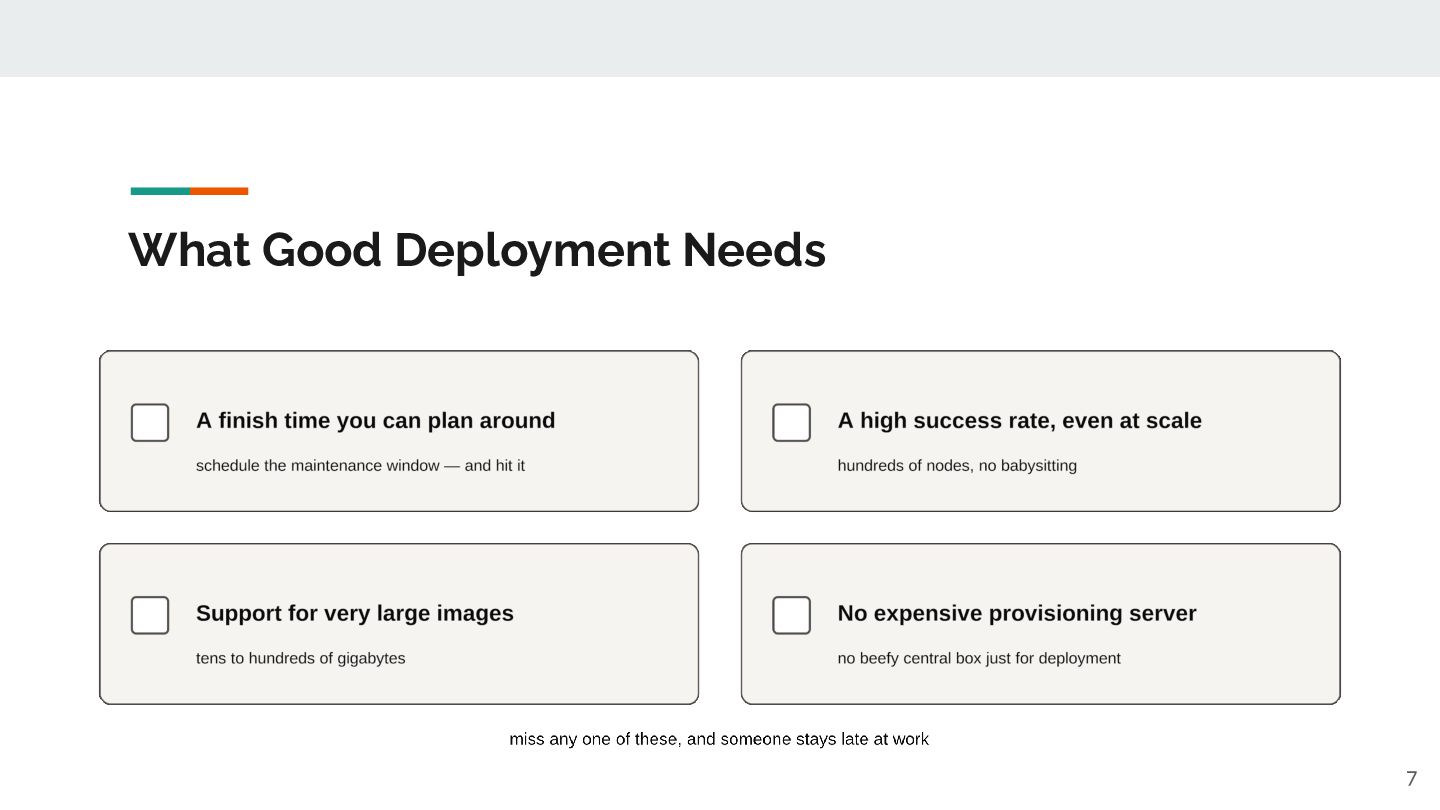
  22. What "Predictable" Means Provisioning time became a property of the

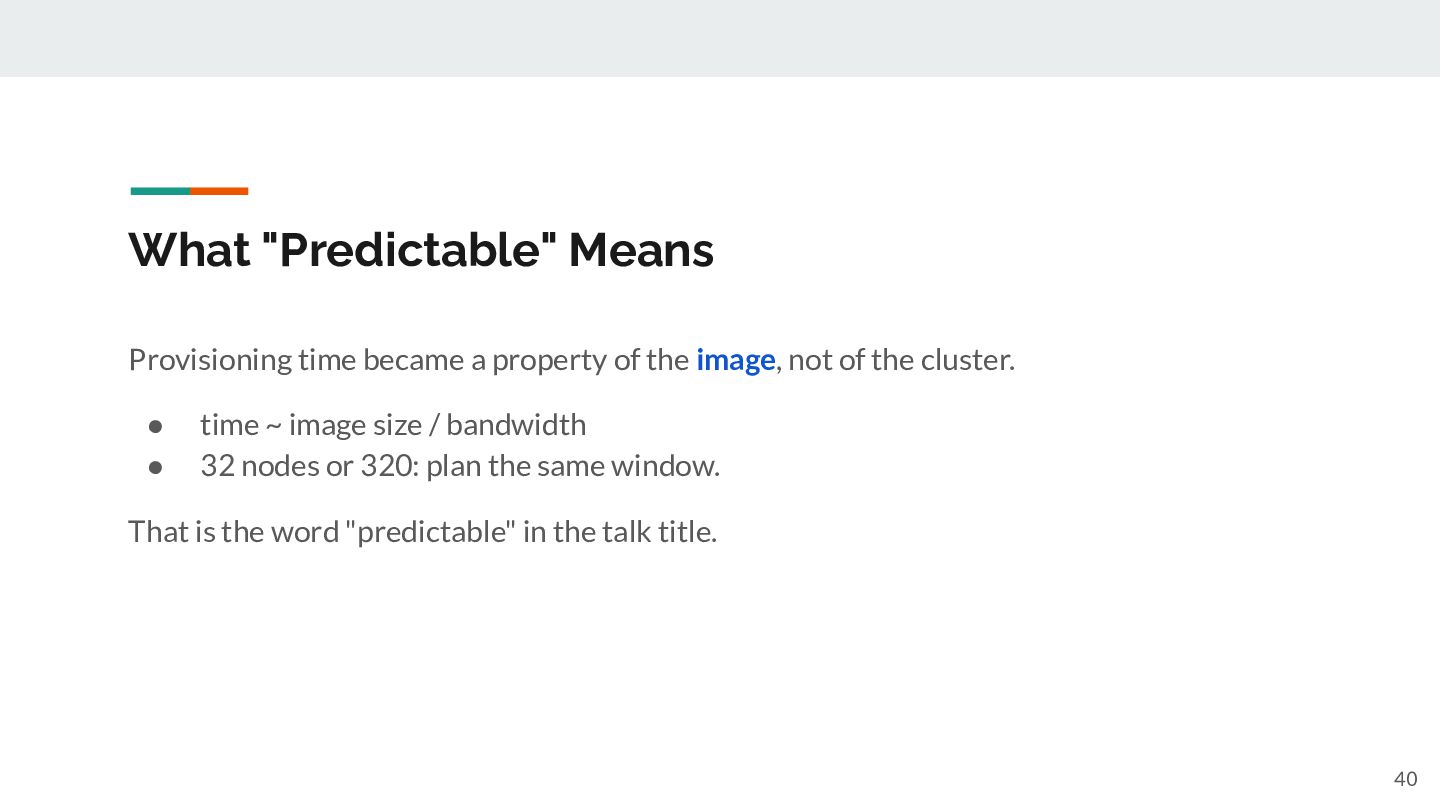
    image, not of the cluster. • • time ~ image size / bandwidth 32 nodes or 320: plan the same window. That is the word "predictable" in the talk title. 40
  23. A Broken Node Blocks Nobody • • • A node

    crashes mid-download? It just drops out. Everyone else keeps going - no single point of failure. After repair it reannounces to the tracker and re-images itself from nodes that already finished. Remember: AI clusters lose a node every ~3 hours. This failure model is exactly the one they live with. 42
  24. Free Relays: Any Stock BT Client The torrent is 100%

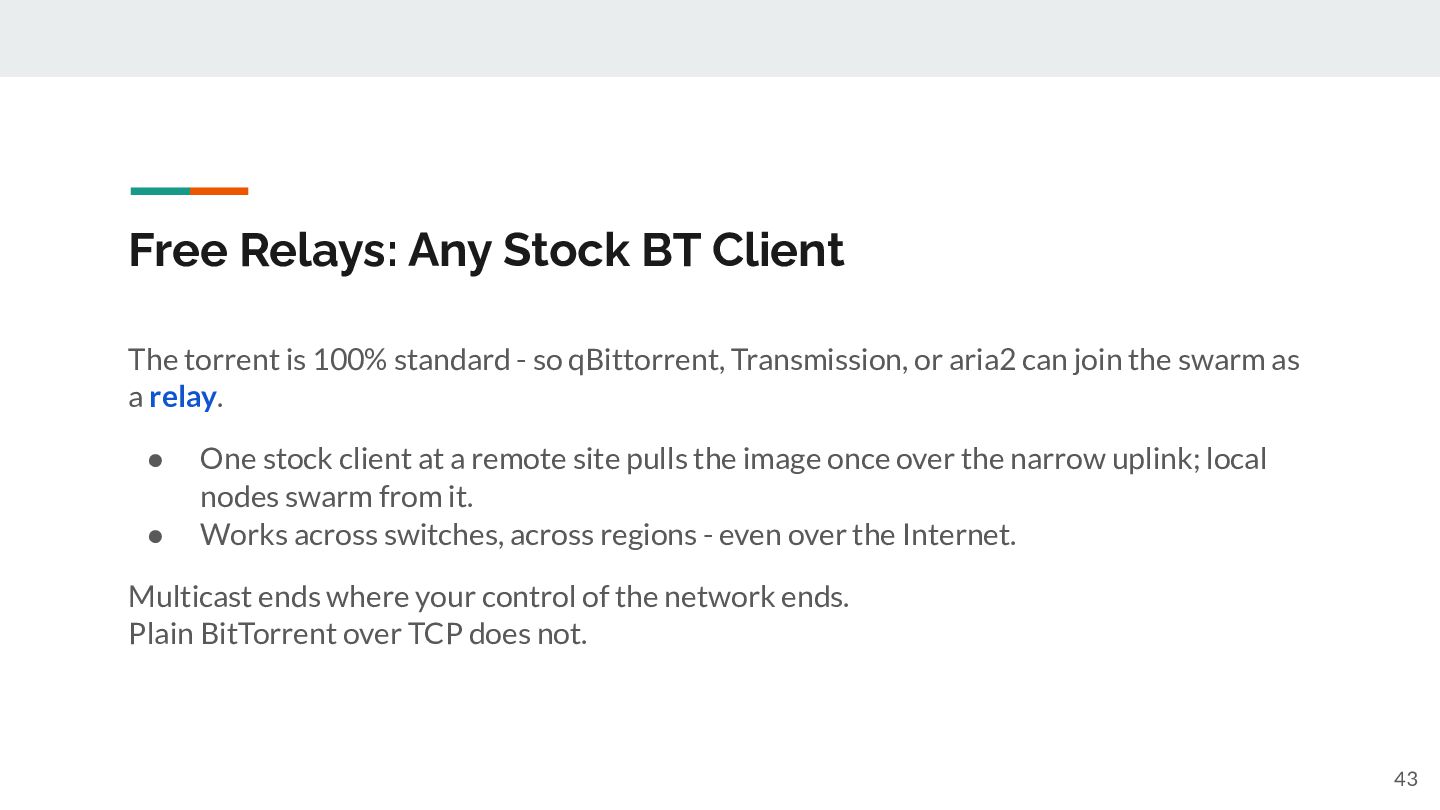
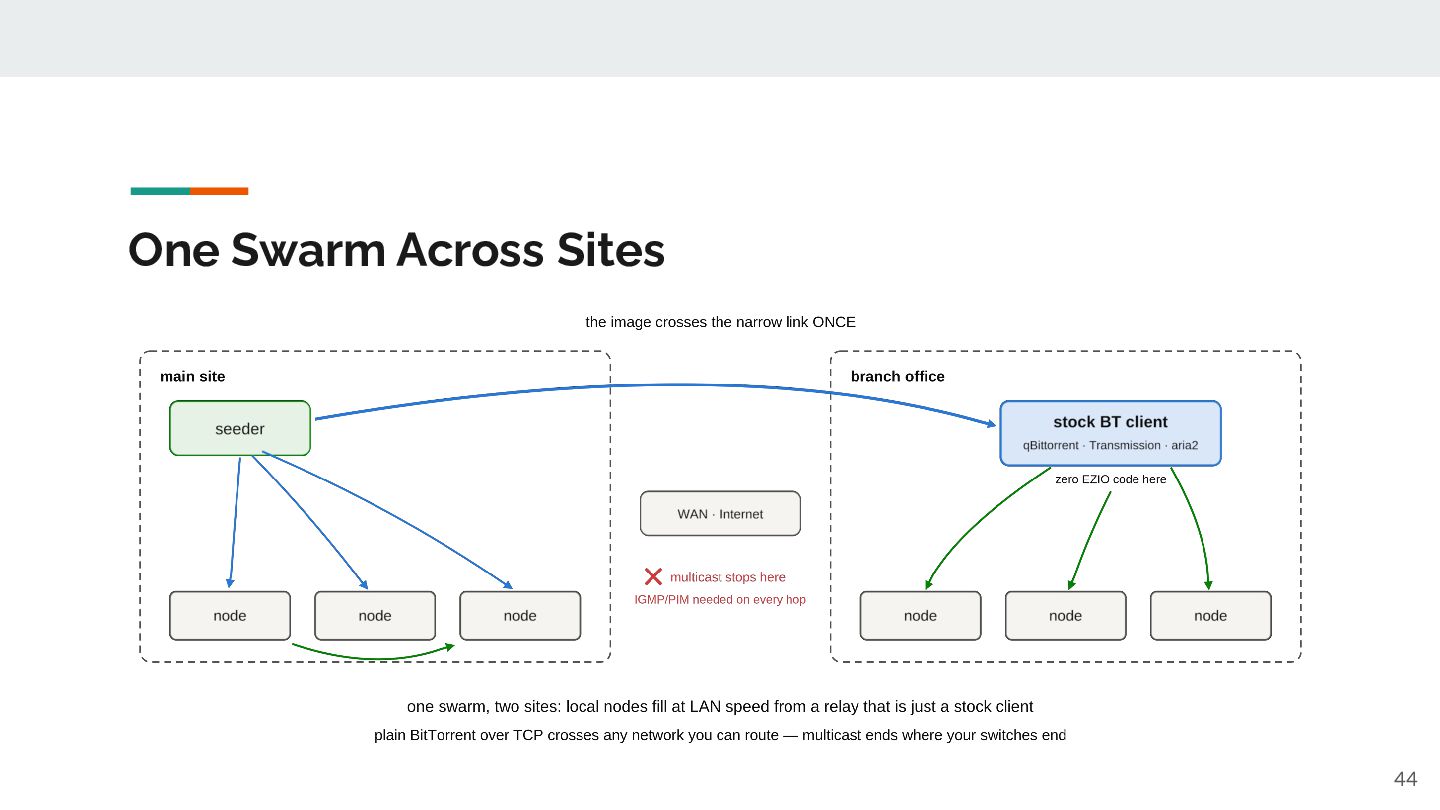
    standard - so qBittorrent, Transmission, or aria2 can join the swarm as a relay. • • One stock client at a remote site pulls the image once over the narrow uplink; local nodes swarm from it. Works across switches, across regions - even over the Internet. Multicast ends where your control of the network ends. Plain BitTorrent over TCP does not. 43
  25. Adopting EZIO: Four Steps 1. 2. 3. 4. Boot a

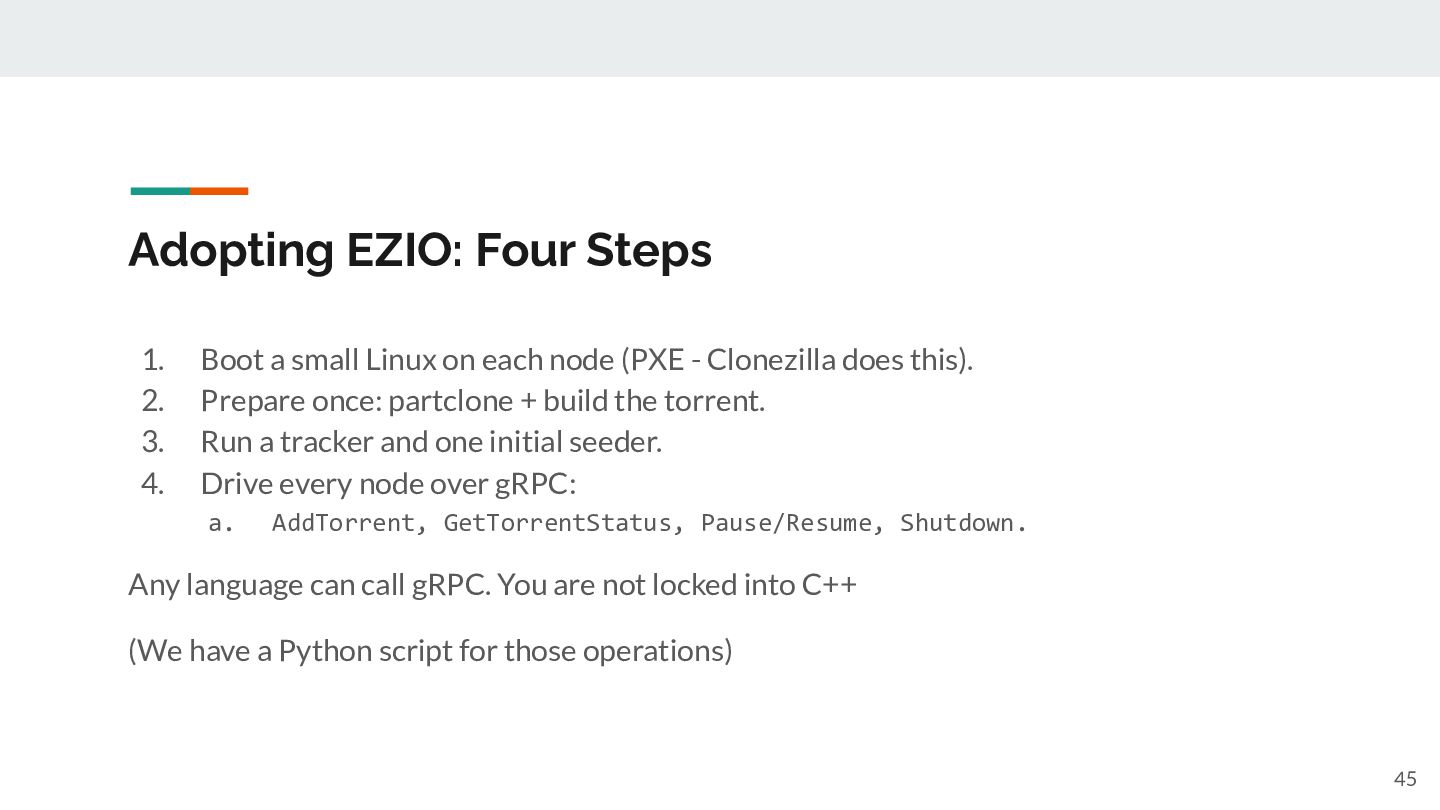
    small Linux on each node (PXE - Clonezilla does this). Prepare once: partclone + build the torrent. Run a tracker and one initial seeder. Drive every node over gRPC: a. AddTorrent, GetTorrentStatus, Pause/Resume, Shutdown. Any language can call gRPC. You are not locked into C++ (We have a Python script for those operations) 45
  26. What You Do NOT Need • • • • •

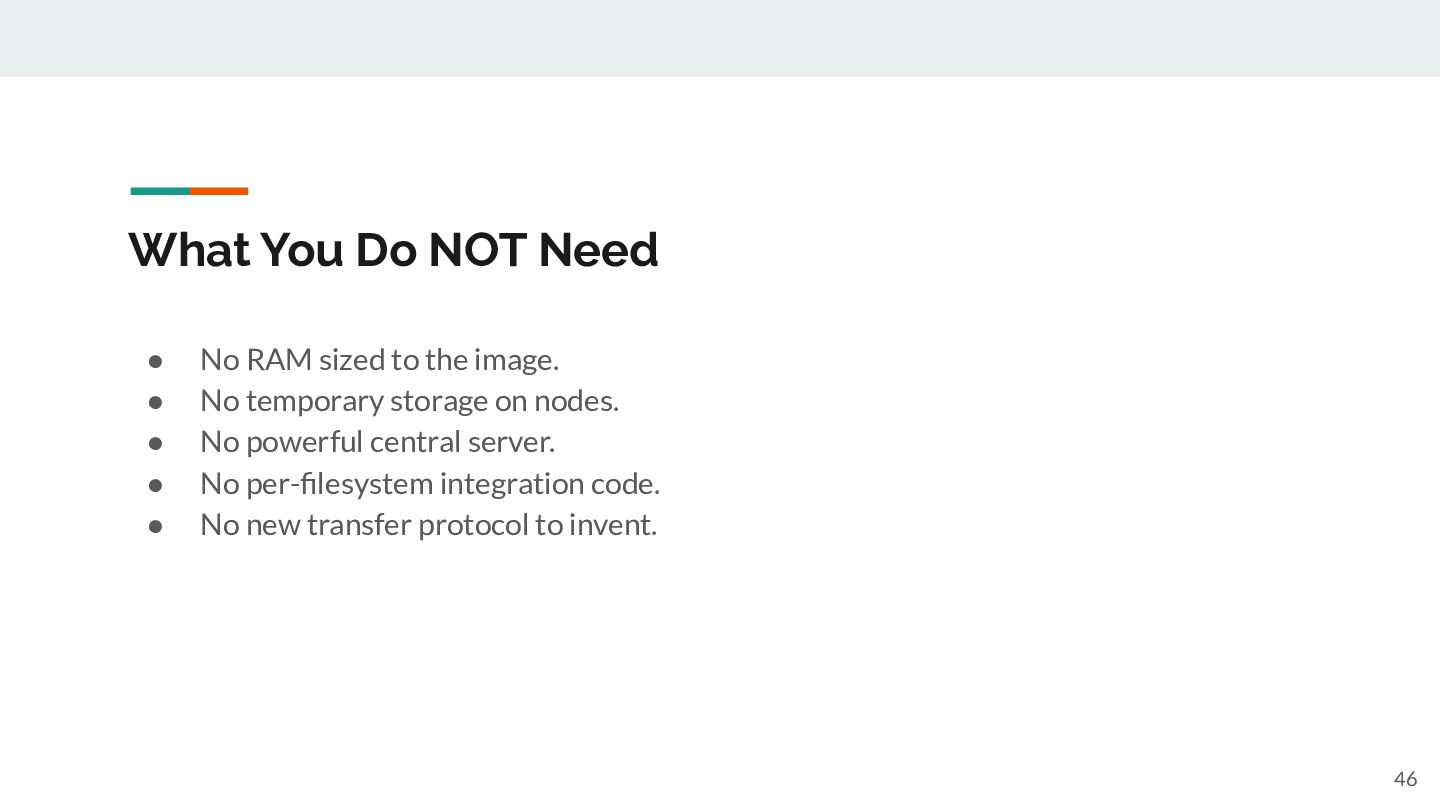
    No RAM sized to the image. No temporary storage on nodes. No powerful central server. No per-filesystem integration code. No new transfer protocol to invent. 46
  27. The Evidence Base • • • Applied Sciences (2019) -

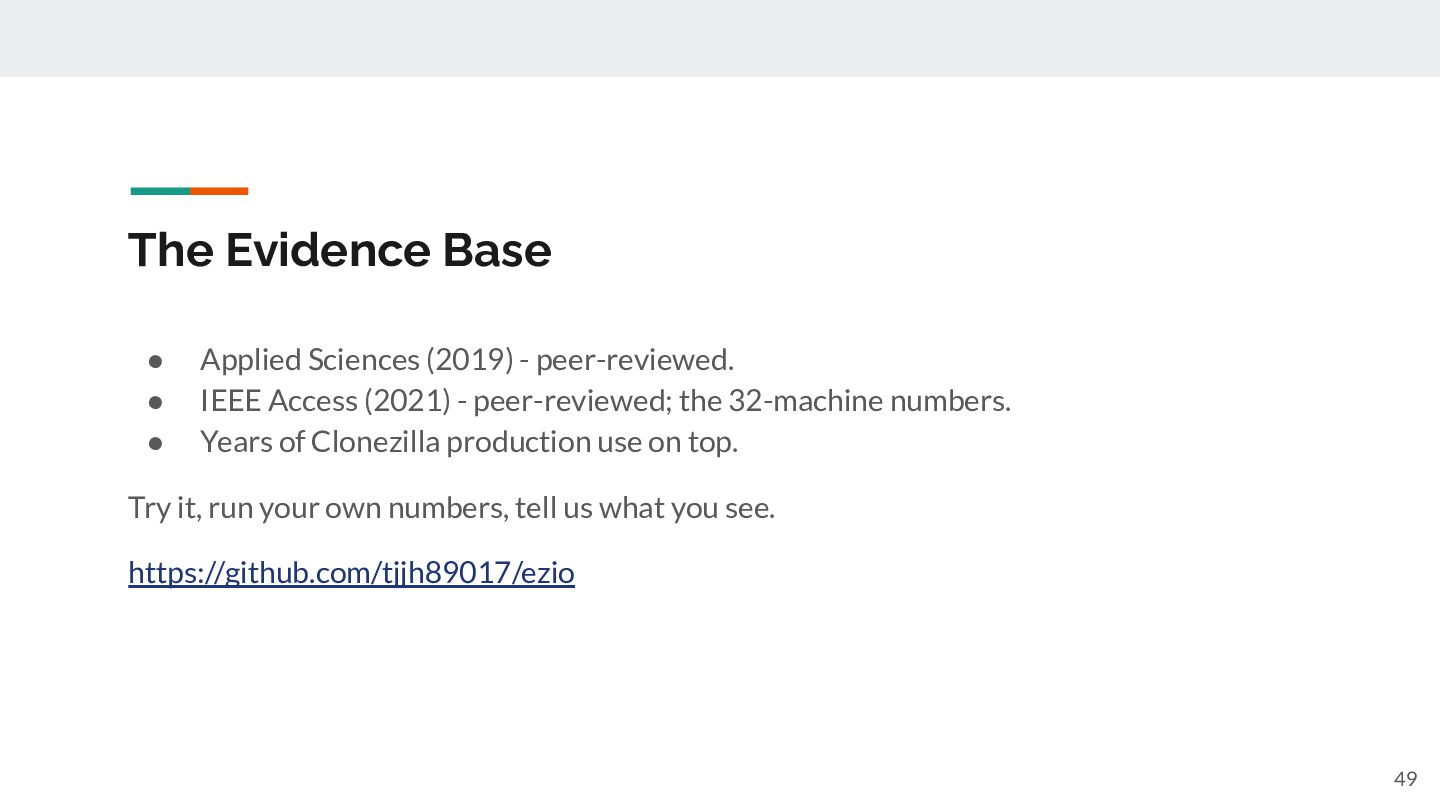
    peer-reviewed. IEEE Access (2021) - peer-reviewed; the 32-machine numbers. Years of Clonezilla production use on top. Try it, run your own numbers, tell us what you see. https://github.com/tjjh89017/ezio 49
  28. EZIO in Five Lines • • • • • Torrent

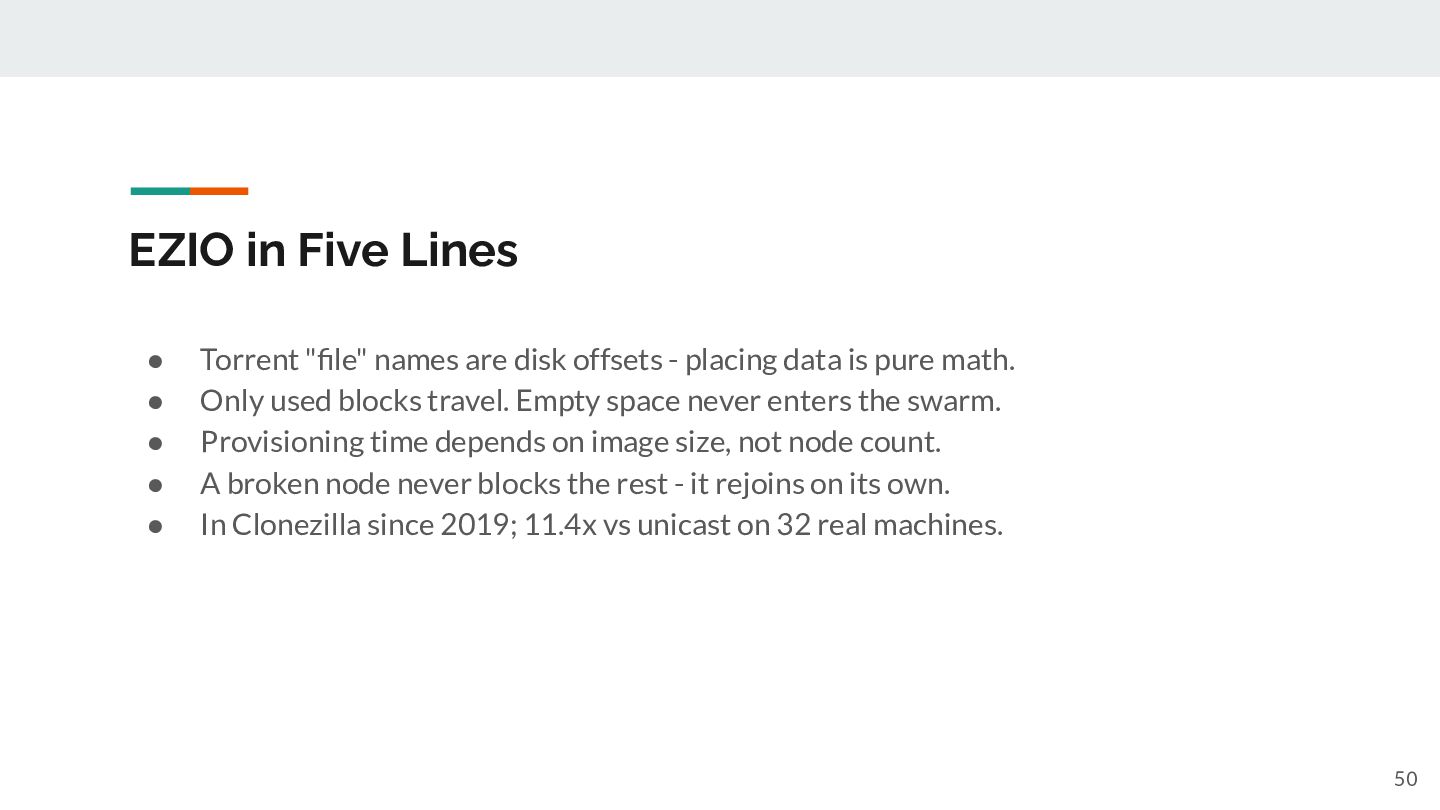
    "file" names are disk offsets - placing data is pure math. Only used blocks travel. Empty space never enters the swarm. Provisioning time depends on image size, not node count. A broken node never blocks the rest - it rejoins on its own. In Clonezilla since 2019; 11.4x vs unicast on 32 real machines. 50
  29. Who Should Pick This Up • • • Provisioning platforms:

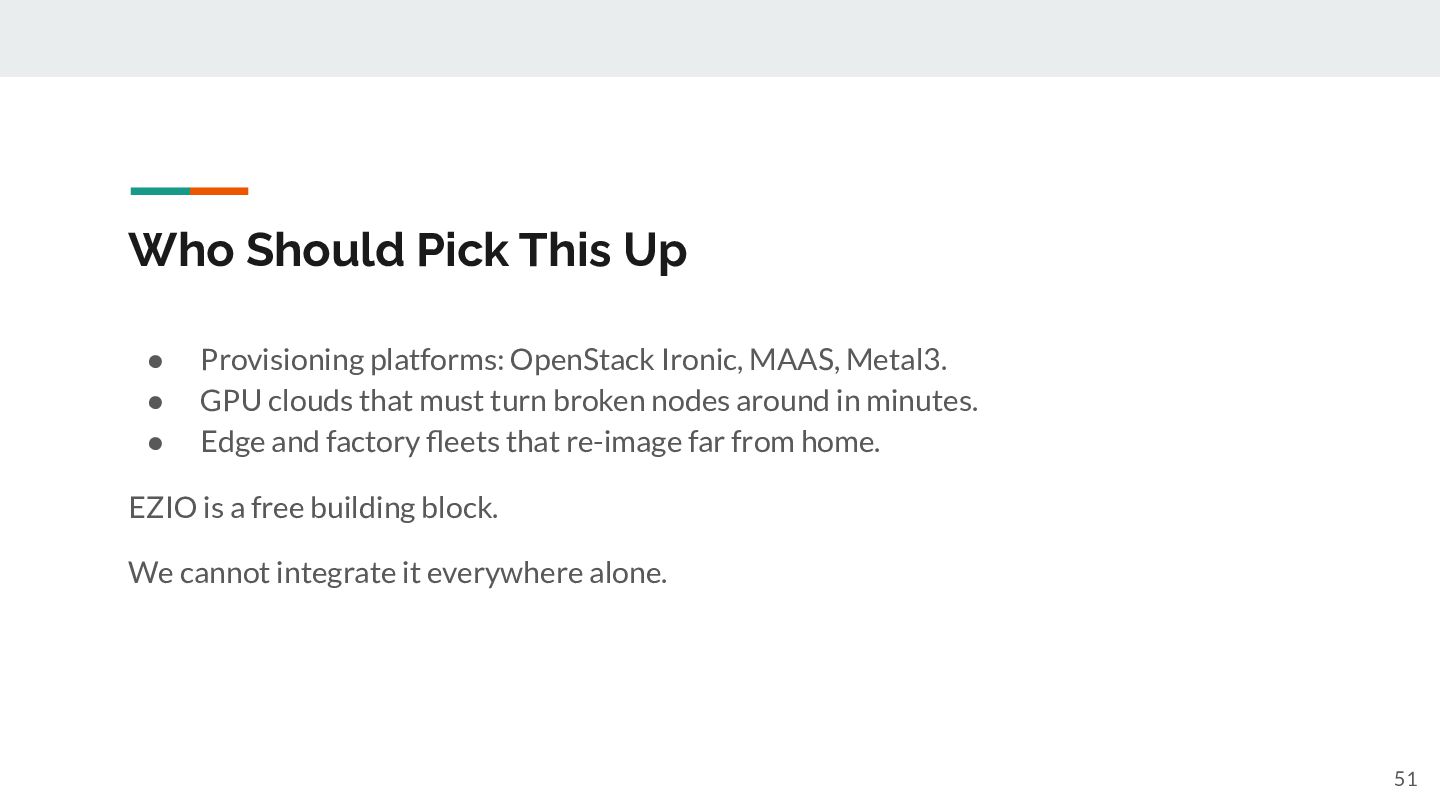
    OpenStack Ironic, MAAS, Metal3. GPU clouds that must turn broken nodes around in minutes. Edge and factory fleets that re-image far from home. EZIO is a free building block. We cannot integrate it everywhere alone. 51
  30. Special Thanks • National Center for High-performance Computing, NIAR, Taiwan

    ◦ We deployed the clusters with Clonezilla Bittorrent mode for several years 52
  31. Thank You - Questions? EZIO: Predictable, Fast, Scalable BitTorrent-Based Bare

    Metal Provisioning Date Huang Find me after the session, or contact me via Linkedin I would love to hear about your cluster. Also, please help me to start my project. https://github.com/tjjh89017/ezio Linkedin 53