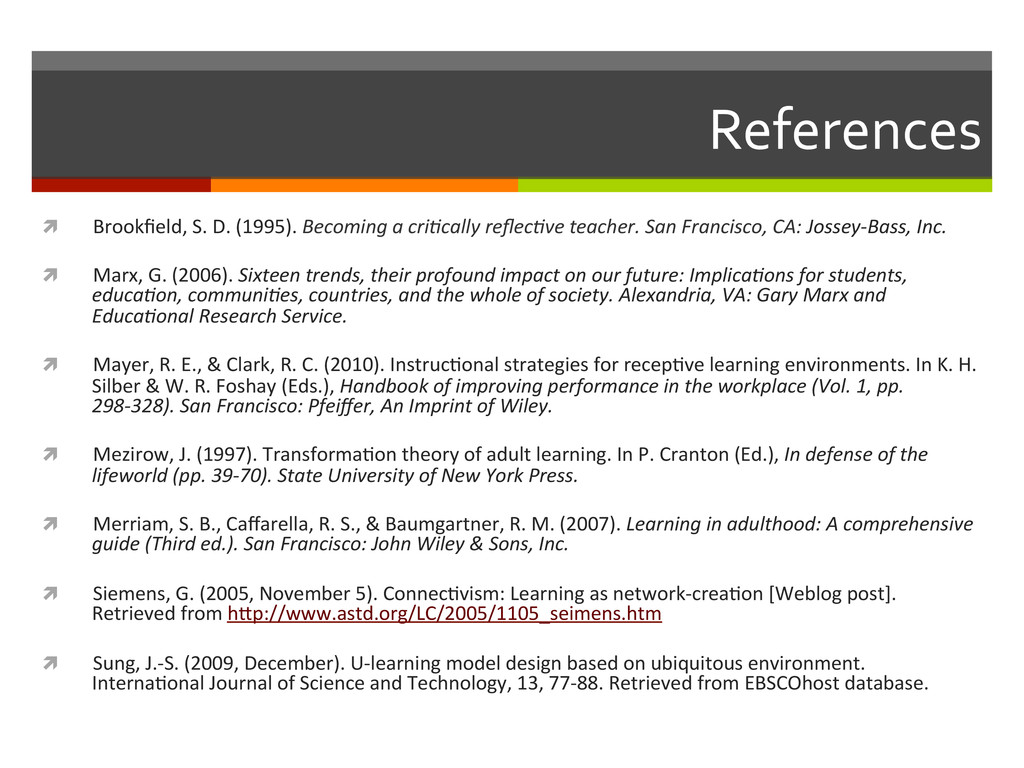
reflec,ve teacher. San Francisco, CA: Jossey-‐Bass, Inc. ì Marx, G. (2006). Sixteen trends, their profound impact on our future: Implica,ons for students, educa,on, communi,es, countries, and the whole of society. Alexandria, VA: Gary Marx and Educa,onal Research Service. ì Mayer, R. E., & Clark, R. C. (2010). Instruc=onal strategies for recep=ve learning environments. In K. H. Silber & W. R. Foshay (Eds.), Handbook of improving performance in the workplace (Vol. 1, pp. 298-‐328). San Francisco: Pfeiffer, An Imprint of Wiley. ì Mezirow, J. (1997). Transforma=on theory of adult learning. In P. Cranton (Ed.), In defense of the lifeworld (pp. 39-‐70). State University of New York Press. ì Merriam, S. B., Caffarella, R. S., & Baumgartner, R. M. (2007). Learning in adulthood: A comprehensive guide (Third ed.). San Francisco: John Wiley & Sons, Inc. ì Siemens, G. (2005, November 5). Connec=vism: Learning as network-‐crea=on [Weblog post]. Retrieved from hop://www.astd.org/LC/2005/1105_seimens.htm ì Sung, J.-‐S. (2009, December). U-‐learning model design based on ubiquitous environment. Interna=onal Journal of Science and Technology, 13, 77-‐88. Retrieved from EBSCOhost database.


 terasawat
 madhuri28
 juanmartin2026
 akiraasano
 kentaroy47
 hiola
hiola
 ainischool
 mariooc
 kekekenta
 frievea
 signer
 pedronauck
 inesmontani
 soudai
 frankvandijk
 csswizardry
 tessaabrams
 marktimemedia
 pwiseman
 shpigford
 tapps
tapps
 axbom
axbom
 davidcarrasco