bring you the 2013-2014 edition of the Turkey Software Quality Report(TSQR). Former reports were distributed not only in Turkey but also in more than 70 countries through ISTQB (International Software Testing Qualifications Board - istqb.org) member boards. This report aims to gauge the trends in software quality in Turkey and contribute to the initiatives taken for the improvement of software quality in all over the world. The report is designed to help companies to make paradigm shifts in their mindsets. It not only draws a clear picture of the current situation in the Turkish market but also sets the de facto standards and trends for future information technology (IT) projects. This kind of a report will be a reference point for all decision makers. With the help of TSQR, we are trying to lay down the foundations of a healthy discussion platform for the improvement; Turkish IT market. TSQR will be presented at the opening ceremony speech of TestIstanbul 2013(testistanbul.org) on May 23rd initiating a series of keynotes, presentations and discussions during the two-day conference. We would like to thank all TTB members and professionals who took their time to complete the survey and contribute to this report. We are looking forward to meeting with you at TestIstanbul 2013 with this year’s motto of ‘Future of Testing: New Techniques and Methodologies’ on May 23rd, 24th and discuss the findings of this report face to face. TurkishTesting Board TURKEY SOFTWARE QUALITY REPORT 2013-2014 03
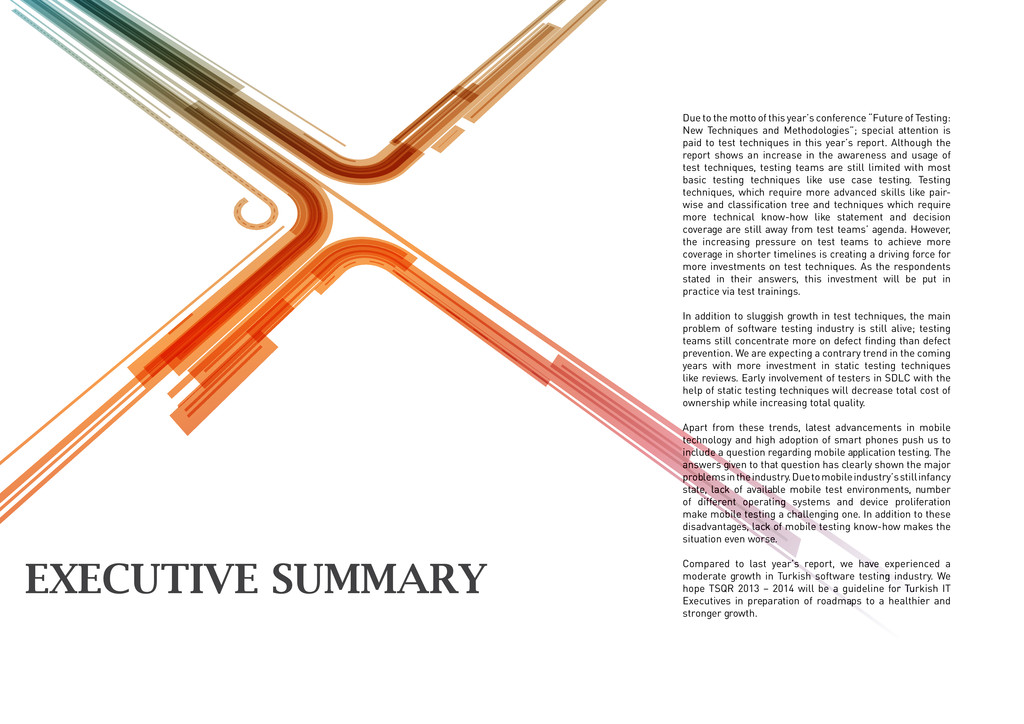
“Future of Testing: New Techniques and Methodologies”; special attention is paid to test techniques in this year’s report. Although the report shows an increase in the awareness and usage of test techniques, testing teams are still limited with most basic testing techniques like use case testing. Testing techniques, which require more advanced skills like pair- wise and classification tree and techniques which require more technical know-how like statement and decision coverage are still away from test teams’ agenda. However, the increasing pressure on test teams to achieve more coverage in shorter timelines is creating a driving force for more investments on test techniques. As the respondents stated in their answers, this investment will be put in practice via test trainings. In addition to sluggish growth in test techniques, the main problem of software testing industry is still alive; testing teams still concentrate more on defect finding than defect prevention. We are expecting a contrary trend in the coming years with more investment in static testing techniques like reviews. Early involvement of testers in SDLC with the help of static testing techniques will decrease total cost of ownership while increasing total quality. Apart from these trends, latest advancements in mobile technology and high adoption of smart phones push us to include a question regarding mobile application testing. The answers given to that question has clearly shown the major problems in the industry. Due to mobile industry’s still infancy state, lack of available mobile test environments, number of different operating systems and device proliferation make mobile testing a challenging one. In addition to these disadvantages, lack of mobile testing know-how makes the situation even worse. Compared to last year’s report, we have experienced a moderate growth in Turkish software testing industry. We hope TSQR 2013 – 2014 will be a guideline for Turkish IT Executives in preparation of roadmaps to a healthier and stronger growth. TURKEY SOFTWARE QUALITY REPORT 2013-2014 05
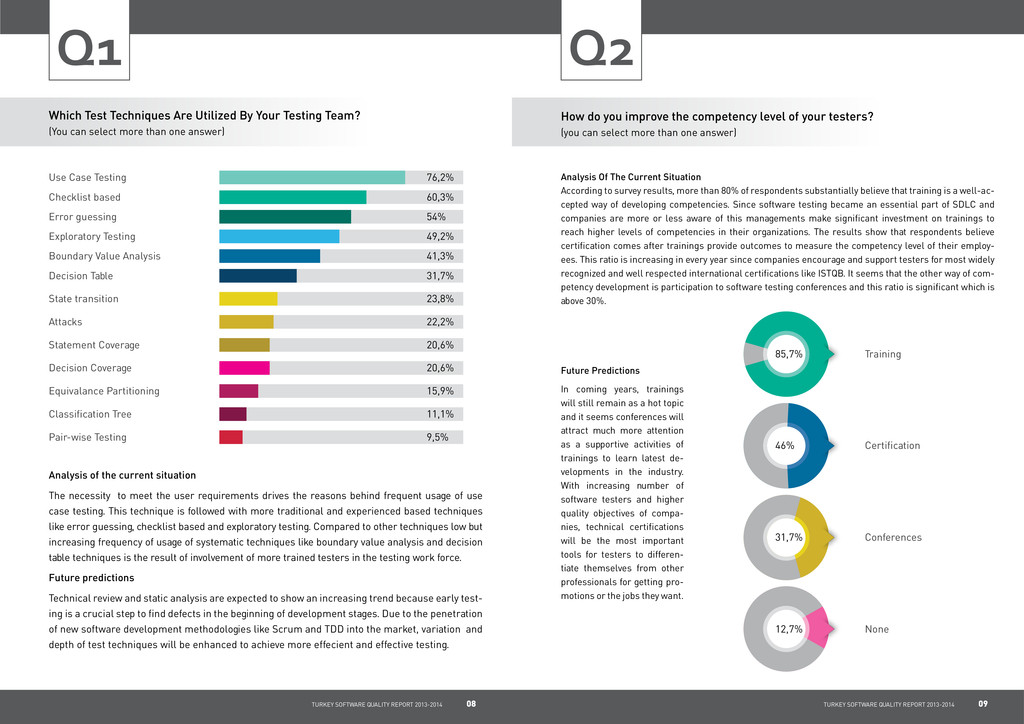
can select more than one answer) Analysis of the current situation The necessity to meet the user requirements drives the reasons behind frequent usage of use case testing. This technique is followed with more traditional and experienced based techniques like error guessing, checklist based and exploratory testing. Compared to other techniques low but increasing frequency of usage of systematic techniques like boundary value analysis and decision table techniques is the result of involvement of more trained testers in the testing work force. Future predictions Technical review and static analysis are expected to show an increasing trend because early test- ing is a crucial step to find defects in the beginning of development stages. Due to the penetration of new software development methodologies like Scrum and TDD into the market, variation and depth of test techniques will be enhanced to achieve more effecient and effective testing. Error guessing 54% Checklist based 60,3% Attacks 22,2% Exploratory Testing 49,2% Equivalance Partitioning 15,9% Boundary Value Analysis 41,3% Decision Table 31,7% Use Case Testing 76,2% State transition 23,8% Pair-wise Testing 9,5% Classification Tree 11,1% Statement Coverage 20,6% Decision Coverage 20,6% TURKEY SOFTWARE QUALITY REPORT 2013-2014 08 Q1 TURKEY SOFTWARE QUALITY REPORT 2013-2014 09 How do you improve the competency level of your testers? (you can select more than one answer) Analysis Of The Current Situation According to survey results, more than 80% of respondents substantially believe that training is a well-ac- cepted way of developing competencies. Since software testing became an essential part of SDLC and companies are more or less aware of this managements make significant investment on trainings to reach higher levels of competencies in their organizations. The results show that respondents believe certification comes after trainings provide outcomes to measure the competency level of their employ- ees. This ratio is increasing in every year since companies encourage and support testers for most widely recognized and well respected international certifications like ISTQB. It seems that the other way of com- petency development is participation to software testing conferences and this ratio is significant which is above 30%. Future Predictions In coming years, trainings will still remain as a hot topic and it seems conferences will attract much more attention as a supportive activities of trainings to learn latest de- velopments in the industry. With increasing number of software testers and higher quality objectives of compa- nies, technical certifications will be the most important tools for testers to differen- tiate themselves from other professionals for getting pro- motions or the jobs they want. Training 85,7% Certification 46% Conferences 31,7% None 12,7% Q2
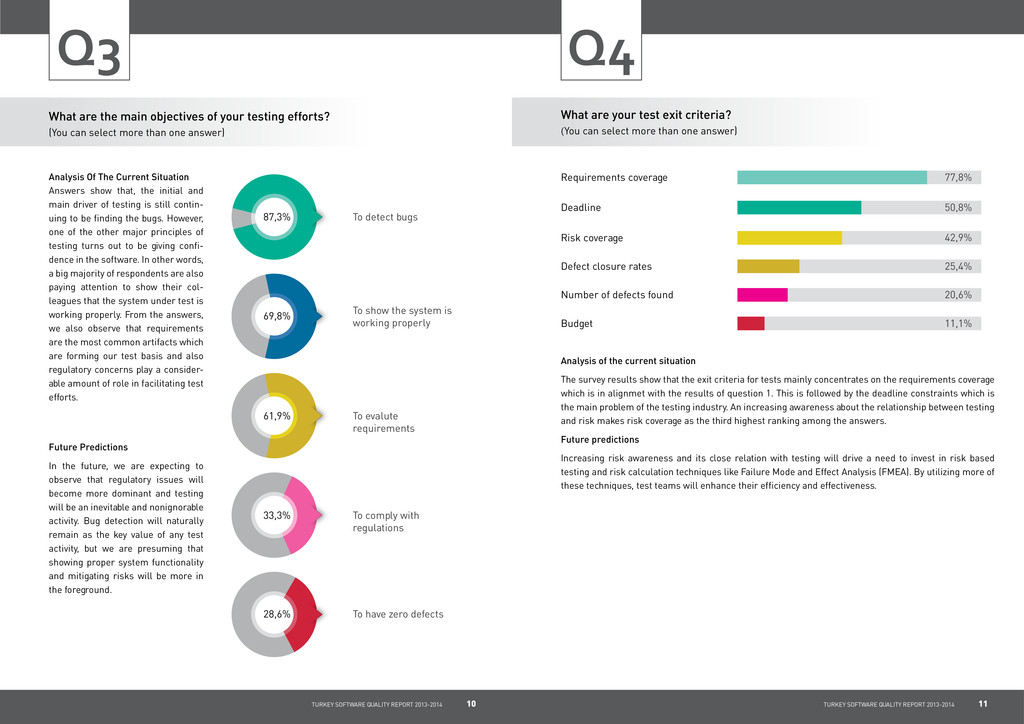
and main driver of testing is still contin- uing to be finding the bugs. However, one of the other major principles of testing turns out to be giving confi- dence in the software. In other words, a big majority of respondents are also paying attention to show their col- leagues that the system under test is working properly. From the answers, we also observe that requirements are the most common artifacts which are forming our test basis and also regulatory concerns play a consider- able amount of role in facilitating test efforts. Future Predictions In the future, we are expecting to observe that regulatory issues will become more dominant and testing will be an inevitable and nonignorable activity. Bug detection will naturally remain as the key value of any test activity, but we are presuming that showing proper system functionality and mitigating risks will be more in the foreground. TURKEY SOFTWARE QUALITY REPORT 2013-2014 10 What are the main objectives of your testing efforts? (You can select more than one answer) To detect bugs 87,3% Q3 To have zero defects 28,6% To comply with regulations 33,3% To evalute requirements 61,9% To show the system is working properly 69,8% Q4 What are your test exit criteria? (You can select more than one answer) TURKEY SOFTWARE QUALITY REPORT 2013-2014 11 Requirements coverage 77,8% Risk coverage 42,9% Deadline 50,8% Number of defects found 20,6% Budget 11,1% Defect closure rates 25,4% Analysis of the current situation The survey results show that the exit criteria for tests mainly concentrates on the requirements coverage which is in alignmet with the results of question 1. This is followed by the deadline constraints which is the main problem of the testing industry. An increasing awareness about the relationship between testing and risk makes risk coverage as the third highest ranking among the answers. Future predictions Increasing risk awareness and its close relation with testing will drive a need to invest in risk based testing and risk calculation techniques like Failure Mode and Effect Analysis (FMEA). By utilizing more of these techniques, test teams will enhance their efficiency and effectiveness.
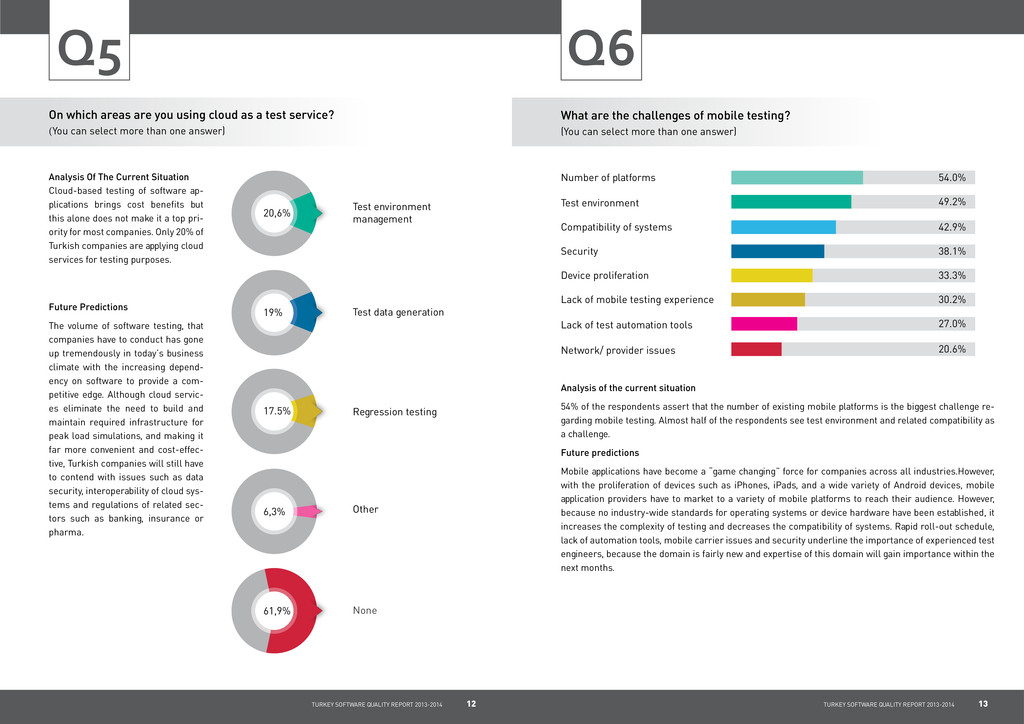
service? (You can select more than one answer) Q5 TURKEY SOFTWARE QUALITY REPORT 2013-2014 12 None 61,9% Other 6,3% Test environment management 20,6% Regression testing 17.5% Test data generation 19% Analysis Of The Current Situation Cloud-based testing of software ap- plications brings cost benefits but this alone does not make it a top pri- ority for most companies. Only 20% of Turkish companies are applying cloud services for testing purposes. Future Predictions The volume of software testing, that companies have to conduct has gone up tremendously in today’s business climate with the increasing depend- ency on software to provide a com- petitive edge. Although cloud servic- es eliminate the need to build and maintain required infrastructure for peak load simulations, and making it far more convenient and cost-effec- tive, Turkish companies will still have to contend with issues such as data security, interoperability of cloud sys- tems and regulations of related sec- tors such as banking, insurance or pharma. What are the challenges of mobile testing? (You can select more than one answer) TURKEY SOFTWARE QUALITY REPORT 2013-2014 13 Q6 Device proliferation 33.3% Number of platforms 54.0% Lack of mobile testing experience 30.2% Compatibility of systems 42.9% Lack of test automation tools 27.0% Security 38.1% Network/ provider issues 20.6% Test environment 49.2% Analysis of the current situation 54% of the respondents assert that the number of existing mobile platforms is the biggest challenge re- garding mobile testing. Almost half of the respondents see test environment and related compatibility as a challenge. Future predictions Mobile applications have become a “game changing” force for companies across all industries.However, with the proliferation of devices such as iPhones, iPads, and a wide variety of Android devices, mobile application providers have to market to a variety of mobile platforms to reach their audience. However, because no industry-wide standards for operating systems or device hardware have been established, it increases the complexity of testing and decreases the compatibility of systems. Rapid roll-out schedule, lack of automation tools, mobile carrier issues and security underline the importance of experienced test engineers, because the domain is fairly new and expertise of this domain will gain importance within the next months.
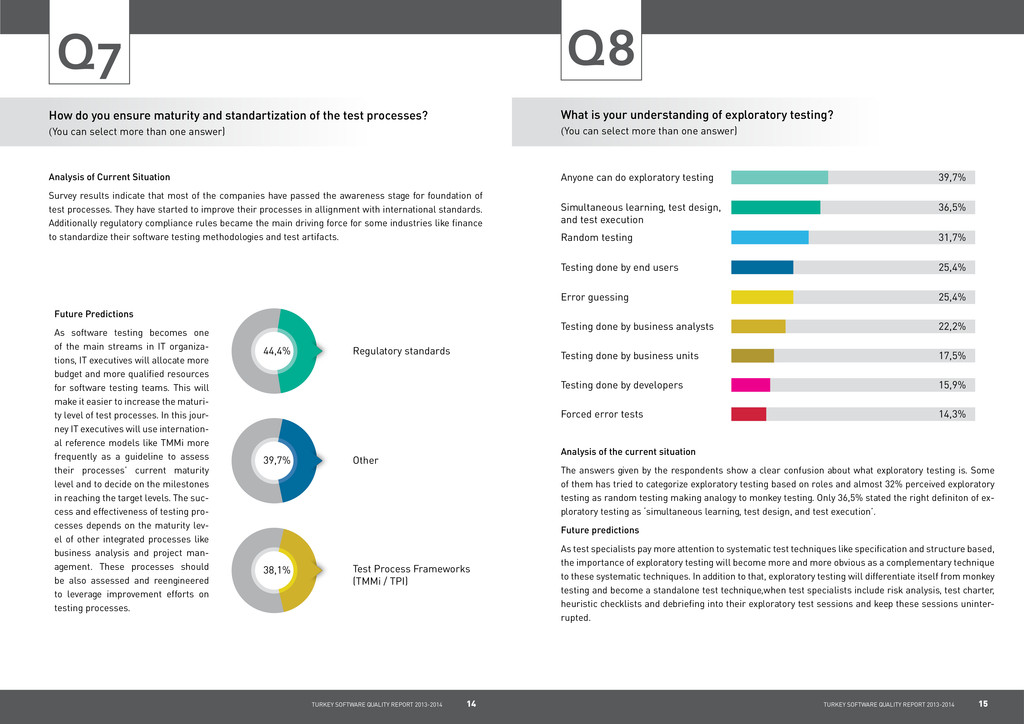
maturity and standartization of the test processes? (You can select more than one answer) Q7 Regulatory standards 44,4% Analysis of Current Situation Survey results indicate that most of the companies have passed the awareness stage for foundation of test processes. They have started to improve their processes in allignment with international standards. Additionally regulatory compliance rules became the main driving force for some industries like finance to standardize their software testing methodologies and test artifacts. Test Process Frameworks (TMMi / TPI) 38,1% Other 39,7% Future Predictions As software testing becomes one of the main streams in IT organiza- tions, IT executives will allocate more budget and more qualified resources for software testing teams. This will make it easier to increase the maturi- ty level of test processes. In this jour- ney IT executives will use internation- al reference models like TMMi more frequently as a guideline to assess their processes’ current maturity level and to decide on the milestones in reaching the target levels. The suc- cess and effectiveness of testing pro- cesses depends on the maturity lev- el of other integrated processes like business analysis and project man- agement. These processes should be also assessed and reengineered to leverage improvement efforts on testing processes. Q8 What is your understanding of exploratory testing? (You can select more than one answer) TURKEY SOFTWARE QUALITY REPORT 2013-2014 15 Testing done by end users 25,4% Testing done by business units 17,5% Testing done by business analysts 22,2% Anyone can do exploratory testing 39,7% Random testing 31,7% Simultaneous learning, test design, and test execution 36,5% Testing done by developers 15,9% Error guessing 25,4% Forced error tests 14,3% Analysis of the current situation The answers given by the respondents show a clear confusion about what exploratory testing is. Some of them has tried to categorize exploratory testing based on roles and almost 32% perceived exploratory testing as random testing making analogy to monkey testing. Only 36,5% stated the right definiton of ex- ploratory testing as ‘simultaneous learning, test design, and test execution’. Future predictions As test specialists pay more attention to systematic test techniques like specification and structure based, the importance of exploratory testing will become more and more obvious as a complementary technique to these systematic techniques. In addition to that, exploratory testing will differentiate itself from monkey testing and become a standalone test technique,when test specialists include risk analysis, test charter, heuristic checklists and debriefing into their exploratory test sessions and keep these sessions uninter- rupted.
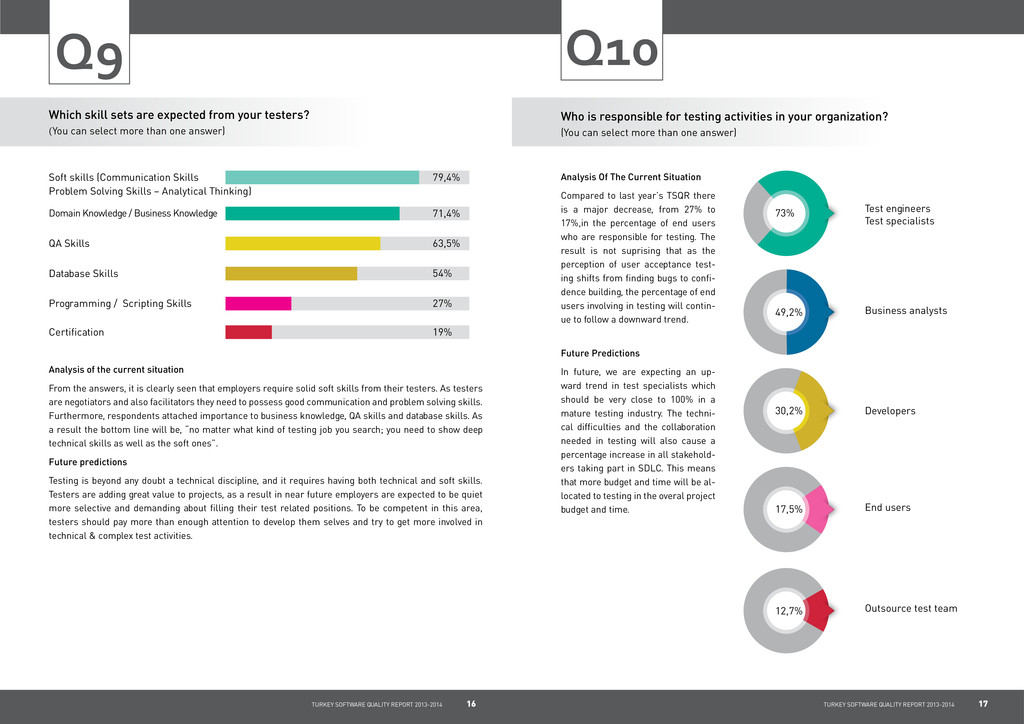
can select more than one answer) TURKEY SOFTWARE QUALITY REPORT 2013-2014 16 QA Skills 63,5% Programming / Scripting Skills 27% Database Skills 54% Certification 19% Domain Knowledge / Business Knowledge 71,4% Soft skills (Communication Skills Problem Solving Skills – Analytical Thinking) 79,4% Analysis of the current situation From the answers, it is clearly seen that employers require solid soft skills from their testers. As testers are negotiators and also facilitators they need to possess good communication and problem solving skills. Furthermore, respondents attached importance to business knowledge, QA skills and database skills. As a result the bottom line will be, “no matter what kind of testing job you search; you need to show deep technical skills as well as the soft ones”. Future predictions Testing is beyond any doubt a technical discipline, and it requires having both technical and soft skills. Testers are adding great value to projects, as a result in near future employers are expected to be quiet more selective and demanding about filling their test related positions. To be competent in this area, testers should pay more than enough attention to develop them selves and try to get more involved in technical & complex test activities. TURKEY SOFTWARE QUALITY REPORT 2013-2014 17 Who is responsible for testing activities in your organization? (You can select more than one answer) Q10 Test engineers Test specialists 73% Developers 30,2% End users 17,5% Business analysts 49,2% Outsource test team 12,7% Analysis Of The Current Situation Compared to last year’s TSQR there is a major decrease, from 27% to 17%,in the percentage of end users who are responsible for testing. The result is not suprising that as the perception of user acceptance test- ing shifts from finding bugs to confi- dence building, the percentage of end users involving in testing will contin- ue to follow a downward trend. Future Predictions In future, we are expecting an up- ward trend in test specialists which should be very close to 100% in a mature testing industry. The techni- cal difficulties and the collaboration needed in testing will also cause a percentage increase in all stakehold- ers taking part in SDLC. This means that more budget and time will be al- located to testing in the overal project budget and time.
ing and supporting software testing professionals in Tur- key. The TTB was constituted in Istanbul in September 2006 as a non-profit organisation and a member of the Interna- tional Software Testing Qualifications Board (ISTQB). TTB is responsible for certification of testing profession- als to the standards and syllabi laid down by the ISTQB. TTB also acts to generate public awareness of the econom- ic and risk mitigation benefits that professional software testing practice offers. TestIstanbul is the largest conference in South East Europe and Middle East on software testing. TestIstanbul introduc- es the region not only to the advancements in software testing but also to the advancements in other streams of SDLC like business analysis, design, development and us- ability. With its almost 700 participants from all over the world every year, TestIstanbul creates a healthy discussion and networking platform for IT professionals and compa- nies. ISTQB is a global, non-profit organization responsible for enabling test professionals, through globally accepted soft- ware testing certification standards to support their career development. As of October 2012, ISTQB has issued over 267.000 certifications in more than 70 countries www.istqb.org www.testistanbul.org www.turkishtestingboard.org TURKEY SOFTWARE QUALITY REPORT 2013-2014 19


 turkishtestingboard
 techseoconnect
 kneath
 rakko
rakko
 tonyrice
 bryan
bryan
 eileencodes
 katarinadahlin
 aleyda
 orderedlist
 skipperchong
 tammyeverts
 smashingmag