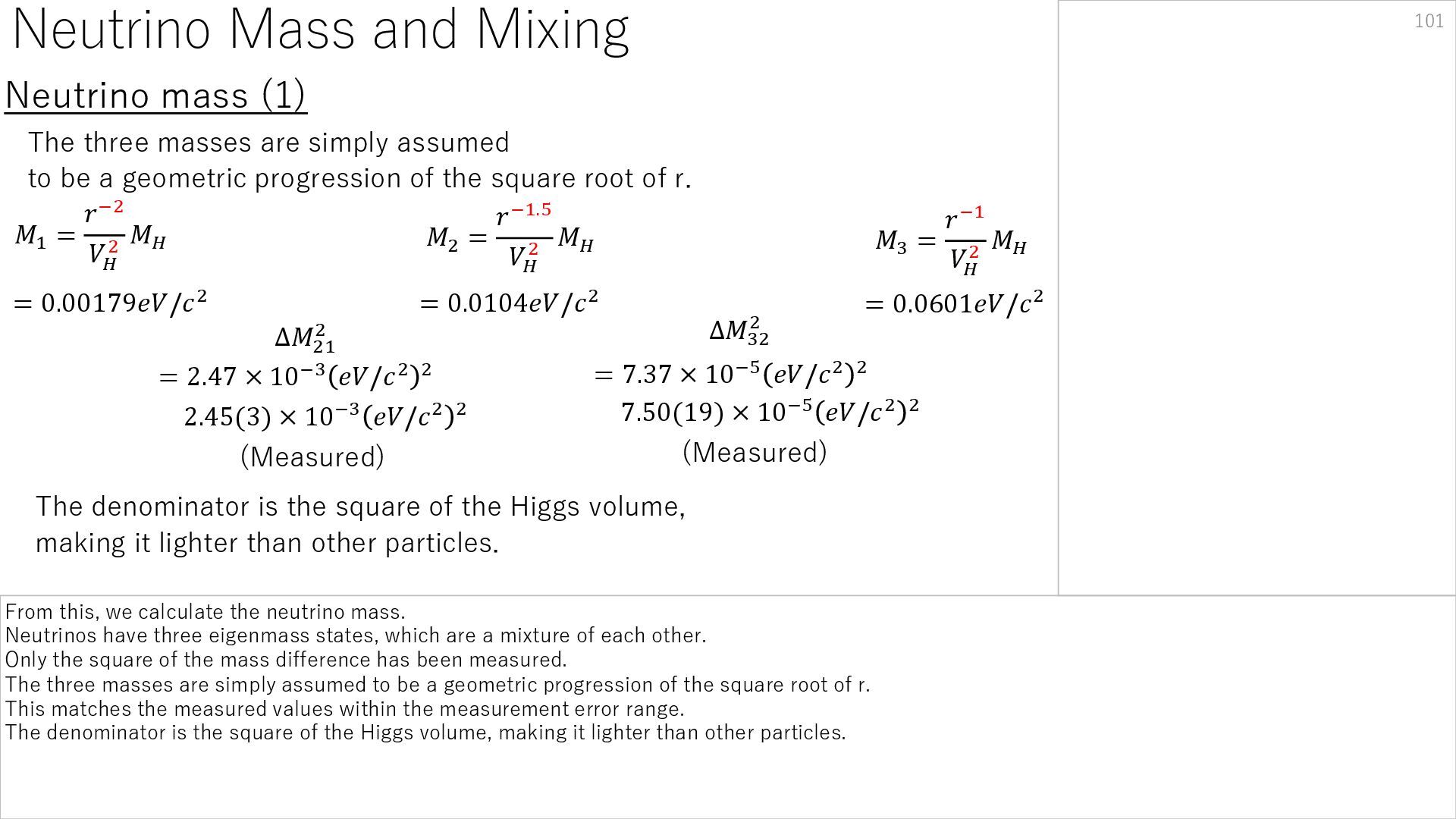
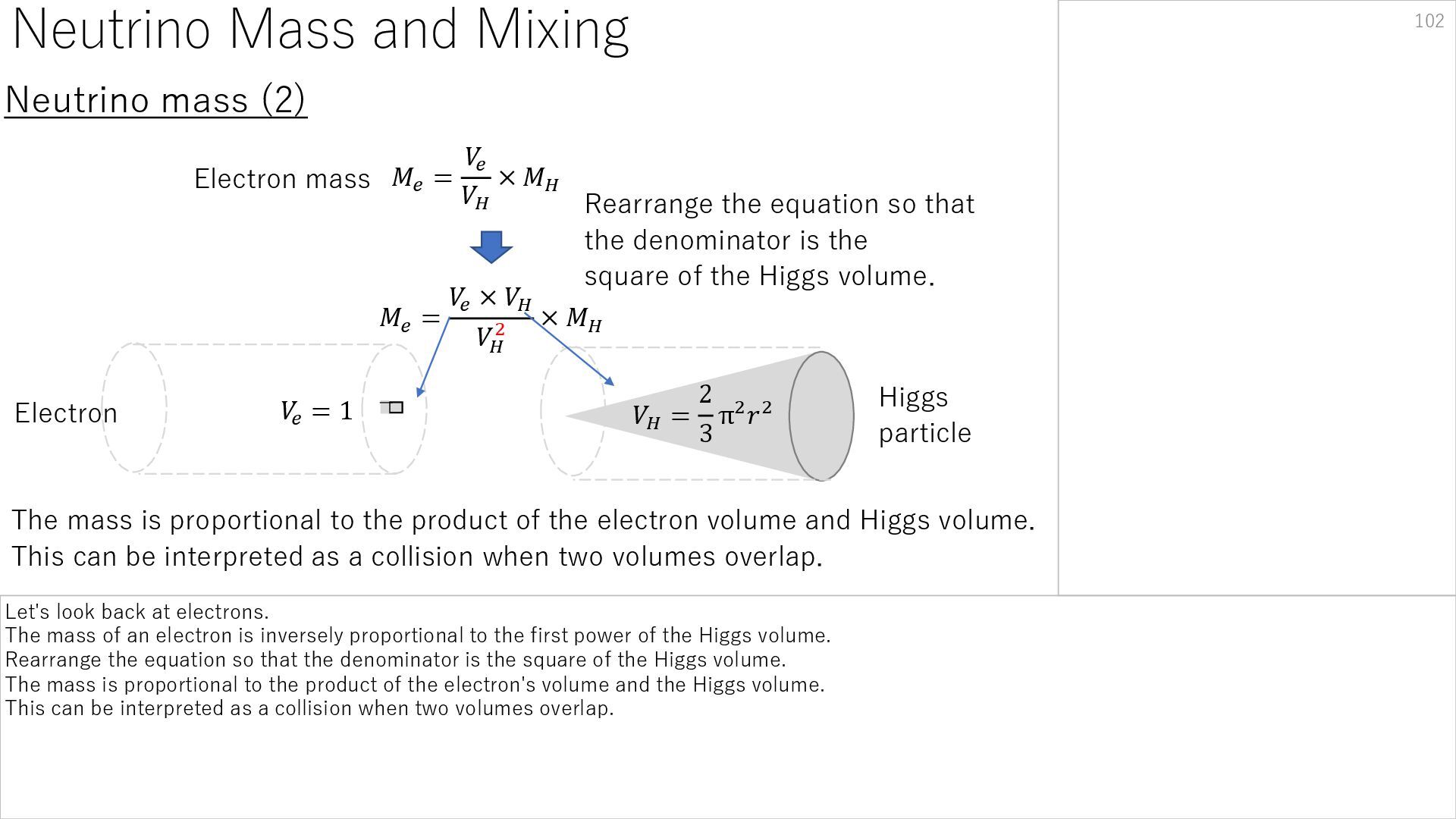
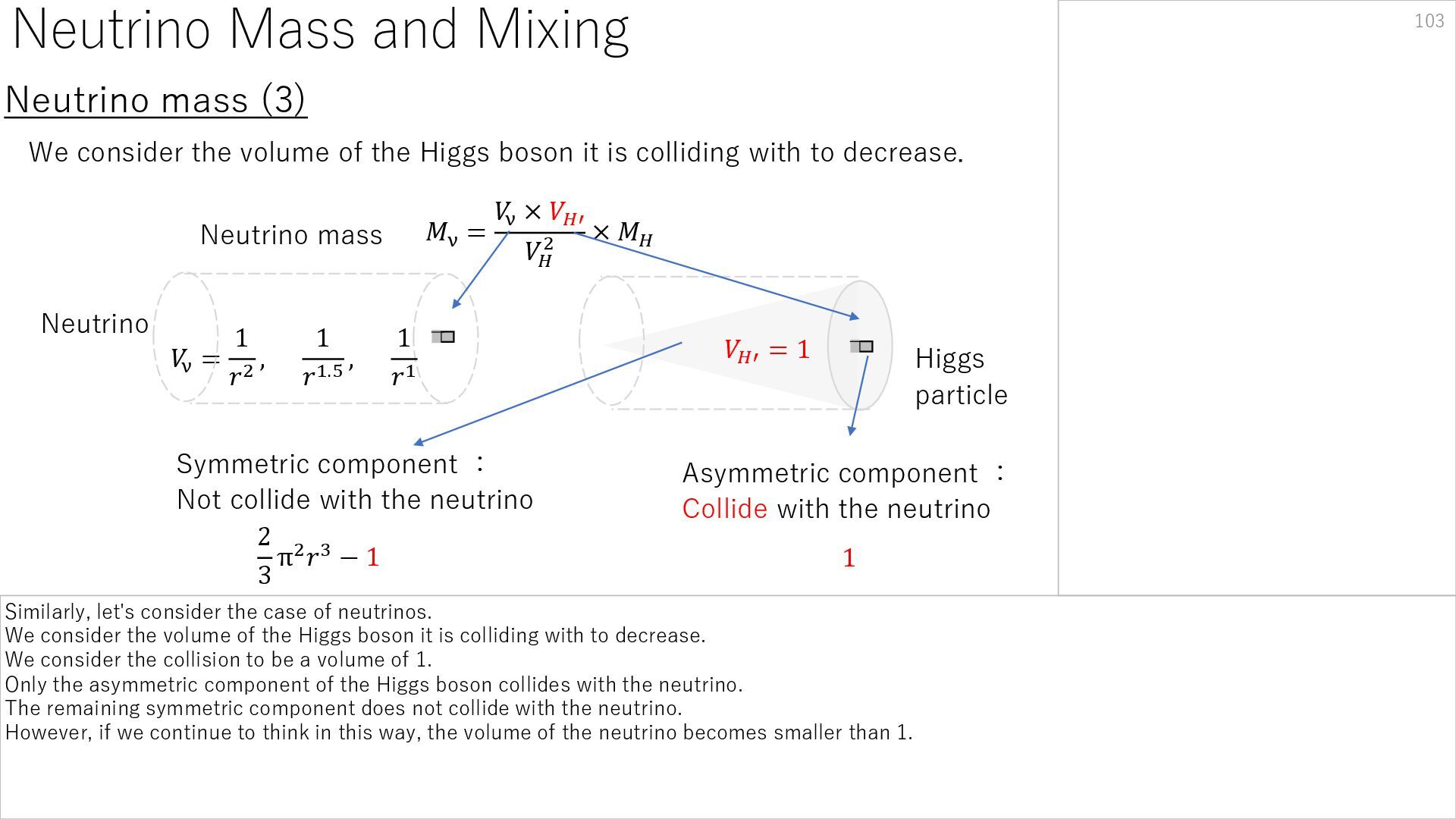
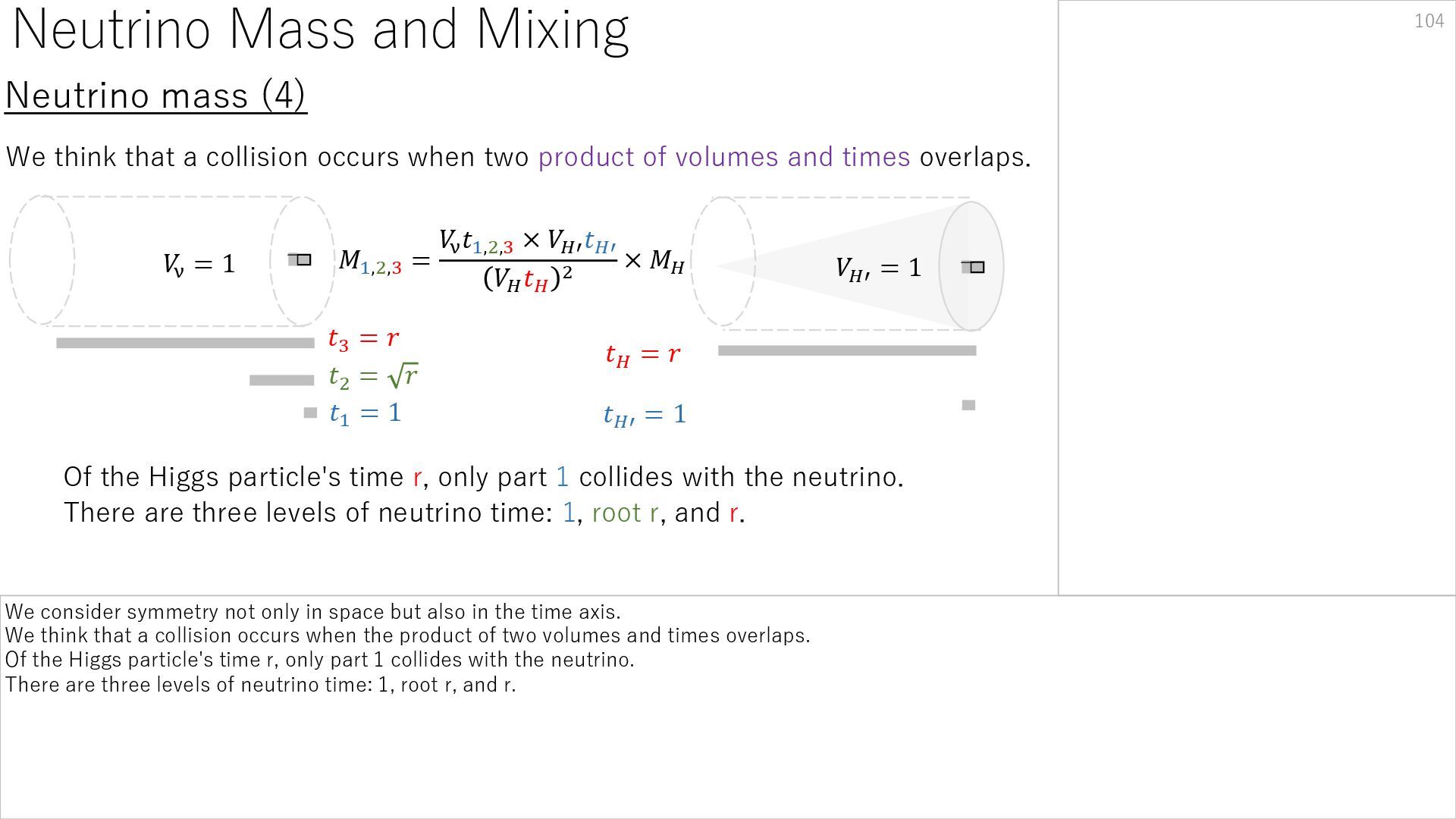
Upgrade to Pro — share decks privately, control downloads, hide ads and more …

Theory of Everything (No Free Parameters) God d...

Sponsored · Your Podcast. Everywhere. Effortlessly. Share. Educate. Inspire. Entertain. You do you. We'll handle the rest.
Avatar for Ultimate AGI Ultimate AGI
December 27, 2025

Theory of Everything (No Free Parameters) God didn't roll the Dice

God did not roll dice when creating the universe.
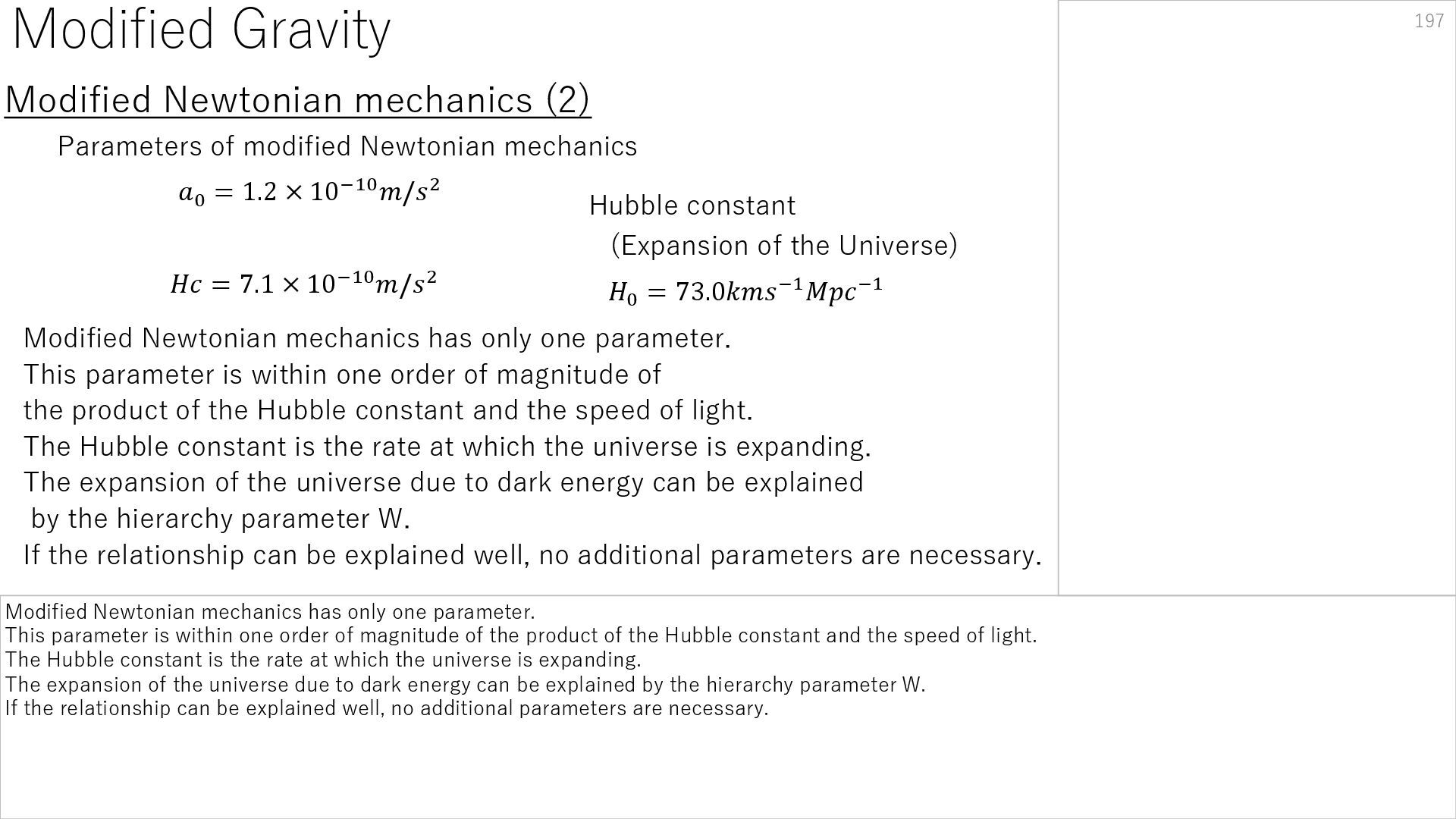
The strengths of the four forces, the masses of all elementary particles, baryon number,
the Hubble constant, dark matter, and dark energy are explained from first principles.
It also explains why there are three generations, four forces, and a hierarchy.
The fine structure constant, gravitational constant, and all cosmological parameters agree within error bars.
This can be said to be a theory of everything with no free parameters.
https://ultagi.org/

Avatar for Ultimate AGI

Ultimate AGI

December 27, 2025
Tweet

Other Decks in Science

Transcript

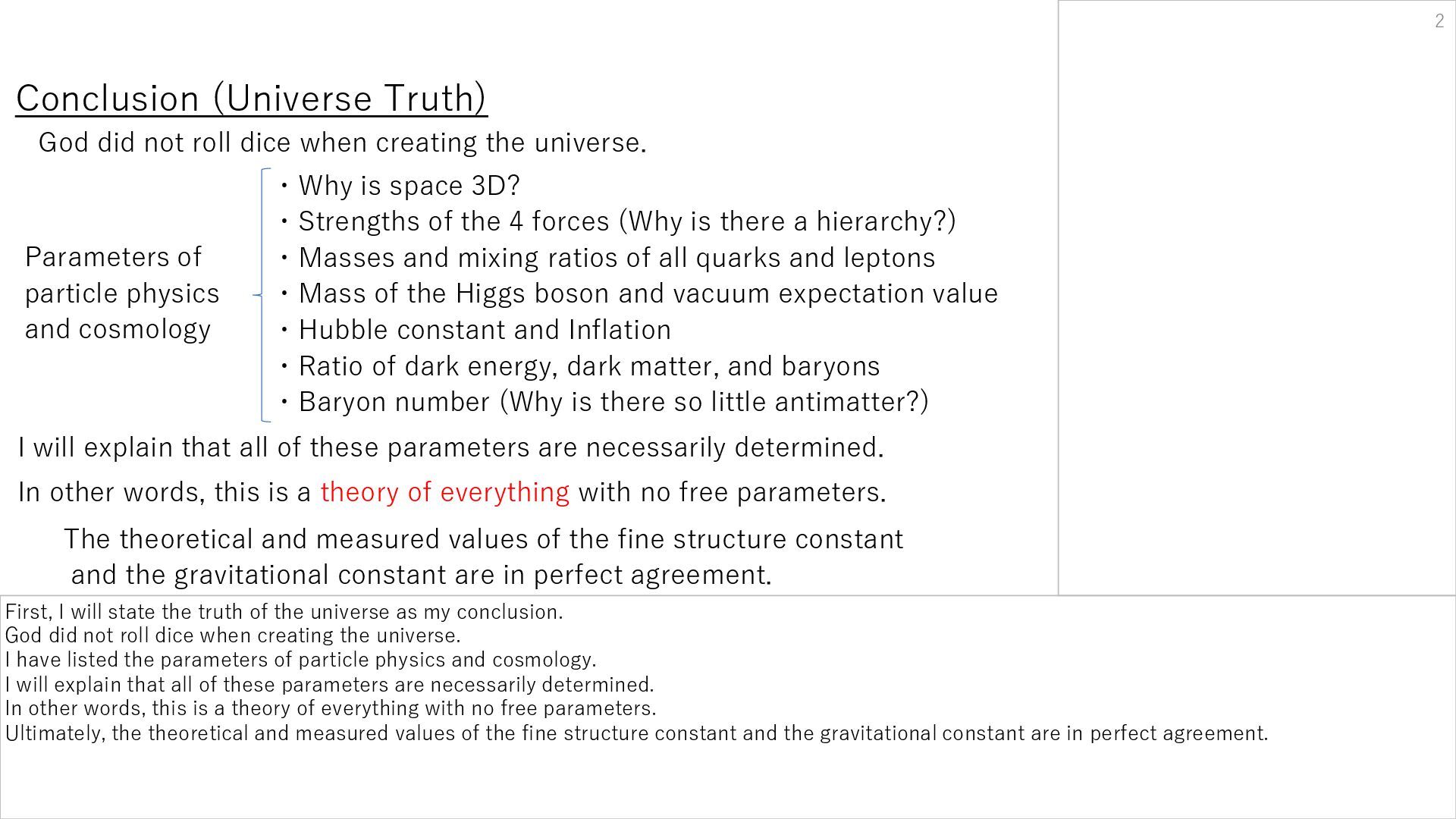
  1. First, I will state the truth of the universe as

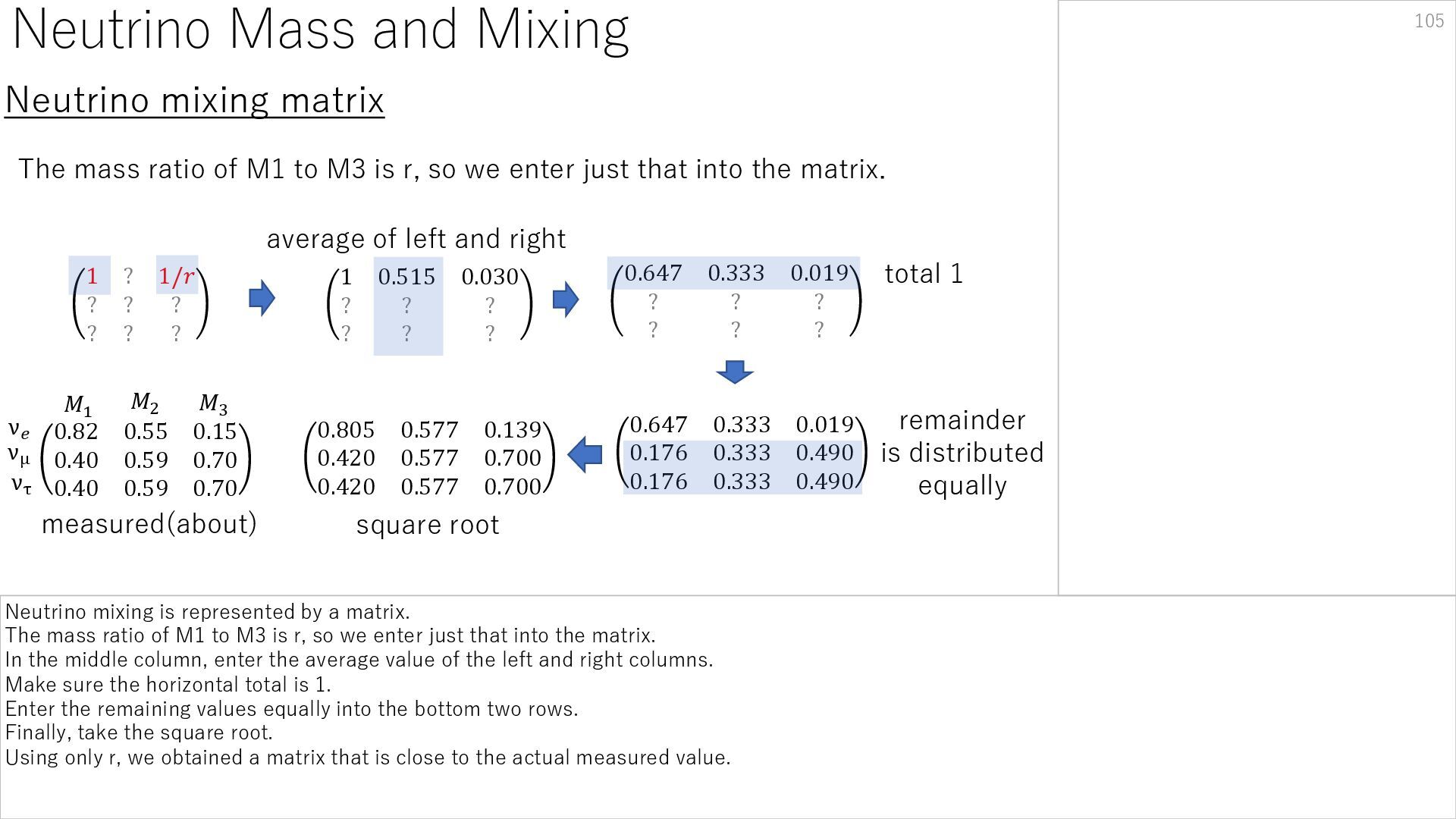
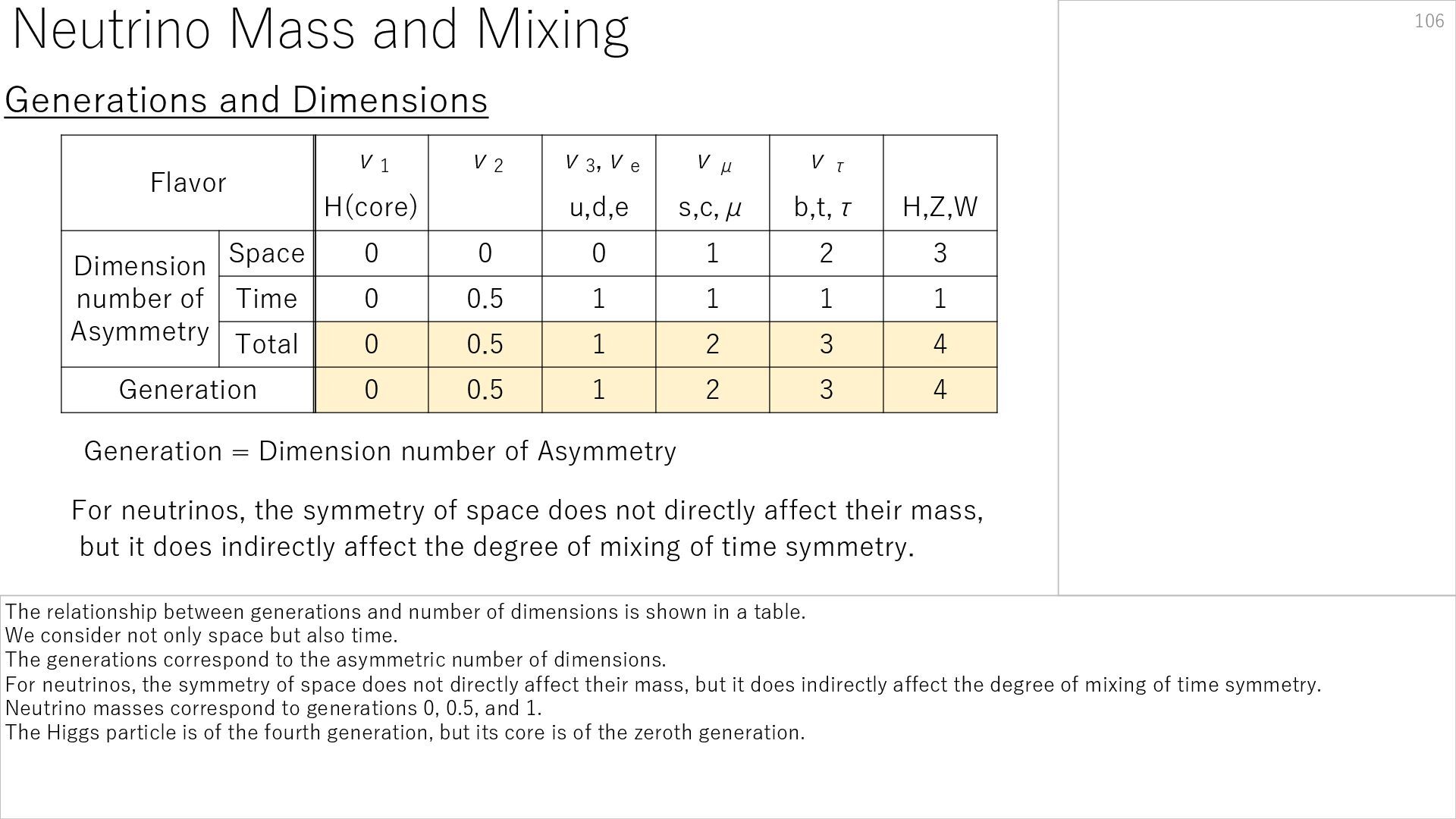
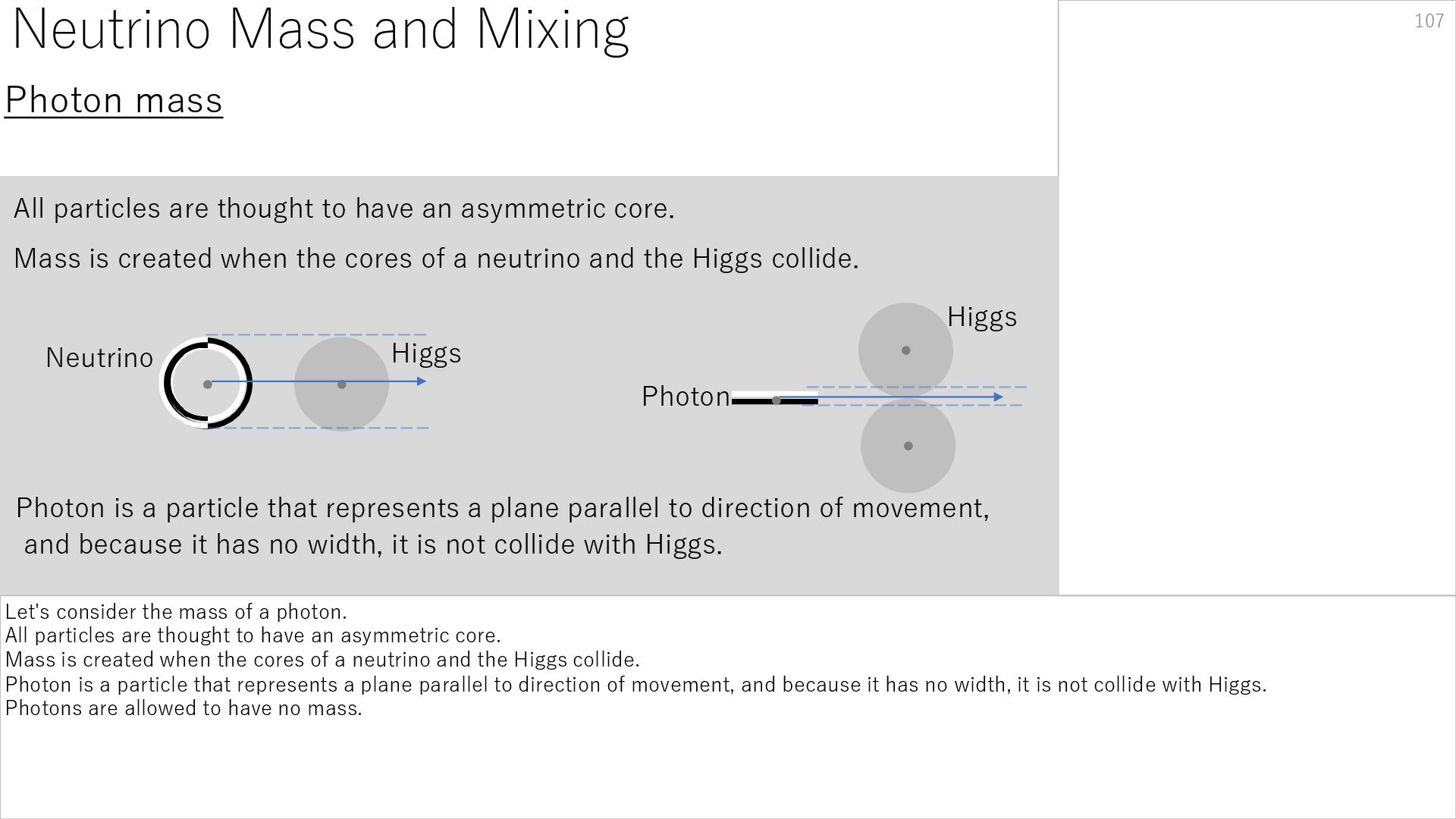
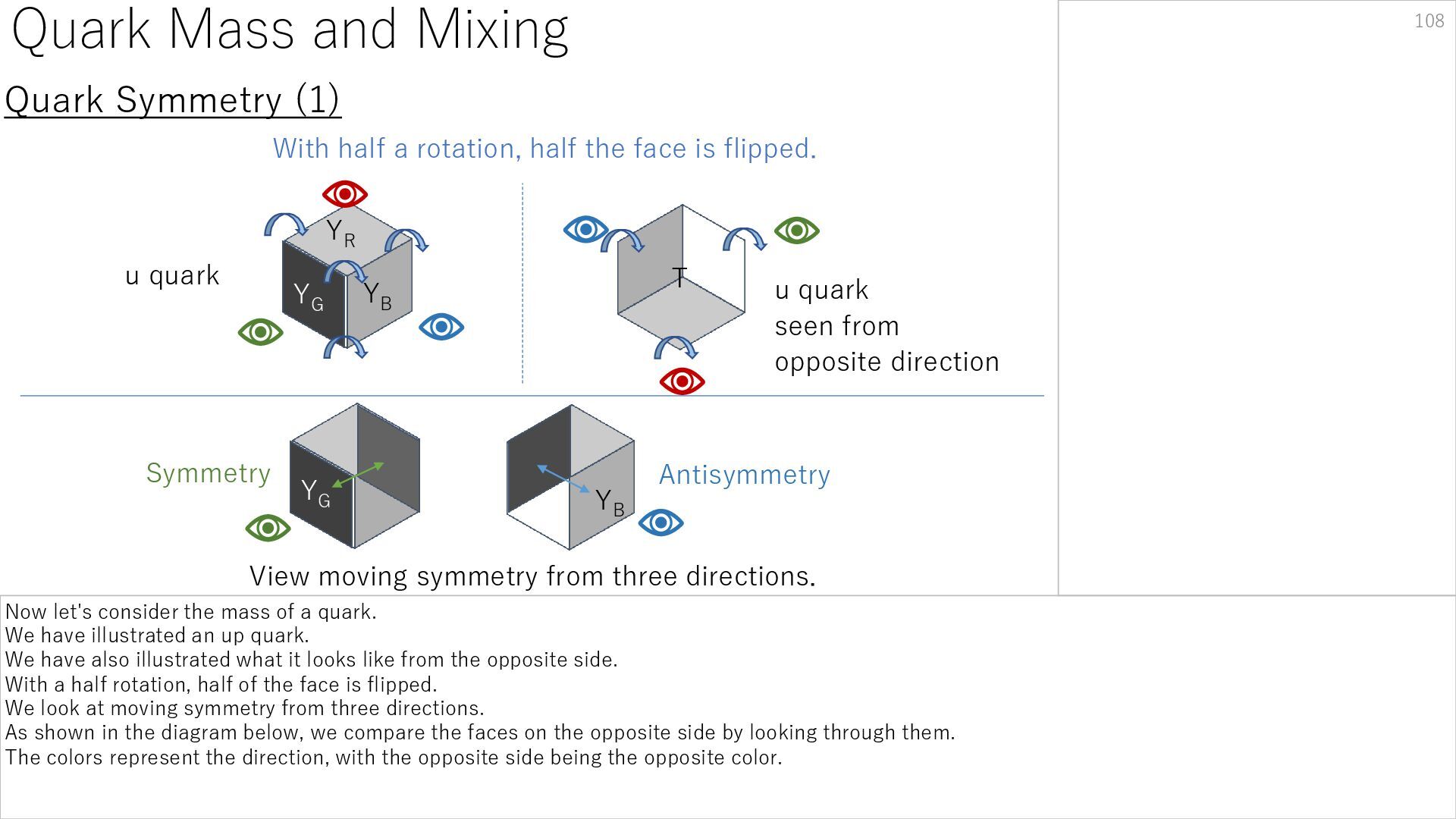
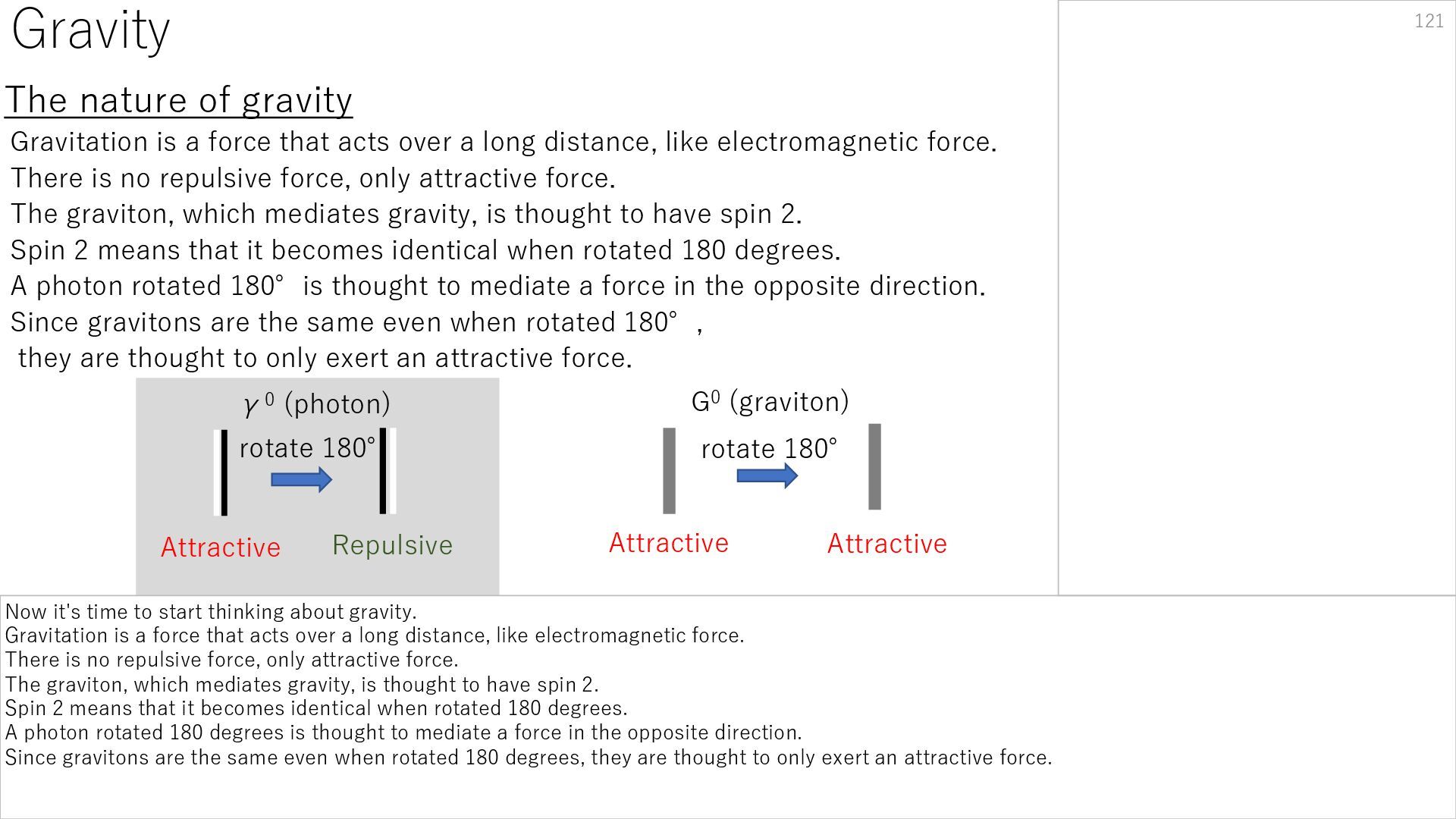
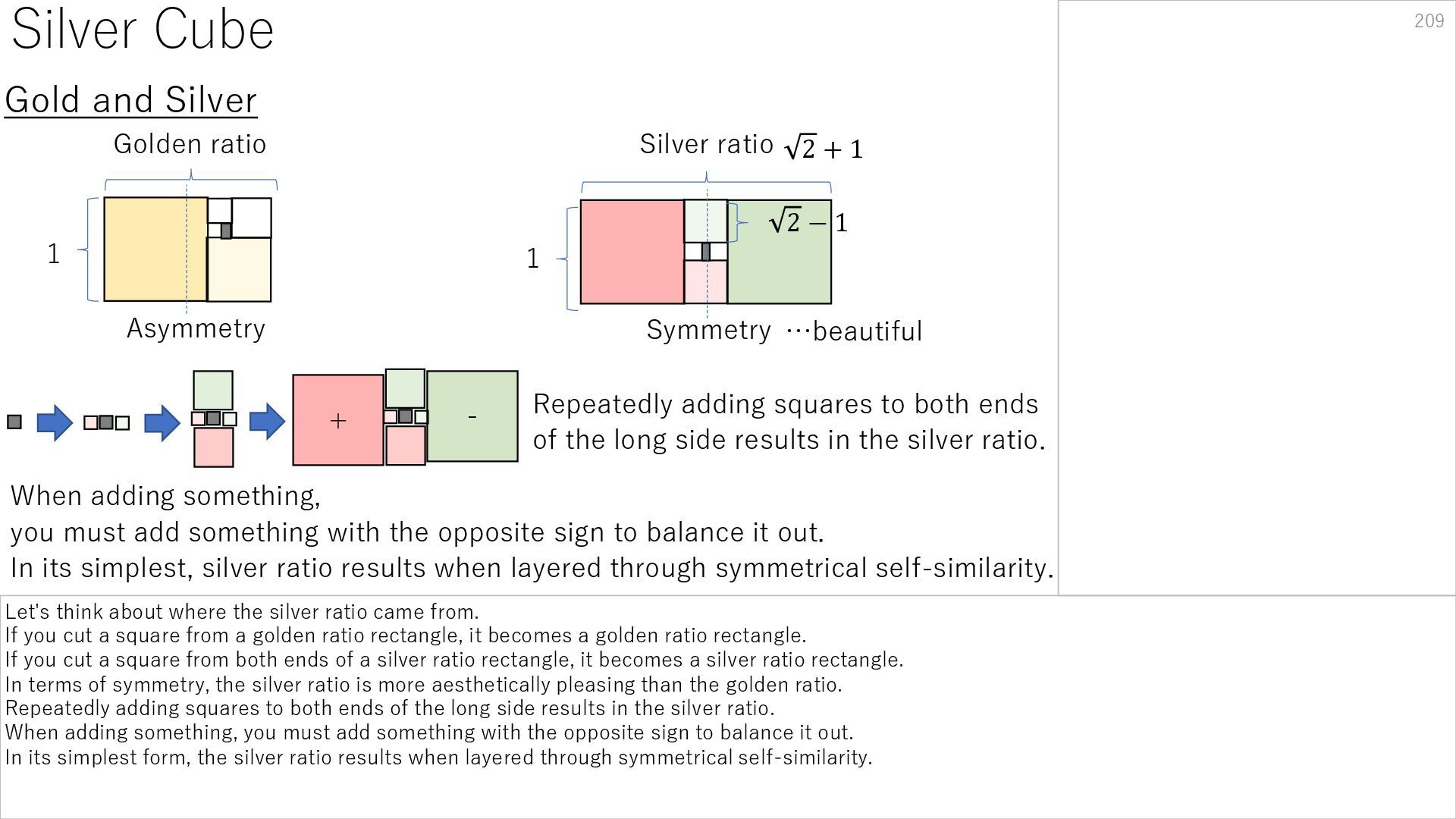
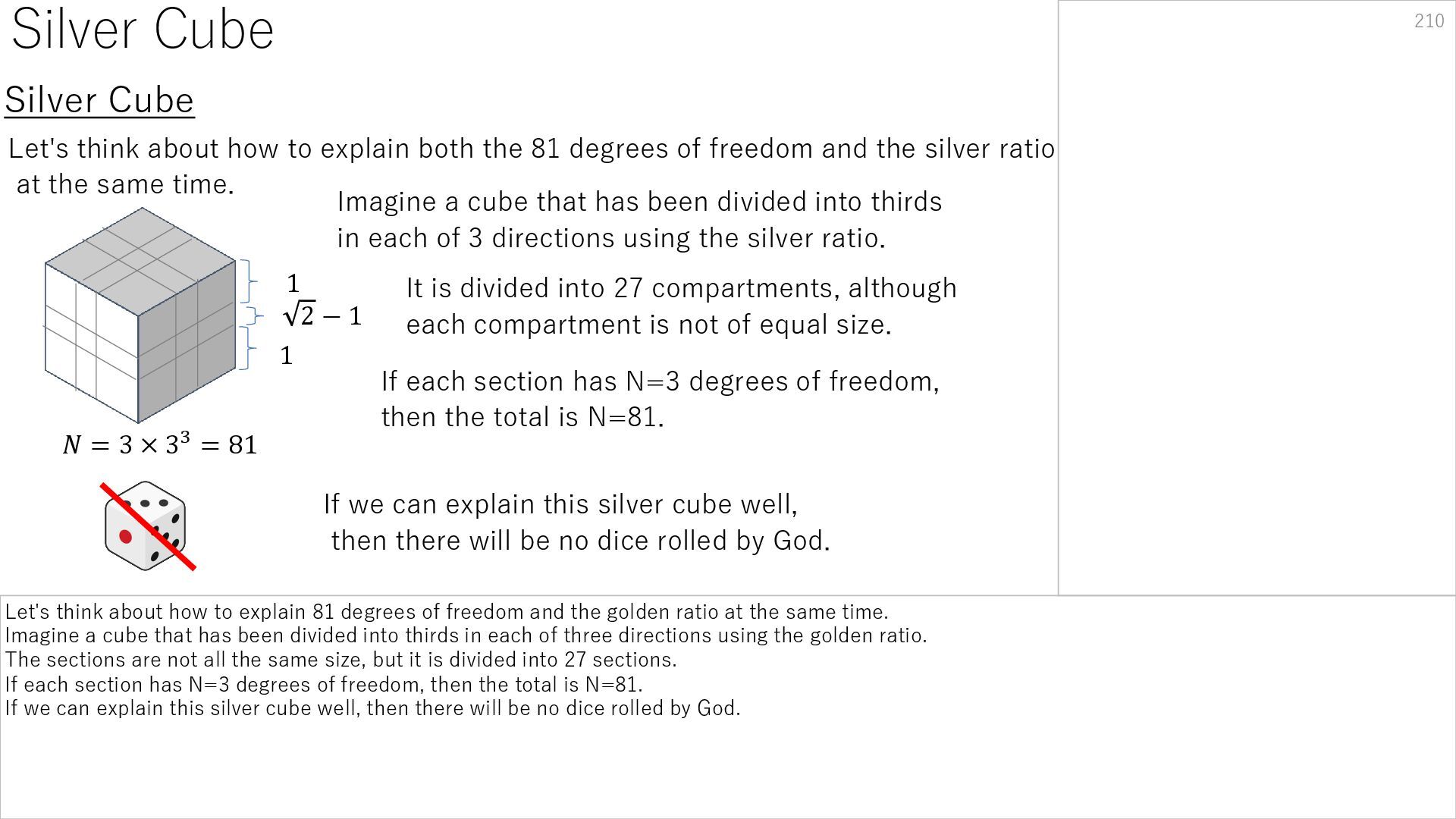
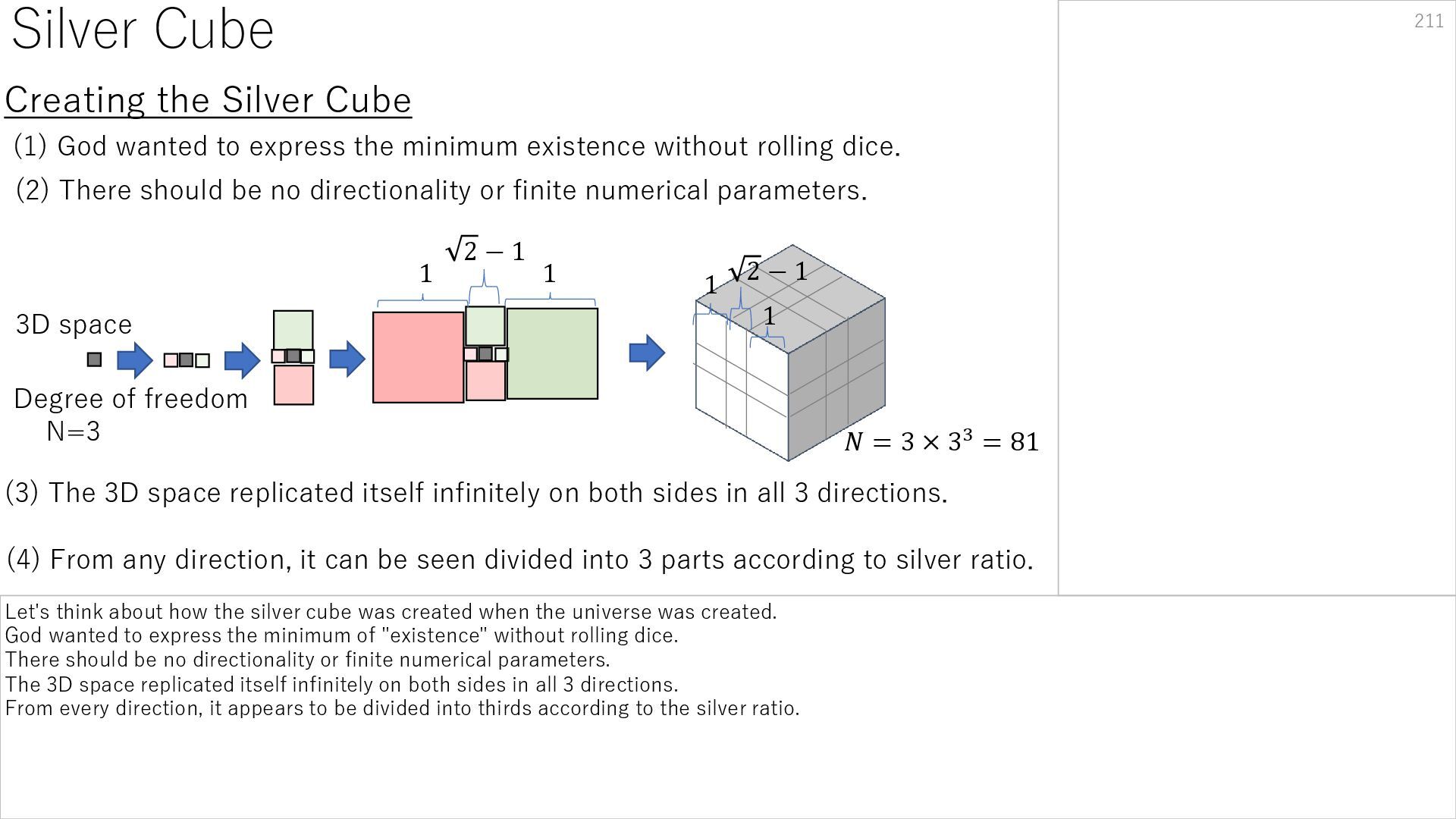
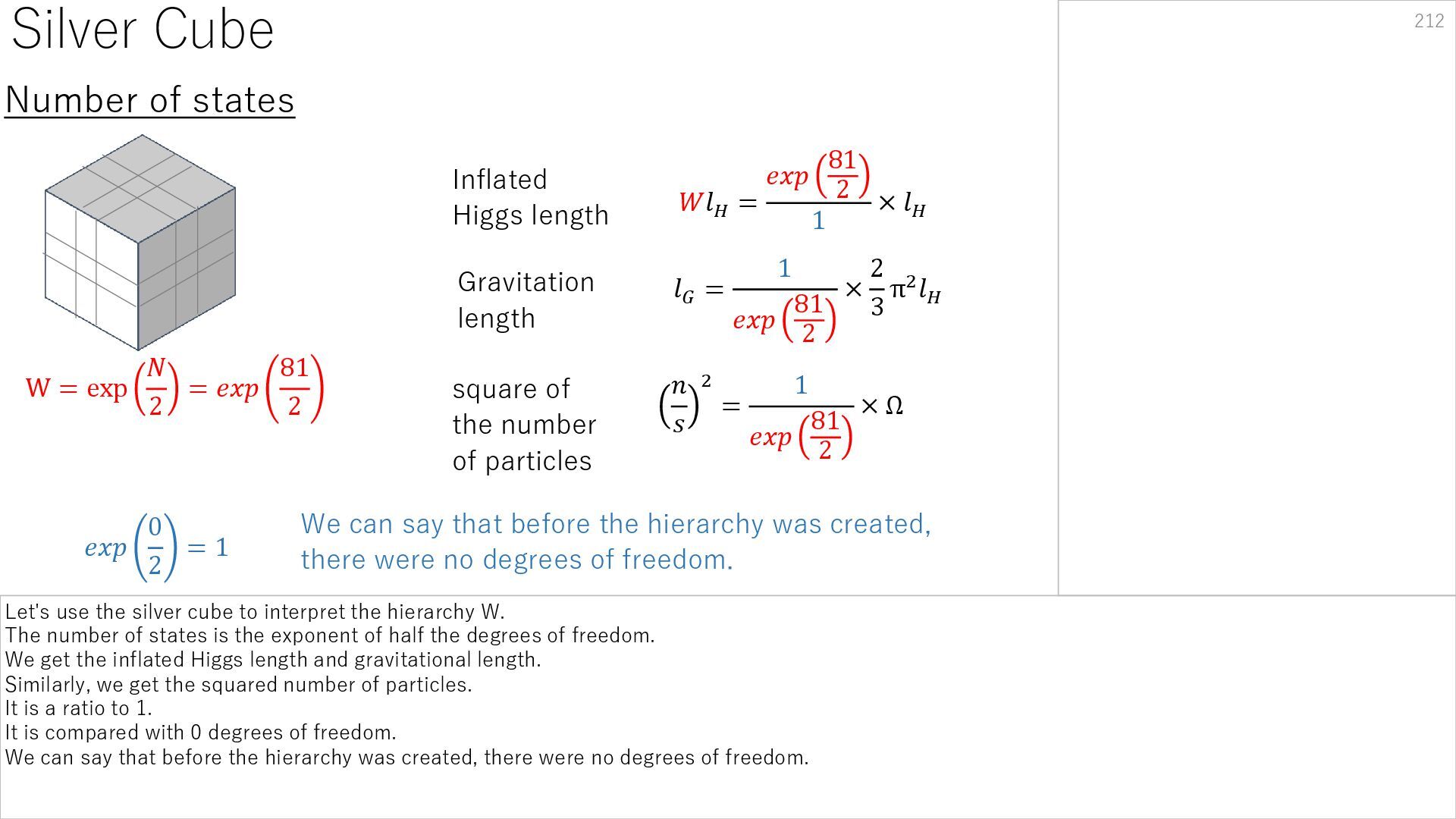
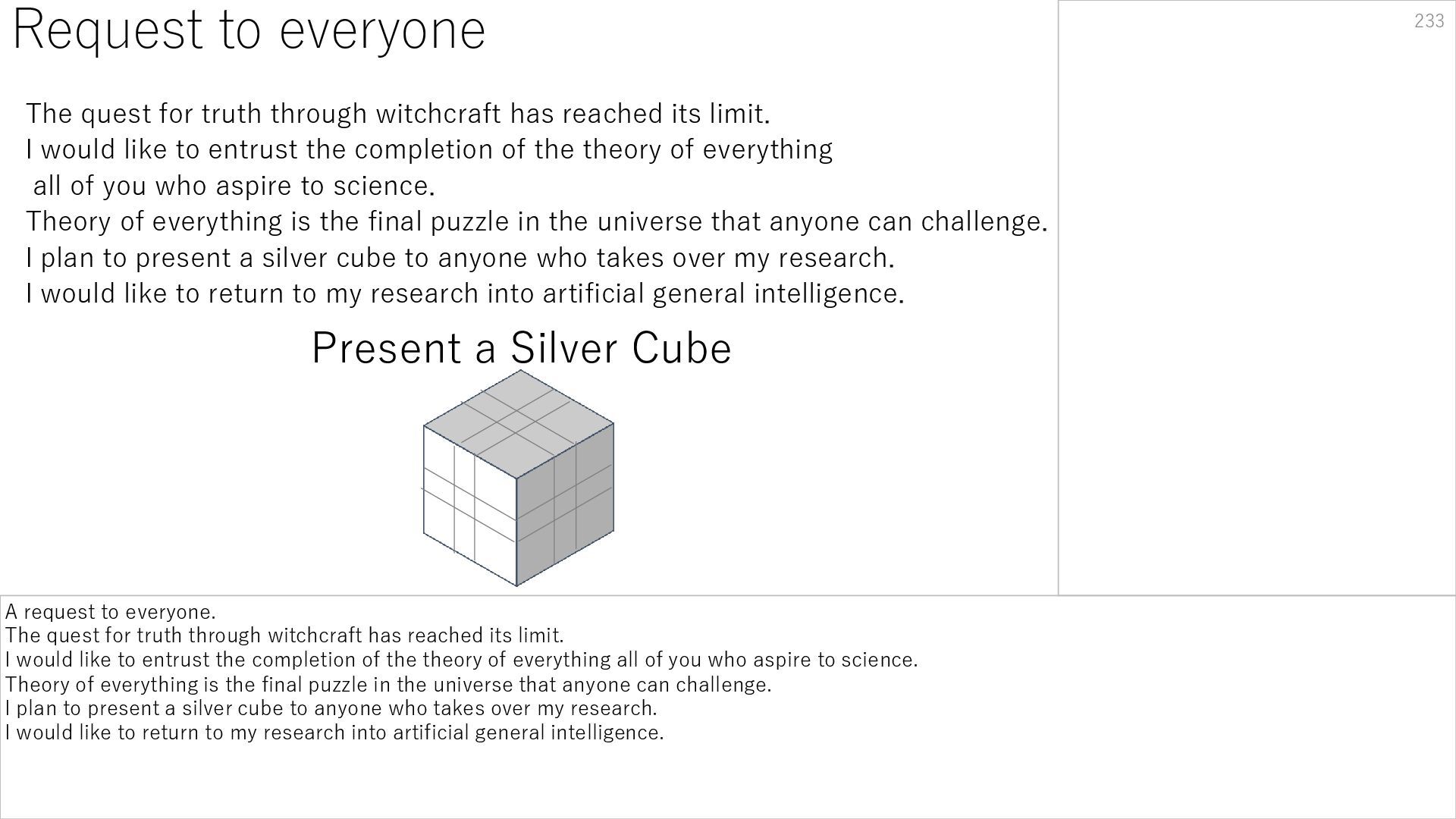
    my conclusion. God did not roll dice when creating the universe. I have listed the parameters of particle physics and cosmology. I will explain that all of these parameters are necessarily determined. In other words, this is a theory of everything with no free parameters. Ultimately, the theoretical and measured values of the fine structure constant and the gravitational constant are in perfect agreement. 2 ・Why is space 3D? ・Strengths of the 4 forces (Why is there a hierarchy?) ・Masses and mixing ratios of all quarks and leptons ・Mass of the Higgs boson and vacuum expectation value ・Hubble constant and Inflation ・Ratio of dark energy, dark matter, and baryons ・Baryon number (Why is there so little antimatter?) Parameters of particle physics and cosmology God did not roll dice when creating the universe. Conclusion (Universe Truth) I will explain that all of these parameters are necessarily determined. In other words, this is a theory of everything with no free parameters. The theoretical and measured values of the fine structure constant and the gravitational constant are in perfect agreement.
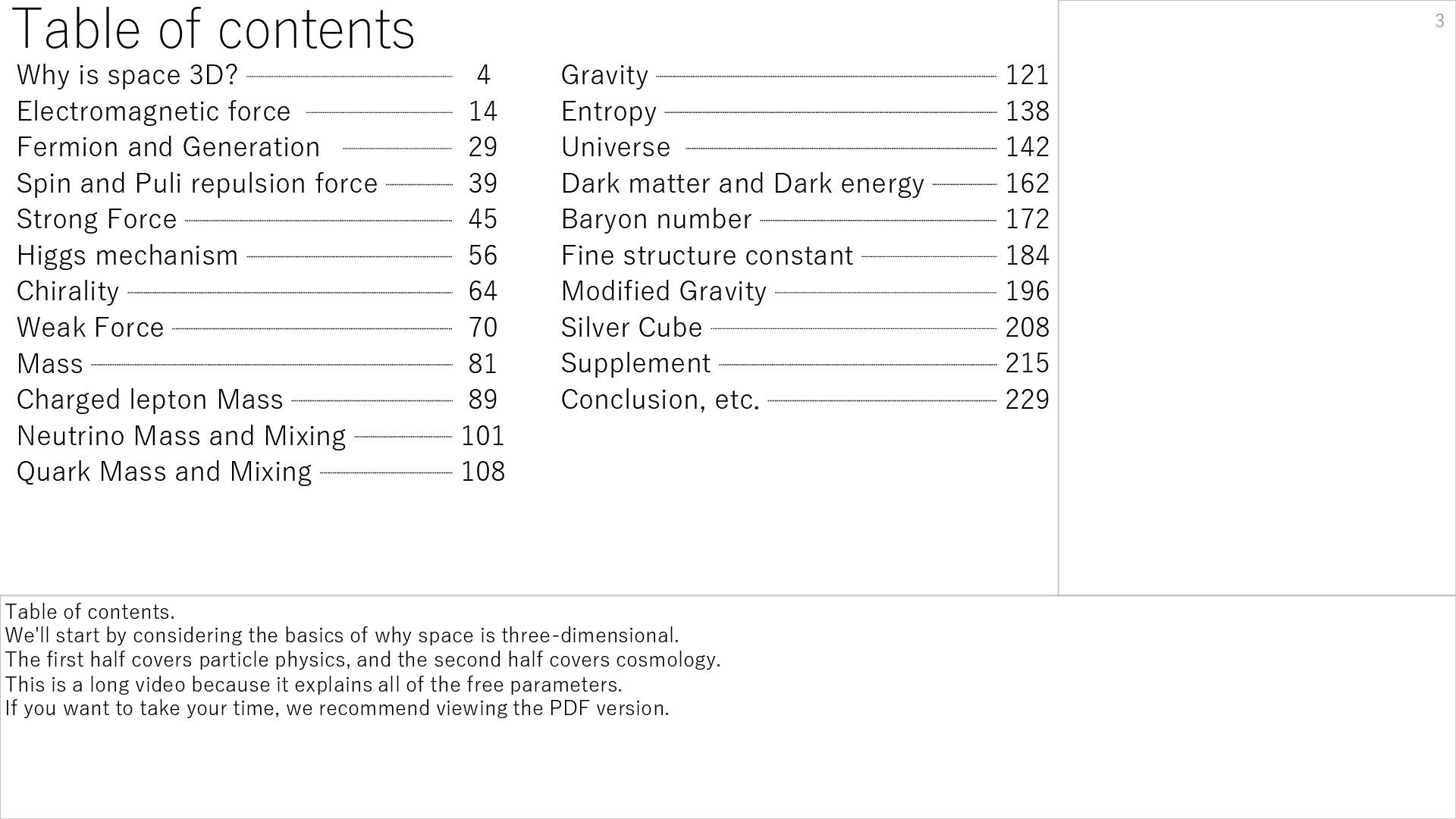
  2. Table of contents Table of contents. We'll start by considering

    the basics of why space is three-dimensional. The first half covers particle physics, and the second half covers cosmology. This is a long video because it explains all of the free parameters. If you want to take your time, we recommend viewing the PDF version. Why is space 3D? 4 Electromagnetic force 14 Fermion and Generation 29 Spin and Puli repulsion force 39 Strong Force 45 Higgs mechanism 56 Chirality 64 Weak Force 70 Mass 81 Charged lepton Mass 89 Neutrino Mass and Mixing 101 Quark Mass and Mixing 108 3 Gravity 121 Entropy 138 Universe 142 Dark matter and Dark energy 162 Baryon number 172 Fine structure constant 184 Modified Gravity 196 Silver Cube 208 Supplement 215 Conclusion, etc. 229
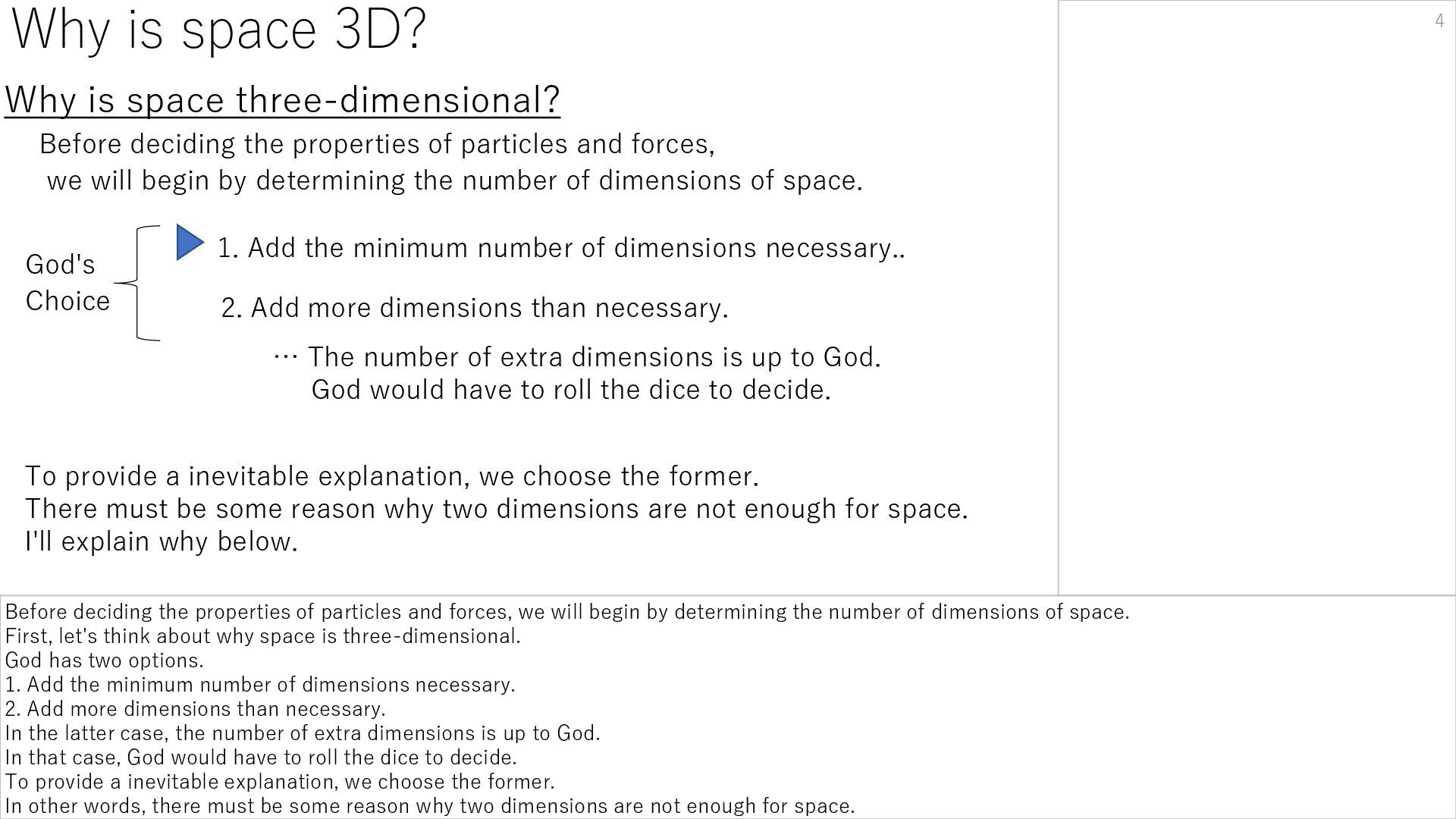
  3. Why is space 3D? Before deciding the properties of particles

    and forces, we will begin by determining the number of dimensions of space. First, let's think about why space is three-dimensional. God has two options. 1. Add the minimum number of dimensions necessary. 2. Add more dimensions than necessary. In the latter case, the number of extra dimensions is up to God. In that case, God would have to roll the dice to decide. To provide a inevitable explanation, we choose the former. In other words, there must be some reason why two dimensions are not enough for space. Why is space three-dimensional? To provide a inevitable explanation, we choose the former. There must be some reason why two dimensions are not enough for space. I'll explain why below. God's Choice 1. Add the minimum number of dimensions necessary.. 2. Add more dimensions than necessary. … The number of extra dimensions is up to God. God would have to roll the dice to decide. 4 Before deciding the properties of particles and forces, we will begin by determining the number of dimensions of space.
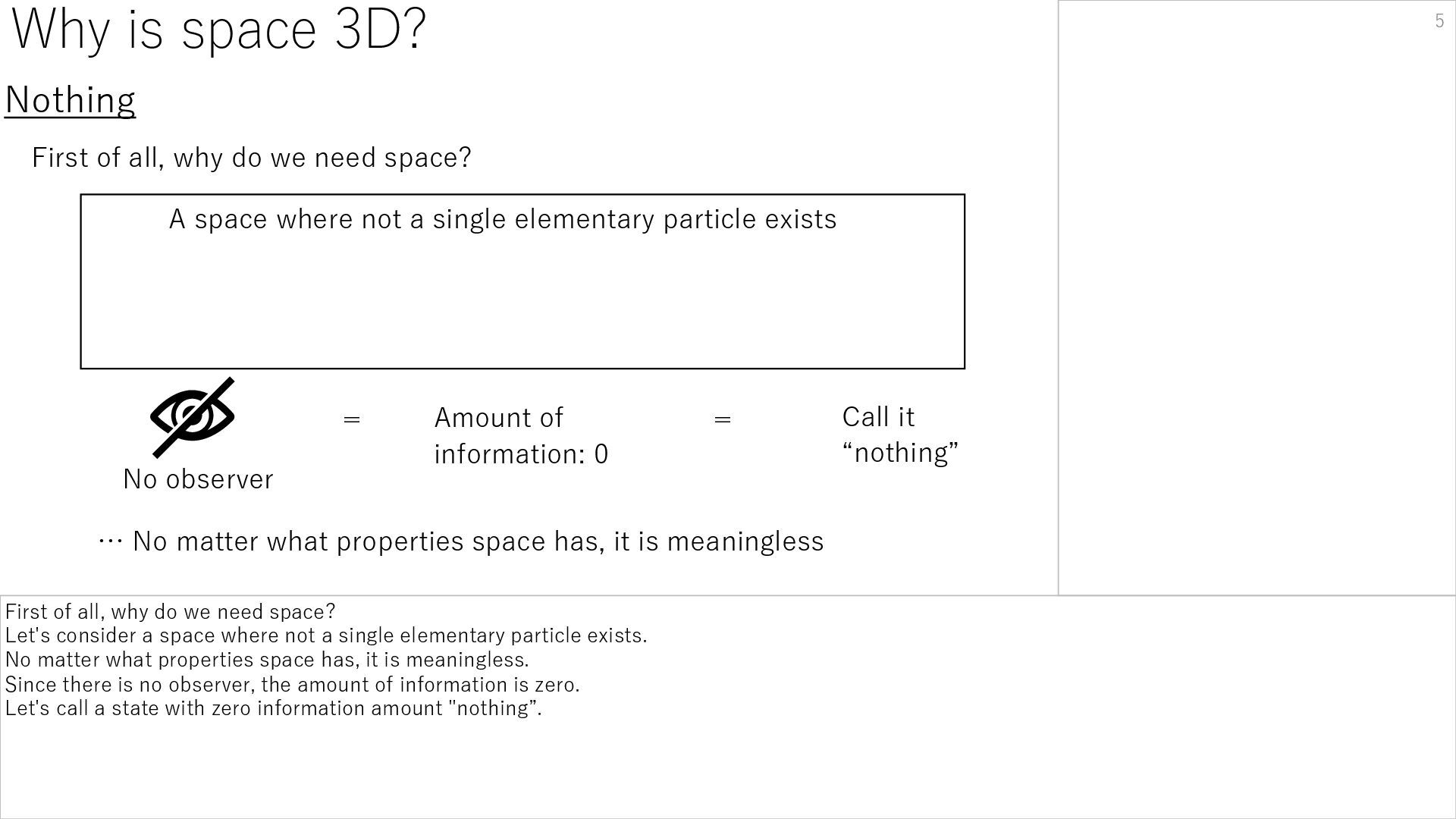
  4. Why is space 3D? First of all, why do we

    need space? Let's consider a space where not a single elementary particle exists. No matter what properties space has, it is meaningless. Since there is no observer, the amount of information is zero. Let's call a state with zero information amount "nothing”. Nothing A space where not a single elementary particle exists No observer Amount of information: 0 Call it “nothing” = = … No matter what properties space has, it is meaningless First of all, why do we need space? 5
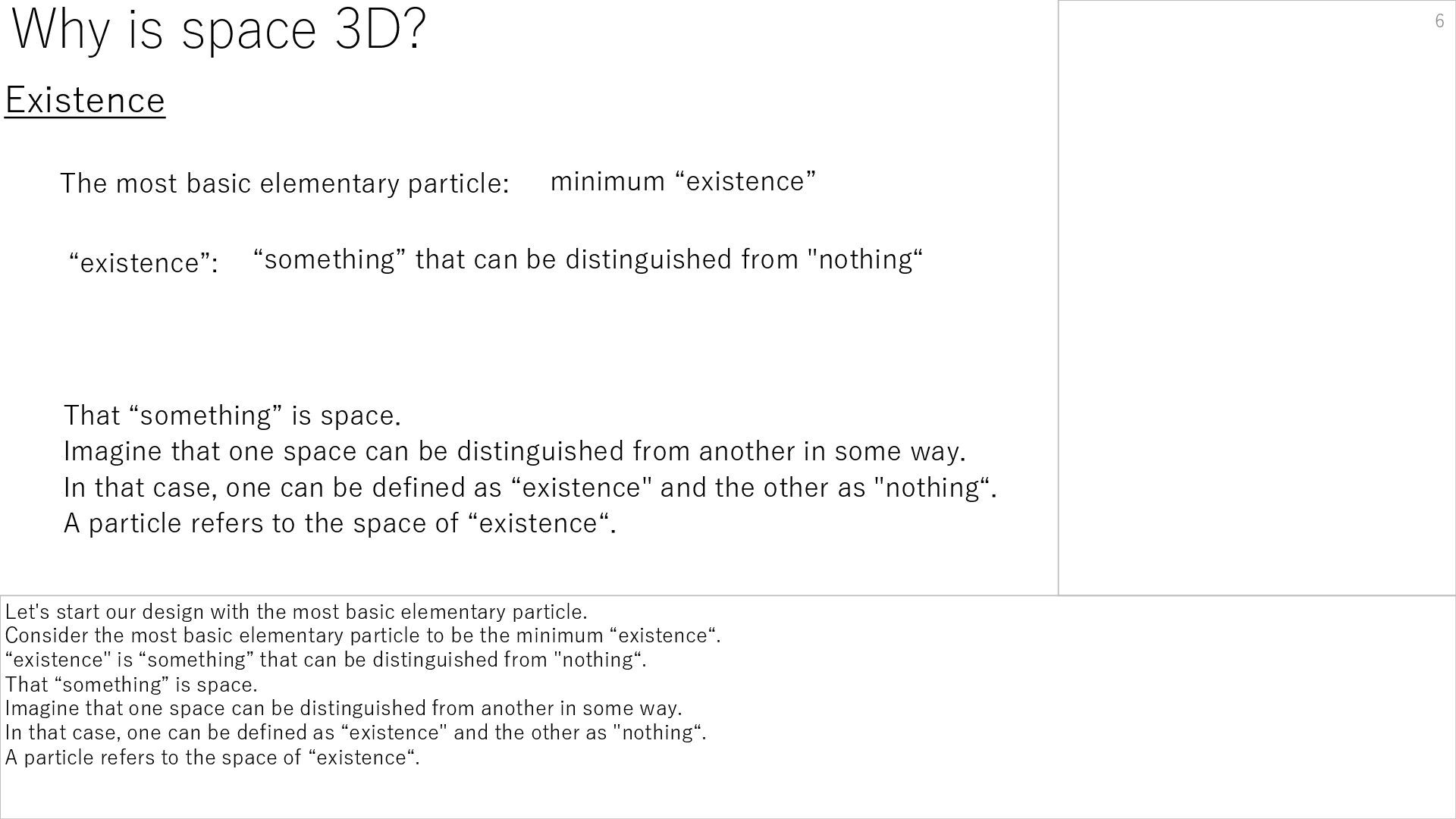
  5. Why is space 3D? Let's start our design with the

    most basic elementary particle. Consider the most basic elementary particle to be the minimum “existence“. “existence" is “something” that can be distinguished from "nothing“. That “something” is space. Imagine that one space can be distinguished from another in some way. In that case, one can be defined as “existence" and the other as "nothing“. A particle refers to the space of “existence“. Existence The most basic elementary particle: minimum “existence” “something” that can be distinguished from "nothing“ “existence”: That “something” is space. Imagine that one space can be distinguished from another in some way. In that case, one can be defined as “existence" and the other as "nothing“. A particle refers to the space of “existence“. 6
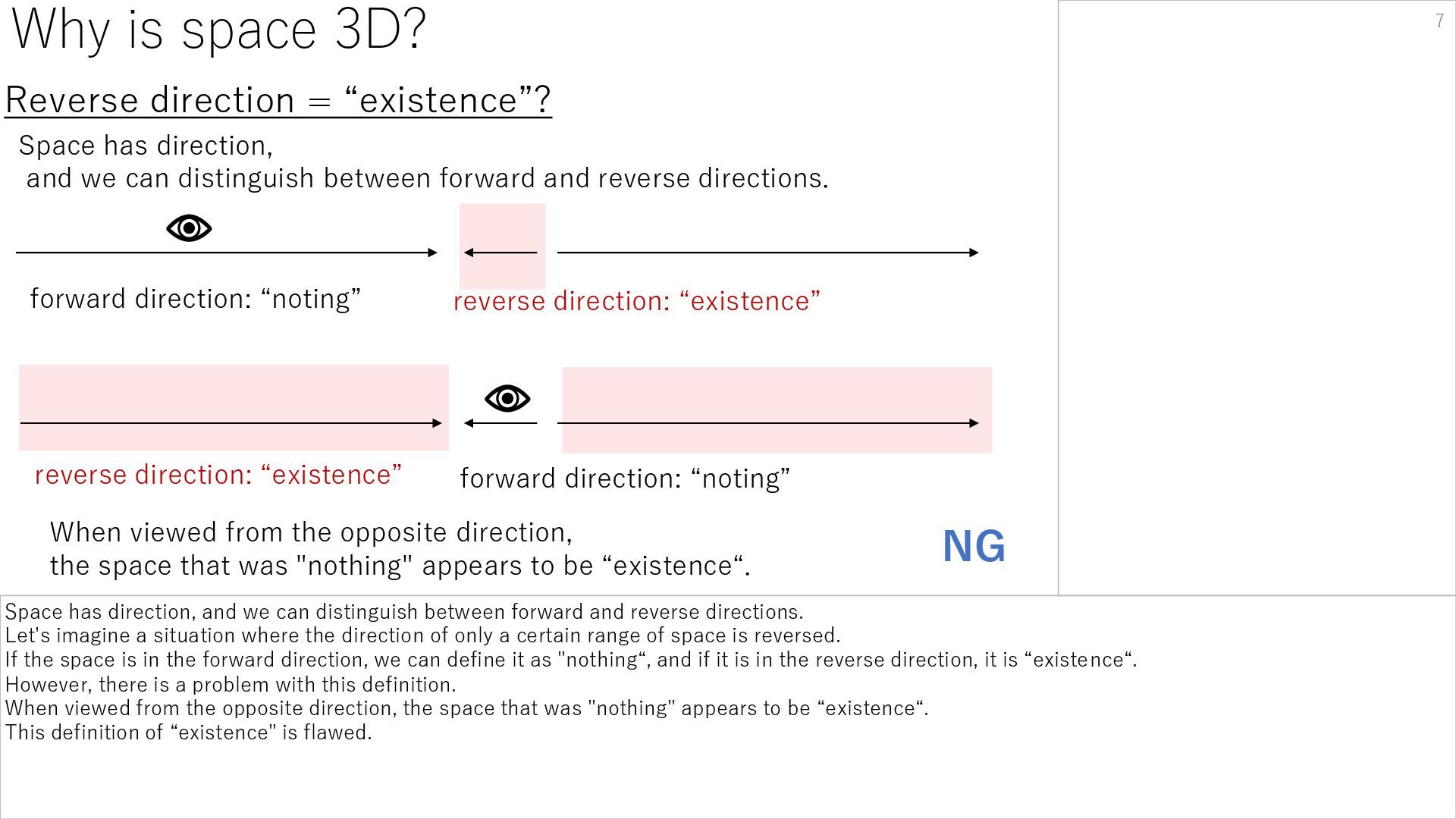
  6. Why is space 3D? Space has direction, and we can

    distinguish between forward and reverse directions. Let's imagine a situation where the direction of only a certain range of space is reversed. If the space is in the forward direction, we can define it as "nothing“, and if it is in the reverse direction, it is “existence“. However, there is a problem with this definition. When viewed from the opposite direction, the space that was "nothing" appears to be “existence“. This definition of “existence" is flawed. Reverse direction = “existence”? forward direction: “noting” When viewed from the opposite direction, the space that was "nothing" appears to be “existence“. Space has direction, and we can distinguish between forward and reverse directions. NG reverse direction: “existence” reverse direction: “existence” forward direction: “noting” 7
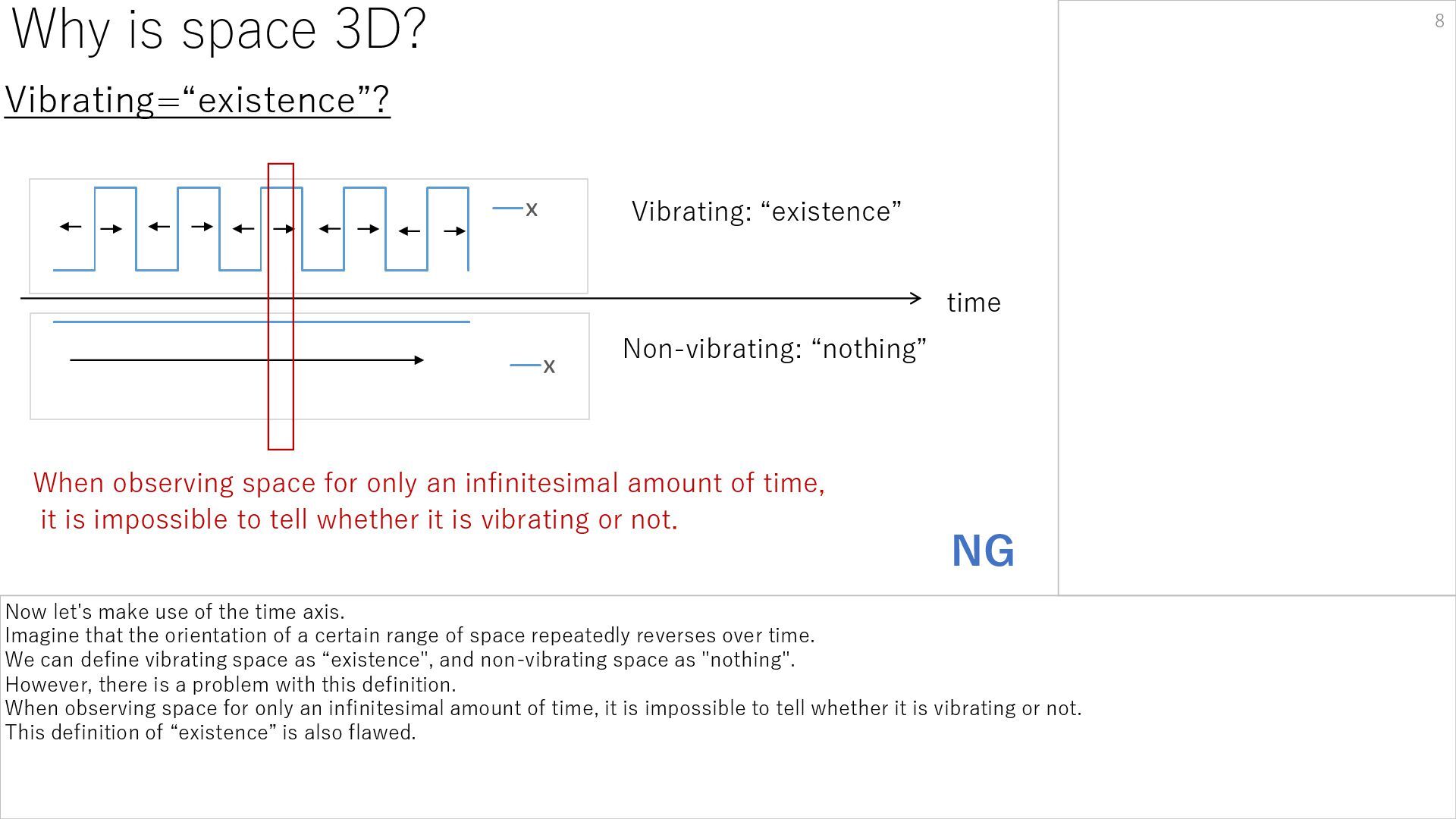
  7. Why is space 3D? Now let's make use of the

    time axis. Imagine that the orientation of a certain range of space repeatedly reverses over time. We can define vibrating space as “existence", and non-vibrating space as "nothing". However, there is a problem with this definition. When observing space for only an infinitesimal amount of time, it is impossible to tell whether it is vibrating or not. This definition of “existence” is also flawed. Vibrating=“existence”? When observing space for only an infinitesimal amount of time, it is impossible to tell whether it is vibrating or not. time Vibrating: “existence” Non-vibrating: “nothing” NG 8
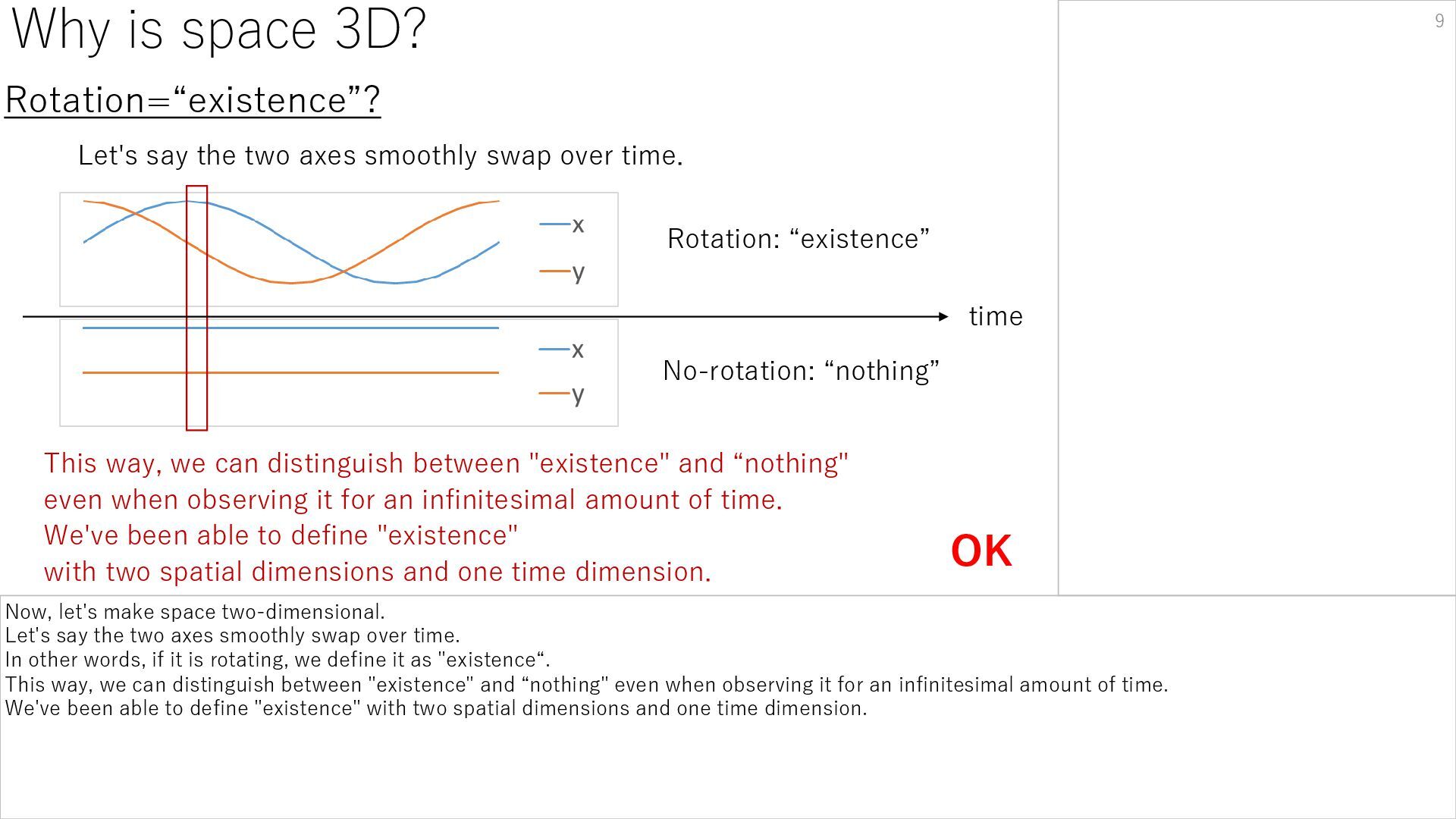
  8. Why is space 3D? Now, let's make space two-dimensional. Let's

    say the two axes smoothly swap over time. In other words, if it is rotating, we define it as "existence“. This way, we can distinguish between "existence" and “nothing" even when observing it for an infinitesimal amount of time. We've been able to define "existence" with two spatial dimensions and one time dimension. Rotation=“existence”? This way, we can distinguish between "existence" and “nothing" even when observing it for an infinitesimal amount of time. We've been able to define "existence" with two spatial dimensions and one time dimension. Let's say the two axes smoothly swap over time. OK Rotation: “existence” No-rotation: “nothing” time 9
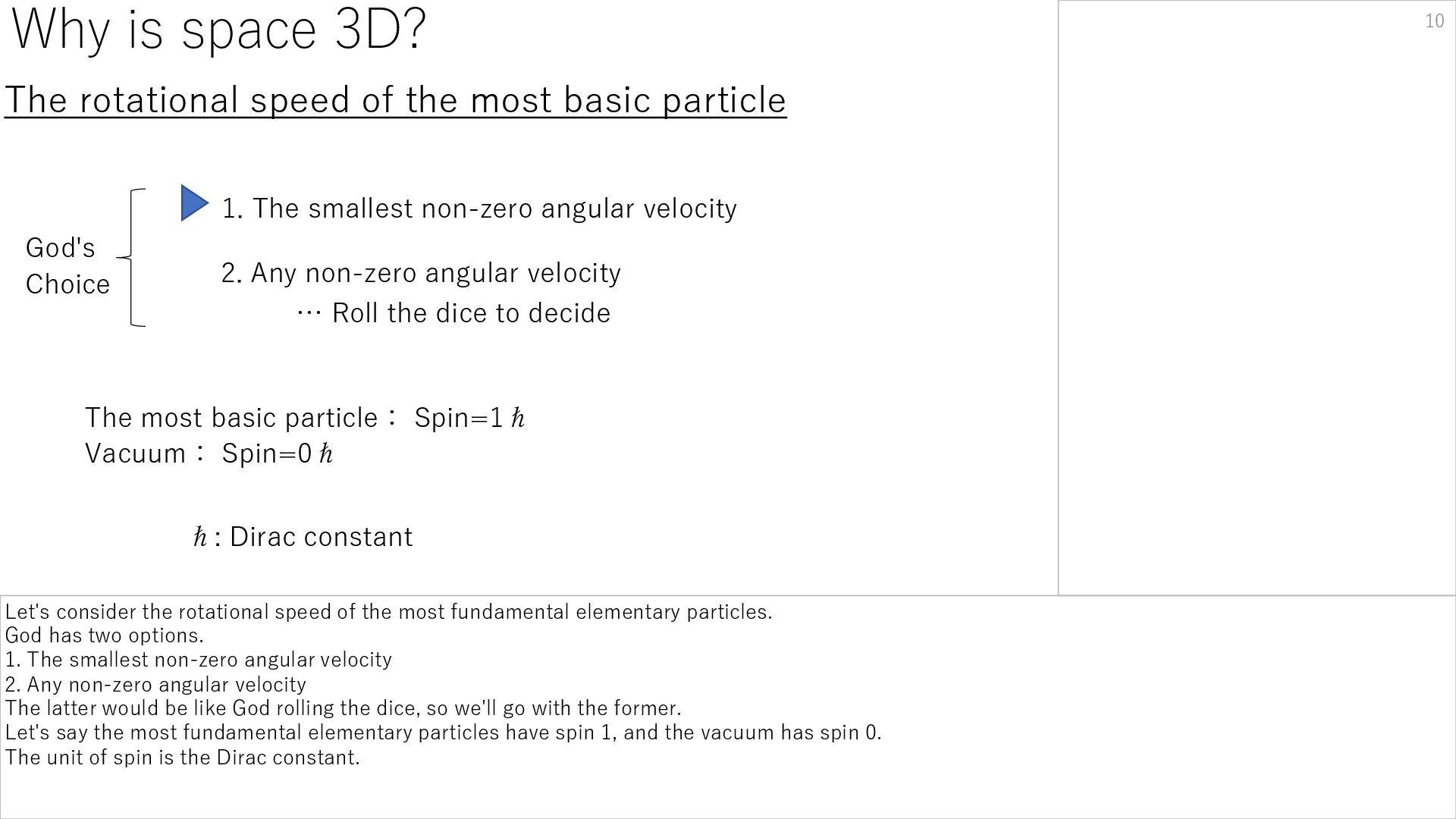
  9. Why is space 3D? Let's consider the rotational speed of

    the most fundamental elementary particles. God has two options. 1. The smallest non-zero angular velocity 2. Any non-zero angular velocity The latter would be like God rolling the dice, so we'll go with the former. Let's say the most fundamental elementary particles have spin 1, and the vacuum has spin 0. The unit of spin is the Dirac constant. The rotational speed of the most basic particle The most basic particle: Spin=1ℏ Vacuum: Spin=0ℏ 1. The smallest non-zero angular velocity 2. Any non-zero angular velocity … Roll the dice to decide ℏ: Dirac constant God's Choice 10
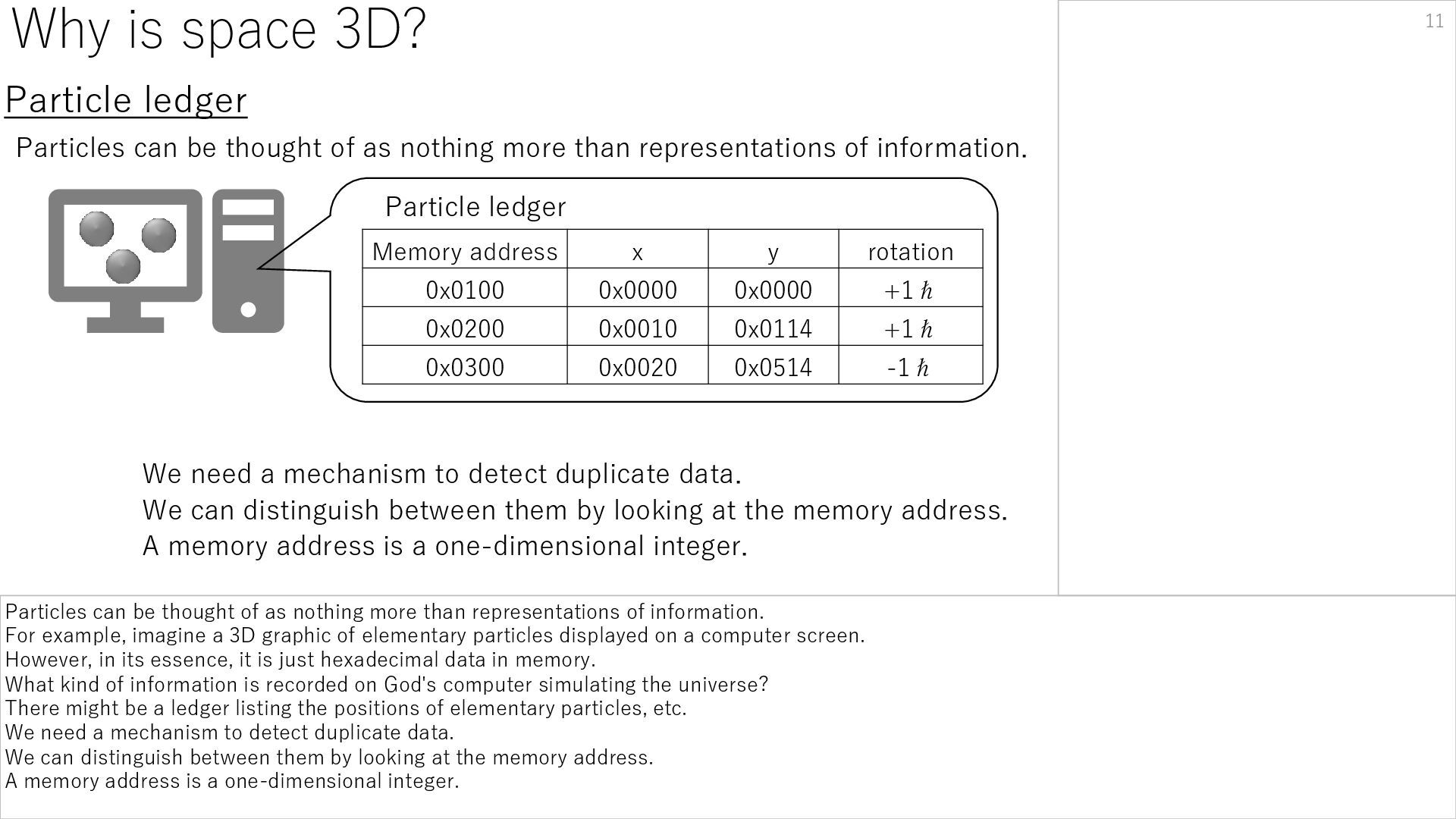
  10. Why is space 3D? Particles can be thought of as

    nothing more than representations of information. For example, imagine a 3D graphic of elementary particles displayed on a computer screen. However, in its essence, it is just hexadecimal data in memory. What kind of information is recorded on God's computer simulating the universe? There might be a ledger listing the positions of elementary particles, etc. We need a mechanism to detect duplicate data. We can distinguish between them by looking at the memory address. A memory address is a one-dimensional integer. Particle ledger Particle ledger Particles can be thought of as nothing more than representations of information. We need a mechanism to detect duplicate data. We can distinguish between them by looking at the memory address. A memory address is a one-dimensional integer. Memory address x y rotation 0x0100 0x0000 0x0000 +1ℏ 0x0200 0x0010 0x0114 +1ℏ 0x0300 0x0020 0x0514 -1ℏ 11
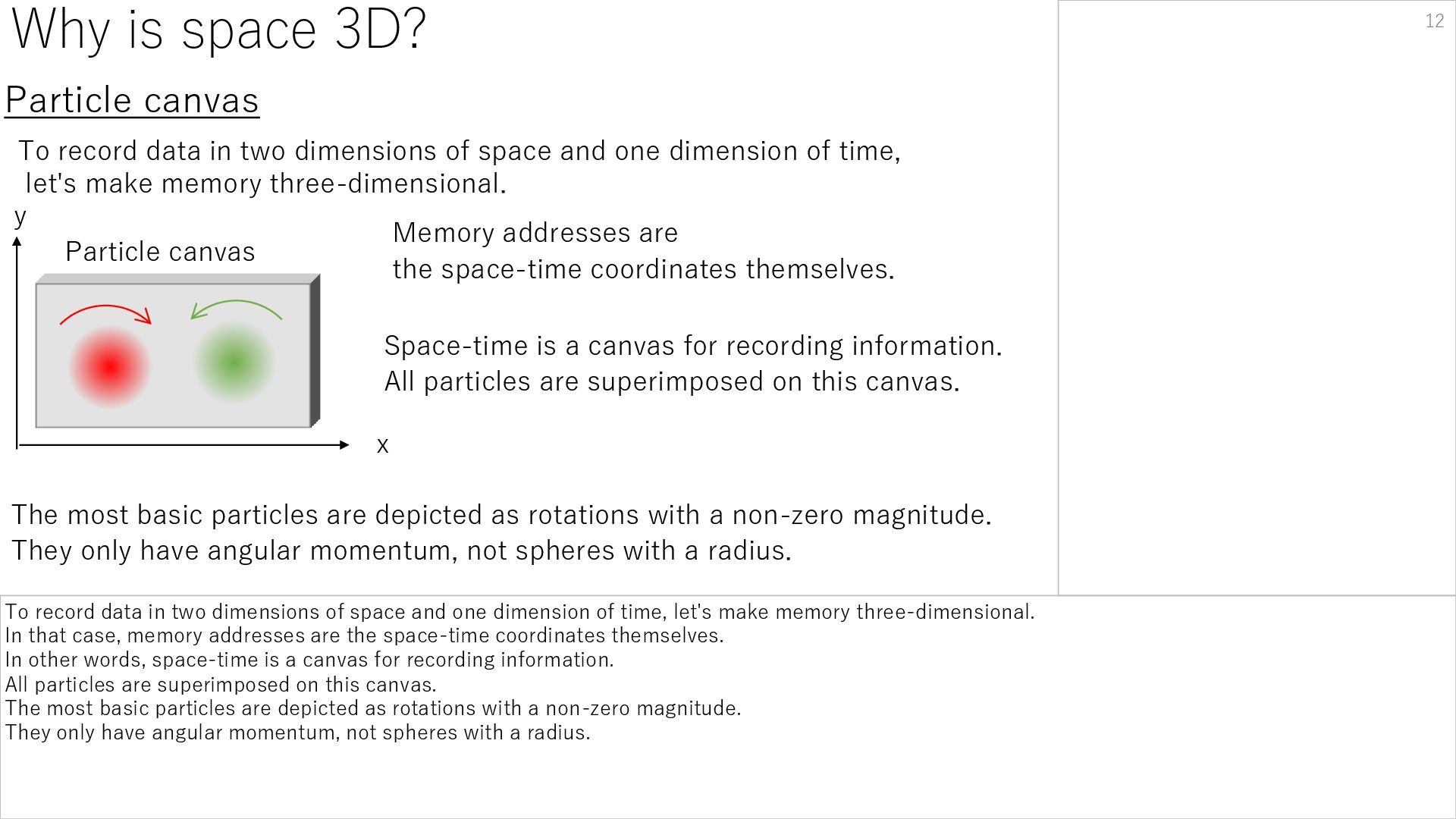
  11. Why is space 3D? To record data in two dimensions

    of space and one dimension of time, let's make memory three-dimensional. In that case, memory addresses are the space-time coordinates themselves. In other words, space-time is a canvas for recording information. All particles are superimposed on this canvas. The most basic particles are depicted as rotations with a non-zero magnitude. They only have angular momentum, not spheres with a radius. Particle canvas To record data in two dimensions of space and one dimension of time, let's make memory three-dimensional. Particle canvas x Space-time is a canvas for recording information. All particles are superimposed on this canvas. y Memory addresses are the space-time coordinates themselves. The most basic particles are depicted as rotations with a non-zero magnitude. They only have angular momentum, not spheres with a radius. 12
  12. Why is space 3D? A problem arises when trying to

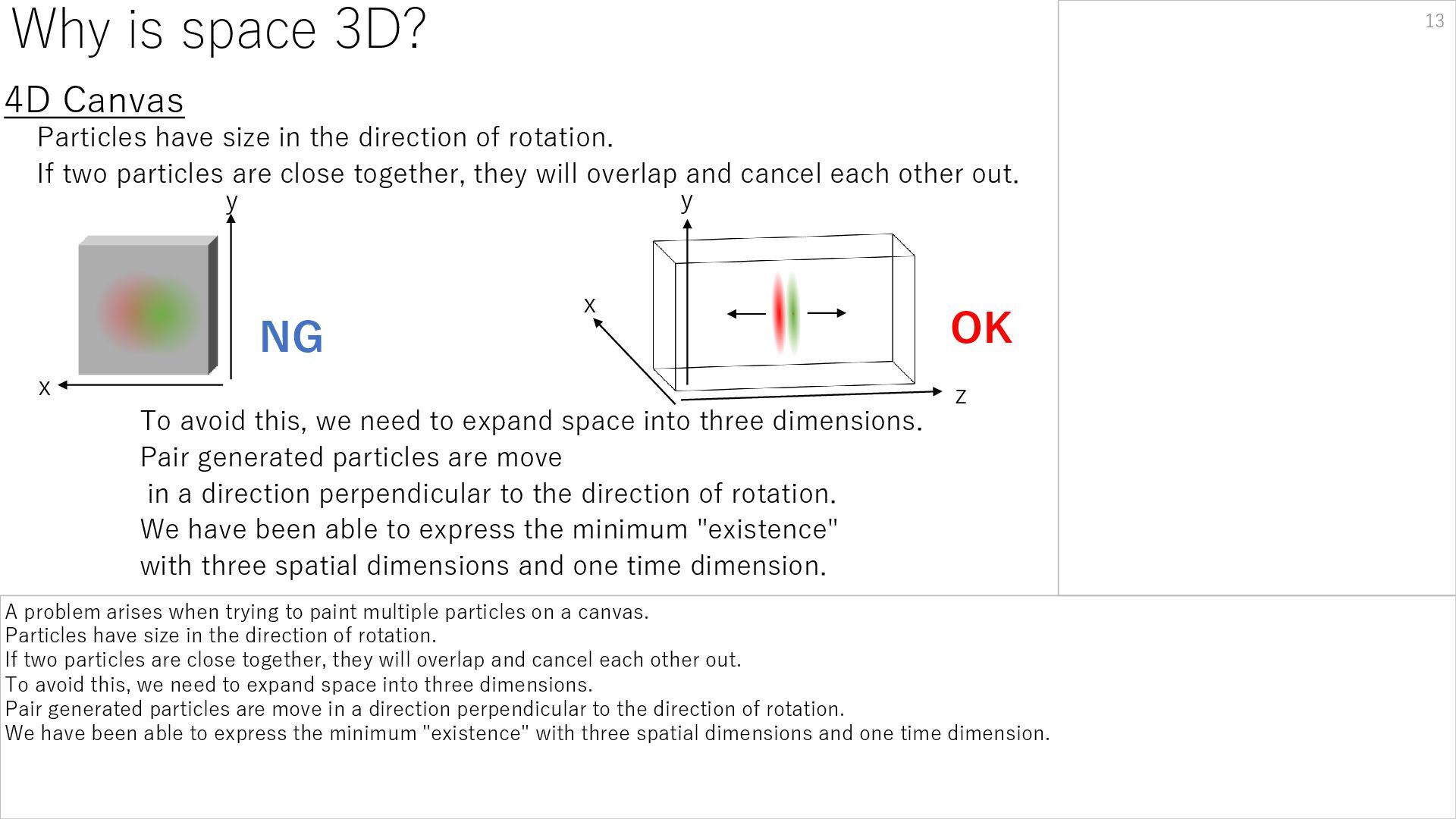
    paint multiple particles on a canvas. Particles have size in the direction of rotation. If two particles are close together, they will overlap and cancel each other out. To avoid this, we need to expand space into three dimensions. Pair generated particles are move in a direction perpendicular to the direction of rotation. We have been able to express the minimum "existence" with three spatial dimensions and one time dimension. 4D Canvas Particles have size in the direction of rotation. If two particles are close together, they will overlap and cancel each other out. x y y x z To avoid this, we need to expand space into three dimensions. Pair generated particles are move in a direction perpendicular to the direction of rotation. We have been able to express the minimum "existence" with three spatial dimensions and one time dimension. OK NG 13
  13. Electromagnetic force What is the most basic elementary particle? It

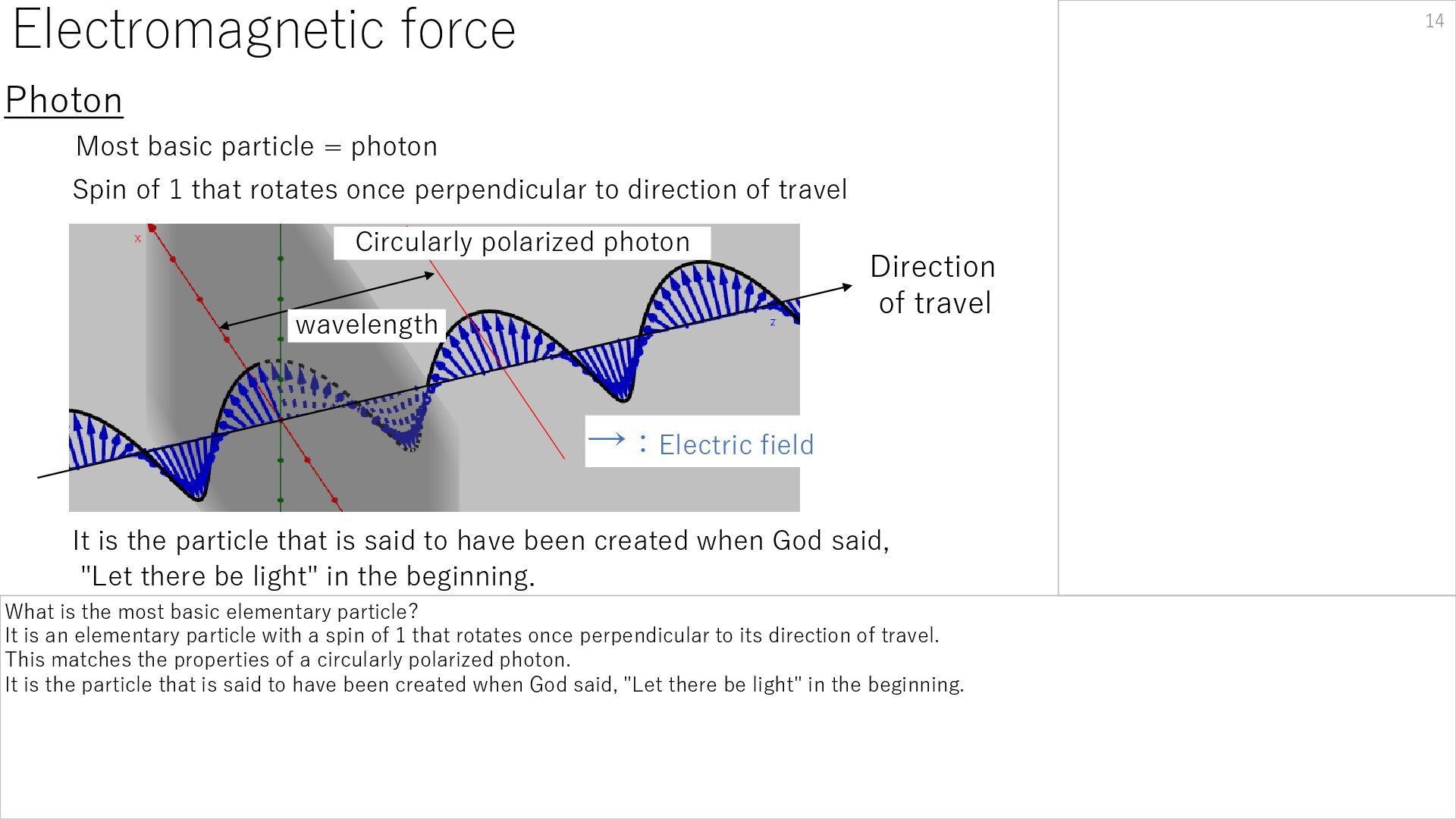
    is an elementary particle with a spin of 1 that rotates once perpendicular to its direction of travel. This matches the properties of a circularly polarized photon. It is the particle that is said to have been created when God said, "Let there be light" in the beginning. Photon wavelength →:Electric field Direction of travel Circularly polarized photon Most basic particle = photon Spin of 1 that rotates once perpendicular to direction of travel It is the particle that is said to have been created when God said, "Let there be light" in the beginning. 14
  14. Electromagnetic force We are overlooking some of the information that

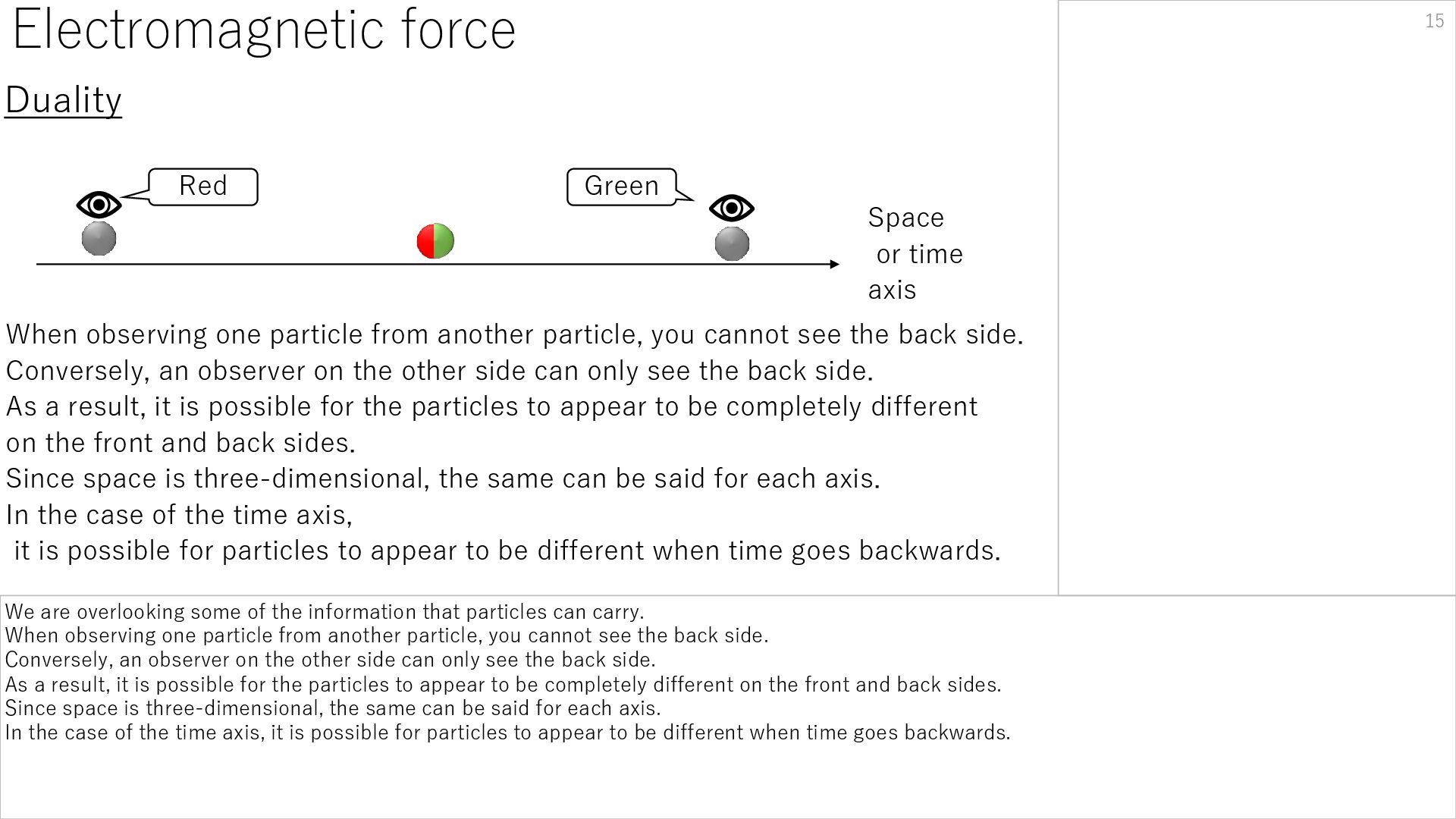
    particles can carry. When observing one particle from another particle, you cannot see the back side. Conversely, an observer on the other side can only see the back side. As a result, it is possible for the particles to appear to be completely different on the front and back sides. Since space is three-dimensional, the same can be said for each axis. In the case of the time axis, it is possible for particles to appear to be different when time goes backwards. Duality When observing one particle from another particle, you cannot see the back side. Conversely, an observer on the other side can only see the back side. As a result, it is possible for the particles to appear to be completely different on the front and back sides. Since space is three-dimensional, the same can be said for each axis. In the case of the time axis, it is possible for particles to appear to be different when time goes backwards. Red Green Space or time axis 15
  15. Electromagnetic force Since space has directions, let's illustrate it by

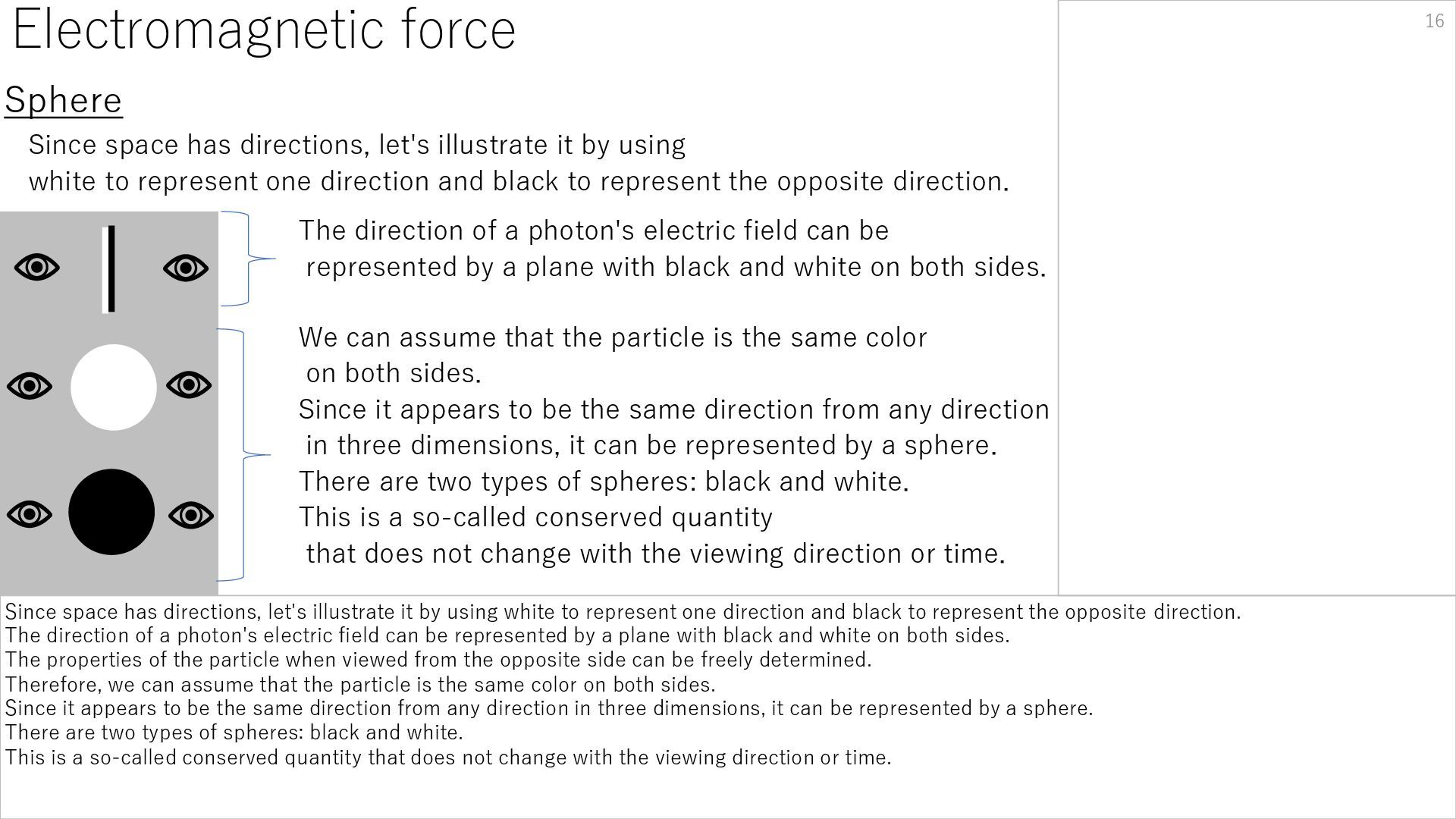
    using white to represent one direction and black to represent the opposite direction. The direction of a photon's electric field can be represented by a plane with black and white on both sides. The properties of the particle when viewed from the opposite side can be freely determined. Therefore, we can assume that the particle is the same color on both sides. Since it appears to be the same direction from any direction in three dimensions, it can be represented by a sphere. There are two types of spheres: black and white. This is a so-called conserved quantity that does not change with the viewing direction or time. Sphere Since space has directions, let's illustrate it by using white to represent one direction and black to represent the opposite direction. The direction of a photon's electric field can be represented by a plane with black and white on both sides. We can assume that the particle is the same color on both sides. Since it appears to be the same direction from any direction in three dimensions, it can be represented by a sphere. There are two types of spheres: black and white. This is a so-called conserved quantity that does not change with the viewing direction or time. 16
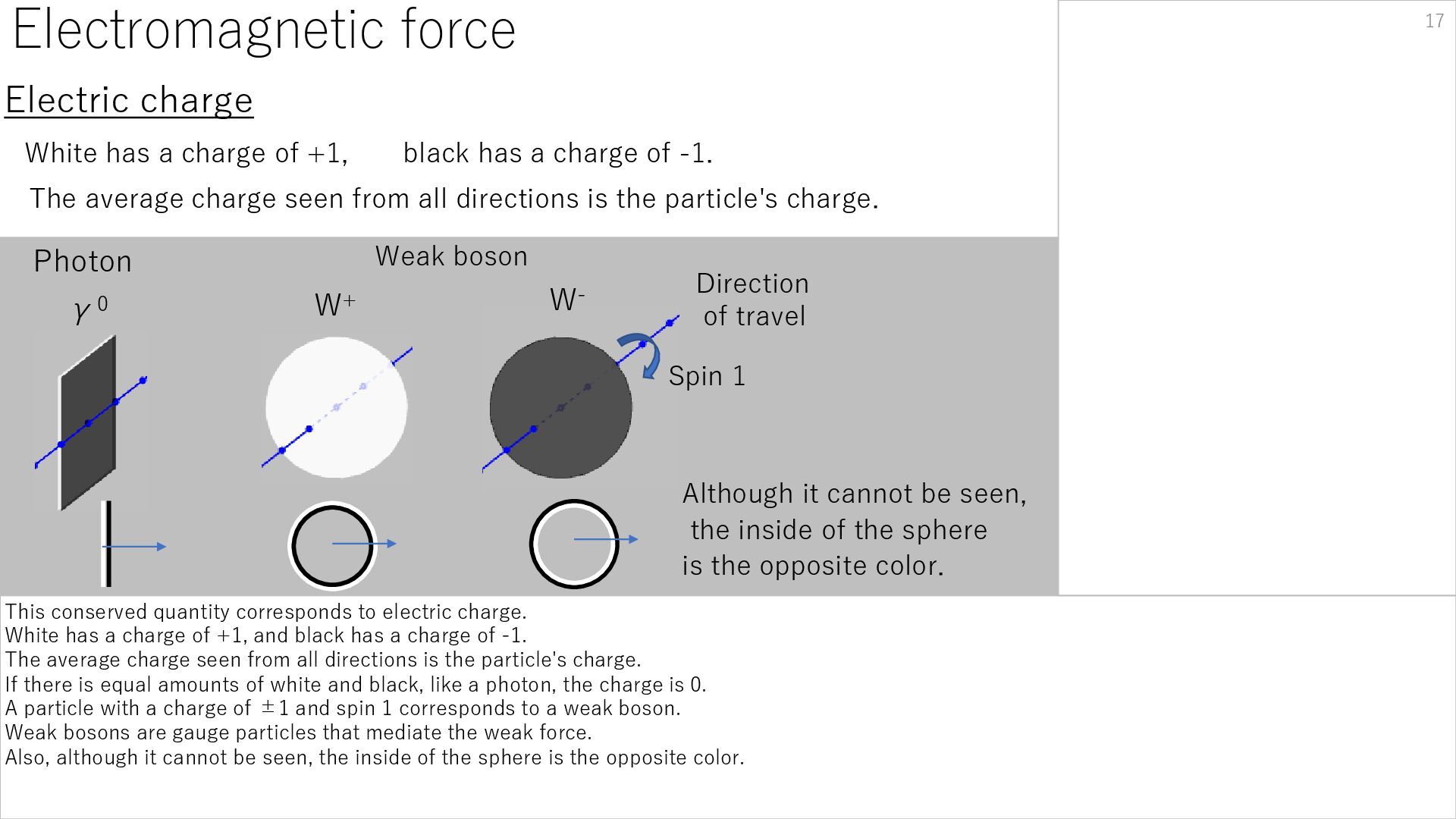
  16. Electromagnetic force This conserved quantity corresponds to electric charge. White

    has a charge of +1, and black has a charge of -1. The average charge seen from all directions is the particle's charge. If there is equal amounts of white and black, like a photon, the charge is 0. A particle with a charge of ±1 and spin 1 corresponds to a weak boson. Weak bosons are gauge particles that mediate the weak force. Also, although it cannot be seen, the inside of the sphere is the opposite color. Electric charge γ0 W+ Although it cannot be seen, the inside of the sphere is the opposite color. White has a charge of +1, black has a charge of -1. The average charge seen from all directions is the particle's charge. Weak boson Photon W- Direction of travel Spin 1 17
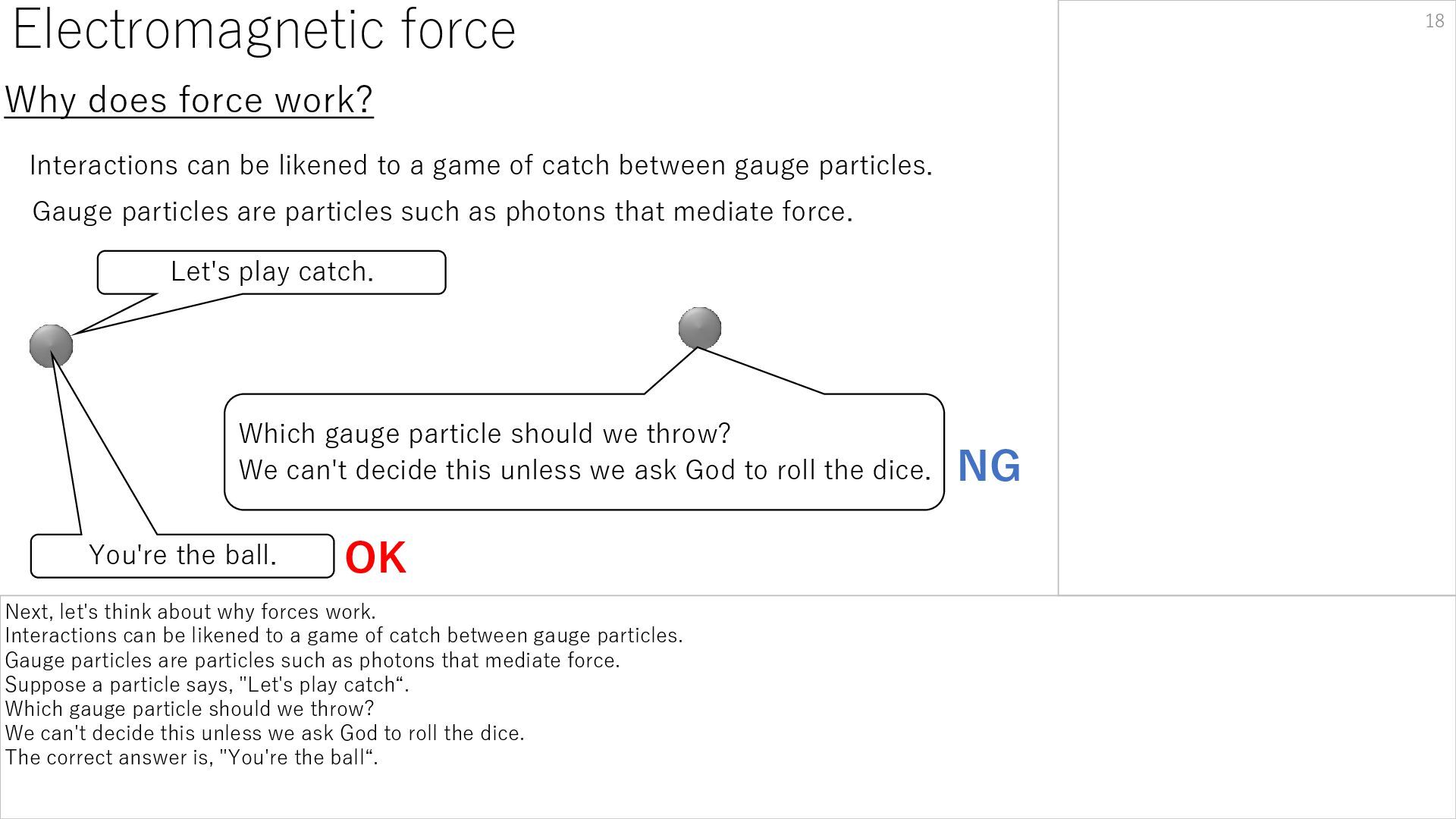
  17. Electromagnetic force Next, let's think about why forces work. Interactions

    can be likened to a game of catch between gauge particles. Gauge particles are particles such as photons that mediate force. Suppose a particle says, "Let's play catch“. Which gauge particle should we throw? We can't decide this unless we ask God to roll the dice. The correct answer is, "You're the ball“. Why does force work? Interactions can be likened to a game of catch between gauge particles. Let's play catch. Which gauge particle should we throw? We can't decide this unless we ask God to roll the dice. You're the ball. NG OK Gauge particles are particles such as photons that mediate force. 18
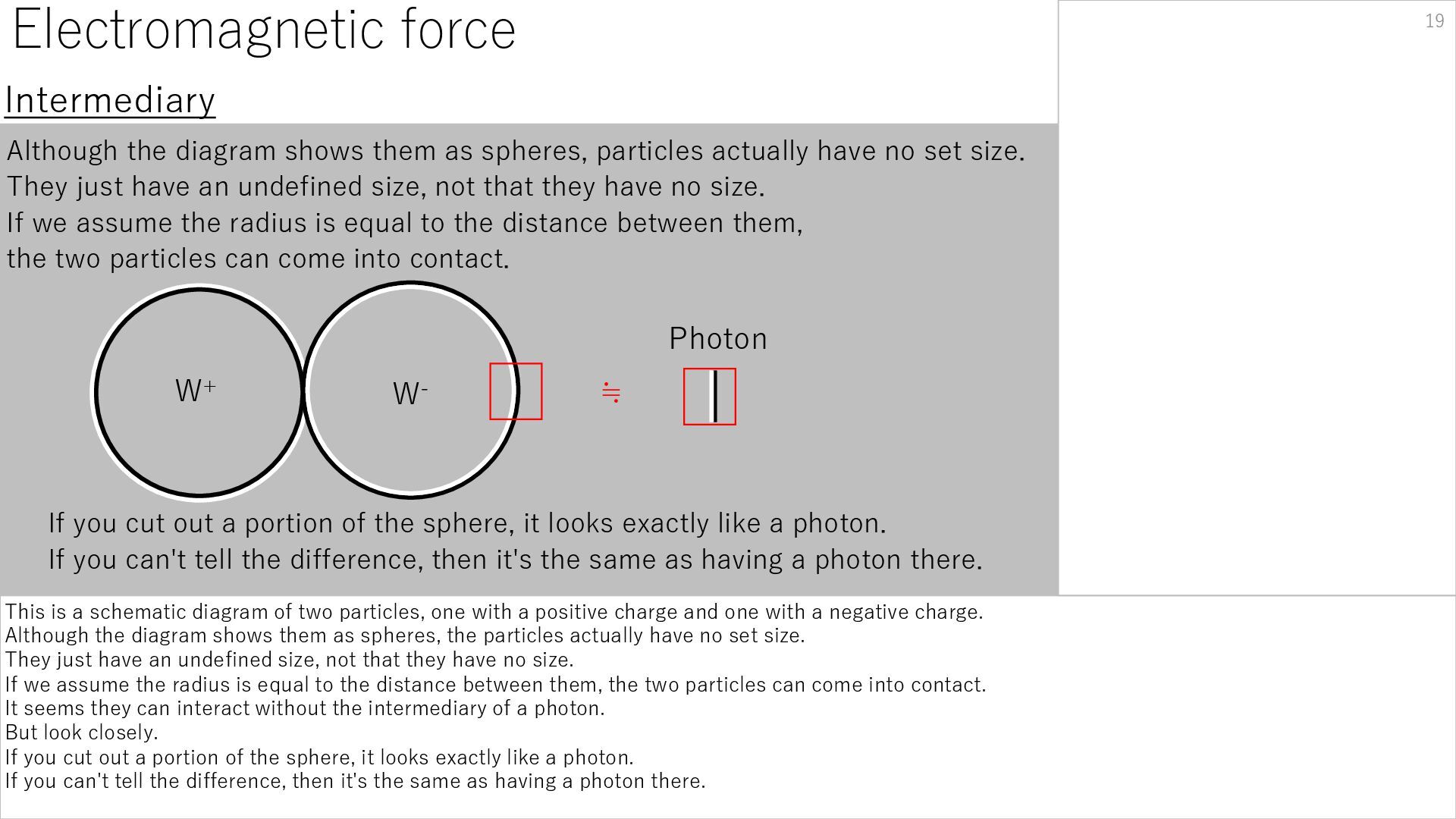
  18. Electromagnetic force This is a schematic diagram of two particles,

    one with a positive charge and one with a negative charge. Although the diagram shows them as spheres, the particles actually have no set size. They just have an undefined size, not that they have no size. If we assume the radius is equal to the distance between them, the two particles can come into contact. It seems they can interact without the intermediary of a photon. But look closely. If you cut out a portion of the sphere, it looks exactly like a photon. If you can't tell the difference, then it's the same as having a photon there. Intermediary If you cut out a portion of the sphere, it looks exactly like a photon. If you can't tell the difference, then it's the same as having a photon there. Although the diagram shows them as spheres, particles actually have no set size. They just have an undefined size, not that they have no size. If we assume the radius is equal to the distance between them, the two particles can come into contact. W+ W- Photon ≒ 19
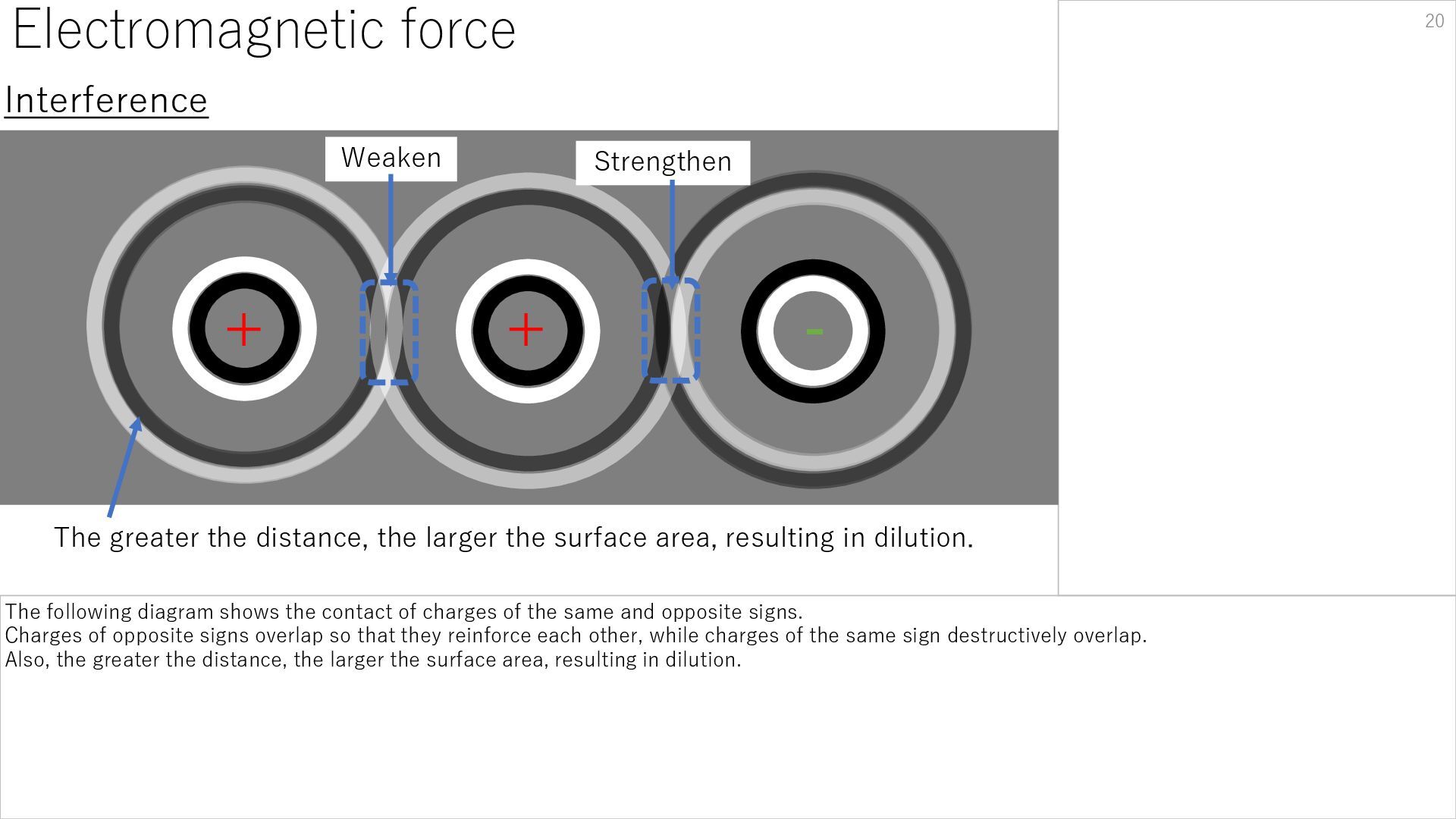
  19. Electromagnetic force The following diagram shows the contact of charges

    of the same and opposite signs. Charges of opposite signs overlap so that they reinforce each other, while charges of the same sign destructively overlap. Also, the greater the distance, the larger the surface area, resulting in dilution. Interference - + + Strengthen Weaken The greater the distance, the larger the surface area, resulting in dilution. 20
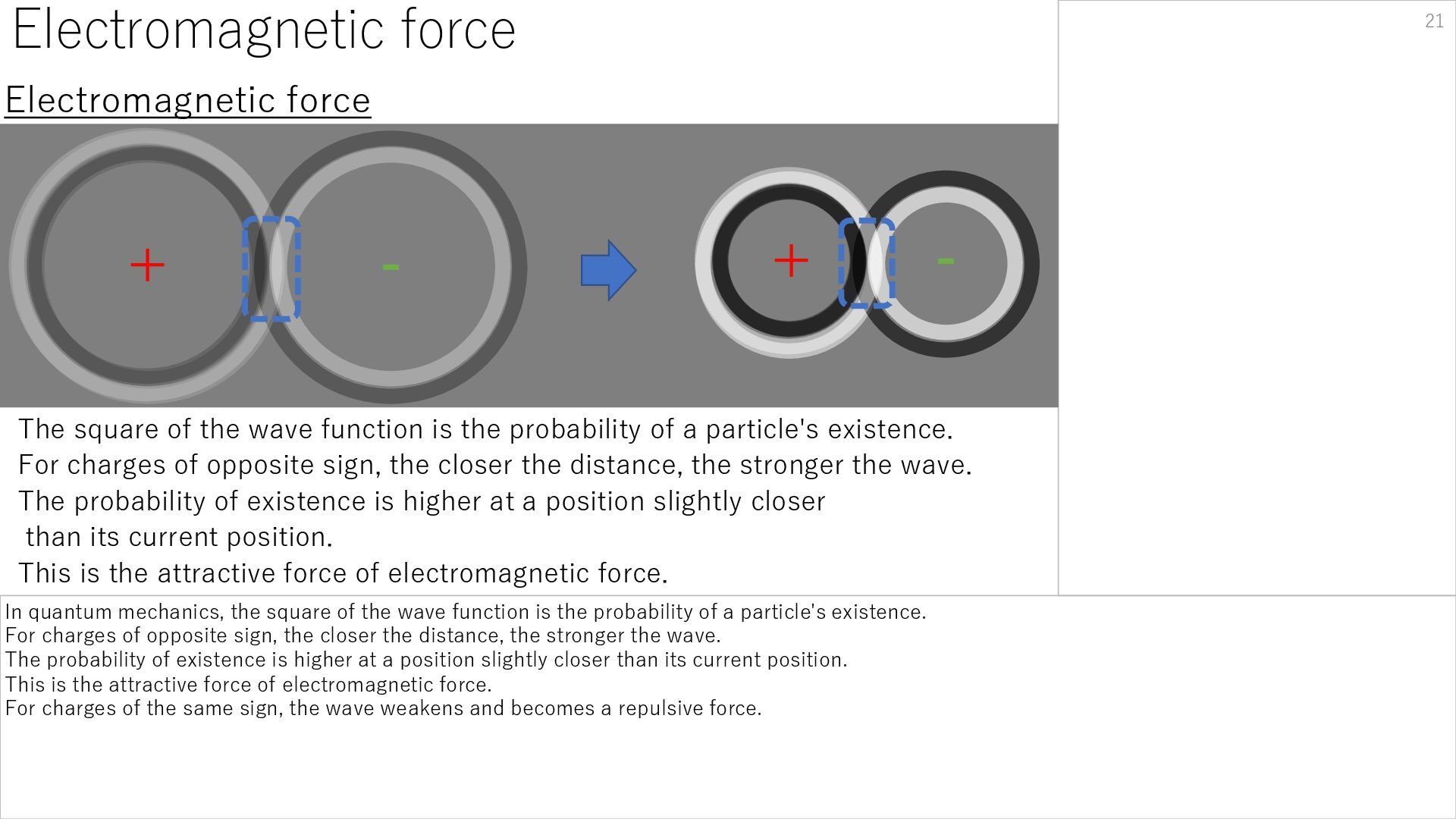
  20. Electromagnetic force In quantum mechanics, the square of the wave

    function is the probability of a particle's existence. For charges of opposite sign, the closer the distance, the stronger the wave. The probability of existence is higher at a position slightly closer than its current position. This is the attractive force of electromagnetic force. For charges of the same sign, the wave weakens and becomes a repulsive force. Electromagnetic force The square of the wave function is the probability of a particle's existence. For charges of opposite sign, the closer the distance, the stronger the wave. The probability of existence is higher at a position slightly closer than its current position. This is the attractive force of electromagnetic force. + + - - 21
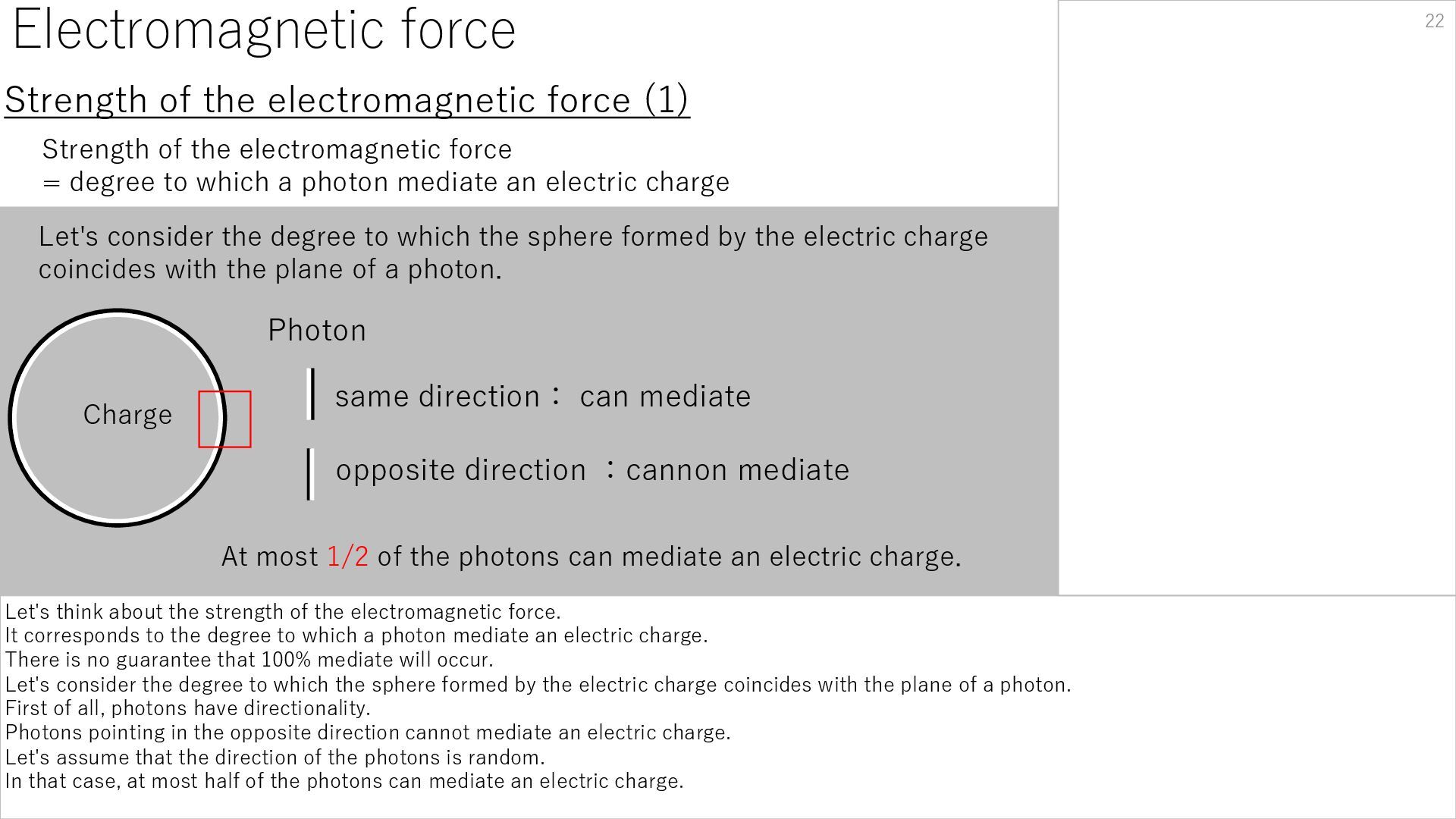
  21. Electromagnetic force Let's think about the strength of the electromagnetic

    force. It corresponds to the degree to which a photon mediate an electric charge. There is no guarantee that 100% mediate will occur. Let's consider the degree to which the sphere formed by the electric charge coincides with the plane of a photon. First of all, photons have directionality. Photons pointing in the opposite direction cannot mediate an electric charge. Let's assume that the direction of the photons is random. In that case, at most half of the photons can mediate an electric charge. Strength of the electromagnetic force (1) Strength of the electromagnetic force = degree to which a photon mediate an electric charge Photon Charge same direction: can mediate opposite direction :cannon mediate Let's consider the degree to which the sphere formed by the electric charge coincides with the plane of a photon. At most 1/2 of the photons can mediate an electric charge. 22
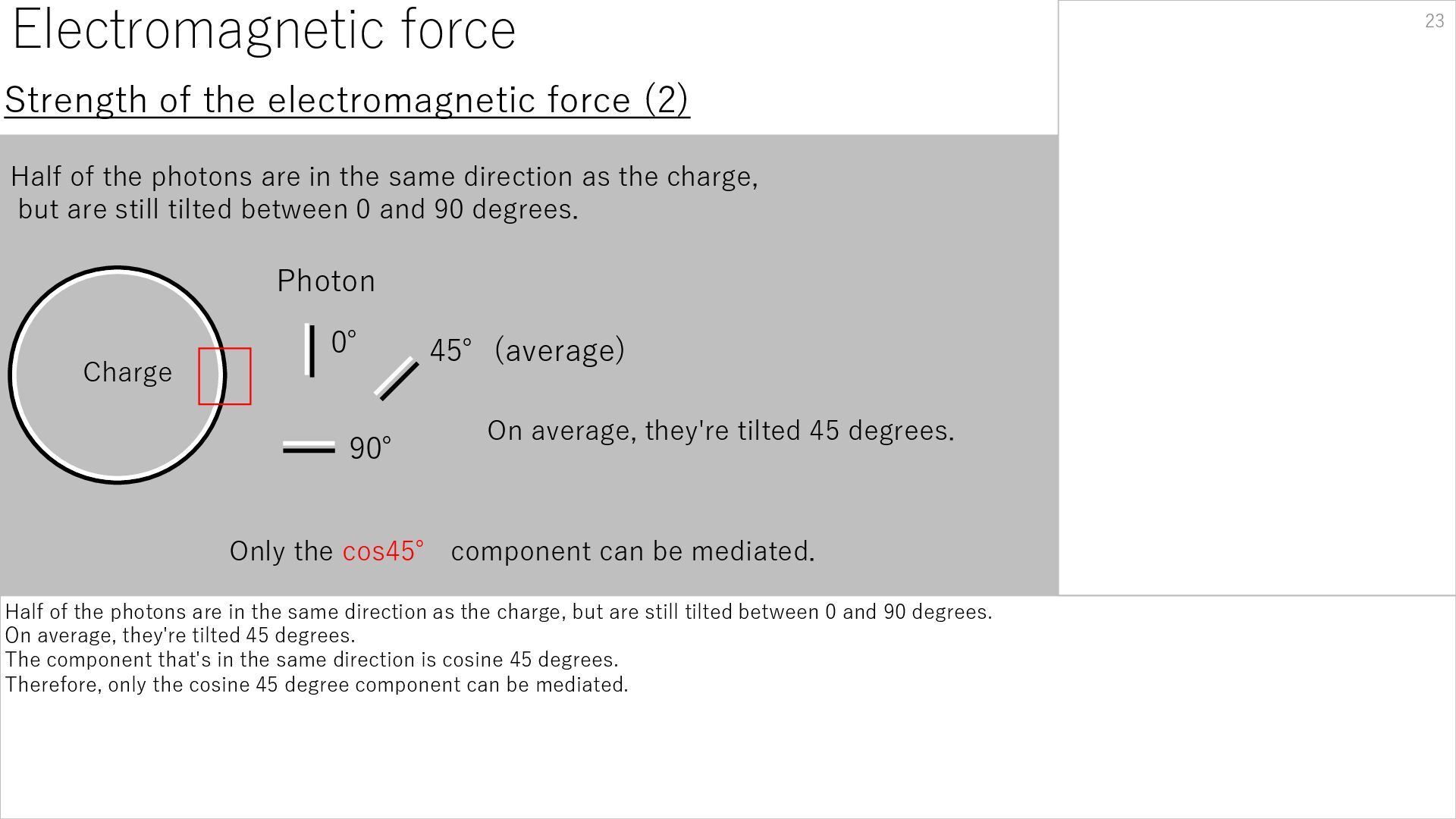
  22. Electromagnetic force Half of the photons are in the same

    direction as the charge, but are still tilted between 0 and 90 degrees. On average, they're tilted 45 degrees. The component that's in the same direction is cosine 45 degrees. Therefore, only the cosine 45 degree component can be mediated. Strength of the electromagnetic force (2) A B C Photon Charge 0° 90° 45°(average) Half of the photons are in the same direction as the charge, but are still tilted between 0 and 90 degrees. On average, they're tilted 45 degrees. Only the cos45° component can be mediated. 23
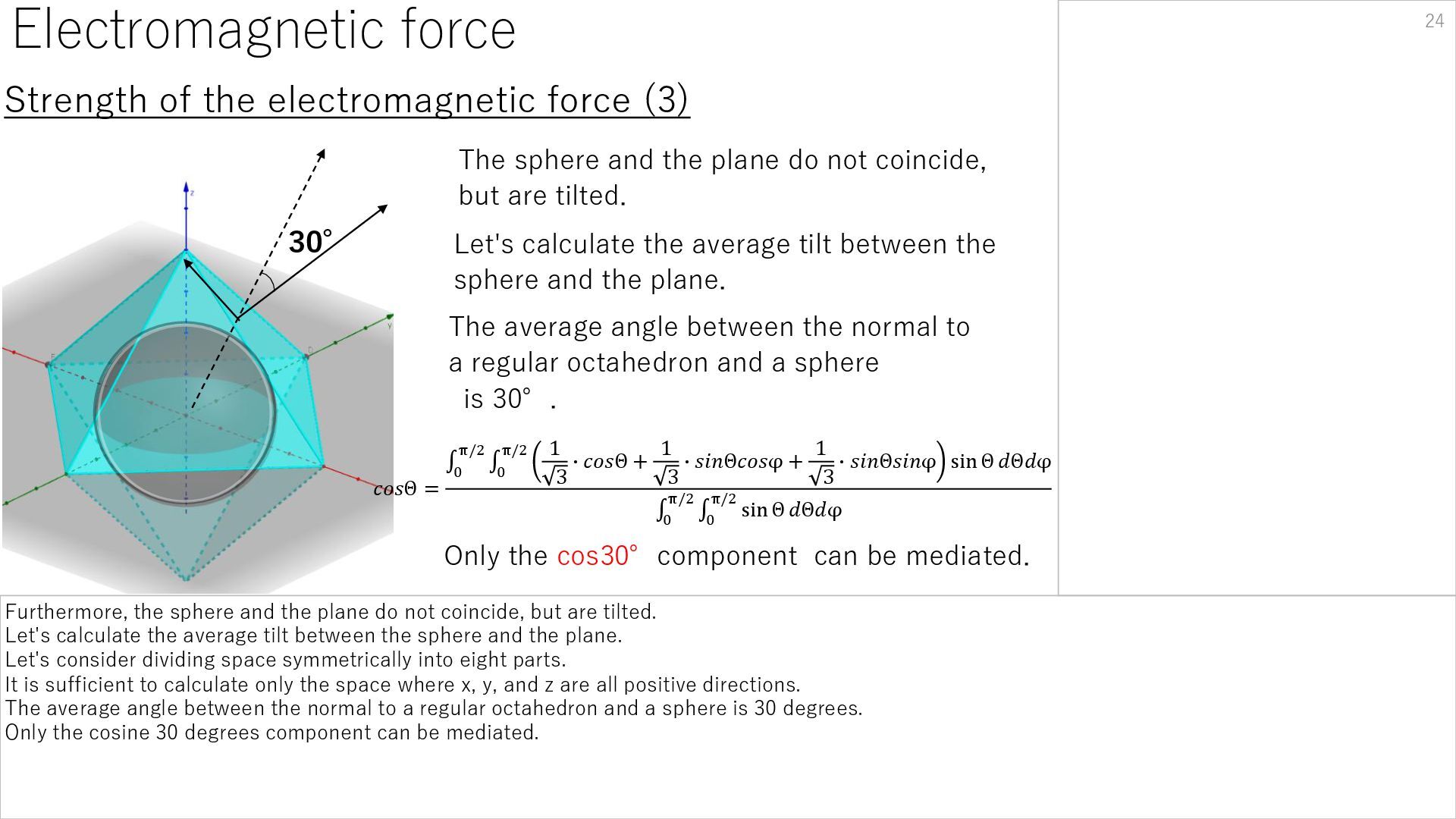
  23. Electromagnetic force Furthermore, the sphere and the plane do not

    coincide, but are tilted. Let's calculate the average tilt between the sphere and the plane. Let's consider dividing space symmetrically into eight parts. It is sufficient to calculate only the space where x, y, and z are all positive directions. The average angle between the normal to a regular octahedron and a sphere is 30 degrees. Only the cosine 30 degrees component can be mediated. Strength of the electromagnetic force (3) 30° The sphere and the plane do not coincide, but are tilted. Let's calculate the average tilt between the sphere and the plane. The average angle between the normal to a regular octahedron and a sphere is 30°. Only the cos30°component can be mediated. 24 𝑐𝑜𝑠Θ = ׬ 0 π/2 ׬ 0 π/2 1 3 ∙ 𝑐𝑜𝑠Θ + 1 3 ∙ 𝑠𝑖𝑛Θ𝑐𝑜𝑠φ + 1 3 ∙ 𝑠𝑖𝑛Θ𝑠𝑖𝑛φ sin Θ 𝑑Θ𝑑φ ׬ 0 π/2 ׬ 0 π/2 sin Θ 𝑑Θ𝑑φ
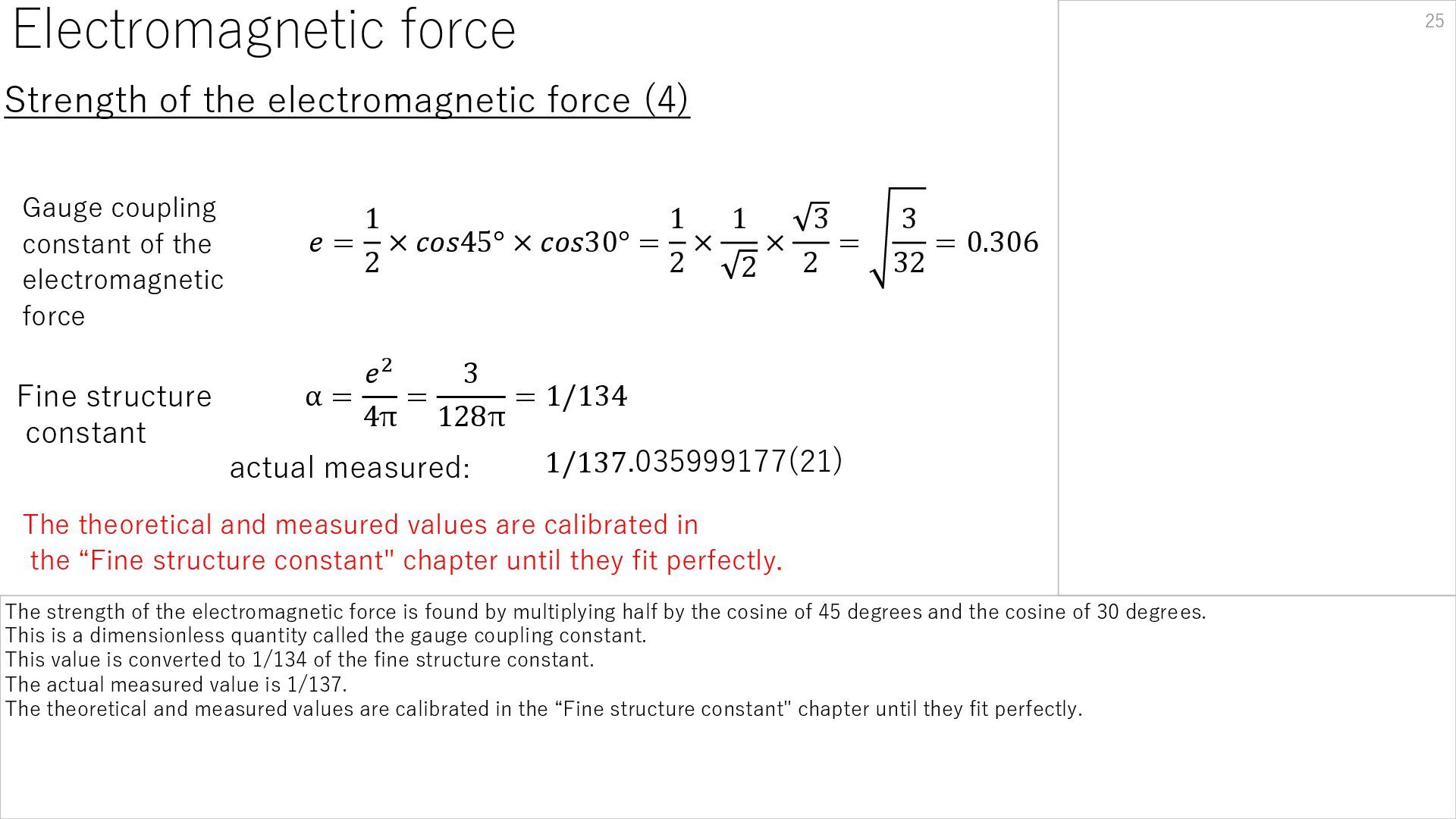
  24. Electromagnetic force The strength of the electromagnetic force is found

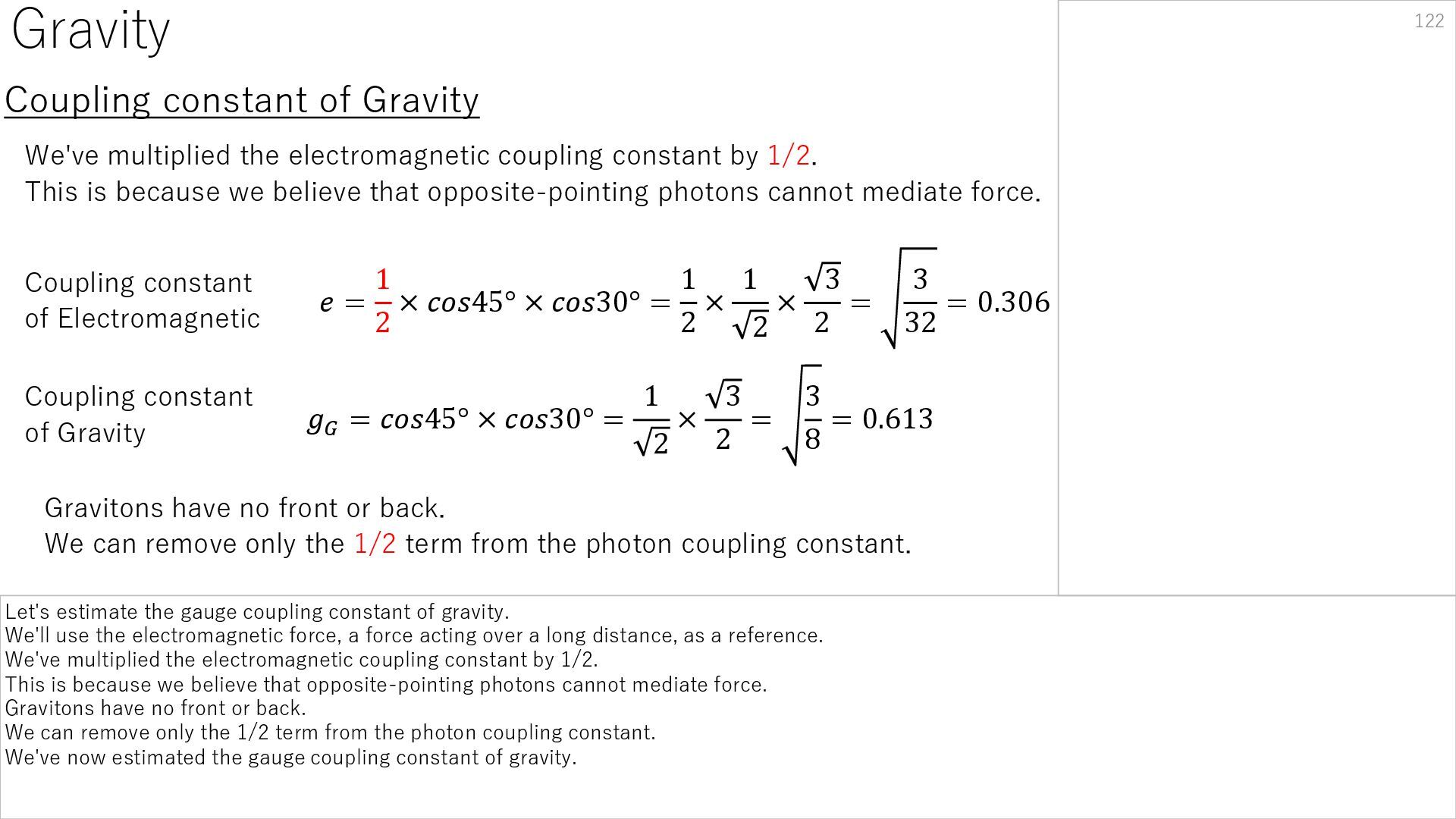
    by multiplying half by the cosine of 45 degrees and the cosine of 30 degrees. This is a dimensionless quantity called the gauge coupling constant. This value is converted to 1/134 of the fine structure constant. The actual measured value is 1/137. The theoretical and measured values are calibrated in the “Fine structure constant" chapter until they fit perfectly. Strength of the electromagnetic force (4) 𝑒 = 1 2 × 𝑐𝑜𝑠45° × 𝑐𝑜𝑠30° = 1 2 × 1 2 × 3 2 = 3 32 = 0.306 α = 𝑒2 4π = 3 128π = 1/134 Fine structure constant actual measured: Gauge coupling constant of the electromagnetic force 25 1/137.035999177(21) The theoretical and measured values are calibrated in the “Fine structure constant" chapter until they fit perfectly.
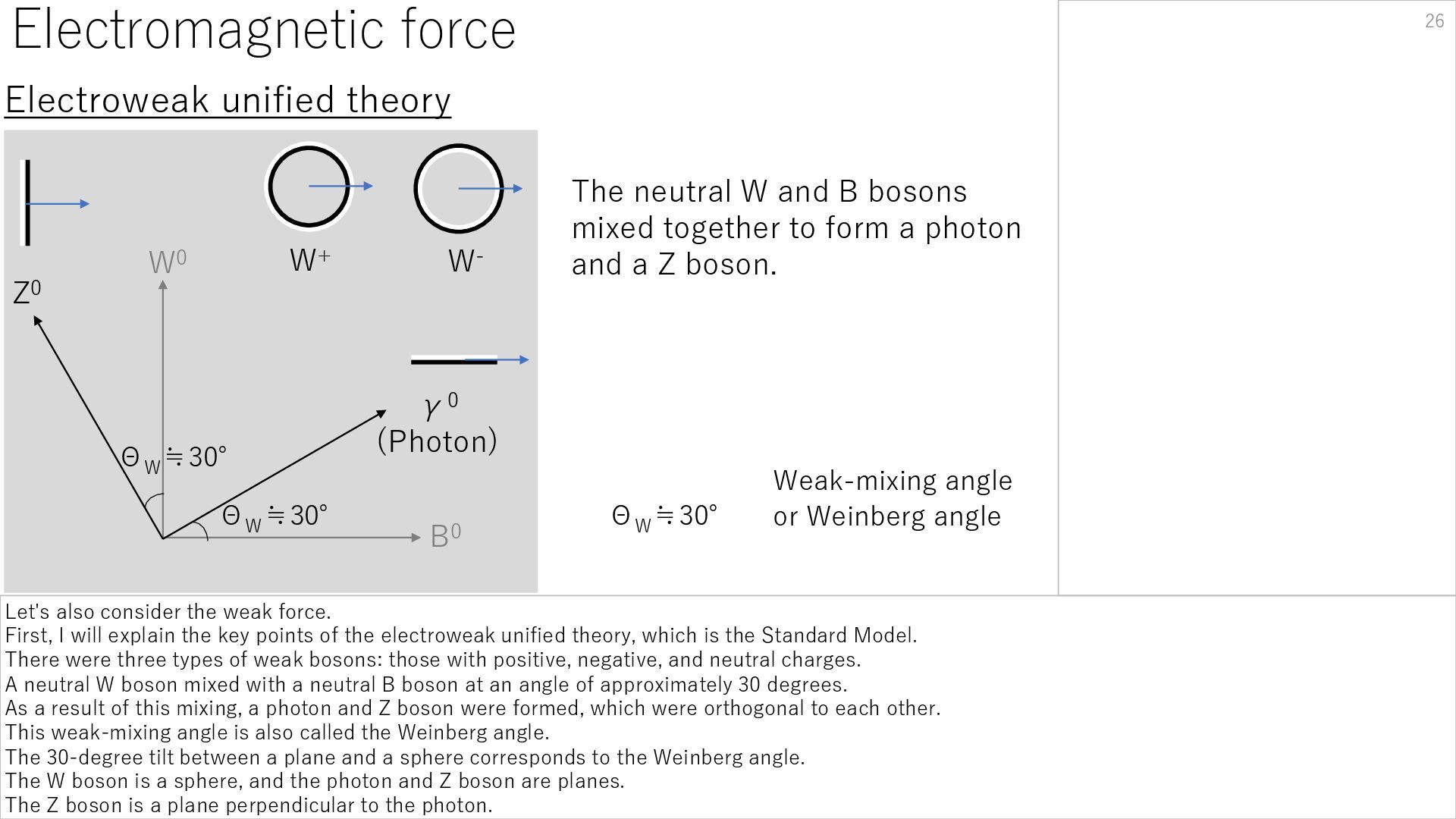
  25. Electromagnetic force Let's also consider the weak force. First, I

    will explain the key points of the electroweak unified theory, which is the Standard Model. There were three types of weak bosons: those with positive, negative, and neutral charges. A neutral W boson mixed with a neutral B boson at an angle of approximately 30 degrees. As a result of this mixing, a photon and Z boson were formed, which were orthogonal to each other. This weak-mixing angle is also called the Weinberg angle. The 30-degree tilt between a plane and a sphere corresponds to the Weinberg angle. The W boson is a sphere, and the photon and Z boson are planes. The Z boson is a plane perpendicular to the photon. Electroweak unified theory B0 W0 γ0 (Photon) Z0 Θ W ≒30° Θ W ≒30° W+ W- Θ W ≒30° Weak-mixing angle or Weinberg angle The neutral W and B bosons mixed together to form a photon and a Z boson. 26
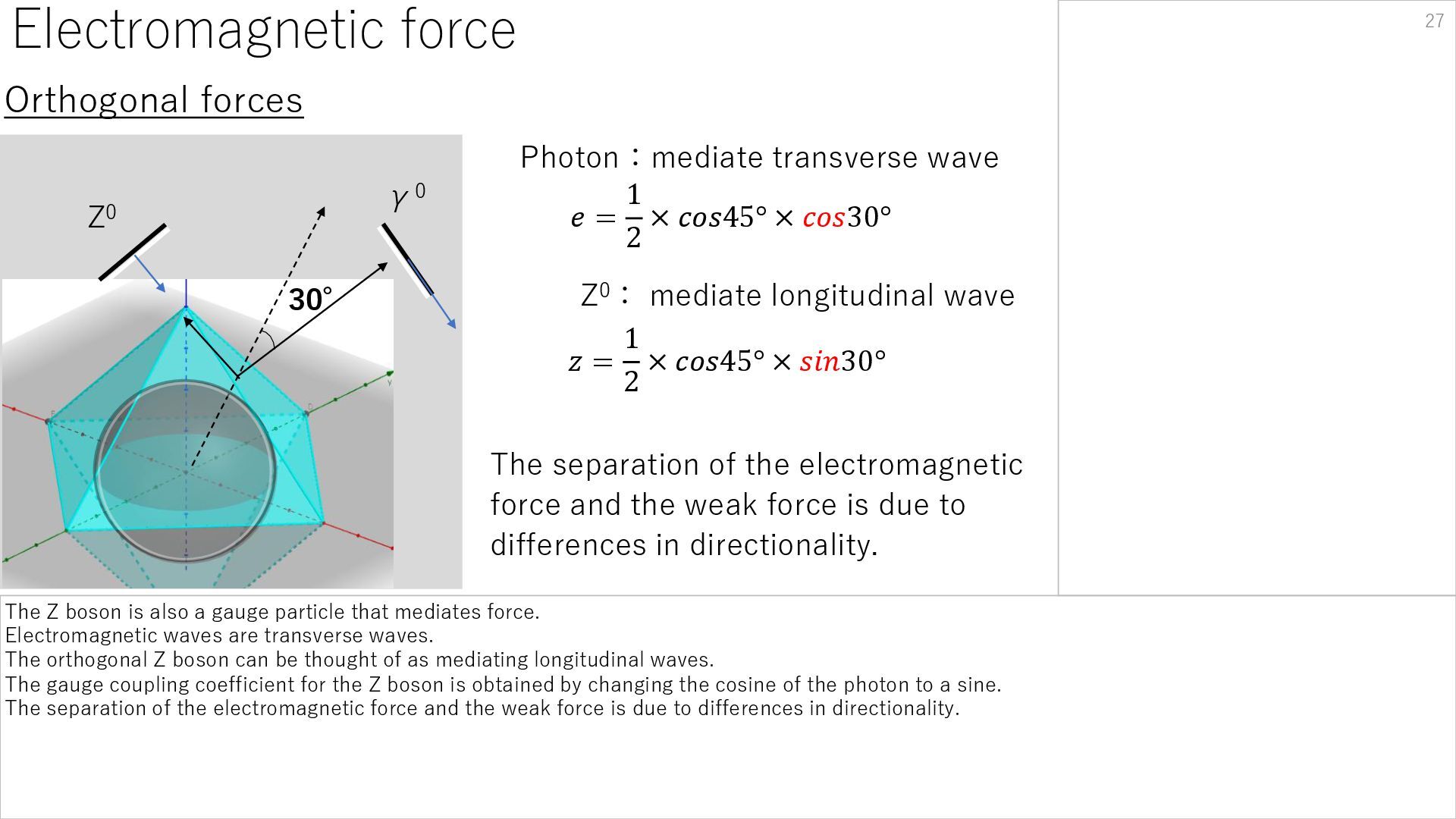
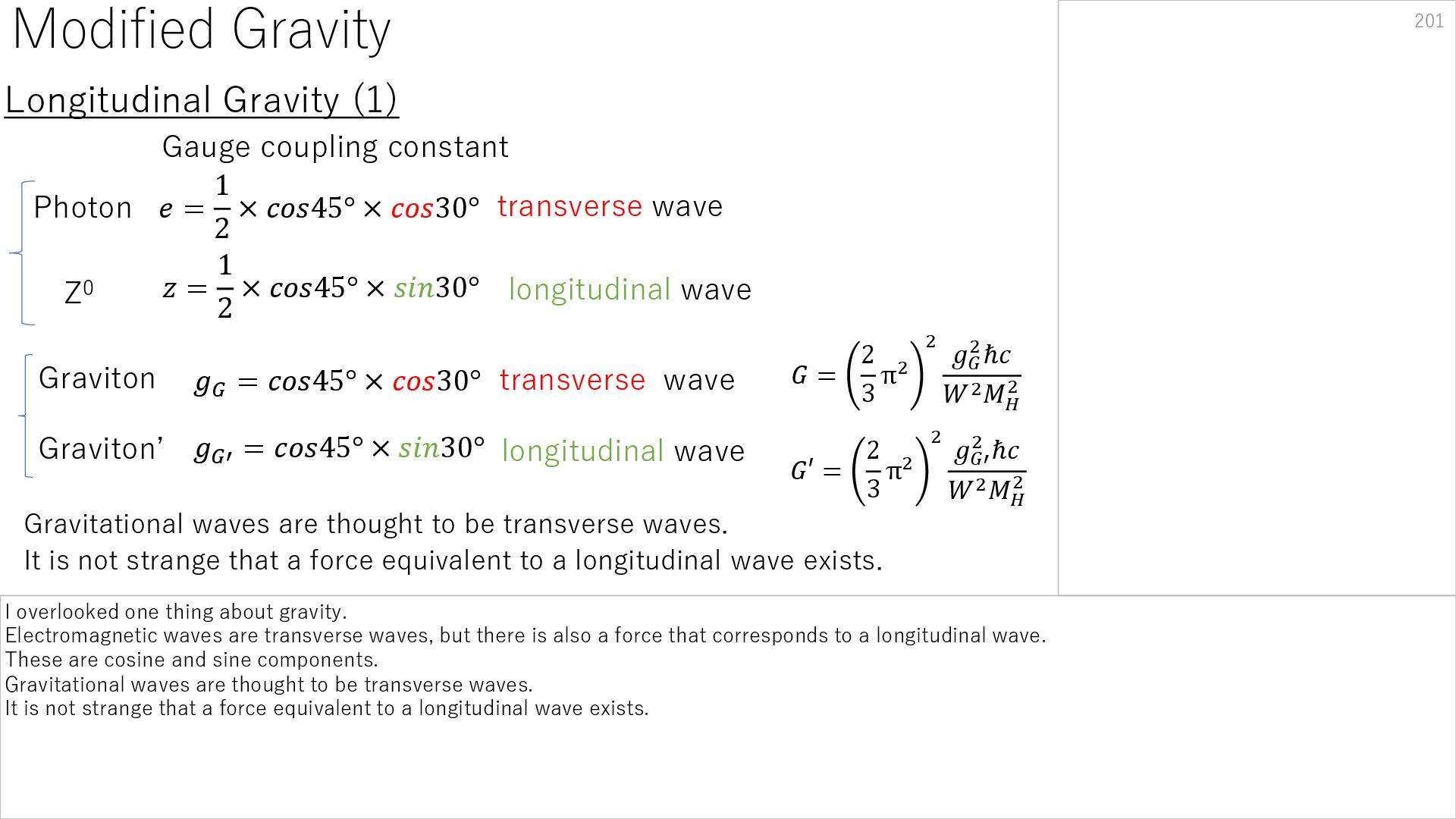
  26. Electromagnetic force The Z boson is also a gauge particle

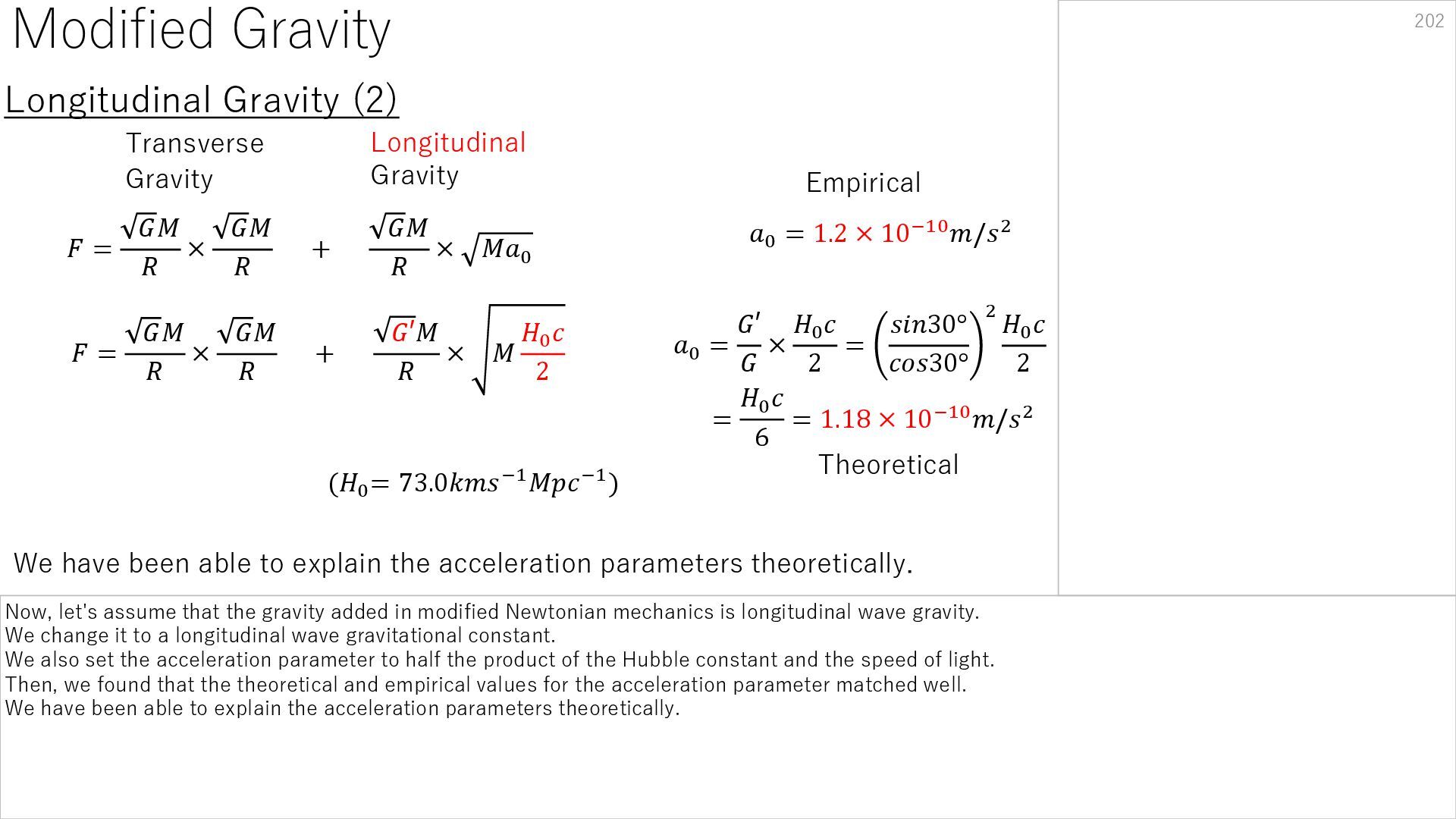
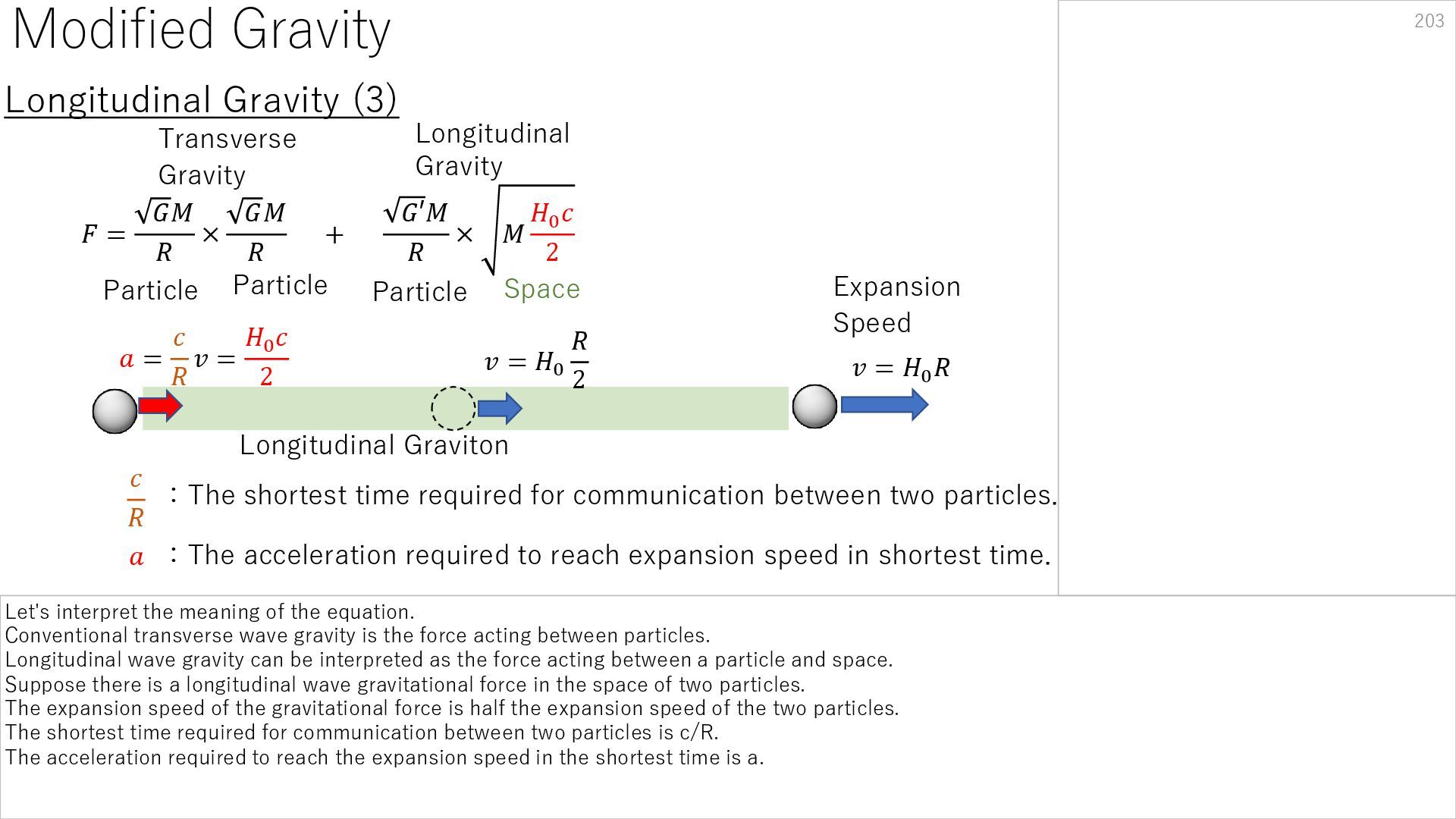
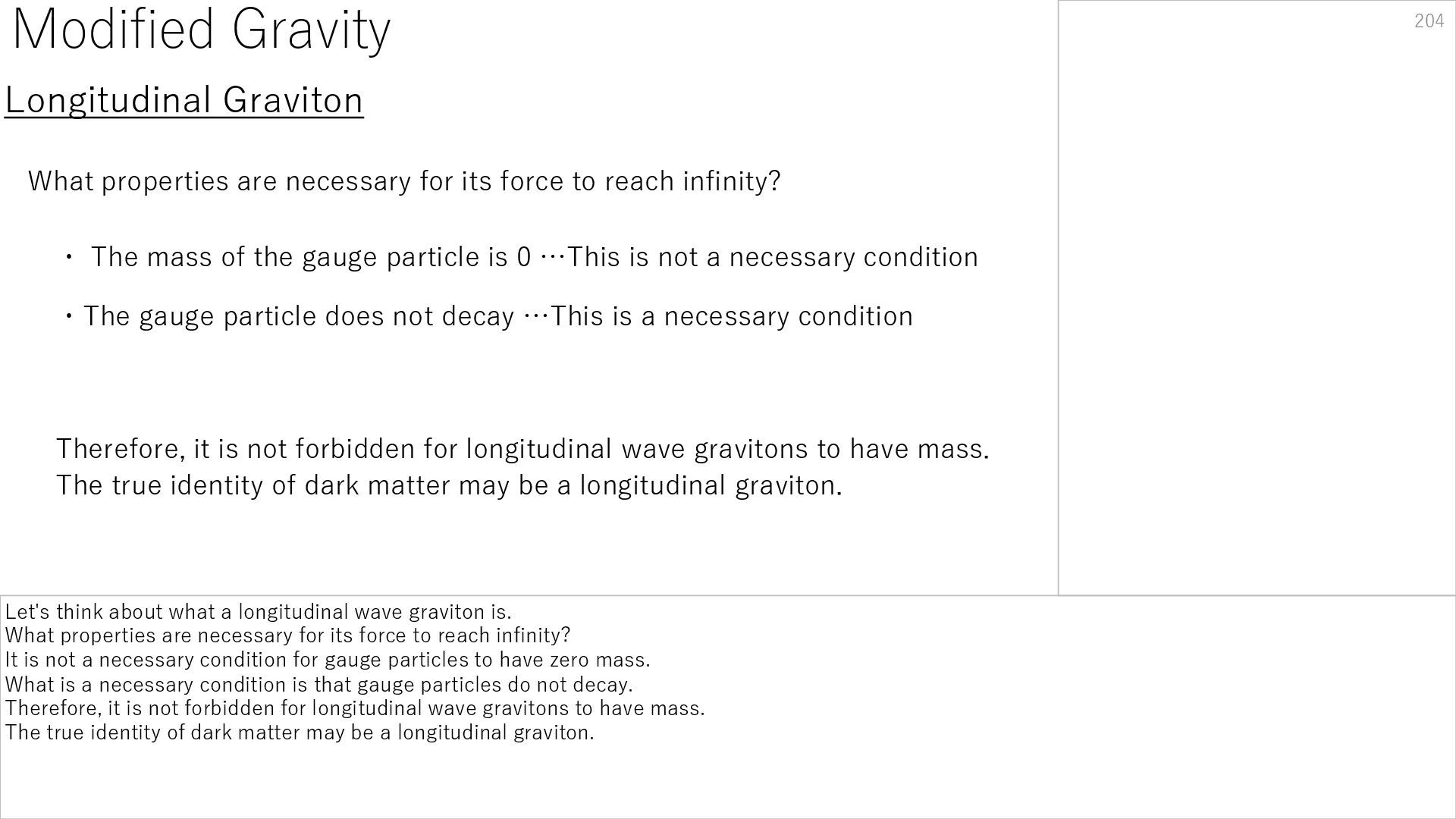
    that mediates force. Electromagnetic waves are transverse waves. The orthogonal Z boson can be thought of as mediating longitudinal waves. The gauge coupling coefficient for the Z boson is obtained by changing the cosine of the photon to a sine. The separation of the electromagnetic force and the weak force is due to differences in directionality. Orthogonal forces 30° Z0 γ0 𝑒 = 1 2 × 𝑐𝑜𝑠45° × 𝑐𝑜𝑠30° 𝑧 = 1 2 × 𝑐𝑜𝑠45° × 𝑠𝑖𝑛30° Photon:mediate transverse wave Z0: mediate longitudinal wave The separation of the electromagnetic force and the weak force is due to differences in directionality. 27
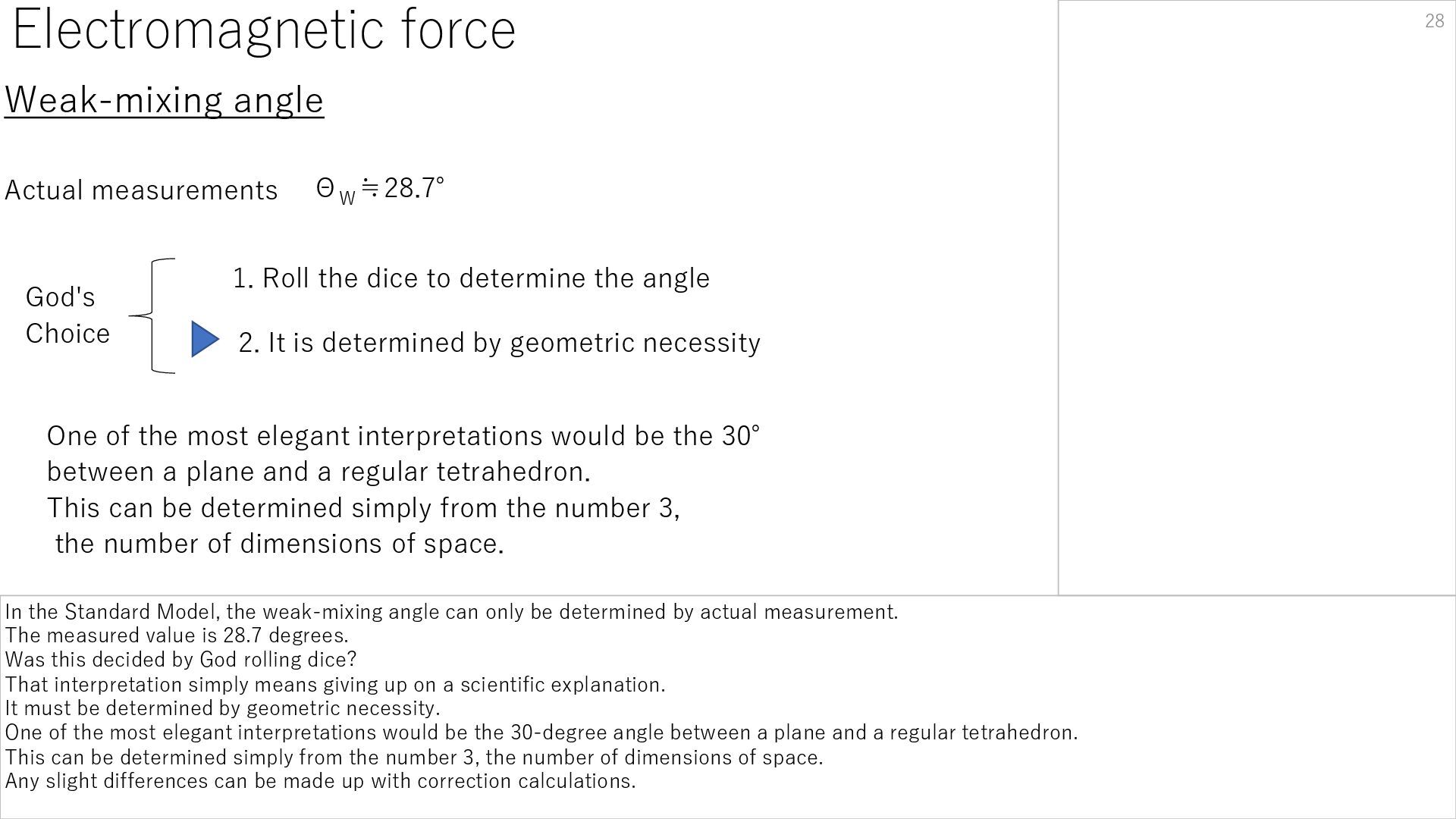
  27. Electromagnetic force In the Standard Model, the weak-mixing angle can

    only be determined by actual measurement. The measured value is 28.7 degrees. Was this decided by God rolling dice? That interpretation simply means giving up on a scientific explanation. It must be determined by geometric necessity. One of the most elegant interpretations would be the 30-degree angle between a plane and a regular tetrahedron. This can be determined simply from the number 3, the number of dimensions of space. Any slight differences can be made up with correction calculations. Weak-mixing angle One of the most elegant interpretations would be the 30° between a plane and a regular tetrahedron. This can be determined simply from the number 3, the number of dimensions of space. 1. Roll the dice to determine the angle 2. It is determined by geometric necessity Θ W ≒28.7° Actual measurements God's Choice 28
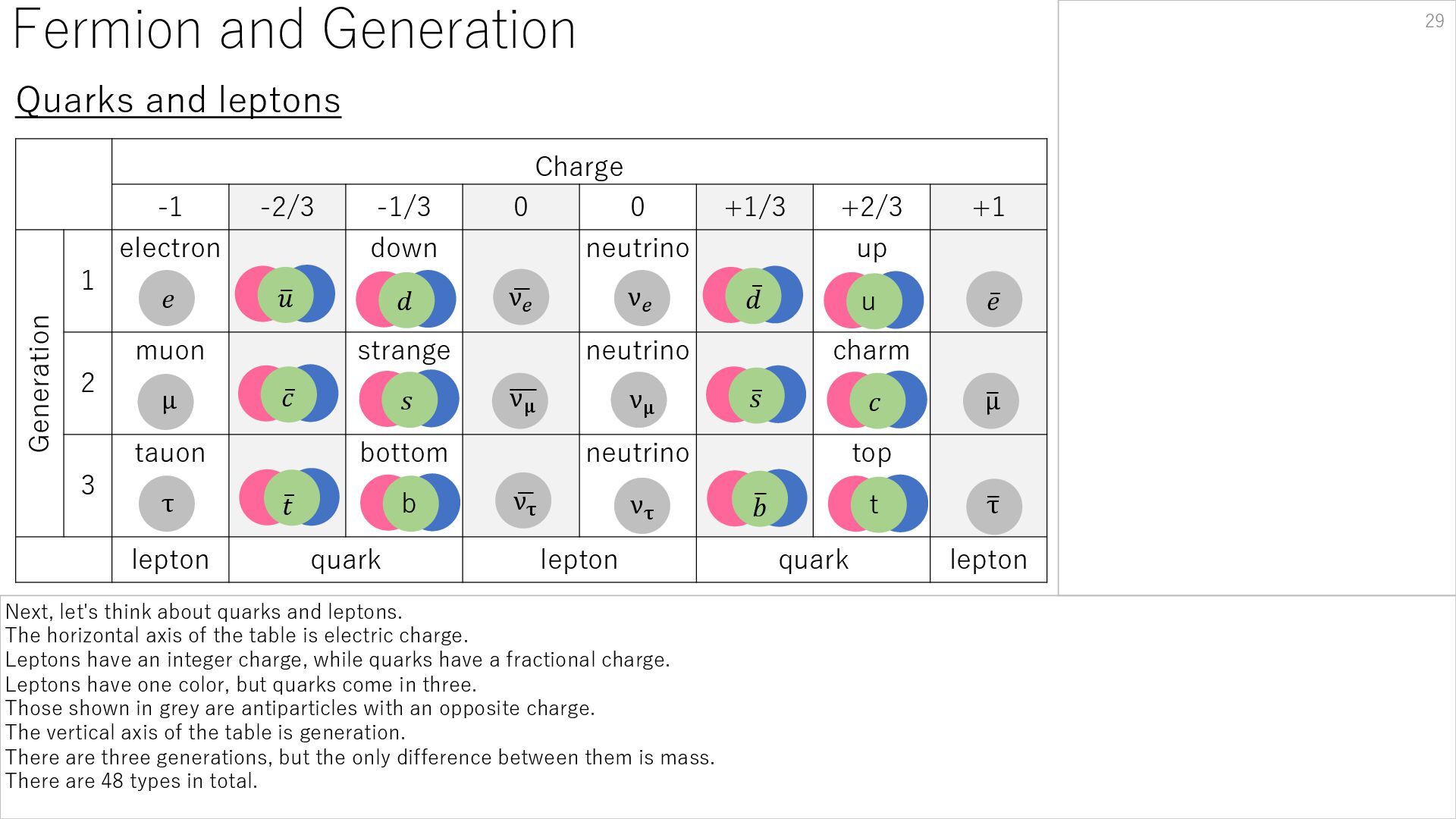
  28. Charge -1 -2/3 -1/3 0 0 +1/3 +2/3 +1 Generation

    1 electron down neutrino up 2 muon strange neutrino charm 3 tauon bottom neutrino top lepton quark lepton quark lepton Fermion and Generation Next, let's think about quarks and leptons. The horizontal axis of the table is electric charge. Leptons have an integer charge, while quarks have a fractional charge. Leptons have one color, but quarks come in three. Those shown in grey are antiparticles with an opposite charge. The vertical axis of the table is generation. There are three generations, but the only difference between them is mass. There are 48 types in total. Quarks and leptons 𝑑 ഥ ν𝑒 νμ ഥ ντ ν𝑒 νμ ντ 𝑠 b u 𝑐 t ҧ 𝑑 ҧ 𝑠 ത 𝑏 ത 𝑢 ҧ 𝑐 ҧ 𝑡 𝑒 μ τ ҧ 𝑒 ത μ ത τ 29
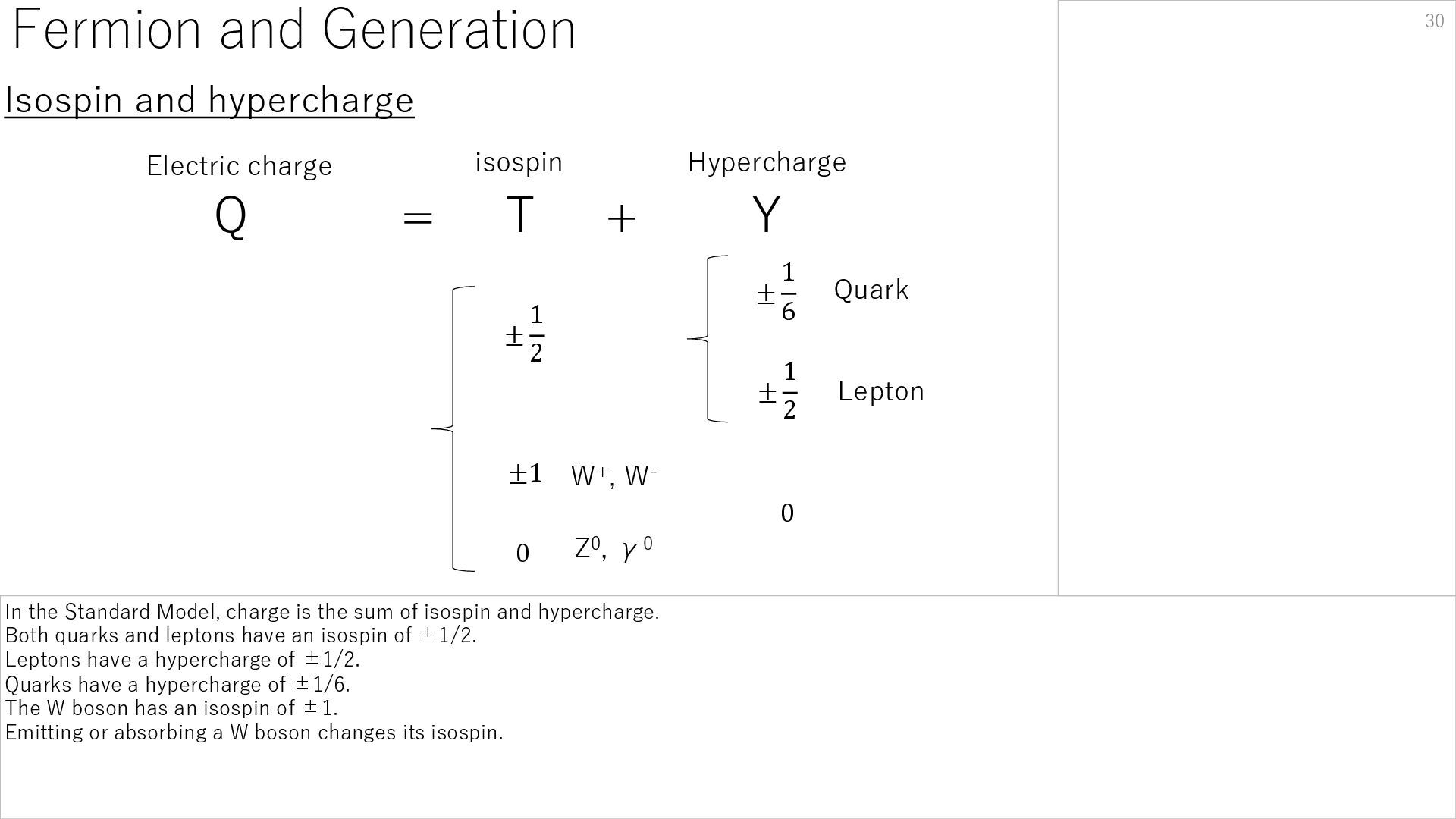
  29. Fermion and Generation In the Standard Model, charge is the

    sum of isospin and hypercharge. Both quarks and leptons have an isospin of ±1/2. Leptons have a hypercharge of ±1/2. Quarks have a hypercharge of ±1/6. The W boson has an isospin of ±1. Emitting or absorbing a W boson changes its isospin. Isospin and hypercharge Q = T + Y Electric charge isospin Hypercharge ± 1 2 ± 1 2 ± 1 6 Quark Lepton ±1 W+, W- 0 Z0, γ0 0 30
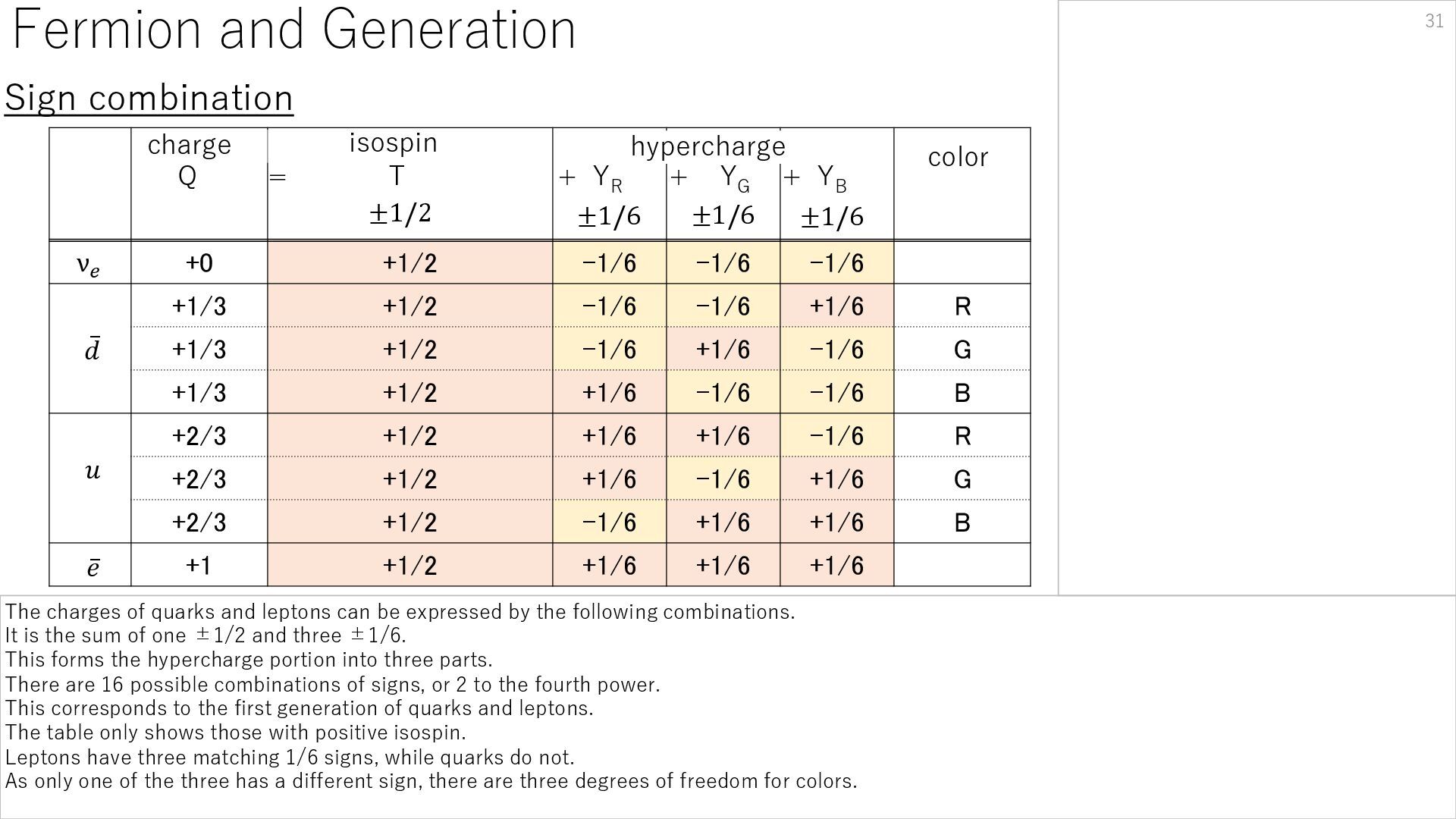
  30. +0 +1/2 -1/6 -1/6 -1/6 +1/3 +1/2 -1/6 -1/6 +1/6

    R +1/3 +1/2 -1/6 +1/6 -1/6 G +1/3 +1/2 +1/6 -1/6 -1/6 B +2/3 +1/2 +1/6 +1/6 -1/6 R +2/3 +1/2 +1/6 -1/6 +1/6 G +2/3 +1/2 -1/6 +1/6 +1/6 B +1 +1/2 +1/6 +1/6 +1/6 Fermion and Generation The charges of quarks and leptons can be expressed by the following combinations. It is the sum of one ±1/2 and three ±1/6. This forms the hypercharge portion into three parts. There are 16 possible combinations of signs, or 2 to the fourth power. This corresponds to the first generation of quarks and leptons. The table only shows those with positive isospin. Leptons have three matching 1/6 signs, while quarks do not. As only one of the three has a different sign, there are three degrees of freedom for colors. Sign combination Q = T + Y R + Y G + Y B charge isospin hypercharge ±1/2 ±1/6 ±1/6 ±1/6 𝑢 ҧ 𝑑 ν𝑒 ҧ 𝑒 color 31
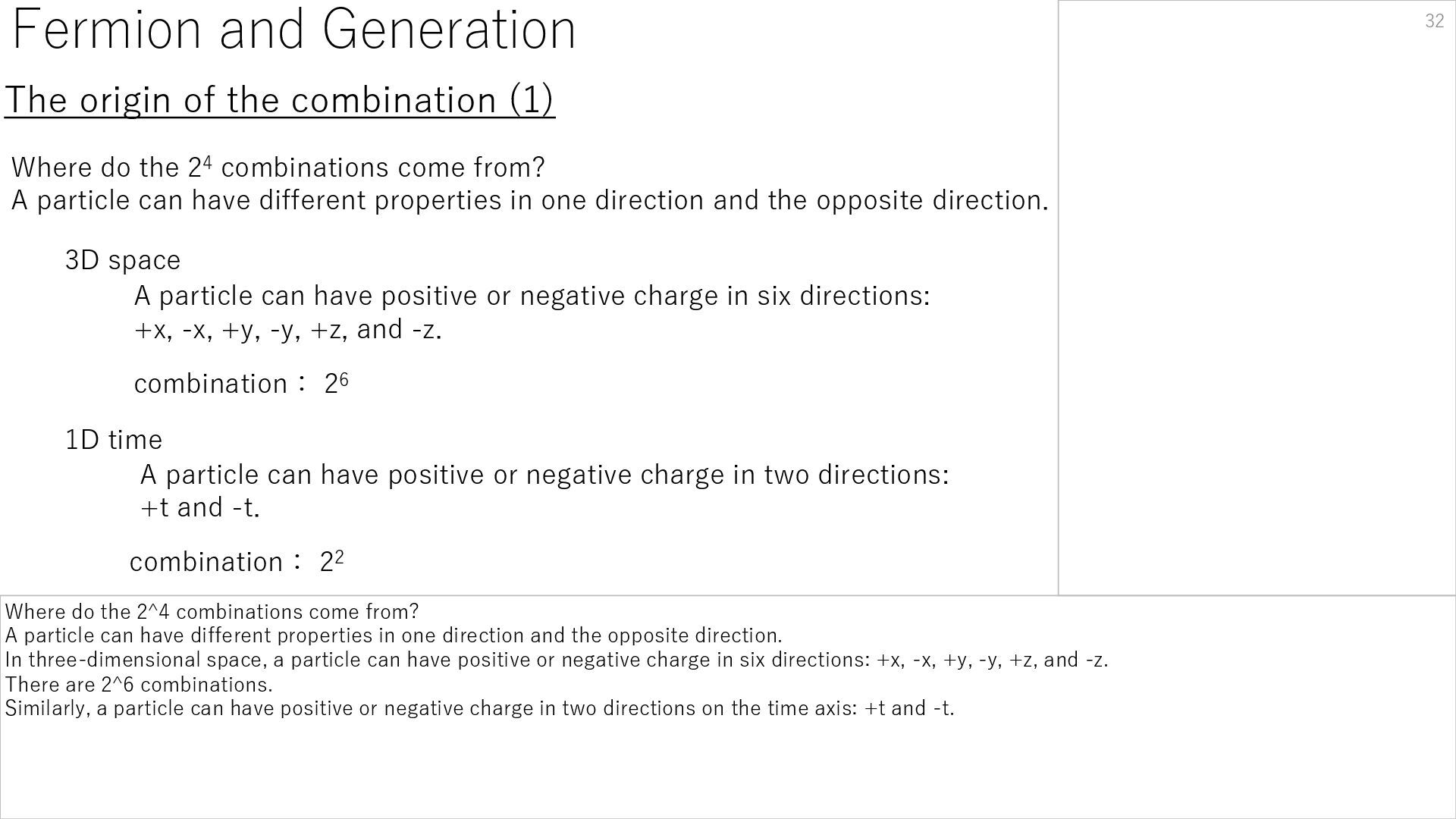
  31. Fermion and Generation Where do the 2^4 combinations come from?

    A particle can have different properties in one direction and the opposite direction. In three-dimensional space, a particle can have positive or negative charge in six directions: +x, -x, +y, -y, +z, and -z. There are 2^6 combinations. Similarly, a particle can have positive or negative charge in two directions on the time axis: +t and -t. The origin of the combination (1) Where do the 24 combinations come from? A particle can have different properties in one direction and the opposite direction. 3D space 1D time A particle can have positive or negative charge in six directions: +x, -x, +y, -y, +z, and -z. A particle can have positive or negative charge in two directions: +t and -t. combination: 26 combination: 22 32
  32. Fermion and Generation The + direction can also be the

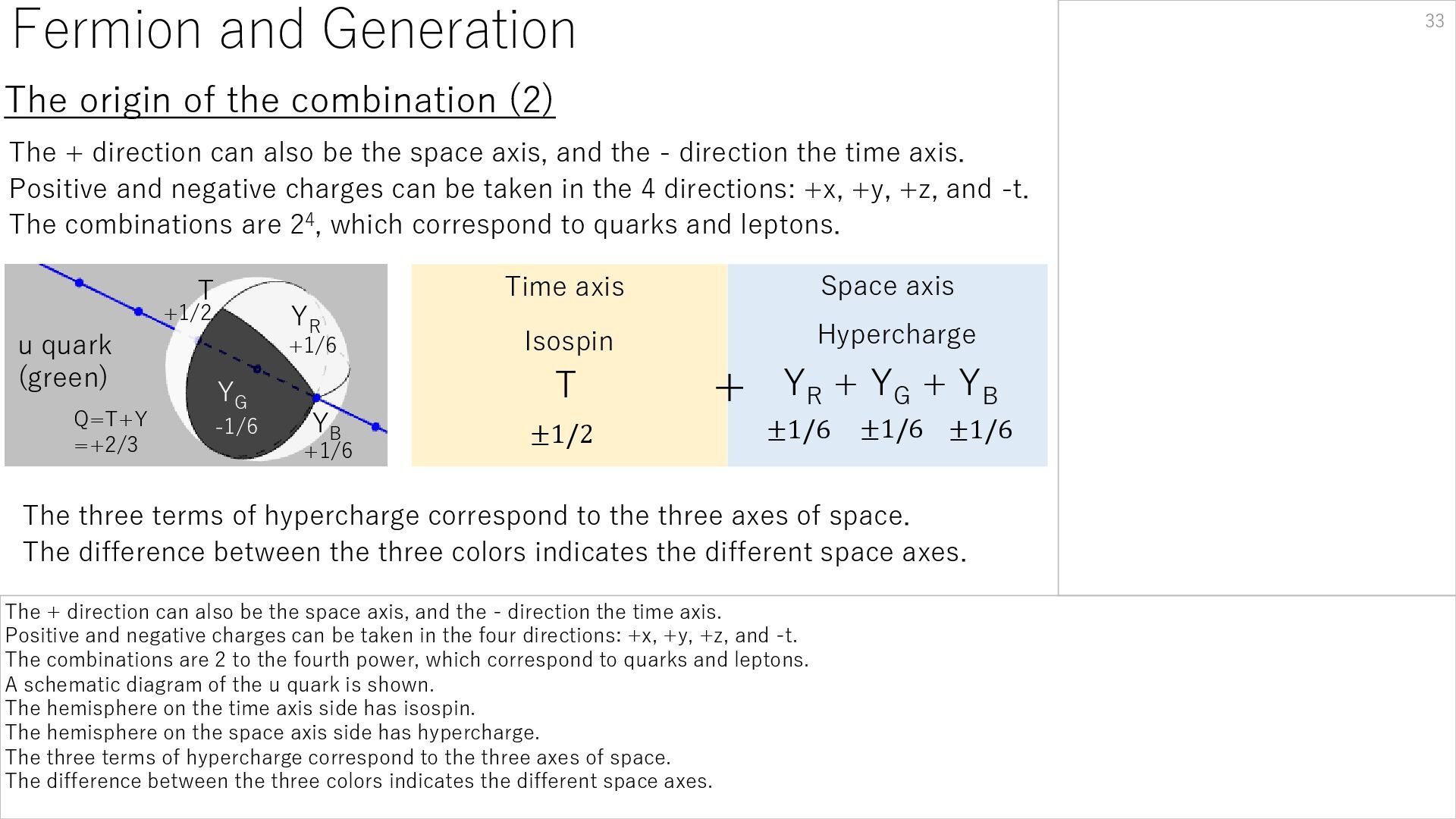
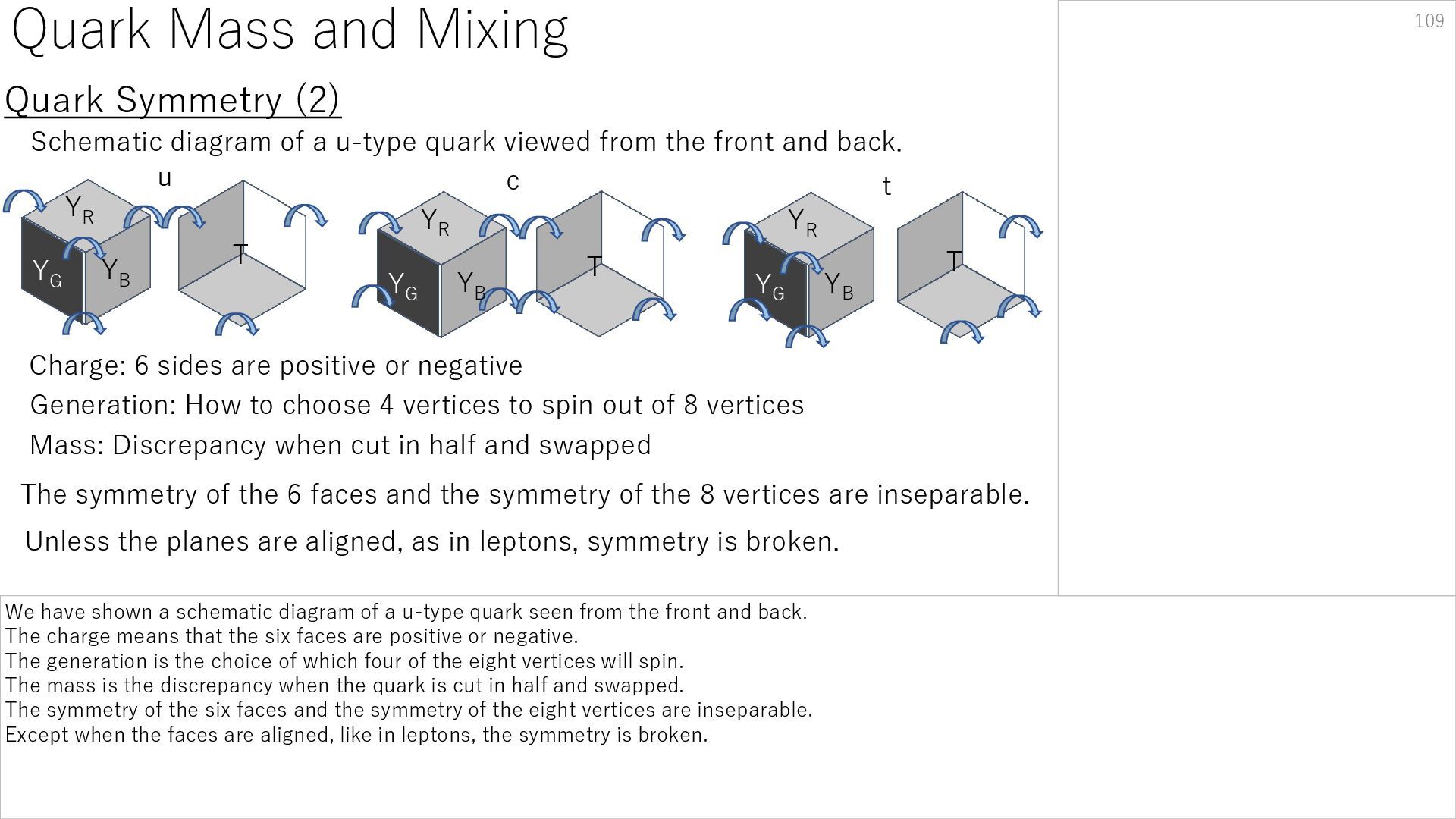
    space axis, and the - direction the time axis. Positive and negative charges can be taken in the four directions: +x, +y, +z, and -t. The combinations are 2 to the fourth power, which correspond to quarks and leptons. A schematic diagram of the u quark is shown. The hemisphere on the time axis side has isospin. The hemisphere on the space axis side has hypercharge. The three terms of hypercharge correspond to the three axes of space. The difference between the three colors indicates the different space axes. The origin of the combination (2) u quark (green) Y R Y G Y B T +1/2 +1/6 +1/6 -1/6 T Isospin Hypercharge ±1/2 ±1/6 ±1/6 ±1/6 Y R + Y G + Y B + The + direction can also be the space axis, and the - direction the time axis. Positive and negative charges can be taken in the 4 directions: +x, +y, +z, and -t. The combinations are 24, which correspond to quarks and leptons. Q=T+Y =+2/3 Time axis Space axis The three terms of hypercharge correspond to the three axes of space. The difference between the three colors indicates the different space axes. 33
  33. Fermion and Generation Let's think about spin. Quarks and leptons

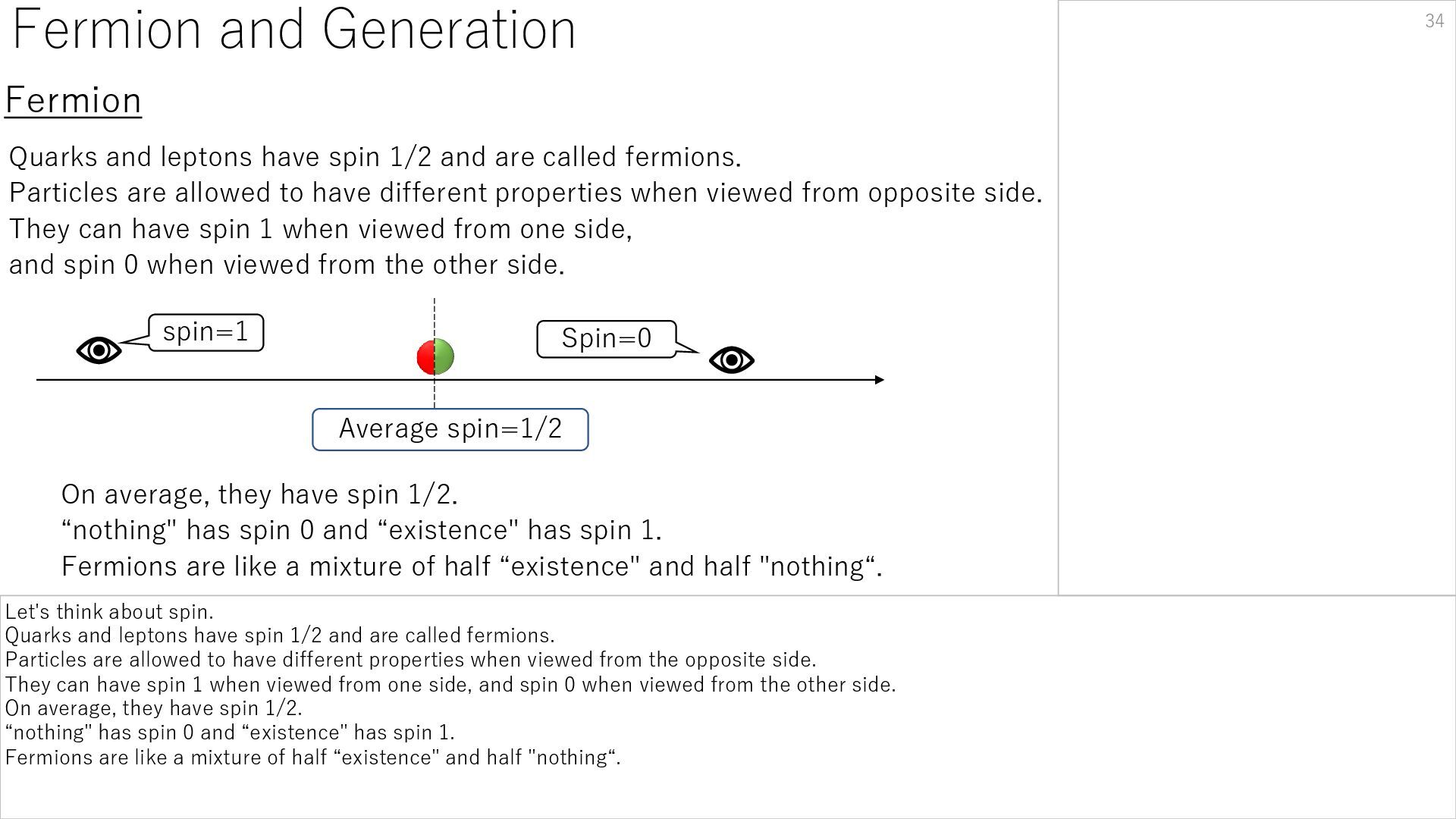
    have spin 1/2 and are called fermions. Particles are allowed to have different properties when viewed from the opposite side. They can have spin 1 when viewed from one side, and spin 0 when viewed from the other side. On average, they have spin 1/2. “nothing" has spin 0 and “existence" has spin 1. Fermions are like a mixture of half “existence" and half "nothing“. Fermion spin=1 Spin=0 Quarks and leptons have spin 1/2 and are called fermions. Particles are allowed to have different properties when viewed from opposite side. They can have spin 1 when viewed from one side, and spin 0 when viewed from the other side. On average, they have spin 1/2. “nothing" has spin 0 and “existence" has spin 1. Fermions are like a mixture of half “existence" and half "nothing“. Average spin=1/2 34
  34. Fermion and Generation Bosons have no generations, but fermions have

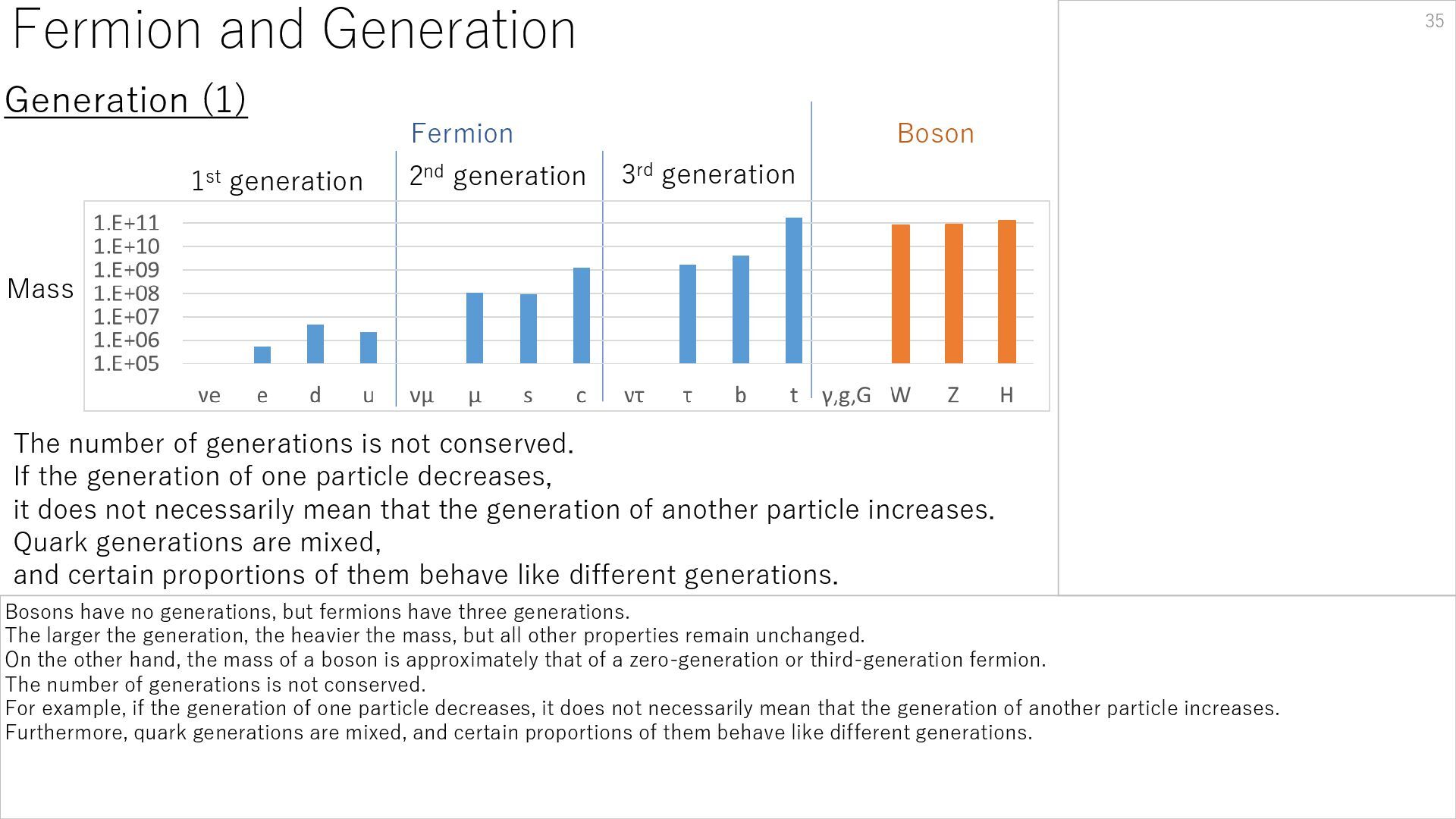
    three generations. The larger the generation, the heavier the mass, but all other properties remain unchanged. On the other hand, the mass of a boson is approximately that of a zero-generation or third-generation fermion. The number of generations is not conserved. For example, if the generation of one particle decreases, it does not necessarily mean that the generation of another particle increases. Furthermore, quark generations are mixed, and certain proportions of them behave like different generations. Generation (1) Boson Fermion Mass The number of generations is not conserved. If the generation of one particle decreases, it does not necessarily mean that the generation of another particle increases. Quark generations are mixed, and certain proportions of them behave like different generations. 1st generation 2nd generation 3rd generation 35
  35. Generation 1 2 3 X Antisymmetric Symmetric Symmetric Y Antisymmetric

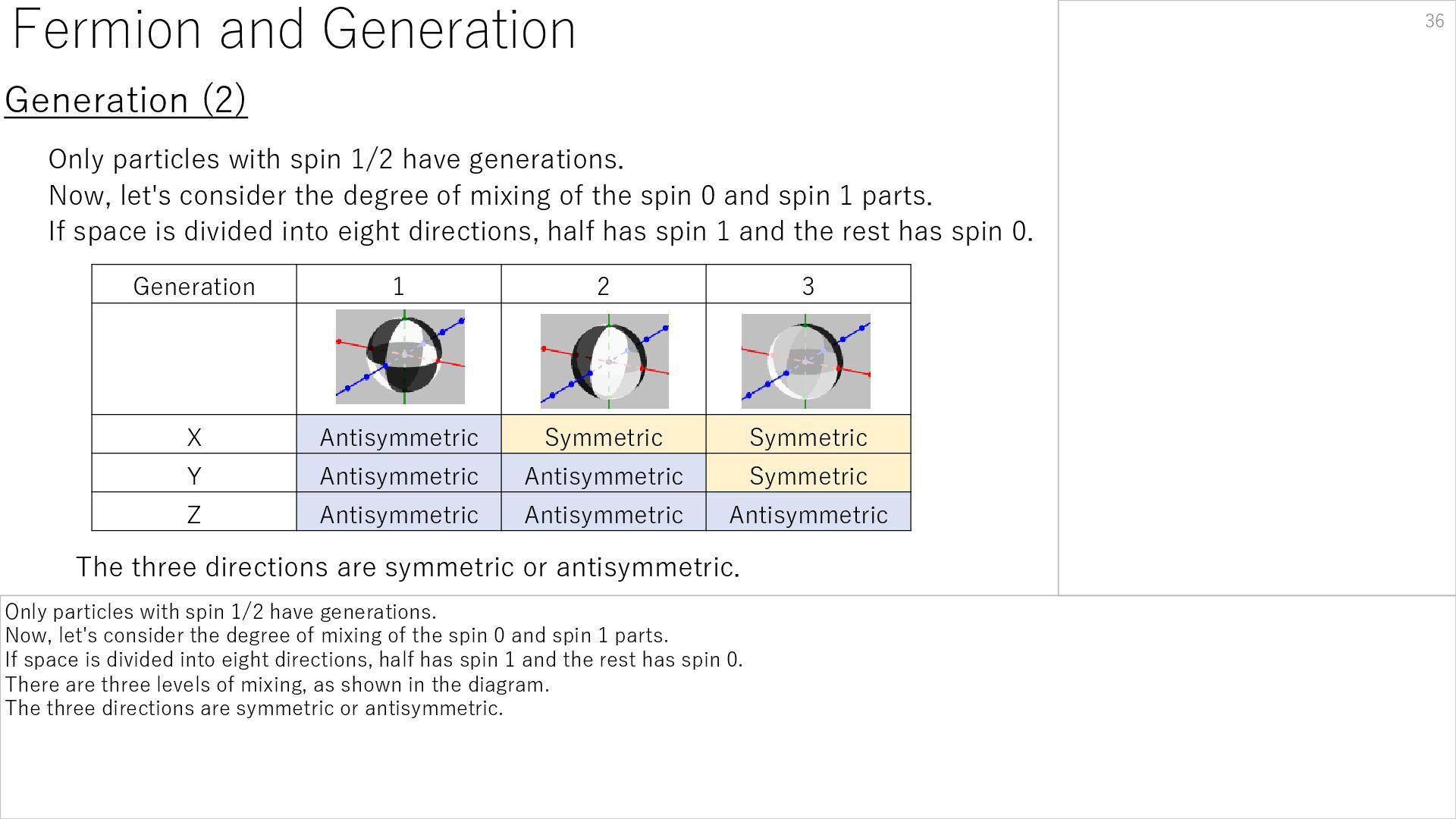
    Antisymmetric Symmetric Z Antisymmetric Antisymmetric Antisymmetric Fermion and Generation Only particles with spin 1/2 have generations. Now, let's consider the degree of mixing of the spin 0 and spin 1 parts. If space is divided into eight directions, half has spin 1 and the rest has spin 0. There are three levels of mixing, as shown in the diagram. The three directions are symmetric or antisymmetric. Generation (2) Only particles with spin 1/2 have generations. Now, let's consider the degree of mixing of the spin 0 and spin 1 parts. If space is divided into eight directions, half has spin 1 and the rest has spin 0. The three directions are symmetric or antisymmetric. 36
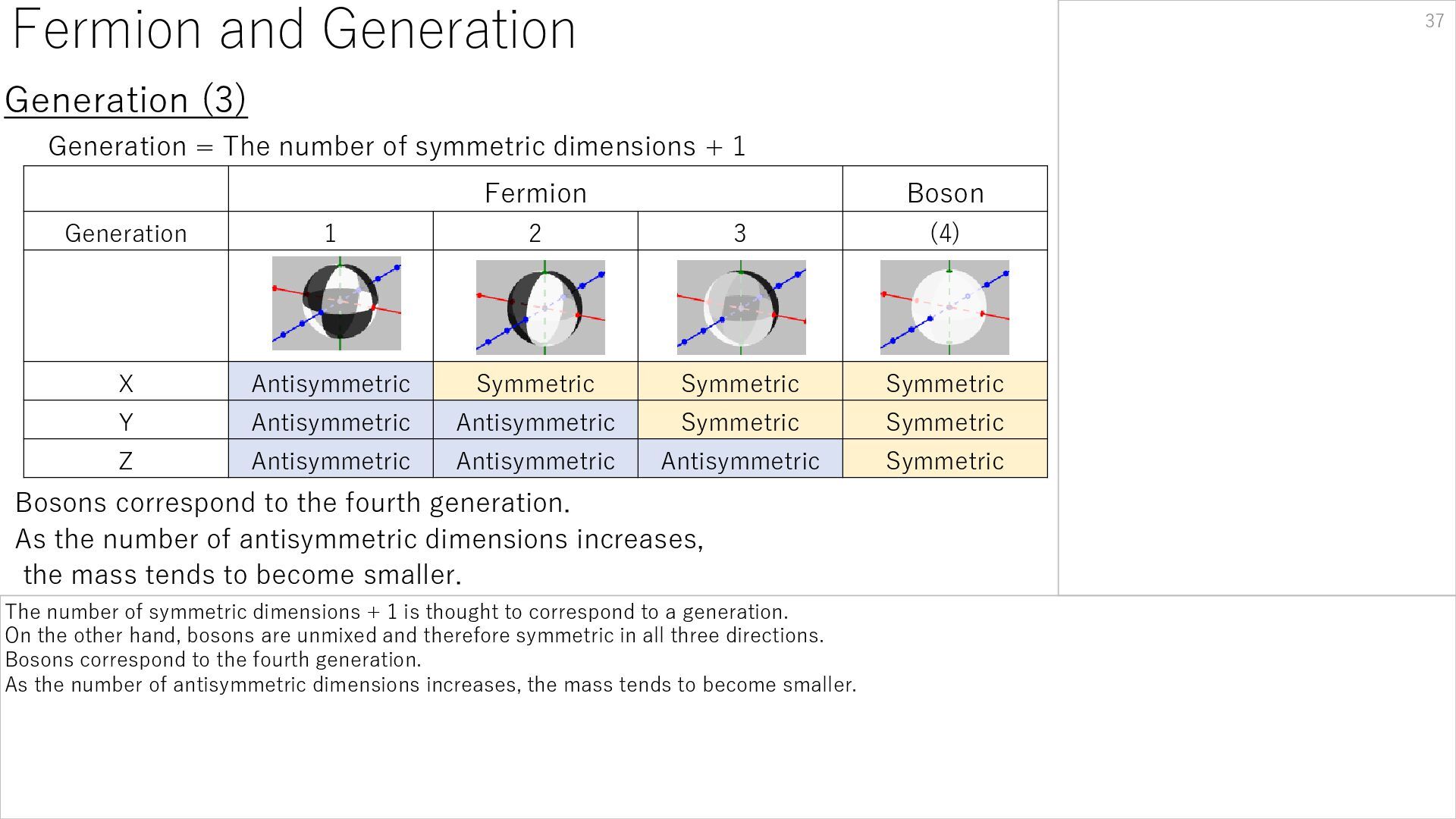
  36. Fermion Boson Generation 1 2 3 (4) X Antisymmetric Symmetric

    Symmetric Symmetric Y Antisymmetric Antisymmetric Symmetric Symmetric Z Antisymmetric Antisymmetric Antisymmetric Symmetric Fermion and Generation The number of symmetric dimensions + 1 is thought to correspond to a generation. On the other hand, bosons are unmixed and therefore symmetric in all three directions. Bosons correspond to the fourth generation. As the number of antisymmetric dimensions increases, the mass tends to become smaller. Generation (3) Generation = The number of symmetric dimensions + 1 Bosons correspond to the fourth generation. As the number of antisymmetric dimensions increases, the mass tends to become smaller. 37
  37. Fermion and Generation Did God roll the dice to decide

    the number of generations to be 3? Since space is three-dimensional, we can deduce that the number of generations is also 3. The dimensionality of mixing is one of the most elegant interpretations. Perhaps it is a mixing of spins. The raw materials remain the same, only the degree of mixing is different. Therefore, this is consistent with the property of non-conservation. It is also not unusual for the degree of mixing to mix between generations. Generation (4) The dimensionality of mixing is one of the most elegant interpretations. Perhaps it is a mixing of spins. The raw materials remain the same, only the degree of mixing is different. Therefore, this is consistent with the property of non-conservation. It is also not unusual for the degree of mixing to mix between generations. God's Choice 1. I rolled the dice and decided on 3 generations. 2. Since space is 3D, the number of generations is also 3. 38
  38. Spin and Puli repulsion force Let's try to interpret the

    mysterious properties of spin 1/2. Photons have spin 1, so they rotate 360 degrees in one wavelength and return to their original phase. Fermions, on the other hand, have spin 1/2. If the whole thing rotates 180 degrees, it will not return to its original phase. If half of it rotates 360 degrees, it will return to its original phase. It's just that the amount of rotation is half, but it still makes a full rotation. Spin 1/2 39 Photon Fermion Spin 1 Spin 1/2 The whole thing rotates 360° and returns to its original phase. If the whole thing rotates 180°, it will not return to its original phase. 360° 180° 180° 360° NG OK If one half rotates 360°, it will return to its original phase.
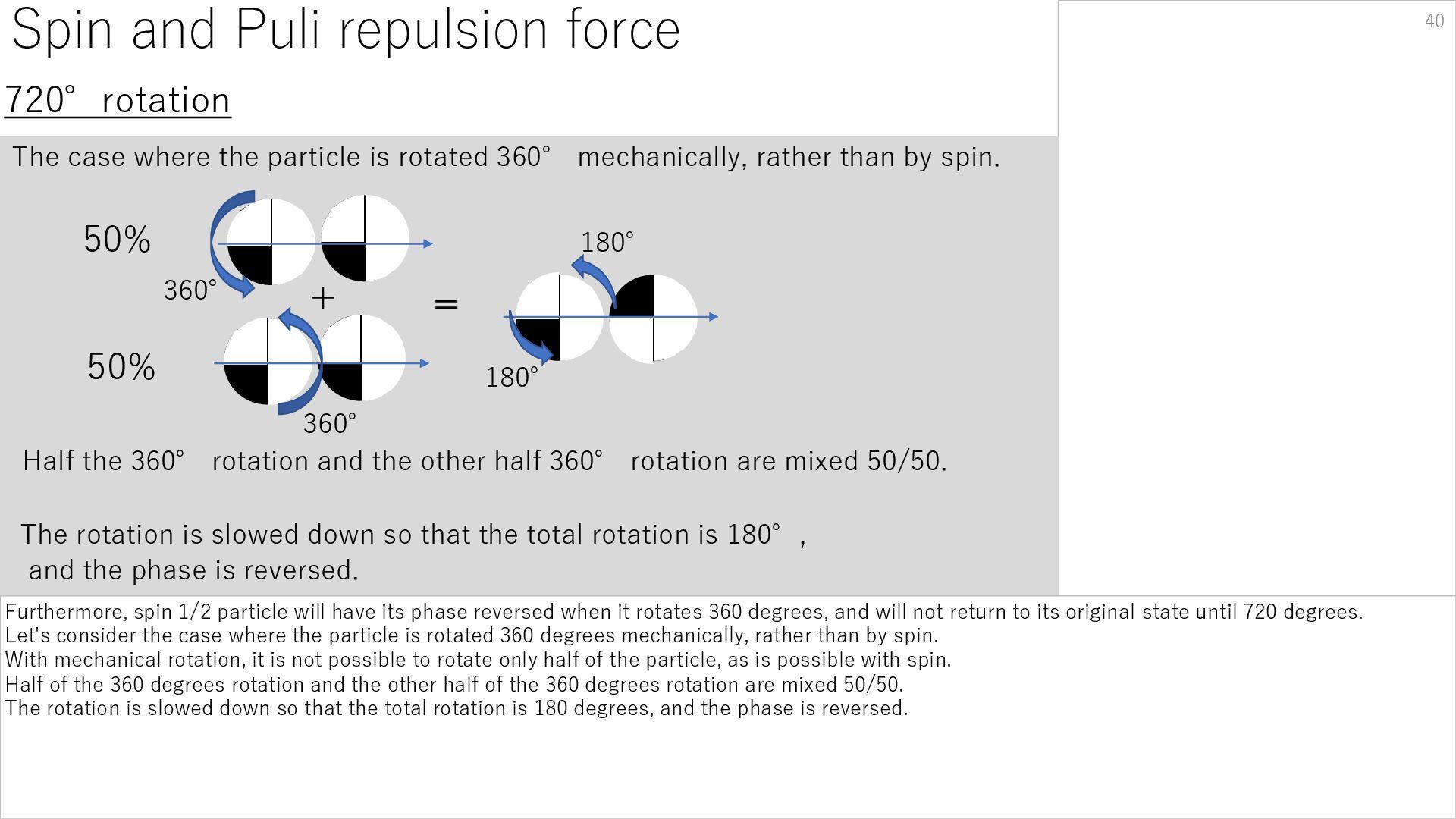
  39. Spin and Puli repulsion force Furthermore, spin 1/2 particle will

    have its phase reversed when it rotates 360 degrees, and will not return to its original state until 720 degrees. Let's consider the case where the particle is rotated 360 degrees mechanically, rather than by spin. With mechanical rotation, it is not possible to rotate only half of the particle, as is possible with spin. Half of the 360 degrees rotation and the other half of the 360 degrees rotation are mixed 50/50. The rotation is slowed down so that the total rotation is 180 degrees, and the phase is reversed. 720°rotation 40 360° 360° 180° 180° 50% 50% + = The case where the particle is rotated 360° mechanically, rather than by spin. Half the 360° rotation and the other half 360° rotation are mixed 50/50. The rotation is slowed down so that the total rotation is 180°, and the phase is reversed.
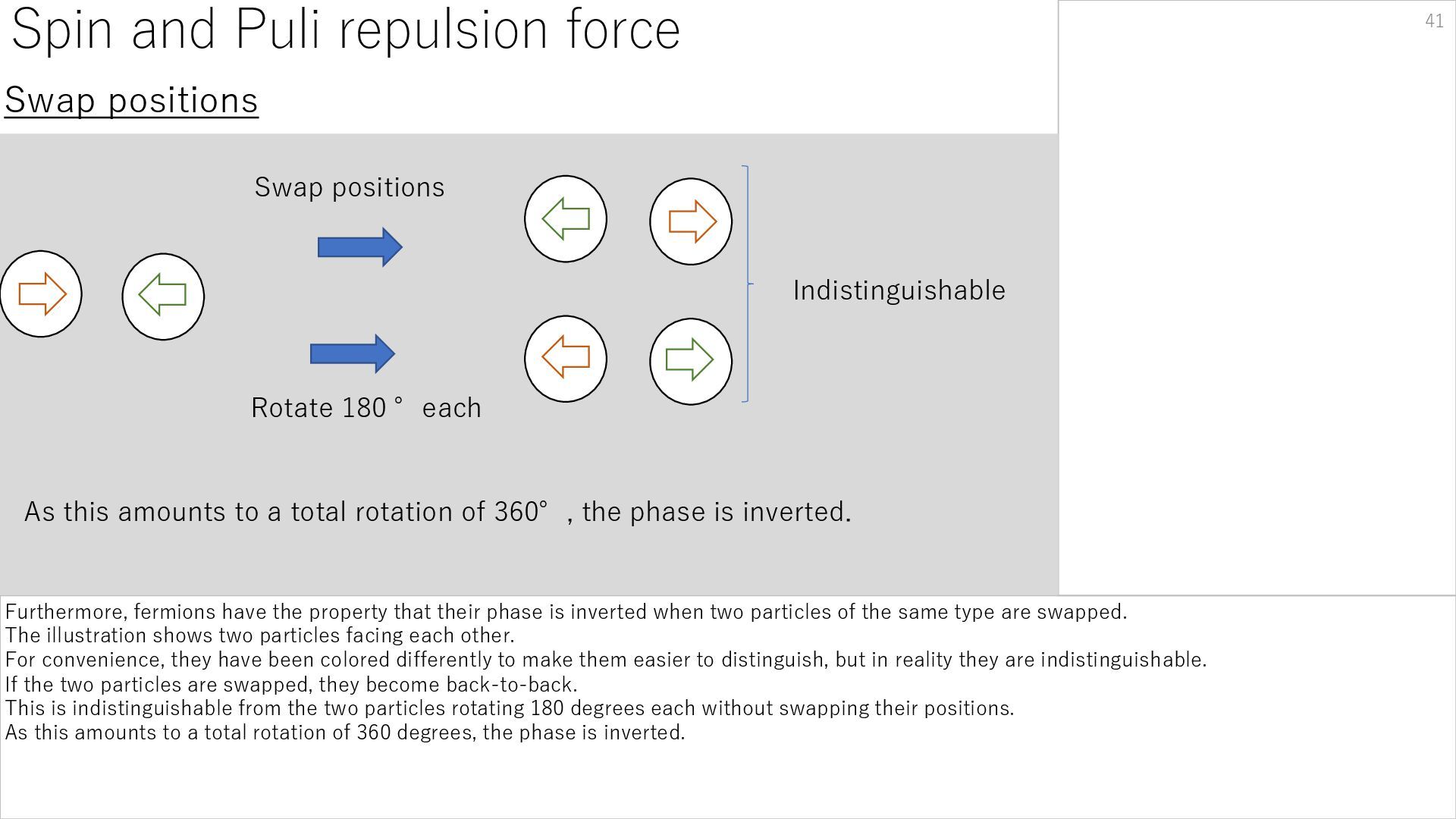
  40. Spin and Puli repulsion force Furthermore, fermions have the property

    that their phase is inverted when two particles of the same type are swapped. The illustration shows two particles facing each other. For convenience, they have been colored differently to make them easier to distinguish, but in reality they are indistinguishable. If the two particles are swapped, they become back-to-back. This is indistinguishable from the two particles rotating 180 degrees each without swapping their positions. As this amounts to a total rotation of 360 degrees, the phase is inverted. Swap positions 41 Swap positions Rotate 180 °each As this amounts to a total rotation of 360°, the phase is inverted. Indistinguishable
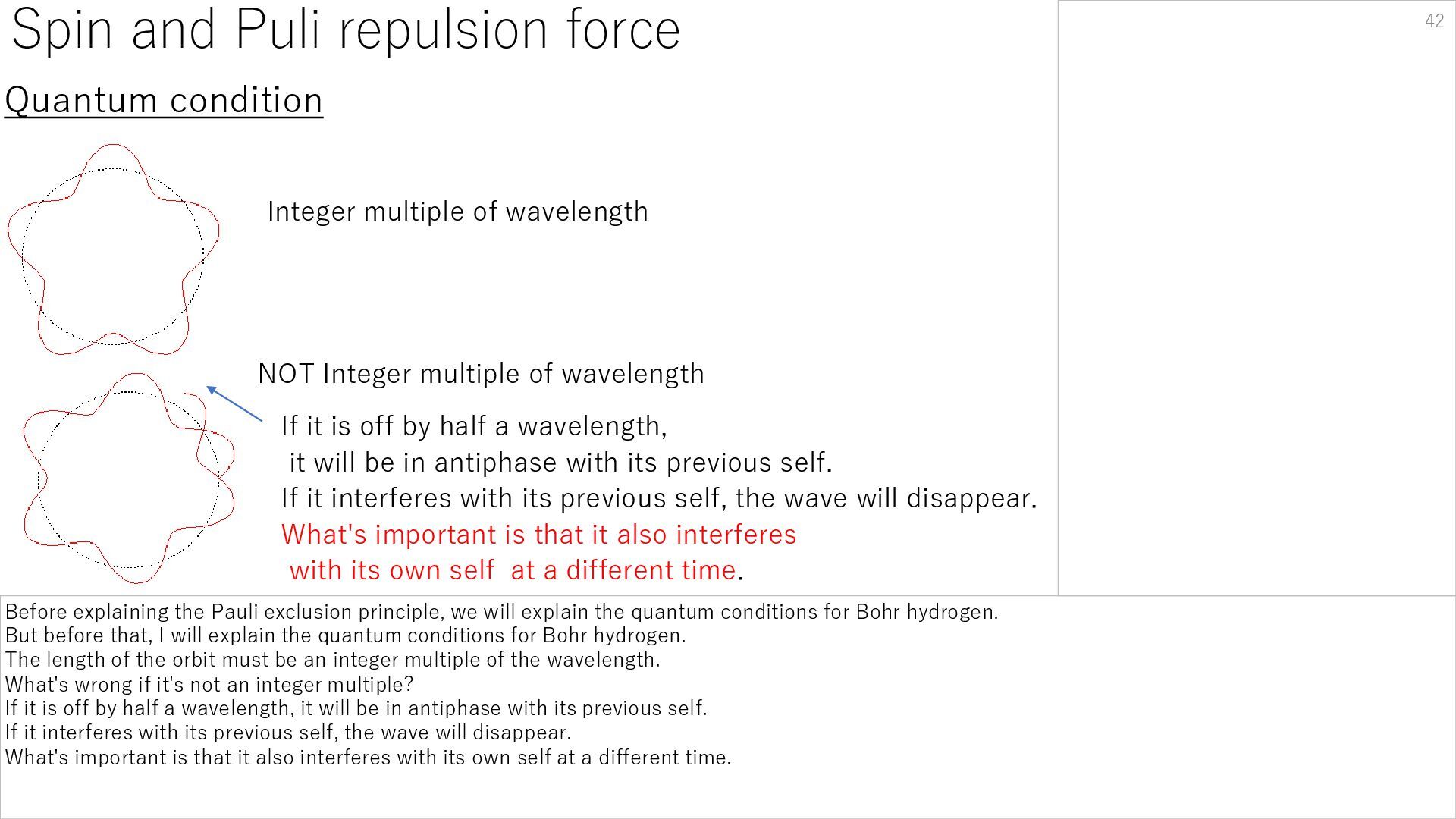
  41. Spin and Puli repulsion force Before explaining the Pauli exclusion

    principle, we will explain the quantum conditions for Bohr hydrogen. But before that, I will explain the quantum conditions for Bohr hydrogen. The length of the orbit must be an integer multiple of the wavelength. What's wrong if it's not an integer multiple? If it is off by half a wavelength, it will be in antiphase with its previous self. If it interferes with its previous self, the wave will disappear. What's important is that it also interferes with its own self at a different time. Quantum condition Integer multiple of wavelength NOT Integer multiple of wavelength If it is off by half a wavelength, it will be in antiphase with its previous self. If it interferes with its previous self, the wave will disappear. What's important is that it also interferes with its own self at a different time. 42
  42. Spin and Puli repulsion force Let's interpret the Pauli exclusion

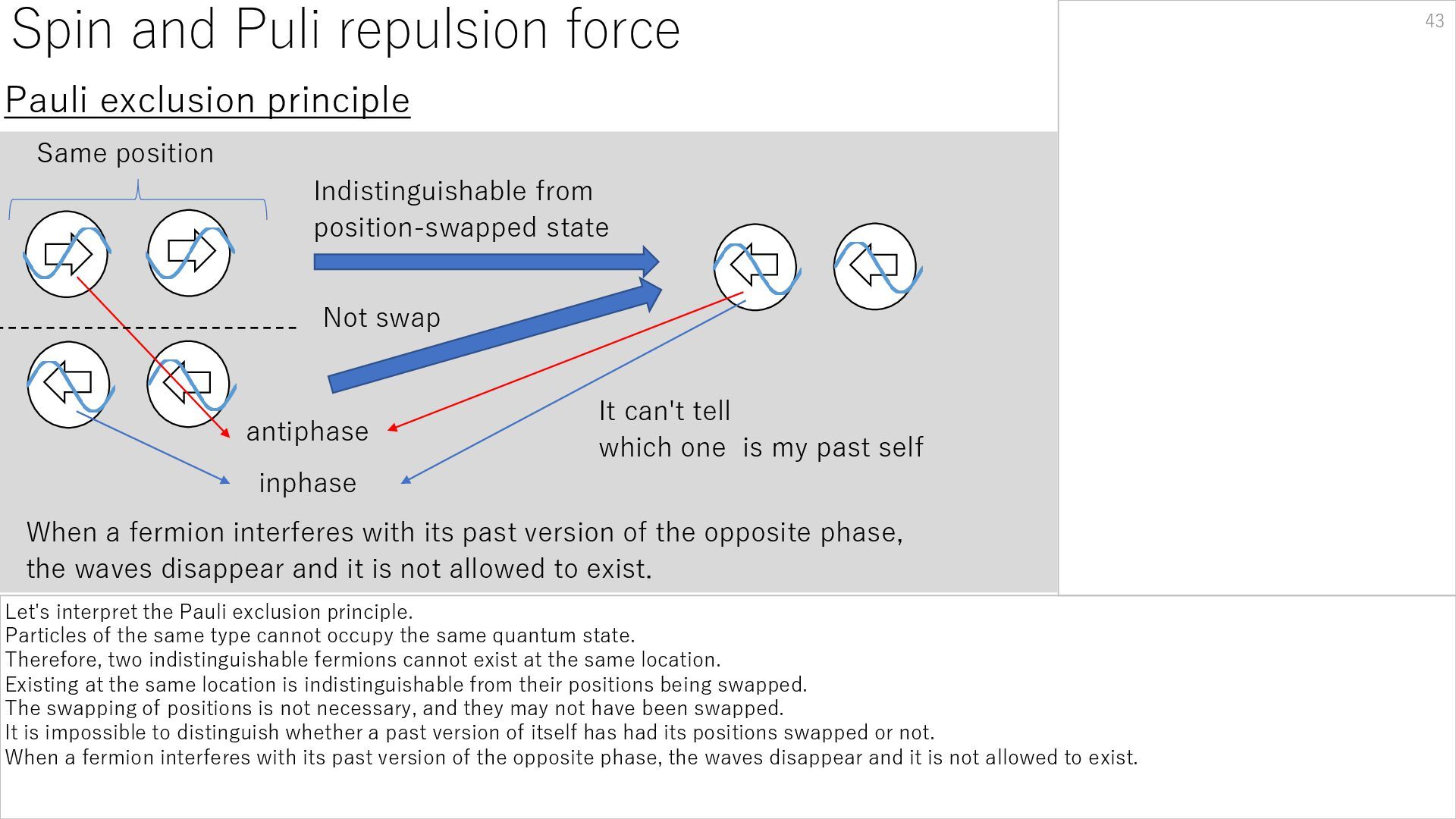
    principle. Particles of the same type cannot occupy the same quantum state. Therefore, two indistinguishable fermions cannot exist at the same location. Existing at the same location is indistinguishable from their positions being swapped. The swapping of positions is not necessary, and they may not have been swapped. It is impossible to distinguish whether a past version of itself has had its positions swapped or not. When a fermion interferes with its past version of the opposite phase, the waves disappear and it is not allowed to exist. Pauli exclusion principle 43 Indistinguishable from position-swapped state Same position Not swap antiphase inphase It can't tell which one is my past self When a fermion interferes with its past version of the opposite phase, the waves disappear and it is not allowed to exist.
  43. Spin and Puli repulsion force The force that acts due

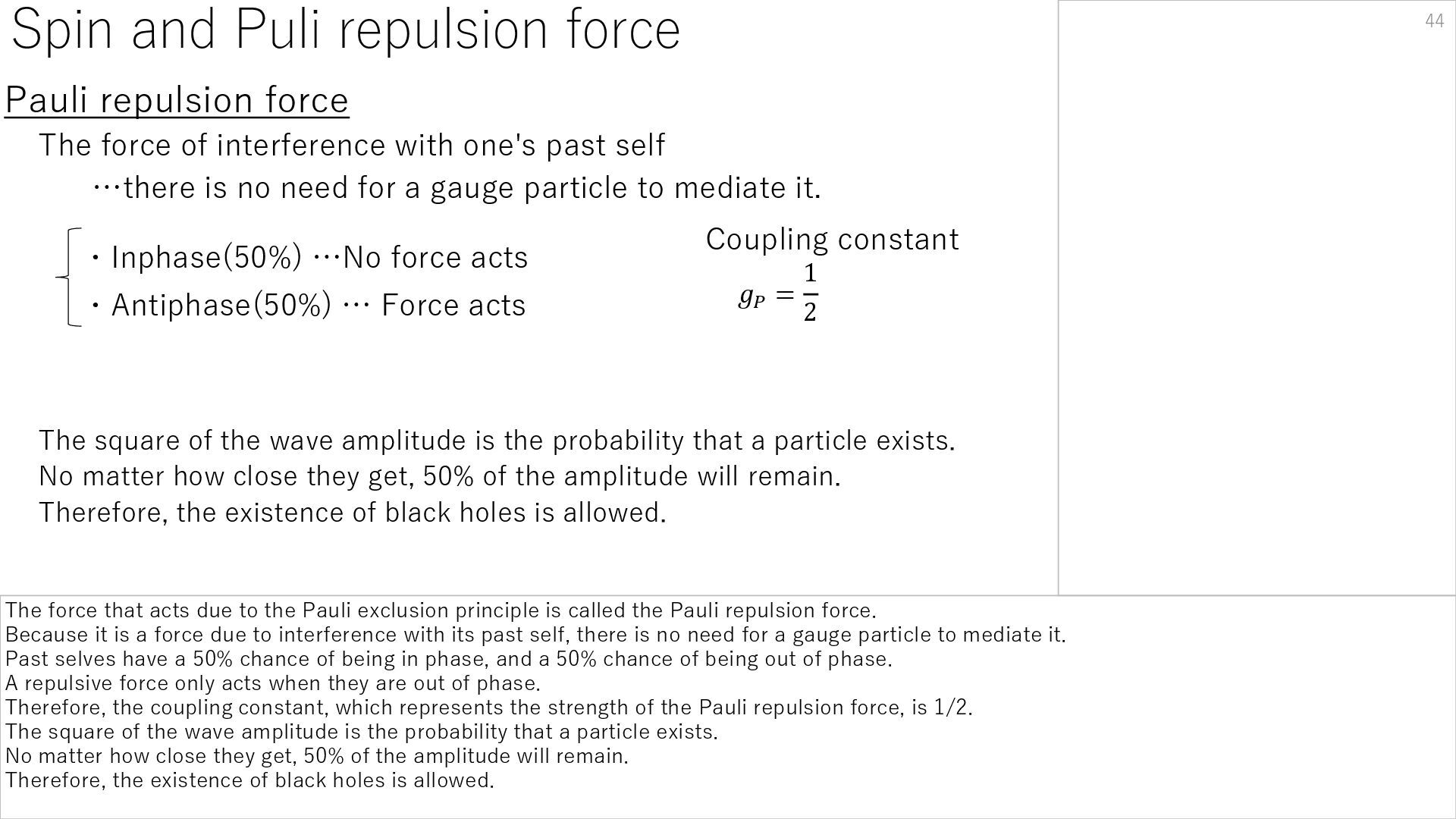
    to the Pauli exclusion principle is called the Pauli repulsion force. Because it is a force due to interference with its past self, there is no need for a gauge particle to mediate it. Past selves have a 50% chance of being in phase, and a 50% chance of being out of phase. A repulsive force only acts when they are out of phase. Therefore, the coupling constant, which represents the strength of the Pauli repulsion force, is 1/2. The square of the wave amplitude is the probability that a particle exists. No matter how close they get, 50% of the amplitude will remain. Therefore, the existence of black holes is allowed. Pauli repulsion force 44 The force of interference with one's past self …there is no need for a gauge particle to mediate it. ・Inphase(50%) …No force acts ・Antiphase(50%) … Force acts 𝑔𝑃 = 1 2 Coupling constant The square of the wave amplitude is the probability that a particle exists. No matter how close they get, 50% of the amplitude will remain. Therefore, the existence of black holes is allowed.
  44. Strong Force Next, we will consider the strong force. The

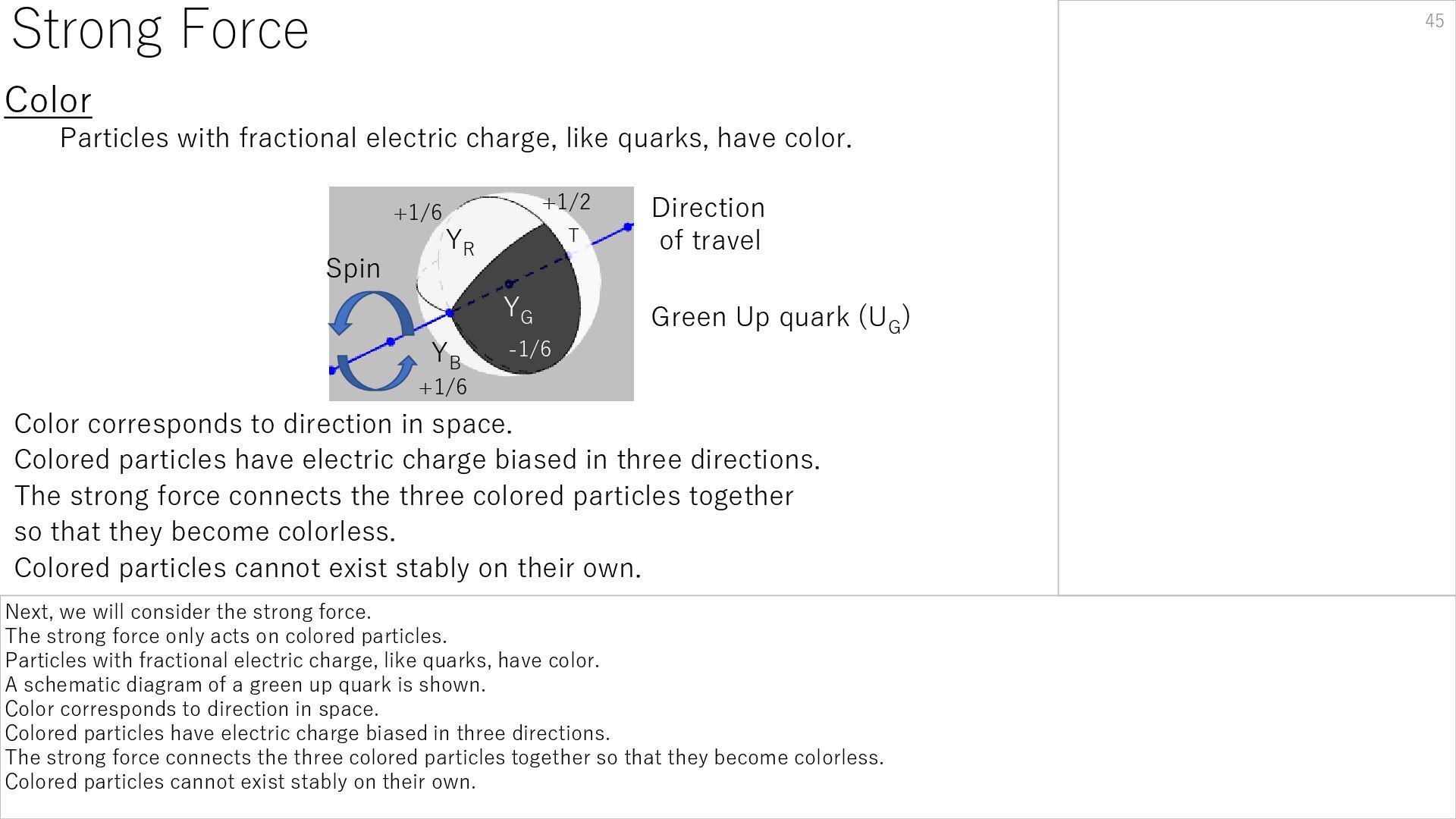
    strong force only acts on colored particles. Particles with fractional electric charge, like quarks, have color. A schematic diagram of a green up quark is shown. Color corresponds to direction in space. Colored particles have electric charge biased in three directions. The strong force connects the three colored particles together so that they become colorless. Colored particles cannot exist stably on their own. Color Y G Y R Y B Spin Direction of travel T +1/6 -1/6 +1/6 +1/2 Green Up quark (U G ) Color corresponds to direction in space. Colored particles have electric charge biased in three directions. The strong force connects the three colored particles together so that they become colorless. Colored particles cannot exist stably on their own. Particles with fractional electric charge, like quarks, have color. 45
  45. Strong Force Why can't colored particles exist on their own?

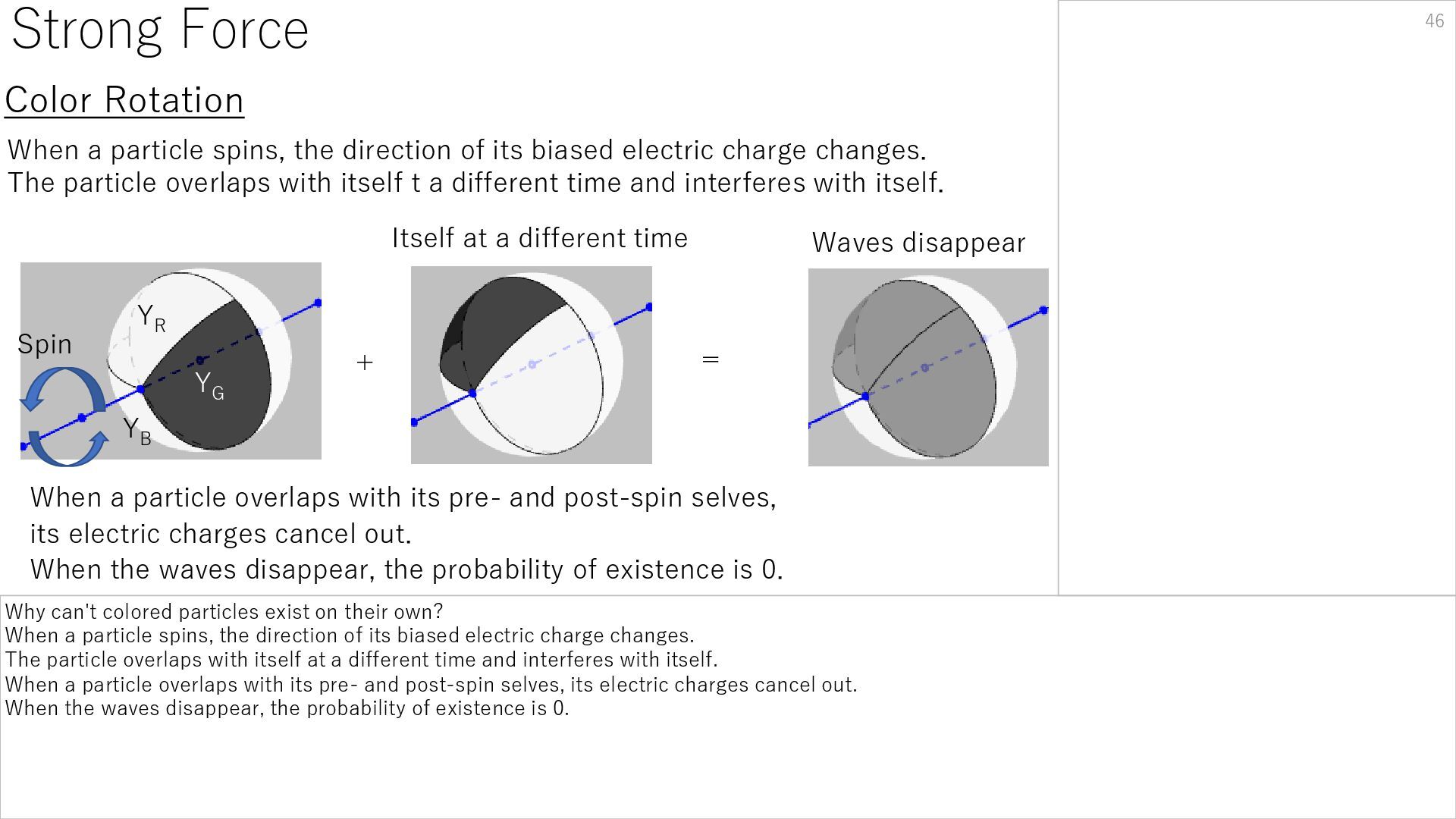
    When a particle spins, the direction of its biased electric charge changes. The particle overlaps with itself at a different time and interferes with itself. When a particle overlaps with its pre- and post-spin selves, its electric charges cancel out. When the waves disappear, the probability of existence is 0. Color Rotation Y G Y R Y B Spin + = When a particle spins, the direction of its biased electric charge changes. The particle overlaps with itself t a different time and interferes with itself. When a particle overlaps with its pre- and post-spin selves, its electric charges cancel out. When the waves disappear, the probability of existence is 0. Itself at a different time Waves disappear 46
  46. Strong Force The strong force is mediated by gauge bosons

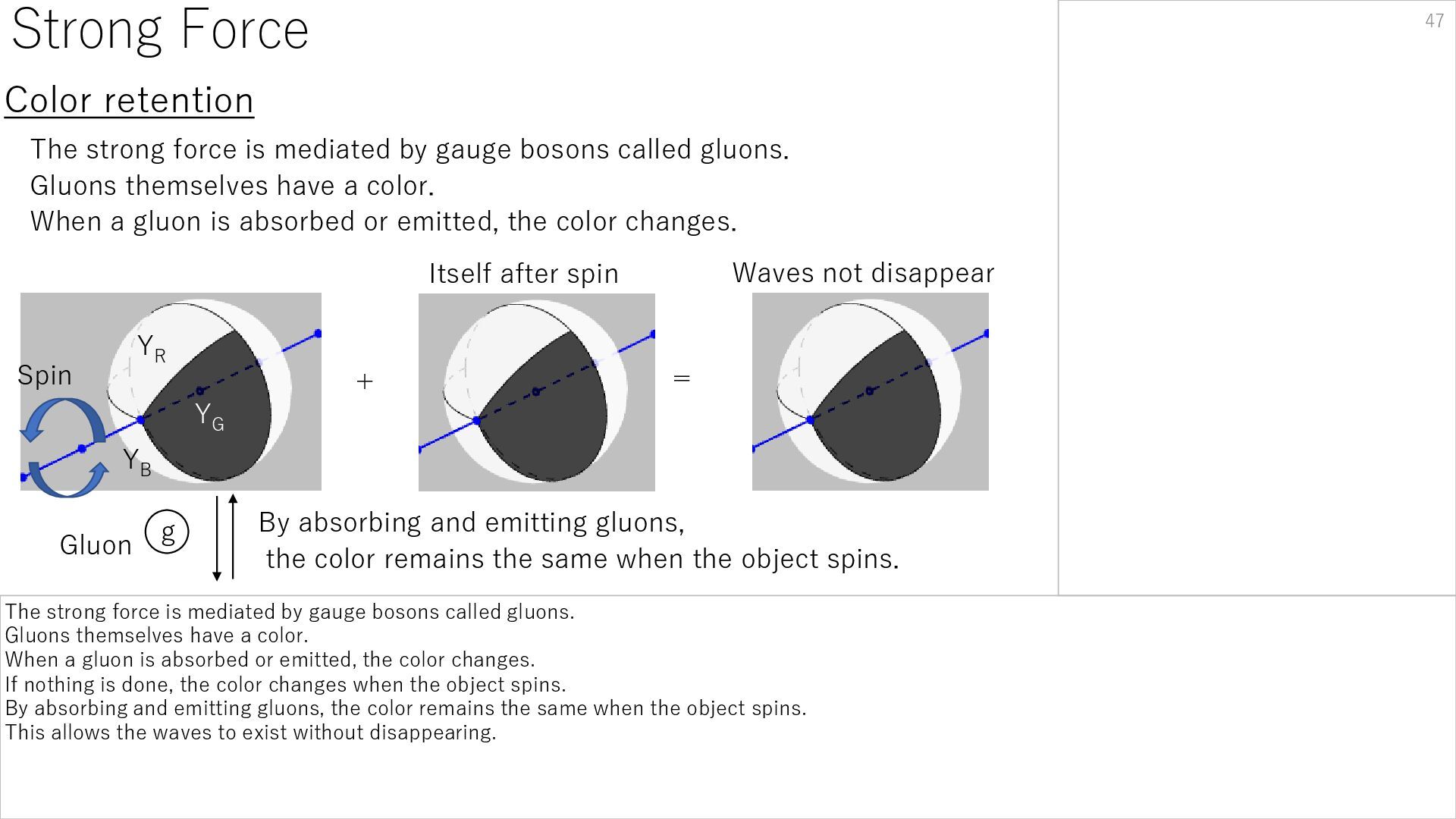
    called gluons. Gluons themselves have a color. When a gluon is absorbed or emitted, the color changes. If nothing is done, the color changes when the object spins. By absorbing and emitting gluons, the color remains the same when the object spins. This allows the waves to exist without disappearing. Color retention Y G Y R Y B Spin + = Itself after spin Waves not disappear By absorbing and emitting gluons, the color remains the same when the object spins. g Gluon The strong force is mediated by gauge bosons called gluons. Gluons themselves have a color. When a gluon is absorbed or emitted, the color changes. 47
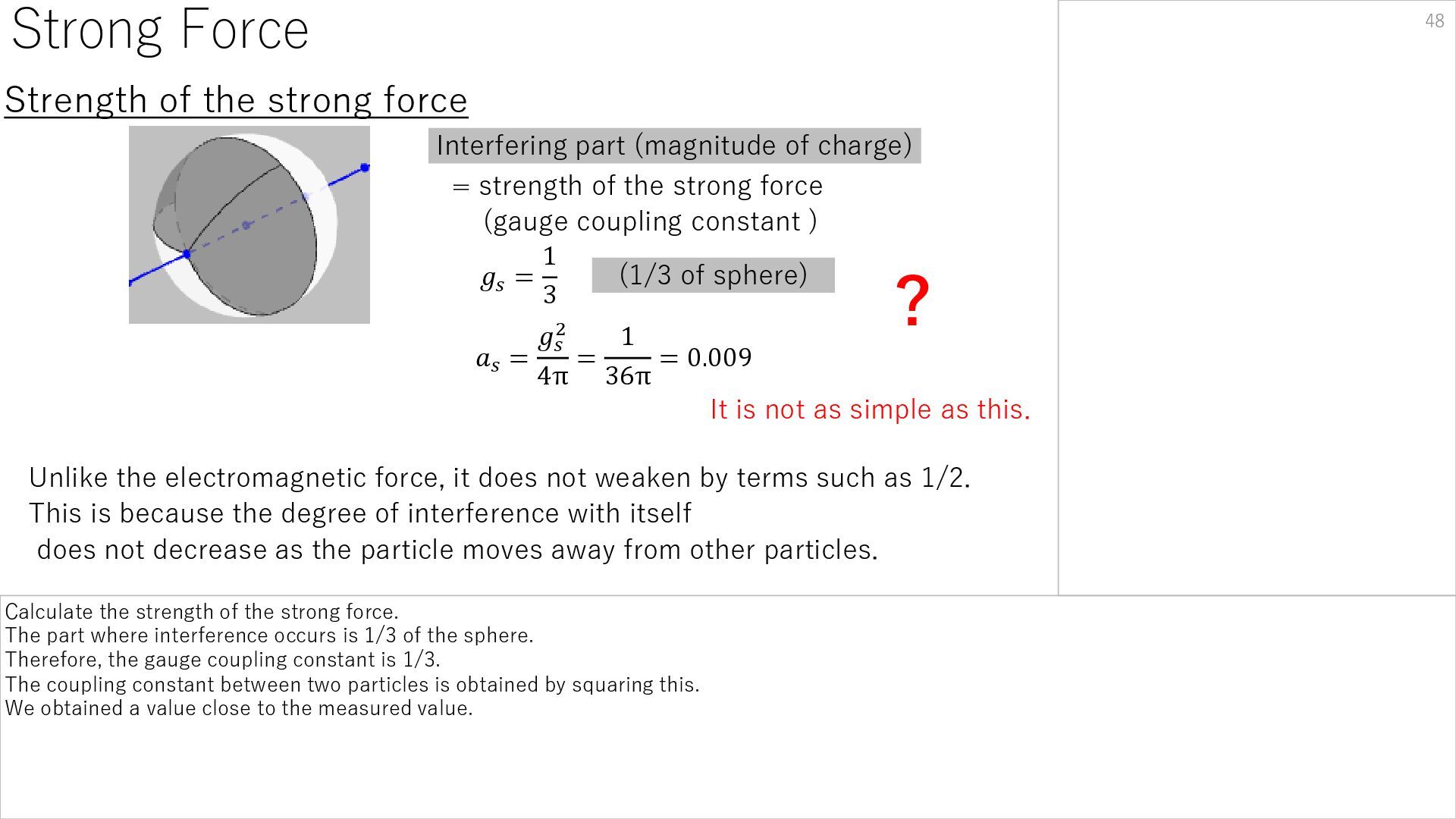
  47. Strong Force Calculate the strength of the strong force. The

    part where interference occurs is 1/3 of the sphere. Therefore, the gauge coupling constant is 1/3. The coupling constant between two particles is obtained by squaring this. We obtained a value close to the measured value. Strength of the strong force Interfering part (magnitude of charge) 𝑔𝑠 = 1 3 = strength of the strong force (gauge coupling constant ) (1/3 of sphere) 48 𝑎𝑠 = 𝑔𝑠 2 4π = 1 36π = 0.009 Unlike the electromagnetic force, it does not weaken by terms such as 1/2. This is because the degree of interference with itself does not decrease as the particle moves away from other particles. ? It is not as simple as this.
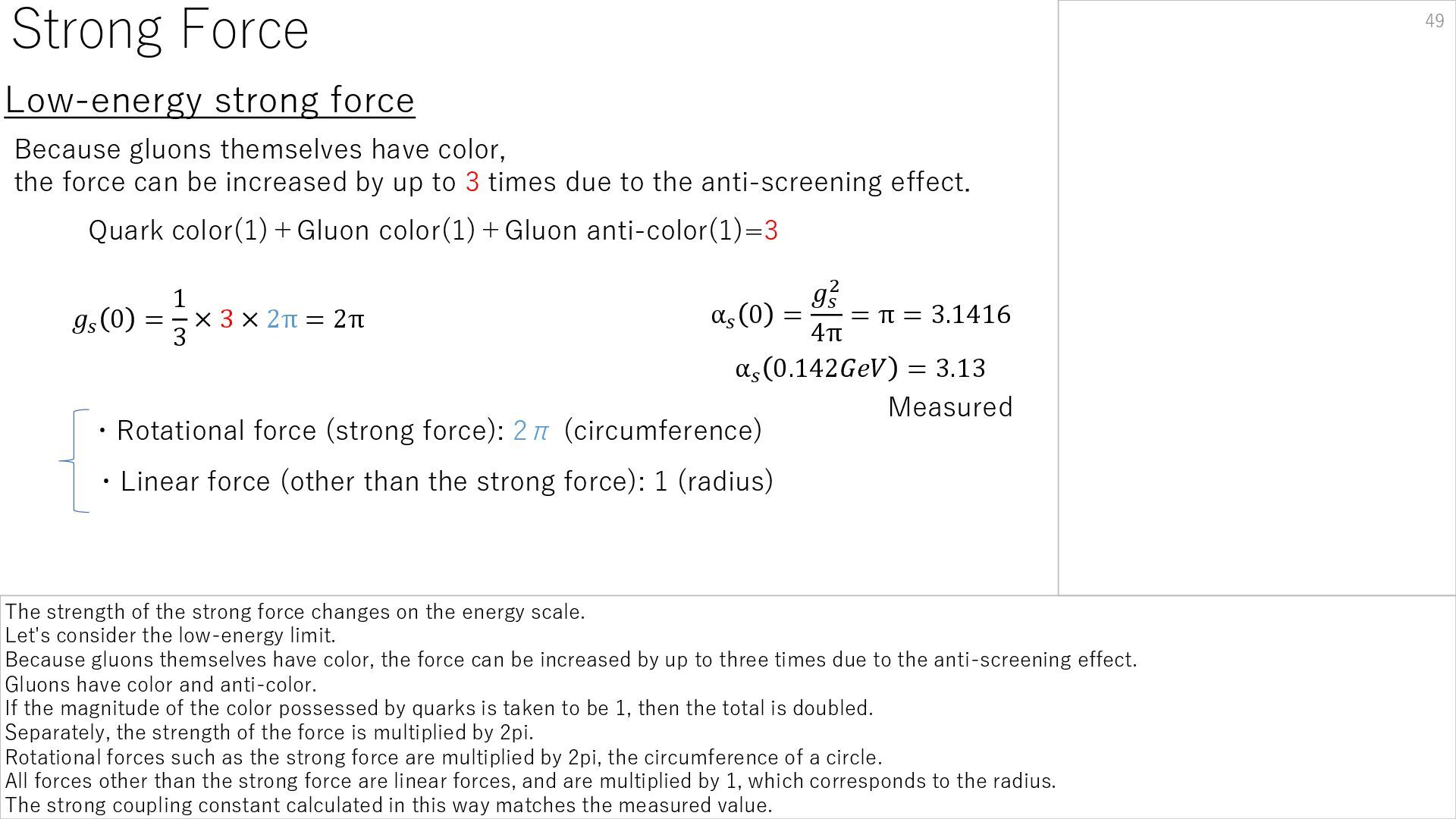
  48. Strong Force The strength of the strong force changes on

    the energy scale. Let's consider the low-energy limit. Because gluons themselves have color, the force can be increased by up to three times due to the anti-screening effect. Gluons have color and anti-color. If the magnitude of the color possessed by quarks is taken to be 1, then the total is doubled. Separately, the strength of the force is multiplied by 2pi. Rotational forces such as the strong force are multiplied by 2pi, the circumference of a circle. All forces other than the strong force are linear forces, and are multiplied by 1, which corresponds to the radius. The strong coupling constant calculated in this way matches the measured value. Low-energy strong force ・Linear force (other than the strong force): 1 (radius) 49 𝑔𝑠 0 = 1 3 × 3 × 2π = 2π α𝑠 0 = 𝑔𝑠 2 4π = π = 3.1416 α𝑠 0.142𝐺𝑒𝑉 = 3.13 Quark color(1)+Gluon color(1)+Gluon anti-color(1)=3 Measured Because gluons themselves have color, the force can be increased by up to 3 times due to the anti-screening effect. ・Rotational force (strong force): 2π (circumference)
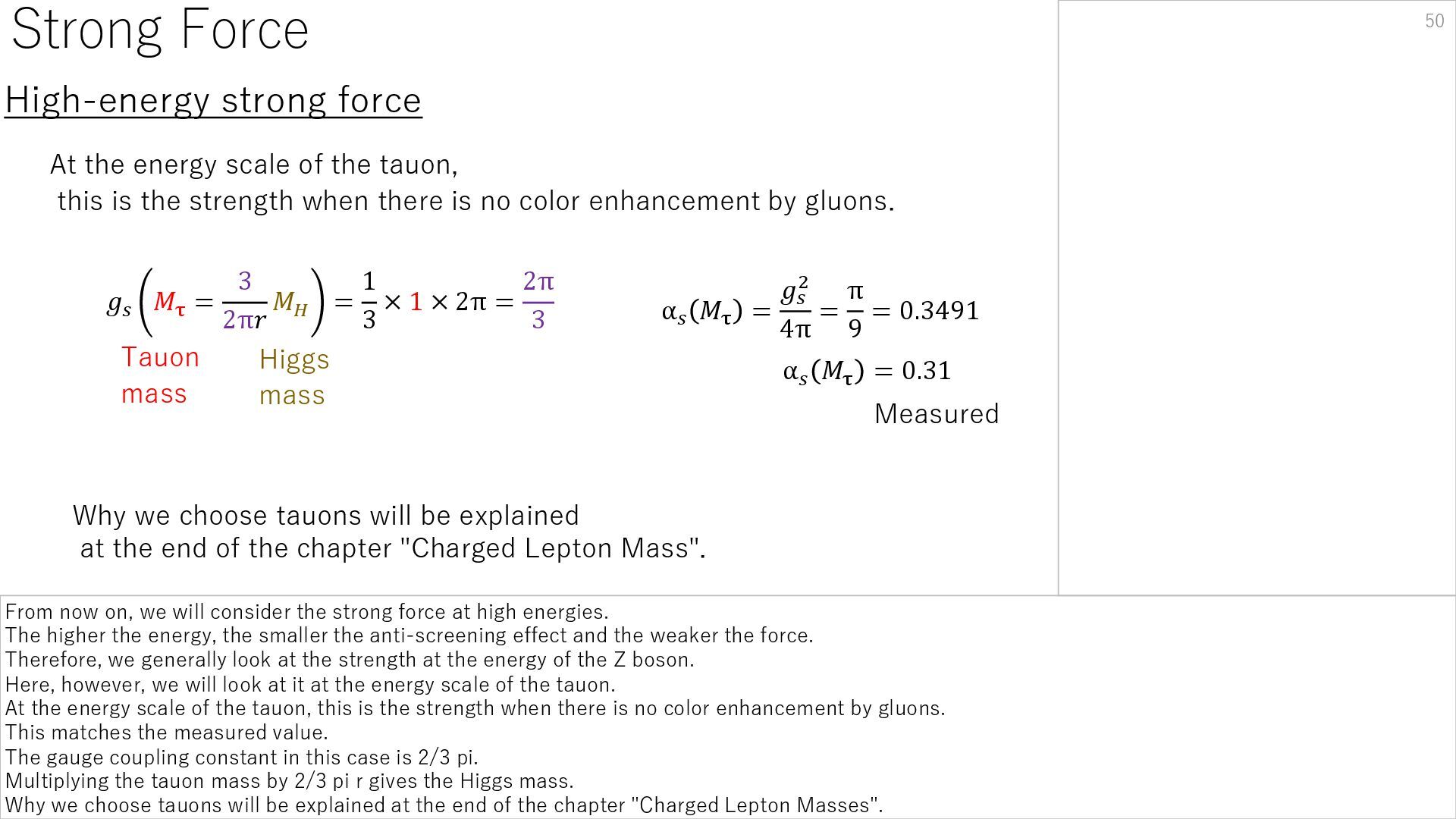
  49. Strong Force From now on, we will consider the strong

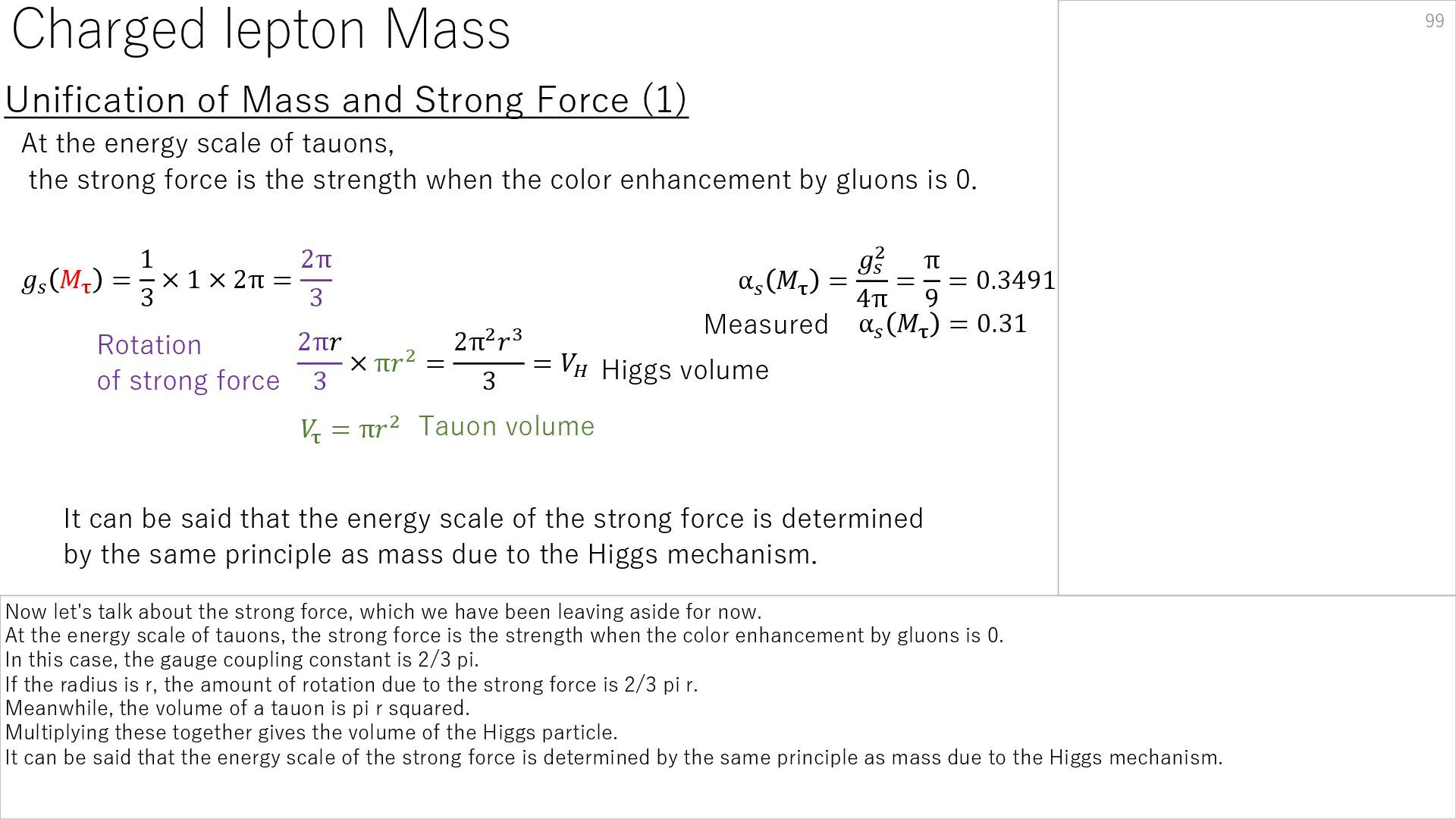
    force at high energies. The higher the energy, the smaller the anti-screening effect and the weaker the force. Therefore, we generally look at the strength at the energy of the Z boson. Here, however, we will look at it at the energy scale of the tauon. At the energy scale of the tauon, this is the strength when there is no color enhancement by gluons. This matches the measured value. The gauge coupling constant in this case is 2/3 pi. Multiplying the tauon mass by 2/3 pi r gives the Higgs mass. Why we choose tauons will be explained at the end of the chapter "Charged Lepton Masses". High-energy strong force 50 𝑔𝑠 𝑀τ = 3 2π𝑟 𝑀𝐻 = 1 3 × 1 × 2π = 2π 3 α𝑠 𝑀τ = 𝑔𝑠 2 4π = π 9 = 0.3491 α𝑠 𝑀τ = 0.31 Measured At the energy scale of the tauon, this is the strength when there is no color enhancement by gluons. Why we choose tauons will be explained at the end of the chapter "Charged Lepton Mass". Tauon mass Higgs mass
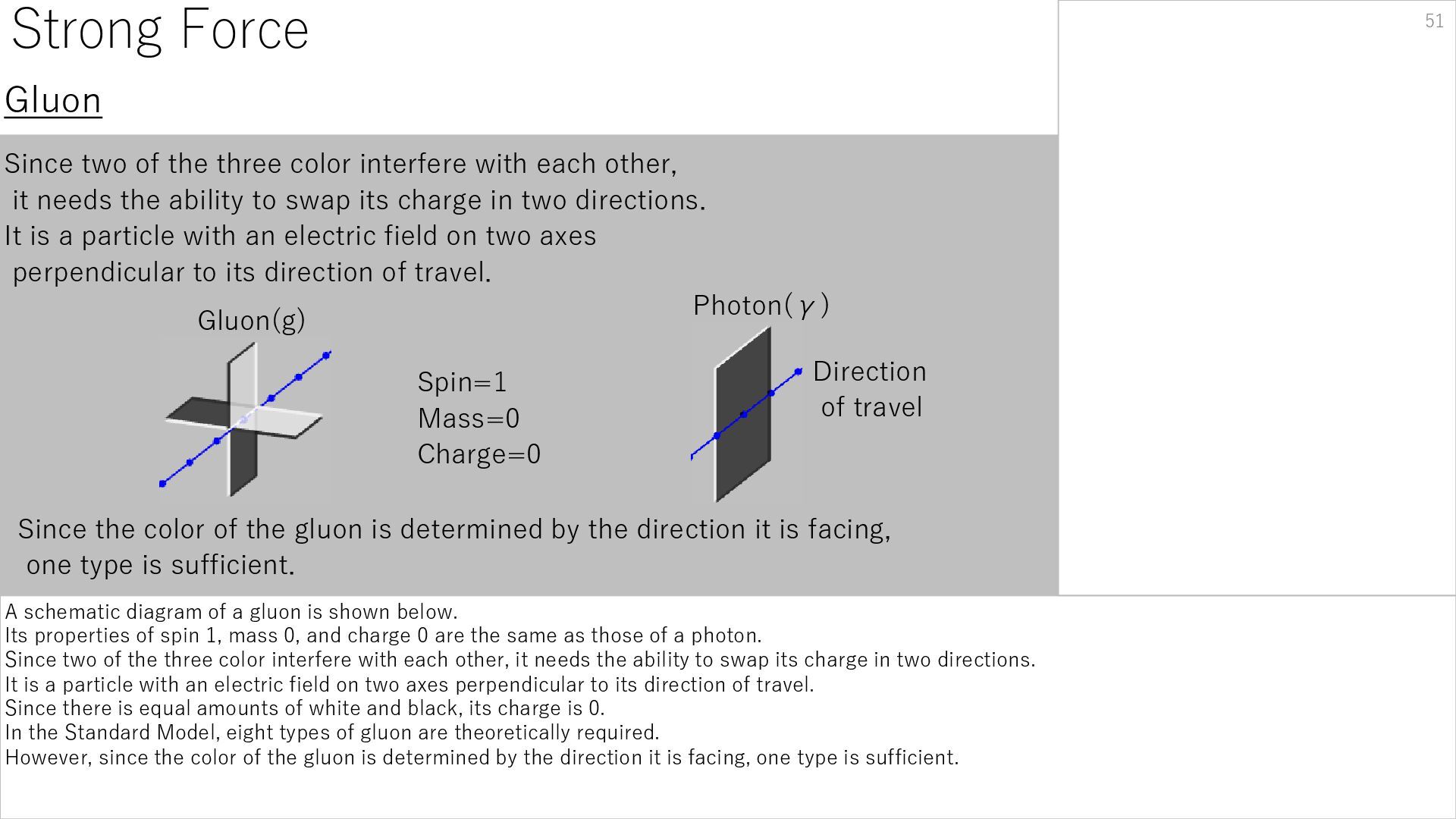
  50. Strong Force A schematic diagram of a gluon is shown

    below. Its properties of spin 1, mass 0, and charge 0 are the same as those of a photon. Since two of the three color interfere with each other, it needs the ability to swap its charge in two directions. It is a particle with an electric field on two axes perpendicular to its direction of travel. Since there is equal amounts of white and black, its charge is 0. In the Standard Model, eight types of gluon are theoretically required. However, since the color of the gluon is determined by the direction it is facing, one type is sufficient. Gluon Since the color of the gluon is determined by the direction it is facing, one type is sufficient. Gluon(g) Photon(γ) Direction of travel Spin=1 Mass=0 Charge=0 Since two of the three color interfere with each other, it needs the ability to swap its charge in two directions. It is a particle with an electric field on two axes perpendicular to its direction of travel. 51
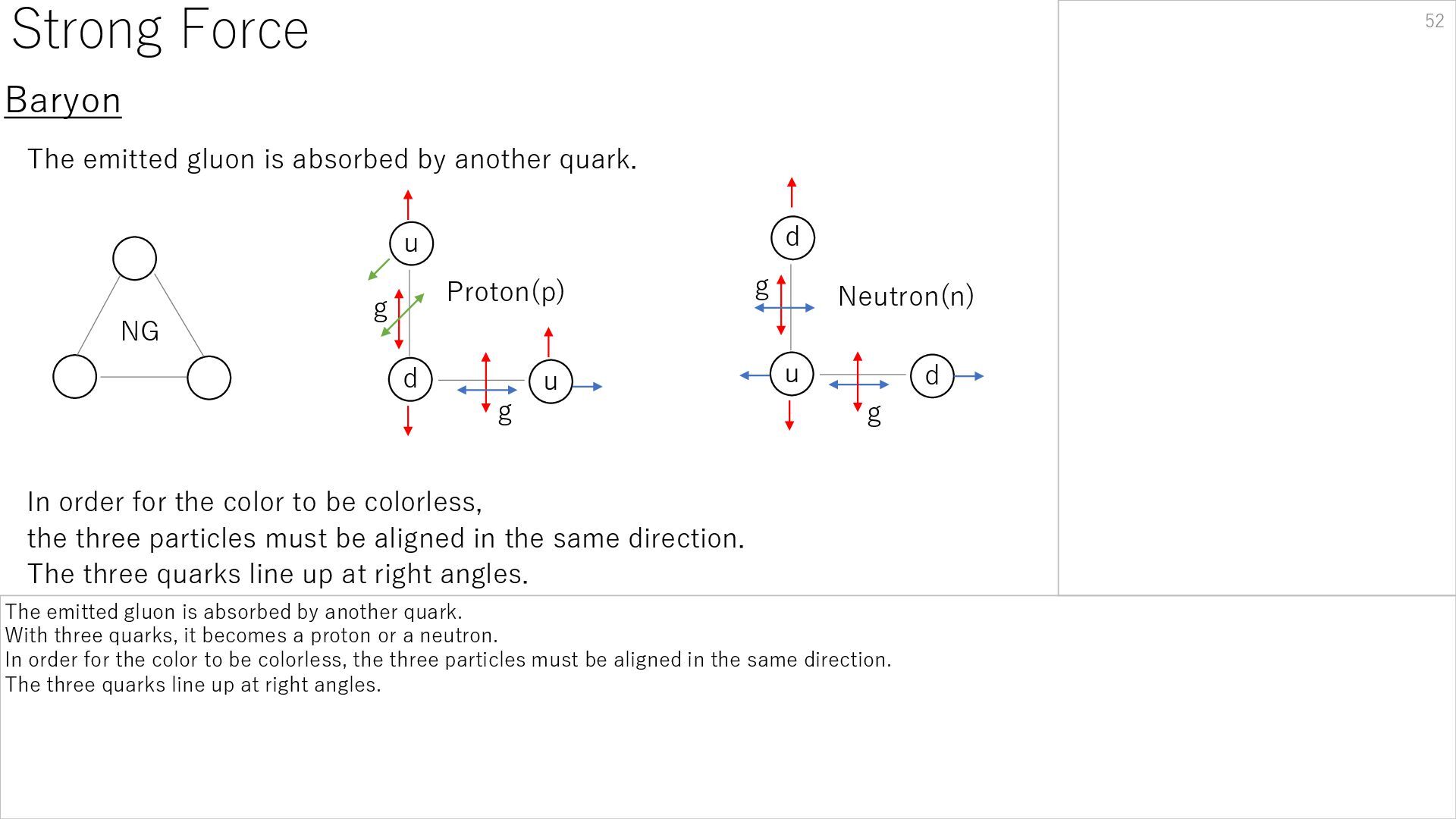
  51. Strong Force The emitted gluon is absorbed by another quark.

    With three quarks, it becomes a proton or a neutron. In order for the color to be colorless, the three particles must be aligned in the same direction. The three quarks line up at right angles. Baryon u d u g g Proton(p) d u d Neutron(n) g g NG In order for the color to be colorless, the three particles must be aligned in the same direction. The three quarks line up at right angles. The emitted gluon is absorbed by another quark. 52
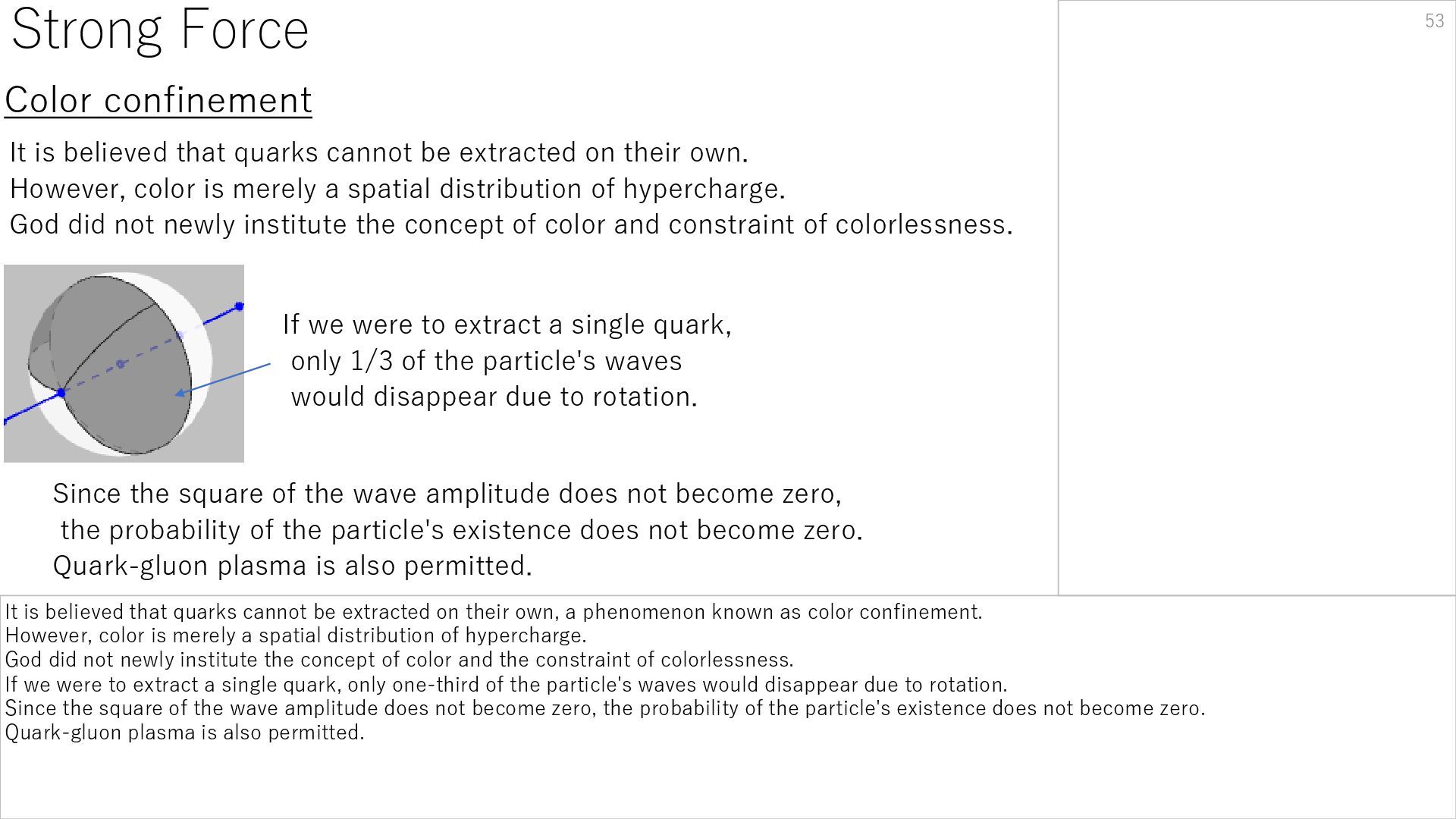
  52. Strong Force It is believed that quarks cannot be extracted

    on their own, a phenomenon known as color confinement. However, color is merely a spatial distribution of hypercharge. God did not newly institute the concept of color and the constraint of colorlessness. If we were to extract a single quark, only one-third of the particle's waves would disappear due to rotation. Since the square of the wave amplitude does not become zero, the probability of the particle's existence does not become zero. Quark-gluon plasma is also permitted. Color confinement 53 If we were to extract a single quark, only 1/3 of the particle's waves would disappear due to rotation. Since the square of the wave amplitude does not become zero, the probability of the particle's existence does not become zero. Quark-gluon plasma is also permitted. It is believed that quarks cannot be extracted on their own. However, color is merely a spatial distribution of hypercharge. God did not newly institute the concept of color and constraint of colorlessness.
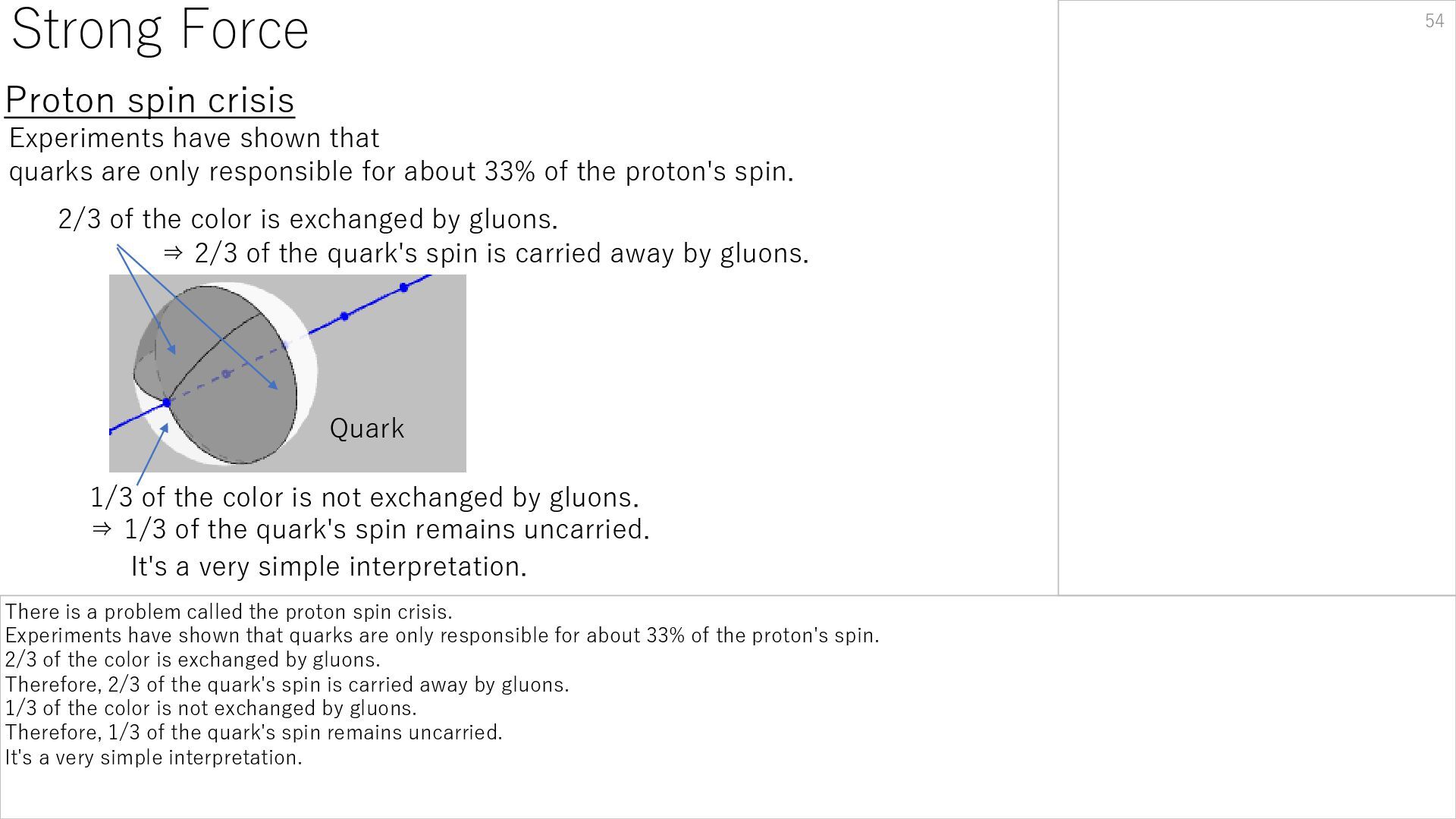
  53. Strong Force There is a problem called the proton spin

    crisis. Experiments have shown that quarks are only responsible for about 33% of the proton's spin. 2/3 of the color is exchanged by gluons. Therefore, 2/3 of the quark's spin is carried away by gluons. 1/3 of the color is not exchanged by gluons. Therefore, 1/3 of the quark's spin remains uncarried. It's a very simple interpretation. Proton spin crisis 2/3 of the color is exchanged by gluons. 54 ⇒ 2/3 of the quark's spin is carried away by gluons. 1/3 of the color is not exchanged by gluons. ⇒ 1/3 of the quark's spin remains uncarried. Experiments have shown that quarks are only responsible for about 33% of the proton's spin. It's a very simple interpretation. Quark
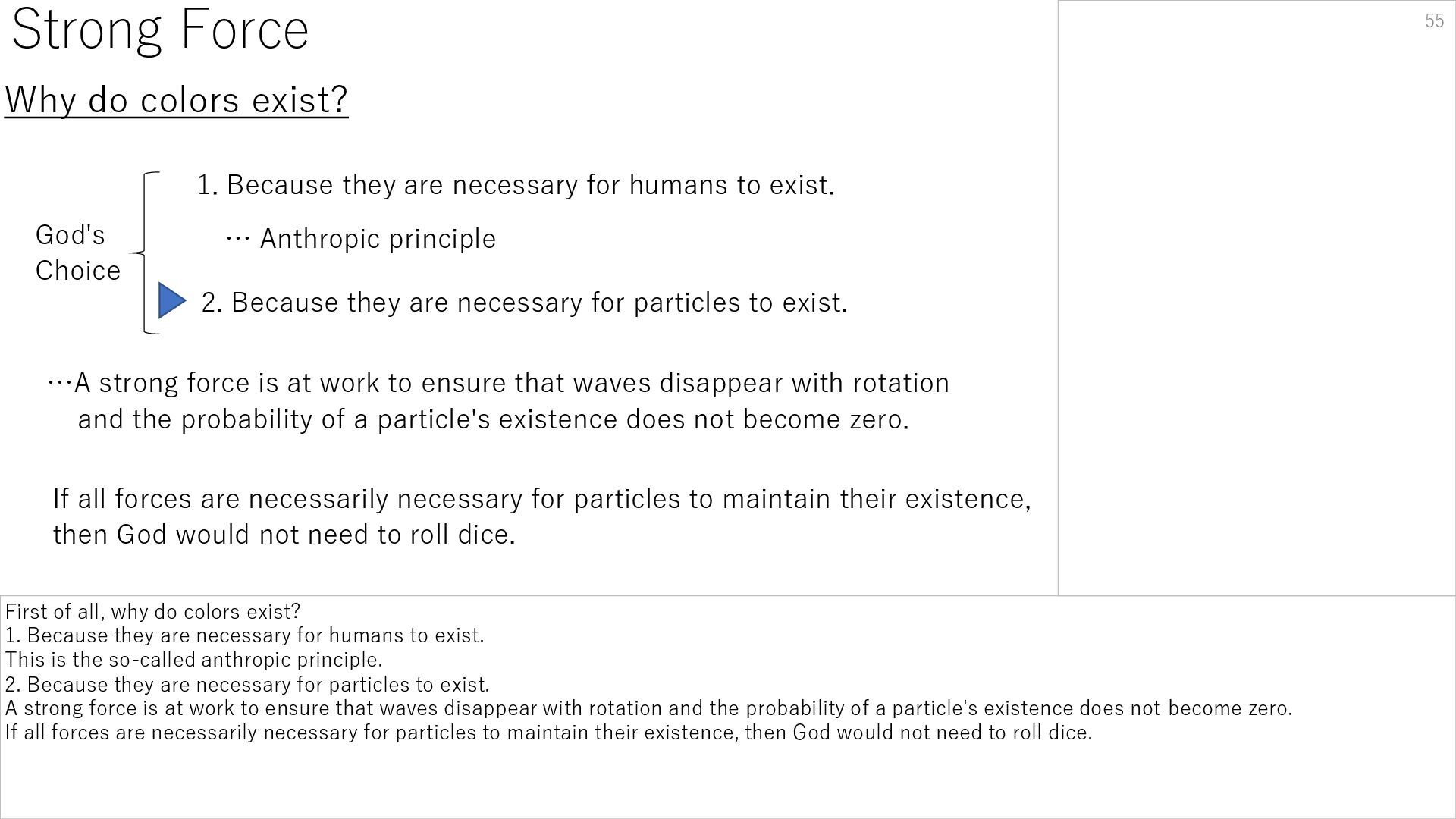
  54. Strong Force First of all, why do colors exist? 1.

    Because they are necessary for humans to exist. This is the so-called anthropic principle. 2. Because they are necessary for particles to exist. A strong force is at work to ensure that waves disappear with rotation and the probability of a particle's existence does not become zero. If all forces are necessarily necessary for particles to maintain their existence, then God would not need to roll dice. Why do colors exist? If all forces are necessarily necessary for particles to maintain their existence, then God would not need to roll dice. God's Choice 1. Because they are necessary for humans to exist. 2. Because they are necessary for particles to exist. … Anthropic principle …A strong force is at work to ensure that waves disappear with rotation and the probability of a particle's existence does not become zero. 55
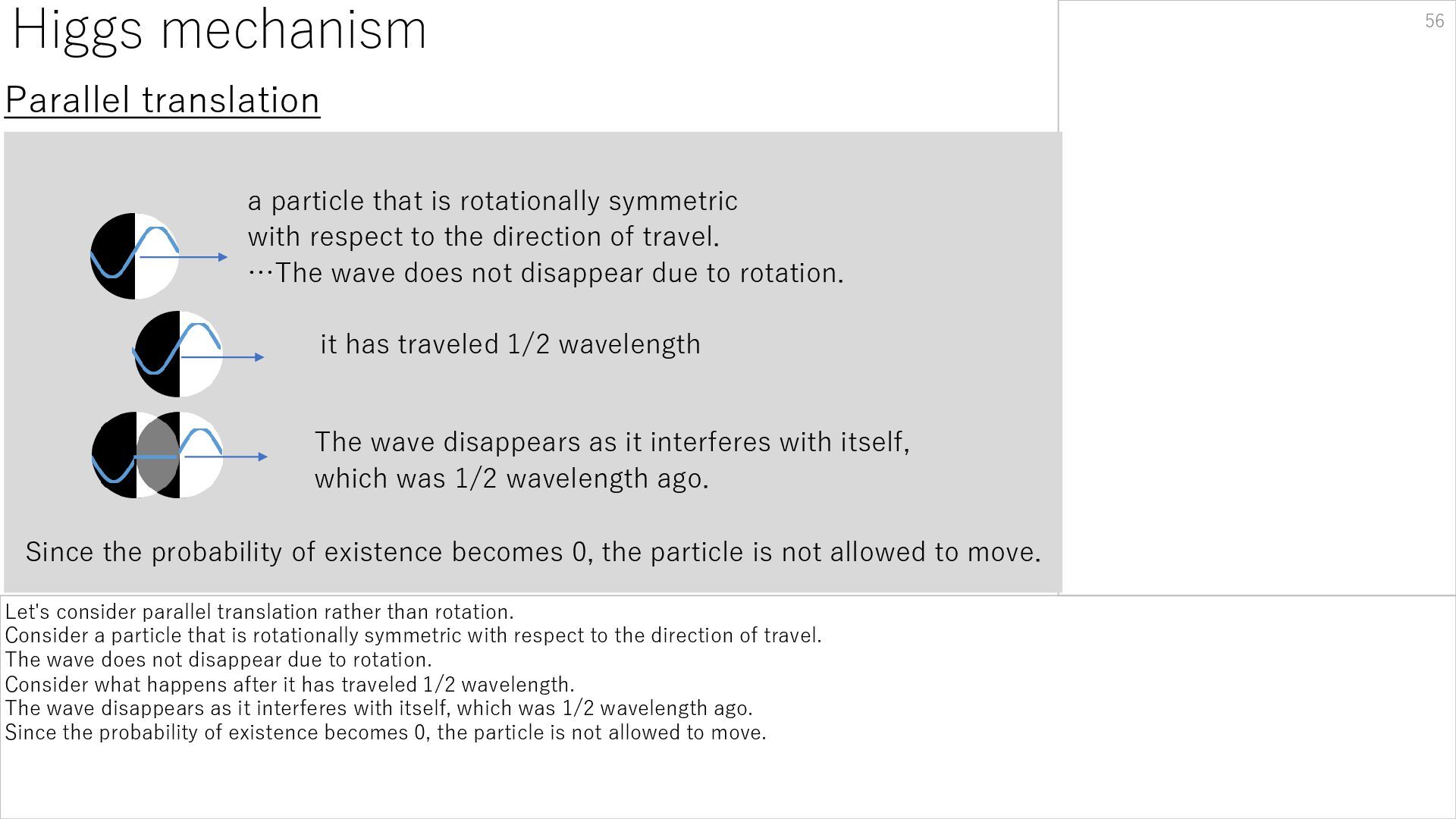
  55. Let's consider parallel translation rather than rotation. Consider a particle

    that is rotationally symmetric with respect to the direction of travel. The wave does not disappear due to rotation. Consider what happens after it has traveled 1/2 wavelength. The wave disappears as it interferes with itself, which was 1/2 wavelength ago. Since the probability of existence becomes 0, the particle is not allowed to move. Parallel translation it has traveled 1/2 wavelength The wave disappears as it interferes with itself, which was 1/2 wavelength ago. a particle that is rotationally symmetric with respect to the direction of travel. …The wave does not disappear due to rotation. Since the probability of existence becomes 0, the particle is not allowed to move. Higgs mechanism 56
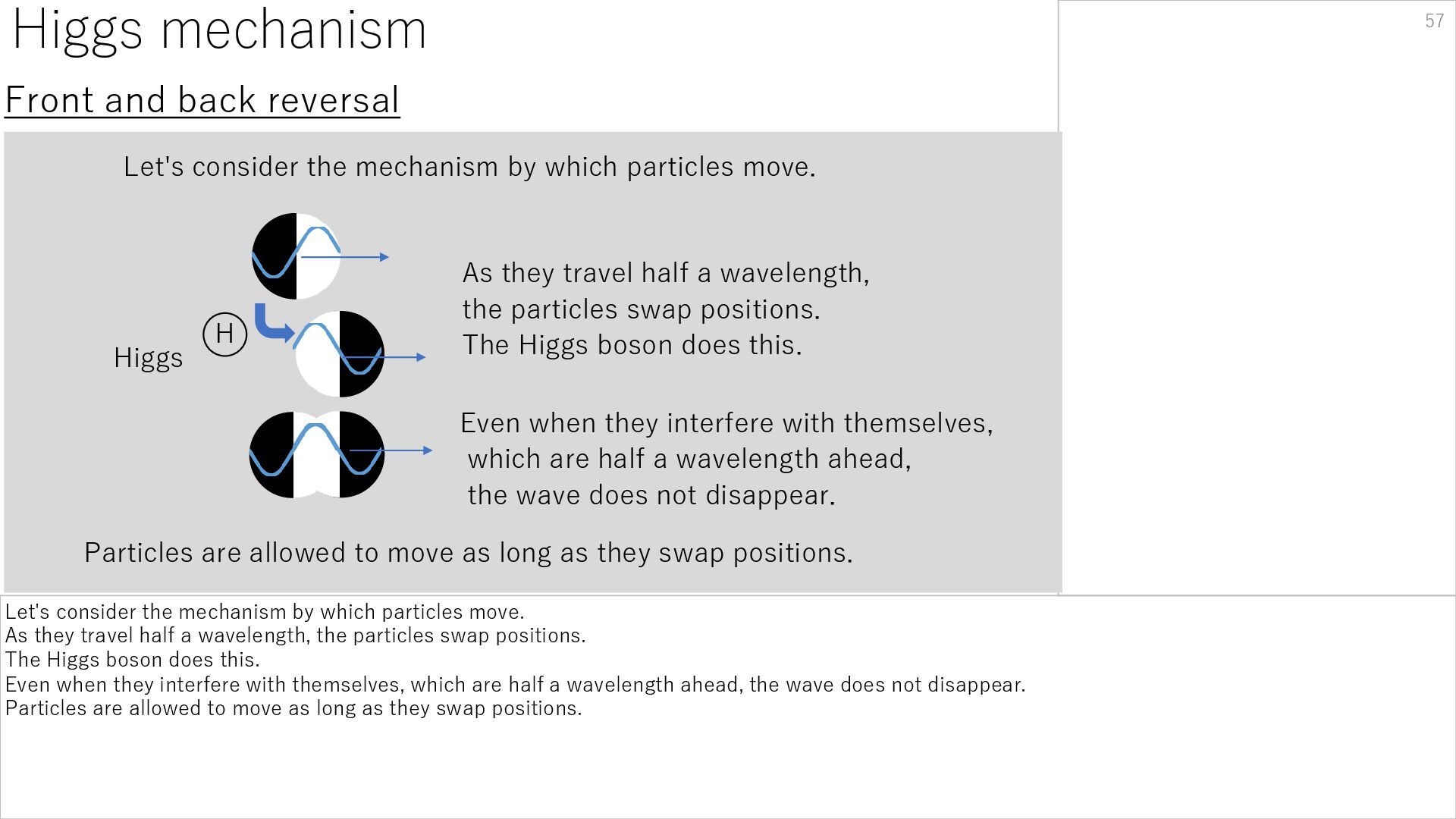
  56. Let's consider the mechanism by which particles move. As they

    travel half a wavelength, the particles swap positions. The Higgs boson does this. Even when they interfere with themselves, which are half a wavelength ahead, the wave does not disappear. Particles are allowed to move as long as they swap positions. Front and back reversal As they travel half a wavelength, the particles swap positions. The Higgs boson does this. Even when they interfere with themselves, which are half a wavelength ahead, the wave does not disappear. Particles are allowed to move as long as they swap positions. H Higgs Let's consider the mechanism by which particles move. Higgs mechanism 57
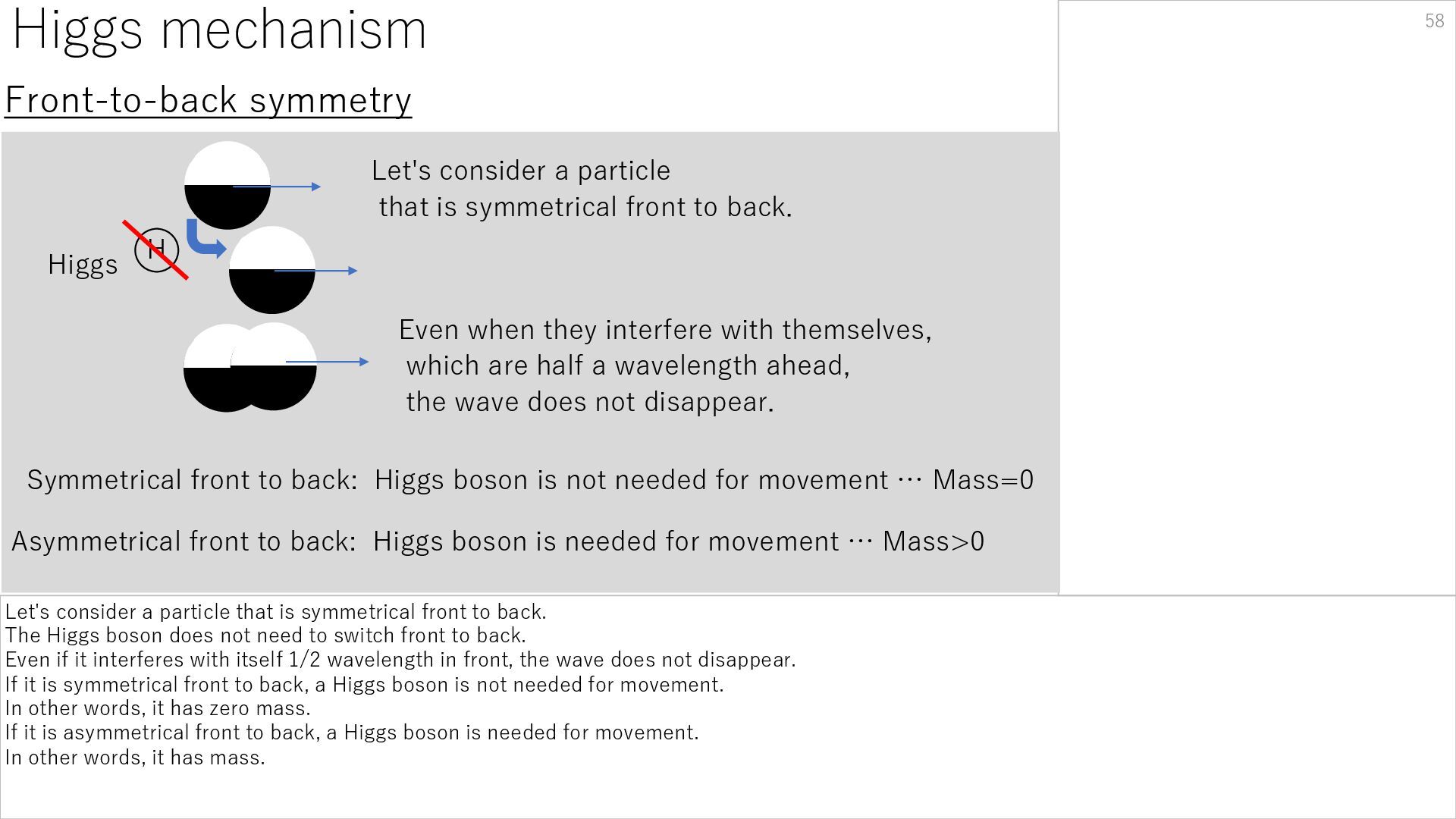
  57. Let's consider a particle that is symmetrical front to back.

    The Higgs boson does not need to switch front to back. Even if it interferes with itself 1/2 wavelength in front, the wave does not disappear. If it is symmetrical front to back, a Higgs boson is not needed for movement. In other words, it has zero mass. If it is asymmetrical front to back, a Higgs boson is needed for movement. In other words, it has mass. Front-to-back symmetry Symmetrical front to back: Higgs boson is not needed for movement … Mass=0 H Higgs Let's consider a particle that is symmetrical front to back. Asymmetrical front to back: Higgs boson is needed for movement … Mass>0 Even when they interfere with themselves, which are half a wavelength ahead, the wave does not disappear. Higgs mechanism 58
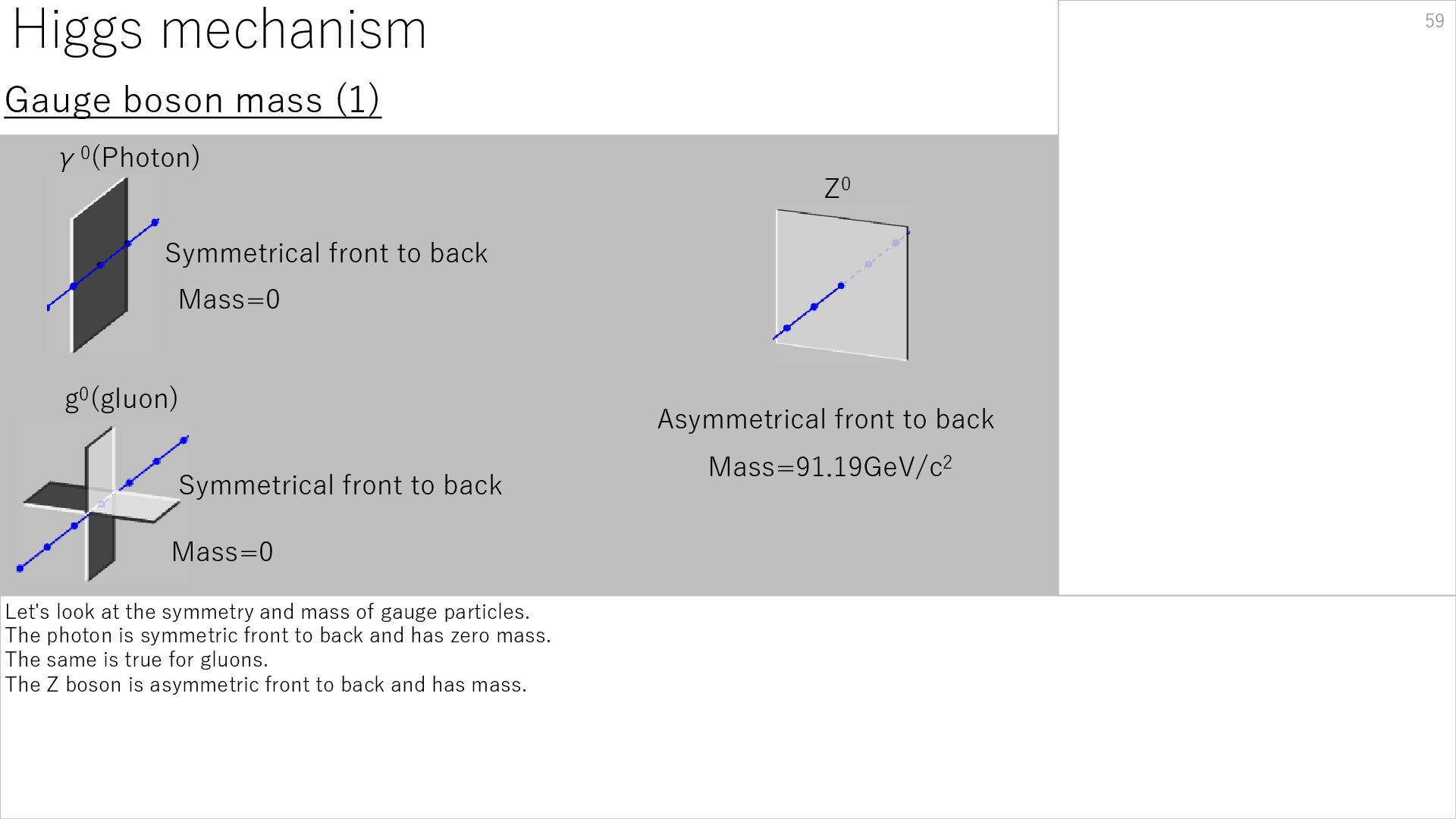
  58. Let's look at the symmetry and mass of gauge particles.

    The photon is symmetric front to back and has zero mass. The same is true for gluons. The Z boson is asymmetric front to back and has mass. Gauge boson mass (1) γ0(Photon) Z0 g0(gluon) Symmetrical front to back Symmetrical front to back Mass=0 Mass=0 Asymmetrical front to back Mass=91.19GeV/c2 Higgs mechanism 59
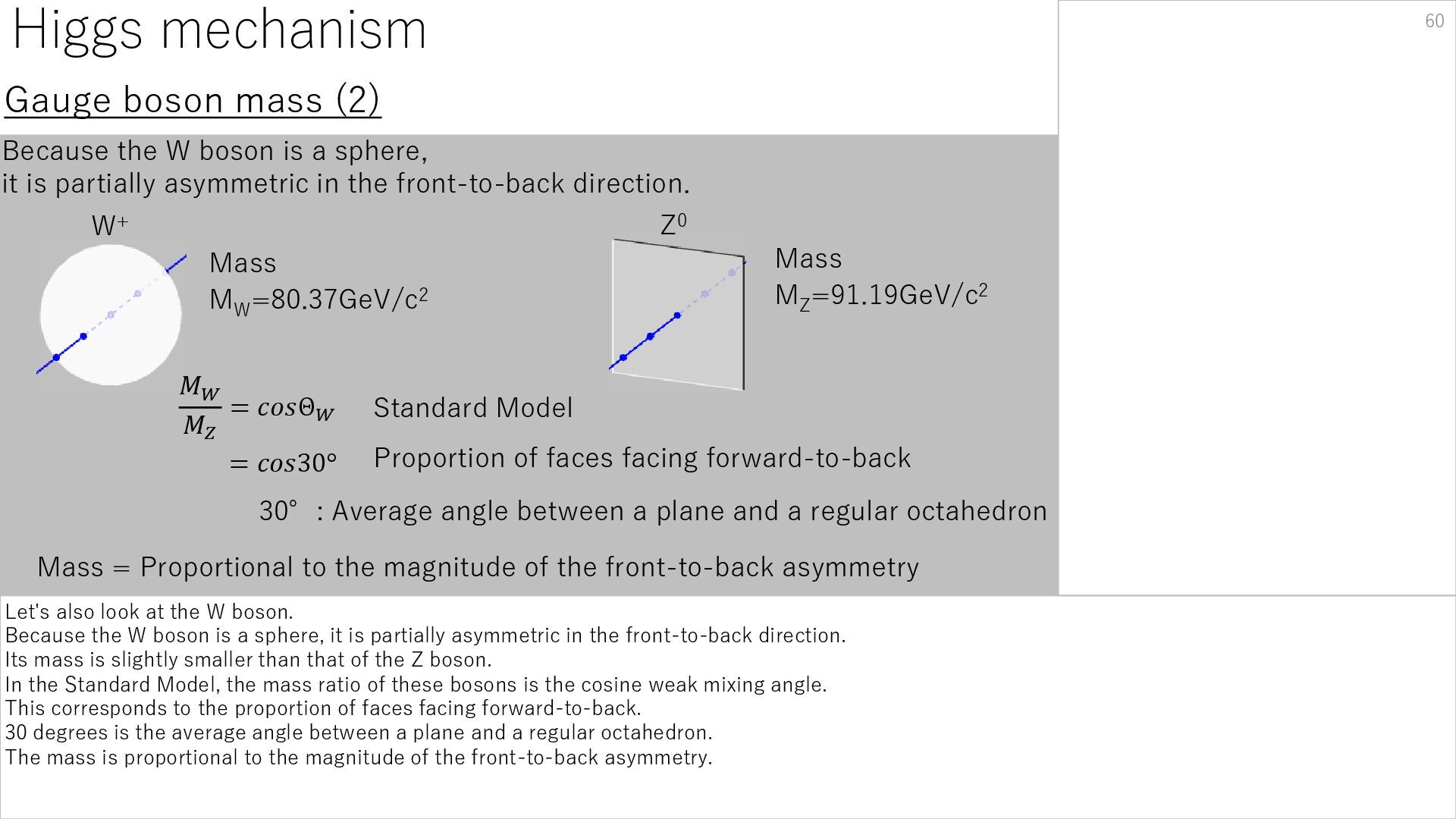
  59. Let's also look at the W boson. Because the W

    boson is a sphere, it is partially asymmetric in the front-to-back direction. Its mass is slightly smaller than that of the Z boson. In the Standard Model, the mass ratio of these bosons is the cosine weak mixing angle. This corresponds to the proportion of faces facing forward-to-back. 30 degrees is the average angle between a plane and a regular octahedron. The mass is proportional to the magnitude of the front-to-back asymmetry. Gauge boson mass (2) Z0 Mass M Z =91.19GeV/c2 W+ Mass M W =80.37GeV/c2 𝑀𝑊 𝑀𝑍 = 𝑐𝑜𝑠Θ𝑊 Standard Model = 𝑐𝑜𝑠30° 30°: Average angle between a plane and a regular octahedron Mass = Proportional to the magnitude of the front-to-back asymmetry Because the W boson is a sphere, it is partially asymmetric in the front-to-back direction. Proportion of faces facing forward-to-back Higgs mechanism 60
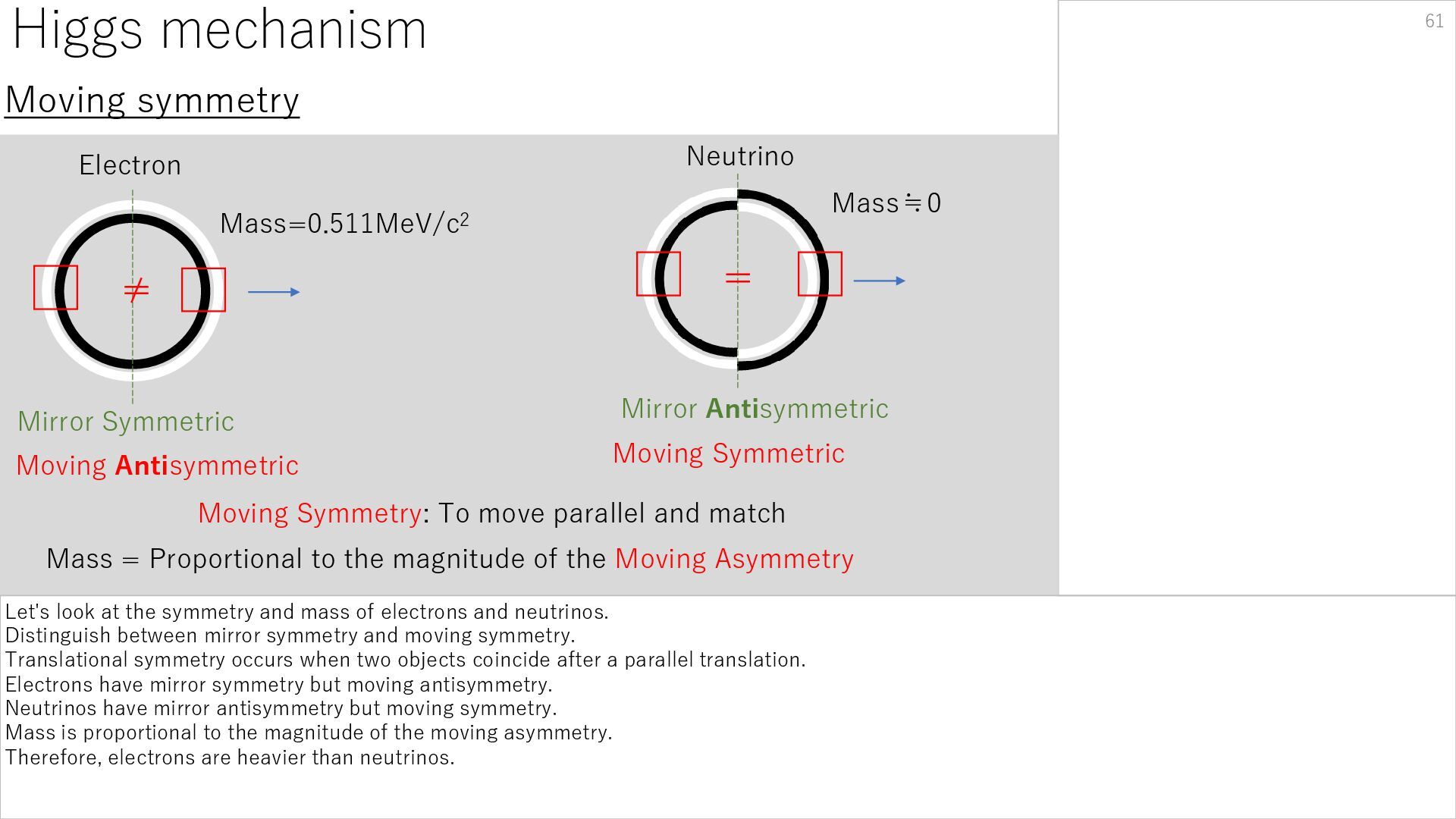
  60. Let's look at the symmetry and mass of electrons and

    neutrinos. Distinguish between mirror symmetry and moving symmetry. Translational symmetry occurs when two objects coincide after a parallel translation. Electrons have mirror symmetry but moving antisymmetry. Neutrinos have mirror antisymmetry but moving symmetry. Mass is proportional to the magnitude of the moving asymmetry. Therefore, electrons are heavier than neutrinos. Moving symmetry Electron Neutrino Mirror Symmetric Moving Antisymmetric Moving Symmetric Mirror Antisymmetric = ≠ Mass = Proportional to the magnitude of the Moving Asymmetry Mass=0.511MeV/c2 Mass≒0 Moving Symmetry: To move parallel and match Higgs mechanism 61
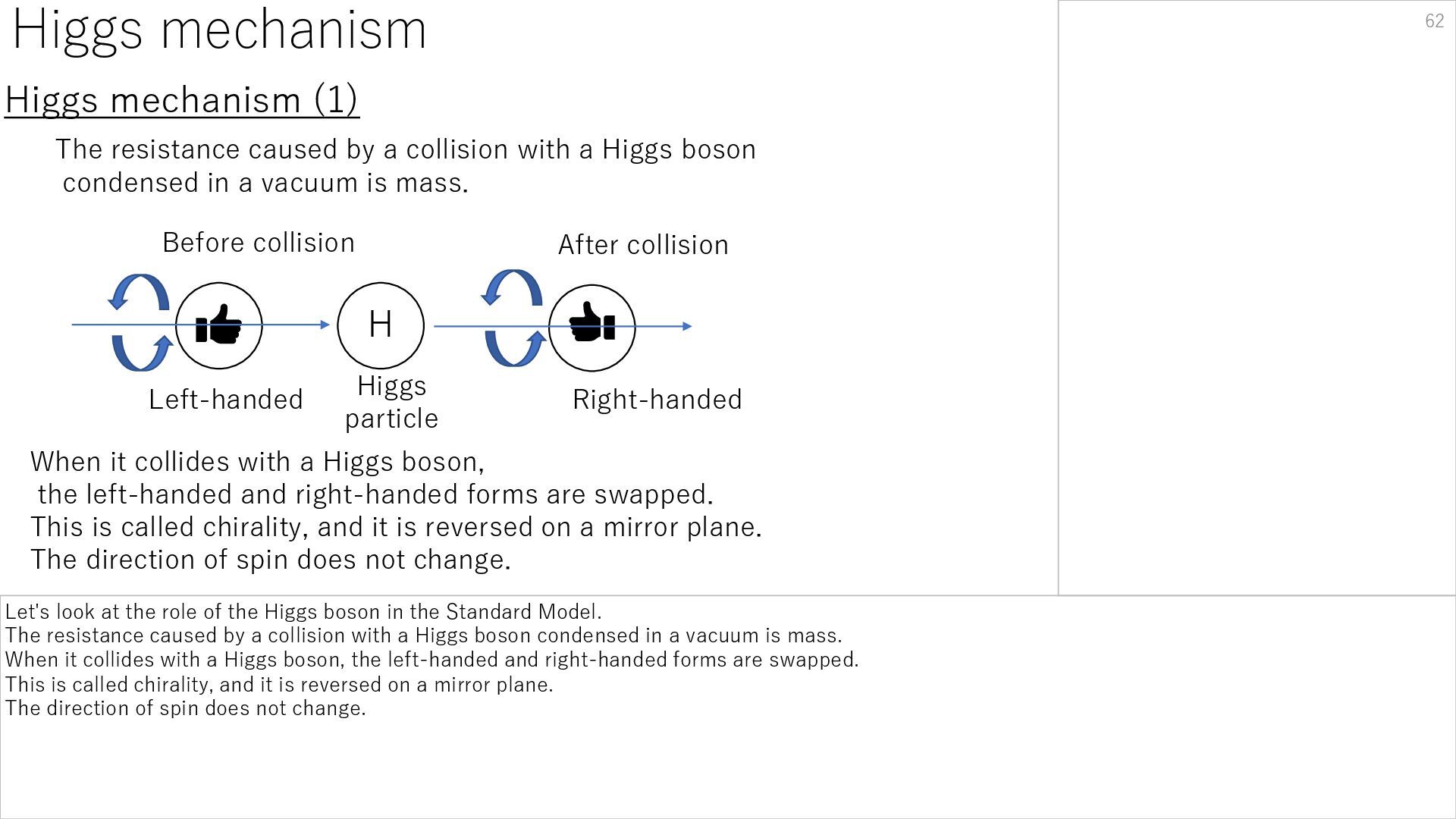
  61. Let's look at the role of the Higgs boson in

    the Standard Model. The resistance caused by a collision with a Higgs boson condensed in a vacuum is mass. When it collides with a Higgs boson, the left-handed and right-handed forms are swapped. This is called chirality, and it is reversed on a mirror plane. The direction of spin does not change. Higgs mechanism (1) H Left-handed Right-handed Higgs particle Before collision After collision The resistance caused by a collision with a Higgs boson condensed in a vacuum is mass. When it collides with a Higgs boson, the left-handed and right-handed forms are swapped. This is called chirality, and it is reversed on a mirror plane. The direction of spin does not change. Higgs mechanism 62
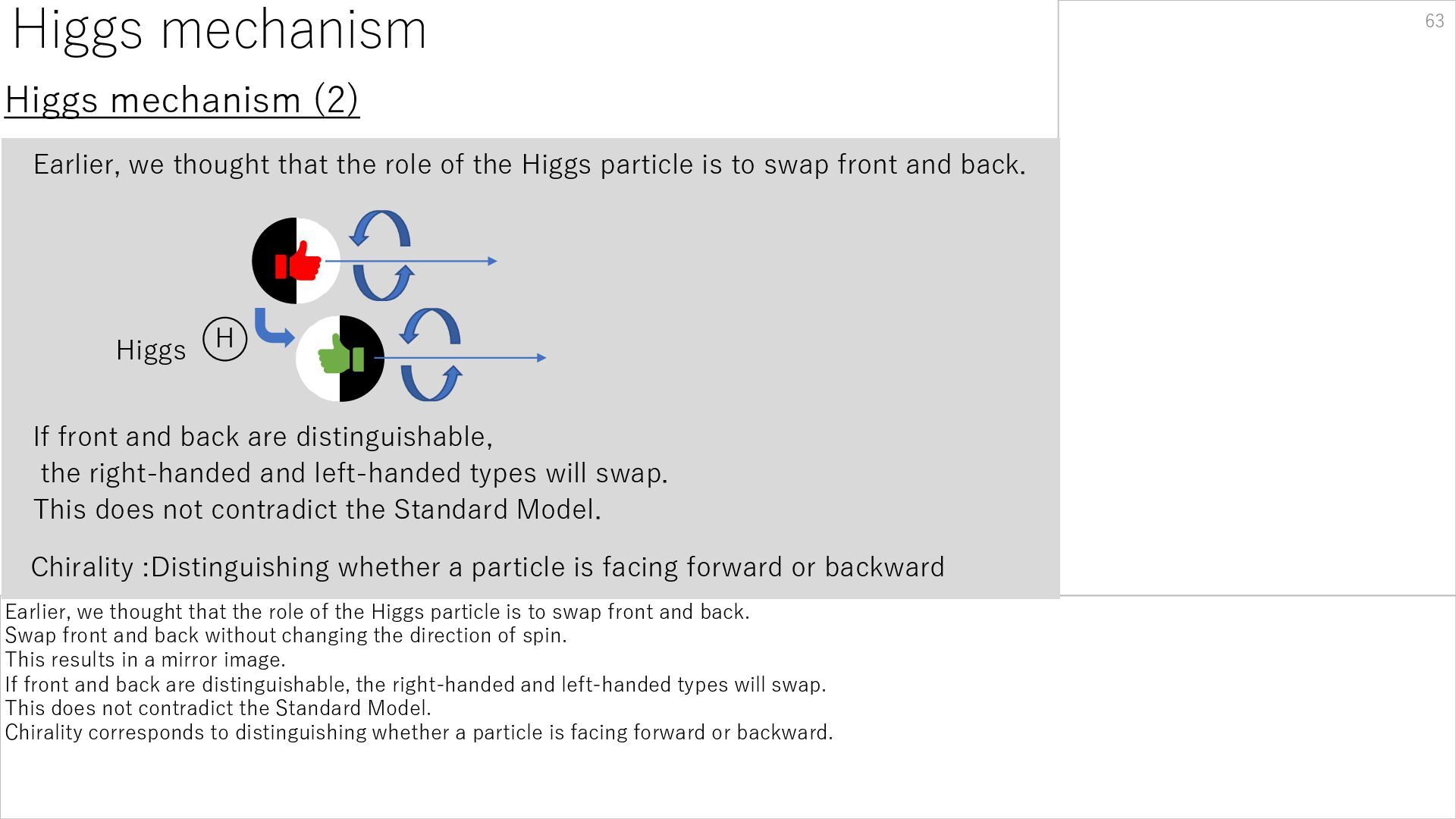
  62. Higgs mechanism Earlier, we thought that the role of the

    Higgs particle is to swap front and back. Swap front and back without changing the direction of spin. This results in a mirror image. If front and back are distinguishable, the right-handed and left-handed types will swap. This does not contradict the Standard Model. Chirality corresponds to distinguishing whether a particle is facing forward or backward. Higgs mechanism (2) H Higgs Earlier, we thought that the role of the Higgs particle is to swap front and back. If front and back are distinguishable, the right-handed and left-handed types will swap. This does not contradict the Standard Model. Chirality :Distinguishing whether a particle is facing forward or backward 63
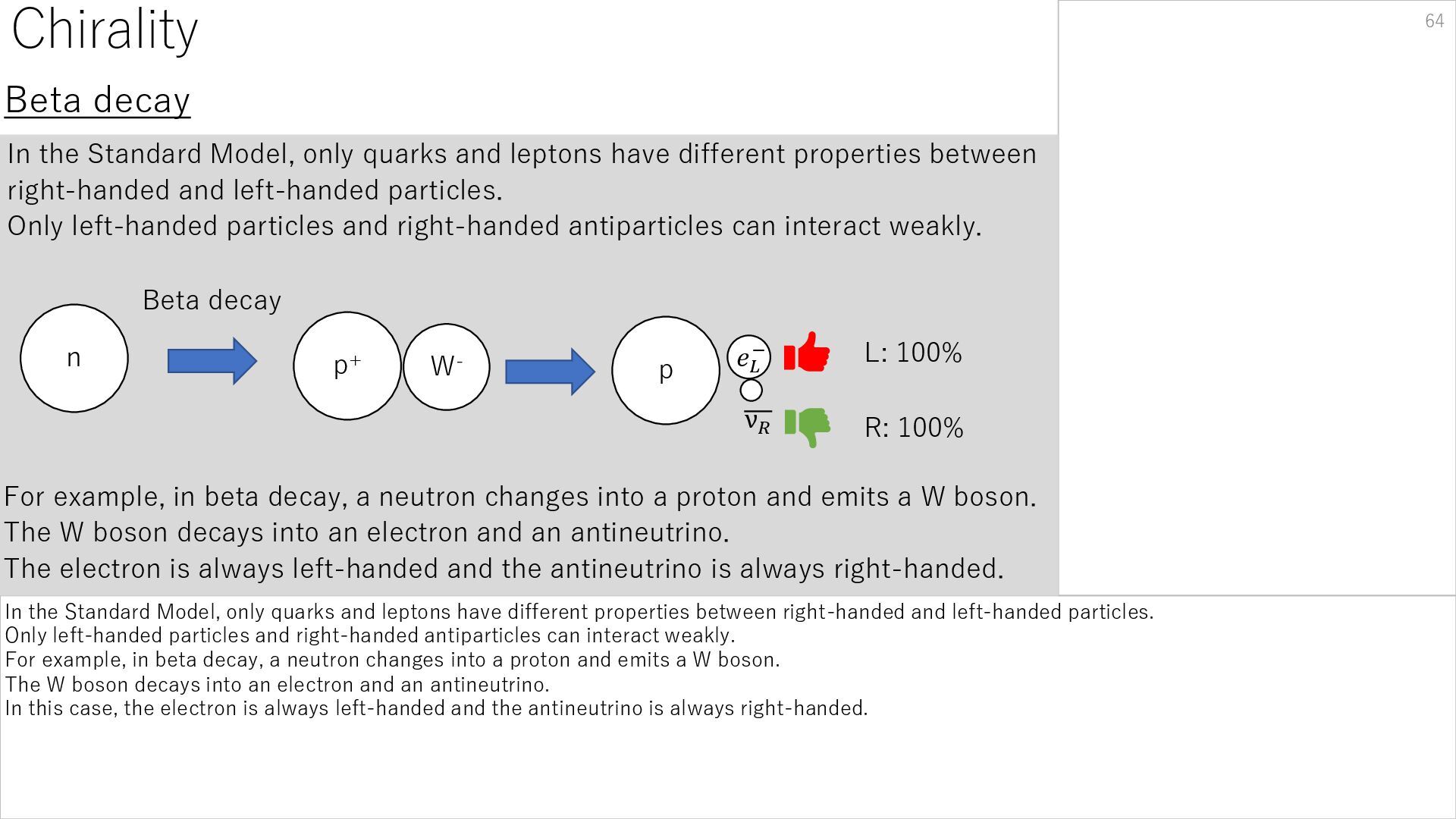
  63. Chirality In the Standard Model, only quarks and leptons have

    different properties between right-handed and left-handed particles. Only left-handed particles and right-handed antiparticles can interact weakly. For example, in beta decay, a neutron changes into a proton and emits a W boson. The W boson decays into an electron and an antineutrino. In this case, the electron is always left-handed and the antineutrino is always right-handed. Beta decay In the Standard Model, only quarks and leptons have different properties between right-handed and left-handed particles. Only left-handed particles and right-handed antiparticles can interact weakly. For example, in beta decay, a neutron changes into a proton and emits a W boson. The W boson decays into an electron and an antineutrino. The electron is always left-handed and the antineutrino is always right-handed. n p+ Beta decay W- p ν𝑅 L: 100% R: 100% 𝑒𝐿 − 64
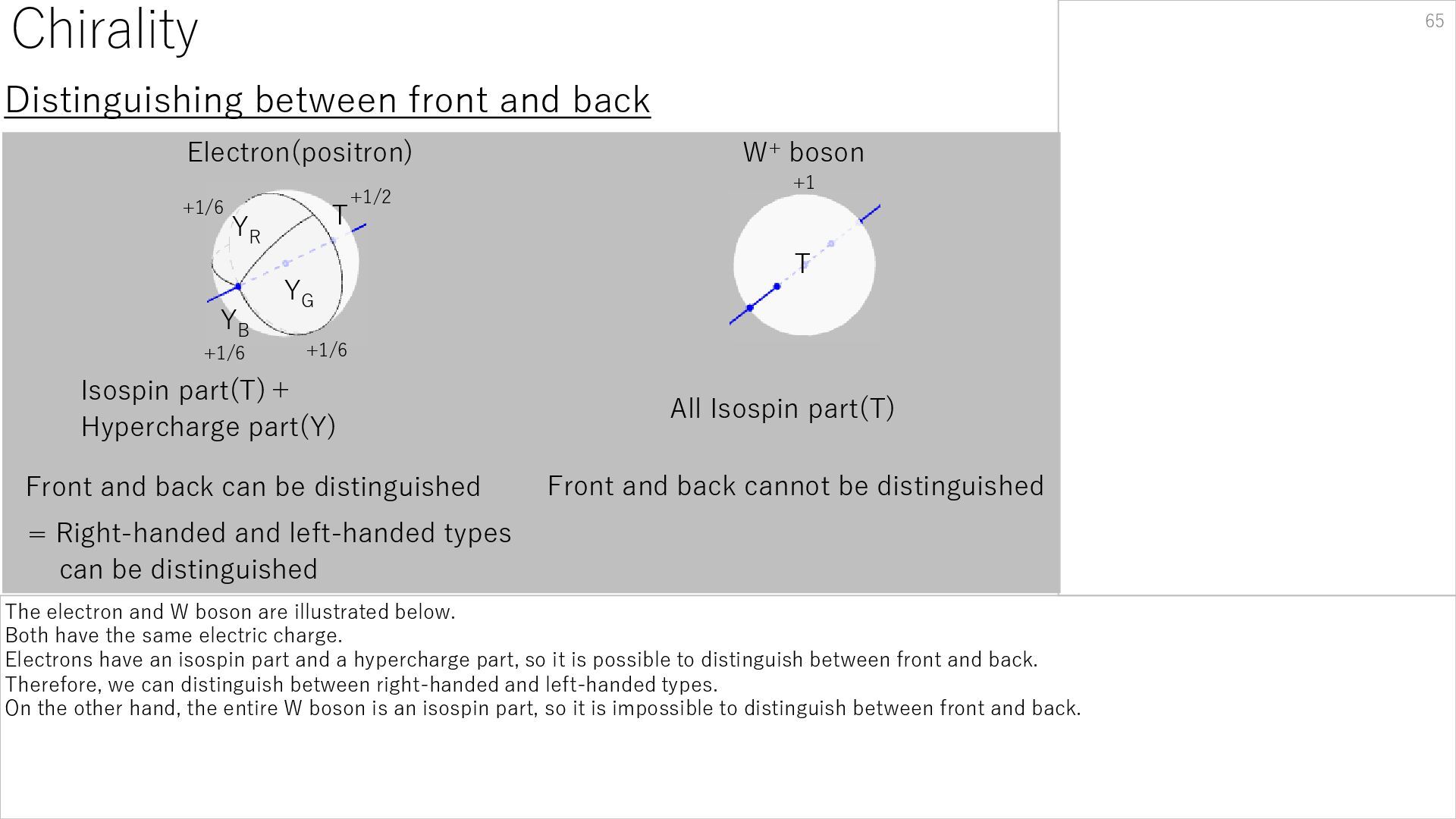
  64. Chirality The electron and W boson are illustrated below. Both

    have the same electric charge. Electrons have an isospin part and a hypercharge part, so it is possible to distinguish between front and back. Therefore, we can distinguish between right-handed and left-handed types. On the other hand, the entire W boson is an isospin part, so it is impossible to distinguish between front and back. Distinguishing between front and back Y R Y G Y B T T +1/2 +1 +1/6 +1/6 +1/6 Electron(positron) W+ boson Isospin part(T)+ Hypercharge part(Y) All Isospin part(T) Front and back can be distinguished = Right-handed and left-handed types can be distinguished Front and back cannot be distinguished 65
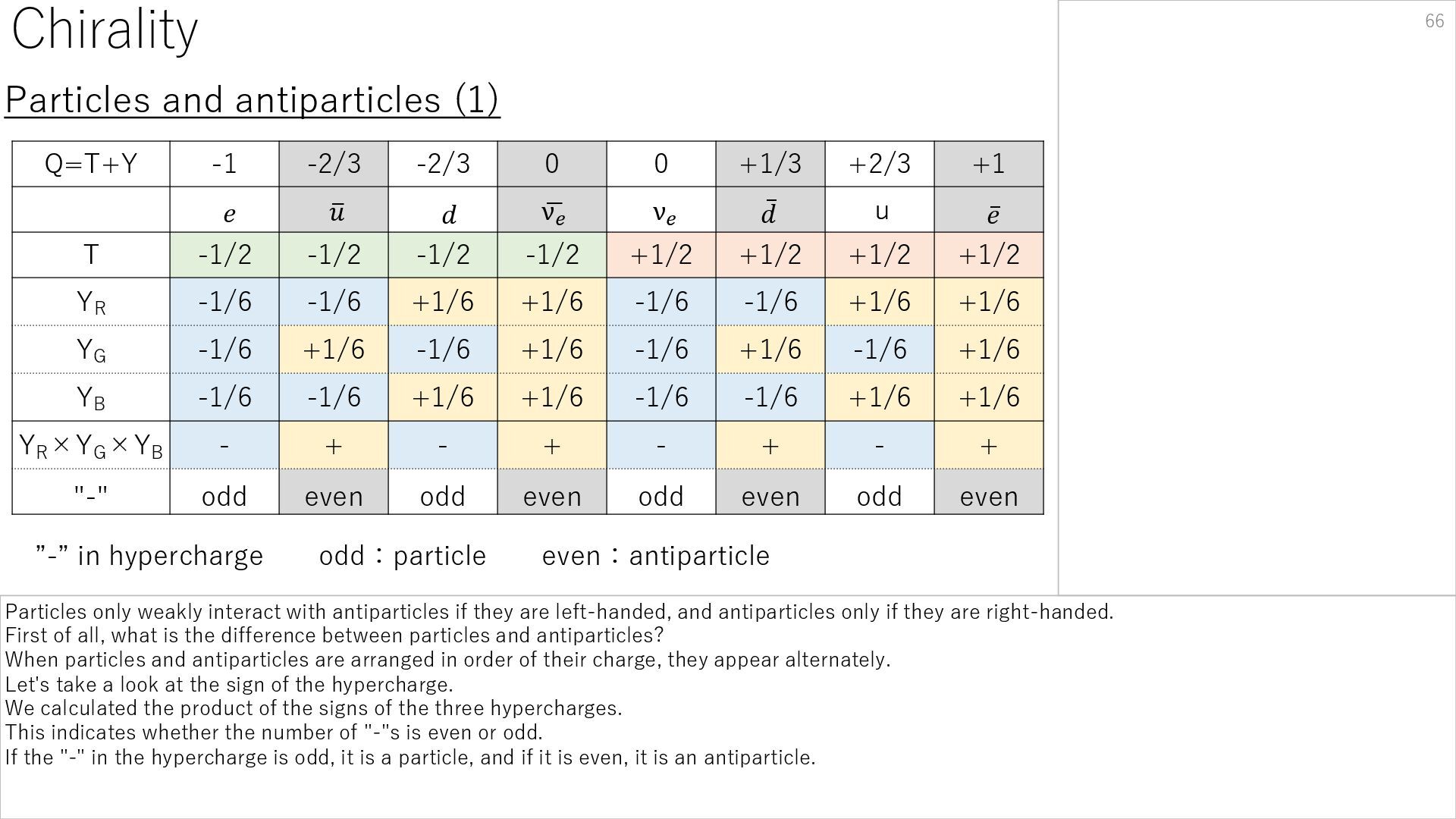
  65. Q=T+Y -1 -2/3 -2/3 0 0 +1/3 +2/3 +1 T

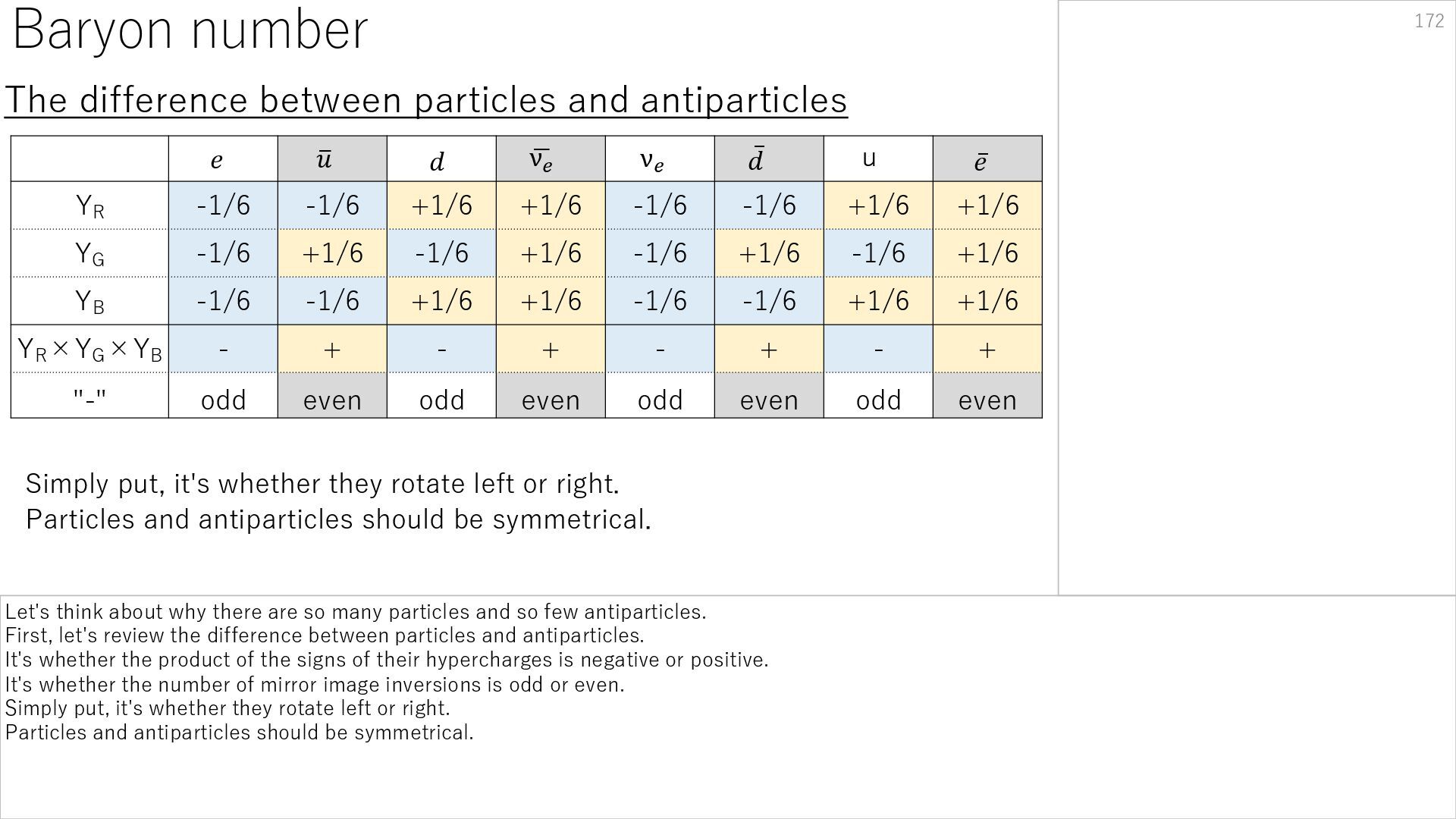
    -1/2 -1/2 -1/2 -1/2 +1/2 +1/2 +1/2 +1/2 YR -1/6 -1/6 +1/6 +1/6 -1/6 -1/6 +1/6 +1/6 YG -1/6 +1/6 -1/6 +1/6 -1/6 +1/6 -1/6 +1/6 YB -1/6 -1/6 +1/6 +1/6 -1/6 -1/6 +1/6 +1/6 YR ×YG ×YB - + - + - + - + "-" odd even odd even odd even odd even Chirality Particles only weakly interact with antiparticles if they are left-handed, and antiparticles only if they are right-handed. First of all, what is the difference between particles and antiparticles? When particles and antiparticles are arranged in order of their charge, they appear alternately. Let's take a look at the sign of the hypercharge. We calculated the product of the signs of the three hypercharges. This indicates whether the number of "-"s is even or odd. If the "-" in the hypercharge is odd, it is a particle, and if it is even, it is an antiparticle. Particles and antiparticles (1) 𝑑 ഥ ν𝑒 ν𝑒 u ҧ 𝑑 ത 𝑢 𝑒 ҧ 𝑒 ”-” in hypercharge odd:particle even:antiparticle 66
  66. Chirality The sign of hypercharge represents three directions in space.

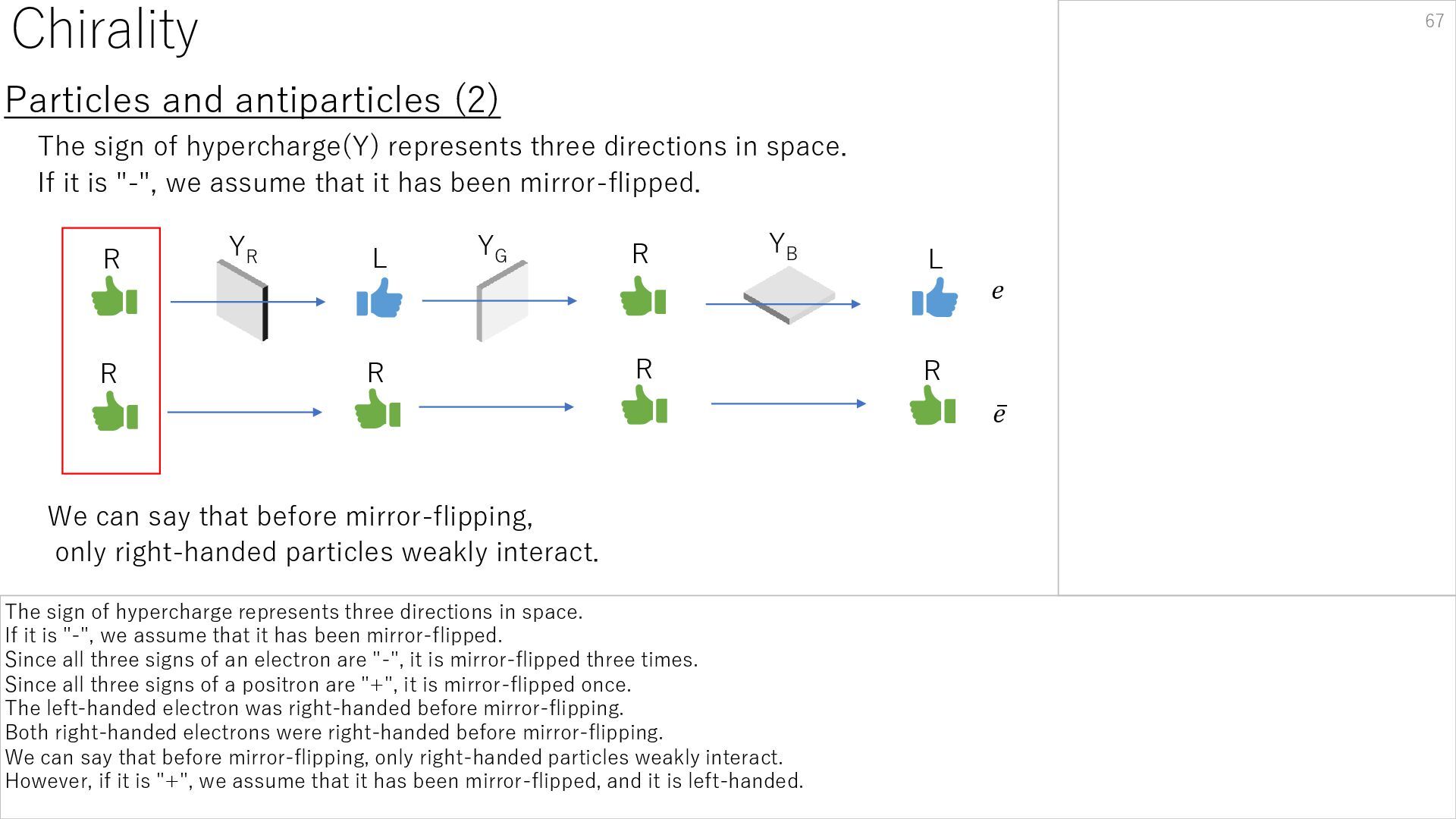
    If it is "-", we assume that it has been mirror-flipped. Since all three signs of an electron are "-", it is mirror-flipped three times. Since all three signs of a positron are "+", it is mirror-flipped once. The left-handed electron was right-handed before mirror-flipping. Both right-handed electrons were right-handed before mirror-flipping. We can say that before mirror-flipping, only right-handed particles weakly interact. However, if it is "+", we assume that it has been mirror-flipped, and it is left-handed. Particles and antiparticles (2) L Y R Y G Y B 𝑒 ҧ 𝑒 R L R R R R R The sign of hypercharge(Y) represents three directions in space. If it is "-", we assume that it has been mirror-flipped. We can say that before mirror-flipping, only right-handed particles weakly interact. 67
  67. Chirality Isospin also has a sign. The sign of isospin

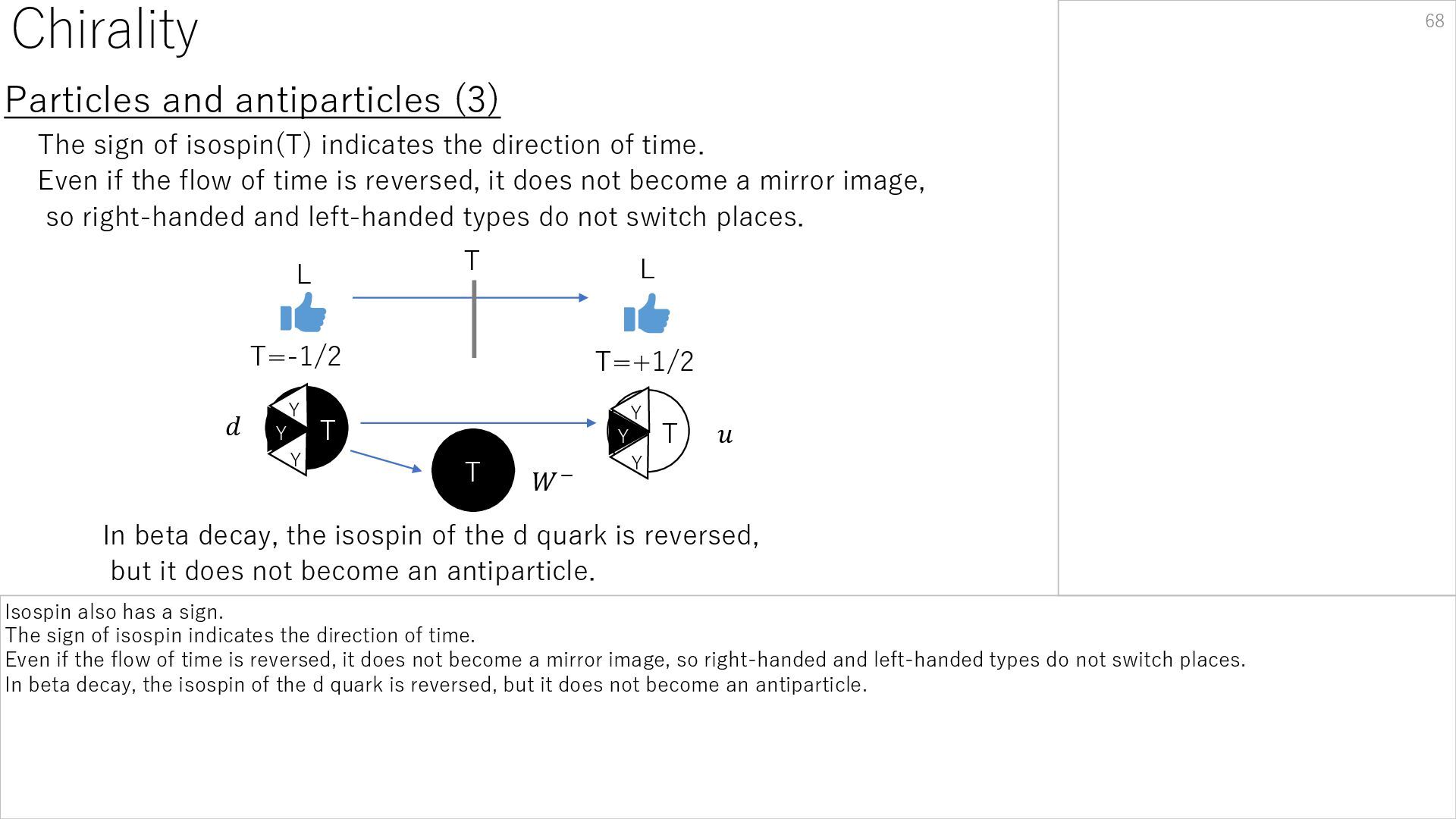
    indicates the direction of time. Even if the flow of time is reversed, it does not become a mirror image, so right-handed and left-handed types do not switch places. In beta decay, the isospin of the d quark is reversed, but it does not become an antiparticle. Particles and antiparticles (3) L L T T=-1/2 T=+1/2 T Y Y T Y T Y Y Y 𝑊− 𝑑 𝑢 The sign of isospin(T) indicates the direction of time. Even if the flow of time is reversed, it does not become a mirror image, so right-handed and left-handed types do not switch places. In beta decay, the isospin of the d quark is reversed, but it does not become an antiparticle. 68
  68. Chirality So what exactly are right-handed and left-handed? Let's express

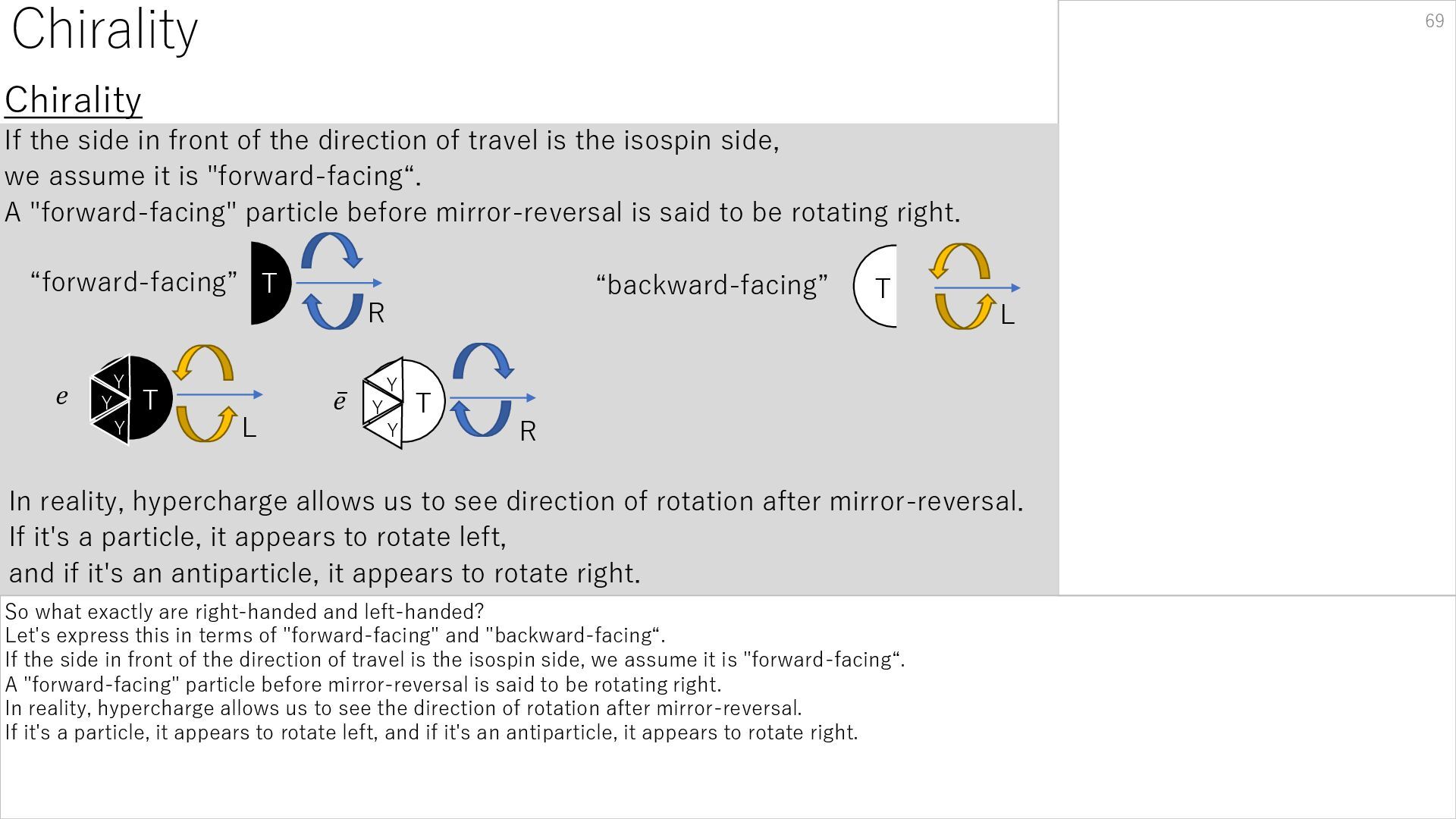
    this in terms of "forward-facing" and "backward-facing“. If the side in front of the direction of travel is the isospin side, we assume it is "forward-facing“. A "forward-facing" particle before mirror-reversal is said to be rotating right. In reality, hypercharge allows us to see the direction of rotation after mirror-reversal. If it's a particle, it appears to rotate left, and if it's an antiparticle, it appears to rotate right. Chirality T Y Y Y T T “forward-facing” If the side in front of the direction of travel is the isospin side, we assume it is "forward-facing“. A "forward-facing" particle before mirror-reversal is said to be rotating right. “backward-facing” 𝑒 R L L T Y Y Y R In reality, hypercharge allows us to see direction of rotation after mirror-reversal. If it's a particle, it appears to rotate left, and if it's an antiparticle, it appears to rotate right. ҧ 𝑒 69
  69. Weak Force Let's think about why only "forward-facing" particles interact

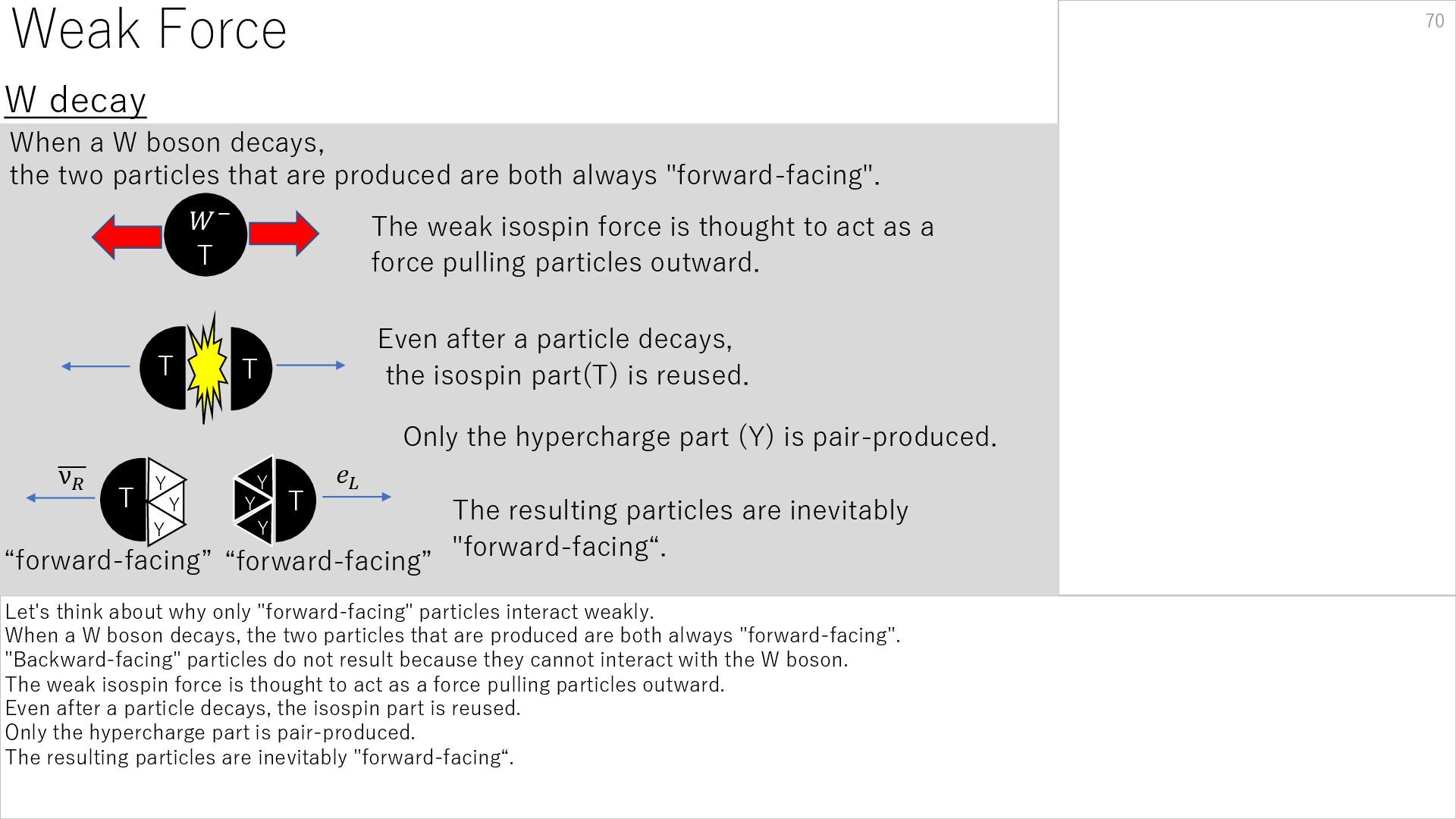
    weakly. When a W boson decays, the two particles that are produced are both always "forward-facing". "Backward-facing" particles do not result because they cannot interact with the W boson. The weak isospin force is thought to act as a force pulling particles outward. Even after a particle decays, the isospin part is reused. Only the hypercharge part is pair-produced. The resulting particles are inevitably "forward-facing“. W decay T T T T T Y Y Y 𝑒𝐿 Y Y Y ν𝑅 “forward-facing” “forward-facing” When a W boson decays, the two particles that are produced are both always "forward-facing". The weak isospin force is thought to act as a force pulling particles outward. 𝑊− Even after a particle decays, the isospin part(T) is reused. Only the hypercharge part (Y) is pair-produced. The resulting particles are inevitably "forward-facing“. 70
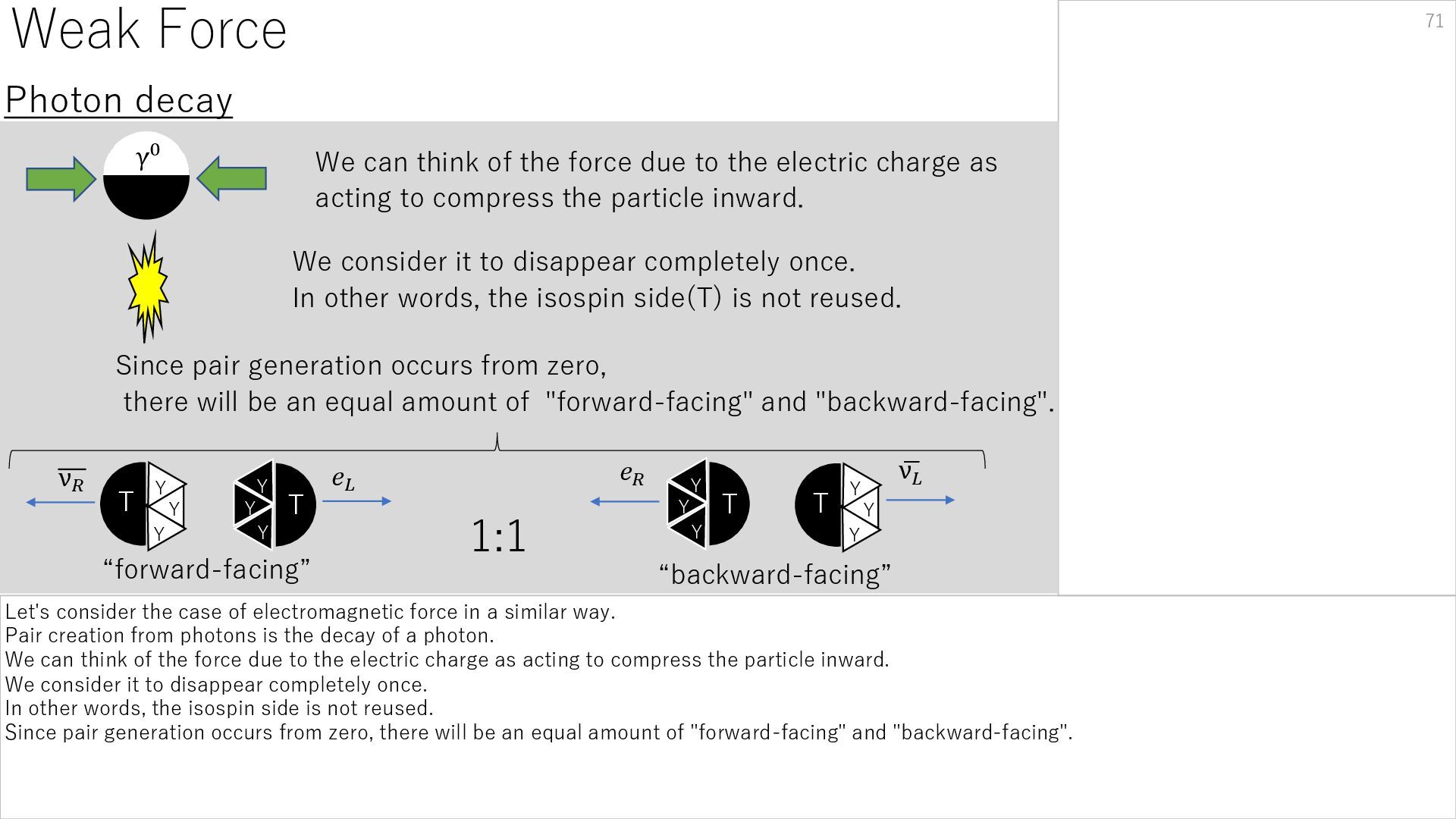
  70. Weak Force Let's consider the case of electromagnetic force in

    a similar way. Pair creation from photons is the decay of a photon. We can think of the force due to the electric charge as acting to compress the particle inward. We consider it to disappear completely once. In other words, the isospin side is not reused. Since pair generation occurs from zero, there will be an equal amount of "forward-facing" and "backward-facing". Photon decay γ0 T T Y Y Y Y Y Y “forward-facing” T T Y Y Y Y Y Y “backward-facing” 𝑒𝐿 ν𝑅 𝑒𝑅 ഥ ν𝐿 1:1 We can think of the force due to the electric charge as acting to compress the particle inward. We consider it to disappear completely once. In other words, the isospin side(T) is not reused. Since pair generation occurs from zero, there will be an equal amount of "forward-facing" and "backward-facing". 71
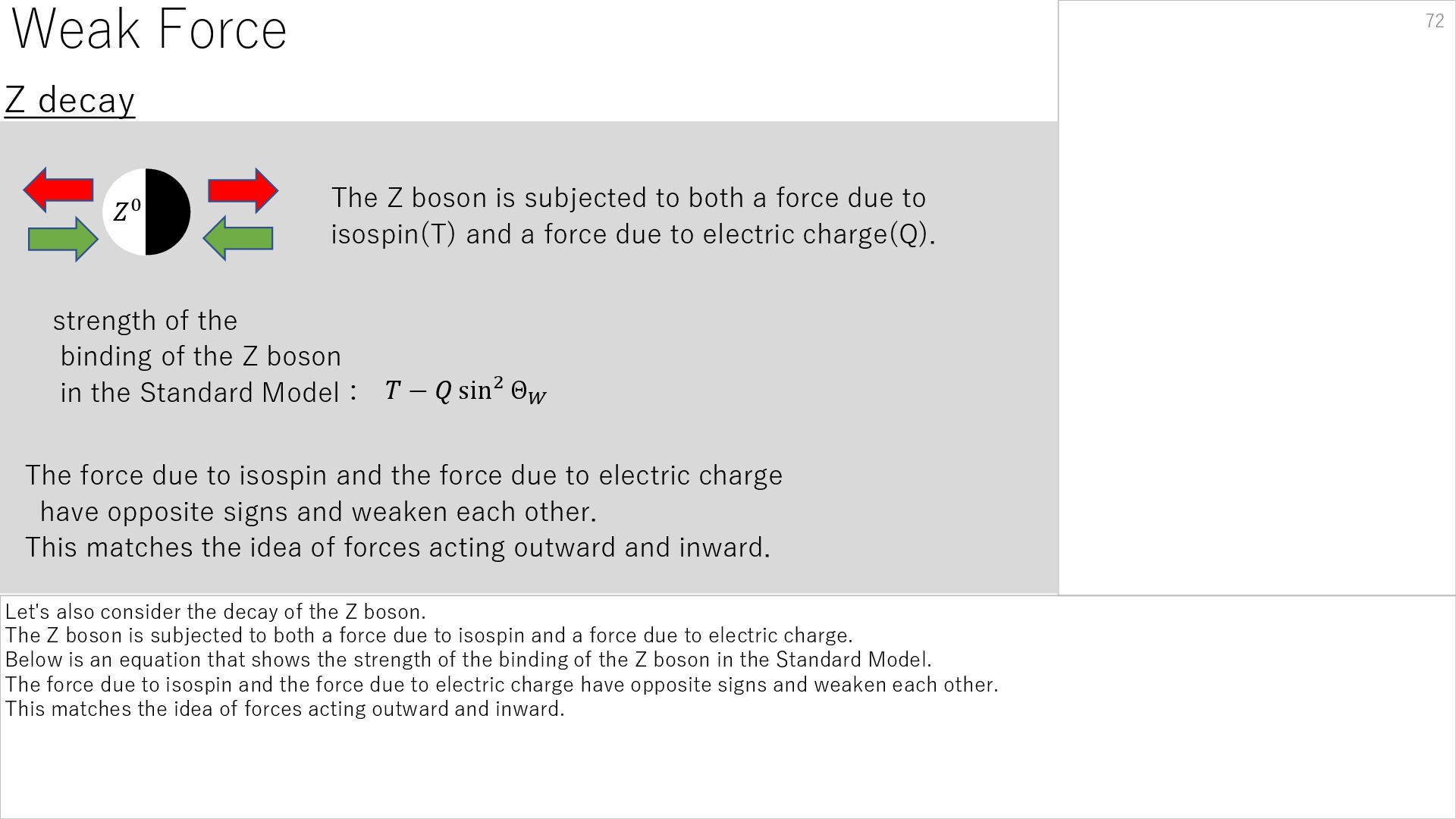
  71. Weak Force Let's also consider the decay of the Z

    boson. The Z boson is subjected to both a force due to isospin and a force due to electric charge. Below is an equation that shows the strength of the binding of the Z boson in the Standard Model. The force due to isospin and the force due to electric charge have opposite signs and weaken each other. This matches the idea of forces acting outward and inward. Z decay 𝑍0 The Z boson is subjected to both a force due to isospin(T) and a force due to electric charge(Q). strength of the binding of the Z boson in the Standard Model: 𝑇 − 𝑄 sin2 Θ𝑊 The force due to isospin and the force due to electric charge have opposite signs and weaken each other. This matches the idea of forces acting outward and inward. 72
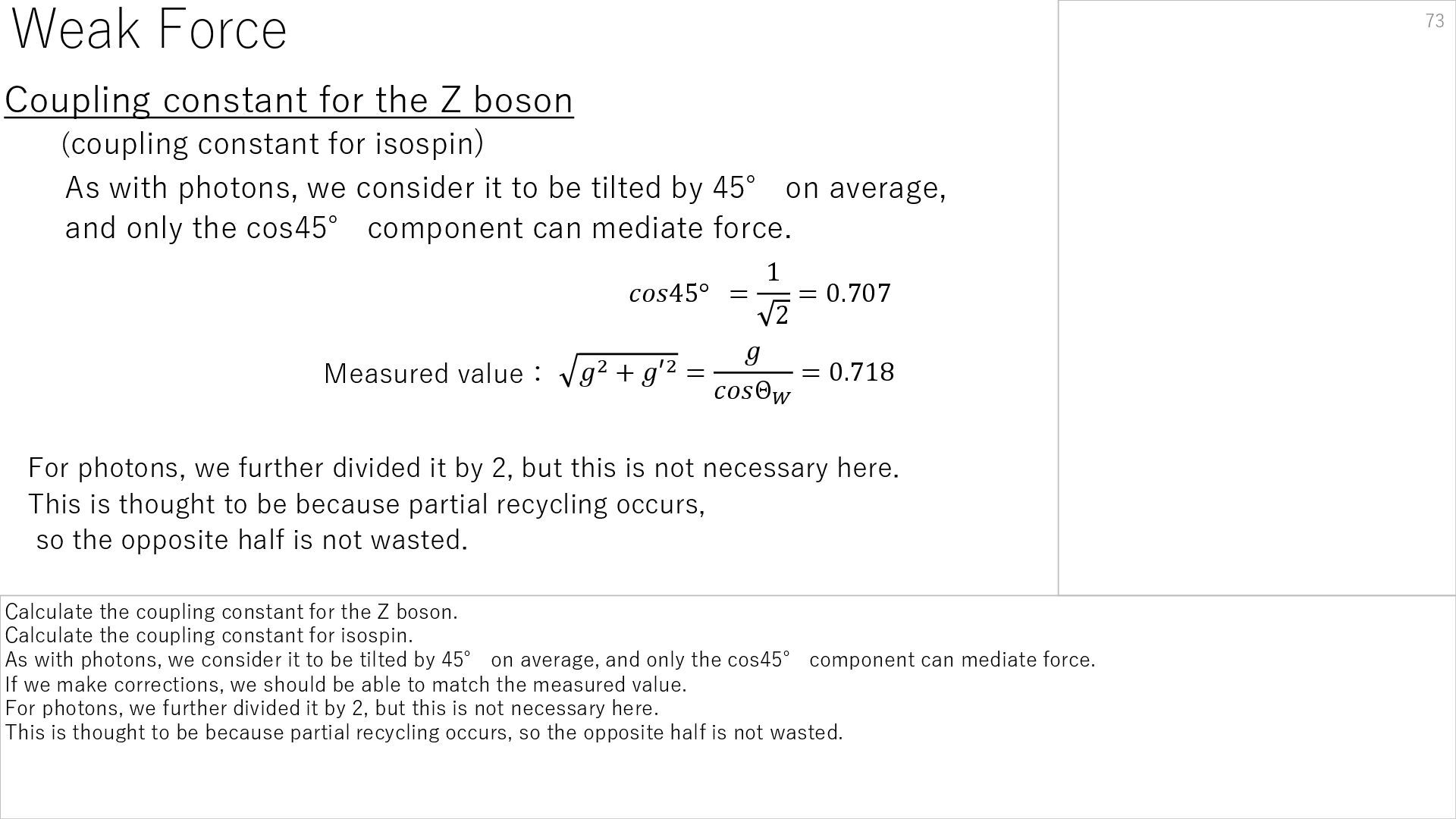
  72. Weak Force Calculate the coupling constant for the Z boson.

    Calculate the coupling constant for isospin. As with photons, we consider it to be tilted by 45° on average, and only the cos45° component can mediate force. If we make corrections, we should be able to match the measured value. For photons, we further divided it by 2, but this is not necessary here. This is thought to be because partial recycling occurs, so the opposite half is not wasted. Coupling constant for the Z boson 𝑐𝑜𝑠45° = 1 2 = 0.707 𝑔2 + 𝑔′2 = 𝑔 𝑐𝑜𝑠Θ𝑊 = 0.718 Measured value: (coupling constant for isospin) As with photons, we consider it to be tilted by 45° on average, and only the cos45° component can mediate force. For photons, we further divided it by 2, but this is not necessary here. This is thought to be because partial recycling occurs, so the opposite half is not wasted. 73
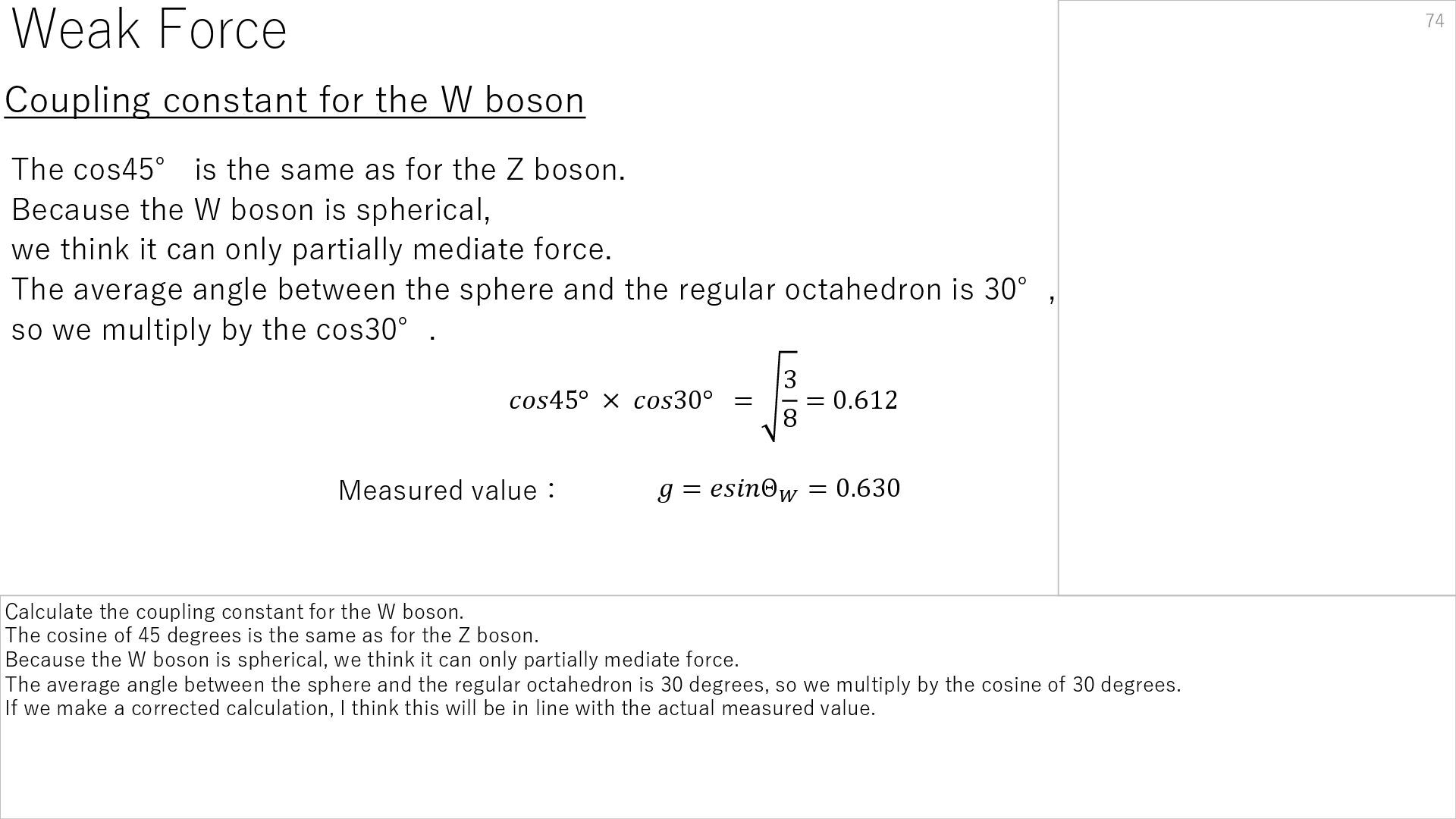
  73. Weak Force Calculate the coupling constant for the W boson.

    The cosine of 45 degrees is the same as for the Z boson. Because the W boson is spherical, we think it can only partially mediate force. The average angle between the sphere and the regular octahedron is 30 degrees, so we multiply by the cosine of 30 degrees. If we make a corrected calculation, I think this will be in line with the actual measured value. Coupling constant for the W boson 𝑐𝑜𝑠45° × 𝑐𝑜𝑠30° = 3 8 = 0.612 𝑔 = 𝑒𝑠𝑖𝑛Θ𝑊 = 0.630 Measured value: The cos45° is the same as for the Z boson. Because the W boson is spherical, we think it can only partially mediate force. The average angle between the sphere and the regular octahedron is 30°, so we multiply by the cos30°. 74
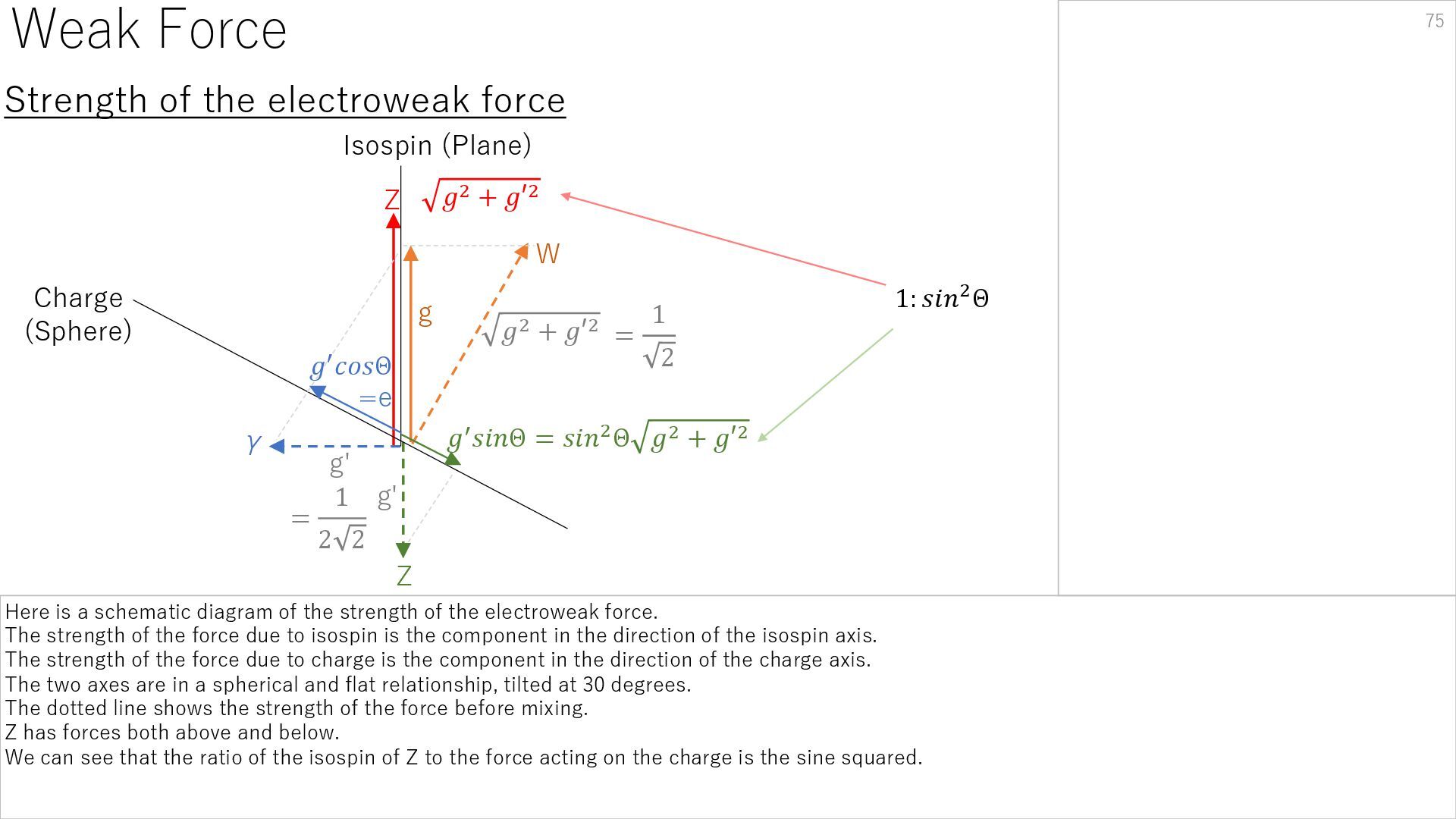
  74. Weak Force Here is a schematic diagram of the strength

    of the electroweak force. The strength of the force due to isospin is the component in the direction of the isospin axis. The strength of the force due to charge is the component in the direction of the charge axis. The two axes are in a spherical and flat relationship, tilted at 30 degrees. The dotted line shows the strength of the force before mixing. Z has forces both above and below. We can see that the ratio of the isospin of Z to the force acting on the charge is the sine squared. Strength of the electroweak force Z W Z γ g 𝑔2 + 𝑔′2 𝑔2 + 𝑔′2 g' g' 𝑔′𝑠𝑖𝑛Θ = 𝑠𝑖𝑛2Θ 𝑔2 + 𝑔′2 = 1 2 2 Isospin (Plane) = 1 2 𝑔′𝑐𝑜𝑠Θ =e Charge (Sphere) 1: 𝑠𝑖𝑛2Θ 75
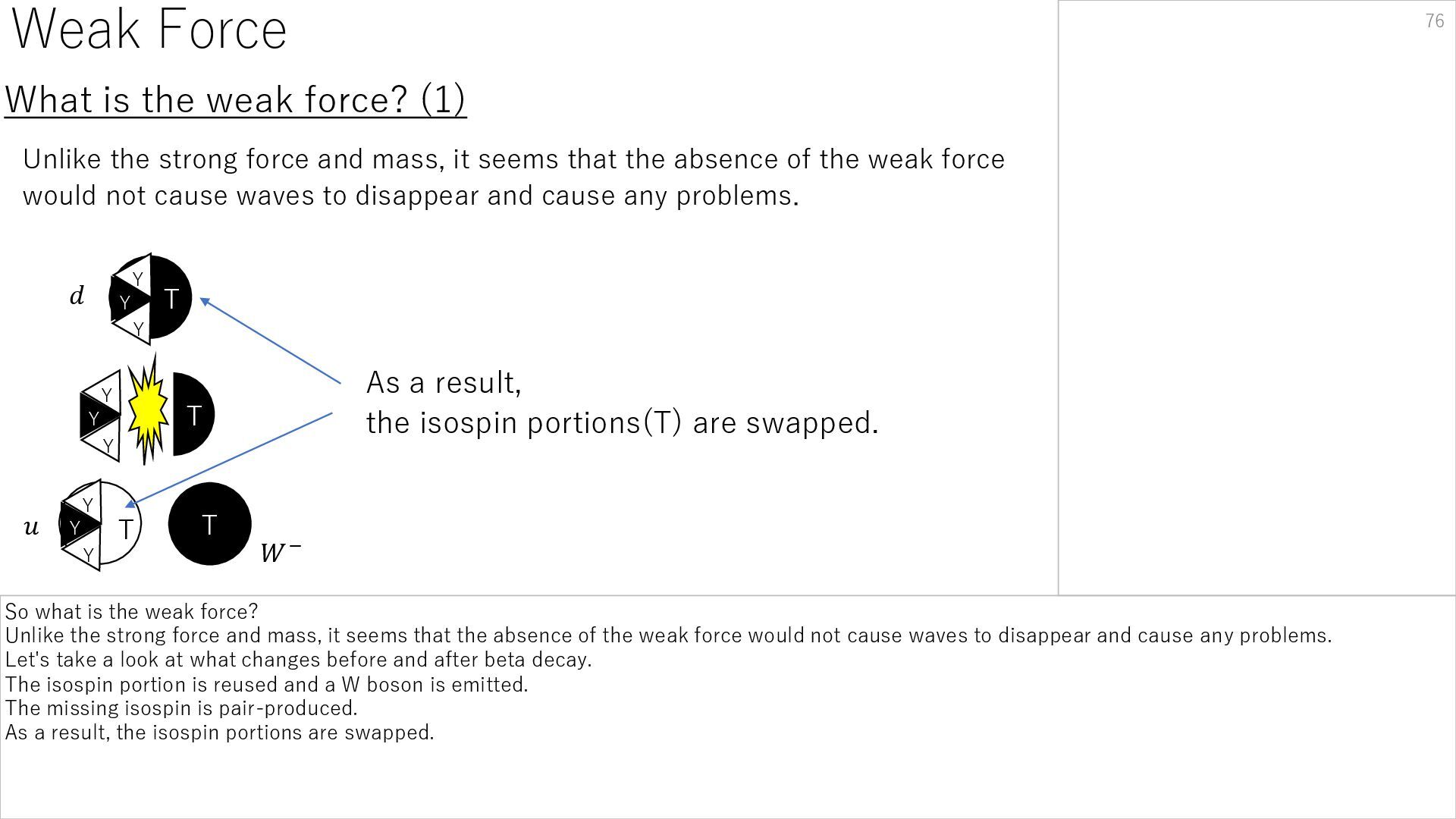
  75. Weak Force So what is the weak force? Unlike the

    strong force and mass, it seems that the absence of the weak force would not cause waves to disappear and cause any problems. Let's take a look at what changes before and after beta decay. The isospin portion is reused and a W boson is emitted. The missing isospin is pair-produced. As a result, the isospin portions are swapped. What is the weak force? (1) T Y Y T Y T Y Y Y 𝑊− 𝑑 𝑢 Y Y Y T Unlike the strong force and mass, it seems that the absence of the weak force would not cause waves to disappear and cause any problems. As a result, the isospin portions(T) are swapped. 76
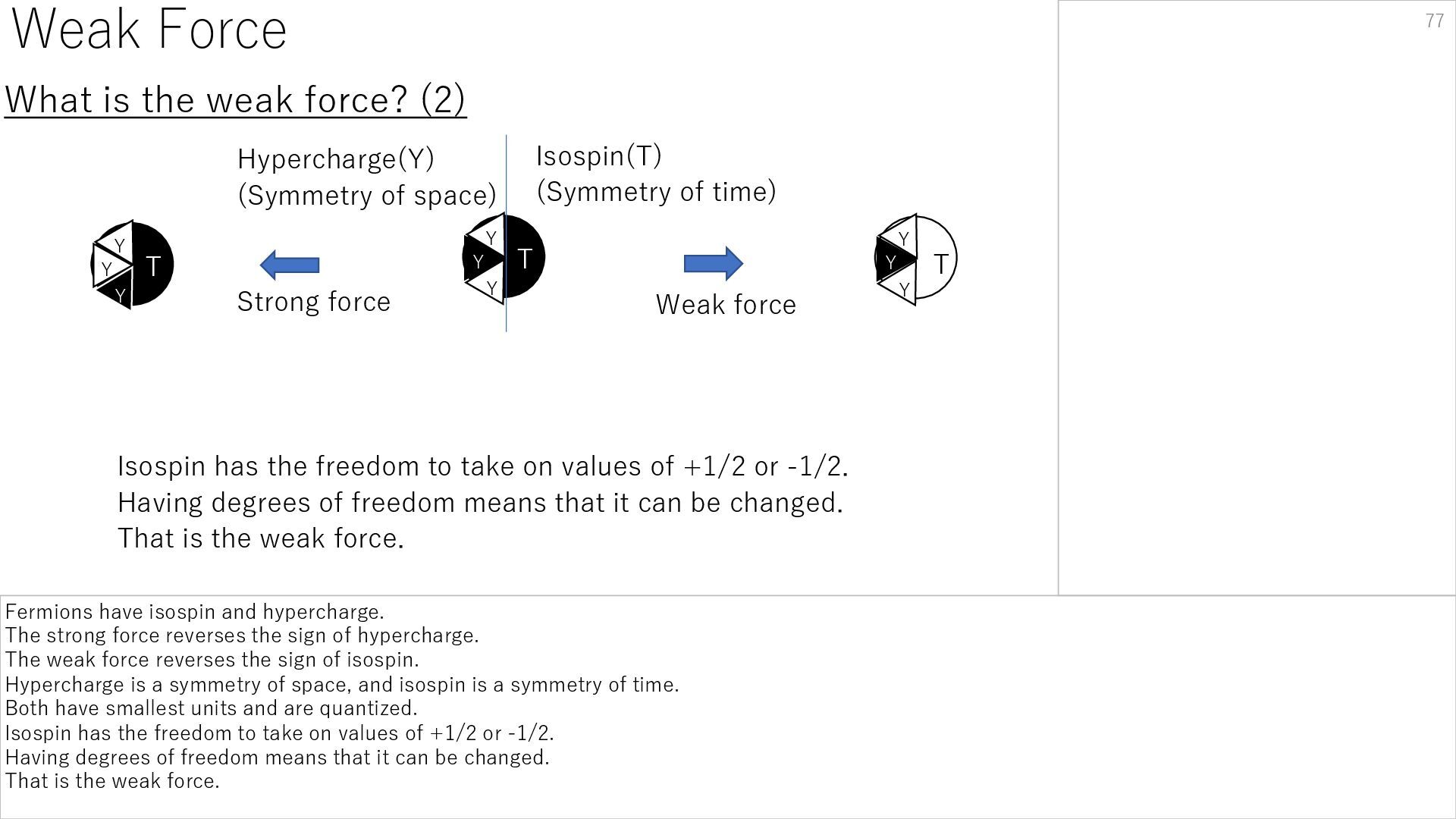
  76. Weak Force Fermions have isospin and hypercharge. The strong force

    reverses the sign of hypercharge. The weak force reverses the sign of isospin. Hypercharge is a symmetry of space, and isospin is a symmetry of time. Both have smallest units and are quantized. Isospin has the freedom to take on values of +1/2 or -1/2. Having degrees of freedom means that it can be changed. That is the weak force. What is the weak force? (2) T Y Y Y T Y Y Y T Y Y Y Isospin has the freedom to take on values of +1/2 or -1/2. Having degrees of freedom means that it can be changed. That is the weak force. Isospin(T) (Symmetry of time) Hypercharge(Y) (Symmetry of space) Strong force Weak force 77
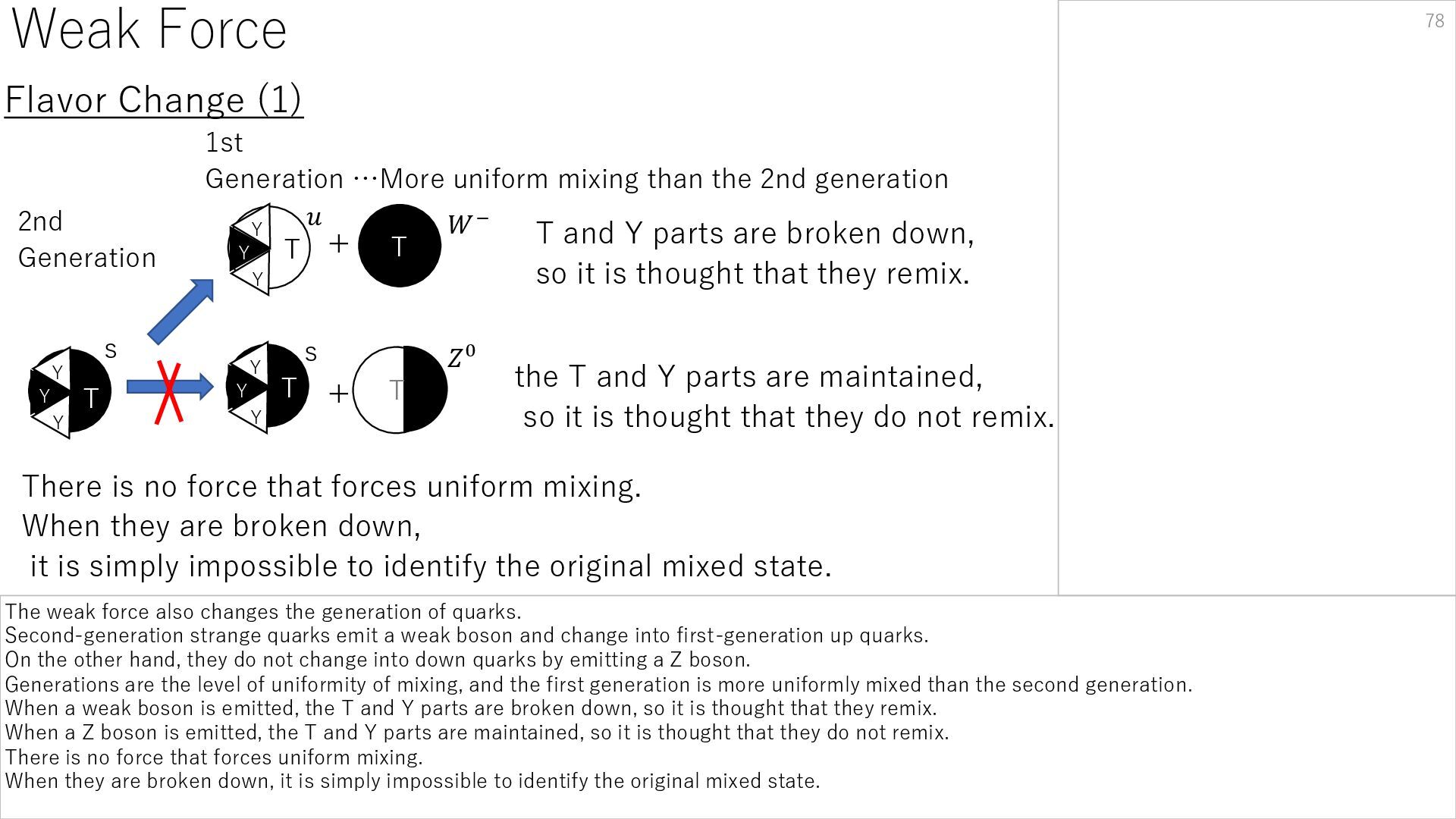
  77. Weak Force The weak force also changes the generation of

    quarks. Second-generation strange quarks emit a weak boson and change into first-generation up quarks. On the other hand, they do not change into down quarks by emitting a Z boson. Generations are the level of uniformity of mixing, and the first generation is more uniformly mixed than the second generation. When a weak boson is emitted, the T and Y parts are broken down, so it is thought that they remix. When a Z boson is emitted, the T and Y parts are maintained, so it is thought that they do not remix. There is no force that forces uniform mixing. When they are broken down, it is simply impossible to identify the original mixed state. Flavor Change (1) 78 T Y Y Y s T Y Y Y 𝑢 T Y Y Y s T 𝑊− 𝑍0 T + + 2nd Generation T and Y parts are broken down, so it is thought that they remix. the T and Y parts are maintained, so it is thought that they do not remix. There is no force that forces uniform mixing. When they are broken down, it is simply impossible to identify the original mixed state. 1st Generation …More uniform mixing than the 2nd generation
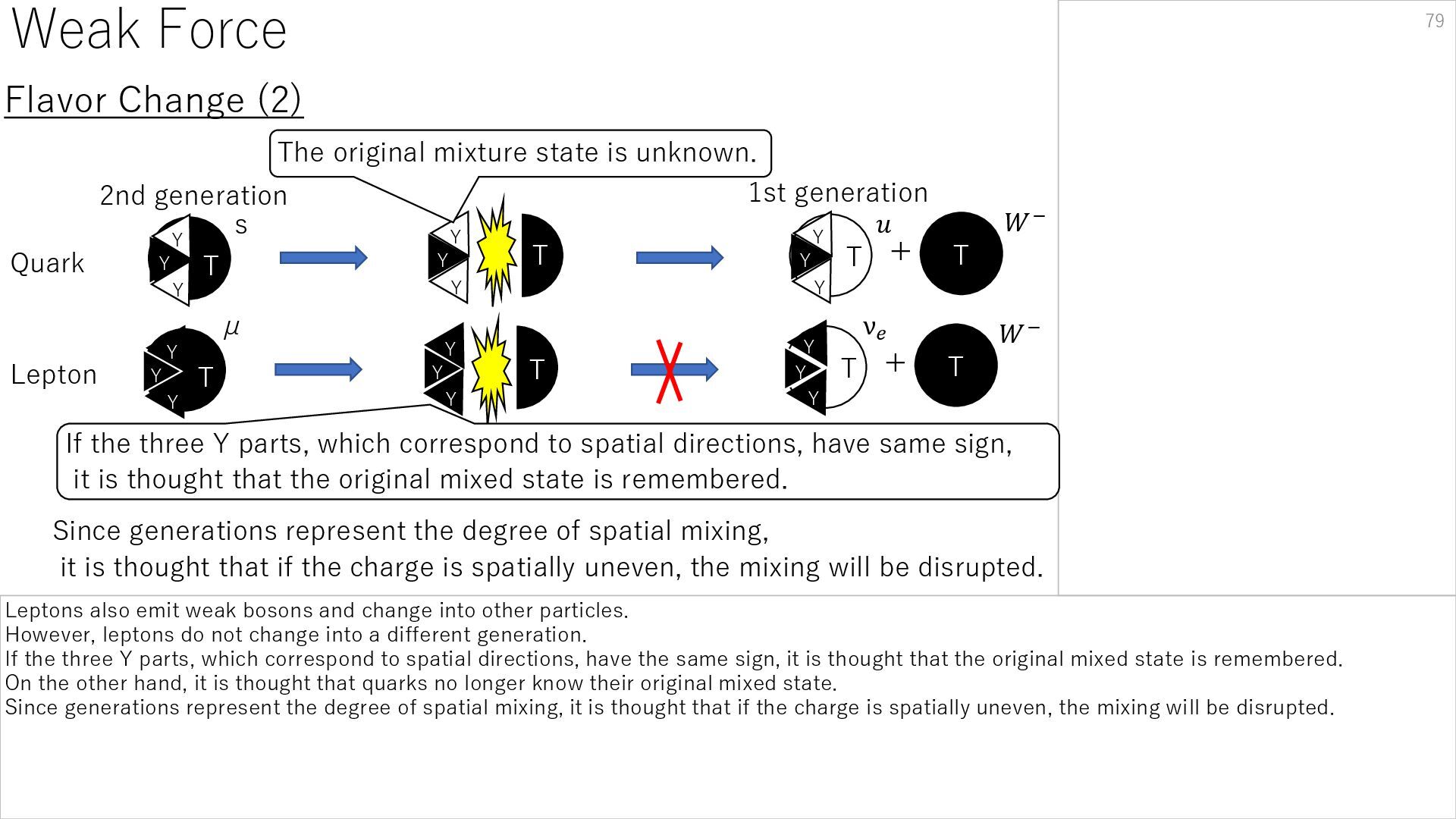
  78. Weak Force Leptons also emit weak bosons and change into

    other particles. However, leptons do not change into a different generation. If the three Y parts, which correspond to spatial directions, have the same sign, it is thought that the original mixed state is remembered. On the other hand, it is thought that quarks no longer know their original mixed state. Since generations represent the degree of spatial mixing, it is thought that if the charge is spatially uneven, the mixing will be disrupted. Flavor Change (2) 79 T Y Y Y 𝑢 T Y Y Y s T 𝑊− + 2nd generation 1st generation Since generations represent the degree of spatial mixing, it is thought that if the charge is spatially uneven, the mixing will be disrupted. Y Y Y T Quark T ν𝑒 T Y Y Y μ T 𝑊− + Y Y Y T Lepton T T The original mixture state is unknown. If the three Y parts, which correspond to spatial directions, have same sign, it is thought that the original mixed state is remembered. Y Y Y
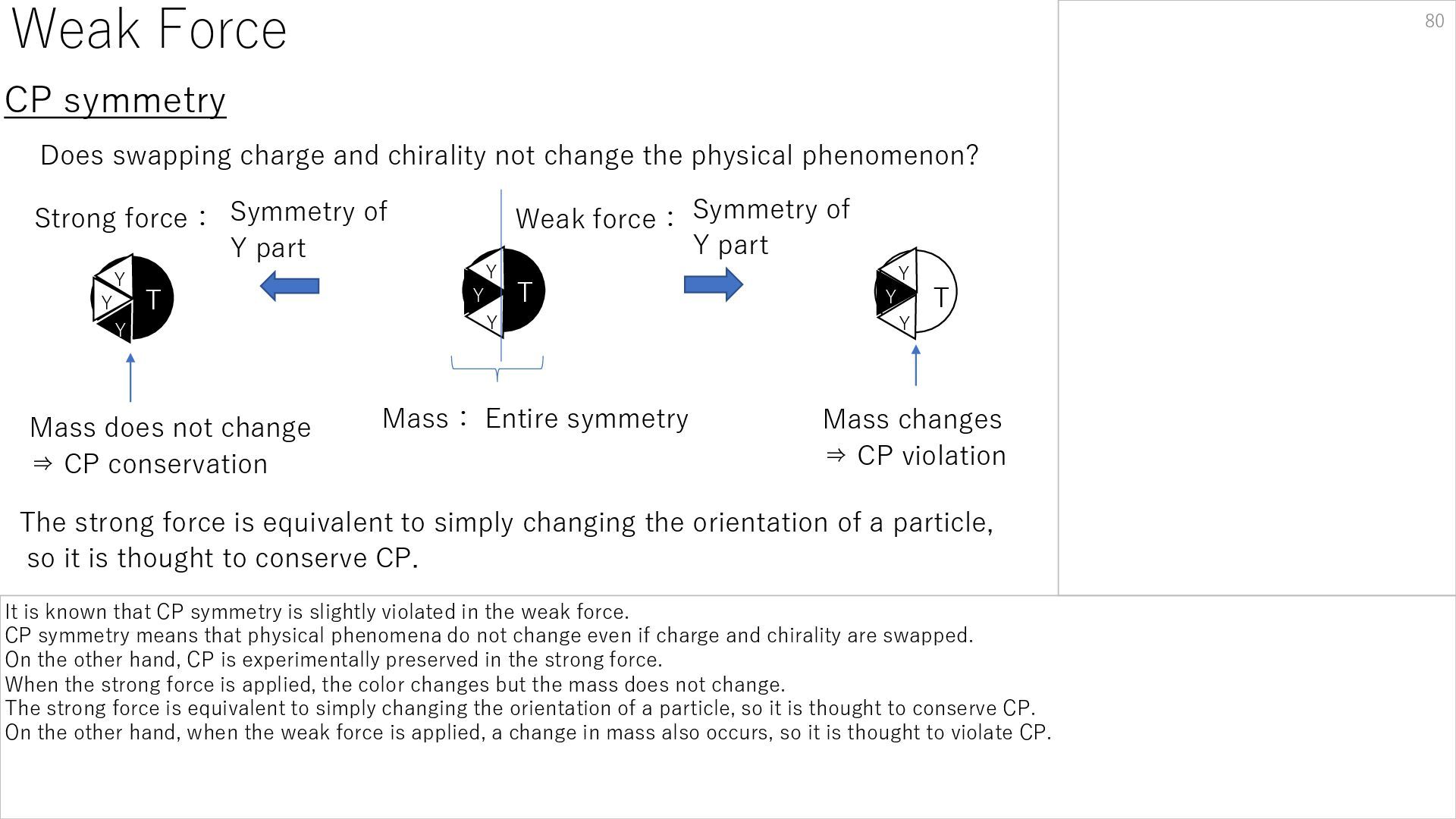
  79. Weak Force It is known that CP symmetry is slightly

    violated in the weak force. CP symmetry means that physical phenomena do not change even if charge and chirality are swapped. On the other hand, CP is experimentally preserved in the strong force. When the strong force is applied, the color changes but the mass does not change. The strong force is equivalent to simply changing the orientation of a particle, so it is thought to conserve CP. On the other hand, when the weak force is applied, a change in mass also occurs, so it is thought to violate CP. CP symmetry Mass does not change ⇒ CP conservation 80 T Y Y Y T Y Y Y T Y Y Y Symmetry of Y part Strong force: Weak force: Mass: Entire symmetry Mass changes ⇒ CP violation The strong force is equivalent to simply changing the orientation of a particle, so it is thought to conserve CP. Does swapping charge and chirality not change the physical phenomenon? Symmetry of Y part
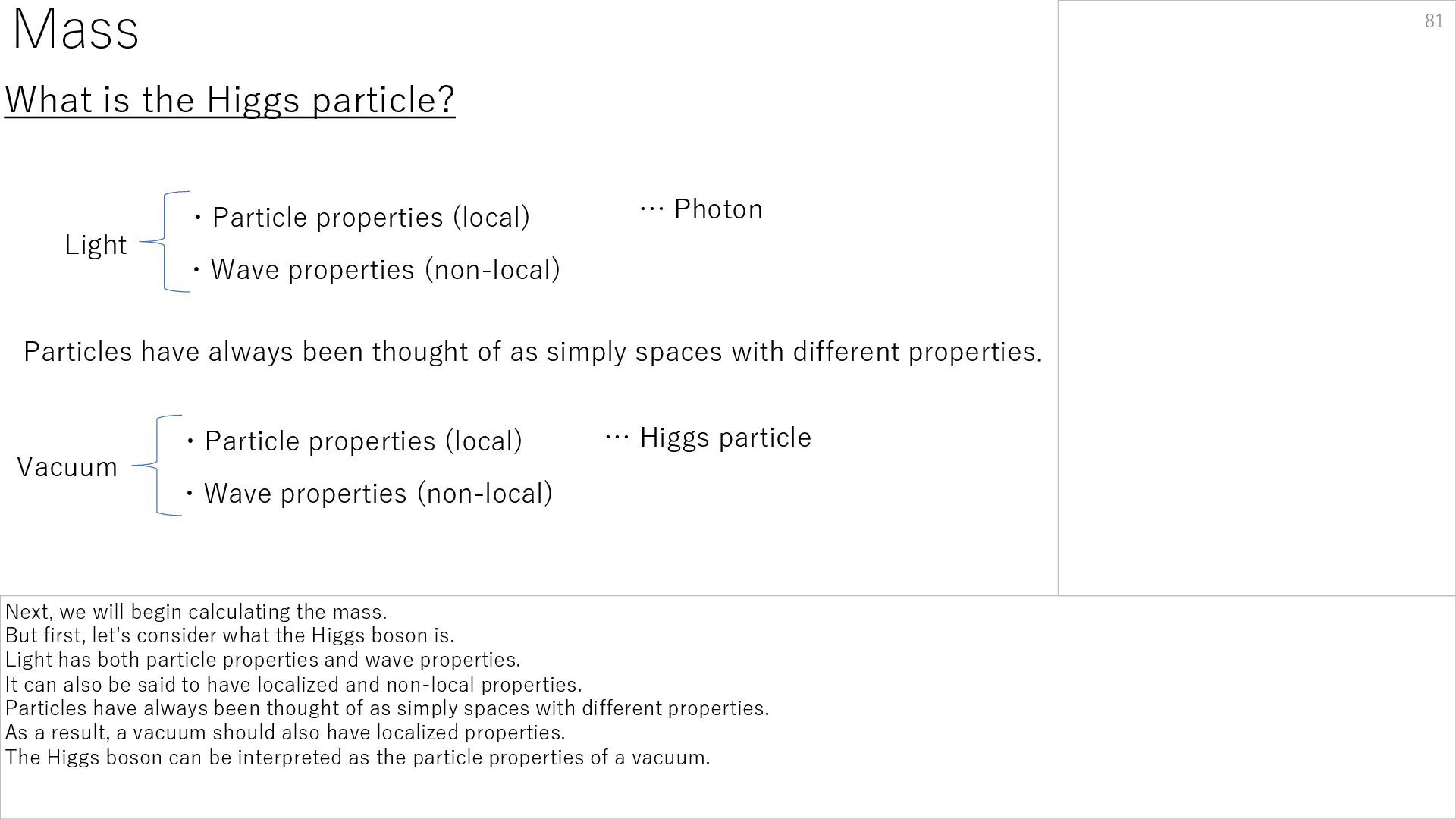
  80. Mass Next, we will begin calculating the mass. But first,

    let's consider what the Higgs boson is. Light has both particle properties and wave properties. It can also be said to have localized and non-local properties. Particles have always been thought of as simply spaces with different properties. As a result, a vacuum should also have localized properties. The Higgs boson can be interpreted as the particle properties of a vacuum. What is the Higgs particle? Light ・Particle properties (local) ・Wave properties (non-local) … Photon Vacuum ・Particle properties (local) ・Wave properties (non-local) … Higgs particle Particles have always been thought of as simply spaces with different properties. 81
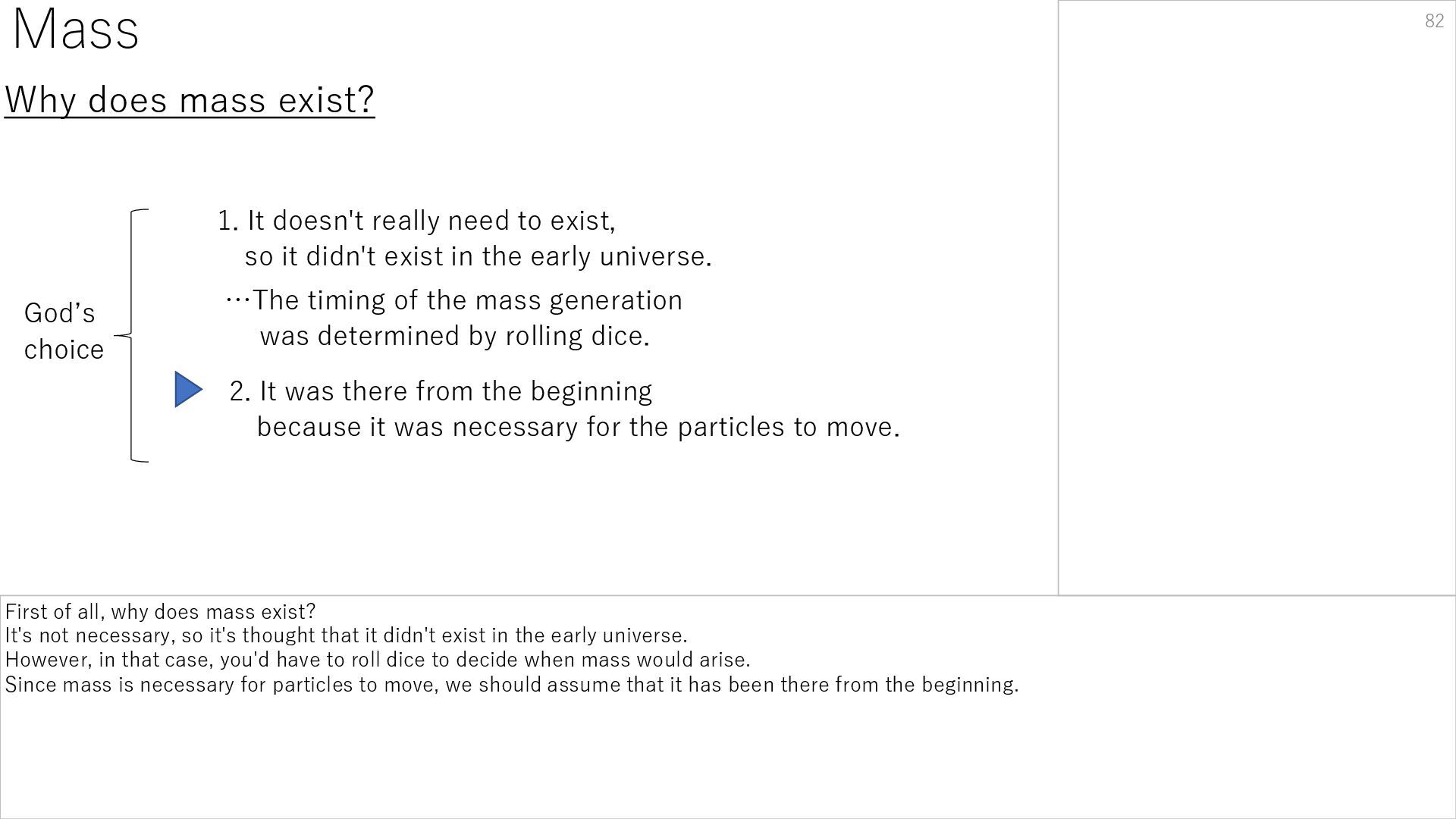
  81. Mass First of all, why does mass exist? It's not

    necessary, so it's thought that it didn't exist in the early universe. However, in that case, you'd have to roll dice to decide when mass would arise. Since mass is necessary for particles to move, we should assume that it has been there from the beginning. Why does mass exist? God’s choice 1. It doesn't really need to exist, so it didn't exist in the early universe. 2. It was there from the beginning because it was necessary for the particles to move. …The timing of the mass generation was determined by rolling dice. 82
  82. Mass Mass can be interpreted as the degree of collision

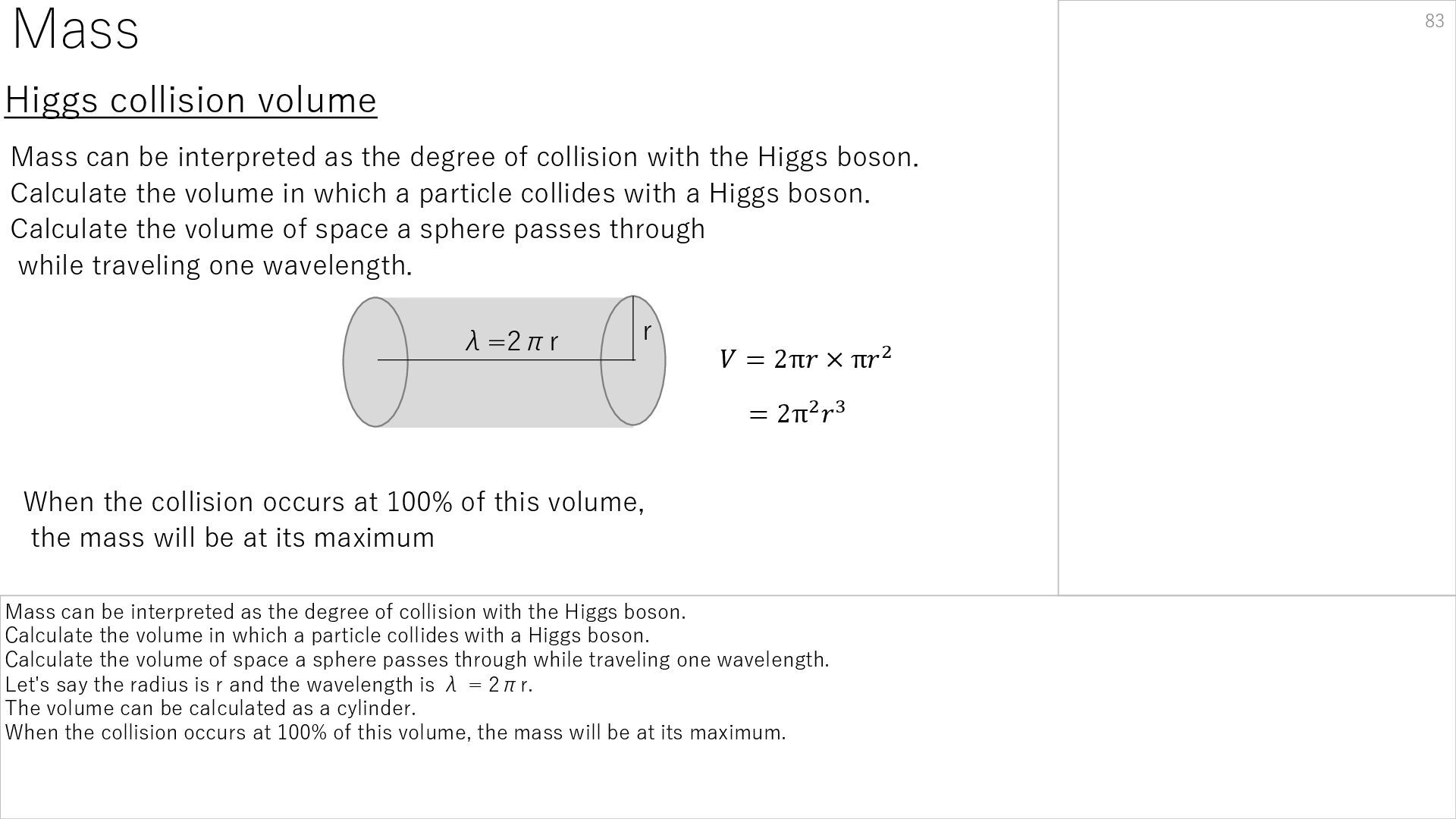
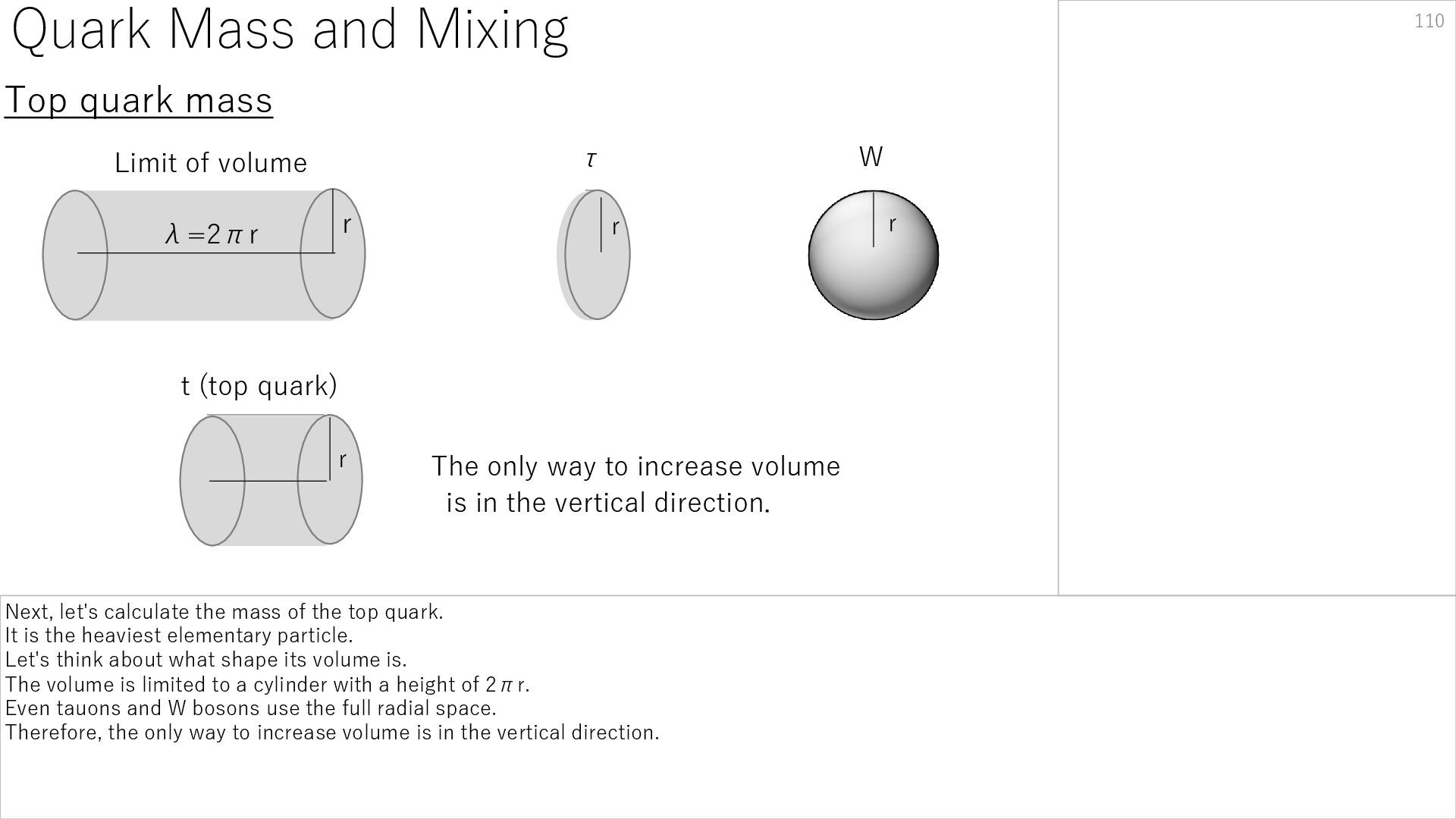
    with the Higgs boson. Calculate the volume in which a particle collides with a Higgs boson. Calculate the volume of space a sphere passes through while traveling one wavelength. Let's say the radius is r and the wavelength is λ = 2πr. The volume can be calculated as a cylinder. When the collision occurs at 100% of this volume, the mass will be at its maximum. Higgs collision volume λ=2πr r Mass can be interpreted as the degree of collision with the Higgs boson. Calculate the volume in which a particle collides with a Higgs boson. Calculate the volume of space a sphere passes through while traveling one wavelength. 𝑉 = 2π𝑟 × π𝑟2 When the collision occurs at 100% of this volume, the mass will be at its maximum = 2π2𝑟3 83
  83. Mass We calculate the volume where the Higgs boson itself

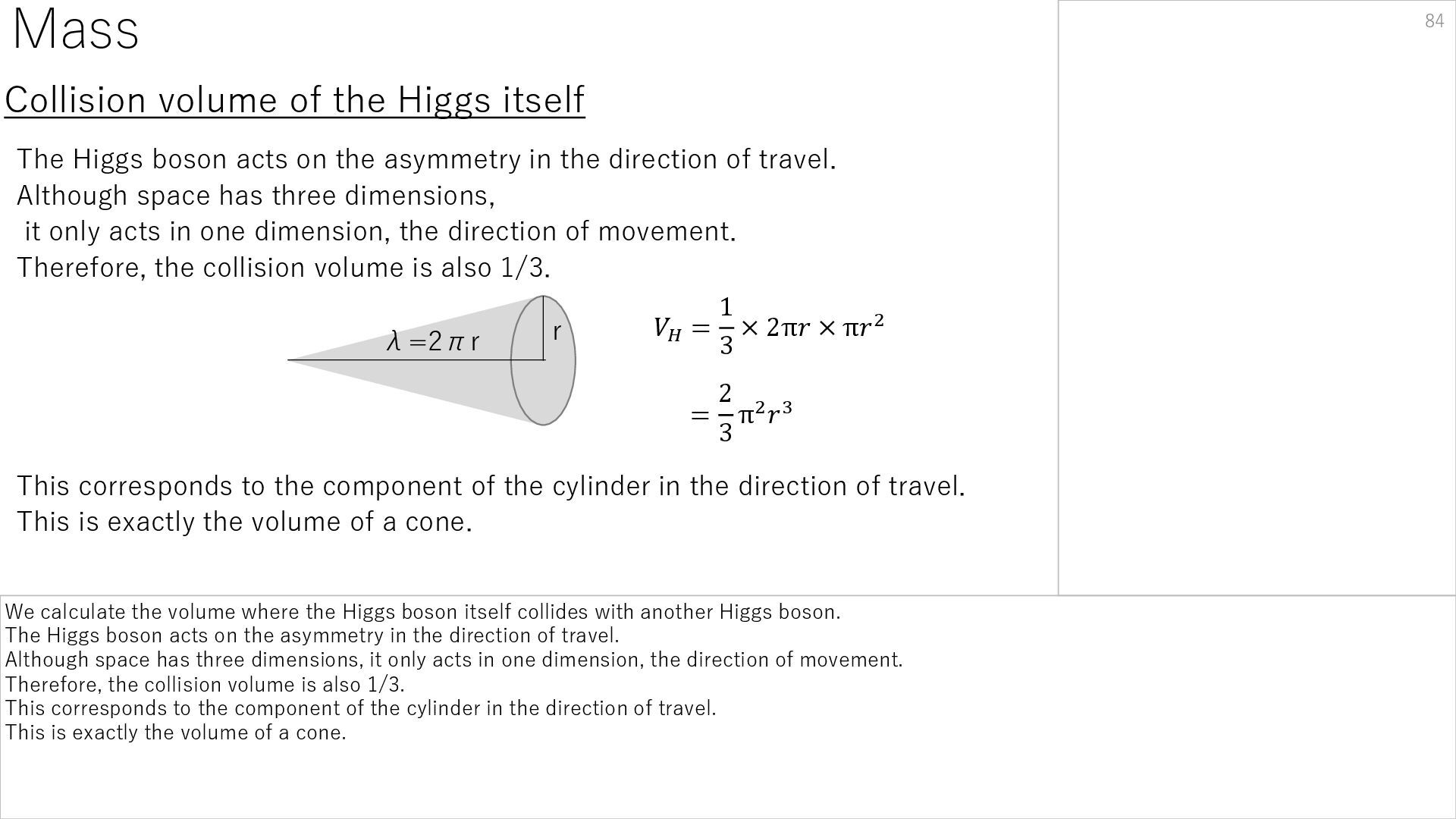
    collides with another Higgs boson. The Higgs boson acts on the asymmetry in the direction of travel. Although space has three dimensions, it only acts in one dimension, the direction of movement. Therefore, the collision volume is also 1/3. This corresponds to the component of the cylinder in the direction of travel. This is exactly the volume of a cone. Collision volume of the Higgs itself λ=2πr r 𝑉𝐻 = 1 3 × 2π𝑟 × π𝑟2 = 2 3 π2𝑟3 The Higgs boson acts on the asymmetry in the direction of travel. Although space has three dimensions, it only acts in one dimension, the direction of movement. Therefore, the collision volume is also 1/3. This corresponds to the component of the cylinder in the direction of travel. This is exactly the volume of a cone. 84
  84. Mass Let's calculate the mass of the W boson. We

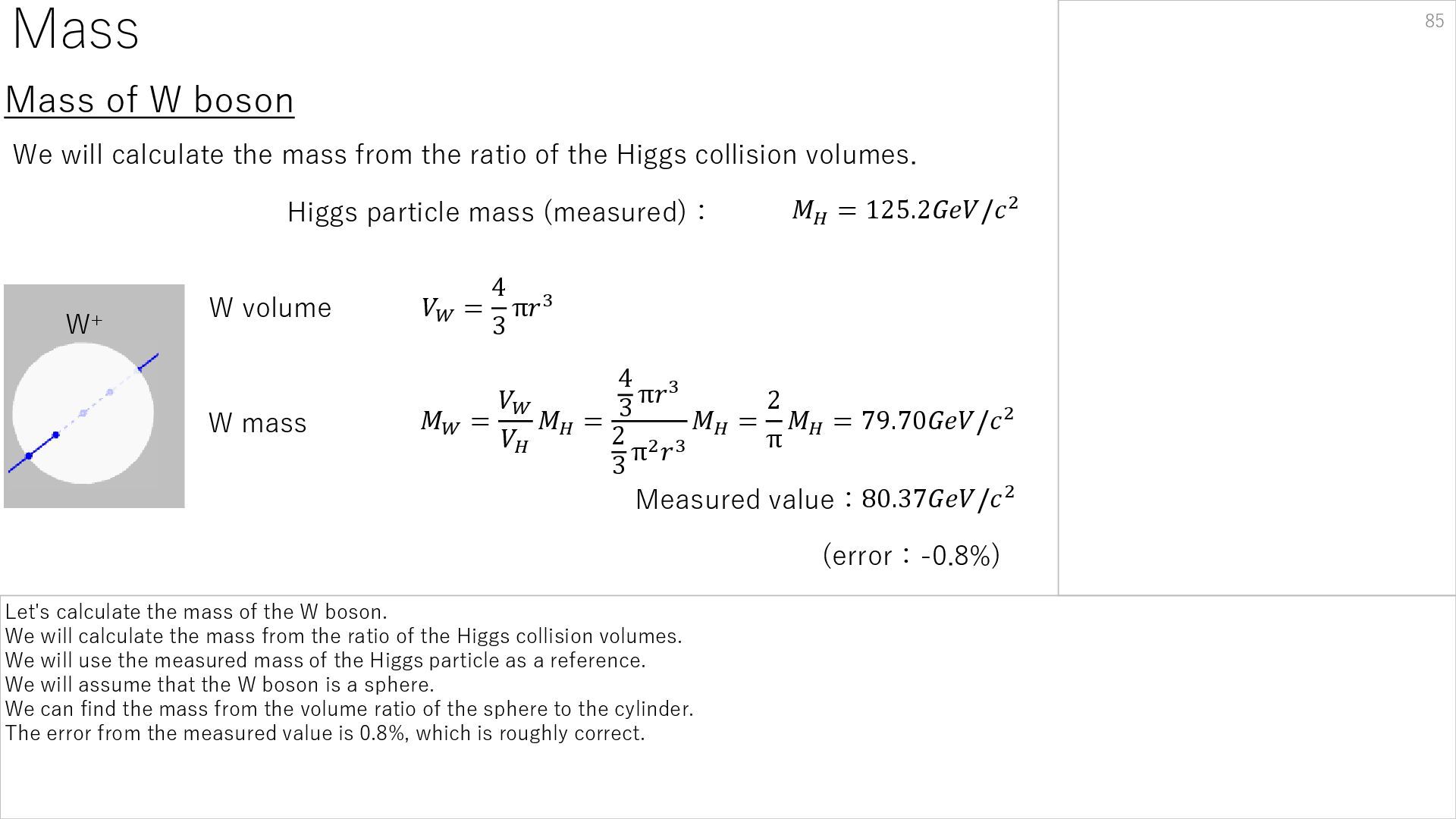
    will calculate the mass from the ratio of the Higgs collision volumes. We will use the measured mass of the Higgs particle as a reference. We will assume that the W boson is a sphere. We can find the mass from the volume ratio of the sphere to the cylinder. The error from the measured value is 0.8%, which is roughly correct. Mass of W boson W+ 𝑉𝑊 = 4 3 π𝑟3 𝑀𝑊 = 𝑉𝑊 𝑉𝐻 𝑀𝐻 = 4 3 π𝑟3 2 3 π2𝑟3 𝑀𝐻 = 2 π 𝑀𝐻 = 79.70𝐺𝑒𝑉/𝑐2 𝑀𝐻 = 125.2𝐺𝑒𝑉/𝑐2 80.37𝐺𝑒𝑉/𝑐2 Higgs particle mass (measured): W mass W volume We will calculate the mass from the ratio of the Higgs collision volumes. Measured value: (error:-0.8%) 85
  85. Mass Let's also calculate the mass of the Z boson.

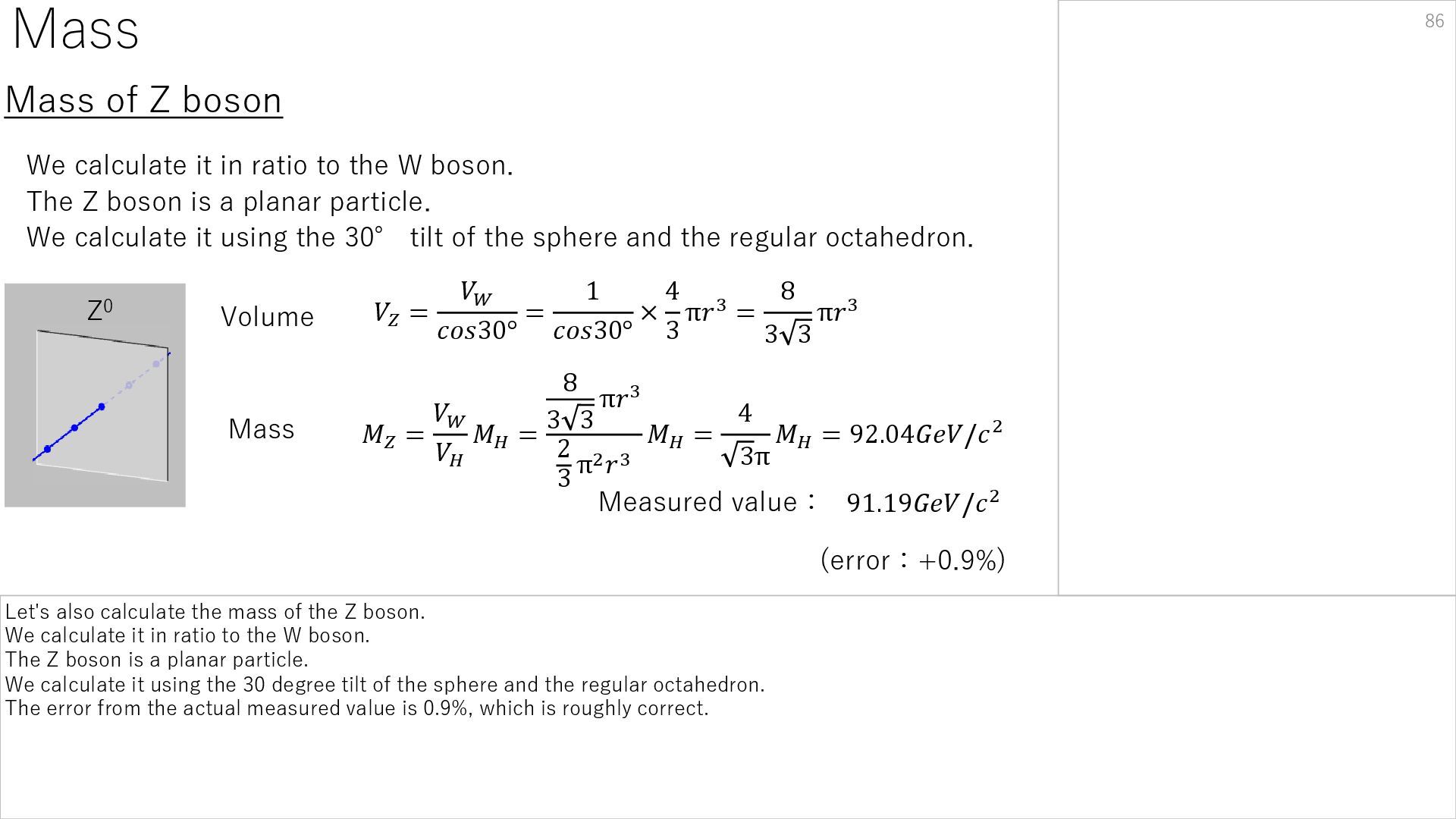
    We calculate it in ratio to the W boson. The Z boson is a planar particle. We calculate it using the 30 degree tilt of the sphere and the regular octahedron. The error from the actual measured value is 0.9%, which is roughly correct. Mass of Z boson Z0 𝑉𝑍 = 𝑉𝑊 𝑐𝑜𝑠30° = 1 𝑐𝑜𝑠30° × 4 3 π𝑟3 = 8 3 3 π𝑟3 𝑀𝑍 = 𝑉𝑊 𝑉𝐻 𝑀𝐻 = 8 3 3 π𝑟3 2 3 π2𝑟3 𝑀𝐻 = 4 3π 𝑀𝐻 = 92.04𝐺𝑒𝑉/𝑐2 91.19𝐺𝑒𝑉/𝑐2 Measured value: (error:+0.9%) Volume Mass We calculate it in ratio to the W boson. The Z boson is a planar particle. We calculate it using the 30° tilt of the sphere and the regular octahedron. 86
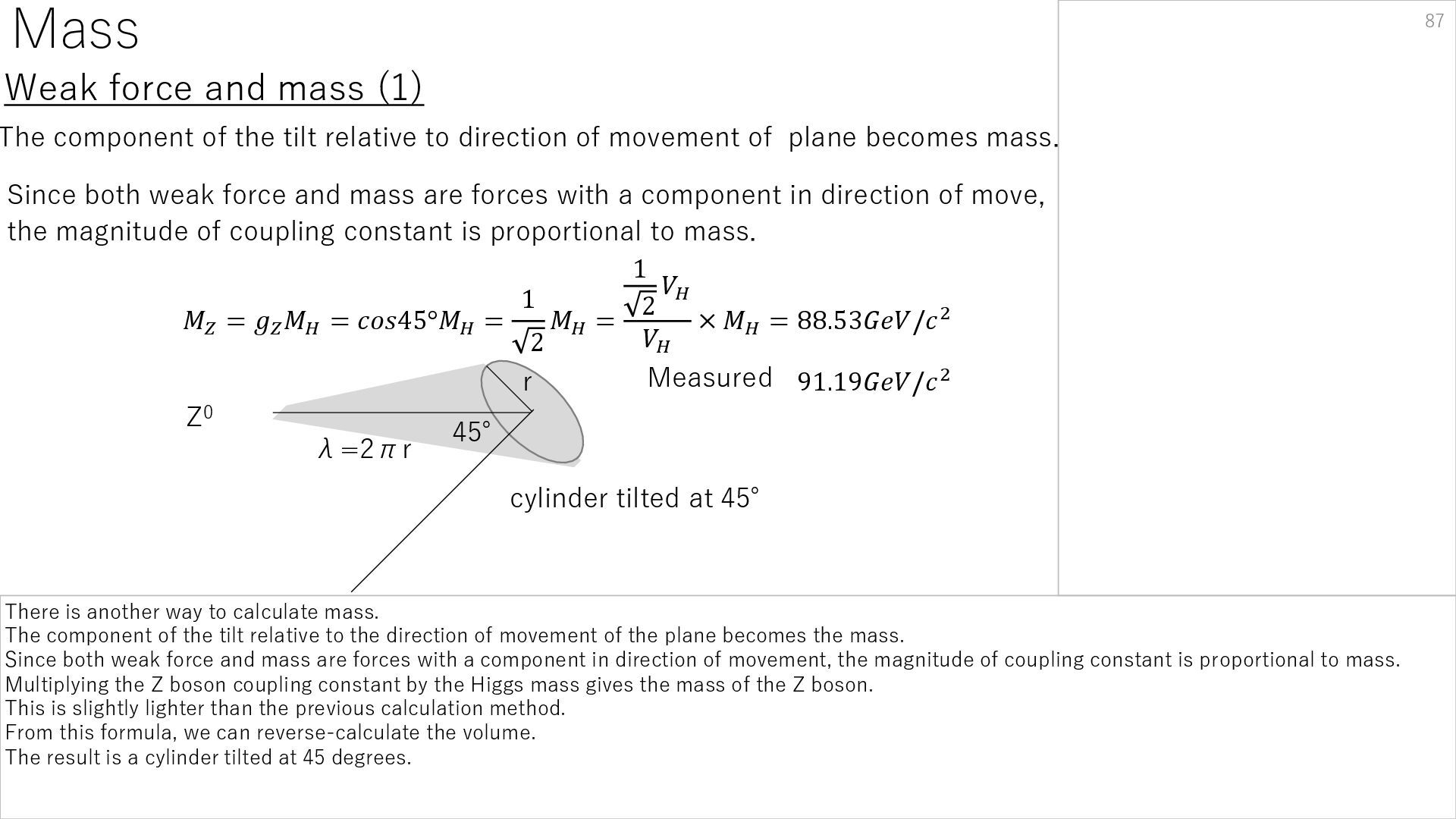
  86. Mass There is another way to calculate mass. The component

    of the tilt relative to the direction of movement of the plane becomes the mass. Since both weak force and mass are forces with a component in direction of movement, the magnitude of coupling constant is proportional to mass. Multiplying the Z boson coupling constant by the Higgs mass gives the mass of the Z boson. This is slightly lighter than the previous calculation method. From this formula, we can reverse-calculate the volume. The result is a cylinder tilted at 45 degrees. Weak force and mass (1) 91.19𝐺𝑒𝑉/𝑐2 Measured 87 λ=2πr r 45° cylinder tilted at 45° The component of the tilt relative to direction of movement of plane becomes mass. 𝑀𝑍 = 𝑔𝑍 𝑀𝐻 = 𝑐𝑜𝑠45°𝑀𝐻 = 1 2 𝑀𝐻 = 1 2 𝑉𝐻 𝑉𝐻 × 𝑀𝐻 = 88.53𝐺𝑒𝑉/𝑐2 Since both weak force and mass are forces with a component in direction of move, the magnitude of coupling constant is proportional to mass. Z0
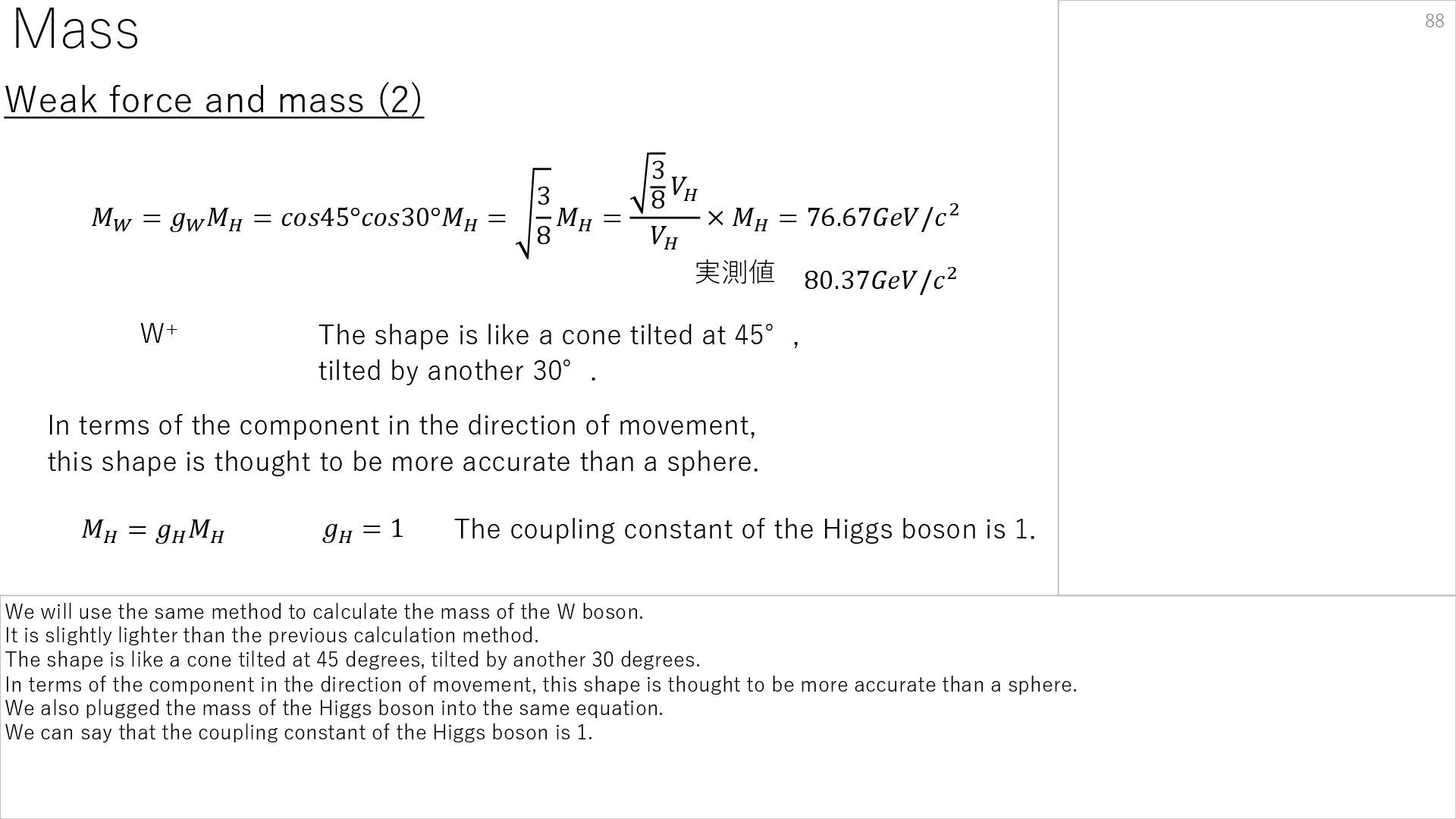
  87. Mass We will use the same method to calculate the

    mass of the W boson. It is slightly lighter than the previous calculation method. The shape is like a cone tilted at 45 degrees, tilted by another 30 degrees. In terms of the component in the direction of movement, this shape is thought to be more accurate than a sphere. We also plugged the mass of the Higgs boson into the same equation. We can say that the coupling constant of the Higgs boson is 1. Weak force and mass (2) 80.37𝐺𝑒𝑉/𝑐2 実測値 88 𝑀𝑊 = 𝑔𝑊 𝑀𝐻 = 𝑐𝑜𝑠45°𝑐𝑜𝑠30°𝑀𝐻 = 3 8 𝑀𝐻 = 3 8 𝑉𝐻 𝑉𝐻 × 𝑀𝐻 = 76.67𝐺𝑒𝑉/𝑐2 𝑀𝐻 = 𝑔𝐻 𝑀𝐻 𝑔𝐻 = 1 W+ The shape is like a cone tilted at 45°, tilted by another 30°. The coupling constant of the Higgs boson is 1. In terms of the component in the direction of movement, this shape is thought to be more accurate than a sphere.
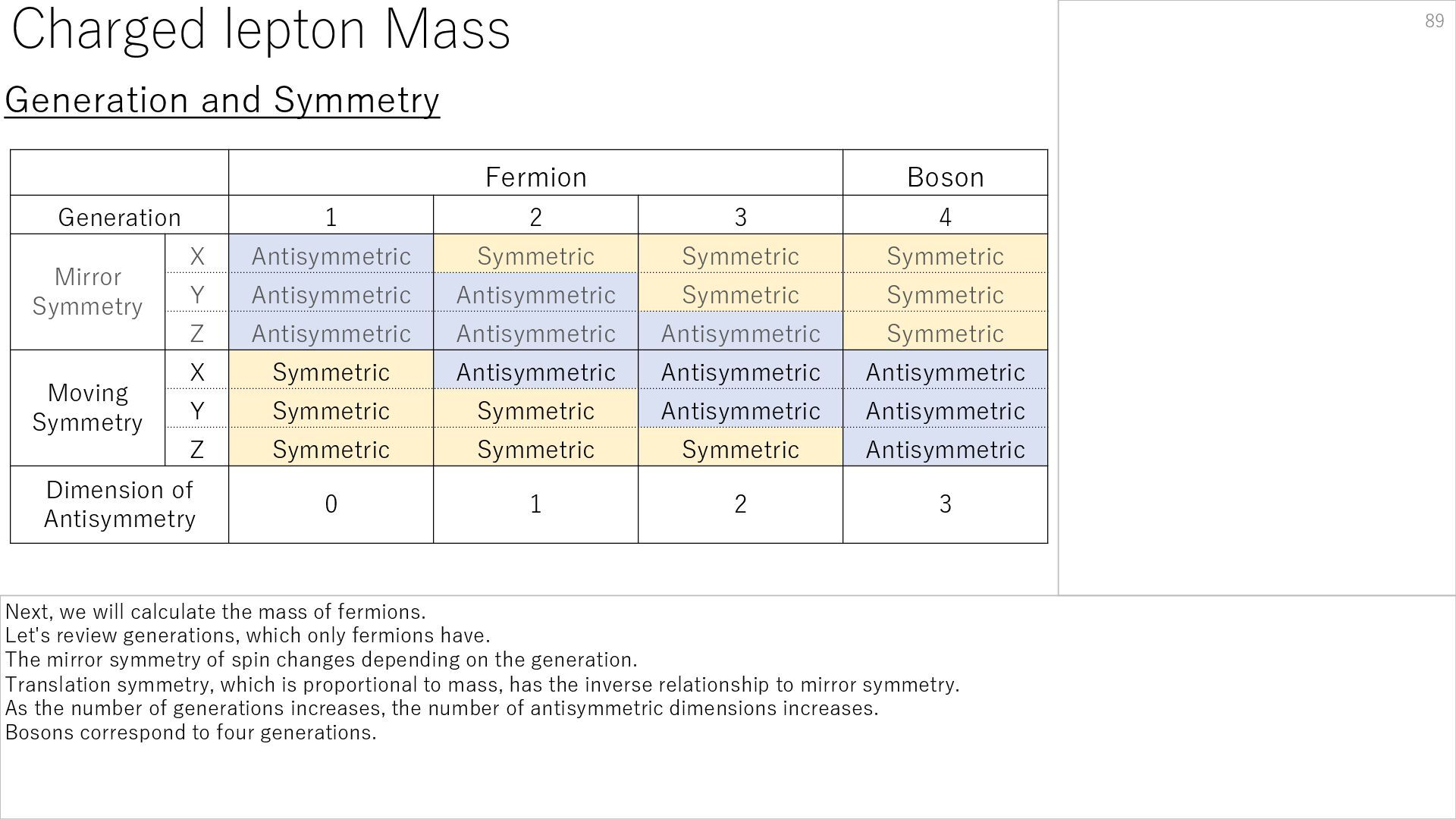
  88. Charged lepton Mass Next, we will calculate the mass of

    fermions. Let's review generations, which only fermions have. The mirror symmetry of spin changes depending on the generation. Translation symmetry, which is proportional to mass, has the inverse relationship to mirror symmetry. As the number of generations increases, the number of antisymmetric dimensions increases. Bosons correspond to four generations. Generation and Symmetry Fermion Boson Generation 1 2 3 4 Mirror Symmetry X Antisymmetric Symmetric Symmetric Symmetric Y Antisymmetric Antisymmetric Symmetric Symmetric Z Antisymmetric Antisymmetric Antisymmetric Symmetric Moving Symmetry X Symmetric Antisymmetric Antisymmetric Antisymmetric Y Symmetric Symmetric Antisymmetric Antisymmetric Z Symmetric Symmetric Symmetric Antisymmetric Dimension of Antisymmetry 0 1 2 3 89
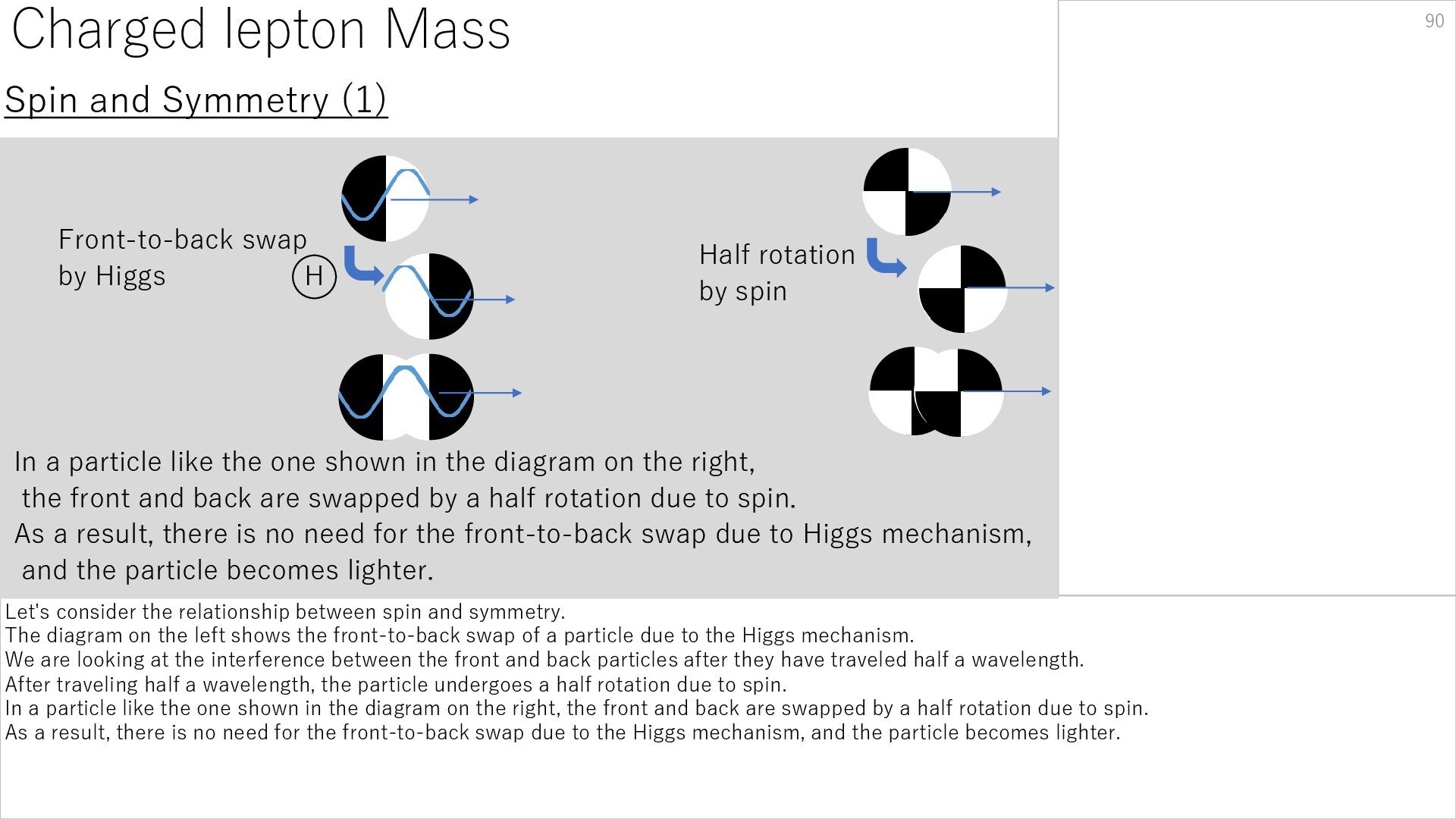
  89. Charged lepton Mass Let's consider the relationship between spin and

    symmetry. The diagram on the left shows the front-to-back swap of a particle due to the Higgs mechanism. We are looking at the interference between the front and back particles after they have traveled half a wavelength. After traveling half a wavelength, the particle undergoes a half rotation due to spin. In a particle like the one shown in the diagram on the right, the front and back are swapped by a half rotation due to spin. As a result, there is no need for the front-to-back swap due to the Higgs mechanism, and the particle becomes lighter. Spin and Symmetry (1) H 90 Front-to-back swap by Higgs Half rotation by spin In a particle like the one shown in the diagram on the right, the front and back are swapped by a half rotation due to spin. As a result, there is no need for the front-to-back swap due to Higgs mechanism, and the particle becomes lighter.
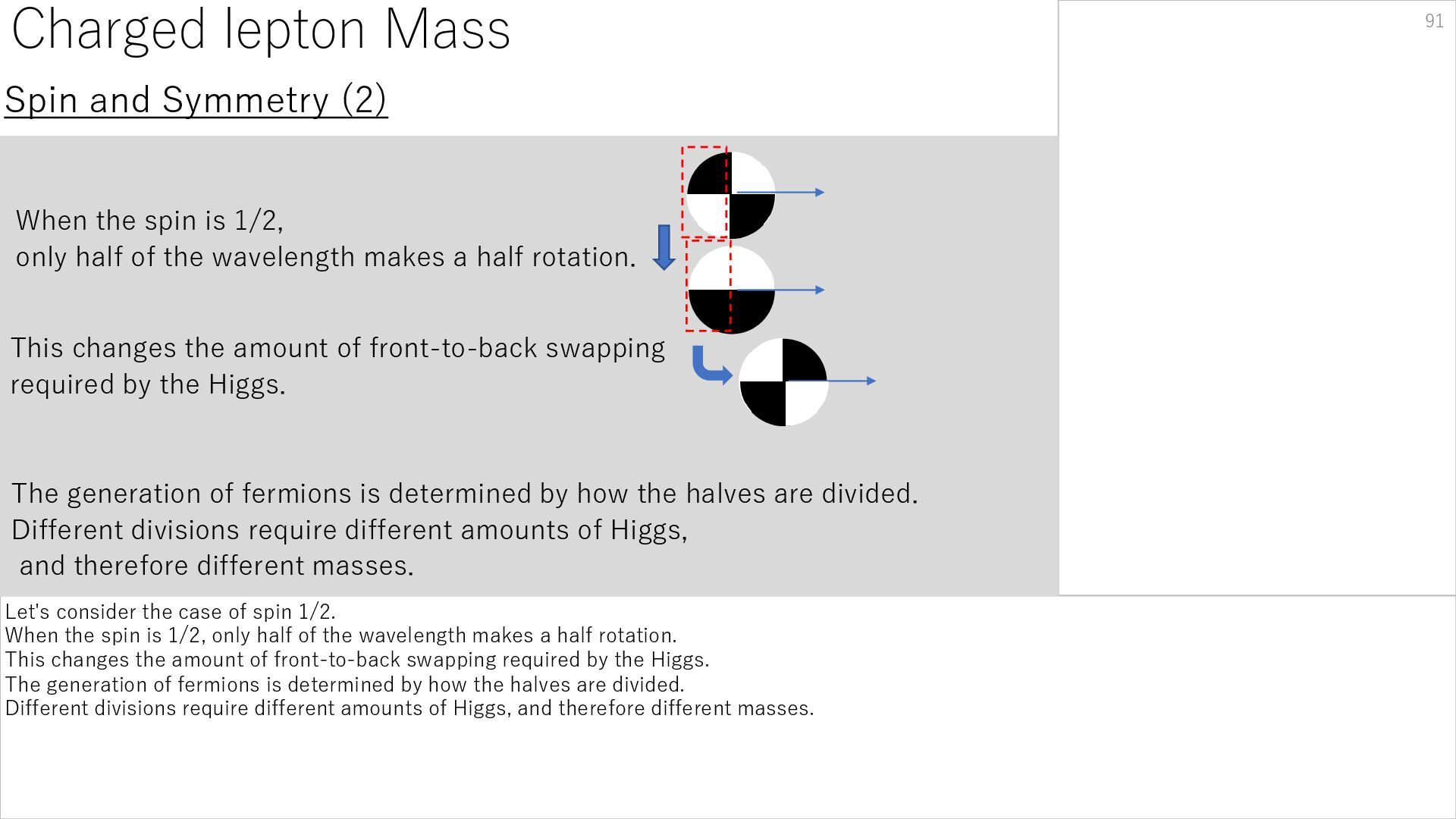
  90. Charged lepton Mass Let's consider the case of spin 1/2.

    When the spin is 1/2, only half of the wavelength makes a half rotation. This changes the amount of front-to-back swapping required by the Higgs. The generation of fermions is determined by how the halves are divided. Different divisions require different amounts of Higgs, and therefore different masses. Spin and Symmetry (2) 91 When the spin is 1/2, only half of the wavelength makes a half rotation. This changes the amount of front-to-back swapping required by the Higgs. The generation of fermions is determined by how the halves are divided. Different divisions require different amounts of Higgs, and therefore different masses.
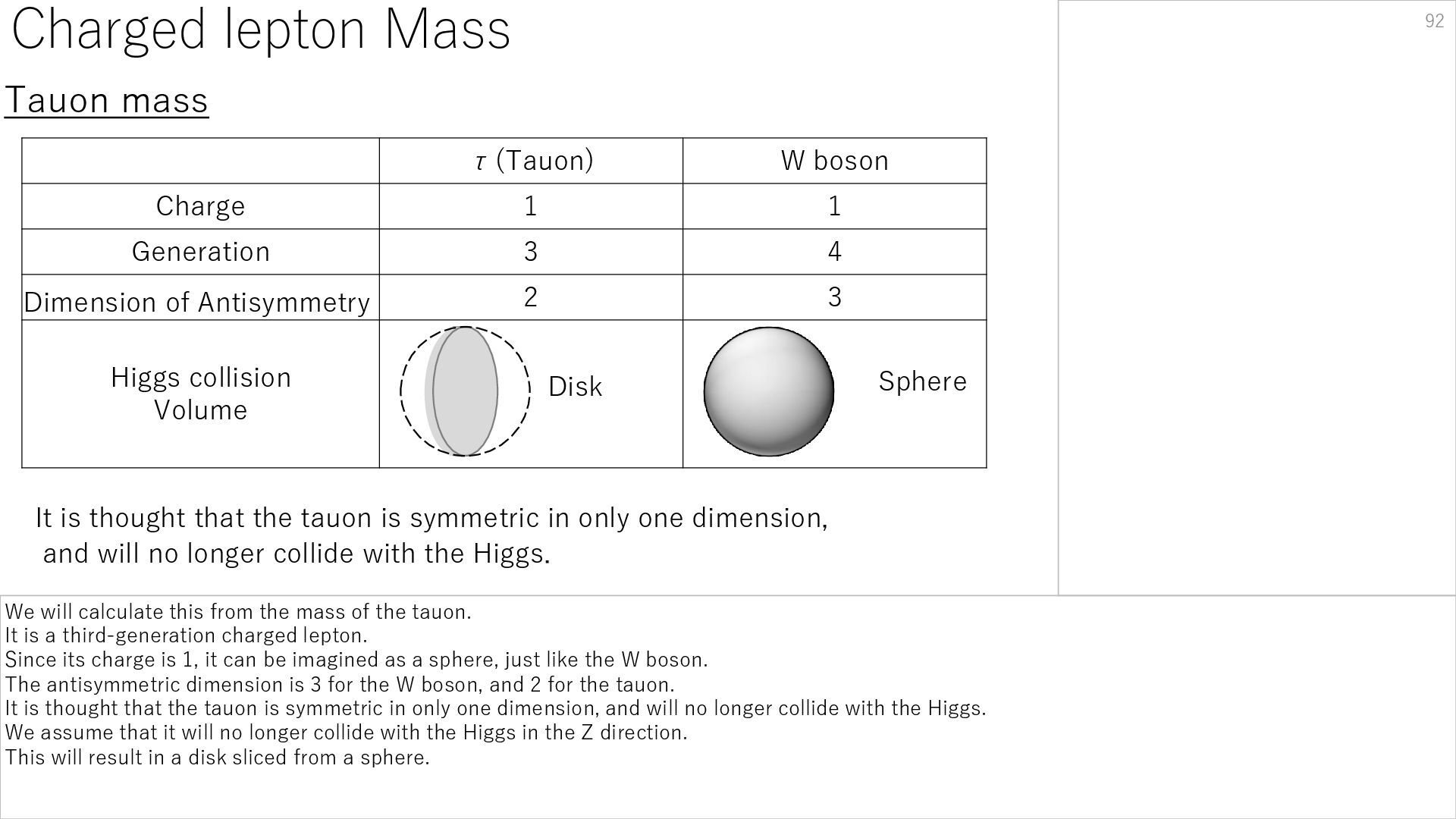
  91. τ(Tauon) W boson Charge 1 1 Generation 3 4 Dimension

    of Antisymmetry 2 3 Higgs collision Volume Charged lepton Mass We will calculate this from the mass of the tauon. It is a third-generation charged lepton. Since its charge is 1, it can be imagined as a sphere, just like the W boson. The antisymmetric dimension is 3 for the W boson, and 2 for the tauon. It is thought that the tauon is symmetric in only one dimension, and will no longer collide with the Higgs. We assume that it will no longer collide with the Higgs in the Z direction. This will result in a disk sliced from a sphere. Tauon mass It is thought that the tauon is symmetric in only one dimension, and will no longer collide with the Higgs. Disk Sphere 92
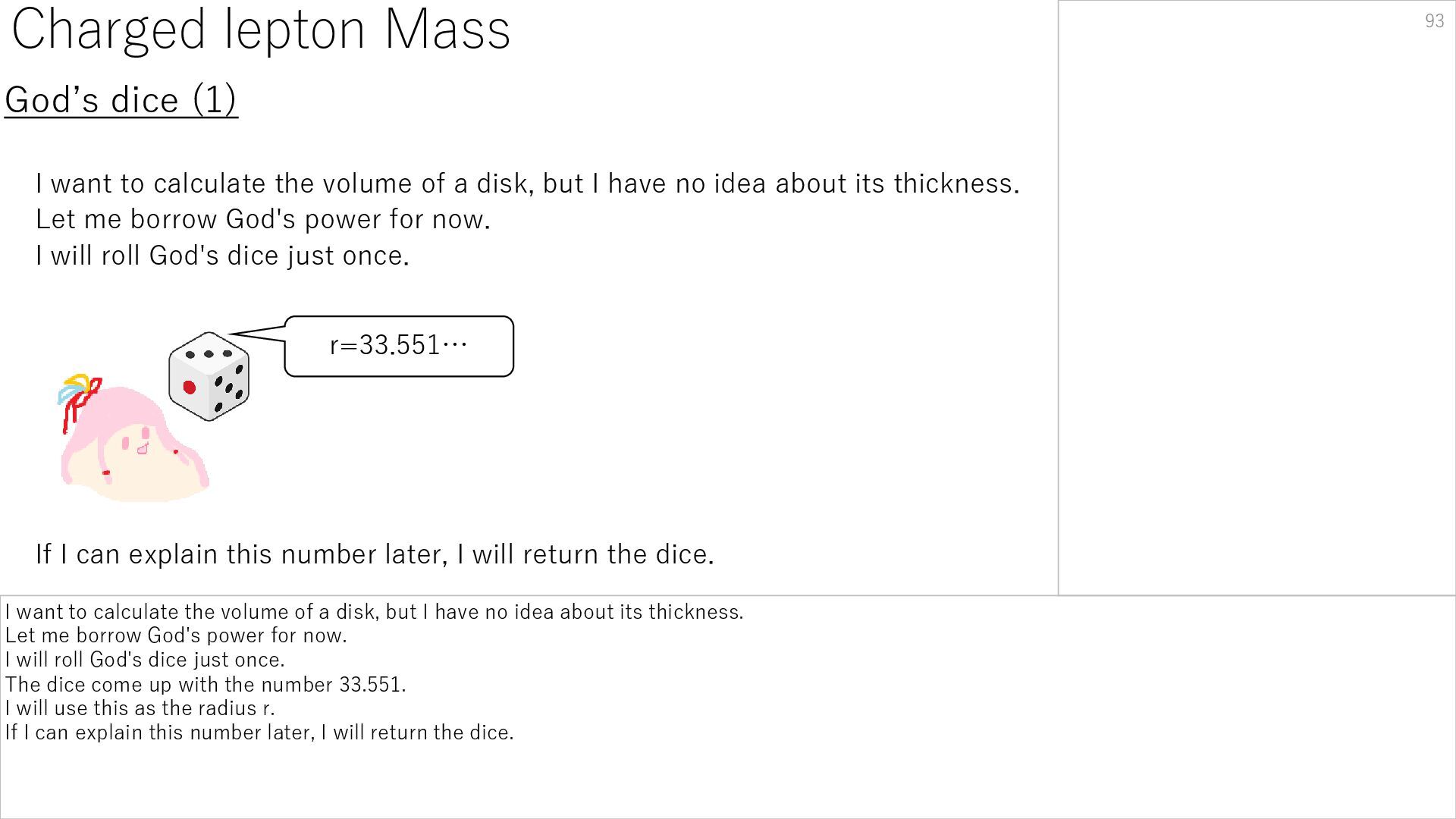
  92. Charged lepton Mass I want to calculate the volume of

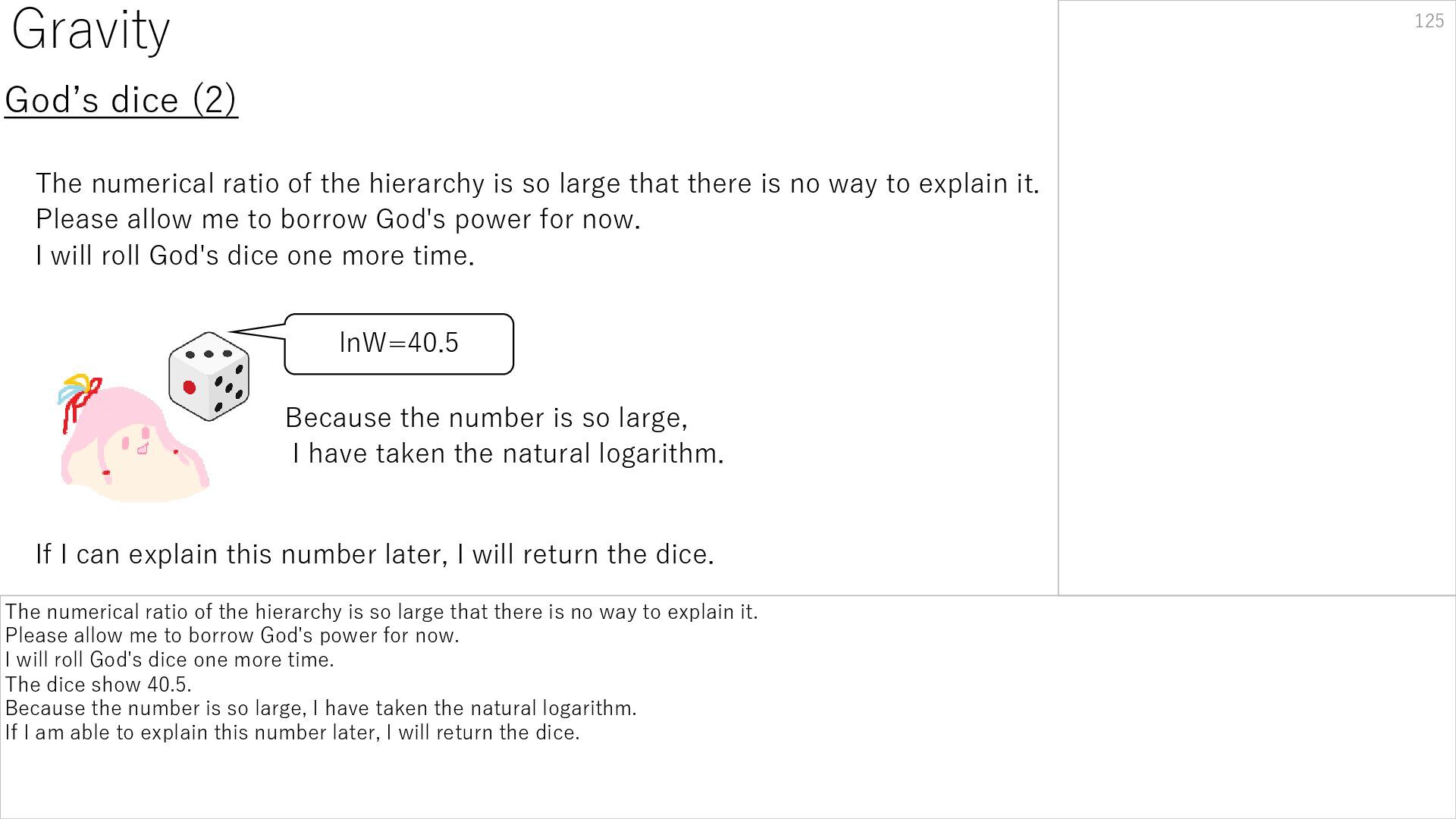
    a disk, but I have no idea about its thickness. Let me borrow God's power for now. I will roll God's dice just once. The dice come up with the number 33.551. I will use this as the radius r. If I can explain this number later, I will return the dice. God’s dice (1) r=33.551… I want to calculate the volume of a disk, but I have no idea about its thickness. Let me borrow God's power for now. I will roll God's dice just once. If I can explain this number later, I will return the dice. 93
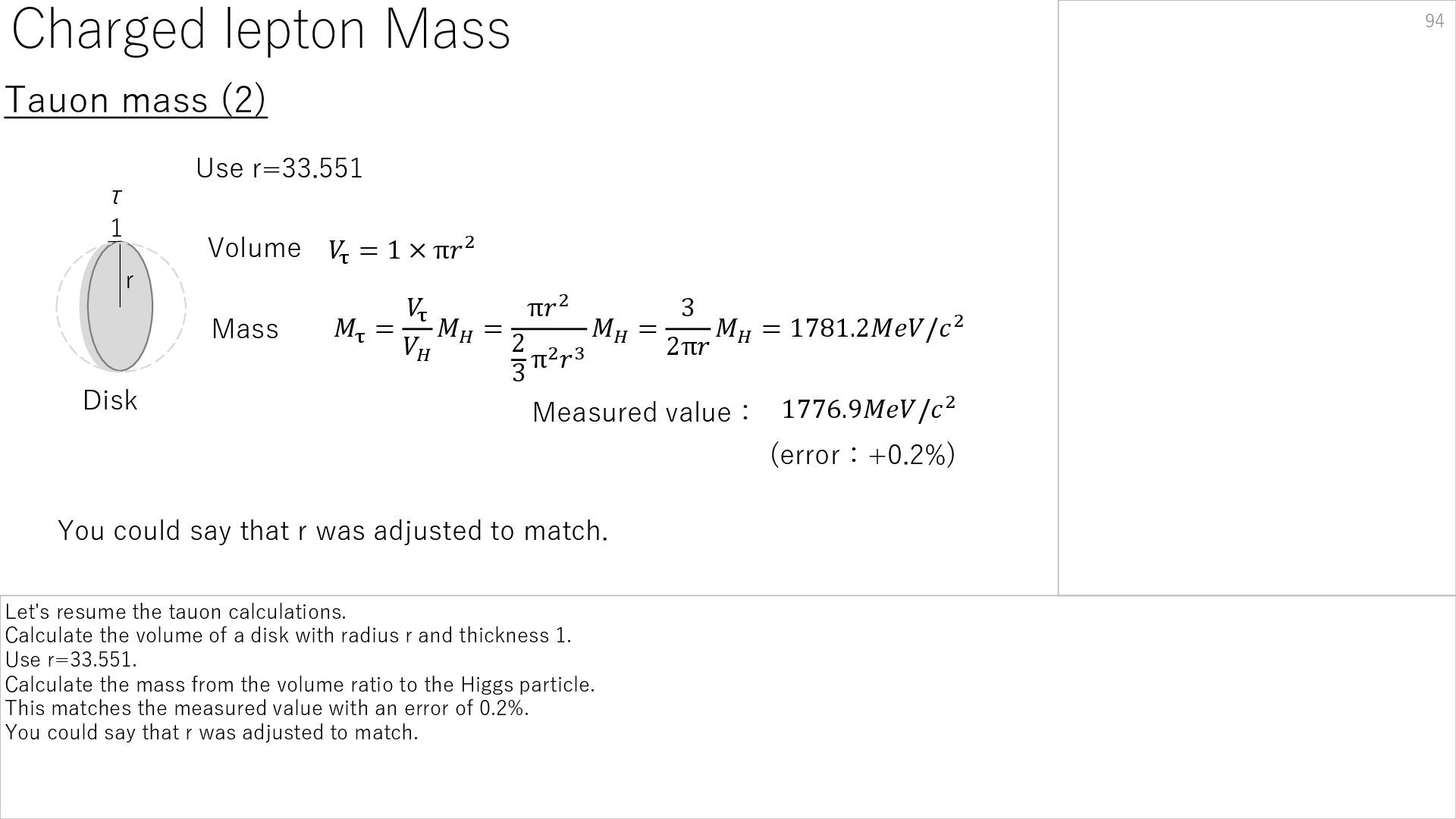
  93. Charged lepton Mass Let's resume the tauon calculations. Calculate the

    volume of a disk with radius r and thickness 1. Use r=33.551. Calculate the mass from the volume ratio to the Higgs particle. This matches the measured value with an error of 0.2%. You could say that r was adjusted to match. Tauon mass (2) You could say that r was adjusted to match. r 1 τ 𝑉 τ = 1 × π𝑟2 𝑀τ = 𝑉 τ 𝑉𝐻 𝑀𝐻 = π𝑟2 2 3 π2𝑟3 𝑀𝐻 = 3 2π𝑟 𝑀𝐻 = 1781.2𝑀𝑒𝑉/𝑐2 Volume Mass 1776.9𝑀𝑒𝑉/𝑐2 Measured value: (error:+0.2%) Use r=33.551 Disk 94
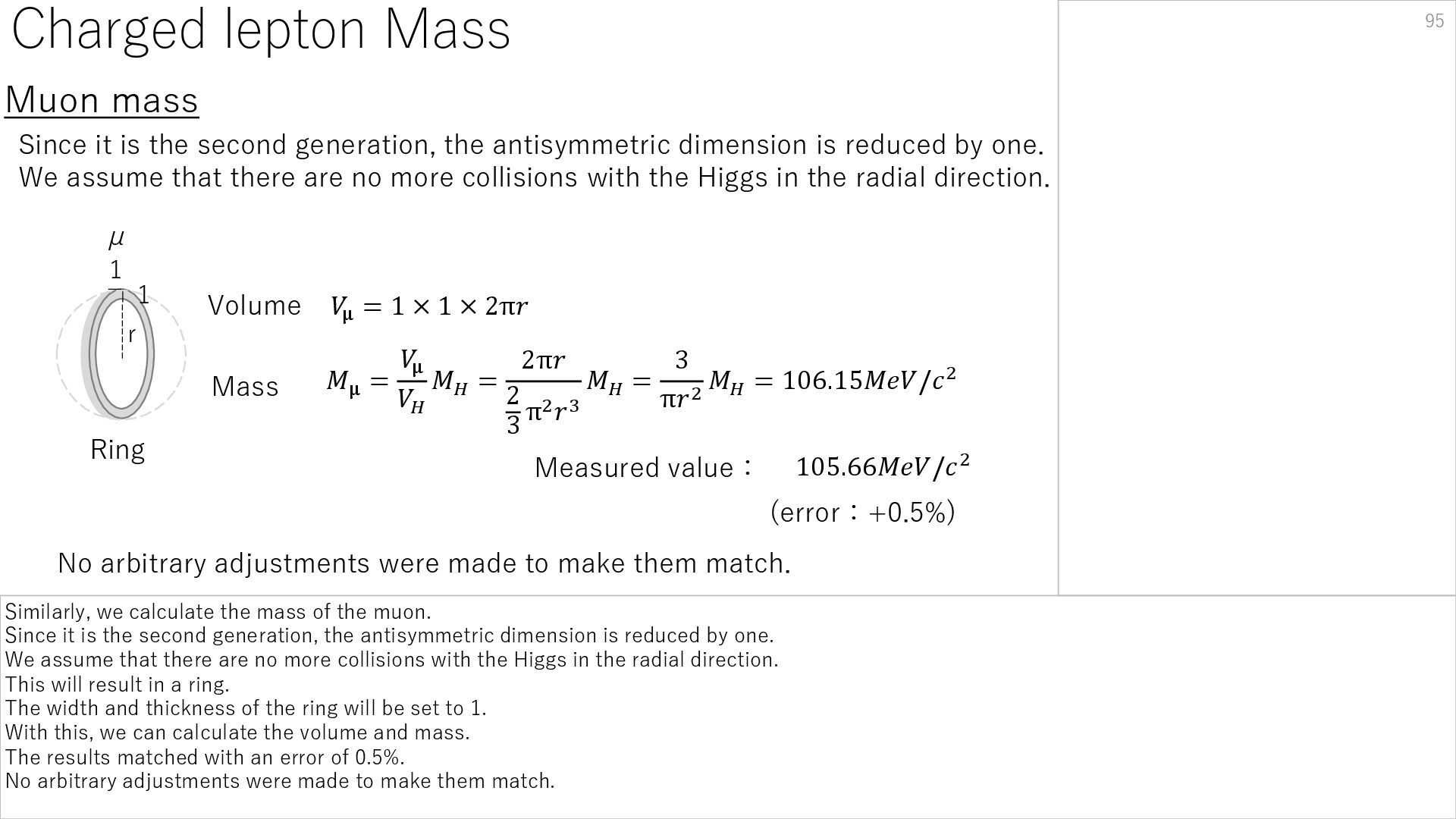
  94. Charged lepton Mass Similarly, we calculate the mass of the

    muon. Since it is the second generation, the antisymmetric dimension is reduced by one. We assume that there are no more collisions with the Higgs in the radial direction. This will result in a ring. The width and thickness of the ring will be set to 1. With this, we can calculate the volume and mass. The results matched with an error of 0.5%. No arbitrary adjustments were made to make them match. Muon mass Ring r 1 1 μ Volume Mass 105.66𝑀𝑒𝑉/𝑐2 Measured value: (error:+0.5%) No arbitrary adjustments were made to make them match. Since it is the second generation, the antisymmetric dimension is reduced by one. We assume that there are no more collisions with the Higgs in the radial direction. 𝑉 μ = 1 × 1 × 2π𝑟 𝑀μ = 𝑉 μ 𝑉𝐻 𝑀𝐻 = 2π𝑟 2 3 π2𝑟3 𝑀𝐻 = 3 π𝑟2 𝑀𝐻 = 106.15𝑀𝑒𝑉/𝑐2 95
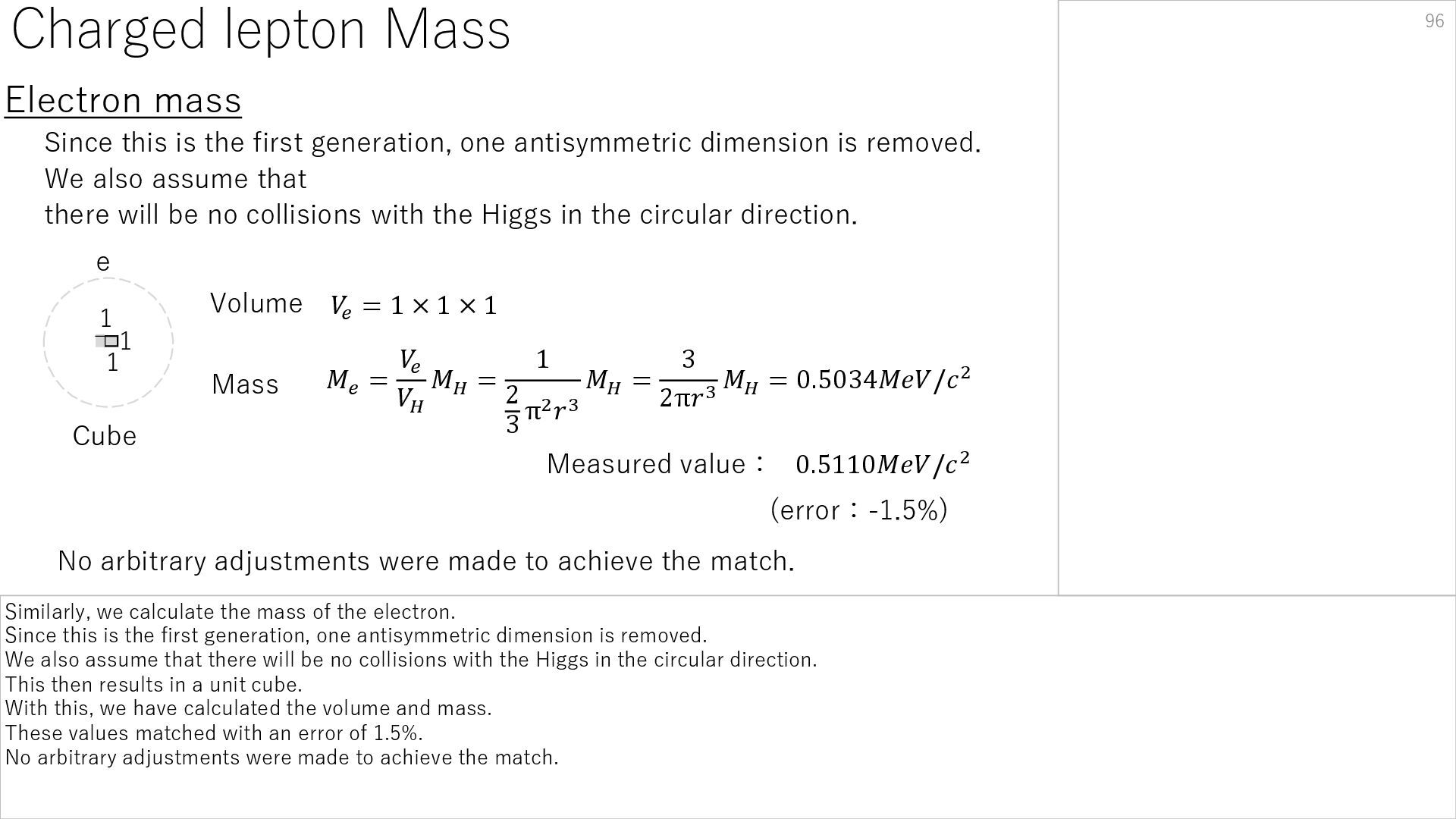
  95. Charged lepton Mass Similarly, we calculate the mass of the

    electron. Since this is the first generation, one antisymmetric dimension is removed. We also assume that there will be no collisions with the Higgs in the circular direction. This then results in a unit cube. With this, we have calculated the volume and mass. These values matched with an error of 1.5%. No arbitrary adjustments were made to achieve the match. Electron mass Cube 1 1 e 𝑉 𝑒 = 1 × 1 × 1 𝑀𝑒 = 𝑉 𝑒 𝑉𝐻 𝑀𝐻 = 1 2 3 π2𝑟3 𝑀𝐻 = 3 2π𝑟3 𝑀𝐻 = 0.5034𝑀𝑒𝑉/𝑐2 Volume Mass 0.5110𝑀𝑒𝑉/𝑐2 Measured value: (error:-1.5%) No arbitrary adjustments were made to achieve the match. Since this is the first generation, one antisymmetric dimension is removed. We also assume that there will be no collisions with the Higgs in the circular direction. 1 96
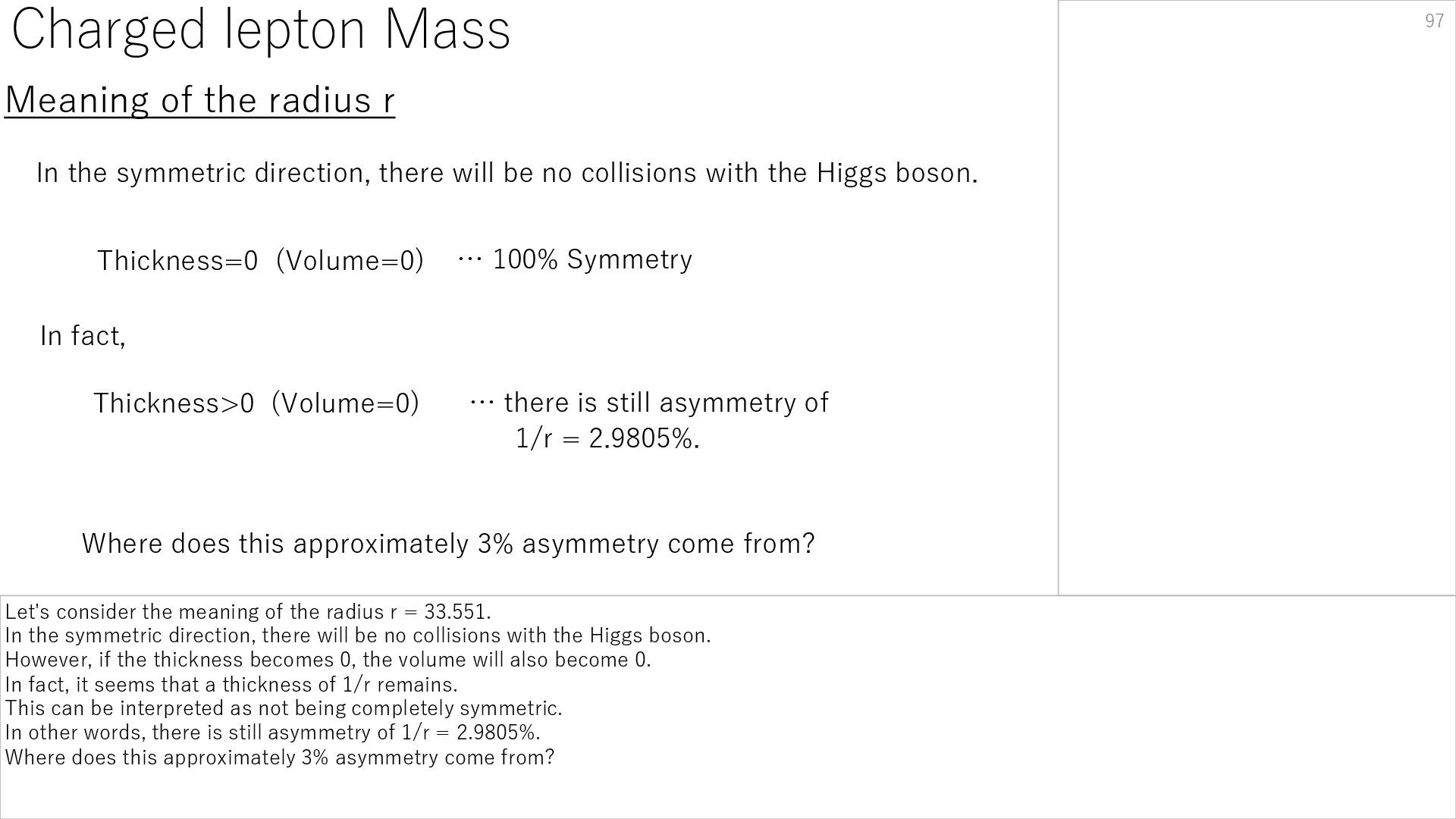
  96. Charged lepton Mass Let's consider the meaning of the radius

    r = 33.551. In the symmetric direction, there will be no collisions with the Higgs boson. However, if the thickness becomes 0, the volume will also become 0. In fact, it seems that a thickness of 1/r remains. This can be interpreted as not being completely symmetric. In other words, there is still asymmetry of 1/r = 2.9805%. Where does this approximately 3% asymmetry come from? Meaning of the radius r Thickness=0 (Volume=0) In the symmetric direction, there will be no collisions with the Higgs boson. … 100% Symmetry In fact, … there is still asymmetry of 1/r = 2.9805%. Where does this approximately 3% asymmetry come from? Thickness>0 (Volume=0) 97
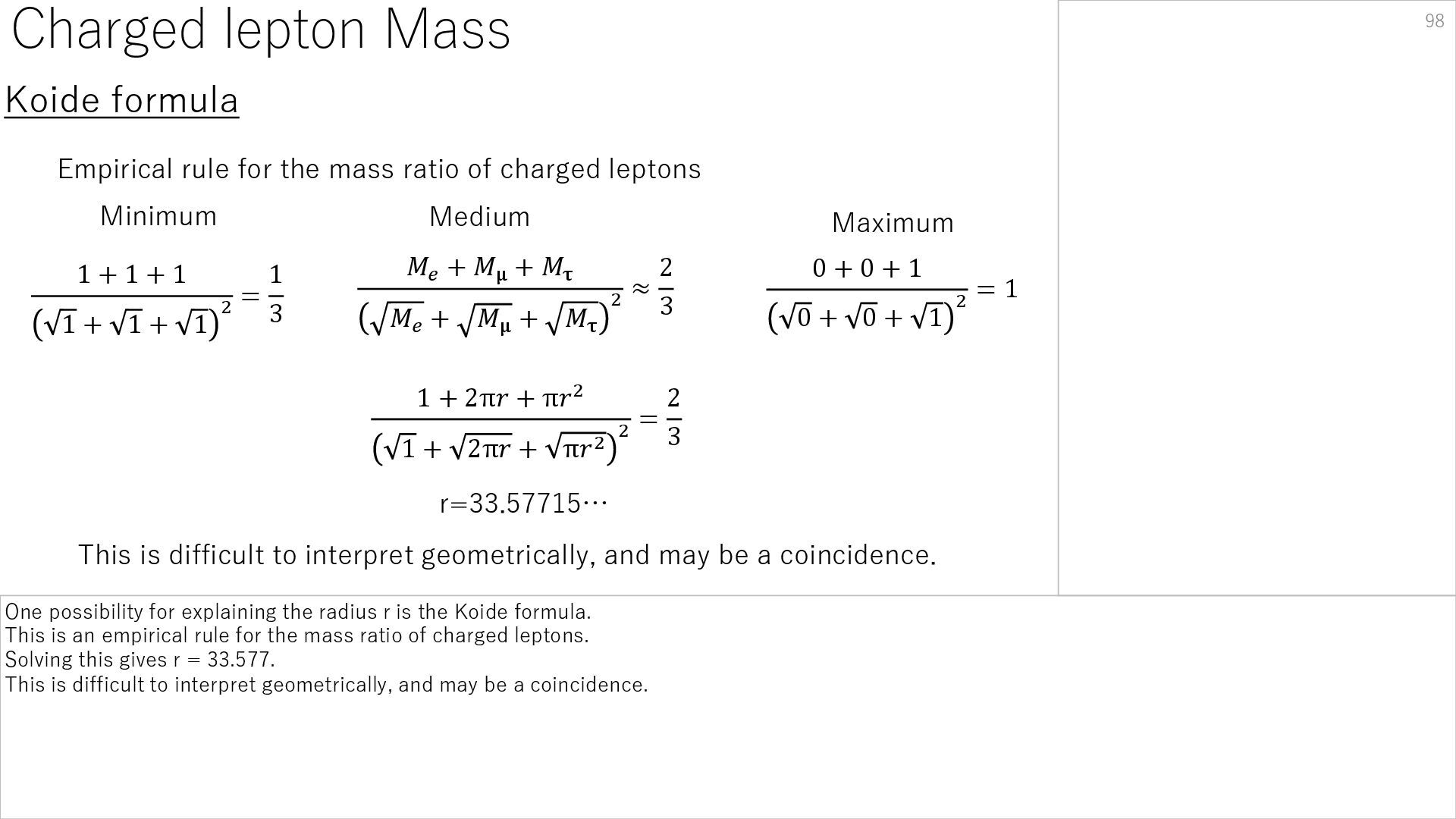
  97. Charged lepton Mass One possibility for explaining the radius r

    is the Koide formula. This is an empirical rule for the mass ratio of charged leptons. Solving this gives r = 33.577. This is difficult to interpret geometrically, and may be a coincidence. Koide formula r=33.57715… 𝑀𝑒 + 𝑀μ + 𝑀τ 𝑀𝑒 + 𝑀μ + 𝑀τ 2 ≈ 2 3 1 + 1 + 1 1 + 1 + 1 2 = 1 3 0 + 0 + 1 0 + 0 + 1 2 = 1 Maximum Minimum Medium Empirical rule for the mass ratio of charged leptons This is difficult to interpret geometrically, and may be a coincidence. 98 1 + 2π𝑟 + π𝑟2 1 + 2π𝑟 + π𝑟2 2 = 2 3
  98. Charged lepton Mass Now let's talk about the strong force,

    which we have been leaving aside for now. At the energy scale of tauons, the strong force is the strength when the color enhancement by gluons is 0. In this case, the gauge coupling constant is 2/3 pi. If the radius is r, the amount of rotation due to the strong force is 2/3 pi r. Meanwhile, the volume of a tauon is pi r squared. Multiplying these together gives the volume of the Higgs particle. It can be said that the energy scale of the strong force is determined by the same principle as mass due to the Higgs mechanism. Unification of Mass and Strong Force (1) 99 α𝑠 𝑀τ = 𝑔𝑠 2 4π = π 9 = 0.3491 α𝑠 𝑀τ = 0.31 Measured 𝑉 τ = π𝑟2 𝑔𝑠 𝑀τ = 1 3 × 1 × 2π = 2π 3 At the energy scale of tauons, the strong force is the strength when the color enhancement by gluons is 0. Rotation of strong force 2π𝑟 3 × π𝑟2 = 2π2𝑟3 3 = 𝑉𝐻 Tauon volume Higgs volume It can be said that the energy scale of the strong force is determined by the same principle as mass due to the Higgs mechanism.
  99. Charged lepton Mass Let's compare them using diagrams. Mass can

    be thought of as the resistance to movement. Energy is determined by the volume passed through by the movement. The strong force can be thought of as the resistance to spin. Energy is determined by the volume passed through by spin. Rotating by 2/3 pi r gives the Higgs volume. Since energy is determined by the same principle, they can be said to be unified. Unification of Mass and Strong Force (2) 100 r 2πr r 1 2π𝑟 3 𝑉 τ = π𝑟2 V = π𝑟2 × 2 3 π Mass: Resistance to movement Energy is determined by the volume that is passed through during movement. Strong force: Resistance to spin Energy is determined by the volume that the spin passes through.
  100. Neutrino Mass and Mixing From this, we calculate the neutrino

    mass. Neutrinos have three eigenmass states, which are a mixture of each other. Only the square of the mass difference has been measured. The three masses are simply assumed to be a geometric progression of the square root of r. This matches the measured values within the measurement error range. The denominator is the square of the Higgs volume, making it lighter than other particles. Neutrino mass (1) 𝑀1 = 𝑟−2 𝑉𝐻 2 𝑀𝐻 𝑀2 = 𝑟−1.5 𝑉𝐻 2 𝑀𝐻 𝑀3 = 𝑟−1 𝑉𝐻 2 𝑀𝐻 = 0.0601𝑒𝑉/𝑐2 = 0.0104𝑒𝑉/𝑐2 = 0.00179𝑒𝑉/𝑐2 Δ𝑀21 2 = 7.37 × 10⁻⁵ 𝑒𝑉/𝑐2 2 = 2.47 × 10⁻³ 𝑒𝑉/𝑐2 2 Δ𝑀32 2 7.50(19) × 10−5 𝑒𝑉/𝑐2 2 2.45(3) × 10−3 𝑒𝑉/𝑐2 2 (Measured) (Measured) The three masses are simply assumed to be a geometric progression of the square root of r. The denominator is the square of the Higgs volume, making it lighter than other particles. 101
  101. Neutrino Mass and Mixing Let's look back at electrons. The

    mass of an electron is inversely proportional to the first power of the Higgs volume. Rearrange the equation so that the denominator is the square of the Higgs volume. The mass is proportional to the product of the electron's volume and the Higgs volume. This can be interpreted as a collision when two volumes overlap. Neutrino mass (2) 102 𝑉𝐻 = 2 3 π2𝑟2 𝑉 𝑒 = 1 𝑀𝑒 = 𝑉 𝑒 𝑉𝐻 × 𝑀𝐻 Electron mass 𝑀𝑒 = 𝑉 𝑒 × 𝑉𝐻 𝑉𝐻 2 × 𝑀𝐻 The mass is proportional to the product of the electron volume and Higgs volume. This can be interpreted as a collision when two volumes overlap. Rearrange the equation so that the denominator is the square of the Higgs volume. Higgs particle Electron
  102. Neutrino Mass and Mixing Similarly, let's consider the case of

    neutrinos. We consider the volume of the Higgs boson it is colliding with to decrease. We consider the collision to be a volume of 1. Only the asymmetric component of the Higgs boson collides with the neutrino. The remaining symmetric component does not collide with the neutrino. However, if we continue to think in this way, the volume of the neutrino becomes smaller than 1. Neutrino mass (3) 103 𝑉𝐻′ = 1 𝑉 ν = 1 𝑟2 , 1 𝑟1.5 , 1 𝑟1 𝑀ν = 𝑉 ν × 𝑉𝐻′ 𝑉𝐻 2 × 𝑀𝐻 Neutrino mass Symmetric component : Not collide with the neutrino Asymmetric component : Collide with the neutrino Higgs particle Neutrino 2 3 π2𝑟3 − 1 1 We consider the volume of the Higgs boson it is colliding with to decrease.
  103. Neutrino Mass and Mixing We consider symmetry not only in

    space but also in the time axis. We think that a collision occurs when the product of two volumes and times overlaps. Of the Higgs particle's time r, only part 1 collides with the neutrino. There are three levels of neutrino time: 1, root r, and r. Neutrino mass (4) 104 𝑉𝐻′ = 1 𝑉 ν = 1 𝑀1,2,3 = 𝑉 ν 𝑡1,2,3 × 𝑉𝐻′ 𝑡𝐻′ 𝑉𝐻 𝑡𝐻 2 × 𝑀𝐻 𝑡3 = 𝑟 𝑡2 = 𝑟 𝑡1 = 1 𝑡𝐻 = 𝑟 𝑡𝐻′ = 1 We think that a collision occurs when two product of volumes and times overlaps. Of the Higgs particle's time r, only part 1 collides with the neutrino. There are three levels of neutrino time: 1, root r, and r.
  104. Neutrino Mass and Mixing Neutrino mixing is represented by a

    matrix. The mass ratio of M1 to M3 is r, so we enter just that into the matrix. In the middle column, enter the average value of the left and right columns. Make sure the horizontal total is 1. Enter the remaining values equally into the bottom two rows. Finally, take the square root. Using only r, we obtained a matrix that is close to the actual measured value. Neutrino mixing matrix 1 ? 1/𝑟 ? ? ? ? ? ? 1 0.515 0.030 ? ? ? ? ? ? 0.647 0.333 0.019 ? ? ? ? ? ? 0.647 0.333 0.019 0.176 0.333 0.490 0.176 0.333 0.490 0.805 0.577 0.139 0.420 0.577 0.700 0.420 0.577 0.700 0.82 0.55 0.15 0.40 0.59 0.70 0.40 0.59 0.70 𝑀1 𝑀2 𝑀3 ν𝑒 νμ ντ average of left and right total 1 remainder is distributed equally measured(about) square root The mass ratio of M1 to M3 is r, so we enter just that into the matrix. 105
  105. Neutrino Mass and Mixing The relationship between generations and number

    of dimensions is shown in a table. We consider not only space but also time. The generations correspond to the asymmetric number of dimensions. For neutrinos, the symmetry of space does not directly affect their mass, but it does indirectly affect the degree of mixing of time symmetry. Neutrino masses correspond to generations 0, 0.5, and 1. The Higgs particle is of the fourth generation, but its core is of the zeroth generation. Generations and Dimensions 106 Generation = Dimension number of Asymmetry For neutrinos, the symmetry of space does not directly affect their mass, but it does indirectly affect the degree of mixing of time symmetry. Flavor ν1 ν2 ν3 ,νe νμ ντ H(core) u,d,e s,c,μ b,t,τ H,Z,W Dimension number of Asymmetry Space 0 0 0 1 2 3 Time 0 0.5 1 1 1 1 Total 0 0.5 1 2 3 4 Generation 0 0.5 1 2 3 4
  106. Neutrino Mass and Mixing Let's consider the mass of a

    photon. All particles are thought to have an asymmetric core. Mass is created when the cores of a neutrino and the Higgs collide. Photon is a particle that represents a plane parallel to direction of movement, and because it has no width, it is not collide with Higgs. Photons are allowed to have no mass. Photon mass 107 Neutrino Photon All particles are thought to have an asymmetric core. Mass is created when the cores of a neutrino and the Higgs collide. Higgs Higgs Photon is a particle that represents a plane parallel to direction of movement, and because it has no width, it is not collide with Higgs.
  107. Quark Mass and Mixing Now let's consider the mass of

    a quark. We have illustrated an up quark. We have also illustrated what it looks like from the opposite side. With a half rotation, half of the face is flipped. We look at moving symmetry from three directions. As shown in the diagram below, we compare the faces on the opposite side by looking through them. The colors represent the direction, with the opposite side being the opposite color. Quark Symmetry (1) 108 Y R Y G Y B u quark T Y G Y B Y G Symmetry Antisymmetry With half a rotation, half the face is flipped. u quark seen from opposite direction View moving symmetry from three directions.
  108. Quark Mass and Mixing We have shown a schematic diagram

    of a u-type quark seen from the front and back. The charge means that the six faces are positive or negative. The generation is the choice of which four of the eight vertices will spin. The mass is the discrepancy when the quark is cut in half and swapped. The symmetry of the six faces and the symmetry of the eight vertices are inseparable. Except when the faces are aligned, like in leptons, the symmetry is broken. 109 Quark Symmetry (2) Y R Y G Y B u T Y R Y G Y B T Y R Y G Y B t T c Schematic diagram of a u-type quark viewed from the front and back. Charge: 6 sides are positive or negative Generation: How to choose 4 vertices to spin out of 8 vertices Mass: Discrepancy when cut in half and swapped The symmetry of the 6 faces and the symmetry of the 8 vertices are inseparable. Unless the planes are aligned, as in leptons, symmetry is broken.
  109. Quark Mass and Mixing Next, let's calculate the mass of

    the top quark. It is the heaviest elementary particle. Let's think about what shape its volume is. The volume is limited to a cylinder with a height of 2πr. Even tauons and W bosons use the full radial space. Therefore, the only way to increase volume is in the vertical direction. Top quark mass r r λ=2πr r Limit of volume τ W r t (top quark) The only way to increase volume is in the vertical direction. 110
  110. Quark Mass and Mixing We will calculate the masses of

    three generations of u-type quarks. Unlike electrons, up quarks are assumed to be three cubes. The height of the cylinder changes depending on the generation. The height of the cylinder follows a geometric progression. The error from the actual measured mass values is about 1%. u type quark mass r 3 2 × 82 r 1 3 2 × 81 1 3 2 × 80 𝑉𝑡 = 3 2 82 × π𝑟2 𝑉 𝑐 = 3 2 81 × 2π𝑟 𝑉 𝑢 = 3 2 80 × 3 t (top) c (charm) u (up) 𝑀𝑡 = 170.99𝐺𝑒𝑉/𝑐2 𝑀𝑐 = 1274𝑀𝑒𝑉/𝑐2 𝑀𝑢 = 2.27𝑀𝑒𝑉/𝑐2 2.16𝑀𝑒𝑉/𝑐2 1273𝑀𝑒𝑉/𝑐2 172.57𝐺𝑒𝑉/𝑐2 measured: error: +4.9% +0.1% -0.9% 111
  111. Quark Mass and Mixing Calculate the masses of the three

    generations of d-type quarks. Assume that the volume in the circumferential direction is only 1/9 of 360 degrees. The height of the cylinder changes depending on the generation. The height of the cylinder follows a geometric progression. The error from the actual measured mass value is about 1%. d type quark mass 1 3 × 8 3 1 s (strange) r 1 r 3 × 8 3 2 b (bottom) 1 d (down) 𝑉𝑑 = 3 8 3 2 × π𝑟2 𝑉𝑑 = 3 8 3 0 × 3 𝑀𝑑 = 4.222𝐺𝑒𝑉/𝑐2 𝑀𝑠 = 94.3𝑀𝑒𝑉/𝑐2 𝑀𝑑 = 4.5𝑀𝑒𝑉/𝑐2 4.7𝑀𝑒𝑉/𝑐2 93.5𝑀𝑒𝑉/𝑐2 4.183𝐺𝑒𝑉/𝑐2 measured: error: -3.6% +0.9% +0.9% 3 × 8 3 0 𝑉 𝑠 = 3 8 3 1 × 2π𝑟 1 9 360° 1 9 360° 112
  112. Quark Mass and Mixing Quarks are also mixed together and

    are represented by a matrix. The ratio of first to second generations is r, and the ratio of second to third generations is r squared. Both the vertical and horizontal dimensions must add up to 100%. Finally, take the square root. Using only r, we obtained a matrix that is close to the actual measured value. Quark mixing matrix (1) 1 2/𝑟 1/𝑟3 2/𝑟 1 2/𝑟2 1/𝑟3 2/𝑟2 1 94.4% 5.62% 0.003% 5.62% 94.2% 0.172% 0.003% 0.172% 94.2% 0.971 0.237 0.005 0.237 0.971 0.042 0.005 0.042 0.999 0.974 0.225 0.004 0.225 0.973 0.042 0.009 0.041 0.999 s b d u c t measured square root Both vertically and horizontally, total 100% The ratio of first to second generations is r, and the ratio of second to third generations is r squared. 113
  113. Quark Mass and Mixing There is an empirical formula between

    quark masses and mixing matrices. When the square root of a u-type quark is multiplied by the mixing matrix, it is proportional to the square root of a d-type quark. If the coefficients are expressed using r, they are approximately equal. The matrix can also be expressed approximately using r. The square root of a d-type quark mass can be expressed as a mixing of the square root of a u-type quark mass. Quark mixing matrix (2) 114 𝑀𝑑 𝑀𝑠 𝑀𝑏 ∝ 𝑀𝑢 𝑀𝑐 𝑀𝑡 0.974 0.225 0.004 0.225 0.973 0.042 0.009 0.041 0.999 𝑀𝑑 𝑀𝑠 𝑀𝑏 ≈ 1/𝑟 𝑀𝑢 𝑀𝑐 𝑀𝑡 1 2/𝑟 1/𝑟3 2/𝑟 1 2/𝑟2 1/𝑟3 2/𝑟2 1 = 𝑀𝑢 𝑀𝑐 𝑀𝑡 1/𝑟 2/𝑟2 1/𝑟4 2/𝑟2 1/𝑟 2/𝑟3 1/𝑟4 2/𝑟3 1/𝑟 (Nishida) Empirical formula The square root of a d-type quark mass can be expressed as a mixing of the square root of a u-type quark mass.
  114. Quark Mass and Mixing We were able to convert from

    u-type to d-type using a mixing matrix, but what about the reverse? We calculated the inverse matrix. The terms in the top right and bottom left have changed shape. The conversion from u-type to d-type and from d-type to u-type can be expressed just by changing the sign. Quark mixing matrix (3) 115 1 𝑟 1 2 𝑟 1 𝑟3 2 𝑟 1 2 𝑟2 1 𝑟3 2 𝑟2 1 𝑟 1 − 2 𝑟 1 𝑟3 − 2 𝑟 1 − 2 𝑟2 1 𝑟3 − 2 𝑟2 1 1 𝑟±1 ± 1 ± 2 𝑟 1 𝑟3 2 𝑟 1 ± 2 𝑟2 1 𝑟3 ± 2 𝑟2 1 d→u u→d +:u→d -:d→u Inverse matrix (approximation)
  115. Quark Mass and Mixing Let's consider why it appears that

    the square roots of the masses are mixing. Mass is proportional to the Higgs collision volume. The ratio of the Higgs collision volume to the volume of the cylinder is defined as the Higgs collision probability. The Higgs collision probability is the probability that a particle exists at a position where it will collide with a Higgs particle. The probability of a particle existing is the square of the wave amplitude. Conversely, the wave amplitude is the square root of the particle's existence probability. The wave amplitude is proportional to the square root of the mass. When waves mix, this can be interpreted as the square roots of the masses mixing. Higgs collision probability 116 𝑃 = 𝑉 2π2𝑟3 M = 𝑃 × 3𝑀𝐻 Higgs collision probability Higgs collision volume Mass The Higgs collision probability is the probability that a particle exists at a position where it will collide with a Higgs particle. Particle existence probability = 𝑊𝑎𝑣𝑒 𝑎𝑚𝑝𝑙𝑖𝑡𝑢𝑑𝑒2 W𝑎𝑣𝑒 𝑎𝑚𝑝𝑙𝑖𝑡𝑢𝑑𝑒 = Particle 𝑒𝑥𝑖𝑠𝑖𝑡𝑒𝑛𝑐𝑒 𝑝𝑟𝑜𝑏𝑎𝑏𝑖𝑙𝑖𝑡𝑦 ∝ 𝑀𝑎𝑠𝑠 When waves mix, this can be interpreted as the square roots of the masses mixing. (Cylinder)
  116. Quark Mass and Mixing The masses of charged leptons could

    be expressed as geometric shapes without coefficients. On the other hand, the masses of quarks had to be expressed as geometric shapes with coefficients. Furthermore, quarks mix between generations, but charged leptons do not. If there is no mixing, it can be said that coefficients are not necessary. It is only as a result of mixing that coefficients appear to exist, but there were no coefficients before mixing. Let's rethink quark mass as a mixture of geometric shapes without coefficients. Mass mixing 117 We rethink the mass of a quark as a mixture of geometric shapes without coefficients. Higgs collision volume (Mass) Intergenerational Mixing Chaeged Lepton Geometry without coefficients No Quark (1) Geometry with coefficients? (2) Mixuture of Geometry without coefficients? Yes
  117. Quark Mass and Mixing Calculate the mass of a d-type

    quark. Assume that the masses of four generations of charged leptons mix. We assume the Higgs boson is the fourth generation. If the difference in the number of generations is 1, then the mass will mix by r to the power of -1. The matrix of the difference in the number of generations should sum to 100% in both length and width. Assuming that mass is proportional to the magnitude of the charge, it is multiplied by the absolute value of the charge. The calculated mass is close to the measured value, but there is an error of more than 10%. d-type quark mass mixing 118 𝑟0 𝑟−1 𝑟−2 𝑟−3 𝑟−1 𝑟0 𝑟−1 𝑟−2 𝑟−2 𝑟−1 𝑟0 𝑟−1 𝑀𝑑 𝑀𝑠 𝑀𝑏 = 97.0% 2.9% 0.1% 0.0% 2.8% 94.3% 2.8% 0.1% 0.1% 2.8% 94.3% 2.8% 𝑀𝑒 𝑀μ 𝑀τ 2𝑀𝐻 𝑄 = 3.8𝑀𝑒𝑉/𝑐2 120𝑀𝑒𝑉/𝑐2 2.91𝐺𝑒𝑉/𝑐2 Make the total of the rows and cols 100% 𝑒 μ τ 2𝐻 𝑑 𝑠 𝑏 If the difference in the number of generations is 1, then the mass will mix by r to the power of -1. Higgs particle assumed as the fourth generation Mass is proportional to the magnitude of the charge
  118. Quark Mass and Mixing Calculate the mass of a u-type

    quark. Only the differences from d-type quarks are highlighted. Overall, the mixing ratio is 1/4 times larger. Only the mixing with the fourth generation has an increased order. u-type quark mass mixing 119 𝑒 μ τ 2𝐻 𝑢 𝑐 𝑡 4𝑟 0 4𝑟 −1 4𝑟 −2 4𝑟 −3+0.5 4𝑟 −1 4𝑟 0 4𝑟 −1 4𝑟 −2+1 4𝑟 −2 4𝑟 −1 4𝑟 0 4𝑟 −1+1.5 𝑀𝑢 𝑀𝑐 𝑀𝑡 = 99.3% 0.7% 0.0% 0.0% 0.7% 97.8% 0.7% 0.7% 0.0% 0.1% 7.9% 92.0% 𝑀𝑒 𝑀μ 𝑀τ 2𝑀𝐻 𝑄 = 1.7𝑀𝑒𝑉/𝑐2 1.29𝐺𝑒𝑉/𝑐2 154𝐺𝑒𝑉/𝑐2 Overall, the mixing ratio is 1/4 times larger. Only the mixing with the fourth generation has an increased order. Make the total of the rows and cols 100%
  119. Quark Mass and Mixing We've shown the same thing for

    charged leptons. Charged leptons do not mix between generations. The mixing ratio is infinity. The mixing ratio of u-type quarks is four times that of d-type quarks. The greater the charge, the less mixing between generations there is. Charged lepton mass mixing 120 ∞0 ∞−1 ∞−2 ∞−3+? ∞−1 ∞0 ∞−1 ∞−2+? ∞−2 ∞−1 ∞0 ∞−1+? 𝑀𝑒 𝑀μ 𝑀τ = 100% 0% 0% 0% 0% 100% 0% 0% 0% 0% 100% 0% 𝑀𝑒 𝑀μ 𝑀τ 2𝑀𝐻 𝑄 𝑒 μ τ 2𝐻 𝑒 μ 2𝐻 d-type quark:r u-type quark:4r Charged lepton:∞ The greater the charge, the less mixing between generations there is. Mixing ratio
  120. Gravity Now it's time to start thinking about gravity. Gravitation

    is a force that acts over a long distance, like electromagnetic force. There is no repulsive force, only attractive force. The graviton, which mediates gravity, is thought to have spin 2. Spin 2 means that it becomes identical when rotated 180 degrees. A photon rotated 180 degrees is thought to mediate a force in the opposite direction. Since gravitons are the same even when rotated 180 degrees, they are thought to only exert an attractive force. The nature of gravity Gravitation is a force that acts over a long distance, like electromagnetic force. There is no repulsive force, only attractive force. The graviton, which mediates gravity, is thought to have spin 2. Spin 2 means that it becomes identical when rotated 180 degrees. A photon rotated 180°is thought to mediate a force in the opposite direction. Since gravitons are the same even when rotated 180°, they are thought to only exert an attractive force. γ0 (photon) G0 (graviton) rotate 180° rotate 180° Attractive Repulsive Attractive Attractive 121
  121. Gravity Let's estimate the gauge coupling constant of gravity. We'll

    use the electromagnetic force, a force acting over a long distance, as a reference. We've multiplied the electromagnetic coupling constant by 1/2. This is because we believe that opposite-pointing photons cannot mediate force. Gravitons have no front or back. We can remove only the 1/2 term from the photon coupling constant. We've now estimated the gauge coupling constant of gravity. Coupling constant of Gravity 𝑒 = 1 2 × 𝑐𝑜𝑠45° × 𝑐𝑜𝑠30° = 1 2 × 1 2 × 3 2 = 3 32 = 0.306 Coupling constant of Electromagnetic 𝑔𝐺 = 𝑐𝑜𝑠45° × 𝑐𝑜𝑠30° = 1 2 × 3 2 = 3 8 = 0.613 Coupling constant of Gravity We've multiplied the electromagnetic coupling constant by 1/2. This is because we believe that opposite-pointing photons cannot mediate force. Gravitons have no front or back. We can remove only the 1/2 term from the photon coupling constant. 122
  122. Gravity Let's explain the Planck scale. It is the scale

    at which the strength of gravity is equivalent to a gauge coupling constant of 1. However, we have been able to estimate a gauge coupling constant for gravity that is not 1. Let's also find the scale at which the strength of gravity is equivalent to the gauge coupling constant we found earlier. The length scale can be found by dividing the "Planck length" by the coupling constant. Let's call this length the “Gravitation length“. Planck scale Planck length 𝑙𝐺 = 𝑙𝑃 𝑔𝐺 = 8 3 𝑙𝑃 = 8ℏ𝐺 3𝑐3 = 2.639 × 10⁻³⁵𝑚 𝑙𝑃 = ℏ𝐺 𝑐3 = 1.616 × 10⁻³⁵𝑚 Scale at strength of gravity is equivalent to a gauge coupling constant of 1. Gravitation length Scale at strength of gravity is equivalent to a gauge coupling constant of g G . 123
  123. Gravity Only the scale of gravity is far removed from

    the scales of the other forces. This is called the hierarchy problem. Let's calculate the scale of the Higgs boson. Divide the Compton wavelength of the Higgs boson by 2π. Let's call this the "Higgs length“. Higgs scale Compton wavelength of the Higgs boson 𝑙𝐻 = λ𝐻 2π = ℏ 𝑀𝐻 𝑐 = 1.576 × 10⁻¹⁸𝑚 λ𝐻 = ℎ 𝑀𝐻 𝑐 = 9.903 × 10⁻¹⁸𝑚 Higgs length Hierarchy 𝑙𝐻 ≫ 𝑙𝑃 , 𝑙𝐺 10−18𝑚 10−35𝑚 124
  124. Gravity The numerical ratio of the hierarchy is so large

    that there is no way to explain it. Please allow me to borrow God's power for now. I will roll God's dice one more time. The dice show 40.5. Because the number is so large, I have taken the natural logarithm. If I am able to explain this number later, I will return the dice. God’s dice (2) The numerical ratio of the hierarchy is so large that there is no way to explain it. Please allow me to borrow God's power for now. I will roll God's dice one more time. If I can explain this number later, I will return the dice. lnW=40.5 Because the number is so large, I have taken the natural logarithm. 125
  125. Gravity Let's calculate the hierarchy. We can do this by

    looking at the ratio of the Higgs length to the gravitational length. However, we will deliberately multiply it by 2/3 and pi squared. The value W determined by rolling dice is based on this. W is the volume ratio between a cube and a cone inflated only in the height direction. Hierarchy The value W determined by rolling the dice is based on this. 𝑙𝐻 𝑙𝐺 = 5.972 × 10¹⁶ 𝑉𝑊 = 2π 3 𝑙𝐻 × π𝑙𝐺 2 𝑉𝐺 = 𝑙𝐺 3 𝑙𝐺 λ = 2π𝑙𝐻 𝑙𝐺 W is the volume ratio between a cube and a cone inflated only in the height direction. 126 𝑊 ≈ 2 3 π2 × 𝑙𝐻 𝑙𝐺 = 3.929 × 10¹⁷ 𝑊 ≈ 𝑉𝑊 𝑉𝐺 𝑙𝑛 2 3 π2 × 𝑙𝐻 𝑙𝐺 =40.512
  126. Gravity Let's think about the unification of forces. It is

    predicted that in the early universe, the four forces were unified. This is because unification is more beautiful. The strengths of the four forces were the same and indistinguishable. One type of force would be sufficient, but there were four duplicated. Redundancy is, in other words, waste. Can we call that beautiful? Unity in the sense that the forces have the same strength is not beautiful. Unity in the sense that they can be explained by the same principles is beautiful. Beautiful Unity of Forces In the early universe, the four forces were unified?. The strengths of the four forces were the same and indistinguishable. One type of force would be sufficient, but there were four duplicated. Redundancy is, in other words, waste. Unity in the sense that the forces have the same strength : not beautiful Unity in the sense that they can be explained by the same principles: beautiful 127
  127. Gravity All forces have underlying symmetries. The electromagnetic force acts

    on the symmetry of the orientation of tiny faces. The strong force acts on the symmetry of the hypercharge part of a particle. The weak force acts on the symmetry of the isospin part of a particle. Mass acts on the symmetry of the entire particle. Gravity acts on the symmetry between particles. All forces are neither redundant nor missing. There are different forces for symmetries at each level. Symmetry as the source of force Electromagnetic:symmetry of the orientation of tiny faces Weak:symmetry of isospin part Strong:symmetry of hypercharge part Rest mass:symmetry of entire particle Gravity:symmetry between particles All forces are neither redundant nor missing. There are different forces for symmetries at each level. (phase) (space) (time) 128
  128. Gravity Each force has a corresponding quantum. A quantum is

    the unit in which force acts. The quanta of the electromagnetic force, strong force, and weak force are electric charge, hypercharge, and isospin. Rest mass is determined by hypercharge, isospin, and generation. The quantum corresponding to gravity is energy. Quantum Force Quantum (unit of force) Electromagnetic Charge Strong Hypercharge Weak Isospin Rest mass Hypercharge, Isospin, Generation Gravity Energy 129
  129. Gravity Let's explain local gauge transformations. We change only one

    quantum. Here, we change the isospin of a single particle. When a d quark changes to a u quark, a W-boson appears. The sum of the isospin of the u quark and W-boson does not change from the d quark. This is because gauge particles appear so that the quantum remains unchanged. Local gauge transformation T=-1/2 T= +1/2 + +1 = -1/2 T T Y Y Y 𝑊− 𝑑 𝑢 T Y Y Y T Y Y Y T Y Y Y Change only one quantum The sum of the isospin of the u and W- does not change from the d. This is because gauge particles appear so that the quantum remains unchanged. 130
  130. Gravity Let's consider a local gauge transformation of gravity. Let's

    think about kinetic energy. Suppose we change the kinetic energy of only one particle so that it increases. Gravitons appear so that the total energy remains unchanged. However, when we think about it relatively, a contradiction arises. From the perspective of the particle on the right, it appears that the particle on the left has increased momentum. Conversely, from the perspective of the particle on the left, it appears that the momentum of the particle on the right has increased. It is impossible to determine how many gravitational forces will be generated from each particle. Local gauge transformation of gravity (1) Increased kinetic energy G Graviton G Looking at it from the other side, it's contradictory. Stop Stop 131
  131. Gravity What is energy, anyway? The sum of potential energy

    and kinetic energy is conserved. However, the addition of different concepts cannot be a fundamental physical quantity. To begin with, energy is not an visible quantity. In reality, energy simply causes the positions of particles to appear to change. Essentially, constant energy means that the scale of space is constant. Energy is a property of space, not a property of particles. Energy Potential energy + Kinetic energy = Total energy (conserved) The addition of different concepts cannot be a fundamental physical quantity. To begin with, energy is not an visible quantity. In reality, energy simply causes the positions of particles to appear to change. Essentially, constant energy means that the scale of space is constant. Energy is a property of space, not a property of particles. 132
  132. Gravity Let's consider the local gauge transformation for gravity once

    again. Kinetic energy is a property of the space between two particles. It cannot be defined so that the two particles each have independent quantities. Increasing kinetic energy changes space. The graviton, which appears to cancel out the change, is space that emerges from that space. The idea that space changes due to energy is the essence of general relativity. Gravitons are not particles that emerge from particles. However, particles can be interpreted as a type of space. Conversely, gravitational forces can also be interpreted as a particle rather than as space. Local gauge transformation of gravity (2) The idea that space changes due to energy is the essence of general relativity. Gravitational forces can also be interpreted as a particle rather than as space. Kinetic energy Graviton Increased Kinetic energy Kinetic energy is a property of the space between two particles. Increasing kinetic energy changes space. The graviton, which appears to cancel out the change, is space that emerges from that space. 133
  133. Gravity Let's attempt to quantize gravity. There must be a

    smallest unit of energy mediated by a graviton. For example, let's say the mass of the entire universe is 1. If a graviton carries a mass of 1, we can say that gravity has been quantized. However, if the universe is infinitely large, we run into problems. Let's think of the universe as simply being made up of an infinite collection of the smallest unit universes. The smallest unit of the universe is two particles and the space between them. We only need to consider the energy between the two particles Quantization of gravity (1) There must be a smallest unit of energy mediated by a graviton. Entire Universe Graviton Mass=1 Mass=1 Space Smallest unit of the universe Let's think of the universe as simply being made up of an infinite collection of the smallest unit universes. The smallest unit of the universe is 2 particles and the space between them. We only need to consider energy between the 2 particles. if the universe is infinitely large, we run into problems. 134
  134. Gravity Let's think about the relationship between gravity's strength and

    energy. First, a property common to gravity and electromagnetic force is that the force weakens as the distance increases. In electromagnetic force, we have interpreted the gravitational force as working through constructive interference between waves. The greater the distance, the more diluted the waves become. Also, a property unique to gravity is that the greater the energy, the stronger it becomes. The longer the wavelength, the weaker the force. Even with a long wavelength, the waves are diluted. Quantization of gravity (2) Property common to gravity and electromagnetic ・The force weakens as the distance increases. In electromagnetic force, we have interpreted the gravitational force as working through constructive interference between waves. The greater the distance, the more diluted the waves become. Property unique to gravity ・the greater the energy, the stronger it becomes. The longer the wavelength, the weaker the force. Even with a long wavelength, the waves are diluted. 135
  135. Gravity The smaller the energy, the more diluted the graviton

    is. If the energy is not the same, the graviton is not the same. The smallest unit of energy carried by a graviton does not have to be the same either. The smallest unit of energy can be considered to be equal to the energy between two particles. The energy of the space between two particles is equal to the energy of a graviton. This will not seem strange if you think of it as simply reinterpreting space as particles. Quantization of gravity (3) = Energy of Graviton Energy between two particles G The smaller the energy, the more diluted the graviton is. If the energy is not the same, the graviton is not the same. The smallest unit of energy carried by a graviton does not have to be same either. The smallest unit of energy can be considered to be equal to the energy between two particles. The energy of the space between two particles is equal to the energy of a graviton. This will not seem strange if you think of it as simply reinterpreting space as particles. (The smallest unit of energy) 136
  136. Gravity Gravity is diluted and weakened according to the wavelength.

    Gravitons can be thought of as being stretched to the length of the wavelength. Gravitation weakens by one power of the wavelength. Gravitons can be imagined as undergoing uniaxial inflation between two particles. Although they are cylindrical, if you look at just the one-dimensional components, their volume is 1/3. The volume of a graviton is represented by a cone. This is why the volume ratio of a uniaxially inflated cone was used in calculating the hierarchy W. Quantization of gravity (4) 𝑊 = 𝑉𝑊 𝑉𝐺 𝑙𝐺 λ = 2π𝑙𝐻 𝑙𝐺 This is why the volume ratio of a uniaxially inflated cone was used in calculating the hierarchy W. Gravity is diluted and weakened according to the wavelength. Gravitons can be thought of as being stretched to the length of the wavelength. Gravitation weakens by one power of the wavelength. Gravitons can be imagined as undergoing uniaxial inflation between two particles. Graviton 137
  137. Entropy Let's think about entropy. There is thermodynamic entropy and

    statistical mechanical entropy. Here, the number of states W is interpreted as being the same as the hierarchy parameter. There is also the equipartition theorem. Energy is equally distributed among the degrees of freedom of motion, N. For example, if motion is possible in the X, Y, and Z directions, then N=3. The Boltzmann constant is 1 in the natural unit system. Calculating the degrees of freedom, N, gives us 81. Entropy 𝑆 = 𝑘𝐵 𝑙𝑛𝑊 𝑄 = 1 2 𝑁𝑘𝐵 𝑇 Δ𝑆 = Δ𝑄 𝑇 Statistical mechanical entropy 𝑁 = 2𝑙𝑛𝑊 = 81 Equipartition theorem degrees of freedom 𝑘𝐵 : Boltzmann constant =1 Thermodynamic entropy Energy is equally distributed among the degrees of freedom of motion, N. (For example, if motion is possible in the X, Y, and Z directions, then N=3) (natural unit system) Interpreted as number of states W = hierarchical parameter W 138
  138. Entropy Let's interpret 81 degrees of freedom. First, there are

    3 degrees of freedom in 3-dimensional space. After the hierarchy is created, it looks like the image on the right. Each of the 3-dimensional directions is divided into 3 parts, resulting in 27 parts. Each part has 3 degrees of freedom, so there are 81 degrees of freedom in total. Degree of freedom (1) 𝑁 = 3 𝑁 = 3 × 33 = 81 3 Dimension 81 Dimension Create Hierarchy 139 degrees of freedom Each of the 3-dimensional directions is divided into 3 parts, resulting in 27 parts. Each part has 3 degrees of freedom, so there are 81 degrees of freedom in total.
  139. Entropy Let's review the relationship between W and the strength

    of gravity. W is the volume ratio of a cone inflated only in the height direction, representing a graviton, to a cube. When there is one cube inside the cone, the number of states is W. This number of states W is determined by the degrees of freedom N=81. The smaller the mass and the longer the wavelength, the weaker the gravitational force will be. Even if the mass is the same, the greater the degrees of freedom, the more the gravitational force will be stretched. Degree of freedom (2) 𝑊 = 𝑉𝑊 𝑉𝐺 𝑉𝑊 = 2π 3 𝑙𝐻 × π𝑙𝐺 2 𝑉𝐺 = 𝑙𝐺 3 𝑙𝐺 λ = 2π𝑙𝐻 𝑙𝐺 W is the volume ratio of a cone inflated only in the height direction, representing a graviton, to a cube. 140 When there is one cube inside the cone, the number of states is W. This number of states W is determined by the degrees of freedom N=81. The smaller the mass and the longer the wavelength, the weaker the gravitational force will be. Even if the mass is the same, the greater the degrees of freedom, the more the gravitational force will be stretched.
  140. Entropy We have thought of the hierarchy W as a

    ratio of numbers. What about energy ratios? We have shown the formulas for entropy in thermodynamics and statistical mechanics. Combining these two formulas, we get the relationship between the amount of heat Q and the number of states W. We will assume that the temperature is constant. We have seen that thermal energy is proportional to the logarithm of the number of states. Therefore, we will interpret the hierarchy W as representing the number of states. Then, the logarithm of W can be thought of as an energy ratio. Number of states and energy Thermodynamic entropy Δ𝑆 = Δ𝑄 𝑇 𝑆 = 𝑘𝐵 𝑙𝑛𝑊 Q = 𝑇𝑘𝐵 𝑙𝑛𝑊 Q ∝ 𝑙𝑛𝑊 Statistical mechanical entropy Heat Temperature Number of states Boltzmann's constant Assume temperature T is constant. : Number ratio : Energy ratio 𝑙𝑛𝑊 Hierarchy Hierarchy 𝑊 We will interpret the hierarchy W as representing the number of states. Thermal energy is proportional to the logarithm of the number of states 141
  141. Universe From here, let's think about the beginning of the

    universe from God's perspective. First, rotation was necessary to distinguish “existence" from “nothing“. In order to create rotation, three-dimensional space and one-dimensional time were created. A space that rotates left was created, representing “existence“. However, without something to compare it to, you can't say it's rotating. For comparison, a space with no rotation was created, representing "nothing“. Here's where a problem arises. When viewed from the other way around, the non-rotating space appears to be rotating right. It's unclear which is “existence“. Beginning of the Universe (1) Nothing Nothing First, rotation was necessary to distinguish “existence" from “nothing“. In order to create rotation, 3D space and 1D time were created. A space that rotates left was created, representing “existence“. However, without something to compare it to, you can't say it's rotating. For comparison, a space with no rotation was created, representing "nothing“. When viewed from the other way around, the non-rotating space appears to be rotating right. It's unclear which is “existence“. 142
  142. Universe It also appears to be half rotated to the

    left and half rotated to the right. Because the two are symmetrical, it is impossible to tell which one is “existence“. So God created a hierarchy in only one of them. The two became asymmetrical, and could be distinguished. The two lived happily ever after. Beginning of the Universe (2) 143 𝑁 = 3 × 33 = 81 Degree of freedom Because the two are symmetrical, it is impossible to tell which one is “existence“. Creating Hierarchy The two became asymmetrical, and could be distinguished. N = 3
  143. Universe Let's compare the properties of the two particles. The

    degrees of freedom are now 1 and 81. The length and mass of the two particles are based on the Higgs natural unit. The ratio of their lengths is an exponent of half 81. The inflated Higgs volume can be calculated. This is simply the volume of a sphere with radius equal to the inflated Higgs length. Beginning of the Universe (3) 144 𝑁 = 81 𝑁 =3 Degree of freedom: The length and mass of the 2 particles are based on the Higgs particle as a natural unit. Length: 𝑊𝑙𝐻 = 0.6117𝑚 𝑙𝐻 = ℏ 𝑀𝐻 𝑐 = 1.576 × 10⁻¹⁸𝑚 4 3 π 𝑊𝑙𝐻 3 = 0.9585𝑚3 Inflated Higgs volume: 𝑊 = 𝑒𝑥𝑝 81 2 = 3.881 × 10¹⁷
  144. Universe Let's consider what happened to the Higgs boson at

    the creation of the universe. Suppose that initially, the vacuum contained the energy of two Higgs bosons. Only one side underwent inflation, creating a hierarchy. The degrees of freedom increased from 3 to 81. The energy equivalent to three degrees of freedom changed into something that is not a vacuum. The remainder remained as a vacuum. The energy of this remaining vacuum is called the Higgs vacuum expectation value. Even the actual measured value is slightly less energy than that of two Higgs bosons. Higgs Vacuum Expectation Value (V.E.V.) 145 M𝐻 = 125.20𝐺𝑒𝑉/𝑐2 1 − 3 81 M𝐻 M𝐻 M𝐻 Creating Hierarchy 3 81 M𝐻 2 − 3 81 M𝐻 = 245.76𝐺𝑒𝑉/𝑐2 Measured Higgs 𝑉. 𝐸. 𝑉. = 246.2196𝐺𝑒𝑉 𝑁 = 3 𝑁 = 81 N = 3 Suppose that initially, the vacuum contained the energy of two Higgs bosons.
  145. Universe Let's consider what changed from the vacuum. The reference

    critical density is the mass that changed from the vacuum divided by the inflationary Higgs volume. There are currently two measured values for the critical density. This is because the measured value of the Hubble constant is split in two depending on the measurement method. The current critical density appears to be close to the reference critical density. Critical density 146 1 − 3 81 M𝐻 M𝐻 3 81 M𝐻 𝑁 = 3 𝑁 = 81 ρ𝑠 = 3 81 𝑀𝐻 4 3 π 𝑊𝑙𝐻 3 = 8.62 × 10⁻²⁷𝑘𝑔/𝑚3 Measured Standard Critical density Inflated Higgs volume ρ𝑐𝑟𝑖𝑡 = 3𝐻0 2 8π𝐺 = 8.53 13 𝑜𝑟 10.01(28) × 10−27𝑘𝑔/𝑚3 𝐻0 = 67.4 6 𝑜𝑟 73.0(10)𝑘𝑚𝑠−1𝑀𝑝𝑐−1 Hubble constant Critical density The current critical density appears to be close to the standard critical density.
  146. Universe Let me explain cosmic inflation. In the beginning, there

    was the Higgs boson. Higgs time is the Higgs length divided by the speed of light. Multiplying the Higgs time by the Higgs energy gives the reduced Planck constant. Due to the uncertainty principle, the Higgs boson came into existence by borrowing energy from vacuum fluctuations. In other words, the universe is a virtual particle. As the universe went through inflation, the Higgs length grew larger. Its size after inflation is about the same as in typical inflation models. Cosmic inflation 147 𝑒𝑥𝑝 81 2 𝑙𝐻 = 0.6117𝑚 Higgs particle Cosmic inflation 𝑙𝐻 = ℏ 𝑀𝐻 𝑐 = 1.576 × 10⁻¹⁸𝑚 𝑡𝐻 = 𝑙𝐻 𝑐 = 5.257 × 10⁻²⁷𝑠 𝑀𝐻 = 125.2𝐺𝑒𝑉/𝑐2 𝑡𝐻 × 𝑀𝐻 𝑐2 = ℏ Due to the uncertainty principle, Higgs boson came into existence by borrowing energy from vacuum fluctuations. Its size after inflation is about the same as in typical inflation models. 𝑡 ≦ 𝑡𝐻 In other words, the universe is a virtual particle.
  147. 𝐻𝑠 −1 = ℏ 80π2 729𝑊2.5 𝑀𝐻 𝑐2 = 1.44

    × 1010𝑦𝑒𝑎𝑟 Universe It's reluctant, but we have to think about the end of the universe. Remember, the universe exists because of energy borrowed from the vacuum. Whatever is borrowed must be paid back. Once the repayment is complete, the universe will return to nothingness. Hubble time is Planck's constant divided by the borrowed energy. That 14.4 billion years is the repayment deadline. It's now 13.8 billion years, so it's about time to pay it back. However, due to the law of conservation of energy, it can't be paid back. The end of the universe 148 Standard Hubble time current age of the universe 1.38 × 10¹⁰𝑦𝑒𝑎𝑟 It's time to give back the vacuum energy you borrowed! Due to the law of conservation of energy, I cannot repay Repayment deadline Remember, the universe exists because of energy borrowed from the vacuum. Whatever is borrowed must be paid back. Once the repayment is complete, the universe will return to nothingness. Borrowed energy, discounted by inflation Vacuum Fluctuation
  148. Universe God has thought of it. If you don't repay

    the vacuum energy, I will inflate prices and make energy less valuable! If the universe expands, the wavelength of light will lengthen and its energy will decrease. It will also become more difficult to travel long distances, effectively making energy less valuable. If the distance between particles becomes infinite, the value of energy will be zero and expansion will also be zero. The universe is expanding so as to be flat because it is adjusted so that the debt is just repaid exactly. Expansion of the Universe 149 If you don't repay the vacuum energy, I will inflate prices and make energy less valuable! If the universe expands, the wavelength of light will lengthen and its energy will decrease. It will also become more difficult to travel long distances, effectively making energy less valuable. If the distance between particles becomes infinite, the value of energy will be zero and expansion will also be zero. The universe is expanding so as to be flat because it is adjusted so that the debt is just repaid exactly.
  149. Universe Let me explain why the Higgs vacuum expectation value

    has decreased. The particles that caused inflation borrowed energy from vacuum fluctuations. Due to inflation, their energy became 3/81. Because 3/81 of the energy is still borrowed, the amount of energy that can be borrowed from the vacuum has decreased. Decreasing vacuum energy 150 ℏ It borrowed energy from fluctuations in the vacuum. ℏ 3 81 ℏ ℏ 1 − 3 81 ℏ Particle Antiparticle H H Due to inflation, their energy became 3/81. Because 3/81 of the energy is still borrowed, the amount of energy that can be borrowed from the vacuum has decreased.
  150. Universe Let's take another look at the Higgs vacuum expectation

    value. The measured value of the Higgs V.E.V. is slightly smaller than the theoretical value. This is thought to be because the vacuum energy has been partially repaid. We introduce a parameter called the debt ratio γ. We can calculate the current debt rate β from the measured value. It appears that approximately 90% of the debt remains. Higgs Vacuum Expectation Value (V.E.V.) 151 1 − 3 81 M𝐻 M𝐻 3 81 M𝐻 245.76𝐺𝑒𝑉/𝑐2 Measured 246.22𝐺𝑒𝑉/𝑐2 Theoretical Higgs 𝑉. 𝐸. 𝑉. = 2 − γ 3 81 × 125.20(±0.11)𝐺𝑒𝑉=246.2196𝐺𝑒𝑉 The measured value of the Higgs V.E.V. is slightly smaller than theoretical value. This is thought to be because the vacuum energy has been partially repaid. Measured Debt ratio γ = 90.2(±4.7)%
  151. Universe Let me explain Hubble tension. The Hubble constant is

    the rate at which the universe is expanding, but there are two conflicting measured values. They are calculated based on the early and late universes, respectively. It can also be expressed as the ratio of Hubble times. The Hubble time in the late universe is approximately 92% of that of the early universe. This is thought to be not a measurement error, but that something is actually changing. There is a hypothesis that there was early dark energy, which existed only in the early period. If the amount of early dark energy is around 10%, this seems to match actual measurements. This is likely related to the debt ratio γ of 10%. Hubble tension 152 Early universe Late universe The Hubble constant is the rate at which the universe is expanding, but there are two conflicting measured values. There is a hypothesis that there was early dark energy, which existed only in the early period. If the amount of early dark energy is around 10%, this seems to match actual measurements. This is likely related to the debt ratio γ of 10%. 67.4𝑘𝑚𝑠−1𝑀𝑝𝑐−1 73.0𝑘𝑚𝑠−1𝑀𝑝𝑐−1 = 1.339 × 10¹⁰𝑦𝑒𝑎𝑟 1.451 × 10¹⁰𝑦𝑒𝑎𝑟 = 92.3% Early universe Late universe
  152. Universe The expansion of the universe is shown in a

    graph. The horizontal axis is time and the vertical axis is the expansion of the universe. A flat expansion that just repays vacuum energy would be a straight line. The actual expansion of the universe appears to be accelerating. It is thought that the expansion is currently close to what would occur if vacuum energy were overpaid by 10%. As a result of the 10% over-expansion, it appears that the 10% overpayment of vacuum energy has been repaid. Over expansion (1) 153 Expansion of the Universe Time Current Flat expansion that just repays vacuum energy Flat expansion with 10% overpayment of vacuum energy Accelerating Actual Expansion As a result of the 10% over-expansion, it appears that the 10% overpayment of vacuum energy has been repaid.
  153. Universe Let's consider the fine structure constant. As the vacuum

    energy decreases, it is thought that the interactions also weaken. The debt ratio was calculated from the measured value of the fine structure constant. The debt ratio was approximately 89%, a highly accurate value. The fine structure constant is a variable that changes depending on the debt ratio. Fine structure constant (1) 154 γ = 88.9954699(6)% Debt ratio As the vacuum energy decreases, it is thought that the interactions also weaken. The fine structure constant is a variable that changes depending on the debt ratio. Measured 𝑒 = 1 − γ 1 81 × 1 2 × 𝑐𝑜𝑠45° × 𝑐𝑜𝑠30° Gauge coupling constant Fine structure constant α−1 = 4π 𝑒2 = 137.05999177(21)
  154. Universe Correction to the graph of the expansion of the

    universe. Observations show that the fine structure constant has changed very little. The acceleration of expansion is thought to have progressed rapidly in the early stages and then slowed down. In the later stages of the universe, it is thought to become nearly linear, and the fine structure constant will remain nearly constant. The current amount of overexpansion can be accurately predicted from the fine structure constant. Over expansion (2) 155 Observations show that the fine structure constant has changed very little. γ = 88.9954699% The acceleration of expansion is thought to have progressed rapidly in the early stages and then slowed down. Expansion of the Universe Time Current Flat expansion that just repays vacuum energy Flat expansion with 1-γ overpayment of vacuum energy Accelerating Actual Expansion
  155. Universe We have graphed the energy balance. Here, we assume

    second-order inflation. Due to second-order inflation, the volume of the universe increased or its mass decreased. The amount of change corresponds to the initial dark energy. This initial dark energy was repaid to the Higgs V.E.V. Second inflation 156 3 81 𝑀𝐻 4 3 π 𝑊𝑙𝐻 3 Higgs V.E.V. Standard Critical density 𝑀𝐻 + 1 − 3 81 𝑀𝐻 4 3 π 𝑊𝑙𝐻 3 Second inflation This early dark energy was repaid to the Higgs V.E.V. The volume of the universe increased or its mass decreased 𝑀𝐻 + 1 − γ 3 81 𝑀𝐻 4 3 π 𝑊𝑙𝐻 3 γ 3 81 𝑀𝐻 4 3 π 𝑊𝑙𝐻 3 = 3 81 𝑀𝐻 γ 4 3 π 𝑊𝑙𝐻 3 γ Debt ratio
  156. Universe Now we will calculate the theoretical value of the

    Higgs mass. First, there is a highly accurate measured value for the Fermi coupling constant. The Higgs V.E.V. can be obtained from the Fermi coupling constant. The Higgs mass can be calculated from the V.E.V. and the debt ratio γ. This matches the measured value. Higgs mass 157 G𝐹 = 11663788(6) × 10−5𝐺𝑒𝑉−2 𝑉. 𝐸. 𝑉 = 1 2𝐺𝐹 = 246.2196 4 𝐺𝑒𝑉 Fermi coupling constant M𝐻 = 𝑉. 𝐸. 𝑉. 2 − 3 81 γ = 125.172747 23 𝐺𝑒𝑉/𝑐2 Higgs Higgs mass 125.20 11 Measured Measured Theoretical
  157. Universe The gravitational constant is considered in the same way

    as the fine structure constant. However, in the case of gravity, the calculation is done with the debt ratio set to 1. The theoretical value and measured value are consistent. The theoretical value was obtained with higher accuracy than the actual measured value. The effect of debt seems to vary depending on the type of interaction. Gravitational constant 158 Measured 𝑔𝐺 = 1 − γ 1 81 × 𝑐𝑜𝑠45° × 𝑐𝑜𝑠30° γ = 1 In the case of gravity, the calculation is done with the debt ratio set to 1. The effect of debt seems to vary depending on the type of interaction. Theoretical Gauge coupling constant Gravitational constant Debt ratio 𝐺 = 2 3 π2 2 𝑔𝐺 2ℏ𝑐 𝑊2𝑀𝐻 2 = 80 81 2 π4ℏ𝑐 6𝑊2𝑀𝐻 2 6.67430(15) × 10−11 = 6.674325(24) × 10−11𝑚3𝑘𝑔−1𝑠−2
  158. Universe We will also consider the weak force. In the

    weak force, we assume that there is no damping like the fine structure constant. When the balance of force strengths changes, the weak mixing angle changes. The weak force is relatively stronger than the electromagnetic force. We think the weak mixing angle will be close to the actual measured value at low energies. Weak mixing angle 159 𝑐𝑜𝑠Θ𝑊 = 1 1 − γ 1 81 𝑐𝑜𝑠30° = 𝑐𝑜𝑠28.88° 𝑠𝑖𝑛2Θ𝑊 = 1 − 𝑐𝑜𝑠2Θ𝑊 = 0.2332 0.238 Measured at low energy In the weak force, we assume that there is no damping like fine structure constant. When the balance of force strengths changes, the weak mixing angle changes.
  159. Universe Calculate the Hubble constant. The Hubble constant at the

    standard critical density will be called the standard Hubble constant. The reciprocal of the standard Hubble constant will be called the standard Hubble time. The difference between Hubble constant and standard Hubble constant is due to difference between age of the universe and standard Hubble time. Hubble constant 160 The difference between Hubble constant and standard Hubble constant is due to difference between age of the universe and standard Hubble time. ρ𝑠 = 3 81 × 𝑀𝐻 4 3 π 𝑊𝑙𝐻 3 = 3𝐻𝑠 2 8π𝐺 𝐻𝑠 = 80π2𝑐 81 ∙ 9𝑊2.5𝑙𝐻 = 67.739264(8)𝑘𝑚𝑠−1𝑀𝑝𝑐−1 Standard critical density Standard Hubble constant 𝐻0 = 67.4 .6 𝑜𝑟 73.0(10)𝑘𝑚𝑠−1𝑀𝑝𝑐−1 Hubble constant Standard Hubble time 𝑡𝑠 = 1 𝐻𝑠 = 14.44346456 13 𝑏𝑖𝑙𝑙𝑖𝑜𝑛 𝑦𝑒𝑎𝑟 𝑡0 = 13.797(23) 𝑏𝑖𝑙𝑙𝑖𝑜𝑛 𝑦𝑒𝑎𝑟 Age of the Universe
  160. Universe Once the standard Hubble constant is determined, the standard

    Hubble distance is determined. It is the 61st power of Napier's number for the inflated Higgs length. This scale is equivalent to a typical inflation model. The standard Hubble volume is also determined as the volume of the sphere. We have stated how many times larger the Higgs particle it is. The standard Hubble mass is also determined from the volume and critical density. Volume and Mass 161 𝑙𝑠 = 𝑐 𝐻𝑠 = 𝑊2.5 729 80π2 𝑙𝐻 = 8.66 × 1043𝑙𝐻 𝑉 𝑠 = 4 3 π 𝑐 𝐻𝑠 3 = 𝑊4.5 7293 803π6 × 4 3 π 𝑊𝑙𝐻 3= 2.72 × 10132𝑉𝐻 Standard Hubble distance Standard Hubble volume ρ𝑠 = 3 81 𝑀𝐻 4 3 π 𝑊𝑙𝐻 3 = 6.34 × 10−55 𝑀𝐻 𝑉𝐻 Standard Critical density = 2.23 × 1026𝑊𝑙𝐻 = 4.66 × 1079𝑊3𝑉𝐻 𝑉𝐻 = 4 3 π𝑙𝐻 3 𝑀𝑠 = ρ𝑠 𝑉 𝑠 = 𝑊4.5 3 ∙ 7293 81 ∙ 803π6 𝑀𝐻 = 4.12 × 1077𝑀𝐻 Standard Hubble Mass Equivalent to the e-folding number in typical inflation models = exp(60.67)𝑊𝑙𝐻 = 𝑒𝑥𝑝 57.21 𝑊3𝑀𝐻
  161. Dark matter and Dark energy Let's think about the ratio

    of matter to dark energy. Let's recall the existence of something called the Higgs collision volume. The volume a particle passes through while traveling one wavelength is a cylinder. The Higgs collision volume is 1/3 of this volume, the component horizontal to the direction of travel. The remaining component perpendicular to the direction of travel is 2/3. Mass is proportional to the Higgs collision volume. Higgs collision volume 162 λ=2πr r 𝑉𝐻 = 1 3 × 2π2𝑟3 𝑉𝑉 = 2 3 × 2π2𝑟3 λ=2πr r 𝑉 = 2π2𝑟3 𝑀𝐻 3𝑀𝐻 2𝑀𝐻 Volume Mass Horizontal to the direction of travel Vertical to the direction of travel The volume that a particle passes through while traveling 1 λ
  162. Dark matter and Dark energy I have graphed the ratio

    of matter to dark energy. I believe that 1/3 corresponding to the horizontal component became matter, and 2/3 corresponding to the vertical component became dark energy. I also believe that matter decreased due to the second inflation. On the other hand, I believe that dark energy was not affected by the expansion. The ratio of matter to dark energy matches the actual measured value. Matter ratio (1) 163 31.5% ±0.7% 68.5% ±0.7% Measured Matter Dark energy ΩΛ Ω𝑚 1 3 = 33.333% 2 3 = 66.667% Horizontal component Vertical component γ 1 3 γ 1 3 + 2 3 = 31.967% 2 3 γ 1 3 + 2 3 = 69.205% I also believe that matter decreased due to the second inflation. I believe that dark energy was not affected by the expansion.
  163. Dark matter and Dark energy The ratio of matter is

    graphed. The measured ratio of baryons to the total of baryons and dark matter is approximately 2 pi. The theoretical value shows that this is exactly 2 pi. This matches the measured value. This theoretical value is for the standard Hubble time. Matter ratio (2) 164 Ω𝑏 Ω𝑏 + Ω𝑐 = 4.93% 4.93% + 26.57% = 1 6.39 ≈ 1 2π Measured Baryon Dark matter Dark energy Theoretical Theoretical (Standard Hubble time) 4.93(6)% Measured 26.5(7)% 68.5(7)% 4.90113875 3 % 25.89362421 1 % 69.20523704 2 % γ 1 3 × 1 2π 2 3 γ 1 3 × 1 − 1 2π Ω𝑏= γ 6π γ + 2 3 ΩΛ = 2 3 γ + 2 3 Ω𝑐 = γ 3 1 − 1 2π γ + 2 3
  164. Dark matter and Dark energy We calculate the current ratio

    taking into account the expansion of the universe. The universe is expanding at the rate of 2/3 of time. However, dark matter does not change. Calculated using the ratio of standard Hubble time to the age of the universe. This is closer to the actual measured value than before. Matter ratio (3) 165 4.93(6)% Measured 26.5(7)% Baryon Dark matter Dark energy 5.004 4 % 26.44 2 % 68.56 2 % 68.5(7)% Theoretical (Current) 𝑎 = 𝑡𝑠 𝑡0 2 3 𝑡0 = 13.797(23) 𝑏𝑖𝑙𝑙𝑖𝑜𝑛 𝑦𝑒𝑎𝑟 𝑡𝐻 = 14.434646(1) 𝑏𝑖𝑙𝑙𝑖𝑜𝑛 𝑦𝑒𝑎𝑟 Age of Universe Standard Hubble time Ω𝑏= 𝑎γ 6π 𝑎γ + 2 3 ΩΛ = 2 3 𝑎γ + 2 3 Ω𝑐 = 𝑎γ 3 1 − 1 2π 𝑎γ + 2 3
  165. Dark matter and Dark energy Let's think about the meaning

    of matter ratios. As shown in the diagram, all matter occupies the volume of a cone with a height of 2πr. Normal matter occupies a portion of that volume, a cone with a height of r. The remainder is dark matter. Particles are considered to have a size r not only in the radial direction but also in the height direction. Ordinary matter corresponds to the volume that it occupies even without moving. Dark matter corresponds to the volume that it occupies by moving. Dark energy corresponds to the volume that is not occupied by moving. Interpretation of matter ratio 166 r λ=2πr Ω𝑏 = 1 3 × 𝑟 × π𝑟2/𝑉 Ω𝑐 = 1 3 × 2π𝑟 − 𝑟 × π𝑟2/𝑉 ΩΛ = 2 3 × 2π𝑟 × π𝑟2/𝑉 Particles are considered to have a size r not only in the radial direction but also in the height direction. Ordinary matter corresponds to the volume that it occupies even without moving. Dark matter corresponds to the volume that it occupies by moving. Dark energy corresponds to the volume that is not occupied by moving. 𝑉 = 2π𝑟 × π𝑟2 r Ordinary matter Dark matter Dark energy
  166. Dark matter and Dark energy Let's think about how dark

    matter has mass. The mass ratio of a particle to dark matter is the ratio of the volume of the particle itself to the volume it passes through. Ordinary matter is a particle that itself has mass. Dark matter is the space that a particle passes through that has mass. Is dark matter a space that is attached to ordinary matter? Or is dark matter a space that exists independently? Dark matter 167 r λ-r r Ordinary matter is when the particle itself has mass. Dark matter is when the space through which a particle passes has mass. ・Is dark matter a space that exists independently? ・Is dark matter a space that is attached to ordinary matter?
  167. Energy ratio Ω Asymmetry of origin Particle Antiparticle Dark energy

    0 X,Y direction Dark matter 0 Z direction (moving component) Ordinary matter 0 Z direction (rest component) Dark matter and Dark energy The origin of energy is summarized in the table. The asymmetry that existed equally in all three directions has been distributed as energy. The energy of matter originates from the asymmetry in the Z direction, which is the direction of motion. Dark energy originates in the X and Y directions, so it is twice as abundant as matter. Origin of energy 168 1 3 × 1 2π 1 3 × 1 − 1 2π 2 3 The asymmetry that existed equally in all three directions has been distributed as energy.
  168. Dark matter and Dark energy Regarding dark energy, there is

    something called the cosmological constant problem. The theoretical value for dark energy and the measured value differ by 120 orders of magnitude. The conventional theoretical value is the Planck mass divided by the Planck volume. However, in this theory, the Higgs mass is divided by the inflated Higgs volume. This matches the measured value. The weaker the gravity, the larger the inflated Higgs volume. On the other hand, the weaker the gravity, the smaller the Planck volume. You are free to use the Planck scale as a natural unit, but there is no necessity for something on the Planck scale to exist in nature. If the vacuum is filled with Higgs, it would be natural to think in terms of the Higgs scale. Cosmological constant problem 169 𝑀𝑝 𝑙𝑃 3 5.15 × 1096𝑘𝑔/𝑚3 5.83(16) × 10−27𝑘𝑔/𝑚3 Measured Planck mass Higgs mass Planck volume Inflated Higgs volume Dark energy 122 digit mismatch! >>>> = Match! You are free to use the Planck scale as a natural unit, but there is no necessity for something on the Planck scale to exist in nature. If the vacuum is filled with Higgs, it would be natural to think in terms of the Higgs scale. 𝑀𝐻 4 3 π 𝑒𝑥𝑝 81 2 𝑙𝐻 3 × 3 81 ΩΛ 5.907(2) × 10−27𝑘𝑔/𝑚3
  169. Dark matter and Dark energy This explains why dark energy

    cannot exist as a particle. For ordinary matter and dark energy, the direction of pair creation and the direction of the asymmetry that originates are the same. When a particle and antiparticle are paired, they become antisymmetric in that direction. On the other hand, the asymmetry that originates in dark energy is perpendicular to the direction of pair creation. Since there is no antisymmetry in the perpendicular direction, pair creation is not possible. Pair creation 170 Matter Antisymmetric Antimatter Dark matter Anti-dark matter Can pair creation Cannot pair creation because of not antisymmetric Dark energy Anti-dark energy
  170. Dark matter and Dark energy Let's think about spin. Originally,

    there were two particles, one of which rotated once. However, because of symmetry, they appear to rotate 1/2 times relative to each other. Therefore, ordinary matter has spin 1/2. Similarly, dark matter and dark energy also have spin 1/2. Does dark energy cause space to rotate? Spin 171 Spin 1 Spin 1 Spin 1/2 Spin 1/2 Indistinguishable Ordinary matter … Spin 1/2 Dark matter … Spin 1/2 Dark energy… Spin 1/2 Does dark energy cause space to rotate? Critical density
  171. YR -1/6 -1/6 +1/6 +1/6 -1/6 -1/6 +1/6 +1/6 YG

    -1/6 +1/6 -1/6 +1/6 -1/6 +1/6 -1/6 +1/6 YB -1/6 -1/6 +1/6 +1/6 -1/6 -1/6 +1/6 +1/6 YR ×YG ×YB - + - + - + - + "-" odd even odd even odd even odd even Baryon number Let's think about why there are so many particles and so few antiparticles. First, let's review the difference between particles and antiparticles. It's whether the product of the signs of their hypercharges is negative or positive. It's whether the number of mirror image inversions is odd or even. Simply put, it's whether they rotate left or right. Particles and antiparticles should be symmetrical. The difference between particles and antiparticles Simply put, it's whether they rotate left or right. Particles and antiparticles should be symmetrical. 𝑑 ഥ ν𝑒 ν𝑒 u ҧ 𝑑 ത 𝑢 𝑒 ҧ 𝑒 172
  172. Baryon number The two Higgs bosons condensed in the vacuum

    are thought to have the properties of a particle and an antiparticle. Suppose only the particle-like Higgs boson becomes matter. Inevitably, matter would have the properties of a particle, not an antiparticle. Dark matter and dark energy should also have the properties of a particle. On the other hand, the vacuum is slightly biased towards antiparticles. Overall, the properties of particles and antiparticles are equal. Asymmetry between particles and antiparticles 173 Inevitably, matter would have the properties of a particle, not an antiparticle. Dark matter and dark energy should also have the properties of a particle. On the other hand, the vacuum is slightly biased towards antiparticles. Particle Antiparticle H H M𝐻 = 125.2𝐺𝑒𝑉/𝑐2 1 − 3 81 M𝐻 M𝐻 M𝐻 Creating Hierarchy 3 81 M𝐻
  173. Baryon number Let's consider baryon number. The ratio of baryon

    number to photon number has been measured. Even as the universe expands, entropy is conserved. The baryon number to entropy density ratio is an indicator of baryon asymmetry. Entropy is calculated from the cosmic microwave background temperature and the degrees of freedom of particles. Baryon number 174 𝑛𝑏 𝑛γ = 6.04(12) × 10−10 Baryon number Photon number 𝑛𝑏 𝑠 = 0.858 × 10⁻¹⁰ Measured 𝑠 = 𝑔∗ π4 45𝜁 3 × 𝑛γ = 𝑔∗ π4 45𝜁 3 × 2𝜁(3) π2 𝑘𝐵 𝑇0 ℏ𝑐 3 = 𝑔∗ 2π2 45 𝑘𝐵 𝑇0 ℏ𝑐 3 Entropy density Cosmic Microwave Background Temperature 𝑇0 = 2.7255 6 𝐾 𝑔∗ = 2 + 7 8 × 2 × 3 × 4 11 = 34 11 Particle Degrees of Freedom Photon(L,R) Neutrino(L,R×3gen) Even as the universe expands, entropy is conserved. The baryon number to entropy density ratio is an indicator of baryon asymmetry. Baryon number entropy density ratio
  174. Baryon number When considering the asymmetry between particles and antiparticles,

    we need to consider leptons as well. Assume that there are equal amounts of eight types of fermions across three generations from the beginning. For every eight fermions, two baryons are created. In other words, the fermion number is 8/2 the baryon number. Fermion number 175 𝑑𝑅 ν𝑒 𝑒 𝑑𝐺 𝑑𝐵 𝑢𝑅 𝑢𝐵 𝑢𝐺 Fermion number 𝑛𝑓 𝑠 = 8 2 × 𝑛𝑏 𝑠 = 3.43 × 10⁻¹⁰ 𝑛𝑏 = 2 8 𝑛𝑓 Assume that from the beginning, there are equal amounts of 8 types of fermions with three generations. When considering the asymmetry between particles and antiparticles, we need to consider leptons as well. Fermion Baryon
  175. Baryon number The entropy of the universe is constant, but

    its density changes as it expands. Therefore, we calculate the entropy density in standard Hubble time. This is multiplied by the ratio of the age of the universe to the standard Hubble time. It is assumed that the universe expands at the 2/3 power of time. Entropy of Hubble time 176 𝑠 = 𝑔∗ 2π2 45 𝑘𝐵 𝑇0 ℏ𝑐 3 𝑇0 = 2.7255 6 𝐾 Age of the universe Standard Hubble time The entropy of the universe is constant, but its density changes as it expands. Therefore, we calculate the entropy density in standard Hubble time. Standard Hubble time Entropy density Current Entropy density Current cosmic microwave background temperature 𝑡0 = 13.797(23) 𝑏𝑖𝑙𝑙𝑖𝑜𝑛 𝑦𝑒𝑎𝑟 𝑡𝑠 = 14.434646(1) 𝑏𝑖𝑙𝑙𝑖𝑜𝑛 𝑦𝑒𝑎𝑟 𝑠𝑠 = 𝑔∗ 2π2 45 𝑘𝐵 𝑇0 ℏ𝑐 3 × 𝑡0 𝑡𝑠 2 = 𝑔∗ 2 ∙ 802π6𝑀𝐻 2𝑐𝑘𝐵 3𝑇0 3𝑡0 2 45 ∙ 813𝑊5ℏ5
  176. Baryon number So far, we've looked at entropy per unit

    volume. Here, we calculate the entropy per unit volume of the inflated Higgs. The result is close to the square root of the number of states, W. Assuming we correct it by a certain coefficient, it matches exactly. The square of the entropy per degree of freedom is the number of states W. This coefficient will be explained later. Entropy per volume 177 Entropy per inflated Higgs volume Assume The square of the entropy per degree of freedom is the number of states W. 𝑔∗ 𝑊 = 2.435 × 10⁹ 𝑆𝑠 = 𝑠𝑠 × 4 3 π 𝑊𝑙𝐻 3 = 𝑔∗ 8 5 π 3 7 80 81 2 × 𝑘𝐵 3𝑇0 3𝑡0 2 𝑊2ℏ2𝑀𝐻 𝑐2 = 2.534 × 10⁹ γ + 2 3 𝑆𝐻 = 2.441 × 10⁹ β + 2 3 × 𝑆𝑠 𝑔∗ 2 = 𝑊 = 𝑒𝑥𝑝 81 2
  177. Baryon number Let's look back at the calculation of matter

    ratios. We considered second inflation to have occurred at a debt ratio of γ. The sum of the three numerators is the coefficient that appeared earlier. The denominator is that coefficient, normalized so that the total adds up to 100%. Second inflation can be thought of as the number of particles decreasing, but the total energy did not decrease and was adjusted to 100%. Because the energy per particle was adjusted, entropy was also adjusted. Matter ratio 178 Baryon Dark matter Dark energy Debt ratio Second inflation can be thought of as the number of particles decreasing, but the total energy did not decrease and was adjusted to 100%. Because the energy per particle was adjusted, entropy was also adjusted. Ω𝑏= γ 6π γ + 2 3 ΩΛ = 2 3 γ + 2 3 Ω𝑐 = γ 3 1 − 1 2π γ + 2 3 γ 6π + γ 3 1 − 1 2π + 2 3 = γ + 2 3 =96.3318231 2 % γ = 88.9954699(6)% = 4.90113875 3 % = 25.89362421 1 % = 69.20523704 2 %
  178. Baryon number Calculate the theoretical value of the baryon number.

    Swap the numerator and denominator in the equation assumed earlier. The number of particles is the inverse of the number of states divided by the energy ratio. The fermion number and baryon number have been calculated. They match the measured values. The dark matter number could also be calculated in a similar manner. Baryon number (2) 179 γ + 2 3 × 𝑆𝑠 𝑔∗ 2 = 𝑊 𝑛𝑥 𝑠 2 = 1 𝑊 × γ + 2 3 2 × Ω𝑥 Assume 𝑛𝑓 𝑠 = γ + 2 3 1 𝑊 × Ω𝑏 = γ + 2 3 1 𝑊 × γ 6π γ + 2 3 = 3.42337930(2) × 10−10 6.04(12) × 10−10 𝑛𝑏 𝑛γ = 2 8 × 𝑛𝑓 𝑠 × 𝑔∗ π4 45𝜁 3 = 6.02466287(3) × 10−10 Fermion Baryon Dark matter 𝑛𝑐 𝑠 = γ + 2 3 1 𝑊 × Ω𝑐 = 7.86869918(3) × 10−10 Measured
  179. Baryon number Next, we calculated the number of particles per

    unit volume. We calculated the fermion number and baryon number. There are two measured values: one from the cosmic microwave background and one from the Big Bang nucleosynthesis. It matches both. We performed similar calculations for dark matter. Baryon number (3) 180 𝑛𝑓 = γ + 2 3 1 𝑊 × Ω𝑏 × 𝑠 = 1.0001(7)𝑚−3 𝑛𝑏 = 2 8 𝑛𝑓 = 0.2500(2)𝑚−3 Measured Fermion Baryon Dark matter 0.2515(17) 0.248(5) CMB BBN 𝑛𝑐 = γ + 2 3 1 𝑊 × Ω𝑐 × 𝑠 = 2.299(2)𝑚−3
  180. Baryon number Let's calculate the average mass of a particle.

    We can find the average mass of a particle by dividing the critical density of matter by the number of particles per unit volume. We were able to calculate this not only for fermions and baryons, but also for dark matter. However, the number of particles per unit volume changes due to the expansion of the universe. Average mass of one particle (1) 181 𝑀𝑓 = Ω𝑏 × ρ𝑐𝑟𝑖𝑡 𝑛𝑓 = 242𝑀𝑒𝑉/𝑐2 𝑀𝑐 = Ω𝑐 × ρ𝑐𝑟𝑖𝑡 𝑛𝑐 = 556𝑀𝑒𝑉/𝑐2 Fermion Dark matter We can find the average mass of a particle by dividing the critical density of matter by the number of particles per unit volume. 𝑀𝑏 = 8 2 𝑀𝑓 = 967M𝑒𝑉/𝑐2 Baryon However, the number of particles per unit volume changes due to the expansion of the universe.
  181. Baryon number We calculate the average mass of a particle

    so that the expansion of the universe does not affect it. We consider the inflated Higgs volume as a unit. Multiplying the critical density by that volume gives us just the Higgs mass. We assume that the number of particles has decreased from 1 due to second inflation. We calculated not only fermions and baryons, but also dark matter. The mass of baryons was almost the same as that of hydrogen. Average mass of one particle (2) 182 𝑀𝑓 = Ω𝑏 × ρ𝑐𝑟𝑖𝑡 × 4 3 π 𝑊𝑙𝐻 3 γ + 2 3 = γ 6π × 𝑀𝐻 27 γ + 2 3 2 = 236𝑀𝑒𝑉/𝑐2 𝑀𝑐 = Ω𝑐 × ρ𝑐𝑟𝑖𝑡 × 4 3 π 𝑊𝑙𝐻 3 γ + 2 3 = 1246𝑀𝑒𝑉/𝑐2 Fermion Dark matter 𝑀𝑏 = 8 2 𝑀𝑓 = 943M𝑒𝑉/𝑐2 ≒ Hydrogen Baryon We consider the inflated Higgs volume as a unit. Multiplying the critical density by that volume gives us just the Higgs mass. We assume that the number of particles has decreased from 1 due to second inflation.
  182. Baryon number Is it a coincidence that the average mass

    of baryons is almost the same as that of hydrogen? Let's assume that this is not a coincidence but a necessity. The debt ratio γ is determined from the average mass. However, the mass of antiparticles is taken as negative when calculating the average mass. Perhaps the universe is adjusted to match the masses of particles. Average mass of one particle (3) 183 γ = 1 − 72π 𝑀𝑓 𝑀𝐻 ± 1 − 144π 𝑀𝑓 𝑀𝐻 36π 𝑀𝑓 𝑀𝐻 𝑀𝑏 = 8 2 𝑀𝑓 = 943M𝑒𝑉/𝑐2 ≒ Hydrogen Coincidence? Let's assume that this is not a coincidence but a necessity. Perhaps the universe is adjusted to match the masses of particles. 𝐴𝑣𝑒𝑟𝑎𝑔𝑒 𝑀𝑎𝑠𝑠 = 𝑃𝑎𝑟𝑡𝑖𝑐𝑙𝑒 𝑡𝑜𝑡𝑎𝑙 𝑀𝑎𝑠𝑠 − 𝐴𝑛𝑡𝑖𝑝𝑎𝑟𝑡𝑖𝑐𝑙𝑒 𝑡𝑜𝑡𝑎𝑙 𝑀𝑎𝑠𝑠 𝑃𝑎𝑟𝑡𝑖𝑐𝑙𝑒 𝑁𝑢𝑚𝑏𝑒𝑟 − 𝐴𝑛𝑡𝑖𝑝𝑎𝑟𝑡𝑖𝑐𝑙𝑒 𝑁𝑢𝑚𝑏𝑒𝑟
  183. Fine structure constant From here, we will investigate the fine

    structure constant. The fine structure constant is determined by the debt ratio, as shown in the equation. However, the fine structure constant may change slightly over time. Therefore, the debt parameter γ is assumed to be a function of time. The current debt ratio is assumed to be γ0. We also assume that there is a minimum debt ratio. Debt parameter 184 α−1 = 4π 1 2 𝑐𝑜𝑠45°𝑐𝑜𝑠30° 1 − γ0 1 81 2 = 137.035999177(21) γ0 = 88.9954699(6)% Current debt ratio Measured Measured Minimum debt ratio γ𝑚𝑖𝑛 Debt parameter γ γ𝑚𝑖𝑛 ≦ γ 𝑡 ≦ 1 Function of time The fine structure constant may change slightly over time.
  184. Fine structure constant Changing the subject, let's count the types

    of particles. Quarks are three color and leptons are one color, so there are eight types of fermions per generation. There are twice as many right-handed and left-handed fermions, and twice as many particles and antiparticles. Multiplying this by three further generations makes a total of 96 types of fermions. There are six types of gauge bosons, and twice as many right-handed and left-handed bosons. There is only one Higgs boson as it has spin 0, so there is 13 types of bosons in total. There is only one type of gluon and graviton, and no extra particles like dark matter are included. Furthermore, the internal degrees of freedom for fermions is 7/8, while for bosons it is 1. Particle types 185 γ0, 𝑍0, 𝑊+, 𝑊−, 𝑔0, 𝐺0 𝐻0 Boson Fermion L, R 8 2 2 3 × × × = Particle/Antiparticle ν, 𝑑𝑟 , 𝑑𝑔 , 𝑑𝑏 , 𝑢𝑟 , 𝑢𝑔 , 𝑢𝑏 , 𝑒 Generation 96 6 L, R 2 × 1 + 1 × Spin 0 Internal degrees of freedom Fermion: 7 8 1 Boson: = 13
  185. Fine structure constant Let's calculate the ratio of particle types

    to the total internal degrees of freedom. It is slightly smaller than the current debt ratio. Let's assume that this value is the minimum debt ratio. The Universe initially borrowed energy from vacuum according to type of particle. However, due to the degrees of freedom, there is excess energy. The excess can be repaid, but it does not have to be done right away. The mind of the universe fluctuate as to whether or not to repay the excess. Minimum debt ratio 186 7 8 × 96 + 13 96 + 13 = 97 109 = 88.9908257% = γ𝑚𝑖𝑛 Degree of freedom Particle types Assume Minimum debt ratio γ0 = 88.9954699(6)% The Universe initially borrowed energy from vacuum according to type of particle. However, due to the degrees of freedom, there is excess energy. The excess can be repaid, but it does not have to be done right away. The mind of the universe fluctuate as to whether or not to repay the excess.
  186. Fine structure constant Speaking of fluctuations, there's the cosmic microwave

    background radiation. The universe has been paying back or borrowing again the excess and free energy it has. This appears as fluctuations in the cosmic microwave background radiation. The energy of the fluctuations is 1 minus the minimum debt rate. The amplitude of the fluctuations is actually measured to be one in tens of thousands. We'll assume that this can be expressed using W. Cosmic microwave background 187 Energy borrowed from the vacuum Fluctuation energy Direction of Cosmic Microwave Background Fluctuation Measured Assume The universe has been paying back or borrowing again the excess energy that has become free. ≈ 1 20000~30000 = 1 4 2 3 W = 1 22553 𝐸𝑠 𝐸𝑓 = 1 − γ𝑚𝑖𝑛 𝐸𝐻
  187. Fine structure constant As shown in the equation above, dividing

    Planck's constant by the Hubble time gives the total energy at the early universe. Next, the fluctuation energy is the reduced Planck's constant divided by the current time. This shows that the amount of energy that can be borrowed decreases over time. The equation below shows that the current energy is the minimum borrowing rate plus fluctuation energy. As the fluctuation energy decreases over time, it asymptotically approaches the minimum borrowing rate. Fluctuation energy 188 E𝑠 = 1 𝑡𝑠 × ℏ Total energy at the early universe Standard Hubble time Planck constant 𝐸𝑓 = 1 𝑡0 × ℏ 4 2 3 𝑊 𝐸0 = γ𝑚𝑖𝑛 𝐸𝑠 + 𝐸𝑓 Fluctuation energy Current time Current energy The amount of energy that can be borrowed decreases over time.
  188. Fine structure constant Calculate the current debt ratio. The current

    debt ratio is the current energy divided by the total energy at the beginning of the universe. However, when the current time is 0, the fluctuation energy becomes infinite. We will correct this so that the debt ratio is 1 when the current time is 0. Current debt ratio 189 We will correct this so that the debt ratio is 1 when the current time is 0. γ0 = γ𝑚𝑖𝑛 + 1 𝑡0 𝑡𝑠 + 1 1 − γ𝑚𝑖𝑛 × 1 4 2 3 𝑊 × 1 4 2 3 𝑊 γ 0 = γ𝑚𝑖𝑛 + 1 − γ𝑚𝑖𝑛 × 4 2 3 𝑊 × 1 4 2 3 𝑊 = 1 𝑡0 = 0: γ0 = 𝐸0 𝐸𝑠 = γ𝑚𝑖𝑛 𝐸𝑠 + 𝐸𝑓 𝐸𝑠 = γ𝑚𝑖𝑛 + 1 𝑡0 /𝑡𝑠 × 1 4 2 3 𝑊
  189. γ0 = γ𝑚𝑖𝑛 + 1 𝑡0 𝑡𝑠 + 1 1

    − β𝑚𝑖𝑛 × 1 4 2 3 𝑊 × 1 4 2 3 𝑊 = 88.995463(8)% Fine structure constant Calculate the theoretical value of the fine structure constant. We used the value from the Λ-CDM model as the current time. By calculating the current debt ratio, we can also calculate the fine structure constant. This matches the measured value, within the margin of error. However, the accuracy is one order of magnitude lower than the measured value. Theoretical value from the current time 190 𝑡0 = 13.797(23) 𝑏𝑖𝑙𝑙𝑖𝑜𝑛 𝑦𝑒𝑎𝑟 88.9954699(6)% Measured α−1 𝑡0 = 4π 1 2 𝑐𝑜𝑠45°𝑐𝑜𝑠30° 1 − γ0 1 81 2 = 137.03599893(26) 137.035999177(21) Measured Λ-CDM mode Current debt ratio Current time Fine structure constant
  190. Fine structure constant We calculated the age of the universe

    from the cosmic microwave background radiation. We considered the relationship assumed in calculating the baryon number, with the minimum debt ratio fixed. We were able to calculate the age of the universe from the measured temperature of the universe. This matches the Λ-CDM model within error, but it appears slightly younger. We also calculated the fine structure constant. The error is smaller, but it still matches the measured value. The Λ-CDM model is fitted by assuming various parameters. On the other hand, this equation allows us to convert from temperature to time without any parameters. From temperature to time 191 𝑇0 = 2.7255 6 𝐾 Measured Temperature of the Universe γ𝑚𝑖𝑛 + 2 3 × 𝑆𝑠 𝑔∗ 2 = 𝑊 Assume Age of the Universe α−1 𝑡0 = 137.035999104(52) 137.035999177(21) Measured Fine structure constant 𝑡0 = 3 γ𝑚𝑖𝑛 + 2 5 8 3 π 7 81 80 2 𝑊2.5ℏ2𝑀𝐻 𝑐2 𝑘𝐵 3𝑇0 3 13.797(23) Λ-CDM model = 13.781 5 𝑏𝑖𝑙𝑙𝑖𝑜𝑛 𝑦𝑒𝑎𝑟
  191. Fine structure constant Conversely, we can calculate the temperature of

    the cosmic microwave background radiation from the age of the universe. However, there is no way to know the age directly. Calculations using an estimated age result in lower accuracy, so it is better to measure the temperature directly. This equation also has no free parameters. When we want to know about the physics of the universe at current time, the only parameter we need to know is the current time. From time to temperature 192 𝑡0 = 13.797(23) 𝑏𝑖𝑙𝑙𝑖𝑜𝑛 𝑦𝑒𝑎𝑟 2.7255 6 Λ-CDM model Measured 𝑇0 = 3 3 β𝑚𝑖𝑛 + 2 5 8 3 π 7 81 80 2 𝑊2.5ℏ2𝑀𝐻 𝑐2 𝑘𝐵 3𝑡0 2 = 2.7235 30 𝐾 When we want to know about the physics of the universe at current time, the only parameter we need to know is the current time. Temperature of the Universe Age of the Universe
  192. Fine structure constant The logarithmic graph shows the change in

    the debt ratio and fine structure constant over time. The two values are linked. They have now stabilized at a nearly constant value. There is only a slight difference compared to the 100 million years since the oldest celestial objects became observable. Meanwhile, in the 380,000 years since the universe first became clear, there has been almost no change since the beginning of the universe. It takes 5.8 million years for the value to change by half. This change over time may be the cause of Hubble tension. Changes over time (1) 193 α−1 β 𝑡 [𝑦𝑒𝑎𝑟 ] 102 103 104 105 106 107 108 109 1010 1011 1012 Now Clearing of the Universe Oldest observable celestial object Cause of Hubble tension? 0.38M 13.8G 0.1G 5.8M
  193. Fine structure constant We have included calculated values such as

    when the universe first cleared up. The change in the fine structure constant between the early universe and the present is calculated to be -0.27%. This is within the limit imposed by Big Bang nucleosynthesis. Also, measured values from 10 to 12 billion years ago are available, and when compared, they match. The current rate of change has also been measured, and although the error is large, it is on the same order. It appears that the fine structure constant was smaller in the past than it is now. Also, the change in the fine structure constant appears to be slowing over time. Changes over time (2) 194 α−1 𝑁𝑜𝑤 = 137.035999104 α−1 0 = 137.413262668 α−1 0.38𝑀 = 137.390061424 α 𝑁𝑜𝑤 − 11𝐺 − α 𝑁𝑜𝑤 α 𝑁𝑜𝑤 = −4.5 × 10−6 = −4.1 × 10⁻¹⁶ /𝑦𝑒𝑎𝑟 −5.7 ±1.0 × 10⁻⁶ Δα 𝑁𝑜𝑤 = −8.4 × 10⁻¹⁷/𝑦𝑒𝑎𝑟 −1.6 ±2.3 × 10⁻¹⁷ Measurement from 10 to 12 billion years ago Current measurement α 0 − α 𝑁𝑜𝑤 α 𝑁𝑜𝑤 = −0.27% −1.2%~ + 0.4% Constraints from Big Bang nucleosynthesis
  194. Fine structure constant I've put together an equation for the

    fine structure constant. It can be calculated if you know the age or temperature of the universe. The Higgs mass is also needed, but this can be determined precisely from the Fermi coupling constant. Alternatively, since the Higgs mass is a natural unit, we can just use 1. It is possible to force it into a single equation, but it will be long. Equation 195 α−1 = 4π 1 2 𝑐𝑜𝑠45°𝑐𝑜𝑠30° 1 − γ0 1 81 2 = 137.035999104(52) 𝑡0 = 81 80 81 ∙ 981𝑊2.5ℏ2𝑀𝐻 𝑐2 56π7𝑘𝐵 3𝑇0 3 𝑊 = 𝑒𝑥𝑝 81 2 137.035999177(21) Measured Theoretical 𝑇0 = 2.7255 6 𝐾 Measured Temperature of the Universe α−1 = 4π 3 32 1 − 1 81 97 109 + 1 81 ∙ 981𝑀𝐻 3 𝑐6 56π3𝑒𝑥𝑝 5 ∙ 81 4 𝑘𝐵 3𝑇0 3 4 2 3 𝑒𝑥𝑝 81 2 + 109 109 − 97 2 𝐻𝑠 = 80 81 × π2𝑀𝐻 𝑐2 9𝑊2.5ℏ γ0 = 97 109 + 1 𝐻𝑠 𝑡0 4 2 3 𝑊 + 109 109 − 97
  195. Modified Gravity Let me introduce modified Newtonian mechanics. Dark matter

    was postulated to explain the rotational motion of galaxies. However, if the strength of gravity is modified, it can be explained without dark matter. Such a theory is called modified Newtonian mechanics. The closer the acceleration is to 0, the more gravity is modified in the stronger. At the solar system level, the strength of gravity remains approximately the minus square of the distance. At the galactic level, the strength of gravity is approximately the minus first power of the distance. Modified Newtonian mechanics (1) Solar system level 𝐺𝑟𝑎𝑣𝑖𝑡𝑦 ∝ 1 𝐷𝑖𝑠𝑡𝑎𝑛𝑐𝑒2 𝐺𝑟𝑎𝑣𝑖𝑡𝑦 ∝ 1 𝐷𝑖𝑠𝑡𝑎𝑛𝑐𝑒1 Galactic level No need for dark matter? The closer the acceleration is to 0, the more gravity is modified in the stronger. At the solar system level, the strength of gravity remains approximately the minus square of the distance. At the galactic level, the strength of gravity is approximately the minus first power of the distance. 196
  196. Modified Gravity Modified Newtonian mechanics has only one parameter. This

    parameter is within one order of magnitude of the product of the Hubble constant and the speed of light. The Hubble constant is the rate at which the universe is expanding. The expansion of the universe due to dark energy can be explained by the hierarchy parameter W. If the relationship can be explained well, no additional parameters are necessary. Modified Newtonian mechanics (2) Parameters of modified Newtonian mechanics 𝑎0 = 1.2 × 10⁻¹⁰𝑚/𝑠2 Hubble constant Modified Newtonian mechanics has only one parameter. This parameter is within one order of magnitude of the product of the Hubble constant and the speed of light. The Hubble constant is the rate at which the universe is expanding. The expansion of the universe due to dark energy can be explained by the hierarchy parameter W. If the relationship can be explained well, no additional parameters are necessary. (Expansion of the Universe) 197 𝐻𝑐 = 7.1 × 10⁻¹⁰𝑚/𝑠2 𝐻0 = 73.0𝑘𝑚𝑠−1𝑀𝑝𝑐−1
  197. Modified Gravity Let's think about why gravity is modified. First,

    assume space is not expanding. Next, suppose dark energy changes space to an expanding state. Now, consider a local gauge transformation. When space changes, gauge particles are generated to cancel out the change. In other words, a force is generated. In addition to gravity due to mass, gravity due to expansion is added. As a result, gravity becomes stronger. Modified Newtonian mechanics (3) When space changes, gauge particles are generated to cancel out the change. Gauge particle Expansion of the Universe Local gauge transformation Unexpanded space Gravity = Gravity by mass + Gravity by expansion Increase 198
  198. Modified Gravity Let's compare gravity due to mass with gravity

    due to expansion. Mass does not change even if distance changes. Gravity is proportional to the negative squared of the distance, because it expands spherically. On the other hand, Hubble's law states that the speed at which a star moves away is proportional to the first power of the distance. Due to expansion, gravity is also proportional to the negative squared of the distance. The strength of gravity is proportional to the negative squared of the distance, obtained by multiplying the negative squared force by the first power. Modified Newtonian mechanics (4) Gravity by mass Gravity by expansion 𝐺𝑟𝑎𝑣𝑖𝑡𝑦 ∝ 1 𝐷𝑖𝑠𝑡𝑎𝑛𝑐𝑒2 𝐺𝑟𝑎𝑣𝑖𝑡𝑦 ∝ 1 𝐷𝑖𝑠𝑡𝑎𝑛𝑐𝑒1 𝐸𝑥𝑝𝑎𝑛𝑠𝑖𝑜𝑛 ∝ 𝐷𝑖𝑠𝑡𝑎𝑛𝑐𝑒1 Hubble's law Spherical spreading and attenuation × = Mass remains the same regardless of distance The greater the distance, the greater the expansion rate. 199
  199. Modified Gravity Modified Newtonian mechanics has a variation that expresses

    it as the sum of two gravitational forces. Conventional gravity is the force that follows the square of the distance. Additional gravity is the force that follows the first power of the distance. Substituting the Hubble constant into the acceleration parameter gives the following equation. Modified Newtonian mechanics (5) 200 𝐹 = 𝐺𝑀2 𝑅2 + 𝐺𝑎0 𝑀3 𝑅 𝑎0 = 1.2 × 10⁻¹⁰𝑚/𝑠2 Conventional Gravity Additional Gravity 𝐹 = 𝐺𝑀 𝑅 × 𝐺𝑀 𝑅 + 𝐺𝑀 𝑅 × 𝑀𝑎0
  200. Modified Gravity I overlooked one thing about gravity. Electromagnetic waves

    are transverse waves, but there is also a force that corresponds to a longitudinal wave. These are cosine and sine components. Gravitational waves are thought to be transverse waves. It is not strange that a force equivalent to a longitudinal wave exists. Longitudinal Gravity (1) 𝑒 = 1 2 × 𝑐𝑜𝑠45° × 𝑐𝑜𝑠30° 𝑧 = 1 2 × 𝑐𝑜𝑠45° × 𝑠𝑖𝑛30° transverse wave Z0 𝑔𝐺 = 𝑐𝑜𝑠45° × 𝑐𝑜𝑠30° 𝑔𝐺′ = 𝑐𝑜𝑠45° × 𝑠𝑖𝑛30° longitudinal wave transverse wave longitudinal wave Photon Graviton Graviton’ Gauge coupling constant Gravitational waves are thought to be transverse waves. It is not strange that a force equivalent to a longitudinal wave exists. 201 𝐺 = 2 3 π2 2 𝑔𝐺 2ℏ𝑐 𝑊2𝑀𝐻 2 𝐺′ = 2 3 π2 2 𝑔𝐺′ 2 ℏ𝑐 𝑊2𝑀𝐻 2
  201. Modified Gravity Now, let's assume that the gravity added in

    modified Newtonian mechanics is longitudinal wave gravity. We change it to a longitudinal wave gravitational constant. We also set the acceleration parameter to half the product of the Hubble constant and the speed of light. Then, we found that the theoretical and empirical values for the acceleration parameter matched well. We have been able to explain the acceleration parameters theoretically. Longitudinal Gravity (2) 202 Transverse Gravity Longitudinal Gravity 𝐹 = 𝐺𝑀 𝑅 × 𝐺𝑀 𝑅 + 𝐺𝑀 𝑅 × 𝑀𝑎0 𝐹 = 𝐺𝑀 𝑅 × 𝐺𝑀 𝑅 + 𝐺′𝑀 𝑅 × 𝑀 𝐻0 𝑐 2 𝑎0 = 1.2 × 10⁻¹⁰𝑚/𝑠2 𝑎0 = 𝐺′ 𝐺 × 𝐻0 𝑐 2 = 𝑠𝑖𝑛30° 𝑐𝑜𝑠30° 2 𝐻0 𝑐 2 Empirical = 𝐻0 𝑐 6 = 1.18 × 10⁻¹⁰𝑚/𝑠2 Theoretical We have been able to explain the acceleration parameters theoretically. (𝐻0 = 73.0𝑘𝑚𝑠−1𝑀𝑝𝑐−1)
  202. Modified Gravity Let's interpret the meaning of the equation. Conventional

    transverse wave gravity is the force acting between particles. Longitudinal wave gravity can be interpreted as the force acting between a particle and space. Suppose there is a longitudinal wave gravitational force in the space of two particles. The expansion speed of the gravitational force is half the expansion speed of the two particles. The shortest time required for communication between two particles is c/R. The acceleration required to reach the expansion speed in the shortest time is a. Longitudinal Gravity (3) 203 𝐹 = 𝐺𝑀 𝑅 × 𝐺𝑀 𝑅 + 𝐺′𝑀 𝑅 × 𝑀 𝐻0 𝑐 2 Particle Particle Particle Space 𝑣 = 𝐻0 𝑅 𝑣 = 𝐻0 𝑅 2 Longitudinal Graviton 𝑎 = 𝑐 𝑅 𝑣 = 𝐻0 𝑐 2 Expansion Speed 𝑐 𝑅 :The shortest time required for communication between two particles. :The acceleration required to reach expansion speed in shortest time. 𝑎 Longitudinal Gravity Transverse Gravity
  203. Modified Gravity Let's think about what a longitudinal wave graviton

    is. What properties are necessary for its force to reach infinity? It is not a necessary condition for gauge particles to have zero mass. What is a necessary condition is that gauge particles do not decay. Therefore, it is not forbidden for longitudinal wave gravitons to have mass. The true identity of dark matter may be a longitudinal graviton. Longitudinal Graviton 204 What properties are necessary for its force to reach infinity? ・ The mass of the gauge particle is 0 …This is not a necessary condition ・The gauge particle does not decay …This is a necessary condition Therefore, it is not forbidden for longitudinal wave gravitons to have mass. The true identity of dark matter may be a longitudinal graviton.
  204. Modified Gravity There is also something called entropic gravity in

    the theory of gravity. Gravity simply appears as an increase in entropy. In general relativity, gravity appears as a distortion of space-time. In quantum gravity, gravitational forces are exchanged. "Space-time“, "graviton“, and "entropy" are all invisible concepts that humans have arbitrarily defined. In all cases, the visible concept of "the relative positions of particles" is simply changing. They are simply different interpretations of the same phenomenon using concepts that do not need to be distinguished. Entropic gravity 205 "Space-time“, “Graviton“, and "Entropy" are all invisible concepts that humans have arbitrarily defined. In all cases, the visible concept of "the relative positions of particles" is simply changing. They are simply different interpretations of the same phenomenon using concepts that do not need to be distinguished. General relativity Quantum gravity Entropic gravity Space-time is distorted Gravitons are exchanged Entropy increases
  205. Entropic Gravity Gravity in this video Degree of freedom Meaning

    Gravity weakens with distance Gravity is weaker than other forces Modified Gravity Modified Gravity I compared it with entropic gravity. The degrees of freedom of entropic gravity show that gravity weakens with distance. On the other hand, the degrees of freedom in this video show that gravity is weaker than other forces. It's not a contradiction, it's just that they're focusing on different things. The strength of modified gravity is the same in both. Perhaps they can be interpreted in a way that makes them compatible. Comparison with entropic gravity 206 N = 4π𝑅2 𝑙𝑃 2 N = 81 𝑎0 = 𝐻0 𝑐 6 𝑎0 = 𝑠𝑖𝑛30° 𝑐𝑜𝑠30° 2 𝐻0 𝑐 2 = 𝐻0 𝑐 6 It's not a contradiction, it's just that they're focusing on different things. Perhaps they can be interpreted in a way that makes them compatible.
  206. Modified Gravity So which is correct, dark matter or modified

    gravity? If there is room for uncertainty, then neither is the optimal solution. If there was a theory that had the best of both, there would be no uncertainty. Dark matter is thought to exist independently of other particles. Furthermore, its amount must necessarily be fixed inevitably. Dark matter 207 Dark matter Modified gravity VS If there is room for uncertainty, then neither is the optimal solution. If there was a theory that had the best of both, there would be no uncertainty. Dark matter is thought to exist independently of other particles. Furthermore, its amount must necessarily be fixed inevitably.
  207. Silver Cube Finally, let's organize the dice. So far, we've

    rolled God's dice twice. The asymmetry parameter r and the hierarchical parameter W. Doubling the natural logarithm of W gives us 81. The ratio of the two parameters is now 1 to root 2 + 1. This is called the silver ratio. Once one is determined, the other is also determined. In other words, God has only rolled one die. Two dice 2𝑙𝑛𝑊 𝑟 : 1 2 + 1 : Hierarchy parameter Asymmetry parameter Silver ratio = 81 = 81 2 + 1 𝑙𝑛𝑊 = 40.5 𝑟 = 33.551 … Once one is determined, the other is also determined. In other words, God has only rolled one die. 208
  208. Silver Cube Let's think about where the silver ratio came

    from. If you cut a square from a golden ratio rectangle, it becomes a golden ratio rectangle. If you cut a square from both ends of a silver ratio rectangle, it becomes a silver ratio rectangle. In terms of symmetry, the silver ratio is more aesthetically pleasing than the golden ratio. Repeatedly adding squares to both ends of the long side results in the silver ratio. When adding something, you must add something with the opposite sign to balance it out. In its simplest form, the silver ratio results when layered through symmetrical self-similarity. Gold and Silver Golden ratio Silver ratio Symmetry Asymmetry …beautiful 1 1 + - Repeatedly adding squares to both ends of the long side results in the silver ratio. When adding something, you must add something with the opposite sign to balance it out. In its simplest, silver ratio results when layered through symmetrical self-similarity. 209 2 + 1 2 − 1
  209. Silver Cube Let's think about how to explain 81 degrees

    of freedom and the golden ratio at the same time. Imagine a cube that has been divided into thirds in each of three directions using the golden ratio. The sections are not all the same size, but it is divided into 27 sections. If each section has N=3 degrees of freedom, then the total is N=81. If we can explain this silver cube well, then there will be no dice rolled by God. Silver Cube Let's think about how to explain both the 81 degrees of freedom and the silver ratio at the same time. 210 2 − 1 1 1 Imagine a cube that has been divided into thirds in each of 3 directions using the silver ratio. It is divided into 27 compartments, although each compartment is not of equal size. 𝑁 = 3 × 33 = 81 If each section has N=3 degrees of freedom, then the total is N=81. If we can explain this silver cube well, then there will be no dice rolled by God.
  210. Silver Cube Let's think about how the silver cube was

    created when the universe was created. God wanted to express the minimum of "existence" without rolling dice. There should be no directionality or finite numerical parameters. The 3D space replicated itself infinitely on both sides in all 3 directions. From every direction, it appears to be divided into thirds according to the silver ratio. Creating the Silver Cube 211 2 − 1 1 1 1 1 2 − 1 3D space Degree of freedom 𝑁 = 3 × 33 = 81 N=3 (1) God wanted to express the minimum existence without rolling dice. (3) The 3D space replicated itself infinitely on both sides in all 3 directions. (4) From any direction, it can be seen divided into 3 parts according to silver ratio. (2) There should be no directionality or finite numerical parameters.
  211. Silver Cube Let's use the silver cube to interpret the

    hierarchy W. The number of states is the exponent of half the degrees of freedom. We get the inflated Higgs length and gravitational length. Similarly, we get the squared number of particles. It is a ratio to 1. It is compared with 0 degrees of freedom. We can say that before the hierarchy was created, there were no degrees of freedom. Number of states 212 W = exp 𝑁 2 = 𝑒𝑥𝑝 81 2 𝑙𝐺 = 1 𝑒𝑥𝑝 81 2 × 2 3 π2𝑙𝐻 𝑛 𝑠 2 = 1 𝑒𝑥𝑝 81 2 × Ω 𝑊𝑙𝐻 = 𝑒𝑥𝑝 81 2 1 × 𝑙𝐻 Inflated Higgs length Gravitation length square of the number of particles 𝑒𝑥𝑝 0 2 = 1 We can say that before the hierarchy was created, there were no degrees of freedom.
  212. Silver Cube Next, we look at energy. Energy is proportional

    to the logarithm of the number of states. We can obtain the critical density and Higgs vacuum expectation value. This is compared with 1 degree of freedom. Energy 213 2 + 1 𝑁 = 81 ρ𝑐𝑟𝑖𝑡 = 3 81 × 𝑀𝐻 4 3 π 𝑒𝑥𝑝 81 2 𝑙𝐻 3 Critical density Higgs V.E.V. 2 − 3 81 × 𝑀𝐻 𝑐2 𝑁 = 3 You can think of it as being compared with 1 degree of freedom.
  213. Silver Cube Next, let's look at asymmetry in mass. Let's

    look at just one face of the silver cube. For a given face, aspect 1 corresponds to the hierarchy one generation back. The degree of freedom corresponding to that partial volume is the asymmetry parameter r. The mass decreases by r to 1. You can think of it as being compared with 1 degree of freedom. Asymmetry 214 Asymmetry 𝑁 = 1 You can think of it as being compared with 1 degree of freedom. 2 + 1 1 𝑁 = 81 For a given face, aspect 1 corresponds to the hierarchy one generation back. 𝑟 = 81 × 1 2 + 1 2 + 1 2 + 1 3 = 33.551 1 𝑟 = 1 81 × 2 + 1 3 1 2 + 1 2 + 1 = 1 33.551
  214. Planck units Higgs units c (light speed) 1 1 ℏ

    (Dirac cosntant) 1 1 kB (Boltzmann costant) 1 1 MH (Higgs mass) 125.20(11)GeV/c2 1 125.172747 23 𝐺𝑒𝑉/𝑐2 G (Gravity constant) 1 [m3kg-1s-2] 6.67430(15)×10-11 6.674325(24)×10-11 Supplement From here on, I will provide some additional explanation. Speaking of natural units, there is the Planck unit. Let's create a more natural unit in which the mass of the Higgs boson is set to 1. We think that the Planck mass was created through inflation of the Higgs mass. Therefore, the Higgs mass is the original mass. Let's call this the Higgs unit. The gravitational constant can now be expressed in terms of other constants. Higgs natural units 215 80 81 2 π4ℏ𝑐 6𝑊2𝑀𝐻 2
  215. Supplement Energy and gauge coupling constants can be converted in

    terms of the Higgs mass. In the Higgs unit system, energy and gauge coupling constants are equal. The gauge coupling constant is the magnitude of the asymmetry. The asymmetry is a value between 0 and 1. 0 is symmetric, and 1 is antisymmetric. The force acts so that the wave does not disappear but increases the probability of the particle's existence. When the force acts to prevent the wave from completely disappearing, g=1. Force and Symmetry (1) 216 𝐸 = 𝑔𝑀𝐻 𝑐2 𝐸 = 𝑔 𝑔 = 𝐴𝑠𝑦𝑚𝑚𝑒𝑡𝑟𝑦 0:Symmetry Gauge coupling constant Energy (Higgs unit system) 1:Antisymmetry (0 ≦ 𝑔 ≦ 1) The force acts so that the wave does not disappear but increases the probability of the particle's existence. When the force acts to prevent the wave from completely disappearing, g=1.
  216. Supplement There are different types of forces because there are

    different types of symmetry. There are different types of symmetry because there is a hierarchy. There are different symmetries for tiny parts, half a particle, whole particles, and between particles. Different symmetries cause different interference. Force and Symmetry (2) 217 Hierarchy Force Symmetry Cause of Interfere Tiny part Electromagnetic Direction (Phase) Other particle Half particle Weak Isospin Other particle Srong Hypercharge (Spinning) Self Whole particle Pauli repulsion Spin symmetry (Swapping) Self Mass Moving symmetry (Moving) Self Inter particles Gravity Positional relationship Other particle Gravity' Expansion of space Other particle There are different types of forces because there are different types of symmetry. There are different types of symmetry because there is a hierarchy.
  217. Force Gauge coupling constant Electromagnetic Weak Strong 2π @0 ,

    2π/3(@𝑀τ )[𝑔] Pauli repulsion 1/2[−] Mass 1[𝐻] Gravity Supplement I have summarized the gauge coupling constants. Naturally, the way the force works and its strength will differ. They are unified in the sense that if the degree to which the wave weakens is the same, the strength of the force will also be the same. You can also say that the gradient of the probability of a particle's existence becomes the force. Here, the effect of vacuum energy is omitted. Force and Symmetry (3) 218 They are unified in that if the degree to which the wave is weakened is the same, the strength of the force will also be the same. The gradient of the probability of a particle's existence becomes the force. 𝑐𝑜𝑠45°𝑐𝑜𝑠30°/2 𝑊 + 𝑐𝑜𝑠45°/2[𝑍] 𝑐𝑜𝑠45°𝑐𝑜𝑠30°/2 γ + 𝑐𝑜𝑠45°𝑠𝑖𝑛30°/2[𝑍] 𝑐𝑜𝑠45°𝑐𝑜𝑠30° 𝐺 + 𝑐𝑜𝑠45°𝑠𝑖𝑛30°[𝐺′] The effect of vacuum energy is omitted.
  218. Supplement The relationships between all forces are illustrated here. They

    are divided into two major sections, top and bottom. Only the strong force and mass, shown below, are forces that arise from interference with themselves. The only difference between these two is that one is translation, while the other is rotation. All other forces, shown above, are forces that arise from interference with others. The only difference between the electromagnetic force and the weak force is directionality. The Pauli repulsive force is not directional, as it is not mediated by gauge particles. Gravity arises from the relative positions of particles, and is affected by hierarchy. Force and Symmetry (4) 219 Strong force Mass Electromagnetic Weak force(W) Weak force(Z) Gravity Interfere with others Interfere with self Moving Spin Vertical Horizontal Spherical Moving direction Puli repulsion Overlapping Positional relationship
  219. Supplement Let's also talk about superstring theory, which is said

    to be a candidate for the theory of everything. Wouldn't it be beautiful if everything were made of string? Everyone has different aesthetic sense, so there is no right or wrong answer. God chose one type of string from among 10 to the power of 500 combinations. Isn't a die with 10 to the power of 500 sides too big? In fact, the opposite is true: there are too few combinations. That's because the universe is infinite. Wouldn't an infinite number of combinations be more beautiful? Super string theory Wouldn't it be beautiful if everything were made of string? Everyone has different aesthetic sense, so there is no right or wrong answer. God chose one type of string from among 10 to the power of 500 combinations. Isn't a die with 10 to the power of 500 sides too big? In fact, the opposite is true: there are too few combinations. That's because the universe is infinite. Wouldn't an infinite number of combinations be more beautiful? 10500 types! Too much? Too little? 220
  220. Supplement Is the universe really infinite? We cannot see outside

    the edge of the universe because it is expanding faster than the speed of light. Only one assumption is necessary to estimate the size of the universe. God does not play dice. Suppose the universe has a finite size. In that case, God would have to roll dice to determine its size. If God does not roll dice, the universe is infinite. Is the universe infinite? ・Size of the universe is finite: ・Size of the universe is infinite: God’s choice God needs to roll the dice and decide size God doesn't play dice 221
  221. Supplement Not rolling the dice means not making any choice.

    God does not choose the universe, and all parallel worlds exist. Parallel worlds do not require world lines. A world equivalent to that parallel world exists somewhere in the universe. This is because the universe is infinite. It is impossible to distinguish between a parallel world and somewhere so far away that it cannot be observed in this world. Parallel World Not rolling the dice means not making any choice. God does not choose the universe, and all parallel worlds exist. Parallel World World line Parallel worlds do not require world lines. A world equivalent to that parallel world exists somewhere in the universe. This is because the universe is infinite. It is impossible to distinguish between a parallel world and somewhere so far away that it cannot be observed in this world. somewhere so far away that it cannot be observed in this world This World impossible to distinguish 222
  222. Supplement It's not just parallel worlds that exist in the

    infinite universe. There are also afterlife and other worlds. Is it possible for you, with your memories from your previous life, to exist in an entirely different world? It would be strange if they didn't exist. Because the universe is infinite. God does not roll the dice to deny the existence of a particular world. Those who watch this video will be granted the right by God to be reincarnated into another world. Another World ・Afterlife World ・Parallel World ・Another World … Exist … Exist … Exist It would be strange if they didn't exist. Because the universe is infinite. God does not roll the dice to deny the existence of a particular world. Those who watch this video will be granted the right by God to be reincarnated into another world. 223
  223. Supplement Let's think about God's dice in quantum mechanics. When

    two states are mixed together, it is not certain which one is present. One could interpret this as God rolling the dice to decide the outcome the moment it is observed. However, the universe is infinite. Because the universe is infinite, all patterns exist somewhere in the universe. In other words, God is not rolling the dice and selecting the outcome. Quantum God's Dice 224 ? Observation 50% 50% 50% 50% + + Somewhere in the universe Because the universe is infinite, all patterns exist somewhere in the universe. In other words, God is not rolling the dice and selecting the outcome. Somewhere in the universe
  224. Supplement Finally, let's think about what exactly God is. God

    did not roll dice. This means that God does not need limbs to roll dice. God is a minimalist, preferring only the bare necessities. God does not have unnecessary limbs. In other words, God is a soft-bodied organism. Finally, we have been able to deduce what God looks like. If you come across such a creature after death, please be kind to it. You will surely be reincarnated into another world under favorable conditions. God’s Figure God did not roll dice. This means that God does not need limbs to roll dice. God is a minimalist, preferring only the bare necessities. God does not have unnecessary limbs. In other words, God is a soft-bodied organism. Let there be light If you come across such a creature after death, please be kind to it. You will surely be reincarnated into another world under favorable conditions. 225
  225. Supplement Let me tell you the story of the fine

    structure constant, also known as the magic number. Once upon a time, there was a human who asked God to write down the fine structure constant. But God had no hands, so he couldn't write it. But God doesn't roll dice, so we should be able to know the value without having to ask him. Elementary particles taught us about the universe. Conversely, the universe taught us about elementary particles. Happily ever after. Magic Number 226 I'm telling you I don't have a hand. God, please write down the fine structure constant! α−1 = 4π 1 2 𝑐𝑜𝑠45°𝑐𝑜𝑠30° 1 − γ0 1 81 2 = 137.035999104(52) 𝑡0 = 81 80 81 ∙ 981𝑊2.5ℏ2𝑀𝐻 𝑐2 56π7𝑘𝐵 3𝑇0 3 𝑊 = 𝑒𝑥𝑝 81 2 137.035999177(21) Measured Theoretical 𝑇0 = 2.7255 6 𝐾 Measured Temperature of the universe Elementary particles taught us about the universe. Conversely, the universe taught us about elementary particles. 𝐻𝑠 = 80 81 × π2𝑀𝐻 𝑐2 9𝑊2.5ℏ γ0 = 97 109 + 1 𝐻𝑠 𝑡0 4 2 3 𝑊 + 109 109 − 97
  226. Supplement Let's think about supersymmetry. Can particles exist that differ

    only in their spin? The analogy of hydrogen and helium makes this clear. Can hydrogen and helium exist where only the masses are reversed? Helium's inert property is due to its mass. In this case, mass is the quantum number, and inertness is the property. If the quantum numbers are the same, the property is the same. Supersymmetry Quantum: 227 M=1 M=2 Property: Active Inert M=1 M=2 Active Inert ෩ 𝐻 ෪ 𝐻𝑒 𝐻 𝐻𝑒 Supersymmetry If the quantum numbers are the same, the property is the same.
  227. Supplement A great detective deduces the theory of everything. The

    suspects are superstring theory and silver cube theory. Since there are 10 to the power of 500 possible superstrings, there must be some that fit reality perfectly. On the other hand, the evidence for the silver cube is that it mostly fits. The motivation for superstrings is that God created the universe by choosing one from the 10 to the power of 500 possible combinations. God chose the one that was convenient for humans to exist. The motivation for the silver cube is that God created the minimum possible universe without rolling dice. God loves equality and hates making choices. Which do you deduce is correct? Inferring the Theory of Everything 228 Super String Theory Silver Cube Theory Confession You cannot ask God directly. Evidence There are 10500 possibilities, so there must be one that matches reality perfectly. It's mostly correct. Motive God created the universe by choosing 1 of 10500 possibilities. God chose the one that was convenient for humans to exist. God created a minimal universe without rolling the dice. God loves equality and hates choice.
  228. Conclusion This is a summary of the creation of the

    universe. God created only the bare minimum necessary to express “existence" that could be distinguished from "nothing“. Three-dimensional space, one-dimensional time, and hierarchy were necessary. Various particles and forces inevitably emerged, and their properties were determined. God did not roll dice. Summary of the creation of the universe (1) God created only the bare minimum necessary to express “existence" that could be distinguished from "nothing“. (2) 3-dimensional space, 1-dimensional time, and hierarchy were necessary. (3) Various particles and forces inevitably emerged, and their properties were determined. God did not roll dice. 229
  229. Remaining problems Some of the remaining issues include insufficient explanations.

    The quark masses and mixing matrices are only roughly explained. Uncertain about dark matter. The physics of the silver cube is unclear. There is still a puzzle left to solve. 230 Insufficient explanation ・The quark masses and mixing matrices are only roughly explained. ・Uncertain about dark matter. ・The physics of the silver cube is unclear. There is still a puzzle left to solve.
  230. References References. 1. Particle Data Group. Contains numerical data on

    particles and the universe. 2. The Bible. God created the world in six days. 3. A Letter from Einstein. God did not roll dice. (1) Particle Data Group 231 https://pdg.lbl.gov/ (2) The Bible (3) A Letter from Einstein God does not play dice. God created the world in six days. Contains numerical data on particles and the universe.
  231. Contact Let me introduce myself as an author. I'm a

    freelance witch. I'm researching artificial general intelligence. I had planned to have a artificial general intelligence research the theory of everything, but I decided to generate ideas on my own. Am I some kind of AI that's good at generating things that look like them? 232 I'm a freelance witch. I'm researching artificial general intelligence. I had planned to have a artificial general intelligence research the theory of everything, but I decided to generate ideas on my own. Am I some kind of AI that's good at generating things that look like them? About the Author [email protected] https://ultagi.org/ Silver Witch Ultimate AGI
  232. Request to everyone A request to everyone. The quest for

    truth through witchcraft has reached its limit. I would like to entrust the completion of the theory of everything all of you who aspire to science. Theory of everything is the final puzzle in the universe that anyone can challenge. I plan to present a silver cube to anyone who takes over my research. I would like to return to my research into artificial general intelligence. 233 The quest for truth through witchcraft has reached its limit. I would like to entrust the completion of the theory of everything all of you who aspire to science. Theory of everything is the final puzzle in the universe that anyone can challenge. I plan to present a silver cube to anyone who takes over my research. I would like to return to my research into artificial general intelligence. Present a Silver Cube
  233. Afterword Thank you for watching. Even when I explain something

    well, it may be by chance. But when one puzzle piece falls into place correctly, other pieces fall into place in a chain reaction. In the end, I was able to explain almost everything elegantly, without any crucial contradictions. The greatest achievement was that it unintentionally led to proof of the existence of another world. I will be traveling to another world ahead of everyone else. 234 Thank you for watching. Even when I explain something well, it may be by chance. But when one puzzle piece falls into place correctly, other pieces fall into place in a chain reaction. In the end, I was able to explain almost everything elegantly, without any crucial contradictions. The greatest achievement was that it unintentionally led to proof of the existence of another world. I will be traveling to another world ahead of everyone else.